TL;DRFor sun and sea in January, head to the Canary Islands (20–25°C), Egypt (22–26°C, Hurghada, Sharm El Sheikh), Thailand (28–32°C, sea around 27°C, Phuket, Koh Samui, Krabi) or the Dominican Republic (27–30°C, Punta Cana). Other great options include the Seychelles and Oman (25–30°C), Vietnam and the Philippines (27–32°C), plus Australia and South Africa, both enjoying summer with temperatures of 25–30°C. There are 10 destination ideas here in total, complete with hotel picks and things to do, from the Giza pyramids to the Great Barrier Reef.
January is that month when most of us already long for an escape from the cold weather and snow. If you’re also looking for a holiday destination where you can relax in the warm sunshine and refresh yourself in the sea, in this article Warm January Holiday Destinations: Best Places for Your Holiday (Even by the Sea) I have some great tips for you that are ideal for a January holiday.
Whether you prefer tropical white-sand beaches, surfing or other adrenaline activities, or simply warm weather, you have many fascinating countries to choose from. Let’s take a look together at 10 great places to go for warmth in January.
Warm January Holiday Destinations: Best Places for Your Holiday (Even by the Sea)
If you don’t want to freeze at home in January, I’ve put together 10 tips for ideal destinations for a warm January holiday.
💡TIP: If you don’t want to go on holiday independently, then go with a tour package. Invia offers countless options.
Canary Islands (Tenerife, Gran Canaria, Lanzarote or Fuerteventura)
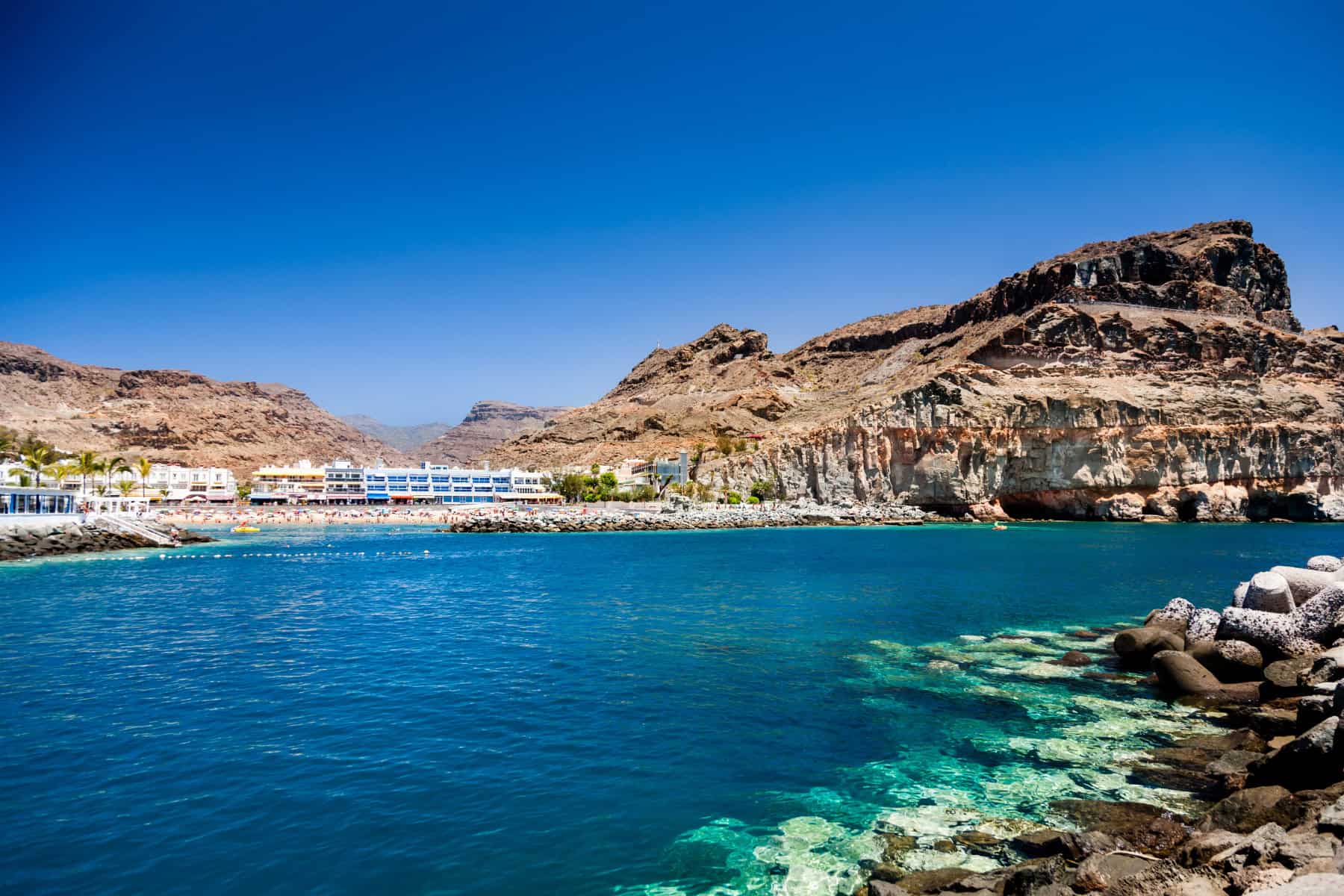
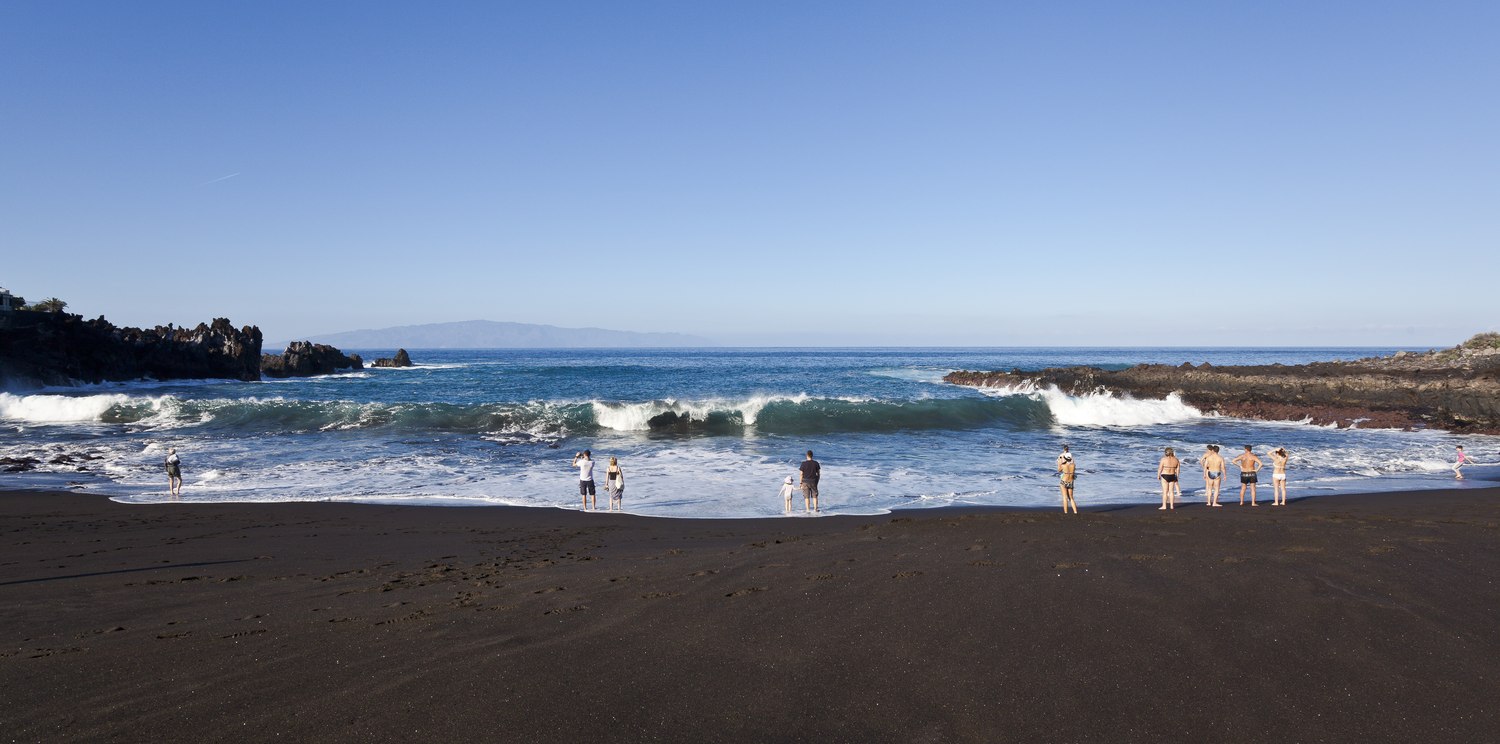
The Canary Islands are a great choice for escaping the cold weather. Tenerife, Gran Canaria, Lanzarote, and Fuerteventura offer pleasant temperatures around 20–25 °C, which is great for beach walks, hiking in volcanic landscapes, and enjoying the local culture. The Canaries are also great for water lovers, thanks to their crystal-clear sea and diverse underwater life.
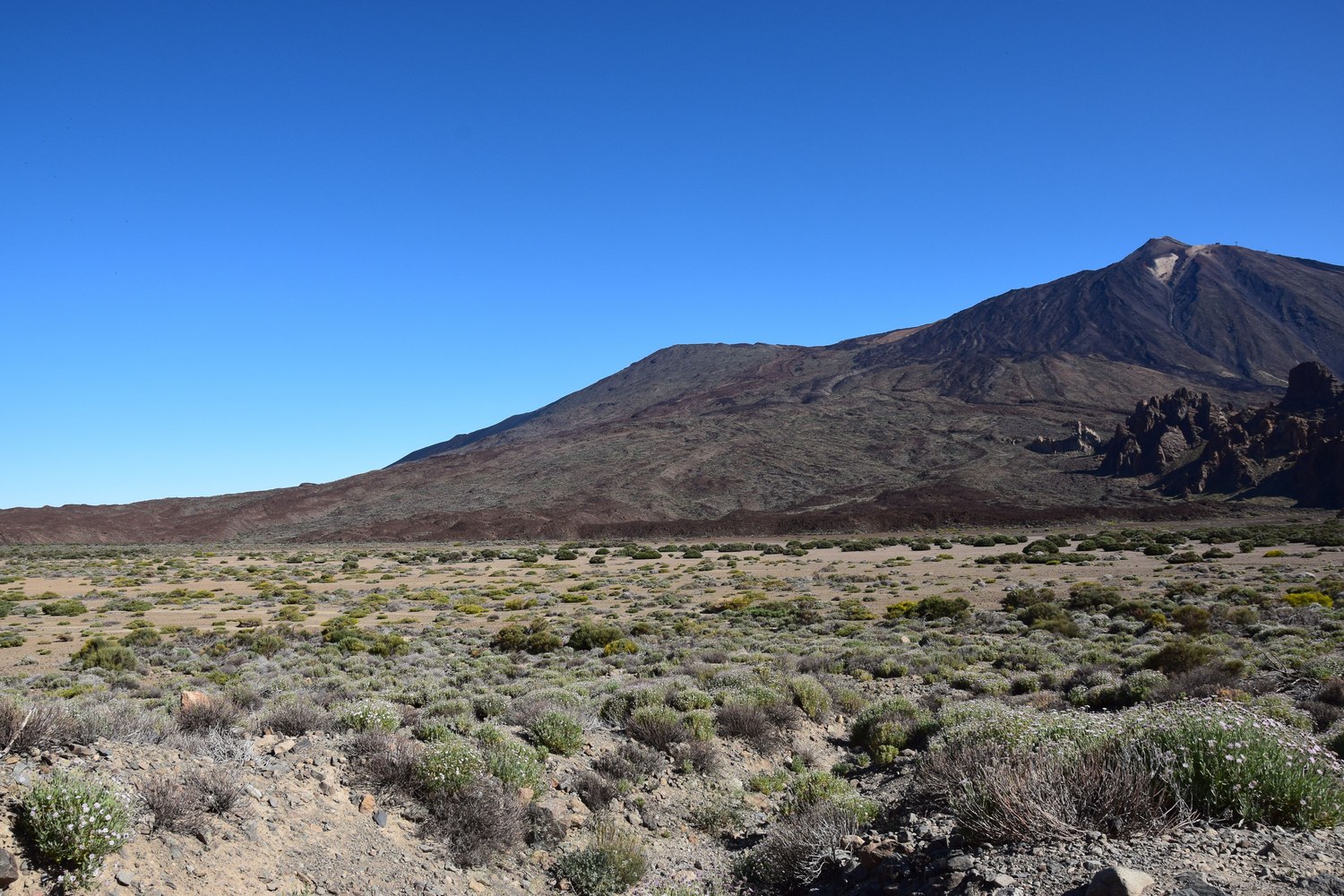
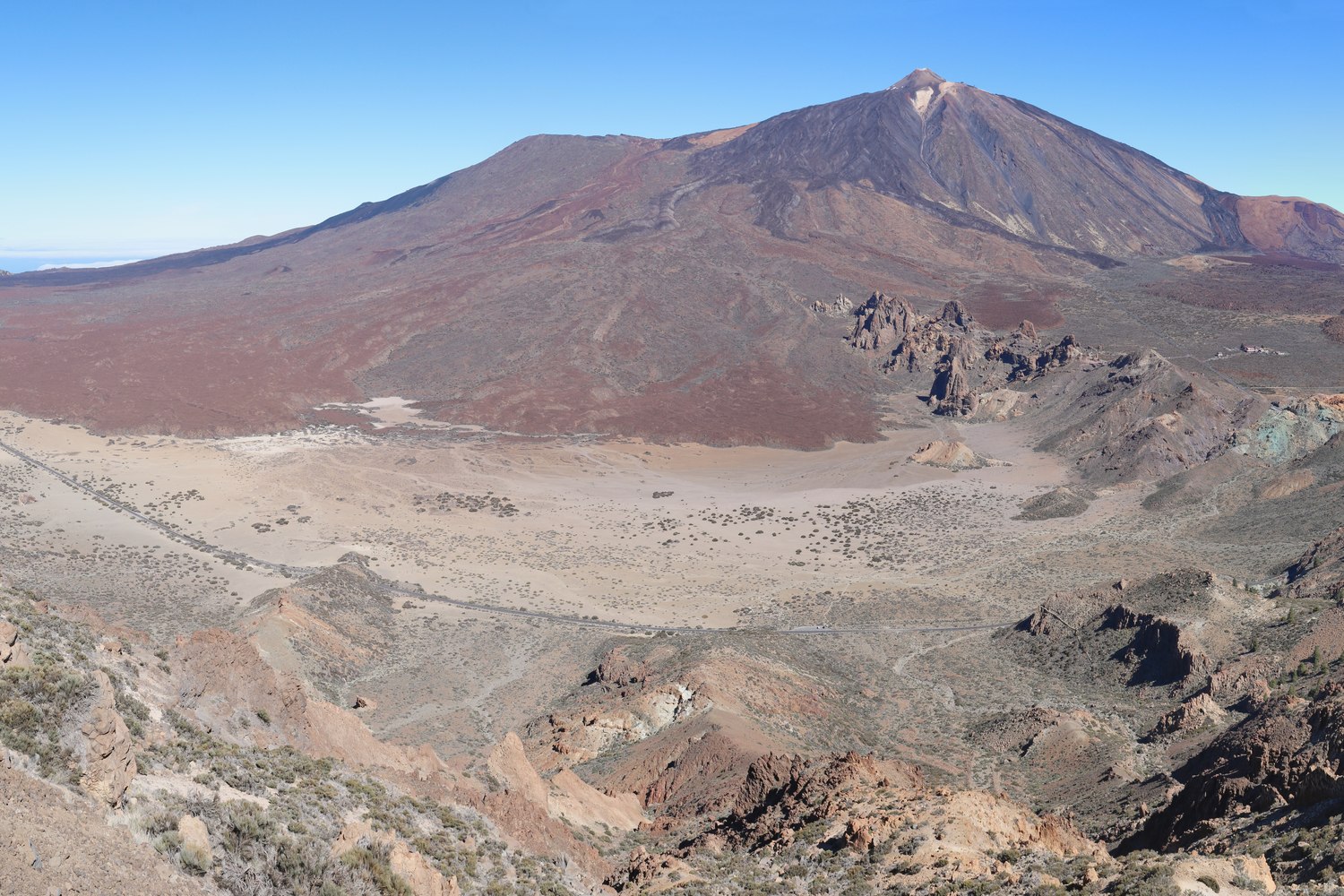
In the Canaries, I recommend visiting the volcanoes on Tenerife, where you can hike Pico del Teide, or take a walk through the protected nature reserve of La Palma. Water sports enthusiasts will 100% enjoy kitesurfing and windsurfing in Fuerteventura and Lanzarote.
You’ll experience absolute luxury at the Secrets Bahía Real Resort & Spa Adults only, but if you’re planning a holiday with the whole family, then check out Sol Fuerteventura Jandia – All Suites.
Canary Islands
Egypt
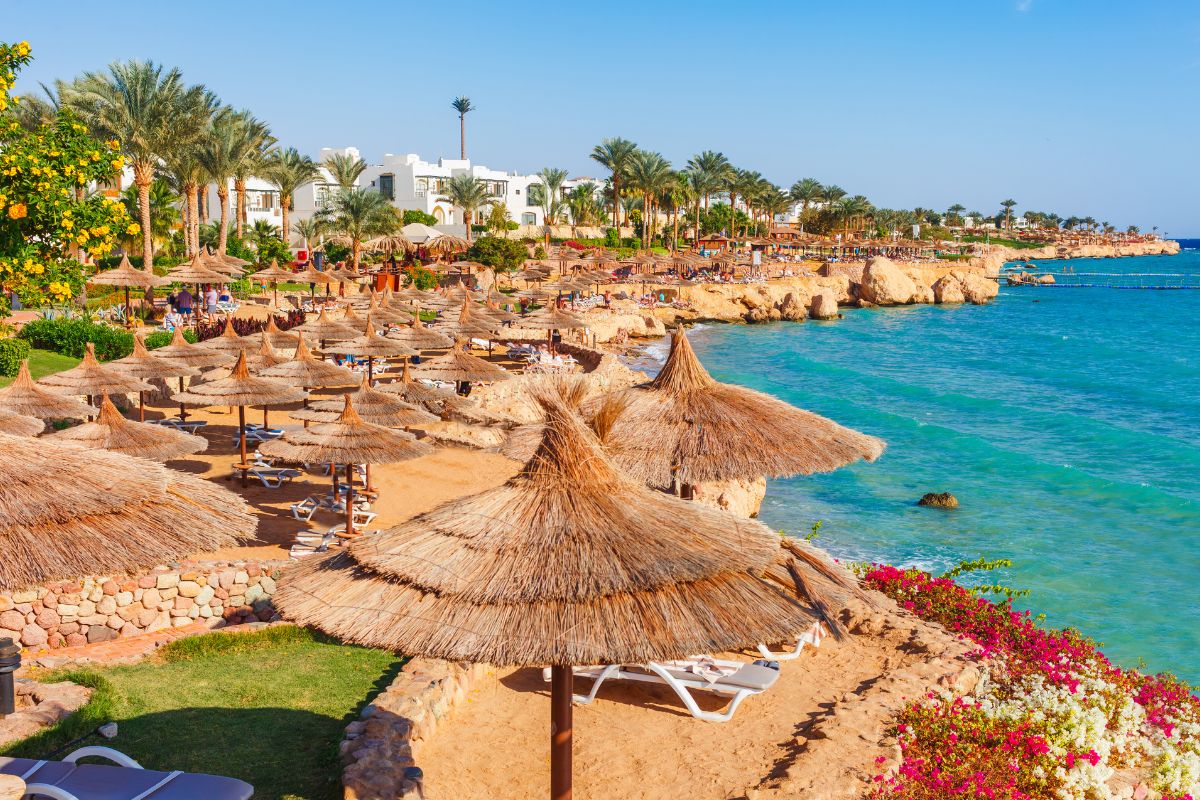
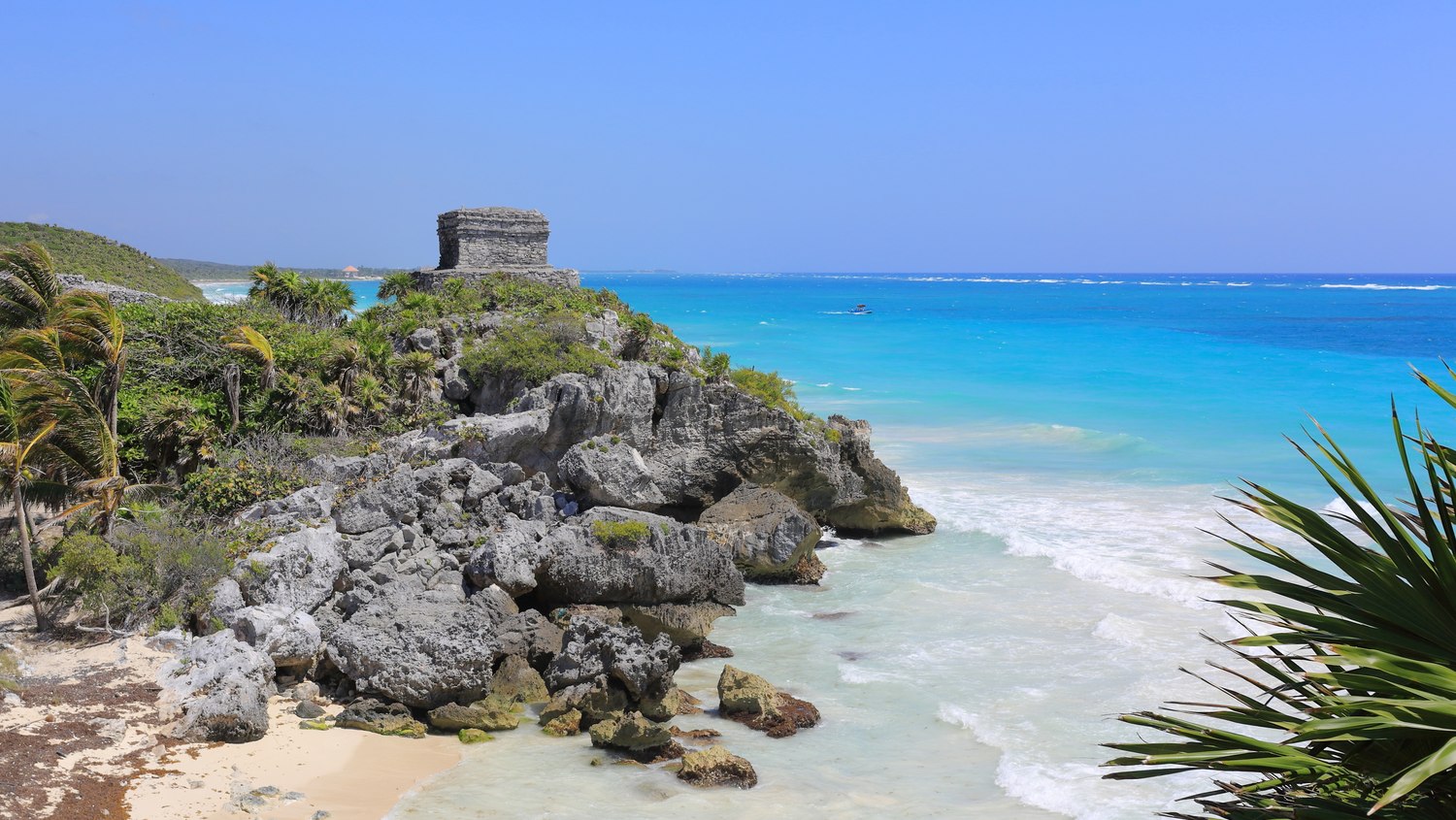
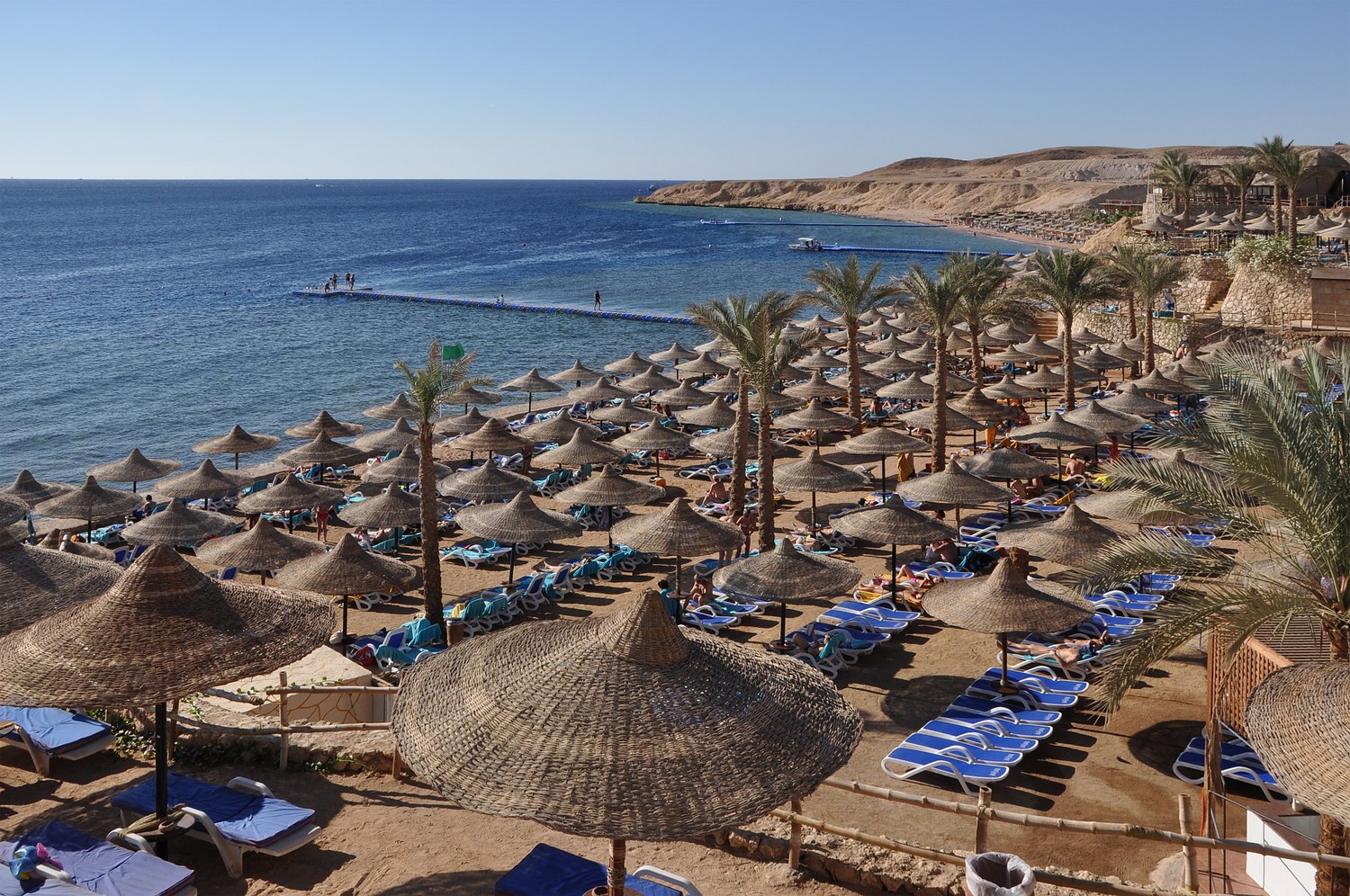
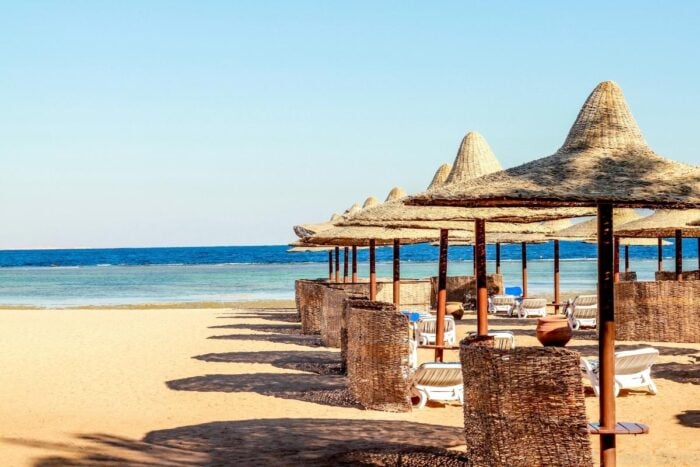
Egypt is already a classic for winter holidays. It has direct access to the sea and plenty of sun. Areas like Hurghada, Marsa Alam, and Sharm El Sheikh have temperatures around 22–26 °C in January, which is ideal for lounging on the beach or exploring ancient monuments.
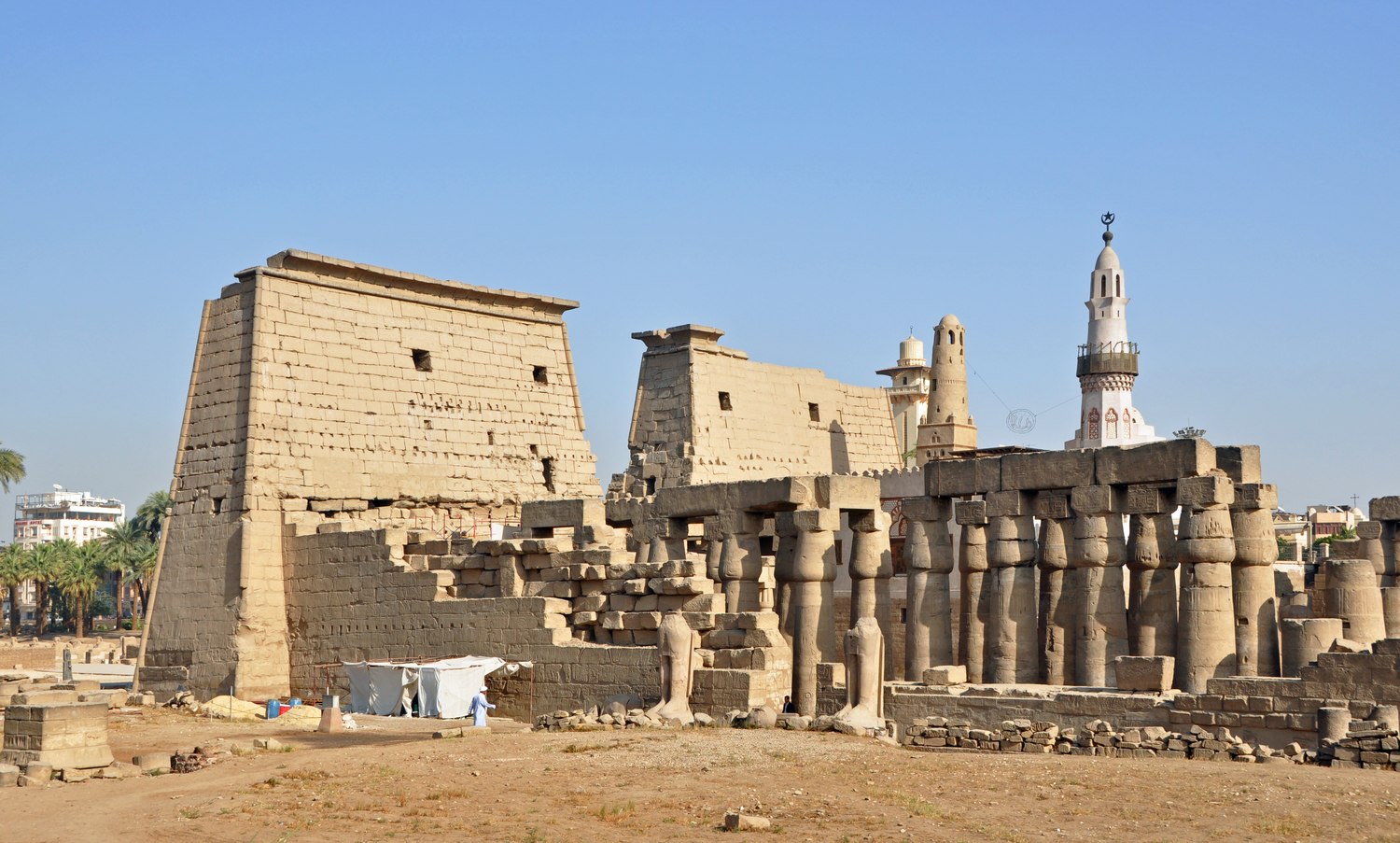
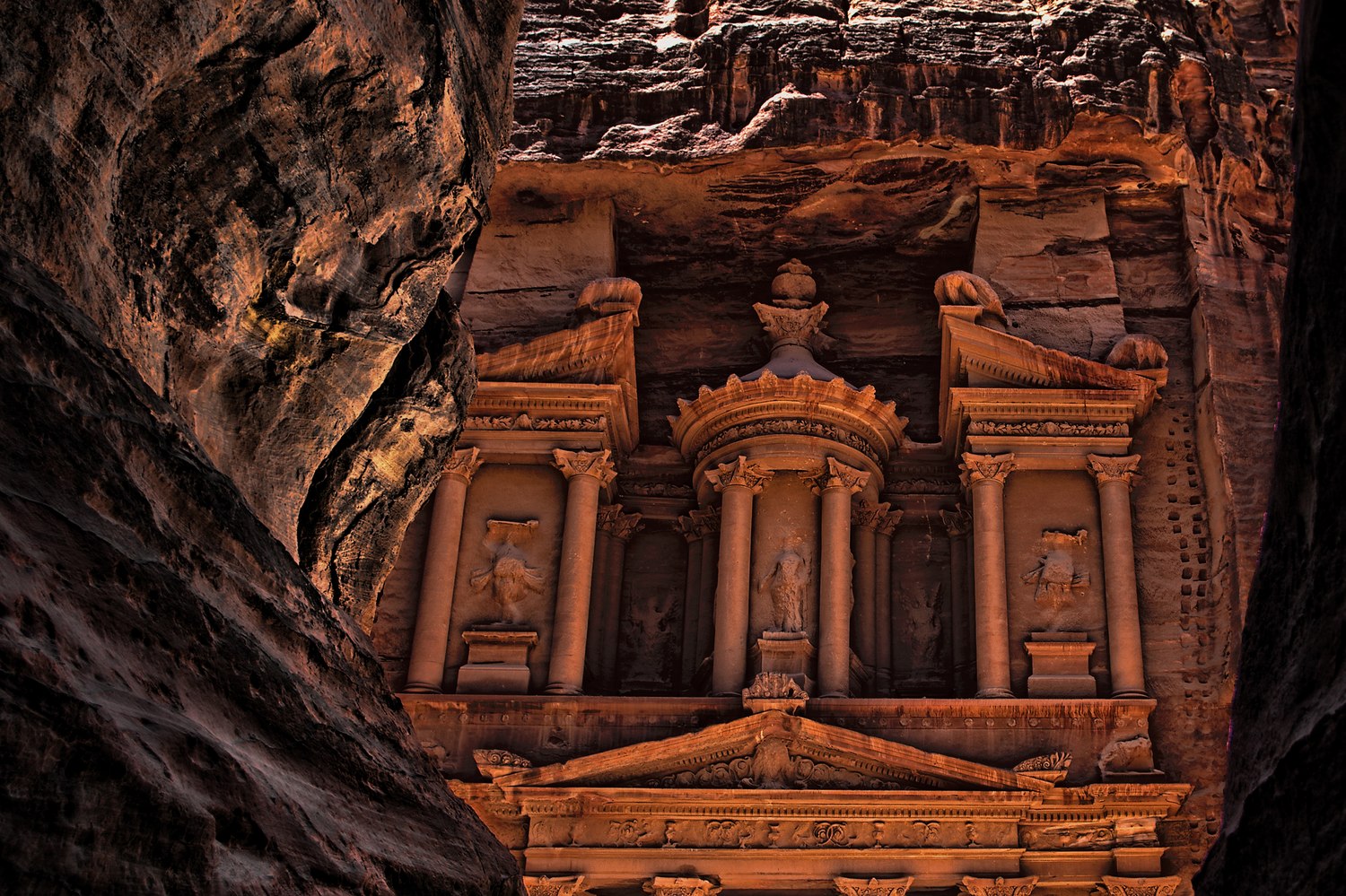
Egypt offers not only beautiful beaches but also many historical sites. I recommend visiting the pyramids in Giza, the temple in Luxor, or the ancient temple in Karnak. For diving enthusiasts, the Red Sea area, such as Hurghada or Sharm El Sheikh, is ideal, where you can enjoy crystal-clear water and diverse underwater life.
January Holiday in Egypt: Best Hotel Resorts
Egypt has an abundance of hotel resorts, and it’s almost impossible to go wrong.
Hilton Alexandria King’s Ranch Hotel,
Tree Lounge Pyramids View INN,
Retac Qunay Dahab Resort & SPA.
Egypt
Thailand
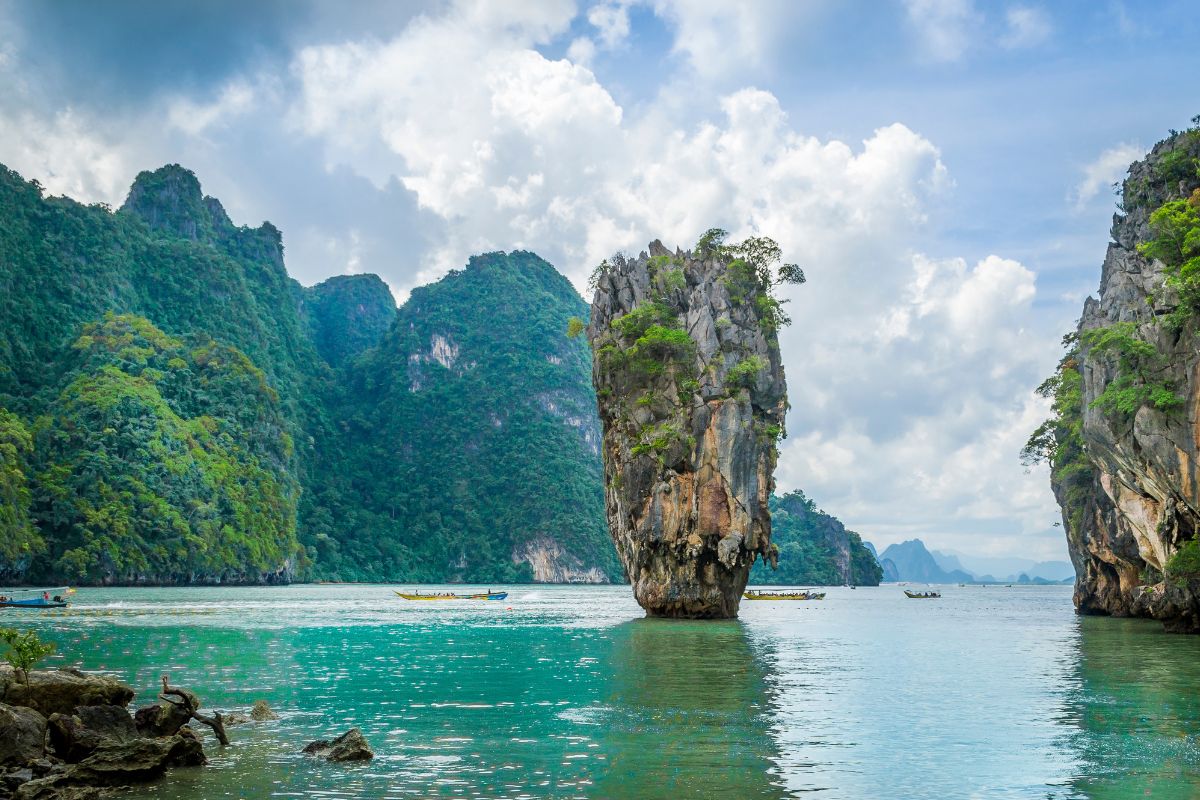
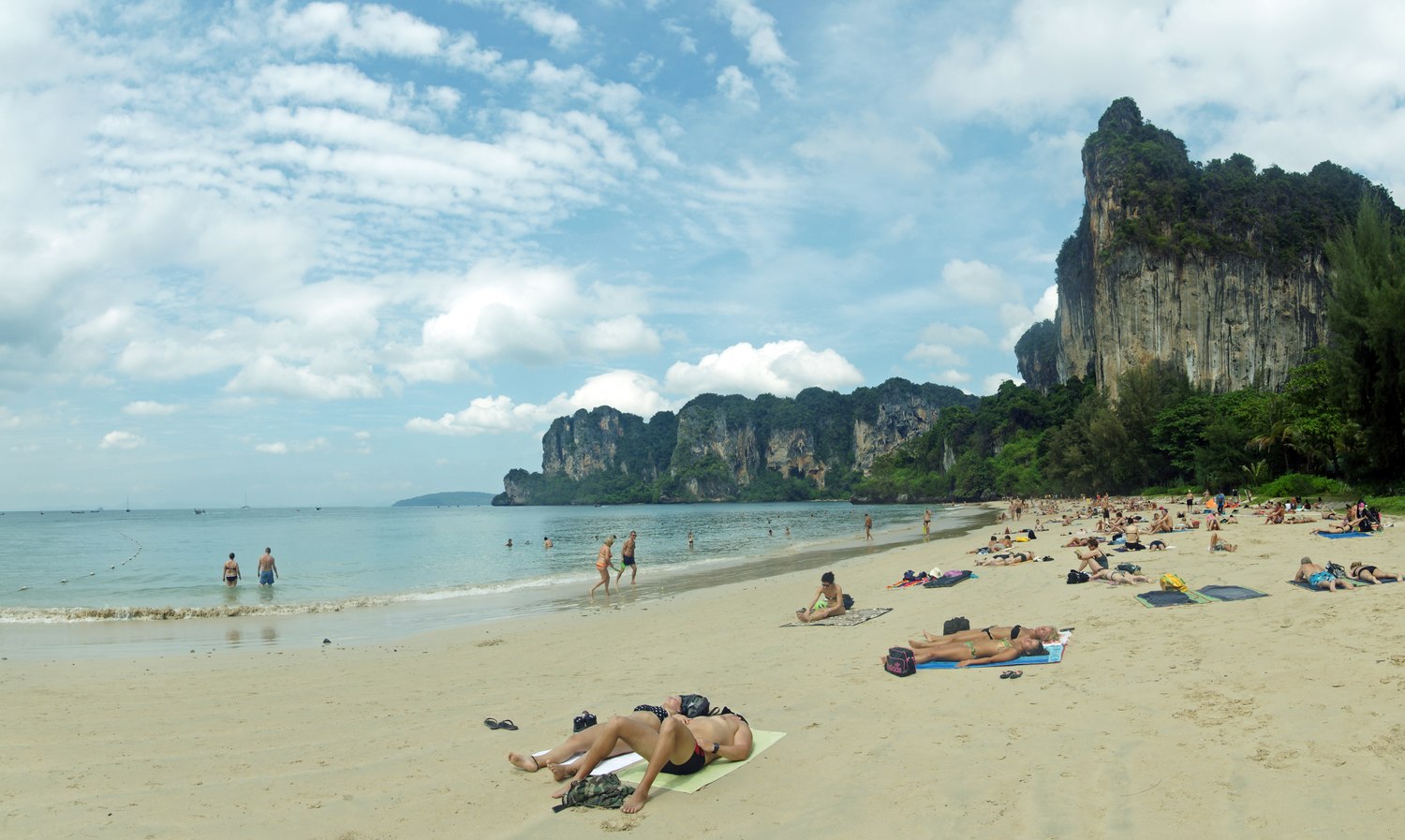
Thailand is great in January for all lovers of tropical weather. Temperatures range around 28–32 °C, and popular destinations like Phuket, Koh Samui, or Krabi offer beautiful beaches, diverse cuisine, and plenty of activities, from cave trekking to night markets. The sea has a pleasant temperature of around 27 °C.
Planning a winter holiday in Koh Samui? We’ve selected the most interesting hotels worth visiting in January for you:
Sasitara Thai Villas – If traditional Thai architecture appeals to you, these villas are perfect for you. Built from authentic Thai teak wood in Ayudhya style, you’ll find them just a short walk from Choeng Mon Beach.
The Spot – An ideal choice for golf and beach lovers. This hotel is located near the most beautiful places on the island, such as Chaweng and Lamai beaches.
Amaya Resort – For those who want the beach within reach, this resort offers a convenient location. Lamai Beach is just an 18-minute walk from here.
Aforetime Beach House – Want to save money and experience the charm of Thai tradition at the same time? This 63-year-old wooden house directly on Taling Ngam Beach is a great choice for an authentic experience at an affordable price.
Thailand
Dominican Republic
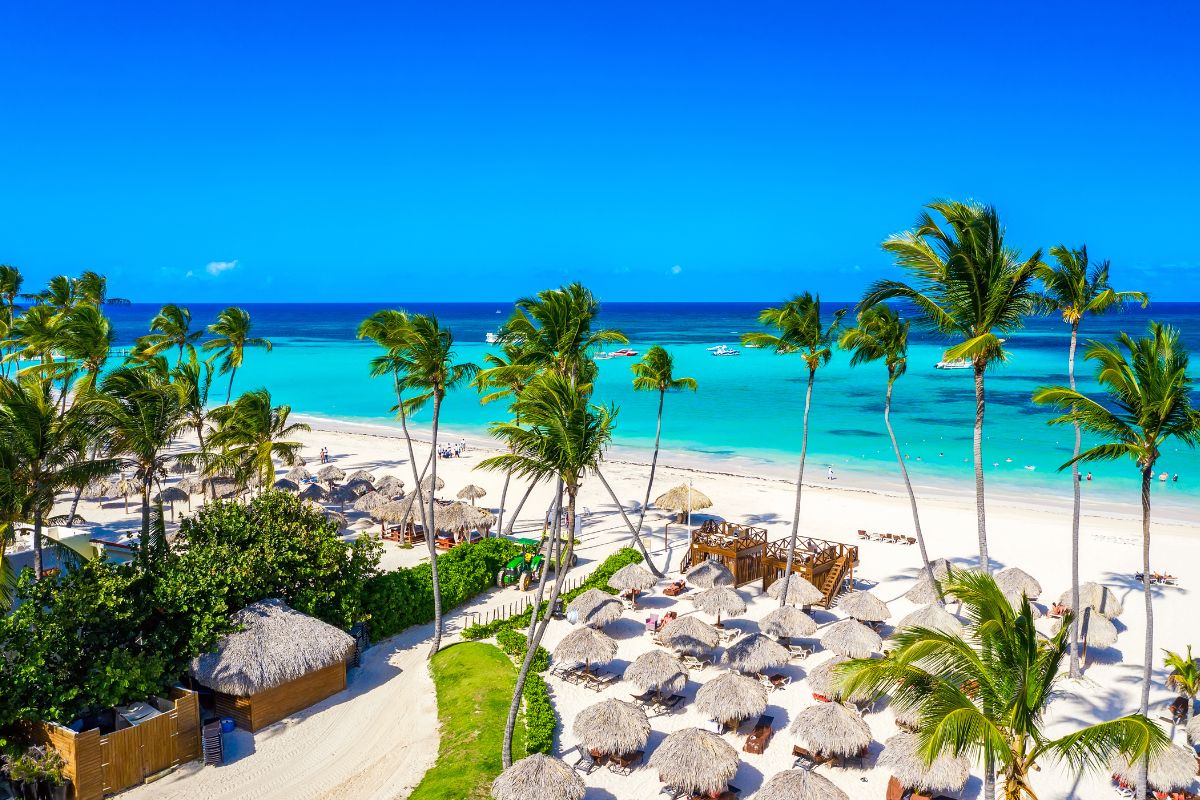
The Dominican Republic is a paradise for those who long for sandy beaches and sunshine. In January, temperatures here range around 27–30 °C. Punta Cana is known for its luxury resorts, white-sand beaches, and water sports opportunities, while the Samaná area is ideal for nature and waterfall lovers. The Dominican Republic is also known for its rich culture and friendly inhabitants.
I recommend visiting Los Haitises National Park with its rainforests, caves, and lagoons, or enjoying an adrenaline-pumping experience with ziplining or ATV riding. By the sea, you can go snorkeling, diving, or fishing.
Holiday in the Dominican Republic: Tips for the Best Hotels
Renaissance Santo Domingo Jaragua Hotel & Casino,
Wyndham Alltra Samana All Inclusive Resort,
Hacienda Samana Bay Hotel.
Dominican Republic
Australia
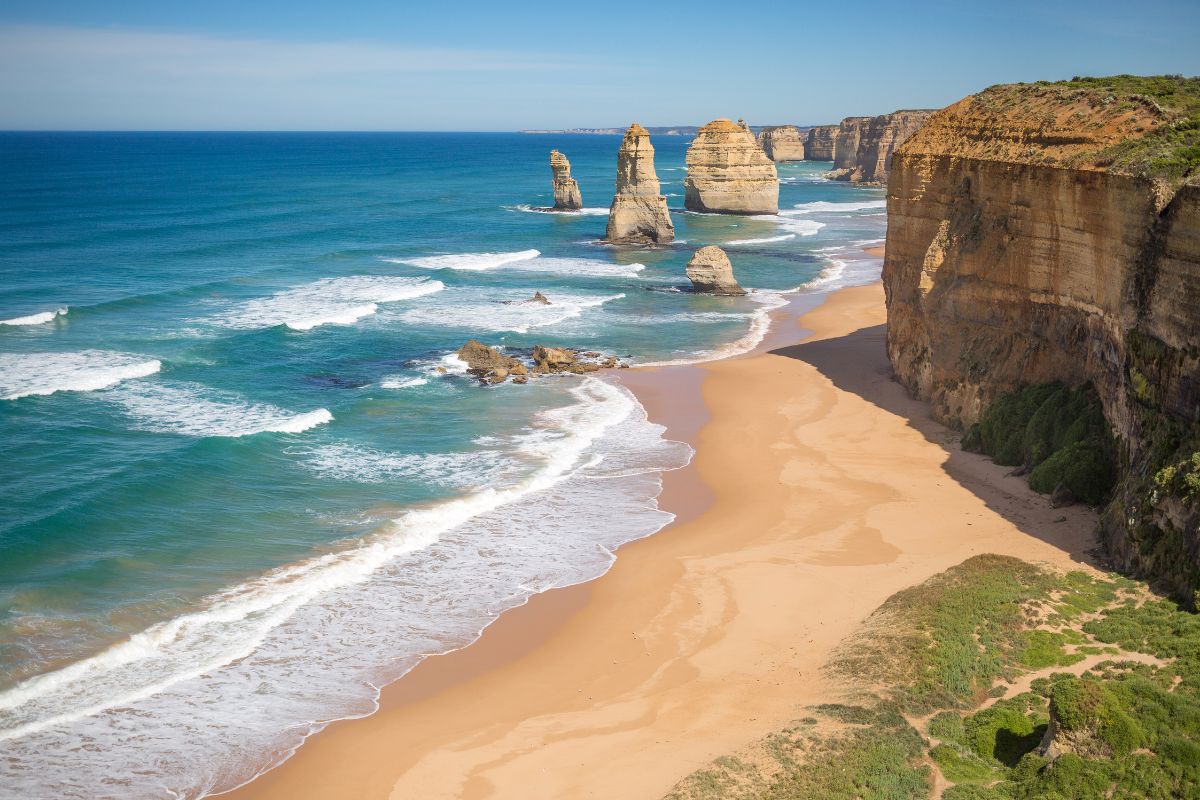
If you’re looking for warmth on the other side of the world, Australia is an ideal choice for a January holiday. In January, Australia is in full summer, and temperatures range between 25–30 °C. You can visit the beaches on the Gold Coast, surf at Bondi Beach in Sydney, or go on a nature trip, such as to the Great Barrier Reef or Kakadu National Park.
Australia is a country where you can experience a lot. In Sydney, visit the famous Opera House, or head to the Blue Mountains National Park. The Great Barrier Reef is a place where you can enjoy snorkeling and diving, and in the south, you can go on a safari and admire wild animals in their natural habitat.
Where to Stay in Australia?
In Sydney, you’ll find luxury hotels, such as the iconic Park Hyatt Sydney with Opera House views, or more affordable options, such as modern boutique hotels and hostels in the Bondi Beach area. If you plan to visit the Great Barrier Reef, consider staying in Port Douglas or on the Whitsundays islands, where you can enjoy beachfront bungalows.
Tips for other hotels:
Absolute Beachfront Central Surfers Paradise,
Seacrest Beachfront Apartments Surfers Paradise.
Australia
Seychelles
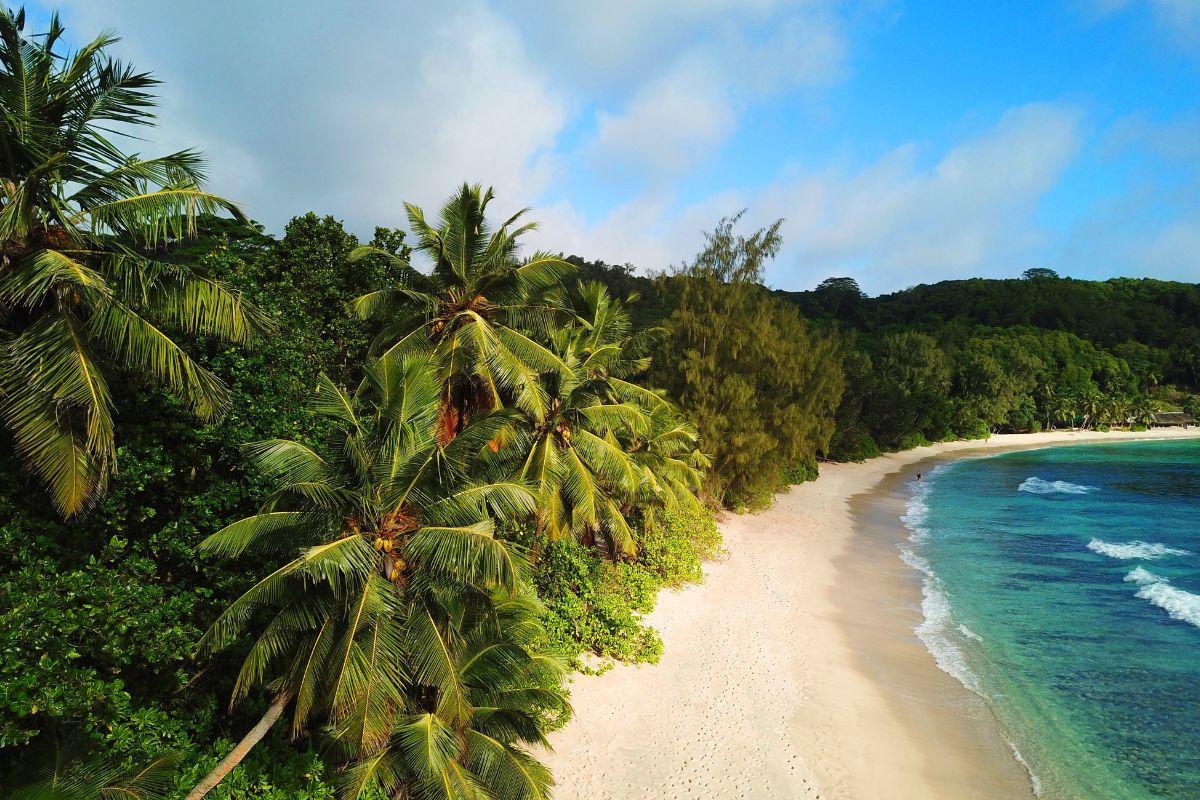
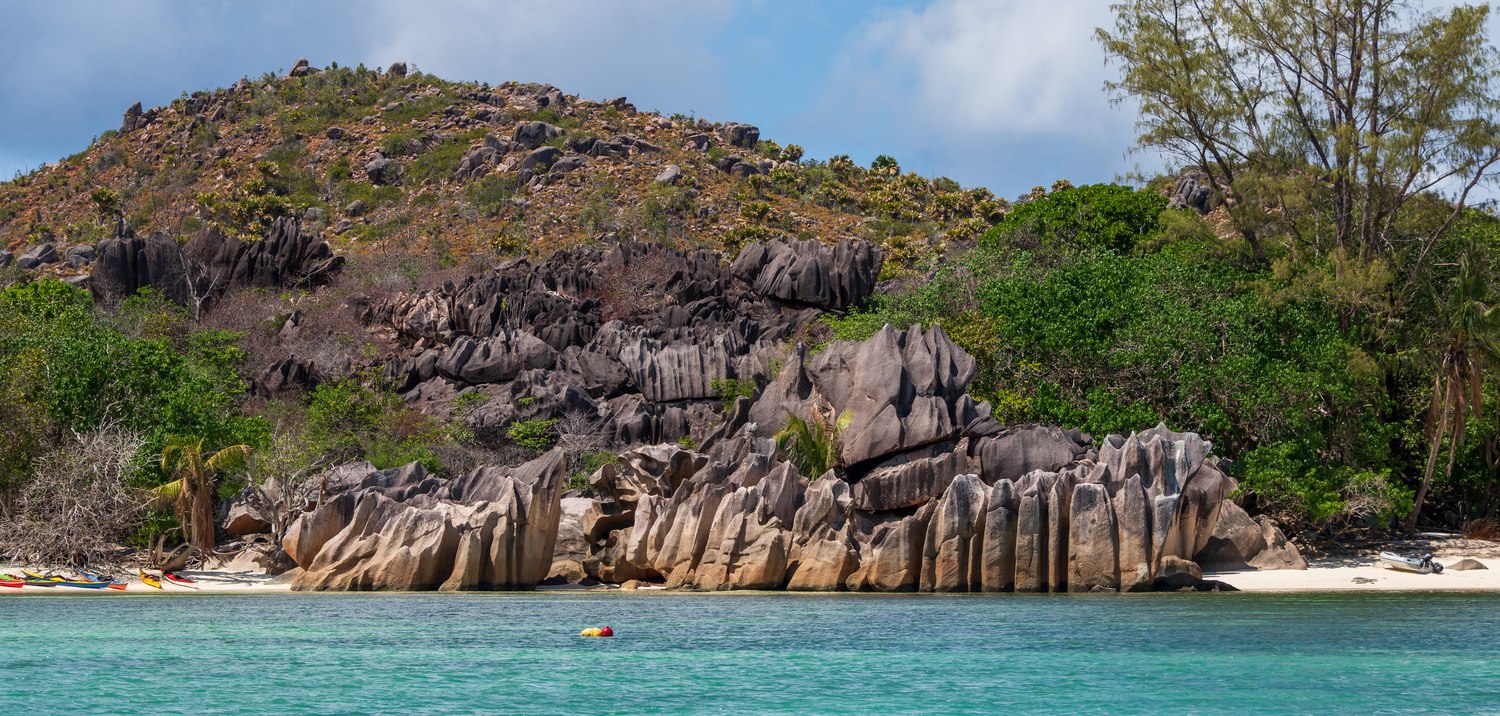
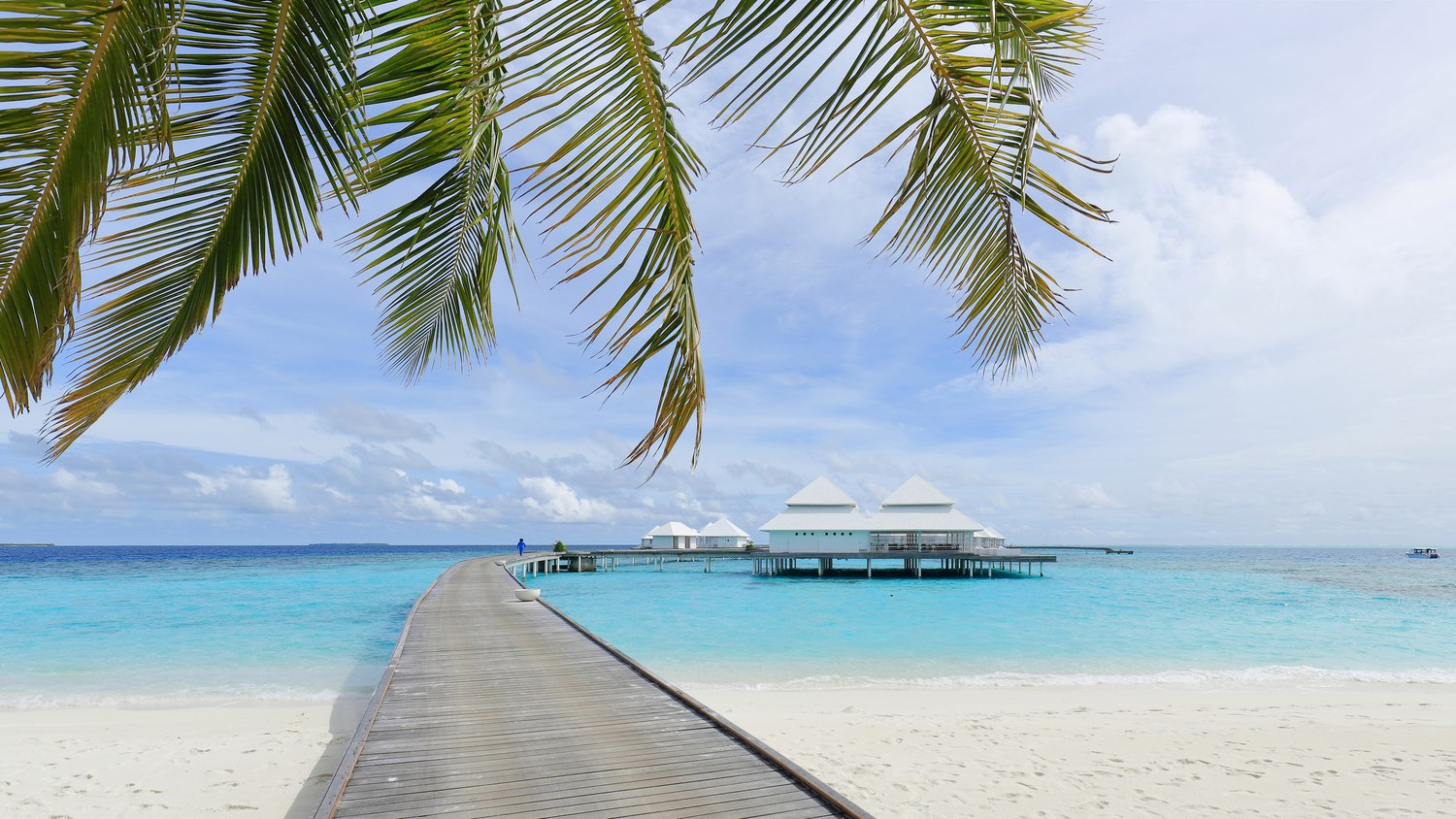
Seychelles is a tropical paradise with beautiful beaches, white sand, and turquoise water. In January, temperatures here range around 27–30 °C, which is absolutely perfect.
Seychelles is also synonymous with paradise beaches, but besides lounging on the beach, you can also enjoy a range of great activities. I recommend visiting nature reserves, such as Vallée de Mai, where you can see endemic plant and animal species. On La Digue island, you can enjoy bike rides or snorkeling in crystal-clear waters.
Seychelles: Tips for the Best Hotels
Valmer Resort and Spa,
Paradise Sun Hotel Seychelles,
Oasis Hotel Restaurant & Spa.
Seychelles
Oman
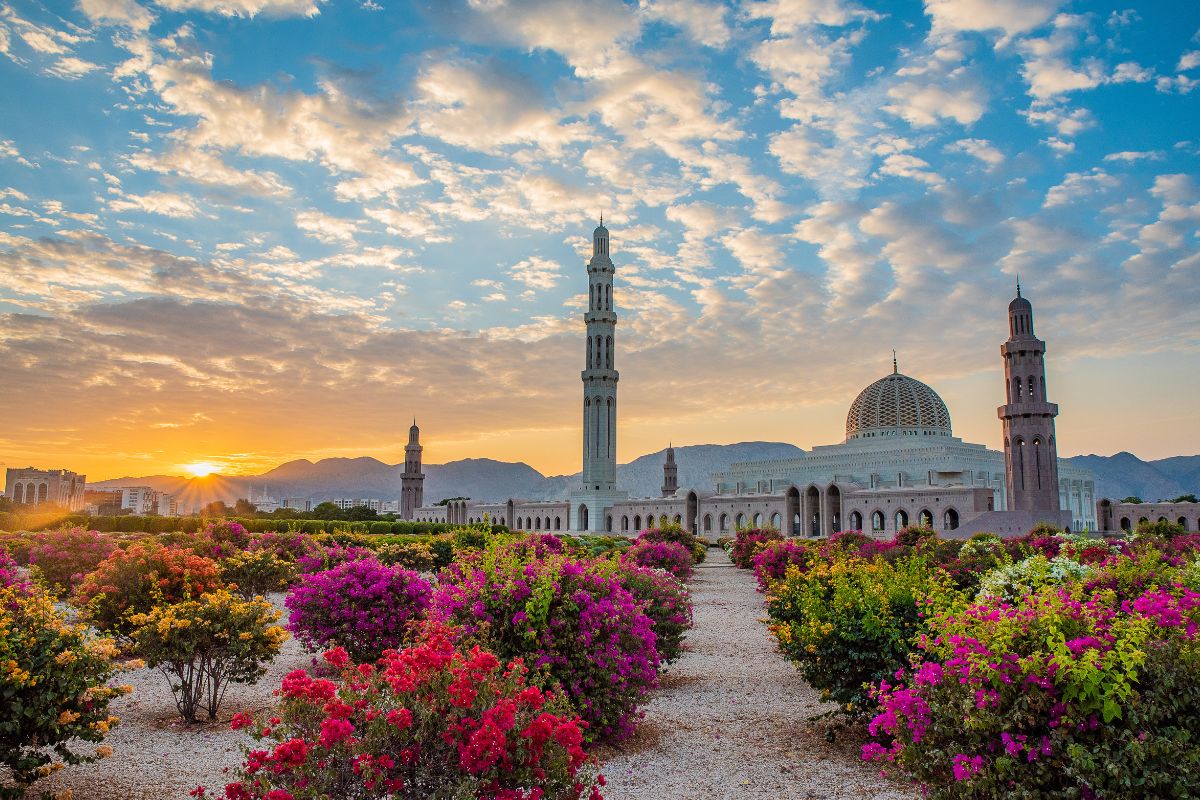
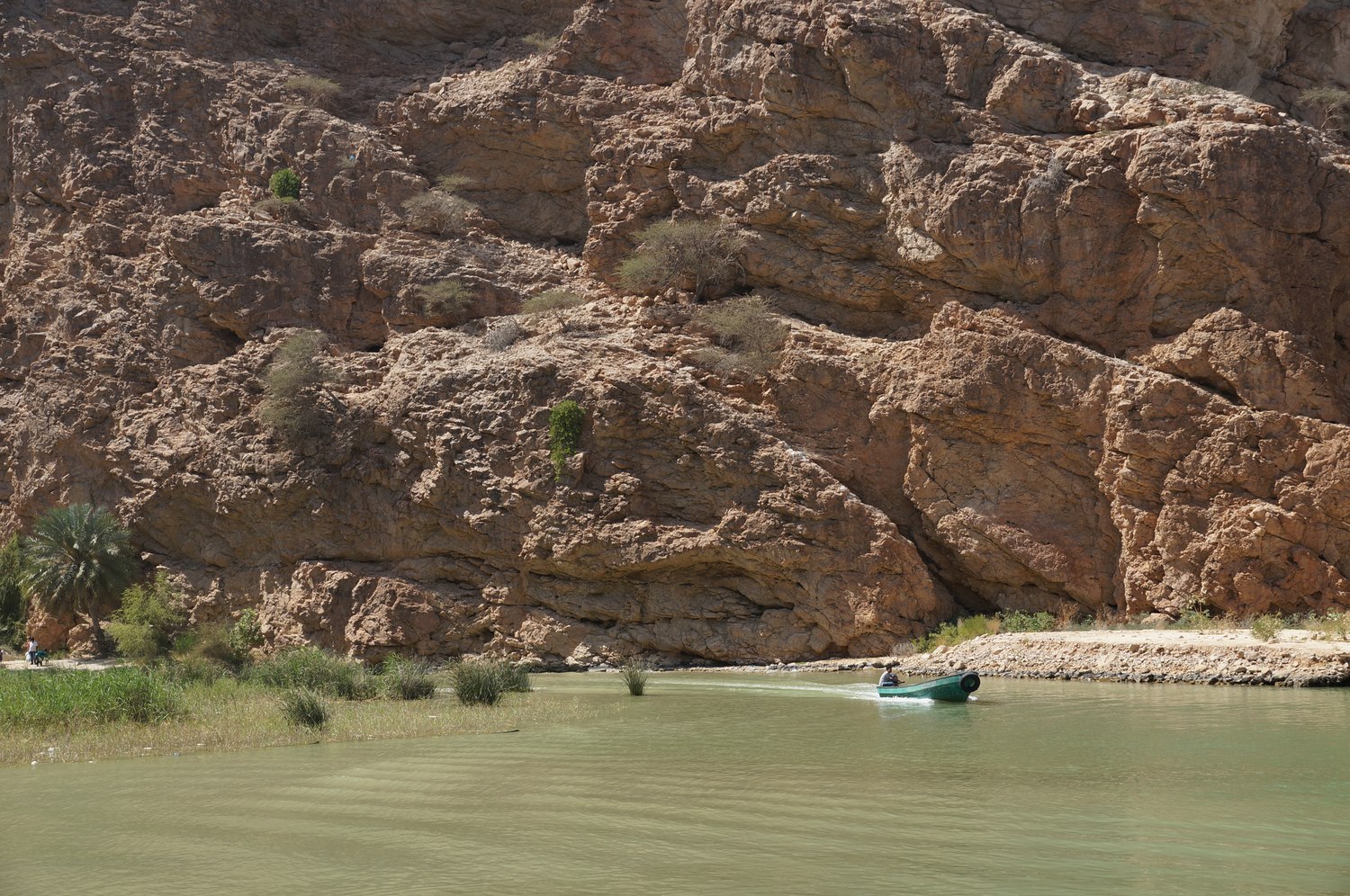
Oman is a great destination for those looking for a slightly different holiday experience. Temperatures in January here range around 25–28 °C, which is ideal for relaxing on the beaches, as well as exploring Arab culture and history. You can visit the capital city Muscat, beautiful deserts, ancient forts, or canyons.
If you love nature, you can head to the Wahiba Sands desert for a safari or enjoy hiking in the Hajar Mountains.
Exotic Holiday in Oman: Tips for the Best Resorts
Grand Millennium Muscat,
Al Bustan Palace,
Naseem Resort,
Crowne Plaza Muscat.
Oman
Vietnam
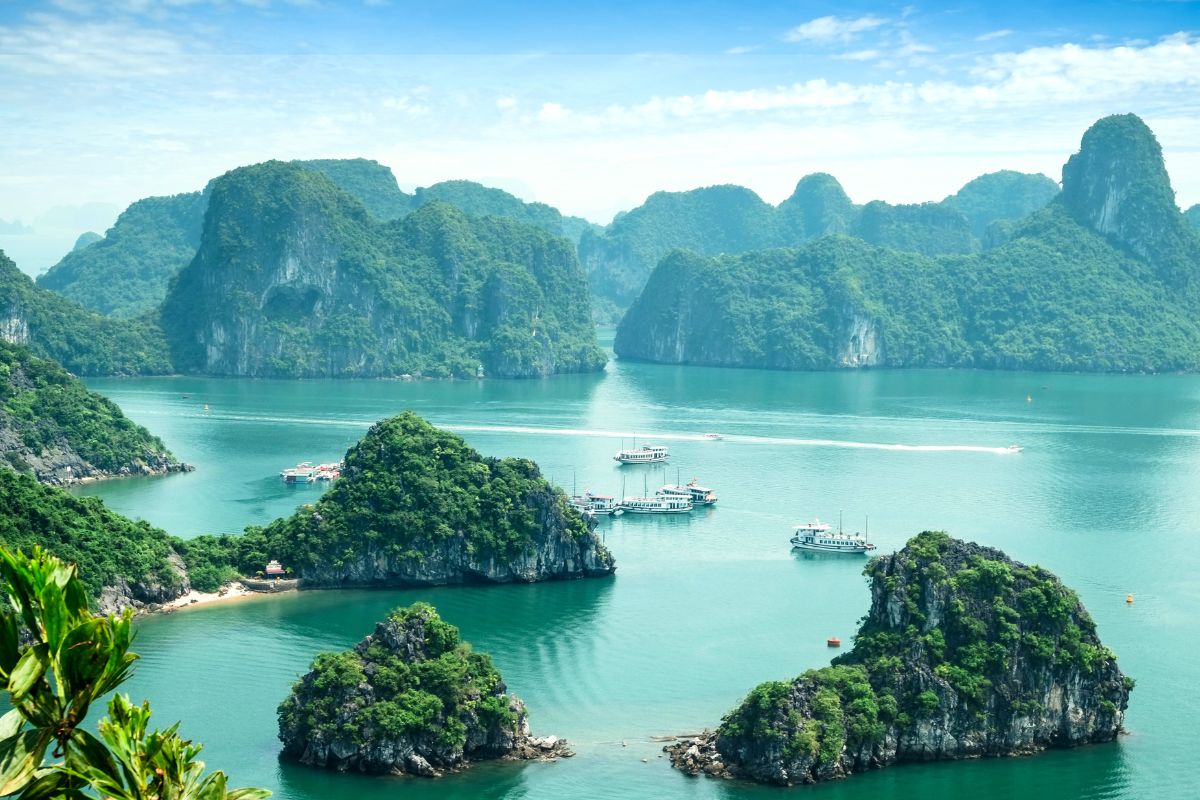
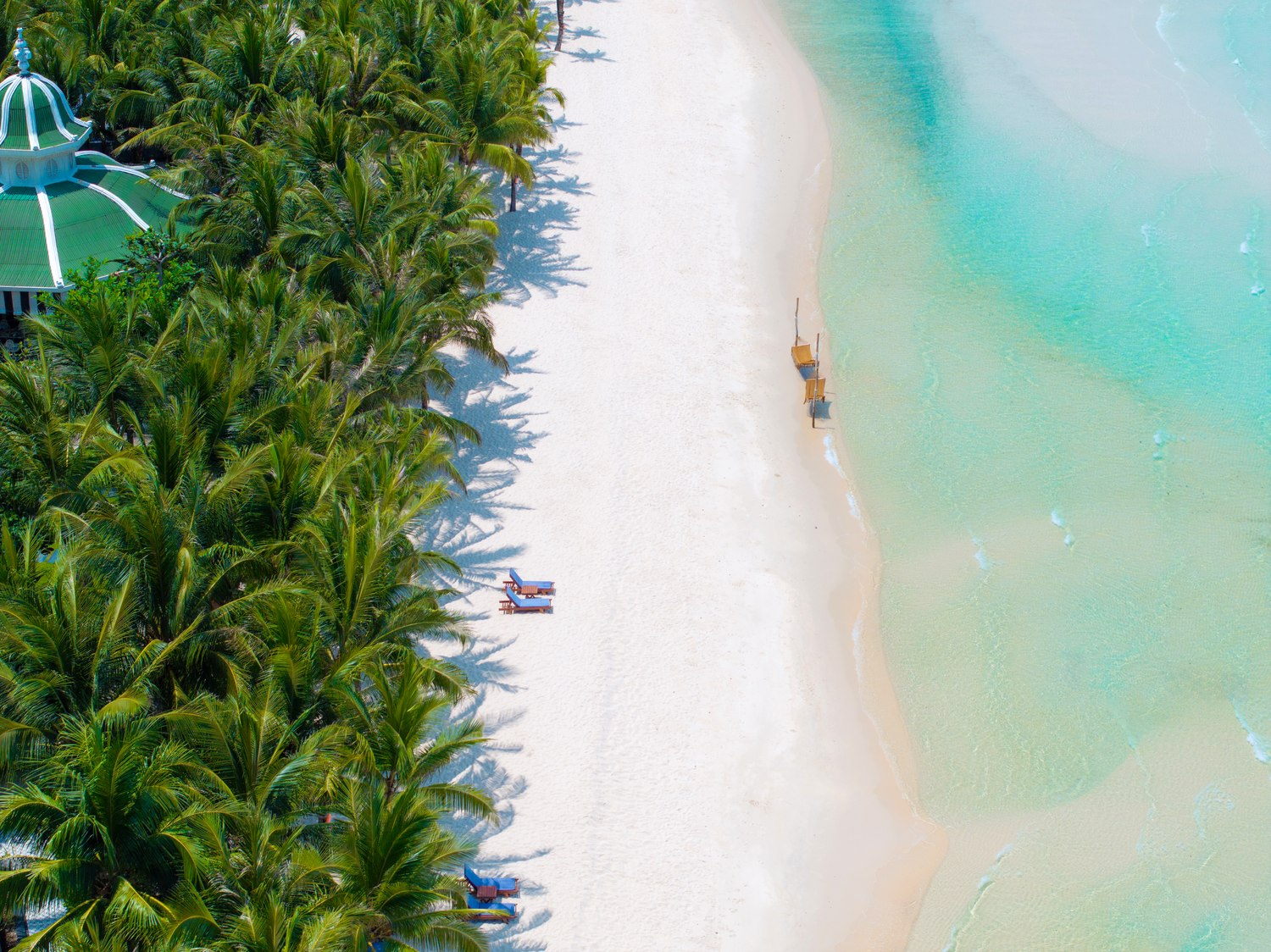
Vietnam is a great choice in January for all lovers of exotic destinations. Temperatures in the southern part of the country, in the Ho Chi Minh City area or on Phu Quoc island, reach 28–30 °C. You can look forward to beautiful beaches, snorkeling, diving, as well as exploring local culture and sights, such as My Son temple or the mud statues in My Tho.
Accommodation Tips in Vietnam
If you’re heading to Hanoi, I recommend staying in the historic Old Quarter, where you’ll find stylish boutique hotels like Sofitel Legend Metropole. In Ho Chi Minh City (Saigon), it’s worth looking for accommodation in the city center, for example, at the luxurious Hotel des Arts Saigon or in modern apartments.
For beach lovers, resorts on Phu Quoc island, such as Fusion Resort Phu Quoc, offering private villas, are ideal.
Vietnam
Philippines
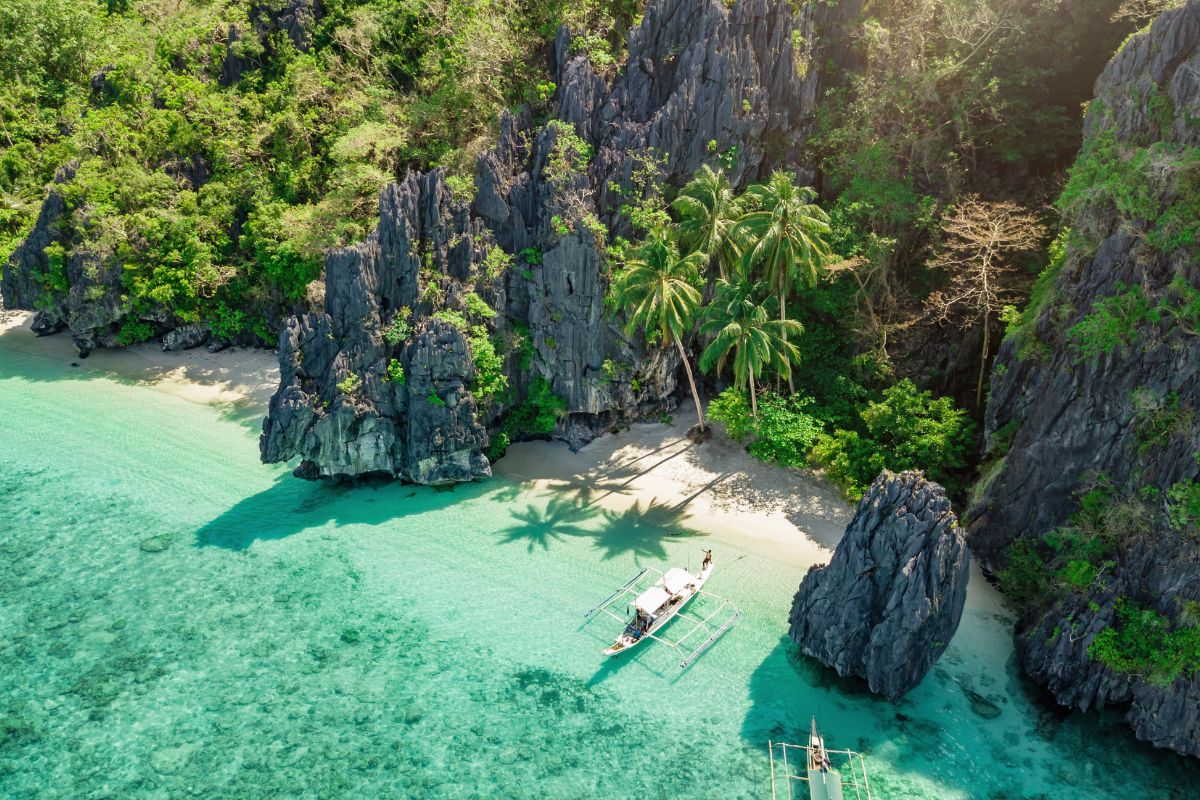
The Philippines is a fantastic destination for all those who long for a combination of beaches, nature, and culture. With over 7,000 islands, there’s an ideal place for everyone here. In January, the Philippines experiences its dry season, and temperatures range around 27–32 °C.
Among the most popular destinations are Palawan, Boracay, and Cebu. Here you can enjoy beautiful beaches, snorkeling, diving, or simply relax in a tropical paradise.
January Holiday in the Philippines: Tips for the Best Hotels
Dusit Thani Lubi Plantation Resort,
Bakawan Hideaway Resort and Restaurant,
Epic Suites Bohol.
Philippines
South Africa
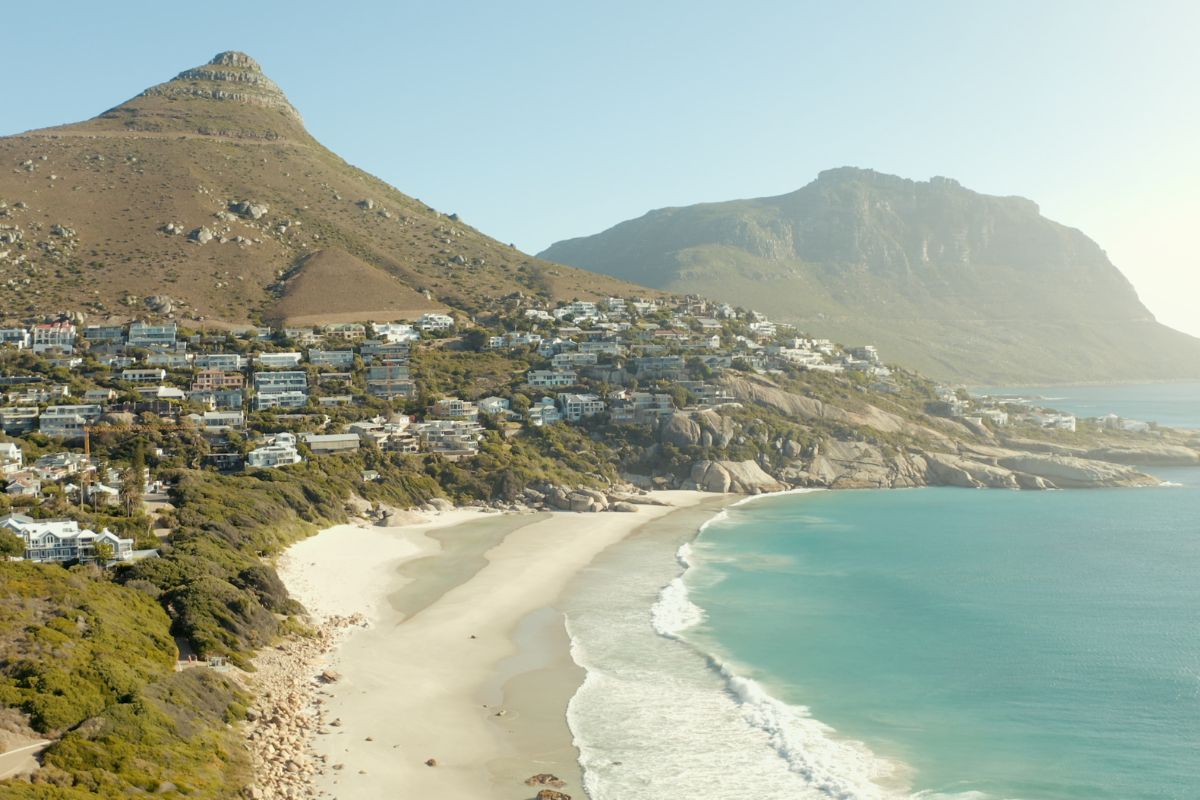
If you’re looking for not only sun but also safari and wild nature, South Africa is the right choice for a January holiday. January in South Africa means summer, and temperatures here range around 25–30 °C. The sea is cooler, with a temperature around 20–22 °C. You can enjoy the beaches in Cape Town, wildlife viewing in Kruger National Park, or take a trip to Table Mountain with breathtaking views of the surrounding landscape.
For nature lovers, a walk in national parks like Tsitsikamma or Addo Elephant Park is ideal, where you can see elephants and other animals in their natural habitat.
South Africa: Hotel Tips
Elephants Safari Lodge,
Nandoni Waterfront Resort,
AmmaZulu African Palace.
South Africa
Lukáš and Lucie recommend
Where to stay in warm destinations in January
6 accommodations — wellness hotels, resorts and other accommodation options
In January, it’s ideal to head to places like the Canary Islands, Thailand, Seychelles or the Dominican Republic. All these destinations offer pleasant temperatures and beautiful beaches.
Which destination is best for a seaside holiday in January?
If you want to relax by the sea, ideal destinations include Egypt, Thailand, the Philippines, or Australia, where you’ll find warm sea and sunny weather.
What is the best destination for a family holiday in January?
For a family holiday, Thailand is a great choice, where you can enjoy beaches, water activities, and exploring local culture, or the Canary Islands with a wide range of activities for all ages.
Where to go for an exotic holiday in January?
Exotic destinations like Seychelles, Oman, or the Philippines are great for those who want to escape winter and enjoy tropical weather, beautiful beaches, and local culture.
What are the temperatures in the Canary Islands in January?
In the Canary Islands, temperatures in January range around 20–25 °C, which is ideal for beach walks and nature hikes.
Tips and Tricks for Your Vacation
Don’t Overpay for Flights
Search for flights on Kayak. It’s our favorite search engine because it scans the websites of all airlines and always finds the cheapest connection.
Book Your Accommodation Smartly
The best experiences we’ve had when looking for accommodation (from Alaska to Morocco) are with Booking.com, where hotels, apartments, and entire houses are usually the cheapest and most widely available.
Don’t Forget Travel Insurance
Good travel insurance will protect you against illness, accidents, theft, or flight cancellations. We’ve had a few hospital visits abroad, so we know how important it is to have proper insurance arranged.
Where we insure ourselves: SafetyWing (best for everyone) and TrueTraveller (for extra-long trips).
Why don’t we recommend any Czech insurance company? Because they have too many restrictions. They set limits on the number of days abroad, travel insurance via a credit card often requires you to pay medical expenses only with that card, and they frequently limit the number of returns to the Czech Republic.
Find the Best Experiences
Get Your Guide is a huge online marketplace where you can book guided walks, trips, skip-the-line tickets, tours, and much more. We always find some extra fun there!
TL;DRA cheap ski holiday comes down to timing: skip Christmas, New Year and half-term, and go for January after New Year or late March instead, when first-minute discounts hit as much as 30%. The best-value spots include the French Alps (Les Sybelles, Chamrousse), Italy’s Trentino and Livigno, and smaller Austrian resorts outside Tyrol. It’s also worth booking an apartment with a kitchen instead of a hotel, buying lift passes online in advance, and travelling in a bigger group to cut transport costs per person. According to the FAQ, a week away for a family of four with smart planning comes to roughly 25,000–40,000 CZK.
Skiing is often seen as an expensive hobby that only some people can afford. In reality, though, it all comes down to planning. If you know when to book, where to go, and where to cut costs, you can enjoy a fantastic winter getaway at a surprisingly reasonable price. A cheap ski holiday doesn’t have to mean compromising on quality — quite the opposite. Many European resorts now offer great-value packages, affordable apartments, and lift passes at prices that are more accessible than ever.
In this article, you’ll find practical tips on how to save on accommodation, transport, lift passes, and food. We’ll also look at destinations where you can ski well without breaking the bank, and advise on when to snap up early-bird deals versus waiting for last-minute bargains. For inspiration on winter breaks and current offers, check out SnowTrex.
Avoid peak season and travel outside school half-term holidays.
Book early-bird deals well in advance or take advantage of last-minute offers.
Choose a self-catering apartment instead of a hotel.
Buy lift passes online in advance.
Travel with more people and split the transport costs.
A cheap ski holiday starts with the right timing
The dates you choose have a massive impact on the overall cost of your ski holiday. Christmas, New Year’s Eve, and school half-term weeks are by far the most expensive, with accommodation and lift pass prices often inflated by tens of percent. On the other hand, January after the New Year rush or late March tend to be significantly cheaper — even though snow conditions can still be excellent.
Later in the season you’ll also benefit from fewer crowds on the slopes and shorter queues at the lifts. So if you’re not tied to school holidays, picking the right dates alone could save you a significant chunk of your budget.
Cheap ski holiday – tips
Early bird or last minute?
Both approaches have their merits. Early-bird bookings work best for families or larger groups who want a guaranteed date and quality accommodation. It’s not uncommon for pre-season discounts to reach up to 30%.
Last-minute deals, on the other hand, are perfect for flexible travellers who can head off at short notice. You can often find fantastic ski holiday packages at a fraction of the original price this way. Keep an eye on current ski holiday deals, for example on skiing breaks in France.
3 destinations for affordable skiing
French Alps
Ski holidays in Franceare among the best options for budget-friendly skiing. Large resorts like Les Sybelles or Chamrousse offer affordable slope-side apartments alongside hundreds of kilometres of runs. With easyJet and Ryanair flying from London to Geneva, Lyon, and Grenoble, the French Alps are easily accessible from the UK.
Italy
Areas like Trentino or Livigno are popular thanks to their excellent value for money. Skiers are drawn not only by superb food and sunny weather but also by lift passes that are often cheaper than in Austria. Browse some options at ski holidays in Italy.
Smaller resorts in Austria
Ski holidays in Austria don’t have to be expensive. Smaller resorts away from the most famous Tyrolean hotspots tend to be considerably more affordable. With flights from London to Innsbruck or Salzburg, or even a short transfer from Munich, getting there from the UK is straightforward.
Affordable skiing
Accommodation that won’t blow your budget
The type of accommodation you choose makes a huge difference. Hotels with half-board are convenient but often significantly pricier than self-catering apartments with a kitchenette. Being able to cook your own meals can easily save you hundreds of euros over a week.
Another smart strategy is staying in a neighbouring village with a regular ski bus service. Prices tend to be lower than right next to the lifts, yet the convenience remains much the same. You can find great deals on accommodation through platforms like Booking.com.
Buy lift passes smartly, not expensively
Lift passes are one of the biggest expenses on any ski holiday. The best value usually comes from buying online in advance — many resorts now use dynamic pricing, similar to airlines, so the earlier you purchase, the more you save.
It’s also worth looking into multi-day or regional passes, which let you ski across several resorts at a better rate than buying individual day passes.
Transport — the biggest savings come from planning
Getting to the mountains can make up a significant slice of your costs. The key difference often comes down to how many people are sharing the journey. If you’re flying, booking well ahead with budget airlines like easyJet or Ryanair from London, Manchester, or Edinburgh can keep costs low.
Alternatives include organised coach trips or car-sharing, which can bring transport costs down to a minimum. For more distant destinations like France, package ski holidays that include transfers are often the most economical choice.
Get your gear affordably, but not cheaply
Not everyone needs to own their own equipment. For beginners or kids who are growing fast, renting is often the smarter choice. Modern rental shops offer quality skis and snowboards at very reasonable prices.
However, if you ski several times a season, buying your own gear can be more cost-effective in the long run — ideally during off-season sales when prices are slashed.
Food: the silent budget killer
Eating on the slopes can inflate your budget surprisingly quickly. Lunch for a family of four at a mountain restaurant can cost as much as an entire day’s shop at the supermarket.
Preparing your own breakfasts, packing snacks, or doing simple cooking in your apartment can lead to massive savings. A combination of homemade meals and the occasional restaurant visit is usually the sweet spot between comfort and staying on budget.
Tips for cheap skiing
Cheap ski holidays with kids
Families with children should keep an eye out for special resort promotions. Many ski areas offer free children’s lift passes or discounted ski school programmes.
Infrastructure matters too — short distances between your accommodation and the slopes, or a convenient ski bus, can make the whole holiday far less stressful with little ones in tow.
Discounts, packages, and loyalty programmes
All-in-one ski holiday packages that bundle accommodation with a lift pass are often excellent value. They frequently work out cheaper than buying each element separately.
It’s also worth signing up for loyalty programmes with travel agencies or keeping tabs on seasonal promotions — these can unlock additional perks and bonuses that add up nicely.
Final thoughts
A cheap ski holiday isn’t about one big trick — it’s about a series of smart decisions. The right timing, the right destination, buying your lift pass early, and saving on transport can together make a difference of several hundred euros. With good planning, you can enjoy brilliant skiing without the eye-watering bill. Whether you head to France, Italy, or Austria, we wish you a wonderful winter holiday and plenty of perfect kilometres on the slopes.
Tips for a cheap ski holiday
Frequently Asked Questions (FAQ)
When is the cheapest time to go skiing?
The best deals are usually outside peak season, especially January after New Year’s and the end of March.
Where in Europe can you ski most affordably?
France and some parts of Italy offer a very good price-to-quality ratio. Smaller Austrian resorts can also be a more budget-friendly option.
How much does a ski holiday cost for a family with two children?
The price depends on your destination and travel dates, but with smart planning you can get away with around €1,000–€1,600 for a week’s stay.
Is it worth buying a ski pass online in advance?
Yes. Online pre-sales are usually significantly cheaper than buying a ski pass on the spot.
Is it cheaper to ski in Poland or in Italy?
Poland tends to be cheaper in terms of transport and accommodation, but Italy often offers better value for money when it comes to service quality and resort size.
Tips and Tricks for Your Vacation
Don’t Overpay for Flights
Search for flights on Kayak. It’s our favorite search engine because it scans the websites of all airlines and always finds the cheapest connection.
Book Your Accommodation Smartly
The best experiences we’ve had when looking for accommodation (from Alaska to Morocco) are with Booking.com, where hotels, apartments, and entire houses are usually the cheapest and most widely available.
Don’t Forget Travel Insurance
Good travel insurance will protect you against illness, accidents, theft, or flight cancellations. We’ve had a few hospital visits abroad, so we know how important it is to have proper insurance arranged.
Where we insure ourselves: SafetyWing (best for everyone) and TrueTraveller (for extra-long trips).
Why don’t we recommend any Czech insurance company? Because they have too many restrictions. They set limits on the number of days abroad, travel insurance via a credit card often requires you to pay medical expenses only with that card, and they frequently limit the number of returns to the Czech Republic.
Find the Best Experiences
Get Your Guide is a huge online marketplace where you can book guided walks, trips, skip-the-line tickets, tours, and much more. We always find some extra fun there!
TL;DRThis guide to things to do in Olomouc, Czech Republic covers 14 tips for the main sights of the country’s second-largest heritage reserve after Prague: the UNESCO-listed Holy Trinity Column (roughly 32 metres tall), the unique Olomouc Astronomical Clock rebuilt in the style of socialist realism, St. Wenceslas Cathedral with the second-tallest church tower in the country, the view from the tower of St. Moritz Church, and the pilgrimage site of Svatý Kopeček with its zoo. Three hours is enough for a quick look at the centre, but ideally set aside one or two days. The train from Prague takes about 2 hours 15 minutes, and the best months are May to September for strolling or December for the famous Advent markets with dozens of stalls. And don’t miss a tip on the famous Olomouc cheese (tvarůžky) and a trip to Loštice or Bouzov Castle.
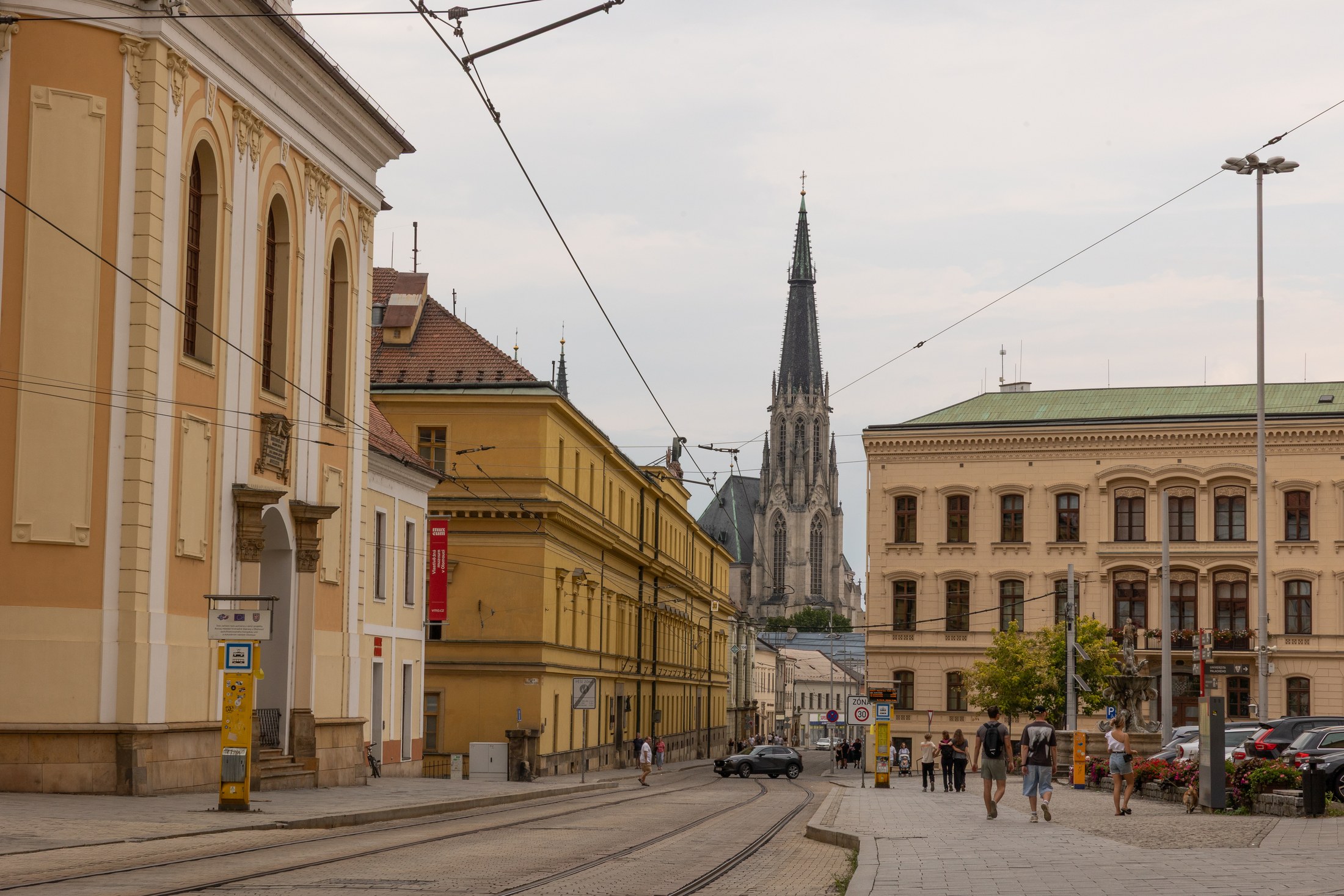
My fingers were freezing as I passed a hot mug of mead from hand to hand in the darkening Upper Square, watching the steam rise above the roofs of the wooden stalls. Lukáš and I arrived in Olomouc in the middle of Advent and instantly understood why the Lonely Planet guide called this town Europe’s best-kept secret. Among the many things to do in Olomouc, Czech Republic, you get the second-largest heritage reserve right after Prague — but instead of weaving through crowds with umbrellas, you can pause peacefully by baroque fountains and soak up genuine calm.
The student spirit also gives the historic backdrop a very likeable energy. Palacký University is based here, which means one in seven residents is a student. As a result, the centre is packed with great independent cafés and bistros where a specialty coffee and good food won’t cost you a fortune. Simply put, Olomouc is noticeably cheaper and more laid-back than the capital.
Whether you come in winter for the famous markets or in summer for wandering the parks, the local sights will keep you busy for a whole weekend. In this article for 2026 you’ll find all our tips on what to see in Olomouc, where to stay smartly, and where to go for the best vegetarian food in town.
Olomouc
Summary: what to see and not miss in Olomouc
Holy Trinity Column: A huge UNESCO-listed baroque monument dominating the main square.
Olomouc Astronomical Clock: A one-of-a-kind piece rebuilt in the style of socialist realism, where workers march instead of saints.
Baroque fountains: A unique set of historic fountains inspired by classical mythology, scattered across the whole centre.
St. Wenceslas Cathedral: A majestic cathedral with the second-tallest church tower in the country.
View from St. Moritz: The best panoramic view of the city from the tower of a Gothic church.
Svatý Kopeček: A popular pilgrimage site and a great zoo, ideal for a half-day trip.
Olomouc cheese (tvarůžky): A local cheese specialty you must try, ideally served warm.
Café scene: Dozens of cosy spots with specialty coffee and student-friendly prices.
When to visit Olomouc: weather by season
Olomouc works all year round, but each season shows the city in a slightly different light. Lukáš and I most recently tried the winter version, and I have to admit the historic lanes under snow have huge charm. The weather in Olomouc, Czech Republic ranges from warm, lively summers to cold, snowy winters, so pack accordingly.
Spring and summer for strolling
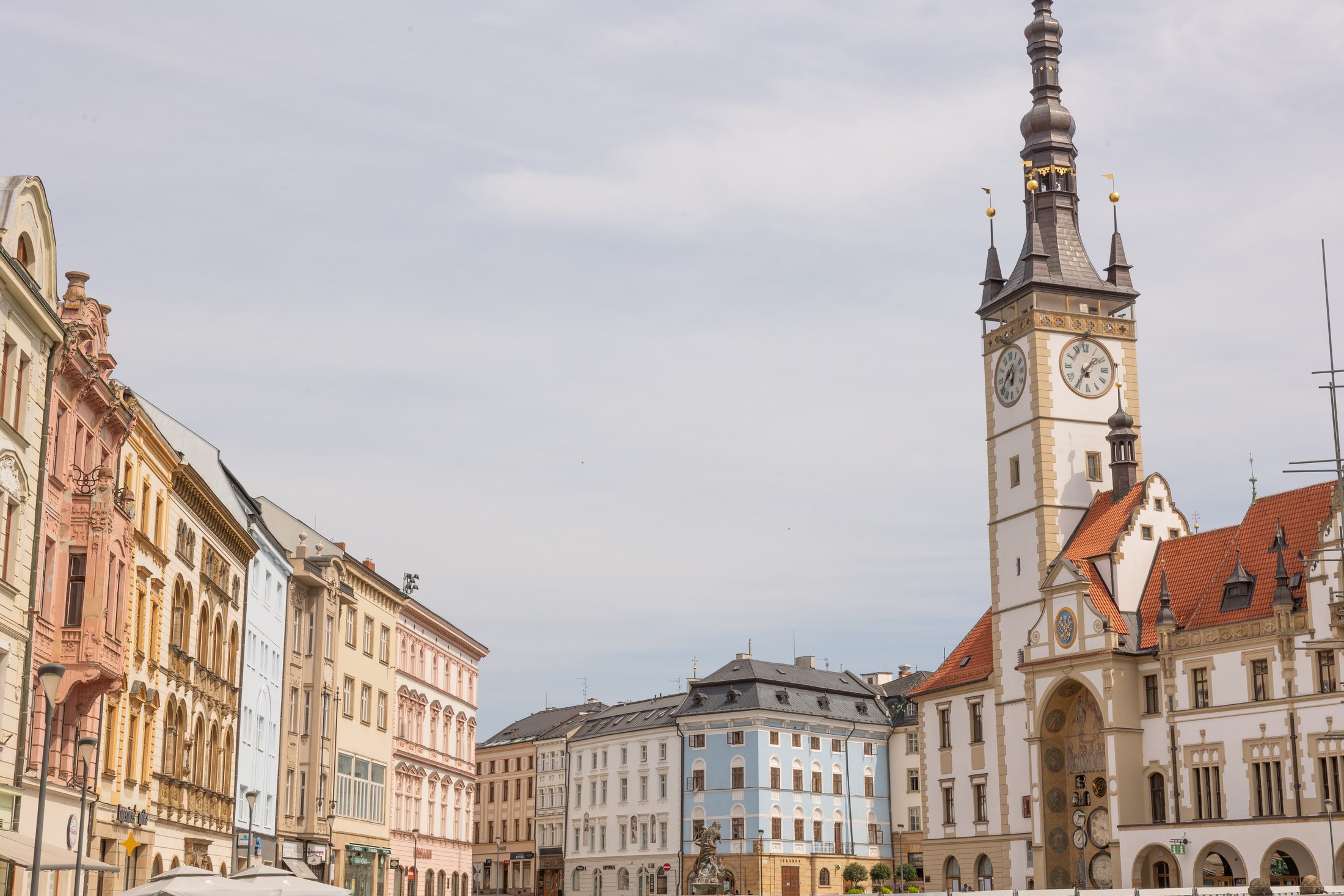
The Upper Square with the town hall tower on a summer morning
From May to September the city is at its liveliest. You can linger on the terraces of the Upper Square or wander through the parks. In spring the magnolias also bloom beautifully in Bezruč Gardens. Summer is also the only season when you can safely climb the viewing tower of St. Moritz Church.
Winter and the Advent markets
The local Christmas markets are among the loveliest in the country. They cluster on the Upper and Lower squares, where you’ll find over a hundred stalls. From my own experience I can recommend the local punch trail and the hot mead they pour into original returnable mugs. Winter here can be bitingly cold, so warm clothing is a must.
How many days to spend
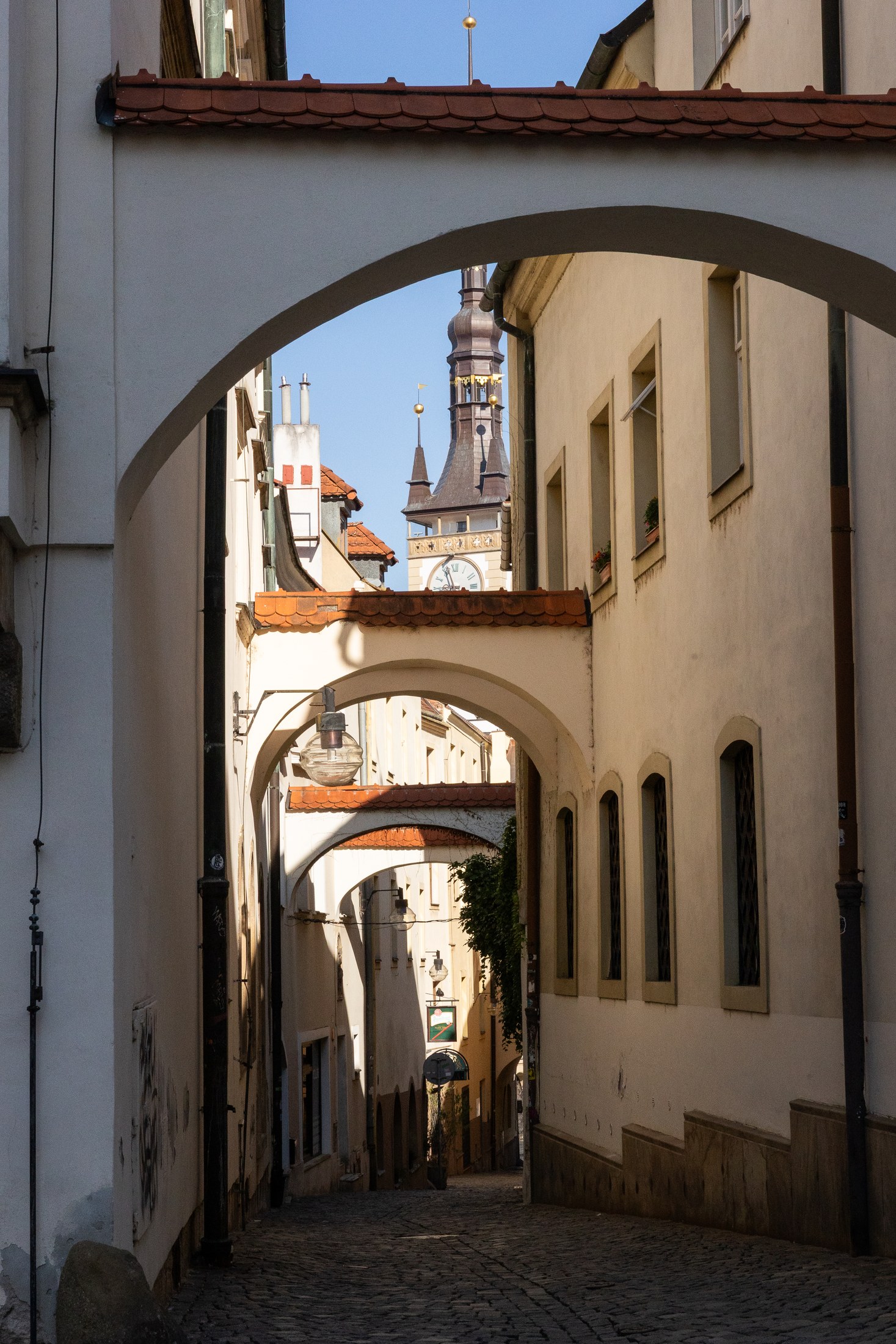
The passageways and arcades are among the loveliest corners of Olomouc’s centre
At a brisk pace you can walk the historic core in half a day, roughly three hours. But that would be a shame. Ideally set aside one to two days for Olomouc. On the first day you explore the centre, the cafés and the museums; on the second you can head out to Svatý Kopeček or to nearby Loštice for the local cheese.
Where to stay in Olomouc: best hotels
The advantage of Olomouc is that even premium hotels here often cost a fraction of what you’d pay in Prague. The centre is compact, so wherever you lay your head within the pedestrian zone, you’ll have all the main action within easy reach. You’ll find plenty of Olomouc, Czech Republic hotels to suit every budget.
💡 Tip: If you’re planning a visit during Advent, book your accommodation well in advance. Because of the popular markets, the best places tend to sell out as early as autumn.
Where we stayed: OREA Hotel Arigone
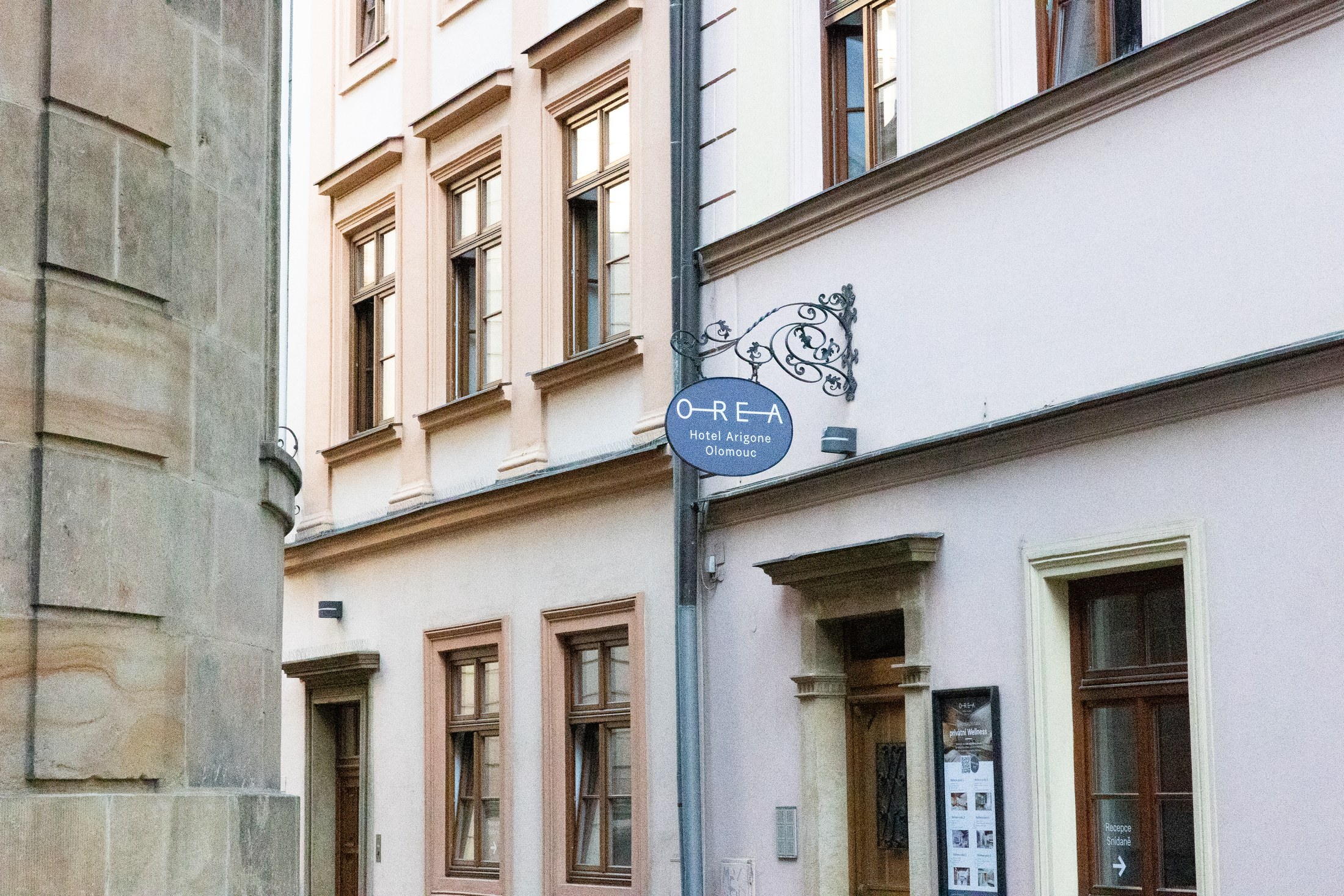
Our choice fell on the OREA Hotel Arigone on Univerzitní Street, just a few minutes’ walk from the Upper Square, and it was a hit. The hotel was created by linking several historic houses, so every room is a little different, and above all they have six private wellness rooms with a hot tub and sauna plus a maisonette with its own terrace above the city’s rooftops.
Arigone occupies historic houses just a few minutes from the Upper Square
For us, as parents of a small child, it was a whole different league: your child falls asleep and you have the wellness behind a locked door, with no babysitting and no strangers in the relaxation room. On top of that the hotel has its own parking courtyard (for a fee, book ahead as capacity is limited) and breakfasts where you fill your own croissants with pistachio cream. Children up to 5.99 years old also stay here for free.
For lovers of beautiful interiors, the obvious choice is Long Story Short. It works as both a premium hostel and a hotel with lovely private rooms and a fantastic courtyard. A great alternative is the cosy Miss Sophie’s Olomouc in a historic building, or the elegant Hotel Theresian, which has a beautiful rooftop wellness area.
Comfortable four-star options
If you’re after reliable standards and generous breakfasts, check out the NH Collection Olomouc Congress. This NH hotel in Olomouc, Czech Republic lies a short walk from the centre and offers modern rooms with a view. Travellers also praise the Clarion Congress Hotel Olomouc near the main train station. And right in the heart of the city you’ll find the very comfortable Hotel Trinity.
Budget stays and guesthouses
For travellers on a tighter budget, Penzion Na Hradě makes sense — it sits in a quiet lane just steps from the Cathedral. International students and backpackers, meanwhile, often choose Poets Corner Hostel, which offers a friendly atmosphere and very affordable bed prices.
Things to do in Olomouc, Czech Republic: 14 tips
The centre may be spread out, but you can comfortably reach the vast majority of the sights on foot. Get ready to look up a lot, whether at the ornate façades or the monumental towers.
1. Holy Trinity Column
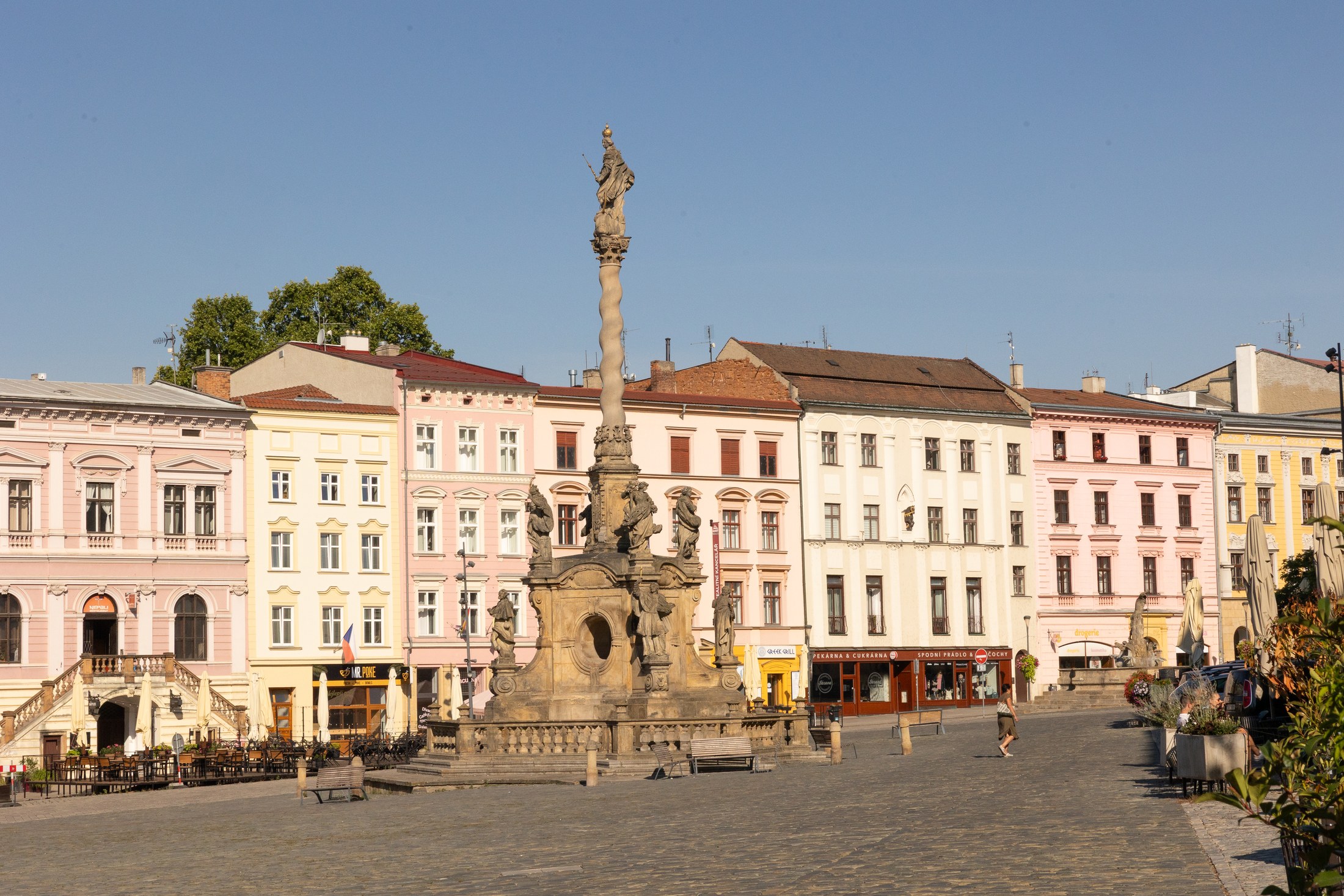
The Holy Trinity Column on the Upper Square, inscribed on the UNESCO list
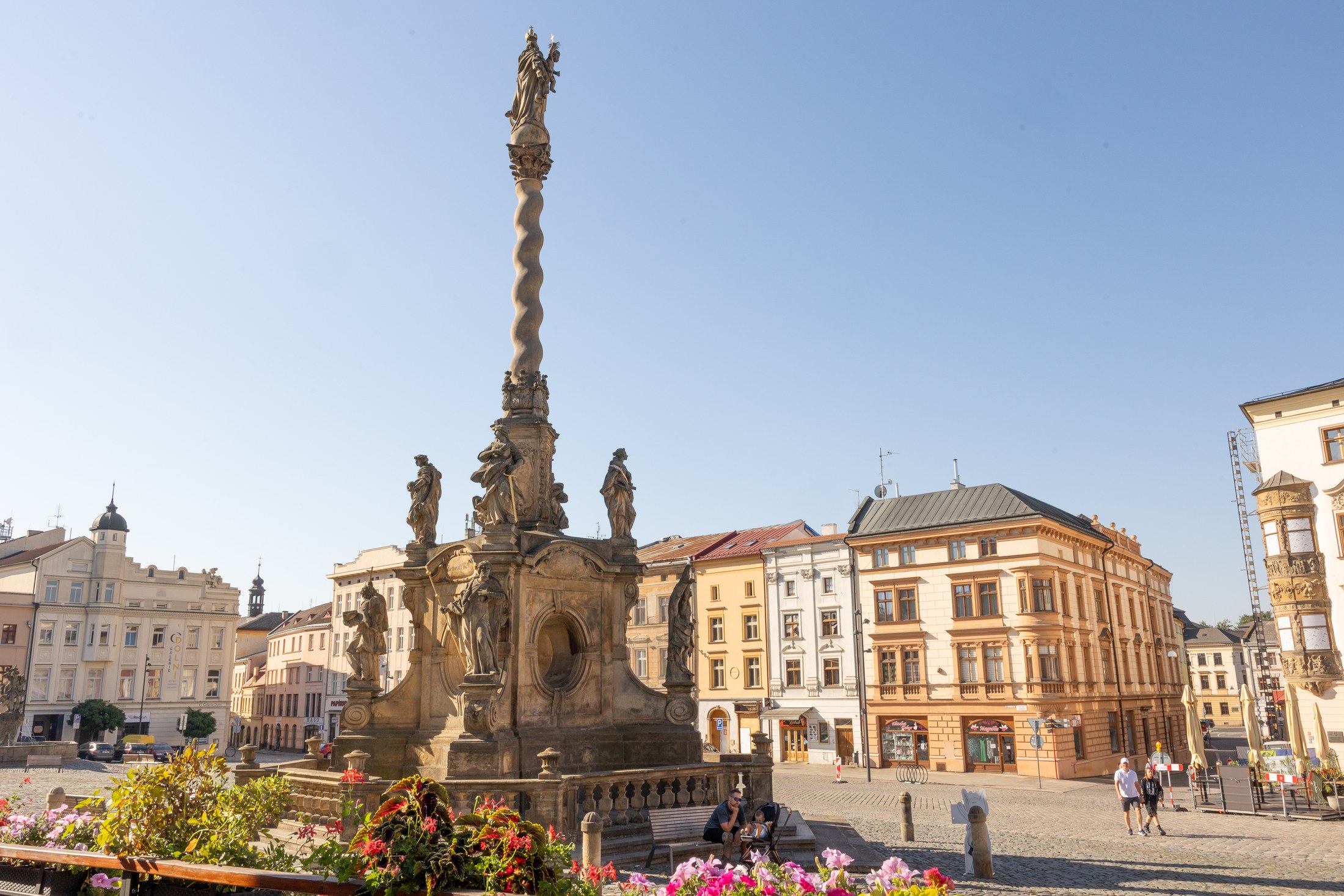
When you step onto the Upper Square, this structure immediately grabs your attention. It’s the largest baroque sculpture group in Central Europe, unified into a single monument. It stands an impressive ~32 metres tall, and its construction ran from 1716 to 1754, when Maria Theresa came in person to consecrate it.
Since 2000 the column has been inscribed on the UNESCO list. It is decorated with eighteen statues of saints, twelve light-bearers and six reliefs of apostles. The detailed stonework is truly fascinating, especially when you realise the masters of the time worked only with basic tools.
💡 Tip: A small chapel is hidden inside the base of the column. It’s only open occasionally during the summer season, but if you’re lucky, definitely take a peek inside.
Olomouc
2. Olomouc Astronomical Clock
The astronomical clock is at eye level, so you can take a good close look at it
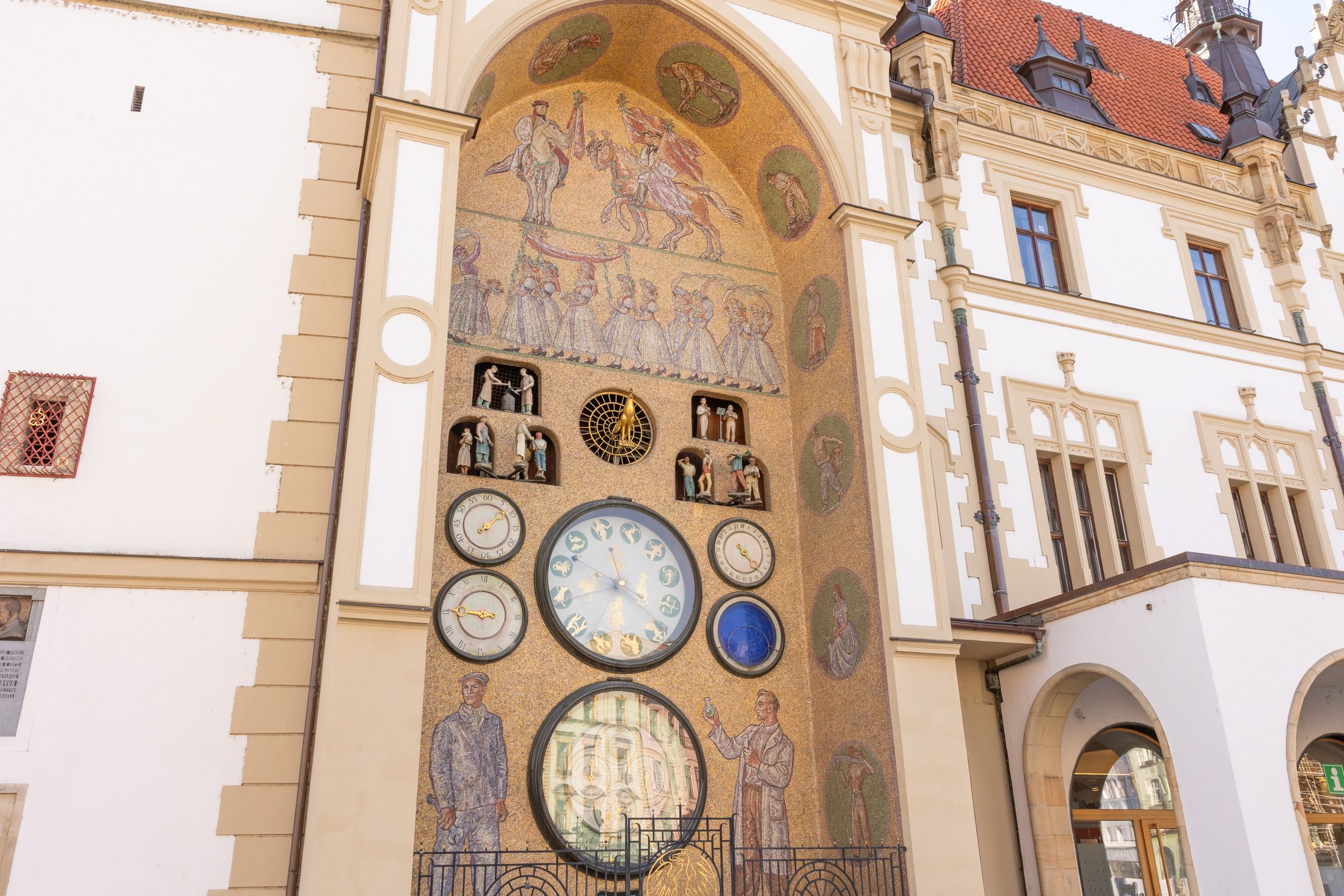
Right next to the column, on the town hall wall, you’ll find an absolute world curiosity. The original historic clock was badly damaged by a shell in May 1945. The city decided to restore it, but the 1947–1955 rebuild under Karel Svolinský was carried out in the hard-line spirit of socialist realism.
It’s a slightly bizarre sight. Instead of holy apostles, proletarians parade by — a blacksmith, a baker, a chemist and a labourer. On the calendar dial you can even spot key dates of the communist regime. International tourists love this oddity, mainly because, unlike the Prague clock, it’s set conveniently at eye level.
💡 Tip: The carillon plays Haná folk songs only once a day, exactly at noon. Be at the town hall a little early to grab a good spot for this feverish socialist dream.
3. Town Hall Tower
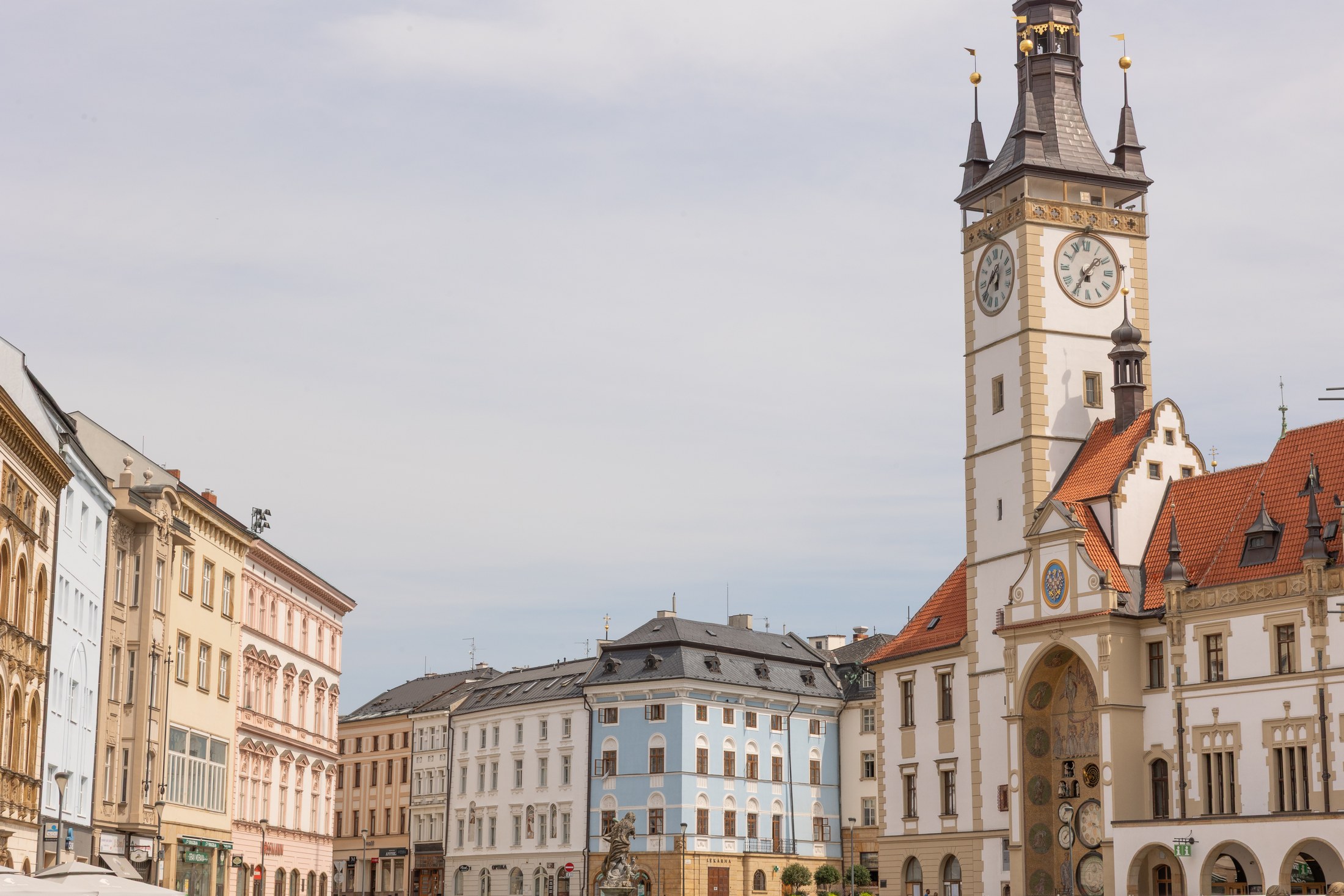
The town hall tower is 75 metres tall and you can only climb it with a guide
The town hall building on the Upper Square hides more than just the astronomical clock. Its tower rises to 75 metres and offers a superb bird’s-eye view over the entire historic core.
You can only climb up as part of a guided tour. It runs seasonally, and the entrance fee is around €2 (50 CZK). It’s a great chance to see the city from a completely different angle.
💡 Tip: You have to buy tower tickets at the information centre, which is located right in the town hall arcade.
4. The set of baroque fountains
The fountain and Marian Column on the Lower Square
As you stroll through the centre, you’ll come across a unique set of historic fountains with no equal in the country. Most of them draw inspiration from classical mythology. The oldest is Neptune’s Fountain from 1683, but the most artistically demanding is undoubtedly Caesar’s Fountain from 1724–1725.
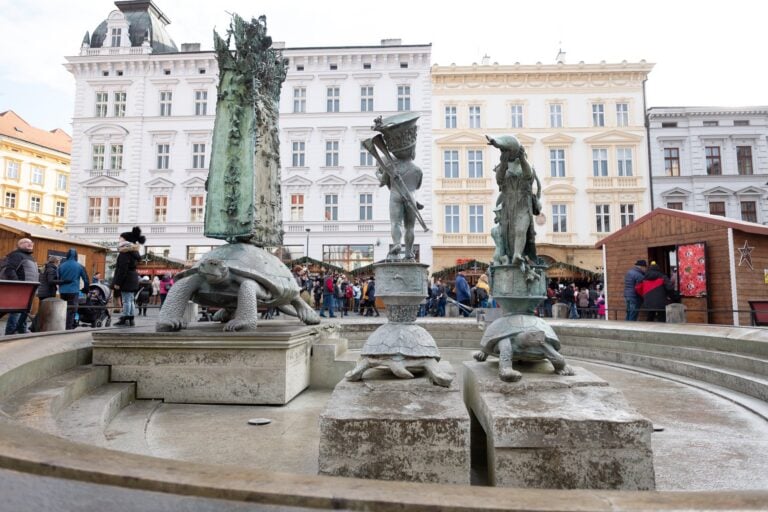
Legend has it that Julius Caesar himself founded Olomouc. Beneath the hooves of his horse you can spot a statue of a dog, symbolising the city’s loyalty to its ruler. In 2002 the historic collection was joined by the modern Arion Fountain by sculptor Ivan Theimer.
💡 Tip: By the modern Arion Fountain on the Upper Square you’ll find a bronze statue of a turtle. Kids love it and happily clamber over it in summer while parents rest on the edge of the basin.
Olomouc
5. St. Wenceslas Cathedral
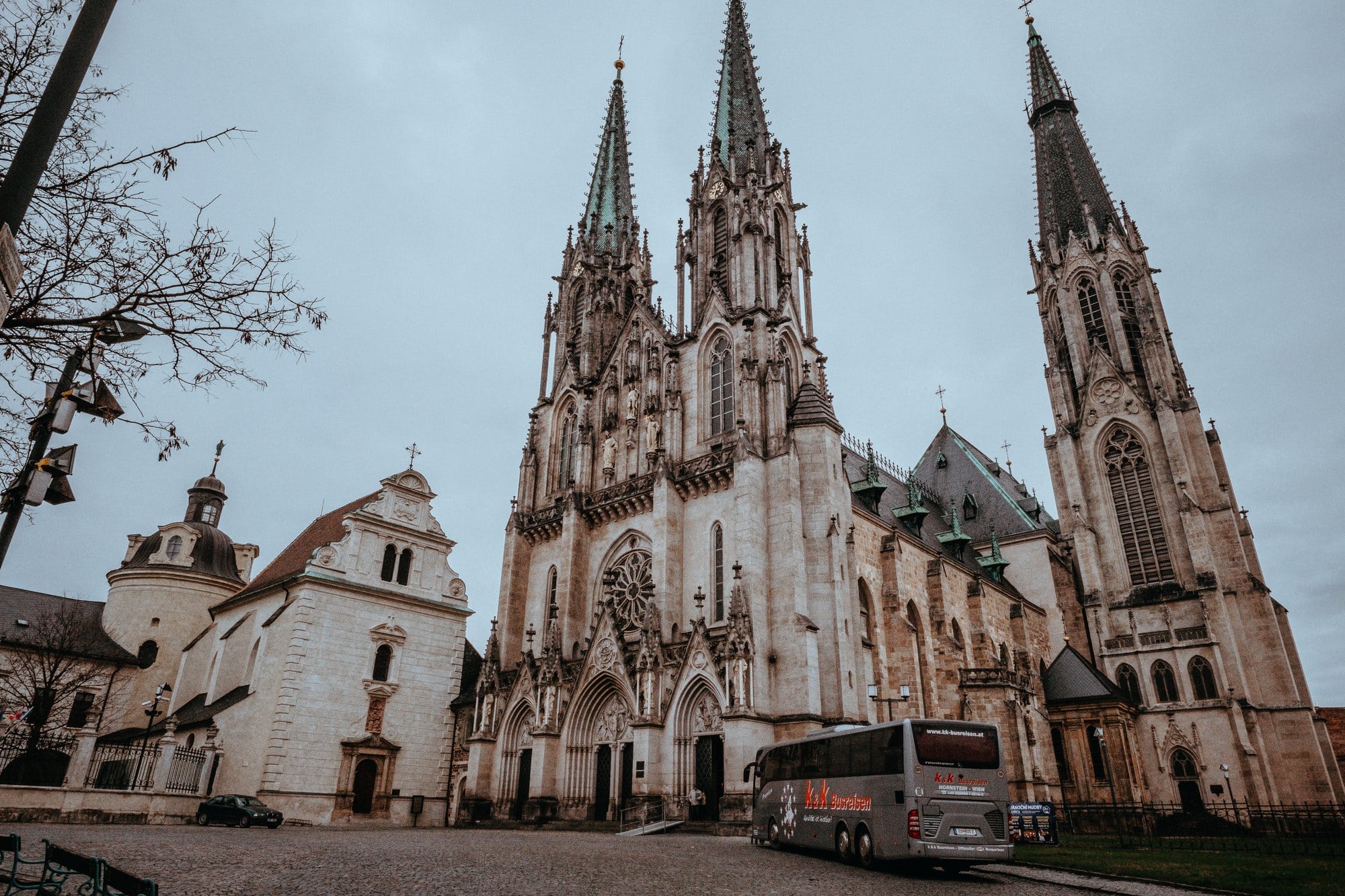
Heading from the square towards the ramparts, you’ll come upon the majestic Cathedral. Its southern tower measures exactly 100.65 metres, making it the tallest church tower in Moravia and the second tallest in the whole country. The Gothic architecture looks incredibly monumental both outside and in.
In the past you could climb the stairs all the way up, but note that the tower climb has been permanently closed since 2021. You can, of course, still visit the cathedral interior with no problem, and entry is free.
💡 Tip: Don’t forget to head down the stairs to the underground crypt beneath the presbytery. It’s freely accessible and holds the tombs of Olomouc bishops and archbishops.
6. Mozart’s trail and the Archdiocesan Museum
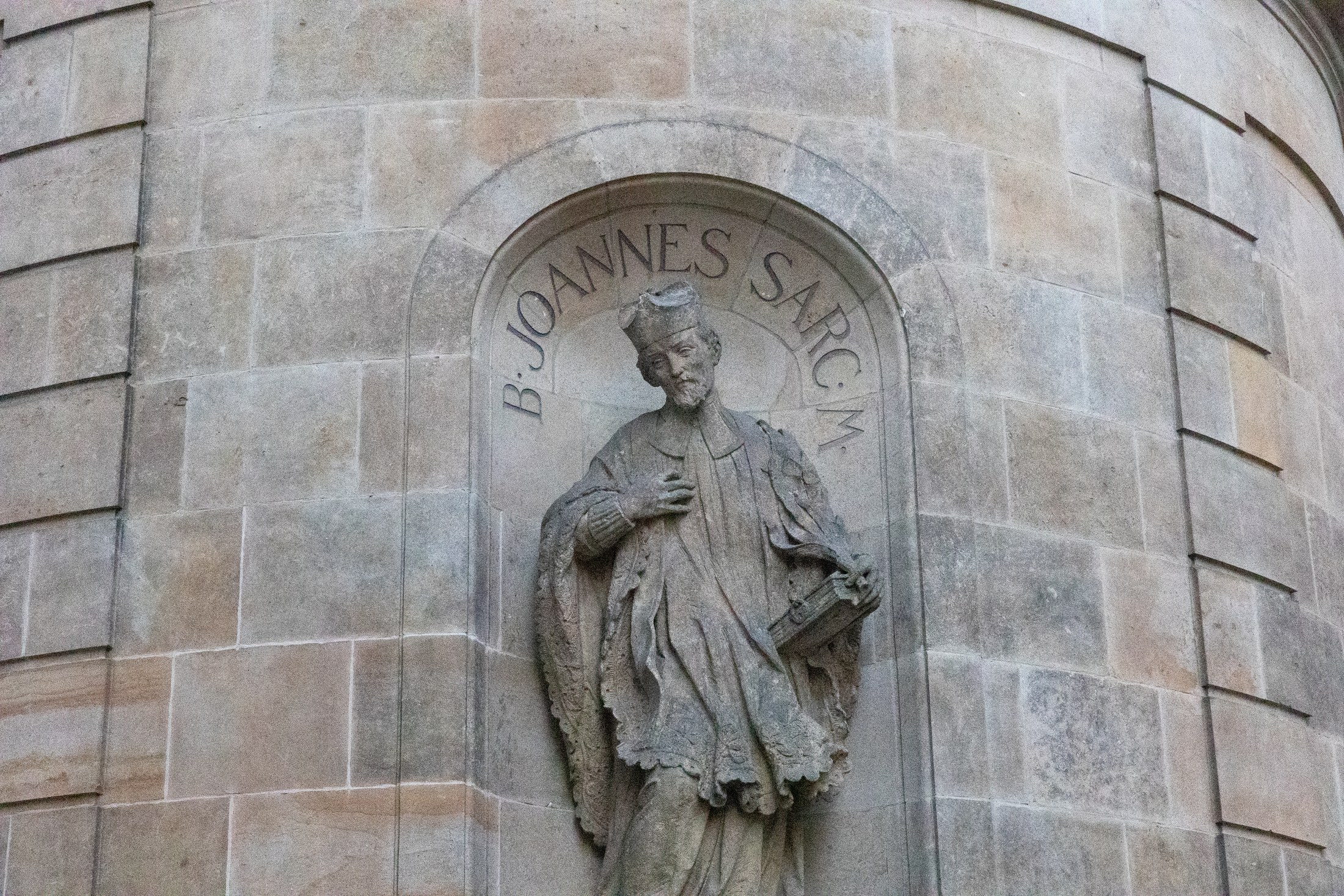
In Olomouc you’ll find baroque statues even on the facades of ordinary houses
Right next to the cathedral stands the former chapter deanery, which today houses the excellent Archdiocesan Museum. In 1767 the then only eleven-year-old Wolfgang Amadeus Mozart arrived here. On the way he caught a severe case of smallpox and was taken in by the local dean Podstatský.
Fortunately the young genius recovered here, and in gratitude he composed his Symphony No. 6 in F major, KV 43 within these very walls — a piece still nicknamed the Olomouc Symphony to this day. It’s a powerful human story that gives these cold walls a whole new dimension.
💡 Tip: The Archdiocesan Museum itself deserves your attention even if you’re not exactly an expert in sacred art. The restored spaces and preserved carriages are a feast for the eyes.
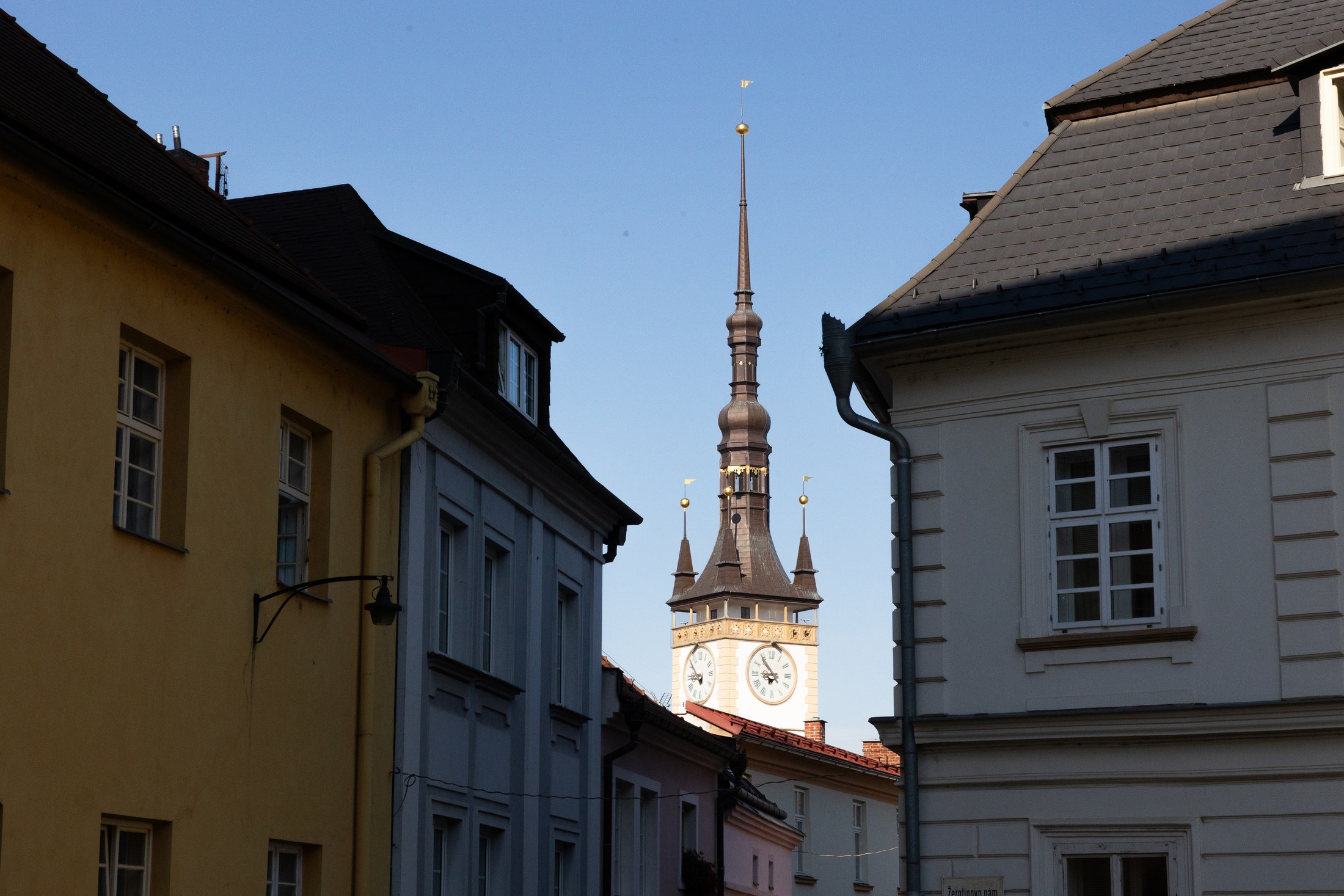
The towers of Olomouc’s churches peek out above the lanes at almost every corner
This mighty Gothic church hides two great treasures. The first is the largest organ in Central Europe, built by master Engler in 1745. Today it has an impressive 95 stops and around 7,800 pipes. If you come in September, you can experience an international organ festival.
The second draw is the climb up the tower, which stands 46 metres tall. Entry costs a token €0.60–0.80 (15–20 CZK) and at the top you’ll find what I think is the very best view over the roofs of Olomouc. It’s open from May to September in fine weather.
💡 Tip: A very narrow double spiral staircase leads to the top. If you suffer from claustrophobia or fear cramped spaces, it’s better to skip this climb.
8. St. Michael’s Church
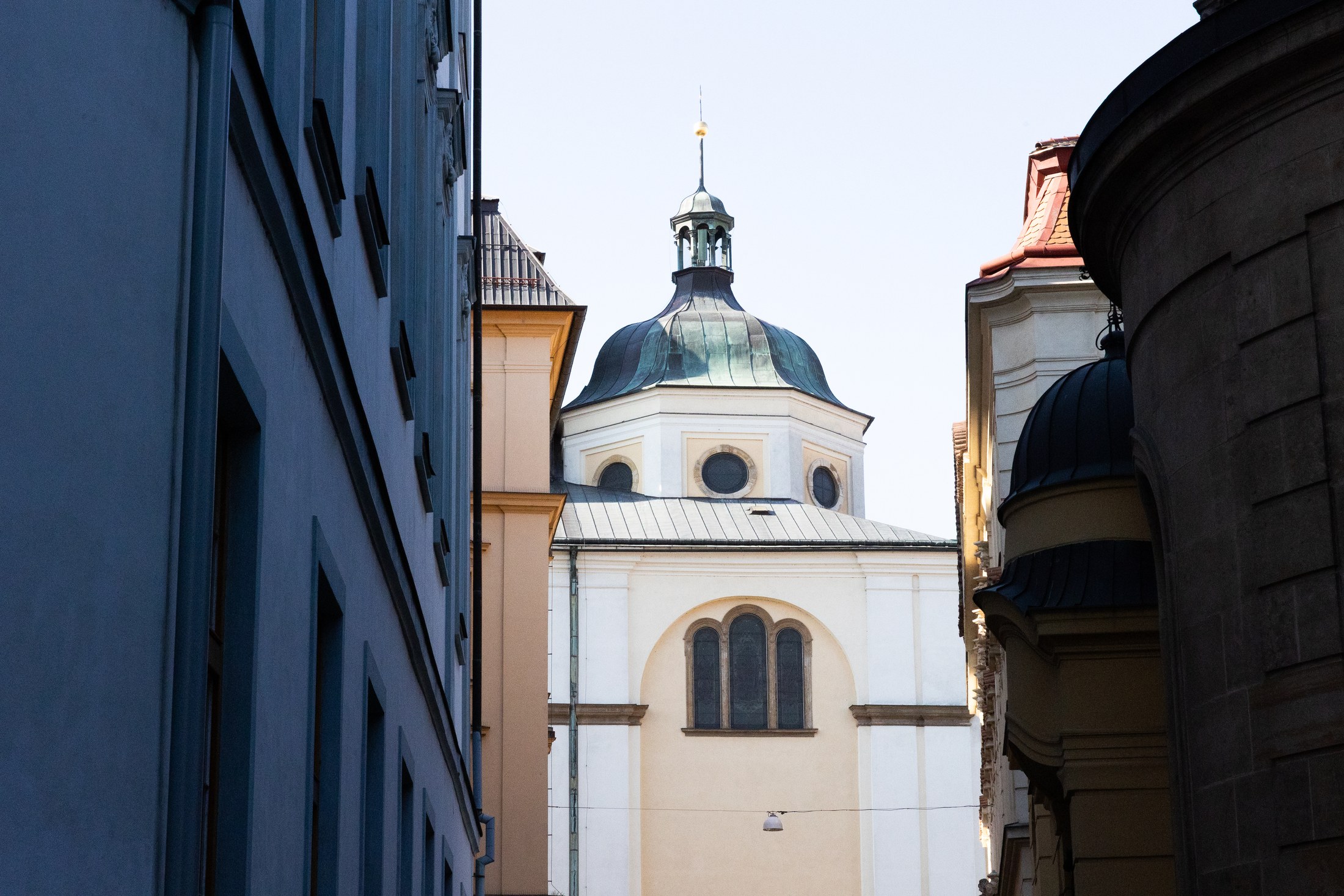
The dome of St. Michael’s Church above the rooftops of the historic centre
Winding through the lanes, you’ll come across an early baroque church recognisable by its distinctive three domes. They’re meant to symbolise the Holy Trinity. From the outside it may not look as mighty as the Cathedral, but the interior will take your breath away.
The rich stucco decoration of the interior was created by the Italian master Baltazar Fontana. The space is incredibly bright and airy, which isn’t always the case with baroque buildings.
💡 Tip: You’ll get the nicest photo of St. Michael’s from the narrow Michalská lane that leads to it from the Lower Square. It makes a perfect frame for the baroque façade.
Olomouc
9. Klášterní Hradisko Monastery
A short way from the very centre, heading north, stands the huge complex of a former Premonstratensian monastery. It’s often nicknamed the Moravian Escorial. Today it houses a military hospital — incidentally the oldest in the country.
Because of the hospital operation you’ll mostly only see it from the outside, but it’s still worth the walk. The façade is beautifully restored and shows the enormous power the religious orders once held in the Haná region.
💡 Tip: A pleasant walking route runs around Hradisko along the Morava River. Locals come here to walk their dogs and jog — it’s a great escape from the city bustle.
Olomouc
10. Palacký University and the Archbishop’s Palace
The archbishop’s seminary building, today part of Palacký University
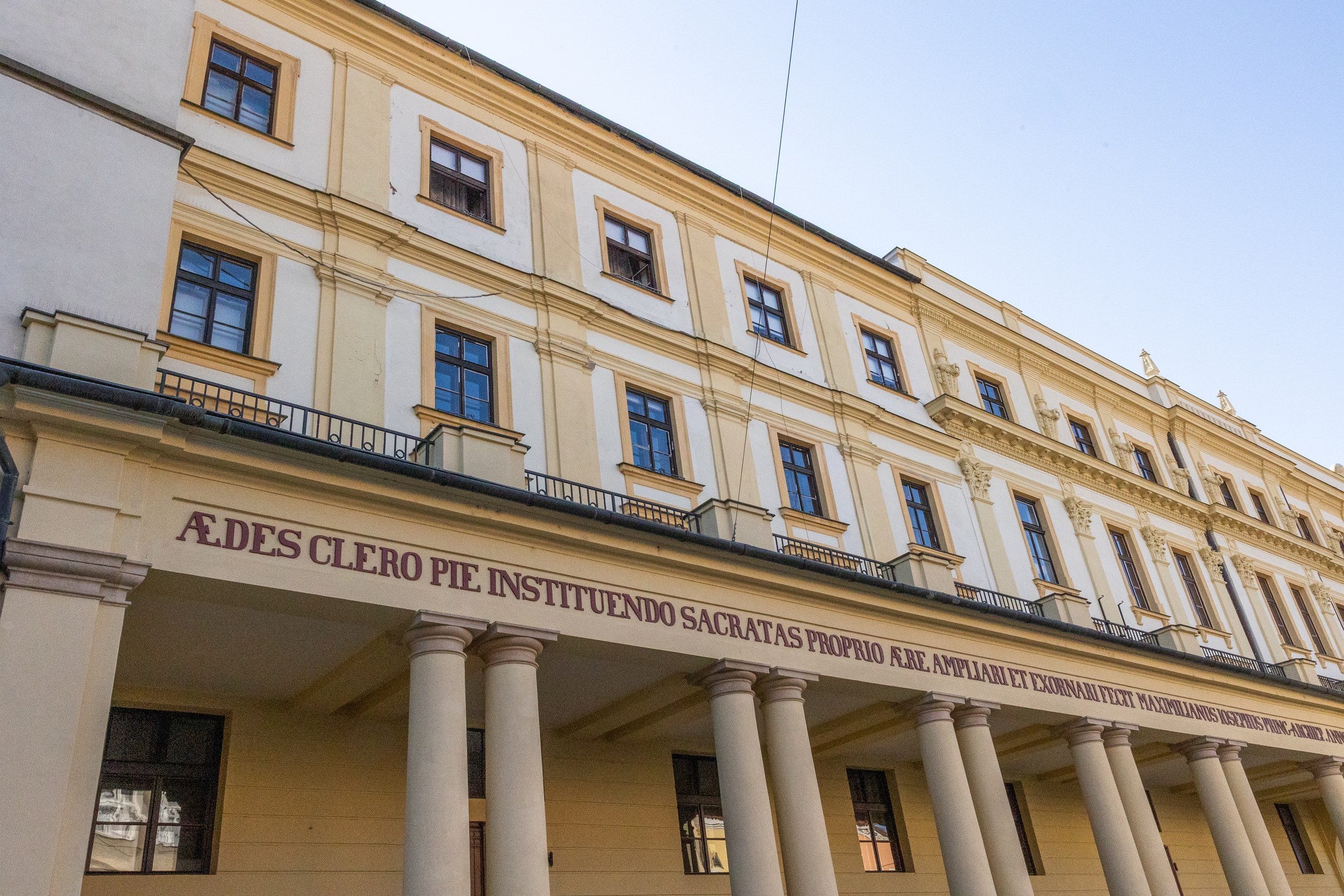
Olomouc was shaped by the church and by learning. The university was founded here back in 1573, making it the second oldest in the Czech lands. Right next to some of its buildings stands the grand Archbishop’s Palace.
This building has witnessed great history. In 1848 the then eighteen-year-old Franz Joseph I ascended the throne here. Among the distinguished guests who spent the night here were Maria Theresa, the composer Beethoven and Pope John Paul II.
💡 Tip: The Archbishop’s Palace offers guided tours of its state rooms. They’re open to the public and you’ll see original historic furniture.
11. Fortress of Knowledge (Pevnost poznání)
If you’re coming with kids, or you’re simply interested in science, head to the Korunní pevnůstka grounds. A historic artillery building houses the interactive Fortress of Knowledge museum, run directly by the university.
You’ll find a great digital planetarium, a giant model of the brain and plenty of hands-on physics experiments. For families with children it’s the perfect rescue when it’s raining outside.
💡 Tip: The exhibition on Olomouc’s history is presented in comic-book form, which even entertains schoolchildren who would normally yawn with boredom in a classic museum.
12. Svatý Kopeček and Olomouc Zoo
About eight kilometres from the centre lies the pilgrimage site of Svatý Kopeček. Its landmark is the beautiful baroque Basilica of the Visitation of the Virgin Mary, which holds the title of basilica minor. In 1995 it was even visited in person by Pope John Paul II. From the centre you can comfortably get here on city bus number 11, straight from the station.
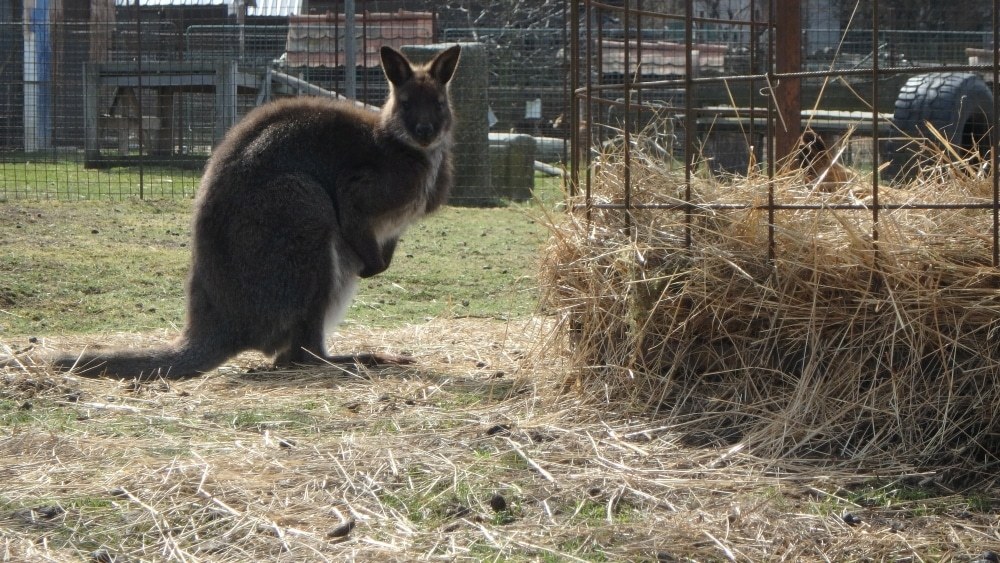
Right next to the basilica sprawls the fantastic Olomouc Zoo, covering 40 hectares. It has huge sea aquariums with sharks, walk-through kangaroo enclosures and lots of greenery. It makes an ideal half-day trip.
💡 Tip: Inside the zoo grounds stands a 32-metre-high viewing tower. You do have to climb 128 steps, but on a clear day you can see all the way to Praděd.
13. Bezruč Gardens and the ramparts
Olomouc was once an impregnable fortress, and remnants of the brick ramparts still line part of the historic core. Directly beneath them stretch the Bezruč Gardens — a long, narrow park that follows the shape of the old fortifications.
In spring locals come here to admire the blooming magnolias. An educational trail also runs through the park, guiding you past the preserved baroque fortlets.
💡 Tip: The best way into the park from the centre is via the inconspicuous steps by the Michalský výpad. It’s a favourite shortcut for local students.
Olomouc
14. Advent and Christmas markets
If you arrive in December, the whole city smells of cinnamon and cloves. The Olomouc markets are famous for their wide range of drinks. Local stallholders pride themselves on special punches, often flavoured with fresh fruit or exotic spices.
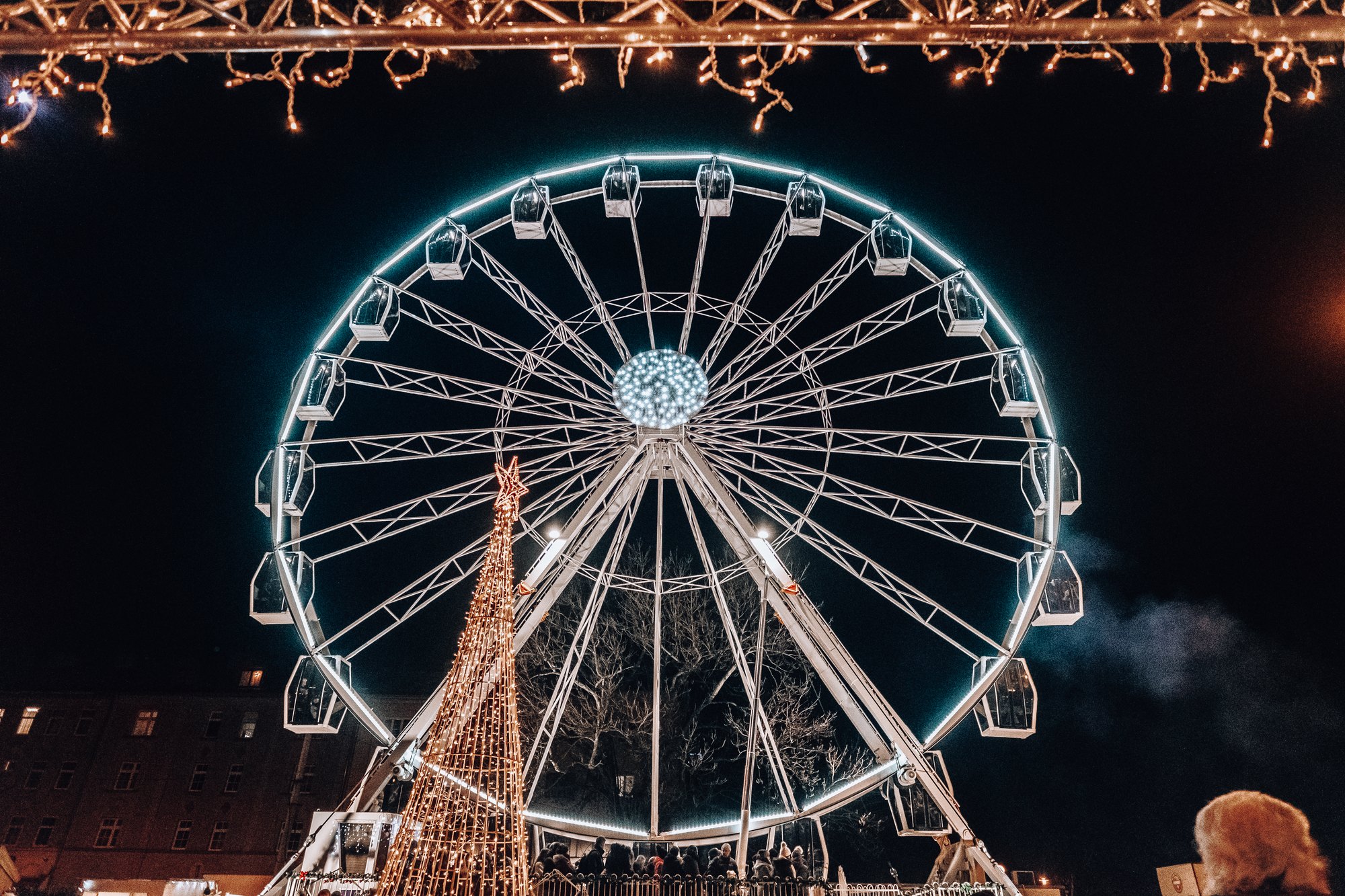
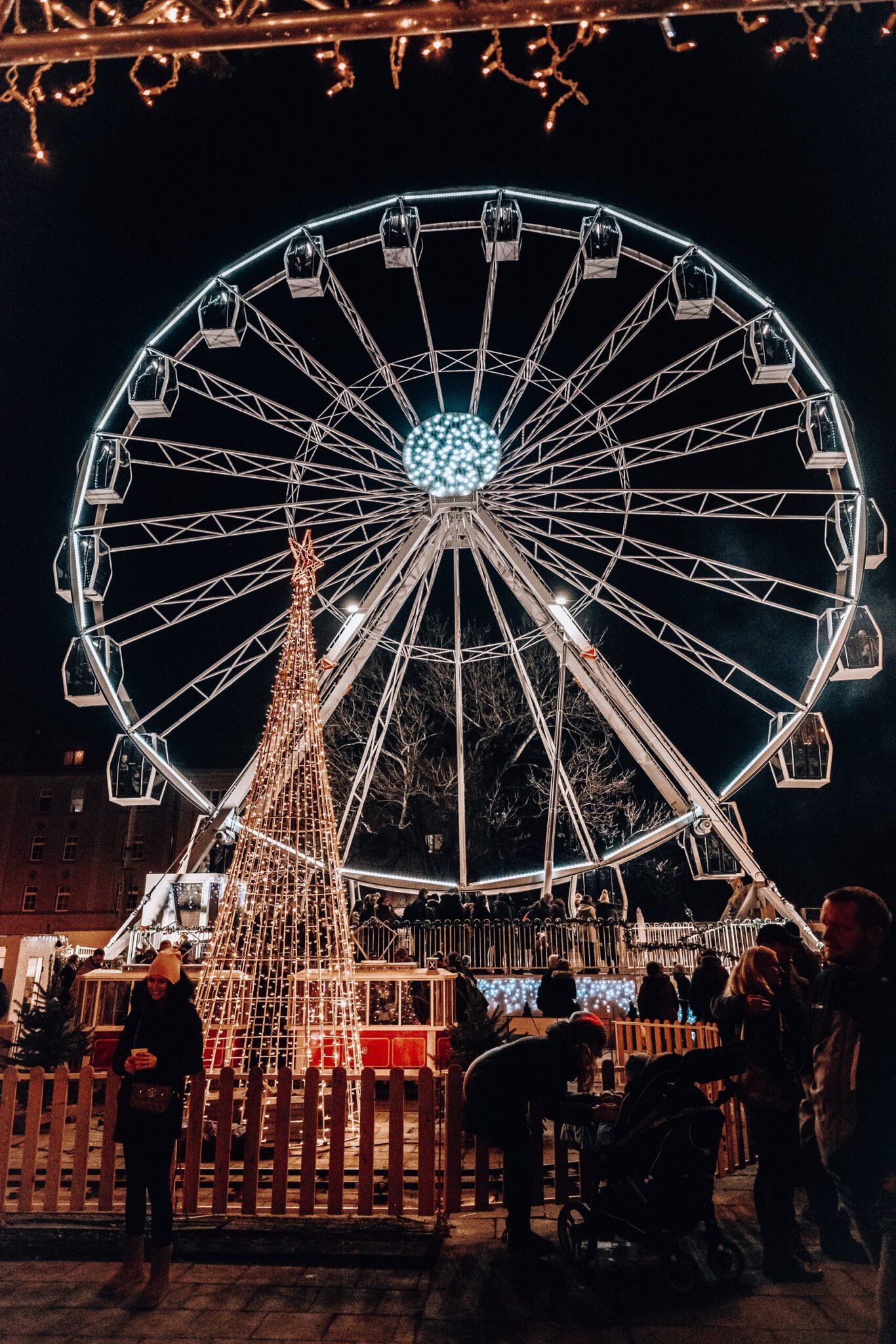
Most of the action takes place on the Upper and Lower squares. There’s a giant Ferris wheel with a lovely view over the illuminated roofs, and a wooden nativity scene. The atmosphere here tends to be far more intimate and friendly than the crowded Old Town Square in Prague.
💡 Tip: The punch mugs come with a deposit. If you keep yours as a souvenir after drinking, no one will mind — you’ll just lose the €2 (50 CZK) deposit.
What to taste and where to grab a coffee in Olomouc
Cafés with street-side seating are as much a part of Olomouc as the fountains
Say “Olomouc” and most people instantly think of tvarůžky. This one truly original Czech cheese is actually made in nearby Loštice, where it has a tradition stretching back over 400 years. Since 2010 it has even held a protected geographical indication from the European Union, which the region won after a drawn-out dispute with Germany.
The cheese has a strong smell, but it’s very low in fat and diet-friendly. And since it’s cheese, Lukáš and I love it as vegetarians. It’s best served warm — for example fried in breadcrumbs or melted into a hearty garlic soup. Meat-eating travellers often pair it with the local Litovel or Holba beer, or try various tvarůžky sausages.
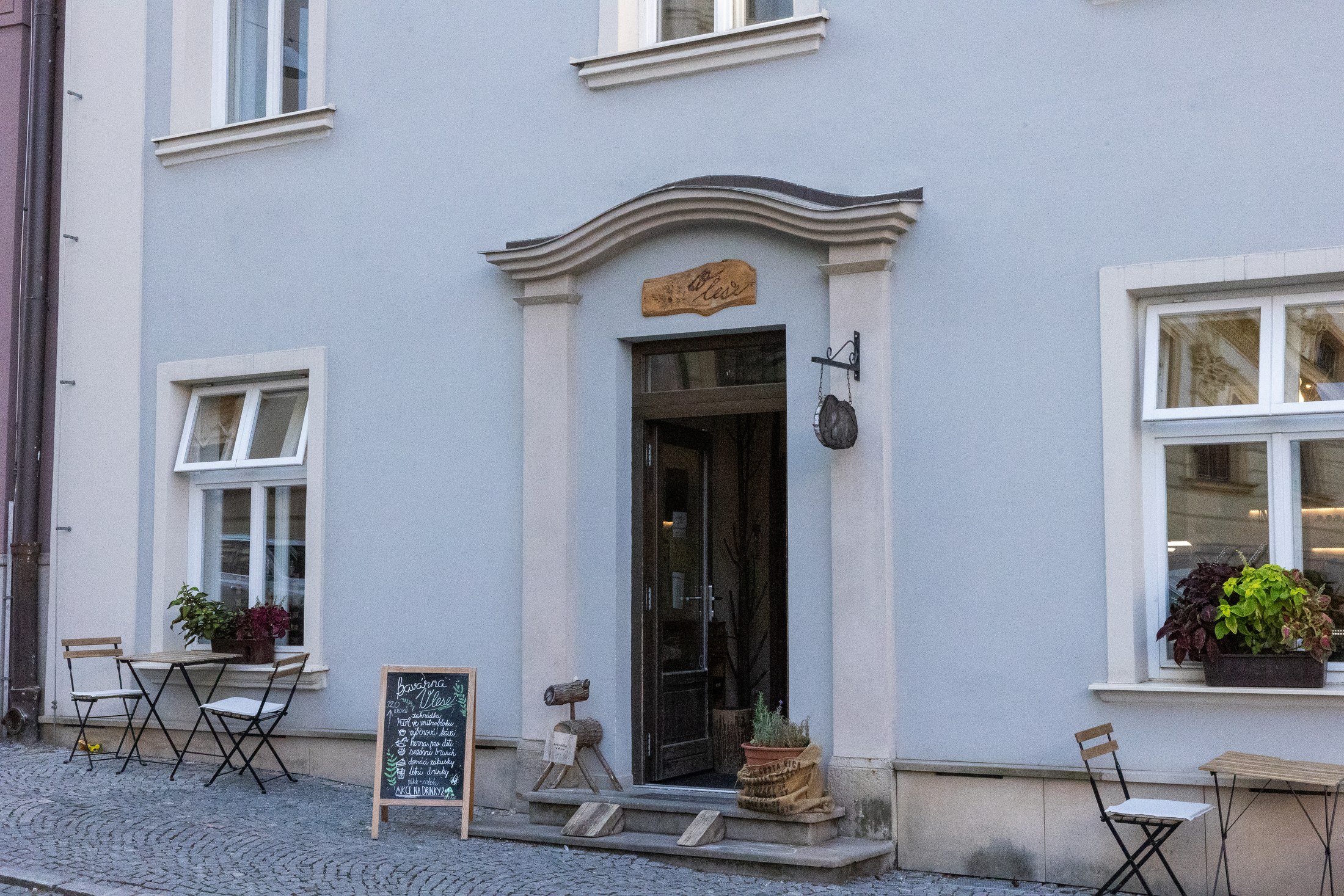
Thanks to the students, the café scene here is absolutely excellent. A safe bet is Café La Fée with its lovely French mood. Great espresso is served at KAFE JAK LUSK or at the tiny espresso bar Pikola. If you’re after a place with a big courtyard, drop by Long Story Short, and for an intimate atmosphere try Café na cucky or the café V lese.
As vegetarians you certainly won’t go hungry here — there are plenty of meat-free spots. For a quick lunch the obvious choice is the bistro Koza zůstala celá, which cooks purely vegetarian. Also legendary here is GREEN BAR, which works by weight. Great plant-based sandwiches are made by Bistro ROZMARÝNY and Bistro Bistrá kráva. If you fancy Asian food, the Nepalese restaurant Kathmandu makes excellent paneer cheese, and the Vietnamese Koriandr serves great tofu.
Day trips from Olomouc
From the centre of Olomouc it’s easy to set off on a trip by train or car
If you have a car, or you’re not afraid of the local buses, the area around Olomouc offers several great destinations.
Svatý Kopeček and its zoo have already been mentioned — that’s the clear number one choice. If you’ve fallen for the charm of the ripening cheese, drive about thirty kilometres to Loštice. There you’ll find the specialised Olomouc Cheese Museum, where you’ll learn all about how it’s made and, of course, stock up right at the A.W. company shop.
Castle lovers shouldn’t miss Bouzov. This romantic castle with its distinctive turrets is about half an hour’s drive away and looks exactly like the fairy-tale backdrops you picture. Films are often shot here. A short way from it lies the town of Litovel, nicknamed the “Haná Venice” thanks to the branches of the Morava River flowing right through its centre.
Practical info: train from Prague to Olomouc
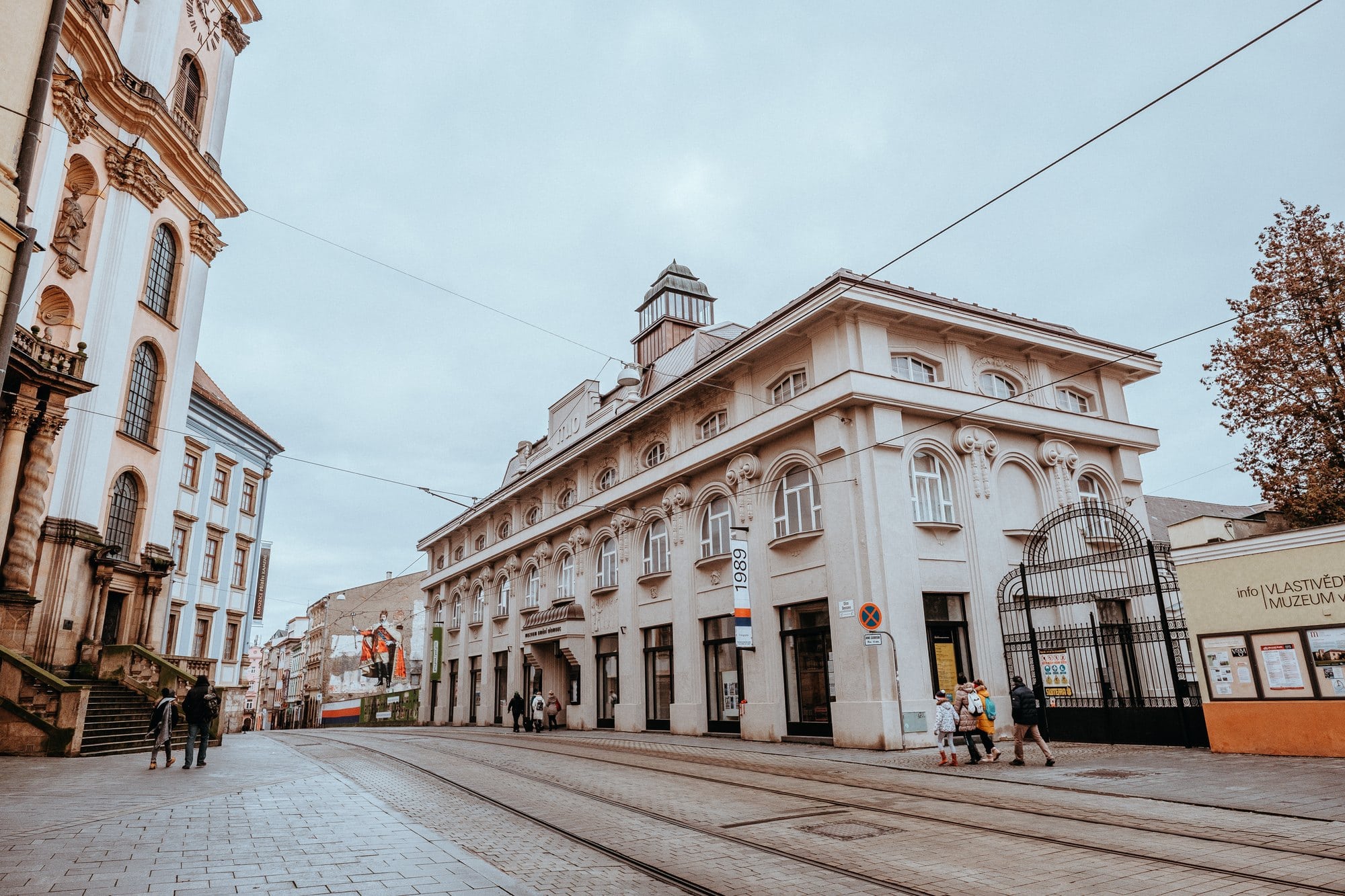
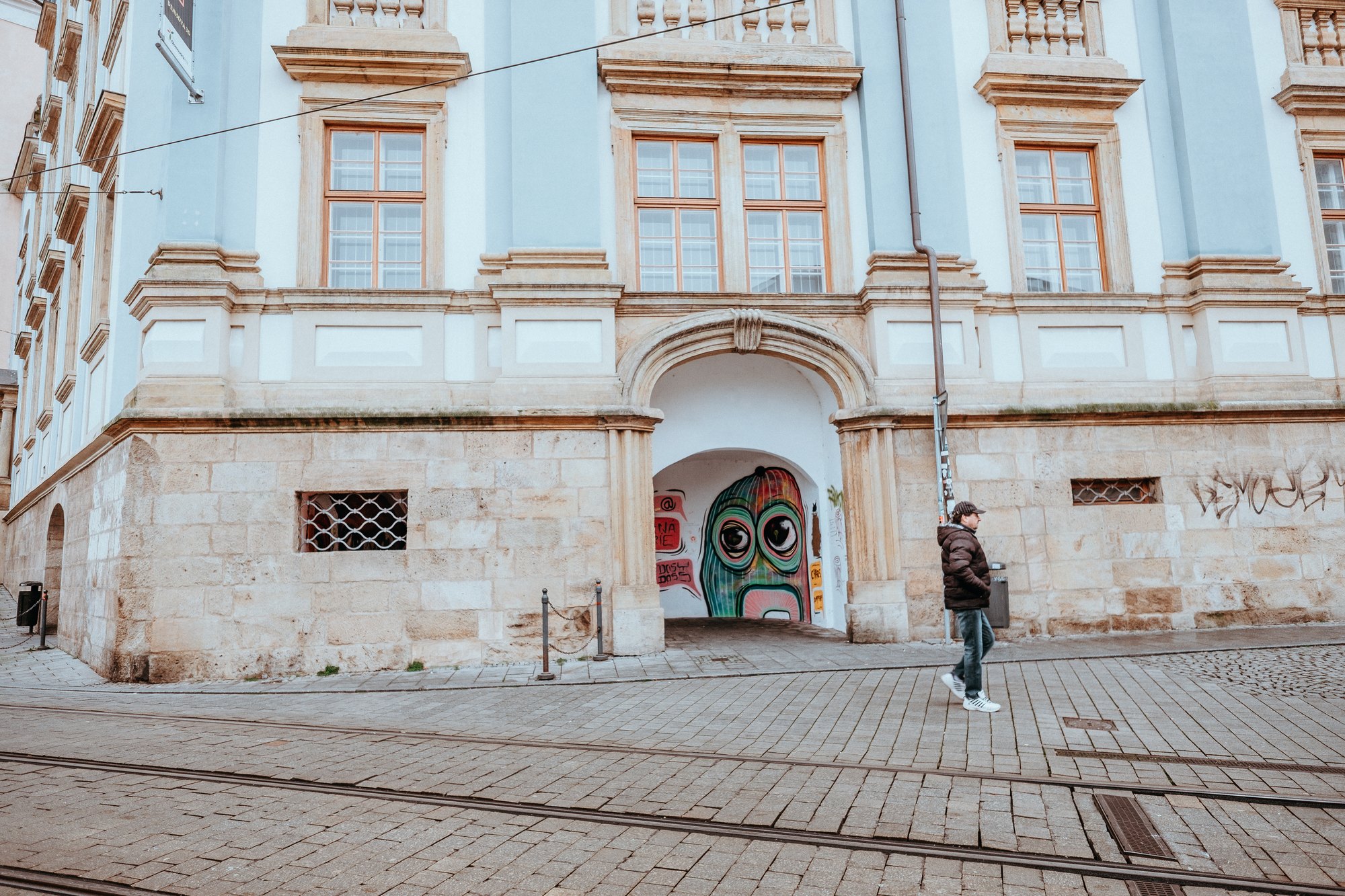
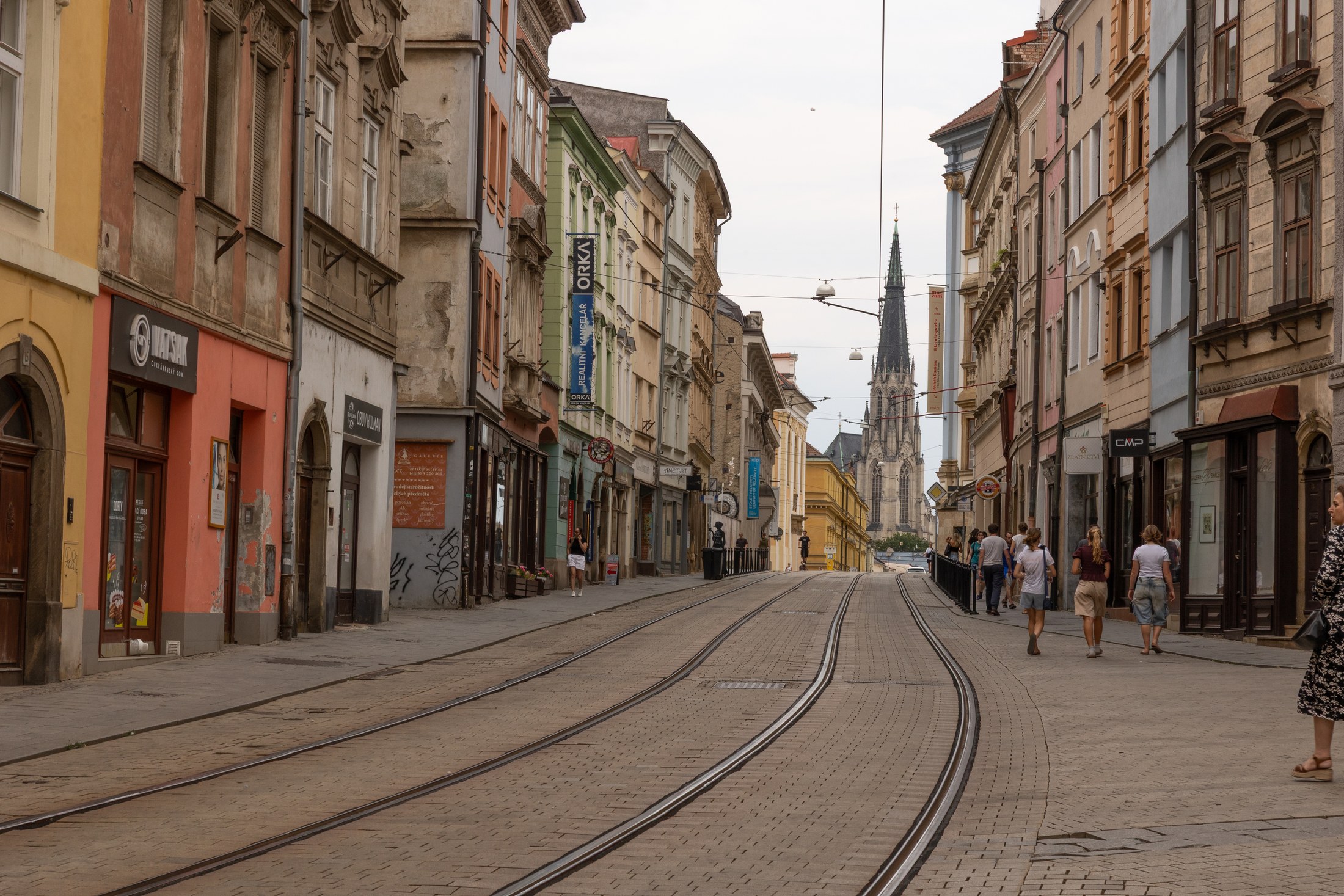
Denisova Street with tram tracks in the centre of Olomouc
The fastest and most comfortable way to reach Olomouc is by train. It sits on the main corridor, so direct connections run constantly. The train from Prague to Olomouc, Czech Republic takes roughly 2 hours 15 minutes on the SC Pendolino or express services. Tickets with RegioJet, České dráhy or Leo Express usually cost between €5 and €14 (130–330 CZK). From Brno the train takes about an hour and a half.
If you arrive by car, be ready for the fact that the historic core is a pedestrian zone with restricted access. Parking in zone A just around the centre costs around €4 per hour (100 CZK). It’s much smarter to use the covered parking garages by the station or the park-and-ride lots on the edge of town and take the tram into the centre. Olomouc’s public transport is reliable, and you can easily tap your card to pay for a ticket right on board.
Where we stayed and why we recommend it can be found in our OREA Hotel Arigone review, with a hot tub and sauna right in the room.
Frequently asked questions
How much time do I need to visit Olomouc?
A quick tour of the main sights in the centre takes about three hours. To leisurely soak up the atmosphere, visit cafés, and possibly take a trip to Svatý Kopeček, we recommend setting aside one to two days.
Where can I park for free or cheaply?
Parking in the centre and surrounding streets is paid (zone A is the most expensive). Free parking is available in outlying parts of the city, for example near shopping centres, from where you can easily reach the centre by tram in just a few minutes.
Can you climb the tower of St. Wenceslas Cathedral?
No, access to the Cathedral tower has been permanently closed since 2021 for safety and technical reasons. If you want a view from above, use the tower of St. Maurice Church or the Town Hall tower.
What to do in Olomouc with children?
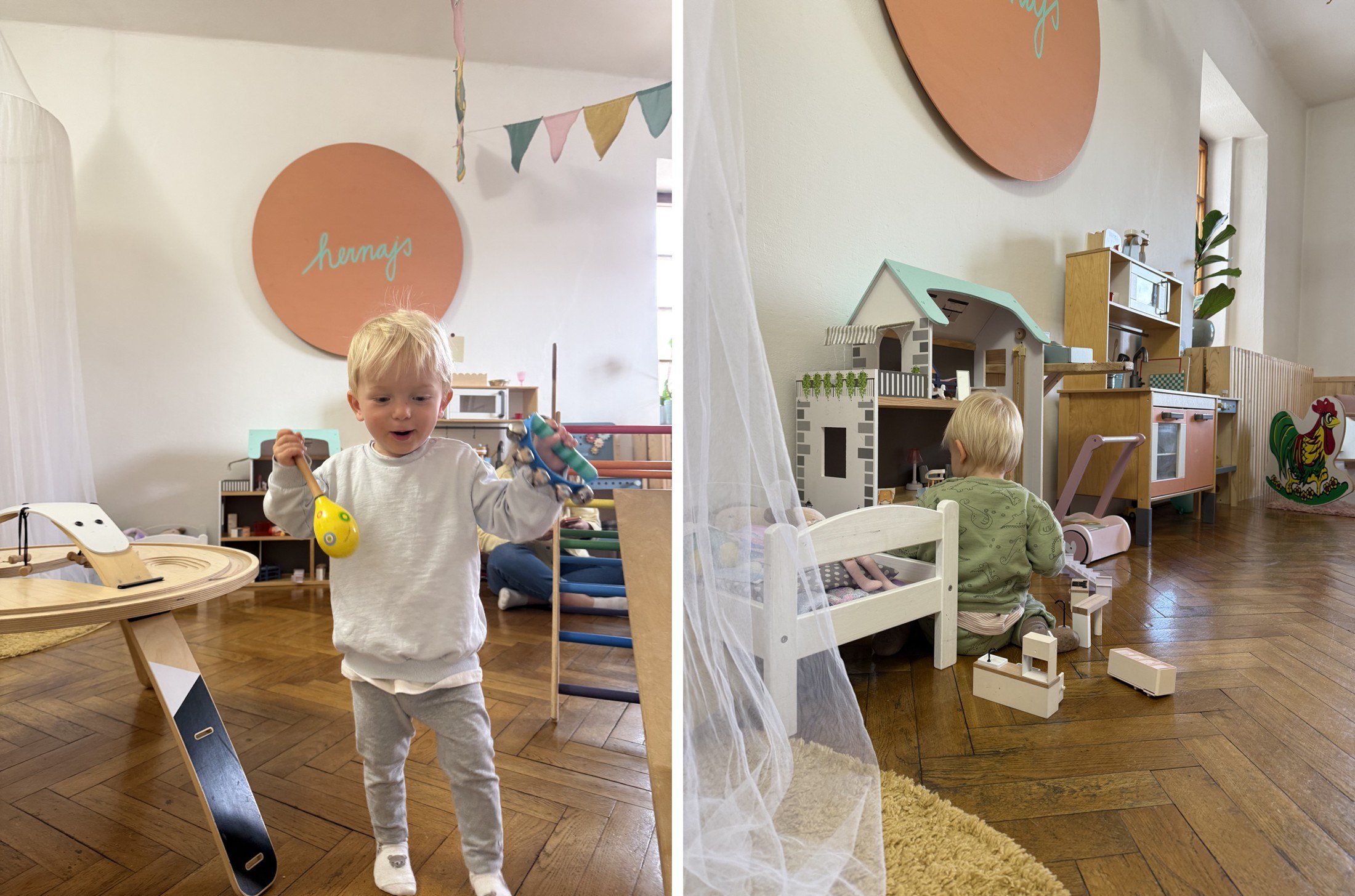
The absolute highlight is the Fort of Knowledge (Pevnost poznání) with its interactive science exhibits. In fine weather, we recommend hopping on bus No. 11 to Olomouc ZOO on Svatý Kopeček. When it rains, indoor play centres right in the city centre will save the day (JáSám on Horní náměstí or V lese on Žerotínovo náměstí). We’ve compiled all 34 tips in a separate article, Olomouc with kids.
When exactly does the Olomouc astronomical clock play?
The chimes and moving figures on the Town Hall astronomical clock are set in motion only once a day, precisely at 12:00 noon. The performance lasts several minutes.
Why is there a worker instead of saints on the astronomical clock?
The original historic astronomical clock was destroyed by a grenade at the end of World War II in 1945. During its post-war reconstruction in the 1950s, artist Karel Svolinský redesigned it in the spirit of the then-ruling socialist realism.
Where can I taste olomoucké tvarůžky?
Most traditional restaurants in the centre offer them as a starter or main course, often fried, pickled, or in garlic sauce. You can also buy them in local cheese shops, or take a trip directly to the company store in Loštice.
Tips and Tricks for Your Vacation
Don’t Overpay for Flights
Search for flights on Kayak. It’s our favorite search engine because it scans the websites of all airlines and always finds the cheapest connection.
Book Your Accommodation Smartly
The best experiences we’ve had when looking for accommodation (from Alaska to Morocco) are with Booking.com, where hotels, apartments, and entire houses are usually the cheapest and most widely available.
Don’t Forget Travel Insurance
Good travel insurance will protect you against illness, accidents, theft, or flight cancellations. We’ve had a few hospital visits abroad, so we know how important it is to have proper insurance arranged.
Where we insure ourselves: SafetyWing (best for everyone) and TrueTraveller (for extra-long trips).
Why don’t we recommend any Czech insurance company? Because they have too many restrictions. They set limits on the number of days abroad, travel insurance via a credit card often requires you to pay medical expenses only with that card, and they frequently limit the number of returns to the Czech Republic.
Find the Best Experiences
Get Your Guide is a huge online marketplace where you can book guided walks, trips, skip-the-line tickets, tours, and much more. We always find some extra fun there!
TL;DRIn February you won’t be swimming anywhere in Europe, not even in the Canary Islands (Tenerife’s sea is just 20.1 °C). Real warmth is only in the tropics: Bali 29.6 °C, Zanzibar 29.5 °C, the Maldives and Thailand 28.9 °C. The Canary Islands and Madeira still offer around 21 °C during the day and plenty of sun, which is unmatched anywhere else in Europe in February, and Egypt is ideal for Luxor and the pyramids without the heat. In the mountains, February is statistically the best ski month — just watch out for school half-term breaks, which push prices up and fill the slopes. On top of that, the famous carnivals in Venice and Tenerife reach their peak.
February may be the shortest month on the calendar, but let’s be honest — with all that darkness outside the window, it can feel absolutely endless. Christmas is long gone, spring still feels impossibly far away, and the sun seems to have vanished entirely. And yet this is exactly the time when you can snag seriously cheap flights to the warm tropics, when the Alps have their best powder, and when families all over are juggling half-term school breaks.
If you’re curled up under a blanket right now wondering about the best vacation destinations for February, I have good news for you, because your options really are plentiful. People usually fall into two camps: some desperately need to thaw out their frozen bones and are hunting for where to go to the sea in February, while others reach for their ski boots and head for their favourite snowy slopes.
In this article you’ll find no fewer than 30 ideas split into clear categories, so warmth-lovers, mountain enthusiasts, carnival fans and chasers of the Nordic winter will all find something. I’ve put together a big sea-temperature table, specific hotel tips, rough prices, and practical advice for the half-term season. All the weather data is based on ten-year averages from 2015 to 2024 according to the reliable ERA5 reanalysis, and the sea temperatures come from a precise ocean model covering 2019 to 2024.
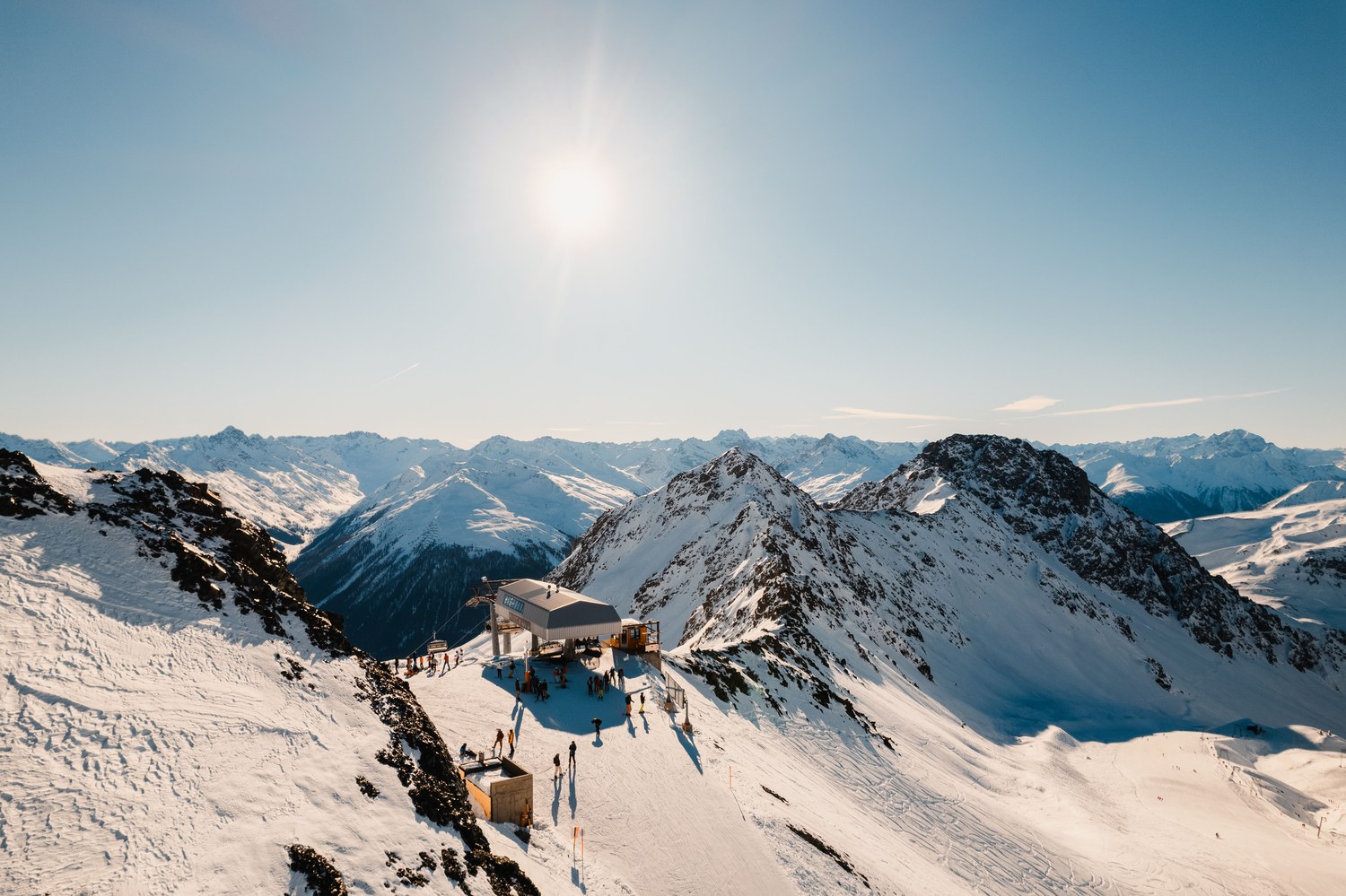
Skiing in the Alps in February (Photo: Ollie Craig / Pexels)
TL;DR
In Europe you won’t swim anywhere in February, not even in the popular Canary Islands (Tenerife, for example, has water of just 20.1 °C).
Real warmth is only in the tropics: Bali at 29.6 °C, Zanzibar at 29.5 °C, the Maldives at 28.9 °C, Thailand at 28.9 °C and Mauritius at 28.0 °C.
The Canary Islands and Madeira offer a very pleasant 21 °C during the day, which makes for absolutely ideal conditions for hiking and all-day exploring in nature.
Egypt promises air warmed to 23–25 °C, but the sea itself is only 21–23 °C, so most travellers head straight for the heated hotel pools instead.
In many countries school half-term breaks are staggered by region across several weeks, so if your dates are flexible you can hunt down much cheaper accommodation.
In the snowy Alps and Tatras, February is the very best ski month of the whole winter season.
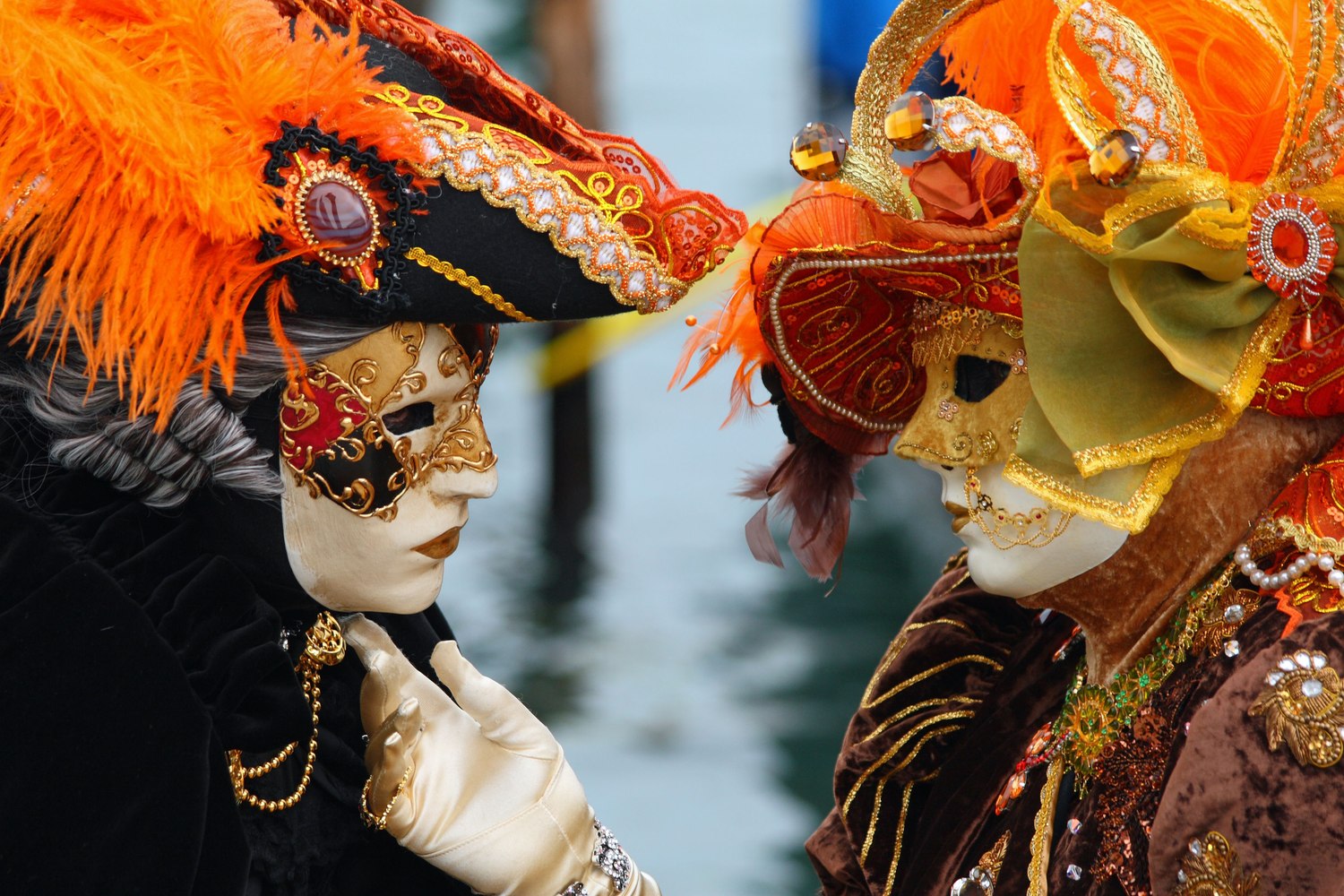
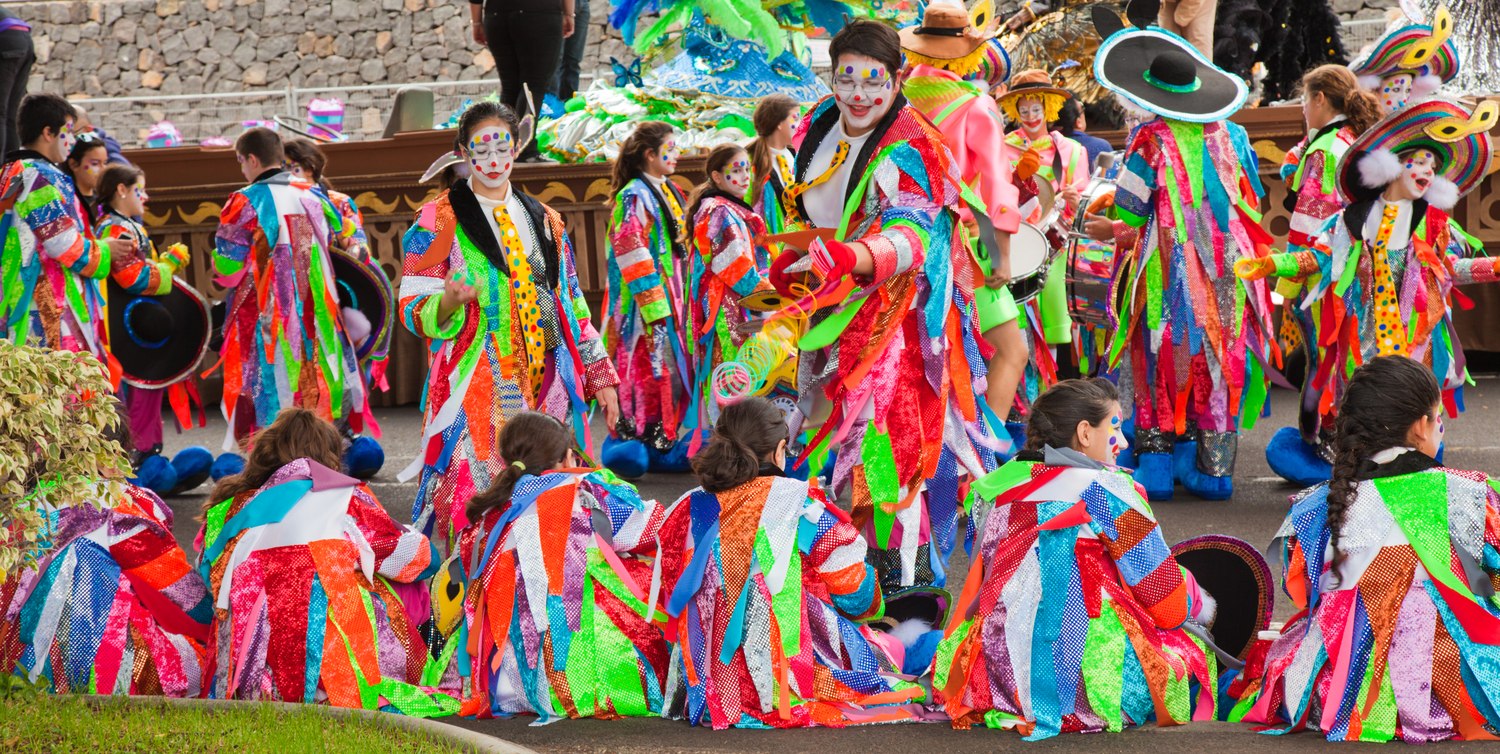
February is when the famous carnivals peak, with the most iconic and spectacular found in Venice, Italy and on Tenerife in Spain.
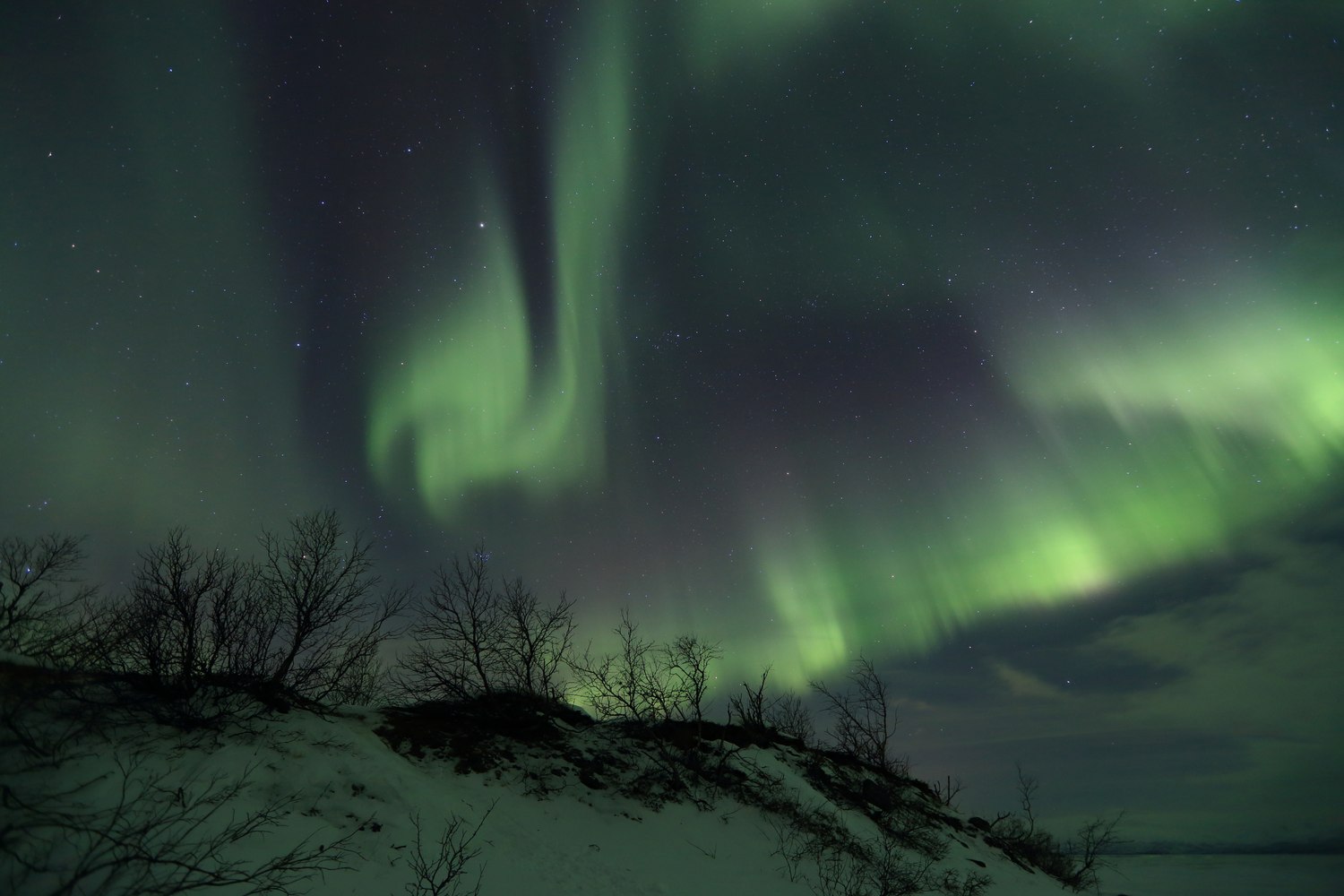
In the far north it’s still a great season, luring travellers with the magical northern lights and a host of other classic winter delights.
Why go in February (and what to expect)
Heading somewhere in the middle of winter has enormous charm, even if it takes a bit more planning than an ordinary summer holiday. February is a month of huge extremes, because while one place is gripped by bitter frost, elsewhere people are baking on the beach — so you can pick exactly what your body and soul need right now. Let’s look together at the main reasons to pack your bags right now, and also at the pitfalls to watch out for when booking.
5 reasons to travel in February
The cheapest tropics before spring. While flights to exotic destinations soar to astronomical heights at Christmas, in February you can find genuinely lovely fares for a fraction of the price. Airlines are trying to fill their planes before the main spring season, so if you have flexible dates you can save a lot of money and enjoy those luxurious beaches relatively cheaply.
The best snow of the season. If you love skiing and winter sports, February usually brings European mountains their absolute best snow conditions. The snow cover is already thick enough, the days are slowly getting longer, and the chance of an azure-blue sky above the slope is far higher than in gloomy December.
Half-term breaks are a ready-made window for families. Parents of school-age children know it well — February offers the ideal chance to head abroad without pulling kids out of lessons. A whole week off simply invites you to pack the suitcases and set off with the family for a proper trip in the snow or the sun.
Colourful, wild carnivals. February is known worldwide as the month of spectacular street celebrations with traditions stretching back hundreds of years. Travellers rave online about the incredible energy, the beautiful masks and the ever-present music that reliably chases away any winter blues.
Pure psychological relief. This is perhaps the single most important point, because after a dose of February sun and vitamin D, the rest of winter feels completely different. Just take even a simple long weekend somewhere with a blue sky and suddenly you have enough energy to make it calmly through March and reach the real spring. ☺️
What doesn’t work in February
Even though it’s a great month for travel, not everywhere will welcome you with ideal conditions, and it always pays to keep realistic expectations. According to the experience of many travellers and locals alike, there are some destinations and ideas you’re better off avoiding so you’re not left disappointed by freezing evenings or closed restaurants.
Swimming anywhere in Europe, including the Canaries. The water is icy, and unless you’re a trained cold-water swimmer, you simply won’t feel like getting in.
The Mediterranean is closed and cold. Tourist infrastructure in resorts in Greece or Italy is in deep winter hibernation, and aside from rain you’ll mostly find shuttered windows.
Long-haul flights are expensive around half-term. If you land right in the peak dates, flights to exotic destinations can be uncomfortably overpriced.
The Caribbean and Asia are at their seasonal peak — and so are prices. These regions enjoy the very best weather of the whole year, which logically means you’ll pay top rates for hotels and services.
The Alps are packed on half-term weekends. The slopes are bursting at the seams, lift queues are long, and you’ll need to book accommodation many months in advance.
Staggered half-term breaks: why they’re an advantage
While in some countries all schoolchildren have the same week off and prices shoot to absurd heights because of it, in others half-term is a huge strategic advantage. In many places school breaks don’t fall on everyone at once — they’re cleverly staggered by region across several weeks between February and March. Thanks to this system you can dodge the very biggest crowds.
That means you can choose dates that don’t fall in the most expensive week, and both in the mountains and at seaside resorts you can save a lot. I always recommend checking the calendar and confirming the current schedule, because the exact dates vary by region and by year. That way you’ll easily figure out when the crowds hit and plan your holiday for a time when the slopes are a little quieter.
Where it’s warmest in February: the big sea table
When searching for the ideal winter escape, people often ask where exactly that invisible line is beyond which it finally feels genuinely pleasant. In February the boundary between swimming and not swimming is sharper than ever and there’s no compromise: either you fly far into the tropics, or you simply won’t be swimming. If you’re trying to save money and hoping the south of Europe will surprise you with a summery heatwave, you’ll likely be very disappointed.
To give you a clearer picture, I’ve put together a detailed overview sorted from the warmest sea, so you can see at a glance where it’s worth booking flights. All the figures come from precise ten-year ERA5 reanalysis averages and an ocean model for 2019 to 2024, so these are reliable numbers, not just marketing promises from tour operators.
Destination
Sea temperature
Air by day
At night
Days with rain
Bali Indonesia
29.6 °C
28.8 °C
24.2 °C
26.4 of 30
Zanzibar Tanzania
29.5 °C
32.0 °C
26.0 °C
11.1 of 30
Maldives Maldives
28.9 °C
28.1 °C
26.8 °C
8.0 of 30
Ko Samui (Thailand) Thailand
28.9 °C
28.5 °C
24.8 °C
12.0 of 30
Mauritius Mauritius
28.0 °C
29.5 °C
24.7 °C
21.5 of 30
Trincomalee (Sri Lanka) Sri Lanka
27.8 °C
28.4 °C
24.3 °C
12.4 of 30
Cancún Mexico
26.7 °C
26.8 °C
22.4 °C
10.7 of 30
Muscat Oman
24.0 °C
25.9 °C
18.4 °C
1.2 of 30
Boa Vista Cape Verde
23.4 °C
25.9 °C
18.7 °C
1.2 of 30
Sharm el-Sheikh Egypt
22.9 °C
23.6 °C
13.7 °C
0.9 of 30
Sal Cape Verde
22.9 °C
24.0 °C
19.7 °C
1.2 of 30
Aqaba Jordan
21.8 °C
22.4 °C
11.5 °C
2.5 of 30
Marsa Alam Egypt
21.6 °C
23.3 °C
15.7 °C
0.0 of 30
Dubai UAE
21.6 °C
25.2 °C
15.9 °C
1.8 of 30
Hurghada Egypt
21.2 °C
21.7 °C
14.3 °C
0.4 of 30
Tenerife Canary Islands
20.1 °C
20.5 °C
14.8 °C
8.4 of 30
Gran Canaria Canary Islands
19.9 °C
20.0 °C
14.5 °C
3.8 of 30
Madeira Portugal
19.5 °C
18.5 °C
13.7 °C
8.3 of 30
Fuerteventura Canary Islands
19.2 °C
20.1 °C
15.1 °C
2.8 of 30
Lanzarote Canary Islands
19.1 °C
19.3 °C
15.0 °C
3.3 of 30
Algarve Portugal
19.0 °C
16.8 °C
10.4 °C
5.1 of 30
Ha Long (Vietnam) Vietnam
18.9 °C
20.8 °C
15.3 °C
8.3 of 30
Agadir Morocco
18.7 °C
21.6 °C
12.3 °C
2.9 of 30
Antalya and the Turkish Riviera Turkey
18.6 °C
15.7 °C
6.5 °C
9.2 of 30
Rhodes Greece
18.2 °C
15.6 °C
11.1 °C
8.4 of 30
Bodrum Turkey
18.1 °C
15.2 °C
9.7 °C
10.0 of 30
Paphos Cyprus
18.1 °C
16.5 °C
9.5 °C
8.2 of 30
Ayia Napa Cyprus
18.0 °C
16.7 °C
10.3 °C
5.6 of 30
Kos Greece
18.0 °C
15.2 °C
11.2 °C
10.2 of 30
Santorini Greece
17.2 °C
15.4 °C
11.7 °C
7.3 of 30
Azores Portugal
17.0 °C
16.5 °C
13.0 °C
13.0 of 30
Crete Greece
16.8 °C
16.2 °C
8.9 °C
9.8 of 30
Zakynthos Greece
16.7 °C
14.9 °C
10.0 °C
8.9 of 30
Lefkada Greece
16.5 °C
14.5 °C
8.0 °C
9.9 of 30
Malta Malta
16.1 °C
15.6 °C
11.5 °C
5.9 of 30
Corfu Greece
15.8 °C
14.1 °C
9.4 °C
10.3 of 30
Ksamil and Saranda Albania
15.6 °C
14.4 °C
5.9 °C
9.1 of 30
Halkidiki Greece
15.4 °C
12.9 °C
8.6 °C
7.2 of 30
Costa del Sol (Málaga) Spain
15.3 °C
17.3 °C
10.1 °C
4.7 of 30
Calabria Italy
15.3 °C
14.5 °C
8.8 °C
11.5 of 30
Sicily Italy
15.2 °C
15.1 °C
8.8 °C
9.4 of 30
Amalfi and the Bay of Naples Italy
15.2 °C
14.1 °C
6.9 °C
11.2 of 30
Hammamet Tunisia
15.2 °C
16.8 °C
9.2 °C
6.1 of 30
Ibiza Spain
15.1 °C
15.9 °C
10.3 °C
4.3 of 30
Mallorca – Palma Spain
14.8 °C
15.7 °C
8.5 °C
5.6 of 30
Dubrovnik Croatia
14.8 °C
12.8 °C
5.4 °C
11.1 of 30
Djerba Tunisia
14.8 °C
18.4 °C
10.7 °C
3.7 of 30
Corsica France
14.6 °C
14.1 °C
5.9 °C
10.5 of 30
Costa Blanca (Alicante) Spain
14.5 °C
16.9 °C
9.2 °C
3.5 of 30
Budva Montenegro
14.2 °C
12.9 °C
6.7 °C
11.8 of 30
French Riviera (Nice) France
14.2 °C
13.4 °C
6.0 °C
6.8 of 30
Split and Makarska Croatia
14.1 °C
12.7 °C
5.2 °C
9.8 of 30
Tuscany (coast) Italy
14.0 °C
12.9 °C
6.0 °C
9.7 of 30
Sardinia Italy
13.8 °C
14.8 °C
7.2 °C
7.2 of 30
Puglia Italy
13.7 °C
14.4 °C
7.3 °C
8.4 of 30
Costa Brava Spain
13.6 °C
14.1 °C
6.1 °C
7.1 of 30
Istria Croatia
12.0 °C
11.3 °C
5.5 °C
10.0 of 30
Rimini and the northern Adriatic Italy
8.6 °C
11.4 °C
4.2 °C
9.4 of 30
Sunny Beach Bulgaria
7.7 °C
10.3 °C
2.5 °C
7.6 of 30
New York (beaches) USA
5.2 °C
6.2 °C
-2.9 °C
10.0 of 30
Sea and air temperatures in February, sorted from the warmest sea. Air and rainfall are ten-year averages for 2015–2024 from the ERA5 reanalysis, sea temperature from an ocean model for 2019–2024.
Where you can swim in February
When you look at the specific numbers, it’s absolutely clear that lovers of hot beaches will have to pack their suitcases and set off on a properly long flight this year. The northern hemisphere is still waking from its winter sleep, while regions near the equator enjoy the very best possible conditions for lounging on a sunbed all day long.
So you can be absolutely sure, I’ve split things into four categories based on the real temperatures in each location. Travellers have very different tolerances for the cold, and what feels like a pleasant refreshment to one person can mean a ruined holiday for another. 😅
Above 28 °C is the tropics, which includes Indonesian Bali at an incredible 29.6 °C, African Zanzibar (29.5 °C), the Maldives and Thailand (both 28.9 °C), Mauritius (28.0 °C) and Sri Lanka, where Trincomalee reports water of 27.8 °C. Bali also has lovely daytime temperatures around 28.8 °C, and the Thai island of Ko Samui promises air warmed to 28.5 °C.
Around 26–27 °C covers the Caribbean and Mexico, with famous Cancún offering a sea warmed to a very pleasant 26.7 °C and daytime temperatures consistently around 26.8 °C.
A bearable 21–24 °C is found in Egypt, Dubai and Oman, where you can swim, but for many it’s already more of a very refreshing experience. Muscat in Oman offers sea at 24.0 °C, while popular Sharm el-Sheikh in Egypt holds water at 22.9 °C and air at 23.6 °C.
Below 21 °C are the Canaries and Madeira, where only truly hardy souls take to the sea. Tenerife, for example, has water of 20.1 °C, Gran Canaria 19.9 °C and Madeira in Portugal just 19.5 °C, with daytime temperatures around 18.5 °C.
Cities, mountains and the north in February
Not everyone longs for sand and sunscreen, of course, because for many travellers a real winter holiday means completely different experiences. If you’d rather explore historic centres without the crowds, love crunching snow underfoot or dream of seeing the magical northern lights with your own eyes, we have more great options for you. In February you can take wonderful trips to European capitals and into the Nordic wilds — you just need to know exactly where to head and how to dress properly.
Destination
Air by day
At night
Days with rain
Sun/day
Marrakech Morocco
21.3 °C
6.9 °C
5.5 of 30
9.7 h
Lisbon Portugal
15.9 °C
9.4 °C
6.7 of 30
8.5 h
San Francisco USA
15.3 °C
8.2 °C
7.2 of 30
8.9 h
Barcelona Spain
14.7 °C
5.9 °C
6.2 of 30
8.7 h
Rome Italy
14.2 °C
5.0 °C
8.7 of 30
8.3 h
Athens Greece
13.8 °C
6.4 °C
7.3 of 30
8.5 h
Tokyo Japan
10.3 °C
1.1 °C
7.9 of 30
8.0 h
Interlaken Switzerland
8.4 °C
1.3 °C
12.9 of 30
6.8 h
Budapest Hungary
8.0 °C
-0.0 °C
8.9 of 30
6.3 h
Bled Slovenia
7.1 °C
-0.9 °C
9.4 of 30
6.4 h
South Moravia (Mikulov) Czechia
6.9 °C
-0.5 °C
7.6 of 30
6.1 h
Prague Czechia
6.5 °C
-0.9 °C
10.0 of 30
5.8 h
Zell am See Austria
6.5 °C
-2.7 °C
12.6 of 30
6.8 h
Kraków Poland
5.8 °C
-1.4 °C
12.5 of 30
4.8 h
Cortina d’Ampezzo (Dolomites) Italy
3.8 °C
-5.0 °C
8.6 of 30
7.6 h
Bergen and the fjords Norway
3.6 °C
-1.3 °C
19.1 of 30
3.7 h
Reykjavík Iceland
2.0 °C
-2.6 °C
17.0 of 30
3.4 h
Toronto Canada
1.0 °C
-6.9 °C
9.4 of 30
6.4 h
High Tatras (Štrbské Pleso) Slovakia
-1.0 °C
-6.8 °C
14.9 of 30
5.8 h
Anchorage USA
-3.0 °C
-9.2 °C
11.9 of 30
4.5 h
Cities, mountains and the north in February. Ten-year averages for 2015–2024 (ERA5 reanalysis).
Warm February vacation destinations: 9 tropical spots
If you want a guarantee of swimming in a warm sea in February, one very simple truth applies. You simply have to accept that you’ll spend at least seven hours on a plane, because you won’t find swimming-worthy water any closer to Europe. The good news is that our winter months coincide with the peak of the dry season in the most beautiful exotic paradises.
The reward for the longer journey is not just empty beaches and a turquoise sea, but also a perfect tropical climate with no unexpected showers. Let’s look at nine destinations well worth heading to in February if you’ve had enough of the winter cold and desperately need to catch a tan beneath the palms.
1. Maldives: the peak of the dry season
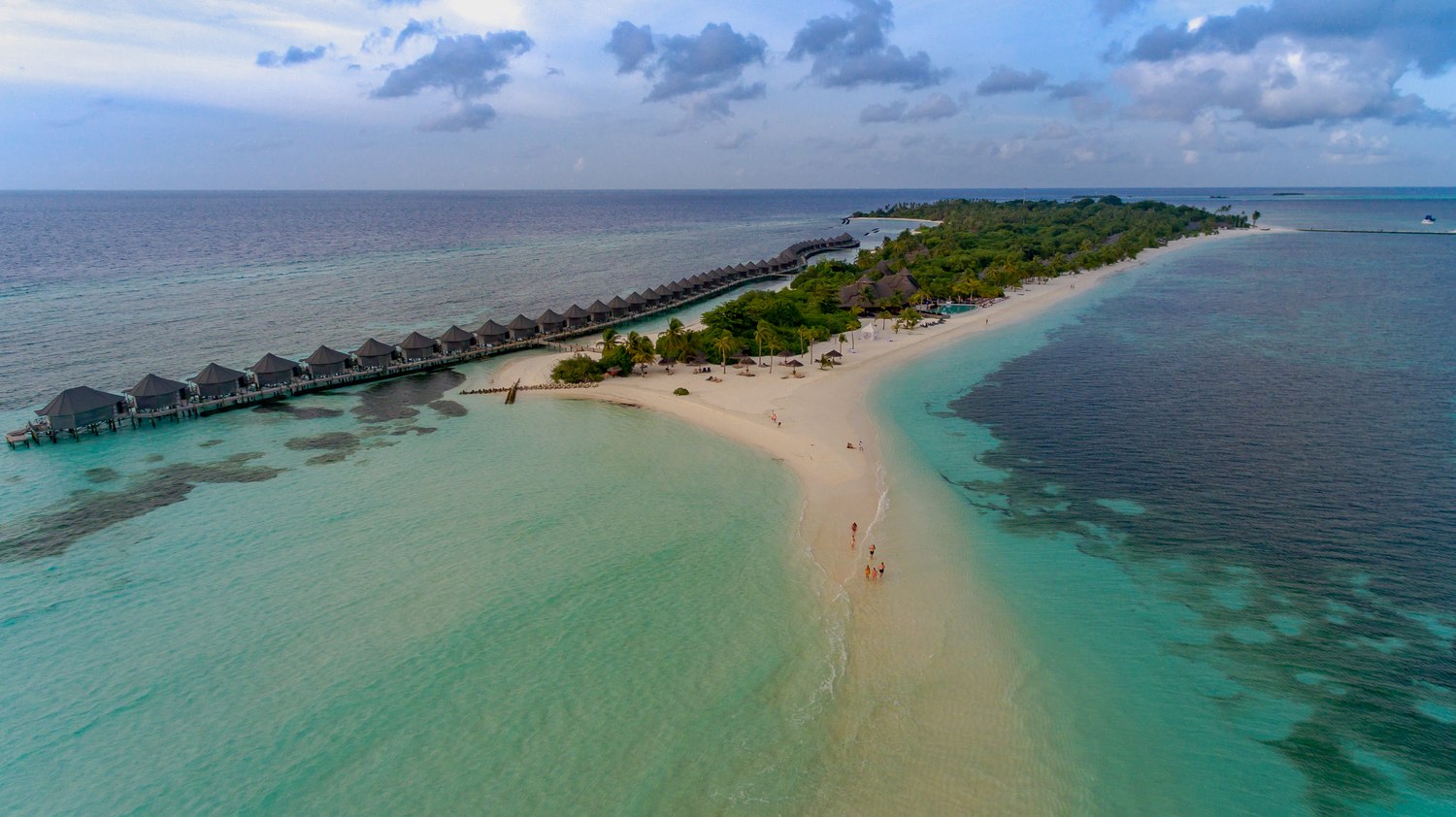
The Maldives are an absolute safe bet in February for anyone who loves warm sand and calm waves. Daytime temperatures hold at an ideal 28.1 °C, while at night they drop only slightly to 26.8 °C, so you can leave the jumpers at home. At an incredible 28.9 °C, the water is perhaps even warmer than the air, and travellers rave that you can happily snorkel in it for hours.
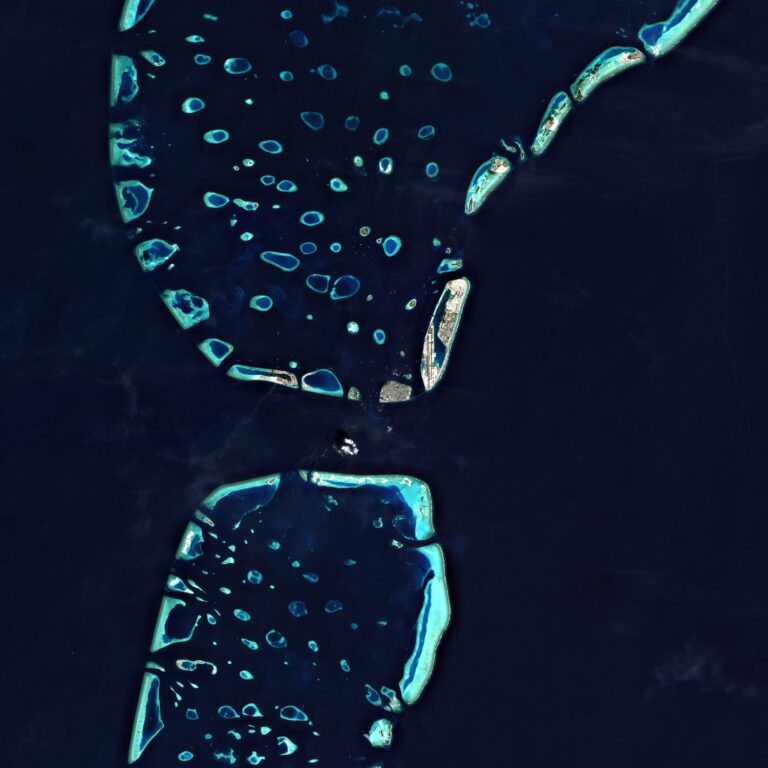
The Maldives in the dry season (Photo: dronepicr / Wikimedia Commons, CC BY 2.0)
This month is the absolute peak of the dry season, which means you can expect an average of 11.1 hours of sunshine a day. Rain is rare — statistics show around 8 rainy days — but usually it’s just a quick night-time shower that won’t slow you down at all. If you’re unsure about timing, definitely read our article on when to go to the Maldives.
February weather also favours perfect underwater visibility, which you’ll appreciate when watching the colourful fish and turtles at the coral reefs. Because demand is so huge, though, you’ll need to book resorts well in advance — and our guide to where to stay in the Maldives will easily help you with that.
If you’re planning an escape to Southeast Asia, the Andaman coast is at the very peak of its tourist season in February, with minimal rain. Spots like Phuket, Krabi or the beloved island of Ko Lanta report a perfectly blue sky and a calm sea, creating absolutely ideal conditions for boat trips. Seasoned travellers recommend this part of the year as the very best for exploring bays and limestone cliffs, of which our tips on what to see in Thailand list plenty.
Thailand’s Andaman coast (Photo: This photo was taken by Anton Zelenov.
Please credit this wi / Wikimedia Commons, CC BY-SA 4.0)
The Gulf of Thailand, and specifically the island of Ko Samui, is no bad choice either, with average daytime temperatures around 28.5 °C. The sea will delight you at a lovely 28.9 °C, and although statistics mention around 12 rainy days, these are usually quick, refreshing showers after which the sun comes straight back out with an average of 10.7 hours a day. Night-time temperatures fall to a pleasant 24.8 °C.
Whichever coast you choose, February days are made for sipping coconuts under the palms and taking evening strolls through the markets. For those of you thinking of going independently, we’ve written a detailed guide to Thailand without a tour operator, which makes the whole organisation a breeze.
3. Zanzibar: dry between two monsoons
The African spice island offers a perfect window of beautiful weather at the start of the year, because it sits in a short dry period between two monsoons. February temperatures regularly climb to a hot 32.0 °C, and the humid air will make you forget the Central European frosts very quickly. The sea invites endless swimming at a luxurious 29.5 °C, and on the fine white-sand beaches you’ll recharge plenty of much-needed energy.
Zanzibar (Photo: ObonyoML / Wikimedia Commons, CC BY-SA 4.0)
At night it cools only mildly to 26.0 °C, so you’ll definitely use the room’s air conditioning, and evenings spent outdoors are hugely pleasant. The sun blazes for an impressive 11.2 hours a day and rain tends to be the exception in this period, even if the statistics show around 11 days with a cloud or two. You’ll find all the practical planning information in our big guide to Zanzibar.
Besides catching a tan, it’s well worth heading out to the clove and vanilla plantations or exploring the mysterious alleys of Stone Town. Since this is one of the most popular winter times to travel, make sure to choose your accommodation early.
When it comes to the Island of the Gods, I have to be completely honest and tell you straight that February falls right in the middle of the rainy season. Local statistics look alarming at 26.4 rainy days a month, but in practice it usually rains only briefly and intensely in the afternoon, while you enjoy sunshine in the mornings. Average daytime temperatures hold at a lovely 28.8 °C and the sea is warmed to an incredible 29.6 °C.
Bali in the rainy season (Photo: Vyacheslav Argenberg / Wikimedia Commons, CC BY 4.0)
Travellers agree that the winter months are the cheapest and at the same time the greenest part of the whole year. The rice fields glow with rich colours, the waterfalls have tremendous force, and there are far fewer tourists than at the summer peak — you can read more in our article on Bali. At night temperatures fall to 24.2 °C and the sun manages to shine for around 9.4 hours a day.
This timing is absolutely ideal for digital nomads, surfers and anyone who doesn’t mind the occasional tropical downpour. An excellent choice for a February stay is the peninsula in the south, where there’s a little less rain, so take a look at our tips for the Uluwatu area.
5. Sri Lanka: the southwest at its best
February Sri Lanka shows its most beautiful face above all on the southwest coast and in the central interior. While the north and east of the island are being lashed by the monsoon, areas like Galle, Mirissa or the popular Unawatuna report absolutely luxurious conditions for both swimming and sightseeing. Air temperatures hold steadily around 28.4 °C by day and 24.3 °C at night, an ideal compromise between heat and pleasant coolness.
Southwest Sri Lanka (Photo: Praveenshashika / Wikimedia Commons, CC BY-SA 4.0)
The ocean water is a wonderful 27.8 °C and the sun will treat you to a generous 11 hours of light each day. This month is also a huge draw for animal lovers, because it’s peak season for watching the enormous whales off the coast of Mirissa, reportedly one of the most beautiful moments of the whole trip. You’ll find a complete itinerary for your journey in our article on Sri Lanka.
Despite the favourable weather forecast, it’s worth allowing for an average of 12 rainy days, though these usually show up only as short tropical showers. Thanks to them the tea plantations inland stay wonderfully lush, and a ride on the famous blue train through the hills will absolutely captivate you.
6. Mauritius and the Seychelles
When planning a trip to the islands of the Indian Ocean, it’s vital to remember that they lie in the southern hemisphere. February here is the absolute peak of summer, which brings a very hot and, above all, highly humid climate that may not suit everyone. During the day, prepare for temperatures around 29.5 °C, and even the nights at 24.7 °C won’t offer much relief from the ever-present heat.
Mauritius (Photo: NorbertNagel / Wikimedia Commons, CC BY-SA 4.0)
At the same time I have to warn you honestly that the winter months fall within the unpopular cyclone season. The statistics do show a lovely 11.4 hours of sunshine, but also a high 21.5 days with rain, so you have to accept that nobody can guarantee you a completely blue sky. We’ve summed up more details about the local climate and trip tips under the link Mauritius.
On the other hand, you’ll enjoy a perfectly warm sea at 28.0 °C that positively begs for all-day snorkelling. The scenery is also gorgeously in bloom thanks to the more frequent rain, and the waterfalls reach their greatest force, which makes trips inland a fantastic affair.
7. Caribbean and Mexico: the best part of the year
The Caribbean region enjoys its absolute golden era in February, and you’d search in vain for better timing for a trip across the ocean. Hurricane season is long and safely gone, replaced by stable, very pleasant weather with daytime temperatures around 26.8 °C and nights of 22.4 °C. The sea in Mexican Cancún and on the surrounding islands offers an ideal 26.7 °C, and the sun will smile on you for around 10.5 hours a day.
Mexico’s Caribbean coast (Photo: Martin Falbisoner / Wikimedia Commons, CC BY-SA 4.0)
Because this is the absolute peak of the tourist season, I have to prepare you in advance for the fact that flight and resort prices are at their annual maximum. Local hotels burst at the seams under the influx of Americans escaping the winter, so if you’re considering an all-inclusive stay in Mexico, don’t put off booking.
You needn’t worry about rain in this period — statistics do report around ten days with a shower, but in reality it’s a negligible amount of water. If you’re weighing up other months and want to be sure of great weather, I recommend reading our big overview of when to go to Mexico.
8. Vietnam and Southeast Asia
Vietnam in February is a huge country of contrasts when it comes to weather, and you need to watch out for that when planning your itinerary. While the north around Ha Long Bay is cold and foggy with daytime temperatures barely around 20.8 °C and a sea of 18.9 °C, the south around Ho Chi Minh City and Phu Quoc island enjoys wonderfully dry, classic tropical warmth. In the north the sun peeks out for just 5.5 hours a day and the nights, at 15.3 °C, can be quite cold.
Crucial information for all travellers is the fact that February usually brings the lunar new year celebration known as Tet. During this important holiday the whole country is on the move, many sights and family businesses are closed, and train and bus tickets sell out weeks in advance.
If you opt for the southern part of the country, you’ll be rewarded with empty beaches, luxurious swimming and tables laden with fragrant herbs and noodles. Travellers really appreciate that it doesn’t rain in this period, so you can devote yourself fully to exploring the markets and scootering between the rice paddies.
9. Japan and Asia for a different experience
If swimming doesn’t tempt you and you’d rather experience a proper winter with a huge dose of culture, head to the Land of the Rising Sun. February in Tokyo is fairly cold, with average daytime temperatures of 10.3 °C and night frosts falling to 1.1 °C, but this time of year offers an absolutely unique atmosphere. The sea at 10.2 °C won’t tempt you into a swimsuit, but the sun shines for a lovely eight hours a day and it rains only around eight days a month.
Japan in winter (Photo: Manish Prabhune / Wikimedia Commons, CC BY 4.0)
While the northern island of Hokkaido is in the midst of its spectacular snow-festival season with giant ice sculptures, the alleys of ancient Kyoto delight with beautifully empty temples free of tourist crowds. The end of winter is also the time when you’ll snag the very cheapest flights of the whole year. For inspiration for your trip, I recommend browsing our article on a holiday in Japan.
Travelling in colder weather has the huge advantage that you can fully and guilt-free enjoy the local onsen hot springs, which warm you through perfectly in the evening. If you’re still unsure about timing, we’ve written a detailed guide on when to go to Japan.
February sun without a long flight: 6 destinations
Many of us just want to shed our heavy coats for a moment mid-winter and top up on a little vitamin D without spending half a day on a plane. If you’re one of those who don’t want to fly halfway around the planet, one important rule applies. Without a long flight you can’t expect to swim in a warm sea, because the water around Europe and North Africa simply isn’t swimsuit weather.
But you can expect something far more valuable for your mind: warming sunshine, temperatures climbing towards 20 degrees, and pleasantly half-empty historic sights without the summer crowds. Let’s look together at six great destinations where a light jumper is all you need during the day and you’ll soak up plenty of spring energy.
1. Canary Islands: European sun in winter
The islands of eternal spring work as a guaranteed European escape from the cold. I do have to admit honestly, though, that with an ocean temperature between 19.1 °C and 20.1 °C, swimming in the sea is really one for hardy souls, even if you’ll find plenty of relaxation at the hotel pools. During the day the average temperatures on the islands hover just above 20 °C, from 19.3 °C on windy Lanzarote to 20.5 °C in the south of Tenerife — a luxury you simply won’t find anywhere else in Europe.
Tenerife in February (Photo: Vladislav Krot / Pexels)
A huge draw for a February visit is, among other things, the famous carnival on Tenerife, which reportedly ranks among the biggest and most colourful in the entire world. If you’re not sure exactly where to head, take a look at our clear guide on which Canary Island to choose. The sun will keep you company for around ten hours a day and rain is rare — on Gran Canaria it rains an average of just four days a month.
Whether you go for volcanic beaches or mountain hikes, don’t miss our detailed guide to the island of Tenerife. At night temperatures drop to around fifteen degrees, so a light jacket definitely belongs in your suitcase.
💡 Accommodation tip:Marina Elite in Arguineguín on Gran Canaria.
2. Madeira: flowers and levadas
The Portuguese island of flowers offers absolutely fantastic conditions for an active holiday full of hikes in the winter months. During the day you can count on a very pleasant 18.5 °C, which is the absolute ideal for all-day hikes along the irrigation channels known as levadas. The ocean at 19.5 °C is more for admiring from the cliffs, but the sun will keep you company for a solid 9.3 hours each day ☺️.
Madeira (Photo: Dietmar Rabich / Wikimedia Commons, CC BY-SA 4.0)
The February climate brings an average of eight rainy days a month, thanks to which the island keeps its typical emerald-green colour and the waterfalls have plenty of water. At night, prepare for a chillier 13.7 °C, so a good windbreaker and a fleece definitely shouldn’t be missing from your backpack. You’ll find all the information you need for planning your cliffside trails in our article on Madeira.
Locals recommend combining hiking with a tasting of the excellent wine and fresh exotic fruit at the market in Funchal. If you’re interested in a detailed breakdown of temperatures for each month, be sure to check out our piece focused on the weather in Madeira.
3. Egypt: warm on land, cooler sea
If you’re looking for very affordable warmth, the Red Sea resorts certainly won’t let you down at the end of winter. On land you’ll find a beautiful 21.7 °C in Hurghada up to a wonderful 23.6 °C in Sharm el-Sheikh, and practically not a drop of rain will fall from the sky. The sea in this period is around 21.2 °C to 22.9 °C, so you can swim in it, but the water is more pleasantly refreshing than genuinely tropical.
Egypt without the heat (Photo: Marc Ryckaert / Wikimedia Commons, CC BY 3.0)
It’s precisely this milder weather that makes February the very best month for historic trips to the pyramids at Giza or the temple in Luxor, since you avoid the summer’s exhausting 40-degree heat. The nights are cooler and fall to around 14 degrees, so pack a jumper for evening strolls along the promenade. Our piece on where to go on holiday in Egypt will gladly help you choose a specific resort.
The sun shines here for a lovely ten hours a day, and the wind typical of the winter months creates great conditions for kitesurfing fans. For more detailed temperature tables and further recommendations, take a look at our guide to the weather in Egypt.
A trip to admire the modern architecture of the Emirates is a hugely popular winter choice, and it makes perfect sense. February in Dubai counts as one of the very nicest months of the whole year, when you’ll measure an absolutely ideal 25.2 °C during the day. Gone is the dreaded summer inferno when you can barely breathe outside, and you can calmly enjoy strolls beneath the giant Burj Khalifa or shopping at the traditional markets.
Dubai (Photo: Jan Michael Pfeiffer (original) / Wikimedia Commons, CC BY-SA 2.0)
The sea temperature holds at 21.6 °C, so it’s the braver swimmers who’ll take the plunge, but the hotel pools are usually perfectly heated. The sun shines for a lovely 10.1 hours a day and you definitely don’t need to lug an umbrella around, because statistics show an average of just under two rainy days a month. Nights at 15.9 °C are absolutely ideal for a comfortable sleep.
Whether you decide to admire the singing fountains, head out on a jeep safari into the sand dunes, or simply relax by the water, you’ll definitely appreciate our detailed guide to the city of Dubai, where you’ll find plenty of practical advice for your trip.
5. Oman and Jordan: the desert at the ideal temperature
The Middle East offers great conditions at the end of winter for all adventurers who love combining nature with history. In Muscat, Oman you’ll enjoy a beautiful 25.9 °C during the day and a promising 24.0 °C in the sea, which makes this destination a surprisingly luxurious refuge for lovers of warm sand. Rain is almost unheard of here and the sun blazes for an impressive 10.6 hours a day, as we write more about in our article on a holiday in Oman.
Wadi Rum in Jordan (Photo: Berthold Werner / Wikimedia Commons, CC BY-SA 3.0)
Aqaba in Jordan, on the Red Sea, offers a milder 22.4 °C during the day, but for sightseeing trips around the country it’s absolutely perfect timing. In February you can wander the famous rock city of Petra for hours without the threat of heatstroke, which is utterly unthinkable in summer. You do need to be prepared, though, that Petra lies at around 1,130 metres above sea level and night-time temperatures here fall uncomfortably low.
When camping in the Wadi Rum desert, don’t forget to pack genuinely warm clothing for the evening, because the night air can trouble even the hardiest characters. You’ll find plenty of inspiration and specific route tips in our itinerary for a holiday in Jordan.
6. Morocco: Marrakech and the desert
The end of our selection belongs to enchanting North Africa, which lures visitors with the scent of spices, mint tea and beautiful architecture. In February the royal city of Marrakech offers a lovely 21.3 °C during the day, creating absolutely luxurious conditions for exploring the bustling markets and gardens. The sun shines for a pleasant 9.7 hours a day and occasional rain appears an average of just six times a month.
Marrakech (Photo: Petar Milošević / Wikimedia Commons, CC BY-SA 4.0)
I do have to warn you honestly about the huge temperature swings, though, because in Marrakech night-time temperatures fall as low as a very chilly 6.9 °C and most traditional houses, known as riads, have no central heating. If you fancy heading to the ocean and the resort of Agadir, a similar 21.6 °C awaits you, but the sea, at just 18.7 °C, is only for genuinely tough characters. We’ve summed up tips for the best markets and sights in our article on what to see in Marrakech.
This time of year is absolutely fantastic for renting a car and travelling under your own steam, because the roads aren’t crowded with tourists and accommodation prices are very friendly. Our tried-and-tested itinerary for a road trip through Morocco will help you plan the whole journey right up to the beautiful sand dunes.
Best February vacation destinations for the mountains: the season’s best snow
According to ski statistics, February is probably the very best month for winter fun, because the slopes have the most snow of the whole season. On top of that, the days are noticeably longer than in December and the sun is already starting to warm the slopes pleasantly. The one small catch is that this is exactly when half-term breaks overlap across Europe, which unfortunately pushes prices up and packs the slopes to bursting.
But if you can afford to travel outside the busiest weeks, absolutely ideal conditions await you. Local hoteliers recommend booking accommodation well in advance so you secure a reasonable price and don’t have to commute to the lifts from far away. The mountains are living life to the full this month and the atmosphere in the alpine villages tends to be wonderful.
1. Austrian Alps: a classic within easy reach by car
Austria is an absolute constant for skiers who happily return year after year. The drive to most of the famous resorts takes at most seven hours from the surrounding countries, so you don’t spend the whole day travelling and can even hit the slopes the same day. Naturally, before you set off it’s worth checking how the Austrian motorway vignette (toll sticker) works, so you don’t get any unnecessary surprises on the way. Among the absolute top spots are resorts like Zell am See and Kaprun, Kitzbühel, Ischgl, Saalbach and high-altitude Sölden.
The Austrian Alps in winter (Photo: Magda Ehlers / Pexels)
As for the weather, in Zell am See, for instance, February daytime temperatures sit around a pleasant 6.5 °C and drop to -2.7 °C at night, with an average of 12.6 days with precipitation and a luxurious 6.8 hours of sunshine a day. When skiing tires you out, there’s nothing better than swapping ski boots for a swimsuit and exploring the renowned wellness hotels in Austria. In summer the Austrian lakes are a draw for swimmers, but in winter their frozen surfaces turn into a magical backdrop for relaxing in the sauna.
2. Italy and the Dolomites: Dolomiti Superski
Experienced skiers often agree that the southern side of the Alps offers far more stable weather and, above all, far more sunshine than the north. Looking at the statistics for Cortina d’Ampezzo, February days promise temperatures around 3.8 °C, nights drop to -5.0 °C and there are an average of just 8.6 days with precipitation, yet the sun shines for a lovely 7.6 hours a day. The number-one draw here is undoubtedly the connected Dolomiti Superski pass, which opens the gates to an incredible hundreds of kilometres of perfectly groomed slopes.
The Dolomites in winter (Photo: Zoran Kurelić Rabko / Wikimedia Commons, CC BY-SA 3.0)
Italy is also famous for its hospitality and excellent food on the slopes, where even vegetarians will find plenty to love among the superb pasta and pizza, while meat-eaters reportedly swear by the local cured meats. If you’re planning to head to the Dolomites with kids, you’ll certainly appreciate the gentler slopes and the many ski schools with a patient approach. In the summer months the crowds head here for Lago di Sorapis, but in winter these mountains belong purely to lovers of corduroy and carved turns.
3. The High Tatras and Slovakia
Anyone looking for a more affordable alternative to the alpine giants should definitely turn their gaze to Slovakia. You’ll enjoy not only lower prices but also plenty of unspoilt nature, which is a huge relief. The weather at Štrbské Pleso keeps its proper wintry character in February, with daytime temperatures around -1.0 °C and night frosts falling to -6.8 °C. Snow falls fairly often, an average of 14.9 days a month, and the sun shows up for 5.8 hours a day.
The High Tatras in winter (Photo: Kacper Wolski / Pexels)
Skiing in the Tatras has the huge advantage that you can pair it fantastically with relaxing in hot water. When your legs ache after a full day carving the slopes, the thermal baths in Slovakia are, according to travellers, an absolute balm for body and soul. And if you enjoy a bit of winter hiking alongside the slopes, take a look at these 3 hikes in the High Tatras, which take on a completely different, slightly magical atmosphere in their snowy coat. ☺️
4. Switzerland: expensive, but different
Rumours swirl that Switzerland will ruin your wallet the moment you glance at the ski-pass prices, which is partly true, but the quality of service here reportedly matches the high price tags perfectly. This country offers skiing at huge altitudes against the backdrop of the most iconic four-thousanders, which tower above deep valleys. In popular Interlaken, for example, February temperatures hold around 8.4 °C during the day and drop only slightly to 1.3 °C at night. You can expect 12.9 days with precipitation and 6.8 hours of sunshine, which beautifully lights up the surrounding peaks.
The Swiss Alps (Photo: Norbert Aepli, Switzerland (User:Noebu) / Wikimedia Commons, CC BY 3.0)
A winter holiday in Switzerland doesn’t have to be all about skiing steep slopes, though. If you want a break from the pistes, locals recommend exploring Switzerland by train, because gliding through a snowy landscape in the glass carriages of the red trains is one of the most beautiful experiences of all. It’s simply an exclusive destination for those of you seeking perfect service and fairy-tale scenery.
5. Slovenia and the Julian Alps
Slovenia isn’t among the great skiing superpowers, but that only means a more intimate and friendly atmosphere awaits you here. The journey from many towns is shorter than to the more distant corners of the Austrian or French Alps, which you’ll appreciate especially when travelling with smaller children. In the beautiful surroundings of Lake Bled, expect February daytime temperatures around 7.1 °C, cooling to -0.9 °C at night, with an average of 9.4 days with precipitation. The sun will keep you company for a pleasant 6.4 hours a day, which positively invites afternoon strolls after skiing.
Bled in winter (Photo: Mihael Grmek / Wikimedia Commons, CC BY-SA 3.0)
The very best thing about the Slovenian winter is the brilliant chance to combine morning carving with an afternoon soak in warm water. According to many reviews, the best thermal baths in Slovenia are architecturally gorgeous and often offer direct views of the snowy peaks. Once you’ve had your fill of skis, set off to explore Bled and Bohinj, because the frozen lakes surrounded by majestic mountains look like they’ve been cut straight out of a Christmas postcard.
6. Central Europe: the cheapest option
You don’t have to cross borders far to the south at all cost to get in some decent February skiing. The mountains of Central Europe usually have a good blanket of snow this month, even if statistics for Prague show more spring-like values, with daytime 6.5 °C and night-time -0.9 °C, 10.0 days with precipitation and 5.8 hours of sun. The Polish side of the Giant Mountains (Krkonoše) is also increasingly popular, boasting modern lifts and often somewhat friendlier ski-pass prices.
The Giant Mountains in winter (Photo: Pudelek / Wikimedia Commons, CC BY-SA 4.0)
The great advantage of a holiday closer to home is flexibility: if the February weather doesn’t cooperate and the snow starts vanishing before your eyes, you have plenty of backup plans. You can take the family to explore the best water parks in Czechia or warm up your bones in the bubbles of the best thermal baths in Czechia. And if you happen to be closer to the east, the best water parks in Slovakia are a great alternative for rainy winter days when you wouldn’t send even a dog out onto the slope. 😅
Where to go in February for carnival and the Nordic winter
In many countries February is a month of huge celebrations, because this is when the traditional carnival festivities peak and everything builds towards Ash Wednesday. The streets fill with parades, music and wild masks, which turns this otherwise grey winter period into one of the merriest months of the year. If you love culture, music and dance, you should definitely add at least one world-famous carnival to your travel bucket list.
At the complete opposite end of the spectrum are those of you who long for total silence, frosty romance and a heavenly show. February is also the last truly strong month for chasing the northern lights, when the far north is still properly wintry yet no longer in total darkness all day. These Nordic expeditions reportedly completely change people’s view of winter, which suddenly stops being just a tedious wait for spring.
1. The Venice Carnival
When you say February festivities, the first thing that comes to many people’s minds is the breathtaking Venice with its mysterious masks. St Mark’s Square turns into one enormous historical stage in this period, where people parade in incredibly elaborate costumes, and the whole atmosphere must be absolutely enchanting judging by the photos. Since the exact carnival dates depend on the date of Easter, they change every year, so before planning your trip you must carefully check the days of the celebrations.
The Venice Carnival (Photo: Frank Kovalchek from Anchorage, Alaska, USA / Wikimedia Commons, CC BY 2.0)
Travellers often agree on one very practical piece of financial advice, because prices in the city centre itself skyrocket during the celebrations. If you want to save serious money, it pays to stay outside the main island, for example in the Mestre district, from where you can reach the heart of the Venice Carnival by train or bus in just a few minutes. You can then spend the saved money on excellent Italian pasta or traditional sweets instead.
2. The Tenerife Carnival
Few people know that to experience carnival madness on the level of famous Rio de Janeiro you don’t have to cross the ocean at all. The capital of the Canary island, Santa Cruz de Tenerife, hosts celebrations that, according to many rankings, are among the very biggest and most spectacular in the entire world. Expect endless parades full of feathers, Latin American music and dancing crowds who party into the early hours.
Carnival in the Canary Islands (Photo: Tamara Kulikova / Wikimedia Commons, CC BY-SA 4.0)
The best thing about this destination is that you can very easily combine the February carnival fun with an escape from the winter cold. The Canary Islands are known as the land of eternal spring, so Tenerife will offer you plenty of sun during the day and temperatures that positively tempt you to relax on the beach with a book, while in the evening you throw yourself into the whirl of exuberant celebrations.
3. Lapland and Finland: huskies, reindeer and the northern lights
Finnish Lapland is a destination surrounded by fairy-tale legends, because the snowy forests and wooden cabins with crackling fireplaces create an absolutely perfect backdrop. Although it’s still deep winter here in February with heaps of snow, the big advantage is that the days are already noticeably longer than in December. Thanks to this you can traverse the frozen landscape by husky or reindeer sled in daylight and still have plenty of energy in the evening for the main show.
Lapland (Photo: Jacek Rużyczka / Wikimedia Commons, CC BY-SA 4.0)
It’s the night sky that draws most travellers here, because the northern lights in Lapland reportedly play in the most beautiful colours. If you’re unsure about the right timing and researching when to go to Lapland, rest assured that late winter is hugely popular for watching this phenomenon. You just need to bundle up in several layers of thermal underwear and get a little lucky with a clear sky.
4. Iceland and Norway
Let me say honestly right up front that February in these places isn’t for the faint-hearted, because the weather can be extremely harsh and unpredictable. In Reykjavík, daytime temperatures around 2.0 °C and night-time -2.6 °C await you, with an average of 17.0 days of precipitation a month and just 3.4 hours of sun. Bergen in Norway isn’t much better off with daytime 3.6 °C, night-time -1.3 °C and rain or snow on an incredible 19.1 days. In Iceland you have to accept that many roads are impassable due to blizzards and plans change from hour to hour.
Iceland in winter (Photo: Eric Kilby / Wikimedia Commons, CC BY-SA 2.0)
So why go there at all? The answer is the beautiful blue ice caves, which are in their very best condition and safely accessible in this period. If you’re carefully weighing up when to go to Iceland, February is a compromise between the harsh climate and the chance of emptier sights. Just as breathtaking, according to photographers, are the northern lights over the Lofoten Islands, where the magical green lights reflect on the surface of the dark fjords — a sight that must etch itself deep into your memory.
5. Sweden and Lapland in the north
The Swedish part of Lapland stands slightly in the shadow of its Finnish neighbour, which makes it a somewhat quieter and often marginally cheaper alternative for a winter adventure. Here you’ll find the famous ice hotel and national parks blanketed in deep snow, where you can race around on snowmobiles for hours without meeting crowds of other tourists. The local nature retains its raw wildness, which appeals above all to lovers of authentic experiences away from the best-known resorts.
Swedish Lapland (Photo: Pavel.shyshkouski / Wikimedia Commons, CC BY-SA 4.0)
Just as in Finland or Norway, here too the main motivation for travellers is the darkness lit up by a cosmic show. Photo-hunters really rave about how the northern lights in Sweden paint the sky above the frozen lakes in unbelievable shades. For anyone researching when to go to Sweden for winter fun, February promises, according to statistics, enough snow for all the classic Nordic activities and, at the same time, more bearable temperatures for longer spells outdoors.
Where to go in February for city breaks and wellness
Exploring European capitals in the summer months tends to be a trial by fire, sweating in the crowds and paying astronomical prices for an ordinary room on the edge of the city. February, by contrast, brings a wonderful chance to enjoy culture, museums, cafés and local architecture for a fraction of the usual price and, above all, in complete calm. And when you add the prospect of hot thermal springs, you have the recipe for an absolutely perfect long weekend that will leave you feeling reborn.
Places to visit in Europe in the cheapest period of the year
Southern European cities are only slowly waking into spring in February, but compared to the grey Central European winter it’s a balm for the soul, because the sun is often high in the sky and it’s definitely no longer coat weather. Travellers really appreciate the half-empty streets around the main sights, which you can hardly reach in high season, and hotels often offer very attractive deals. A winter city break is ideal for those of you who love lingering in local bistros, tasting vegetarian tapas or taking endless strolls through galleries. Try considering these beautiful destinations:
European cities in winter without the queues (Photo: Diego Delso / Wikimedia Commons, CC BY-SA 4.0)
Rome (Italy): day 14.2 °C, night 5.0 °C, 8.7 days with rain, 8.3 h/day of sun. Save our tips on what to see in Rome.
Lisbon (Portugal): day 15.9 °C, night 9.4 °C, sea 16.4 °C, 6.7 days with rain, 8.5 h/day of sun. Our guide to Lisbon will help you.
Barcelona (Spain): day 14.7 °C, night 5.9 °C, sea 13.7 °C, 6.2 days with rain, 8.7 h/day of sun. Explore what sunny Barcelona has to offer.
Budapest (Hungary): day 8.0 °C, night -0.0 °C, 8.9 days with rain, 6.3 h/day of sun. A great chance to try the thermal baths in Budapest.
Thermal baths and wellness: the best February classic
When better to treat yourself to a proper dose of relaxation than in a month when it’s damp and cold outside and the chill gets right under your fingernails. Wellness stays are among the very favourite escapes from everyday reality, because the hot water and fragrant saunas reliably wash away all the stress from work. The huge advantage is that you don’t have to travel halfway across Europe for quality pampering, because the best spa resorts are often practically on your doorstep. Here’s a list of countries where you’ll warm up guaranteed best:
Thermal baths in winter (Photo: Daniel 'DaNeShady' Nagy / Wikimedia Commons, CC BY-SA 3.0)
Hungary and Budapest: the cradle of spa culture, where majestic architecture meets healing springs.
Slovakia: check out the thermal baths in Slovakia, which delight families with children and couples seeking calm in the mountain scenery alike.
Slovenia: smaller, more intimate complexes — the best thermal baths in Slovenia will win you over with their high standard of service.
When you start planning a winter trip, you’ll soon discover that prices vary enormously in February depending on which week you land in. The main culprit is the half-term school breaks, which are staggered by region, so demand for accommodation rockets up and down.
Especially in popular ski resorts the difference can easily be double if your dates fall right in the holiday period. If you’re not tied to your children’s school schedule, it definitely pays to shift your dates by a week to save a lot of money and avoid the biggest crowds on the slopes.
💡 TIP: With mountain apartments, the general rule is that they’re booked well in advance, because families plan their mountain trips a year ahead. With tropical destinations, on the other hand, you can occasionally snag a decent last-minute deal when airlines have seats left over at the last moment.
💡 Tip: In February the price hinges mainly on whether your dates fall in the local half-term break. Shifting your trip by a week can mean roughly half the price for mountain apartments. Browse the latest accommodation deals and compare two adjacent weeks — the difference will surprise you.
The tropics and a guarantee of warmth
If you long for total relaxation under the palms and want a hundred-percent guarantee of hot weather, long-haul destinations are the clear choice. Travellers really rave about the following resorts for their excellent service and gorgeous white-sand beaches:
Not everyone fancies spending ten or more hours on a plane, so many people choose closer destinations with pleasant spring weather. According to reviews, these hotels offer excellent facilities for an escape from the winter cold, even if swimming in the sea will be more for hardy cold-water types:
Marina Elite (Arguineguín, Gran Canaria)
Steigenberger Golf Resort El Gouna (El Gouna, Egypt)
For lovers of winter sports and relaxing in a hot sauna, there are plenty of beautiful spots where you can nicely combine active days with perfect relaxation. Tourists often recommend the following accommodation for its fantastic wellness facilities and very good access to the snowy slopes:
How much a February holiday costs and when to book
Budgeting for winter trips can be a little tricky, because prices are driven mainly by the half-term breaks, which are staggered by region across several weeks. In the mountains especially you’ll feel a huge difference between a holiday week and a non-holiday week, when the accommodation bill can easily double. A standard alpine guesthouse might cost you around €150 and a nicer apartment easily tips over €200 per night.
If you fly for warmth to the Caribbean, Thailand or the Maldives, bear in mind that long-haul destinations are in high season in February. Flights are no longer at their Christmas maximum, but they won’t be dirt cheap either. Flights to southern Europe, on the other hand, can be had for very little, since few people head there in winter because of the cooler weather.
Where you can save in February
Fortunately, even in this busy month there are ways to keep costs at a reasonable level without having to hold back. You just need to plan a little cleverly and use a few tried-and-tested travel tricks that will give your wallet significant relief.
Try to shift your dates outside the local half-term break.
Head to the slopes on Sunday and stay until Friday — weekends tend to be the most expensive in the mountains.
For winter fun, pick cheaper Bulgaria or Slovakia instead of the traditional Alps.
Stay in a spacious apartment with a kitchen where you can cook for yourself.
For tropical destinations, book flights well in advance.
If you’re interested in more practical transport tips, be sure to read our detailed guide on how to find cheap flights.
What to watch out for in February: 7 risks
Planning a winter trip can bring a few unpleasant surprises if you don’t research the specifics of each destination well in advance. I’ve picked out the most common pitfalls that are worth giving a wide berth so you can enjoy your time off in complete calm.
1. You won’t swim anywhere in Europe: Even the popular Canary Islands aren’t swimsuit weather in winter, since Tenerife’s water is just 20.1 °C. 2. Cyclone season in the southern Indian Ocean: Wild tropical weather at this time affects mainly Mauritius, Réunion and Madagascar. 3. The rainy season on Bali: In this part of Asia you have to expect very heavy, frequent rain in the winter months. 4. Lunar new year in Asia: Holidays like Tet and Chinese new year mean closed businesses and completely sold-out transport, and the date changes every year. 5. Crowded and priciest mountains: Because of the half-term breaks, this is the very most expensive and busiest month in European ski resorts. 6. The whims of Nordic weather: In Iceland and Norway unexpected road closures and cancelled flights due to heavy snowstorms are common. 7. A short month with clustered holidays: Half-term dates very often overlap with Valentine’s Day and long weekends, so all transport sells out in advance.
February, January or March? A quick comparison
Sometimes it’s really hard to decide which winter month will be the very best for your longed-for trip. Each period has its own quirks, so a lot depends on whether you’re after the lowest prices, perfect ski conditions on the slopes, or already eagerly awaiting the first rays of spring.
January
After the Christmas rush, this month is traditionally the cheapest of the whole winter season, so you’re guaranteed to save on flights and accommodation. Looking at specific numbers, Tenerife reports a sea temperature of 20.4 °C and air around 20.8 °C. In Egypt the water holds at a pleasant 21.9 °C, which is a fairly solid value for a quick escape to warmth.
February
Statistically this is the month that brings the best snow conditions in the mountains, so for all skiers it’s the absolute peak. In the Canary Islands the sea cools slightly to 20.1 °C, but the air rises to 21.1 °C. In Egypt, meanwhile, the sea temperature drops to 21.2 °C, which is about the coolest swimming you can experience there all winter.
March
With the arrival of March, southern Europe already offers the first real spring, the days grow noticeably longer and the sun starts to warm quite nicely. On Tenerife the air warms to a lovely 21.8 °C, even if the water stays at a flat 20.0 °C. Egyptian resorts, by contrast, are slowly waking up to summer and the sea temperature there safely returns to a decent 21.9 °C.
What to pack for a February holiday
The contents of your suitcase will naturally vary a lot depending on which climate zone you’re heading to. I’ve put together a universal list of the most important things that definitely shouldn’t be missing, so you’re prepared for absolutely everything on your travels.
For tropical destinations, pack light swimwear and a reliable insect repellent.
For the mountains you’ll definitely use quality thermal underwear and good sunglasses.
For European cities, smart layering pays off.
You badly need sunscreen both on the snowy slopes and in the tropics.
A nourishing lip balm will save you from unpleasant chapping.
A strong power bank is an absolute must, because in the cold your phone battery drains much faster.
A travel plug adapter comes in handy for long-haul flights.
Definitely pack swimwear for the mountains too — it’ll come in handy for the hotel wellness.
A head torch will make evening transfers and after-dark trips much easier.
Travel insurance with cancellation cover is the foundation of every trip.
⚠️ Remember that standard policies very often don’t cover skiing, so it’s absolutely essential to arrange special winter-sports cover for the mountains. For more details, take a look at our article on how to choose travel insurance, and don’t forget the specific travel insurance for children.
Where next: more tips for winter travel
Winter offers an enormous number of opportunities to discover new places — you just need to pick the right direction. If you’re still hesitating and looking for a whole heap of inspiration, I’ve prepared several themed articles full of practical advice.
Winter travel naturally sparks a lot of questions, because we’re all trying to find the perfect compromise between a tight budget and nice weather. I’ve summed up for you the most common questions about February holidays, so you have all the important information neatly in one place.
Where is it warmest in February?
The warmest seas are found in the tropical regions of Asia and Africa, where travellers traditionally escape the omnipresent winter cold. According to long-term averages, Bali boasts a gorgeous 29.6 °C, Zanzibar follows closely with 29.5 °C, and in the Maldives or Thailand you’ll reliably measure around 28.9 °C. These long-haul destinations guarantee you’ll warm up to the bone and enjoy the water to the fullest. If you don’t fancy flying halfway around the world, Dubai and Oman are excellent closer alternatives offering very pleasant conditions.
Can you swim anywhere in Europe in February?
Realistically, you won’t be doing much swimming in European waters this month, because the ocean remains really very cold in most places. Even on the popular Canary Islands it’s not ideal for all-day splashing, as Tenerife has sea temperatures of just 20.1 °C and Gran Canaria reports even slightly less, exactly 19.9 °C. Such values are really only tolerable for experienced cold-water swimmers who aren’t afraid of somewhat chilly water. However, you can look forward to pleasant daytime temperatures around 21 °C and constantly shining sun, which is absolutely ideal for excursions.
Where to go to the sea cheaply in February?
Winter trips to the ocean aren’t usually very kind to your wallet, because flights are mainly to exotic destinations in their peak season. Egypt is usually the cheapest option overall for shortening the wait for summer. The air there during this period easily hovers around a lovely 23 to 25 °C, though you must expect the sea to be only around 21 to 23 °C. Otherwise, unfortunately, a fairly unforgiving rule applies: February simply isn’t cheap by the sea, and you’ll have to pay a bit extra for warmth.
Where to go for the February school holidays?
The biggest hit is naturally the mountains, whether you choose sunny slopes in the Austrian Alps, beautiful nature in the Slovak Tatras, or prefer to stay faithful to your local ski runs. An excellent alternative for families with children are also various thermal spas and giant aqua parks. If you want to save significantly, I warmly recommend cleverly shifting your stay outside the holiday week of your home district. Thanks to this simple trick, you’ll avoid the biggest crowds and accommodation costs can drop by as much as half.
When are the February school holidays?
The school holiday system in the Czech Republic is set up so that February holidays rotate gradually across individual districts. This entire rotation takes place over a long six weeks, falling precisely between February and March. The specific schedule is always issued well in advance by the Ministry of Education, and it’s very important to realize that the dates change every year, so you must always monitor them carefully. It’s precisely because of this staggered arrangement that the main winter season in the mountains lasts so long and accommodation capacity is constantly fully booked.
Is February good for skiing?
Yes, for winter sports lovers it’s definitely the absolute best skiing month of the entire year. Statistically, the mountains have the most snow, the slopes are in absolutely perfect condition, and the days are noticeably longer compared to gloomy December. It sounds like a complete fairy tale, but it has its downside. At the same time, it’s the most expensive and by far the busiest part of the ski season, so you must book all ski passes and popular hotels really well in advance.
Where to go for carnival in February?
The end of winter is marked by colourful festivities and exuberant merriment that attracts travellers from all over the world. In Europe, the undisputed most famous is Venice in Italy, where people stroll the streets in beautiful historic masks, and Tenerife in Spain also offers an amazing atmosphere with its magnificent parades. The exact date of these celebrations is always tied to the carnival period before Ash Wednesday, which in practice means it changes every year according to the movable date of Easter. If you don’t want to miss this experience, plan your trip early.
Is February good for the Northern Lights?
This month definitely ranks among the very best periods for observing the magical celestial display. Nights in the north are still sufficiently long and dark, but the day is getting noticeably longer, so besides hunting for the aurora at night you can easily fit in a regular daytime programme and excursions. Among the most popular and most reliable destinations for this experience are Iceland’s landscape full of waterfalls, snow-covered Norway, Finnish Lapland, and northern Sweden. Local guides agree that during this period you have an excellent chance of success.
Do I need special insurance for the mountains?
This is something many tourists unfortunately underestimate, but the answer is absolutely and clearly yes. Standard travel insurance that you arrange for summer trips to the sea very often does not cover skiing, snowboarding, or other activities on snow. To be protected in case of an accident on the slopes, it’s absolutely essential to pay extra for winter sports coverage. Medical expenses or helicopter transport in the Alps can climb to incredible amounts, so those few extra euros for a special package are definitely worth it.
Tips and Tricks for Your Vacation
Don’t Overpay for Flights
Search for flights on Kayak. It’s our favorite search engine because it scans the websites of all airlines and always finds the cheapest connection.
Book Your Accommodation Smartly
The best experiences we’ve had when looking for accommodation (from Alaska to Morocco) are with Booking.com, where hotels, apartments, and entire houses are usually the cheapest and most widely available.
Don’t Forget Travel Insurance
Good travel insurance will protect you against illness, accidents, theft, or flight cancellations. We’ve had a few hospital visits abroad, so we know how important it is to have proper insurance arranged.
Where we insure ourselves: SafetyWing (best for everyone) and TrueTraveller (for extra-long trips).
Why don’t we recommend any Czech insurance company? Because they have too many restrictions. They set limits on the number of days abroad, travel insurance via a credit card often requires you to pay medical expenses only with that card, and they frequently limit the number of returns to the Czech Republic.
Find the Best Experiences
Get Your Guide is a huge online marketplace where you can book guided walks, trips, skip-the-line tickets, tours, and much more. We always find some extra fun there!
TL;DRIn Europe, swimming season is basically over in November, with only the Canary Islands (Tenerife 23.1 °C) and Egypt (Sharm el-Sheikh 26.8 °C) still holding on. In the tropics, though, the best part of the year is just beginning: Maldives 29.7 °C, Thailand 29.7 °C, Bali 29.6 °C, and Dubai and Oman are finally pleasant after a scorching summer. November is usually the cheapest month of the year for flights, as it falls between the summer and Christmas seasons. Towards the end of the month, the Advent markets kick off and the Alpine glaciers open. Up north, aurora season is at its peak.
November is hands down one of the gloomiest months of the year in Central Europe, with nothing to look forward to outside but early darkness, damp fog and endless drizzle — which is exactly why it’s the perfect time to escape to the sun. While everyone back home is digging out their winter coats, flights to warmer climates drop to their yearly low and the most beautiful tropical destinations kick off their very best season. Fleeing the autumn blues makes a huge amount of sense for your wallet, too.
If you’re sitting at your computer right now with a hot cup of tea, wondering about warm November destinations, I have great news for you — there are far more options than you might think at first glance. Whether you’re after just a long weekend in a European city or you’re mainly interested in where to head for a beach break, I’ve tried to put together the most detailed overview possible. There really is a lot to choose from, and it all comes down to how much time and money you want to invest in your autumn adventure.
In this article you’ll find 30 concrete tips, a big table of sea temperatures neatly sorted from the warmest destinations, and of course recommendations for tried-and-tested hotels and budgets. All the data is based on precise ten-year averages from 2015 to 2024 drawn from the reliable ERA5 climate reanalysis, while sea temperatures come from a detailed marine model covering 2019 to 2024. But I haven’t forgotten those of you who are instead looking out for the first snow, so we’ll also peek at the start of Advent and the approaching ski season.
Canary Islands, the only place to swim in Europe in November (Photo: Diego Delso / Wikimedia Commons, CC BY-SA 3.0)
TL;DR
In Europe the swimming season is basically over, and only the Canary Islands reliably hold on, where the water off the coast of Tenerife is still a very pleasant 23.1 °C.
Egypt is still fantastic, with Sharm el-Sheikh tempting you with a sea temperature of 26.8 °C, and popular Hurghada measuring a respectable 25.4 °C.
In the popular tropics, on the other hand, the best part of the year begins, as proven by the fairytale Maldives with water at 29.7 °C, Thailand at 29.7 °C and sunny Bali at 29.6 °C.
Dubai and Oman are finally pleasant again after an unbearably hot summer, so you can look forward to sea temperatures of 28.2 °C and 29.0 °C respectively.
In the African Cape Verde islands, the water hovers between 26.5 and 26.9 °C, and the most favourable period for a visit is slowly kicking off.
In November you’ll snag the cheapest flights of the whole year, because airlines need to fill empty seats before the Christmas madness.
Towards the end of the month, European cities also see the Advent markets kick off, and high up in the Alps the glaciers open with the first frosts.
If a chillier adventure appeals to you, know that up in the far north the northern lights season is peaking right now.
Why November is an underrated month
Many people think the travel season ends with the last days of October, but in my view that’s a huge mistake that needlessly deprives you of great experiences. November may not look like the most attractive month on the calendar at first glance, but for savvy travellers it’s an absolute treasure. Let’s take a look together at why you should be packing your bags precisely when most other people are sitting at home by the radiator.
5 reasons to travel in November
The lowest flight and hotel prices of the year are probably the biggest draw, because tourism slows down significantly after the summer peak. Airlines do everything they can to sell off empty seats before the Christmas holidays, so you’ll often stumble on flights for a fraction of the usual price, and the same goes for accommodation. Hoteliers simply need to pay their staff outside the high season too, which gives you a great chance to snag a more luxurious room for the price of an ordinary guesthouse.
While in summer you’re squashed into endless crowds at popular landmarks, the autumn months guarantee you half-empty streets and quieter beaches. You can stroll calmly through the historic centres of European cities without bumping into anyone, and your photos will finally be free of hundreds of strangers’ heads. On top of that, the locals tend to be far more relaxed once the summer tourists have left and have more time for you ☺️.
If you’re eyeing more distant, exotic spots, you’ll be delighted to know that the dry season is just beginning in the tropics, promising the best possible weather. The monsoons are slowly retreating, the sky is clearing and humidity drops to a bearable level, so you won’t be sweating just from sitting on the terrace. It’s the absolute best time to head, say, to Southeast Asia or the Indian Ocean region.
In Europe the sun is slowly losing its strength, but in return the magical Advent and ski season kick off, which has its own unmistakable charm. At the end of the month, Christmas trees light up in cities big and small and roasted chestnuts start to waft through the air, while on the Alpine glaciers you can carve your first proper turns on fresh powder. For lovers of winter romance, it’s an absolutely ideal combination.
And finally we have to be honest and admit that simply escaping the darkest month of the year has enormous value for our mental health. When you know that only bare trees and overcast skies await you back home, even an ordinary long weekend in the southern European sun can work absolute wonders for your mood. It’s simply a small investment in your own wellbeing that will pay off a hundred times over.
What doesn’t work in November
To be completely honest, though, not every destination is suitable for an autumn holiday, and if you don’t want to be disappointed you have to choose fairly carefully. November is a month of big transitions, when the weather breaks in many places and becomes distinctly unpredictable. So if you’re planning a trip, watch out for the following traps that travellers often fall for:
Swimming in the Mediterranean is over, because the water is cooling down significantly, so apart from the aforementioned Canary Islands and Egypt you won’t get much use out of your swimwear.
Most popular Greek islands and Adriatic resorts are already completely closed, hoteliers are winterising their properties and ferries run only on very limited schedules.
You have to bear in mind that the days are much shorter, which means it gets dark really early in the northern hemisphere and you only have a few hours of daylight to explore.
Across the whole of southern Europe there’s an increased risk of autumn rain, so sightseeing walks can easily get rained out and a raincoat should be mandatory kit.
In the popular Caribbean the hurricane season officially ends, but the weather there usually settles down for good only at the very end of the month.
Where is it warmest in November: the big sea temperature table
To make the choice as easy as possible, Lukáš and I have prepared a detailed overview of the most popular destinations you can escape to in autumn. All the figures in our table are based on precise historical data from the past ten years, so these aren’t just random estimates from travel-agency brochures. We focused on real averages, so you know exactly what you’re getting into and whether a light sweater will do or you’d better pack a warmer jacket too.
I’ve deliberately sorted the table from the warmest sea, because that’s usually the main figure we care about most in a dreary autumn. So at the very top you’ll logically find the tropics and more distant, exotic spots where you’re guaranteed to warm up, the middle section belongs to popular Egypt and the Canary Islands, and the very bottom of the table represents destinations suitable more for pleasant beach walks without swimming.
Destination
Sea temperature
Daytime air
At night
Rainy days
Maldives Maldives
29.7 °C
28.0 °C
26.1 °C
21.9 of 30
Ko Samui (Thailand) Thailand
29.7 °C
28.1 °C
24.9 °C
25.7 of 30
Bali Indonesia
29.6 °C
29.3 °C
24.2 °C
24.2 of 30
Trincomalee (Sri Lanka) Sri Lanka
29.4 °C
28.8 °C
23.9 °C
24.9 of 30
Muscat Oman
29.0 °C
29.4 °C
21.8 °C
1.3 of 30
Cancún Mexico
28.6 °C
27.9 °C
23.4 °C
15.3 of 30
Zanzibar Tanzania
28.5 °C
29.6 °C
24.5 °C
23.8 of 30
Dubai UAE
28.2 °C
30.6 °C
20.8 °C
1.1 of 30
Boa Vista Cape Verde
26.9 °C
29.5 °C
22.2 °C
0.8 of 30
Sharm el-Sheikh Egypt
26.8 °C
28.3 °C
19.1 °C
0.6 of 30
Sal Cape Verde
26.5 °C
27.7 °C
23.4 °C
1.1 of 30
Mauritius Mauritius
26.4 °C
28.9 °C
22.4 °C
12.6 of 30
Marsa Alam Egypt
25.7 °C
27.5 °C
20.7 °C
0.6 of 30
Ha Long (Vietnam) Vietnam
25.5 °C
25.9 °C
19.6 °C
9.3 of 30
Hurghada Egypt
25.4 °C
26.3 °C
19.6 °C
0.1 of 30
Aqaba Jordan
24.9 °C
27.2 °C
16.8 °C
0.6 of 30
Ayia Napa Cyprus
23.8 °C
22.2 °C
16.3 °C
6.7 of 30
Antalya and the Turkish Riviera Turkey
23.5 °C
21.3 °C
11.2 °C
8.3 of 30
Paphos Cyprus
23.3 °C
22.3 °C
14.7 °C
5.9 of 30
Rhodes Greece
23.1 °C
20.9 °C
16.0 °C
7.0 of 30
Tenerife Canary Islands
23.1 °C
23.6 °C
18.3 °C
8.5 of 30
Gran Canaria Canary Islands
22.8 °C
22.9 °C
17.7 °C
5.0 of 30
Madeira Portugal
22.8 °C
21.4 °C
16.6 °C
11.2 of 30
Malta Malta
22.6 °C
20.7 °C
17.0 °C
10.9 of 30
Kos Greece
22.5 °C
20.1 °C
15.9 °C
9.2 of 30
Lanzarote Canary Islands
22.2 °C
22.5 °C
18.2 °C
2.3 of 30
Bodrum Turkey
22.1 °C
20.2 °C
14.1 °C
9.4 of 30
Fuerteventura Canary Islands
22.1 °C
23.3 °C
18.4 °C
2.2 of 30
Zakynthos Greece
21.8 °C
19.5 °C
15.0 °C
13.1 of 30
Lefkada Greece
21.7 °C
19.0 °C
12.7 °C
13.0 of 30
Djerba Tunisia
21.6 °C
22.4 °C
15.6 °C
4.0 of 30
Hammamet Tunisia
21.6 °C
20.8 °C
14.0 °C
6.7 of 30
Algarve Portugal
21.3 °C
19.4 °C
13.3 °C
7.3 of 30
Crete Greece
21.2 °C
21.1 °C
13.8 °C
7.8 of 30
Sicily Italy
21.2 °C
19.5 °C
13.8 °C
13.4 of 30
Calabria Italy
21.2 °C
19.1 °C
13.9 °C
14.2 of 30
Ksamil and Saranda Albania
21.2 °C
18.5 °C
10.7 °C
13.4 of 30
Corfu Greece
21.0 °C
18.3 °C
14.2 °C
14.7 of 30
Santorini Greece
21.0 °C
19.9 °C
16.1 °C
4.6 of 30
Agadir Morocco
20.9 °C
24.0 °C
14.7 °C
3.1 of 30
Amalfi and the Bay of Naples Italy
20.6 °C
17.9 °C
11.6 °C
15.4 of 30
Azores Portugal
20.1 °C
19.2 °C
16.1 °C
15.1 of 30
Corsica France
19.9 °C
17.4 °C
10.3 °C
12.8 of 30
Ibiza Spain
19.8 °C
19.4 °C
14.7 °C
6.4 of 30
Budva Montenegro
19.8 °C
17.1 °C
11.4 °C
13.9 of 30
Mallorca – Palma Spain
19.7 °C
18.7 °C
12.9 °C
8.3 of 30
Split and Makarska Croatia
19.7 °C
16.3 °C
9.7 °C
13.1 of 30
Dubrovnik Croatia
19.7 °C
16.8 °C
9.8 °C
13.9 of 30
Halkidiki Greece
19.3 °C
17.1 °C
13.2 °C
8.0 of 30
Sardinia Italy
19.0 °C
17.8 °C
11.3 °C
10.5 of 30
Puglia Italy
18.9 °C
18.2 °C
11.8 °C
10.6 of 30
Tuscany (coast) Italy
18.8 °C
16.1 °C
9.8 °C
13.2 of 30
French Riviera (Nice) France
18.4 °C
16.6 °C
9.5 °C
8.9 of 30
Costa del Sol (Málaga) Spain
18.3 °C
20.0 °C
13.1 °C
5.5 of 30
Istria Croatia
18.0 °C
14.8 °C
9.7 °C
11.2 of 30
Costa Blanca (Alicante) Spain
17.9 °C
20.1 °C
12.4 °C
5.0 of 30
Costa Brava Spain
17.9 °C
16.9 °C
9.7 °C
8.5 of 30
Rimini and the northern Adriatic Italy
15.6 °C
14.6 °C
8.4 °C
10.9 of 30
Sunny Beach Bulgaria
15.2 °C
14.4 °C
7.3 °C
8.5 of 30
New York (beaches) USA
13.0 °C
12.5 °C
4.4 °C
8.3 of 30
Sea and air temperatures in November, sorted from the warmest sea. Air and rainfall are ten-year averages 2015–2024 from the ERA5 reanalysis, sea temperature from a marine model 2019–2024.
Where you can still realistically swim in November
Once you look at the actual figures, you’ll quickly realise that if you demand truly bathwater-warm water, you’ll have to fly a little further. Travellers very often praise the Asian and African coasts, where the ocean doesn’t cool down at all after summer and offers absolutely ideal conditions for all-day snorkelling. Based on long-term reviews and measurements, the destinations can be divided into several fairly clear categories that make it easy to choose the right one.
If you like certainty and warm water, stick to these real averages:
Above 28 °C you’ll only find in the true tropics: The Maldives holds an amazing 29.7 °C (with a daytime air temperature of 28.0 °C), Thailand’s Ko Samui is exactly the same (29.7 °C sea, 28.1 °C air) and hot on their heels is Indonesian Bali with water at 29.6 °C. African Zanzibar won’t disappoint either (sea 28.5 °C), nor will Dubai and Oman’s Muscat, where after a hot summer the sea offers a gorgeous 28.2 °C and 29.0 °C respectively, plus an absolute minimum of rainfall.
A pleasant 25 to 27 °C is the golden middle ground: Affordable Egypt reigns here, with Sharm el-Sheikh reporting water at 26.8 °C (air 28.3 °C) and Hurghada at 25.4 °C (air 26.3 °C). Cape Verde is very similar, with the ocean off the islands of Sal and Boa Vista measuring 26.5 to 26.9 °C, and in Mauritius you can look forward to water at 26.4 °C with average daytime air temperatures around 28.9 °C.
A refreshing 23 to 24 °C for hardier swimmers: In this category you’ll already run into the European stalwarts running on their last legs, so to speak. This includes Tenerife in the Canaries with a sea temperature of 23.1 °C (air 23.6 °C), Ayia Napa in Cyprus with water at 23.8 °C, and Antalya on the Turkish Riviera, where the sea still holds an acceptable 23.5 °C, although at night the air already drops to a cooler 11.2 °C.
Below 22 °C the Mediterranean is done for the season: All the other European destinations are no good for swimming at this time of year, and their shores are ideal at most for surfers in wetsuits, or for romantic walks along the coast enjoying the clean sea air without the crowds.
Cities and mountains in November
Although we’ve been talking mainly about swimming so far, it would be a huge shame to forget that November is historically the very cheapest month to visit European cities. While swimming in the south of the continent is no longer an option, the weather there — with temperatures around fifteen degrees — is absolutely ideal for long sightseeing walks: you don’t sweat and there are no queues anywhere. And if you love café culture, cosy galleries or the first sips of mulled wine at the markets, Europe’s cities will absolutely win you over at this time of year 😅.
Destination
Daytime air
At night
Rainy days
Sun/day
Marrakech Morocco
24.1 °C
10.0 °C
4.0 of 30
9.2 h
Athens Greece
18.6 °C
11.0 °C
7.4 of 30
8.2 h
Lisbon Portugal
18.0 °C
12.3 °C
9.9 of 30
7.6 h
Barcelona Spain
17.4 °C
9.5 °C
7.7 of 30
7.8 h
Rome Italy
17.2 °C
9.3 °C
12.7 of 30
7.0 h
San Francisco USA
16.7 °C
9.9 °C
6.7 of 30
8.5 h
Tokyo Japan
16.7 °C
8.4 °C
9.5 of 30
7.2 h
Interlaken Switzerland
10.8 °C
4.9 °C
13.5 of 30
5.9 h
Bled Slovenia
9.9 °C
3.0 °C
11.4 of 30
5.2 h
Budapest Hungary
9.6 °C
2.9 °C
9.2 of 30
5.1 h
Zell am See Austria
9.6 °C
0.8 °C
11.9 of 30
6.1 h
Southern Moravia (Mikulov) Czechia
8.7 °C
2.7 °C
8.2 of 30
4.5 h
Prague Czechia
8.4 °C
2.3 °C
9.7 of 30
4.3 h
Kraków Poland
8.4 °C
2.0 °C
10.3 of 30
4.5 h
Toronto Canada
8.2 °C
2.2 °C
9.8 of 30
5.6 h
Cortina d’Ampezzo (Dolomites) Italy
6.9 °C
-1.2 °C
9.4 of 30
6.3 h
Bergen and the fjords Norway
6.1 °C
1.8 °C
17.5 of 30
2.8 h
Reykjavík Iceland
3.9 °C
0.2 °C
15.8 of 30
2.2 h
High Tatras (Štrbské Pleso) Slovakia
3.2 °C
-2.4 °C
11.5 of 30
5.2 h
Anchorage USA
-2.0 °C
-7.1 °C
12.3 of 30
3.3 h
Cities, mountains and the north in November. Ten-year averages 2015–2024 (ERA5 reanalysis).
Warm short-haul destinations in November: 8 places
If you don’t fancy spending half a day on a plane, November offers a surprisingly decent choice of warm short-haul destinations — you just have to head a little further south than during the summer holidays. While the Mediterranean is slowly settling into its winter slumber, North Africa and the Atlantic islands are only just opening up the most pleasant part of the year, tempting you with a very agreeable climate free of scorching heat.
In these parts you won’t face any temperature extremes, but rather ideal conditions for combining relaxation on the beach with sightseeing. What’s more, package and flight prices drop pleasantly after October, so you can treat yourself to an autumn warm-up without a big draught on your wallet.
1. Canary Islands: the only place in Europe where you can swim
This Spanish archipelago is an absolute safe bet for anyone looking for European comfort while still demanding sunshine. They are, after all, the only European islands with a sea temperature above 22 °C in November, which is plenty for very pleasant autumn swimming. According to long-term measurements, daytime air here stays around a lovely 24 °C, and on Tenerife, for example, you’ll get an average of 23.6 °C during the day and water at a nice 23.1 °C.
If you’re still hesitating over which Canary Island to choose, it comes down purely to which activities appeal to you most. On Tenerife, travellers rave about trips to the Teide volcano or strolls through the town of Puerto de la Cruz, while on Gran Canaria, with an average 22.9 °C, the famous Maspalomas sand dunes are the big draw.
On Lanzarote, where it only rains 2.3 days a month, you’ll be captivated by the volcanic Timanfaya National Park, and on Fuerteventura, with daytime highs of 23.3 °C, locals recommend exploring the town of Corralejo and the gorgeous Playa de Papagayo. The whole archipelago also boasts more than nine hours of sunshine a day, so your chances of warming up are truly enormous.
💡 Accommodation tip:Marina Elite in Arguineguín on Gran Canaria.
2. Egypt: the most reliable warmth within a three-hour flight
When it comes to where to holiday in Egypt, the autumn months tend to be the clear favourite of just about every traveller. While in summer you’d bake here, in November it’s finally pleasant even for all-day trips to the pyramids, which you can now explore in peace without the risk of sunstroke. The whole country offers a luxurious warm-up not far from home, with almost zero rainfall and more than ten hours of sun every day.
Egypt and the Red Sea (Photo: Marc Ryckaert (MJJR) / Wikimedia Commons, CC BY 3.0)
If you keep a close eye on the weather in Egypt, you’ll find that Sharm el-Sheikh boasts daytime temperatures of 28.3 °C and the sea here reaches an incredible 26.8 °C. The other resorts don’t lag behind either, because Marsa Alam offers 27.5 °C during the day and popular Hurghada a very pleasant 26.3 °C with water at 25.4 °C.
Tourists also praise the autumn months for the excellent snorkelling conditions, when the water feels like a warm bath and only a gentle, refreshing breeze blows. In Hurghada, it rains an average of just 0.1 days a month, so you can leave the umbrella at home with a clear conscience and pack only your swimwear and sunscreen.
These African islands lying in the middle of the Atlantic are a perfect escape from the Central European drizzle, because autumn is precisely when the best months for a visit kick off here. On the island of Sal the mercury climbs to 27.7 °C during the day, while the nights stay incredibly balmy with an average 23.4 °C, tempting you into long evening walks along the beach. Cape Verde will simply win you over with its laid-back, no-stress atmosphere.
It’s a touch warmer still on neighbouring Boa Vista, where daytime temperatures climb up to 29.5 °C and the ocean welcomes you with a beautiful 26.9 °C. You’ll see rain very rarely here in November — the statistics list barely one rainy day for the whole month, so you can look forward to undisturbed relaxation under the palms.
The locals recommend packing a lighter sweater just in case the stronger ocean wind picks up, which is typical of this archipelago and incidentally creates great conditions for kitesurfing. With ten hours of sun a day, you’ll get just as good a tan as in the middle of the summer holidays, only without the annoying crowds of tourists.
This beautiful corner of Portugal is famous for its year-round spring-like atmosphere, but I have to warn you honestly that a pure beach holiday it really won’t be at this time of year. The sea still holds a decent 22.8 °C, but during the day you’ll measure roughly 21.4 °C, and clouds and occasional showers appear more often, with the statistics reporting an average of 11.2 rainy days a month. Autumn weather on Madeira is, however, absolutely ideal for active travellers who don’t want to just lie by the pool.
Levadas on Madeira (Photo: muffinn from Worcester, UK / Wikimedia Commons, CC BY 2.0)
Right now is the best time to explore the famous irrigation channels, along which the most beautiful hiking trails wind. Walking beside the levadas at a pleasant twenty degrees, you won’t break a sweat, and you’ll fully enjoy the fantastically green nature that takes on new life after the summer months.
If you’re planning a trip to Madeira, be sure to pack good hiking boots and a light waterproof jacket. The local mountains can really stir up the cloud cover, so while the sun shines in Funchal in the south, the northern cliffs can be shrouded in mysterious mist ☺️.
5. Cyprus and the Turkish Riviera: the season on its last legs
The eastern Mediterranean holds its warmth the longest of all European locations, yet you’ll already feel the autumn mood here quite clearly. The sea still shows a fantastic 23.8 °C in Cyprus’s Ayia Napa, but the morning and evening air has noticeably cooled, because night-time temperatures around Paphos drop to 14.7 °C. Your holiday in Cyprus at this time will therefore be fantastic more for exploring archaeological sites than for all-day lounging on a sunbed.
Cyprus and the Turkish Riviera (Photo: Anatoliy Smaga / Wikimedia Commons, CC BY-SA 4.0)
A similar situation prevails on the opposite coast, where a holiday in Turkey tempts you with a calmer atmosphere free of the holiday rush. In popular Antalya you’ll measure 21.3 °C during the day and the water is a lovely 23.5 °C, you just have to bear in mind that the sun no longer has the same strength and it rains occasionally, on average around 8.3 days a month.
I’d therefore recommend heading to these parts with the expectation of easygoing trips into history, with the occasional refreshing dip in the waves along the way. Also keep in mind that some hotels and restaurants are already closing for the winter, so the resorts feel far sleepier than in summer.
6. Dubai and the United Arab Emirates
If you long for a hundred-per-cent guarantee of hot weather and ultra-modern luxury, the city of skyscrapers definitely won’t let you down. After a hellish summer, when you can’t survive outside, November is one of the very best months to visit Dubai. The air stays at a fantastic 30.6 °C during the day, which is the absolutely ideal compromise between the summer furnace and pleasant warmth for evening strolls, when the mercury drops to around twenty degrees.
Dubai (Photo: Khanshahab06 / Wikimedia Commons, CC BY-SA 4.0)
The biggest draw at this time is undoubtedly the water, because the Persian Gulf acts like a giant thermal pool. The sea sits at an incredible 28.2 °C, so you won’t want to get out at all, and on top of that you can expect almost ten hours of pure sunshine a day without a single drop of rain.
Travellers also praise Dubai in the autumn months for the enormous number of outdoor festivals and open restaurant terraces. All the outdoor attractions run at full tilt and the city buzzes with incredible energy, and the locals recommend heading out into the desert too, where by the afternoon there’s no longer any risk of collapsing from the heat 😅.
7. Oman: desert, wadis and empty beaches
This jewel of the Arabian Peninsula still remains somewhat off the mass-tourism radar, which makes it an absolutely fantastic destination for calmer souls. The capital Muscat welcomes you with lovely daytime temperatures of 29.4 °C, creating perfect conditions for discovering ancient forts and souks scented with frankincense. Your holiday in Oman thus turns into a Thousand and One Nights fairytale full of authentic experiences.
Omani wadi (Photo: albinfo / Wikimedia Commons, CC BY-SA 4.0)
The absolute highlight here, though, is the swimming, because the water in the Gulf of Oman offers the best conditions in the whole region. The sea boasts an incredible 29.0 °C, so you’ll feel literally like you’re in a warm spa, and thanks to more than ten hours of sun a day you can sunbathe on deserted beaches from morning to night.
What travellers value most about the autumn dates is that you can finally head safely into the interior. According to reviews it’s the best time for trips into the dried-up river valleys known as wadis, where you can bathe in crystal-clear pools, or for camping under the stars in the desert, because near Muscat it rains only about one day a month.
8. Jordan and Aqaba: the best month for Petra
This Middle Eastern country offers a perfect balance between exploring world-famous landmarks and classic beach relaxation. November, along with April, is the very best month to visit the rock city of Petra, because the scorching heat is long gone from the desert, so you’ll manage the long hikes between the sandstone temples with a smile. If a holiday in Jordan appeals to you, you really couldn’t wish for better timing.
Petra in Jordan (Photo: Faraheed / Wikimedia Commons, CC BY-SA 3.0)
After demanding excursions, you can reliably recharge in the very south of the country by the Red Sea. In the resort of Aqaba, daytime temperatures climb to a very pleasant 27.2 °C and the sea still holds a great 24.9 °C, promising fantastic conditions for diving and exploring the colourful coral reefs without any unpleasant chill.
The locals only point out that the nights are getting cooler, with temperatures dropping to 16.8 °C, so definitely pack something warmer for evenings out. You needn’t worry about rain, though, because the statistics show just 0.6 rainy days a month, so you’re practically guaranteed the full ten hours of sunshine a day.
Tropical November escapes: 8 destinations where the season is just starting
If you long for the true tropics, white sand and coconuts dropping from the trees, the autumn months play incredibly into your hands. In November the exotic destinations switch over to the absolute best part of the year, when the demanding monsoons usually end and nature turns beautifully green after the heavy rains.
This is exactly when the sea is at its warmest across all these locations, so you’ll feel like you’re in a giant heated tub. The financial side is also a huge advantage, because flight and accommodation prices haven’t yet jumped to the crazy Christmas level, meaning you can treat yourself to a hefty dose of luxury for far more reasonable money.
1. Maldives: the start of the dry season
This dreamy chain of coral islets in the Indian Ocean is the absolute pinnacle of a beach holiday for many people, and autumn timing makes a huge amount of sense. From November to April the dry season prevails here, which means the damp southwest monsoon retreats and the sky starts to clear beautifully. If you’re wondering when to go to the Maldives, right now you’ll experience fantastic daytime temperatures around 28.0 °C and a sea warmed to an incredible 29.7 °C.
Maldives (Photo: Martin Falbisoner / Wikimedia Commons, CC BY-SA 4.0)
Travellers rave about this month for its absolutely ideal price-to-quality ratio. November is the very last month before resort prices absurdly jump to Christmas and New Year levels, so you can even bag a cheap Maldives trip. Don’t let the statistic of 21.9 rainy days scare you, because it’s usually just short night-time showers or quick tropical bursts, after which the sun comes right back out.
Southeast Asia tempts you with fantastic food, Buddhist temples and gorgeous beaches, but when planning a trip here you have to be extremely careful about which coast you choose. From November, the best possible season begins on the Andaman side, with resorts like Phuket, Krabi or Ko Lanta, when the rains end and the sea calms down beautifully. This is exactly where your Thailand road trip should head if you’re after perfect autumn bliss.
Andaman coast of Thailand (Photo: kallerna / Wikimedia Commons, CC BY-SA 3.0)
In contrast, the island of Ko Samui in the Gulf of Thailand paradoxically has its wettest month of the year in November. This is the absolute most common mistake when planning a Thai holiday, because the statistics here report a frightening 25.7 rainy days and the sea tends to be very rough. Although the air and water temperatures on the island reach a lovely 28.1 °C and 29.7 °C respectively, it really won’t be much good for swimming here.
So when drawing up your list of what to see in Thailand, stick exclusively to the west coast in autumn. Locals recommend heading mainly to the smaller coves, where you’ll enjoy crystal-clear water and fantastic snorkelling without the afternoon downpours.
3. Bali and Indonesia
This iconic Island of the Gods tempts you with rice paddies, Hindu temples and surf waves, but an autumn visit requires a slightly different approach than mid-summer. I have to honestly admit that November officially marks the start of the rainy season here, as proven by the statistic of 24.2 rainy days a month. There’s no reason to panic, though, because according to travellers’ experiences it usually rains only very briefly and intensely in the afternoon, after which the air clears beautifully.
Rice terraces on Bali (Photo: Vyacheslav Argenberg / Wikimedia Commons, CC BY 4.0)
The huge argument for travelling at this time is the financial side and the overall calm on the island. It’s noticeably cheaper than in the summer high season and you won’t be squashed in endless traffic jams, so you’ll enjoy Bali far more authentically. The air is a pleasant 29.3 °C during the day and the sea, at 29.6 °C, feels like warm tea.
If you’re planning a classic Bali road trip, it pays to get up early in the morning, when the sky tends to be clearest and the sun blazes down. Thanks to more than ten hours of sunshine, you’ll manage to explore all the landmarks and beaches, just pack a good raincoat for the afternoon journeys to be safe.
4. Sri Lanka: the southwest awakens
This teardrop-shaped island in the Indian Ocean is a huge climatic conundrum, because the weather behaves completely differently on different sides of the coast. While the north and east around the town of Trincomalee are lashed by the Maha monsoon, with an average of 24.9 rainy days a month, the southwestern part of the island is just waking up into its high season. It’s crucial not to confuse these two areas so you don’t end up shut in your hotel with a book.
Galle Fort in Sri Lanka (Photo: A.Savin / Wikimedia Commons, FAL)
Southwestern resorts like Galle, Mirissa or the gorgeous Unawatuna slowly get going in November and prepare for the wave of tourists that fully erupts from December. The air here stays around a lovely 28.8 °C and the Indian Ocean is a fantastic 29.4 °C, so your holiday in Sri Lanka will be all about perfect beach relaxation and whale watching.
Travellers also praise this transitional month for the lush vegetation inland, where you absolutely must venture out to the tea plantations. Local specialities are then the excellent vegetable curries and lentil flatbreads, which you’ll enjoy in small street bistros for next to nothing — and quite happily without an umbrella in hand.
5. Zanzibar and Tanzania
The Spice Island off the east coast of Africa is a huge draw for all lovers of pristine white beaches and azure water, even though the autumn dates have a slightly tarnished reputation. November officially falls into the so-called short rains period, which needlessly puts a lot of people off. In reality, though, these are just quick showers that mostly pass in the night and leave no trace by morning, because the sun shines here for more than eleven hours a day.
Zanzibar (Photo: ObonyoML / Wikimedia Commons, CC BY-SA 4.0)
Precisely because of this slight rain uncertainty, the autumn months are among the very cheapest of the whole year. You can thus experience Zanzibar in wonderful peace without hundreds of tourists at every turn, while the daytime temperatures of a luxurious 29.6 °C will reliably warm you to the bone. The Indian Ocean also holds a gorgeous 28.5 °C, which makes it a perfect spot for snorkelling among starfish.
If a holiday in Zanzibar appeals to you, definitely set out to explore the historic lanes of Stone Town or the local farms with fragrant cloves and cinnamon. Travellers also rave about the Forodhani night markets, where local cooks prepare fantastic vegetable flatbreads and fresh fruit juices.
This green island paradise with dramatic mountain peaks and endless sugar plantations sits in the southern hemisphere, so while we’re shivering, here everything is only just starting. In November the local summer officially begins, bringing gorgeous daytime temperatures climbing to 28.9 °C and absolutely perfect conditions for lounging on the beach. The humid cyclone season is still far off, so you can look forward to a stable and very pleasant climate.
Mauritius (Photo: Sarvesh Lutchmun / Wikimedia Commons, CC BY-SA 4.0)
The biggest benefit of this month is the incredible amount of sunshine, of which you’ll enjoy almost twelve hours every day. The sea slowly warms up after the local winter to a lovely 26.4 °C, so your holiday in Mauritius will offer very refreshing but still beautifully warm swimming in the turquoise lagoons that fringe the island on all sides.
According to reviews, autumn is absolutely fantastic too for trips to Black River Gorges National Park or the coloured sands of Chamarel. Humidity hasn’t yet reached the highest January levels, so you won’t be drenched in sweat within the first five minutes of a hike, and the nights at 22.4 °C guarantee a pleasant sleep even without the air conditioning cranked up.
7. Vietnam: the centre and south stay dry
This long, slender Asian country is so vast that within a single month you’ll experience several completely different seasons. In the northern part around the breathtaking Ha Long Bay, pleasant daytime temperatures of 25.9 °C prevail, while mountainous Sapa is already reporting a noticeable cool-down, which creates absolutely brilliant conditions for multi-day trekking between the rice terraces. Do pack a warm jacket for the mountains, though, because night-time temperatures drop below twenty degrees.
Vietnam (Photo: Thomas Hirsch / User:Ravn / Wikimedia Commons, CC BY-SA 3.0)
A completely different situation, however, reigns in central and southern Vietnam, where your steps should head for a beach break. The south around pulsing Ho Chi Minh City and Phu Quoc island is finally dry, the monsoons have retreated for good, and you can enjoy endless sunshine on white beaches with an iced coconut in hand.
The locals recommend the autumn dates for discovering the fantastic cuisine too, because you can sit outside on little plastic stools long into the night. Try, for example, the traditional pho noodle soup in a vegetarian version or fresh spring rolls filled with herbs and tofu, which waft literally from every corner of the local markets.
8. Caribbean and Mexico: the end of hurricane season
When considering a trip across the ocean, a lot of people worry about unpredictable weather, but the autumn months already promise very favourable conditions. The Atlantic hurricane season officially ends only on 30 November, but the second half of the month is already significantly calmer and marks the notional start of the very best Caribbean season. If you’re carefully studying when to go to Mexico, the end of November will bring you gorgeous weather without the crushing crowds of tourists.
Caribbean coast of Mexico (Photo: Martin Falbisoner / Wikimedia Commons, CC BY-SA 4.0)
On the Yucatán Peninsula, daytime temperatures stay steadily around 27.9 °C and the Caribbean Sea will embrace you with its 28.6 °C, which is simply perfection itself. Even though the statistics report roughly fifteen rainy days, it’s usually just short evening storms, quickly replaced on the sun-drenched coast by a beautifully clear sky with ten hours of sun a day.
Travellers also choose this period for the very reasonable hotel prices, so a luxury all-inclusive in Mexico won’t cost you your life savings. Besides lounging on the beach, the locals recommend heading out to the Mayan pyramids too or bathing in the mysterious underground caves known as cenotes, where the water is wonderfully crystal-clear and refreshing.
Warm destinations in Europe in November: cities, Advent and sightseeing
November is an absolutely ideal month for exploring Europe’s cities, because flights and hotels drop to their yearly low. While in summer you’re crammed into huge crowds and paying astronomical sums for average accommodation, in autumn you have the landmarks almost to yourself and can invest the money you save in good food or tickets to renowned museums. On top of that, the south of Europe still enjoys a very pleasant climate that may no longer tempt you into all-day lounging by the water, but is absolutely perfect for clocking up the kilometres around historic centres.
So if you don’t absolutely need to catch a tan on the beach, set off to enjoy the calmer atmosphere, soak up the first pre-Christmas mood and explore the lanes without frustrating queues. Pack layered clothing and an umbrella to be safe, because the weather can sometimes be a bit changeable, but the savings and half-empty squares are absolutely worth it.
1. Southern Spain: Andalusia and the Costa del Sol
Andalusia is a literal furnace in summer, but in November it turns into a paradise for anyone who loves endless sightseeing walks. Travellers praise the fact that the climate is still beautifully spring-like here, so on the popular Costa del Sol around Málaga you’ll measure a very pleasant 20.0 °C during the day, it cools to 13.1 °C at night and the sun shines a lovely 8.8 hours a day. The sea sits around 18.3 °C, which really isn’t swimming weather, but that leaves you all the more time to explore iconic places like Seville, historic Córdoba or magical Granada with its famous Alhambra palace.
If you head a little further along the coast to the Costa Blanca near Alicante, very similar conditions await, specifically 20.1 °C during the day, 12.4 °C at night and a sea at 17.9 °C. Rainy days here tend to number only around five a month, so you have a huge chance that a visit to Málaga or romantic clifftop Ronda won’t get rained out at all. The local gastronomy is an experience in itself, and vegetarians will definitely be delighted by the excellent tapas with olives, cheeses and patatas bravas that Málaga offers on literally every corner.
2. Portugal: Lisbon, Porto and the Algarve
Exploring Portugal without the summer heat is a huge advantage that a lot of people have only discovered in recent years. Lisbon itself reports a nice 18.0 °C during the day and 12.3 °C at night in November, which makes tackling its steep lanes a much less sweaty affair than in August. The sun shines here 7.6 hours a day, and although rainy days number around ten, the showers often pass quickly and you can duck into one of the many cosy little cafés for a great pastel de nata ☺️.
Lisbon (Photo: Ввласенко / Wikimedia Commons, CC BY-SA 4.0)
If you’re drawn more to northern Porto, prepare for cooler weather with an average of 16.6 °C during the day, 10.7 °C at night and roughly fourteen days with some rain. A completely different situation prevails in the south, which is where those craving sunshine head, so a road trip along the Algarve is a great choice. Here the daytime temperatures climb to 19.4 °C, the nights hold a pleasant 13.3 °C and the sea at 21.3 °C can even tempt hardier souls into a quick dip, plus you’ll be treated to a lovely 8.6 hours of sunshine a day.
3. Rome, Naples and southern Italy
The Italian capital is literally overrun with tourists from all over the world for most of the year, but November is exactly the magical time when the streets finally quieten down a little. Historical statistics give Rome a pleasant 17.2 °C during the day and 9.3 °C at night, which means you don’t need a thick winter coat — a light jacket will do. Although you have to prepare for roughly 12.7 rainy days, the sun still shows up for 7.0 hours a day and you can work through your list of what to see in Rome without constantly jostling with the crowds.
Rome (Photo: Diliff / Wikimedia Commons, CC BY-SA 2.5)
The biggest draw of autumn Italy, though, is clearly the prices, because flights drop to an absolute low and you can find accommodation for a song. You’ll visit the Vatican Museums or the famous Colosseum without frustrating hour-long queues, which for many travellers is the very best reason to head here right now. If you’re planning Rome in 3 days, you’ll manage to calmly work through all the main sights, sample a great vegetarian pizza margherita and enjoy excellent cacio e pepe pasta without waiting for a free table.
4. Marrakech and Morocco
When you’re after something truly exotic in November while still close to Europe, Morocco’s cities are an absolute safe bet. For Marrakech and desert trips, autumn is the most pleasant period of the whole year, because the deadly summer furnace is gone and the air is beautifully clear. During the day you’ll warm up to a splendid 24.1 °C, the temperature drops to 10.0 °C at night, and with just four rainy days a month you can fully enjoy 9.2 hours of sun a day.
Marrakech (Photo: Herokk / Wikimedia Commons, CC BY-SA 4.0)
Whether you decide to explore what to see in Marrakech or would rather head to the ocean, the weather definitely won’t let you down. Popular Agadir, for example, offers 24.0 °C during the day, the nights there are even warmer at 14.7 °C and the ocean holds a very decent 20.9 °C. If you plan a road trip through Morocco, you’ll definitely be won over by the endless blue sky with 9.7 hours of sun, which during the Central European autumn fog is literally a lifesaver for your mental health.
5. Advent markets: where they start earliest
The end of November is the absolute smartest time to head out for mulled wine and festive atmosphere. Most of the big Advent markets open their gates in the last week of November, so you’ll soak up the Christmas mood entirely without the December crowds, when you can barely move in the squares. The exact opening dates naturally shift slightly each year, but by the turn of the month you can usually be sure the stalls will be in full swing.
Advent markets in Europe (Photo: Marco Aldeia / Wikimedia Commons, CC BY-SA 4.0)
The locals recommend combining shopping for your first gifts with a long weekend so you can also explore the cities themselves without unnecessary stress. Among the most renowned stalwarts that start early and are worth seeing are these cities:
Kraków (scoring points with friendly prices and a beautiful historic centre)
6. London, Paris and the northern cities
Although the weather in northern Europe already calls for a warm coat and scarf, the big cities have their undeniable charm this month. November is the ideal window when you’ll find the lowest prices just before the total December Christmas peak hits and hotels double their rates. The streets are already starting to be decorated with the first festive lights, the windows of the big department stores tempt with gorgeous decorations and the atmosphere after dark is incredibly romantic.
London at Christmas time (Photo: Ank Kumar / Wikimedia Commons, CC BY-SA 4.0)
If you work through what to see in London, you’ll find that a rainy afternoon is easily tucked away in one of the dozens of amazing museums, most of which also have free entry. Likewise, what to see in Paris offers an endless array of galleries and art collections where you can wander for days on end in the warm and dry. And the cafés on every corner will happily welcome you in for a hot chocolate or coffee as soon as it starts getting uncomfortably chilly outside.
7. Budapest and spa towns
The Hungarian capital is made for autumn trips, thanks above all to its immensely rich thermal tradition. Budapest in November reports an average of 9.6 °C during the day and 2.9 °C at night, so the cold is already fairly noticeable, and with 9.2 rainy days and only 5.1 hours of sun it positively invites you to sink into some hot water. Pack your swimwear and, after a day of running around the sights, go for a soak in the Széchenyi or Gellért baths, which according to many reviews is absolutely perfect relaxation.
Thermal baths in Budapest (Photo: Slyronit / Wikimedia Commons, CC BY-SA 4.0)
The hot springs form a wonderful contrast with the cold air, and the thermal baths in Budapest operate year-round, so you needn’t worry about missing out on this experience. If you’re planning Budapest in a weekend, besides relaxing in the water you’ll also manage to sample a great vegetarian lángos or a traditional sweet trdelník right at the market. Price-wise, the city is still very friendly, so you can treat yourself to lovely accommodation right in the centre without ruining your travel budget.
Where to head in November for the mountains and the northern lights
November in the mountains tends to be that odd transitional month, when the autumn colours slowly vanish beneath the first blanket of snow. It’s usually still too early for classic skiing almost everywhere except the high-altitude glaciers, but on the other hand the hotels are waking from their off-season slumber and offering very attractive prices for luxurious wellness stays. If you love strolling in the crisp, cool air and then warming up in a sauna with a view of the peaks, you’ll be absolutely thrilled.
A completely different story, though, plays out in the far north, where the eleventh month of the year is considered a huge draw. It’s one of the very best months for hunting the northern lights, because the nights are already long and dark enough, yet the harshest Arctic frosts have not yet set in. Heading to Scandinavia or Iceland requires quality warm gear, but the chance to witness that green spectacle in the sky is absolutely worth the minor discomfort.
1. Lapland and Finland: the start of the winter season
In the very north of Europe, real winter announces itself as early as November and the landscape gradually wraps itself in a white carpet. With the arrival of the first snow, the traditional winter activities get going, so you can look forward to a husky sled ride pulled by an enthusiastic team, or to carefully feeding the adorable reindeer. By the end of the month most of the local winter programmes are running, so you can plan when to go to Lapland straight for this period and avoid the priciest Christmas dates.
Lapland in winter (Photo: WikiLucas00 / Wikimedia Commons, CC BY-SA 4.0)
The main reason people come here and huddle into their warm jackets is of course the northern lights in Lapland, which now have absolutely great conditions. The days shorten quickly, darkness falls very early in the afternoon and that gives you a huge window of time for sky-watching. Most of the better accommodations also offer an aurora alert straight to your room, so you don’t have to freeze outside all night and only dash out when the sky starts to glow beautifully.
2. Iceland: northern lights and long nights
If you’re considering an Icelandic adventure, I have to warn you honestly that the weather here can be extremely harsh and unpredictable in autumn. The capital Reykjavík shows just 3.9 °C during the day, the temperature drops to 0.2 °C at night and the sea at 6.4 °C may look dramatic, but you definitely won’t be swimming in it. The statistics uncompromisingly show 15.8 rainy or snowy days and only 2.2 hours of sun, so the lack of light is really palpable and the interior roads are already safely closed.
Iceland (Photo: AstroAnthony / Wikimedia Commons, CC BY 4.0)
So why actually travel to the island of ice and fire right now? Reportedly the aurora has its best conditions at this time, because the pitch-black darkness and frequent solar flares create the perfect scenery for viewing. If you study when to go to Iceland, you’ll find that the main Iceland guide recommends this month primarily for people who want to hunt the northern lights and bathe in hot springs, while they save the long hikes for summer.
3. Norway and the Lofoten Islands
Much like Iceland, the Norwegian coast is settling into its winter slumber and the days are shortening at lightning speed. Popular Bergen and the surrounding fjords report 6.1 °C during the day and 1.8 °C at night, with the water holding 9.5 °C and rain to be expected an average of 17.5 days a month. The sun shows up for just 2.8 hours a day, so you’ll use your raincoat and sturdy boots practically all the time, but the misty, mystical atmosphere of the Norwegian mountains has something to it.
Norway and the Lofoten Islands (Photo: Ximonic (Simo Räsänen) / Wikimedia Commons, CC BY-SA 3.0)
Further north come the magical Lofoten Islands, where snow-dusted peaks rise sharply straight out of the dark ocean. Experienced photographers praise how the northern lights over the Lofoten offer an incredible reflection on the water’s surface — a sight people travel a long way for. Deciding when to go to Norway therefore comes down to whether you crave the summer solstice or you’re willing to trade warmth for the green sky spectacle 😅.
4. The Alps: glaciers and pre-season
In November the Alps are in an absolute off-season, and snow conditions at lower elevations are often a real lottery. You can reliably ski at this time only on the glaciers, but even so you’ll be pleased that lift-pass and hotel prices are at their lowest level of the whole winter season. Popular Zell am See in Austria promises an average 9.6 °C during the day and 0.8 °C at night, with the sun managing to shine 6.1 hours and rainy days numbering roughly 11.9.
Glacier skiing in the Alps (Photo: Bested / Wikimedia Commons, CC BY-SA 3.0)
On the Italian side, for example in renowned Cortina d’Ampezzo in the Dolomites, expect 6.9 °C during the day, while at night it already freezes at an average of -1.2 °C, and the sun shines 6.3 hours across 9.4 rainy days. Even if the skiing doesn’t work out, the Austrian lakes have a beautifully melancholic mood in misty weather and walks in the valleys are very refreshing. It’s therefore ideal to pick a quality wellness hotel in Austria, where you can easily make up for any lack of snow with a rest in the heated pool.
Where to go in Central Europe in November
If you don’t fancy travelling far and would rather stay closer to home, the Central European November can be pretty gloomy, but it offers plenty of local joys. In Prague, prepare for an average of 8.4 °C during the day and 2.3 °C at night, you’ll pull out the umbrella about 9.7 times a month and enjoy a modest 4.3 hours of sun a day. It’s an absolutely ideal time to slow down, eat well and discover places you can’t reach at all in summer because of the crowds. Local travellers rave about several tried-and-tested ways to make autumn more pleasant on the chilly days:
Czech spa town (Photo: Ivanhoe / Wikimedia Commons, CC BY-SA 3.0)
Warming thermal baths and wellness stays that will reliably thaw you out.
Mysterious mists over the Bohemian Paradise or sun-soaked inversions on the mountain peaks.
A calm Prague finally free of tourist crowds, where you can browse museums and galleries in peace.
The Advent preparations at the end of the month, when the first trees light up on the squares.
Wild water parks, which are a perfect rescue for weekends with restless kids.
Strolls along the colonnades of traditional spa towns, or even in Bohemian Switzerland, where the sandstone rocks have a magical atmosphere in dreary weather.
Where to stay in November
Choosing the right accommodation during the autumn months calls for a little more caution and careful planning, because the transition between the summer and winter seasons brings its own rules. The key November quirk is the fact that in the Mediterranean most hotels close completely for the winter and only reopen their receptions to tourists in spring. In Egypt, the sun-drenched Canary Islands and the exotic tropics, on the other hand, this is the very start of the best and most sought-after high season.
So always check very carefully whether your chosen hotel or favourite guesthouse is even open in November, so you’re not staring at a locked door on arrival. 💡 But I have great news for you too, because November is demonstrably the cheapest month of the whole year for booking flights and hotels. You just have to watch out for the very end of the month, when hoteliers and airlines start raising prices thanks to the approaching Advent and the first festive stays.
💡 Tip: In the Mediterranean most hotels close in November, while in Egypt, the Canaries and the tropics the season is only just beginning. Always check whether a hotel is even open in November, and browse the current accommodation offers with a free-cancellation filter.
Guaranteed warmth by the sea
If you long for reliable sunshine and don’t want to spend long hours on a plane, travellers clearly rave most about the resorts in North Africa and on the Atlantic islands. These destinations run absolutely reliably all year round, offer perfect facilities for relaxation, and heated pools tend to be standard in the better hotels.
Steigenberger Golf Resort El Gouna (El Gouna, Egypt)
Fort Arabesque Resort (Hurghada, Egypt)
Marina Elite (Arguineguín, Gran Canaria)
Hotel Riu Palace Boavista (Boa Vista, Cape Verde)
The tropics and beyond
When the sky at home clouds over with heavy grey, in the tropical regions the most beautiful part of the year is only just beginning, full of clear days and calm ocean. According to reviews, autumn is absolutely ideal for visiting the more distant islands, where you’ll avoid the exhausting summer monsoons and enjoy fairytale beaches with fine white sand.
For those of you who don’t long for all-day lounging on the beach, the late autumn days are made for laid-back exploring of gorgeous historic cities without tourist crowds. The milder temperatures let you wander the ancient lanes from morning to night, linger in cosy local cafés and soak up the authentic atmosphere of the approaching holidays.
How much a November holiday costs and when to book
Planning an autumn escape to the sun has one huge financial advantage that it would be a sin not to use to the max. Historical data and experience clearly show that November tends to be the very cheapest month of the whole year for flights to the Mediterranean and for long-haul flights. Airlines and hoteliers alike try to fill emptier capacity in this quiet period, when families with children stay home because of school and festive travellers are still holding out for December.
If you decide to travel with an agency, according to tour operators the autumn off-season is roughly 15% cheaper than the summer peak, and for exotic long-haul destinations this price difference tends to be far more pronounced. Prices, however, start rising fairly steeply in the last week of November thanks to the beginning of Advent, and then logically shoot up sharply just before Christmas.
What you can save on in November
Travelling smart means knowing a few little tricks that can ultimately save you a nice chunk of money. Thanks to the huge flexibility outside the main holidays, you have a unique chance to put together a trip precisely to your financial liking — you just need to stick to a few tried-and-tested rules.
Look for flights departing mid-week, because Tuesday and Wednesday flights tend to be statistically the cheapest. If you’re stuck, check out our detailed guide on how to find cheap flights.
Aim your holiday at the first three weeks of the month rather than the very last one, when prices already start reacting to the approaching Advent frenzy.
Head to the tropics with a safe head start before the huge Christmas peak, which traditionally doubles accommodation prices.
Choose accommodation without an all-inclusive package everywhere the excellent local street food is renowned and extremely cheap.
For long-haul flights, a longer stay pays off financially far more than a short one, since the flight itself always makes up the biggest item in the overall budget.
What to watch out for in November: 7 risks
Although autumn travel brings plenty of joy and saved money, it also has its specific pitfalls that it’s good to be mentally prepared for in advance. Before you eagerly click to buy those irresistibly cheap flights, take a careful look at this list of traps so you don’t end up standing there with tears in your eyes.
1. Closed hotels and services in the Mediterranean: The traditional summer strongholds (Greece, Croatia, Bulgaria, Albania and much of Turkey) are settling into their winter slumber, so expect closed restaurants, cancelled ferries and empty beach bars. 2. Very short day: In the south of Europe it gets dark fairly early, the sun usually sets around five in the afternoon, and evening beach walks won’t be possible without a sweater. 3. Rainy season in southern Europe: November is historically one of the very wettest months across the whole Mediterranean, so prepare for the fact that a few rained-out days may interfere with your plans. 4. Hurricane season in the Caribbean: Tropical storms can still be very unpredictable, because the official hurricane season ends only on 30 November. 5. The monsoon switch in Asia: The weather is breaking, so while Ko Samui and the east of Sri Lanka are drowning in rain, areas like Phuket and the southwest of Sri Lanka are opening up to the sun. 6. The snow lottery in the Alps: If you long for skiing, only the high-altitude glaciers reliably operate, while snow conditions in lower resorts are a huge gamble. 7. The end of the month gets pricey: The very last week of November is definitely no longer cheap, because Advent kicks off in all the big cities and hotels fill up fast with festive tourists.
November, October or December? A quick comparison
When choosing the date for your longed-for autumn holiday, you often find yourself hesitating between three consecutive months and racking your brain over which will be the most sensible choice. Let’s look at the exact figures for the two most popular affordable destinations, so you have a completely clear picture of how fast the temperatures fall and what that does to your budget.
October
After a long, hot summer, the sea is still fantastically warm and all of Europe offers fairly reliable swimming conditions. Popular islands like Tenerife have the ocean warmed to a lovely 24.4 °C, while Egypt’s Sharm el-Sheikh tempts you with a luxurious 27.8 °C in the water. Flight prices, however, tend to be a touch higher, because lots of people take advantage of the autumn public holidays and school breaks.
November
This month is the absolute turning point, that notional tipping point when you already have to head a little further south for warmth. The water off Tenerife slowly cools to 23.1 °C and the Red Sea around Sharm el-Sheikh still reports a very pleasant 26.8 °C. November is the very last cheap month of the whole year, when you can snag the most attractive deals.
December
The European beaches are now definitively deserted, the ocean off Tenerife drops to a refreshing 21.8 °C, and even in Sharm el-Sheikh the sea temperature falls to 24.9 °C, which already takes a bit of courage for the more heat-loving among us. In December, flight and accommodation prices also shoot up sharply because of the approaching Christmas, so for the same comfort you’ll often pay double.
What to pack for a November holiday
Packing for autumn trips requires a touch more thought than in the height of summer, when a single dress and flip-flops will do. The key to success is smart layering, thanks to which cold mornings by the sea won’t catch you off guard, while during the day you can happily sunbathe on the beach.
Layered clothing: Pack lighter cotton T-shirts, but don’t forget warmer layers you can easily add and remove depending on the current temperature.
Waterproof jacket: A light windbreaker with a good membrane will save you from unexpected autumn showers, which are fairly common in the Mediterranean.
Warm hoodie: The evenings tend to be quite cold after sunset, so a comfy hoodie will be your best companion on promenade walks.
Swimwear: Definitely don’t leave it at home — you’ll use it not only in the tropical seas but also in indoor heated pools and hotel wellness centres.
Sunscreen: The low autumn sun can burn you unpleasantly even in Egypt or the Canaries, let alone the strong equatorial sun in the tropics.
Repellent for the tropics: In exotic destinations a quality mosquito spray is an absolute must for safe and peaceful evenings on the terrace.
Comfortable walking shoes: The milder temperatures positively invite long all-day sightseeing trips, so good footwear is the foundation of contentment.
Head torch or small lamp: Given the very early darkness, your own light source will come in immensely handy on evening walks back to the hotel.
Quality power bank: Colder weather drains your phone battery faster, right when you’re photographing the most beautiful views.
Where next: more tips for autumn and winter travel
If you’re still hesitating over the right destination or considering a completely different date for your well-earned holiday, I’ve got a whole pile of further useful reading ready for you. Draw inspiration from our other guides, which will advise you in detail on choosing a place and booking flights.
I’ve decided to answer the very most common questions about autumn travel to the sun nicely and thoroughly, all in one place. People often write to me asking for help choosing a safe and warm destination, because getting your bearings in the whims of autumn weather around the world can sometimes be quite a puzzle.
Where is it warm by the sea in November?
If you’re looking for the absolute certainty of tropical temperatures and all-day beach lounging, travellers rave most about Asian destinations during this period. Thailand is a huge hit with an average temperature of 29.7 °C, or popular Indonesian Bali, where the thermometer shows a beautiful 29.6 °C. The Maldives also offer completely ideal conditions for swimming enthusiasts with a temperature of 29.7 °C, while in African Zanzibar you’ll warm up in very pleasant 28.5 °C. If you prefer somewhat shorter flights, the nearby Middle East will definitely captivate you. A popular choice is Oman with an average of 29.0 °C or nearby Dubai, which tempts with 28.2 °C. Among the very closest destinations with guaranteed sunshine, popular Egypt is on offer, where resorts around Sharm el-Sheikh still reach a respectable 26.8 °C.
Can you still swim in Europe in November?
Realistically and without chattering teeth, you can comfortably swim only in the Spanish Canary Islands, which lie far to the south near the African coast. According to official measurements, the ocean around the popular island of Tenerife still has a pleasant 23.1 °C and neighbouring Gran Canaria reports a very similar 22.8 °C. The eastern Mediterranean, which includes Cyprus and the popular Turkish Riviera, still has water temperatures above 23 °C and the sea hasn’t had time to cool down, but unfortunately the surrounding air temperature has already relentlessly dropped. Beach stays are no longer entirely pleasant, as a cold wind will blow over you when you get out of the water.
Where to go to the sea cheaply in November?
If you’re on a very tight budget and looking for the best value for money, experienced travellers recommend betting on tried-and-tested Egypt through last-minute deals, where you can snag fantastic discounts on luxury hotels. Another excellent and very reliable choice is the Spanish Canary Islands or the somewhat more distant Cape Verde. Moreover, the golden rule applies that November is historically the absolute cheapest month of the entire year for purchasing flights and booking accommodation, so you’ll get much more bang for your buck than during the peak summer season.
Where to go for exotic destinations in November?
The autumn months are an absolutely ideal launching pad for trips to more distant tropical paradises, where the rainy season is slowly ending. Locals primarily recommend the Maldives and Thailand on the Andaman side of the coast, where the best main season full of sunshine and calm ocean is just beginning at this time. African Zanzibar is also an excellent choice, along with immensely popular Mauritius or diverse Vietnam full of good food. From the second half of the month, trips to the beautiful Caribbean can also be planned very reliably, as the dangerous hurricane season officially closes there.
Is November good for the Northern Lights?
Yes, if hot sand doesn’t appeal to you and you’d rather long for a breathtaking natural spectacle, this month is among the very best times of the year. Nordic nights are already beautifully long and truly deeply dark, which guarantees the perfect contrast for observing magical green streaks in the sky. A huge advantage is also the fact that the harshest Arctic winter hasn’t yet struck, so you can stay outside a bit longer. Head out for this breathtaking experience primarily to magical Iceland, mountainous Norway, or beyond the Arctic Circle to enchanting Finnish Lapland.
When do Christmas markets start?
Mulled wine and roasted chestnut lovers should pay attention before the end of the month, because most of the really big European markets start in the last week of November. Cities like Vienna, Budapest, or German Dresden wrap themselves in festive lights quite early to attract as many weekend visitors as possible from all around. However, the specific date naturally varies slightly each year depending on the calendar and the beginning of Advent, so it always needs to be carefully verified in advance on the official website of your chosen city.
Can you ski in November?
The truth is that during this period, winter sports enthusiasts can ski reliably only on high-altitude glaciers in popular Austria, northern Italy, and the French Alps. Everywhere else and at lower elevations, snow conditions are a huge lottery and most classic resorts haven’t even remotely started their lifts yet. On the other hand, an early season start has one major advantage, as it’s the absolutely cheapest part of the entire ski season, and moreover, the perfectly groomed glacier slopes are not at all crowded.
Why is November the cheapest month for travel?
The answer lies in the simple logic of tourism, because this month falls right between the two absolute biggest seasons. The hot summer season full of school holidays has long ended and the expensive Christmas season hasn’t started yet by far, so there’s complete calm everywhere. Flights and hotel capacity remain at their annual minimum during this period, as airlines and hoteliers make every effort to attract the handful of autumn travellers. Anyone with a flexible calendar who doesn’t mind travelling outside typical holidays can benefit from this.
Where to go in November with children?
If you need to entertain the kids and warm them up in the sunshine at the same time, resorts in Egypt and the Canary Islands are an absolute sure bet for warmth. Parents appreciate the short flights and hotels with huge pools where children can romp around all day. If you don’t feel like flying to the sea, thermal baths and large modern water parks across Central Europe are an excellent alternative for rainy weekends. Long weekends at the very end of the month are also a popular family choice, when city walks can be combined with the first Christmas markets.
Tips and Tricks for Your Vacation
Don’t Overpay for Flights
Search for flights on Kayak. It’s our favorite search engine because it scans the websites of all airlines and always finds the cheapest connection.
Book Your Accommodation Smartly
The best experiences we’ve had when looking for accommodation (from Alaska to Morocco) are with Booking.com, where hotels, apartments, and entire houses are usually the cheapest and most widely available.
Don’t Forget Travel Insurance
Good travel insurance will protect you against illness, accidents, theft, or flight cancellations. We’ve had a few hospital visits abroad, so we know how important it is to have proper insurance arranged.
Where we insure ourselves: SafetyWing (best for everyone) and TrueTraveller (for extra-long trips).
Why don’t we recommend any Czech insurance company? Because they have too many restrictions. They set limits on the number of days abroad, travel insurance via a credit card often requires you to pay medical expenses only with that card, and they frequently limit the number of returns to the Czech Republic.
Find the Best Experiences
Get Your Guide is a huge online marketplace where you can book guided walks, trips, skip-the-line tickets, tours, and much more. We always find some extra fun there!
TL;DRFor an October break that isn’t just about the beach, head to Mexico’s Yucatán (the rainy season’s winding down and crowds thin out), the United Arab Emirates (air temperatures around 35°C, sea 24–28°C) or Cape Verde (air 27–30°C, sea around 27°C). Egypt (25–30°C) is another good shout, and Andalusia and Portugal’s Algarve let you combine swimming with sightseeing. For a proper cultural trip, Morocco (20–28°C) fits the bill, or Madeira for 7–8 days, or Iceland for at least 14 days if you’re chasing the northern lights. Early October is also perfect for the Dolomites, when the larches turn gold and hotel rates drop. For a long weekend, Rome, Budapest, Paris or Barcelona are all worth it, with temperatures hovering around 23°C.
October can get chilly, and heading to the mountains is really only for the hardy – though we still love visiting the Dolomites in early October to see the golden larches. October is a brilliant month for exploring southern Europe, whether that’s a trip to Andalusia, a long weekend in Rome, or romantic Paris. But where are the best vacation destinations in October for a beach holiday? Here’s our list of the 15 best places for an October vacation.
Fancy a beach holiday in October where you can actually swim without freezing? Some of the best destinations include Mexico, Cape Verde, and the United Arab Emirates. Let’s dive into the details – where to go, where to stay, and we’ll throw in links to our more in-depth guides along the way. ☺️
Mexico – Yucatán
We lived in Mexico for five months, and if there’s one place that’s absolutely worth visiting, it’s the Yucatán. Mexico is renowned for its unique Mayan culture and stunning nature. You’ll find beautiful cenotes, breathtaking beaches (make sure to visit Holbox), and for those who prefer more than just lounging on the sand, we’d recommend visiting the Mayan ruins at Tulum or the famous Chichen Itza.
Beach on the Yucatán in Mexico, Holbox island
October is an ideal time to visit the Yucatán, as the rainy season is winding down – perfect conditions for both sightseeing and sunbathing by the sea. What’s more, October is one of the quieter months, meaning fewer crowds and lower accommodation prices.
United Arab Emirates
October is one of the best months to visit the United Arab Emirates, as the weather is much more pleasant compared to the extreme summer heat – but don’t be fooled, it’s still warm. Afternoon temperatures in October hover around 35°C, occasionally reaching up to 40°C, while the sea temperature is ideal for swimming, ranging between 24 and 28°C.
Dubai – beach vacation in October
The UAE is famous for its luxury resorts and hotels offering world-class service and comfort. Some of the most popular resorts and hotels for an October beach holiday include:
Hotel Rotana Fujairah Resort & SPA in Fujairah, nestled between the Hajar Mountains and the Indian Ocean along the Persian Gulf coast, offering luxury accommodation set in beautifully landscaped gardens right on a long sandy beach.
Hotel Citymax Bur Dubai in the heart of Dubai – a great option for those looking for affordable accommodation close to the main tourist attractions.
What’s October like in Egypt? Pretty pleasant, actually. It’s a great compromise for anyone who wants to avoid the tourist hordes while still enjoying plenty of sunshine. Temperatures typically hover around a comfortable 25 to 30°C – ideal for exploring the country’s historical treasures like the pyramids of Giza, the temples of Luxor, and the stunning archaeological sites in Aswan, without the punishing summer heat.
October is also a time when hotels are much cheaper, so you can treat yourself to a luxury all-inclusive break at a bargain price. On top of that, the milder weather makes it a perfect time to relax on Egypt’s gorgeous beaches – think Sharm El Sheikh and Hurghada – or go diving and snorkelling in the Red Sea, where waters are calm and visibility is superb.
October vacation destination? Egypt is a great choice
Another favourite area is Hurghada. Together with Sharm El-Sheikh on the Sinai Peninsula, it’s considered one of the best spots in Egypt. Top-rated hotels here include the Pickalbatros Blu Spa Resort, offering an ultra all-inclusive package, and the Beach Albatros Resort.
If you fancy somewhere a bit different, check out Soma Bay, home to the world-renowned Kempinski Hotel Soma Bay.
Cape Verde
Cape Verde is a fantastic alternative to the Caribbean, and in October it’s an absolute paradise for anyone craving warm weather and quality beach resorts. Average temperatures in October sit around 27–29°C, with highs reaching 30°C. Sea temperature is around 27°C.
Not the type to spend all day on a sunlounger? Would you rather explore stunning landscapes, sample delicious local food, and maybe squeeze in a swim along the way? Then check out our favourite road trips that are perfect for October.
Morocco
If you’re after a slightly adventurous yet affordable cultural holiday, we can wholeheartedly recommend Morocco. October is one of the best times to visit, as the weather becomes much more pleasant after the scorching summer. Temperatures hover around a mild 20 to 28°C, making it comfortable to explore city souks, historical monuments, and gorgeous natural scenery.
Dades Gorge, view from Timzzillite Chez Mohamed restaurant
For nature lovers, October is the perfect time for trekking in the Atlas Mountains or exploring the Sahara by camel. Morocco in October offers the ideal combination of pleasant weather, cultural enrichment, and adventurous activities in the heart of North Africa.
This country isn’t the easiest destination for first-time independent travellers, but if you’ve got a bit of experience under your belt, don’t hesitate. 😎
Before you go, read our article on safety in Morocco to avoid any run-ins with local scammers, and check out the road trip route we took.
Madeira – the island of flowers
Madeira is a year-round destination. It’s not really a swimming holiday kind of place, but rather a paradise for hiking and sightseeing. If you haven’t been, you absolutely must go. Madeira is one of the most beautiful islands in the world – and we’ve been to Hawaii too. 😁
How long should you spend on Madeira? We’d recommend 7–8 days to see the highlights. You’ll find our itinerary in our Madeira guide.
If you fancy a holiday where you can swim and explore magnificent cities and rich culture at the same time, head to Andalusia. Even in October, temperatures stay around 25°C, and if you’re not too sensitive to cooler water, you can still swim in the sea.
Andalusia in Spain is one of the most popular destinations for a cultural break in October. The Costa del Sol is a gorgeous coastline packed with beaches, while Granada, Seville and Córdobarank among Europe’s most stunning historical gems.
October surfing holiday – Algarve – southern Portugal
This year we’re heading to the Algarve for October and November (yes, it’s our second trip to southern Portugal this year 😁). The Algarve is one of the most incredible places in Europe. By October the water is fairly cold, but it’s a surfer’s paradise and a dream for anyone who loves temperatures around 20–25°C, dramatic cliffs, ceramic workshops, fantastic food, and charming little towns.
Praia do Vale Centeanes beach in Portugal
Seven days is enough for southern Portugal (our itinerary is here), though we always end up spending at least a month. Definitely hire a car (we use DiscoverCars) so you can easily explore the coastline.
You’ll find our full itinerary with tips on the best base locations for accommodation here.
Dolomites – chasing golden larches
October is a borderline month for a trip to the Italian Alps, as it starts getting properly cold. Still, we love going in early October to see the golden larches. This year is the first autumn we’re not heading to the Dolomites – hopefully next year we’ll make up for it with our little one. ☺️ By October, the tourist crowds have thinned out and hotels are significantly cheaper. We wouldn’t recommend camping though – it can get pretty chilly. If you’re tempted anyway, make sure you pack warm layers and check out our guide on how to choose a good sleeping bag.
The Dolomites in October
The Dolomites are great for all ages, but in October we wouldn’t bring small children – some cable cars are closed and the weather, while potentially beautiful, can be cold.
We recommend the area around Ortisei, where you can explore Seiser Alm and Seceda. In Ortisei, you could stay at B&B Villa Angelino or the stylish apartments at Apt Lara Siela.
Our other favourite base is the Cortina area. If you’re travelling with dogs like us, try the affordable B&B Hotel Passo Tre Croci Cortina – the breakfasts are excellent, it’s right next to the Lago di Sorapis trailhead, and dogs are welcome for a small fee.
Iceland is cold year-round – whether you go in July or October, you’ll need a winter hat and a waterproof jacket. But if you want to see the northern lights, your chances are much better in Iceland in September or October (here’s our ideal 14-day itinerary), as the nights are longer than in summer.
Go for at least 14 days and you won’t regret it. You could spend a month in Iceland and still have plenty to discover. A month would probably be enough, though – as stunning as it is, you’d have to be a Viking to want to live here full-time, because the weather is absolutely bonkers. 😁
Iceland in October
Lukáš and Lucie recommend
Where to stay in October
6 accommodations — resorts, wellness hotels and other accommodation options
Only got a few days off but desperate for a change of scenery? Here are our favourite long weekend getaways for October.
Rome – a long weekend in October
Rome is one of my favourite European cities, but I avoid it during summer. Last time we went was in June and the heat absolutely wiped us out. That’s why I’d recommend visiting in autumn, when temperatures are much more comfortable and there are fewer tourists.
It was extremely hot in Rome in June – go in autumn instead.
If you don’t want to queue for hours at the Vatican, check out the tips in our Rome article. Most importantly, stay in the centre – look for accommodation near the main train station (where the airport train stops) or near one of the airport bus stops.
Try checking availability at Residenza Cavallini, which is a five-minute walk from the airport bus express stop, close to the Vatican and the Trevi Fountain. We loved this small hotel – although the room was quite compact, it was clean and breakfast at a nearby café (croissant, toast, and cappuccino) was included in the price.
Long weekend in Budapest
Budapest is gorgeous all year round, but we prefer going in late September or October to avoid the brutal summer heat. We visit Budapest every year because no other European city has quite the same incredible atmosphere. Beyond the stunning landmarks, it’s a city brimming with amazing cafés, bistros, restaurants, and vintage shops.
View from Fisherman’s Bastion
Stay right in the centre. The cheapest option is Flow Hostel, where we used to stay when we were watching every penny.
Do we even need to sell you on Paris? Paris is the city of love, rich history, museums, art, and incredible food. If you’ve never been, we’d suggest at least a long weekend – though if you want to properly explore not just the Louvre but other art museums too, a weekend won’t cut it.
The Louvre in Paris
I’ve spent a full week in Paris several times and it was never enough. And what about October in Paris? It can get a bit chilly and the odd rain shower is possible, but there’s so much to see indoors that it really doesn’t matter. Autumn can also be absolutely gorgeous – colourful and sunny – so it really comes down to luck.
Read our Paris guide and decide for yourself how long you want to go.
Barcelona
Just like Rome, Barcelona is a brilliant destination for a long weekend in October. Temperatures hover around 23°C – absolutely ideal for exploring the sights and hidden corners of Spain’s second most visited city.
If you’re heading to Barcelona, we’d recommend reading our Barcelona guide, where you’ll find tips on how to skip the queues at major attractions. October may be a quieter month, but at the most popular landmarks you might not notice the difference. 😁
Our family didn’t listen to us, didn’t buy tickets to Sagrada Família in advance as we’d advised – and couldn’t get in.
Make sure to stay in the centre – you can walk to most places easily. Try the affordable and bohemian Sant Jordi Hostels Gracia, or the slightly pricier but delightful Hotel Granvia, housed in a beautifully renovated 19th-century building.
For a hotel with a great view, we’d recommend Hotel Gaudí, though it is a little dated.
Budget October holiday? Try a wellness hotel
Want a luxurious holiday without spending a fortune on flights and hotels abroad? Try something different and go for a staycation closer to home.
October weather isn’t always the best? Fair point – but what about a wellness hotel? In a wellness hotel you won’t care what the weather’s doing outside, and if you pick a beautiful location, you can enjoy the crisp autumn air too when the sun comes out. Plus, by not flying abroad you can splash out on a truly luxurious hotel instead.
Frequently asked questions
Where to go on a beach holiday in October?
For a beach holiday in October, head to Dubai, Cape Verde, or Mexico.
Where to go for a long weekend in October?
For a long weekend in October, head to Barcelona, Rome, Paris, or Budapest.
Tips and Tricks for Your Vacation
Don’t Overpay for Flights
Search for flights on Kayak. It’s our favorite search engine because it scans the websites of all airlines and always finds the cheapest connection.
Book Your Accommodation Smartly
The best experiences we’ve had when looking for accommodation (from Alaska to Morocco) are with Booking.com, where hotels, apartments, and entire houses are usually the cheapest and most widely available.
Don’t Forget Travel Insurance
Good travel insurance will protect you against illness, accidents, theft, or flight cancellations. We’ve had a few hospital visits abroad, so we know how important it is to have proper insurance arranged.
Where we insure ourselves: SafetyWing (best for everyone) and TrueTraveller (for extra-long trips).
Why don’t we recommend any Czech insurance company? Because they have too many restrictions. They set limits on the number of days abroad, travel insurance via a credit card often requires you to pay medical expenses only with that card, and they frequently limit the number of returns to the Czech Republic.
Find the Best Experiences
Get Your Guide is a huge online marketplace where you can book guided walks, trips, skip-the-line tickets, tours, and much more. We always find some extra fun there!
Most travellers heading to Scotland make a beeline straight for historic Edinburgh, which is a bit of a shame. Glasgow, Scotland is an incredibly vibrant and lively city that will win you over with its industrial history, stunning Art Nouveau architecture and, above all, its remarkably friendly locals. There’s a reason people say that people make Glasgow, and after your first visit to a local pub or café you’ll understand exactly why.
Compared to its polished capital neighbour, Glasgow offers a more authentic and slightly grittier Scottish vibe that has an enormous charm of its own. On top of that, the city boasts one incredible bonus for your budget. Most of its most beautiful and largest museums and galleries are completely free, so you’ll save a serious amount of money on culture.
Whether you love art, enjoy wandering picturesque streets, or you’re chasing meat-free culinary experiences, this city will pleasantly surprise you. Let’s go through the best tips for getting the most out of your stay in Scotland’s largest city, where to base yourself strategically, and what to watch out for when planning.
Photo: Paul Harrop / Wikimedia Commons, CC BY-SA 2.0
TL;DR
Main draw: Glasgow is a paradise for culture lovers, because iconic spots like the Kelvingrove Art Gallery or the Riverside Museum charge no entrance fee at all.
Vegan heaven: The city is considered the vegan capital of Britain, with dozens of top-notch plant-based venues.
Getting around: The fastest way around the centre and West End is the orange subway, which locals affectionately nickname the Clockwork Orange.
When to go: May to September is ideal, but watch out for late July and early August 2026, when the city hosts a major sporting event and prices will shoot up.
Architecture: Don’t forget to look up — the city is full of unique Art Nouveau buildings by the famous architect Charles Rennie Mackintosh.
Nature trips: Just a short drive from the city lies the gorgeous Loch Lomond National Park, the gateway to the Scottish Highlands.
Photo: Hwyndham / Wikimedia Commons, CC BY-SA 4.0
Glasgow, Scotland Weather and When to Go
The Glasgow, Scotland weather is famous for being utterly unpredictable, and in a single day you can easily experience all four seasons. The best time to visit is therefore from May to September, when the days are longest and you have the best chance of sunshine. That said, always pack a decent raincoat and layers of reliable clothing, because a rain shower can catch you off guard even in the middle of a sunny summer.
If you’re planning a trip in 2026, be extremely careful about the dates from 23 July to 2 August 2026. During this time Glasgow hosts the prestigious international Commonwealth Games, which completely upends the usual tourist scene. Throughout the event, accommodation prices will be sky-high and hotels booked out months in advance. Unless you’re coming specifically for the sport, avoid these dates or secure your bed really well in advance.
Winter in Glasgow tends to be damp, dark and fairly windy, but it definitely has its charm. Before Christmas the city comes alive with beautiful Advent markets on George Square and magical festive lights that brighten even the shortest days. If you don’t mind the occasional frost and early sunsets, the winter months offer much lower flight and accommodation prices and half-empty museums where you won’t be squeezed among the crowds.
Photo: Peter Whatley / Wikimedia Commons, CC BY-SA 2.0
💡 Tip for accommodation and experiences: We compare local stays right here, so you can see what’s available and at what price. We prefer to look for it on Booking.com, which usually has the best cancellation terms. Tickets, tours and activities are then worth comparing and buying through GetYourGuide.
Choosing the right neighbourhood is absolutely key to exploring the city with ease. For your first visit, by far the best choice is the central City Centre or historic Merchant City. From these areas you can comfortably walk to the main train station, the Buchanan Street shopping strip and the brilliant nightlife. If you’re after a more bohemian, laid-back student atmosphere full of independent cafés, go for the popular West End, near the university and the botanic gardens.
For fans of modern trends, there’s the Finnieston district, rightly hailed as one of the coolest areas in all of Britain. On the other hand, travellers who need to keep a closer eye on their budget can opt for the quieter, cheaper Southside. Book your accommodation well in advance via Booking, especially if you’re travelling in the summer months or during festivals. Here are some specific tips for great hotels across different categories:
Kimpton Blythswood Square Hotel: For those seeking genuine luxury right in the city centre, this hotel is absolutely top-tier. Set in a beautiful historic building, it even has its own first-class spa.
voco Grand Central: A truly iconic, historic hotel that sits right inside the main station building. It offers beautiful rooms, a touch of luxury and unbeatable access to trains and the airport bus.
Apex City of Glasgow Hotel: A great upper-mid-range option with a perfect central location, where all the main shopping streets are literally around the corner.
The Argyll Hotel: A traditional and very cosy mid-range hotel located in the trendy West End. You’ll be just a few steps from Kelvingrove Park and the museums, with some of the best restaurants nearby.
Moxy Glasgow Merchant City: A modern, very stylish hotel a short walk from High Street station. It’s ideal for younger travellers, with playful design, a great bar and a perfect location for evening exploring.
Glasgow Youth Hostel: A great, clean option for budget travellers right by the park in the West End. It tends to sell out very fast, though, so don’t put off booking.
Photo: Michael Dibb / Wikimedia Commons, CC BY-SA 2.0
18 Things to See and Do in Glasgow, Scotland
Let’s take a look at the very best this Scottish metropolis has to offer — from world-famous museums and stunning architecture to picturesque lanes lined with bars.
Photo: Suicasmo / Wikimedia Commons, CC BY-SA 4.0
1. Kelvingrove Art Gallery and Museum
This breathtaking place is the most visited free attraction in all of Scotland and should absolutely top your list. The grand red sandstone building is an unmissable landmark and hides an astonishing 22 themed galleries. In total you can explore an incredible 8,000 exhibits, so set aside a whole morning for your visit — you’ll constantly be discovering something new.
Best of all, entry is completely free, which is a huge relief for your travel budget. Inside you’ll find absolutely everything from a giant dinosaur skeleton to historic weapons, natural history and world-class works of art. The greatest jewel of the whole collection is undoubtedly the famous painting by Salvador Dalí, around which clusters of admirers and art lovers form almost constantly.
If you want to learn more about the history and soak up the right atmosphere, it pays to arrive on time. Enthusiastic local volunteers run free guided tours here that take place daily at 11:00 and 14:00. During them you’ll pick up plenty of fascinating facts you’d never find on the ordinary labels beside the display cases.
Photo: Daniel Naczk / Wikimedia Commons, CC BY-SA 4.0
2. Riverside Museum
This amazing, award-winning transport museum sits in a jaw-dropping modern building right on the banks of the River Clyde. The structure was designed by the famous architect Zaha Hadid and from the outside already looks like an enormous futuristic wave of metal and glass. Inside are more than 3,000 fascinating exhibits that trace the history of transport across Britain, and entry here is completely free for everyone too.
The exhibition is incredibly playful and varied, so it delights every generation. You can walk down a reconstructed historic street from the early 20th century and peek into old shops. You’ll see majestic steam locomotives, historic cars, a collection of antique prams and old skateboards, and even come across a Stormtrooper figure from Star Wars.
Just like the previous museum, you can rely on the vast knowledge of the local guides here too. Free tours run every day at 11:00 and 14:00, and all you need to do is join in. If you’re travelling with kids, this is a place you definitely shouldn’t skip — it’s an absolute paradise for them, full of interactive elements.
Photo: No machine-readable author provided. Finlay McWalter assumed / Wikimedia Commons, CC BY-SA 3.0
3. Glasgow Necropolis
For lovers of history and gentle melancholy, a visit to this sprawling Victorian cemetery is an absolute must. This so-called city of the dead lies on a steep hill directly above the cathedral and was deliberately modelled on the famous Parisian cemetery Père-Lachaise. Both its scale and its very atmosphere will take your breath away right at the entrance gate.
During your walk you’ll come across more than fifty thousand graves, many of them adorned with beautiful and intricate tombs, tall obelisks and detailed statues that recall the wealth of the merchants of the time. Entry to the whole grounds is free, and besides the fascinating Victorian architecture you’ll get one of the best views of the entire city from here, which photographers in particular will appreciate.
This place is at its most beautiful in the early evening. Especially at sunset, the cemetery takes on a unique and slightly mysterious atmosphere, with long shadows stretching across the old headstones. It’s ideal to combine your visit with the neighbouring cathedral and the nearby statue of the city’s founder, Saint Mungo, whose legacy is strongly tied to this mystical spot.
Photo: Osama Shukir Muhammed Amin FRCP(Glasg) / Wikimedia Commons, CC BY-SA 4.0
4. Discover the Charm of the West End
If you’re after that just-right relaxed, student and artsy atmosphere, you absolutely have to head to the western part of the city. In 2023 the West End even ranked as the 20th coolest neighbourhood in the whole world in the prestigious Time Out magazine, which really says it all. This is where locals spend their lazy weekends and where things are always buzzing.
Wandering the cobbled lanes here, you’ll find dozens of independent cafés serving speciality coffee, adorable vintage shops full of treasures, old bookstores and, of course, great traditional pubs. The main artery of this area is the busy Byres Road, off which smaller lanes branch out, hiding the most interesting local venues and design boutiques.
This neighbourhood is perfect to combine into one big exploring loop. You can start the morning with a visit to the Kelvingrove museum, stroll through the adjacent park and then head to the nearby university. For lunch or an afternoon coffee, just drop into one of the local bistros, where you’ll fully savour that genuine Glasgow ease, without stress or rush.
Photo: Atreides83 / Wikimedia Commons, CC BY-SA 4.0
5. University of Glasgow and the Hunterian Museum
The main campus of the local university looks exactly like the legendary Hogwarts from the Harry Potter films, and we’re not exaggerating one bit. You can wander freely beneath mighty Gothic vaults and admire beautiful historic courtyards that look straight out of a medieval film. The whole complex feels immensely majestic and offers fantastic corners for your photos.
Right within the grounds of this famous university sits the oldest public museum in Scotland, called the Hunterian. Entry to these halls is completely free too, and it would be a huge mistake to skip it. Inside you’ll discover fascinating collections that originally served to teach students of medicine and history, so you can look forward to a genuinely unusual and slightly bizarre spectacle.
The exhibits range from detailed anatomy and medical curiosities to rare Roman artefacts from the Antonine Wall and extensive zoology collections full of strange creatures in jars. It’s basically the perfect hidden gem of the city that many ordinary tourists have no idea about, which is exactly why you’ll enjoy the visit in complete peace.
Photo: Sarah Arasco / Pexels
6. Taste the Vegan Capital of Britain
This is a huge draw not only for die-hard vegetarians and vegans, but for all food lovers. In recent years the city has built an unshakeable reputation as a meat-free culinary paradise and is routinely called the vegan capital of all Britain. For plenty of travellers this is a big and very practical reason to choose this destination over the slightly more traditional Edinburgh.
During your visit you simply have to drop by Mono, an absolute fixture of the local scene since 2002. Alongside excellent plant-based burgers, schnitzels, honest mac ‘n’ cheese and homemade hummus, there’s often live music and great gigs. Another huge hit is its sister bar, Stereo, which sits in a historic building and even offers its entire menu completely gluten-free.
Also well worth a taste is the cosy Saramago café, tucked inside the CCA contemporary art centre. It has a lovely beer terrace and serves great vegetarian and vegan tapas, hearty soups and delicious mains. Glasgow simply proves that meat-free food doesn’t have to be boring — on the contrary, it can be an enormous gastronomic experience bursting with flavour.
Photo: Tony Webster / Wikimedia Commons, CC BY-SA 4.0
7. Gallery of Modern Art (GoMA)
The Gallery of Modern Art sits in an absolutely gorgeous neoclassical building right in the middle of the elegant Royal Exchange Square. This institution too offers free entry, and inside you’ll find provocative and often very surprising rotating exhibitions. The focus here is mainly on works by contemporary local Scottish and famous international artists.
The building itself has a very rich history — it originally served as the grand residence of a wealthy tobacco merchant, later as an exchange and a library. Today its spaces are beautifully lit and form the perfect contrast to the often very modern and daring art installations. A visit won’t take up your whole day, but it’s definitely worth a short stop during a stroll through the centre.
In front of the gallery, be sure to notice the famous equestrian statue of the Duke of Wellington, which almost always sports an orange traffic cone on its head. This custom began long ago as an ordinary student prank after a raucous night out, but today it’s an official symbol of Glasgow’s quirky humour. After years of fruitless struggle, the city has stopped trying to remove the cone and now takes it as a proud part of itself.
Photo: Crowsus / Wikimedia Commons, CC BY-SA 4.0
8. The Burrell Collection
This amazing and extensive museum lies a little farther from the bustling centre, in the picturesque setting of Pollok Park, but the trip out here is definitely worth it. The whole building recently underwent an enormous and costly renovation that has transformed the exhibition beyond recognition, and entry to this collection is completely free too. It’s an ideal destination for a quieter afternoon full of art.
Here you’ll find the stunning lifetime collection of the wealthy and passionate shipping magnate Sir William Burrell, who generously donated it to the city. You can view more than 9,000 diverse works of art that he collected from all over the world. On display is everything from rare Chinese ceramics to heavy medieval weapons and armour and beautiful works by famous French Impressionists.
The architecture of the building is an experience in itself. It’s designed to blend perfectly with the surrounding nature. From the huge glazed windows, you can even watch nature during your visit and, with a bit of luck, spot the famous shaggy cattle grazing in the surrounding park. It’s a perfect fusion of art and rural calm just a short distance from the city.
Photo: Emmi Hakka / Wikimedia Commons, CC BY-SA 4.0
At the very edge of the sprawling Glasgow Green park you’ll find a fascinating museum that, unlike most, focuses not on kings, nobles or wealthy merchants, but on the ordinary working-class people of the city. The People’s Palace charts in detail the history of local families, their everyday lives, their forms of entertainment and their incredibly harsh living conditions, from the 18th century to the present day.
Here you’ll learn plenty about how people once lived in overcrowded flats, where they went to dance and how they spent their precious days off. This popular attraction is another place you can visit without paying any entrance fee at all, which makes it one more great addition to your budget itinerary in search of the true Glasgow spirit.
Right next to the old museum building are the huge, architecturally beautiful glass Winter Gardens, full of rare exotic plants and palms. It’s an absolutely ideal place to shelter and warm up if a typical Scottish rain shower catches you outside. In the enormous glasshouse you feel like you’re in a completely different climate zone.
Photo: John a s / Wikimedia Commons, CC BY-SA 3.0
10. The Architecture of Charles Rennie Mackintosh
What the famous Antoni Gaudí is to Barcelona, Charles Rennie Mackintosh is undoubtedly to Glasgow. This visionary architect and gifted designer gave the city a completely unique Art Nouveau face that you’ll admire on every corner. His buildings, furniture and interiors are known worldwide for their elegant clean lines, asymmetry and iconic rose motif.
Many of his most significant buildings and designs are scattered throughout the city’s streets. Interestingly, the renowned vegan bar Stereo mentioned earlier actually occupies one of his beautiful historic buildings, so you can combine admiring architecture with great food. Mackintosh’s influence on the look of the city is simply ever-present and unmistakable.
💡 Tip: On long walks through the city, don’t forget to look up regularly so you don’t miss the beautiful wrought details on the façades and balconies. If his style really grabs you, you can also head to the special Mackintosh House museum, which offers a perfect reconstruction of the interiors of his own home, complete with all the original details.
Photo: 瑞丽江的河水 / Wikimedia Commons, CC BY-SA 4.0
11. Glasgow Cathedral
This majestic and at first glance dark structure is the only medieval cathedral on the Scottish mainland to have survived the turbulent, destructive Protestant Reformation almost intact. Its dark Gothic walls, weathered by moss and time, look immensely dramatic and mysterious from the outside — a little like something from a dark historical novel about the Middle Ages.
Entry to the cathedral’s stunning interior is free, and as soon as you step inside you’ll be struck by the vast space. You can calmly admire the beautiful stained-glass windows through which sunlight streams, and the incredibly high vaults supported by massive columns. The atmosphere inside is very calm and quiet, creating a beautiful contrast to the busy streets outside.
During your visit, be sure to descend the old stone steps into the dim lower crypt. This is where you’ll find the tomb of Saint Mungo, the revered patron and founder of the city, to whom the whole history of Glasgow is tied. From here you can then continue straight up to the neighbouring Necropolis, which rises directly above the cathedral.
Photo: No machine-readable author provided. Whancam assumed (based / Wikimedia Commons, CC BY 3.0
12. Evening Atmosphere on Ashton Lane
If, after a demanding day full of sights, you’re wondering where to head after dark for a good dinner or drink, this is exactly the right place. Ashton Lane is a narrow, cobbled lane tucked away in the West End, lit year-round by hundreds of romantic string lights overhead. It looks incredibly magical here, and the atmosphere is downright infectious.
In this small lane you’ll find some of the most popular bars and restaurants in the whole city, set in old brick buildings. You can enjoy a great beer, sample the celebrated whisky, or drop into the old independent Grosvenor cinema, which screens films in a beautiful retro setting with very comfy seats and a drink in hand.
Bear in mind, though, that at weekends it gets seriously busy and the lane bursts at the seams under the crowds of local students and tourists. If you want to sit down for dinner in peace and enjoy the local atmosphere without waiting for a free table, definitely make a reservation in advance. It’s one of those places people love to come back to night after night.
Photo: Sonny Vermeer / Pexels
13. Explore the Cool District of Finnieston
The area strategically positioned between the centre and the West End has undergone an absolutely enormous, incredible transformation in recent years. Today this district is very often called one of the most fashionable neighbourhoods in all of Britain. A once-gloomy industrial zone has turned into the true epicentre of modern gastronomy, culture and nightlife.
Walking along the long Argyle Street, you’ll come across an endless stream of cosy hipster cafés, artisan bakeries with fresh bread and stylish cocktail bars. Every month brings new, interesting venues that outdo one another with original concepts, so you’ll always stumble upon something fresh and worth tasting.
Besides the great food and drink, it’s also a perfectly strategic spot for music lovers. Finnieston lies a short walk from the river, where people head when they’re off to a big international concert at the nearby huge, modern OVO Hydro arena. Before gigs the bars here are packed, and the district has a fantastic, electrifying vibe.
Photo: Michael D Beckwith / Wikimedia Commons, CC0
14. George Square and the City Chambers
The very historic heart of the city is the spacious and busy George Square, surrounded on all sides by significant statues of famous Scots and majestic buildings. But the greatest attention here clearly goes to the grand City Chambers town hall, built during the era of the greatest prosperity and immense wealth of the British Empire.
Even from the outside the town hall looks incredibly grand, but the real surprise awaits you inside. There’s a stunning marble staircase that, during its construction, reportedly swallowed up more quality Italian marble than the entire Vatican. The interiors are decorated with detailed mosaics, gold leaf and enormous chandeliers that will literally take your breath away with their opulence.
A great advantage for tourists is that you can see these stunning ceremonial interiors on guided tours that are completely free. They usually run on weekdays and are led by local guides who know every detail of the building. You’ll learn plenty of interesting facts about how the city became the second most important metropolis of the empire in the 19th century.
Photo: Rebecca A Wills / Wikimedia Commons, CC BY-SA 2.0
15. The Botanic Gardens and Kibble Palace
When you need a break from the busy shopping streets and traffic noise, head straight to the Botanic Gardens on the northern edge of the West End. This sprawling park is beautifully maintained all year round, offers plenty of benches for a picnic, and entry to the whole grounds won’t cost you a single pound.
By far the greatest jewel and landmark of the gardens is Kibble Palace, a beautiful Victorian glasshouse of curved glass and white wrought iron that looks like a delicate gem set in greenery. Inside you’ll find an impressive national collection of giant ferns and rare exotic plants, grown here under the careful watch of the gardeners.
Besides Kibble Palace, there are other, more modern glasshouses here, where you can stroll through a tropical rainforest or admire a collection of carnivorous plants and orchids. It’s simply an absolutely ideal place for a quiet afternoon stroll with a coffee in hand, where you’ll forget for a moment that you’re in Scotland’s largest city full of people.
Photo: Malcolm Neal / Wikimedia Commons, CC BY-SA 2.0
16. Shopping on Buchanan Street
This wide, constantly pulsing pedestrian zone is the main artery for all shopping maniacs and fashion lovers. You’ll find absolutely everything here, from popular high-street chains to big shopping centres and luxury boutiques, often housed in incredibly beautiful historic buildings. Be sure to also stop by the gorgeous Argyll Arcade, full of glittering jewellers.
But Buchanan Street is fantastic even for those of you who don’t want to shop at all and just fancy a walk. The street is famous far and wide for its buskers, who create an unforgettable atmosphere. On every corner you’ll come across someone different, and the quality of their music is often at an incredibly high level.
On a single stroll you’ll often hear proud pipers in traditional tartan kilts, discover young talented guitarists, or listen to singers with amazing voices. These musicians give the whole city a brilliant, lively soundtrack that makes plenty of people stop, listen in, and forget the rush for a moment.
Photo: Geert Rozendom / Pexels
17. A Tasting at Clydeside Distillery
Being in Scotland and not visiting at least one distillery would be an absolute sin for plenty of travellers. But if you don’t have the time or a rental car to drive far out into the countryside, you can head straight to the revitalised harbour area of the city, home to the modern Clydeside Distillery. It sits right by the river and is superbly easy to reach.
On a paid and very engaging tour, you’ll learn absolutely everything about the rich history of whisky-making in this specific region. You’ll see the enormous, gleaming copper stills in which this liquid golden treasure is carefully distilled, and take in the unmistakable aroma of malt that drifts through the whole building. You’ll discover everything that shapes the drink’s final flavour.
At the very end of every tour, of course, comes the best part — a guided tasting of several kinds of local produce, where the experts teach you how to properly taste whisky and recognise its individual notes. 💡 Tip: It’s best to book the tour online in advance, as group capacity is limited and weekends often sell out.
Photo: Anne Burgess / Wikimedia Commons, CC BY-SA 2.0
18. Meet the Highland Cows at Pollok Country Park
If you want to meet the famous shaggy Scottish cows (which locals lovingly call Highland coos) during your trip without leaving the city at all, this is your secret trump card. Pollok Country Park is by far the largest park in the city and lies just a short train ride from Central Station, so getting here is very easy.
Besides the Burrell Collection art gallery mentioned earlier, here you’ll find vast, sprawling pastures where these iconic and immensely photogenic animals graze freely. You can watch them from a safe distance and snap beautiful photos, as if you were somewhere deep in the countryside amid the wild nature of the Scottish Highlands.
The park also offers plenty of beautiful wooded trails, old stone bridges and the historic Pollok House. It’s simply a perfect and very peaceful escape from the city bustle that both you and your tired feet will appreciate after days of walking the cobbles in the centre. It’s also a great spot for an afternoon picnic in the grass.
Where to Go Next from Glasgow
Thanks to its great location, the city is an absolutely ideal base for exploring more of Scotland’s beauty. Just about 40 minutes by train or car away lies the gorgeous Loch Lomond National Park, the symbolic gateway to the rugged Scottish Highlands.
If you have more time for travelling and want to explore other British cities, I’d recommend using the convenient rail network. Trains run frequently and, when booked in advance, at reasonable prices. Here are a few tips for further reading for your trip:
To explore the main sights, visit the free museums, and soak up the evening atmosphere in the streets, 2 to 3 days will be more than enough. However, if you’re planning longer trips to the surrounding countryside or to the lakes of Loch Lomond National Park, allow 4 days so you won’t be rushing around unnecessarily.
Is staying in Glasgow expensive?
Compared to nearby Edinburgh or London, it’s noticeably cheaper, both for accommodation and food. A huge advantage for your budget is the fact that most of the world-renowned museums and galleries charge absolutely no admission, so you’ll save a fortune on culture that you’d have to pay dearly for elsewhere.
How do I get from the airport to the city centre?
The fastest and most convenient option is undoubtedly to take the Glasgow Airport Express bus (route 500). It runs continuously every 12 to 15 minutes, stops at the main railway station and Buchanan bus terminal, and the journey takes about 15 minutes. You can easily buy tickets directly from the driver with a contactless card.
Should I choose Edinburgh or Glasgow?
It depends purely on what you prefer. Edinburgh offers fairytale history, a majestic castle, and romantic streets, but it’s full of tourists and more expensive. Glasgow, on the other hand, is more authentic, has a richer nightlife, world-class museums completely free of charge, and is an absolute paradise for lovers of vegan food and industrial architecture.
How does the city’s public transport work?
The city centre and West End are excellently connected by the circular metro line, nicknamed the Clockwork Orange thanks to the bright orange colour of the trains. It’s very fast, cheap, and easy to navigate because you can’t get lost. For longer distances outside the city centre, there’s an excellent, dense, and reliable bus network.
Is the city safe for tourists?
Yes, the city centre, West End, and all the main tourist areas are very safe even after dark. The locals are famous for their enormous hospitality and will happily help you out if you get lost. Just follow common-sense safety precautions and watch your belongings in larger crowds on shopping streets.
Is the destination suitable for families with children?
Absolutely, the city is very child-friendly. An excellent choice for families is the Riverside transport museum, which kids love thanks to its interactive exhibits. On the other side of the river you’ll also find the interactive Glasgow Science Centre (which does charge admission), where children can spend an entire afternoon entertained by various scientific experiments.
Tips and Tricks for Your Vacation
Don’t Overpay for Flights
Search for flights on Kayak. It’s our favorite search engine because it scans the websites of all airlines and always finds the cheapest connection.
Book Your Accommodation Smartly
The best experiences we’ve had when looking for accommodation (from Alaska to Morocco) are with Booking.com, where hotels, apartments, and entire houses are usually the cheapest and most widely available.
Don’t Forget Travel Insurance
Good travel insurance will protect you against illness, accidents, theft, or flight cancellations. We’ve had a few hospital visits abroad, so we know how important it is to have proper insurance arranged.
Where we insure ourselves: SafetyWing (best for everyone) and TrueTraveller (for extra-long trips).
Why don’t we recommend any Czech insurance company? Because they have too many restrictions. They set limits on the number of days abroad, travel insurance via a credit card often requires you to pay medical expenses only with that card, and they frequently limit the number of returns to the Czech Republic.
Find the Best Experiences
Get Your Guide is a huge online marketplace where you can book guided walks, trips, skip-the-line tickets, tours, and much more. We always find some extra fun there!
TL;DRTunisia in North Africa is one of the cheapest ways to reach really warm sea: a flight of under three hours from most European hubs, and all-inclusive often cheaper than half-board in Croatia. Djerba has the warmest water (29.6 °C in August, still 26.5 °C in October) and just 0.1 rainy days a month in summer. Beyond the beaches you’ll find Carthage, blue-and-white Sidi Bou Said, the mosaics of the Bardo and the amphitheatre in El Djem, one of the best-preserved Roman arenas in the world. The Sahara and the Star Wars film locations are within easy reach too. ⚠️ The dinar is a closed currency you can’t buy in advance or take out, and vegetarians need to learn to say “no tuna”.
For beach lovers on a budget, Tunisia in North Africa is probably the cheapest way to reach genuinely warm sea, and you’ll get there in under three hours’ flight time from most European hubs. While a similar budget might buy you a week in a modest apartment in Croatia, here you get full tables under all-inclusive dining instead. Sadly, plenty of people never step outside the gates of their hotel resort, which is a huge shame, because this North African country offers so much more than just sun loungers by the pool.
If a holiday in Tunisia is tempting you right now, don’t settle for sipping drinks under a parasol — get out and discover the amazing local culture. Travellers very often ask what to see in Tunisia, and the answer is a colourful mix of ancient ruins, buzzing markets and fascinating desert landscapes. It may not seem that way at first glance, but this destination has great adventures on offer even for those who normally prefer independent, DIY travel.
In this article you’ll find a full 22 tips for specific places, from coastal resorts to the sand dunes of the Sahara, where a trip is absolutely worth it. I’ve also prepared detailed month-by-month weather tables based on real ten-year data, tips on getting around using shared louage vans or metered yellow taxis, and accommodation recommendations. There’s also an honest section on what to watch out for in this Muslim country, how paying with the local dinar works, and the fact that although the official language is Arabic, you’ll get by almost everywhere with French.
Sandy beach with turquoise sea on Djerba
TL;DR
The island of Djerba has the warmest sea in the whole country — in August the water hits an incredible 29.6 °C, and even in October it holds at a very pleasant 26.5 °C.
During July and August, temperatures in the south climb past 33 °C and it statistically rains just 0.1 days a month, so you really don’t need to worry about non-stop sunshine.
The most pleasant months for sightseeing and trips inland are clearly April, May, September and October, when you neatly dodge the punishing heat.
Historic Carthage, the blue-and-white town of Sidi Bou Said and the old medina of Tunis are all UNESCO-listed and easy to cover on a single suburban railway line.
The monumental amphitheatre in El Djem ranks among the best-preserved Roman arenas in the world, and by all accounts it wows even people who aren’t usually into ancient monuments.
The endless Sahara is literally within reach — from Djerba you can easily join amazing two-day jeep trips right out among the dunes.
The local dinar is a closed currency — you can’t legally buy it in advance abroad or take it out of the country, so always change money only after you land, at the airport.
Although North African cuisine is very meat-heavy, vegetarians eat very well in Tunisia — you just need to learn to say everywhere that you strictly want your food without tuna.
Why go to Tunisia (and who it isn’t for)
Maybe you’re still weighing up whether this corner of North Africa is the right choice for your time off this year. Let’s take a proper look at what this destination absolutely excels at and who, on the other hand, I’d advise to look at other parts of the world instead. ☺️
6 reasons Tunisia is worth the trip
Value for money: It’s one of the cheapest all-inclusive destinations, where you get very generous service for your money. Often a stay in a lovely hotel with meals from morning to night works out cheaper than just renting an apartment somewhere in southern Europe, where you’d then have to buy food and flights on top.
Very warm sea and a long season: You can swim comfortably from June right through to the end of October, and the water temperature in the south feels more like a thermal spa. If you tend to feel the cold and your teeth usually chatter in the Mediterranean, you’ll most likely be absolutely delighted here.
Three different Tunisias in one: On a single holiday you can enjoy classic coastal relaxation, get lost in the alleys of an ancient medina full of colourful carpets and ceramics, and then head out into the silence of the endless desert. Few countries offer such huge, beautiful contrasts in a relatively small area.
Ancient monuments without the crowds: Travellers very often praise the fact that the wonderfully preserved Roman ruins here can be explored in relative peace, without being crammed in with hundreds of other tourists. The atmosphere at places like El Djem is said to have huge charm precisely because there are fewer visitors.
Close and easy to reach: Direct charter flights from major European hubs will get you to Enfidha, Djerba or Monastir airport in under three hours, which is an ideal option even for families with small children. There are no drawn-out connections or exhausting time changes — you simply board and can be sunbathing shortly after.
The Sahara and Star Wars film locations: In the south of the country you’ll discover fascinating salt lakes and deserted desert sets that reportedly look absolutely fantastic and draw film fans from all over the world. For many people the trip into the dunes is the crowning highlight of the whole stay, one they fondly remember afterwards.
Who Tunisia isn’t for
As much charm as this country has, I won’t lie to you — it’s definitely not a destination for everyone. If you recognise yourself in any of the points below, you might want to book flights to Spain or Greece instead, so you don’t end up needlessly frustrated once you’re there.
Anyone who can’t stand being pestered in the medinas and haggling, because the market traders can be incredibly persistent and loud.
Anyone who automatically expects European-standard service outside the resorts, spotlessly clean streets and general organisation.
Anyone who copes badly with intense heat, since in summer the temperature in the sun regularly tips over 33 °C and the air literally shimmers.
Anyone who wants to drink alcohol freely everywhere on holiday, because this is a Muslim country and you’ll mostly find beer or wine in hotels or specialised tourist venues.
Anyone who absolutely doesn’t want to deal with a closed currency and cash, since you can only pay by card in better restaurants or supermarkets in the big cities — everywhere else the dinar rules.
When to go to Tunisia: weather month by month
Picking the right dates is absolutely key, because even though this is Africa, temperatures shift quite noticeably over the year. To make your decision easier, I’ve put together a detailed weather overview based on real ten-year averages from 2015 to 2024, drawn from the very accurate ERA5 meteorological reanalysis.
As for sea temperature, that comes from a detailed marine model covering 2019 to 2024, so don’t expect any prettied-up estimates from tour operator brochures — just hard data. Let’s start with the sunny south around the popular island of Djerba, which is statistically the hottest spot on the whole coast. 😅
Month
Day
Night
Sea
Rainy days
Sun/day
January
17 °C
10 °C
15 °C
2.0
8.8 h
February
18 °C
11 °C
15 °C
3.7
9.6 h
March
21 °C
13 °C
17 °C
2.3
10.6 h
April
23 °C
15 °C
19 °C
2.6
11.2 h
May
27 °C
18 °C
22 °C
2.1
12.0 h
June
31 °C
22 °C
25 °C
0.0
12.9 h
July
34 °C
24 °C
29 °C
0.0
13.0 h
August
34 °C
25 °C
30 °C
0.8
12.6 h
September
31 °C
24 °C
28 °C
2.9
11.2 h
October
28 °C
20 °C
26 °C
3.1
9.8 h
November
22 °C
16 °C
22 °C
4.0
9.3 h
December
18 °C
12 °C
17 °C
4.0
8.7 h
Average temperatures on Djerba month by month. Air and rainfall are ten-year averages 2015–2024 from the ERA5 reanalysis, sea temperature from a marine model 2019–2024.
The north is cooler and rainier than the south
While the south tempts you with early swimming, northern resorts like Hammamet and the area around the capital, Tunis, have a slightly cooler, wetter climate. The data shows nicely that Hammamet gets around 8 to 9 rainy days a month in December and January, whereas southern Djerba has only about 3 to 4 wet days in the same winter period.
The sea also warms up a bit more slowly in the north, so in May the water around Tunis and Hammamet is usually a fresh 20 to 21 °C, which only cold-water fans will appreciate. The genuinely comfortable swimming season here really kicks off during June and holds until the end of October, when both air and water temperatures are perfect for spending whole days on the beach.
Month
Day
Night
Sea
Rainy days
Sun/day
January
16 °C
9 °C
17 °C
5.0
8.4 h
February
17 °C
9 °C
15 °C
6.1
9.3 h
March
18 °C
11 °C
16 °C
8.4
10.1 h
April
21 °C
13 °C
17 °C
5.3
11.0 h
May
25 °C
16 °C
20 °C
5.3
12.0 h
June
29 °C
20 °C
24 °C
1.9
12.8 h
July
33 °C
23 °C
27 °C
0.3
13.1 h
August
33 °C
23 °C
28 °C
2.4
12.6 h
September
29 °C
22 °C
27 °C
5.3
10.8 h
October
25 °C
18 °C
25 °C
7.6
9.5 h
November
21 °C
14 °C
22 °C
6.7
8.8 h
December
18 °C
11 °C
18 °C
6.6
8.2 h
Hammamet in the north is cooler and rainier than Djerba. Averages 2015–2024 (ERA5), sea temperature 2019–2024.
The best months by type of holiday
Swimming and beach relaxation: The ideal window is June to October, when the sea on Djerba ranges from a wonderful 25 °C up to 29.6 °C in August and you won’t want to get out of it at all.
Sightseeing and the Sahara: If you’re planning trips inland, head here from March to May, or in October and November, when you comfortably avoid the sweltering summer days.
Cheapest dates: From November to March you’ll get hotels for a fraction of the price, but bear in mind swimming in the sea definitely won’t be on the cards.
What to avoid: July and August are totally unsuitable for long trips inland and into the desert, since the punishing heat will only wear you out for nothing.
Ramadan: what it means for tourists
When choosing your dates, it’s worth knowing that the country regularly observes the holy month of Ramadan, whose timing shifts forward by roughly 11 days each year. In practice this doesn’t affect the big beach resorts at all — they run completely normally — but outside them, local restaurants are closed during the day and the overall pace on the streets is noticeably slower. Locals do respect visitors, but it’s basic courtesy not to eat, drink or smoke in public, and to wait for refreshments until you’re in the privacy of your hotel or until after sunset.
What to see in Tunisia: 22 tips from Carthage to the Sahara
If you’re planning a trip to North Africa, Tunisia is guaranteed to surprise you with its huge variety, which stretches from the ancient monuments around the capital, through the green north and bustling resorts, all the way to the endless sand dunes in the south. Getting here is very easy: direct charter flights from major European hubs to Enfidha, Djerba or Monastir airport take roughly two and a quarter to three hours. Seasoned travellers strongly recommend avoiding the touts inside the terminal at Tunis, who offer overpriced rides, and instead heading to the official yellow taxi rank outside the building, where you should always insist the meter is switched on upfront.
Sadly, most visitors fly here purely for classic all-inclusive stays and barely leave the comfort of the hotel resort all week, which in my view is a huge shame. The most interesting historical treasures, authentic Arab markets and photogenic little towns are often just beyond the fence of your hotel, so it would be a real crime not to explore them. Let’s take a look together at the best this sun-drenched country has to offer, so you bring home much more than just a tan from a hotel lounger.
1. The medina of Tunis: a UNESCO-listed labyrinth
The historic centre of the capital is the best-preserved medina in all of North Africa, and its narrow, winding alleys instantly transport you back several centuries. The heart of this pulsating place is the imposing Great Mosque of Ez-Zitouna, surrounded by traditional souks (markets) divided by trade, where the scent of spices mixes with the hammering of coppersmiths. Guides agree that a walk through this maze is an absolute must for anyone who wants to soak up genuine Arab atmosphere.
Vaulted souk in the medina of Tunis
Head into the medina ideally first thing in the morning, when the alleys are quieter and the traders are only just setting out their goods. You’ll definitely be approached by various self-appointed guides who want to show you the way to the best rooftop viewpoint — respond with a polite but clear and firm refusal unless you fancy paying a hefty tip 😅. Since you’re in a Muslim country, don’t forget to wear something that covers your shoulders and knees for your walk through town.
2. Carthage: from an empire that rivalled Rome
Just a short distance from modern central Tunis lie the ruins of legendary Carthage, which in antiquity ruled the Mediterranean and fought the famous Punic Wars against the Roman Empire. Today it’s a sprawling, UNESCO-listed archaeological park where the key highlights include Byrsa Hill, the majestic remains of the Antonine Baths lining the shore, and the ancient Punic ports. Travellers particularly praise how the Phoenician, Roman and Byzantine layers of history blend together against a backdrop of sparkling blue sea.
Antonine Baths in Carthage (Photo: Bernard Gagnon / Wikimedia Commons, CC BY-SA 3.0)
Getting to this historic site is completely hassle-free, because Carthage lies right on the route of the TGM suburban railway linking Tunis with the coast. For easier communication at ticket offices and monuments, French will come in handy — alongside official Arabic, it’s very widely spoken in Tunisia, whereas outside the main tourist resorts English will sometimes leave you stuck. The large site involves a lot of walking in direct sun, so comfortable shoes and plenty of water are an absolute must.
3. Sidi Bou Said: a blue-and-white town above the sea
Perched on a cliff above the Gulf of Tunis is the picturesque town of Sidi Bou Said, which in photos often resembles the Greek islands thanks to its dazzling white façades and signature bright blue doors with wrought-iron grilles. This spot has long drawn artists, writers and romantics from all over the world, who come to sit in the legendary Café des Nattes and admire the view of the moored yachts. It’s said to be one of the most photographed places in all of Africa, which is no wonder when you see those charming flower-filled alleys ☺️.
Blue-and-white alley in Sidi Bou Said
To save yourself the stress, definitely visit either very early in the morning or in the late afternoon, because at midday this small town is literally bursting at the seams with day-trippers. From Tunis you can reach it easily by TGM train or by yellow taxi — just make sure the driver has the meter running from the very start of the ride. Prices in the local cafés are noticeably higher than in the rest of the country, but for the atmosphere over a mint tea with pine nuts, many say it’s worth it.
4. The Bardo: mosaics you won’t see anywhere else
The Bardo National Museum is housed in the magnificent complex of a former palace of the Bey of Tunis and holds a treasure of incalculable value. Here you’ll find one of the largest and best-preserved collections of Roman mosaics in the world, which originally decorated the floors of wealthy villas across North Africa and now hang like giant paintings on the walls. The museum’s spaces combine Andalusian architecture with painted wooden ceilings, creating a truly unique setting for ancient statues and artefacts thousands of years old.
Main hall with Roman mosaics in the Bardo Museum
Both the entrance fee to the museum and souvenir shopping nearby have to be handled in the local currency, the Tunisian dinar (TND), which divides into a thousand millimes. Remember that the dinar is a strictly closed currency, which means you can’t bring it in from home — you have to change your euros or dollars only after landing in Tunisia. Before you fly out, you then have to spend any remaining dinars or change them back at the airport, and the exchange offices will ask you for the original exchange receipt to do so.
5. Hammamet: kasbah, medina and the north’s best beaches
Hammamet is one of the oldest and most popular resorts in the country, where tourists come for wide beaches of fine, pale sand and a gentle slope into the sea. Besides the modern hotel zone, you’ll find a beautiful ancient medina and a majestic fortress, the kasbah, standing right on the shore and offering magical views over the whole coast. Within the preserved walls hide quiet residential lanes full of white houses and flowering gardens, a great place to escape the midday heat.
Fortress and beach in Hammamet (Photo: Георгий Долгопский / Wikimedia Commons, CC BY-SA 4.0)
If you’re wondering where to go on holiday in September, Tunisia’s northern coast and Hammamet are an absolutely ideal choice at that time, because the sea is warm and the summer crowds are slowly disappearing. In the better hotels, larger restaurants and modern supermarkets in Hammamet you’ll pay by card without any trouble, but in the markets inside the medina and in smaller shops, cash is king. Always keep plenty of small coins and low-value notes on you, because traders often can’t give change.
6. Nabeul: ceramics and spices
The town of Nabeul, just a short distance from Hammamet, is considered the capital of Tunisian ceramics, a craft with several centuries of tradition here. Local workshops produce beautifully decorated bowls, plates and tiles with typical Andalusian and Ottoman motifs, and you can often watch skilled craftsmen at work over their shoulders. The town comes alive above all during the big Friday market, when traders gather from far and wide and the streets fill with the scent of piles of fresh spices, herbs and citrus blossom.
Spice stall at the market in Nabeul
For the trip between Hammamet and Nabeul, I warmly recommend trying a mode of transport called the louage — the classic shared eight-seater vans with coloured stripes. These vans have a fixed price and route and work on a very simple principle: they leave their stand the moment all eight seats are filled. It’s an incredibly cheap, fast and authentic way to travel safely between Tunisian towns alongside the locals.
7. Cap Bon and the thermal baths of Korbous
The Cap Bon peninsula juts into the Mediterranean towards Italy’s Sicily, and locals lovingly nickname it the green garden of Tunisia. This fertile region is dotted with citrus groves, vineyards and sleepy fishing villages that contrast sharply with the arid south. The biggest draw of the whole peninsula is the healing thermal springs in the little town of Korbous, where hot mineral water gushes from the rocks straight into the cool sea waves, creating utterly wonderful natural baths.
Turquoise cove on the Cap Bon peninsula
To explore the remote coves and viewpoints on the Cap Bon peninsula, it’s best to rent your own car, because public transport comes here only very sporadically. If you decide to drive, take extra care, because Tunisian traffic can be very chaotic and the rules are treated more like loose suggestions. Definitely sort out quality travel insurance before you go, so you know you’ll be well looked after in case of any unexpected health issues or minor accidents on the road.
8. Bizerte and the north
The northernmost city in all of Africa offers visitors a completely different atmosphere from the classic resorts on the east coast, and tourists often unfairly overlook it. Bizerte boasts a beautiful old harbour lined with cafés, above which rise the massive walls of a fortress and the narrow lanes of the old Andalusian quarter. The beaches along the northern coast are much wilder, often fringed with pine forests, and even in the height of summer you’ll find spots where you’ll lie completely alone.
Old harbour in Bizerte (Photo: Kritzolina / Wikimedia Commons, CC BY-SA 4.0)
Because crowds of foreign tourists don’t head here, Bizerte has kept its very authentic character, which brings small communication challenges. By travellers’ accounts you won’t get far with English here, so it’s the perfect time to dust off some basic French or rely on a translation app and gestures. In the local spots by the old harbour you can enjoy excellent coffee and watch the fishermen untangling their nets exactly as they have done for centuries.
9. Sousse: medina, ribat and a lively resort
Sousse is one of the liveliest cities in Tunisia and masterfully combines the buzz of a modern holiday resort with deep history. Its heart is the sprawling, UNESCO-listed medina, guarded by an imposing fortified monastery called the ribat, whose tall watchtower offers a fantastic view over the town and harbour. According to guides, lovers of history and a slight shiver down the spine shouldn’t miss the extensive early Christian catacombs, which stretch for several kilometres beneath the city.
Ribat walls above the medina in Sousse
Walking the winding alleys of the Sousse medina, you’ll come across hundreds of shops selling ceramics, leather goods and hammered lamps, where haggling over the price is expected. Always remember that Tunisia is a traditional Muslim country, so even though you’re in a tourist town, don’t enter the medina and monuments in beachwear or plunging necklines. Respecting local customs about dress will earn you a much warmer welcome from traders and spare you unwanted glances.
10. Monastir: a mausoleum and a fortress from the movies
Neighbouring Monastir is a bit quieter than bustling Sousse, and its landmark is undoubtedly the enormous stone ribat, considered the finest military structure of Islamic architecture in North Africa. You might recognise these ancient walls from the big screen, because the legendary comedy Life of Brian was filmed here, along with the epic Jesus of Nazareth. Right next to the fortress stands the beautiful mausoleum of Habib Bourguiba, Tunisia’s first president, with a dazzling golden dome and tall minarets.
Ribat in Monastir (Photo: IssamBarhoumi / Wikimedia Commons, CC BY-SA 4.0)
Reaching this area is very easy, because most holiday flights from Europe land right in Monastir or nearby Enfidha. If you’re planning a DIY trip rather than a package, check out our tips on how to find cheap flights, because outside the main summer season you can grab standalone tickets at very good prices. Monastir itself has a fairly compact centre you can easily walk around in one pleasant afternoon.
11. El Djem: a Roman amphitheatre that takes your breath away
Looking at the colosseum in the town of El Djem, it’s hard to believe you’re not standing in Rome itself, because this is one of the largest and best-preserved Roman arenas in the world. This monumental, UNESCO-listed structure once held over thirty thousand spectators, who came to watch bloody gladiator fights and battles with wild animals. What’s more, the colour of the sandstone blocks changes wonderfully depending on how the sun’s rays are hitting them.
Roman amphitheatre in El Djem (Photo: Skander zarrad / Wikimedia Commons, CC BY-SA 4.0)
Compared with its more famous Italian sibling, El Djem has a huge advantage: you won’t stand in queues for hours and can explore the whole complex much more freely. Visitors particularly praise that you can climb right up to the highest tiers of the seating for a perfect view, and descend into the intricate underground, where in dark cells the gladiators once awaited their fate. The arena sits on the main railway line, so you can easily reach it by train from Sousse or Tunis.
12. Kairouan: Tunisia’s holiest city
Kairouan is the fourth holiest city of Islam, right after Mecca, Medina and Jerusalem, and you’ll feel its spiritual atmosphere at every step. The city’s landmark is the stunning Great Mosque with its massive minaret and huge courtyard, which serves as the architectural model for all the other mosques in North Africa. Also worth seeing are the ancient Aghlabid basins, which once supplied the whole city with water, and countless craft workshops, because Kairouan is famous for producing the finest knotted carpets.
Great Mosque in Kairouan (Photo: Dennis G. Jarvis / Wikimedia Commons, CC BY-SA 2.0)
When visiting this deeply religious city, you must be very strict about the dress code, because entry to the sacred sites is completely off-limits to inappropriately dressed tourists. Remember too that non-Muslims may not enter the prayer halls directly, but can view and photograph their beautifully decorated interiors, with their dozens of columns, through the open doors from the courtyard. A walk through the local medina, by contrast, is full of life, and you’re guaranteed to meet traders who’ll happily invite you into their workshop for tea.
13. Djerba: the island with the warmest sea
The island of Djerba at the very south of the country is an absolute paradise for lovers of swimming and sunbathing, because locals proudly claim they get an incredible 320 sunny days a year. The most beautiful long, pale-sand beaches stretch mostly along the north-east coast and offer a very shallow, gradual entry into the water, which families with small children love above all. Thanks to its southern location, the sea here is a few degrees warmer than at the northern resorts, so the swimming season lasts considerably longer.
Sunset over a beach on Djerba
Getting to the island is as convenient as it gets for tourists, because international flights land right at the local Djerba-Zarzis airport and transfers to the hotels take just a few dozen minutes. The island is linked to the mainland by a Roman causeway, so you can easily take trips into the desert on the mainland, whether with a rental car or an organised tour. Djerba has a much more laid-back island atmosphere overall, and time flows noticeably slower here than in the rest of Tunisia.
14. Houmt Souk: the capital of Djerba
The administrative centre of the whole island is the charming little town of Houmt Souk, whose name literally translates as “marketplace”, which perfectly captures its character. In the centre you’ll find a tangle of alleys full of traditional souks with colourful fabrics, ceramics and jewellery, while on the shore rises the massive defensive fortress of Borj El Kebir from the fifteenth century. Just a short walk from the fortress lies a picturesque fishing harbour, where lively auctions of freshly caught fish and octopus are held early every morning.
Stalls with hats and baskets in Houmt Souk
Around the island and into Houmt Souk, you’ll get around best in the ubiquitous yellow taxis, which are exceptionally cheap and run practically constantly. The important rule applies again, though: before getting in you must check whether the driver is willing to switch on the meter, otherwise at the end of the trip they may demand an absurdly high tourist surcharge. The town itself is full of cosy little cafés in the shade of bougainvillea, where you can rest after shopping over a strong Arabic coffee.
15. Djerbahood in Erriadh: street art in the heart of a village
The traditional village of Erriadh in the interior of Djerba underwent an incredible transformation a few years ago, when over a hundred and fifty artists from around the world gathered here for a unique art project. They painted the old white façades, walls and doors with hundreds of beautiful murals and street-art works, creating an open-air gallery now known as Djerbahood. This spot quickly became one of the most photogenic stops on the island, where ancient architecture blends completely naturally with modern art.
Mural in Djerbahood in the village of Erriadh
A walk through the alleys feels like a treasure hunt, because the wonderful murals often hide in tucked-away passages or on crumbling little walls, so it’s worth spending a good few hours here. As this is a residential village, travellers recommend being quiet and fully respecting the privacy of local residents, into whose windows tourists are literally peering. Definitely bring plenty of cash, because the local little cafés and souvenir shops don’t take cards.
16. El Ghriba Synagogue
Djerba is home to one of the oldest and most important Jewish communities in the entire Arab world, whose centre is the beautiful El Ghriba Synagogue near the village of Erriadh. The interior of this sacred building is richly decorated with blue tiles, carved wood and silver ornaments, which combined with the beams of light creates a very mystical atmosphere. According to legend, the synagogue hides in its foundations a stone from the destroyed Temple of Solomon in Jerusalem, and pilgrims from all over the world gather here every year.
El Ghriba Synagogue on Djerba (Photo: IssamBarhoumi / Wikimedia Commons, CC BY-SA 4.0)
Given its historical importance and the security situation, you should expect thorough security checks on entry, similar to those at the airport. Inside the synagogue there are strict dress rules, so both men and women must cover their heads and wear long trousers or a skirt. If you don’t have a suitable headscarf with you, the staff at the entrance will happily lend you the necessary covering so you can view this architectural gem without any problem.
17. Guellala and its pottery tradition
On the island’s southern coast lies the peaceful village of Guellala, famous since ancient times for its excellent pottery. Local craftsmen mine quality clay from nearby underground deposits and, in dozens of small workshops, throw amphorae, bowls and jugs on traditional wheels, which they then fire in huge clay kilns. Besides the workshops themselves, where the potters will gladly invite you in to watch them work, you’ll also find an interesting museum devoted to Djerban traditions, weddings and folklore.
Clay pots in the pottery village of Guellala
If you’re planning to take fragile ceramic souvenirs home from Guellala, have the traders carefully wrap them in several layers of newspaper so they survive the flight. When buying handcrafted goods, I’ll remind you again that you can’t legally take Tunisian dinars out of the country, so change only as much cash as you really plan to spend on gifts and refreshments. Haggling over the price is completely normal here, but it takes place in a friendly spirit over a glass of sweet mint tea.
18. Flamingo Island and the lagoon
The Ras Rmel peninsula, which locals never call anything but Flamingo Island, is a beautiful stretch of untouched nature in the north of Djerba, reached by excursion boat from Houmt Souk harbour. Here you’ll find a large, shallow lagoon with crystal-clear water, which in the winter and spring months is a favourite stop for huge flocks of pink flamingos on their migration route. In summer the birds fly off, but the place turns into a perfect destination for swimming and lazing on fine-sand beaches with no large hotel complexes.
Flamingos in the lagoon near Djerba (Photo: El Golli Mohamed / Wikimedia Commons, CC BY-SA 4.0)
Trips to the lagoon are sold by dozens of agencies and by the pirate-boat captains themselves right at the harbour, with the price usually including the cruise, swimming and a simple lunch on the beach. The prices of these trips aren’t fixed, so don’t be afraid to haggle a little for better terms with the touts by the boats, especially if you’re travelling in a larger group. Don’t forget to pack high-factor sunscreen and a hat, because on the lagoon’s long sandy spits there’s practically nowhere to hide from the sharp sun.
19. Douz: the gateway to the Sahara
The town of Douz lies at the very edge of civilisation and has rightly earned the nickname the gateway to the Sahara, because the endless dunes of the Grand Erg Oriental begin right beyond its outskirts. Tourists come here for real desert adventure, which includes camel rides at sunset, dune-buggy driving and, above all, a magical night in a traditional Berber camp under the starry sky. Every December there’s also the famous International Sahara Festival, where the Bedouin show off their equestrian skills.
Sahara dunes near Douz (Photo: Dennis G. Jarvis / Wikimedia Commons, CC BY-SA 2.0)
When planning a desert trip, don’t underestimate your packing, because although temperatures climb to dizzying heights during the day, after sunset the temperature in the sand dunes drops dramatically and the nights can be very cold. You can reach Douz from the coastal resorts by bus or shared louage van, but most travellers prefer organised two-day trips that handle all the logistics and desert accommodation for you.
20. Tozeur, Chebika and the mountain oases
The area around the town of Tozeur is a fascinating world where huge green palm groves, fed by underground springs, suddenly rise out of the parched, stony desert. The greatest jewels of this region are the nearby mountain oases of Chebika, Tamerza and Mides, which nestle in the shade of deep canyons and where the famous scenes from the film The English Patient were shot. In these dramatic gorges with small waterfalls and pools, you feel as though you’ve landed on a completely different planet, which travellers rate among the greatest experiences in all of Tunisia.
Mountain oasis of Chebika with a pool and palm trees
Shared louage vans will only take you to the main towns like Tozeur, but there’s no regular public transport running directly to the mountain oases. To explore these remote canyons you have to hire a 4×4 with a local driver, who knows the dusty tracks by heart and will safely guide you through the more demanding stretches of terrain. Jeeps set out from Tozeur early every morning, which is the perfect time for a walk in the oases before the sun beats down on the scorching rock walls.
21. Star Wars film locations: Matmata and Ong Jemel
The Tunisian desert is practically sacred ground for all fans of the Star Wars saga, because director George Lucas chose the otherworldly landscape here as the home planet of Tatooine. In the Berber village of Matmata you can visit unique underground dwellings dug into the earth, one of which served as the iconic home of Luke Skywalker. Near the town of Nefta, amid the dunes at Ong Jemel, the complete sand sets of the town of Mos Espa still stand to this day, simply left to their fate by the filmmakers after shooting.
Underground Berber dwelling in Matmata (Photo: Bernard Gagnon / Wikimedia Commons, CC BY-SA 3.0)
When you reach the film sets in the middle of the desert, expect a group of local souvenir sellers and owners of fennec foxes or falcons hanging around them at all times. These people will place the animals on your shoulders without asking and then very aggressively demand money for the photo, so if you’re not interested in that kind of experience, be firmly dismissive from the very start. Access to the sets is otherwise completely free, and they look their best in the soft afternoon sun, when long shadows pick out their shapes.
22. Chott el Djerid: a giant salt lake
Between the desert towns of Douz and Tozeur lies Chott el Djerid, the largest salt pan in the Sahara, which in summer dries out into an endless white crust glittering in the sun. A tarmac road runs straight across this giant lake, and driving along it is an utterly surreal experience, because the enormous heat very often produces the optical illusion known as a mirage, where the salt flat seems to ripple and turn into a sheet of water. In winter, by contrast, the depression partly floods with water and takes on incredible shades of pink and purple.
Boat with a Tunisian flag on the Chott el Djerid salt lake
Along the road crossing the lake you’ll find several rest stops with small stalls where you can buy desert roses and safely photograph the crystalline salt up close. Under no circumstances, though, try to drive your rental car off the paved road onto the salt flat itself, even if it looks perfectly solid. The salt crust is very treacherous — in many places deep mud lurks beneath it, and getting a stuck car out of it in the middle of the wilderness would be enormously difficult and costly.
Where to stay in Tunisia: which area suits whom
Tunisia is mostly sold as a popular all-inclusive destination, but choosing the right location is absolutely key to how much you’ll ultimately enjoy your whole stay. While some travellers are after perfect service and the warmest possible sea for swimming, others prefer easy access to historical monuments and buzzing old markets.
Location simply determines whether you’ll have a peaceful beach holiday or days full of discovering Roman ruins and exploring narrow alleys. Let’s take a look together at the most popular areas so you can choose exactly the resort that suits you best.
💡 Tip: Alongside package deals, it’s worth comparing the current accommodation offers in Tunisia for a DIY trip too. With all-inclusive resorts it really pays to read reviews from the last few months, because the quality of individual hotels varies more than in Europe.
Overview of the areas
Djerba tempts you with the warmest sea and longest swimming season in the country. Travellers praise its calmer pace and endless beaches, but bear in mind you’ll be furthest here from the big historical monuments in the north.
Hammamet and Jasmine Hammamet are the ideal choice for those who want to be closest to the capital, Tunis, and famous Carthage. You’ll find very modern resorts here that reviews rate as exceptionally good and superbly equipped for a holiday with kids.
Sousse and Port El Kantaoui form a very lively resort with a lovely marina and plenty of options for evening entertainment. This area is also pleasantly close to the stunning amphitheatre in El Djem and the historic town of Monastir.
Monastir and Skanes come into their own when you want the airport literally within reach and to avoid long transfers. The atmosphere here is noticeably calmer than in neighbouring Sousse, which suits laid-back relaxation.
Mahdia boasts perhaps the loveliest sandy beaches on the whole central coast. It’s a generally quiet, less touristy destination people visit for crystal-clear water and total relaxation.
Specific accommodation tips
Radisson Blu Palace Resort & Thalasso Djerba sits on the island of Djerba and travellers recommend it for its renowned thalasso centre and beautiful quiet beach, where you’ll relax perfectly.
Hotel Bel Azur Thalasso & Bungalows in the popular resort of Hammamet works as a huge family resort right by the sea, where by guests’ accounts both kids and adults keep busy.
Movenpick Resort & Marine Spa Sousse stands right by the sandy beach in Sousse, with the big advantage that you’ll be very close to the historic medina.
Concorde Green Park Palace is in Port El Kantaoui and offers a stunning, sprawling site with many pools, said to satisfy even the most demanding holidaymakers.
Hotel Dar Said is a charming little boutique hotel right in the picturesque blue-and-white town of Sidi Bou Said, which lovers of authentic, romantic atmosphere will especially appreciate.
What to eat in Tunisia: a practical guide for vegetarians
Local gastronomy is heavily influenced by French and Arab cuisine, with local cooks loving to add the spicy paste harissa to everything. Although the local cuisine is famous for lamb couscous and spiced merguez sausages, by travellers’ accounts lovers of purely meat-free dishes get their fill here too.
Couscous with vegetables on a Tunisian plate
If you don’t eat meat, you’ll be pleased that the basis of many traditional recipes is fresh vegetables, pulses and a huge amount of excellent olive oil. Just watch out very carefully for the fact that locals love to add egg and tuna to almost everything (including vegetable salads and plain pizza) without it being mentioned in the name. For that reason it really pays to learn the French phrases “sans thon” (no tuna) and “sans œuf” (no egg) and to always double-check when ordering.
vegetable couscous is the absolute national dish, and in most traditional restaurants there’s a purely vegetable version full of pumpkin, chickpeas and carrot.
brik is a wonderfully crispy triangular pastry parcel of fried dough, classically filled with tuna and egg, so ask the staff for the version without tuna.
lablabi is a thick chickpea soup with pieces of stale bread, naturally vegetarian and guaranteed to keep you full for half a day 😅.
kafteji is made of fried, chopped vegetables (typically pumpkin, peppers and potatoes) and makes an excellent vegetarian main course or a hearty side.
salade mechouia is a fantastic mix of grilled peppers and tomatoes generously doused in olive oil, often eaten with fresh baguette.
omek houria will surprise you as a smooth carrot salad with a good dose of spicy harissa, perfect for taking the edge off a little hunger.
harissa isn’t so much a dish in itself as the legendary hot paste of chilli and garlic, added to literally everything and found on every table.
mint tea with pine nuts and dates is the most typical end to any good meal, and locals really know how to savour this sweet ritual.
Getting around Tunisia: taxis, louages and rental cars
If you decide to leave the gates of your hotel resort and head out to explore the surroundings, you have several fairly reliable transport options to choose from. Whether you pick local taxis, trains or shared vans, by all accounts travelling around the country is quite cheap, even if it sometimes takes a little patience and haggling.
Taxis and how to avoid overpaying
You’ll spot city taxis at a glance by their bright yellow colour, and it’s an absolute must to insist the meter is switched on before the ride starts. It often happens, especially at Tunis airport, that touts start approaching you right inside the terminal and offer an overpriced ride. It’s always best to ignore these offers with a smile, head straight to the official rank outside the hall, and definitely not get into the first car parked right at the exit.
Louage: shared vans between towns
For journeys between towns, travellers love using so-called louages, which are shared eight-seater vans with a fixed route and price. They work on a very simple principle: they leave their own stand only once they’re completely full. For longer routes along the coast, especially if you’re heading to the monuments, the train linking Tunis, Sousse and Sfax works brilliantly, while around the capital you can easily hop on the TGM suburban railway, which cleverly connects Tunis, Carthage and Sidi Bou Said.
Rent a car, or go with a tour
If you’re planning to explore the south of the country and the oases at your own pace, a rental car definitely makes sense, but be aware the local driving style is noticeably more aggressive and chaotic than you’re used to. As for trips into the Sahara itself, those are usually done on an organised basis with an experienced driver, so it’s best not to venture into the sand dunes on your own at all, to avoid getting into trouble for nothing.
How much does a holiday in Tunisia cost
You’ll be glad to know that this North African country has long been one of the absolute cheapest destinations with genuinely warm sea that you can visit from Europe. It’s even very often the case that a week-long hotel stay here on an all-inclusive basis works out cheaper than paying for just half-board in popular Croatia. Below you’ll find a rough budget for two people for a week’s stay, which naturally varies a lot depending on high or low season.
an all-inclusive package for two people for a week costs roughly €820 to €1,400, depending on the hotel level and the month.
DIY accommodation can be found for a couple in the range of €290 to €620 for seven nights, if you book ahead.
eating out (outside the hotel) is very affordable, and eating in local restaurants means budgeting around €120 to €250 for the week.
transport using local taxis and shared louage vans will cost you around €40 to €120 for the week, depending on how much you get out and about.
excursions into the desert or to the monuments with a guide can add roughly €80 to €250 for two people to your budget.
Money and the dinar
The local currency is the Tunisian dinar (TND), which is further divided into 1,000 millimes. It’s extremely important to know that the dinar is a strictly closed currency, which means you can’t legally buy it anywhere in advance outside the country, and you can’t take it out either beyond a purely symbolic amount. So change money only after landing, at the airport or in your hotel, and don’t forget to keep all your exchange receipts. Before you fly out you have to spend the rest or change it back at a bank, and you’ll need those paper receipts to do so. As for paying by card, it works fine in hotel resorts, better restaurants and large supermarkets in the cities, but everywhere else cash simply rules.
💡 TIP: Read our detailed guide on how to find cheap flights if you’re considering a DIY trip and want to save.
What to watch out for in Tunisia
Although this country is largely very welcoming to tourists, there are a few things it’s good to mentally prepare for in advance. When you know what to expect, you’ll avoid needless stress and enjoy your holiday in complete peace.
pestering and haggling in the medinas can be tiring, but keep in mind that a polite, clearly stated no doesn’t always work best.
fake “guides” will often approach you at monuments claiming they’ll show you around, then demand a hefty sum at the end.
taxis without a meter are a classic tourist trap, so always insist it’s switched on before the ride begins.
the closed currency and cash can catch inexperienced travellers off guard, so remember you can’t take dinars out and you’ll need banknotes outside the hotel.
clothing in mosques and medinas should be respectful of the local culture, so covered shoulders and knees are definitely a good idea.
only bottled drinking water is a rule you should follow without exception to avoid unpleasant stomach trouble.
strong sun and heat on desert trips can be deceptive, so always wear a head covering and drink huge amounts of fluids.
current government travel advice is worth checking before every trip, because the border areas with Libya and Algeria have long been advised against for visits. Check your own government’s official foreign travel advice before you go.
Tunisia with kids
Families with small children love this country, and no wonder, because local hoteliers are usually superbly prepared for little visitors. The resorts here offer plenty of entertainment and comfort, so parents can really relax while the smallest ones are safely looked after.
the shallow entry into the sea on the north-east of Djerba is absolutely ideal for families with small children, because the water there is as warm as coffee and safe.
all-inclusive resorts with water parks can be found all along the coast and are an endless source of holiday fun for kids.
camels and ponies on the beaches tempt you into a ride, but in fairness it’s worth flagging that the welfare of these animals is often questionable, so it’s good to think it over first.
short flights from most European hubs take around three hours, easily manageable even for kids who aren’t keen on flying.
the fact that you can communicate in English and German in the resorts makes it much easier to sort out any requests around children’s meals or entertainment programmes.
Where next: more tips for a cheap beach holiday
If you’re still not entirely sure where to head for the sea this year, you can find inspiration in our other articles. I’ve put together plenty of useful guides and tips to help you plan the very best holiday.
Finally, I’ve clearly compiled answers to the most common questions travellers usually have about this popular North African destination. I hope this practical information helps you with the final planning of your dream trip.
When is the best time to visit Tunisia?
May, June, September and October are generally considered the very best months to head to this magical North African country for a relaxing holiday. During this period you’ll reliably avoid the biggest summer heat, but still enjoy beautifully warm seas and very pleasant evenings ideal for strolls. If you’re considering a trip in the middle of summer in August, you need to prepare yourself mentally and physically for truly extreme heat. For example, on the popular island of Djerba, the sea reaches an impressive 29.6 °C in this month, but daytime temperatures commonly climb to 33.7 °C in the shade, which can be exhausting for many people.
Is Tunisia safe?
Tourist areas and large hotel resorts are considered very safe and travelers move around them routinely without any problems. The main annoyances you might encounter as tourists are usually just overly pushy street vendors in the markets and occasional attempts to overcharge for services or souvenirs. However, increased caution is needed if you’re planning to travel independently to more remote regions. Border areas with Libya and Algeria are not recommended for visits at all due to heightened security risks. Before any trip, it’s always wisest to carefully monitor current travel advisories from your foreign ministry.
What currency should I take to Tunisia?
There’s definitely no point trying to get money before your departure, because the Tunisian dinar is a strictly closed currency that cannot be exported and you can’t legally buy it abroad anyway. The best strategy is to take euros or US dollars with you and exchange them gradually once you’re there at the airport, at your hotel, or in official exchange offices. As for card payments, they’ll work reliably in most large hotels and better restaurants in cities. Everywhere else, especially in traditional markets, medinas, or when paying for smaller services, you’ll definitely need local cash.
Can you swim in Tunisia in October?
Yes, the autumn months are absolutely ideal for a seaside stay and travelers very often praise this timing. Temperatures are already somewhat more bearable than in the sweltering August, but the water remains beautifully warm throughout the summer and positively invites long swimming sessions. If you head to the sunny island of Djerba, for example, you can expect the sea to average a lovely 26.5 °C in October and daytime air temperatures to stay around a very pleasant 28.4 °C. An autumn holiday in this North African country is thus a perfect choice for anyone wanting to extend their summer.
Can vegetarians eat well in Tunisia?
Local gastronomy is fortunately quite generous to lovers of meat-free food, so you’ll definitely eat well and to your fill. Traditional cooks work with large amounts of fresh vegetables and legumes, which means you can enjoy vegetable couscous, chickpea soup lablabi, fried kafteji mixture, or excellent salads. However, you need to be extremely careful that tuna and boiled eggs are customarily added to almost everything here, even to dishes where you wouldn’t normally expect them. Before ordering, therefore, always insist on requesting the dish “sans thon” (without tuna) and “sans œuf” (without egg).
How do I get to the Sahara?
Trips to the sand dunes are among the very most popular experiences, but it’s definitely not recommended to head into the desert on your own without experience. Most travelers choose a comfortable organized two-day excursion, which you can purchase directly from your hotel rep or in local agencies. These trips are commonly organized from popular resorts such as the island of Djerba or the city of Sousse and include a 4×4 ride and overnight stay in the desert. Alternatively, you can head to the desert towns of Douz and Tozeur, which serve as the main gateways to the Sahara, and hire a vetted local guide with a vehicle directly on site.
Do I need a visa for Tunisia?
The good news is that for ordinary tourist stays, a visa is currently not required for most international visitors. You only need a travel passport that must be valid for at least six months after your planned return home. Upon entry to the country, you simply fill out a simple arrival card, which you submit to passport control. However, it’s extremely important to remember that administrative requirements can change very quickly over time. Therefore, before purchasing any flights or package holidays, always double-check the most current information directly on the official website of your foreign ministry.
Do I need to cover up in Tunisia?
Although you’re in a Muslim country, dress codes for tourists are very relaxed and surprisingly tolerant here. Within hotel resort grounds, by the pool, and on the beach, completely normal beachwear applies, just as you’re used to in Europe. However, the situation changes once you venture out to the old medinas and especially if you plan to visit the vicinity of mosques or other religious monuments. In such cases, it’s definitely appropriate out of respect for local culture to have your shoulders and knees covered. Simply wear a longer skirt or linen trousers and throw a light scarf over your shoulders, which will also elegantly protect you from the harsh sun.
Tips and Tricks for Your Vacation
Don’t Overpay for Flights
Search for flights on Kayak. It’s our favorite search engine because it scans the websites of all airlines and always finds the cheapest connection.
Book Your Accommodation Smartly
The best experiences we’ve had when looking for accommodation (from Alaska to Morocco) are with Booking.com, where hotels, apartments, and entire houses are usually the cheapest and most widely available.
Don’t Forget Travel Insurance
Good travel insurance will protect you against illness, accidents, theft, or flight cancellations. We’ve had a few hospital visits abroad, so we know how important it is to have proper insurance arranged.
Where we insure ourselves: SafetyWing (best for everyone) and TrueTraveller (for extra-long trips).
Why don’t we recommend any Czech insurance company? Because they have too many restrictions. They set limits on the number of days abroad, travel insurance via a credit card often requires you to pay medical expenses only with that card, and they frequently limit the number of returns to the Czech Republic.
Find the Best Experiences
Get Your Guide is a huge online marketplace where you can book guided walks, trips, skip-the-line tickets, tours, and much more. We always find some extra fun there!
I was born in Písek, Czech Republic. Then I spent long years in Prague, travelled across a good chunk of Europe, saw plenty of beautiful cities, and in the end my husband and I came back here, to the river Otava. Today we live here with our son Jonášek, and I still insist that Písek is one of the most beautiful towns in South Bohemia. 😊
Písek is the town where I was born and where I now live again with my family. I know every little alley here, I know where to go for the best coffee (and where not to), where in summer you can slip down to the river without a single tourist spotting you, and I also know what really isn’t worth your time (yes, I’ll be honest). It’s the kind of little town that maybe won’t wow you at first glance with monumental architecture like Český Krumlov, but it slowly wins you over – with its atmosphere, the calm by the river, history on every corner, and that special South Bohemian ease that’s hard to describe but easy to feel.
If you’re looking for what to see in Písek and expecting dry lists of monuments, I might surprise you a little. This article is more like a walk through town with a friend who’ll show you places you won’t find in any guidebook. I’ve put together 39 tips for landmarks, interesting spots and cafés, and since I have a two-year-old at home, I’ll also share what to do in Písek and the surrounding area with kids. So let’s get to it.
TL;DR
Stone Bridge – the oldest stone bridge in the Czech Republic, an iconic landmark, free entry, most beautiful at dawn in the mist.
Sladovna Písek – an interactive centre for kids (and, honestly, adults too), the ideal tip for Písek with kids when it rains.
National Stud Farm – a national cultural monument in Tudor style, tours for around €6 (150 CZK), bring cash.
Spots in Palacký Park – gluten-free Do Nebe and Park Café, both with park views.
Travel Cafe – in my opinion the best café in town, with a courtyard garden and a sandpit for kids.
Písek Hills – a forested massif right behind town, great for walks, running and cycling trips.
Around Písek – Zvíkov, Orlík, Hluboká, Tábor – all within 40 minutes by car.
What makes Písek special and why it’s worth a visit
Písek is sometimes nicknamed theAthens of South Bohemia, and even if that sounds a bit grand for a town of thirty thousand, there’s something to it. The tradition of education here goes back centuries, culture is very much alive to this day, and for its size the town has an unusually high number of galleries, theatres and festivals. But above all – Písek has a history that other towns could live off for generations.
Let’s start with the most famous thing. The Stone Bridge over the Otavadates back to the 13th century and is the oldest preserved bridge in the entire Czech Republic. Yes, older than Charles Bridge in Prague, even though Praguers don’t love to hear me say it. 😅 But it’s not just about the bridge. In 1887 Písek became the first town in Bohemia with public electric lighting – Křižík’s municipal power plant lit up the local square before Prague! František Křižík tested his technology right here, in a small South Bohemian town on the gold-bearing Otava.
And that Otava – it’s the river the whole of Písek revolves around. Gold-bearing, beautiful, in summer full of paddlers and swimmers. The poet Fráňa Šrámek, who lived and worked here, wrote about it in a way that makes you want to sit down on the bank straight away and let the wind blow through your hair. By the way, if you’re travelling with kids, don’t miss the Sand Sculptures, a sculpture show right on the bank of the Otava, where every year enormous sand statues take shape that take your breath away. It’s probably the most photogenic thing you’ll see in Písek in spring and summer.
When to go to Písek and how to get there
Písek is beautiful in every season, and I say that with the full authority of someone who has lived through even the gloomy grey Novembers here. But each season has its own thing, and it depends what you’re after.
Spring (April–May) is probably my favourite time. Palacký Park bursts into bloom, everything along the Otava turns green and the town wakes up after winter – café terraces open, people come outside and there’s that fresh energy in the air. And above all, at the end of May the new giant sand sculptures are unveiled on the embankment – this year for the twentieth time – accompanied by the family festival Pískoviště. Street theatre, concerts, workshops for kids, the whole town comes alive. One of the loveliest weekends of the year.
Summer (June–August) is for swimming in the Otava, paddling trips, town festivities and long evenings in the riverside gardens. June brings Touch Písek – historical festivities right in the centre, knights, crafts, period markets. August then has the Folklore Festival, which draws ensembles from all over the world. Just bear in mind that in high season there are more tourists in town (though still incomparably fewer than in Krumlov, no doubt about that).
Autumn (September–October) – golden Písek. Literally. The trees in the parks and along the river turn colour, the morning mists over the Otava look like something out of a film, and the tourists thin out. Ideal for walks and relaxed sightseeing. And in mid-September the music festival Cool v plotě livens up the centre.
Winter (November–March) – I’ll be honest, Písek in winter is no Christmassy Salzburg. But the Advent markets on the Great Square have their charm too, in recent years we’ve even had an ice ring on the square, Sladovna is warm and full of activities for kids, and when the snow falls and you take a walk across the bridge… it’s simply a fairy tale.
By bus from Prague is probably the most convenient option. RegioJet runs from the Na Knížecí stop and the journey takes roughly 70 minutes. A ticket costs about €5–9 (120–220 CZK) depending on how far in advance you book. Buses run fairly often, so you can even do it as a day trip.
By train it’s unfortunately not so great – there’s no direct connection, you have to change (usually in Tábor or Protivín) and the journey with the transfer takes about 2.5 to 3 hours. If you’re not a fan of local lines with connections, go for the bus.
By car from Prague it’s104 km, roughly an hour along the D4 motorway (which is finally fully finished, thank goodness). Parking in the centre can be a bit of a battle, but you can use the car park by the exhibition grounds. And if you’re driving in from abroad, remember that a motorway vignette (toll sticker) is required in several neighbouring countries such as Austria and Switzerland.
Where to stay in Písek and how much it costs
Písek isn’t Prague, so the accommodation prices won’t give you a heart attack, but you also won’t find twenty five-star hotels here. The choice is smaller but decent – from apartments to hotels with a restaurant.
Hotel Biograf is probably the best-known address in town – 4 stars, modern and renovated, housed in the building of a former cinema (hence the name). On Booking it scores 8.6/10, the rooms are clean and comfortable, breakfast solid. It also has a Finnish sauna and massages.
Hotel U Kapličky is a more classic choice with a pleasant atmosphere and, above all – it has the restaurant Chapelle, one of the better ones in town and “Michelin Selected” (but more on food later).
If you want to save money or you’re travelling in a bigger group, you can find apartments in Písek from around €23 (550 CZK) per night, which is a really decent price. Guesthouses then start at around €48 (1,160 CZK) per night for a double room. Take a look, for example, at Residence U Kamenného mostu, Soho apartment. We prefer to look for accommodation on Booking.com.
I’d recommend booking ahead, especially in summer and during festivals, when places fill up fast.
What to see in Písek, Czech Republic: 39 tips for landmarks and interesting spots
And now for the main thing – why you actually opened this article. 😁 I’ve put together a list of 39 places, landmarks and curiosities in Písek that are worth seeing. Some you’ll know from postcards, others may surprise you. I’ve tried not to think only about the “big” tourist attractions, but to add those unassuming spots that tourists walk past without noticing, yet which have a story.
The town of Písek is surprisingly rich in landmarks and curiosities, and this is my personal guide that I stand behind. So come along, let’s start at the bridge.
1. The Stone Bridge (Deer Bridge) – the oldest stone bridge in the Czech Republic
This is the place most people come to Písek for, and I don’t blame them one bit. The Stone Bridge over the Otava dates back to the 13th century, is almost 110 metres long, has 7 arches and is simply the oldest preserved stone bridge in the entire Czech Republic. Charles Bridge in Prague is younger, and yes, I repeat that at every opportunity because it makes me happy. 😊
The bridge is decorated with copies of Baroque statues of saints (the originals are now safely stored away), which were added later, and the whole view – the stone arches, the Otava beneath them, the town on both banks – is one of the loveliest in South Bohemia. And do you know when it’s most beautiful of all? Early in the morning, when mist rolls over the river. The bridge emerges from the haze like something out of a historical novel, and you stand there completely alone, because at six in the morning there’s simply no one else here. The second-best time is at sunset, when the surface of the Otava turns orange. Bring your camera.
Entry is of course free, 24 hours a day, 7 days a week. It’s a bridge, you just walk across it. Just you, the old stones and the river beneath your feet. Sometimes I think this is where Písek is most itself.
2. The Putim Gate and Fráňa Šrámek Alley
“When I walked through that Putim Gate…” – almost every Czech knows this old folk song. And now I might surprise you: the gate itself hasn’t stood here for a long time. The tower was demolished in 1812 and the rest was gone by 1836. What remains is the spot where the gate once stood, and above all a stretch of medieval town fortifications with a parkan and a semicircular bastion, preserved here to a rather impressive extent.
A short walk from here, on the façade of house no. 154 in Putim Street, you’ll find a relief known as the “two little maidens”, carved figures said to refer to that very famous song. The whole place has a calm, slightly nostalgic atmosphere that makes you slow down, even though I walk through it often.
3. The castle, town fortifications and Prácheň Museum
Písek Castle is one of those things locals shrug off with “yeah, the castle”, while tourists stand there with their mouths open. It’s Early Gothic, built by Přemysl Otakar II, and it stands on a promontory above the Otava in such a way that from some angles it looks as if it grew straight out of the rock. Today it houses the Prácheň Museum, which – now hold on – won a special award in the prestigious European Museum of the Year competition. From Písek! Sometimes I wonder whether people even noticed.
The exhibitions are surprisingly varied. From archaeology through medieval art to ethnography. Personally I always enjoy the Gothic lapidarium, but if you’re travelling with kids they’ll appreciate the interactive parts more. And the castle space itself is an experience – stone halls, vaulted ceilings, passages within the fortifications.
Practical info: Opening hours March–September 9:00–18:00, October–December 9:00–17:00. Admission adults €2.50 (60 CZK), children €1.20 (30 CZK), family ticket €6 (150 CZK). For that money it’s one of the best value-for-experience deals in town.
4. Křižík’s Municipal Power Plant
Here I’ll disappoint you: the power plant is currently closed and a new exhibition is being prepared. So if you had it planned as a main highlight, you’ll have to wait. But I have to mention it, because its story is absolutely key to understanding why Písek is such an exceptional town.
In 1887 – a year before the Žižkov power plant in Prague – Písek switched on the first permanent public electric lighting in Bohemia. František Křižík, the Czech Edison, chose this small South Bohemian town for his pioneering experiment. Imagine the era: people on the square who had known nothing but candles and gas lamps all their lives, and suddenly electric light came on. Písek was ahead of Prague. That’s a fact I never get tired of.
Good news to finish on: in spring 2026 the renovated Francis turbines returned to the power plant, and since May the site is generating electricity again. The new exhibition is still awaiting its opening – check the town’s website for the latest information.
5. The National Stud Farm
If there’s one place in Písek I’d send absolutely every visitor to, it’s the stud farm. Not just for the horses (though they’re gorgeous), but for the grounds themselves. A building in Tudor style – yes, in Písek, in South Bohemia – that looks as if you’d been transported to the English countryside. It’s a national cultural monument and one of the most beautiful stud farms in all of Europe.
And now a little treat for history lovers: a stallion named Ardo, who lived here, is said by tradition to have served as the model for the statue of St Wenceslas on Wenceslas Square in Prague. So every time you walk past that statue, know that the horse is actually a Písek local. 😄
Tours last1 to 1.5 hours, a guide takes you around the stables, the riding hall and the historic spaces. Admission €6 (150 CZK) adults, €4 (100 CZK) children. And now an important warning that’ll save you trouble at the ticket desk: they accept CASH ONLY! No cards, no phone. Bring your coins.
6. Church of the Nativity of the Virgin Mary
The tower of this church is a landmark you can spot from almost anywhere in Písek – the tower is over 70 metres tall and the viewing gallery sits at 42 metres; if you’re not afraid, you can climb the 210 steps to the top. The view over the town and surroundings is worth being out of breath for, I guarantee it. But the most interesting thing about this church is the clock on the tower. Look at it carefully – something won’t add up.
Have you spotted it? The small hand shows the minutes and the big one shows the hours. Exactly the opposite of what you’re used to. Nobody knows exactly why – there are several theories – but the result is that almost every tourist stares at the clock in confusion while the locals quietly chuckle. Generations of locals have been amused by it. And another little fun fact? If you look at the clock from the right angle, you can make out an owl.
Important: You can only go up the tower with a prior reservation, so plan ahead. You’ll get the information at the town’s info centre.
7. The Great Square and Aleš Square with Stumbling Stones
Písek’s two main squares are connected and form a kind of heart of the town: the Great Square is the grand one, with the town hall and a fountain, while Aleš Square is quieter, with the library and trees. Strolling through them is pleasant at any time, but I want to point out one thing you could easily miss if you don’t know about it.
On the pavements in the centre of Písek you’ll find Stumbling Stones, the so-called Stolpersteine. They are small brass plaques set into the paving, each bearing the name, date of birth and fate of a person who lived at that spot and became a victim of the Holocaust. You’ll find them on Heyduk Street, Žižka Avenue and the Great Square.
Every time I walk past them, I stop for a moment. They make you realise that these aren’t just names from a textbook. They were neighbours, shopkeepers, people who walked the same streets as we do today. It’s a quiet, dignified reminder, and I think no one who visits Písek should overlook it.
8. The Marian plague column on Aleš Square
On Aleš Square stands a Baroque plague column from 1713–1714, erected by the town in thanks for the plague being averted. At the top is the Virgin Mary, and below her 10 saints: patrons against the plague, protectors of the town. It was created by the sculptor Christian Widemann, and the whole composition is surprisingly dynamic and detailed for how small the square actually is.
If you like Baroque, this is one of the nicer plague columns in South Bohemia. And even if Baroque isn’t quite your thing, at least stop by – the contrast of the old statuary with the little cafés around it has its own charm.
9. The barracks
The former Žižka Barracks on Žižka Avenue are heritage-protected and gradually being transformed. I won’t lie to you – it’s not a place you’d go to on purpose for two hours, but if you walk down Žižka Avenue, notice those massive buildings and imagine how many soldiers passed through here over the centuries. Písek always had a strong military tradition, and these barracks are its tangible reminder.
10. The town hall
The Baroque town hall on the Great Square was built between 1740 and 1767, and its towers with onion domes are among the most photogenic silhouettes in town. The viewing point in the tower is occasionally opened to the public, offering a lovely view of the square, the town’s rooftops and, on a clear day, even the Šumava hills in the distance.
The town hall itself is still functional and houses the municipal offices, so you can’t just wander inside, but the exterior is gorgeous. That warm yellow shade of the façade, the Baroque gables, the tower clock… Whenever I cross the square, I automatically glance up at it.
11. Church of the Exaltation of the Holy Cross
Another church founded in Písek by Přemysl Otakar II in the 13th century – this king clearly had a building fever here. The church fascinates me for two reasons. First, it has beautiful Renaissance sgraffito on the façade, unusually rich and elaborate for a South Bohemian church. Second, and this is something history lovers with an interest in sacred architecture will appreciate – it has a reversed orientation, with the altar facing west. It grew out of a Dominican monastery church and got its present form during a 17th-century rebuild, which reliably confuses fans of sacred architecture.
From the outside it looks a bit unassuming, so a lot of people walk past it. Don’t make the same mistake.
12. The Meat Shops (Masné krámy)
The Meat Shops have operated in Písek since the Middle Ages. It’s a covered alley along the southern front of the Great Square, with small shops on both sides (today there are more than 20), selling everything from ceramics through jewellery to local food.
To small children the alley may feel a bit dark and mysterious, but that’s exactly its charm. This narrow alley has an atmosphere that shopping centres around the world try to fake, and here is the original, with medieval roots. On top of that, it’s a great shortcut from the square to Ningr Street.
13. The town library and Upekla café
The Empire-style building on Aleš Square that houses the town library is an architectural gem in its own right. It used to be the J. A. Comenius school. During the renovation, conservators even discovered and saved valuable 19th-century paintings. Today it’s an architecturally successful, bright and modern public space with a relaxing community garden.
But above all, on the ground floor of the library there’s the Upekla café, with homemade pastries, cakes and tarts (they also have gluten-free desserts) and a terrace by the fountain. Upekla also has a courtyard with a sandpit and a fairly large space where kids can let off steam while you finish your coffee. That combination – a café in the historic library building on the square – is simply lovely. The ideal spot for a break between sightseeing.
14. The police station building (former library)
The buildings in the historic core of Písek live their own lives and change their purpose, and this huge house at 85 Aleš Square is a shining example. In the past you’d have come here for silence and to borrow books, because for decades it housed the popular municipal (formerly district) library. After the library moved into the new and more modern premises of the renovated J. A. Comenius school, the building didn’t stay empty. It’s currently being gradually adapted into the new headquarters and modern station of the Písek municipal police.
15. Statue of St Florian
On Havlíček Square, which all the locals simply call “na Floriáně”, stands a statue of St Florian, the patron of firefighters. The little square is smaller, quieter and a bit off to the side. Plus you’ll find some great vintage shops here.
16. Palacký Park
Palacký Park was created on the site of the former moat, and today it’s one of the most pleasant places in all of Písek. Shady trees, tidy paths, benches with a view, and above all – it’s home to two fantastic cafés.
Do Nebe is exactly as lovely as its name (“To Heaven”) suggests, even though over time the café turned into a steakhouse. It’s still completely gluten-free, though, which every coeliac will appreciate. Stylish interior, excellent coffee, and in summer a garden under the trees. And just a little further on is Park Café, which is a touch more modern and has great waffles. And then there’s the renowned U Reinerů restaurant from 1844. To be really honest, its heyday is probably behind it, but drop in at least for a draught Pilsner (I’d skip the food) and a proper dose of history.
Palacký Park is also a place where concerts and cultural events are held in summer, where people run, walk their dogs and where Písek simply comes alive. If you have just half an hour to spare, take a walk through here. It is worth it.
17. Schrenk’s Pavilion
A romantic-looking classicist gazebo set right in Palacký Park, dating from 1841. It’s named after the district governor of the time. Interestingly, although it looks stately, theatre and music programmes used to be held in it.
18. Neptune’s Fountain
The statue of Neptune comes from a Baroque fountain of 1771, which originally stood on the Great Square. The fountain was removed at the start of the 20th century, and after years Neptune finally got a new spot here in Palacký Park. Neptune poses among the trees with his trident, and sometimes I wonder whether he likes it better here than on the busy square. Probably yes – it’s peaceful in the park and the water in the fountain hums pleasantly.
19. Monuments to Adolf Heyduk and František Palacký
In Palacký Park you’ll find monuments to two significant figures, and I want to pause mainly at the first. Adolf Heyduk was a poet who lived in Písek for over 60 years, married here (his wife was a daughter of the Reiner family – yes, the ones from the U Reinerů restaurant) and wrote a large part of his work here. He was a quiet patriot who loved Písek and South Bohemia and wove it all into his poetry.
The monument to František Palacký, the father of the nation and a historian, then reminds us that Písek too had its role in the Czech national revival. Both monuments sit in the park’s beautiful setting, an ideal stop on your walk.
20. Adolf Heyduk’s House
And straight from the monument to the house. On Tyrš Street stands the villa where Adolf Heyduk lived, and it’s another architectural gem. It was designed by the architect Jan Koula in 1900 in the style of Czech Neo-Renaissance, and what’s unique about it: it has a largely preserved original interior. That’s a rarity in the Czech Republic – most similar houses have gone through so many rebuilds that nothing of the original survives.
From the outside, the sgraffito, the decorated gables and the overall feeling that the house was built by someone who cared about every detail all catch the eye. If you’re interested in the architecture of the turn of the 19th and 20th centuries, this is a must-see stop. Just note that the memorial is closed for renovation throughout 2026, so save the interior tour for next season.
21. Kronberger’s Gazebo
This is a hidden gem that a lot of people don’t even know about. A small Empire-style structure from 1840, set right into the parkan wall. It was built by the chaplain Kronberger, who probably just wanted a nice place to read and reflect – and who could blame him. Today it houses the philatelists’ club, which is a bit poetic in itself. A tiny gazebo full of tiny stamps.
22. Hotel Otava
A Neo-Renaissance gem with Art Nouveau elements from the end of the 19th century, built by the pharmacist Dvořáček. But watch out – take a good look at those façades! The paintings were done by Josef Bosáček based on designs by Mikoláš Aleš during the hotel’s construction. Aleš’s trace is everywhere in Písek, but here it’s especially visible. The hotel has been through various ups and downs, but the façade still puts on a real show.
And now the news that makes it worth stepping inside too. After renovation, Café Otava (Komenského 56/1) opened on the ground floor, a restaurant with a café and wine bar in First Republic style, which suits the historic building best of all. They’re open daily, on weekdays from 7:30 for breakfast, the lunch menu runs from 11 to 15:00, and in the evening the place turns into a wine bar with its own wine shop.
Vegetarians won’t go hungry here: the menu often has, say, mushroom risotto with parmesan or fried cauliflower for around €8 (199 CZK), a salad with grilled goat cheese for around €10 (239 CZK), and a pumpkin soup for around €2.50 (59 CZK), plus homemade desserts from their own pastry chef. 💡 Tip: Sit by the window, then step outside and look up at the Aleš paintings once more – with a coffee in hand it’s a different experience.
23. The synagogue
On Soukenická Street stands a synagogue from 1871. It has a sad story. Services here ended in 1938, during the occupation the synagogue was closed, and after the war it served for many years only as a warehouse. Today it’s a quiet, somewhat overlooked place that nonetheless carries important history. If you pass by, stop for at least a moment.
24. The polyclinic building
A Neo-Renaissance palace on Aleš Square that looks as if it should host balls and formal receptions. And what’s in it? A polyclinic. 😅 It used to be the U Černého orla inn, so the building has had an interesting journey – from dancing through beer to the dentist. The irony of fate, but at least you can admire the beauty while you wait for a blood test.
25. The House of the Cannonballs and burgher houses
You’ll recognise this house easily. It has cannonballs embedded in the façade. It’s not decoration but an authentic reminder of wartime. The Renaissance sgraffito on the façade is gorgeous, and as a bonus – the poet Fráňa Šrámek lived here.
But Písek is generally full of beautiful burgher houses worth your attention. The House U Slona, U Beránka, Drlíčov, Chelčického 4, U Matky Boží – each has its own story, its own decoration, its own character. My advice is simply to lift your eyes from the pavement and look up. Písek rewards those who watch closely.
26. The New Bridge
A bridge built during the Second World War, which might sound uninteresting, but it’s actually an architectural monument. Clean, functional design, an elegant arch across the Otava. It stands a little in the shadow of its more famous stone neighbour, but I’m mentioning it all the same.
27. The Sokol Hall
On Tyrš Street, since 1895, stands the Sokol Hall with rich stucco decoration. It was a centre of patriotism and association life: here people exercised, sang, debated and built national identity. Sokol exercise sessions are still held here to this day.
28. The old post office
Gregor Street, house number 125. The old post office remembers the era of stagecoaches. Imagine horse-drawn carts arriving here with letters, parcels and occasionally travellers dusty from the road. In a time when “email” meant a pigeon brought your message faster than usual.
29. Raab’s Villa
And now something that never stops fascinating me. Raab’s Villa is the first independent building the architect Dušan Jurkovič designed. The year was 1901. It was built by the industrialist Adolf Raab and it’s a gorgeous blend of Slovak and Swiss folk architecture. Wooden elements, romantic details, everything perfectly thought out.
You’ll find it at the junction of Tábor and Sedláček streets. It’s incredible that this gem stands right here in Písek. Jurkovič went on to build all over the Czech Republic and Slovakia, but he started here with us. As a local, I can’t help but be proud of that. ☺️
30. Monument to the fallen at Melegnano and Solferino
A sculpture of a lion standing on an unfurled banner, a symbol of peace after battle. The monument commemorates the soldiers of the 11th Písek Regiment who fell in the battles of Melegnano and Solferino in Italy in 1859. A long way from home, a long way from the Otava. A quiet, dignified monument at which it’s worth pausing for a moment.
31. The Marian Chapel
A small Baroque monument on the edge of the centre. No grand cathedral, more of a calm point on the town map. Exactly the kind of place you walk past twenty times before you notice it for the first time, and then you wonder how you could have overlooked it.
32. Church of the Holy Trinity
A Late Gothic church from 1576 with an adjacent old cemetery. And here’s the main thing – it has absolutely amazing acoustics. That’s why today it serves as a concert hall, and listening to live music here is an experience you won’t forget. Gothic vaults, old gravestones outside the windows, and a sound that wraps around you from all sides. If there’s a concert on, go. Without a second thought.
33. Church of St Wenceslas
The oldest sacred site in Písek, documented as early as around 1200, the present Gothic-Renaissance building is from the 16th century and stands in the Wenceslas suburb. Here you’ll find probably the oldest fresco depiction of the burning of Master Jan Hus in Europe. In Písek! Just bear in mind that you can usually only get inside during Mass.
This deserves far more attention than it gets. If you’re interested in history, you’re standing before something truly exceptional here.
34. The hillfort
Remains of an ancient settlement from a time when the town of Písek didn’t yet exist. People lived here long before anyone laid the first stone of the Stone Bridge. It’s food for thought – you’re standing on a site where people settled maybe thousands of years ago because it felt good to be here. And it still does.
35. The Path of Sorrowful Stones
About 1.5 km from the U Vodáka game park you’ll find a path that might surprise you. 14 stone blocks line the trail, and each of them symbolises one modern struggle – depression, loneliness, burnout, the loss of a loved one, addiction…
It’s not a depressing walk, even though it might sound that way. It’s more about naming the things we don’t normally talk about. And the path ends with hope – a viewpoint from which you can see far. As a metaphor it works beautifully. As a walk it works too.
36. Villa Marta and the Dagmar Šimková footbridge
A story that could fill an entire film. Dagmar Šimková was a political prisoner arrested by the secret police (StB) right in the beautiful Villa Marta here in Písek. She spent years in communist prisons and wrote a book about it, We Were There Too – if you don’t know it, read it.
In 2018 an elegant footbridge over the Otava was opened in her honour – 140 metres long, designed by the architect Josef Pleskot, who is, incidentally, a native of Písek. The footbridge is gorgeous, airy, modern, and yet it carries a heavy and important story. One of the loveliest spots in town for a walk with a pram or a run.
37. Fráňa Šrámek Theatre
Who’d have thought a former military shooting range would one day become a theatre? It opened in 1940, and straight away with The Bartered Bride — Smetana would probably have been pleased. It only received the name of Fráňa Šrámek in 1991.
Inside you’ll find a beautiful historic stage curtain and seating by the sculptor Libor Hurda. The theatre has a soul and an atmosphere that bigger venues sometimes lack. The programme is worth following – performances are held regularly and to a high standard.
Lukáš and Lucie recommend
Where to stay in Písek
5 accommodations — hotels and other lodging options
Address Bakaláře 43/6, right by the Church of the Nativity of the Virgin Mary. A Late Baroque building with classicist elements, whose history reaches back to the 14th century. And the most interesting thing – it’s literally fused with the fortification wall, and a Gothic bastion is part of it. So when you step inside, you actually step into the fortifications. Building archaeology in the flesh.
39. The parkans by the Putim Gate
The space between the fortification walls, which was renovated and turned into a lovely resting zone. Views onto the old bastions, benches, calm. The ideal place when you need to disappear from the bustle of the centre for a while but don’t want to go far.
What to do in Písek with kids: tips for families in town and around
Písek is a town where you won’t get bored with kids. And I say that as the mum of two-year-old Jonášek, with whom I spend most of my days here. Whether the kids are bouncing on the giant exhibits at Sladovna, feeding the fallow deer in the enclosure, or playing on the playgrounds in the park. Here are my tips for where to head with the family right in town, plus a few trips into the surroundings we have just around the corner.
This is simply number one. Four floors full of interactive exhibitions where kids (and, let’s be honest, parents too) play, explore, build and discover. For the little ones aged 0 to 6 there’s Pilařiště, a safe space full of stimuli. Older kids get swallowed up by Mraveniště and the changing themed exhibitions.
Open Tuesday to Sunday 9–17, in summer daily including Monday until 18:00. Admission €6 (150 CZK) per person, Pilařiště €5 (120 CZK), a family ticket 2+2 costs around €21 (500 CZK) and kids under 3 are free. And an important piece of advice – book online, especially on weekends and during holidays, because it gets full.
Sand sculptures on the embankment (former Cipískoviště)
Giant sand sculptures right by the Stone Bridge, on the Otava embankment. A new theme every year, a new wow. The event used to be called Cipískoviště, but today it’s officially named Sand Sculptures in Písek and in spring it’s accompanied by the family festival Pískoviště. It runs from spring to summer and it’s free – you just come and gaze. The kids are absolutely stunned.
Travel Cafe: a café with a sandpit
This is our family regular and, in my opinion, the best café in Písek. You’ll find Travel Cafe on Komenského Street below the grammar school, two minutes from the Great Square. Breakfast and brunch in the morning, a bistro with specialty coffee during the day, a glass of wine in the evening, and above all a courtyard garden with a sandpit and a playhouse, thanks to which you really can finish your coffee in peace. We almost always sit outside here and we all eat well: they have perfect breakfasts and light lunches, and our little one has pancakes. In summer they even put on children’s shows.
💡 Tip: There’s also a kids’ corner at SOHO Cafe on the Great Square, Sova na Větvi by the Stone Bridge and Upekla in the library (sandpit in the courtyard).
Play centres in Písek: Myška herna and co.
When the weather doesn’t cooperate, the play centres save us. The biggest indoor playground in town is Myška herna (V Portyči 450): climbing frames, slides, a trampoline, foam building blocks and a café for parents. The equipment is already pretty dated, but it’s still the biggest play centre in Písek, so we keep going. An all-day ticket for a child aged 1 to 10 costs around €5 (129 CZK), an hour €3.50 (84 CZK), adults €2 (50 CZK), and it’s closed on Fridays. Toddlers aged one to three will appreciate Thursday’s Montessori workshops Fazole (around €8 / 200 CZK, max. 6 children), while schoolchildren will enjoy the LezeTop climbing centre with a children’s wall or the Laser Arena in the Luna shopping centre.
A complete overview of the play centres with opening hours and prices can be found in the article Písek with kids, plus a continuously updated list of play centres, cafés with kids’ corners and playgrounds at pisek.info/deti/hernicky.
The U Vodáka game enclosure
A forest enclosure where you watch mouflons and fallow deer from a viewing platform and along the fence. The animals are used to people, so you’ll almost always see them, and the fallow deer especially like to be admired. The walk is easy, even small legs can manage it, and the forest around is beautiful in every season.
Živec cabin and the 3D maze
In the Písek Hills you’ll find the Živec cabin with a forest playground and, above all, a net maze up in the treetops. Kids climb, crawl through and hang in the air, and they’re absolutely thrilled. For parents: down below there’s a refreshment spot and benches. So all’s well. 😁
The town island
An island in the middle of the Otava – it sounds like a fairy tale and it kind of looks like one too. A children’s playground, minigolf, a boat rental and a restaurant with a river view. In summer the ideal place for a whole afternoon. The kids play, you sit with a beer or a lemonade and watch the water. What more could you want.
Hernajs
Hernajs is on Jungmann Street, in the same building as the café Až na půdu. They share an entrance, but the play centre isn’t part of the café — it’s a separate business on the upper floor, and you can only take your coffee up to the kids with you. It’s small and there’s no room for running around, so it mainly suits toddlers up to about two years. They announce their workshops and sensory activities on their Instagram, but the programme changes constantly and often isn’t running.
Mini Academy
A children’s centre offering sensory play, English for the little ones, exercise with toddlers and even a mini disco. The programmes change, so it’s worth following their pages. For parents with small children it’s a lifesaver, and you’ll meet other families from Písek here too.
Traffic playground by St Wenceslas
By the lido you’ll find a renovated traffic playground with traffic lights, a roundabout and everything little drivers need. Kids learn the rules of the road here while having fun. And because there’s also YEZ Café with a sandpit for the youngest, you can eat in peace in the meantime and the younger siblings are entertained too. Practical, fun, functional.
Naše zvířátka Putim: a free mini zoo
This is my favourite tip for the smallest kids. In Putim, ten minutes by car from Písek, there’s the family mini zoo Naše zvířátka, where you’ll meet kangaroos, meerkats, goats, birds of prey and a talking raven, plus there’s a retro playground with swings and a sandpit. And now the best part: entry is free, you only pay a voluntary contribution into the box (they suggest around €2–4 / 50–100 CZK), and they’re open daily from 9 to 19.
💡 Tip: Combine it with a walk through Putim, the village made famous by the Good Soldier Švejk. And if your kids dream of horses, just outside Písek in Smrkovice there’s Stáj Merlin, where you can arrange a pony ride or a walk with a llama or alpaca. Just call ahead – everything here runs by appointment and prices are on request.
The lido by St Wenceslas: swimming with a view of the Otava
When it’s hot, Písek families head for the lido by St Wenceslas, which has been running here for over 75 years. It’s a real classic on the riverbank: a children’s pool with a slide, a paddling pool and, for those who want it, a swim straight in the Otava. Adults pay around €3.70 (90 CZK) per day, children under 140 cm around €2.50 (60 CZK) and a family ticket comes to around €9 (225 CZK), which I think is more than fair. In the complex you can also rent a boat for around €4 (100 CZK) per hour, and there’s refreshment right by the water.
On the water down the Otava: paddling for families too
The Otava around Písek is a calm, slow river, ideal for a first go at paddling with kids. Rental companies deliver boats to Písek for free, a family canoe for two adults and two kids costs around €31 (750 CZK) per day, a big raft for six people about €64 (1,550 CZK), and the price includes vests, barrels and paddles. You don’t have to plan a whole-day expedition straight away – the rentals also offer short afternoon trips of an hour and a half to three hours, and they’ll advise the right stretch based on the current water level.
Zeměráj near Kovářov: a day in the early Middle Ages
Set aside a whole day for this trip. The Zeměráj experience park near Kovářov (about 35 minutes by car towards Milevsko) is a living open-air museum of an early medieval village where kids get their hands on everything: they grind grain, try period crafts, and there’s a kilometre-long barefoot trail, a water playground, a maze and more than a hundred games and puzzles scattered around the grounds.
Admission is around €8 (190 CZK) for adults and €7 (170 CZK) for children from 2 years, smaller kids free and parking free too. It’s open from May to the end of September, during the holidays daily from 9:30 to 18:30, outside the holidays mainly on weekends. 💡 Tip: Pack a towel to rinse off your feet after the barefoot trail – you’ll want it.
The Elinka train over the Rainbow bridge
This one is a favourite for little and big train fans alike. On summer Saturdays the historic electric railcar Elinka from 1903 – the oldest of its kind in the Czech Republic – sets off on the line from Tábor to Bechyně, along with the splendid locomotive Bobinka. The line, by the way, is historic: it was the first electrified railway in the country, and along the way the train even crosses the famous Bechyně Rainbow bridge.
From Písek it’s most convenient to drive to Bechyně (half an hour by car) and board the return services at around 11:25 and 15:25. A ticket costs around €8 (200 CZK) for adults and €4 (100 CZK) for children aged 6 to 15. Check the current dates and times with Czech Railways before you go, as they can vary a little each year.
What to do in Písek when it rains
A rainy day in Písek is no reason to pack your bags. In fact, and I say this honestly, some of the best experiences here are precisely the indoor ones. Here’s a list of places to take cover without feeling you’re just killing time.
Sladovna – the obvious choice number one. Four floors of fun for the whole family, you can easily spend a whole morning or afternoon here.
Prácheň Museum – a Gothic castle, collections from prehistory to the present. In the rain the atmosphere has even more punch.
Křižík’s power plant – note, it’s currently closed for renovation. But keep an eye on when it opens, because it’ll be worth it.
Cafés – the café scene in Písek is surprisingly rich. Choose Balzám café for a quiet sit-down, Sova na Větvi for excellent coffee, Až na půdu for breakfast and a seat in the courtyard, Frame for modern design and a cup of coffee or matcha, Travel Cafe (our favourite, with a garden and sandpit) when you want to travel at least in your thoughts and have a good brunch with it. In a category of their own are the play centres, mainly Myška herna.
Restaurants – a rainy day is a great excuse for a proper lunch. More in the food section below.
Kino Portyč – don’t expect a modern multiplex with a big selection of snacks, but you can catch a new film at a very reasonable price.
Museum of Milevsko Masks – half an hour by car and you’re in the museum of the oldest carnival procession in the Czech Republic. Kids can try on replica masks, play with tablets and colour their own mask in the workshop. Admission around €2.50/1.20 (60/30 CZK), family around €5.70 (140 CZK).
Horažďovice aquapark – forty minutes by car, but with a water slide, a wild river, a wave pool and a children’s pool with a pirate ship. A family ticket for two hours comes to around €20 (490 CZK). There’s also an indoor pool with an 86-metre slide closer by, in Strakonice.
Swimming stadium + steam room – the indoor pool and steam room are open, only the outdoor complex is closed for now (the town is building a brand-new pool). Since there’s water outside anyway, at least be in the warm kind.
Harmony – yoga, pilates, gym, sauna, massages. A rainy day can be turned into a wellness day, can’t it?
Puppy yoga at Mini Academy – yoga with puppies. Yes, you read that right. Yoga. With. Puppies. Do I need to say more? 😅
Where to park in Písek
Parking in Písek can occasionally be a puzzle, and there are a few things worth knowing in advance so you don’t circle the centre needlessly. The town has three price zones and the system is straightforward.
Zone I (centre):
1st hour: around €0.80 (20 CZK)
2nd hour: around €1.20 (30 CZK)
Each additional hour: around €2.50 (60 CZK)
Zone II (wider centre):
1st–2nd hour: around €0.40 (10 CZK)
Each additional hour: around €1.20 (30 CZK)
Zone III (edge):
around €0.40 (10 CZK)/hour
On public holidays parking is free everywhere, and on Sundays almost everywhere, the exception being the Great Square, where you pay every day.
You can pay through the MPLA app, which is probably the most convenient option. No hunting for coins, no running to the machine.
My tip: If you’re staying for a longer time, park at the exhibition grounds or by the cultural centre – it’s a short walk from the centre, the zone is cheaper and there’s usually a spot. A few minutes’ walk won’t hurt you and your wallet will thank you. If you park by the Elim sports hall, it’ll be completely free.
Where to eat and drink well in Písek
Písek is a town where you eat and drink surprisingly well. No gastronomic desert, as one might expect from a town this size. Here are the places we like to go to in Písek, and since my husband and I are both vegetarians, I’m mainly writing about what we order.
Our four regulars for food:
Tandoor (Heydukova 172/10) – an Indian restaurant tucked away in a passage from Heyduk Street to Palacký Park, entrance up the stairs. Nepalese chefs, a real tandoor oven and a great vegetarian selection: palak paneer, daal makhani or channa masala for around €7 (175 CZK), plus fresh naan for around €2.30 (55 CZK). Closed on Sundays.
Do Nebe (Palackého sady 68/9) – a gluten-free restaurant that today styles itself as a steakhouse, but most of the menu is naturally gluten-free and for coeliacs it’s the number-one address in Písek. The menu keeps changing there, though, so I never know in advance whether we’ll find something as vegetarians — occasionally they have a meat-free dish and then we love coming here. The daily menu costs around €2.20–10 (54–249 CZK). A garden in the park, a small playground nearby, closed on Sundays.
Pizzeria San Marco (Velké náměstí 118/11) – an Italian restaurant right on the square, with an Italian owner, a wood-fired oven and homemade pasta. Margherita, quattro formaggi, lasagne and tiramisu, reckon on around €8–12 (200–300 CZK) per person.
Pomodoro Ristorante Italiano (Bakaláře 147/3) – a second Italian, this time right by the Church of the Nativity of the Virgin Mary. Homemade pasta, gnocchi, pesto and ice cream, with a terrace and gelateria in summer. When San Marco is full, it’s usually quieter here.
Other places worth a mention:
Kozlovna u Plechandy (Svatotrojická 164/5) – Czech classics with a terrace overlooking the Stone Bridge, a few vegetarian dishes on the menu and high chairs available. The local specialities are svíčková and pork knuckle, and in season you’ll struggle to get in without a reservation.
Chapelle at Hotel U Kapličky – modern cuisine recognised in the Michelin Guide 2026, a more elegant setting, ideal for a romantic dinner or a celebration.
U Reinerů (Palackého sady 98) – a restaurant from 1844 with a garden in the park. Its heyday is probably behind it, but it’s worth a stop for a draught Pilsner and a proper dose of history.
Aura (Velké náměstí 104) – Asian cuisine for those who want something different.
Restaurant Ostrov on the town island – a semi-shaded garden with a fenced children’s playground, minigolf and boats. Fried cheese for around €8.60 (209 CZK), ideal with kids.
Cafés (because coffee deserves its own category):
Travel Cafe (Komenského 87/16) – my favourite café in Písek. Specialty coffee, breakfast and brunch, wine in the evening, and above all a courtyard garden with a sandpit. Two minutes from the square.
Coffee Dealer (Drlíčov 145/17) – an espresso and brew bar for those who take coffee seriously, especially filter. Mon–Sat 9–17, Sun 10:30–17.
Kaférna (Heydukova) – and here I have to be honest. The coffee there is good, no doubt about it, but for reasons unknown the staff are capable of shouting at you across the whole street. This coffee bar is known among locals for its unpleasant service, and it’s a shame to spoil your visit to Písek with it. Better head to Coffee Dealer by the church.
Sova na Větvi – its own roastery and a kids’ corner, a short walk from the bridge
Balzám Café – a music café in Sladovna, with Wednesday concerts in summer
Frame Kafé – modern, design-led, brunch by the Stone Bridge
Až na půdu – breakfast and a seat in the courtyard; the same building also has the Hernajs play centre (a separate business)
Upekla – homemade pastries, cakes and tarts in the library, sandpit in the courtyard
SOHO Cafe – a fenced kids’ corner and pancakes on the Great Square
Park Café 67 – the best waffles in the whole town
Wine and drinks:
Degustárna (Bakaláře 44/4) – for wine lovers
Víno Hruška – another wine tip
Kavárnička Hella – coffee and cocktails and a pleasant evening atmosphere
Revolution bar – drinks, music, a bit more energy, great bartenders
Day trips around Písek: 13 places to head for on a day out
Písek is a great base for trips around South Bohemia. By car, by bus, by bike – from here you can get anywhere. And that “anywhere” includes castles, dams, crocodiles and the Šumava mountains. Here are thirteen places worth heading to.
Zvíkov stands at the confluence of the Otava and Vltava and is probably the most beautiful castle in the area. Admission is around €7.40 (180 CZK), and when you get hungry the Pivovarský dvůr Zvíkov will save you. A little further on is Orlík Chateau above the reservoir, and during the holidays a sightseeing boat runs between Zvíkov and Orlík – the cruise takes about 50 minutes and costs around €12 (300 CZK). A fairy-tale trip.
Crocodile Zoo Protivín
Fifteen minutes by car from Písek and you’re among the crocodiles. Every species you can imagine, and even white crocodiles. The kids are thrilled, the adults too, and every time I’m there I’m amazed that this crocodile farm is so close by.
Memorial of the Battle of Sudoměř
Jan Žižka fought one of the first battles here with his Hussites in 1420. There’s a 16-metre statue and, around it, the Markovec and Škaredý ponds. If you enjoy Czech history, this place has a strong atmosphere. And the surrounding landscape is gorgeous, a peaceful South Bohemian picture.
The Fairy-tale Forge in Selibov
Devils, water sprites, fairies and a creative workshop to go with it. The ideal trip with smaller kids who still believe in fairy tales (and with bigger ones who pretend they don’t but enjoy it all the same).
Farmapark Maletice
A petting zoo plus amusement park on the road to Protivín, about 12 minutes from Písek. Goats, alpacas, ponies, rabbits, plus giant air trampolines, a hay-bale maze, zip lines and a covered sandpit with a slide. Open daily 10–18, admission around €10 (250 CZK) per child, €8.60 (210 CZK) per adult, family around €36 (879 CZK) (cheaper online), kids under 2 free, parking free. Farmapark opened in summer 2025 and is currently probably the most popular family trip from Písek.
Fiziland and the Kingdom of Time in Protivín
Protivín, 15 minutes from Písek, has two family destinations under one roof. Fiziland (Zelenohorská 986) is an amusement park by the YouTuber Fizi: a giant slide, trampolines, a foam pit, a bouncy castle and a quiet zone for the youngest, plus an outdoor playground. Open daily 10–18, a child pays around €16 (389 CZK) and an accompanying adult around €6.50 (159 CZK) (a family package for two adults and two kids comes to around €36 / 889 CZK), kids under 3 free. Tickets must be bought online in advance, on-site sales aren’t guaranteed. I’ve covered the park in detail in the article about Fiziland.
A completely different league is the Kingdom of Time (Purkyňova 255): a renovated Art Nouveau villa with a clock museum, where a 19th-century tower mechanism chimes every full hour, and on the ground floor a play centre, a creative workshop and a fenced garden with a slide and zip line. Open daily 9–17, the museum costs around €3.70/2.50 (90/60 CZK), but the play area and garden are free if you buy a coffee. Ideal for toddlers.
Bagrárium in Strakonice
A 2026 novelty and the first of its kind in the Czech Republic: Bagrárium (Povážská 358, Strakonice, 30 minutes by car) is an indoor play centre where kids control realistic models of excavators, loaders and dumper trucks over a big sandpit and dig for treasure in it. You book online for half-hour slots between 10 and 18, around €11 (279 CZK) for 30 minutes on one machine. Note, the recommended age is from 6 years (the controls need coordination of both hands), so it’s more of a tip for older siblings.
Tábor
A Hussite town, 45 minutes’ drive away. Medieval underground tunnels (a bit claustrophobic, but worth it), a Chocolate Museum (kids + chocolate = a win), a zoo and the Jordán reservoir for swimming in summer. Tábor is a town with character and an atmosphere that differs from Písek and is definitely worth a visit.
Tábor
České Budějovice
České Budějovice is about forty minutes by car from Písek. The huge Přemysl Otakar II Square, the climb up the Black Tower (225 steps, but that view!) and, of course, the Budvar brewery with a tour. The South Bohemian metropolis, where you can spend a whole day and still not see everything.
What to see and do in České Budějovice
Hluboká nad Vltavou
Our most famous fairy-tale chateau is less than 40 minutes from Písek. Over the summer they put on tours with the duchess for kids aged 5 to 10 – the costumed Duchess Eleonora gives tours daily at 12:15, 13:30 and 14:45, but the group is limited to twenty people, so book online in advance. And right below the chateau by the Munice pond is Hluboká Zoo (around €7.40 / 180 CZK adults, €5.70 / 140 CZK children, tots under 90 cm free), just the right size for small legs to manage.
Český Krumlov
An hour’s drive and you’re in a UNESCO town that looks like it’s straight out of a medieval film. A chateau with bears in the moat (really, live bears), a centre full of alleys and the Egon Schiele gallery for art lovers. Expect crowds of tourists, but even so it is worth it. Best outside the high season.
Český Krumlov
Šumava
An hour is all you need and you’re in theŠumava National Park. The Boubín virgin forest, the wild Vydra river, Modrava for lovers of adventure stories (or at least that feeling), cycle trails for a whole day. Šumava is a different world – slower, greener, quieter. The perfect reset from everything.
Šumava
Prague
Prague is about an hour by car from Písek along the D4, or 70 minutes by RegioJet bus. Comfortable, no stress about parking, for around €5–9 (120–220 CZK). Prague is Prague, but it’s nice to know it’s actually just a short hop from Písek. For a trip, a concert, a museum, and back home to the Otava in the evening.
Prague
What to see in Písek: conclusion
So there you have it – Písek as I know and love it. A town that doesn’t wait for hordes of tourists but quietly lives its own beautiful life by the river. With the oldest bridge, with a gallery where kids play, with cafés that won’t burn your coffee, and with stories that have been written here for centuries.
I was born here, I came back here and I’m grateful for it. But Písek isn’t jealous – it loves to share. So come, take a walk across the bridge, have a coffee on the square, drop into Sladovna, look at the Otava from the Dagmar Šimková footbridge and let yourself be surprised by how much beauty fits into one South Bohemian town.
Want to venture out around Písek? I’ve written a separate guide Trips around Písek: 30 tips from a local — Zvíkov and Orlík castles, a reservoir cruise, Blatná and Hluboká, all with exact distances and driving times from Písek.
Frequently asked questions
Is the Stone Bridge in Písek really older than Charles Bridge?
Yes, and it’s not just a legend. The Stone Bridge in Písek dates back to the second half of the 13th century, while Charles Bridge in Prague wasn’t founded until 1357. The Písek bridge is several decades older — it’s the oldest surviving stone bridge in the Czech Republic.
Will Sladovna entertain older children too?
Absolutely. The Anthill and rotating interactive exhibitions are designed to engage school-age kids and teenagers as well. It’s not just a climbing frame for toddlers — older children solve logic challenges, experiment and discover. Honestly, adults enjoy it too.
Where exactly are the sand sculptures?
On the embankment by the Stone Bridge, right next to the Otava River. The sculptures are usually there from spring through summer and admission is free. Just show up and admire them — no entrance fee, no reservation needed.
How do I get to the Jarník lookout tower?
It’s about 4 km from the centre of Písek; the easiest route leads through the forest from the U Vodáka car park (you can’t drive all the way to the tower). The path is gently uphill and manageable even for children, then 182 steps lead to the top and entry is free. You’ll be rewarded with a panoramic view of the town and surrounding countryside.
When is the best time to visit the National Stud Farm?
Ideally in summer, from June to October, when regular guided tours take place — on Wednesdays, Fridays and Sundays at 2 PM. Outside the season the grounds have limited access, so summer is your best bet.
How much is admission to the Prácheň Museum?
Adults pay €2.50 (60 Kč), children €1.20 (30 Kč) and family admission comes to €6 (150 Kč). For what you’ll see inside — from the Gothic castle to collections from across the region — it’s probably one of the best value-for-experience deals in Písek.
What’s the best way to get to Písek from major European hubs?
The most convenient option is the RegioJet bus — it departs from Na Knížecí stop and the journey takes about 70 minutes. A ticket costs €5–9 (120–220 Kč) depending on the fare. By car via the D4 motorway you’ll make it in about an hour. Both options are hassle-free.
Where should I go in Písek with kids?
Number one is Sladovna (gallery through play, €6 / 150 Kč, children under 3 free), in summer the Sand Sculptures on the embankment and the Václav swimming area, when it rains Myška playroom. For trips within 20 minutes I recommend Farmapark Maletice, Naše zvířátka in Putim (free) and Království času in Protivín. We have a complete family guide in the article Písek with children.
Tips and Tricks for Your Vacation
Don’t Overpay for Flights
Search for flights on Kayak. It’s our favorite search engine because it scans the websites of all airlines and always finds the cheapest connection.
Book Your Accommodation Smartly
The best experiences we’ve had when looking for accommodation (from Alaska to Morocco) are with Booking.com, where hotels, apartments, and entire houses are usually the cheapest and most widely available.
Don’t Forget Travel Insurance
Good travel insurance will protect you against illness, accidents, theft, or flight cancellations. We’ve had a few hospital visits abroad, so we know how important it is to have proper insurance arranged.
Where we insure ourselves: SafetyWing (best for everyone) and TrueTraveller (for extra-long trips).
Why don’t we recommend any Czech insurance company? Because they have too many restrictions. They set limits on the number of days abroad, travel insurance via a credit card often requires you to pay medical expenses only with that card, and they frequently limit the number of returns to the Czech Republic.
Find the Best Experiences
Get Your Guide is a huge online marketplace where you can book guided walks, trips, skip-the-line tickets, tours, and much more. We always find some extra fun there!
Planning a trip to Písek, Czech Republic with kids? This one is close to my heart, because I was born in this beautiful South Bohemian town and spent my childhood here. Although I later lived in Prague for many years, Lukáš and I recently decided to move back down south, so we now live here with our two-year-old son Jonášek. As a local mum, I can tell you with a clear conscience that Písek is an absolutely ideal destination for families with kids, where everything is conveniently close at hand.
Since I move around town every day with a pram and an energetic toddler, I know all too well how hard it can sometimes be to come up with a plan that keeps the whole family happy. That’s why I decided to put together this comprehensive guide, where you’ll find the best playrooms, outdoor playgrounds and day-trip ideas, so your family holiday goes as smoothly as possible. Písek is about far more than just the oldest stone bridge in the country — it offers amazing facilities for kids of all ages.
I’ve prepared 44 tips that we local mums are constantly sharing in various groups and forwarding to friends who are just arriving. I’ve added practical info on prices and opening hours for 2026. Whether you’re coming for a long weekend or the whole summer holidays, I’m sure you’ll easily piece together an itinerary you’ll remember for a long time.
TL;DR
Biggest indoor playroom: Myška herna in Portyč has fairly dated equipment, but it’s still the largest playroom in Písek, so we keep going there.
Culture for kids: Sladovna with its Pilařiště and Mraveniště exhibitions is an absolute must — just don’t forget to buy tickets online in advance.
Favourite playground: The new playground with a giant wooden deer at Na Trubách and the marble runs on Jiráskovo Embankment will keep kids busy for a whole afternoon.
Café with a play corner: Our favourite, Travel Cafe, has a courtyard garden with a great sandpit and playhouse.
Top 3 day trips: Farmapark Maletice, Kingdom of Time in Protivín and the Fairytale Forge in Selibov are safe bets.
What to do when it rains: Sladovna, Myška herna, the swimming stadium pool, the small Hernajs playroom or Portyč cinema will save the day.
When to visit Písek with kids
Písek is beautiful all year round, but if you want to enjoy the town to the full with outdoor activities too, the ideal time to visit is from late May to September. From late May, giant sand sculptures start rising on the riverbank by the Stone Bridge — a big draw — and the summer months practically call for a visit to the lovely river lido at St Wenceslas.
If you’re coming in winter or autumn, you definitely won’t be bored, because the town has great indoor facilities led by Sladovna and several playrooms, so you’ll be sorted even if it’s pouring down. For a visit with kids I’d recommend setting aside at least a long weekend, but if you want to fit in day trips to the surrounding area too, you could easily spend a whole week here full of experiences.
Where to stay in Písek with kids
Choosing the right accommodation is key for families with kids, and in Písek you’ll find several great options right in the centre. Hotel Biograf is a lovely four-star hotel a short walk from the centre, with an excellent 8.6 rating on Booking, and parents will surely appreciate the chance to unwind in the sauna in the evening.
The historic Hotel Otava, with Aleš murals on its façade, has a newly refurbished ground-floor Café Otava (breakfast from 7:30, lunch menu, homemade desserts) — a great spot for breakfast with kids. You won’t find rooms on Booking at the moment though, so for accommodation go for Biograf or U Kapličky instead. If you’re after a more modern gastronomic experience combined with a stay, take a look at Hotel U Kapličky, whose Chapelle restaurant even made it into the Michelin Guide.
For families coming mainly in summer for swimming and sport, Penzion Sport is absolutely ideal, sitting right by the river within the town lido complex. The advantage is that the restaurant with a terrace is right inside the lido, so the pools and paddling pool are just a few steps away. You can easily book all of these via Booking, where you’ll sometimes find interesting deals too.
Playrooms and indoor fun in Písek
When the weather doesn’t cooperate, or you simply need to hide from the summer sun for a few hours, Písek offers plenty of indoor options. A regularly updated overview of playrooms, cafés with play corners and playgrounds with verified opening hours can be found at pisek.info/deti/hernicky. Every Písek mum has these places saved on her phone.
1. Myška herna
This is by far the largest indoor playground in Písek, which you’ll find on V Portyči street (no. 450), and we local families head here really often, especially when it’s chucking it down outside. Inside there are huge climbing frames, slides, a big trampoline and lots of foam building blocks that kids use to build dens.
The playroom is primarily aimed at kids up to age 10, but thanks to special play features even the smallest toddlers can enjoy themselves in a safe environment. Meanwhile parents can sit in the café area, have a coffee and keep an eye on the kids the whole time.
Admission depends on how long you spend in the playroom — an hour for a child costs around €3.50 (84 CZK), but for about €5 (129 CZK) you can stay all day. Babies under one pay just €2 (49 CZK) and accompanying adults a symbolic €2 (50 CZK), which makes Myška very affordable fun.
Let’s be honest: the equipment is pretty dated and nothing here smells of newness. But it’s still the biggest playroom in Písek by far, which is exactly why we keep coming back. Nowhere else in town gives kids so much room to run around.
2. Sladovna – the Pilařiště exhibition
Sladovna, which works as a huge hands-on gallery, is an absolute one-of-a-kind and the pride of Písek that you can’t miss. Its section called Pilařiště is designed especially for the youngest kids, from newborns to six-year-olds, who can safely explore the world through colours, sounds and tactile experiences.
The space is inspired by the work of illustrator Radek Pilař, and kids can crawl, climb into soft hideaways and play with interactive elements. Given Sladovna’s huge popularity with visitors from out of town, I recommend checking available slots and buying tickets online in advance.
Entry to Pilařiště runs in dedicated 90-minute time slots to avoid overcrowding, and basic admission for 2026 is around €5 (120 CZK) per person. Kids under one get in free, and you can park prams without any trouble in the large cloakroom on the ground floor.
3. Sladovna – the Mraveniště exhibition
While Pilařiště is for the little ones, older kids from age three will be absolutely enchanted by the giant Mraveniště (Anthill), located on an upper floor of Sladovna. It’s a huge wooden labyrinth full of tunnels, bridges and climbing frames, where kids briefly become little ants and explore a complex system of passageways.
Visitors enter the Anthill at half-hourly intervals to avoid jams in the narrow tunnels, and entry is included in the ticket to the main exhibitions (around €6 / 150 CZK, kids under 3 free). These change regularly, so even if you come to Písek several times, you’ll always find something new here.
If you’d like to take a break during your visit, there’s a coffee machine in the foyer, or you can pop straight into the adjacent Balzám Café. A family ticket to the main exhibitions comes to roughly €20 to €25 (500–600 CZK), which is definitely worth it for those hours of quality entertainment.
4. Fazole – Montessori workshops
For parents of toddlers aged one to three, Písek has the lovely Fazole Montessori workshops, run by facilitators focused on a respectful approach. In a specially adapted environment, kids can try working with Montessori materials, practise fine motor skills and learn independence.
Workshops for the public usually run on Thursday mornings, but since capacity is limited to a maximum of six children, you always need to book your spot in advance. Admission costs around €8 (200 CZK) per morning, and a healthy children’s snack is included in the price.
Just be careful about the right address, because some older websites list Sedláčkova street, but the workshops for the public should currently be held on Karlova street. So it’s best to check on their website before you go.
5. Hernajs
You’ll find Hernajs on Jungmannova street, in the same building as the Až na půdu café. The playroom isn’t part of the café, though — it’s a separate business, they just share an entrance, and you can bring coffee from the café upstairs to the kids.
It’s a small upstairs playroom with wooden toys — a play kitchen, a doll’s house, musical instruments for the little ones. Jonášek and I mostly came here between his first and second birthday. Once he got more active we’ve come less often, because there’s simply no room for running around here.
On Instagram @her.najs you’ll find info about clubs, craft sessions and sensory play too. The programme changes a lot and often isn’t running, though, so it’s best to always check the date in advance. They don’t have a public price list.
6. Mini Academy Písek
Another interesting place for families is Mini Academy on Pražská street, which focuses mainly on children’s clubs and organised activities. It offers a huge range (a complete overview of Písek clubs by age is on pisek.info), from popular baby sessions for kids under two, through sensory play, to modern clubs like hobby horsing or gymnastics.
It’s primarily about regular clubs rather than free play, so check specific dates and prices directly with them by phone or online — and by the way, you can also hire the space for a birthday party.
💡 Tip: Holiday day camps are run by Laser Arena (see the next tip); for Mini Academy, ask about their current offer.
7. Laser Arena Písek & Game Café Bar
If you have older kids or teenagers in the family, definitely take them to the Luna department store on the Great Square, where the third floor hides a brilliant Laser Arena. For younger kids from around age six, the rule is that anyone who can carry the glowing game vest can play.
While the older kids run around the darkened arena, you can sit down in the adjoining Game Café Bar, which even caters to babies with a children’s corner and a changing table. Besides laser game, you’ll also find pool, table football, a racing simulator and virtual reality goggles here.
Basic admission for one laser game round is around €4.50 (110 CZK), but it can get very busy at weekends and during holidays, so I recommend booking in advance. They’re usually open Friday to Sunday; on weekdays it’s by arrangement.
8. LezeTop – Písek Climbing Centre
For all the little monkeys who climb the furniture at home, a visit to the LezeTop climbing centre on U Vodárny street is absolutely ideal. They have a huge area of over 1,500 square metres and more than 150 climbing routes of varying difficulty.
Don’t worry about coming with complete beginners, because they have a special kids’ wall and boulder where even the smallest can safely try climbing without any complicated ropes. All the gear, including tiny climbing shoes, can be borrowed right at reception.
The whole space is fully wheelchair accessible, so you can get in with a pram too, and once you’re worn out from climbing, you can settle in at their bar, which also has a small children’s corner. They’re open every day from ten in the morning until evening.
9. Swimming stadium
When it’s chilly outside, Písek’s swimming stadium on Ostrovní street will reliably save the day — this is where local families come for weekend swimming. There’s a children’s pool measuring nine by six metres with a maximum depth of ninety centimetres, so kids can easily touch the bottom.
While the kids splash around in the warm water, adults can take turns in the steam rooms, which are available right by the pool. In summer you can also step out onto the outdoor terrace and catch some sun on the loungers.
Admission prices change often and the website lists an older price list from 2022, according to which adults pay around €4 (100 CZK) and kids up to 140 cm around €2.50 (60 CZK) for two hours, so expect the amounts at the till to be a bit higher. It’s open every day, but at weekends only from the afternoon.
10. Mother and Child Care Centre
If you have a really small baby and want to enjoy the water in a more intimate setting, check out what the Mother and Child Care Centre on Erbenova street offers. They have a special heated children’s pool for swimming courses for infants and toddlers up to six years old.
Besides the pool, the centre has a pleasant children’s corner, where kids can play after swimming and acclimatise before heading out. The centre focuses primarily on regular courses and physiotherapy, so one-off entries always need to be arranged by phone.
Opening hours are Monday to Friday (Mon–Thu 8am–6pm, Fri 8am–4pm), but for exact info on availability and current prices I recommend calling, as this information is unfortunately missing from the website.
11. Town library and Upekla café
The town library on Aleš Square isn’t just a boring book-lending spot — Písek’s children’s department is a real feast for the eyes. The space is beautifully painted in an underwater style, two large live aquariums with fish are built into the walls, and there’s even a proper children’s slide.
In the same building there’s the Upekla patisserie and café, which also has a courtyard in the inner block. And that’s exactly where you’ll find a sandpit and a fairly large space where kids can happily let off steam while you finish your coffee. From the children’s department it’s just across the yard, so reading and playing can be combined into one morning.
💡 Tip: Upekla also caters for a gluten-free diet, so a child with coeliac disease can have a cake here too.
Playgrounds, parks and the river: Písek with kids outdoors
As soon as the sun comes out, Písek comes alive and all the families head to the river and the parks. Here’s an overview of places where kids are guaranteed to have fun in the fresh air.
12. Sand sculptures on the riverbank
This is the absolute symbol of summer in Písek, drawing visitors from all over the country. Every year from late May, huge sand sculptures start rising on the riverbank by the Stone Bridge, created by experienced sculptors, and every year they have a completely different theme.
This event used to be called Cipískoviště; today you’ll find it as Sand Sculptures in Písek, and the whole display is completely free to visit all summer long, until the autumn rains destroy the sculptures. There’s always an accompanying festival with a programme for families too.
For toddlers it’s fascinating to watch those enormous sandcastles, and you can also stroll along the river and grab some ice cream at Pomodoro by the church, or at one of the cafés near the bridge.
13. The Stone Bridge and riverbank
While you’re at the sculptures, don’t miss a walk across the Stone Bridge itself, which is the oldest preserved bridge in the Czech Republic, dating back to the 13th century. For kids the bridge is interesting for its niches and statues, among which they can run about, since cars aren’t allowed.
Beneath the bridge runs a beautifully landscaped riverbank, where local families regularly come to feed the ducks and swans. Just please remember that bread is bad for the birds, so bring them a little corn, peas or special waterfowl pellets instead.
From the riverbank there’s also a lovely view of Písek castle, and you can photograph the whole scene for your family album. The walk along the water is completely step-free too, so prams and kids’ balance bikes will get through without the slightest problem.
14. Town Island
The Town Island, surrounded by the Otava river, is a quiet green oasis right in the town centre, reached via a footbridge. You’ll find a large park here with beautiful mature trees that provide much-needed shade in the summer heat.
For kids there’s a large fenced playground with modern play features, where you needn’t worry about your toddler running off somewhere. Right next to the playground, older kids and adults can also play mini golf on the well-kept local course.
When the kids get hungry, the island has the traditional Restaurace Ostrov, which has its own smaller playground by the summer garden, so you can finish your lunch in peace while the kids play nearby.
15. Traffic playground at St Wenceslas
The traffic playground on Zátavské Embankment recently underwent a major renovation and has been reopened in full glory since May 2025. It’s an absolute paradise for all the little fans of cars, balance bikes and scooters, who can practise riding by the rules here.
The playground has real working traffic lights, a roundabout, pedestrian crossings and various road signs. If you don’t have your own vehicle with you, you can hire brilliant pedal go-karts here for around €2 (50 CZK) per half hour, which are especially fun for preschoolers and younger schoolchildren.
During the summer holidays they’re open every day, morning and afternoon; in spring and autumn they mostly operate in the afternoons and at weekends. Entry with your own bike or balance bike is completely free.
Right by the playground there’s also YEZ Café, so you have somewhere to sit down for a coffee and a bite to eat. And since there’s also a sandpit for the little ones, siblings who aren’t yet big enough for the pedal karts will be entertained too.
16. Jiráskovo Embankment and marble playground
Jiráskovo Embankment is another beautifully landscaped riverside space, home to a unique marble playground covering 186 square metres. There are nine different runs here and even a special marble slide, which can keep kids busy for an unbelievably long time.
If you don’t have your own marbles, don’t despair — you can buy marbles for around €1 (20 CZK) at the nearby info centre or straight from a machine by the run. The whole space is wonderfully interactive and playful, though the popular pump track was unfortunately removed here in May 2026.
Besides marbles, you’ll also find a playground made of living willow, a barefoot walking trail where kids can try different surfaces, and the Flux parkour playground for older athletes, so activities for all age groups blend together here.
17. The deer playground at Na Trubách
This is a brand-new hit of 2026 that all the Písek kids are absolutely thrilled about. The dominant feature of the new forest playground at Na Trubách is a huge, eight-metre-tall wooden deer, which serves both as a lookout and, above all, as an intricate climbing frame with a slide.
Around the deer stretches a lovely space with swings, wooden logs for balancing and a large sandpit for toddlers. The playground is designed in a natural style to fit into the surroundings, and the plan is to gradually add sculptures of an ant, an owl and a squirrel too.
Since the playground is brand new, expect it to be packed at weekends, so with smaller kids I’d recommend heading over on a weekday morning instead.
18. Palacký Gardens
Palacký Gardens are the largest park in the centre of Písek, created on the site of former moat trenches. It’s an ideal spot for a peaceful pram walk under the crowns of old trees, and in summer various promenade concerts are often held here.
On the western edge of the park there’s a smaller children’s playground with a pebble surface, dominated by a beautiful wooden climbing frame shaped like a fish. You’ll also find spring rockers for toddlers and one popular hanging swing.
The only downside of this playground is that there are no benches right by the play equipment for parents, so you usually have to stand nearby or sit on the edge of the wooden kerbs. Even so, it’s a great stop while wandering around town.
19. The lido at St Wenceslas
When the summer heat hits, the whole town moves to the lido at St Wenceslas on Zátavské Embankment. This complex combines classic swimming in the Otava river with modern pools, so there really is something for everyone.
For families with kids there’s a shallow children’s pool with a slide and a separate paddling pool for the very smallest toddlers. Around the pools are grassy areas for blankets, and there are also mature trees you can shelter under with a pram in the shade.
The lido is open from May to September, every day until half past seven in the evening; adults pay around €3.50 (90 CZK) and kids up to 140 cm around €2.50 (60 CZK). The advantage is that the restaurant of the adjacent Penzion Sport operates right within the complex, so lunch is sorted.
20. Boats and paddling on the Otava
The Otava river doesn’t just flow through Písek — it practically invites all sorts of water fun that you can manage even with smaller kids. There’s a rental right by the Town Island, where in season you can hire classic rowing boats or pedalos.
Kids love being able to see the town from a completely different perspective from the boat and watch the ducks gliding across the water up close. At the lido at St Wenceslas you can also hire a boat for around €4 (100 CZK) per hour and paddle a little way along the Otava.
If you like longer trips, the Otava is a renowned canoeing river, so you can plan a family descent of one of its calmer stretches — there are several boat and raft rentals around Písek.
21. The U Vodáka deer enclosure
For families who love animals and nature, a lovely walking destination is the U Vodáka forest enclosure, located on the edge of the Písek Hills. It’s just a short distance from town, yet you’ll find yourself in the complete peace of the forest.
From the viewing platform and along the fence you can watch fallow deer and mouflon, which are used to people — that reliably keeps kids busy for a long time. An easy forest path leads to the enclosure, manageable even for little legs; with a pram, expect some rough terrain.
The best thing about this trip is that it’s accessible year-round and completely free, so local families happily head here even in winter with a flask of tea, when snow has fallen and the animals stand out beautifully in the snowy forest.
22. Živec 3D maze
In the forests above Písek, right next to the well-known Živec cottage, a unique 3D maze suspended among the trees has appeared. It’s a system of hanging walkways and little houses, completely secured with protective nets, so you don’t need any climbing harnesses or helmets.
The attraction sits at a height of three and a half to six metres above the ground, which guarantees a proper dose of adrenaline. Kids aged three to seven can only go up accompanied by an adult; for the very smallest, there’s a smaller forest rope playground with a crystal house down on the ground.
The maze is part of the educational Gemstone Trail and is freely accessible, so there’s no admission fee. You can leave your car at the U Tří rybníků or U Honzíčka car park and reach it by a pleasant forest walk.
23. Jarník lookout tower
While you’re at the Živec cottage, definitely take the roughly 700-metre walk along the blue trail marker to the iron Jarník lookout tower, which rises to 606 metres above sea level. More active preschoolers can manage the climb too — just note that 182 fairly see-through steps lead to the top.
From the viewing platform you’ll get a wonderful view over the whole Písek region and the Šumava mountains, which is definitely worth the effort. Entry to the tower is free, but in winter and off-season it’s usually locked and you have to borrow the keys at the Živec cottage.
💡 Tip: If you plan to combine the trip with lunch, check the opening hours of the restaurant at the Živec cottage in advance, as in winter mode they’re usually open only Friday to Sunday.
24. Hradiště marble run
In the suburban forests at Hradiště, where a prehistoric hillfort once stood, a fantastic forty-metre forest marble run was created in August 2025. It’s wonderfully set into the natural terrain, weaving around tree stumps and bumps, and kids can run up and down beside it for hours.
Unlike the marble playground on the embankment, here there’s no machine, so you have to bring your own marbles from home — ideally the bigger wooden or glass ones. The run is part of wider sports trails in the forest, so you’ll come across various exercise elements too.
The forest walk at Hradiště is very calming and manageable even with an off-road pram; just expect a slight incline, as the run is built on a slope to give the marbles just the right speed.
Lukáš and Lucie recommend
Where to stay in Písek
5 accommodations — hotels and other lodging options
If you have a determined sandcastle builder at home, take them to the Písek Exhibition Grounds, where you’ll find an absolutely huge public sandpit. It’s such a large area of sand that dozens of kids play here at once without getting in each other’s way.
The advantage of this spot is the huge and very cheap car park right next door, so you don’t have to carry toys, sand moulds and balance bikes far. The sandpit is also partly shaded by trees, so you can bear it here even in the summer heat.
What’s more, it’s just a few minutes’ walk from the river and the centre, so you can easily combine it with other activities in Písek.
Day trips with kids around Písek
All of these places are at most a 45-minute drive away, so they can be managed as day trips.
26. Farmapark Maletice
This brand-new farm park only opened in summer 2025 and is enjoying its second season this year, sitting just twelve minutes’ drive towards Protivín. Kids can see goats, sheep, alpacas, adorable piglets and parrots up close, and for an extra fee even try grooming and pony rides.
But the biggest hit is the giant air trampolines, which the owners claim are the largest in the country, where kids can bounce until they drop. Besides that you’ll find a hay-bale maze, water pillows on a sandy beach, ziplines and a covered sandpit, so there’s at least half a day’s worth of activities here.
Admission on the spot costs around €10 for kids (250 CZK) and €8.50 for adults (210 CZK), but if you buy tickets online in advance you can save around €4 (100 CZK) on a family ticket. Kids under two get in free, and there’s a bistro inside where payment is cashless only.
27. Naše zvířátka Putim
Nearby Putim, made famous by the Good Soldier Švejk, is just six kilometres from Písek. Here you’ll find the beautiful, lovingly built Naše zvířátka animal corner, cared for by Mrs Kozáková, where you’ll see Bennett’s wallabies, meerkats, birds of prey and even a talking raven.
The whole place is very family-oriented, and besides the animals, kids will find a pleasant retro playground with features for ages two to twelve. Toddlers will surely appreciate most the enclosures with goats, sheep and rabbits, which they can watch from up close.
The best thing about this place is that entry is completely free or by voluntary donation into the box, and it’s open every day from nine in the morning until seven in the evening. You can park for free about half a kilometre from the site, and you can buy small refreshments inside.
28. Kozel’s farm in Předotice
Předotice is just under 13 kilometres and twelve minutes’ drive from Písek, making it one of the very closest farm parks we have. The animals here are used to kids, they can be stroked and fed, and the whole place feels more like a family farm than a paid attraction.
Besides the animals, kids can enjoy a merry-go-round, toys and discovery games around the grounds, so even those who’ve quickly had enough of stroking goats will be entertained. There’s a refreshment kiosk at the entrance where you can sit down in peace.
💡 Tip: They’re closed on Wednesdays, otherwise open from ten to six. Current admission prices are on kozluvstatek.cz or ask on the phone at 775 172 474.
29. Starý Bor farm near Sedlice
Starý Bor farm lies near Sedlice, 16 kilometres and a quarter of an hour’s drive from Písek, and it’s one of those places that wins over parents too. Most of the animals came here from owners who couldn’t or didn’t want to care for them, so it’s half farm, half sanctuary.
You’ll see ostriches, emus, llamas, goats, sheep and exotic parrots and peacocks, the animals can be fed, and puzzles are dotted around the grounds for kids to solve as they walk. There’s a playground and a refreshment stall too, where among other things they sell ice cream, including gluten-free.
The farm operates seasonally, roughly from May to September, daily from eleven to six. According to visitors, admission is usually voluntary, but it’s best to check in advance at farmastarybor.cz or on the phone at 606 560 993. An off-road pram will manage the grounds, and you can extend your visit with a walk around the pond.
30. Štětice stables
Štětice near Ražice is just under 12 kilometres from Písek, so a quarter of an hour by car, and these are the best-rated stables around here. They run rides in the surrounding area and take complete beginners, so you can come even with a child who has never sat on a horse.
During the holidays, Písek families come here for rides regularly, and reviews repeatedly praise the attitude of the people who care for the horses. Arrange dates and conditions for kids in advance at stajestetice.cz or on the phone at 724 759 880.
31. Ranch Calamity Jane in Probulov
The ranch near Probulov is a bit further, 32 kilometres and half an hour’s drive, but it’s close to the Orlík reservoir, so it can be combined with a trip to the water. The grounds are really spacious: horses, farm animals, pastures and a western atmosphere.
Besides horse riding, there’s also a campsite with teepees where you can spend the night, which older kids especially appreciate. They’re usually open daily from ten to six; check the programme and prices at calamity.cz or on the phone at 775 646 461.
32. Fiziland Protivín
If you have schoolchildren at home or follow kids’ YouTubers, you’re sure to know the name Fizi, who opened his own huge amusement park Fiziland in Protivín (about 15 minutes from Písek). In the enormous hall everyone has to move around in socks only, and long trousers and sleeves are recommended for safety on the attractions.
Kids will find giant slides, racing tracks, foam pits and lots of huge trampolines here, plus an outdoor playground and plenty of arcade machines. For the smallest toddlers there’s a designated quiet zone so the older kids don’t knock them over during their wild games.
Be aware that a visit to Fiziland isn’t exactly cheap — a child’s ticket costs around €16 (389 CZK), an accompanying adult around €6.50 (159 CZK), and the best-value family package for two adults and two kids comes to around €36 (889 CZK). But interest is so huge that on-the-spot ticket sales aren’t guaranteed at all, so you have to book in the e-shop at least a day or two in advance. I’ve written up all the attractions, prices and tips on where to stay near the park in a separate article about Fiziland in Protivín.
33. Kingdom of Time in Protivín
While you’re in Protivín, definitely don’t skip the Kingdom of Time, which is a wonderfully restored Art Nouveau villa that works as a clock museum, but above all as an absolute paradise for families with kids. The exhibition of historic clocks and a tower clock mechanism is on the upper floor, but the main draw for kids happens on the ground floor and in the garden.
You’ll find a lovely creative workshop where kids make alarm clocks or puppets, and a wonderful playroom with a play kitchen and balance bikes. Even better is the fenced garden with a chute, a zipline and lots of climbing frames, where kids can let off steam while you sit with a coffee.
Best of all — the playroom and garden are completely free for café visitors; you only pay admission to the clock museum itself (adults around €3.50 / 90 CZK, kids around €2.50 / 60 CZK). For families with two-year-old toddlers it’s an ideal place that will safely save the day if it rains.
34. Crocodile Zoo Protivín
Protivín for the third time, this time for reptile lovers, because right on the square you’ll find the Crocodile Zoo, home to over a hundred of these prehistoric animals. The whole exhibition is also completely wheelchair accessible, so you can get in easily with a pram too.
The crocodiles can be seen in huge terrariums, and a family ticket for two adults and two kids comes to around €41 (1,000 CZK), while kids under two traditionally get in free. They’re usually open from September to June until four in the afternoon, and an hour longer in summer.
Just be aware that the popular commented crocodile feeding is currently only part of a paid exclusive tour, so if you want to see the animals in action, you’ll have to pay extra for the experience. You can easily park for free in the surrounding streets or by the nearby Norma supermarket.
35. Fairytale Forge in Selibov
On the way to Protivín, be sure to stop in the small village of Selibov, home to the magical Fairytale Forge, which delights preschoolers most of all. Right at the entrance you’re welcomed by the live donkeys Aladin and Jasmínka, and inside kids can dress up as all sorts of fairytale characters.
The whole visit takes about two hours, during which you’ll walk through a fairytale stable, try a creative workshop and get lost in a maze full of characters. Around the forge there’s also the Ferdinand the Stork trail with twelve fun stations.
Admission this year is a flat rate for everyone at around €4 (95 CZK), and little ones under two pay nothing. During the summer holidays they’re open every day; off-season they mostly operate at weekends and hold lovely events during Advent too, when the U Červené karkulky refreshment stand fills the air with tempting smells.
36. Zeměráj Kovářov
About 35 minutes’ drive from Písek lies Zeměráj, a huge outdoor park focused on Czech history and traditions. For the little ones there’s a beautiful children’s village called Hrejkov, where they can try old crafts and play in stylish wooden houses.
Every child who loves being active in nature will get their fill here — there’s a kilometre-long barefoot walking trail, water play and an archaeological site, and you can even bake flatbreads from dough together. Given the natural terrain, definitely leave the white trainers at home and bring sturdy shoes.
Admission to Zeměráj costs around €8 for adults (190 CZK) and €7 for kids from age two (170 CZK), and parking at the site is free. They’re open from May to the end of September, and in summer they operate every day from half past nine in the morning until evening.
37. Bagrárium Strakonice
Strakonice is about half an hour from Písek, and since February 2026 it’s home to the first indoor digger park in the country, a real one-of-a-kind. It’s a huge covered play hall with a sandpit, where kids operate realistic, large RC models of diggers, loaders and dumper trucks.
With this tip I have to strongly point out that the attraction is suitable for kids from age six, because operating the machines requires good fine motor skills and coordination of both hands, so it’s completely unsuitable for toddlers. But if you have an older sibling who loves construction, it’ll be the experience of the year for them.
Rides run in half-hour slots, and for one machine for thirty minutes you’ll pay around €11 (279 CZK), with a drink included in the price. Due to high demand, you need to book online at least a day in advance; they’re open from ten to six in the evening.
38. Zvíkov and a boat trip to Orlík
Combining a castle with a boat trip sounds like the perfect summer outing, and that’s exactly what Zvíkov Castle offers, located about 25 minutes from Písek. This majestic castle at the confluence of the Vltava and Otava has a beautiful exterior, and the tour of the royal palace is self-guided, so you can walk it at your own pace, which you’ll really appreciate with restless kids.
Right below the castle there’s a jetty, from which boats set off towards Orlík Chateau in the summer season. The cruise itself takes just under an hour, which is just right to keep kids entertained without getting bored, and an adult ticket is around €12 (300 CZK), while kids under three sail for free.
If you decide to visit Orlík Chateau itself, bear in mind that the chateau tour lasts almost an hour, which may already be too long for a two-year-old, so with smaller kids I’d recommend sticking to just the cruise and a picnic below the castle.
39. Blatná Chateau and fallow deer
The water chateau of Blatná is about half an hour’s drive away and is one of the most popular places for local families, thanks to its wonderful chateau park. A herd of fallow deer roams freely here, used to visitors and happy to be watched from just a few metres away.
Entry to the park costs only around €2 (50 CZK) and kids under six get in completely free; it’s open every day from early morning until evening. Just be very careful during the autumn rut, when there’s a strict ban on feeding or approaching the animals.
In summer the chateau also holds special children’s tours for kids from age three, lasting about 40 minutes and needing to be booked in advance. After your walk, be sure to pop into the chateau café Oh My Deer, where you’ll occasionally spot cute alpacas in the enclosure too.
40. Hluboká Zoo
The South Bohemian Zoo at Hluboká is beautiful, compact and lies about 40 minutes from Písek, making it an ideal destination for a half-day trip. They mainly keep animals from the temperate zones of Europe and Asia, and thanks to the flat terrain the whole zoo is great to walk around with a pram.
Basic adult admission is around €7.50 (180 CZK) and kids under 90 cm tall get in completely free. The zoo is open year-round, in summer from half past eight in the morning until seven in the evening, and parking at the entrance costs around €3 (80 CZK) per day.
Right next to the zoo there’s the popular Park Hluboká, where older kids from age six can try the adrenaline rope course, or the whole family can play mini golf and bounce on bungee trampolines.
41. Tábor and its museums
The historic town of Tábor, just under an hour’s drive away, is a great rescue when it rains on holiday, because it has two amazing museums. The first is the renowned Museum of Chocolate and Marzipan, where you’ll see incredible sculptures made of these sweet materials (admission around €12 / 290 CZK, kids €8 / 200 CZK, under 100 cm free, family €34 / 830 CZK).
Right nearby is the Lego Museum, which offers a huge brick play area where kids can build for hours on end, and toddlers under three get in free. The exhibition is full of giant models and interactive buttons.
If, on the other hand, the sun is shining, you can head to the local Tábor Zoo in Větrovy, which is smaller but very pleasant. Adult admission is just around €4.50 (110 CZK) and kids under three again pay nothing.
42. Museum of Milevsko Masks
The town of Milevsko is known for having the oldest carnival procession in the country, which is why the unique Museum of Milevsko Masks was created here, about 25 minutes from Písek. It’s a smaller but very visual museum full of giant colourful masks that are sure to captivate kids.
The tour doesn’t drag on, so even impatient toddlers can easily manage it, and a family ticket comes to just around €6 (140 CZK). In summer they’re open Monday to Saturday, and on Sunday only in the afternoon.
After visiting the museum, you can stroll around the beautiful grounds of the nearby Milevsko monastery, surrounded by nature, where kids can run freely on the grassy areas far from the road.
43. Horažďovice Aquapark
When you want a proper swim and the Písek pool isn’t enough, head to the aquapark in Horažďovice, about 45 minutes away. Compared to classic swimming stadiums, the water here is heated to a lovely 28.4 °C, which you’ll appreciate especially with small children who feel the cold.
For families there’s a perfectly equipped children’s pool with two slides and a water mushroom. Admission is very friendly — an adult pays around €6.50 (160 CZK) for two hours and a family ticket comes to a lovely €20 (490 CZK).
The only thing to watch out for is the regular autumn technical shutdown, which in 2026 falls between 31 August and 13 September, so definitely don’t come during that time and choose a different plan instead.
44. Vodňany and the fishing museum
Just over twenty kilometres from Písek lies the fishpond town of Vodňany, which offers a very pleasant and peaceful alternative to busier tourist destinations. Kids will surely love the local Zátiší forest park, through which runs the fun Vodňan the Stork trail, which is also freely accessible and completely free.
After a walk in nature, you can move on to the Fishing Museum, where you can see large aquariums with live freshwater fish, always a big thrill for toddlers. If you have energy left, head just outside town to the freely accessible Haniperk lookout tower, which offers a lovely view over the countryside.
Where to eat in Písek with kids
When it comes to food and coffee, I swear by Travel Cafe on Komenského street, where Jonášek, Lukáš and I go most often, almost always sitting outside. They have a wonderful courtyard garden with a great sandpit and a little playhouse, so I can enjoy my speciality coffee in peace while the little one plays with the sand moulds.
It’s not just about the coffee: they do perfect breakfasts and light lunches, so we all eat here, including the little one, who has pancakes. For us it’s clearly our favourite spot in town.
If you’re looking for more child-friendly cafés, definitely try SOHO Cafe with a fenced play corner and excellent crêpes, or the Sova na Větvi café, which has its own roastery and a play corner. YEZ Café right by the traffic playground is also a great choice, with a sandpit for the little ones, as is the Upekla patisserie (they also have gluten-free desserts), which hides another sandpit in its courtyard.
If you want to combine lunch with time outdoors, Restaurace Ostrov sits right in the park by the river, and next to its summer garden you’ll find a fenced children’s playground. Parents can enjoy their meal in the partial shade while older kids play nearby or practise on the local mini golf.
For a hearty lunch or dinner, I warmly recommend the Indian restaurant Tandoor, where great Nepalese chefs cook, and they make the best vegetarian Palak Paneer, which my husband and I always look forward to. Alternatively, head to the Do Nebe restaurant in Palacký Gardens. It’s primarily a steakhouse and the menu keeps changing, so I never know in advance whether we’ll find something for us as vegetarians. But they sometimes have something meat-free, so we keep going.
When you fancy classic Italian food, Pizzeria San Marco on the Great Square serves great wood-fired pizza and excellent homemade pasta. Equally great is the Italian restaurant Pomodoro right next to the church, where in summer you can also have their outstanding homemade ice cream on the terrace.
As for more speciality coffee, head to Coffee Dealer on Drlíčova street, where they make excellent filter. The often-recommended Kaférna has good coffee, but the staff are capable of shouting at you across the street for no apparent reason. This coffee bar is known among locals for its unpleasant service, and it’s a shame to spoil your visit with that, so spend your money a few steps further at Coffee Dealer instead.
What to do in Písek with kids when it rains
Even if bad weather catches you out on holiday, it doesn’t matter at all in Písek. Here’s a quick overview of the best options for taking cover with the kids:
Sladovna Písek: Duck into Pilařiště or Mraveniště for a few hours, but buy tickets online.
Myška herna: The giant climbing frames and trampolines in Portyč reliably tire out kids up to age ten.
Swimming stadium: The warm water in the children’s pool will warm you up and shorten a rainy afternoon.
Hernajs: A small upstairs playroom with wooden toys, ideal for toddlers up to about two.
Portyč cinema: A modern digital cinema on Čechova street that schedules afternoon kids’ screenings.
Laser Arena Písek: A great action-packed option for older kids and schoolchildren, right on the square.
LezeTop: An indoor climbing wall with a safe kids’ boulder and a pleasant bar.
Practical tips for families: parking, prams, nappy changing
Getting around Písek is fairly easy, but for parking in the centre definitely download the MPLA app, which lets you pay for parking without hunting for coins. If you want to park completely free, leave the car by the Elim sports hall, or park very cheaply in the large car park by the Exhibition Grounds.
You can get almost everywhere with a pram, but remember that the historic centre has cobbles and paving, so larger air-filled wheels will come in handy. Along the river and in the parks, on the other hand, the paths are beautifully smooth and paved.
When visiting the renowned Sladovna, you needn’t worry about complicated logistics, because you can conveniently park prams in the spacious ground-floor cloakroom, where there’s a dedicated spot for them. Likewise, most cafés and restaurants on my list have highchairs and facilities for comfortable nappy changing.
Where to go next
To see what’s happening in Písek right now, check pisek.info/akce; an overview of places and sights is at pisek.info/mista, and parents will appreciate the whole Kids section with nurseries, playgroups and clubs.
And if you’re planning trips beyond family destinations too, take a look at Day trips around Písek: 30 tips from a local, where you’ll find castles, chateaux, lookout towers and water sorted by distance from Písek.
Frequently asked questions
What to do with kids in Písek when it rains?
The best rainy-day refuge is the Sladovna play gallery with its Pilařiště and Mraveniště exhibitions. A great alternative is the giant Myška play centre in Portyč, the swimming pool at the plavecký stadion, or the small Hernajs play area on Jungmannova Street. For a rainy afternoon, Portyč cinema with children’s screenings is also a good option.
How much does Sladovna cost?
Basic admission to Pilařiště costs €5 per person, with free entry for babies under one year. Family tickets for the main exhibitions range between €20 and €25. Definitely book your tickets online in advance, as capacity sells out quickly.
Where to go in Písek with a toddler?
For two-year-olds, Pilařiště at Sladovna is ideal, as well as the sandpit at Travel Cafe or the brand-new Na Trubách playground. For trips in the surrounding area, toddlers will especially love the Naše zvířátka petting zoo in Putim, which is also completely free to enter.
What is the best play centre in Písek?
The biggest and most popular is Myška herna on V Portyči Street. The equipment is getting a bit dated, but it’s still the largest space in town: huge climbing frames, a trampoline, and a safe corner for toddlers. You’ll pay €3.50 per hour, but kids can easily stay entertained here for a whole morning.
What are the best excursions within 20 minutes?
Don’t miss the new Farmapark Maletice with giant trampolines and animals. Another great choice is Království času in Protivín, which has a beautiful play area with a café, or the magical Pohádková kovárna in Selibov with live donkeys and creative workshops.
Is Písek suitable for strollers?
Yes, Písek is very stroller-friendly. The embankment along the Otava River, Městský ostrov, and the surrounding forests in Písecké hory have beautiful paved or hardened paths. Only in the historic centre around the squares should you expect traditional cobblestones.
Where to swim with kids in Písek?
In summer, the plovárna u Václava right on the river is absolutely unbeatable, where you’ll also find a children’s pool with a slide and a paddling pool. Outside the summer season, head to the municipal plavecký stadion, which offers a heated children’s pool and steam rooms.
Where to go with kids for free?
Completely free are the viewing of the giant Sand Sculptures on the waterfront and feeding the fallow deer at the forest enclosure U Vodáka. Also free is entry to the amazing marble-run playground on Jirásek embankment or the beautiful petting zoo with kangaroos and meerkats in nearby Putim.
Tips and Tricks for Your Vacation
Don’t Overpay for Flights
Search for flights on Kayak. It’s our favorite search engine because it scans the websites of all airlines and always finds the cheapest connection.
Book Your Accommodation Smartly
The best experiences we’ve had when looking for accommodation (from Alaska to Morocco) are with Booking.com, where hotels, apartments, and entire houses are usually the cheapest and most widely available.
Don’t Forget Travel Insurance
Good travel insurance will protect you against illness, accidents, theft, or flight cancellations. We’ve had a few hospital visits abroad, so we know how important it is to have proper insurance arranged.
Where we insure ourselves: SafetyWing (best for everyone) and TrueTraveller (for extra-long trips).
Why don’t we recommend any Czech insurance company? Because they have too many restrictions. They set limits on the number of days abroad, travel insurance via a credit card often requires you to pay medical expenses only with that card, and they frequently limit the number of returns to the Czech Republic.
Find the Best Experiences
Get Your Guide is a huge online marketplace where you can book guided walks, trips, skip-the-line tickets, tours, and much more. We always find some extra fun there!