

For the longest time, the Dolomites in Italy with kids felt like one big unknown to us. Back when Lukáš and I used to head into these Italian mountains before our son was born, our holidays looked something like this: we slept in a tent or campervan, set off at the crack of dawn for the steepest climbs, and came back utterly wrecked after dark. We lived for that feeling of having conquered another peak. But this year we came here for the first time with two-year-old Jonášek and our two dogs, Kája and Baby. And honestly? We had absolutely no expectations. Our son can’t stand a carrier, and he only started tolerating the pushchair after his second birthday — and even then only when he’s awake. The rest of the time he basically just sleeps in it.
And lo and behold, it turned out to be a completely different holiday, yet just as much of a knockout as it was in our child-free days. Whereas before we’d pick a multi-hour trek every day and head out at sunrise, this year we enjoyed a slow breakfast, soaked up the view straight from the campsite, then caught a bus to a cable car that whisked us comfortably to the top. Up there we’d take a short stroll, test how much our folding travel pushchair could handle, eat ice cream, and spend hours at the mountain huts just gazing at the peaks. For the first time, we got to enjoy places we’d never bothered with before, because they simply weren’t a “long enough” trip for us.
Thanks to all this, we fully appreciated the luxury of the local cable cars — they carry you, pushchair and dog and all, right up into the clouds, where flat green meadows, jaw-dropping views and mountain huts with playgrounds and fantastic Italian food await. After the first day, we were checking cable car timetables instead of elevation maps, and that told us everything. Don’t be afraid to travel with little ones — they’ll show you a completely different side of the Dolomites than the one you know. And honestly, they’re now our new favourite mountains.
TL;DR
- Cable cars and buses are your best friends — they carry you, pushchair and dog included, straight from the valley up to over 2,000 metres, so no gruelling climbs.
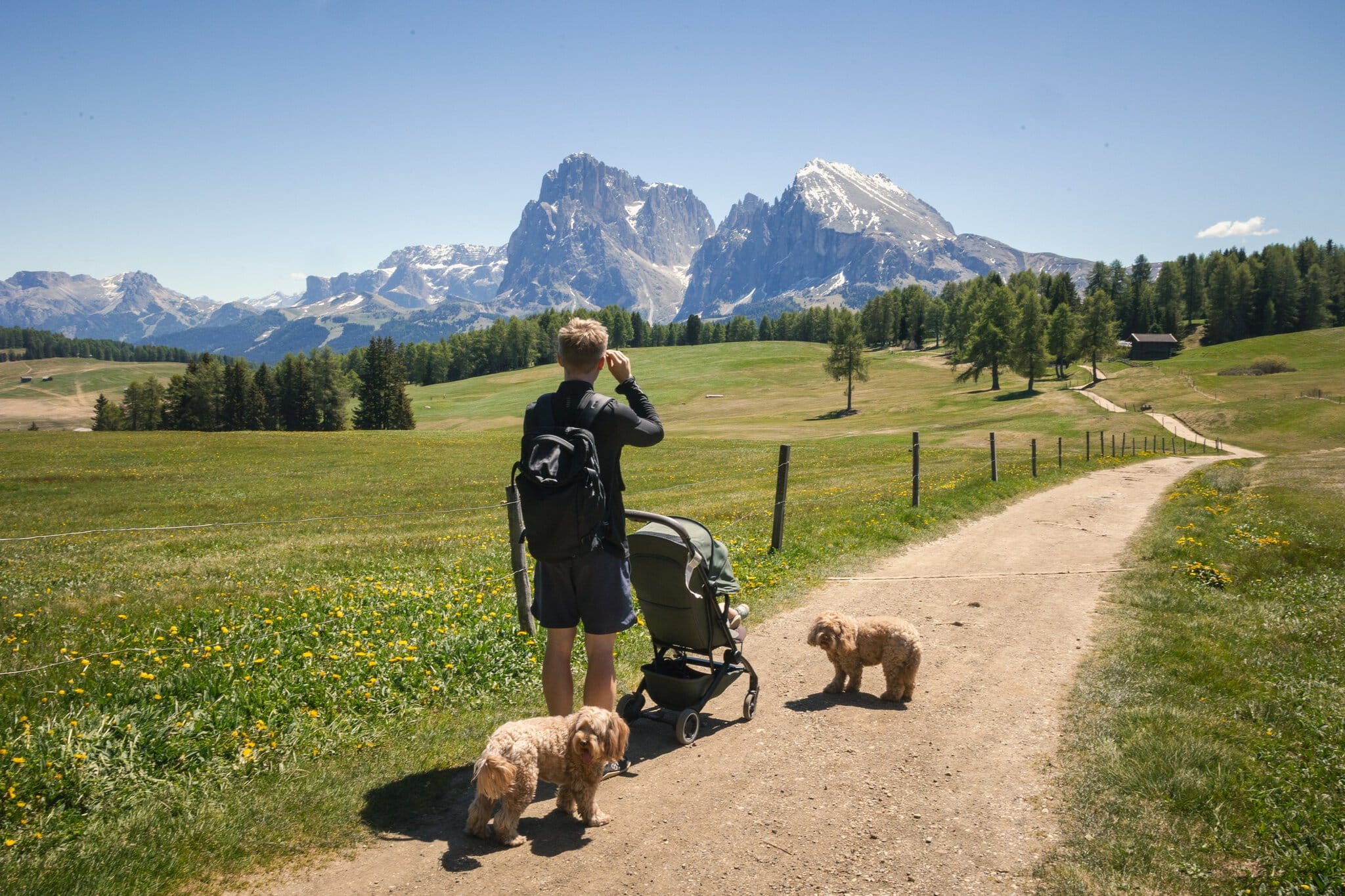
- For families with a pushchair, the Alpe di Siusi plateau is paradise, with kilometres of firm, almost flat paths. Even our ordinary folding pushchair managed them.
- Choose your accommodation strategically in one spot (a base camp), so you’re not constantly packing and moving with the kids. Ortisei or Cortina are great choices.
- A carrier is ideal for the rockier trails — but only if your child tolerates it. Ours refuses one, so we relied on cable cars and flat sections, and it worked out brilliantly.
- The mountain huts (rifugi) are geared up for children — you’ll usually find a kids’ menu, high chairs and an outdoor playground with mountain views.
- The mountain weather changes incredibly fast, so even in the height of summer, keep warm layers and SPF 50 sun cream in your backpack.
The full destination guide: Dolomites — guide and what to see
When to Go and How to Get There
Planning a family holiday takes a bit more logistics than travelling as a footloose couple. When you’re heading into the Italian Alps with little ones, you mainly need to think about stable weather and walkable trails, so you don’t end up battling mud or unexpected snow.
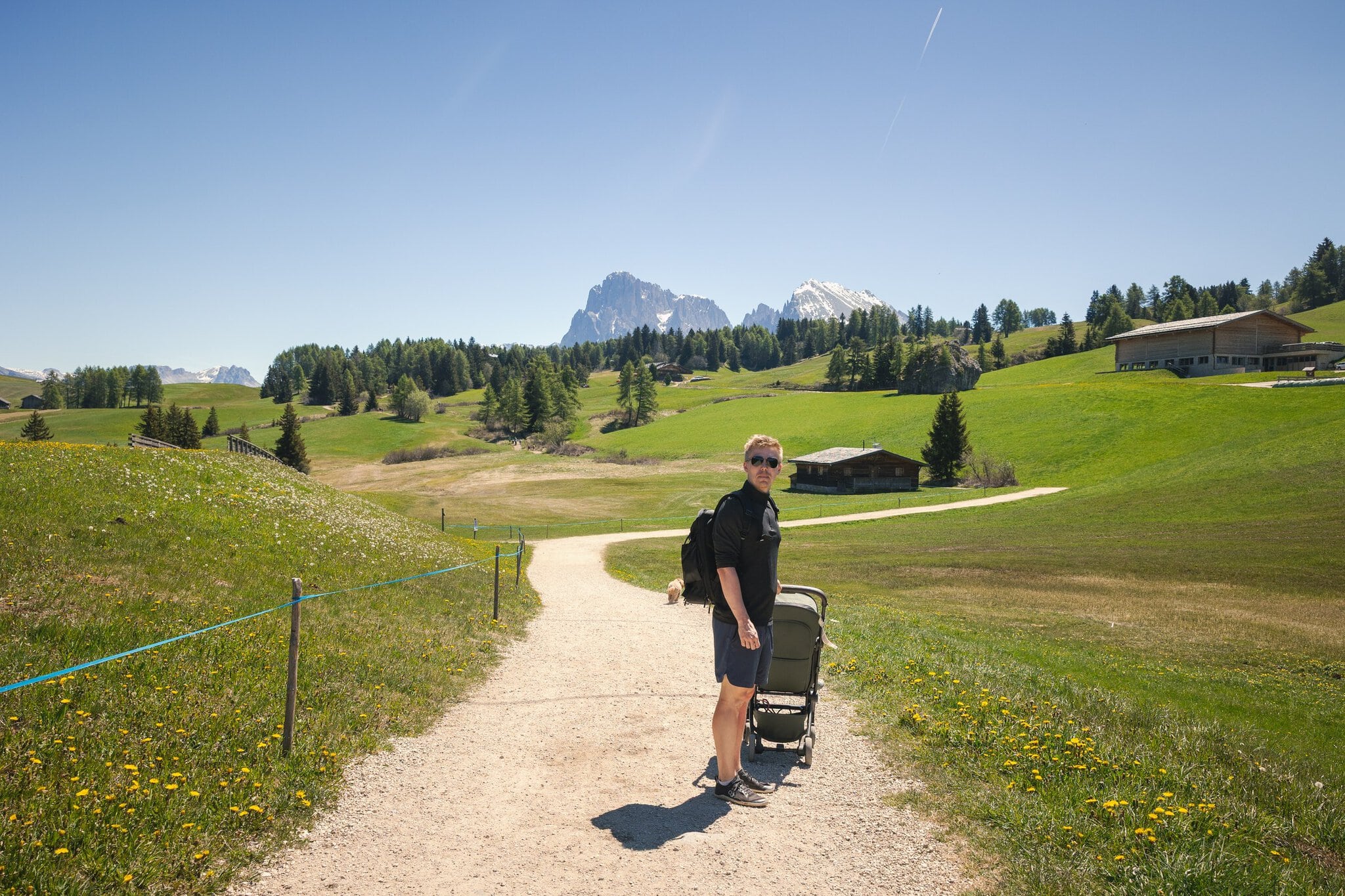
The Dolomites in summer simply work — we were there in July, and in our view mid-June to early September is the best time. Just brace yourself, because in August the Italians take their national holidays (Ferragosto) and everywhere gets genuinely packed. If you can swing it, September is absolutely magical: the crowds thin out, the air is crystal clear and it’s still pleasantly warm in the sun. The easiest way over from the UK is to fly — the nearest airports are Venice or Treviso, with regular connections from London (Gatwick, Stansted, Heathrow), Manchester and other UK hubs, and from there you pick up a hire car. From the airport it’s a beautiful two-hour drive into the heart of the mountains. If you’d rather drive your own car, you can route through France, Switzerland or Austria — just budget extra time and remember you’ll need motorway vignettes for Switzerland and Austria. Look for cheap flights on comparison sites and book your hire car well in advance.
Where to Stay and How Much It Costs
When you’re travelling with little kids, forget the nomadic lifestyle of sleeping somewhere different every night. We tried it once (a new hotel every other day) and it was chaos. Nappies, snack pouches, the pushchair, the dog… no, thanks. It’s far better to pick one or two strategic “base camps” and do day trips out from there. Accommodation in the Dolomites isn’t the cheapest — in peak season, count on at least €150 to €250 per night for a nice family apartment, but for the comfort and peace of mind, it’s absolutely worth it.
Ortisei in the Val Gardena valley is, in my opinion, the best base for families with pushchairs. It sits right in the heart of the most beautiful views, and crucially, cable cars run straight up to Alpe di Siusi and Seceda, so in the morning you just load the family into the cabin and you’re in paradise within ten minutes. On top of that, Ortisei has a gorgeous pedestrian centre full of shops and cafés, where you can sit back with an evening Aperol while the little one sleeps in the pushchair. You could stay, for example, in the lovely family apartments at Dolomiti Sweet Lodge, which has a small playground for kids and plenty of space to run around.
The other great option is Cortina d’Ampezzo, ideal if you want to explore the eastern part of the range around Tre Cime and Lake Sorapis. Cortina d’Ampezzo is a touch busier and more upmarket, but it offers everything you could need, from supermarkets to pharmacies and excellent restaurants. If you’re more into camping (which kids usually love), we recommend the Cortina Olympia campsite, with great family facilities and wonderful peace and quiet. Just to the south lies the Val di Fassa valley, which I’d recommend more for families with older, more active kids, as the terrain there offers more sporty pursuits and longer treks.
What Kids Can Handle by Age, from the Pushchair to the Chamois
Every parent knows that what works for one child may not work at all for another. Still, as we travelled around we kept notes (what the little ones can manage, and what ends in tears on the rocks), and here’s what we came up with.
1. Ages 0 to 4: Cable Cars, Pushchairs and (Maybe) a Carrier
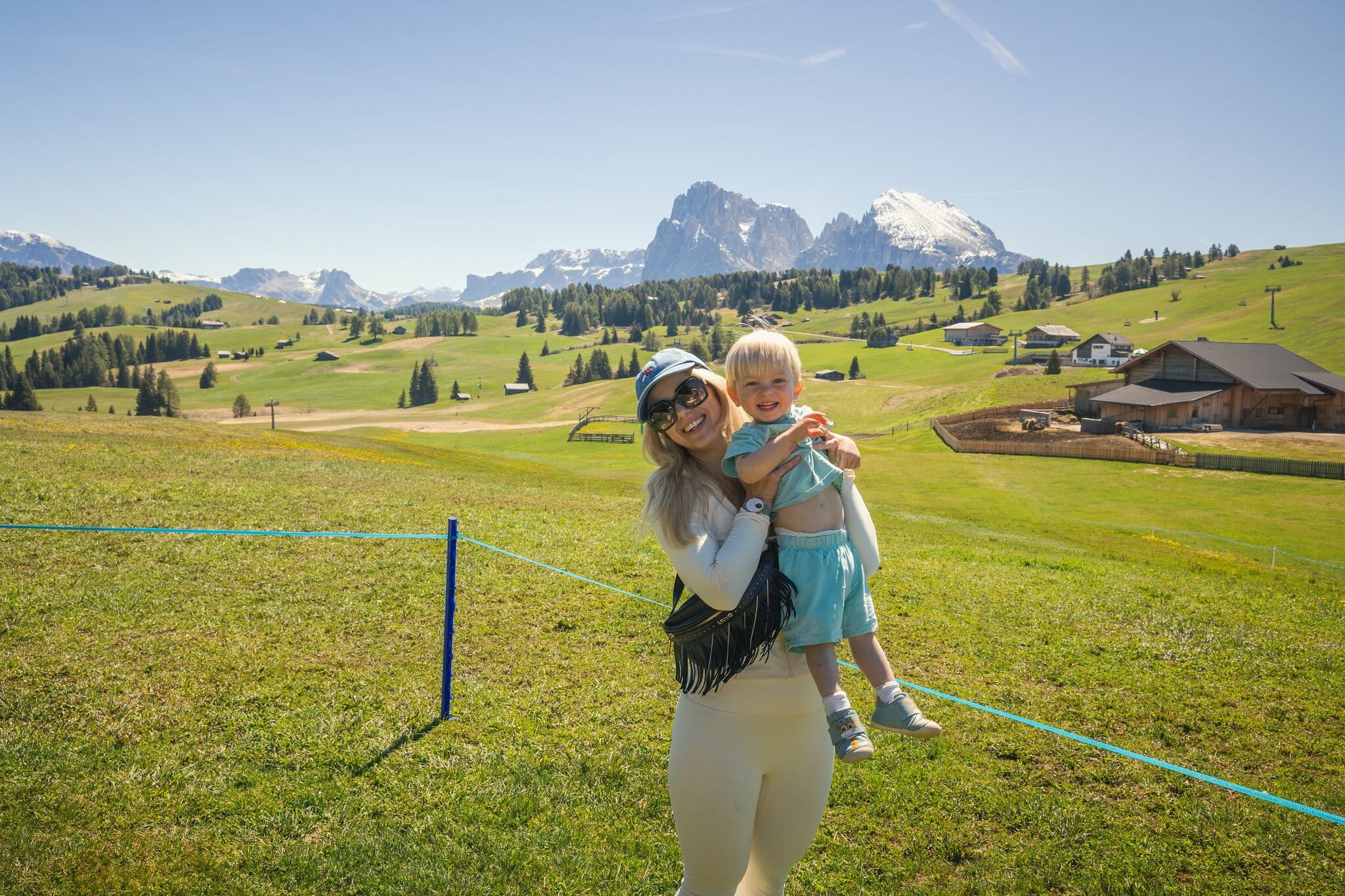
This is exactly the stage we’re in right now with two-year-old Jonášek — and I’ll admit straight away that our kit ended up looking different from what most blogs advise. Our son simply can’t stand a carrier, so the classic “bring a hiking child carrier” tip didn’t apply to us at all. We bet on cable cars, buses and flat high-altitude plateaus, where your child can roll along comfortably in the pushchair while you soak up incredible views without a single steep metre.
Let’s be honest about the pushchair: an off-road pushchair with big air-filled wheels is obviously the best choice for rough ground. But we only have an ordinary folding travel pushchair (a Joolz) — and it’s tougher than anyone would expect. It comfortably lasted a whole day on the Alpe di Siusi plateau. The rule is simple: if your child can sit happily in a pushchair for longer stretches, an off-road model is better; if they tolerate a carrier, that opens up a whole different world of treks. And if they do neither, like ours? No worries — the cable cars come to the rescue.
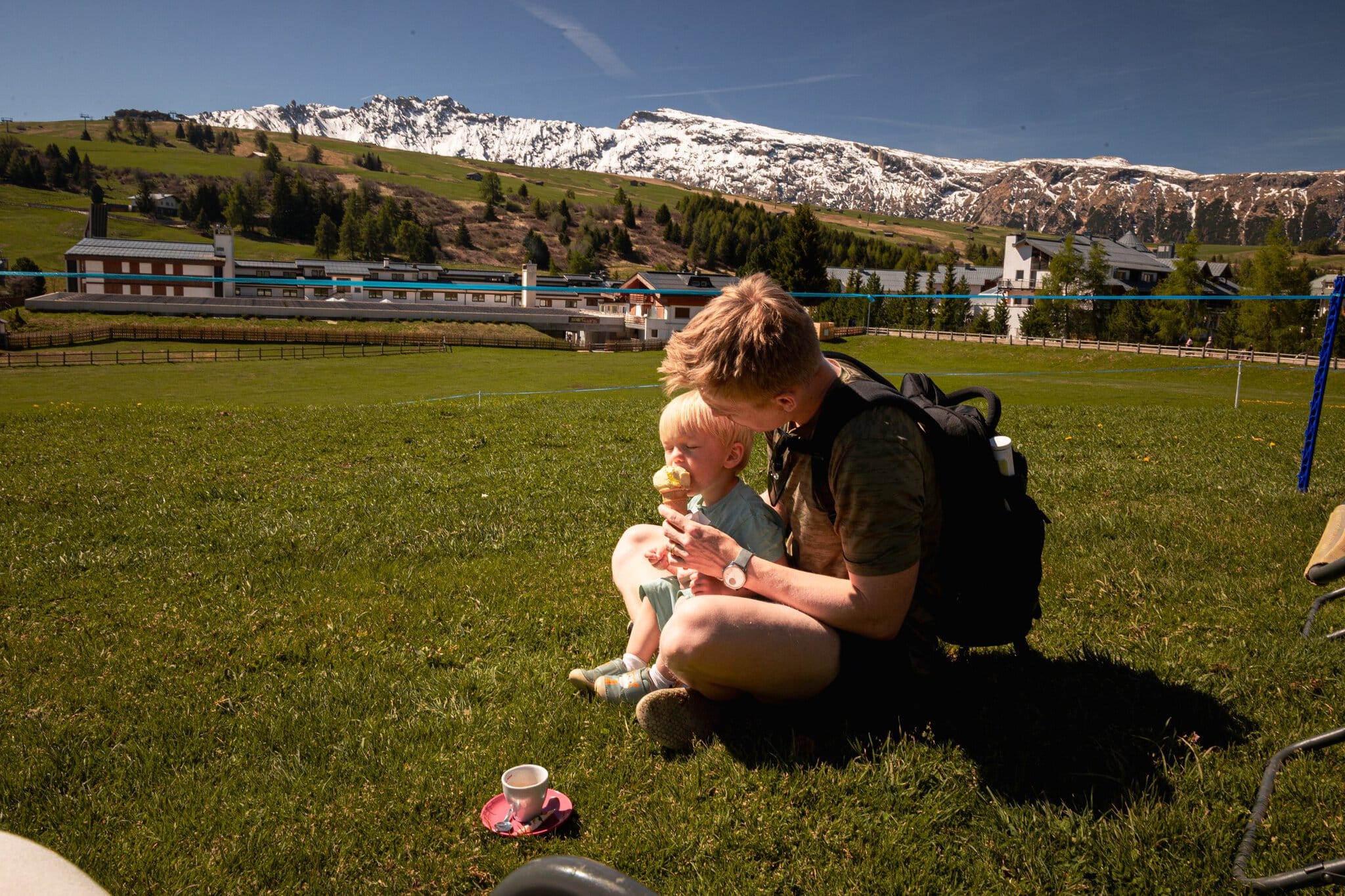
With children this age, there’s no point planning routes longer than five to seven kilometres, because you need plenty of stops for feeding, nappy changes and letting the little one run around on the grass. Use the cable cars as much as you can, and pick routes that end at a mountain hut, where you can get hot food and a changing table. Above all, don’t rush — the mountain isn’t going anywhere, and your child’s comfort matters far more than an extra kilometre.
2. Ages 4 to 6: First Mountain Steps and Big Motivation
At this age kids walk on their own, but their little legs tire quickly and, more importantly, they lose interest if the path just plods uphill. The trick is to make sure something is always happening, because otherwise comes boredom, then tiredness, then tears — you know the drill. Choose routes with a babbling stream, where they can throw pebbles or build fairy houses.
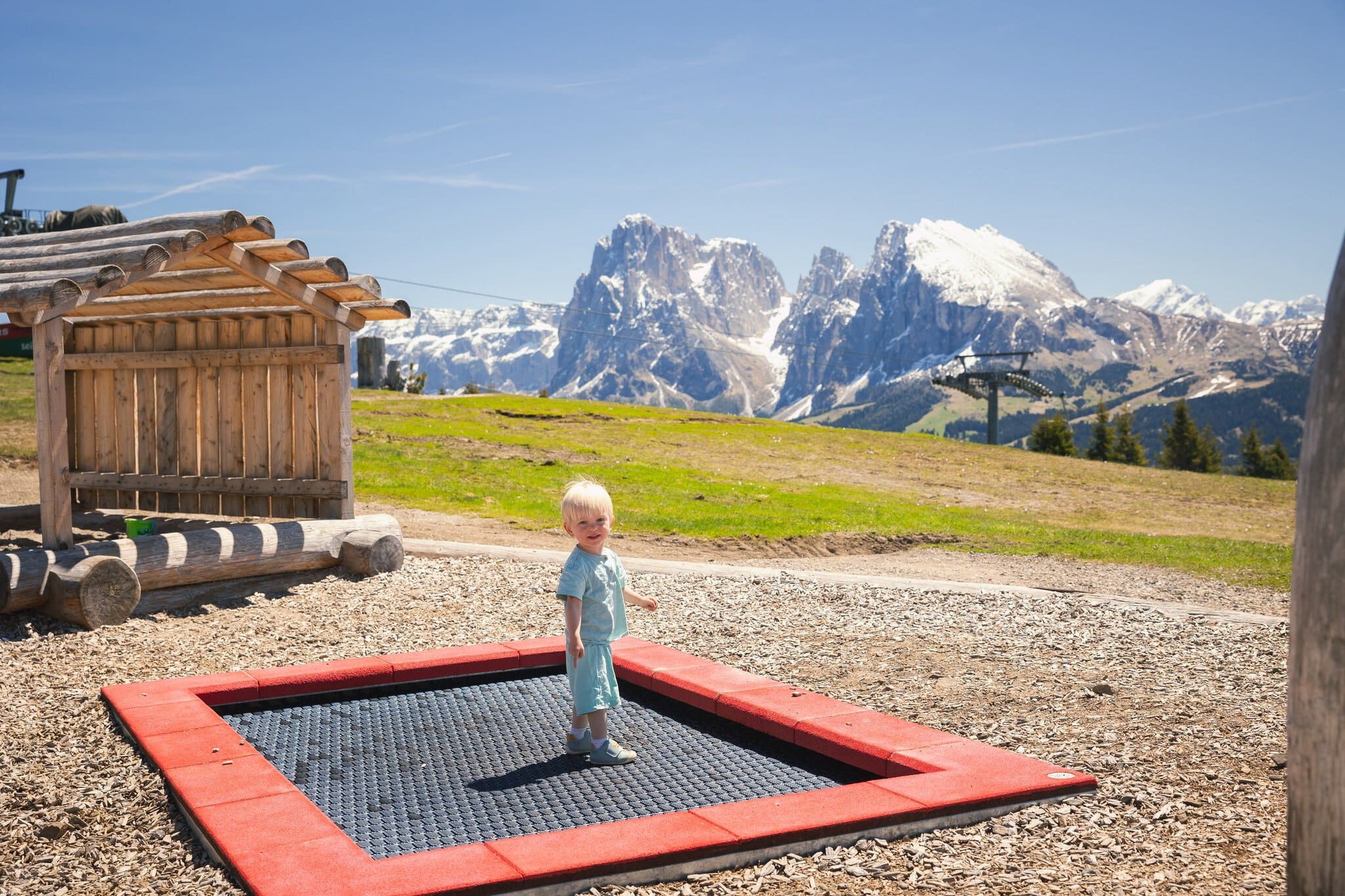
A good trick is to promise ice cream or a giant slice of pizza at the hut at the end. Routes shouldn’t have much elevation gain, and around six kilometres is usually just right to get through without needless tears or carrying them on your shoulders. We don’t have a child this age yet, but from friends we know that plenty of treats in your pocket solves almost any minor crisis.
3. Ages 6 to 10: Action Heroes on the Trail
According to plenty of parents, this is the best phase for the mountains, full stop — school-age kids have the energy, the stamina and, above all, they love it because adventure is everywhere they look. You can take them on more demanding hiking trails in the Dolomites, which involve gentle climbs and slightly tougher terrain.
A huge hit at this age tends to be the old military bunkers and trenches from World War I, which you can crawl into with a torch, or a first easy taste of via ferratas (protected climbing routes), where kids strap on a harness and feel like real mountaineers. Lukáš is already looking forward to Jonášek growing up a bit so they can explore the dark caverns in the rocks together with their head torches.
Specific Routes and Experiences: 7 Things to Try with Kids
Here’s our personal pick of the most relaxed spots we’ve walked ourselves, the ones where we know neither you nor your kids will suffer. I focused mainly on places where your jaw will drop and where even the littlest ones will have a great time.
4. Alpe di Siusi (Seiser Alm): Pushchair Paradise
If you want to travel with a pushchair, Alpe di Siusi is a place you simply cannot miss. It’s the largest high-altitude meadow in Europe, and the view of the jagged peaks contrasting with the brilliant green pastures is breathtaking. You ride up comfortably on the cable car from Ortisei and suddenly find yourself on a plateau laced with dozens of kilometres of wide, firm paths. This, by the way, is exactly where our ordinary folding Joolz travel pushchair lasted a whole day — an off-road one would be comfier, but even ours managed it without a hitch.
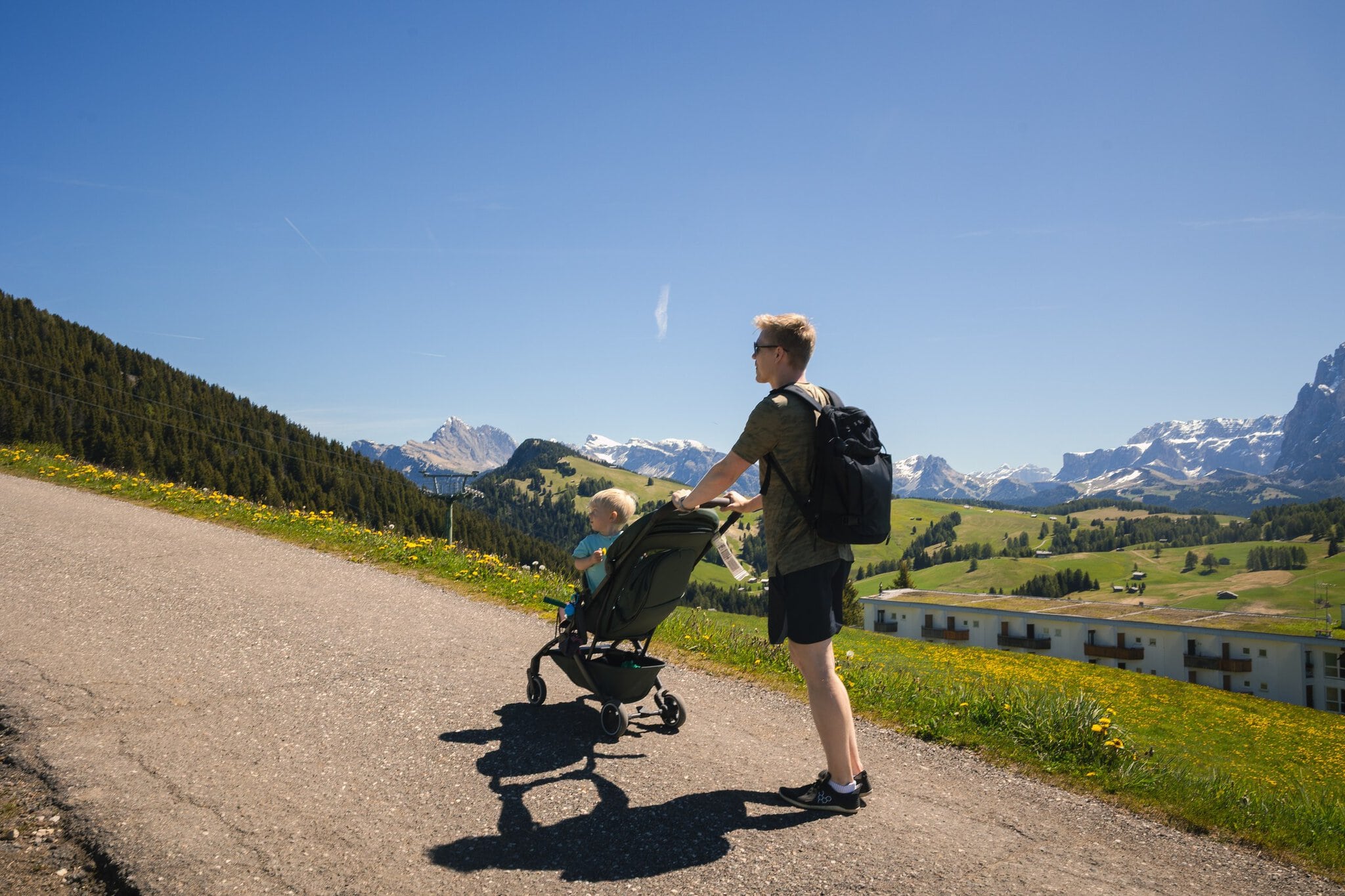
We spent the whole day here with Jonášek. The cable car costs around €30 per person, but we’d happily have paid more for that view and peace. Cows with adorable bells around their necks graze everywhere, which was a huge attraction for our little one, and every few kilometres you come across a perfectly equipped hut — some even have a small playground. Just watch out for cyclists, of which there are plenty in season, and don’t forget a hat, because there’s almost no shade on the pastures.
5. Seceda: The Most Iconic View, Effort-Free
Mount Seceda is that famous tilted rocky ridge that pops up all over Instagram the moment you search for the Dolomites. The good news for parents is that you don’t have to slog uphill for hours to reach this photogenic wonder. Once again, you’re saved by Seceda and the cable car from Ortisei, which carries you up in two stages to an altitude of 2,500 metres, right to the viewpoint at the top.
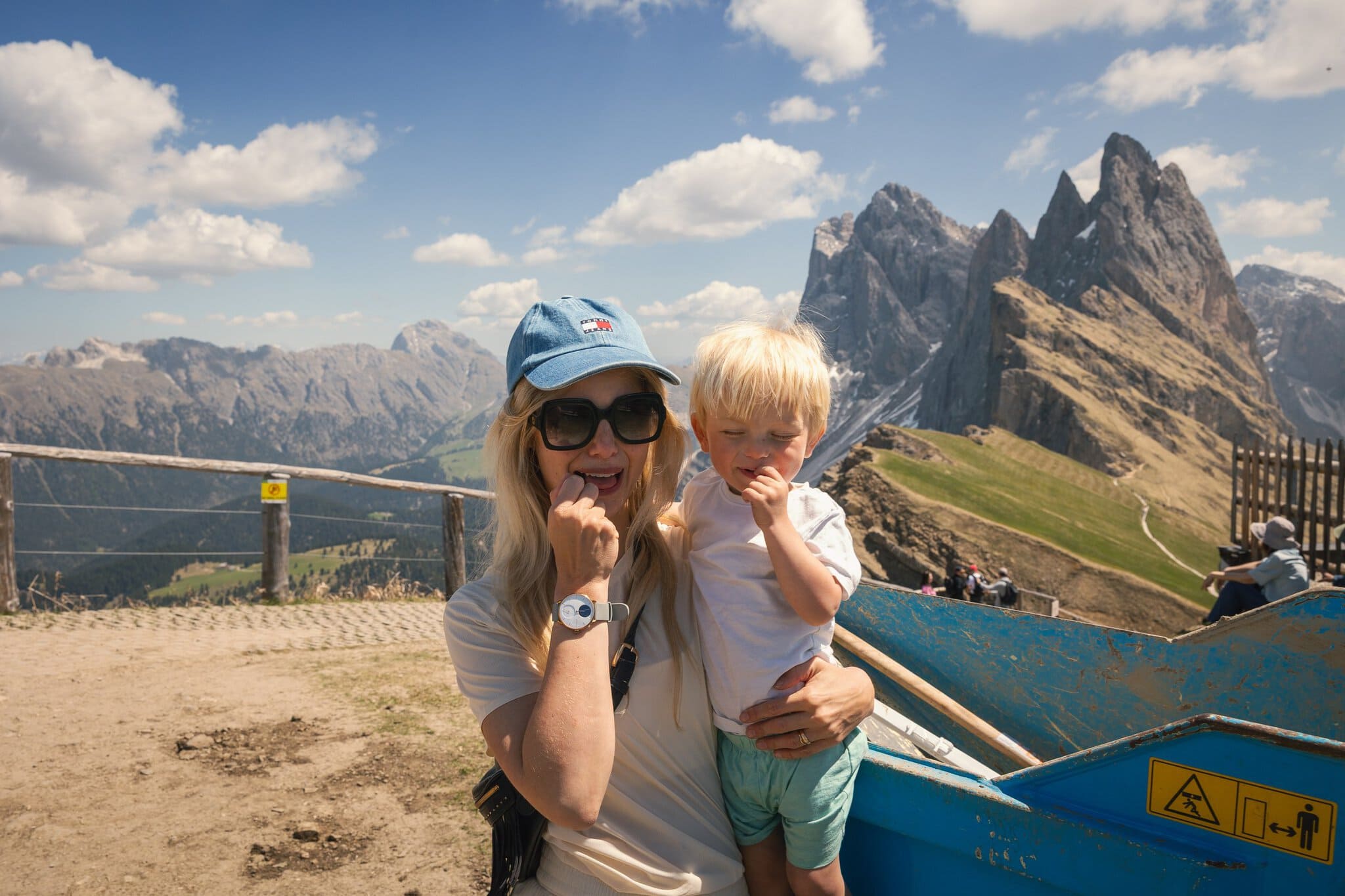
With a pushchair you can reach the main viewpoint and a short way along the ridge, but the longer walk down towards the huts isn’t passable — it’s quite rocky and steep (a carrier would come in handy here, if your child tolerates one). So we didn’t push it: we stayed at the viewpoint, had a lovely picnic, Jonášek ran around the meadow and the dogs Kája and Baby happily sniffed the mountain air. It gets pretty windy up there, so even if it’s t-shirt weather down in the valley, be sure to pack windbreakers and hats for the adults too.
6. Tre Cime di Lavaredo from the Auronzo Hut
The three massive rock towers of Tre Cime are probably the most famous symbol of the Dolomites. You can come here with kids too, but it has its quirks. A toll mountain road leads up to the Rifugio Auronzo hut (driving in costs €30), which is great because it saves you an enormous climb. From there, a wide and almost flat path leads towards the Rifugio Lavaredo hut.
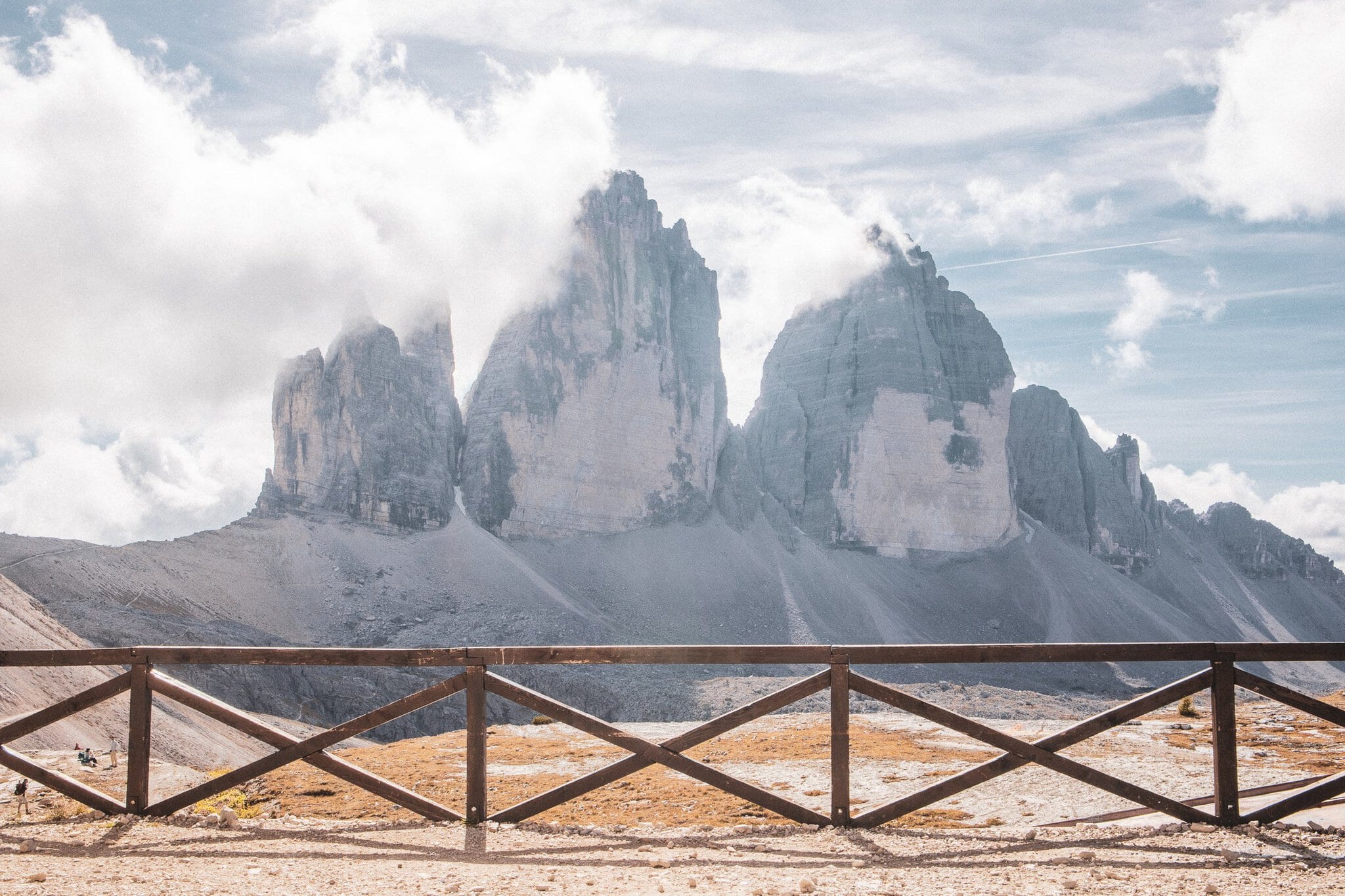
You can manage this first stretch (about 45 minutes each way) with a decent off-road pushchair, but if you want to go further and do the full loop around the towers, leave the pushchair in the car and take only a carrier. The whole loop is about 10 kilometres and can easily take four hours with younger kids, so don’t plan it with a toddler — we just did the shorter section and turned back. For older children, though, it’s a fantastic adventure, with little tunnels and rock formations along the way. Be sure to arrive early in the morning, ideally before eight, because the toll gate closes mercilessly once the car park fills up.
7. The Fairytale Lake Lago di Carezza
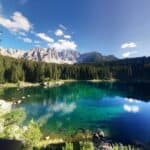
When you want to pause for a moment and show the kids the magic of the local landscape, Lago di Carezza is the perfect choice. This small glacial lake glows an unbelievable turquoise, reflecting the peaks of the Latemar massif. Legend has it that a water nymph lives at the bottom and that the colours in the water come from a broken rainbow thrown in by a lovestruck wizard — a story guaranteed to delight any child.
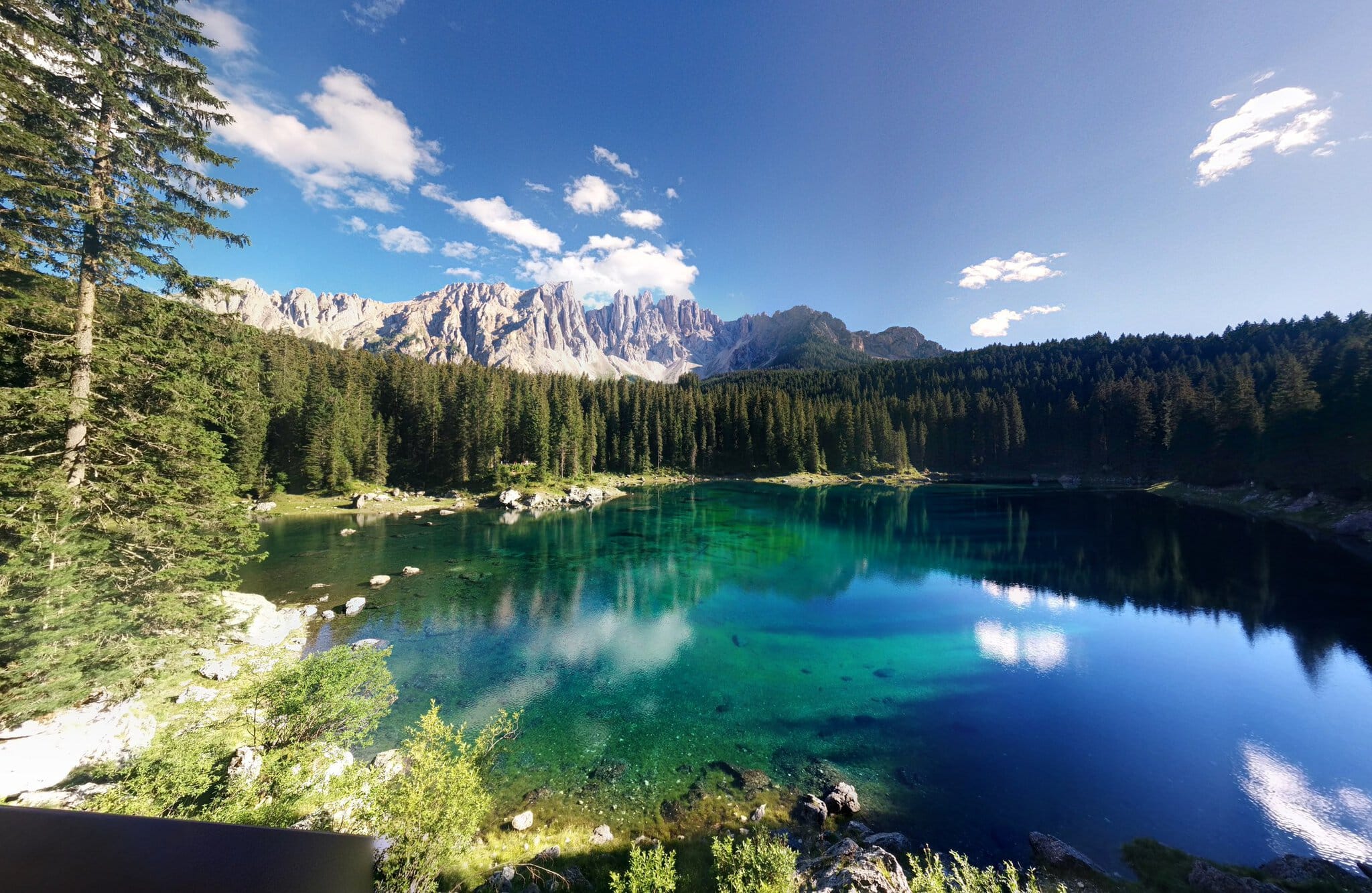
From the car park by the main road, you reach the lake in two minutes via an underpass, so no stress at all. A firm sandy path suitable for all kinds of pushchairs runs around the lake, and you’ll finish the whole walk in half an hour. It’s more of a lovely rest stop than a full-blown trip, but we came just before sunset, when the bus crowds had cleared, and Jonášek backed away from that turquoise water like a child seeing the sea for the first time. That was the moment.
8. Val di Funes and the View of the Santa Maddalena Church
If you’re after a quieter corner of the range that isn’t so crowded, head to the Val di Funes valley. You won’t find giant cable cars or hordes of tourists here, but rather that calm, slow South Tyrolean way of life. The most beautiful photo is taken at the famous little church of Santa Maddalena, with the Odle massif rising dramatically behind it.
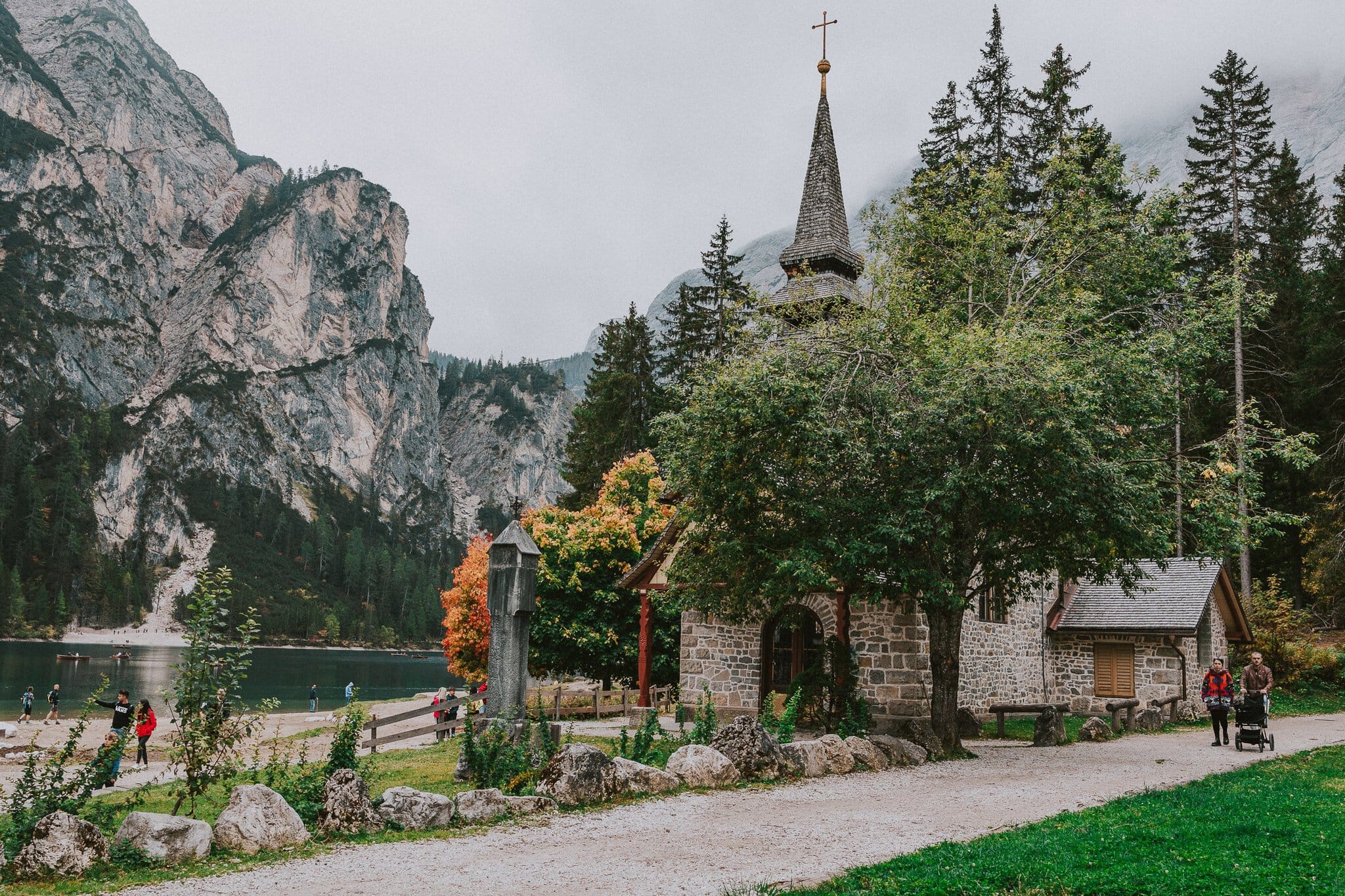
For families with kids, there’s a great gentle route across the meadows to the Geisleralm hut. The path runs through forest and across pastures, the climb is gradual, and the best part awaits at the end: the Geisleralm hut has an amazing playground, lots of sun loungers on the grass, and they make one of the best apple strudels with vanilla sauce for miles around. This route does call for a carrier or off-road pushchair, though — an ordinary one wouldn’t make it in places.
9. Cinque Torri and Exploring the Old Bunkers
The cluster of five rock towers, Cinque Torri, is a huge draw mainly for families with older children, let’s say from six years up. Once again, a two-seater chairlift carries you straight from the main road up to the Rifugio Scoiattoli hut. The view of the towers is stunning, but the real adventure lies right beneath them.
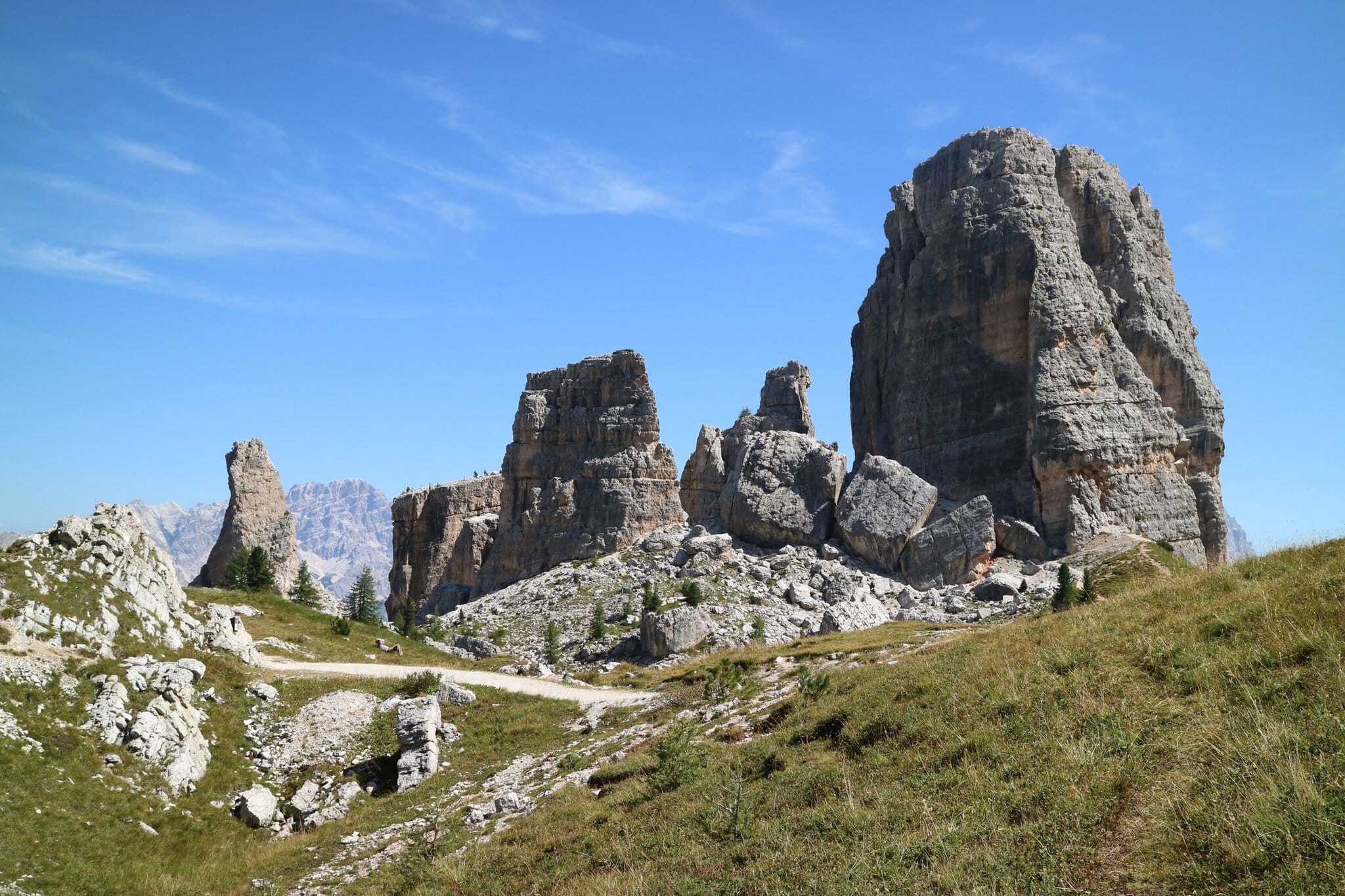
The whole area is essentially a huge open-air World War I museum. Around the rocks and right inside them are carved trenches, gun ports and military bunkers you can wander through freely. Kids can spend hours running around here, climbing on the rocks and discovering old hideouts, while you settle onto the hut’s terrace and admire the view. Definitely pack a small torch in the kids’ backpacks — they’ll be thrilled.
10. The Cortina Olympia Trail Along the River
Sometimes you just need to take a break from climbing and simply go for a stroll. Around Cortina d’Ampezzo runs an old railway line converted into a perfect cycle path and walking promenade, the so-called Olympia Trail. It’s completely flat, the surface is fine gravel or tarmac, and the whole way you walk alongside a wild turquoise river with views of the peaks.
It’s probably the safest and most relaxed walk we’ve discovered here with a pushchair and the dogs. When the kids’ legs get tired, you simply sit on the riverbank, dip your feet in the icy water and just rest. The route is tens of kilometres long, so you can carve off exactly the chunk that suits you.

Short Walks Straight from the Towns
This was our biggest discovery of travelling with a toddler this year. We used to drive straight through the towns and rush off into the mountains, but with Jonášek we realised that even a slow stroll along a cobbled pedestrian zone or to a nearby church is a lovely activity — and one that almost always ends with ice cream and a playground. Here are our tips for easy walks doable even with an ordinary pushchair.
Ortisei and the Val d’Anna Valley
Ortisei has one of the prettiest pedestrian centres in the whole Dolomites — the cobbled, flat Streda Rezia zone full of shops and cafés practically walks itself with a pushchair. Right in town there’s the Luis Trenker promenade and, beside it, a large playground with a slide, a wooden locomotive and a sandpit.
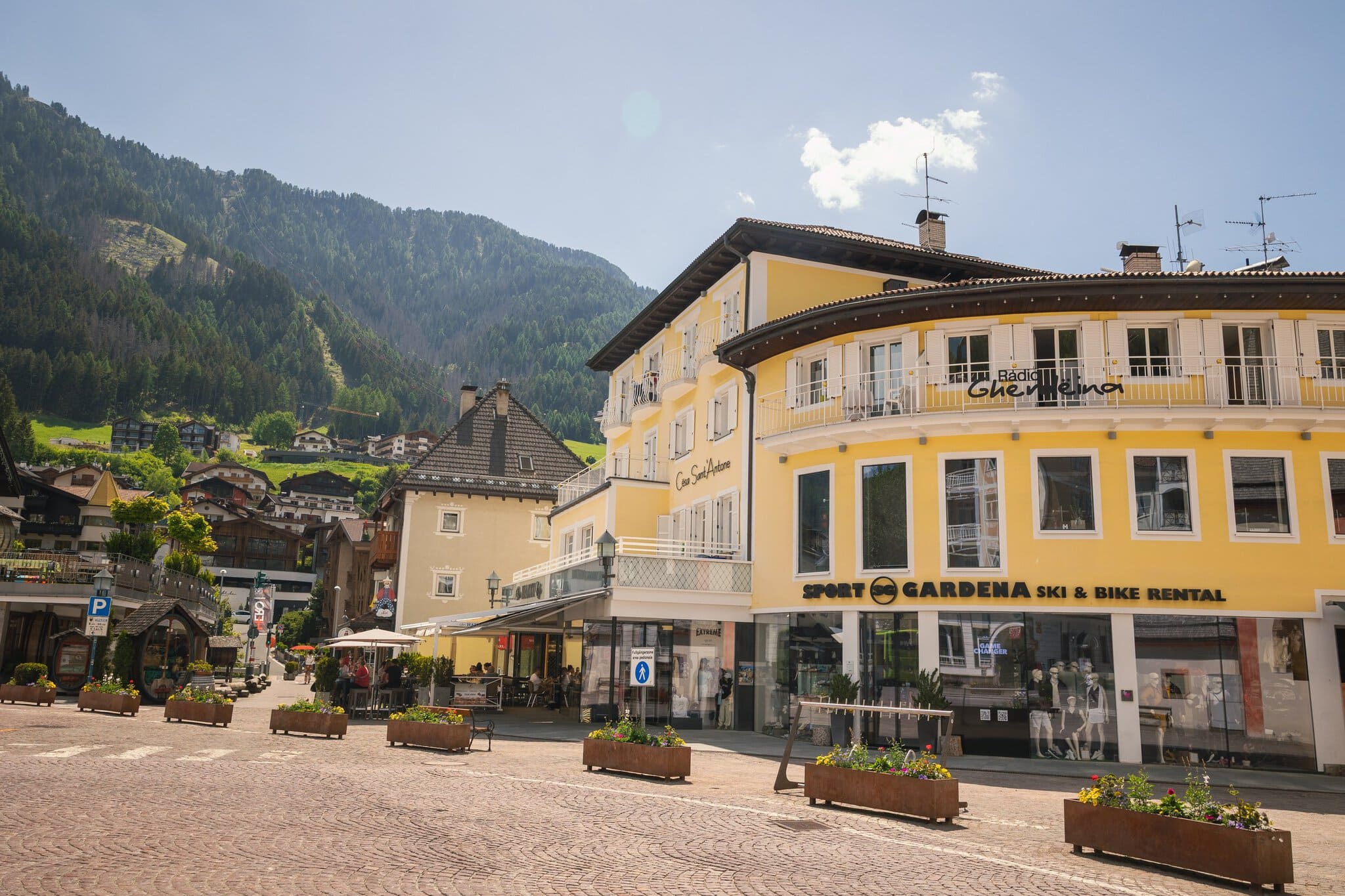
When you want to venture a bit further, set off on the classic family promenade into the Val d’Anna valley. It leads straight out of Ortisei along a stream, with minimal climbing, and at the end there’s a meadow with a playground, hammocks and a Kneipp wading pool. The surface is rougher in places, so a really lightweight buggy will be a bit of a struggle, but a sturdier pushchair will manage.
Seis am Schlern and the St. Konstantin Church
Seis am Schlern (Siusi) is a quiet town beneath the mighty Schlern massif and the main departure point for the cable car up to Seiser Alm. For a short, relaxed walk, head out from here along an easy path to the picturesque little church of St. Konstantin — it runs through meadows and light woodland with minimal elevation, and there are benches with mountain views along the way.
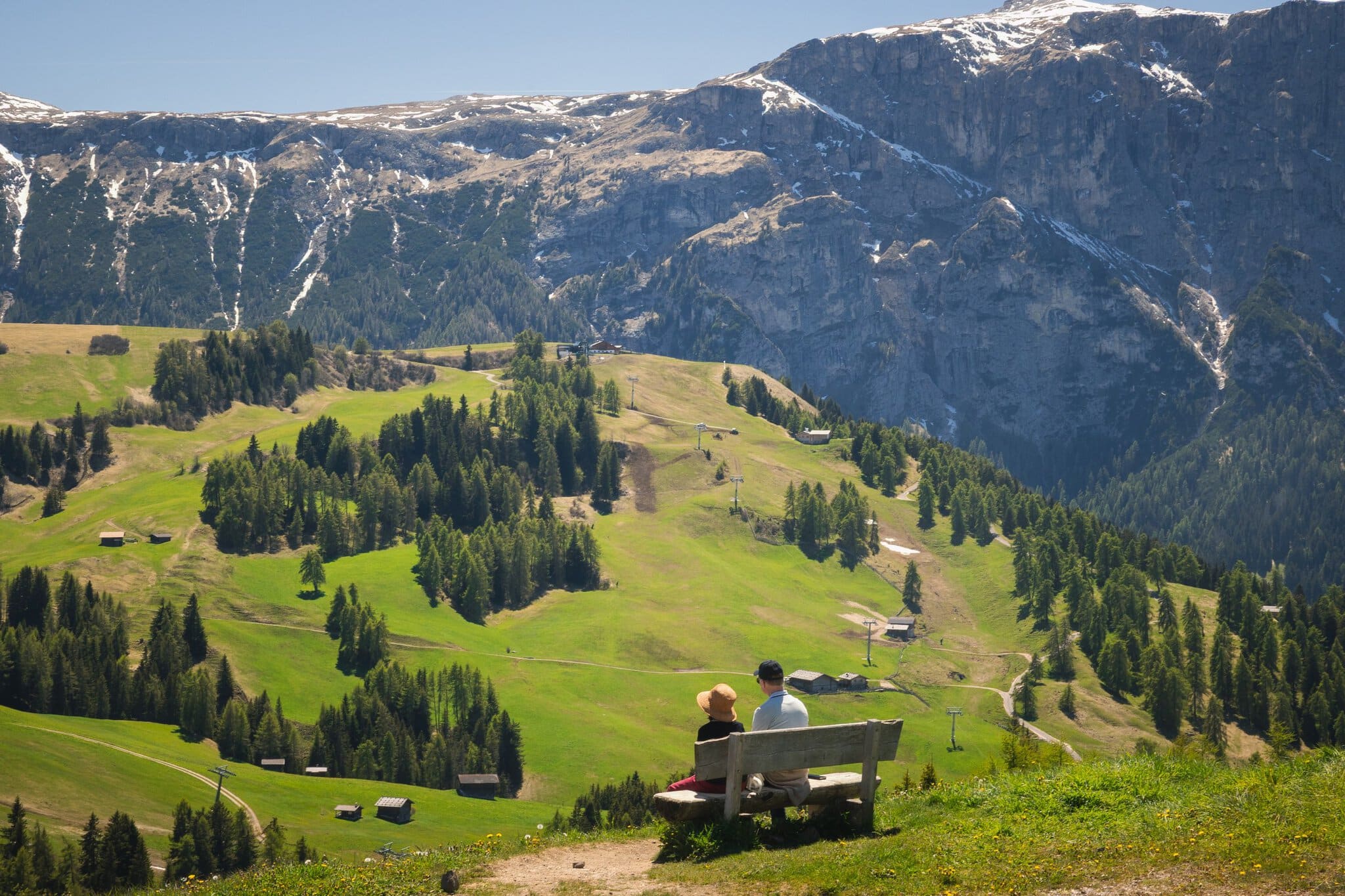
If you want a view without the effort, ride the cable car up from the valley to Tschötschalm on Puflatsch (around 2,000 m). There’s a flat stretch passable with a pushchair and a nice playground — exactly the “up by cable car, then just gaze” style that hooked us so much this year.
Kastelruth (Castelrotto) and the Marinzen Playground
Kastelruth is among the most beautiful villages in Italy — painted facades, a church square with an iconic onion-domed tower and a playground right in the centre. For a quick walk, there’s the Calvary loop (Kofelrunde): a well-maintained path about a kilometre long, practically flat, pushchair-friendly, with little chapels and lovely views over the town’s rooftops.
The biggest draw for kids, though, is Marinzen. From the centre of Kastelruth, a small cable car carries you up to the Marinzenalm hut (around 1,500 m), where there’s a large playground with a long slide, a petting zoo and a pond. It’s flat up top, so no problem with the pushchair, and you won’t be able to drag the kids away.
Around Cortina: Lago di Pianozes and Corso Italia
When you’re based in Cortina d’Ampezzo, you don’t have to head straight for the high mountains. The famous pedestrian zone Corso Italia, with its bell tower in the middle, is flat, cobbled and ideal with a pushchair — bars, patisseries and views of the peaks. A great stop for a coffee and kids’ ice cream between trips.
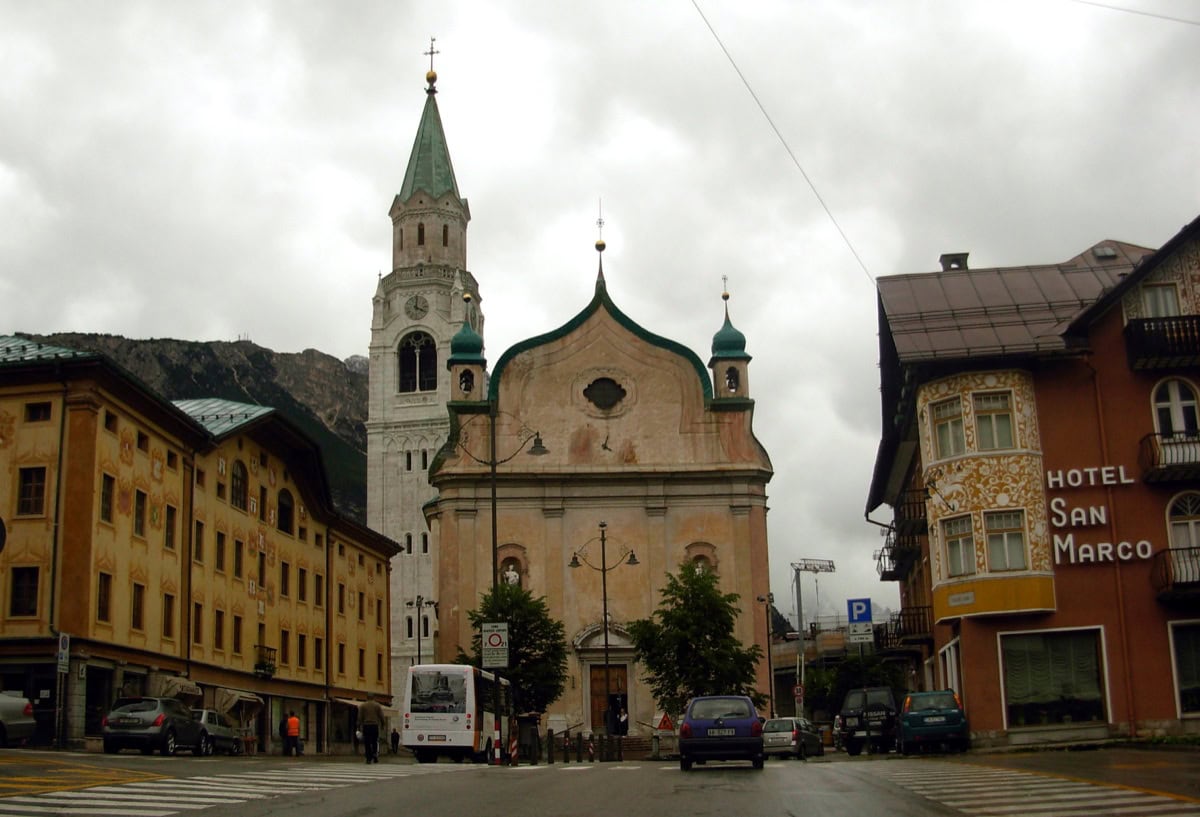
For a flat walk into nature just outside town, head to the little Lago di Pianozes lake. You can manage the short loop around the water even with an ordinary pushchair in about twenty minutes, and by the lake there’s a restaurant, a kiosk and a small playground. By contrast, watch out for Lago Ghedina and Lago d’Ajal — they’re rocky and steep, so leave the pushchair at home and take a carrier.
When It Rains in the Dolomites: Rescue Plans for Families
Even in summer, the mountains offer no guarantee of sunshine every day. When the clouds roll in, drop into the valley and the rain sets in steadily, there’s no point dragging the kids along muddy trails. Luckily, there are plenty of ways to save the day.
11. Water Parks That Save the Day
Instead of sulking in the apartment, pack your swimsuits and head somewhere warm. A great smaller complex is Acquapura in Cortina d’Ampezzo, where you’ll find indoor heated pools and a paddling pool for the little ones.
If you’re staying in the western part of the range, we warmly recommend driving down a little to the town of Brixen. There you’ll find the huge water world Acquarena Brixen, with several indoor and outdoor pools, water slides and a big wellness zone for the parents. Jonášek loved the warm water, and after several days of walking we relaxed our muscles beautifully.
12. Ötzi and Museums That Won’t Bore Them
When it rains all day, take a drive to the town of Bolzano. The South Tyrol Museum of Archaeology there is home to Ötzi, the famous Iceman, over 5,000 years old, who was found frozen in a glacier. For older kids, seeing a real mummy and his weapons is an unbelievably fascinating experience that easily beats the usual displays of pictures.
In the Val Badia valley you can then visit the Museum Ladin, which tells the story of how the Dolomites formed and where kids can see real fossils and the bones of a prehistoric cave bear. Even we adults had no idea such a giant once lived here, so it was educational for the grown-ups too.
The Dolomites with a Dog: How It Works with Your Furry Friends
We’re used to travelling with our pack, so Kája and Baby couldn’t be missing from our family debut with Jonášek either. Generally, the Italians are very dog-friendly, but since a large part of the Dolomites lies in national parks and nature reserves, you have to follow a few clear rules.
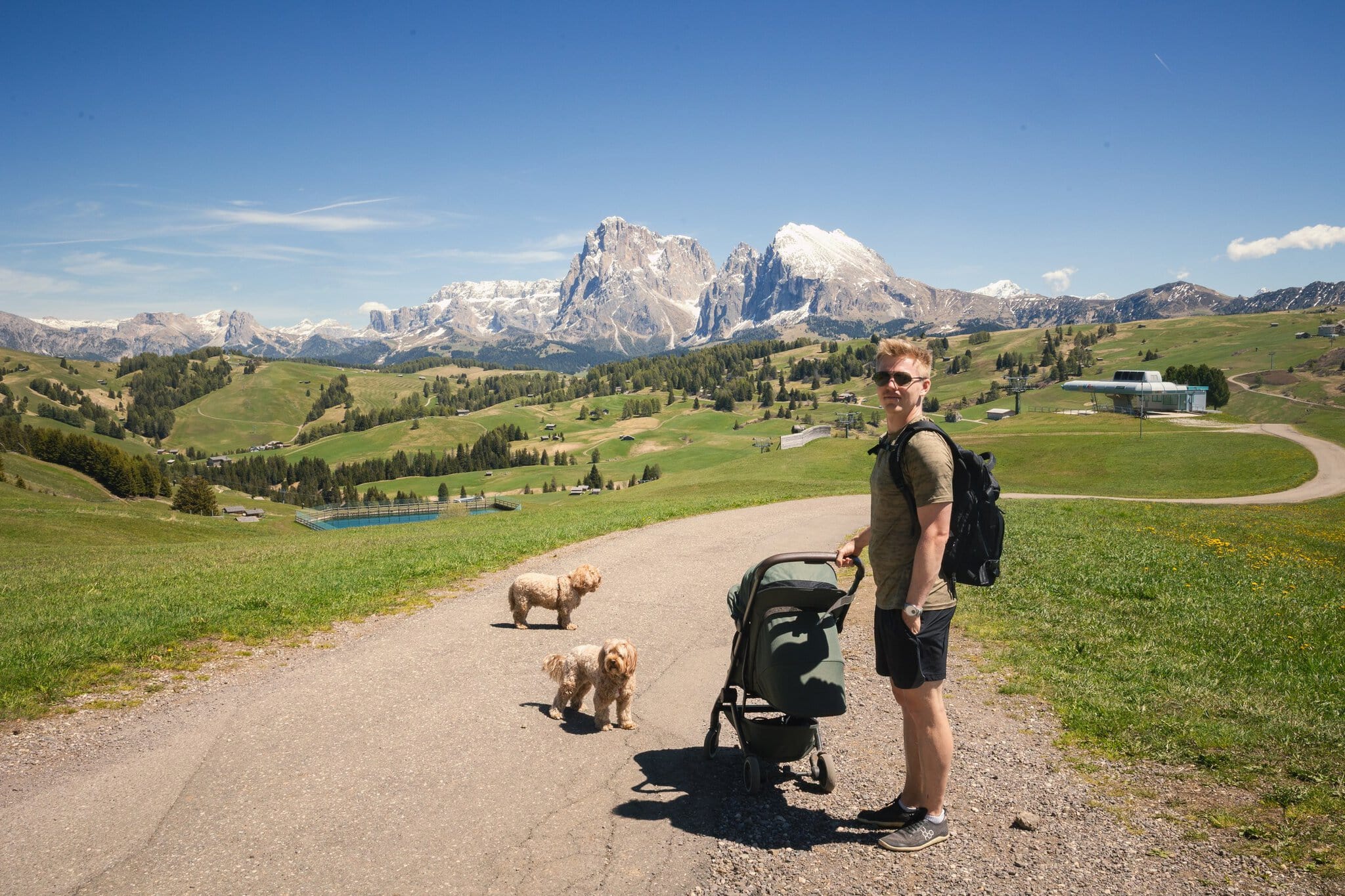
💡 Tip: On almost all the cable cars and buses, they want dogs to wear a muzzle (you can buy one practically everywhere, including right at the bottom stations). Honestly, it annoyed us quite a bit — they wanted it even when we were riding in the cabin completely alone. When we had several cable cars in a row ahead of us, we preferred to leave Kája and Baby resting at the campsite.
Dogs must always be on a lead on the mountain trails. Especially on the pastures, like Alpe di Siusi, this is absolutely crucial, because a loose dog could spook the cows or endanger the grazing horses and marmots. The vast majority of cable cars will let you on with a dog without any fuss, usually for a small fee of around €3 to €5. Just keep a muzzle ready in your backpack, as cable car staff occasionally insist on it for the cabin ride.
As for accommodation and restaurants, most mountain huts (rifugi) welcome dogs on their outdoor terraces and will usually bring them a bowl of water. Inside the restaurant it’s more case-by-case, but it’s usually not a problem. With Kája and Baby we comfortably walked part of the Tre Cime route and the valley promenade. One place I definitely wouldn’t go with a dog is the popular Lago di Sorapis — there are several very exposed sections with iron steps and huge crowds, where passing people with a dog is incredibly tricky, so it’s better to do that trek without them.
What to Eat and Drink: A Guide for Fussy Little Taste Buds
One of the biggest perks of a holiday in Italy is that just about every child loves the local cuisine. Forget mealtime boycotts — here you’re saved by food that is perfect in its simplicity.
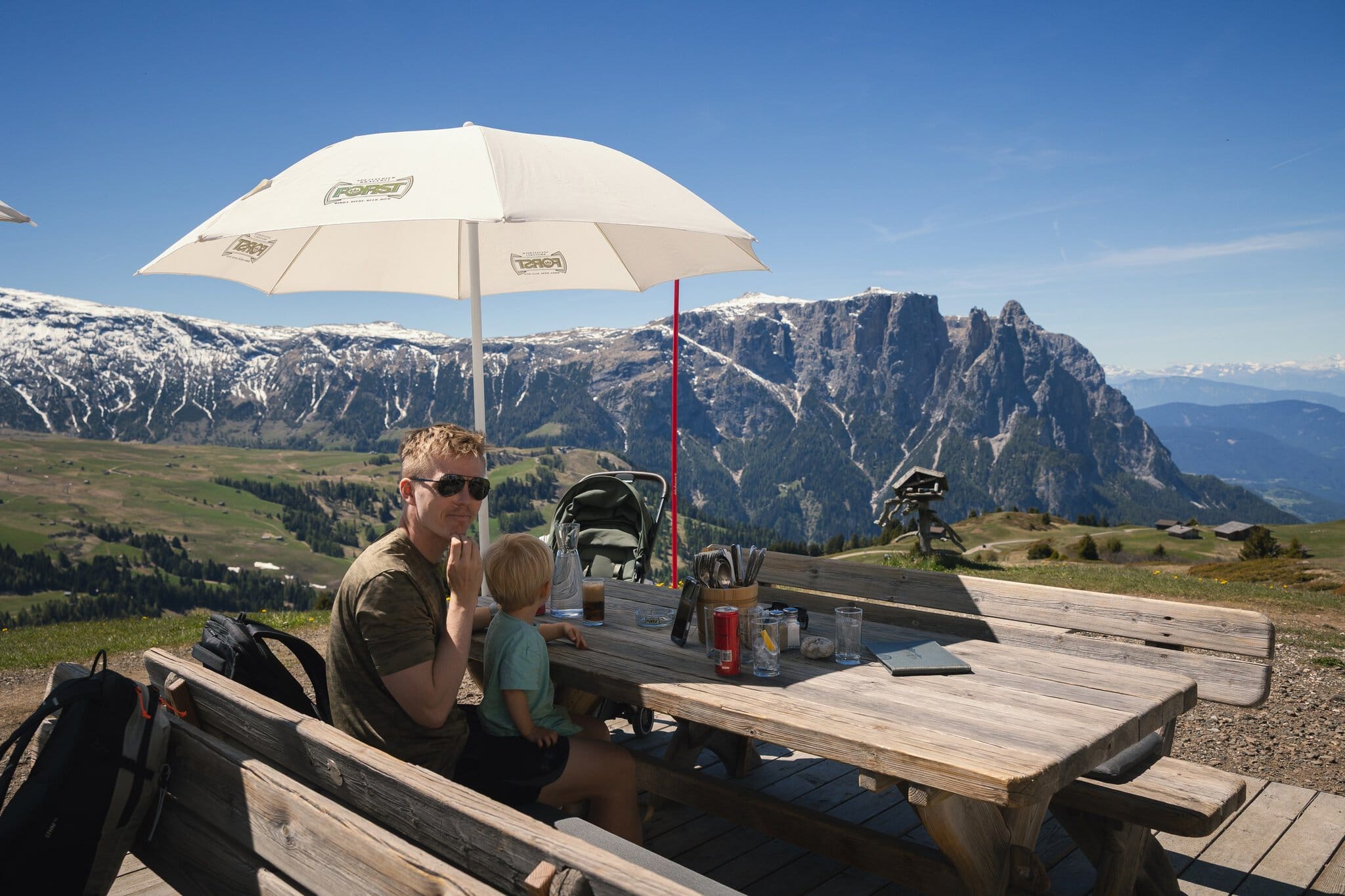
All the mountain huts cook fantastically and always offer dishes that kids can handle. We absolutely fell in love with Rifugio Averau near Cinque Torri, where they make incredible homemade pasta, and also Rifugio Col Pradat in the Alta Badia valley. At both places we were served with a smile, even when Jonášek was having one of his louder moments.
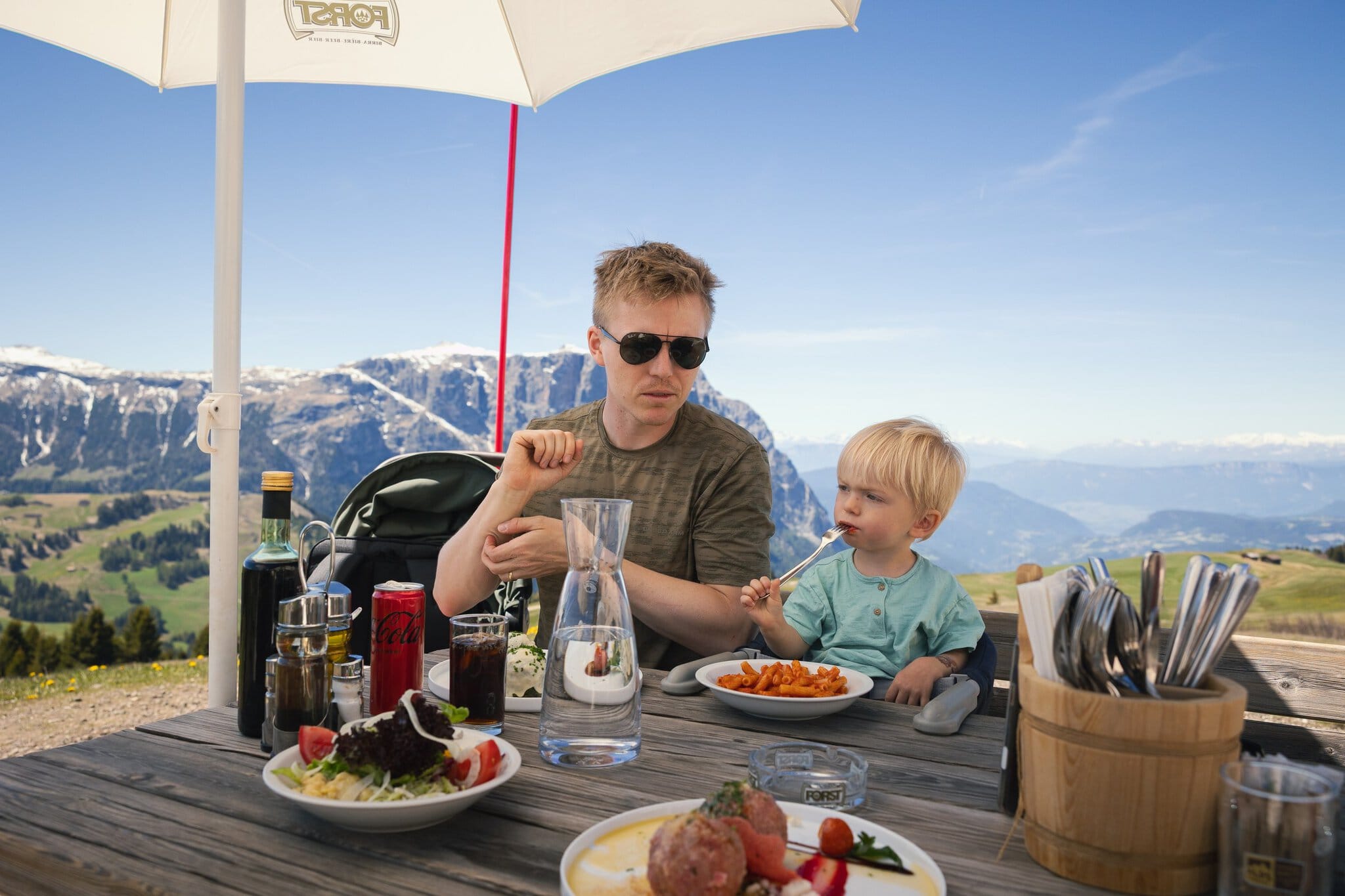
We always ordered simple pasta al pomodoro (with tomato sauce) or excellent pizza. A local classic is the so-called canederli — large Tyrolean bread dumplings. As vegetarians, we go for the version with cheese or herbs, but traditionally they’re also filled with speck and served in a rich broth or with melted butter. It’s a proper calorie bomb that leaves kids with energy to spare after a trip.
And of course — an absolute must and our daily reward ritual was a proper Italian gelato down in town, which they make phenomenally well in both Cortina and Ortisei. For toddlers like Jonášek we carried food pouches and purées up the hills, but at the huts they’ll happily warm up food you bring or prepare a clean, salt-free broth with a smile.
Practical Advice to Wrap Up: Safety and What to Pack
Mountains are mountains, and even if you’re moving around manicured meadows near the huts, you mustn’t underestimate the preparation. The weather in the Dolomites can switch from clear skies to a heavy hailstorm in just twenty minutes — we’ve experienced it firsthand many times.
Always, even on the hottest August days, keep a waterproof layer and a warmer jumper packed for yourself and the kids. The sun in the mountains above 2,000 metres also burns completely differently than at the seaside. We underestimated it on the first day — Jonášek was as red as a lobster within an hour, even though we’d told ourselves it was overcast. SPF 50 sun cream, good sunglasses and a sun hat are absolute essentials.
As for packing, an off-road pushchair with big air-filled wheels is ideal — but if you don’t have one, like us, don’t despair: even an ordinary folding travel pushchair (a Joolz in our case) holds up surprisingly well on flat plateaus like Seiser Alm, just don’t overload it on rougher ground. And if your child tolerates a carrier, bring it — it opens up more routes. You don’t need to lug loads of water; at every hut you can buy drinks or have your bottles refilled. We’ll definitely head back to the Dolomites with the kids — once you discover how relaxed it is thanks to the cable cars, you won’t want to go anywhere else. 😉
Where to Next
The Dolomites are close to our hearts, and we’ve written plenty of other detailed guides about them on the blog. If you want to plan specific treks or you’re curious about other valleys, take a look here:
- The complete guide and hiking trails in the Dolomites for everyone
- What to do in the Dolomites and how to put together an itinerary
- Cortina d’Ampezzo: Our main base in the Dolomites
- Seceda: A guide to the most photogenic ridge in the Dolomites
Tips and Tricks for a Carefree Trip
When you travel with small children, fortune favours the prepared. We found it well worth sorting out the most important things like flights, a hire car and good insurance well in advance, so that on the ground we only had to decide which side of the hill to head for that day.
Where to Find Flights
Look for cheap flights on a comparison site, where you’ll always find the best combination of connections from the UK to Venice or Treviso. From Venice it’s only a short drive into the mountains.
If you’re flying with a baby for the first time, you’ll definitely appreciate that the drive from the airport to Cortina takes about two hours along a beautiful motorway. So no endless slog with a pushchair and suitcases.
Hiring a Car
Lukáš always checks the comparison sites and so far they’ve never once left us waiting at the airport without a car. 😁 A comparison tool saves us loads of time, whether we’re heading to the mountains or the seaside.
With kids, it’s definitely worth paying extra for a bigger car like an estate or an SUV. Trust me, by the time you’re packing the boot with the pushchair, a mountain of nappies and the adults’ luggage on top, you’ll be grateful for every extra centimetre.
Booking Accommodation
Booking.com is our favourite search engine for hotels and family apartments. In the Dolomites we recommend booking really far in advance, even half a year ahead, because the best family guesthouses disappear at lightning speed.
We always make sure the accommodation has its own little kitchen. With a small child, you simply need to heat water for milk in the middle of the night or whip up a quick snack without having to rely on the hotel restaurant.
Don’t Forget Insurance
Travelling into the mountains without insurance doesn’t pay off, especially with kids. For shorter trips within Europe we go with reliable cover, and for longer stays we use SafetyWing travel insurance. Don’t forget your GHIC (Global Health Insurance Card) for state healthcare in Italy too — but it’s no substitute for proper travel insurance covering mountain rescue.
➜ Before you set off, check out our travel insurance comparison (incl. a 50% discount).
Medical care in Italy is excellent, but mountain rescue operations or helicopter transport from remote valleys cost an enormous amount of money. So those few extra pounds for insurance are the best investment in your peace of mind.
Data and Internet
Thanks to the end of EU roaming charges from the UK, you may pay a daily fee with your provider in Italy, so check your plan before you go. If you want guaranteed fast data, take a look at our experience with the Holafly eSIM.
Up in the mountains we usually switch the data off now and then to unwind, but for checking the weather apps mobile internet is an absolute must. The radar saved our skin a few times this year from an unexpected downpour.
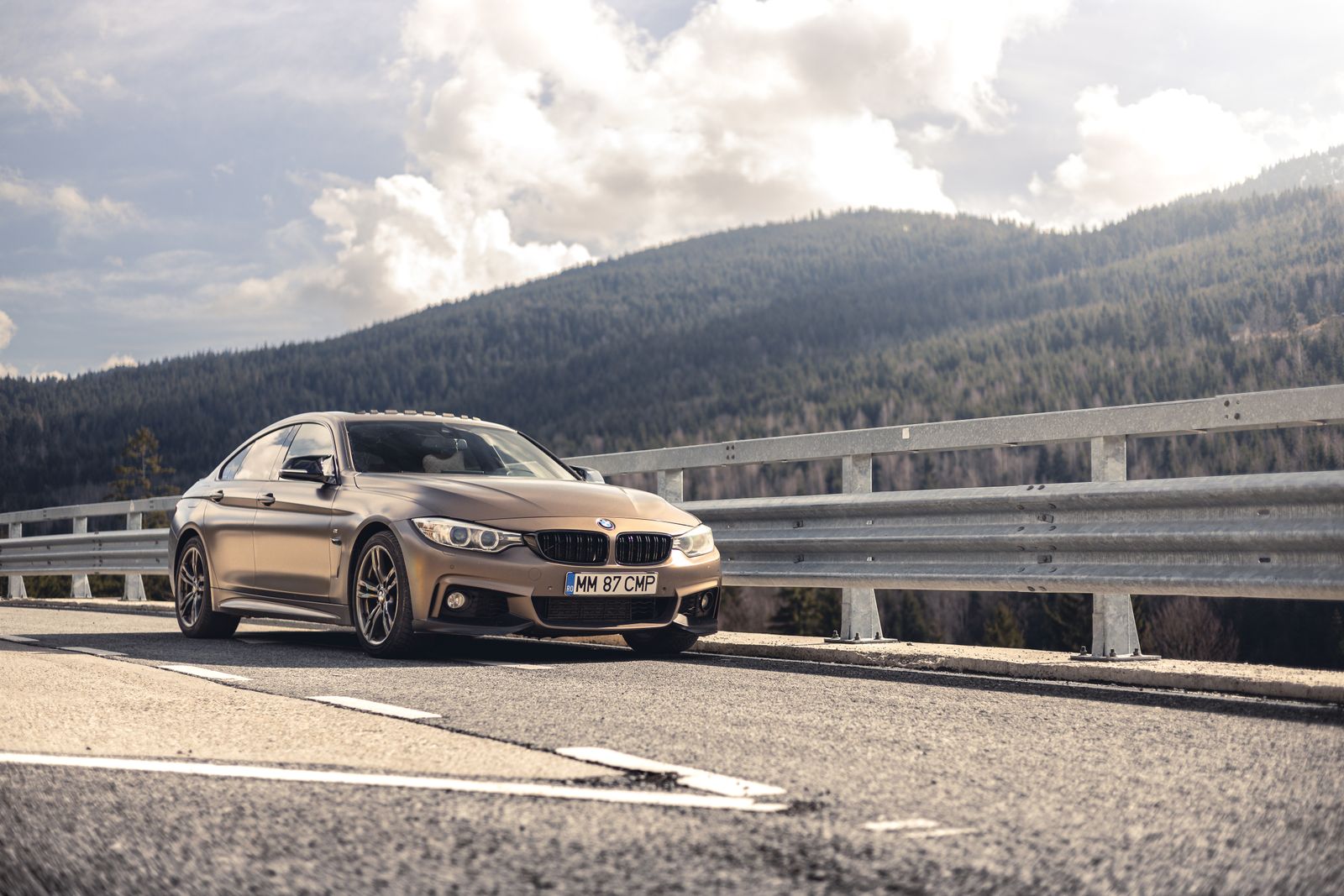 🚗 Car rental on the roadVerified rental cars in the Dolomites
Search with the DiscoverCars comparison engine — it compares prices from dozens of local and international rental companies, and most bookings come with free cancellation.
Compare car prices in the Dolomites →FAQ — Frequently Asked Questions About Travelling with Kids in the Dolomites
1. Can parents who aren’t trained mountaineers manage the Dolomites with kids?
Definitely yes. Thanks to the extensive network of cable cars that take you up to heights over 2000 meters, you can explore the beautiful flat alpine plateaus without having to climb a single steep hill. The Dolomites are absolutely ideal for out-of-shape parents with children.
2. Can you go around the Dolomites with a stroller?
Yes, but you need to choose your routes carefully. A pram paradise is the Alpe di Siusi plateau, lakeside promenades (Lago di Carezza) and valley paths — even a regular folding pushchair can handle these flat sections. For rougher terrain, an all-terrain buggy with large wheels is better, and for narrower mountain trails you’ll need a baby carrier (if your child tolerates it).
3. Are mountain huts prepared for children?
Most mountain huts (rifugi) cater to families during the main summer season. They typically have high chairs available, will happily warm up baby food you bring, or offer children’s menus (soups, pasta). Many of them also have outdoor playgrounds with sandboxes and climbing frames.
4. What to Pack for Kids on a Hike?
The key is layering. Even in August, the weather in the mountains can change in a flash. Pack a quality waterproof jacket, fleece sweater, sturdy shoes, but also a sun hat, sunglasses and sunscreen with SPF 50, because the mountain sun burns incredibly strong even through clouds. A baby carrier is also handy (if your child tolerates it) and plenty of snacks for older kids to keep them motivated.
5. Do you need to book accommodation in the Dolomites in advance?
Definitely yes. If you’re planning a trip for July or August, book your accommodation ideally already in January or at the latest in spring. The Italian Alps are very busy in summer and quality family apartments close to the cable cars disappear first.
6. Can dogs go on cable cars and treks in the Dolomites?
Yes, most cable cars will allow you with your dog (often for a small fee) and in national parks you can walk with your dog without any problems, only it is mandatory to keep them on a leash at all times. For cable cars, it’s always better to pack a muzzle in your backpack as well.
How much do cable cars cost in the Dolomites?
Cable cars aren’t exactly cheap. A return ticket for an adult typically costs between 25 and 40 euros depending on the length of the cable car. Children up to a certain age (often up to 6 or 8 years old) usually travel free or with a significant discount, but this may vary slightly between specific operators. If you’re planning to ride a lot, it’s worth considering multi-day passes.
Tips and Tricks for Your Vacation
Don’t Overpay for Flights
Search for flights on Kayak. It’s our favorite search engine because it scans the websites of all airlines and always finds the cheapest connection.
Book Your Accommodation Smartly
The best experiences we’ve had when looking for accommodation (from Alaska to Morocco) are with Booking.com, where hotels, apartments, and entire houses are usually the cheapest and most widely available.
Don’t Forget Travel Insurance
Good travel insurance will protect you against illness, accidents, theft, or flight cancellations. We’ve had a few hospital visits abroad, so we know how important it is to have proper insurance arranged.
Where we insure ourselves: SafetyWing (simple monthly subscription) and TrueTraveller (for extra-long trips).
Find the Best Experiences
Get Your Guide is a huge online marketplace where you can book guided walks, trips, skip-the-line tickets, tours, and much more. We always find some extra fun there!
More from Dolomites
Full guide →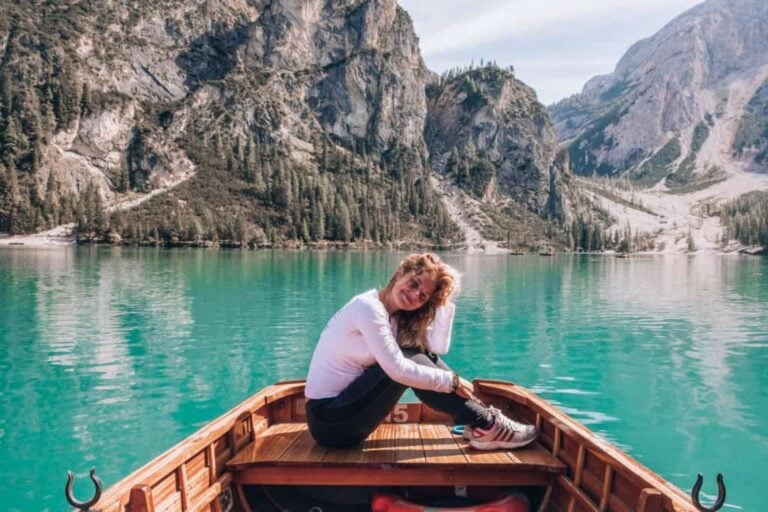 What to see · most readDolomites Italy: 15 Most Beautiful Places + Complete Guide (2026)
 ActivitiesDolomites Alta Via 1: The Queen of Multi-Day Treks in the Dolomites
 What to seeCroda da Lago & Lago Federa, Dolomites Italy: 10 Tips on What to See and Do
 What to seeSass Pordoi, Dolomites Italy: 10 Tips on What to See and Do
 What to seeLago di Carezza (Karersee), Dolomites Italy: 10 Tips on What to See and Do


