Salamanca, Spain: 15 Best Things to See in the Golden City

TL;DRSalamanca, Spain’s so-called Golden City, packs in 15 highlights worth seeking out, including Plaza Mayor, the joined Old and New Cathedrals, and the university founded in 1218, where a hidden frog is said to bring good luck. Don’t miss the Casa de las Conchas, studded with over 300 shells, and the Roman bridge Puente Romano. One day covers the main sights, but two gives you a proper feel for the city. April, May, September and October are the best months — summers push past 40°C, while winters turn bitterly cold. Trains from Madrid take under two hours, and the old town has been a UNESCO World Heritage Site since 1988.

The moment you first step into the historic centre of Salamanca Spain and the afternoon sun hits the buildings around you, you’ll immediately understand why this place is nicknamed the Golden City. All the major buildings are constructed from a special sandstone quarried nearby in Villamayor, rich in iron content that literally glows in the sunlight. Salamanca won’t overwhelm you with grand modern boulevards — instead, it gradually wins you over with its incredibly vibrant energy. It’s one of the oldest university cities in Europe, where centuries of history blend seamlessly with an endless stream of student life in narrow cobblestone alleyways.

If you’re looking for a Spanish destination that offers breathtaking architecture without the endless crowds you’d find at coastal resorts, Salamanca is an absolutely perfect choice. Within a remarkably compact area, you’ll find two stunning cathedrals joined into one enormous structure, mysterious facades full of hidden symbols, and dozens of picturesque little squares dotted with cafés. The city is also easily accessible by train from Madrid, making it a brilliant option even as a short inland getaway. From the UK, you can fly into Madrid with British Airways, Ryanair, or easyJet and be in Salamanca in under two hours by high-speed rail.
TL;DR

  • Spain’s most beautiful square: Plaza Mayor in Salamanca is considered by many to be the most stunning square in all of Spain and forms the natural heart of the city.
  • Two cathedrals: The city boasts a unique complex of the Old and New Cathedrals, connected to each other, with a famous astronaut sculpture hidden on the newer one’s facade.
  • University tradition: The local university was founded back in 1218, and visitors try to spot a tiny frog carved into its ornate facade — said to bring good luck.
  • House of Shells: Casa de las Conchas is an iconic palace decorated with over three hundred carved scallop shells.
  • Day trip from Madrid: You can reach Salamanca comfortably by train from the capital in just under two hours, making it a perfect long-weekend destination.
  • When to visit: The best weather awaits in spring and autumn, as summers are extremely hot and winters bitterly cold.

When to Visit Salamanca Spain

The geographic heart of Spain and the surrounding high plateau have a rather harsh continental climate. Locals often sum it up with a clear and fitting rule: nine months of winter and three months of hell. Winters here are genuinely freezing and often accompanied by biting winds, while the summer months from June to August bring scorching heat with temperatures regularly exceeding 40 °C (104 °F).

The best time to visit is undoubtedly spring or early autumn. The ideal months are April, May, September, and October, when temperatures are pleasant for full days of sightseeing and the city buzzes with student life. If you do end up visiting in the middle of summer, we’d recommend adapting to the Spanish rhythm — take a long siesta during the worst of the midday heat in the shade of a cool church or museum.

Where to Stay in Salamanca

💡 Tip for accommodation and activities: We usually search for accommodation on Booking.com, which tends to have the best cancellation policies. For tickets, tours, and activities, it’s worth comparing options on GetYourGuide.

Salamanca is a very compact city, and you can easily cover the vast majority of attractions on foot. The smartest strategy is to pick accommodation right in the historic centre, ideally somewhere in the triangle between Plaza Mayor, the cathedral, and the university buildings. If you’re arriving by car, be very careful about parking — the old town is criss-crossed with pedestrian zones and one-way streets, so it’s best to find a hotel with its own underground garage.

You can easily arrange accommodation through the usual booking platforms, and we’d recommend booking through Booking.com well in advance, especially if you’re planning a trip during the September festivities or spring holidays.

  • Sercotel Las Torres: This hotel sits right on the iconic Plaza Mayor and offers absolutely unbeatable views from its windows straight onto the action in the city centre. The rooms are a touch on the smaller side, but the location more than makes up for it.
  • Hospes Palacio de San Esteban: If you’re after a touch of luxury and an unforgettable atmosphere, this hotel is housed in a beautifully restored 16th-century Dominican convent. It features a gorgeous garden with a pool — an absolute godsend during the hot months.
  • Hotel Rector: A charming boutique hotel near the Roman bridge that regularly features in lists of the best small hotels in Europe. It’s ideal if you’re looking for complete tranquillity while still being just a few minutes’ walk from the cathedral.

15 Best Things to See and Do in Salamanca Spain

Let’s dive into the very best this university city has to offer. The historic centre has been a UNESCO World Heritage Site since 1988, and centuries of history greet you around every corner. Many smaller details and tours can be booked in advance — you’ll find a wide range of guided walks easily on GetYourGuide.

1. Plaza Mayor and Its Unique Atmosphere
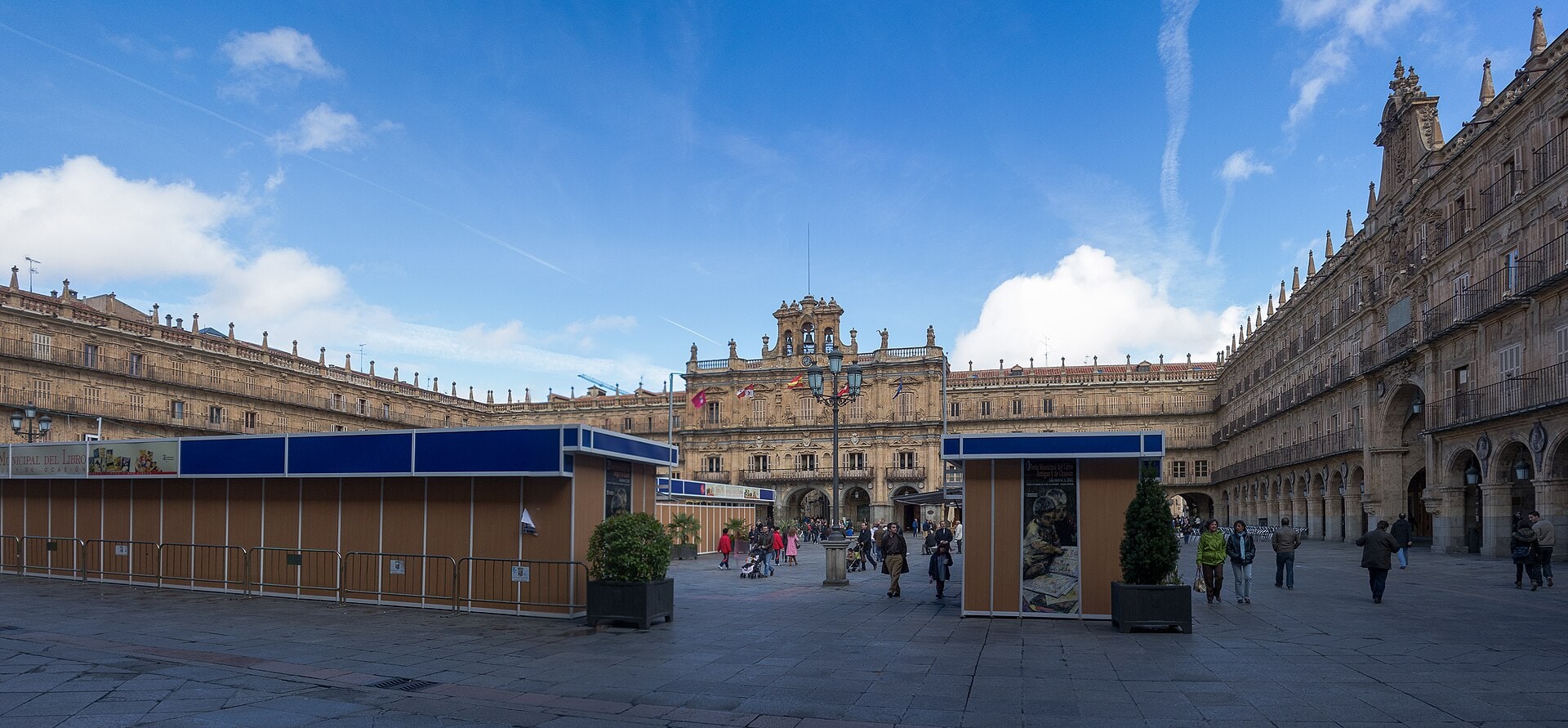
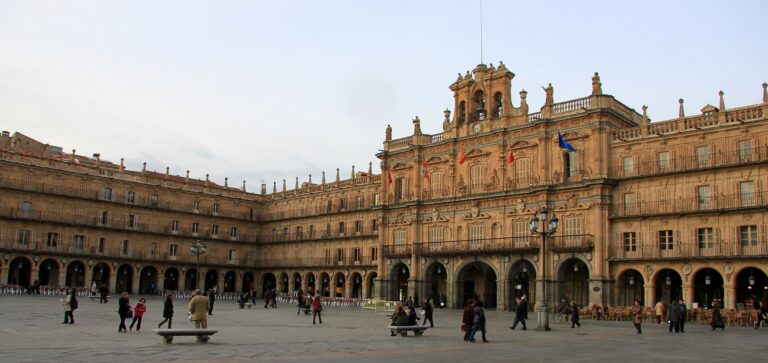
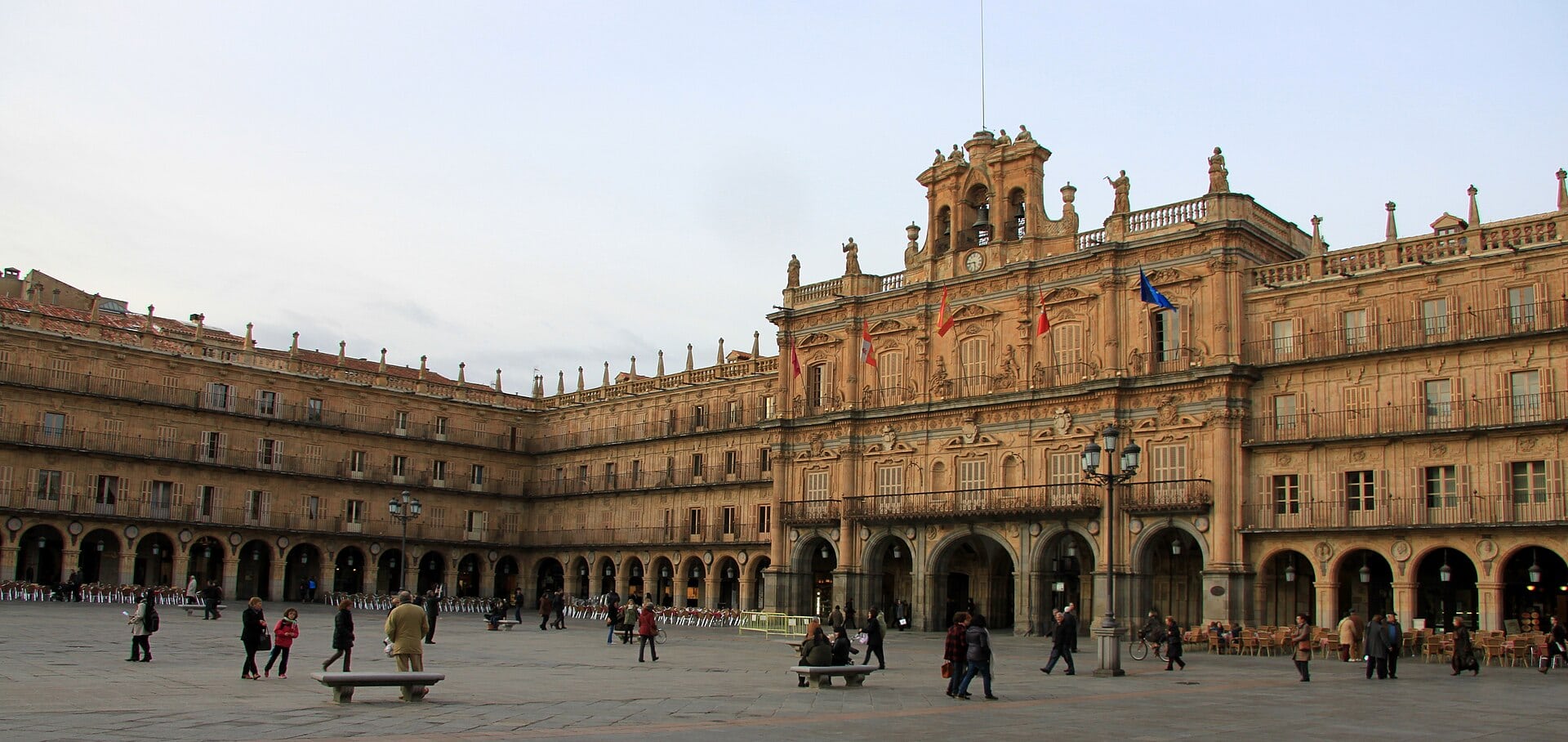
Plaza Mayor in Salamanca isn’t just any old square — according to many Spaniards, it’s the most beautiful plaza in the entire country. Built in the 18th century in stunning Baroque style to a design by architect Alberto de Churriguera, it forms a perfect enclosed rectangle lined with arcades featuring 88 arches. The entire space is built from golden sandstone that shifts in hue throughout the day, from pale yellow to deep orange.

Between the arches of the arcade, you’ll spot carved medallions bearing the faces of notable figures from Spanish history. You’ll find kings, explorers, writers, and military commanders, while some medallions are deliberately left blank, waiting for future heroes. The square once served as a bullfighting arena, but today it’s the city’s main meeting point where students, locals, and visitors all converge.

💡 Local tip: The best time to visit the square is early morning, when it’s still almost deserted and you can photograph it in peace, and then again after dark, when hundreds of lights come on and the square takes on an incredibly romantic atmosphere. Make sure to grab a seat at the historic Café Novelty, which has been serving customers since 1905, and enjoy a coffee with a view of the town hall.

2. Two Cathedrals Joined Into One

Most cities have just one cathedral, but Salamanca can boast two enormous houses of worship that are quite literally stuck together. When construction of the New Cathedral (Catedral Nueva) was approved in the 16th century, the original plan called for demolishing the old one. Fortunately, the build took so long that both structures ended up being preserved, and today you can seamlessly walk from the breathtaking late Gothic space into the more intimate Romanesque Old Cathedral (Catedral Vieja).

The Old Cathedral dates back to the 12th century, and its crowning glory is a remarkably well-preserved altarpiece with 53 panel paintings depicting scenes from the lives of Christ and the Virgin Mary. The New Cathedral, by contrast, impresses with its soaring height and richly decorated vaulting that seems to float in mid-air. The devastating Lisbon earthquake of 1755 seriously damaged the structure, but the tower was subsequently reinforced and still stands proudly today.

Don’t miss paying for the Ieronimus exhibition, an absolutely unique route that takes you across the rooftops and walkways of both cathedrals. You’ll get up close to the vaulting, peer down into the main nave from a dizzying height, and finally climb to the very top of the tower for the best panoramic view of the entire city.

3. The Astronaut and the Ice-Cream-Eating Dragon on the Facade
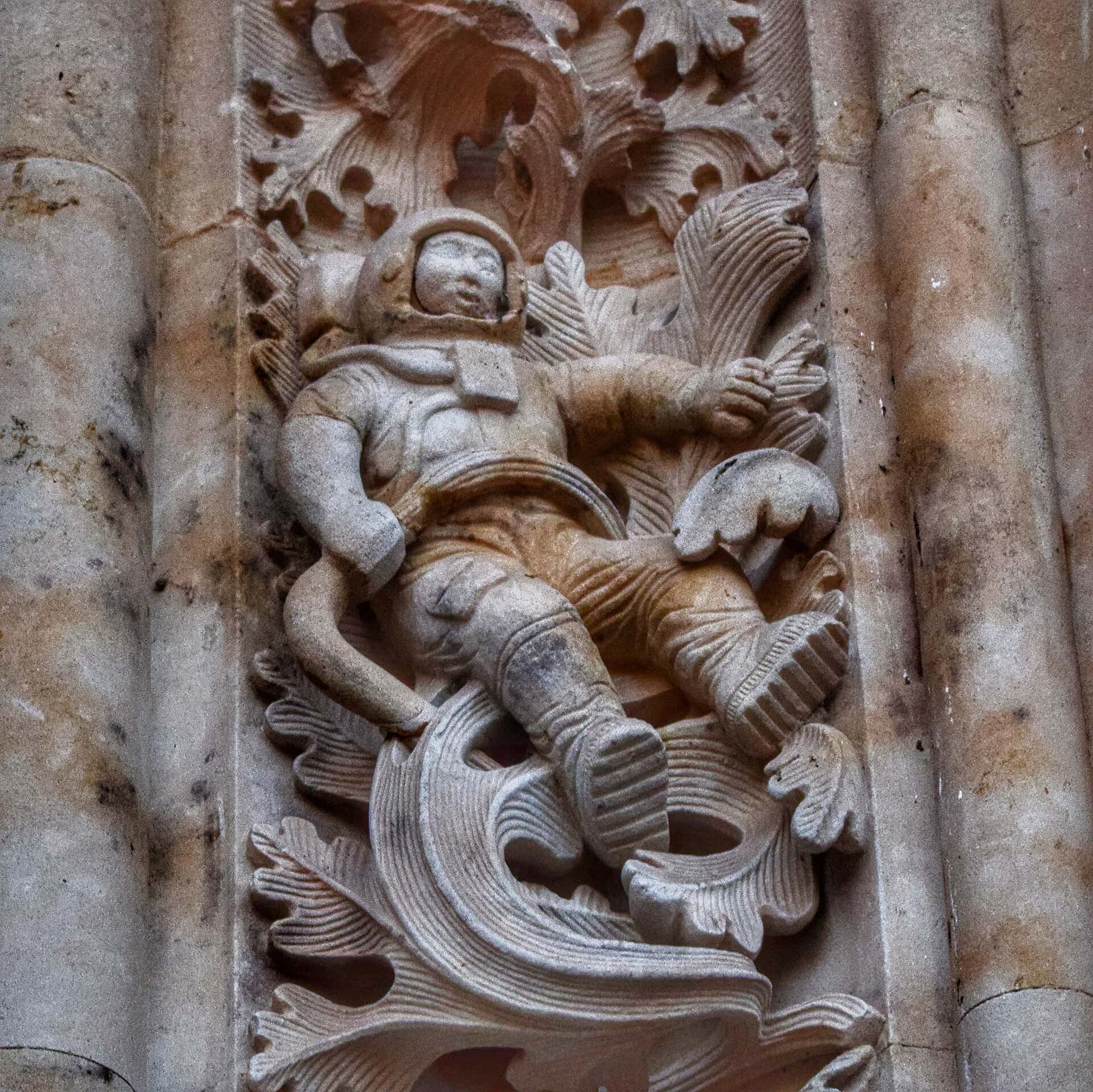
Stand in front of the north portal of the New Cathedral, known as the Puerta de Ramos, and you’ll likely spot a huddle of tourists breathlessly scanning the elaborate stone carvings. They’re searching for one of the most famous and bizarre details in all of Salamanca. Right in the middle of 16th-century Gothic ornamentation hangs a perfectly carved sculpture of a modern astronaut in a spacesuit.

This anachronism has a fairly simple and logical explanation that tourists often miss. In 1992, the cathedral facade underwent extensive restoration, and the lead stonemason Jerónimo García decided to honour an old tradition whereby builders should always add an element representing their own era to any monument being repaired. The astronaut thus symbolises the 20th century and humanity’s enormous technological progress.

💡 Local tip: The astronaut isn’t the only surprise on this facade. If you look a little lower, you’ll also find a dragon happily tucking into a scoop of ice cream in a cone. Hunting down all these modern details is great fun, especially if you’re travelling with children.

4. University of Salamanca and Its Historic Halls
The University of Salamanca, founded in 1218, is the oldest functioning university in Spain and the fourth oldest in all of Europe. Its historic buildings form their own quarter, and simply strolling through the old courtyards instantly transports you back several centuries. The main building, Escuelas Mayores, boasts an absolutely breathtaking Plateresque facade that looks more like the delicate work of a silversmith than a stonemason.

Inside, make sure to explore the old lecture halls, which have preserved their original 16th-century appearance. The most famous is the lecture hall of Fray Luis de León, the celebrated poet and professor who was imprisoned by the Inquisition for five years. When he finally returned to his lectern, he allegedly opened his lecture with the legendary words “As we were saying yesterday,” defiantly dismissing his captors as though nothing had happened.

The university’s greatest treasure, however, is its historic library, which houses tens of thousands of old volumes and rare manuscripts. Carved wooden shelves, antique globes, and the scent of aged paper make this room one of the most magical spots in all of Salamanca. You can’t actually enter the library itself — it’s protected for conservation reasons — but you can study it in detail through a glass wall.

5. Hunting for the Famous Lucky Frog

While you’re standing before the ornately decorated facade of the main university building, you simply have to join in the favourite ritual of every student and visitor. Somewhere in that overwhelming flood of intricate ornaments, coats of arms, and medallions hides a tiny stone frog sitting on a human skull. According to an old student legend, anyone who finds the frog without help is guaranteed to pass all their exams and enjoy good fortune in life.

The origin of this curious symbol remains unclear to this day. Some historians claim the frog on the skull was meant to warn students about sins and vices that lead to death, while others believe it’s simply a whimsical signature left by one of the stonemasons. Whatever the truth, the search can easily take you a good half hour, because the frog is genuinely tiny and blends right into the surrounding stone.

💡 Local tip: Don’t look for the frog right at the top or at ground level. Focus your gaze on the right pillar of the facade, roughly at the third tier of decoration, and carefully examine the skulls carved into the column. If you still can’t find it, just follow the pointing fingers and camera lenses of the tourists around you.

6. Casa de las Conchas and the Mystery of the Shells
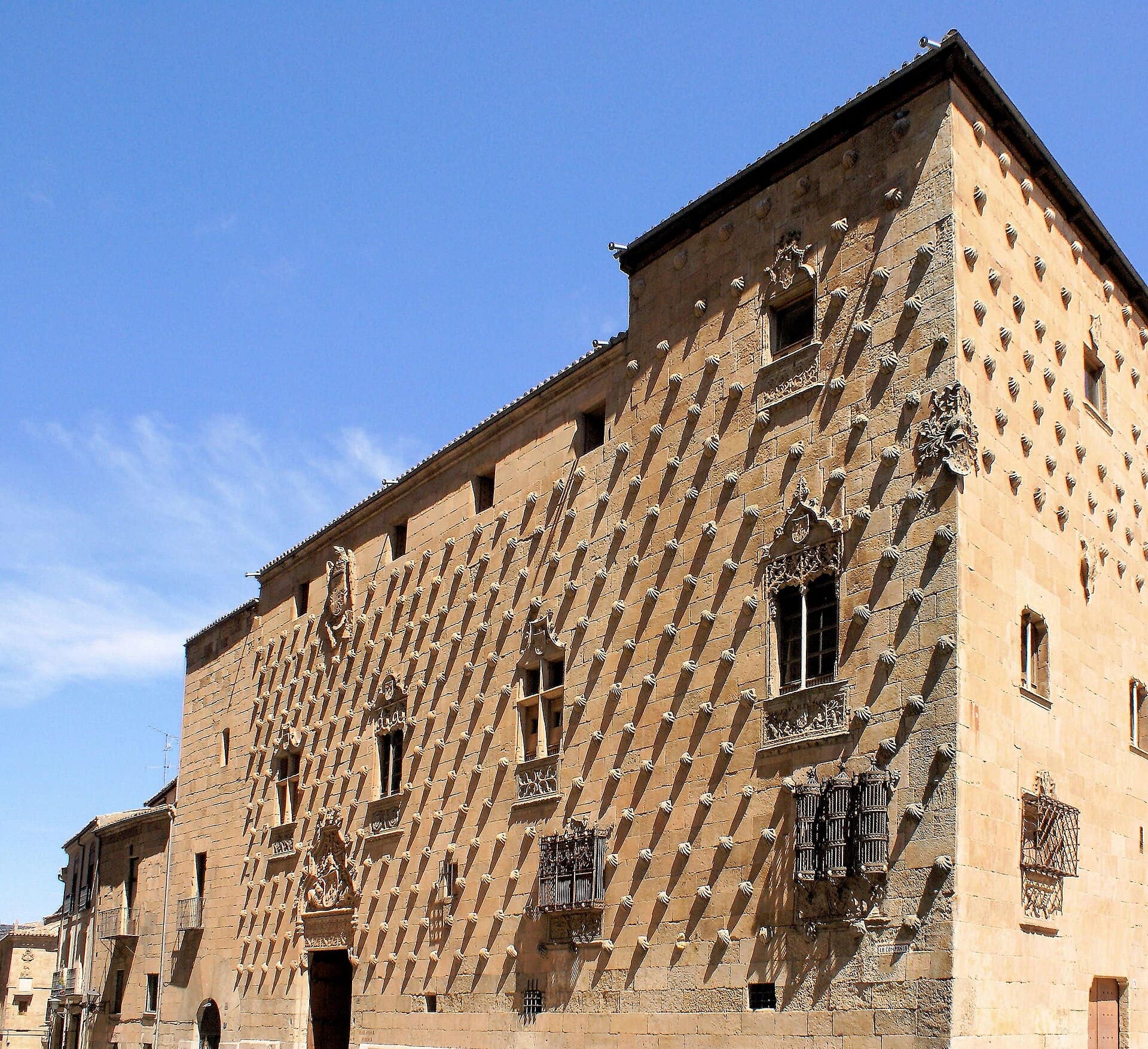
Just a few steps from the university, you’ll come across a building you simply can’t miss. The House of Shells, or Casa de las Conchas, is a late Gothic palace from the end of the 15th century whose facade is adorned with over three hundred carved scallop shells. These shells are the traditional symbol of pilgrims heading to Santiago de Compostela, as the house’s owner, knight Rodrigo Arias de Maldonado, was a prominent member of the Order of Saint James.

An incredible number of romantic legends swirl around this building. The most famous claims that a gold coin from the time of the palace’s construction is hidden beneath one of the shells. This is partly why the city once banned people from touching the facade — to stop treasure hunters from damaging the shells. Another legend says that the Pimentel family, into which the owner married, hid their family jewels beneath the shells.

Today the building houses a public library, which means you can step into the gorgeous inner courtyard completely free of charge. Take in the elegant arcades, stone gargoyles, and beautiful wrought-iron window grilles. From the upper floor of the courtyard, there’s also a fantastic view directly towards the towers of the nearby Jesuit college — a wonderful spot for photographs.

7. Convento de San Esteban and Christopher Columbus
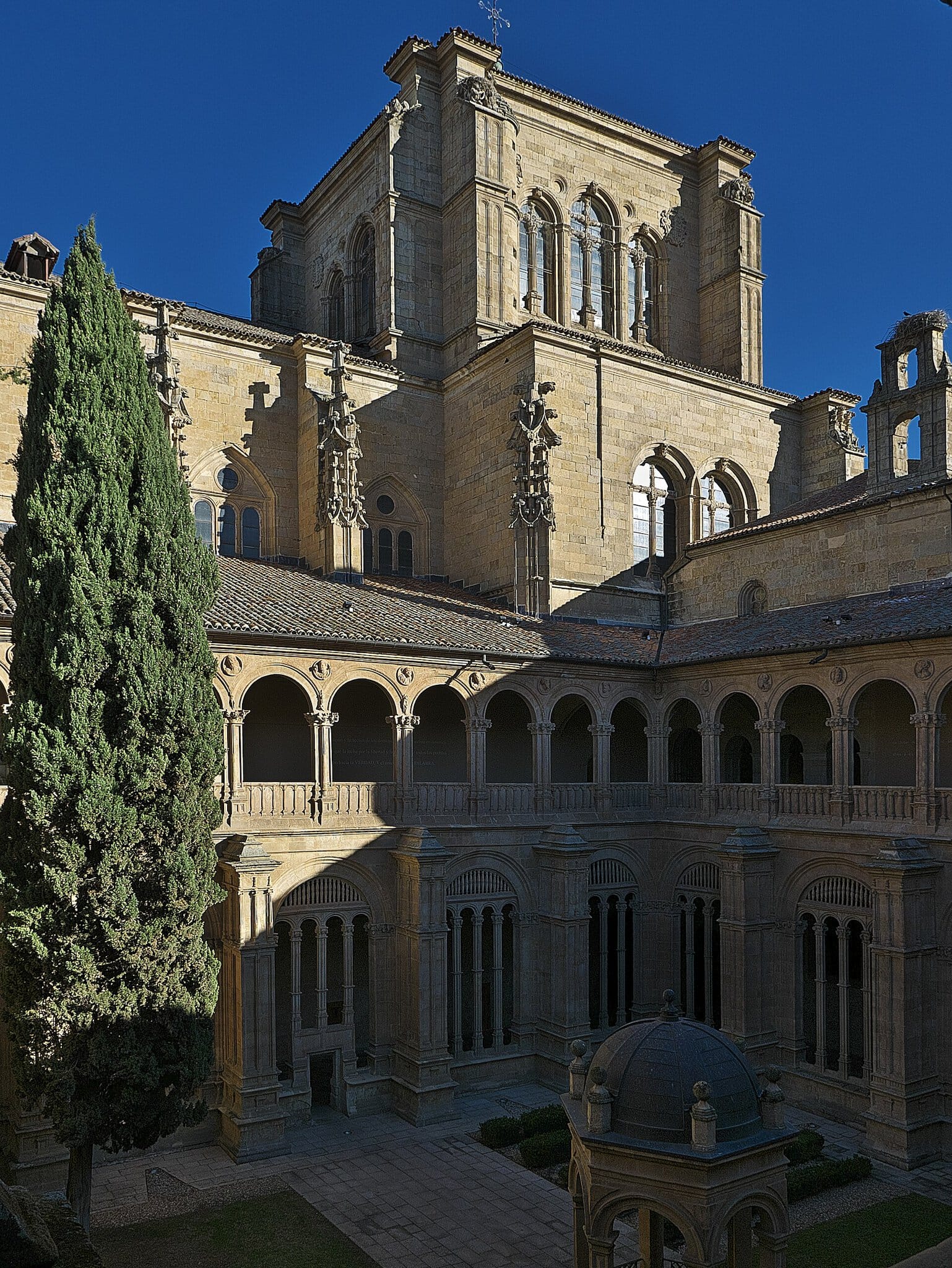
The Convent of Saint Stephen, or Convento de San Esteban, is an enormous Dominican complex that stops you in your tracks the moment you arrive at the little square in front of it. Its massive Plateresque facade resembles an intricately carved altarpiece set right into the sandstone wall, with a sculpture of the stoning of Saint Stephen dominating the centre. The convent played an absolutely pivotal role in the history of Spain and overseas exploration.

It was within these very walls that Christopher Columbus stayed in the late 15th century, trying to convince the learned Dominican friars — and eventually the Catholic monarchs themselves — of the feasibility of his planned voyage to the Indies via the western route. The monks here were strong supporters of his, and their influence likely helped Columbus eventually secure the funding for his historic expedition.

Inside the complex, take your time strolling through the beautiful Cloister of the Kings (Claustro de los Reyes), which blends Gothic ribbed vaults with Renaissance elements. There’s an incredible sense of peace and serenity here, in sharp contrast with the bustling student streets outside. Be sure to also visit the monumental convent church with its stunning gilded Baroque altarpiece by José de Churriguera.

lukas a lucka
Lukáš and Lucie recommend
Where to stay in Salamanca
4 accommodations — wellness hotels, hotels and other lodging options

8. Huerto de Calixto y Melibea for Romantic Souls
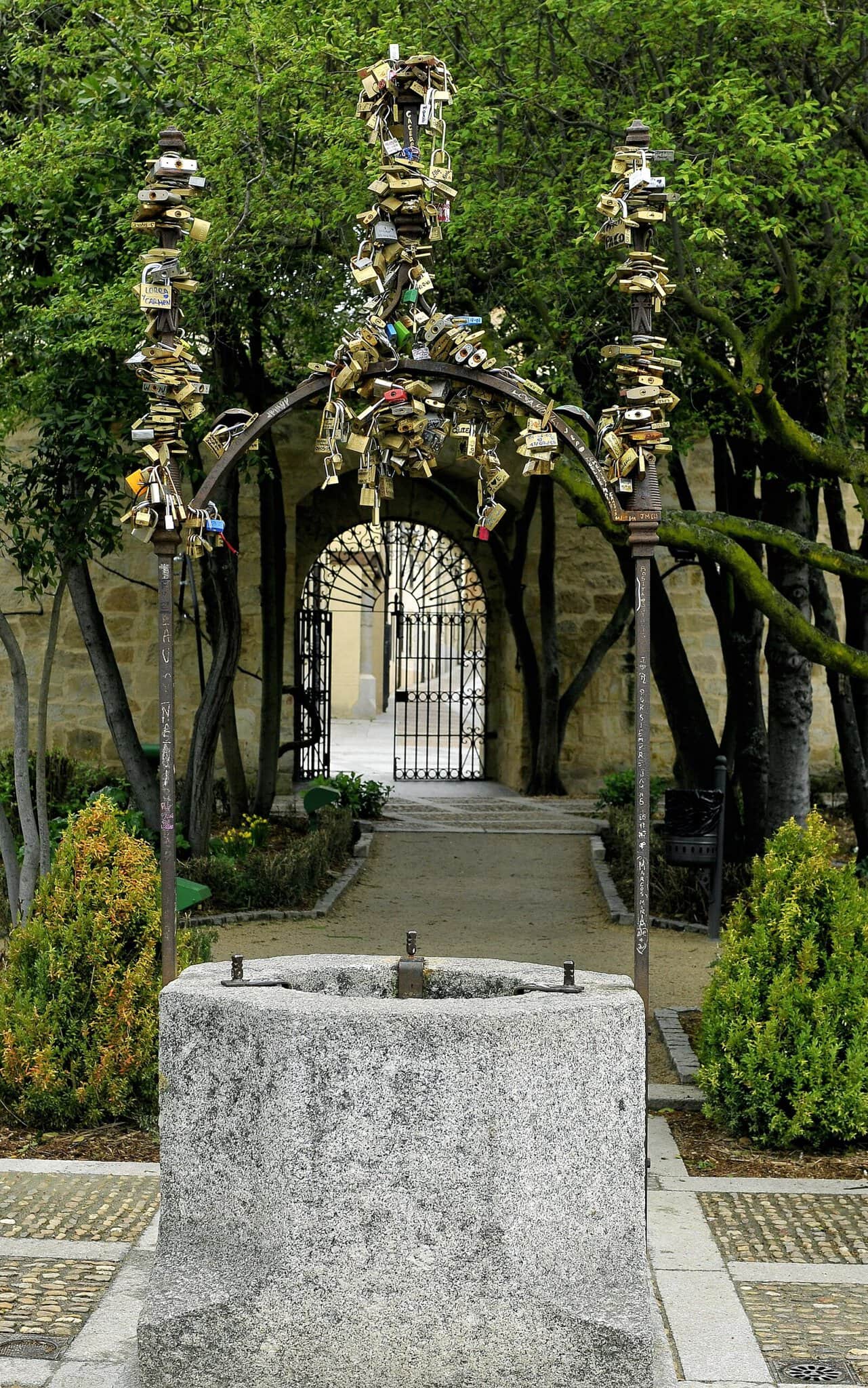
If you need a break from admiring imposing stone structures, head to the charming little park known as the Huerto de Calixto y Melibea. This beautifully maintained garden sits on the old city walls just behind the cathedrals and offers the perfect green retreat, full of flowers and fruit trees.

The garden is named after the main characters of the famous 15th-century Spanish literary work La Celestina. The story of the tragic love between young nobleman Calixto and the beautiful Melibea is traditionally set in this very spot. In the garden you’ll find a small well full of coins, benches hidden beneath climbing plants, and even a statue of the matchmaker Celestina herself.

💡 Local tip: The garden is on an elevated position, which means it offers absolutely stunning views of the River Tormes and the Roman bridge below. It’s one of the best spots in the city for watching the sunset, when the cathedral towers rising above the treetops turn a deep, fiery orange.

9. Puente Romano — the City’s Oldest Monument
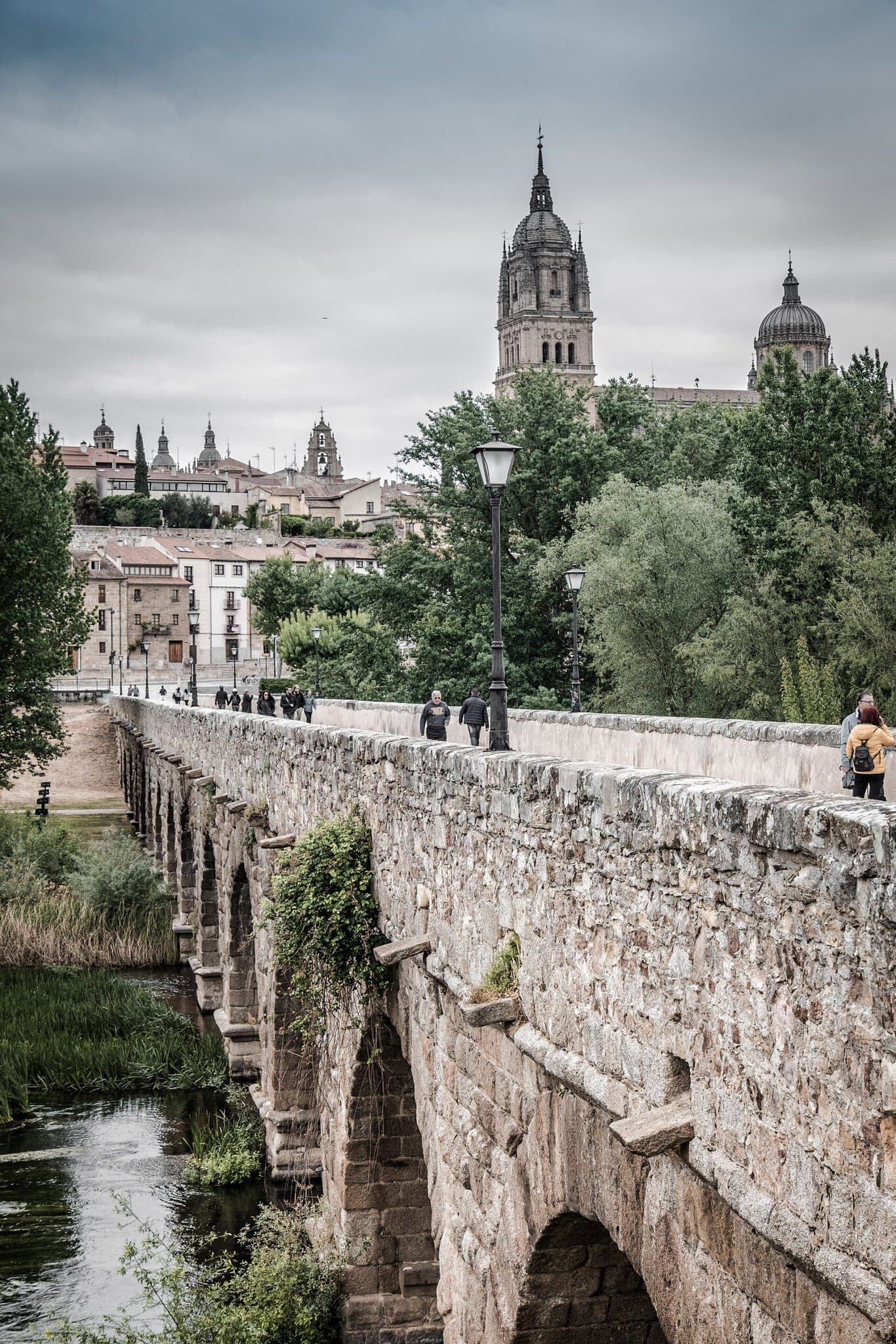
Walking downhill from the cathedrals towards the River Tormes, you’ll reach the Puente Romano — the oldest surviving structure in all of Salamanca. This massive stone bridge was built in the 1st century AD as part of the so-called Silver Way (Vía de la Plata), an important Roman trade route connecting the south and north of the Iberian Peninsula.

Of the bridge’s 26 arches, the first 15 on the city side still date from the original Roman construction, while the rest had to be rebuilt over the centuries following devastating floods. The bridge is now exclusively for pedestrians, and a walk across it offers the quintessential view of Salamanca’s skyline — the one you’ll recognise from most postcards.

Right at the entrance to the bridge, you’ll notice an ancient headless stone animal sculpture. This is a so-called verraco, a boar or bull carved by pre-Roman Celtic tribes, famous from the picaresque novel Lazarillo de Tormes. According to the story, a blind beggar smashed young Lazaro’s head against this very statue to teach him that life is harsh and he must always stay alert.

10. Casa Lis and Dazzling Art Nouveau
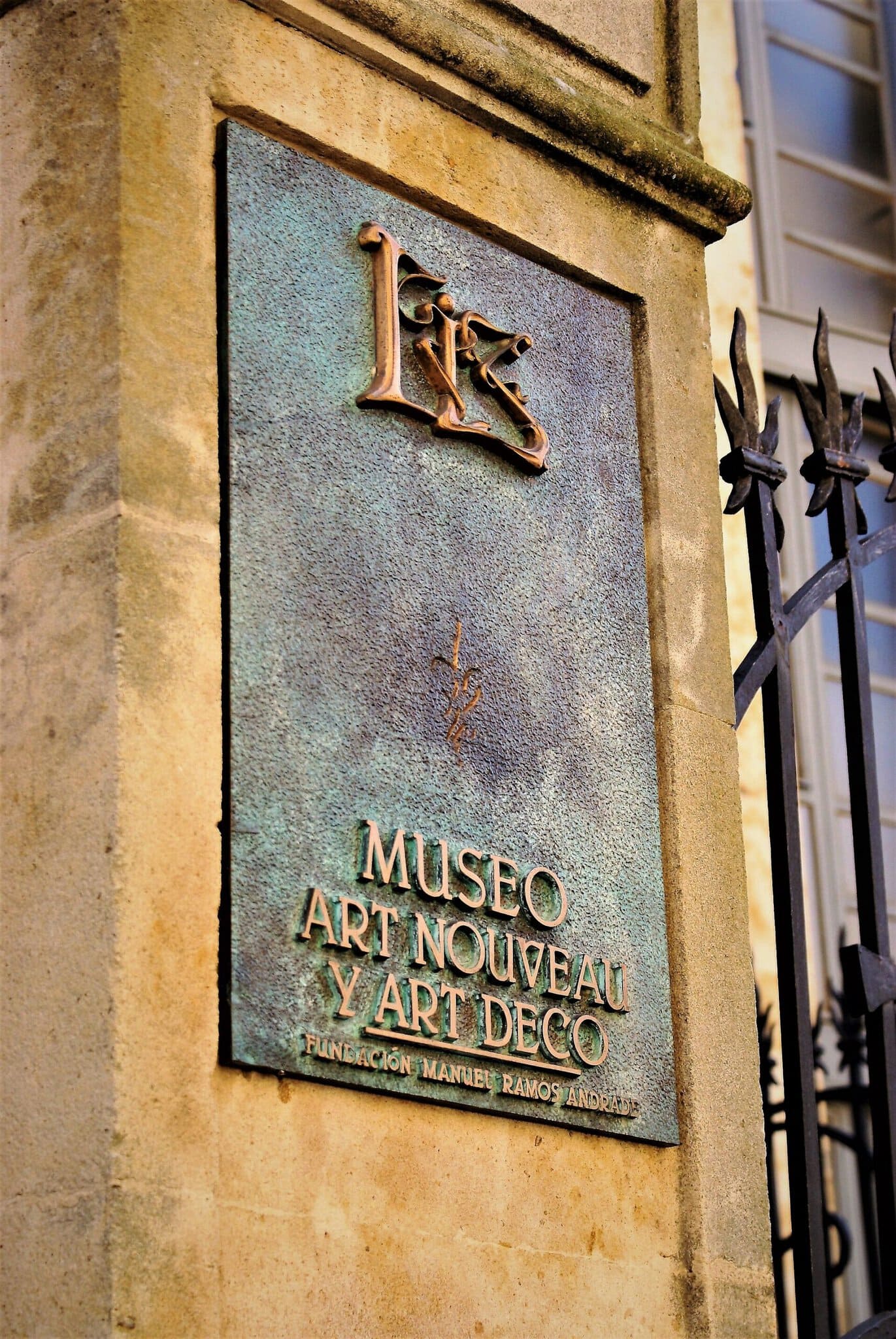
While Salamanca thrives primarily on its medieval and Renaissance heritage, Casa Lis offers a completely unexpected and refreshing contrast to the ubiquitous golden sandstone. This gorgeous Modernist palace, built in the early 20th century right on the old city walls, now serves as the Museum of Art Nouveau and Art Deco (Museo Art Nouveau y Art Déco).

The moment you step inside, you’ll be dazzled by the inner courtyard’s absolutely breathtaking stained-glass ceiling, shimmering with colour. The museum houses a vast collection of decorative arts from the turn of the 19th and 20th centuries, including rare glasswork by René Lalique, porcelain dolls, jewellery, and elegant period furniture.

Don’t forget to visit the museum café, located in the building’s southern facade. It features enormous stained-glass windows overlooking the river and an interior furnished with original Art Nouveau pieces. Sipping a coffee in this setting as sunlight filters through the coloured glass is an experience you absolutely shouldn’t miss.

11. La Clerecía and the Scala Coeli Tower Views

Directly opposite the famous House of Shells rises the imposing complex of the Jesuit college and church of La Clerecía. This enormous Baroque structure was built in the 17th century with a single goal: to showcase the power and wealth of the Jesuit order and create an architectural counterweight to the nearby old university. The church interior is monumental and hides a magnificent Baroque altarpiece.

The real highlight, though, awaits if you buy the ticket called Scala Coeli (Stairway to Heaven). This tour route takes you up narrow wooden stairs to the very top of the two towering church spires. The climb is a bit of a workout for your legs, but the reward at the top is absolutely fantastic.

💡 Local tip: From the walkway between the towers, you’ll get breathtaking views straight down into the courtyard of the House of Shells and across the entire web of historic alleyways. It’s probably the best spot for understanding the urban layout of the old town, and the cathedral towers look close enough to touch.

12. The Celestial Vault — El Cielo de Salamanca

In one of the unassuming rear courtyards of the university buildings, known as the Patio de Escuelas Menores, hides one of the city’s greatest and most mysterious artistic treasures. El Cielo de Salamanca, or the Sky of Salamanca, is a stunning 15th-century mural painting created by the artist Fernando Gallego.

Originally, this enormous astrological fresco decorated the vault of the old university library and served as a teaching aid for students of astronomy and astrology. The painting depicts a night sky filled with constellations, zodiac signs, and mythological figures such as a centaur, a hydra, and the god Mercury in a drawn chariot. During building renovations, the painting was hidden for centuries behind a false ceiling and only rediscovered in the mid-20th century.

Today the fresco has been carefully restored and is displayed in a specially darkened room where gentle lighting perfectly highlights every detail. Entry to this room is free, and thanks to the calm, quiet atmosphere, you can spend long minutes contemplating the medieval vision of how the universe worked.

13. The Legendary Cueva de Salamanca

In the small Plaza de Carvajal near the city walls, you’ll stumble upon the remains of an old crypt shrouded in dark legends. The Cueva de Salamanca, or Cave of Salamanca, was according to folklore the place where the Devil himself taught magic, astrology, and the occult sciences. Each year he supposedly selected seven students, whom he instructed for seven years — one of whom had to leave their soul behind as payment and remain in the cave forever.

The most famous student of this infernal school was reportedly the Marquis of Villena, who managed to outsmart the Devil and escape — but lost his shadow in the process, forever marking him as someone with ties to dark forces. These legends were so popular in the Middle Ages that the word “salamanca” is still used in parts of Latin America as a synonym for witchcraft.

Today the cave is far less sinister. The city has beautifully renovated the site — you can descend the steps into the remains of the old crypt of the San Cebrián church and explore the foundations of the old Marqués de Villena tower. During summer evenings, small concerts and theatrical performances are often held here.

14. Student Life and Tapas on Calle Van Dyck

No visit to Salamanca is complete without diving into the local food and nightlife scene, shaped by its enormous student community. While the historic centre around Plaza Mayor tends to offer more traditional — and often overpriced — restaurants, the real culinary action happens a little further out. Ask any local student where to go in the evening, and they’ll send you to Calle Van Dyck without a moment’s hesitation.

This street north of the centre is absolutely packed with dozens of small tapas bars bursting at the seams. The tapas culture here is very much alive, and prices are geared towards student budgets. Vegetarians will find a huge range of excellent options. Try classics like patatas bravas (fried potatoes with spicy sauce), the traditional tortilla de patatas, fried pimientos de Padrón, or superb local sheep’s cheese.

If you’re travelling with a meat-eater, they’ll certainly come across the local speciality called hornazo. It’s a hearty savoury pie stuffed with pork, chorizo, and hard-boiled eggs, deeply rooted in regional tradition. But you might prefer to simply order a glass of draught beer or local wine — in most bars, you’ll get a small vegetarian snack included on the house.

15. A Magical Evening Stroll Through the Illuminated City

Once darkness falls and you feel you’ve seen everything the day had to offer, get ready — because Salamanca reveals a second, even more enchanting face after sunset. The entire historic centre is fitted with a specially designed lighting system intended to maximise the warm golden glow of the Villamayor sandstone.

Set off on a slow stroll past the same sights you visited during the day. The illuminated cathedral towers look utterly monumental from the Roman bridge, the intricate carvings on the university facade cast deep shadows that make the ornaments seem to leap from the wall, and the House of Shells lit from below looks more mysterious than ever. Plaza Mayor, alive with people and bathed in soft light, will completely captivate you.

💡 Local tip: Forget the map and just let yourself drift through the little side streets around the convents and university buildings. The night-time silence is broken only by students’ footsteps, the hum of music from cafés, and the sound of a guitar from a street musician. It’s the very best way to bid the city farewell.

Where to Go Next from Salamanca

Thanks to its location and excellent transport links, Salamanca makes a superb base for exploring more fascinating corners of Spain. Whether you’re drawn to architecture, nature, or pilgrim trails, you’ve got plenty of options.

  • Back to the heart of Castile: If you arrived from the south, don’t miss Madrid, which is superbly connected to Salamanca by Alvia express trains (the journey takes just over an hour and a half). Along the way, you can stop at stunning historic cities like Toledo with its blend of three cultures, or Segovia with its famous Roman aqueduct.
  • Northwest for history: Follow the historic Silver Way to the city of León, home to one of the most beautiful Gothic cathedrals in Europe. From there, you can continue along the pilgrim route all the way to the legendary Santiago de Compostela.
  • North for ocean and nature: If mountains and the rugged Bay of Biscay coastline appeal to you more, head north. The stunning limestone peaks of Picos de Europa national park await, and if you love the sea, elegant coastal promenades can be found in cities like Santander or the renowned San Sebastián.

Frequently Asked Questions

How many days are needed to visit Salamanca?

To see the main sights in the historic centre, one packed day will be more than enough. But if you want to really enjoy the city, soak up its evening atmosphere and take your time strolling through all the museums and monasteries, I’d recommend setting aside a full two days for Salamanca.

Can Salamanca be done as a day trip from Madrid?

Yes, it’s technically doable. Trains from Madrid’s Chamartín station run fairly frequently and the journey takes about 1 hour and 40 minutes. Just keep in mind that it’ll be pretty exhausting and you’ll miss out on the best part of what the city has to offer – that magical evening stroll through the illuminated streets.

Is Salamanca safe for tourists?

Salamanca is a very safe city with exceptionally low crime. Thanks to the ever-present students, the streets are full of people and well lit even late at night. Greater caution is needed only for petty pickpocketing on the crowded Plaza Mayor and in the immediate vicinity of the cathedral.

Where exactly do I find the famous astronaut on the cathedral?

Don’t look for the astronaut on the old main façade, but you need to head to the northern portal of the New Cathedral (Puerta de Ramos), which faces the Plaza de Anaya square. The little figure sits at roughly eye level on the left panel of the richly decorated entrance, just below a dragon eating an ice cream.

What should I bring back from Salamanca as a souvenir?

The most popular souvenir is a small figurine of a frog perched on a skull, which you’ll find in every shop in all sorts of versions. Silver and filigree products are also a favourite, building on the old craft tradition of the Plateresque style for which the city is so famous.

When is entry to Salamanca’s monuments free?

Most of the major monuments offer set hours when there’s no admission fee. For example, the New and Old Cathedrals usually have free entry on Tuesday afternoons from 4:00 to 6:00 p.m. The university buildings and some monasteries offer similar perks, so always check their official websites in advance and you’ll save plenty of euros.

What’s the best way to get around the city?

Definitely on foot. The historic centre is very compact, full of pedestrian zones, and the distances between the individual monuments are absolutely minimal. It’s better to leave your car parked in the hotel garage, because finding your way through the narrow one-way streets can be very frustrating for a visitor, and on-street parking spaces are in critically short supply.

Tips and Tricks for Your Vacation

Don’t Overpay for Flights

Search for flights on Kayak. It’s our favorite search engine because it scans the websites of all airlines and always finds the cheapest connection.

Book Your Accommodation Smartly

The best experiences we’ve had when looking for accommodation (from Alaska to Morocco) are with Booking.com, where hotels, apartments, and entire houses are usually the cheapest and most widely available.

Don’t Forget Travel Insurance

Good travel insurance will protect you against illness, accidents, theft, or flight cancellations. We’ve had a few hospital visits abroad, so we know how important it is to have proper insurance arranged.

Where we insure ourselves: SafetyWing (best for everyone) and TrueTraveller (for extra-long trips).

Why don’t we recommend any Czech insurance company? Because they have too many restrictions. They set limits on the number of days abroad, travel insurance via a credit card often requires you to pay medical expenses only with that card, and they frequently limit the number of returns to the Czech Republic.

Find the Best Experiences

Get Your Guide is a huge online marketplace where you can book guided walks, trips, skip-the-line tickets, tours, and much more. We always find some extra fun there!
Santander, Spain: 16 Best Things to See and Do

TL;DRSantander, an elegant port city in Cantabria on Spain’s Green Coast in the north, is all about the Magdalena Palace, Renzo Piano’s striking Centro Botín, and the wide sandy sweep of El Sardinero beach. There are 16 ideas here for the city and beyond, from the Cabárceno nature park to Gaudí’s El Capricho villa in Comillas and the Altamira cave near Santillana del Mar. Two full days cover the city itself, but if you’re adding trips around Cantabria, plan on five to seven days. The best weather, with temperatures around 22 to 26°C, runs from mid-June to the end of September — and it’s worth renting a car to explore the countryside and reach the more remote beaches.

If you’re thinking about a trip to Spain and picturing nothing but parched landscapes, scorching heat, and sangria on overcrowded beaches, the northern coast might completely catch you off guard. Green Spain, or España Verde, is an entirely different world — one that feels more like Ireland, only with far better food and dramatic mountains on the horizon. Right in the heart of this region, in the province of Cantabria, lies the elegant port city of Santander Spain. It’s a place where aristocratic history blends with laid-back surf culture, where you can admire modern art in the morning and hike along clifftops above a crashing ocean in the afternoon.

The city stretches around one of the most beautiful bays in the world, and its atmosphere is wonderfully refreshing. Although a devastating fire swept through the centre in 1941, Santander rose from the ashes and today offers a fascinating mix of historic palaces and cutting-edge modern architecture. You’ll find gorgeous wide sandy beaches, superb gastronomy focused on local produce, and a perfect base for exploring the entire green north. I’ve put together this detailed guide to help you plan the perfect trip to this slightly overlooked but utterly enchanting corner of the Iberian Peninsula.

TL;DR

  • Top attractions: The Magdalena Peninsula and Palace, the ultra-modern Centro Botín, the stunning sandy beaches of El Sardinero, and the beautifully restored cathedral.
  • Best time to visit: The driest and sunniest weather runs from June to September, with pleasant temperatures hovering around 24 °C.
  • Getting there: You can reach Santander by train or bus from Bilbao or Madrid, and there’s even a direct ferry from Plymouth or Portsmouth with Brittany Ferries. For exploring the surrounding countryside and hidden beaches, however, hiring a car is essential.
  • Day trips: Don’t miss the Cabárceno Nature Park, the medieval village of Santillana del Mar, or the modernist gem of Comillas.
  • Food: Northern Spain is a foodie’s paradise, with a thriving pintxos culture and the local lightly sparkling txakoli wine.
  • How long to stay: Two full days are enough for the city itself, but if you want to explore Cantabria and the nearby mountains, allow five to seven days.

When to Visit Santander

Unlike southern Andalusia, where summer heatwaves can make sightseeing genuinely unbearable, northern Spain has an entirely different — and far more comfortable — rhythm. The climate here is strongly influenced by the Atlantic Ocean, which means the air is more humid, cooler, and considerably wetter. It’s precisely all that rain that makes Cantabria so dazzlingly green and full of lush pastures.

The only reliable window of relatively dry, sunny weather in Santander Spain stretches roughly from mid-June to the end of September. Even on the hottest August days, temperatures hover around a very pleasant 22 to 26 °C, creating ideal conditions for combining sightseeing with beach time. The water in the Bay of Biscay never gets as warm as the Mediterranean, but by late summer it’s perfectly refreshing for a swim.

If you’re considering a trip in spring or autumn, be prepared for the sky to cloud over at any moment and for heavy showers to roll in. The rest of the year, the north is dominated by rain and strong winds. That said, for lovers of dramatic scenery, stormy seas, and deserted surf beaches, autumn in Cantabria has its own unmistakable and slightly melancholic charm.

Where to Stay in Santander

💡 Accommodation & experiences tip: We usually search for accommodation on Booking.com, which tends to have the best cancellation policies. For tickets, tours, and activities, it’s worth comparing options on GetYourGuide.

Choosing where to stay in Santander largely depends on what kind of holiday you’re after. The city essentially splits into two main areas that visitors tend to gravitate towards. The first is the historic centre and the area around the harbour (Puertochico), which is ideal if you want to be close to the sights, modern art, and an endless supply of evening tapas bars.

The second — and arguably more appealing option for summer — is the El Sardinero neighbourhood, which stretches along the famous beaches of the same name. This area still breathes the elegance of a bygone era when Spanish aristocracy flocked here, and it’s where you’ll find the most refined hotels with ocean views. From El Sardinero, you can reach the centre via a pleasant coastal walk or a quick hop on a city bus.

  • Luxury with a view: If you fancy a touch of real elegance, check out the Eurostars Hotel Real, which sits on a hillside with a fantastic panorama over the bay and ranks among the most iconic buildings in the city.
  • Great value by the beach: An excellent mid-range choice is the Gran Hotel Victoria, just steps from the El Sardinero beaches, offering comfortable rooms with balconies.
  • Right in the thick of it: For those who love city buzz, I’d recommend Vincci Puertochico, a design hotel right by the harbour, within easy reach of the best restaurants and the Centro Botín museum.

I’d recommend booking well in advance via Booking.com, especially if you’re planning a trip in July or August, when Spaniards from the sweltering interior flock to Cantabria to escape the heat. Nightly rates at a decent hotel for two during peak season typically range between €100 and €160, while off-season prices can drop by a third or more.

16 Best Things to See and Do in Santander

Let’s dive into the best that this Cantabrian gem has to offer — from strolling through royal gardens to sampling local cheeses at a bustling market. The city is surprisingly spread out, so don’t hesitate to hop on local public transport or rent a bike from time to time.

1. Palacio de la Magdalena: The Royal Summer Residence

At the turn of the 20th century, city officials decided to build a summer palace for the Spanish royal family to boost tourism. The result was the majestic Palacio de la Magdalena, completed in 1912, which became a favourite retreat for King Alfonso XIII and his wife Victoria Eugenie of Battenberg. The architecture is a fascinating blend of English, French, and traditional Cantabrian elements.

You can visit the palace interior, but be sure to check the opening hours, as the building now partly serves as a conference centre and summer university venue. Guided tours cost just €3 and take you through the grand reception halls, the royal dining room, and the private chambers, all of which offer breathtaking views straight out to the ocean and the surrounding cliffs.

2. Walking the Magdalena Peninsula

The palace itself sits on the sprawling Península de la Magdalena, which today functions as a huge public park. It’s probably the locals’ favourite spot for weekend strolls and picnics. You can walk the entire perimeter along a paved path that’s roughly three kilometres long and offers views across every angle of the bay.

Along the way, you’ll stumble upon several points of interest, including a small open-air marine park where you can spot penguins and seals from the cliffs, as well as an exhibition of replica historical ships. 💡 Local tip: The most stunning views of the cliffs and crashing waves are on the northern side of the peninsula early in the morning, when you’ll barely encounter anyone other than a handful of joggers.

3. El Sardinero Beaches: Sand and Belle Époque

Once you’ve had your fill of royal history, head a little north to the El Sardinero district, famous for its stunning beaches. They’re divided into Primera Playa (First Beach) and Segunda Playa (Second Beach), both connected by a long and very elegant promenade. Fine golden sand and clean bay waters draw thousands of visitors in summer.

Looming directly above the beaches is the iconic Gran Casino del Sardinero building from 1916, lending the whole area a wonderful Belle Époque feel. Even if you’ve no plans to play roulette, the building is worth admiring for its majestic façade alone. If you prefer more active relaxation, the beaches in Santander are a renowned surfing paradise, and there are dozens of schools nearby where you can hire a board and wetsuit.

4. Centro Botín: Architecture That Floats

While El Sardinero breathes history, the harbour area recently received an injection of cutting-edge modern architecture. Centro Botín, designed by the celebrated Italian architect Renzo Piano, opened in 2017 and instantly became a new symbol of the city. The building, composed of two rounded blocks clad in ceramic discs, looks as though it’s hovering right above the surface of the bay.

Inside this cultural centre, you’ll find rotating exhibitions of modern art and various cultural events. Even if contemporary art isn’t really your thing, I’d definitely recommend taking the lift up to the rooftop terrace, which is free to access. It offers one of the finest panoramic views in the entire city — across the sea, the rooftops, and the distant mountains inland.

5. Cathedral of the Assumption of the Virgin Mary

Santander’s cathedral is architecturally unique because it’s essentially two churches stacked on top of each other. The lower part, the 12th-century Crypt of El Cristo, is dark, atmospheric, and through its glass floor you can still admire the remains of the original Roman settlement. The upper, much more spacious section was added later in the Gothic style.

The building has had a rough time through the centuries. In 1893, it was severely damaged by a massive ship explosion in the harbour, and in 1941 it was nearly destroyed in the great fire that engulfed the entire city. Its present appearance is largely the result of a meticulous mid-20th-century restoration, yet the interior — with its mighty pillars and peaceful cloister — still retains a deeply spiritual atmosphere.

6. Paseo de Pereda and the Bay

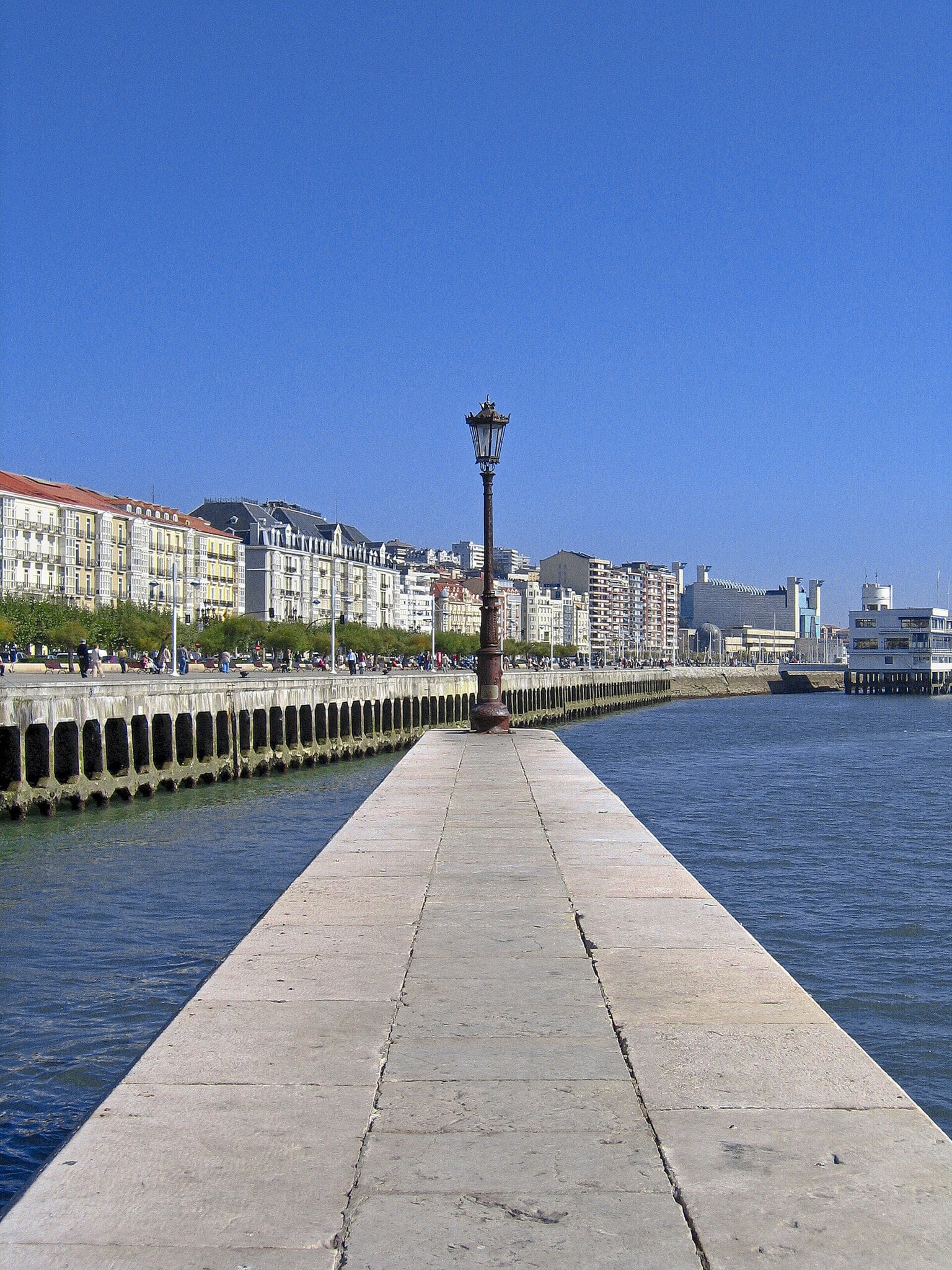
No matter where you’re headed, your steps will sooner or later cross the Paseo de Pereda. This broad seafront promenade lined with historic buildings featuring glazed balconies (known as galerías) is one of the most beautiful sights in the city. These buildings miraculously survived the devastating 1941 fire and offer a glimpse of what Santander looked like in its golden age.

The promenade takes you past the lovely Jardines de Pereda gardens all the way to the harbour. Along the way, you can sit on a bench, watch the ferries departing for England, or grab a coffee at one of the many pavement cafés. It’s the perfect spot for a lazy afternoon when you don’t feel like rushing between sights and just want to soak up the maritime atmosphere.

7. Mercado de la Esperanza: A Foodie’s Paradise

No visit to a Spanish city is complete without exploring the local market, and in Santander it’s even better because the Mercado de la Esperanza is housed in a gorgeous iron-and-glass modernist building dating from 1904. It’s a gloriously authentic place full of noise, colour, and aromas, where locals come every morning to buy their fresh produce.

The ground floor is legendary for its seafood counters, stocked with fish caught that very day in the Bay of Biscay. The upper floor is dedicated to cheese, fruit, vegetables, and bread. As vegetarians, we found an incredible selection of local cheeses — definitely look for the subtly smoked Idiazábal sheep’s cheese from nearby Basque Country or the creamy Cantabrian varieties — plus fresh olives, nuts, and superb artisan bread.

lukas a lucka
Lukáš and Lucie recommend
Where to stay in Santander
4 accommodations — wellness hotels, hotels and other accommodation options

8. Puertochico and the Pintxos Culture

The old fishing quarter of Puertochico has gradually transformed into the city’s main gastronomic hub. Its narrow streets are absolutely packed with small bars and taverns where locals head in the evenings for pintxos. The custom is simple: you don’t sit down at one table for three hours — instead, you hop from one bar to the next, having a glass of wine and one or two small dishes displayed on the counter at each stop.

Unlike southern tapas, pintxos are often elaborate little culinary creations served atop a slice of baguette and held together with a cocktail stick. 💡 Local tip: Vegetarians will find plenty of brilliant options here, from the classic Spanish potato omelette (tortilla de patatas) and fried Padrón peppers with salt, to wild mushrooms in garlic or grilled goat’s cheese with jam. Don’t forget to order a glass of refreshing txakoli — a local, lightly sparkling white wine that’s traditionally poured from a height.

9. Plaza Porticada and the Underground Ruins

The Plaza Porticada, officially known as Plaza de Velarde, was created in the 1950s as a direct response to the devastating city fire. It was designed in a neoclassical style to serve as the new civic centrepiece of Santander. The square is framed by elegant colonnades and regularly hosts markets, concerts, and cultural festivals.

The real treasure, however, lies beneath its paving stones. During renovations in 1998, workers uncovered an extensive archaeological site. Today you can visit the Centro Arqueológico de la Muralla Medieval, where you’ll walk among the remains of the original medieval city walls and old cobblestone streets, giving you a vivid sense of what the city looked like centuries ago. Admission is nominal and a visit takes about half an hour.

10. Maritime Museum of Cantabria

Northern Spain is deeply intertwined with the ocean, and nowhere will you understand that better than at the Museo Marítimo del Cantábrico. The museum sits near Los Peligros beach and offers an extensive and engaging exhibition on humanity’s relationship with the sea. You’ll find everything from the history of whaling to scale models of old ships and maritime instruments.

The biggest draws for visitors tend to be the enormous whale skeletons suspended from the ceiling and the large aquariums on the lower floor, showcasing the diverse marine life of the nearby Bay of Biscay. It’s an excellent stop, particularly if you hit a typical Cantabrian rainy day and need somewhere to shelter for a few hours. Admission is around €8.

11. Funicular del Río de la Pila

Santander is built across several steep hills, and constantly walking up and down can be quite tiring. The city solved this problem elegantly by installing public escalators in various spots. Even more interesting, though, is the ground-level funicular on Río de la Pila street, which locals use as everyday transport and which makes for a fun attraction for visitors.

Riding this glass-enclosed funicular is completely free and it whisks you up to the Mirador del Río de la Pila viewing platform. From the top station, you’re treated to a gorgeous view over the rooftops of the old town and the calm waters of the bay. I’d suggest heading up just before sunset, when the city and ocean take on a beautiful golden glow.

12. Cabo Mayor and Its Lighthouse

If you love wild nature and wave-lashed cliffs, definitely make time for a walk out to the Faro de Cabo Mayor lighthouse. You’ll find it on the northern edge of the city, roughly half an hour’s walk from the El Sardinero beaches. This 30-metre lighthouse has been guarding the entrance to the bay since 1839 and is surrounded by rugged, green landscapes that feel rather reminiscent of the Irish coast.

At the base of the lighthouse, there’s now an interesting art gallery (Centro de Arte Faro de Cabo Mayor) exhibiting works inspired by the sea and maritime themes. But the best thing to do here is simply sit on the grass above the cliffs, listen to the thundering waves, and watch the gulls circling over the churning water. It can get incredibly windy on the clifftops, so don’t forget to pack a windproof jacket.

13. Day Trip: Parque de la Naturaleza de Cabárceno

This is emphatically not your ordinary zoo. The Cabárceno Nature Park, just about twenty kilometres south of Santander, was created by reclaiming a vast open-pit iron ore mine. The result is an absolutely jaw-dropping, almost otherworldly landscape of red rocks and valleys where animals from around the globe roam freely across 750 hectares.

The enclosures are so enormous that the park is set up as a drive-through safari — you take your own car along thirty-five kilometres of tarmac roads. You can watch elephants, bears, rhinos, and gorillas in surroundings that give them genuine space and freedom. The admission ticket also includes a ride on a long gondola cable car that carries you high above the entire park, offering unforgettable views of this unique reclaimed landscape.

14. Day Trip: Modernist Comillas

Fifty kilometres west of Santander lies the small town of Comillas, which absolutely deserves a place on your itinerary. At the end of the 19th century, it became a favourite summer retreat for the Spanish aristocracy and earned the nickname “town of archbishops”. You’ll find remarkably rich architecture here, including the neo-Gothic Sobrellano Palace and the Pontifical University building.

The main draw, however, is El Capricho — one of the few buildings that the legendary Catalan architect Antoni Gaudí designed outside his native Catalonia. This fairy-tale villa with a minaret-like tower is lavishly decorated on the outside with sunflower-motif ceramics, perfectly showcasing Gaudí’s genius for detail and playfulness. Admission is around €7, and during the summer season I’d recommend buying tickets online in advance.

15. Day Trip: Santillana del Mar and Altamira Cave

Just a short drive from Comillas lies Santillana del Mar, famously known across Spain as “the town of three lies” — because it’s neither holy (santa), nor flat (llana), nor on the sea (del mar). In reality, it’s a perfectly preserved medieval village full of stone houses bearing coats of arms, wrought-iron balconies, and narrow cobblestone lanes where time seems to have stood still for centuries.

Beyond the charming village itself, visitors also flock here for the renowned Altamira Cave, home to some of the most important prehistoric paintings in the world. The original cave is closed to the general public to protect its microclimate, but right next door is a superb museum housing the so-called Neocueva (New Cave) — a flawless, three-dimensional replica of the original space where you can marvel at the famous bison paintings dating back fifteen thousand years.

16. Exploring Green Cantabria

Santander is the perfect springboard for exploring the wider northern coast. Green Spain is a region that richly rewards travellers willing to trade guaranteed blue skies for raw authenticity and nature. Hire a car and set off to discover hidden beaches tucked beneath cliffs, tiny fishing villages, or venture deeper inland to taste Cantabrian cheeses straight from the farm.

The motorways here are mostly toll-free and the roads very well maintained. Driving westward towards the neighbouring Principality of Asturias, you’ll pass dozens of spots where you’ll want to pull over and simply drink in the views of the wild Atlantic. This is Spain for the adventurous — and its rugged beauty will utterly captivate you.

Where to Go From Santander

If you have more time on your hands, northwestern Spain offers plenty of other fascinating destinations to explore. The great thing about Cantabria is that everywhere is relatively close, and you can easily combine mountains, coast, and historic cities.

  • Bilbao: Just an hour’s drive east, you’ll find the Basque city made famous by the titanium Guggenheim Museum and a brilliant pintxos culture in the old town.
  • San Sebastián: Continue deeper into the Basque Country to a city boasting arguably the most beautiful urban beach in Europe and the highest concentration of Michelin stars anywhere.
  • Picos de Europa: Just over an hour’s drive from Santander, these dramatic limestone mountains offer cable car rides at Fuente Dé and treks around glacial lakes.
  • Oviedo and Asturias: Head into the neighbouring region to explore pre-Romanesque architecture and sample the legendary Asturian cider.
  • Santiago de Compostela: If a longer road trip tempts you, drive the entire northern coastline all the way to Galicia and the final destination of the famous pilgrimage route.
  • Madrid: Santander has a direct and comfortable train connection to the Spanish capital, so you can easily combine the coast with the bustling art-filled metropolis.

Frequently Asked Questions

Is Santander worth visiting?

Absolutely. It’s an ideal destination for those seeking a combination of an elegant city, beautiful beaches, and excellent cuisine, without having to fight through the massive crowds that plague resorts in southern Spain. The city has a very pleasant, relaxed atmosphere.

How many days do I need in Santander?

For the city itself, exploring the Magdalena peninsula, Centro Botín, and relaxing on the beaches, two full days will comfortably suffice. However, I highly recommend using the city as a base for 5 to 7 days and exploring the surrounding Cantabria region, such as Cabárceno park or the mountains.

Do I need a car in northern Spain?

In the city itself, you can get by on foot and with city buses. Trains run between major cities like Bilbao and Santander, but for truly exploring the region, hidden beaches, villages like Comillas, and the Picos de Europa mountains, a car is absolutely essential. Without one, you won’t reach the most beautiful spots.

What’s the weather like in summer?

Unlike the south, don’t expect sweltering 40-degree heat. In July and August, temperatures typically hover around a pleasant 23 to 26°C (73-79°F). However, the northern coast is known for its variability, so even in midsummer it can cloud over and rain showers can roll in. A windbreaker or light sweater always comes in handy here.

What happened during the great fire of 1941?

In February 1941, a devastating fire swept through the city center, fueled by strong winds from the ocean. Over two days, almost the entire historic part of the city burned down, including many old winding streets. Santander had to be largely rebuilt, which is why the center today has a more modern character with wider streets.

What should I try if I don’t eat meat?

While the northwest is famous for seafood and beef, vegetarians definitely won’t go hungry here. In tapas bars, you can always get Spanish potato tortilla, excellent fried Padrón peppers with salt, garlic mushrooms, plenty of local cheeses (especially Idiazábal), and fresh olives.

Are the beaches in Santander sandy?

Yes, and they’re among the most beautiful in all of northern Spain. The beaches in the El Sardinero district feature very fine, light-colored sand, are incredibly wide (especially at low tide), and offer excellent conditions not only for swimming but also for surfing.

What’s the best way to get to Santander?

While Santander has its own small airport, Seve Ballesteros, flights from the Czech Republic often involve connections and can be pricey. The most practical option is often to fly into nearby Bilbao, which has more airline options, and then take a bus or rental car from there (the journey takes about an hour and fifteen minutes).

Tips and Tricks for Your Vacation

Don’t Overpay for Flights

Search for flights on Kayak. It’s our favorite search engine because it scans the websites of all airlines and always finds the cheapest connection.

Book Your Accommodation Smartly

The best experiences we’ve had when looking for accommodation (from Alaska to Morocco) are with Booking.com, where hotels, apartments, and entire houses are usually the cheapest and most widely available.

Don’t Forget Travel Insurance

Good travel insurance will protect you against illness, accidents, theft, or flight cancellations. We’ve had a few hospital visits abroad, so we know how important it is to have proper insurance arranged.

Where we insure ourselves: SafetyWing (best for everyone) and TrueTraveller (for extra-long trips).

Why don’t we recommend any Czech insurance company? Because they have too many restrictions. They set limits on the number of days abroad, travel insurance via a credit card often requires you to pay medical expenses only with that card, and they frequently limit the number of returns to the Czech Republic.

Find the Best Experiences

Get Your Guide is a huge online marketplace where you can book guided walks, trips, skip-the-line tickets, tours, and much more. We always find some extra fun there!
Rome in 3 Days: Itinerary and What to See

TL;DRThree days in Rome is enough to cover the ancient zone (Colosseum, Roman Forum), the Vatican with St Peter’s Basilica, and the historic centre with the Trevi Fountain, Pantheon and Trastevere — though that’s the bare minimum. Stretch it to 4 or 5 nights if you want to fit in Pompeii or Ostia Antica. Colosseum tickets (from €20) go on sale 30 days ahead, Vatican Museums tickets (€25) 60 days ahead, and both sell out within minutes. From February 2026, there’s a €2 charge to step down to the pool at the Trevi Fountain, which has a capacity of 400 people. May, June, September and October are the best months, with temperatures dropping to a pleasant 22°C. Sturdy shoes are a must — Rome’s baking-hot cobblestones (sampietrini) are brutal on your feet.

Rome is one of those cities that can utterly enchant you with its beauty — but if you arrive unprepared, it’ll chew you up before you’ve even tossed a coin into your first fountain. Most people come here with romantic visions of carefree wandering among ancient columns, artisan gelato cone in hand, wind in their hair. But reality often hits hard on day one when you’re planning Rome in 3 days without doing your homework first.

Scorching cobblestones, relentless crowds pressing through narrow alleyways, and hopelessly sold-out tickets can turn a dream holiday into a logistical nightmare. Lukáš and I love Rome and always enjoy coming back, but we’ve learned that the secret to success isn’t how many sights you can tick off — it’s all about precise timing and strategic planning. The Eternal City isn’t a quiet museum; it’s a buzzing, noisy metropolis of three million people, where antiquity rubs shoulders with the morning rush hour. 😅

In this article, I’ll show you how to put together the ideal three-day itinerary so your feet don’t hurt more than absolutely necessary by the end. We’ll walk through the most stunning sights from the Colosseum to the Vatican, I’ll tell you where to stay strategically, and show you how to dodge the worst tourist traps. Rome can actually be surprisingly kind to your wallet if you know the local rules of the game. Let’s dive in and discover how to truly make the most of the Italian capital. ☺️

TL;DR

  • Buy tickets a month ahead: Colosseum tickets (on the official website) are released exactly 30 days in advance and sell out within minutes. Vatican tickets open up 60 days ahead.
  • Three days is the bare minimum: Split your itinerary logically — Day 1 for ancient Rome (Colosseum, Forum), Day 2 for the Vatican and surroundings, Day 3 for the historic centre.
  • New rules at Trevi: From 2026, there’s a €2 fee to descend to the Trevi Fountain basin, and the space is capacity-limited.
  • Comfortable shoes are a must: Rome’s cobblestones (sampietrini) are merciless. Leave the heels and flimsy sandals at home, or your feet will be screaming by evening.
  • Coffee at the bar: An espresso costs around €1.20 if you drink it standing at the bar. The moment you sit down at a table with service, you’ll pay three times as much.
  • Water is free: Don’t buy overpriced plastic bottles. Hundreds of drinking fountains (nasoni) with ice-cold, potable water are dotted all over the city.

When to Visit Rome and How Many Days You Need

Chasing perfect weather while dodging the crowds is probably the trickiest balancing act for any traveller. The desire is simple — we all want to see Rome bathed in sunlight, sit outdoors with an Aperol Spritz, but not be squeezed in with ten thousand other people doing exactly the same thing. The best months to visit are May, June, September, and especially October. In autumn, temperatures drop to a pleasant 22 °C, the air clears up, and the city is bathed in gorgeous, soft light that’s ideal for photography. The catch? These are also peak months when the city is bursting at the seams and hotels are fully booked.

Summer in Rome — specifically July and August — is a test of both physical and mental endurance. Temperatures routinely soar to 31–35 °C, and the humidity turns the streets into a stifling greenhouse. The ancient stones of the Colosseum soak up the heat all day and radiate it like a giant oven long after sunset. If you have to visit in summer, your daily routine needs a radical overhaul: alarm at six, hit the major sights before ten in the morning, and hide in an air-conditioned restaurant or your hotel over midday. The afternoon siesta here isn’t laziness — it’s pure survival. In August, there’s also the Ferragosto holiday, when many locals shut their family-run businesses and flee to the coast.

Winter, on the other hand, is the best-kept secret of budget travellers. From late November to February, temperatures hover between 5 and 13 °C, there’s the occasional rain shower, and mornings can be bitingly cold. But you gain something priceless: space. Accommodation prices drop to their annual lows, and queues at monuments shrink to virtually nothing. You can stroll through the Vatican Museums in January at your own pace, without being herded through the corridors like cattle.

So how many days do you actually need? The long-weekend myth is probably the most common trap. People try to cram three thousand years of history into two days and end up with nothing but blisters. Three days is the absolute minimum to logically divide the city into the ancient zone, the Vatican, and the historic centre. If you want to add a day trip to Pompeii or the ruins of Ostia Antica, aim for 4–5 nights. If you’re travelling with kids, slow the pace down and work in parks or underground tours that’ll keep them entertained more than dry history.

Where to Stay in Rome

💡 Accommodation & experience tip: We usually search for places to stay on Booking.com, which tends to have the best cancellation policies. For tickets, tours, and activities, it’s worth comparing options on GetYourGuide.

Your choice of neighbourhood defines your entire Rome experience. Pick the wrong one, and you’ll spend a third of the day crammed into the metro or on buses that never seem to run on time. The most common dilemma is between Monti and Trastevere. Monti sits strategically right behind the Colosseum, has its own metro station, and offers the perfect balance between access to the sights and escape from the hordes. You’ll find brilliant vintage shops and a laid-back vibe, with locals sipping beer on the steps of a fountain. Trastevere, on the other hand, is the epitome of romance with its narrow lanes and fantastic nightlife, but it has no metro station and gets incredibly noisy in the evening.

If you want to live inside a postcard, Centro Storico (the area around the Pantheon and Piazza Navona) is your pick. Everything is within walking distance, but you’ll pay a hefty premium for the location and find yourself right in the thick of tourist traps. If you’re travelling with children or just want peace and quiet, go for the Prati neighbourhood. It’s right next to the Vatican, has flat terrain (ideal for pushchairs), and feels very elegant and safe. Plus, you can reach St Peter’s Basilica first thing in the morning.

For travellers on a tighter budget, the area around Termini station is the classic choice. You’ll find the cheapest hotels and excellent transport links (both metro lines cross here), but the streets aren’t the cleanest and you need to keep a sharp eye out for pickpockets. We always book accommodation well in advance through Booking.com, because prices in Rome can skyrocket in the weeks before your trip. A lovely option is the elegant Hotel Artemide near Piazza della Repubblica, or the romantic Relais Le Clarisse in the heart of Trastevere with its beautiful inner courtyard. For more specific recommendations, check out our article on where to stay in Rome.

12 Things to See and Do in Rome (3-Day Itinerary)

Lukáš and I put this itinerary together to minimise tiring transfers and help you enjoy each part of the city to the fullest. Day one dives into ancient Rome, day two takes us to the world’s smallest country, and day three gets lost in the lanes of the historic centre.

Day 1: Ancient Rome and the Birth of an Empire

1. The Colosseum: Ticket Lottery and Going Underground

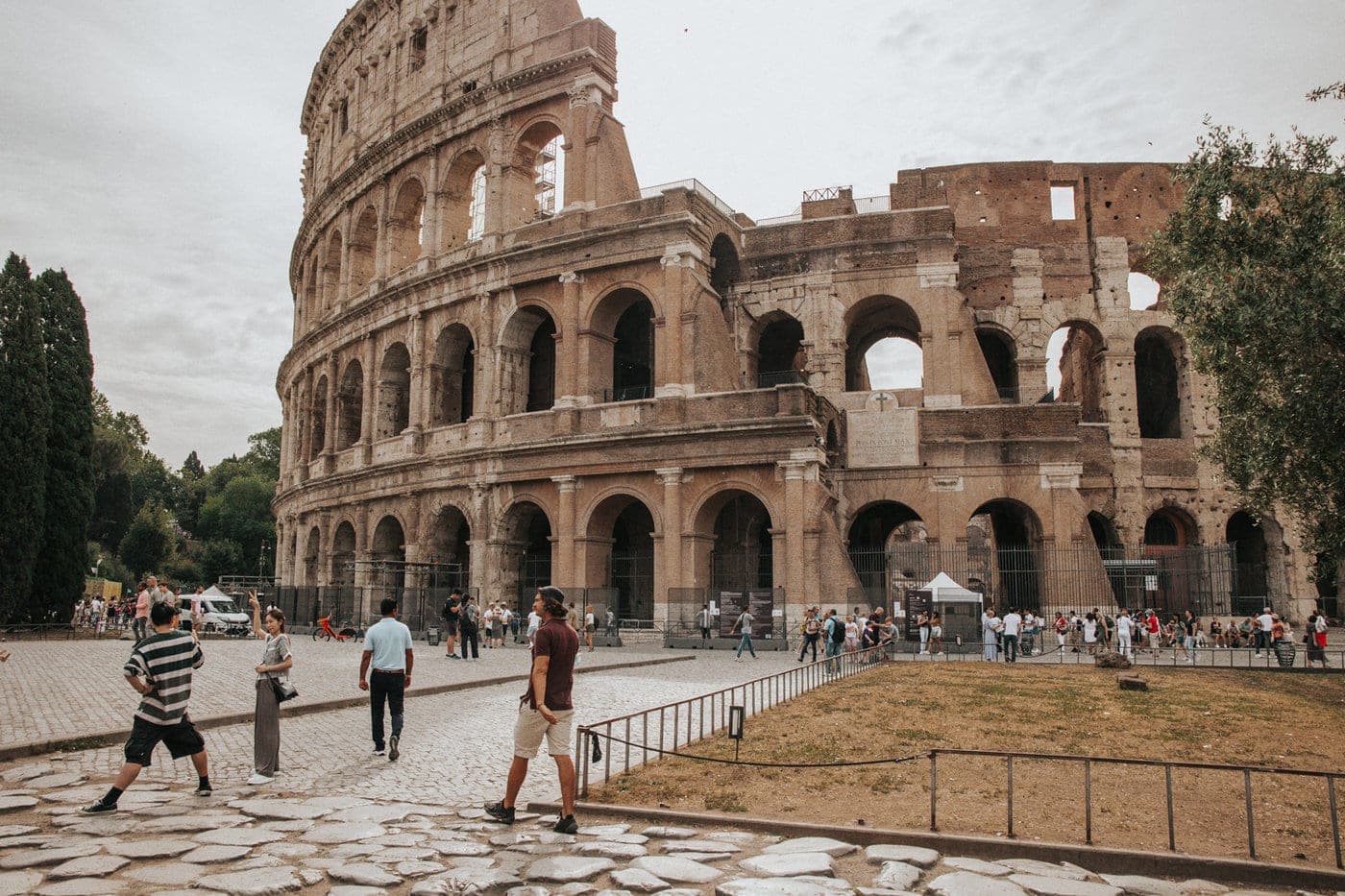
The Colosseum is Rome’s ultimate magnet. Everyone who visits the Eternal City wants to see the arena where life-and-death decisions were made. But if you don’t have tickets bought a month in advance, your visit will probably be limited to peering at it from outside while weaving through thousands of people. The golden rule is simple: there is only one official ticket seller, and that’s the coopculture.it portal (which redirects you to ecm-coopculture.inera.it). Every other website is a reseller charging massive mark-ups for dubious service.

Tickets are released into the system exactly 30 days in advance at 9:00 AM. A standard ticket costs €20 (including the booking fee), but we strongly recommend grabbing the Full Experience ticket for €22. This gives you access to the reconstructed arena floor and, crucially, the underground chambers (hypogeum), where gladiators and wild animals waited in total darkness before their entrance. What’s more, this ticket is valid for two full days, so you can spread the load and save the Roman Forum for the following morning. Tickets vanish within minutes, though — you need to be sitting at your computer with your card ready at nine on the dot.

Outside the Colosseum, watch out for men dressed as gladiators. They’ll cheerfully shove a plastic sword into your hands, snap a photo with you, and then aggressively demand €20 or more. Ignore them completely and keep walking. Also guard your pockets at the Colosseo metro exit, where organised pickpocket gangs operate in the massive crush. You’ll find more details in our in-depth guide to the Colosseum in Rome.

2. Roman Forum and Palatine Hill: The Scorching Heart of Antiquity

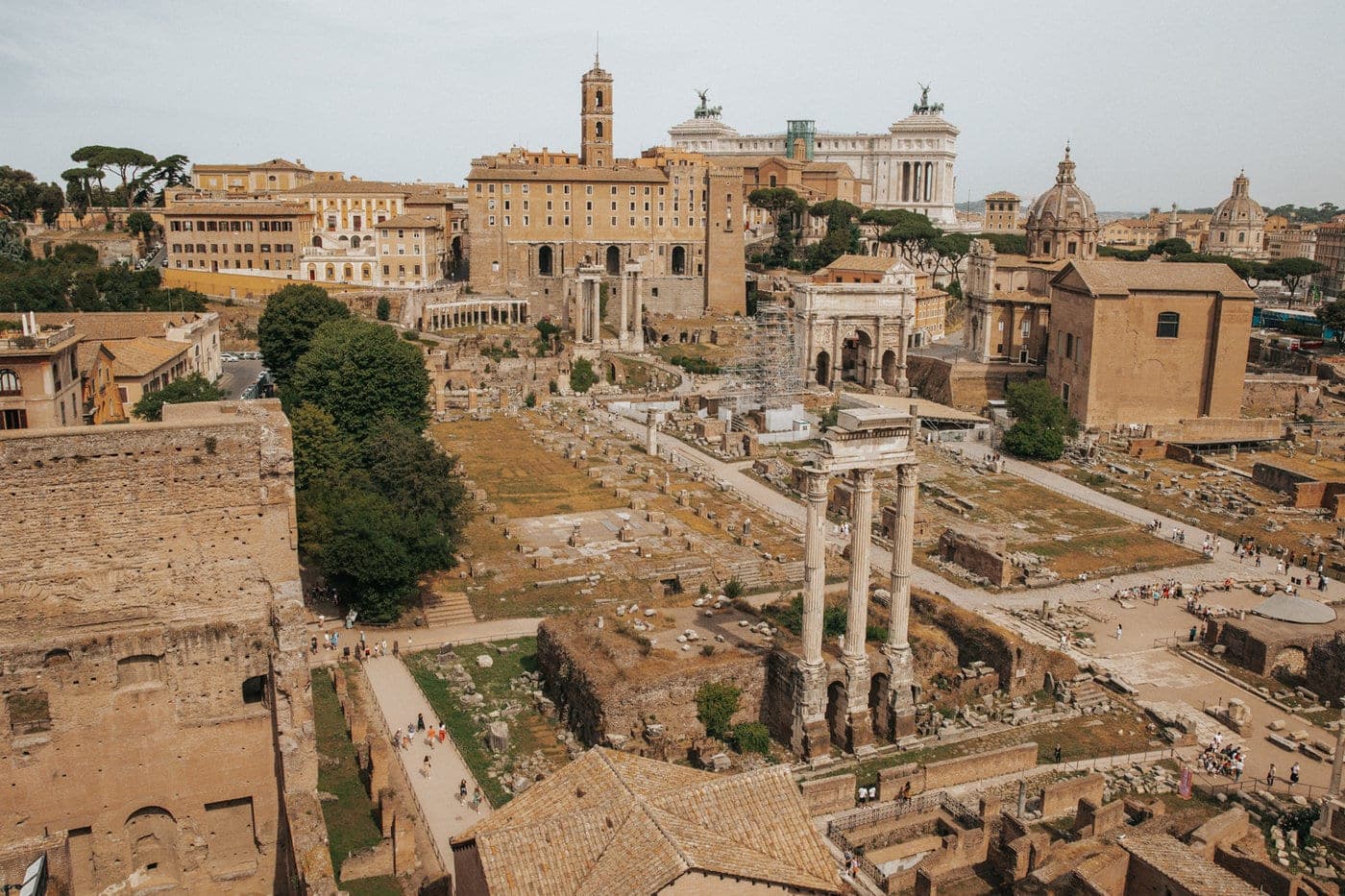
While the Colosseum was the venue for bloody entertainment, the Roman Forum was the true political, religious, and commercial hub of the entire empire. This is where triumphal processions marched, where Cicero gave his speeches, and where emperors built their marble palaces on the Palatine Hill above. The entrance to this vast archaeological site is separate from the Colosseum, and you could easily spend hours wandering around.

The main problem with the Forum is that there’s absolutely no shade. In summer, the massive marble blocks absorb the sun’s heat all day and act like a giant radiator in the afternoon. Sturdy footwear is an absolute must — the ground is extremely uneven and flip-flops will ruin your visit. Don’t buy overpriced water at the entrances; inside the site you’ll find several public drinking fountains (nasoni) dispensing ice-cold, potable water completely free of charge.

💡 Insider tip: Don’t plan a long trek to the other side of the city after the Forum. Seasoned guides recommend visiting the nearby Basilica di San Clemente instead. It looks unassuming from the street, but you can descend into its underground levels to discover an older 4th-century church, and deeper still, 1st-century Roman houses with a mysterious Mithraic temple. It’s a fascinating journey through time in pleasant coolness — and without the crowds.

3. Piazza Venezia and the Vittoriano Monument

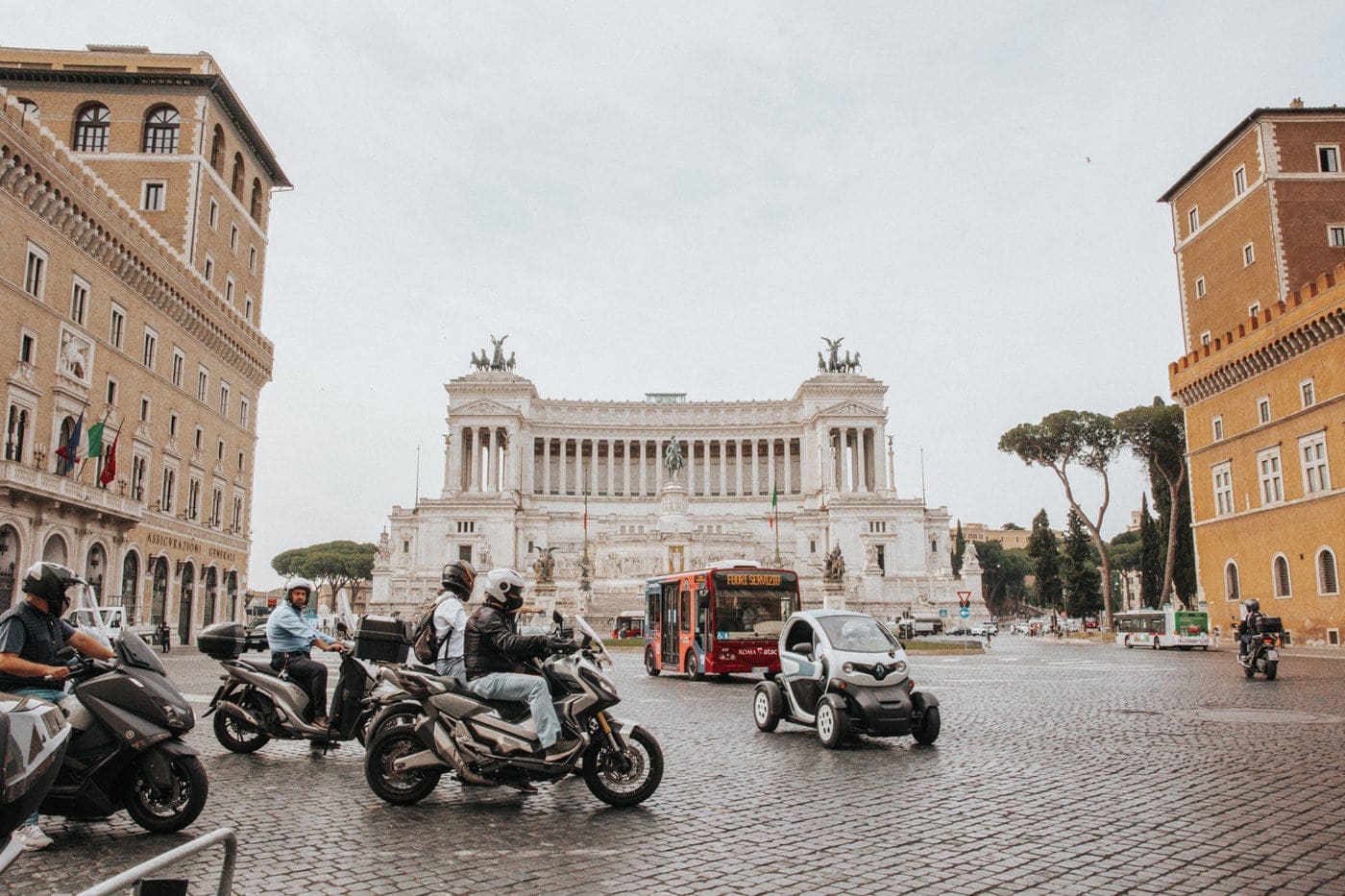
When you walk out of the Forum towards the centre, you’ll inevitably hit Piazza Venezia. This busy traffic hub is dominated by the gigantic white Brescian marble edifice known as the Vittoriano — the monument to King Victor Emmanuel II. Romans have long had a love-hate relationship with it, giving it a string of mocking nicknames. The most common ones are “The Typewriter” (La Macchina da Scrivere) and “The Wedding Cake.”

While it doesn’t exactly blend in with its ancient surroundings, it offers one huge advantage. You can take a glass lift all the way to the very top of the monument. From there, you’ll get one of the best panoramic views of the entire historic centre and the ruins of the Forum stretching all the way to the Colosseum. It’s the perfect way to cap off your first day, after which you can head for a well-deserved dinner in the nearby Monti neighbourhood.

Day 2: The Vatican and the Papal State

4. Vatican Museums and the Sistine Chapel

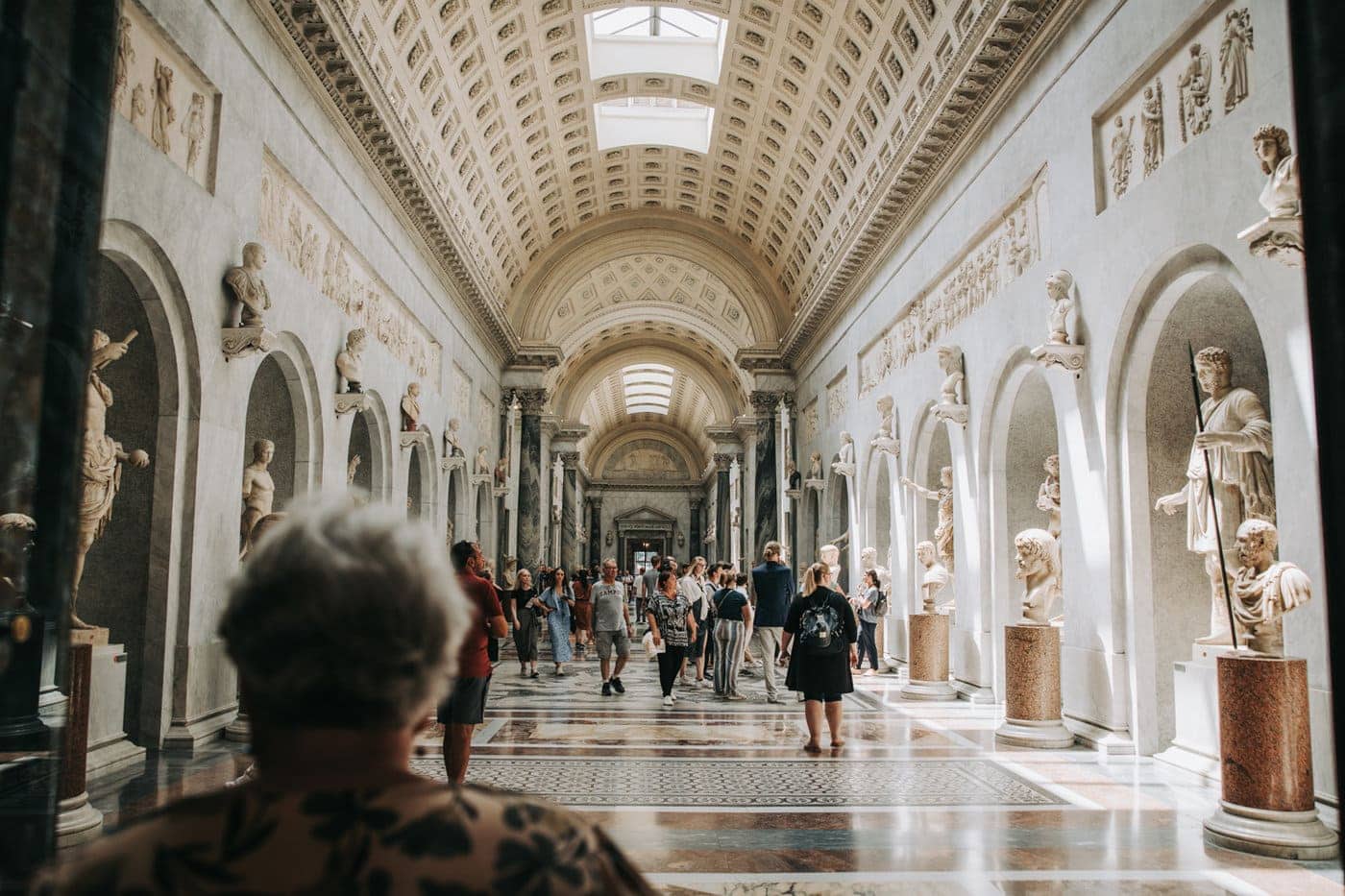
Entering the world’s smallest independent state means facing an enormous paradox. You’re about to see the absolute pinnacle of Renaissance art, yet you’re voluntarily throwing yourself into one of the busiest tourist hotspots on the planet. The Vatican Museums form a labyrinth of corridors stretching nearly ten kilometres, and there’s no shortcut straight to the Sistine Chapel. You simply have to walk through the entire complex.

If you turn up without a pre-purchased ticket, you’ll join a queue that snakes along the towering Vatican walls, where waiting times routinely stretch to two or three hours. The best solution is to buy tickets through the official portal (tickets.museivaticani.va) for €25. These are released exactly 60 days in advance at midnight, and the best early-morning slots disappear within minutes. If you manage to snag a time slot between eight and nine in the morning, you’ll have a realistic chance of seeing Michelangelo’s frescoes in relative peace.

💡 Insider tip: Photography and filming are strictly forbidden inside the Sistine Chapel — guards enforce this very firmly, loudly shushing the crowds. The chapel is a consecrated space, so keep your camera in your bag and simply soak in the incredible atmosphere. For more tips on beating the queues, check out our article on the Vatican Museums.

lukas a lucka
Lukáš and Lucie recommend
Where to stay in Rome
3 accommodations — hotels and other lodging options

5. St Peter’s Basilica and Climbing the Dome

St Peter’s Basilica is the largest and most lavish Catholic building on Earth. Entry is completely free, but that’s precisely what draws unimaginable crowds. The main hurdle isn’t cost — it’s the airport-style security screening. In peak season, the queue regularly stretches to two hours, winding around the entire St Peter’s Square. How to beat it? Get up early and be at the metal detectors just before eight in the morning, or come in the late afternoon instead.

The dress code here is enforced without exception. It doesn’t matter that it’s 35 °C outside and you’ve just endured a long queue. If your shoulders and knees aren’t covered, attendants will stop you at the door and send you away — men and women alike. The smart move is to pack a light, wide scarf in your bag and wrap it around yourself before entering.

Climbing Michelangelo’s dome is one of the highlights of any Vatican visit. You can go entirely on foot (551 steps for €8) or take the lift to the basilica roof and walk the rest (320 steps for €10). The final stretch runs through the shell of the dome itself — the walls lean inward and the staircase narrows into a very tight spiral. Those with severe claustrophobia might want to think twice, but the view down onto the square with the keyhole perspective of Bernini’s colonnade is absolutely worth the effort.

6. Castel Sant’Angelo and Sunset Views

After an intense Vatican visit, you’ll probably be suffering from art overload. There’s no point dashing across to the other side of the city for more sights. Just walk along the broad Via della Conciliazione and you’ll reach the massive cylindrical fortress of Castel Sant’Angelo. Originally built as Emperor Hadrian’s mausoleum, it later served as an impregnable fortress and papal residence, connected to the Vatican by a secret elevated passageway within the walls.

The castle is fascinating in its own right, but the real draw is the upper terrace right beneath the enormous bronze statue of the Archangel Michael. From here, you get a spectacular 360-degree view over the entire city. We recommend heading up in the early evening, when the setting sun paints the River Tiber and the dome of the basilica in shades of gold. Afterwards, cross the Ponte Sant’Angelo lined with baroque statues and make your way into the centre for dinner. You’ll find a comprehensive guide to the smallest country in the world in our article on the Vatican.

Day 3: The Historic Centre and the Streets of Trastevere

7. Trevi Fountain and the New Rules

When you turn a corner in a narrow lane and suddenly find yourself standing before a towering, thundering mass of gleaming white travertine, it’s one of the most powerful moments Rome has to offer. The Trevi Fountain is a masterpiece that has suffered enormously from overtourism in recent years. The situation reached a point where the city had to step in. Since February 2026, there’s a new €2 fee for anyone who wants to descend the steps directly to the fountain basin and toss a coin.

The area below is now cordoned off and monitored with a capacity limit of 400 people. Access to the water is available from 9:00 to 22:00. If you’d rather not pay or wait in a queue, you can still admire the fountain for free from the upper level of the piazza — though police with whistles will keep moving you along to avoid blocking the walkway. Lukáš and I love coming here early in the morning or late at night, when it has that perfect cinematic atmosphere.

💡 Insider tip: Most people snap a photo of the fountain and rush off. Try walking just a few steps further into the alley Vicolo del Puttignani to find the unassuming entrance to Vicus Caprarius (the City of Water). It’s a brilliant underground archaeological site featuring the ancient aqueduct that still feeds the fountain to this day. You’ll cool down and escape the crowds above. More tips in our article on the Trevi Fountain.

8. The Pantheon: A Miraculous Dome and Its Oculus

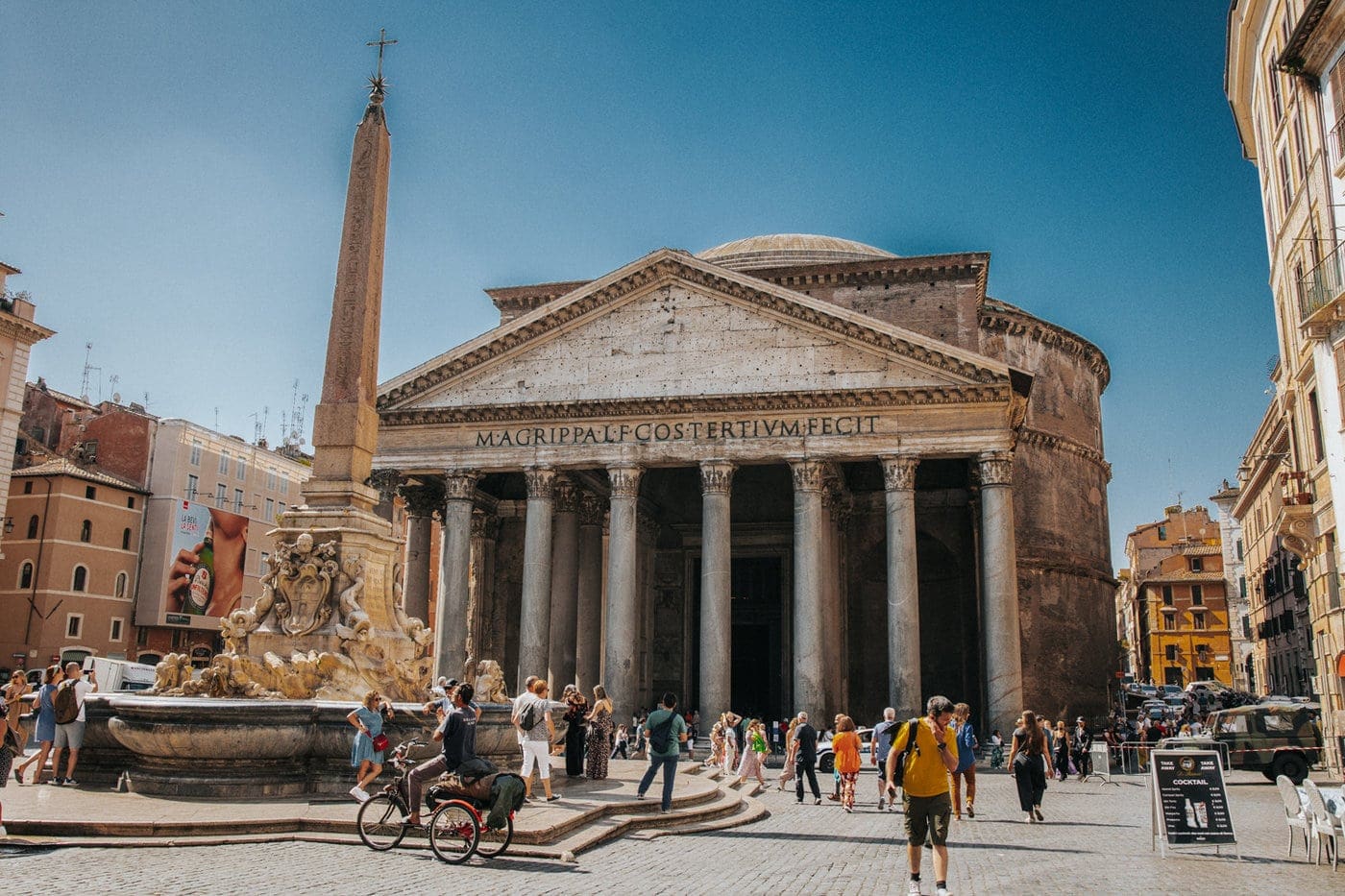
The best-preserved ancient building in the world survived two thousand years of looting and earthquakes because it was consecrated as a Christian church in the 7th century. Its enormous concrete dome with its nine-metre circular opening (the oculus) remains an architectural marvel to this day. When it rains in Rome, water falls straight through the oculus onto the gently convex marble floor, where an ingenious ancient drainage system channels it away.

The days when you could simply walk into the Pantheon off the street are unfortunately gone. Entry now costs €5 (with a planned increase to €7 during 2026). You need to book tickets through the official portal of the Ministry of Culture, and weekend reservations are absolutely essential. Try to book the 9 AM slot, when the heavy bronze doors first open and the shaft of light is just beginning to glide across the coffered ceiling. And remember — a strict dress code with covered shoulders applies here too! For more details, see our guide to the Pantheon in Rome.

9. Piazza Navona and Dodging the Tourist Traps

Piazza Navona has preserved the elongated shape of the ancient Stadium of Domitian and today stands as a masterclass in Roman Baroque, dominated by Bernini’s Fountain of the Four Rivers. There’s a lively buzz of street artists and musicians. As a sight, it’s a visual gem — but gastronomically, it’s an absolute minefield. 😅

The restaurants overlooking the square and in the surrounding lanes towards the Vatican represent the very worst of tourist traps. Reliable warning signs include waiters who actively try to lure you inside from the street, and picture menus in five languages. Give a wide berth to any place offering fish or premium meat priced by weight (the word “per etto” means per 100 grams). Tourists here regularly end up paying hundreds of euros for one mediocre lunch. Instead, duck into the side streets towards Campo de’ Fiori.

10. The Spanish Steps and a Romantic Stroll in Pincio Park

The Spanish Steps, with their unique butterfly-wing design, have been drawing visitors for centuries. In spring, they’re adorned with hundreds of blooming azaleas. They may look inviting for a rest, but be warned — sitting on them is strictly forbidden. The city introduced this rule to protect the historic marble. Police in high-vis vests actively enforce it, and the moment you so much as crouch, you’ll hear a whistle. The fine is around €250.

In the piazza at the bottom of the steps, organised groups of scammers run the classic bracelet and rose hustle. They’ll approach you with a beaming smile, start complimenting where you’re from, and before you know it, they’ve tied a bracelet to your wrist or thrust a rose into your hand as a “lucky gift.” Seconds later, they aggressively demand €10–20. The only effective defence is zero eye contact and a brisk walk away. Better yet, climb all the way to the top of the steps and continue to Pincio Park, which offers one of the most beautiful sunset viewpoints in the city.

11. Trastevere: Lost in Time

Trastevere is the embodiment of that dreamy, romantic vision of Italy. Medieval architecture, narrow pedestrian lanes draped in ivy, and laundry drying on lines strung between windows. While the neighbourhood has become heavily touristy and the area around Piazza Trilussa gets incredibly noisy in the evening, it still retains enormous charm.

Head here in the early evening, ideally before sunset. There’s no strict itinerary of sights to rush around — the best thing to do is simply get lost in the maze of alleys, peek inside the Basilica di Santa Maria in Trastevere with its golden mosaics, and then settle into one of the local trattorias for a wonderful dinner. Find out more about this picturesque quarter in our article on Trastevere.

12. Where to Eat Brilliantly (and Meat-Free) in Rome

Rome is a gastronomic paradise — you just need to know where to go. Lukáš and I are vegetarian, so the local offal-based classics are off the table for us (things like traditional trippa alla romana or braised oxtail coda alla vaccinara, which are the pride of the Testaccio neighbourhood). Luckily, Italian cuisine is absolutely ideal for vegetarians.

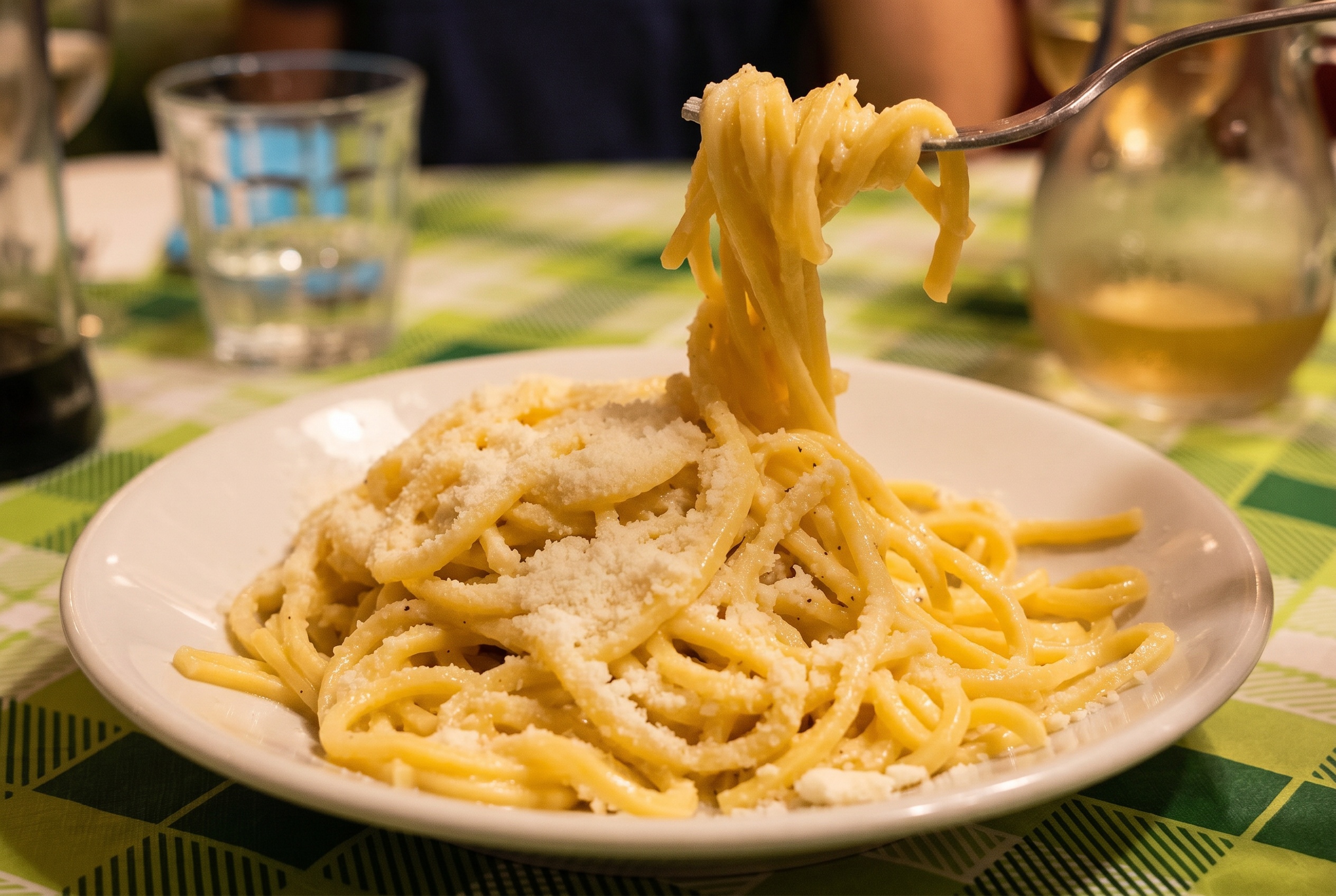
Our all-time favourite is the pasta classic cacio e pepe (pecorino cheese and black pepper). For arguably the best version, head to Roma Sparita in Trastevere, where they serve it in a bowl made of baked Parmesan. For a quick, cheap lunch, pizza al taglio (pizza sold by the slice and weight) is genius. We recommend the famous Pizzarium (Bonci) near the Vatican, which has pillowy dough and fantastic vegetarian combos. Also brilliant is the Roman street food called Trapizzino — essentially a pizza pocket stuffed with various sauces (try the aubergine parmigiana one).

And don’t forget the golden Italian coffee rule. If you drink your espresso standing at the bar (al banco), it costs next to nothing — usually around €1.20. But the moment you sit down at a table with service on a famous piazza, you’re paying for the service and the view, and the bill can easily climb to €4.

Day Trips from Rome and Useful Links

If you have more than three days in Rome, definitely consider day trips beyond the city. It’s a great way to escape the crowds and see a different side of Italy.

  • Ancient harbour: About half an hour by train from the centre lie fascinating ruins that rival Pompeii, but with a fraction of the tourists. Read our article on Ostia Antica.
  • Villas and gardens: Just outside the city, you’ll find stunning Renaissance gardens with fountains. Check out our tips for Tivoli.
  • The full picture: All our tips on sights and hidden gems are in our comprehensive guide to what to see in Rome.
  • Travelling with family? Read our dedicated article on Rome with kids, covering pushchairs, parks, and gelato.

Frequently Asked Questions

Is the Roma Pass worth buying?

It depends on your itinerary. The card (48h for €38 or 72h for €62.90) offers free entry to your first attraction and unlimited public transport. If you use it for the Colosseum, it makes sense, but you’ll still need to book your exact time slot on the Coopculture website for a €2 fee. Important note: the Vatican doesn’t accept Roma Pass at all.

How does public transport work and what does it cost?

A basic ticket (BIT) costs €1.50 and is valid for 100 minutes on buses, trams, and one metro entry (there’s a planned price increase to €2 in July 2026). However, we prefer using the Tap&Go system. Just tap your regular payment card at the yellow validator in the metro or on buses. The system automatically caps your daily spending at €8.50, so you’ll never pay more than a day pass.

Is water from public fountains (nasoni) really safe to drink?

Yes, absolutely. Rome has around 2,500 cast-iron drinking fountains called ‘big noses.’ The water flows from the surrounding mountains and is ice-cold, clean, and free. A neat local trick: cover the bottom spout with your finger and water will shoot up through the small hole at the top straight into your mouth.

Is Rome a safe city?

Physically, yes—violent crime is rare here. However, professional pickpockets are a huge problem, especially in crowded areas. Bus number 64, which runs from Termini to the Vatican, is notoriously bad. Always wear your backpack on your front and keep valuables in deep, zippered pockets.

Can I pay by card everywhere?

Italy has made huge strides, and today you can pay by card at museums, restaurants, and even for gelato. The law actually requires merchants to accept cards. That said, it’s still smart to carry a few small coins (10 and 20 cents) for tipping your barista for coffee or for public toilets.

Where can I find public toilets in the city center?

Public restrooms are scarce on the streets. Your best strategy is to pop into any bar, buy an espresso at the counter for a euro, and politely ask for the bathroom key with your receipt in hand (‘Dov’è il bagno?’). Large fast-food chains are also a reliable backup.

What’s the best way to get from the airport to the city center?

From the main Fiumicino airport, the most convenient option is the Leonardo Express train. It costs €14 and takes you non-stop to Termini station in 32 minutes. From the smaller Ciampino airport, Terravision or SIT buses run for around €6. If you’re taking a taxi, insist on an official white cab with a fixed flat rate to the center (€50 from Fiumicino, €40 from Ciampino).

Tips and Tricks for Your Vacation

Don’t Overpay for Flights

Search for flights on Kayak. It’s our favorite search engine because it scans the websites of all airlines and always finds the cheapest connection.

Book Your Accommodation Smartly

The best experiences we’ve had when looking for accommodation (from Alaska to Morocco) are with Booking.com, where hotels, apartments, and entire houses are usually the cheapest and most widely available.

Don’t Forget Travel Insurance

Good travel insurance will protect you against illness, accidents, theft, or flight cancellations. We’ve had a few hospital visits abroad, so we know how important it is to have proper insurance arranged.

Where we insure ourselves: SafetyWing (best for everyone) and TrueTraveller (for extra-long trips).

Why don’t we recommend any Czech insurance company? Because they have too many restrictions. They set limits on the number of days abroad, travel insurance via a credit card often requires you to pay medical expenses only with that card, and they frequently limit the number of returns to the Czech Republic.

Find the Best Experiences

Get Your Guide is a huge online marketplace where you can book guided walks, trips, skip-the-line tickets, tours, and much more. We always find some extra fun there!
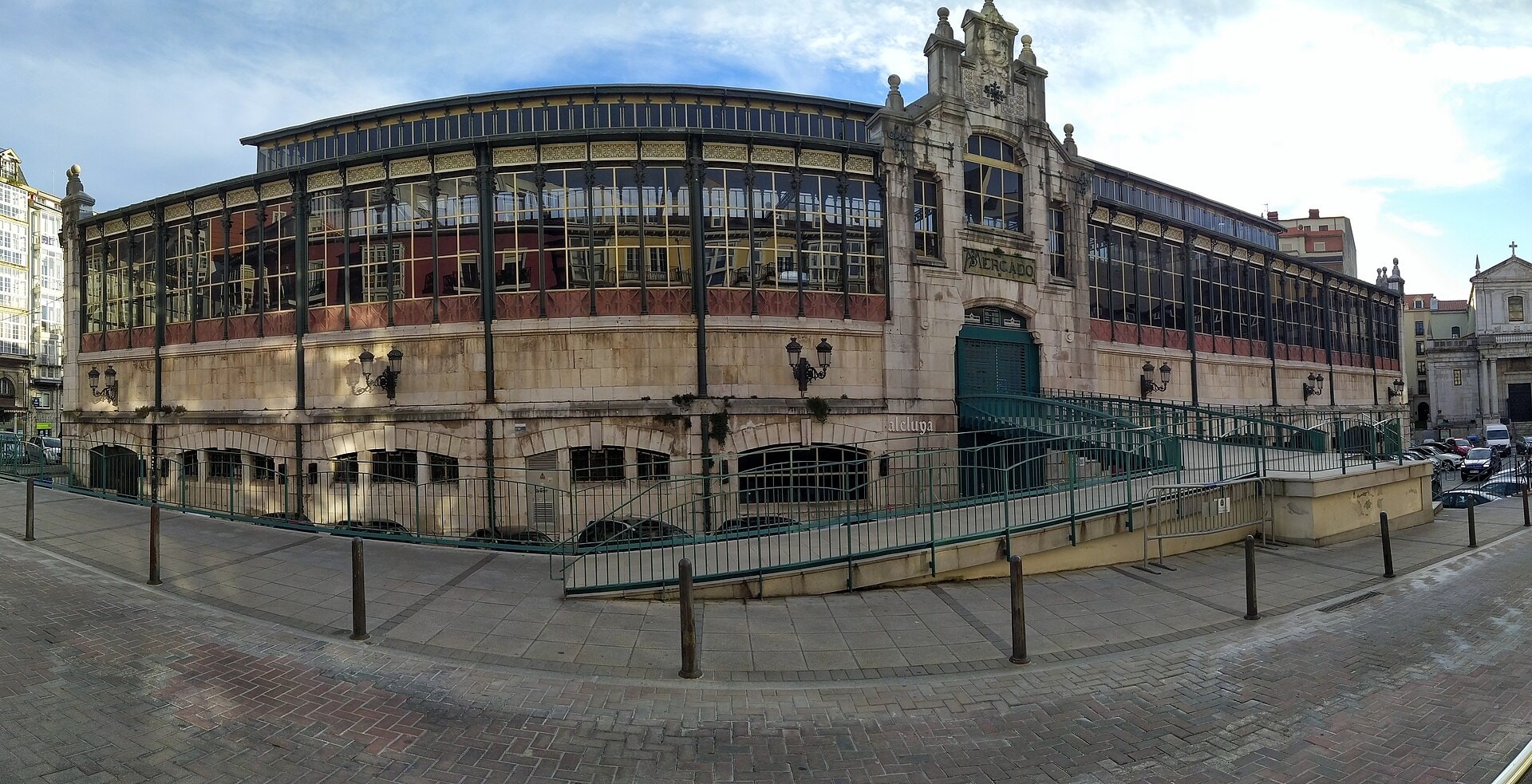
Where to Stay in Rome: Best Neighbourhoods by Trip Type

TL;DRThe best base in Rome really depends on what you’re after. Monti suits first-timers, with the Colosseum and metro line B right on your doorstep. Trastevere brings romance and nightlife, though you’ll trade that for noise and trickier transport links. Prati, near the Vatican, is the calmest pick for families thanks to its flat streets. Testaccio is a foodie favourite, with proper Roman cooking and the Mercato di Testaccio market. Aventino offers a quiet, leafy escape for couples, while Termini and Esquilino have the cheapest rooms and easy transport — just watch out for pickpockets.

Rome doesn’t forgive a lack of preparation — and I know this from personal experience. Most of us arrive with a romantic vision of carefree wandering among ancient columns, a cone of perfect artisan gelato in hand and the wind in our hair, but reality often hits you like a ton of bricks on day one. Scorching cobblestones, relentless crowds squeezing through narrow alleyways, and hopelessly sold-out tickets can turn this magical city into a logistical nightmare. If you’re wondering where to stay in Rome, you’ve already taken the most important first step — because my partner Lukáš and I fell in love with the Eternal City, but quickly learnt that the secret to a successful Roman conquest isn’t how many landmarks you tick off, but how strategically you plan.

If you’re thinking of heading to the Italian capital, I should warn you upfront: Rome simply isn’t a museum. It’s a loud, chaotic, and pulsating metropolis of three million people, where antiquity collides with the morning rush hour and where a poorly chosen hotel can cost you a fortune in frayed nerves. In this article, we’ll look at the best neighbourhoods in Rome Italy to base yourself in, depending on the type of trip you’re planning. I’ll tell you which areas to head to for romance, where to find peace and quiet for families, and what to avoid like the plague.

TL;DR

  • Best neighbourhood for first-timers: Monti offers the perfect balance between access to landmarks (the Colosseum is just around the corner) and an escape from the worst crowds.
  • Where to find nightlife: Trastevere is undeniably touristy, but its medieval charm and dozens of bars make it an ideal choice for couples and lovers of evening entertainment.
  • For families with children: The Prati neighbourhood near the Vatican has flat terrain, wide safe streets, and feels much calmer than the historic centre.
  • A foodie paradise: In Testaccio you’ll find the most authentic Roman cuisine and fantastic markets, even though it’s further from the main sights.
  • New fees in 2026: A new €2 admission fee applies at the Trevi Fountain, and Pantheon tickets are rising to €7.
  • Booking is essential: Colosseum tickets must be purchased on the official website exactly one month in advance, and Vatican Museums tickets 60 days ahead.
  • Watch out for tourist traps: Always drink your coffee standing at the bar for a euro, and never eat in restaurants where a waiter actively lures you in with a picture menu.

When to Visit Rome Italy

Chasing perfect weather while dodging the crowds is incredibly tricky in Rome. Every traveller wants the same thing — to see the city bathed in sunshine and sit outside with a glass of Aperol — but nobody wants to be crammed in with ten thousand other people while doing it. The best months to visit are typically May, June, September, and October, when temperatures settle around a comfortable 22°C and the air clears up beautifully. You get gorgeous autumn light that’s perfect for photography, and evenings you can enjoy in a light jumper. The price of this comfort is steep, though — hotels are at full capacity and the streets around the Pantheon resemble an anthill.

Summer in Rome — specifically July and August — is a test of both physical and mental endurance. Temperatures routinely climb to 31–35°C, and the humidity turns the streets into a suffocating greenhouse with not a breath of wind. The ancient stones of the Colosseum soak up heat all day and radiate it like a giant oven long after sunset. If you must visit in summer, your daily routine needs a radical overhaul: set your alarm for six in the morning and hit the main sights before ten. Around midday, when the sun is at its fiercest, you simply have to retreat to your hotel or an air-conditioned restaurant for a long siesta.

August has one more brutal quirk — the Ferragosto holiday on 15 August. A huge number of locals lock up their flats, pull down the shutters, and flee en masse to the coast or the mountains. Many family-run businesses and smaller authentic restaurants simply close for two to three weeks, hanging a “closed for holidays” sign on the door. The main attractions operate as normal, but you’ll miss out on that genuine neighbourhood atmosphere in areas like Trastevere or Testaccio.

Winter, roughly from late November to February, is the best-kept secret of every budget traveller. Temperatures hover between 5 and 13°C with the occasional shower, but you gain something priceless: breathing room. Accommodation prices drop to their annual lows, flights from London cost a fraction of summer fares, and queues at the sights shrink to almost nothing. You can stroll through the Vatican Museums in January at your own pace without being herded through the corridors like cattle on a conveyor belt.

The Holy Year 2025, the so-called Jubilee, placed an enormous burden on the city with 33 million pilgrims from around the world. The city was effectively overwhelmed, and visitors reported absolute overcrowding. The Holy Doors were ceremonially closed on 6 January 2026, bringing significant relief — the streets are noticeably more breathable now. Don’t be lulled into a false sense of emptiness, though, because at the main tourist icons like the Colosseum or the Trevi Fountain, the crowds simply never thin out.

Where to Stay in Rome and Its Surroundings

💡 Accommodation & experiences tip: We prefer searching for places to stay on Booking.com, which tends to have the best cancellation policies. For tickets, tours, and activities, it’s worth comparing options on GetYourGuide.

Choosing the right neighbourhood defines your entire experience of the Eternal City, and mistakes here really don’t pay off. The biggest blunder newcomers make is booking accommodation purely based on price without considering logistics, which then forces you to commute for an hour on an overcrowded bus with no air conditioning. It’s the difference between collapsing into bed exhausted every evening and casually strolling down to a local trattoria on the corner. We always book hotels well in advance through Booking.com, because availability in the centre vanishes at an astonishing pace.

Monti: The Best Choice for a First Visit

If you’re looking for the perfect balance between access to sights and an escape from the crowds, Monti is a safe bet. It sits strategically right behind the Colosseum, and in terms of transport it’s ideal — you have a Metro Line B station here and can walk to the Roman Forum and Termini main station. In the evening, the neighbourhood comes alive at a relaxed pace around the little Piazza della Madonna dei Monti, where locals grab a beer and drink it sitting on the steps of the Renaissance fountain. Take a look at popular options like the Condotti Boutique Hotel or the cosy Hotel Artemide, both of which offer excellent service.

Trastevere: Romance and Buzzing Nightlife

Trastevere — literally “across the Tiber” — is the embodiment of the romantic Italian dream: narrow pedestrianised lanes and laundry drying on lines overhead. You’ll find some of the best bakeries and eateries here, but bear in mind that the area is now very touristy and incredibly noisy at night. Trastevere’s biggest drawback is transport — there’s no metro, and the only way into the centre is tram number 8, which is hopelessly packed during the morning rush. I’d recommend looking for accommodation in the southern part of the neighbourhood towards the Basilica of Santa Cecilia, where it’s considerably quieter.

Centro Storico: Living Inside a Postcard

Staying in the imaginary triangle between the Pantheon, Piazza Navona, and the Spanish Steps is a dream for many visitors. You can comfortably walk everywhere, which is a massive advantage, but you pay a hefty premium on room prices for it. The historic centre is perpetually crowded, you’ll be woken in the morning by glass recycling trucks, and you’re right in the epicentre of tourist traps. If you’re still set on staying here, choose hotels in quieter side streets — for example around the charming Via dei Coronari — and watch out for restricted traffic zones (ZTL).

Prati: Elegant Calm for Families with Children

The Prati district stretches north of the Vatican and features wide, grid-pattern boulevards and handsome Art Nouveau buildings. For families with children or older travellers, it’s an excellent choice because, unlike the centre, it has flat terrain that’s ideal for pushchairs and feels very safe. A huge advantage is the immediate proximity to the Vatican, allowing you to visit St Peter’s Basilica right when it opens without hour-long queues. The orange Metro Line A also runs through the area, connecting you quickly to the rest of the city.

Testaccio: A Hidden Paradise for Foodies

Beyond the Aventine Hill lies Testaccio, a former working-class neighbourhood where you won’t find many classic landmarks. People come here for one thing above all else: fantastic local food. You’ll find the best, most honest versions of cacio e pepe and carbonara here, and the heart of the district is the modern, glass-fronted Mercato di Testaccio. There’s less accommodation available — mostly apartments — but if gastronomy is your main goal and you don’t mind taking the metro to the sights, it’s a perfect choice.

Aventino: A Quiet Green Oasis for Couples

The Aventine is one of Rome’s original seven hills and the polar opposite of the bustling historic centre. It’s a quiet residential neighbourhood full of greenery, with gorgeous villas and wide streets lined with umbrella pines. It offers fantastic views over the city from the Orange Garden (Giardino degli Aranci), but the downside is that it’s on a hill — something you’ll definitely feel after a full day of walking. There’s an absolute minimum of restaurants and zero nightlife, so it’s best suited to those who want total peace and quiet in the evening.

Termini and Esquilino: Budget and Logistics

The area around Termini main railway station may not have the most glamorous reputation and the streets aren’t the cleanest, but it offers two enormous advantages. You’ll find the cheapest hotels and superb transport connections here, since both main metro lines intersect at this station and the direct Leonardo Express train from Fiumicino Airport arrives right here. You do need to keep a sharp eye out for skilled pickpockets, though — both by the escalators and on overcrowded buses, particularly the notorious number 64 route towards the Vatican.

10 Best Things to See and Do in Rome Italy

Rome is enormous and getting around will drain you fast, so the key to survival is dividing the city into logical zones and dedicating each day to one of them. The traditional cobblestones known as sampietrini will reliably destroy any unsuitable footwear, so quality trainers with thick soles are an absolute must. Let’s dive into the best of what the Italian capital has to offer — and how to enjoy it without losing your mind to the crowds.

1. Colosseum: Exclusive Access to the Underground

The Colosseum is Rome’s ultimate magnet — everyone wants to see the place where life and death were once decided. The crowds around the amphitheatre can be maddening, and you simply can’t buy tickets on the spot, so preparation is essential. The golden rule is clear: there is only one official ticket seller at coopculture.it, where basic admission costs €20 including the booking fee. Online scalpers often charge triple for dubious services — give them a wide berth.

If you want a truly exceptional experience, snap up the Full Experience ticket for €22. It grants you access directly onto the arena floor and into the mysterious underground, where wild animals and gladiators once waited in darkness. This ticket also has the huge bonus of being valid for a full two days, so you can split your visit and avoid exhaustion. Tickets are released exactly 30 days in advance at 9:00 AM and vanish before your eyes, so you’ll need lightning-fast fingers.

Right in front of the Colosseum you’ll encounter Rome’s oldest trick: men dressed in historical gladiator costumes. They’ll shove a sword into your hands without warning, pose for a photo, and then aggressively demand €20 per person. It’s a highly organised scam, and the only effective defence is complete indifference — don’t slow down and don’t make eye contact.

💡 Local tip: Book your Colosseum entry for 8:30 AM. You’ll be among the very first visitors inside, the morning light is brilliant for photos, and the arena won’t yet resemble a human anthill.

2. Roman Forum and Palatine Hill: The Heart of the Ancient World

While the Colosseum was a venue for blood sport, the Roman Forum was the true political and commercial hub of the entire empire. You’re walking on the very same paving stones that Julius Caesar once trod, with the Palatine Hill and its imperial palace ruins towering above. The fundamental problem with this vast site is that there’s absolutely no shade whatsoever, and in summer temperatures soar to unbearable levels. The massive marble blocks absorb solar heat all day and act like a giant radiator by afternoon.

Sturdy footwear is an absolute necessity, because the surface is extremely uneven, full of potholes and slippery stones. Flip-flops or thin-soled sandals will reliably ruin your visit within the first hour. If you’re going with children, the survival rule is simple: head out first thing at 9:00 AM, while the air is still somewhat bearable.

Don’t buy overpriced plastic water bottles from street vendors at the entrances. Inside the Forum and up on the Palatine, you’ll find several public drinking fountains called nasoni. The water flows constantly, is ice-cold, 100% safe to drink, and completely free — all you need is your own reusable bottle.

💡 Local tip: Romans know an elegant trick for drinking from the nasoni without a cup. Just block the main spout at the bottom with your finger and water shoots up through a small hole on top of the tap, right into your mouth.

lukas a lucka
Lukáš and Lucie recommend
Where to Stay in Rome
3 accommodations — hotels and other lodging options

3. Vatican Museums and the Sistine Chapel: Getting to Michelangelo

Entering the world’s smallest state means facing an enormous paradox: you’re willingly throwing yourself into a seething mass of global tourism in pursuit of supreme Renaissance art. The Vatican Museums form a labyrinth of corridors nearly ten kilometres long, with the Sistine Chapel waiting at the very end. Anyone who turns up without a pre-purchased ticket joins a queue snaking along the high walls, where waiting times of two to three hours in direct sunlight are the norm.

The best solution is to buy timed-entry tickets exclusively through the official portal tickets.museivaticani.va. Basic admission is €20 plus a €5 booking fee, but tickets are released exactly sixty days in advance at midnight, and the most coveted morning slots disappear in a flash. If you have a Roma Pass city card, it won’t help you here — the Vatican has its own rules and isn’t part of the system at all.

To keep your visit from turning into a claustrophobic ordeal, pick the earliest morning slots between 8:00 and 9:00. You’ll breathe easier and have a realistic chance of seeing the Sistine Chapel in relative calm before the enormous organised tour groups arrive. Remember that inside the Sistine Chapel there’s a strict ban on photography — if the guards catch you, they’ll insist you delete the image on the spot.

💡 Local tip: Another surprisingly effective strategy is booking a late afternoon slot around 15:30. The biggest waves of tourists are already leaving, the light in the galleries begins to soften, and the noise gradually fades.

4. St Peter’s Basilica and Climbing the Dome

St Peter’s is the largest and most lavish Catholic church in the world, and its sheer scale will leave you speechless. Entry to the basilica itself is completely free, but that’s precisely what draws enormous crowds. The main obstacle is the airport-style security screening, where the queue across St Peter’s Square can easily stretch to two hours during peak season. If you get up early and arrive at 7:00 AM sharp, you’ll be inside within minutes.

A surprising number of tourists underestimate this rule and ruin their entire day: the Vatican enforces a strict dress code with zero mercy. Shoulders and knees must be covered — no vests, no short shorts. It doesn’t matter that it’s 35°C outside and you’ve queued for ages; the attendant will simply stop you at the door and turn you away.

Climbing Michelangelo’s dome rewards you with a panoramic view over all of Rome and costs €8 on foot or €10 with a lift to the halfway point. The final 320 steps, however, must always be tackled through an extremely narrow, claustrophobia-inducing space between the dome’s inner and outer shells. There’s barely any air, so if you have heart problems or issues with confined spaces, think very carefully before attempting it.

💡 Local tip: Always carry a light, wide scarf in your bag. Just before entering the basilica, drape it over your shoulders to meet the dress code — and avoid buying overpriced paper shawls from street vendors.

5. Trevi Fountain: The End of Free Crowding

You’ll rarely approach the Trevi Fountain in silence — its presence is given away by the powerful roar of water bouncing off the surrounding buildings. In recent years, however, the experience has shrunk to a fight for every square centimetre, so the city took drastic action. Since 2 February 2026, all non-residents must pay a new €2 fee to access the fountain’s basin area. This zone is physically fenced off and monitored, with a maximum of 400 people allowed in at any one time.

The traditional ritual of tossing a coin over your left shoulder to guarantee your return to Rome remains intact, of course. Thousands of euros land on the fountain floor every day; the city regularly collects them using special underwater vacuums, and the entire proceeds go to the charity Caritas. If you’d rather not pay the admission fee, you can still admire the fountain for free from the upper level of the square, though police will keep urging you to move along so you don’t block the passage.

💡 Local tip: Take a few extra steps into the alley Vicolo del Puttignani to find the inconspicuous entrance to Vicus Caprarius. It’s a fascinating underground archaeological site with an ancient aqueduct — a perfect escape from the madness above.

6. The Pantheon: An Ancient Marvel Beneath the Oculus

The Pantheon is the best-preserved ancient building in the world, having survived two thousand years of plundering and earthquakes. Its enormous concrete dome conceals a nine-metre circular opening — the oculus — which is the building’s sole source of natural light. When it rains in Rome, water falls straight through the oculus onto the slightly convex floor, where it’s immediately drained away by an ingenious ancient system of channels.

The days when you could simply wander in off the street are long gone. Admission is now €5, and from 1 July 2026 the ministry plans to raise it to €7. You need to secure tickets through the official portal pantheon.cultura.gov.it, and especially at weekends, advance booking is an absolute must — otherwise you’ll face a merciless queue in the blazing sun.

💡 Local tip: Book the 8:30 or 9:00 AM slot, when the heavy bronze doors first open. Inside, you’ll experience that rare moment when the column of light from the oculus is just beginning to sweep across the coffered ceiling.

7. Piazza Navona and Surroundings: Beware of Tourist Traps

Piazza Navona is a masterpiece of Roman Baroque, dominated by Bernini’s Fountain of the Four Rivers. The atmosphere here is lively, full of street artists and musicians, but from a gastronomic standpoint it’s a literal minefield. The restaurants overlooking the square represent the very worst of Rome’s tourist traps, where waiters actively lure you inside with picture menus in five languages.

The sneakiest trick in this area is pricing dishes “per etto”, meaning per 100 grams rather than per portion. Lukáš and I are vegetarian so we steer clear of fish, but Asian tourists at one establishment here recently paid over €600 for a single lunch because they were charged for a huge fish and a non-existent mandatory “service charge”. Genuine Italian restaurants have transparent pricing and only charge a small coperto (cover charge) for your table setting.

💡 Local tip: Instead of sitting down on the square, walk to nearby Campo de’ Fiori and pop into the legendary bakery Forno, where you can grab fresh pizza bianca with olive oil straight from the counter. The fried artichokes in this area are also superb.

8. The Spanish Steps and Pushy Street Sellers

The Spanish Steps, sweeping upward from the Fontana della Barcaccia to the French church of Trinità dei Monti, are the elegant centrepiece of Rome’s fashion district. From a distance they look inviting for a rest, but beware — sitting on them is strictly forbidden to protect the historic marble. Police in high-vis jackets actively enforce the ban; the moment you perch, you’ll hear a whistle and risk a fine of around €250.

In the square below the steps, highly organised groups of scammers operate, targeting relaxed couples in particular. They approach with a broad smile and within seconds force a rose into your hand or tie a bracelet around your wrist, claiming it’s a gift. Don’t be fooled — they’ll immediately start aggressively demanding €10 to €20, and the only effective defence is total indifference and zero eye contact.

💡 Local tip: If you’re after romance without the hassle of pushy sellers, climb all the way to the top of the steps and continue to the Pincio terrace. It offers one of the most beautiful sunset views over the entire city.

9. Castel Sant’Angelo: A Strategic Link to the Vatican

Cross the Tiber over the Ponte Sant’Angelo — lined with Bernini’s statues of angels — and you’ll reach a massive cylindrical fortress. Castel Sant’Angelo was originally built as the mausoleum of Emperor Hadrian, later serving as a fortress, a grim prison, and ultimately a luxurious papal residence. To this day, it’s connected to the Vatican by a secret elevated passageway within the walls, through which popes fled to safety during the Sack of Rome.

For the modern traveller, the castle’s main advantage is its location — just a few hundred metres from St Peter’s Square. It’s the perfect stop on the way back to the centre after a morning tour of the Vatican Museums. Walk up the original ancient spiral ramp and from the upper terrace — directly beneath the enormous statue of Archangel Michael — you’ll be treated to a fantastic panorama of the city.

💡 Local tip: Tickets here don’t tend to sell out as hopelessly as the Colosseum, so you can visit more spontaneously — ideally in the late afternoon when the crowds begin to thin.

10. Borghese Gallery: Art for the Prepared

Tucked inside the Villa Borghese park is the gallery of the same name, where Cardinal Scipione amassed one of the finest art collections in the world. You’ll see breathtaking marble sculptures by Bernini and dark, genius canvases by Caravaggio. There’s no room for last-minute decisions here, because the gallery strictly does not admit walk-ins — advance reservation is absolutely compulsory.

Tickets cost €18, and visits operate in strict two-hour slots with a capacity of just 360 people. Thanks to this limit, you never feel crowded and can appreciate the art in peace — but once the two hours are up, staff will unceremoniously usher you out. Tickets disappear weeks in advance, so don’t delay in purchasing them on the official website.

💡 Local tip: If you can’t bag tickets, the Villa Borghese park itself is well worth a visit. You can hire pedal go-karts, take a boat ride on the little lake, and shelter from the summer heat under the canopy of umbrella pines.

Day Trips from Rome

If you have more than four days in Rome, it would be a shame not to venture beyond the city limits. A brilliant half-day trip is to the ancient port ruins of Ostia Antica, reachable by a regular commuter train for the price of a local transport ticket. It offers a similar experience to Pompeii but with a fraction of the tourists and plenty of shade from tall trees. Lovers of Renaissance gardens and fountains should head to the town of Tivoli, where the breathtaking Villa d’Este and the majestic Hadrian’s Villa await.

If you’re craving a more powerful historical experience, a high-speed train will whisk you to Naples and from there straight to the famous Pompeii. It’ll take a full day, but walking through the frozen ancient city in the shadow of Vesuvius is absolutely worth it. For better planning of your stay in the Eternal City itself, check out our detailed Rome in 3 Days itinerary, or read our comprehensive guide to What to See in Rome. If you’re travelling with family, we’ve also put together practical tips on how to manage Rome with Kids without unnecessary stress.

Frequently Asked Questions

Can I pay by card everywhere in Rome?

Italy has made huge strides in cashless payments, and today you can pay by card in restaurants, museums, and even for a scoop of gelato. That said, always carry some coins in 10 and 20 euro denominations—they’ll come in handy for small tips for your barista, public restrooms, or buying water from small street kiosks where the card terminal occasionally ‘happens’ not to work.

Where can I find public restrooms in the city center?

Public toilets are extremely scarce in Rome and are usually pay-to-use. Your best strategy is to pop into any bar, buy an espresso at the counter for about 1.20 euros, and politely ask where the restroom is. Under Italian law, bars must allow paying customers to use their facilities.

Is the water from street fountains really drinkable?

Yes, the water from the so-called nasoni (cast-iron drinking fountains scattered throughout the city) is completely safe to drink, ice-cold, and free. It comes from the mountains through the same aqueducts as in ancient times, so don’t waste money on bottled water—just keep a reusable bottle handy.

Does the Pantheon have the same dress code as the Vatican?

Even though it’s an ancient monument, the Pantheon is still a consecrated Catholic church. The exact same rules apply as at the Vatican, meaning you must have your shoulders and knees covered. In the hot summer months, bring a light scarf to throw over your shoulders before entering, or security will turn you away.

How can I avoid overpriced coffee?

The golden rule of Roman bars is this: if you sit down at a table with waiter service and a view of a monument, you’ll pay a hefty surcharge and your coffee can cost up to 4 euros. If you want to drink espresso cheaply like the locals do, pay at the register and drink it standing at the bar, where it costs just over a euro.

What should I do in the city center when it starts pouring rain?

Rome’s summer storms can be quite intense, and the basalt paving stones instantly turn into a dangerous skating rink. Duck into the Pantheon and watch the rain pour in through the open oculus, or take shelter in one of the dozens of churches that are free to enter. Whatever you do, avoid the Spanish Steps in the rain—they get incredibly slippery.

Can I bring a backpack into the Colosseum or Vatican?

A small daypack or purse is no problem, but large backpacks or bulky bags won’t be allowed inside. All luggage goes through an X-ray machine just like at the airport, and it’s strictly forbidden to bring glass bottles, alcohol, or pocket knives into these sites.

Tips and Tricks for Your Vacation

Don’t Overpay for Flights

Search for flights on Kayak. It’s our favorite search engine because it scans the websites of all airlines and always finds the cheapest connection.

Book Your Accommodation Smartly

The best experiences we’ve had when looking for accommodation (from Alaska to Morocco) are with Booking.com, where hotels, apartments, and entire houses are usually the cheapest and most widely available.

Don’t Forget Travel Insurance

Good travel insurance will protect you against illness, accidents, theft, or flight cancellations. We’ve had a few hospital visits abroad, so we know how important it is to have proper insurance arranged.

Where we insure ourselves: SafetyWing (best for everyone) and TrueTraveller (for extra-long trips).

Why don’t we recommend any Czech insurance company? Because they have too many restrictions. They set limits on the number of days abroad, travel insurance via a credit card often requires you to pay medical expenses only with that card, and they frequently limit the number of returns to the Czech Republic.

Find the Best Experiences

Get Your Guide is a huge online marketplace where you can book guided walks, trips, skip-the-line tickets, tours, and much more. We always find some extra fun there!
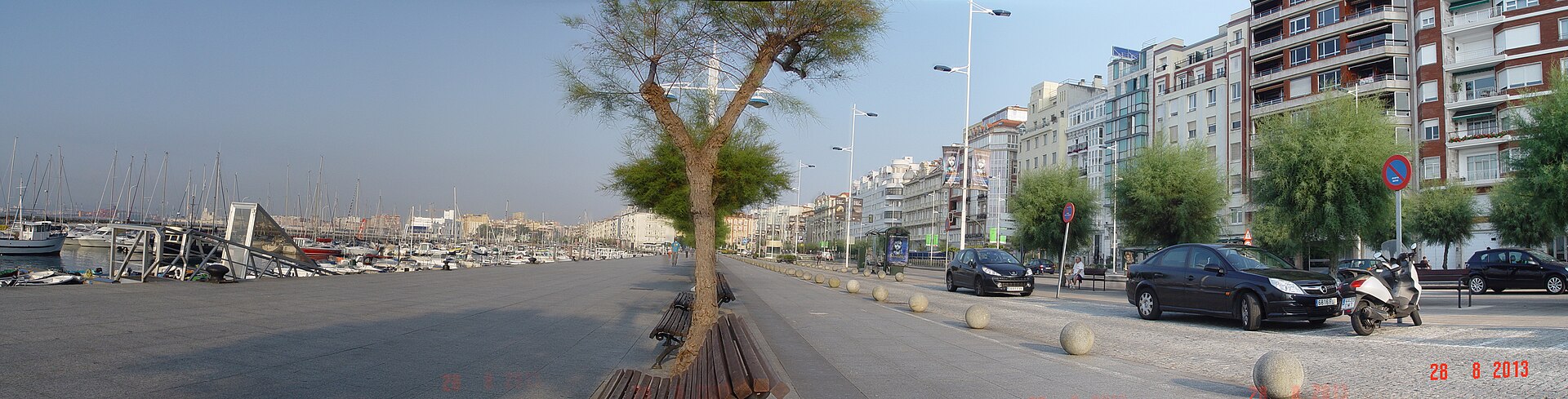
Alentejo and Costa Vicentina: Wild Beaches and White Villages

TL;DRAlentejo and the Costa Vicentina are all about wild beaches like Praia de Odeceixe, Praia da Arrifana and Praia do Amado, plus whitewashed villages such as Monsaraz and Zambujeira do Mar, and Évora’s historic centre with its Roman temple and Chapel of Bones. The best time to visit is September and October, when the sea sits at 20 to 21 degrees and the summer crowds have thinned out — steer clear of August, when inland temperatures push past 40 degrees. 5 to 7 days is the sweet spot for a trip, and you’ll need a car to get between the far-flung beaches and villages. There are 14 specific tips here on places and things to do, including the Rota Vicentina walking trail and Cabo de São Vicente, and a heads-up that accommodation prices have risen since 2026 following a crackdown on unofficial flats.

Do you know that feeling when you’re craving absolute peace, endless beaches, and a glass of good wine, but the thought of overcrowded resorts and noisy promenades fills you with dread? Portugal hides a massive treasure that the typical tourist crowds have largely overlooked — until now. Alentejo Portugal and the wild Costa Vicentina coastline represent the authentic, raw face of the Iberian Peninsula you may have only dreamed of. Here you’ll find dramatic cliffs plunging into a raging ocean, vast beaches without a single parasol, and endless plains dotted with fragrant cork oaks.

If you’re looking for a place where time has stood still and nature still calls the shots, you’ve come to exactly the right place. Alentejo covers nearly a third of Portugal’s entire landmass, yet only a fraction of the population lives here, making it a perfect oasis for lovers of slow travel. You can wander cobblestoned lanes of historic white villages, taste outstanding local cheeses, and gaze up at some of the clearest starry skies in Europe come nightfall. Pack your comfiest walking shoes and an open mind, because I guarantee this corner of Portugal will win you over with its quiet, understated beauty.

TL;DR

  • The Costa Vicentina coast is a protected natural park with no massive hotel complexes — just wild beaches perfect for surfers and nature lovers.
  • Historic Évora is the beating heart of the interior, and its famous Chapel of Bones and Roman temple are well worth a full-day visit.
  • The Rota Vicentina trail offers some of the most spectacular coastal treks in Europe, easily manageable in shorter day-long sections.
  • The ocean water is freezing even in the middle of a scorching summer, so expect a bracing dip rather than hours of Mediterranean-style swimming.
  • White villages like Monsaraz transport you centuries back in time and reward you with stunning panoramic views over vast lakes and rolling countryside.
  • A car is absolutely essential, as public transport between remote beaches and inland villages is extremely limited.
  • Pay attention to new accommodation regulations — since 2026, unofficial holiday apartments have largely disappeared, so booking early is key.

When to Visit Alentejo and the Coast

Timing your trip is absolutely crucial, because the climate in this region can be extreme. While the coast is constantly swept by strong Atlantic winds, temperatures inland climb to unbearable heights during the summer months. If you’re planning to explore historic sites and go on long hikes, avoid August — thermometers in Évora regularly hit over 40°C and the streets are completely deserted during the day. In summer, life shifts entirely to the coast, where cold currents and sea breezes make things far more bearable.

By far the best time to visit is September and October, when the worst of the heat has passed but the days are still beautifully sunny and long. The ocean is at its warmest after a full summer (which in practice still means a rather brisk 20–21°C), so the more adventurous among you can actually take a swim. Better still, the summer crowds of Portuguese holidaymakers who flock to the coast in August will have dispersed, leaving you with popular beaches and restaurants virtually to yourself. Spring from April to May is fantastic for botany lovers, as the whole of Alentejo bursts into bloom before the summer sun scorches it golden.

The winter months from November to March bring more frequent rain and temperatures around 15°C — not exactly swimsuit weather, but ideal for hiking the Rota Vicentina. Many cafés and smaller guesthouses on the coast close for winter, but that only makes encounters with locals over a cup of strong coffee all the more authentic. If you don’t mind packing a warmer jumper and a windbreaker, winter in Alentejo will charm you with its melancholic, utterly peaceful pace.

Where to Stay in Alentejo and on the Coast

💡 Accommodation & experiences tip: We love searching for places to stay on Booking.com, which usually has the best cancellation policies. For tickets, tours, and activities, it’s worth comparing options on GetYourGuide.

Your choice of base depends entirely on how independent you want to be and whether you prefer waking up to ocean views or wandering cobblestoned streets. Accommodation options here are vastly different from the busy south — don’t expect gigantic resorts with entertainment programmes, but rather small boutique hotels, renovated country estates, and stylish apartments. If you want to experience genuine rural romance, look for “Turismo Rural” properties — these are often beautifully restored farmhouses surrounded by cork oaks, where breakfast means homemade cheese and freshly baked bread.

For exploring the interior, the best strategic choice is historic Évora, from where you can easily take day trips to surrounding castles and vineyards. Consider the lovely Evora Olive Hotel, which offers modern comfort right in the heart of the old town, or smaller family-run guesthouses tucked away in narrow lanes. On the Costa Vicentina, the ideal base is the town of Vila Nova de Milfontes, which sits right at a river mouth and offers the perfect mix of beaches, restaurants, and a laid-back surf vibe. The popular Selina Milfontes complex here combines stylish accommodation with a community atmosphere and excellent facilities.

Bear in mind, though, that the accommodation market underwent a drastic shift in 2026 due to new European regulations. Platforms like Booking were required to remove unregistered and unofficial listings across the board, so the supply of super-cheap private apartments has essentially vanished. Only legal, professionally managed villas and flats remain, which guarantees higher quality and safety but has naturally pushed prices up. Especially if you’re planning a summer trip, booking well in advance — even six months ahead — is now absolutely essential if you don’t want to end up sleeping in your car.

14 Things to See and Do in Alentejo and Costa Vicentina

Let’s take a detailed look at the most exciting spots this vast region has to offer. You’ll find the perfect balance of wild nature, outdoor activities, and slow-paced exploration of Portugal’s rich history.

1. Walk a Section of the Rota Vicentina

This famous network of hiking trails ranks among the very best in all of Europe and attracts keen walkers from around the world. The route splits into two main paths — the Historical Way winds through the rolling interior among cork oaks, while the Fishermen’s Trail (Trilho dos Pescadores) hugs the dramatic clifftop edge where land tumbles into the ocean. The Fishermen’s Trail is absolutely breathtaking, but be warned: you’ll often be trudging through deep sand, which gives your legs quite the workout.

You certainly don’t need to tackle the full few hundred kilometres — just pick a single day section. A hugely popular stretch runs between the towns of Porto Covo and Vila Nova de Milfontes, where every bend reveals a new, even more dramatic view of the churning Atlantic. Make sure you wear sturdy footwear, because flip-flops or basic plimsolls simply won’t cut it on sandstone cliffs.

💡 Local tip: Always set off with a huge supply of water and a hat. There’s absolutely zero shade on the cliffs, and the cool ocean breeze easily tricks you — the sun burns far more fiercely than you’d realise at the time.

2. Praia de Odeceixe and the River Lagoon

One look at aerial photos of this beach and you’ll immediately understand why it regularly tops lists of Portugal’s most beautiful spots. The River Seixe carves a gorgeous horseshoe bend around a wide sandy peninsula before finally pouring into the ocean waves. Thanks to this unique layout, you can choose between throwing yourself into the wild Atlantic surf or lounging in the calm, considerably warmer fresh water of the river.

It’s an ideal spot for families with children, who can safely splash about in the shallow lagoons on the river side while adults battle the surf a stone’s throw away. The little village of Odeceixe itself sits a few kilometres inland, and a small tourist train runs to the beach during summer — a brilliant alternative if you’d rather not fight for a parking space in the perpetually packed car park by the water.

💡 Local tip: Stay until late afternoon when the tide starts going out. The riverbed partially drains, little sandy islets appear, and the whole beach takes on an incredibly photogenic atmosphere in the soft golden light.

3. Surf Mecca: Praia da Arrifana

This bay sheltered by towering black cliffs is practically a sacred site for wave riders. Arrifana sits deep below a steep hillside, so the descent to the water alone is a mini adventure, rewarded by views of perfect waves breaking over the sandy bottom. The atmosphere is utterly relaxed — old campervans dot the car parks and people in wetsuits jog past with boards tucked under their arms, heading eagerly for the water.

Even if surfing isn’t your thing, it’s well worth sitting on the clifftop just watching the buzz. At the top of the hill near the car park, you’ll find the ruins of an old fortress with panoramic views stretching along the entire coastline and its long line of foaming surf. The surrounding lanes are also home to several excellent bistros and cafés serving great coffee and fresh fruit bowls.

💡 Local tip: You can technically drive down to the beach, but the road is extremely narrow and turning around at the bottom is nearly impossible in season. Leave your car at the large car park up top and simply walk down the hill — you’ll save yourself a lot of stress.

4. Magical and Macabre Évora

If you could visit only one inland city in Alentejo, it would have to be Évora — its historic centre is a UNESCO World Heritage Site. The city is dominated by a remarkably preserved Roman temple from the 1st century, standing proudly in the main square as a reminder of the region’s rich ancient past. Right next door you’ll find the Sé Cathedral, whose rooftop you can climb for sweeping views of the city’s white houses trimmed with yellow borders.

The biggest — and most chilling — draw, however, is the famous Capela dos Ossos, the Chapel of Bones. The walls and columns of this small chapel at the Church of St. Francis are meticulously lined with the skulls and bones of approximately five thousand monks. The inscription above the entrance, which translates as “We bones that are here, await yours,” is guaranteed to give you goosebumps — but it’s an incredibly powerful and thought-provoking experience.

💡 Local tip: Explore Évora in the early morning or late evening only. In summer, the midday heat is absolutely unbearable — the city sits in a basin and the stone walls amplify the heat relentlessly.

5. The Lost White Village of Monsaraz

High on a hill near the Spanish border sits a village that looks as though it stepped straight out of a historical fairy tale. Monsaraz consists of just a few cobblestoned lanes lined with dazzling white houses, all enclosed within imposing medieval walls. Cars are strictly banned, so the only sounds you’ll hear are swallows chirping and your own footsteps on the ancient paving.

At the very end of the village stands the ruin of an old castle with a bullring, from which you get a jaw-dropping panoramic view over the surrounding countryside. Directly below the hill spreads Lake Alqueva, the largest artificial lake in Europe, its deep blue surface contrasting beautifully with the parched golden landscape. A stroll along the ramparts at sunset is one of the most romantic experiences in all of Portugal.

💡 Local tip: If you can, book accommodation right in the village or its immediate surroundings. Monsaraz lies within an officially certified Dark Sky area, meaning there’s virtually no light pollution and you can see the Milky Way in all its glory at night.

6. Wild Praia do Amado

This enormous, sweeping beach surrounded by red and ochre cliffs is an absolute gem of the western coast. Praia do Amado is renowned for its strong, consistent waves, drawing an international surfing community year-round and hosting various competitions. The ocean displays its untamed power here, and while it makes for stunning viewing, swimming can be quite dangerous due to strong undercurrents.

A network of wooden boardwalks and viewpoints surrounds the beach, letting you admire the dramatic cliffs in comfort and safety. It’s also one of the best spots for watching the sunset, when the surrounding rocks turn incredible shades of crimson and orange. You’ll find a few simple wooden stalls selling cold drinks — grab one and just soak up the endless good vibes.

💡 Local tip: Dress warmer than you think you’ll need to. A very fresh wind blows off the ocean here even in summer, and once the sun drops, the wind chill plummets sharply.

7. Wandering Among Cork Oaks

Driving through inland Alentejo, you can’t help but notice the distinctive, wonderfully calming landscape. The farming system known as montado is a unique symbiosis of cultivated land and cork oak groves, forming a kind of Iberian savanna. Portugal is the world’s largest producer of cork, and the majority of this careful, sustainable harvest takes place right here in Alentejo.

The trunks of recently stripped oaks display a fascinating rich orange to deep red colour that contrasts sharply with the grey-green leaves. The bark is stripped by hand only once every nine years or so, and it doesn’t harm the tree at all. It’s well worth pulling over, stepping out of the car, and simply walking in silence beneath these majestic trees that have stood for centuries.

💡 Local tip: On freshly stripped trunks, you’ll often spot a number painted in white. It marks the year (e.g. 4 means 2024) when the cork was last harvested, so farmers know exactly when they can strip the tree again.

lukas a lucka
Lukáš and Lucie recommend
Where to stay in Alentejo and Costa Vicentina
3 accommodations — hotels and other lodging options

8. Zambujeira do Mar and Its Cliffs

This tiny fishing village quite literally balances on the edge of a sheer cliff high above the ocean. Zambujeira do Mar is a cluster of classic white houses with blue trim and a small square from which a steep path leads down to a gorgeous sandy beach hemmed in by dark rocks. Compared to the busier towns further south, this place retains a wonderfully sleepy, authentic atmosphere where time moves only with the tides.

In August, a big music festival does jolt the village to life for a few days, but for the rest of the year it’s an oasis of absolute tranquility. A fantastic scenic path runs along the coastline, where you can stroll beside the cliffs and breathe in the freshest, saltiest air imaginable. Afterwards, grab a glass of local wine at one of the tiny clifftop restaurants and gaze out at the vast horizon.

💡 Local tip: Walk a short way north to the smaller Praia de Nossa Senhora do Mar, which is even wilder and often completely deserted even in the middle of summer.

9. Historic Mértola Above the River Guadiana

For a slightly different atmosphere, head towards the Spanish border to the town of Mértola, often described as the most Islamic town in Portugal. The town rises on a steep hill above the confluence of two rivers, its history shaped by long centuries of Moorish rule. The clearest proof is the local church, which was originally a mosque and still retains its unique Arabic architecture, complete with distinctive arches.

Walking through Mértola’s narrow, winding streets as they climb to the old castle ruins feels like stepping into a time machine. The local archaeological museum is scattered across the whole town, housing incredible artefacts from both the Roman and Islamic periods. The surrounding Vale do Guadiana Natural Park also offers excellent hiking and birdwatching opportunities for rare species.

💡 Local tip: Visit in May when the Islamic Festival takes over the town. The lanes fill with spice markets, oriental music, and artisan crafts, and the whole of Mértola transforms for a few days into a genuine Arabian medina.

10. Boating on Lake Alqueva

As mentioned with the village of Monsaraz, the Alqueva reservoir is a massive highlight of inland Alentejo. This gigantic body of water completely transformed what was once parched countryside, creating a vast network of bays, tiny islands, and hidden coves. Swimming in the fresh, pleasantly warm summer water is a fantastic contrast to the icy Atlantic on the western coast.

You can hire a small motorboat or a houseboat and explore the lake at your own pace — no boating licence required. Gliding between submerged hilltops and olive groves offers an entirely new perspective. Several well-equipped river beaches (praias fluviais) have also sprung up along the shores, complete with parasols, cafés, and paddleboard hire.

💡 Local tip: If you decide to hire a houseboat for a few days, make sure you stock up on all provisions well in advance from a bigger town. Shopping options directly on the lakeshores are pretty limited.

11. The Edge of Europe at Cabo de São Vicente

Although this iconic cape administratively belongs to the neighbouring Algarve region, geographically and visually it’s a natural extension of the wild Costa Vicentina. This majestic promontory was long considered the end of the world, and when you stand on cliffs tens of metres high staring into the infinite ocean, it’s easy to understand why. Fierce wind slams into the red rocks while enormous waves crash thunderously far below.

The cape is dominated by a red lighthouse whose beam is visible for dozens of kilometres. The site holds enormous historical significance — it was from here that Portuguese caravels set sail into the unknown during the Age of Discovery. The area around the lighthouse is freely accessible and offers the most epic views you can possibly imagine.

💡 Local tip: The sunset here is the stuff of legend, but it also attracts big crowds. Come early in the morning for sunrise instead — the cliffs glow pink and you’ll have this end of the world entirely to yourself.

12. Slow Days in Vila Nova de Milfontes

This laid-back holiday town is the heart of the Alentejo coast and a favourite retreat for Portuguese locals themselves. Milfontes sits at the mouth of the River Mira, which means you can choose between calm river swimming and diving into wild waves at Praia do Malhão. The historic centre around the Forte de São Clemente fortress is packed with excellent restaurants, cafés, and small shops selling local ceramics.

It’s the ideal spot to switch off completely for a few days and embrace the slow local pace. Mornings mean popping out for fresh pastries, afternoons are for paddleboarding upriver along the Mira, and evenings end with a glass of wine at one of the clifftop viewpoints. If you’re after the perfect balance between amenities and authenticity, you’ll absolutely love it here.

💡 Local tip: Be careful swimming right where the river meets the ocean. During tidal changes, extremely strong currents form here that can unexpectedly drag you far out to sea.

13. Stork Watching at Cabo de Sardão

A short distance south of Zambujeira do Mar, you’ll stumble upon a fascinating natural anomaly that draws ornithologists and curious travellers alike. On the jagged, pointed sea stacks of Cabo de Sardão, white storks nest directly above the churning ocean. It’s said to be the only place in the world where these birds build their nests on cliffs rather than on chimneys or tall trees. Watching a stork circling high above foaming waves is utterly surreal.

Around the lighthouse — which, incidentally, is one of the few in Portugal that shines inland rather than out to sea (thanks to an architect’s blunder) — runs a gorgeous wooden boardwalk. You can stroll safely along the cliff edge, binoculars in hand, observing bird families feeding their chicks in nests perched on impossibly narrow rocky ledges.

💡 Local tip: Bring good binoculars or a camera with a telephoto lens. The nests are visible to the naked eye, but for detailed observation you’ll definitely appreciate the magnification.

14. Taste the Vegetarian Side of Alentejo

Alentejo’s gastronomy is famous for being hearty and generous, but that doesn’t mean meat-free fans will be left out. The foundation of everything here is the superb Alentejo bread (pão alentejano) — dense, with a gorgeously crispy crust, served with absolutely everything. Local cheeses, especially sheep’s varieties like Queijo de Serpa, have a very pronounced, sometimes pungent flavour and, paired with olives and olive oil, make for the best starter in the world.

A brilliant choice is traditional açorda soup — essentially a garlic and coriander broth into which stale bread is soaked and topped with a poached egg. Various versions of migas — mashed bread with garlic and olive oil — are also hugely popular. Of course, the region is equally renowned for dishes made with black Iberian pork (porco preto) and fish specialities cooked in a copper cataplana pot, but you’ll find more than enough vegetarian alternatives rooted in honest, quality ingredients.

💡 Local tip: Watch out for the sneaky custom known as the couvert. When you sit down in a restaurant, the waiter will automatically bring a basket of bread, cheese, and olives. It’s not a complimentary gesture! If you touch anything, you’ll be charged for it. If you don’t want it, simply say “Não, obrigado” and they’ll take it away.

Where to Go Next from Alentejo

If you’ve got more time and want to extend your Portuguese adventure, Alentejo is perfectly positioned for onward exploration. From the interior, it’s just over an hour’s drive to the capital, so our Lisbon Guide will help you plan the perfect finale wandering the lanes of Alfama. If romantic castles and palaces tempt you, don’t miss the gem that is Sintra, just a short hop north of Lisbon.

If you’re heading north in pursuit of port wine instead, check out our article on what Porto has to offer. And if you’ve fallen in love with the Atlantic waves and want to discover the rest of Portugal’s finest sandy stretches, browse our overview of the Most Beautiful Beaches in Portugal so you know where to lay your towel next time.

Frequently Asked Questions

How many days do I need to visit the region?

To properly explore Alentejo and Costa Vicentina, I recommend setting aside at least 5 to 7 days. Distances may look short on the map, but driving along narrow roads to beaches and wandering through the interior takes quite a bit of time. If you want to hike part of the Rota Vicentina trail, add another two days on top of that.

Is it safe to swim at Costa Vicentina beaches?

You need to be very careful. Even in August, the ocean is usually only around 19 to 21 degrees Celsius, and currents can be extremely strong. Many wild beaches don’t have lifeguards, and the waves are incredibly powerful. Unless you’re a very confident swimmer, it’s better to just cool off at the water’s edge or look for sheltered river lagoons (like the one in Odeceixe).

Do I absolutely need a car to get around?

Yes, renting a car is practically essential for exploring this area. While you can get to Évora from Lisbon by bus, there’s no meaningful public transport to the wild coastal beaches and small whitewashed villages. A car gives you complete freedom to stop wherever you fancy.

How does toll payment work in Portugal?

The main A22 motorway and other major routes use fully electronic tolling with no traditional barriers. When picking up your rental car, ALWAYS have them activate the small white box called Via Verde that sticks behind the rearview mirror. The rental company will charge you a small daily fee for it, and tolls will then be automatically and stress-free deducted from your credit card.

Are the coast and interior safe?

Portugal is generally a very safe country, but there’s one unpleasant epidemic: thefts from cars at remote beach car parks. Thieves specifically target rental vehicles. Don’t leave anything valuable in your car whatsoever, not even hidden in the boot. Whenever you head to the beach, always take your documents and money with you.

What are the opening hours for local restaurants?

Portuguese people eat quite late, and lunch and dinner times are strictly observed. Restaurants typically open for lunch between 12:30 and 3:00 PM, then close. For dinner, they open at 7:00 PM at the earliest, but locals don’t start dining until after 8:00 PM. If you’re hungry at five in the afternoon, only bakeries or cafés will save you.

What’s the situation with accommodation after the 2026 rule changes?

Following new European Union regulations in 2026, platforms had to remove a huge number of unofficial and cheap apartments. There are now fewer accommodation options on the market, but they’re all fully legal and regulated. Rental prices have increased due to reduced supply, and booking several months in advance is now absolutely essential.

Tips and Tricks for Your Vacation

Don’t Overpay for Flights

Search for flights on Kayak. It’s our favorite search engine because it scans the websites of all airlines and always finds the cheapest connection.

Book Your Accommodation Smartly

The best experiences we’ve had when looking for accommodation (from Alaska to Morocco) are with Booking.com, where hotels, apartments, and entire houses are usually the cheapest and most widely available.

Don’t Forget Travel Insurance

Good travel insurance will protect you against illness, accidents, theft, or flight cancellations. We’ve had a few hospital visits abroad, so we know how important it is to have proper insurance arranged.

Where we insure ourselves: SafetyWing (best for everyone) and TrueTraveller (for extra-long trips).

Why don’t we recommend any Czech insurance company? Because they have too many restrictions. They set limits on the number of days abroad, travel insurance via a credit card often requires you to pay medical expenses only with that card, and they frequently limit the number of returns to the Czech Republic.

Find the Best Experiences

Get Your Guide is a huge online marketplace where you can book guided walks, trips, skip-the-line tickets, tours, and much more. We always find some extra fun there!
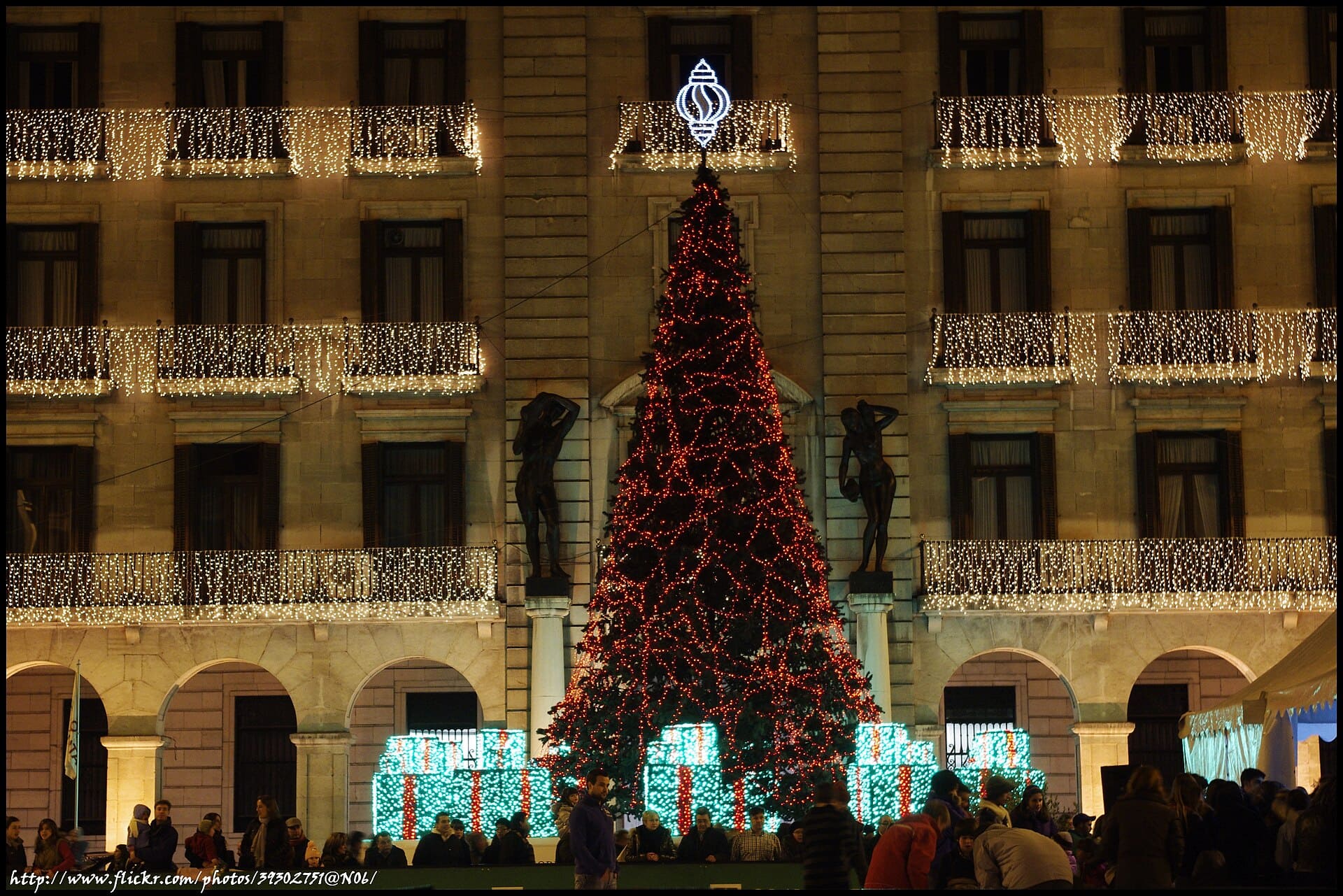
Serra da Estrela Portugal: 12 Best Things to See and Do

TL;DRSerra da Estrela is mainland Portugal’s highest mountain range, topped by Torre, which hits a symbolic 2000 metres thanks to a seven-metre stone tower (its natural height is 1993 m). Highlights include the 13-kilometre glacial Zêzere valley, the mysterious Covão dos Conchos lake, the Zêzere river with Manteigas as an ideal base, and the country’s only ski resort (a lift pass costs around €35). Getting into the natural park is free, and you’ll want at least two to three days to work through the main sights (12 in total). The best time to go is May to October, or December to March if you’re after snow. From Lisbon, it’s about three hours by motorway.

You know that feeling when you picture Portugal and all you see is endless sandy beaches or the colourful alleyways of Lisbon? Well, put that image aside for a moment, because I’m about to take you somewhere completely different. Serra da Estrela Portugal is home to the highest mountain range on the mainland, and it offers landscapes that will absolutely take your breath away. Think majestic granite cliffs, deep glacial valleys, and utterly unique mountain villages where time seems to have stood still.

If you’re looking for an escape from the coastal crowds and you love unspoilt nature, this is the perfect destination for your next adventure. The mountain range sits in central Portugal and its name translates to Star Mountains — which couldn’t be more fitting for this magical place. Crystal-clear lakes, endless hiking trails, and — surprise — the only ski resort in the entire country all await you here.

The area has been designated a natural park and in recent years has become a hugely popular destination for road trip enthusiasts. The roads twist and turn through sharp switchbacks, and every bend reveals a view you’ll want to photograph immediately. Be prepared, though — the weather here can be incredibly unpredictable, and temperatures can change within minutes.

In this article, you’ll find twelve specific tips on what to see and do in Serra da Estrela. I’ll tell you where to strategically base yourself so you don’t spend hours in the car, and when the best time to visit is. Trust me — this mountain adventure will be one of the highlights of your Portuguese journey.

TL;DR

  • Highest point: The summit of Torre stands at 1,993 metres, but a king had a seven-metre stone tower built on top to round it up to a neat two thousand.
  • Only skiing in Portugal: In winter you can hit the slopes at Estância de Esqui — the Serra da Estrela ski resort and the country’s only one.
  • Culinary gem: The local Serra da Estrela cheese (Queijo Serra da Estrela) is an absolute legend, exported all over the world.
  • Natural wonder: The Zêzere Glacial Valley stretches thirteen kilometres with stunning views reminiscent of the Alps.
  • Mysterious sinkhole: Covão dos Conchos looks like a portal to another world, but it’s actually a brilliant piece of engineering.
  • Swimming: In summer you can cool off at beautiful river beaches, like the one in the village of Loriga.
  • How much time you need: Allow at least two to three full days to explore the main highlights.

When to Visit Serra da Estrela

Planning a trip to the Star Mountains requires a bit of thought about what exactly you want to experience. The weather here plays an absolutely crucial role, and each season offers a dramatically different experience. While summer temperatures along the coast push towards 40°C, up here you’ll find a wonderfully cool refuge from the heat.

If you’re after hiking and want to explore mountain lakes, aim to visit between May and October. Spring is absolutely ideal for spotting wildflowers and gushing waterfalls, while September and October bring stable weather with gorgeous autumn colours. Summer does offer the warmest temperatures, but you’ll also have to contend with larger numbers of Portuguese visitors escaping the sweltering cities.

The winter months from December to March drape the mountains in a white blanket. For the Portuguese, this is a massive event — snow here is an absolute rarity. At weekends, enormous queues form on the approach roads, packed with carloads of families heading up to build snowmen. If you want to experience snowy Portugal without the stress, I’d strongly recommend planning your visit strictly on weekdays and packing plenty of warm clothing.

💡 Local tip: In winter, always keep snow chains in your car, as police can completely block access to higher elevations without them. The roads are maintained, but mountain blizzards can catch even the most experienced drivers off guard.

Where to Stay in Serra da Estrela

💡 Accommodation and experiences tip: We usually search for accommodation on Booking.com, which tends to have the best cancellation policies. For tickets, tours, and activities, it’s worth comparing options on GetYourGuide.

Choosing the right base is absolutely essential for exploring the park, because the mountain roads are slow and full of hairpin bends. By 2026, the wave of modernisation has reached even here, and the range of quality accommodation has expanded significantly. Rather than standard apartments, I’d recommend trying traditional mountain hotels, many of which now offer heated pools with panoramic views.

The best strategic location is the little town of Manteigas, which sits right in the heart of the glacial valley. From here you’ll be close to all the main hiking trails and waterfalls. If you’re after a more luxurious experience, book into the iconic Casa das Penhas Douradas hotel, where you can enjoy wonderful spa facilities and fantastic breakfasts made from local produce. It’s pricier, yes — but for the peace and quiet surrounded by nature, it’s absolutely worth it.

Another excellent choice is the historic city of Covilhã, which lies at the foot of the mountains and offers all the urban amenities including large supermarkets and superb restaurants. For a special stay, consider the Pousada da Serra da Estrela — a luxury hotel housed in a former sanatorium with absolutely jaw-dropping valley views. Always book your Serra da Estrela Portugal hotels well in advance through Booking.com, as availability during peak season disappears fast.

Your budget for a mountain stay depends on your expectations. A lovely double room in a quality mountain hotel with spa facilities will set you back around 120 to 180 euros per night. If you prefer more rustic apartments in the villages, expect to pay roughly 70 to 100 euros — though prices naturally rise during winter months and holiday periods.

12 Best Things to See and Do in Serra da Estrela

Let’s dive into the very best that this natural park has to offer. We’ll explore not only the iconic peaks and mysterious lakes, but also hidden villages and local traditions. Pack your comfiest hiking boots and get ready for unforgettable views.

1. Torre — Reaching Two Thousand Metres

Although the mountain range looks impressively grand, its highest natural point — Torre — actually measures just 1,993 metres above sea level. King João VI wasn’t satisfied with this number back in the early nineteenth century, so he had a seven-metre stone tower built on the summit to bring the total height to a neat two thousand metres. This spot is the absolute centrepiece of the entire range and one you simply cannot miss.

What surprises many visitors is that you can actually drive all the way to the very top. Around the tower itself there’s even a roundabout and a massive car park. It might feel a tad commercial, but it does mean the place is accessible to absolutely everyone regardless of fitness level.

Right at the summit you’ll find a handful of little shops selling traditional souvenirs and local specialities. You can pick up the famous cheese, warm woollen blankets, or sample the local firewater. On a clear day, the views from Torre are simply staggering — you can see all the way into neighbouring Spain.

2. Estância de Esqui — Serra da Estrela Ski Resort

Skiing in Portugal sounds like a bad joke, but here it’s absolutely real. Just below the Torre summit lies the only ski resort in the country — the Serra da Estrela Portugal ski resort — drawing thousands of enthusiastic locals and curious tourists alike. Don’t expect some sprawling Alpine mega-resort; it’s a compact area with just a handful of runs, but the atmosphere is absolutely unforgettable.

The resort is equipped with modern snow cannons, so even when nature doesn’t cooperate, there’s usually enough artificial snow on the slopes. You’ll find drag lifts and chairlifts, and the runs are ideal mainly for beginners and intermediate skiers. A full-day ski pass in 2026 costs around 35 euros — a very friendly price compared to Alpine resorts.

If you don’t have your own gear, no worries. There’s a well-equipped rental shop right on site for skis and snowboards, and you can also book lessons with an instructor. Even if you’re not an experienced skier, I’d recommend visiting the resort just for the sheer novelty of carving turns in sunny Portugal.

3. Zêzere Glacial Valley

Vale Glaciar do Zêzere is, without exaggeration, one of the greatest natural wonders in all of Europe. This perfectly U-shaped valley was carved more than twenty thousand years ago by a massive glacier. It stretches thirteen kilometres from the Torre summit down to the town of Manteigas, offering scenery that will leave you speechless.

The best way to take in the valley is by driving along the N338, which cuts right through it. The road winds alongside the River Zêzere, with steep granite slopes cloaked in green vegetation rising on both sides. There are plenty of safe viewpoints where you can pull over and simply soak in the beauty.

For more active travellers, I’d recommend walking part of the valley along the waymarked trail. Along the way you’ll spot traditional stone shepherds’ huts and might even encounter flocks of mountain sheep grazing freely. It’s a wonderfully calming and photogenic experience that really showcases the raw power of nature.

4. Famous Serra da Estrela Cheese

The gastronomy in these mountains has one undisputed king, and that’s Queijo Serra da Estrela cheese. This is a protected traditional product made exclusively from the milk of local sheep breeds. What makes it particularly fascinating is that instead of animal rennet, it uses an extract from wild thistle flowers for curdling — giving it an utterly unique flavour.

The cheese has a firm rind on the outside, but inside it’s so creamy and liquid that you can’t slice it. Locals eat it by cutting off the top rind like a lid and spooning the oozing interior onto fresh bread. It’s an absolute delicacy that any cheese lover will fall head over heels for.

You’ll find it in shops and markets in the surrounding villages on practically every corner. A whole wheel will set you back roughly twenty to thirty euros depending on size and maturity. It’s often served alongside sweet pumpkin jam, which beautifully balances out its intense, slightly tangy flavour.

5. Charming Manteigas and Its Wool Heritage

Manteigas is arguably the most picturesque spot in the entire mountain range. It sits at the very bottom of the glacial valley and feels like an oasis of calm. Narrow cobbled streets, white houses with red-tiled roofs, and the ever-present sound of running water make it the perfect place for an afternoon stroll and a good cup of coffee.

The town is historically renowned for wool processing and the production of a traditional fabric called Burel. Shepherds once wore heavy waterproof cloaks made from it, but today the material is enjoying a huge renaissance. You can visit the Burel Factory, where you’ll see historic weaving looms in action and learn about the entire production process.

In the on-site design shop you can pick up beautiful woollen accessories — everything from colourful blankets and cushions to elegant backpacks and coats. It’s a perfect and meaningful souvenir that also supports local Portuguese craftsmanship and the preservation of traditional skills.

lukas a lucka
Lukáš and Lucie recommend
Where to stay in Serra da Estrela
3 accommodations — wellness hotels and other accommodation options

6. Historic Village of Linhares da Beira

If you love history, you simply must visit Linhares da Beira. This little village is part of Portugal’s network of Historical Villages and positively drips with medieval atmosphere. Crooked lanes are lined with ancient stone houses, and at every turn you’ll stumble upon some fascinating architectural detail.

The main landmark is a mighty twelfth-century castle perched on a hill above the village. Entry is free, and the views from its ramparts across the surrounding plains are absolutely spectacular. At sunset in particular, the old stones take on a gorgeous golden hue — pure heaven for any photographer.

These days the village is also well known as one of the best paragliding spots in Europe. Thanks to specific thermal currents, international competitions are held here regularly, and you’ll often see dozens of colourful canopies soaring above the castle. Even just watching the spectacle from the ground is well worth your time.

7. Beech Forest and Rota das Faias

The nature of the Estrela mountains isn’t all about bare rocks and grass. Near the town of Manteigas lies a genuine gem — a dense beech forest. A hiking trail called Rota das Faias has been created here, and it ranks among the most beautiful short treks in the area. It’s manageable for anyone.

The route is just under six kilometres long and takes you through a shady forest that provides a perfect escape from the sun in summer. But the real magic happens in autumn, when the leaves turn incredible shades of yellow, orange, and red. Honestly, you’ll feel more like you’re in Canada than in southern Europe.

The path is very well marked and follows soft forest floor. Along the way you’ll come across the small chapel of São Lourenço, from which a lovely view of the entire valley opens up. Don’t forget to bring plenty of water, as there are no springs or refreshment stands along the way.

8. Poço do Inferno Waterfall

The name of this waterfall sounds rather ominous — it translates to “Hell’s Well” — but the reality is absolutely enchanting. It’s a ten-metre waterfall tucked away in a deep, narrow gorge, reached via a picturesque little road full of switchbacks. It’s a hugely popular stop for all visitors to the park.

Water from the Leandres stream plunges into a dark pool ringed by rugged rocks. The surrounding vegetation is incredibly lush and green thanks to the constant moisture. If you’re brave enough, you can take a dip in the pool — but be warned, the water is absolutely freezing even in the height of summer.

A very pleasant hiking trail of around two and a half kilometres loops around the waterfall. It’s a bit more challenging with some elevation gain and the occasional boulder to clamber over, but it rewards you with views of the waterfall from multiple angles. If you head out early in the morning, there’s a good chance you’ll have the place entirely to yourself.

💡 Local tip: The waterfall is at its most impressive in spring after the snowmelt. By the end of a dry summer it can dwindle to little more than a trickle, so time your visit accordingly.

9. Mystical Covão dos Conchos

This spot took the internet by storm and became a viral sensation. At first glance, Covão dos Conchos looks like a mysterious portal sucking water into the depths of the earth. In the middle of a tranquil mountain lake, there’s a circular opening nearly fifty metres in diameter into which the water surface thunders and disappears.

In reality it’s not a miracle of nature at all, but a brilliant feat of engineering from the 1950s. It’s an overflow tunnel that channels water from this lake through underground pipes to the nearby Lagoa Comprida reservoir. The tunnel stretches over one and a half kilometres, and its edges have gradually become cloaked in moss — giving it that magical appearance.

There’s no road to the lake — you have to get there on foot. The trail starts at the Lagoa Comprida dam and measures roughly four and a half kilometres one way. The terrain is fairly rocky and gently undulating, so make sure you wear sturdy hiking boots. Your reward will be the sight of something you truly won’t find anywhere else in the world.

10. River Beach Swimming in Loriga

Portugal is full of so-called river beaches, but Praia Fluvial de Loriga is truly one of a kind. It’s set in a gorgeous valley lined with terraced fields and offers the perfect refreshment on scorching summer days. Essentially it’s a series of natural rock pools connected by small waterfalls, fed by crystal-clear water from the melting snow above.

The beach is surrounded by green lawns and has basic facilities including clean toilets and a small kiosk selling refreshments. The spot is very popular with local families in summer, so if you want to bag a good spot for your towel, arrive before midday.

The water in the pools is beautifully clear, but prepare yourself — it’s a genuine test for cold-water swimmers. Even in August, the water temperature hovers around just 15°C. But if you muster the courage and take the plunge, you’ll feel an incredible rush of energy and total rejuvenation.

11. Impressive Lagoa Comprida Dam

Lagoa Comprida is the largest lake in the entire mountain range and serves as a huge water reservoir for the region. This expansive hydroelectric dam was built at an altitude of over 1,600 metres and offers utterly breathtaking views of the dark water surface reflecting the surrounding granite peaks.

Right by the dam wall you’ll find a spacious car park and several small shops selling regional products, where you can pick up excellent local bread and cheese. Many hikers set off from here, as several very popular trails start at the dam — including the one to the aforementioned Covão dos Conchos.

Simply walking along the long concrete dam wall is a great experience in itself. The wind up here is fierce, so even in summer you’ll appreciate a light jacket or jumper. The water in the lake is a deep, dark blue — almost black — thanks to its great depth, and swimming is strictly prohibited for safety reasons.

12. Stargazing Under the Night Sky

Serra da Estrela isn’t famous just for snow and peaks — it’s also blessed with remarkably clear night skies. Thanks to the high altitude and minimal light pollution from cities, you’ll find ideal conditions for stargazing here. The evenings are cooler, yes, but the view of the Milky Way makes it absolutely worth it.

A dark sky protection initiative has recently launched in the area, and the local Observatório Espacial runs regular night-time excursions. You can join guided observation sessions using professional telescopes and learn all sorts of fascinating facts about the cosmos. These events need to be booked in advance via their official website.

If you prefer solitude, simply drive up to one of the higher viewpoints after dark, switch off your lights, and let your eyes adjust. During August nights you can easily watch shooting stars and soak up the utter silence, broken only by the occasional distant clinking of sheep bells.

Where to Go Next from Serra da Estrela

Once you’ve thoroughly explored the mountains and start thinking about the next stop on your Portuguese road trip, you’ve got several brilliant options. From the mountains you can easily hop over to other gems in central and northern Portugal.

  • If you don’t mind heading a bit further north and love wine, make for the famous Douro Valley. Its terraced vineyards tumbling down to the river offer a gorgeous contrast to the mountain scenery.
  • More into history and university-town vibes? Head to the wonderful city of Coimbra, which is less than two hours’ drive from the mountains.
  • If you’re craving more wild nature and hiking, I’d recommend visiting the Peneda-Gerês National Park in the far north of the country near the Spanish border.
  • And if you simply can’t wait to feel sand between your toes, head straight west and discover the most beautiful beaches in Portugal, where you can finally soak up the sun and surf after your mountain adventure.

Frequently Asked Questions

Can I handle driving in the mountains even as a beginner?

The roads in the mountains are fairly wide and in most places have good asphalt surfaces. But do expect a lot of sharp hairpin bends and steep climbs. As long as you focus fully on driving and keep to the speed limit, you’ll manage it without any problems even with average experience. In winter, though, things are tougher because of snow and ice.

Is there an entrance fee in the park?

No, the entire Serra da Estrela Natural Park is completely free to access with no fees whatsoever. There’s no charge for driving up to the Torre summit or for parking at the main tourist attractions. Fees only apply to specific services, such as ski rental, souvenir shopping or guided tours.

How many days should I set aside for the mountains?

For a quick visit to the main spots by car, one very packed day will do. But if you want to soak up the atmosphere, do at least one of the treks and visit the villages in the valley, I’d recommend setting aside at least two nights. The ideal amount of time for exploring without rushing is three full days.

Are the hiking trails suitable for children too?

Some trails are, others can be demanding. A walk through the Rota das Faias beech forest or around the Lagoa Comprida reservoir is great and safe even for smaller children. The path to the Covão dos Conchos lake, on the other hand, is very rocky and you definitely won’t get through it with a pushchair, so only head there with older children who are used to walking.

Do I need an electronic Via Verde transponder on the motorways?

If you’re heading into the mountains from Lisbon or Porto, you’ll probably travel on motorways with electronic tolls. When renting a car, definitely ask for a Via Verde transponder; it’ll save you a lot of hassle paying fines, because many sections lack classic toll gates and the cameras only capture licence plates.

Where can I buy the best local cheese?

You’ll get the most authentic Queijo Serra da Estrela cheese straight from local farmers at markets or in small family shops in the towns of Manteigas or Seia. You’ll also find a good selection in the shops at the Torre summit, though prices there tend to be a bit inflated due to the high concentration of tourists.

What’s the best way to get to the mountains from Lisbon?

The most comfortable and fastest option is renting a car. The journey from Lisbon takes about three hours of actual driving time via the A1 motorway and then the A23. Public transport is fairly complicated; by train you can get at most as far as the town of Covilhã, and from there you’d have to take a taxi into the mountains, which works out quite expensive.

Tips and Tricks for Your Vacation

Don’t Overpay for Flights

Search for flights on Kayak. It’s our favorite search engine because it scans the websites of all airlines and always finds the cheapest connection.

Book Your Accommodation Smartly

The best experiences we’ve had when looking for accommodation (from Alaska to Morocco) are with Booking.com, where hotels, apartments, and entire houses are usually the cheapest and most widely available.

Don’t Forget Travel Insurance

Good travel insurance will protect you against illness, accidents, theft, or flight cancellations. We’ve had a few hospital visits abroad, so we know how important it is to have proper insurance arranged.

Where we insure ourselves: SafetyWing (best for everyone) and TrueTraveller (for extra-long trips).

Why don’t we recommend any Czech insurance company? Because they have too many restrictions. They set limits on the number of days abroad, travel insurance via a credit card often requires you to pay medical expenses only with that card, and they frequently limit the number of returns to the Czech Republic.

Find the Best Experiences

Get Your Guide is a huge online marketplace where you can book guided walks, trips, skip-the-line tickets, tours, and much more. We always find some extra fun there!
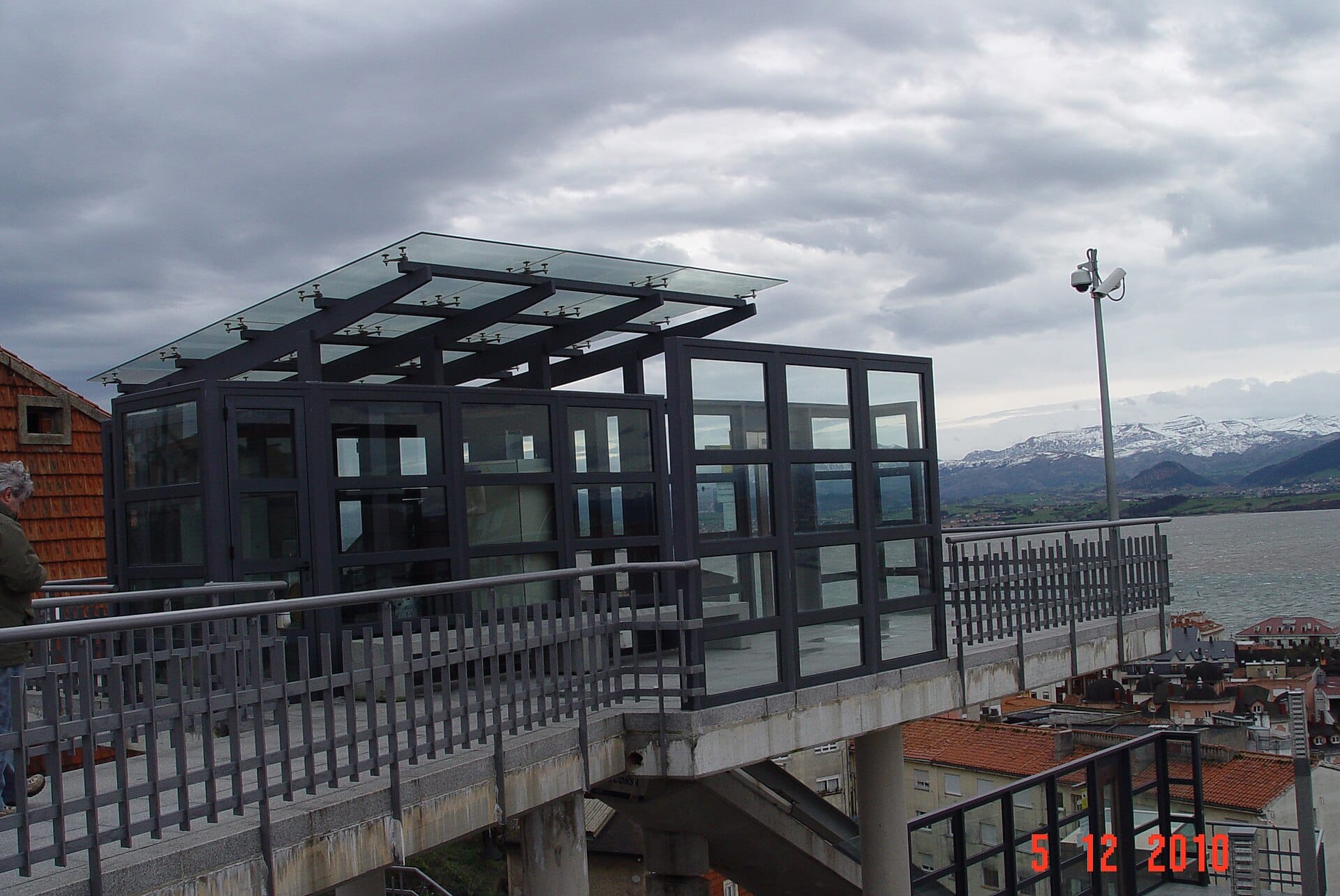
Oviedo and Asturias: Green Spain by the Ocean

TL;DRAsturias is a green region in northern Spain, where the Picos de Europa mountains rise just 15 kilometres from the Atlantic coast, centred on historic Oviedo with its Gothic San Salvador Cathedral and the pre-Romanesque churches on Mount Naranco, protected by UNESCO. The article rounds up 14 concrete tips, including San Lorenzo beach in Gijón, the lakes of Covadonga, the Fuente Dé cable car (a return ticket costs around 17 euros), and Playa del Silencio. The best time to visit is June to September, when temperatures hit 22 to 26 degrees Celsius, though the sea stays chilly below 20 degrees. You’ll want your own car to reach the remoter spots, and no trip is complete without a glass of tart sidra and a taste of Cabrales cheese.

Cross the invisible border between the parched Castilian plateau and Spain’s northern coast, and you’ll experience a dramatic shift in scenery that catches virtually every traveller off guard. The ochre and brown tones of southern Spain suddenly give way to lush, impenetrable greenery, and the air grows heavy with moisture from the untamed Atlantic. Oviedo Spain and the surrounding region of Asturias — often called España Verde, or Green Spain — feel more like wild Ireland, only with incomparably better food and far more dramatic limestone mountains. Asturias and its capital Oviedo form a world unto themselves, where ancient history blends with breathtaking nature and a distinctive culture you simply won’t find anywhere else on the Iberian Peninsula. Sun-seekers who crave all-day lounging on packed beaches tend to give this corner a miss, because this land belongs first and foremost to foodies, mountain lovers, and enthusiastic drivers. They understand perfectly well that the occasional rain cloud is simply the price you pay for the juiciest pastures and the finest produce imaginable. I’ve put together this detailed guide to help you know exactly what to expect from Spain’s green north.

TL;DR

  • Green north: Asturias is a region of striking contrasts, where towering mountains rise just a few kilometres from the wild Atlantic coast.
  • Historic heart: Oviedo boasts unique pre-Romanesque monuments protected by UNESCO and a stunning Gothic cathedral.
  • Coastal life: Gijón is a vibrant seaside city with endless beaches and a fishermen’s quarter that buzzes from morning to night.
  • National park: Picos de Europa will wow you with deep gorges, glacial lakes, and the famous sanctuary of Covadonga.
  • Local gastronomy: The quintessential experience is drinking sharp cider poured from a height and sampling pungent mountain cheeses.
  • Weather: Be prepared for rain — it falls far more often than in the south, and that’s the secret behind the region’s gorgeous landscapes.
  • Getting around: A hire car is absolutely essential for reaching remote beaches and mountain villages.

When to Visit Oviedo and Asturias

Unlike sun-drenched Andalusia, where summer heatwaves can be genuinely dangerous, northern Spain marches to a completely different and far milder beat. The only reliable window of relatively dry, sunny weather runs from June to September, when you can enjoy the outdoors to the fullest. Even in the height of August, temperatures hover around a very pleasant 22–26 °C, creating ideal conditions for hiking and city exploration. The ocean stays fairly cool and refreshing even in summer, so don’t expect bath-like waters — think of it more as an invigorating dip after a mountain trek.

The rest of the year, the northern coast is characterised by frequent rainfall, strong winds, and overcast skies. But it’s precisely this damp climate blowing in from the Bay of Biscay that makes the region so dazzlingly green and the pastures so incredibly fertile. If you visit in spring or autumn, make sure to pack a quality waterproof jacket and sturdy shoes, because the weather in Oviedo Spain can change literally from one minute to the next. Winter brings heavy snowfall to the higher reaches of the Picos de Europa — great news for experienced mountaineers, less so for casual visitors.

Where to Stay in Asturias

💡 Accommodation and experience tips: We like to search for stays on Booking.com, which usually offers the best cancellation policies. For tickets, tours, and activities, it’s worth comparing options on GetYourGuide.

Choosing the right base for exploring the region depends mainly on whether you prefer city culture, the sound of the ocean, or the solitude of high mountains. If you’re after elegance and history, Oviedo itself is an excellent choice, giving you easy access to every corner of Asturias. In Oviedo, you could treat yourself to the luxurious Eurostars Hotel de la Reconquista, a historic palace with magnificent courtyards that transports you back in time the moment you step inside. For sea lovers and nightlife fans, the coastal city of Gijón is a perfect fit, with countless modern hotels right on the seafront promenade.

There I’d recommend the popular NH Gijón, located just steps from the famous San Lorenzo beach and offering fantastic ocean views. If your main goal is trekking in the national park, however, the most strategic base is the mountain town of Cangas de Onís. The Parador de Cangas de Onís, a former monastery nestled in stunning natural surroundings, offers an unforgettable experience brimming with peace and an almost mystical atmosphere. You can easily and securely book accommodation across all of Asturias through Booking.com, where you’ll also find charming rural cottages known as casas rurales — the most authentic way to experience the region.

14 Best Things to See and Do in Oviedo and Asturias

Oviedo and the wider province offer such an incredible wealth of natural and cultural treasures that you’ll struggle to decide where to go first. Let’s dive into the very best that should absolutely feature in your Asturian itinerary.

1. Oviedo: San Salvador Cathedral and the Holy Chamber

The spiritual heart and soul of the entire city is undoubtedly the majestic San Salvador Cathedral, whose tower dominates Oviedo’s skyline. This awe-inspiring Gothic structure was built gradually from the 13th to the 16th century, and its asymmetric façade with just one completed tower gives it a uniquely distinctive character. The cathedral has always been a crucial stop for pilgrims heading to Santiago de Compostela, who would pause here to pay their respects to the sacred relics. Entry to the main nave costs around 7 euros, which includes a very helpful audio guide that walks you through the rich history of the site.

The greatest treasure of the entire complex, however, is the Cámara Santa — the Holy Chamber — dating back to the 9th century and inscribed on the UNESCO World Heritage List. Inside this dark, mysterious room lies the legendary Sudarium of Oviedo, a cloth that believers claim was wrapped around the head of Jesus Christ after his crucifixion. You can also admire exquisite gem-encrusted crosses here, including the Cruz de la Victoria (Cross of Victory), which serves as the proud symbol of all Asturias and features on its flag.

💡 Insider tip: If you want to experience the cathedral without the tourist crowds and coach groups, head there first thing in the morning when it opens. The sunlight filtering through the coloured stained glass creates a truly magical atmosphere.

2. Oviedo: Strolling Through the Old Town (Casco Antiguo)

Oviedo’s historic centre, known as the Casco Antiguo, is remarkably well preserved, elegant, and — best of all — entirely pedestrianised. Winding streets are lined with colourful townhouses, stone palaces bearing noble coats of arms, and dozens of cosy cafés that practically beg you to sit down for an afternoon break. The city is famous for its immaculate cleanliness and beautifully maintained public spaces, regularly winning awards as the cleanest city in all of Spain. Don’t miss the Plaza de la Constitución, home to the historic town hall and the lovely church of San Isidoro.

One of the old town’s most charming quirks is the sheer number of life-sized bronze statues you’ll stumble upon at literally every turn. You can snap a photo with a bronze Woody Allen — who publicly declared his love for Oviedo, calling it a fairytale place beyond reality — or with the adorable comic-strip character Mafalda. If you’re a market fan, a visit to the Mercado del Fontán is an absolute must: under elegant iron arches, local farmers sell the freshest cheeses, vegetables, and crusty bread you’ll find anywhere.

💡 Insider tip: On weekends, local musicians often gather in the Plaza del Fontán to play the traditional Asturian bagpipes (gaita), lending the whole square an unforgettable and distinctly Celtic atmosphere.

3. Oviedo: Pre-Romanesque Churches on Mount Naranco (UNESCO)

Just beyond the city limits, on the slopes of the lush Monte Naranco, a pair of architectural treasures of incalculable value lie hidden. These are unique pre-Romanesque structures from the 9th century, commissioned by the Asturian kings at a time when the rest of the peninsula was under Moorish rule. The most famous is Santa María del Naranco, originally a royal summer palace of King Ramiro I, which impresses with its elegant proportions and ornate balconies. This building is so exceptional that it lent its name to an entire architectural style — the so-called Ramirense architecture.

A few hundred metres further up the path, you’ll come across the little church of San Miguel de Lillo, of which only about a third of the original structure survives today. Even so, it fascinates with its detailed stone reliefs depicting scenes of daily life, including acrobats and musicians. You can reach the monuments either via a pleasant hour-long walk from Oviedo’s centre or a short ride on a local bus, and combined admission to both sites costs around 4 euros.

💡 Insider tip: Try to time your visit for the late afternoon, when the setting sun bathes the ancient stone in golden light and you get a fantastic view over the whole of Oviedo spread out in the valley below.

4. Gijón: San Lorenzo Beach and the Coastal Promenade

If Oviedo represents the historical and aristocratic soul of the region, then Gijón is its pulsing, untamed heart right on the coast. The city’s main draw is the gorgeous San Lorenzo Beach, stretching over a mile and a half in a perfect crescent shape. Fine golden sand is washed by the waves of the Bay of Biscay, attracting keen surfers from across Europe all year round. The beach is flanked by a broad, always-bustling promenade known locally as El Muro, where locals walk, jog, and cycle in all weathers.

Swimming in the ocean here is more of an experience for the hardy, as the water rarely climbs above 20 °C — but as a post-sightseeing cool-down, it’s absolutely brilliant. At low tide, the beach widens dramatically, opening up a vast expanse for beach volleyball, football, or long romantic walks along the rocky shoreline. At the eastern end of the promenade stands the church of San Pedro, its silhouette against the crashing waves one of the most photographed scenes in all of Gijón.

💡 Insider tip: Along the promenade you’ll notice special numbered stone stairways, called escaleras. Locals habitually arrange to meet at a specific stairway number — most popularly “Escalera 4,” where the sand is softest.

5. Gijón: The Historic Fishing Quarter of Cimadevilla

The oldest and without doubt most charismatic part of Gijón is the Cimadevilla peninsula, once home to poor fishermen, sailors, and tobacco workers. Today, the quarter has transformed into the city’s bohemian hub, full of narrow cobbled lanes, weathered but photogenic houses, and dozens of traditional bars and restaurants. This is where most locals and visitors flock after sunset to enjoy genuine Asturian hospitality and lively evening entertainment. As you wander, you’ll also come across the remains of ancient Roman baths — a reminder that this strategic spot has been settled since antiquity.

At the very top of the peninsula sprawls the expansive Cerro de Santa Catalina park, offering sweeping panoramic views over the ocean and both of the city’s beaches. On the highest point of the cliff stands the monumental concrete sculpture Elogio del Horizonte by the celebrated Basque artist Eduardo Chillida. Stand right in the centre of this massive artwork and you’ll hear a fascinating acoustic effect that amplifies the sound of waves crashing on the rocks far below.

💡 Insider tip: Set aside time for an evening “txikiteo” — essentially a bar crawl through Cimadevilla’s alleyways. Head for wherever you hear the most noise and see the most people spilling out onto the pavement — that’s a sure sign of the best atmosphere.

6. Traditional Asturian Cider and the Art of Pouring It

Visiting Asturias without tasting the local apple cider — known as sidra — would be an unforgivable traveller’s sin, because this drink defines the entire local culture. Don’t expect a sweet, fizzy commercial drink, though: Asturian sidra is naturally fermented, unfiltered, and has a very distinctive, almost earthy tartness. It’s drunk in special establishments called sidrerías, where the floor is often covered in sawdust because a good deal of the drink ends up on the ground during pouring. The whole ritual of drinking sidra is a fascinating social affair with its own strict, unbreakable rules.

The key part is the pouring itself, called escanciar. The server raises the bottle high above their head and sends a thin stream arcing down into a wide glass held in the other hand, low near the hip. This acrobatic feat serves to rapidly aerate the drink, giving the cider a few seconds of light effervescence and fully releasing its apple aroma. Only a small measure is ever poured — a culín — which you must drink straight away in one go, before it “dies” and loses its freshness.

💡 Insider tip: Never pour the cider yourself straight from the bottle on the table — you’d be showing a serious lack of etiquette. If the server isn’t nearby, feel free to ask anyone at the next table; locals love the chance to show off their escanciar skills.

7. Tasting Local Cheeses (Cabrales) and the Famous Fabada

Asturias’s green pastures produce some of the finest dairy products in all of Spain, and the region proudly calls itself the “land of cheeses,” with over 40 different varieties made here. The most famous by far is Cabrales, an intensely pungent blue cheese that matures for several months in natural limestone caves high in the Picos de Europa. Its aroma is so powerful you can smell it from metres away, and it’s best enjoyed spread on crusty bread alongside a refreshing glass of sidra — a perfect vegetarian treat. Also well worth trying are the creamy Afuega’l pitu and the delicately smoked Gamonéu.

When it comes to main courses, the undisputed symbol of the region is fabada asturiana, which you’ll find on the menu at absolutely every traditional restaurant. It’s an incredibly hearty, rich stew of large white beans slow-cooked with cured sausages, black pudding, and pork. It’s the ultimate calorie bomb that local meat lovers tuck into mainly during the colder months to refuel after a hard day in the mountains. If you’d rather skip the meat, excellent alternatives include superb local potato tortillas or sweet frixuelos pancakes filled with apple compote.

💡 Insider tip: If you want to bring back Cabrales cheese as a souvenir, have it vacuum-sealed at the shop. Otherwise, its intense aroma will reliably permeate your entire luggage — and your clothes — for years to come.

8. Picos de Europa National Park and Its Limestone Peaks

The Picos de Europa — literally “Peaks of Europe” — are one of the oldest and most spectacular national parks on the entire Iberian Peninsula. They owe their poetic name to Spanish sailors returning from the Americas, because the jagged limestone summits were the first land they spotted on the horizon from their ships. This breathtaking massif lies just 15 kilometres from the Atlantic coast, yet its highest serrated peaks soar to an impressive 2,600 metres above sea level. It’s precisely this dramatic proximity of ocean and high mountains that creates the frequent fog and rain that have carved deep karst gorges over millions of years.

Several gateways lead into the park, with the Asturian side renowned for its rich green pastures and deep valleys where herds of goats and cattle roam freely. For hikers, the absolute highlight is the famous Ruta del Cares, a trail carved directly into a sheer cliff face high above a wild river. The route is fairly long but almost completely flat, meaning anyone with sturdy footwear can manage it — and the views down into the gorge are utterly breathtaking.

💡 Insider tip: The weather in the Picos de Europa is extremely unpredictable. Even when bright sunshine blazes in the valley below, thick dripping fog can engulf you higher up. Always carry a waterproof layer and a warm jumper in your daypack.

lukas a lucka
Lukáš and Lucie recommend
Where to Stay in Oviedo and Asturias
4 accommodations — wellness hotels and other lodging options

9. Covadonga Sanctuary and the Birth of the Spanish Reconquista

If you have any interest in European history, the valley of Covadonga will feel like an utterly magical place, because this is where the story of modern Spain began. In this wild mountain gorge, Visigothic nobleman Pelayo defeated a Moorish army in 722 AD, launching the famous Reconquista — the centuries-long Christian reconquest of the Iberian Peninsula. The sanctuary of Santa Cueva itself is dramatically carved right into a sheer limestone cliff, beneath which a thundering waterfall plunges into a crystal-clear pool below.

A long stairway leads up to the cave chapel, where a wooden image of the Virgin of Covadonga and the tomb of King Pelayo himself are kept — pilgrims often ascend on their knees. Facing the cliff stands a monumental neo-Romanesque basilica built from pinkish limestone, its twin slender towers creating a striking contrast with the surrounding forest green. The entire site holds enormous national and spiritual significance; for Spaniards, Covadonga is a symbol of resistance, pride, and national identity.

💡 Insider tip: Parking at the sanctuary is very limited and virtually impossible in high season. Leave your car down in the town of Cangas de Onís and take the regular shuttle buses — you’ll save yourself a lot of stress navigating the mountain switchbacks.

10. The Glacial Lakes of Lagos de Covadonga

From the Covadonga sanctuary, an incredibly narrow, steep, and winding mountain road climbs even deeper into the national park, up to a magical pair of glacial lakes. Lakes Enol and Ercina sit at around 1,100 metres above sea level and represent one of the most iconic landscapes in all of Spain, frequently appearing on TV broadcasts of the famous Vuelta a España cycling race. Crystal-clear water mirrors the surrounding jagged peaks, and on the lush green banks, herds of brown Asturian cows graze freely with bells tinkling around their necks.

A very pleasant, undemanding circular trail loops around both lakes, taking roughly two to three hours and leading to several fantastic viewpoints. During peak summer — typically June to September — and on public holidays, the road up is completely closed to private vehicles during the day to prevent traffic gridlock. The only way up during these times is by a special shuttle bus from car parks in the valley, with a return ticket costing around 9 euros.

💡 Insider tip: The cows by the lakes may be photogenic and accustomed to people, but they’re still semi-wild animals. Don’t get too close, don’t pet them, and definitely don’t feed them human food — it’s not worth the risk.

11. Fuente Dé Cable Car and Heavenly Views

Although this engineering marvel sits just across the border in neighbouring Cantabria, it’s an inseparable part of the Picos de Europa experience and easily accessible from the Asturian side. The Fuente Dé cable car is one of the longest single-span aerial tramways in all of Europe, and the ride is an adrenaline rush you won’t quickly forget. The glass-walled cabin whisks you in under four minutes from the deep valley floor at 1,070 metres up to the upper station of El Cable, perched at a staggering 1,823 metres.

What makes the whole thing truly jaw-dropping is that the 750-metre height difference is conquered without a single support pylon — the cabin simply hangs in open space in front of a colossal vertical rock face. From the upper station, the views are genuinely breathtaking, and you can set off on several hikes of varying difficulty into the heart of the central massif. A return ticket costs around 17 euros, and in summer I strongly recommend buying tickets online well in advance, unless you fancy standing in a very long queue.

💡 Insider tip: Head up on the very first cable car of the morning. In the afternoon, thick cloud cover frequently rolls in from the ocean and fills the valley, leaving you staring at nothing but impenetrable white mist from the viewpoint.

12. Dramatic Cliffs and Beaches (Playa del Silencio)

The Asturian coastline, known as the Costa Verde, is wild, untamed, and dotted with hundreds of small coves hidden between steep limestone cliffs. The absolute crown jewel is Playa del Silencio — the Beach of Silence — which regularly features in rankings of the most stunning beaches in all of Spain. No wide road leads down to this perfect crescent-shaped cove; you have to leave your car on the clifftop and descend a fairly steep gravel path, which reliably deters the casual tourist hordes.

Don’t expect soft sand here — the beach is made up of smooth pebbles on which wild Atlantic waves crash with a thunderous roar. There are no facilities whatsoever, no refreshment stalls, no toilets — just the raw, primal power of nature surrounded by silvery rock walls that shield the cove from the wind. It’s the perfect spot for meditation, reading a book, or watching the sunset as the surrounding cliffs catch gorgeous purple and golden hues.

💡 Insider tip: Because of the pebbles and sharp underwater stones, I’d recommend packing water shoes in your bag. Even if you don’t plan on swimming, walking barefoot on the beach is a rather painful form of accidental acupuncture.

13. The Charming Fishing Village of Cudillero

While driving along the Asturian coast, you absolutely mustn’t miss Cudillero, widely regarded as the most picturesque village in the entire north of Spain. The buildings are literally squeezed into a narrow ravine plunging steeply towards the ocean, with colourful houses sporting wooden balconies stacked tightly together in several tiers — the whole effect resembles a gigantic natural amphitheatre. Local legend has it the village was founded by Vikings, and to this day it retains a very distinctive, slightly isolated seafaring atmosphere.

The best experience is simply getting lost in the maze of miniature staircases and narrow alleys that lead to several brilliant viewing terraces with a bird’s-eye view of the harbour square below. Down by the water, you’ll find a row of excellent restaurants where you can watch fishing boats bobbing on the waves from the outdoor terraces. Although Cudillero is very popular and can get packed in summer, climbing just a few streets higher instantly brings blissful quiet among the locals’ drying laundry.

💡 Insider tip: Make your way to the Faro de Cudillero lighthouse, perched on a nearby cliff. A beautiful, easy coastal path leads there, and it’s where you’ll get the best photos of the churning ocean.

14. Coastal Town of Ribadesella and the Tito Bustillo Prehistoric Caves

On Asturias’s eastern coast lies the elegant resort of Ribadesella, uniquely divided by the broad mouth of the River Sella right where it flows into the ocean. On one bank sits the historic centre full of bars and shops, while the other side is lined by the long Santa Marina beach, around which wealthy returning emigrants from the Americas — the so-called Indianos — built grand villas in the early 20th century. The town truly comes alive in August during the famous international canoe race on the Sella, accompanied by a raucous week-long festival.

The real treasure here, though, is the remarkable Tito Bustillo cave complex, inscribed on the UNESCO World Heritage List. Inside these vast limestone caverns lie some of the most significant prehistoric paintings in the world, dating back an astonishing 15,000 to 25,000 years. To protect the fragile microclimate, daily visitor numbers are strictly limited, so you’ll need to book tickets on the official website potentially a month in advance — otherwise you’ve no chance of getting in.

💡 Insider tip: Right next to the cave is an excellent modern museum with interactive exhibits that brilliantly explain the lives of prehistoric hunters. The museum visit is a great alternative if tickets to the actual cave have sold out.

Where to Go Next from Northern Spain

If you’ve got a hire car and extra time, northern Spain opens up a wealth of further adventures. To continue exploring Basque culture, head over to the modern city of Bilbao with its world-famous Guggenheim Museum, or to nearby San Sebastián, the undisputed capital of Spanish gastronomy. If you’re craving sunshine and want to experience the completely different Moorish atmosphere of the south, you could fly down to Andalusia — I’d recommend working through our guide to the 20 most beautiful places in Andalusia. There you’ll find gems like Seville, historic Córdoba, or the breathtaking city of Granada with the Alhambra Palace.

Another fascinating stop in the south is the cliff-edge town of Ronda, or the coastal city of Málaga. Adrenaline junkies shouldn’t miss the famous Caminito del Rey walkway. If you’d rather explore big cities, it’s easy to catch a high-speed train to Madrid, or you could discover Gaudí’s architecture in Barcelona. Fans of modern architecture and great food will love sunny Valencia, and for those seeking beach relaxation and party vibes, the Balearic island of Ibiza is a perfect pick. And if food is your thing in general, be sure to check out our guide to traditional Spanish cuisine.

Frequently Asked Questions

What’s the best way to get to Oviedo and Asturias?

The quickest route is to fly into the port city of Santander in neighboring Cantabria or to the resort town of Bilbao in the Basque Country, then continue by rental car. While there are no direct flights from Prague to Asturias, you can easily reach Asturias Airport (OVD) with one connection. The airport is located just a few kilometers from Oviedo.

Do I really need a car to travel around Asturias?

Although fairly reliable bus and train services run between Oviedo, Gijón and the other larger towns, a car is an absolute necessity for truly discovering the region. Without one you won’t be able to reach the remote beaches, the mountain viewpoints in the Picos de Europa, or the picturesque fishing villages along the coast, where public transport hardly runs at all.

Is the ocean in Gijón warm enough for summer swimming?

Swimming in the Bay of Biscay is more of an experience for hardy souls, because even in the warmest part of August the water here rarely exceeds 20 degrees Celsius. What’s more, the ocean is often wild and full of strong undercurrents, so it’s more popular among surfers in wetsuits than among families with small children looking for warm thermal baths.

How much will a ride on the Fuente Dé cable car cost me?

A return ticket on this breathtaking cable car will set you back about 17 euros for an adult, with children naturally getting a discount. Given the enormous popularity of this attraction, I strongly recommend buying tickets online in advance for a specific time slot, to avoid waiting in the queue at the ticket office for several hours.

What exactly is the famous fabada asturiana?

Fabada is an absolutely iconic symbol of Asturian cuisine that you’ll come across at every turn. It’s a very rich, calorific stew of large white beans, to which blood sausages, chorizo and various kinds of smoked pork are added, so unfortunately this dish is definitely not suitable for vegetarians.

Will I be able to get by in English in the smaller Asturian villages?

In hotels and better restaurants in Oviedo or Gijón you’ll have no problem with English, but in the countryside and the mountains English is spoken only very rarely. It’s definitely worth learning at least some basic phrases in Spanish and downloading an offline translator onto your phone, because the locals will hugely appreciate your effort and will be far warmer toward you.

How does summer transport to the Covadonga Lakes work?

During the summer tourist season and on public holidays, there’s a strict daytime ban on private cars driving directly up to the lakes. You have to park down in the valley and use the special shuttle buses that run up and down the mountain road, with a return ticket costing 9 euros, and you can stay up at the top for as long as you like.

Is Asturian sidra sweet like classic British cider?

Not at all — traditional Asturian sidra is completely unfiltered, naturally fermented, and its taste is very earthy and markedly tart, so it bears no resemblance to the sweet commercial ciders we’re used to from our bars. What’s more, it’s served in a special way, poured from a great height into wide glasses so that it aerates for a second.

Tips and Tricks for Your Vacation

Don’t Overpay for Flights

Search for flights on Kayak. It’s our favorite search engine because it scans the websites of all airlines and always finds the cheapest connection.

Book Your Accommodation Smartly

The best experiences we’ve had when looking for accommodation (from Alaska to Morocco) are with Booking.com, where hotels, apartments, and entire houses are usually the cheapest and most widely available.

Don’t Forget Travel Insurance

Good travel insurance will protect you against illness, accidents, theft, or flight cancellations. We’ve had a few hospital visits abroad, so we know how important it is to have proper insurance arranged.

Where we insure ourselves: SafetyWing (best for everyone) and TrueTraveller (for extra-long trips).

Why don’t we recommend any Czech insurance company? Because they have too many restrictions. They set limits on the number of days abroad, travel insurance via a credit card often requires you to pay medical expenses only with that card, and they frequently limit the number of returns to the Czech Republic.

Find the Best Experiences

Get Your Guide is a huge online marketplace where you can book guided walks, trips, skip-the-line tickets, tours, and much more. We always find some extra fun there!
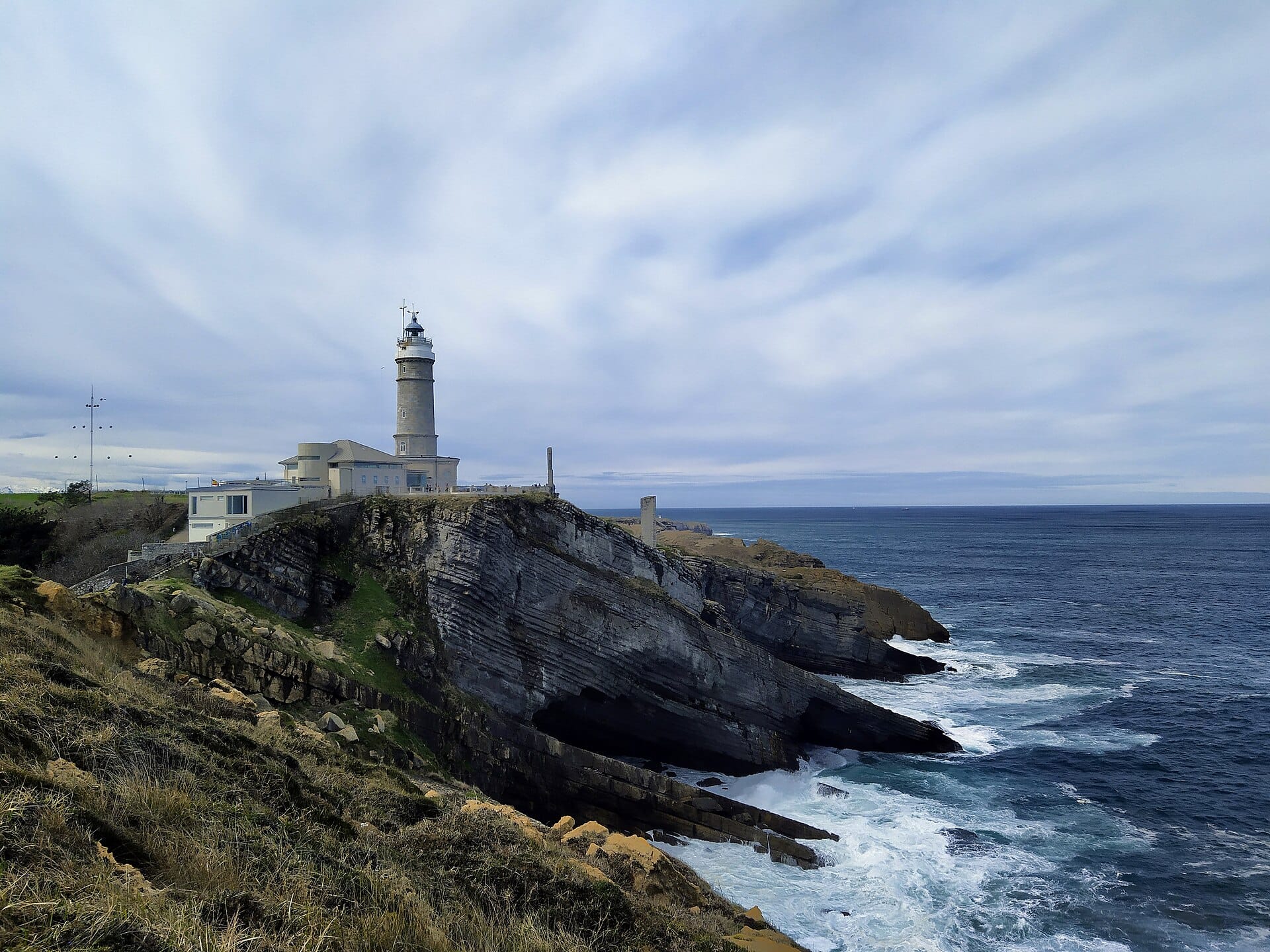
Costa del Sol: Best Beaches and Resorts in Southern Spain

TL;DRThe Costa del Sol runs for roughly seventy kilometres along southern Spain, and the best bases are Málaga, Marbella, Fuengirola, Torremolinos and Benalmádena. The finest beaches are around Nerja, Estepona and Fuengirola, whose eight kilometres of Blue Flag sand are hard to beat. Come in May, June, September or October, when the sea’s lovely, temperatures sit around 25–28°C and crowds thin out — steer clear of August, when inland heat tops 40°C. Málaga is the region’s cultural hub, with the Alcazaba, the “La Manquita” cathedral and the Picasso Museum. For a taste of luxury, head to Marbella and Puerto Banús, or the Costa del Golf, home to more than 70 golf courses. For something more authentic, try the whitewashed villages of Mijas and Frigiliana, or a day trip to Gibraltar — just remember you’ll need a valid passport.

If you’re thinking about heading to southern Spain for your next holiday, you’re in for a treat — this is a region that has defined the perfect European summer for decades. The waves of the Mediterranean lap against a coastline that rightfully earned its nickname, the Sunshine Coast. The Costa del Sol is a land of fascinating extremes, where you’ll find absolutely everything you could wish for on a getaway. Think bustling concrete resorts pulsing with nightlife, exclusive marinas packed with superyachts, and quiet mountain villages where, on a clear day, you can see all the way to Africa.

But coastal Andalusia offers far more than sun loungers and all-inclusive hotels. This is a proud region where the legendary Pablo Picasso was born, home to the oldest continuously inhabited city in Europe, and a place that radiates genuine southern energy. I’ve put together a detailed guide to help you plan the perfect trip. We’ll explore 16 top things to see and do along the Costa del Sol, plus practical tips on getting around and where to stay. 😉

TL;DR

  • Málaga is more than just an airport: The city has undergone a massive transformation and become a confident cultural hub that deserves at least two days of your time.
  • Best time to visit: Skip the August extremes and aim for May, June, September, or October, when the sea is warm and the crowds are thinner.
  • Luxury and tradition: Marbella and Puerto Banús offer a dazzling display of wealth, while Nerja to the east or inland Mijas retain a much more authentic atmosphere.
  • Day trip to Gibraltar: If you want to see wild monkeys and a little piece of Britain, don’t forget to bring a valid passport.
  • Hiring a car: For a beach-based stay, the excellent local train will do the job, but for exploring the white villages or venturing to Cádiz, a car is absolutely essential.
  • Andalusian gastronomy: Spaniards eat dinner late — authentic restaurants don’t fill up until after nine in the evening, and fresh vegetables and local tapas reign supreme along the coast.

When to Visit the Costa del Sol and What Weather to Expect

Choosing the right time to visit southern Andalusia is absolutely crucial. You might be wondering whether August in the south is really such a bad idea. The answer is clear — if you’re not a fan of extreme heat, it’s best to avoid peak season. The summer months push inland temperatures well above 40 °C. The coast itself is slightly cooler thanks to the refreshing sea breeze, but humidity is high and the resorts are bursting at the seams.

The ideal time to visit is during the spring months of May and June, or the autumn months of September and October. The Mediterranean is still wonderfully warm for swimming during these periods, and air temperatures hover around a comfortable 25 to 28 °C. You’ll also dodge the biggest crowds and find accommodation at much friendlier prices. Spring is also the perfect time if you’re planning an active holiday filled with mountain hikes or rounds of golf.

Winter on the Costa del Sol — think January and February — is hugely popular with digital nomads and travellers from northern Europe. People flock here for the mild climate, with daytime temperatures often sitting around 15 to 18 °C. While that’s certainly not swimming weather, it’s absolutely ideal for beach walks and sightseeing. The sun shines more than 300 days a year here, so the chances of a rain-soaked holiday are truly minimal.

Where to Stay on the Costa del Sol

💡 Accommodation and experiences tip: We usually search for places to stay on Booking.com, which tends to have the best cancellation policies. For tickets, tours, and activities, it’s worth comparing options on GetYourGuide.

The coastline stretches roughly seventy kilometres and every resort offers a completely different vibe. If it’s your first time heading to southern Spain and you want to combine beaches with culture, I’d recommend basing yourself in Málaga or very close to it. The city is brilliantly connected by commuter train to the airport and the surrounding beaches. For families with kids looking for gentle slopes into the sea and a relaxed atmosphere, Fuengirola or Benalmádena are excellent choices.

If you’re after luxury, outstanding food, and don’t mind splashing out a bit more, focus on the area around Marbella and Estepona. These stretches of coast are much greener, more exclusive, and home to top-notch boutique hotels. Don’t leave your booking too late — the best spots on Booking.com tend to sell out for the spring and autumn months well in advance.

Here are three specific accommodation recommendations depending on what you’re looking for:

  • Vincci Larios Diez (Málaga): A gorgeous modern hotel right in the historic heart of Málaga, just steps from the cathedral. It boasts a stunning rooftop terrace with panoramic views — the perfect spot for a morning coffee before diving into the buzz of the city.
  • Amàre Beach Hotel (Marbella): A luxury adults-only hotel located right on the beachfront promenade in Marbella. An excellent choice for a romantic getaway for two, with impeccable service and a stylish beach club.
  • Hotel IPV Palace & Spa (Fuengirola): A sprawling resort right next to the medieval Sohail Castle with a huge pool and direct access to the sandy beach. It’s a fantastic base for families who want all the comforts in one place.

16 Best Things to See and Do on the Costa del Sol

Let’s dive into the very best that the Andalusian coast has to offer — from buzzing cities and glamorous marinas to natural wonders hidden just a stone’s throw from the busy resorts. You’ll easily piece together the perfect itinerary from this list. ☺️

1. Málaga and Its Historic Heart

For years, Málaga served millions of tourists as little more than an arrivals hall — somewhere to pass through quickly on the way west to the beach resorts. But today, everything has changed, and the city has reinvented itself as a confident cultural destination. Málaga’s historic heart is beautifully compact, largely pedestrianised, and threaded with shady, marble-paved lanes that practically beg you to wander aimlessly.

Towering majestically above the centre is the 11th-century Moorish fortress of the Alcazaba. Unlike Granada’s famous Alhambra, it’s far more intimate and compact, and offers absolutely breathtaking views over the port and the nearby bullring. Just below its walls, you’ll discover the ruins of an ancient Roman theatre that local workers stumbled upon completely by accident back in the 1950s.

2. The Cathedral the Locals Call “The One-Armed Lady”

You simply can’t miss the Cathedral of Nuestra Señora de la Encarnación when strolling through central Málaga. This enormous Renaissance structure dominates the entire city, but it has one major quirk. Locals affectionately call it La Manquita, which translates to “The One-Armed Lady.” Its south tower was never completed due to a catastrophic lack of funds back in the 18th century.

The interior is jaw-droppingly grand, with richly carved wooden choir stalls that are truly breathtaking. If you don’t suffer from vertigo, I’d highly recommend buying the ticket that takes you up to the cathedral’s rooftop. Walking across the stone vaults high above the city at sunset is an experience you won’t forget in a hurry.

3. In the Footsteps of Pablo Picasso

The main draw of modern Málaga remains, without a doubt, its most famous son. Pablo Picasso was born here in 1881, and the city proudly carries his artistic legacy everywhere you look. You can stop by the Plaza de la Merced, where his birthplace still stands — it’s now a small museum dedicated to his early life.

The real highlight, though, is just a few streets away. The Museo Picasso is housed in the beautifully restored Palacio de Buenavista and displays over two hundred works spanning the artist’s entire career. This extensive collection was donated by members of Picasso’s own family, giving the whole exhibition a uniquely personal feel. Buy your tickets online in advance — the queues here can be seriously long.

4. Nerja and the Iconic Balcón de Europa

While most visitors head west from Málaga airport, travelling east reveals a quieter side of the region. The crown jewel of this stretch of coast is the town of Nerja. This former fishing village has managed to hold onto its charm, largely because it lacks the massive high-rise developments that are so typical of the western resorts.

The undisputed focal point here is the Balcón de Europa, a circular viewing terrace perched on a cliff right above the Mediterranean waves. It was originally an artillery battery, but today it’s the absolute best spot for an evening stroll. It’s brilliant for watching street performers and soaking up the views of the rugged coastline where the mighty Sierra de Almijara mountains plunge straight into the sea.

5. The Cueva de Nerja Cave System

About five kilometres from the centre of Nerja lies an enormous natural wonder that you absolutely shouldn’t miss. Cueva de Nerja is a vast cave system that was discovered entirely by accident by a group of boys in 1959. It contains some of the largest stalactites in the world, and the cavernous underground halls feel like natural cathedrals.

💡 Insider tip: During the Andalusian summer, when temperatures outside hit 40 °C, the caves are the perfect escape. Inside, the temperature stays at a constant 19 °C all year round. In peak season, however, it’s absolutely essential to book your tickets online several days in advance — otherwise you’ll rock up to the ticket office only to find everything sold out.

6. The Enchanting White Village of Frigiliana

If you’re already in Nerja, it’s just a seven-kilometre drive up into the hills to reach a completely different world. Frigiliana is often hailed as one of the most beautiful white villages in all of Andalusia. Its historic centre, of Moorish origin, is a maze of steep, narrow lanes paved with pebbles and lined with dazzlingly white house facades.

Everywhere you look, you’ll spot doors painted in pastel shades and hundreds of blue flower pots overflowing with colourful geraniums. It’s worth heading here early in the morning or in the late afternoon, when the sun isn’t as harsh and the lanes empty out after the day-trippers leave. From the upper terraces of the village, you get utterly stunning views across wooded valleys all the way to the shimmering blue sea.

7. Torremolinos for Beach Fun Lovers

Just west of Málaga, you’ll hit the liveliest stretch of the Costa del Sol. Back in the 1960s and 70s, Torremolinos was already a symbol of free-spirited living and liberation in what was then a deeply conservative Spain. Today, it’s an incredibly vibrant resort with a huge range of accommodation, aimed squarely at holidaymakers seeking guaranteed sunshine and non-stop entertainment.

You’ll find kilometres of wide, shallow beaches that are excellently maintained and backed by buzzing promenades. The town is packed with water parks, souvenir shops, and nightclubs. If you’re after peace and romance, Torremolinos probably won’t be your cup of tea — but if you want your holiday to be full of energy and fun, you’ll be in absolute paradise here.

lukas a lucka
Lukáš and Lucie recommend
Where to Stay on Costa del Sol
4 accommodations — wellness hotels, resorts and other lodging options

8. Benalmádena and the Unique Puerto Marina

Benalmádena practically merges seamlessly with neighbouring Torremolinos. This town offers a slightly more varied coastline dotted with smaller coves, but its biggest attraction is undoubtedly the massive yacht harbour of Puerto Marina. Its architecture is wonderfully unconventional — a peculiar blend of a fairy-tale Arabian palace and a modern shopping centre.

The marina is laced with artificial islands topped with luxury apartments, and hundreds of gleaming boats bob between them. During the day, it’s a great spot for browsing little boutiques, and come evening, the whole area transforms into a buzzing nightlife hub packed with bars and restaurants. For families with kids, there’s also the large Sea Life aquarium and a butterfly park.

9. Fuengirola and the Medieval Sohail Castle

The third of the classic mass-tourism resorts is Fuengirola. The town draws visitors primarily with its eight kilometres of sandy beaches, which regularly earn Blue Flag awards for cleanliness. The Paseo Marítimo promenade is reportedly the longest in all of Spain, and cycling along it on a rented bike is a brilliant way to spend an afternoon.

Perched on a small hill above the river on the outskirts of town stands the medieval Moorish fortress of Castillo de Sohail. Although it has been destroyed and rebuilt numerous times over the centuries, it’s now beautifully restored and offers lovely views of the coastline. During the summer months, the castle also doubles as a stunning historical backdrop for various music festivals and open-air evening concerts.

10. The Mountain Pueblo Blanco of Mijas

If you fancy a break from the bustling coastal scene, just head a few kilometres into the steep hills above Fuengirola. You’ll stumble upon a traditional pueblo blanco called Mijas that clings to the mountainside. It’s exactly the kind of Andalusian village you see on postcards — all blindingly white houses and narrow, winding lanes.

Although Mijas gets fairly touristy during the day, it still retains enormous charm. You’ll find small artisan workshops, tiny chapels carved directly into the rock, and panoramic viewpoints offering sweeping views across dozens of kilometres of coastline. It’s the ideal spot to settle onto a café terrace in the late afternoon, order a refreshing drink, and simply watch the sun go down.

11. The Traditional Side of Marbella

The further west you drive from Málaga, the more exclusive the coast becomes. Marbella has been a clear byword for Spanish luxury and wealth for decades. Its historic centre, known as the Casco Antiguo, is surprisingly very traditional, with not a trace of tasteless concrete tourism. It’s a beautiful tangle of lanes that still follow their ancient Moorish layout.

The heart of old Marbella is the Plaza de los Naranjos, a square filled with mature, fragrant orange trees. Around the square sit a Renaissance town hall and dozens of small tapas bars that spill their tables out onto the pavement each evening. Wandering through the old town, ducking under balconies draped with climbing plants, is one of the most beautiful experiences you can have on the coast.

12. The Glamorous Marina of Puerto Banús

The real spectacle of jaw-dropping wealth takes place a few kilometres further west from Marbella’s centre, at the marina of Puerto Banús. This is where the world’s biggest superyachts come to dock, and the waterfront promenade is lined with luxury boutiques from the likes of Dior, Gucci, and Louis Vuitton. People come here to see and be seen — it’s as simple as that.

Along the harbour streets, the latest Ferraris, Lamborghinis, and Rolls-Royces cruise by at a crawl, their owners popping in for a coffee at eye-wateringly inflated prices. Even if you’re not planning to drop thousands of euros on a handbag, strolling along the quay with an enormous ice cream in hand and gawking at boats the size of a small block of flats makes for a pretty entertaining afternoon.

13. Estepona in Full Bloom

Further west lies the resort town of Estepona, which has been enjoying a massive renaissance in recent years. The local council decided to brand it as the “garden of the Costa del Sol”, and today the entire historic centre is literally smothered in hundreds of thousands of living flowers. Every lane has its own colour-coded flower pots, creating an incredibly photogenic setting.

Estepona is considerably quieter than neighbouring Marbella and retains a much more authentic Andalusian character. The local beaches are wide, uncrowded, and the town centre moves at a relaxed Spanish pace. On top of that, the council has commissioned dozens of huge artistic murals painted across building facades throughout the town, which you can seek out using a special map.

14. Costa del Golf for Sports Enthusiasts

For the legions of golfers who flock here, this region isn’t called the Sunshine Coast at all — it’s the Costa del Golf. With more than seventy top-class courses, it boasts the highest concentration of golfing infrastructure in mainland Europe. The courses are impeccably maintained and set into gorgeous, rolling landscapes with sea views.

These aren’t just ordinary green spaces, either. The legendary Valderrama club is considered one of the finest — and most challenging — courses in Europe, having even hosted the prestigious Ryder Cup. Other resorts like Finca Cortesín offer world-class luxury and impeccable service. The golf season peaks in spring and autumn, when temperatures are absolutely ideal for a full day out on the fairways.

15. Gibraltar and the Barbary Macaques

Gazing from the western beaches, you’ll inevitably spot the massive limestone rock that dominates the horizon. Gibraltar, a British Overseas Territory covering barely seven square kilometres, is a fascinating geographical anomaly — and it’s only about an hour’s drive from Marbella. As soon as you cross the border, you’re treated to the bizarre experience of the main road crossing straight through the airport runway.

⚠️ Essential travel warning: Gibraltar is NOT part of the Schengen Area. To cross the border, you’ll need a valid passport — a national ID card may not be accepted, and border checks are strict. The main attraction for visitors is taking the cable car up to the Upper Rock, a nature reserve at the summit. Up there, you’ll enjoy spectacular views across to Africa and encounter the famous Barbary macaques — Europe’s only wild primates — who are extraordinarily cheeky and love pinching food from backpacks.

16. Cádiz and the Wilder Atlantic Coast

If you continue west beyond Gibraltar, past the windsurfing hotspot of Tarifa, you’ll reach the Costa de la Luz. Here, the Mediterranean gives way to the Atlantic, and sitting on a narrow peninsula jutting out into the ocean is Cádiz. Founded by the Phoenicians around 1100 BC, it’s considered the oldest continuously inhabited city in Europe. Cádiz has a completely different feel — slightly weathered and melancholic, with a labyrinth of narrow streets.

The local Atlantic beaches, such as the enormous Playa de la Victoria, rank among the best urban beaches in Spain. They’re wide, with fine golden sand, and a refreshing ocean breeze always blows in. The city truly comes alive in February, when it hosts one of the biggest and most outrageous carnivals in the country — a celebration built on music, humour, and razor-sharp satire.

Day Trips from the Costa del Sol

Coastal Andalusia is the perfect springboard for exploring the whole of southern Spain. If you’ve hired a car, the possibilities for fantastic inland excursions are virtually endless. You can delve into the history of stunning cities or set off on adventurous hikes into the mountains.

  • If dramatic views are your thing, head to the town of Ronda, famous for its colossal stone bridge spanning a deep gorge.
  • For adrenaline junkies, there’s the nearby Caminito Del Rey trail, once known as the world’s most dangerous pathway, now perfectly restored and completely safe.
  • Consider visiting some of the inland Moorish gems, too. Check out our detailed Granada guide full of tips on the Alhambra, or explore our article on 15 things to see in Córdoba.
  • If you’re looking for more road trip inspiration across the region, have a look at our piece on the 20 most beautiful places in Andalusia.
  • And if you’d love to taste the best of the local cuisine, browse our guide to traditional Spanish food.

Frequently Asked Questions

How to get from Málaga airport to the resorts?

The airport is fantastically connected to the commuter train called Cercanías. It runs at very frequent intervals and will conveniently take you both to the center of Málaga and to the other side, through Torremolinos and Benalmádena, all the way to the terminus in Fuengirola. You can easily buy tickets at the machines in front of the platform.

Do I need a passport for a trip to Gibraltar?

Yes, a passport is absolutely essential. After Brexit, Gibraltar is not part of the Schengen area and border checks are very thorough. An ordinary ID card will no longer be enough for you to cross the Spanish-British border, so definitely keep this in mind when packing your bags.

When do Spanish restaurants open for dinner?

The Spanish eat very late and the Andalusian coast is no exception. Authentic restaurants open no earlier than around eight in the evening and the locals only start gathering around half past nine. If a restaurant is already full at six in the evening, it’s most likely intended purely for tourists and the quality may fall short.

What is espeto, which smells so good everywhere on the beaches?

It’s an absolutely iconic local specialty of the Málaga province. Traditionally it’s sardines skewered on a reed stick, grilled right on the beach over glowing embers, often set up in old boats. For vegetarians and vegans, the chiringuitos (beach bars) then offer excellent meatless tapas, such as patatas bravas or fried eggplant drizzled with cane honey.

Is the Costa del Sol a good place for a holiday with children?

The region is absolutely perfectly prepared for families. You can get from the airport to your hotel in a few minutes, the beaches in resorts like Fuengirola or Torremolinos have a shallow and safe entry into the sea, and everywhere you’ll find plenty of water parks and attractions. On top of that, the all-inclusive hotels here really work like a charm.

Do I need a rental car on the coast?

It depends on your plans. If you just want to lie on the beach and occasionally pop into Málaga, you’ll get by perfectly well with the local Cercanías train. But if you want to discover the white villages in the mountains, head to the ocean in Cádiz or explore more deserted coves, renting your own car is an absolute necessity.

How does paying work in Gibraltar?

The official currency is the Gibraltar pound, which is firmly pegged to the British pound. In the vast majority of shops and at the sights, they also quite commonly accept euros, you just have to bear in mind that the merchants will convert it for you at a slightly worse, touristy rate. Ideally, of course, pay everywhere by card, which mostly works without any problems.

Tips and Tricks for Your Vacation

Don’t Overpay for Flights

Search for flights on Kayak. It’s our favorite search engine because it scans the websites of all airlines and always finds the cheapest connection.

Book Your Accommodation Smartly

The best experiences we’ve had when looking for accommodation (from Alaska to Morocco) are with Booking.com, where hotels, apartments, and entire houses are usually the cheapest and most widely available.

Don’t Forget Travel Insurance

Good travel insurance will protect you against illness, accidents, theft, or flight cancellations. We’ve had a few hospital visits abroad, so we know how important it is to have proper insurance arranged.

Where we insure ourselves: SafetyWing (best for everyone) and TrueTraveller (for extra-long trips).

Why don’t we recommend any Czech insurance company? Because they have too many restrictions. They set limits on the number of days abroad, travel insurance via a credit card often requires you to pay medical expenses only with that card, and they frequently limit the number of returns to the Czech Republic.

Find the Best Experiences

Get Your Guide is a huge online marketplace where you can book guided walks, trips, skip-the-line tickets, tours, and much more. We always find some extra fun there!

Cádiz, Spain: 15 Best Things to See in Europe’s Oldest City

TL;DRCádiz, founded by the Phoenicians around 1100 BC, is Europe’s oldest continuously inhabited city, and there are fifteen key things worth seeing: the golden-domed Cathedral of Santa Cruz, the Torre Tavira with its camera obscura, the Barrio del Pópulo, the beaches of La Caleta and Playa de la Victoria, the fortresses of Santa Catalina and San Sebastián, and the February carnival (running 13–22 February in 2026). One day covers the main sights, but give yourself two or three for the beaches and tapas. May, June, September and October are the best months, with temperatures of 25–28°C — best to steer clear of August. The train from Seville to Cádiz takes about an hour and forty minutes.

Picture a city surrounded by the wild ocean on three sides, with a history so ancient that it holds the title of the oldest continuously inhabited city in all of Europe. That’s exactly what Cádiz Spain is — an Andalusian gem that, according to historical records, was founded by the Phoenicians around 1100 BC. While the nearby Costa del Sol coastline bursts at the seams with tourists hunting for perfect resorts, this city on the Costa de la Luz offers an entirely different and far more authentic atmosphere.

Here you’ll find a captivating weathered charm, narrow winding alleyways where you’re guaranteed to get lost, and a magnificent cathedral with a golden dome that gleams in the afternoon sun from miles away. The Mediterranean gives way to the Atlantic here, which means the air is fresher, the wind stronger, and the beaches are incredibly wide with the finest sand imaginable. If you’re considering a trip to southern Spain, you absolutely shouldn’t skip this enchanting place perched on a narrow peninsula.

In this guide, we’ll walk you through fifteen specific tips on what to see and do in Cádiz so you can make the absolute most of your visit. I’ll point you to the best neighbourhoods for soaking up the atmosphere, tell you where to find the famous camera obscura, and explain why people from all over Spain flock here at the end of winter. You’ll also find practical information on hotels in Cádiz Spain and how to get there, so you can plan your trip completely stress-free.

TL;DR

  • A historical marvel: Founded by the Phoenicians over three thousand years ago, the city proudly holds the title of Europe’s oldest city, brimming with archaeological treasures.
  • Ocean-side cathedral: The iconic golden-domed cathedral is an absolute must-see, and climbing its tower rewards you with phenomenal views over the entire old town.
  • Torre Tavira: The tallest historic watchtower houses a unique mirror system called a camera obscura, projecting a live image of the city in real time.
  • Atlantic beaches: Unlike the calm Mediterranean, the Atlantic reigns here — beaches like La Caleta and La Victoria are perfect for swimming and water sports alike.
  • The wild carnival: In February, the city comes alive with one of the world’s most famous carnivals, built around sharp wit and satirical songs from local groups.
  • Easy access from Seville: It’s an ideal destination for a day trip or overnight stay from the Andalusian interior — the train journey is comfortable and quick.
  • When to visit: The best weather without extreme summer heat is in spring and autumn, when the ocean breeze keeps things perfectly pleasant.

Best Time to Visit Cádiz Spain

Choosing the right time to visit southern Andalusia is absolutely crucial, as summer temperatures can be genuinely exhausting. If you’re not a fan of extremes, avoid August, when inland areas regularly hit over 40°C and coastal resorts are packed to the rafters with domestic and international tourists. Although the Atlantic Ocean always provides a refreshing breeze here, making it somewhat more bearable than, say, Seville, the humidity takes its toll, and exploring sights at midday can be pretty gruelling.

The ideal time for exploring the city is May and June, followed by September and October. During these months, temperatures hover around a very pleasant 25–28°C, the sea is still warm enough for swimming, and the streets aren’t hopelessly clogged with crowds. In autumn, the ocean water has warmed up after a long summer, making a dip at the wide local beaches a genuine treat even for those who usually shy away from cold water.

A completely unique time to visit is late winter — specifically February — when crowds descend for the famous Cádiz Carnival. In 2026, the main celebrations are scheduled for 13–22 February, and the city transforms into one enormous street party. Winter in general is hugely popular with digital nomads and travellers from northern Europe, as daytime temperatures often sit between 15–18°C, which is absolutely perfect for wandering the winding alleyways.

Hotels in Cádiz Spain: Where to Stay

💡 Tip for accommodation and experiences: We love browsing for stays on Booking.com, which tends to offer the best cancellation policies. For tickets, tours, and activities, it’s worth comparing options on GetYourGuide.

The historic centre (Casco Antiguo) sits on the northern tip of the peninsula and is fairly compact, so you can easily get everywhere on foot. If you want to soak up the authentic historical atmosphere and stay close to all the main sights, look for accommodation in the Barrio del Pópulo or La Viña neighbourhoods. This area is packed with narrow cobbled lanes, tapas bars, and small boutique hotels — though bear in mind that parking is virtually impossible and the nightlife can be rather loud.

For those after more of a beach holiday, a much better option is the newer part of the city around Playa de la Victoria. You’ll find wide boulevards, modern high-rises, and a huge selection of hotels with direct ocean views. The historic centre is just a fifteen-minute local bus ride away, so you won’t miss out on the sights while enjoying quieter nights and simpler logistics if you’ve got a rental car.

When searching for accommodation, head to Booking.com for the best deals in both areas. One of the most popular central hotels is Hotel Las Cortes de Cádiz, housed in a beautiful historic building that oozes nineteenth-century charm. If you’re after absolute luxury and modern architecture, the Parador de Cádiz is hard to beat — it sits just a stone’s throw from Playa de La Caleta and boasts fantastic pools overlooking the endless Atlantic.

15 Best Things to See and Do in Cádiz Spain

The historic centre is positively laced with monuments, charming squares, and traces of ancient civilisations. Let’s take a detailed look at fifteen places and experiences that form the very soul of this extraordinary Andalusian city.

1. Santa Cruz Cathedral and Its Tower

This imposing structure is the undisputed centrepiece of the entire city, and its golden dome of glazed tiles is visible from afar the moment you approach the peninsula. Locals often call it the “Cathedral of the Americas,” because it was financed by the enormous wealth that flowed into the city through trade with the New World during the eighteenth century. Its construction took an incredible 116 years, resulting in a fascinating blend of Baroque, Rococo, and Neoclassical architectural elements.

Inside, you’ll be struck by the vast interior and beautifully decorated vaults, but the real highlight awaits once you tackle one of the towers. The Torre del Reloj (Clock Tower) doesn’t have conventional stairs — instead, you ascend via a spiral ramp originally used by animals carrying building materials. From the top, you’re rewarded with a breathtaking panorama of the entire historic centre with its typical white rooftops and the endless blue ocean stretching beyond.

Plaza de la Catedral, the square that spreads directly in front of the main entrance, is also one of the liveliest spots in the city. It’s lined with cafés and restaurants where you can sit down with a good coffee and simply watch the world go by. The cathedral’s façade glows with gorgeous warm tones in the afternoon sun, making this spot an absolute dream for any photography enthusiast.

2. Torre Tavira and the Fascinating Camera Obscura

In the eighteenth century, when Cádiz was at the peak of its trading power, wealthy merchants built tall watchtowers on the roofs of their houses to spot ships returning from the Americas. Over 120 of these towers survive in the city today, but Torre Tavira is by far the tallest and most important. It was from this very tower that the official lookout informed the port authorities about every sail that appeared on the horizon.

Today the tower draws visitors not only for the stunning panoramic views from its rooftop terrace, but above all for a unique optical device called a camera obscura. It’s a system of mirrors and lenses installed in a darkened room that projects a live, moving image of the entire city onto a white horizontal screen. During a guided presentation, the operator uses this device to zoom in on the most interesting details — from people strolling across squares to birds circling above the cathedral.

💡 Insider tip: As the capacity of the darkened projection room is very limited, I’d strongly recommend booking your tickets online a few days in advance. During peak season, English-language tours can sell out a week ahead, and it would be a real shame to miss this magical experience.

3. The Oldest Quarter: Barrio del Pópulo

If you want to breathe in the most authentic historical atmosphere, you need to get lost in the narrow lanes of Barrio del Pópulo. This is the very oldest part of the city, with roots stretching back to the thirteenth century, and it still preserves its original medieval street layout. You enter through three massive stone archways that once formed part of the old city walls — they remain strikingly majestic to this day.

Wandering through this quarter, you’ll stumble upon picturesque little squares, tucked-away churches, and houses with gorgeous wrought-iron balconies. The atmosphere is quiet and mysterious during the day, but once evening rolls around, the alleyways come alive with countless tapas bars and small taverns. It’s the perfect place to spend long hours uncovering hidden architectural details and soaking up the quintessential Andalusian pace of life.

The quarter has undergone extensive revitalisation over the past two decades, transforming from a somewhat neglected area into a very safe and sought-after neighbourhood. You’ll come across plenty of artisan shops where local artists sell handmade ceramics and jewellery — a brilliant opportunity to pick up genuinely original souvenirs.

4. City Beach: Playa de La Caleta

When you think of a city beach, few people imagine somewhere as gorgeous and photogenic as La Caleta. This sandy cove sits right on the edge of the historic centre and is flanked by two ancient fortresses on either side. Its beauty and unique atmosphere even caught the eye of Hollywood — it was used as a filming location for the famous Halle Berry scene in the James Bond film Die Another Day, where the cove surprisingly stood in for Havana, Cuba.

Thanks to its sheltered position, the water here is calmer than on the long ocean beaches to the south, which you’ll appreciate when swimming. On summer weekends, entire local families descend on the beach, bringing folding chairs, parasols, and cool boxes packed with food, creating an incredibly vibrant and authentic scene. The beach’s centrepiece is the beautiful white former bathhouse Balneario de Nuestra Señora de la Palma, whose elegant pavilions stretch right out over the sand.

Sunset at Playa de La Caleta is considered one of the most beautiful in all of Andalusia. As the sun dips towards the horizon, painting the sky in deep oranges and purples, the silhouettes of small fishing boats anchored in the bay create an utterly magical scene — one that’ll have you coming back every single evening.

5. Castillo de Santa Catalina Fortress

On the northern tip of Playa de La Caleta, the fascinating Castillo de Santa Catalina juts out into the ocean. It was built at the end of the sixteenth century, commissioned by Spanish King Philip II after a devastating raid by the English fleet under Sir Francis Drake, who caught the city off guard and sacked it in 1587. The fortress features a classic star-shaped floor plan that was a masterpiece of military architecture at the time, designed to withstand modern artillery.

Today this mighty stone structure is open to the public, and entry is completely free. Once you cross the drawbridge, you’ll find yourself in a spacious central courtyard surrounded by former military barracks and gunpowder stores. These spaces now serve as a cultural centre hosting regular art exhibitions and craft workshops.

The biggest draw, however, is a stroll along the fortress’s massive ramparts. From here you get a fantastic view of the endless Atlantic, the opposing San Sebastián fortress, and Playa de La Caleta itself. It’s a wonderful spot to simply sit on the stone, listen to the roar of the ocean waves, and let centuries of history wash over you at this strategic port.

6. Castillo de San Sebastián Fortress

On the opposite side of the La Caleta bay, on a small islet connected to the mainland by a long stone causeway, lies the Castillo de San Sebastián. The walk along the narrow causeway (Paseo Fernando Quiñones) alone is an incredible experience — waves crash against the stonework from both sides and the air is thick with salty spray. According to ancient Phoenician legends, a temple dedicated to the god Kronos once stood on this very islet.

The fortress’s current form dates from the early eighteenth century, and its standout feature is a 41-metre-tall lighthouse — uniquely, it’s the only one in Spain built with an iron framework designed by the famous Gustave Eiffel. For many years the fortress served as a military prison and strategic defensive point, forming a deadly crossfire with Santa Catalina to protect the entrance to the city.

Although the interior undergoes frequent renovations and may occasionally be closed to visitors, the walk out to its gates is absolutely worth it. It’s an ideal spot for a morning jog or an evening wander — from the end of the causeway you can admire the old town from a completely unique perspective while soaking up the powerful ocean wind that’s so characteristic of this area.

7. Mercado Central de Abastos Market

If you want to experience the real daily life of the locals, there’s no better place than the Mercado Central. Situated on Plaza de la Libertad, it’s housed in a gorgeous Neoclassical building surrounded by Doric columns. The market is divided into several sections and offers an absolutely incredible showcase of the freshest local produce, brought in by farmers and fishermen from the entire surrounding region.

In the central area you’ll find the fish market, where locals love to pick up ingredients for the famous pescaíto frito. While it makes for a visually fascinating spectacle, vegetarians will be more drawn to the outer sections. Here you’ll find beautiful stalls bursting with fresh fruit, vegetables, superb Andalusian cheeses, olives, and crusty bread. I’d definitely recommend grabbing some fresh figs or enormous tomatoes and putting together a picnic.

The market isn’t just a shopping destination — it’s a social hub too. Along its outer arcade you’ll find a host of small food stalls and tapas bars that open around lunchtime. You can tuck into excellent vegetarian empanadas, fried padrón peppers, or traditional churros with thick hot chocolate, all washed down with a chilled beer right among the chattering locals.

lukas a lucka
Lukáš and Lucie recommend
Where to stay in Cádiz
3 accommodations — wellness hotels, hotels and other accommodation options

8. Plaza de las Flores — The Flower Square

Right next to the central market lies the charming triangular Plaza Topete — though nobody calls it anything other than Plaza de las Flores. As the name suggests, the entire space is lined with colourful flower stalls that fill the square with gorgeous fragrance and a stunning visual contrast against the historic stone buildings. It’s one of the most delightful spots in the entire old town and an ideal place for a quick breather.

In the centre of the square stands a statue of Roman senator Cornelius Balbus, who was born in the city and played a key role in its development during antiquity. Around the edges you’ll find several famous traditional freidurías (shops specialising in fried delicacies) where locals buy traditional Andalusian treats served in paper cones. The architecture of the surrounding buildings is quintessentially Cádiz, featuring glazed wooden enclosed balconies called cierros that protrude into the open space.

In the nearby cafés you can treat yourself to a wonderful Andalusian breakfast of toasted bread topped with freshly grated tomatoes and quality olive oil (tostada con tomate). It’s beautifully simple but utterly delicious — the perfect fuel for further exploring, enjoyed to the soundtrack of a bubbling fountain and the bustle of the surrounding flower vendors.

9. Roman Theatre (Teatro Romano)

Archaeological discoveries in this city often happen by pure chance, and the Roman theatre is a perfect example. It wasn’t discovered until 1980, when construction workers stumbled upon its enormous ruins while digging foundations for a new building in the Pópulo quarter. Dating from the end of the first century BC, with a capacity of over 20,000 spectators, it was one of the largest in the entire Roman Empire.

What makes this site so fascinating is that a large portion of the theatre still lies buried beneath the foundations of medieval and modern houses. During the visit — which, by the way, is completely free for EU citizens — you’ll pass through a modern visitor centre with excellent information panels before entering the ancient underground galleries that spectators once used to reach their seats.

Standing in the reconstructed section of the auditorium and imagining the masses who came here for entertainment two thousand years ago is an incredibly powerful historical experience. What’s more, the theatre doesn’t feel artificially cleaned up — it naturally merges with the surrounding urban fabric, perfectly illustrating how layers of history constantly overlap in this ancient city.

10. Parque Genovés — A Botanical Wonder

When you’re tired of sightseeing under the blazing sun, you won’t find a better refuge in the city than the stunning Parque Genovés. This expansive park on the northwestern edge of the peninsula, right by the ocean, is the largest green oasis in the historic centre and boasts an incredible collection of exotic plants. Many of the trees here were brought directly from the Americas during the famous exploratory and trading expeditions.

The park is particularly famous for its precise and rather distinctive topiary work — the canopies of many trees are trimmed into perfect geometric shapes, creating a slightly surreal, fairy-tale atmosphere. Wide sandy paths lead you past beautiful fountains, aviaries, and small ponds where you can sit on a bench and take shelter in the cool shade of the palms.

The park’s most popular feature is an artificial waterfall and grotto (La Gruta) that you can actually walk through — and from the top, there’s a lovely view out to the ocean. The gardens seamlessly transition into a seafront promenade, so after a refreshing rest among the trees, you can carry on with a pleasant stroll alongside the endless Atlantic waves.

11. La Viña Quarter — The Heart of Carnival

While Barrio del Pópulo is the city’s historic core, La Viña is without question its most vibrant, beating heart. This former fishing quarter, named after the vineyards (viñas) that once grew here, is famous for its incredibly warm and boisterous atmosphere. It’s where the best ideas and songs for the famous local carnival are born, and the neighbourhood is considered the very soul of that spectacular February event.

The lanes of La Viña are narrow, the houses painted in bright colours, and come evening there’s someone playing guitar on every corner. It’s absolutely the ideal spot for an evening tapas crawl — the streets here, especially the main artery Calle Virgen de la Palma, are literally packed with small family-run restaurants and bars. Cooks whip up superb vegetarian tortillas, fried aubergine drizzled with cane honey (berenjenas con miel), and excellent patatas bravas at lightning speed.

Walking through this quarter means constantly dodging tables dragged out onto the pavement and clusters of chatty locals debating life over a glass of sherry. The atmosphere here isn’t contrived for tourists — it reflects the real, raw, and incredibly friendly face of the Andalusian spirit.

12. Playa de la Victoria — The Endless Beach

If you’re craving a proper beach day and little La Caleta feels too cramped, head to the newer part of the city and the spectacular Playa de la Victoria. This beach stretches for several kilometres along the Costa de la Luz coastline and ranks among the very best city beaches in all of Spain. A wide strip of the finest golden sand offers plenty of space even at the height of summer.

Unlike beaches on Spain’s eastern coast, the Atlantic rules here, bringing wonderfully refreshing air along with ideal conditions for water sports enthusiasts. The waves tend to be bigger, and you can often spot surfers and kiteboarders taming the ocean. The beach is superbly equipped with sun lounger hire, showers, sports courts, and wheelchair-accessible paths right down to the water.

Running the full length of the beach is a wide modern promenade (Paseo Marítimo) that’s absolutely perfect for evening walks, rollerblading, or jogging. It’s flanked by dozens of modern restaurants, ice cream parlours, and cocktail bars where you can sit on an outdoor terrace watching the sunset while the ocean breeze ruffles your hair.

13. Experience the Wild Cádiz Carnival

If you manage to time your visit for February, you’re in for an absolutely spectacular experience you’ll never forget. The local carnival is one of the biggest in Spain (in 2026 it runs from 13–22 February) and has a completely unique character. Don’t expect scantily clad dancers and samba rhythms like Rio’s carnival — this celebration is built primarily on razor-sharp humour, satire, and incredible wordplay.

The carnival’s main stars are the so-called chirigotas — musical groups in outrageous costumes who parade through the streets singing witty songs that skewer current politics, social issues, and celebrity gossip. While you probably won’t catch every punchline without fluent Spanish, the infectious energy, the performers’ incredible commitment, and the constant roars of laughter from the crowd are guaranteed to sweep you up.

The carnival festivities involve literally the entire city, from toddlers to pensioners. Everyone wears a costume, and the evening streets — especially in La Viña — transform into one enormous, unorganised, yet wonderfully friendly party of dancing, singing, and good drinking. It’s the ultimate expression of Andalusian joie de vivre.

14. Museo de Cádiz and Its Archaeological Treasures

For all history lovers, a visit to the Museo de Cádiz is absolutely essential. This institution, housed on the beautiful Plaza de Mina, was formed by merging an archaeological museum with a fine arts museum, and the quality will genuinely surprise you. Entry is free for EU citizens — which, given the calibre of the exhibits, feels almost unbelievable. The museum spans three floors, each covering a completely different epoch.

The crown jewels of the ground-floor archaeological collection are undoubtedly the two Phoenician anthropoid sarcophagi from the fifth century BC, which rank among the most important Phoenician finds anywhere in the world. The discovery of the male sarcophagus at the end of the nineteenth century caused a massive sensation, while the female one wasn’t found until a full century later — beneath the foundations of a local cinema. The detailed stonework on these tombs is absolutely breathtaking.

The upper floors house an excellent fine art collection where you can admire works by masters such as Zurbarán, Murillo, and Rubens. If you want a comprehensive understanding of how Europe’s oldest city evolved — from the ancient port of Gadir through Roman Gades to the wealthy trading metropolis of the eighteenth century — a few hours spent in these air-conditioned galleries is the best possible choice.

15. Puerta de Tierra — The Defensive City Gates

The last tip on our list — but by no means one to overlook — is the imposing Puerta de Tierra complex. This massive stone barrier represents the original seventeenth-century city walls that physically separate the historic centre with its narrow lanes from the modern part of the city with its wide boulevards. The walls were built to defend the strategic peninsula from landward attacks, and their robust architecture commands enormous respect even today.

The complex’s standout feature is a tall clock tower with a marble portico that was added somewhat later. In the mid-twentieth century, as car traffic grew and the old town risked being cut off, the city council considered demolishing the walls entirely. Instead, they came up with the brilliant solution of cutting two large arches through the massive masonry for vehicles to pass through — preserving the monument while adapting it for the modern age.

You’ll also find a fascinating Lithographic Museum and renovated underground vaults that you can walk through. Around the gates, well-maintained gardens with fountains spread out, and as you pass through one of the arches from the modern city into the old, you truly feel as though you’ve crossed an invisible boundary in time, stepping several centuries into the past.

Day Trips from Cádiz

If you have more time in southern Spain, Cádiz makes an absolutely fantastic base for exploring other Andalusian gems. The most logical and popular excursion is undoubtedly a trip to the Andalusian capital — you can read all about it in our detailed Seville guide. The train takes just over an hour and a half, whisking you to a city bursting with fiery flamenco and jaw-dropping Moorish architecture.

If you’ve got a rental car, I’d highly recommend heading inland to explore the famous Andalusian white villages (Pueblos Blancos). The most photogenic of all is a town perched on the edge of a dramatic gorge, whose magic we describe in our article on Ronda. For a comprehensive itinerary, take a look at our 20 Most Beautiful Places in Andalusia article, where you’ll find a detailed plan for travelling through the entire region.

If you’re drawn to other great Spanish historical centres with a rich Moorish heritage, don’t miss our articles on 15 things to see in Córdoba and the fascinating Granada guide. And if you’d like to compare Atlantic beaches with their Mediterranean counterparts on the Costa del Sol, check out our Málaga guide, from where you can set off on the famous and adrenaline-pumping Caminito del Rey trail.

Frequently Asked Questions

How many days do I need to see Cádiz?

To explore the main sights in the historic centre, one full, packed day will comfortably do. But if you also want to relax on the gorgeous local Atlantic beaches, sit around in tapas bars and soak up the slow Andalusian pace without any rush, I’d recommend setting aside two to three days for the city.

Is the ocean in Cádiz cold?

Given that the city doesn’t sit on the Mediterranean but right on the Atlantic Ocean, the water here tends to be noticeably cooler. While in spring swimming is really only for the very hardy, during the main summer holidays and in autumn the water temperature climbs to a very pleasant twenty to twenty-two degrees, which combined with the hot air makes for a great refreshment.

What’s the best way to get here from Seville?

The connection between these two cities is absolutely excellent. The best option is the high-speed trains run by the national operator Renfe, which run several times a day and take roughly an hour and forty minutes. The station is right next to the historic centre, so once you step off the train you can walk straight to the sights.

Do I need a rental car in the city?

If you’re planning to stay just in the city and not take trips to the more remote nature reserves, a car will be more of a burden here. The historic lanes are extremely narrow, often one-way, and parking in the centre is expensive and complicated. The city is wonderfully walkable, and for longer distances there’s a reliable network of city buses.

What are the local gastronomic specialities?

Although what made the locals most famous is the traditional pescaíto frito (crispy fried little fish) and espeto (sardines grilled over a fire), vegetarians definitely won’t go hungry here. You can taste excellent tapas such as cheeses from the Sierra de Cádiz mountains, traditional potato tortilla, the refreshing cold soup salmorejo or fried aubergine drizzled with dark cane honey called miel de caña.

Does Cádiz have its own airport?

There’s no airport right in the city, but the logistics are still very simple. The nearest small airport is in the town of Jerez de la Frontera, about a forty-minute train ride away. Most international travellers, however, fly into the large airports in Seville or Málaga, from where you can easily reach Cádiz by direct train or bus connections.

Is it a good destination for families with children?

Absolutely. The city offers a great combination of wide sandy beaches with a gentle slope into the sea and interesting, easily accessible historic fortresses where children can run around freely. On top of that there are plenty of green parks, and the overall atmosphere is very safe even in the evening and centred on family life, as is the custom in Spain.

Tips and Tricks for Your Vacation

Don’t Overpay for Flights

Search for flights on Kayak. It’s our favorite search engine because it scans the websites of all airlines and always finds the cheapest connection.

Book Your Accommodation Smartly

The best experiences we’ve had when looking for accommodation (from Alaska to Morocco) are with Booking.com, where hotels, apartments, and entire houses are usually the cheapest and most widely available.

Don’t Forget Travel Insurance

Good travel insurance will protect you against illness, accidents, theft, or flight cancellations. We’ve had a few hospital visits abroad, so we know how important it is to have proper insurance arranged.

Where we insure ourselves: SafetyWing (best for everyone) and TrueTraveller (for extra-long trips).

Why don’t we recommend any Czech insurance company? Because they have too many restrictions. They set limits on the number of days abroad, travel insurance via a credit card often requires you to pay medical expenses only with that card, and they frequently limit the number of returns to the Czech Republic.

Find the Best Experiences

Get Your Guide is a huge online marketplace where you can book guided walks, trips, skip-the-line tickets, tours, and much more. We always find some extra fun there!
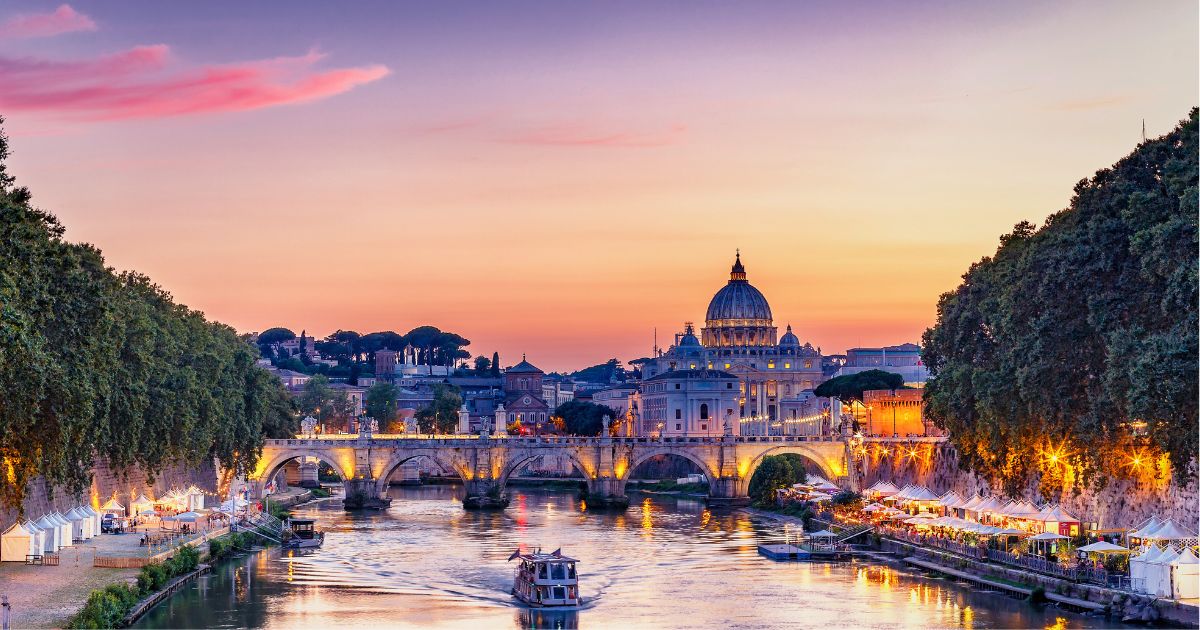
Jerez de la Frontera: Sherry, Horses and Flamenco

TL;DRJerez de la Frontera is famous for three things: fortified sherry wine, Andalusian horses and authentic flamenco — and unlike Seville, it keeps a genuine, unpolished feel. Among the 14 top tips are tastings at the Tío Pepe and Fundador bodegas, the horse show at the Royal Andalusian School of Equestrian Art, the Moorish Alcázar with San Salvador Cathedral, and the Barrio de Santiago, flamenco’s birthplace. May is best, when the Feria del Caballo festival takes over the city, or come in March, April or October for pleasant weather. One day covers the basics, but two or three nights let you dig deeper. You can reach Jerez by direct train from Seville (about an hour, €11–€15) or from Cádiz (35 minutes).

You know that feeling when you arrive in a city and instantly sense a truly authentic atmosphere that hasn’t yet succumbed to mass tourism? That’s exactly what Jerez de la Frontera is like — the uncrowned capital of Andalusian culture and one of the most rewarding destinations in Jerez Spain, where the scent of ageing wine mingles with the rhythmic clatter of horse hooves in narrow cobbled streets.

In this article, you’ll find 14 detailed tips on what to see and do in Jerez de la Frontera, and I’ll show you why you absolutely shouldn’t skip this city on your travels through southern Spain. I’ll point you to the famous bodegas for an unforgettable tasting, tell you where to experience the most passionate flamenco, and share practical advice on where to stay and the best time to visit.

Jerez is a place that has held on to its true Spanish soul without pandering to the crowds, so you’ll experience Andalusia in its purest form. Whether you’re planning a quick day trip from Seville or spending a long weekend in the area, you’re in for a real treat.

TL;DR

  • Main highlights: Jerez is world-famous for three things — fortified sherry wine, dancing Andalusian horses and authentic flamenco.
  • Top landmarks: Don’t miss the Moorish fortress Alcázar and the monumental San Salvador Cathedral, which stand just steps apart from each other.
  • When to go: May is the most spectacular month thanks to the famous Feria del Caballo, but March, April and October also offer ideal weather for sightseeing.
  • Wine tasting: Visiting at least one traditional bodega (such as Tío Pepe or Fundador) is an absolute must, even if you’re not normally a wine enthusiast.
  • Where to eat: Seek out the so-called tabancos — traditional local taverns where wine is poured straight from the barrel and served alongside superb cheeses and olives.
  • Getting there: Jerez is easy to reach by direct train from Seville or nearby Cádiz, with the journey taking roughly an hour and services running frequently. From the UK, you can fly into Jerez Airport (XRY) with carriers like Ryanair and British Airways from London.

When to Visit Jerez de la Frontera

Choosing the right time is absolutely crucial when visiting inland Andalusia, as the climate extremes here can be truly unforgiving. The best time to visit is spring, specifically April and May, when temperatures hover around a very pleasant 25°C and the city buzzes with incredible energy.

The absolute peak of the season is the Feria del Caballo in May, when the streets fill with horse-drawn carriages, women in traditional flamenco dresses, and music everywhere you turn. If you want to experience this spectacular celebration, you’ll need to book accommodation up to nine months in advance, as capacity vanishes at an astonishing pace.

On the other hand, you’d be wise to steer well clear of the summer months, as July and August bring scorching heat to Jerez, with the mercury regularly exceeding 40°C in the shade. In that kind of weather, the streets empty out completely during the day, life grinds to a halt, and sightseeing becomes more of an ordeal than a pleasure.

A fantastic alternative to spring is the autumn period from September to November, when the grape harvest takes place and the city is filled with the scent of fermenting grapes. October temperatures are still beautifully warm, but without the suffocating humidity, so you can comfortably spend entire days strolling between landmarks and lingering on outdoor terraces.

Where to Stay in Jerez de la Frontera

💡 Tip for accommodation and experiences: We love searching for stays on Booking.com, which usually offers the best cancellation policies. For tickets, tours and activities, it’s worth comparing options on GetYourGuide.

For the perfect experience, I’d recommend looking for accommodation right in the historic centre (Centro Histórico), from where all the main landmarks, wine cellars and restaurants are within easy walking distance. There’s no point wasting time commuting from the suburbs, as the real magic of the city lies in evening wanders through the narrow cobblestoned lanes.

Another excellent neighbourhood is the traditional Barrio de Santiago, widely regarded as the historic cradle of flamenco, offering a genuine local atmosphere packed with small bars. Accommodation in Jerez tends to be a little more affordable than in nearby Seville, so you can treat yourself to more luxurious hotels housed in converted aristocratic palaces without breaking the bank.

Here are three specific hotel recommendations that you can easily book through Booking — just make sure to act well in advance:

  • Hotel Bodega Tío Pepe: A truly unique experience — this elegant hotel sits right within the grounds of the most famous wine cellar and features a stunning rooftop pool with cathedral views.
  • Casa Palacio María Luisa: Five-star luxury in a beautifully restored historic palace, where classic Andalusian architecture meets impeccable service.
  • Hotel YIT Casa Grande: An affordable yet stylish choice on a quiet street just minutes from Plaza del Arenal, complete with a charming flower-filled interior patio.

14 Things to See and Do in Jerez de la Frontera

Let’s dive into the best that this fascinating Andalusian city has to offer — from world-renowned wine cellars and architectural gems to places where you can experience true artistry.

1. Bodegas Tío Pepe and a World-Class Sherry Tasting

A visit to Jerez wouldn’t be complete without touring one of the many enormous wine cellars known locally as bodegas. The González Byass complex (better known as Tío Pepe) is the most famous of them all, and you’ll spot its iconic logo — a guitar-playing figure in a hat — all over Spain.

This vast bodega essentially functions as a city within a city, with its own little streets, shady courtyards draped in grapevines, and seemingly endless rows of oak barrels. During the guided tour — which is well worth booking ahead on platforms like GetYourGuide — you’ll learn all about the unique solera ageing system that gives the local fortified wine its distinctive character.

The tour is brilliantly engaging and even includes a ride on a little tourist train, which you’ll particularly appreciate in the summer months. It all culminates, of course, in a generous tasting of different styles of sherry, from the driest and palest Fino to the sweet, inky-dark Pedro Ximénez.

💡 Insider tip: Don’t be put off if your first sip of dry sherry tastes unusual — this wine has a very distinctive flavour reminiscent of nuts and yeast. It’s best enjoyed well chilled and paired with quality green olives or mature manchego cheese.

2. The Royal Andalusian School of Equestrian Art

Right after wine, horses are the city’s second great symbol, and the Royal Andalusian School of Equestrian Art (Fundación Real Escuela Andaluza del Arte Ecuestre) is an institution of world-class calibre. This is where the finest Andalusian horses and riders train to perform breathtaking dressage feats.

The star attraction is a show called “How the Andalusian Horses Dance”, a mesmerising spectacle combining classical dressage with traditional Spanish music and eighteenth-century costumes. Watching these majestic creatures move with effortless grace to the rhythm of flamenco is a profoundly moving experience, even if you have zero interest in equestrianism.

If you can’t make it on a show day, I’d recommend attending at least one of the morning training sessions, which are open to the public at a reduced admission price. You’ll get a behind-the-scenes peek, explore the beautiful stables, visit the carriage museum and watch the masters at their daily work.

Tickets for the main show sell out weeks in advance, so don’t leave your online purchase to the last minute. The entire complex is also set within a gorgeous park surrounding the Recreo de las Cadenas palace, which is worth a long stroll with camera in hand.

3. The Moorish Alcázar and Its Enchanting Gardens

While Seville and Granada have their famous palaces, Jerez boasts a beautifully preserved Alcázar dating from the 11th and 12th centuries, making it one of the oldest Moorish monuments on the Iberian Peninsula. This massive defensive fortress instantly transports you back to the era when the Almohads ruled the entire region.

Inside the thick walls, you’ll discover a fascinating complex whose crowning glory is the ancient Arab Baths (Baños Árabes), with their characteristic star-shaped skylights in the ceiling. Wander through gorgeous geometric gardens, explore the remains of an old mosque later converted into a Christian chapel, and admire the ingenious system of ancient cisterns.

One of the Alcázar’s greatest surprises is the Camera Obscura housed in the main tower (Torre de Villavicencio), which offers an unusual perspective over the entire city. Using a simple optical system of mirrors and lenses, a live 360-degree image of Jerez’s streets is projected onto a white screen.

Allow roughly two hours for the full complex, as the site is surprisingly extensive and the views from the ramparts towards the neighbouring cathedral are absolutely breathtaking. Admission is very reasonable, and unlike the more famous Alhambra, you won’t have to fight your way through endless crowds of tourists.

4. San Salvador Cathedral and Its Mix of Styles

Directly opposite the Alcázar stands the monumental San Salvador Cathedral, which dominates the city’s skyline and immediately impresses with its architectural complexity. Construction began in the 17th century and continued for decades, which left a clear mark on its appearance.

Look closely and you’ll spot a fascinating blend of Gothic, Baroque and Neoclassical elements that somehow come together in a strikingly harmonious whole. The freestanding bell tower is particularly noteworthy — its lower section actually dates back to the original Arab mosque that once stood on this site.

There’s a small entrance fee that includes an audio guide, and it’s well worth paying. Inside, you’ll find soaring vaulted ceilings, beautifully carved wooden choir stalls, and a small museum housing a rare painting by the great artist Zurbarán, entitled La Virgen Niña.

💡 Insider tip: For the best photographs of the cathedral, head there just before sunset. The warm Andalusian light sets the sandstone façade ablaze in rich golden tones, creating an absolutely magical atmosphere.

5. Barrio de Santiago and Authentic Flamenco

Jerez has long been locked in a friendly rivalry with Seville and Cádiz over the title of the true birthplace of flamenco, but the locals here have no doubt that the most authentic art comes from their very own streets. The heart of this passionate phenomenon is the historic Barrio de Santiago, home to many celebrated Romani musicians and dancers.

A walk through these narrow, slightly weathered lanes offers a grittier, more unpolished side of the city. Around Plaza de Santiago, you’ll find several traditional peñas flamencas — community clubs dedicated to flamenco — where locals gather for informal performances and to share their culture.

If you’d like to experience flamenco as a visitor, the city has several so-called tablaos that host professional shows of a very high standard. The experience in a smaller, intimate venue with just one guitarist, a singer and a dancer is often far more powerful than a grand production for hundreds of people.

Remember that flamenco isn’t just about the dance — it’s above all a deeply emotional form of singing (cante jondo) that expresses grief, love and joy. Even if you don’t understand the Spanish lyrics, the sheer intensity and pain in the performers’ voices will leave a lasting impression.

6. The Feria del Caballo in May

If you have any flexibility in planning your trip, definitely consider visiting Jerez during the first half of May, when the famous Feria del Caballo (Horse Fair) takes place. It’s one of the most important and most beautiful festivals in all of Andalusia, with a tradition stretching back over five hundred years.

Unlike the famous Seville Feria, where most of the tents (casetas) are strictly private, the Jerez celebration is completely open to the public and everyone is warmly welcomed inside. Parque González Hontoria transforms into a vast fairground city of colourful tents, hundreds of thousands of light bulbs illuminate the streets, and the wine flows quite literally like water.

During the day, the horses take centre stage as hundreds of beautifully decorated carriages and riders in traditional outfits parade through the park. Women don vibrant flamenco dresses (trajes de flamenca), men wear elegant suits with wide-brimmed hats, and the whole affair feels like a painting from the nineteenth century come to life.

As evening falls, attention shifts to music, food and dancing, with celebrations routinely continuing into the early hours. Be sure to try rebujito, a refreshing cocktail of dry sherry and lemon-lime soda that will keep you going through the warm spring night.

7. Traditional Tabancos and Local Gastronomy

To truly understand the soul of this city, you need to spend an evening in the so-called tabancos. These are traditional Jerez taverns that originally served as wine dispensaries and have preserved their unmistakable rustic charm to this day, complete with wooden barrels and faded bullfighting posters on the walls.

Don’t expect fancy menus at a tabanco — the wine is often ladled straight from huge barrels with a small dipper, and the waiter chalks your bill directly onto the wooden bar. I’d highly recommend visiting the famous Tabanco El Pasaje, which has been going since 1925 and hosts spontaneous flamenco performances almost every evening.

When it comes to food, Jerez revolves around a culture of small tapas shared among friends. While most classic Andalusian specialities are heavily meat-based (the locals adore chicharrones and Ibérico ham), vegetarians will appreciate the excellent selection of premium cheeses, huge olives, traditional potato tortilla and refreshing salmorejo (a thicker cousin of gazpacho).

💡 Insider tip: Don’t arrive for dinner before half past eight in the evening. Spaniards eat very late, and if you turn up at a tabanco at seven o’clock, you’ll be sitting there completely alone and missing out on the best part — the loud, friendly atmosphere of a packed house.

lukas a lucka
Lukáš and Lucie recommend
Where to Stay in Jerez de la Frontera
4 accommodations — wellness hotels, hotels and other lodging options

8. The Historic Bodegas Fundador

While Tío Pepe is the most famous, Bodegas Fundador holds the title of the oldest wine cellar in Jerez, having been founded all the way back in 1730. If you prefer a slightly calmer, more historically immersive atmosphere away from the bigger tourist crowds, this is the perfect choice.

This complex is renowned not only for its superb sherry but above all for producing the legendary Spanish brandy Fundador. During the tour, you’ll walk through the awe-inspiring bodega La Mezquita, whose arrangement of hundreds of columns and arches genuinely echoes the famous mosque in Córdoba.

Beyond the barrels of wine, you’ll also see a fascinating collection of signatures from famous figures who have visited over the years. Alexander Fleming, Orson Welles and members of the Spanish royal family have all left their names chalked on barrels here.

Tours are often conducted in smaller groups, which leaves plenty of room for questions and a more personal experience with the guide. Naturally, everything wraps up with a tasting in a beautiful patio, where you can compare the differences between various types of aged brandy and classic sherry.

9. Mercado Central de Abastos

If you want to see everyday local life in action, head to the main city market, Mercado Central de Abastos, first thing in the morning. This stunning Neoclassical building from the 19th century, built on the site of a former convent, is brimming with colour, aromas and incredible energy.

As with any proper Spanish market, the star of the show here is incredibly fresh produce from the surrounding region. You’ll pass stalls overflowing with seasonal fruit, huge bundles of herbs, dozens of types of olives and superb local cheeses made from goat’s and sheep’s milk.

Local chefs and home cooks come here daily to shop and haggle over prices, and the noise and energy of the place are thoroughly infectious. A local speciality is the enormous fresh fish section stocked from nearby Cádiz — while we vegetarians may not appreciate it gastronomically, it’s a visually fascinating spectacle.

Make sure to visit the market during the morning, as most stalls close around two in the afternoon. I’d recommend picking up some fresh cheese, bread, olives and fruit, then heading off for a brilliant picnic in one of the city’s parks.

10. Palacio del Virrey Laserna

The historic centre of Jerez hides dozens of old noble residences, but few are as accessible and authentic as Palacio del Virrey Laserna. This magnificent Neoclassical palace has been owned by one and the same aristocratic family continuously since the 13th century.

What makes a visit here so special is the fact that tours are often led by the current owner and count himself, Mr Asís Moreno. This means you won’t get a dry textbook lecture, but rather a lively narrative packed with personal anecdotes, family secrets and fascinating details about the life of the Spanish aristocracy.

During the roughly one-hour tour, you’ll walk through grand reception rooms, a gorgeous library and private quarters filled with original antique furniture, rare paintings and tapestries. The palace doesn’t pretend to be something it’s not — it still radiates the feeling of a lived-in home rather than a sterile museum.

Don’t forget to admire the stunning interior patio with marble columns and a fountain, which once served as a cool summer retreat. Admission is around €8, and I’d recommend checking the opening hours beforehand, as the palace may be closed to the public on certain days outside peak season.

11. The Sherry Triangle (Sanlúcar and El Puerto)

Although Jerez is the capital of sherry production, it forms just one of the three points of the so-called Sherry Triangle (Marco de Jerez). Under strict regulations, authentic sherry may only be produced within the area bounded by Jerez, Sanlúcar de Barrameda and El Puerto de Santa María.

If you have a car or fancy a short bus ride, take a half-day trip to the coastal town of Sanlúcar de Barrameda. It’s here, thanks to a specific microclimate and ocean breeze, that a unique type of sherry called Manzanilla is produced — distinctively light with a characteristically salty edge.

Sanlúcar is a charming fishing town with a large historic centre and beautiful views across the Guadalquivir river towards Doñana National Park. The main square, Plaza del Cabildo, is lined with traditional cafés where you can enjoy superb coffee and tapas while watching the unhurried pace of Andalusian life.

The third point of the triangle, El Puerto de Santa María, also sits on the coast and offers gorgeous beaches as well as more famous wine cellars, including Osborne — whose iconic silhouettes of giant black bulls line motorways across Spain. Both towns make an excellent escape if the summer heat in Jerez becomes too intense.

12. Cartuja de Jerez Monastery

Roughly five kilometres beyond the city limits lies an architectural jewel that many tourists unfairly overlook. Cartuja de Santa María de la Defensión is an imposing Carthusian monastery from the 15th century and is considered one of the most significant religious monuments in the entire province of Cádiz.

The moment you arrive, you’ll be struck by its monumental Renaissance portal and richly decorated façade, a masterpiece of Andalusian Baroque. The monastery is still home to nuns, and a beautifully quiet, contemplative atmosphere prevails — a stark contrast to the bustling city streets.

This place holds great significance for another reason too — it was the monks here who, in the 15th century, laid the foundations for breeding the famous Carthusian horses (Caballo Cartujano). This is one of the purest and rarest lines of the Andalusian horse, renowned for its extraordinary elegance and trainability.

💡 Insider tip: The breeding facility for these rare horses (Yeguada de la Cartuja) is right next to the monastery and offers fascinating tours and demonstrations every Saturday morning, covering the history of this unique breed. Definitely don’t miss it if you’re more interested in animals than architecture.

13. Museo Arqueológico in the Historic Heart

If you’re a lover of ancient history, don’t miss the Archaeological Museum (Museo Arqueológico de Jerez), housed in a beautiful 18th-century palace right on Plaza del Mercado. This square sits at the heart of one of the city’s oldest neighbourhoods and exudes a distinctly medieval atmosphere.

The museum holds an extensive collection of artefacts spanning from prehistory through the Roman era to the Islamic Middle Ages. The single most prized relic is the so-called Casco de Guadalete, an incredibly well-preserved Greek bronze helmet from the 7th century BC, which was discovered by chance in the nearby river.

The exhibitions are very clearly laid out and help you understand the extraordinarily complex history of a region through which Phoenicians, Romans, Visigoths and Moors all passed before Christian kings reconquered the area. Labels are partially available in English, so you’ll be able to enjoy the visit fully.

A visit takes roughly an hour and a half, and admission is very cheap (often entirely free for EU citizens). Afterwards, I’d suggest sitting down on the adjoining little square, grabbing a coffee and simply soaking up the peaceful atmosphere of this historic neighbourhood where the typical tourist crowds rarely venture.

14. Day Trip from Seville or Cádiz

Many travellers don’t base themselves in Jerez but instead make it a day trip from the larger neighbouring cities. From a logistical standpoint, this is a very smart and easy option, as the transport infrastructure in this part of Andalusia works brilliantly.

If you’re spending your holiday in Seville, simply head to the main Santa Justa or San Bernardo station. Direct Renfe trains run to Jerez roughly every hour, the journey takes just 50 minutes to an hour, and a one-way ticket costs around €11 to €15 depending on the type of train.

It’s even closer from seaside Cádiz, where the commuter train (Cercanías) takes a comfortable 35 minutes. Jerez’s railway station is a handsome historic building decorated with ceramic azulejo tiles and sits just about 15 minutes’ walk from the very heart of the city and the main bodegas. If you’re flying in from the UK, Jerez Airport (XRY) is served by Ryanair and British Airways from London, making it remarkably easy to reach directly.

💡 Insider tip: If you’re visiting Jerez on a one-day trip, book your bodega tour and horse show tickets well in advance. These two top attractions have fixed time slots, and without a prior reservation you could easily miss out on the best experiences.

Where to Go Next from Jerez de la Frontera

Andalusia is a region that offers endless possibilities for exploration. From Jerez, you can head in practically any direction and stumble upon world-class landmarks or stunning natural scenery. If you’re planning a broader road trip, here are links to more articles full of inspiration:

Frequently Asked Questions

How many days do I need to visit Jerez?

For a basic introduction to the city, visiting one bodega, touring the Alcázar, and watching the Andalusian horse show, one full day is plenty. However, if you want to soak up the authentic atmosphere of the evening tabancos, catch a flamenco performance, and explore the surrounding wine region, I’d recommend spending two to three nights there.

Do I need to book bodega tours in advance?

During high season (spring and fall) and on weekends, reservations are absolutely essential, as famous cellars like Tío Pepe or Fundador sell out quickly. Tours also run at specific times according to language (Spanish, English, German), so buying tickets online through official websites or GetYourGuide will save you a lot of hassle.

Is the city safe for tourists?

Jerez de la Frontera is a very safe city, even for solo female travelers. As with any larger city, watch out for pickpockets in crowded areas and busy markets. After dark, you can move around the historic center without worry—it’s full of locals sitting in restaurants and bars.

Should I choose Seville or Jerez for my holiday?

Seville is magnificent, full of grand monuments and stunning architecture, but it’s also much more affected by mass tourism. Jerez, on the other hand, is smaller, more intimate, and maintains a more authentic Andalusian character with a local atmosphere. The ideal scenario is to stay in Seville and take a day trip to Jerez by train, or vice versa.

What’s the dress code for the horse show and bodegas?

Andalusia has a fairly relaxed atmosphere, so don’t worry about showing up in smart casual clothing. For the horse show and bodegas, nice shorts and a shirt are perfectly fine, but avoid beachwear or flip-flops, as Spaniards do appreciate a certain level of elegance and neatness even in everyday life.

Where can I park if I’m driving?

The historic center of Jerez is full of narrow one-way streets, and driving into it can be a nightmare for unfamiliar drivers. I recommend using the large underground car parks on the edge of the center, such as Parking Arenal or Parking Alameda Vieja, which are just a few minutes’ walk from all the main sights.

Is vegetarian food available in Jerez?

Although Andalusian cuisine is heavily meat-based, we vegetarians definitely won’t go hungry here. In traditional establishments, go for manchego cheese, cold salmorejo soup, spinach with chickpeas (espinacas con garbanzos), patatas bravas, or the excellent Spanish tortilla de patatas, which you’ll find on menus almost everywhere.

Tips and Tricks for Your Vacation

Don’t Overpay for Flights

Search for flights on Kayak. It’s our favorite search engine because it scans the websites of all airlines and always finds the cheapest connection.

Book Your Accommodation Smartly

The best experiences we’ve had when looking for accommodation (from Alaska to Morocco) are with Booking.com, where hotels, apartments, and entire houses are usually the cheapest and most widely available.

Don’t Forget Travel Insurance

Good travel insurance will protect you against illness, accidents, theft, or flight cancellations. We’ve had a few hospital visits abroad, so we know how important it is to have proper insurance arranged.

Where we insure ourselves: SafetyWing (best for everyone) and TrueTraveller (for extra-long trips).

Why don’t we recommend any Czech insurance company? Because they have too many restrictions. They set limits on the number of days abroad, travel insurance via a credit card often requires you to pay medical expenses only with that card, and they frequently limit the number of returns to the Czech Republic.

Find the Best Experiences

Get Your Guide is a huge online marketplace where you can book guided walks, trips, skip-the-line tickets, tours, and much more. We always find some extra fun there!