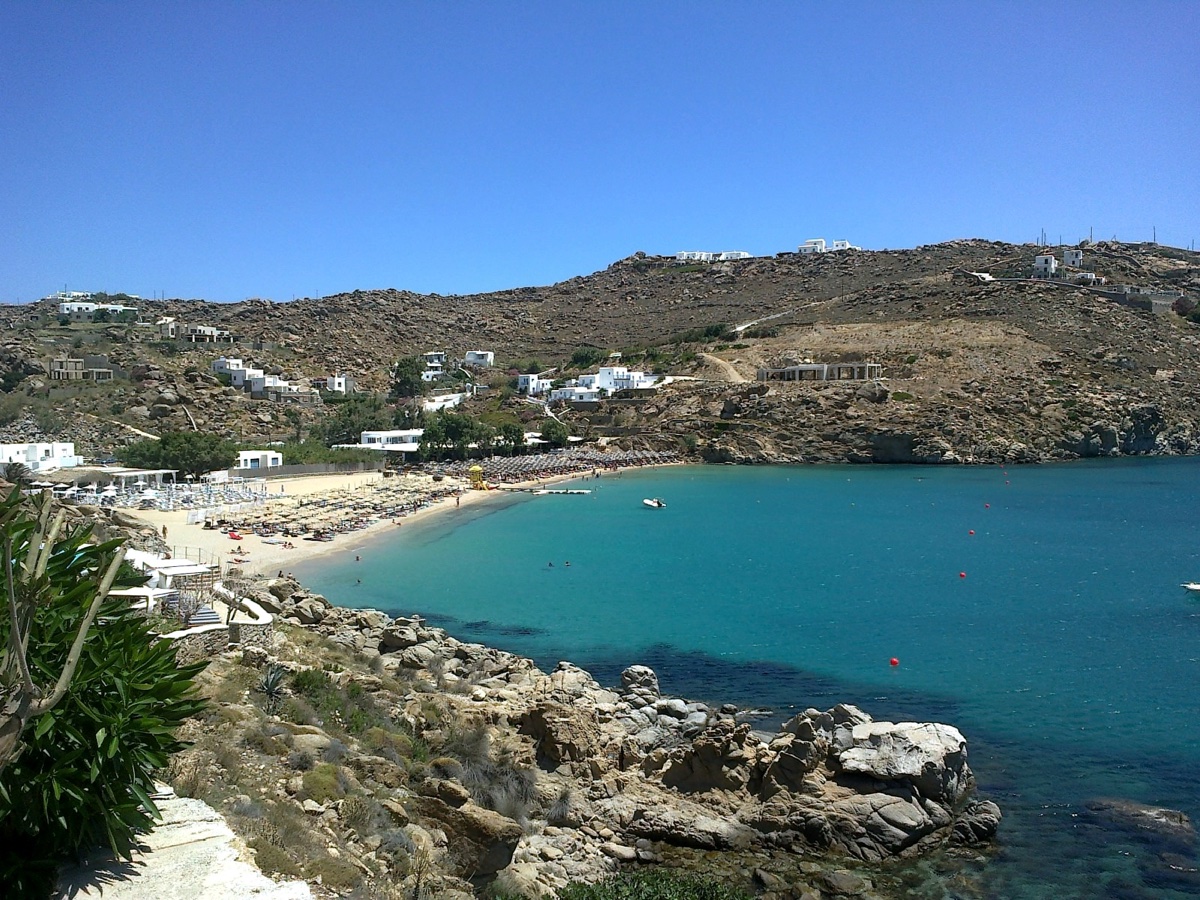
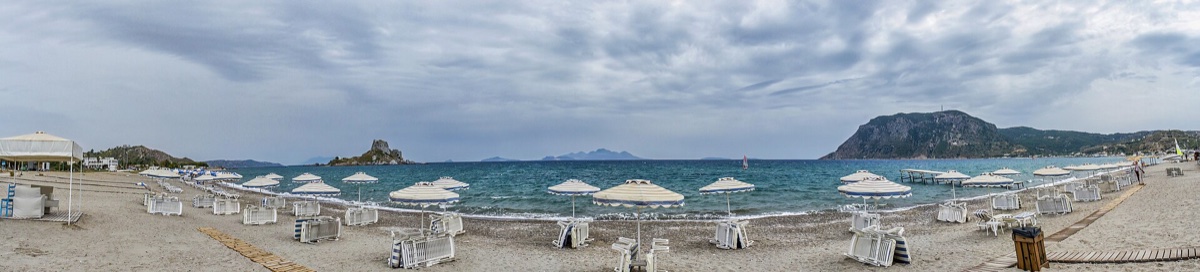
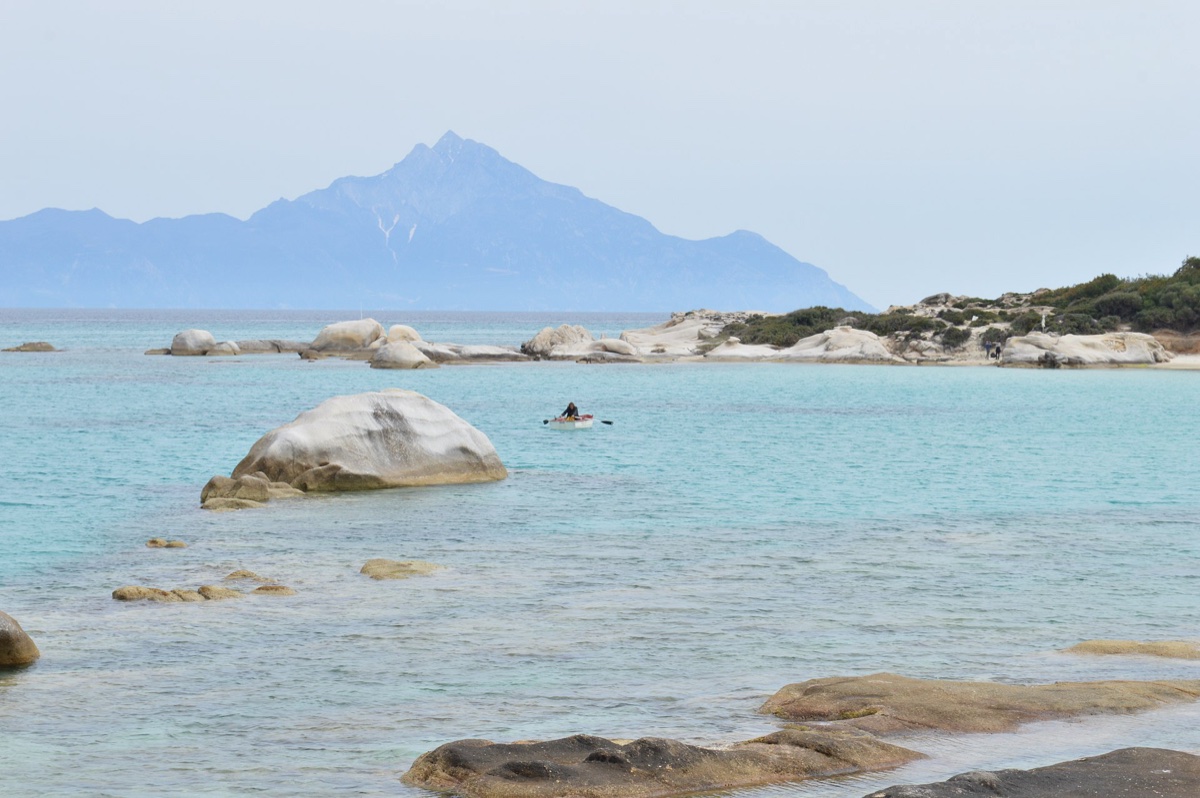
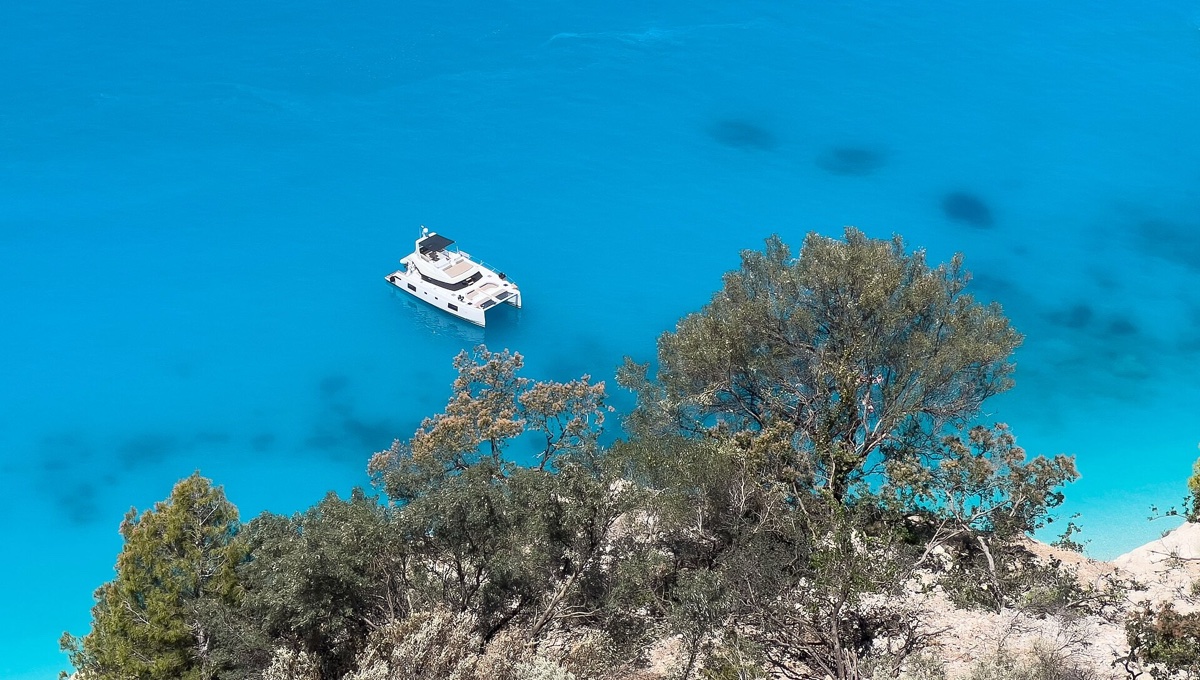
TL;DRGreek food revolves around a holy trinity: horiatiki, tzatziki and moussaka, backed up by pastitsio, stuffed gemista, and street-food staples gyros and souvlaki — souvlaki being meat grilled on skewers over charcoal, gyros carved off a spinning rotisserie. A pitta gyros will set you back 3 to 5 euros, a Greek salad or mezedes at a taverna comes to 6 to 9 euros, and dinner with starters, a main and wine runs 15 to 25 euros a head. Vegetarians are well catered for too, with fava, gigantes, dakos, saganaki or gemista orfana, followed by baklava, galaktoboureko or loukoumades for something sweet. Taverna life really only gets going after nine in the evening, and to avoid getting ripped off, steer clear of places with a tout on the door or no prices on the menu, and always ask to have your fish weighed before you order.
Mention Greece to most people and, alongside ancient columns and blue-domed churches, their minds go straight to the food. And that’s no coincidence. Greek food has a magnetic pull — the words alone generate nearly five million search queries every month from people hungry to know more about the country’s incredible gastronomy.
The secret doesn’t lie in complicated cooking techniques. It rests on the absolute freshness of ingredients, a generous pour of olive oil, and above all, the way Greeks actually eat. Food here isn’t just fuel — it’s a social event, a ritual, and the perfect excuse to sit around a table with family or friends for three hours straight.
And here’s some great news upfront — especially for fellow vegetarians: Greece is one of the most plant-friendly cuisines in the world, thanks to its abundance of vegetable mezedes, pulses, and cheese. In this guide, I’ll walk you through 20 Greek dishes you absolutely must try, along with what to order, when to eat, what to drink, and how to avoid the most common tourist pitfalls. Let’s dive in. ☺️
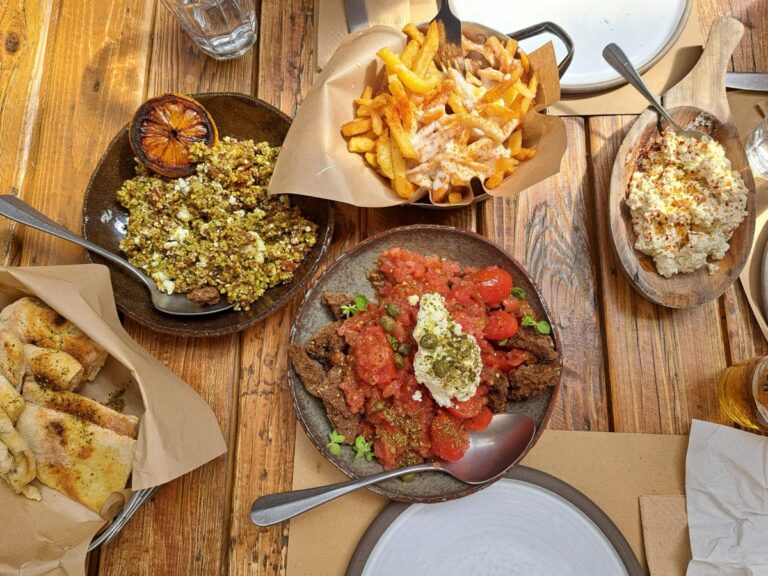
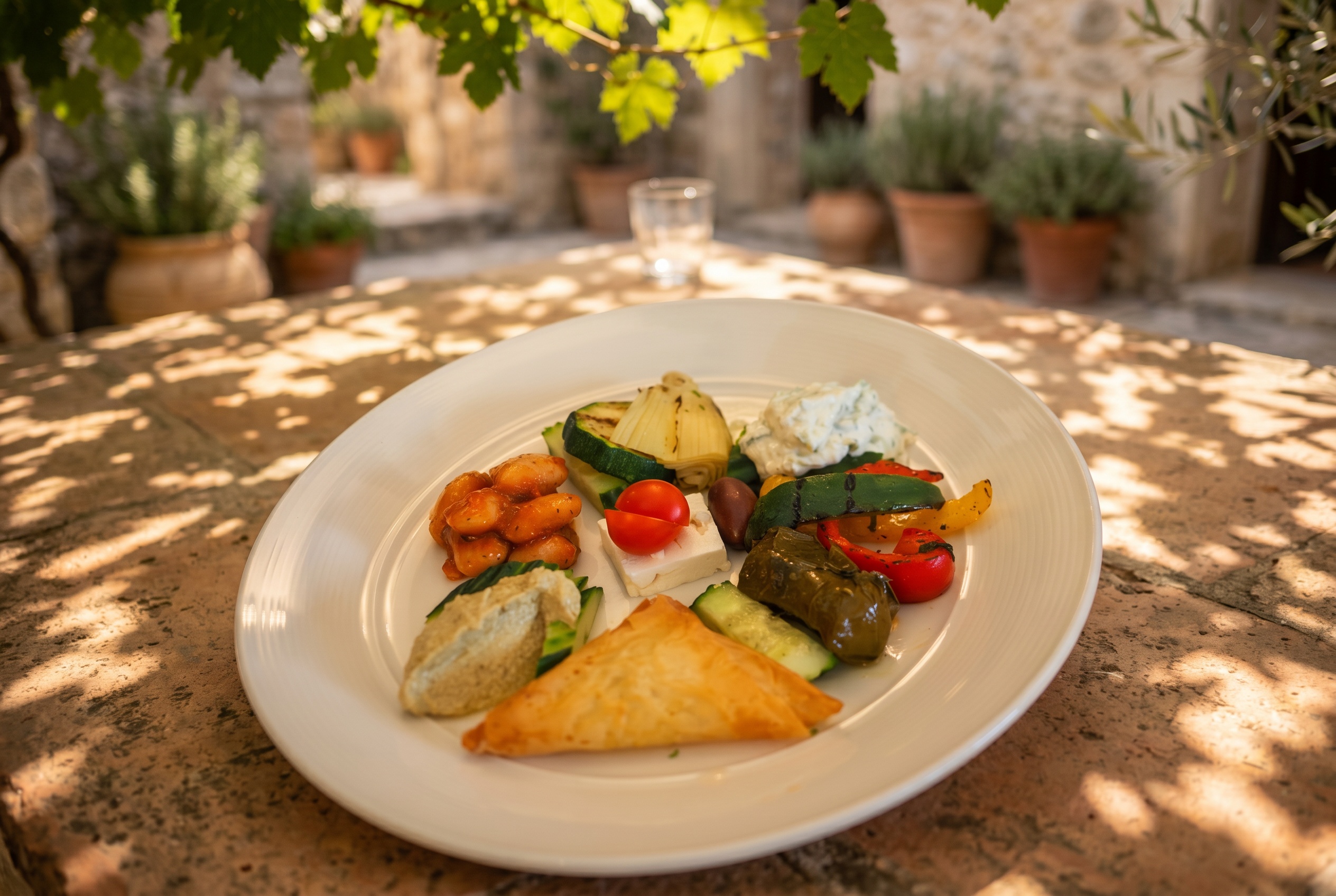
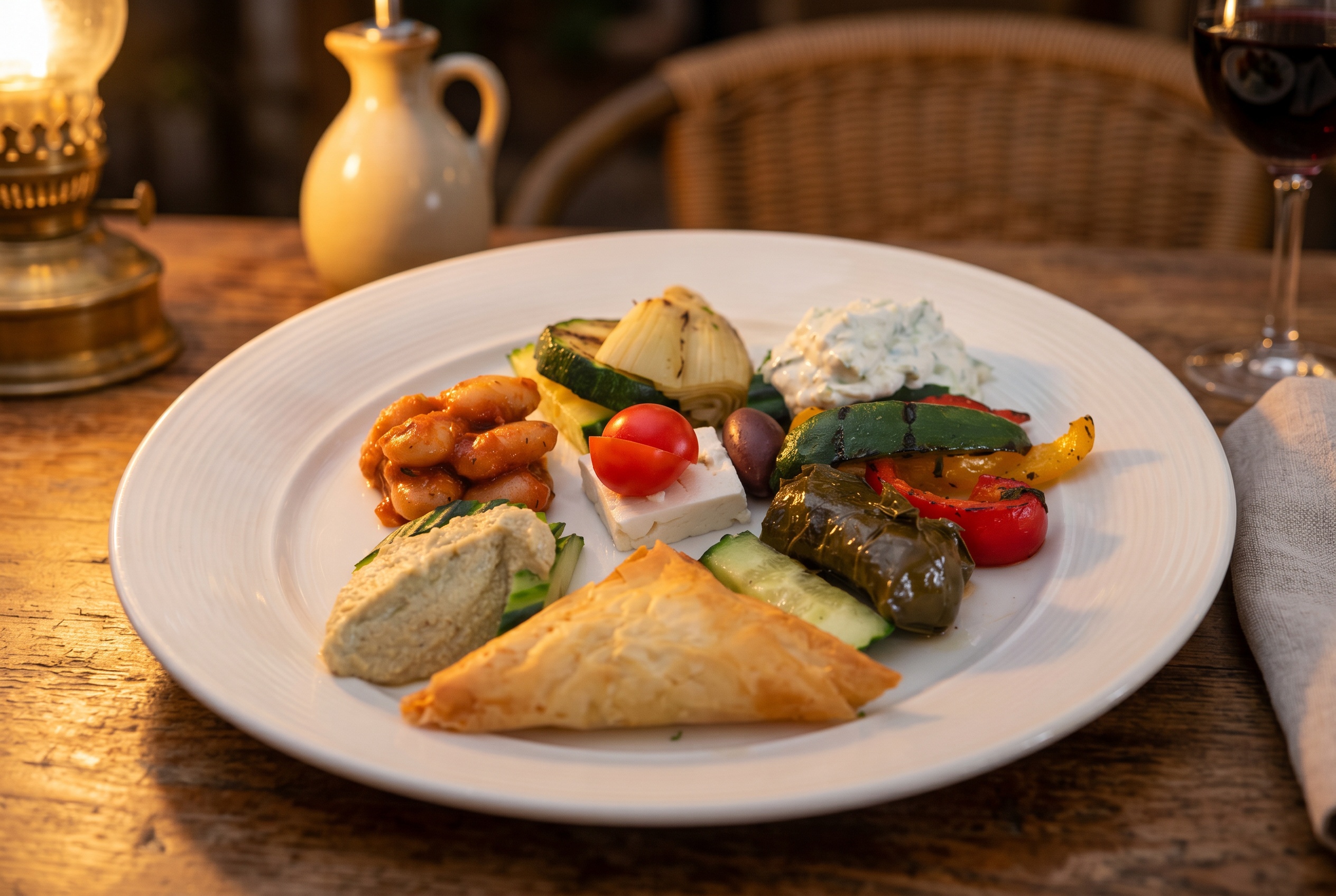
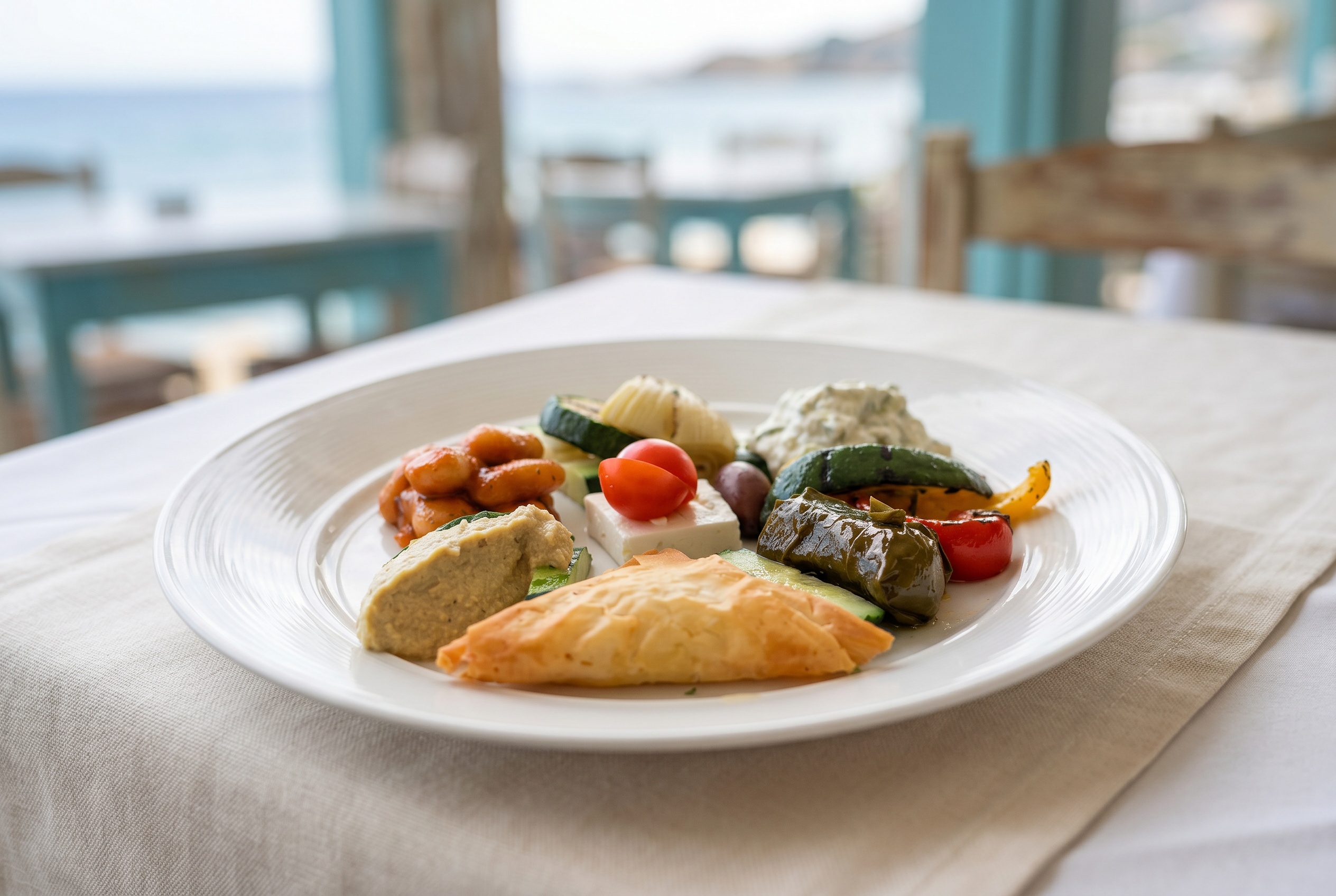
It all starts with mezedes — small sharing plates placed in the centre of the table for everyone to pick at. Order gradually, not all at once.
The holy trinity of classics: Greek salad (horiatiki), tzatziki, and baked moussaka. Add pastitsio and stuffed gemista to round it out.
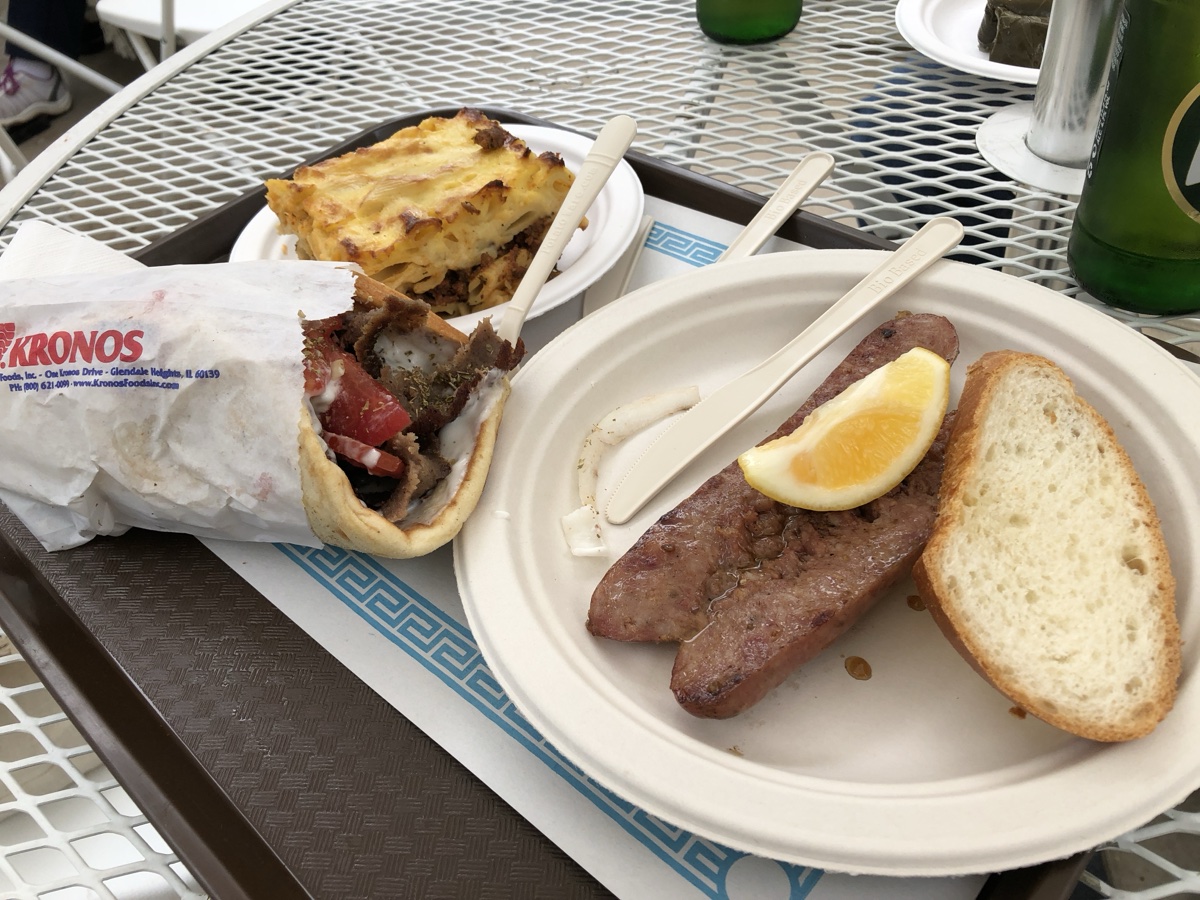
King of street food is gyros and souvlaki. People often mix them up, but there’s a real difference (explained below). Vegetarian versions are widely available today.
Vegetarians are very well catered for: fava, gigantes, dakos, meatless gemista orfana, fried saganaki cheese, and dozens of vegetable starters.
Sweet finish: baklava, galaktoboureko, loukoumades, and Greek yoghurt with honey and walnuts.
What to drink: iced frappé or freddo espresso during the day; ouzo, tsipouro, or Assyrtiko wine in the evening.
Watch out for: the bread scam, fish priced by weight, menus without prices, and restaurants with touts at the door.
Taverna Culture: How Greeks Actually Eat
Photo: Eden, Janine and Jim from New York City, CC BY 2.0, Wikimedia Commons
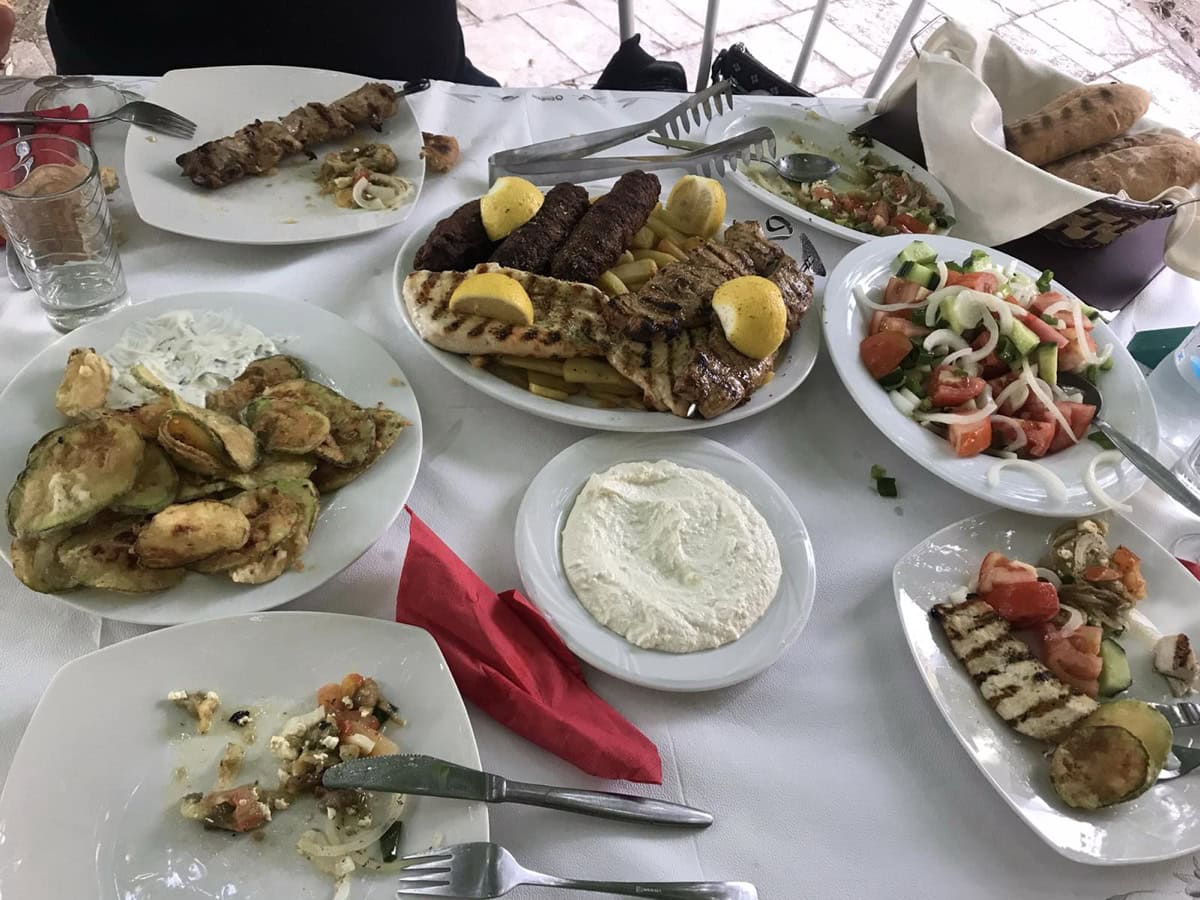
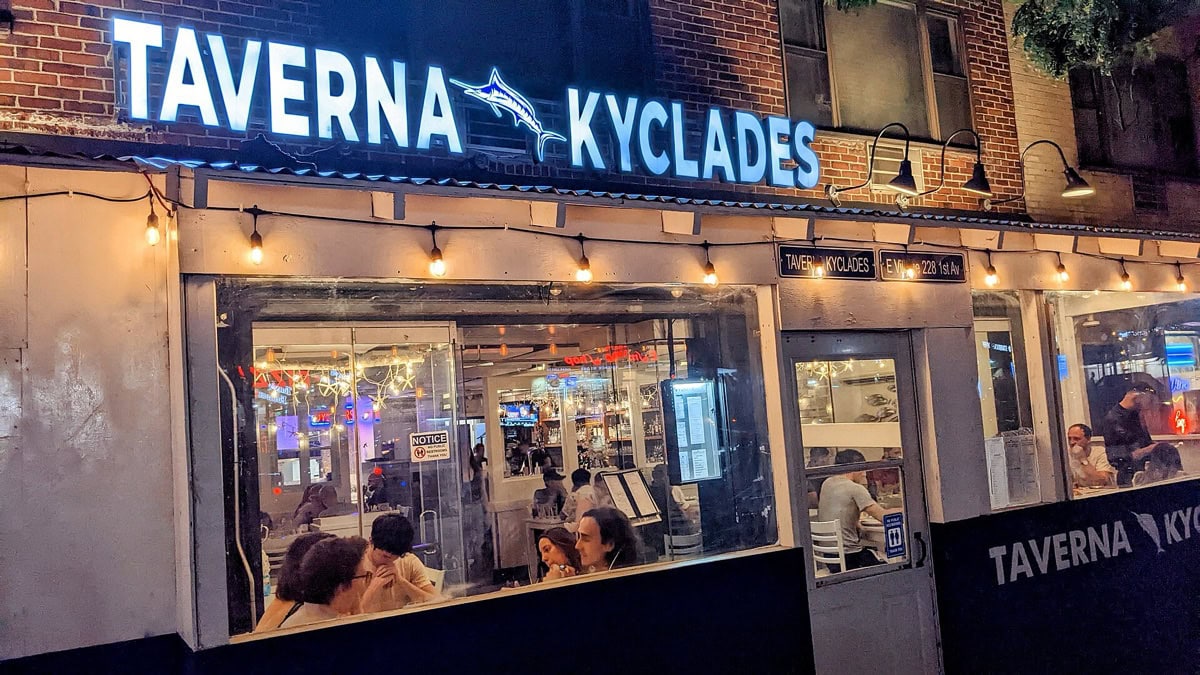
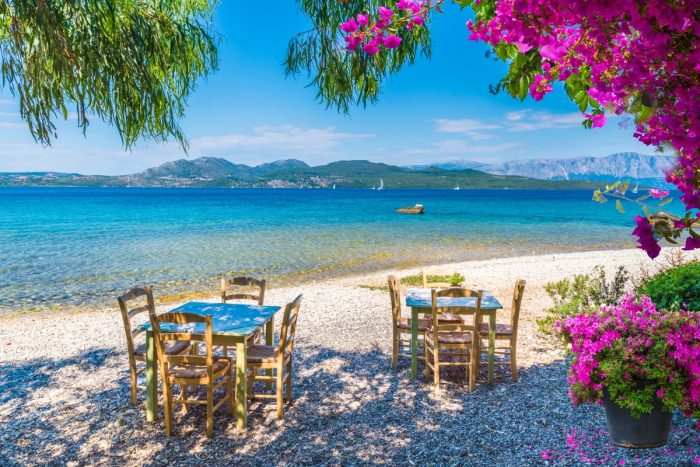
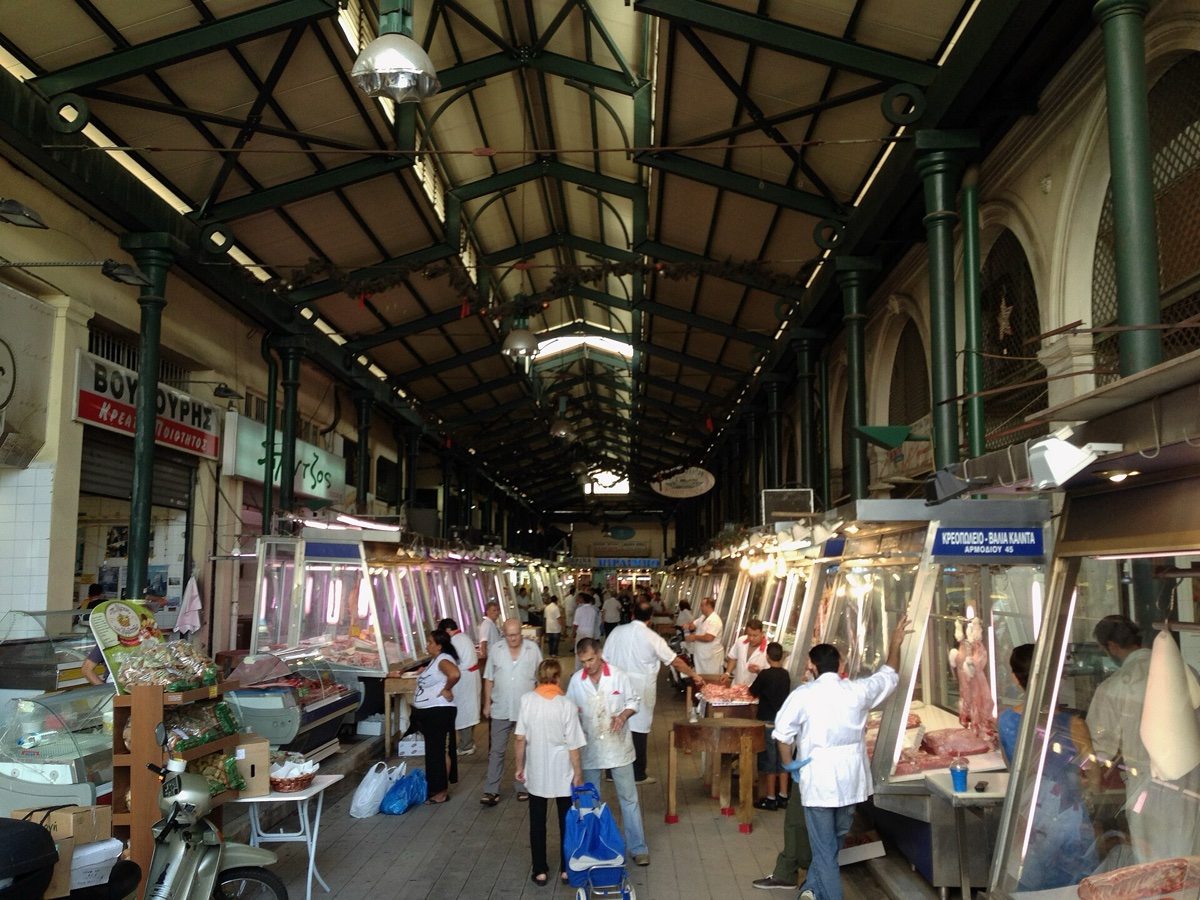
The heart of Greek dining is the taverna. Don’t expect starched white tablecloths and hushed background music, though. A proper Greek taverna is loud, smells of charcoal and sea air, and has paper tablecloths held down by plastic clips to stop them blowing away in the breeze.
The foundation of any taverna meal is the mezedes — small plates of starters and nibbles placed in the centre of the table for everyone to share, with ouzo, tsipouro, or local wine flowing freely alongside. Greeks rarely order a single main course just for themselves; they’d far rather fill the table with a spread of smaller dishes and share everything. It’s a style of eating you’ll fall in love with instantly, because it lets you taste ten different things in one sitting.
Timing matters too. Between 3pm and 6pm, many Greeks observe an afternoon break and plenty of traditional kitchens close or cook only for tourists. Real culinary life doesn’t kick off until after 9pm, so if you turn up at 7, you’ll likely be sharing the room with other tourists.
💡 Tip: As soon as you sit down in touristy areas (such as the Plaka in Athens or on Mykonos), a waiter may bring bread and bottled water without asking. This is the so-called “bread scam” and it’ll appear on your bill as a charge of €1–3 per person. The practice is technically legal, but the charge must be listed on the menu. If it isn’t, you’re perfectly within your rights to dispute it.
The Holy Trinity (and a Few More) Greek Classics
Photo: JIP, CC BY-SA 4.0, Wikimedia Commons
Before you venture into regional specialities, it’s worth mastering the absolute cornerstones of Greek cuisine.
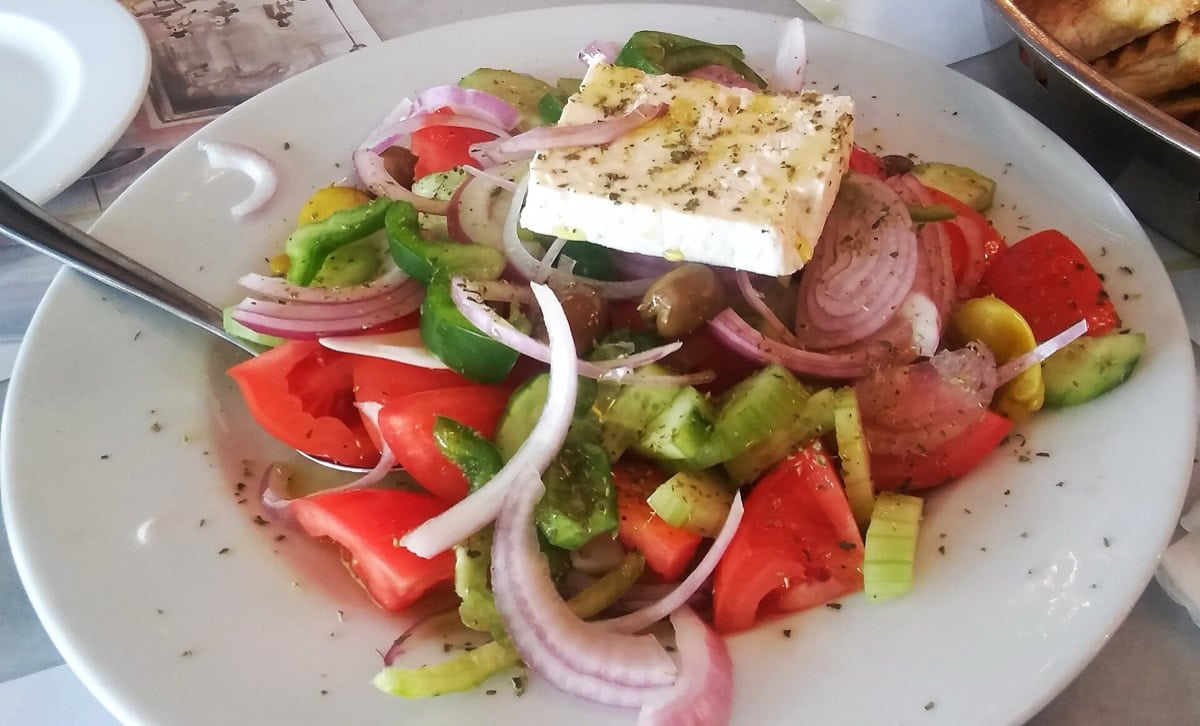
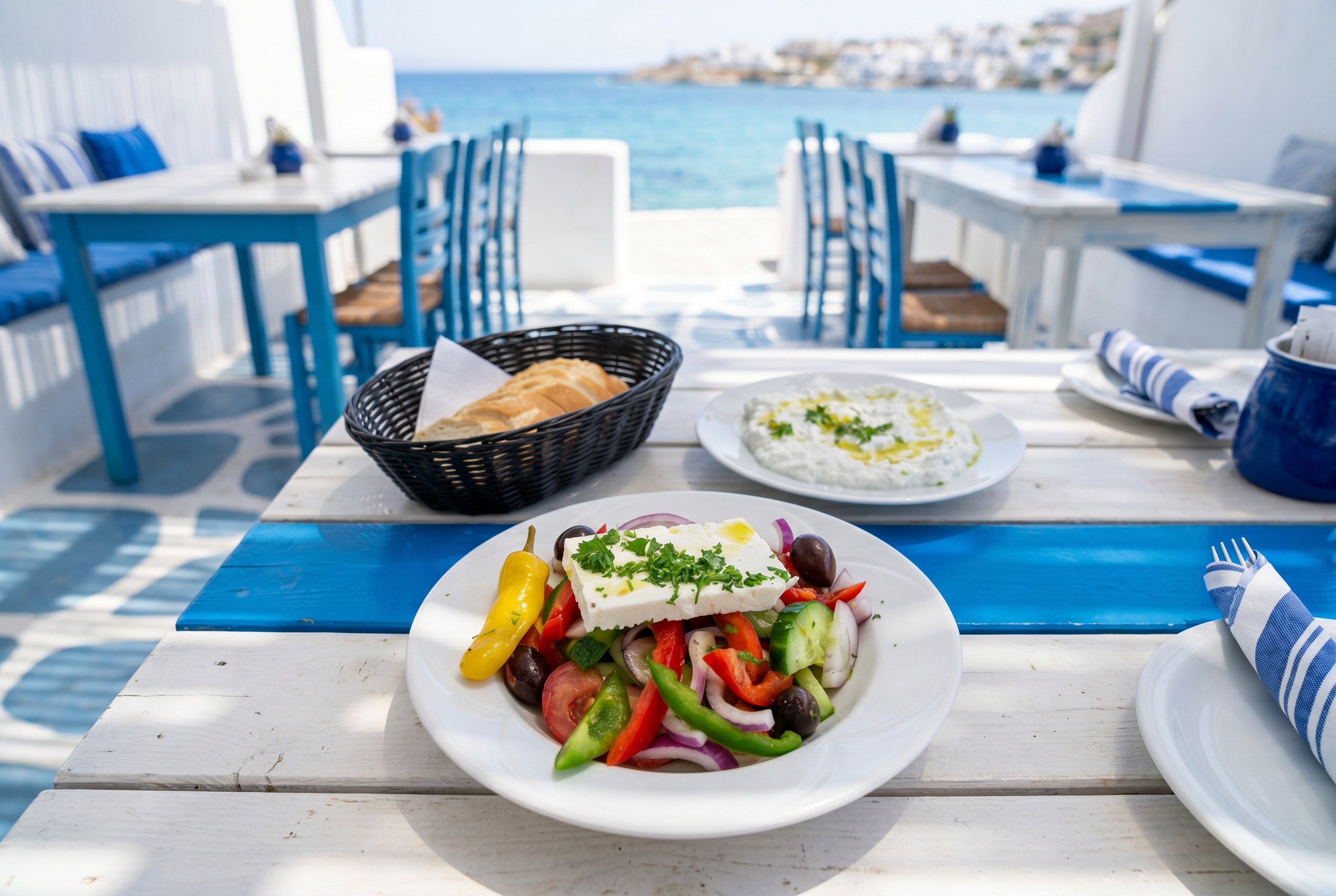
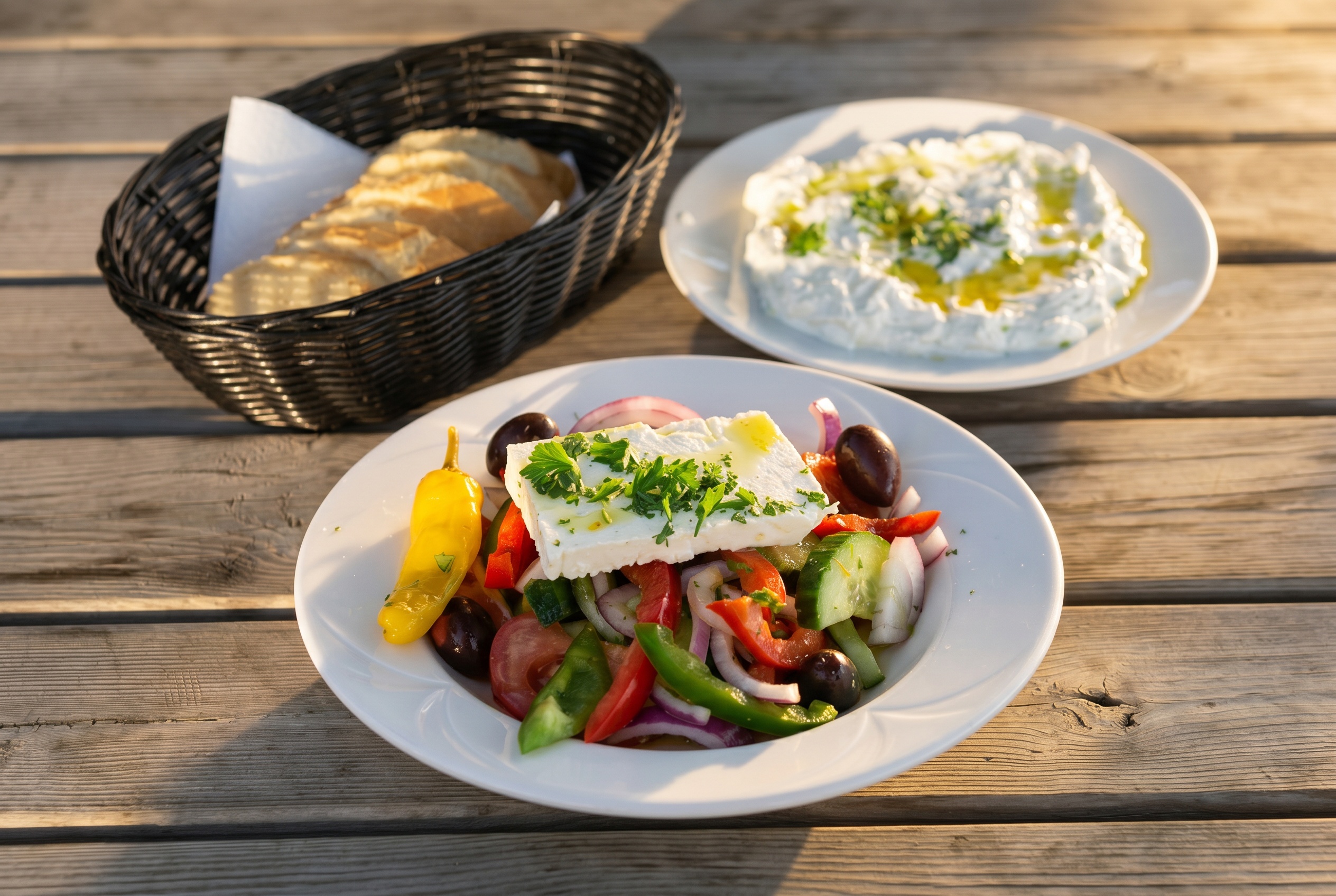
Horiatiki (Greek salad) is the ultimate pillar. It’s built from roughly chopped tomatoes, cucumbers, red onion, Kalamata olives, and green pepper, all drizzled with quality olive oil and scattered with dried oregano. In an authentic horiatiki, you’ll never find shredded lettuce, and the feta isn’t crumbled over the top — it sits as one thick slab on the crown of the salad. On a hot day, it’s one of the finest things you can eat.
Tzatziki you probably know already. Thick Greek yoghurt, grated and squeezed cucumber, plenty of garlic, olive oil, and a dash of vinegar or lemon. It’s the perfect dip for bread and vegetables alike.
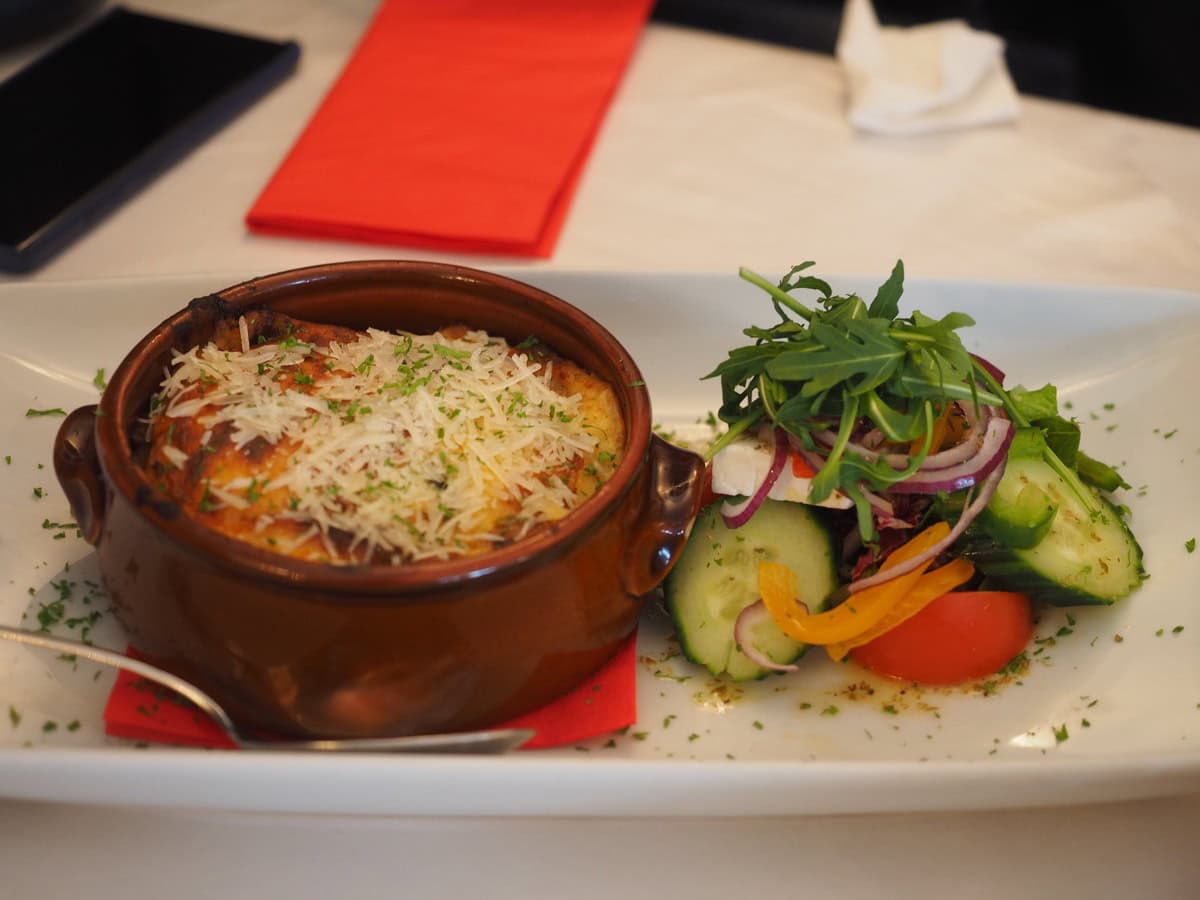
Moussaka is the iconic layered dish of aubergine, potato, and minced meat in a tomato-based sauce with a hint of cinnamon, all topped with a thick béchamel and baked until golden. Traditionally made with lamb or beef, many tavernas now serve an excellent vegetarian version with just vegetables. Its cousin, pastitsio, is essentially the Greek answer to lasagne — same concept, but using long hollow pasta tubes instead of sheets.
And then there’s gemista — large tomatoes or peppers stuffed with rice and herbs, then slowly baked in the oven. It comes in a meat version and a meatless one; the latter is called orfana, meaning “orphaned”, and it’s an absolute vegetarian classic.
Street Food: Gyros, Souvlaki, and the Difference Between Them
Photo: Sarah Stierch, CC BY 4.0, Wikimedia Commons
Greece has a rich street food tradition, and two terms dominate it — terms that travellers constantly mix up. Let’s settle this once and for all.
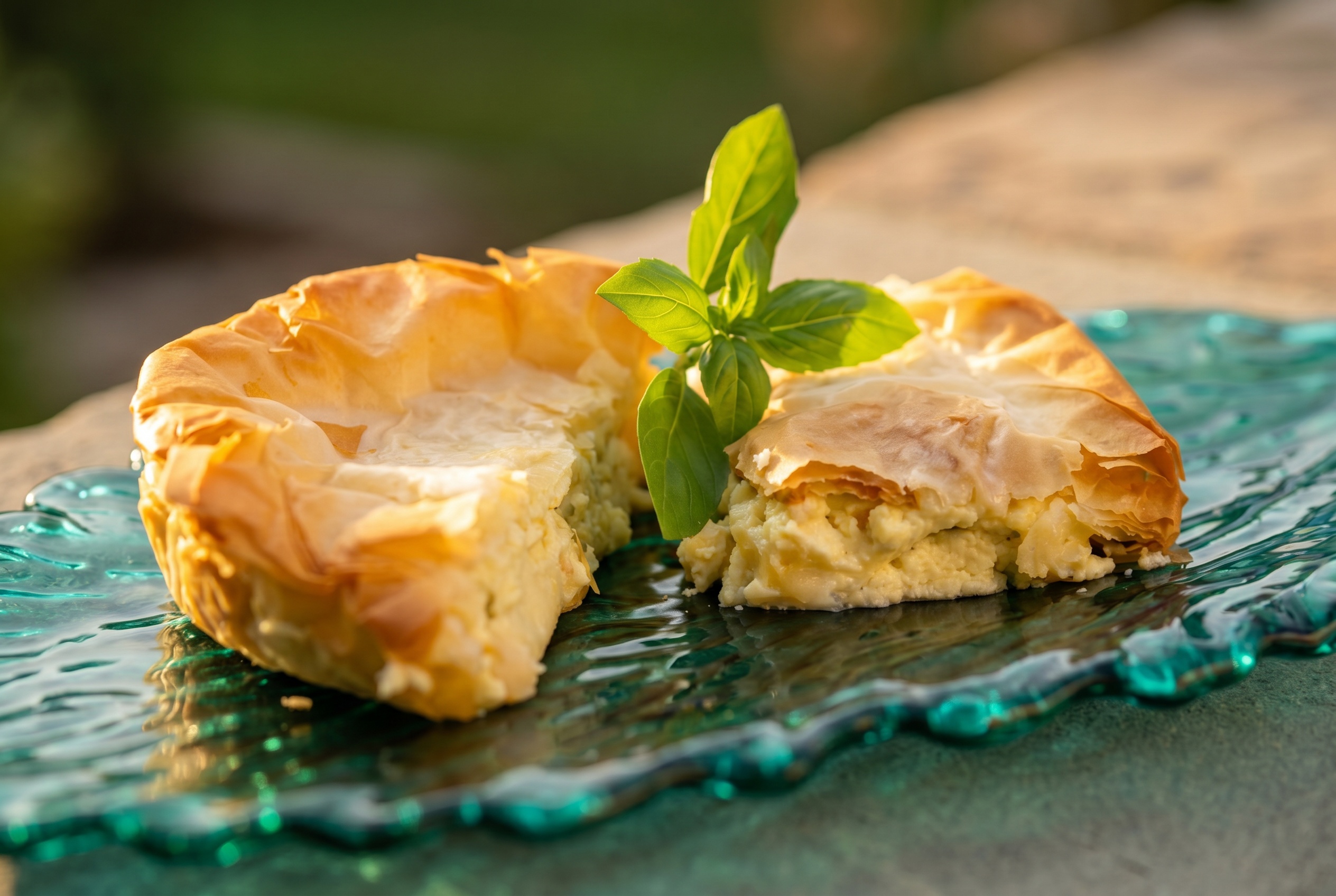
Souvlaki are small chunks of meat (usually pork or chicken) threaded onto a skewer and grilled over charcoal. They can be eaten on their own on a plate with a squeeze of lemon, or wrapped in a pitta with tomatoes, onion, chips, and tzatziki. Gyros, on the other hand, is made from thin slices of meat stacked onto a huge vertical rotisserie spit, slowly roasting and shaved off as it spins. It goes into a pitta in exactly the same way. In short: souvlaki is the skewer, gyros is the spinning spit.
For locals, this is the national fast food — and it costs just a few euros. Vegetarians needn’t despair either: plenty of places now offer gyros made with mushrooms or halloumi, and in any decent-sized town you’ll find falafel in pitta that works just as well.
Once you head inland from the coast into the mountains, a different league awaits. Tavernas up there serve paidakia (chargrilled lamb chops) and kleftiko — lamb slow-roasted in parchment paper. The name kleftiko comes from the Greek word for bandits, who supposedly used to cook stolen meat in underground pits so the smoke wouldn’t give them away. For meat lovers, these are the local legends.
Cheeses You Have to Try
Photo: Tammy Green from Chicago, USA, CC BY-SA 2.0, Wikimedia Commons
Greeks consume more cheese per person than anyone else in Europe, and honestly, we completely understand why. The lion’s share goes to feta — a salty, crumbly cheese made from sheep’s (and sometimes goat’s) milk with protected designation of origin status. Under EU rules, only cheese made in mainland Greece and on the island of Lesbos can legally be called feta.
But feta is far from the only dairy miracle the country has to offer. Graviera is a hard cheese with a sweet, nutty flavour that pairs beautifully with wine. Manouri is a soft, creamy whey cheese that finds its way into both sweet and savoury pastries.
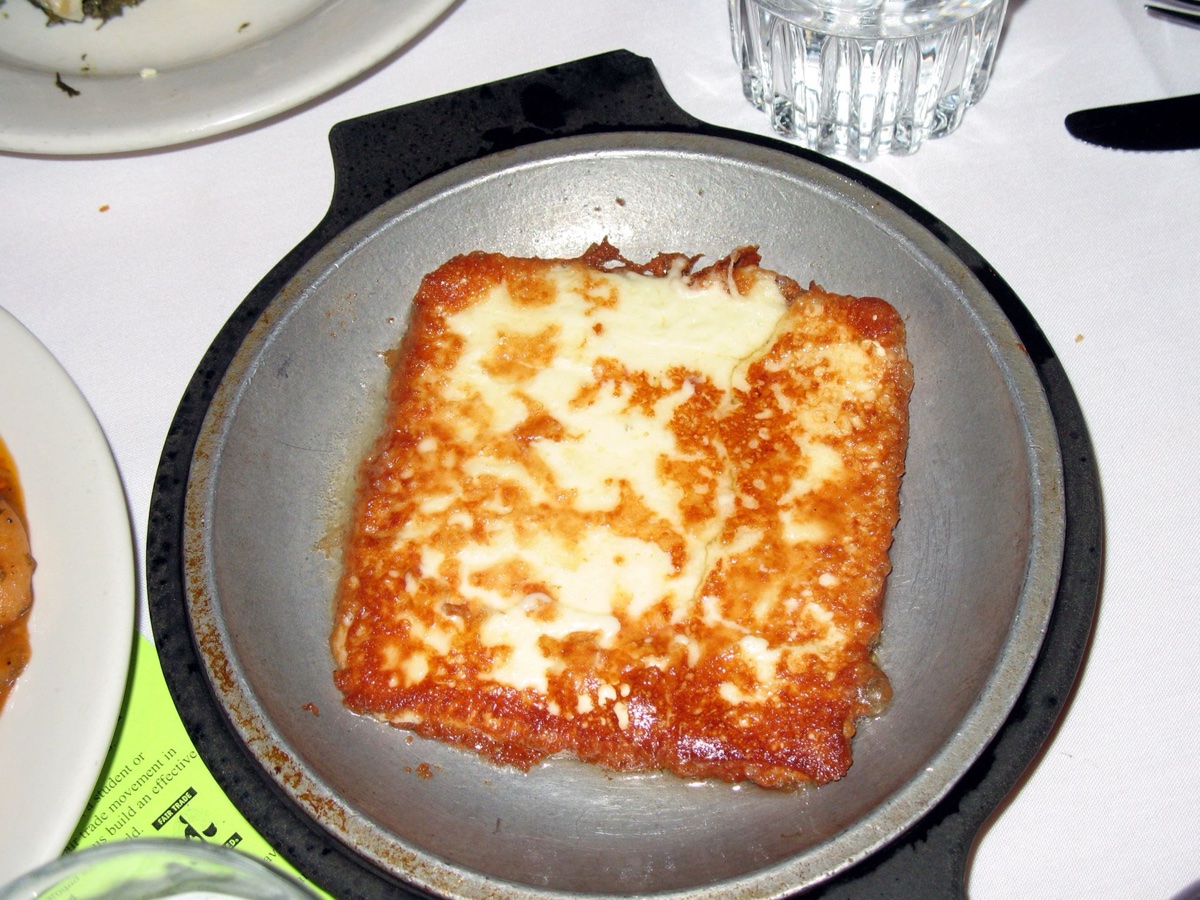
And then there’s our personal favourite: saganaki. This isn’t actually a type of cheese — it’s a cooking method. A thick slab of hard cheese is dusted in flour and fried in a very hot pan until it has a crisp, golden crust and a molten centre, then served piping hot with a generous squeeze of lemon. As a simple vegetarian starter, it’s hard to beat.
Gifts from the Sea: More Than Just Fish on a Plate
Photo: Klearchos Kapoutsis from Santorini, Greece, CC BY 2.0, Wikimedia Commons
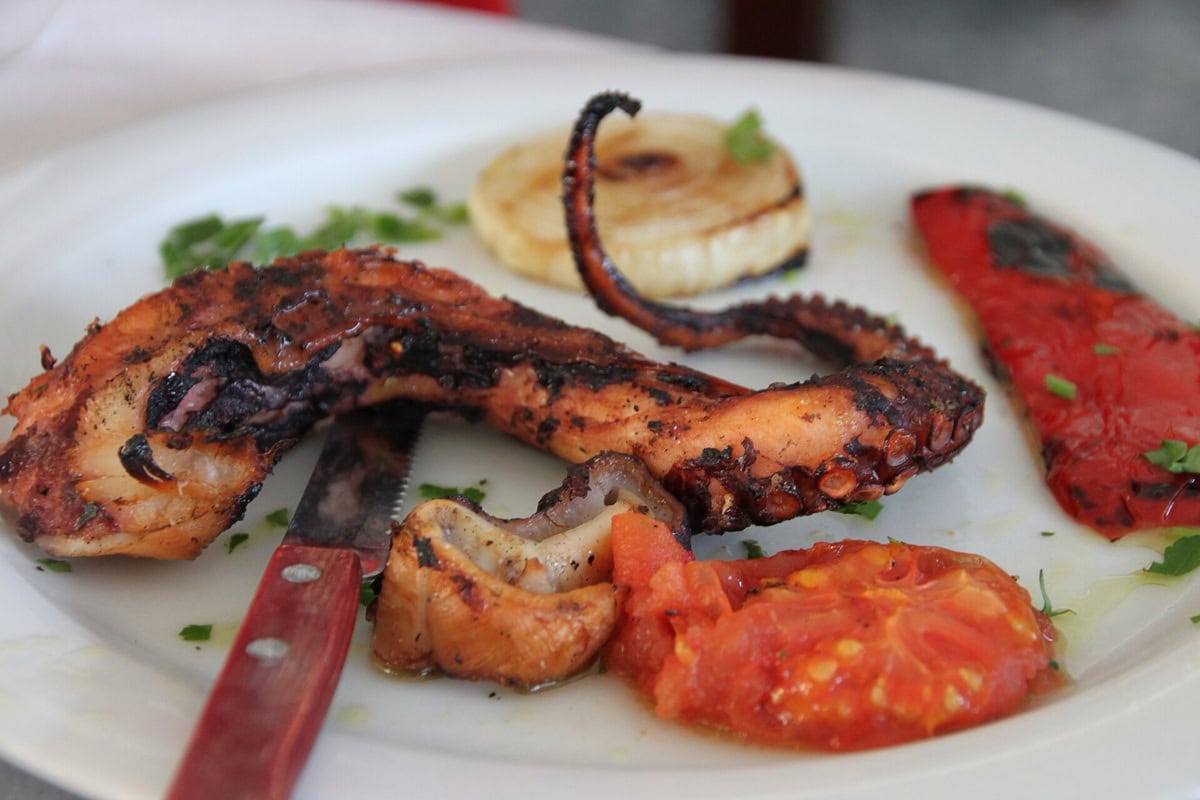
Octopus drying on a line outside a taverna like laundry is one of the most iconic images of the Greek coast. The sun draws out the moisture and intensifies the flavour before they head to the grill. Seafood is a huge deal here, for locals and visitors alike, and it’s something many people simply can’t leave the coast without trying.
Among the most popular seafood dishes: kalamarakia (fried squid rings with lemon), grilled sardines known as sardeles, and garides saganaki — prawns braised in a thick tomato sauce with feta and a splash of ouzo. For whole fish, Greeks love tsipoura (sea bream) and lavraki (sea bass).
⚠️ If you’re ordering seafood, be very careful about pricing. Fresh catches (often listed as “catch of the day”) are sold by weight, not by portion. Before you order any fish, ask to see it, have it weighed, and get the final price confirmed upfront. Otherwise the bill can come as a very nasty shock.
Regional Specialities: Every Island Tastes Different
Photo: Waldviertler, CC BY-SA 4.0, Wikimedia Commons
Greek cuisine is anything but uniform. Every region has its own traditions, local ingredients, and historical influences, so even if you travelled the whole country, you’d be eating something slightly different at every stop. Here’s a quick overview.
Region
Signature Dishes
Why Try It
Crete
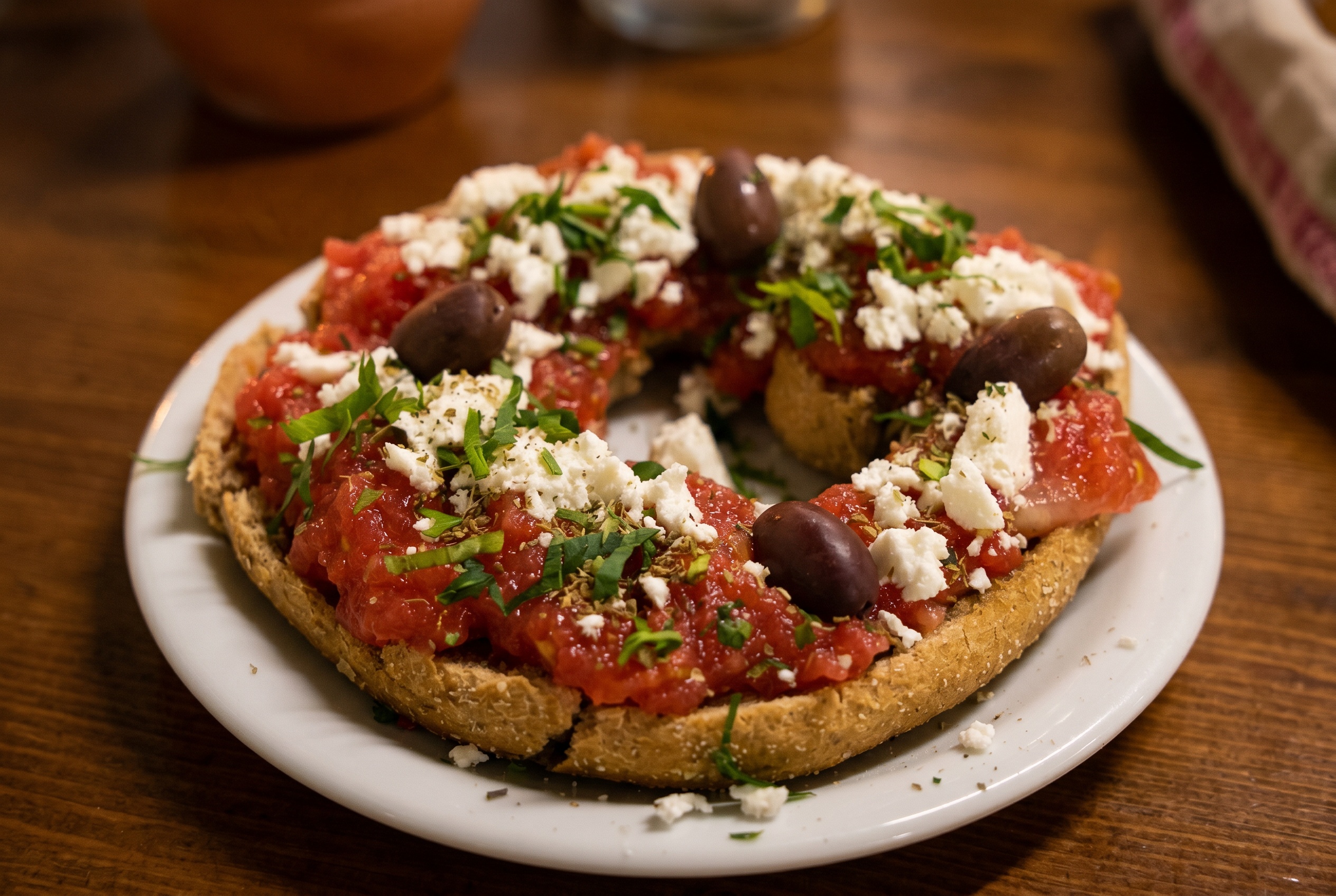
Dakos (barley rusk with tomatoes and mizithra cheese), kalitsounia (small cheese or herb pastries), raki spirit
The Cretan diet is considered one of the healthiest in the world; food here is earthy and packed with local herbs
Corfu & the Ionian Islands
Sofrito (veal in garlic sauce), pastitsada (meat with pasta), bourdeto (spicy fish stew)
These islands were never under Ottoman rule — centuries of Venetian influence shaped a completely different culinary tradition
Thessaloniki & Northern Greece
Bougatsa (filo pastry filled with custard or cheese), a distinct style of gyros, heavy spicing
Thessaloniki is Greece’s gastronomic capital, shaped by the flavours of Asia Minor refugees
Santorini
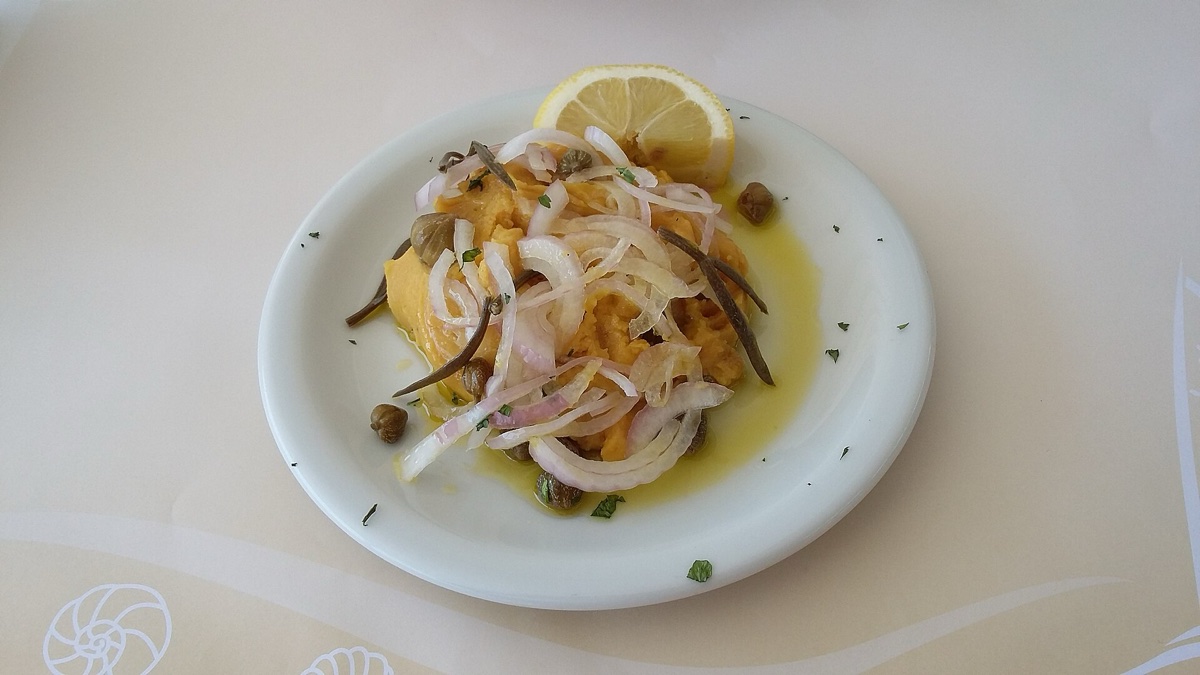
Fava (yellow split pea purée), tomatokeftedes (tomato fritters), Assyrtiko wine
The volcanic soil gives the tomatoes and vines an extraordinarily concentrated flavour
Naxos
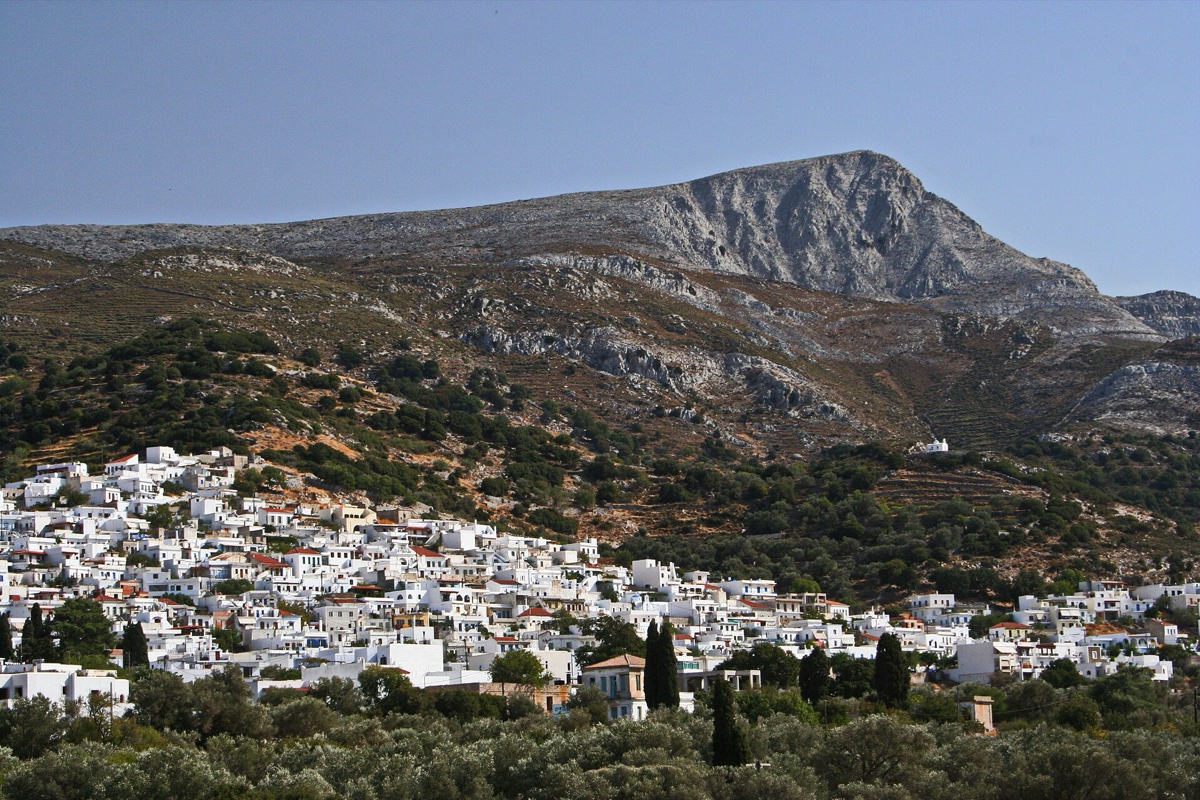
Naxian potatoes, arseniko cheese, kitron liqueur
The most fertile of the Cyclades islands, which supplies the rest of Greece with its prized potatoes and cheeses
For vegetarians, this table is something of a treasure trove. Cretan dakos, Santorini’s fava and tomatokeftedes rank among the finest things Greek cuisine has to offer — and not a scrap of meat in sight.
Lukáš and Lucie recommend
Where to stay in Greece
2 accommodations — hotels and other lodging options
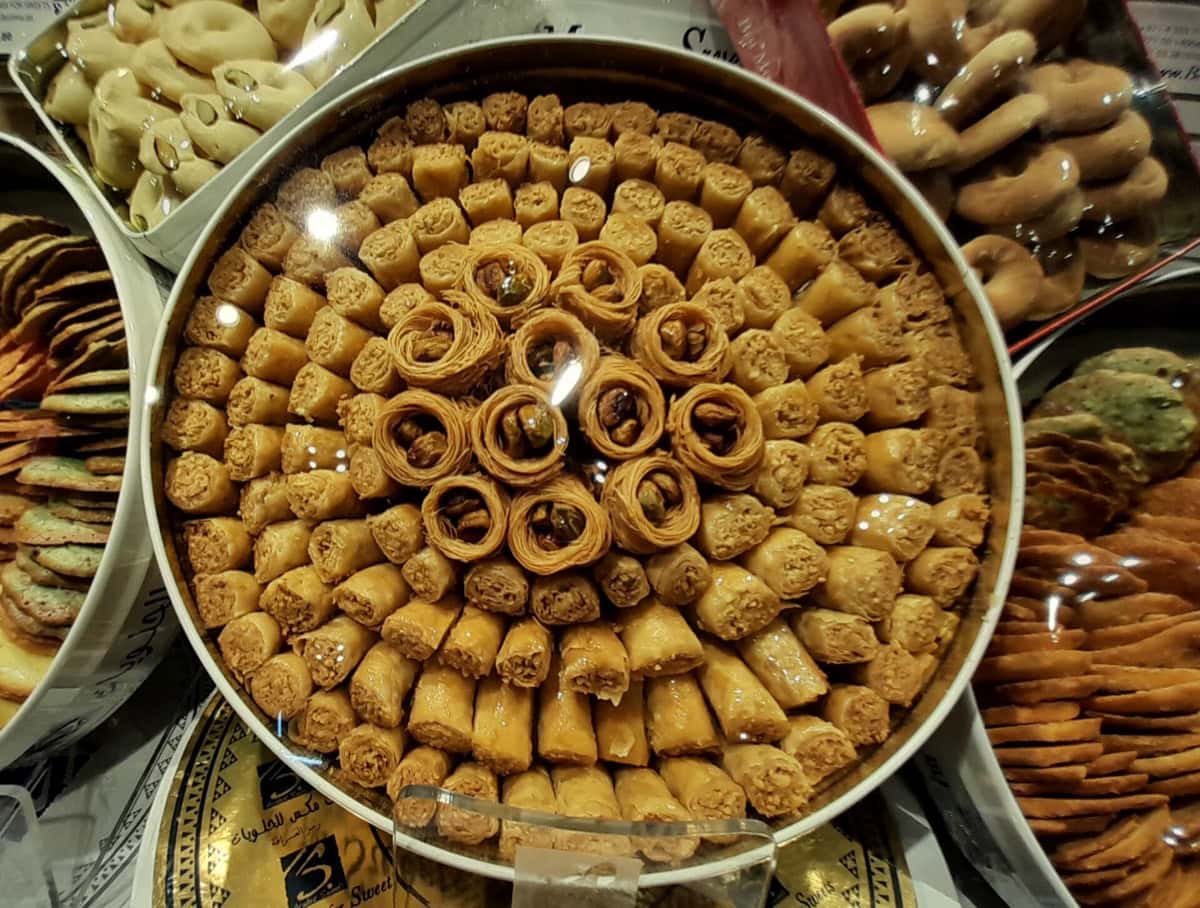
Greek desserts are rich, sticky, and ferociously sweet — honey, nuts, and paper-thin filo pastry play the starring roles in almost all of them. And we’re completely hooked.
The ultimate classic is baklava — layers of pastry with chopped walnuts, drenched in sweet syrup. Going one step further is galaktoboureko, filo pastry filled with a rich semolina custard, also soaked in syrup after baking. And fans of fried food must try loukoumades — small Greek doughnuts fried until golden, drizzled with hot honey, and dusted with cinnamon.
After something lighter? Plain Greek yoghurt with honey and walnuts works brilliantly as a dessert, and in many tavernas they’ll bring it out as a complimentary treat at the end of your meal.
What to Drink: From Frappé to Retsina
Photo: Antonio Fajardo i López, CC BY 3.0, Wikimedia Commons
Greeks are a nation of coffee lovers, though their coffee culture has its own distinct character. In summer, two national drinks dominate. The first is frappé — instant coffee shaken with water into a thick foam and served over ice, invented by accident at the Thessaloniki trade fair in the 1950s. The more modern and now wildly popular alternative is freddo espresso: a shot of espresso rapidly chilled and frothed with ice.
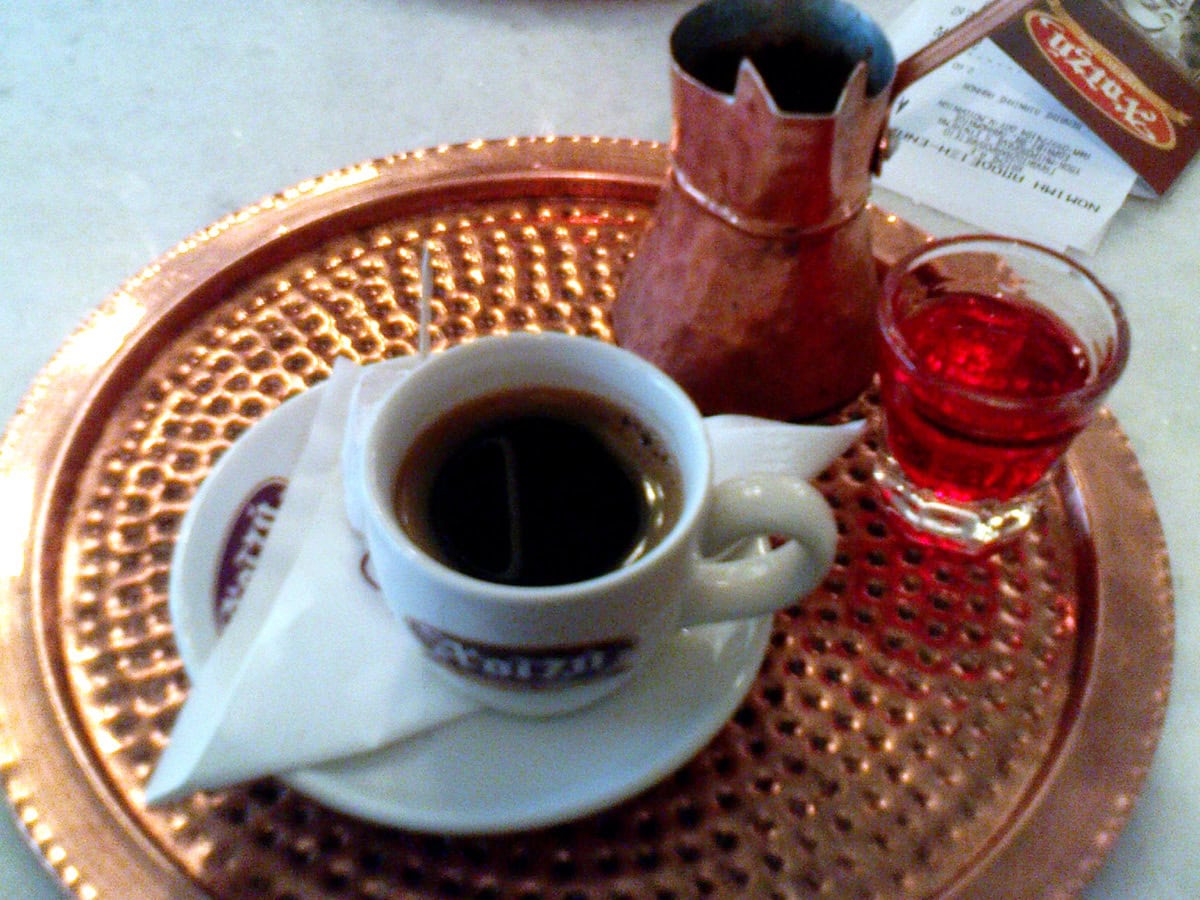
Traditional Greek coffee is brewed directly in a small copper pot called a briki, grounds and sugar included. There’s one golden rule: never stir the coffee in the cup, or you’ll disturb the sediment and end up with a mouthful of mud. ☺️
Come evening, it’s time for something stronger. Ouzo is an anise-flavoured spirit that must always be served with ice or cold water — when you add the water, it turns a milky white in a satisfying chemical reaction. A more traditional and potent alternative is tsipouro, known as raki on Crete. Greek wine is also enjoying a real renaissance, so forget cheap carton wine and seek out crisp, mineral Assyrtiko from Santorini or full-bodied red Agiorgitiko from the Peloponnese. A special case is retsina — white wine flavoured with pine resin, which you’ll either love or hate. And beer? You’ll most often find light lagers such as Mythos, Fix, or Alfa, which in the summer heat essentially do the job of water.
How Much Does Food Cost in Greece?
Photo: Scudsvlad, CC BY-SA 4.0, Wikimedia Commons
The good news is that eating well in Greece is still very affordable if you steer clear of the most tourist-heavy spots. Prices vary significantly by island — on Mykonos or Santorini, expect to pay roughly double compared to the mainland — but here’s a general sense of what to budget.
A gyros or souvlaki pitta — the classic grab-and-go street food — costs around €3 to €5 and is genuinely filling enough for a full lunch. An iced frappé or freddo espresso at a café runs about €3 to €4, while a Greek salad or a plate of mezedes at a taverna comes to roughly €6 to €9.
For a proper sit-down dinner at a family taverna — a few shared starters, a main course, and a carafe of house wine — budget around €15 to €25 per person. For that price, you’ll eat royally and probably leave feeling you’ve overdone it. Vegetarians often spend less, since vegetable starters and pulses tend to be the cheapest items on the menu.
How Not to Get Stung: Surviving the Tourist Jungle
Greece is a phenomenal place to eat, but in the most heavily visited spots — Athens, Mykonos, Santorini — it’s surprisingly easy to fall into tourist traps. A bit of common sense and a few simple rules will keep you out of trouble.
A tout outside is a bad sign. If someone is standing in the doorway with a menu, actively pulling people in off the street, walk on. A good taverna doesn’t need one.
A menu without prices means run. If they hand you a menu with no prices, or tell you they’ll “let you know the price”, get up and leave. It’s an age-old trick that ends with a €200 bill for two portions of calamari.
Eat where the locals eat. Look for places tucked away down side streets. If there’s a large Greek family at the next table arguing loudly over the food, you’re in exactly the right place.
Order gradually. Don’t let them bring everything at once. Greeks have starters, eat them, sip their wine, and only then order the next round. Waiters are used to this pace — don’t feel rushed.
A Mini Greek Food Glossary
Knowing a handful of basic phrases will go a long way in any taverna. Locals genuinely appreciate the effort and you’ll often find the welcome becomes noticeably warmer.
Kalimera – Good morning / good day
Kalispera – Good evening
Efcharistó – Thank you
Parakaló – Please (also “you’re welcome”)
To logariasmó, parakaló – The bill, please
Nero – Water
Krasi – Wine (lefko = white, kokkino = red)
Yamas! – Cheers!
Where to Eat and Where to Stay
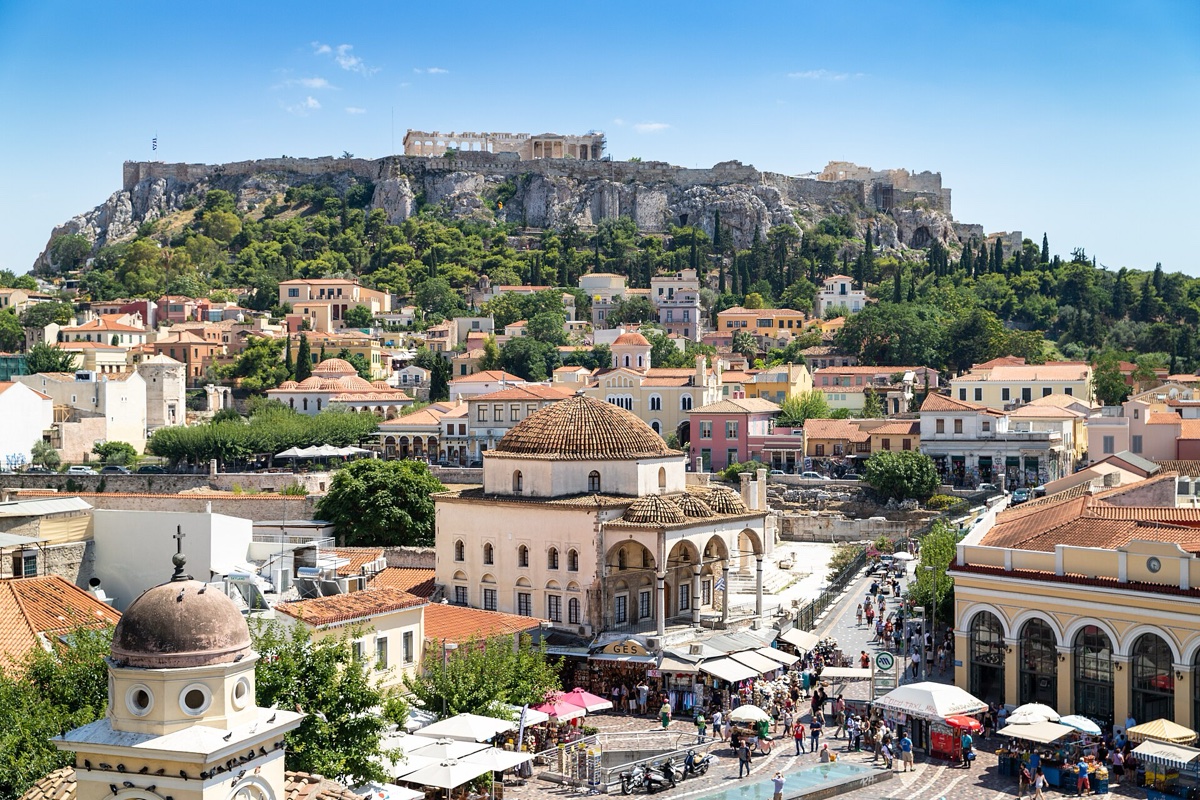
The best rule for finding a great taverna is to wander away from the main tourist drags and watch where the locals congregate. In Athens, neighbourhoods like Psyri and Koukaki are worth seeking out; on the islands, head to inland villages where the food tends to be better and considerably cheaper than on the beach.
💡 Accommodation and experiences tip: We usually book accommodation through Booking.com, which tends to offer the most flexible cancellation policies. And if you want to truly get under the skin of Greek cuisine, a food tour or cooking class with locals is well worth it — you can find and compare the best options on GetYourGuide.
Accommodation in Athens starts from around €60 per night; on the islands, prices climb higher in peak season. Wherever you’re headed, book early — the best-value spots with a great price-to-quality ratio go fast.
Further Reading
Before you head off to eat your way around Greece, check out our other articles on the country:
The most typical Greek dishes include Greek horiatiki salad, tzatziki dip, baked moussaka, street food gyros and souvlaki, and stuffed vegetables gemista. Olive oil and feta are essential, along with dozens of small appetizers called mezedes that are shared at the table. As the national fast food, gyros in pita takes the lead.
What can vegetarians eat in Greece?
Greece has one of the most vegetarian-friendly cuisines around. You can safely enjoy Greek salad, tzatziki, fried saganaki cheese, stuffed gemista orfana, Santorinian fava, Cretan dakos, gigantes beans, or stuffed grape leaves dolmades. For street food, you can now find gyros made with mushrooms or halloumi, and the ubiquitous falafel in pita.
What’s the difference between gyros and souvlaki?
Souvlaki are small pieces of meat skewered and grilled over charcoal, while gyros is prepared from thin slices of meat stacked on a large rotating vertical spit, from which it’s gradually shaved off. However, both are wrapped exactly the same way in pita with tzatziki, tomatoes, and fries. Simply put: souvlaki is a skewer, gyros is a spit.
What do Greeks eat for breakfast?
A traditional Greek breakfast is light. It typically consists of fresh bread, Greek yogurt with honey and nuts, seasonal fruit, and coffee. Bougatsa is also popular—crispy filo pastry filled with sweet custard or cheese, eaten mainly in the northern part of the country. A hearty breakfast with eggs and bacon is more of an exception found in tourist hotels.
What do people drink in Greece?
During the day, iced coffees like frappé and freddo espresso reign supreme, along with traditional Greek coffee brewed in a briki pot. In the evening, Greeks sip anise-flavored ouzo or tsipouro spirit (called raki on Crete), both served with ice and water. Wines worth trying include white Assyrtiko from Santorini, red Agiorgitiko, or resin-flavored retsina. The most popular beer is Mythos.
How do you avoid getting ripped off at restaurants in Greece?
Avoid establishments with touts outside the entrance and menus without listed prices. Fish and seafood are sold by weight, so always have your catch weighed and agree on the price beforehand. Watch out for the ‘bread scam’—unsolicited bread and water added to your bill. And most importantly, eat where the locals eat, not where they’re trying to lure you in from the street.
How do you say thank you in Greek?
Thank you in Greek is efcharistó. A few other words that will delight people in a taverna are kaliméra (good morning), kalispéra (good evening), parakaló (please), and yamas (cheers). Greeks are pleased when a foreigner at least tries to speak their language, and they’ll often repay you with a warmer attitude.
Tips and Tricks for Your Vacation
Don’t Overpay for Flights
Search for flights on Kayak. It’s our favorite search engine because it scans the websites of all airlines and always finds the cheapest connection.
Book Your Accommodation Smartly
The best experiences we’ve had when looking for accommodation (from Alaska to Morocco) are with Booking.com, where hotels, apartments, and entire houses are usually the cheapest and most widely available.
Don’t Forget Travel Insurance
Good travel insurance will protect you against illness, accidents, theft, or flight cancellations. We’ve had a few hospital visits abroad, so we know how important it is to have proper insurance arranged.
Where we insure ourselves: SafetyWing (best for everyone) and TrueTraveller (for extra-long trips).
Why don’t we recommend any Czech insurance company? Because they have too many restrictions. They set limits on the number of days abroad, travel insurance via a credit card often requires you to pay medical expenses only with that card, and they frequently limit the number of returns to the Czech Republic.
Find the Best Experiences
Get Your Guide is a huge online marketplace where you can book guided walks, trips, skip-the-line tickets, tours, and much more. We always find some extra fun there!
TL;DRThe best Greek beaches for 2026 include icons like Elafonissi and Balos on Crete, dramatic Myrtos on Kefalonia, moon-like Sarakiniko on Milos and the symmetrical curve of Voidokilia in the Peloponnese, while the famous Navagio on Zakynthos stays closed for 2026 because of landslides. Under a new law, at least 70% of every beach has to stay free of sunbeds, which cost 5–15 euros a day on quieter islands and upwards of 100 euros on Mykonos. Families will love the shallow waters of Agios Georgios on Naxos or Tigaki on Kos, party-goers head for Super Paradise on Mykonos, and if you want to dodge the crowds, try Simos on Elafonisos or Vai, with its palm grove, on Crete. Greece currently has 623 Blue Flag beaches, and on the Ionian islands it’s worth packing water shoes for the pebbles and sea urchins.
Close your eyes and picture the perfect holiday — chances are you’re imagining turquoise water and an endless stretch of white sand or pebbles baking in the sun. You’re definitely not alone. The best beaches in Greece are searched for hundreds of thousands of times every month, and it’s no wonder. Greece has literally thousands of them and consistently ranks second in the world for Blue Flag awards, currently holding around 620.
Finding your dream cove, though, isn’t as simple as jabbing a finger at a map. Some of the most famous beaches are now groaning under the weight of crowds, others have been closed by nature itself, and still others have been quietly hijacked by overpriced beach clubs where two sunbeds cost more than your flight.
That’s why this honest guide exists. I’ll walk you through 20 of the most beautiful Greek beaches, sorted by what you actually want from your holiday — alongside the practical rules for 2026 (sunbeds, the closed Navagio, the new beach law) and a handy summary table at the end. Let’s dive in. ☺️
Postcard-perfect iconic beaches: Elafonissi (pink sand), Balos (lagoon), Myrtos, and Sarakiniko. Stunning, but often packed — arrive early to make the most of them.
Watch out for Navagio (Shipwreck Beach) on Zakynthos: it’s still closed for 2026 due to ongoing rockfalls. You can’t set foot on the sand or swim near the wreck — views from a boat or the clifftop lookout are your only options.
Families with children will love the shallow, calm waters of Agios Georgios (Naxos), Tigaki (Kos), and Golden Beach (Thassos).
Party from afternoon till dawn at Super Paradise (Mykonos), Paradise Beach (Kos), and Kavos (Corfu).
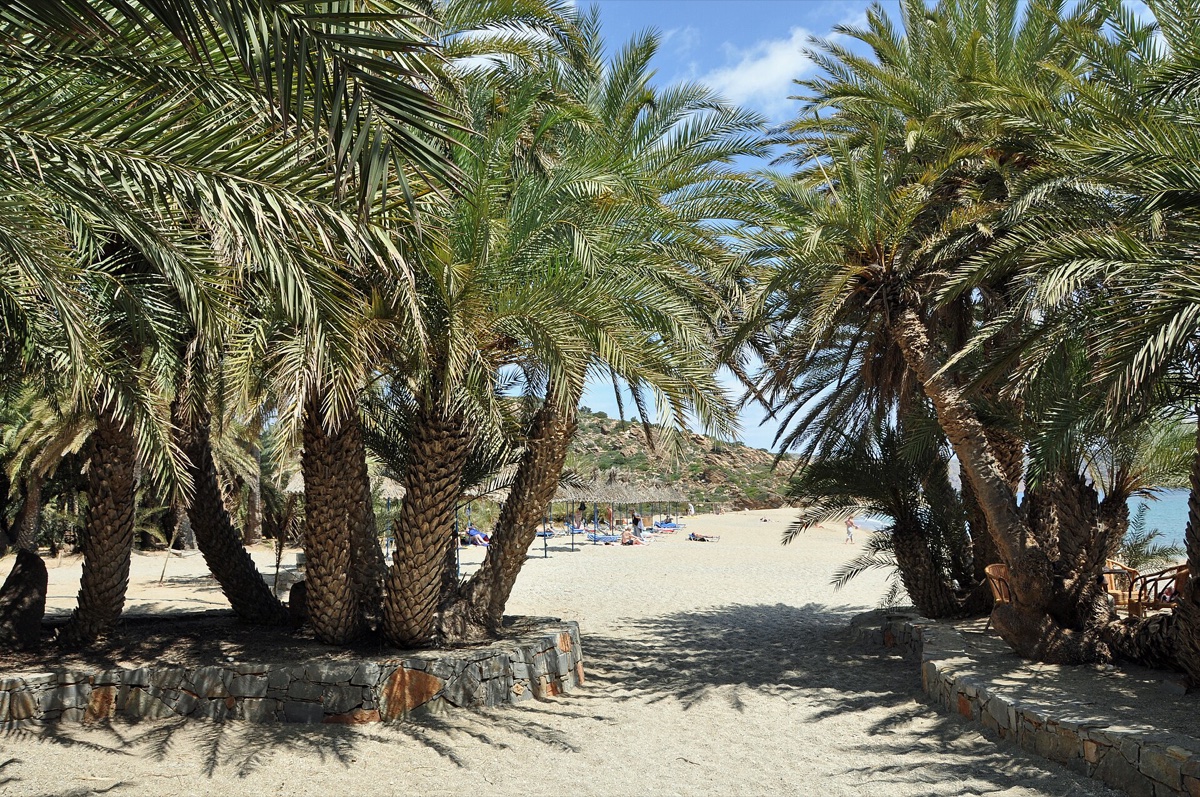
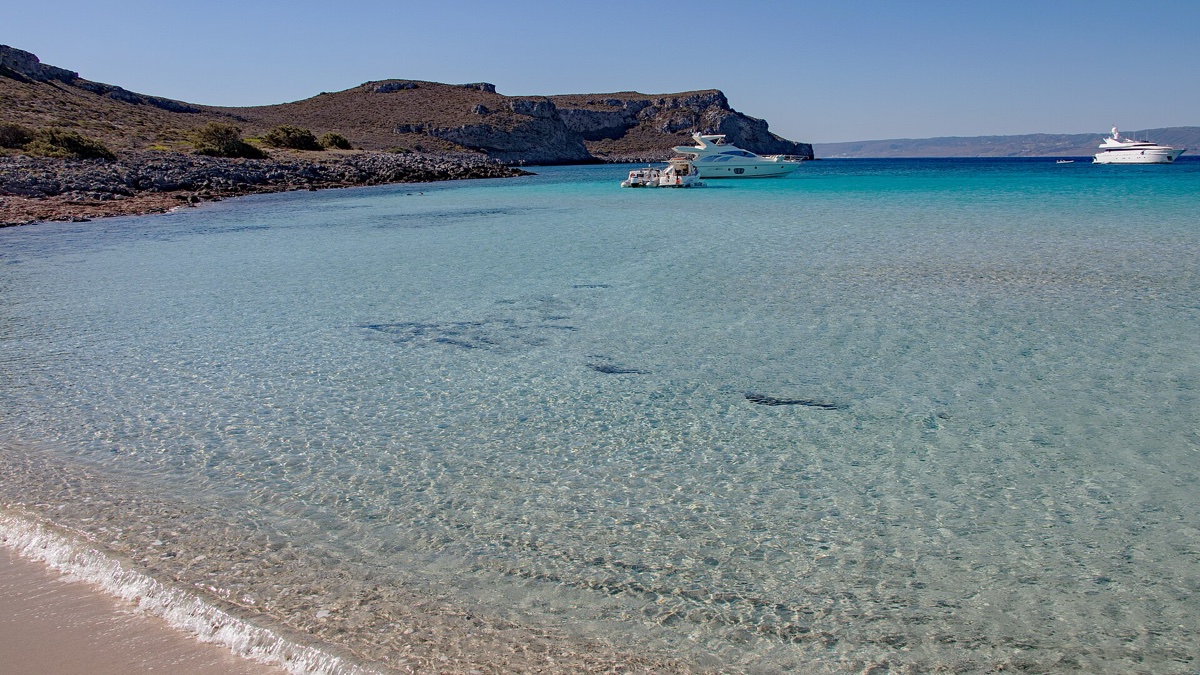
Escaping the crowds is easy at Voidokilia, Simos, Vai with its palm grove, or the wild sands of Egremni.
New beach law: at least 70% of every beach must remain free of sunbeds and umbrellas. You can now lay your own towel down almost anywhere.
Water shoes are a must on the Ionian Islands — the pebbles and sea urchins are no joke.
Essential Greek Beach Rules for 2026
Before you head out to catch some sun, it’s worth knowing how things work right now — Greek beach culture has changed considerably in recent years, and a few things have shifted quite dramatically.
The biggest talking point is sunbeds and umbrellas — and the wildly varying prices. On quieter islands like Thassos or on the mainland, a set of two sunbeds and an umbrella will cost you around 5 to 15 euros per day. At the luxury beach clubs of Mykonos, that same setup can set you back an eye-watering 100 euros or more. On many smaller islands like Kos or Naxos, the friendly “free sunbed with a purchase” rule still applies — order a frappé and something to eat at the nearby taverna and the spot is yours for the day.
The golden rule: always ask the price upfront. Many beach bars don’t display a price list anywhere, and your eyes will water when the bill arrives.
The Towel Movement and the New Law
If you’d rather not pay anything and prefer to spread your own towel, the law is now firmly on your side. Under Greek legislation, at least 70% of every beach must remain freely accessible to the public (and in Natura 2000 protected zones, that rises to 85%). For years, bar operators ignored this and staked out the sand all the way down to the waterline — but in the summer of 2023, a huge wave of public anger erupted, known as the “Towel Movement” (Κίνημα της Πετσέτας). Locals protested against illegal sunbed sprawl, the government cracked down hard, deploying drones and handing out fines of between 2,000 and 60,000 euros. People can now report violations directly from the beach via the official MyCoast app, which received more than eleven and a half thousand complaints in a single summer. The result? You can now plant your own umbrella almost anywhere.
Sea Urchins, Pebbles, and Safety
Lifeguards and warning flags are only found on large, organised beaches, where a red flag means swimming is prohibited. At wild coves, you’re on your own — so keep two things in mind.
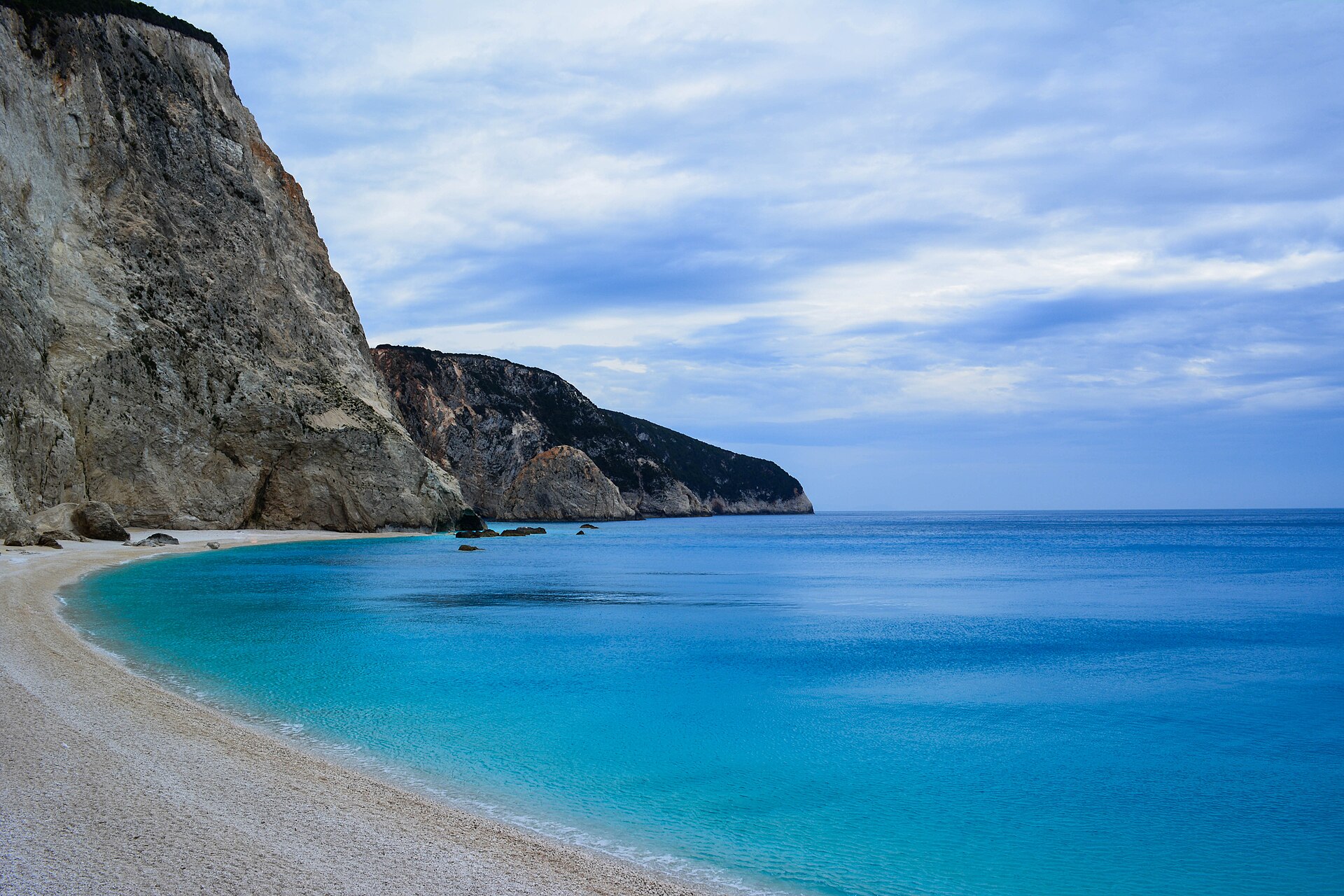
The Ionian Islands (Kefalonia, Lefkada, Zakynthos) are famous for their extraordinary blue water, which they owe to white limestone pebbles. They look spectacular, but walking on them is genuinely painful, so water shoes are an absolute necessity here. The second hazard is sea urchins, which tend to cluster on rocks and stones in clear water. On a purely sandy beach you won’t encounter them, but the moment you’re picking your way into the sea over rocks, watch your step carefully.
The good news is that Greek waters rank among the cleanest in Europe. The country has 623 Blue Flag beaches for 2025, a designation that covers water quality, safety, and facilities all in one. If you’re travelling with someone with limited mobility, check out the Seatrac accessible ramps, which are now installed at nearly 150 Greek beaches and allow independent sea entry.
Iconic Beaches You Know from Postcards
These are the beaches you’ve seen in travel brochures and all over Instagram. They’re breathtaking — but their fame comes at a price, so going in with a strategy makes all the difference.
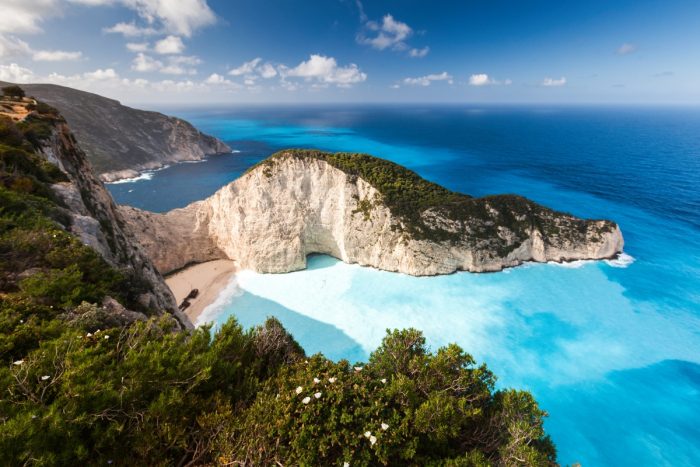
Navagio (Shipwreck Beach), Zakynthos
Photo: kallerna, CC BY-SA 4.0, Wikimedia Commons
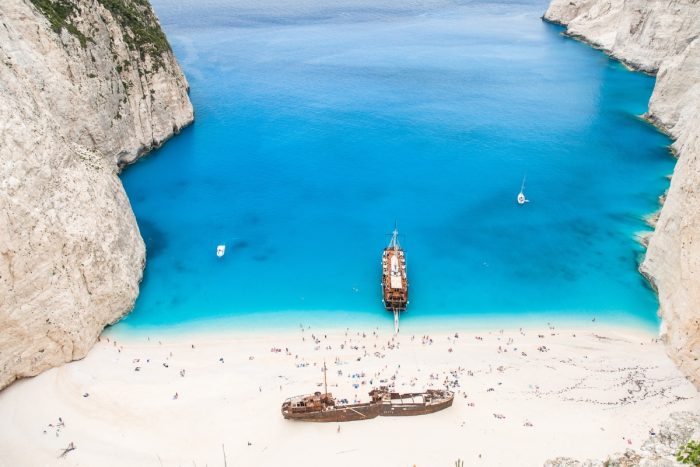
A cove sheltering the rusting hull of the smuggler’s ship Panagiotis, surrounded by sheer white limestone cliffs — this is probably the most photographed spot in all of Greece. It’s also a genuine headache at the moment.
⚠️ Current status for 2026: the beach is closed to visitors. Following a series of dangerous rockfalls and seismic activity, authorities extended the strict access ban after an inspection in March 2026. You cannot set foot on the sand or swim near the wreck — indefinitely. Don’t be taken in by touts promising a picnic right next to the ship.
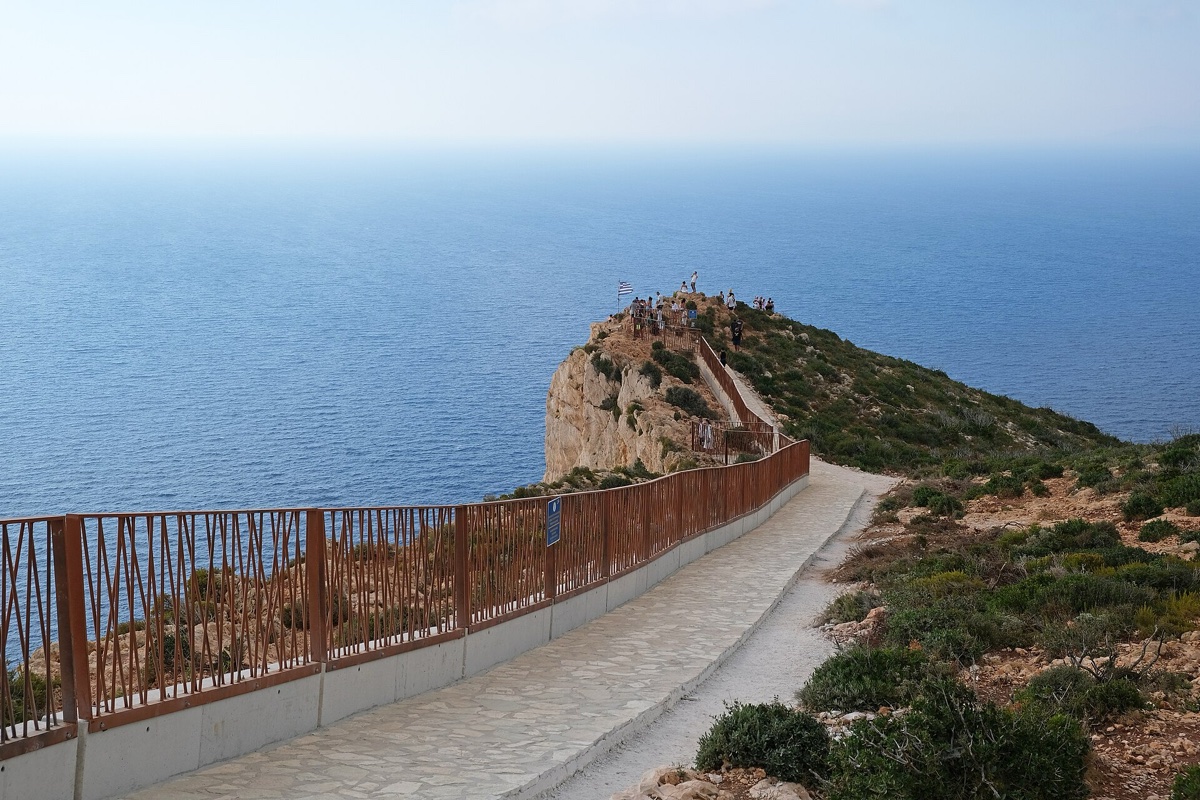
So what can you do? You can either book a boat trip (departing from Porto Vromi, Alykes, or Skinari) that takes you into the cove to photograph it from the deck. Or head to the clifftop viewing platform high above the beach, which offers an equally jaw-dropping perspective. Expect queues and occasional restricted access, especially in strong winds. For more tips on making the most of the island, check out our guide to Zakynthos.
💡 Tip: You can browse and book Navagio boat trips in advance on GetYourGuide — it saves you hunting for tickets on the day and lets you pick the best-reviewed boat.
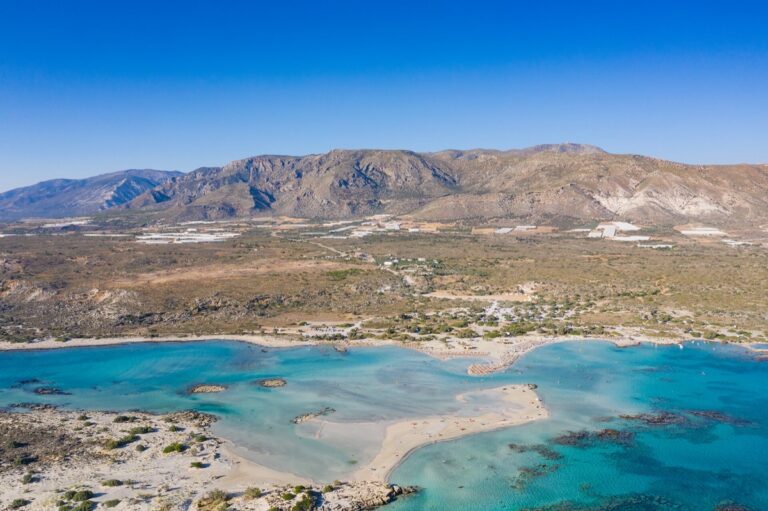
Elafonissi, Crete
Photo: dronepicr, CC BY 2.0, Wikimedia Commons
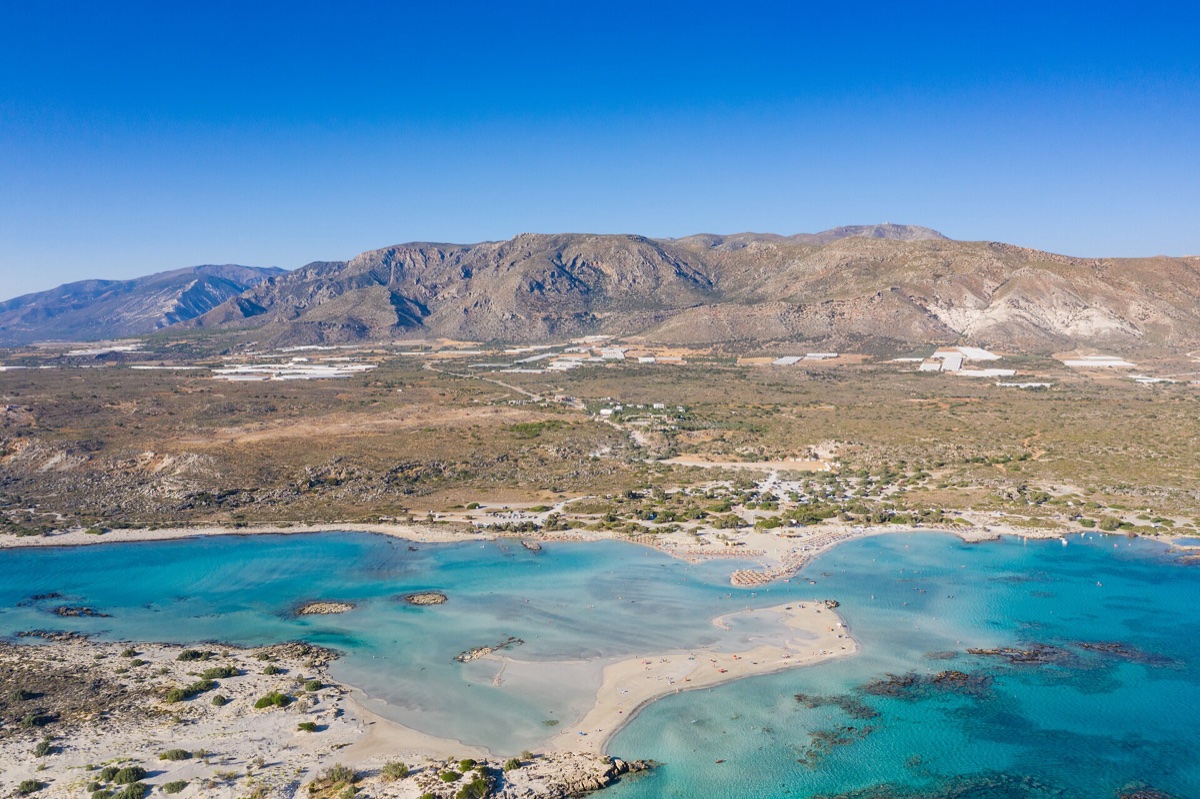
A lagoon on the south-western tip of Crete, famous for its blush-pink sand — the colour comes from crushed shells of tiny sea creatures. The water is incredibly shallow and warm, so you can simply wade from the mainland across to the small islet alongside, and kids have a playground that looks straight out of a fairy tale.
It sounds like paradise, but in July and August Elafonissi becomes an absolute ant colony, with hundreds of cars and dozens of coaches arriving daily — up to 5,000 people on a single day. To truly enjoy it, you need to be strategic. Arrive before 10am, or alternatively after 5pm, once the organised tour groups have left. And remember that the entire lagoon is a nature reserve, so you can’t take the pink sand home as a souvenir. More tips in our guide to Crete.
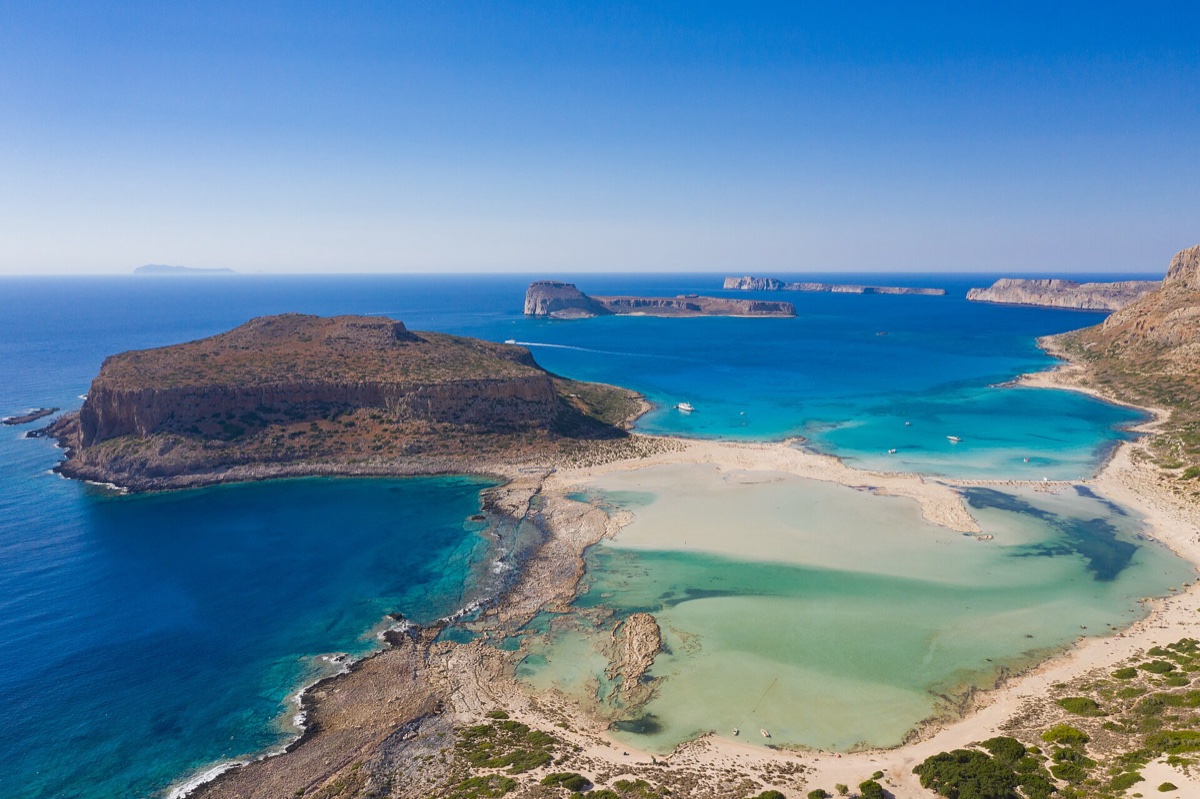
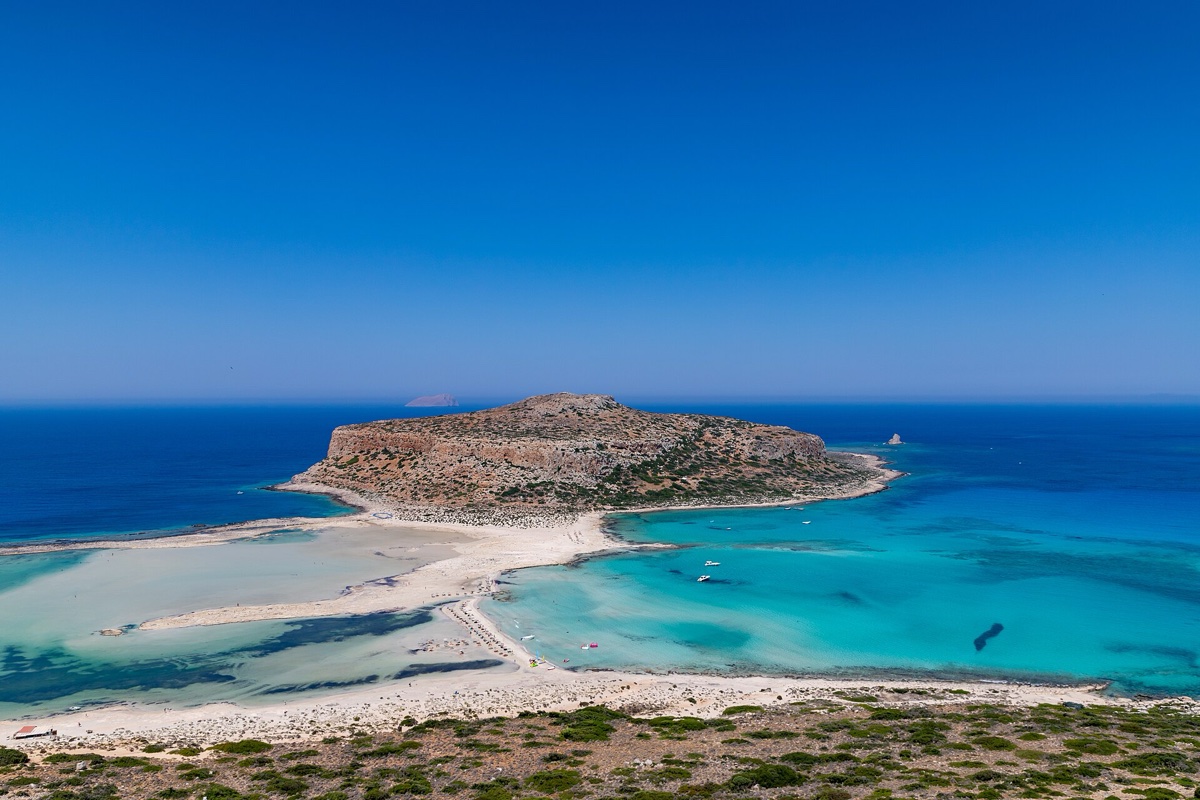
Balos, Crete
Photo: dronepicr, CC BY 2.0, Wikimedia Commons
Another Cretan lagoon, this time in the north-west — raw, wild beauty where dozens of shades of blue and green collide. Getting here is half the adventure.
The more relaxed option is a full-day boat trip from Kissamos harbour (around 30–40 euros), which also stops at the pirate islet of Imeri Gramvousa before dropping you right at the water’s edge. The alternative is driving, but that means eight kilometres of dusty off-road track along the cliff edge — a route most car hire companies explicitly exclude from their insurance. At the end you park and descend (and later, in the blazing heat, climb back up) about twenty minutes along a rocky footpath. The reward is an utterly unbeatable view from above that will stay with you long after you’ve left.
💡 Tip: You can book a full-day boat trip to Balos and Gramvousa from Kissamos well in advance on GetYourGuide — boats fill up fast in high season.
Myrtos, Kefalonia
Photo: Tony Hisgett, CC BY 2.0, Wikimedia Commons
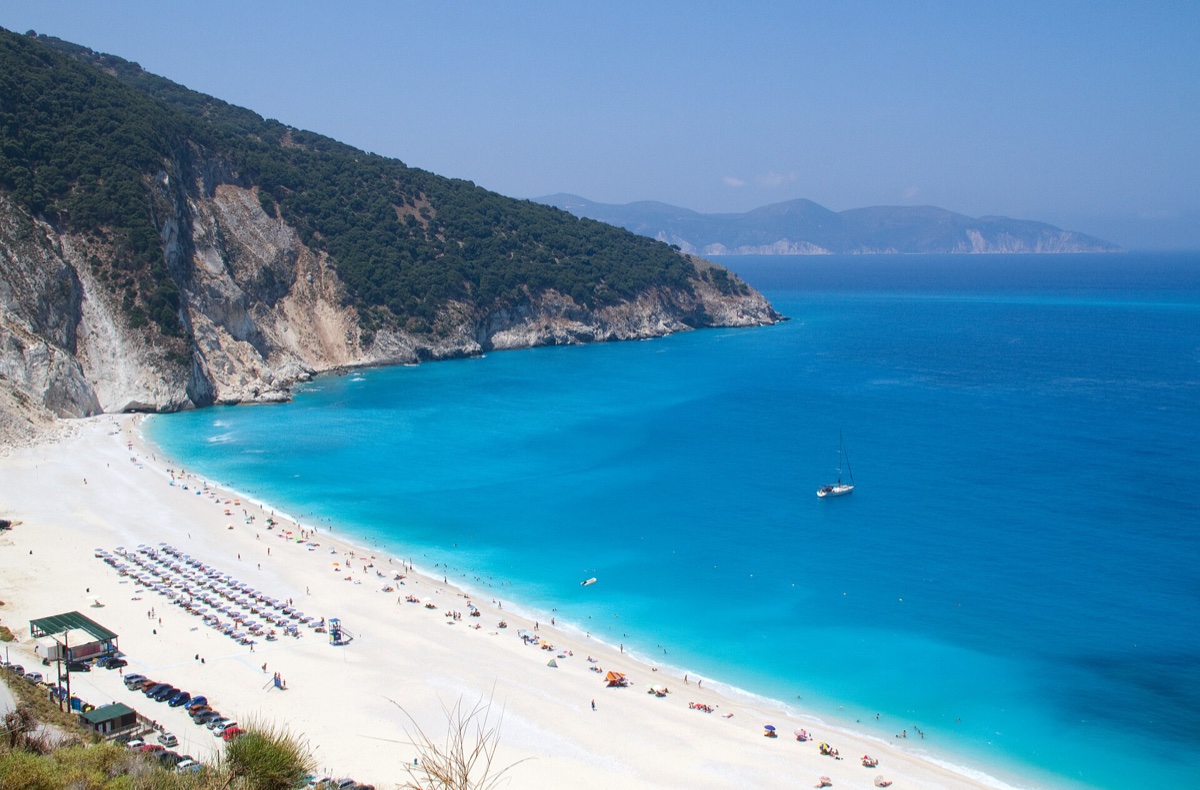
Dazzling white pebbles set against deep blue water and steep green cliffs — Myrtos has a dramatic, almost cinematic quality that makes it one of the most photographed beaches in the Ionian Islands.
The water drops sharply and the currents can be deceptively strong, so this isn’t the ideal spot for young children. For confident swimmers and photography lovers, though, it’s an absolute must. Don’t forget your water shoes — the pebbles are unforgiving. Kefalonia has plenty of quieter coves too; see our guide to Kefalonia for more.
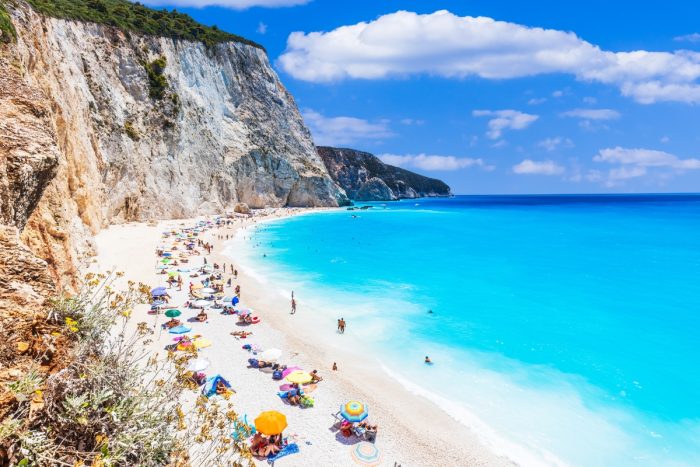
Porto Katsiki, Lefkada
Photo: Dimitra Papadimitriou, CC BY-SA 4.0, Wikimedia Commons
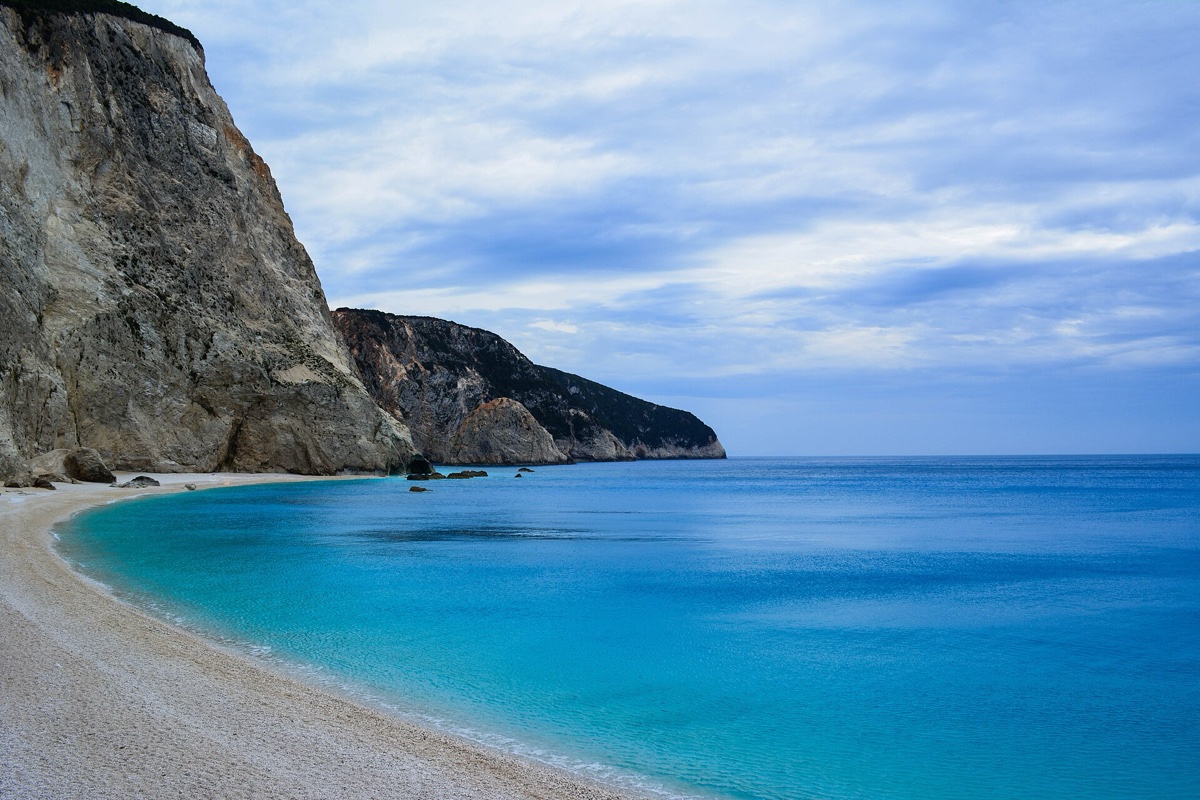
The name translates as “Goat Harbour” — because once upon a time, only goats could get down here. These days a road leads to the clifftop and you descend to the beach via around a hundred steep steps bolted into the rock face. The water, thanks to the limestone bedrock, is a milky, otherworldly turquoise that genuinely takes your breath away.
Worth knowing: in the afternoon the sun hammers mercilessly off the white cliff face, so bring plenty of water and prepare for serious heat. Lefkada has many more beaches of this calibre — explore them in our guide to Lefkada.
Sarakiniko, Milos
Photo: dronepicr, CC BY 2.0, Wikimedia Commons
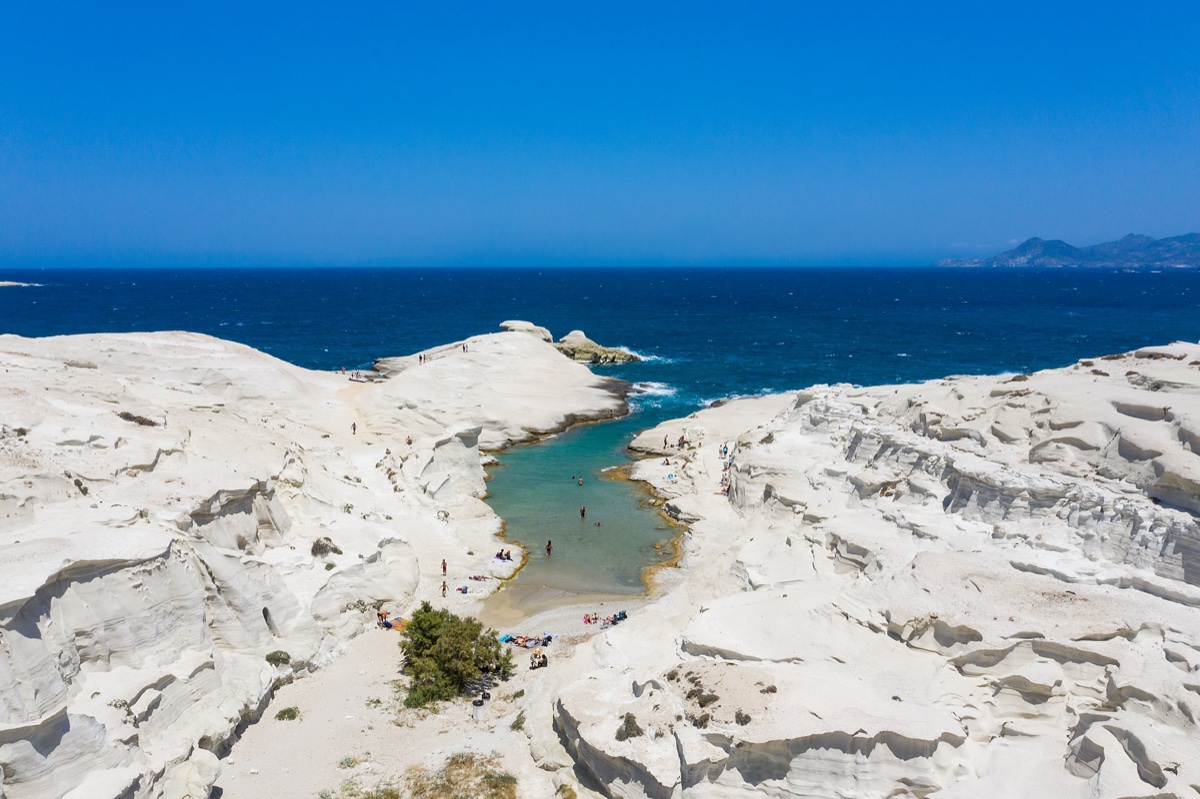
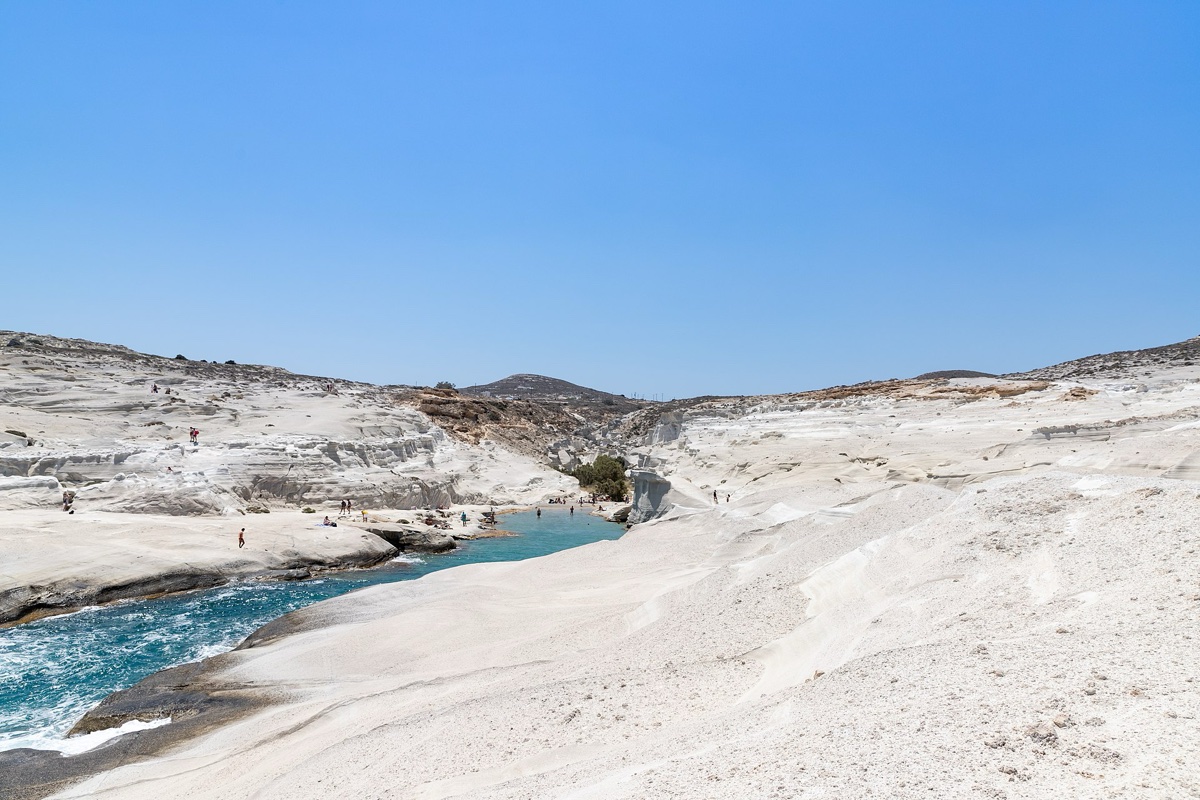
Sarakiniko isn’t really a beach in the traditional sense — it’s more like a lunar landscape. Brilliant white volcanic rock has been sculpted by wind and sea into smooth, rounded forms; there’s barely any sand, you lie directly on sun-warmed stone, and you leap into the water from the rocks.
It’s an experience you won’t find anywhere else in Greece — just bear in mind that there is absolutely no shade on those white rocks, and the stone reflects the sun so intensely that you’ll burn in no time. Bring a hat, plenty of sunscreen, and aim to arrive early in the morning or late in the afternoon. We cover this volcanic island in more detail here.
Family-Friendly Beaches
Travelling with kids? Then dramatic cliffs and deep water aren’t what you’re after. You want fine sand for building castles, a gently shelving entry where toddlers can splash safely, and solid facilities — toilets, tavernas, the works. These beaches were made for little swimmers.
Agios Georgios, Naxos
Photo: Zde, CC BY-SA 4.0, Wikimedia Commons
Naxos is generally considered to have the best sandy beaches of all the Cycladic islands, and Agios Georgios sits right beside the main town of Chora. The water stays shallow for tens of metres from the shore, waves are almost non-existent, and parents can sit at a taverna with their children in full view the whole time.
A huge bonus is that you can walk here straight from town — no car needed at all. If you’re choosing one island for a family holiday, Naxos is a safe bet every time.
Tigaki, Kos
Photo: Asurnipal, CC BY-SA 4.0, Wikimedia Commons
A long, wide strip of pale sand on the north coast of Kos, with excellent facilities and plenty of sunbeds — but also plenty of free space for your own towel. The water is crystal clear, exceptionally shallow, and holds a Blue Flag. Tigaki is calm, well-equipped, and ideal for a holiday with children. Kos is also brilliant for cycling, so you can easily ride here from town. For more island highlights, take a look at our guide to Kos.
Golden Beach (Chrissi Ammoudia), Thassos
Photo: Sli23121953, CC BY-SA 4.0, Wikimedia Commons
Golden Beach lives up to its name. Three kilometres of soft sand backed by lush green mountains, with calm, warm water that’s perfect for the youngest swimmers. Thassos is also one of the most affordable Greek islands, so you won’t be paying a fortune for sunbeds here. If you’re after relaxed family vibes without the crowds or inflated prices, this is your place.
Falassarna, Crete
Photo: Pavel Špindler, CC BY 3.0, Wikimedia Commons
If Elafonissi feels too overwhelming, Falassarna on the western coast of Crete is an excellent alternative. It’s enormous — made up of several adjoining sandy sections — so even at the height of summer you can find your own quiet corner. The water is beautifully clear and the beach is well-equipped.
The open sea does mean a stronger breeze here on occasion, which wave-lovers will appreciate more than absolute beginners in the water. In return, it rewards you with some of the finest sunsets on the entire island.
Agios Gordios, Corfu
Photo: Marc Ryckaert (MJJR), CC BY 3.0, Wikimedia Commons
A beautiful bay on Corfu’s west coast, surrounded by ancient olive groves and dramatic rock formations. The sand is a little coarser than elsewhere, but the entry into the water is completely safe and there are some excellent family-run tavernas right on the beach. It’s one of those spots where you can happily spend an entire day without a care in the world. More island tips in our guide to Corfu.
Party Beaches for Dancing Till Dawn
If a beach holiday means DJ sets, cocktails, and dancing in the sand rather than a quiet book and the sound of the waves, Greece has its legends. Just don’t go near these if you’re after peace and quiet. 😅
Lukáš and Lucie recommend
Where to stay in Greece
1 accommodation — hotels and other lodging options
Photo: rene boulay, CC BY-SA 3.0, Wikimedia Commons
Ground zero for Greek beach hedonism. By day it’s all luxury sunbeds and expensive cocktails; come afternoon the music cranks up and the whole cove transforms into an enormous open-air club packed with the global jet set.
It is expensive, exclusive, and very, very loud — sunbeds at premium clubs like Scorpios need to be reserved weeks in advance. But if you want to dance the night away and feel like a celebrity for a day, you’re in exactly the right place. We cover the most famous party island in Greece in our guide to Mykonos.
Paradise Beach, Kos
Photo: Stimoroll, CC BY-SA 4.0, Wikimedia Commons
A smaller and considerably more affordable cousin of the Mykonos legend. Also known as “Bubble Beach” because volcanic activity sends tiny streams of bubbles rising up from the seabed. It’s a brilliant swim during the day, and by afternoon a lively atmosphere takes hold with music and water sports. The perfect compromise when you want fun but aren’t prepared to pay Mykonos prices.
Kavos, Corfu
The southern tip of Corfu has been claimed almost entirely by young British holidaymakers. The beach itself isn’t the prettiest on the island, but if you’re after cheap drinks, loud music, foam parties, and a raucous nightlife scene, Kavos delivers on every count. It’s a purpose-built party zone and one of the most intense in Europe — families and anyone seeking quiet should definitely look elsewhere.
Wild and Quiet Beaches Away from the Crowds
For those who want nothing but wind and waves, and don’t mind trading beach-bar comforts for space and silence. The reward is solitude, elbow room, and the feeling that you’ve discovered it all yourself.
Kavourotrypes (Orange Beach), Halkidiki
Photo: EAMorton, CC BY-SA 4.0, Wikimedia Commons
A cluster of small coves with white sand and turquoise water, framed by fragrant pine forests and smooth white rocks. This isn’t one continuous beach — it’s a whole chain of hidden coves along the Sithonia peninsula in Halkidiki.
It does get busy in peak season, but in June or September it turns into absolute paradise. Halkidiki also holds more Blue Flags than any other region in Greece, so water quality is never in doubt.
Egremni, Lefkada
Photo: Stefan Fussan, CC BY-SA 3.0, Wikimedia Commons
⚠️ Access remains difficult. The famous staircase leading down to this stunning beach was largely destroyed by a powerful earthquake in 2015. It has been partially rebuilt, but the descent — and especially the climb back up — in summer heat is an extremely demanding undertaking that I wouldn’t recommend to anyone who isn’t in solid physical shape.
The best and safest way to experience Egremni is to arrive by boat from Nidri or Vassiliki. From the water, that endless wall of white cliff plunging into turquoise sea looks even more extraordinary than from above.
Vai, Crete
Photo: Marc Ryckaert (MJJR), CC BY 3.0, Wikimedia Commons
At the far eastern tip of Crete you’ll find something genuinely unique: the largest natural palm grove in Europe. With thousands of date palms swaying behind the shoreline, Vai feels more like the Caribbean than the Mediterranean — and it’s a sight you simply don’t expect.
It does function as an organised beach with full facilities, but venture a little further from the main entrance and you’ll find the peace and quiet you came for. It’s a long drive to the other end of the island, but absolutely worth the effort.
Simos, Elafonisos
Photo: DimitrisP67, CC BY-SA 4.0, Wikimedia Commons
A bit of a hidden gem, this one. Elafonisos is a small island just off the southern tip of the Peloponnese (not to be confused with Elafonissi in Crete), and you reach it via a short ferry crossing from the port of Pounta — barely ten minutes on the water.
Simos is a spectacular double bay of fine white sand and dunes, nicknamed the “Caribbean of Europe”. It’s a remote spot favoured by Greeks themselves, so if you want to go where the locals go, this is it.
For Nature Lovers: Turtles and a Perfect Crescent
To finish, two beaches where the main attraction isn’t a beach bar or sunbeds, but nature itself. One is home to endangered sea turtles; the other has a shape so perfect it barely seems real.
Gerakas, Zakynthos
Photo: kallerna, CC BY-SA 4.0, Wikimedia Commons
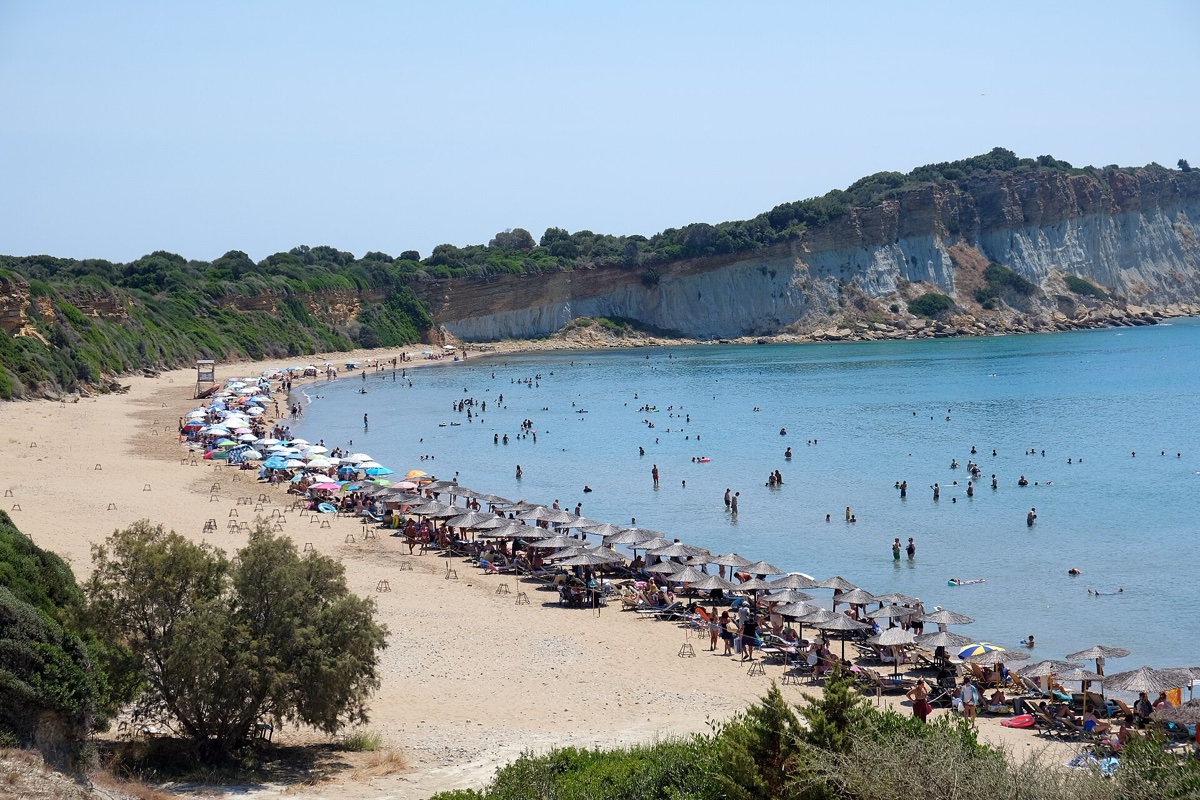
Zakynthos is about far more than a closed shipwreck. In the south of the island lies Gerakas, a key nesting site for the endangered loggerhead sea turtle (Caretta caretta), which falls within the National Marine Park and operates under strict rules.
You can’t plant your own umbrella in the sand (to protect the nests), no dogs are allowed, motorised water sports are banned, and crucially the beach closes strictly at sunset. The water is beautifully clear, warm and shallow, and with a snorkel you may well spot a fully grown loggerhead just metres from the shore. Just remember the golden rule: don’t touch, don’t chase — observe quietly from a respectful distance. Full park rules are on the official website.
Voidokilia, Peloponnese
Photo: Chris06, CC0, Wikimedia Commons
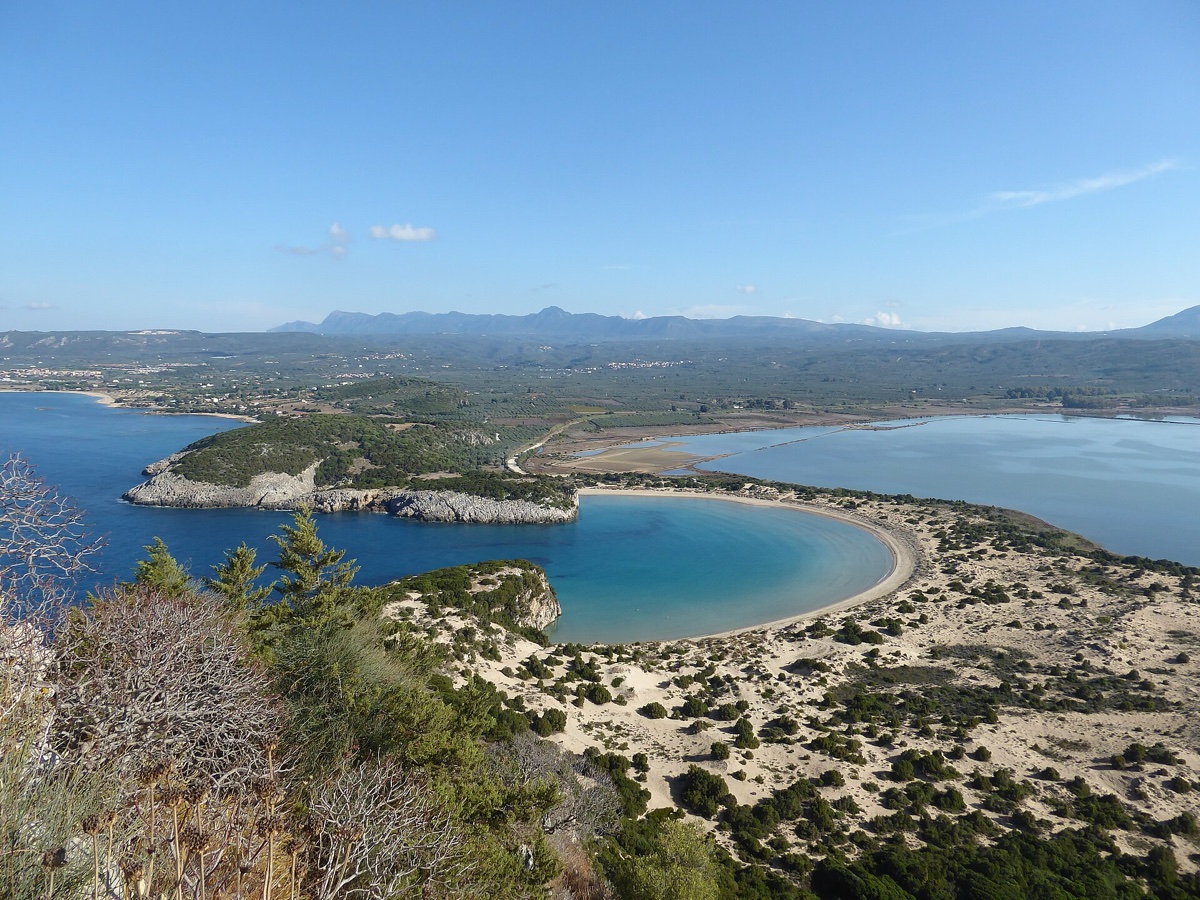
An almost flawless semicircle in the shape of the Greek letter omega (Ω), rimmed by a band of sand dunes. Voidokilia on the Peloponnese is so perfectly symmetrical it looks almost artificial, and it’s one of the most photogenic beaches in the whole of Greece.
The water is shallow and calm, and above the beach sits the Cave of Nestor alongside a Frankish castle, while behind it a lagoon teems with birdlife. This is a wild, protected beach with no cafés or sunbeds, so bring your own shade, water, and snacks. For all its simplicity, it’s one of the most unforgettable spots in Greece.
The Full List: TOP 20 Greek Beaches at a Glance
Here’s a quick overview of all twenty beaches in one place — whether you’re choosing by island, beach type, or whether you’re travelling with children or in search of a party.
Beach
Island / Region
Surface
Best for
How to get there
Elafonissi
Crete
pink sand
families, photos
car/bus (arrive early)
Balos
Crete
sand
adventurers
boat from Kissamos or off-road
Navagio ⚠️
Zakynthos
white pebbles
closed to visitors
view from boat or clifftop only
Myrtos
Kefalonia
white pebbles
strong swimmers, adults
car (steep winding road)
Sarakiniko
Milos
white rock
photos, cliff jumping
car, scooter
Porto Katsiki
Lefkada
pebbles
couples, swimmers
car + 100 steps
Agios Georgios
Naxos
fine sand
families with young children
walk from Chora town
Tigaki
Kos
sand
families, relaxation
car, cycle from Kos town
Golden Beach
Thassos
sand
families
car, bus
Falassarna
Crete
sand
families, wave lovers
car
Agios Gordios
Corfu
coarser sand
families
car, bus
Super Paradise
Mykonos
sand
party, luxury
car, water taxi
Paradise Beach
Kos
sand
party, young crowds
car, bus
Kavos
Corfu
sand
wild nightlife
car, bus to south of island
Kavourotrypes
Halkidiki
sand / rock
peace, nature
car, then walk through forest
Egremni ⚠️
Lefkada
pebbles
adventurers
boat from Nidri (steps risky)
Vai
Crete
sand
exotic scenery lovers
car to eastern Crete
Simos
Elafonisos
white sand
escaping the crowds
ferry from Peloponnese
Gerakas
Zakynthos
sand
turtle watching
car (strict NP rules apply)
Voidokilia
Peloponnese
sand
nature lovers
car (crescent-shaped bay)
Where to Stay Near the Best Greek Beaches
💡 Accommodation tip: We always search for places to stay on Booking.com, which tends to have the best cancellation policies — handy if weather or beach access conditions change. For tours, boat trips, and activities, it’s worth comparing and booking through GetYourGuide.
Where you base yourself depends hugely on which beaches you want to explore. On Crete, choose your base according to the beaches on your list. For Elafonissi and Balos, Chania in the west is ideal; for Vai and the eastern beaches, Sitia or Agios Nikolaos make more sense. Apartment prices start around 50–70 euros per night, and in high season booking a few months ahead is wise.
For family beaches, Naxos or Kos are reliable choices — both have plenty of self-catering apartments within walking distance of the sea. If you’re heading to Mykonos for the party scene, bear in mind it’s the most expensive island in Greece and a decent place to stay in season will start at around 150 euros a night. Kos offers a similar vibe at a fraction of the cost.
For quieter beaches like Voidokilia or Simos, staying in the surrounding villages gives you an authentic atmosphere and local prices. Wherever you’re headed, it’s worth comparing options on Booking.com and booking early — the best value options go first.
Whether you end up at a buzzing beach bar in the Cyclades or a hidden cove in the Ionian Islands, don’t forget what matters most: respect the local rules, look after the nature around you, and soak up every bit of that incredible laid-back feeling the Greek coast does better than anywhere else. Have a wonderful trip! ☺️
Read More
Before you go, check out our other articles on Greece to get every last detail of your holiday sorted:
Some of the absolute most beautiful include the Cretan lagoon of Elafonissi with its pink sand and Balos, the omega-shaped Voidokilia on the Peloponnese, the dramatic Myrtos on Kefalonia, and the lunar landscape of Sarakiniko on Milos. But it really depends on what you’re looking for. For families, the best will be the shallow sandy beaches on Naxos and Kos, while adventurers will prefer the wild coves of the Ionian Islands.
Is Navagio beach (the shipwreck) open in 2026?
No. Navagio on Zakynthos is still closed to entry for 2026 due to dangerous landslides and seismic activity. Access to the beach and to the wreck is forbidden; in March 2026 the authorities extended the ban indefinitely. You can only see it from an excursion boat that sails into the cove, or from the viewing platform on the cliff above the beach.
Which Greek beach is best for families with children?
For families with small children, Agios Georgios on Naxos is ideal, where the water stays shallow even dozens of meters from shore. Other excellent choices include Tigaki on Kos, Golden Beach on Thassos, and Agios Gordios on Corfu. All feature fine sand, gradual entry into the water, minimal waves, and good facilities with tavernas and restrooms.
How much does a sun lounger cost on a Greek beach?
Prices vary enormously. On quieter islands and the mainland, you’ll pay around 5 to 15 euros per day for a set of two loungers and an umbrella, while luxury beach clubs on Mykonos can easily charge 100 euros or more. On many smaller islands, there’s a ‘free lounger with purchase’ policy, and by law 70% of every beach must remain free access, so you can always lay down your own towel for free.
When are the turtles on Zakynthos?
Loggerhead sea turtles nest on Zakynthos roughly from June to August, when the females lay their eggs, and the hatchlings emerge from around August to October. Your best chance of spotting one is on Gerakas, Dafni, and Marathonisi beaches, or while snorkelling in Laganas bay. Always observe them from a distance and never touch them.
Where is the warmest and cleanest sea in Greece?
The warmest water is usually found in the south, on Crete, Rhodes, and in the Dodecanese, where the sea stays pleasantly warm well into October. As for cleanliness, Greek waters are among the cleanest in Europe, with the country boasting over 620 Blue Flag beaches. The Ionian Islands are particularly famous for their exceptionally crystal-clear water, thanks to the white limestone seabed.
Are there sharks or jellyfish in Greek waters?
You don’t need to worry about sharks—attacks on humans are extremely rare in Greece and you won’t typically encounter them while swimming. You may occasionally come across jellyfish, but most are harmless. Just watch out for the purple warning flag, which indicates the presence of marine hazards. A more practical concern is sea urchins on rocky beaches, which can be avoided by wearing water shoes.
Tips and Tricks for Your Vacation
Don’t Overpay for Flights
Search for flights on Kayak. It’s our favorite search engine because it scans the websites of all airlines and always finds the cheapest connection.
Book Your Accommodation Smartly
The best experiences we’ve had when looking for accommodation (from Alaska to Morocco) are with Booking.com, where hotels, apartments, and entire houses are usually the cheapest and most widely available.
Don’t Forget Travel Insurance
Good travel insurance will protect you against illness, accidents, theft, or flight cancellations. We’ve had a few hospital visits abroad, so we know how important it is to have proper insurance arranged.
Where we insure ourselves: SafetyWing (best for everyone) and TrueTraveller (for extra-long trips).
Why don’t we recommend any Czech insurance company? Because they have too many restrictions. They set limits on the number of days abroad, travel insurance via a credit card often requires you to pay medical expenses only with that card, and they frequently limit the number of returns to the Czech Republic.
Find the Best Experiences
Get Your Guide is a huge online marketplace where you can book guided walks, trips, skip-the-line tickets, tours, and much more. We always find some extra fun there!
TL;DRKos, in the Greek Dodecanese, has 15 ideas for day trips that mix ancient history with the active side of island life — from the Asklepion healing centre and Neratzia Castle to the Bros Thermal Spring and a ferry over to Bodrum in Turkey (30–60 minutes each way). The island’s known for its 200-plus kilometres of cycle paths, and bike hire costs €3–€5 a day. June to mid-September is best for swimming, while May, June and the September-October crossover suit more active sightseeing. Highlights include the Hippocrates Plane Tree in the town centre, the hillside village of Zia with its sunsets, and the beaches of Paradise Beach and Agios Stefanos on the Kefalos peninsula.
If you think Kos is nothing more than a factory of giant all-inclusive resorts and lazy days by the pool, let me set the record straight right away. 😊 This sun-drenched corner of the Dodecanese is genuinely unique — it blends deep ancient history with surprisingly active, adventurous holidays in a way that few Greek islands manage. I’ve put together 15 things to do in Kos, Greece that cover something for every type of traveller, from ancient ruins and thermal springs to a day trip on a different continent. The island is also the birthplace of Hippocrates, the father of modern medicine, so fascinating historical sights are never in short supply. I’ll tell you where to stay for the best base, why you should hire a bike on day one, and what to watch out for if you decide to hop across to neighbouring Turkey.
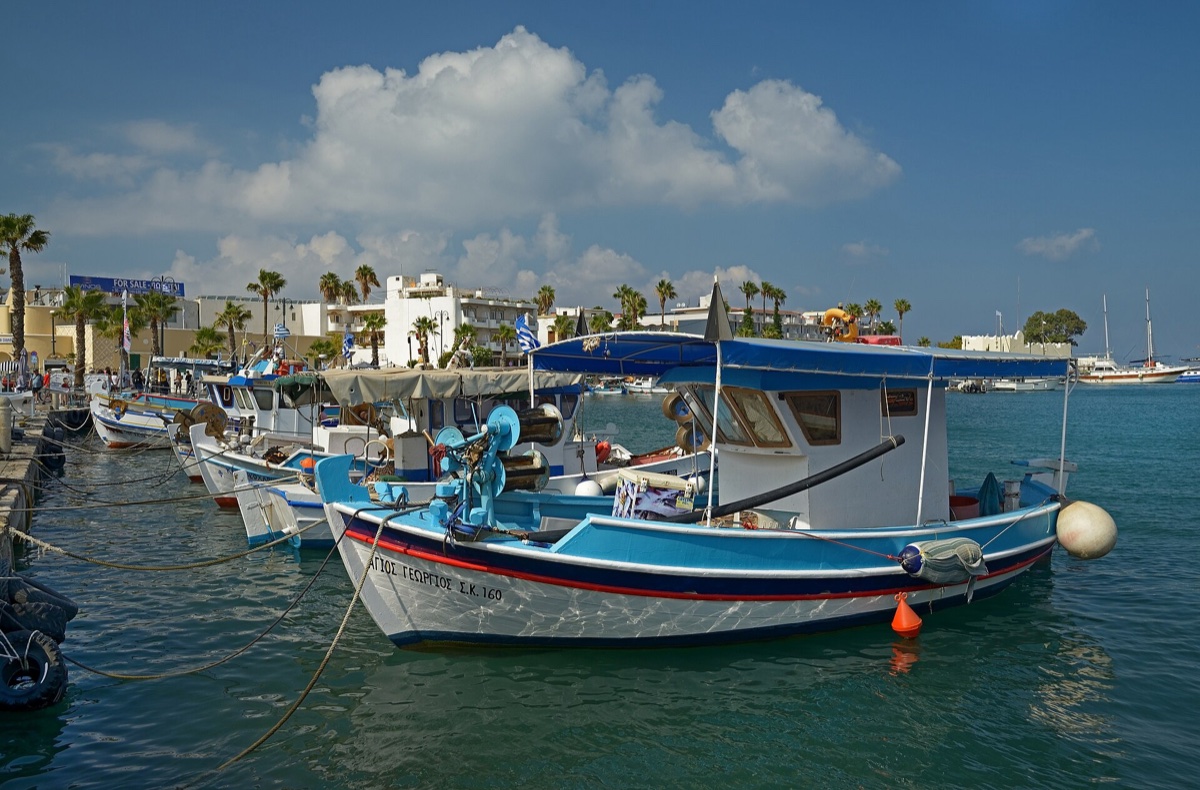
Photo: Ввласенко, CC BY-SA 3.0, Wikimedia Commons
TL;DR
Greece’s most cycle-friendly island: The northern part of Kos is beautifully flat and criss-crossed by over 200 kilometres of cycle paths — hire a bike on your first day.
Hippocrates’ legacy: Don’t miss the ancient healing centre of the Asklepion or the famous plane tree in the heart of Kos Town.
Natural spa: At Bros Therma beach you can soak in hot sulphurous springs that bubble up directly into the sea — completely free of charge.
Watch out for crowds: The mountain village of Zia is famous for its stunning sunsets but suffers from severe overtourism in high season — go early in the morning instead.
Day trip to Turkey: From Kos you can see the Turkish town of Bodrum on the horizon — ferries run daily, but you’ll need a valid passport.
Great for families: Long sandy beaches with a very gradual entry into the sea make Kos an ideal choice for a holiday with young children.
Thanks to its southerly position, Kos boasts an incredible three hundred sunny days a year and ranks among the sunniest spots in the entire Aegean. If swimming and soaking up the sun on the beach is your main goal, the ideal window is June through to mid-September. Temperatures regularly climb above 30 °C during the summer months and the sea is as warm as a bathtub — perfect for families with young children. Bear in mind, though, that this is also when the island is at its busiest and accommodation prices are at their peak.
Active travellers who want to explore the island by bike and take in the ancient sights will find May, June and especially late September into October a better fit. October in particular is something of a hidden gem across the Dodecanese — the tourist crowds thin out dramatically, hotel prices drop sharply, yet the sea retains a very pleasant temperature after the long hot summer. Up in northern Greece the weather can already be turning by then, but down here you can still sunbathe without a second thought.
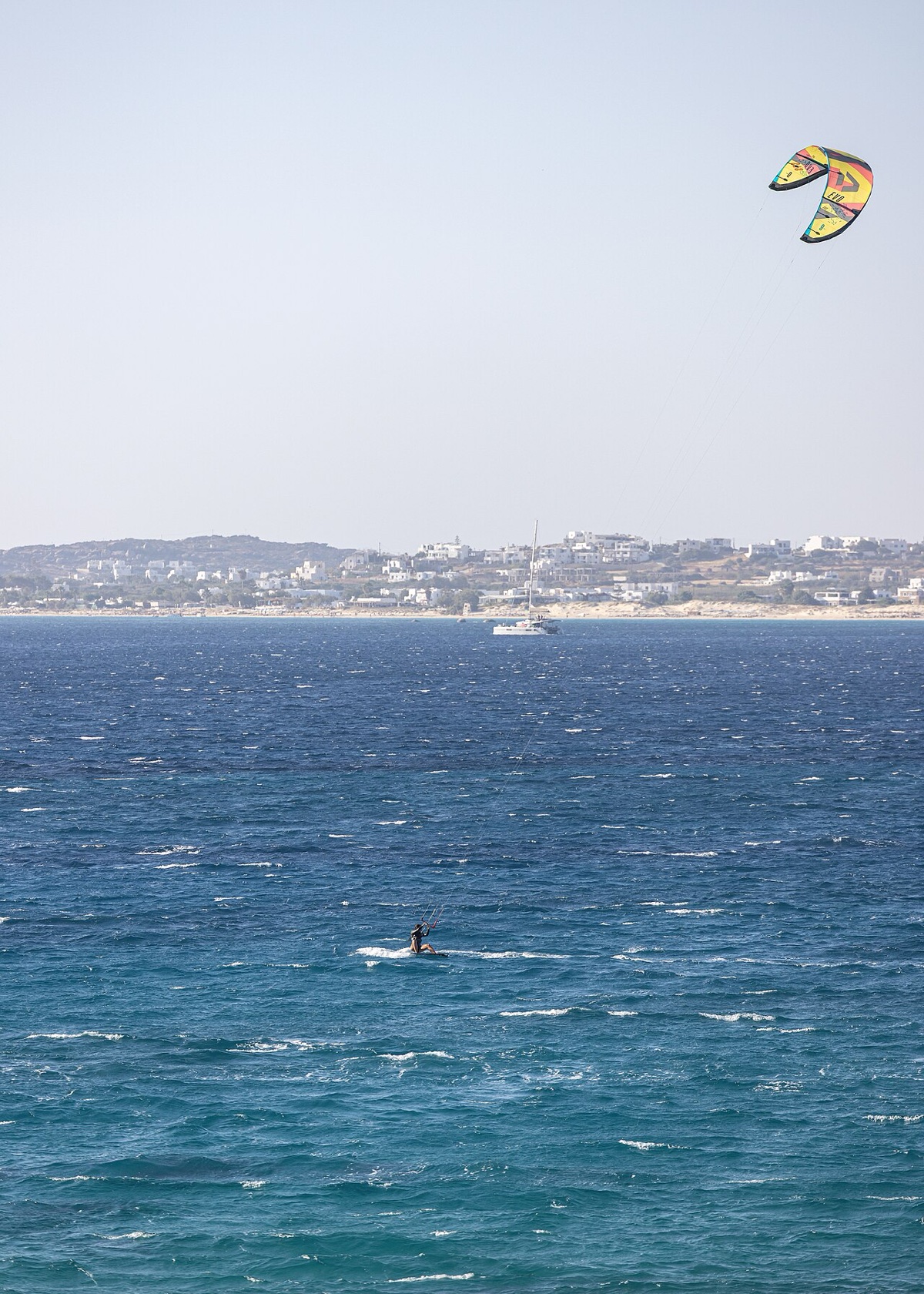
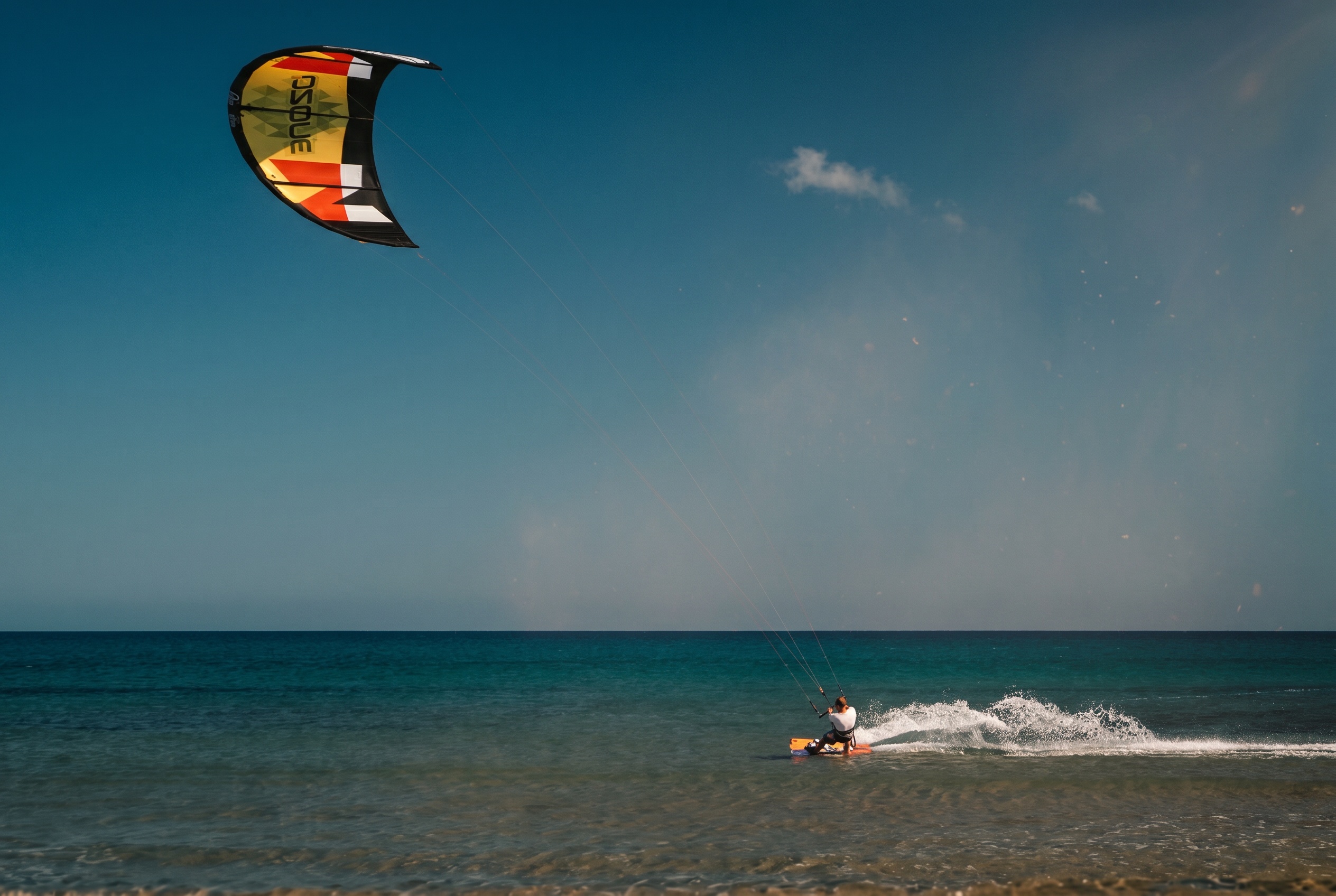
From mid-May to mid-September, the Aegean is also swept by the dry northerly wind known as the meltemi. On Kos it tends to be a little gentler than on the neighbouring Cyclades, but it can still kick up waves along the northern coast — which windsurfers and kitesurfers absolutely love. On the eastern shores the same wind brings a very welcome cooling breeze during the scorching August heat, so even when the sun is blazing you won’t feel like you’re being slowly baked alive.
Photo: Karelj, public domain, Wikimedia Commons
Where to Stay in Kos
💡 Travel tip: We always search for accommodation on Booking.com, which tends to have the best cancellation policies. For tickets, tours and activities, it’s worth comparing and booking through GetYourGuide.
Although Kos is a fairly compact island — you can drive from one end to the other in just over an hour — choosing the right base will shape the whole character of your holiday. If long, fine sandy beaches with shallow water are your priority, head to the northern coast and the resorts of Tigaki or Marmari. This area is ideal for families with children and for anyone who wants to spend their evenings strolling along the shore. A great pick in Tigaki is the luxurious five-star Astir Odysseus Kos Resort & Spa, offering huge pools and top-class wellness facilities, while in Marmari the highly rated Caravia Beach hotel is a perennial family favourite.
The eastern coast around Kos Town, along with the neighbouring resorts of Lambi and Psalidi, is a great choice for travellers who want historical sights and a lively nightlife scene on their doorstep. You’ll find decent mid-range hotels here for around 60 to 120 euros per night, and thanks to the dense network of cycle paths you can reach the town centre in just a few minutes on a bike. The western resort of Mastichari, meanwhile, has a quieter, more village-like feel and is home to the impressive Neptune Luxury Resort, renowned for its exceptional gastronomic programme showcasing local cheeses and sweets.
If lively entertainment and proximity to the airport appeal to you, look for accommodation in Kardamena on the southern coast, where the popular Grand Blue Beach Hotel stands out. For absolute peace and romantic sunsets, choose the more remote Kefalos peninsula in the southwest — home to the prestigious Ikos Aria. You can browse and book all of these options easily on Booking.com, where you’ll also find detailed reviews from previous guests.
Lukáš and Lucie recommend
Where to Stay in Kos
6 accommodations — hotels, wellness hotels and other accommodation options
Let’s dive into the very best that this Greek island has to offer. I’ve put together a mix of ancient history, stunning beaches and brilliant day trips — there’s genuinely something here for every kind of traveller.
Photo: Rikki Mitterer, CC BY-SA 4.0, Wikimedia Commons
1. Kos Town and the Ancient Agora
The island’s main town is like one big, compact history textbook you can browse through in a leisurely afternoon. All the main sights are within a few minutes’ walk of each other, making it very easy to explore on foot. Right in the centre spreads the vast ancient agora, which once served as the commercial and social heart of the city. Today you can wander freely among the remains of Doric columns and sanctuaries that were unexpectedly uncovered by a powerful earthquake in 1933 — admission is completely free.
Just a short stroll away you’ll find the fascinating Casa Romana, a reconstructed Roman villa with an extraordinary thirty-six rooms and three inner atriums. The preserved mosaic floors and marble fountains give you a vivid sense of the luxury enjoyed here two thousand years ago. As you wander through the town you’ll also notice the Defterdar Mosque on Eleftherias Square — its minaret collapsed in another earthquake in 2017 and it’s still awaiting full restoration. If history really grips you, the local archaeological museum is well worth a look too.
Photo: sophie, public domain, Wikimedia Commons
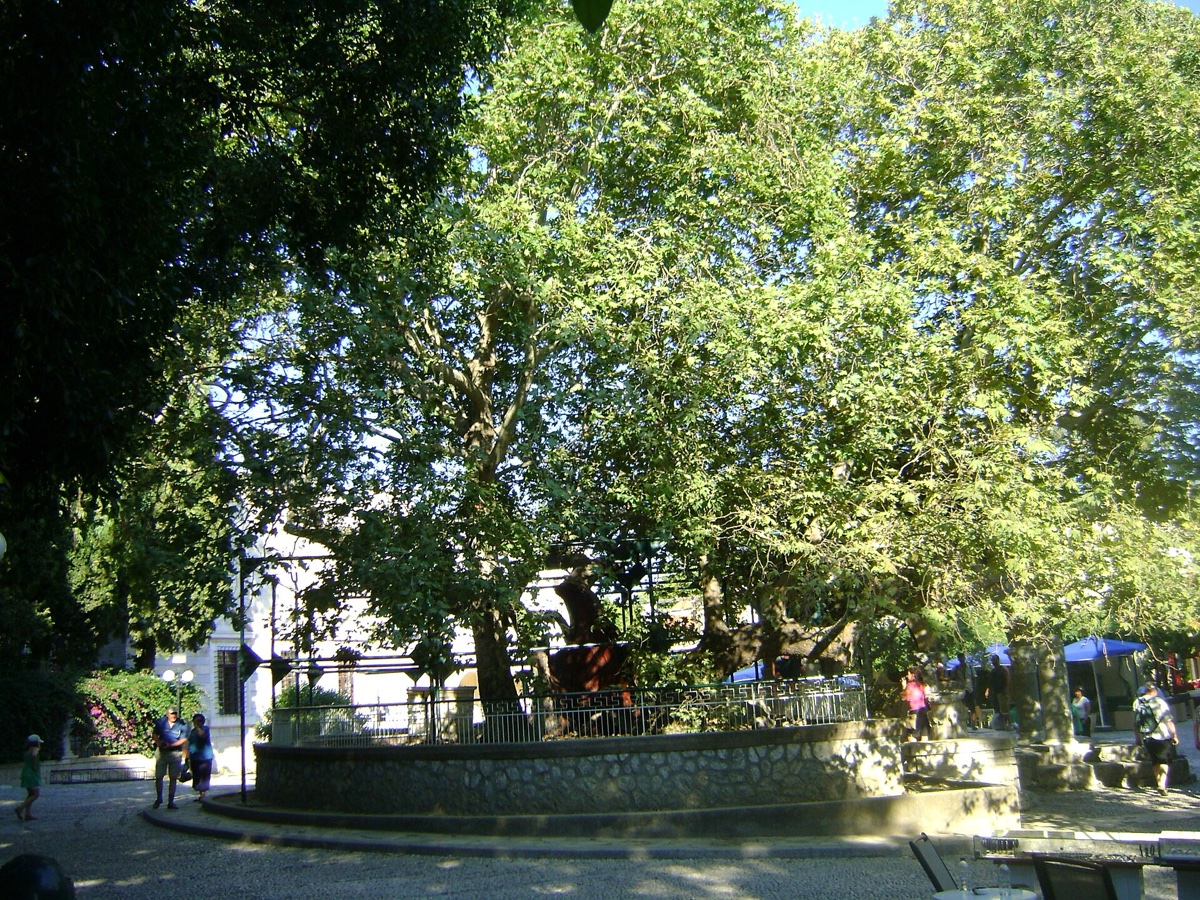
2. The Hippocrates Plane Tree
Right in the town centre, not far from the harbour, stands a tree that draws virtually every visitor to the island. The famous Hippocrates Plane Tree is said, according to ancient legend, to be the very spot where the father of modern medicine taught his students in the shade of its spreading canopy. If that were true, this majestic tree would have to be over two and a half thousand years old — which, botanically speaking, simply isn’t possible.
The current trunk is around five hundred years old, though locals proudly claim it’s a direct descendant of the original. Its girth measures twelve metres, and the tree is now so ancient that it needs an elaborate frame of metal and wooden supports on all sides just to stay upright. Visiting is entirely free, and right beside it you’ll find an old Ottoman fountain and the Loggia Mosque, both of which add a wonderfully layered historical atmosphere to the spot — even if both also bear the scars of recent earthquakes.
Photo: Asurnipal, CC BY-SA 4.0, Wikimedia Commons
3. Neratzia Castle
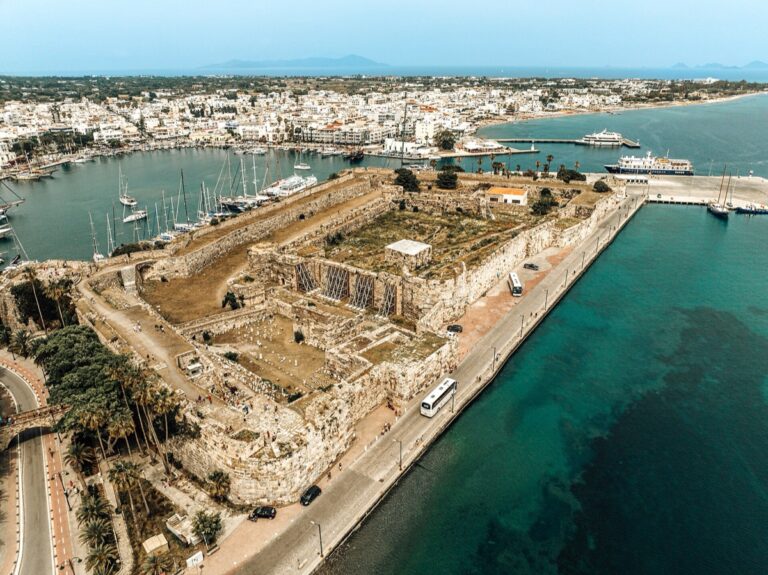
Strolling along the harbour in Kos Town, your eye will inevitably be drawn to the massive Neratzia fortress. This imposing structure was built in the fourteenth century by the Knights of St John to defend the island against raids from the nearby Ottoman Empire. The castle was sadly badly damaged in the devastating 2017 earthquake and was completely closed to visitors for eight years on safety grounds. The good news is that following an expensive restoration costing more than two and a half million euros in European funding — which reinforced the damaged walls — the castle finally reopened to the public in 2025.
Walk the newly secured battlements for breathtaking views over the harbour and its moored boats, then treat yourself to an iced coffee in town afterwards. Admission is around 5 euros and the visit takes roughly an hour. Do bear in mind that some peripheral areas may still be fenced off, and it’s worth arriving in the morning as the castle typically closes in the mid-afternoon.
Photo: ΑΝώΔυΝος, CC BY-SA 4.0, Wikimedia Commons
4. The Asklepion: Ancient Hospital
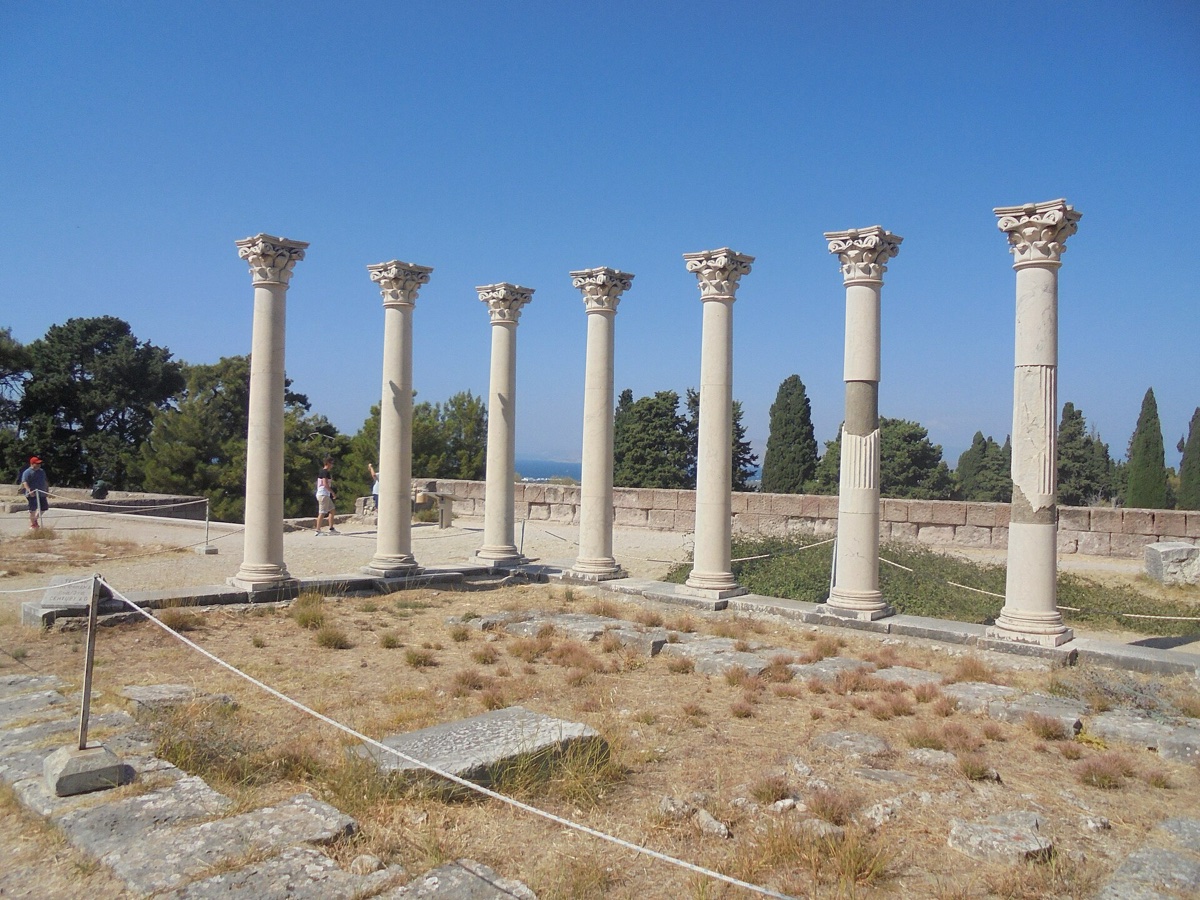
About three and a half kilometres northwest of the town centre, set into a gentle hillside, lies the single most important ancient site on the entire island. The Asklepion functioned in antiquity as a vast healing centre and sanctuary dedicated to Asclepius, the god of medicine. According to historians, this is where Hippocratic medical practices were applied, and patients travelled here from across the ancient world in search of a cure.
The complex is laid out across several terraces, and the higher you climb, the more the view opens up towards the Turkish coast — which looks close enough to touch from up here. Adult admission is around 8 euros, but check the current price on the official hhticket.gr website as it can change. EU citizens under 25 get in free. From Kos Town you can catch local bus number 3, or take the tourist train, but either way go early in the morning to beat the heat and the crowds.
Photo: Asurnipal, CC BY-SA 4.0, Wikimedia Commons
5. Explore Kos by Bike
If there’s one thing that sets Kos apart from most other Greek islands — which tend to be mountainous and tricky to navigate by bike — it’s the island’s serious love affair with cycling. In 2022, Kos was awarded the prestigious Bike Friendly Destination certification, and it fully deserves the title. The northern and eastern coasts are almost perfectly flat and threaded with over 200 kilometres of well-maintained cycle paths, where you’ll encounter families with toddlers and active retirees alike.
Hire shops are on every corner, and a basic city bike will set you back just 3 to 5 euros a day. If you fancy heading further into the interior, e-bikes are available from around 15 euros a day. The most beautiful and safest route runs directly from Faros beach along the coast through Kos Town and on to the resort of Psalidi — it takes about an hour at a very relaxed pace, and you can stop at a café or take a dip in the sea whenever the mood takes you. Try friendly Nikos Bikes in Tigaki, where the staff are happy to help you plan your route.
Photo: kallerna, CC BY-SA 3.0, Wikimedia Commons
6. Bros Therma Hot Springs
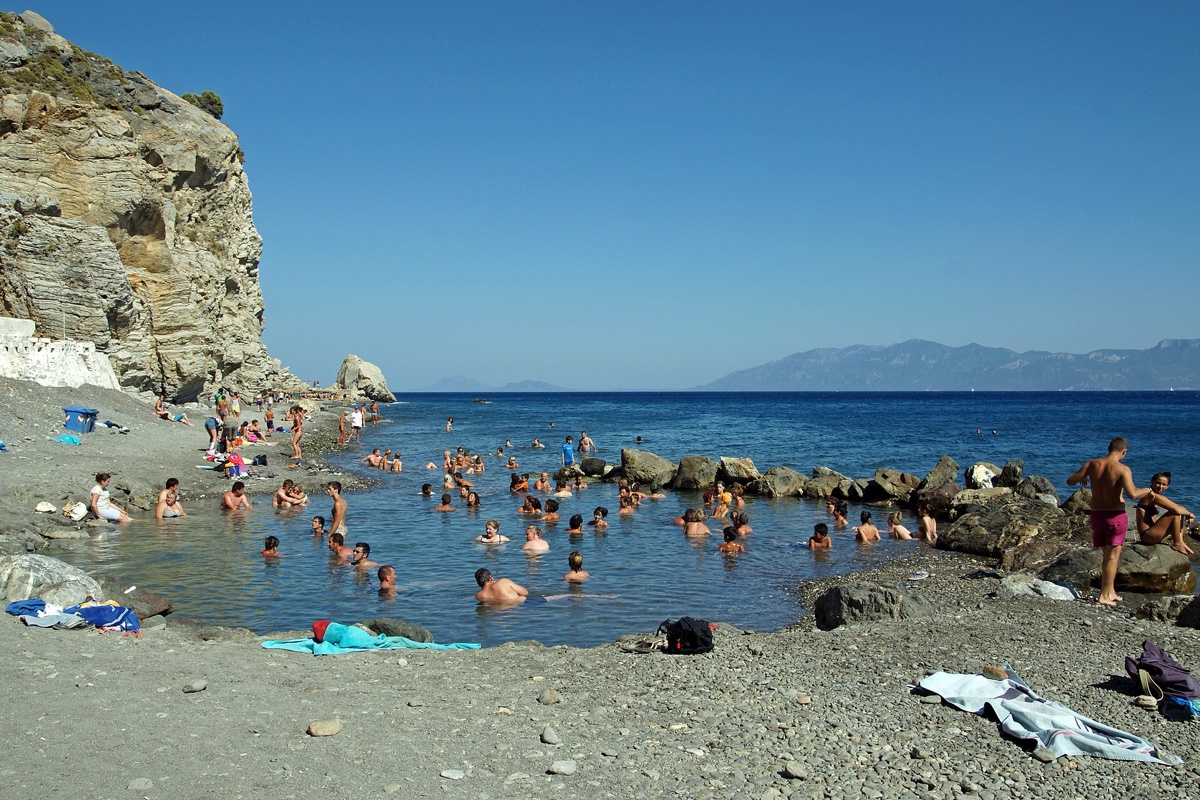
Fancy a bit of natural spa therapy? Then make the trip out to the eastern coast, about twelve kilometres from Kos Town. At Bros Therma beach, natural sulphurous springs at 42–50 °C bubble straight out of the rock and into the sea. Locals have used the stones to create a small natural pool roughly twenty-five square metres in size, where the hot mineral water mixes with the cooler Aegean waves — the result is an absolutely blissful place to relax.
Entry to the hot springs is completely free and open year-round. Do bring water shoes, though — the beach is covered in dark volcanic pebbles and the path to the springs is quite rocky. Also avoid wearing light-coloured swimwear or silver jewellery, as the high sulphur and mineral content in the water can permanently stain them yellow. Local buses run from Kos Town and the journey takes around twenty-five minutes, after which you’ll have a roughly fifteen-minute walk downhill to the water.
Photo: Robert Ahner, CC BY-SA 4.0, Wikimedia Commons
7. Sunsets in the Mountain Village of Zia
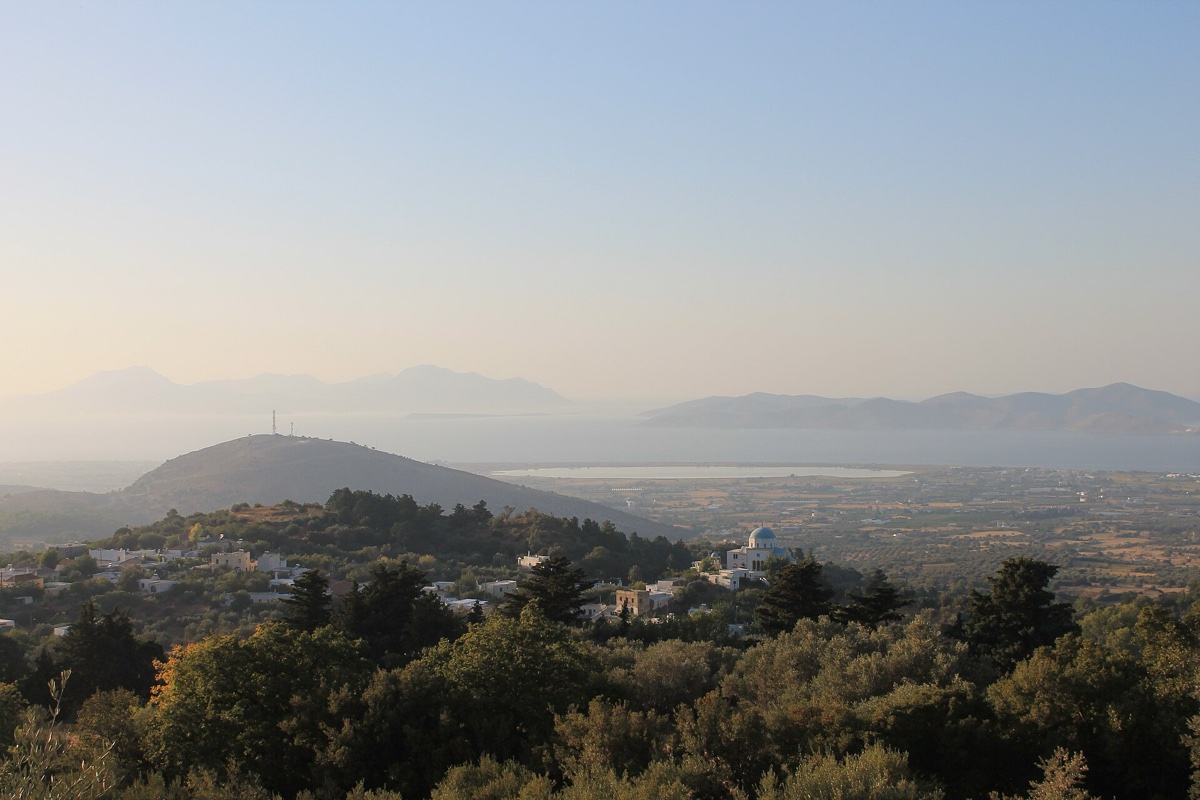
Perched high on the slopes of Mount Dikeos, the pretty village of Zia is known for its traditional blue-and-white architecture and sweeping views over the northern coast. It has become something of a legend thanks to the most spectacular sunsets on Kos. You’ll find plenty of souvenir shops and tavernas where you can try the local speciality: a refreshing cinnamon lemonade called kanelada.
💡 Tip: Zia suffers badly from overtourism during peak season. Around sunset, dozens of coaches pull in and thousands of people jostle for space on the viewpoints with their phones raised. If you’d rather avoid the chaos, visit early in the morning or late morning, when the village has a wonderfully calm and authentic feel. The natural park on the edge of the village also offers lovely views without the crowds. If you want to have dinner here, try the traditional taverna Oromedon — they do excellent wood-fired vegetarian dishes, a wonderful meat-free moussaka, and fried cheese with jam that’s absolutely worth the trip alone.
Photo: Ввласенко, CC BY-SA 3.0, Wikimedia Commons
8. Kefalos Peninsula and Agios Stefanos
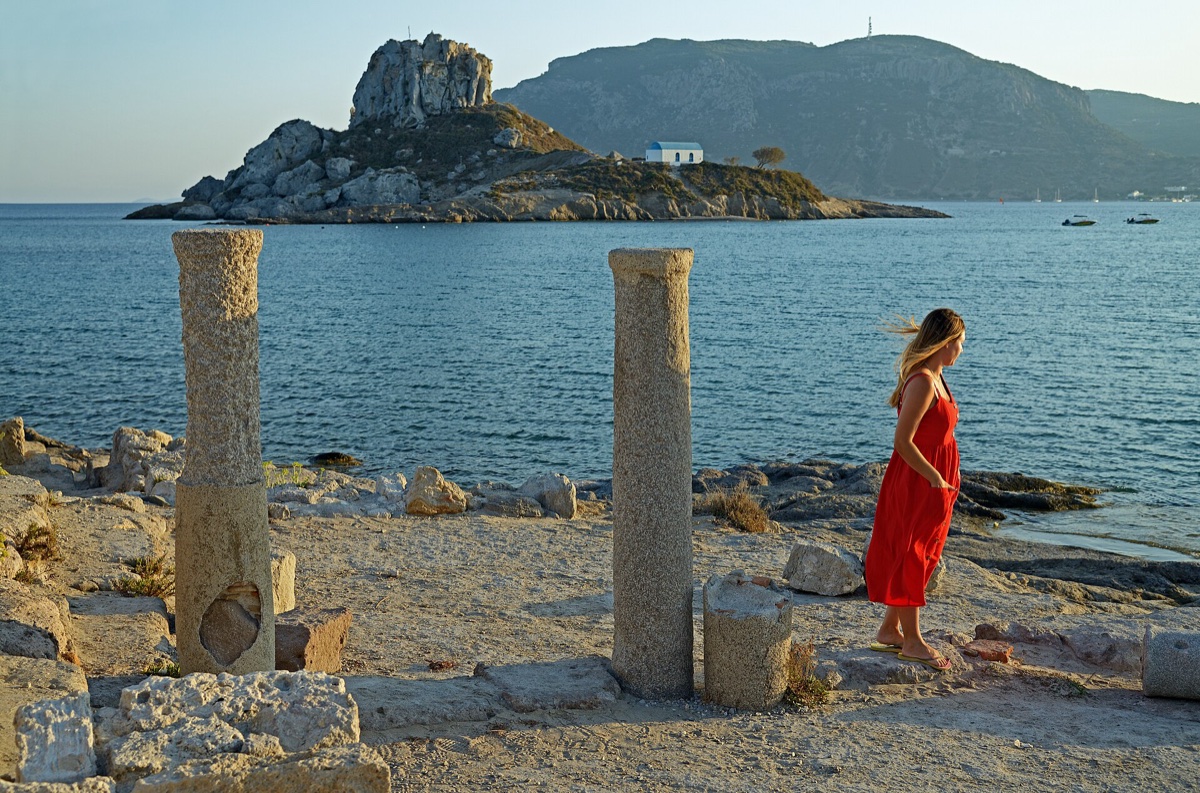
While the north of the island is dotted with large resort complexes, the southwestern Kefalos peninsula — about forty kilometres from Kos Town — still has a noticeably quieter, more rural character. Its coastline is fringed with beautiful coves just begging to be explored. The standout gem is Agios Stefanos beach, which offers something you’d be hard pressed to find anywhere else: swimming right alongside the ruins of a fifth-century early Christian basilica, whose columns rise just a few steps from the water’s edge.
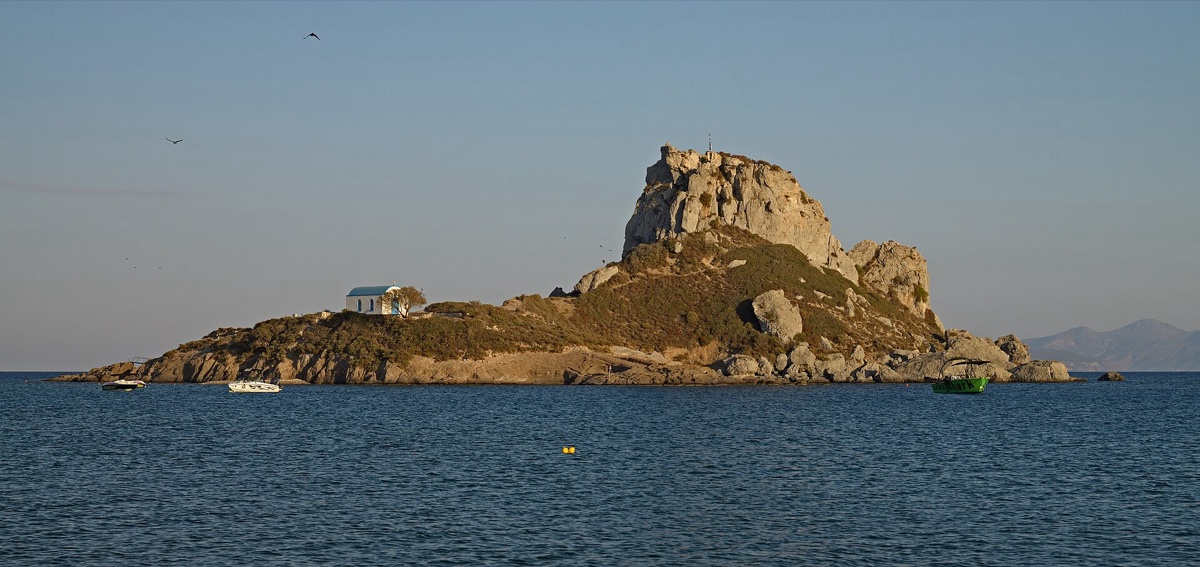
Directly opposite the beach, roughly a hundred and fifty metres offshore, sits the photogenic little islet of Kastri — topped by an iconic white chapel with a blue dome dedicated to St Nicholas. Confident swimmers can easily paddle out to it and ring the bell at the entrance, though always check the current sea conditions before you set off. The water around this part of the island is a little cooler than in the north, but it makes up for it in clarity and transparency.
Photo: יובל מדר, CC BY-SA 3.0, Wikimedia Commons
9. Paradise Beach and Camel Beach
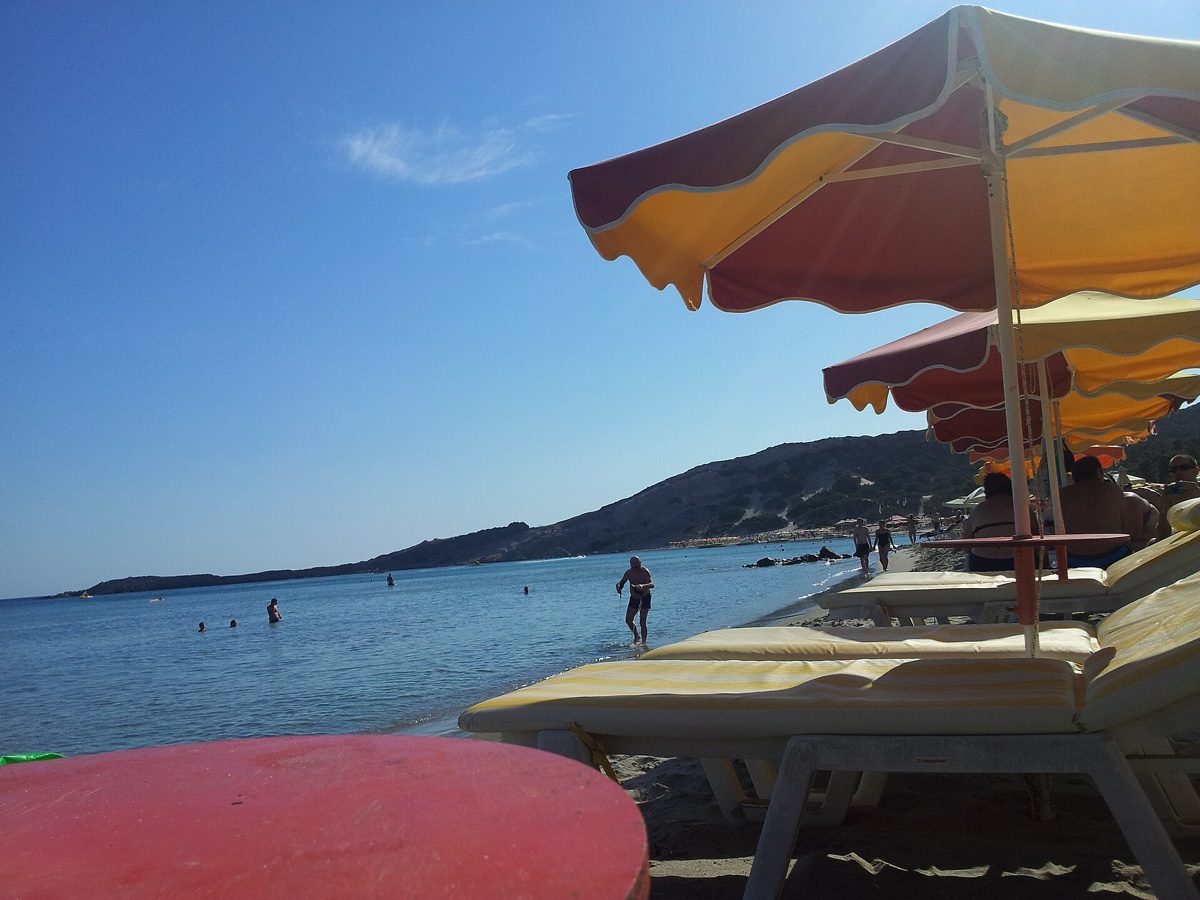
While you’re on the Kefalos peninsula, you absolutely cannot skip the beaches that regularly feature in lists of the most beautiful in all of Greece. The most famous is Paradise Beach, and it lives up to its name completely. Its fine golden sand, turquoise water and wide range of water sports make it a genuine paradise for families with children. It’s often nicknamed “bubble beach” too, because tiny bubbles of volcanic gas constantly seep up from the seabed — a brilliant extra attraction for young swimmers.
If Paradise Beach feels too busy during high season, drive a little further to the more secluded cove of Camel Beach. It gets its name from a huge rock on the horizon that looks remarkably like a sitting camel. The access road is fairly steep and gravelly — worth noting because standard hire car insurance often doesn’t cover unmade roads. Your reward for the slightly more adventurous journey is a great deal more peace and quiet, noticeably cooler and more refreshing water, and fantastic snorkelling conditions along the rocky edges of the bay.
Photo: Piotr Piętka, CC BY 3.0, Wikimedia Commons
10. The Sandy Beaches of the North
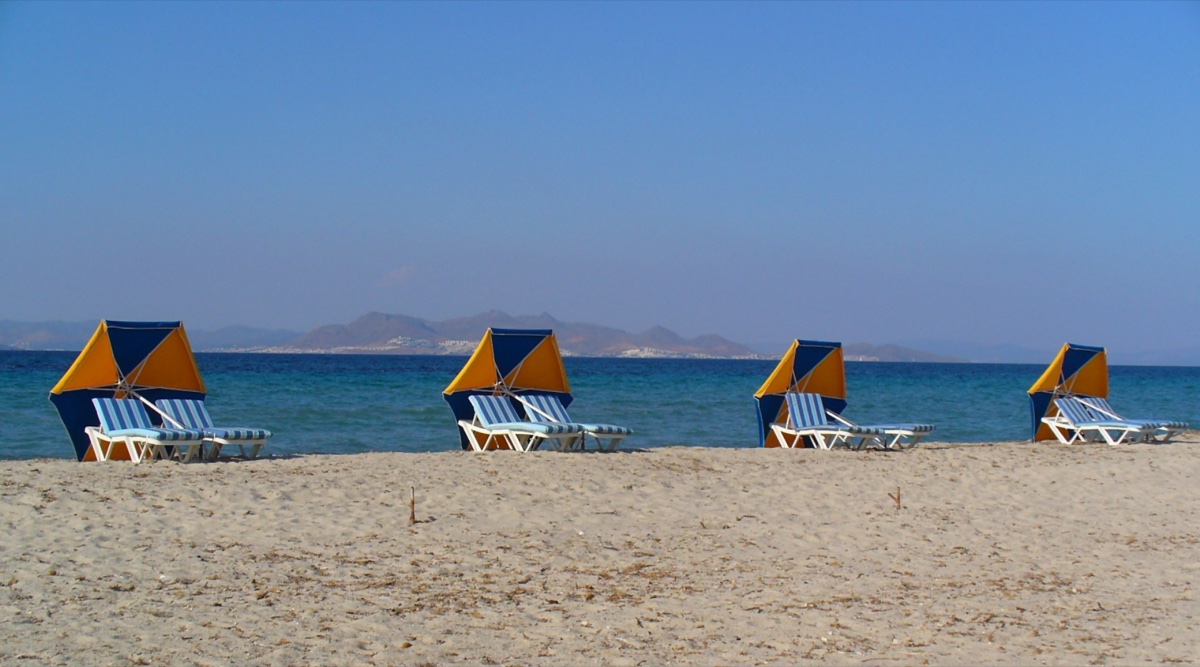
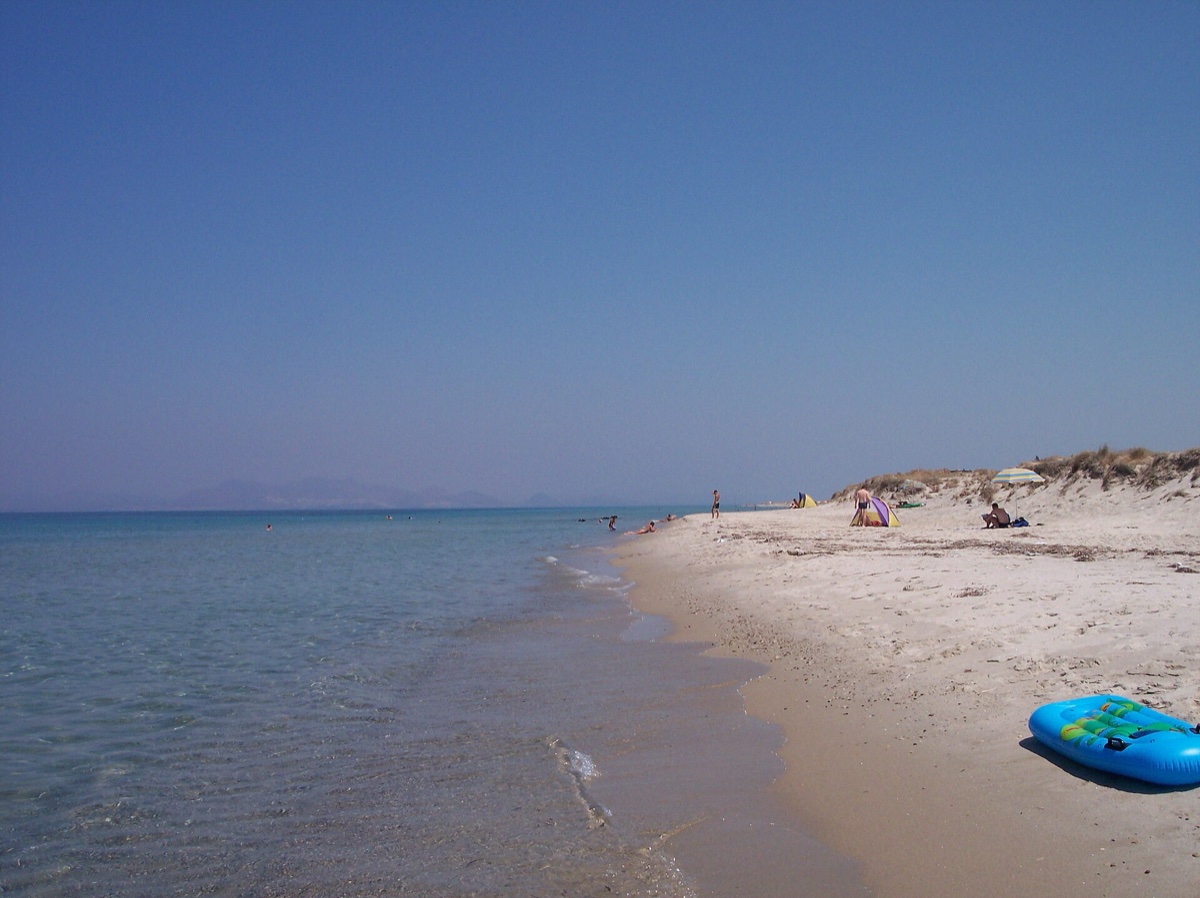
If your ideal holiday day is blissfully simple — morning coffee, beach until sunset — then the northern coast is made for you. The resorts of Tigaki, Marmari and Mastichari all share one defining feature: vast stretches of wonderfully fine, pale sand. Tigaki’s beach alone stretches for ten kilometres, flies the Blue Flag for water quality, and is connected to Kos Town by a convenient flat cycle path. The entry into the sea here is so gradual that you can wade dozens of metres out and still only be knee-deep — perfect for young children.
While Tigaki and neighbouring Marmari — flanked by pretty sand dunes — are fairly tourist-oriented resort towns full of hotel complexes, Mastichari retains the pleasant character of a traditional fishing village. It’s also the departure point for regular ferries over to the neighbouring island of Kalymnos. The entire northern coast is very exposed to the wind, so when the meltemi blows from mid-May through September, windsurfers and kitesurfers flock here from all over Europe. The sky fills with colourful kites on those days, as the conditions are simply ideal — and there are plenty of schools and equipment hire shops along the shore if you fancy giving it a go.
Photo: Rikki Mitterer, CC BY-SA 4.0, Wikimedia Commons
11. Plaka Forest with Peacocks and Alykes Salt Lake
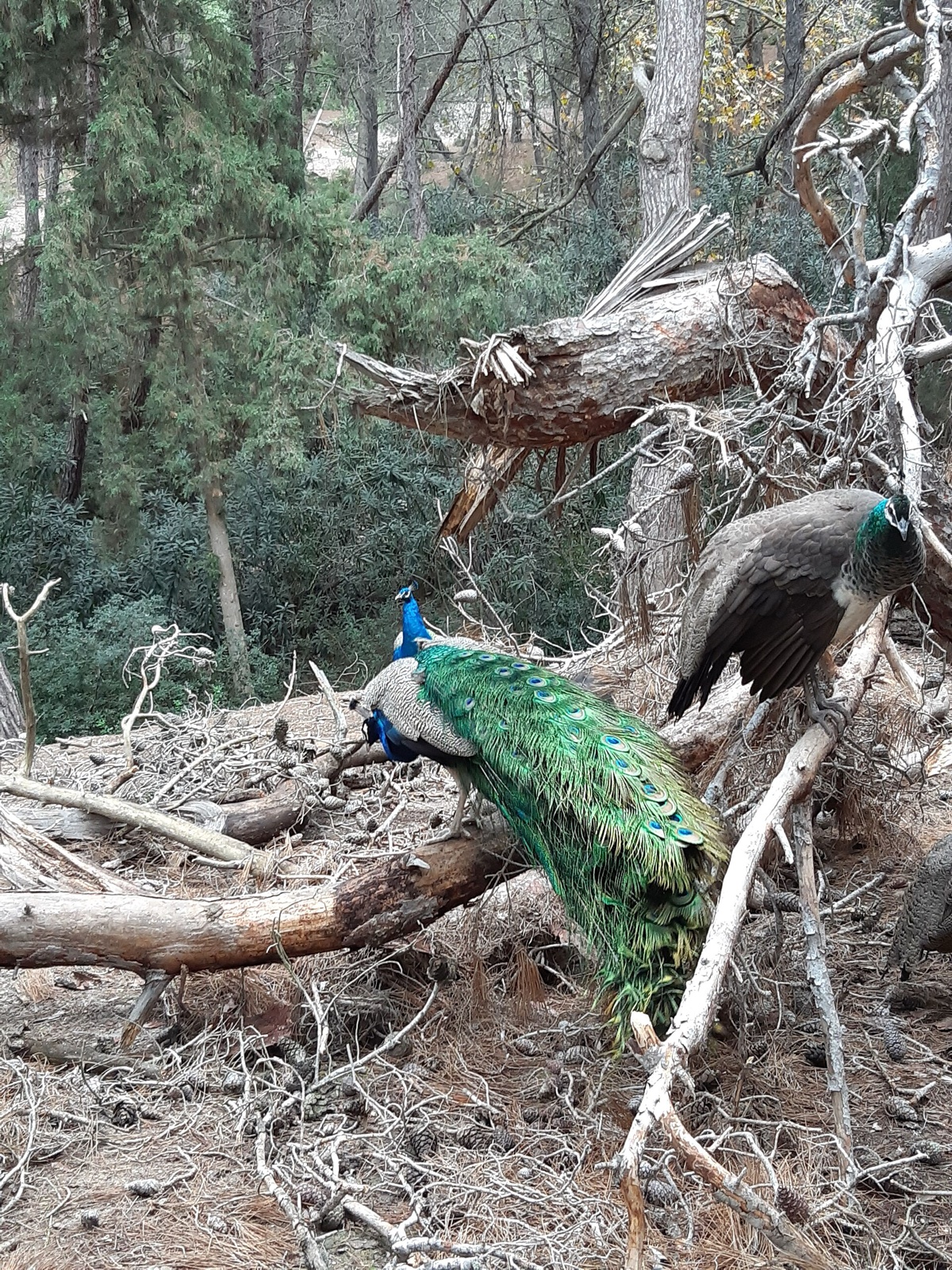
If you need a break from the salty sea and blazing sun, venture inland towards the village of Antimachia near the airport. Here you’ll find Plaka Forest, a pine woodland that acts as the green lung of the island. Entry is free, and the main attraction is the dozens of free-roaming peacocks that are remarkably tame and will eat right out of your hand. There are also freshwater turtles and plenty of shady picnic spots — the only catch is that no buses come here, so you’ll need a car or bike.
Another worthwhile natural stop on the northern part of the island is the Alykes salt lake, just outside Tigaki. In the summer heat it dries out to a glistening salt crust with mountains in the background, but if you visit in spring, autumn or winter you stand a very good chance of spotting flocks of wild flamingos that stop here during their migration. It’s a lovely cycle from Kos Town and makes for a perfect afternoon outing.
Photo: Asurnipal, CC BY-SA 4.0, Wikimedia Commons
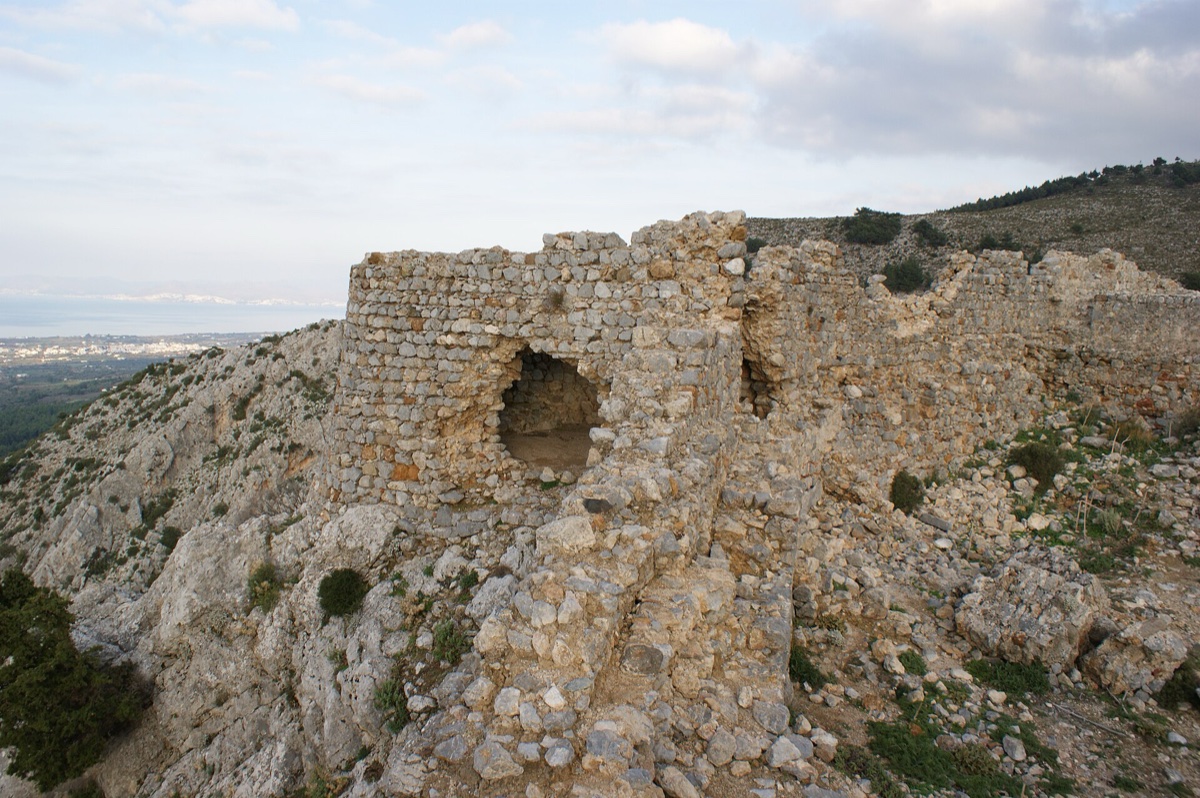
12. The Abandoned Castle of Palio Pyli
Love mysteries and abandoned places with a dark history? Then Palio Pyli is bound to captivate you. It’s a ruined medieval settlement hidden high in the island’s interior, hurriedly abandoned by its inhabitants in the nineteenth century during a devastating cholera epidemic. Rising above the crumbling stone houses are the imposing remains of a Byzantine castle and two historic small churches, reached by a roughly three-kilometre woodland trail from the modern village of Pyli. From the top, the panoramic views across the Aegean, the neighbouring islands and the nearby Turkish coast are absolutely breathtaking — which is why it’s also become a popular spot for watching the sunset.
Entry to the whole site is completely free, though travel forums regularly warn about fake monument guardians. These individuals sometimes hang around at the forest entrance and try to persuade unsuspecting tourists to make voluntary contributions towards a non-existent restoration fund. Don’t be taken in — feel free to walk straight past them with a clear conscience. The climb up is a bit demanding, so wear sturdy footwear, but you’ll be rewarded at the top by a charming little café with extraordinary views.
Photo: Mustang Joe, CC0, Wikimedia Commons
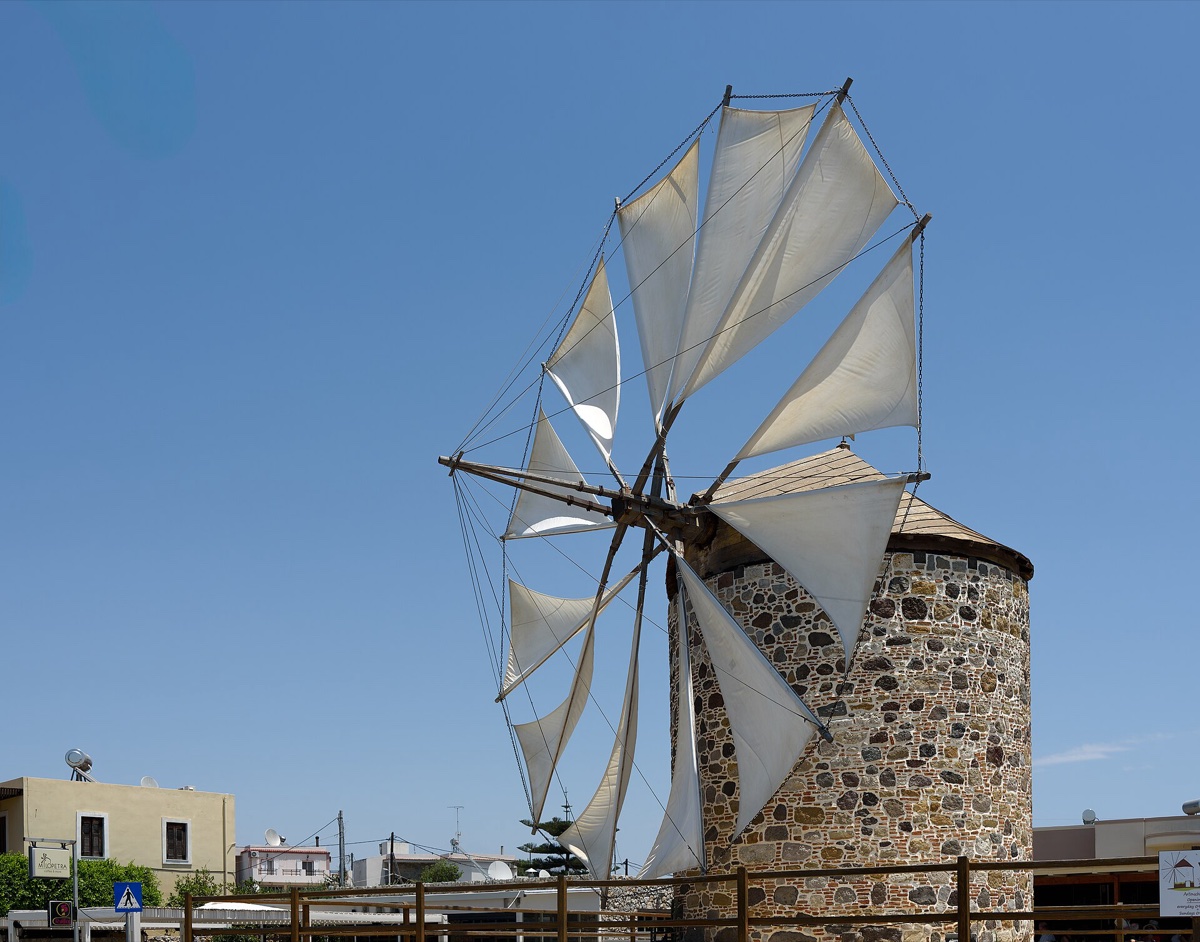
13. The Windmill in Antimachia
Most of us picture iconic white windmills the moment we think of Greek islands, and Kos happily delivers. In the village of Antimachia, right in the middle of the island not far from the international airport, you’ll find the only fully functioning windmill on the whole island. It’s over two hundred and fifty years old and, following careful restoration, now operates as a fascinating small museum. For an entrance fee of around 3 to 5 euros, you can step inside the mill and have the owners walk you through exactly how the ancient grain-milling mechanism works.
The visit also includes the adjacent traditional house, furnished with original period furniture, which shows precisely how a typical island miller’s family would have lived a hundred years ago. It’s a quick stop, but a surprisingly interesting and wonderfully photogenic one. While you’re in Antimachia, it’s also well worth swinging by the nearby thirteenth-century Crusader fortress of Kastell, inside whose walls two charming little chapels are tucked away.
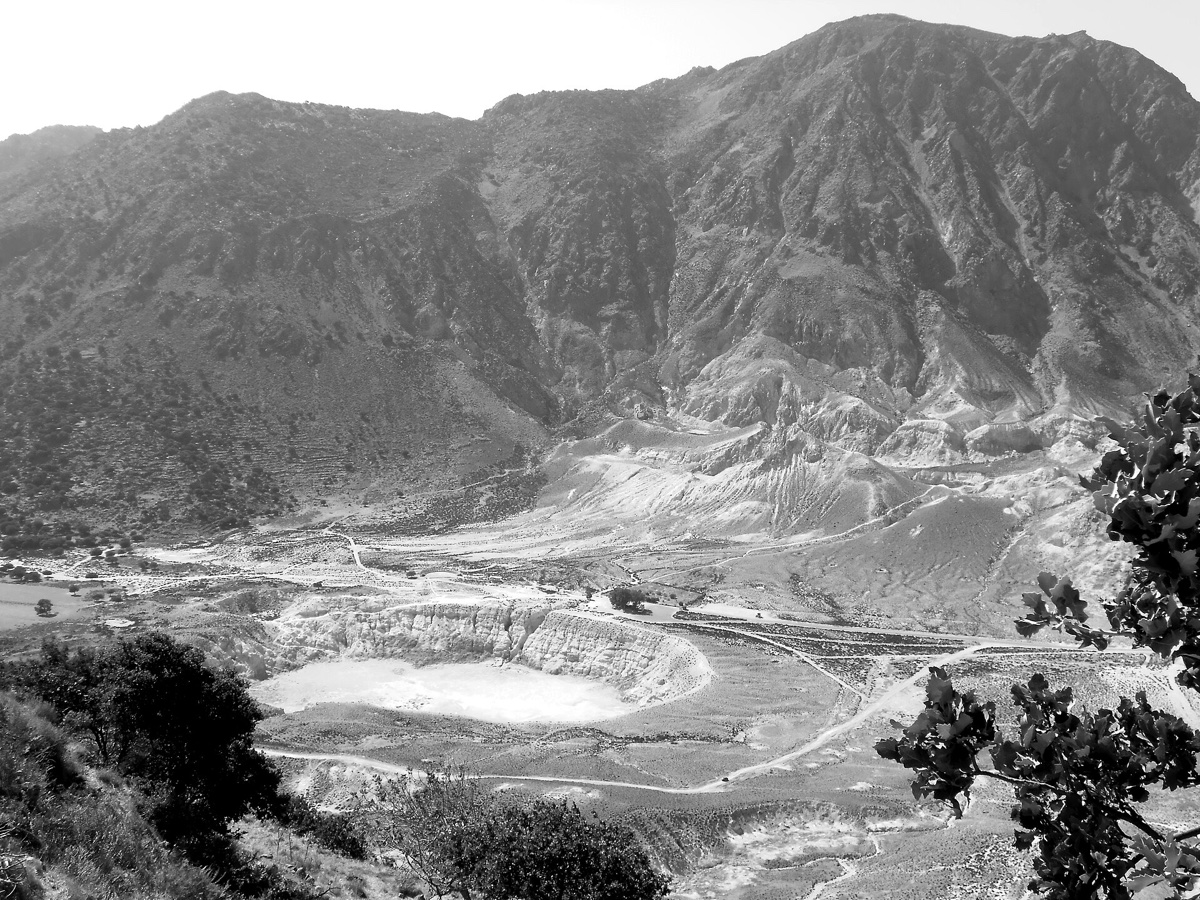
Being this close to an active sleeping volcano and not visiting it would be a real missed opportunity. The neighbouring island of Nisyros is a fascinating place, with volcanic activity still rumbling away beneath its surface. You can book a full-day organised tour for around 40 euros, easily arranged through platforms like GetYourGuide or directly through a local rep. The price typically includes a bus transfer from the port to the Stefanos crater, where you’ll walk across a yellow sulphurous crust and feel the heat radiating up from below.
If you prefer to explore independently, it’s perfectly straightforward and cheaper. Regular ferries run from Kardamena port, with a return ticket costing around 16 euros and the crossing taking about forty-five minutes. On the island itself you’ll pay 3 euros as an island fee and 5 euros for access to the crater. Don’t miss the picturesque harbour town of Mandraki with its Panagia Spiliani monastery, where you can try the wonderful local almond drink called soumada.
Photo: Serhio Magpie, CC BY 4.0, Wikimedia Commons
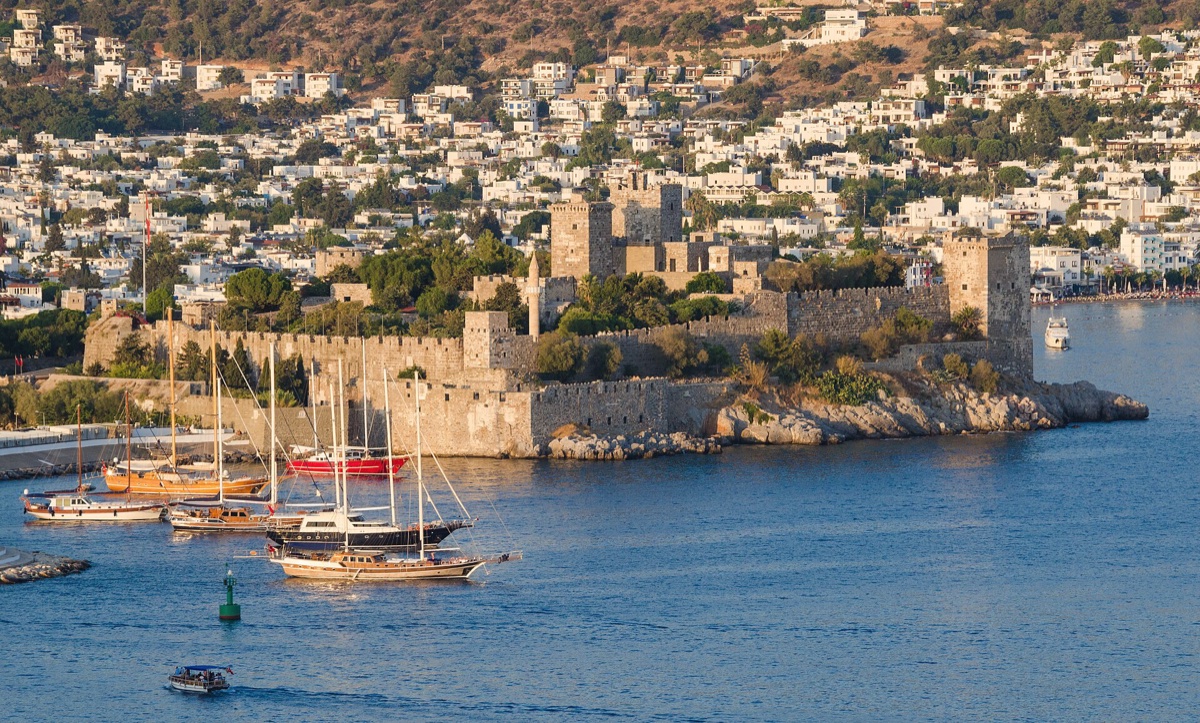
15. A Day Trip to Bodrum, Turkey
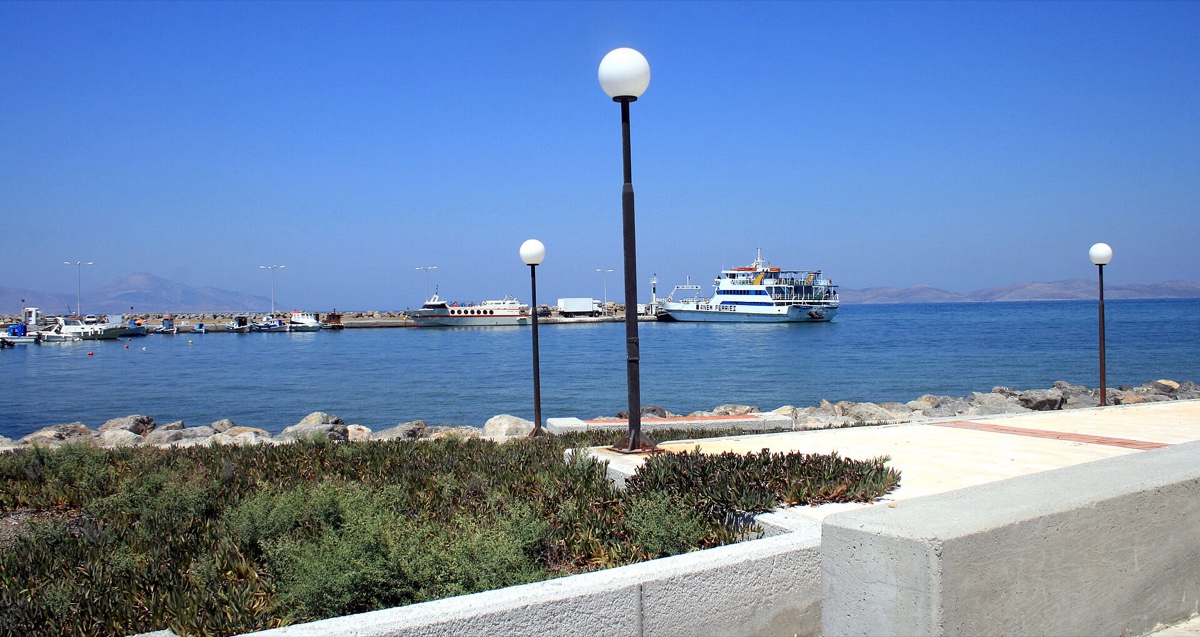
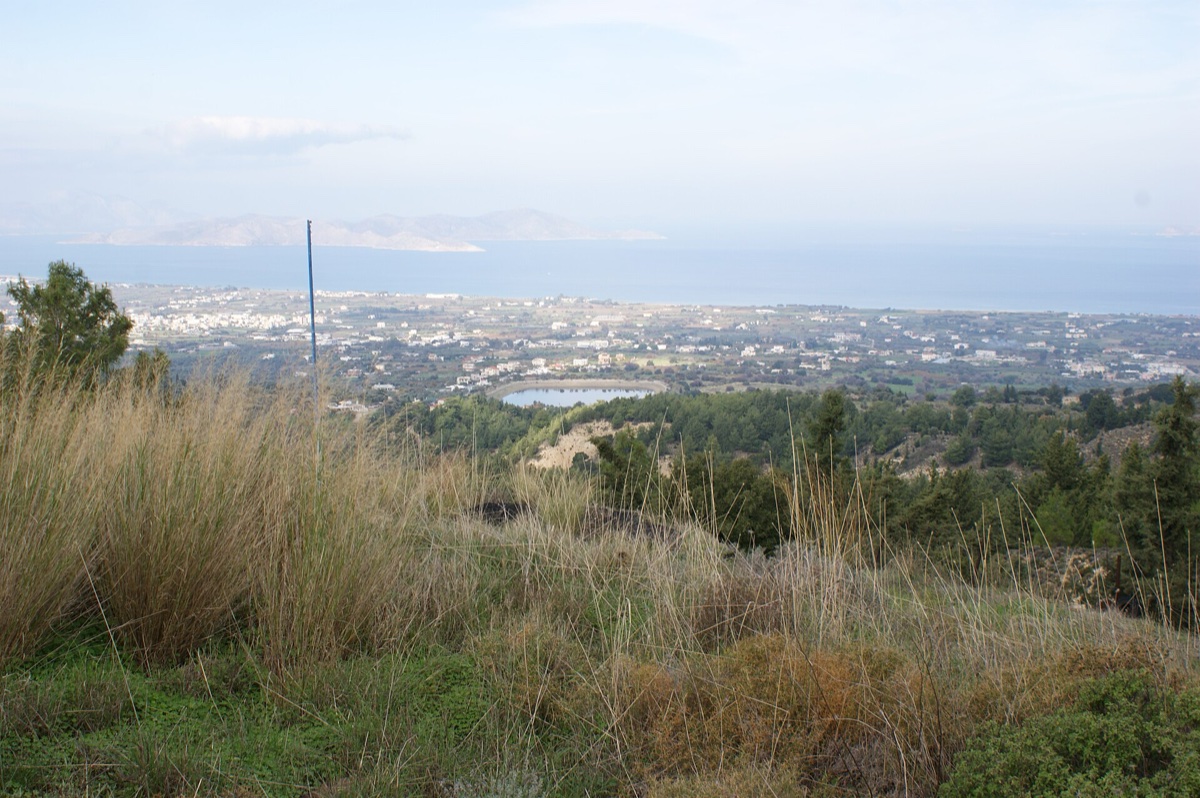
From the beaches in northern Kos, the Turkish mainland is so sharp and clear on the horizon that it almost feels within swimming distance — just seven nautical miles separate the two countries. It would be a real shame not to make the most of it and hop over for a day on an entirely different continent. Boats depart every morning from Kos Town to the Turkish resort of Bodrum, and the crossing takes just 30 to 60 minutes depending on the vessel. Return tickets are available from various operators for between 15 and 25 euros.
In Bodrum you’ll discover bustling bazaars where everything is up for negotiation — from spices to leather goods — as well as the imposing Castle of St Peter and the remains of the ancient Mausoleum of Halicarnassus. The latter is one of the Seven Wonders of the Ancient World: you’ve probably read about it at school, but nothing quite prepares you for seeing it in person. ⚠️ Important note: Turkey is not a member of the EU or the Schengen Area. This means that for this trip you must carry a valid passport — a UK driving licence or any other ID card will not be accepted. Passport and customs checks at the port before departure can take a while and queues do form, so arrive with plenty of time to spare.
Where to Eat in Kos
The food scene on Kos is far better than you might expect. This isn’t just about gyros and Greek salad: the island has its own PDO-protected cheeses, fried pastry parcels drizzled with honey, and a cinnamon lemonade you simply won’t find anywhere else. Kos has exceptionally fertile soil and a long tradition of local produce, which forms the backbone of most island specialities. If you love discovering new flavours, seek out the traditional family-run tavernas that cook from recipes passed down through the generations — there are great options for meat lovers and vegetarians alike.
The absolute must-try is the local cheese called krasotiri (also known as posa). This soft goat’s or sheep’s milk cheese carries a protected designation of origin and is unique in that it ripens in red grape pomace, giving it a distinctive reddish rind and a subtly spicy, wine-tinged flavour. Another vegetarian treat is katimeria — delicious fried pastry parcels stuffed with fresh cheese, then generously drizzled with honey and dusted with cinnamon. On hot summer days you’ll be very grateful for a glass of kanelada, the traditional cinnamon lemonade especially associated with the mountain village of Zia, or the popular local almond drink known as soumada.
For the best restaurants, the taverna Oromedon in Zia is well worth booking in advance. They serve outstanding mountain cuisine, a wonderful meat-free wood-fired moussaka, and a magnificent fried cheese with homemade jam. Back in Kos Town, the elegant restaurant Petrino — set in a beautiful garden courtyard — is a must for its excellent tasting boards loaded with local cheeses. Not far from the centre, the popular taverna Elia serves a near-perfect saganaki alongside a whole range of traditional vegetable meze dishes.
Meat eaters are also well catered for. A typical local speciality is pitaridia — homemade pasta similar to wide noodles, slow-cooked in a rich meat broth. Traditionally served with a generous portion of minced meat and pork fat, it’s a wonderfully hearty dish that locals particularly love on cooler evenings.
Where to Go Next from Kos
If you’re weighing up whether Kos is the right destination for your holiday, or you’d like to combine it with other places in Greece, do have a look at our other guides. We’ve put together a comprehensive overview of where to go on holiday in Greece, comparing different destinations. History lovers will find plenty to interest them on the neighbouring island of Rhodes, while for the ultimate in romance our article on a holiday in Santorini is essential reading. And if your flights are already booked, don’t forget to check our practical packing list of what to bring on a Greek island holiday.
Frequently Asked Questions
I’ve put together answers to the most common questions about a holiday on Kos, so you can head off with everything sorted. Hopefully these practical tips will make planning a little easier. 😉
What are the must-see attractions on Kos?
The absolute essentials include the ancient healing center of Asklepion, the imposing Neratzia Castle, and the town center with Hippocrates’ Plane Tree and the ancient agora. For natural beauty, don’t miss the thermal beach of Bros Therma, the Kefalos peninsula with the Agios Stefanos basilica, and the abandoned medieval village of Palio Pyli. Be sure to catch the sunset from the village of Zia as well.
How long is the flight to Kos?
A direct flight from the Czech Republic to Hippocrates International Airport on Kos takes approximately 2.5 hours. In the summer season, direct charter flights operate from Prague, Brno, and Ostrava. The airport is located in the central part of the island near the village of Antimachia, so the transfer to most hotels and resorts takes no longer than thirty to forty minutes, which is a huge advantage.
How expensive is Kos?
Kos is one of the very budget-friendly Greek islands, mainly thanks to the huge competition among hotels and rental agencies. A meal at an average taverna will cost you 15 to 25 euros per person, renting a city bike costs an amazing 3 to 5 euros a day, and you can get a smaller car in season from 35 euros a day. Bus tickets on the intercity KTEL lines range between 2 and 5 euros.
What’s the sea like on Kos?
The sea on Kos is wonderfully clean and in the summer months warms up to a pleasant 25 °C. The northern coast (Tigaki, Marmari) has very long shallows with fine sand, which is great for children, though it sometimes gets windy here and waves form. The southwestern coast near Kefalos has slightly cooler and calmer water, with absolutely crystal-clear visibility ideal for snorkelling.
What should I watch out for on Kos?
Definitely watch out for the strong sun and the summer meltemi wind, because when it blows you often don’t feel the heat and can very easily get sunburnt on the beach. Also bear in mind that the island doesn’t use the Uber app, so you’ll have to rely on local taxis or the very well-functioning bus network. On the eastern pebble beaches and at the thermal springs, you’ll definitely need water shoes.
Is Kos suitable for families?
Yes, Kos is considered one of the best destinations in Greece for families with children. The reason is its flat terrain, certified as Bike Friendly, which is ideal for safe bike rides with kids. On top of that, it offers very short transfers from the airport and, above all, the endless northern beaches, where the water stays shallow even tens of metres from the shore.
Is a trip to Bodrum worth it?
If you like contrasts, then definitely yes. In just half an hour’s sailing, you’ll find yourself in a completely different, oriental world full of markets and haggling. The ferries are affordable, costing around 20 euros, but remember that you’re leaving the Schengen area, so you absolutely need a valid passport; they won’t let you on the boat with an ID card.
Tips and Tricks for Your Vacation
Don’t Overpay for Flights
Search for flights on Kayak. It’s our favorite search engine because it scans the websites of all airlines and always finds the cheapest connection.
Book Your Accommodation Smartly
The best experiences we’ve had when looking for accommodation (from Alaska to Morocco) are with Booking.com, where hotels, apartments, and entire houses are usually the cheapest and most widely available.
Don’t Forget Travel Insurance
Good travel insurance will protect you against illness, accidents, theft, or flight cancellations. We’ve had a few hospital visits abroad, so we know how important it is to have proper insurance arranged.
Where we insure ourselves: SafetyWing (best for everyone) and TrueTraveller (for extra-long trips).
Why don’t we recommend any Czech insurance company? Because they have too many restrictions. They set limits on the number of days abroad, travel insurance via a credit card often requires you to pay medical expenses only with that card, and they frequently limit the number of returns to the Czech Republic.
Find the Best Experiences
Get Your Guide is a huge online marketplace where you can book guided walks, trips, skip-the-line tickets, tours, and much more. We always find some extra fun there!
TL;DRTuscany, Italy tempts you with 30 of its most beautiful places, from Florence, Siena and Pisa with its Square of Miracles, through the tufa towns of Pitigliano and Sovana, all the way to the beaches on the island of Elba and the natural hot springs in Saturnia and Bagni San Filippo. The best time to visit is April, May, September and October, with temperatures around 20 to 25 degrees, while the full 7-day itinerary looping Florence–Lucca–Pisa–San Gimignano–Volterra–Siena–Chianti–Val d'Orcia needs at least five to seven days. As a base, we recommend Siena or the Val d'Orcia area, and accommodation in an agriturismo runs about €60 to €125 a night. Don't drive into historic centres like Florence, Siena or Monteriggioni because of the camera-monitored ZTL zones, where a violation means a fine mailed straight to your home.
When Lukáš and I pedalled up those endless hills on our long-distance cycling trip across Europe, I think I was sweating from places I didn't even know I had. Tuscany, Italy really put us through our paces on the bikes, but every single metre of climbing was worth it. When the view of the rolling landscape dotted with cypress trees opens up in front of you, you instantly forget about your aching legs and just stare in disbelief at all that beauty. It's exactly the kind of postcard-perfect splendour you know from pictures, except in real life it's even a notch better.
Tuscany is quite simply paradise on earth, and we absolutely love coming back. Whether you long to wander the narrow lanes of medieval little towns, want to taste the finest Italian wine right at the vineyards, or just soak in hot natural springs, you'll find your thing here. On top of that, Lukáš and I are vegetarians, and the local traditional cuisine is an absolute dream come true for us.
In this article, I've put together everything you need to know before your trip. We'll look at when the best time to go is, how to avoid hefty parking fines, and most importantly I'll show you 30 of the most beautiful places you definitely shouldn't miss. I've also added our favourite seven-day road trip itinerary to make your planning as easy as possible.
Saturnia – hot springs in Tuscany
Summary
Best time to visit: By far the best is April, May and September, when it's pleasantly warm and you avoid the worst crowds.
Driving and fines: You're not allowed to drive into historic centres, which are guarded by the so-called camera-monitored ZTL zones, and fines fly straight to your home.
Accommodation: It's ideal to find a strategic base, and I recommend Siena or the Val d'Orcia area, from which you can make brilliant day trips in every direction.
Natural hot springs: Tuscany is full of free springs right out in nature, the most famous being the cascades in Saturnia, where you need to go early in the morning.
Local food: Be sure to try the thick ribollita soup or the traditional pici pasta, and with your wine have some pecorino sheep's cheese.
Wine regions: The most famous are Chianti Classico and the area around Montalcino, but in season you have to book tastings well in advance.
Beaches and sea: If you want clean water without the crowds on paid sunbeds, head south to the Maremma area or the island of Elba.
Tuscany: weather and sea temperature by month
🌡️ Warmest: August (30 °C by day) · 🌊 Warmest sea: August (28 °C) · ☔ Least rain: July
Month
Day
Night
Sea
Rainy days
January
12 °C
5 °C
15 °C
12
February
14 °C
6 °C
14 °C
7
March
15 °C
7 °C
14 °C
8
April
17 °C
9 °C
16 °C
10
May
21 °C
14 °C
19 °C
12
June
26 °C
18 °C
23 °C
6
July
29 °C
21 °C
27 °C
3
August
30 °C
22 °C
28 °C
6
September
26 °C
18 °C
24 °C
10
October
21 °C
15 °C
22 °C
12
November
16 °C
10 °C
19 °C
15
December
13 °C
7 °C
16 °C
16
Source: climate normal 2019–2024 (Open-Meteo, measured data)
Tuscany is a stunning destination in any season, but the ideal time to visit depends a lot on what exactly you want to experience. From our experience, the absolute best time is spring and autumn. If you can, go in April, May, or then in September and October. In these months the temperatures hover around a pleasant 20 to 25 degrees, which is absolutely ideal for exploring towns and for cycling. On top of that, the spring landscape is incredibly lush green and full of blooming poppies, while autumn plays out in golden colours and is the time of the grape and olive harvest. We break down the temperatures month by month, as well as the sea temperature, in our article Weather in Tuscany.
Personally, I'd rather avoid summer, even though I understand that families with kids often have no other option. From mid-June to the end of August, Tuscany turns into a furnace, with temperatures regularly climbing past 35 degrees. Walking through the baking stone lanes of Florence in that kind of sticky heat is more of a punishment than a treat. On top of that, this is when the Italians themselves are on holiday, so there are huge crowds everywhere. Watch out especially for the period around 15 August, when the Ferragosto holiday is celebrated and a lot of smaller businesses or restaurants may be completely closed.
If you don't mind slightly cooler weather, winter in Tuscany has something going for it too. From December to February, daytime temperatures sit around 8 to 11 degrees, which is plenty for walks in a jumper and jacket. The advantage is that you'll have even the most famous places like San Gimignano or Pisa almost to yourself. You do have to bear in mind, though, that winter tends to be the rainiest season, so you won't get by without an umbrella and good shoes. It's an absolutely magical time for bathing in the hot natural springs, when steam rises from the warm water into the frosty morning air.
When planning how long to travel, definitely count on at least five to seven days. Tuscany is enormous, and the distances between the individual villages on winding back roads take up more time than they look on a map. If you want to see Florence, Siena, taste wine in Chianti and drive through the Val d'Orcia valley, a week is the absolute minimum so that you're not constantly just rushing around in the car. For those who only have a long weekend, I recommend picking just one smaller area, for example the surroundings of Siena, and saving the rest for next time.
Where to stay in Tuscany
Choosing the right base is absolutely crucial for a holiday in Tuscany. Lukáš and I always try to find accommodation somewhere in the middle of the region, so we don't have to spend hours driving around every day. In this respect, the surroundings of Siena or the Val d'Orcia area are absolutely ideal. From here you're close to the most beautiful hilltop towns, the vineyards and the thermal springs. I'd only recommend staying right in the centre of Florence to those who don't have a car and plan to travel purely by train, because parking and traffic in the streets of Florence are a driver's nightmare.
If you want to experience the real, authentic Tuscany, definitely look for a so-called agriturismo. These are traditional stone farms and rural estates that local families have converted into charming guesthouses. They often come with a pool overlooking the countryside, and the owners will offer you their own olive oil, homemade cheeses and wine at breakfast. It's an experience that no big, impersonal hotel can give you. Prices per night in a nice agriturismo for two run roughly from €60 to €125 (1,500 to 3,000 CZK), depending of course on the season and the facilities. We prefer to look for and book accommodation the classic way on Booking, where the choice of these farms is the largest. We've written up twenty specific farms with prices in our article Agriturismo in Tuscany, and if you're travelling in a bigger group or with family, check out our selection of villas with a pool in Tuscany.
When you want to pick a specific place, we have a few tips. If you're after pure luxury and don't mind paying a bit extra, take a look at the Hotel Certosa di Maggiano a short drive from Siena. It's a beautiful historic complex in a former Carthusian monastery dating back to 1316, with a wonderful pool and a sprawling garden where you'll feel like you're in a fairytale. For a slightly more affordable but still very elegant experience, there's the villa Ca' Bianca Tuscany Relais a few kilometres from Siena on the edge of Chianti, which offers everything you'd expect from the Tuscan countryside.
The town of Lucca in the north of the region also has a brilliant strategic location. From here you're a short drive from Pisa, the sea and the mountains. Here the cosy Casamariu accommodation is very popular, and it won't ruin your wallet while still providing great comfort. Whichever area you choose, in the summer months book your accommodation several months in advance. The best and affordable farms with a pool tend to be sold out for July and August as early as the start of spring. Travelling with kids? We break down what actually works in Tuscany and what doesn't in our article Tuscany with kids.
Lukáš and Lucie recommend
Where to stay in Tuscany
4 accommodations — wellness hotels, hotels and other accommodation options
Tuscany is so packed with monuments and natural beauty that you could spend a year here and there'd still be something to discover. I've picked out 30 of our favourite places for you that I think are worth a visit.
1. Florence – the Renaissance heart of the region
Florence is the most visited place in Tuscany
Florence is a city where art seems to breathe from every corner. An absolute basic is a visit to the famous Uffizi Gallery, where you'll see Botticelli's Birth of Venus with your own eyes. But definitely buy the tickets, which cost around €25, online well in advance, otherwise you'll spend half a day waiting in an endless queue. If you long to see the original of Michelangelo's David, you have to head to the nearby Galleria dell'Accademia.
The landmark of the whole city is the enormous Duomo Santa Maria del Fiore with its brick dome by the architect Brunelleschi. Entry to the cathedral itself is free, but if you want to climb the 463 steps all the way up to the dome, you have to buy a combined ticket and book a specific time slot. The view of Florence's red roofs from the top is absolutely breathtaking.
Don't forget to stroll across the historic Ponte Vecchio bridge, which is literally dotted with small goldsmith's shops. Just a short walk from it you'll find Piazza della Signoria, the main square with the Palazzo Vecchio town hall, which functions as a kind of open-air sculpture gallery.
💡 Tip: Don't under any circumstances try to drive into the centre of Florence. The whole centre is a strict ZTL zone with cameras. The best thing is to leave your car at the big Villa Costanza park-and-ride right by the exit from the A1 motorway and take the tram into the centre comfortably in a few minutes.
2. Pisa and its Square of Miracles
The Leaning Tower of Pisa in Tuscany
When you say Pisa, everyone immediately pictures the famous Leaning Tower, where crowds of tourists try to get the funniest photo of themselves propping it up. Construction began back in 1173, and the tower started leaning during the build itself because of the soft subsoil. If you want to climb the nearly 300 steps to the top, set aside €20 and definitely buy your ticket in advance for a specific time.
It would be a huge shame, though, to come to Pisa, snap the tower and drive straight off. The whole Piazza dei Miracoli, or Square of Miracles, is a UNESCO World Heritage Site and is absolutely stunning. Right next to the tower stands the beautiful marble Cathedral of the Assumption, entry to which is free when you buy a ticket for the tower.
Definitely make time for the enormous circular Baptistery, which is the largest in all of Italy and has absolutely incredible acoustics. Just next to it is the monumental Camposanto cemetery with beautiful frescoes, where there's wonderful peace away from the crowds packed onto the lawn around the tower.
💡 Tip: Most people leave the Square of Miracles straight away, but try walking into the historic centre of Pisa towards the river Arno. You'll find beautiful little squares and lanes where you can sit down for excellent gelato without the tourist mark-ups.
3. Medieval Siena and its shell-shaped square
If you set off early in the morning, you can get a similar photo.
For me personally, Siena is probably the most beautiful larger city in all of Tuscany. It's a huge rival to Florence and has kept a much more authentic medieval character. The heart of the whole city is the famous Piazza del Campo, which has a unique shell shape and slopes down towards the town hall. It's right here that the famous and gruelling Palio horse race takes place twice a year. We covered both towns in detail in a separate article, Siena and San Gimignano.
Rising above the square is the slender Torre del Mangia, over a hundred metres tall. The climb up more than four hundred narrow steps is quite a workout, but the view of Siena's brick roofs for around €10 is definitely worth it.
Don't let the monumental Siena Cathedral, or the Cathedral of the Assumption, escape your attention either. Both outside and inside it's made of striped black-and-white marble, and it's a stunning sight. It's worth buying the combined OPA SI Pass for around €15, which also opens the doors to the fascinating Piccolomini Library and the crypts.
💡 Tip: Just like in Florence, the historic centre of Siena is reserved for pedestrians only. Leave your car in one of the big underground garages by the walls; the Santa Caterina car park, for example, works brilliantly, and escalators take you almost all the way up into the centre.
4. San Gimignano – the town of medieval skyscrapers
Siena and its shell-shaped square
As you approach San Gimignano, you'll spot its unmistakable silhouette from afar. In the Middle Ages, wealthy families here competed to build the tallest tower as a symbol of power. Today it's sometimes jokingly called the medieval Manhattan, because fourteen of the roughly seventy original towers have survived beautifully.
The tallest of them is Torre Grossa, which you can also climb. Admission costs around €10, but it's better to buy the San Gimignano Pass for €15 straight away, which lets you visit all the main town museums. Don't forget to look inside the Romanesque Collegiata with its beautiful frescoes either. You'll find specific tips on what to fit in around town in our article Siena and San Gimignano: 8 tips.
This little town is a huge draw, so during the day it can be genuinely shoulder-to-shoulder. Piazza della Cisterna with its historic well is surrounded by cafés and little shops, where hundreds of tourists from coach tours squeeze in.
💡 Tip: If you want to experience the real magic of San Gimignano, come here early in the morning or stay overnight. Once the buses leave around five in the afternoon, the lanes empty out, the lamps come on, and you'll feel like a time traveller.
5. Lucca and its perfect walls
San Gimignano
Lucca lies a little off the main tourist onslaught, and yet it's an absolute jewel of northern Tuscany. Its greatest pride is its perfectly preserved Renaissance walls, which still hold the town in a tight ring today. The walls are so wide that a tree-lined promenade runs along the top, and walking all the way around them is a roughly four-kilometre stroll. You'll find a detailed guide in our article Lucca: 22 tips on what to see and why to cycle the walls.
The very best thing is to rent a bike right by the walls and cycle around the whole town from up top. In the centre itself, you'll be captivated by the oval Piazza dell'Anfiteatro, whose houses precisely trace the shape of the original Roman amphitheatre that once stood here.
The town's most striking landmark is the brick Torre Guinigi. You'll recognise it easily, because several large oak trees grow right on its roof. If you climb the 230 steps, admission will cost you just under €6 and you'll get a beautiful view over the surroundings from the shade of the trees.
💡 Tip: Lucca is one of the few Tuscan towns that lies on completely flat ground. It's therefore an ideal destination if you've had enough of forever climbing steep hills. On top of that, you can get here brilliantly and cheaply by train directly from Florence.
6. Etruscan Volterra and the alabaster tradition
The town of Lucca in Tuscany
Ancient Volterra rises high on a hill, a town whose history reaches deep into the days of the ancient Etruscans. The town is protected by massive double walls and has kept a slightly rougher, more mysterious character than the surrounding Renaissance towns to this day. From the centre there are gorgeous views into the deep valleys around. You'll find more tips in our article Volterra: 18 tips on what to see in the Etruscan town of alabaster.
Volterra is famous the world over for working precious alabaster. In the narrow lanes you'll come across plenty of small craft workshops where you can watch the masters at work. It's a fascinating sight, and alabaster products are the best souvenir you can bring home from here.
Definitely don't skip a visit to the Guarnacci Etruscan Museum, which is among the most important of its kind in Italy. If you plan to visit several rooms and sights, such as the old Palazzo dei Priori town hall or the Roman theatre, it's worth buying the Volterra Card for around €15.
💡 Tip: For parking in Volterra, the La Dogana underground car park worked best for us. It's paid, sure, but at least your car won't be baking in the sun all day, and it's just a few steps to the Porta San Francesco gate.
7. The Cascate del Mulino natural springs in Saturnia
The historic town of Volterra in Tuscany
This place is one of my biggest highlights from all of Tuscany. The Cascate del Mulino are natural thermal springs that well up from the ground and form cascades of small travertine pools right next to an old mill. The water is a lovely 37.5 degrees all year round, so you can bathe here even in the middle of winter.
The best thing about it is that these springs are completely free and open 24 hours a day. Don't expect any changing rooms, showers or luxury facilities here, though — it's simply nature. You only pay for parking at the nearby designated car park, which works out at €2.50 an hour.
I have to warn you, though, that the water is strongly sulphurous, so expect the typical rotten-egg smell, which you won't easily wash out of your swimsuit. What's more, the bottom of the pools is quite slippery and sometimes has sharp little stones, so water shoes definitely come in handy.
💡 Tip: Never, but really never bring silver jewellery into the water, because it would instantly turn black in the sulphurous water. And if you want to avoid the crowds that gather here during the day, you have to get up early and ideally be here before eight in the morning.
8. Val d'Orcia – the most photogenic landscape
Montepulciano in Tuscany
When you close your eyes and picture Tuscany, you probably see exactly the Val d'Orcia valley. This whole area has been a UNESCO World Heritage Site since 2004 and is an absolute paradise for photographers. Here you'll find those perfectly rolling green hills, endless golden fields and lone stone farmhouses on the horizon.
The absolute symbol of the area is the tall, slender cypress trees. They often line the driveways to farms or just stand in little clusters on a hill. One of the most beautiful spots is the small Cappella della Madonna di Vitaleta chapel, which stands alone in the fields lined by exactly these trees.
The best way to soak up this beauty is to link the local villages along the SP 146 road, which runs between Pienza and Montepulciano. It's a scenic route full of bends, where you'll want to stop every five minutes to take yet another photo.
💡 Tip: A beautiful cypress avenue, known as Viale dei Gladiatori, is near Pienza by the Terrapille agriturismo. It's right here that the closing dream scenes from the famous film Gladiator were shot. Most of these avenues lie on private land, so you can only photograph them from a distance from the road.
9. Pienza and its famous pecorino sheep's cheese
Arezzo is famous mainly for the frescoes by Piero della Francesca
Pienza is a small town right in the heart of the Val d'Orcia, often nicknamed the ideal Renaissance town. In the fifteenth century, Pope Pius II, who was born here, had a large part of it rebuilt. Luckily, Pienza lies more or less on flat ground, so there are no drastic climbs waiting for you here like in other towns.
The town's main draw, though, is the food — specifically the famous pecorino di Pienza sheep's cheese. Lukáš and I are crazy about cheese, and here you'll come across it absolutely everywhere. In the narrow lanes there's one cheese shop next to another, and you'll smell that distinctive aroma of maturing cheese at every step.
Here you can taste pecorino at many stages of maturity, from the soft and fresh kind to hard cheeses matured in ash or walnut leaves. Local pear jam or honey goes wonderfully with them.
💡 Tip: Before you leave Pienza, go and take a look at the Palazzo Piccolomini. Right behind it there's a beautiful hanging garden and viewing terrace, from which you have the whole Val d'Orcia area laid out at your feet.
10. Montepulciano and Nobile wine
The harbour in the Italian town of Livorno
Montepulciano rises on a high ridge and looks incredibly majestic. It's a town full of elegant Renaissance palaces and steep lanes that converge on the main Piazza Grande. It's from this square and the surrounding walls that there are gorgeous views over the Val di Chiana valley.
The town is famous the world over for its red wine, Vino Nobile di Montepulciano. If you like wine, you're in the right place. It's not just an ordinary tasting, though — many of the local wineries have their historic cellars carved right into the rock deep beneath the houses.
A visit to such an underground labyrinth full of enormous oak barrels is an experience in itself. They often let you peek into the cellars for free, and if you buy a bottle as a keepsake, they'll offer you a small tasting too.
💡 Tip: On the last Sunday of August every year, Montepulciano hosts the traditional Bravìo delle Botti race. Competitors from the various neighbourhoods push heavy wooden barrels steeply uphill in front of them, and in the evening the whole town then celebrates outdoors at long tables with traditional food.
11. Montalcino and the fortress above the vineyards
The wine town of Grosseto
Speaking of wine, we mustn't forget nearby Montalcino. This small hilltop town is home to one of the most expensive and most prized Italian wines, Brunello di Montalcino. This powerful red wine matures here for several years, and tastings in the local enotecas tend to be a slightly more serious affair.
Even if you're not a wine drinker, Montalcino is worth a stop. The town's landmark is the mighty medieval Fortezza from the fourteenth century. For a small fee, you can walk right along its walls, from where there's a splendid view of the surrounding vineyards and olive groves.
The town itself is very peaceful, full of narrow steep lanes and small squares. It's a great place to have traditional pici pasta for lunch and just watch the slow pace of the Italian countryside.
💡 Tip: If you're planning a guided tasting right at one of the surrounding vineyards, remember that Italy's drink-driving limit is 0.5 per mille, but on the narrow little roads it's better not to risk it. Instead, arrange a tasting within walking distance of your accommodation.
12. The Chianti Classico wine region
Pistoia in Tuscany
Between Florence and Siena stretches probably the most famous Italian wine region — Chianti. You'll recognise it by the fact that the landscape rolls more here, there are more forests, and endless rows of vineyards stretch out all around. The finest wine is Chianti Classico, which bears a black rooster on its emblem, the so-called Gallo Nero.
The best way to enjoy Chianti is to drive along the scenic Chiantigiana road (SR222). The route takes you through the prettiest wine villages such as Greve, Radda or Castellina in Chianti. Each of them has its own little centre where you can taste the local products.
Besides wine, they also produce top-quality extra virgin olive oil here on a large scale. We bring home a year's supply of oil from Italy — the fresh autumn one, called olio nuovo, has an almost slightly peppery taste, and with fresh bread it's an absolute delicacy.
💡 Tip: The large, famous wineries in Chianti operate in season almost exclusively on advance reservation. If you want a full tasting combined with a cellar tour, book your spot even three weeks ahead.
13. The tiny fortress of Monteriggioni
A former Etruscan town
Monteriggioni is so tiny that you'll walk through the whole of it in twenty minutes, but I guarantee you won't forget it. It's actually a tiny medieval fortress with perfectly circular walls, from which fourteen defensive towers rise up. From a distance it looks like a huge stone crown set on top of a hill.
This little town even found its place in literature, since Dante Alighieri himself mentioned it in his famous Divine Comedy. Inside the walls you'll find just one small square, a little church, a few stone houses and shops selling ceramics.
For a few euros you can walk right along the walls on wooden walkways. From here you have a beautiful view not only of the fortress's inner courtyard, but also of the surrounding green landscape towards Siena. We've put together another twenty-two such borghi, including those with the official certification of the most beautiful villages in Italy, in our article The most beautiful little towns in Tuscany.
💡 Tip: Even though Monteriggioni is tiny, it has its own strict ZTL zone. Don't try to drive inside — the large Via Cassia Nord park-and-ride is right below the hill by the walls, and you can always find a spot there.
14. Arezzo and the frescoes by Piero della Francesca
The Tuscan countryside
Arezzo lies a little off the main Tuscan triangle of Florence–Siena–Pisa, and maybe that's why there are somewhat fewer foreign tourists here. And yet it's a wealthy town with a beautiful sloping Piazza Grande, which you might remember from the film Life Is Beautiful.
The town made its name in the production of gold jewellery, but for art lovers the main draw is the Basilica of San Francesco. Inside you'll find the Legend of the True Cross fresco cycle by the famous painter Piero della Francesca, which is one of the most important Renaissance works of all.
If you come here on the first weekend of the month, you'll experience a huge traditional antiques market. The whole centre fills up with hundreds of stalls of historic furniture, old books and ceramics, and the town takes on an incredibly lively atmosphere.
💡 Tip: From Arezzo you're just a short drive from the border with the Umbria region. It's a great and quieter base if you want to explore the eastern part of Tuscany and enjoy an authentic setting without being crammed in with the crowds.
15. Cortona under the Tuscan sun
Florence Duomo
Cortona is a gorgeous little town perched high on a hill, from which there's a fantastic view over the valley and all the way to Lake Trasimeno. It became known to many travellers mainly thanks to the famous book and film Under the Tuscan Sun. Be prepared for the lanes here to be genuinely extremely steep, and you'll be walking up a proper hill.
Cortona's history is closely tied to the ancient Etruscans. Even the foundations of the massive walls that surround the town date back to the fifth century BC. It's definitely worth visiting the local Museum of the Etruscan Academy, where you can see plenty of fascinating excavations.
Besides the history, the laid-back atmosphere will get to you too. On Piazza della Repubblica you can sit down on the town hall steps, have some excellent gelato and just soak up that real Italian ease, which not even the steep hills can spoil.
💡 Tip: For parking in Cortona, the same applies as everywhere else — the centre is off-limits. The best thing is to leave your car at the large car park by the market below the hill and take a series of escalators up, saving yourself a lot of effort.
16. The forest springs of Bagni San Filippo
View of Siena
If you don't like the idea of crowds at the cascades in Saturnia, try the slightly wilder Bagni San Filippo. These natural thermal springs are right in the middle of a forest near a little village in the Val d'Orcia. The water wells up here at almost fifty degrees, so it will reliably warm you up even on cooler days.
The main landmark of this place is an enormous, brilliantly white limestone formation nicknamed Balena Bianca, the White Whale. Hot sulphurous water flows down over it into shallow pools where you can bathe for free.
Access to the springs is via a short walking trail through the forest, so I recommend taking comfortable shoes. Just like in Saturnia, you won't find any facilities here, so you have to bring your towel, water and everything you need from the car. If you want thermal springs with comfort, check out our tips on thermal spas and wellness hotels.
💡 Tip: The ground around the spring is often muddy from the sediment, which the locals like to smear on their faces as a face mask, by the way. So bring an older dark towel and water shoes so you don't ruin your nice things.
17. Bagno Vignoni and its thermal square
Let's stay with the springs a moment longer. Bagno Vignoni is a tiny village with a world first. Instead of a classic main paved square, they have an enormous rectangular pool full of hot thermal water here. It's a historic monument, so unfortunately you can't bathe in it, but in winter steam rises from it and it looks absolutely magical.
Pilgrims on their way to Rome used to bathe here regularly, but today a different spot is reserved for free bathing. You have to walk a short way below the village into the so-called Parco dei Mulini. Here you can see the remains of the old thermal mills and come across a stream with warm water too.
If you'd like to enjoy real relaxation with all the comfort, you can pay for entry to one of the luxury hotel spas right in the village, where perfectly maintained outdoor pools await you. We've picked out the best wellness hotels and thermal spas in Tuscany.
💡 Tip: Make a trip here towards evening. Around the historic pool there are plenty of little cafés and wine bars where you can have a glass of wine with a view of the rising steam and enjoy an incredibly romantic atmosphere.
18. Pitigliano, or the Little Jerusalem
San Gimignano in Italy
The south of Tuscany hides the so-called tufa towns, and Pitigliano is absolutely the most beautiful of them. The town is built on a huge spur of volcanic tufa, and the houses blend seamlessly into the sheer rock beneath them. The best view of the whole drama opens up already from the approach road.
Pitigliano is often nicknamed the Little Jerusalem. In the sixteenth century, a sizeable Jewish community settled here, having found a safe refuge. The historic Jewish ghetto has survived to this day, where for a few euros you can view the synagogue, the ritual baths and the old kosher butcher's shop.
Foreigners don't come here much, so a much quieter and more authentic atmosphere reigns here than in the north of the region. You can just wander the winding lanes and marvel at how people managed to live for centuries on such a steep cliff.
💡 Tip: If you want a magazine-worthy photo of Pitigliano, stop at the lay-by on the SR74 road coming from Manciano. From here you have the whole town, with its typical bell tower and viaduct, laid out at your feet in all its glory.
19. Sovana and the Etruscan tombs
The Leaning Tower of Pisa
Just a short drive from Pitigliano you'll find another tufa town, peaceful Sovana. It has just one main street, but it's lined with beautiful medieval buildings and ends at a majestic church. It's a place where time stopped hundreds of years ago.
The most interesting part, though, lies in the woods around the village. Sovana is surrounded by an ancient Etruscan necropolis, where stunning monumental tombs are carved into the rock. The most famous of them is the Tomba Ildebranda, which looks like a smaller Greek temple sunk into the rock.
What's more, this whole area is threaded with the so-called Vie Cave, deep paths carved into the rock created by the Etruscans themselves. Walking through these shady canyons, up to twenty metres deep, is quite a mysterious experience.
💡 Tip: A walk along the Vie Cave is an ideal activity for a hot summer afternoon. The walls of soft tufa hold a pleasant coolness — just don't forget to take good shoes, because the bottom of the paths tends to be uneven and very slippery after rain.
20. Sorano, the Tuscan Matera
Lucca in Tuscany
The trio of tufa towns is completed by Sorano, which thanks to its cascading layout is often nicknamed the Tuscan Matera. The houses here are stacked one on top of another at the edge of a steep gorge, and many of them have cellars carved right into the soft volcanic rock.
Rising majestically above the town is the enormous defensive fortress Fortezza Orsini. It's one of the most impressive military complexes in Tuscany, and thanks to its strong walls no one ever managed to conquer it.
In Sorano you won't find any crowds of tourists with cameras. It's a place where in the morning you'll meet only locals going for coffee, and you can lose yourself undisturbed in the tangle of dark medieval lanes, which often end in unexpected views of the green valley.
💡 Tip: You can comfortably visit all three tufa towns — Pitigliano, Sovana and Sorano — in a single day. They're only a few kilometres apart, and each of them has a completely different but equally magical atmosphere.
21. The port city of Livorno
Map of Tuscany to download
Livorno isn't the classic neat little Renaissance town — it's a rougher, lively port city that's definitely worth discovering. Instead of the typical Tuscan hills, you'll find wide streets, canals reminiscent of Venice, and an enormous busy port.
The most beautiful thing here is an evening stroll along the elegant Terrazza Mascagni promenade. It's a huge terrace with iconic chequerboard paving that lines the waterfront and offers absolutely unbeatable views of the sunset over the sea.
From a foodie point of view, as vegetarians we find our thing here thanks to a local speciality. Definitely try the so-called torta di ceci, also called cecina, which is a thin baked flatbread made of chickpea flour, water and olive oil. The locals like to have it stuffed straight into a bread roll as quick street food.
💡 Tip: A short way south of Livorno the coast rises into sandstone cliffs known as Calafuria. It's a beautiful spot with wild Mediterranean vegetation where the locals like to escape the bustle of the city, and where you can snorkel brilliantly.
22. Viareggio and the beaches of Versilia
Photo: Arne Müseler, CC BY-SA 3.0 de, Wikimedia Commons
If you long for a classic beach holiday with all the trimmings, head to the north of Tuscany to the area called Versilia. Viareggio is its main hub, and you'll recognise it by its wide sandy beaches and elegant colonnade full of Art Nouveau buildings and luxury boutiques.
The beaches here are long, with fine sand and a very gentle entry into the sea, which is ideal for families with younger children. Most of the coast is, however, divided into the so-called stabilimenti, which are paid zones with neatly arranged sunbeds and umbrellas, for which you'll pay quite a bit extra in season.
Viareggio is also famous nationwide for its spectacular February carnival. Traditionally, huge and often very satirical papier-mâché floats are built here, which then parade along the seafront promenade accompanied by music and dance.
💡 Tip: If you don't want to pay for expensive sunbeds, look for signs reading spiaggia libera, which means a free public beach. They tend to be a bit busier and don't have their own showers, but the sea is exactly the same.
23. Castiglione della Pescaia
Photo: Johannes Gilger, CC BY-SA 2.0, Wikimedia Commons
While the northern coast is more refined and manicured, the south of Tuscany in the Maremma area is noticeably wilder and more authentic. Castiglione della Pescaia is a charming fishing village on a hill, over which an old medieval castle keeps watch with a beautiful view of the harbour.
Here you'll enjoy gorgeous clean water and long sandy beaches that regularly rank at the top of Italian water-cleanliness charts. Compared to Viareggio, the atmosphere here is much more relaxed and more connected to the surrounding unspoilt nature.
The historic centre on the hill is full of winding lanes with stone houses, where you'll find excellent little restaurants. In summer it's a very popular destination even among Italians themselves, so it tends to be pleasantly lively here in the evenings.
💡 Tip: Local Italian sources often recommend not missing a walk to the ruins of the old San Guglielmo monastery, which are hidden in the surrounding woods and offer a bit of shade and history a short way from the baking beaches.
24. The sandy cove of Cala Violina
Photo: Jacopo Marcovaldi, CC BY 2.0, Wikimedia Commons
Cala Violina is without a doubt one of the most beautiful beaches in all of Tuscany. It lies protected in the Bandite di Scarlino nature reserve, and there's no direct car access to it. To reach this beauty, you have to walk about a kilometre and a half from the car park through fragrant pine forest.
What makes this beach special is its fine white sand containing grains of quartz. It's said that when you walk on it, the sand gently squeaks or sings beneath your feet, which is also where the name Violina, meaning violin, comes from. The sea here is wonderfully clean and crystal clear.
Since it's a nature reserve, you won't find any stalls, toilets or sunbed rentals here. You have to carry everything you need on your back, especially enough drinking water.
💡 Tip: Because the beach is so popular and the nature is fragile, the authorities limit the number of visitors in the peak summer season. You have to reserve entry online in advance and pay a small fee, so definitely keep an eye on this so you don't walk through the forest for nothing. You'll find more tips on the coast in our article The most beautiful beaches in Tuscany.
25. The island of Elba and the traces of Napoleon
Photo: SDKmac, CC BY-SA 4.0, Wikimedia Commons
If you have more than just a week for Tuscany, definitely make a trip to the island of Elba. It's the largest island of the Tuscan Archipelago, and from the port in Piombino you can get there by ferry in about an hour. You can take your car with you, but in the peak summer season book your ticket well in advance. We've written up everything essential in a separate article, The island of Elba: what to see, beaches and the ferry.
Elba went down in history mainly as the place of Emperor Napoleon's exile in 1814 and 1815. The main town of Portoferraio is full of memories of his stay; you can visit his official residence, the Palazzina dei Mulini, or his summer residence Villa San Martino, which lies just outside town.
The main reason everyone comes here, though, is the stunning coastline. Elba offers over 150 beaches of all kinds, from the fine sand of the Cavoli coves to the brilliantly white pebbles and turquoise water at the iconic Sansone beach.
💡 Tip: If you want to find a beach without crowds on Elba, avoid the main sandy resorts and look for the smaller rocky coves, the so-called calette. The way down to them is often steeper, but the reward will be peace and quiet and the best snorkelling.
26. Bolgheri and the cypress avenue
Photo: Repuli, CC BY-SA 4.0, Wikimedia Commons
The little town of Bolgheri lies near the coast, and leading to it is probably the most famous road in all of Italy — the Viale dei Cipressi. It's a five-kilometre straight road lined on both sides by two rows of old, mighty cypresses. The sight is so iconic that the avenue has been declared a national monument.
The town itself is tiny; you enter it through a gate beneath an old castle, and immediately a wonderful atmosphere hits you. Unlike the packed centres of Florence or Siena, there's noticeably more peace and quiet here, and you can wander undisturbed through lanes full of flowers and small shops.
Bolgheri and its surroundings are, above all, a name to reckon with in the world of wine. It's from these vineyards near the sea that the famous wines known as Super Tuscans come. Winemakers here began successfully growing French varieties like Cabernet Sauvignon, thereby somewhat rewriting the rules of Italian winemaking.
💡 Tip: Tasting prices at the famous wineries around Bolgheri tend to be somewhat higher than in ordinary Chianti, so set aside around fifty euros on average. If you just want to taste, right in the centre of Bolgheri there are plenty of cosy enotecas that'll pour you great wine by the glass.
27. Grosseto and the Tuscan countryside
Photo: Alienautic, CC BY-SA 4.0, Wikimedia Commons
Grosseto serves as the main hub of the southern part of Tuscany, the Maremma area. The town has a beautiful historic centre encircled by brick walls in the shape of a hexagon, which the famous Medici family had built in the sixteenth century. The walls are brilliantly preserved, and you can take a pleasant walk along them.
Inside the centre, the main Piazza Dante with its beautiful Cathedral of San Lorenzo is worth seeing. Grosseto is overall a very laid-back and unassuming town, where you won't run into hordes of tourists with guides, so you can experience ordinary Italian life and shop in local stores.
The surrounding countryside is flatter and famous for producing excellent olive oil and wine. Around the town you'll find plenty of farms and agriturismos offering peaceful accommodation far from the hustle of the big resorts, but with good access to the sea.
💡 Tip: If you're looking for dinner around Grosseto, forget the expensive restaurants and look for the summer sagre. These are traditional village food festivals where the locals serve you fresh pasta for a few euros and pour homemade wine straight into plastic cups.
28. Pistoia – the town of flowers
Photo: Palickap, CC BY-SA 4.0, Wikimedia Commons
Pistoia lies north of Florence and often stays unfairly overlooked. And yet it's a town with a beautiful historic Piazza del Duomo, where you'll find a cathedral with an impressive bell tower, old palaces and a baptistery that can boldly rival the one in Florence with its decoration.
The town became famous throughout Italy as a centre for growing flowers and ornamental trees. If you're arriving here, you'll spot the huge expanses of greenhouses and nurseries from afar. Large flower markets are then held regularly in the centre, which beautifully scent and enliven the town.
Also worth a visit is the Basilica of Our Lady of Humility, with the third-largest dome in Italy, signed by the architect Giorgio Vasari. And if you're travelling with kids, definitely don't miss the large local zoo, which has red pandas among other things.
💡 Tip: Pistoia is a great starting point for trips into the mountains. The area called Montagna Pistoiese is full of forests, hiking trails and, in winter, even functions as a smaller ski resort.
29. Anghiari and its lost fresco
Photo: Luca Aless, CC BY-SA 3.0, Wikimedia Commons
Anghiari is an absolutely gorgeous, little-known village lying in the east of Tuscany near the border with Umbria. It's included on the official list of the most beautiful villages in Italy, and you'll find the real, genuine medieval atmosphere here, with narrow lanes that climb steeply uphill.
The little town went down in history with the famous Battle of Anghiari in 1440, where the Florentines fought against Milan. This battle was to be captured by Leonardo da Vinci on a giant fresco in Florence, which he never finished, though, and which mysteriously disappeared. In Anghiari, a captivating local museum is dedicated to this event.
Besides the history, it's a joy just to wander here. The most beautiful lane is Via della Torre, which takes the form of a long, gently ascending staircase leading all the way up to the old bell tower. From here you get a beautiful view over the valley of the river Tiber.
💡 Tip: Anghiari is home to the historic Busatti manufactory, which for generations has been weaving incredibly high-quality linen and cotton fabrics using traditional methods. You can peek right into their workshop and take home a truly genuine handcrafted souvenir.
30. The granite island of Giglio
Photo: Simonetta Viterbi, CC BY 2.0, Wikimedia Commons
Our last tip is the island of Giglio, which lies about sixteen kilometres off the coast of the Maremma area. It's a beautiful, mostly granite island with wild nature, part of the Tuscan Archipelago National Park. The ferry trip here takes about an hour.
The island has just three small settlements. Giglio Porto is the colourful harbour where you arrive, Giglio Castello is an ancient village with a fortress hidden high in the hills, and Giglio Campese is a wide sandy beach on the western coast, ideal for swimming and watching sunsets.
Most of the island is covered in fragrant Mediterranean vegetation and old vineyards that slope down to the sea in terraces. They're used to make the local strong white wine Ansonica, which you can have with lunch at one of the local restaurants overlooking the waves.
💡 Tip: If you're spending your holiday on the southern coast of Tuscany, Giglio is an absolutely perfect destination for a day trip. Leave your car at the Porto Santo Stefano harbour on the mainland; you can get around the island comfortably on the local buses, so you'll save on the expensive car ferry.
A 7-day driving itinerary around Tuscany
Tuscany is made for a road trip, but it's enormous and you won't fit everything in within a week. We designed this logical loop so that you see the most famous towns, taste great wine and enjoy the prettiest landscape, but without wearing yourself out. You'll find a detailed version, including ZTL zones, parking and tips on bases, in our article Tuscany by car.
Day 1: Florence without a car If you fly into Florence or drive here, leave your car on the outskirts at the Villa Costanza park-and-ride and take the tram into the centre (watch out for the ZTL zones!). Devote the whole day to exploring the city's Renaissance beauty on foot. Definitely don't miss the Duomo with Brunelleschi's dome and stroll across the famous Ponte Vecchio full of small goldsmith's shops. Buy your tickets to the Uffizi or Accademia galleries online several days in advance, otherwise you'll spend half a day waiting in the queue.
Day 2: Lucca and Pisa On the second day, pick up your car and head west. Devote the morning to the town of Lucca, where you should rent bikes and cycle along the wide Renaissance walls. After an excellent lunch, drive over to nearby Pisa and explore the whole Square of Miracles, not just the famous Leaning Tower, but the enormous baptistery and the adjacent cemetery too.
Day 3: San Gimignano and Volterra Get up a little early in the morning and head to San Gimignano before the first coaches full of tourists arrive. Walk the winding lanes among the fourteen medieval towers and enjoy your morning coffee in peace. In the afternoon, drive over to ancient Etruscan Volterra, where you can lose yourself in the little workshops and admire the local masters working alabaster.
Day 4: Siena Devote this day solely to Siena, which in our view is perhaps even more beautiful than Florence itself. Park comfortably in the underground garages by the walls and head to the famous shell-shaped Piazza del Campo. In the afternoon, definitely explore the fascinating black-and-white Duomo, and if you have the energy, climb the narrow steps up the Torre del Mangia.
Day 5: The Chianti wine region Slow down the pace and set off on a scenic drive along the SR222 road, known as the Chiantigiana. The route takes you through picturesque wine villages like Greve or Castellina in Chianti. Reserve a tasting of local wine with the black rooster seal in advance, and don't forget to try the local fresh extra virgin olive oil, which is absolutely excellent.
Day 6: The Val d'Orcia valley and the springs Head into the most postcard-perfect Tuscan landscape, full of golden hills and cypress avenues. Stop in Pienza for a tasting of the delicious pecorino sheep's cheese, and in the afternoon explore the wine cellars carved into the rock beneath the town of Montepulciano. Towards evening, go and warm up in the natural thermal springs of Bagni San Filippo, which are hidden right in the forest.
Day 7: The sea or the journey back You can spend the last day relaxing on the beach. If you long for nature, drive to the sandy cove of Cala Violina in the Maremma area, just don't forget to reserve entry in advance. If you're already heading home, make a last stop in Arezzo, buy some souvenirs and have one final Italian gelato on the beautiful sloping square.
Where to go next from Tuscany
If you have more time for travelling around Italy, it would be a huge shame to stay in just one region. Tuscany has an absolutely ideal location for further exploring of the peninsula. Lukáš and I fell so much in love with the Italian landscape and culture that we've written several more detailed guides about it. If you want to deepen your Tuscan experiences even further, definitely check out our article devoted purely to the region's capital, where you'll find detailed tips on Florence. We've also written in detail about the Square of Miracles in our article on the city of Pisa, and we've prepared a separate guide for climbing the Leaning Tower of Pisa.
When you set off from Tuscany towards the northwest along the coast, you'll reach the neighbouring region of Liguria. It's right there that the famous five colourful villages clinging to steep cliffs are located. It's an absolutely photogenic paradise with a romantic atmosphere, about which we've written a complete guide to Cinque Terre. It does get genuinely crowded there in summer, but a walk along the narrow trails among the vineyards high above the sea is an experience you simply can't miss.
If, on the other hand, you're tempted to head from Tuscany towards the south into the so-called green heart of Italy, you mustn't miss the Umbria region. Just across the region's border, a fascinating historic town rises on an enormous volcanic rock, hiding one of the most beautiful cathedrals in the whole country. You'll find all our tips on this place in our guide to Orvieto. And if you'd like to continue even further south in search of ancient monuments and great food, we've written a comprehensive article with tips on what to see in Rome.
Italy is quite simply an enormous and incredibly diverse country. The northern mountains, the romantic lakes and the wild south offer completely different experiences. If you're still not entirely clear on exactly where you'd like to go next time, we've prepared a big roundup full of inspiration for you. You'll find it in our article Where to go on holiday in Italy. And we haven't forgotten the lovers of romance and canals either, for whom we have a practical guide to Venice.
Frequently asked questions
How many days do you need to visit Tuscany?
For the absolute essentials like Florence and a quick drive through the countryside, a long weekend will suffice. However, if you want to truly enjoy the region, 5 to 7 days is ideal. This gives you enough time to explore smaller hilltop towns at a leisurely pace, visit vineyards, and bathe in natural thermal springs without constantly rushing.
When is the best time to travel?
The absolute best time to visit is during the months of April, May, September, and October. This way you avoid the unpleasant summer heat, which often exceeds 35 degrees Celsius, and you won’t encounter such huge crowds of tourists. Spring offers beautifully blooming green landscapes, while autumn is ideal for wine harvest and olive picking enthusiasts.
Is a holiday in Tuscany expensive?
Tuscany is one of the slightly more expensive Italian regions, especially around Florence and Siena. However, if you choose accommodation in the countryside at an agriturismo and eat at smaller family-run trattorias away from the main squares, you can keep costs at a reasonable level. You’ll also save a lot of money by visiting freely accessible thermal baths instead of luxury hotel spas.
Do I need a car for traveling?
It depends on your plan. If you only want to see the main cities like Florence, Pisa, or Lucca, you’ll do just fine with the excellent Italian rail network. But if you dream of wandering through the Val d’Orcia valley, want to visit isolated vineyards, or the tufa towns in the south, you won’t get there without a rental car.
How do I avoid parking fines?
The biggest trap for foreigners are the so-called ZTL zones in historic city centers. Entry into them is monitored by cameras and without permission you’ll receive an automatic fine that will arrive at your home. Before entering any town, always look for signs with a blue letter P and leave your car safely parked outside the historic walls.
What vegetarian specialties must I try?
Tuscan cuisine is a vegetarian’s dream. You absolutely must try the thick ribollita soup full of beans and vegetables, or the summer tomato salad panzanella made with stale bread. We fell most in love with the handmade thick pici spaghetti with garlic sauce and the excellent local pecorino di Pienza sheep’s cheese with pear jam.
Where can I find thermal springs for free?
Tuscany is full of natural spas that you don’t have to pay a single euro for. The most famous are the Cascate del Mulino cascades near the town of Saturnia, where you can bathe in travertine pools. A wilder alternative in the middle of the forest is the Bagni San Filippo springs. Just be aware that you won’t find any changing rooms or toilets there.
Can you camp in Tuscany?
Yes, camping is very popular here and you’ll find plenty of beautiful and well-equipped campsites. Great options are along the coast in the Maremma area, where you can sleep just steps from the beach under the shade of tall pine trees. Beautiful campsites are also scattered inland, for example right near Florence you’ll find a campsite with a swimming pool.
Tips and Tricks for Your Vacation
Don’t Overpay for Flights
Search for flights on Kayak. It’s our favorite search engine because it scans the websites of all airlines and always finds the cheapest connection.
Book Your Accommodation Smartly
The best experiences we’ve had when looking for accommodation (from Alaska to Morocco) are with Booking.com, where hotels, apartments, and entire houses are usually the cheapest and most widely available.
Don’t Forget Travel Insurance
Good travel insurance will protect you against illness, accidents, theft, or flight cancellations. We’ve had a few hospital visits abroad, so we know how important it is to have proper insurance arranged.
Where we insure ourselves: SafetyWing (best for everyone) and TrueTraveller (for extra-long trips).
Why don’t we recommend any Czech insurance company? Because they have too many restrictions. They set limits on the number of days abroad, travel insurance via a credit card often requires you to pay medical expenses only with that card, and they frequently limit the number of returns to the Czech Republic.
Find the Best Experiences
Get Your Guide is a huge online marketplace where you can book guided walks, trips, skip-the-line tickets, tours, and much more. We always find some extra fun there!
TL;DRMany travellers reckon Naxos is the best Greek island for families, and there are fifteen top tips on what to see and do, from the ancient Portara gate and the Venetian Kastro castle in Chora to the beaches of Agios Prokopios, Plaka and Agia Anna, all with a gentle slope into the sea. Mount Zas (1,004m), the highest peak in the Cyclades, is great for hiking, Mikri Vigla is a kitesurfing hotspot, and the marble village of Apiranthos along with the Kouros statues near Apollonas serve up plenty of history. The ferry from Piraeus in Athens takes 3 to 6 hours and costs 50 to 95 euros, while accommodation and food run 30 to 40 percent cheaper than on neighbouring islands. June and September are the best months to visit, and 5 to 7 days is plenty to explore the island.
If you’re thinking about heading to Greece for a summer holiday this year, here’s a tip you’ll thank us for later. Naxos is, by many travellers’ accounts, hands down the best Greek island for families — and honestly, once you visit, you’ll instantly understand why. While neighbouring islands groan under the weight of tourist crowds and battle soaring prices, here you’ll find genuine Cycladic peace of mind for far more reasonable money. It’s the largest and greenest island of the entire archipelago, living at its own pace and not relying solely on tourism to get by.
So what does Naxos Greece have in store for you? I’ve put together 15 tips covering everything from the most beautiful beaches and ancient sculptures to mountain villages where you won’t pass a single tourist all afternoon. You’ll find endless sandy beaches with a very gradual slope into the sea — perfect for little swimmers. Beyond the swimming, though, I’d strongly recommend hiring a car and heading inland, where traditional white-marble mountain villages and fertile valleys full of olive trees are waiting to be explored. Naxos truly rewards visitors who aren’t in a rush and want to discover its hidden corners.
Photo: Jules Verne Times Two, CC BY-SA 4.0, Wikimedia Commons
Best beaches: The western coastline offers kilometres of fine sand, with beaches like Plaka and Agios Prokopios ranking among the most beautiful in all of Greece.
History and monuments: Right by the harbour, the ancient gateway of Portara welcomes you, and in the main town you can get wonderfully lost in the alleys of the Venetian castle of Kastro.
Active holiday: The island is home to the highest peak in the Cyclades (Mount Zas, 1,004 m), with a great hiking trail to the summit, and the Mikri Vigla area is world-famous for kitesurfing.
Great food: The island is largely self-sufficient in food, so make sure you try the famous Naxian potatoes, local cheeses graviera and arseniko, and the local liqueur kitron.
Getting there: From Athens (Piraeus port) you can reach Naxos by ferry in 3 to 6 hours, with tickets costing roughly €50 to €95 depending on the speed of the boat. From the UK, fly to Athens with British Airways, easyJet or Aegean Airlines, then take the ferry from Piraeus.
Prices and budget: Compared to its more famous neighbours, you can easily save 30 to 40 percent on accommodation and taverna meals here.
Photo: Stepanps, CC BY-SA 4.0, Wikimedia Commons
When to Visit Naxos
The best time to visit Naxos depends on what you’re after, but generally speaking, June and September are the ideal months. The sea is already beautifully warm, the days are long and sunny, and you’ll avoid the worst of the summer crowds. Temperatures hover at a pleasant 25–28°C, which is absolutely perfect not just for swimming but also for hiking in the mountains and exploring ancient sites. Most restaurants and hotels are fully open, and accommodation prices tend to be more wallet-friendly than during the peak summer rush.
If you’re planning a trip in July or August, be prepared for very high temperatures and also for the strong summer wind known as the meltemi. This northerly wind can whip up the sea quite dramatically in the afternoons and send sand flying across the beaches, so it’s worth planning big beach days early in the morning. Fortunately, the island has plenty of sheltered coves — such as the Alyko cedar forest area or the southern part of Agios Georgios beach — where the water stays calm even in strong winds. For windsurfers and kitesurfers, on the other hand, August is absolute paradise.
To explore the whole island properly, I’d recommend setting aside at least 5 to 7 days so you don’t feel rushed. Naxos is genuinely large and the mountain roads are full of bends, so getting from place to place takes a fair amount of time. If you have fewer days, you’ll need to choose between beach relaxation and exploring the interior, because you simply can’t fit both into a long weekend. From late October onwards, many businesses close and ferries run less frequently, so autumn trips require more careful planning.
Photo: Manfred Werner (Tsui), CC BY-SA 4.0, Wikimedia Commons
Where to Stay in Naxos
💡 Accommodation & experiences tip: We always search for accommodation on Booking.com, which tends to have the best cancellation policies. For tickets, tours and activities, it’s worth comparing and booking through GetYourGuide.
Choosing the right area to stay is key on Naxos, because the island is large and each part offers a completely different atmosphere. The best base for a first visit is the main town of Chora (Naxos Town) and the adjacent Agios Georgios beach. You’re within easy reach of the ferry, you can walk to dozens of excellent tavernas in the evening, and you don’t necessarily need a hire car for your entire stay, as most buses depart from here. A very popular choice in this area is Hotel Katerina, which offers excellent value for money, or the somewhat more upmarket Phoenicia Naxos apartments with beautiful views.
If you’re after a classic beach holiday and want to step straight from your room onto the sand, I’d suggest focusing on the resorts of Agios Prokopios and Agia Anna. These areas lie about five kilometres south of the main town and offer the most beautiful beaches with turquoise water. You’ll find everything from beach clubs with sun loungers to quieter family-run guesthouses. A fantastic beachside option is Margaret of Naxos, where they serve absolutely fantastic breakfasts, or the very elegant Melidron Hotel with bright rooms and a large outdoor pool. Nightly rates at these hotels in high season typically range from around €60 to €120.
For those who love absolute peace and quiet — or a touch of romance — the more southerly beaches such as Plaka or Pyrgaki will give you far more privacy. Bear in mind, though, that in these more remote parts a hire car is pretty much essential, as buses are infrequent and the choice of restaurants within walking distance is quite limited. Whichever area you choose, I’d recommend booking your accommodation through Booking.com well in advance, as the best family hotels tend to sell out for the summer holidays as early as spring.
Photo: Zde, CC BY-SA 4.0, Wikimedia Commons
15 Best Things to See and Do in Naxos
And now for the main event — here are the places you absolutely must tick off your list in Naxos. I’ve included both the most iconic landmarks and a few hidden gems tucked away inland.
Photo: Jules Verne Times Two, CC BY-SA 4.0, Wikimedia Commons
1. Portara (Gateway of Apollo’s Temple)
The moment your ferry pulls into the harbour, you’re greeted by the island’s most majestic symbol — the enormous marble gateway known as Portara. This is the only completed part of the ancient Temple of Apollo, dating back to the 6th century BC. The temple itself was never finished, and most of its stones were later used to build the Venetian castle, but this nearly six-metre-tall gateway has stood proud ever since.
The gateway stands on the tiny islet of Palatia, connected to the main town by a short and wonderfully photogenic stone causeway. Access to the monument is completely free and it’s open 24 hours a day, so you can visit whenever the mood takes you. Ocean waves occasionally wash over the path, so watch your step — and your shoes.
The most magical experience here is at dusk, as Portara is the most popular sunset spot on the entire island. The sun often sets perfectly framed within the marble gateway, creating a truly breathtaking scene — one that even NASA once used as their image of the day. In peak season it gets very busy, so I’d recommend arriving at least an hour early and claiming a good spot on the surrounding rocks.
Photo: Manfred Werner (Tsui), CC BY-SA 4.0, Wikimedia Commons
2. Chora (Naxos Town) and the Venetian Kastro
The island’s main town — which locals simply call Chora — is a perfect showcase of Cycladic architecture interwoven with medieval history. Once you move away from the busy harbour promenade, you’ll discover a beautiful labyrinth of narrow whitewashed alleyways and stone staircases climbing up the hillside. This area is known as the Old Market and is home to dozens of small boutiques selling gorgeous linen dresses, handmade leather sandals and local jewellery at prices far more reasonable than anything you’d find on Mykonos.
Crowning the hilltop is the 13th-century Venetian castle of Kastro, a reminder of the three centuries that Venice held sway over the island. Inside the old walls, an extraordinary calm descends, and you’ll find old Catholic churches, museums and ancient noble houses with coats of arms above their doors. It’s a striking contrast to the typically Greek bustle just a few streets below.
One fascinating detail: the marble used to build the castle walls came from the very temple whose gateway still stands at the harbour, so antiquity and the Middle Ages blend together seamlessly here. A walk through the whole town including the Kastro takes around half a day, and I’d highly recommend finishing it with a superb dinner at one of the traditional tavernas tucked away in the side streets, where you can sample the finest local cheeses.
Photo: ambabheg, CC BY 2.0, Wikimedia Commons
3. Agios Prokopios Beach and Agia Anna
If you’re searching for the ultimate beach idyll, head straight for the western coastline and the resorts of Agios Prokopios and Agia Anna. These two beaches flow seamlessly into one another and are among the most popular in all of Greece. Agios Prokopios stretches for roughly one and a half kilometres of coarse white sand and impossibly clear, turquoise water that looks more like the Caribbean than the Mediterranean.
The beach is well sheltered from northern winds thanks to the nearby cape of Stelida, which means the water is wonderfully calm and perfectly suited to families with young children. You’ll find every comfort imaginable — sun lounger and umbrella hire, a full menu of water sports, and plenty of beachside cafés. Better still, buses run from the main town every twenty minutes in season, and a one-way ticket costs just €2.10, so a hire car isn’t necessary at all.
Neighbouring Agia Anna is a little smaller and has a much more intimate feel. There’s a small fishing harbour with colourful boats and a wonderful selection of tavernas with tables set right in the sand, just a few steps from the water’s edge. It’s an ideal spot to while away a lazy afternoon with an iced frappé in hand and soak up the relaxed, wonderfully cosmopolitan evening atmosphere.
Photo: G Da, CC BY-SA 3.0, Wikimedia Commons
4. Plaka Beach
Just beyond the resort of Agia Anna begins another natural gem — the staggering Plaka beach. At nearly four kilometres long, it’s one of the longest unbroken stretches of sand in the entire Cyclades. The sand here is incredibly fine, golden, and in many places forms beautiful natural dunes covered with low-growing vegetation, giving the whole place a wonderfully wild and untamed character.
The sea entry is extremely gradual and the seabed slopes away only very gently, making it safe and enjoyable for even the very smallest children. The further south you walk along the beach, the fewer people you’ll encounter and the more privacy you’ll find. In the southern sections, where there are no organised sun loungers, nudism is widely tolerated, so there’s a little freedom for everyone here.
A sandy track runs along the beach, with a handful of excellent tavernas and small guesthouses dotted along it, but you won’t find any enormous hotel complexes here. That’s what keeps Plaka with its perfectly laid-back, slightly bohemian vibe — you know, the kind of place where you take off your watch and forget what day it is 😁.
Photo: Manfred Werner (Tsui), CC BY-SA 4.0, Wikimedia Commons
5. Kitesurfing and Windsurfing at Mikri Vigla
Adrenaline seekers and water sports enthusiasts should make a beeline for the Mikri Vigla area on the south-west of the island. This stretch of coast is formed by a rocky headland that splits the shoreline into two gorgeous white-sand bays. The northern side of the headland, known as Orkos Bay, is world-renowned as one of the best and windiest kitesurfing spots in the entire Mediterranean.
The specific geography of the surrounding islands creates a Venturi effect that amplifies the summer meltemi wind funnelling through the channel between Naxos and Paros. Conditions for kite riding in July and August are simply outstanding. Based right on the beach is the legendary Flisvos Kitecentre, where you can hire complete RRD equipment or book lessons with IKO-certified instructors.
💡 Tip: Private kitesurfing lessons here start at around €70 per day. If you’re brand new to the sport, I’d recommend booking your lessons right at the start of your holiday, as a beginner’s course typically takes around ten hours spread over several days. The southern side of the Mikri Vigla headland, meanwhile, is sheltered from the wind and offers wonderfully calm swimming for anyone in your group who prefers to stay on dry land.
Photo: dronepicr, CC BY 2.0, Wikimedia Commons
6. Alyko Cedar Forest and Hidden Beaches
If you’re craving a complete escape from civilisation, head further south to the protected nature reserve of Alyko. This place is truly one of a kind — it’s home to a sprawling forest of rare cedars and junipers that grow directly on the sandy dunes and stretch right to the edge of the cliffs. Hidden among the trees are four stunning white-sand coves, often nicknamed Hawaii Beach.
The great advantage of this area is its position, which shields the beaches perfectly from northern winds. Even when a fierce meltemi is battering the rest of the island, the water in the Alyko coves stays mirror-calm. There are no stalls, sun loungers or beach bars here, so make sure you bring enough drinking water, snacks and your own umbrella — though shade can also be found under the overhanging branches of the trees.
The whole place has an incredible tropical feel, with the water shimmering in extraordinary shades of blue and green. Up on the cliff above the beach, the ruins of a never-completed hotel complex now serve as a canvas for breathtaking street art by internationally renowned artists. It’s a fascinating contrast between wild nature and contemporary urban art.
Photo: C messier, CC BY-SA 4.0, Wikimedia Commons
7. The Mountain Village of Halki and the Vallindras Distillery
To truly discover the soul of Naxos, you need to leave the beaches behind and venture into the lush interior. In the heart of the fertile Tragea valley lies the charming village of Halki (also spelled Chalki), which was once the island’s main commercial hub. To this day you can admire beautiful neoclassical villas with colourful shutters and ancient Venetian tower houses, all testaments to the considerable wealth of local merchants in centuries past.
The village’s star attraction is the historic Vallindras Distillery, founded back in 1896, which as the island’s oldest distillery still produces the famous local liqueur kitron. This sweet and intensely aromatic drink is distilled from the leaves and fruit of the citron — an ancient relative of the modern lemon. A visit to the distillery, which includes a small family history museum, is entirely free and requires no booking.
The visit ends with a complimentary tasting of three different varieties of kitron, which vary in colour and alcohol content from the gentle green version through to a strong, clear spirit. A short distance from the village, I’d also recommend visiting the tiny 6th-century church of Panagia Drosiani, which shelters some of the oldest surviving Byzantine frescoes on the entire Balkan Peninsula.
Higher still in the mountains, at around 600 metres above sea level, you’ll come across what is arguably the most photogenic village on the entire island. Apiranthos is an architectural marvel — virtually every house, narrow lane and staircase is built from gleaming white local marble. The village was founded long ago by refugees from Crete, and to this day it retains its own distinct dialect and cultural traditions that set it apart from the rest of Naxos.
Wandering the winding alleyways feels like stepping back in time. You can visit no fewer than five small museums here, including a fascinating geological and archaeological museum. On the main square, several excellent traditional tavernas await, with the much-loved Rotonda being a particular favourite thanks to its sweeping panoramic view across the valley — serving wonderful meat-free dishes packed with fresh vegetables and local cheeses.
💡 Tip: Never visit Apiranthos at midday in summer. The white marble acts like a giant reflector and heats up to a fierce intensity remarkably quickly, making the village almost unbearably hot in the middle of the day. The ideal time to visit is either early in the morning or in the late afternoon, when the sun loses its edge and the marble takes on a beautiful golden hue.
Photo: Zde, CC BY-SA 4.0, Wikimedia Commons
9. Hiking Mount Zas (Zeus)
If you like to stay active on holiday, the hike to the highest point in the entire Cyclades is not to be missed. Mount Zas — often referred to as Mount Zeus — rises to 1,004 metres, and according to ancient Greek mythology, this is the very spot where the king of the Olympian gods grew up in a secret cave. From the summit, you’re rewarded with an indescribable panoramic view across the whole of the Aegean Sea and the surrounding islands.
The classic hiking route forms a roughly five-kilometre circular trail with around 500 metres of elevation gain. The path starts near the mountain village of Filoti at a small spring called Aria, where you can fill your bottles with deliciously cold, fresh mountain water. The route is fairly steep and very rocky, requiring sturdy footwear, but it’s very much doable in around two to three hours depending on your pace.
On the way up, you’ll pass the famous Cave of Zeus — a vast cavern full of impressive stalactites. The golden rule? Bring plenty of water and set off at first light, because there isn’t a scrap of shade on the entire route and the Aegean sun beating down on bare rock is no joke.
Photo: Zde, CC BY-SA 4.0, Wikimedia Commons
10. The Colossal Kouros Statues (Apollonas and Melanes)
In antiquity, Naxos was one of the most important centres of sculpture, thanks to its vast reserves of top-quality marble, and the island is still home to three remarkable unfinished statues known as kouroi. The most famous is the giant Kouros near the fishing village of Apollonas on the northern coast, which measures an impressive 10.7 metres in length and weighs an extraordinary 80 tonnes.
The statue — most likely a depiction of Dionysus or Apollo — dates from the 7th century BC and has been lying in the ancient quarry for nearly three thousand years, halted by a deep crack in the stone that ultimately led the sculptors to abandon their work. It’s possible the commission also fell through when the patron ran out of money — the ancient world had its share of overambitious projects too.
Two further similar, if slightly smaller, unfinished statues lie in the shade of old orchards near the village of Melanes in the Flerio area. The path to them winds through beautiful green countryside alongside an ancient aqueduct that once supplied the main town with water. Visiting these sites is a quietly magical experience — you’re seeing ancient art in its raw, abandoned state, exactly where the master craftsmen were forced to leave it all those centuries ago.
Photo: Stepanps, CC BY-SA 4.0, Wikimedia Commons
11. The Ancient Temple of Demeter near Sangri
History lovers are truly in their element on Naxos, and about ten kilometres from the main town near the village of Sangri stands a beautifully reconstructed ancient temple from the 6th century BC. The sanctuary was dedicated to Demeter, the goddess of agriculture and the harvest — which makes perfect sense, as it sits in the middle of the most fertile farming valley on the entire island.
This marble temple is architecturally hugely significant, having been built a full century before the famous Parthenon in Athens. It also represents one of the earliest known examples of marble roof tiling. For centuries it lay hidden beneath layers of soil and a later Christian basilica, until archaeologists rediscovered it in 1949 and painstakingly reassembled it from the original stones scattered across the surrounding fields.
Today the site is beautifully maintained and exudes an incredible sense of calm. In spring, when the surrounding landscape is vivid green and carpeted with wild flowers, a visit to the temple is genuinely restorative. Just beside the ruins, a very well-designed modern museum offers fascinating detail about the complex and painstaking archaeological reconstruction.
Photo: Karel Stipek, CC BY 4.0, Wikimedia Commons
12. The Routsouna Waterfall and the Green Interior
When most people picture a Greek island, they imagine dry, parched landscapes — but Naxos will happily prove you wrong. Hidden between the villages of Keramoti and Kinidaros is the rare 20-metre Routsouna waterfall, an absolute natural rarity by Cycladic standards. It’s formed where two mountain streams converge, and its surroundings feel more like a lush tropical jungle than anything you’d expect in the Aegean.
The waterfall is reached by a roughly 40-minute walk from the village of Keramoti, passing old stone bridges, the ruins of ancient water mills and trees draped in thick ivy. The waterfall itself tumbles into a small natural pool where, after the exertion of the hike, you can take a wonderfully refreshing dip.
It’s worth saying that the most spectacular sight awaits in spring or early summer, when the streams are still fed by snowmelt from the mountains. During a particularly dry August, the main flow can diminish considerably and sometimes dry up altogether — but even then, the walk through this unusually verdant valley full of butterflies and plane trees is absolutely worth the trip.
Photo: JBradyK, CC BY-SA 3.0, Wikimedia Commons
13. The Emery Mines and Cable Transport to Moutsouna
Naxos has a rich industrial history that is, by European standards, truly unique. For centuries the island was the only region in Europe to mine emery on a large scale — an exceptionally hard mineral used industrially for grinding and polishing metals. The mining took place in harsh conditions deep in the mountains near the village of Koronos.
The most remarkable industrial monument is the enormous aerial ropeway built between 1926 and 1929, constructed to carry heavy wagons loaded with emery from the mountain mines down to the sea at the port of Moutsouna. This nine-kilometre-long industrial line operated until 1978, and its pylons and rusting wagons still hang in the air high above deep valleys — a poignant reminder of the hard-working lives of local miners.
Moutsouna itself, on the isolated eastern coast, has gradually transformed from a busy industrial port into an extraordinarily peaceful fishing village. The local beaches are almost deserted, and time seems to have stood still in the tavernas right on the quayside — making it an ideal escape from the summer crowds on the western coast.
Photo: Stepanps, CC BY-SA 4.0, Wikimedia Commons
14. Remote Southern Beaches (Kalados and Pyrgaki)
If you’ve got a reliable hire car and don’t mind a bit of adventure on rougher roads, set off to discover the island’s most southerly beaches. The area around Pyrgaki and Kalados bays is completely isolated and offers absolute silence and serenity. Pyrgaki is a gorgeous bay with fine sand and very shallow water, facing south and therefore perfectly sheltered from the summer’s northerly winds.
Even more remote is Kalados beach at the very southern tip of Naxos. The road to it descends deep from the mountains from the village of Filoti and covers about 24 kilometres, with the final sections often unpaved and dusty — a four-wheel drive vehicle is recommended for this stretch. Your reward is untouched nature where you’ll barely see another tourist.
In summer, small excursion boats occasionally make the trip to Kalados from the main town, but for most of the year this place is blissfully deserted. Make sure you bring everything you’ll need — food, water, the lot — as there are no supermarkets or beach bars anywhere near here.
15. Food and Local Produce
Greek food is great everywhere, but Naxos is simply in a league of its own — and that’s largely because the island is almost entirely self-sufficient. Almost everything that lands on your plate grew just a few kilometres from the taverna. The island’s most celebrated ingredient is the Naxian potato, which thanks to its unique soil has a protected designation of origin and is so good that top restaurants in Athens have it delivered specially.
The local cheeses are another highlight. I’d strongly recommend trying graviera — a mild, buttery cow’s milk cheese with a slightly sweet flavour — and the much bolder, hard and piquant sheep’s milk cheese arseniko. Vegetarians will feel like they’ve found paradise here: local tavernas make exceptional fava (a thick yellow split-pea purée), gemista (vegetables stuffed with rice and herbs) and dolmadakia (stuffed vine leaves). The island also does wonderful slow-roasted goat and pork with lemon, but meat-free options are plentiful and genuinely delicious.
💡 Tip: The best authentic food is found in the inland villages. The family-run Axiotissa taverna near Kastraki is hugely praised for its outstanding meat-free vegetable pies, fried green tomatoes and crispy dakos with xinomyzithra cheese. Back in the main town, don’t miss the traditional restaurant To Elliniko, tucked away in a cool shaded courtyard and serving the finest home-cooked specialities.
Where to Go Next from Naxos
Thanks to its central position in the Cyclades, Naxos is an outstanding springboard for exploring the wider archipelago. Ferries depart from the local port daily to virtually every corner of the Aegean.
A trip to the Small Cyclades: If you love islands where almost no cars are allowed, hop on the local ferry Express Skopelitis for a day trip to Koufonisia or the tiny island of Iraklia. The beaches here will remind you of the Maldives.
Paros: The neighbouring island is so close that the direct ferry takes just 40 minutes. Paros is far more cosmopolitan — full of elegant boutiques and a buzzing nightlife — making it a perfect contrast to the rustic charm of Naxos.
Santorini: Even famous Santorini is very easily reached from here. The high-speed catamaran takes between one and two and a half hours, with tickets costing around €31 to €60, so it’s entirely doable as an intense day trip to catch those legendary sunsets.
For more inspiration and practical advice on travelling around the Greek islands, take a look at our other guides:
Before you head off to Naxos, here are the answers to the most common questions we get. Hopefully they’ll make your planning a little easier. 😉
How do I get to Naxos?
The most common route is a flight to Athens followed by a transfer to the port of Piraeus. From there, the classic Blue Star ferries run to the island (the trip takes 5 to 6 hours and a ticket costs 50 to 60 euros), or the faster SeaJets catamarans, which cover the route in 3 to 4 hours for around 85 to 95 euros. Always buy your tickets well in advance.
Which Greek island is the most beautiful?
It depends on your preferences, but Naxos is often called the most beautiful thanks to its diversity. Unlike the barren islands, it’s incredibly green with vast fertile plains, majestic mountains, and the longest, finest sandy beaches in the entire region—all without the mass tourism.
Which Greek island is best for a holiday?
If you’re looking for the perfect balance between price and quality, Naxos is the clear winner. Compared to overpriced Mykonos or Santorini, you’ll save tens of percent on accommodation and food here. Plus, the island offers everything from beach lounging to active hiking, ancient ruins, and outstanding local cuisine.
Is Naxos suitable for families with children?
Absolutely! International guidebooks regularly rate it as the best Greek island for families. The beaches on the west coast, like Agios Prokopios or Plaka, have soft sand and very shallow, safe water entry. There’s also a calm, relaxed atmosphere without wild nighttime parties.
How many days should I spend on Naxos?
Given the size of the island and the number of activities available, I’d recommend planning a stay of at least 5 to 7 days. Anything shorter and you won’t have time to combine beach relaxation with exploring mountain villages, visiting the ancient Kouros statues, and wandering through the historic center of Chora.
What can’t you bring into Greece?
Greece is in the EU, so standard European rules apply. Basically: don’t pack meat or dairy products from non-EU countries, drugs, weapons without permits, or protected animals or plants. Nothing dramatic—just common sense.
Tips and Tricks for Your Vacation
Don’t Overpay for Flights
Search for flights on Kayak. It’s our favorite search engine because it scans the websites of all airlines and always finds the cheapest connection.
Book Your Accommodation Smartly
The best experiences we’ve had when looking for accommodation (from Alaska to Morocco) are with Booking.com, where hotels, apartments, and entire houses are usually the cheapest and most widely available.
Don’t Forget Travel Insurance
Good travel insurance will protect you against illness, accidents, theft, or flight cancellations. We’ve had a few hospital visits abroad, so we know how important it is to have proper insurance arranged.
Where we insure ourselves: SafetyWing (best for everyone) and TrueTraveller (for extra-long trips).
Why don’t we recommend any Czech insurance company? Because they have too many restrictions. They set limits on the number of days abroad, travel insurance via a credit card often requires you to pay medical expenses only with that card, and they frequently limit the number of returns to the Czech Republic.
Find the Best Experiences
Get Your Guide is a huge online marketplace where you can book guided walks, trips, skip-the-line tickets, tours, and much more. We always find some extra fun there!
TL;DRGreece has it all: island beaches on Crete, Corfu and Zakynthos, historic sites in Athens, Rhodes and Delphi, and natural wonders like Meteora and the Zagori villages. The best time to visit is June and September, when temperatures are pleasant and the crowds thin out. Crete and Corfu suit families best, thanks to their shallow beaches and family-friendly resorts. A week’s holiday for two in high season runs to 18,000–40,000 Czech crowns, depending on which island you pick.
Where to go on holiday in Greece? There are so many beautiful destinations that you could go to Greece all your life and never explore every corner of it. Greece is a popular tourist destination thanks to its crystal clear beaches, historical monuments and great food. Let’s take a look at the most beautiful islands, places and cities in Greece to spend your summer holidays.
After you choose your destination, think about whether you want to fly to Greece on your own or with a tour operator. If you fly on your own, be sure to check out our article, on how to get cheap flights.
It is best to search for tours on Invia, because there you can find a selection of tours from 150 Czech travel agencies that are verified by this portal and you can be sure that they are trustworthy. Thanks to this portal you can easily compare the prices of tours between different travel agencies.
Greece holidays: where to go on holiday to Greece
Where to buy tours to Greece?
If you don’t want to stress, it is advisable to take advantage of the offer called. First Minute. These are discounts on tours if you buy them far enough in advance (in the winter months).
Those of you who don’t mind that a lot of the best tours may be sold out but want the best price can wait for Last Minute Discounts, that is, last minute discounts. Unfortunately, often the best destinations and hotels are already sold out, and sometimes you can catch a deal on an expensive hotel for a really great price.
Where to go on holiday in Greece: How to choose the ideal destination
Are you worried about where to go on holiday in Greece? First, decide whether you want to go to the mainland or to the Greek islands in the Aegean or Ionian Sea. If you’re going to Greece for history, you might want to go to Athens or Metéora.
Are the Greek islands in the Ionian or the Aegean Sea more beautiful?
It’s impossible to say for sure, depending on what you desire, islands in the Aegean such as Santorini, Mykonos and Rhodes have rockier terrain and you will find typical Cycladic villages with white houses and blue roofs. However, the beaches are rougher as they tend to be on the rockier coastline, with the exception of some sandy beaches.
The Greek islands in the Ionian Sea, such as Corfu, Cephalonia and Zakynthos, have richer green vegetation and are often more heavily forested. You won’t find the iconic white houses with blue roofs, but the beaches are all the more welcoming. These are known for their finer sand and shallower entrance to the sea, and are therefore more suitable for families with children.
Greek islands in the Aegean Sea
Where to go on holiday in Greece? If you’re looking for the most beautiful islands in Greece, it’s going to be tricky, because each one has something special. We bring you the most beautiful islands in the Aegean Sea to visit in Greece. But which is the most beautiful of them all, we’ll leave that up to you.
Crete
Crete is the largest Greek island and offers beautiful beaches, high mountains and deep canyons. It is an ideal destination for lovers of sun, sea and nature. In Crete we can visit picturesque fishing villages, taste local cuisine in traditional tavernas and stay in comfortable hotels.
In Crete you will find Knossos, a large archaeological site that is associated with the legendary minotaur and labyrinth. Also visit the Archaeological Museum of Heraklion.
Crete is one of the most beautiful islands in Greece
Crete is surrounded by beautiful beaches that will satisfy any lover of the sea. Elafonissi is famous for its pink sand and crystal clear water, Balos and Falassarna or Vai are also very popular.
The local cuisine is known for its healthy Mediterranean diet, which includes fresh fish, olive oil, cheeses such as feta and mizithra, and of course fresh vegetables and fruit. A typical dish is dakos, a traditional salad, or moussaka, a layered meat dish.
Crystal clear water in Crete
Crete is graced not only by beautiful beaches, but also by impressive mountain scenery. The Samarian Gorge is one of the longest in Europe and is a popular place for hikers who enjoy nature walks. The island also offers beautiful caves and breathtaking views of the surrounding landscape.
Where to stay in Crete: The best hotels
One of the best hotels in Crete is the Stella Village Seaside Hotel, which also offers all-inclusive accommodation. If it’s full, check out the Arina Beach Resort.
Euboia
Euboia, also known as Evia, is the second largest Greek island and is located off the coast of Athens. Often overlooked in favour of more famous Greek destinations, this island offers a wonderful combination of beautiful beaches, thermal springs, picturesque villages and impressive mountain landscapes.
Euboia is the perfect destination for those looking for a more peaceful and authentic Greek experience.
Greek islands in the Aegean Sea: Euboia
In the north of the island you will find beaches like Agia Anna or Pefki, which are surrounded by green forests and offer clear and very calm water. In the south of the island, areas such as Karystos and Marmari boast turquoise seas and sandy beaches.
Visit archaeological sites and museums on Euboea, such as the Archaeological Museum of Chalkida.
Euboia is also famous for its thermal springs, especially in the Aidipsos area in the north of the island. These thermal springs are known for their healing effects.
For nature and hiking lovers, Euboia offers a variety of walking and hiking opportunities. The island is criss-crossed with a network of hiking trails that lead through mountainous areas, offering spectacular views and allowing you to discover the local flora and fauna.
Where to stay in Euboie
If you prefer all-inclusive, there is not so much choice, we recommend the Brown Beach Evia Island, All Inclusive in Eretria, a member of Brown Hotels.
Lesvos
Lesbos, the third largest Greek island in the northeastern Aegean Sea, is famous for its link to the ancient poet Sappho and is a popular destination for art, history and nature lovers.
If you love history, you should not miss the town of Mytilene, where you can visit an ancient theatre, a castle and several historical museums.
Lesbos, the third largest Greek island in the northeastern Aegean Sea, is famous for its connection to the ancient poet Sappho
For nature lovers, there is the Petrified Forest at Sigri, a unique geological site where you can see fossilised trees dating back millions of years. The island also offers beautiful beaches such as Eressos and Molyvos, and is ideal for birdwatching, especially in wet areas such as Kalloni.
Lesvos is also famous for its thermal springs, which are located in various parts of the island, including the town of Eftalou. These springs are known for their healing properties.
Where to go on holiday in Greece? How about Lesvos
The gastronomy of Lesvos is a typical example of Greek cuisine. OStrov is famous for its production of olive oil, cheese and ouzo, the traditional Greek aniseed liqueur. In the local tavernas you can taste fresh fish, seafood and a wide range of traditional Greek dishes.
Where to stay in Lesvos: The best hotel
One of the best hotels in Lesvos is definitely Galazio Asteri I., which is a short walk from the thermal baths.
Rhodes
Rhodes is one of the most popular islands in the Aegean Sea. Rhodes boasts many beautiful beaches that invite you to relax and enjoy water sports. Tsambika Beach, Prasonisi and Anthony Quinn Bay arejust some of the most famous and offer beautiful sandy shores and crystal clear water.
Rhodes is one of the most popular islands in the Aegean Sea
The capital of the island is the city of the same name, which is on the UNESCO list. Be sure to go and walk the city walls, visit thePalace of the Grand Masters and enjoy the atmosphere in the streets of the Old Town, which will take you back to the time of the knights and antiquity. Another important monument is the ancient Acropolis of Lindos with its breathtaking views of the Aegean Sea.
For nature lovers, the Butterfly Valley is also attractive, where you can see thousands of butterflies in their natural habitat.
🔗 These are affiliate links — they don't change your price and help us create content. · All experiences →
Rhodes is also known for its excellent cuisine – just like the other Greek islands. Local specialities include fresh fish and seafood, traditional Greek dishes such as moussaka and souvlaki, and local cheeses. Don’t forget to try the local wines, which are considered among the best in Greece.
Where to stay in Rhodes: a tip for a great hotel
There is quite a wide choice of accommodation in Rhodes, if you book early, the all-inclusive Atlantica Dreams Resort may still be available for your dates .
Chios
Chios, an island in the Aegean Sea, is one of the most interesting and least commercial Greek islands. It is mainly known for its production of mastic, a unique resin with medicinal properties, which is extracted from shrubs that grow only on this island.
Chios is the most beautiful lesser known Greek island
Chios has a rich history that is evident in its many ancient monuments and architectural gems. Don’t miss a visit to Nea Moni, a UNESCO-listed Byzantine monastery known for its magnificent mosaics. Also worth mentioning are medieval villages such as Pyrgi with its typical facades and Mesta, a well-preserved medieval fortified town.
Chios boasts beautiful beaches and unspoiled nature. Among the most beautiful and interesting beaches are Mavra Volia with its black pebbles and Vroulidia. For nature lovers, the island also offers a number of hiking trails and natural attractions such as the Olympi Caves and medieval villages in the mountain areas.
If you’re thinking about where to go on holiday in Greece, where it will be quiet and peaceful, Chios is the right choice.
Tip for the best accommodation in Chios
There are absolutely great Sea Breeze Apartments Chios, if they don’t sell out on your dates, don’t hesitate!
Samos
Samos, a picturesque island in the Aegean Sea, is the birthplace of the famous mathematician Pythagoras. In addition to its interesting history and culture, it has beautiful beaches, the most popular being Kokkari, Tsamadou and Psili Ammos.
Samos is one of the lesser known Greek islands
Visit Pythagorion, an ancient city named after the famous mathematician and a UNESCO World Heritage Site. Don’t miss the Eupaline Tunnel, an ancient aqueduct that is a masterpiece of ancient engineering.
Samos is known for its high quality sweet wines, which are made from the local Muscat grape variety. We recommend visiting the local vineyards and tasting these unique wines directly from the source.
Where to stay in Samos?
You won’t find many all-inclusive hotels on Samos, but there are some great apartments, such as Erato by Samian Mare.
Naxos
Naxos is the largest island in the Cyclades and is known for some of the best beaches in the Cyclades, including Agios Prokopios, Agia Anna and Plaka.
In terms of architecture, one of the most famous symbols of the island is the Portara Gate, a remnant of the ancient Temple of Apollo, which dominates the harbour. Naxos also has many Byzantine churches and Venetian towers that testify to its rich historical heritage.
Naxos is the largest Greek island in the Cyclades
For an authentic Greek experience, visit mountain villages like Apeiranthos or Filoti. These villages offer spectacular views of the surrounding countryside and a glimpse into traditional island life.
Where to stay in Naxos?
If you’re looking for great apartments at an unbeatable price, check out Annio studios.
Thasos
Thasos, also known as Thassos, is a Greek island in the northern Aegean Sea. On Thassos you will find some of the most beautiful beaches in Greece, including Golden Beach, Paradise Beach and Alyki, which are known for their bright blue waters and picturesque scenery.
In terms of history, Thasos is full of ancient monuments. Among the most important is the ancient theatre in the island’s capital, which is still used for various cultural events. Other notable sites include the archaeological site of Alyki and the ancient city of Limenas, where you can admire the ruins of ancient temples and buildings.
Thasos also has beautiful beaches
For those looking for an authentic Greek experience, mountain villages such as Theologos and Panagia are worth a visit . These villages offer spectacular views of the island, the chance to sample local cuisine in traditional tavernas and a glimpse into traditional Thasos life.
Where to stay in Thasos?
Beautiful and cheap accommodation on Thasos are the Giola aparments and studios 2. Unfortunately, they are often sold out.
Lemnos
Lemnos, an island in the northern Aegean Sea, is known for its unique landscape, rich history and traditional villages. This lesser-known Greek island offers an authentic experience away from the crowded tourist destinations.
The beaches of Lemnos are diverse and offer something for everyone. From vast sandy beaches such as Plati and Thanos to picturesque coves, the island provides an ideal setting for relaxing and swimming in the clear sea.
Lemnos is not a very well-known Greek island, but it is suitable for those who are looking for an authentic holiday experience in Greece
The historical and cultural attractions at Lemnos are equally impressive. An important historical site is the ancient city of Poliochni, which is considered one of the oldest inhabited cities in Europe. Also worth a visit is the medieval castle in the capital Myrina, which provides spectacular views of the city and the coast.
For visitors looking for an authentic Greek experience, traditional villages such as Moudros and Kondias are ideal places to explore on Lemnos. In these villages you can taste the local gastronomy, see traditional Greek architecture and enjoy the peaceful atmosphere of the island.
Lemnos is therefore an ideal destination for those looking for a quieter holiday with a rich history, beautiful beaches and authentic Greek charm.
Where to stay in Lemnos?
On Lemnos you won’t find as much choice of accommodation as on the other more famous islands, but you can try to see if Thalassa is available.
Mykonos
One of the most famous Greek islands in the Aegean Sea, Mykonos is popular for its lively nightlife, beautiful beaches and typical Cycladic architecture. This island is the perfect choice for those looking for a combination of relaxation on the beach and nightlife.
Mykonos is one of the most beautiful and popular islands in Greece.
The beaches of Mykonos are world famous, you can find everything here: From lively beaches like Paradise and Super Paradise, which are known for their beach parties and club life, to quieter and more family-friendly beaches like Ornos and Psarou.
Apart from the beaches, Mykonos is famous for its picturesque main town, known as Chora. Chora is full of narrow, winding streets, white houses with blue windows and doors, colourful flowers and small churches that create a typical Cycladic atmosphere. The windmills, which tower over the town and are one of the symbols of the island, are also an important monument.
Where to go on holiday in Greece for two and with family? Try Mykonos
For culture lovers, Mykonos offers several interesting museums and historical sites. The Archaeological Museum of Mykonos offers a glimpse of the island’s ancient artefacts and heritage, while a visit to Delos Island, near Mykonos, is a journey to one of the most important archaeological sites in Greece.
Mykonos is therefore an ideal destination for those looking for a combination of beautiful beaches, rich nightlife and traditional Greek culture in the unique environment of the Cyclades.
Tips for the best hotels in Mykonos
Mykonos is home to a number of iconic and luxurious hotels, one of the most beautiful being the Palladium Hotel. Another great but cheaper option is the Poseidon Hotel Suites.
Santorini
Santorini, one of the most famous and photogenic Greek islands, is known for its dramatic views, single volcanic landscape and picturesque villages with white houses and blue domes.
Santorini’s main attractions are its charming villages, such as Oia and Fira, which boast breathtaking views of the caldera and the Aegean Sea. Oia is famous for its amazing sunsets, which attract tourists from all over the world.
The most beautiful white villages with blue roofs can be found in Santorini, Greece
Santorini also has beautiful beaches such as Red Beach and Black Beach, which offer a unique combination of volcanic sand and rocks.
For lovers of history and archaeology, Santorini offers interesting places such as the ancient ruins of Akrotiri, a well-preserved Minoan city that was buried under volcanic ash during the eruption in the 2nd. millennium BC. n. l.
Santorini is popular among influencers
Gastronomy on Santorini is also worth a look, with many excellent restaurants and tavernas offering traditional Greek and Mediterranean cuisine. Don’t forget to try the local wines, which are considered some of the best in Greece, thanks to the island’s unique volcanic territory.
Where to stay in Santorini: The best hotels
Among the best hotels in Santorini (and no wonder) is the AVAL All Suite Hotel. If you’re on a budget, I would definitely check out the Olvos Luxury Suites.
Paros
Paros, one of the most beautiful islands of the Cyclades, is popular for its beautiful beaches, picturesque villages with white houses and rich history. This island combines natural beauty with traditional Greek character, making it an ideal destination for those looking for a relaxing holiday with an element of authenticity.
The beaches on Paros are extremely impressive and diverse. From lively and popular beaches like Golden Beach, which is a popular windsurfing spot, to quieter and more secluded beaches like Kolymbithres.
In the capital of Parikia you will find the famous church of Panagia Ekatontapiliani, one of the most important Byzantine monuments in Greece.
Villages like Lefkes, located in the interior of the island, give you a glimpse into traditional Cycladic life. This village offers breathtaking views of the surrounding countryside and is home to several charming cafés and tavernas.
Paros is also known for its local wineries, which produce some of the best wines in the region.
Where to stay in Paros
On Paros we have a clear choice in accommodation and that is Blue Waves Suites & Apartments – To Kyma. Some of the most beautiful apartments that have a great location and also an unbeatable price for what you are getting.
Kos
Kos, one of the main islands in the Dodecanese, is known for its beautiful beaches, historical monuments and relaxed atmosphere.
Kos has some of the most beautiful beaches in Greece. The best ones are the busier beaches of Tigaki and Kardamena and the quieter bay of Agios Stefanos.
Greece holidays: where to go on holiday to Greece – Kos
The island also has important archaeological sites that reflect its rich heritage. The most famous is Asklépion, an ancient healing complex and one of the most important sites associated with Hippocrates, the father of medicine. Kos, the island’s capital, is home to many historical sites, including a medieval castle and the ancient Agora.
For an authentic Greek experience, visit mountain villages like Zia, where you can enjoy traditional cuisine and breathtaking views of the island.
Where to stay in Kos: The best hotel
There are plenty of beautiful hotels on Kos, but we think the best is the Diamond Boutique Hotel.
Skyros
Skyros, often overlooked when deciding where to go on holiday in Greece, is one of the islands in the Northern Sporades archipelago.
The beaches of Skyros are quiet andunspoilt, ideal for those looking for a relaxing holiday in Greece, away from the crowds. Popular beaches such as Molos and Magazia offer beautiful sandy shores and clear waters, while smaller coves and secluded beaches provide privacy and tranquillity.
The beaches of Skyros are quiet and unspoilt, ideal for those looking for a relaxing holiday in Greece, away from the crowds.
Skyros is also known for its traditional villages and Byzantine monasteries. The island’s capital, Chora, is built on a hillside and is characterised by its narrow streets, whitewashed houses and impressive Byzantine fortress. The village of Skyros is also home to unique crafts, including woodcarving and pottery.
For those planning a holiday in Greece who want to experience the local culture, Skyros offers unique cultural traditions, including the famous Carnival and traditional Greek dancing. The island is also home to a small breed of Skyrian horses, which can be seen during walks around the island.
Skyros is therefore a great choice for those looking for a quieter and more authentic destination in Greece, with a rich history, beautiful beaches and preserved traditional culture. Its unique atmosphere and beauty make this island an ideal place for a relaxing and enriching holiday.
Where to stay on Skyros: Tip for the best hotel
There is a very nice hotel on Skyros called Perigiali, it’s just often booked out in high season, so if it’s available I wouldn’t hesitate.
Karpathos
Karpathos, often overlooked when choosing where to holiday in Greece, is a beautiful island located near Crete in the Dodecanese. This island is ideal for those looking for a combination of unspoilt nature, traditional villages and beautiful beaches, offering an authentic Greek experience away from the main tourist routes.
The beaches of Karpathos are varied and stunning. From isolated coves like Kyra Panagia and Apella, which offer crystal clear water and picturesque scenery, to busier beaches like Amoopi.
Karpathos
Karpathos is known for its well-preserved culture, especially in mountain villages like Olympos, where the traditional way of life remains almost untouched by modern civilization. Here you can taste authentic Greek dishes, admire traditional clothing and listen to local music.
Where to stay in Karpathos
If we were choosing our accommodation, we would definitely go to B&N Melas Studios.
Patmos
Often overlooked when planning a holiday in Greece, Patmos is a small island in the Aegean Sea known for its peaceful atmosphere, spiritual heritage and beautiful beaches.
Patmos is best known as the place, where St. John the Theologian wrote the book of Revelation. Monastery of St. John the Theologianwhich dominates the island, is not only a spiritual centre but also an impressive architectural monument. The village of Chora, with its narrow streets and traditional white houses, is absolutely perfect for a day trip.
The beaches of Patmos are diverse and offer something for everyone. From the busier beaches like Skala, which is close to the main port, to the secluded and quiet beaches like Psili Ammos.
On the island you will also find a number of historical and archaeological sitest. In addition to the monastery and the Cave of the Apocalypse, where Revelation was written, there are other Byzantine churches and chapels worth visiting.
Patmos is therefore an ideal choice for travellers looking for a holiday in Greece that offers a quieter atmosphere, rich spiritual heritage and beautiful natural scenery.
Where to stay in Patmos?
On Patmos you will find a number of great apartments and villas, we were most interested in Latmos 1860.
Greek islands in the Ionian Sea
The Ionian Sea is famous for its beautiful sandy beaches and turquoise water. The most popular islands in the Ionian Sea are Corfu, Kefalonia and Zakynthos. But if you’re looking for somewhere quiet to go on holiday in Greece , you might want to try Lefkada.
Kefalonia (Kefalonia)
Kefalonia, one of the largest Ionian islands, is a great choice for those looking for a holiday in Greecewith children or as a couple. This picturesque island offers stunning beaches, breathtaking mountain landscapes and a rich history, making it an ideal destination for both family and romantic holidays.
Kefalonia, one of the largest Ionian islands, is a great choice for those looking for a holiday in Greece with children or as a couple.
Kefalonia’s beaches are extremely impressive and varied. Myrtos, one of the most famous beaches on the island, is known for its stunning white cliffs and azure blue waters. Other popular beaches such as Antisamos and Skala offer beautiful scenery and good conditions for popular water sports.
Where to go on holiday in Greece? How about the popular island of Kefalonia.
Kefalonia is also home to several historical and cultural sites. Melissani, a beautiful underground cave with a lake, is one of the most important natural attractions of the island. Also visit St. George’s Castle and the ancient ruins of Sami.
Where to stay in Kefalonia: Best tips for hotels
If you’re lucky, try to hunt down the super cheap but gorgeous sea view accommodation of Medusa Apartments.
Corfu
Corfu, a green island in the Ionian Sea, is one of the most beautiful and popular destinations in Greece. We go back there regularly every few years.
Greece holidays: where to go on holiday to Greece – Corfu
Kerkyra, the capital of Corfu, is a UNESCO World Heritage Site and is famous for its ancient architecture, including impressive fortresses and outdoor markets. A walk through the historic streets of the city reveals its Venetian, French and British influences.
Corfu is surrounded by crystal clear sea and offers a wide range of beaches, from busy and popular ones to quiet and isolated coves. The most popular and unknown beaches include Paleokastritsa, Sidari and Glyfada.
Corfu has beautiful bays, beaches and viewpoints.
Traditional Corfu cuisine includes specialities such as pastitsada (beef or rooster meat cooked with tomatoes and served with pasta) and sofrito (slices of beef cooked in a white wine sauce with garlic and parsley).
For families with children there are Aqualand or Hydropolis water parks.
Where to stay in Corfu
We were quite unlucky that we booked our accommodation at the last minute and almost everything was sold out. If you book early, check availability at Angsana Corfu Resort & Spa.
Zakynthos is a popular destination for tourists looking for beautiful beaches and turquoise sea. It is famous for its stunning Navagio beach, which is surrounded by cliffs. There are also blue caves on the island, which you can see during one of the boat trips. These are organised by travel agents or can be booked through GetYourGuide.
Zakynthos is often considered the most beautiful Greek island
Besides Navagio, Zakynthos offers many other beautiful beaches such as Laganas, Gerakas and Vasilikos, which are ideal for swimming, sunbathing and water sports. The island is also home to the protected Caretta-caretta sea turtle, which can be seen on some beaches, especially in the Zakynthos National Marine Park.
Zakynthos is also rich in history and culture. In the capital of Zakynthos you can visit several historic churches, Byzantine museums and stroll around the picturesque harbour. Villages on the island, such as Bochali, offer spectacular views of the town and the sea, as well as the opportunity to sample the local cuisine in traditional tavernas.
Where to stay in Zakynthos
Zakynthos has a number of beautiful hotels, apartments and villas for rent, among the best are Viatzo Villas, so check if they still have availability.
Lefkada
Lefkada is connected to mainland Greece by a bridge. It is famous for its breathtaking beaches, emerald green sea and picturesque mountain villages –
Porto Katsiki beach, famous for its white cliffs and crystal clear water, is one of the most iconic on the island.
Lefkada is one of the more expensive and luxurious holidays and no wonder. It certainly has some of the most beautiful maybe even the most beautiful beaches in Greece
Lefkada is also known for its picturesque mountain villages, such as Agios Nikitas and Karya, where you can taste the local cuisine and see traditional crafts.
For lovers of outdoor activities, Lefkada offers opportunities for mountain biking, hiking and water sports, including windsurfing and kitesurfing, especially in areas such as Vasiliki, which is known as a paradise for windsurfers.
Lefkada is beautiful
Lefkada is also home to several historical monuments and monasteries, including the Faneromeni Monastery, which offers beautiful views of the capital. Visiting these sites provides an insight into the rich history and culture of the island.
Where to stay in Lefkada
Lefkada is generally considered expensive, but if you’re lucky, there will be free rooms at Papatsas Center Houses.
Lukáš and Lucie recommend
Where to stay in Greece
6 accommodations — resorts, hotels and other lodging options
Greece is not just about islands and beaches. If you want a little more cultural experience, we recommend heading to the mainland. Here are tips on where to go on holiday in Greece on the mainland.
Athens
Athens probably needs little introduction. This city is world-renowned for its historical monuments, rich culture and vibrant urban life, making it the ideal place for those who want to explore the rich heritage of ancient Greece while enjoying a modern metropolis.
Athens’ main attraction is the Acropolis, an ancient complex on a hill that dominates the city and is home to several important monuments, including the Parthenon, the Erechtheion and the Temple of Nike. This site is not only iconic to Athens, but also symbolizes the importance of ancient Greece to Western civilization.
Athens – holidays
Other important historical sites include the Agora, an ancient public assembly and political centre, and the Olympic Stadium, where the first modern Olympic Games were held. The Archaeological Museum of Athens is one of the best in the world and offers an extensive collection of art and artefacts from all over Greece.
Athens is not just about ancient history. The city offers a lively nightlife, excellent gastronomy and a rich art and cultural scene. Neighbourhoods such as Plaka, Monastiraki and Psyri offer cosy taverns, modern bars and craft shops.
Where to stay in Athens?
One of the best accommodations right in Athens is definitely Mythodea Athens Suites.
Thessaloniki
Thessaloniki is the second largest city in Greece. The city is famous for its Byzantine churches and fortress. The Waterland water park is also a very popular place to visit with children.
One of the main attractions of Thessaloniki is the White Tower, a historical fortress and symbol of the city, which offers a magnificent view of the city and the sea. Other important historical sites are the Rotunda, a majestic building from Roman times, and the Arch of Galerius.
Thessaloniki
The Archaeological Museum of Thessaloniki is one of the most important in Greece and offers an extensive collection of artworks and artefacts from ancient Macedonia.
For lovers of gastronomy, Thessaloniki is a paradise. The city is famous for its culinary scene, which includes traditional Greek taverns, stylish restaurants and lively markets such as Modiano, where you can sample local specialities and fresh produce.
Moreover, thanks to its location on the Aegean coast, Thessaloniki offers beautiful coastal promenades and beaches.
Best hotel in Thessaloniki
The best – or at least one of the best – hotel in Thessaloniki is Noa Hotel, if she’s free, I wouldn’t hesitate.
Peloponnese
The Peloponnese is a peninsula in the southwest of Greece that offers a great holiday for those who love nature, history and culture. Here they can visit the ruins of the Olympic Games in Olympia, the UNESCO monument of Mycenae or the ruins of the ancient city of Epidaurus.
History is omnipresent in the Peloponnese. Places like the ancient city of Mycenae, with its famous Lion’s Gate and royal tombs, or Epidauros, famous for its well-preserved ancient theatre, are examples of Greece’s rich past.
Peloponnese
But the Peloponnese is also home to breathtaking natural beauty. The Mani region, with its rugged mountain landscapes and traditional stone villages, is ideal for hiking and exploring. Nafplio, the first capital of modern Greece, offers picturesque streets, elegant architecture and spectacular sea views.
Where to stay in the Peloponnese
We recommend one of the most desirable hotels in the area, which is The Westin Resort, Costa Navarino.
Metéora
Metheora, one of the most spectacular and unique holiday destinations in Greece, is famous for its majestic rock formations and the Orthodox monasteries built on them.
Meteora
The monasteries of Metéora, built on top of high rock formations, are masterpieces of medieval architecture and engineering. Originally there were 24 monasteries, but today only six remain open, each offering visitors the opportunity to explore the rich history and magnificent frescoes.
Where to stay near Metéora
Less than one kilometre from Metéora is a super hotel directly overlooking the monasteries: the Hotel Doupiani House.
Chalkidiki
Where to go in Greece outside the islands? How about Halkidiki, a peninsula in the northeast of the country, known for its idyllic beaches, crystal clear waters and picturesque villages. The area consists of three “fingers” – Kassandra, Sithonia and Athos, each offering unique experiences and beauty.
Kassandra, the southernmost and busiest “finger”, is popular for its lively resorts, bars and beaches such as Kallithea and Hanioti. This area is ideal for visitors looking for a combination of relaxation on the beach and lively nightlife.
Chalkidiki – holidays Greece
Sithonia, the middle “finger”, is much quieter, with beautiful beaches such as Kriaritsi and Karidi, and is ideal for those who want a more relaxing holiday without the busy nightlife. Sithonia is also great for lovers of outdoor activities, including hiking, cycling and water sports.
Athos, the northernmost “finger” and home of the sacred Mount Athos, is an autonomous monastic state and only accessible to men with permission.
Where to stay in Halkidiki
If you also prefer to be right on the beach, there is an absolutely amazing resort in Halkidiki called Georgalas Sun Beach Resort.
Delphi
Ancient Delphi was considered the “center of the world” in ancient Greece. Today, visitors can admire the remains of the impressive temples, theatre and stadium, which stand as a testament to the rich history and culture of the place. The most important remains are the Temple of Apollo, once home to Pythia, the famous oracle, and the ancient theatre with its magnificent view of the valley.
Delphi
The Archaeological Museum of Delphi is one of the best in Greece and preserves many finds from the archaeological site, including the famous bronze chariot and the statue of Auriga.
The surrounding landscape of Delphi is also breathtaking. Mount Parnassus is a popular hiking spot and offers stunning views of the surrounding countryside. In the winter months it becomes a popular skiing resort.
Where to stay near Delphi
The Fedriades Delphi Hotel is extremely popular among travellers because of its super location.
Zagori
Zagori, a lesser-known but extremely scenic region in northwestern Greece, is a great choice for those looking for somewhere to go on a cycling or hiking holiday in Greece. This mountainous region in Epirus is known for its breathtaking scenery, traditional stone villages and impressive stone bridges.
One of Zagori’s main attractions is Vikos-Aoos National Park and Vikos Gorge, one of the deepest gorges in the world. The area offers wonderful opportunities for hiking, with trails that lead through stunning forests, rivers and mountain peaks, providing visitors with unforgettable views.
Zagori
Traditional villages in Zagori, such as Megalo Papingo, Mikro Papingo and Monodendri, are known for their characteristic stone houses and narrow streets. These villages offer visitors the opportunity to explore traditional Greek country life and sample local cuisine in cosy tavernas.
Where to stay in Zagori
There are a number of excellent and highly rated resorts in Zagori, with Aristi Mountain Resort being one of the best.
Pelion
Pelion, a peninsula located in central Greece, offers a fascinating combination of mountain and coastal scenery, making it an ideal place to discover both the beautiful countryside and traditional Greek culture.
Pelion is known for its picturesque villages with traditional stone houses, narrow streets and magnificent views of the Aegean Sea. Villages such as Makrinitsa, Portaria and Tsagarada are particularly popular with visitors who want to enjoy the authentic atmosphere and excellent local cuisine.
Pelion
The peninsula is also home to several beautiful beaches, such as Mylopotamos and Agios Ioannis, which offer clear water and picturesque landscapes, ideal for relaxing and swimming. For nature and hiking lovers, Pelion offers a rich network of hiking trails that pass through dense forests, lead past springs and offer breathtaking views.
The winter months on Pelion bring a different kind of magic, with skiing and winter sports opportunities in the mountain resort of Agriolefkes. This aspect makes Pelion an attractive destination all year round.
Pelion is also known for its traditional products such as olives, honey and fruit brandies.
Where to stay on the Pelion peninsula
A great accommodation with a pool on the Pelion peninsula is for example Hotel Zagora, see if there will be availability.
Olympus
Mount Olympus is the highest mountain in the country and known as the home of the gods in Greek mythology. This majestic mountain range, located in northern Greece near the town of Litochoro, is ideal for those who want to combine a cultural experience with hiking.
Olympus
With a number of hiking trails leading to various peaks, including the highest peak Mytikas, Olymp offers options for everyone, from easy walks to challenging climbs. The roads to Olympus lead through dense forests, mountain meadows and rocky cliffs, offering breathtaking views and the opportunity to encounter rich flora and fauna.
Frequently Asked Questions
Where to go on holiday to Greece with children?
For holidays to Greece with children, head to Corfu, Crete, Rhodes, Zakynthos or Santorini. These islands are ideal for family holidays.
Can I fly to Greece on my ID?
Yes, Greece is in the European Union.
Is a holiday in Greece or Bulgaria more beautiful?
Greece is considered more beautiful than Bulgaria, but every destination is different.
How to travel to Greece?
The easiest way to get to Greece is by plane. Of course, you can also drive and some islands can be reached by ferry.
Which travel document for Greece?
For Greece, all you need is an ID card or passport.
Which Greek island is the most beautiful?
The most beautiful Greek islands are Mykonos, Santorini, Rhodes, Zakynthos, Corfu and Crete.
Where is Greece?
Greece is located in south-eastern Europe at the southern tip of the Balkan Peninsula. It is surrounded by the Aegean Sea to the east, the Ionian Sea to the west and the Mediterranean Sea to the south.
Which Greek island to choose for a holiday?
If you want a holiday with a lively nightlife, we recommend Mykonos and Rhodes, for a family holiday Crete and Corfu, for peace and nature Zakynthos or Kefalonia.
Where is the calm sea in Greece?
Calm seas can be found on islands in the Ionian Sea such as Corfu, Kefalonia and Lefkada, which are known for their shallow and calm waters.
Where is the best place in Greece?
The best places to visit in Greece include the idyllic beaches of Zakynthos, the breathtaking views of Santorini, the historic sites of Athens and the rugged mountain landscapes of the Peloponnese. But it’s individual, and what we like may not be what you like.
Where are the most beautiful beaches in Greece?
In our opinion, the most beautiful beaches in Greece are in Lefkada.
Tips and Tricks for Your Vacation
Don’t Overpay for Flights
Search for flights on Kayak. It’s our favorite search engine because it scans the websites of all airlines and always finds the cheapest connection.
Book Your Accommodation Smartly
The best experiences we’ve had when looking for accommodation (from Alaska to Morocco) are with Booking.com, where hotels, apartments, and entire houses are usually the cheapest and most widely available.
Don’t Forget Travel Insurance
Good travel insurance will protect you against illness, accidents, theft, or flight cancellations. We’ve had a few hospital visits abroad, so we know how important it is to have proper insurance arranged.
Where we insure ourselves: SafetyWing (best for everyone) and TrueTraveller (for extra-long trips).
Why don’t we recommend any Czech insurance company? Because they have too many restrictions. They set limits on the number of days abroad, travel insurance via a credit card often requires you to pay medical expenses only with that card, and they frequently limit the number of returns to the Czech Republic.
Find the Best Experiences
Get Your Guide is a huge online marketplace where you can book guided walks, trips, skip-the-line tickets, tours, and much more. We always find some extra fun there!
TL;DRFifteen tips for Milos cover the moonscape beach at Sarakiniko, the pirate cove of Kleftiko reachable only by boat, the colourful fishermen’s houses (syrmata) in the village of Klima, the capital Plaka with the island’s best sunset views, and the adrenaline-fuelled Tsigrado beach. The island has over seventy beaches, early Christian catacombs holding the remains of seven to eight thousand people, and the spot where the Venus de Milo statue was found in 1820. Four to five days is enough to explore properly, and the best time to go is mid-May to the end of June or September, when it’s around 25 degrees and the strong meltemi winds have died down. SeaJets ferries get you there from Athens in just under three hours.
If you’re dreaming of picture-perfect Cyclades — whitewashed houses, blue-domed churches, and sparkling sea — but the thought of shoulder-to-shoulder crowds fills you with dread, Milos, Greece might just be your ideal destination. This volcanic island offers extraordinary value and the world is only just starting to catch on. While its more famous neighbours battle sky-high prices and tourist overload, Milos still has an authenticity and tranquillity that’s becoming increasingly rare in the Greek islands.
Milos is geologically one of the most remarkable islands in the Cyclades — and you’ll understand why the moment you arrive. Its volcanic origins have produced colours you simply won’t find anywhere else in Greece: snow-white cliffs, blood-red rock faces, and water in shades of turquoise that don’t look entirely real. The island has over seventy beaches, and many of them look more like scenes from another planet than a typical European seaside resort.
We’ve put together fifteen tips to help you explore Milos properly — from the lunar landscape of Sarakiniko and the pirate caves of Kleftiko, to where to find the best pitarakia on the island. We’ve also thrown in a few honest warnings that could save you from some holiday regrets. 😉 You’ll also find practical information on where to stay, how to get around, and what to watch out for when planning your trip.
Photo: dronepicr / Wikimedia Commons, CC BY 2.0
TL;DR — Quick Summary
Most iconic spots: The lunar beach of Sarakiniko and the pirate cove of Kleftiko, which is only accessible by boat.
Historical highlight: This is the very island where the famous Venus de Milo statue was discovered in 1820 — now one of the Louvre’s greatest treasures.
Getting there: The fastest SeaJets catamarans from Athens take under three hours, but tickets sell out incredibly fast.
Getting around: To explore the wild western coastline, you’ll need a four-wheel-drive vehicle — non-4WD cars are not covered by rental insurance on those tracks.
Where to stay: The port town of Adamas is the most practical base; for romance, head to Plaka or the peaceful village of Pollonia.
Local food: Don’t leave without trying pitarakia — delicious fried pastry pockets filled with local cheese and mint.
Weather and wind: Strong meltemi winds lash the island in summer, so June or September are the ideal times to visit.
The best time to visit Milos is mid-May to the end of June, or throughout September. Temperatures hover around a very pleasant 25°C, the sea is warm enough to swim in, and you’ll comfortably avoid the worst of the tourist crowds. Spring brings lush green scenery and wildflowers, though early morning dips can still be on the fresh side — best suited to the hardier swimmer.
July and August are brutally hot, regularly exceeding 35°C, and accommodation prices surge accordingly. One thing many visitors underestimate is the meltemi — a powerful summer wind that sweeps across the Aegean from mid-June through September. In the afternoons it can gust up to 40 km/h, frequently causing boat trips to be cancelled and making swimming on the northern beaches quite challenging. It can be a welcome cooling breeze in the peak heat, but it also whips up significant waves. If strong meltemi is forecast, head to the southern beaches like Firiplaka or Paleochori, which are well sheltered by high cliffs.
The vast majority of visitors arrive by ferry from Piraeus, Athens’ main port. The fastest catamarans from SeaJets cover the crossing in around two and a half hours, with one-way tickets costing roughly €41–€79. Conventional ferries from companies like Blue Star Ferries take five to seven hours but start from around €33 and offer a far more stable ride in choppy conditions.
We strongly recommend booking ferry tickets at least three to four months in advance, as sailings sell out hopelessly quickly in peak season. You can also fly directly from Athens with Olympic Air or Sky Express — the flight takes under 45 minutes, though the small propeller aircraft have very limited capacity. From the UK, the most convenient option is to fly into Athens with British Airways, easyJet, or Ryanair, then connect to Milos by ferry or domestic flight. Once on the island, hire a car or quad bike for around €35–€50 per day. For the wild western coast you’ll absolutely need a 4WD — rental companies will void your insurance if you take a standard car on those tracks. Book your rental well ahead; hire shops get very busy in season and the better vehicles go first.
Photo: Klearchos Kapoutsis, CC BY 2.0, Wikimedia Commons
Where to Stay in Milos
💡 Accommodation tip: We book our stays through Booking.com for the best cancellation policies. For tours, day trips, and activities, it’s worth comparing and booking through GetYourGuide.
Milos has no large hotel complexes — and that’s exactly what makes it so appealing. Where you choose to stay depends largely on whether you have a car and how much peace and quiet you’re after. The island is dominated by small family-run guesthouses, boutique studios, and traditional apartments. Rooms get snapped up very quickly, with average prices in season ranging from €60 to €100 per night — so don’t delay booking on Booking.com if you’ve got your heart set on a particular spot.
The most practical base is the main port town of Adamas, where all ferries dock and where you’ll find the greatest concentration of restaurants, cafés, and car hire companies. It’s the best choice if you’d rather not drive, as the vast majority of boat trips depart from here, along with the island’s local bus routes. A highly rated option in Adamas is the Olea Bay Hotel (from €190/night), which offers beautiful sea views and a calmer setting slightly away from the busiest part of the centre.
If you’re after the classic Cycladic romance of narrow alleyways and sunset views, stay in the hilltop village of Plaka. Bear in mind that the entire centre is closed to cars, so you’ll need to park at the bottom of the hill and carry your luggage a short way up. It’s an utterly charming place full of small boutiques and stylish bars that come alive in the early evening.
For families with children and couples seeking complete tranquillity, the fishing village of Pollonia in the north-east is an excellent choice. It has a lovely sandy beach shaded by tamarisk trees and top-quality restaurants right along the seafront promenade, plus a ferry connection to the neighbouring island of Kimolos. You can stay at the popular Villa Mary Elen or the Litsa Malli Rooms, where prices start from a very reasonable €92/night. True romantics can rent a converted fisherman’s boathouse — known as syrmata — right on the waterfront in the village of Klima, which is an incredibly authentic experience, though prices reflect it at around €160–€500 per night.
Lukáš and Lucie recommend
Where to stay in Milos
4 accommodations — hotels and other lodging options
Photo: Manfred Werner (Tsui) / Wikimedia Commons, CC BY-SA 4.0
15 Best Things to See and Do in Milos, Greece
Here are fifteen things that keep people coming back to Milos again and again — starting with the absolute must-sees you can’t afford to miss. You can easily spread the programme across four to five days, which is the perfect amount of time to soak up the atmosphere without feeling rushed.
Photo: dronepicr, CC BY 2.0, Wikimedia Commons
1. Sarakiniko and Its Lunar Landscape
This is the undisputed symbol of Milos and almost certainly the most photographed beach in the entire Cyclades — made famous internationally by Kungs’ music video for “This Girl”. Don’t expect golden sand and sunbeds, though. Sarakiniko is made up of brilliant white volcanic tuff rock, sculpted by wind and waves into surreal formations that genuinely resemble the surface of the moon. The contrast between those bleached white rocks and the deep turquoise water below is the kind of thing that turns even the most reluctant photographer into a trigger-happy shutterbug.
There is absolutely no natural shade anywhere on the rocky formation, so a wide-brimmed hat, a high-factor sunscreen, and plenty of water are non-negotiable. In the middle of summer, the white rocks heat up and reflect the sun like a giant mirror, which can become exhausting without any shelter. Thrill-seekers come here for cliff jumping into the deep water below, but exercise serious caution when the meltemi is blowing — the waves can push you hard against the jagged rocks.
💡 Local tip: To enjoy Sarakiniko in peace, arrive no later than 9am or come back for the evening sunset. During the peak season, tour buses from cruise ships descend between 10am and 2pm, and you can suddenly find yourself sharing the “deserted moon” with two thousand other people — which rather kills the magic.
Photo: dronepicr, CC BY 2.0, Wikimedia Commons
2. Kleftiko — The Pirate Cove
Tucked away at the south-western tip of the island lies an absolute treasure — once a secret hideout for pirate ships, today one of the most breathtaking spots in all of Greece. Kleftiko is a dramatic cluster of towering white rock formations, natural arches, and sea caves rising from crystal-clear, almost neon-turquoise water. There are no roads leading here whatsoever, so booking an organised boat trip is the only realistic way to experience it.
Boats depart most frequently from Adamas harbour or from the southern beaches, and there’s a wide range of options to suit different budgets. A half-day speedboat excursion costs around €28–€44 per person and includes roughly four hours on the water, with swimming stops and the spectacular experience of passing through the rock tunnels. For something more luxurious, a full-day sailing trip is well worth the splurge.
Companies like Polco Sailing offer eight-hour catamaran cruises for around €150 per person, including a generous home-cooked meal using local ingredients, unlimited drinks (including wine and beer), and full snorkelling and paddleboard equipment. The water is so clear you can see dozens of metres down, and swimming inside the caves — where sunlight fractures off the white seabed — is probably the single best experience the island has to offer.
Photo: Zde / Wikimedia Commons, CC BY-SA 4.0
3. The Colourful Boathouses of Klima Village
Milos is home to a unique architectural feature you won’t find anywhere else in Greece: the syrmata. These are traditional fishermen’s garages carved directly into the soft volcanic rock right at the water’s edge. The ground floor was always used to shelter boats from destructive winter storms, while the upper floor served as modest living quarters for fishing families during the summer months.
The finest and best-preserved examples are in the village of Klima, where locals paint their wooden doors and shutters in the most vivid, eye-catching colours so they can spot their own home from out at sea. The result is an impossibly photogenic row of red, yellow, blue, and green little houses stretching along the waterfront — many of which now operate as wonderfully characterful holiday apartments.
Come in the late afternoon, when the setting sun lights up the whole bay and creates an atmosphere that rivals the famous sunsets of Santorini — with a fraction of the crowd. You can wander along the narrow concrete platforms in front of the boathouses, watch cats dozing in the last of the sun, and soak up the unhurried, genuinely unspoilt island pace of life.
Photo: Zde / Wikimedia Commons, CC BY-SA 4.0
4. Plaka and the Best Sunset on the Island
Perched high on a hill above the sea, Plaka is the island’s capital and the very essence of traditional Cycladic architecture that we all know from postcards. Narrow labyrinthine lanes, dazzling white façades with blue shutters, small boutiques, and stylish cocktail bars make up this beautiful hilltop village. The entire historic centre is closed to traffic, so you can wander freely for hours — just leave your car in the free car park at the bottom of the hill.
Above the village stands the ruin of a Venetian castle, Kastro, reached via a fairly steep staircase that will give your legs a workout in the summer heat. The climb is absolutely worth it, though, for the sweeping panoramic views across the bay and the surrounding islands.
The area around the charming little church of Panagia Thalassitra is widely considered the finest sunset-watching spot on the island. As the colours of the sky reflect off the white-washed walls, the effect is truly magical — and word has got around. We’d recommend heading up at least an hour before sunset to claim a good spot on the low walls, so you can take it all in properly without the usual jostling for position.
Photo: dronepicr, CC BY 2.0, Wikimedia Commons
5. The Adrenaline Beach of Tsigrado
If heights don’t bother you and you enjoy a bit of adventure, don’t miss Tsigrado beach on the southern coast — it’s become a major social media sensation in recent years, and for good reason. The cove itself is tiny, with exceptionally fine sand and perfect turquoise water, but the real attraction is the approach. You have to squeeze through a narrow crack in the rock, then descend two fairly steep wooden ladders using a thick rope for support.
It’s more like mild scrambling than actual climbing, but sturdy footwear and a dash of courage are essential. Young children and anyone with limited mobility should probably skip this one. You park at the top and carry everything down in a rucksack — there are no sunbeds, no kiosk, and no facilities down at the beach.
Given how small the cove is, we recommend arriving early in the morning before it fills up and a queue starts forming on the ladder. The experience of swimming in this semi-enclosed rocky arena is so intimate and beautiful that the slightly hair-raising descent is more than worth it.
Photo: dronepicr, CC BY 2.0, Wikimedia Commons
6. Geothermal Springs at Paleochori and the Firiplaka Cliffs
The island’s volcanic activity may have gone quiet on the surface, but the earth is very much still alive underneath. The clearest proof is the long beach of Paleochori, where hot geothermal springs called fumaroles bubble up directly through the sand and the shallow seabed. When you wade in close to the shore, you can feel warm bubbles rising from below — slightly sulphurous but utterly fascinating, like a natural jacuzzi under an open sky.
Some clever local restaurants make the most of this natural phenomenon, cooking food in pots buried in the hot volcanic sand. If you’re lucky, you’ll spot it happening — and then absolutely order whatever they’re making.
In the next bay along you’ll find Firiplaka, which is equally popular and famous for its spectacular volcanic cliffs in rich shades of red, pink, and orange. The sandy floor slopes gently into the water, making it ideal for a lazy all-day beach session. Unlike Tsigrado, it’s very easy to access, which makes it a firm favourite for a relaxed afternoon by the sea.
Photo: Manfred Werner (Tsui) / Wikimedia Commons, CC BY-SA 4.0
7. Fishing Village Charm in Mandrakia and Firopotamos
Beyond the famous Klima, the island hides several other picturesque little settlements that have kept their sleepy fishing-village character completely intact. Mandrakia is a tiny, impossibly photogenic harbour on the northern coast, with more brightly painted syrmata and small boats bobbing gently on the water. Strolling along the jetty and watching the fishermen go about their work feels like genuine balm for the soul.
Just ten minutes away by scooter lies the bay of Firopotamos, with its whitewashed chapel perched right on the cliff edge and water so clear it’s perfect for snorkelling. Schools of small fish dart between the old boathouses, and the atmosphere tends to be noticeably quieter than at the island’s better-known beaches — you can happily lay your towel out on the concrete jetty and no one will bat an eyelid.
A low wall, an iced coffee, a cat rubbing against your leg. You really don’t need anything else.
Photo: Zde, CC BY-SA 4.0, Wikimedia Commons
8. The Rock Fjord of Papafragas
On the northern coast near Pollonia, you’ll find a dramatic natural feature that looks like an enormous pool carved deep into solid rock. Papafragas is a very narrow sea gorge flanked by sheer vertical walls, through which the sea flows into a small sandy cove at the far end. The water here glows an extraordinary emerald green, and hidden sea caves dot the surrounding cliffs, just begging to be peered into.
One important heads-up: the official path down to the beach is currently closed due to rockfall risk, and the old carved steps are damaged and treacherous. Most visitors photograph this stunning gorge from the safety of the clifftops above, while the more adventurous swim in from the neighbouring and more accessible beach of Kapros.
Just nearby you’ll also find the significant archaeological site of Phylakopi, where you can explore the remains of a Bronze Age settlement. Despite its historical importance, it’s almost entirely off the tourist radar, so you’ll likely have these ancient ruins — with their sweeping sea views — entirely to yourself.
Photo: Zde, CC BY-SA 4.0, Wikimedia Commons
9. The Ancient Catacombs near Tripiti Village
Milos isn’t only about wild nature — its history is equally remarkable, stretching back thousands of years. Just below the pretty village of Tripiti, roughly 2.5 km from the capital Plaka, you’ll find one of the most significant early Christian catacombs in the world. This vast underground complex dates back to the first century AD and is believed to be the burial site of some seven to eight thousand of the earliest Christians.
In terms of historical significance, these catacombs rank third in the world — after those in Rome and the Holy Land. Only a small, carefully lit section of the tunnels is open to the public, but even that small portion carries an overwhelming sense of history and quiet reverence.
Admission is around €5–€10 and the tour of the tunnels takes roughly twenty minutes. Opening hours are typically Wednesday to Monday, 9am to 7pm. As a bonus, the underground chambers stay pleasantly cool — a very welcome respite on a hot summer’s day.
Photo: Zde, CC BY-SA 4.0, Wikimedia Commons
10. The Ancient Theatre and Birthplace of the Venus de Milo
Less than 700 metres from the catacombs stand the remains of an ancient Roman theatre, built from gleaming white Parian marble — making it a perfect combined stop for a half-day excursion. At its height, the theatre held an impressive 5,000 spectators, and it still offers a fantastic panoramic view over the bay and the village of Klima below. Entry to the theatre is free, and it’s well worth sitting on the ancient stone steps for a moment to let the atmosphere sink in.
And just a short distance from those steps, something remarkable happened on 8 April 1820: a local farmer named Yorgos was digging in his field when he unearthed the Venus de Milo — also known as the Aphrodite of Milos — a masterpiece dating to around 100 BC.
This stunning marble statue is now one of the crown jewels of the Louvre in Paris, and the French are rather protective of it. On the island itself, you’ll find only a modest commemorative plaque marking the discovery site and a highly faithful replica in the archaeological museum in Plaka — which is absolutely worth a visit.
Photo: Zde, CC BY-SA 4.0, Wikimedia Commons
11. Pollonia and a Day Trip to Kimolos
At the north-eastern tip of the island lies the laid-back village of Pollonia, which has quietly transformed itself over recent years into an elegant and much-loved little resort. It has a beautiful tree-shaded sandy beach, excellent restaurants along a relaxed waterfront promenade, and an overall atmosphere of effortless calm that makes it particularly popular with couples and families. It’s the kind of place where an evening stroll ending in a good meal just feels absolutely right.
From the small jetty in Pollonia, a local ferry departs several times a day to the neighbouring island of Kimolos, operated by Blue Gem with the vessel Osia Methodia. The crossing takes just over 25 minutes, and a foot-passenger ticket costs around €2.40 — making this one of the cheapest and most rewarding half-day detours you’ll find anywhere in the Aegean.
Kimolos is even quieter than Milos itself, and it hides some real natural gems. The undisputed highlight is the gorgeous Prassa beach with its white sand and water so impossibly clear and turquoise that you could easily convince yourself you’d been teleported to the Caribbean.
Photo: Zde, CC BY-SA 4.0, Wikimedia Commons
12. The Sykia Cave and the Martian Rocks of Cape Vani
The western coast of Milos is wild, almost entirely uninhabited, and largely only accessible by boat or a serious 4WD. Sykia is a vast sea cave whose roof partially collapsed over the centuries, leaving a hole through which daylight now falls directly onto the water, creating an emerald shimmer on the surface below. Inside the cave is a small pebble beach that smaller excursion boats can reach, letting you swim in this extraordinary natural cauldron.
A little further along, the dramatic headland of Cape Vani looks like a backdrop from a science-fiction film. An old manganese mine here has exposed rock faces blazing in intense shades of deep red, purple, and black — an extraordinary contrast against the blue of the sea.
If you want to reach Cape Vani overland, be aware that the rough gravel track requires a 4WD vehicle. Standard hire cars are strictly prohibited on this road, with rental companies voiding insurance for anyone who ignores the rule — so don’t try to cut corners and hire a proper jeep or quad bike instead.
13. A Relaxed Day at Plathiena Beach
When you’ve had your fill of adrenaline scrambles and long boat trips, head to the northern coast near Plaka for a proper rest. Plathiena beach sits in a broad bay sheltered by high rocky cliffs, roughly 2 km from the capital, and offers wonderfully soft sand with a very gentle slope into the sea. There are noticeably fewer people here than on the southern beaches, the water is calm, and it’s a fantastic spot for a relaxed afternoon with a book — or for families with younger children.
Thanks to its slightly out-of-the-way location, Plathiena is a genuine haven of peace. The narrow road to get here is part of the charm, and the reward is a beach so soft it could pass for a premium Caribbean resort. In summer, a small drinks and snack stand often sets up here. For the best experience, visit in the late afternoon, when the surrounding cliffs turn a beautiful shade of gold in the fading sunlight.
14. The Abandoned Sulphur Mines of Paliorema
This one is a genuine treat for fans of industrial history, urban exploration, and unusual photography. On the south-eastern coast of the island, the bay of Paliorema is home to the completely abandoned and slowly crumbling buildings of an old sulphur mine, also known as Thiorichia. Mining ceased here in the mid-twentieth century, but rusting mine carts, old wagons, rail tracks, and extraction machinery remain on-site, set directly into the colourful volcanic cliffs and being slowly swallowed by time.
Entry to the mine complex is entirely free, but you need to move carefully — the old structures are not fenced off and are in various states of decay. Swimming in the sea with a rusting industrial ruin as your backdrop is a strangely evocative experience unlike anything else you’ll find in Greece, and the photos come out brilliantly.
The steep, potholed track down requires good ground clearance or a proper 4WD. If you’re in a standard hire car, you’re better off joining an organised boat trip that occasionally stops here.
Photo: IliasPtr, CC BY-SA 4.0, Wikimedia Commons
15. A Day Trip to the Uninhabited Island of Polyaigos
If time allows and you fancy swimming somewhere truly off the beaten track, book a full-day boat trip to the neighbouring island of Polyaigos. This sizeable chunk of land sits between Milos and Kimolos and is completely uninhabited — nothing here but sun-scorched wild nature and the occasional herd of feral goats. Precisely because no one lives here and there’s no regular boat service, the coves are blessed with the clearest, most vivid turquoise water in the entire Aegean Sea.
Catamarans depart most often from Adamas harbour and a full-day trip costs roughly €120–€150 per person. Boats usually moor near towering cliffs, and you can snorkel for hours in visibility so good you can see dozens of metres below the surface.
When you get home and struggle to explain why the holiday was so hard to put into words, think of Polyaigos. That particular shade of turquoise is genuinely impossible to describe properly. Most trips include refreshments on board as well, so you can simply sit back and enjoy the peace, far away from the crowds.
Where to Eat in Milos
Greek food is a chapter in itself, and on Milos that’s doubly true. While Greece is well known for its grilled meat dishes, this island has some outstanding local specialities you really shouldn’t leave without trying. Top of the list is pitarakia — perfect little fried pastry pockets filled with sharp myzithra cheese and fresh mint. For something sweet, try karpouzopita: an unusual watermelon cake with honey and cinnamon that’s surprisingly delicious.
For excellent food, head to the famous taverna O! Hamos! near Papikinou beach in Adamas. Although this family-run place is celebrated for its slow-roasted meats from their own farm, vegetarians are very well served here too — think fantastic fried courgette with goat’s cheese, a superb meat-free moussaka, and veggie patties with a watermelon sauce that will genuinely win you over. Do expect queues, though: reservations aren’t taken and evenings are packed.
For the freshest seafood on the island, make the short drive north to the village of Mandrakia. The stand-out restaurant here is Medusa, renowned for its broad selection of daily fresh fish and seafood, with lunchtime queues to match. Order the sun-dried octopus, find a spot with a view over the colourful boathouses and the lapping waves, and order another glass of wine. You’ve earned it.
Where to Go Next from Milos
Milos has a brilliantly strategic location in the Cyclades, with ferry connections to more than eighteen other destinations across the Aegean — making it easy to combine with other islands.
If you’re drawn to classic romance and iconic blue-domed views, check out our article on Santorini holidays. A fast ferry from Milos takes around two hours.
Want to combine history with a lively nightlife scene? Read our guide on Mykonos holidays.
If you’re planning a longer trip and want to explore a wider range of islands, have a look at our round-up of the most beautiful Greek islands for plenty of further inspiration.
Planning a trip to Milos, Greece? Here are the answers to the most common questions to help you prepare — so you don’t overlook any important detail and can enjoy a stress-free holiday from the moment you arrive.
How do you travel to Milos?
The most common and practical route is to fly to Athens and then take a ferry from the port of Piraeus. Fast catamarans (SeaJets) make the trip in just under three hours and a ticket costs around 41 to 79 euros, while the slower ships (Blue Star) take about five to seven hours but can be had from as little as 33 euros. In summer, buy your tickets several months in advance. If you’re travelling outside the high season, ferry frequency drops a bit, so it’s best to double-check the timetables. The boat trip itself is a great experience, though.
Where can I fly to Milos from?
The island has a small domestic airport with direct flights exclusively from Athens on carriers like Olympic Air or Sky Express, with flights taking roughly 40 minutes. There are no direct flights from the Czech Republic—you’ll always need to connect through the Greek capital. Since smaller propeller planes are used, seat capacity is quite limited, so don’t leave your flight booking until the last minute.
Which Greek island is the most beautiful?
It depends on what you’re looking for in a holiday. Santorini is iconic with its blue-domed roofs, Naxos scores points with families thanks to its sandy beaches, and Milos is considered the most geologically interesting and diverse island in all the Cyclades with its more than seventy colorful beaches. Whichever you choose, the Cycladic architecture and excellent local food definitely won’t disappoint.
Where is the most beautiful sea in Greece?
Milos and its surroundings boast absolutely fantastic waters. The uninhabited island of Poliegos near Milos is regularly cited as having the absolute clearest and most turquoise water in the entire Aegean Sea, accessible only by boat. Plus, the diverse beaches here mean you can discover completely different coastline every day and never get bored.
How many days do I need on Milos?
For a relaxed exploration of the island, I’d recommend setting aside four to five days. This gives you time for a full-day boat trip to Kleftiko, leisurely walks through picturesque villages with colorful boat houses, and plenty of time to relax on volcanic beaches. However, if you’re planning to visit neighboring Kimolos or do more hiking along the remote western coast, feel free to extend your stay to a full week. The island definitely won’t bore you.
Do I need a car on Milos?
Yes, renting a car or a powerful ATV is practically essential if you want to discover hidden beaches and have freedom to explore. While buses do connect the main towns, their frequency drops significantly after dark, and the most interesting natural sites on the western part of the island are only accessible with a 4×4 vehicle. Car rental agencies also get very busy during peak season, so definitely reserve your vehicle from home as soon as you know your exact travel dates.
When is the best time to visit Milos?
The absolutely ideal months are May, June, and September. You’ll avoid the extreme August heat exceeding 30 degrees Celsius, the biggest tourist crowds, and especially the strong northern meltemi wind that often disrupts boat trip plans in midsummer. The September sea is also perfectly warm after the long summer, so even those who don’t usually seek out cooler water will enjoy swimming.
Tips and Tricks for Your Vacation
Don’t Overpay for Flights
Search for flights on Kayak. It’s our favorite search engine because it scans the websites of all airlines and always finds the cheapest connection.
Book Your Accommodation Smartly
The best experiences we’ve had when looking for accommodation (from Alaska to Morocco) are with Booking.com, where hotels, apartments, and entire houses are usually the cheapest and most widely available.
Don’t Forget Travel Insurance
Good travel insurance will protect you against illness, accidents, theft, or flight cancellations. We’ve had a few hospital visits abroad, so we know how important it is to have proper insurance arranged.
Where we insure ourselves: SafetyWing (best for everyone) and TrueTraveller (for extra-long trips).
Why don’t we recommend any Czech insurance company? Because they have too many restrictions. They set limits on the number of days abroad, travel insurance via a credit card often requires you to pay medical expenses only with that card, and they frequently limit the number of returns to the Czech Republic.
Find the Best Experiences
Get Your Guide is a huge online marketplace where you can book guided walks, trips, skip-the-line tickets, tours, and much more. We always find some extra fun there!
TL;DRLefkada is the only Greek island you can reach by car without a ferry. Flights to the mainland airport at Preveza (Aktio) take around 2 hours, and from there it’s just half an hour’s drive across the free floating bridge to the island. Among the 15 tips on what to see and do are the iconic Porto Katsiki beach, the harder-to-reach Egremni (its land access has been closed since 2025), family-friendly Kathisma, the village of Agios Nikitas with Milos beach, the island’s capital Lefkada Town, the Dimosari waterfalls, the surfing bay at Vassiliki, and the mountain villages of Karya and Eglouvi. June and September are the best months to visit, with sea temperatures of 24–26°C and fewer crowds.
If you’re dreaming of Lefkada, Greece and looking for a Greek island with Caribbean-blue water — but without the endless crowds you’d find on Santorini — you’re going to absolutely love it here. It’s a little slice of paradise with one huge, genuinely game-changing advantage: it’s the only Greek island you can reach by car without a ferry. The Ionian Sea shimmers in every shade of turquoise, limestone cliffs plunge dramatically into the water, and tucked away inland you’ll find sleepy mountain villages where time has simply stood still. ☺️
The western coastline is home to the most dramatic and photogenic beaches in all of Greece, while the eastern shore offers calm, sheltered bays that are perfect for families with young children. Whether you’re into lounging on the beach, adrenaline-fuelled windsurfing, or simply wandering old alleyways with an iced frappé in hand, Lefkada has something for everyone. We’ve put together this detailed travel guide so you don’t miss a thing — read on!
Photo: Tanopoulou / Wikimedia Commons, CC BY-SA 4.0
TL;DR
Most famous beach: Porto Katsiki is an absolute must, but arrive by 10:30am at the latest — otherwise you won’t find parking and you’ll be fighting the crowds.
Watch out for Egremni: One of the most beautiful beaches on the island has had its land access officially closed since 2025 due to landslides — the only way to get there is by boat trip from Nidri or Vassiliki.
Getting there: You fly into Preveza (Aktio) Airport on the mainland, from where you can reach the island by car or bus in about half an hour via the free floating bridge.
Hire a car: Without a car or scooter you’ll barely scratch the surface of the island, as public transport is fairly unreliable and won’t get you to the most beautiful remote beaches.
Boat trips: From the resort of Nidri, boats depart daily for the nearby islets of Meganisi and Skorpios — a perfect full-day activity when you fancy a break from driving.
Wind for surfers: If you love windsurfing, head straight south to Vassiliki Bay, where the famous thermal wind known as Eric blows reliably every afternoon.
When is the best time to go to Lefkada? It’s a more important question than it might seem, because the Ionian Islands are surprisingly green and lush compared to the parched Cyclades, and the climate here plays a bigger role than you’d expect. Hands down, the best months to visit are June and September — you’ll dodge the biggest crowds, enjoy relatively quiet roads, and find much friendlier accommodation prices. The sea reaches a lovely 24–26°C, which makes for ideal all-day swimming conditions. A huge bonus of the Ionian Sea is that the dreaded Meltemi wind that plagues the eastern Aegean islands — whipping up sand on beaches and disrupting boat trips — simply doesn’t blow here. 😉
If you have to travel during peak season in July or August, be prepared for temperatures that regularly hit 35°C, and the surrounding forests mean humidity can be noticeably high. Car parks at the most popular beaches fill up well before midday, but on the flip side the sea reaches a glorious 27°C in August — you’ll struggle to drag yourself out of the water. Spring months like April and May are ideal for hiking, cycling and exploring the interior, when the island bursts into bloom and the waterfalls run at full force. The sea in May is only around 18–21°C though, which only the hardiest swimmers will truly appreciate. October is a golden compromise — the odd shower aside, the sea stays beautifully warm from the summer.
Photo: DominikCK1999 / Wikimedia Commons, CC BY 4.0
Where to Stay in Lefkada, Greece
💡 Accommodation & activities tip: We always search for accommodation on Booking.com, which usually offers the best cancellation policies. For tours, experiences and tickets, it’s worth comparing and booking through GetYourGuide.
Choosing the right base in Lefkada depends a lot on what you want from your holiday, because the eastern and western coasts are radically different from one another. The eastern coast around the resort of Nidri is ideal for families with children — the sea is calmer and shallower, there are plenty of excellent tavernas, and it’s the main hub for all boat trips. Check out the popular Cosmopol Studios, which has a lovely pool and is just five minutes from the action, or the more upmarket Anatoli Villas near the village of Nikiana, where you’ll wake up to stunning sea views.
If you’re coming primarily for those wild, Caribbean-coloured beaches on the western coast, I’d recommend basing yourself in the charming fishing village of Agios Nikitas. It’s a wonderfully peaceful spot with a car-free centre, within easy reach of the famous Kathisma beach and the hidden Milos beach — the traditional family-run Nefeli Hotel is a great option here. Water sports enthusiasts and those after a more cosmopolitan vibe should head to the southern bay of Vassiliki, where you’ll find the excellent Grand Nefeli Hotel sitting right on the surfers’ beach. And if you’d rather skip the typical resort feel altogether and soak up the atmosphere of a lively, year-round town, Lefkada Town itself makes an excellent base. One word of advice: book early. The best apartments and villas in popular spots can sell out as early as February, so don’t hang around when it comes to reserving on Booking.com.
Where to Eat in Lefkada
Being in Greece and not trying the local specialities would be an absolute crime. Lefkadian cuisine carries a strong Venetian influence, so alongside classic moussaka you’ll come across wonderful meat ragùs and an abundance of fresh seafood. The food here simply tastes of sunshine and good vibes.
The Best Tavernas Worth Seeking Out
If you’re spending time on the eastern coast, make a stop at Taverna Elena by the harbour in Nidri. The freshly caught fish and tzatziki with just the right kick are absolutely spot on. On the western side, perched above Kathisma beach, we’d recommend Rachi restaurant in the village of Exanthia. It gets busy, but the panoramic sunset views paired with excellent lamb on the plate are absolutely worth the wait. And if you fancy something a little different up in the mountains, head to the village of Eglouvi and seek out Taverna To Steki, where they serve the most celebrated lentil dish on the entire island.
Photo: Kate Horti / Wikimedia Commons, CC BY-SA 4.0
15 Best Things to See and Do in Lefkada, Greece
So what’s in store? Quite a lot, as it turns out — from jaw-dropping limestone cliffs to mountain villages frozen in time, where they serve the best lentils in all of Greece.
Photo: Dimitra Papadimitriou / Wikimedia Commons, CC BY-SA 4.0
1. Porto Katsiki — The King of All Beaches
This is exactly the place you’ve seen on the cover of every holiday brochure, and in real life it takes your breath away completely. Dazzling white limestone cliffs tower directly above the shimmering turquoise sea, cradling a beautiful crescent of fine sand and pebbles. You get down to the water from the car park via just under a hundred concrete steps — a surprisingly manageable descent that families with children and older travellers handle without any trouble. The entry into the water is quite steep and there are often stronger currents, so keep a close eye on young children near the water’s edge.
Make sure you bring your own umbrella and plenty of water. Sun loungers aren’t rented here at all due to the risk of falling rocks, and shade from the cliff only arrives in the afternoon. There are small cafés at the top of the car park serving refreshments with breathtaking views, though prices are on the higher side. If you want to enjoy the beach in peace and get those stunning photos without hundreds of other people in the frame, arrive early — ideally before 10:30am, as the car park fills up relentlessly after that.
💡 Local tip: Parking at the top of the cliff is paid and costs between 5 and 10 € per car depending on the time of day. Morning slots cost 10 €, while the price drops to 5 € after 3pm. For the richest turquoise colour in your photos, the best light is roughly between noon and 2pm.
Photo: Dollbaby78 at English Wikipedia / Wikimedia Commons, Public domain
2. Egremni Beach and Its Tricky Access
Egremni beach stretches for an impressive two and a half kilometres, boasting incredibly golden sand that many consider even more beautiful and majestic than the more famous Porto Katsiki. And the story of getting there? It reads like a dramatic saga with multiple series: earthquake, then new steps, then landslides, then closed again. Although a brand-new metal staircase of over four hundred steps was built in 2021, in June 2025 the beach was once again officially closed to land access due to significant ground movement and the ongoing risk of landslides.
Don’t despair, though — the most comfortable and currently the safest option is to take a boat trip. Dozens of smaller and larger excursion boats depart daily from the harbours in Nidri and from the southern resort of Vassiliki, taking you directly to this stunning beach. You get a few hours swimming in the clearest water imaginable, and you’re spared that dreaded four-hundred-step slog back up the hill in the afternoon heat. 😅
💡 Local tip: Before heading to Lefkada, always check the latest status of land access to Egremni, as the situation changes constantly depending on geological surveys and winter rainfall. A boat trip is the reliable option that will never let you down — and it saves you a lot of stress behind the wheel.
Photo: Alf van Beem / Wikimedia Commons, CC0
3. Kathisma Beach — The Comfortable Choice
If you’re after that Caribbean-blue water of the western coast but don’t fancy climbing dozens of steps with all your beach gear, Kathisma will be your obvious choice. It’s the best-equipped and most accessible beach on the entire western side, easily reachable by car along a wide road with parking just a few metres from the sea — there’s even free parking directly opposite the beach. You’ll find a long stretch of coarser sand mixed with small pebbles, lined with modern beach bars serving excellent cocktails and playing great music.
You can rent comfortable sun loungers with an umbrella for between 10 and 25 € per day, which you’ll absolutely appreciate in the summer heat. Kathisma has a fantastic, slightly more party-oriented vibe with afternoon DJ sets, and when the wind picks up just right, the waves roll in beautifully — perfect for bodysurfing. For the adrenaline seekers, this is also the main paragliding hub on the island, where gliders soar from the surrounding hills and land right in front of the sunbathers below.
💡 Local tip: Stick around until early evening, because sunsets at Kathisma are absolutely magical. Order an iced frappé, settle into one of the beachside bars and watch the sun slowly sink into the endless Ionian Sea.
Photo: Gnurpsnewoel / Wikimedia Commons, CC0
4. Charming Agios Nikitas and Milos Beach
Agios Nikitas is the only village that sits directly on the sea along the wild western coastline, and it has retained an incredibly authentic fishing-village character. The entire centre operates as a strict pedestrian zone, so you can wander freely through narrow cobbled lanes bursting with bougainvillea in bloom, duck into a family-run taverna and enjoy a proper Greek salad without a car in sight. You’ll need to leave your vehicle in the lay-bys along the main road above the village, which requires a healthy dose of patience and luck during the peak summer months.
From the village, you can also reach one of the island’s most beautiful hidden beaches — Milos Beach. You have two options: a roughly twenty-minute walk over a forested hill with about seventy metres of elevation gain, or the more relaxed alternative. From the main beach in Agios Nikitas, a small water taxi departs regularly and will take you there for 3–5 €, arriving in under ten minutes at this utterly unspoilt stretch of coastline.
💡 Local tip: Milos Beach has absolutely no facilities — no bars, no sun loungers, nothing — so make sure you bring plenty of drinks and something to eat. Above the beach stand the ruins of an old windmill that gave it its name, and even in the height of summer the place has a wonderful sense of calm.
Photo: Blackberrijack / Wikimedia Commons, CC0
5. Lefkada Town and Its Colourful Architecture
As soon as you cross the free floating bridge from the mainland onto the island, Lefkada Town welcomes you — and it definitely deserves more than a quick drive-through. The town has a very distinctive architecture with a strong Venetian influence, but after a series of devastating earthquakes the locals began cladding the upper floors of their buildings in corrugated metal sheeting, painted in vivid pastel colours. It looks wonderfully cheerful — a symbol of defiance against the forces of nature. It creates a unique labyrinth of narrow streets that are brilliant for picking up local souvenirs, lace or locally produced honey.
In the evenings the town truly comes alive, with the main promenade around the marina filling with locals and visitors strolling past luxury yachts. Make sure you walk across the iconic wooden bridge over the lagoon and explore one of the many cafés along the main shopping street, Ioannou Mela. You’ll also find several excellent traditional bakeries where you can grab a fresh spinach spanakopita or a cheese-filled tiropita for the next day’s beach trip.
💡 Local tip: Right at the entrance to the town, just before the bridge, stands the medieval Agia Mavra Castle, which once defended the island against pirates. Entry costs just 2–3 € and a walk around the well-preserved old ramparts, with beautiful views over the entire lagoon, is absolutely worth it.
Photo: Blackberrijack / Wikimedia Commons, CC0
6. Dimosari Waterfalls near Nidri
When you’ve had your fill of salt water and blazing sun, head inland to cool off at the Dimosari Waterfalls, just about three kilometres from the busy eastern resort of Nidri. From the car park, you follow a pleasant half-kilometre walk through a shaded canyon alongside a babbling stream. The trail is well marked, you’re in the shade of tall trees the entire way, and children manage it easily — though I’d recommend proper footwear rather than flip-flops, as the worn rocks can be quite slippery.
At the end of the gorge, a roughly fifteen-metre waterfall tumbles into a small natural pool. The water is beautifully clear but genuinely freezing — rarely above 18°C — which in the summer heat feels like the most refreshing thing in the world. You can absolutely swim here, just brace yourself for quite a shock. 😁 Entry to the whole area is completely free, and right by the car park there’s a very pleasant café shaded by plane trees.
💡 Local tip: If you visit during the peak summer months of July and August, be aware that the water flow drops dramatically and the waterfall can sometimes be almost dry. The most impressive cascade and the best overall experience can be found in spring and early June.
The harbour in Nidri is the main hub for all boat trips, and skipping a full-day sail around the nearby islands would be a real shame. The most popular route heads to Skorpios, the island made famous by Greek shipping magnate Aristotle Onassis, who married Jackie Kennedy — widow of the American president — right here. The island itself is strictly off limits as it’s privately owned, but the boats cruise past it at close range and often anchor for a swim directly off the iconic little beach where the famous couple used to bathe.
Another highlight is the enchanting island of Meganisi, where boats sail into the vast Papanikolis sea cave — a cavern that served as a secret hiding place for a Greek submarine during the Second World War. On Meganisi you’ll have free time to explore the traditional fishing village of Vathi, grab a great lunch or simply wander between the old stone houses. These full-day excursions typically cost between 25 and 40 € per person on larger boats; if you prefer a smaller boat with around twenty people, expect to pay roughly 60–70 €.
💡 Local tip: In peak season the boats fill up fast and the best departure times go quickly, so book your trip a few days in advance. It’s easy to sort from home online — a reliable platform like GetYourGuide is a great option.
Photo: Blackberrijack, CC0, Wikimedia Commons
8. Vassiliki and the Famous Surfing Wind Eric
At the very southern tip of the island lies the wide bay of Vassiliki, which proudly holds the title of one of the best windsurfing destinations in the whole of Europe — it was even considered as a venue for the 2004 Olympic sailing events. In the mornings the sea here is completely flat and mirror-calm, making it perfect for families with children, beginners on paddleboards, or those learning the basics of sailing. The water stays shallow for a long stretch and, sheltered by the bay, gets wonderfully warm — great for swimming.
Everything changes dramatically at around 2pm, when the famous thermal wind the locals affectionately call Eric sweeps in over the surrounding mountains. Within minutes the bay comes alive, the wind builds to 15–25 knots, and hundreds of colourful sails belonging to experienced windsurfers shoot out across the water. The atmosphere in Vassiliki, thanks to the international sporting community centred around the legendary Club Vass, is entirely its own: relaxed, international, and lively in the harbour tavernas come evening.
💡 Local tip: Even if windsurfing holds zero appeal and nothing would get you on a board, pulling up a chair in a beachside bar in the afternoon and simply watching the incredible spectacle on the water is a genuinely great experience. There are plenty of professional schools here too, so if you’re feeling brave, this is a brilliant place to give it a go safely.
9. Kitesurfing and Windmills at Agios Ioannis
While the south of the island is completely ruled by windsurfing, the northern coastline just a short drive from Lefkada Town is the spiritual home of kitesurfing. The long, open beach at Agios Ioannis is truly iconic, framed by three old historic windmills that give the whole place a wonderfully romantic quality. Kiters use these stone mills as landmarks when heading out to water, and they create a stunning backdrop for photographs.
It’s an exposed beach with coarser sand and pebbles, hit full-on by northern winds that blow reliably every day from May to September between 2pm and 8pm. If you love the thrill of being hauled across the water by a kite and launching into huge jumps, you’ll be in seventh heaven here. And even for the average visitor, it’s a wonderful spot for an afternoon stroll — dozens of brightly coloured kites dancing above the deep blue sea make for a genuinely spectacular scene.
💡 Local tip: The water here drops to depth very quickly, there are strong currents, and the waves can be deceptively powerful — so I really wouldn’t recommend this beach for a relaxed family swim with children. Leave it to the athletes and head to the much calmer eastern coastline with the kids instead.
Photo: Austroungarika, CC BY-SA 3.0, Wikimedia Commons
10. Cape Lefkatas and the Legend of Sappho’s Leap
If you love dramatic landscapes steeped in legend and ancient history, you absolutely must make the journey to the far south-western tip of the island — Cape Lefkatas, also known as Cape Doukato. Here, enormous white cliffs drop sheer into the churning sea below, and right at the edge stands a beautiful old lighthouse from 1890 with a focal height of sixty metres. The road here winds up from the village of Athani along narrow tracks high above sheer drops — it’s stunning, but I’d recommend keeping both hands on the wheel and resisting the urge to pretend it’s nothing.
This place carries an incredibly powerful energy. In antiquity, a temple to Apollo stood here, and according to famous legend, this is where the ancient Greek poet Sappho leapt into the waves, heartbroken over her unrequited love for a ferryman named Phaon. That’s why this spot is still known to this day as Sappho’s Leap. You can’t get inside the lighthouse itself, but you can walk the well-maintained paths around the headland and take in the views over the endless deep blue sea.
💡 Local tip: Plan your route along the western coast so that you arrive at the lighthouse just before sunset. It’s arguably the most romantic spot on the entire island, and watching the sun drop into the Ionian Sea from this height is simply breathtaking.
Photo: Upp75 / Wikimedia Commons, CC BY-SA 3.0
11. Faneromeni Monastery with Lagoon Views
The Panagia Faneromeni Monastery is the most important religious site on the island and serves as the spiritual guardian of Lefkada as a whole. It sits on a wooded hillside just four kilometres from the main town and is the only still-functioning monastery on the island. Even the drive up is worth it — panoramic views of Agios Ioannis beach, the lagoon and the old windmills all unfold before you at once.
The monastery grounds are beautifully maintained, filled with mature trees and flowers, and there’s even a small zoo with birds, peacocks and deer — a guaranteed hit with children. Inside, you can take in the beautiful church with its sacred icon of the Virgin Mary, a museum of old manuscripts, and precious liturgical objects. The whole place has a wonderful sense of peace and stillness that makes a very pleasant contrast to the noise and bustle of the beaches. Entry to both the grounds and the museum is completely free.
💡 Local tip: As with any Orthodox monastery, shoulders and knees must be covered. If you turn up in beach clothes or shorts, don’t worry — the monks will happily and freely lend you long skirts and scarves at the entrance so you can still go inside.
Photo: Numenor, CC BY-SA 3.0, Wikimedia Commons
12. Mountain Villages: Karya and Eglouvi
When the beach heat gets a bit much, jump in the car and head up into the central mountain range, where the temperature is always a few degrees cooler. The heart of the interior is the village of Karya, perched at 500 metres above sea level and famous for its traditional Lefkadian embroidery and a special needlework technique called the Karsaniko stitch. You can visit the small folk museum, and on the main square beneath ancient plane trees, sip an excellent coffee and soak up the genuine village atmosphere.
Even higher up, at 700 metres, sits the village of Eglouvi, renowned for growing the finest lentils in all of Greece. The surrounding plateau is so unique it’s actually listed as a protected area by the FAO. Make sure you order the traditional thick lentil soup (fakes) or a lentil salad in one of the local tavernas. It sounds simple, but the flavour will genuinely surprise you. If you happen to be visiting in early August — specifically around the 6th — you might even catch the big lentil festival, complete with live music and food. 😉
💡 Local tip: Alongside the lentils, make sure you try the traditional sweet called ladopita — a delicious cake made with olive oil, almonds, sesame and cinnamon. Lefkada is also well known for its air-dried salami with a subtle garlic flavour, which locals traditionally enjoy with an evening glass of wine.
Photo: GerritR, CC BY-SA 4.0, Wikimedia Commons
13. Sivota Bay and Hiring a Boat
Sivota Bay looks as though someone accidentally transplanted a Norwegian fjord to Greece: it’s narrow, deep and surrounded by green hills — you’d never guess you were on a Greek island. The slopes tumble directly into the blue water, and the harbour is packed with luxury sailing boats and yachts, as this is one of the best-protected natural anchorages in the entire Ionian Sea. The whole promenade is lined with excellent tavernas where sailors from around the world gather for dinner in the evenings.
If you want to experience the sea from a completely different angle and discover small deserted beaches that are simply unreachable by car, Sivota is the perfect place to hire a small motorboat. Under Greek maritime law, you can actually pilot a boat with an engine up to 30 horsepower without any kind of skipper’s licence. Hiring a small family boat for four to five people here costs roughly 50–90 € for the whole day, with fuel charged separately based on actual usage.
💡 Local tip: The hire company will give you a thorough briefing before you set off and show you everything you need to know. Pack a cool box with drinks, load up the snorkelling gear and head off to explore the hidden coves and caves along the southern coastline — it’s an absolutely brilliant experience and the feeling of freedom is second to none!
Photo: Stefan Fussan, CC BY-SA 3.0, Wikimedia Commons
14. Hidden Beaches: Gialos, Pefkoulia and Agiofili
If the crowds at Porto Katsiki don’t appeal, Lefkada hides plenty of lesser-known beaches that are no less beautiful. In the north-west lies the vast Pefkoulia beach, where fragrant pine trees lean down towards the turquoise water — you’ll find an organised section with sun loungers as well as a huge wild stretch where you can have total privacy. Down on the southern coast hides the gorgeous pebble cove of Agiofili, which you can reach either along a dirt track (with a 10 € parking charge) or very comfortably by water taxi from the resort of Vassiliki.
My secret favourite is the wild Gialos beach in the south-west, reached via a road with twelve tight hairpin bends. It’s a long, open stretch of sand and smooth pebbles that stays genuinely quiet even in August — there’s one friendly little taverna here, and it’s an absolutely outstanding spot for snorkelling away from the tourist masses.
💡 Local tip: Be very careful on the road down to the wild beach at Megali Petra near the village of Kalamitsi. The road is in terrible condition, extremely narrow and very steep — hire companies regularly warn customers about the risk of overheating engines and brake failure in scooters and quad bikes. This route is genuinely only for very experienced drivers, and entirely at your own risk.
Photo: MariaZervalaki20, CC BY-SA 4.0, Wikimedia Commons
15. Road Trip to the Mainland: Parga and the River Acheron
Not many people realise this, but the bridge connecting Lefkada to the mainland opens up a fantastic opportunity: a proper road trip through north-western Greece without a single ferry. Set aside a full day and head north to the picturesque coastal town of Parga, just about an hour’s drive from the island. Parga will captivate you immediately with its colourful houses built up into the hillside, an old Venetian fortress and romantic narrow alleyways that feel more like the Italian Riviera than Greece.
On the way back, make sure you stop at the mystical springs of the River Acheron — the river that ancient Greek mythology described as the waterway of the dead leading directly to the Underworld. Today it’s a beautiful nature reserve where you can wade through ice-cold crystal-clear water through a deep shaded gorge, which is an incredibly refreshing and unique experience in the summer heat. You can also hire rafts here or ride on horseback directly through the riverbed.
💡 Local tip: Consider also visiting the nearby Amvrakikos Gulf near the town of Preveza — a vast protected wetland area where a boat trip will very often bring you face to face with wild dolphins and huge flocks of rare pelicans in their natural habitat.
Where to Go Next from Lefkada
Thanks to the mainland bridge, Lefkada is an ideal starting point for a broader road trip through north-western Greece. If you have your own or a hire car and enough time, after exploring the island you could push on into the interior — the monumental cliff-top monasteries of Meteora make for a longer drive but are absolutely worth every kilometre. If you’re still weighing up which Greek island is right for you, have a read of our article Where to Go on Holiday in Greece, which has a great breakdown of the options.
Fancy some island hopping? From Lefkada you can easily drive across to nearby Kefalonia, which offers a completely different, far more mountainous feel. For inspiration, take a look at our picks of the Most Beautiful Greek Islands, or read more about the neighbouring Ionian Islands in our guides to Zakynthos and Corfu. And before you start packing your bags, don’t forget to check out our practical tips on What to Pack for a Holiday in Greece so nothing important gets left behind.
Frequently Asked Questions
Still have some questions before your trip? Here’s a summary of the most common things people ask us about Lefkada, Greece.
What is there to see on Lefkada?
The biggest draw is the wild beaches on the west coast like Porto Katsiki, Egremni and Kathisma, which have Caribbean-blue water. The main town with its colourful houses is also worth a visit, along with the Faneromeni Monastery, the Dimosari Waterfalls near Nidri and the traditional mountain village of Eglouvi. For surfers, the bay of Vassiliki on the south of the island is an absolute must.
How long is the flight to Lefkada?
A direct charter flight from Prague to Preveza/Aktio airport (PVK) takes around 2 hours. From the airport you can then reach the island by car or bus in about 30 to 35 minutes, crossing a free floating bridge. Flights mostly run from June to September.
What is the sea like on Lefkada?
The west coast of Lefkada is washed by the Ionian Sea, which is famous here for its brilliant turquoise to milky colour caused by the white limestone seabed. The water here is beautifully clear, but the west coast often has waves and the sea drops away quickly. The east coast, by contrast, has a much calmer and shallower sea.
Which airport do you fly to for Lefkada?
Lefkada doesn’t have its own airport on the island itself. You fly into the mainland airport of Preveza, which you’ll find under the code Aktio (PVK). It’s just under 25 kilometres from the island’s main town, so the transfer across the free bridge is very quick and hassle-free.
Where are the white sand beaches?
You’ll find the most famous sandy beaches mixed with small white pebbles exclusively on the west coast of the island. They include the iconic Porto Katsiki, the harder-to-reach Egremni beach, the well-equipped Kathisma, and the hidden Milos beach near the little village of Agios Nikitas.
When is the best time to visit Lefkada?
The absolute best time to visit is the months of June and September. At this time the sea is already beautifully warm (around 24–26 °C), but you’ll avoid the most scorching heat that hits in July and August. On top of that, the beaches are much emptier and accommodation tends to be noticeably cheaper. EXCERPT: Set out to discover the only Greek island you can reach by car, and let yourself be enchanted by Caribbean-turquoise water, white cliffs and the peace of its mountain villages.
Tips and Tricks for Your Vacation
Don’t Overpay for Flights
Search for flights on Kayak. It’s our favorite search engine because it scans the websites of all airlines and always finds the cheapest connection.
Book Your Accommodation Smartly
The best experiences we’ve had when looking for accommodation (from Alaska to Morocco) are with Booking.com, where hotels, apartments, and entire houses are usually the cheapest and most widely available.
Don’t Forget Travel Insurance
Good travel insurance will protect you against illness, accidents, theft, or flight cancellations. We’ve had a few hospital visits abroad, so we know how important it is to have proper insurance arranged.
Where we insure ourselves: SafetyWing (best for everyone) and TrueTraveller (for extra-long trips).
Why don’t we recommend any Czech insurance company? Because they have too many restrictions. They set limits on the number of days abroad, travel insurance via a credit card often requires you to pay medical expenses only with that card, and they frequently limit the number of returns to the Czech Republic.
Find the Best Experiences
Get Your Guide is a huge online marketplace where you can book guided walks, trips, skip-the-line tickets, tours, and much more. We always find some extra fun there!
TL;DRAthens comes with 21 solid tips, from the Acropolis and Parthenon (€30 entry, and you must book a time slot online) to the Acropolis Museum with its original caryatids, plus the neighbourhoods of Plaka, Anafiotika, Psyri, Koukaki and Exarchia. Two to three full days cover the main sights and the atmosphere nicely. The best time to go is April to mid-June or September and October, when temperatures sit around 20–25°C — summer heat can hit 42°C and the monuments shut over midday. From the centre you can easily day-trip to the Temple of Poseidon at Cape Sounion or take the ferry to car-free Hydra. The metro from the airport (line 3) costs €9 — watch out for pickpockets and the so-called bread scam at restaurants in Plaka.
For many travellers, Athens, Greece has long been little more than a quick stopover on the way to the islands — a dash to photograph ancient columns before catching the first ferry from Piraeus. But that reputation is well out of date. The city has transformed into a confident destination in its own right, easily filling a long weekend and then some. Today you’ll find a wild mix of ancient grandeur and raw street culture: three-thousand-year-old marble monuments sitting just a stone’s throw from world-class street art, and traditional coffee houses buzzing alongside trendy cocktail bars. To truly get under Athens’ skin, you need to embrace its contradictions.
In this guide you’ll find exactly 21 tips covering the most fascinating places the city has to offer — from the iconic Parthenon to hidden Cycladic alleyways and the best spots to watch the sun go down. We’ll also warn you about the sneaky restaurant traps lurking in the historic centre, share advice on keeping your wallet safe on the metro, and explain the new ticketing rules that have changed quite dramatically in recent years. Get ready: the Greek capital is about to completely win you over.
Photo: Jakub Hałun / Wikimedia Commons, CC BY 4.0
TL;DR
Acropolis entry: Tickets cost €30 year-round and you must book a specific time slot online in advance.
Combined tickets scrapped: The state combined ticket covering seven sites was abolished in 2025 — you’ll need to use commercial bundle packages or buy tickets separately.
Getting from the airport: The blue Metro Line 3 takes you to the centre for €9, but watch out for pickpockets.
Restaurant scams: In tourist areas, watch out for the so-called bread scam, where you’re charged for bread placed on your table uninvited.
Best time to visit: Spring and autumn are ideal; summers bring extreme heat exceeding 40 °C and sites close at midday.
Where to stay: The charming neighbourhood of Plaka or the quieter but very trendy Koukaki district beneath the hill are both excellent bases.
Day trips: Athens is a brilliant base for visiting the Temple of Poseidon at Cape Sounion or the nearby car-free island of Hydra.
Timing your trip right makes an enormous difference to how much you actually enjoy it — nobody wants to melt in a concrete oven. The sweet spots are April to mid-June and then September and October. Temperatures sit at a pleasant 20–25 °C, the air is easy to breathe, and the soft light is simply gorgeous for photographing ancient monuments. Crowds are manageable during these months too, so you won’t be queueing in the blazing sun for what feels like forever. Athens weather in spring and autumn is genuinely one of the city’s biggest selling points. Flights from the UK are very affordable — easyJet, British Airways and Ryanair all serve Athens from London and several regional airports, and if you book ahead you can often grab a return for well under £100.
As tempting as a Greek summer sounds, the city itself becomes mercilessly brutal in July and August. During the summer of 2025, temperatures climbed as high as 42 °C, which is frankly no fun at all. Authorities were forced to close historic sites repeatedly during afternoon hours (roughly noon to 5 pm) because visitors were collapsing on scorching marble, and the government introduced a ban on outdoor work over the midday period. If you do visit in the height of summer, you’ll need to fully adopt the local southern rhythm: head out to sites early in the morning, take a proper siesta in an air-conditioned room or visit the cool museums at midday, and only venture back out after sunset. Winter, on the other hand, is wonderful for history lovers who want the city almost to themselves — just don’t count on the winter ticket discounts that used to exist, as those are now gone. For the city centre itself, two to three full days is the right amount of time; add extra days if you want to swim or do day trips.
Photo: Ggia / Wikimedia Commons, CC BY-SA 3.0
Where to Stay in Athens
💡 Accommodation & experiences tip: We always search for accommodation on Booking.com, which has the best cancellation policies. For tickets, tours and activities, it’s worth comparing and booking through GetYourGuide.
Choosing the right neighbourhood is one of the most important decisions you’ll make before your trip, because Athens doesn’t function as one compact whole. It’s more like a patchwork of connected villages, each with its own atmosphere and character. For a first visit, we recommend staying as close to the historic centre as possible so you can walk to most of the ancient sites without constantly wrestling with a crowded metro.
If you’re after classic charm and want the most famous monuments literally on your doorstep, stay in the picturesque Plaka neighbourhood. You’ll find beautiful neoclassical houses, cosy alleyways and cascades of bougainvillaea. A hugely popular option is the welcoming Hotel Byron, which offers excellent value for money, or the slightly more upscale Phaedra Hotel, where rooms start from around €120 per night. If budget is no object and you want full luxury, take a look at the new boutique The Dolli, which has a rooftop infinity pool with a breathtaking direct view of the Parthenon. We always recommend booking well in advance through Booking.com, as the best rooms disappear months before peak season.
For a quieter stay with a more local feel, the trendy residential neighbourhood of Koukaki is a brilliant choice. It sits right below the new Acropolis Museum, has far fewer tourists, and is home to some of the best independent cafés and bakeries in the city. A great option here is the modern CITYLUXE Suites & Rooms. If nightlife is your priority, the area around Monastiraki Square is a lively base, and the popular Plaka Hotel with its fantastic rooftop terrace is right in the thick of it. We’d strongly recommend avoiding the area around Omonia Square, Larissa station and the Vathi neighbourhood, which can feel unsafe after dark and are best given a wide berth at night.
Photo: Jakub Hałun / Wikimedia Commons, CC BY 4.0
21 Best Things to See and Do in Athens, Greece
Let’s dive into the very best Athens has to offer. We’ve put together a comprehensive list of places ranging from ancient ruins to modern culinary experiences, so you can build your itinerary exactly the way you like it.
Photo: Zde / Wikimedia Commons, CC BY-SA 4.0
1. The Acropolis and the Iconic Parthenon
The city’s great landmark — visible from virtually every rooftop in Athens — is an absolute must for every visitor. But this is also where the realities of modern mass tourism hit hardest, and you really do need to prepare properly. The days of simply walking up to the ticket window are gone for good: Greece’s Ministry of Culture has introduced a strict daily cap of 20,000 visitors and mandatory timed entry slots.
You must buy your ticket online in advance at the official website hhticket.gr and select a specific entry window — you only get a fifteen-minute grace period. Miss your slot and you won’t be admitted, and there’s no refund. Admission costs a flat €30 per adult year-round, with all winter discounts having been permanently removed in 2026. The reward at the top, of course, is the Parthenon itself — the perfect temple dedicated to the goddess of wisdom, still breathtaking after centuries of looting and explosive damage. The Acropolis in Athens, Greece truly is one of the world’s great sights.
💡 Local tip: Book the very first entry slot at 8:00 am and buy tickets at least five days ahead. The air is still bearable in the morning, the light is perfect for photos, and — crucially — you’ll avoid the enormous crowds that pour in from the big cruise ships from around 10 am onwards, accounting for nearly half of all daily visitors.
Photo: Giles Laurent / Wikimedia Commons, CC BY-SA 4.0
2. The Modern Acropolis Museum
Even if you’re not usually a museum person, this stunning piece of modern architecture is absolutely not to be missed. The Acropolis Museum building — all glass and concrete — is built directly beneath the sacred hill, creating a thrilling contrast with the ancient ruins above. From the moment you step inside it’s an experience in itself, because you literally walk across a glass floor above carefully excavated remains of an ancient neighbourhood.
On the top floor, cleverly aligned parallel to the Parthenon itself, you can see the original friezes in natural daylight, which is genuinely awe-inspiring. The undisputed highlights of the collection, however, are the original Caryatids — the sculpted maidens who once held up the roof of the Erechtheion. Five of the original six are here; the sixth, sadly, remains in the British Museum in London. Admission is €15 in summer and €10 in winter.
💡 Local tip: If you want a view of the sacred hill without the crowds, head up to the museum’s rooftop café. You get a superb view of the Parthenon from up there — and you can visit without buying a ticket to the main galleries.
Photo: Palickap / Wikimedia Commons, CC BY-SA 4.0
3. Plaka Athens — and the Restaurant Traps to Avoid
Plaka is the oldest and undeniably most photogenic neighbourhood in Athens, spreading across the slopes right at the foot of the sacred hill. Its narrow cobbled lanes, gorgeous neoclassical facades and cascades of pink bougainvillaea make it an irresistible backdrop for photos. It’s also a massive tourist magnet, which inevitably comes with some pitfalls you need to know about before you accidentally hand over more money than you intended.
Steer clear of any place where a tout is standing outside trying to hustle you through the door — genuinely good tavernas don’t need to do that. A very common trick is the so-called bread scam, where a waiter places a basket of bread and a bottle of water on your table without you ordering either, then adds up to €3 per person to the bill. Charging for unsolicited bread is actually illegal under Greek law (since 2013), so don’t be afraid to politely but firmly send the basket back. Always check that the restaurant has a menu with clear prices displayed outside before you sit down.
Photo: Jebulon / Wikimedia Commons, CC0
4. The Hidden Village of Anafiotika
Clinging to the northern slopes of the hill just above touristy Plaka is a tiny architectural miracle that most casual visitors never discover. In the nineteenth century, workers from the island of Anafi built their homes here in the traditional Cycladic style as a way of staying connected to their faraway home while they came to work on the construction of the royal palace in the capital.
What awaits you is dazzling whitewashed walls, vivid blue doors and narrow passages where two people can barely pass. Lazily sunbathing cats complete the perfect island atmosphere. In this pocket of the city, it’s astonishingly easy to forget you’re standing in the middle of a metropolis of four million people — it feels far more like Mykonos.
💡 Local tip: Come early in the morning for the best photos without the crowds. Please do remember to respect the privacy of the people who actually live here — the noise from the street is often right beneath their bedroom windows.
Photo: A.Savin / Wikimedia Commons, CC BY-SA 3.0
5. The Ancient Agora and Temple of Hephaestus
Once you’ve come down from the main hill, head towards this sprawling area at its base. This was once the political, commercial and social heart of the ancient city — the place where Socrates preached and the first democrats walked and debated. Today it’s a surprisingly green park full of fascinating ruins, where you can escape the busy streets and find shade under the trees.
The undisputed star of the site is the Temple of Hephaestus, which is one of the best-preserved ancient Greek temples in the entire country and is criminally underrated compared to the more famous Parthenon. Separate admission costs €10.
💡 Local tip: The old state combined ticket (which used to cover multiple sites for €30) was abolished by the Ministry in April 2025. If you want to see several sites in one go without queueing repeatedly, look for commercial combo packages on platforms like GetYourGuide, which will deliver e-tickets straight to your phone for multiple days ahead.
Photo: Jebulon / Wikimedia Commons, CC0
6. Monastiraki Square and the Flea Market
The beating heart of commerce and street bustle in Athens is right here. Monastiraki Square is the perfect spot to grab a seat and simply watch the incredible flow of humanity swirling around you. It also offers one of the finest views of the floodlit Acropolis in the city, particularly as dusk falls and the whole monument glows against the night sky.
The area is famous above all for its flea market, which runs mainly on Sunday mornings. You can find absolutely everything here, from old coins and leather sandals to the most wonderfully kitsch fridge magnets. In the surrounding streets — especially the famous Mitropoleos Street — you’ll find dozens of stalls where locals love to grab traditional street food. The smell of freshly baked pastries and fried snacks fills the air, so make sure you stop in at Krinos for loukoumades: honey-drenched doughnuts dusted with cinnamon that are absolutely addictive.
Photo: Jebulon / Wikimedia Commons, CC0
7. The Alternative Neighbourhood of Psyri
The neighbouring district of Psyri has undergone an enormous and fascinating transformation in recent years. What was once a run-down, rough-edged area of workshops and artisan trades has become a vibrant hub of alternative culture and nightlife where the local young crowd gravitates. Old workshops have made way for independent cafés and specialty coffee shops, and the walls of the buildings are covered in elaborate, colourful street art.
The place really comes alive in the evenings, and after 10 pm it changes beyond recognition. Streets fill with little outdoor tables, live music drifts out from every direction, and plates of mezedes arrive at the table. These are small portions of traditional sharing food, washed down generously with a carafe of house wine or a glass of fiery anise-flavoured ouzo. Don’t miss Pittaki Street, which is famous for its fairy-light decorations — a total Instagram hit and a wonderful backdrop for an evening stroll.
Photo: Jebulon / Wikimedia Commons, CC0
8. The Majestic Temple of Olympian Zeus
A short walk from the busy centre, you’ll come across the remains of what was meant to be the largest temple in the entire ancient world — and even today its scale is genuinely staggering. Construction of this colossus took an extraordinary seven centuries and was only completed by the Roman Emperor Hadrian. It’s a beautiful and relatively peaceful spot compared to the main tourist trail, making it a great place for some unhurried photographs.
Of the original 104 enormous Corinthian columns, only fifteen still stand — but that’s more than enough for them to radiate an absolutely extraordinary sense of monumentality and power. One column lies toppled on the ground after a severe storm in the nineteenth century, giving you a rare chance to examine its massive marble drums and intricate decorative details up close. Admission is €8, with a half-price discount available off season.
Photo: Jebulon / Wikimedia Commons, CC0
9. The Historic Theatre of Dionysus
As you descend the southern slope of the main hill, don’t miss this hugely significant site tucked right below the rock face. These stone seats are, quite literally, the birthplace of European drama and the place where the history of theatre as we know it began to be written. The plays of Aeschylus, Sophocles and Euripides all had their world premieres on this very stage.
The theatre once held an astonishing seventeen thousand spectators, and the beautiful marble thrones in the front row survive to this day — reserved in ancient times for the most important priests and senior dignitaries. Sit here for a moment, close your eyes, and you can almost hear the applause of the ancient Athenians. We recommend visiting either early in the morning or in the late afternoon, when the shadows cast across the stone create a truly magical atmosphere.
Photo: SilentResident (compilation, sources to attribute see above; if any of the sourc / Wikimedia Commons, CC BY-SA 3.0
Although the building is a bit further from the main historic centre, skipping it would be a serious mistake for anyone with even a passing interest in history. The grand neoclassical building may look a little old-fashioned from the outside, but inside it holds the greatest treasures ever discovered anywhere in Greece. Set aside at least two to three hours for your visit — the collection is enormous — and admission in summer is €12.
The undisputed centrepiece of the collection is the famous golden death mask that the German archaeologist Heinrich Schliemann famously — and mistakenly — believed belonged to the legendary Mycenaean king Agamemnon, when it actually dates several centuries earlier. You’ll also find the extraordinary Antikythera Mechanism, often described as the world’s first analogue computer.
💡 Local tip: The Ministry has approved a major renovation of the entire museum, which will see the building close for up to five years. Before you visit, always check the official website to confirm it’s still open to the public.
Photo: Zde / Wikimedia Commons, CC BY-SA 4.0
11. Views from Lycabettus Hill
For the very best panoramic view over the city, make your way to this prominent hill rising 277 metres above the rooftops. You can tackle the fairly steep walk up through a pine grove — which will definitely get you sweating — or save your energy and take the underground funicular for €7 one way. It runs roughly every half hour and whisks you to the top in just a few minutes.
At the top, a small whitewashed chapel of St George greets you, along with a view that is genuinely jaw-dropping. The panorama stretches across an endless sea of white buildings all the way to the port of Piraeus and the glittering Aegean. Sunset from up here is simply magical — just be prepared to share that idea with a fair number of other travellers.
💡 Local tip: If you don’t fancy paying for the funicular — which runs through a dark tunnel with no view anyway — order an Uber or a regular taxi. They’ll take you all the way up to the car park for around €5, which is definitely the best value if there are two or more of you.
Photo: Eusebius, CC BY 3.0, Wikimedia Commons
12. Free Views from Filopappos Hill
Looking for a quieter alternative with equally stunning views, minus the crowds? Head to this expansive public park. The hill sits at almost the same height as the Acropolis directly across the valley, giving you a completely unobstructed, face-on view of the Parthenon that really does look like you could reach out and touch it. Better still, entry is entirely free and the park is open around the clock.
At sunset, you can watch the ancient marble slowly change colour from gold to soft pink to deep amber — it’s one of those views that stays with you. The walk up to the monument at the very top takes a pleasant fifteen to twenty minutes along paved paths.
💡 Local tip: Wear sturdy shoes and bring plenty of water — there are no vendors or kiosks up top. Also make sure to head back down while it’s still light; the paths are poorly lit at night and it can feel a little uncomfortable after dark.
Photo: Jebulon, CC0, Wikimedia Commons
13. The Marble Panathenaic Stadium
This is a genuine world first, and the sight of it will make your jaw drop. It is the only full-size stadium on the planet built entirely from white marble, and on a sunny day it genuinely glows. Originally constructed for the ancient games, it was completely restored at the end of the nineteenth century to host the very first modern Olympic Games in 1896.
You’re free to jog along the same athletics track as those ancient champions, or climb the steep steps up to the highest marble terraces for a beautiful view over the whole arena and a slice of the city beyond. Inside the tunnels beneath the stands, you’ll also find a fascinating exhibition of all the Olympic torches from the modern era — a great experience even if you’re not a sports fan. Admission is €12, purchased on the day at the ticket desk; queues are generally short.
Photo: Palickap / Wikimedia Commons, CC BY-SA 4.0
14. Syntagma Square and the Changing of the Guard
The central square functions as the main transport and political hub of the entire Greek capital. Here you’ll find the majestic Greek Parliament building and, directly in front of it, the Tomb of the Unknown Soldier. The main attraction, though, is the traditional changing of the presidential guard — the Evzones — which takes place with clockwork precision every hour on the hour.
The soldiers wear highly distinctive historical uniforms featuring hand-stitched kilts and heavy wooden clogs with large pom-poms, and the full outfit weighs an impressive twenty kilograms. The grandest and most ceremonial changing of the guard takes place every Sunday at 11 am, accompanied by a military band. Right next to parliament, you can also escape the urban buzz entirely by ducking into the beautiful and free National Garden, where you can rest in the shade of subtropical trees and spot tortoises basking beside the ponds.
Photo: Stolbovsky, CC BY-SA 3.0, Wikimedia Commons
15. Where the Locals Live: Koukaki and Exarchia
More interested in everyday Athenian life than ticking off ancient monuments? Head south of the centre to the beloved neighbourhood of Koukaki. Don’t expect famous ruins here — instead you’ll find tree-lined pedestrian streets, brilliant bakeries and celebrated coffee shops along Drakou Street. This is where you’ll see Athenians doing what they do best: nursing a single iced freddo espresso for a good three hours while having an animated conversation with whoever happens to be around.
At the other end of the social spectrum sits Exarchia — traditionally the stronghold of students, artists and the occasional fierce anarchist. The walls are covered in political slogans and you’ll find the best independent bookshops and underground music scene in the city. If you visit on a Sunday, don’t miss the famous farmers’ market on Kallidromiou Street, where you can pick up excellent olives and fresh-pressed juices. Exarchia won’t be everyone’s cup of tea, but it has a raw and completely unfiltered energy that’s unlike anywhere else in Athens.
Photo: athenswalk, CC0, Wikimedia Commons
16. Koulouri Street Food and the Varvakios Market
Street food in this city deserves a chapter all of its own — Athenians absolutely love eating on the move. Every morning, on seemingly every corner, you’ll spot glass-fronted carts selling koulouri: a simple ring of dough generously coated in sesame seeds. Crispy on the outside, soft in the middle, and costing around fifty pence, it’s the perfect start to the day alongside a morning coffee.
For a proper culinary adventure, head to the Varvakios central market. The best and loudest atmosphere is between 8 and 11 am, when vendors are loudly calling out the prices of fresh cheeses, olives and fragrant spices. Around the market you’ll also find plenty of small, cheap bistros where locals actually eat. Close to nearby Omonia Square, you’ll find the legendary dairy bar Stani, where you can get an extraordinary Greek yogurt with walnuts and honey — a recipe they’ve been perfecting for over eighty years.
17. Where to Eat (A Vegetarian’s Paradise)
Greek cuisine is remarkably vegetarian-friendly, and you absolutely won’t go hungry. We can wholeheartedly recommend the excellent restaurant Avocado, one of the pioneers of meat-free dining in the city, located just a short walk from Syntagma Square. If you fancy modern healthy street food, try Mama Tierra, where they make outstanding veggie wraps and falafel.
In Koukaki, we love popping into the popular restaurant Peas, which focuses on fresh salads and wholesome bowls. In any standard local taverna, you can always order a classic Greek salad, dolmades (vine leaves stuffed with rice), saganaki cheese or a delicious fava bean dip with complete confidence. While you watch the locals on Mitropoleos Street tucking into gyros and souvlaki, treat yourself to a spanakopita — a traditional pastry filled with spinach and feta that is genuinely divine.
Photo: dronepicr, CC BY 2.0, Wikimedia Commons
18. Rooftop Bars with a View
An evening drink with a view of the floodlit Acropolis is one of the absolute highlights of any trip to Athens. The most famous and most photographed option is the A for Athens bar right on Monastiraki Square. The view from there is genuinely iconic, but be prepared for cocktails priced around €15 and a bit of a scramble for a spot by the railing.
If you want something a bit more authentic, seek out a discreet side entrance and take an old lift up to the spacious Couleur Locale bar. Prices are friendlier, the vibe is more relaxed, and you’ll hear far more Greek being spoken than English. A drink here will set you back a very reasonable €8–12, and the view over the city at night is fantastic. Another great, more laid-back option is the Retirè bar on the roof of the Ergon House hotel, with comfortable sun loungers and beautiful fairy lights strung overhead.
Photo: Marmat564 / Wikimedia Commons, CC0
19. Open-Air Summer Cinemas
Watching films under a starry sky is a much-loved summer tradition for Athenians, and it’s one you simply shouldn’t miss. These outdoor cinemas operate from roughly May to the end of September, offering an atmosphere that’s genuinely romantic and one-of-a-kind. The most famous is the historic Cine Thision, which has been running continuously since 1935 and oozes old-world charm.
As a bonus, beyond the screen you have a completely unobstructed view of the majestically lit Acropolis, looming large just behind it. The programme includes both classic films and the latest Hollywood releases, all shown in the original language with Greek subtitles — so no unwanted dubbing to worry about. During the screening, you can grab a cold beer or a traditional cheese pie from a small hatch and settle in for a perfect warm Athenian evening. Another lovely option is the recently renovated Cine Paris, right in the heart of Plaka.
Photo: Salwa Farwaneh, CC0, Wikimedia Commons
20. The Athens Riviera and Lake Vouliagmeni
Not many people realise just how close you are to brilliant swimming from the sweltering city centre. The so-called Athens Riviera stretches directly south of the city and is easily reached by public transport — trams 5 or 6 run directly from Syntagma Square. An absolutely unmissable highlight is the unique Lake Vouliagmeni, a natural thermal lake nestled inside a sunken limestone cave surrounded by dramatic cliffs.
The water is fed by underground thermal springs and the nearby sea, maintaining a very pleasant temperature of around 24 °C all year round — meaning a dip is perfectly enjoyable even in January. As an added bonus, tiny Garra rufa fish give you a complimentary natural pedicure, gently nibbling away at your feet. Entry to the complex costs around €19 and includes well-maintained facilities, comfortable sun loungers and a restaurant for a full day of relaxation.
Photo: Oleksandr Troitskyi, CC BY-SA 4.0, Wikimedia Commons
21. Day Trips from Athens: Sounion and the Islands
Athens is an ideal base for brilliant day trips into the surrounding area. If you hire a car or book an organised tour, head for Cape Sounion, where a stunning Temple of Poseidon perches dramatically on a sheer cliff above the sea — about an hour and a half’s drive from the city centre. We recommend arriving roughly an hour before sunset, because the sight of the sun dropping through the columns into the sea is genuinely unforgettable. 💡 Local tip: To avoid the really enormous crowds that gather at sunset, set your alarm and come for sunrise instead — you’ll practically have the whole place to yourself.
Thanks to excellent ferry connections from the nearby port of Piraeus, a quick day trip to the Saronic Islands is also very tempting. A particularly wonderful choice is Hydra, where a strict ban on all motor vehicles is in force. Time moves at a completely different pace here, and the alleyways full of donkeys will win you over immediately. For something more historically focused, you can also take a bus to the famous ancient oracle site at Delphi in the mountains, about three hours away.
Where to Go Next from Athens
Once you’ve explored the monuments and soaked up the city’s energy to your heart’s content, Greece offers endless options for your next stop. If you’re dreaming of crystal-clear water and white sandy beaches, have a read of our guide to Where to Go on Holiday in Greece, packed with practical tips.
For lovers of island life, we’ve put together an overview of the Most Beautiful Greek Islands. From Athens you can seamlessly fly on to the world-famous volcanic caldera, which we cover in our article on a Santorini Holiday. If you prefer variety and mountains, explore our tips on a Crete Holiday. Athens airport connects you cheaply to many other great destinations too, whether you fancy the vibrant nightlife of Mykonos or the historic streets of Thessaloniki. And before you leave home, make sure you check our packing list article on What to Pack for a Holiday in Greece.
Frequently Asked Questions
What are the must-see attractions in Athens?
Beyond the iconic Parthenon, don’t miss the modern Acropolis Museum with its glass floors where you can see the original famous sculptures. Stop by the ancient Temple of Hephaestus in the Ancient Agora and soak up the atmosphere at the Sunday flea market in Monastiraki. For great views, hike up Lycabettus Hill or head to Filopappou Hill for free.
When is the best time to visit Athens?
You’ll experience the most pleasant weather during the spring months from April to mid-June and in autumn during September and October, when temperatures drop to a comfortable 20 to 25 degrees Celsius. In summer, the city experiences extreme heat waves and historical sites often have to close around midday for safety reasons.
What should I watch out for in Athens?
Your biggest enemy will be skilled pickpockets, especially on the blue metro line number 3 from the airport, where a ticket costs 9 euros. In tourist restaurants in the Plaka district, watch out for unrequested bread on the table that they’ll charge you for, and with taxis, insist they turn on the meter, or better yet, use more reliable apps like Uber or FreeNow.
Where can I go on a day trip from Athens?
The most popular option is an afternoon trip to the Temple of Poseidon at Cape Sounion, where you can experience a beautiful sunset. From Piraeus port, you can take a fast ferry to the stunning car-free island of Hydra in an hour and a half, or you can head by bus to explore the historical oracle at Delphi.
How much does admission to the Acropolis cost?
A ticket costs 30 euros for adults year-round, and the previous winter discounts were permanently eliminated in 2026. Don’t forget that you must purchase your ticket online several days in advance and select a specific time slot. The state combined ticket for multiple sites has also been completely discontinued.
How many days do I need for sightseeing?
Two to three full days will be more than enough to cover the main historical sites, museums, and soak up the atmosphere in the narrow streets of Plaka. If you’re planning to head to the sea at the Athens Riviera or take a full-day trip to nearby islands, add another two days.
Can you swim in the sea in Athens?
Yes, just south of the city stretches the so-called Athens Riviera, which you can easily reach by public transport from Syntagma. You’ll find organized beaches in the Glyfada or Alimos neighborhoods, and a huge draw is Lake Vouliagmeni, a thermal lake with year-round warm water around 24 degrees Celsius.
What animal was the symbol of Athens?
The main symbol of the city and the beloved goddess of wisdom has been the owl since ancient times, specifically the little owl. You can still find its image on many preserved ancient coins, traditional souvenirs, and it’s even featured on modern Greek euro coins in the one euro denomination.
Tips and Tricks for Your Vacation
Don’t Overpay for Flights
Search for flights on Kayak. It’s our favorite search engine because it scans the websites of all airlines and always finds the cheapest connection.
Book Your Accommodation Smartly
The best experiences we’ve had when looking for accommodation (from Alaska to Morocco) are with Booking.com, where hotels, apartments, and entire houses are usually the cheapest and most widely available.
Don’t Forget Travel Insurance
Good travel insurance will protect you against illness, accidents, theft, or flight cancellations. We’ve had a few hospital visits abroad, so we know how important it is to have proper insurance arranged.
Where we insure ourselves: SafetyWing (best for everyone) and TrueTraveller (for extra-long trips).
Why don’t we recommend any Czech insurance company? Because they have too many restrictions. They set limits on the number of days abroad, travel insurance via a credit card often requires you to pay medical expenses only with that card, and they frequently limit the number of returns to the Czech Republic.
Find the Best Experiences
Get Your Guide is a huge online marketplace where you can book guided walks, trips, skip-the-line tickets, tours, and much more. We always find some extra fun there!
TL;DRKefalonia is the largest of the Greek Ionian Islands, and there are 16 tips here, from Myrtos beach to the underground Melissani cave to the unspoilt Venetian village of Fiskardo, the only settlement that survived the 1953 earthquake.
Plan for 5 to 7 days, ideally 10 to 14, and come in September for warm sea and thinner crowds. Direct flights take just over two hours, with fares starting around 3,680 Kč.
Other highlights include watching Caretta caretta loggerhead turtles in Argostoli harbour in the morning, and heading up Mount Ainos, which rises to 1,628 metres. Hiring a car is essential for exploring this mountainous island.
If you’re thinking about a summer trip to Greece and find the Cyclades a little too scorched and overcrowded, here’s a tip worth bookmarking. Kefalonia, Greece is the largest of the Ionian Islands, and the moment you land you’ll be struck by just how lush and green everything is. Dramatic mountains roll seamlessly into dense forests, which in turn plunge straight down to a sea of impossibly intense turquoise and inky blue.
Although the island was made famous by the Hollywood film Captain Corelli’s Mandolin, it has managed to hold on to a wonderfully relaxed and authentic atmosphere. Thanks to its sheer size, crowds spread out naturally, so even in peak summer you won’t find yourself elbow-to-elbow with other tourists. You’ll find sleepy mountain villages, wild pebble coves, and long sandy beaches with a gently shelving entry into the water.
Getting around: Kefalonia is vast and mountainous, so hiring a car is an absolute must if you want to see the best of it.
A note on history: In August 1953, the island was struck by a devastating earthquake measuring 7.2 on the Richter scale, which flattened most of the villages — the only exception is the perfectly preserved northern village of Fiskardo.
Most famous beach: Myrtos Bay is considered the most photogenic in all of Greece, but be warned — watch out for treacherous currents and a dramatically shelving seabed.
Natural wonder: Don’t miss a boat ride across the underground lake inside Melissani Cave, where midday sunlight streams through the collapsed roof in an almost magical display.
Morning magic: Right in the harbour of the capital Argostoli, you can watch enormous sea turtles for free every morning as they swim in to follow the fishing boats.
Best time to visit:September is hands down the best month — the summer crowds have thinned out, prices drop, and the sea is still beautifully warm.
Photo: Berit from Redhill/Surrey, UK / Wikimedia Commons, CC BY 2.0
Best Time to Visit Kefalonia
Kefalonia has a classic Mediterranean climate, but its exceptionally lush vegetation means you can expect slightly higher humidity here than on other Greek islands. The sweet spots are late May to June and the whole of September, when temperatures sit at a very comfortable 27–30°C and the sky is reliably clear. Spring offers empty roads and a beautifully flowering landscape, though the sea can still be rather bracing after winter and requires a certain bravery to dive in.
September and early October are genuinely the best time to travel around the Ionian Islands, because after a full summer of soaking up heat the sea holds a bath-warm temperature of around 25–26°C. August, on the other hand, is best avoided: Italian and Greek holidaymakers descend en masse, and the island bursts at the seams. Kefalonia doesn’t have the same sprawling hotel infrastructure as nearby Zakynthos, so in August accommodation is often hopelessly sold out and prices can easily double compared to early summer.
During July and August, temperatures regularly push towards 40°C, which makes sightseeing on foot quite an ordeal. If you do end up travelling in peak season, plan your visits to the most popular beaches first thing in the morning to beat the worst of the heat and the inevitable parking chaos.
One great advantage of the entire Ionian archipelago is that the dreaded Meltemi wind doesn’t blow here in summer — the same wind that can whip up sand and disrupt ferries on the eastern Aegean islands. Getting to Kefalonia from the UK is straightforward: the flight takes just over three hours, and airlines including Jet2, TUI, and easyJet operate direct routes from several UK airports, with fares starting from around £80 each way depending on the season. You can also fly year-round via Athens, or arrive by ferry from the mainland port of Kyllini.
Photo: Fæ / Wikimedia Commons, CC BY-SA 3.0
Where to Stay in Kefalonia
💡 Accommodation tip: We always search for hotels on Booking.com for the best cancellation policies. For tours, activities, and day trips, it’s worth comparing options on GetYourGuide.
It’s worth thinking carefully about where to base yourself before you book, because the map can be deceptive and distances between attractions are genuinely large by Greek island standards. The winding mountain roads are full of switchbacks and add considerable time to every journey — for example, driving from the capital Argostoli to the northern village of Fiskardo takes a good hour and a half. For first-timers and families, the Lassi area is an ideal choice, sitting just a short drive from both the airport and the capital. You’ll find everything you need on your doorstep, a good selection of restaurants, and the gorgeous sandy beaches of Makris Gialos and Platis Gialos with their gently sloping entry into the water.
Lukáš and Lucie recommend
Where to stay in Kefalonia
6 accommodations — hotels, wellness hotels and other accommodation options
If you’re after a peaceful retreat and don’t mind paying a little extra for luxury, take a look at the stunning White Rocks Hotel right in Lassi, which has its own private beach, breathtaking sea views, and double rooms with breakfast starting at around €300 per night. Couples and those who love long beach walks will find the resort of Skala on the south-east coast a brilliant option — the atmosphere is noticeably more relaxed, and the highly rated Blue Jasmine aparthotel is a great base. For those who prefer a bit of urban buzz and evening strolls along the seafront, Argostoli itself is a solid pick — you’ll also find more budget-friendly options like Blue Paradise Studios.
The town of Sami on the eastern coast also offers a brilliantly strategic base for exploring, because from here you’re close to both famous caves and to Antisamos Beach, and it’s easy to hop on a ferry to neighbouring Ithaca. Pleasant studios can be found here for around €70 per night. If total seclusion is your priority, check out the stylish Ideales Resort in the Trapezaki area, where luxury villas with private pools and large barbecues await.
The quieter Paliki peninsula to the west is an interesting and slightly more affordable alternative, though bear in mind that you’ll need to use the local ferry from Argostoli to the town of Lixouri after arriving — thankfully it runs very frequently and the crossing takes only about twenty minutes. In the Svoronata area near the airport, the well-reviewed Avithos Resort Hotel is surrounded by greenery and just a short walk from the lovely sandy Avithos Beach — perfect for families with young children who want a relaxed holiday without lots of driving.
Photo: Antonis Kossyvas / Wikimedia Commons, CC BY-SA 4.0
16 Best Things to See and Do in Kefalonia, Greece
The island offers so many wonderful places that you’re unlikely to squeeze everything into a single holiday — you could quite happily spend a whole month here and still feel like you’d only scratched the surface. Here’s our selection of the spots that are worth every detour, whether you’re a dedicated beach lounger or someone who feels most alive in the mountains.
Photo: allen watkin from London, UK / Wikimedia Commons, CC BY 2.0
1. Myrtos Beach
Myrtos is the beach you’ve seen on every postcard — and it will still take your breath away in real life. White pebbles, sheer limestone cliffs, water in a shade of cyan so vivid it barely looks real. The sweeping crescent of dazzling white stones lies deep below a dramatic cliff face, and the road down involves a long series of tight, narrow hairpin bends — drive with care and arm yourself with patience, as you’ll occasionally need to squeeze past oncoming coaches.
There’s a car park right at the beach that’s completely free, but in the height of summer it fills up hopelessly before 10am, so an early start is essential. Further up, just above the hairpins, there’s a popular viewpoint where you can get that classic postcard shot you’ve seen in every travel catalogue.
💡 Local tip: Myrtos demands real respect from swimmers. The seabed shelves sharply just a few steps in, and strong undertows can develop even on days when the rest of the island is completely calm — if you can see larger waves, stay out of the water. Make sure to bring water shoes too, as walking barefoot on the sun-baked white pebbles can be seriously painful.
Photo: Spiros Rokkos, CC BY-SA 4.0, Wikimedia Commons
2. Assos
Perched on a narrow isthmus of a thickly wooded peninsula, the tiny village of Assos is without exaggeration one of the most romantic spots on the whole island. Its pastel-coloured houses in classic Venetian style are reflected beautifully on the surface of an exceptionally calm bay, practically begging you to while away a long afternoon at one of the local tavernas with an iced frappé in hand. Don’t expect the white-and-blue Cycladic look — the architecture here plays in shades of ochre, pink, and yellow.
Directly above the village, the extensive ruins of a Venetian castle dating from 1593 tower majestically over the bay — it was built to protect the islanders from constant pirate raids and Ottoman attacks. A lovely walking trail leads up from the village, and you can choose between a shorter, steeper path over rocks or a longer, more gradual route along an old cobbled road. The full loop takes around two hours.
Up at the top, you’re rewarded with absolutely phenomenal views across the surrounding landscape and the deep blue Ionian Sea. We’d strongly recommend setting off on this trek early in the morning before the sun gets too fierce, as much of the path is fully exposed and the climb can be quite demanding. Parking in the village is free at the large public car park on the left as you arrive.
Photo: Tom dl, CC BY-SA 3.0, Wikimedia Commons
3. Fiskardo
This remarkably elegant fishing village at the very northern tip of the island has a fascinating history and a completely different feel to the rest of Kefalonia. It’s one of the very few places on the island that miraculously escaped the devastating 1953 earthquake largely unscathed, which is why it still retains its original Venetian architecture — all shuttered windows and balconies draped in purple bougainvillea. From Argostoli, you’ll wind your way here along mountain roads for about an hour and a half.
Today Fiskardo is considered one of the most upmarket and glamorous resorts in the entire Ionian Sea, drawing the well-heeled from across Europe. The promenade is lined with gleaming superyachts alongside old colourful fishing boats, and the narrow streets are packed with designer boutiques and excellent restaurants with perfect views across to the rugged island of Ithaca.
Most visitors arrive around lunchtime as part of organised boat trips, so between about 11:30am and 2:30pm it can get genuinely heaving. Try arriving in the late afternoon instead, when the streets start to breathe again — or take a short walk to the nearby 16th-century Venetian lighthouse perched on the cliffs just beyond the harbour, which offers lovely views without the crowds.
Photo: Sztudva Gyöngyi, CC BY-SA 3.0, Wikimedia Commons
4. Argostoli
The island’s capital was almost entirely flattened by the catastrophic earthquake and rebuilt from scratch, so you won’t find picturesque crooked historic lanes here — instead, expect wide boulevards full of modern cafés and shops. The city has a very pleasant and lively energy, especially in the evenings, when locals gather on the spacious main square, Plateia Vallianou, for long conversations while children run around well into the night. You can park comfortably along the waterfront, though be aware that the town centre has paid parking zones at roughly €0.50 per hour.
The absolute highlight of Argostoli, though, is something entirely different and far more natural. Every morning, roughly between 8am and 10am, endangered loggerhead sea turtles (Caretta caretta) appear in the shallow harbour right beside the fishing boats, swimming in to feast on fish scraps thrown into the water. Seeing them this close, for free, in the wild is something you simply won’t experience like this anywhere else in Europe.
Make sure to take a stroll along the famous De Bosset stone bridge, built in 1813, which spans the Koutavos lagoon — at an impressive 700 metres, it’s said to be the longest stone bridge over seawater in the world. About three kilometres from the centre you’ll also find the iconic white circular St Theodore’s Lighthouse with its twenty Doric columns, a hugely popular spot for watching the sun sink into the sea in the evening.
Photo: Matt Sims, CC BY 2.0, Wikimedia Commons
5. Melissani Cave
This phenomenal geological wonder near the port of Karavomylos and the town of Sami is simply not to be missed on your Kefalonia holiday, even if queues form in season. It’s a vast collapsed cave with a subterranean lake, whose roof partially caved in during a powerful earthquake long ago. The lake is constantly fed by a complex underground network connected to sinkholes on the other side of the island near Argostoli — water takes a full 15-kilometre underground journey before it emerges here.
On arrival you descend through a tunnel to the water’s edge, climb into a small wooden rowing boat, and a local boatman punts you around the perfectly transparent lake for about twenty minutes with a commentary. Adult tickets cost €10, while children, students, and seniors over 65 pay around half price at €5, and children under six get in free. The cave is typically open from 10:00 to 17:00 with the last entry half an hour before closing.
🔗 These are affiliate links — they don't change your price and help us create content. · All experiences →
💡 Local tip: Timing is absolutely key here for the full magical experience. The best window is between 11:30am and 2:00pm, when the sun is at its highest and light pours directly down through the opening in the roof onto the water. At that point the cave turns such a brilliant turquoise that the boats in photos appear to float on air, and you can see all the way down to the rocky bottom without any trouble.
Photo: Lubomir Mihalik, CC BY 3.0, Wikimedia Commons
6. Drogarati Cave
Just a short drive from Melissani Lake lies another extraordinary underground space — the magnificent stalactite cave of Drogarati. A fairly long staircase leads down inside, and once you reach the bottom you’ll immediately appreciate the constant year-round temperature of around 18°C, which feels like an absolute blessing and a welcome escape from the scorching Greek afternoon sun. Like Melissani, this cave is typically open from 10am to 5pm in season.
The cave is enormous and holds a staggering array of stalactites and stalagmites in all manner of shapes and colours — please resist the temptation to touch them, as the oils from human hands can permanently damage their growth. Thanks to its distinctive shape, the main chamber has exceptional acoustics and is nicknamed the natural concert hall, so much so that actual public concerts are occasionally held inside it.
Entrance to the cave costs €6 for adults and €3 for children, but if you’re planning to visit both underground gems on the same day, it’s definitely worth asking at the ticket desk for the combined ticket at €13. This handy pass covers one entry to each cave and is valid for the same day or the following day — saving you a few euros towards an ice cream. ☺️
Photo: Piet Horden, CC BY-SA 3.0, Wikimedia Commons
7. Antisamos Beach
This beautiful, highly photogenic beach hides in a deep bay roughly four kilometres from the port of Sami on the eastern coast, enclosed on all sides by intensely green wooded hills that tumble steeply to the water’s edge. Its beauty was spotted long ago by Hollywood filmmakers — it was here that the most important scenes from Captain Corelli’s Mandolin were filmed, with the bay serving as the backdrop for the large Italian military camp.
The beach is covered in fine, brilliantly white pebbles and the water is absolutely crystal clear, which — combined with rich marine life around the rocky edges — makes it one of the best snorkelling spots on the entire island. Along the shore you’ll find modern beach bars like Acron and Mojito, where you can enjoy great cocktails and rent comfortable sun loungers and parasols for a full day of doing absolutely nothing.
Getting there is straightforward and even smaller cars manage the road with ease, with plenty of parking spaces available. Given how popular the beach is, though, be prepared for the fact that sun lounger hire typically runs between €15 and €20 per set in season, or is offered free with a minimum spend at the bar of around €30–€45.
Photo: Matti, CC BY-SA 3.0, Wikimedia Commons
8. Skala and the South of the Island
Fed up with pebbles everywhere and craving that classic golden sand between your toes? Head to the popular resort of Skala at the very southern tip of the island. Its more-than-three-kilometre-long beach consistently earns an EU Blue Flag award for outstanding cleanliness and excellent water quality, so you can be certain you’re swimming in pristine conditions.
Thanks to the very gently sloping entry into the water and the calm sea, this is an ideal destination for families with young children, who can splash safely in the warm shallows. The beachfront is lined with a pleasant pedestrian zone full of souvenir shops, traditional Greek tavernas, and fragrant cafés for an excellent evening meal. If Skala feels a touch too busy, the quieter village of Lourdas lies just nearby, with an equally beautiful and long beach.
Beyond the beach, there’s a quick historical detour to be made, as right in the heart of the resort you’ll find the freely accessible ruins of an ancient temple and the remains of a luxurious Roman villa with beautifully preserved original mosaics — well worth a brief stop on the way back from the sea.
Photo: Abfab27, public domain, Wikimedia Commons
9. Mount Ainos
Kefalonia isn’t just about the sea and sunbathing — the central part of the island is dominated by the vast massif of Mount Ainos, whose highest peak, Megas Soros, rises to an impressive 1,628 metres above sea level. The entire 3,000-hectare forested area has been designated as Greece’s only island national park, and from an altitude of 600 metres the slopes are covered in the rare endemic Kefalonian fir, whose very dark needles contrast sharply with the pale limestone and give the mountain a distinctively sombre look from a distance.
You can drive fairly comfortably all the way up to the transmitter near the summit car park, from where several well-marked walking trails fan out — including a popular one-and-a-half-hour loop from the Environmental Centre. It’s a good ten degrees cooler up here than down at the coast, making a trip up in sweltering August feel like an absolute gift. Do pack a light layer.
With a bit of luck and patience, you might also spot herds of semi-wild ponies roaming freely across the south-eastern slopes of the national park — they’ve been wandering here for decades and are a big draw for photographers. On a clear day, the summit offers a jaw-dropping panorama taking in neighbouring Zakynthos, Lefkada, and the distant Greek mainland.
Photo: Kefexplorer, CC BY-SA 4.0, Wikimedia Commons
10. Monastery of Saint Gerasimos
In the exceptionally picturesque Omala Valley nestled at the foot of Mount Ainos, you’ll find the most important spiritual centre on the island. This large and beautifully decorated monastic complex is dedicated to Saint Gerasimos, the beloved patron saint and protector of Kefalonia, whose mummified remains are still reverently kept here in a silver sarcophagus. Local tradition holds that the saint protected the island even during the devastating earthquake.
The complex includes both old and newer buildings adorned with breathtaking interior frescoes and gilded icons. Near the nave of the old church, you’ll also find a small, very narrow underground cave where the saint lived for many years as a humble hermit — you can descend into it via some rather steep metal steps if you’re not claustrophobic.
Entry to the monastery is completely free for everyone, but please remember to dress respectfully — covered shoulders and knees are strictly required for both men and women. The atmosphere is incredibly peaceful and soothing, making it perfect for a moment of quiet reflection in the middle of an otherwise busy and hot holiday. And a visit here pairs naturally with a wine tasting just around the corner — which, honestly, is a rather ideal combination. ☺️
Photo: Glorious 93, CC BY-SA 4.0, Wikimedia Commons
11. Robola Wine Cooperative
While you’re exploring the Omala Valley, it would be an absolute crime not to visit the famous local Robola Wine Cooperative, which is located just a few hundred metres from the monastery of Saint Gerasimos. The pride of the area is the local Robola grape variety, a premium white wine that grows almost exclusively on the steep limestone terraced slopes of this island and thrives nowhere else in Greece quite so well. It’s a very dry, crisp, and intensely mineral wine with subtle citrus notes — wine lovers will absolutely adore it.
The cooperative has a freely accessible exhibition on the fascinating history of winemaking on the island and is typically open to the public every day from 9am to 8pm during the main tourist season (May to October). A basic look around the production area and a casual tasting at the counter is usually free of charge. That said, we’d really recommend treating yourself to something a little more in-depth.
Splash out on the guided seated tasting, which comes in at a very reasonable €12 per person. During it, an experienced sommelier will walk you through six different wines (including the flagship Robola and the sweet Mavrodaphne), and you’ll also receive a generous board with Mediterranean bruschetta, local cheese, dried fruit, and nuts — which handily doubles as a light vegetarian lunch. 😅
Photo: Tigerente, CC BY 4.0, Wikimedia Commons
12. Xi Beach
If you head out by car or ferry to the western Paliki peninsula, about eight kilometres from the town of Lixouri you’ll come across a beach that looks like it belongs on a completely different continent. Xi Beach is famous for its utterly unique yellow-to-brick-red sand, which creates a striking and wonderfully photogenic contrast with the shallow, pale blue waters of the Ionian Sea. Forget white cliffs — the geology here is something else entirely.
Behind the beach, tall natural cliffs of pale clay rise up — clay that locals swear has genuinely beneficial and healing properties for the skin. It’s a common sight to see tourists of all ages enthusiastically mixing the clay with seawater and plastering it all over their bodies and faces, as if they’d paid for some luxury spa treatment under the open sky. 😁
Thanks to the incredibly fine sand, virtually zero waves, and very warm shallow water that you can wade through for dozens of metres, this is an extremely popular destination for families with young children — so expect it to be quite busy and lively in peak season. Right at the beach you’ll find ample parking and several relaxed beach bars with a full sun-lounger and parasol service.
Photo: Matt Sims, CC BY 2.0, Wikimedia Commons
13. Hidden Beaches of Kefalonia
If you’re put off by overpriced sun loungers and crowds at the well-known Instagram hotspots, Kefalonia fortunately hides plenty of secluded coves for the more adventurous traveller. One such hidden gem is Fteri Beach, which rivals the famous Myrtos in its wild beauty and white pebbles, but can only be reached by boat or a very demanding hike steeply down over loose gravel. Fortunately, a regular water taxi runs from the nearby village of Zola for around €10 return, which is the safest option.
In the far north near Fiskardo, you’ll find the completely wild cove of Dafnoudi, reached by a fifteen-minute walk through a pleasant, shady forest. Another brilliant tip is the charming pebble beach of Emblisi, where ancient pine trees and olive trees provide natural shade growing almost to the water’s edge — meaning you can do without a parasol entirely.
💡 Local tip: You might come across photos online of the stunning remote beach of Platia Ammos on the western coast of the Paliki peninsula, with its towering sheer rock walls and utter tranquillity. However, a word of warning: the access steps to this beach were badly damaged in a recent earthquake and the descent is currently extremely dangerous and officially prohibited — we’d recommend admiring this beauty safely from the viewpoint at the top instead.
Photo: GerritR, CC BY-SA 4.0, Wikimedia Commons
14. Sami and a Day Trip to Ithaca
The harbour town of Sami on the eastern coast has a lovely long promenade, and it was here that filmmakers built the large wooden pre-war Argostoli sets for filming Captain Corelli’s Mandolin — the real capital city looked too modern after its post-earthquake reconstruction. The town has a very laid-back and relaxed atmosphere today, with plenty of excellent waterfront tavernas serving fantastic vegetarian mezze, local cheeses, and the oven-baked vegetable dish briam.
Sami also serves as the main and most convenient jumping-off point for anyone wanting to explore the mythical home of King Odysseus. Regular ferries of various sizes depart here for the neighbouring island of Ithaca, with the crossing to Piso Aetos port taking just over an hour and offering beautiful views of both islands along the way.
You can opt for the cheaper scheduled ferry and explore the island at your own pace by car, or book a comfortable organised full-day guided boat trip that runs to around €35–€65 depending on the type of vessel, itinerary, and what’s included. Ithaca is smaller, greener, and wonderfully quiet — exactly the kind of island where time slows to a standstill and you finally stop checking your phone.
Photo: Dan Taylor, CC BY 2.0, Wikimedia Commons
15. Hire a Boat Without a Licence
Kefalonia’s mountainous interior and coastline seen from the road is spectacular — but exploring its extraordinarily jagged shoreline from the deck of your own little boat is an experience on a completely different, more liberating level. Greece has a wonderfully generous rule: small motorboats with engines up to 30 horsepower require no captain’s licence or qualification — all you need is a standard driving licence and a short safety briefing at the marina.
Reliable hire companies can be found in most of the larger ports — popular and well-regarded ones include those in Fiskardo or Agia Efimia (such as Regina’s Boats), and of course in Sami (Kefalonia Compass). With a small boat like this, you can freely cruise along the protected coastline and stop to swim in tiny deserted coves that you’d simply never reach by road or on foot.
In the height of summer, book your boat several days in advance — or even from home before you travel — as demand is enormous. Daily hire rates vary by location, boat size, and month, but budget roughly €80–€150 plus the cost of fuel you use. Double-check the exact terms beforehand, or browse organised trip options easily on the GetYourGuide platform.
Photo: Anastasia Ioanna, CC BY-SA 3.0, Wikimedia Commons
16. Kourkoumelata and Metaxata
If you’d like to get a sense of what the island looked like before that fateful August of 1953, take a short drive into the countryside south-east of Argostoli, just past the airport. The village of Kourkoumelata was also completely destroyed in the earthquake, but a wealthy local shipowner named Vergottis had it entirely rebuilt according to the original architectural plans down to the last detail — and footed the entire bill himself.
Today, thanks to him, it’s quite possibly the most immaculate and beautiful village on the entire island, boasting gorgeous neoclassical houses, perfectly manicured flowering gardens, and elegant clean streets entirely free of overhead electricity cables. It makes for a striking and very pleasing contrast to the otherwise purely functional modern architecture that characterises most of the island.
Right next door lies the tiny village of Metaxata, which has a very different kind of appeal — this one is for lovers of literature and romantic history. It was here, in 1823, that the celebrated English poet Lord Byron spent several months writing before departing for the Greek mainland to fight for independence. A dignified memorial and statue still commemorates his inspirational stay on the island to this day.
Where to Eat in Kefalonia
Greek cuisine on the Ionian Islands is exceptional, and Kefalonia is no exception. Local tavernas take great pride in fresh ingredients, so whether you order fish, seafood, or traditional meat dishes, you’re in for a treat. The island is known for its meat pie called kreatopita, which is absolutely worth trying, alongside local Kefalonian cheeses and almond-based sweets.
When choosing where to eat, follow the locals — it’s always a reliable guide. Captain’s Table in Argostoli has an excellent reputation for fresh fish and grilled octopus. If you’re up in the north around Fiskardo, try the restaurant Tassia, famous for its outstanding seafood and stunning harbour views. In the Lassi area, the popular taverna Sto Psito serves up great traditional food alongside beautiful sunset views over the sea. Whatever you order, wash it down with a chilled glass of local Robola wine — as discussed, it’s non-negotiable.
Where to Go Next After Kefalonia
Kefalonia makes a wonderful springboard for exploring the rest of the Ionian Sea and Greece more broadly. From the port of Fiskardo you can easily catch a ferry to the neighbouring island of Lefkada, and to the south-east you can hop on a boat to the magical island of Zakynthos. If you haven’t quite decided where to head this year, we’ve put together a guide on Where to Go on Holiday in Greece, comparing all the most popular destinations.
Do also take a look at our roundup of the Most Beautiful Greek Islands, where we go into more detail on which island suits families and which is better for couples. For more on specific Ionian islands, we have a dedicated guide on Zakynthos Holidays and detailed tips for Corfu Holidays.
If you’re thinking about the southern Aegean too, you might find our Crete Holiday guide useful, and for hopeless romantics there’s always Santorini Holidays. And before you even start packing, have a read through our practical What to Pack for a Greek Holiday list — so you don’t forget anything important.
Frequently Asked Questions
If this is your first time visiting Kefalonia, you probably have plenty of practical questions swirling around. We’ve put together answers to the most common ones so you can plan your Greek holiday with complete peace of mind.
What should I visit in Kefalonia?
You absolutely must see the iconic Myrtos Beach, the Melissani Cave with its underground lake, and the historic town of Fiskardo in the north, which was the only place to survive the earthquake. Don’t miss the capital Argostoli either, where you can watch Caretta caretta sea turtles in the harbor in the morning, and I’d also recommend a trip up to the mountains to Ainos National Park, home to wild horses and rare fir trees.
Which part of Kefalonia is the most beautiful?
Each part has its own charm. For lovers of greenery and picturesque villages, the north around Fiskardo and Assos is the most beautiful, where you’ll find original Venetian architecture. If you’re looking for soft sand and relaxed swimming, you’ll love the Skala resort area in the south, Xi Beach with its red sand, or Lassi near the airport, which makes a great base for day trips.
When do turtles hatch in Kefalonia?
Caretta caretta turtles mate in spring and nest mainly from May to early August, primarily on the island’s southern beaches. The baby turtles then hatch from eggs buried in the sand after about two months, so your best chance of seeing them make their way to the sea is in late summer, from mid-August to October. You can see adult turtles in Argostoli harbor year-round.
How do I get to Kefalonia?
The fastest and most convenient way is a direct flight from Prague with Smartwings, which takes just over two hours and tickets can be found from around 135 EUR. Another option outside peak summer season is to fly with a connection through Athens, or reach the island by ferry from the mainland port of Kyllini to the town of Poros, with the crossing costing around 13.50 EUR per person.
Where should I go on a day trip from Kefalonia?
A very popular full-day excursion is a boat trip to the neighboring green island of Ithaca, with boats departing from Sami harbor (trips cost around 35 to 65 EUR). Another great option is to rent a small motorboat up to 30 HP without needing a license and explore wild hidden coves, or take a trip to the Omala Valley and combine a visit to the Monastery of Saint Gerasimos with a tasting of the local Robola wine.
How many days should I spend in Kefalonia?
To avoid rushing and really enjoy your holiday, five to seven days is the absolute minimum, as driving on the mountain roads takes quite a bit of time. The island is truly huge and distances are deceptive, so if you want to see both beaches and caves while also relaxing over good coffee, the ideal stay would be a full ten to fourteen days.
Is Myrtos dangerous?
Myrtos Beach is stunning and incredibly photogenic, but it demands respect. The seabed drops off very steeply after just a few steps, and the beach often has strong and unpredictable currents that can catch you off guard even on days when the water at other island beaches is completely calm. Always pay attention to current warnings, don’t overestimate your abilities, and enter the water with caution.
Where is the pink beach in Crete?
A bit off topic, but happy to help. There are actually two famous pink sand beaches in Crete. The most well-known is Elafonissi on the southwestern tip of the island, and the second, equally beautiful one is Balos Beach in the northwest.
Tips and Tricks for Your Vacation
Don’t Overpay for Flights
Search for flights on Kayak. It’s our favorite search engine because it scans the websites of all airlines and always finds the cheapest connection.
Book Your Accommodation Smartly
The best experiences we’ve had when looking for accommodation (from Alaska to Morocco) are with Booking.com, where hotels, apartments, and entire houses are usually the cheapest and most widely available.
Don’t Forget Travel Insurance
Good travel insurance will protect you against illness, accidents, theft, or flight cancellations. We’ve had a few hospital visits abroad, so we know how important it is to have proper insurance arranged.
Where we insure ourselves: SafetyWing (best for everyone) and TrueTraveller (for extra-long trips).
Why don’t we recommend any Czech insurance company? Because they have too many restrictions. They set limits on the number of days abroad, travel insurance via a credit card often requires you to pay medical expenses only with that card, and they frequently limit the number of returns to the Czech Republic.
Find the Best Experiences
Get Your Guide is a huge online marketplace where you can book guided walks, trips, skip-the-line tickets, tours, and much more. We always find some extra fun there!