

Whenever I walk down Široká Street and pass the parked Porsches, I’m always struck by the absurd contrast that the Prague Jewish Quarter offers today. You’re standing in a place where the poor once crammed into the dark, damp lanes of one of the most densely populated ghettos in Europe — and now the polished shop windows glow with price tags that could buy you a small flat. During my years in Prague, when I shuttled between secondary school and Charles University, I learned to see Josefov not as a shopping boulevard, but as a scar on the face of the city. A scar that was largely cut away at the turn of the 19th and 20th centuries during the so-called Prague clearance (asanace).
Our history teachers back then didn’t sugar-coat anything — they took us straight to the peeling walls of the old synagogues. No dry memorising of dates from the blackboard. Here, in the shade of the tall trees lining the cemetery, those historical tragedies took on real shape. Later, when I was taking a photojournalism course with a heavy DSLR around my neck, I spent my early mornings here. I tried to capture that specific light breaking over the edges of the leaning tombstones, before the narrow paths flooded with organised tour groups and their umbrellas held high.
These days, when my husband Lukáš and I return to Prague each year, our walks through this district have taken on a new dimension. Recently we manoeuvred through it for the first time with our two-year-old Jonáš in a pushchair. You discover plenty of down-to-earth things along the way — like how squeezing an off-road pram through the narrow doorways of some sights is a superhuman task, or how the silence in the synagogues is so deep that every little cough sounds like a gunshot. And yet we keep coming back. The weight of history still lingers here, despite the Art Nouveau facades and the tourist buzz.
So let’s take it step by step — the synagogues, the cemetery, Kafka, and a few things you won’t find in the guidebooks, because you only learn them once you arrive with a pushchair. 😅
TL;DR
- Tickets are split into two main circuits. The Jewish Museum in Prague does not include the Old-New Synagogue — for that you need a separate ticket, or you can buy the combined Prague Jewish Town ticket.
- The Old Jewish Cemetery hides twelve layers of graves stacked on top of each other, because the community was not allowed to bury its dead anywhere else and customs forbid disturbing old graves.
- The Pinkas Synagogue serves as a memorial to the victims of the Holocaust. Its walls are covered with nearly 80,000 names of Czech and Moravian Jews, and upstairs you’ll find a chilling exhibition of children’s drawings from Terezín.
- The Old-New Synagogue is the oldest continuously functioning synagogue in Europe. According to legend, the clay remains of the Golem, created by Rabbi Löw, rest in its attic.
- The Spanish Synagogue will amaze you with its Moorish style. Its gold-decorated interior feels more like a palace in Andalusia than a Central European place of worship.
- On Saturdays and during Jewish holidays, all the museum sites and the Old-New Synagogue are strictly closed. Plan your visit for other days.
- Men must cover their heads when entering the cemetery and the synagogues (except the Spanish one). You’ll get a paper kippah at the entrance, but feel free to bring your own cap or hat.
- Pařížská (Paris) Street, today a symbol of luxury, only came into being after the brutal demolition of the original ghetto at the turn of the 19th and 20th centuries.
- Touring the entire complex will take you at least three to four hours, unless you just want to dash mindlessly through the exhibitions.
The full destination guide: Czechia — guide and what to see
When to Visit the Jewish Quarter
Unlike other Prague neighbourhoods where you can improvise, Josefov requires at least a bit of planning. The whole area is a living religious centre and the management of the sites follows strict rules of the Jewish calendar. If you turn up blind, you can easily find yourself facing locked doors.
Spring and Autumn: Ideal Light and Bearable Queues
April, May, September and October are, for me, absolutely the best months to visit. The early autumn light filtering through the yellowing leaves of the Old Jewish Cemetery creates exactly that specific, melancholic atmosphere I associate with this place from my photography wanderings. The temperatures are pleasant for the long stretches of standing outside the sights, and the queues at the ticket offices haven’t yet reached their summer extremes.
💡 Tip: If you come in autumn, keep an eye on the dates of the High Holy Days (Yom Kippur, Rosh Hashanah), which usually fall in September or October. On these days everything is uncompromisingly closed and the lanes around the Old-New Synagogue are sealed off by police for security reasons.
Summer and Winter: Extremes You Need to Reckon With
In the summer months, the narrow lanes of Josefov turn into a baking oven. The historic buildings have no air conditioning in the modern sense, and crowds of tourists inside the synagogues quickly use up the air. Winter, on the other hand, offers a raw, almost mystical experience. The snow-covered tombstones look breathtaking, but be prepared for the fact that the stone floors in the synagogues hold an unpleasant chill.
On the flip side, winter has its practical perks too. Lukáš and I were here once in February, and even though after two hours we were so frozen we had to dash off for a cup of tea, we had most of the sights almost to ourselves. That simply won’t happen in high season.
💡 Tip: If you have to go in July or August, be at the ticket office right at 9:00, when it opens. You’ll have roughly an hour before the big organised groups arrive from the river cruise boats and coaches.
Shabbat: The Day Time Stands Still
This is the most common mistake visitors make. Every Saturday (Shabbat) and on all Jewish holidays, the entire Jewish Museum and the Old-New Synagogue are completely closed. What’s more, the Friday opening hours can be shortened in the winter months due to the earlier sunset. Sundays are usually open, but they logically face the biggest crowds of tourists who had to push their visit back a day.
💡 Tip: Sunday mornings in Josefov are surprisingly calm if you arrive right at nine. Most tourists are still sleeping off Saturday night.
Where to Stay
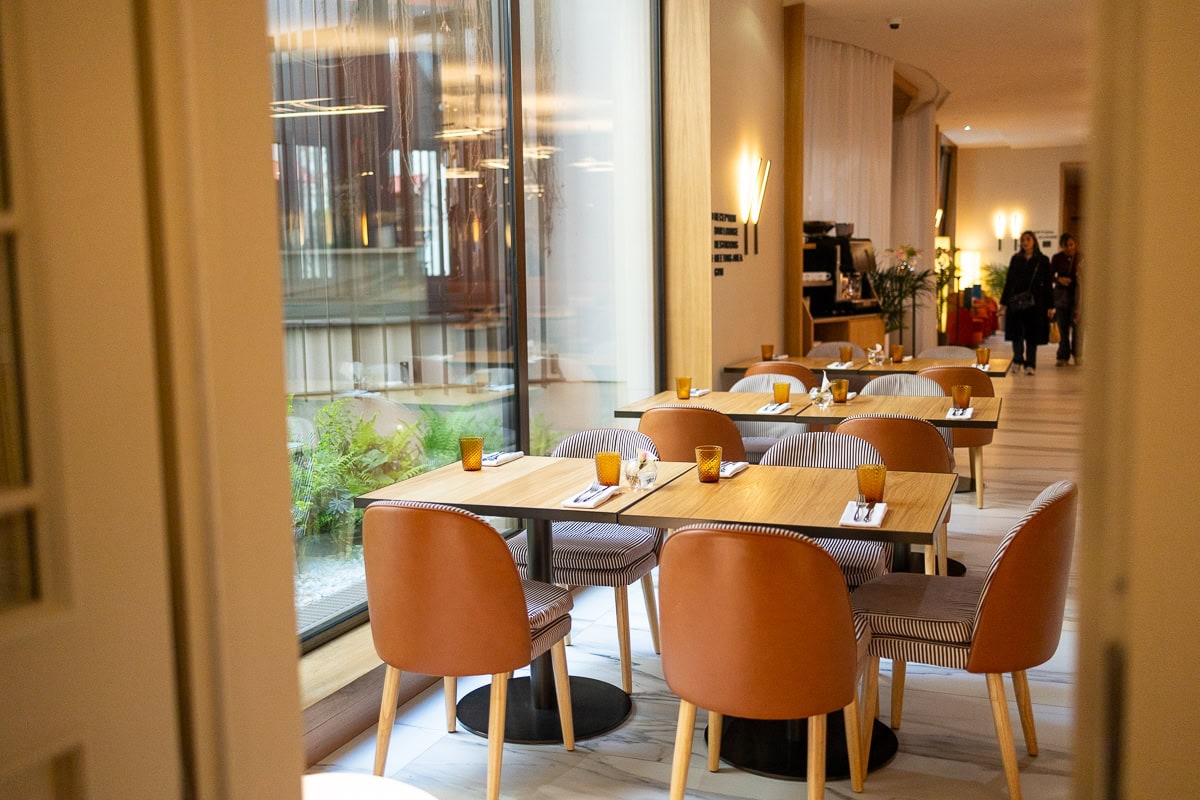
When Lukáš and I were last looking for a base for our Prague stay — somewhere with everything close by, yet still comfortable for a family with a two-year-old toddler — we chose The Julius Hotel near the Jindřišská Tower. It’s about a fifteen-minute walk to Josefov from here, but the route runs pleasantly through the city centre and you avoid the sky-high prices of hotels right on Pařížská Street.
We stayed in a One Bedroom Suite, which gave us a separate bedroom so we didn’t have to sit in the dark once Jonáš had fallen asleep. As a vegetarian, what really won me over was their breakfasts: finally a hotel where the meat-free option doesn’t mean just a dried-out slice of cheese and an apple, but thoughtfully chosen local ingredients. If you’re after quality digs, check out the prices and availability of The Julius Hotel on Booking.com.
The Jewish Museum in Prague and the Ticket System
Understanding how the tickets to the local sights work takes a bit of concentration. I often see confused tourists standing in front of the Old-New Synagogue with a museum ticket, baffled as to why they’re not being let in. The catch is that the sights are not managed by a single organisation.
At the moment, you essentially have three main options. The Jewish Museum in Prague circuit (around €22 for an adult) includes the Pinkas, Klausen, Maisel and Spanish Synagogues, plus the Old Jewish Cemetery and the Ceremonial Hall. The second option is a standalone ticket to the Old-New Synagogue (roughly €11), which is managed directly by the Jewish Community.
The best choice for a complete experience is the combined Prague Jewish Town ticket (around €34), which opens every door for you. The tickets are valid for seven days, but you can only enter each site once.
💡 Tip: Buy your tickets online in advance, or pop into the box office at the Information and Reservation Centre at Maiselova 15. The main ticket office by the cemetery tends to be hopelessly jammed in high season. An alternative is booking a guided Jewish Quarter tour through GetYourGuide, where you’ve got both the tickets and a guide sorted in a single package.
The Highlights: Synagogues and the Cemetery
Each of the synagogues in Josefov tells a different part of the story. The point isn’t to race through them all in an hour just to tick off a list. I’d recommend picking the ones that interest you most thematically and giving them your time.
Old-New Synagogue: The Legend of the Golem and the Beating Heart of the Community
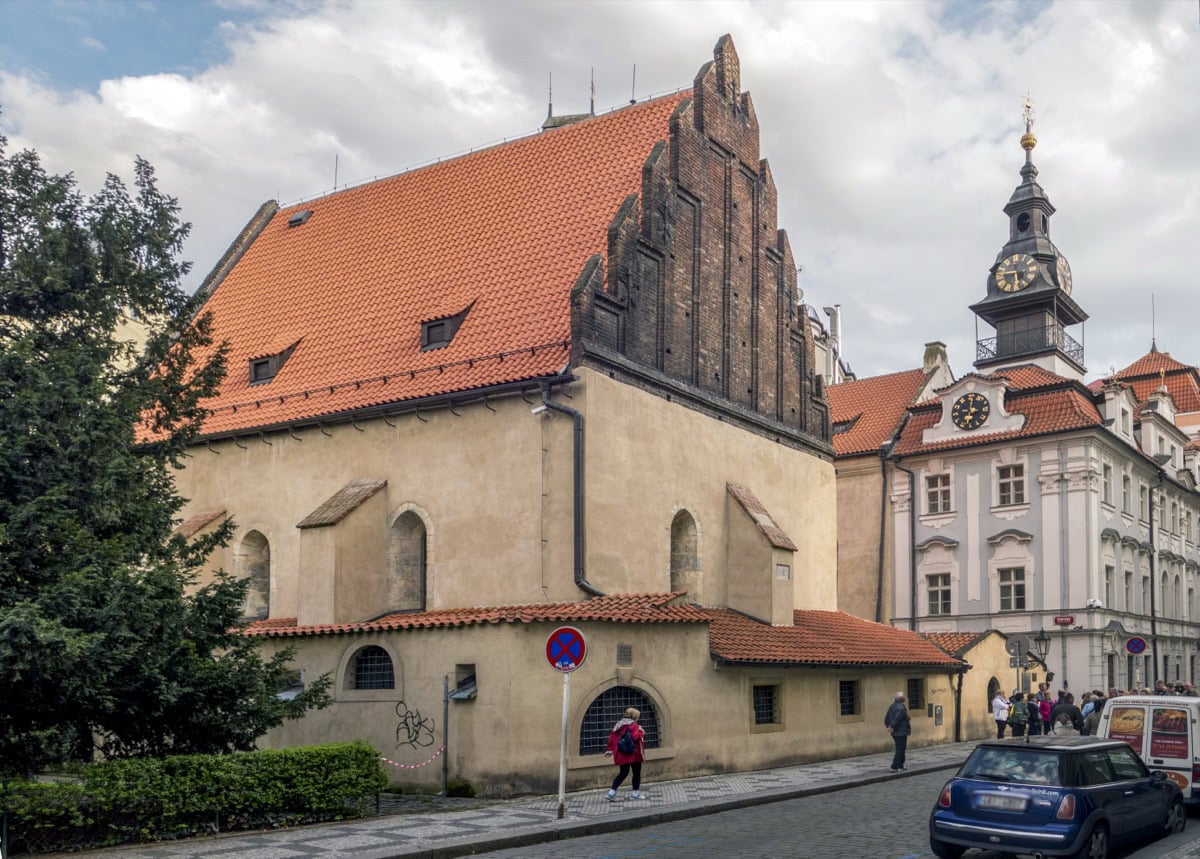
This is exactly the kind of building where you feel the weight of the centuries the moment you touch the massive entrance doors. It was founded in the last third of the 13th century, making it the oldest still-functioning synagogue in Europe. Its early Gothic interior is austere and dark, the vaults supported by two mighty pillars. In the middle stands the bimah, a raised platform enclosed by a wrought-iron grille, and it was right here, in this half-light, that the famous Rabbi Löw — creator of the legendary Golem — preached. Local lore has it that the remains of this clay giant still rest in the synagogue’s attic, where entry is strictly forbidden.
You can get inside either with a standalone ticket or with the combined Prague Jewish Town ticket. The Staroměstská metro and tram stop is about a five-minute walk away. It’s open every day except Saturdays and Jewish holidays.
💡 Tip: Notice the banner of the Prague Jewish community hanging on one of the pillars. The right to use their own flag was granted to the community by Charles IV, and for Europe at the time, that was something quite exceptional.
Pinkas Synagogue: The Place Where Words Run Out
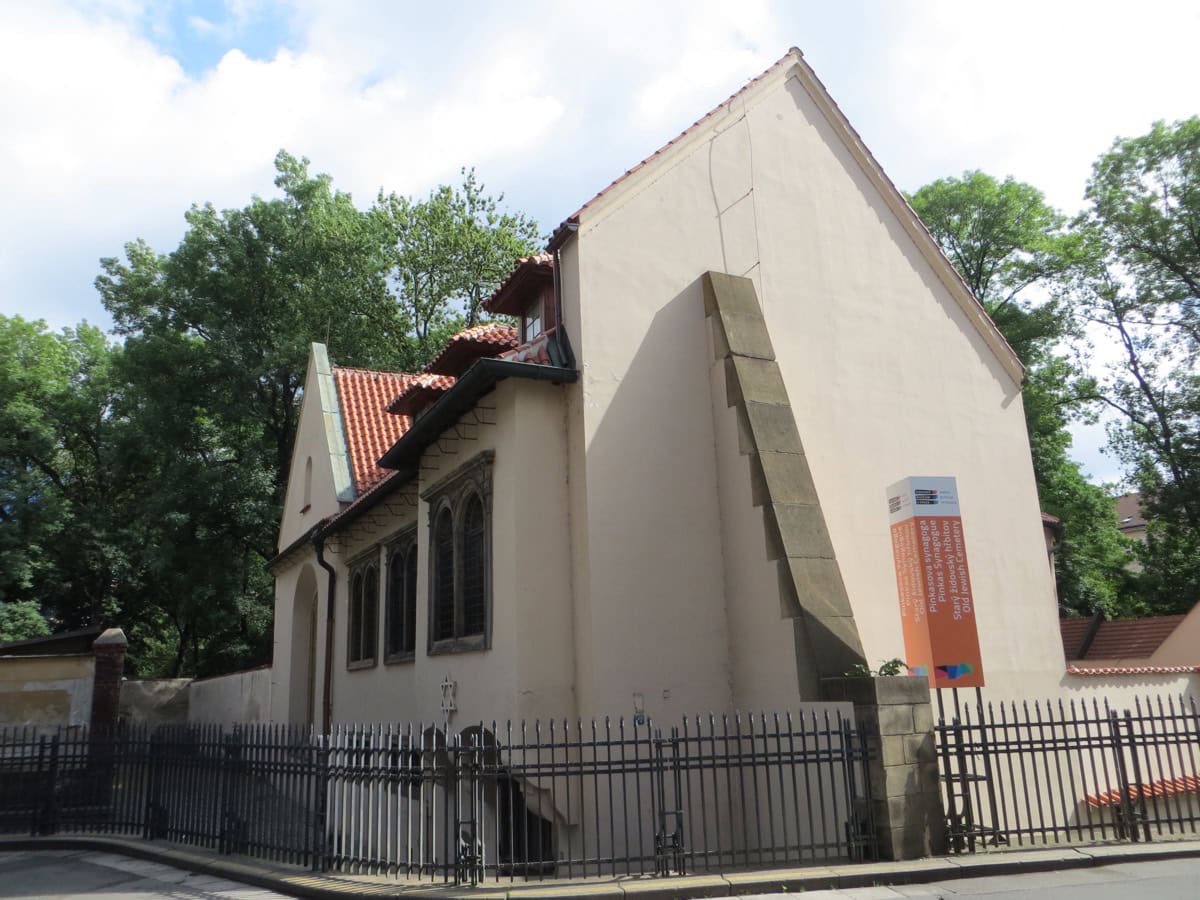
An unremarkable building from the outside, but inside it’s one of the most powerful memorials I’ve ever visited. Today the Pinkas Synagogue serves as the Memorial to the Shoah victims from the Czech lands. Every interior wall, from the floor to the vaults, is covered by hand with the names of nearly 80,000 Czech and Moravian Jews who perished during the Second World War. When I was here as a secondary-school student, we took it as abstract numbers. Today, walking past those walls as an adult, that endless list of names with dates of birth and death physically grips your stomach.
On the first floor you’ll then find the permanent exhibition of children’s drawings from the Terezín concentration camp. The children painted them under the guidance of the artist Friedl Dicker-Brandeis. As the mother of little Jonáš, I look at these pictures of butterflies and homes — painted on scraps of wrapping paper by children, most of whom did not survive — with all the more emotion.
Entry is part of the Jewish Museum circuit. It’s also from here that you enter the Old Jewish Cemetery.
💡 Tip: Take your time with the audio guide. A quiet voice constantly reads out the names of the victims inside the synagogue. It’s a detail that lends the whole space an immensely intimate and chilling dimension.
Old Jewish Cemetery: Twelve Layers of History Beneath the Trees
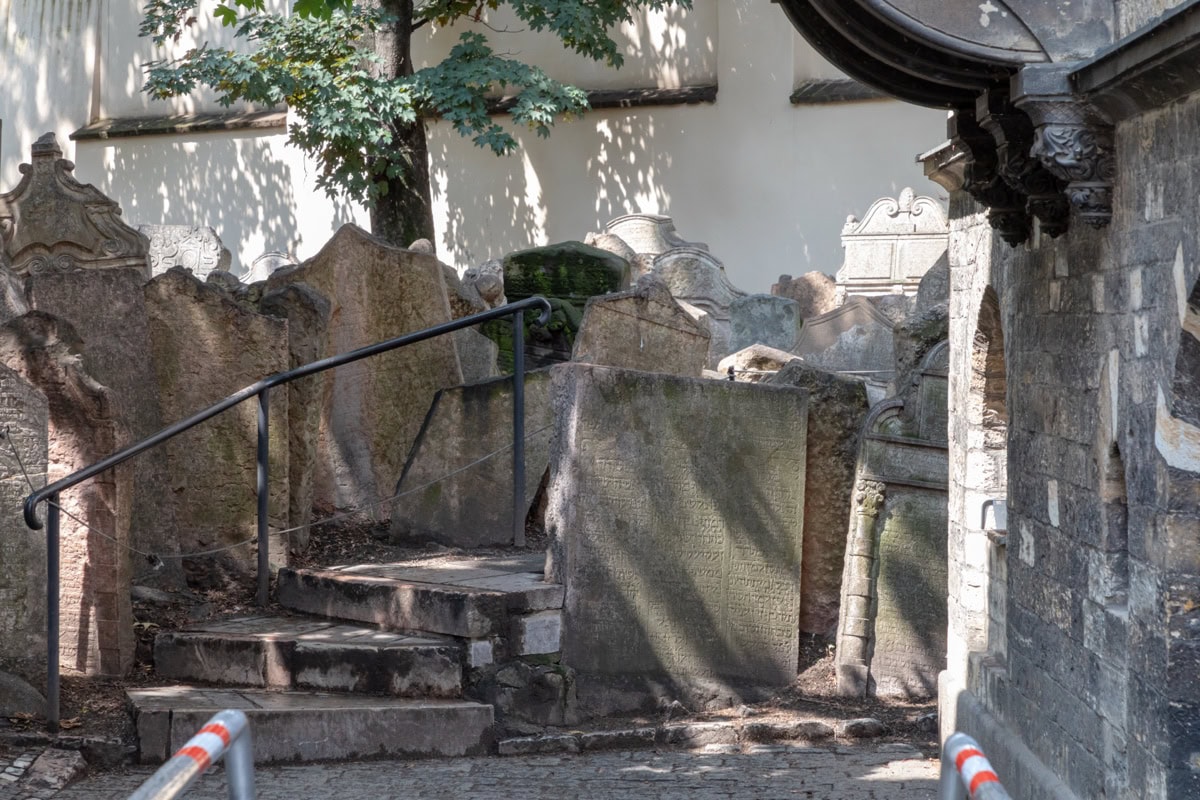
One of the most famous historic cemeteries in the world looks at first glance like a chaotic tangle of stone and ivy. The tombstones lean in every direction, often propped against one another. The reason for this visual anarchy is the fact that Jewish customs strictly forbid disturbing old graves. Because the community couldn’t expand the cemetery beyond the ghetto walls, it had to bring in new soil and bury the dead on top of one another. In some places, there are up to twelve layers of graves. It’s estimated that beneath the twelve thousand visible tombstones rest as many as a hundred thousand people.
The most visited spot is the grave of the aforementioned Rabbi Löw, where to this day people tuck little slips of paper with wishes under small stones. The cemetery is accessible as part of the museum circuit.
💡 Tip: If you’re coming with the family, leave the pushchair at the hotel or by the entrance (the staff will advise you). The route runs along narrow, uneven stone paths, often up steps, and you’ll genuinely get stuck here with a pram.

Spanish Synagogue: A Golden Treasure in Moorish Style
While the Old-New Synagogue is Gothically austere and dark, the Spanish Synagogue is its absolute opposite. It was built in 1868 in the then-fashionable Moorish style, and its interior will utterly take your breath away. The walls, vaults and stained-glass windows are covered with intricate Islamic ornaments; gold, stucco and rich colours gleam everywhere. You feel more like you’re in the Alhambra than in the middle of Central Europe — and I love that contrast. ☺️ The name “Spanish” refers precisely to this style and to the Sephardic Jews who were expelled from Spain.
Inside you’ll find an exhibition devoted to the modern history of Jews in the Czech lands, from the Josephine reforms right up to the present day. The acoustics here are absolutely phenomenal, which is why evening classical music concerts are often held here.
💡 Tip: Upstairs in the exhibition, take a look at the section devoted to Jewish entrepreneurs and industrialists of the First Republic. It beautifully fills in the context of how much the community contributed to the development of the state before the Second World War.
Klausen Synagogue and Maisel Synagogue
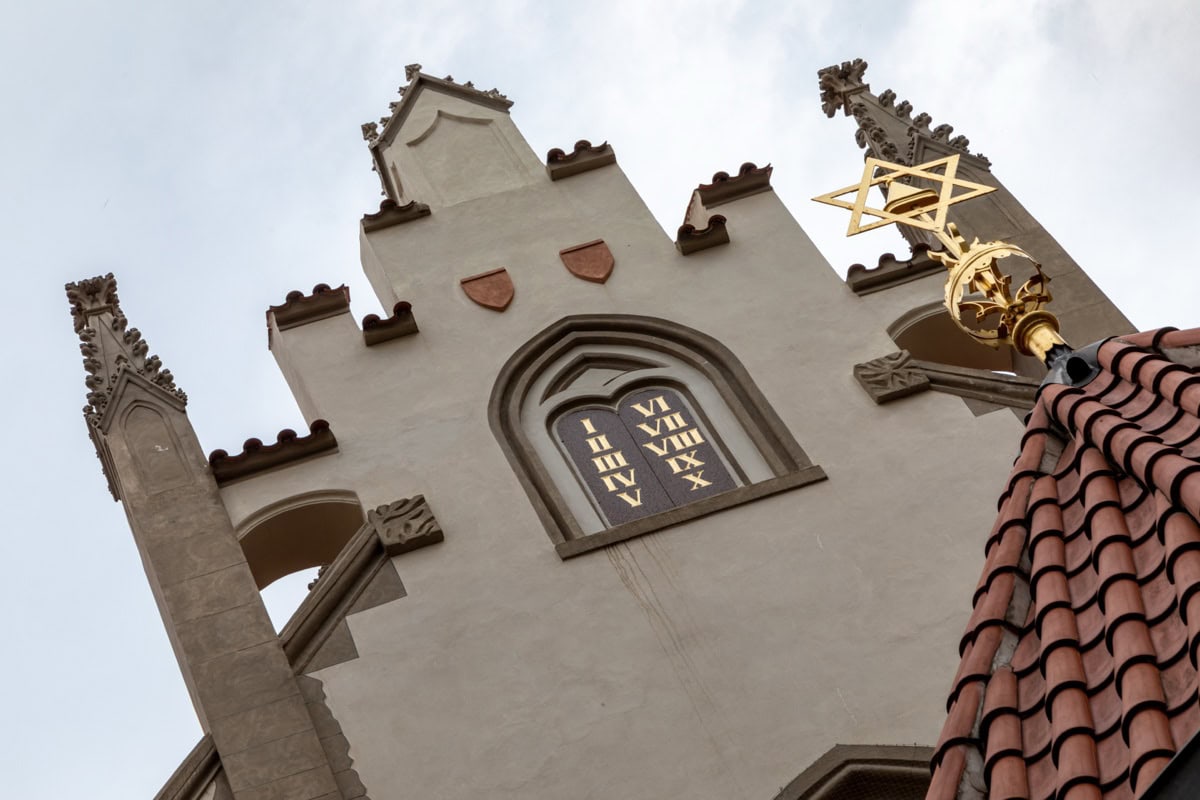
Right by the exit from the cemetery, you’ll come across the Klausen Synagogue (the largest of all in the former ghetto), where today you’ll find a fascinating and accessibly presented exhibition on Jewish traditions and customs. If you’re not quite sure what a bar mitzvah is, how a Jewish wedding works or what kosher eating involves, this is where you’ll get all the answers.
The Maisel Synagogue, tucked away on Maiselova Street, serves as an introduction to the entire history of Jewish settlement in the Czech lands from the 10th to the 18th century. It was commissioned by Mordechai Maisel, the mayor of the Jewish town and one of the richest men in Prague at the time, who among other things financed the construction of the Prague Jewish ghetto. Both synagogues are included in the main museum ticket.
💡 Tip: In the Maisel Synagogue, don’t miss the digital model of the original Jewish town before the clearance. Only then do you grasp how unbelievably cramped and tangled it once was here.
Map of points of interest for your phone
Franz Kafka and the Genius Loci of Josefov
Although Franz Kafka wrote in German, his identity is inseparably bound up with Prague, and especially with Josefov and the Old Town. He grew up in these lanes, walked through them to school, and drew inspiration for his absurd and oppressive novels here.
Franz Kafka’s Birthplace
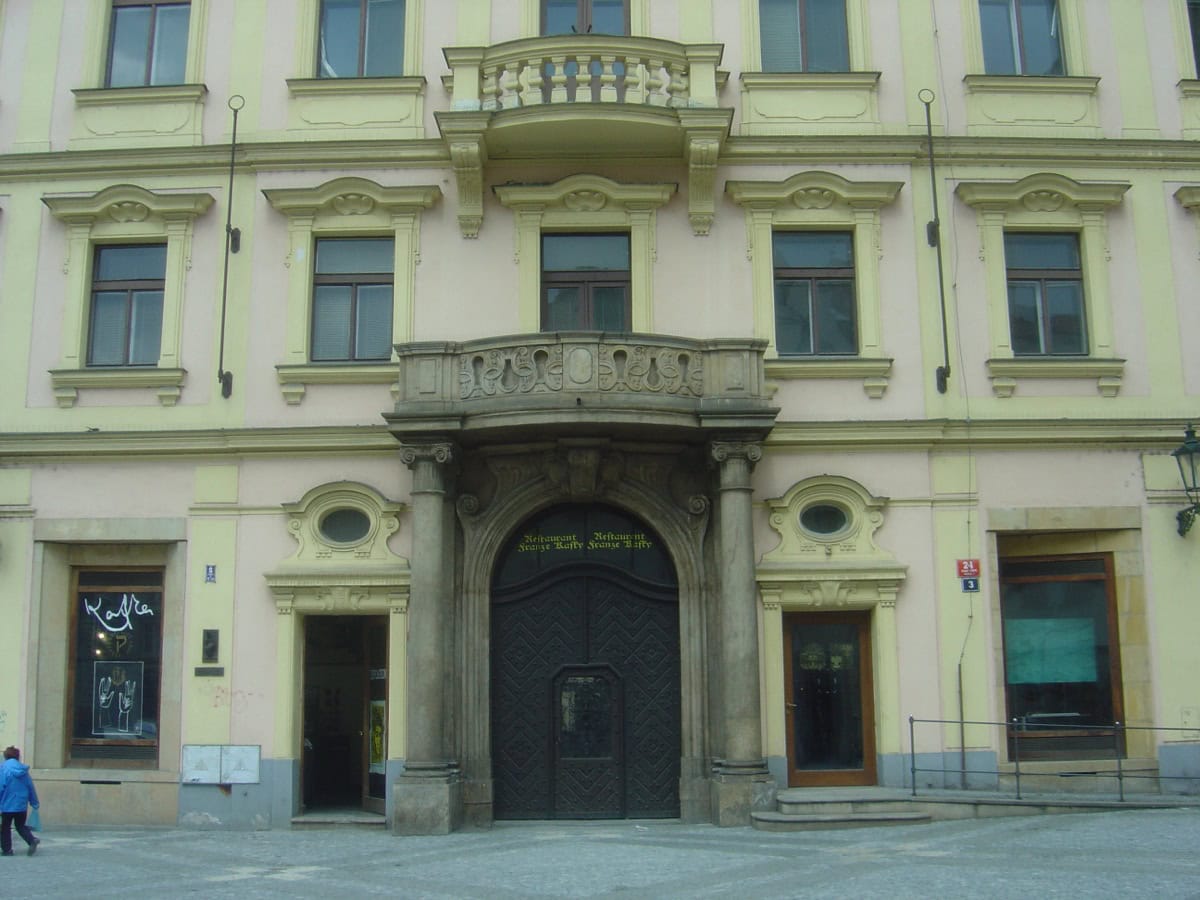
On the corner of Kaprova and Maiselova streets, on today’s Franz Kafka Square, once stood the House at the Tower, where the writer was born in 1883. The original house fell victim to the clearance; only its Baroque stone portal survived, incorporated into a new building from the early 20th century. It’s not a place for an hour-long tour — rather, pause here for a moment, look at that portal, and try to imagine a boy stepping out of it for whom the world would soon stop making sense. 😉
And if you take a moment and lift your head, you’ll notice small details on the house’s facade that rather nicely recall that era. I always remember here just how terribly cramped this place must once have felt, and I’m not at all surprised that it left such a strong imprint on Kafka’s writing.
💡 Tip: Don’t look for a museum here. The main and best Kafka Museum is on the opposite bank of the Vltava, in the Lesser Town, right by Charles Bridge in the Herget Brickworks.
The Franz Kafka Monument by Jaroslav Róna
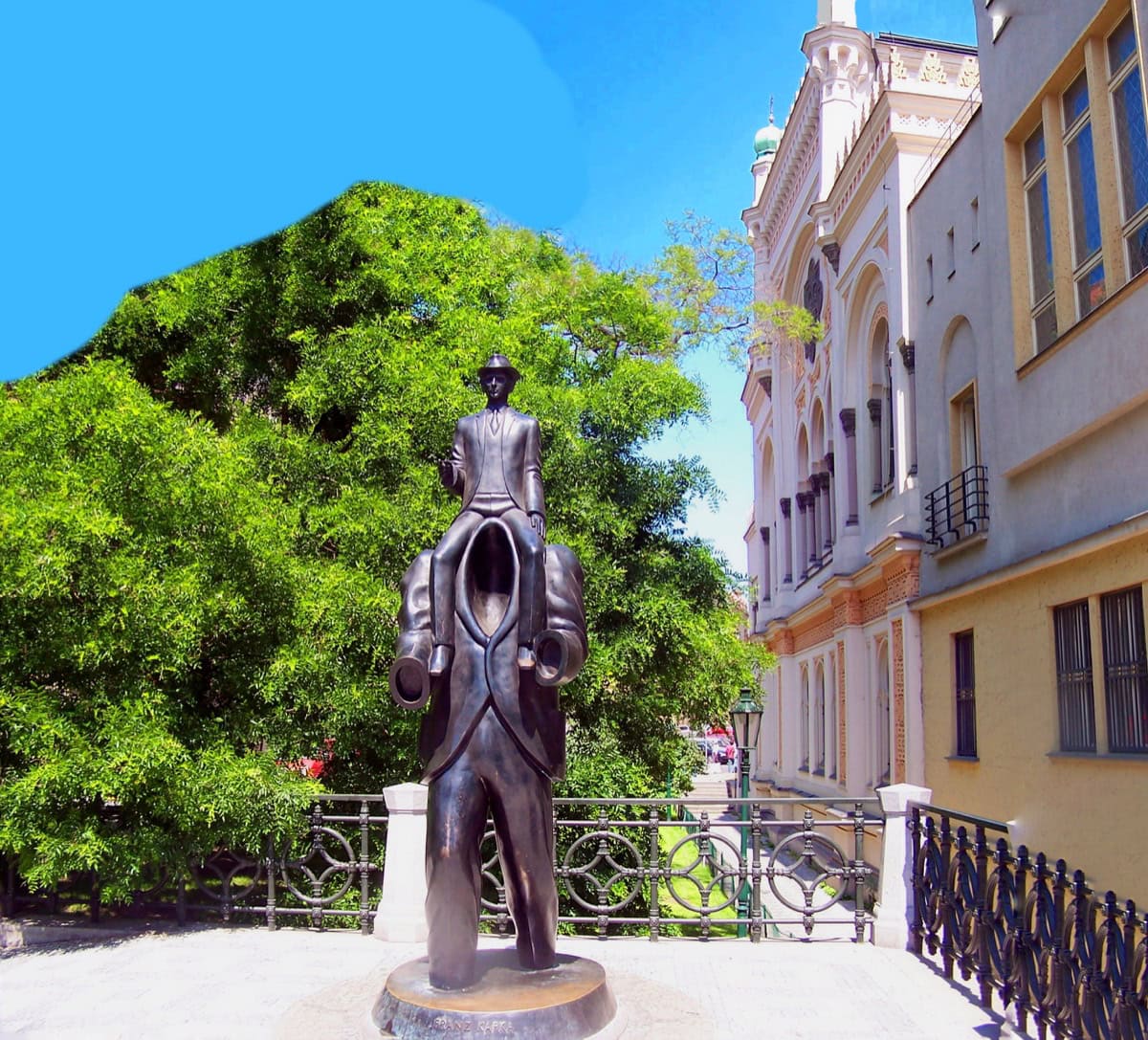
As you walk down Vězeňská Street towards the Spanish Synagogue, you’ll come across a sculpture that perfectly captures Kafkaesque absurdity. The bronze monument by sculptor Jaroslav Róna from 2003 depicts an empty suit of enormous proportions, with a smaller figure of Kafka himself perched on its shoulders. The statue references his early short story “Description of a Struggle”. It’s one of the few modern works of art in the centre that genuinely fits in naturally here and doesn’t come across as just a tourist attraction.
For context: people often also talk about David Černý’s rotating Franz Kafka Head. That one is located by the Quadrio shopping centre on Národní Street (Národní třída metro stop), roughly a twenty-minute walk from Josefov. It’s a great spectacle, but it has nothing to do with historic Josefov location-wise.
💡 Tip: Try photographing the statue from a low angle towards the facade of the Spanish Synagogue. You’ll get an interesting compositional contrast between the modern bronze and the Moorish architecture.
Pařížská Street: Luxury on the Ruins of the Ghetto
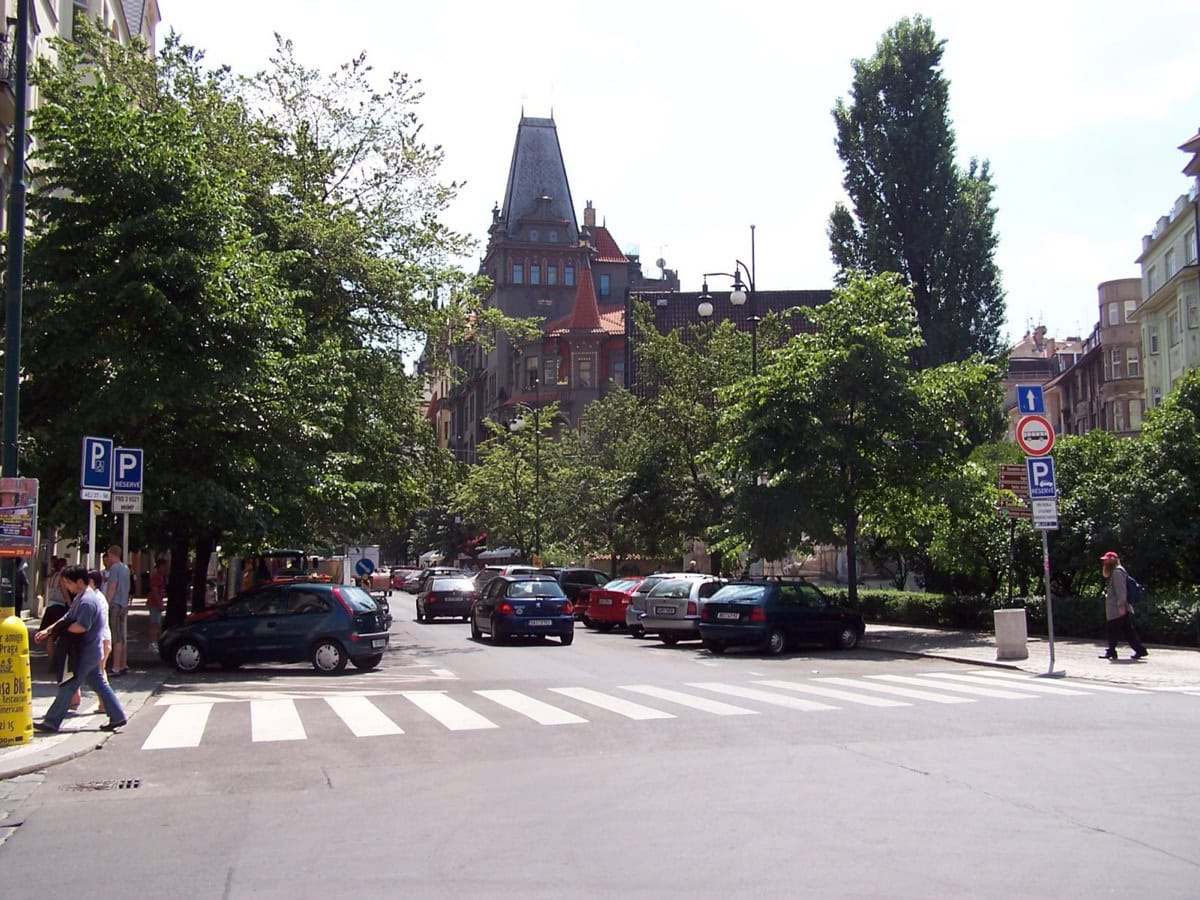
Pařížská (Paris) Street is today the most prestigious address in Prague. It’s lined with boutiques from brands like Dior, Chanel and Prada. But its history is far darker. It was cut straight through the middle of the former Jewish ghetto during the clearance, when the city councillors decided to wipe out the substandard slum and replace it with wide boulevards modelled on Paris. Hundreds of historic houses, courtyards and synagogues disappeared.
It’s undeniably beautiful, but as a backdrop it’s a little sterile — those facades are so perfect they almost hurt. Lukáš says he always feels like he’s on a film set here. 😅 For Prague locals, it’s more of a thoroughfare towards Letná than a place where they’d actually spend time.
Where to Eat
Walking through the whole of Josefov is genuinely tiring, and if you’re anything like Lukáš and me, we couldn’t keep going for long without good food and coffee. Luckily, the area is packed with great spots. Here are my two absolute favourites where we go nearby to recharge, and both have the advantage that vegetarians and lovers of honest classics alike will be happy.
Restaurant Maitrea: An Oasis of Calm
If you’re after excellent food without a snobbish markup and you’re a vegetarian like me, head after your tour to Týnská Lane, where you’ll find Restaurant Maitrea. It’s a beautiful oasis of calm with a fantastic meat-free menu, just a three-minute walk from the Old-New Synagogue. After all the hustle and bustle on Pařížská, it’s balm for the soul.
They do great lunch deals, and the feng-shui-style interior will reliably calm you down even with a restless toddler in tow. Whenever we go, I order their udon noodles — I look forward to them from the moment I wake up.
Café Louvre: Literary Corridors and Divine Pancakes
If you want to soak up the atmosphere of the places where Kafka debated with his contemporaries, you’ll need to wander a little further to Národní Street, to the legendary Café Louvre. It opened in 1902 and Kafka came here during his university years with his friends from the philosophy circle. The first-floor interior still holds onto its First-Republic elegance, with billiard tables and waiters in suits.
From a vegetarian’s point of view, it’s a lifesaver. They’ve got an excellent creamy garlic soup, great cheese dishes, and their pancakes are famous. It’s a short walk from Josefov, but for a rounded literary experience it’s simply worth it. If you come at the weekend, be prepared for it to be busy, but if you arrive on a weekday around ten in the morning, you’ll find a quiet spot by the window overlooking the bustling Národní Street.
Practical Info
How to get there: The best starting point is the metro line A or a tram (lines 2, 17, 18) to Staroměstská. From there it’s literally just a few steps to the Pinkas Synagogue, and you can then cover the whole of Josefov on foot, because it’s surprisingly compact.
Rules and dress code: In all the synagogues (except the Spanish one) and at the Old Jewish Cemetery, men are required to enter with their heads covered. No worries — if you forget a hat or cap, you’ll be given a paper kippah (yarmulke) at the entrance. Clothing should be respectful: forget about vest tops and ultra-short shorts, you’re on religious ground and in places of remembrance.
How much time to set aside: If you have the combined ticket and want to properly go through all the synagogues and the cemetery, set aside at least three to four hours. Don’t plan Prague Castle for the same afternoon — you’d be utterly drained by the sheer amount of information and impressions.
Where to Next
- What to See in Prague: 100+ Tips for Sights, Cafés and Restaurants
- Prague Cafés: The Places We Go for Speciality Coffee
Frequently Asked Questions
How much does admission to the Jewish Museum in Prague cost?
In 2026, you’ll pay around €22 for the basic museum circuit. A combined ticket that includes the Old-New Synagogue costs approximately €34. Discounts are available for students, children, and families.
When is the Jewish Quarter closed?
All monuments under the Jewish Museum in Prague and the Old-New Synagogue are completely closed every Saturday (Shabbat) and during all Jewish holidays throughout the year.
Can I take photos at the Old Jewish Cemetery?
Yes, photography in the exterior areas of the cemetery is allowed for personal use. Inside the synagogues, photography is usually prohibited or heavily restricted (no flash), so always check the pictograms at the entrance.
Is it possible to visit the Old-New Synagogue for free?
No, admission is always charged. Either as a separate ticket or as part of a more expensive combined ticket for the entire Prague Jewish Quarter.
How long does a tour of the Jewish Quarter take?
A quick walk through the main highlights (Pinkas Synagogue, cemetery, Old-New Synagogue) takes about two hours. For a more detailed visit including the Spanish Synagogue and museum exhibitions, set aside 3 to 4 hours.
Where can I find Franz Kafka’s head?
That famous moving, mirrored head by David Černý is not in Josefov. You’ll find it on Národní třída near the Quadrio shopping center. In Josefov, near the Spanish Synagogue, stands the Kafka statue by Jaroslav Róna.
Tips and Tricks for Your Vacation
Don’t Overpay for Flights
Search for flights on Kayak. It’s our favorite search engine because it scans the websites of all airlines and always finds the cheapest connection.
Book Your Accommodation Smartly
The best experiences we’ve had when looking for accommodation (from Alaska to Morocco) are with Booking.com, where hotels, apartments, and entire houses are usually the cheapest and most widely available.
Don’t Forget Travel Insurance
Good travel insurance will protect you against illness, accidents, theft, or flight cancellations. We’ve had a few hospital visits abroad, so we know how important it is to have proper insurance arranged.
Where we insure ourselves: SafetyWing (simple monthly subscription) and TrueTraveller (for extra-long trips).
Find the Best Experiences
Get Your Guide is a huge online marketplace where you can book guided walks, trips, skip-the-line tickets, tours, and much more. We always find some extra fun there!
More from Czechia
Full guide → Day trips · most readMikulov, Czech Republic: 10 Best Things to Do and See
 With kidsBest Water Parks in the Czech Republic: 13 Family Tips for 2026
 When to goBrno Christmas Markets 2026 – Tree Lighting, Opening Hours & Programme
 FoodPrague, Czech Republic: 10 Best Things to Do and See with a Toddler
 Where to stayPrague, Czech Republic: 10 Best Family Hotels for Your Stay with Children


