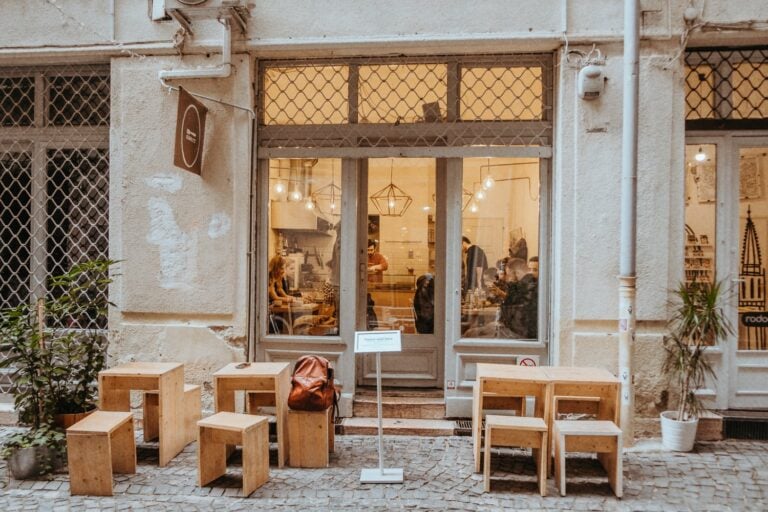
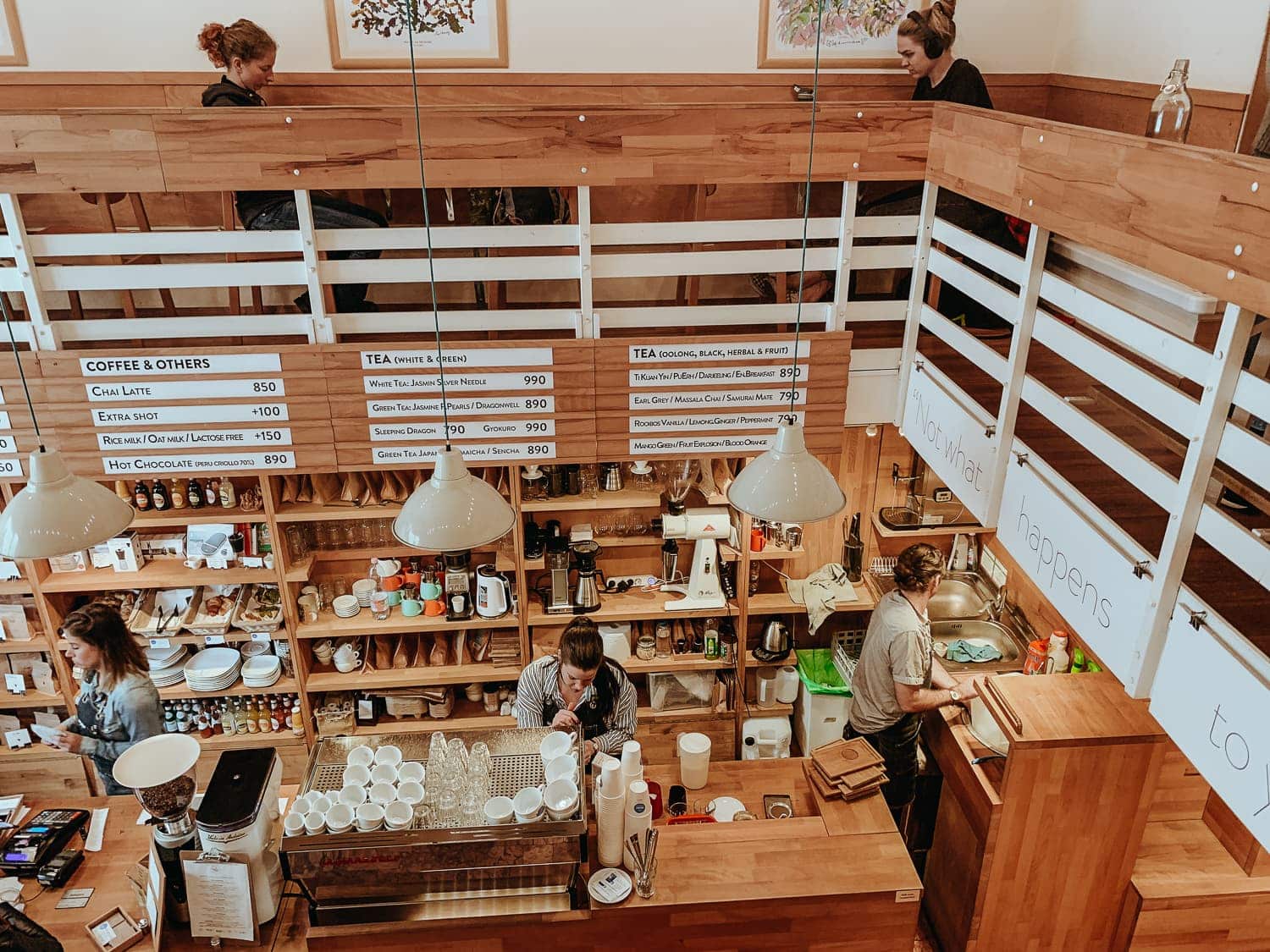
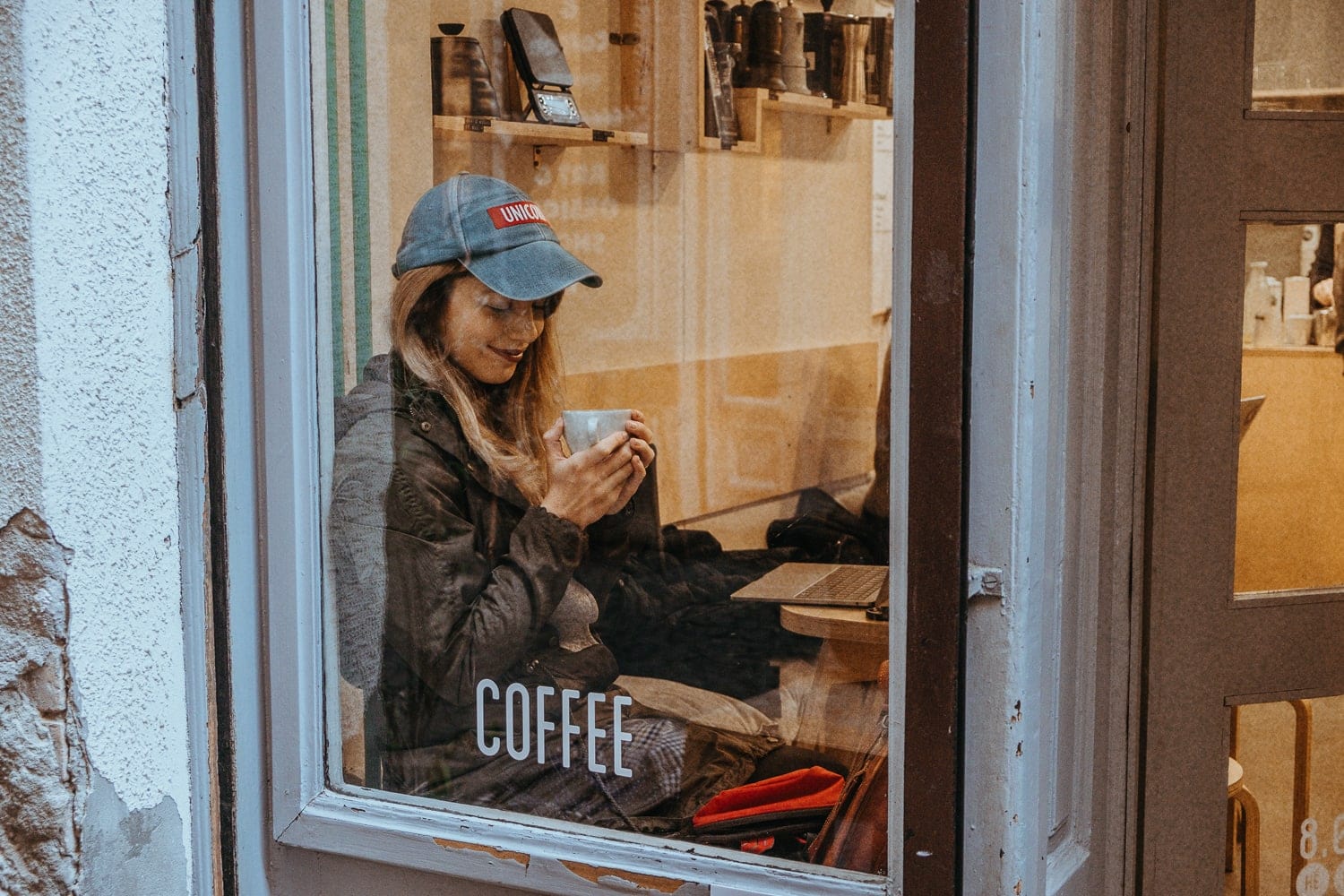
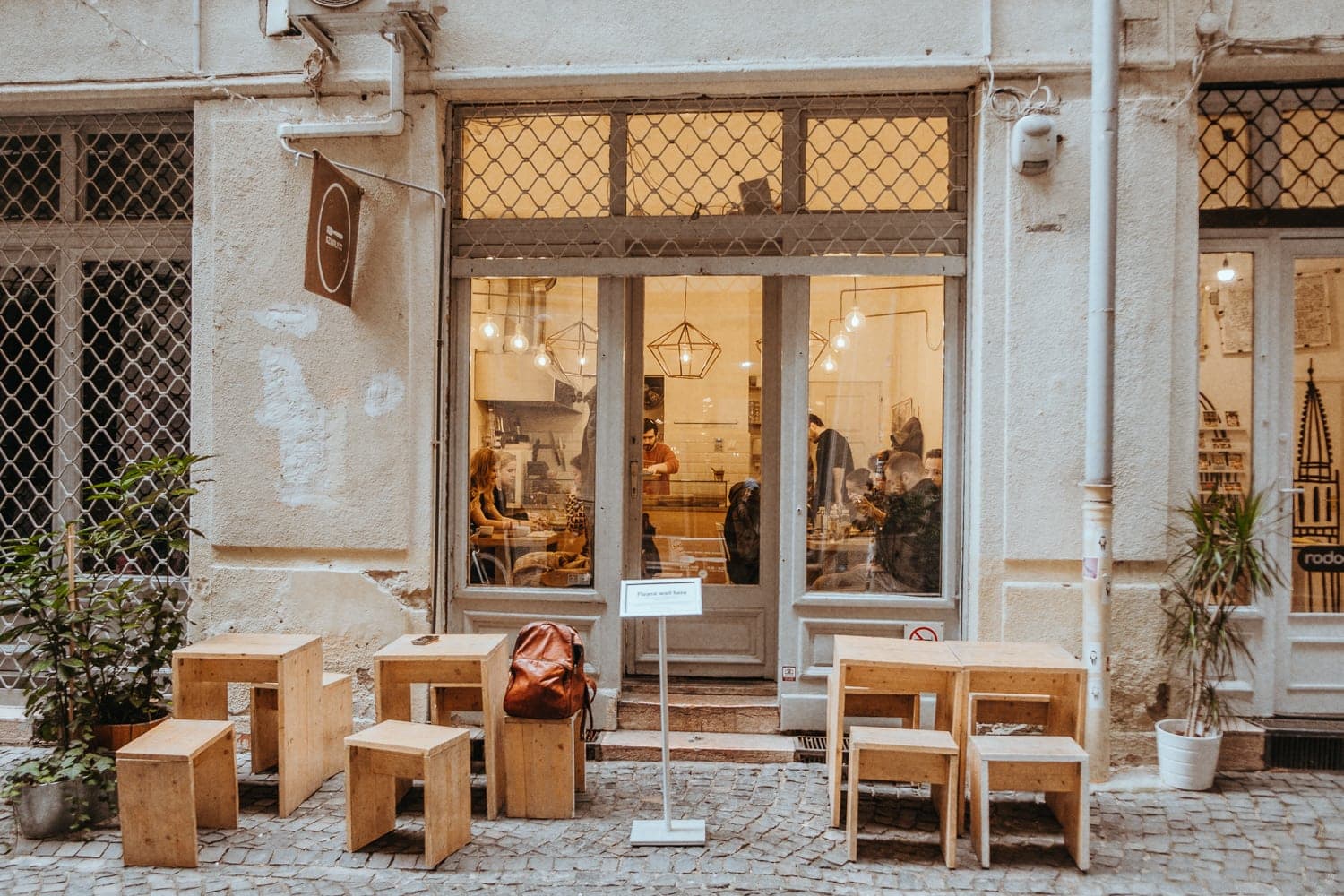
TL;DRBudapest is a coffee lover’s paradise, and caffeine fiends will fall for it hard. You’ll find gorgeous hipster cafés alongside grand old coffeehouses steeped in history. This guide rounds up 12 of the best cafés for great coffee, breakfast or brunch. Spring (April–June) or autumn (September–October) are the best times to walk the city, when it’s neither too hot nor swamped with tourists. Base yourself in the centre — most of Budapest is easily walkable.
I’m sure you’ve heard that Budapest is a café paradise. If you love good coffee and the beautiful surroundings of hipster cafes, I promise you’ll love Budapest as much as we do. Let’s take a look at the 12 best coffee shops in Budapest.
The best time to visit Budapest is spring (April-June) or autumn (September-October). Budapest is quite hot in summer and there are a lot of tourists. We also don’t recommend winter, because it’s usually very cloudy and cold.
Be sure to stay in the centre, Budapest can be easily walked almost entirely on foot, saving you time and money on transport.
Cheap accommodation in Budapest
Try the Flow hostel, where we stayed when we were saving every penny. It’s a rather designer and nice hostel, a short walk from the market and super money.
Luxury accommodation in Budapest
We tried Hotel Vision, it has great breakfast, location and wonderful rooms. It’s stunning, but quite expensive. Aria Hotel Budapest by Library Hotel Collection .
Patisseries, bistros and cafés in Budapest: where to go for the best coffee and breakfast
In Budapest, you’ll enjoy great food, culture, history and amazing cafes. Every time we’re there, we discover another one. We are adding a list of our favourites. If you are looking for what to see in Budapest, be sure to read our second article.
1) Madal Cafe – great coffee and cakes
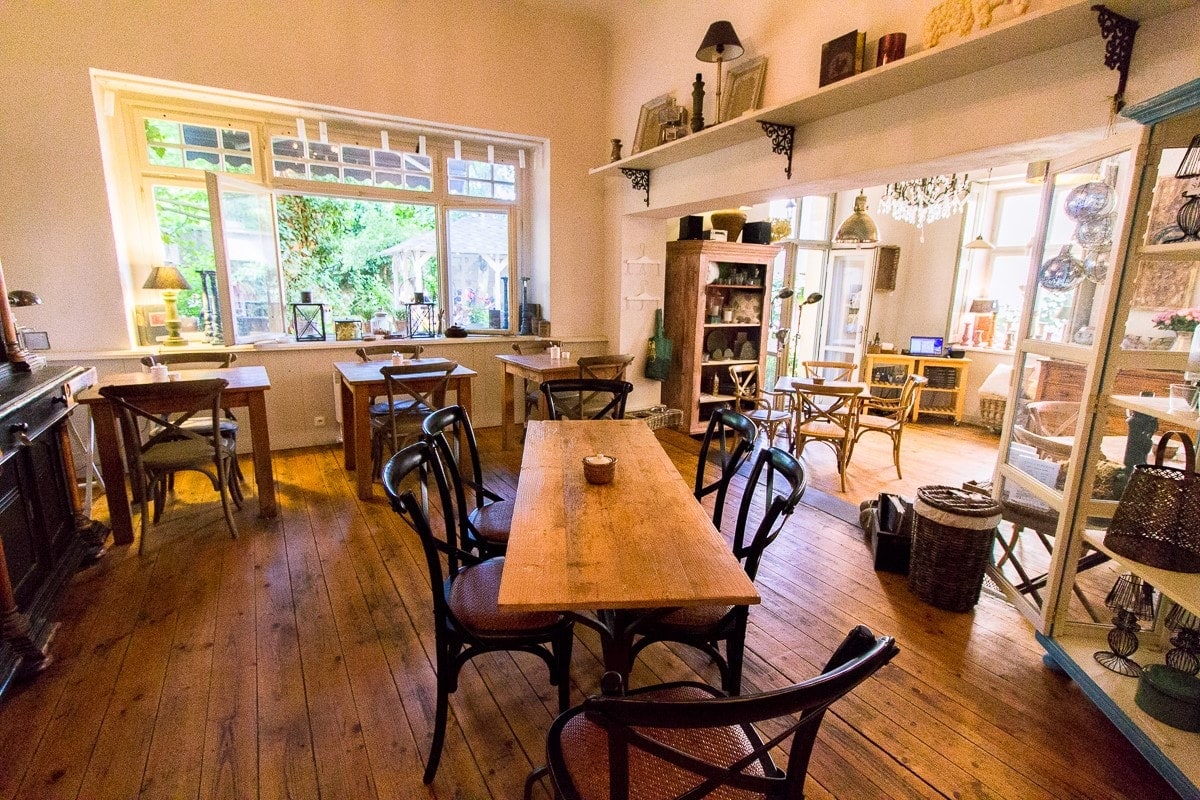
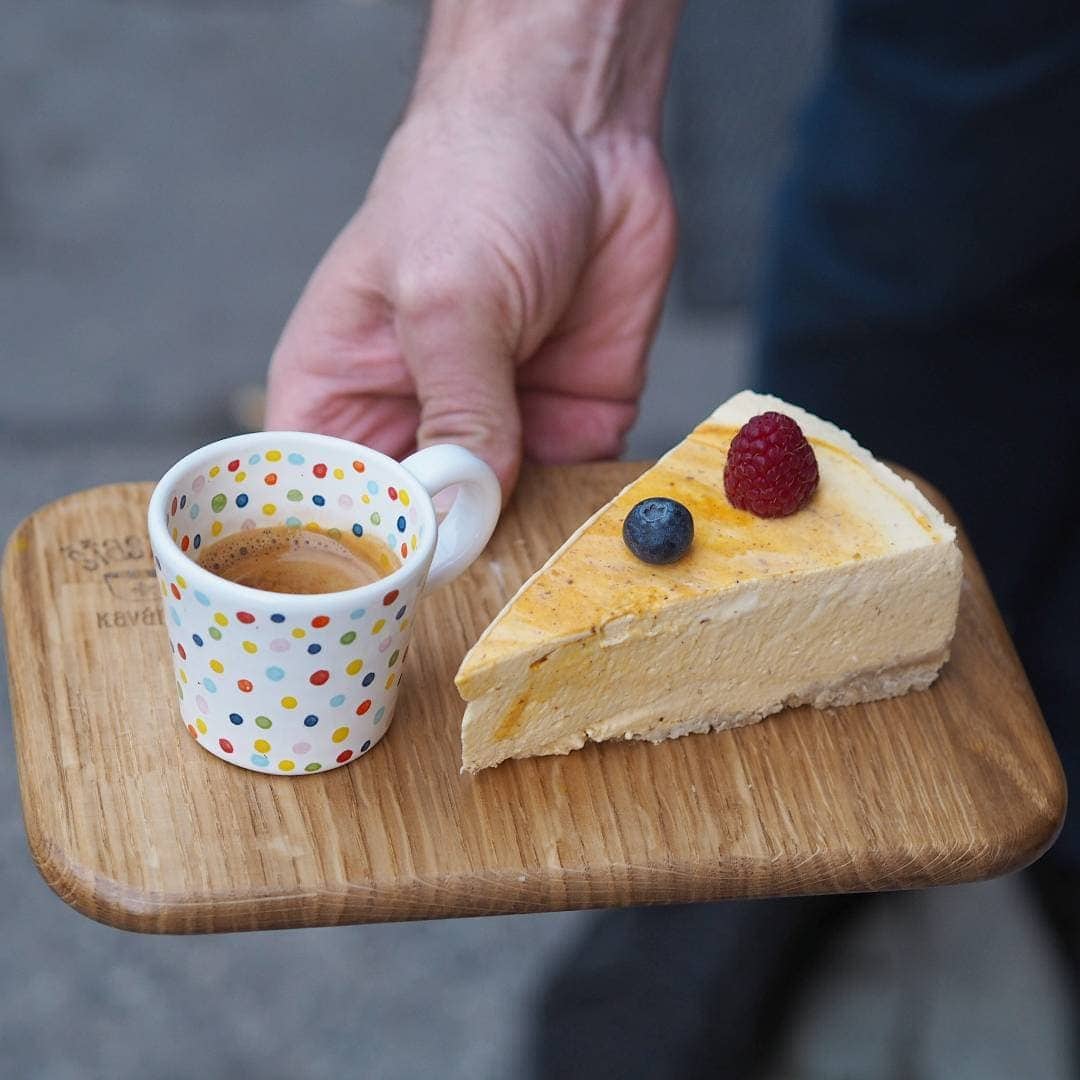
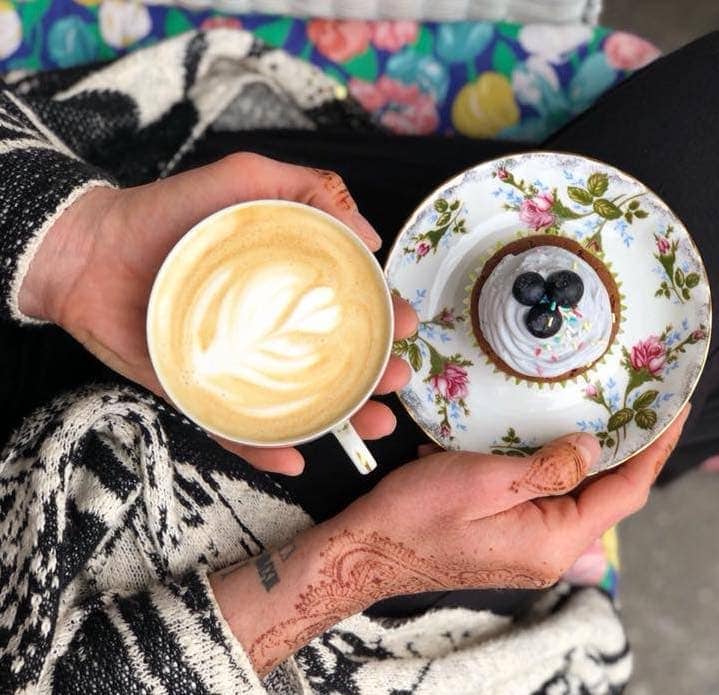
Madal Café has three branches in Budapest. We liked the one at Ferenciek Tere 3, where you can sit and work in peace. Madal Café not only has excellent coffee, but also vegan cakes. Plus, if you’re looking for stable and fast wi-fi, this is your place.
Madal Cafe
2) Where to brunch in Budapest? Try Blue Bird Cafe
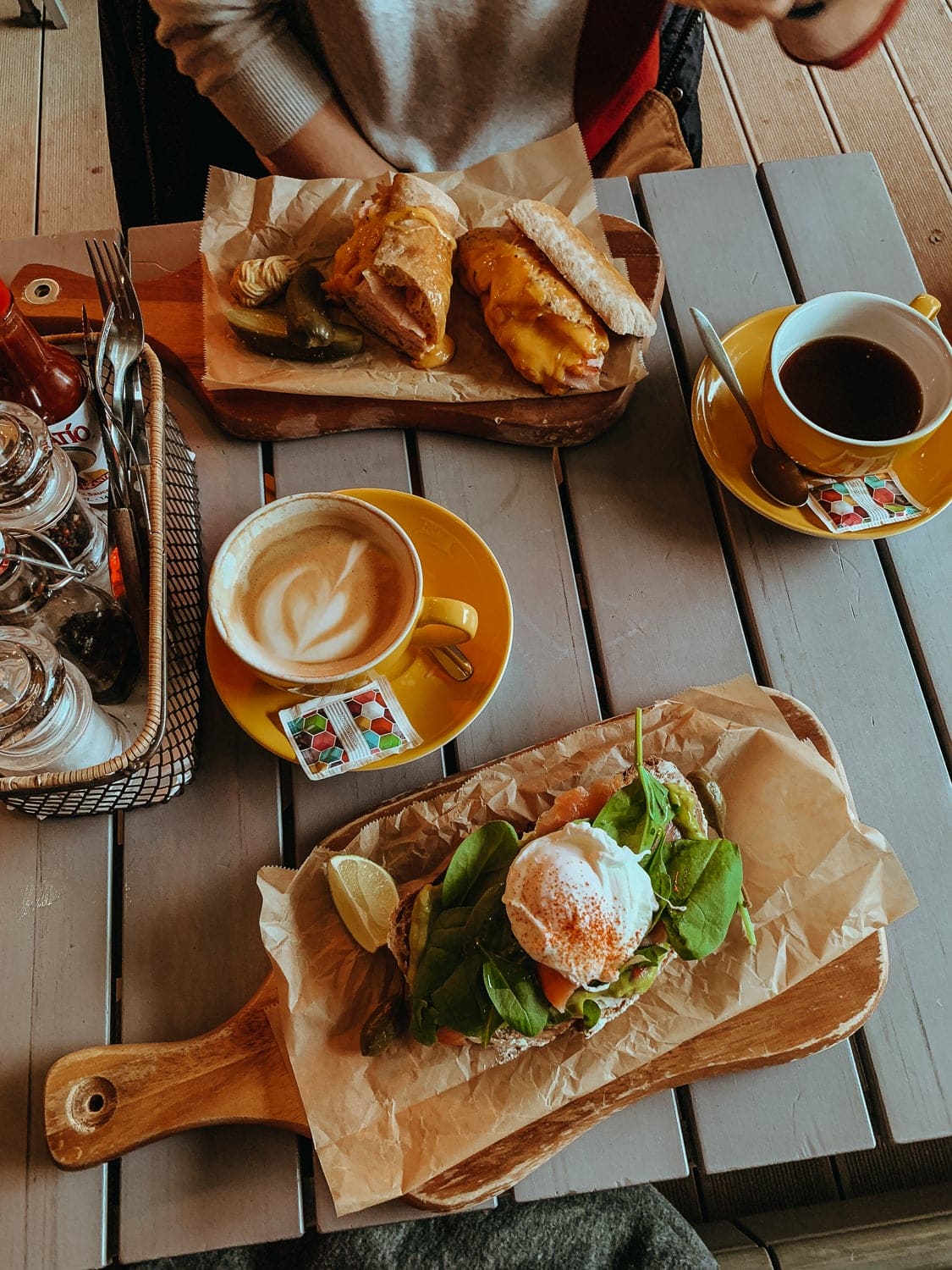
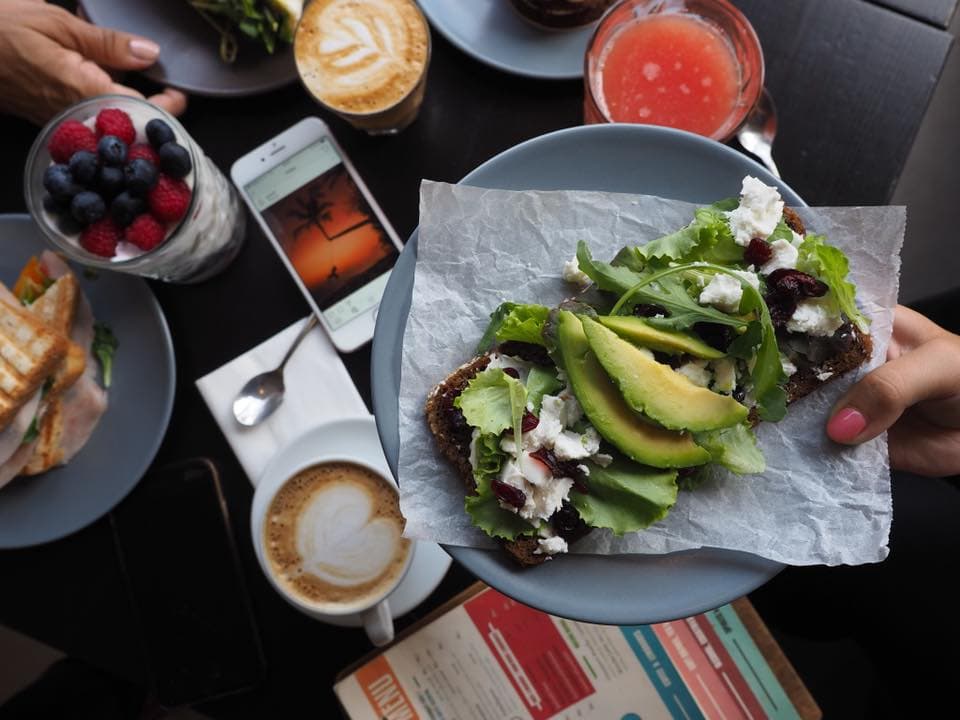
If you’re looking for a café in Budapest where you can also have a great meal, then Blue Bird Café is a great option. Delicious avocado toast, pancakes with Nutella and banana served as sushi, great coffee and a colourful Mexican-style setting are all available at Blue Bird Cafe.
3) Contact – for lovers of fine coffee
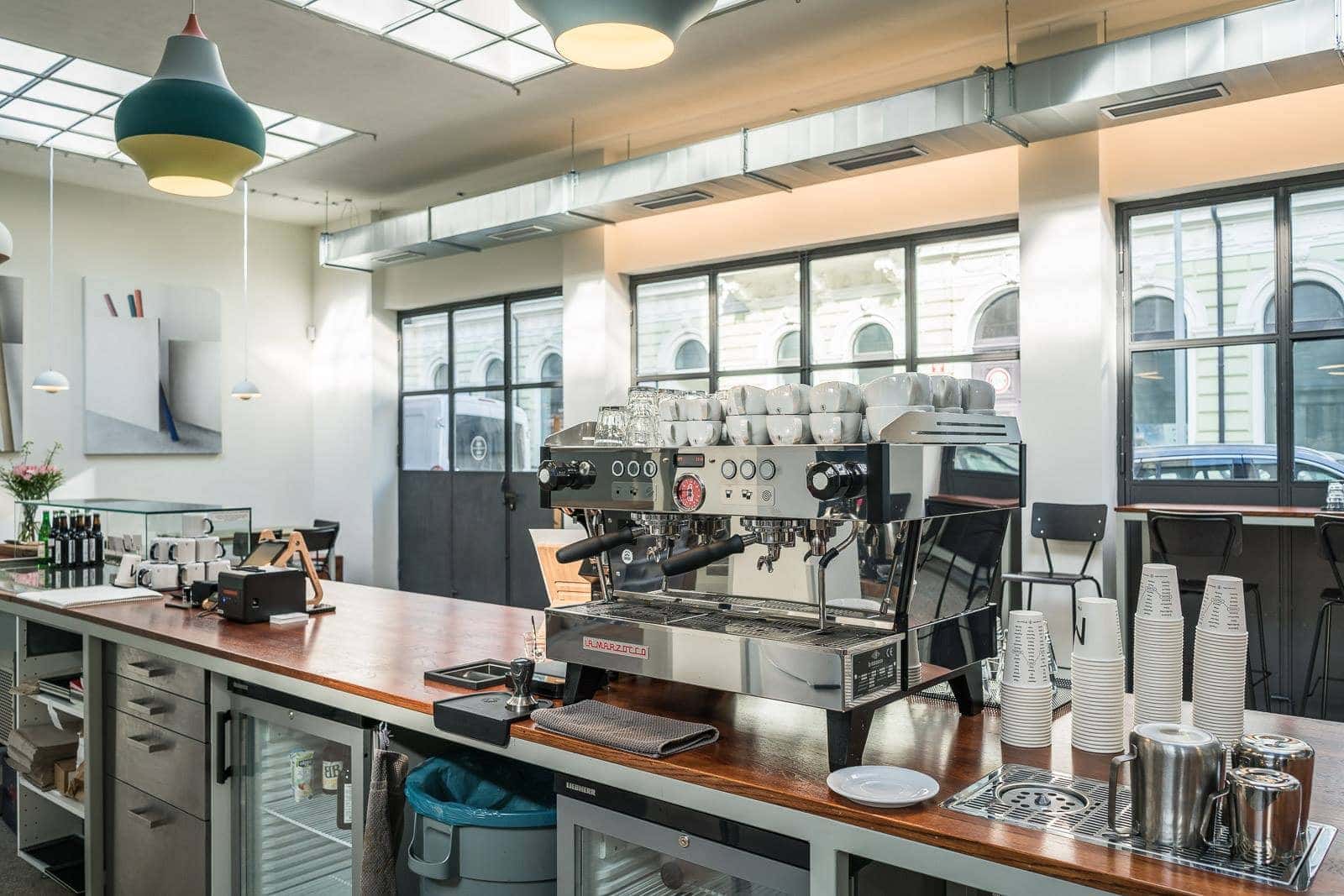
You will find the choice coffee in the popular café Kontakt, which belongs to the same owner as the Szimply bistro across the street. The place is a bit smaller, you’ll have to go across the street for food, but the coffee, they make world class coffee.
Café Contact in Budapest
4) Budapest breakfast: only Szimply
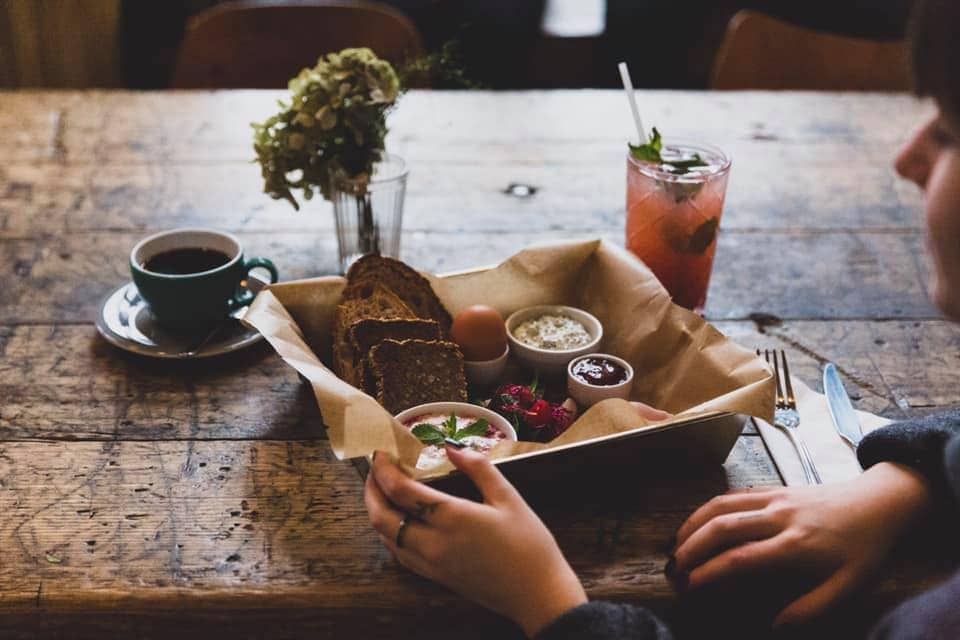
Szimply is not a café, but a bistro (they don’t serve coffee here, you have to bring it from Kontakt), which is famous for the best breakfast in Budapest. It’s no wonder there’s often a half hour wait for a table, their breakfasts are a true work of art for your taste buds.
Szimply Budapest
If they don’t have room, don’t leave. They’ll give you a machine that will let you know when a table is available, and in the meantime you can enjoy your coffee across the street at Kontakt.
5) Dose Espresso Budapest
You can also go to Dose Espresso Bar for quality coffee and good cakes. Their coffee is said to please even the biggest coffee snobs.
6) SuWu
A café with a very simple interior, but one of the best lattes in Budapest. It offers savoury filled croissants, chocolate muffins, macaroons and doughnuts.
7) Törökméz
You can also head to the right side of the river for a colourful coffee or a great breakfast. While the aforementioned cafés can be found around the centre of Pest, this treasure can be found just off the Margit Híd Bridge.
Torokmez Cafe
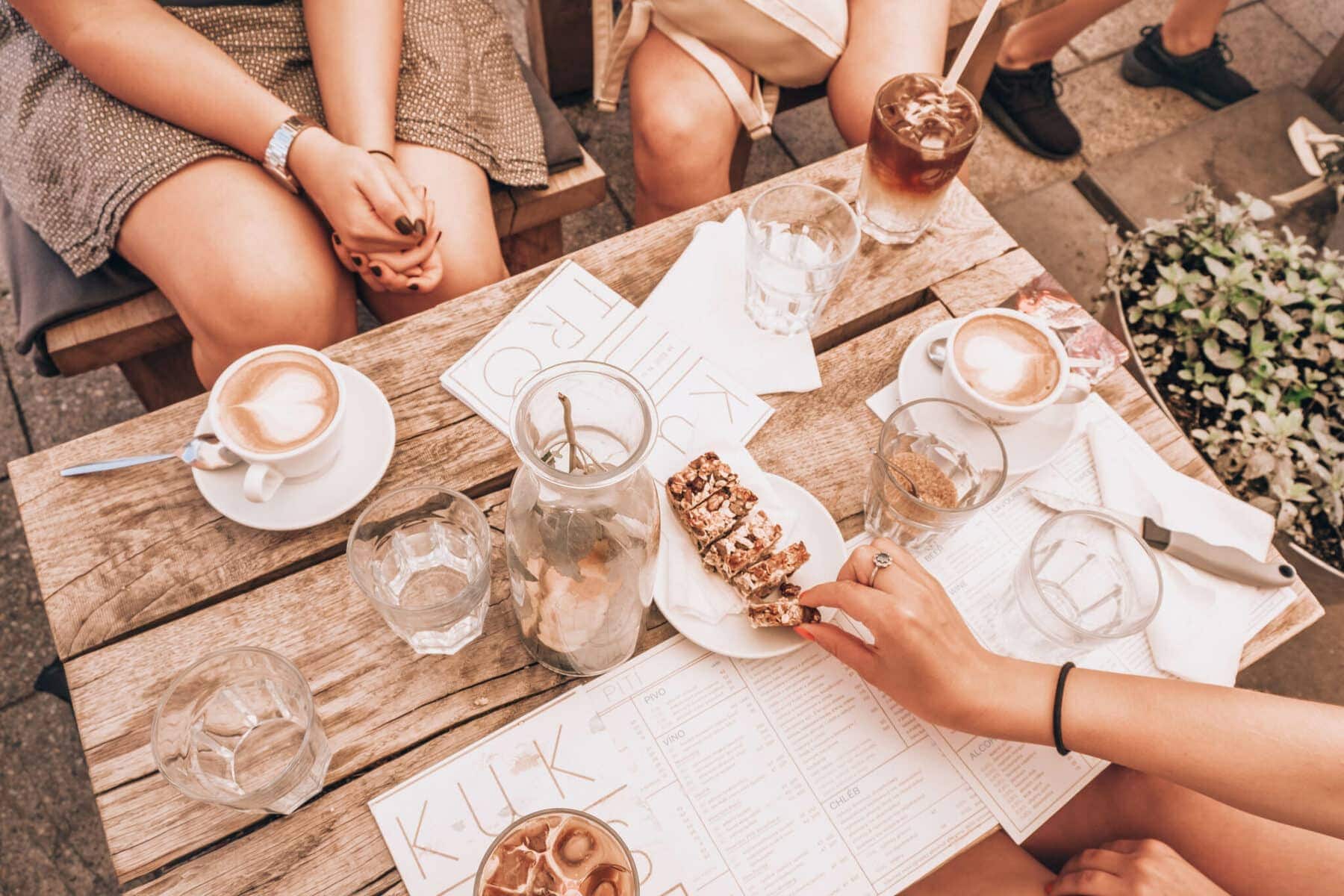
8) Toprum Budapest – a café overlooking Budapest
Want to have breakfast with a view of Budapest? Make a reservation for brunch at Toprum. Whether you’re craving waffles, pancakes, avocado toast or classic yogurt with granola and fruit, they have it all.
9) Vinyl &Wood
The café caught our eye with its small shop on the ground floor, where they sell stylish wood products, but also offer great cakes, lemonades and good coffee is a must on our list.
Vinyl Wood Cafe
10) Eco Café Magnet
Looking for a café near Parliament? Head to Eco Café Magnet, which offers filter coffee and matcha lattes in addition to fine espressos, lattes and cappuccinos.
11) Budapest Baristas
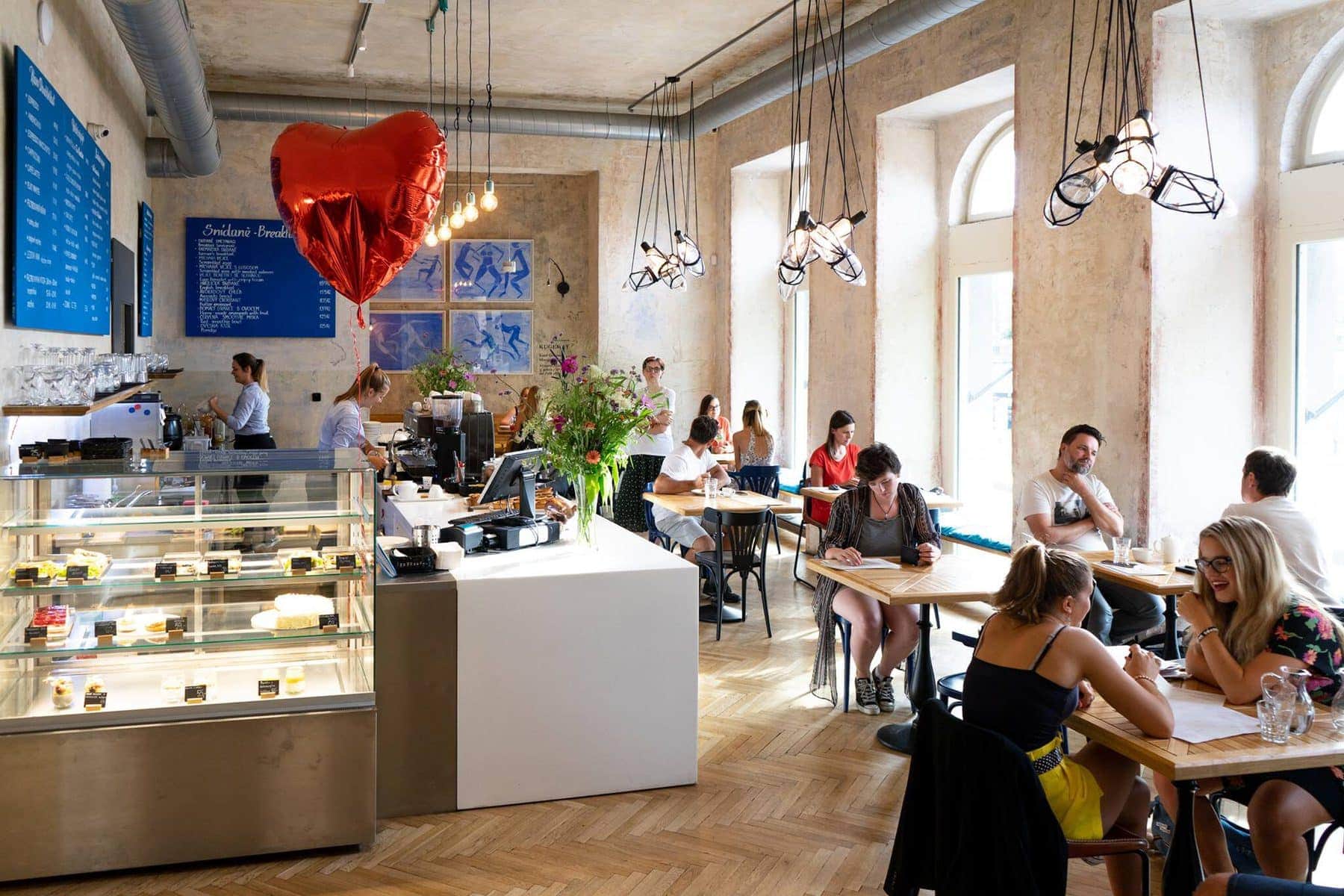
If, like us, you’re staying at the amazing hipster hostel Flow, this cafe is just around the corner. Beware, it gets pretty crowded during breakfast and brunch. The food here is excellent.
12) Cinnamon
On the right bank of the river you will also find a quiet and pleasant café Cinnamon. They serve eggs, porridge and fresh croissants for breakfast, which can be a nice change from avocado toast (if you’re obsessed with it like I am and eat it everywhere).
🔗 These are affiliate links — they don't change your price and help us create content. · All experiences →
Tips and Tricks for Your Vacation
Don’t Overpay for Flights
Search for flights on Kayak. It’s our favorite search engine because it scans the websites of all airlines and always finds the cheapest connection.
Book Your Accommodation Smartly
The best experiences we’ve had when looking for accommodation (from Alaska to Morocco) are with Booking.com, where hotels, apartments, and entire houses are usually the cheapest and most widely available.
Don’t Forget Travel Insurance
Good travel insurance will protect you against illness, accidents, theft, or flight cancellations. We’ve had a few hospital visits abroad, so we know how important it is to have proper insurance arranged.
Where we insure ourselves: SafetyWing (best for everyone) and TrueTraveller (for extra-long trips).
Why don’t we recommend any Czech insurance company? Because they have too many restrictions. They set limits on the number of days abroad, travel insurance via a credit card often requires you to pay medical expenses only with that card, and they frequently limit the number of returns to the Czech Republic.
Find the Best Experiences
Get Your Guide is a huge online marketplace where you can book guided walks, trips, skip-the-line tickets, tours, and much more. We always find some extra fun there!
TL;DRPrague’s café scene just keeps growing, and this guide rounds up 27 of the best hipster and Instagram-friendly cafés in Prague, perfect for a catch-up, brunch or an afternoon with your laptop. Each one comes with a tip on what makes it stand out, plus a map you can pull up on your phone. Whether you’re after minimalist specialty coffee spots or cosy cafés with homemade cakes, there’s something to match your mood. Go beyond the tourist centre and discover Prague’s proper coffee culture.
Our article about the ten best hipster cafes in Prague is visited by dozens of coffee lovers every day. But it’s from 2018 and the cafes in Prague are growing at a rapid pace.
Because you deserve to visit ALL the most beautiful cafes in Prague, we have a new list for 2019. In total, 27 other Prague cafés that are ideal for meetings, brunch and work. At the end of the article you will find a map that you can easily download to your phone.
Our list is full of hipster-themed cafes and all of them are insta-friendly, so don’t forget your phones and cameras. There will be plenty to photograph! 🙂
The best hot chocolate in PragueHot chocolate from Kavárna Pod Lipami, photo: Facebook Kavárna Pod Lipami, crop
A cute little café just off Letenský náměstí, where you can have sweet cakes or soup in addition to good coffee. Some claim that they have the best hot chocolate in Prague. You’ll have to judge for yourself if that’s true.
3) Café Neustadt
Working meetingsCafé Neudstadt, photo: Facebook Café Neudstadt
For quiet business meetings around Charles Square, I usually disappear to Cafe Neustadt, located in the courtyard of the New Town Hall. The cafe is quiet, they have excellent coffee and you can also have something to eat.
4) Super Tramp Coffee
Good coffee and food, business meetings for those who like hipster placeshttps://www.instagram.com/p/BqP6p2nFNEG/?utm_source=ig_share_sheet&igshid=8f9lh5mghtw4
Inside you will find beautiful floral decorations, friendly service and a quiet environment for meetings and work. Again, this is one of the most hipster cafes in Prague, besides great cakes you can also enjoy music from the gramophone. Summer seating takes place on the outside steps.
5) Loft cafe Karlin
For online work and business meetingsLoft Cafe Karlin, photo: Facebook Loft Cafe Karlín
Loft cafe Karlín was established in 2017 and from the beginning it has been presented as a café that is suitable for work and business meetings. The concept of the café is the work of entrepreneur Michal Dubský and David Kolář, who wanted to create a pleasant innovative space where only selected coffee is served. You can have a small snack here and the wifi works mostly without problems.
6) Cafedu
For learning and working onlineThe food and coffee at Cafed is excellent, photo: Facebook Cafedu
Cafedu presents itself as a quiet non-stop study room and it fulfills this purpose at first glance. It has large windows, desks spacious enough to work and fast wifi. If you love Dos Mundos coffee like we do, you’ll be right at home here.
The café is bustling with students studying or working on projects together. Unfortunately, it is so popular that it is often full. Always remember to check the second floor as well.
7) Periphery Cafe
Work meetings, hanging out with friendsPeriferie Cafe, photo: Facebook Periferie Cafe
You won’t find that many beautiful cafés in Braník, but Periferie Cafe has everything hipsters and families with children are looking for. Here you can find organic products and homemade strudel, and if you feel like a beer, no problem. Also suitable as a place for business meetings.
8) Style & Interior
Business meetings and dates
Inside the Styl and Interier café in Prague
Treasure in Vodičkova Street. If you’re looking for a quiet place to meet, especially during the warm spring and summer months, head to the charming garden of the Style & Interier café in Vodičkova Street. If you love cheesecake, we’ve never been disappointed here.
9) Ema Espresso Bar
Good coffee, latte arthttps://www.instagram.com/p/BphtrkvlW2s/?utm_source=ig_share_sheet&igshid=1az3sdytu8kpr
Very stylish and unfortunately often full cafe. Ema is synonymous with perfect latte art in Prague, which is why she is often the target of local Instagrammers. Again, you won’t die of hunger here, you can have a good coffee with and a good cake or bun. The simple interior won’t let you down either. Unfortunately, it’s not easy to find a vacancy here.
10) Dos Mundos Café
Meetings, delicious brunch and coffeehttps://www.instagram.com/p/BstH2wMAAmn/
I think the best coffee in Prague is at Dos Mundos. Period. Okay, a hundred people, a hundred tastes, but I love the coffee at Dos Mundos and happily recommend them everywhere I go. My favourite branch is in Letná, it has swings, it’s quiet for meetings and work.
11) Alf & Bet
Good coffee, bakeryAlf & Bet, photo: Facebook Alf & Bet
Café and bakery in one not far from Palmovka station dressed in industrial outfit. You probably won’t go here for a business meeting or to study, but you can definitely get good coffee and great pastries here.
12) Café only
All types of appointmentshttps://www.instagram.com/p/Bpl8gbxjq0i/?utm_source=ig_share_sheet&igshid=1d0s1s4y9hdz
Vršovice is no longer a forgotten corner, you can just go to Café for a great brunch or just sit down over a good coffee. They offer eggs, porridge and smoothie bowl. Their desserts are also praised. Nice environment for all types of meetings.
Work meetings / quiet workplaceOliver’s Coffee Cup, photo: Facebook Oliver’s Coffee Cup
This cozy café right on the busy Wenceslas Square, where they can even make you a bear for a latte, reminds me in a way of Kontakt café in Budapest. Ideal for a quick escape from the hectic Wenceslas Square. Also suitable as a place for workshops.
15) Cacao Prague
Meetings / dates / good food / smoothieshttps://www.instagram.com/p/Bp2alQtHbam/?utm_source=ig_share_sheet&igshid=1gtcn5w38nw2z
Cacao may not have the most insta-friendly interiors, but you won’t complain at breakfast. Here you will find not only delicious cakes and great sandwiches, but also a huge selection of healthy meals and smoothies. Whether you love Buddha bowls or would like to have a green smoothie, Cacao has it all.
16) SmetanaQ
Work online / work meetings / dates / foodSmetanaQ, photo: Facebook SmetanaQ
The stylish café next to Hollar on Smetana Embankment used to be my frequent retreat during my university days. They not only have good coffee, but also fast internet and excellent waffles and sandwiches.
17) Happy Cafe
Work meetings / healthy cakes /Happy Cafe, photo: Facebook Št’astná kavárna
Good coffee in cheerful mugs, amazing desserts and sandwiches made in-house are prepared from the finest ingredients sourced from local producers. I’ve grown to love it especially for the owners who really have their hearts in the right place. The café has wifi and is ideal for work and any meetings due to its quiet environment.
18) Café looking for a name
Business meetings / Online work / Food / Coffee
Café looking for a name, photo: Facebook Café looking for a name
Who hasn’t been here, it’s as if he hasn’t lived among Prague hipsters. Seriously, this café in Andel has everything you want from a café. They have created a relaxed comfortable environment with excellent coffee and food in the former joinery shop. Their eggs benedict was once an Instagram hit and I don’t know anyone who hasn’t taken a picture of their toilets. Well, there’s a reason, by the way, go there yourself. They have fast internet and this place is good for business meetings and dates. Just beware, you often have to wait for seats.
Goodies / coffee / meetings / readingsCafe Spirit, photo: Facebook Cafe Spirit
Another place that is known for its goodies that look great and taste just as good. Good coffee is already in our selection of attractions. This small café in Žižkov is ideal for meetings or just to sit down with a book.
21) Mouse Candy Shop
History / Honest Czech desserts
https://www.instagram.com/p/Bios6WhBSKb/?utm_source=ig_share_sheet&igshid=jhbs23w423y7
Confectionery Mouse follows the First Republic history of confectionery František Mouse. His pastry shop in Vodičkova Street has been frequented by Prague families for decades. I recommend visiting at least once in your life if you like history and traditional desserts. Definitely a nice place to take visitors.
22) Cafe Letka
Meetings / Interior / Food
Cafe Letka
On their website you can read “The squadron was a café already during the monarchy. But then she forgot how to be a café for a hundred years. Today, Letka is a modern café with everything.” I can’t say how it was a hundred years ago, but today you can really find everything you need. A pleasant environment, a fine breakfast/brunch menu and of course great coffee. The perfect place for meetings.
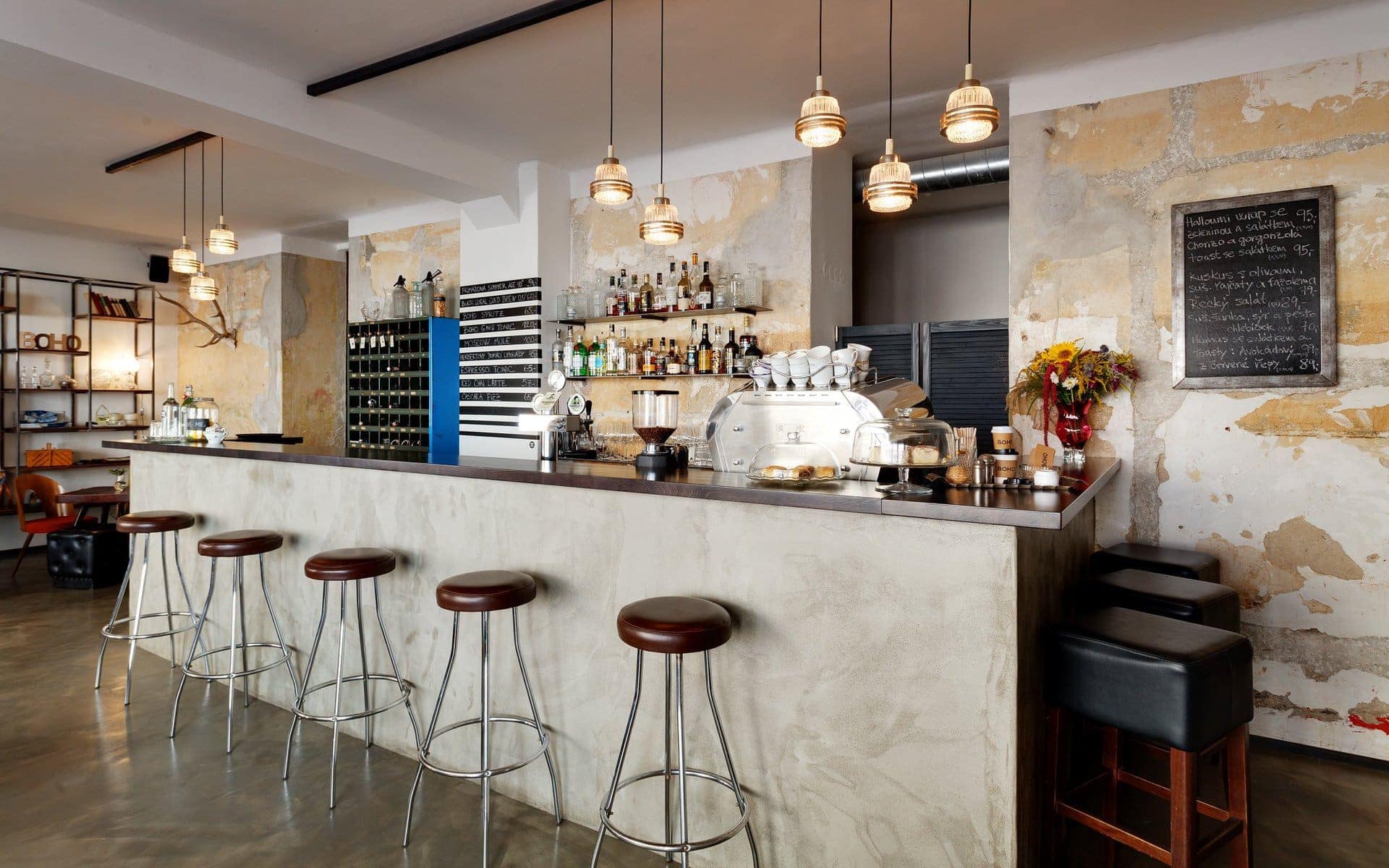
Meetings, online work, foodBOHO Cafe and store, photo: Facebook BOHO Cafe and store
Nice place in Vinohrady to work, to read and to eat. The Boho Cafe also has a great wine selection and a small outdoor seating area.
Best avocado toast, business meetings, online work, coffee{%CAPTION%}
For a long time I was trying to find out where they have the best avocado toast in Prague. The winner for me was Monolok Cafe, where we like to go not only for breakfast, but also for business meetings. In Monolok they have a stable wifi connection, just ask for the password and you can work from here in in peace.
27) Cloud Coffee
Reading, studying, meetingsCloud Coffee, photo: Facebook Oblak Coffee
A small café in Vršovice, which is a good place for reading, studying and meetings. It stands out for its friendly service, good sandwiches and excellent coffee. It is obvious that the owners love good coffee.
If you have Google Maps on your phone, you can download a map of Prague cafes to your phone. You can open it anytime and see which of these great cafes is closest to you. The ultimate tool for thirsty coffee lovers!
[mailerlite_form form_id=”10″]
🔗 These are affiliate links — they don't change your price and help us create content. · All experiences →
Tips and Tricks for Your Vacation
Don’t Overpay for Flights
Search for flights on Kayak. It’s our favorite search engine because it scans the websites of all airlines and always finds the cheapest connection.
Book Your Accommodation Smartly
The best experiences we’ve had when looking for accommodation (from Alaska to Morocco) are with Booking.com, where hotels, apartments, and entire houses are usually the cheapest and most widely available.
Don’t Forget Travel Insurance
Good travel insurance will protect you against illness, accidents, theft, or flight cancellations. We’ve had a few hospital visits abroad, so we know how important it is to have proper insurance arranged.
Where we insure ourselves: SafetyWing (best for everyone) and TrueTraveller (for extra-long trips).
Why don’t we recommend any Czech insurance company? Because they have too many restrictions. They set limits on the number of days abroad, travel insurance via a credit card often requires you to pay medical expenses only with that card, and they frequently limit the number of returns to the Czech Republic.
Find the Best Experiences
Get Your Guide is a huge online marketplace where you can book guided walks, trips, skip-the-line tickets, tours, and much more. We always find some extra fun there!
TL;DRMikulov is a lovely town in South Moravia, right in the heart of Pálava, ringed by vineyards and limestone hills. Highlights include the château, the Holy Hill with its Way of the Cross, the old Jewish quarter, the main square, and some cracking wineries and cafés. It’s a great base for exploring Pálava, cycling out to the Nové Mlýny reservoirs, or just pottering about on two wheels. The town is at its best in spring, and especially in autumn during the wine harvest. The guide has 10 tips on what to see and do in and around Mikulov, plus where to go for wine and where to get a good meal.
I visited Mikulov for the first time less than a year and a half ago. And it was love at first sight. Since then I have been returning to Mikulov whenever possible. Since you’ve noticed and often write to me for tips on what to do in Mikulov, I put together this article with the places that have stuck in my heart.
If you don’t find your favorites here, please let me know in the comments, and forgive me – there are hundreds of beautiful places in Pálava, and they can’t all fit into one article. In this article, Mikulov, Czech Republic: 10 Best Things to Do and See, you’ll find places to see in Mikulov, cafes you should visit, and buildings you must see.
While there are many truly beautiful places in the Czech Republic, Pálava has its own unique charm. Here you’ll find beautiful and diverse nature, white rocks, vineyards, bodies of water, and in spring, a flood of pink blossoms.
There is more sun here, ancient oaks decorate the bank of the blind arm of the Dyje River and in the Milovnice Forest you will find warm-loving oak forests, which do not grow outside South Moravia in the Czech Republic. Every time I come here, I feel like I’m in my beloved Italy. Time passes more slowly here and you don’t have to be ashamed of the wine for breakfast.
Mikulov, Czech Republic: 10 Best Things to Do and See
Most people come to Mikulov for good wine. However, it was probably grown here in the 2nd century. century. And thanks to the terrifying warming, Moravian wines are gaining in quality every year. But if you are not a fan of wine, or you can’t drink, Mikulov is still a great place for trips.
1) Holy Hill Mikulov
When I asked Lukas if we were going “to the hill”, he thought we were going for ice cream. After finding out what he had actually agreed to, he was slightly disappointed. But not for long.
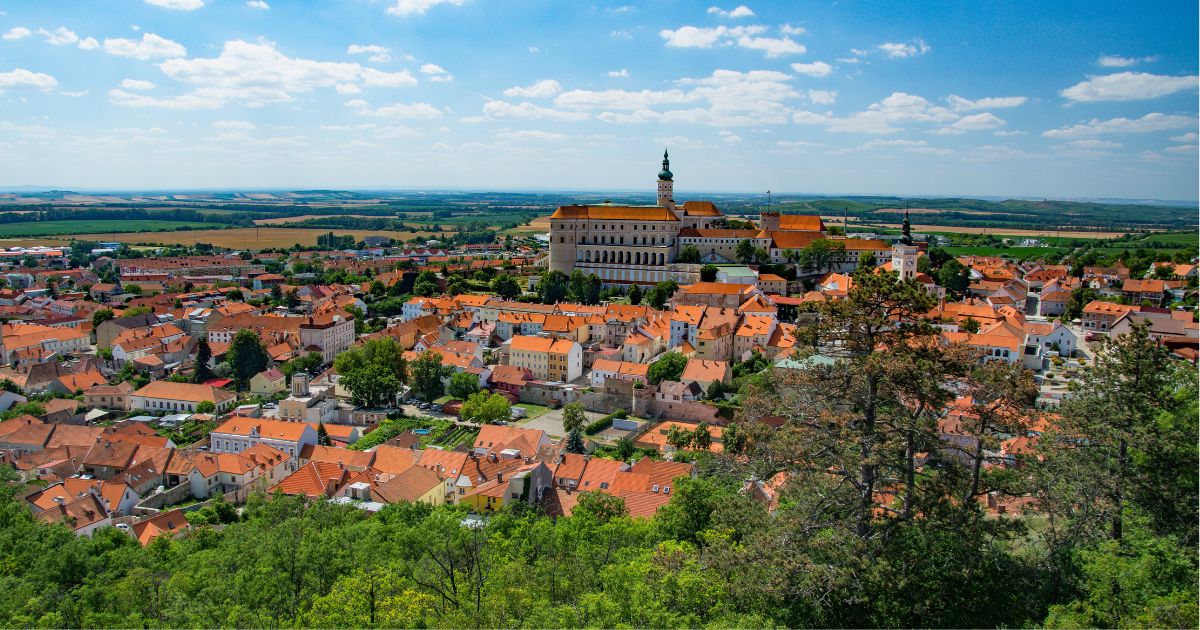
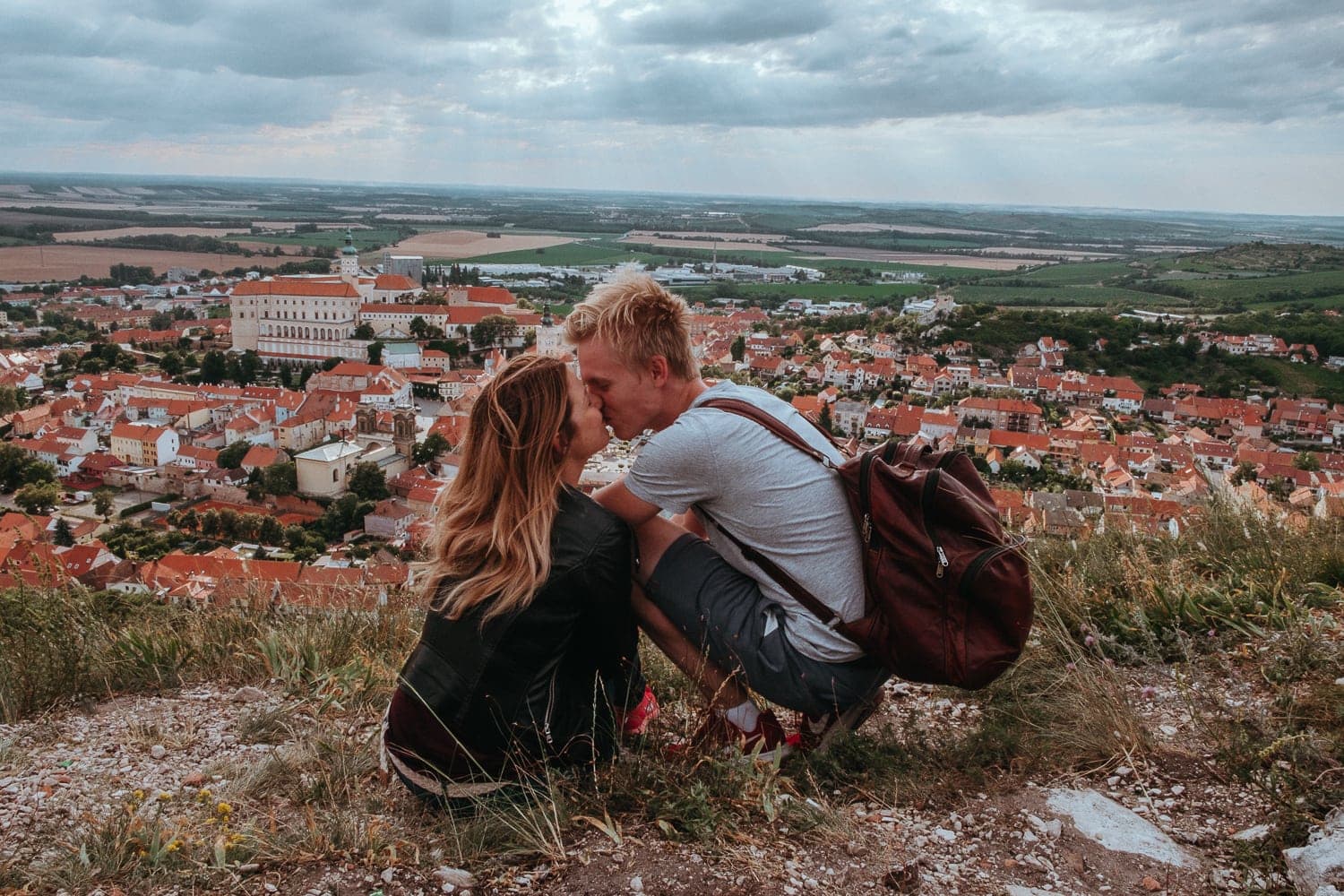
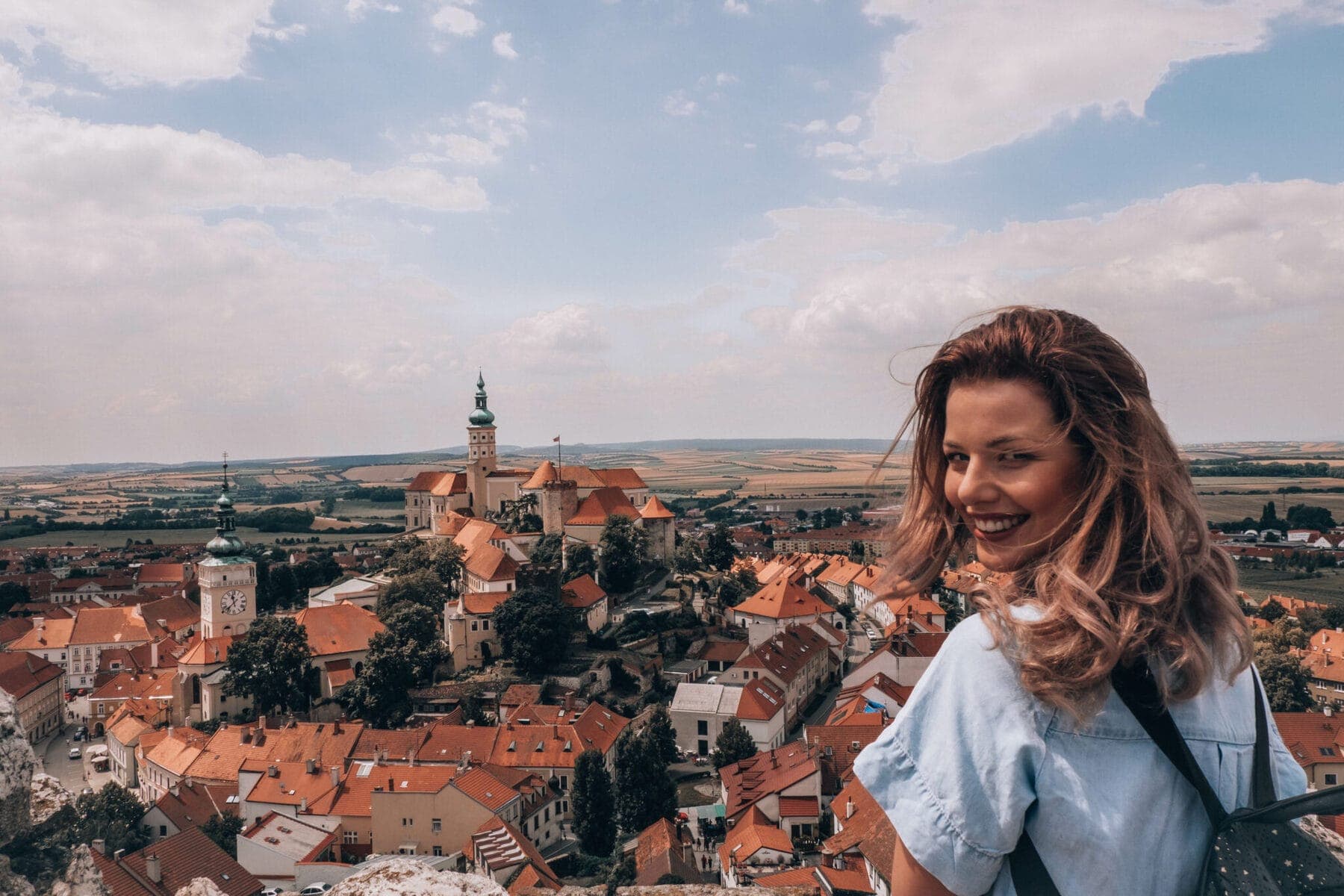
Svatý kopeček is a beautiful cross path that ends with a panoramic view of the whole Mikulov. I visit Svatý Kopeček every time I visit.
Not only does it make you feel better when you go there right after lunch or dinner, but it’s also great to think and, most importantly, to see this beautiful city from above.
This Stations of the Cross are among the oldest in the Czech lands and include a total of 17 buildings: 14 Stations of the Cross chapels, the Chapel of St. Sebastian and the Bell Tower and Chapel of the Holy Sepulchre. The Stations of the Cross were built by the owner of the Mikulov estate, Bishop of Olomouc and Cardinal František of Dietrichstein, as an expression of gratitude to God for overcoming the plague epidemic in 1622.
2) Mikulov Castle
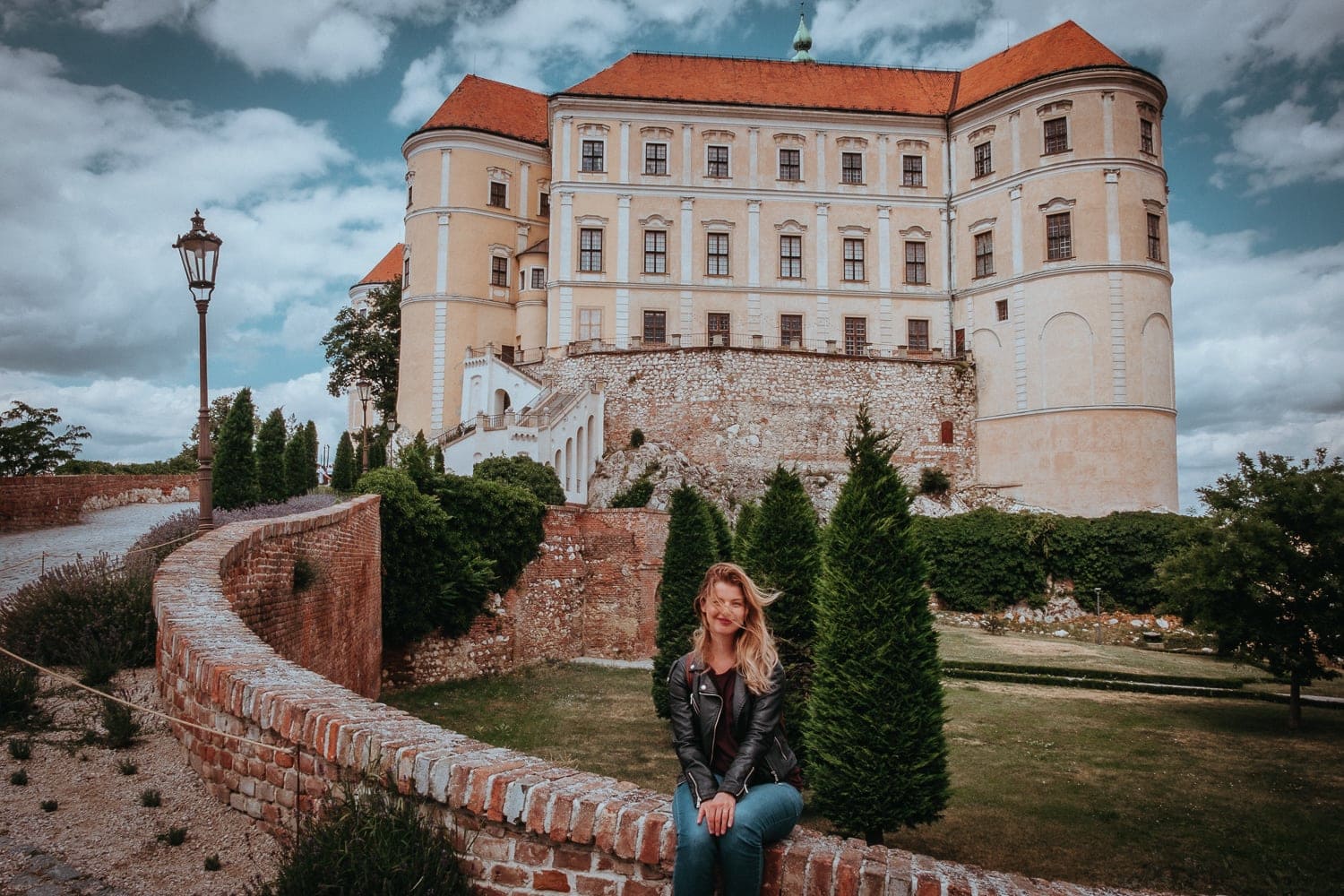
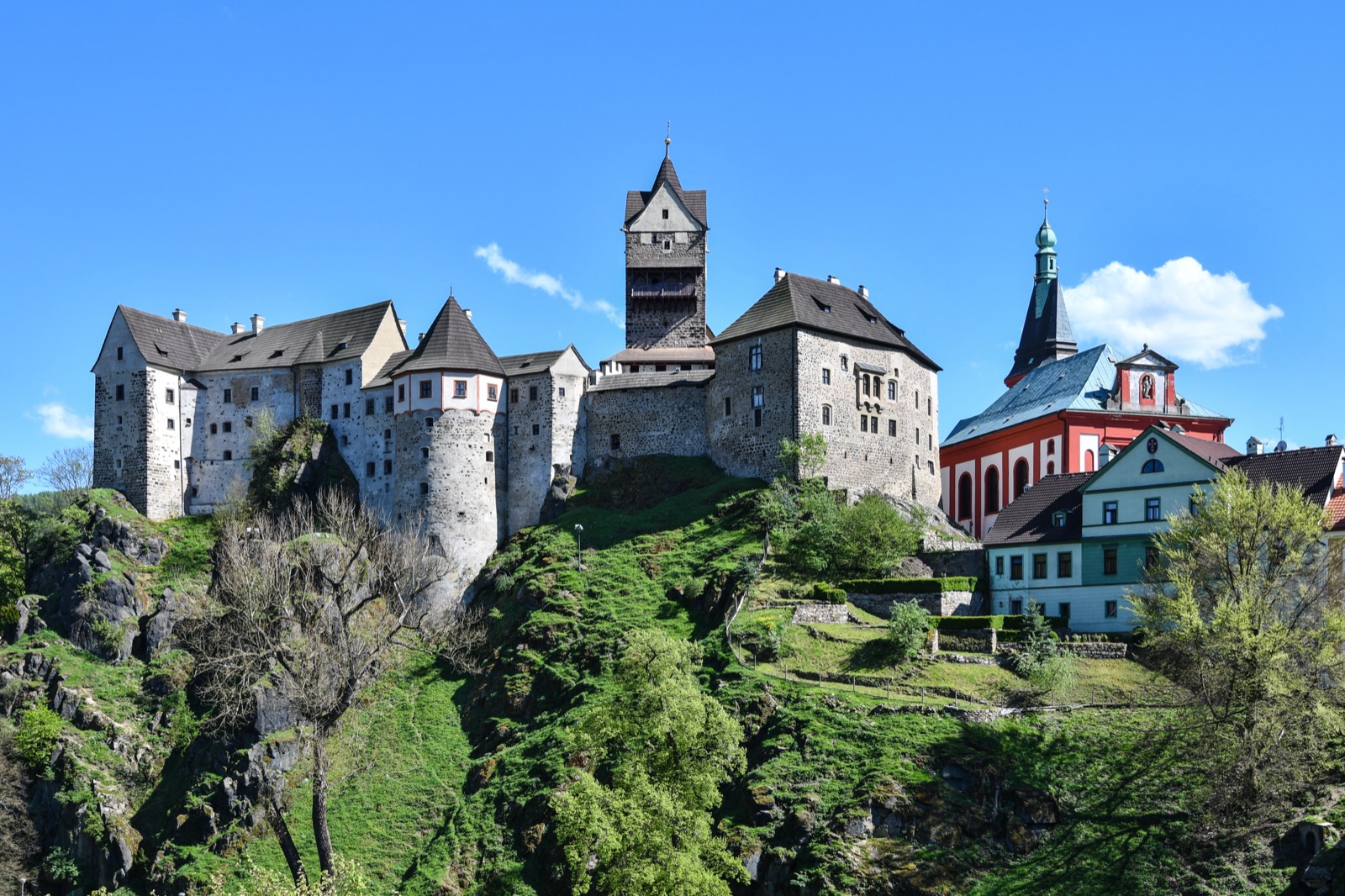
The former Liechtenstein and later Dietrichstein castle stands on a prominent cliff and is the main dominant feature of Mikulov. It acquired its present form in 1719 after a fire, and unfortunately it was not the last one. In 1945, during the retreat of the German army, it burnt down again and in the 50s it was rebuilt. years, it had to undergo a demanding reconstruction.
You can visit the castle on three tours. One will take you through the history of the castle, the second will take you to the castle library, and if you choose the third, you will be guided through the castle cellar with a giant barrel and learn all about the history of wine.
Opening hours of the castle in Mikulov
Month
Days of the week
Opening Hours
December, January, February, March
closed
closed
April, October, November
Fri-Sun
9:00-16:00
May, June, September
Tue-Sun
9:00-17:00
July, August
Mon-Sun
9:00-18:00
Tour circuits and prices
A – History / full admission 120 CZK, reduced 60 CZK, family 260 CZK
B – Chateau Library / full admission 60 CZK, reduced admission 30 CZK, family admission 140 CZK
C – Chateau cellar with a giant barrel / full admission 60 CZK, reduced 30 CZK, family 140 CZK
3) View from the tower – St. Wenceslas Church
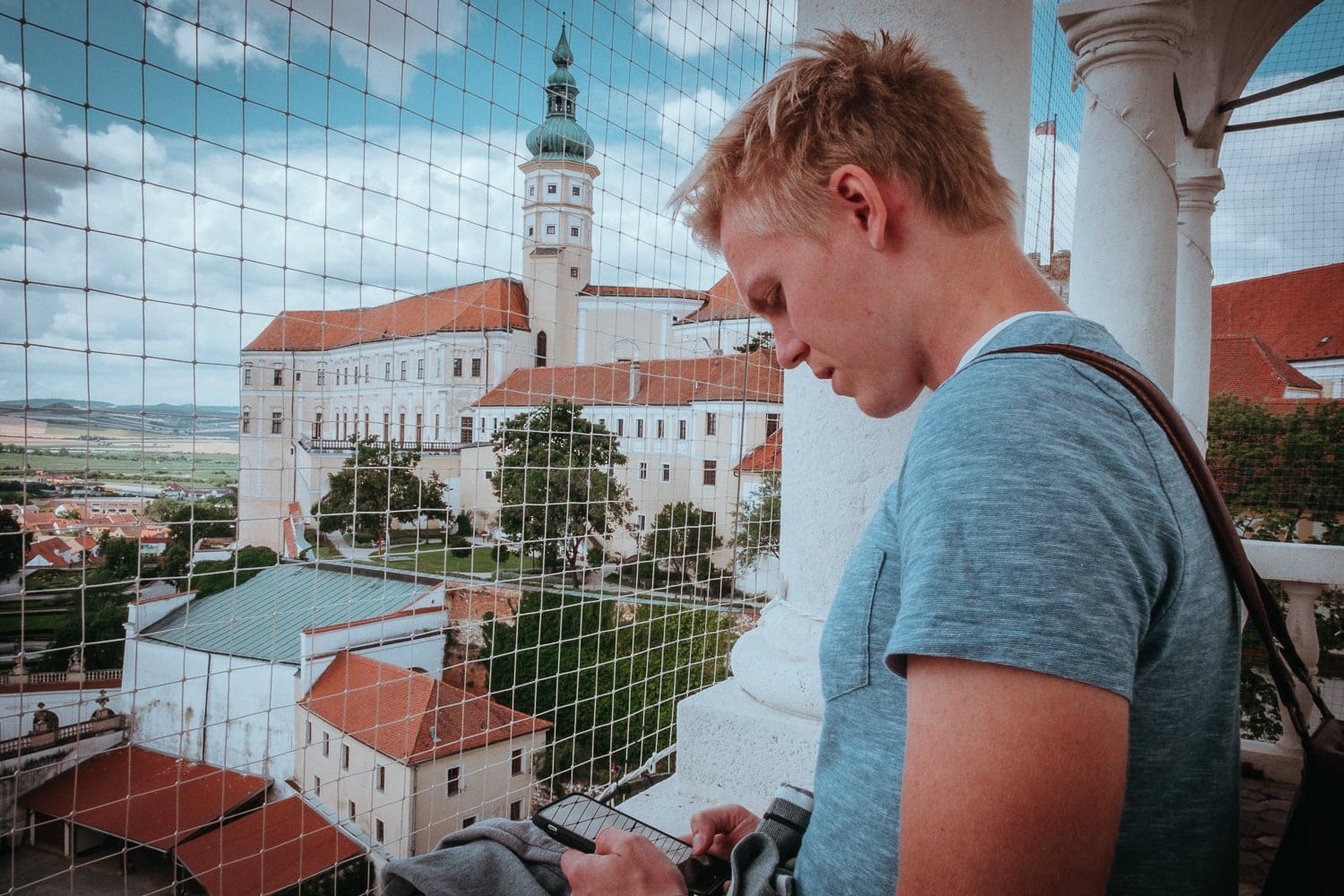
New in 2019 is the opening of the tower of the Church of St. Wenceslas Square, from where you have a view of the square, the castle and the rooftops of the historic town. The only shame is that the whole view is fenced off, so you have to look and take pictures through the cracks.
4) Dietrichstein Tomb
The flames also accompany the history of the Dietrichstein tomb, which used to be a church but burned down in 1784. The church was converted into a tomb and today it contains 45 coffins and 3 urns with the remains of the Dietrichstein family. Interestingly, the founder of the tomb, Prince Franz Josef Dietrichstein, is buried in Vienna and only his heart was placed in the tomb. After the reconstruction, part of the space is also used as a gallery.
Opening hours of the Dietrichstein Tombs
Month
Days of the week
Opening Hours
April, May, June, September, October
Mon-Sun
10:00-17:00
July, August
Mon-Sun
9:00-18:00
November, March
reservations only
from 10 persons
Admission to the Dietrichstein Tomb
full 70 CZK, reduced 50 CZK, family 190 CZK
evening tours – full 100 CZK, reduced 50 CZK, family 250 CZK
admission November-March: full 100 CZK, reduced 50 CZK, family 250 CZK
5) Goat Castle
Which view of Mikulov is the most beautiful? You’ll have to decide that for yourselves, but the one from Kozí hrádek will likely be among the best. Kozí hrádek is one of the three rocky landmarks of Mikulov and originally it was a two-storey artillery tower with a gallery, which served to defend the castle.
View from Kozí Hrádek
6) Quarry near Mariánský Vrch – on Janičův Vrch
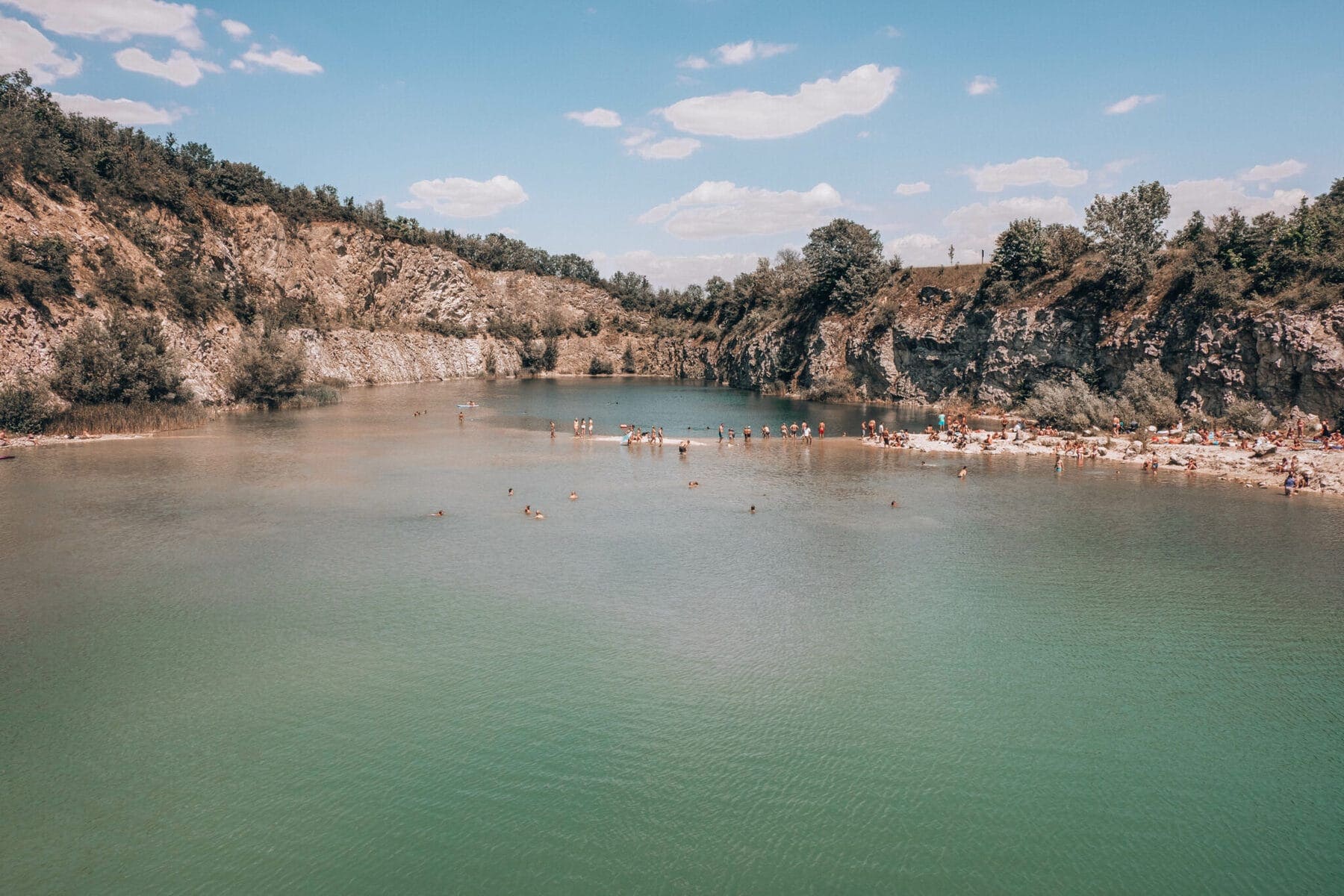
Where to go swimming in Mikulov? If you don’t mind not being alone, try this flooded limestone quarry. Unfortunately, it is very popular, but once you reach it, you will understand why. A little Czech Croatia.
7) Winery U Kapličky
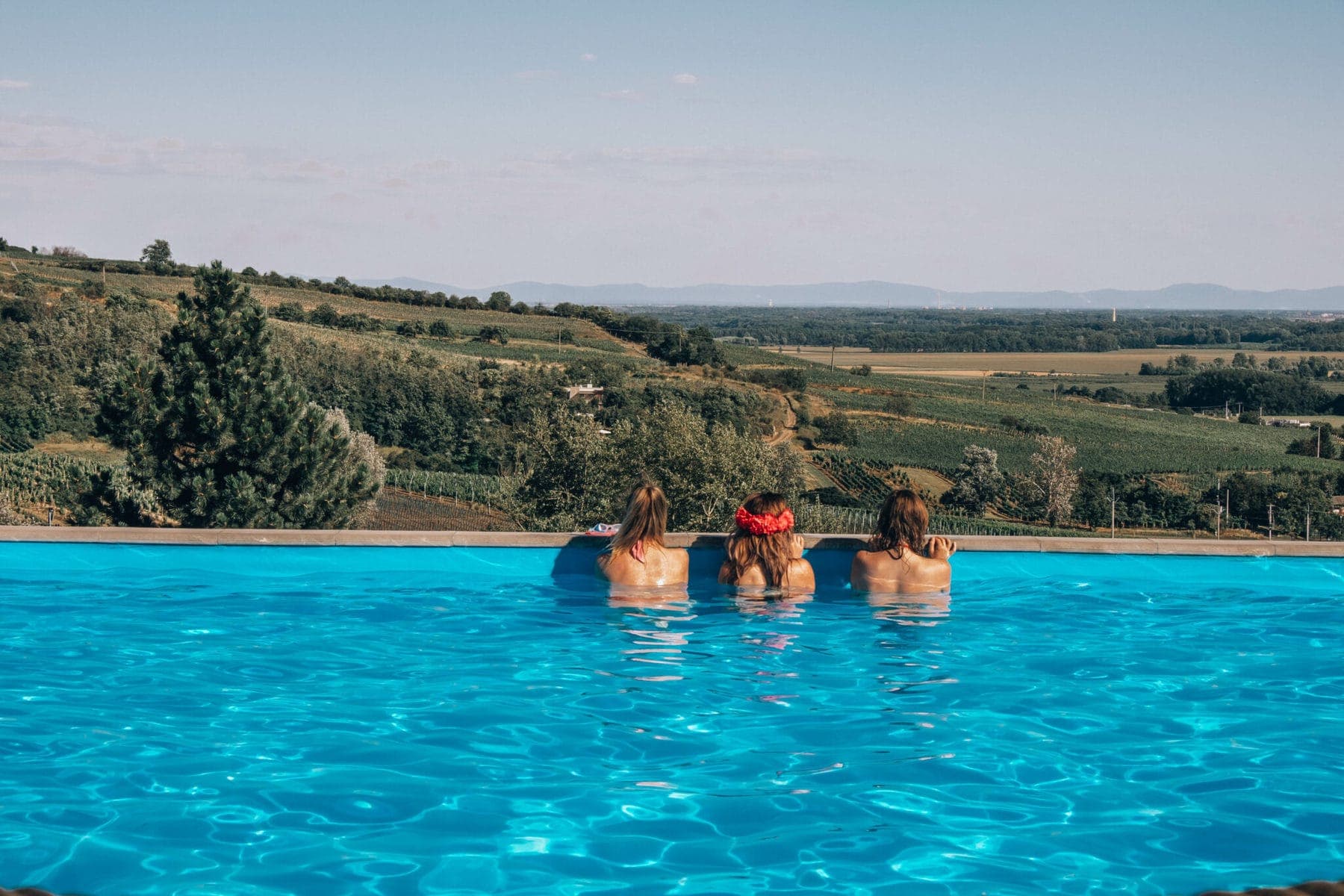
For great wine and good food overlooking the Pálava Mountains, head to Zaječí to the U Kapličky winery. I recommend to stay here, they have a swimming pool with a panoramic view of the Pálava, wellness and pleasant rooms. Wine tastings are often held here, and even discos (honestly, that quite startled us 🙂 ).
It is a family winery, which was founded in 2005 and is focused on the production of quality wines from grapes grown in their own vineyards, their quality is confirmed by a number of awards that they regularly receive.
Winery U Kapličky
8) Cafe Fara
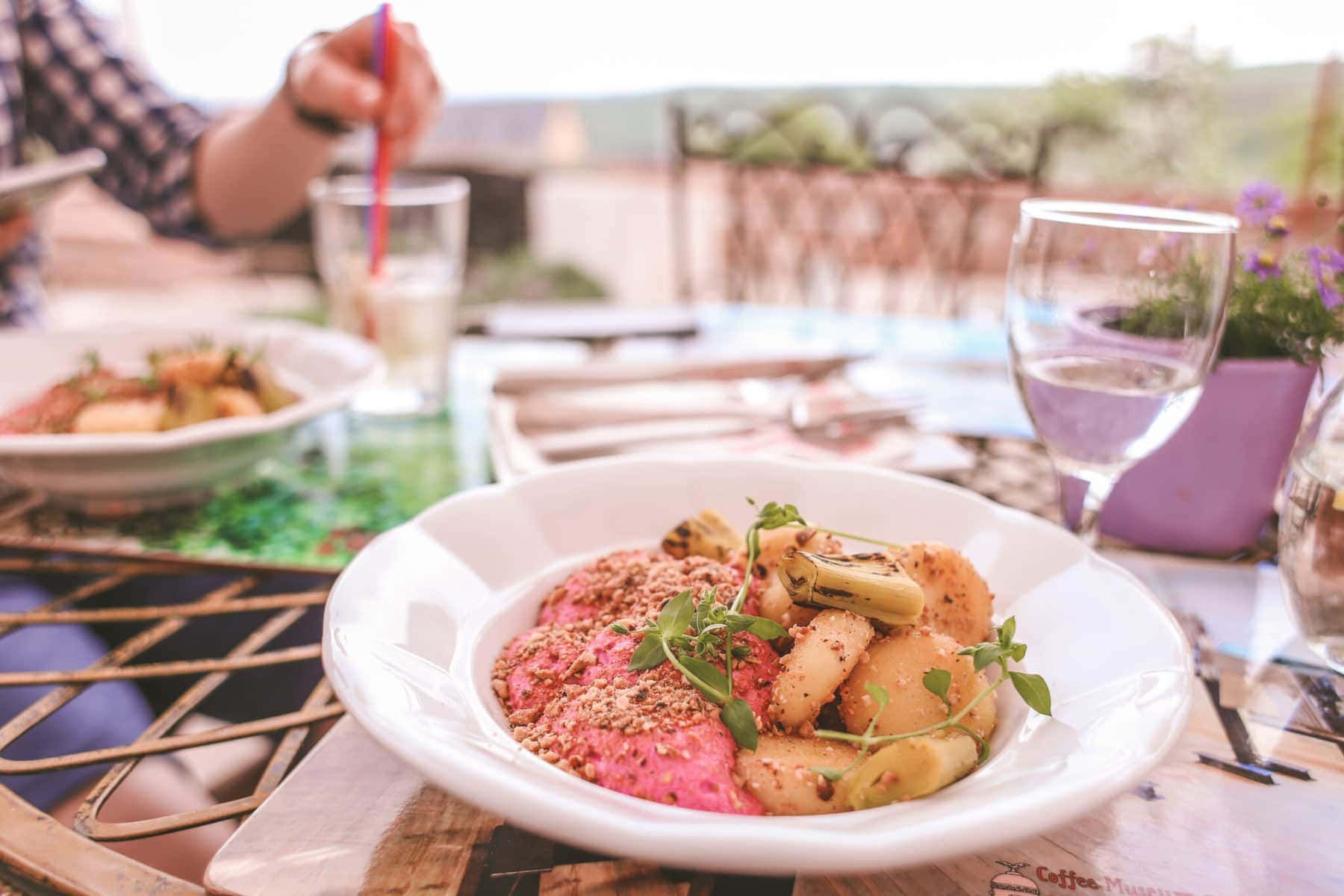
In addition to great coffee, this stylish café in Klentnice offers strongly modernized traditional Czech cuisine and accommodation in a wooden guesthouse built on the site of the original pigsties. The café and bistro is located in the original rectory, which has been restored in a thoroughly historic manner, including the original facade.
If you’re looking for a place to spend the weekend on warm days, be sure to check out Cafe Fara check it out. The guest house also has a stunning swimming pool, which has a stylish relaxation area.
Cafe Fara
9) Lavender Farm of the Old Woman
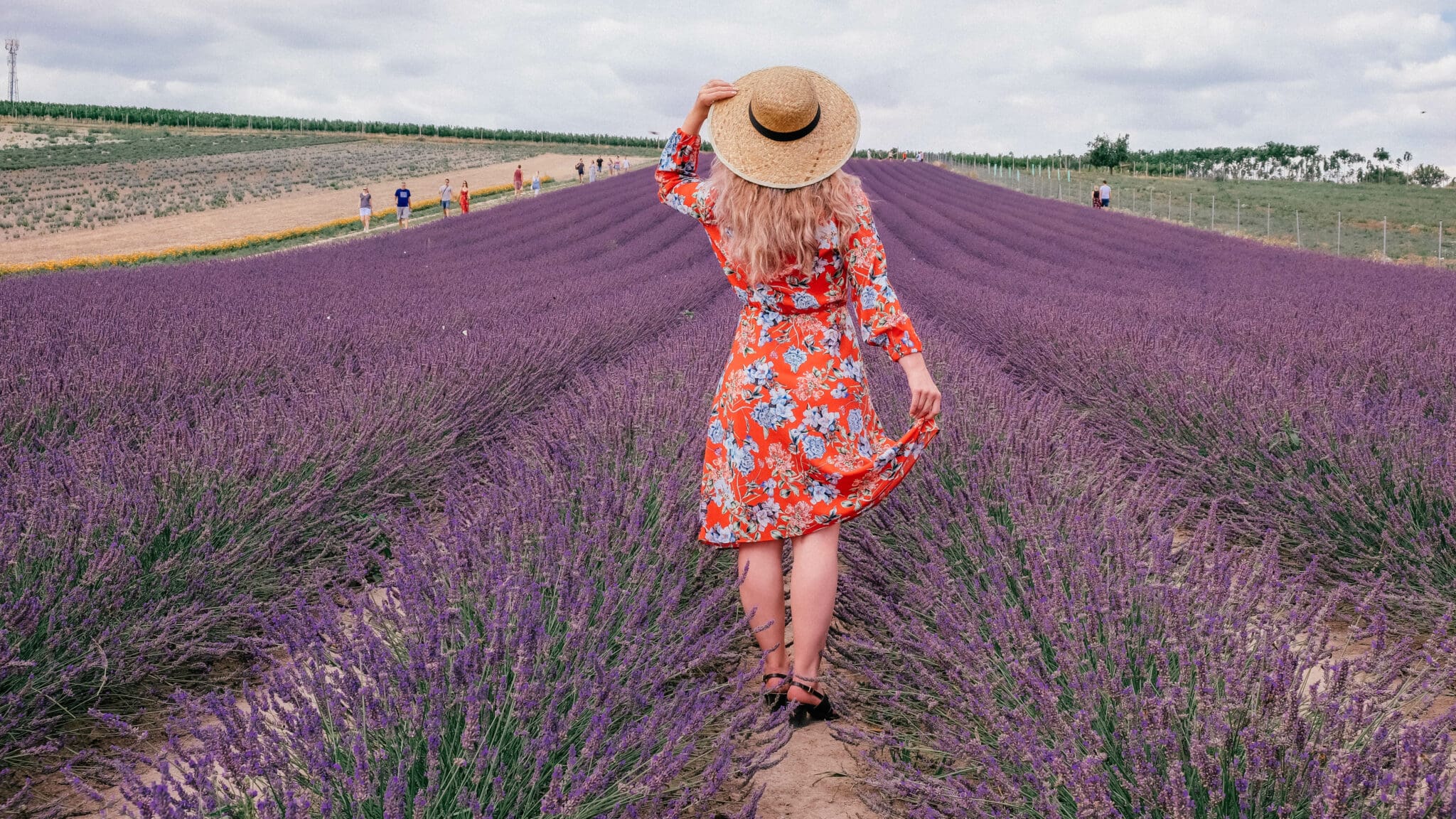
Have you always wanted to go to Provence so you can walk through a lavender field? Then you don’t have to go to France. Exactly such a field is located not far from Mikulov in Starovičky. Beware, lavender grows in June and July, so enjoy your visit to the lavender field well plan. In Starovičky, you buy an entrance in their shop, and then they direct you to the field. You can also buy a variety of lavender products in the shop, from soap to lavender coffee. For lavender lovers, this is paradise.
10) Orphanage
Orphan’s Castle is a ruin of a Gothic castle that you can visit at any time of the year. If you are not in the mood for a longer hike, a short trail leads directly from the village Klentnice. However, if you would like to take a longer walk, you can walk here from Mikulov and then continue to Děvičky.
Lukáš and Lucie recommend
Where to stay in Mikulov
6 accommodations — campsites, wellness hotels and other lodging options
Cycling routes in the vicinity of Mikulov: Cycling from Mikulov to Hraniční zámek
South Moravia is primarily flat, so the surrounding area is perfect for bike trips. From Mikulov you can go, for example, via Sedlec to Hlohovec to Hraniční zámek. This route is 24 km long and is suitable for families with children. For more information please find Here. More cycling routes can be found in the tab On the bike on the Mikulov website.
Orphan’s Castle
Where to eat in Mikulov – Restaurant Mikulov
There are many excellent places in Mikulov, but I liked especially Sojka, which I have to visit every time we visit. Modern fresh cuisine where you can go with your vegetarian and vegan friends and everyone will have a great meal.
Another great restaurant is the elegant bistro Drogerka, but if you want to celebrate an anniversary or for a more festive dinner, you can check out Marcel Ihnacak’s restaurant in Boutique Hotel Tanzberg.
Bistro Kuk
Where to go for breakfast and coffee in Mikulov
The first day we always head to Bistro Kukwhere they have several kinds of freshly baked bread and sweet pastries. However, they offer a variety of more and less healthy dishes to start your day with.
If you’re looking for eggs for breakfast, head to Bistro Kafé – Like Home. If you love pancakes, be sure to head to Kafe Pala, where they have a selection of sweet and savoury pancakes, and excellent coffee is a must!
Accommodation Mikulov
Your first visit to Mikulov should include stylish accommodation. But if you’re looking for something cheaper, look for example at Guesthouse Slavia, hostel Castle-Wall-Inn or Pension na Náměstí. You can also camp near Mikulov, the cheapest camp is Camp Pálava, where there is a simple restaurant and mostly clean showers. If you pay a little extra, you can go camping in the Mars camping site, which is near the Nové Mlýny water reservoir, where there is also a sandy beach. You can also rent water sports equipment here.
If I were to recommend only one accommodation in Mikulov – without hesitation – try Apartments Antico. If you’re not afraid of gothic and a bit of a shot owner, go ahead and pick a basement apartment! Accommodation in the 800-year-old gothic cellar left perhaps the biggest impression on Lukáš and me from the whole Mikulov.
This apartment is experiential, and as its owner Petr says: “(…) it does not meet the current commercial concept, everything is crooked, worn and trampled, of course with 21st century elements.” These gothic apartments are located in a renovated Renaissance house from the 17th century. and they’re the best in the whole city. And I hate the Gothic.
For those who don’t like gothic, and would prefer something more moderate, there is the Štajnhaus guesthouse, which must satisfy every Prague hipster. The Instagram apartments have a modern minimalist feel that respects the character of the historic building.
This hotel is especially famous for its spa, which is located on the rooftop. In addition to a rooftop hot tub and swimming pool, it also has its own wine cellar and a small brewery. Unfortunately, every time we wanted to go, it was sold out. Maybe next time.
During your visit, you definitely shouldn’t miss Mikulov Castle, which houses an exhibition on winemaking and regional history. Svatý kopeček (Holy Hill), with its Stations of the Cross, offers beautiful views of the town and the surrounding landscape. For history enthusiasts, the Dietrichstein Tomb or the synagogue and Jewish cemetery, one of the largest in the Czech Republic, are interesting destinations.
If you’re up for a longer trip, head to Archeopark Pavlov, where you can learn more about the prehistoric settlement of this area. Another great stop is the Lednice-Valtice Cultural Landscape, which is just a few kilometers away and offers beautiful gardens, romantic buildings, and Lednice Castle.
Sports enthusiasts will appreciate the cycling paths through the vineyards, which lead, for example, to Nové Mlýny, where you can relax by the water. Mikulov and its surroundings offer countless excursion possibilities, whether you love history, nature, or good wine.
What to Do in Mikulov when it Rains
Even rainy weather in Mikulov doesn’t have to deter you from great experiences. Visit Mikulov Castle to learn more about the region’s history and winemaking. The Dietrichstein Tomb, which holds the rich past of the noble family, is also an excellent choice.
Culture lovers will enjoy Galerie Konvent with its contemporary art exhibitions, or the Regional Museum, home to the famous giant barrel. If you’re seeking relaxation, head to the wine cellars, where you can sample renowned Moravian wines and soak in the pleasant atmosphere. And if you want to warm up, an ideal choice is wellness at one of the hotels or a short trip to Aqualand Moravia in Pasohlávky.
Frequently Asked Questions
Where to stay in Mikulov?
For cheaper accommodation we recommend Guesthouse Slavia. Hipsters will love the Steinhaus and history lovers will love the Antico Apartments.
Where to go in Pálava for wine?
Excellent wine, equally good food and beautiful views can be found at the Vinařství u Kapličky or Václav Winery.
Where to eat in Mikulov?
For delicious food, go to Sojka or the Drogérka restaurant. For coffee, visit the Kuk bistro.
🔗 These are affiliate links — they don't change your price and help us create content. · All experiences →
Tips and Tricks for Your Vacation
Don’t Overpay for Flights
Search for flights on Kayak. It’s our favorite search engine because it scans the websites of all airlines and always finds the cheapest connection.
Book Your Accommodation Smartly
The best experiences we’ve had when looking for accommodation (from Alaska to Morocco) are with Booking.com, where hotels, apartments, and entire houses are usually the cheapest and most widely available.
Don’t Forget Travel Insurance
Good travel insurance will protect you against illness, accidents, theft, or flight cancellations. We’ve had a few hospital visits abroad, so we know how important it is to have proper insurance arranged.
Where we insure ourselves: SafetyWing (best for everyone) and TrueTraveller (for extra-long trips).
Why don’t we recommend any Czech insurance company? Because they have too many restrictions. They set limits on the number of days abroad, travel insurance via a credit card often requires you to pay medical expenses only with that card, and they frequently limit the number of returns to the Czech Republic.
Find the Best Experiences
Get Your Guide is a huge online marketplace where you can book guided walks, trips, skip-the-line tickets, tours, and much more. We always find some extra fun there!
TL;DRItaly is so varied that there’s something for everyone: sea, historic towns and mountains. This guide rounds up 20 of the best places for a holiday in Italy. Head to Puglia, Sardinia or Sicily for swimming, to Rome, Florence and Venice for the sights, or to the Dolomites and lakes Como and Garda for the scenery. The cities are loveliest in spring and autumn, while the coast is best in summer. We’ll help you pick the right trip for whatever you’re after.
I think we didn’t realize for a long time that Italy is probably the most frequent destination we return to. Although we go to Portugal for a month every year, we visit Italy several times a year. We are in the Dolomites every year (yes, we’re going again this year), and we’ve been to Rome and Tuscany several times, and we even spent a whole week in Venice. Today we bring you tips on where to go on vacation in Italy.
Go to Rome in spring or autumn to avoid the main tourist season. The same applies to Tuscany and Venice. If you’re heading to the sea, the best swimming weather will be from June to September.
Lukáš and Lucie recommend
Where to stay in Italy
6 accommodations — wellness hotels, hotels and other lodging options
Where to Vacation in Italy: the most Beautiful Places
Now let’s look at where to go in Italy for the sea and where to go in Italy for the mountains. We’ll show you the most beautiful places in Italy. Then let us know in the comments where your favorite places are and what we should visit in Italy. 😁
Dolomites
How many times have we been to the Dolomites? I can’t even count anymore, but we return there every year. We camped there, cycled through them, and explored them by caravan and car.
Our favorite season is autumn, when the Dolomites begin to turn golden. You definitely shouldn’t miss Lago Sorapis, Tre Cime, or Seiser Alm. Read about what to see in the Dolomites.
Rome captivates me with every visit. Besides the magnificent monuments and amazing gastronomy, you’ll definitely notice the extremely relaxed atmosphere. You can fly to Rome very easily, and getting from the airport to the city center is a breeze.
Rome is ideal for a long weekend and is a great place for all history lovers. Be sure to visit the Colosseum, Pantheon, Forum, and Vatican. All our tips on how to enjoy Rome to the fullest and avoid queues, where to stay to easily get there from the airport and be close to the center, you’ll find in our article.
Where to Stay in Rome
We were thrilled with Residenza Cavallini, which is five minutes from the airport express bus stop, a short walk from the Vatican and the Trevi Fountain.
Venice
There’s a reason why Venice has a problem with a large number of tourists, and currently you have to pay an entrance fee to the city if you’re not staying there. Venice is a magical, romantic city full of history, admired by visitors for centuries.
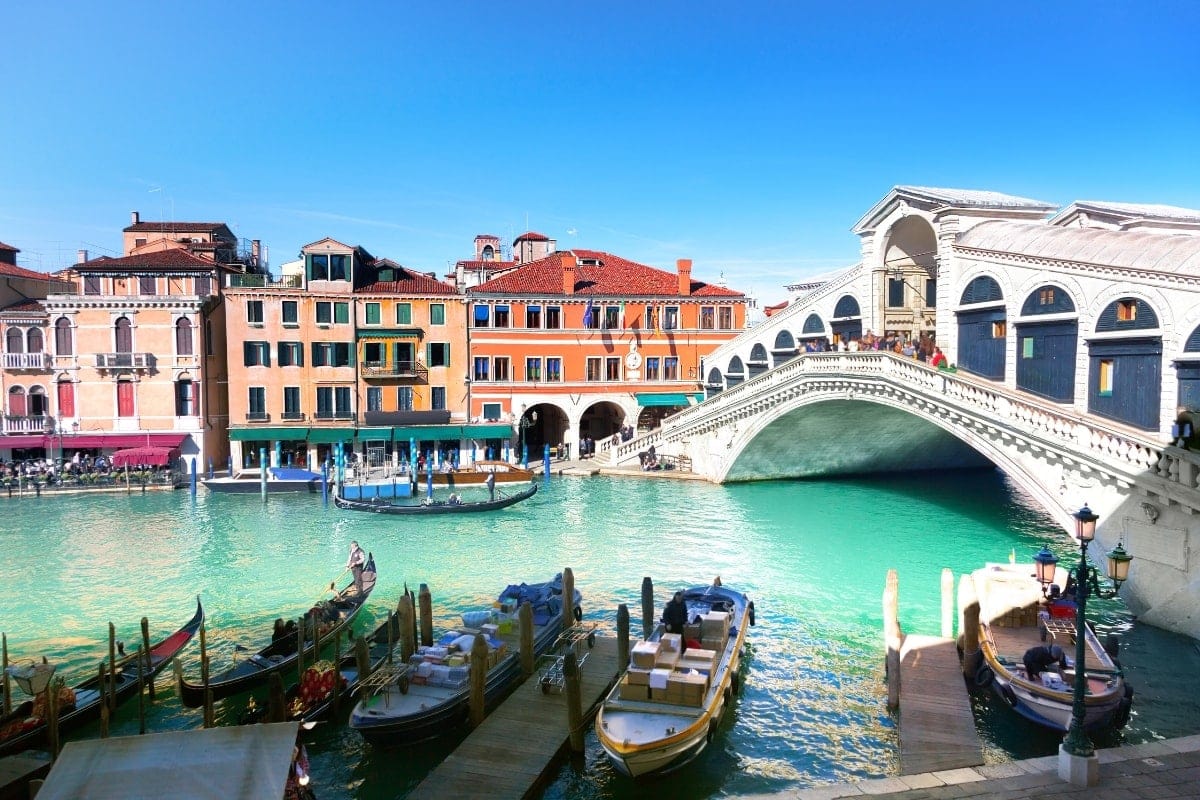
During your visit, you definitely must take a gondola ride, visit the Doge’s Palace or the Gallerie dell’Accademia, enjoy the sunset at Ponte di Rialto, and spend at least one evening in Piazza San Marco. 40 tips on what to see in Venice, but most importantly, where to stay and how to skip ticket queues, you’ll find in our article about Venice. Venice is not ideal for parents with small children who need to use a stroller to get around the city.
If you’re already in Venice, you can take a trip to the second largest city in Veneto, the romantic Verona. If you’re interested in more, read our 32 tips on what to see and do in Verona. You can get from Venice to Verona by train in an hour and a half.
Anyone who knows me knows I love Tuscany. Beautiful nature, Etruscans, and romantic cities that gave us so many world-renowned Renaissance painters that I can’t even list them all off the top of my head; among the most famous natives are Leonardo da Vinci, Michelangelo Buonarroti, Sandro Botticelli, Piero della Francesca, Masaccio, and Filippo Lippi.
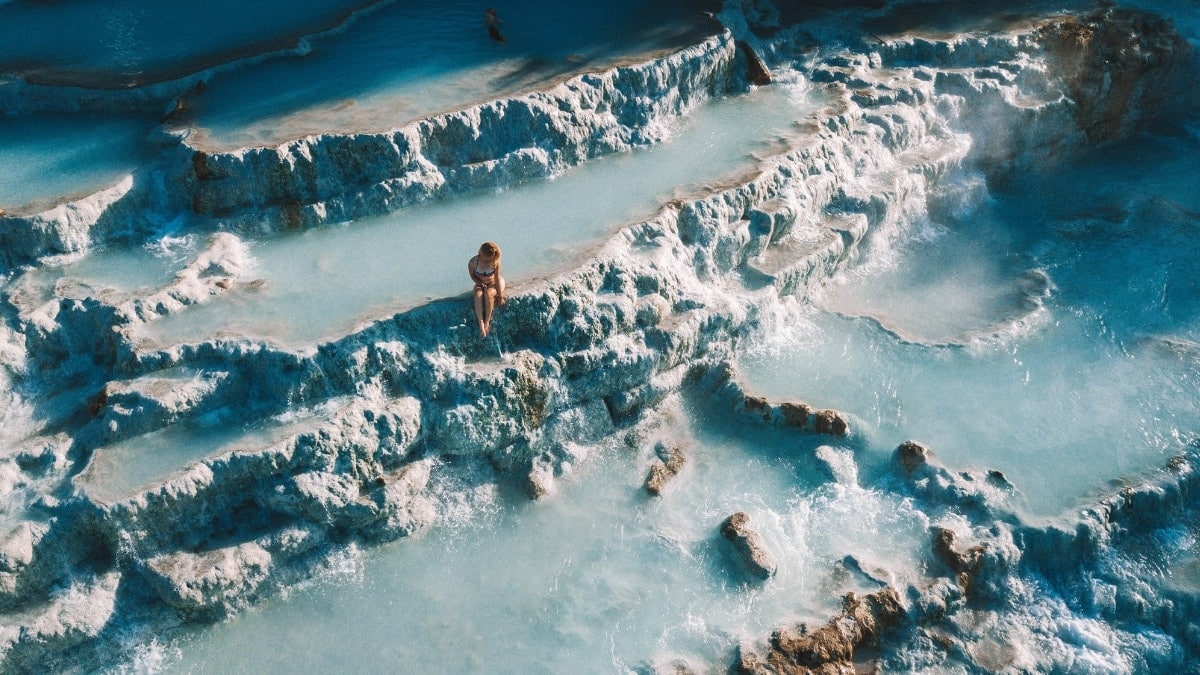
Tuscany is also known for its picturesque hilly landscapes, vineyards, and olive groves. I recommend, like us, going by bike as well; it’s wonderful to cycle here. If you’re not passionate cyclists, in the article about Tuscany you’ll also find our tip for a road trip by car. You definitely must visit Pisa, Siena, Florence, the Chianti wine region, and the Saturnia thermal baths.
TIP: If you decide to visit Pisa and its Leaning Tower, then read our article for more details.
Volterra: Outside the center:Affordable but great accommodation Fontesettimena. In the center, you’ll find Albergo Etruria. For us fans of typical Tuscan houses, there’s also the slightly more expensive Appartamenti Villa Mascagni.
To the Sea on the Amalfi Coast: Vacation in Campania
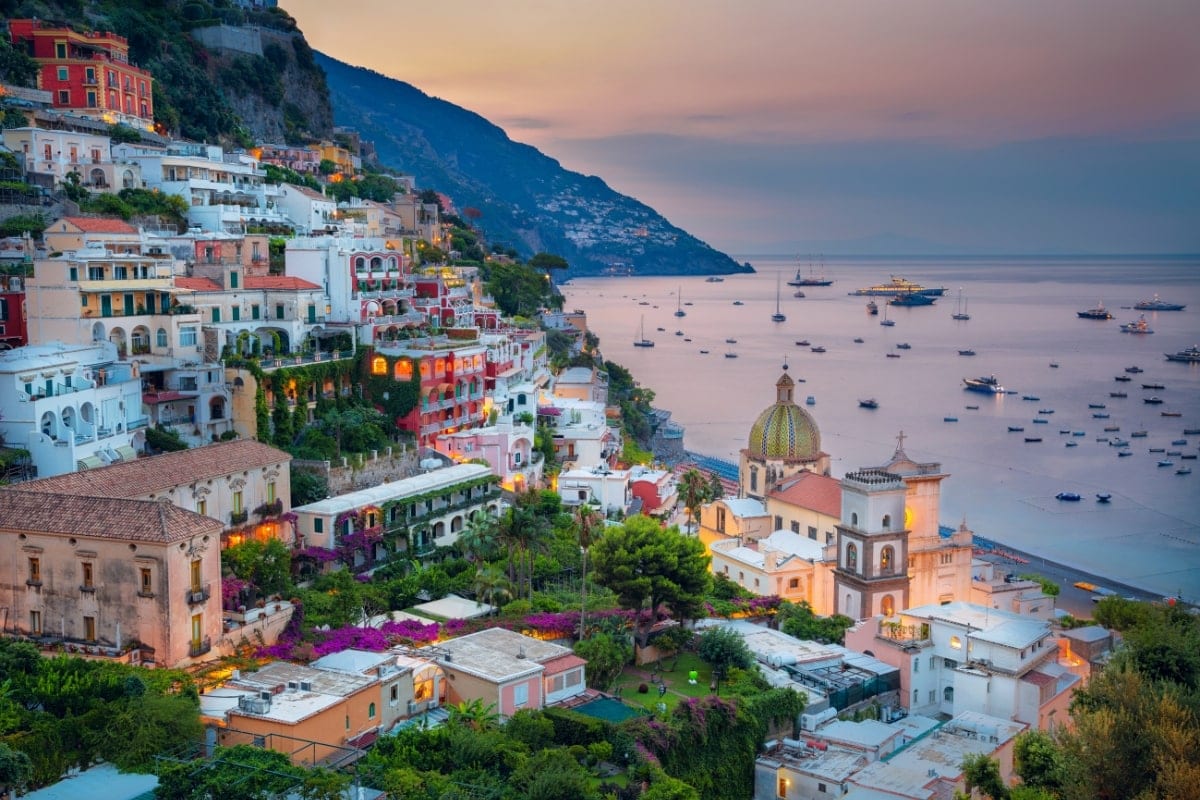
The Amalfi Coast is known for its breathtaking beaches and turquoise sea. Among the most famous resorts are Positano, Amalfi, Praiano, or Ravello. All villages and towns are located on steep hillsides; the town centers are mostly by the sea, and houses continue to climb high into the mountains. Enjoy the sun on Spiaggia di Fornillo beach in Positano or Arienzo beach.
The Amalfi Coast, like the rest of Italy, has a rich history. Visit the ancient city of Paestum, an impressive archaeological site, or explore the charming town of Ravello with its historic villas and gardens.
This area in Italy is also great for people who prefer nature walks over lounging by the sea. Embark on the famous Sentiero degli Dei (Path of the Gods) trail, which offers breathtaking coastal views.
Accommodation in Positano is quite expensive, so be prepared for prices starting at hundreds of euros per night.
Best value for money:Hotel Royal Prisco
Luxury accommodation:Il San Pietro di Positano
Sicily
Sicily, the pearl of the Mediterranean Sea, is an island full of contrasts. This island offers not only beautiful beaches and crystal-clear waters but also a fascinating history and rich culture, reflected in its many monuments, cities, and traditions.
Don’t miss a visit to Agrigento, where an amazing complex of ancient Greek temples known as the Valley of the Temples awaits you. These sites are proof of Sicily’s rich history and its connection to ancient Greece.
Taormina, one of the most beautiful and picturesque towns in Sicily, is also worth a visit. A stroll through its narrow streets full of flowers and colorful facades is like a journey into a fairy tale. Visit the ancient Greek theater with breathtaking views of the sea and Etna, and don’t forget to taste local specialties like cannoli.
For nature and adventure lovers, climbing Mount Etna is an unforgettable experience. This active volcano is the highest and most active volcano in Europe. Explore lava fields, craters, and breathtaking views from the summit of this impressive mountain.
Where to Stay in Sicily
Affordable accommodation:Villa Agrumeto
Luxury accommodation:Therasia Resort Sea and SPA
Mid-range option: Hotel Villa Cute
Milan
If you love design and fashion, head to Milan for your vacation. This Italian metropolis is ideal for a long weekend, and besides being the heart of fashion and design, it also offers countless cultural treasures, fascinating history, and a very energetic atmosphere.
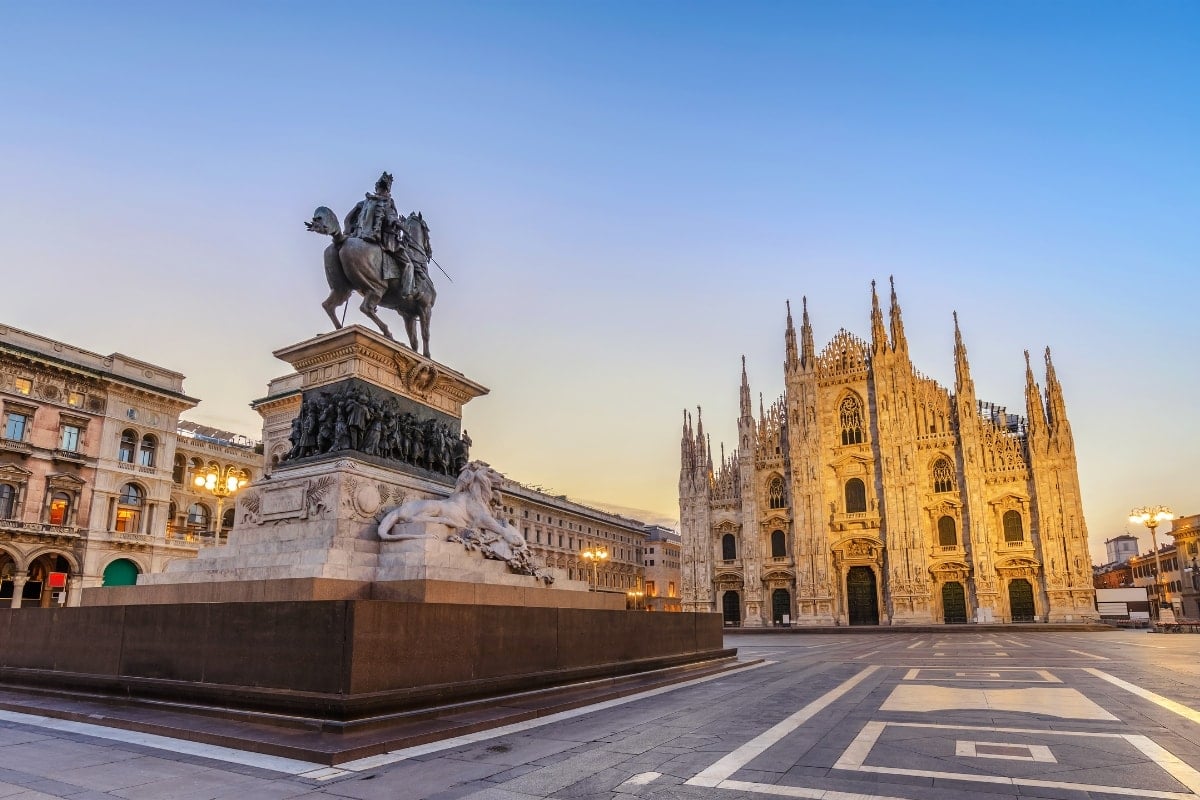
Milan’s dominant feature is the magnificent Gothic Duomo cathedral, which literally captivates with its impressiveness and beauty. The city is also home to the world-renowned La Scala opera house; if you love culture, you should definitely go to an opera or ballet.
An unmissable stop in Milan is the Church of Santa Maria delle Grazie, home to one of the most significant works of world art – Leonardo da Vinci’s Last Supper mural.
Milan is world-renowned as a center of fashion and design, so if you love shopping, you shouldn’t miss the luxurious shopping street Via Montenapoleone.
For nature and history lovers, a visit to Sempione Park and Sforza Castle is ideal. A stroll along the park’s green avenues offers a pleasant respite from the city’s hustle and bustle.
If you know us, you know we’re not big on sports, but if you are, you might want to visit the San Siro football stadium.
Where to Stay in Milan
Accommodation in the center: INTOMILAN Galleria Duomo
TIP: For more tips on accommodation in Milan, read our article.
Lake Como
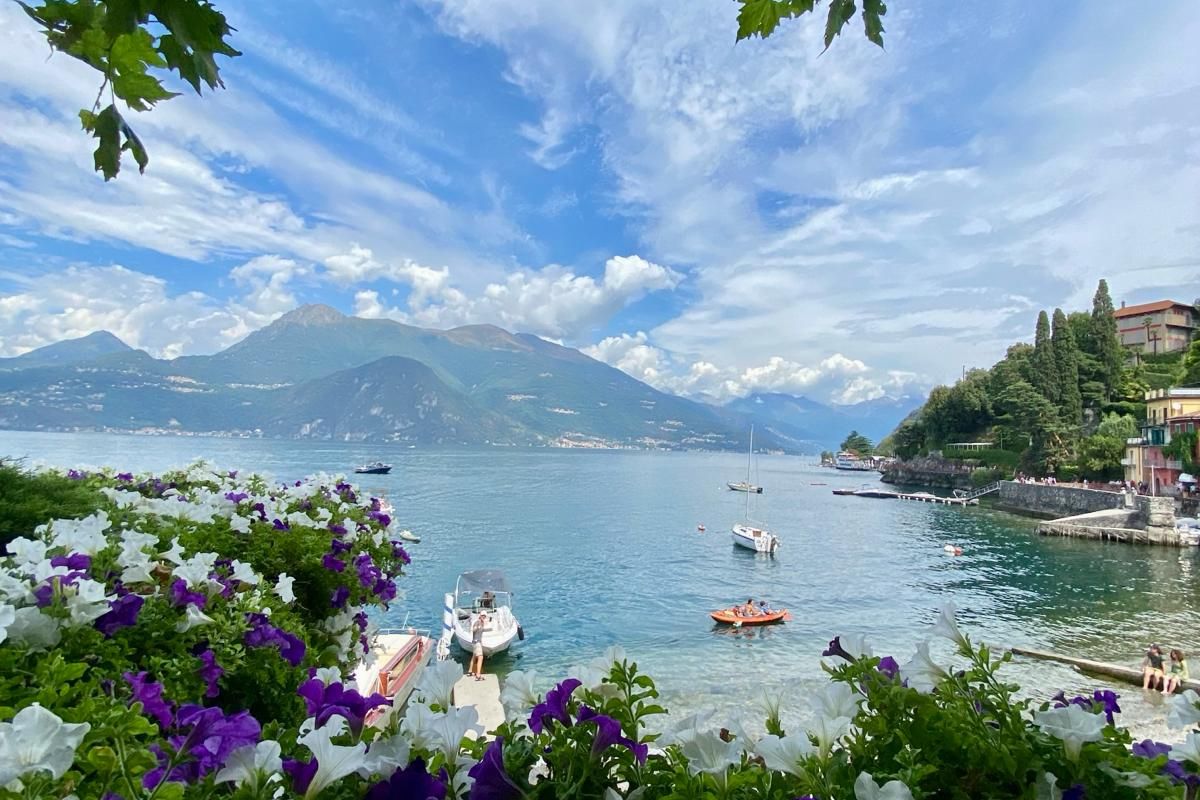
From Milan, it’s a stone’s throw to Lake Como and its beautiful towns. I would recommend at least a day trip to picturesque Varenna to everyone. However, if you have more time, there’s definitely a lot to explore around the lake. Read our article with 34 tips on what to see and do at Lake Como.
Varenna — a town on Lake Como
Pompeii
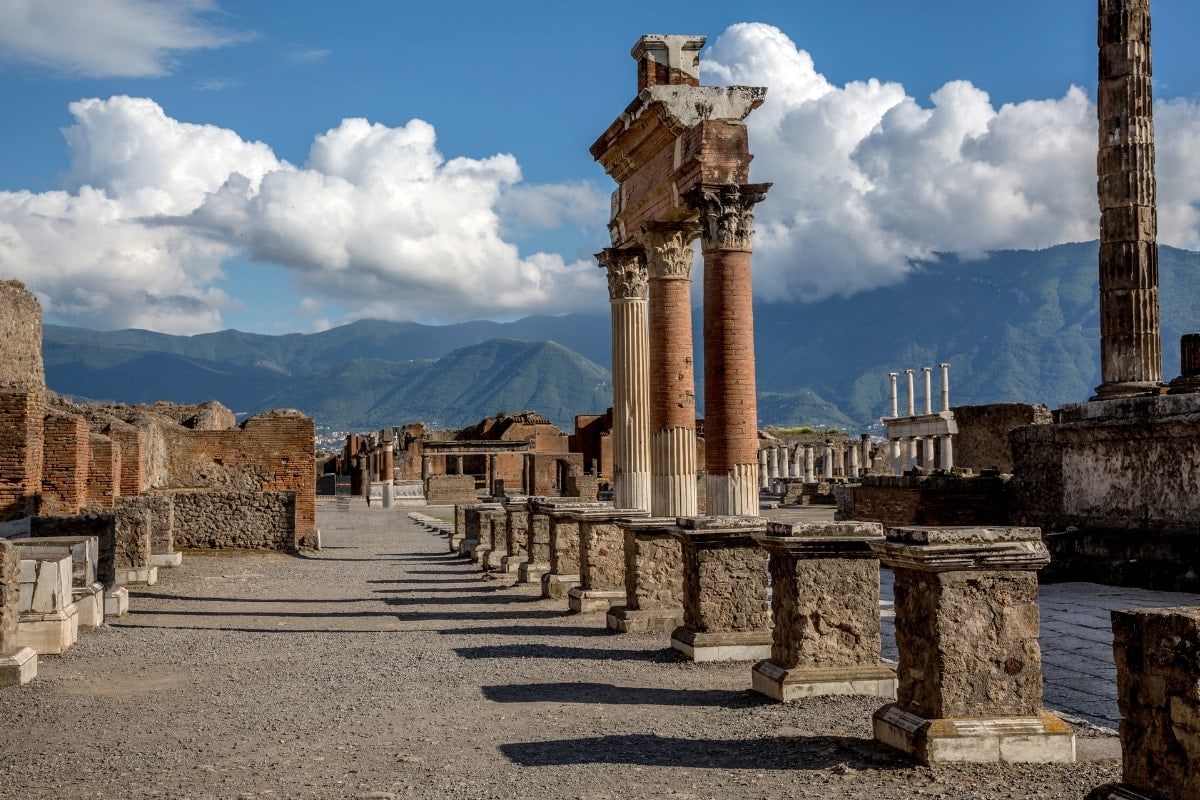
Pompeii, a city frozen in time, represents a fascinating place that takes us back to ancient Rome. The destruction caused by the volcanic eruption in 79 AD buried this city under a layer of ash and lava, and it is precisely because of this that we can now look into the past and glimpse the lives of its inhabitants.
Most people go to Pompeii from Naples for a day trip. All information about Pompeii, including admission fees, can be found HERE.
Capri Island
Capri, the pearl of the Tyrrhenian Sea, is a small Italian island that has attracted visitors for centuries with its beauty, romantic atmosphere, and rich history. This gem among islands is an ideal place for relaxation, but also for discovering the secrets it hides. You can get to Capri Island from Naples by ferry.
One of the most famous and beautiful places on Capri is the Blue Grotto (Grotta Azzurra), which you can only reach by boat with a ferryman.
On the island, you can also visit the picturesque town of Anacapri and its main attraction – Villa San Michele, which was built by the Swedish physician and writer Axel Munthe. A stroll through the villa’s gardens will reward you with magnificent views of the sea and the surrounding landscape.
Don’t forget to taste the famous limoncello on the island, a typical liqueur from Capri.
If you’re looking for a vacation spot with rich history and culture, interesting monuments, and delicious food, Naples is the right place for you. Naples is the largest city in Southern Italy and is located on the Tyrrhenian Sea coast. The city is full of historic buildings, ancient churches, and museums, making it an ideal destination for history lovers.
You should definitely head to Piazza del Plebiscito, the largest square in Naples, where several important landmarks are located, including the Royal Palace, the Basilica of San Francesco di Paola, and the Church of San Carlo all’Arena. The square is also surrounded by several cafes and restaurants, where you can enjoy delicious Italian coffee and traditional Neapolitan pizza.
The Archaeological Museum in Naples is one of the main tourist destinations, as you’ll find a number of archaeological artifacts from ancient Rome and Greece there. Also, be sure to take a trip to Mount Vesuvius and Sant’Elmo Castle, which is located on a hill above Naples and offers magnificent views of the city and its surroundings.
What to Taste in Naples – Traditional Italian Delicacies
Don’t forget to taste Neapolitan pizza, which is thin like traditional Italian pizza but has high edges. Neapolitan pizza is on the UNESCO World Heritage list. If you love sweets, be sure to try “sfogliatella” in Naples – a crumbly puff pastry with a filling of ricotta, vanilla, and candied fruit. Another sweet specialty is “baba” – a leavened cake with rum glaze.
Where to Stay
Affordable accommodation: San Gaetano bed
Mid-range option: Di Palma Suite
Luxury: Residenza Matilde
Sardinia
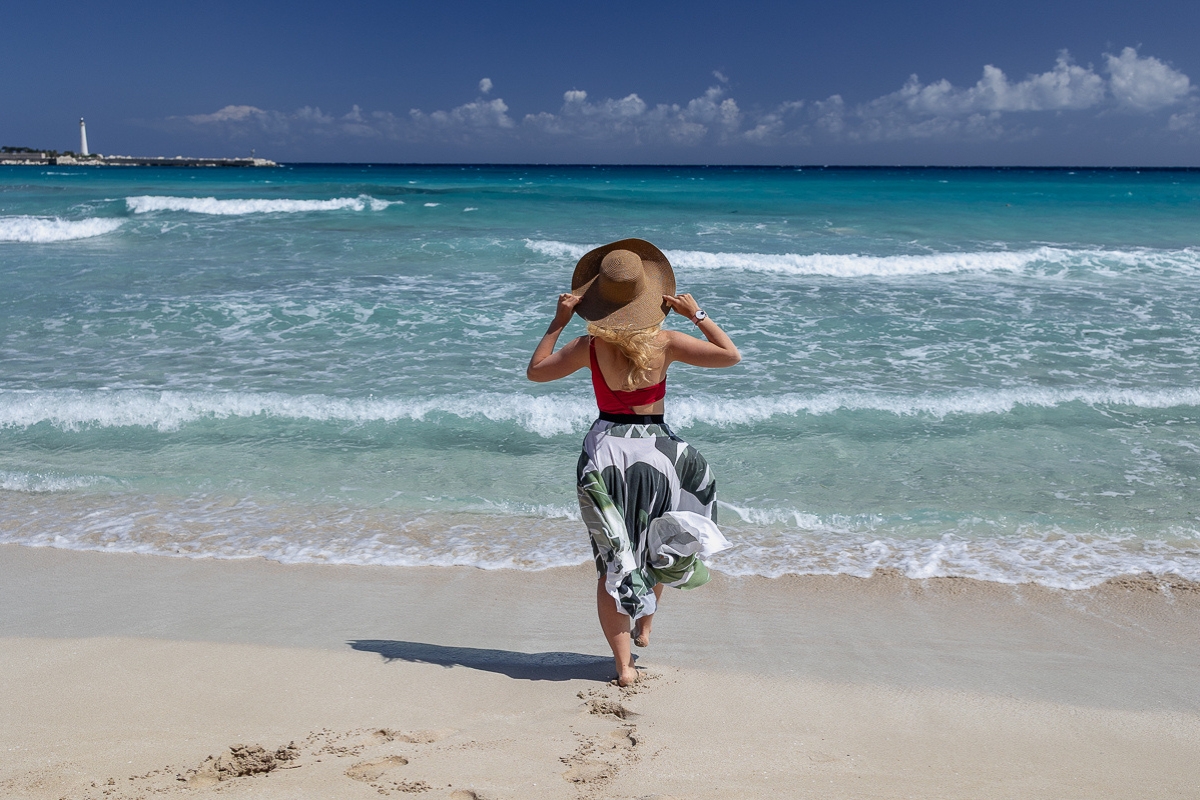
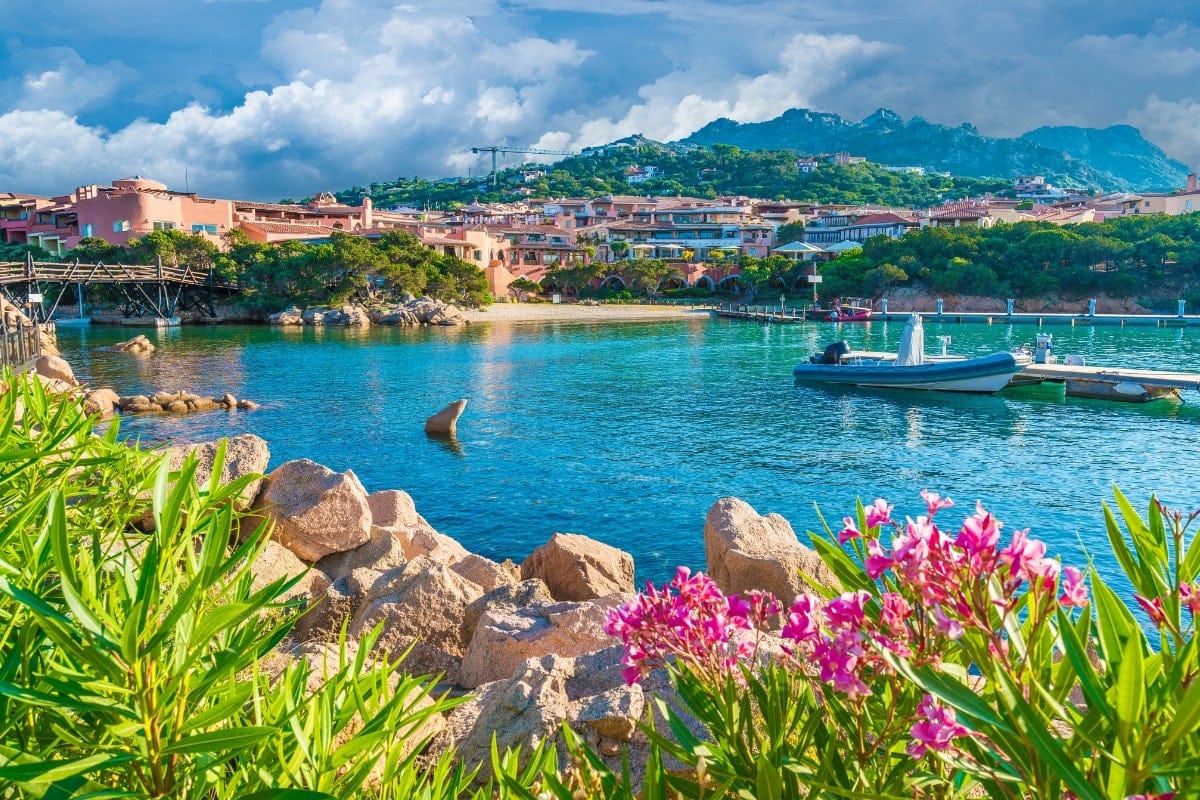
Another great place to go for a vacation in Italy is Sardinia, an Italian island in the Tyrrhenian Sea, known for its diversity and contrasts. On one hand, it offers a coastline with crystal-clear turquoise waters and white beaches reminiscent of the Caribbean; on the other, there’s a rugged interior with grazing sheep herds and a traditional way of life.
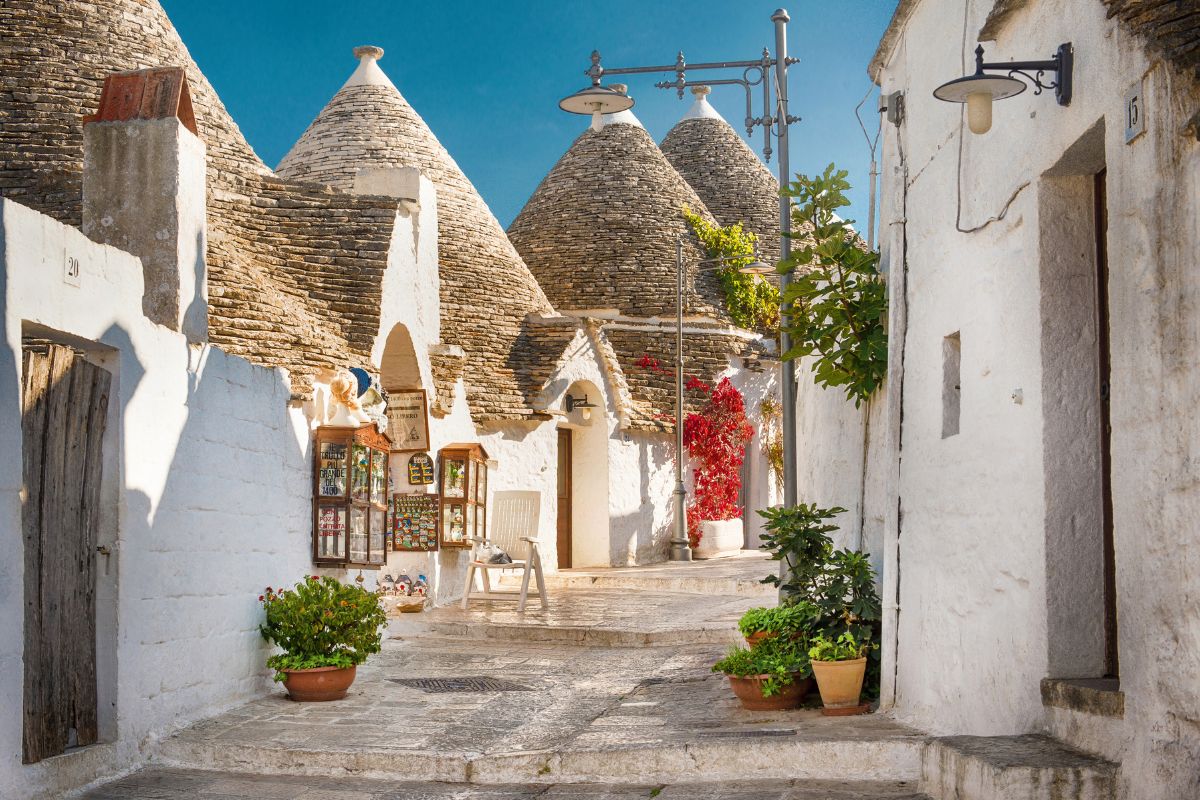
The island is unique for the culture of the Nuragic people, who began building the first truncated cone-shaped stone structures called nuraghes on the island. These structures are almost 4,000 years old, and thousands of them are found on the island.
In addition to the sights, Sardinia also offers excellent local specialties, which are influenced by shepherds and their way of life. These include local cheeses, such as Pecorino Romano and Pecorino Sardo, as well as wines, among which Cannonau and Monica are the most famous.
Sardinian festivals are a magnificent display of local costumes, masks, music, and dance, as well as local gastronomy. Religious holidays are a great attraction for tourists, who can thus get to know the local culture and traditions.
The island also boasts corals, which is reflected in the name of the coastal stretch between Alghero and Bosa, called the Coral Riviera. Coral fishing has a long tradition in Sardinia, dating back to the 14th century.
Where to Stay in Sardinia:
Accommodation by the sea with a pool:Hotel Cala di Volpe, a Luxury Collection Hotel, Costa Smeralda
Cinque Terre
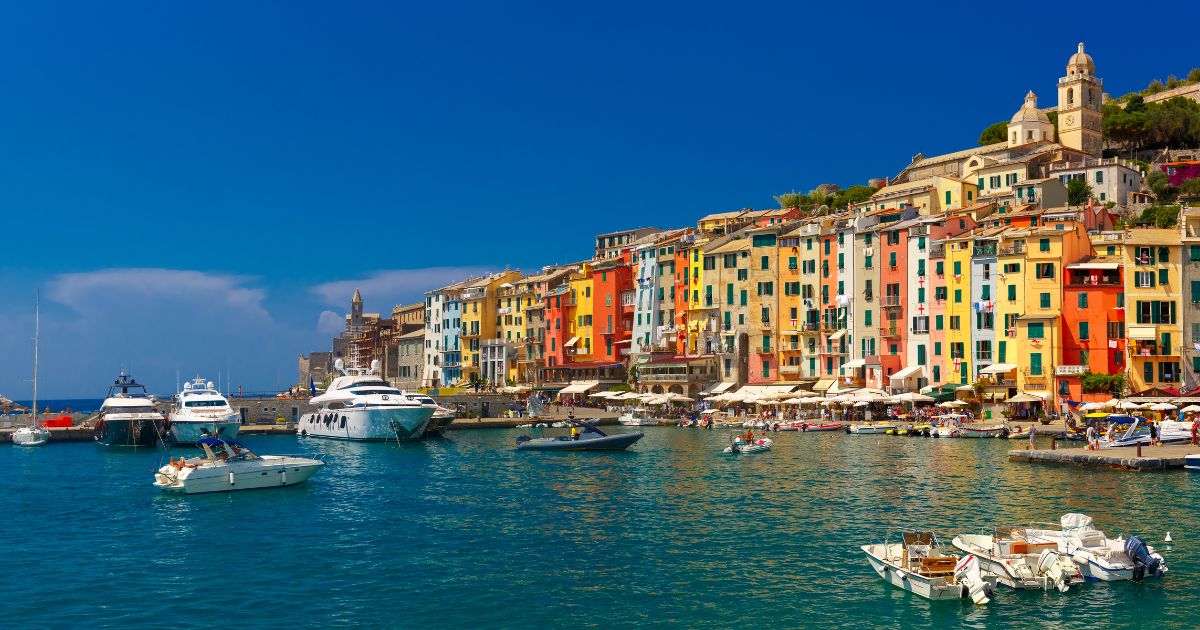
Cinque Terre is an area on the Ligurian Riviera, widely visited by both Italian and foreign tourists, and is listed as a UNESCO natural world heritage site. This area consists of five charming villages, precisely nestled between steep cliffs. The area is an ideal place for tourists and trekking enthusiasts.
The original inhabitants were fishermen and cultivators of grape varieties, who adapted to the natural conditions and built their homes on the slopes. The area was declared a national park, which means a constant influx of visitors who transformed the original peaceful rhythm of life into a prosperous locality full of shops and restaurants.
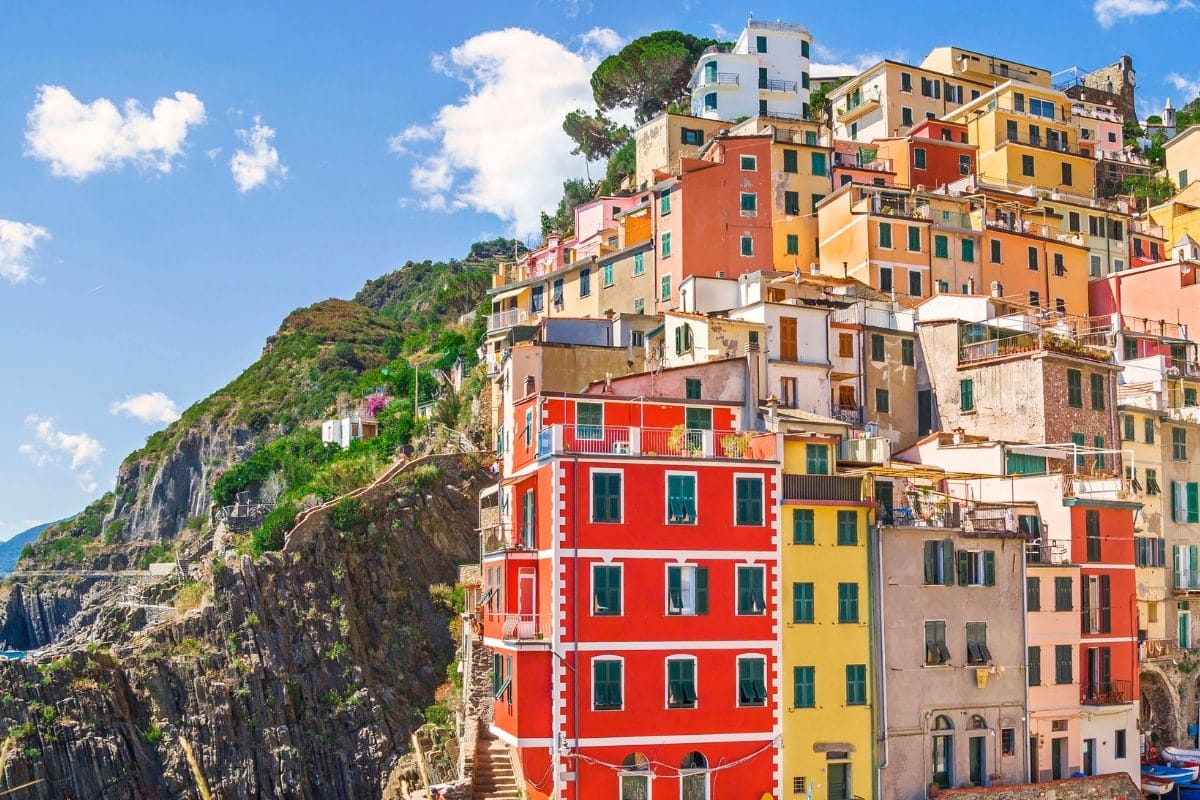
Each of the five Cinque Terre villages has its own charm. Manarola is the oldest and has pastel-colored houses, Monterosso al Mare is the largest and has a vast beach, Corniglia is situated high above the sea and is surrounded by vineyards, Riomaggiore is the easternmost and has colorful houses nestled into steep slopes, and Vernazza has the only natural harbor in the entire area and a medieval fortified castle. Tourists can take the Path of Lovers, which connects all the villages, or they can have guides show them hidden spots.
Where to Stay in Cinque Terre
The most romantic village is certainly Manarola, which is also the most photogenic:
Accommodation in Manarola: Affittacamere San Giorgio
Southern Italian Puglia: Bari, the Capital
Head to Southern Italian Puglia, which offers several beautiful cities, a lot of history, and UNESCO World Heritage sites. Its capital is Bari, which will welcome you with the intricate streets of its old town combined with a modern metropolis.
Bari has an international airport and an ideal location for excursions in the surrounding area. Also worth visiting are the cliffside town of Polignano a Mare, Monopoli, charming Alberobello, or the cave city of Matera.
If you like port cities, then definitely visit the birthplace of Christopher Columbus — Genoa. It is the capital of the Liguria region and the province of Genoa. Here you can enjoy its rich history, swim in the sea, or go on excursions in the surrounding area. From Genoa, for example, you can visit the industrial metropolis of Turin, which you can reach by train in 2 hours.
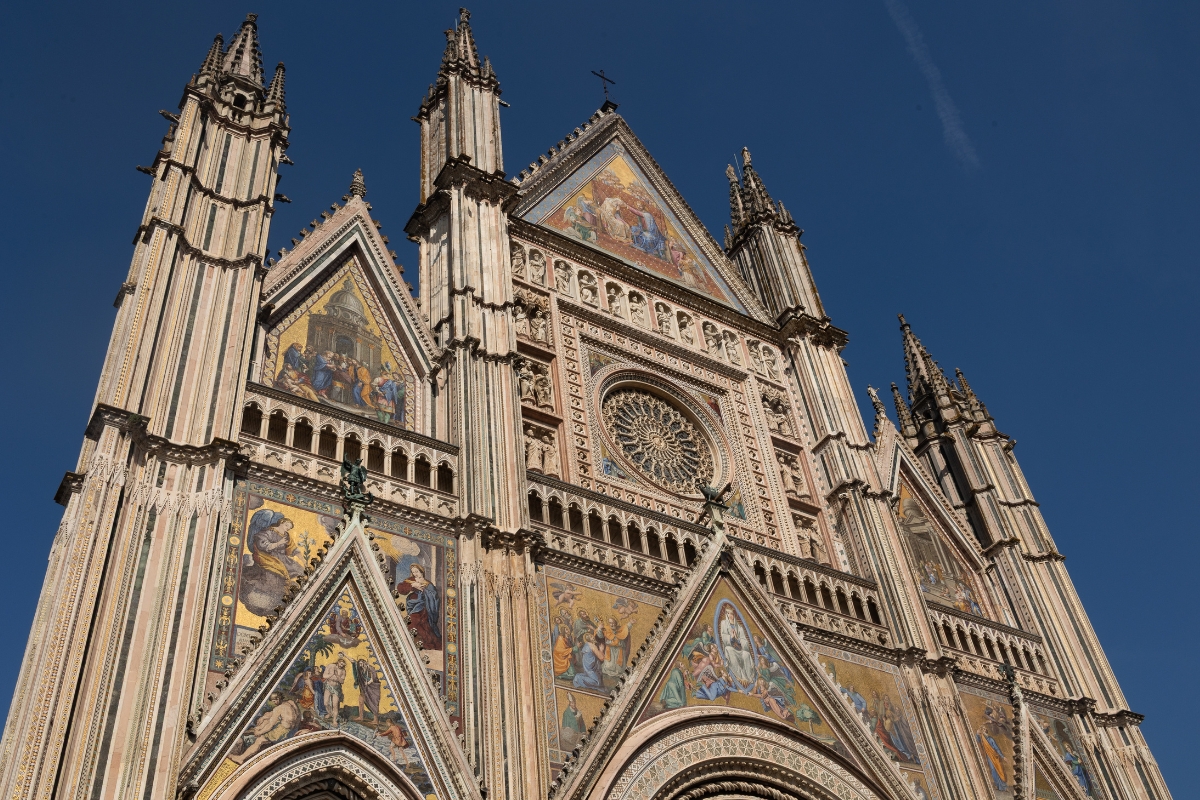
If you’ve never heard of Orvieto, you’re not alone. But that’s a mistake. This Italian city in Umbria has the most beautiful cathedral in all of Italy. Be smart and instead of Tuscany, head to Umbria and visit its picturesque towns, beautiful landscape, and taste local wines. Umbria is a hidden gem of central Italy that not everyone knows about yet.
🔗 These are affiliate links — they don't change your price and help us create content. · All experiences →
FAQs
What is the best time to visit Italy?
If you want to swim, the best time to go is sometime between June and September; for exploring cities, late spring or early autumn is ideal.
What currency is used in Italy?
Italy uses the euro.
What is the official language in Italy?
The official language in Italy is Italian.
Do I need a visa to visit Italy?
No, you don’t. EU citizens can move freely within Italy.
Is tap water safe to drink in Italy?
Yes, it is safe, although in some locations, bottled water is recommended.
Do you tip in Italy?
Yes, it’s not mandatory, but it’s common. However, the amount is not fixed; most Italians round up the amount.
What types of power outlets are used in Italy?
In Italy, type F and L sockets are used, and the standard voltage is 230 V, 50 Hz.
What is the best way to get around Italy?
If you don’t have a car, you can use buses, taxis, or trains, which are extremely popular among Italians for travel between larger cities.
Do I need travel insurance for a holiday in Italy?
Yes, whenever you travel abroad, you should have travel insurance. We find AXA insurance to be the cheapest. You can easily arrange it online even a few minutes before departure.
Can I pay everywhere with a credit card?
Most hotels, restaurants, and shops in Italy accept credit cards, but just like at home, it’s good to have some cash, as you might encounter establishments that don’t accept cards.
Tips and Tricks for Your Vacation
Don’t Overpay for Flights
Search for flights on Kayak. It’s our favorite search engine because it scans the websites of all airlines and always finds the cheapest connection.
Book Your Accommodation Smartly
The best experiences we’ve had when looking for accommodation (from Alaska to Morocco) are with Booking.com, where hotels, apartments, and entire houses are usually the cheapest and most widely available.
Don’t Forget Travel Insurance
Good travel insurance will protect you against illness, accidents, theft, or flight cancellations. We’ve had a few hospital visits abroad, so we know how important it is to have proper insurance arranged.
Where we insure ourselves: SafetyWing (best for everyone) and TrueTraveller (for extra-long trips).
Why don’t we recommend any Czech insurance company? Because they have too many restrictions. They set limits on the number of days abroad, travel insurance via a credit card often requires you to pay medical expenses only with that card, and they frequently limit the number of returns to the Czech Republic.
Find the Best Experiences
Get Your Guide is a huge online marketplace where you can book guided walks, trips, skip-the-line tickets, tours, and much more. We always find some extra fun there!
TL;DRBled and Bohinj are Slovenia’s most beautiful lakes, tucked away in the heart of Triglav National Park. Bled draws crowds with its fairytale island church, a castle perched on a cliff, and warm water for swimming, while the quieter Bohinj is all about wild scenery and gentle walks. Summer means swimming and hiking; come winter, it’s all about cross-country skiing. Don’t skip the Vintgar Gorge or the views from the surrounding peaks. Inside you’ll find 15 tips on what to do around both lakes, where to stay, and where to head for a day trip.
Bohinj and Bled are the most beautiful lakes in Slovenia, located in the heart of the Triglav National Park. We went there for the first time when we rode our bikes across Europe and fell in love immediately. We’ve been back several times since then. In winter, you can go cross-country skiing here, while in summer the landscape invites you to take nature walks and swim in the pleasantly warm Lake Bled. Let’s see what to do in Bled and at Lake Bohinj.
If you like peace and quiet, we recommend staying at Lake Bohinj and then taking a trip to Bled. We stayed in the absolutely luxurious and brand new Hotel Bohinj and we absolutely loved it. We’re still remembering.
The hotel prepares a programme for guests in the garden, one day there is a barbecue, another day there is live music. If there is no program, you can sit in deck chairs or at tables and look at the mountain peaks. In addition, this hotel has a spa. We did not regret at all that we chose a slightly more expensive hotel than usual. The hotel had an amazing breakfast and an absolutely luxurious restaurant.
Bled: weather by month
🌡️ Warmest: July (daytime 26 °C) · ☔ Least rainfall: February
Month
Day
Night
Rainy days
January
5 °C
-2 °C
9
February
9 °C
0 °C
6
March
11 °C
1 °C
11
April
14 °C
4 °C
12
May
17 °C
9 °C
19
June
24 °C
14 °C
12
July
26 °C
16 °C
15
August
25 °C
16 °C
14
September
20 °C
12 °C
13
October
16 °C
8 °C
12
November
10 °C
3 °C
12
December
6 °C
-1 °C
10
Source: climate normal 2019–2024 (Open-Meteo, measured data)
How long to go to Bled and Lake Bohinj
We went for 6 days and it was absolutely perfect. We managed to visit everything mentioned below and had time to laze around and relax with a book in hand or in the wellness area.
What you should know about Bled
Lake Bled, also known as Lake Bled, is a perfect turquoise lake of glacial origin in Slovenia. It is 2.1 km long and 1 km wide and reaches a maximum depth of 45 metres.
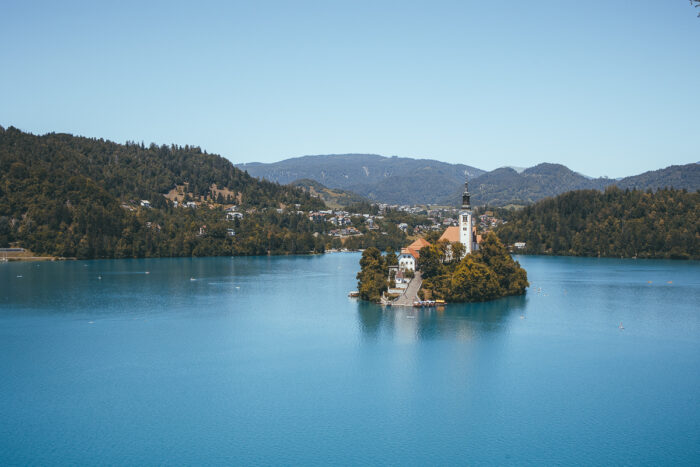
In the middle of the lake is the charming islet of Blejski otok with the pilgrimage church of the Virgin Mary and the Old Slavic cemetery. You can visit the island either by boat from the harbour or by paddling over on a boat. Some can even swim there (the distance from the nearest shore is only 350 metres).
Swimming in Lake Bled – water temperature
The water in the lake is pleasantly warm, up to 26 °C in summer, making Lake Bled one of the warmest lakes in the Alps. If you go swimming, the ideal temperature is from the end of June to September.
What you should know about Lake Bohinj
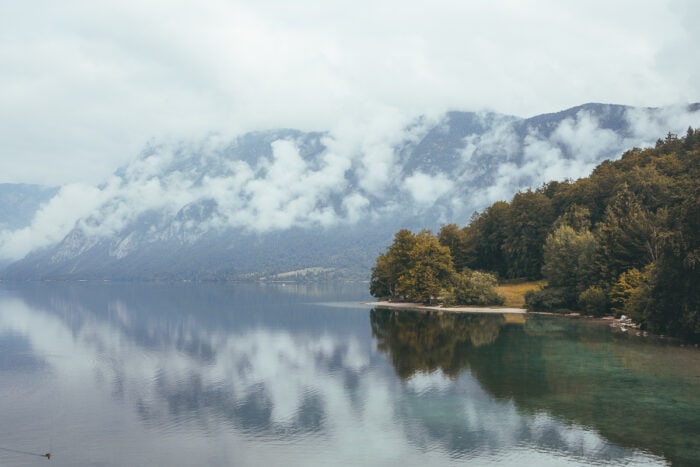
Lake Bohinj is the largest natural lake in Slovenia. The main tributary of the lake is the Savica River. Lake Bohinj is 4.2 km long and up to 1 km wide at its longest part. Compared to Bled, Lake Bohinj is quieter because there are far fewer restaurants and hotels and services in general.
Water temperature Bohinj
Lake Bohinj is much colder than Lake Bled, but that doesn’t mean you can’t swim in it. The water is up to 23 °C in summer.
15 tips on what to do and see at Lake Bohinj and in Bled
Going to Slovenia? Now let’s take a look at what to do in Bled and Lake Bohinj. The two lakes are a short distance from each other, so make sure you visit both when you visit Slovenia.
Rent a boat at Lake Bled
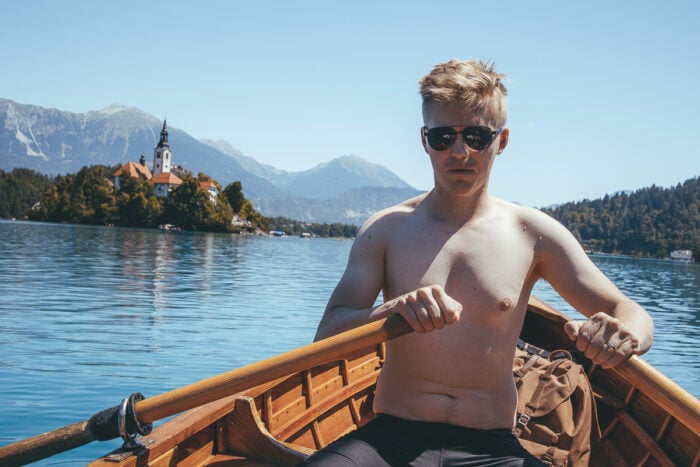
As mentioned above, in the middle of Lake Bled you will find the small island of Blejski otok with the pilgrimage church of Our Lady. To get there, you either have to swim 350 m, take an electric boat or rent a kayak. But you can also rent a paddle board or a classic boat like we did.
Bled Castle
Don’t forget to take a trip to Bled Castle, which is perched on a rock above the lake. The castle was built at the beginning of the 11th century. century, its present form dates from the 16th century. century. Today it serves as a town museum and a stylish restaurant. The terrace has a great view of the lake and the surrounding mountains. The price of admission can be found here.
Take a walk around Bled
If it’s not too hot, go for a walk around the lake, which is 6 kilometres long. Easy trails also lead to the surrounding hills, from which you have nice views of the lake.
View of Bled: Osojnica
For an unforgettable view of Lake Bled, visit the viewpoint called Osojnica. After less than an hour of climbing, you will be rewarded with breathtaking panoramic views of the lake and surrounding mountains.
Vintgar competition
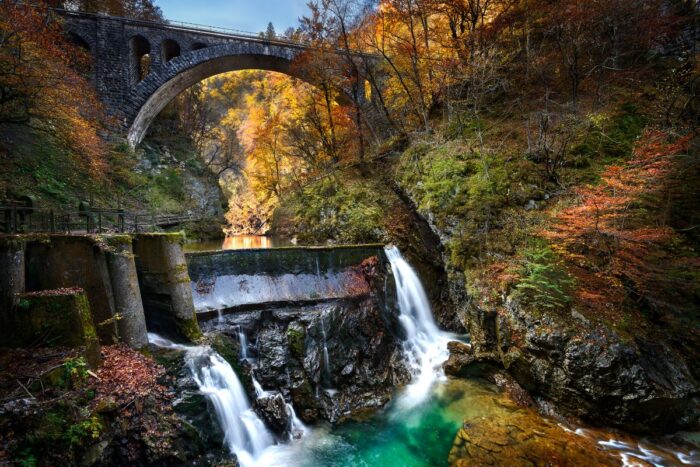
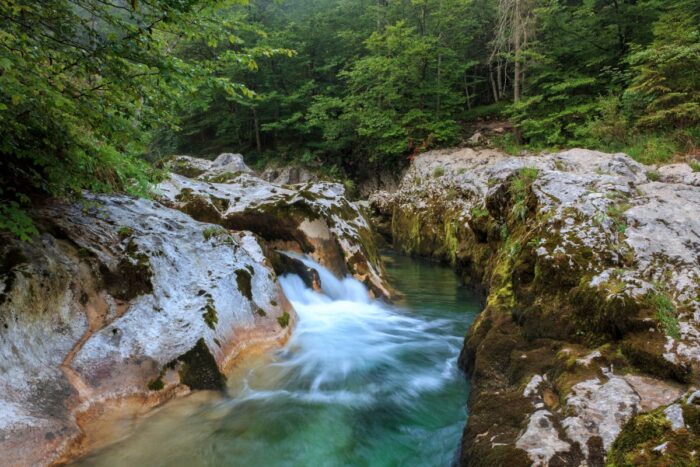
One of the most popular excursions from Bled is a visit to the Vintgar Gorge. This 1.6 km long gorge is a short walk around a fast flowing river, waterfalls and cascades. Don’t forget to wear sturdy shoes as the paths can be slippery.
The Mostnica Competition
Mostnica is a beautiful gorge that is about 2 km long. There is a nature trail that starts in Stara Fužina. Here you will find beautiful rock formations with blue-green colored water.
Vogel – ski resort and viewpoint
For a spectacular view of Lake Bohinj, takethe cable car to the top of Vogel, which is a ski resort in winter but a popular hiking destination in summer. This peak offers some of the best views of the Julian Alps.
Triglav – the highest mountain in Slovenia
Triglav is the highest mountain in Slovenia in Triglav National Park and is considered a national symbol. This 2,864-metre peak is a popular destination for experienced climbers and hikers who are willing to undertake a challenging ascent.
Bohinjska Bistrica – wellness centre
In Bohinjska Bistrica there is a large wellness centre with swimming pools and saunas, where you can enjoy rest and relaxation after an active day in nature.
Walk around Lake Bohinj
The walk around Lake Bohinj is not difficult at all, but it is quite long. It will take you about 3 hours, as it is about 12 km long. But you can rent a bike or electric bike and ride around the lake.
Horse riding around Lake Bohinj
If you don’t feel like walking around Lake Bohinj, you can book a horse ride and ride around it in the saddle.
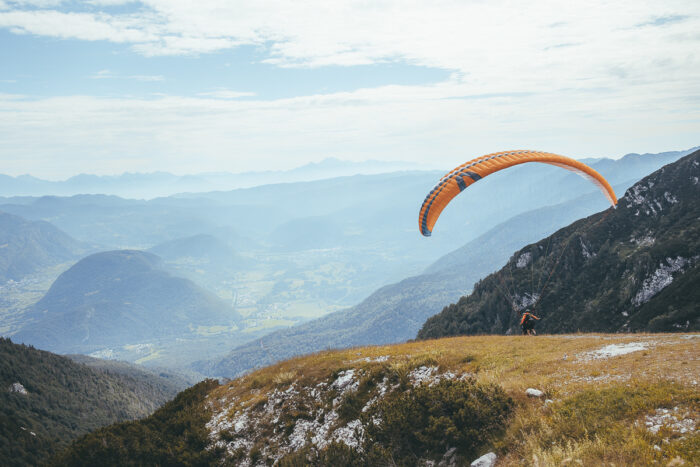
Paragliding
One of the attractions we were sorry we didn’t try because we didn’t know about it. We only found out when we took the cable car up the Vogel. At Lake Bohinj you can go paragliding and jump (is that what they say?) from the Vogel.
Rafting
Do you love rafting or would you like to try it? Slovenia, with its turquoise rivers, invites this activity. You can book it very easily with GetYourGuide, for example, through which we book most attractions not only in Europe.
🔗 These are affiliate links — they don't change your price and help us create content. · All experiences →
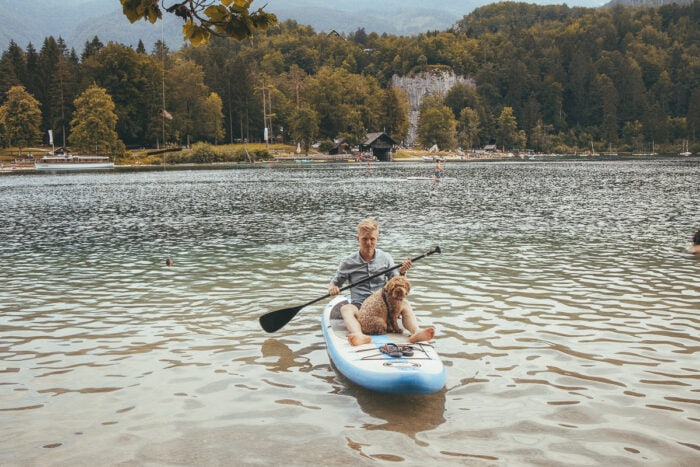
Paddle Boarding
If you’ve never stood on a paddle board, it might be time to give it a try at Lake Bled or Bohinj. The water here is perfectly calm, so it invites even beginners to sit on a paddle board.
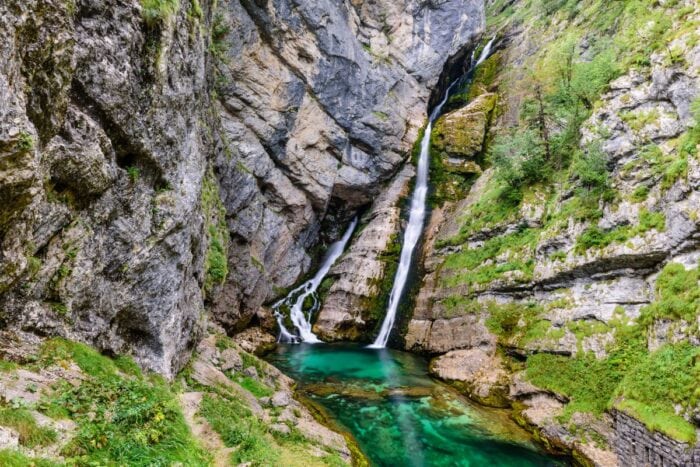
Go to the Savica waterfalls
Savica waterfalls areprobably the most famous waterfalls in Slovenia ever. Before 2008, they measured over 130 m, but after the landslide they are unfortunately only 80 m long. As these are the most unknown waterfalls in Slovenia, there are a lot of tourists, so we recommend to go early. Parking at the waterfalls is paid, as are most of the parking lots at the trailheads.
Before you get to the falls, but before you pay admission, you can find the current prices here.
What to do near Bled with children?
All water activities are very popular with children, from boat trips on Bled to rafting. Horseback riding is also great, or you can visit Aquapark Bohinj.
Where to go on a day trip from Bled
If you are spending a week or more at Bled and Bohinj, you may want to take a longer trip outside of Triglav.
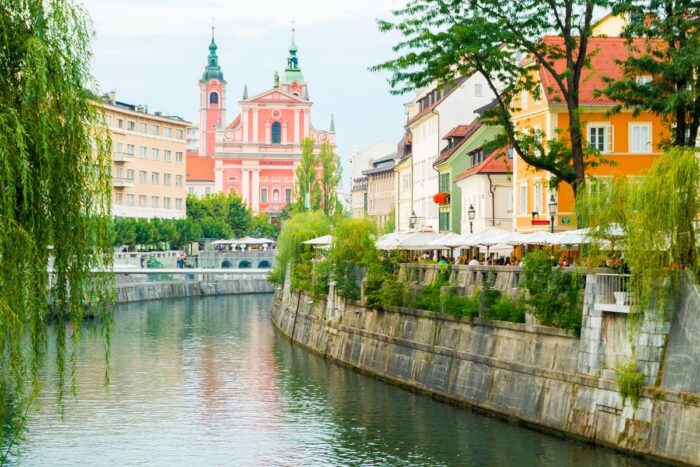
Ljubljana – the capital of Slovenia
Ljubljana, the capital of Slovenia, is about 80 km from Bohinj. It is a picturesque and lively city that is ideal for walking, shopping and exploring Slovenian culture. Visit Ljubljana Castle, stroll the streets of the Old Town or attend one of the many cultural and musical events that take place there.
Soca – river and valley
The Soca is one of the most beautiful rivers in Europe, known for its unique turquoise colour. The area is ideal for hiking, rafting and other popular water sports.
Postojna Caves and Predjama Castle
Slovenia is known for its caves. If you are interested in geology and history, visit the Postojna Caves, one of the largest and most beautiful caves in Europe. Not far from the caves is Predjama Castle, which is carved directly into the rock face.
Slovenia has a lot to offer, whether you are looking for peace and relaxation, outdoor
Piran
If you want to go to the sea,you can visit Piran, a picturesque Slovenian town on the coast, famous for its Venetian architecture and magnificent views of the Adriatic Sea. You can stroll through the narrow streets, visit the Cathedral of St. George or take a walk around the city walls.
Karst and Škocjan Caves
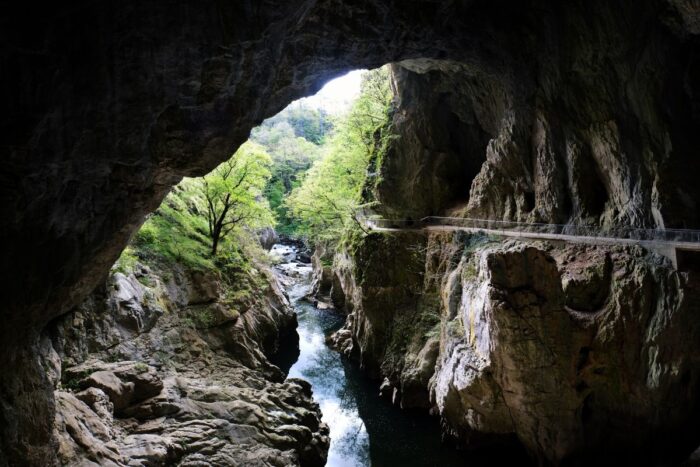
The Karst region is famous for its karst phenomena and caves. The Škocjan Caves are a UNESCO World Heritage Site and one of the largest and most impressive caves in the world.
Lukáš and Lucie recommend
Where to stay near Bled and Lake Bohinj
2 accommodations — hotels and other lodging options
If you’re heading to Lake Bohinj mainly for hiking, you’ll find a list of the most famous treks in the area below.
The road to the Savica waterfall
Difficulty: easy
Duration: approximately 2 hours
Distance: 6 km (round trip)
The path to the Savica waterfall is one of the most popular in the surroundings of Lake Bohinj. The route is mostly on paved paths and stairs, but it is worth it for the beautiful view of the Savica waterfall. The waterfall is about 80 metres high and offers an impressive view, especially after rain when the water flow is at its highest.
To the top of the Vogel
Difficulty: medium
Duration: approximately 4-5 hours
Distance: 10 km (round trip)
The Vogel Peak offers some of the most beautiful views of the Julian Alps. This moderately demanding hike starts at the bottom station of the Vogel cable car and runs mostly on well-marked trails. From the top of Vogel you will have a magnificent view of Lake Bohinj and the surrounding mountains.
Circular route around Lake Bohinj
Difficulty: easy
Duration: approximately 3-4 hours
Distance: 12 km
You can do this trail with children, as it goes around the lake on a solid path and a straight path. On the way, you can stop at the Church of St. John the Baptist or relax on one of the many beaches along the lake.
Trek to the Black Lake (Crno jezero)
Difficulty: medium
Duration: approximately 3-4 hours
Distance: 8 km (round trip)
This moderately demanding hike takes you to Černý jezero, one of the seven Triglav lakes. The route starts at the bottom station of the Vogel cable car and leads through forested slopes and alpine meadows. At the end of the journey, you will have a wonderful view of the Black Lake with the panorama of the Julian Alps in the background.
5. Route to Mostnica Gorge
Difficulty: easy
Duration: approximately 2 hours
Distance: 4 km (round trip)
This easy trail leads to Mostnica Gorge, a breathtaking canyon carved out of limestone rock by the Mostnica River. The path starts in the village of Stara Fužina and runs along the river with many small waterfalls and clear blue pools. The route is also suitable for families with children.
Route to the top of Pršivec
Difficulty: medium
Duration: approximately 4-5 hours
Distance: 12 km (round trip)
The route to the top of Pršivec is a moderately demanding hike that offers spectacular views of Lake Bohinj and the surrounding mountains. The trail starts in the village of Stara Fužina and leads through varied terrain, including forests, rocks and alpine meadows. From the top of Pršivec you can see the entire circuit of the Julian Alps up to the highest mountain – Triglav. We had our dog with us, but we had to help him climb part of the route.
What to taste in Slovenia: typical Slovenian food and desserts
Kremšnita: This pudding dessert can be found not only in Slovenia, but also in Slovakia and in Croatia. The custard is made of crispy puff pastry, vanilla cream and whipped cream.
Sweat: A traditional Slovenian puff pastry dessert filled with various fillings such as nuts, poppy seeds or cottage cheese.
Kranjska klobasa: the Slovenian version of sausage, which is famous all over the world. It is made from minced pork and seasoned with various herbs and spices. It is served with sauerkraut and mustard.
Idrija Žlikrofi: A traditional Slovenian specialty from Idrija, these are actually triangle-shaped dumplings. The filling is usually potatoes and nuts, and they are served with various sauces or grated bacon fried in butter.
Strudels: These are rolls of yeast dough that are filled either sweet or savoury. So there can be fruit, cottage cheese, spinach, but also meat.
Prekmurska gibanica: Another sweet dessert from the Prekmurje region. It is a layered cake made of puff pastry, the filling is usually made of nuts, poppy seeds and apples. It is sweet, aromatic and very popular among the locals.
Medenjaki: Slovenian honey gingerbread.
FAQ – Frequently Asked Questions
Is Bled suitable for families with children?
Yes, Bled is also suitable for the youngest children. The water is calm, relatively warm and there is plenty of activities for children of all ages.
Where to stay in Bled?
We recommend staying at Lake Bohinj rather than Bled, where prices are lower and it is quieter.
Is Bled suitable for cycling?
Bled by bike is extremely popular because the nature around Bled is beautiful and you can go on a longer trip from Bled to the surrounding area.
What to do in Slovenia when it rains?
If it’s raining in Bled, take a trip to Ljubljana or Piran.
Where to eat in Bled?
We were absolutely delighted with the restaurant Sova Bled.
Parking Bled: Where to park at the lake?
Bled has a number of parking spaces around the lake, you can find a list here.
Lake Bled excursions: where to go in the surroundings?
Be sure to check out Lake Bohinj, which is easily accessible by car or bus.
Is there a cable car in Bled?
There is no cable car in Bled. The cable car is at the neighbouring Lake Bohinj and leads to the Vogel ski resort, from where hikers can go hiking in summer.
Tips and Tricks for Your Vacation
Don’t Overpay for Flights
Search for flights on Kayak. It’s our favorite search engine because it scans the websites of all airlines and always finds the cheapest connection.
Book Your Accommodation Smartly
The best experiences we’ve had when looking for accommodation (from Alaska to Morocco) are with Booking.com, where hotels, apartments, and entire houses are usually the cheapest and most widely available.
Don’t Forget Travel Insurance
Good travel insurance will protect you against illness, accidents, theft, or flight cancellations. We’ve had a few hospital visits abroad, so we know how important it is to have proper insurance arranged.
Where we insure ourselves: SafetyWing (best for everyone) and TrueTraveller (for extra-long trips).
Why don’t we recommend any Czech insurance company? Because they have too many restrictions. They set limits on the number of days abroad, travel insurance via a credit card often requires you to pay medical expenses only with that card, and they frequently limit the number of returns to the Czech Republic.
Find the Best Experiences
Get Your Guide is a huge online marketplace where you can book guided walks, trips, skip-the-line tickets, tours, and much more. We always find some extra fun there!
TL;DRLooking for the perfect wellness hotel in Czechia for a long weekend away? This guide rounds up 28 of the best wellness hotels and spa breaks for couples across the country, with pools, sauna worlds and private spa suites. We’ll help you work out what to look for, whether you’re after a big wellness resort, a quiet and private retreat, or an adults-only hotel. Each entry explains what makes it special and who it suits best. Pick the kind of relaxation that fits your style.
If the weather outside is not the most beautiful and you would like to go somewhere for a long weekend, a wellness hotel is one of the most popular choices. Let’s take a look at the best wellness hotels in the country near where you live.
What to look out for when choosing a wellness hotel in the Czech Republic
Not every wellness hotel suits everyone, that’s for sure, we all have different tastes. Some people prefer large wellness hotels, others want privacy and some of you may want to go to a spa hotel where children are not allowed. The best wellness hotel means something different to everyone, so always look not only at reviews and tips from friends, but also at what you expect from your stay.
But be careful which season you go in. We have found that in some wellness hotels you get a completely different level of service in high and low season. For example, we were disappointed by the wellness hotel Sv. Katherinewhich is why you won’t find it in the selection.
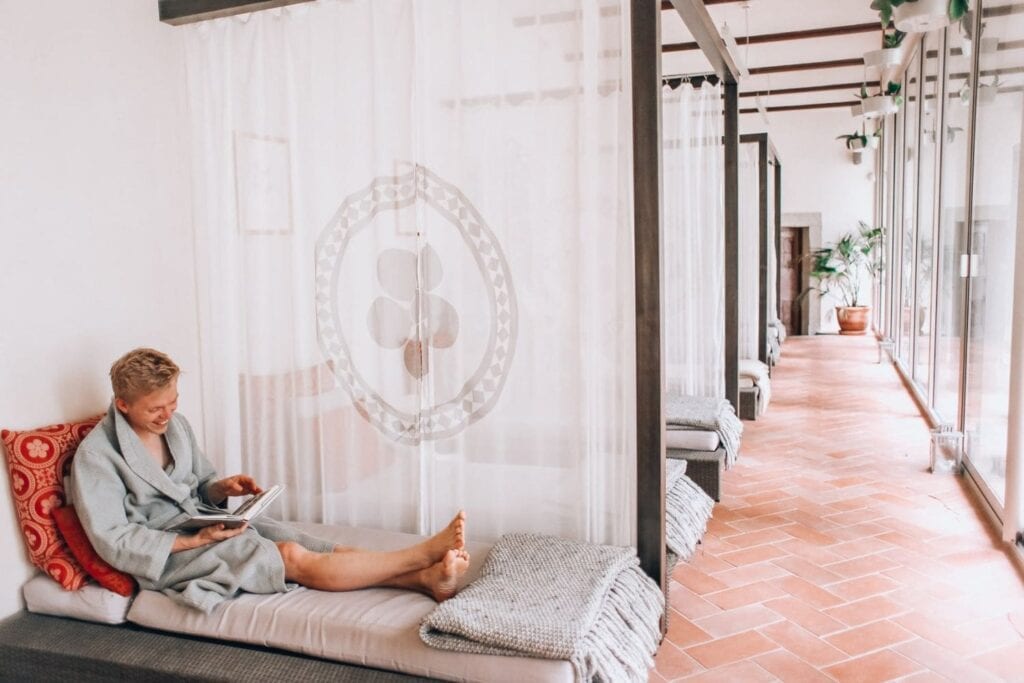
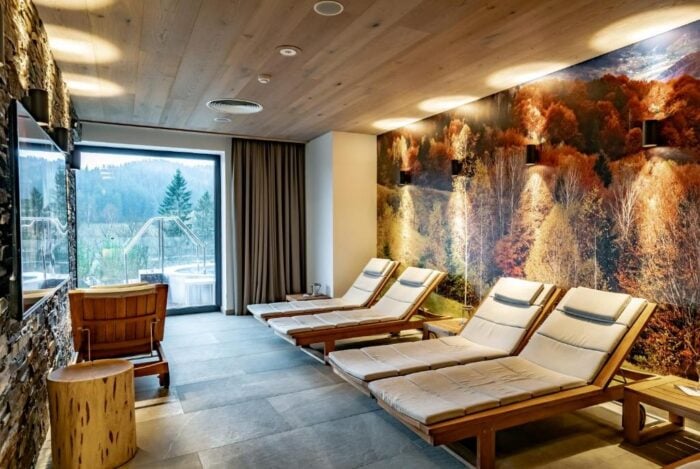
Relaxation room overlooking the castle garden
28 tips for the best wellness hotels and wellness stays for two in the Czech Republic
It’s nasty, rainy and drizzly outside and you want to escape somewhere you’ll be comfortable? We have prepared a list of the 28 best Czech wellness hotels. We have divided them approximately by the locations where they are located so that you can choose a wellness hotel near your home.
We have added luxury wellness hotels that cost more than 10 000 CZK per night, but we have also included cheap and very well rated wellness hotels that do not have super modern equipment, but have a quality wellness centre and great service. We believe that you will choose from our offer and enjoy your wellness stay to the fullest.
Wellness stays for two in Moravia
If Moravia and Bohemia were to compete for the best wellness, Moravia would probably win (and we in South Bohemia would lose in a landslide 😁), in Moravia you can find wellness hotels that are suitable for a romantic weekend for two or for larger groups. Let’s take a look at the best wellness hotels in Moravia.
Wellness Infinit Maximus
Probably the most famous wellness can be found in Brno in South Moravia. Maximus Resort is rightfully one of the most renowned. Their sauna world offers 12 saunas, massages, private baths and thermal pools. There’s a photogenic cooling pool and if you stay at the hotel, you’ll be treated to a hearty breakfast and a great dinner. Whoever we sent here for a wellness stay enjoyed the long weekend to the max.
Maximus Resort Brno
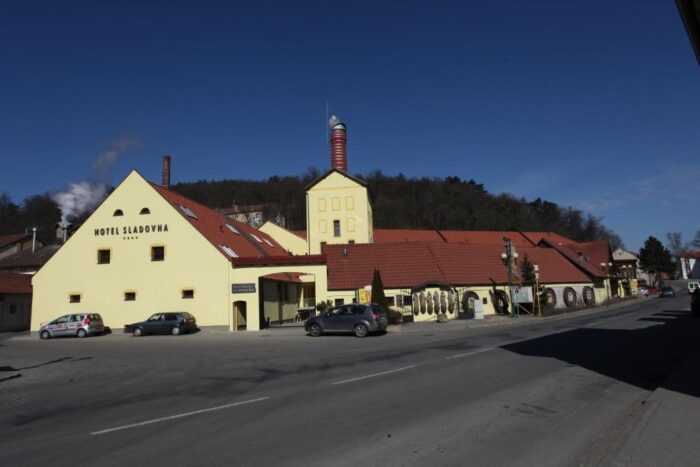
Hotel Sladovna – cheaper wellness for larger groups
The little-known hotel Sladovna is located next to the brewery in Černá Hora, not far from Brno. It is a wellness hotel that is relaxed, it doesn’t play around and is therefore more for a relaxing holiday with friends than for a romantic weekend. But the price is friendly, the staff is very nice and besides the jacuzzi and sauna you will also find a swimming pool in the hotel. Larger groups will appreciate the opportunity to bowl.
Theresian Hotel in Olomouc
Right in the centre of Olomouc you will find the Theresian Hotel, so you can combine a wellness stay with exploring the city. The hotel has a small wellness area with a Kneipp walkway, sauna and hot tub. There used to be a great restaurant in the hotel, but it has recently closed. But that’s okay, because you can have lunch and dinner at one of the restaurants in the centre.
Theresian Hotel Olomouc
Theatre hotel in Olomouc
Among the best wellness hotels is definitely the Theatre Hotel in Olomouc. Right when you enter, you will be impressed by the design lobby, but the biggest gem here is the wellness and then the Entree restaurant under the direction of chef Přemek Forejt. We consider this restaurant to be the best restaurant in the Czech Republic in terms of gastronomic experience.
Lobby of the Theatre Hotel
Wellness & spa hotel Augustinian House in Luhacovice
The Wellness & Spa Hotel Augustinian House is the highest rated wellness hotel on this list. On booking.com it even has 9.6. If you’ve been there, you’re probably not surprised. The hotel has a great breakfast but also offers dinner.
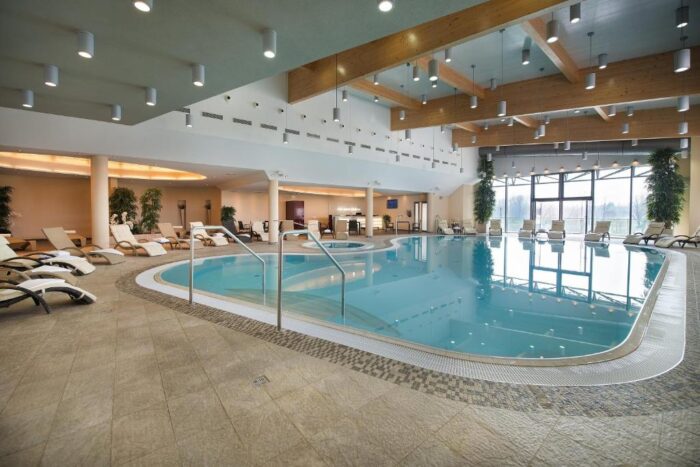
You can relax in the relatively large garden and in the summer you can swim in the swimming pond. If you don’t like mass spas, you’ll appreciate that the wellness area with a hot tub, swimming pool and sauna world is relatively quiet. Don’t forget to get a massage.
Wellness in Grandhotel Tatra
lMountain hotel Grandhotel Tatra in the beautiful surroundings of Velké Karlovice, where foxes give good night. There is a nice restaurant, a swimming pool with counter-current, a very good spa with an outdoor terrace where you can find a jacuzzi. Be careful when staying in the summer as they have mobile and quite noisy air conditioners. This wellness belongs to the cheaper ones but unfortunately it also reflects on the quality of some services.
Wellness hotels and wellness stays for two in the Highlands
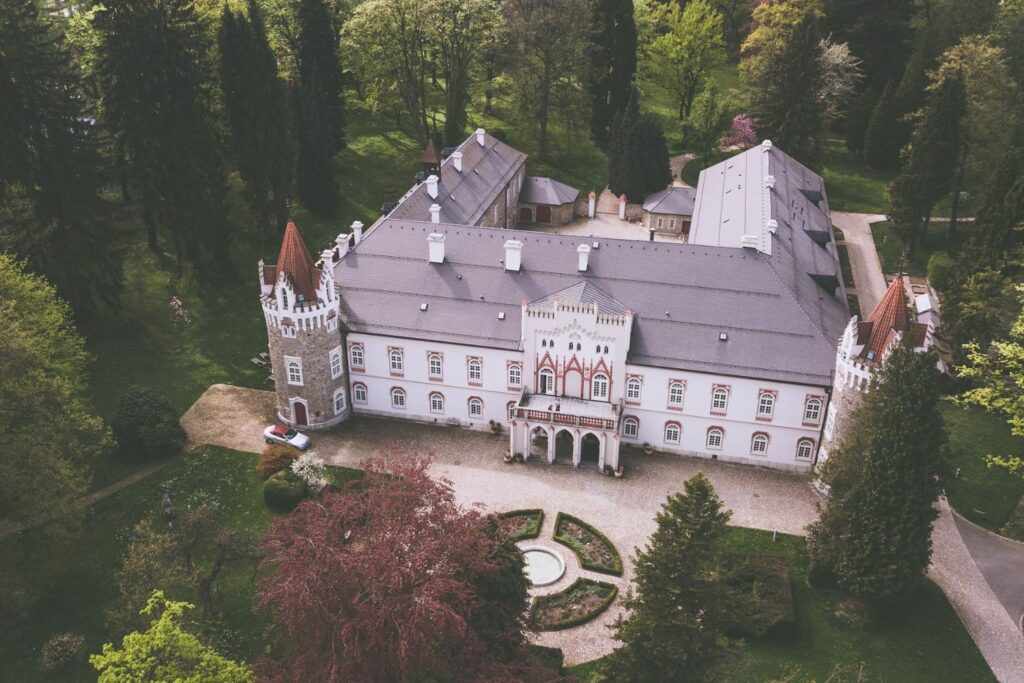
We don’t have many popular wellness hotels in the Highlands, but there is Chateau Herálec, where I would go until I’m completely ruined. A person who loves wellness should really go there at least once.
Chateau Herálec
If I wanted to go back to somewhere, it would definitely be Chateau Herálec. The relatively large premises of the chateau have been sensitively renovated and now you will find truly chateau-like but luxurious accommodation that combines history and modernity. The chateau is incredibly cosy and the on-site spa is an oasis of calm.
wellness hotel Chateau Herálec
The best wellness hotels in South Bohemia
I’m a girl I’m from South Bohemia and I like living here, but as far as wellness hotels are concerned, it seems to me that the offer here is definitely not as good as I would like. Still, there are a few options here if you want to go on a trip to the south and combine it with wellness or if you are also a proud South Bohemian and don’t want to go all the way to Beskydy or Prague.
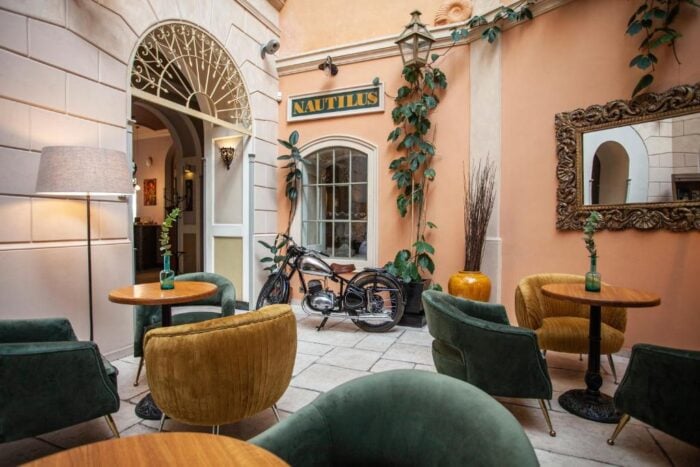
Hotel Nautilus, Tabor
The camp is our sweetheart, because Lukas and I got engaged there years ago. It’s a wonderful city to spend a weekend in and when you combine it with wellness, you don’t even have to worry about bad weather. Hotel Nautilus has an absolutely fabulous location right in the centre of Žižkov Square, where you will find the best local businesses.
The spa at this hotel is small, offering only a Finnish sauna and a private hot tub. But you can also go for various massages.
Wellness hotel in Tábor
Wellness Hotel Diamant
A 10-minute walk from the Hluboká Chateau you will find the Diamant Wellness Hotel, which has a smaller wellness centre, but a special sauna for women and a wide range of treatments. If you have a sleep problem, the Diamant Hotel is known for its quality mattresses (of course mattresses are very subjective 🙂 ). The design of the hotel might be something I would personally look for, but I can’t deny the hotel is extremely clean, which I can appreciate.
Wellness hotels in Beskydy
From our selection you may think that the best wellness hotels are in the Beskydy Mountains. If you want to be surrounded by nature, enjoy a beautiful wellness in a Scandinavian-style hotel and eat well, the Beskydy Mountains have in recent years become home to hotels that offer all of the above.
ENDEMIT Boutique Hotel & Spa
The breathtaking location of the Endemit Hotel is one of the best-rated wellness hotels in the Beskydy Mountains. No wonder. In addition to the divine views, it offers a great spa, an amazing restaurant and cosy rooms. So if you’re looking for a wellness hotel in the middle of nature, Endemit could be the right choice.
Hotel Miura
For lovers of contemporary art and architecture, there is the Miuroa Hotel, which you will find on Čeladná. It has a renowned restaurant, is close to the golf courses and has a great spa with a relaxing bubble pool, hydro massage, steam and salt baths, Kneipp walkway and sauna world. MIURA SPA is one of the few implementations of the KLAFS SPA concept in Central Europe.
Resort CATTALEYA – wellness hotel in the middle of forests
If you want to relax in the middle of the woods, you should check out the CATTALEYA Resort, where you can also enjoy a private spa with a hot tub and sauna. Here, too, the place is known for its excellent restaurant and great breakfasts. There will also be golfers, only 3 km from the resort you will find a golf course. For us, the hotel has one major drawback, dogs are not allowed.
Hotel Vitality – wellness hotel with tennis courts, bowling and badminton
Of the mentioned wellness hotels in the Beskydy Mountains, it is certainly one of the cheapest and also the least designed. However, if you are looking for a wellness hotel where you will have other activities besides the spa, Hotel Vitality is worth considering. The hotel also has tennis courts and mini golf, and you can play bowling or badminton in the adjacent area.
The spa itself is quite extensive, with a swimming pool with two lanes for swimmers, three whirlpools, a water bar and other water activities, and of course various types of saunas. This wellness is definitely one of the best wellness hotels if you prefer great sports and relaxation and don’t want Scandinavian design or private wellness.
wellness hotel Vitality
Pension Jurášek
Pension Jurášek is another gem in Beskydy. As well as an excellent spa, the hotel also offers a ski storage room, making it an excellent base for skiers. The guesthouse is located near the forest, like most hotels in the Beskydy Mountains, where there are also swimming lakes. The wellness centre features three saunas, a steam room and a swimming pool.
Where to go for wellness from Prague?
Are you from Prague and don’t want to go far to the wellness centre or are you going to Prague for a weekend and want to combine it with a relaxing stay? We have prepared for you both wellness facilities in Prague and spa hotels within an hour’s drive from Prague. We believe that you will choose.
Chateau St. Havel – wellness in Prague 4
Wellness hotel Chateau St. Havel is located in Prague 4 in the grounds of a former chateau. This wellness hotel is one of the cheaper ones, but also one of the lower rated. What you might appreciate is the opportunity to play golf. The rooms are decorated in a chateau style, which may not be to everyone’s liking. It is certainly not as sensitively equipped as, for example, Chateau Herálec.
Alchymist Grand Hotel and Spa – Preferred Hotels & Resorts in Prague 1
Directly in Prague 1 you will find a UNESCO-protected Baroque monument (the House of Jesus) from the 16th century. century one of the most luxurious spas in Prague. So if you want to combine the tour Prague with wellness, you have the opportunity at the Alchymyst Grand Hotel and Spa, which has a unique Ecsotica spa in the basement of the 11. century. Access to the wellness area is free for hotel guests.
Alchymist Grand Hotel and Spa is a wellness centre in the centre of Prague
Aquapalace Hotel Prague in Prague for families with children
Do you have young children and need a spa where they will enjoy themselves? Head to Aquapalace Hotel Prague, the largest indoor waterpark in Central Europe. Within the hotel you have access to the water park but also to the wellness area.
The children will have fun in the water park and you can enjoy a day in the sauna. If you have smaller children who need to be supervised at all times, take a grandmother or friends with you and take turns babysitting.
Chateau Mcely Bouquet Spa near Mladá Boleslav
When you really want to please your spouse or go on an extremely romantic trip full of luxury, Chateau Mcely should fulfil your every fantasy of a wellness stay full of peace, tranquillity and good food. Chateau Mcely has a pleasant garden, a small swimming pool and a nice spa.
A wellness stay at Chateau Mcely is synonymous with luxury
Vista Resort & Club at Prague Castle
This Scandinavian-style wellness hotel, a short walk from Prague Castle, is an oasis of calm in the middle of the bustling city. If you would like to combine a wellness stay with a visit Prague, you won’t regret going to Vista Resort & Club. The spa and wellness area is one of the smaller ones and you have to pay separately.
Spa Hotel Felicitas in Poděbrady
Do you want to go out of Prague, but don’t want to go to the end of the country? How about trying the Spa Hotel Felicitas in Poděbrady. Poděbrady is an absolutely beautiful but quiet town, so you can enjoy the tranquility if you are escaping from the hustle and bustle of the big city and it is only 50 minutes away from Prague.
The only thing you might be disappointed about is that the sauna is not included in the price of the hotel room, so be prepared to pay extra for it. On the other hand, the hotel is cheaper than those located directly in Prague.
Wellness hotel in Poděbrady
Salori near Hradec Kralove
A relatively hard to follow oasis of calm with very uncluttered pages is Salori Sauna Gardenwhich also offers beautiful and very modern Scandinavian-style accommodation. It’s a bit further from Prague (a little over an hour).
The best wellness hotels in North Bohemia
What are the best wellness hotels in North Bohemia? That’s exactly what we’ve focused on in this selection, and you’ll find plenty of them, including the Antonie Hotel, where we spent two amazing New Year’s Eves.
Hotel Bedřiška in Spindleruv Mlyn
Hotel Bedřiška is an excellent choice if you want to combine an active holiday with a relaxing one. In addition to the wellness facilities, the hotel has tennis courts and offers free cable car tickets for interesting hiking trails. The hotel is right next to the forest, a short walk from the ski slope and near the bobsled track.
Wellness hotel V Nebi, Příchovice, Korenov
Do you want to feel like you’re in Heaven? Then you must go to the wellness hotel in Nebi, which is one of the newest wellness hotels in the Czech Republic. You will find this Czech heaven just outside Harrachov in the middle of nature with panoramic views. The hotel has a wellness centre with a heated indoor pool, Finnish and herbal sauna, as well as a spacious garden with an outdoor Finnish sauna and a cooling pond.
Aparthotel Svatý Vavřinec, Pec pod Sněžkou
The Aparthotel Svatý Vavřinec in Pec pod Sněžkou has a wonderful wellness area with sauna, jacuzzi, but also offers a great children’s corner and a wonderful restaurant. Families with children will appreciate the fact that they can stay in an apartment. Dogs are welcome here, they will even prepare a bowl and paw towel for your dog in the room. The rooms are extremely cosy and you won’t miss anything during your stay.
Antonie hotel in Frydlant
Antonie hotel in Frydlant is not very well known and that is a pity. We have spent two New Year’s Eves in Antonia in recent years and can 100% recommend it to everyone. Hotel Antonie has a great spa, wellness area, and a squash or badminton area.
In addition, there is an excellent restaurant. If you don’t want to, you don’t have to leave the hotel at all and you certainly won’t get bored. However, you can go hiking in the surroundings and cross-country skiing in summer.
Moreover, the hotel is pet-friendly, so you can come here with your dogs.
Wellness in the Babylon Centre in Liberec
Babylon is past its prime, let’s face it. During my childhood it was the most luxurious place my parents could take us and maybe that’s why I remember it fondly. It’s still a great place for families with kids, although the rooms in the hotel seem a bit older and maybe Aquapalace Prague is a bit better.
Wellness and spa hotels in West Bohemia
West Bohemia is famous for its spa, it will not surprise you to find here some of the greatest jewels of Czech wellness hotels, namely Resort Kovárna Frýdštejn.
Cihelny Golf & Wellness Resort – Karlovy Vary
Cihelny Golf & Wellness Resort near Karlovy Vary has been one of the most popular spa hotels for quite a long time. But it’s also noticeable on furniture that already shows some signs of wear and tear. Nevertheless, you will appreciate the beautiful view from the pool, the sauna and the possibility to go to the gym. The resort is especially popular with golfers as it is located right on the golf course.
Retro Riverside Wellness Resort in Vary
Probably the best rated wellness hotel in this part of the country is the Retro Riverside Wellness Resort. In addition to the saunas, there is a beautiful pool with a view, extremely friendly staff and owner, and excellent food. In addition to a sauna, swimming pool and hot tub, guests can enjoy the fitness centre.
Resort Kovárna Frýdštejn
Among the most beautiful accommodations in the Czech Republic is definitely the Resort Kovárna, which is an absolutely breathtaking place and deserves the high ratings it receives from guests.
Very sensitively combining modern elements with historical ones, it’s a cosy place full of leather features that reminds me of the luxurious country estates of the American West. Breakfast here is picnic style and the spa is just as fabulous as the rest of the resort.
Lukáš and Lucie recommend
Where to stay in the Czech Republic
6 accommodations — wellness hotels, hotels and other accommodation options
To Brno to the Maximus Hotel, to the Beskydy Mountains to the Endemit Hotel or in Prague to the Vista Resort & Club near Prague Castle.
What is a wellness stay?
A wellness stay is the name given to a stay in a hotel that offers a sauna world, swimming pool, whirlpool and massages.
Where to go for wellness in Prague?
In Prague you can go to the wellness hotel Chateau St. Havel, Alchymist Grand Hotel and Spa or Aquapalace Hotel Prague.
Where to go for super wellness?
The best wellness hotels include Resort Kovárna, Wellness & Spa Hotel Augustinian House and V nebi.
Where to go for wellness in Beskydy?
The best wellness facilities in the Beskydy Mountains include ENDEMIT Boutique Hotel & Spa, Hotel Miura, Hotel Vitality and Penzion Jurášek.
What is the best wellness in the Czech Republic?
The best wellness in the Czech Republic is in the Maximus Resort, the Kovárna Resort, the Wellness & Spa Hotel Augustinian House and Chateau Herálec.
Where to go for wellness in South Bohemia?
The best wellness in South Bohemia is at the Nautilus Hotel in Tábor and in Wellness Hotel Diamant.
Where to go for the best wellness in West Bohemia?
The best wellness hotels in West Bohemia are Cihelny Golf & Wellness Resort and Resort Kovárna Frýdštejn.
Where to go for wellness with children?
With small children, go to the Aquapalace Prague or Aparthotel Svatý Vavřinec for wellness.
Where to go for a wellness stay with your dog?
For a wellness stay with your dog you can, for example, go to the Hotel Antonie.
Tips and Tricks for Your Vacation
Don’t Overpay for Flights
Search for flights on Kayak. It’s our favorite search engine because it scans the websites of all airlines and always finds the cheapest connection.
Book Your Accommodation Smartly
The best experiences we’ve had when looking for accommodation (from Alaska to Morocco) are with Booking.com, where hotels, apartments, and entire houses are usually the cheapest and most widely available.
Don’t Forget Travel Insurance
Good travel insurance will protect you against illness, accidents, theft, or flight cancellations. We’ve had a few hospital visits abroad, so we know how important it is to have proper insurance arranged.
Where we insure ourselves: SafetyWing (best for everyone) and TrueTraveller (for extra-long trips).
Why don’t we recommend any Czech insurance company? Because they have too many restrictions. They set limits on the number of days abroad, travel insurance via a credit card often requires you to pay medical expenses only with that card, and they frequently limit the number of returns to the Czech Republic.
Find the Best Experiences
Get Your Guide is a huge online marketplace where you can book guided walks, trips, skip-the-line tickets, tours, and much more. We always find some extra fun there!
TL;DRMadeira, Portugal is a volcanic Atlantic island and one of the most beautiful places on earth. It draws you in with dramatic cliffs, an eternal spring climate, the Cabo Girão viewpoint and levada hikes across the whole island. In this guide you’ll find the 25+ most beautiful places, a detailed 7-day itinerary and tips for the best hikes. Heads up: many popular PR trails now require paid bookings, so plan for them in advance. You can visit year-round; for hiking, spring to autumn is ideal.
I planned to return to the Portuguese island of Madeira for almost eight years. And even though I’ve literally travelled half the world between those two visits, my opinion of Madeira, Portugal hasn’t changed one bit — it’s definitely one of the most beautiful islands on our blue planet. And maybe in the universe too, who knows.
In this complete guide you’ll find 25+ most beautiful places to see on Madeira in 2026, a detailed day-by-day 7-day itinerary, an overview of the best levada hikes, tips for local food and, most importantly — the latest info on the mandatory bookings and paid entry to PR trails that Madeira introduced in 2026. Let’s dive in!
Practical information for your trip to Madeira
Madeira, Portugal: weather and sea temperature month by month
🌡️ Warmest: August (25 °C by day) · 🌊 Warmest sea: August (25 °C) · ☔ Least rain: July
Month
Day
Night
Sea
Rainy days
January
16 °C
11 °C
20 °C
10
February
17 °C
11 °C
19 °C
9
March
17 °C
11 °C
19 °C
13
April
18 °C
12 °C
20 °C
11
May
20 °C
14 °C
21 °C
8
June
21 °C
15 °C
22 °C
12
July
23 °C
17 °C
24 °C
4
August
25 °C
18 °C
25 °C
4
September
23 °C
17 °C
24 °C
13
October
22 °C
16 °C
24 °C
12
November
19 °C
14 °C
23 °C
11
December
17 °C
13 °C
21 °C
13
Source: climate normal 2019–2024 (Open-Meteo, measured data)
When to visit Madeira? The best months
The Madeira weather in Portugal is fairly stable, so you can go at any time of year. Even in December and January temperatures can hover around 20 degrees, although the average daytime temperature is roughly 17 degrees.
The most popular season is probably spring (April–June), when temperatures are at their most pleasant and the flower festival takes place in Funchal. Just keep in mind that it can rain on some days.
Summer is the most popular time to visit Madeira if you want to go whale watching, but temperatures can climb to around 33 °C, which can be uncomfortable for anyone planning to do some hiking.
Autumn (September–November) tends to be quieter on Madeira, temperatures are still pleasant (in September we had around 25 °C), but it can rain again. Early autumn is ideal for a visit if you’re planning hikes in the mountains and along the coast.
I’ve been to Madeira in both June and September, and both times I had fairly pleasant weather, even if it drizzled now and then. So really, don’t be afraid to go almost any time.
Direct flights to Madeira run from several European cities. If there’s no direct flight from your home airport, you can get there in 4–5 hours with one stopover in Lisbon or Porto. Keep an eye on deals from Ryanair, easyJet, TAP Portugal and Lufthansa — return tickets can be snapped up from around €120 if you watch the offers well in advance.
Tip: Landing at Madeira’s Cristiano Ronaldo Airport is one of the most adrenaline-filled in Europe. The runway is built on pillars over the ocean and in a crosswind it’s quite the experience. Don’t worry, the pilots are trained for it.
Package tour or on your own?
Madeira is ideal for independent travel. The island is safe, compact and easy to get around with a rental car. With a package tour you lose the flexibility you’ll really appreciate here — like the option to head up to Pico do Arieiro for sunrise the moment the weather clears. Personally, we recommend renting a car and doing it your own way.
Renting a car on Madeira
Rental agencies will try to talk you out of small cars, because Madeira’s roads climb some pretty steep hills. We had a small car on both visits and never ran into trouble. But if you’re not a seasoned driver, book a more powerful car and, above all, an automatic — pulling away on those extremely steep hills is sometimes no joke.
Things to watch out for: Madeira’s roads are narrow and winding, but of good quality. Most main routes run through modern tunnels. We recommend full insurance — minor scratches do happen on the narrow roads. Petrol is more expensive on the island than in mainland Portugal; you can check the current price here.
Where to stay on Madeira
Madeira is a fairly small island, so it’s perfectly possible to find a nice hotel in Funchal and take day trips from there. In the end, though, we decided that moving around the island is worth it — that way you’ll catch both sunrise and sunset in different spots, which is priceless.
Funchal is the best base for shorter stays. If you have more time, we recommend spending at least 2–3 nights in the north (Porto Moniz, São Vicente) — the northern coast has a completely different atmosphere and you’ll meet hardly any tourists in the morning.
NEW FOR 2026: Paid entry and bookings for PR trails
This is probably the most important thing you need to know for 2026. Madeira has introduced a mandatory system of pre-bookings and paid entry for its most popular walking trails (marked as PR — Pequena Rota). If you plan a levada hike or a trek to Pico Ruivo, you must book your spot online in advance.
How much does it cost?
Prices vary depending on the difficulty and popularity of the trail:
Easier trails (PR 6, PR 9): €3/person
Medium trails (PR 1, PR 10): €5/person
Most popular trails (25 Fontes, Caldeirão Verde): €7–10.50/person
Children under 12: free
Where and how to book
Bookings are made through the official portal ifcn.madeira.gov.pt. We recommend booking at least 3–5 days in advance, especially in high season (April–October). The daily capacity is limited and the most popular trails like 25 Fontes tend to sell out up to a week ahead in high season.
Tip from experience: Plan your hikes as the first thing when organising your holiday — not the last! And if your preferred trail is fully booked, try a lesser-known alternative. Madeira has dozens of beautiful levadas that aren’t as popular but are just as stunning.
25+ most beautiful places on Madeira
Before we get to the itinerary, here’s a complete overview of the best of what you’ll see on Madeira. We’ve either visited each place in person or recommend it based on the experience of travellers we trust.
1. Funchal — the island’s capital
Funchal is a pleasant little city that climbs up the slope from the harbour. I wouldn’t call it the highlight of Madeira, but it definitely deserves at least one day. We kept it for the start and end of our trip — and it pleasantly surprised us every time.
What not to miss in Funchal:
Mercado dos Lavradores — a colourful market with exotic fruit, flowers and fresh fish. Try the anona (custard apple) and passion fruit.
Zona Velha (old town) — lanes full of street art, painted doors on Rua de Santa Maria and the best restaurants in the city.
Jardim Botânico — a botanical garden with a gorgeous view over the city. Entrance fee around €6.
Cable car to Monte — the cable car takes you up to the Monte district above Funchal, home to the Monte Palace tropical garden and the Nossa Senhora do Monte church.
The toboggan ride from Monte — traditional wicker sledges steered by two men in white who whisk you down the asphalt road. A completely unique and slightly crazy experience. Around €30 for 2 people.
On Madeira you can enjoy the toboggan ride in Funchal in any season.
2. Cabo Girão — the highest cliffs in Europe
580 metres of sheer drop straight into the ocean. Cabo Girão is one of the highest sea cliffs in the world, and the glass-floored viewpoint (skywalk) is free. You only need 30–45 minutes, but that view down will take your breath away — and maybe your stomach too, if you’re afraid of heights.
Below the cliffs you’ll spot tiny farming plots (fajãs), which the farmers reach by cable car. It’s unreal.
3. Câmara de Lobos — Churchill’s fishing village
A picturesque fishing village with colourful boats that Winston Churchill loved — he even painted it here. An espresso on the square overlooking the harbour is a mandatory stop. Câmara de Lobos is also famous as the best place for poncha — the traditional Madeiran drink. Try it at O Jango.
4. Curral das Freiras — the Valley of the Nuns
A dramatic valley surrounded by steep mountains, where nuns hid from pirates in the 16th century. The view from Eira do Serrado is breathtaking — and then you can drive down to the village for lunch. Order the espetada (meat on a bay-leaf skewer); one of the best on the island is here.
5. Pico do Arieiro — the third-highest peak
If you want to know what paradise might look like, you need to head to Madeira’s third-highest peak (1,818 m), and ideally at sunrise. Drive up and soak in the view above the clouds. If the weather cooperates, you’ll get alternating views of mountains and a sea of clouds. It’s unforgettable.
The most beautiful spot on Madeira — Pico Arieiro
6. Pico Ruivo — Madeira’s highest peak
The trek from Pico do Arieiro to Pico Ruivo (1,862 m) is, in my opinion, the most beautiful trek in the world. A ridge path with tunnels carved into the rock, chasms on both sides and views you’ll remember for the rest of your life. 7 km one way, 4–5 hours there and back, over 700 m of cumulative elevation gain.
On my second visit we were out of luck — it rained all day on Pico do Arieiro. So here’s some important advice: keep a backup day and only set off when it’s clear! In the fog the trek loses 90% of its magic.
7. Ponta de São Lourenço — the eastern tip of the island
A dry, rugged landscape in stark contrast to the rest of green Madeira. The trek to the eastern tip of the island is stunning — 7.4 km, 2–3 hours, medium difficulty. Cliffs plunging into the ocean, red and yellow rocks, wind and salty air. A completely different world from the rest of the island.
We set off from the upper, more distant car park, from where the route is a bit more demanding but the views are better. You walk along the cliffs all the way to an oasis where you’ll find the Sardine House cafe & snacks. From the café you can take a boat that brings you back to the car park.
8. Porto Moniz — natural lava pools
Porto Moniz is known for its natural pools formed from volcanic lava, into which the ocean splashes. Entry around €3. Swimming in the pools with a view of the open Atlantic is one of those experiences people come to Madeira for. At sunrise it’s usually calm here — if you stay overnight in Porto Moniz, you can have it almost to yourself.
Porto Moniz
9. Seixal — black beach and waterfalls
Seixal Beach is one of the most photogenic spots on the whole island. Black volcanic sand, waterfalls tumbling straight off the cliff into the sea, and dramatic green cliffs in the background. There are also the Seixal Natural Pools — a natural pool where you can swim safely.
10. São Vicente — Madeira’s prettiest little town
São Vicente is nestled in a narrow, romantic valley stretching from the Atlantic coast into the interior. If you arrive early enough, soft cushions of cloud will probably still be drifting over the hills. The small historic centre is dominated by the beautiful 16th-century Igreja de São Vicente church.
11. São Vicente Caves — lava tunnels
Volcanic caves and tunnels created by lava flows. The tour lasts about 45 minutes and is great for rainy days. You’ll learn about the island’s volcanic history and walk through tunnels where lava flowed millions of years ago. Entrance fee around €8.
12. Fanal — the misty laurel forest (UNESCO)
Fanal Forest is one of the most popular photography locations on Madeira. Once it fills with mist, there’s no more magical place on the whole island. The twisted, moss-covered laurel trees look like a scene straight out of Lord of the Rings.
You’ll probably spend a couple of hours in Fanal Forest. Be patient, the mist almost always comes in the end. The best time to chase the fog is roughly until eleven in the morning and then later in the afternoon. The walk takes 30–60 minutes, and the laurel forest is part of the UNESCO Laurisilva.
13. Santana — traditional triangular houses
A picturesque town in the north of the island known for its traditional triangular houses (casas de colmo) with thatched roofs. They’re colourful, photogenic and look like something out of a fairy tale. A short stop for photos and lunch — 1–2 hours is enough.
14. Ribeira da Janela — rock formations
A breathtaking viewpoint that looks straight out of Game of Thrones. Rock formations jutting out of the sea against a backdrop of dramatic coastline. Stop off on your way from Porto Moniz — it’s just a few minutes from the main road and definitely worth the pause.
15. Miradouro Véu da Noiva — waterfall viewpoint
A viewpoint over the “Bride’s Veil” waterfall — a white ribbon of water tumbling off a green cliff straight into the ocean. One of the most photographed viewpoints on the northern coast. You’ll find it on the road between Seixal and São Vicente.
16. Jardim do Mar — surfing and quiet
A tiny village on the southwestern coast where surfers come from all over Europe. If you’re not chasing waves but peace and quiet, you’ll find it here. Lanes full of flowers, small cafés and a seafront promenade where you can sit for hours and listen to the waves.
17. Machico — the second-largest town
Machico has one of the few man-made sandy beaches on the island (the sand was imported from Morocco). A calm town with a pleasant promenade and good seafood restaurants. A great stop on the way to Ponta de São Lourenço.
18. Achadas da Cruz — the steepest cable car in the world
Near Porto Moniz you’ll find the steepest cable car in the world, running vertically down from the cliff to the beach. Buy your tickets before you change your mind, the ride looks terrifying. When you get to the bottom, you’ll discover it’s not just a promenade along the beach but an allotment colony. You’ll search in vain for how people bring supplies down other than by cable car. They really do use the cable car.
19. Prainha de Caniçal — the prettiest natural beach
A small sandy beach with volcanic sand surrounded by dramatic cliffs. The only natural sandy beach on Madeira and definitely one of the prettiest. It’s ideal for swimming in summer, but it’s also pleasant here in spring and autumn.
20. Calheta Beach — a beach for families
A man-made sandy beach with calm water, ideal for families with children. Nearby there are restaurants and cafés with sea views. If you have small children and want a day by the sea, Calheta is your best choice on Madeira.
21. Curral das Freiras — the Eira do Serrado viewpoint
The viewpoint above the Valley of the Nuns is one of the most dramatic on the island. From up high you can see the whole valley and the village at the bottom — it looks like a miniature. Combine it with a visit to Curral das Freiras itself down below.
22. Miradouro da Portela — views of the northern coast
A panoramic viewpoint over Madeira’s green northern coast. A great stop on the way back from Santana or Ponta de São Lourenço. There’s also a restaurant here with good food and a pleasant terrace.
23. Ribeira do Inferno — the original road
Between São Vicente and Seixal you can walk along the original road that led from here to Seixal. For lovers of slightly offbeat attractions it’s an interesting detour — you’ll see what travel on Madeira looked like before the tunnels were built.
24. Miradouro da Santinha — viewpoint above Porto Moniz
If you’re in Porto Moniz and have the time, drive up to this viewpoint. From here Porto Moniz looks like a town off a postcard — rooftops, natural pools and the endless ocean.
25. Garajau Beach — crystal-clear water
A beautiful pebble beach with crystal-clear water, accessible by cable car. The area is part of the Garajau nature reserve, so the underwater world here is exceptional — a great spot for snorkelling.
26. Blandy’s Wine Lodge — Madeira wine tasting
Historic cellars in Funchal where Madeira wine has been produced since 1811. A tour with tasting costs around €15 and it’s well worth it — you’ll learn about the unique process of making this fortified wine, which is heated (unlike other wines). A great plan for a rainy afternoon.
The best levada hikes on Madeira
Levadas are unique irrigation channels that have been built on Madeira since the 15th century. Trails run alongside them, guiding you through laurel forests, valleys full of waterfalls and misty mountain ridges. The levada hikes are the number-one reason to visit Madeira.
They say if you haven’t done a levada on Madeira, you haven’t really been. On every visit I did at least one.
Levada das 25 Fontes (25 waterfalls)
The most famous levada hike on the island — and deservedly so. The trail leads through dense laurel forest (UNESCO) and ends at an amphitheatre with 25 waterfalls cascading over mossy rocks into a pool.
Length: 11 km (round trip)
Difficulty: medium
Time: 3–4 hours
Start: Rabaçal (car park + shuttle bus)
Entry 2026: around €7–10.50, booking required
Tip: Combine it with Levada do Risco (a 100 m waterfall), which starts at the same place. Doable in a single day.
Levada do Caldeirão Verde
All the levadas feel similar to me, so we picked one that also runs through tunnels — the Levada do Caldeirão Verde, which is 12 km and takes roughly 3–4 hours. Extremely popular, but also beautiful — the tunnels are narrow, you’ll need a headlamp, and at the end a green amphitheatre with a waterfall awaits.
Levada do Caldeirao Verde is said to be one of the most beautiful on Madeira
Length: 12 km (round trip)
Difficulty: medium
Time: 3–4 hours
Entry 2026: booking required via ifcn.madeira.gov.pt
Levada do Rei (the Royal Levada)
A less-visited alternative, but a beautiful one. It runs through the laurel forest in the north of the island and ends at the source of the Ribeiro Bonito river. Ideal for those who want peace and quiet and don’t like crowds.
Length: 10 km (round trip)
Difficulty: easy to medium
Time: 3 hours
Vereda dos Balcões (the easiest)
If you don’t have the time or fitness for longer hikes, this is your levada. A short, easy walk (1.5 km one way) to the Balcões viewpoint, from where you can see the Ribeira da Metade valley and, in good weather, even Pico do Arieiro. Ideal for families with children too.
Pico do Arieiro → Pico Ruivo: the king of treks
Technically this isn’t a levada, but it’s the most famous trek on Madeira. It connects the island’s third- and first-highest peaks along a ridge path with tunnels carved into the rock.
Length: 7 km (one way), 14 km round trip
Difficulty: demanding
Time: 5–6 hours (round trip)
Altitude: 1,818 m → 1,862 m (over 700 m of cumulative elevation gain)
Entry 2026: booking required
Tip: Set off as early as possible (ideally before 8:00). It’s most beautiful above the clouds early in the morning, and you’ll avoid both the crowds and the afternoon fog.
Whale and dolphin watching
Madeira is surrounded by deep ocean waters, which makes it one of the best places in Europe for cetacean watching. The chance of spotting dolphins is over 95% all year round!
If you’re visiting Madeira at a time when whales and dolphins are around the coast, you definitely shouldn’t skip a trip out to sea. We set aside a whole day for it, because we bought a tour with a guarantee that if we saw nothing, we could go again for free.
Dolphin and whale watching on Madeira
What can you see?
Dolphins (year-round): bottlenose, striped, common — over 95% chance
Sperm whale (April–October): the most common whale around Madeira
Bryde’s whale (summer): rarer, but spectacular
Sei whale (spring): passing along migration routes
Practical info
Price: €35–65/person (2–3 hours)
Where from: Funchal or Calheta harbour
Recommended operators: VMT Madeira, Lobosonda, Rota dos Cetáceos
Tip: Bring a warm layer — it’s always windy on the open ocean, even when it’s warm on shore.
What to taste on Madeira — local food
Madeiran cuisine is simple but fantastic. Fresh fish, meat on a bay-leaf skewer and local rum — you won’t go hungry here, and you’ll eat well for a reasonable price.
Espetada — meat on a bay-leaf skewer
Madeira’s iconic dish. Pieces of beef skewered on a bay-leaf stick and grilled over fire. It’s served hanging on a stand right at your table. The scent of bay infuses the meat and the result is fantastic. Restaurant price around €12–18.
Where to try it: The restaurants in Curral das Freiras or Câmara de Lobos have the best ones.
Poncha — Madeira’s national drink
A mix of aguardente (sugarcane spirit), honey and citrus. It looks innocent, but two ponchas and your legs start to wobble. It comes in a classic (lemon), passion fruit and a regional orange version. Price €3–5.
Where to try it: O Jango in Câmara de Lobos — reputedly the best poncha on the island. We can confirm.
Bolo do caco — Madeira’s garlic bread
A flat bread made from sweet-potato dough, served hot with garlic butter. You’ll get it in every restaurant as a starter and it’s addictive. Honestly, even if all we ate on Madeira was bolo do caco, that would be reason enough for the trip.
Lapas grelhadas — grilled limpets
Sea limpets grilled with garlic butter and lemon. It looks a little scary, but the flavour is a knockout. One of the most popular starters on the whole island. Price around €8–12.
Madeira wine — where to taste it
A fortified wine with a history dating back to the 15th century. Unlike port, Madeira wine is heated, which gives it a unique caramel flavour. We recommend a visit to Blandy’s Wine Lodge in Funchal — a tasting with a tour of the historic cellars for around €15.
Travelling with kids on Madeira
Madeira isn’t the most ideal island for travelling with small children — there are lots of cliffs and mountains but few nice beaches. Nor are there many resorts where you could let little kids run wild.
But if you’ve already got little mountaineers at home, you can enjoy travelling around Madeira even with them. Suitable activities for families:
Calheta Beach — a calm sandy beach, safe for children
Porto Moniz natural pools — safe swimming in the lava pools
Vereda dos Balcões — a short, easy levada hike (1.5 km)
The toboggan ride from Monte — an experience for the whole family
Botanical gardens — calm strolls among exotic plants
Mercado dos Lavradores — kids will love tasting the exotic fruit
For relaxing by a pool or on the beach, though, Madeira isn’t the best pick — the Canary Islands or the Algarve are better for that.
Beaches on Madeira
Madeira is known for its wild nature and rocky coastline, but it also offers beautiful spots for swimming. Just don’t expect kilometres of white sand — it’s different here, but all the more unique for it:
Prainha de Caniçal — the only natural sandy beach, volcanic sand
Seixal Beach — black volcanic sand and waterfalls off the cliff
Porto Moniz — volcanic pools with natural seawater
Calheta Beach — a man-made sandy beach, suitable for families
Machico Beach — a sandy beach with calm waters
Garajau Beach — a pebble beach with crystal-clear water, accessible by cable car
7-day itinerary around Madeira (day by day)
Our itinerary was very relaxed — we got to enjoy and explore everything to our heart’s content. You could probably fit in more over seven days, but if you’re after a laid-back sightseeing holiday, follow in our footsteps.
Day 1 — Arrival and Funchal
After you land, pick up your car at the airport and head to Funchal. We landed in the evening, so we decided to stay right in the city and not drive anywhere.
Afternoon/evening:
Check in and stroll through Zona Velha (the old town with street art)
Visit Mercado dos Lavradores — exotic fruit, flowers, fresh fish
Dinner at one of the restaurants on Rua de Santa Maria
Your first poncha of the trip — a mandatory initiation
I can recommend the romantic if slightly dated hotel Inn & Art Madeira, where you can dine with a view of the cliffs at sunset. The hotel has a vegetarian menu too, and you get free wine with your stay. Even though we didn’t expect much from this retro, air-conditioning-free place, it was a wonderful start to the whole holiday.
Day 2 — Cabo Girão, Câmara de Lobos, Curral das Freiras
Morning: Drive up to Cabo Girão (580 m — the highest cliff in Europe, glass viewpoint). A short 30–45 minute stop.
Late morning: Descend to Câmara de Lobos — a picturesque fishing village that Winston Churchill loved. An espresso on the square, photos of the colourful boats and maybe your first poncha of the day at O Jango.
Afternoon:Curral das Freiras (the Valley of the Nuns) — a dramatic view from Eira do Serrado, then down to the village for lunch. Order the espetada!
Day 3 — Pico do Arieiro → Pico Ruivo
A full-day trek. Drive up to Pico do Arieiro (1,818 m) as early as possible — ideally for sunrise. The trek to Pico Ruivo (1,862 m) and back = about 14 km, 5–6 hours.
Important: Check the weather! In the fog the trek loses 90% of its magic. Keep a backup day and swap it with day 4 or 5 if needed. You don’t have to go all the way to Ruivo — it’s a fairly demanding trek with 1,000 m of elevation gain.
Evening: Return to Funchal and a well-earned dinner.
Day 4 — São Vicente, Seixal and Porto Moniz (northern coast)
After breakfast, head north.
Morning:São Vicente — a walk through the centre and along the seafront promenade. If you’re interested, a tour of the lava caves (45 minutes).
Along the way: Stop at Ribeira do Inferno (the original road), Miradouro Véu da Noiva (waterfall), and Seixal Beach (black beach with waterfalls). The Seixal Natural Pools are good for a swim.
Afternoon:Porto Moniz — natural lava pools (entry €3). Continue to the Ribeira da Janela viewpoint (rock formations) and Achadas da Cruz (the steepest cable car in the world).
Evening: Save your tour of Porto Moniz for the evening, when it’ll be quiet. Dinner at Sea View Restaurant — good food, including options for vegetarians.
Where to stay:Hotel Salgueiro in Porto Moniz — with breakfast, close to the natural pools.
Day 5 — Fanal Forest + Levada das 25 Fontes
Get up early and walk through Porto Moniz at dawn before breakfast — it’s usually calm in the morning, and you might be the only ones around for miles.
Morning: Drive up to Fanal Forest — the misty laurel forest. Arrive as early as possible; the mist is at its best until 11:00. A 30–60 minute walk.
Afternoon: Drive to Rabaçal (car park + shuttle). Hike Levada das 25 Fontes (3–4 hours), optionally combined with Levada do Risco (+ 1 hour).
Stay at Estalagem do Vale in São Vicente, which has a pool and mini golf. If you’d like to dine with a view, book a table at Restaurante Lavrador São Vicente.
Day 6 — Ponta de São Lourenço + Santana
Morning:Ponta de São Lourenço — a trek to the eastern tip of the island. A dry, rugged landscape in contrast to the rest of green Madeira. 7.4 km, 2–3 hours.
Afternoon:Santana — the traditional triangular houses (casas de colmo). A short stop for photos and lunch.
On the way back:Miradouro da Portela — views of the northern coast.
Where to stay:Portobay Serra Golf — book dinner in good time, otherwise you’ll have to go elsewhere.
Day 7 — Whale watching / Monte / Funchal
Morning:Whale and dolphin watching from Funchal (2–3 hours on a boat). Buy a tour with a guarantee — if nothing shows up, you get to go again for free.
Afternoon:Cable car to Monte + the toboggan ride back down (around €30/2 people). Alternatively: Blandy’s Wine Lodge (Madeira wine tasting), shopping in Funchal, relaxing.
For accommodation we recommend Hotel Terrace Mar in Funchal — it has a pool too. Book it without breakfast if you’re planning an early flight the next day.
It rains on Madeira now and then — that’s a fact you have to factor in. But a rainy day here definitely doesn’t mean a wasted one. Here are a few tried-and-tested tips:
São Vicente Caves
Volcanic tunnels and caves formed millions of years ago. The tour lasts 45 minutes and is fascinating — you’ll learn about the island’s volcanic history. Entry around €8, an ideal plan for a rainy morning.
Blandy’s Wine Lodge
A tour of the historic cellars with a Madeira wine tasting. Around €15, and you’ll learn why Madeira wine is so unique (it’s heated, unlike every other wine). A romantic plan for a rainy afternoon.
Mercado dos Lavradores
The colourful market in Funchal runs in any weather. Taste exotic fruit, buy flowers and watch the fishermen with the catch of the day. A pleasant hour even in a downpour.
CR7 Museum
Cristiano Ronaldo was born on Madeira and there’s a museum dedicated to him in Funchal, full of trophies, jerseys and golden boots. Even if you’re not a football fan, it’s interesting — and there’s a photogenic statue outside. Entry around €5.
Levada hikes in light rain
It sounds crazy, but the levada trails are magical in light rain. The Laurisilva laurel forest is even more magical in mist and rain. All you need is a waterproof jacket and good footwear. Just avoid exposed ridge treks (Pico do Arieiro).
Things to watch out for on Madeira
Madeira is a beautiful, safe island, but a few things are good to know in advance:
Weather and rapid changes — the climate can shift during the day, so we recommend layering your clothes. It rains more in the north of the island than in the south.
Rough terrain — many hiking trails follow steep paths, so proper footwear is essential. Bring a headlamp for the levadas (tunnels!).
Road traffic — drive carefully on the mountain switchbacks, as some roads are narrow and steep. The tunnels, though, have made travel much easier.
PR trail bookings 2026 — a new system! Don’t forget to book your spots on the popular trails in advance, or they won’t let you on.
Sea currents — swimming in the ocean can be dangerous due to strong currents, so watch for warnings and swim in the natural pools.
Mosquitoes — generally not a big problem thanks to the windy conditions and steep terrain. They can be more active in summer, but nothing dramatic.
Sun and UV — although the climate is mild, the UV on Madeira is strong, so don’t forget your sunscreen.
Prices and payments — you can pay by card almost everywhere, but cash can come in handy in smaller villages.
How much does a week on Madeira cost — budget 2026
Madeira is significantly cheaper than the Canary Islands or the Azores. With a reasonable budget you can manage a week for €1,000–1,400 per person, all in. Here’s a rough overview:
Tip: Entry to the PR trails (new for 2026) adds roughly €20–40 per person for the week, depending on how many hikes you do. Children under 12 enter for free.
Frequently asked questions (FAQ)
Is one week enough for Madeira?
Yes, in one week you can visit the best of Madeira. With our 7-day itinerary you’ll see the main sights, fit in 2-3 levada walks, whale watching and Funchal. However, if you have the option, 10 days is ideal — you’ll have time for backup days in case of bad weather.
Do I need to reserve entry for treks in Madeira from 2026?
Yes, from 2026 Madeira has introduced a mandatory pre-booking system for PR (Pequena Rota) routes. Reservations are made online via the portal ifcn.madeira.gov.pt. Prices range from €3 to €10.50 per person depending on the difficulty of the route. Children under 12 have free entry. We recommend booking 3-5 days in advance, for popular routes like 25 Fontes even a week ahead.
What is the weather like in Madeira and when is the best time to go?
Madeira has a stable subtropical climate with temperatures of 17-25 °C year-round. Spring (April-June) is most popular — pleasant temperatures and the flower festival. Summer is ideal for whale watching, but temperatures can exceed 30 °C. Autumn (September-November) is quieter with pleasant temperatures. Even in winter, temperatures stay around 17-20 °C.
Is Madeira suitable for families with children?
Madeira is not a typical family resort — it lacks long sandy beaches and all-inclusive hotels. But for active families with older children it’s great. Suitable activities: Calheta Beach (calm beach), Porto Moniz pools, the short Vereda dos Balcões, toboggan ride from Monte and botanical gardens.
How much does a week in Madeira cost in 2026?
A week in Madeira can be done for €800-1,400 per person on a budget (Airbnb, self-catering, cheaper car) or €1,400-2,300 in the mid-range option (3-4* hotels, restaurants, activities). Madeira is significantly cheaper than the Canary Islands. The new entry fees for PR treks add approximately €20-40 per person per week.
Do I need a car in Madeira?
We strongly recommend it. Madeira may be a small island, but without a car you won’t reach most viewpoints, levada walks and beautiful spots outside Funchal. Buses operate, but are slow and limited. You can rent a car from approximately €160 per week. Roads are of good quality with many new tunnels.
Are mosquitoes a problem in Madeira?
No, mosquitoes are not a big problem in Madeira. The island is well protected thanks to its steep terrain and windy conditions. In the summer months they may be more active in areas with higher humidity, but compared to other travel destinations it’s minimal. Do bring repellent on your trip though.
Tips and Tricks for Your Vacation
Don’t Overpay for Flights
Search for flights on Kayak. It’s our favorite search engine because it scans the websites of all airlines and always finds the cheapest connection.
Book Your Accommodation Smartly
The best experiences we’ve had when looking for accommodation (from Alaska to Morocco) are with Booking.com, where hotels, apartments, and entire houses are usually the cheapest and most widely available.
Don’t Forget Travel Insurance
Good travel insurance will protect you against illness, accidents, theft, or flight cancellations. We’ve had a few hospital visits abroad, so we know how important it is to have proper insurance arranged.
Where we insure ourselves: SafetyWing (best for everyone) and TrueTraveller (for extra-long trips).
Why don’t we recommend any Czech insurance company? Because they have too many restrictions. They set limits on the number of days abroad, travel insurance via a credit card often requires you to pay medical expenses only with that card, and they frequently limit the number of returns to the Czech Republic.
Find the Best Experiences
Get Your Guide is a huge online marketplace where you can book guided walks, trips, skip-the-line tickets, tours, and much more. We always find some extra fun there!
TL;DRMauritius is shaping up as a brilliant choice for 2026, mixing beaches, mountains and culture in one trip. The best months to go are May, June, September and October, when it’s driest and cyclone risk (which peaks between January and March) is much lower. The article packs in 21 concrete tips, from hiking Le Morne Brabant (a 3.5 km trek, 3–5 hours) to the seven-coloured earth and waterfall at Chamarel (entry from €15), or snorkelling with turtles at Trou aux Biches. For a place to stay, stick to the sheltered north or west coast (Grand Baie, Flic en Flac) — the east gets windy from June to October. It’s also doable on a tight budget: guesthouses start around €60 a night, and street food is cheap too, with Dholl Puri going for the equivalent of about 10–15 Mauritian rupees.
Although Mauritius often gets lumped together with other exotic paradises, let me set the record straight right from the start. This isn’t just a flat island full of sun loungers and endless lounging around. A Mauritius holiday is essentially the Maldives with proper substance, where on top of the turquoise lagoon you also get mountains, rainforests and an incredibly rich culture. The island simply has so much to offer that it would be a real shame to spend your whole stay locked behind the gates of a hotel resort.
While in the morning you can snorkel with sea turtles, after lunch you’ll be scrambling up the iconic Le Morne mountain or sampling the best street food in the entire Indian Ocean. The island is also just the right size to drive around in a rental car, yet diverse enough to keep you entertained for a full two weeks without a hint of boredom. The roads are surprisingly good, and even though they drive on the left, the traffic is easy to handle once you’re outside the bigger towns.
So now, onto those promised 21 tips. I’ll show you how not to get caught out by the reversed seasons, why you should pay close attention to which coast you choose for your accommodation, and how to enjoy your holiday here even on a tighter budget.
TL;DR
If you’re packing your bags right now and just need a quick overview of the essentials, I’ve summed up the key points for you. Here’s what you should know before you board the plane:
Reversed seasons: The Mauritian summer (November to April) is hot and humid with a risk of cyclones, while winter (May to October) is drier but very windy on the east coast.
Choosing the coast is crucial: In the Mauritian winter, avoid the east because of strong wind and seaweed. The sheltered west and north offer the ideal refuge.
Budget: Mauritius doesn’t have to be overpriced. A great network of guesthouses and apartments makes cheaper travel possible, as does the fantastic local street food.
Getting around: Local buses are reliable and cheap. If you rent a car, remember they drive on the left here.
No malaria: The island is very safe health-wise, malaria doesn’t occur here, and thanks to the coral reef the lagoons are shallow and calm even for small children.
Weddings: Unlike the Maldives, a wedding in Mauritius is legally valid back in the UK too, and brides often get huge discounts at resorts.
Formalities: You don’t need a visa, but don’t forget to fill in the mandatory All-in-One Travel Digital Form, which is completely free.
When to Go to Mauritius: Watch Out for the Reversed Seasons
Choosing the right time to travel to Mauritius is absolutely key, because it lies in the southern hemisphere and the seasons here work exactly the other way round to ours. If you don’t want to spend your holiday cooped up in your room, it pays to plan ahead and know the local quirks.
The Mauritian summer runs roughly from November to April and brings temperatures between 25 and 33 °C. The water is a gorgeous 29 degrees, but it’s also a season of high humidity and the main cyclone period. These peak between January and March. The island is usually only hit on the edges, but a direct strike comes around once every five years and can leave you stuck at the hotel for a few days. During these months it’s a good idea to have some indoor activities or a few good books up your sleeve.
The Mauritian winter, on the other hand, runs from May to October and offers more pleasant temperatures of around 20 to 26 °C. It’s noticeably drier, but the south-easterly trade wind comes into play. This wind turns the east coast into a surfer’s paradise, but for ordinary swimming it’s pretty windy and cooler there during these months. Definitely pack a windbreaker or a light jumper for evening walks, because the feels-like temperature can drop quite quickly after sunset.
So when is the absolute best time? The sweet spot is May, June, September and October. September is the driest month of the entire year, the wind gradually dies down and the sea starts to warm up. On top of that, in these shoulder months you’ll find the best prices on flights and accommodation.
Where to Stay in Mauritius: Choosing the Coast Is Everything
Photo: Trou aux Biches Beachcomber
While in other destinations you mostly worry about the price and the hotel’s facilities, in Mauritius you first have to think about the points of the compass. The north and west coasts are sheltered from the wind all year round, whereas the east can be very windy and full of washed-up green seaweed from June to September. It also depends on what kind of sea you prefer. In some places the entry is extremely shallow and sandy, in others you’ll find coral right by the shore, which calls for water shoes. The island offers everything from luxury resorts to cheap guesthouses. From October 2025 onwards, also factor in a tourist tax of €3 per person per night.
North coast (Trou aux Biches, Grand Baie)
The north is the liveliest part of the island, with excellent infrastructure, restaurants and beautiful beaches that are sheltered from strong wind all year round. It’s the ideal choice if you want to have everything close at hand and love evening strolls.
Among the luxury options, the standout is Trou aux Biches Beachcomber Golf Resort & Spa, with a gorgeous lagoon perfect for families with children and snorkelling straight off the beach. On a more reasonable budget, the aparthotel Be Cosy Apart’ Hotel stands out with its own kitchenette and a location just a stone’s throw from the sea. And if you’re after atmosphere rather than facilities, the guesthouse Esprit Libre Restaurant & Guest House, with its renowned home-style restaurant, is a safe bet, especially for couples.
West and south-west coast (Flic en Flac, Le Morne)
The west offers incredible sunsets, long beaches and great launchpads for trips inland. Flic en Flac has one of the longest beaches on the island, while the Le Morne peninsula in the south-west looks like something straight off a postcard.
Right by the famous beach in Flic en Flac sits the beautiful colonial-style resort Sugar Beach Mauritius. If you prefer self-catering and independence, check out the luxury apartments Leora Beachfront by Horizon Holidays in the Tamarin area, from where you’re close to the morning dolphin trips. On the Le Morne peninsula itself, the reigning champion is LUX* Le Morne, set on the sheltered leeward side, or alternatively Hotel Riu Palace Mauritius, which is excellent if you’re after strong all-inclusive right beside the lagoon beloved by kitesurfers.
East and south coast (Belle Mare, Blue Bay)
The east coast is lined with the most luxurious five-star resorts and stunning beaches. Just bear in mind that it’s very windy here from June to October. The south, by contrast, is wilder, less developed, and home to the best snorkelling spot on the island.
Golfers and lovers of luxury in the east will simply go for Constance Belle Mare Plage, with two 18-hole courses right on site. In the south, just ten minutes from the airport, sits Shandrani Beachcomber Resort & Spa on a private peninsula, so the beaches are almost all yours. And if snorkelling in Blue Bay is your main goal, stay at Blue Beryl Guest House — the marine park is literally a few steps away.
21 Things to See and Do in Mauritius
Let’s take a look together at the very best Mauritius has to offer. From mountains and waterfalls to sacred lakes. I’ll show you how to avoid the crowds, where to save money, and what it would be a sin to skip.
1. Climbing Le Morne Brabant mountain
This iconic mountain, over 500 metres high, isn’t just a beautiful backdrop for photos but, above all, a place of huge historical value listed on the UNESCO list. It served as a refuge for escaped slaves (known as maroons), who hid in its inaccessible caves.
The trek is roughly 3.5 kilometres long and takes three to five hours. The lower part of the route is completely free and open from seven in the morning. But if you want to tackle the summit rock section, you have to hire a certified guide, because it’s private land and the safety rules here are often tightened (the price is around 1,500 to 2,000 rupees).
For the trek, definitely wear sturdy footwear, because the final stretch before the summit requires using your hands and scrambling over rocks. The car park down by the beach is usually half empty early in the morning, but if you arrive after eight, you’ll have a real job finding a spot. After the descent, I recommend jumping straight into the sea at the adjacent public beach, one of the prettiest in the south.
💡 Tip: Set off at 7:00 a.m. at the very latest. Later it’s unbearably hot on the rock, and the last entry to the summit usually closes at 14:30. Take at least two litres of water per person.
2. Seven Coloured Earth and Chamarel waterfall
Photo: CEphoto, Uwe Aranas / Wikimedia Commons, CC BY-SA 3.0
The Chamarel area in the south-west of the island is probably Mauritius’s best-known geological anomaly. The local sand dunes shimmer in seven different colours, from red through purple to blue, caused by the gradual cooling of volcanic rock at different temperatures.
For an entry fee of up to €15 you get the coloured dunes, an enclosure with giant tortoises and (this is the main reason to go) a view of the breathtaking Chamarel, the highest single-drop waterfall on the island. The dunes themselves take about fifteen minutes to see, so it’s not worth coming here just for them.
In the geopark grounds you’ll also find a small café serving excellent coffee from the local plantation. The coffee plants grow right on the slopes around the coloured dunes, and if you’re a caffeine lover, definitely pick up a pack of Chamarel whole-bean coffee as a souvenir to take home. I’d recommend planning your visit for a sunny day, when the colours of the sand show best under direct light.
💡 Tip: Combine your Chamarel visit into a single full-day trip around the south-west. Add the nearby rum distillery and an afternoon walk in Black River Gorges National Park.
3. Black River Gorges National Park
Photo: CEphoto, Uwe Aranas / Wikimedia Commons, CC BY-SA 3.0
If you need a break from the beach heat, head into the forested hills of Black River Gorges National Park. A huge advantage is that entry and all the treks here are completely free. You’ll find dozens of kilometres of marked trails of varying difficulty.
The highest point is Piton de la Petite Rivière Noire (828 m), which you can reach in about 4 hours. For families with children, the shorter Les Mares trail is ideal. With a bit of luck you’ll spot rare endemic birds here, such as the pink pigeon or the Mauritius kestrel.
The park has two main entrances and several car parks with maps. It’s worth stopping at the Gorges Viewpoint or Macchabee Viewpoint, which open up an incredible view of the waterfalls and deep green valleys tumbling all the way to the west coast. If you’re not up for longer hikes, even just driving through the park by car is an experience, as the road winds through gorgeous rainforest with plenty of stops.
💡 Tip: The park’s treks are best walked in the drier months from April to October. After heavy rain the paths turn into an impassable skating rink of mud.
4. Soak up the atmosphere in Port Louis
The capital, Port Louis, is busy, noisy and sweaty, but it’s definitely worth a visit. Half a day is plenty to explore it. The heart of the city is the historic Central Market (open Monday to Saturday), where the smells of spices, fresh vegetables and local street food all mingle together.
Don’t miss a visit to Aapravasi Ghat, a UNESCO site where the first Indian labourers landed in the 19th century. It was this very migration that shaped today’s Mauritius, where Indians make up roughly two-thirds of the population. The more modern face of the city is shown by the Caudan Waterfront promenade, with its famous alley full of hanging umbrellas.
The best place to park your car is in the paid garages at the Caudan Waterfront shopping centre. From there you can easily walk the whole centre on foot. Bring some small cash for shopping at the market and don’t be afraid to haggle over souvenir prices. Besides food, you’ll find fantastic handicrafts here and woven bags that locals hand-weave from palm leaves.
💡 Tip: Don’t go to Port Louis in the morning between seven and nine, or in the afternoon between four and six. The traffic jams around the city are absolutely insane at these times.
5. Giant water lilies in Pamplemousses
Photo: Condem at English Wikipedia / Wikimedia Commons, Public domain
The Sir Seewoosagur Ramgoolam Botanical Garden, better known simply as Pamplemousses, is the oldest botanical garden in the southern hemisphere, founded back in 1770. It’s a beautiful oasis of calm, full of exotic palms and spices.
The main draw, though, is the giant Victoria amazonica water lilies, whose leaves grow up to three metres in diameter and can even support a small child. Admission costs a pleasant 300 rupees (about €5.50) and the garden is a great escape into the shade during hot summer days.
Besides the water lilies, you’ll also see nutmeg-bearing trees, cinnamon trees, and an incredible collection of more than eighty species of palm from all over the world. Watch out for free-roaming dogs and don’t forget the insect repellent, because the greenery and damp around the ponds create the perfect breeding ground for mosquitoes.
💡 Tip: Local guides will offer their services right at the entrance. For around 100 to 200 rupees their services are really worth it, because without them you’ll miss plenty of interesting plants and won’t hear the fascinating stories about how they’re used.
6. The sacred Grand Bassin lake (Ganga Talao)
Photo: Diego Delso / Wikimedia Commons, CC BY-SA 4.0
High up in the mountains, surrounded by a crater, lies Grand Bassin lake, the most sacred Hindu site on the island. According to legend it’s connected to the sacred Indian river Ganges. From afar you’re greeted by two gigantic, 33-metre-high statues of the gods Shiva and Durga.
Entry to the whole complex is free. You can stroll around the lake, watch worshippers offering flowers and fruit, and admire the colourful temples. At the end of February and the start of March, the Maha Shivaratri festival takes place here, when up to half a million people make the pilgrimage on foot from all over the island.
Because the lake sits high in the mountains, it’s often cooler here and the complex sometimes shrouds itself in thick mist, which gives it an even more magical and slightly eerie atmosphere. I’d recommend setting aside at least an hour and a half for your visit, so you have time to walk around the smaller shrines in the forest by the lake, where you’ll come across countless colourful statues of Indian gods.
💡 Tip: Dress respectfully here (covered shoulders and knees). And watch out for the local monkeys, which are incredibly cheeky and will snatch anything resembling food right out of your hand.
7. A cruise to Île aux Cerfs
Photo: Adamina / Wikimedia Commons, CC BY 2.0
This small island off the east coast is often billed as an absolute paradise on earth. The truth is, it has some of the most beautiful beaches, but it also gets very crowded with tourists during the day. You can get here either by a fast water taxi from the village of Trou d’Eau Douce (around 400 to 800 rupees for the return trip), or as part of a full-day catamaran tour.
Catamaran tours start at around $70 and include a BBQ lunch right on board, often with a detour to the nearby Grand River South East waterfall. The island is great for swimming, but expect a more commercial atmosphere.
On Île aux Cerfs you’ll find plenty of stalls with overpriced refreshments and a huge range of water sports, from banana boat rides to parasailing. A little further inland, the island even hides a giant 18-hole golf course designed by the famous Bernhard Langer.
💡 Tip: If you want some peace and quiet on Île aux Cerfs, don’t stay on the main beach right by the jetty. Walk about 15 minutes along the coast and you’ll find empty stretches all to yourself.
8. The underwater waterfall (an illusion from above)
Photo: “dronepicr” / Wikimedia Commons, CC BY 2.0
Photos of the so-called underwater waterfall off the coast of Le Morne have travelled the world and are probably the most famous image of Mauritius. In reality it’s not a genuine waterfall, but a perfect optical illusion created by sand and silt that ocean currents wash from the shallow shelf down into the depths.
You won’t see this anomaly at all from the beach or from a boat. The only way to view the underwater waterfall in all its glory is from the air. A fifteen-minute helicopter flight will set you back around €190, and seaplane flights start at $250.
If you do decide on a flight, I recommend booking it for the very start of your holiday. The weather in Mauritius changes quickly, and in strong winds the flights are cancelled. With an early booking, you’ll have time to calmly reschedule for another day.
💡 Tip: If you don’t want to spend hundreds of euros on a helicopter, you can get a partial (if not quite as perfect) view of this illusion for free from the summit viewpoint during the Le Morne mountain trek.
9. Turtles and snorkelling in Trou aux Biches
Trou aux Biches beach in the north-west of the island is often rated as one of the best of all. It has incredibly fine sand, a gentle entry into the water and is absolutely ideal for families with small children, because the lagoon is shallow and wave-free.
The main draw here, though, is snorkelling straight from the shore. The distance to the reef is short, and at a depth of around two metres you can routinely come across huge sea turtles, which gather here to feed. Locals often offer boat trips, but you can easily swim out to the turtles on your own.
Right by the beach there are excellent facilities with toilets, showers and even a few mobile stalls where, after swimming with the turtles, you can buy fresh pineapple sprinkled with chilli or hot noodles. Avoid weekends, when local families pour in and unfold huge picnics on the sand, so the place is packed wall to wall.
💡 Tip: Swim out to the turtles ideally in the morning between nine and eleven, when visibility is best and the sand stirred up from the bottom is at a minimum.
Lukáš and Lucie recommend
Where to Stay in Mauritius
6 accommodations — resorts, wellness hotels and other lodging options
If snorkelling is your number one priority, you have to head south-east to the Blue Bay Marine Park. It’s a protected area with more than fifty species of coral, including a giant brain coral that’s over a thousand years old.
The water here has incredible visibility, and the best way to make the most of it is to hire a glass-bottom boat in the village of the same name: for 350 to 500 rupees they’ll take you to the best reefs and let you snorkel there for an hour among hundreds of colourful fish.
Local conservationists are working to restore damaged coral here, so you’ll even see special nurseries where new clusters are grown. Precisely because of nature conservation, it’s strictly forbidden to take away any pieces of dead coral or shells; customs officers at the airport check this very strictly, and there are huge fines for it.
💡 Tip: Don’t forget to pack water shoes with a firm sole. Throughout the Indian Ocean there’s a risk of stepping on a sea urchin or, even worse, on the extremely venomous stonefish, which blends in perfectly with the rocks.
11. Sunsets on Flic en Flac beach
On the west coast lies the several-kilometre-long Flic en Flac beach, which is hugely popular at weekends with locals too. The bright white sand is shaded by casuarina trees, under which locals love to camp and hold family picnics.
The water here is calm and sheltered by the coral reef, but the biggest draw is the evenings. The west coast offers the most dramatic sunsets on the island. Around the promenade you’ll also find plenty of stalls and food trucks with local refreshments.
The promenade along the beach is alive until late evening. As soon as the sun sets, dozens of lights flicker on at the roti stalls and fried-noodle vendors. If you enjoy running, this is one of the best spots for a morning jog on the island, because the shade of the trees lingers long after sunrise and the kilometres of firm sand are practically an invitation to exercise.
💡 Tip: Be careful swimming further from the shore. There are gaps in the coral reef at Flic en Flac through which the water drains back into the ocean, and unpleasant currents can form here.
12. The wild south at Gris Gris and Le Souffleur
While most of the island is surrounded by a protective coral reef, the southern tip at the Gris Gris cliffs is completely open to the ocean. The scenery here is more reminiscent of the rugged coast of Ireland or Brittany, where huge waves crash into black volcanic rocks.
A little further east you’ll find Le Souffleur, a blowhole created by seawater spraying under pressure through cavities in the rock. Swimming anywhere in this whole area is absolutely out of the question and life-threatening, but for photography and soaking up the raw power of nature it’s a fantastic spot.
At the Gris Gris cliffs there’s no protective barrier reef, which means the full force of the ocean lands directly on the land. Walk along the worn path beside the cliff to the La Roche qui Pleure viewpoint, which translates as the Weeping Rock. The water shattering against the rocks here creates a constant rain, so definitely don’t forget to bring a waterproof cover for your camera.
💡 Tip: Head to the wild south when the rest of the island is windy or overcast. Dramatic weather suits these cliffs incredibly well, and the atmosphere is all the more powerful for it.
13. Whale watching (all year round)
Mauritius is one of the few destinations in the world where you can watch sperm whales practically all year round. These majestic whales linger in the deep waters not far from the west coast, especially around the bays of Tamarin and Black River.
From July to October/November they’re joined by migrating humpback whales, which come here to raise their young. Boat trips to see the whales cost around €60 to €120. Bear in mind, though, that swimming with whales is strictly forbidden in Mauritius for the sake of animal protection.
Whale trips usually last around three hours, and the boats set out straight from the pier into the ocean. Unlike with dolphins, the operators here treat the animals far more respectfully and keep a safe distance, so you have plenty of time to watch the breathtaking spray of water from the blowholes.
💡 Tip: The whales often move far from the coast in open water, where it can get pretty rough. If you suffer from seasickness, take a tablet before boarding the boat.
14. Swimming with dolphins in Tamarin Bay
While you’re not allowed to swim with whales, with wild dolphins it’s permitted in Tamarin Bay. In the morning, pods of spinner and bottlenose dolphins gather here to rest after their nighttime hunting. It sounds idyllic, but I have to warn you honestly.
Unfortunately, dozens of boats often form here, chasing and stressing the animals. If you want to do the experience ethically, choose only operators with small boats, follow the rules (never touch the dolphins) and set off as early in the morning as possible. Most trips cost around €50 to €80.
If you’re not confident swimming in the open ocean, experienced instructors will jump into the water with you and keep an eye on you. But don’t expect the animals to come to you for a cuddle of their own accord — these are wild creatures that often just swim quickly beneath you into the depths.
💡 Tip: Dolphin trips only make sense early in the morning, ideally between 7:00 and 10:00. Later on, the animals head out to the open sea.
15. The Tea Route and Bois Chéri
Even though the island is mainly known for sugarcane, on the central plateau you’ll find gorgeous, vividly green tea plantations. The most famous is the Bois Chéri factory, which has been running since 1892 and is part of the so-called Tea Route (Route du Thé).
For just under €9 you can walk through a small museum, see the tea processing in action and finish with a tasting that comes with a gorgeous view of a crater lake. Their black tea with vanilla is a local classic you’ll fall in love with.
Throughout the tour you’ll smell the heavy, sweet scent of dried leaves and vanilla in the air. After the tasting, be sure to stop by the on-site restaurant, The Bois Cheri Restaurant, which prepares special tea-infused dishes. You can sample, for example, green tea prawns or a fantastic panna cotta with black tea syrup.
💡 Tip: If you want to see the tea pickers at work right on the plantations, you have to arrive in the morning. In the afternoon the tea is only processed inside the factory.
16. A tasting of local rum
Photo: “dronepicr” / Wikimedia Commons, CC BY 2.0
The history of Mauritius is firmly tied to growing sugarcane, and rum is, of course, made from it. Unlike Caribbean rums made from molasses, here they often produce so-called agricole rum directly from freshly pressed sugarcane juice.
Among the most beautiful distilleries are Rhumerie de Chamarel in the south-west and the historic Saint Aubin estate in the south. A tour with a tasting of several samples works out at around €12 to €15. The rums here are often macerated with vanilla, coffee or exotic fruit.
Every good distillery also has a shop where you can buy bottles straight from the source. The packaging is absolutely gorgeous too and makes a perfect gift for friends back home.
💡 Tip: The tastings are really generous. If you’re driving, agree in advance who’s going to do the tasting, because the drink-driving tolerance here is strict.
17. Where to eat: street food and the legendary Dholl Puri
Forget the expensive hotel restaurants — the real culinary heart of Mauritius beats on the street. Thanks to the strong Indian influence, the island is an absolute paradise for vegetarians; eateries with a “pure veg” sign are on every corner, and street food will cost you less than a coffee back home.
The national treasure is the Dholl Puri: a soft flatbread filled with yellow split peas, served with bean curry and spicy chutney. This whole vegetarian miracle costs 20 to 30 rupees on the street (about 40 to 60 pence). I’d definitely recommend trying the crispy lentil fritters gateaux piments too, or the refreshing sweet drink alouda from the market. For seafood lovers, the local speciality is octopus curry, which you’ll find in every coastal restaurant.
The whole culinary scene here blends Indian, African, French and Chinese influences. A big phenomenon are the so-called “boulettes”, which are Mauritian dim sum dumplings steamed and served in a strong broth. You’ll find them in every town, but the best are reputedly made in the Chinatown of Port Louis. Street food is safe, the hygiene here is surprisingly good, and you really don’t need to worry about an upset stomach.
💡 Tip: For the best dholl puri on the island, people go to Dewa & Sons in the town of Rose Hill. There are often long queues of locals here, which is the best guarantee of quality.
18. The little red-roofed church at Cap Malheureux
Photo: otterboris / Wikimedia Commons, CC BY 3.0
At the very northern tip of the island lies the village of Cap Malheureux (which translates as “Cape of Misfortune”, named after the many shipwrecks). Here stands the iconic Catholic church of Notre-Dame Auxiliatrice de Cap Malheureux, whose vivid red roof contrasts sharply with the turquoise sea.
The stop is completely free and takes just a moment. From the beach behind the church there’s also a fantastic view of Coin de Mire island, which rises from the ocean like a huge stone whale.
Most tourists just come here, photograph the church from outside and carry on, but it’s worth taking a peek inside too, where you’ll find an altar carved from a single block of solid stone.
💡 Tip: Stop by here on a Sunday morning, when mass is held. The singing and energy of the local worshippers give the place a wonderful atmosphere.
19. Colonial history at Eureka House
If you’re curious about how the wealthy Creole gentry lived in the 19th century, head to the inland town of Moka. Eureka House, dating from 1830, is one of the best-preserved plantation houses on the island and boasts an incredible 109 doors, which ensured perfect ventilation in the tropical climate.
Admission costs 300 rupees and inside you’ll find gorgeous mahogany and ebony furniture that gives you a sense of how life was lived here. A bonus few people expect: behind the house hides a short trail to a river with four small waterfalls, where you can happily take a dip.
I recommend rounding off your visit at the on-site restaurant right on the house’s veranda, where they serve one of the best Creole menus on the island, made up of several kinds of fragrant curry and fresh vegetables.
💡 Tip: Moka lies on the central plateau, where it’s often cooler and rainier than on the coast. It’s a great trip for days when it’s raining or overcast by the sea.
20. Getting around the island: rent a car (and drive on the left!)
Mauritius is 65 kilometres long and 45 wide, so you can explore it from a single base. If you really want to get to know the island, renting a car is the best option. Prices are around €40 a day. Just don’t forget that, as a former British colony, they drive on the left here — which will feel right at home for UK drivers!
An alternative is the local buses, which work surprisingly well, run frequently and are incredibly cheap (a ticket costs 15 to 30 rupees). Taxis on the street usually don’t have a meter, so always agree the price in advance.
The road signage is a little confusing, especially at the roundabouts, of which there are plenty. On the motorways the speed limit is around 110 kilometres per hour, but in towns expect 40. Petrol stations are usually attended, so you don’t even have to get out of the car — local staff will fill up and clean your windscreen for a small tip of around fifty rupees.
💡 Tip: If you don’t want to haggle with taxi drivers on the street, download the local Yugo app to your phone, which works on a similar principle to Uber or Bolt and shows you a fair price straight away. Also bear in mind that there are a lot of stray dogs roaming the island that, sadly, often dart under the wheels, so drive carefully.
21. Weddings and discounts for newlyweds
This is a huge draw of Mauritius. Unlike the Maldives, where weddings for foreigners are merely symbolic, a wedding ceremony in Mauritius is legally valid back in the UK too once the paperwork is sorted. Package prices start at around £1,400.
Even more interesting, though, are the perks for those coming here on honeymoon. Resorts commonly give brides huge discounts on accommodation, often in the range of 25 to 100% (in some places the bride stays completely free). You just need to arrive within six to twelve months of the wedding and show your marriage certificate.
The ceremony process is admittedly more bureaucratically demanding and requires sending in many copies of birth certificates with an apostille in advance, but the wedding agencies at the resorts usually arrange it all for you. The ceremony itself most often takes place in the early evening on the beach, under an arch decorated with local flowers, to the sound of the sea. You then head home not only rested, but with a new name and an official ring.
💡 Tip: If you’re planning a wedding, you have to arrive on the island at least three to four working days before the ceremony to get all the paperwork sorted at the offices in Port Louis.
Where to go next from Mauritius
If you’re tempted by other islands in the Indian Ocean and wondering where to head next time, take a look at our other guides:
🔗 These are affiliate links — they don't change your price and help us create content. · All experiences →
Frequently asked questions
When is the best time to travel to Mauritius?
The best balance of pleasant weather and good prices is offered in the months of May, June, September, and October. Humidity is lower, temperatures stay around a comfortable 25–28 °C, and you’ll avoid the risk of cyclones. If you’re going in July or August, stay on the west coast to avoid strong winds.
When are there cyclones in Mauritius?
“`html
Cyclone season lasts during the Mauritian summer, from November to April, with the highest risk from January to March. Storms marginally hit the island several times a year, but a direct and strong hit statistically occurs only once every five years.
“`
Do I need a visa for Mauritius and what about the formalities?
For stays up to 90 days, you don’t need a visa. However, it is absolutely essential to fill out the mandatory All-in-One Travel Digital Form at safemauritius.govmu.org approximately 48 to 72 hours before departure. A QR code will be generated for you. The form is completely free, so watch out for fraudulent websites that charge fees for it.
Is there malaria or other risks in Mauritius?
“`html
No, Mauritius is completely safe from a malaria perspective and you don’t need any antimalarials (the last cases were recorded in 1999). However, dengue fever does occur here, which is transmitted by mosquitoes even during the day, so a quality DEET repellent is a must.
“`
Mauritius, Maldives, or Zanzibar? What to choose?
Choose the Maldives if you want absolute peace, romance, and don’t mind that there’s nothing to do outside the resort. Zanzibar is the cheapest option, offering African rawness and the possibility to combine it with a safari, but it has significant low tides and more basic services. Mauritius is the golden middle ground, offering stunning lagoons, but also mountains, waterfalls, towns, and safe travel by rental car.
Can you travel Mauritius on a budget?
“`html
Absolutely! You don’t have to stay in a five-star resort. The island has a fantastic network of guesthouses and fully equipped apartments that you can find from 60 to 90 euros per night. If you use local buses and eat local street food for a few euros, you’ll keep your daily budget to a minimum.
“`
What’s the time difference like in Mauritius?
This is a huge advantage. Compared to Central European Time, Mauritius is only +2 hours ahead during our summer time and +3 hours in winter. This means you won’t experience almost any jet lag and can enjoy your holiday right from the first day.
Tips and Tricks for Your Vacation
Don’t Overpay for Flights
Search for flights on Kayak. It’s our favorite search engine because it scans the websites of all airlines and always finds the cheapest connection.
Book Your Accommodation Smartly
The best experiences we’ve had when looking for accommodation (from Alaska to Morocco) are with Booking.com, where hotels, apartments, and entire houses are usually the cheapest and most widely available.
Don’t Forget Travel Insurance
Good travel insurance will protect you against illness, accidents, theft, or flight cancellations. We’ve had a few hospital visits abroad, so we know how important it is to have proper insurance arranged.
Where we insure ourselves: SafetyWing (best for everyone) and TrueTraveller (for extra-long trips).
Why don’t we recommend any Czech insurance company? Because they have too many restrictions. They set limits on the number of days abroad, travel insurance via a credit card often requires you to pay medical expenses only with that card, and they frequently limit the number of returns to the Czech Republic.
Find the Best Experiences
Get Your Guide is a huge online marketplace where you can book guided walks, trips, skip-the-line tickets, tours, and much more. We always find some extra fun there!
TL;DRGeneva, on the shores of Lake Geneva, offers 16 main highlights — allow a full two days, or three if you want to explore the surrounding area. Star attractions include the 140-metre-high Jet d’Eau fountain, St Pierre Cathedral with tower views for CHF 7, the Palace of Nations (UN) with tours from CHF 25, the free CERN Science Gateway, and the Bains des Pâquis lido, where entry costs CHF 2 and a legendary cheese fondue around CHF 25. Anyone staying overnight in the canton of Geneva gets a free Geneva Transport Card, covering all public transport including trains and the Mouettes shuttle boats. Summer is best for the lake, with water temperatures of 20 to 24 degrees, while spring and autumn suit sightseeing and a CERN visit better.
Geneva often gets labelled as an impossibly expensive and slightly dull bureaucratic city you only visit for business meetings. The truth, though, is that Geneva in Switzerland is a genuinely fascinating place set on the shores of Europe’s largest alpine lake — one that will surprise you with its relaxed atmosphere and a whole heap of things to do.
I’ve put together 16 tips on what to see and do in Geneva — whether you’re heading there for a long weekend or just a quick day stop. I’ll show you that even though this is a city of luxury and pricey watches, there are plenty of things you can experience completely free of charge.
I’ve prepared a complete guide on how to save money thanks to free public transport, where to tuck into the best cheese fondue, and how to get into the heavily guarded underground world of CERN. So let’s take a look together at how to make the most of the Swiss city without bankrupting yourself in the process.
Photo: Toba Oduwaiye / Pexels
TL;DR
Free transport: Anyone staying in the canton of Geneva automatically receives a Geneva Transport Card. It’s valid on public transport, trains and the yellow Mouettes water taxis.
The city’s symbol: The most famous attraction is the 140-metre-high Jet d’Eau fountain. Visiting it is free, but it’s scheduled to be switched off in November 2026.
Palace of Nations (UN): Tours cost 25 CHF (around €27) and tickets vanish at lightning speed. They’re released on the 20th of each month.
Science for everyone: Entry to the new CERN Science Gateway visitor centre is completely free — you just need to register online in advance.
The best view: Don’t miss the cable car up Mont Salève. Heads up — the mountain is already in France, so you’ll need euros and your ID.
Budget saver: If you’d rather not pay 40 CHF (around €43) for dinner, the Migros and Coop supermarkets or the lunchtime menu (plat du jour) will come to the rescue.
Geneva works brilliantly all year round. Thanks to its alpine setting and the enormous lake, every season has a completely different character, so it really just comes down to what you’re after. If you want to swim and enjoy lake cruises, summer is without a doubt your best bet. The water sits at a pleasant 20 to 24 degrees and the whole waterfront comes alive with a typical seaside atmosphere. Just be wary of older guidebooks tempting you with the summer Fêtes de Genève festival. That event was permanently cancelled back in 2018 and replaced by smaller open-air concerts and the huge electronic music festival Lake Parade, where thousands of people dance along the lakeshore.
Spring and autumn are absolutely ideal for exploring landmarks, museums and visiting CERN. The Geneva weather is also perfect for long strolls through the local parks, and the cobbled lanes of the historic centre aren’t nearly as clogged with tourists. Temperatures stay comfortable, the trees around the lake put on a colourful show, and the famous Flower Clock in the Jardin Anglais dresses itself in the freshest, most beautiful blooms in spring.
Winter has a charm all of its own, especially if you arrive in magical December. From 11 to 13 December 2026, the city celebrates Geneva’s biggest festival, L’Escalade, marking with enormous enthusiasm the repulsion of the Savoyard attack in 1602. People wander the streets in historic costume and chocolate cauldrons filled with marzipan are smashed everywhere with great ceremony. The Christmas markets have also moved right onto the Quai du Mont-Blanc waterfront under the name Noël au Quai, so you can enjoy a cracking Swiss mulled wine with a view of the majestically lit fountain.
Photo: ZongJun Xie / Pexels
Where to Stay in Geneva
💡 Tip for accommodation and experiences: We love searching for places to stay on Booking.com, where the cancellation terms tend to be the best. For tickets, tours and activities, it’s worth comparing and booking through GetYourGuide.
Right off the bat, I’ve got one absolutely crucial piece of information about how the city works. Every guest who officially checks into a hotel, hostel or even a campsite in the canton of Geneva gets a free Geneva Transport Card. This handy digital card arrives in your inbox via a dedicated app a few days before you arrive, and it’s valid on all public transport including trains and the yellow water taxis. You can even use it from the airport, which saves you a load of money and hassle right from the start.
Accommodation in Geneva really isn’t cheap, so it pays to choose carefully. The zone right by the lake offers the best of luxury with views of the fountain, while the district near Cornavin station scores big on sheer practicality and easy transport connections.
If you’re after absolute luxury and budget isn’t an issue, take a look at Beau-Rivage Genève. This legendary five-star palace from 1865 stands right on the promenade, has a breathtaking panoramic view of the Jet d’Eau and, of course, throws in that public transport card with your stay. Another icon right by the bridge across the lake is the famous Four Seasons Hôtel des Bergues, the oldest operating hotel in the city.
For those wanting great value for money right in the centre, an excellent choice is the Hôtel Bristol. You’ll find it on a perfectly quiet street a short walk from the main station, and the price includes both faultless service and access to the hotel spa. Comic-book fans, meanwhile, will absolutely love the Hôtel Cornavin right by the main station. It’s known as Tintin’s hotel, and in the glass-walled lobby you’ll find the longest working pendulum clock in the world.
When you need to save money, the highly rated Geneva Hostel is just a few steps from the lake, and a night there will set you back a reasonable sum, including a hearty breakfast and the transport card. The cheapest sensible bed in the city is the ibis budget Genève Petit-Lancy. It sits a bit further out in the suburbs, but a quick tram ride gets you to the lake in 25 minutes, and thanks to the city card you’ll pick up at reception, the journey won’t cost you a single franc.
Photo: Altin Rrahmani / Pexels
16 Things to See and Do in Geneva
And now for the specific tips. Geneva will surprise you with just how much you can fit in, from science and diplomacy to the best fondue of your life. Set aside two full days for the city itself — you definitely won’t regret it. Everything is spotlessly clean and safe, too, so you can enjoy your exploring completely worry-free.
Photo: John Samuel / Wikimedia Commons, CC BY-SA 4.0
1. The Jet d’Eau Fountain: 140 Metres of Pure Beauty
The absolute symbol of the city and a jaw-dropping sight you’ll spot from just about every angle along the promenade. The Jet d’Eau fountain shoots water 140 metres into the air at an incredible rate of 500 litres per second, with the water leaving the nozzle at 200 kilometres per hour. Back in 1886 it started out as a simple pressure-relief valve for the local water network, serving the city’s jewellers and watchmakers, but people loved it so much that the city soon turned it into a star attraction. You can walk right up to the fountain along the Jetée des Eaux-Vives pier completely free of charge — just be ready for an unexpected soaking if there’s even a slight breeze.
From spring through to autumn the fountain runs reliably from morning until sunset, and in summer it’s beautifully lit up in colour. I do have one important warning for you, though. In autumn 2026, specifically from 2 November to 3 December, essential major maintenance will take place and the whole attraction will be switched off completely. It’s also turned off as a precaution during very strong winds or extreme frost, so if you’re heading to the lake in deep winter, it’s best to check its current status in advance.
Photo: Yann (talk) / Wikimedia Commons, CC BY-SA 4.0
2. St-Pierre Cathedral and the View from the Towers
Right in the heart of the old town towers the majestic St-Pierre Cathedral, best known as the long-standing home base of the famous reformer John Calvin. Entry to the stunning main nave is free, and you can take a quiet look at the unassuming, simple wooden chair from which Calvin used to preach. The cathedral is a fascinating mix of Romanesque, Gothic and Neoclassical architectural styles, and its fascinating history stretches all the way back to the 12th century.
I’d definitely recommend paying the small fee of 7 CHF (around €7.50) to climb the north tower. You’ll have to tackle 157 narrow, twisting steps, but you’ll be rewarded with the most beautiful panoramic view over the entire old town, the shimmering lake and, on a clear day, even the nearby Mont Blanc massif. Opening hours vary by season; in the summer months it’s usually open until early evening. And if you’re curious about what lies beneath your feet, there’s a fascinating archaeological site below the cathedral — pick up a combined ticket at the desk.
Photo: JoachimKohler-HB / Wikimedia Commons, CC BY-SA 4.0
3. The Old Town and the Historic Place du Bourg-de-Four
Geneva’s old town (Vieille Ville) is an incredibly romantic labyrinth of cobbled lanes, hidden passageways and perfectly preserved historic buildings. Its beating heart is the Place du Bourg-de-Four, which once served as an important ancient Roman forum. Today it’s the locals’ favourite spot for a leisurely afternoon coffee and a natter. The houses from the 16th to 18th centuries are charmingly squeezed up against one another, and the whole square has a wonderfully relaxed, almost Mediterranean atmosphere.
As you wander through the old town, you’re bound to stumble sooner or later upon the historic town hall, the Hôtel de Ville, and the lovely green Promenade de la Treille. There’s one genuinely big and fun curiosity here, too. You’ll find the officially longest wooden bench in the world, measuring an impressive 120 metres. If you’d like to learn even more about the city’s tangled history, pop into the nearby Maison Tavel. It’s the oldest private house in all of Geneva, and the permanent exhibition charting local life is open to visit completely free of charge.
Photo: Yann Forget / Wikimedia Commons, CC BY-SA 3.0
4. The Palace of Nations (UN): Into the Heart of World Diplomacy
Geneva is a major European headquarters of the United Nations, and a visit to the sprawling Palace of Nations is a truly enormous experience. During the roughly hour-long guided tour you’ll get a glimpse of the famous Human Rights Room with its fascinating colourful ceiling by artist Miquel Barceló, and walk along endless corridors where modern world history is written every day. Tours run in several languages, but English and French are the standard go-to options.
Pay close attention here, though, because the logistics of a visit are fairly complicated and strict. Tickets cost 25 CHF (around €27) and can only be bought online in advance on the official UN website. Slots for the following month open up on exactly the 20th of each month and disappear incredibly quickly. You must arrive at least 30 minutes early for an airport-style security check, and you absolutely need a valid passport or ID card. While you wait, you can watch the free-roaming peacocks that call the adjacent Ariana Park home.
Photo: Photograph by Mike Peel (www.mikepeel.net). / Wikimedia Commons, CC BY-SA 4.0
5. The Broken Chair: A Chair with a Message
Directly opposite the heavily guarded main entrance to the Palace of Nations, on the vast Place des Nations, stands a giant wooden chair. This twelve-metre sculpture weighs over an impressive five tonnes and is conspicuously missing one leg. It’s not just some random artistic whim, but rather a very powerful political message. The organisation Handicap International placed the sculpture here back in 1997 as a loud protest against the use of insidious landmines and cluster munitions.
It was originally only meant to stand here for a few months during the signing of the Ottawa Treaty, but it became so popular that it stayed on the square permanently, and today it constantly reminds the diplomats entering the UN of their obligations towards civilians. And the best part? Stopping here to snap a photo of the giant wobbly chair won’t cost you a penny. Right next to it, playful water jets spurt up from the ground too, reliably cooling weary travellers down on a hot summer’s day.
Photo: VasuVR / Wikimedia Commons, CC BY 4.0
6. CERN Science Gateway: Science Accessible to All (For Free!)
This is an absolute sensation for all you keen lovers of science, space and modern technology. At the very last stop of tram number 18, a brand-new, futuristic visitor centre, the CERN Science Gateway, has recently sprung up from the studio of the renowned architect Renzo Piano. Entry to the fantastic interactive exhibitions is completely free — you just need to complete the mandatory registration in advance on the CERN website. You can comfortably book up to a month ahead, which guarantees you a hassle-free entry.
If you’d like to go even deeper, though, onto the celebrated guided tour into the labs and test facilities, it’s a bit trickier logistically. These tours are also free, but spots are released in a special web app exactly two hours before the tour begins, on site. The system works on a first-come, first-served basis, and since only about 10 per cent of all visitors manage to get on a tour, I’d recommend arriving right at opening time at nine in the morning.
Photo: Christopher Politano / Pexels
7. The International Red Cross and Red Crescent Museum
Geneva is the proud birthplace of the Red Cross movement, and this particular museum is among the most powerful experiences in all of Europe. It’s just a short walk from the Palace of Nations, and its permanent exhibition bears the fitting name The Humanitarian Adventure. The sprawling exhibition is cleverly divided into three thematic sections, designed by three different acclaimed architects, and it thoroughly explores defending human dignity, the difficult restoration of family ties, and reducing natural risks across the world.
Admission is 15 CHF (around €16) for adults, while students and seniors get a discounted rate of 10 CHF. The museum is designed to genuinely move you — not as a dry display of cabinets, but as a powerful story that stops you in your tracks and makes you think. Allow a good two hours. If you pick up the Geneva City Pass tourist card, entry to this museum (along with dozens of other landmarks) is completely free. It’s best to check the opening hours in advance on the museum’s official website.
Photo: Hugo Sykes / Pexels
8. A Lake Cruise and the Yellow Mouettes Water Taxis
One of the absolute best tricks for saving money in pricey Geneva is making regular use of the network of small water taxis charmingly called Mouettes (meaning seagulls). These unmissable little yellow boats have been criss-crossing the harbour from one shore to the other since 1897, connecting the banks where there are no bridges. They function as regular public transport, which means you ride them completely free with your Geneva Transport Card. The boats also run all year round at roughly ten-minute intervals.
If you’re craving a much longer and suitably romantic experience, though, you can head out on a cruise aboard a historic paddle steamer operated by CGN. The gorgeous two-hour loops around Lake Geneva with views of the Alps start at around 33 CHF (around €35). In the peak summer season, the beautifully restored historic steamer Savoie from 1914 sails daily from the harbour, gracefully whisking you off to the picturesque French towns on the far side of the enormous expanse of water.
Photo: Martín Álvarez Mullally / Pexels
9. Bains des Pâquis: Baths on the Pier and Legendary Fondue
This iconic spot is an absolute favourite among all the locals. The much-loved concrete pier with its baths was built back in 1932, and in the early nineties the city even had to fight hard to save it in a referendum. In summer, what feels like the whole of Geneva comes here to swim and sunbathe, and entry to the beach costs a mere 2 CHF (around €2). From September to April the whole complex cleverly transforms into a warming sauna and Turkish hammam with an entry fee of 20 CHF. It’s open every day from early morning until late at night.
The biggest draw, though, is without a doubt the local informal restaurant Buvette des Bains. If you love good cheese, you simply must book a spot for the legendary cheese fondue well in advance. This quintessential vegetarian Swiss classic (quality melted cheese, a splash of wine and lots of bread for dipping) will set you back around 25 to 27 CHF. Eating fragrant, bubbling fondue out on the pier in the middle of winter, with a breathtaking view of the lit-up Jet d’Eau, is simply the best local experience you can have here. You need to book a table by phone or online by six in the evening at the latest via their website.
Photo: Attila Nóbik / Wikimedia Commons, CC BY-SA 2.0
10. The Jardin Anglais and the Giant Flower Clock
Right on the bustling lakeside promenade lies the popular Jardin Anglais, which in 1854 became the first public park in the English style in all of Geneva. Entry is completely free, and on a hot summer’s day it’s a great spot to relax on the lawn in the shade of the old trees. The main draw for most visitors, though, is the famous L’horloge fleurie, or Flower Clock. It was created in 1955 as a beautiful and fragrant tribute to the celebrated Swiss watchmaking tradition.
The clock is made up of around 6,500 flowers and plants, which the gardeners change several times a year, and it’s different every time — so you can never come twice and see the exact same thing. The second hand measures 2.5 metres (reportedly the longest in the world) and the whole mechanism is linked to a satellite. The Swiss simply don’t mess about, not even when it comes to maintaining flower beds. Besides the clock, you’ll also find the gorgeous monumental Quatre-Saisons fountain in the park, where crowds of tourists are forever snapping photos.
Photo: MHM55 / Wikimedia Commons, CC BY-SA 4.0
11. Parc des Bastions and the Reformation Wall
Just below the old town you’ll find another wonderful green oasis of calm, the Parc des Bastions. This was once the site of the city’s first botanical garden, but these days people come here for a slightly different kind of fun: six giant outdoor chessboards, where local pensioners and students passionately play their carefully plotted games all year round. Feel free to join in, or just sit on a bench and quietly watch their look of fierce concentration.
At the very edge of the park rises the imposing Mur des Réformateurs, or Reformation Wall. This venerable monument from 1909, over a hundred metres long, grandly celebrates the leading historical figures of Calvinism. In striking larger-than-life proportions, master craftsmen carved into the hard stone the statues of John Calvin, Guillaume Farel, Theodore Beza and John Knox. Entry to both the park and the monument is completely free, and in the winter months a beautiful public ice rink with a magical atmosphere is set up right in front of the wall.
Photo: Wandersmaa / Wikimedia Commons, CC BY 3.0
Lukáš and Lucie recommend
Where to stay in Geneva
6 accommodations — wellness hotels, hotels and other lodging options
12. Carouge: A Sardinian District with a Bohemian Soul
Hop on tram number 12 or 18 right in the centre and within a few minutes you’ll cross the river Arve and find yourself in a completely different, surprisingly southern world. Carouge is actually a separate little town that the Kingdom of Sardinia built from scratch in the 18th century as a direct rival to wealthy Geneva. The architecture here is reminiscent of sunny Italy or the Mediterranean at every turn. Low houses with colourful wooden shutters hide gorgeous green courtyards and small romantic gardens.
Today Carouge is fondly nicknamed Geneva’s Greenwich Village. Around the main street, Rue Saint-Joseph, you’ll find dozens of small artisan studios, jewellers, cafés and stylish vintage boutiques. Every Wednesday and Saturday morning, traditional markets selling local produce take place on the picturesque Place du Marché, with a history stretching back an impressive 300 years. If you’re looking for a great laid-back drink or an intimate jazz concert in the evening, head to Rue Vautier, where things buzz with life late into the night.
Photo: Agence Hemelka / Wikimedia Commons, CC0
13. The Cable Car up Mont Salève (Careful, You’re in France!)
Although the Mont Salève massif is affectionately nicknamed Geneva’s home mountain, geographically this ridge already lies just across the border. The comfortable bus number 8 will take you to the Veyrier-Douane stop, from where it’s only a feeble ten-minute walk to the lower station of the older cable car. But here’s where one absolutely crucial warning awaits you. You’re crossing a closely watched national border into France, so you must carry a valid ID document (national ID card or passport), and payment here is exclusively in euros, not francs.
A return ticket for an adult costs €18 (one-way €13) and within a few minutes it whisks you up to an altitude of 1,100 metres — and the view from the top is genuinely worth it. You’ll see the whole glittering city of Geneva laid out before you, the enormous lake far below, and on the other side the breathtaking white Mont Blanc massif rising up. At the top you’ll find a rich network of well-marked hiking trails, excellent mountain restaurants, and you’ll often spot paragliders circling overhead. The cable car runs reliably every day in summer, but in winter its operation is limited to just a few selected days a week, so it’s best to check the times online.
Photo: Liviu Gorincioi / Pexels
14. Chocolate Heaven: Favarger and Stettler
What would a proper trip to wealthy Switzerland be without a hearty dose of quality chocolate? Geneva itself is home to several world-famous family chocolatiers with long histories. One of the very oldest is Favarger, which has been making the finest sweets since 1826. Their big factory is in nearby Versoix, but you’ll find a beautifully fragrant boutique right in the city centre by the lake. Another absolute legend is the chocolatier Stettler & Castrischer, which in the past became famous for producing pavés de Genève, or traditional Geneva cobblestones. These are incredibly delicate chocolate cubes made from the finest ganache, dusted with cocoa, which melt away on your tongue.
If you want to take your chocolate discovery seriously and do it justice, I’d recommend buying a special Choco Pass through the main tourist information centre. For 40 CHF you get a tasting pass that lets you visit five partner chocolatiers within 24 hours, with a generous tasting of their best products at each one. Honestly, 40 CHF for an all-day chocolate marathon? That’s practically free in Geneva. 😁
Photo: jihua shen / Pexels
15. Patek Philippe Museum: A Temple of Luxury Watches
Even if you’re not exactly planning to buy a luxury watch worth a small fortune on your trip, you definitely shouldn’t miss a visit to this gorgeous museum. The elegant four-storey building in the Plainpalais district holds one of the very largest and historically most valuable watch collections in the entire world. During the tour you’ll delve into the intricate history of Swiss watchmaking from the 16th century right up to the absolute cutting edge of the present day, and you’ll see with your own eyes the most complicated pocket watch in the world, the famous Calibre 89.
Admission for an adult visitor is, by local standards, a very reasonable 10 CHF (around €11), while children and young people under 18 even get in completely free, which makes the museum a great family destination. Watch out for the very unusual opening hours, though. The museum is open to the general public from Tuesday to Friday, but surprisingly only in the afternoon, from 14:00 to 18:00. On Saturday it’s open all day, but on Sunday and Monday the building is firmly closed.
Photo: Benoît Prieur / Wikimedia Commons, CC0
16. Markets on Plainpalais: A Paradise for Collectors and Foodies Alike
The huge, irregular diamond-shaped expanse of the Plaine de Plainpalais transforms several times a week, as if by magic, into a buzzing and very lively marketplace. Every Wednesday, Saturday and the first Sunday of the month, the biggest flea market in all of Geneva takes place here, and indeed one of the largest and most celebrated in Switzerland. Almost three hundred crammed stalls sell everything from valuable antique furniture and luxury vintage clothing to second-hand old bikes and gorgeous leather-bound books. Haggling over prices isn’t as aggressive or commonplace as somewhere in southern Europe, but it’s certainly worth giving it a friendly go.
On Tuesdays and Fridays, the plain instead turns into a giant fragrant farmers’ market full of fresh cheeses, crunchy vegetables and renowned local produce. All around the square you’ll also find great, modern vegan and vegetarian spots packed with students. If you get hungry while exploring, pop into the popular trendy café Ou Bien Encore for its famous gluten-free pastries, or try the excellent lunchtime menu at the friendly Café Mutin with a clear conscience.
Photo: Ilo Frey / Pexels
Where to Eat in Geneva
Geneva and cheap dining? At first glance, that might sound like the perfect oxymoron. Restaurants here really are among the most expensive in Europe, and for a perfectly ordinary dinner at an average place you can easily drop around 40 CHF (around €43) per person. Even so, there are some very pleasant ways to enjoy the city’s superb food scene without bankrupting yourself. You just need to know exactly where to head and what to watch out for.
What’s more, the city is incredibly cosmopolitan, so you’ll find practically the whole world on your plate. From traditional hearty Swiss cheese specialities and authentic Italian pizza made by immigrants to modern vegan bistros, there really is something for everyone here, even demanding gourmands.
Photo: Gonzalo Acuña / Pexels
Legendary Cheese Fondue and Markets
As I mentioned in more detail in the tip about the city baths, an absolute culinary must is a visit to Buvette des Bains right on the Bains des Pâquis pier. If you’re after the best ratio of price to a genuinely authentic local experience, head straight here. Their famous cheese fondue will set you back around 25 CHF, which by Geneva standards is a small miracle. Bubbling quality cheese, lots of fresh bread for dipping and a beautiful view of the evening lake make for a perfect combination you won’t forget in a hurry.
Bear in mind, though, that this place is enormously popular not only with curious tourists but also with local bankers and students who flock here by the hundred after work. Without a reservation in advance you simply won’t get a table in the evening, so secure your spot in good time. Another great rescue option is the street farmers’ markets on Plainpalais, where on Tuesdays and Fridays you can grab fantastic fresh filled baguettes and slices of quiche right in your hand.
Photo: Christian Naccarato / Pexels
Saviours by the Name of Supermarkets and the Daily Menu
When you need to grab a quick and relatively cheap bite right in the middle of exploring the city, modern supermarkets like Migros and Coop will be your best friends throughout your stay. Their larger branches in particular, which you’ll typically find near the station or in the lower floors of shopping centres, have huge hot-food sections, generous salad bars and excellent fresh sandwiches made on the spot. Just buy your lunch in a paper box and head out to eat it on a bench in the nearest park, exactly the way the locals love to do.
If you do want to sit down at a nice restaurant and enjoy proper table service, though, always look for an offer in the window with the words plat du jour, meaning the daily or lunchtime menu. Most popular spots, including those around the bohemian Carouge district, offer specially discounted dishes at lunchtime that are usually delicious and very generously portioned. In the evening, sadly, prices everywhere shoot up uncompromisingly to standard high Swiss rates.
Where to Go from Geneva and Day Trip Ideas
Geneva has the huge strategic advantage of sitting right on the border between Switzerland and France, so it makes for a perfect base for further day trips. About 40 minutes away by comfortable direct bus lies the gorgeous, historic French town of Annecy. It’s rightly called the Venice of the Alps, and a long romantic stroll along its winding canals with their crystal-clear turquoise water is straight out of a fairy tale. Another huge nearby draw is the famous mountain resort of Chamonix and the majestic snow-capped Mont Blanc.
You can easily book a trip to both of these spots through GetYourGuide — just be aware that the often-offered combined tours that squeeze both towns into a single day tend to be very rushed, leaving you without enough time to properly soak up the beauty on the spot. If you have the chance, it’s better to set aside a proper full day for each place.
If you’d like to stick strictly to Switzerland and you’re interested in more places worth exploring, definitely take a peek at our other guides that we’ve prepared on the blog:
Search with the DiscoverCars comparison engine — it compares prices from dozens of local and international rental companies, and most bookings come with free cancellation.
✓ DiscoverCars comparison✓ free cancellation on most bookings✓ no hidden fees
Frequently Asked Questions
Here you’ll find answers to the most common questions I get about planning a visit to Geneva. These are the most important practical bits and pieces that will reliably save you a load of time, nerves and money on your budget once you’re there.
What to see in Geneva in 1 day?
Start early in the morning at the iconic Jet d’Eau fountain, from where you can smoothly move along the shore to the cobbled old town to the St-Pierre Cathedral and climb its tower for the best morning view. Then run downhill to see the famous Flower Clock and as a reward, take a yellow Mouettes boat across the sparkling lake to the Bains des Pâquis city baths, where you can have a great lunch. In the afternoon, head out by tram either to the diplomatic quarter to the Palais des Nations and the Broken Chair statue, or dive into the mysteries of the universe at the modern CERN centre. However, both of these afternoon stops absolutely require advance online booking, so you need to plan your itinerary ahead of time.
Is Geneva expensive and how to save money there?
Yes, it’s consistently one of the most expensive cities in the world, and a regular dinner at an average restaurant will easily cost you 35 to 50 CHF (€36 to €52) per person. A trip here can get quite pricey if you don’t prepare and take advantage of the local perks offered by the city itself. You’ll save most reliably with the free Geneva Transport Card, which means you won’t pay a single franc for any public transport throughout your entire stay. Instead of sitting in restaurants, it’s better to buy fresh and much cheaper food at Migros and Coop supermarkets, and always carry your own water bottle with you. There are drinking fountains with the purest quality mountain water everywhere.
Can you visit CERN and how much does it cost?
The great news is that the new and super-modern CERN Science Gateway visitor centre is completely free for all visitors from around the world. You just need to complete a simple online registration on their website, which is available up to a month in advance, and you can explore the interactive exhibitions. Guided tours directly underground and into the actual testing laboratories are also free, but only about 10 percent of all visitors get access to them through a special digital application that only works on-site. Those who arrive early in the morning right at opening time have by far the best chance of getting on a tour with a scientist.
How does the free Geneva Transport Card work?
The rules are very generous. Anyone who legally stays in an official hotel, hostel or even a campsite anywhere in the Canton of Geneva is fully entitled to this card. It simply arrives electronically to your email a few days before arrival and you download it to your phone. It’s then valid for unlimited travel on all buses, trams, trains in zone 10 and on the cute yellow Mouettes boats. Additionally, a fast train runs from the airport to the centre, for which you can print a free one-time 80-minute ticket from a machine right in the hall where you wait for your luggage.
How many days to set aside for Geneva?
The historic city center, lakeside parks, and main sights will easily take you one to two days of walking. The city is quite compact and thanks to excellent public transport you can get everywhere very quickly. However, Geneva is an absolutely brilliant strategic base for exploring the surrounding area, so I warmly recommend setting aside three days total for your trip and dedicating the third day to a beautiful excursion. You could head to historic French Annecy, take the cable car up Mont Blanc, or visit the gorgeous sun-drenched Swiss wine terraces of Lavaux near Lausanne.
Can you swim in Geneva and in the lake?
Absolutely yes, and the locals do it with enormous enthusiasm! During the summer months, the crystal-clear Lake Geneva has a pleasant 20 to 24 degrees and the beaches are bursting at the seams. The absolute best spot for swimming and sunbathing is the iconic city baths Bains des Pâquis, where you’ll pay only a symbolic 2 CHF for all-day entry. In winter, there’s a popular outdoor sauna and steam-scented hammam for cold water swimmers and heat lovers, with the option of a bracing icy plunge directly into the lake waters – an incredibly cleansing experience that I highly recommend.
Do they accept euros in Geneva?
The official state currency here is the classic Swiss franc (CHF), even though you’re just a few kilometers from the French border. Some larger multinational stores and the busiest tourist spots will eventually accept euros, but they’ll give you change in francs and often at a very unfavorable exchange rate. Nowadays, though, you can pay absolutely without problems everywhere with a contactless card or phone, even for a small coffee at the markets. You’ll really only necessarily need physical euros in cash when you head across the border to the Mont Salève cable car, which is situated purely on French territory.
What language are the UN tours conducted in?
Regular individual and group tours of the sprawling Palais des Nations run as standard under the guidance of experienced guides, always in English or French. You choose your times directly when booking. The requested tickets for 22 EUR need to be booked online immediately, as soon as available slots are released on the 20th of each month for the following month. Latecomers are usually out of luck. And most importantly, don’t forget to bring your valid passport or ID card on the day of the tour – without them, you won’t be allowed into the building past the strict airport-style security check.
Tips and Tricks for Your Vacation
Don’t Overpay for Flights
Search for flights on Kayak. It’s our favorite search engine because it scans the websites of all airlines and always finds the cheapest connection.
Book Your Accommodation Smartly
The best experiences we’ve had when looking for accommodation (from Alaska to Morocco) are with Booking.com, where hotels, apartments, and entire houses are usually the cheapest and most widely available.
Don’t Forget Travel Insurance
Good travel insurance will protect you against illness, accidents, theft, or flight cancellations. We’ve had a few hospital visits abroad, so we know how important it is to have proper insurance arranged.
Where we insure ourselves: SafetyWing (best for everyone) and TrueTraveller (for extra-long trips).
Why don’t we recommend any Czech insurance company? Because they have too many restrictions. They set limits on the number of days abroad, travel insurance via a credit card often requires you to pay medical expenses only with that card, and they frequently limit the number of returns to the Czech Republic.
Find the Best Experiences
Get Your Guide is a huge online marketplace where you can book guided walks, trips, skip-the-line tickets, tours, and much more. We always find some extra fun there!
TL;DRKarlovy Vary’s star attraction is the Hot Spring, shooting a 73°C geyser twelve metres into the air. Don’t miss the Mill Colonnade, with its 124 Corinthian columns designed by architect Josef Zítek, the wooden Market Colonnade, the Park Colonnade, and the Diana lookout tower reachable by cable car. Quieter forest viewpoints like Jelení skok, Goethe’s Lookout and Tři kříže are worth seeking out too. While you’re there, try Becherovka, visit the Moser glassworks and pick up some spa wafers. One day covers the main colonnades, but give yourself two to three days if you want to explore further — Loket Castle, Bečov nad Teplou Chateau, the Svatošské rocks and Mariánské Lázně all make great side trips. May and June are the best months to come, while early July belongs to the KVIFF film festival.
Karlovy Vary has a reputation as a town you visit mainly for medical treatments and sipping water from little porcelain cups. But let me clear up that misconception right away, because this spa town offers far more than just gentle strolling with a wafer in hand. The architecture looks more like a giant film set dropped into the deep green valley of the Teplá River, and the atmosphere instantly transports you back to the golden age of the Austro-Hungarian Empire.
Although people travel here from all over the world in search of health, you’ll also find top-notch cafés, mysterious forest viewpoints and food that will pleasantly surprise you. Spend just a single weekend here and you’ll immediately understand why dozens of famous figures, from Goethe to Hollywood stars, fell in love with these streets.
I’ve put together the most interesting things Karlovy Vary has to offer. I’ll tell you which colonnades not to miss, where to catch the prettiest views of the pastel façades, and which hotels are worth the splurge according to enthusiastic traveller reviews.
TL;DR: what to see in Karlovy Vary
The Hot Spring and colonnades: the Mill, Market, Park and Hot Spring colonnades form the absolute core of spa life.
The spa cure your way: a stroll just wouldn’t be complete without the classic cup, warm mineral water and a sweet wafer.
Viewpoints: for the best photos, head up to the Diana Lookout Tower by funicular or to the gazebos above town.
Becherovka, Moser and wafers: a trio of traditional treats that inseparably belong to the town.
Day trips nearby: Loket Castle, Bečov nad Teplou Chateau and neighbouring Mariánské Lázně are all close by.
Best time to visit: late spring and early summer are ideal, while in July the town comes alive with its film festival.
The town looks its best in late spring and the first half of summer, when all the parks around the Park Colonnade are in full bloom and the historic buildings bask in the sun. May and June bring ideal conditions for long walks, because it’s already pleasantly warm but the streets aren’t yet bursting at the seams with the main holiday crowds.
Early July traditionally belongs to the KVIFF film festival, which is one of the biggest cultural events in the Czech Republic. The town transforms beyond recognition during this time, and you’ll bump into crowds of young people and film fans everywhere. It’s an amazing experience, but be aware that accommodation sells out hopelessly months in advance and prices shoot through the roof.
If you prefer peace and quiet, the autumn months offer romantic views of the golden leaves in the surrounding forests. Winter has its own special charm thanks to the Advent markets and the clouds of steam that rise from the hot springs into the frosty air. Karlovy Vary simply works all year round, so it all comes down to which atmosphere you’re after.
💡 Tip: Most of the promenades and forest trails are completely free and open at any time of day. So you don’t need a big budget at all to soak up the right mood — just lace up some comfortable shoes and head out.
Where to stay in Karlovy Vary
The choice of accommodation here is genuinely wide, and it largely shapes the impression you take home from your weekend. You can sleep in enormous palaces with crystal chandeliers, or in smaller family-run guesthouses scattered across the surrounding hills. You just need to decide which style you prefer.
If you’re after a truly exceptional experience and don’t mind paying extra, Grandhotel Pupp is an absolute legend dating back to 1701. This is where the famous Bond film Casino Royale was shot, and according to guest reviews you really do feel like a movie star here. Equally luxurious care is promised by Carlsbad Plaza Medical Spa & Wellness, with its huge wellness centre, or the fairytale-like Hotel Savoy Westend.
For lovers of classic elegance, Hotel Imperial is a perfect fit — it even has its own funicular to take you up to it. The Parkhotel Richmond also boasts lovely ratings; it’s surrounded by a calm English park and offers an escape from the busiest crowds.
💡 Tip: Whatever you book, try to get a room facing the valley rather than the busy road. Waking up to the morning mist drifting over the river and historic rooftops really does make all the difference.
What to see and do in Karlovy Vary
Let’s take a look at the specific places that definitely shouldn’t be missing from your itinerary. I’ll show you the most famous springs as well as the secret forest paths with cracking views.
1. The Hot Spring (Vřídlo): the heart of the spa
This is the absolute centrepiece of the whole town. Hot mineral water shoots up from deep underground under enormous pressure to a height of twelve metres, and the water itself reaches an incredible 73 °C. This whole natural spectacle plays out inside the glass-walled Hot Spring Colonnade from 1975, which forms an interesting functionalist contrast to the older buildings around it.
Cleverly arranged around the main geyser are cooler taps where people draw water for the drinking cure. The taste is reportedly quite distinctive — very salty and slightly ferrous — so it’s probably not to everyone’s liking right away, but you simply have to give it a go.
Photo: Perituss, CC0, Wikimedia Commons
💡 Tip: To make the experience complete, grab a traditional porcelain cup with a built-in spout in the handle. They’re sold at every stall for a few euros, and you’ll have a lovely souvenir sorted at the same time.
2. The Mill Colonnade
Many consider it the most beautiful building in the entire town, and honestly, it’s hard to disagree. This stunning structure was designed by the famous architect Josef Zítek, who is also responsible for Prague’s National Theatre. When you stand before its majestic row of 124 Corinthian columns, you’ll feel more like you’re somewhere in ancient times than in western Bohemia.
Inside, there are a total of five different springs, and people are constantly strolling about with their cups. I warmly recommend stopping for a moment to admire the beautiful details on the ceilings or the statues on the balustrade, which represent the individual months of the year.
Photo: Txllxt TxllxT, CC BY-SA 4.0, Wikimedia Commons
3. The Market and Park Colonnades
The wooden Market Colonnade, with its white lacework decoration, looks incredibly romantic and resembles a giant carved gazebo from the Swiss Alps. As well as the Market Spring, the Charles IV Spring also rises here, and the Castle Tower towers up right behind it.
Just a little further downstream you’ll come across the Park Colonnade. It’s a light cast-iron structure set amid the greenery of Dvořák Gardens. People often praise it as the ideal spot for a quiet rest, since it tends to be slightly less crowded than the central ones.
Photo: Zorka Sojka, CC BY-SA 4.0, Wikimedia CommonsPhoto: Lubor Ferenc, CC BY-SA 4.0, Wikimedia Commons
4. The Castle Tower and Castle Hill
This tower is actually the last remnant of the original castle that Charles IV himself is said to have had founded here. Today there’s a restaurant with a terrace in its grounds, but the walk up the hill is worth the little bit of effort on its own. As a reward you’ll get a really lovely bird’s-eye view over the bustling streets of the spa district.
Photo: Lubor Ferenc, CC BY-SA 4.0, Wikimedia Commons
Lukáš and Lucie recommend
Where to Stay in Karlovy Vary
6 accommodations — hotels, wellness hotels and other lodging options
This Baroque church by the famous architect Kilián Ignác Dientzenhofer, dating from 1737, is one of the main landmarks of the whole valley. You can’t miss its two green copper domes even from a distance. I definitely recommend taking a peek inside, because the interior is surprisingly bright, and for those interested there’s also an accessible underground crypt hidden here.
6. The Orthodox Church of Sts Peter and Paul
The golden onion domes of this late-19th-century church clearly point to just how popular the local spa once was among Russian high society. The façade is gorgeously decorated, and inside it hides valuable icons and mosaics. It’s a kind of fascinating exotic element that nicely breaks up the otherwise typically Central European architecture of the town.
Photo: Txllxt TxllxT, CC BY-SA 4.0, Wikimedia Commons
7. The Diana Lookout Tower and funicular
If you don’t fancy slogging up the steep hill, a comfortable historic funicular will carry you from the centre straight up to the Diana Lookout Tower. From the viewing platform at over 500 metres, you’ll get the absolute best panoramic view across the wider area, and in good weather you can see all the way to the peaks of the Ore Mountains. Families with children will also appreciate the local butterfly house.
Photo: Lubor Ferenc, CC BY-SA 4.0, Wikimedia Commons
💡 Tip: Feel free to take the funicular to shorten the way up, but definitely walk back down along the forest trails. It takes less than an hour, and along the way you’ll pass the famous chamois statue at the Deer Leap viewpoint.
8. Lesser-known viewpoints above town
Sadly, a huge number of tourists stay only down by the river, which is a real shame. The most interesting and most peaceful views are actually found up in the spa forests. Locals love these trails, and anyone who makes the climb usually says it was the loveliest moment of their whole trip:
Deer Leap with the chamois statue: a legendary spot where, according to legend, a deer is said to have shown Charles IV the hot springs.
Goethe’s Lookout: a pretty little brick tower you can reach via a pleasant walk.
Charles IV Lookout and the Three Crosses: historic spots from 1877 with a very romantic atmosphere.
You only need to climb a few dozen metres above the level of the colonnades and suddenly you find yourself in complete silence in the middle of nature.
Photo: Jan Starec, CC BY-SA 3.0, Wikimedia Commons
9. Becherovka, Moser and spa wafers
Karlovy Vary is clear on this one. Becherovka, Moser and spa wafers form a trio without which a trip hardly counts. The herbal liqueur Becherovka has been made here to a secret recipe since 1807 and is often jokingly nicknamed the thirteenth spring. You can even visit the Jan Becher visitor centre and explore the whole exhibition.
Also worth a mention is the famous Moser glassworks, which has been supplying crystal to leading statesmen all over the world for more than 160 years. And finally, I mustn’t forget the crispy spa wafers filled with hazelnut or vanilla cream. Their sweet aroma wafts from every other little shop, and a trip without tasting them would hardly even count.
Photo: Sharon Hahn Darlin, CC BY 2.0, Wikimedia Commons
Where to eat in Karlovy Vary
Karlovy Vary long ago outgrew dumplings and svíčková (beef in cream sauce). An interesting coffee scene and a few really good international restaurants have sprung up here.
For a great dessert and coffee, it’s reportedly worth heading to the elegant Café Pupp or to Parisienne, which has absolutely fantastic reviews. If you’re into specialty coffee, walk a little way up the hill to Raposa Coffee Roastery. They have their own roastery, a beautiful view, and travellers agree it’s one of the best spots for an afternoon break. You’ll also get a good cappuccino at Cafe Kava or at the smaller Pinkiez espresso bar.
When it comes to a proper lunch, Restaurace Tusculum near the gardens is very often recommended, or the slightly more upscale Le Marché. For vegetarians, the Indian Haandi Indian Restaurant is a great choice. According to the reviews, they make excellent paneer cheese, fresh flatbreads and a varied selection of meat-free curries that even meat lovers rave about. For a lighter snack or a quick soup, the popular BAGEL Lounge does the trick.
💡 Tip: If you’re looking for a genuinely good vegetarian offer that doesn’t stop at the obligatory fried cheese and chips, Indian restaurants or modern brunch cafés will be your very best bet.
Day trips around Karlovy Vary
The surrounding area hides plenty of historical and natural attractions, so if you’re staying for several days, be sure to set aside time for a few trips to the neighbourhood:
Photo: Isiwal, CC BY-SA 4.0, Wikimedia Commons
Loket Castle: a gorgeous medieval fortress perched on a rock above a bend in the Ohře River, easily reached by both train and car.
Bečov nad Teplou: the local chateau is home to the Reliquary of St Maurus, the Czech Republic’s second most valuable goldsmith treasure after the crown jewels.
Svatoš Rocks: a stunning rock formation by the river, made for relaxed afternoon walks.
Mariánské Lázně: another famous spa town with a magnificent Singing Fountain, lying just half an hour away.
💡 Tip: If you’re planning castle tours or specific treatments, it’s better to buy your tickets online in advance. You can use a portal like GetYourGuide, for example, to avoid queuing at the ticket office.
Where to next
If the spa atmosphere has won you over, take a look at some other similar articles on the blog:
“`html
For the very basic center with springs and colonnades, one full day will be enough. However, if you want to leisurely explore the forest viewpoints, take the cable car up to Diana, or add a trip to Loket Castle, definitely plan at least two to three days.
“`
Are the colonnades and springs free?
Yes, the vast majority of promenades and the actual tasting of water from the springs is completely free for everyone. You’ll only pay for any museum entries, the cable car to the lookout tower, or purchasing a traditional porcelain cup.
How to drink from springs properly?
“`html
Water should be collected in special spa cups and drunk very slowly in small sips while walking. Each spring also has a different temperature and composition, so it’s good to start with the milder ones and remember that this is healing water, not regular drinking water to quench your thirst.
“`
Can you get to Karlovy Vary without a car?
Absolutely no problem at all. There are regular direct trains and buses from Prague. The centre itself is quite compact, so you can easily explore it on foot and you’d only really use a car for longer trips outside the city anyway.
When does the film festival take place in Vary?
Karlovy Vary Film Festival KVIFF is traditionally held every year at the beginning of July. The city transforms completely, red carpets, crowds and outdoor screenings, but book your accommodation up to half a year in advance, otherwise you don’t stand a chance.
Tips and Tricks for Your Vacation
Don’t Overpay for Flights
Search for flights on Kayak. It’s our favorite search engine because it scans the websites of all airlines and always finds the cheapest connection.
Book Your Accommodation Smartly
The best experiences we’ve had when looking for accommodation (from Alaska to Morocco) are with Booking.com, where hotels, apartments, and entire houses are usually the cheapest and most widely available.
Don’t Forget Travel Insurance
Good travel insurance will protect you against illness, accidents, theft, or flight cancellations. We’ve had a few hospital visits abroad, so we know how important it is to have proper insurance arranged.
Where we insure ourselves: SafetyWing (best for everyone) and TrueTraveller (for extra-long trips).
Why don’t we recommend any Czech insurance company? Because they have too many restrictions. They set limits on the number of days abroad, travel insurance via a credit card often requires you to pay medical expenses only with that card, and they frequently limit the number of returns to the Czech Republic.
Find the Best Experiences
Get Your Guide is a huge online marketplace where you can book guided walks, trips, skip-the-line tickets, tours, and much more. We always find some extra fun there!