TL;DRNuremberg’s Christkindlesmarkt takes over Hauptmarkt square in the city centre from 29 November to Christmas Eve, with stalls open daily from 10am to 9pm (10am to 2pm on Christmas Eve itself). It’s worth setting aside a full day for it, ideally a whole weekend. If you’re driving, you’ll find free parking on the edge of the city, near Kessler Platz (180 metres from the Wöhrder Wiese metro stop) or at Wöhrder Talübergang, while the residential zones in the centre cap parking at two hours for €2.50 an hour. This is one of Europe’s oldest Christmas markets, first mentioned in writing back in 1628.
Every year to Nuremberg thousands of visitors flock to Nuremberg for the Christmas market. No wonder, these German Christmas markets are among the oldest and most famous in Europe.
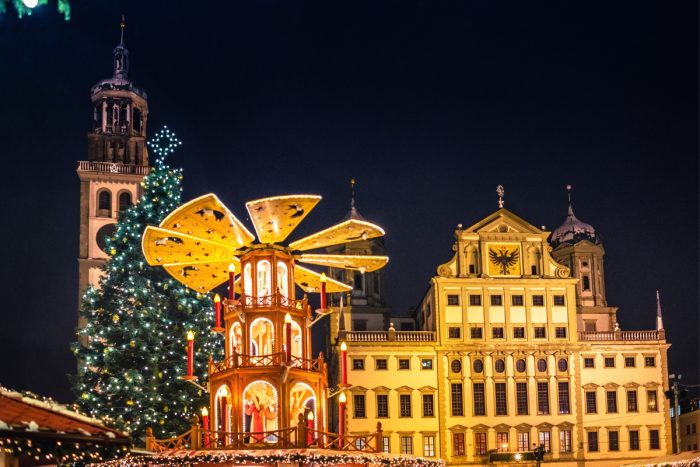
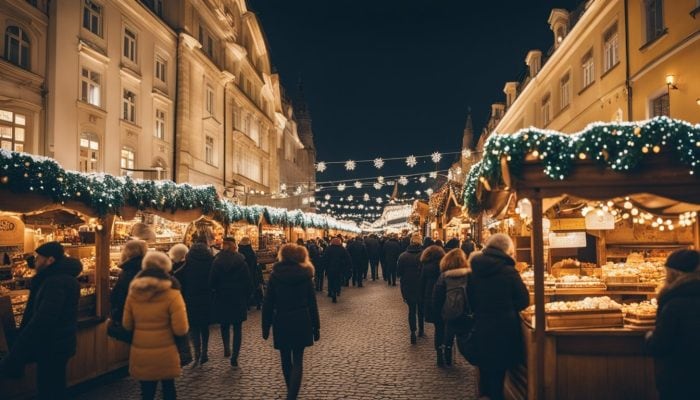
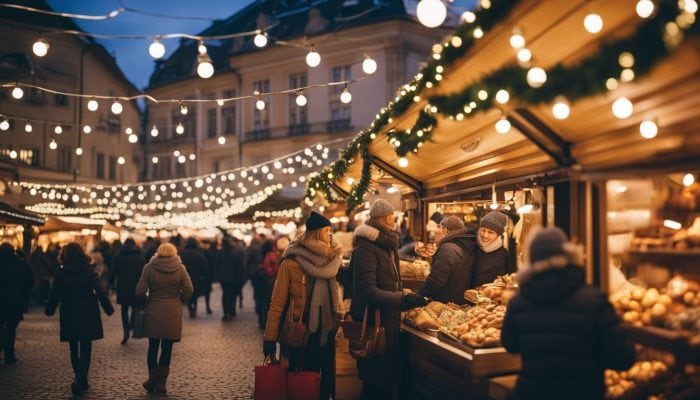
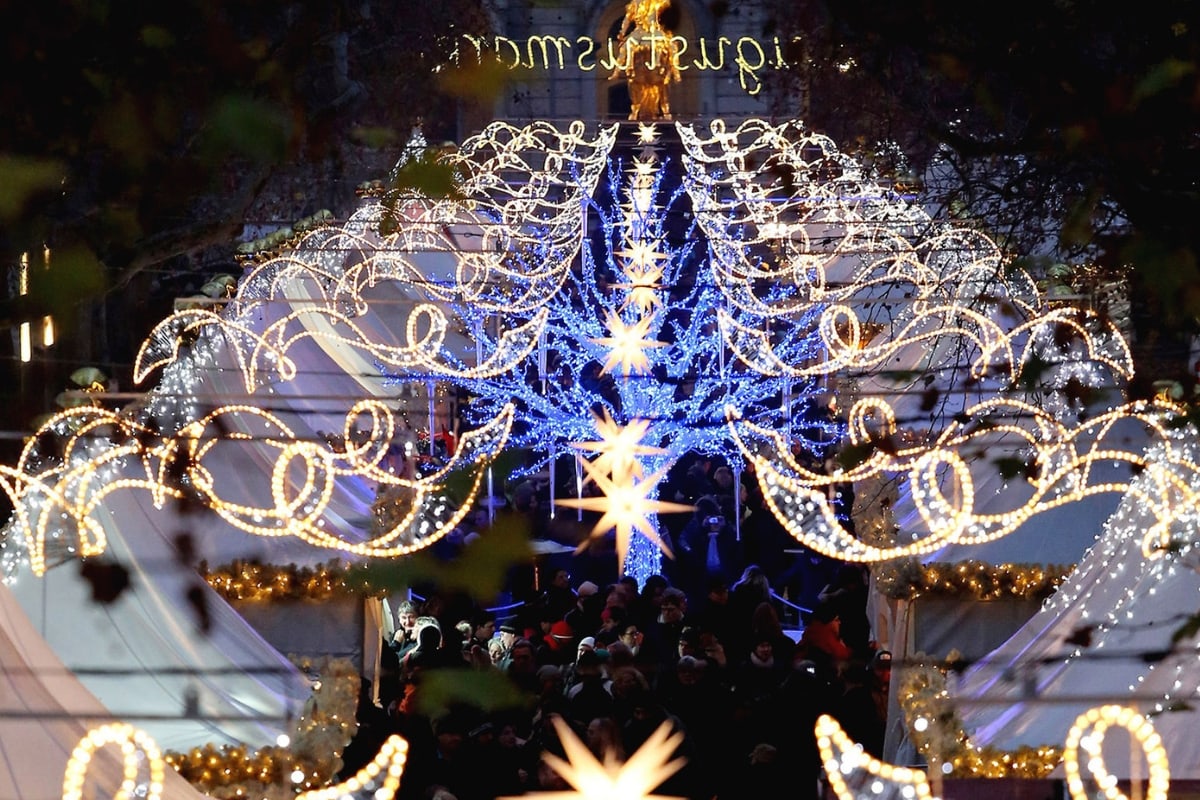
Every year, residents and visitors alike can enjoy gingerbread, mulled wine and the festive atmosphere that has permeated the town since 1. December until Christmas Eve. The main markets are located right on the Hauptmarkt, the heart of Nuremberg’s historic district.
Christmas Market Nuremberg 2023: How long to go for?
If you want to enjoy the Christmas atmosphere to the full and still explore the city, a weekend away is ideal as you can not only visit the markets, but also take in the other sights and stop to shop for Christmas gifts or quality German food. Of course, one day is enough for a visit.
What can you look forward to at the Christmas markets in Nuremberg?
Due to the economic importance of Nuremberg, the Christmas markets are a key part of local culture. What you can look forward to:
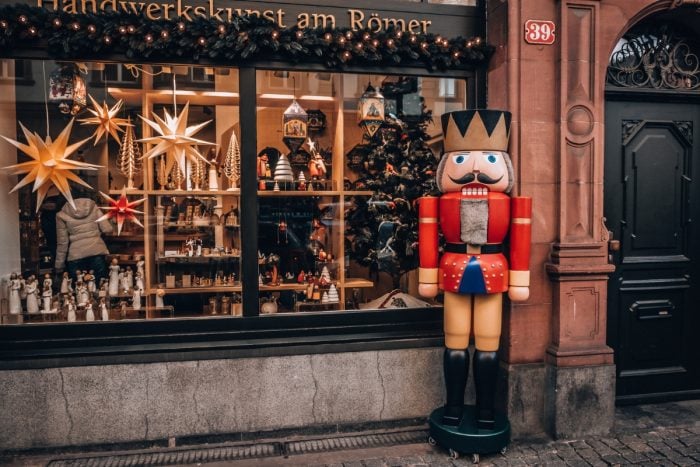
For handmade Christmas decorations and gifts,
traditional German delicacies such as Nürnberger Rostbratwürste, traditional German mildly spiced sausages.
A stage performance at the Christkindlesmarkt, a traditional part of the Nuremberg Christmas market. This performance symbolises the beginning of the Advent season.
The history and tradition of the Christmas markets in Nuremberg
Nuremberg’s markets, known as the Christkindlesmarkt, are – as mentioned above – a big part of the city’s culture. Christmas markets in Nuremberg date back to the 17th century. century and is one of the oldest and most famous Christmas markets in Europe. The first written mention of the market dates back to 1628.
Christmas Market Nuremberg: location and opening hours
In our guide you will find important information about the Christmas markets in Nuremberg – when the markets open, how to get there and where to park.
Where are the Christmas markets in Nuremberg?
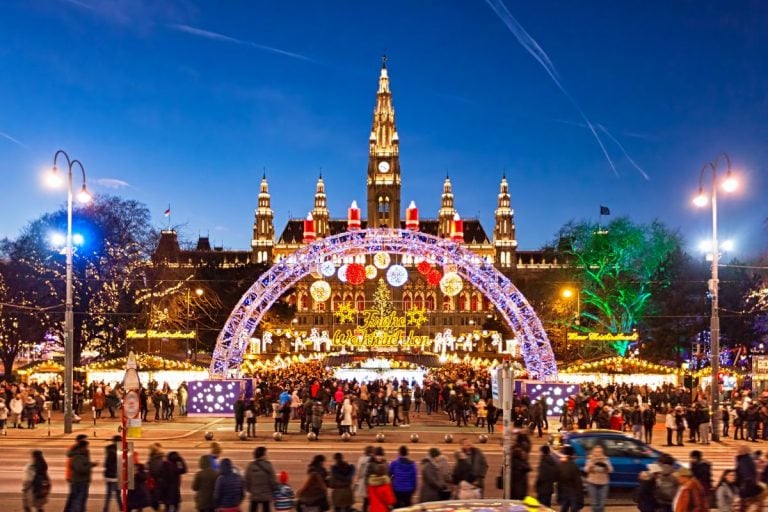
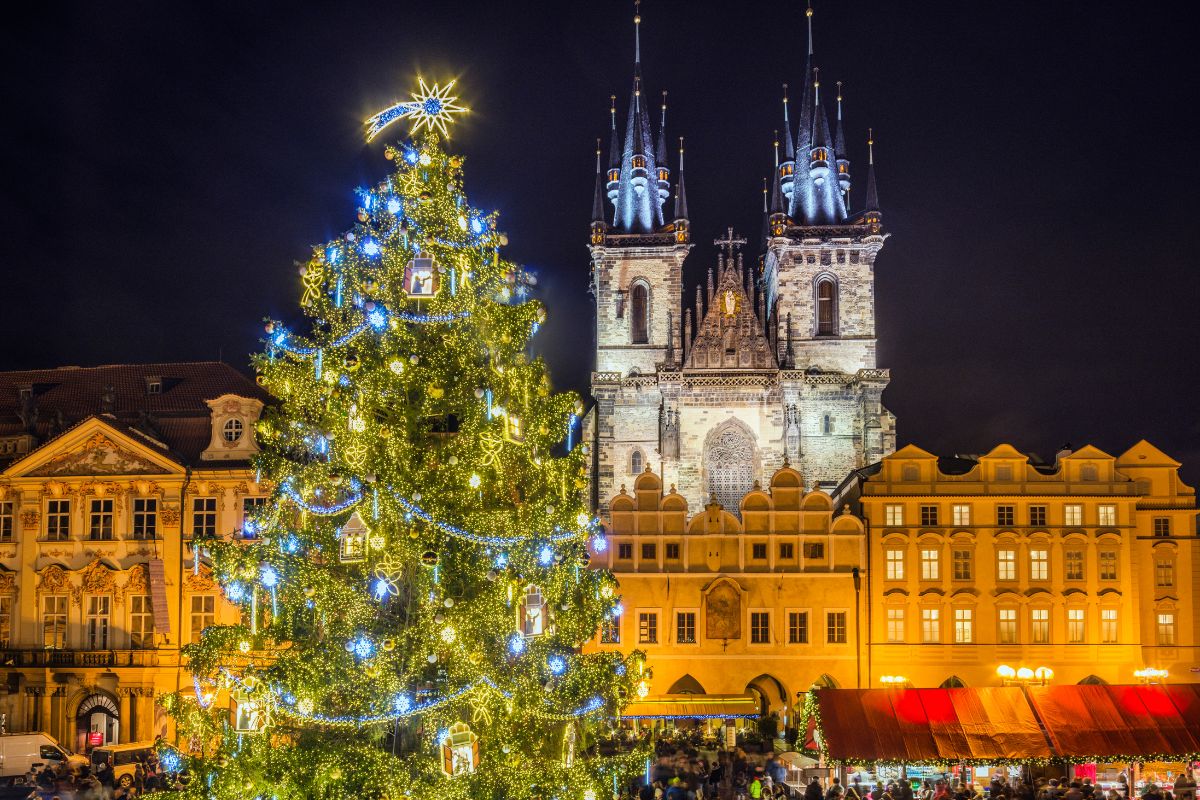
Nuremberg’s Christmas market, known as the Nürnberger Christkindlesmarkt, is held on the Hauptmarkt in the city centre. During the Advent season, this square transforms into a magical place full of Christmas scents, lights and stalls with Christmas goodies.
Christmas Markets Nuremberg: dates and opening times 2023
Beginning: Christmas Markets in Nuremberg start on 1 December
Opening hours: stalls are open from 10:00 to 21:00.
Christmas Eve: opening hours are shortened on 24 December and stalls are open from 10:00 to 14:00
How to get to Nuremberg: Bus, tour or car?
The markets are easily accessible by bus from Prague (FlixBus runs there) or with a tour, which you can easily find through the Invia portal. If you arrive in your own car, it is good to know that parking options may be limited due to high demand.
Christmas Market Nuremberg: where to park
When visiting the Christmas markets in Nuremberg, it is good to know that Nuremberg does not have all areas included in the resident parking zones.
You can park for free on the street in many outskirts of the city. When parking during the working week, please pay attention to the additional information on the traffic signs, as Nuremberg has regular street cleaning during which parking is prohibited.
See www.nuernberg.de for a map of the residents-only areas. In the city centre in the resident zones, parking is available for a maximum of two hours (EUR 2.50/hour).
Tips for free, unguarded parking near the centre:
Kessler Platz– 180 metres from Wöhrder Wiese Underground Station, close to the historic centre.
Wöhrder Talübergang– well connected to the centre by buses 36 and 94, stop Bauvereinstr.
What to buy at the Christmas markets in Nuremberg?
At the Christmas markets in Nuremberg, you can choose from a wide range of traditional German products and delicacies.
Traditional products and souvenirs
Nuremberg’s Christmas markets are famous for their handmade Christmas decorations and impeccable German craftsmanship. Stall offerings include:
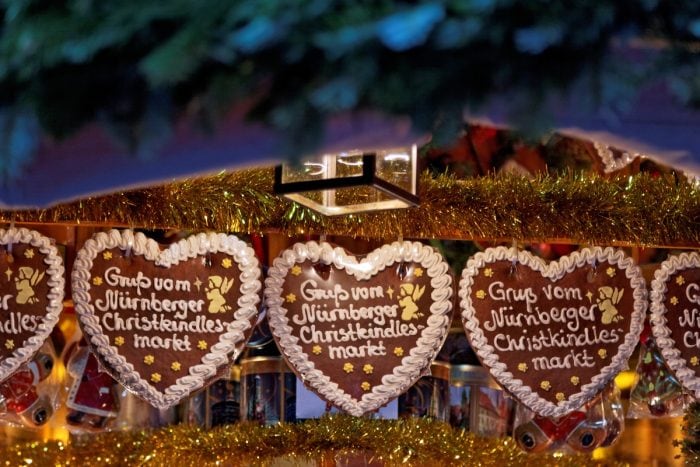
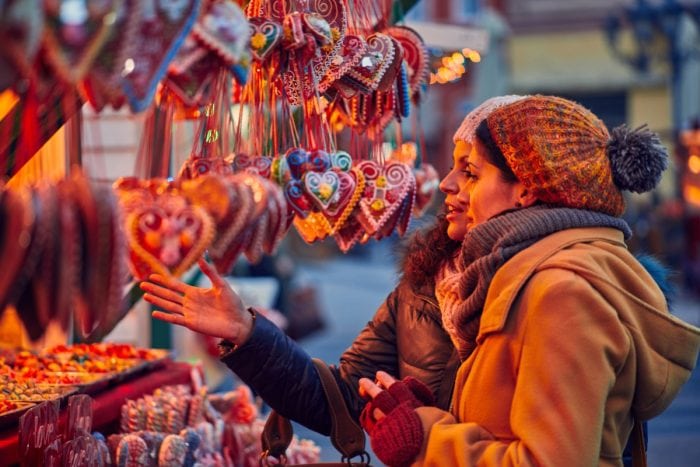
Traditional German gingerbread, which is similar to Czech Christmas gingerbread, is also based on the same traditions. They are excellent and honest. Whether they are better than the Czech ones, we leave it to you to judge.
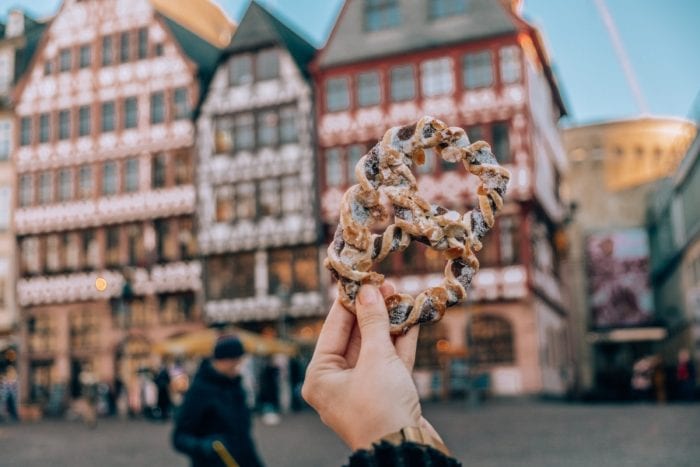
Bishop’s sandwiches – another sweet treat you must try.
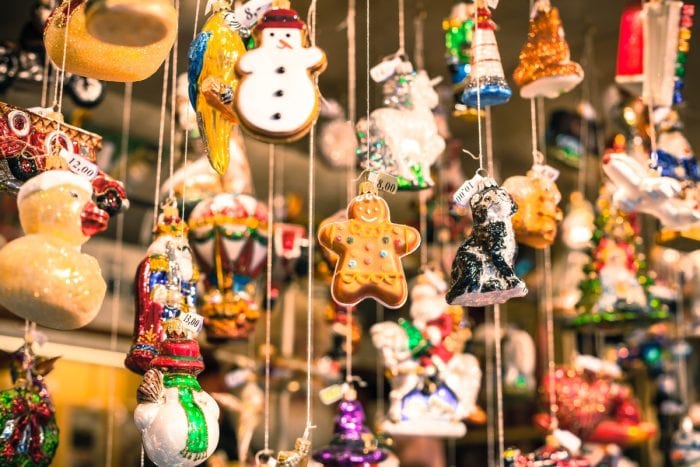
Christmas decorations made of various materials, from glass to ceramics.
Christmas Market Nuremberg 2023 – Taste German gingerbread
Food & Drink: What to taste at the Christmas markets in Nuremberg
When it comes to food and drink, Nuremberg offers the best of German Christmas cuisine and traditional Christmas drinks:
Mulled wine (Glühwein) and punch are traditional drinks that can be found not only here but also in Germany. Again, you can judge whether German or Czech ones are better. Anyway, on frosty days, such punch or mulled wine warms the body and soul. You can find them in more variations at the markets, everyone has their own recipe.
As mentioned above, there are also various types of German gingerbread, which are an indispensable part of Christmas markets thanks to their rich spices and specific taste.
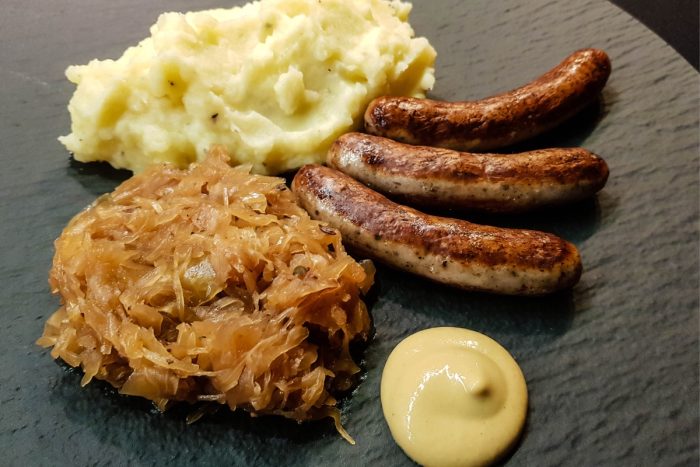
Nuremberg bratwursts: these world-famous little sausages are grilled and served with sauerkraut, potato salad or as ‘two or three in a roll’ (known as ‘Weggla’). These small sausages, grilled on an open fire made of beech wood, are an irresistible delicacy. During Advent, bratwursts are prepared at the famous Nuremberg Christmas Market, where their aroma attracts visitors to the stalls. Legend has it that their small size allowed the innkeepers to sell them through keyholes during closing time. The reality, however, lies in the economics 16. century, when Nuremberg butchers reduced the size of their sausages to maintain their high quality at the same price. These sausages are protected by the European Union as a protected geographical indication, which guarantees that all ‘Nürnberger Rostbratwurst’ are produced in Nuremberg according to a precise recipe.
Feuerzangenbowle: This drink, a mixture of red wine and rum, is an essential part of winter celebrations. The name comes from the tongs holding a burning, rum-soaked sugar cone over the mixing bowl. The sugar dissolves, caramelizes and drips into the wine, giving Feuerzangenbowle its specific taste.
The legendary Nuremberg bratwursts
Lukáš and Lucie recommend
Where to stay in Nuremberg
3 accommodations — hotels and other lodging options
Programme for children and adults at the Christmas markets in Nuremberg
The Christmas markets in Nuremberg offer a varied programme for both children and adults. Highlights include attractions such as carousels and special children’s Christmas markets, as well as culinary experiences and traditional crafts. Nuremberg claims that its Christmas markets are the biggest and most beautiful in Europe.
But if you’re interested in more than just strolling through the stalls, sipping a mulled wine and sampling German gingerbread, we recommend checking out GetYourGuide for more interesting activities.
You can, for example, combine a city walk with a beer tasting at a local brewery or take a guided tour of the markets and the city to get much more information about Nuremberg than the average visitor.
FAQ – Frequently Asked Questions
Where are the best markets in Nuremberg?
The best markets in Nuremberg are on the main square Hauptmarkt, where the Christkindlesmarkt is held every year. Nuremberg likes to call it the biggest Christmas market in Europe.
When does the Christmas market in Nuremberg start?
Christmas Market in Nuremberg starts on 1. December and are open from 10:00 to 21:00.
How long to go to the Christmas market?
At least one full day, ideally a weekend.
What time do the stalls close at the Christmas markets in Nuremberg?
9:00 pm, Christmas Eve at 2:00 pm.
Where to park in Nuremberg?
We recommend parking in Kessler Platz which is a short walk from the historic centre.
Tips and Tricks for Your Vacation
Don’t Overpay for Flights
Search for flights on Kayak. It’s our favorite search engine because it scans the websites of all airlines and always finds the cheapest connection.
Book Your Accommodation Smartly
The best experiences we’ve had when looking for accommodation (from Alaska to Morocco) are with Booking.com, where hotels, apartments, and entire houses are usually the cheapest and most widely available.
Don’t Forget Travel Insurance
Good travel insurance will protect you against illness, accidents, theft, or flight cancellations. We’ve had a few hospital visits abroad, so we know how important it is to have proper insurance arranged.
Where we insure ourselves: SafetyWing (best for everyone) and TrueTraveller (for extra-long trips).
Why don’t we recommend any Czech insurance company? Because they have too many restrictions. They set limits on the number of days abroad, travel insurance via a credit card often requires you to pay medical expenses only with that card, and they frequently limit the number of returns to the Czech Republic.
Find the Best Experiences
Get Your Guide is a huge online marketplace where you can book guided walks, trips, skip-the-line tickets, tours, and much more. We always find some extra fun there!
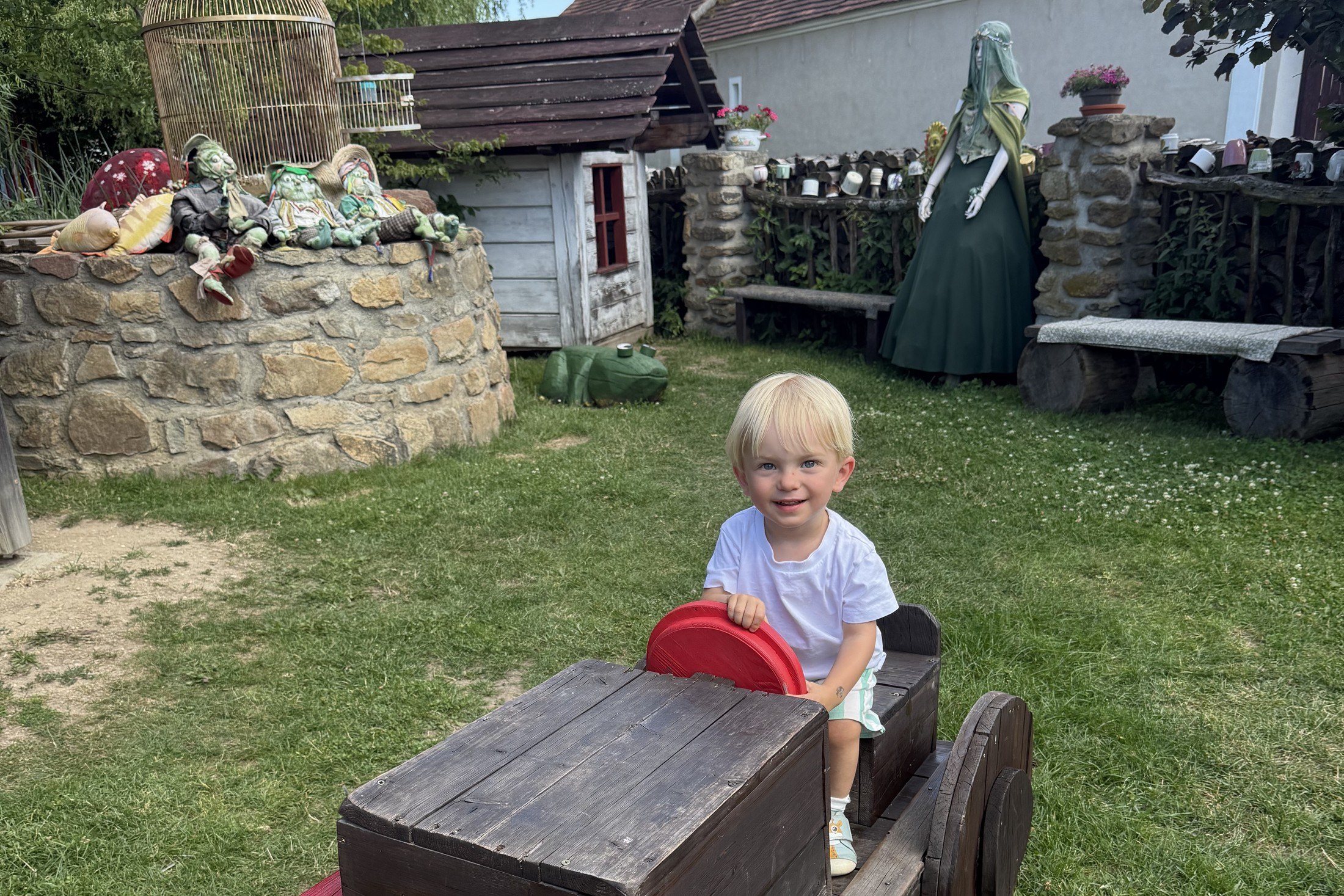
I was born in Písek, Czech Republic, and although I later spent long years in Prague, these days Lukáš, our two-year-old Jonášek and I live here together again. Since our family loves hunting down the best day trips around Písek, I have to say honestly that as a base for exploring South Bohemia this town is absolutely ideal — and I won’t hear a bad word said about it.
Thanks to its great location and connection to the D4 motorway, you can reach most South Bohemian landmarks by car within an hour, whether you’re drawn to deep history, sprawling fishponds or the dense forests of Šumava. Písek simply sits right in the middle of the best of it all, and you always have dozens of options to choose from.
Come and drive the Písek region with me — here are 30 places we love, ordered from those just around the corner to full-day adventures. Let’s take a look at where to go to see animals, castles, water and gorgeous views over the countryside.
TL;DR
Best trip overall: A visit to the majestic Zvíkov Castle combined with a scenic boat cruise to the nearby Orlík Chateau.
Closest destination: The Jarník lookout tower and the adjoining Písek Hills, which you can easily reach from the town centre on a pleasant walk.
Best for families with kids: The Fairytale Forge in Selibov and the newly opened Maletice Farm Park, full of animals and attractions.
For a rainy day: The Protivín Crocodile Zoo, which reliably keeps you entertained in the warmth, or the interesting museums in the surrounding towns.
UNESCO tip: The little village of Holašovice, famous for its utterly unique and beautifully preserved Folk Baroque architecture.
Most visited destination: The Hluboká nad Vltavou State Chateau, whose fairytale architecture draws crowds of tourists from all over the world.
Off-season: While the castles sleep through winter, the lookout towers, zoos and wanders through the Písek Hills run without restrictions all year round.
How to plan day trips from Písek
Písek has an exceptionally strategic location near the D4 motorway, which in practice means that getting toward Prague or deeper south is very quick and comfortable. To keep things organised, I split the trips into shorter half-day ones, roughly within thirty kilometres of town, and longer full-day ones over forty kilometres away, for which we prefer to set aside a whole free day.
When planning any tour of castles and chateaux run by the National Heritage Institute, bear in mind that they’re generally closed on Mondays. This quiet heritage-sector convention applies even to the biggest draws in the area, so save the start of the week for nature, lookout towers or zoos, which tend to have far more flexible opening hours.
South Bohemia is also hugely popular with cyclists, and a dense network of bike trails will safely take you to many destinations along the Otava River. If you rely on public transport, the train gets you nicely to the surrounding towns, but for some more isolated landmarks it’s often better and faster to use the regional bus lines instead.
Based on a photo by: Chmee2 / Wikimedia Commons, CC BY-SA 3.0 · colour edited
Where to stay if you want to explore the area
If you’re coming to the Písek region for a weekend or a week, it’s worth staying right in Písek and heading out from there. Most of the destinations in this article are within half an hour’s drive, and in the evening you return to town, where there’s parking, food and a stroll along the riverside.
The best address belongs to Hotel Biograf, a short walk from the main square. It’s been renovated and has long been among the best-rated in Písek. A quieter option is Hotel U Kapličky, with its own restaurant and parking, which you’ll appreciate when you get back late from a trip.
A cheaper choice is Penzion Sport, just a few minutes’ walk from the sports complex and the swimming pool. And if you want to be right in the historic centre, try Hotel Otava, set in a First Republic-era building with murals by Mikoláš Aleš — though rooms are harder to come by, so book well ahead.
💡 Tip: Browse the full range of accommodation in Písek with current prices on the Písek accommodation map — in high season and over long weekends capacity fills up fast.
Trips within 15 kilometres: half-day or by bike
These closest destinations really are just around the corner, and Písek families come here mostly at weekends when they don’t fancy spending too long in the car. You can easily manage them over an afternoon or as a pleasant goal for a cycling trip.
Based on a photo by: Chmee2 / Wikimedia Commons, CC BY 3.0 · colour edited
1. The Jarník lookout tower
From the centre of Písek the tower is just 5.1 kilometres away, about a 21-minute drive to the car park. It sits right in the Písek Hills above town, and from the free U Vodáka car park it’s another 1.7 kilometres on foot to the tower itself through lovely woodland.
The climb is free and open around the clock. Nearly a thousand people rate it an average of four and a half stars, and although it’s technically a telecommunications tower, the viewing platform offers a beautiful panoramic view of the town and surroundings — as long as the haze isn’t rolling in.
This trip also combines perfectly with the nearby U Vodáka enclosure, where you can watch fallow deer and mouflon. A short walk from there, by the Živec cabin, you’ll find a popular 3D maze in the treetops, which makes this spot a perfect half-day destination for all ages.
Based on a photo by: Chmee2 / Wikimedia Commons, CC BY-SA 3.0 · colour edited
2. The Písek Hills
To the edge of this vast forest complex it’s about 9.4 kilometres, roughly a 24-minute drive from the town centre. The Písek Hills aren’t real mountains in the true sense — they’re more of a gorgeous wooded upland that forms the green lungs of the whole region.
You’ll find a huge network of perfectly marked paths and quiet ponds that practically beg for long walks. I highly recommend visiting the Písek Foresters’ Lookout, with seating, a description of the history of local forestry and a calm view down into the valley. Whether you set out on foot from the centre or drive up to the Živec cabin, incredible peace always awaits.
The paths are surfaced and a pushchair rolls along without any trouble. Even in high season you can easily find a corner where you won’t meet a soul all day, whether you’re picking mushrooms, running or just wandering.
3. Putim: Our Animals
The famous little village of Putim is a mere 6.5 kilometres away, a 9-minute drive. The village is known far and wide mainly thanks to the famous novel about the good soldier Švejk, but for local families the big draw is a lovely little zoo called Our Animals (Naše zvířátka).
This small site has completely free entry, and you’ll see kangaroos and cheeky meerkats. The animals are used to people and the place is carefully maintained, so you’ll definitely stay longer than you might expect at first glance. You’ll find current opening hours at nasezviratkaputim.cz.
Once you’ve had your fill of the animals, walk over to the old stone bridge across the Blanice and to the Church of St Lawrence — that village calm simply tugs at your heart, even if you only drop by for half an hour.
4. Selibov: The Fairytale Forge
The trip to Selibov covers a distance of 8.2 kilometres and takes about 9 minutes from Písek’s square. Here you’ll find the wonderful Fairytale Forge (Pohádková kovárna), one of the very favourite family destinations from across the whole wider area, boasting a rating of 4.7 stars from thousands of people.
Inside the historic building, devils, water goblins and adorable fairies await — mainly for younger children, but honestly, adults are left open-mouthed too. The figures are incredibly detailed, and that slightly mysterious atmosphere of old Czech legends fits the place perfectly.
The site also includes a creative workshop for busy hands, and live little donkeys are kept in the yard, which brighten up the visit nicely. Always double-check the opening hours and current entrance fee on their website pohadkovakovarna.cz, since operations can shift a little outside the main summer season.
Based on a photo by: donald judge / Wikimedia Commons, CC BY 2.0 · colour edited
5. Kestřany: the Upper and Lower Forts
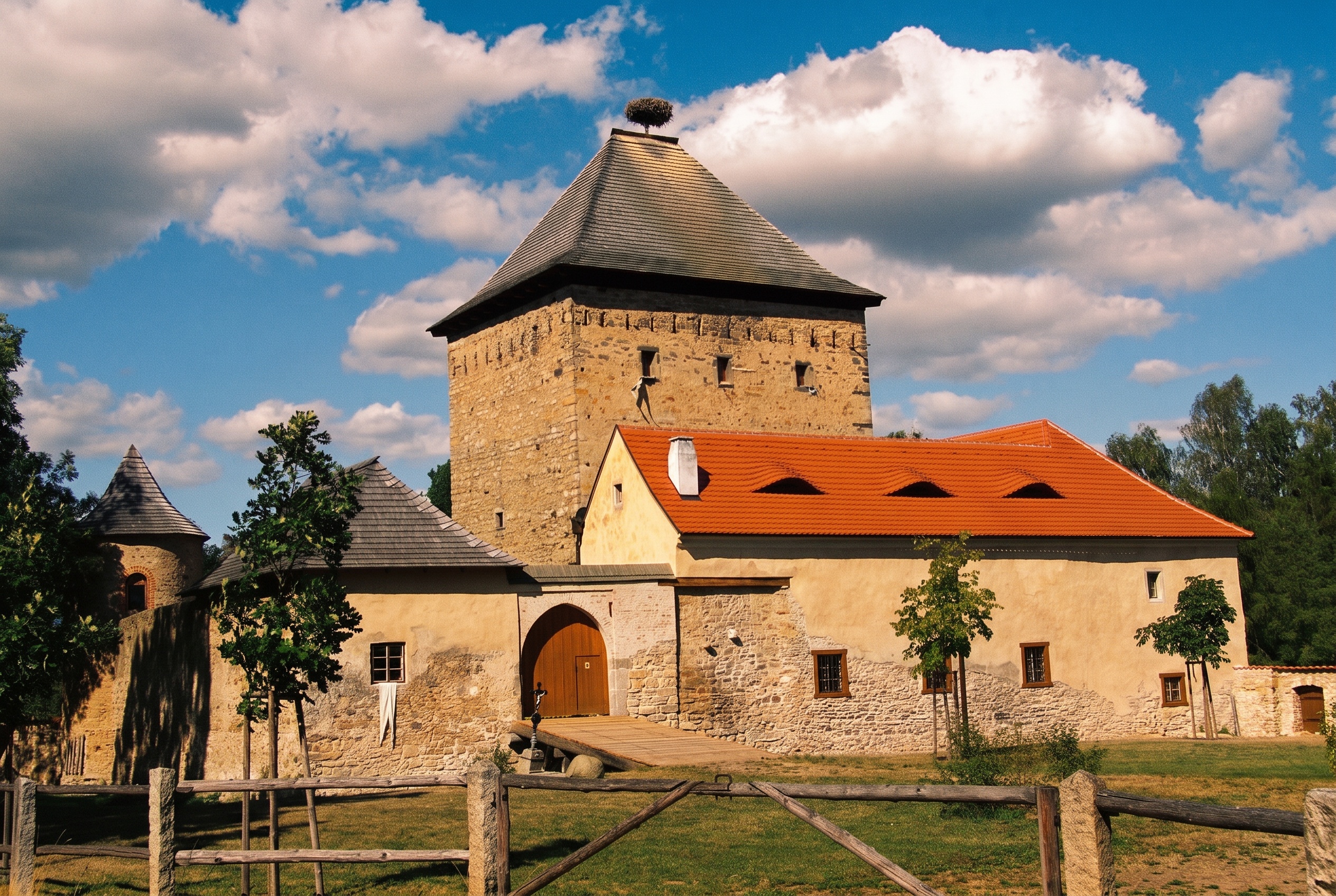
This historic gem lies 8.9 kilometres from Písek, a 13-minute drive. Kestřany is a big name among history lovers, because it’s home to a truly unique pair of medieval forts standing right next to each other — something you’ll hardly see anywhere else in the country.
The grounds of the Upper Fort are usually open in summer from 9 a.m. to 7 p.m. and feel like a genuine romantic ruin. Both forts have kept their raw medieval character without needless modern interventions, so you feel as if you’d wandered straight out of some heroic novel and forgotten the way back.
A big advantage of this place is that the crowds don’t pour in and there’s wonderful peace here, so you can fully enjoy photographing and exploring the walls. You’ll find detailed information about the tours and current opening hours on the website kestrany.cz.
6. Maletice: the Farm Park
To the newly built farm park in Maletice it’s 11.2 kilometres, an easy 12 minutes in the car. It’s a relatively new project, but it won the hearts of local families incredibly quickly and is now one of the most popular family destinations within reach of town.
The site is huge and offers plenty of hands-on animals along with giant trampolines where kids can burn off energy in complete safety. Everything is designed so parents can enjoy a coffee in peace while the little ones stay in sight and have fun on the sprawling play equipment. The farm park is put together incredibly cleverly and quickly became a fixture among Písek families. Check the entrance fee and opening hours at farmaparkmaletice.cz.
This destination is an absolute must, especially for families, and you can easily spend a whole afternoon here. If you’re after more ideas like this, be sure to check out our article Písek with kids: 40 tips from a local mum, where you’ll find a heap of other tried-and-tested spots in the area.
Based on a photo by: Chmee2 / Wikimedia Commons, CC BY 3.0 · colour edited
7. Řežabinec and the Řežabinec Pools
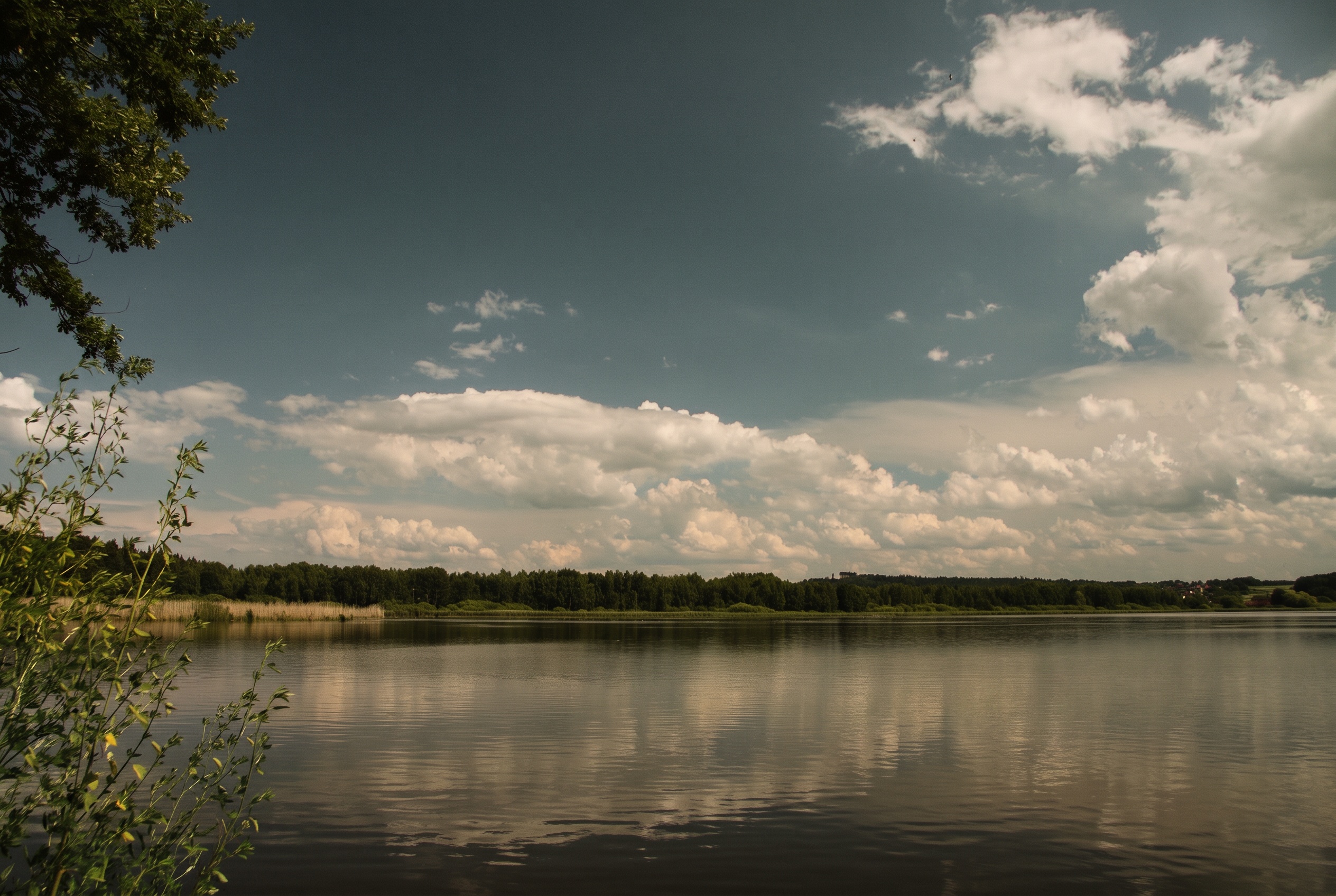
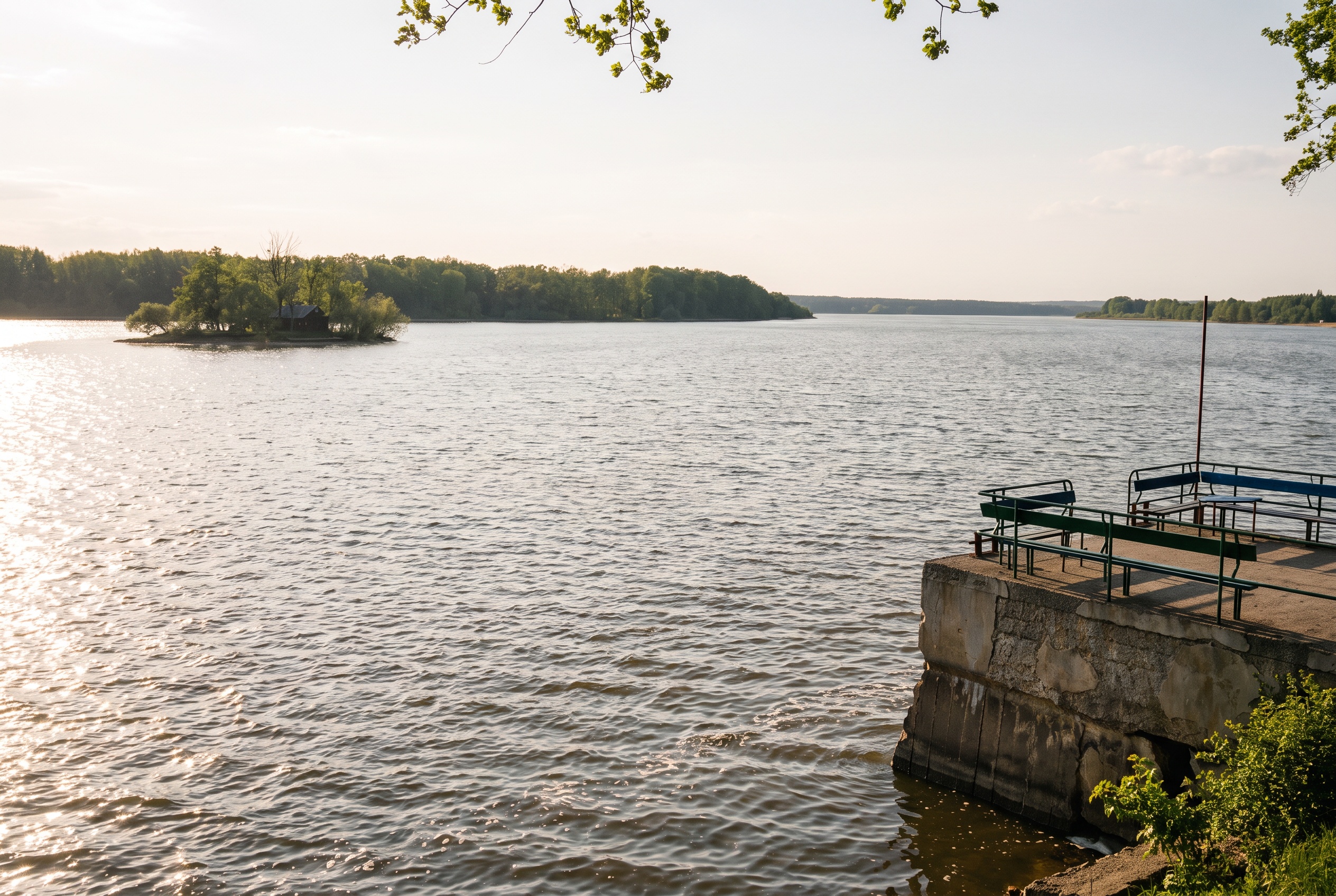
To this beautiful nature reserve near the village of Ražice it’s 11.3 kilometres, taking around 25 minutes. The Řežabinec pond is one of the most important ornithological sites in all of South Bohemia, and the whole area is strictly protected as a national nature reserve.
A pretty educational trail runs around the water, complete with a wooden bird hide from which you can watch life on the surface undisturbed. I recommend packing a pair of binoculars, because the sheer number of birds nesting or stopping over during migration is truly fascinating.
This spot is ideal for anyone seeking quiet and a complete escape from civilisation, since it draws nature lovers rather than mass tourists. The trail is also easy and flat, so even older visitors or occasional day-trippers can manage it with ease.
Based on a photo by: Honza and Ivana Ebr / Wikimedia Commons, CC BY 3.0 · colour edited
8. The Podolí Bridge
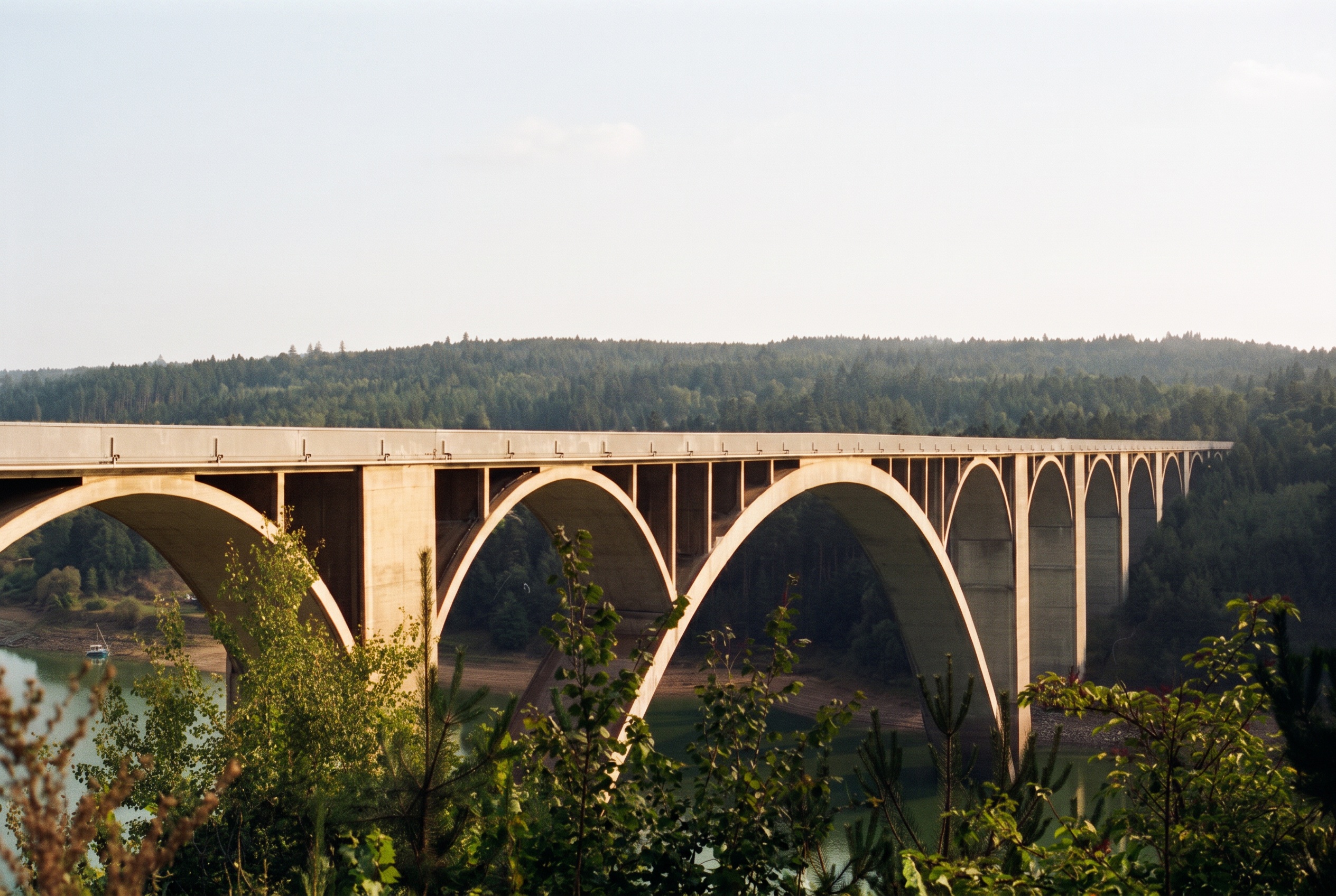
To this engineering marvel it’s 12.1 kilometres from Písek, just a 13-minute drive. The Podolí Bridge, arching over the Orlík Reservoir, is an immensely elegant arch structure built between 1938 and 1942, and to this day it’s a stunning example of the engineering of its era.
The deck boasts a main span of 150 metres and offers a breathtaking view straight down onto the water far below. At designated spots you can safely pull over, drink in the view and snap beautiful shots of the valley the bridge so elegantly crosses.
There’s also often a small refreshment stand open by the bridge where you can grab a coffee, and it all pairs wonderfully with a visit to nearby Zvíkov Castle. On Google Maps the bridge has a fabulous 4.7-star rating from more than two thousand people, proof that the stop is well worth it.
9. Sudoměř: the Žižka Memorial
To this famous battlefield it’s 13.7 kilometres, and you’ll reach it from town in just 18 minutes. Right here, in the landscape among the ponds, the legendary Battle of Sudoměř took place in 1420, where Hussite forces led by Jan Žižka of Trocnov famously triumphed over the crusaders.
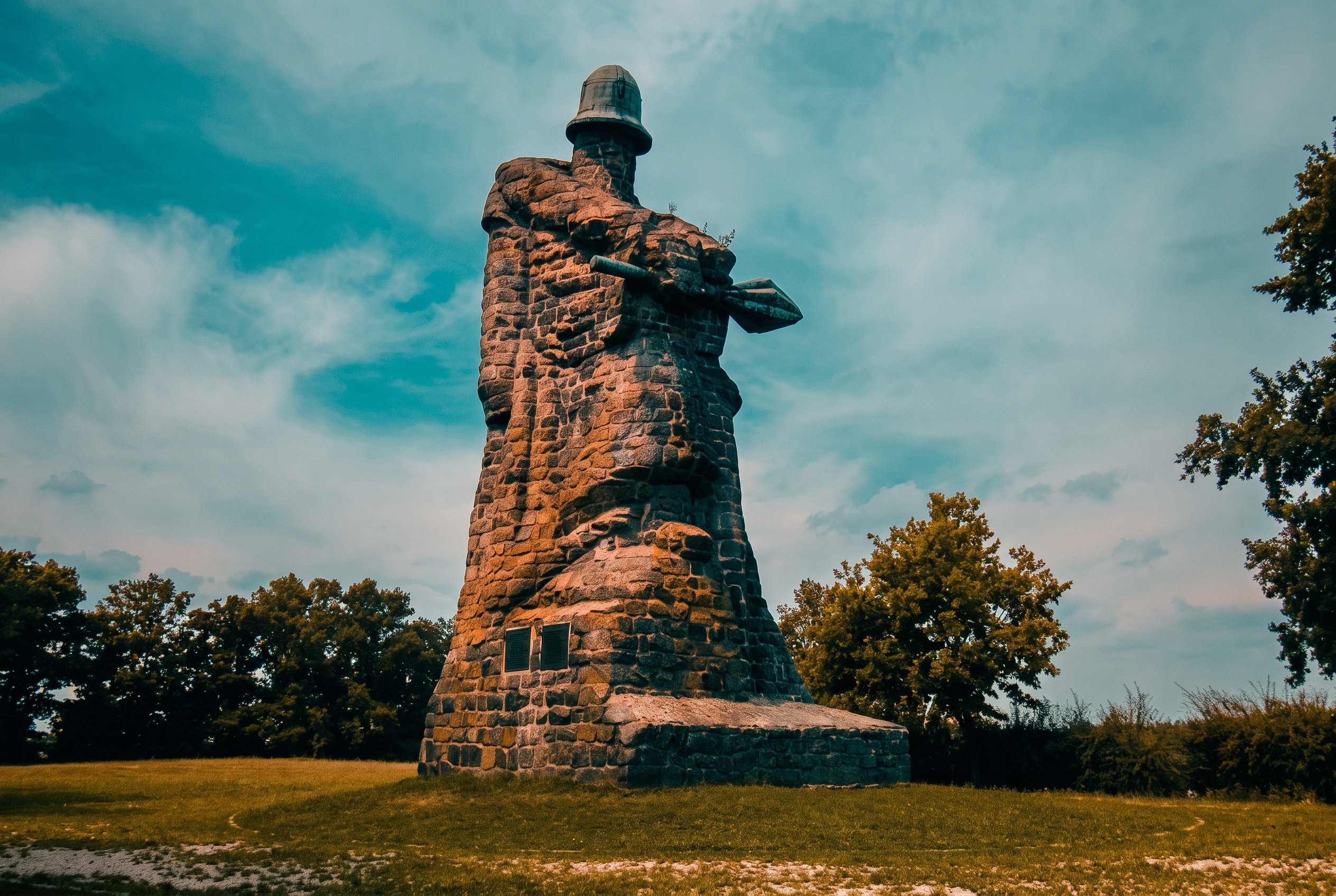
Today a monumental stone memorial in the shape of a Hussite warrior stands here, freely accessible and, of course, completely free. The place has a strong genius loci, and information boards let you study in detail exactly how the military tactics of the day, using the muddy ponds, actually worked.
A pleasant route runs around the memorial between the bodies of water, perfect for an afternoon walk, and people rate the place a lovely 4.7 stars. It’s a piece of history set in the typically calm South Bohemian countryside that you’ll simply fall in love with.
10. Protivín
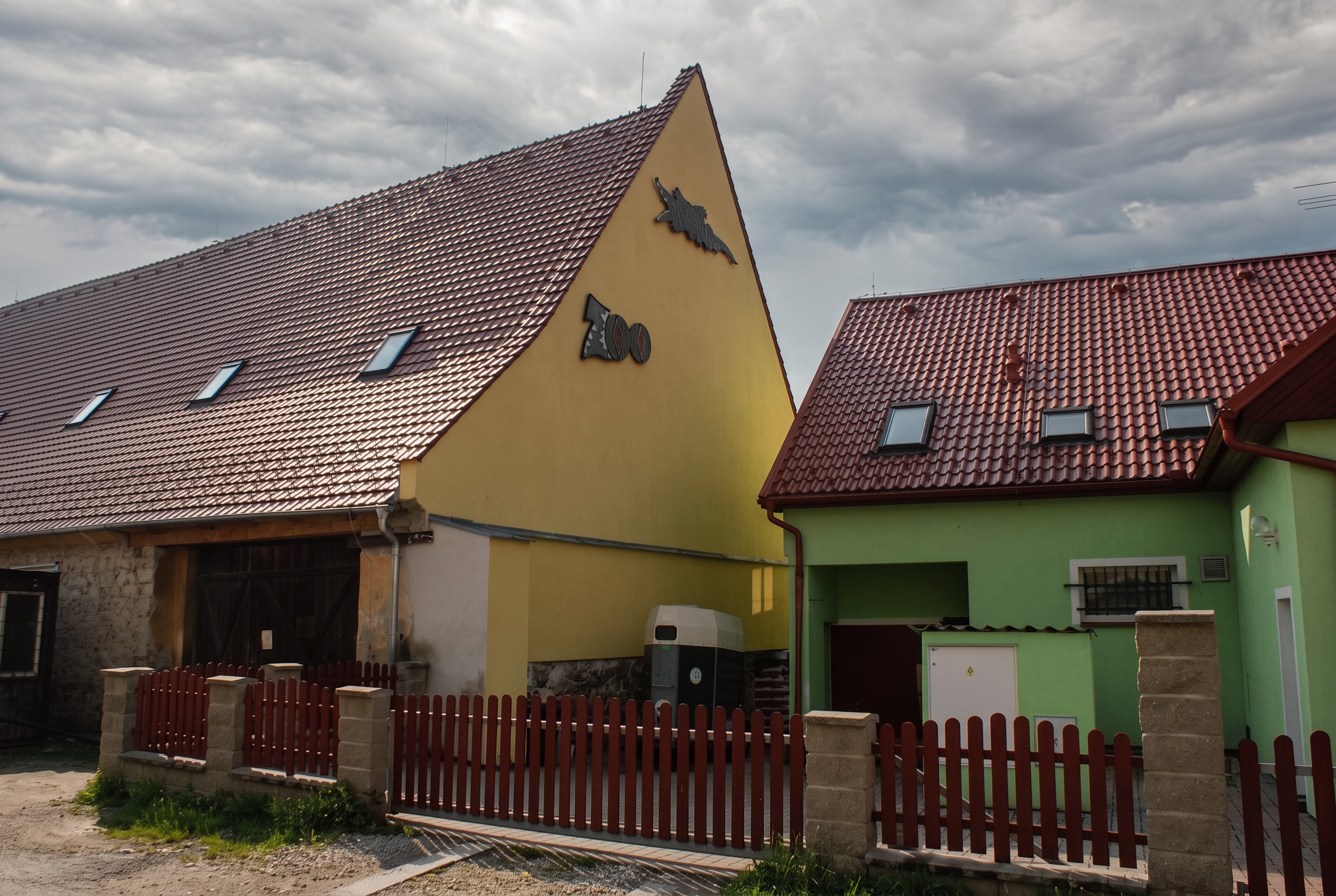
The little town of Protivín lies 14.1 kilometres away, and you’ll get there very quickly in 14 minutes. This town is an incredibly popular destination and hides so many attractions that you could easily spend a whole weekend here, starting with the renowned Crocodile Zoo, rated 4.5 stars from over five thousand reviews.
This zoo runs the largest specialised crocodile breeding programme in Europe and in summer is usually open daily from 10 a.m. to 5 p.m. Beyond that, you’ll find the delightful Kingdom of Time, an Art Nouveau villa housing a clock museum, complete with an indoor play area and a garden.
Also well worth seeing is a tour of the historic Platan Brewery, and if you have younger children, the indoor entertainment centre Fiziland might just save the day. Check the entrance fees for the individual attractions in advance at krokodylizoo.cz and elsewhere, so nothing surprises you on the spot.
Castles, chateaux and monasteries around Písek
This batch of trips takes a little more time, since the historic sites sit roughly 15 to 40 kilometres away. But they all rank among the absolute best of what you can see in our region.
Based on a photo by: Klaus Kettner / Wikimedia Commons, CC BY 2.5 · colour edited
11. Zvíkov Castle: the “king of Czech castles”
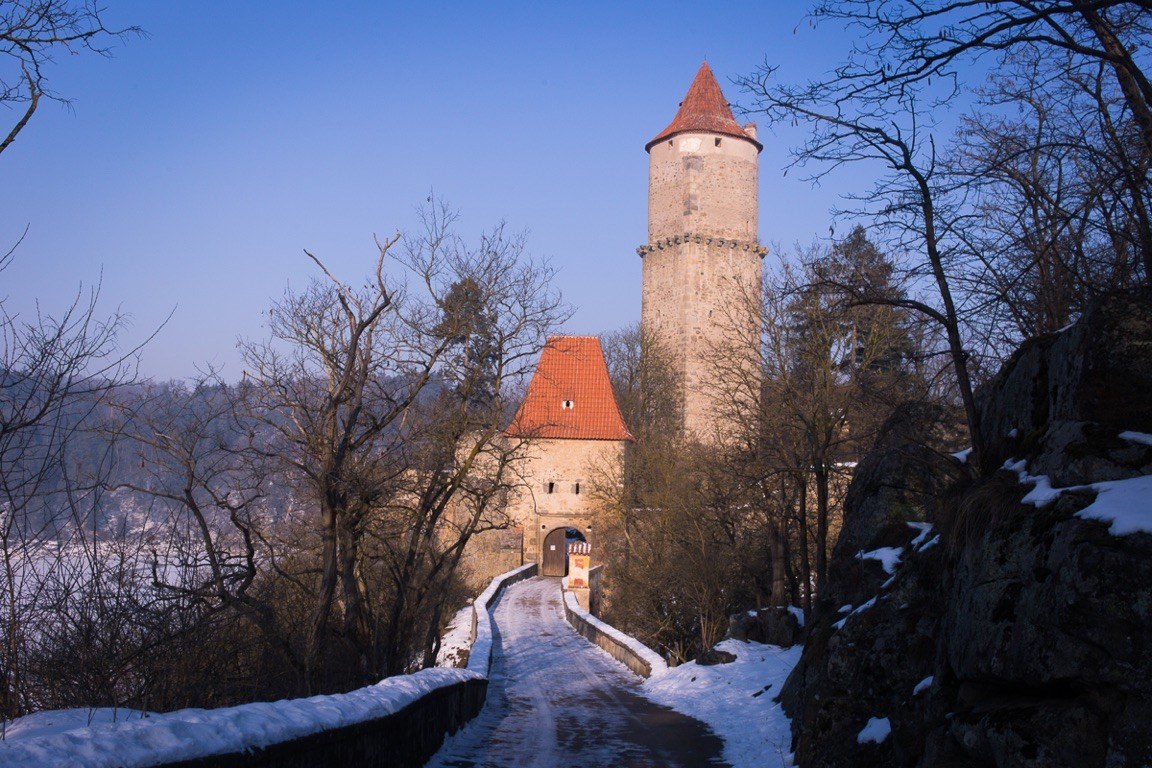
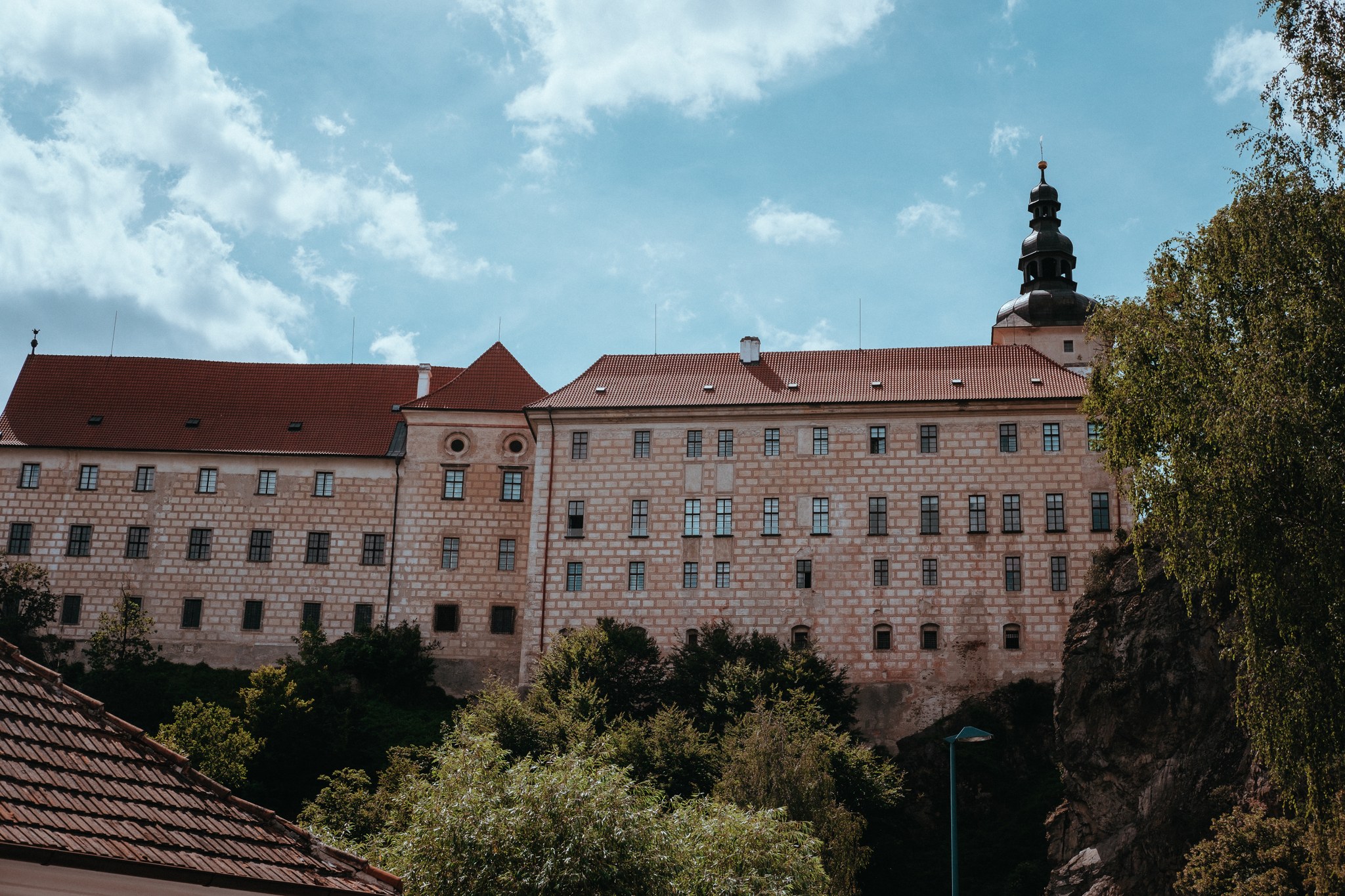
To this majestic castle it’s 26.4 kilometres, roughly a 32-minute drive. Zvíkov is rightly called the king of Czech castles, and its setting on a rocky promontory above the confluence of the Vltava and Otava — now raised by the surface of the Orlík Reservoir — is absolutely iconic.
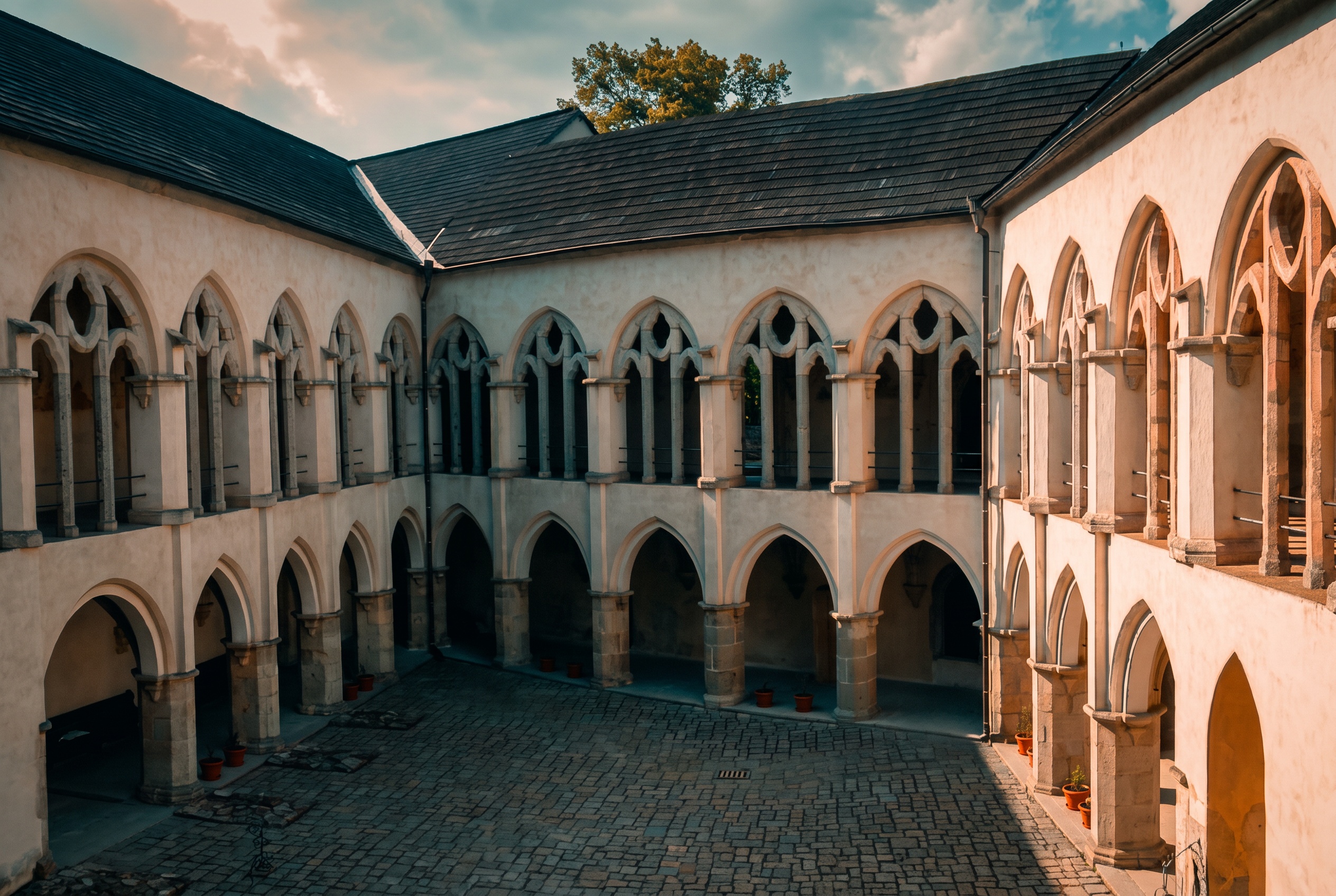
According to the confirmed 2026 price list, the basic Royal Palace tour costs 180 CZK (about €7.50) for adults, the reduced fee for seniors and youth is 140 CZK (about €5.70) and children pay 50 CZK (about €2). You go around at your own pace, and in about an hour you’ll take in the Gothic arcades and the wonderful Romanesque Hlízová Tower, which you simply have to stop at.
In July and August it’s open Tuesday to Sunday from 9 a.m. to 5 p.m., closed on Mondays, and expect capacity to sell out often in season. Outside the summer holidays, watch out for the lunch break, when the ticket office is closed between noon and 1 p.m. You’ll find the current price list and opening hours at hrad-zvikov.cz.
Based on a photo by: Bjalek Michal / Wikimedia Commons, CC BY-SA 3.0 · colour edited
12. Orlík nad Vltavou Chateau
The trip to Orlík covers 40.1 kilometres, and from Písek you’ll comfortably get there in 36 minutes. This gorgeous Lobkowicz chateau rises right above the surface of the Orlík Reservoir and is one of the most photogenic aristocratic residences in the entire country.
In summer the chateau is usually open Tuesday to Sunday between 9 a.m. and 5 p.m., while Mondays traditionally stay closed. After touring the richly furnished interiors, I definitely recommend walking through the sprawling chateau park, which also hides the monumental tomb of the Schwarzenberg family.
The ticket prices aren’t listed across the board, so check the current entrance fee on the official website zamekorlik.cz, and be very careful not to confuse it with zamek-orlik.cz, which is a completely different ruin near Humpolec. Any questions can also go to their phone line: +420 382 275 101.
Based on a photo by: Ludmila Zellner Rotbauerová / Wikimedia Commons, CC BY-SA 4.0 · colour edited
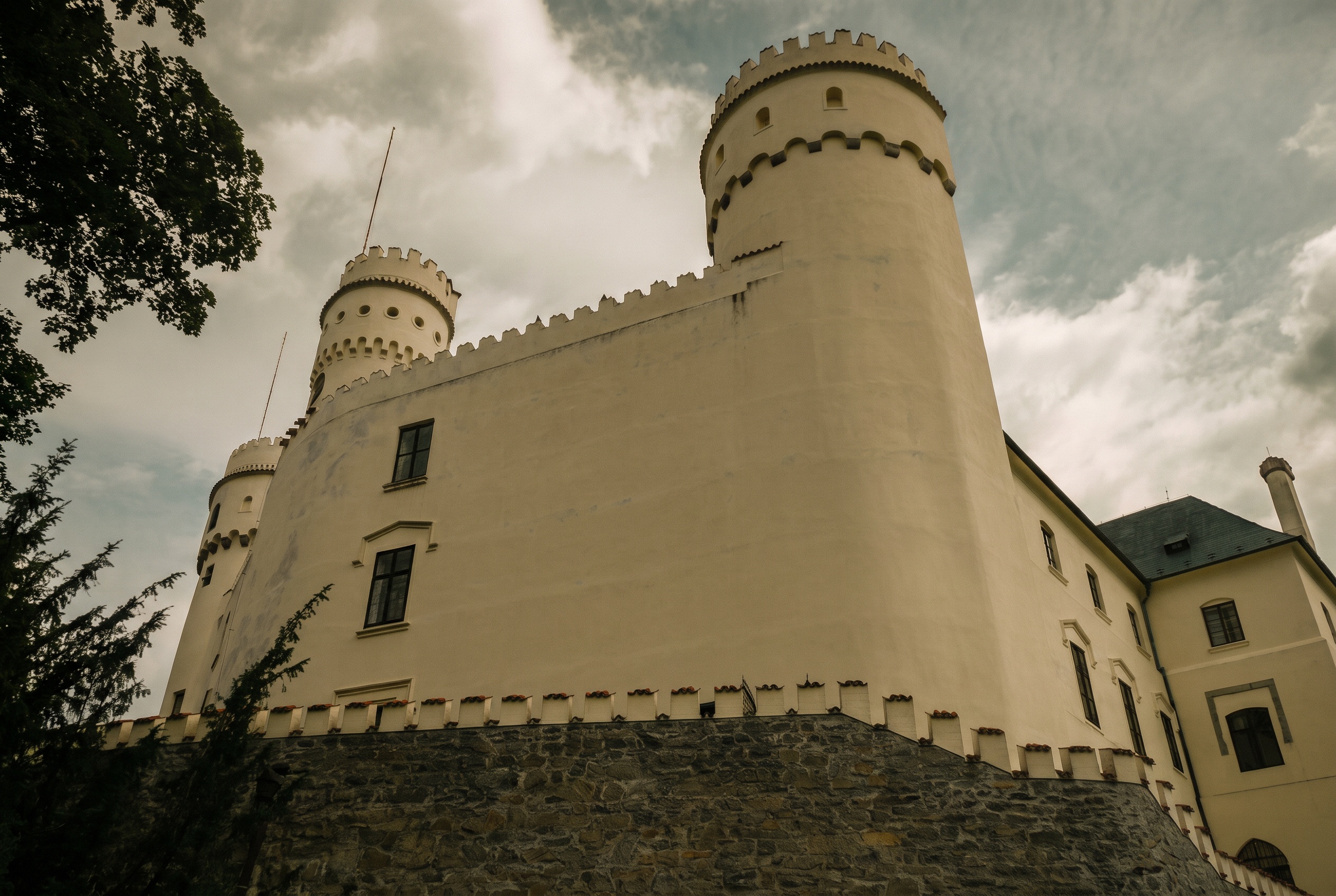
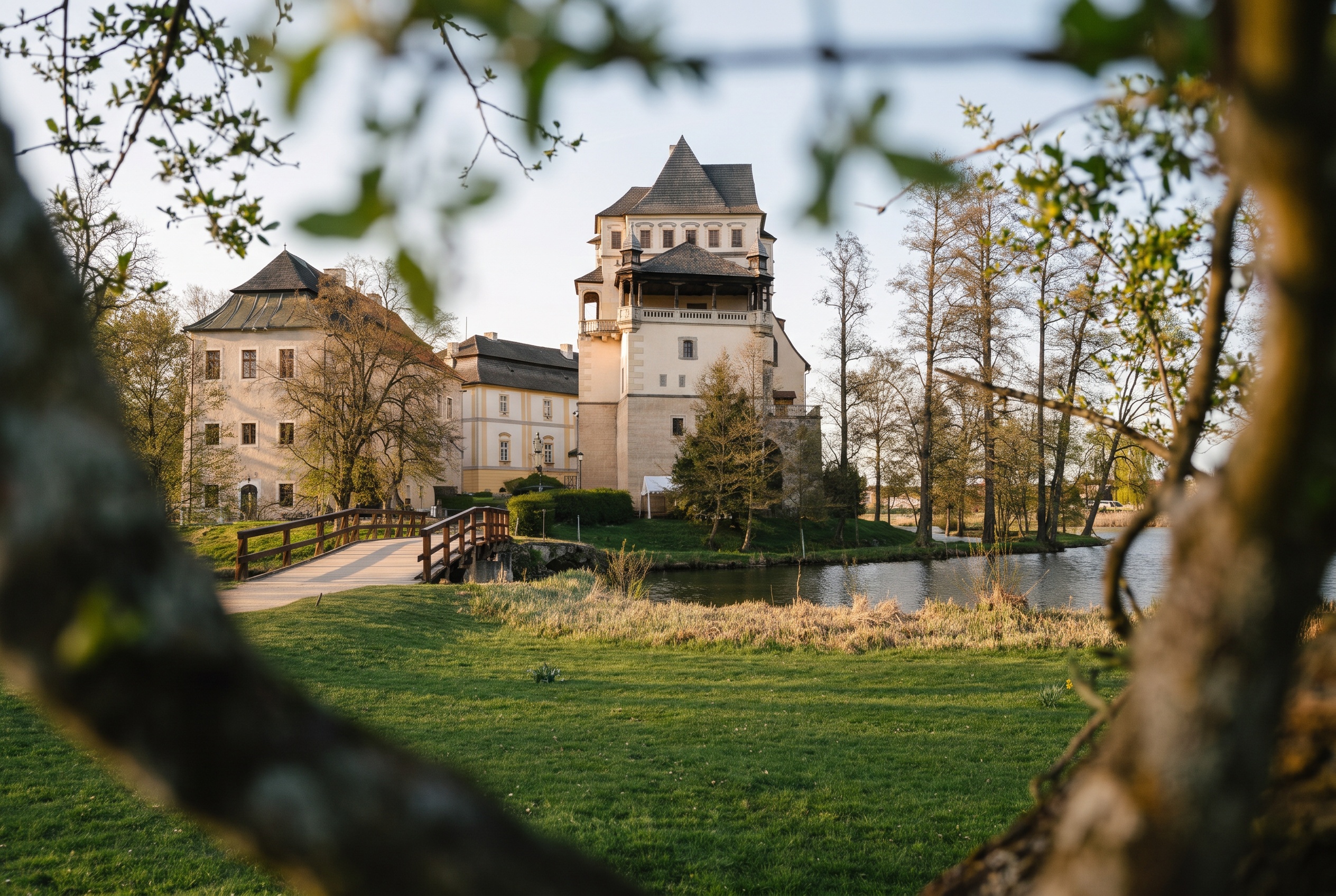
13. Blatná Chateau
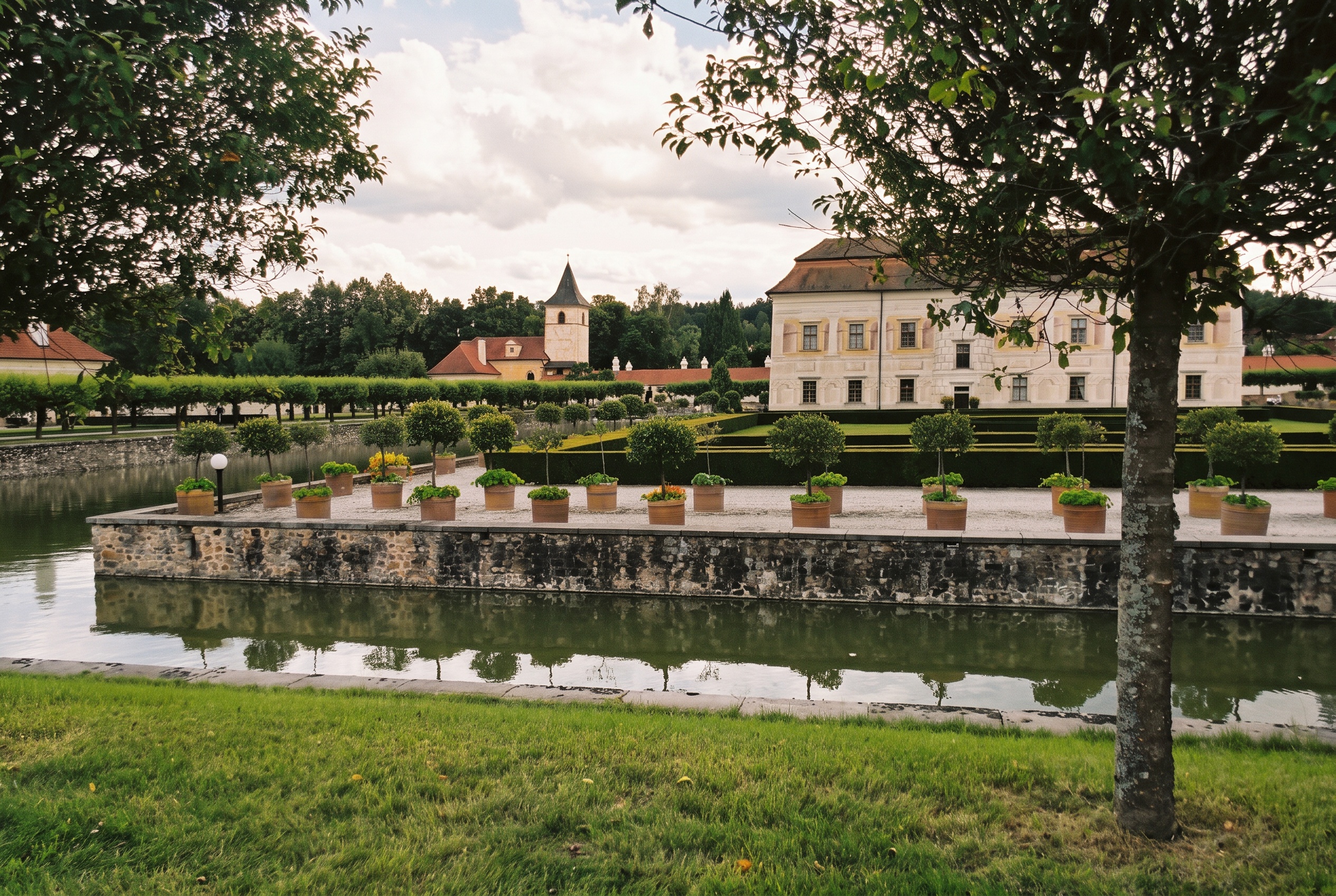
To the Blatná chateau it’s 27.1 kilometres, a pleasant 27-minute drive. It’s one of the best-preserved water chateaux in the country. A moat surrounds it on all sides, and the whole romantic backdrop has roots somewhere in the 13th century.
The biggest draw here, though, is the sprawling chateau park with free-roaming fallow deer you can feed, and they’ve recently even started keeping adorable alpacas. The park is enormous, full of old oaks and threaded with water channels, so you can easily spend half a day here just wandering. This is exactly the kind of trip we love bringing visitors to, because feeding deer from your hand wins everyone over. Buy two bags of feed right at the ticket office — trust me, one won’t be enough.
In season the grounds are usually open from 9 a.m. to 6 p.m., and inside you’ll find the excellent Oh My Deer Café where you can rest. Check the entrance fees for the chateau and park in advance at zamek-blatna.cz, as they can vary depending on any events taking place.
Based on a photo by: VitVit / Wikimedia Commons, CC BY-SA 4.0 · colour edited
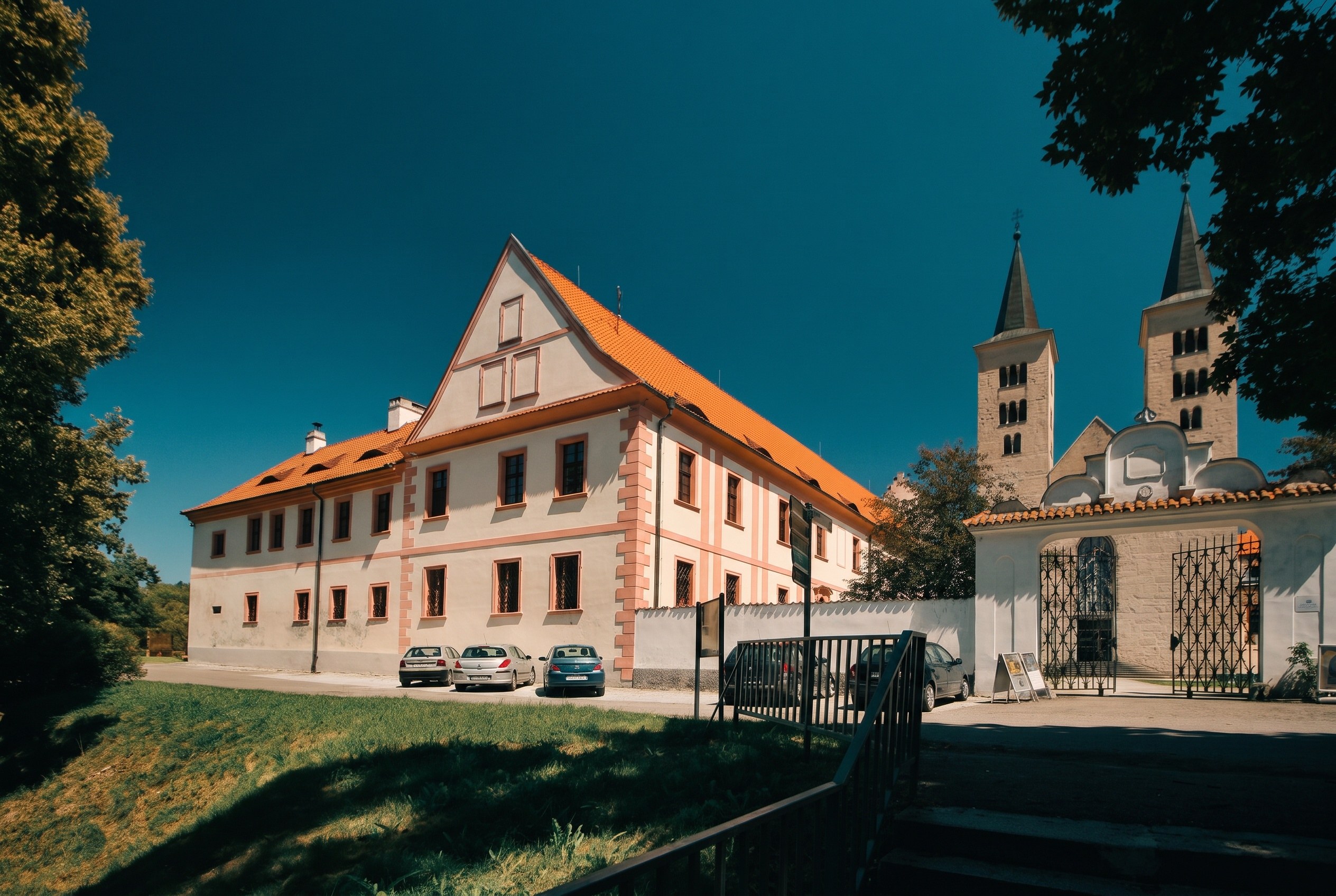
14. Milevsko Monastery
To Milevsko it’s exactly 28.8 kilometres, which works out to a 32-minute drive. The local Premonstratensian monastery was founded back in 1187, making it the oldest monastic institution in South Bohemia, and to this day it’s a wonderfully calm place for reflection.
In the main visitor season the grounds are open from 9:30 a.m. to 5 p.m. and offer several tour routes that acquaint you with the region’s rich spiritual history. Please check the specific entrance fees for the exhibitions directly on their site klastermilevsko.cz.
When visiting the town, don’t miss the excellent Museum of the Milevsko Masks either, which maps the famous Shrovetide carnival tradition aspiring to a UNESCO listing. It’s a very playful, colourful exhibition that perfectly balances the more solemn atmosphere of the nearby monastery.
Based on a photo by: Michielverbeek / Wikimedia Commons, CC BY-SA 4.0 · colour edited
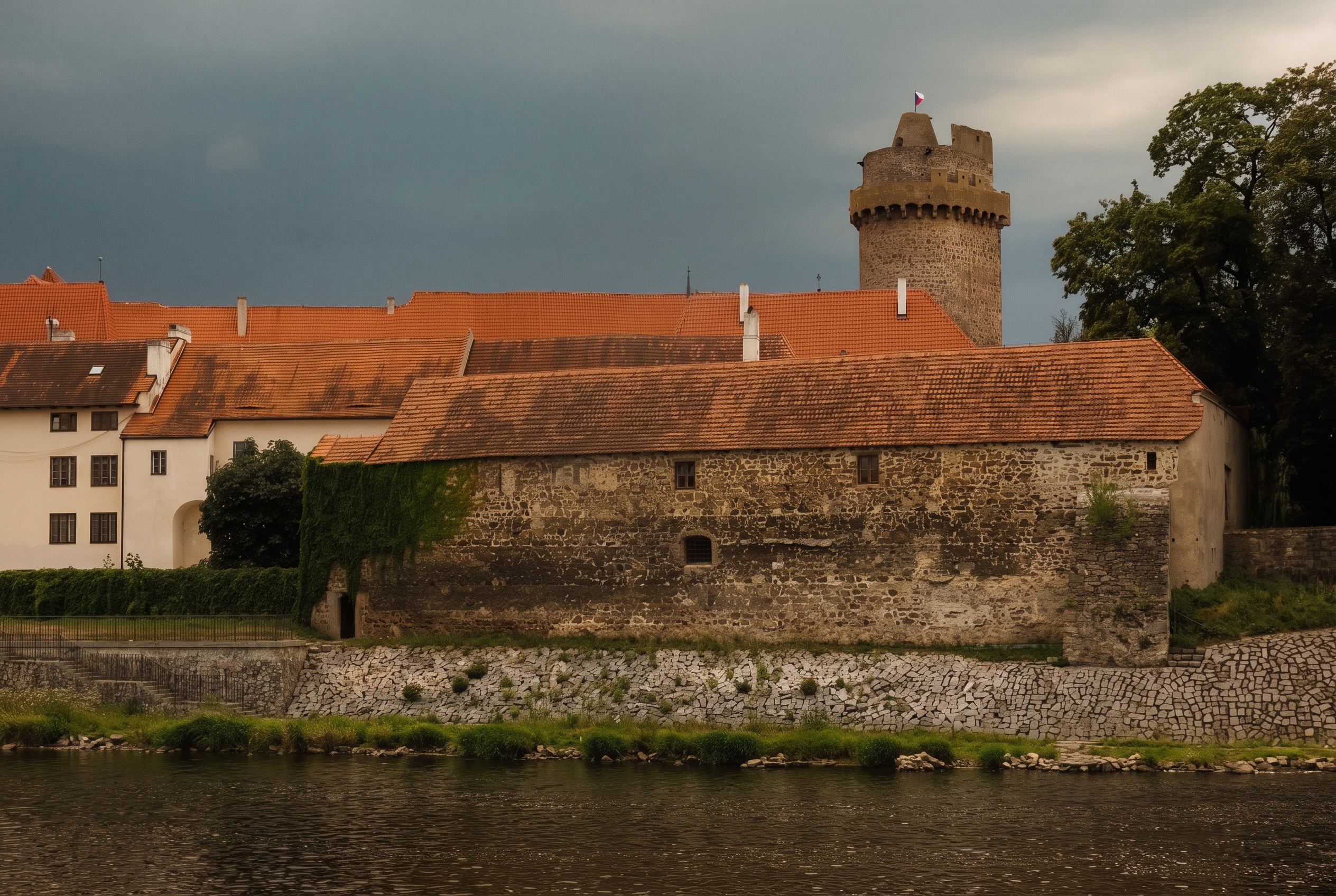
15. Strakonice Castle
Strakonice Castle lies 25.6 kilometres away, and you’ll get there from town in a brisk 24 minutes. This sprawling castle complex rises right above the confluence of the Otava and Volyňka rivers and has undergone a very extensive and successful renovation in recent years.
Today its halls house the fantastic Museum of the Central Otava Region with a huge collection of bagpipes, which perfectly maps the famous local bagpiping tradition, and motoring fans will love the exhibition of ČZ motorcycles. You’ll find visitor details and the event programme at hradstrakonice.cz. Strakonice also recently gave the riverside a big makeover, so after touring the castle I recommend just sitting on the bank with a good coffee and soaking up the views of the historic walls.
If you head to Strakonice with kids, you can also try the nearby Bagrárium, aimed at children aged 6 and up, where you get to operate real machines. It’s a smaller venture with just ten reviews, but for little builders the experience is absolutely unforgettable.
16. Bechyně Chateau and the Rainbow Bridge
To the spa town of Bechyně it’s 31.9 kilometres, and the drive along the back roads takes about 39 minutes. The local Renaissance chateau, run by Panství Bechyně, offers beautiful views into the deep valley of the Lužnice River.
The town, though, is famous mainly for the Bechyně Rainbow Bridge (Duha) from 1926–1928, a technical rarity, since it’s the only bridge in the country to carry both road and rail in a single arch a full 50 metres above the river. What’s more, the historic electric railway “Elinka” from Tábor runs right into town — Křižík’s first work of its kind in the monarchy.
Interestingly, this railway has a direct historical link to Písek’s Křižík power plant, so technical history ties together nicely here. During your visit you can also peek into the International Museum of Ceramics, under the wing of the Aleš South Bohemian Gallery.
When we were in Bechyně, what got us most was the view of the chateau from the other side of the valley — only from there do you appreciate how high above the Lužnice it stands. It’s worth walking to the bridge and crossing it in full, because the shots from below and above look completely different every time.
💡 Tip: You can pair Bechyně with the water chateau of Červená Lhota, which lies further east (82 kilometres from Písek, almost an hour and a half). We managed both places in a single day, and the combination makes sense.
Based on a photo by: Palickap / Wikimedia Commons, CC BY-SA 4.0 · colour edited
This Renaissance gem is 36.1 kilometres away, a 34-minute drive. Kratochvíle is a gorgeous Italian Renaissance villa surrounded by a flawless moat, built as a summer retreat by the famous Vilém of Rožmberk.
For 2026 the confirmed entrance fees apply, with the villa tour costing 220 CZK (about €9) for adults, 180 CZK (about €7.50) for seniors and 70 CZK (about €2.90) for children, while the Grand circuit is 280 CZK (about €11.50). If you just want a stroll, entry to the geometrically precise chateau garden alone costs 60 CZK (about €2.50).
The atmosphere here is incredibly photogenic and the whole place looks like something out of a fairy tale, mainly thanks to the moat that surrounds the villa on all sides. Check the current opening hours on the official website zamek-kratochvile.cz.
Based on a photo by: Manka / Wikimedia Commons, CC BY 3.0 · colour edited
18. The ossuary and cemetery in Albrechtice nad Vltavou
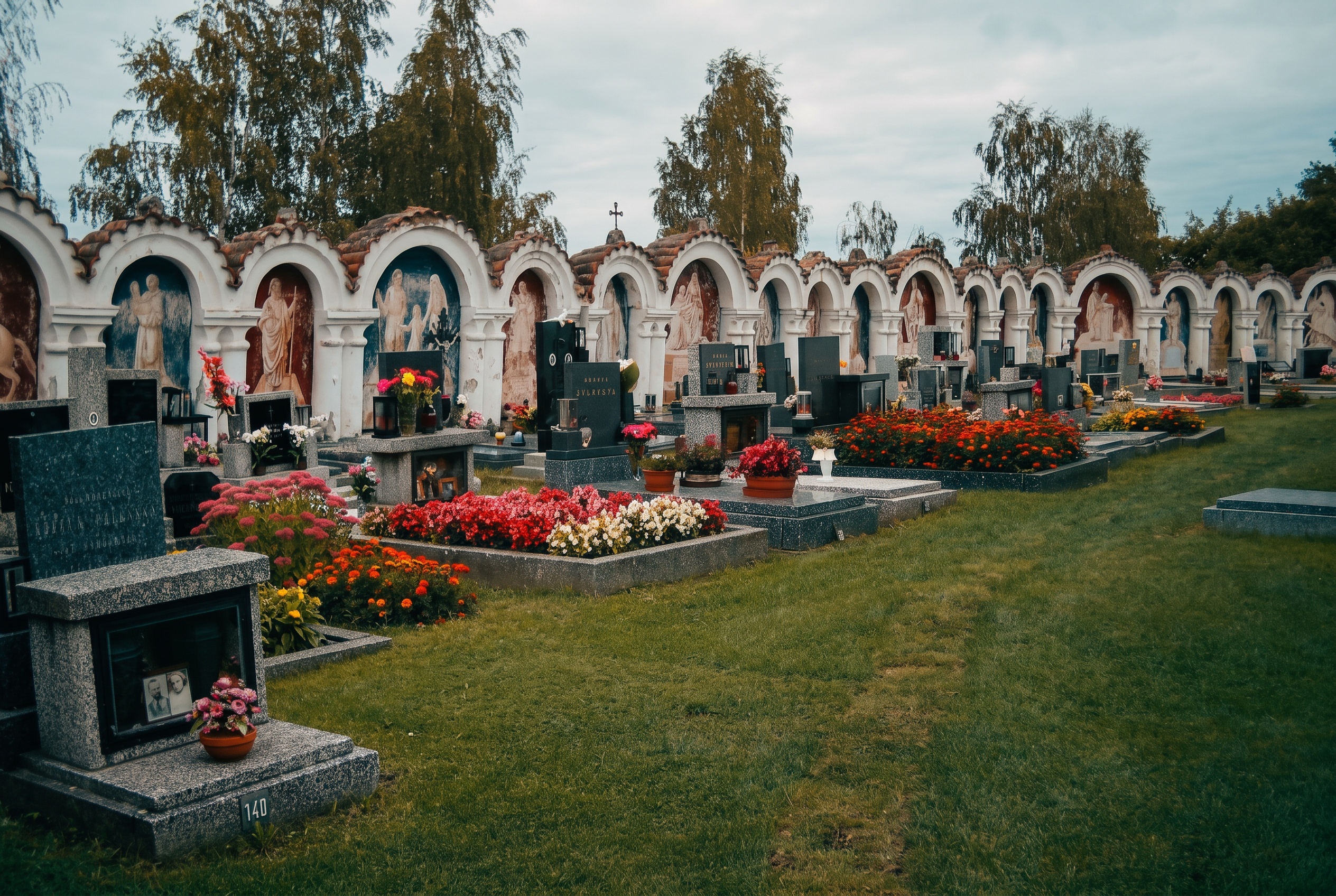
For this unassuming yet unique trip you’ll drive 16.4 kilometres, taking just 18 minutes. In Albrechtice nad Vltavou you’ll find the Church of St Peter and Paul with an adjoining cemetery, ringed by a truly unique wall of painted niche chapels that serve as miniature ossuaries.
It’s a very little-known place with a wonderful, quiet atmosphere, freely accessible for free. It only has a few dozen reviews on the maps, but anyone who stumbles upon it leaves thrilled. The paintings in the chapels tell stories and bear moralising inscriptions from the 19th century, making the place a fantastic hidden treasure of the region.
Just be very careful not to confuse this little ossuary with the famous one in Sedlec near Kutná Hora, since search engines often mix them up. The Albrechtice version here is far more intimate, quieter and virtually undiscovered by tourists. You’ll find practical information about the place on the municipal website albrechticenadvltavou.cz.
Water: the Orlík Reservoir, the Vltava and the Otava
South Bohemia’s rivers and reservoirs are a chapter all of their own. In summer they offer great swimming; in spring and autumn, stunning scenery of carved canyons. I recommend planning these trips mainly for days when the weather is nice.
Based on a photo by: Jiří Sedláček / Wikimedia Commons, CC BY-SA 4.0 · colour edited
19. Boat cruise Zvíkov ↔ Orlík
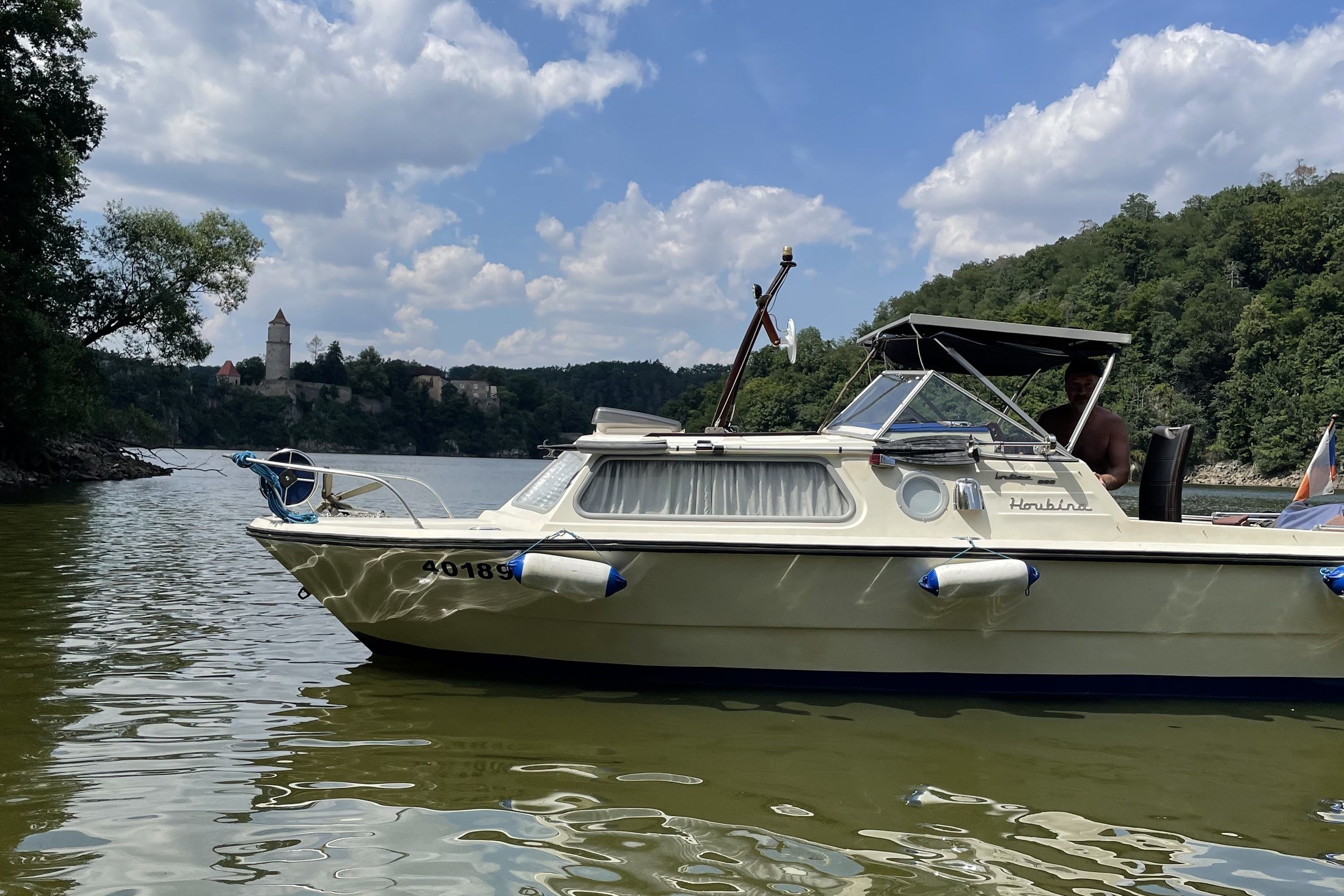
To the dock below Zvíkov Castle it’s 26 kilometres, roughly a 32-minute drive. This is where the Orlík boat service departs, which to me is the very nicest trip combination in the whole Písek region, since it links two stunning castles with relaxation on the water.
This year the boats run a regular route between Orlík Chateau and Zvíkov Castle in both directions, operating Tuesday to Sunday, with Mondays off. Be aware that the popular route right up to the dam wall itself is currently not running at all, due to hazardous access.
The fares and exact timetable unfortunately aren’t fixed, so it’s best to check all the information by phone or on the website lodnidopravanaorliku.cz. 💡 Tip: During the holidays the boats are usually full, so I recommend arriving at the dock with plenty of time to spare.
20. The Orlík Reservoir: beaches and campsites
To the shores of this huge reservoir you’ll drive roughly 26 to 40 kilometres, depending on exactly which beach you choose. Orlík is the largest reservoir on the Vltava by volume, and its deeply flooded canyons have a quite unreal atmosphere. The raised water swallowed the valley, and from a boat it looks as if you were sailing somewhere in Scandinavia, not a short drive from Písek.
You’ll find a huge number of natural beaches, well-equipped campsites and boat rentals here, so you could easily spend an entire summer holiday. In the hot months the water is pleasantly warm, though quality can occasionally worsen during August depending on the specific cove.
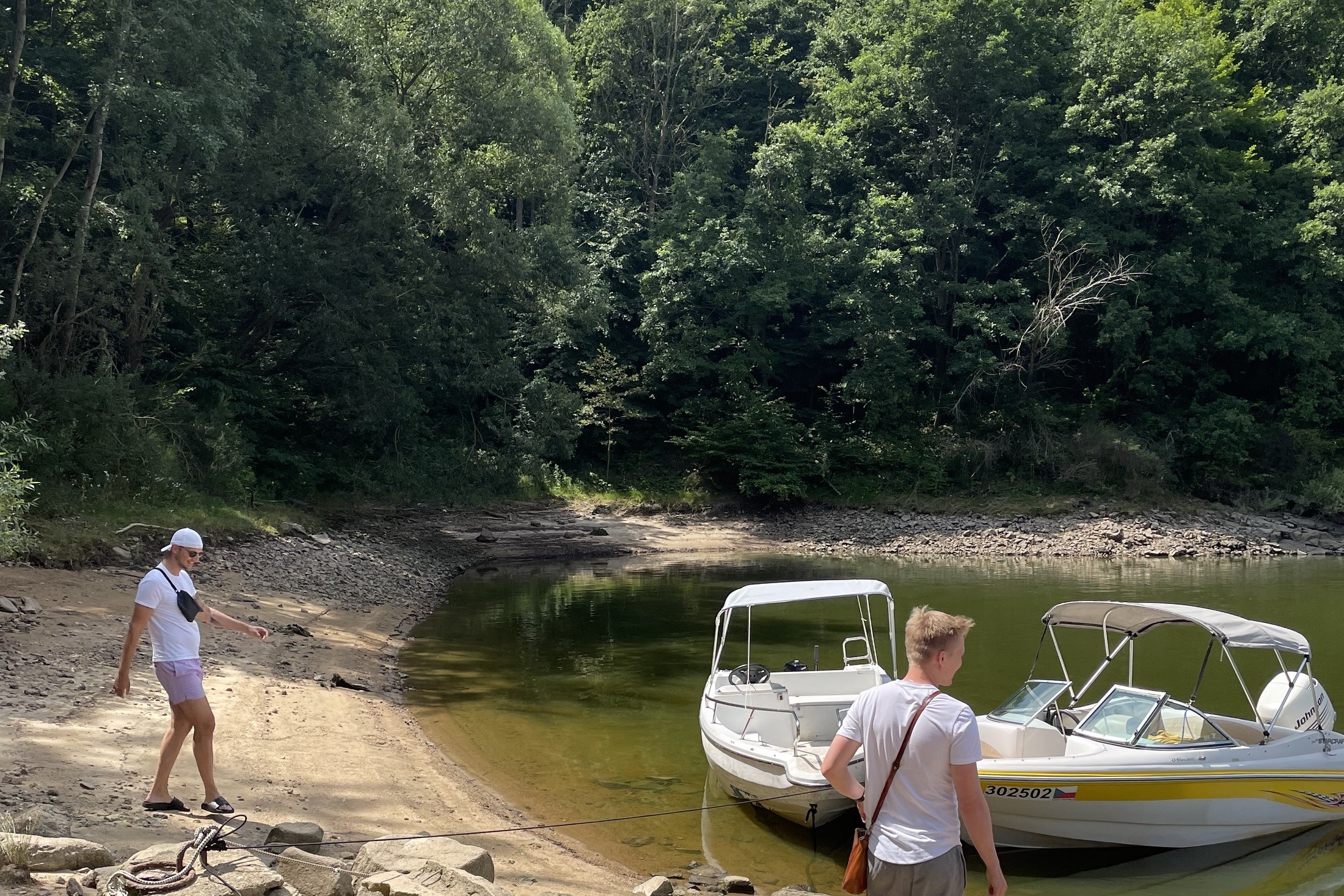
If you’re after quieter spots, avoid the biggest campsites and try scouting out the smaller coves, which you can often reach only on foot through the forest. It’s an ideal destination for anyone who loves paddleboards or wants to rent a small motorboat and explore the cliffs up close. We love coming here for afternoon paddleboarding — you just need to find a cove without too many boats.
Based on a photo by: Jan Tichavský / Wikimedia Commons, CC BY-SA 4.0 · colour edited
21. Červená nad Vltavou
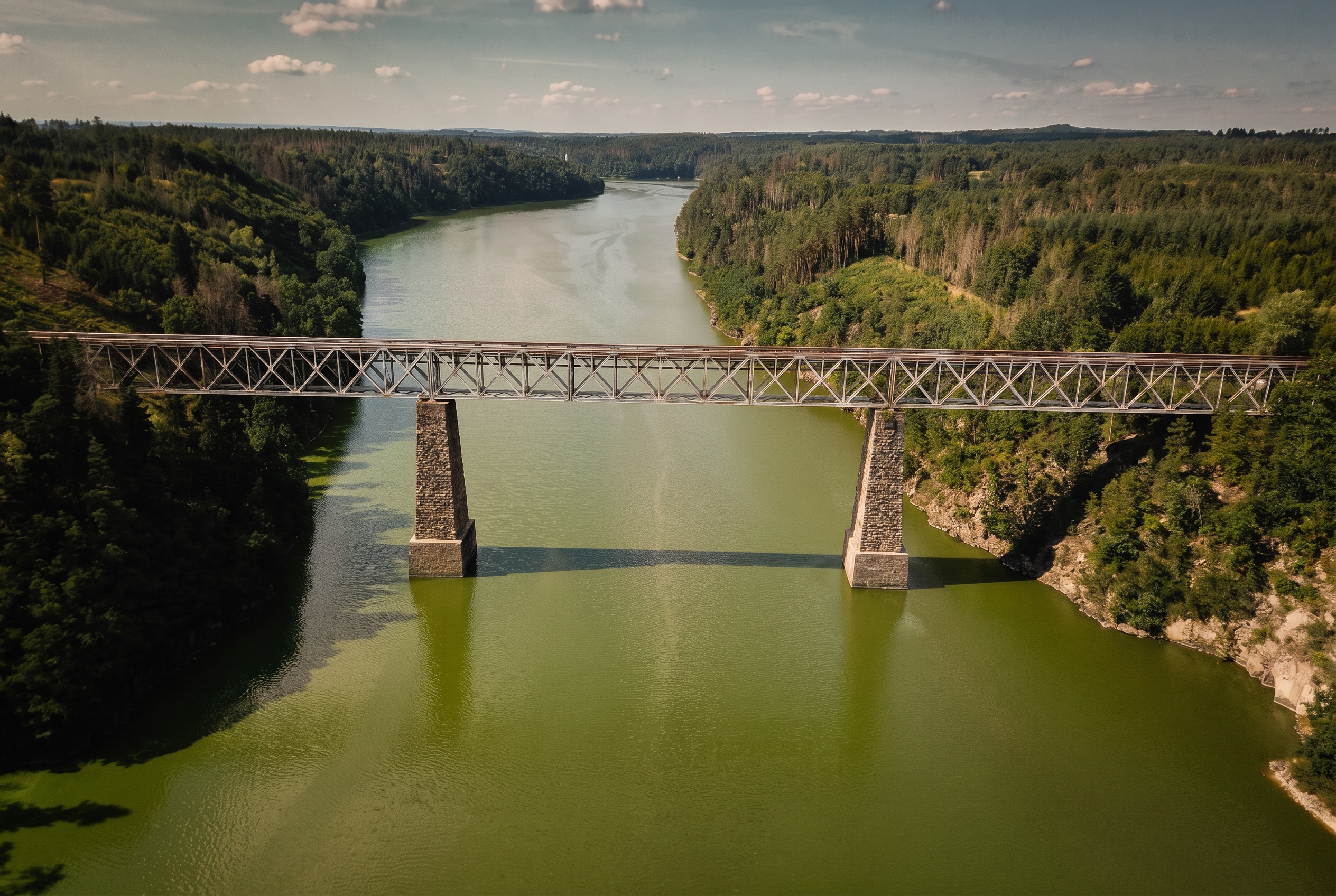
To this intriguing spot you’ll drive 18.8 kilometres and arrive in 22 minutes. Červená nad Vltavou is a historically very significant point, because it’s exactly here that the Vltava enters its deep canyon, and an impressive former railway bridge arches high above the water.
The place served for years as an important ferry crossing and to this day has a “tramping” atmosphere, kept alive by cabin settlements on both banks. The bridge structure is genuinely photogenic, and the view of it from water level is worth the stop.
Today it’s a very popular stop for cyclists and hikers moving along the river. You can sit down nicely, rest and just watch the flowing water and the boats heading on across the reservoir.
22. Vodňany and its ponds
To this town devoted to fishermen it’s 22.3 kilometres, and the journey takes exactly 22 minutes. Vodňany is practically a synonym for the fishing tradition — the famous Secondary Fishery School is based here, and the whole area is threaded with a dense network of beautiful ponds.
In the centre, don’t miss the Vodňany Municipal Museum and Gallery, usually open Tuesday to Sunday, and to be safe check the entrance fee on the website muzeumvodnany.cz. The local museum brilliantly maps the history of pond-keeping that shaped the whole landscape into its present form.
For a family walk I can warmly recommend the V Zátiší educational trail around the local ponds, which is very calm and well maintained. Vodňany is famous for its fishing tradition, and the local carp is a name spoken of far and wide in the best restaurants.
Based on a photo by: Michal Klajban / Wikimedia Commons, CC BY 4.0 · colour edited
South Bohemian towns and full-day destinations
If you don’t mind spending around three quarters of an hour in the car, Písek opens up the chance to visit the very most famous places in all of South Bohemia. Here we’re talking about proper full-day trips.
23. Hluboká nad Vltavou
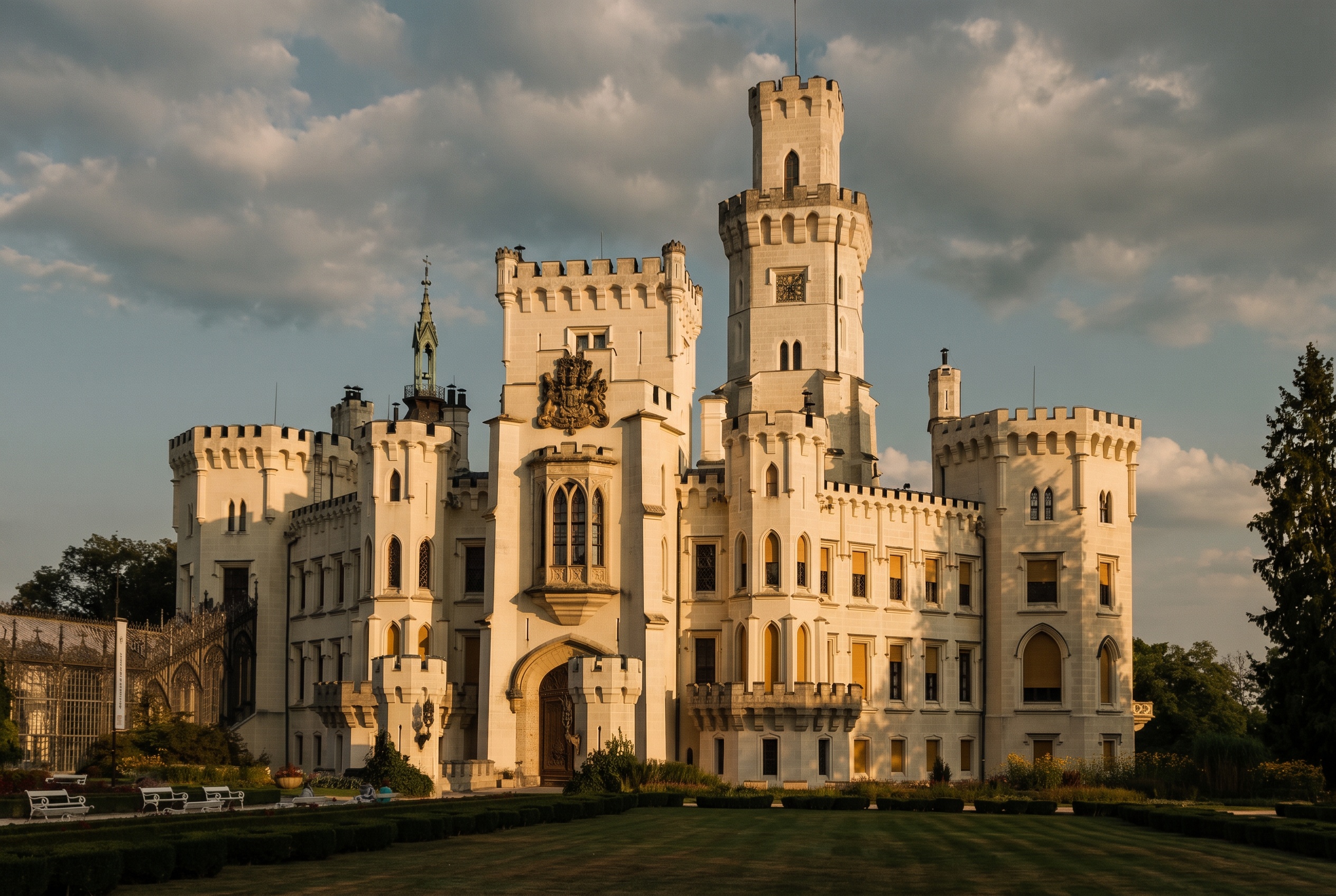
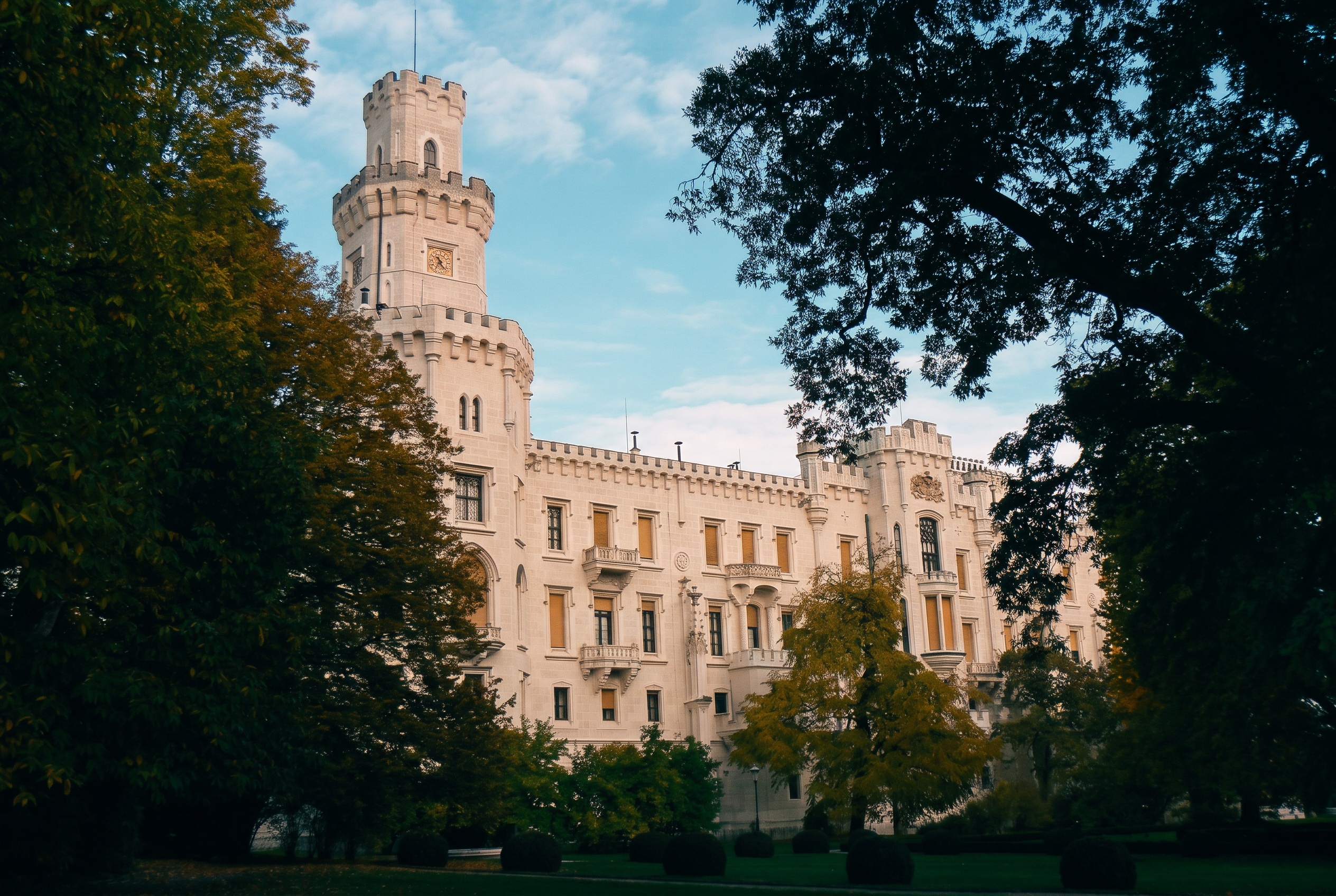
To our most famous chateau it’s 45.1 kilometres, roughly a 42-minute drive. Hluboká is an absolute phenomenon — with more than 28,000 reviews it’s by far the most visited destination in the wider area, and its Tudor Gothic style draws tourists like a magnet.
The confirmed 2026 entrance fee for the basic State Rooms circuit is 300 CZK (about €12.30) for adults, seniors and youth pay 240 CZK (about €9.80) and children 90 CZK (about €3.70). The chateau also offers other routes, such as the private apartments for 220 CZK (about €9), the lookout tower for 180 CZK (about €7.50), or even a special winter route that runs outside the main season too. You’ll find tour bookings and the current price list at zamek-hluboka.cz.
The whole complex is rounded out by the beautiful Aleš South Bohemian Gallery, housed in the former chateau riding hall, and below the chateau you’ll find the excellent Ohrada Zoo. Set aside a whole day for Hluboká, because the chateau tour itself is only part of the programme and the surrounding park can take a long while to explore. There are then enough cafés below the chateau for you to take a break before heading back.
Based on a photo by: VitVit / Wikimedia Commons, CC BY-SA 4.0 · colour edited
24. Tábor
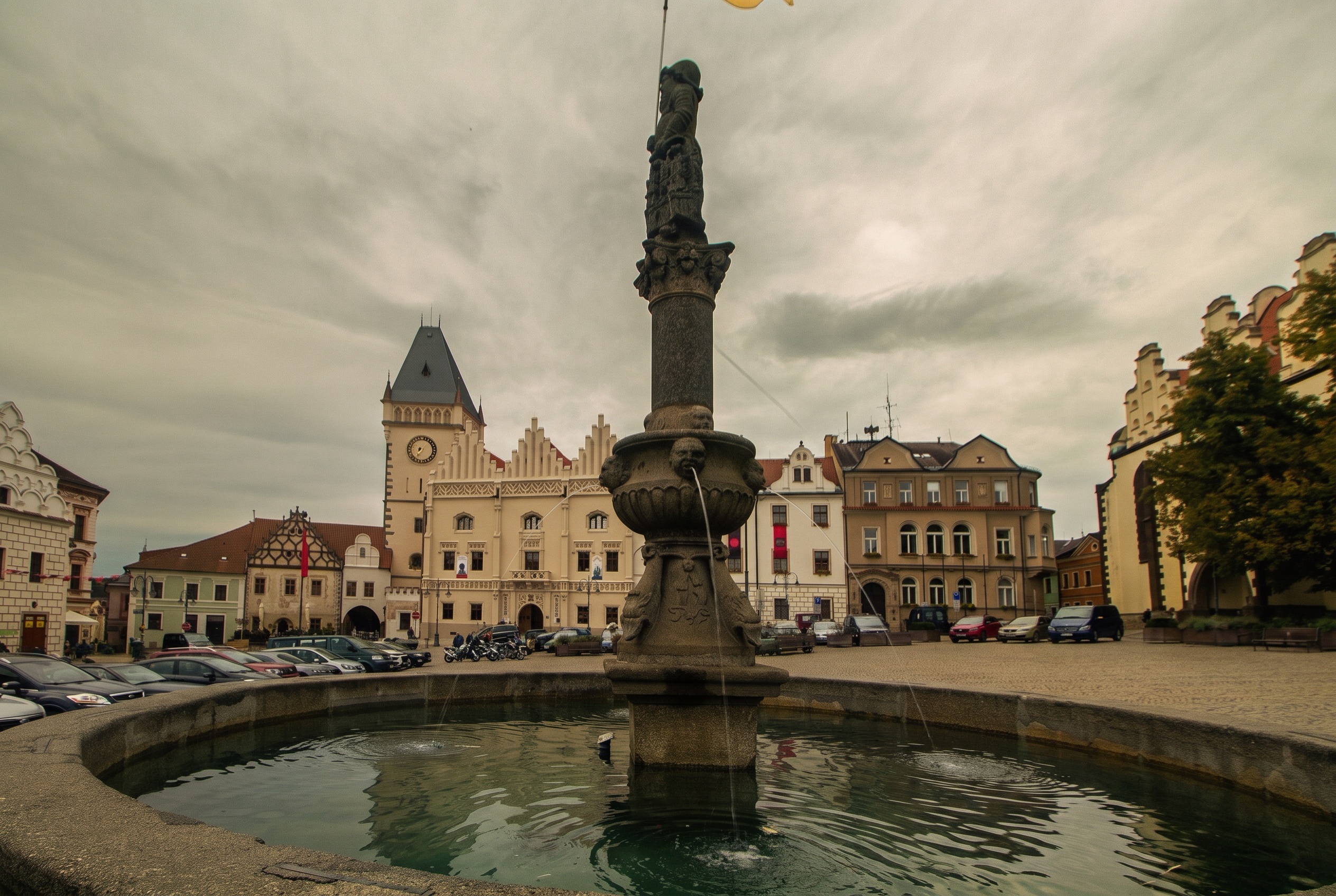
To historic Tábor it’s 46.6 kilometres, and you’ll reach it from Písek in 48 minutes. This town is famous for its Hussite history, and the winding lanes around the massive Žižka Square have a one-of-a-kind charm you’ll simply fall in love with.
During your visit, be sure to head to the excellent Hussite Museum and don’t forget to explore the mysterious Tábor underground, which stretches right beneath the medieval houses. Another big draw is the modern exhibition The Tábor Treasure, which presents valuable historical finds from the region.
The town also thrives on great food, with excellent cafés and vegetarian bistros serving fantastic hummus and fresh salads. Lukáš and I are especially fond of the local lanes that wind up and down, and every time we discover some new little shop or stylish bistro. If the town draws you in deeper, we’ve written a separate article of tips on what to see in Tábor.
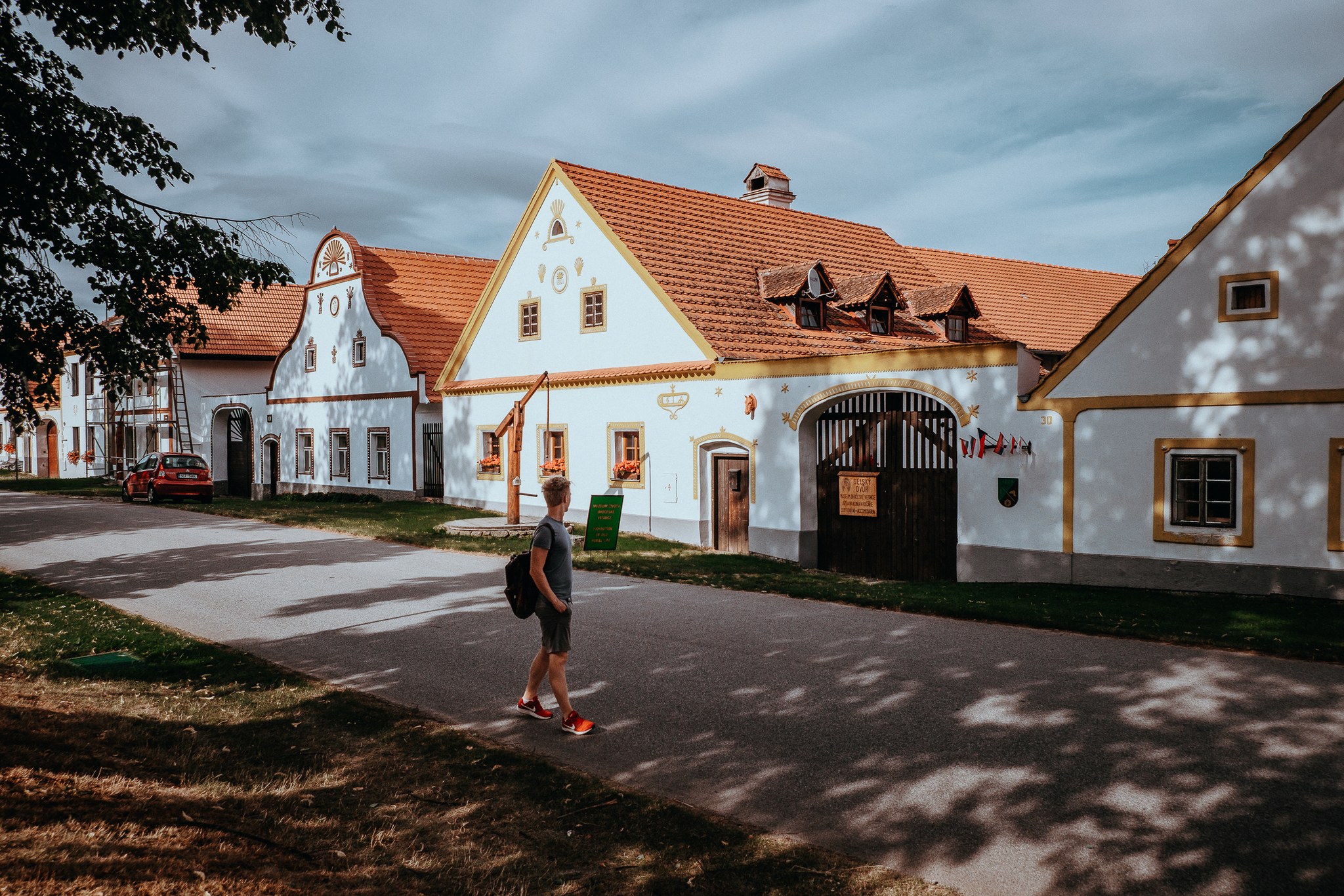
25. Holašovice
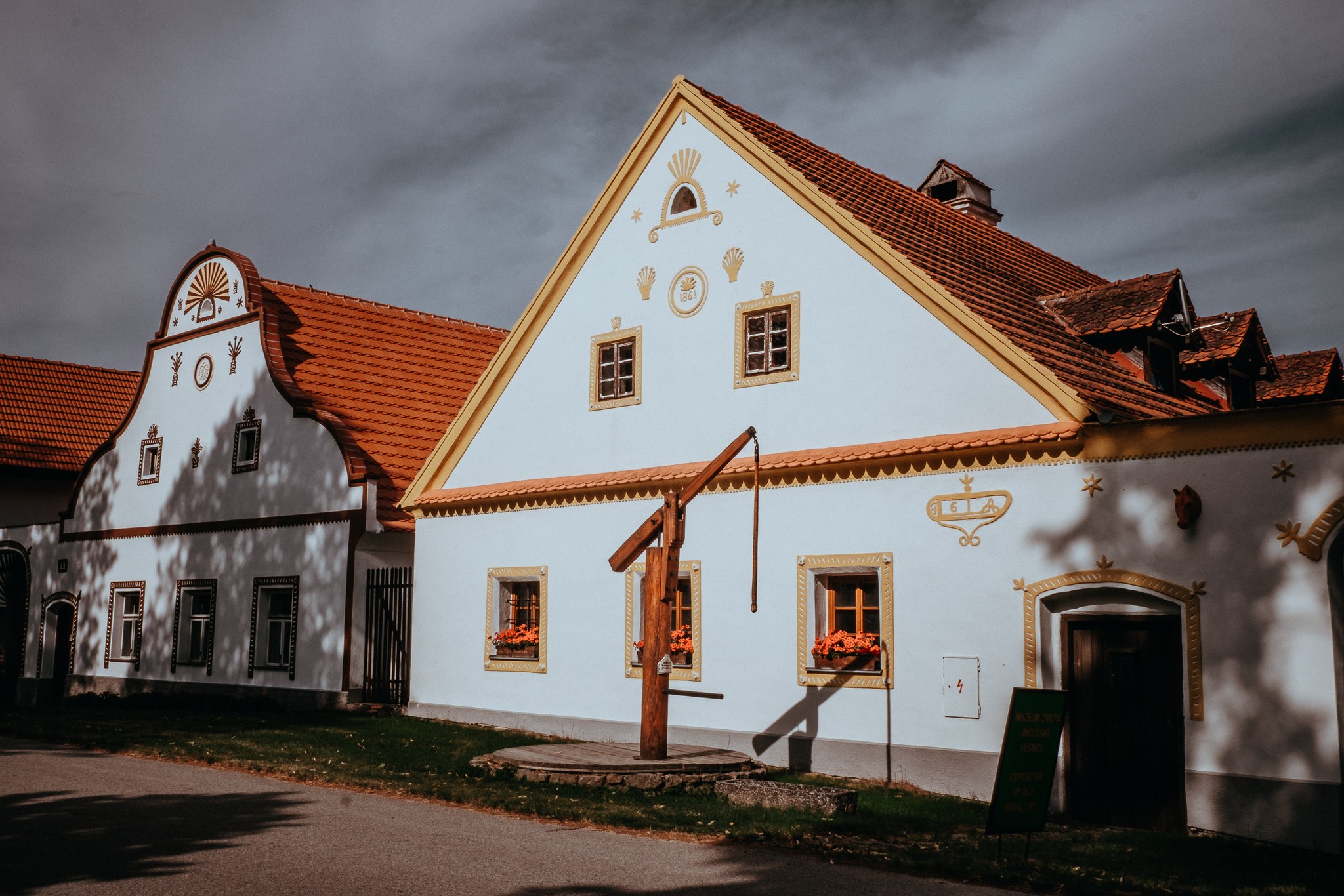
For the Folk Baroque you’ll drive 48.7 kilometres, which works out to a 46-minute drive. Holašovice is rightly inscribed on the UNESCO World Heritage list, and its huge rectangular village green, lined with fairytale-decorated farmsteads, is among the most beautiful sights in our country.
The architecture of the South Bohemian Folk Baroque here is preserved in utterly unique completeness, and it’s no dead open-air museum but a normally living village. You can wander freely, admire the stucco on the gables and soak up the incredibly peaceful atmosphere of times gone by.
During your visit, I recommend stopping at the local café or walking to the nearby Holašovice Stonehenge, a modern megalithic structure on the hill behind the village. Entry to the village is, of course, free — it’s a public space open to all considerate visitors. You’ll find information about the village and its events at holasovice.eu.
As we strolled the green, what we enjoyed most was comparing the gables of the individual farmsteads — each has a different combination of arches, volutes and painted details, even though at first glance the whole green looks uniform. Count on an hour or two, so you don’t have to rush it.
Based on a photo by: Jakub Hałun / Wikimedia Commons, CC BY 4.0 · colour edited
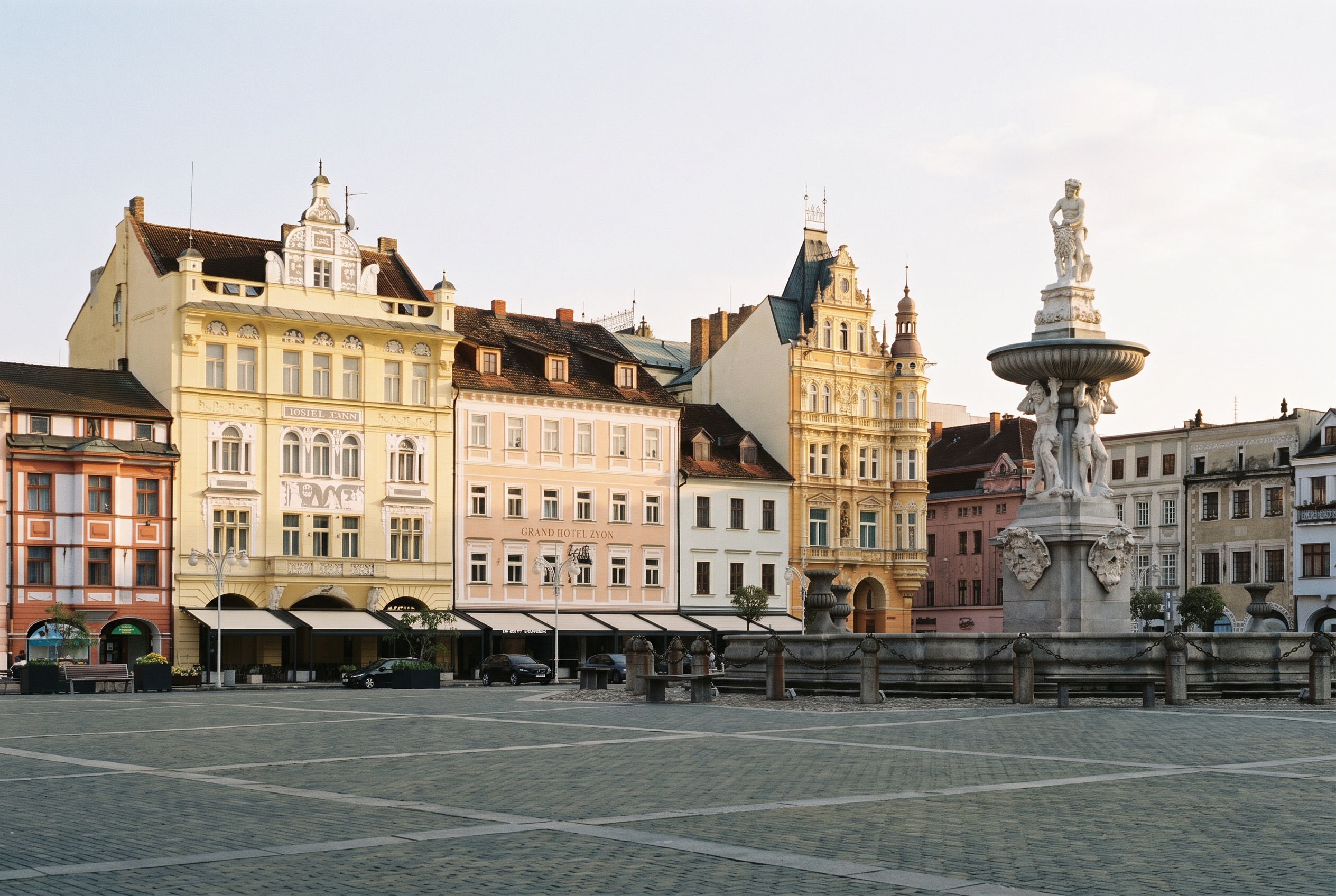
26. České Budějovice
To the South Bohemian capital it’s 51.1 kilometres, and you’ll be there by car in 49 minutes. Budějovice is a lively city dominated by the iconic Přemysl Otakar II Square, one of the very largest square plazas in the entire country, lined with beautiful arcades. What’s great about Budějovice is that you can blend history with shopping and excellent food. Stop on the square for the renowned coffee and soak up that genuine South Bohemian city atmosphere.
Your steps should lead to the top of the famous Black Tower, from where there’s a fantastic view over the whole city and the distant peaks of Šumava. The city is also known for the Budvar brewery and the great bike trails that wind along the banks of the Vltava and Malše rivers right in the centre. You’ll find the Black Tower’s opening hours and event tips on the tourist portal budejce.cz.
If you want to explore the city in more detail and are looking for tips on good food or hidden cafés, be sure to open our detailed guide toČeské Budějovice, where you’ll find everything you need.
Based on a photo by: Chmee2 / Wikimedia Commons, CC BY-SA 3.0 · colour edited
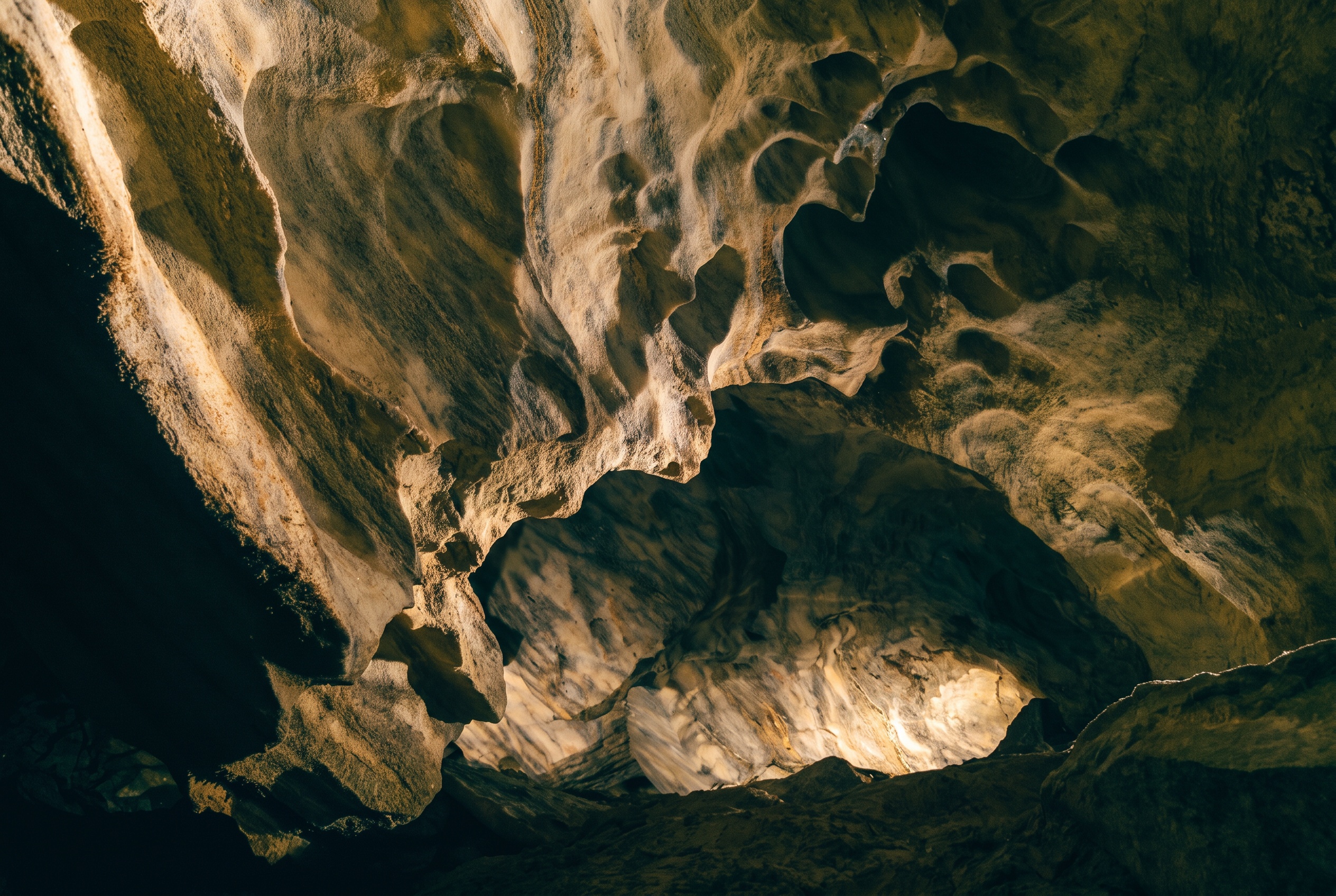
27. The Chýnov Cave
To this underground gem you’ll drive 62 kilometres, roughly a 63-minute journey. The Chýnov Cave is historically the very first cave opened to the public in the Czech lands, back in 1863, and unlike the Moravian Karst you won’t see classic stalactites here.
This cave is fascinating for its steep passages and incredibly coloured marble walls, which play through every shade from white through yellow to deep brown. The tour is a touch more physically demanding due to the many steps, but the experience is definitely worth it.
Since it’s a protected natural formation, always check the current price list and opening hours on the website chynovska.caves.cz, because in winter the cave is traditionally closed to protect the hibernating bats.
Based on a photo by: Jakub Hałun / Wikimedia Commons, CC BY 4.0 · colour edited
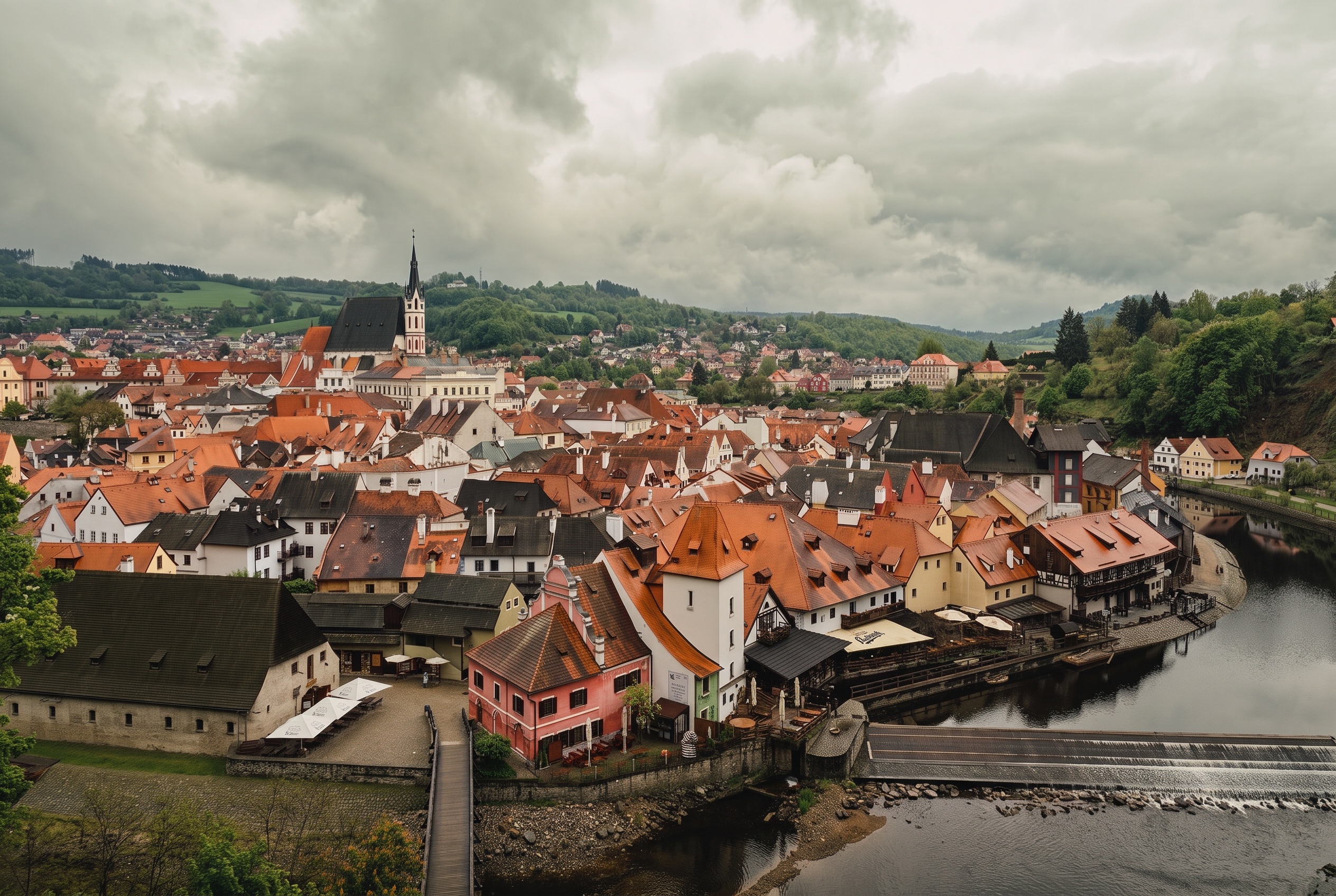
28. Český Krumlov
To our most beautiful town you’ll drive 69.9 kilometres, reaching it from Písek in 68 minutes. Český Krumlov, inscribed on the UNESCO list, needs no lengthy introduction — its Renaissance chateau towering above a bend in the Vltava is known to just about everyone, and a visit is simply a must.
The town is full of winding lanes, historic houses and romantic views around every corner, so you can easily wander here all day. Outside the summer holidays there tend to be somewhat fewer people, which does the medieval town’s atmosphere a huge favour. Even when Krumlov is packed with tourists, it simply has something special about it. We always prefer to get up early and walk the centre first thing in the morning, while most people are still asleep in their hotels. You’ll find the chateau tour routes and entrance fees at zamek-ceskykrumlov.cz.
To plan the trip in full, including parking and the best viewpoints, check out our separate article on whatČeský Krumlov has in store, where we’ve written everything up in detail.
29. Třeboň and the pond landscape
To the heart of the fish-farming country it’s 73.7 kilometres, which corresponds to roughly a 68-minute drive. Třeboň is an incredibly picturesque spa town with a Renaissance chateau and a historic centre surrounded on all sides by the dikes of the famous ponds, headed by the enormous Svět pond.
The flat landscape here is an absolute paradise for casual cyclists and spa guests, and the must-see stops include the monumental Schwarzenberg Tomb, hidden in an English park. Plan the trip for a whole day, because the pace here is infectiously slow and relaxed. You’ll find the chateau tour routes and entrance fees at zamek-trebon.cz.
The cafés on the square are exactly the kind of place where you order one tea and sit there for an hour. And you know what? That’s completely fine, because Třeboň simply sets you to that tempo.
Based on a photo by: Huhulenik / Wikimedia Commons, CC BY 3.0 · colour edited
30. Šumava
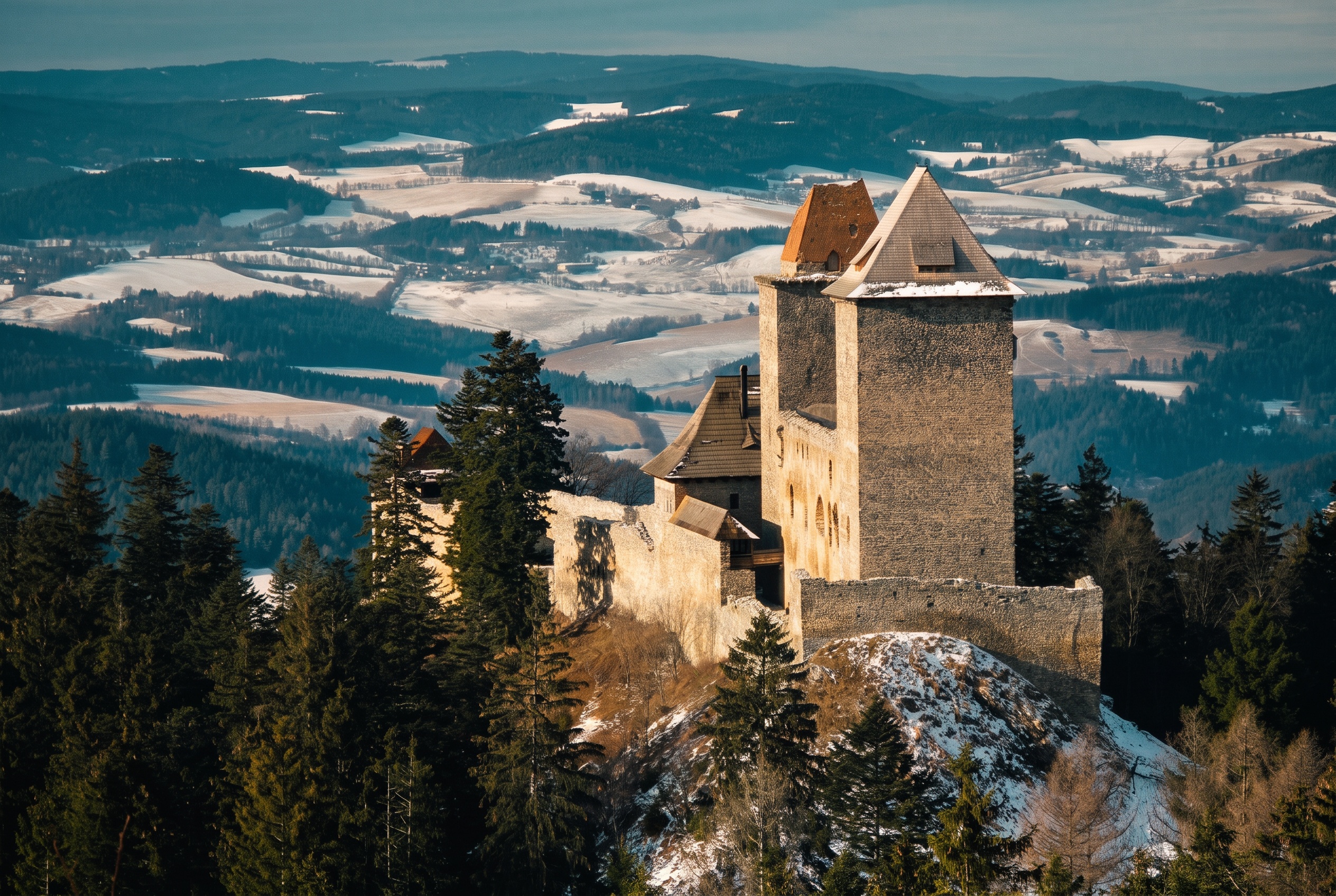
To the nearest edge of Šumava you’ll drive around 40 to 60 kilometres — for example, you’ll reach Prachatice in 44 minutes. The Šumava National Park offers endless hiking possibilities, whether you head for the mysterious Kašperk Castle, the wild Boubín primeval forest, or all the way to the Lipno reservoir.
Kašperk Castle is one of the highest-lying royal castles in Bohemia, and a rating from over nine thousand people says it all. And if you venture a bit further to Lipno, you may as well turn it into a whole weekend — there are easily two days’ worth of attractions there.
For families planning to head into the mountains even with the littlest ones, we’ve put together a very practical article, Šumava with a pushchair, where you’ll find exact routes you can roll along without much trouble even on small wheels.
Based on a photo by: ŠJů (cs:ŠJů) / Wikimedia Commons, CC BY-SA 3.0 · colour edited
What’s open around Písek even off-season
While most state-run castles and chateaux fall into a deep winter sleep from November to March, around Písek you’ll find plenty of places you can happily visit even in the colder months.
The Písek Hills and lookout towers: Nature never closes. Walks on surfaced paths and a climb up the freely accessible Jarník lookout tower are great even in the frost.
The Protivín Crocodile Zoo: The indoor heated pavilions full of reptiles run all year round and make an ideal shelter from the sleet.
Town museums and galleries: The exhibitions in Písek, Tábor or Vodňany are usually open regardless of the summer tourist season.
The big South Bohemian cities: A visit to České Budějovice, Český Krumlov or Tábor is perhaps even more magical outside summer, since you avoid the biggest crowds on the squares.
Winter tours of Hluboká: Hluboká nad Vltavou Chateau is one of the few to offer a special heated winter route, so you won’t miss the aristocratic interiors even in January.
Where to go from Písek without a car
Although a car is an undeniable advantage for exploring the smaller villages, you can take plenty of great trips from Písek without one too. Just bear in mind that you simply can’t reach the popular Zvíkov and Orlík castles by train, since the tracks don’t run there and you have to rely on buses, which don’t run all that often at weekends.
The train connection from Písek is, however, absolutely fantastic for trips to the bigger towns, such as Strakonice, Vodňany, Tábor or České Budějovice, which you reach very comfortably and quickly. The local station has been renovated and connections link up fairly reliably, so a full day of city sightseeing by rail makes a lot of sense.
For cycling lovers there’s a lovely, easy bike trail running straight out of town along the Otava River, along which you can reach many interesting destinations entirely without a motor. If you want to make the trip easier, many regional buses also offer bike transport on special trailers during the summer season.
Where to next
If you’re interested in more tips for travelling around our homeland, or you want to explore Písek truly in depth, take a look at these tried-and-tested guides:
The best choice for a day trip is combining a visit to Zvíkov Castle with a boat cruise to nearby Orlík Chateau. If you’re looking for more urban sightseeing, I definitely recommend heading to historic Tábor with its amazing underground tunnels, or to the romantic Hluboká nad Vltavou Chateau with its adjacent zoo.
Where to go for a weekend in the Písek region?
On weekends, shorter trips to the nearby Písecké hory (Písek Hills) combined with a climb up the Jarník lookout tower and a visit to the U Vodáka game enclosure are very popular. Another beautiful stop is Putim with its petting zoo, or the monumental Podolský Bridge, which offers a fascinating view over the Orlík reservoir.
What to do with kids around Písek?
Families with children absolutely love the Fairy Tale Forge in Selibov, where you can see devils and water goblins, or the newly built Farmapark Maletice with giant trampolines. Another great choice is Krokodýlí ZOO (Crocodile Zoo) in Protivín, which is open year-round and children are usually absolutely thrilled by it.
How far is Zvíkov from Písek?
The majestic Zvíkov Castle lies approximately 26 kilometers from Písek and the drive takes about 32 minutes of relaxed driving. The castle towers on a rocky promontory above the confluence of the Vltava and Otava rivers and represents one of the most popular and beautiful tourist destinations in all of southern Bohemia.
Is there a boat service from Zvíkov to Orlík?
Yes, regular boat service between Zvíkov Castle and Orlík Chateau operates, with boats running in both directions from Tuesday to Sunday. Be aware, however, that boats usually have Mondays off, and I recommend checking the exact schedule and current prices in advance on the carrier’s official website.
What’s the best trip within 15 minutes from town?
In just fifteen minutes you can reach the beautiful village of Putim with its popular petting zoo, or Kestřany, where you’ll find an absolute gem in the form of two preserved medieval fortresses standing right next to each other. Another quick option is Protivín with its clock museum and renowned zoo.
Where to go for free around Písek?
You can visit the Jarník lookout tower in the Písecké hory (Písek Hills) completely free of charge, the freely accessible Naše zvířátka petting zoo in Putim, or the Hussite battle memorial by the ponds in Sudoměř. There’s also no admission fee to the unique outdoor ossuary with painted chapels located in Albrechticích nad Vltavou.
What’s open in the area during winter?
While most state-owned castles and chateaux close outside the summer season, you can visit Krokodýlí ZOO (Crocodile Zoo) in Protivín year-round, as well as the city museums in Tábor and Strakonice, and of course the Písecké hory (Písek Hills). An exception among chateaux is Hluboká nad Vltavou, which offers a special winter tour circuit.
Tips and Tricks for Your Vacation
Don’t Overpay for Flights
Search for flights on Kayak. It’s our favorite search engine because it scans the websites of all airlines and always finds the cheapest connection.
Book Your Accommodation Smartly
The best experiences we’ve had when looking for accommodation (from Alaska to Morocco) are with Booking.com, where hotels, apartments, and entire houses are usually the cheapest and most widely available.
Don’t Forget Travel Insurance
Good travel insurance will protect you against illness, accidents, theft, or flight cancellations. We’ve had a few hospital visits abroad, so we know how important it is to have proper insurance arranged.
Where we insure ourselves: SafetyWing (best for everyone) and TrueTraveller (for extra-long trips).
Why don’t we recommend any Czech insurance company? Because they have too many restrictions. They set limits on the number of days abroad, travel insurance via a credit card often requires you to pay medical expenses only with that card, and they frequently limit the number of returns to the Czech Republic.
Find the Best Experiences
Get Your Guide is a huge online marketplace where you can book guided walks, trips, skip-the-line tickets, tours, and much more. We always find some extra fun there!
TL;DRThe best Christmas markets in Vienna are on Rathausplatz in front of the town hall, with a two-tier ice rink, Eistraum, covering 9,500 m², plus the market by Schönbrunn palace and the grand little village at Belvedere. For something more intimate, try the market by Stephansdom cathedral with around 40 stalls, or the historic Spittelberg quarter with over 120 stalls. For a quieter vibe, head to the lesser-known market at the Gartenpalais Liechtenstein. Markets generally run from mid-November to the end of December, though Schönbrunn and the Prater stay open until 6 January. It’s worth spending at least a full weekend in Vienna — or combining it with a trip to Hallstatt or Salzburg, about 3 hours away.
Thousands of Czechs go to Vienna before Christmas to experience the Christmas atmosphere. There are many locations with Christmas markets in Vienna, and it’s a good idea to plan where you want to go in advance. Find out what the best Christmas markets in Vienna are! 😊
Vienna is beautiful and we think it would be a great shame if you only went to Vienna for a detour. We recommend you spend at least a full weekend in Vienna and explore other sites and historical monuments. What to see in Vienna (apart from the Christmas markets) in our article about Vienna.
Christmas markets in Austria, known as “Christkindlmärkte”, are not only an important pre-Christmas tradition, but also a cultural and social phenomenon with a history dating back to the Middle Ages.
History. century. Originally, they provided a place to buy supplies and ingredients for the Christmas holidays.
Atmosphere and decorations: characterized by a fairy-tale atmosphere with decorations, lights, wreaths and a dominant Christmas tree, creating a festive atmosphere.
Handmade crafts and gifts: you can find handmade crafts such as Christmas ornaments, wood carvings and candles that are ideal for original Christmas gifts.
Culinary delights: you can immerse yourself in the world of traditional Austrian delicacies – from mulled wine and Christmas gingerbread to roasted almonds and various pastries.
Cultural events: the markets often offer a rich cultural programme, including concerts, choirs and theatre performances, which adds to their convivial atmosphere.
Regional diversity: each region in Austria has its own version of Christmas markets. In Vienna, for example, the markets are grand and historic, while in the Alpine regions they are more rustic.
Christmas markets in Austria are a fascinating combination of history, culture, art and gastronomy, and are an unforgettable part of the Advent season.
The most popular Christmas markets and locations in Vienna
The following is a list of the most popular Christmas markets, including opening times and the best things you’ll find there. Because there are so many of them, we have prepared a map of the Christmas markets in Vienna for your reference:
Christmas Market on Rathausplatz
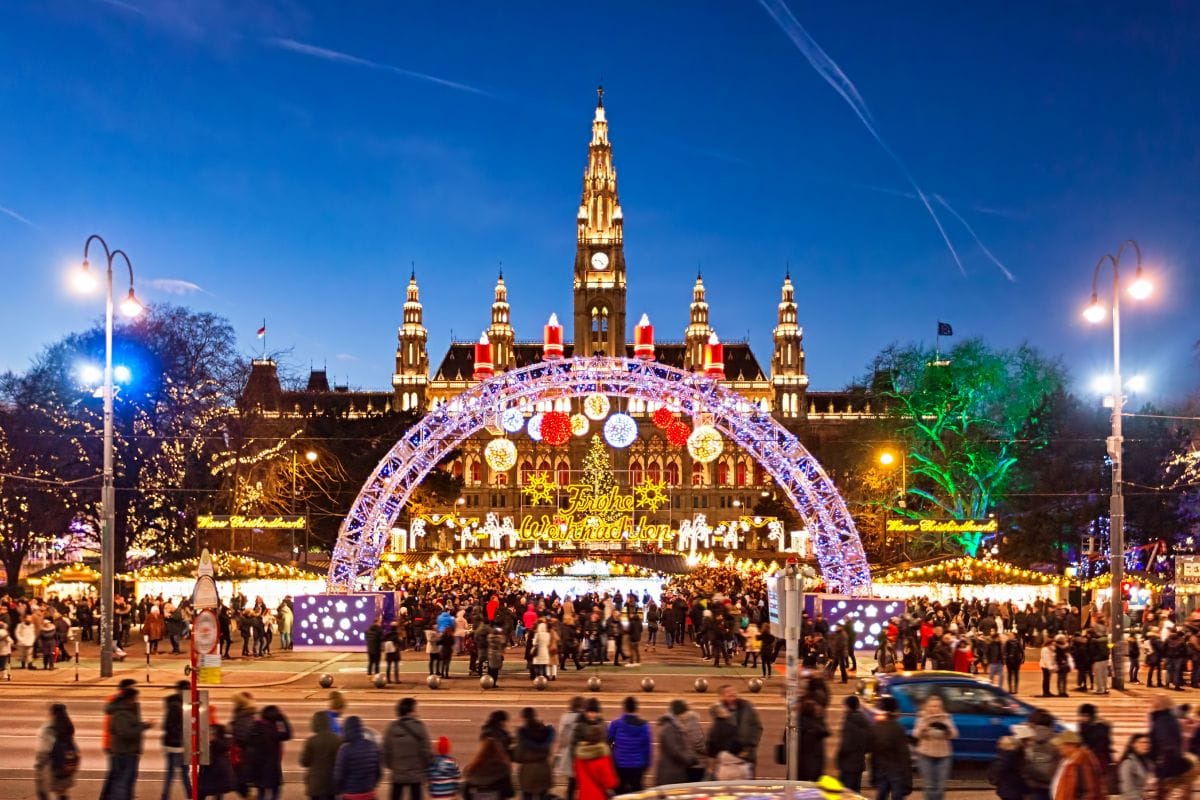
On Vienna’s main square Rathausplatz the largest Christmas market in Vienna is held every year Christkindlmarktwhich is considered one of the most beautiful Christmas markets in Europe.
The Christmas atmosphere is mainly created by the Vienna City Hall and the huge Christmas tree decorated with glowing hearts.
At the Christmas Market you will find the unique two-storey outdoor ice rink Eistraum and the icy paths of the Town Hall Park with a total area of 9500 m².
Children will be attracted by the 12-metre high carousel, reindeer train and a hut with its own ice rink. Everything is surrounded by a large number of market stalls where you can buy all kinds of Christmas decorations, handmade gifts and enjoy a good mulled wine.
The markets on Rathausplatz are more obscure, so expect the biggest crowds here too.
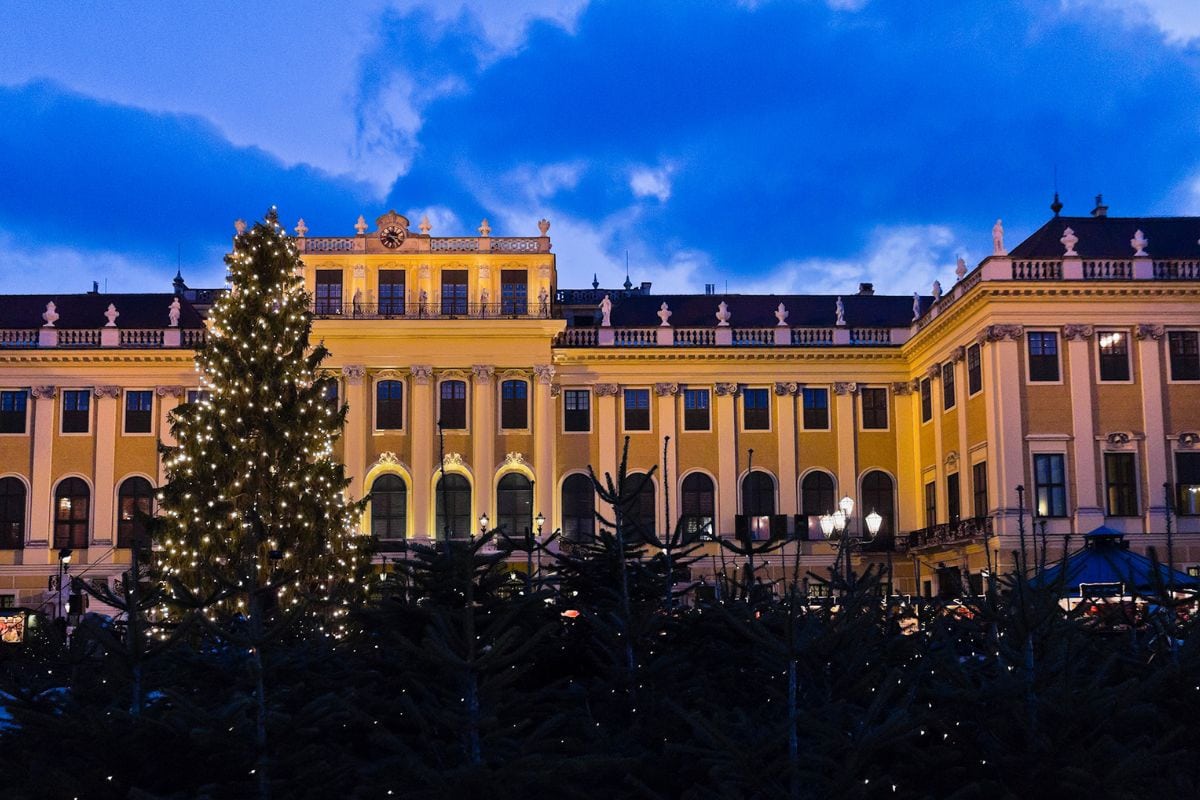
Christmas markets can also be found on the grounds of Schönbrunn Palace . This market is special because it is located in a place that was inhabited by the imperial family. The markets are majestic and many concerts are held here.
There is a Christmas workshop for children where they can make Christmas decorations.
Christmas Village, which is situated in front of a beautiful Baroque castle Belvedere…is famous for its gastronomy and craftsmanship.
The atmosphere of the Christmas market at this castle is unique – a walk through the Advent park around the castle is an unforgettable experience. If you are looking for an escape from the hustle and bustle of the city, Belvedere is the ideal choice. It is close to the centre, but far enough away to relax in the Christmas atmosphere.
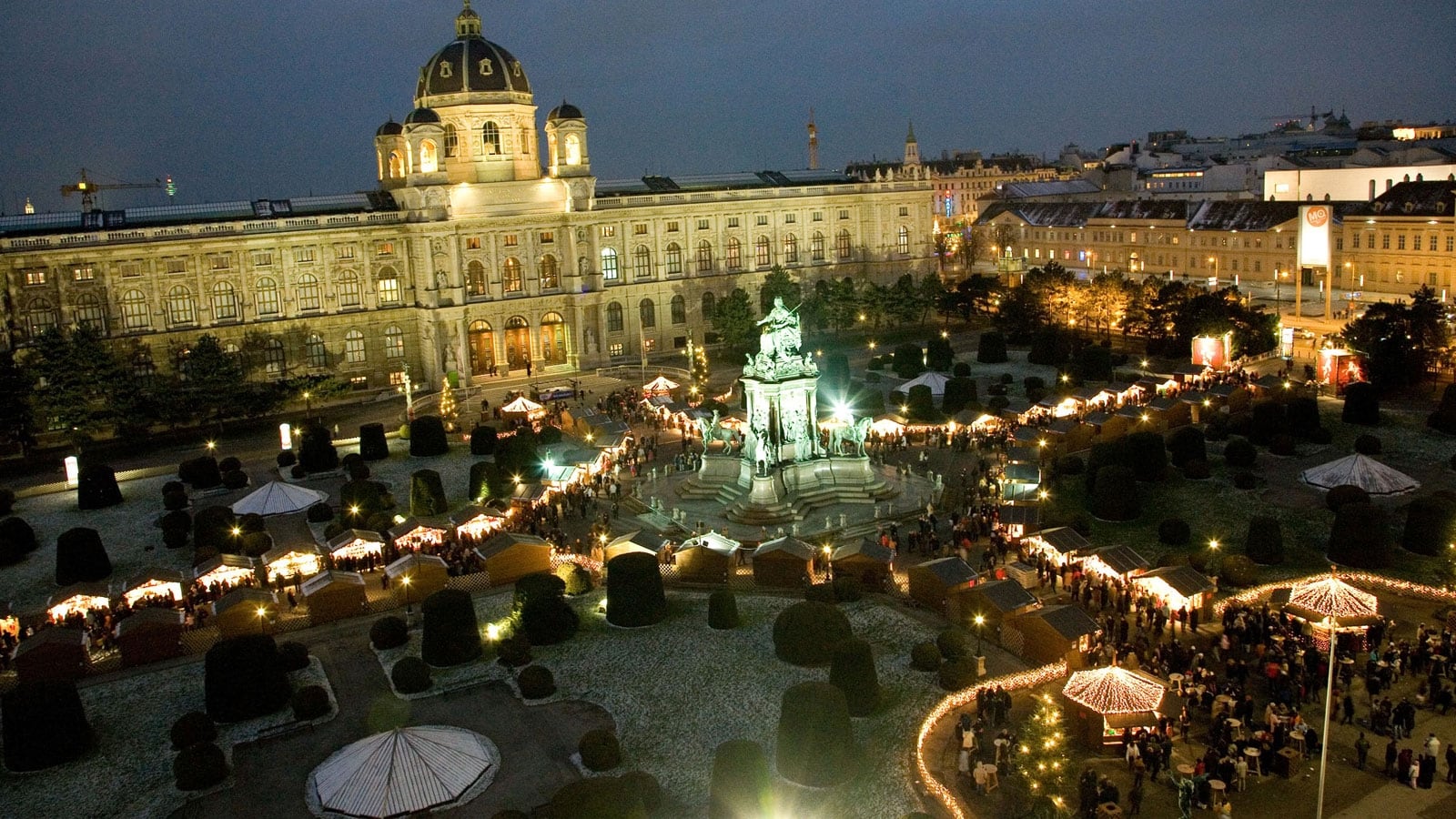
From Rathausplatz you can walk to the Christmas Village on Maria Theresia Square. This village is situated in the area between the Art History and Natural History Museum buildings, which are built in neo-Renaissance style.
Walking around the beautifully lit square, you will discover stalls full of handicrafts, original Christmas gifts and tempting gastronomic specialties. (like every square in Vienna 😂)
Stephansdom, the Gothic cathedral in the heart of Vienna, is a beautiful landmark that should not be missed when visiting Vienna (winter or summer).
This imposing building is located in the Innere Stadt (Inner City) and is not to be missed. The Christmas market, which takes place in its immediate vicinity, is smaller, but this is what gives the whole place an intimate and cosy atmosphere. Around Štěpánské náměstí there are typical Old Town houses, including the one where Mozart once lived.
Looking for a quieter Christmas atmosphere? Then the markets in Liechtenstein Palace than the markets in the city centre.
As this is a relatively new event, only the third time it has been held, these markets are less well known and therefore not as crowded with visitors. Although these markets are smaller, they offer a wide selection of goods and refreshments. In addition, a charming historical carousel awaits the youngest visitors.
The Old Vienna Christmas Market on Freyung Square is one of the most traditional and oldest Christmas markets in Vienna. These markets have a long history dating back to 1772 and are known for their authentic atmosphere that reflects the historical character of Vienna.
The market has been taking place on Am Hof Square since 18. century and the historical atmosphere of this tradition still prevails here today. Advent there is one of the most authentic and offers a rich cultural programme.
Christmas Village on the campus of the University of Vienna
During December, the courtyard University of Vienna transforms into a Christmas village. There are approximately 50 stalls and the opportunity to play curling.
A stroll through the historic Biedermeier district is a fascinating experience at any time of the year, but in December its atmosphere becomes even more magical.
With over 120 Christmas stalls offering everything from jewellery to warm jumpers, this area is the perfect place for Christmas shopping. And while you’re enjoying your roasted almonds, you’re sure to come across the perfect Christmas gift.
Winter market at the Giant Wheel on Riesenradplatz
Der Prater rockt aneb Prater jede. This is the motto of this year’s Christmas market at the Giant Wheel in Prater. The well-known amusement park has prepared a rich musical programme for you: every Thursday, Friday and Saturday there will be a live concert at 19:00. You can look forward to a variety of genres from rock to gospel. You can sway to the rhythm with a mulled wine in hand while your children enjoy the various attractions.
Christmas Village Alm Advent will captivate you with its rural charm. As you enter, you will be surrounded by the smell of old wood from the rustic farmhouses, where delicacies from local producers await you. Almadvent emphasizes traditional crafts, handmade products and authentic cuisine. There are a number of activities for children, including a special room for little tinkerers. Enjoy the atmosphere of a pleasant rural idyll amidst the urban bustle of Vienna.
Ottakringer Weihnachtszauber (The Magic of Christmas)
From Thursday to Sunday, the Ottakringer Brewery courtyard hosts an unusual Christmas market with creative crafts and fun activities. You can visit demonstrations of the craftsmanship of glassmakers, carvers and candle makers, take part in interesting workshops or try your hand at curling. This Christmas market offers fun for both children and adults, who can enjoy a unique beer punch.
Across all of the city’s markets, you’ll find plenty of stalls selling a variety of goods and treats:
Handicrafts and art
At the markets you will find stalls full of quality handicrafts and original art. You can look forward to handmade jewellery, ceramics or wooden toys, where each piece has its own story.
Traditional Austrian delicacies
Forget the boars, you can find them in Austria too, but especially at the markets you will find many traditional delicacies:
Mulled wine (Glühwein): red or white wine flavoured with spices such as cinnamon, cloves, orange peel and sugar.
Punch: another popular warming drink, often made with rum or amaretto and various fruit flavours.
Roasted almonds and nuts: these sweetly spiced and caramelised treats are perfect for snacking while browsing the markets.
Christmas gingerbread (Lebkuchen): a traditional spiced pastry, often decorated with colourful toppings and decorations.
Sausages (Würstel): various types of sausages such as bratwurst, weisswurst or kasekrainer, served with mustard and bread.
Austrian pastries: a variety of pastries, including the popular vanilla rolls (Vanillekipferl) and Linzer Augen (Linzer Augen).
Maroni (roasted chestnut): Warm, slightly sweet roasted chestnuts are an ideal way to warm up in cold weather.
Kaiserschmarrn: A sweet pancake, torn into pieces and served with fruit compotes or sugar.
Gifts and decorations
For Christmas lovers, the stalls with gifts and decorations are a paradise. In Vienna, you can shop for beautiful Christmas decorations, candle holders or Advent wreaths to add a touch of festive splendour to your home.
How to get to Vienna: by car, tour or car?
You can easily get to the market by bus from Prague or Brno ( FlixBus runs there) or with a tour, which you can easily find through the portal Invia. If you arrive in your own car, it is good to know that parking options may be limited due to high demand.
How to get to the Christmas markets within Vienna
By bus: Vienna has an extensive public transport network. If you choose to take the bus, look for lines that stop near the main marketplaces. For Rathausplatz, where some of the most famous markets are held, look for lines that take you directly to this stunning square.
Stephansplatz: For markets in this area, you can use the metro and get off at the Stephansplatz station of the same name, which is part of the U1 and U3 lines. From here it is only a short walk.
Spittelberg: If you want to visit the markets at Spittelberg, you can also use the underground – look for the Volkstheater station on lines U2 and U3, which is within easy reach of this area.
Karlsplatz: The ideal underground station to visit the market on Karlsplatz Square is Karlsplatz, which serves lines U1, U2 and U4. From this station, it’s just a short walk to the magical stalls and Christmas atmosphere.
Christmas markets Vienna: where to park
In central Vienna, parking is usually charged and it is often difficult to find a free space. Here are a few options to deal with this problem:
Parking zones: the centre of Vienna is divided into several parking zones where parking is charged. Parking tickets can be purchased at newsagents or via the mobile app. Parking time is often limited to 2 hours.
P+R Parking: As an alternative to parking directly in the city centre, P+R (Park and Ride) car parks are located at metro stations on the outskirts of the city. From here, you can easily travel by metro to the city centre.
Garages and underground parking: There are also several paid garages and underground car parks in central Vienna. These options are more expensive but offer greater comfort and safety. Search via Google Maps.
Mobile parking apps: There are apps that help you find a free parking space and allow you to pay your parking fee electronically. More about the app below.
Vienna parking app HandyParken
You can use the mobile app to pay for parking in Vienna “HandyParken“. This app is widely used throughout Austria and allows you to conveniently pay for parking via your mobile phone. The app is available for both Android and iOS devices.
HandyParken features include:
Easy payment of parking fees: You can quickly and conveniently pay for parking without having to find a parking meter.
Overview of parking tariffs: The app shows the current parking tariffs for different zones.
Warning before parking time expires: The app can alert you before your parking ticket expires.
Frequently Asked Questions
The Christmas markets in Vienna are one of the main tourist attractions of the winter season. Here you will find answers to frequently asked questions to help you plan your visit better.
What are the best Christmas markets in Vienna for 2023?
The best Christmas markets in Vienna for 2023 include the Christmas Market on Stephansplatz, where around 40 stalls offer Austrian traditions and products, and the Christmas Market at the Spittelberg, known for its distinctive charm and artistic products.
What attractions can I expect at the Christmas market at the Rathausplatz in Vienna?
At the Christmas market near the town hall you can expect a lavishly decorated tree, various craft stalls, festive decorations and a wide range of traditional Austrian delicacies, including a large ice rink.
Is it possible to visit the Christmas markets in Vienna and Salzburg in one trip?
Yes, it is possible to plan a trip to include the Christmas markets in Vienna and Salzburg, which are approximately 3 hours apart by train or car.
Where can I park near the Christmas markets in Vienna?
For parking near the Christmas markets, it is best to use the parking houses or reserved parking zones in the city. Keep up-to-date on parking restrictions and available spaces.
🔗 These are affiliate links — they don't change your price and help us create content. · All experiences →
Tips and Tricks for Your Vacation
Don’t Overpay for Flights
Search for flights on Kayak. It’s our favorite search engine because it scans the websites of all airlines and always finds the cheapest connection.
Book Your Accommodation Smartly
The best experiences we’ve had when looking for accommodation (from Alaska to Morocco) are with Booking.com, where hotels, apartments, and entire houses are usually the cheapest and most widely available.
Don’t Forget Travel Insurance
Good travel insurance will protect you against illness, accidents, theft, or flight cancellations. We’ve had a few hospital visits abroad, so we know how important it is to have proper insurance arranged.
Where we insure ourselves: SafetyWing (best for everyone) and TrueTraveller (for extra-long trips).
Why don’t we recommend any Czech insurance company? Because they have too many restrictions. They set limits on the number of days abroad, travel insurance via a credit card often requires you to pay medical expenses only with that card, and they frequently limit the number of returns to the Czech Republic.
Find the Best Experiences
Get Your Guide is a huge online marketplace where you can book guided walks, trips, skip-the-line tickets, tours, and much more. We always find some extra fun there!
TL;DRDresden’s Christmas markets run from 26 November to 24 December 2025, daily from 10am to 9pm (2pm on Christmas Eve), spread across several spots in the city. The main and oldest is Striezelmarkt on Altmarkt square, celebrating its 591st year and drawing over three million visitors annually. Other favourites include the cosier market at Neumarkt by the Frauenkirche, medieval festivities at the Stallhof, and the modern Augustusmarkt with its ferris wheel by the Goldener Reiter statue. A day trip is enough to get a taste, but a weekend gives you the full experience. Entry to the markets is free, and mulled wine costs 5 euros.
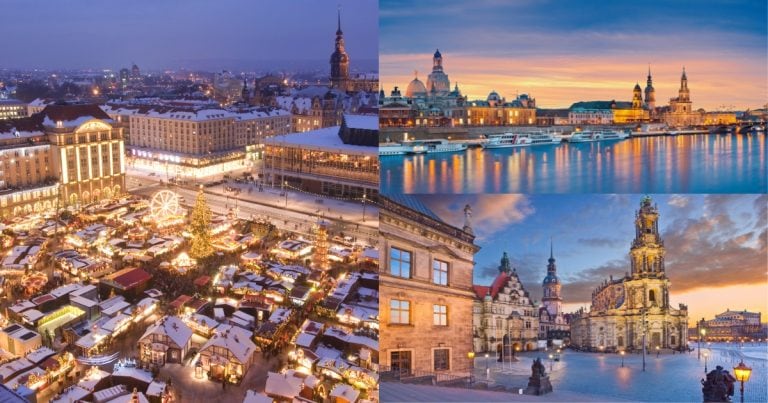
If you love Christmas markets but are tired of always heading to Vienna or Nuremberg, why not visit the Dresden Germany Christmas market scene? In this article, you’ll discover where to find the best Christmas markets in Dresden, what to buy, and where to park.
This year’s Christmas markets are truly worth the trip — in 2025, the main market celebrates an incredible 591 years of existence.
Dresden Germany Christmas Markets 2026: Where are the best Advent markets?
Dresden Germany Christmas Market: History and Tradition
The Christmas markets in Dresden, Germany, known as the Striezelmarkt, are deeply rooted in the city’s history and evoke the traditional atmosphere of Advent celebrations.
The history of the Striezelmarkt dates back to the Middle Ages, when Saxon Elector Friedrich II and his brother Duke Sigismund authorised the market to be held in 1434. This market takes place on Altmarkt square.
Despite their long history, the Christmas markets have preserved the spirit of the original tradition, something the Germans are rightly proud of.
TIP: Dresden Germany Christmas markets — organised tours: various tour operators run trips to Christmas markets in Germany. Check out the offerings on GetYourGuide.
When Are the Christmas Markets in Dresden: Opening Hours
When do the Christmas markets in Dresden take place:
The Christmas markets begin on 26 November and end on Christmas Eve, 24 December. Some markets continue until 6 January.
Opening hours:
Markets are open daily from 10:00 to 21:00.
On Christmas Eve, they are open from 10:00 to 14:00.
Best Christmas Markets in Dresden Germany
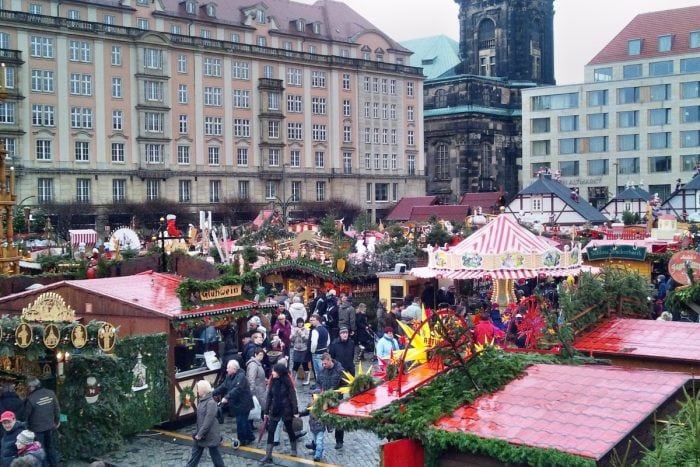
The Advent markets in Dresden aren’t limited to the aforementioned Altmarkt. You’ll find them scattered all across the city — some smaller, some larger, some more romantic, modern, or traditional.
The Advent markets in Dresden have a rich tradition and have become one of the top destinations for lovers of Christmas atmosphere from all over Europe.
The best Christmas market in Dresden is the Striezelmarkt
How Long to Spend at Dresden Christmas Markets?
Although one full day is enough for the Christmas markets, we recommend going for a weekend so you can also attend local concerts, soak up the magical evening Christmas atmosphere, and perhaps book an Advent dinner cruise on the river (more details below).
On top of that, you can do some Christmas shopping for gifts or pick up some German specialities that are often cheaper than back home.
TIP: Don’t forget travel insurance — SafetyWing could come in handy.
Where to Stay in Dresden: Best Hotel Tips
Stay in the city centre so you don’t have to worry about getting back to your hotel in the evening. One of the best hotels is Hotel Suitess, which tends to book up quickly. If it’s fully booked, check availability at Townhouse Dresden. You can also browse more options on Booking.com.
The Best Christmas Market in Dresden is Striezelmarkt
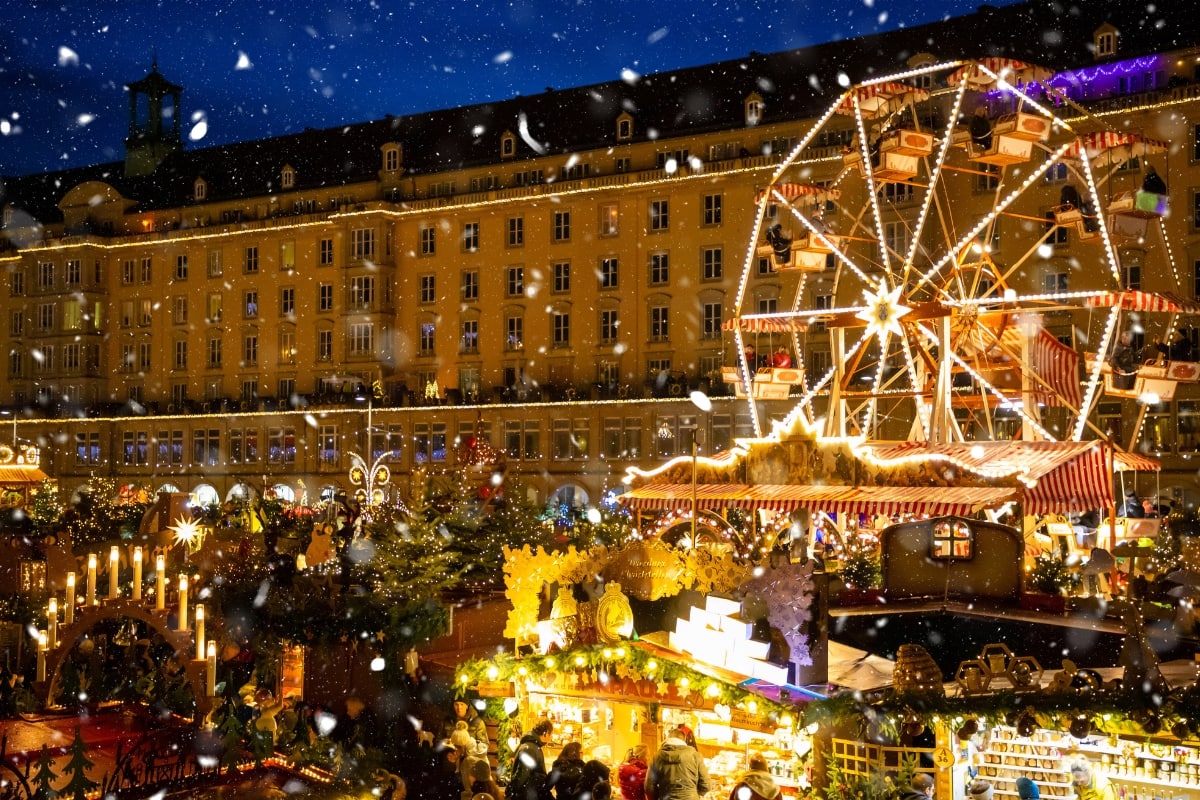
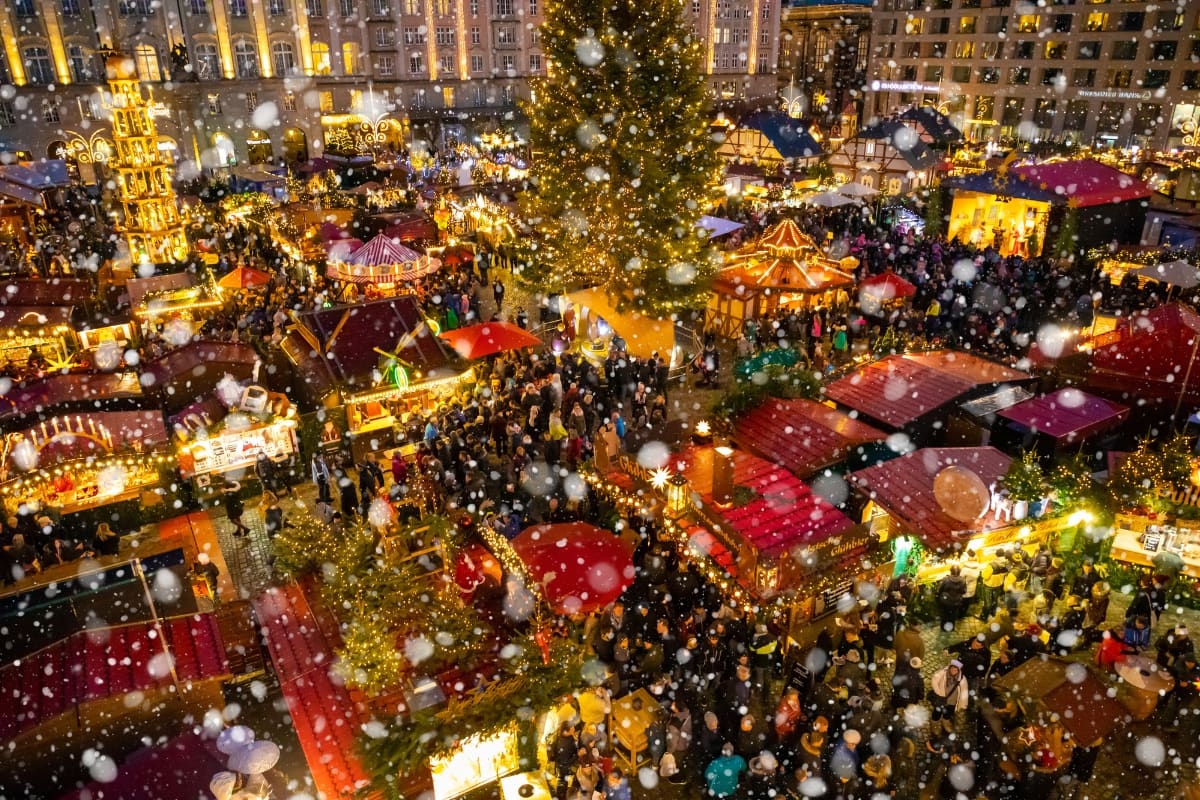
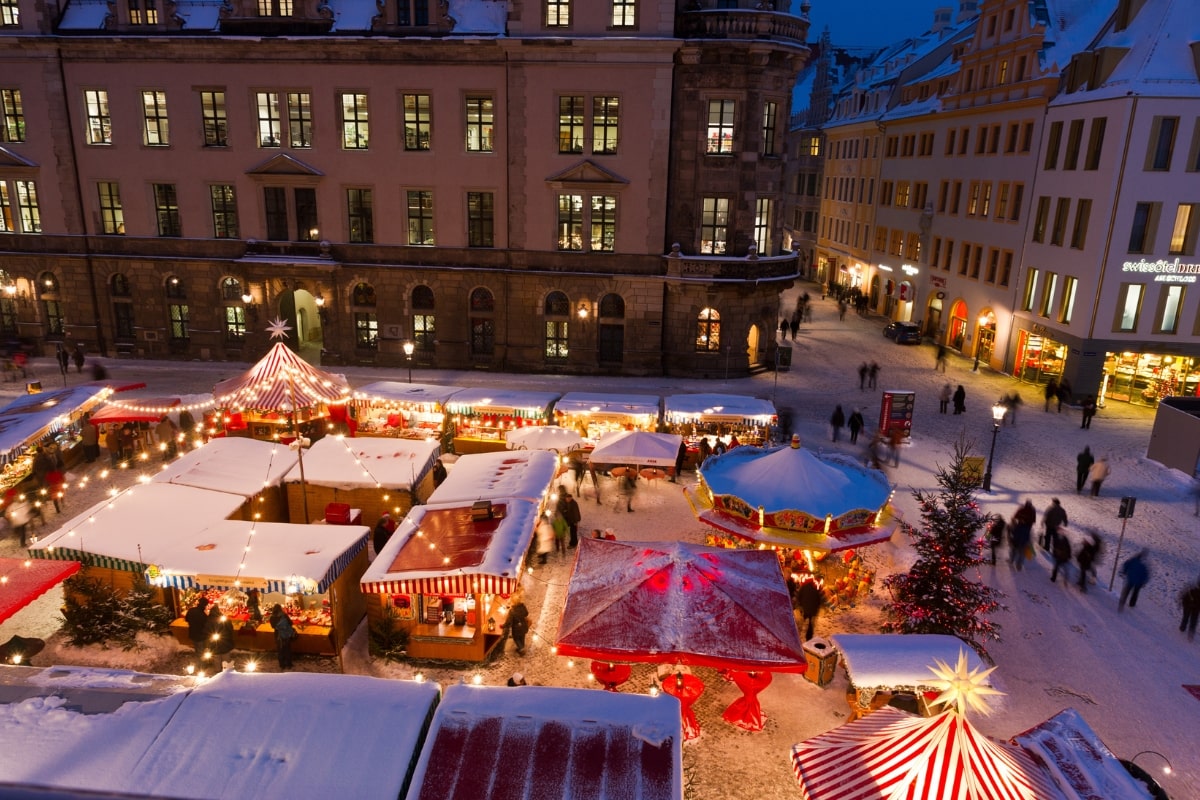
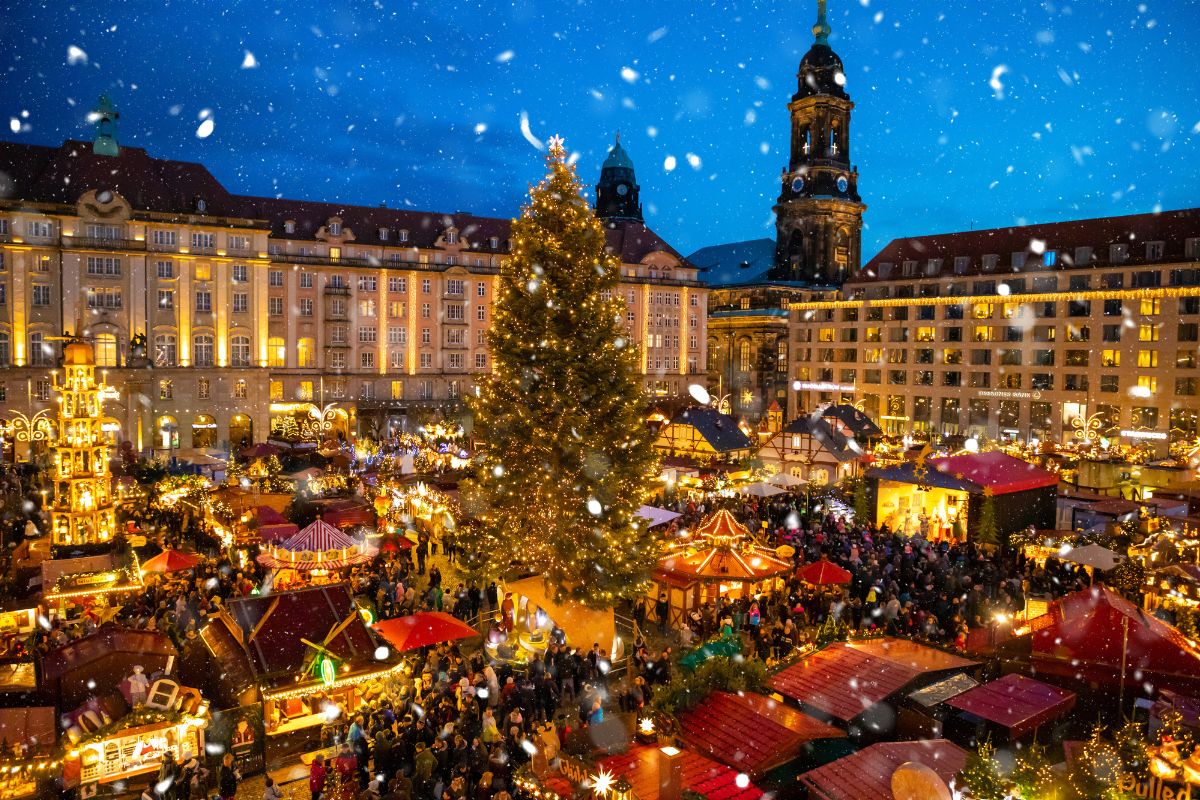
We’ve already mentioned Altmarkt — this is where Dresden’s most famous Christmas market, the Striezelmarkt, takes place. As noted above, this market boasts a tradition stretching back nearly 600 years. That alone makes it unmissable.
It’s somewhat busy, but it’s also the largest and most famous market in Dresden, regularly attracting three million visitors.
You’ll find a wide range of Christmas decorations and gifts here, from classic woodcarvings from the Vogtland region to modern designer pieces. The daily cultural programme is packed with live performances and activities for children, including the arrival of the Christkind (Christ child).
Dates: 26.11. – 24.12.2025
Open: 10:00–21:00, first day from 16:30, 24.12. until 14:00
Location: Altmarkt
Transport: Tram 8, 11 to Prager Str. or tram 3, 7 to Pirnaischer Pl.
Neumarkt – Less Commercial Advent Markets in Dresden
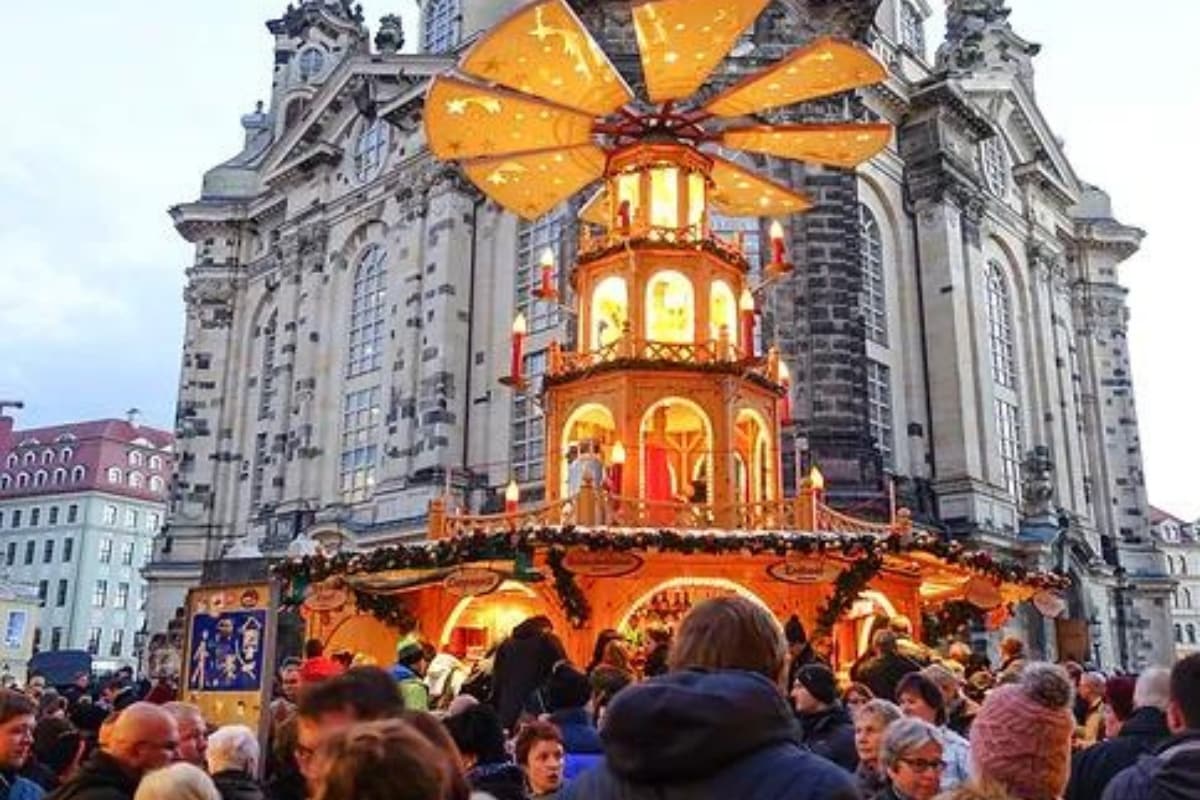
At Neumarkt, located right next to the famous Frauenkirche, you’ll find intimate Christmas markets that offer an authentic and less commercial atmosphere. They’re ideal for those seeking something a little different yet still representative of Saxony.
Neumarkt – less commercial Advent markets in Dresden
Here you’ll find handmade products and authentic Christmas decorations. These markets are known for their pleasant, calmer atmosphere compared to the bustling Striezelmarkt.
Dates: 26.11.2025 – 5.1.2026
Open: 11:00–22:00, closing day 11:00–18:00, closed on public holidays
The Stallhof, once part of the ducal court, transforms into a venue filled with medieval celebrations during Advent. Visitors come here not just for Christmas goods, but mainly for knights, fire shows, and historical and musical performances. Children absolutely love these markets.
Stallhof and medieval celebrations
Dates: 26.11.2025 – 23.12.2025
Open: 11:00–21:30, last day until 18:30, closed on public holidays
If you love a romantic atmosphere filled with the scent of mulled wine and Christmas treats, then you shouldn’t miss the market at the Frauenkirche. A wonderful experience of artisan crafts and traditional delicacies is guaranteed.
Dates: 26.11. – 24.12.2025
Open: 10:00–21:00, Fridays and Saturdays until 22:00
Romantic Christmas market at the castle – Dresden Christmas markets
Modern Christmas Market Augustusmarkt
The Augustusmarkt is the second-largest Christmas market in the city, but it’s a bit different from the traditional ones we’ve described above. It aims to present Advent markets with a modern twist.
It features a fresh and very contemporary design, and its approach to food is equally progressive. This place is a true paradise for lovers of great gastronomy and street food.
You’ll find the Blue Tree in the centre of the market, a glowing Christmas fir on Gomondai-Platz, and a huge Ferris wheel near the Goldener Reiter statue, offering fantastic views of the historic city centre.
What to Buy at Dresden Markets: Food, Drinks, Souvenirs and Gifts
At the Christmas markets in Dresden you’ll naturally find many treats that are common across German Advent markets. But there are some unique specialities you simply must try. Here’s what to taste in Dresden:
Glühwein (mulled wine) and Punsch (punch) – classic Christmas market staples. Time to compare whether the Germans make it better than the Austrians! 😉
Stollen – a traditional German Christmas cake. Inside you’ll find dried fruit and nuts, and the top is dusted with powdered sugar. There are several varieties, including Marzipanstollen (with marzipan) and Christstollen, a special Christmas version. Stollen is not only popular at the Christmas markets but is also commonly given as a Christmas gift and is part of traditional festive celebrations in many German households.
Pflaumentoffel – small figures made from marzipan or baked prunes that symbolise good luck.
Lebkuchen – German gingerbread, often decorated with almonds, chocolate, or sugar icing.
Pfeffernüsse – similar to gingerbread but heavily spiced and coated in sugar rather than icing.
Zimtsterne – cinnamon stars, a beloved type of Christmas biscuit known for their rich cinnamon flavour and soft texture.
Vanillekipferl – vanilla crescents that originate from Austria but are well known throughout Central Europe, including Bavaria and wider Germany.
Bratwurst – grilled German sausages, often served with mustard and bread.
Glühwein – hot spiced wine, perfect for warming up on cold winter days.
Reibekuchen – German potato pancakes, usually served with apple compote or sour cream.
Schweinshaxe – roasted pork knuckle, often served with potatoes or sauerkraut.
Flammkuchen – a thin, crispy pizza-like dish with various toppings, including bacon, onion, and cream.
Heiße Maronen – hot roasted chestnuts, a popular street food at the Christmas markets.
What to Buy at the Christmas Markets in Dresden
At the Christmas markets in Dresden you can buy:
Ceramic products – Christmas ornaments, mugs, and plates.
Wooden toys – puzzles, figurines, and nativity scenes.
Glass ornaments – hand-painted baubles and bells.
Textile goods – hand-sewn winter clothing and accessories.
Tips for Other Activities in Dresden During Advent
Stay overnight in Dresden and treat yourself and your partner to a romantic Advent evening by going on an evening dinner cruise on the River Elbe. You can easily book this experience through GetYourGuide.
How to Get to Dresden for the Christmas Markets
Are you sold on a trip to the Dresden Christmas markets? But how do you get there? The easiest options from the UK include flying into Dresden Airport or nearby Berlin or Prague, and then taking a train or bus. Dresden is also well connected by rail from most major German cities. You can find organised Advent tours on platforms like GetYourGuide.
By Train or by Car?
If you’re flying into Berlin, the most convenient option is to take a direct train to Dresden — the journey takes about two hours. If you’re driving, it’s comfortable but you’ll need to think about parking. Dresden is easily accessible via the A4 and A13 motorways.
Dresden Christmas Markets: Where to Park
When planning your trip to Dresden, finding a parking spot can be a key concern for drivers. Dresden is divided into three parking zones, and on-street parking is always paid, even in the outskirts of the city. Paying for on-street parking is easy — either at machines (accepting cash or card) or at some locations via the mobile apps Easypay or PayByPhone.
In the city centre, in the premium Zone I, the fee is €1 per 20 minutes with no daily cap. In Zones II and III, prices are lower — €0.50 per 15 minutes with a daily cap of €8 for Zone II and €6 for Zone III. Parking spaces in the centre are often scarce, which can be stressful. It’s also important to note that on-street parking is charged on weekends too.
For those looking for free parking, Park & Ride (P+R) car parks are available near public transport stops. An up-to-date list can be found on the VVO website (www.vvo-online.de).
During the Christmas market season, a large P+R car park opens at P+R Messe with capacity for 800 cars near the Dresden exhibition centre, providing easy access to the main Christmas markets.
Recommended Park & Ride Car Parks:
P+R Prohlis: Capacity of 67 spaces, 25 minutes to the centre by trams 1, 9, and 13.
P+R Reick: Capacity of 21 spaces, under 5 minutes to the centre by S2 train.
P+R Gompitz and Pennrich: Both with around 45 spaces, 25 minutes to the centre by tram 7.
P+R Kaditz: Nearly 200 spaces, 15 minutes to the centre by trams 9 and 13.
P+R Messe: Large car park for 800 cars during the Christmas markets.
Secure Parking in Car Parks
For those who, like us, prefer the convenience of having their car close to the centre, Dresden offers several indoor car park options. These are spread across the city centre and offer various pricing, from more affordable to pricier options located right in the heart of the city.
WÖHRL/Florentinum: €1.50/hr or €15/day, close to the centre.
Galeria Karstadt Kaufhof: Same price, 10 minutes’ walk from the centre.
Altmarkt-Galerie: €1.50/hr, after the third hour €2/hr, €20 per day.
Centrum Galerie: €2/hr, €12 per day, close to Altmarkt.
Parkplatz Ostra-Ufer: €0.10/10 minutes, max. €5 per day, near Dresden-Mitte station.
Wiener Platz/Hauptbahnhof: €2/hr, €16 per day, at the main railway station.
Parkplatz Strehlener Strasse: €0.10/10 minutes, max. €5 per day, on the southern edge of the centre.
A complete list of car parks and parking garages can be found on the official city website www.dresden.de.
Cultural Programme in Dresden During Advent
Just like every city, Dresden hosts a range of Advent concerts during the Christmas season. Christmas music fills many venues, from cathedrals to smaller chapels. If you’re staying overnight in Dresden, check out the concerts at the Kulturpalast, where renowned artists and world-class orchestras perform throughout December.
Dresden Advent Markets: Prices at the Markets
Prices at the Christmas markets tend to rise a little each year, and that’s true across Germany. Be prepared with a slightly bigger budget, but trust us — it’s well worth it. You’ll enjoy unique culinary experiences, handmade decorations, beautiful artisan crafts, and great Christmas gifts.
Card payment is accepted at most stalls, but we recommend carrying some cash as well. If you run out, you can use ATMs or purchase so-called “Taler” (tokens) at the information centre, which work as a form of payment at some stalls.
Prices may vary slightly, but for reference, expect the following approximate costs at the Dresden markets:
🔗 These are affiliate links — they don't change your price and help us create content. · All experiences →
Tips and Tricks for Your Vacation
Don’t Overpay for Flights
Search for flights on Kayak. It’s our favorite search engine because it scans the websites of all airlines and always finds the cheapest connection.
Book Your Accommodation Smartly
The best experiences we’ve had when looking for accommodation (from Alaska to Morocco) are with Booking.com, where hotels, apartments, and entire houses are usually the cheapest and most widely available.
Don’t Forget Travel Insurance
Good travel insurance will protect you against illness, accidents, theft, or flight cancellations. We’ve had a few hospital visits abroad, so we know how important it is to have proper insurance arranged.
Where we insure ourselves: SafetyWing (best for everyone) and TrueTraveller (for extra-long trips).
Why don’t we recommend any Czech insurance company? Because they have too many restrictions. They set limits on the number of days abroad, travel insurance via a credit card often requires you to pay medical expenses only with that card, and they frequently limit the number of returns to the Czech Republic.
Find the Best Experiences
Get Your Guide is a huge online marketplace where you can book guided walks, trips, skip-the-line tickets, tours, and much more. We always find some extra fun there!
TL;DRPrague’s Christmas markets for 2025/2026 run from 25 November 2025 to 6 January 2026 across seven locations – Old Town Square, Wenceslas Square, Anděl, Náměstí Míru, Náměstí Republiky, Jiřího z Poděbrad Square and Tylovo Náměstí. The Christmas tree lighting ceremony on Old Town Square happens on Saturday 29 November 2025 at 4pm. Stalls are usually open from 10am to 10pm, with food stands staying open till midnight. Old Town Square hosts the biggest and busiest market, with a nativity scene, a mini zoo and a full programme on the main stage, while Anděl, Náměstí Míru and Tylovo Náměstí offer a quieter, more family-friendly vibe with craft demonstrations and workshops for kids.
The Christmas markets in Prague are among the most beautiful in Europe and attract visitors from all over the world every year. The magical atmosphere of festively decorated squares, the aroma of mulled wine and trdelník (chimney cake) will put you in the holiday spirit – even if you’re not usually the biggest fan of Christmas celebrations.
In this article, you’ll find all the essential information about the Christmas markets Prague has to offer – where and when they take place, when the Christmas tree is lit, and what programme to expect.
Christmas markets Prague
Where to Stay
If you want to enjoy a few glasses of mulled wine at the Christmas markets, we recommend staying in the centre of Prague. Below you’ll find our favourites, but you can also check out the full list of the best accommodation here.
One of the main highlights of the Prague Christmas markets is the ceremonial lighting of the Christmas tree on Old Town Square. This event is always spectacular, accompanied by Christmas music and various performances. This year, the tree lighting will take place on Saturday, 29 November 2025, at 4:00 PM.
The Prague Christmas markets usually start at the end of November and run until early January. This year, the earliest ones begin on 25 November, and the last markets close on 6 January 2026.
Old Town Square Christmas Market
Old Town Square hosts the largest and most popular Christmas market in Prague. With a beautifully decorated Christmas tree, traditional stalls, and a cultural programme, it’s the heart of the city’s festive celebrations.
You can feast on traditional Christmas treats such as trdelník (chimney cake), roasted chestnuts, sausages, grilled skewers, and potato pancakes. And of course, no visit is complete without mulled wine, punch, or Czech Christmas sweets.
Retail stalls are open from 10:00 AM to 10:00 PM, and food stalls from 10:00 AM to midnight. A live programme runs on the main stage throughout the market season. Don’t miss the nativity scene, traditional folk craft demonstrations, and a mini zoo.
Old Town Square Christmas market
Wenceslas Square Christmas Market
Wenceslas Square is one of the busiest spots in Prague, and during Christmas it comes alive with stalls full of traditional Czech handicrafts, Christmas ornaments, and delicious food. You’ll find the stalls at the lower end of Wenceslas Square. Christmas goods stalls are open from 10:00 AM to 10:00 PM, while food stalls stay open until midnight.
Wenceslas Square Christmas market
Christmas Market at Anděl
The market at Anděl is smaller but quite popular among locals. Thanks to its location, it’s easily accessible from the city centre and has a more relaxed atmosphere. You’ll find plenty of traditional Christmas goods and treats to take home. Street performers add to the festive entertainment.
Christmas Market at Náměstí Míru (Peace Square)
Náměstí Míru is known for its traditional Christmas market right in front of the Church of St. Ludmila. You’ll find many stalls selling handmade products, jewellery, and unique gifts. The market also features Christmas workshops for children, theatre performances, and concerts.
Christmas market at Náměstí Míru
Christmas Market at Republic Square (Náměstí Republiky)
Republic Square is located right next to the Palladium shopping centre, making it an ideal spot if you want to combine your Christmas shopping with a market visit. The stalls offer advent wreaths and traditional treats such as Prague ham, roasted chestnuts, mulled wine, and Christmas sweets.
Christmas market at Republic Square
Christmas Market at Jiřího z Poděbrad Square
This market has a quieter, family-friendly atmosphere. The stalls focus on handmade crafts and homemade goodies that make perfect Christmas gifts.
Christmas Market at Tylovo Square
The smaller market at Tylovo Square has a welcoming atmosphere, with stalls offering the traditional range of refreshments, ornaments, wreaths, candles, candle holders, toys, nativity scenes, sweets, and handcrafted items.
Christmas market at Tylovo Square
Frequently Asked Questions
Which Christmas markets in Prague are the best?
The largest and most famous are the markets on Old Town Square, but each market has its own unique charm.
When is the tree lighting on Old Town Square?
The Christmas tree on Old Town Square is lit on Saturday, 29 November at 4:00 PM.
How to get to the Christmas markets?
The best way is by public transport – trams, metro, or buses. All major market locations are well connected.
What Czech specialities are worth trying?
We recommend trying trdelník (chimney cake), grilled sausages, mulled wine, and traditional Czech Christmas sweets.
When do Prague Christmas markets start in 2025?
The Prague Christmas markets run from 25 November 2025 to 6 January 2026.
🔗 These are affiliate links — they don't change your price and help us create content. · All experiences →
Tips and Tricks for Your Vacation
Don’t Overpay for Flights
Search for flights on Kayak. It’s our favorite search engine because it scans the websites of all airlines and always finds the cheapest connection.
Book Your Accommodation Smartly
The best experiences we’ve had when looking for accommodation (from Alaska to Morocco) are with Booking.com, where hotels, apartments, and entire houses are usually the cheapest and most widely available.
Don’t Forget Travel Insurance
Good travel insurance will protect you against illness, accidents, theft, or flight cancellations. We’ve had a few hospital visits abroad, so we know how important it is to have proper insurance arranged.
Where we insure ourselves: SafetyWing (best for everyone) and TrueTraveller (for extra-long trips).
Why don’t we recommend any Czech insurance company? Because they have too many restrictions. They set limits on the number of days abroad, travel insurance via a credit card often requires you to pay medical expenses only with that card, and they frequently limit the number of returns to the Czech Republic.
Find the Best Experiences
Get Your Guide is a huge online marketplace where you can book guided walks, trips, skip-the-line tickets, tours, and much more. We always find some extra fun there!
Bratislava, the capital of Slovakia, has a special kind of charm — it’s a foreign capital that still feels wonderfully close and easy to reach. This corner of Bratislava, Slovakia sits right in the heart of Central Europe, and you can hop over on a quick flight or an easy drive, which makes it a perfect spot for a spontaneous weekend escape. Since most travellers come here for just two or three days, choosing the right location is absolutely crucial. You really don’t want to waste precious time on a tram when the prettiest cafés and historic landmarks could be right around the corner.
The entire old town can be comfortably explored in a single morning, so if you book strategically, you won’t need public transport at all. In this guide we’ll look at where to stay in Bratislava to make your trip truly worth it. We’ll break down the individual neighbourhoods, show you why it pays to splurge on the centre, and take a look at apartments as a great alternative that come at very friendly prices. Whether you’re after five-star luxury with a view of the Danube or a cosy little room in the winding streets, you’ll definitely find something.
💡 Tip: Compare accommodation across Bratislava in one place — check availability and prices. Apartments around the Old Town tend to be cheaper than hotels, starting from around €40 a night.
TL;DR
Best hotel overall: Without a doubt Marrol’s Boutique Hotel, which holds an incredibly high rating and offers a wonderfully personal touch.
Best for history lovers: I recommend ARCADIA Boutique Hotel, where you’ll sleep in a carefully restored 13th-century building.
Best riverside luxury: If you’re after five-star service, the Grand Hotel River Park with its fantastic spa is a safe bet.
Best quiet location near the centre: Try Hotel Antares, tucked into a lovely villa neighbourhood a short walk from Horský Park.
Best value for money: The practical, modern Hotel Saffron offers a great standard for a reasonable price, a short walk from the centre.
Best on a budget: Go for the reliable ibis Bratislava Centrum, just a few steps from the castle and the streets below it.
Alternative to hotels: Private apartments around the Old Town are a huge trend and can be found from just €40 a night.
Which area to choose and where to look for accommodation
Before you start picking a specific hotel, it’s really important to understand how Bratislava is laid out and what to expect from each neighbourhood. Every part of the city has its own distinct atmosphere and suits a different type of traveller. Let’s take a closer look at the most important areas so you know exactly what you’re getting into.
Staré Mesto (the Old Town) is without question the most charming and sought-after part of the Slovak capital, home to the prettiest historic buildings, with all the main sights right at your fingertips. The narrow cobbled streets are packed with stylish cafés, excellent restaurants and bars, so if you want to experience the real buzz of the city and its nightlife, this is where you need to stay. It’s naturally the most expensive location in the city, but for a short weekend it’s the most practical and comfortable choice, since you can walk everywhere.
Nové Mesto lies a little further from the historic core and is more of a practical, modern part of Bratislava. You won’t find romantic architecture here, but this is where the sports stadiums and big arenas are — handy if you’re coming for a concert or an ice hockey game. Accommodation here is logically noticeably cheaper and quieter, and you can reach the centre by tram in just a few minutes.
Petržalka sits on the other bank of the Danube and is famous as a huge housing estate, but don’t let that description put you off — when it comes to accommodation it offers unbeatable value for money. Local public transport works brilliantly, and if you pick a hotel near the river, you can walk into the Old Town straight across the iconic SNP Bridge. It’s the ideal choice for anyone wanting to save money or spending several days in Bratislava.
When to go and when to book so prices don’t catch you out
Bratislava is a year-round destination, but if you want to fully enjoy strolling through the streets and lingering on café terraces, the best time to visit is from late spring to early autumn. During this period the city is buzzing and accommodation prices stay at standard European levels — for 2026 you can expect mid-range hotels to cost around €80 to €130 a night. If you’re planning a spring or autumn weekend, booking a hotel roughly a month or two ahead is plenty.
The winter months are a chapter of their own, because the magical Christmas markets push accommodation prices steeply upwards. In December the city is bursting at the seams and the best hotels in the centre sell out weeks in advance, so for the Advent weekends you’ll need to book a good three to four months ahead. If this topic interests you, take a look at our separate article on how to enjoy the Christmas markets in Bratislava, where you’ll find plenty of practical tips.
If you want to save a lot and hotel services aren’t your main priority, remember that apartments tend to be cheaper than hotels, and Bratislava has an enormous number of them. A beautifully renovated flat just a few steps from the Old Town can be found from just €40 a night, which is a fantastic alternative, especially for couples or families with kids. These offers disappear fast, though, so it pays to keep an eye on booking sites well in advance.
Very central location; lower rating, expect basic digs
An overview of accommodation in Bratislava. Prices are indicative and vary by season.
12 best hotels in Bratislava
Let’s take a look at specific tips on where to rest your head, whether your budget is unlimited or you’re after something friendlier to your wallet. I’ve picked 12 tried-and-tested places to stay across all categories, each boasting excellent reviews and a strategic location.
Photo: Grand Hotel River Park, a Luxury Collection Hotel, Bratislava / Google Maps
1. Grand Hotel River Park, a Luxury Collection
This five-star gem holds a rating of ★4.6 and is quite simply the most luxurious address you’ll find in the entire city. It sits right on the Danube riverfront, so it offers breathtaking river views while the historic centre is just a pleasant fifteen-minute stroll along the promenade. The rooms are enormous, fitted with the finest materials, and the staff will grant your every wish before you’ve even had the chance to voice it.
The biggest draw here is undoubtedly the fantastic ZION SPA LUXURY on the top floor, where you can swim in a pool with glass walls while watching the river flow by. Prices naturally match a world-class five-star standard and start at roughly €150 a night, but for that experience it’s absolutely worth it. It’s the perfect choice for a romantic anniversary or simply for those moments when you want to treat yourself to maximum pampering.
💡 Tip: If you’re arriving by car, the hotel offers its own underground garage, which is a huge advantage given the central location, although parking comes at a higher fee.
Photo: Radisson Blu Carlton Hotel, Bratislava / Google Maps
2. Radisson Blu Carlton Hotel
If you love history and classic elegance, this hotel with its ★4.6 rating is a genuine Bratislava icon that has witnessed the city’s most glorious eras. It occupies a beautiful historic building right on Hviezdoslav Square, so the moment you step outside you have the historic Slovak National Theatre building to your left and fountains and rows of trees in front of you. Inside you’ll find traditional luxury, crystal chandeliers and an atmosphere that whisks you back a hundred years.
The rooms are furnished in a classic style with an emphasis on maximum comfort, and the front ones offer a lovely view straight onto the goings-on in the square. It’s the ideal spot for travellers who want to stay in the very beating heart of the city and don’t mind paying extra for a prestigious address. Expect a luxury-category price tag, but the location here is simply unbeatable.
💡 Tip: The hotel’s Savoy restaurant and bar is a renowned spot that even the locals frequent, so I’d definitely recommend stopping by for an evening drink with a view of the illuminated theatre.
Photo: Sheraton Bratislava Hotel / Google Maps
3. Sheraton Bratislava Hotel
This modern hotel boasts a ★4.6 rating and sits right next to the popular Eurovea shopping centre, making it a strategic base for anyone who loves shopping and modern architecture. It stands on the beautifully landscaped Danube riverfront, packed with cafés, restaurants and bistros, so in the evening the atmosphere here is incredibly lively and cosmopolitan. You can reach the historic core with a comfortable ten-minute walk.
The interiors are exactly what you’d expect from this brand — elegant, spacious and very timeless — and the beds are famous for their above-average comfort. There’s also an excellent fitness centre and a smaller spa where you can unwind after a full day of exploring the city. Pricewise we’re in the luxury range from €150 upwards, which, given the flawless service, is entirely understandable.
💡 Tip: Thanks to the connection with the shopping centre, comfortable and secure parking is sorted — it’s available to hotel guests for a daily fee in the extensive underground garages.
Photo: Marrol’s Boutique Hotel / Google Maps
4. Marrol’s Boutique Hotel
With an incredible ★4.7 rating, this is the highest-rated hotel in our entire selection, and the moment you step inside you’ll understand why. This boutique wonder lies just a few steps from the Old Town and offers an incredibly personal, warm and homely approach that you simply won’t get at big chains. The interior recalls a luxurious English country house full of wood, thick carpets and comfortable leather armchairs, creating a fantastically cosy atmosphere.
Guests most often rave about the beautiful hotel library with its fireplace, where you can sip a coffee after lunch and dive into one of dozens of books. The rooms are very elegant and breakfast is prepared from the finest local ingredients, so you’ll genuinely look forward to every morning. Although this is boutique luxury with a higher price tag, every euro makes sense here and a stay is quite simply an experience in itself.
💡 Tip: The hotel offers a welcome drink and a constantly restocked minibar included in the room price — a lovely detail that underlines their renowned hospitality.
Photo: Loft Hotel Bratislava / Google Maps
Lukáš and Lucie recommend
Where to stay in Bratislava
6 accommodations — hotels, wellness hotels and other accommodation options
If classic hotel interiors bore you and you’re after something with a real dose of character, this hotel with its ★4.7 rating and modern industrial style will completely win you over. It sits just a short walk from the Presidential Palace, meaning you can reach the historic centre comfortably in a few minutes while staying slightly away from the biggest tourist crowds. The room design combines exposed brick, metal elements and solid wood, so it looks like a luxurious New York loft.
What makes this place truly special is its own brewery and the Fabrika The Beer Pub restaurant, located right on the ground floor and brewing fantastic craft beer. It’s the ideal choice for younger couples, hipsters, or simply anyone who appreciates top-notch boutique design and a relaxed yet still very professional atmosphere.
💡 Tip: Don’t skip dinner in their restaurant — besides their own beer they prepare excellent meat-free dishes and honest homemade lemonades that really hit the spot after a day of walking around the city.
Photo: ARCADIA BOUTIQUE HOTEL / Google Maps
6. ARCADIA Boutique Hotel
This charming hotel with its ★4.6 rating is an absolute dream for every history lover, as it’s set right in the Old Town’s pedestrian zone in a carefully restored 13th-century building. From the moment you enter you’ll be struck by the beautiful vaulted ceilings, historic staircase and preserved architectural details that make you feel like a guest at a nobleman’s residence. Some rooms even look straight onto the Franciscan Church.
Beyond the breathtaking atmosphere, the hotel also offers great facilities, including its own spa hidden in the historic cellars, where you’ll find a whirlpool and saunas for perfect relaxation. The hotel restaurant focuses on traditional Slovak cuisine with a modern twist, so if you fancy tasting hearty meat-free bryndzové halušky with chives, you won’t have to go far. Prices run around €120 to €150 a night, which is very fair for such a unique experience in the heart of the city.
💡 Tip: Since the hotel lies right in the pedestrian zone, you can’t drive up to the entrance, but the staff will happily help arrange parking in nearby garages and give you a hand with your luggage.
Photo: Lindner Hotel Bratislava – JDV by Hyatt / Google Maps
7. Lindner Hotel Bratislava
This reliable hotel with its ★4.5 rating is the perfect mid-range option and sits in the wider centre near Trnavské Mýto, one of the city’s main transport hubs. It’s part of the Central complex, so if you need to shop for anything or run an errand, you just take the lift straight down into the mall. From here you can reach the Old Town by tram in roughly ten minutes, which is quick and convenient.
The rooms are surprisingly spacious, modernly furnished and, thanks to the large windows, offer great city views, especially from the higher floors. It’s an absolutely ideal choice for families with kids, since you get plenty of space, all the amenities under one roof, and prices in a pleasant range of €80 to €110 a night.
💡 Tip: Hotel guests get discounted admission to a large wellness and fitness centre with a swimming pool, located right in the shopping gallery building.
Photo: HOTEL DEVÍN / Google Maps
8. HOTEL DEVÍN
With a ★4.5 rating, this stalwart of Bratislava accommodation is an absolute classic that has maintained its high standard for decades. The building sits right on the Danube riverfront, overlooking the UFO on the SNP Bridge, and you can reach the historic centre itself in literally two minutes. The interiors are very traditional, perhaps a touch conservative, but everything is perfectly clean and well maintained.
It’s the ideal choice for travellers who prefer traditional hotel service and don’t want any design experiments, but do demand absolute reliability and an excellent location. Breakfasts here are generous, and for a mid-range price you get an address that costs considerably more at other hotels.
💡 Tip: When booking, definitely pay extra for a room with a river view — watching the illuminated Bratislava Castle and the flowing Danube from your bed in the evening is priceless.
Photo: Hotel ANTARES / Google Maps
9. Hotel Antares
This immensely pleasant four-star hotel with its ★4.4 rating is a great choice for those seeking peace and quiet without being completely cut off from the centre. It’s set in a lovely residential villa neighbourhood right between the Old Town and the green Horský Park, so you can comfortably walk to both in about 15 minutes. Unlike the busy centre, at night all you’ll hear here is the rustle of the trees.
The rooms are modernly and very cosily furnished, and the hotel even has its own pretty garden where you can enjoy a coffee in the summer months. It falls into the mid-range price category and is a perfect retreat for couples or older travellers who want to explore the sights by day but happily retreat to a quiet, safe setting in the evening.
💡 Tip: Given its location on a slope, the hotel also offers its own garage parking, which is a huge plus in this villa neighbourhood, since street parking here is often reserved for residents only.
Photo: Jiri Kropac / Google Maps
10. Hotel Saffron
If you’re looking for the best affordable option outside the very centre, with a ★4.4 rating, this modern, large-capacity hotel is exactly what you need. It sits a short walk from the Medická Záhrada garden, and although the surroundings aren’t as romantic as the streets below the castle, you can walk to the historic core in a very pleasant ten minutes. The rooms are practically furnished, clean and offer exactly what you need for a weekend stay.
It’s unbeatable value for money in the mid-range category, because for very reasonable money you get a high standard, generous buffet breakfasts and professional service. It’s often used by people on business trips, but for weekend exploring it’s an absolutely great, wallet-friendly base thanks to its strategic location.
💡 Tip: The hotel has a huge car park and garages of its own, so if you’re arriving by car and don’t want to deal with the hassle of parking in the historic streets, you’ll sort it out here without the slightest stress.
Photo: ibis Bratislava Centrum / Google Maps
11. ibis Bratislava Centrum
This hotel from the well-known international chain, with a ★4.0 rating, is an absolutely reliable base for travellers on a budget. Its biggest advantage is the fantastic location right below Bratislava Castle, from where the very start of the historic Old Town is literally across the street. The rooms are on the smaller side and furnished in the brand’s typical minimalist style, but the beds are comfortable and everything is spotlessly clean.
Pricewise you’ll easily fit into the budget category, between €50 and €80 a night, which is a really excellent deal for such a central location. It’s ideal accommodation for those of you planning to spend whole days out exploring the city, needing the hotel only for a quick shower and a comfortable night’s sleep.
💡 Tip: The hotel offers a fairly generous breakfast, but given the central location I’d recommend heading out in the morning to one of the nearby stylish cafés for great specialty coffee and fresh pastries.
Photo: Andrei Mircea Nistor / Google Maps
12. Old City Hotel
Finally, we have a place to stay that sits right on the famous Michalská Street — the most pulsating centre you could possibly imagine. I do have to honestly point out, though, that the hotel has a lower rating of ★3.7, so you’ll need to approach it with the right expectations. The rooms are very basic, the furnishings have seen better days, and given the location on a street full of bars, it can get quite noisy at night.
So why mention it at all? Because if you’re after cheap accommodation in the very heart of the action and your main goal is to practically tumble straight from the bar into bed, it does the job perfectly. It falls into the lowest price category and is popular mainly with younger travellers or groups of friends who don’t mind the occasional street noise at all.
💡 Tip: If you’re a light sleeper, definitely ask specifically for a room facing the inner courtyard when booking — it will at least partly shield you from the nighttime revelry on the street.
How to choose the right hotel and not put a foot wrong
Choosing your accommodation depends mainly on who you’re travelling with and what your priorities are. If you’re going for a romantic weekend for two, it’s definitely worth paying extra for a boutique hotel right in the Old Town. You’ll be able to linger in cafés late into the night, and morning walks through the empty streets up to the castle have an incredible charm. For families with kids, on the other hand, it makes more sense to stay in the wider centre or in Petržalka, where the same money gets you far more space and peace.
Pay special attention to transport, especially if you’re arriving by car from abroad. Most of the historic Old Town is a strict pedestrian zone, and street parking in the wider centre is often reserved for residents only. Always check in advance whether your chosen hotel offers its own garage and how much it costs, so you don’t end up circling the city hunting for pricey public parking structures. And if you’re driving in, remember to sort out the motorway vignette (toll sticker, as you’d need in Austria or Slovenia) for the countries you pass through.
Don’t forget either that apartments tend to be cheaper than hotels, and Bratislava has hundreds of them. You get your own little kitchen, more privacy, and if you’re travelling as a group of four, the cost per person drops to an absolute minimum. A beautiful flat near the centre can easily be found from €40 a night, which makes apartments a huge competitor even for cheaper hotels.
Where to next
If you’ve already picked your accommodation, be sure to check out our detailed article with tips on what to see in Bratislava, where you’ll find the best landmarks and attractions.
Heading out in December? Read up on why the Christmas markets in Bratislava are among the most laid-back in Central Europe and what to taste there.
And if you want to combine your city trip with some proper relaxation, we’ve got a big roundup of tips on the best thermal spas in Slovakia.
Frequently asked questions
Is accommodation in Bratislava expensive?
It depends on the location and season, but generally Bratislava is comparable in price to regional European cities, and cheaper than many capitals. Mid-range hotels cost around €80 to €130 per night, while nice apartments just outside the center start at €40, which is a very pleasant price.
Where can I park when staying in the Old Town?
Most of the Old Town is a pedestrian zone, so you can’t actually drive directly to many hotels. Check in advance whether your hotel has its own garage, otherwise you’ll need to use paid underground parking garages on the edge of the center (for example, near the opera house or below the castle).
How many days do I need to visit Bratislava?
Bratislava is a fairly compact city, so to explore the historic center and castle a long weekend is more than enough (two nights). If you also want to visit the Devín ruins or modern art museums, add another day.
Is a hotel or a private apartment better value?
It depends on your preferences, but apartments are a huge trend here and tend to be significantly cheaper. If you’re traveling as a family or group of friends and don’t mind preparing your own breakfast, an apartment from €40 per night is economically a much better choice than a traditional hotel.
Is public transport in Bratislava reliable?
Yes, the local tram and bus system works very reliably and is clean. However, if you stay in the Old Town or in its immediate vicinity, you probably won’t use public transport at all, because you can comfortably walk to all the main sights.
Where can I find the best meat-free food in Bratislava?
Slovak cuisine is quite meat-heavy, but in all good restaurants they’ll happily prepare authentic meat-free bryndzové halušky or stuffed pierogies for you. In addition, the Old Town has a huge number of modern bistros and restaurants that specialize directly in vegetarian cuisine.
Which neighborhood is best for nightlife?
Definitely the Old Town and the area around Michalská Street and Hviezdoslav Square. You’ll find the highest concentration of stylish bars, traditional pubs, and modern clubs here, so if you want to drink into the early hours, look for accommodation right in this area.
Tips and Tricks for Your Vacation
Don’t Overpay for Flights
Search for flights on Kayak. It’s our favorite search engine because it scans the websites of all airlines and always finds the cheapest connection.
Book Your Accommodation Smartly
The best experiences we’ve had when looking for accommodation (from Alaska to Morocco) are with Booking.com, where hotels, apartments, and entire houses are usually the cheapest and most widely available.
Don’t Forget Travel Insurance
Good travel insurance will protect you against illness, accidents, theft, or flight cancellations. We’ve had a few hospital visits abroad, so we know how important it is to have proper insurance arranged.
Where we insure ourselves: SafetyWing (best for everyone) and TrueTraveller (for extra-long trips).
Why don’t we recommend any Czech insurance company? Because they have too many restrictions. They set limits on the number of days abroad, travel insurance via a credit card often requires you to pay medical expenses only with that card, and they frequently limit the number of returns to the Czech Republic.
Find the Best Experiences
Get Your Guide is a huge online marketplace where you can book guided walks, trips, skip-the-line tickets, tours, and much more. We always find some extra fun there!
Every single day, parcels arrive at the offices of the Uluru-Kata Tjuta National Park from all over the world, containing rocks, red sand and apologetic letters. Tourists who once secretly carried off a piece of the sacred earth as a souvenir humbly return it, claiming the act brought them nothing but terrible luck. The phenomenon of the so-called “sorry rocks” makes one thing perfectly clear: Uluru in Australia is no ordinary mountain, but a place charged with incredibly powerful energy.
Although the red heart of Australia might look like an inhospitable, empty wasteland at first glance, it hides a fascinating Indigenous culture that stretches back tens of thousands of years. They say you leave Uluru a different person, and believe it or not, that red colour somehow clings to you long after you’ve come home. I’ve put together a detailed guide to the most beautiful spots, so you know exactly what to expect from a journey into the centre of the continent.
I’ve covered everything from tickets and accommodation to tips on activities. The goal is to get you out into the desert well prepared and without unnecessary stress. We’ll go through when to go so you don’t roast, how best to reach the area, and how much it will all cost. On top of that, we’ll take a look at the local culture, because without understanding it you’d miss the most important part of Uluru.
Photo: Dietmar Rabich / Wikimedia Commons, CC BY-SA 4.0
TL;DR
Park entry: A three-day park pass costs AUD 38 (free for under-18s) and it’s best to buy it online in advance.
Best time to visit: May to September offers pleasant temperatures around 20 to 30 °C, while summer brings extreme heat and trail closures.
Essential protection: From October to March the ever-present flies will drive you mad, so a fly net over your head is an absolute must.
Getting there: A direct flight to Ayers Rock Airport (AYQ) includes a free transfer to the hotels, while flying into Alice Springs means a longer drive.
Recommended length of stay: At least three nights are recommended for a comfortable visit, giving you enough time for the neighbouring rock formations too.
Basic rule: Climbing to the summit has been strictly banned since 2019, and out of respect for local traditions you should not photograph sacred sites.
Top tip: If you’re renting a car, a standard two-wheel-drive vehicle is more than enough for the usual loop, as the main roads are sealed.
Entry fees and when to go
To enter the Uluru-Kata Tjuta National Park itself, you’ll need a so-called park pass, which is a compulsory requirement for moving around the whole protected area. The standard three-day ticket costs AUD 38 (roughly €23), while children and teenagers up to eighteen enter completely free. If you decide to stay longer and want to visit repeatedly, you can pay extra for an annual version, but for the vast majority of travellers a three-day ticket is perfectly sufficient and easy to buy online.
Arriving at the wrong time of year can turn a dream trip into a survival mission, so don’t underestimate your timing. The most ideal period is undoubtedly the months from May to September, when daytime temperatures sit in a very pleasant range of 20 to 30 °C. During these months the sky is usually crystal clear and the light for photography is absolutely perfect. That said, be aware that night temperatures can drop very low, so layered clothing is a must.
If you decide to go during the Australian summer, expect temperatures that regularly climb above 40 °C, which can be genuinely dangerous for an unacclimatised body. The park management routinely closes trails once the temperature exceeds 36 °C (in summer this happens around eleven), so your window for activity shrinks to the early morning, and even then you’ll be grateful for shade.
Another quirk you’ll have to come to terms with in the outback is the incredibly persistent desert flies, whose peak season runs from October to March. We’re not talking about a few annoying insects, but whole clouds of them constantly flying into your eyes, ears and mouth, so a protective fly net over your head is the only thing that will save you from losing your mind. And remember the park’s official rule, which requires you to carry at least one litre of water for every hour of walking.
How to reach the Red Centre
Deciding how you’ll actually get to this remote area is one of the most important steps in your whole plan, because distances in the outback are truly enormous. Many travellers automatically choose a direct flight to the small Ayers Rock Airport (AYQ), which sits close to the national park and the Yulara resort itself. The huge advantage of this option is the completely free bus transfer waiting for every arrival, taking you straight to your accommodation in about ten minutes.
The second popular option is to fly into the town of Alice Springs, roughly 465 kilometres away, and then rent a car. Here it’s worth flagging a common trap travellers fall into: the flight between Alice Springs and the Uluru airport is often more expensive than the car rental itself for several days. The drive between the town and the national park takes around five and a half hours, offers gorgeous views of the desert landscape, and along the way you might even spot the flat-topped Mount Conner, nicknamed “fake Uluru” for its shape.
If you decide to rent a vehicle, there’s a widespread myth that you absolutely need a giant off-roader for the outback. In reality, a standard two-wheel-drive (2WD) car is more than enough for the classic loop. All the main roads, including the Lasseter Highway and the Luritja Road turnoff towards Kings Canyon, are well maintained and fully sealed. You’d only need a four-wheel-drive if you wanted to tackle the unsealed Mereenie Loop shortcut, which also requires a special permit.
An alternative for those who don’t fancy driving in the desert are organised multi-day tours straight from Alice Springs. A three-day loop, which usually includes transport, meals, entry fees and sleeping in traditional swags, will set you back around AUD 790 to 995 depending on the operator. It’s a great choice for solo travellers or anyone who wants everything sorted, but bear in mind you’ll have to fit fully into the group’s packed schedule.
Where to stay: Yulara and around
💡 Accommodation and experiences tip: We prefer to look for accommodation on Booking.com, which usually has the best cancellation terms. For tickets, tours and activities, it’s worth comparing and booking through GetYourGuide.
Finding accommodation right next to the national park comes with one huge quirk: the effective monopoly of the whole tourist town of Yulara. All the hotels and services here are run by the Voyages company, which means prices are fixed and fairly high, simply because there’s no competing alternative for hundreds of kilometres. It’s the only base far and wide, so it’s absolutely essential to book your rooms many months in advance, especially if you’re travelling in high season.
For families with children or groups of friends, the Emu Walk Apartments are a great choice — according to reviews on Booking, they’re the highest-rated accommodation in the entire resort. If you’re after true luxury and five-star service, the elegant Sails in the Desert is the obvious pick, or you can take the middle road with the Desert Gardens Hotel, where some rooms offer a direct view of the majestic rock. For travellers on a tighter budget, the Outback Pioneer Hotel & Lodge offers more affordable rooms and shared facilities.
If you’re planning a wider loop and heading out to the more distant canyons too, you’ll also need accommodation in the Watarrka area. Camping isn’t allowed inside the national park itself, but right nearby you’ll find the well-equipped Discovery Resorts – Kings Canyon, offering everything from campsites and luxury glamping tents to classic hotel rooms. A popular alternative here is Kings Creek Station, where you can sleep in traditional desert tents and soak up the real atmosphere of the Australian outback.
Dining options, or where to eat well
In the centre of Yulara you’ll find an IGA supermarket, and trust me, in a monopoly resort in the middle of the desert that’s exactly the kind of news that puts a smile on your face. Although food prices here are naturally higher than in the big coastal cities, it’s still by far the cheapest way to feed yourself in the resort if you have the option to cook. On top of that, the resort offers plenty of free activities, such as guided garden walks or talks about Indigenous culture, which help you save even more of your budget.
If you fancy treating yourself on holiday, though, there are several proper restaurants. You’ll find everything from upscale places with a three-course menu to the relaxed style of the Outback Pioneer, where guests pick their ingredients from the counter (from steaks to vegetable skewers) and grill them themselves outside, all while a live band plays. It’s a great chance to taste something traditional while keeping your wallet at least a little at ease.
14 experiences in the red heart of Australia
The area around Uluru and Kata Tjuta offers so many fascinating spots that one weekend simply won’t cut it. From hikes along the sacred walls and quiet corners full of rock art to a modern night show, you certainly won’t be bored here.
I’ve picked out 14 experiences that, in my view, form the absolute core. You can arrange them at your own pace, but take my advice and start your outings early in the morning. Your reward will be not only gorgeous colours but, above all, far safer temperatures.
Photo: Dietmar Rabich / Wikimedia Commons, CC BY-SA 4.0
1. Sunrise at the Talinguru Nyakunytjaku lookout
Starting the day by watching the first sunrays hit the giant monolith is an absolutely unforgettable experience you shouldn’t miss. The purpose-built Talinguru Nyakunytjaku viewing platform is designed so that you have the rock right in front of you while also seeing the outlines of the neighbouring peaks in the distance. You’ll need to arrive while it’s still pitch dark to secure a good spot, because crowds of excited travellers stream here from all over the resort for sunrise.
Getting up early can be tough, but the reward of colours shifting from deep purple to brilliant orange is absolutely worth it. The magic moment comes when the sun tips over the horizon and the whole landscape is bathed in golden light. And even if you were standing there alone, the silence and the flood of colour would still get you. Despite the number of people, a sacred hush often falls over the lookout, because the majesty of the waking desert simply takes your breath away.
When planning this early adventure, don’t underestimate warm clothing, because desert nights can be unexpectedly freezing and the temperature can drop close to zero. 💡 Tip: Bring a thermos of hot tea or coffee to warm you up while waiting for the first rays, and get your camera ready before you arrive, because the colours change incredibly fast.
Photo: Dietmar Rabich / Wikimedia Commons, CC BY-SA 4.0
2. Uluru Base Walk: the loop around the monolith
If you want to truly grasp the gigantic scale of this natural wonder, the best way is to tackle the complete walking loop, which stretches an impressive 10.6 kilometres. The route takes you right along the entire rock face and takes about three and a half hours on foot, during which you’ll see surprisingly varied scenery. While the rock looks smooth from afar, up close you’ll discover deep grooves, fascinating caves and mysterious nooks carved by thousands of years of erosion.
As you walk, you’ll fully realise that this sandstone giant changes character at almost every step. In some sections you’ll pass through dense acacia scrub, in others you’ll hit bare plains, with each side of the rock offering a completely different visual experience. It’s also a space to switch off. Just you, the red rock and a silence that might catch you a little off guard.
Practically speaking, it’s absolutely essential to set off at first light to avoid the scorching afternoon heat. 💡 Tip: Make sure your backpack holds enough fluids following the official rule of one litre per hour, and respect the markings at sacred sites where photography is strictly forbidden.
Photo: Photograph: Cemendtaur
Derivative work MagentaGreen / Wikimedia Commons, CC BY-SA 4.0
3. Mala Walk with a park ranger guide
For a deeper understanding of the local culture, this two-kilometre walk is an absolute must, and it’s completely free. Every morning there’s a guided tour led directly by park rangers, who reveal the fascinating secrets of Indigenous legends over an hour and a half. The meeting point is always the Mala car park, with the summer walks setting off at eight in the morning and the cooler-season walks at ten.
Walking slowly along the steep rock face, you’ll see ancient campsites and striking rock paintings that served as textbooks for younger generations. The rangers vividly explain how the Indigenous people survived in this harsh landscape, how they found food and what stories are tied to individual cracks in the rock. The route ends at the beautiful Kantju Gorge, where a stunning waterfall forms after rare rains.
Honestly, of everything the park offers for free, this is the most valuable — worth more than any brochure, because you get the information straight from the source. 💡 Tip: Don’t be afraid to ask the guides anything you’re curious about; they’re very open and happy to explain even the trickier concepts of Indigenous law that you’d struggle to grasp from printed leaflets.
Photo: rheins / Wikimedia Commons, CC BY 3.0
4. Kuniya Walk and the Mutitjulu waterhole
This very short, easy trail, measuring just one kilometre there and back, leads you to one of the most remarkable spots in the whole park. The destination of this roughly half-hour walk is the permanent Mutitjulu Waterhole, a vital source of water for animals and plants in the wider area. It’s an incredibly quiet, peaceful place where time seems to stand completely still.
Along the way you’ll also see the Kulpi Mutitjulu cave, which holds more beautiful examples of traditional rock art. This place is linked to a fascinating Indigenous legend about an epic battle between a female python named Kuniya and the venomous snake Liru. Attentive visitors say the very grooves and shadows on the rock face still recall the traces of this ancient mythological struggle that shaped the landscape.
Thanks to the permanent presence of water, this spot is a great place to watch small birds and local wildlife. 💡 Tip: If you come in the late afternoon, you’ll avoid the biggest crowds from the tour buses and be able to soak up the magical atmosphere of this sacred place in complete silence and privacy.
Photo: Dietmar Rabich / Wikimedia Commons, CC BY-SA 4.0
5. The Cultural Centre and Indigenous art
Visiting the official cultural centre, where entry is completely free, should be one of your first steps after arriving in the national park. Inside you’ll find the fascinating Tjukurpa Tunnel, which draws you into the world of Indigenous traditions through sound and visuals. The centre is open daily from 7:00 a.m. to 5:45 p.m. and it’s recommended to set aside at least two full hours for a proper look around.
Alongside the educational exhibits, there are also two excellent art galleries, Maruku Arts and Walkatjara Art, where you can admire traditional dot paintings and wood carvings. These are authentic works by local artists, and buying souvenirs in these galleries directly supports the Indigenous community. You can often see artists at work here, watching the precision with which they create their masterpieces.
When you’re tired from taking it all in, you can rest at the lovely Ininti café, which offers refreshments and a beautiful view of the surrounding landscape. 💡 Tip: Photography and filming are strictly prohibited throughout the cultural centre, which must be respected without exception out of respect for the sacred objects and stories on display.
Photo: Toby Hudson / Wikimedia Commons, CC BY-SA 3.0
6. Kata Tjuta and the Valley of the Winds hike
While most of the attention goes to the famous monolith, the neighbouring Kata Tjuta rock formations deserve just as much respect as their more famous neighbour, perhaps even more. This complex of thirty-six huge sandstone domes covers over 20 square kilometres, and its highest peak, Mount Olga, rises an impressive 546 metres above the plain, meaning it’s significantly taller than Uluru itself. The earlier name for this place was The Olgas, but today the traditional name meaning “many heads” is used.
The best way to explore this area is to tackle the challenging but breathtaking Valley of the Winds trail. The loop measures 7.4 kilometres and leads you straight through the heart of this mysterious rock labyrinth, where narrow gorges alternate with open views across the wilderness. It’s here that you’ll fully appreciate the enormous power of nature, which has shaped these giant boulders into their current form over millions of years.
This hike is one of the more physically demanding ones, and the park management closes it without compromise for safety reasons once the temperature exceeds 36 °C. 💡 Tip: Head out at first light, because unlike its more famous neighbour, you won’t meet such crowds of tourists here and you’ll have all that beauty almost to yourself.
Photo: Weldon.r.thompson / Wikimedia Commons, CC BY-SA 4.0
7. Walpa Gorge: the easier route into the heart of the rocks
If you don’t fancy the long, demanding Valley of the Winds loop, there’s a much more accessible alternative in Walpa Gorge. This very popular trail measures just 2.6 kilometres there and back, takes about an hour of gentle walking, and almost every visitor can manage it. The route leads you right between the two most massive sandstone domes of the whole complex, which loom above you like giant watchtowers.
As soon as you step into the shade of the gorge, you’ll instantly feel a noticeable drop in temperature, which is incredibly refreshing in the desert environment. This microclimate is exactly what allows unique plant species to survive, species that would stand no chance on the scorching plains, and after rains you might even come across a flowing stream. The red walls contrasting with the brilliant blue sky also create absolutely perfect conditions for photography.
The trail may be shorter, but the surface is very rocky and uneven, so sturdy, closed shoes are a must here too. 💡 Tip: Since you’re in the shade of high rocks, this is an ideal place to visit even in the later morning hours, when open ground would already be unbearably hot.
Photo: DaHuzyBru / Wikimedia Commons, CC BY-SA 4.0
8. Field of Light: a field of fifty thousand lights
The combination of harsh desert landscape and modern art gave rise to a fascinating light installation called Field of Light. British artist Bruce Munro had fifty thousand glass spheres placed on slender stems, which glow with thousands of soft colours after sunset. It was originally meant to be a temporary exhibition, but thanks to its enormous success and more than 730,000 delighted visitors, its stay has been extended at least until the end of 2029.
This experience offers an utterly quiet, contemplative walk through a vast field that looks like an alien glowing garden has bloomed in the desert. The installation spreads across an enormous area, with the outline of the rock rising into the darkness in the background, and this combination (the field of light and the darkness all around) really gets you. Prices for basic tickets start at roughly AUD 50 and include a comfortable transfer straight from your hotel in Yulara. You can buy them on the official website.
If you’re after romance and calm, this light spectacle is an absolutely ideal way to round off a demanding day. 💡 Tip: Tickets tend to sell out weeks in advance, so don’t hesitate to book on the official website and check current availability before you visit.
Photo: Mercedes Andrea Cataldi / Pexels
9. Wintjiri Wiru: a story told by drones
The newest and most technologically advanced experience in the Red Centre is the absolutely stunning Wintjiri Wiru night show, launched in 2023. While the Field of Light is more about quiet meditation, this spectacle is powerful cultural storytelling, in which a swarm of more than a thousand illuminated drones creates huge moving images across the night sky. The basic version of the show, called Twilight or After Dark, costs around AUD 205.
During the show, an ancient Indigenous story about the Mala people unfolds over the desert, accompanied by traditional music and narration in the local Pitjantjatjara language with an English translation. It’s the first time in history that the local Anangu community has officially approved telling their sacred story through such modern technology. For an even more intense experience, you can pay extra for the Sunset Dinner version from AUD 310, which includes a lavish dinner.
This show is the perfect choice for anyone who wants to experience a modern interpretation of ancient legends with a stunning wow factor. 💡 Tip: For the After Dark version, carefully check its availability in advance, because in some months this late-night show may have a seasonal break.
Photo: Damien Leyden / Pexels
10. Dinner under the Australian stars
Dinner in the middle of the desert, under a sky with not a trace of light pollution, with kangaroo on the menu — yes, this is exactly the kind of experience people fly thousands of kilometres for. The most famous version is the legendary Sounds of Silence, which costs AUD 295 and offers a roughly four-hour programme starting with a glass of sparkling wine while you watch the sunset. This is followed by a rich buffet inspired by local ingredients and a fascinating talk by an astronomer about the constellations of the southern sky.
During dinner, traditional dishes of so-called bush tucker are served, with the menu often including kangaroo or crocodile meat for those who want to experiment. If you prefer meat-free food, though, the organisers happily offer excellent vegetarian options on request, so absolutely everyone can enjoy this luxurious experience to the full. An even more exclusive and intimate alternative is the Tali Wiru dinner for AUD 455, featuring a four-course plated menu with premium wines.
Dining under a sky unpolluted by any light from big cities is utterly unrepeatable, and the stars seem within reach. 💡 Tip: These dinners take place in the open, so definitely pack a very warm jacket, because once the sun sets, the desert quickly turns into a fridge.
Photo: Christophe95 / Wikimedia Commons, CC BY-SA 4.0
11. Uluru actively: by bike or on camelback
If plain walking has started to bore you, you can spice up exploring around the monolith by renting a bicycle. The Outback Cycling company offers bike rentals right by the cultural centre, with a basic three-hour rental costing AUD 80, or AUD 129 if you also use their bus transfer from the resort. Riding along the flat trail around the rock is very pleasant and lets you circle the whole mountain much faster than on foot.
Another very popular and historically stylish option is watching the landscape from the back of the ship of the desert. Camels aren’t native to Australia, but they were brought here in the nineteenth century to transport cargo, and today they’re an inseparable part of the outback. A short ninety-minute ride called the Camel Express starts at AUD 98, but there are also pricier options tied to sunset viewing.
From the saddle of a camel you get a completely new perspective on the surrounding bush, and you’ll save your tired legs too. 💡 Tip: If you choose cycling, set off first thing in the morning, because as the day wears on, riding in the hot desert air turns from a pleasant outing into a fairly gruelling workout.
Photo: Hardlinerr / Wikimedia Commons, CC BY-SA 4.0
12. Kings Canyon and the legendary Rim Walk
Roughly three hundred kilometres from Uluru lies Watarrka National Park, whose main jewel is the monumental Kings Canyon. This enormous sandstone canyon with sheer walls over a hundred metres high offers one of the best hiking trails in all of Australia, the famous Rim Walk. The route measures six kilometres and takes three to four hours to complete, with the most demanding part being the steep climb right at the start, aptly nicknamed “Heart Attack Hill”.
Once you’ve climbed to the rim of the canyon, you’ll be rewarded with fantastic views into the deep abyss and a walk through a labyrinth of weathered rock domes. Midway along the route, wooden steps descend into an oasis called the Garden of Eden, a shady gorge with a permanent pool surrounded by lush vegetation. It’s crucial to know that this place is sacred to the Indigenous people, so swimming in the pool is strictly forbidden — and please genuinely respect what the signs say. The hike is also physically demanding, and in the heat the same strict rules apply as on the other trails.
💡 Tip: If the temperature is climbing towards 36 °C, you must set off before nine in the morning without exception; for less able walkers there’s the flat, barrier-free Kathleen Springs trail, 2.5 kilometres long.
Photo: DaHuzyBru / Wikimedia Commons, CC BY-SA 4.0
13. Alice Springs: gateway to the rugged outback
Although many tourists use this town merely as a transit stop, Alice Springs has its own unmistakable atmosphere and rich history. It’s definitely worth heading up to the popular Anzac Hill lookout, where entry is completely free and from where you’ll have the whole town, set among the surrounding hills, laid out before you. It’s an especially popular spot at sunset, where locals and travellers gather to admire the shifting colours of the desert.
The town is also home to two utterly unique institutions that make life possible in such extreme conditions. The first is the base of the flying doctors (Royal Flying Doctor Service), who provide medical care to farms hundreds of kilometres away, the second the legendary School of the Air, which uses satellites to deliver education to children on remote cattle stations. Visiting both centres shows you the harsh reality of life in the interior.
If you visit the town in spring, you might catch the amazing ten-day Parrtjima festival of light, which is also free to attend. 💡 Tip: The exact festival dates shift slightly each year, so before planning a spring trip, check the precise dates on the event’s official website so you don’t miss the spectacle.
Photo: DaHuzyBru / Wikimedia Commons, CC BY-SA 4.0
14. The stunning West MacDonnell Ranges
West of Alice Springs stretches a mountain range more than one hundred and sixty kilometres long, hiding the most beautiful gorges and natural swimming holes. The first stop, just eighteen kilometres from town, is Simpsons Gap, where early in the morning or at dusk you’re very likely to come across adorable rock wallabies. Another gem is the narrow, dramatic Standley Chasm, where the red rock walls tower to an enormous height.
Visitors often recommend visiting Standley Chasm ideally around midday, when the sun shines straight into the narrow crevice and turns the rocks incredibly vivid shades. If, after the dusty roads, you’re craving a refreshing dip, head to Ellery Creek Big Hole, one of the most popular natural swimming spots in the region. The water here is very icy even in the height of summer, but the experience of swimming among red rocks is simply priceless.
The whole area is wonderfully accessible, because the main road to Ormiston Gorge is fully sealed. 💡 Tip: Exploring these ranges will take you a whole day, so if you’re staying in Alice Springs, definitely rent a car and set off to discover these natural beauties, which are often unfairly overlooked by tourists.
Who Uluru belongs to: the Anangu, Tjukurpa and the climbing ban
To truly understand the Red Centre, you have to let go of the ordinary tourist’s viewpoint and see this place through the eyes of its original owners. The area has been inhabited for tens of thousands of years by the Anangu people, for whom the monolith is not just a piece of sandstone but the living centre of their universe and spiritual being. The foundation of their view of the world is the so-called Tjukurpa, an incredibly complex system that functions as religion, philosophy, moral code and a practical map for survival in the desert all at once.
Knowledge of Tjukurpa isn’t passed on in written form, but is carefully preserved through intricate ceremonies and songs called inma. Out of respect for these traditions, at many places in the park, the so-called sensitive sites, taking any photographs is strictly forbidden. The reason is simple: under Indigenous law, some stories and places are meant strictly only for initiated men or only for women, and if a photo were seen by someone it wasn’t meant for, it would be a serious breach of taboo. These places are clearly marked, so just leave the camera in your pocket and treat it as basic courtesy towards your hosts.
The clearest expression of respect for Indigenous culture was the historic and utterly unanimous ban on climbing to the summit of the mountain. For decades a sign stood at the start of the trail on which the Anangu humbly asked visitors not to climb their sacred mountain, because it wounds them, yet many tourists ignored this plea for a long time. The park’s board eventually decided to permanently close the climbing route, which came into effect on 26 October 2019, symbolically exactly on the 34th anniversary of the so-called Handback, when the land was officially returned to the original inhabitants.
Celebrations of the land’s return are hugely important to the community, and October 2025 saw huge celebrations of the 40th anniversary of the Handback, held right at the Talinguru Nyakunytjaku lookout with concerts and exhibitions. When you find yourself wondering why this mountain is so magnetic to people, remember the staggering physical statistics of this giant: it rises 348 metres above the plain, its circumference measures 9.4 kilometres, and it weighs an unimaginable 1.425 billion tonnes. And although part of the mass lies hidden beneath the surface, it’s precisely the visible beauty, changing colour in the rain, that drives people to send those cursed “sorry rocks” back home.
How much the Red Centre costs: budget
A trip into the Australian interior is definitely not among the cheapest affairs, and it’s good to prepare yourself both mentally and financially for the higher price level. The biggest item in your budget will undoubtedly be transport and accommodation, because the three-day park pass at AUD 38 is the smallest amount in the overall picture. If you opt for the more comfortable flight straight to Ayers Rock Airport and a stay in the Yulara resort, be aware that you’ll pay a premium for comfort in a monopoly environment.
For a basic rough budget for three nights for two people, count on roughly these costs: return domestic flights will cost you approximately AUD 800 to 1,000 depending on your departure point and how far ahead you book. Mid-range accommodation like the Desert Gardens Hotel will swallow another roughly AUD 1,000 to 1,200 for three nights. If you rely on shopping at the local IGA supermarket and cooking for yourself, you can push food costs down to a reasonable AUD 200, whereas eating in restaurants every day will easily triple that amount.
To all of this you have to add the cost of paid activities, which can significantly inflate the budget. If you treat yourself to, say, the Field of Light night show (from AUD 50 per person) and the luxurious Sounds of Silence dinner (AUD 295 per person), the total budget for a couple on a long weekend easily tips over AUD 3,000 (roughly €1,800). A more economical option is flying into Alice Springs, renting a standard car for five days and camping, which can easily cut the total costs in half.
Planning a trip to such a remote area brings plenty of unknowns. To make your preparations as easy as possible, I’ve put together answers to the most common questions that are bound to cross your mind before you fly out into the desert.
Is a trip to Uluru worthwhile even for a very short time?
Travelers agree that flying here for just one night is absolutely not worthwhile, because the ratio of transportation cost to time spent is very unfavorable. For a real experience and to explore the surrounding rock formations, you need time to slow down and soak up the desert atmosphere.
How many nights is ideal for visiting Red Centre?
A comfortable minimum is generally considered to be three nights, which gives you enough time to explore the monolith, neighboring Kata Tjuta, and also provides necessary buffer in case of bad weather or extreme heat. Two nights is really very tight.
How much exactly does entry to the national park cost?
The standard three-day park pass costs 38 AUD per adult, while children and youth under 18 have completely free entry. It’s best and most convenient to purchase the ticket in advance online on the official national park website.
Can you still climb Uluru?
No, climbing to the summit has been strictly and permanently banned since October 26, 2019. It was a unanimous decision by the board of management at the request of the indigenous Anangu people, for whom the rock is deeply sacred and tourist climbs were hurtful to them.
When is the best time to visit and when are flies a problem?
The best weather is from May to September with pleasant temperatures around 20 to 30 °C. If you go in the season from October to March, you must prepare not only for extreme heat, but also for ubiquitous clouds of flies, so a protective fly net is an absolute necessity.
Is a regular car sufficient for traveling around the area?
Yes, if you stick to the main circuit, a regular two-wheel drive (2WD) vehicle is more than sufficient. All the main roads, including the Lasseter Highway and the Luritja Road turnoff toward Kings Canyon, are in fact high-quality sealed and paved roads.
Should I choose Field of Light or rather Wintjiri Wiru?
They are not direct competitors, each experience offers something different. Field of Light is a quiet, romantic and contemplative walk through a light field, while Wintjiri Wiru offers a breathtaking wow effect and cultural storytelling using a thousand illuminated drones.
What exactly does the indigenous term Tjukurpa mean?
Tjukurpa is a fascinating and complex system of perceiving the world of the indigenous Anangu. It’s not just a religion, but functions simultaneously as a moral code, philosophy, history and practical map for survival in the harsh conditions of the Australian desert.
How far is Kings Canyon and can it be done in a day?
Kings Canyon is approximately 300 kilometers from Uluru on a well-sealed road. Although it can be done as a very long full-day trip with an early morning start, travelers highly recommend staying overnight right in the Watarrka area and enjoying the morning Rim Walk at a leisurely pace.
Is the Red Centre area suitable for traveling with children?
Yes, but you must be very careful about extreme heat and adequate hydration. The resort offers family apartments and children will appreciate the easy walks and free accompanying programs, however long hikes in the heat are not suitable for them.
Tips and Tricks for Your Vacation
Don’t Overpay for Flights
Search for flights on Kayak. It’s our favorite search engine because it scans the websites of all airlines and always finds the cheapest connection.
Book Your Accommodation Smartly
The best experiences we’ve had when looking for accommodation (from Alaska to Morocco) are with Booking.com, where hotels, apartments, and entire houses are usually the cheapest and most widely available.
Don’t Forget Travel Insurance
Good travel insurance will protect you against illness, accidents, theft, or flight cancellations. We’ve had a few hospital visits abroad, so we know how important it is to have proper insurance arranged.
Where we insure ourselves: SafetyWing (best for everyone) and TrueTraveller (for extra-long trips).
Why don’t we recommend any Czech insurance company? Because they have too many restrictions. They set limits on the number of days abroad, travel insurance via a credit card often requires you to pay medical expenses only with that card, and they frequently limit the number of returns to the Czech Republic.
Find the Best Experiences
Get Your Guide is a huge online marketplace where you can book guided walks, trips, skip-the-line tickets, tours, and much more. We always find some extra fun there!
If you’re planning to explore the beauty of Salzburg, Austria and can’t wait to see the places from the legendary film The Sound of Music, I have to surprise you a little right at the start. The famous von Trapp villa from the film doesn’t actually exist. Filmmakers pieced this grand house together from two different castles, and all the interior scenes were shot in Hollywood studios. Even so, hunting down these fragments across the city will completely absorb you.
An even bigger shock comes at the very end of the story. Remember that dramatic escape of the family over the Alpine ridges into Switzerland? It was pure Hollywood fantasy, because in reality that route would have led them straight into Nazi Germany. The real von Trapp family simply packed their suitcases, walked to the nearby train station in Aigen and comfortably left for safety by train.
Salzburg is quite simply a city where historical reality constantly blends with movie magic. And once you start walking its cobblestones in search of the right houses, gates and gazebos, you’ll realize that the tension between myth and truth is actually the best thing it has to offer.
TL;DR
The film villa is an illusion: It’s made up of the facade of Schloss Frohnburg and the rear lakeside terrace of Schloss Leopoldskron.
The famous gazebo was moved: It no longer stands by the lake but can be found in the park of Hellbrunn Palace, and for safety reasons you can’t go inside.
The family’s real home: The actual Villa Trapp lies in the Aigen district, now operating as a hotel where you can even sleep in Maria’s room.
Organized tours: The classic Sound of Music bus tour lasts about 4 hours and costs roughly €80.
When to go: The best weather for excursions is from May to September, and the Advent season is stunning too, but expect crowds.
What to watch out for: During the summer Salzburger Festspiele festival (July and August), the city is bursting at the seams and accommodation prices soar.
Main visiting tip: Nonnberg Abbey is still a working home for nuns, so absolute quiet and respect are required when visiting the courtyard and chapel.
Salzburg, Austria in practice: how to get there and when to go
Getting to Salzburg is very convenient, and the fastest way is by your own car. From major European hubs the drive can be just a few hours, and central European cities are within easy reach. Don’t forget to sort out an Austrian motorway vignette (toll sticker, e.g. Austria/Switzerland) before crossing the border — you can now easily buy it online. If you prefer public transport, train connections with a change in Linz or Vienna work perfectly reliably and drop you right in the heart of the action.
For travelers coming from further afield, there’s the option of using the international airport right in Salzburg. Alternatively you can fly into Munich, from where you can reach Mozart’s city by car or train in under two hours. Carriers like Ryanair, easyJet and Lufthansa serve the region well. The city itself is fairly compact and you can walk to most of the sights. For the longer distances to the castles on the city’s edge, the local trolleybuses and buses work brilliantly, running very frequently and on time.
As for the ideal timing of your visit, it mainly depends on your expectations and budget. From May to September the weather in Salzburg, Austria is at its best for strolling through the gardens and taking trips to the lakes. The Advent season is extremely popular, when the Salzburg markets rank among the most magical in all of Europe, but you’ll have to brace yourself for high prices and crowds of tourists. On the other hand, the most expensive months are July and August, during the famous summer festival, when accommodation is often sold out well in advance.
11 film locations in Salzburg and the surrounding area
There are surprisingly many film locations, scattered all over the city. Here are the ones that truly make the outing worthwhile, along with the ones where I honestly warn you not to expect miracles.
Photo: Raimond Spekking, CC BY-SA 4.0, Wikimedia Commons
1. Mirabell Gardens and the Do-Re-Mi staircase
When you say Salzburg and The Sound of Music, most people immediately picture the Mirabell Gardens with their iconic staircase. These Baroque gardens lie right in the heart of the city and are one of the most beautiful relaxation spots in all of Austria. You can wander among perfectly trimmed hedges, admire the colorful floral ornaments and enjoy a gorgeous view of Hohensalzburg Fortress, which towers high above the city.
For film fans it’s an absolute must, because this is exactly where the grand finale of the famous Do-Re-Mi song was shot. In this scene Maria and the children hop up the stone staircase found in the northwestern corner of the gardens, using the steps like giant piano keys. This playful film montage also features the nearby Pegasus Fountain, around which the characters cheerfully run. All these places look exactly as you remember them from the screen.
From a practical point of view you’ll be pleased to know that the gardens are freely accessible and completely free, so you can pop in several times a day. The best light for photos is early in the morning, when you’ll avoid the biggest crowds from the tour buses. If your feet are already tired from walking, the gardens are a great place to sit on a bench, unwrap a sandwich and just gaze at the fortress for a while.
💡 Tip: If you’re heading to Salzburg in winter, keep in mind that the Mirabell Gardens lose some of their charm, because the statues are usually covered against the frost and the flower beds are empty. Even so, it is worth stopping by at least for the peaceful atmosphere of the frozen city.
Photo: Isiwal, CC BY-SA 4.0, Wikimedia Commons
2. Nonnberg Abbey and Maria’s real life
The Benedictine abbey perched on a rock above the Old Town is the oldest convent in the German-speaking world. This is exactly where the young Maria arrived as a candidate for the sisterhood, and from here she was sent to the von Trapp family to look after the children. The atmosphere of this place is utterly absorbing and centuries of history breathe over you. If you get there early in the morning, you might catch the morning Mass with the singing of the local nuns — an experience you won’t soon forget.
When visiting, it’s crucial to remember that this is no film attraction, but a real home for nuns. Only the picturesque courtyard and the beautiful ancient chapel are open, while the rest of the sprawling complex remains behind closed doors. You’ll find official information about services on the official website of Nonnberg Abbey, which I recommend checking before your visit.
The climb up to the gates is quite demanding, because you have to set off on foot up the steep steps from the Old Town. But the views from the terrace in front of the abbey over the southern part of Salzburg and the snowy Alpine peaks more than make up for the effort. There’s no entrance fee here, which makes respect for the sacredness of the place all the more expected.
💡 Tip: Remember to dress appropriately, because they won’t let you into the chapel with bare shoulders or overly short trousers. It’s always good to bring a scarf you can wrap around yourself before entering, so as not to disturb the peace of the local community.
Photo: Bede735, CC BY-SA 4.0, Wikimedia Commons
3. The gazebo from Sixteen Going on Seventeen
The famous glass gazebo where Liesl and Rolf danced in the rain is the absolute highlight of the visit for many fans. It originally stood by the lake on the grounds of Leopoldskron Palace, but due to the enormous influx of tourists it had to be relocated to a quieter spot. Today you’ll find it in the spacious public park right next to Hellbrunn Palace on the southern edge of the city. The gazebo’s surroundings are wrapped in greenery and offer the perfect composition for your photos.
Right next to this iconic pavilion, a new multimedia museum dedicated to the making of the film recently opened. Inside you’ll find plenty of interesting props, interactive exhibits and behind-the-scenes stories that will delight any enthusiast. It’s fascinating to see how much work it took to create the illusion of a rainy night when filming actually took place on a warm summer day.
Unfortunately I have to add one sad piece of news: you can’t go inside the gazebo for safety reasons, because years ago a visitor tried to imitate the dance leap across the benches, injured herself badly, and the city decided to lock it. So today you can only view and photograph it from the outside.
💡 Tip: Even though you can’t go inside, the park by Hellbrunn is free to enter and offers plenty of space to take beautiful photos of the gazebo without crowds of strangers in the frame. It’s ideal to combine your visit with a tour of the nearby trick fountains.
Photo: Zairon, CC BY-SA 4.0, Wikimedia Commons
4. Hellbrunn Palace and its trick fountains
Once you’re at the gazebo, don’t miss the Baroque Hellbrunn Palace itself and its famous water games. This summer palace was built by the Archbishop of Salzburg with one clear goal — he wanted to have fun and surprise his guests. During the filming of the movie the child actors spent a lot of time here and, according to witnesses, romped around among the fountains.
The main draw is undoubtedly the trick fountains, which have been reliably working for over 400 years. During the guided tour your guide leads you through a garden full of hidden nozzles, mechanical theaters and water tricks. Water squirts from stone deer, from the steps and from inconspicuous holes in the path. The tour lasts under an hour and is incredible fun for adults and children alike.
You can check the current opening hours and ticket prices directly on the Hellbrunn Palace website. The ticket includes both the water games and a tour of the palace itself and the huge park. Keep in mind that the water games only run seasonally, from April to early November.
💡 Tip: If you don’t want to get completely soaked during the fountain tour, pay close attention to where the guide steps. They know exactly where the hidden nozzles are and always stand on the one safe spot. Even so, it’s best to tuck away your cameras and phones.
Photo: ManfredK, CC BY-SA 4.0, Wikimedia Commons
5. Schloss Leopoldskron and the lakeside scenes
This majestic palace served the filmmakers as the rear side of the von Trapp family villa. This is where the famous terrace stands, from which the children and Maria fell out of the boat into the water while trying to greet the Baron. The famous gazebo originally stood by this lake too, before the city decided to move it elsewhere. The view of the palace with the calm surface of the lake and the Alpine peaks in the background is absolutely breathtaking.
Today the palace is a luxury hotel and conference center. It offers dozens of rooms in the adjacent Meierhof annex and twelve exclusive suites right in the historic palace. Indicative prices start from around €399 for a double room in the off-season, while a night right in the palace costs around €600. If you stay here, you’ll gain access to the magnificent Max Reinhardt Library, which strongly inspired the interiors in the film.
The key information for all travelers is that without a valid accommodation booking or a paid event, you won’t get inside. The palace is simply not an ordinary public attraction. You’ll find details about accommodation options on the Schloss Leopoldskron website. If you’re not sleeping here, you’ll have to make do with the view from the opposite shore of the lake.
💡 Tip: Even if you’re not a hotel guest, you can walk along the public path around Leopoldskroner Weiher lake. From the opposite shore you’ll get the very best photos of the palace with the mountains in the background, completely free of charge.
Photo: Erge123 (talk), CC BY-SA 3.0 at, Wikimedia Commons
6. Schloss Frohnburg and the film facade of the villa
If Leopoldskron represented the back of the house, then the 17th-century Schloss Frohnburg served as the front facade. This is where they filmed the scenes with the large wrought-iron gate that Maria first approaches with a guitar in hand, singing I Have Confidence. It’s also where the family secretly pushes the car when trying to escape the Nazis during the tense evening getaway.
This little palace lies in a quiet residential district close to the center. Today its rooms house the Mozarteum University of Music and serve as student dormitories. For that reason the building’s interior and the adjacent garden are normally completely off-limits to the public. So you’ll have to make do with the view from the main street.
The walk to the palace is very pleasant, as a beautiful chestnut-lined avenue called Hellbrunner Allee leads here. You can walk or cycle here on your way from the center toward Hellbrunn Palace. It’s a great spot for a quick stop and a photo of the famous gate.
💡 Tip: Try to time it for when the students have their windows open. You’ll often hear future opera singers or violinists practicing, which adds another wonderful musical dimension to your visit to this film location.
Photo: Arne Müseler, CC BY-SA 3.0 de, Wikimedia Commons
7. Villa Trapp in Aigen: the family’s real home
While the film villa is a Hollywood illusion, the real Villa Trapp genuinely exists and stands in the Aigen district. The real von Trapp family lived in this spacious house with a large park from 1923 to 1938. The building has a fascinating yet dark history, because after the family fled to America the villa was seized by Nazi leader Heinrich Himmler, who turned it into his summer residence.
From the end of the war until 2008 the villa was strictly closed to the public. Then it became a boutique hotel, where you could sleep in the family’s original rooms, even in the suite where Maria Augusta von Trapp herself lived when she came to the house as a young governess.
⚠️ Check the operating status before you travel. Information currently varies: booking portals still list the villa, while other sources report it as closed to the public. If you’re planning a trip specifically for it, write directly to the owners in advance and don’t rely on the portals.
Getting to the villa is very easy — just hop on the local train and get off at the Aigen stop, which lies right next to the park. It was from this small station that the real family left by train for Italy, which completely shatters the film myth of a dramatic nighttime march over the snowy mountains.
💡 Tip: If you don’t want to stay at the hotel itself, you can pay for a guided tour of the house and park. These tours take place regularly and reveal incredible details about the family’s real life that never made it into the film.
Photo: Thomas Ledl, CC BY-SA 4.0, Wikimedia Commons
8. The basilica in Mondsee and the famous wedding
Although most of the story unfolds right in Salzburg, the filmmakers headed roughly thirty kilometers east to shoot the romantic wedding scene. In a picturesque little town beside the lake of the same name stands the beautiful Basilica of St. Michael in Mondsee, whose yellow facade and richly decorated interior you’ll surely remember from the grand scene where Maria walks down the aisle to the Baron.
The church is very well maintained and is freely accessible to the public all year round. Inside you can admire the magnificent altars and walk exactly the same paths as the film’s heroine. The little town of Mondsee is enormously charming in its own right and offers plenty of pleasant cafés where you can enjoy a coffee and the famous Austrian apple strudel.
If you come in the summer months, definitely pack your swimsuit. Lake Mondsee is one of the warmest in the whole region, and swimming in its crystal-clear water with a view of the majestic Schafberg mountain is an experience you shouldn’t miss.
💡 Tip: You can reach the basilica by car via the motorway in about half an hour. If you don’t have a car, regular bus lines run here directly from Salzburg’s main train station. The bus ride takes under an hour and offers beautiful views of the countryside.
Photo: User:Mateus2019, CC BY-SA 4.0, Wikimedia Commons
The Summer Riding School is one of the most remarkable theatrical spaces in the world. These fascinating arcades carved directly into the rock of Mönchsberg mountain originally served to train the horses of Salzburg’s archbishops. In the film this is where the extremely tense scene of the final festival concert takes place, after which the von Trapp family slips backstage and begins their escape.
Unlike many other locations, the Felsenreitschule is a real and highly prestigious festival stage. Every summer it hosts the most important opera and theater premieres of the Salzburg Festival. Getting tickets to a performance requires planning months ahead and a fairly hefty bank account.
Fortunately you can see inside even without an expensive opera ticket: the city holds daily guided tours of the festival buildings, so you can explore both the Summer Riding School and the huge Great Festival Hall at your leisure with a guide. You can easily get tours on the spot or arrange them in advance online, including through portals like GetYourGuide.
💡 Tip: The tours are held in several languages and last around fifty minutes. I recommend checking the schedule at the information center first thing in the morning, because during ongoing rehearsals the tour routes sometimes change or are restricted.
Photo: Ank Kumar, CC BY-SA 4.0, Wikimedia Commons
10. Residenzplatz and the fountain full of confidence
Right in the historic center of the city, surrounded by palaces and a museum, lies the spacious Residenzplatz square. In its middle stands a mighty Baroque fountain with rearing horses, around which Maria joyfully hops with a suitcase in hand, splashing water as she sings I Have Confidence on her way from the abbey to her new job.
The square is the absolute focal point of Salzburg and is completely freely accessible at any time of day. Besides the famous fountain, you’ll also see a parking area for the traditional horse-drawn carriages called Fiakers, which give the place a wonderful historic atmosphere. The nearby carillon also regularly plays melodies, including Mozart’s.
During December this square transforms beyond recognition. It hosts Salzburg’s biggest Advent markets, fragrant with mulled wine, gingerbread and roasted chestnuts. It’s a wonderful sight, but because of the wooden stalls you’ll barely see the fountain itself.
💡 Tip: Try to stop by the square early in the morning, before the first tourist carriages start rolling and before the surrounding museums open. You’ll savor the wonderful atmosphere of an empty city and take great photos of the huge fountain without the crowds.
Photo: Diego Delso, CC BY-SA 4.0, Wikimedia Commons
11. A trip to Werfen and the mountain meadows
If you have a car and want to experience the real high-mountain atmosphere from the opening of the film, you have to head south. About forty kilometers from Salzburg, near the town of Werfen, lies the famous The Sound of Music Trail. This is exactly the area where Maria sings the title song of the entire musical on a mountain meadow, spinning with her arms outstretched.
The route leads you along gorgeous viewpoints over the Alpine valley and the mighty Hohenwerfen Castle, which rises on a rock in the middle of the valley. The meadow with the film bench is well signposted and reached by an easy hiking trail. It’s an absolutely perfect spot for a picnic with a view of the Tennengebirge massif.
While you’re in Werfen, don’t miss a visit to the largest ice cave in the world, Eisriesenwelt. It lies high in the mountains and you have to take a cable car and then hike a stretch on foot, but the ice formations inside are incredible.
💡 Tip: Dress warmly. Even when it’s hot summer down in Salzburg, inside the ice cave it freezes all year round and a cold wind often blows on the mountain meadows. Sturdy footwear is an absolute must for this trip.
Photo: Luckyprof (talk), CC BY-SA 3.0 at, Wikimedia Commons
The Sound of Music: what’s true and what’s Hollywood
Once you start digging into the real story, you’ll discover that the filmmakers really played around with reality. The biggest illusion is the von Trapp family villa itself. As I mentioned at the start, the house from the screen doesn’t actually exist. The front side with the wrought-iron gate belongs to Frohnburg Palace, the rear terrace with the lake is part of Leopoldskron Palace, and all the spacious interiors with the giant staircase were built by carpenters in Hollywood studios.
Even more interesting is the famous escape. In the film the family dramatically crosses the snowy Untersberg mountains toward Switzerland with backpacks on their shoulders. It sounds great, but there’s one big geographical catch. The route over those specific mountains would have led them straight into Germany, just a few kilometers from Hitler’s mountain residence at Obersalzberg near Berchtesgaden. The real family simply locked the door of their house in the Aigen district, walked to the nearby train station and calmly left for Italy and then America.
Another example of film logistics is the famous glass gazebo. During filming it really did stand by the lake at Leopoldskron Palace. But after the premiere, thousands of fans started flocking to it, and the landowners were not at all pleased. So the city moved the gazebo to the public park at Hellbrunn Palace, where it still stands today, albeit locked for the safety of tourists who tried to imitate the dance moves inside.
An interesting paradox is how the film is perceived by the city’s own residents. While hundreds of thousands of Americans and Britons flock to Salzburg every year just because of this musical, most local Austrians have actually never seen the film. For them, Salzburg is still primarily the city of Mozart and classical music. Only in recent years has the city fully realized the enormous tourism potential and begun to promote and protect its film legacy more.
Where to stay in Salzburg
Accommodation in Salzburg can really strain your budget, especially in summer and during Advent. But if you want to get the most out of your visit, it’s worth paying a bit for location, because you really do a lot of walking. The Old Town offers the most beautiful historic hotels, but expect higher prices and limited parking. If you’re looking for cheaper options, take a look at the districts around the main train station or toward the Mirabell Gardens. A truly unique experience is spending the night right in one of the film locations.
Here’s a list of specific, highly rated Salzburg hotels I can recommend for your visit:
Schloss Leopoldskron: You can sleep right in the palace that formed the film backdrop by the lake. It’s a luxury experience for the most demanding guests, with wonderful breakfasts in ornate halls.
Villa Trapp: This boutique hotel lies in the quiet Aigen district and lets you sleep right in the original rooms of the real von Trapp family, including Maria’s suite.
Hotel Sacher Salzburg: This iconic five-star hotel sits right on the bank of the Salzach River and, alongside its luxury service, is famous for its absolutely perfect café and views of the Old Town.
Boutiquehotel Am Dom: You’ll find this beautiful design hotel right in the heart of the historic center next to the cathedral. It’s exceptional for its sensitive mix of historic beams and modern Italian design.
Hotel Goldgasse: This small boutique hotel is tucked away in the lane of the same name. Each room has a different theme, and they stand out above all for their attention to detail and top-notch cleanliness.
IMLAUER Hotel Pitter: This larger modern hotel is located a short walk from the Mirabell Gardens. You’ll be won over above all by its amazing rooftop bar and restaurant with a panoramic view of the city.
Motel One Salzburg-Mirabell: A reliable and more affordable choice a short walk from the river. It offers modern, if smaller, rooms and works brilliantly as a base for exploring the city on foot.
To easily compare current prices and availability for all these hotels, I recommend using Booking.com, where you’ll also find detailed reviews from previous guests.
Where to eat
A warning for anyone arriving in light clothing: Austrian cuisine doesn’t do small portions. Käsespätzle (wonderfully stringy cheese noodles topped with fried onions) are exactly as cheesy and heavy as the name suggests and will reliably fill you up for the whole day. And when it comes to dessert, the legendary Salzburger Nockerl are so big they’ll slightly scare you before the first bite (plus they’re baked in the shape of three Alpine peaks). Also excellent is the traditional shredded pancake Kaiserschmarrn with apple sauce, or the classic apple strudel.
Meat lovers commonly seek out the giant Wiener Schnitzel with potato salad in local restaurants, or the traditional country feast Bauernschmaus — a plate loaded with various roasted and smoked meats with cabbage and dumplings. All these local specialties are served at the renowned Bärenwirt restaurant, one of the oldest inns in the city, where the cooking is incredibly honest.
If you’re after an exceptional experience, try to book a table at St. Peter Stiftskulinarium. It’s said to be the oldest operating restaurant in Europe, set right in the rock cellars, and its ancient atmosphere has truly enormous charm. For afternoon coffee and a famous slice of cake, head to the historic Cafe Tomaselli on Alter Markt square, where Mozart himself used to come for coffee. And for a classic dinner with excellent local beer and a great atmosphere, I recommend the large Sternbräu complex, which offers a huge choice of dishes and a pleasant outdoor garden.
Quick cheat sheet: film locations in Salzburg and the surrounding area
To help you find your way around all these places, I’ve prepared a handy table with the key film locations.
Scene or song
Real place
Where it is
Access
Do-Re-Mi song (finale)
Mirabell Gardens
Center, by the river
Free, publicly accessible
Maria leaves the convent
Nonnberg Abbey
On the rock above the Old Town
Courtyard and chapel free, rest closed
Sixteen Going on Seventeen
Glass gazebo
Park by Hellbrunn Palace
Park free, gazebo locked
Children fall out of the boat
Schloss Leopoldskron
Southern edge of Salzburg
Accessible to hotel guests only
Arrival at the villa (gate)
Schloss Frohnburg
By Hellbrunner Allee
Not accessible (music university)
Hiding before the escape
Felsenreitschule
City center
Guided tours
I Have Confidence song
Residenzplatz and fountain
Heart of the Old Town
Free, publicly accessible
Wedding ceremony
Basilica of St. Michael
Town of Mondsee (30 km)
Free, publicly accessible
Opening song on the meadow
The Sound of Music Trail
Town of Werfen (40 km)
Free along the hiking trail
Where to go next
If the Austrian scenery has captivated you, there’s no need to stay only in Salzburg. The entire Salzkammergut region, to which Salzburg forms a kind of gateway, offers endless beautiful excursions. The crystal-clear lakes of Austria lie just a few dozen minutes’ drive away and offer the perfect summer refreshment as well as breathtaking mountain panoramas.
If you’re planning a longer holiday and want to get to know the country really thoroughly, take a look at our detailed Austria road trip: 14-day itinerary, which guides you from Vienna through the Alps to the most beautiful high mountain passes. Austria is simply a country that offers far more than most people imagine before setting off.
This article focuses on film locations. If you’re looking for a classic city guide with the fortress, Mozart’s birthplace, the cathedral and tips for trips in the surrounding area, check out Salzburg: 23 things to see.
Frequently asked questions
When planning a trip like this, plenty of practical questions always come up. So I’ve prepared quick answers to the most common ones, whether it’s about entry to the sights or getting around the surrounding area.
Can you go inside the famous gazebo from the film?
Unfortunately, that’s no longer possible. For safety reasons, the city permanently locked the gazebo after a tourist injured herself trying to recreate the dance moves from the film. However, you can view and photograph it up close in the park at Hellbrunn Palace.
Where did the real von Trapp family villa stand?
The real Villa Trapp is located in the Aigen district (Traunstraße 34). Today it operates as a gorgeous boutique hotel where you can book a stay and sleep in the family’s original rooms, including Maria’s apartment.
How much does an organized Sound of Music tour cost?
A classic bus tour that takes you to the main locations in Salzburg and the lake district lasts roughly four hours. Prices start at around €80 per person.
Do I need a motorway vignette for Austria?
Yes, an Austrian motorway vignette is absolutely mandatory for driving on motorways. If you’re planning to drive from major European hubs via Linz or Vienna, don’t forget to purchase it – ideally in advance online on the official ASFINAG website.
Is Nonnberg Abbey a regular tourist attraction?
No, it’s still a functioning home for Benedictine nuns. Only the charming outer courtyard and the historic chapel are freely accessible. Visitors are strictly required to maintain quiet behavior and wear appropriate clothing covering the shoulders.
Can I visit Leopoldskron Palace?
The palace and its gardens are closed to the general public. Inside operates a private luxury hotel and conference center. To get inside and see the famous lakeside terrace, you’ll need to book accommodation there or attend a ticketed event.
Where did the family actually escape to?
Unlike in the film, they didn’t flee dramatically on foot over high mountains, as that would have led them straight into Nazi Germany. The real family simply locked up their house, walked to the Aigen stop, and boarded a train to Italy.
When is the best time to visit Salzburg?
For exploring film locations and gardens, the ideal period is from May to September. Advent season is also very popular thanks to the beautiful markets. On the other hand, avoid July and August when the city hosts a massive festival and accommodation prices are extremely high.
Tips and Tricks for Your Vacation
Don’t Overpay for Flights
Search for flights on Kayak. It’s our favorite search engine because it scans the websites of all airlines and always finds the cheapest connection.
Book Your Accommodation Smartly
The best experiences we’ve had when looking for accommodation (from Alaska to Morocco) are with Booking.com, where hotels, apartments, and entire houses are usually the cheapest and most widely available.
Don’t Forget Travel Insurance
Good travel insurance will protect you against illness, accidents, theft, or flight cancellations. We’ve had a few hospital visits abroad, so we know how important it is to have proper insurance arranged.
Where we insure ourselves: SafetyWing (best for everyone) and TrueTraveller (for extra-long trips).
Why don’t we recommend any Czech insurance company? Because they have too many restrictions. They set limits on the number of days abroad, travel insurance via a credit card often requires you to pay medical expenses only with that card, and they frequently limit the number of returns to the Czech Republic.
Find the Best Experiences
Get Your Guide is a huge online marketplace where you can book guided walks, trips, skip-the-line tickets, tours, and much more. We always find some extra fun there!
If you’re planning to explore Australia’s east coast, let me prepare you right away for K’gari (formerly Fraser Island), Australia. Across this vast expanse there are no paved roads at all, you drive along the beach as if it were a highway, and on that very same beach small sightseeing planes routinely land — and yes, as a driver you have to give way to them. It’s a place that simply has no equal anywhere in the world. Rainforests growing straight out of the sand and freshwater lakes perched on the dunes? Yes, really.
At the same time, this is a destination that demands enormous respect, because it’s home to wild dingoes — and simply feeding one carries a fine comparable to the price of a used car. Visitors often agree that it’s precisely this combination of untamed nature and strict rules that makes the island an unforgettable experience, one you need to prepare for very carefully in advance.
We’ve put together a guide from A to Z — from the ferry to the dingoes to the most beautiful lakes you can’t afford to miss. You’ll find that planning a trip here takes a bit more effort than an ordinary outing, but the moment you first drive your 4WD into the deep sand and see the endless ocean stretching out ahead of you, you’ll understand it was absolutely worth it.
Photo: Antoine Beauvillain antoinebeauvillain / Wikimedia Commons, CC0
TL;DR
The official name is K’gari: Since 2023 the island has borne its name in the language of the original inhabitants; the old name Fraser Island is now used only marginally.
4WD only: You can only reach the island with a 4×4 (4WD) vehicle, and you’ll need a special access permit.
Dingoes are wild animals: Don’t feed them, don’t come closer than 20 metres, and never run — these are three things to genuinely remember.
The beach is a highway: The famous 75 Mile Beach functions as an official road with a speed limit, where driving is governed strictly by the tides.
Swim only in the lakes: The ocean around the island isn’t safe for swimming, but the incredibly clean freshwater lakes more than make up for it.
Apply sunscreen in good time: The crystal-clear lakes need protecting, so put it on well before you even arrive.
Photo: Ray Lightyear / Wikimedia Commons, CC BY-SA 3.0
K’gari, or Fraser Island?
If you’ve read about this amazing place in older guidebooks, you probably know it as Fraser Island, but since 2023 the island has been officially named K’gari. The name comes from the language of the Butchulla people and translates as “paradise”, which perfectly captures what awaits you after you disembark. The old name still crops up in some foreign-language materials or in internet searches, but locals and official authorities use exclusively the new name, so it’s good to get used to it and to use it with due respect for the region’s history. The place called K’gari, by the way, holds a Google Maps rating of 4.7 from 780 reviews, which alone promises an enormous experience.
The physical scale of this sandy kingdom is hard to imagine until you experience it firsthand, because this is the absolute largest sand island in the world, 122 kilometres long with an incredible area of 1,840 square kilometres. When you realise that this entire gigantic landmass is made of nothing but sand, without any solid rock bedrock at all, it almost sounds like a miracle. Nature has managed to create a functioning ecosystem here that, thanks to its uniqueness, was inscribed on the UNESCO World Heritage list as early as 1992 to protect it for future generations.
You won’t find any conventional roads on the island; all movement happens along worn tracks in deep sand or directly on the beach, which is why the whole visit is a great adventure. The very fact that lush rainforests grow from pure sand, and that enormous freshwater lakes form on the tops of the dunes, fascinates scientists around the world. K’gari is simply not an ordinary holiday. It’s a place where nature breaks its own rules, and you get to witness it.
Photo: Albinfo / Wikimedia Commons, CC0
How to get to Fraser Island, Australia
This is the most important practical part of your planning, because getting to K’gari is completely different from ordinary travel around Australia and requires careful preparation. The essential, non-negotiable rule is that the island can only be reached with 4WD vehicles driving all four wheels and a high clearance — an ordinary car would sink into the sand the moment it drove off the ferry. To even be allowed onto the island, you have to arrange in advance a so-called Vehicle Access Permit, which costs roughly 58 to 62 AUD per month for 2026; always double-check this fee on the official website book.parks.qld.gov.au. Without this permit you won’t even be let onto the ferry, so sort it out well ahead of time.
You have two routes to choose from: either the ferry from River Heads to Kingfisher Bay (roughly 45 minutes, around 123 AUD per car one way). You’ll find this terminal on maps as the River Heads Ferry Terminal, with an excellent Google rating of 4.4 from 127 reviews, and it’s the ideal choice if you’re setting off from the mainland town of Hervey Bay. In Hervey Bay you’ll also find great facilities, such as the Great Sandy Straits Marina (Google 4.5 from 307 reviews) or the Hervey Bay Boat Club (Google 4.1 from 3,058 reviews), where you can stock up before the trip or enjoy one last good meal in civilisation. You can also stop by the visitor centre SeaLink K’gari Ticket Office, which has a rating of 4.3 from 440 reviews, where staff will happily help you with the last details of your journey.
The second, much shorter option is the ferry from the south, specifically from the little town of Rainbow Beach across a spit called Inskip Point, from where the crossing to the island takes just 10 minutes and costs roughly 140 AUD for a return ticket. Boats here operate from the Fraser Venture Ferry Landing, a spot rated 4.5 from 103 reviews, and this route is very popular for its speed and easy access straight onto the beach. Whichever way you choose, always remember that you’re driving into the wilderness and your car must be in perfect technical condition, with tyres let down to the right pressure and a shovel and recovery straps in the boot.
What if you don’t feel confident driving in deep sand, or you simply don’t have a suitable off-road vehicle? Don’t despair — you can definitely still visit the island on organised tours, which are very well thought out and will save you a lot of stress. One very popular company is K’gari Explorer Tours, which boasts a fantastic Google rating of 4.8 from an incredible 1,451 reviews, and these experienced guides will take you to all the important spots in specially adapted off-road buses. What’s more, the guides know the island like the back of their hand, know exactly how to read the sand, and will share plenty of fascinating information you’d never come across otherwise. If you want to browse and compare tours, it’s worth checking GetYourGuide before you go.
Photo: Newretreads / Wikimedia Commons, CC BY-SA 4.0
Dingoes: rules you don’t break
This section is absolutely crucial for your safety and for the safety of the local wildlife, because K’gari is home to one of the purest lines of Australian dingoes. They’re fascinating, but wild and unpredictable animals. The first and by far most important rule, which you’ll hear repeated at every turn, is: never, under any circumstances, feed the animals, because fines can climb to an incredible 28,495 AUD. This astronomical figure has a clear reason — feeding changes the animals’ natural behaviour; dingoes then lose their shyness, start demanding food from people and become aggressive, which ultimately leads to them being put down for safety reasons.
Although dingoes at first glance resemble ordinary, cute stray dogs, don’t be fooled by their appearance — they are apex predators with very strong instincts. The national park authority strictly requires you to keep a safe distance of at least 20 metres from them, not to try to call them, not to take selfies with them, and simply to let them live their wild life in peace. If you’re travelling with family, make sure you keep children within arm’s reach at all times; don’t let them run alone along the beach or around the lakes, because dingoes may assess smaller figures as easy prey and approach them before you even notice.
If a dingo does come too close to you or starts showing too much interest in you, the basic rule is clear: never run away from it, because rapid movement instantly triggers its hunting instinct and the animal will start to chase you. Instead, stand your ground, face it, try to look as big as possible, put your hands on your hips, cross them on your chest, and if you’re in a group, stand close together. You can speak to the animal calmly in a deep voice, but don’t make any sudden movements, and slowly back away — without turning your back — to the safety of the car or a fenced area. All these strict rules aren’t here to spoil your holiday; they serve to protect both the animals and people, so that this unique coexistence can continue to work on the island.
10 places you won’t skip on K’gari
The island is enormous and offers so many attractions that you could spend weeks here and still have plenty to discover, but there are places you simply have to see. We’ve prepared a detailed list of the ten most beautiful spots, which should be a firm part of any itinerary.
Photo: Sensenmann / Wikimedia Commons, Public domain
1. Lake McKenzie (Boorangoora)
This breathtaking freshwater lake is without doubt the island’s most famous icon and boasts a Google rating of 4.9 from 352 reviews, making it the best-rated place on all of K’gari. The water here is stunningly blue, the bottom is made of 98% pure silica sand so fine it resembles smooth flour and squeaks pleasantly underfoot, and it acts as a natural filter guaranteeing perfect clarity. Swimming in this lake is something you won’t forget in a hurry — the water is refreshing and the surrounding greenery creates a perfect contrast with the snow-white shore.
The lake is interesting in that it’s a so-called “perched lake”, which means that its water is formed exclusively by rainfall and has no inflow or outflow. For this reason its ecosystem is extremely fragile and vulnerable to any external pollution that could disrupt its balance forever. Park rangers therefore strongly ask all visitors to apply sunscreen well before arriving at the lake, ideally several hours ahead, so it has time to fully absorb and isn’t needlessly washed off into this unique body of water.
💡 Tip: Because Lake McKenzie is an enormous draw for absolutely all visitors and organised tours, it pays to set off here as early in the morning as possible so you can enjoy the beauty in peace, without the crowds. The morning sun also lights up the water beautifully, creating ideal conditions for the best photos of your trip.
Photo: Laurel Lodged / Wikimedia Commons, CC BY-SA 3.0
2. 75 Mile Beach
This beach isn’t just a stretch of sand by the ocean — it’s the main transport artery of the whole island, and driving along it is an incredible experience. It runs along the entire east coast and functions as a fully-fledged road, so you’ll come across police patrols, you have to obey the road traffic rules and keep a close eye on other drivers. The ocean constantly crashes onto the shore, the air is full of salty spray, and you feel a sense of complete freedom.
As you race along this unique beach in your 4WD, you have to constantly monitor the conditions, because the surface changes with every wave and channels washed out by freshwater creeks flowing from the interior often appear on the route. Driving on the beach is thus far more demanding than on a normal road and requires full concentration, because the sand can be very treacherous and any mistake can leave you stuck.
💡 Tip: Never underestimate the power of the ocean, and don’t try to drive into the salt water, however tempting it may look, because salt can irreparably damage the car’s underbody. Always keep a safe distance from the waves and follow the tracks left by more experienced drivers, who know very well which way is best to go.
Photo: No machine-readable author provided. FrankK~commonswiki assu / Wikimedia Commons, CC BY-SA 3.0
3. S.S. Maheno
Driving along the east beach you’ll come across a monument that looks like an apparition from another world — an enormous shipwreck with a Google rating of 4.6 from 1,164 reviews. This iron colossus became stuck in the sand decades ago and has since been slowly consumed by rust, salt and sand. The sight of the exposed ribs of what was once a luxury ship, with wild waves breaking against it, has a powerful, almost melancholic atmosphere you won’t easily forget.
The wreck has become one of the most photographed landmarks on the entire east coast, and its colours change depending on the time of day, being most magical at sunset or sunrise, when the rusty metal catches rich orange tones. It’s fascinating to watch how nature gradually reclaims a human creation, and how the wreck has become an artificial reef and a home for all sorts of marine organisms.
💡 Tip: Even though the ship is stunning up close, remember that the structure is very unstable, full of sharp rusted edges, and it is strictly forbidden to climb on the wreck or to touch it. Admire this historical landmark from a safe distance and give yourself plenty of time to capture its majesty in photos.
Photo: Saikat Bhowmik / Pexels
4. Champagne Pools
If you’re disappointed that you can’t swim directly in the ocean, then these unique natural pools with a Google rating of 4.7 from 589 reviews are guaranteed to thrill you. Peculiar rock formations here create a kind of basins at the edge of the coast, into which ocean waves spill over at high tide, and the water then foams and bubbles — which earned them this fitting champagne name. It’s the only place on the whole island where you can safely enjoy salt water and let the natural bubbles massage you.
The path to the pools leads along a lovely wooden walkway with beautiful views of the turbulent ocean, and the swimming itself is immensely refreshing, especially on hot summer days. The rock walls protect you from dangerous sea currents, so you can relax in peace in the crystal-clear water and watch wave after wave crash against the outer barrier.
💡 Tip: Before heading to the pools, don’t forget to bring sturdy water shoes, because the rocky bottom and the pool walls can be very sharp and slippery. At the same time, be careful during a stronger tide, when waves can unexpectedly spill over the edge and throw you against the rock.
Photo: Sensenmann / Wikimedia Commons, Public domain
5. Indian Head
At the northern end of the long beach rises this imposing rocky headland, which visitors have rated a Google score of 4.8 from 220 reviews, offering the best panoramic views on the island. A short but fairly steep hike through sand and over rocks leads you to the very top of the cliff, from where a breathtaking view opens up over the endless beach below you and the blue depths of the ocean. From this elevated point you truly grasp just how enormous and wild K’gari really is.
This spot is absolutely ideal for watching marine life, because thanks to the clear water and the height of the cliff you can very often spot majestic manta rays, large sea turtles or even sharks gliding past right below you. Just sit down at the edge of the cliff and wait. Suddenly you’ll see a dark shadow below you, as big as a car. A manta, a shark or a turtle? You’ll only find out on the spot.
💡 Tip: Because the top of the cliff is completely exposed to the sun and wind, bring a hat and plenty of drinking water — the climb on a hot day can really take it out of you. And if you have binoculars with you, definitely don’t leave them in the car, because they’ll come in extremely handy up here.
Photo: Havardtl / Wikimedia Commons, CC BY-SA 4.0
6. Eli Creek
This freshwater creek is one of the most fun stops on the entire east coast, and just about everyone driving past stops here. Crystal-clear and beautifully cool water flows out of the interior and carves its way across the sandy beach straight into the ocean in a fast current, with millions of litres of the purest fresh water flowing into the sea every hour. The place is superbly set up for visitors — you’ll find a fantastic wooden boardwalk here, along which you can walk a short way upstream into the shade of the trees.
The experience of this place lies in the fact that at the end of the walkway you step into the refreshing water and let the gentle current carry you back down to the beach. The water usually only reaches waist height, the bottom is pleasant fine sand, and the whole float, or rather drifting down the creek, is a wonderfully relaxing and fun activity you’ll happily repeat several times in a row.
💡 Tip: If you want to enjoy the creek drift to the full, it pays to bring an inflatable ring or lilo, on which you can lazily let the current carry you along. At the same time, be careful crossing the creek by car, because the bed constantly changes and the water can be surprisingly deep after rain.
Photo: svenimartini / Wikimedia Commons, CC BY-SA 3.0
7. Lake Wabby
Unlike the brilliantly blue Lake McKenzie, Lake Wabby offers a completely different, but no less stunning sight, because its water is a deep emerald green and is surrounded by a mature eucalyptus forest. This little lake lies on the edge of an enormous, ever-shifting sand dune called Hammerstone Sandblow, which is swallowing it at a slow but sure pace, so within a few decades this place will probably vanish from the island’s map entirely. The journey to the lake itself leads on foot through sand and forest, which is a great chance to stretch your legs after a long time sitting in the car.
When you arrive, an enormous wall of sand opens up before you, dropping steeply straight into the green water, creating a completely surreal image. Swimming in the lake is a pleasant refreshment after the hot trek across the dunes, and you’ll often meet little fish in the water here that will curiously nibble at your legs.
💡 Tip: The walk across the sand dune can be very exhausting in the middle of the day, and the sand can get so hot you can’t walk on it barefoot, so put on good trainers and don’t forget a large bottle of water. Be careful when entering the water — the bottom slopes off fairly quickly, and jumping from the dune into the lake isn’t recommended because of the variable depth.
Photo: David Stanley from Nanaimo, Canada / Wikimedia Commons, CC BY 2.0
Although the name might conjure up some busy railway station, it’s actually a beautiful oasis of calm in the very heart of the island. In the past, this place served as the main base for logging, and a whole village stood here with a sawmill, a school and houses for the workers, but today only wild nature reigns. You’ll find a beautiful rainforest here with enormous, centuries-old trees that tower high into the sky and create pleasant, cool shade even on the most scorching days.
The main draw here is a stroll along the wooden walkways beside Wanggoolba Creek, whose water is so transparent that it’s almost invisible at first glance and the creek looks more like a channel of dry sand until you step into it. The atmosphere in this forest is utterly magical, the silence broken only by birdsong and the rustling of leaves, which is a fantastic contrast to the wild, windy beaches on the coast.
💡 Tip: The walk around the creek is very easy and even small children can manage it with no problem, so set aside at least an hour for it and soak up the incredible energy of the ancient forest giants. Around Central Station you’ll also find great facilities with picnic tables, so it’s an absolutely ideal spot for a lunch break in the shade.
Photo: Korkut Tas / Wikimedia Commons, CC BY-SA 3.0
9. Lake Birrabeen
If you’re looking for lakeside beauty that fully matches the famous Lake McKenzie, but you long for greater peace and privacy, then this lake is your ideal choice. It offers exactly the same snow-white sand, incredibly soft to the touch, and fantastically clear water playing in every shade of blue and turquoise. The only difference is that it doesn’t lie on the main tourist routes of most organised tours, so here you’ll often come across just a few other independent travellers and have a large part of the beach all to yourself.
Swimming in these waters is balm for the soul — you can swim far from the shore and still see perfectly clearly to the sandy bottom beneath you. The surrounding greenery is mirrored on the calm surface, and suddenly you realise you’ve spent an hour just sitting on the shore and gazing into the water. And that was more than enough.
💡 Tip: Just as at the other crystal lakes on the island, there’s a strict ban on using sunscreen right before entering the water here too, so keep that in mind when planning your daily schedule. Around the lake you won’t find any refreshment stands, so don’t forget to bring your own picnic and plenty of drinking water for the whole afternoon.
Photo: DANIEL JULIE from Paris, France / Wikimedia Commons, CC BY 2.0
10. Kingfisher Bay
This bay on the western, calmer coast of the island is the gateway for many visitors, because it’s precisely here that a large share of the ferries from the mainland arrives. The local Google rating reaches a lovely 4.3 from 2,616 reviews, which is mainly thanks to the excellent facilities in the form of the large Kingfisher Bay Resort Fraser Island. Unlike the wild east coast, where the ocean roars constantly, the water in this bay is usually completely calm, sheltered from big waves and fringed with mangroves that lend the place a tropical touch.
The bay is renowned for its beautiful sunsets, because the view faces directly west towards the Australian mainland, which makes it the perfect place to round off a long day full of adventure. You can stroll along the long wooden jetty, soak up the evening atmosphere, watch the fishermen or simply enjoy the calm and quiet of the island in the evening, once the car engines fall silent.
💡 Tip: Come and take a look here in the early evening, even if you’re not staying at the resort itself, because the palette of colours in the sky at sunset is utterly unrepeatable from the jetty. Around the bay you’ll also often come across interesting birdlife, so nature lovers should definitely pack a camera with a decent zoom.
Photo: Hunty Hunt / Pexels
75 Mile Beach: highway and runway
This place defies everything you’d normally imagine by the word “beach”, because 75 Mile Beach is officially classified as a state road, and exactly the same road traffic rules apply on it as anywhere else on the mainland, including police patrols with radar. It’s an official highway with a speed limit of 80 km/h, and driving along it is an incredible experience, with the roaring ocean on one side and tall sand dunes on the other. And as if the surreal factor weren’t already enough, as a bonus the beach also serves as a runway for sightseeing planes, so if you see an aircraft landing or taking off, as a car driver you have to give way immediately and pull to the side — a rule you won’t experience anywhere else in the world in a hurry.
Driving on this sandy highway is extremely dependent on natural conditions, above all on the tides, because at high tide the water floods the hard sand and the beach becomes completely impassable. It’s absolutely essential to follow local instructions and carry current tide tables with you, because getting stuck in soft sand just as the ocean is approaching most likely means a complete loss of your vehicle. The journey is full of surprises — you have to constantly watch the terrain, keep an eye on the washed-out channels of freshwater creeks that cross the beach, and steer around the parked cars of fishermen — but the feeling from that enormous endless plain is absolutely priceless.
Photo: Keith Sinclair / Wikimedia Commons, CC BY-SA 4.0
Lake McKenzie and other lakes
The island’s lakes are a world phenomenon, and a visit to the famous Lake McKenzie (Boorangoora) with its phenomenal rating of 4.9 from 352 reviews will surely convince you of it, because you’ll rarely see such a perfect combination of colours anywhere else. The water here rests on a bed of 98% pure silica sand, and because the lake sits high up in the dunes and the water has no inflow, its clarity is absolutely unbelievable and depends only on regular rains. It’s precisely because of this purity and fragile ecosystem that you have to follow the rule and apply sunscreen before arriving at the lake, so that the chemicals from your skin don’t destroy this natural landmark. That’s why we recommend setting off here early in the morning, while the surface is undisturbed by crowds of tourists and the sun hits the water at the very best angle.
But the island also hides other gems that, while not as famous, feel all the more magical to those who venture to them, such as the greenish Lake Wabby disappearing beneath its enormous sand dune, or the calm Lake Birrabeen with its snow-white shores. Each of these lakes has a completely different character, a different water colour and different surrounding vegetation, so it pays to explore as many of them as possible to understand just how incredibly diverse an ecosystem based on nothing but an enormous pile of sand in the middle of the salty ocean can be.
Photo: Bollardant / Wikimedia Commons, CC BY-SA 4.0
Where to eat
K’gari is genuine wilderness, so don’t count on classic restaurants on every corner. Most independent travellers rely on their own supplies, which they buy back on the mainland. We recommend the same to you – bring your own pasta, plenty of water and something to snack on, because there are absolutely minimal shops here and prices are high.
But if you want to eat well without cooking, your safe bet right on the island is the Kingfisher Bay Resort Fraser Island. You’ll find great restaurants and bars here, where after a whole day of bumping around in the sand you can treat yourself to a well-earned dinner and a chilled drink. Another great option is to eat before setting sail, on the mainland in the town of Hervey Bay. Local venues such as the Hervey Bay Boat Club or the restaurant at the Great Sandy Straits Marina offer a perfect last civilised feast before you head off on the ferry for adventure.
Photo: Korkut Tas / Wikimedia Commons, CC BY-SA 3.0
Where to stay
💡 Accommodation and experiences tip: We compare accommodation in the area here, so you can see what’s available and for how much. We prefer to look for it on Booking.com, which usually has the best cancellation terms. Tickets, tours and activities are then worth comparing and buying through GetYourGuide.
If you long for comfort and want the certainty of a quality bed after a demanding day full of bumping around in the 4WD, the only proven accommodation right on the island is the Kingfisher Bay Resort Fraser Island, which holds a decent Google rating of 4.3 from 2,616 reviews. It’s a resort where in the evening you can take a shower, have a proper dinner, and in the morning head back out into the sand (and after a whole day of bumping around in the car, that comes in seriously handy). From the resort you can set off each morning on further adventurous expeditions into the island’s interior, and in the evening savour the sunset with a chilled drink in hand.
Many travellers, though, also choose the alternative approach and decide to sleep on the mainland, from where they set off on organised day trips, which is an absolutely great option if you don’t want to hire an expensive 4WD. An excellent base for such trips is the port town of Hervey Bay with all its infrastructure, or the smaller but beautiful resort of Rainbow Beach in the south, from where the island is a truly short hop by ferry. Whether you opt for a luxury resort right on the sand or the comfort of the mainland, I recommend booking all accommodation well in advance, because capacities tend to sell out lightning-fast in high season.
Photo: UrbanDruid / Wikimedia Commons, CC BY-SA 4.0
When to visit K’gari and what to bring
The island is a year-round destination, but how much you enjoy your visit depends less on the season than on your careful timing around the current tide tables, because driving on the beach depends uncompromisingly on the tide. You can have the most beautiful weather, but if the water happens to be high, you simply won’t get anywhere along the east beach and you’ll have to wait, so flexibility and planning around the ocean are the key to success here. In short — the sea calls the shots here more than your Google calendar does. 😅 Given that you’re essentially in the wilderness and the offering on the island is very limited, you have to bring plenty of water and your own food, because shopping on the spot is difficult and most people cook from their own imported supplies, whether that’s pasta, vegetables or biscuits for the road.
As for gear, the basics are reliable sunscreen (which you must use thoughtfully), sturdy shoes for walking on scorching sand and over roots in the forest, and enough warm clothing, because evenings by the ocean can be surprisingly cold. Take enormous care over the fact that mobile signal is extremely unreliable on the island and completely absent in many places, so make absolutely sure you download all your maps offline and don’t count on being able to Google your route once you’re there. Always report your rough travel plan and your expected return time to someone on the mainland, because on K’gari you really are reliant mainly on yourself and on the solidarity of other passing drivers.
Where to next
If more adventure Down Under appeals to you, we’ve prepared a detailed article Australia’s East Coast: a 2 to 4 week itinerary, where you’ll find plenty of tips on how best to plan the whole route. A little further south lies a beautiful region we describe in detail in the guide Noosa and the Sunshine Coast: 14 things to see, an ideal stop to rest up after demanding driving in the sand.
Since 2023, the island has returned to its original Indigenous name from the Butchulla language, which translates to paradise. The old name Fraser Island is still occasionally used, but official authorities and local residents have switched exclusively to the new name out of respect for the area’s history.
Do I need a 4WD vehicle on the island?
Yes, only 4×4 vehicles with high clearance are allowed on the island – a regular car would get stuck in the deep sand immediately. All roads on the island are made entirely of sand without any paved surfaces, so a proper 4WD vehicle is an absolute necessity.
How much does the vehicle access permit cost?
To drive a vehicle on the island, you need a special Vehicle Access Permit, which costs approximately 58 to 62 AUD per month. This permit must be arranged in advance through the official website – without it, you won’t be allowed on the ferry at all.
Can I visit the island without my own car?
Of course! If you don’t have experience driving in sand or don’t want to pay for a 4WD rental, you can take organized tours. Companies like K’gari Explorer Tours will take you in specially modified 4WD buses to all the important and beautiful spots.
How many days should I plan for a visit?
Although day trips exist, due to the island’s enormous size and slow travel through sand, I recommend setting aside at least two to three days for your visit. That way you’ll have enough time to explore the rainforests at a relaxed pace, visit the famous beach, and swim in the freshwater lakes.
Is it safe to swim in the ocean around the island?
The ocean around the island is not safe for swimming at all, and swimming is strongly discouraged. All swimming and water activities should be redirected to the beautiful freshwater lakes inland, or to the natural rock pools at Champagne Pools.
What should I do if I encounter a dingo?
The basic rules are: don’t feed them, stay calm, keep a distance of at least 20 meters, and never run away from the animal, as quick movement triggers their hunting instinct. Face the dingo, try to appear larger, keep children within arm’s reach at all times, and slowly back away to safety.
Where can I stay on the island?
Right on the island, you’ll find the popular Kingfisher Bay Resort Fraser Island, which offers all the comfort and amenities after a demanding day. Another option is to stay on the mainland in the towns of Hervey Bay or Rainbow Beach and just take day trips to the island.
When is the best time to visit?
The island is beautiful year-round, so it mainly depends on your preferences, but the key to a successful trip is planning according to current tide tables. Driving on the beach is only possible around low tide, so the tides will dictate your daily schedule more than the season.
Can you drive on the beach anytime?
No, driving on 75 Mile Beach is strictly dependent on tides – at high tide, passage is absolutely impossible and dangerous. You must follow local guidelines, have tide tables with you, and only head to the beach during the permitted time window.
Tips and Tricks for Your Vacation
Don’t Overpay for Flights
Search for flights on Kayak. It’s our favorite search engine because it scans the websites of all airlines and always finds the cheapest connection.
Book Your Accommodation Smartly
The best experiences we’ve had when looking for accommodation (from Alaska to Morocco) are with Booking.com, where hotels, apartments, and entire houses are usually the cheapest and most widely available.
Don’t Forget Travel Insurance
Good travel insurance will protect you against illness, accidents, theft, or flight cancellations. We’ve had a few hospital visits abroad, so we know how important it is to have proper insurance arranged.
Where we insure ourselves: SafetyWing (best for everyone) and TrueTraveller (for extra-long trips).
Why don’t we recommend any Czech insurance company? Because they have too many restrictions. They set limits on the number of days abroad, travel insurance via a credit card often requires you to pay medical expenses only with that card, and they frequently limit the number of returns to the Czech Republic.
Find the Best Experiences
Get Your Guide is a huge online marketplace where you can book guided walks, trips, skip-the-line tickets, tours, and much more. We always find some extra fun there!
OREA Hotel Arigone in Olomouc, Czech Republic was our pick for one single reason: a hot tub and sauna right there in the room. When I think back to the days before kids, I remember long weekends when Lukáš and I would sink into a hot tub for a whole afternoon, read in the relaxation room and rush nowhere. But once a small child came along, our idea of relaxation had to shift a little, because you won’t last long in a regular public spa with a toddler in tow. And if you don’t have anyone around to babysit overnight, a romantic weekend starts to feel like pure sci-fi. Luckily, we discovered one brilliant travel trick that saved our parental sanity.
The secret is staying somewhere with a hot tub or sauna right outside your own bedroom door. That’s exactly what lured us to the historic centre of Olomouc, home to the hugely popular OREA Hotel Arigone. In the evening you simply tuck your child into the cot, switch on the baby monitor and quietly slip off to the next room full of hot bubbles. We arrived with high expectations and I have to say that, despite one small parenting mishap on the very first evening, we absolutely loved it.
I’ve written this up the way I’d tell a friend: what wowed us, what I’d double-check when booking and what it’s like staying here with a toddler. I’ll also get to the breakfasts, which alone would tempt me back to Olomouc. Having a good base right in the centre is half the battle on a city break.
A hot tub right in the room, just steps from the bed. This is exactly why we came to Olomouc.
TL;DR: OREA Hotel Arigone in a nutshell
If you’re in a hurry and don’t have time to read our full review, I’ve put together a quick rundown of the most important facts. Arigone has a few things you won’t find elsewhere, and a couple worth knowing about in advance:
Great location: The hotel sits right in the historic centre of Olomouc (Univerzitní 20), just a few minutes’ slow stroll from Horní náměstí (Upper Square) and the famous Holy Trinity Column.
Private wellness: It offers 6 design wellness rooms with a hot tub and sauna that you can rent for 2 or 4.5 hours.
The maisonette dream: The crown jewel is wellness room number 6, a huge loft maisonette with a terrace, its own sauna and a hot tub with a starry-sky effect.
Unforgettable breakfast: A generous buffet where you can fill a fresh croissant with luxurious pistachio cream yourself.
Kids are welcome: It’s not a typical family hotel with entertainers, but children under 5.99 stay free and you’ll find several great kids’ play cafés right nearby.
Parking: The hotel has its own parking courtyard, but capacity is limited and you have to reserve a spot in advance.
High ratings: The hotel has a lovely 4.4 stars from almost 800 reviews on Google, and even 8.8 out of 10 from nearly 4,000 ratings on Booking.
Why we chose Arigone in particular
The entrance on Univerzitní Street, a few minutes from the Upper Square
Olomouc has an utterly magical atmosphere that rivals Prague, but with far more calm. When we were planning our latest trip, we were after a strategic base from which all the main sights would be literally within reach. OREA Hotel Arigone caught our eye straight away, as it was created by sensitively linking several historic houses right in the heart of the city. I really love places to stay that breathe history and don’t have the sterile square footprint of modern new builds.
The other huge draw for us was, of course, the promised private wellness. Although the hotel has 54 rooms in total across various categories, the ones with their own hot tub and sauna are the absolute gem. We knew that during the day we’d be running around town with Jonáš, exploring Olomouc’s little lanes, so the prospect of sinking into hot water in the evening was huge motivation. We simply wanted to combine active sightseeing with perfect rest, and at Arigone we really pulled it off.
The wellness room: hot tub and sauna behind a locked door
Loungers by the hot tub, where you can happily spend a whole eveningYou have the sauna right in the room, so it’s just a few steps to bed afterwards
We stayed in the maisonette wellness room, a loft space of 85 square metres. My jaw dropped the moment I walked in, because the space is beautifully airy and hides its own terrace overlooking the rooftops of Olomouc. The biggest highlight, though, is naturally the hot tub with its LED night-sky effect and the Finnish sauna, both just steps from the bed. We pictured how, on the very first evening, we’d put Jonáš to sleep and then Lukáš and I would open a bottle of wine down in the bubbles.
But the reality of parenthood caught up with us fast, and our first evening turned out completely differently than planned. When I went to settle the little one in his cot, I was so tired after a day of travelling that within ten minutes I fell asleep more soundly than he did. I didn’t wake up until deep in the night, and it was obvious the sauna and hot tub would stay untouched that evening. On the second and third days, though, we more than made up for it, and I have to say that being able to step straight from a hot sauna into your own bed is priceless. It’s simply an incredible luxury you get used to dangerously fast 😅.
Private wellness centre: 6 rooms when the maisonette is booked
The glass-walled sauna in a wellness room at Hotel Arigone
If you don’t manage to snag a room with a hot tub for the whole night, the hotel offers a fantastic alternative: renting one of its private wellness rooms. There are six such rooms in the hotel and you can book them for either 2 hours or a generous 4.5 hours. It strikes me as a great compromise if you’re staying in a standard room but still want a little pampering. Each of these six spaces is slightly different and suited to different kinds of guests:
Wellness room 1: A huge 90 m² space that fits up to 10 people, so it’s ideal for a group of friends. You’ll find a giant Finnish sauna for 8, a hot tub and an experience shower.
Wellness room 2: A cosy 36 m² made just for couples. There’s a large bed and a hot tub (this room has no sauna).
Wellness room 3: A 58 m² space for up to 4 people, tempting you with a Finnish sauna, an experience shower and a luxurious hot tub with an LED night sky.
Wellness room 4: A smaller, intimate room for two where a comfy hot tub takes centre stage.
Wellness room 5: Like number 3, it offers 58 m² for 4 people, with a quality Finnish sauna, a spacious hot tub and an experience shower.
Wellness room 6: The maisonette mentioned earlier (85 m²), which besides its sauna and night-sky hot tub also has a gorgeous terrace overlooking all of Olomouc.
💡 Tip: Because private wellness in Olomouc is genuinely in high demand, I’d recommend booking your specific time slot several weeks before arrival.
The rooms: what to be prepared for
A loft bedroom with a wooden beamed ceilingThe living area of the room, a calm spot to sit once the child is asleep
Because Hotel Arigone was created by joining several historic buildings, each of its 54 rooms is a bit of a one-off. You’ll find rooms in the newer renovated section as well as ones that breathe an older historic atmosphere, so the fittings aren’t entirely uniform everywhere. That gives the hotel enormous charm, but it’s also good to know a few practical details that might surprise you on the spot. When choosing a room, don’t hesitate to mention your preferences; the staff’s helpfulness comes up again and again in reviews.
The first thing to keep in mind for summer visits is air conditioning. Unfortunately the hotel doesn’t have AC in every room, and the loft in particular can get seriously hot during sweltering summer months. If you’re heading here in the middle of summer, definitely ask for a room on a lower floor when booking. Also bear in mind that the lift only goes up to the second floor, so if you have a pushchair and heavy suitcases like we did, a bit of a fitness workout on the stairs awaits you on the way to the loft rooms. In the end it didn’t bother us much, but it’s good to plan for it in advance.
Another important quirk is the location itself, in the city centre. One of Olomouc’s very popular bars sits right on the street below the hotel, which means weekend nights can get quite lively through an open window. If you’re a very light sleeper, or travelling with a small child who wakes at every rustle, just ask for a room with windows facing the quiet courtyard. That way you’ll get complete peace for sleeping while still staying just steps from the historic centre.
The breakfast I still dream about
For me personally, breakfast is the be-all and end-all of any hotel stay, and I have to say OREA Hotel Arigone scores full marks here. Every morning a beautifully arranged buffet awaits you, offering a genuinely rich selection of fresh, quality ingredients. As vegetarians, Lukáš and I especially loved the cheeses, fresh pastries, eggs and fruit, so we always piled up a full plate in the morning. We were in no rush, and breakfast easily stretched to an hour, which with a small child I consider a minor miracle.
But what completely disarmed me, and what I still remember fondly, was the sweet corner. They had fresh croissants and, right beside them, a pistachio cream you could generously fill them with yourself. I swear I still dream about that perfect pistachio croissant and would happily return to Olomouc just for it ☺️. Add excellent morning coffee and the calm atmosphere of the hotel restaurant, and you have the best possible start to a new day.
Arigone with a child: what works and what doesn’t
In-room wellness means you can relax even with a child close byJonáš liked the loungers by the hot tub maybe even more than we did 😁
If you’re travelling with kids, it’s worth saying straight out that Arigone isn’t one of those typical OREA family resorts. You won’t find any noisy entertainment programmes, mascots or a giant hotel kids’ corner full of plastic toys. For some that might be a downside, but we really appreciated the calm. A huge plus is the welcoming pricing, since children under 5.99 stay completely free and older kids up to 12 pay half price.
The lack of a hotel kids’ corner doesn’t matter at all in the centre of Olomouc, because the area is packed with great options for families. Just a few minutes’ walk from the hotel you’ll find the JáSám play café (Horní náměstí 7), right opposite the astronomical clock, with lovely wooden toys, a children’s kitchen and safe climbing frames, while parents enjoy a specialty coffee and homemade cake (open daily until 7 pm). It’s exactly the kind of place you appreciate when the weather turns dreary and you need to wear your child out before an afternoon nap.
We can also warmly recommend the V lese café (Žerotínovo náměstí 3), which hides a beautiful Montessori playroom with a sound tree and activity boards. An all-day pass here costs just 60 CZK (about €2.50), and at weekends they’re open from 10 am to 7 pm, which is absolutely ideal for families. Another option within walking distance is the popular Človíčkov play centre (8. května 24), which you can get into for 59 CZK (around €2.50) for unlimited time. Add in the fact that once the baby’s asleep in the evening you can hop into a private in-room hot tub, and for me Arigone is one of the best city hotels for parents with kids.
Parking, arrival and practical info
Getting into the very heart of historic Olomouc by car can sometimes be a bit of a logistical puzzle, but luckily the hotel has it well figured out. The access route does run through the pedestrian zone, but the hotel sends you very detailed instructions in advance, so there’s no need to worry about getting lost or getting fined. There’s a hotel parking courtyard right behind the building, which is a huge relief when unloading suitcases and a pushchair. Parking is paid, and because the courtyard has limited capacity, you always need to reserve your spot in advance.
As for other practical amenities, free Wi-Fi works perfectly throughout the hotel, so if you need to do a bit of work in the evening you won’t have the slightest problem. According to reviews, the helpful staff are among the things guests praise most about Arigone, so don’t be shy to ask about anything from booking wellness to a dinner tip. The hotel also has a cosy wine bar, perfect for smaller family celebrations or a quiet evening if you’re not in the mood to head out into the buzz of the city.
What other guests point out
Besides our own impressions, I also went through what other guests say about the hotel. OREA Hotel Arigone maintains very high ratings: 4.4 stars from almost 800 reviews on Google and an amazing 8.8 out of 10 from nearly 4,000 ratings on Booking. In reviews people most often praise the utterly unbeatable location in the historic centre, the incredibly comfortable, wide beds and the fantastic buffet breakfast, all of which we can confirm from our own experience. A lot of praise also goes to the staff, who are said to always be smiling and happy to help.
When a criticism does crop up, it usually relates to the practical limitations of a historic building. Some guests complain about the summer heat in loft rooms without air conditioning and occasional noise from the popular bar on the street below the hotel. Another frequently mentioned topic is that the lift only goes to the second floor and you have to walk the rest of the way up to the loft, which can catch out older visitors or guests with bulky luggage. Now and then you’ll also hear a sigh about the parking courtyard being full and the drive through the pedestrian zone requiring a bit of care behind the wheel. None of this is an insurmountable problem, though, as long as you know about it in advance and choose your specific room accordingly.
How much it costs and where to book
Room rates at OREA Hotel Arigone vary quite a bit depending on the season, the day of the week and, of course, the type of room you choose. Standard rooms come at a very friendly price, while the luxurious maisonettes with a hot tub and sauna naturally cost a little more. But since there’s only a limited number of wellness rooms and they’re extremely popular, I strongly recommend not leaving your booking to the last minute. If you’re planning a romantic weekend or an anniversary, it’s better to secure your room even several months ahead.
The hotel restaurant mainly serves breakfast, so for lunch and dinner you head out. That’s no problem at all in Olomouc, because there’s a decent choice of places within walking distance of Arigone, and as vegetarians we had no trouble finding somewhere to eat.
Koza zůstala celá (Mlýnská 952) is a renowned vegetarian restaurant with a 4.8 rating and a pleasant terrace.
GREEN BAR (Ztracená 3) is a quick meat-free option when you need to grab a bite between sightseeing. They open as early as 10 am.
Kathmandu (Dolní náměstí 25) serves Nepalese food, and guests praise how helpfully they advise on vegetarian options.
Olomouc tvarůžky (the region’s famous pungent cheese) are best tried cooked, for example fried or in garlic soup. Eaten cold, they’re quite a challenge for an unaccustomed nose. 😅
One of the biggest advantages of staying on Univerzitní Street is that you can comfortably walk the entire historic centre of Olomouc. Just around the corner lies the sprawling Upper Square (Horní náměstí), home not only to the town hall with its famous astronomical clock, but above all to the monumental Holy Trinity Column, rightly listed as a UNESCO site. It’s worth stopping there for a while to admire the incredible Baroque detail. As you stroll through the city, don’t miss the famous Olomouc fountains either, scattered all over the centre and pleasantly cooling the air in summer.
If you head the other way, you’ll soon reach St Wenceslas Cathedral, whose tall towers form an unmistakable city landmark. Also worth a visit is the majestic Church of St Maurice, which offers a beautiful view of the surroundings. For families with children who want more than the nearby play cafés, a great tip is the interactive science centre Pevnost poznání, where you can easily spend a whole afternoon. And if you don’t mind a short trip by car or bus, definitely head to the popular Zoo at Svatý Kopeček, one of the most beautiful in the country.
Where to go next
If Olomouc has won you over the way it did us, take a look at our other articles too:
What to see in Olomouc: 14 tips on what not to miss in the city, from the astronomical clock to the cathedral.
Olomouc with kids: 34 tips on play cafés, the zoo, the water park and day trips nearby.
What do people most often ask when getting ready for a stay at Arigone? I’ve picked out the questions that were running through our own heads before booking.
Does OREA Hotel Arigone have a hot tub directly in the room?
Yes, the hotel has six special wellness rooms. Duplex room number 6 has a Finnish sauna and a hot tub with a starry night sky effect directly in the room. Other rooms with hot tubs can be rented as part of the private wellness centre.
How much does it cost to rent the private wellness?
The price depends on the specific wellness room and the length of rental. The hotel offers time blocks of 2 hours or 4.5 hours. We recommend booking well in advance, as capacity fills up quickly.
Is Arigone suitable for families with children?
While it’s not a typical family resort with entertainers and a hotel kids’ club, it’s a great choice for families. Children up to 5.99 years stay free, and within walking distance from the hotel you’ll find several excellent playgrounds (e.g. JáSám or V lese).
Does the hotel have its own parking?
Yes, the hotel offers parking in its own courtyard, which is subject to a fee. However, due to limited capacity, you need to reserve a parking space in advance. Access to the hotel leads through a pedestrian zone.
How far is it from the hotel to Horní náměstí (Upper Square)?
The hotel is located in the historic centre on Univerzitní street. You can reach Horní náměstí with its astronomical clock and Holy Trinity Column in just a few minutes at a leisurely pace.
Are the rooms equipped with air conditioning?
Unfortunately, air conditioning is not available in all rooms. Especially in the attic sections of the historic building, it can get hot during the summer months, so we recommend requesting a room on a lower floor in summer.
Where can you entertain children in Olomouc when it’s raining?
Right by the hotel you’ll find a beautiful play area with café JáSám (opposite the astronomical clock), café V lese with a Montessori playroom, or the classic play area Človíčkov. A great alternative for older children is the nearby Pevnost poznání (Fort of Knowledge).
Tips and Tricks for Your Vacation
Don’t Overpay for Flights
Search for flights on Kayak. It’s our favorite search engine because it scans the websites of all airlines and always finds the cheapest connection.
Book Your Accommodation Smartly
The best experiences we’ve had when looking for accommodation (from Alaska to Morocco) are with Booking.com, where hotels, apartments, and entire houses are usually the cheapest and most widely available.
Don’t Forget Travel Insurance
Good travel insurance will protect you against illness, accidents, theft, or flight cancellations. We’ve had a few hospital visits abroad, so we know how important it is to have proper insurance arranged.
Where we insure ourselves: SafetyWing (best for everyone) and TrueTraveller (for extra-long trips).
Why don’t we recommend any Czech insurance company? Because they have too many restrictions. They set limits on the number of days abroad, travel insurance via a credit card often requires you to pay medical expenses only with that card, and they frequently limit the number of returns to the Czech Republic.
Find the Best Experiences
Get Your Guide is a huge online marketplace where you can book guided walks, trips, skip-the-line tickets, tours, and much more. We always find some extra fun there!