The Italian Dolomites are a paradise for anyone who loves mountains, but if you want an experience that’s truly unforgettable, you should try a via ferrata in the Dolomites. These are permanently secured routes that use steel cables, iron rungs, and ladders to take you to places you’d never reach without serious climbing gear and years of experience.
Here’s a little preview of what’s coming: five routes where you’ll be just the right amount of scared, the gear you absolutely must not skip, and a tip on where to grab a beer after you’ve made it back down.
The full destination guide: Dolomites — guide and what to see
TL;DR
If you’re in a hurry and just need a quick overview before your trip, here are the key takeaways. Feel free to screenshot this summary so you’ve got it handy on the go:
- What is a via ferrata: Italian for “iron path” — a mountain route secured with steel cables, iron rungs, and ladders. They were invented right here in the Dolomites during World War I.
- Difficulty ratings: Italy uses letters from A (easy) to D (extremely difficult). Complete beginners should stick to routes rated A or B.
- Essential gear: Never set out without a helmet, climbing harness, and a certified via ferrata lanyard (energy absorber). You can easily rent everything on site.
- Best time to visit: July to September. Always start early in the morning — afternoon thunderstorms are deadly on steel cables (aim to be off the route by 1 PM).
- Base camp: Cortina d’Ampezzo is our favourite base and probably the most convenient starting point for most of the famous routes.
- Guided tours: For your first experience or harder routes (C), definitely hire a certified IFMGA mountain guide. It’s worth every penny for the peace of mind.
What exactly is a via ferrata and where did it come from?
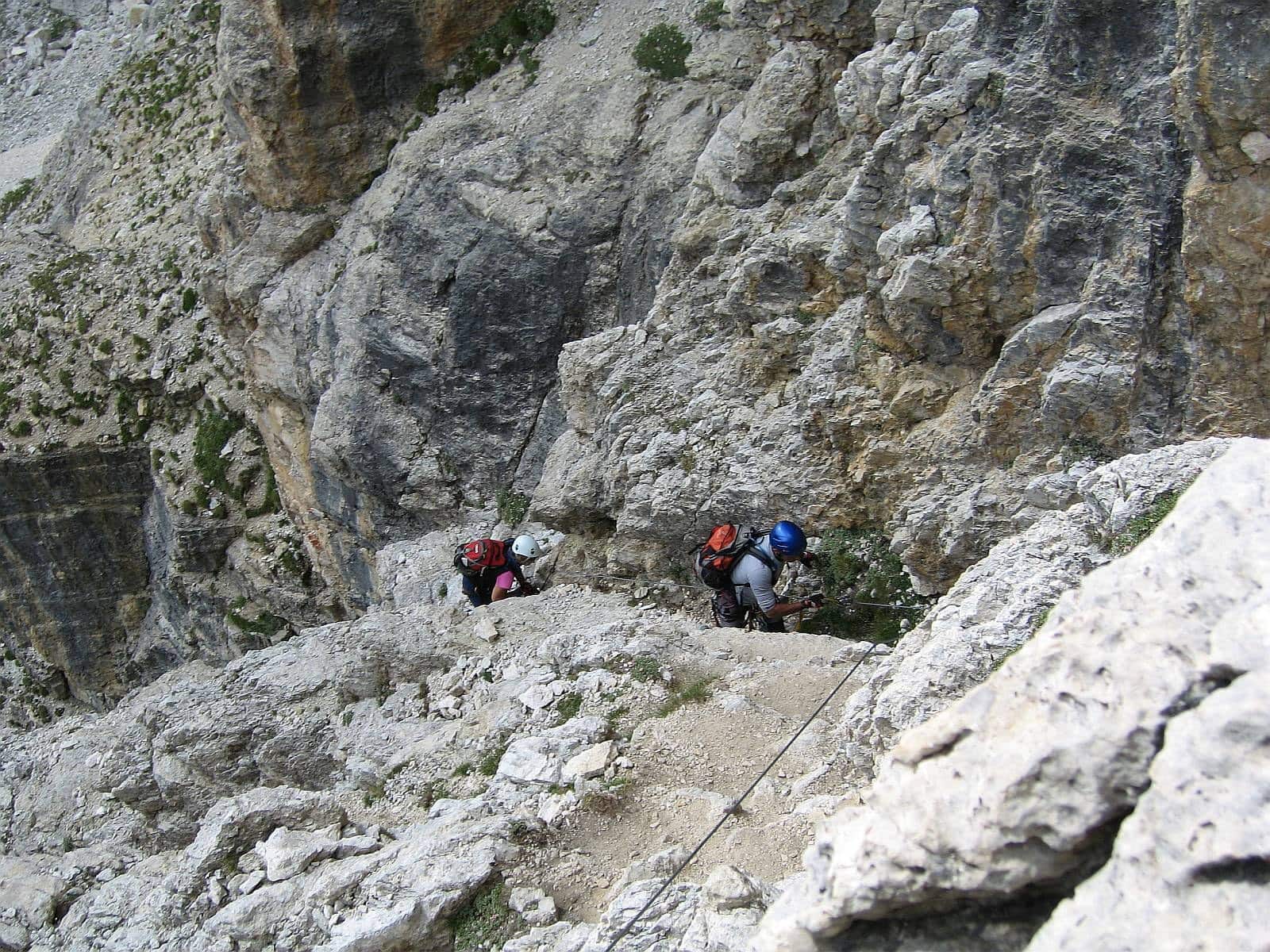
You’ve probably heard the term before, but what does it actually mean in practice? Via ferrata — Italian for “iron path” — is a mountain route permanently equipped with steel cables, iron rungs, ladders, or even suspension bridges. This means you can safely move through extremely steep or even vertical terrain that would otherwise be reserved for experienced climbers with their own ropes and protection. You simply clip your carabiners onto the cable that’s already fixed into the rock and make your way up.
What’s fascinating is that via ferratas were actually invented right here in the Dolomites. During World War I, brutal fighting raged between the Italian and Austro-Hungarian armies at extreme altitudes. Soldiers needed to move men, weapons, and supplies safely and quickly across steep ridgelines, so they started drilling iron rungs into the rock and stringing cables. We’ve spent a good half hour on some of these old wartime paths just trying to imagine how those men managed it over a hundred years ago — in horrific conditions, weighed down by heavy gear, in the dead of winter. It makes you feel a bit out of place on a modern ferrata in lightweight boots with a shiny new carabiner. Today, the Dolomites boast the densest network of via ferratas in all of Europe, and many routes pass through old bunkers and tunnels carved straight into the rock. Trust me, the atmosphere will give you goosebumps.
How hard is it? The Italian difficulty rating system
When choosing your first route, the most important thing to look at is the difficulty rating. The Italian Dolomites use their own classification system, graded with letters from A to D, or sometimes numbers 1 to 5 (where 1 is the easiest). In practice, the letter grading is far more common. As a complete beginner, stick strictly to A and B routes — and honestly, there’s absolutely no shame in that.
- A (Easy): Essentially a hiking trail on steeper terrain that’s equipped with a cable for extra safety. You often don’t even need to hold the cable — it’s more for peace of mind. Perfect for your first time getting familiar with the gear, or if you’re heading out with older kids and want to try it without unnecessary stress.
- B (Moderate): Here you’ll encounter steeper sections and more rock. You’ll actively use the cable to make progress, and you might break a sweat, but anyone with a reasonable level of fitness can handle it.
- C (Difficult): Vertical walls, overhangs, and sections where you need real upper body strength and good balance. For beginners, this difficulty is only suitable with an experienced mountain guide — otherwise it can turn into a genuinely terrifying experience.
- D (Extremely Difficult): Requires excellent physical fitness and prior experience. Long overhanging sections where you’re holding on by arm strength alone. Not for novices — we happily leave these routes to the most seasoned alpinists.
Essential via ferrata gear (and where to get it)
When researching via ferrata in the Dolomites, you’ll often read that you can bring your own gear — but fortunately, that’s not a must. If you’re flying in or don’t fancy buying expensive equipment for a one-off adventure, everything can be rented on the spot. I know all too well what it’s like to lug an enormous suitcase full of unnecessary stuff, so rental shops are a real lifesaver.
If you don’t have your own gear, you can easily rent it in almost every mountain town. In Cortina d’Ampezzo, for example, you’ll find several rental shops (such as Snow Service or local mountain guide offices) where a complete via ferrata set costs roughly 30 to 50 € per day. The staff will happily adjust everything to your size, so there’s no need to worry about getting anything wrong.
What exactly you need to wear and bring:
- Climbing helmet: Never — and I mean never — climb a via ferrata without a helmet. It’s not just about bumping your head on the rock; the main danger comes from people above you who might accidentally dislodge a stone.
- Climbing harness: It needs to fit perfectly — not too tight, not too loose.
- Via ferrata lanyard (Y-lanyard with energy absorber): A specialised set of two elastic lanyards with carabiners and a tear-out energy absorber. Please don’t attempt to use ordinary climbing slings on a via ferrata — in a fall, the consequences could be catastrophic (the energy absorber is there to dissipate the massive impact force).
- Via ferrata gloves: Steel cables are rough, sometimes with loose wires poking out, and trust me — after two hours of climbing without gloves, your hands will be covered in blisters. Sturdy leather gloves from a hardware shop or fingerless cycling gloves will do in a pinch, though dedicated via ferrata gloves are obviously the best option.
- Sturdy boots: Leave the trainers at the hotel. You need quality hiking boots, ideally with a stiffer toe (a so-called climbing zone) so you can stand securely on small rock ledges.
- Water and a first aid kit: Don’t forget to bring plenty of fluids. The sun hammers down on exposed rock with incredible force, and we always carry at least two litres of water per person. A small first aid kit with plasters is also handy, because even the best gloves won’t always prevent the odd blister.
When to visit the Dolomites and what to watch out for
The via ferrata season in the Dolomites is relatively short. In winter, the routes are buried under snow and ice, so the ideal window is from July to the end of September. Autumn brings cooler temperatures, but the days can be beautifully sunny — and best of all, you won’t be queuing on the cables.
The biggest danger on a via ferrata, though, is the weather. Clipping yourself onto a steel cable that runs all the way to a mountain summit during a summer thunderstorm is about the worst idea imaginable — the cables act as a giant lightning rod. The golden rule in the Alps is: by 1 PM, you should be sitting with a beer in a mountain hut or back down in the valley. Afternoon heat storms build incredibly fast, so always set off early in the morning — seven or eight o’clock at the latest. On our first trip to the Dolomites, Lukáš had to drag me out of bed at five in the morning, which I absolutely despise. But when we watched dark clouds massing above the peaks at midday, I had to admit he was right. An early alarm is genuinely a matter of survival here. For safety, don’t forget to arrange proper travel insurance that covers mountain sports. For shorter European trips we go with AXA, and for longer journeys or specific sports we use SafetyWing.
5 best via ferrata in the Dolomites for beginners
These routes are tried-and-tested classics for beginners — we’ve had them recommended by experienced climbers and mountain guides we trust. We deliberately chose them so you’ll feel confident, yet still experience that healthy dose of respect (that’s the sweet spot 😉). Always honestly assess your abilities, though, and if you’re in any doubt, hire a guide.
1. Sentiero Bonacossa (Grade A)
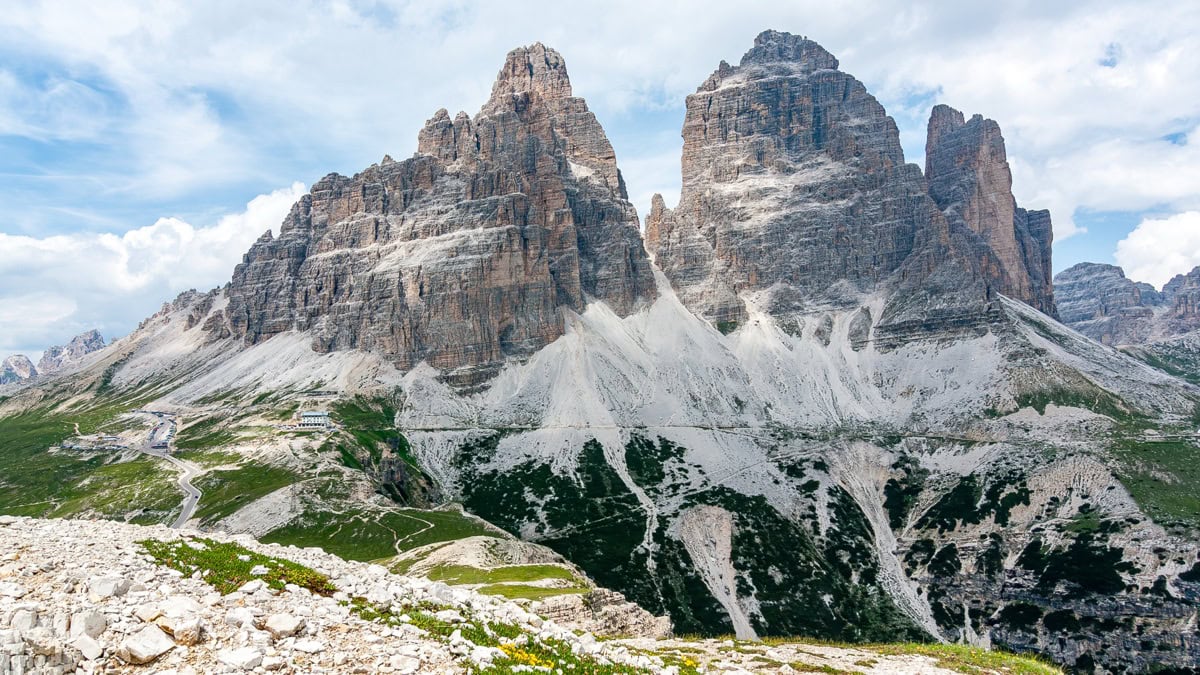
If you’re brand new to via ferratas and not even sure whether you suffer from vertigo or whether you’ll enjoy it at all, Sentiero Bonacossa is the perfect starting point. It’s really more of a stunning high-altitude trail with cables fitted on the steeper sections for extra support.
The route starts near the famous Tre Cime and follows ridgelines towards Rifugio Bossi. There are no vertical walls or gruelling strength sections here — instead, you’ll be soaking in jaw-dropping views of jagged peaks and relishing the feeling of being high in the mountains. I remember standing there for the first time, gazing down into the valley — it was pure magic. The whole outing takes just 1 to 2 hours, so you won’t even have time to get exhausted.
2. Cesare Piazzetta on Sass Pordoi (Classic A/B)
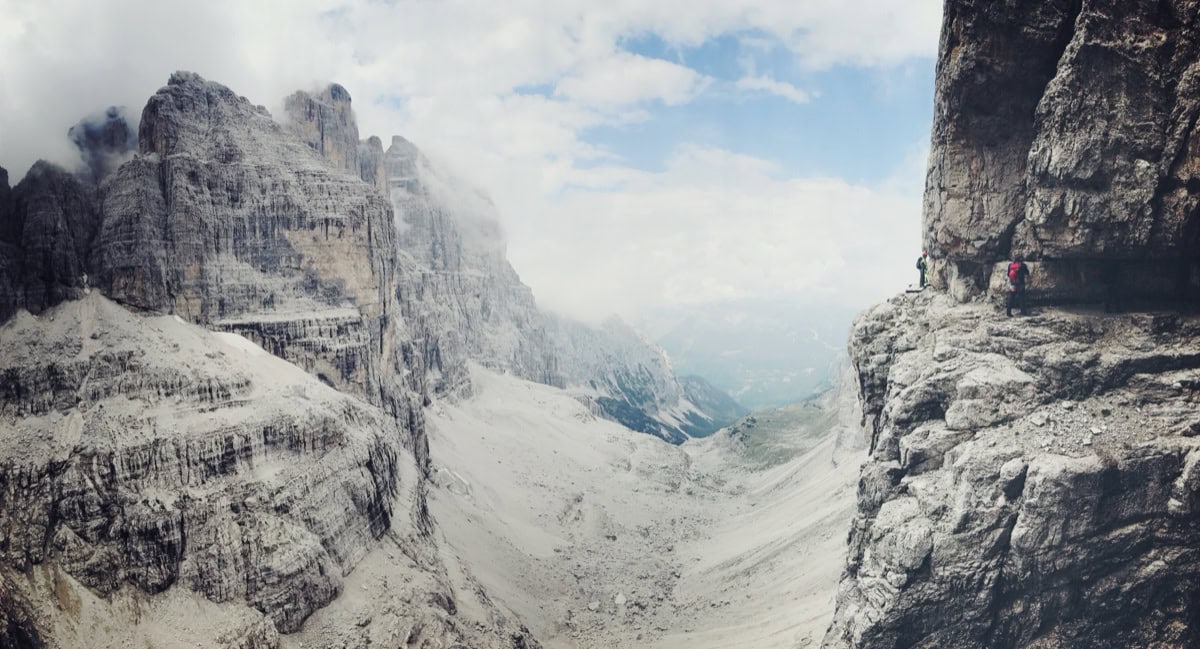
The Sella massif and the spectacular summit of Sass Pordoi offer brilliant options for beginner climbers. The Cesare Piazzetta route, in its easier beginner variant, sits at a comfortable A/B grade. The starting point is fairly easy to reach, and the route follows a very logical line along rocky blocks.
The climb takes roughly 2 to 3 hours and rewards you with truly magnificent views of the surrounding ridgelines. It’s the kind of via ferrata where you need to use both hands and feet, but you still feel completely safe throughout. That feeling when you reach the top and take off your helmet is simply priceless. And as a bonus, you can treat yourself to a superb Italian espresso at the summit with a panorama of the entire Sella group — which is just unbeatable.
3. Innerkofler-De Luca near Tre Cime (Grade C: with a guide)
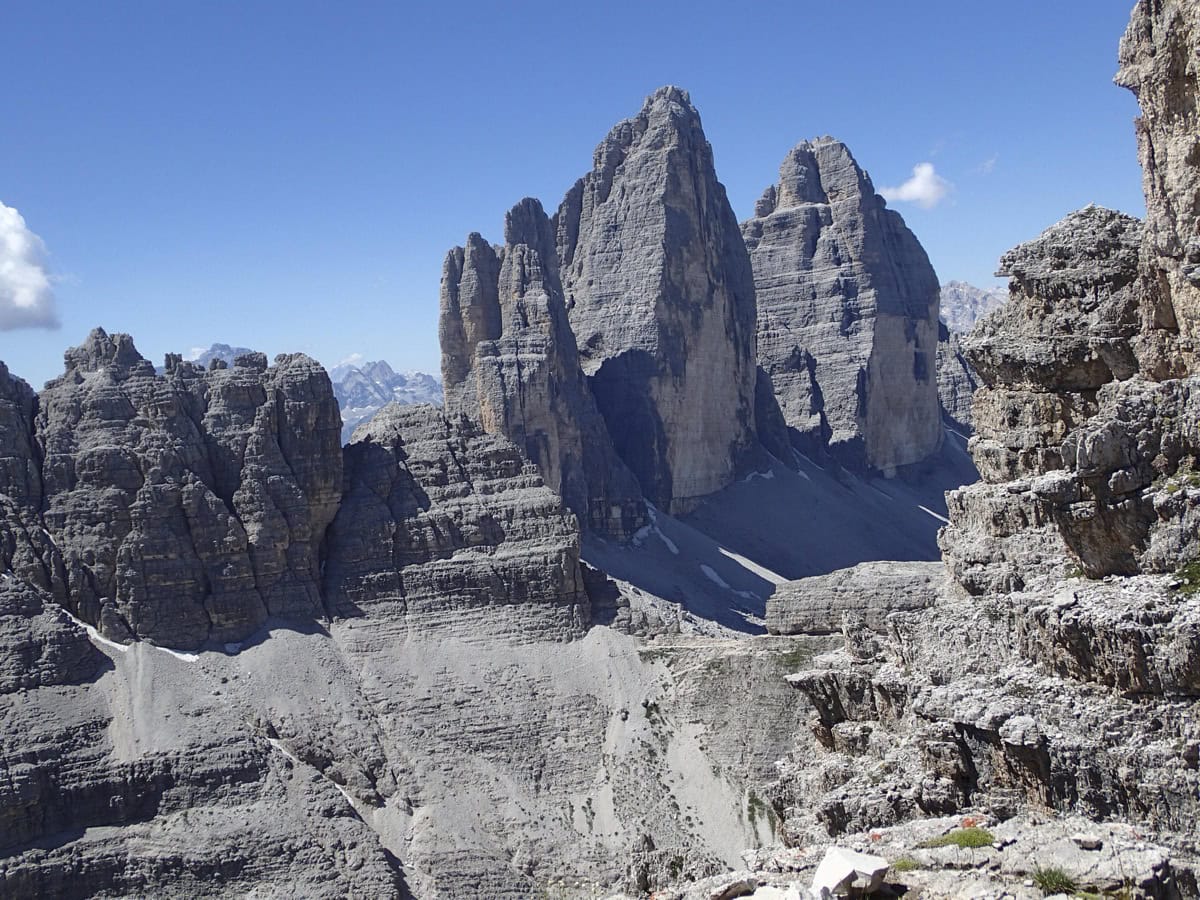
Although this via ferrata is graded C, it’s incredibly popular even among sporty beginners — though we strongly recommend tackling it with a certified guide on your first go. It’s located right on Monte Paterno, which neighbours the iconic Tre Cime di Lavaredo, so the views are straight off a postcard.
What makes this route truly fascinating is its history. It passes through long, carved-out WW1 tunnels, so definitely pack a headtorch. When the lights go out in those dark passages, it’s quite the adrenaline rush in itself. The climb takes roughly 4 to 5 hours, and a guide will help you through the trickier sections and boost your confidence — because at times there’ll be a rather serious drop beneath you 😅.
4. Ferrata delle Trincee on Marmolada (Grade B/C)
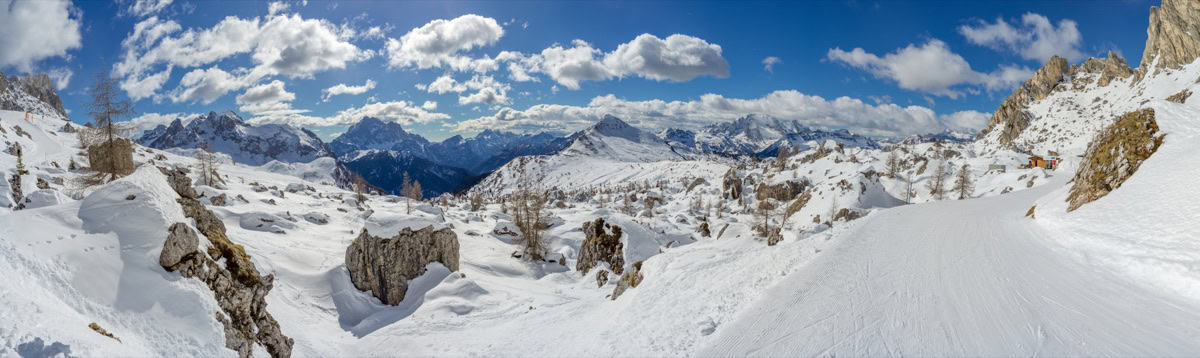
While you’re in the Dolomites, you really shouldn’t miss the queen of these mountains — Marmolada. Directly opposite her majestic glacier rises the Padon ridge, along which runs the stunning historical Ferrata delle Trincee. The B/C rating means you’ll work up a sweat in places, but mostly it’s smooth, flowing climbing on varied rock.
As the name suggests (Trincee means trenches), this route is steeped in wartime history. You’ll walk past old gun slits, bunkers, and trenches. It’s incredible to see first-hand where soldiers once sheltered and to feel the sheer weight of history radiating from the rock. The views of the highest peak in the Dolomites, draped in glacier ice, are so breathtaking that you’ll have to stop and take photos every few minutes. The full circuit takes about 2 to 3 hours of climbing, plus some time for the approach and descent.
5. Ferrata Possnecker on Sassolungo (Grade B/C)
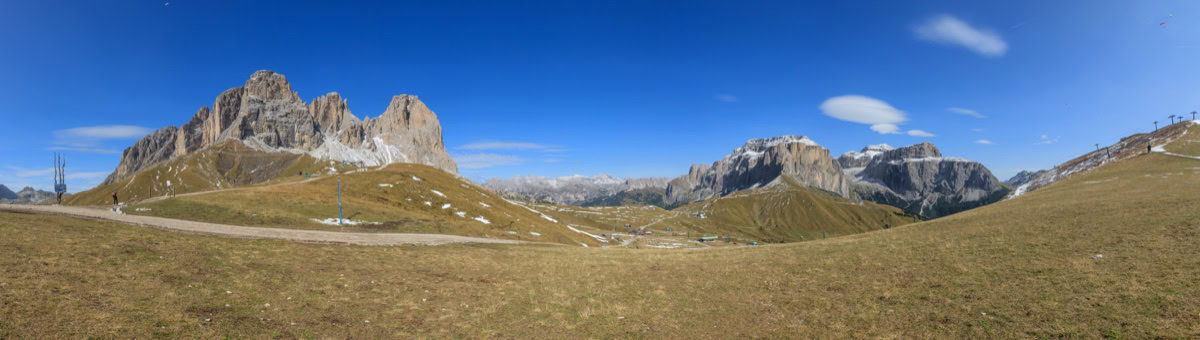
Our final recommendation is an absolute classic in the Sassolungo massif. Possnecker is one of the oldest via ferratas in the Dolomites — a beautiful historic line that cleverly uses natural cracks and chimneys in the rock. Despite its B/C rating, there are no unreasonably tough overhangs here; instead, expect smart, technical climbing.
It leads through gorgeous limestone terrain, alternating between cable-assisted sections and walking along ledges. Most people set off first thing in the morning to leave plenty of time for a relaxed descent, and the whole time you’ll feel like a proper alpinist — even if you’re just getting started with this sport. This was actually the route that first made me think Lukáš and I should make via ferratas a regular thing, because the connection with the rock here is simply magical.
Guided tour or self-guided via ferrata?
This is a question many beginners wrestle with. If you’re considering a self-guided via ferrata in the Dolomites, you need to approach it responsibly. For very easy routes (A or A/B), as long as you don’t suffer from vertigo, you’re reasonably fit, and you know how to handle carabiners safely, you can go on your own. But always make sure someone in your group has at least some experience.
On the other hand, for routes graded C — or if you’re simply not confident — we wholeheartedly recommend hiring a certified IFMGA mountain guide. These guys and gals know the local mountains like the back of their hand. They know how to dodge the crowds, they’ll help you with technique, and they’ll tell you stories that’ll make the hairs on the back of your neck stand up. Hiring a guide typically costs 200 to 300 € per day for a small group, which is absolutely worth it when split between friends.
Where to stay (the best base for via ferratas)
If you want the best via ferratas and day trips within easy reach, we recommend choosing the picturesque town of Cortina d’Ampezzo as your base. Cortina sits right in the heart of the most beautiful peaks, and you can drive to the start of most popular routes in just a few minutes.
It is a somewhat upmarket resort (expect to pay around 150 to 250 € per night for a decent double room in season), but the location pays for itself many times over. You’ll find gear rental shops in town, and best of all, in the evening you can sit on terraces with Aperol Spritzes and watch other hikers limping back from the rocks. Solidarity 😁. If you’re after something with real character, the traditional Hotel de la Poste right in the centre is superb. When we’d rather save some cash and have the mountains right on our doorstep, we go for the lovely Hotel Passo Tre Croci, perched just above town — the trailheads for the via ferratas are literally minutes away.
Where to eat well in the Dolomites
Since I’ve mentioned accommodation and excursions, I can’t leave out the most important thing of all: food. Lukáš and I rarely finish a full day on the rocks without being absolutely ravenous. And the Italian mountains are quite possibly the best place on Earth to satisfy that hunger.
Right in Cortina d’Ampezzo, we have an absolute favourite that we return to every trip: Ristorante Pizzeria Croda Cafe. They make divine thin-crust pizza, and when we stumble in still wearing our hiking boots, nobody bats an eyelid. It’s always buzzing, cheerful, and the prices are surprisingly reasonable by Cortina’s posh standards.
If you want to really treat yourself and taste something more local and artisanal, definitely book a table at El Brite de Larieto. It’s a wonderful mountain farm and restaurant just outside Cortina, where they make their own cheeses and cured meats. Sitting down to a board of their homemade cheese with a glass of local wine as the sun sets — that, my friends, is the real reason we haul ourselves up those mountains. 😁

Training at home before you go
Before heading to Italy for the really big walls, it’s incredibly sensible to practise with your gear somewhere closer to home first. A paralysing fear of heights is best discovered ten metres off the ground in the UK rather than two hundred metres above an Italian abyss 😁. Getting comfortable with the cable at a low-pressure, local spot is always a good idea.
The UK has some excellent options for getting your first taste. Honister Slate Mine in the Lake District is arguably the most famous via ferrata in Britain and offers several routes right above the valley — perfect for total beginners. There’s also the Via Ferrata Xtreme at the same location for those wanting a bigger challenge. Many outdoor centres across the country run introductory courses where you can learn to use all the gear safely, and most places offer equipment rental on site. It’s a fantastic way to build confidence before tackling the Dolomites.
What to do when you’re not climbing
Obviously, you can’t spend your entire holiday dangling from cables — your arms and legs will need a rest. Italy is about so much more than mountains; it’s about food and indulgence, and we always love to let loose a little in the Dolomites.
After a tough day on the rock, you’ll discover that South Tyrolean cuisine is nothing short of miraculous. Italian pasta meets Austrian heartiness, which means you’ll eat three times more than planned while telling yourself you’ve earned every last bite. You’ll fall head over heels for canederli (bread dumplings) in every variety, rich polenta with meat, and sweet apple strudel. And in the evening, to warm up those aching muscles, we highly recommend a bombardino or an Aperol Spritz on a terrace. Most of the nicer hotels in Cortina also offer gorgeous spa facilities and saunas — exactly what your body craves most after a full day on the rock.
Beyond food, we also enjoy some history and relaxation on our rest days. The Dolomites are dotted with stunning mountain lakes, like the iconic Lago di Braies, which you can drive to and simply soak up the scenery when your hands are too worn out for climbing. You can even rent a little rowing boat and have a properly romantic afternoon. One more thing: if you like filming with a drone, leave it at home. Flying is strictly banned in most national parks in the Dolomites, and the fines are seriously hefty 😅.
Read next
- Check out our comprehensive guide Things to Do in the Dolomites for the best hikes without cables.
- Looking for a great place to stay? Browse our guide to Cortina d’Ampezzo: Complete Guide and Our Base.
- For classic hiking, don’t miss the iconic Tre Cime di Lavaredo.
Tips and tricks before you go
Every mountain trip requires a bit of boring planning from the comfort of your sofa. After years of travelling together, Lukáš and I have our own well-oiled system that saves not just our nerves, but usually a fair bit of money too. Here are a few of our personal hacks that have served us best on trips to Italy.
Flights and transport
From the UK, the easiest way to reach the Dolomites is to fly into one of northern Italy’s airports — Milan, Venice, or Verona all work well — and then rent a car for the drive into the mountains. Having your own wheels gives you total flexibility and means you won’t have to rely on Italy’s rather patchy rural bus network. We’ve had consistently great experiences renting through DiscoverCars, which we use all over the world.
For finding cheap flights, we always check Kiwi — it’s our go-to flight comparison site and usually digs up the best connections. From London, you can often find direct or low-cost flights to Venice or Verona with carriers like easyJet, British Airways, or Ryanair. Picking up a hire car at the airport and driving up into the Dolomites is hands down the best combination for maximum freedom in the mountains.
Don’t forget reliable internet
Even though you’re in Europe, mobile signal in the mountains often drops out, and it’s handy to have a backup — especially if you need to check the weather radar for incoming storms. There’s nothing worse than hanging on a rock face wondering whether that dark cloud overhead is about to burst or pass you by.
For longer trips, or if you want plenty of data without the hassle and want to share photos with family straight away, we highly recommend an eSIM. Our top pick is Holafly (check out our review). You install it at home before you leave, and the moment you land, you’re online without any fiddling with physical SIM cards.
 🚗 Car rental on the roadVerified rental cars in the Dolomites
Search with the DiscoverCars comparison engine — it compares prices from dozens of local and international rental companies, and most bookings come with free cancellation.
Compare car prices in the Dolomites →Frequently Asked Questions (FAQ)
Where can I find a reliable Dolomites via ferrata map?
The best and most accurate maps for the Dolomites are published by the Italian Tabacco publishing house. You can buy them at any newsstand or bookshop right on the spot. They’re at a scale of 1:25,000, and the via ferratas are clearly marked in them with black crosses along the routes. There’s also a Tabacco app for smartphones, which we recommend downloading for easier orientation in the terrain.
Can I download a via ferrata dolomites map to my phone for free?
Yes, great helpers include apps like Mapy.cz, which work offline and have via ferratas very well marked. We also recommend apps like Fatmap or Komoot, where you’ll find specific elevation profiles and reviews from other users. For beginners, this is an absolutely invaluable source of information for planning your route properly.
Are via ferratas safe for children?
It depends on the child’s age and experience. For kids from about 10 years old, there are special easy children’s via ferratas (difficulty A), but the child must have a special children’s harness (full-body) and an appropriate shock absorber adapted to their low weight. We definitely recommend doing the first climb with children exclusively with an instructor, so you can be sure and avoid any potential tears from fear.
Do I need climbing rope for via ferratas?
For regular secured routes, you don’t need a rope—you just proceed using a via ferrata set with two carabiners. Climbing rope is only carried by mountain guides for potentially securing children or nervous clients in particularly exposed sections, so you can safely leave this piece of equipment down in the valley.
What happens if I run out of strength on the route?
This is one of the most important things to keep in mind. It’s very difficult to turn back from a via ferrata, and there’s no escape until you climb to the top or reach an exit trail. That’s why it’s crucial not to overestimate yourself, choose a route with easy difficulty, and rest in sections where you can comfortably stand. Don’t rush anywhere and feel free to take breaks—the mountains aren’t going anywhere.
What kind of shoes should I wear?
Definitely don’t wear running shoes or soft sneakers. You’ll be standing on rungs and steel pegs, and through a thin sole, your feet would be unbearably painful within an hour. Lukáš and I once met a guy on a route in regular sneakers, and the sight of his battered feet still haunts me to this day. Ideal are low-cut or ankle-high hiking boots with a so-called ‘climbing zone’ on the toe—that’s a hard, flat rubber section designed precisely for standing on small bits of rock.
Can I go on a via ferrata right after rain?
Better not. Limestone rock in the Dolomites becomes extremely slippery after rain. Even if you have good boots, the iron rungs and cables will be wet and cold, which significantly makes climbing harder and reduces your sense of security. Always carefully check not only the storm radar before your trip, but also precipitation totals from the previous night. A wet via ferrata really isn’t worth the stress.
Tips and Tricks for Your Vacation
Don’t Overpay for Flights
Search for flights on Kayak. It’s our favorite search engine because it scans the websites of all airlines and always finds the cheapest connection.
Book Your Accommodation Smartly
The best experiences we’ve had when looking for accommodation (from Alaska to Morocco) are with Booking.com, where hotels, apartments, and entire houses are usually the cheapest and most widely available.
Don’t Forget Travel Insurance
Good travel insurance will protect you against illness, accidents, theft, or flight cancellations. We’ve had a few hospital visits abroad, so we know how important it is to have proper insurance arranged.
Where we insure ourselves: SafetyWing (simple monthly subscription) and TrueTraveller (for extra-long trips).
Find the Best Experiences
Get Your Guide is a huge online marketplace where you can book guided walks, trips, skip-the-line tickets, tours, and much more. We always find some extra fun there!