TL;DRSEO specialists charge £15–£150 an hour, depending on the scope and level of expertise required. A proper keyword analysis costs at least £900, an SEO audit runs £150–£1,500 (£600 on average), and building a content strategy costs £300–£600.
A decent SEO article comes in around £90–£150, while monthly work with an agency like LK MEDIA starts at £450 for basic fixes plus 3–4 articles. You’ll usually see the first results of SEO optimisation after 3 to 6 months — for new domains, it takes at least 6 months — and the sweet spot is publishing 4–8 articles a month.
You’ve already read our article on what SEO actually is, picked up some tips on how to do it, and explored the SEO tools you need — only to realise you might not be able to handle it on your own? Or maybe you simply want to know how much the SEO cost will actually be? Then you’re in the right place. We’ll break down the cost of SEO work for e-shops, content websites, and business sites alike. We’ll explain why the prices are what they are and what a solid SEO specialist should bring to the table.
What Does SEO Work Actually Include
SEO is a multidisciplinary field that encompasses both technical and content SEO. Very few agencies or specialists can deliver both, because content SEO requires the specialist to also have a strong grasp of copywriting. So keep that in mind. Here’s everything SEO work typically involves:
Keyword Research
This is where it all begins. An SEO specialist should carry out in-depth keyword research that identifies the relevant keywords and phrases your potential customers are using when searching for the products you sell or the content you offer online.
From this research, a content strategy is built for your website or e-shop. Why is strategy so important? The SEO specialist identifies low-competition keywords to target first, so search engines begin to recognise you as an authority in your niche. Once you’ve built up some authority, you can start going after higher-volume, more competitive terms.
Sample Keyword Research: What It Should Look Like
A word of warning: Keyword research is often done poorly. If some “SEO specialist” delivers only a few dozen keywords with no categorisation, they probably don’t know what they’re doing. Worried that you didn’t receive a comprehensive enough analysis?
We’ve prepared a sample keyword research document in the format we actually use ourselves. The sample analysis covers the topic of accounting. It’s available for free on Discord for subscribers of our Patreon.
A blog content plan is an absolute must if you want to approach building a profitable website in a systematic and efficient way.
From the keyword research, an SEO specialist knows what people are searching for, including the keyword difficulty (KD). Based on that, they should create a content plan and a roadmap for your blog.
They should prioritise keywords that are easiest to rank for — those where you can reach the top positions in search engines as quickly as possible. Of course, you also need to factor in other considerations, such as which topics generate the highest margins (especially if you run an e-shop).
Then comes the creation of high-quality, relevant, and engaging content that’s optimised for keywords and covers the topic so thoroughly that readers have no need to look elsewhere.
The worst thing that can happen at this stage is an SEO specialist or copywriter selling you mediocre content just for the sake of publishing something.
That’s utterly useless. SEO content needs to be the best piece of content on the topic — at least within your market. If you’re unsure what that looks like, we’ve written a guide on our Patreon on how to craft the perfect SEO article.
Also watch out for purely AI-generated articles. It’s perfectly fine to use ChatGPT as a writing aid, but publishing an unedited AI article is not acceptable. Artificial intelligence is merely a tool to improve the quality of your output — its work should never be treated as final or ready to publish.
Technical SEO
Technical SEO may be becoming less of a differentiator over time, but if your site is slow, poorly optimised for mobile, or has a weak structure, you’ll be penalised. That’s why it’s one of the first things to address — it can deliver quick wins in SEO.
Off-Page SEO
Off-page SEO refers to activities outside your website that help improve your search engine rankings. This includes sharing content on social media and, importantly, link building. Link building is the strategy of acquiring backlinks — getting other websites to link to yours.
When other sites link to you, they send a signal to search engines that your site is important. The more authoritative the linking site, the more valuable the backlink.
When it comes to link building, make sure your SEO specialist isn’t selling you links from low-quality websites. Link building only works if the links are genuinely high-quality.
Without link building, results come very slowly indeed.
Local SEO
If you run a shop, restaurant, bar, or café, you should definitely pay attention to local SEO. Not every SEO specialist focuses on it, so finding the right person to work with may take some effort.
Why does it matter? Because you want to be discoverable in the town or neighbourhood where your business is located. Optimising your website for searches within a specific geographic area is therefore essential.
Tracking, Analysis, and Optimisation
SEO needs to be measured using the right SEO tools. Google Analytics and Google Search Console aren’t enough on their own, as they only show you how your overall search traffic is moving.
Dedicated SEO tools let you track how you’re climbing for specific keywords, how many keywords your articles and pages are ranking for, and they allow you to refine and improve your content based on real data.
How Much Do SEO Specialists Charge
SEO specialists typically charge between €20 and €200 per hour, depending on the scope of work and the level of expertise required.
How Much Does SEO Cost
It’s extremely difficult to give a definitive answer on how much SEO costs. We recommend checking out our content website packages to get an idea. But here are some typical price ranges for individual services.
How Much Does Keyword Research Cost
Keyword research is one of the most expensive items — a thorough one will set you back at least €1,200, with part of the cost covering analytical tools. It also involves dozens of hours of manual work, which an experienced specialist can streamline with scripts and automation, but even so, larger keyword analyses rarely take fewer than 15 hours.
How Much Does an SEO Audit Cost
Another significant expense is the SEO audit, which typically includes:
Technical analysis (examining site architecture, performing crawls, reviewing no-index pages, pages returning 404 errors and broken links, evaluating URL structure and page load speed including JS and CSS files, image and video sizes, plus various other e-shop-specific aspects),
Content analysis (category and product titles, meta titles and descriptions for search engines, alt text on images and videos, content pages and internal linking, with attention paid to crawl depth, redirects, use of filters, and parametric filter pages for landing pages),
Backlink profile analysis (checking whether spammy links are pointing to the site and what the overall link portfolio looks like),
and verification that the site is properly connected to systems like Google Analytics, Google Search Console, and Bing Webmaster Tools.
Overall, the goal of an SEO audit is to identify and fix issues that could negatively impact organic search performance. These audits can cost anywhere from €200 to €2,000 depending on the size of the website or e-shop. The average price sits around €800.
How Much Does an SEO Content Strategy Cost
The last major line item is creating a content strategy based on keyword research. This involves combining keyword data with competitor analysis and business priorities. Content strategies typically cost between €400 and €800.
Once your keyword research, SEO audit, and content strategy are done, the monthly cost depends entirely on how many issues need fixing and how much content you’ll be creating together with your SEO specialist.
How Much Does a Quality SEO Article Cost
You can buy articles at all sorts of prices online — any freelance copywriter will write one for a few dozen pounds. But most of the time, it won’t be worth the paper it’s printed on. If you want a quality SEO article, you need to understand that it involves:
Mini keyword research,
competitor analysis,
crafting an optimal article structure,
writing the article itself,
publishing it on the website,
optimising images and links for SEO,
internal linking,
adding it to SEO tracking tools.
That’s why quality SEO articles typically cost around €120–€200 when all the above services are included. As a general rule, one excellent article is far better than ten that no one ever finds through search engines.
SEO Cost Per Month: What to Expect
As mentioned above, once you have your keyword research, SEO audit, and content strategy in place, the monthly SEO cost depends entirely on how many issues need fixing and how much content you’ll be producing with your specialist.
At our agency, LK MEDIA, monthly budgets start at around €600, which includes basic fixes and 3–4 articles.
Checklist: How to Write a Quality Optimised Article on WordPress or Shoptet
Are you a copywriter, blogger, or e-shop owner who wants to create quality articles that maximise your chances of earning organic traffic? We’ve prepared checklists from our own workflow for WordPress and Shoptet — for the price of a coffee (about €2.50).
Generally, the earliest you can expect to see any SEO results is around 3 months, with most meaningful progress appearing after 6 months. It heavily depends on the quality and authority of the domain you’re starting with.
If you’re starting on a brand-new domain, expect a minimum of 6 months before you see any results. Highly competitive niches (weight loss, parenting, gambling) or topics related to health and finance (known as YMYL topics) take even longer.
On the other hand, if you’re working with an established e-shop or building a site for a well-known personality (one that Google already recognises), you might see results within a month or two, especially in a low-competition space.
The volume of work matters too. If you’re only publishing one article a month, you might not see results even after six months. The sweet spot is 4–8 articles per month during the first 6 months. For brand-new domains, we recommend starting with 8–10.
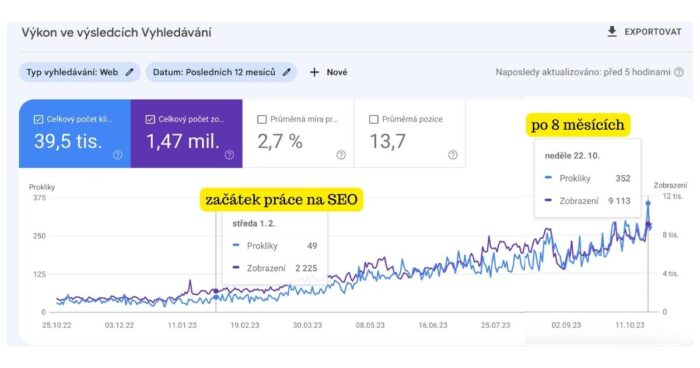
Results of 8 months of collaboration with a client publishing 2–4 articles per month
Tips and Tricks for Your Vacation
Don’t Overpay for Flights
Search for flights on Kayak. It’s our favorite search engine because it scans the websites of all airlines and always finds the cheapest connection.
Book Your Accommodation Smartly
The best experiences we’ve had when looking for accommodation (from Alaska to Morocco) are with Booking.com, where hotels, apartments, and entire houses are usually the cheapest and most widely available.
Don’t Forget Travel Insurance
Good travel insurance will protect you against illness, accidents, theft, or flight cancellations. We’ve had a few hospital visits abroad, so we know how important it is to have proper insurance arranged.
Where we insure ourselves: SafetyWing (best for everyone) and TrueTraveller (for extra-long trips).
Why don’t we recommend any Czech insurance company? Because they have too many restrictions. They set limits on the number of days abroad, travel insurance via a credit card often requires you to pay medical expenses only with that card, and they frequently limit the number of returns to the Czech Republic.
Find the Best Experiences
Get Your Guide is a huge online marketplace where you can book guided walks, trips, skip-the-line tickets, tours, and much more. We always find some extra fun there!
TL;DRSolid SEO comes down to 13 practical steps: researching keywords and competitors, creating the best and most thorough content on a given topic, optimising titles, getting your H1–H5 heading structure right, targeting long-tail keywords, writing proper copy for categories and images, internal linking, compressing and naming images correctly, clean URLs, building relevant backlinks, sharing on social media, and tracking performance through Google Analytics and Google Search Console. Results usually show up 3 to 6 months after you publish or update content, provided the site is technically sound and has decent domain authority. A good SEO specialist working on small to medium projects typically charges somewhere between 20,000 and 70,000 Czech crowns a month. Recommended tools include Collabim, Marketing Miner and Ahrefs, while WordPress users tend to reach for Yoast SEO or Rank Math.
If you have an e-shop, website or blog, you’re probably struggling with how to get people to your site. You can pay for advertising or share content on social mediabut you’ll never get the quality of visitors you get when they find you through search engines. Just how do you go about making sure you show up in their searches?
To make your content traceable, you need to control SEO.In fact, when you build a content strategy with SEO in mind, you can get thousands (even hundreds of thousands) of visitors per month without paying for clicks. Let’s now take a look at what SEO is and how to do it. We’ve also prepared 13 simple tips for SEO – search engine optimization.
What is SEO and how SEO works
SEO belongs to content marketing and it stands for Search Engine Optimization, and it is the process of optimizing a website in order to achieve the highest possible placement (ranking) in internet search results. Let’s explain it even more simply:
If you type “How to do SEO” or “What is SEO” into Google or Seznam, this article should be among the first to pop up in 3-6 months after it’s published. I don’t know when you read this article, but chances are you got here from a search engine. We don’t pay for any advertising. This is the magic of SEO.
SEO is an essential element for effective digital marketing and it involves a lot:
Keyword analysis: identifying relevant keywords and phrases that potential customers use when searching for the products you sell or the online content you offer.
SEO content creation: Creating quality, relevant and engaging content that is keyword optimized and exhausts the topic so much that readers don’t feel the need to go looking for other content.
Technical SEO: Ensures that your website is well optimised from a technical perspective for search engines (it’s fast, displays well on different types of devices and has a great structure).
Off-page SEO: activities outside your website that help improve your search engine rankings (linkbuilding, social signals, good domain reputation).
Local SEO: optimizing your website for searches in a specific geographic area.
Measurement and analysis: monitor the success of your SEO strategy using tools such as Google Analytics and make the necessary adjustments to improve.
Why do SEO – thousands of visitors from one article
When you dedicate yourself to search engine optimization on your website and e-store, you can drive quality traffic to it over the long term without having to pay for clicks.
While in PPC ads you have to pay per click, in SEO you pay for technical optimization and creation of quality articles on a one-time basis. If you have a good specialist, one article can bring you hundreds or even thousands of visitors per month.
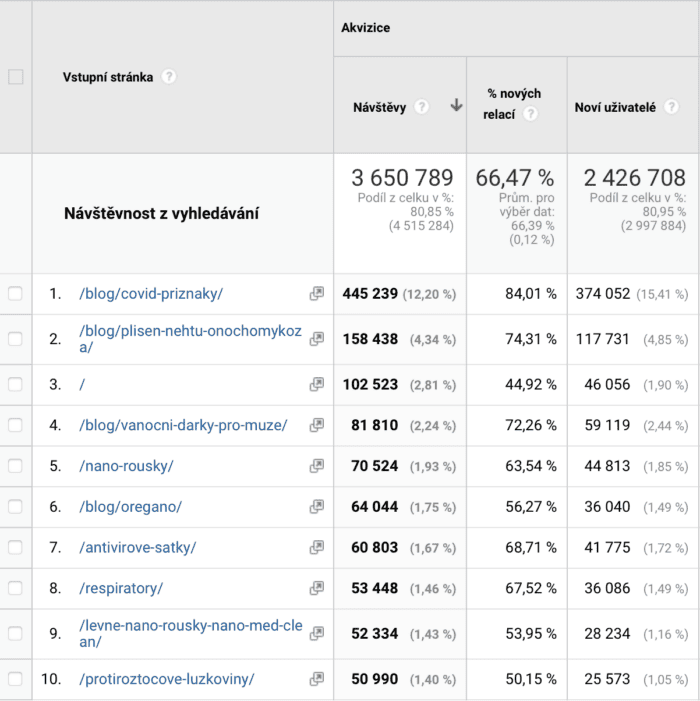
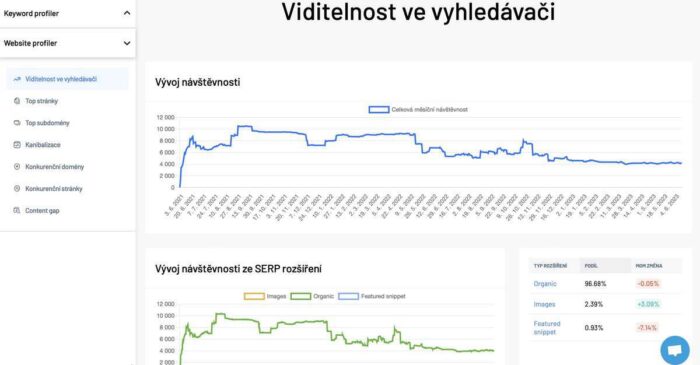
Your stats can then look like this:
Overview of organic traffic to nanospace.cz e-shop for the period 2021-2023
How search engines work and how it relates to SEO
We all know search engines and we all use them. You probably know very well how they work from the user’s point of view. You type in the phrase “What is SEO” and the search engine will offer you relevant links or a straight answer to your question. But to “do SEO” you also need to understand how search engines work technically. Let’s take a look.
Principles of search engines
The basis of every search engine is the so-called web crawler. Under this terrible English name is a script or program that crawls internet links and indexes them. Imagine that a web crawler is a kind of fast bookshelf and web pages are books. The librarian goes through the books and puts them in the library according to themes. This is called indexing, and search engines draw from this library when offering you relevant results.
Search engines consist of two main parts:
A search index, which is a digital library of information about a website.
Search algorithms, which are computer programs responsible for displaying results from a search index.
Your goal is for the librarian to know your site at all, to like the search alogirtm and to offer it among the first. If you create bad content, the librarian (search engine) may also decide it doesn’t like the content and not rank it at all.
How search engines index and rank pages
There are many search engines and each one works a little differently. Here are the basic things that search engines rank:
First, the search engine must find your website and all its pages
Nowhere does it say that search engine robots will find your site on their own. We need to help them as much as possible. And there are several ways to help:
Provision of sitemaps to search engines
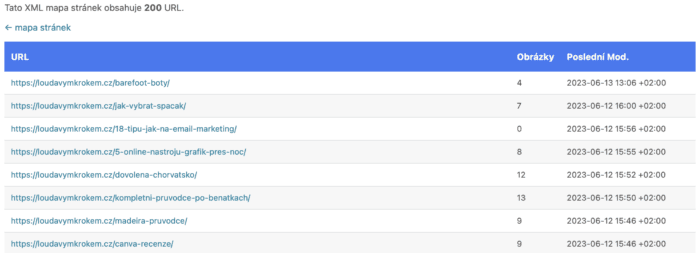
A sitemap is a special page on your website in XML format that clearly lists all the URLs (pages) you want to get into search engines. Its generation is usually handled for you by the tool in which you build the site (e.g. WordPress). This is how the sitemap of the blog loudavymkrokem.cz looks like:
Sitemap of posts on loudavymkrokem.cz
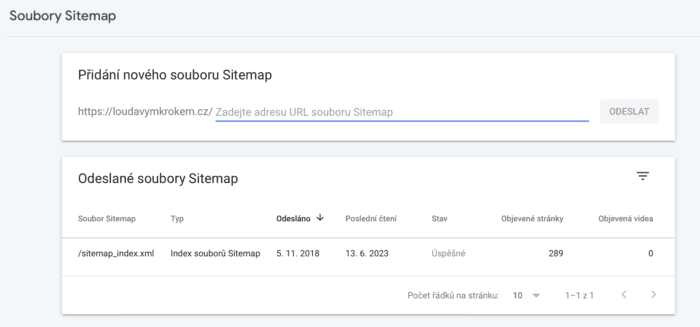
The robots can find the sitemap themselves, or you can slip it to them directly in the administration interface. For example, for Google, the sitemap is passed within the Search Console:
Sitemaps in Google Search Console
Manually submitting the URL to a search engine
Most search engines allow manual URL forwarding. If you don’t have a plugin on your site that does this for you, you can slip the URL to search engines every time you publish a new article. They, in turn, will give him a preferential look. For Google, the manual handover looks like this:
Manual URL indexing on Google
Trackbacks
Every page on your website/blog should have at least one link from the same website (e.g. category, footer, etc.). It shouldn’t happen that no link leads to a page on the website, because then the search engine may not find it.
Search engines crawl sites using “crawling”
It sounds terrible, but it just means that Google or another search engine crawls sites and pulls known URLs. In the case of Google, we call the robot that does this Googlebot.
This step is followed by “processing and rendering”. In this step, the search engine works to understand the content and structure of the page. This involves running code on the page (such as JavaScript) to understand how the page looks and how it is structured. This may include identifying links on the page and other important information.
SEO basics: 13 simple tips
Now, we’ve given you quite a bit of background on what SEO is and even talked a little bit about how search engines work. But let’s stop talking to you in the language of SEO specialists and tell you 13 simple tips that you can apply even if you don’t understand it. Of course, if you have a technically messed up website, this might not help.
The following tips are based, among other things, on Google Search Essentials = recommendations on content creation directly from Google, which everyone interested in SEO should know.
1) Start with keyword analysis and competitor analysis
Do your keyword research before creating content. Find out what phrases and words people are using to search for topics related to your website. Then, find out who and what is ranking in the top search engine positions for the keywords you want to work on. Tools to help you do this are listed below.
2) Create the best content on the internet
For a long time, I didn’t know a thing about Google SEO and Seznam, yet my articles ranked first in the search engines. Why? I always wanted to create the best article you can find. Best structured, readable for the reader and full of information. If anyone had 10 tips, I wrote down 20.
Open the first 10 articles on the internet on your chosen topic and write a better article. Longer, better structured, easier to understand. Search engines are trained to recognize the content that is most valuable to readers. If you want a little more information, on Patreon we’ve added a very comprehensive guide on how to write the best articles with using artificial intelligence.
3) Optimize subtitles
The title (headline) of a page is one of the first things search engines check. Include keywords, use numerals where possible. According to surveys, people prefer odd numbers to even numbers. This is not the case only for 10, 50 and 100.
Don’t write headlines too creative, meaning, that the title of the posts must make it clear what it is about. When you write an article about SEO, I’m not gonna call it “The Great Marquee Treasure, or What You Probably Didn’t Know.” Although it may be creative.
4) Structure the data
Stick to a clear structure and use the text correctly. Use headings and subheadings (H1 to H5) so that H2 headings introduce larger topic units, which you break into subtopics using subheadings H3, H4 and so on.
Don’t forget to add a table of contents in the introduction of your articles. Use FAQs and other elements to help make your content more friendly for people to browse. Keep in mind that people scan when reading articles, so try to make it easier for them to navigate the text.
If your article is a review, use Schema.org structured data. Every CMS platform has a number of plugins for this.
5) Start with very specific questions
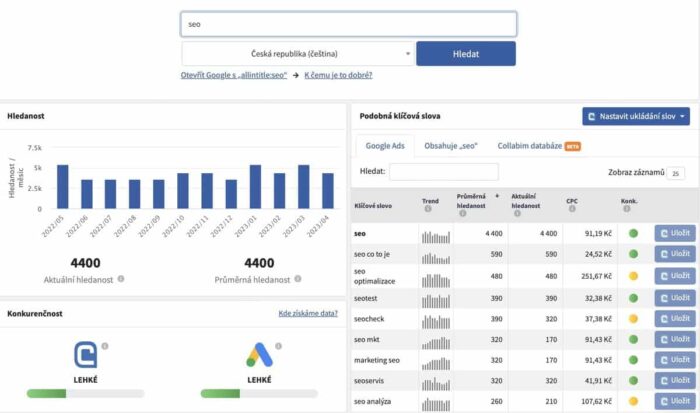
If you are starting out, choose keywords to process that are simple. And we don’t mean simple to process, we mean that they are not very competitive. How do you know? A great tool is the Czech Collabim.
It will not only find you the approximate search volume, but for each keyword you will also see how much competition there is for it.
Keyword Explorer in Collabim
A great way to get relevant traffic quickly and build domain value is to focus on the so-called. Long Tail keywords. In English we would call them “long keywords” and they are specific phrases that people type into search engines.
These phrases are generally longer and more specific than a general keyword. Although they may get fewer searches than more general keywords, they are easier to get to the top positions and yield far more targeted hits.
For example, if you have a barefoot shoe store, you can target a general keyword like “barefoot shoes”. This keyword is likely to have a large number of searches, but also higher competition.
If, on the other hand, you focus on the problems people are solving with barefoot shoes, like “Do barefoot shoes help flat feet?”, not only are you more likely to get paid quickly, but people who are solving a specific problem are much more likely to invest in a product.
6) Texture everything that goes
Whether you have an e-shop or a content site, text categories, tags, add captions to photos and alt descriptions. Fill in all the metadata you can. Why? One reason is that you let search engines know what’s in a category or image, and another is that the vast majority of sites don’t give a damn. For example, we always start with category and brand descriptions in our e-shops. And of course you should have them better than your competitors.
7) Link everything you can = internal linking
In articles and categories, in short, wherever possible, link to relevant products or other articles. Make perfect site linking so that you keep people on your site as long as possible. This is called internal linking.
But don’t be afraid to link to other sites, especially ones with a lot of authority. Search engines also look at whether you are linking to relevant and valuable sites.
8) Shrink images
If you have a WordPress site, be sure to download a plugin that automatically shrinks your images. For those of you who have an e-shop on Shoptet, beware, Shoptet can’t automatically shrink images. You have to do it yourself in Canva or Shortpixel.
And why shrink images? Because the bigger the image, the slower it loads. And search engines don’t like that.
9) Name the pictures
Before you upload the image, be sure to name it correctly. We name our pictures like this: holcicka-s-jablickem.jpg.
It’s the only way to tell the search engines what’s in the picture. This allows you to appear in Google Images searches, for example. Don’t forget to fill in all the attributes for the uploaded images. You can read about how to create good alt texts on hubspot.
10) Work properly with URLs
Even from the URL, search engines can tell what is on the page. So make it easy for them. Don’t make them too long, but try to make them clear and concise. For example, the URL of this article is www.loudavymkrokem.cz/pruvodce-seo/.
11) Get relevant backlinks
The first thing to do is to sign up for all the possible listings on the internet, by which we mean companies.cz, and create a profile on Google My Business. If you are an e-shop, you should be in online catalogues and comparison sites, if you are a blogger, try to get in exchange for a link to articles with relevant listings.
Exchange links with relevant sites, but never overdo it. If you’ve gotten a total of 3 links in the last year and you’d get 50 in one week, search engines will find that suspicious.
Get relevant links gradually and mainly from sites that are valuable and are thematically similar to your content. For example, you can analyse the quality of the domain from which you are being offered a link using the Ahrefs tool.
One way is by writing guest posts on other other sites. Caution: buying PR articles on news sites is usually pointless because the links you get from them are not DO-FOLLOW, but NO-FOLLOW. If they are no-follow, it means that such links do not carry the so-called. reference authority. In short, it tells the search engine “disregard this link when ranking the linked page”.
12) Share your content on social media
By sharing on social networks, you get the so-called. social signals. “Social signals” are interactions that happen on social media, such as likes, shares, comments, retweets, etc. These signals can indirectly affect SEO (Search Engine Optimization) for the following reasons:
Increased visibility: when your website content is shared on social media, its visibility increases. This can lead to more visits to your website and therefore more links to your content.
Credibility and trustworthiness: when your content gets a lot of interaction on social media, it can signal to search engines that your content is useful and valuable, which can also help.
Long-term effect: When content gets a lot of “social signals”, it is more likely to be shared in the future, which can lead to a sustained increase in traffic and links.
It is important to note that Google officially states that “social signals” do not directly affect page rankings. However, these interactions can indirectly help SEO by increasing your site’s visibility and authority.
13) Measure and improve content
Use tools like Google Analytics a Google Search Console to measure your website’s performance and identify areas for improvement. Without measuring and monitoring your performance, you won’t know what’s working and what needs improvement.
We recommend keeping a content plan spreadsheet where you keep a list of blog posts with the last update date and notes on what you’ve changed.
Checklist: how to write a quality optimized article on WordPress or Shoptet
Are you a copywriter, have a blog or e-shop and want to create quality articles that will maximize your chance of getting organic traffic? We have checklists from our workshop for WordPress and Shoptet. For the price of one coffee (59 CZK).
Top 10 SEO tools
SEO tools are a good friend to every SEO specialist, but also to the skilled copywriter. Personally, I use Collabim the most, which is great for day-to-day content work. But there are other tools we couldn’t do without, such as Marketing Miner or Ahrefs. Below you will find a list of the most used ones on the Czech market.
Marketing Miner
Marketing Miner is a Czech SEO and marketing tool that provides a wide range of features for data analysis and website optimization. It contains a number of modules that allow you to display various data about:
domains
keywords
specific URLs.
With one click, you can find out what keywords drive the most traffic to your competitors, which content is the best on the domain, or what the biggest competitors the domain has.
Marketing Miner also allows you to perform analyses on larger datasets. If you process keyword analysis, you can use the so-called. miners that are able to find out the keywords that you have uploaded to the application (for example in excel):
keyword search
position of the selected domain on keywords
keyword competitiveness
suggestions for other related keywords
and much more.
Basic report from Marketing Miner
Collabim
Collabim has similar features to Marketing Miner, but excels primarily in continuous SEO work. You can upload tens of thousands of keywords to Collabim, and every 14 days Collabim will look at what search engine positions your website is ranking for those keywords.
A very useful feature of Collabim is the Holy Grail – a report that fills in an Excel spreadsheet with all the keywords for which your chosen domain ranks in search engines. This is a great way to monitor the content strategy of the competition.
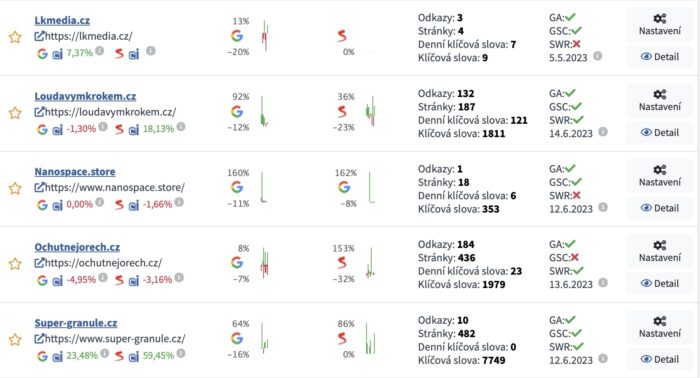
At the same time, you can monitor the performance of multiple domains at the same time in Collabim over the long term.
Overview of projects in Collabim
Ahrefs
Ahrefs is an SEO tool focused on comparing domains and finding opportunities in search engines. It has great datasets on links across sites. We often use Ahrefs to analyze the link profile of a domain (what sites link to the domain and how often) and to analyze the competition.
Ahrefs provides all the data it knows about all domains, so it’s very easy to find out what strategy the site is using to build backlinks, what topics are the strongest in searches, and how it got to the top of the search engines in the first place (whether through honest work or more likely fraudulent practices).
Ahrefs also plots the data into graphs that allow you to estimate how the site is performing over the years. Often this is how we uncover content opportunities – we come across a website that is strong on a topic, but hasn’t been cared for in years and is slowly disappearing from search engines. We take up his theme and go beyond it with activity.
Semrush is a popular offshore SEO tool that provides a wide range of features for keyword analysis, position tracking, competitor analysis, backlink management and more. He’s great for foreign countries. Semrush can speak Czech, but is generally one of the more expensive tools and the above mentioned tools are better for the Czech market.
Answerthepublic
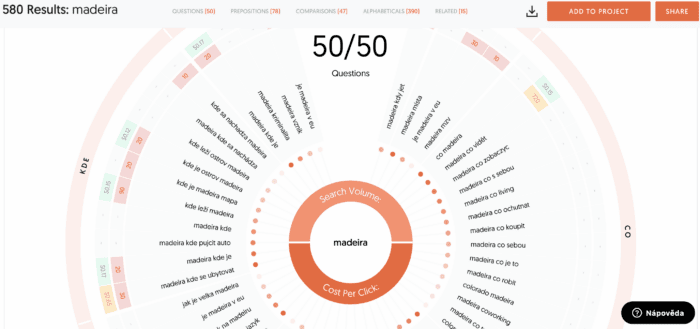
Answerthepublic.com is a relatively undiscovered service in the Czech Republic, but we are very excited about it. After entering 1-2 keywords, it will perform a small keyword analysis for you.He speaks Czech. It finds out what other keywords are related to the topic and displays them in clear circles and tables, from which you can come up with a fancy article outline in minutes.
Preview with answerthepublic.com
Sitebulb
Sitebulb is a tool that can automate a fairly detailed technical and content analysis of any website. It runs as software on a computer (Windows and Mac) and results in detailed reports on all areas of SEO.
Although Sitebulb is simple to use and creates a nice report, the most important thing is your interpretation and how you really understand SEO. This is the only way to put the recommendations into practice.
Screaming Frog
Screaming Frog is a similar tool to Sitebulb, but less visual and more focused on data collection, and can generally handle larger sites (500,000 URL+) than Sitebulb.
Google Search Console
Google’s Search Console is an absolute staple that everyone trying to drive organic traffic should use. Search Console shows you how your website is performing in search engines, what keywords people from Google are clicking through to your website and where you could improve.
It also has basic technical analysis and will tell you if Google doesn’t like something about your site.
Webmaster list
Seznam Webmaster is a similar tool to Google Search Console, but for Czech Seznam.
PageSpeed Insights
PageSpeed Insights is a free tool from Google that analyses the technical side of your website and offers recommendations on how to improve its performance and user-friendliness.
How to do SEO on WordPress?
The principle of SEO is the same on all platforms, but it is true that SEO on a platform WordPress is easier due to the wide range of tools and plugins available. Plugins for better SEO on WordPress:
SEO plugins: there are several popular plugins for SEO on WordPress such as Yoast SEO, All in One SEO Pack or Rank Math. We use Yoast SEO on some sites and Rank Math on newer ones. These plugins offer advanced features for content optimization, meta tag management, keyword analysis, etc.
Image optimization plugins: to speed up the loading of images, it is advisable to compress them. You can use several plugins for this: smush, Imagify or Shortpixel.
SEO specialists charge from 500 CZK to 5000 CZK per hour, it always depends on the scope of work and the expertise that is needed.
The most expensive are keyword analyses, high-quality ones cost at least 30 thousand, where part of the price includes the cost of analytical tools. Keyword analysis then involves dozens of hours of manual work, which an efficient specialist can simplify by using various scripts, but still usually does not get under 15 hours for larger keywords.
Sample keyword analysis
What to watch out for: keyword analyses are often fudged. If an “SEO specialist” only supplies you with a few dozen keywords that are not categorized in any way, they probably don’t know what they are doing. Are you worried that you didn’t get a comprehensive enough analysis?
We have prepared a sample keyword analysis for you in the format we process and use. The keyword analysis is on the topic of accounting. The sample keyword is free in Discord for our Patreon subscribers.
SEO Audit
Another big item is SEO audits, which include :
Technical analysis (examining site architecture, crawling, crawling pages with no-index attribute, pages returning 404 error and dead links on the site, evaluating URL structure and page load speed, including analysis of .js and CSS files and sizes of images and videos on the site + many other aspects of e-shops, etc.),
content analysis (category and product titles, meta titles and search engine descriptions, alt text for images and videos, content pages and internal linking, attention is also paid to crawl depth, redirects, use of filtering and the use of parametric filters to create impactful pages)
link profile analysis (whether spam links lead to the website, what the link portfolio looks like)
and makes sure that the website is properly connected to systems such as Google Analytics, Google Search Console, Webmaster List and Bing Webmaster Tool.
Overall, the goal of an SEO audit is to identify and correct issues that could negatively affect a website’s performance in organic search. These audits can cost 5-50k depending on the size of the site/e-shop. The average price is 20 thousand.
Content strategy
The last big item is the creation of content strategybased on keyword analysis. In this case, it is based on keyword analysis combined with competitive analysis and company priorities. Content strategies usually cost 10-20 thousand.
Once you have completed the keyword analysis, SEO audit and content strategy, the monthly price depends on how many errors you need to fix and how much content you and your SEO specialist will be creating together.
Bonus for Patrons: the 17 most common mistakes when working on SEO
For our Patreon subscribers, we made a video describing the seventeen most common and important mistakes that e-shop owners, bloggers and marketers make most often when working on content SEO.
Simply put, when a link is marked as “no-follow”, it tells the search engine “disregard this link when ranking the linked page”. Comprehensively: No-follow is a value that can be added to the “rel” attribute of a link’s HTML tag. When this value is added, it signals to search engines like Google that they should not transfer any “link authority” (also known as “PageRank”) to the linked page. An example of a no-follow link in HTML might look like this: <a href="http://example.com/" rel="nofollow">Odkaz na example.com</a> No-follow links are often used when a website doesn’t want to be associated with the linked page, or doesn’t want to transfer its link authority to ni. This may be the case if the link leads to a site that does not have a good reputation, or if the link leads to advertising or sponsored content. It is important to note that Google and other search engines may still index pages with no-follow links. The no-follow attribute just tells the search engine to disregard the link when ranking the linked page.
What is an SEO article?
SEO article is the name for an article that is optimized for search engines. This means that it has content focused on certain keywords and has properly structured data.
How to learn SEO?
Learn first how search engines work and then the basic principles of content creation. An SEO specialist should know the technical aspects of search engines and should also be a good copywriter. How to SEO is also discussed on Patreon Loud Step.
How to improve the SEO of a website?
Do a technical and content audit and then improve all metrics step by step and start creating content tailored to the keywords you discover through the content audit.
How long will it take to get to the top of the search engines?
If you have all the technical aspects in order and have already built up some domain authority, your content will get the best results in 6 months from publication/update. If not, either the content is bad or you don’t have enough domain authority.
How to get to the top of the search engines?
Create the best content on the internet that is structured according to SEO recommendations. The key is to have a technically optimized website.
When will the results of the optimization come?
We have first results with clients within 3-6 months. It always depends on the initial state.
How much does SEO cost?
Quality work of an SEO specialist on small and medium-sized projects costs 20-70 thousand per month depending on the requirements for results. Initial investments tend to be more expensive.
What is the best tool for SEO?
It’s not easy to say, but the most popular tools include Marketing Miner and Collabim.
What to do when SEO doesn’t work
You probably have something technically wrong, contact an experienced SEO specialist (for example Lukas ).
Who is Pavel Ungr?
Pavel Ungr is one of the best known Czech SEO consultants.
What is SEOLOGER?
SEOLOGER is an event organized by Pavel Unger. It is a regularly recurring event for SEO specialists to discuss current SEO issues. You can also join FB group .
Who is Michal Binka?
Michal Binka is one of the best known Czech specialists who works for the agency SEO PRAKTICKY.
How to turn on SEO?
SEO is not something that can simply be turned on or off like a switch. SEO is a continuous and dynamic process that requires planning, optimization and ongoing maintenance. There are many factors that influence SEO, and they change constantly depending on changes in search engine algorithms and user behaviour.
What are the best SEO plugins for WordPress?
We have been using Yoast SEO for a long time, but now Rank Math seems better. Other popular SEO plugins include SEOPress, W3 Total Cache, All In One SEO Pack, Broken Link Checker, SEOquake, Rank Math, Premium SEO Pack.
What’s the hammer on your SEO
The hammer for your SEO is the brand of SEO specialist Pavel Unger.
Search for flights on Kayak. It’s our favorite search engine because it scans the websites of all airlines and always finds the cheapest connection.
Book Your Accommodation Smartly
The best experiences we’ve had when looking for accommodation (from Alaska to Morocco) are with Booking.com, where hotels, apartments, and entire houses are usually the cheapest and most widely available.
Don’t Forget Travel Insurance
Good travel insurance will protect you against illness, accidents, theft, or flight cancellations. We’ve had a few hospital visits abroad, so we know how important it is to have proper insurance arranged.
Where we insure ourselves: SafetyWing (best for everyone) and TrueTraveller (for extra-long trips).
Why don’t we recommend any Czech insurance company? Because they have too many restrictions. They set limits on the number of days abroad, travel insurance via a credit card often requires you to pay medical expenses only with that card, and they frequently limit the number of returns to the Czech Republic.
Find the Best Experiences
Get Your Guide is a huge online marketplace where you can book guided walks, trips, skip-the-line tickets, tours, and much more. We always find some extra fun there!
TL;DRBased on real-world experience, the best SEO tools for the Czech market are Ahrefs, Collabim and Marketing Miner — part of a roundup of 10 tools worth knowing about. Collabim stands out for ongoing keyword tracking thanks to its Holy Grail feature, while Ahrefs is the strongest option for backlink and competitor analysis, though it’s on the pricier side. Other picks include Semrush, Answerthepublic.com for keyword suggestions, the technical tools Sitebulb and Screaming Frog (which handles sites with over 500,000 URLs), and the free options Google Search Console, Seznam Webmaster and PageSpeed Insights.
SEO tools are every SEO specialist’s best friend — and every skilled copywriter’s too. In this guide, we share our picks for the best SEO tools that we use daily. Personally, I rely on Ahrefs the most, though it’s on the pricier side. Another tool we couldn’t live without is Collabim, which is fantastic for everyday content work. But there are plenty of other indispensable tools in our stack, from Marketing Miner to Semrush. Below you’ll find our top 10 SEO tools — including the ones we use most and why.
Marketing Miner is a Czech SEO and marketing tool that offers a wide range of features for data analysis and website optimisation. It includes a variety of modules that let you pull different data about:
domains
keywords
specific URLs
With a single click, you can find out which keywords drive the most traffic to your competitors, which content performs best on a domain, or who the domain’s biggest competitors are.
Marketing Miner also handles analysis on larger datasets. If you’re working on keyword research, you can use its “miners” — bulk analysis features that take a list of keywords you upload (via a spreadsheet, for example) and return:
search volume for each keyword
your domain’s ranking positions for those keywords
keyword competitiveness
suggestions for related keywords
and much more.
A basic report from Marketing Miner
Collabim – A Popular SEO Tool for Ongoing Optimisation
Collabim is another Czech-made SEO tool with similar features to Marketing Miner, but it really shines when it comes to continuous SEO work. You can upload tens of thousands of keywords into Collabim, and every 14 days it checks where your website ranks for each of them in search engines.
One particularly useful feature in Collabim is its “Holy Grail” report — it exports all the keywords a selected domain ranks for in search engines straight into a spreadsheet. It’s an excellent way to reverse-engineer your competitors’ content strategy.
You can also track the performance of multiple domains at once over the long term, making it a great tool for agencies and anyone managing several websites.
Project overview in Collabim
Ahrefs – The Most Powerful SEO Tool
Ahrefs is an SEO tool focused on domain comparison and uncovering search engine opportunities. It has outstanding datasets on backlinks across the web. We frequently use Ahrefs for analysing a domain’s backlink profile (which websites link to it and how often) and for competitor analysis.
Ahrefs provides all the data it has on any domain, so you can easily figure out a website’s link-building strategy, which topics it ranks strongest for, and how it climbed to the top of search results — whether through genuine effort or shady tactics.
Ahrefs also visualises data in graphs, making it easy to gauge how a website has performed over the years. We often discover content opportunities this way — we’ll find a site that’s strong on a particular topic but clearly hasn’t been maintained in years and is slowly losing its rankings. We then take over that topic and, through consistent activity, outrank it.
If you want to dive deeper into Ahrefs, there’s plenty of great content on their own Ahrefs Blog.
Semrush
Semrush is one of the most popular SEO tools on the market, offering a comprehensive set of features for keyword research, rank tracking, competitor analysis, backlink management, and more. It’s a fantastic all-in-one solution, particularly for international SEO. Semrush supports a wide range of languages and regions, though it sits on the pricier end of the spectrum.
AnswerThePublic
AnswerThePublic.com is a tool that doesn’t get as much attention as it deserves, but we’re big fans. Just enter one or two keywords and it performs a mini keyword analysis for you. It finds related questions, prepositions, and comparisons people search for, then displays them in visually appealing circles and tables. Within minutes, you’ll have a solid outline for a well-structured article.
Example output from AnswerThePublic.com
Sitebulb
Sitebulb is a tool that runs automated, in-depth technical and content audits of any website. It works as desktop software (available for both Windows and Mac) and produces detailed reports covering all areas of SEO.
While Sitebulb is user-friendly and generates beautiful reports, the most important part is your interpretation of the results and how well you truly understand SEO. That’s the only way you’ll be able to turn its recommendations into actionable improvements.
Screaming Frog
Screaming Frog is similar to Sitebulb but less visual and more focused on raw data collection. It can generally handle much larger websites (500,000+ URLs) than Sitebulb, making it the go-to choice for enterprise-level site audits.
Google Search Console
Google Search Console is an absolute must-have for anyone trying to grow organic traffic. It shows you how your website is performing in search results, which keywords people use to find your site on Google, and where there’s room for improvement.
It also includes basic technical analysis and will alert you if Google spots any issues with your website. Best of all, it’s completely free — making it one of the best SEO tools for beginners and experts alike.
Bing Webmaster Tools
Bing Webmaster Tools is similar to Google Search Console, but for Microsoft’s Bing search engine. If a portion of your audience uses Bing, it’s well worth setting up to get additional insights into your search performance.
PageSpeed Insights
PageSpeed Insights is a free tool from Google that analyses the technical performance of your website and offers recommendations on how to improve its speed and user experience. Site speed is a confirmed ranking factor, so this tool deserves a spot in every SEO toolkit.
How to Learn SEO Quickly and Easily
Start by reading our 13 simple SEO tips that anyone can follow. If you run a Shoptet store, we’ve also recorded a mini-course on SEO for Shoptet, where we walk you through working with some of the SEO tools mentioned above.
Bonus for Patrons: 17 Most Common SEO Mistakes
For subscribers of our Patreon, we’ve recorded a video covering the 17 most common and critical mistakes that e-shop owners, bloggers, and marketers make when working on content SEO.
Checklist: How to Write a Well-Optimised Article on WordPress or Shoptet
Are you a copywriter, blogger, or e-shop owner looking to create quality articles that maximise your chances of earning organic traffic? We’ve put together handy checklists for both WordPress and Shoptet — available for the price of a coffee (around 2.50 €).
SEO is what SEO specialists do. If you’re interested in working with us, feel free to get in touch. ☺️
Tips and Tricks for Your Vacation
Don’t Overpay for Flights
Search for flights on Kayak. It’s our favorite search engine because it scans the websites of all airlines and always finds the cheapest connection.
Book Your Accommodation Smartly
The best experiences we’ve had when looking for accommodation (from Alaska to Morocco) are with Booking.com, where hotels, apartments, and entire houses are usually the cheapest and most widely available.
Don’t Forget Travel Insurance
Good travel insurance will protect you against illness, accidents, theft, or flight cancellations. We’ve had a few hospital visits abroad, so we know how important it is to have proper insurance arranged.
Where we insure ourselves: SafetyWing (best for everyone) and TrueTraveller (for extra-long trips).
Why don’t we recommend any Czech insurance company? Because they have too many restrictions. They set limits on the number of days abroad, travel insurance via a credit card often requires you to pay medical expenses only with that card, and they frequently limit the number of returns to the Czech Republic.
Find the Best Experiences
Get Your Guide is a huge online marketplace where you can book guided walks, trips, skip-the-line tickets, tours, and much more. We always find some extra fun there!
TL;DRSEO stands for Search Engine Optimization, the process of shaping a website to rank as high as possible in Google or Seznam search results. It works thanks to a web crawler that scans pages and adds them to a search index, which search algorithms then draw on to serve results to users. It covers keyword research, SEO content, technical SEO, off-page SEO, local SEO and tracking results with tools like Google Analytics. Unlike PPC ads, where you pay for every click, SEO is a one-off investment in optimisation and content that can bring a single article hundreds or even thousands of visitors a month. To get pages indexed faster, it helps to submit a sitemap or send URLs manually through a tool like Google Search Console.
SEO is part of content marketing and stands for Search Engine Optimization. It’s the process of optimizing websites to achieve the highest possible ranking in search engine results. So what is SEO in digital marketing exactly, how does it work, and why should you care? Let’s break it down in simple terms.
What is SEO
What Is SEO Explained Simply
When you type “What is SEO” into Google, this article should pop up among the top results within 3–6 months of being published. I don’t know when you’re reading this, but chances are you found your way here through a search engine. We don’t pay for any ads. That’s the magic of SEO.
SEO is a fundamental element of effective digital marketing and it covers a wide range of activities:
Keyword Research: Identifying relevant keywords and phrases that potential customers use when searching for the products you sell or the content you offer.
SEO Content Creation: Producing high-quality, relevant, and engaging content that is optimized for keywords and covers a topic so thoroughly that readers don’t feel the need to look elsewhere.
Technical SEO: Ensuring your website is well-optimized from a technical standpoint for search engines — fast loading times, responsive design across devices, and a solid site structure.
Off-page SEO: Activities outside your website that help boost your search engine rankings — link building, social signals, and strong domain reputation.
Local SEO: Optimizing your website for searches within a specific geographic area.
Measurement and Analytics: Tracking the success of your SEO strategy using tools like Google Analytics and making the necessary adjustments to improve performance.
Why You Should Invest in SEO – Thousands of Visitors From a Single Article
When you invest time in search engine optimization on your website or e-commerce store, you can drive high-quality traffic to it on a long-term basis — without paying for each and every click.
While PPC advertising requires you to pay for every click, with SEO you pay for technical optimization and quality content creation as a one-off investment. With the right SEO specialist, a single article can bring in hundreds or even thousands of visitors every month.
Your analytics could end up looking something like this:
Organic traffic overview for the e-shop nanospace.cz for the period 2021–2023
How Search Engines Work and How It Relates to SEO
We all know search engines and we all use them. You probably have a pretty good idea of how they work from a user’s perspective — you type in “What is SEO” and the search engine serves up relevant links or even a direct answer to your question. But to actually “do SEO”, you also need to understand how search engines work on a technical level. Let’s take a closer look.
How Search Engines Work
At the heart of every search engine is something called a web crawler. Behind this intimidating name lies a script or program that systematically browses internet links and indexes them. Think of a web crawler as a super-fast librarian, and websites as books. The librarian goes through each book and files it by topic into the library. This filing process is called indexing, and the library is what search engines draw from when they serve you relevant results.
Search engines consist of two main components:
The search index, which is a digital library of information about web pages.
Search algorithms, which are computer programs responsible for delivering results from the search index.
Your goal is to make sure the librarian knows your pages exist, that the search algorithms like them, and that they’re offered among the top results. If you produce poor content, the librarian (search engine) may decide it’s not worth shelving — and won’t index it at all.
How Search Engines Index and Rank Pages
There are many search engines out there and each one works slightly differently. Here are the key things they evaluate:
First, the search engine needs to find your website and all its pages
There’s no guarantee that search engine bots will discover your pages on their own. You need to help them along, and there are several ways to do that:
Providing a sitemap to search engines
A sitemap is a special page on your website in XML format that lists all the URLs (pages) you want indexed by search engines. Its generation is usually handled automatically by the platform you build your site with (e.g. WordPress). Here’s what the sitemap for the blog loudavymkrokem.cz looks like:
Post sitemap for loudavymkrokem.cz
Bots can find the sitemap on their own, or you can submit it directly through an admin interface. For Google, you submit your sitemap via Search Console:
Sitemap submission in Google Search Console
Manually submitting URLs to search engines
Most search engines allow you to manually submit URLs. If you don’t have a plugin on your site that does this automatically, you can submit URLs to search engines every time you publish a new article. In return, they’ll crawl it as a priority. Here’s what manual submission looks like in Google:
Manual URL indexing in Google
Internal and backlinks
Every page on your website or blog should have at least one link pointing to it from somewhere else on the same site — whether it’s from a category page, the footer, or another article. You should avoid having any page with no links pointing to it, as search engine bots may never find it.
Search engines browse pages through “crawling”
It sounds complicated, but it simply means that Google or another search engine visits websites and downloads known URLs. In Google’s case, the bot that handles this is called Googlebot.
After this step comes “processing and rendering.” During this phase, the search engine works to understand the content and structure of the page. This involves running the page’s code (such as JavaScript) to understand how the page looks and how it’s structured. It may also include identifying links on the page and other important information.
For subscribers of our Patreon, we’ve recorded a video covering the seventeen most common and most critical mistakes that e-commerce owners, bloggers, and marketers make when working on content SEO.
Who Can Help Me With SEO?
SEO is handled by SEO specialists. If you’re interested, feel free to get in touch with us. ☺️
Tips and Tricks for Your Vacation
Don’t Overpay for Flights
Search for flights on Kayak. It’s our favorite search engine because it scans the websites of all airlines and always finds the cheapest connection.
Book Your Accommodation Smartly
The best experiences we’ve had when looking for accommodation (from Alaska to Morocco) are with Booking.com, where hotels, apartments, and entire houses are usually the cheapest and most widely available.
Don’t Forget Travel Insurance
Good travel insurance will protect you against illness, accidents, theft, or flight cancellations. We’ve had a few hospital visits abroad, so we know how important it is to have proper insurance arranged.
Where we insure ourselves: SafetyWing (best for everyone) and TrueTraveller (for extra-long trips).
Why don’t we recommend any Czech insurance company? Because they have too many restrictions. They set limits on the number of days abroad, travel insurance via a credit card often requires you to pay medical expenses only with that card, and they frequently limit the number of returns to the Czech Republic.
Find the Best Experiences
Get Your Guide is a huge online marketplace where you can book guided walks, trips, skip-the-line tickets, tours, and much more. We always find some extra fun there!
TL;DRThe Beskids and Wallachia region has 20 day-trip ideas centred on Rožnov pod Radhoštěm, a great base with the Jurkovič lookout tower (40 CZK entry for adults, 80 CZK for a family) and the Wallachian Open-Air Museum, which takes 1.5–2 hours to look round. Highlights include Pustevny with its Jurkovič-designed chalets Libušín and Maměnka, the Radegast statue and the summit of Radhošť (1129 m), the Beskids’ highest peak Lysá hora (1323 m), Hukvaldy Castle, the Satina Waterfalls and Štramberk with its Trúba tower. Hotel Horal near Rožnov is your best bet for a stay, or go for a caravan pitch at 2500–2900 CZK a night. Summer is the best time to visit, when the trails are in good shape for walkers and cyclists alike.
At the end of May, we set off by caravan to the Moravian-Silesian Beskydy and Wallachia. The romantic green hills, folk architecture, and numerous cycling paths and hiking trails here will charm nature-loving couples and families with children. In this guide — Beskydy and Wallachia, Czech Republic: 20 Best Things to Do and See — I’ll share where to go, what to see, and tips for visiting this beautiful region.
You will learn a lot about the local Wallachian traditions, you can taste Radegast beer right at the source Radegast or even spend weeks hiking the Beskydy ridges. If you have the opportunity, bring your bikes, Beskydy is a paradise for cyclists. Let’s now look at where to go for a trip with children in Beskydy, what to see here, and where to stay strategically.
Where to Stay in Beskydy: Best Hotels
The most strategic starting point for exploring Beskydy is Rožnov pod Radhoštěm. Finding accommodation in Beskydy can be tricky during the season and you might not have many options, but if Hotel Horal is available, it’s one of the best in the area. Current offers with the best price/performance ratio:
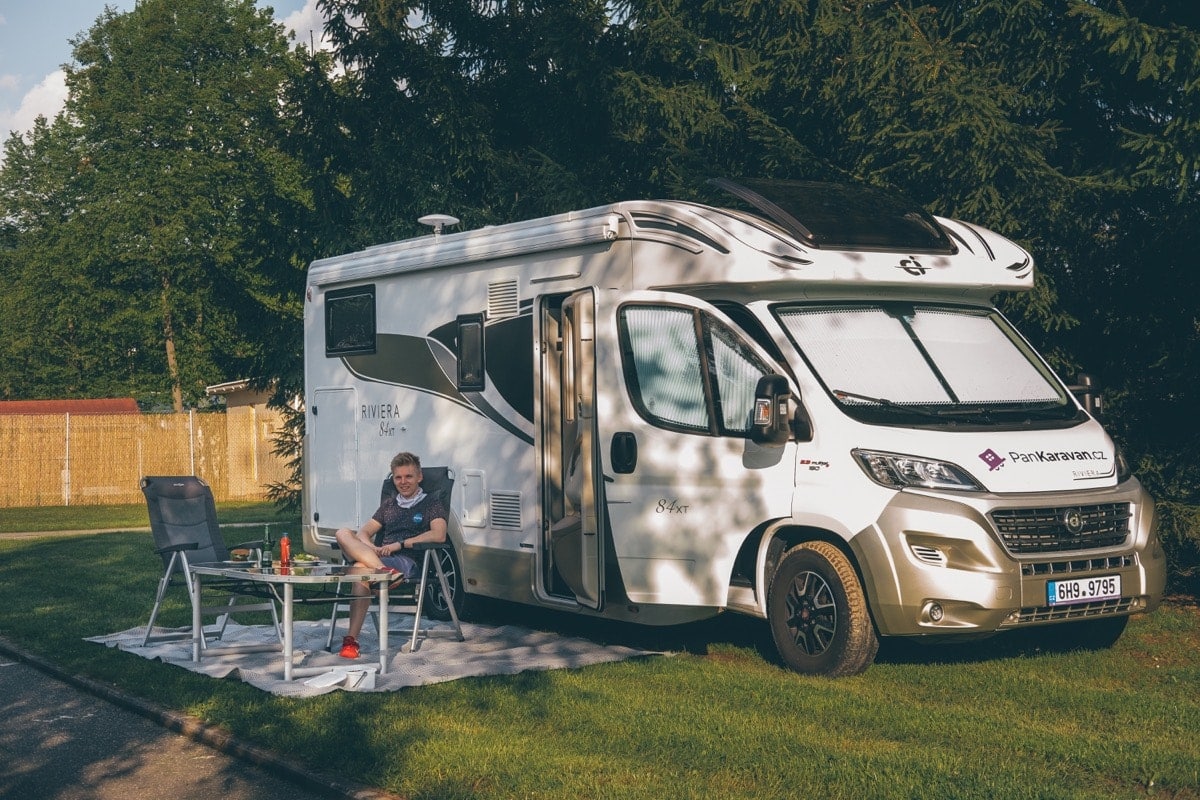
If all hotels are already full, consider renting a caravan. We tested a caravan from Pan Karavan for five days and were surprised how comfortable traveling by caravan is.
Caravan rental in Czechia
Caravan rental costs 2500-2900 CZK per day, for longer rentals, there is a 10-20% discount. The caravan has a consumption of 10-11 liters.
The caravan has a shower, toilet, refrigerator, and kitchenette. It comfortably sleeps 4-5 people depending on the rented caravan. The caravan also has a bike rack, of course, but you can also put them in the storage compartment like we did. You also have outdoor seating and a grill available.
Where to Camp with a Caravan
With a caravan, you don’t have to pay for a campsite every day, if you conserve water, you can go to a campsite once every 2-3 days. Tips for camping outside campsites can be found at bezkempu.cz.
What to Watch out for when Driving a Caravan
If you are renting a caravan for the first time, we definitely recommend going off-season, when there will be less traffic and it will be easier to choose a spot and park at campsites. Never camp on unpaved surfaces if rain is expected, or the ground beneath you will get soaked and a tractor will have to pull you out.
And now, let’s get to why you came here. Best places in Beskydy:
Beskydy: where to Go for a Trip in Beskydy with or without Children
Let’s now look at where to go for a trip in Beskydy, what to see and what to do here.
Rožnov Pod Radhoštěm
A small town in the Rožnov Furrow area, which is part of the Western Beskydy, is an ideal starting point for exploring this region.
It has a small center where you’ll find the Church of All Saints, which was built as a replacement for a 16th-century wooden church between 1745–50. A number of cycling routes lead from here, which is why it is very popular for cycling trips.
Jurkovič Lookout Tower
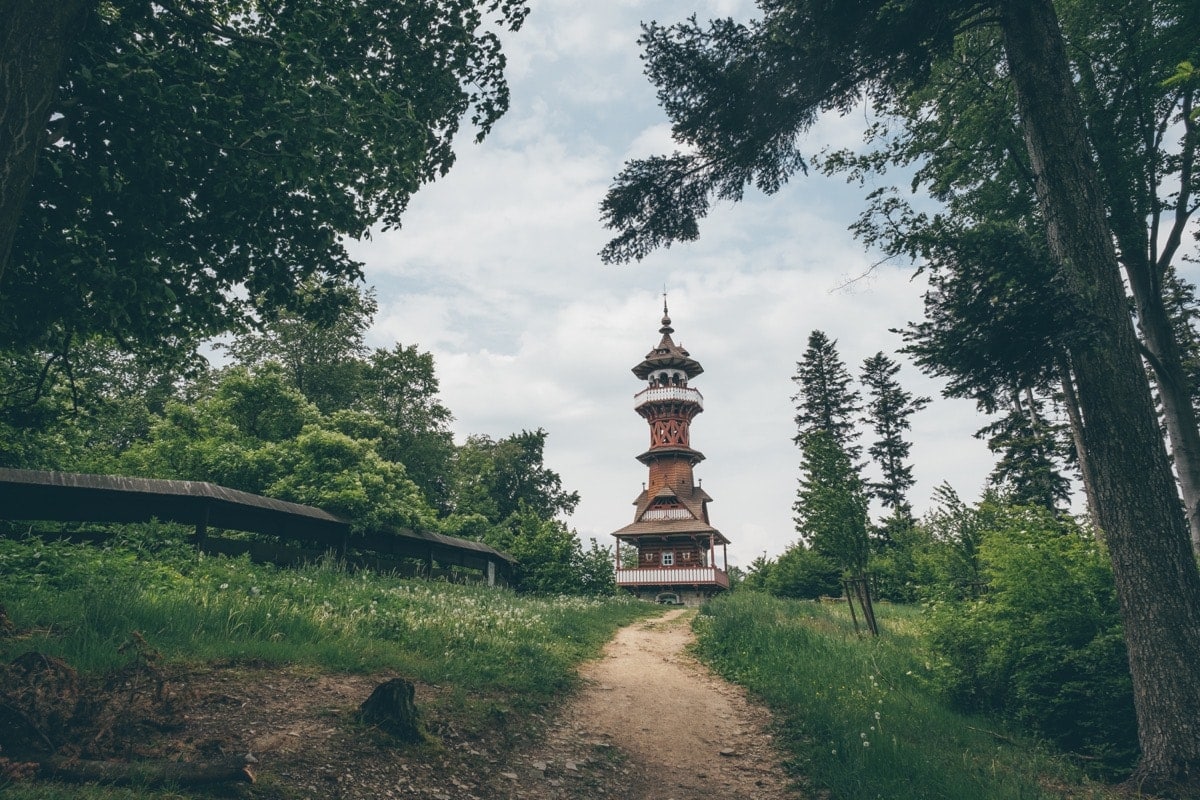
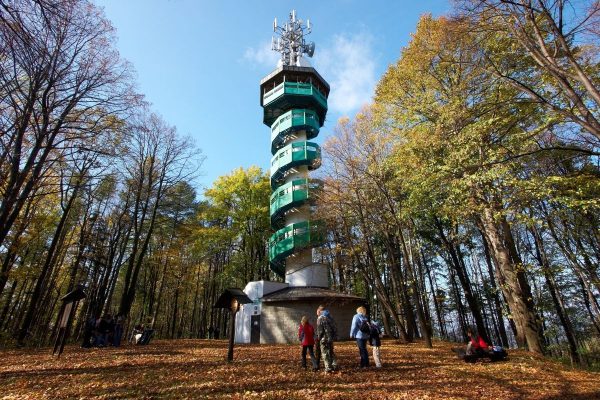
The Jurkovič Lookout Tower looks like something out of a fairytale, it stands on top of Karlův kopec above Rožnov pod Radhoštěm and was only completed in 2011. However, Dušan Jurkovič designed it back in 1896.
According to his design, shelters in Pustevny, spa buildings in Luhačovice, and the building of the suspended cable car on Lomnický štít were also built.
Jurkovič Lookout Tower
You can get to the lookout tower from the parking lot, which is designated for the Wallachian Open-Air Museum. A relatively steep yet short path leads to it. If you are going on vacation with children, it is possible to go to the Jurkovič Lookout Tower even with a stroller, but a baby carrier is more suitable.
Admission to Jurkovič Lookout Tower(Updated may 2020)
Children under 6 years free
6 to 18 years 20 CZK
Adults 40 CZK
Seniors over 60 years 20 CZK
Family admission 80 CZK (parents and max. 4 children)
Before your trip, don’t forget to check the weather so you can enjoy the view 🙂
The Wallachian Open-Air Museum is one of four open-air museums in the Czech Republic and is among the largest outdoor museums in Central Europe.
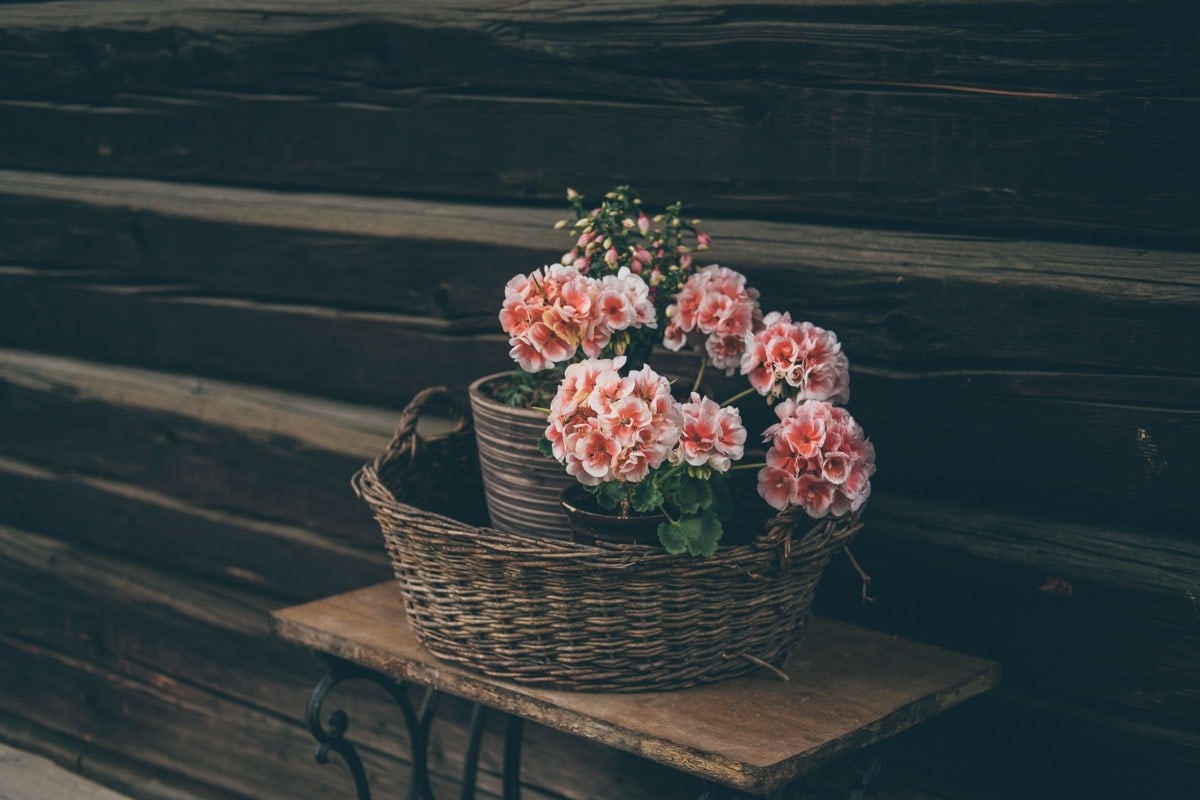
Flowers in the Wallachian Museum
It consists of three parts: the Mill Valley, the Wallachian Village, and the Wooden Town. Admission to each part costs 80-100 CZK. The most extensive part is the Wallachian Village, and if we were to recommend only one part to visit, definitely come here.
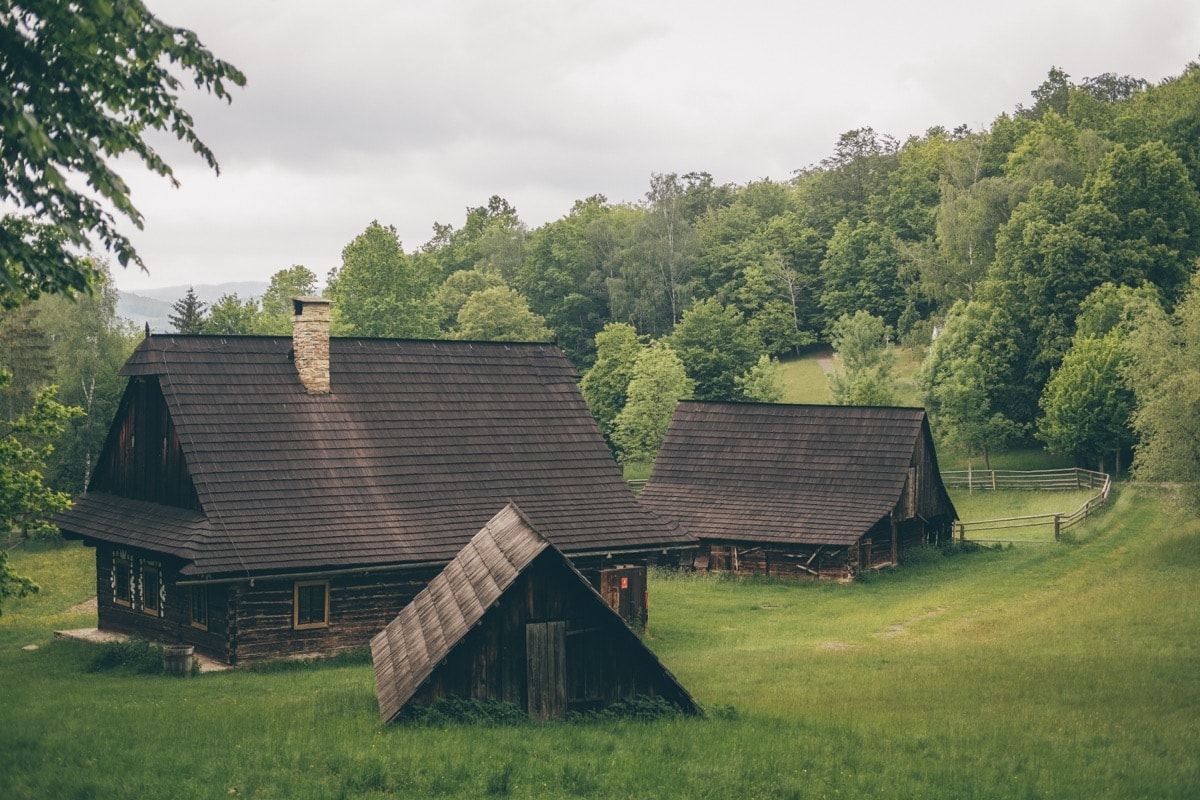
When you enter the Wallachian Village, you feel as if you’ve stepped back a few centuries into an original Wallachian village. You’ll find buildings of both landowners and landless peasants here, as well as a school building and a pub.
Wallachian Open-Air Museum
During the tour, you will probably also see a shepherd with his flock of sheep. Most of the buildings here are original but were relocated here; some structures are replicas created according to archives and field research. The tour will take you 1.5 – 2 hours, refreshments are available on site.
If you have a stroller with you, we recommend visiting the Wooden Town, which is smaller, but you can easily move around with a stroller here.
Pustevny
Pustevny is one of the most visited parts of Beskydy and is located on the border of the Moravian-Silesian and Zlín Regions near the mythical Radhošť mountain.
Jurkovič Shelters
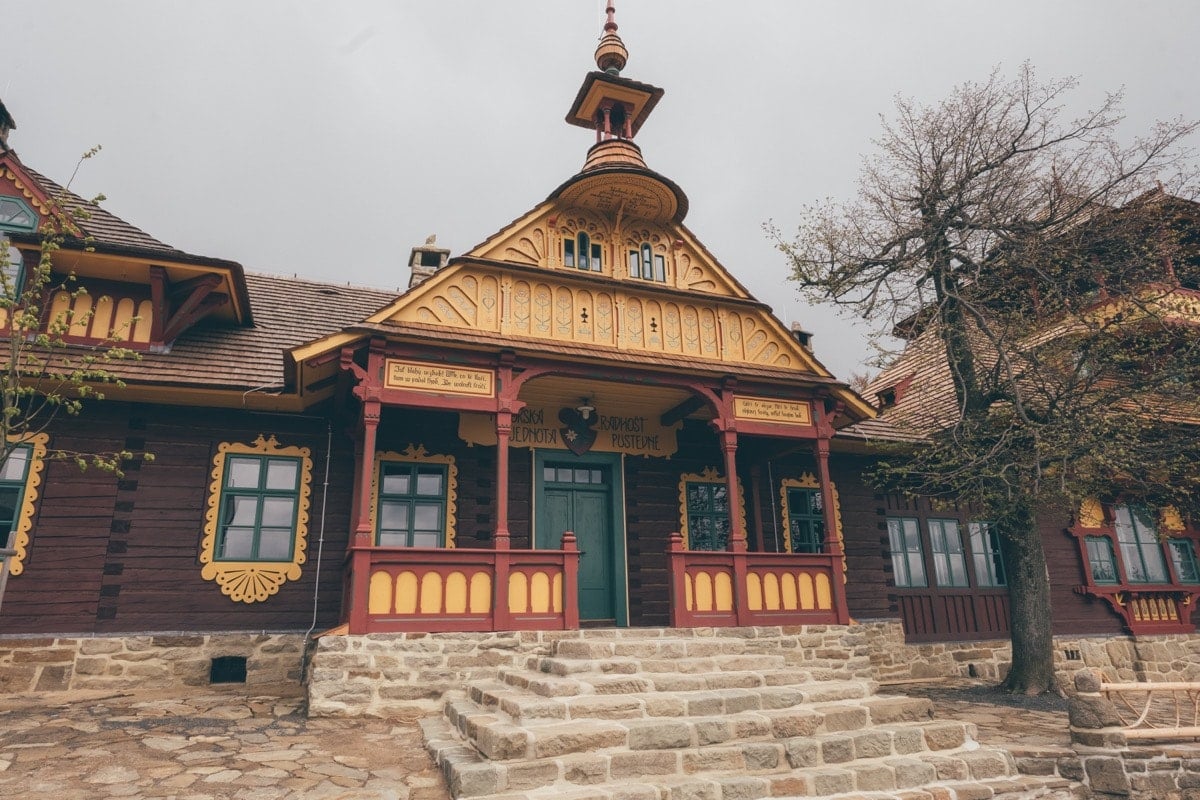
In Pustevny, you will find the famous Jurkovič Shelters, as accommodation for tourists was once called. Dušan Jurkovič built two accommodation and hospitality buildings here in the folk Art Nouveau style, which were named Libušín and Maměnka. These fairytale buildings attract tourists to Pustevny in both summer and winter months. They have stood here since 1899.
Jurkovič Shelters
Valaška Trail
A few steps beyond Pustevny, you’ll find a relatively new skywalk called Valaška Trail, which takes you above the treetops. From the trail, there are beautiful views of Beskydy, but be prepared for a high admission fee (family 600 CZK).
Radegast Statue
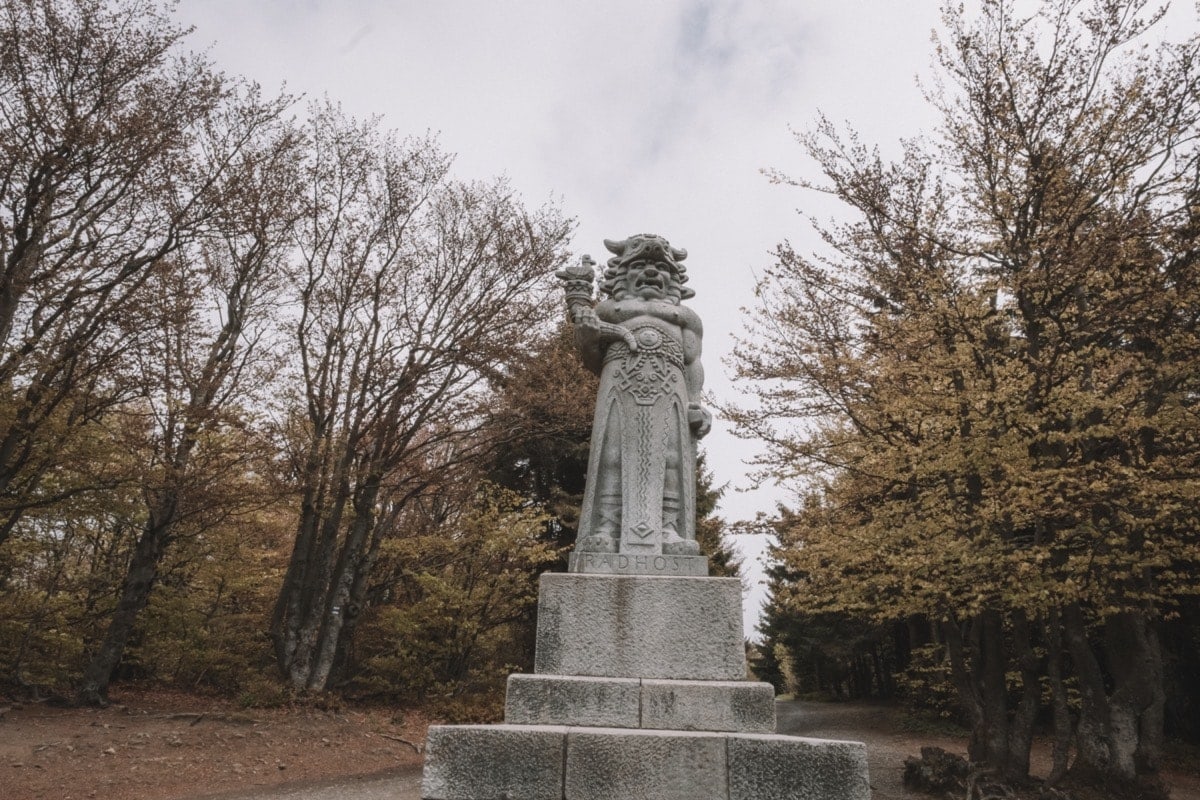
From Pustevny, you can head to the Radegast statue, which you’ll find on the way to Radhošť. The path is also suitable for strollers.
Radegast Statue on Radhošť
Radhošť Peak
If the walk to Radegast isn’t enough for you, you can continue further to Radhošť Peak. If the weather is good, you will see not only the entire Beskydy and Wallachia from here, but also Jeseníky, Malá Fatra, and Veľká Fatra.
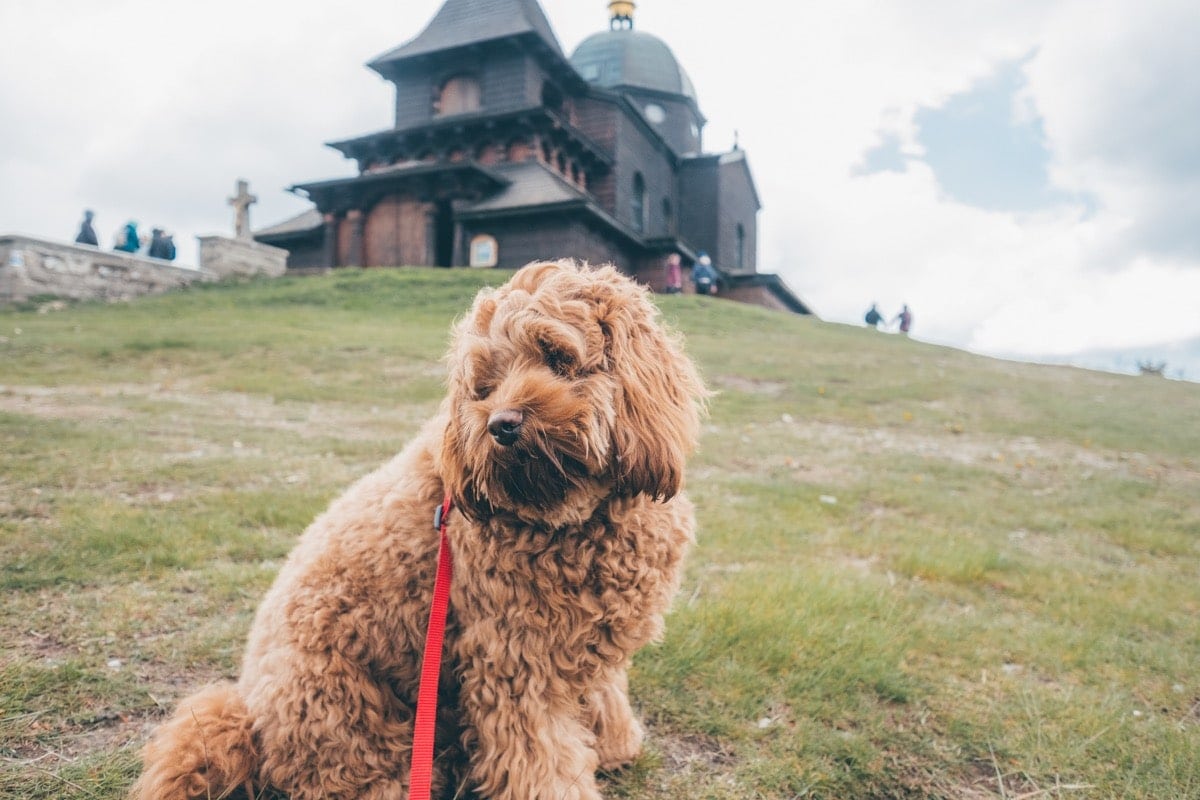
Today, the Chapel of Saints Cyril and Methodius from the late 19th century stands on Radhošť. Unfortunately, the view of the chapel is somewhat marred by a television transmitter, which was built right next to it in 1931.
Chapel of Cyril and Methodius on Radhošť
How to get to Pustevny
You can get to Pustevny in several ways.
If you don’t have a dog like us, you can take the cable car from Trojanovice (parking opposite Hotel Ráztoka).
You can also drive to Pustevny, but parking cost us 150 CZK during the weekend. On weekdays, parking is 100 CZK.
Buses to Pustevny run from Frenštát pod Radhoštěm (Trojanovice stop near Hotel Ráztoka) and from the Rožnov pod Radhoštěm bus station.
If you have a bike with you, you can go to Pustevny via cycling route number 6017 or 46, where the upper cable car station is located.
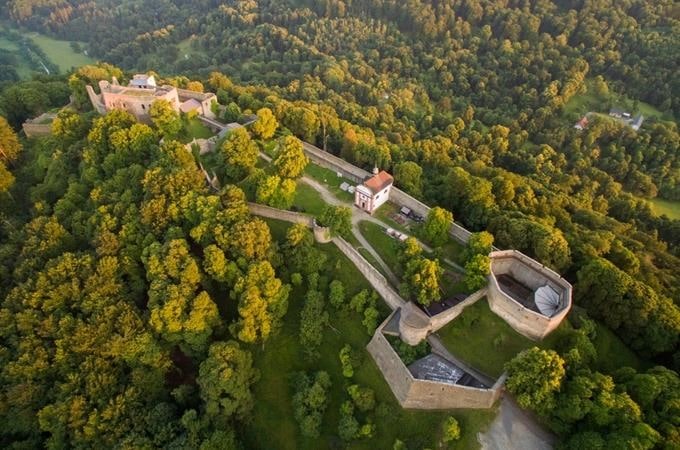
The largest ruin in Moravia can be found near Rožnov pod Radhoštěm on an elongated hill located above the village of Hukvaldy. Hukvaldy is primarily known as the birthplace of the Czech composer Leoš Janáček.
The first mentions of the castle date back to the end of the 13th century. The best-preserved part of the castle is the Chapel of St. Andrew, which, however, was built only in the 17th century. Before you head to Beskydy, check if there are any events planned here. They host spooky nights, wine harvests, pilgrimages, as well as fencing performances and treasure hunts.
Hukvaldy Castle Ruins (source: kudyznudy.cz)
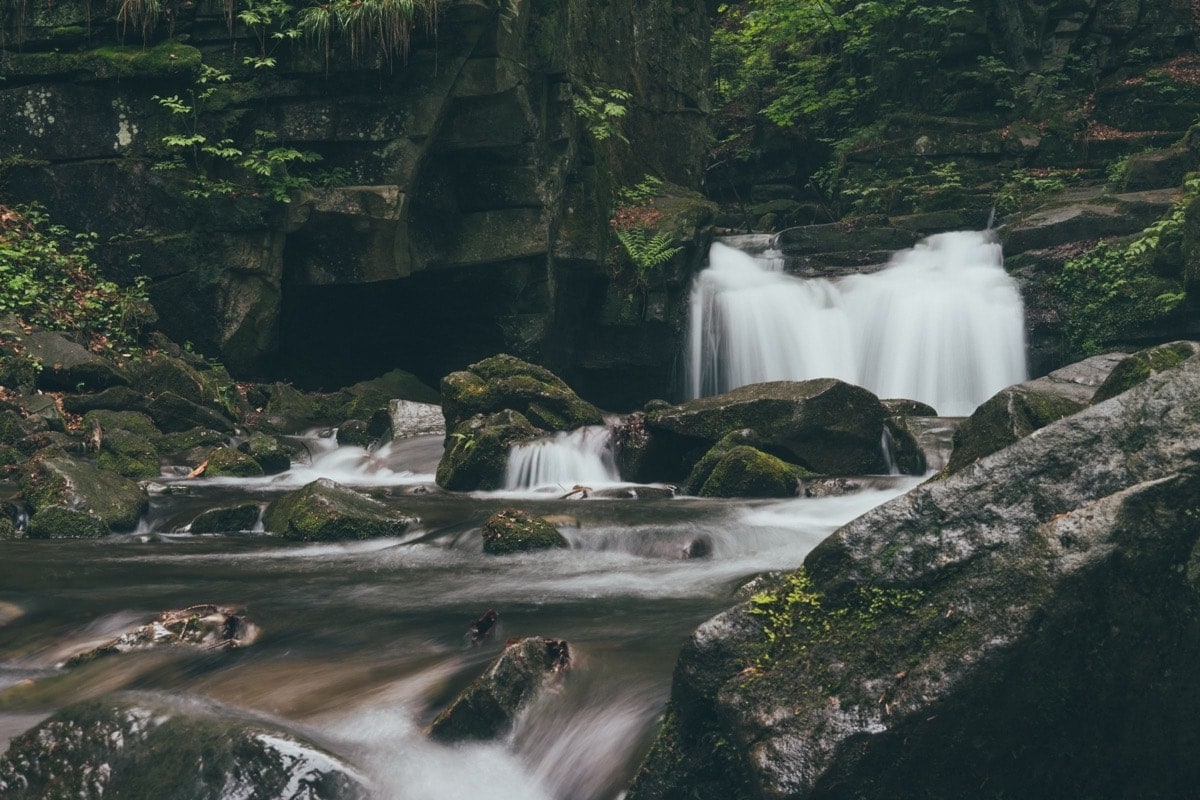
Satiny Waterfalls
The magical small waterfalls in the heart of Beskydy are an ideal trip if it’s too hot, or if the weather is unfavorable and visibility is too low.
Satiny Waterfalls
They are located in a 15 m deep gorge of the mountain stream Satiny and can be reached in several ways. You can take the orange or yellow bear trail, but if you don’t have time, stairs lead directly to them from the road.
Satiny Waterfalls
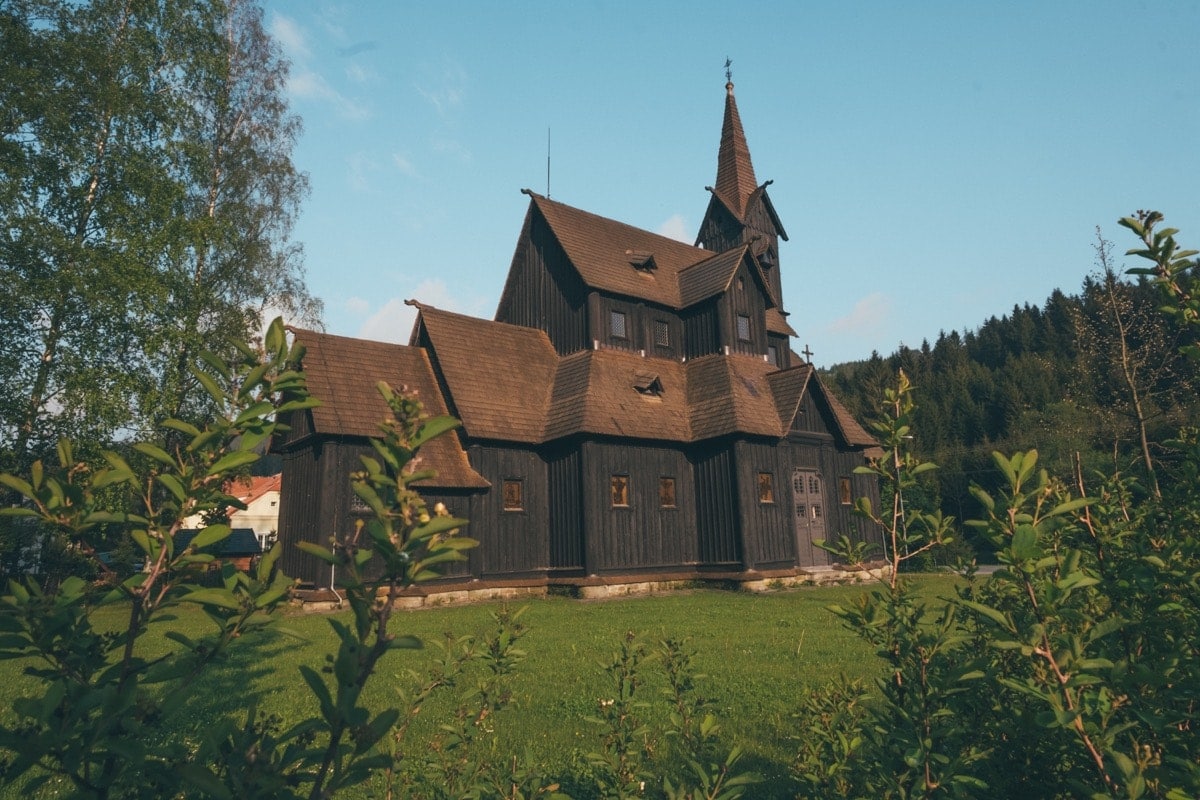
Wooden Church of Saint Frederick
The charming and somewhat mysterious wooden Church of Saint Frederick is located in the village of Bílá. It was built between 1873-1874 by the Archbishop of Olomouc and stands out significantly from other churches in the area in terms of both appearance and construction.
Various myths circulate about the church. One says that it was built according to a Nordic model, which the Archbishop of Olomouc purchased at the World Exhibition in Vienna. For its construction, a very unusual design for Czech standards was chosen, called stavkirche. This construction was used in Norway in the 11th century.
Church of Saint Frederick
Příbor
If you are going on a longer vacation to Beskydy, be sure to also stop in the birthplace of the world-renowned psychologist Sigmund Freud. In Příbor, you will find two exhibitions dedicated to him. One is in his birth house on Zámenická Street, and the other can be found in the Memorial Hall of the local museum.
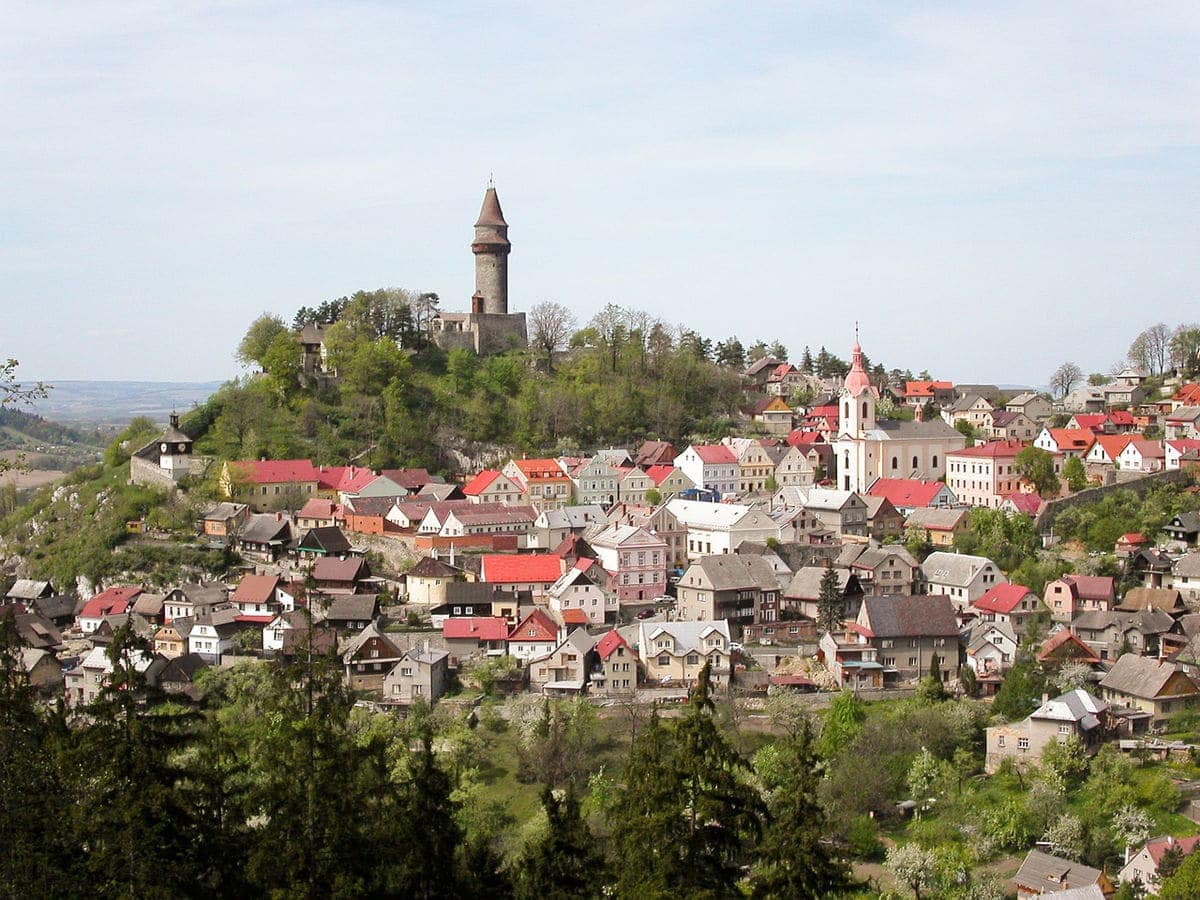
Štramberk
This romantic town in the Nový Jičín district near Kopřivnice is primarily known in Moravia for Štramberk Ears, which is a gingerbread-dough delicacy shaped like a cone.
A local legend says that they originated during the Mongol invasion in 1241, when the enemy army set up camp at the foot of the nearby Kotouč hill. After a night storm, the inhabitants of Štramberk dug through the pond dam and flooded the camp. When the water receded, people found only sacks with salted human ears here. In memory of this event, Štramberk Ears began to be baked.
The dominant feature of the town is Štramberk Castle with its Gothic tower Trúba, which today serves as a lookout tower, in the town, you will find the Štramberk Museum and the Zdeněk Burian Museum.
Štramberk Town (Source: Wikipedia)
Bílá Hora Lookout Tower
The 28 m lookout tower on Bílá hora hill is a very popular tourist destination from Kopřivnice and Štramberk. The concrete structure with a view of Beskydy has stood here for twenty years, and the architect of the design was Milan Šmíd. You can get here by following the blue trail from Štramberk or Kopřivnice. Both routes are approximately 2 km long. You can reach the lookout tower by bike or with a stroller.
Bílá hora Lookout Tower (Source: rozhledna-bila-hora.cz)
Lysá Hora 1323 M a.S.L.
A number of trails lead to Lysá hora, the easiest one is from Visalaje following the red trail, the most popular one leads from Ostravice. The highest peak of the Moravian-Silesian Beskydy is one of the most popular tourist destinations, so it’s better to go here outside of the weekend.
Views from the Beskydy hills
Smrk
Like Lysá hora, Smrk is also one of the most visited peaks in Beskydy. If you prefer to avoid tourists, choose the yellow trail from the Šance reservoir in Staré Hamry, which is less popular. The traditional route follows the red trail from Ostravice or Čeladná. Bring snacks and plenty of water with you; by Czech standards, the route is quite demanding, and there are no refreshments along the way.
Tatra Museum Kopřivnice
In unfavorable weather, you can head to the Tatra Car Museum in Kopřivnice. The museum maps the development of the automotive industry from Austria-Hungary. You will be surprised by a collection of beautiful design cars that once influenced the development of the automotive industry worldwide.
Lukáš and Lucie recommend
Where to stay in Beskydy and Valašsko
2 accommodations — hotels and other accommodation options
In Rožnov pod Radhoštěm, we liked the cafe Balloo Coffee, where, in addition to great coffee, they also have excellent breakfasts, desserts, and soup at lunchtime. We liked it so much that we returned there not only every day but sometimes even several times.
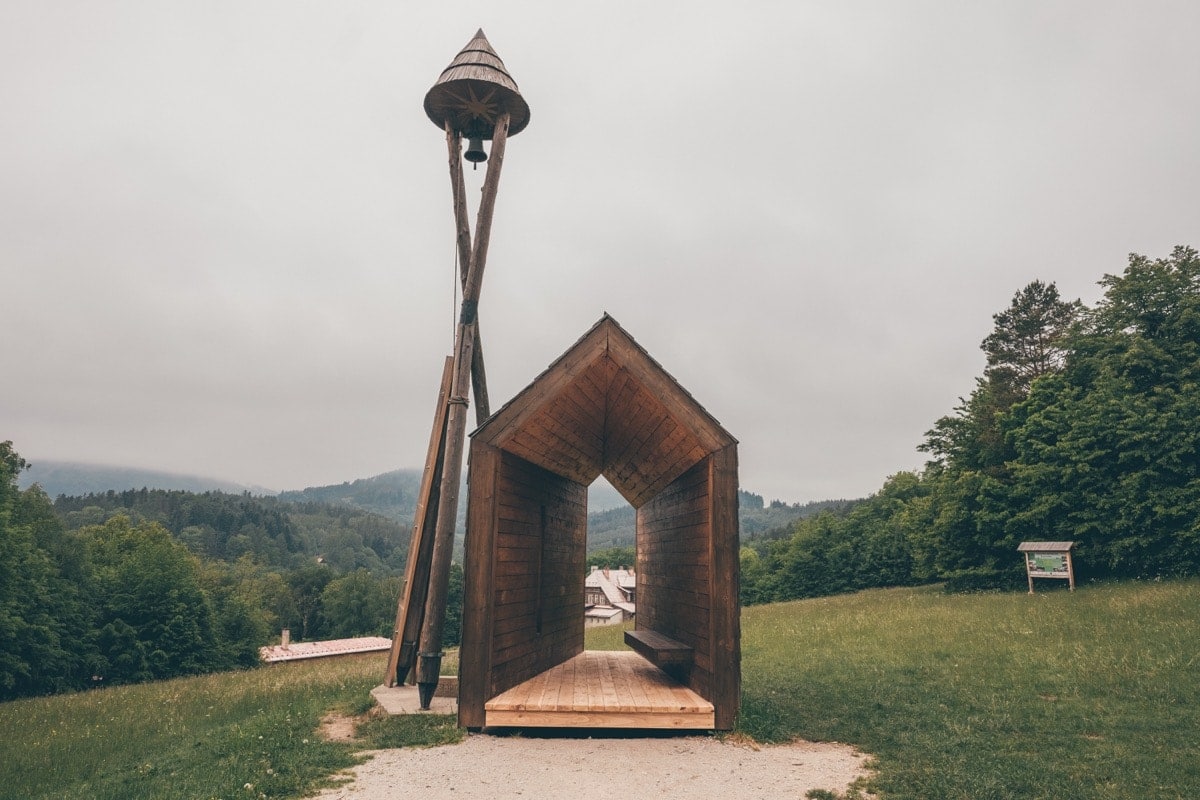
Bell Tower, Guardian of Beskydy (above Frenštát)
Vegetarians will definitely head to Nashe Bistro, which you can also find in town. If you like meat, the restaurant at Hotel Endemit and Albert Málek restaurant were often recommended to us.
Tips and Tricks for Your Vacation
Don’t Overpay for Flights
Search for flights on Kayak. It’s our favorite search engine because it scans the websites of all airlines and always finds the cheapest connection.
Book Your Accommodation Smartly
The best experiences we’ve had when looking for accommodation (from Alaska to Morocco) are with Booking.com, where hotels, apartments, and entire houses are usually the cheapest and most widely available.
Don’t Forget Travel Insurance
Good travel insurance will protect you against illness, accidents, theft, or flight cancellations. We’ve had a few hospital visits abroad, so we know how important it is to have proper insurance arranged.
Where we insure ourselves: SafetyWing (best for everyone) and TrueTraveller (for extra-long trips).
Why don’t we recommend any Czech insurance company? Because they have too many restrictions. They set limits on the number of days abroad, travel insurance via a credit card often requires you to pay medical expenses only with that card, and they frequently limit the number of returns to the Czech Republic.
Find the Best Experiences
Get Your Guide is a huge online marketplace where you can book guided walks, trips, skip-the-line tickets, tours, and much more. We always find some extra fun there!
TL;DRMunich, Bavaria’s capital at the foot of the Alps on the River Isar, mixes history, striking modern architecture, green parks and a brilliant food scene. It’s just 4–5 hours from London, so it works well for a weekend or a longer trip. The heart of the city is Marienplatz, with the New Town Hall and its Glockenspiel clock. Don’t miss the beer gardens, the English Garden or a day trip into the Alps. The guide has 40+ tips, a 1–3 day itinerary and a map you can pull up on your phone. Spring and summer are the best times to go, with autumn’s Oktoberfest as the big highlight.
Munich is a city that will surprise you. The Bavarian capital with 1.5 million inhabitants sits at the foot of the Alps on the River Isar and offers a mix of history, modern architecture, gorgeous parks, and one of the best food scenes in Europe. From the UK, it’s just a 2-hour flight and absolutely worth a visit. After Berlin, it’s our second favourite city in Germany.
Whether you’re planning a weekend break or a longer stay, this guide will help you plan a tailor-made trip — from iconic landmarks to beer gardens and day trips to the Alps. In this article, you’ll find 40+ things to do in Munich, a practical itinerary for 1 to 3 days, tips on Bavarian cuisine, and a map with all the places to download to your phone.
Before we dive into individual tips, here’s our recommended plan depending on how many days you have in Munich. We spent just under three days here and it was just right.
Munich for 1 Day
If you only have one day, focus on the historic centre and the city’s atmosphere.
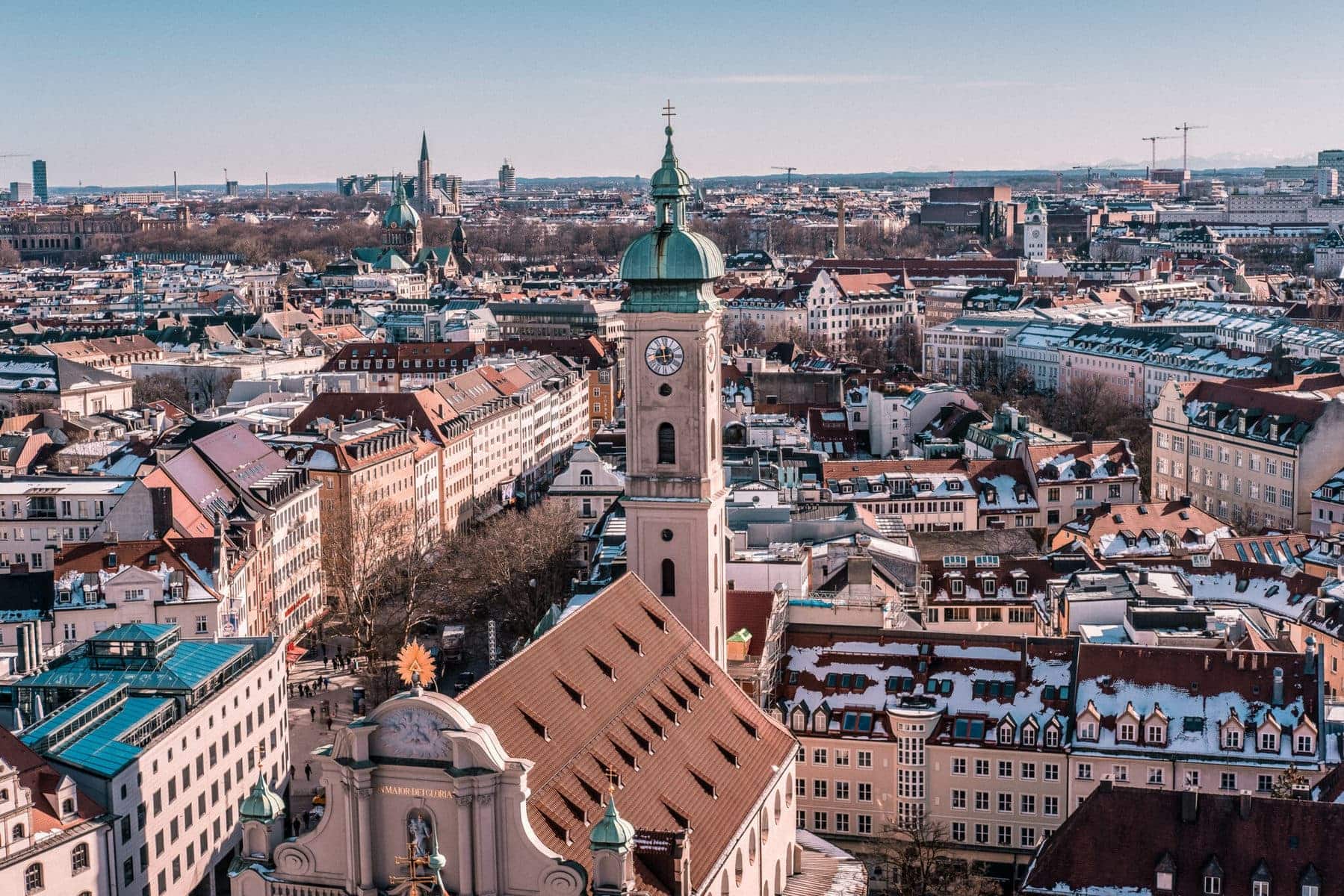
Morning: Start at Marienplatz — admire the New Town Hall and at 11:00 (or 12:00) watch the Glockenspiel chime. Climb the tower of St. Peter’s Church (Alter Peter) — nearly 400 steps, but the view of the city and, on a clear day, all the way to the Alps is worth it (admission €3). Stroll over to Viktualienmarkt, grab some Bavarian sausages or Obatzda with a pretzel and a beer right at the market.
Afternoon: Head to the English Garden — stop by the Eisbach, where surfers catch waves right in the middle of the city (yes, surfers in central Munich — you have to see it!). Walk through the park towards Chinesischer Turm and have a beer in one of Munich’s largest beer gardens. If time allows, visit Odeonsplatz and Hofgarten.
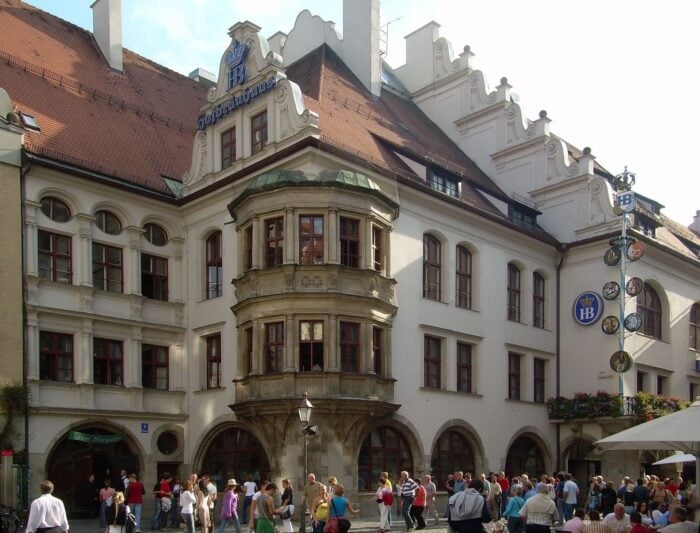
Evening: End the day at Hofbräuhaus or Augustiner-Keller — both offer traditional Bavarian cuisine with live music. Order the Schweinshaxe (roast pork knuckle) and a Maß of beer — it’s an experience that simply belongs to Munich.
Munich for 2 Days
Add to day one:
Day 2 — morning: Head to Nymphenburg Palace — a baroque palace with beautiful gardens (gardens are free). Allow 2-3 hours. On the way back, stop at the Hirschgarten beer garden (the world’s largest, 8,000 seats!), which is right next door.
Day 2 — afternoon:BMW Museum or Deutsches Museum — depends on whether you’re more into the automotive world or science and technology. In our opinion, the BMW Museum is the best attraction in all of Munich, even if you’re not a car fan. Allow at least 2-3 hours.
Day 2 — evening: Dinner at Wirtshaus in der Au for the best Kaiserschmarrn in Munich, or head to Schneider Bräuhaus for wheat beer and Schweinshaxe.
Munich for 3 Days
Dedicate the third day to a trip out of the city:
Neuschwanstein — the fairy-tale castle of King Ludwig II (2 hours by train/car)
Zugspitze — Germany’s highest peak with a cable car to the summit
Salzburg — Mozart’s city is just 1.5 hours by train
Königssee — an emerald-green lake surrounded by steep cliffs
The foundation of a complete visit to Munich is seeing all four main historic squares. That’s where you’ll find the majority of the most important landmarks.
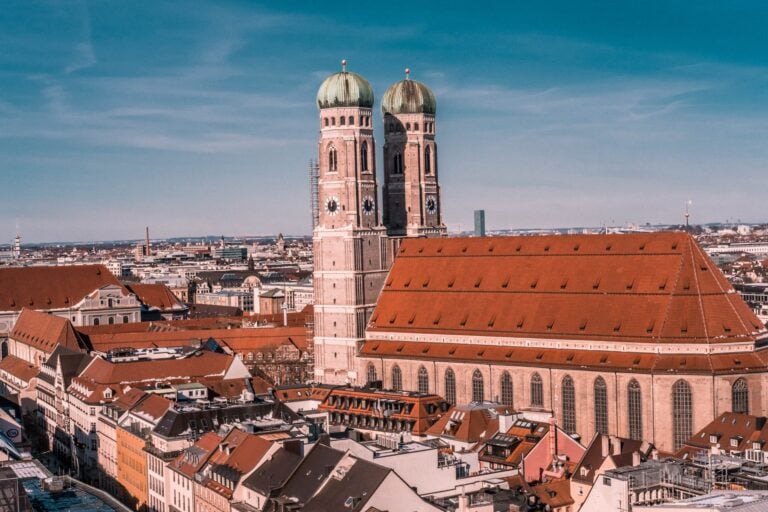
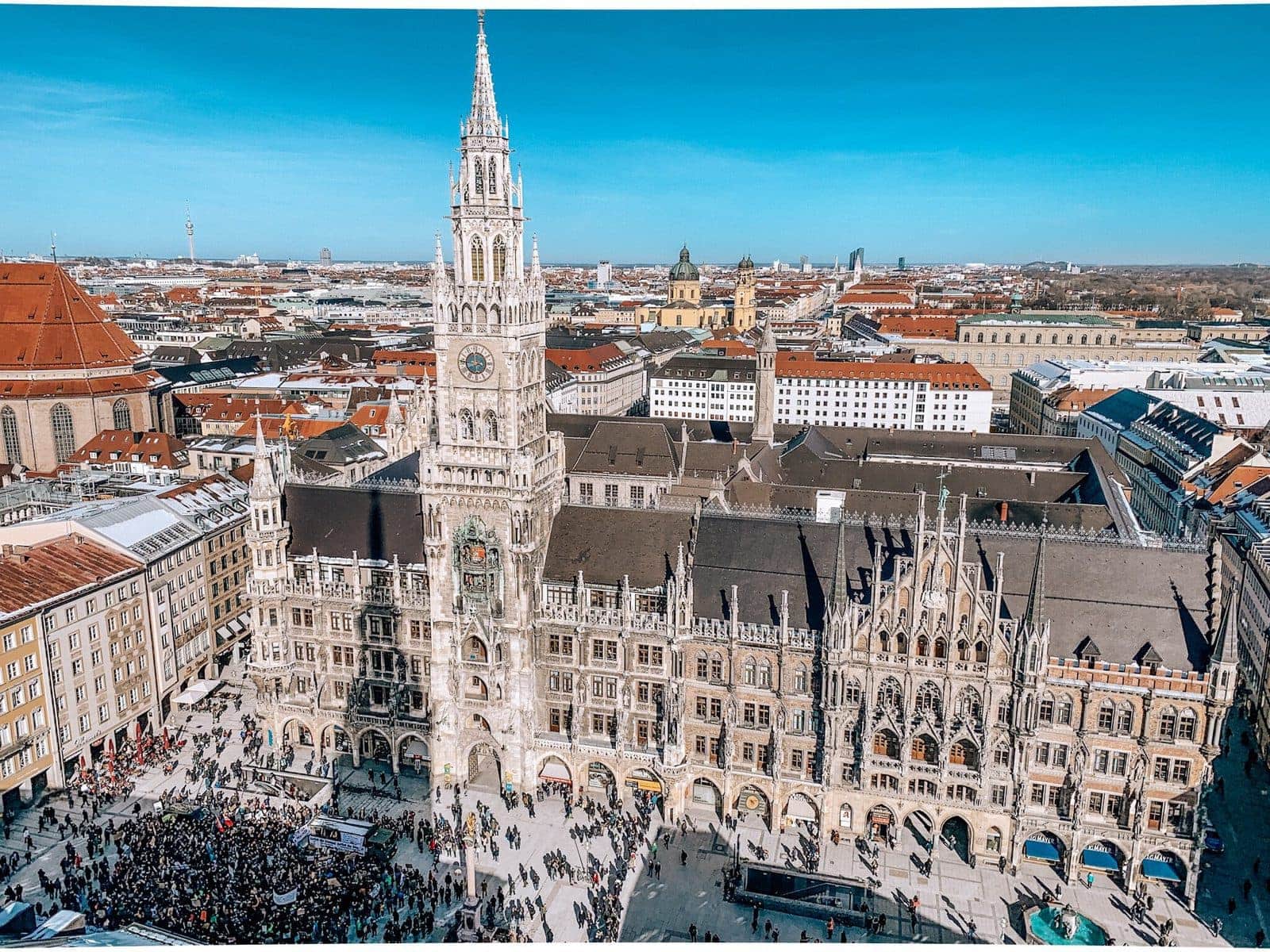
Marienplatz
Marienplatz is the heart of Munich’s old town and one of the most visited places in the city. It’s packed with historic buildings, including the Old and New Town Halls, the Glockenspiel, and the viewing platform at St. Peter’s Church. At the centre of the square stands the Marian Column, a symbol of the city. Various events take place here daily, from markets to cultural performances, making it the ideal starting point for exploring the city.
Marienplatz
Don’t miss these at Marienplatz:
Peterskirche (St. Peter’s Church)
The best way to start exploring any city is always from above. The viewing tower of Peterskirche at Marienplatz offers a panorama of Munich’s entire historic centre.
The climb is quite long — you need to ascend nearly 400 steps to reach the top. But it’s absolutely worth it, and on a clear day you can spot the Alps in the distance. It’s one of the best viewpoints in all of Munich and an alternative to the New Town Hall tower — and in our opinion, the better one.
A family ticket for 2 adults and up to 3 children is €6.
View from Peterskirche in Munich
Neues Rathaus (New Town Hall)
The Neues Rathaus is the New Town Hall. It was built between 1867 and 1909 in a typical Neo-Gothic style. Visiting the town hall is free and offers several highlights:
The famous Glockenspiel (more details below), located in the tower.
Views from the observation platform at 50 metres height with panoramic views of the old town.
Historic halls decorated with paintings and sculptures depicting the city’s history.
A tourist information centre with maps and advice on the city’s landmarks.
Glockenspiel at Neues Rathaus
The Glockenspiel is a carillon (similar in concept to Prague’s Astronomical Clock) mounted on the New Town Hall building. It was built in 1908 and tells a story from the 16th century. The mechanism is truly elaborate, featuring 43 bells and 32 life-sized figures that enact a jousting tournament in which one of the knights falls from his horse.
The Glockenspiel plays every half hour at these times:
Monday to Friday
08:00 – 20:00
Saturday and Sunday
09:00 – 20:00
The specific melody changes with each performance. Usually, it’s a short folk song or dance tune.
Marian Column and Fountain
The Marian Column rising in the centre of Marienplatz is one of Munich’s symbols. It was erected in 1590 as a thanksgiving to the Virgin Mary for averting the plague.
Atop the tall marble column stands a gilded statue of the Virgin Mary wearing a stylised crown, with a crescent moon beneath her feet. Since 1638, it has been accompanied by statues of 12 apostles and 4 Church Fathers.
The column is surrounded by a fountain with water jets, which was added in 1885. In summer, it’s lovely to cool off by the fountain.
We visited Munich in winter, so unfortunately we don’t have a photo of the fountain in action. 😊
Hofbräuhaus Brewery and Beer Hall
Hofbräuhaus is the oldest brewery in Munich, with a history dating back to 1589. It’s located near Marienplatz, just beside the New Town Hall.
Today it primarily serves as a massive restaurant with traditional Bavarian cuisine. The highlight is beer from their own brewery, which you simply must try. 😊 See if you like it even more than a classic British pint!
The beer hall often features live music (from what we could tell, it was an oompah band) and the staff wear traditional clothing. In summer, there’s outdoor seating.
Hofbräuhaus
Odeonsplatz
Odeonsplatz is another historic square in the northern part of Munich’s historic centre. The key landmarks here include:
Feldherrnhalle — a monumental loggia with two towers, built in 1841-1844.
Theatinerkirche — a church dedicated to the Virgin Mary built between 1663 and 1785; its yellow facade is one of the square’s defining features.
Residenz München — a royal palace and the largest urban palace in Germany. The former seat of Bavarian dukes houses magnificent art collections and lavishly decorated halls and chambers. If you only have time for one museum with historical interiors, this should be it.
Odeonsplatz is an ideal spot for an afternoon stroll as a break from exploring the busy centre. From the square, you can walk straight into Hofgarten, where you can relax among fountains and sculptures. 🙃
Königsplatz
Königsplatz is the second most famous square in central Munich. It’s not a typical square, but rather a large green space surrounded by three grand museum buildings.
The square features the famous Propylaea — a monumental gateway in Greek style. It forms the entrance to the museum complex. You’ll also find equestrian statues of Bavarian kings on the square.
Königsplatz is flanked by three major Munich museums — the Alte Pinakothek, the Neue Pinakothek, and the Glyptothek, where you can admire world-renowned art collections.
Königsplatz
Karlsplatz (Stachus)
Karlsplatz is another square in central Munich that primarily serves as a transport hub. It has the eponymous U-Bahn and S-Bahn station, offering excellent connections across the city.
The square is dominated by a Marian column from 1873. In summer, concerts are held here. Below the square lies an extensive shopping centre with numerous shops.
Frauenkirche
The Frauenkirche is another Munich icon, recognisable by its two identical onion-shaped towers. Built in the 15th century, it was sadly heavily damaged during World War II (it has since been restored). Just like Peterskirche, you can climb one of the Frauenkirche towers for panoramic views.
Frauenkirche
Asamkirche
This is a hidden gem that most tourists don’t know about. Asamkirche is a small baroque church on Sendlinger Straße, built by the Asam brothers in the 18th century originally as their private chapel. From the outside you could easily walk past it, but inside awaits one of the most stunning baroque interiors in all of Germany — gilded sculptures, frescoes, and lavish decoration from floor to ceiling. Entry is free and it takes no more than 15 minutes, but the impression lasts much longer.
Nymphenburg Palace
Nymphenburg is a baroque palace located to the west of the city centre, originally built as a summer residence for the Bavarian dukes. Over the years, it underwent several transformations to reach its present-day appearance.
When visiting the palace, don’t miss a tour of its magnificent gardens and interiors, where you can admire lavishly decorated halls and chambers. The gardens are vast and beautiful in every season — and best of all, they’re free.
The Maximilianeum
This historic building was constructed in 1857 and today serves as the seat of the Bavarian Parliament. The spot where the Maximilianeum stands offers a lovely view of the city.
Victory Gate (Siegestor)
The Victory Gate (also known as Siegestor) was built to honour the Bavarian army and is one of the most significant monuments in Munich. It’s reminiscent of Paris’s Arc de Triomphe and sits at the end of the Ludwigstraße boulevard. After being damaged in World War II, it was deliberately only partially restored — as a reminder of peace.
Museums and Galleries
Interested in history, technology, or art? Then you’ll love Munich. Munich is the third-largest city in Germany and home to over 80 museums. But which ones should you visit? Here are our top picks.
BMW Museum – an absolute must-see!
Deutsches Museum – Munich’s most famous museum, which prides itself on being the world’s largest science and technology museum
Glyptothek – the only museum dedicated exclusively to ancient sculpture
Museum Brandhorst – a modern art museum that only opened in 2009, featuring works by Hirst, Warhol, and Basquiat
Kartoffel Museum – a potato museum — and we thought Canadians were quirky when we saw one in Nova Scotia
Pinakothek – in the 19th century, this was the largest art museum in Europe
BMW Museum
Even if you’re not a huge fan of cars or BMW, we can promise the BMW Museum will still be a highlight. In our opinion, it’s the best attraction in all of Munich.
The museum takes you through the entire story of the brand — you’ll see the most beautiful, elegant, and luxurious models, explore how BMW approaches design, and learn what goes into building a Formula racing car. Plus, you can download an excellent audio guide app to your phone that walks you through the entire museum.
Admission
Adults: €10, Reduced: €6
Family ticket
Family ticket (2 adults + 3 children): €16
Opening hours
Tue-Sun: 10:00-18:00 (closed Mondays)
Address
Am Olympiapark 1, 80809 Munich, Olympic Park
Exhibition
150 BMW vehicles incl. prototypes and concepts, history, production, motorsport
Visit duration
2-3 hours depending on pace
Practical information about BMW Museum
BMW Museum
Deutsches Museum
Deutsches Museum is the world’s largest science and technology museum, with over 50 exhibitions covering a wide range of sciences and technologies. Visitors can look forward to exploring a life-size replica of a coal mine or examining the first steam engine. This museum is ideal for families with children and all tech enthusiasts alike.
Address
Museumsinsel 1, 80538 Munich
Opening hours
Tue-Sun: 9-17, Wednesday until 20:00. Closed on the first Monday of each month.
Admission
Adults: €12, Reduced: €8
Exhibition
Over 50,000 exhibits of technology, science, and research from the 15th-21st century
Visit duration
Min. 3 hours, a full day recommended
Events
Workshops, lectures, family programmes
Note
One of the world’s largest science and technology museums
Practical information about Deutsches Museum
Glyptothek Museum
The Glyptothek is one of Munich’s major art museums, housing a rich collection of Greek and Roman sculpture.
The exhibition includes over 400 sculptures from the 6th century BC to the 4th century AD, with highlights including the Laocoon group and the Barberini Faun. The sculptures come from Greek islands as well as mainland Greece and were discovered during excavations in Rome.
Admission to the Glyptothek is €6, reduced admission €4. Open Tuesday to Sunday from 10:00 to 18:00, closed on Mondays. On Sundays, admission is just €1!
Museum Brandhorst
This museum is a true paradise for lovers of modern art. You’ll easily spend at least half a day here, as viewing 1,200 works by some of the most important artists of the 20th and 21st centuries takes time.
Address
Tiergartenstraße 1, 80538 Munich
Opening hours
Tue-Sun: 10-18, Thu 10-20
Admission
Full: €7, Reduced: €3.50
Exhibition
Modern and contemporary art, painting, sculpture, photography
Visit duration
About 2 hours
Alex Katz at Museum Brandhorst in Munich
Kartoffel Museum
The Kartoffelmuseum in Munich is one of the few museums in the world dedicated to potatoes.
At the museum, you’ll learn everything about the history of potato cultivation and use around the world, as well as their cultural significance in different countries. Another section of the museum is devoted to potato varieties, their biological properties, and their use in cooking. You can even see potatoes shaped like animals and people.
Address
Grafinger Str. 2, 81671 Munich
Opening hours
Fri: 9-18, Sat: 11-17
Admission
Free entry
Exhibition
History and culture of potatoes in the world and Germany
Visit duration
About 1 hour
Note
One of the few museums dedicated to potatoes
Alte Pinakothek
The Alte Pinakothek is a significant museum because it houses several truly famous paintings, such as The Night Watch by Rembrandt. The museum is one of the most renowned in the world for old European art.
If you’re interested in classical paintings, definitely pay a visit. On Sundays, admission is just €1.
Address
Barer Straße 27, 80333 Munich
Opening hours
Tue-Sat 10:00-18:00, Thu 10:00-20:00
Admission
Full €11, Reduced €7 (Sundays €1)
Exhibition
European painting from the 14th-18th century
If you still can’t get enough of museums, here are a few more tips:
Bavarian National Museum
With more than 1.3 million objects, the Bavarian National Museum is the largest cultural institution in Bavaria. The collection spans from medieval tapestries to modern art.
Beer & Oktoberfest Museum
The Beer & Oktoberfest Museum in Munich is the ideal spot for lovers of beer and history. 🙃 You’ll learn about the festival’s history, but the most interesting part is undoubtedly the tasting of the best Bavarian beers.
Pinakothek der Moderne
The Pinakothek der Moderne houses extensive collections of architecture, design, graphics, and photography. It focuses almost exclusively on modern art. Again, on Sundays admission is just €1.
Parks and Nature in the City
Go Surfing in Munich
The Eisbach surf wave is a symbol of Munich, located at the edge of the Englischer Garten. Be warned, the water is very cold even in the warmest months — in summer you can expect just 17°C. If the cold doesn’t bother you, you can surf even in winter as it almost never freezes. Just make sure you don’t freeze yourself!
English Garden (Englischer Garten)
The English Garden is one of the largest urban parks in the world — it’s even bigger than New York’s Central Park. It’s the ideal spot for walks, picnics, and relaxing in nature. Inside the park you’ll find the aforementioned surf wave, a Chinese pagoda with a beer garden, and Kleinhesseloher See lake. In summer, locals kick off their shoes, spread out their blankets, and spend entire afternoons here — and honestly, it’s probably the best Munich experience, and it’s completely free.
Hofgarten
Hofgarten is a historic park just a short walk from the English Garden, designed in the Italian Renaissance style. Its centrepiece is a fountain with a Neptune statue. Hofgarten also features the Temple of Diana, a pond, and numerous sculptures. Cultural events are held here in summer.
Olympic Park
The 1972 Olympic Games were held in Munich, and the resulting Olympic Park still hosts cultural and sporting events today. The park is right next to the BMW Museum, so you can easily combine both visits.
Allianz Arena
The Allianz Arena is a modern football stadium, home to the famous German football club FC Bayern Munich. If you’re a football fan, stadium tours including the FC Bayern Museum are available.
Hellabrunn Zoo
If you’re travelling with children, Munich’s Hellabrunn Zoo is a fantastic choice. It’s among the best zoos in Europe and is designed as a geo-zoo — animals are grouped by the continent they originate from. The zoo sits on the banks of the River Isar and a visit takes at least 3-4 hours. Adult admission is around €21, children aged 4-14 pay €9.
Bavarian Cuisine — What to Try and Where to Eat
Munich is a paradise for food lovers. Forget currywurst — here, Bavarian classics reign supreme. And honestly? After a few days in Munich, we had to loosen our belts a notch. 😅
What You Must Try
Weißwurst (white sausage) — a traditional Munich breakfast. Eaten exclusively in the morning, no later than noon, with sweet mustard and a pretzel. Don’t slice it — you don’t eat the skin; you “suck” it out or cut it lengthwise.
Schweinshaxe — crispy roast pork knuckle. The portions are enormous — feel free to share between two people.
Obatzda — a spicy cheese spread with onions, served with a Brezn (pretzel). The perfect snack in a beer garden.
Brezn (pretzel) — the Bavarian pretzel is in a league of its own. Soft inside, crispy outside, sprinkled with coarse salt.
Kaiserschmarrn — sweet shredded pancake with plum compote. The best in Munich is served at Wirtshaus in der Au.
Leberknödelsuppe — liver dumpling soup, a classic Bavarian starter.
Where to Eat — Our Tips
Hofbräuhaus — a tourist classic, but the atmosphere is worth it. Huge portions, live music, one-litre steins.
Augustiner-Keller — locals prefer this over Hofbräuhaus. Excellent beer straight from wooden barrels (Holzfass), more relaxed atmosphere.
Wirtshaus in der Au — famous for the best Kaiserschmarrn in the city. Book ahead.
Schneider Bräuhaus — home of Schneider Weisse wheat beer. Superb Schweinshaxe.
Viktualienmarkt — not a restaurant but a market where you can assemble your own lunch. Cheeses, sausages, fruit, pastries — cheaper and more authentic than restaurants in the centre.
And one more bonus tip: we stumbled upon a little gem near the Eisbach completely by chance. A small Asian restaurant called Halong Bay truly surprised us — although it doesn’t look particularly impressive inside, we hadn’t had Pad Thai that good even during our entire month in Thailand. Lukáš declared they have the best Pho in Europe, and we were so impressed we ordered sushi too. Again, phenomenal. Plus, the prices were low for Munich.
Lukáš and Lucie recommend
Where to stay in Munich
3 accommodations — hotels and other lodging options
Beer Gardens (Biergärten) — Where to Drink Like a Local
Beer gardens are as much a part of Munich as Marienplatz. They’re open from April to October, and there’s an unwritten rule — you can bring your own food, but you buy your beer on-site. How brilliant is that? 😁
Hirschgarten — 8,000 seats, the world’s largest beer garden. Tucked away in a park behind Nymphenburg Palace, so you can combine it with a visit to the palace.
Augustiner-Keller — 5,000 seats beneath chestnut trees. Beer is tapped directly from wooden barrels (Holzfass), which is a rarity even among Munich beer gardens.
Chinesischer Turm — right in the English Garden by the Chinese pagoda. The most photogenic beer garden in the city.
Seehaus — by Kleinhesseloher See lake in the English Garden. More romantic atmosphere, great for an early evening.
Viktualienmarkt Biergarten — a small beer garden right at the market in the centre. Ideal for a quick beer between sightseeing.
Tip: A Maß (one litre of beer) costs around €12-14 in beer gardens. If you want to save a bit, order a Halbe (half litre) for €6-7.
Oktoberfest — A Practical Guide
The world’s largest beer festival takes place annually from mid-September to the first October weekend at the Theresienwiese fairground (U-Bahn station Theresienwiese). Entry to the festival is free — you pay for beer and food.
Key Information
When
Approx. 16 days, from the third Saturday in September to the first Sunday in October
Entry
Free (you pay for beer and food)
Maß of beer (1 litre)
Around €15-16 (prices increase each year)
Attendance
Over 6 million people annually
Where
Theresienwiese (U-Bahn: Theresienwiese)
Tips for Enjoying Oktoberfest
Come on a weekday morning — on weekends and evenings, the tents are packed and you’ll only get in with a reservation.
Tent reservations — if you want a guaranteed seat, book 6-9 months in advance directly on the website of your chosen tent (Augustiner, Hofbräu, Paulaner…).
Smaller tents — Augustiner-Festhalle and Fischer-Vroni have a calmer atmosphere than the massive Hofbräu-Festzelt.
Accommodation — during Oktoberfest, hotel prices are 2-3x higher. Book as early as possible, or consider staying in towns along the S-Bahn line (Dachau, Freising).
Off Season
If you can’t make it to Oktoberfest, try Starkbierfest (March) — a local alternative with even stronger beer, without the tourist crowds. Or Frühlingsfest (April-May) — a smaller spring version of Oktoberfest at the same venue. We haven’t been to Oktoberfest ourselves yet, but it’s definitely on our list for next time.
Shopping and Markets
We’re not big shoppers, so we can’t recommend too many places, but a few stuck with us.
Viktualienmarkt
If you want to taste some local delicacies, head to Viktualienmarkt, where you’ll find just about everything. From fresh vegetables and spices to local Bavarian specialities.
Market in Munich
Kaufingerstraße and Neuhauser Straße
Munich’s main shopping zone — a pedestrian street connecting Marienplatz and Karlsplatz (Stachus). You’ll find big-name brands, souvenir shops, and plenty of cafés for resting between purchases.
Dallmayr
A legendary Munich delicatessen that’s been operating since 1700. Even if you don’t buy anything, it’s worth a visit just to look around — you’ll find exotic fruit, chocolate, cheeses, and teas from around the world. Their coffee is famous throughout Germany.
Christmas Markets
If you visit Munich in December, the Christmas markets are an absolute must. The main Christkindlmarkt on Marienplatz is huge and beautifully illuminated. For something more unusual, try the Mittelaltermarkt (medieval market) — there you’ll get mulled wine in a clay cup and feel like you’ve stepped back in time. 😊
Day Trips from Munich
Munich is an excellent base for day trips into the Bavarian Alps and surrounding cities. All of them can be done in a day, and most are possible without a car thanks to the Bayern Ticket.
Neuschwanstein Castle
The fairy-tale castle of King Ludwig II is Germany’s most photographed landmark. Take the train to Füssen (2 hours), then a bus to the castle. Buy tickets online in advance — they’re often sold out on the day. Admission is around €15 and the tour lasts about 35 minutes. The journey is longer, but the view of the castle set against the Alpine scenery is worth every minute.
Zugspitze
Germany’s highest mountain (2,962 m). Take the train to Garmisch-Partenkirchen (1.5 hours), then a cog railway and cable car to the summit. Views across 4 countries — Germany, Austria, Italy, and Switzerland. Return ticket around €40-60. If you love mountains, this is an unforgettable experience.
Salzburg (Austria)
Mozart’s city is just 1.5 hours by train from Munich. The old town is a UNESCO World Heritage Site and Hohensalzburg is one of the largest fortresses in Europe. With a Bayern Ticket, you can get to Salzburg for the price of a regional ticket — yes, the Bayern Ticket is valid all the way to Salzburg!
Königssee Lake
An emerald-green lake surrounded by steep cliffs. Take the train to Berchtesgaden (2.5 hours), then a bus to the lake. The boat trip to the baroque chapel of St. Bartholomew is an unforgettable experience. The water is so clean you can drink it straight from the lake — at least that’s what the guide on the boat told us. 😊
Dachau Concentration Camp
The memorial of the first Nazi concentration camp. Take the S-Bahn from Munich in just 25 minutes (line S2 to Dachau, then bus 726). Entry is free, audio guide €4.50. Allow at least 3 hours. It’s not an easy visit, but it’s an important one.
Getting to Munich and Transport in the City
How to Get to Munich
By plane: Munich Airport (MUC) is one of Europe’s major hubs with direct flights from London, Manchester, Edinburgh, and other UK cities. Airlines like Lufthansa, British Airways, and easyJet operate regular routes. The airport is well connected to the city centre by S-Bahn (lines S1 and S8, about 40 minutes).
By bus: You can reach Munich by Flixbus from various European cities. Flixbus uses dynamic pricing similar to airlines, so it pays to book as early as possible. The more seats are taken, the more expensive the ticket. Buses are comfortable and offer Wi-Fi.
By train: Munich’s Hauptbahnhof is well connected to the European rail network. From London, you can travel via the Eurostar to Brussels or Paris and then onward by high-speed rail. Deutsche Bahn (DB) offers good connections from cities across Germany and neighbouring countries. Book early via the DB website for the best fares.
Public Transport in Munich
Munich’s public transport network (MVV) is excellent — the metro (U-Bahn), suburban trains (S-Bahn), trams, and buses cover the entire city. A day ticket costs around €9.20 and is worth it practically every time if you plan to make more than two journeys.
Tip: Download the DB Navigator app — you can buy all tickets (local transport and regional trains) through it and avoid fiddling with ticket machines at the station.
Bayern Ticket
The Bayern Ticket is a traveller’s best friend in Bavaria. It’s valid all day on regional trains (RE, RB, S-Bahn) and local public transport throughout Bavaria — including Munich. Price: €29 for 1 person, each additional person +€10 (max 5 people). The more people, the cheaper per person. Buy online via DB Navigator — there’s a surcharge on the train.
Note: The Bayern Ticket is only valid from 9:00 on weekdays (no restriction on weekends) and only on regional trains, not express services (ICE, IC, EC).
CityTourCard München
If you plan to visit several paid attractions, the CityTourCard München may be worthwhile. It includes public transport + 10-50% discounts on attractions (museums, tours, zoo). From €15.90 for 1 day, from €29.90 for 3 days. It pays off if you plan to visit 2+ paid attractions per day.
How Much Does Munich Cost — Budget and Saving Tips
Munich is one of the most expensive cities in Germany, but with a bit of planning it can be managed sensibly. We won’t sugarcoat it — it’s not cheap. But when you know where to save, it’s doable.
Approximate Daily Budget (1 Person)
Item
Budget
Mid-range
Accommodation
€40-60 (hostel)
€100-150 (hotel)
Food
€20-30
€40-60
Public transport
€9.20 (day ticket)
€9.20
Admissions
€10-15
€20-30
Total
€80-115
€170-250
Approximate daily budget for Munich
How to Save Money
CityTourCard München — includes public transport + 10-50% discounts on attractions. From €15.90 for 1 day, from €29.90 for 3 days.
Bayern Ticket — for trips outside Munich. The more people, the cheaper per person.
Sunday at the museum — several Munich museums (Pinakotheken, Glyptothek) offer admission for just €1 on Sundays. This is an absolute bargain.
Viktualienmarkt for lunch — cheaper and more authentic than restaurants in the centre.
Tap water — Munich’s tap water is excellent, so bring your own bottle.
English Garden — Munich’s best experience is completely free.
Where to Stay in Munich — Stylish and Affordable
There’s so much to see in Munich that one day simply won’t be enough. We spent two nights (just under three days) in Munich and it was just right. Here’s our personal accommodation recommendation that we were more than happy with.
Motel One, a ten-minute walk from Munich’s centre, had everything we love about hotels. Gorgeous design, a workspace, and a king’s breakfast in organic quality. Plus, we got a room on the ninth floor with a morning view of all of Munich with the mountains in the background! The trade-off for the pleasant price is smaller rooms, but they’re so cleverly designed that there was nothing to complain about.
Besides the hotel near the Deutsches Museum, Motel One has seven other branches across the city. If you want to be right in the heart of the centre, choose Motel One München Sendlinger Tor. The hotels are identical in price and services, differing only in their design style.
Prefer to browse more options? Check out hotels in Munich on Booking.com to find the best deal for your dates.
Motel One in Munich is amazing
Unexpected things can happen while travelling, so we recommend not forgetting about travel insurance. We’ve had great experiences with long-term insurance from SafetyWing, which can be easily arranged online and is paid monthly.
Munich Map with All Places
Download our interactive Google Maps map with all the places mentioned in this article. Have everything at your fingertips right on your phone — no searching required.
Frequently Asked Questions About Munich
How many days do I need for Munich?
Two days are enough for the city centre and main landmarks. If you want to add a day trip (Neuschwanstein, Zugspitze), count on 3 days. For Munich with its surroundings, 4-5 days is ideal.
How do I get to Munich?
From the UK, the easiest way is to fly — direct flights from London, Manchester, and other cities take around 2 hours. Budget airlines like easyJet and Ryanair often offer great deals. You can also travel by train via Brussels or Paris, or by Flixbus from various European cities.
When is the best time to visit Munich?
May to October — warm weather, beer gardens are open, Oktoberfest in September/October. December is great for Christmas markets. Summer (July-August) can be hot and crowded.
Is Munich expensive?
Yes, it’s one of the most expensive cities in Germany. But with planning, it’s manageable even on a smaller budget — museums on Sundays for €1, lunch at Viktualienmarkt instead of a restaurant, excellent tap water. A rough daily budget ranges from €80-250 depending on your travel style.
Can you get around Munich without a car?
Absolutely. Public transport (U-Bahn, S-Bahn, trams, buses) is excellent and covers the entire city. For trips outside Munich, use the Bayern Ticket for regional trains — it’s valid all day across Bavaria for €29 (1 person).
Is Munich good for families with children?
Very much so. Deutsches Museum has interactive exhibits for kids, Hellabrunn Zoo is one of the best in Europe, Olympic Park offers plenty of activities, and the English Garden is ideal for picnics and play.
🔗 These are affiliate links — they don't change your price and help us create content. · All experiences →
Tips and Tricks for Your Vacation
Don’t Overpay for Flights
Search for flights on Kayak. It’s our favorite search engine because it scans the websites of all airlines and always finds the cheapest connection.
Book Your Accommodation Smartly
The best experiences we’ve had when looking for accommodation (from Alaska to Morocco) are with Booking.com, where hotels, apartments, and entire houses are usually the cheapest and most widely available.
Don’t Forget Travel Insurance
Good travel insurance will protect you against illness, accidents, theft, or flight cancellations. We’ve had a few hospital visits abroad, so we know how important it is to have proper insurance arranged.
Where we insure ourselves: SafetyWing (best for everyone) and TrueTraveller (for extra-long trips).
Why don’t we recommend any Czech insurance company? Because they have too many restrictions. They set limits on the number of days abroad, travel insurance via a credit card often requires you to pay medical expenses only with that card, and they frequently limit the number of returns to the Czech Republic.
Find the Best Experiences
Get Your Guide is a huge online marketplace where you can book guided walks, trips, skip-the-line tickets, tours, and much more. We always find some extra fun there!
TL;DRDubai comes with 43 concrete tips on things to do, from the 800-metre-plus viewing deck at Burj Khalifa, to the ultra-luxe Burj Al Arab and the man-made island of Palm Jumeirah, right through to Kite Beach, Jumeirah Beach and Al Mamzar.
The best time to visit is late October to early April, when temperatures sit at a comfortable 25–32°C, while summer (late May to September) can push past 40°C. Flights take 5–6 hours, and the cheapest fares tend to be out of season, from May to October.
Families do well at hotels like Riu Dubai Beach Resort or the more budget-friendly GLOBALSTAY Holiday Homes, while those after proper luxury should look at Atlantis The Royal, where a week’s stay will set you back over 100,000 CZK.
I’ve been to Dubai several times, most recently on a semi-work trip with nanoSPACE at the World Expo at the end of December, so we also saw an unforgettably monstrous fireworks display during New Year’s Eve. Let’s take a look at what there is to do and see in Dubai, the best places to stay and what to look out for when visiting.
Dubai is a great destination for all lovers of luxury, modern architecture and warmth. A holiday in Dubai is the perfect choice for those looking for a beach holiday in luxury hotels with great dining. This emerging emirate in the United Arab Emirates is becoming one of the most popular tourist destinations in the world.
The history of Dubai – from a small fishing village to a modern metropolis
Dubai’s history dates back to the 19th century. century. The first mention of Dubai dates back to the 1800s, when the settlement and fortress was still considered an Omani outpost. At that time, the UAE was a mere grouping of tribes and was not organised in any way.
At the turn of the 19. and the 20th century with Dubai became a British dependency, along with other states in the region. The whole area was then called the Trucial Coast. During the 20. century saw significant infrastructure development in Dubai, which included the extension of electricity, the construction of the first hotel and the airport.
Dubai’s rapid growth continued into the new millennium. The Dubai Metro opened in 2009 and the Burj Khalifa skyscraper, the world’s tallest building and man-made structure, was completed in 2010. Through ingenuity and ambition, Dubai has transformed from a small fishing village into one of the world’s most iconic metropolises.
Burj Khalifa
Dubai weather: when to go to Dubai
Basically, it is possible to visit Dubai year-round, but the ideal time to visit is between late autumn and early spring, i.e. from late October to early April. During these months, the air temperatures are a pleasant 25°C to 32°C and you can enjoy a milder climate that allows you to explore the city and its sights.
If you are planning your holiday for the summer, be prepared for higher temperatures. The summer season runs from late May to September, when daytime temperatures can easily reach 40°C . This period is suitable for true heat lovers. We are not. 😁
What is New Year’s Eve in Dubai like?
When it comes to New Year’s Eve in Dubai, believe me, it is an unforgettable experience. I have never experienced such a megalomaniacal celebration as in the United Arab Emirates. This is due to the fact that the most famous DJs in the world come here and many billionaires and celebrities live in Dubai.
If you wanted to use one word to describe the New Year’s Eve celebrations in Dubai, it would be the word pompous. So is the famous fireworks display at the Burj Khalifa. Although I am not a big fan of fireworks (we have two dogs), I have to admit that it was really beautiful.
New Year’s Eve in Dubai
Cheap flights to Dubai: where to look
Want to visit Dubai and looking for cheap flights from Prague? Be sure to read our article on how to get cheap flights, but here are a few basic rules.
The cheapest tickets are always either very far in advance or just before departure. But it doesn’t have to be a rule.
Follow all airlines: flights from Prague to Dubai are offered by various airlines such as Smartwings, Pegasus, Air Arabia and Fly Dubai. Use all possible flight search engines such as KAYAK or CheapFlights.org.
Season matters: the cheapest tickets are usually available in the low season, May – October.
How long does it take to fly to Dubai
As far as the airport is concerned, most flights from Prague land at Dubai International Airport (DXB). The flight takes about 5-6 hours and often the largest carrier aircraft, the Airbus A380, flies to Dubai.
How to get around Dubai
In Dubai, you have several transport options that allow you to move around the city comfortably.
One of the most popular and convenient options is the metro, which allows you to get to different parts of the city quickly and easily. The metro is clean, modern and air-conditioned, which you will appreciate especially on hot days.
Other options arebuseswhich can be more convenient than the metro on some routes.
Taxis are the most expensive but in some cases the most convenient. Taxis are available almost anywhere in the city, so you can always find transport when you need it.
Some places are most convenient to get to by ferry.
Holidays in Dubai: Tips for the best hotels
Something different for everyone, with small children you will appreciate the all-inclusive, in a couple maybe something quieter and with a friend you will want to be in the centre of the action. Let’s take a look at some of our favourite hotels in Dubai and maybe you’ll have a choice.
Dubai’s most famous hotel – a symbol of luxury
Writing about hotels in Dubai and not mentioning the ones that are famous all over the world and where celebrities and billionaires stay – it’s simply impossible.
The most famous hotel is certainly theBurj al Arab, famous for its iconic sailboat-shaped silhouette.This six-star hotel is a world-renowned symbol of luxury.
We’re not going to lie to you, Dubai is best for lounging on the beach or by the pool with a good drink, a book and a meal. But if you want to make your visit to Dubai more interesting, there’s plenty to do. In the following paragraphs you will learn about 30 tips on what to do and see in Dubai.
Burj Al Arab on our first visit in 2011
Modern buildings, sights and fun activities in Dubai
Let’s take a look at the most important things you shouldn’t miss in Dubai.
1) Burj Khalifa
One of the highlights of a visit to Dubai is of course the world’s tallest building, the Burj Khalifa. Its more than 800 metres high observation deck offers a panoramic view of the entire city. Don’t forget to stop by the nearby galleries and shops. You can buy tickets conveniently in advance via GetYourGuide so you don’t have to queue.
🔗 These are affiliate links — they don't change your price and help us create content. · All experiences →
2) Burj Al Arab
Another iconic symbol of Dubai is the luxurious Burj Al Arab, which is considered one of the most exclusive hotels in the world. Unfortunately, you can only visit it if you are a guest or have a reservation at the restaurant or are going on a special excursion, which you can buy for example through GetYourGuide.
🔗 These are affiliate links — they don't change your price and help us create content. · All experiences →
3) Dubai Mall
Experience shopping eldorado at Dubai Mall, one of the world’s largest shopping malls. If you love shopping, this is the place to go. Although I have to tell you, it was a bit too much for us. There are around a thousand shops and over 200 restaurants and cafes. 😁
4) Dubai Fountain
It wouldn’t be a proper trip to Dubai if you didn’t get to see the fountain, which is famous for the world’s largest choreographed fountain system and for spraying water 152 metres in time to music. The nozzles can discharge an incredible 83,000 litres of water at a time. This is definitely a must-see show, but we must warn you of one thing: There’s gonna be a lot of people there.
This water show is completely free and runs every afternoon except Friday at 1:00 and 1:30 pm, and Friday at 1:30 and 2:00 pm. But the best time is in the evening, when the show is every 30 minutes from 18:00 to 22:00. Better check the current performance times before you visit here.Be smarter than us and avoid the crowds and crowding by watching the show from the pier for an additional fee (available for purchase on GetYourGuide).
The famous fountain in Dubai
5) Palm Jumeirah artificial island
Palm Jumeirah is an artificial island located in Dubai, United Arab Emirates. It was built between 2001 and 2006 and is known for its distinctive shape, which resembles a palm tree when seen from above. This architectural achievement was built from reclaimed land and is part of a series of artificial archipelagos that give Dubai a unique look.
On the artificial island of Palm Jumeirah you will find luxury hotels and beach clubs, restaurants, as well as Aquaventure Waterpark, Lost Chambers Aquarium, Nakheel Shopping Centre and many more. If you want, you can take a sightseeing helicopter flight over the artificial island, or a less pompous activity is to climb to the platform where you can see the palm island.
You can find a variety of activities on GetYourGuide, which we use to search for tours and tickets around the world (because you don’t pay extra and it’s often more reliable than local online sellers).
🔗 These are affiliate links — they don't change your price and help us create content. · All experiences →
6) Dubai Frame
Located in Zabeel Park in Dubai, the Dubai Frame is a remarkable structure that serves as a lookout tower, museum and memorial. With a height of 150.24 metres and a width of 95.53 metres, it is the largest frame in the world.
The architecture of the Dubai Frame resembles a giant picture frame that “frames” the view of old and new Dubai, metaphorically connecting the emirate’s rich history and its modern present.
7) Cayan Tower
Sheikh Zayed Road is home to many notable and tall buildings. Among them is the much-vaunted Cayan Tower, a 306-metre skyscraper with an imaginative suspended facade that is both function and form. This building is interesting not only for architecture lovers, but it is worth seeing as an example of modern design and construction technology.
The most beautiful beaches in Dubai
Dubai also has very nice beaches, it’s not the Maldives, but the sea is clean, lined with palm trees and usually close to good food and drinks. What more could you want? Well maybe water sports, fortunately they think of that on Dubai beaches too. 😁
7) Kite Beach
Kite Beach is especially popular with kitesurfers, but it is also possible to rent a kayak or paddleboard and enjoy water sports. In addition, you can enjoy delicious food in the surrounding restaurants.
8) Jumeirah Beach
Jumeirah Beach is probably the most popular beach in Dubai, it is clean and lined with beautiful palm trees. But this is not the main reason why tourists visit it. There is an excellent view of the Burj Al Arab – a hotel in the shape of a sailing ship.
9) Al Mamzar
If you’re looking for a beach to go to with the kids, you’ll probably end up choosing Al Mamzar Beach. There is also a playground for children, you can rent a paddle board or other sports equipment, or have a picnic. There are also plenty of restaurants nearby.
10) Sunset Beach
Do you prefer quieter places? Sunset Beach is the ideal choice. As you might guess from the name, it is famous for its breathtaking sunsets, which can be enjoyed directly from the beach or from local cafes and restaurants. From here you also have a beautiful view of the Burj Al Arab.
11) Dubai Marina
The Dubai Marina area has a public beach with plenty of showers and refreshments. That’s why there are quite a lot of people here, but you can’t avoid them on public beaches.
Historical part of the city and museums
Although Dubai looks ultra-modern, there is a smaller historical part that you should definitely not miss. This is the only way to understand where today’s Dubai was born.
Historic part of Dubai
12) Al Fahidi
In the heart of bustling, modern Dubai lies a quiet oasis of the past known as the Al Fahidi Historical Neighbourhood. This picturesque district is the perfect place to soak up the atmosphere about the history and culture of the region.
Walking through the narrow, winding streets lined with traditional mud-brick barastic houses, you will feel as if you have been transported to a time centuries ago. Or to another country. 😁Al Fahidi is a place where you can escape from the frenetic pace of the modern city and immerse yourself in the peace and tranquility of the historic environment.
In the historic Al Fahidi district you will find several well-preserved traditional houses. This site gives you a glimpse into life in Dubai in the 19th century. century when these houses were built.
13) Dubai Creek
Dubai Creek, also known as Dubai Creek, is where this thriving metropolis was born. You can take taxis that ply from one shore to the other, and also visit the Bur Dubai and Deira districts, where there are a number of traditional markets selling spices, gold and other goods.
14) Al Shndagha Museum
If you want to learn a little more about Dubai’s history, we recommend visiting the Al Shindagha Museum, located in the Bur Dubai area near Dubai Creek.
15) Boat ride abra
You can also try a tour of the historic part of the city by boat called abra, which is the traditional way of transport around the bay.
Abra boat ride
16) Dubai Museum
There are a number of museums in Dubai that allow you to explore the local culture, heritage and art. First on your list should be the Dubai Museum, located in the historic Al Fahidi Fort. This fortress is the oldest building in the city and offers colourful dioramas and stackable historical displays. The museum will give you a deep insight into old Dubai and its rich history.
17) Museum of the Future
One of the newest additions to Dubai’s museum scene is Museum of the Futurewhich opened in February 2022. This museum is dedicated to technological advances and innovations in science and has been named one of the most beautiful buildings in the world.
18) Etihad Museum
The Etihad Museum is located in a beautiful new building in Jumeirah and focuses on the history surrounding the founding of the UAE between 1968 and 1974.
19) Coffee Museum
All coffee lovers should go to the Coffee Museum in Dubai. Located in one of Dubai’s cultural hubs, the much-mentioned Al Fahidi area of Bur Dubai, it offers a quiet and comfortable atmosphere in an oriental style.
The Coffee Museum focuses on the history of coffee, coffee culture and the working conditions of coffee plantation workers. It also introduces the importance of coffee in different cultures around the world, as well as Arabic traditions, coffee preparation, roasting and other aspects related to coffee
Adventure and adrenaline activities in and around Dubai
If you want to do something more adrenaline-fuelled or take an interesting excursion, of course you can do that in Dubai. Let’s see what you can do here.
On the dunes in Dubai
20) IMG World of Adventure – the world’s largest indoor theme park
Ajay, if you’re travelling to Dubai with bigger kids, you’ll definitely want to visit IMG Worlds of Adventure – the largest indoor theme park in the world. What you’ll find there:
Marvel: The theme park portion is inspired by the beloved Marvel comics, so if you’re a fan, you won’t want to miss it.😁
Lost Valley: are you fascinated by dinosaurs? Then you must go to Lost Valley.
Cartoon Network: it is focused on famous cartoon characters.
The Haunted Hotel: if you like adrenaline and horror, then you can visit the haunted house.
IMG Kids Zone: A zone designed for children with a range of attractions and activities to entertain even the youngest.
Buy your tickets conveniently via GetYourGuide so you don’t have to queue anywhere.
🔗 These are affiliate links — they don't change your price and help us create content. · All experiences →
21) Sunset on a yacht
We went to dinner on a sunset boat in Dubai, where we had a beautiful view of Dubai’s famous buildings. There are plenty of rides like this on GetYourGuide and you can choose any ride in your price range. I was most interested in the sunset yacht ride. This could be a blast.
🔗 These are affiliate links — they don't change your price and help us create content. · All experiences →
22) Ferrari World
Are you a Ferrari lover? Then don’t miss Ferrari World, where you can learn absolutely everything about Ferrari cars. Just beware, Ferrari World is not in Dubai, but in Abu Dhabi, but you can easily get there from Dubai (the easiest way is by taxi, it takes about an hour). The main attraction is the world’s fastest roller coaster, Formula Rossa. This coaster reaches speeds of up to 240 km/h, making it an attraction really only for the most daring.
🔗 These are affiliate links — they don't change your price and help us create content. · All experiences →
23) Desert safari
Another popular trip that tourists go on, and we did it too, takes place in the desert. It’s suitable for children, don’t expect any adrenaline. Take a quad bike ride on the dunes, take a photo on a camel and end the evening with a purely Arabic dinner with traditional dancing. Once again, we found a trip through GetYourGuide. It was extremely easy because they picked us up right at the hotel.
What to do with children in Dubai
Fortunately, Dubai has a number of theme parks and water parks that children and adults alike will love. Let’s take a look at the most famous of them.
24) Aquaventure Waterpark:
If your kids love slides and water slides, you should go to this water park where they will really have a blast.
25) Kidzania
An interactive “city” for children at Dubai Mall, where children can play at being adults and try out a range of jobs. 😁
26) Wild Wadi, Jumeirah:
It is located next to the Burj Al Arab and was the first waterpark in Dubai. It’s not one of the biggest in Dubai, but some of us might appreciate that.
27) LEGOLAND® Water Park
Do I need to introduce Legoland?☺️ If you and your kids love Legos and water parks, then this is probably the perfect choice for a day of fun. This waterpark is suitable for children aged 2-12 years old.
🔗 These are affiliate links — they don't change your price and help us create content. · All experiences →
28) Dubai Aquarium and Underwater Zoo
Great fun for the whole family. I’m sure Lukas would have come here without the kids. You will find up to 33,000 aquatic animals in this fascinating underwater world. You can walk through a tunnel under the aquarium or try a ride on a glass-bottomed boat.
Trips to the surroundings
When you visit Dubai, you can also visit the surrounding emirates.
29) Abu Dhabi
One of the most popular trips is a visit to the capital of the emirate of Abu Dhabi. Abu Dhabi offers visitors fascinating architecture, such as the Sheikh Zayed Mosque and the modern Louvre Abu Dhabi. You can combine this with a visit to Ferrari World, which we mentioned above.
30) Ajman
Another option is a trip to the Emirate of Ajman, where the most beautiful beaches in the United Arab Emirates are said to be. In the Emirate of Ajman, you can visit the traditional souks or take a boat trip, which will give you a different view than on a boat in Dubai.
Arabic dance in Dubai
Lukáš and Lucie recommend
Where to stay in Dubai
6 accommodations — wellness hotels, hotels and other accommodation options
Of course, you’ll find all kinds of cuisines in Dubai, and you can indulge in food from a different part of the world every day. However, if you want to taste the food that used to be typical for this part of the world, you have to look for Arabic restaurants.
Spices are of great importance in Arabic cuisine. The most important and commonly used spices include cardamom, cumin, coriander, ginger and saffron. These ingredients add a unique flavour and aroma to the food preparation. The most popular dishes include hummus, tabbouleh, falafel and shashlik.
Speaking of spices, we must mention the Arabic spice blend called za’atar. Za’atar is a mixture of dried thyme, sumac, sesame and salt that is used in many Arabic dishes. This spice is often used as a flavouring for pastries or for dipping bread in olive oil.
Safety: what not to do in Dubai
Although Dubai is modern and in some ways very western, it is still an Arab country and you should respect the Muslim culture, customs and laws.
The first time we were in Dubai, I got kicked out of a mall because I was wearing shorts 🙂
How to dress in public in Dubai
First of all, respect the local culture and religion when it comes to clothing. Clothing should cover the shoulders, knees and chest. When I was 14, I was thrown out of a Dubai mall for wearing shorts that were too short. Swimsuits and revealing body only belong to pools and the beach.
Only consume alcohol in restaurants and hotels
You can be fined and even arrested for drinking alcohol outside licensed places (hotels, restaurants). Similarly, drunkenness in public is not tolerated.
Death penalty for drug trafficking
I don’t expect you to be smuggling drugs in Dubai, but if you do, be warned, both possession and smuggling can be punishable by death in Dubai.
Don’t hold hands and don’t kiss
Be tolerant of Arab culture and avoid public displays of tenderness such as holding hands or kissing. Although most Dubai residents are tolerant, it is still considered an affront to public decency in Dubai and fines or arrests cannot be ruled out. Although it doesn’t happen with foreigners.
Beware of photographing mosques and government buildings
If you like to take photos, you should know the local rules about photography. Photography of buildings such as mosques or government buildings is prohibited. Also, avoid taking photos of locals without their permission.
Beware of pandemic measures
The United Arab Emirates had some of the harshest COVID-19 measures during the pandemic. This is also why you should read up on the latest information regarding COVID-19 before you go. At the moment, everything is already cancelled (October 2023), but if the epidemic situation worsens, the UAE would probably be one of the first countries to introduce protective measures.
Frequently Asked Questions
When to fly to Dubai?
The best time for a holiday in Dubai is October-April
Is a holiday in Dubai expensive?
Holidays in Dubai are generally more expensive than, say, Egypt, but can be bought for reasonable money.
What is the most expensive hotel in Dubai?
The most expensive hotel in Dubai is the Burj Al Arab.
What to do in Dubai when it rains?
When it rains, you can visit, for example, the Dubai Aquarium and Underwater Zoo.
Tips and Tricks for Your Vacation
Don’t Overpay for Flights
Search for flights on Kayak. It’s our favorite search engine because it scans the websites of all airlines and always finds the cheapest connection.
Book Your Accommodation Smartly
The best experiences we’ve had when looking for accommodation (from Alaska to Morocco) are with Booking.com, where hotels, apartments, and entire houses are usually the cheapest and most widely available.
Don’t Forget Travel Insurance
Good travel insurance will protect you against illness, accidents, theft, or flight cancellations. We’ve had a few hospital visits abroad, so we know how important it is to have proper insurance arranged.
Where we insure ourselves: SafetyWing (best for everyone) and TrueTraveller (for extra-long trips).
Why don’t we recommend any Czech insurance company? Because they have too many restrictions. They set limits on the number of days abroad, travel insurance via a credit card often requires you to pay medical expenses only with that card, and they frequently limit the number of returns to the Czech Republic.
Find the Best Experiences
Get Your Guide is a huge online marketplace where you can book guided walks, trips, skip-the-line tickets, tours, and much more. We always find some extra fun there!
TL;DRGoogle’s Helpful Content Update (HCU) was announced on 14 September 2023 and finished rolling out by 28 September 2023. It’s a site-wide signal that judges how useful your whole site is, not just individual pages. It runs on machine learning, works continuously, and can take several months to fully assess a site. For SEO, that means doubling down on E-E-A-T signals — author expertise, genuine first-hand experience, and a transparent, real business behind the site. Average length of top-performing articles also dropped by around 4% after the update, as Google now favours a straight answer to a specific question over exhaustive, padded-out content. Sites built around blog-style homepages, stock templates or heavy-handed advertising came off worse after the Helpful Content Update.
Google releases several algorithm updates each year that impact website performance in search results. Some updates barely cause a ripple, while others send shockwaves through the industry. The September 2023 Helpful Content Update (HCU) was firmly in the latter camp — and it has major implications for SEO content writing going forward.
The HCU signals where Google is heading long-term when it comes to evaluating websites, and it’s such a fundamental shift that I decided to do a deep-dive analysis. I went through dozens of reports from international SEO specialists to figure out which elements and practices Google now prioritises most — and what you should focus on when building and writing for your site. Because the changes are truly significant, I’ve put together this article (which I’ll update regularly) covering everything we know about HCU.
The HCU was announced by Google on 14 September 2023, and the rollout was completed on 28 September 2023. The biggest impact was seen in international SERPs, though UK and other local search results were also noticeably affected.
If you’re involved in optimising websites for search engines or building sites for monetisation, this article will be a valuable resource. Let’s dive in!
What Google Itself Says About the HCU
This section is loosely adapted from this source, as it’s an excellent summary of the Google Developer Docs that I couldn’t have put together any better myself.
Google frequently mentions the HCU on its developer pages and devotes an entire section to it. While we all know that Google’s advice can sometimes be misleading (they tell us not to do something, yet it works brilliantly 😅), you absolutely need to understand what the creator of the HCU has to say. So here goes:
1) “The HCU system generates a single site-wide signal” (Source)
A site-wide signal is a ranking factor (a single score) that Google applies to your entire website at once. The ranking of each individual URL is then derived from a combination of that URL’s own score and the overall site score. This means websites with a low HCU rating can drag down even their previously top-performing pages.
2) “The HCU system rewards content where visitors feel they’ve had a satisfying experience, while content that doesn’t meet visitor expectations won’t perform as well.” (Source)
With this, Google is saying it places even greater emphasis on whether visitors found answers to all their questions about a topic on your page.
3) “This classification process is fully automated, using a machine-learning model.” (Source)
This is a VERY important new element. It tells us Google is using an AI classifier to process data for the helpful content update.
4) “Our classifier runs continuously, allowing it to monitor both newly launched and existing sites.” (Source)
The AI classifier runs non-stop. If your site was negatively hit by the HCU, you don’t have to wait for the next Google update after making necessary improvements. As soon as Google recalculates your site’s score and it comes out higher than before, you should see changes in your search impressions almost immediately.
5) “Rating websites with this system may take several months.” (Source)
This can be interpreted in two ways: Google likely needs a large volume of data to assign an HCU score, so smaller websites may take longer to evaluate. Alternatively, it could mean that large websites are the bottleneck, as it takes time for Google to crawl the entire site and assign a score.
Google has also provided a lengthy list of questions you should ask yourself when creating content to assess whether Google considers it helpful.
Here are the most important ones:
“Does your site present information in a way that makes you want to trust it? For example, is there a clear source, evidence of expertise, background about the author or the site that publishes it — such as through links to an author page or the site’s About page?”
“Is this content written or reviewed by an expert or enthusiast who demonstrably knows the topic well?”
“Does the content clearly demonstrate that the author has first-hand experience and in-depth knowledge of the topic (for example, expertise gained through actually using a product or service, or visiting a place)?”
“Do you have an existing or intended audience for your business or site that would find the content useful if they came directly to you?”
“Does your content leave readers feeling like they need to search again to get better information from other sources?”
“Does your content include links that lead to further information about the author or authors and the areas they write about?”
As you can see, the HCU places heavy emphasis on author expertise and content quality, further strengthening the importance of E-E-A-T signals.
Google wants us to think carefully about:
Who is writing our content,
Who we’re creating the content for,
Why we’re creating the content in the first place.
Are you creating content solely for search engines? WRONG. ❌
Are you heavily relying on automation for content creation? WRONG. ❌
Are you writing content that simply summarises what others have already said without adding anything new? WRONG. ❌
Did you decide to write about a topic only because it has high search volume? WRONG. ❌
Are you constantly adding new content or deleting old content because you expect Google will see your site as “fresh”? WRONG. ❌ (Though removing genuinely unhelpful content apparently can help)
How Google Calculates the Helpful Content Score (HCS)
Nobody knows for certain, of course, but based on extensive testing, the global SEO community has some rough estimates of how Google approaches HCS calculation.
The biggest difference is that the AI classifier now genuinely understands the content on a page. Here are the general assumptions about the AI classifier:
The AI classifier doesn’t read the entire text — it likely only processes the first 2,000 words (based on the limitations of the AI tools used)
The HCS primarily evaluates articles and probably doesn’t classify homepages, category pages, or product pages
Speculation: According to Eric Lancheres, the HCS score can only penalise a site — it doesn’t give it a boost — meaning it ranges from 0 to 1. So if Google’s standard algorithms give your URL a score of 95 (on a 1–100 scale) and your site’s overall HCS score is 0.75, then your URL’s effective score becomes 95 × 0.75 = 71.25. In theory, you could be outranked by sites with a somewhat weaker individual URL but a higher overall HCU score.
In practice, this means that even if only a small portion of your site is low quality — or so poor that it drags down the entire site’s HCS score — your excellent content that previously performed brilliantly will also suffer.
On the flip side, a high HCS score can give a lift to URLs that previously underperformed. So choose wisely. 😊
To get a clearer picture of the practical steps I can take to help our own projects and clients’ websites, I compiled the following list of factors that now carry more weight under the HCS:
SEO Content Writing Tips to Optimise for the HCS
Display the Author and Key Information Up Front
If it’s true that the AI classifier only reads a portion of the content, make sure to include the article’s author and links to their bio at the very top — not buried beneath the text.
If applicable (for example, if you’re presenting a commercial offer), include an email address and phone number within the body of the text so potential customers can reach you. Don’t rely solely on a contact form at the bottom of the page — present the offer within the first 2,000 words.
At a minimum, the top of your article should include:
Author name (clickable)
Publication date / Last updated date
Name of the person who reviewed the content (an expert)
Create an author info box and place it in the sidebar of every post.
Invest in Detailed Author Bios and Credentials
Every article on your site should have a clearly identified author. Pseudonyms and team bylines don’t cut it anymore. The author’s name should be clickable, and their author page should provide a thorough description. Don’t forget to include:
The author’s full name
How the author is connected to the website and its subject matter
Where the author gained their expertise and why they’re qualified on the topic
Links to authoritative sites where the author also publishes on the same subject
Links to the author’s personal website and social media profiles
A list of all articles they’ve written for the site
Contact details for the author
Don’t try to prove expertise through images — use straightforward text instead. A photo of you holding a tape measure won’t boost your Google rating, but this sentence will: “I’m a carpenter with 20 years of experience. I’m based in London and my clients include IKEA and John Lewis.”
Cite Real Sources
Until now, Google didn’t truly understand text and relied primarily on internal and external links for semantic comprehension. With AI, that’s changed. If you write an article about nanotechnology and mention “according to the Institute of Nanotechnology” followed by a relevant fact, that’s a positive ranking factor.
Don’t Write Unnecessarily Long Content
The technique of “writing until the topic is exhausted” may no longer work as well. For one, Google likely doesn’t read the entire text. For another, a URL optimised to answer one specific query will have the answer right at the top, whereas in a sprawling article it might be buried in the tenth section.
After the HCU update, the average length of top-performing articles in the SERPs dropped by nearly 4%.
Example: If you want to rank for the keyword “how to sign up for Revolut,” don’t start by explaining “What is Revolut” and “What are Revolut’s benefits” before eventually getting to the actual sign-up process somewhere in the middle of the article. That’s no longer helpful, because the user has to hunt for the information on your page. An article focused solely on the registration process — ideally a few concise paragraphs with some screenshots — will likely rank better.
Use Original Images
Wherever possible, use your own images and photos. If you’re in the travel industry, take your own photographs — and ideally, be in them. Google’s AI almost certainly can’t “read” photos yet, but that’s coming soon. The general consensus is that original photographs and “proof” of actually being somewhere will become a ranking factor (an author pictured at the location they’re writing about is pretty compelling evidence).
Blog as Homepage = Bad Idea
If your homepage is just a list of blog posts, you’re missing a huge opportunity. Your homepage should tell visitors what they’ll find on the site and who’s behind it. Websites with a blog-style homepage performed worse on average after the HCU.
Your Website Should Look Like a Real Business
The more your website feels like a legitimate business, the better. Sites built purely for SEO performed worse after the HCU on average. Conversely, sites with a clear persona, company, or brand behind them fared better.
Consider Adding an E-commerce Element
Think about whether you could integrate micro-services or products into your site that you could sell. We, for example, sell travel maps.
Don’t Use Unmodified Templates
Blogs running stock templates performed worse after the HCU. Invest in a custom template, or at least customise your existing one so it better serves your content.
Avoid Excessive Intrusive Ads
If advertising is your primary monetisation method and the HCU hit you hard, the ads might be the culprit. When your main content is surrounded by ads — or worse, completely blocked by them — Google clearly rates the site as unhelpful.
Open Your Site to Comments
Don’t disable comments on your website. In fact, actively encourage users to leave comments. Sites with a high volume of comments tend to perform better.
Sites with Diverse Traffic Sources Performed Better
This has been a long-standing trend: Google appears to reward websites that attract traffic from multiple sources rather than relying solely on organic search (the so-called “written for Google” approach).
Search for flights on Kayak. It’s our favorite search engine because it scans the websites of all airlines and always finds the cheapest connection.
Book Your Accommodation Smartly
The best experiences we’ve had when looking for accommodation (from Alaska to Morocco) are with Booking.com, where hotels, apartments, and entire houses are usually the cheapest and most widely available.
Don’t Forget Travel Insurance
Good travel insurance will protect you against illness, accidents, theft, or flight cancellations. We’ve had a few hospital visits abroad, so we know how important it is to have proper insurance arranged.
Where we insure ourselves: SafetyWing (best for everyone) and TrueTraveller (for extra-long trips).
Why don’t we recommend any Czech insurance company? Because they have too many restrictions. They set limits on the number of days abroad, travel insurance via a credit card often requires you to pay medical expenses only with that card, and they frequently limit the number of returns to the Czech Republic.
Find the Best Experiences
Get Your Guide is a huge online marketplace where you can book guided walks, trips, skip-the-line tickets, tours, and much more. We always find some extra fun there!
TL;DRAffiliate marketing is one way bloggers make money by recommending products and services, earning a commission of roughly 3% to 30% on each sale. It works through an affiliate link dropped into a post — when a reader clicks through and buys something (say, a hotel on Booking.com or insurance with AXA), the blogger gets a cut. You can partner directly with a company or go through an affiliate network such as eHub, Dognet.cz or CJ.com, though Booking.com’s own programme pays out 20 to 40% of its commission compared with just 4% via networks. The team behind loudavymkrokem.cz say affiliate marketing makes up over 80% of their income, with reviews, links added to older posts, and email newsletters working best.
Running a blog that actually makes money always raises three questions — questions that absolutely everyone asks when they find out our blog generates income.
Question one: Wait, you can actually make a living writing a blog?
Question two: How on earth do you do it?
Question three: How do I get started?
Yes, you can earn money from a blog. Yes, you can even make a living from it. And how do we do it? We break down our blog’s income every month on our Patreon. Over 80% of our income comes from various forms of affiliate marketing — and that’s exactly what we’re diving into today.
What Is Affiliate Marketing
Affiliate marketing is simply a fancy term for recommending products and services in exchange for a commission (whenever your reader makes a purchase or signs up with a partner company).
You’ve certainly come across websites packed with reviews and ratings for all sorts of apps, gadgets, bank accounts… they all earn their money through affiliate marketing.
How Affiliate Marketing Works
It’s straightforward: you place a link on your website that leads to, say, an online shop. If your reader clicks through and makes a purchase (having arrived via your link), you earn a commission. These typically range from around 3% to 30%.
Depending on your niche, there are plenty of companies that manufacture or offer something relevant to your topic. We’ll break it down using the travel niche, which is what we know best.
If you write about travel, obvious affiliate marketing examples include:
Insurance companies offering travel insurance
Online shops selling travel gear
Accommodation booking websites
Apps for currency exchange and payments abroad
Language learning apps
In each of these categories, you’ll find at least five companies that would be happy to offer you a commission for recommending their products. But how do you actually find them?
Finding and Choosing an Affiliate Program
Before we go any further, here’s a quick glossary of affiliate marketing jargon that pops up across the industry — and that we’ll be using throughout this guide:
Advertiser = a company looking for partners to promote its services
Programme = a specific offer from an advertiser
Publisher = the person doing the promoting, e.g. a blog owner — that’s you
Affiliate partner = Publisher = you and us
There are two ways to connect with an advertiser. Either directly (a direct partnership), or through an affiliate network (an indirect partnership).
Direct Partnerships
If you arrange a deal directly with an advertiser, they’ll typically register you in their own system (such as their proprietary affiliate platform), from which you’ll receive your tracking links. The advantage is sometimes higher commissions and a closer working relationship, while the downside is payout thresholds.
It’s not uncommon for advertisers to set minimum payout thresholds as high as €200. That means you won’t receive any payment until your accumulated commissions hit that mark. And when you’re just starting out, reaching that threshold can take several months.
Partnerships Through an Affiliate Network
Affiliate networks are platforms that specialise in connecting advertisers with publishers. The downside can be tougher entry requirements for publishers and slightly lower commissions (the network takes a cut from the advertiser, and the advertiser often passes that cost on to the publisher).
The big advantage, however, is a shared payout threshold. If you sign up with five different advertisers through a single affiliate network, you’ll reach the minimum payout much faster and get paid more frequently.
How to Find the Right Affiliate Programme
When going direct, you usually already know what you want to promote. If you’re planning to promote accommodation listings on Booking.com, a quick Google search will reveal that Booking has its own affiliate programme. And if Google doesn’t give you the answer, the best bet is simply to contact their support team.
On closer inspection, you’ll find that Booking is also registered with several affiliate networks — but the best terms are available directly. Affiliate networks typically offer around 4% of each booking made through your link, whereas Booking itself is willing to share 20–40% of its own commission from each property. In practice, that often works out to significantly more than a flat 4% of the total booking value.
In the UK, many companies run their own affiliate programmes through platforms like Awin, Partnerize, or Impact. Each platform usually displays a contact person right on the dashboard — so you simply reach out to them to get started.
If you don’t have a clear idea of which programme you’re looking for (maybe you just want an online shop that sells travel products), or the company you had in mind doesn’t run its own affiliate programme, there’s a good chance that an affiliate network manages it on their behalf.
Several major affiliate networks operate in the UK and internationally:
Awin – one of the largest networks globally, with thousands of programmes from major brands and retailers
ShareASale – now part of Awin, popular with bloggers, huge catalogue of programmes
Amazon Associates – Amazon’s own affiliate marketing programme, great for product-based content
Impact – growing network with premium brands and excellent reporting tools
Partnerize – focused on enterprise-level brands, strong in travel and finance
Every network has a catalogue of campaigns on its website. Browse through them to find what suits you best. And remember — nobody’s stopping you from signing up with multiple networks at once.
Personally, we don’t choose a network based solely on what it offers, but mainly on how it treats its publishers. For example, CJ Affiliate is somewhat notorious for sudden changes in programmes (such as commission cuts) without giving publishers fair warning. Sure, the advertiser requests the change, but it’s the network’s job to communicate that properly to publishers like us.
After signing up with an affiliate network, you can browse and apply to programmes as you please — but bear in mind that advertisers often need to approve new publishers, which can take a day or two.
Affiliate Programme Terms and Conditions
What you really need to examine closely are the terms and conditions of each programme. These are set by the advertisers themselves, and they can sometimes be so poor that it doesn’t make sense to promote the programme at all.
Why would you promote cameras for one retailer at 2% commission when another retailer offers up to 5% for the exact same product? On items costing hundreds of pounds, that’s a massive difference.
Networks want you to be able to make informed choices, so they provide useful statistics to help with your decision-making:
For instance, the “approval rate” statistic tells you what percentage of conversions the advertiser typically approves. In the example above, the rate is just 53%. That means roughly half of all conversions get rejected for various reasons.
Conversion rejection is frustrating, but it’s justifiable — and the rate varies significantly depending on the type of product or service. It tends to be much higher for clothing or for services that need to be consumed. For example, with Booking.com, a reservation counts as a conversion, but you only get paid once the guest actually shows up and pays.
That said, don’t overthink your choices. When starting out, we always recommend picking one or two affiliate networks (or up to five direct partnerships) and just getting started. Once you see what your readers are most interested in — what they click on and where they convert — you can start shopping around for better offers with higher commissions or better service.
Here are the affiliate marketing programmes we use in the travel niche:
SafetyWing (direct partnership) – travel insurance for nomads, with partner discounts for readers
Skyscanner (via CJ Affiliate) – for finding flights
12go.asia (direct partnership) – transport tickets across Asia
GetYourGuide (direct partnership) – tickets and tours worldwide
SafetyWing (direct partnership) – insurance for digital nomads
Truetraveller (direct partnership) – travel insurance for long-term travellers
TIP: A successful online business also calls for a fast, reliable internet connection. Make sure you’ve got a solid broadband setup to keep everything running smoothly.
How to Start Affiliate Marketing
You’ve chosen your programmes, signed up, and been approved as a publisher. What comes next?
First, you need to grab your tracking links from the affiliate programme, along with any promotional materials the advertisers provide. These usually include banners, bestseller lists, and similar resources.
For example, a well-run affiliate programme might provide publishers with:
Banners in various sizes
Lists of top-selling products in each category
Descriptions of the shop’s unique selling points and products
Featured products worth highlighting
XML product feeds
And much more
Your affiliate link is the most important thing. It’s the only way to track that a customer came from your website after clicking through. These links typically look something like this:
https://www.nanospace.cz?aid=******
Many affiliate programmes offer a whole range of pre-made links you can use for different landing pages, promotions, or product categories:
If you’re promoting an online shop, they’ll usually have a link generator built into their programme. Just paste the URL of the product you want to promote, and the system automatically generates a unique tracking link for you to use.
Types of Blog Promotion
You’ve gone through the advertiser’s materials and your links are ready. Now comes the second word in “affiliate marketing” — the marketing part.
When it comes to promotion, there’s no limit to creativity, but the core methods include:
Adding links to existing content
Writing detailed reviews
Publishing interviews
Banner ads on your website
Email marketing
Social media promotion
Facebook groups
Website footer links
PPC advertising
And a gazillion other options
Adding links to existing content
This is the quickest way to get started with promotion. If you write about travel, you’ve likely already written about various destinations. Check your analytics to see which pages get the most traffic and start with those.
Got an article about London but no list of recommended accommodation? Or worse — you have a list but no clickable links?! Time to add affiliate links via the Booking.com affiliate programme:
Add links everywhere it makes sense. After a few months, your Booking affiliate dashboard might look something like this:
Writing Detailed Reviews
If you’re playing the SEO game and aiming for organic traffic from search engines, you’ve probably already written a review or two. A simple keyword analysis (using tools like Ahrefs or SEMrush) can reveal how many people are searching for a brand name combined with terms like “review,” “experience,” or “is it worth it.”
If you spot a brand that’s getting decent search volume, write a comprehensive review. That’s exactly what we did with all the financial apps we use. Have a look at our DEGIRO review for an example.
During the pandemic, when interest in investing skyrocketed, several of our investment app reviews earned us well over €4,000.
Interviews
Interviews with founders or senior figures at the companies you promote are an excellent form of content marketing. If you work directly with a company, they’ll often suggest an interview themselves.
Just off the top of our heads — Fumbi and Bondster both offered us interviews unprompted in the past six months. Interviews are a brilliant complement to reviews because they add unique content that other writers simply don’t have — and both search engines and readers love that.
Banner Advertising on Your Website
While the golden age of banner ads may be behind us, they can still be a solid supplement to your affiliate marketing strategy. For about seven years, we ran a sidebar banner promoting a 50% discount on travel insurance. It generated a steady, reliable income the entire time.
These days, we only use banners to promote our own projects:
Email Marketing
If you collect your readers’ email addresses, weave affiliate links into your emails. Clicks from emails absolutely count.
It’s particularly effective to include affiliate links in automated email sequences (such as those triggered when someone downloads your free PDF guide).
Ideally, tie everything together: send an email about your latest review, include a link to the review itself, but also a direct affiliate link to the product being reviewed.
What’s more, email click-throughs predominantly happen on desktop rather than mobile. And desktop traffic almost always converts better for affiliate marketing (this is down to cookie-based tracking technology used in browsers).
Social Media Sharing
You can share your affiliate links on social media, though the results tend to be mediocre. A far more effective approach is to share links to valuable content that already contains your affiliate links.
It’s also well worth creating a Facebook group around your niche. Every group we’ve ever created still attracts new members organically to this day. For example, our VIP Group Loudavým krokem now has over 2,600 members. We leverage group ownership by regularly sharing our content there 😎
Adding Links to Your Website Footer
Your website footer, much like the navigation menu, gets clicked more often than you might think. We recommend placing links to your best-performing content with affiliate links — or the affiliate links themselves — right in your footer.
Track Your Results
Don’t forget to create a tidy spreadsheet where you can track the performance of each campaign. Over time, you’ll notice that some campaigns outperform others. It might look something like this:
You’ll also eventually figure out which types of promotion work best for your site and which aren’t worth the effort. Every website and author is different, and there’s no universal formula for what will work for you.
Your niche plays a huge role too. 😊 And it probably goes without saying — only promote products and services you genuinely believe in or have personally tested.
Tips and Tricks for Your Vacation
Don’t Overpay for Flights
Search for flights on Kayak. It’s our favorite search engine because it scans the websites of all airlines and always finds the cheapest connection.
Book Your Accommodation Smartly
The best experiences we’ve had when looking for accommodation (from Alaska to Morocco) are with Booking.com, where hotels, apartments, and entire houses are usually the cheapest and most widely available.
Don’t Forget Travel Insurance
Good travel insurance will protect you against illness, accidents, theft, or flight cancellations. We’ve had a few hospital visits abroad, so we know how important it is to have proper insurance arranged.
Where we insure ourselves: SafetyWing (best for everyone) and TrueTraveller (for extra-long trips).
Why don’t we recommend any Czech insurance company? Because they have too many restrictions. They set limits on the number of days abroad, travel insurance via a credit card often requires you to pay medical expenses only with that card, and they frequently limit the number of returns to the Czech Republic.
Find the Best Experiences
Get Your Guide is a huge online marketplace where you can book guided walks, trips, skip-the-line tickets, tours, and much more. We always find some extra fun there!
TL;DRAmong the 12 September holiday picks, the Dolomites (around Ortisei and Cortina) stand out, along with Iceland for the northern lights, the Algarve and Andalusia for a beach break, and Rome, Budapest or Barcelona for a long weekend. The best time for Rome is late September into October, Budapest holds steady at around 20–25 degrees, the Algarve sea is still warm enough for a swim, and coastal walking trips there call for at least 7 days. Other picks include Madeira, Tuscany, western Canada and the national parks out west in the US, all quieter in September than in peak summer. For a cheaper option without going abroad, there’s always a spa break in the Czech Republic.
September is one of our favourite months to travel. The crowds thin out, southern destinations finally cool down from the scorching summer heat, and it’s the perfect time for sightseeing trips to Andalusia or a long weekend in Rome. Here’s our list of the 12 best vacation in September destinations — whether you’re after beaches, mountains, or unforgettable city breaks.
Dolomites – vacation for couples, families & dog owners
September is the ideal time to visit the Italian Alps. The weather is still pleasant enough for camping, hotel prices start to drop, and the crowds have thinned out considerably. It’s still prime hiking season, and most restaurants and cable cars are running.
Seceda is arguably the most stunning peak in the Italian Alps, reachable by cable car. Dolomites, Italy.
The Dolomites are fantastic for all ages — perfect for a September holiday with kids or even with dogs. Many of the best viewpoints are accessible by cable car, so you can enjoy panoramic walks without tackling steep climbs.
Cable cars are a godsend not just for families with small children but also for grandparents or anyone with dodgy knees or limited stamina. We recommend basing yourself around Ortisei, where you can take day trips to Seiser Alm and Seceda. In Ortisei, try B&B Villa Angelino or the stylish apartments at Apt Lara Siela.
If you don’t have any mobility limitations, you could also head to the Cortina area, where there are fewer cable cars but equally stunning scenery. Travelling with a dog? Check out the affordable B&B Hotel Passo Tre Croci Cortina — the breakfasts are excellent, it’s right next to the trailhead for Lago di Sorapis, and dogs are welcome for a small fee.
I generally avoid southern European capitals in summer because the heat can be absolutely brutal — a recipe for heatstroke rather than sightseeing. Rome is best visited in the second half of September or in October, when temperatures drop to comfortable levels for walking around the city.
Head to Rome in mid-September
You can read all about Rome in our detailed guide, but my top tip is to stay in the centre. Look for accommodation near the main train station (where the airport train arrives) or near one of the airport bus stops.
Staying central in Rome is a massive advantage — you can walk to most sights, which is far better than relying on the city’s rather unreliable (and sweltering) public transport. You could also use electric scooters, but they add up quickly.
Check availability at Residenza Cavallini, which is just five minutes from the airport express bus stop and a short walk from both the Vatican and the Trevi Fountain. We were happy with our stay — the room was on the small side, but it was clean and breakfast was included at a nearby café (croissant, toast and cappuccino).
Iceland – September northern lights
September is one of the best months to visit Iceland (here’s our ideal 14-day itinerary). The nights are getting longer, which means you’ve got a real chance of seeing the northern lights. At the same time, the weather can still be decent — though this is Iceland, so pack for everything and definitely don’t leave your winter jacket at home.
Iceland is one of the most breathtaking places on Earth, and even though you’d have to be a Viking to actually want to live there, everyone should visit at least once in their lifetime.
Where to go on vacation in September? Iceland, of course!
Best beach vacation in September: Algarve – southern Portugal
You can visit the Algarve year-round — it’s pleasant even in winter, though too cold for swimming. September is a different story entirely. The sea is still warm enough for a dip, yet temperatures are comfortable for exploring the stunning beaches, charming villages, and picturesque towns along the coast.
Sunset over Praia da Marinha beach
We recommend spending at least 7 days exploring southern Portugal (you’ll find our itinerary here) and definitely hiring a car (we use DiscoverCars) so you can easily hop between beaches along the coast.
As a base, we recommend our beloved Carvoeiro (one of the top-rated places to stay is Quinta Nova Vale Del Rey, which has a lovely pool and excellent breakfast). Nothing is far from here, and one of the most beautiful beaches in all of southern Portugal is just a stone’s throw away.
If you’re wondering where to go for the best beach vacation in September, Portugal is an outstanding choice!
Long weekend in Budapest
Budapest can feel like an oven in summer, but by September temperatures settle to a pleasant 20–25°C, making it perfect for leisurely strolls without melting in your own sweat. In our opinion, Budapest is one of the most beautiful cities in Europe — it has an incredibly vibrant vibe that buzzes from morning till night.
Budapest Parliament
Budapest is packed with grand architecture, stunning cafés, and incredible restaurants — some draped in flowers, others nestled in illuminated ruins, and a few perched on rooftops with jaw-dropping views. You’ll also find plenty of designer and vintage shops, and there’s loads to keep kids entertained too.
For anyone who loves grand Spanish cities and warm Mediterranean waters, there’s really only one choice — Andalusia. If you’re leaning more towards a cultural trip, I’d suggest going towards the end of September — after all, Andalusia is home to some of the hottest cities in all of Europe (Cordoba).
The most beautiful viewpoint in Cordoba overlooking the city
It’s no surprise that Andalusia is one of the most popular destinations for sightseeing holidays — and equally brilliant for lounging by the sea in September. The Costa del Sol offers gorgeous beaches, while Granada, Seville, and Cordoba are architectural and historical jewels of Europe.
Barcelona
Just like Rome, Barcelona starts to cool down in September, and by the second half of the month you can comfortably enjoy a long weekend without worrying about heatstroke — yet the sea is still warm enough for swimming.
Barcelona is the second most visited city in Spain, so we still recommend booking tickets in advance for the main attractions to avoid queuing (you’ll find all the details in our Barcelona guide).
We recommend staying in the centre so you can walk to most sights. For a cheap and bohemian vibe, try Sant Jordi Hostels Gracia. A solid mid-range pick is Hotel Granvia, set in a beautifully restored 19th-century building with a tasteful modern makeover.
If you’re after a hotel with a view, we can recommend Hotel Gaudí, which has a stunning rooftop view of Palau Güell.
Madeira – the flower island
This incredible Portuguese island is a year-round destination with temperatures always pleasant enough for hiking. In my opinion, it’s one of the most beautiful islands in the world — and my partner Lukáš and I have travelled to quite a few countries by now.Madeira is particularly great for couples and families with older children. It’s not ideal for those looking for a lazy beach holiday (for that, I’d point you towards the Algarve instead).
Fanal Forest in Madeira
Madeira offers spectacular hikes and treks, plus incredible viewpoints you can simply drive to. A common dilemma travellers face is whether to stay in one place or move between hotels. While distances are short in kilometres, the winding mountain roads mean journey times can be surprisingly long. That’s why we chose to move around. You can find our full itinerary here.
Western Canada
If you love mountains and fancy heading a bit further afield, we wholeheartedly recommend our personal favourite — Western Canada. When we lived in Canada, September was hands-down the best time for exploring the Rockies. Not only were there fewer tourists, but the weather was also much more stable. That said, always head into the mountains prepared for anything.
Emerald Lake in Western Canada
Western USA – the most beautiful national parks
Summers in the US national parks are absolutely heaving with tourists, and it seems to get worse every year. Be prepared that some spots may still feel crowded in September, but it’s a vastly better time to visit the parks of the Western USA compared to July or August. Trust me — I’ve done both, and the difference is enormous.
Monument Valley in the USA
Tuscany – beaches and sightseeing
September is also a brilliant time to visit Tuscany — a dream destination for lovers of history, wine, and incredible food, but it’ll also delight those who want a September beach holiday.
A great base for sightseeing is Siena. Check availability at Un terrazzo sulla magia, or for the ultimate Tuscan experience, try booking a classic Italian villa with a pool like Ca‘ Bianca. Lucca is another well-positioned base, with budget-friendly options like Casamariu.
Saturnia hot springs in Tuscany
Tuscany isn’t your typical beach holiday destination — there are simply too many gorgeous inland cities begging to be explored.
But don’t worry, there are plenty of beaches in Tuscany too, making this part of Italy the perfect compromise for couples who can’t agree on whether to go for a lazy beach break or a cultural trip.
Budget vacation? Try a wellness hotel
If you’re on a budget or don’t fancy travelling far, consider a staycation closer to home. Book yourself into a wellness hotel or spa retreat where you can relax even if the weather doesn’t cooperate. And if the sun does come out? Make sure your wellness hotel is in a town or area with plenty to explore nearby.
While wellness hotels tend to cost more than standard accommodation, you’ll save on flights by staying closer to home. So why not invest that money into a nicer hotel where you’re guaranteed a great time — rain or shine?
Frequently asked questions
Where to go on a beach vacation in September?
For the best beach vacation in September, head to Spain’s Andalusia or southern Portugal’s Algarve region.
Where to go for a long weekend in September?
For a long weekend in September, head to Barcelona, Rome, or Budapest.
Tips and Tricks for Your Vacation
Don’t Overpay for Flights
Search for flights on Kayak. It’s our favorite search engine because it scans the websites of all airlines and always finds the cheapest connection.
Book Your Accommodation Smartly
The best experiences we’ve had when looking for accommodation (from Alaska to Morocco) are with Booking.com, where hotels, apartments, and entire houses are usually the cheapest and most widely available.
Don’t Forget Travel Insurance
Good travel insurance will protect you against illness, accidents, theft, or flight cancellations. We’ve had a few hospital visits abroad, so we know how important it is to have proper insurance arranged.
Where we insure ourselves: SafetyWing (best for everyone) and TrueTraveller (for extra-long trips).
Why don’t we recommend any Czech insurance company? Because they have too many restrictions. They set limits on the number of days abroad, travel insurance via a credit card often requires you to pay medical expenses only with that card, and they frequently limit the number of returns to the Czech Republic.
Find the Best Experiences
Get Your Guide is a huge online marketplace where you can book guided walks, trips, skip-the-line tickets, tours, and much more. We always find some extra fun there!