TL;DRIn Alaska, don’t miss Exit Glacier and the hike up the Harding Ice Trail, kayaking among glaciers in Kenai Fjords National Park ($430 per person), and trails by Portage Glacier. Also worth it are the harbour towns of Whittier, Haines and turquoise-tinted Valdez, the views over Denali National Park from Triple Lakes Trail, and the hidden Hatcher Pass between Denali and Anchorage. The authors spent just over two weeks in Alaska after a three-day journey from Canada, and they’d also point you towards Homer, with its galleries, and the City of Kenai, where locals net salmon straight from the sea.
We’d been talking about visiting Alaska since we started dating. But getting to Alaska from Europe is no joke. Flights alone cost a small fortune, and let’s be honest — Alaska is one of the most expensive parts of the USA. In the end, we made it to Alaska. Below you’ll find how we got there and the best places to see in Alaska.
How We Got to Alaska from Canada
When we got our working visas for Canada, we managed to save enough in three and a half months to travel for a full month — and still had money left over. So we decided to return to Canada for another five months and try to earn enough for a much longer road trip. It worked.
In five months, we saved enough and set off for Hawaii, Alaska, through Canada’s Yukon and British Columbia, and then down into the States. We drove to Alaska non-stop for three days (and three days back to Canada) and spent just over two weeks there. Here are the most beautiful places we visited.
10 Best Places to See in Alaska
Let’s take a look at the best places to see in Alaska and the most beautiful hikes we experienced.
1) Harding Ice Field Trail to Exit Glacier
The hike to Exit Glacier turned out even better than we expected
The best things in life are free. We waited 4 days, praying that the clouds would clear from Seward so we could hit this trail to Exit Glacier. On the fourth day, Mother Nature finally smiled at us. That morning it looked like we’d have to give up on Exit Glacier — it was overcast. But it wasn’t raining, so we decided to drive from Seward to the trailhead, where we spotted a tiny sliver of turquoise sky above the glacier. We decided to risk it. And it paid off.
Thrilled by the sunshine, I practically ran up the trail. The fact that it had about 1,000 metres of elevation gain didn’t dampen our enthusiasm one bit. Someone once told me they call this “nature’s kitsch.” The massive white glacier contrasted with the blue sky and purple wildflowers that covered every green section of the hike. I’d never seen anything like it.
2) Kayaking in Kenai Fjords National Park
Kayaking was the most expensive experience of our entire trip
The most expensive five hours of my life. When you’re watching every penny, a price tag of $430 per person makes your stomach churn. The deliberation was long, but we knew how it would end. We had to go — because who knows when we’d come back, and whether we’d ever get the chance to kayak near a glacier among fjords again.
Just on the way there, we spotted whales and loads of puffins. While kayaking, we admired sea starfish and sea lions, paddling among chunks of ice. A stunning — and overpriced — experience that you should budget for in advance. If you’re looking for tours and excursions in Alaska, check out GetYourGuide for great options.
3) Hike to Portage Glacier
If you can bring your own kayaks, there’s a freely accessible lake by Portage Glacier where you can paddle right up to it. We had to settle for a drone shot
This easy three-hour hike to Portage Glacier is definitely worth it, even though a horde of mosquitoes will try to eat you alive along the way. You can get relatively close to the glacier and admire the crystal-clear lake with chunks of ice bobbing on the surface.
4) Port Town of Whittier
They say the weather in Whittier is always worse than elsewhere, but we didn’t notice
Our Lonely Planet guidebook described this place as very weird. We didn’t find anything weird about it. It also claimed the weather here is always worse. We didn’t notice that either. What we did enjoy was strolling through the harbour completely on our own.
5) Hidden Gem Between Denali National Park and Anchorage – Hatcher Pass
Hatcher Pass was a small detour on the road from Denali National Park to Anchorage. It had been raining all day, so we were thrilled when we drove up the hill and got the only view we’d had in hours
Hatcher Pass is a hidden gem on the route from Denali National Park to Anchorage. You need to turn off the main road, but you definitely won’t regret it. Suddenly you find yourself in a valley where wisps of cloud drift above green, rolling hills. There’s an old gold mine that’s been turned into a museum, and you can join a guided tour. Our guide was a bit of a character, though.
6) Spend a Few Days in Denali National Park
View of Denali National Park from the Triple Lakes Trail
Denali is home to the highest peak in North America — Denali (formerly Mt. McKinley). Unfortunately, in this impossibly vast national park, you can’t move around freely and must pay $30–50 for a bus. So we decided to hike only in the more accessible areas. We tackled the Triple Lakes Trail, which offers amazing views of endless mountain peaks — sadly, Denali itself isn’t visible from there.
7) Port Town of Haines
Mt. Ripinski was the last hike on our Alaska adventure. We nearly froze up there. Those smiles took a lot of effort 🙂
Haines is known for its pastel turquoise waters and amazing hikes for mountain lovers. We headed up Mt. Ripinski — a beautiful trail through the forest that leads to a neighbouring peak. From the top, you can see the entire town and its surroundings. The problem was that strong winds picked up at the summit and we were worried it might be dangerous. Luckily, we made it back safely.
8) The Perfectly Turquoise Town of Valdez
The turquoise harbour in Valdez
Small, turquoise, and magical. That’s my memory of the port town of Valdez, where we made a very brief stop.
9) The Sleepy Town of Homer
Homer has its own charm. It’s also much colder there than everywhere else.
The artsy little town of Homer is famous for its galleries of local artists. You might be surprised that, unlike the rest of the Kenai Peninsula, it’s flat.
But that doesn’t take away from its beauty. Head to Homer Spit like we did — a narrow strip of land stretching into the water, where besides the freezing air, you’ll find lovely painted shops, restaurants, and cafés.
10) Fishing Town: City of Kenai
Daily bread for Alaskan families — catching your own dinner
Our guidebook didn’t have much praise for this town. But we were tired and in a bad mood, so we didn’t feel like continuing to Homer. And we were glad we stopped here. It was my greatest cultural experience in Alaska. We headed to the beach, where people don’t swim — instead, they stand in the water catching salmon by waiting for the fish to jump into their enormous nets.
Recommended Guide for Planning Your Alaska Trip 🙂
If you’re planning a trip to Alaska, we highly recommend picking up a good guidebook. It helped us navigate this vast and remote state, find hidden gems, and plan our route efficiently. For accommodation along the way, we booked many of our stays through Booking.com, which often had the best deals even in remote Alaskan towns.
🔗 These are affiliate links — they don't change your price and help us create content. · All experiences →
Tips and Tricks for Your Vacation
Don’t Overpay for Flights
Search for flights on Kayak. It’s our favorite search engine because it scans the websites of all airlines and always finds the cheapest connection.
Book Your Accommodation Smartly
The best experiences we’ve had when looking for accommodation (from Alaska to Morocco) are with Booking.com, where hotels, apartments, and entire houses are usually the cheapest and most widely available.
Don’t Forget Travel Insurance
Good travel insurance will protect you against illness, accidents, theft, or flight cancellations. We’ve had a few hospital visits abroad, so we know how important it is to have proper insurance arranged.
Where we insure ourselves: SafetyWing (best for everyone) and TrueTraveller (for extra-long trips).
Why don’t we recommend any Czech insurance company? Because they have too many restrictions. They set limits on the number of days abroad, travel insurance via a credit card often requires you to pay medical expenses only with that card, and they frequently limit the number of returns to the Czech Republic.
Find the Best Experiences
Get Your Guide is a huge online marketplace where you can book guided walks, trips, skip-the-line tickets, tours, and much more. We always find some extra fun there!
TL;DRMeditation offers five main benefits: deep relaxation, better sleep, emotional control, stress management and a productivity boost. The author’s been practising for 8 months and swears by guided sessions through headphones. Beginners should aim for at least 10–15 minutes a day, while more experienced meditators can go for 20–30 minutes, ideally somewhere quiet with your eyes closed, focusing on your breathing. Since decent guided recordings are hard to come by, the author put together their own 7-day meditation programme, with a free sample available to download on their website. The article also flags meditation as a useful tool alongside treatment for anxiety and depression, with effects showing up after just a few minutes of regular practice.
I’ve been actively meditating for over 8 months, and I can confidently say that the meditation benefits have genuinely improved my life. I haven’t reached any “zen balance,” nor have I experienced enlightenment, but I’ve learned how to be more present in the moment, experience everyday life more deeply, and maintain a clear and rational mind.
Search for flights on Kayak. It’s our favorite search engine because it scans the websites of all airlines and always finds the cheapest connection.
Book Your Accommodation Smartly
The best experiences we’ve had when looking for accommodation (from Alaska to Morocco) are with Booking.com, where hotels, apartments, and entire houses are usually the cheapest and most widely available.
Don’t Forget Travel Insurance
Good travel insurance will protect you against illness, accidents, theft, or flight cancellations. We’ve had a few hospital visits abroad, so we know how important it is to have proper insurance arranged.
Where we insure ourselves: SafetyWing (best for everyone) and TrueTraveller (for extra-long trips).
Why don’t we recommend any Czech insurance company? Because they have too many restrictions. They set limits on the number of days abroad, travel insurance via a credit card often requires you to pay medical expenses only with that card, and they frequently limit the number of returns to the Czech Republic.
Find the Best Experiences
Get Your Guide is a huge online marketplace where you can book guided walks, trips, skip-the-line tickets, tours, and much more. We always find some extra fun there!
TL;DRThis piece captures the sheer absurdity of tourist crowds at America’s and Canada’s biggest hotspots on a road trip, with visitors queuing up to fifteen minutes just for a photo with the General Sherman Tree in Sequoia National Park, or the view at Horseshoe Bend, which the authors reckon is the most overrated stop on the whole trip. The article contrasts the brutal heat of Death Valley (47°C) with the calmer pace of Yellowstone, where they spent five days and found the crowds vanish the moment a geyser blows. All told, the trip covered 20,000 kilometres by car and 800 kilometres on foot over 2.5 months, and the standout spot in North America turned out to be Banff National Park with Moraine Lake.
If you placed two identical Coca-Colas in front of them and said Elvis Presley had touched one, they’d probably start taking selfies with it. Tourists. Our last two weeks of road-tripping were defined by the bizarre side of tourism — social media has created a world where people who actually hate travelling feel compelled to do it anyway.
Social media made people travel who actually hate travelling
Yellowstone is overcrowded with tourists but utterly magical
“THIS IS NOT IN OUR PLAN. Stop taking pictures of stupid things and get up there! When we reach the top, you’ve got fifteen seconds to take your photo and then we’re running back. Got it?” screamed an American man at his wife, theatrically slamming his hat on the ground. The petite woman — clearly used to this — carried on photographing the wildflowers along the Grand Prismatic trail with admirable composure. He puffed up, fuming, and marched off.
Being at the most touristy spots on Earth became a guilty pleasure of ours during the final stretch of our trip. Sometimes you genuinely wonder why people travel when they look like it’s the greatest form of torture known to mankind. Probably for the Instagram photos, we reckon.
Why do tourists queue for a photo with a tree in a forest full of trees?
Queueing for a tree in a forest. Amusing?
From Yosemite, we headed to Sequoia National Park. For a while, we couldn’t find any tourists. We thought it couldn’t be possible — they had to be somewhere. Then we spotted them, all gathered around one particular sequoia. Allegedly the largest sequoia in the world. Every single visitor was queuing up for their ten seconds of clowning around at the General Sherman Tree.
Could you tell this isn’t the biggest tree in Sequoia National Park?
If you’re thinking it must have been a truly spectacular tree, let me assure you — you genuinely can’t tell it’s the oldest or the largest just by looking at it. So we stood there for a good while, watching with great amusement as people waited in a fifteen-minute queue for a photo with a sequoia… in a forest absolutely full of sequoias.
35°C is actually quite refreshing
The iconic Joshua Tree
Joshua Tree Park is a gorgeous and, luckily for us, underrated gem. It’s not exactly ideal for long walks in summer — temperatures soar through the roof and tourists try to spend as little time outside their cars as possible.
We could hardly believe we’d actually made it there. It meant our trusty Chiquita had survived to reach the southernmost point of our road trip — and also that our adventure was slowly coming to an end.
This is not Chiquita
The heat wasn’t about to let up, and the tourists weren’t coming back any time soon. From the scorching, we drove straight into the even more scorching. And our car was about to face its ultimate test. We were heading to the lowest point in North America — Death Valley.
The hottest spot in the western USA
According to some sources, it’s the hottest place on Earth (though others point to Dasht-e Lut in Iran with its record 70.6°C). We had a lovely 47°C. True to our rather unfortunate habit, we arrived at precisely the worst possible time — when they advise you not to walk around at all. But it wouldn’t be the real Death Valley experience if you didn’t brave it in the middle of summer at peak heat. At least that’s what we kept telling ourselves. I’d been warning Lukáš it would feel like standing in front of a giant hair dryer, and sure enough, that’s exactly what it was. During our short walks through this hostile landscape, we could only hope we wouldn’t melt.
When you accidentally skip a national park, you know you’ve visited too many
North Rim is better than South Rim because there are hardly any tourists
It was the perfect preparation for Nevada, Arizona, and Utah, because from then on nothing ever felt quite as brutally hot. 35°C seemed like a pleasant breeze by comparison. We spent two days in Las Vegas pretending to be normal tourists, only to find ourselves on the third day — nursing a hangover — parking up and sleeping right next to the visitor centre at the North Rim of the Grand Canyon. We simply didn’t have the energy for anything else. If you’re curious about all the places we slept that weren’t exactly legal, well, this was one of them.
At first Canyonlands seemed underwhelming, but looking back, it actually doesn’t look half bad
We didn’t linger for long — took a few shorter walks and hopped straight back into our Chiquita to keep moving. We still didn’t have the energy or the mood to trek anywhere properly, so we weren’t even cross with each other when we realised we’d accidentally skipped one of Utah’s national parks. We decided to make a small detour and go back for it.
Maybe we should have had a coffee before the Canyonlands trip — it actually looks rather brilliant
Meet Horseshoe Bend, the most overrated spot in the USA
We didn’t expect quite such a pilgrimage when we decided to make a stop at the wildly popular Horseshoe Bend. The single most overrated place on our entire trip. Thousands of grumpy tourists streaming towards the exact same photo their mates had posted on Instagram. So naturally, we took one too. Research shows that people don’t actually like unfamiliar things — they’re most drawn to what they already know. The more they see a place in photos, the more beautiful it seems. The more famous, the more stunning. Our brains love the familiar. And so we headed to the next popular destination: Monument Valley.
Thanks to Instagram, Horseshoe Bend has become a pilgrimage site
Mesa Verde isn’t exactly a tourist hotspot, but that doesn’t mean it isn’t worth a stop. From 550 AD to 1300, this was home to the Ancestral Puebloans, who could scale cliffs like nobody else. They’d carve tiny toeholds into the rock and scramble up sheer cliff faces.
Our last first time. We got kicked out of town
The infamous trip to Zebra Slot Canyon
From Colorado, we headed into Utah, which we’d been dreading most because of the high temperatures. Turns out that after Death Valley, we’d built up quite an immunity. In Canyonlands and Arches, we strolled about as if the air wasn’t well above 35°C. Our base was the town of Moab, which gave us our very last “first” — the one we’d been waiting for over two months.
At 2 a.m., a police officer knocked on our car window and kicked us out of town. Me with heart palpitations and Lukáš with his eyelids glued shut, we spent half past two in the morning searching for somewhere to sleep, 20 minutes outside town.
The famous symbol of Utah — imagine a thousand tourists sitting behind me and you’ve got the picture. The funny thing was everyone was waiting for sunset, which looks rather rubbish from here
And we nearly drowned…
On the way to Bryce National Park, we drove through Grand Staircase-Escalante National Monument. Because we always think we can outsmart everyone and find more beautiful places without paying, we picked Zebra Slot Canyon as our next destination. And we nearly drowned, because it was flooded. Video here
In Zion and Bryce, we played it safe. At Bryce, we walked all the main trails. In Zion, we chose Observation Point over Angel’s Landing — better views, fewer people.
People think Bryce is more of a driving park, so the trails are blissfully empty
The adorable Mormon sect
Mormon headquarters
Our stop at Mormon HQ was a welcome change of pace. Suddenly, it was as if you’d left America and stepped into a different, far friendlier world belonging to this adorable sect. They’d already tried to convert us back in Alaska, so armed with a Book of Mormon, we set off to explore the mothership. We wandered around to the sound of piano music, admiring the lavish headquarters of the faith that’s taken over the entire state of Utah. Had we not discovered a café plastered with comic book characters and blessed with lightning-fast Wi-Fi, we’d tell you Temple Square is the best thing in all of Salt Lake City. Unfortunately (or fortunately), we found it.
The stunning library in Salt Lake City
Holes into the Earth’s core. The most magical place in the USA
Our first glimpse of Yellowstone was at West Thumb
We thought nothing could impress us any more, and Lukáš was doing everything he could to cut our trip short. When I told him we needed at least four days in Yellowstone, he gave me a deeply suspicious look. That lasted about ten minutes — until he found himself staring into stinking lakes of every conceivable colour. Holes straight into the Earth’s core.
We spent five brilliant days here and it was the perfect ending to our trip
Yellowstone isn’t really a place for long hikes. You mostly squeeze along wooden boardwalks past turquoise pools at 90°C, waiting for the next geyser to surprise you. But here, the crowds of tourists fade into the background — once the geysers start their show, you couldn’t care less if there are a thousand other spectators around you.
Castle Geyser. Geysers never get old
We knew Yellowstone was the golden pinnacle of our travels. The grand finale, as it should be. Yet there was still one obligatory stop waiting for us — our beloved parks along the US-Canada border. But Glacier National Park and Waterton were engulfed in wildfire smoke that had been following us for the last thousand kilometres from Yellowstone.
Grinnell Glacier won’t be here in 20 years
Life is better in Banff
We didn’t give up on Glacier National Park entirely — we at least hiked up to Grinnell Glacier, a glacier that won’t exist in 20 years’ time. After that, with tears in our eyes, we drove back to our friends in Calgary. Our journey was over.
There’s a reason Moraine Lake is one of the top attractions in Banff National Park
“But I still liked Banff the best,” Lukáš declared as we returned to Calgary after 2.5 months of living and travelling in our car. We’d driven 20,000 kilometres, walked 800 kilometres, only to confirm that there’s no better place in North America than Banff.
Our journey with Chiquita may have ended, but we keep on travelling.
Tips and Tricks for Your Vacation
Don’t Overpay for Flights
Search for flights on Kayak. It’s our favorite search engine because it scans the websites of all airlines and always finds the cheapest connection.
Book Your Accommodation Smartly
The best experiences we’ve had when looking for accommodation (from Alaska to Morocco) are with Booking.com, where hotels, apartments, and entire houses are usually the cheapest and most widely available.
Don’t Forget Travel Insurance
Good travel insurance will protect you against illness, accidents, theft, or flight cancellations. We’ve had a few hospital visits abroad, so we know how important it is to have proper insurance arranged.
Where we insure ourselves: SafetyWing (best for everyone) and TrueTraveller (for extra-long trips).
Why don’t we recommend any Czech insurance company? Because they have too many restrictions. They set limits on the number of days abroad, travel insurance via a credit card often requires you to pay medical expenses only with that card, and they frequently limit the number of returns to the Czech Republic.
Find the Best Experiences
Get Your Guide is a huge online marketplace where you can book guided walks, trips, skip-the-line tickets, tours, and much more. We always find some extra fun there!
TL;DRThe bloggers behind this post spent two months living out of a converted car across Alaska, Canada and the western US, covering over 16,000 kilometres. The route took in Panorama Ridge near Whistler (30 km and 1,800 m of climbing), the volcano Mt. St. Helens, San Francisco and its Baker Beach, Lake Tahoe, and Yosemite National Park, where visitor numbers jumped from 3.8 to 5.2 million between just 2013 and 2016. Along the way they dealt with a $240 flat tyre, mosquitoes in Yosemite, wildfire smoke and temperatures over 40°C. The upshot: long-term car travel mixes incredible nature with the daily grind of just getting by on the road.
There’s a difference between a holiday and real travel. There’s a difference between a two-week trip and moving into a car for three months across Western America. We felt it every single day — searching for a place to sleep, somewhere to cook, or a spot to wash up. With that came tears of frustration, bad moods, and the occasional urge to abandon the car at a scrapyard and catch the first flight home from the nearest airport.
No matter which way you turn at Panorama Ridge, your jaw will be on the floor
It’s been exactly two months since we set off camping in Hawaii. After that, we drove 3,000 km from the Canadian city of Calgary to Alaska, and two weeks later made the same long journey back to Canada, before heading into the States. The whole time we’ve been sleeping in our car, where we turned the boot into a bed. In total, we’ve clocked up around 16,000 km so far.
The only thing we looked forward to was going to sleep
The drive back from Alaska was just as endless as the way there. Although the weather was brilliant this time around, the mountains and forests only managed to break the monotony for the first few hundred kilometres. We’d wake up in the morning and the only thing we looked forward to was bedtime and another chapter of Harry Potter on audiobook.
A reward after the long drive, or a punishment?
Garibaldi Lake from above – can anything be more breathtaking?
After three days, we reached our second-to-last stop in Canada: Panorama Ridge near Whistler in British Columbia. We sneaked an overnight stay right in the trailhead car park and set off early the next morning with our backpacks stuffed full. We were facing 30 km and 1,800 metres of elevation gain. The first nine kilometres and 900 metres of climbing took us to the lakeside camp, where we only had to drop our packs, pitch the tent, and then push on to Panorama Ridge. We were already dying on the way up to camp and had demolished 3 out of 10 biscuits we’d brought along (as Lukáš would carefully note).
We simply weren’t built for this. Even though we’d been hiking every other day, those heavy backpacks crushed our hiking egos at an alarming rate. When we finally stumbled into camp, we couldn’t fathom going any further. We barely managed to set up the tent before passing out. After an hour of recovering from the initial exhaustion, we grabbed a snack and carried on.
Our opinion of our fitness dropped with every step
The views were absolutely incredible
The climb was relentless again, but soon the gradient eased off, the views turned into something straight out of a Swiss postcard, and we started telling ourselves the worst was surely behind us. We strolled happily along a flat stretch, gazing at snow-capped peaks, small glacial lakes, and wildflowers framing it all beautifully. But we were fooling ourselves. The last two kilometres delivered a brutal ascent through steep snow. It didn’t exactly cheer us up to see people sliding back down on their backsides.
Next time, we’re taking a helicopter
We made it. Lukáš started feeling dizzy from exhaustion, so we didn’t linger long. On the way back, we accidentally veered off the trail and got lost. Luky could barely walk at that point. So I practically wrestled his backpack off him and barked, “Let’s go.” Eight hours of suffering came to an end, and we crawled into our sleeping bags unable to eat a thing, falling into a long, deep sleep. The next morning, all that awaited was a short and painful descent to the car park.
“You want to do WHAT for a month in the USA? Climb mountains?”
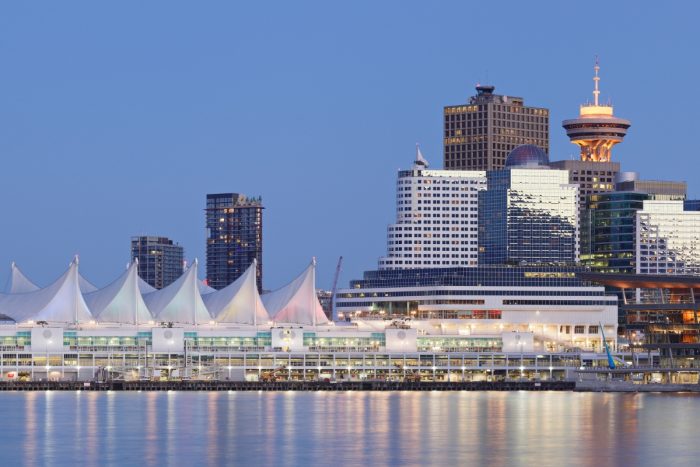
A classic view of Vancouver
After a two-day recovery break with our wonderful friends in Vancouver, we headed for Washington State. For a moment, we thought we might have to turn around, scrap the entire plan, and go explore eastern Canada instead. We were held up at the border and grilled for an hour.
“You’re telling me you’re going to camp and hike in the USA for a whole month?” The third officer stared at us in disbelief, running through the exact same questions as the two before him.
We already saw ourselves being sent back to Canada
In the end, just like his predecessor, he went to search our car — and found two avocados.
“And what’s this? You didn’t declare these.” We’d genuinely forgotten about the avocados. Luckily, he believed it was an honest mistake; otherwise, we’d have been looking at a $300 fine. Even worse, they couldn’t find our car keys. And nobody could figure out which officer had searched our car first. After an agonising hour, we were finally waved through. It was clear we wouldn’t be getting anything else done that day.
The most expensive hike of our lives cost us $240
The mountains in Washington are completely different from those in Canada or Alaska. Rockier, lighter in colour, cleaner, less menacing — and the further south you go, the rounder they seem, with forests that aren’t quite as dense. We found a trail near the town of Everett that, according to our app, was supposed to be the most beautiful in the area. Mt. Pilchuck Trail is a short, three-hour walk to a lookout tower at the summit. Even children can manage it. For us, it was a piece of cake — but also the most expensive trail of our lives.
Mt. Pilchuck is a hugely popular trail packed with Americans
Chiquita needed two brand-new tyres
The only way to the trailhead car park is a rough dirt road full of rocks and potholes the size of craters. And on the way back down, we got a flat. Our dreams of a shower and the drive to Seattle evaporated. Instead, we spent the night — filthy — outside a repair shop we’d barely managed to limp to.
We thought of everything except the most basic thing
You might expect us to have been in tears, but we actually found it hilarious. So did everyone we told in the States. “You didn’t get a flat in 12,000 km across the Yukon and Alaska, and then you get one HERE in Washington?” As funny and ironic as everyone found it, we thought it was equally amusing that we’d prepared for every possible car disaster on the road, yet a simple puncture never crossed our minds.
Mount St. Helens — the biggest air polluter around
Volcanoes in Washington are still active — and they occasionally explode
In 1980, Mt. St. Helens blew its top — quite literally. We decided that even in the insane 30°C heat, we’d tackle Harry’s Ridge, a trail that skirts around the volcano. It was a completely different experience from hiking in the mountains — and nothing like walking in the crater in Hawaii either. We trudged through a parched, barren landscape dotted with strange, resilient wildflowers until we reached a stunning viewpoint overlooking Mt. St. Helens, Spirit Lake, and the snow-covered peak of Mt. Adams.
Mount St. Helens up close
Where Wild ends, wildfire begins
Greg and Vicki welcomed us warmly at the border between Washington and Oregon, even though we’d only given them six hours’ notice. We always look back fondly on their hospitality and the stunning landscape around Bridge of the Gods. If you’ve seen the film Wild, this is where Cheryl Strayed’s three-month journey comes to an end. The very next day, smoke from forest fires engulfed the entire area and buried every view.
We discovered hidden gems only the locals know
So they sent us to the local waterfall at False Creek Falls instead. We felt like we’d stepped into Avatar. It was a brilliant suggestion — the smoke hadn’t reached here yet, and the cool spray from the falls was a godsend in the heat.
Avatar-like waterfalls at False Creek Falls
We were running from the smoke. But it was rolling in from every direction. We never actually saw flames, but in the town where we stopped for the night, the sky glowed an infernal red.
The sky glowed red from wildfires
Misery Ridge Trail was shrouded in a smoky haze, as were the Painted Hills. But what made it even worse were the soaring temperatures. We’d expected the 30s to catch up with us further south, yet here the thermometer was already reading 40°C. Given our simple car-living setup and our “go wherever we fancy” planning style, we found the nearest swimming pool and headed straight for it. The only other people splashing around were children. And us.
Smith Rocks and Misery Ridge Trail
We saw a lot — that much we can’t deny
Crater Lake was supposed to be our next stop, but we didn’t stick around long because the whole thing was blanketed in smoke. Within ten seconds of stepping out of the car, we reeked like smoked kippers. So, in an effort to outrun the wildfires, we made a beeline for the Pacific coast and into California.
California is freezing!
But then the cold hit. You don’t expect chilly weather in California, even if you’ve experienced it there before — you just don’t expect 17°C. “I should have known that being north of San Francisco meant it’d be cooler,” I muttered.
Glass Beach
We spent two days driving along the coast, with one stop at Redwood National Park and another at Glass Beach — a place where nature has transformed rubbish into a glittering field of sea glass, gradually being picked apart by tourists who’ve discovered it. We were supposed to push on to San Francisco that day, but we just couldn’t be bothered. For the first time, we treated ourselves to a hotel with a hot tub and a pool, and postponed San Francisco by a day.
Tourists battling for a slice of Instagram fame
San Francisco
Enough has probably been written about the beauty of San Francisco. Spots that used to be easy to reach are now crammed with honking cars and frustrated tourists fighting for the best photo spot. Luckily, we discovered Baker Beach, which offers a view of the Golden Gate Bridge with only a handful of visitors and a few nudists sunbathing on the sand or leaning against the rocks. They didn’t seem the least bit bothered by the families with children around them. We briefly wondered what they were on, but eventually let the thought drift away and settled ourselves on the Californian cliffs.
San Francisco
I remember how easy it used to be to get onto Alcatraz. We’d buy tickets on the same day and hop on the boat. Those days are long gone. Now you need to book at least three weeks in advance. But since we never knew where we’d be the next day, anything that required careful planning and competing with other visitors simply wasn’t for us. If it were about scrambling up some hill or mountain, that’d be more our thing. After a stroll along the waterfront, we’d had enough of tourists stuffing doughnuts into their faces (in desperation, we did the same), so we jumped in the car and drove several hours east.
Hawaii between California and Nevada — that’s Lake Tahoe
Lake Tahoe
Turquoise water warm enough to swim in, little boats, sandy beaches. Lake Tahoe turned out to be paradise on the border between California and Nevada, and we really didn’t want to leave. Sometimes we think we should have stayed. But after a gorgeous day of sunbathing, by sunset we were already lying in our car an hour and a half further south, at Mono Lake.
Why mosquitoes terrify us
20 Lakes Basin
There’s no point trying to scare us with bears. But mosquitoes? Now that’s a story. Our first hike in Yosemite, the 20 Lakes Basin Loop Trail, was a swarming mosquito hellscape. They were actively trying to devour us. Within an hour, every exposed body part was so bitten that our skin looked like the surface of the Moon. Not even the strongest mosquito repellent from Alaska worked, so we gave up and ran for it. This would have been torture, not fun.
We continued deeper into Yosemite. It was only two in the afternoon, so we decided to tackle Cathedral Lakes — a hike to the iconic peak that Mac OS X users will recognise from their desktop wallpaper. As evening approached, the question of where to bathe arose. The only option was a disgustingly cold lake on the road out of the park — we had no choice, since sleeping in your car inside Yosemite isn’t allowed. We survived the dip, that was the main thing, and spent the night in our car down a dark side street in the first little town outside the park.
We practically ran up to Cathedral Lake
Disneyland in the middle of a national park
If you’ve ever felt like banging your head against the steering wheel in London traffic, then I wouldn’t wish a visit to Yosemite Valley on you. The most popular part of this national park is more like a theme park or Disneyland. Thousands of cars honking over one another and people queuing to photograph everything they’ve seen on their friends’ social media. Sometimes you get the feeling they’re doing it out of obligation, because when you look at their faces, most of them look rather angry.
Yosemite National Park
We hiked the most popular trail to Vernal Falls, overtaking at least a hundred people on the steep path up. The overtaking was like playing a racing video game — dodging oncoming traffic at ever-increasing speeds and racking up points. Thankfully, the closer we got to the top, the more we left the long line of people below us, with the weakest dropping off. From Vernal Falls, we continued to Nevada Falls, where 99% of tourists never make it.
Nevada Falls are absolutely massive!
And is it worth it? Seeing Vernal Falls and Nevada Falls is like stepping into a magical valley — as long as you don’t look left, right, or behind you, and a crowd of tour groups doesn’t plant themselves in front of you. Yosemite is absolutely worth visiting, but it’s not a place I’d want to spend extended time, unlike the Canadian Rockies, for example. And yet, when I first came here nine years ago, it wasn’t like this. The statistics back up my memory: between 2013 and 2016 alone, visitor numbers jumped from 3.8 million to 5.2 million. But don’t worry — resourceful people always find a quiet spot to enjoy the natural wonder, at least for a moment of peace.
Tips and Tricks for Your Vacation
Don’t Overpay for Flights
Search for flights on Kayak. It’s our favorite search engine because it scans the websites of all airlines and always finds the cheapest connection.
Book Your Accommodation Smartly
The best experiences we’ve had when looking for accommodation (from Alaska to Morocco) are with Booking.com, where hotels, apartments, and entire houses are usually the cheapest and most widely available.
Don’t Forget Travel Insurance
Good travel insurance will protect you against illness, accidents, theft, or flight cancellations. We’ve had a few hospital visits abroad, so we know how important it is to have proper insurance arranged.
Where we insure ourselves: SafetyWing (best for everyone) and TrueTraveller (for extra-long trips).
Why don’t we recommend any Czech insurance company? Because they have too many restrictions. They set limits on the number of days abroad, travel insurance via a credit card often requires you to pay medical expenses only with that card, and they frequently limit the number of returns to the Czech Republic.
Find the Best Experiences
Get Your Guide is a huge online marketplace where you can book guided walks, trips, skip-the-line tickets, tours, and much more. We always find some extra fun there!
TL;DRWestern Canada’s 15 most beautiful spots take in turquoise lakes like Moraine Lake, Lake Louise, Peyto Lake, Bow Lake and Emerald Lake, plus demanding hikes such as Garibaldi Lake with views from Panorama Ridge (30 km, 1800 m elevation gain, 10–12 hours), the Alpine Circuit Trail at Lake O’Hara, the Iceline Trail (17 km) and Wilcox Pass looking out over the Columbia Icefield (12 km, 3 hours). June to September is the best window, with September bringing the most stable weather, golden larches around Chester Lake, and thinner crowds. For shorter but no less memorable outings, try Bear’s Hump in Waterton Lakes (1.5 hours) or Johnson Canyon in winter, which takes just an hour.
Western Canada is a treasure of North America. Pastel turquoise lakes surrounded by the towering peaks of the Canadian Rocky Mountains. There’s nowhere else in the world quite like it. We were lucky enough to spend almost a year here. Most of you, if you head to Canada, won’t have the luxury of exploring by trial and error, so I’ve put together a list of the most beautiful places in western Canada that you can visit in this breathtaking landscape. So let’s get to it: These are the 15 most beautiful places in western Canada.
When to visit Canada?
We recommend visiting between June and September. When we lived in Canada, the best weather was typically in September – it was the most stable. In June, there’s a chance there’ll still be snow on the trails.
In summer, the number of tourists is extreme and the weather often changes from hour to hour. It’s no surprise that locals constantly check the forecast (which turns out to be wrong about 90% of the time). October can also be beautiful in the Rocky Mountains, but it can also be bitterly cold. For me, September is the sweet spot.
What about winter? Winter is gorgeous, but for hiking you’ll need snowshoes. However, if you love skiing, western Canada will not disappoint.
15 Most Beautiful Places in Western Canada
1) View of Garibaldi Lake from Panorama Ridge near Vancouver
Garibaldi Lake from above – can it get any more stunning?
One of the greatest experiences we saved for last. We’d already planned to come here once before, but it was autumn and it was raining. In the end, we did this hike on our way from Alaska to the States. It’s a hike that most people split over two days with an overnight camp by Garibaldi Lake.
It’s over 30 km with 1,800 m of elevation gain and takes 10–12 hours if you want to do it in a single day. We hiked for 8 hours on the first day including the summit, spent the night by the lake, and walked back to the car park the next day, which took about 2 hours.
Whichever way you turn on Panorama Ridge, don’t forget to close your mouth – the views are jaw-dropping
2) Stunning views of Lake O’Hara from Alpine Circuit Trail in Yoho National Park
Alpine Circuit takes a lot of energy, but it’s absolutely worth it
The best way to reach Lake O’Hara is by bus, which you need to reserve 3 months in advance. You can of course hike in, but it would take 3–4 hours (one way) and the lake alone isn’t worth that effort.
If you decide to go, book a campsite for one or two nights as well. The most challenging but most breathtaking hike is the Alpine Circuit Trail, which connects several trails. You’ll pass through Wiwaxy Gap, where you gain nearly 500 metres of elevation in just 1.5 km – you’ll curse yourself for being there, until you reach the first viewpoint that takes your breath away.
The route then continues via Hubert Ledges, and you can either return around Lake Oesa like we did, or carry on to Yukness Ledges. Whichever route you choose, the reward of spectacular views is guaranteed.
Another trail we can recommend from Lake O’Hara is the three-hour trail to Lake McArthur.
Less demanding, but no less spectacular
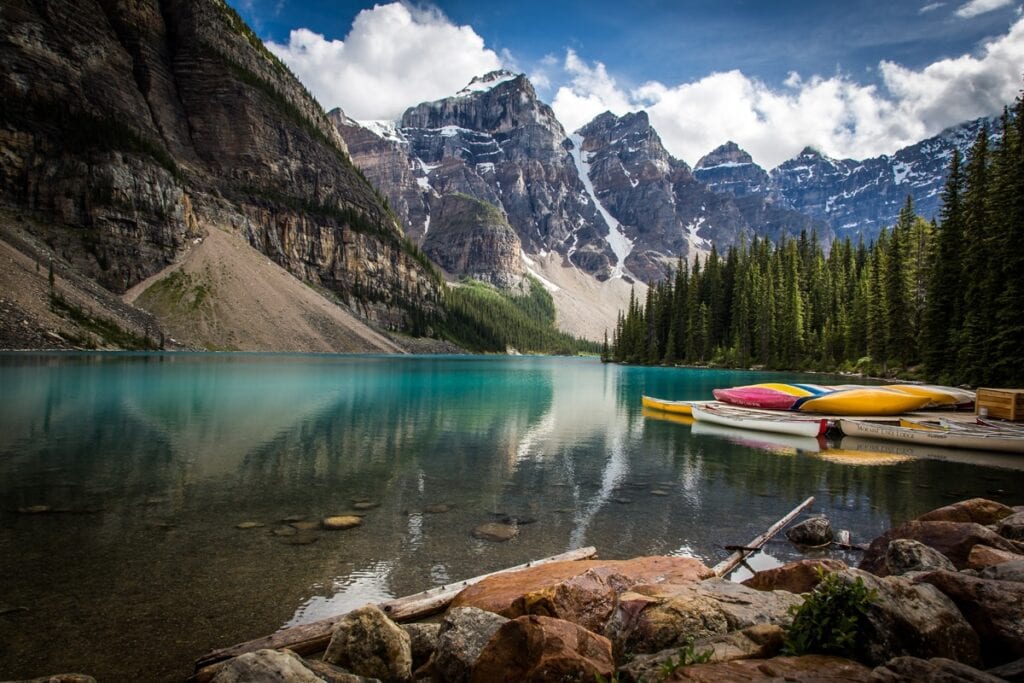
3) Moraine Lake
There’s a reason Moraine Lake is one of the top attractions
This glacial lake near Lake Louise is one of the most-visited spots in Banff. Just a few steps from the car park and your eyes are filled with an incredible blue, colourful kayaks, and mighty mountains stretching out all around. Visit early in the morning or in the evening to avoid the crowds.
A slightly different view of Moraine Lake
4) Plain of Six Glaciers and Lake Agnes Tea House at Lake Louise
View from the Plain of Six Glaciers trail
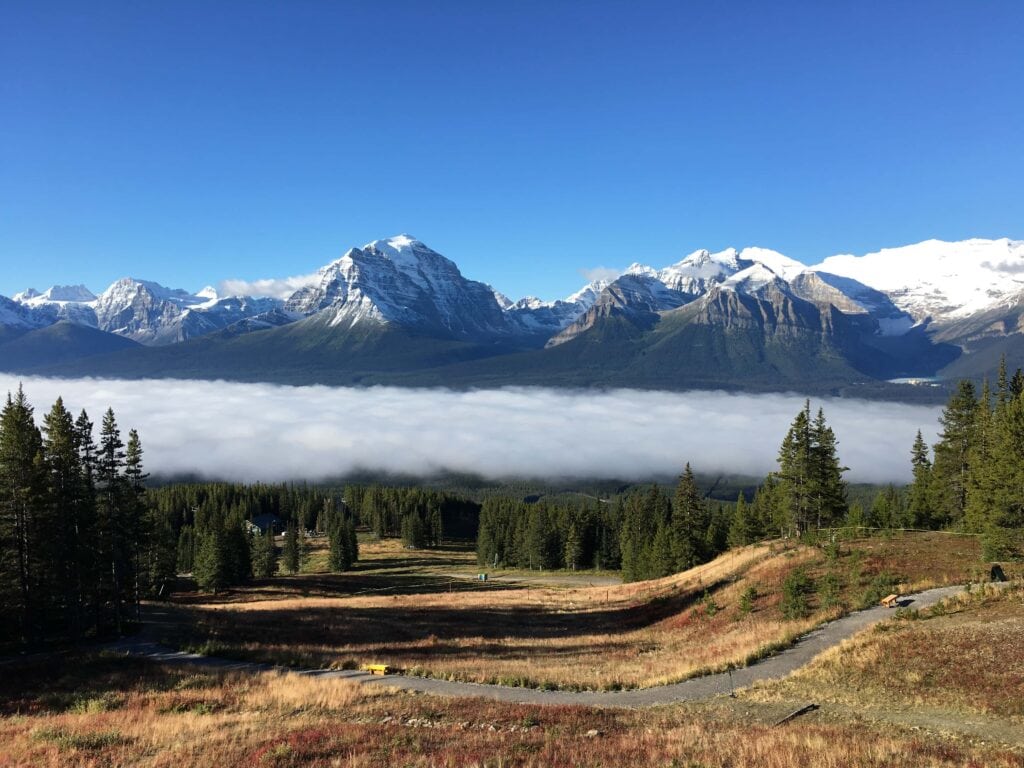
Lake Louise is one of the most famous spots in Banff. Turquoise waters in summer and perfect powder for skiing six months of the year. You can drive right up to the lake, but if you’re up for something even better, head out on one of the trails.
One of our favourites is Plain of Six Glaciers, which is 15 km long with 457 m of elevation gain. Near the top, just before the most demanding section, there’s a tea house where you can grab lunch. Everything there is prepared entirely without electricity.
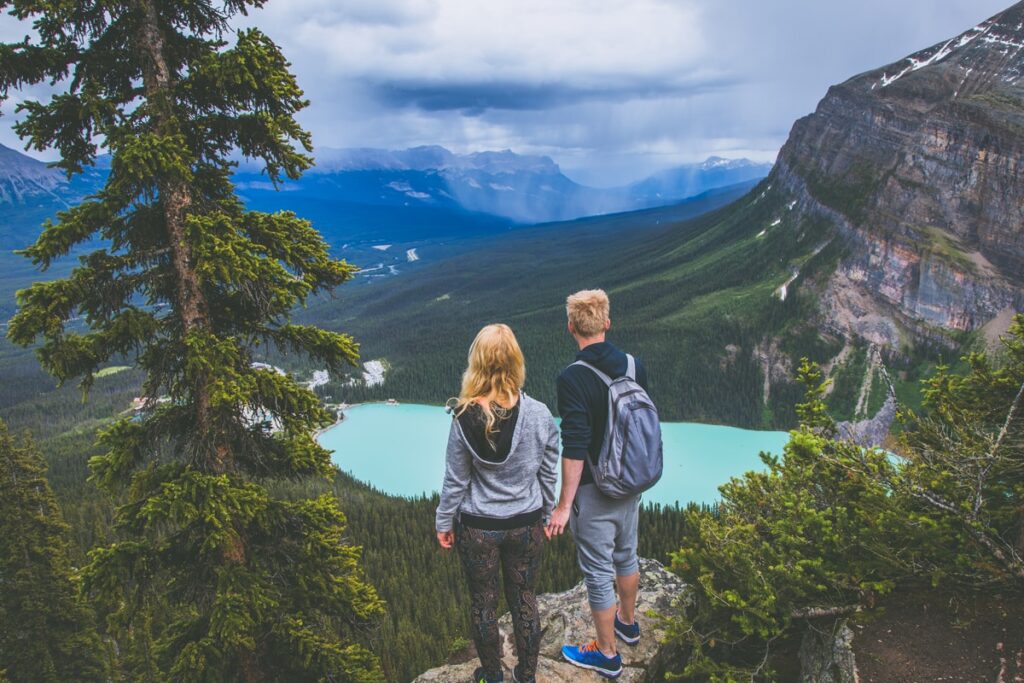
Another hike we can recommend is Lake Agnes. You’ll reach a lake with another tea house, where most people turn around – but don’t give up here, because the best part requires climbing just a little bit higher. Below you, a breathtaking view of Lake Louise unfolds. The whole thing can be done in 2–3 hours.
View of Lake Louise
5) Bow Lake
My love, Bow Lake
If you ask us about our favourite lake, we won’t name any of the most famous ones – we’ll tell you about Bow Lake. This enormous lake sits along the road from Lake Louise to Jasper, and if you arrive before 4 pm, you can grab a bite at the nearby café. From here, you can also set off on a 9 km hike to Bow Lake Falls. Be warned though – if you’re hiking with children, the 400 m of elevation gain comes in the final 1.5 km.
6) Peyto Lake
Turquoise Peyto Lake
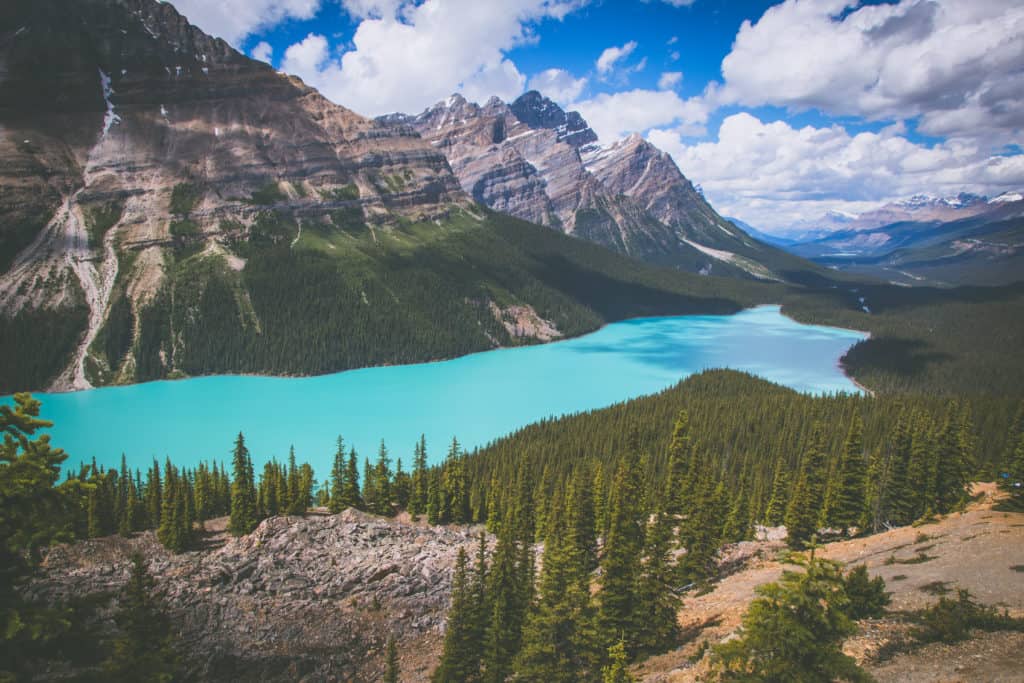
Famous for its almost unnaturally vivid pastel turquoise colour. Peyto Lake is only a five-minute walk from the car park, so you’d need to arrive very early in the morning to enjoy it without the crowds.
7) View from Cascade Mountain
View from Cascade Mountain
If you want to stay a bit longer in Banff, head for one of the mountain summits. You’ll hike through forest for a few hours and then scramble over rocks, but once you see all the surrounding peaks stretching out around you, you won’t regret it. Cascade Mountain takes around 6–8 hours.
8) Parker Ridge near Columbia Icefield
Sunny weather in the mountains isn’t as common as catalogue photos might suggest, yet it’s no less beautiful
Many people consider Parker Ridge one of the best hikes in this area. It’s only about 1 mile long, but be prepared to work up a serious sweat due to its steepness. Don’t look for the end of the trail – there isn’t one. You can keep going for as long as you like. The views are incredible. Set aside at least 2 hours for this trail. You’ll want to linger at the top for a while.
9) Bear’s Hump, Waterton Lakes National Park
View from Bear’s Hump over Waterton Lakes
If you’re looking for a weekend trip from Calgary, definitely head to Waterton. You don’t have to go far for stunning views. Our favourite is from Bear’s Hump, reached via a short but very steep path. You only need about 1.5 hours for this one.
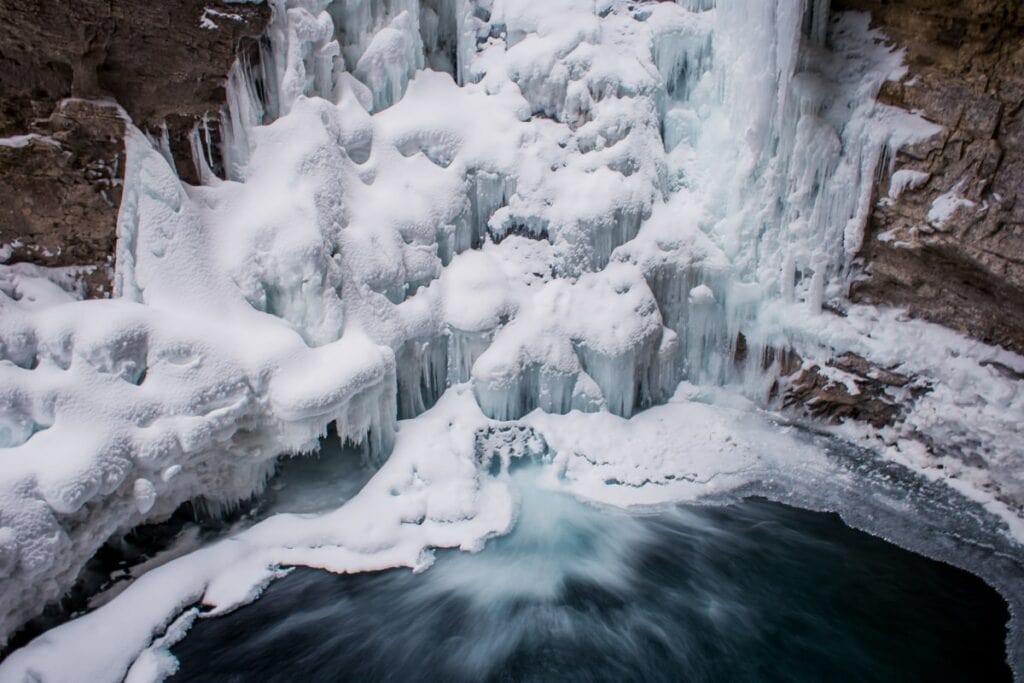
10) Johnston Canyon in winter
Johnston Canyon in winter
Johnston Canyon in summer is like Oxford Street on a Saturday. And it’s the one place where you wonder why – the waterfall views aren’t quite as spectacular as the number of visitors would suggest. But if you come here in winter, it’s a completely different story.
You’ll meet at most a few ice climbers tackling the frozen rock faces, and the sight will leave you speechless. Winter is a powerful enchantress. Plus, in winter you’ll appreciate that the whole thing takes no more than an hour.
11) Emerald Lake, Yoho National Park
Just park up and look out of the car.
The greenest lake I’ve ever seen. This spot isn’t as crowded as Moraine Lake, but that certainly doesn’t mean it’s any less beautiful.
12) Iceline Trail, Yoho National Park
A trail I’d head back to in a heartbeat
If I had to choose one place in the Rockies to revisit, it would be this hike. You can do the full 17 km loop, but if you don’t have that much time, no worries. Once you climb above the treeline (after about an hour), the views are already incredible.
13) Chester Lake, Kananaskis, Canmore
The trail to Chester Lake
People often ask: When should I visit Banff? And I answer without hesitation: September. It might snow, but the larches turn golden, and that’s one of the most beautiful sights you’ll see here. On top of that, Banff starts to empty out. Chester Lake is perfect for larches, and if you liked the film The Revenant, this is the landscape where it was filmed. The hike takes around 4 hours and is only 10 km long.
14) Barrier Lake Lookout in Kananaskis
In April the weather wasn’t ideal yet, but it was still a gorgeous view
If you’re looking for something in Kananaskis, this hike – mostly frequented by locals – is 14 km long and takes about 5 hours. It’s manageable for families with children too.
15) View of Columbia Icefield from Wilcox Pass
View of Columbia Icefield from Wilcox Pass
Columbia Icefield is a very touristy spot, where you’ll pay over a hundred dollars if you want to see the glacier via a giant snow coach. If you’d prefer a slightly different experience, I recommend Wilcox Pass. This easy trail on the opposite side is 12 km long and you can finish it in about 3 hours.
Planning a trip to western Canada?
If you’re planning to explore these beautiful places in western Canada, don’t forget to sort out your accommodation in advance – especially during peak season. You can find great deals on Booking.com. And to stay connected on the go, we recommend getting an eSIM from Holafly – it works perfectly across Canada.
🔗 These are affiliate links — they don't change your price and help us create content. · All experiences →
Tips and Tricks for Your Vacation
Don’t Overpay for Flights
Search for flights on Kayak. It’s our favorite search engine because it scans the websites of all airlines and always finds the cheapest connection.
Book Your Accommodation Smartly
The best experiences we’ve had when looking for accommodation (from Alaska to Morocco) are with Booking.com, where hotels, apartments, and entire houses are usually the cheapest and most widely available.
Don’t Forget Travel Insurance
Good travel insurance will protect you against illness, accidents, theft, or flight cancellations. We’ve had a few hospital visits abroad, so we know how important it is to have proper insurance arranged.
Where we insure ourselves: SafetyWing (best for everyone) and TrueTraveller (for extra-long trips).
Why don’t we recommend any Czech insurance company? Because they have too many restrictions. They set limits on the number of days abroad, travel insurance via a credit card often requires you to pay medical expenses only with that card, and they frequently limit the number of returns to the Czech Republic.
Find the Best Experiences
Get Your Guide is a huge online marketplace where you can book guided walks, trips, skip-the-line tickets, tours, and much more. We always find some extra fun there!
TL;DRThis travelogue from Alaska’s Kenai Peninsula rounds up the best experiences the American north has to offer: hiking up to Exit Glacier, the only glacier you can reach by road, kayaking among icebergs and whales near Seward, and wandering round the artsy town of Homer with its narrow spit jutting into the ocean. You won’t get a kayak hire for the fjords without prior experience, and a guided trip runs to around $500 per person, while driving through the tunnel into the harbour town of Whittier costs roughly $15. The authors recommend setting aside several days for the Kenai Peninsula and building in slack for unpredictable weather, which can push planned trips back by days at a time.
Welcome to our Alaska travel blog! Postcard-perfect mountains, turquoise lakes, and bluish glaciers opened up before us as we arrived on the Kenai Peninsula — the part of Alaska that we all know from those famous, almost kitsch photographs. The part of the land that, in our imaginations, represents Alaska as a whole.
Before we officially entered the Kenai Peninsula, we stopped at the first port town of Whittier on Prince William Sound. The first words we read about this place with 200 residents were: “Whittier is weird — it’s a place like no other on Earth.” To get there, you have to pay about $12 to drive through a railway tunnel, and if you’re unlucky, you might wait up to half an hour because it’s single-lane only.
They say „It is shittier in Whittier“ – the guidebook was lying again
The Quirky Port Town of Whittier
It didn’t seem all that “weird” to us, though. We set off on a short three-hour hike to a glacier, wandered through the miniature community with its charming harbour and unusually blue water, where there really isn’t much to see, and then hurried back.
The first REAL glacier we’d seen after three weeks
This Is the Main Street?
We set up camp just outside Hope, which we planned to explore the next morning for its “typical rural Alaska steeped in history.” That’s what our paper companion — our guidebook navigating us through this northern land — had promised. We didn’t discover much historical about Hope and started seriously doubting the quality of information our Lonely Planet was giving us. And so began one of our less successful days in Alaska.
They Won’t Rent You a Kayak on the Ocean in Alaska
We headed to Seward, where we wanted to go kayaking among the fjords and glaciers. It’s one of the most promoted experiences here in Alaska, and there’s no way to get there other than with a guided tour. If you’re not an expert kayaker, nobody will rent you a kayak for the fjords. And we’d only sat in one once or twice before. But it costs around $400 per person. We were already prepared to eat roots for the rest of the trip, because we didn’t plan on coming back here anytime soon and missing this would have been a real regret.
The turquoise harbour in Valdez
Kayaking completely changed our plans. Unfortunately, the nearest available spots weren’t until several days later — Saturday. So we had to change our plans once again and go explore the rest of the Kenai Peninsula, coming back in a few days.
How the Mormons Tried to Convert Us
“Have you heard of the Mormons?” We were sitting in a public park in the City of Kenai after an exhausting journey, grilling freshly caught salmon. Two friendly Mormons joined us for about twenty minutes and told us how they’re sent around the world as missionaries. They’d just spent six months in Whitehorse, Canada, before being transferred here to Alaska.
All we had was salmon, so we went into the woods for firewood
“Do you know the Bible? Well, it’s a bit outdated. We have our own Bible too, and since you’re so nice, we’ll give you one.” The Mormon pulled out a Bible and wrote his number inside. “If you ever need anything on your journey, just call — we have missionaries all across America.” They said goodbye. We kept the card and the Bible. It might come in handy in Utah.
Daily bread for Alaskan families – catching dinner
Every Evening We Cruise Through Towns with Other RVs Looking for a Place to Sleep
After booking our kayaks, we decided we wouldn’t sleep in campsites anymore and found a spot in a supermarket car park where we slept in the car. We certainly weren’t alone — we’d already noticed that as soon as eight o’clock hits, RVs and motorhomes start cruising around town looking for a free spot to park up for the night.
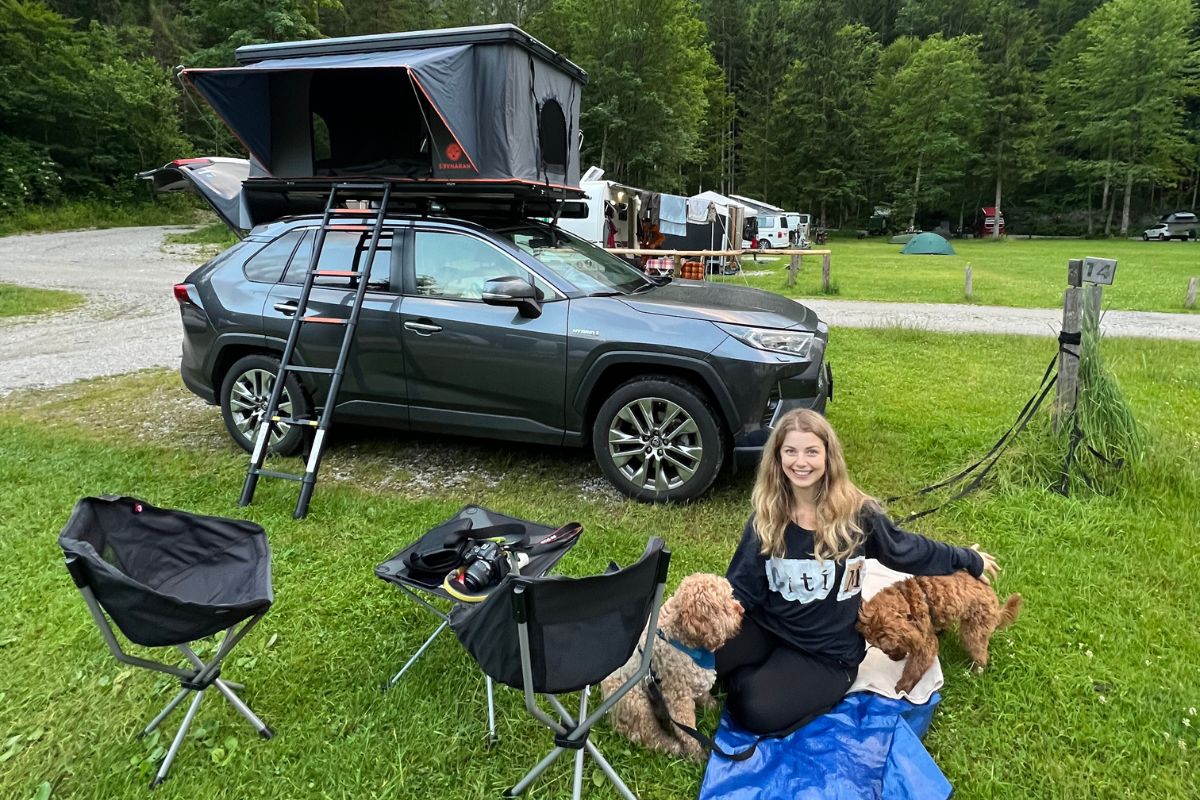
Our Chiquita is more of a functional home than a luxury hotel, but we love her!
These motorhomes are no joke, by the way. They cost around $300,000 and only get about one mile per gallon. And inside, they look like a hotel. “Compared to that, our bed in Red Chiquita is hardly luxury,” Lukáš commented when we first saw the hotel-grade bathrooms in these huge beasts roaming American roads.
Homer had something special about it, apart from the cold
Homer Is a Town of Art and the Spit
Homer is a little town of art. If you wanted, you could spend an entire day wandering through small galleries by local artists. That was our entertainment too. There’s not much else to do here — the surroundings are fairly flat and the weather isn’t the friendliest. Still, it’s worth visiting. There’s a thin strip of land jutting out into the ocean that they call “the Spit,” and at first glance you understand why. You feel like a stronger gust of wind or a bigger wave could sweep it away, and it’s hard to believe this scattered, thin, winding strip has managed to hold on in the water for so long.
Homer is famous for its miniature galleries
When it’s not windy (which happens rarely), it’s pleasant to stroll along. This curious strip is lined with colourful fishing shacks, the air is a mix of fish and salt, and occasionally a sweet breeze drifts over from the local pancake house. People walk around with ice cream as if it weren’t about twelve degrees out. We arrived to perfect weather — sunshine, blue skies, and supposedly the highest temperatures of the summer. But even so, when we forgot our jumper in the car, we had to dash right back.
Seward greeted us with perfect weather — unfortunately it didn’t last
We returned to Seward a day early so we could hike the Harding Icefield Trail, which is supposedly one of the most beautiful hikes in Alaska. But the blue skies had turned into persistent rain, the mountains hid behind clouds, and we spent our day crammed into one of the three cafés in town with other tourists.
We postponed the Harding Icefield Trail for two days because of the weather. It was worth the wait
We were afraid the next day would be the same and ruin our whole kayaking trip. I couldn’t sleep — every raindrop hitting our car woke me up, and every splash stirred up frustration and sadness inside me.
No Gold Mining Here, but Plenty of Gold Diggers
At seven in the morning, it wasn’t raining. We sat ready for our biggest adventure in the office of the company taking us on the trip. There were only five of us, so we quickly boarded the boat and headed out to the ocean. The boat bounced on the waves, and soon we spotted the first whales. We watched these enormous creatures elegantly surfacing and spouting water. Almost as if they knew they were being watched, they swam around the boat while we stood frozen, mesmerised by this whale performance.
Sea stars!
Paddling among small chunks of ice, watching sea lions and sea stars was an incredible experience, even though the sky was overcast and clouds hovered over the mountains. Nobody else around. We often think America has no history because we forget about the indigenous people. And that’s because they left no trace on the land. It remained untouched. But thousands of years ago, they saw it from their canoes just as we saw it on that cold day. This realisation filled me with a feeling of something almost sacred, rocking with five other people in a kayak, quietly observing the mighty power of nature.
Kayaking isn’t for the faint-hearted
The Most Beautiful Hike of Our Lives
We still didn’t leave Seward after that. We hoped the next day would clear up and we’d be able to finish off the Kenai Peninsula with one more experience — the magnificent view of Exit Glacier, the only glacier accessible from the mainland.
“I’m done with this. Let’s go.” I opened my eyes in the morning to dark clouds covering nearly all the mountains around us, the water in the harbour had changed from turquoise to grey as it reflected the sky, and on top of it all, it was starting to rain again.
We were about to leave, annoyed at having lost part of a travel day, but then we decided it was on the way anyway and maybe the weather would be better 20 minutes down the road near the glacier.
The car park didn’t look promising. “But look — it’s breaking up over there.” I pointed above the glacier. Dark clouds were everywhere, except right over our destination, where a patch of blue sky had appeared and sunbeams were dancing on the ice of Exit Glacier.
So we set off. We took it at a killer pace. The hike was supposed to take 6–8 hours in total. We did it in 4. By the time we were a quarter of the way up, the sky was already clearing. Before long there wasn’t a single cloud, and we were enjoying blue skies that contrasted with the white glacier and purple wildflowers scattered all around. In the year we’d spent in North America, we’d seen a lot — but nothing as beautiful as this hike. When you reach the top, you’re supposedly treated to a view of what the Ice Age looked like. Harsh and breathtaking. Once again, we confirmed that the best things in life are free.
Exit Glacier / Shot with a DJI Mavic Pro drone
The grandiose view of Exit Glacier
A bonus hike that didn’t make it into the main story — one we did on the way from Homer to Seward:
Planning a Trip to Alaska? Try Our Favourite Guidebook
Tips and Tricks for Your Vacation
Don’t Overpay for Flights
Search for flights on Kayak. It’s our favorite search engine because it scans the websites of all airlines and always finds the cheapest connection.
Book Your Accommodation Smartly
The best experiences we’ve had when looking for accommodation (from Alaska to Morocco) are with Booking.com, where hotels, apartments, and entire houses are usually the cheapest and most widely available.
Don’t Forget Travel Insurance
Good travel insurance will protect you against illness, accidents, theft, or flight cancellations. We’ve had a few hospital visits abroad, so we know how important it is to have proper insurance arranged.
Where we insure ourselves: SafetyWing (best for everyone) and TrueTraveller (for extra-long trips).
Why don’t we recommend any Czech insurance company? Because they have too many restrictions. They set limits on the number of days abroad, travel insurance via a credit card often requires you to pay medical expenses only with that card, and they frequently limit the number of returns to the Czech Republic.
Find the Best Experiences
Get Your Guide is a huge online marketplace where you can book guided walks, trips, skip-the-line tickets, tours, and much more. We always find some extra fun there!
TL;DRThis road trip across Alaska comes with surprises: heat around 32°C, white nights that never quite go dark, and guns that locals happily carry into restaurants. The route runs through North Pole, whose souvenir shop turns out to be a letdown, then Fairbanks, Denali National Park with its 17km Triple Lakes Trail, the Hatcher Pass mountain crossing, and finally Anchorage, where up to 90 languages are spoken. There are practical bits too — the bus into Denali costs $30–$50, and you’ll want bear spray for hikes, since plenty of locals prefer to carry a gun in the woods instead.
And off we go to Alaska!
“You know we just smuggled across the border everything we confirmed we didn’t have? A weapon (bear spray is considered a weapon), alcohol, fruit, and commercial products (we’re travelling with a box full of our sunglasses brand),” Lukáš says to me. Welcome to Alaska — or rather, welcome to the nerve-wracking experience of crossing the Canada–USA border. We’d crossed it many times over the past year and always had that uneasy feeling in our stomachs. This time it was even worse, because they forgot to stamp our passports in Hawaii. Fortunately, the impossible happened — the border guards at the Yukon–Alaska crossing were actually quite friendly despite the glaring issues with our passports.
“We should have at least hidden some of it.” I think out loud, but we’re already zooming through Alaska in our Red Chiquita. After 3,000 km of rain and insane Yukon roads, we’re glad Alaska is showing us its sunny face. It’s already late evening on the Fourth of July, and Alaska, like the rest of the USA, is celebrating Independence Day — but here near the border, we don’t notice a thing and honestly forget about it entirely.
North Pole Town and Santa’s House — a failed commercial gimmick
Santa’s House in North Pole turned out to be a disappointing souvenir shop
We buy a campsite in the first sizeable forest town, Tok, and suddenly realise it’s almost midnight, yet the sun is still shining. We crawl into our car and try to fall asleep. We’ve been struggling with sleep for days — we couldn’t manage to black out the car, and the sun simply doesn’t set. This problem would follow us across nearly all of Alaska.
“I was expecting elves putting presents together,” I sigh, and we drive off with the same gusto we arrived with.
Forest everywhere you look. Where are the mountains?
Fairbanks doesn’t exactly thrill us either. A bigger town in the middle of the forest. Forest as far as the eye can see. According to our guidebook, the biggest attraction here is the Visitor Centre.
Still, we enjoy Fairbanks in a completely different way — we visit family friends here, and even stay at their place. We have our first Alaskan salmon with them, sample local beer, and for the first time in ages, sleep in a real bed with blackout curtains. Let there be darkness.
The landscape around Angel Rocks near Fairbanks reminded us of the countryside back home in Europe
Long summer days bring unexpectedly high temperatures
The next day we set off on a hike recommended by Tony and his family, who asked: “Do you have a gun?” We’d hear this question many more times. Bear spray is considered a useless toy here — people go hiking with firearms.
On the Angel Rocks hike, we’re tormented far more by mosquitoes and unbearable heat that not only permeates the air but radiates from the ground itself. Our conviction that Alaska would be cold melted away in 32 °C (90 °F). The trail leads us to rocky outcrops on a hill in the middle of an endless forest. There’s nothing around — just trees.
We expected cooler weather than Canada, but in Fairbanks the thermometer read 32 °C (90 °F)
“They’ve got the same weeds we have back home. Only the trees are somehow thinner.” I observe the scrawny tops of coniferous and deciduous trees the whole way down to the car park. We also drive out to Chena Hot Springs, but that doesn’t blow us away either. We keep looking for mountains and turquoise glaciers — we know they’re not here, but they’re deeply rooted in our imagination of what Alaska should look like. To cheer ourselves up, we buy Thai food in town, but with the first bites we realise we’ve blown our daily budget on something that’s more likely to make us ill. It happens. Time to move on.
Off-key singing as a weapon against bears
View of Denali National Park from Triple Lakes Trail
Denali National Park is the largest park in the USA, but only a small portion is accessible to regular visitors. You can only drive to the entrance, and if you want to go deeper, you’ll need to pay $30–50 for a bus. We opted for the 17 km Triple Lakes Trail hike starting from the Visitor Centre. We parked at the trail’s end and took a free shuttle to the start. And then we realised we didn’t have our bear spray. There was nowhere to buy it and no turning back. We didn’t encounter a single bear — probably scared off by our five hours of terrifyingly off-key singing.
There wasn’t much time for breaks during the Denali National Park hike — mosquitoes were feasting on us the entire way
Alaskans love guns, and their presence terrifies us
Not everything goes to plan while travelling, and our failed attempt to see Mt. McKinley proves it. We woke up at a campsite near another trail that was supposed to reward us with a stunning view of North America’s highest peak. Instead, the sky clouded over and it started raining. We left the park and sped towards Anchorage. “WOW!” I screamed, and Lukáš swerved the car to the side. That white massif had terrifyingly gleamed in the rearview mirror. Mt. McKinley (Denali) in all its glory had poked out from behind the clouds for a few minutes, shining like a giant hilly moon as the sun’s rays hit it. We turned the car around and raced back to a restaurant that was supposed to have a great view.
After ten minutes of driving, it had already vanished. We decided to sit down anyway, rest, and drown our sorrows in our first Alaskan burger. But rest was out of the question — locals started pouring into the restaurant, and we couldn’t tear our eyes away from the guns everyone had tucked into their waistbands. We’ll never get used to that.
Our Red Chiquita patiently waits while we grab our daily cup of coffee and something tasty for the long road ahead
Praying with every mile that the car holds together
I feel like we’ve been teleported to Norway. That’s the effect Hatcher Pass has on us. On the road from Denali National Park to Palmer, grass-covered hills start emerging, draped in clouds as thick as pea soup while rain drums on the car. The road is rough — we pray with every mile that we won’t shake loose some vital car part. We start regretting the detour since we probably won’t see anything. We could have taken the shorter route to Anchorage and saved ourselves several hours and a tank of petrol. But then, by some stroke of luck, we stumble upon an old gold mine. The clouds part slightly, and small wisps drift between the mountains above the tiny miners’ cabins.
We decided to take the longer route to Anchorage via Hatcher Pass — unfortunately the weather wasn’t on our sideView of the 1940s miners’ accommodation at the gold mine
Anchorage is a rough city surrounded by mountains
Anchorage feels like a rough neighbourhood surrounded by mountains, with a charming centre and a modern museum. Our guidebook claims it’s one of the most multicultural places in the USA, with up to 90 languages spoken. We didn’t notice that, but we certainly didn’t miss the characters causing a ruckus in car parks at midnight, or the countless homeless people lying on the pavements. Fortunately, the supermarket car park where we spent the night was quiet, and the rain lulled us to sleep.
Anchorage is surrounded by stunning mountains on all sides — you don’t need to climb far for a view, just a few steps from the car park will doAnchorage has the highest percentage of Indigenous people, who have lived here for thousands of years thanks to the favourable climate. As they say — “since time immemorial.”
Soap bubbles and kids’ games to the rescue
Downtown Anchorage invites you for a stroll. The main street is tidy and lined with cute little shops
Although the rain had stopped, our mood took a nosedive in the morning. The fatigue from all the kilometres we’d covered was catching up with us. We set off to climb one of the nearby hills, but after twenty minutes of ascending, we discovered the trails near the car park were poorly marked and we’d accidentally wandered onto a military base. And then it started raining again.
The museum saved us. We explored an excellent section about Alaska’s Indigenous peoples, but we won’t lie — what truly lifted our spirits was the children’s section. Blowing soap bubbles is fantastic therapy. As they say: all work and no play makes Jack a dull boy.
🔗 These are affiliate links — they don't change your price and help us create content. · All experiences →
Tips and Tricks for Your Vacation
Don’t Overpay for Flights
Search for flights on Kayak. It’s our favorite search engine because it scans the websites of all airlines and always finds the cheapest connection.
Book Your Accommodation Smartly
The best experiences we’ve had when looking for accommodation (from Alaska to Morocco) are with Booking.com, where hotels, apartments, and entire houses are usually the cheapest and most widely available.
Don’t Forget Travel Insurance
Good travel insurance will protect you against illness, accidents, theft, or flight cancellations. We’ve had a few hospital visits abroad, so we know how important it is to have proper insurance arranged.
Where we insure ourselves: SafetyWing (best for everyone) and TrueTraveller (for extra-long trips).
Why don’t we recommend any Czech insurance company? Because they have too many restrictions. They set limits on the number of days abroad, travel insurance via a credit card often requires you to pay medical expenses only with that card, and they frequently limit the number of returns to the Czech Republic.
Find the Best Experiences
Get Your Guide is a huge online marketplace where you can book guided walks, trips, skip-the-line tickets, tours, and much more. We always find some extra fun there!
TL;DRGear for long-term travel while working online is mostly electronics, taking up roughly fifty percent of the total luggage space. The core kit is a pair of MacBook Pro 13″ 2017 laptops, an iPhone XS and 6s, a Huawei P20 Pro for website testing, an iPad for studying and writing, a Fitbit Charge 2 and a Kindle Paperwhite. For photos and video, there’s a DJI Mavic Pro drone that can fly two kilometres out without losing image quality, a Fujifilm X-E3 mirrorless camera, a GorillaPod tripod and a Zoom H2N microphone. On the bag front, Bagind leather backpacks and Osprey Kestrel 68 and Osprey Kyte 66 rucksacks have proved their worth, rounded out with a water bottle, a Ravpower charger, a PowerCube adaptor and an inflatable travel pillow.
Travelling while working online is, in our opinion, the best way to make the most of location independence. But it comes with a major downside — besides the usual travel gear, we carry a heap of electronics that takes up roughly fifty percent of our packing space.
We’re amazed ourselves at how much we manage to fit in! But every single piece of gear earns its place for a clear reason. And since we know how much other travellers’ packing lists have helped us, we decided to put together our own — here’s everything we travel with.
1) Everyday Electronics We Use on the Road
MacBook Pro 13” 2017
We both have MacBooks and that’s not changing any time soon.
iPhone XS and iPhone 6s
Our iPhones are primarily work tools, but the iPhone XS doubles as our go-to device for quick travel snaps. It actually handles portraits better than our Huawei.
Huawei P20 Pro
We keep the P20 Pro mainly for testing our websites and projects on a non-Apple platform. That said, we’re also blown away by the triple camera — it absolutely smashes the iPhone XS when it comes to low-light photography.
Beats Solo3 Wireless Headphones
Headphones are an absolute must when travelling by train, plane, or bus. We also rely on them whenever we need to focus in a noisy environment. You’ll typically spot us wearing them in cafés around the world.
iPad
The ultimate learning tool on the road. We don’t carry physical books, and you can’t exactly load economics textbooks onto a Kindle. These days, our iPad mostly serves for checking Google Analytics and watching Netflix. It also works as a backup writing device — that’s why we carry a hardware keyboard for it too.
FitBit Charge 2
When it comes to health, we’re a bit nerdy. We each wear a Fitbit Charge with personalised daily goals. We track workouts, heart rate, and sleep — always trying to beat our own stats.
Kindle Paperwhite
Lugging physical books around the world just isn’t practical, but a Kindle fits anywhere. We spend just as much on books as before, but our bookshelf has stopped growing — well, except the virtual one.
2) Photography and Video Gear
DJI Mavic Pro Drone
A compact, foldable drone that can fly up to two kilometres out while maintaining excellent image quality.
Fujifilm X-E3 Camera
After years of loyalty to Canon (the last model we owned was the 6D), we switched to a mirrorless camera. It’s lighter and more compact, although Lucka had to get used to a different shooting style and a bunch of buttons she considers pointless. 😄
GorillaPod
The perfect tripod for our Fujifilm. It can be attached to pretty much anything and has a rotating head. We’ve even clamped our GorillaPod tripod onto a street lamp before.
Zoom H2N Microphone
We record interviews, do voiceovers, and occasionally publish audio content (like guided meditations). The Zoom microphone remains the best solution in its price range for us — versatile yet professional.
3) Travel Gear Backpacks We Can’t Live Without
Bagind Backpacks
Bagind backpacks are handcrafted in India from goat leather. These are the kind of backpacks you buy once and keep for life.
Osprey Backpacks
We’ve tried quite a few travel backpacks over the years, including various American and Canadian brands, but Osprey suits us best. Lukáš carries the Osprey Kestrel 68 and Lucka uses the Kyte 66.
4) Useful Travel Accessories We Always Carry
Water Bottle
A reusable water bottle is an essential piece of travel gear. There’s nothing quite as satisfying as getting through airport security with an empty bottle and filling it up at a water fountain — while everyone else is paying a fortune for the exact same water.
PowerCube Travel Adapter
We discovered the PowerCube about two years ago. We’ve already broken one, and the second has travelled through a dozen countries with us so far. Thanks to its interchangeable plug adapters, it works practically everywhere — and the two USB ports on the side are a lovely bonus.
Inflatable Travel Pillow
We can’t afford the space for a full-sized neck pillow, even though we love them. Instead, we carry an inflatable version that packs down to the size of a large plum when deflated. Perfect for long flights and bus journeys.
Portable Power Bank
Our trusted brand is RAVPower. It’s quite possibly the only power bank that’s lasted us longer than a year.
Tips and Tricks for Your Vacation
Don’t Overpay for Flights
Search for flights on Kayak. It’s our favorite search engine because it scans the websites of all airlines and always finds the cheapest connection.
Book Your Accommodation Smartly
The best experiences we’ve had when looking for accommodation (from Alaska to Morocco) are with Booking.com, where hotels, apartments, and entire houses are usually the cheapest and most widely available.
Don’t Forget Travel Insurance
Good travel insurance will protect you against illness, accidents, theft, or flight cancellations. We’ve had a few hospital visits abroad, so we know how important it is to have proper insurance arranged.
Where we insure ourselves: SafetyWing (best for everyone) and TrueTraveller (for extra-long trips).
Why don’t we recommend any Czech insurance company? Because they have too many restrictions. They set limits on the number of days abroad, travel insurance via a credit card often requires you to pay medical expenses only with that card, and they frequently limit the number of returns to the Czech Republic.
Find the Best Experiences
Get Your Guide is a huge online marketplace where you can book guided walks, trips, skip-the-line tickets, tours, and much more. We always find some extra fun there!
TL;DRThe bloggers behind this trip converted a Dodge Grand Caravan into a camper and set off from Calgary, Canada, bound for Alaska, with the whole Canada-and-US trip mapped out for just under three months. The route ran through the Rockies to Lake O’Hara in Yoho National Park, where a grizzly chased them mid-hike, then on through Jasper to the famous Alaska Highway, where they spent three days driving in the rain and covered 900 kilometres in miserable conditions. The Calgary-to-Alaska leg came to three thousand kilometres in total and 30 hours behind the wheel. They sleep in campsites and supermarket car parks, and are travelling on a tight budget of around 1,500 Canadian dollars after nearly having their bank account frozen in Whitehorse.
We call her Red Chiquita — our 2005 Dodge Grand Caravan. Somewhere between the Yukon and Alaska, during those five minutes when the rain actually stopped
It’s been raining for three days straight. We’re on our road trip to Alaska, driving along what’s supposedly one of the most beautiful highways in the world, but aside from a beaten-up road and bears wandering along the shoulder, we haven’t caught a single stunning view. Three thousand kilometres from Calgary and 30 hours of driving — 25 of them in the rain. What the guidebooks and travel agencies won’t tell you is that those picture-perfect, almost kitschy photos they use to sell the trip aren’t the reality of every day.
After two weeks of camping in Hawaii, we set off in our car — complete with a DIY bed built inside — heading for Alaska. Our journey through Canada and the USA would take us nearly three months. We’d sleep at campsites, but also in supermarket car parks or tucked away somewhere off the main roads. We’d scramble up mountains, occasionally get dressed up and clean for a trip into town, and other times go days without a shower — simply because there’d be nowhere to wash, or no money for a campsite. We tracked every single expense in a spreadsheet, and you can check it out anytime. We’d spent the previous five months working in Canada to save up for this trip, having lived there for nearly a year with just a short break over Christmas.
We forgot everything we could, stranded in the mountains with no food
On the way to Alaska, we made a stop at Lake O’Hara, Yoho National Park, Canada
Our journey began on Thursday, 29 June, from the Canadian city of Calgary. First stop: Lake O’Hara, reportedly the most beautiful lake in the Rocky Mountains. But if there was something we could forget, we forgot it. We had to turn back several times, which meant we were running late. You can’t just show up at Lake O’Hara — you have to book a shuttle bus three months in advance, and it only runs during summer. We’d been waiting a year, and instead of the two nights at the lakeside campsite we’d hoped for, we only managed to snag one.
Over the past year in Canada, we discovered just how breathtakingly beautiful winter can be. Pictured: Lake McArthur
The bus departed at 10:30, meeting time was 10:10. We rocked up at 10:15. Lukáš nearly forgot his hiking boots, and I packed everything we didn’t need while leaving behind everything we did. And so, inevitably, we ended up at the mountain campsite with barely any food. Again. Other hikers had entire bags full of supplies, while we had a few energy bars, two bananas, two tins of soup, and some cashews. For two days of mountain trekking. The one stroke of luck — which we didn’t even appreciate at the time — was the weather. In Canada, it was still on our side.
Did you know a grizzly was following you?
Lake O’Hara from the shore. The only way to reach it is by bus, and you need to book your spot three months in advance
No surprise, then, that on the second day — when we set off on a more demanding six-hour hike — we were so lightheaded we could barely see the trail in front of us. A brutal ascent gaining over 500 metres of elevation in just 1.5 kilometres was hitting me so hard I had to stop every five minutes. On top of it, my stomach was staging a noisy protest, and all I had to quiet it was a small handful of cashews. When we finally reached the summit, a group of Canadians joined us and pointed out a bear roaming the valley below. We let them go ahead because we had to navigate a narrow path around the mountainside. Then I noticed they’d stopped and were staring back at us. I figured they were probably nervous about the bear and wanted to stick together in a bigger group.
You can reach Lake Oesa via a shorter trail directly from Lake O’Hara or through the Wiwaxy Gap.
“Did you know a grizzly was following you? It was about 100 metres behind you!” they shouted as we caught up. Together, we tried to figure out how to warn the people at the summit, where the bear was now heading. We waved at them, but there was no chance they could see us, let alone understand what we were trying to say. Then, in the distance, we heard a whistle — and we knew they’d spotted the bear themselves. After making sure everyone was safe, we legged it back down to catch the first bus to our car.
The most beautiful hike we did in the Canadian Rockies: the Alpine Circuit from Lake O’Hara
First came hailstones like machine-gun fire
We’re driving our beloved route — one that’s etched into our hearts. We’d driven it so many times the previous summer that we could name the mountain peaks and lakes as they appeared one by one before us. The road from Lake Louise to Jasper is one of the most spectacular highways in the entire world. And honestly, we still haven’t seen anything that tops it.
The view of Lake McArthur. Canada had a long winter that year — places that had been snow-free by this time the year before were still blanketed in ice
In Jasper, we celebrated Canada Day. On 1 July, Canada turned 150, and to mark the occasion, the local park was serving pancakes plus unlimited coffee and juice — all for a two-dollar entry fee. Two dollars is practically pocket change for Canadians.
As we left the mountains on the road that would connect us to the Alaska Highway, we climbed one last hill. And right as we said our goodbyes to the Canadian Rockies, the weather turned into absolute hell.
On our first day out, we were pelted by enormous hailstones — like machine-gun fire raining down on us. We swerved and tried to outrun them, but they kept catching up. Eventually we pulled over at a campsite and tried to find shelter, but it was hopeless. So we just sat there praying for it to stop. After a gruelling twenty minutes, the onslaught finally eased off and we pushed on, accompanied by a dark, relentless downpour.
On the second day, we passed a sign announcing we’d entered the famous and supposedly gorgeous Alaska Highway. All we could see was rain. Nine hundred kilometres of rain.
The only joy on the road was a herd of bison and the occasional caribou or bear spotted by the roadside
Not even a week in, and the bank wants to freeze our account
We woke up in the rain in a Walmart car park in the city of Whitehorse, Yukon — with no idea that the day ahead was going to be a rough one. We’d hoped to cover at least 700 km, but it quickly became clear that wasn’t going to happen.
The moment we left the Canadian Rockies behind, the rain set in — and the only comfort on our dreary drive was the wildlife along the road
We grabbed our morning coffee, blissfully unaware that we’d soon be screaming profanities out the car window, and headed to the bank. Our one-year fee-free CIBC account was expiring, and we needed to switch to a Smart account to avoid being charged for every transaction. A smiling banker welcomed us, saying it would take about 10 minutes and everything would be sorted. Two and a half hours later, we walked out having been told they’d probably freeze our account — because we no longer had work visas, just tourist ones. On top of that, our account wouldn’t let us withdraw more than 800 Canadian dollars (about €550).
At Watson Lake, the rain paused for a moment and we got to nail our own sign in the famous Sign Post Forest. We proudly drew the Czech flag and wrote the names of our hometowns, adding Calgary — our most recent home.
So there we were, hurtling towards Alaska with roughly 1,500 Canadian dollars (about €1,000) in cash — and that was it. If they froze the account, we’d be properly screwed. We left Whitehorse in the foulest of moods, yelling out the window on the highway: “AND WHO DOES THAT HELP?!” After a string of rather more colourful expletives (apologies to anyone who may have overheard us), we felt slightly better.
And so, three days into our road trip to Alaska and it’s still raining. We know there are mountains somewhere around us, but we can’t see a thing. Sometimes the weather plays along, sometimes it doesn’t. That’s the reality of travelling.
🔗 These are affiliate links — they don't change your price and help us create content. · All experiences →
Tips and Tricks for Your Vacation
Don’t Overpay for Flights
Search for flights on Kayak. It’s our favorite search engine because it scans the websites of all airlines and always finds the cheapest connection.
Book Your Accommodation Smartly
The best experiences we’ve had when looking for accommodation (from Alaska to Morocco) are with Booking.com, where hotels, apartments, and entire houses are usually the cheapest and most widely available.
Don’t Forget Travel Insurance
Good travel insurance will protect you against illness, accidents, theft, or flight cancellations. We’ve had a few hospital visits abroad, so we know how important it is to have proper insurance arranged.
Where we insure ourselves: SafetyWing (best for everyone) and TrueTraveller (for extra-long trips).
Why don’t we recommend any Czech insurance company? Because they have too many restrictions. They set limits on the number of days abroad, travel insurance via a credit card often requires you to pay medical expenses only with that card, and they frequently limit the number of returns to the Czech Republic.
Find the Best Experiences
Get Your Guide is a huge online marketplace where you can book guided walks, trips, skip-the-line tickets, tours, and much more. We always find some extra fun there!
TL;DRQuick, easy social content doesn’t need a big budget — it just needs what your business already has. Here are 10 ideas: behind-the-scenes photos, short phone-shot videos for Instagram/Facebook Stories and Reels, sharing customer reviews and questions, recycling older posts, translating foreign sources, and reposting relevant articles from Google News or Twitter. Tools like Lightroom and Canva are free and easy enough for beginners, while sites like the Czech Statistical Office are handy for stats. You can also mine a calendar of quirky dates for inspiration — World UFO Day (2 July) or International Kissing Day, say, tied into your product range, such as books. One more thing worth knowing: posts featuring people get 38% more likes on Instagram.
Small businesses know this struggle all too well. Where do you find the time and budget for creating social media content that actually works? Many business owners understand that quality content is essential these days, but they either run out of ideas, end up only sharing links to their own products, or maybe write a blog post once a month if they’re lucky.
Here’s the thing — you probably already have most of the content you need, you just don’t realise it yet. Today, we’ll show you everything you can use as content for your social media channels.
Search for flights on Kayak. It’s our favorite search engine because it scans the websites of all airlines and always finds the cheapest connection.
Book Your Accommodation Smartly
The best experiences we’ve had when looking for accommodation (from Alaska to Morocco) are with Booking.com, where hotels, apartments, and entire houses are usually the cheapest and most widely available.
Don’t Forget Travel Insurance
Good travel insurance will protect you against illness, accidents, theft, or flight cancellations. We’ve had a few hospital visits abroad, so we know how important it is to have proper insurance arranged.
Where we insure ourselves: SafetyWing (best for everyone) and TrueTraveller (for extra-long trips).
Why don’t we recommend any Czech insurance company? Because they have too many restrictions. They set limits on the number of days abroad, travel insurance via a credit card often requires you to pay medical expenses only with that card, and they frequently limit the number of returns to the Czech Republic.
Find the Best Experiences
Get Your Guide is a huge online marketplace where you can book guided walks, trips, skip-the-line tickets, tours, and much more. We always find some extra fun there!