When you’re searching for the world’s largest ski resorts, browsing through glossy winter catalogues or the websites of popular destinations, you’ll immediately be dazzled by astronomical numbers. Many Alpine resorts boast hundreds of kilometres of pistes, and you could easily get the impression that you could ski there for an entire month without ever taking the same run twice. But the truth is often far more prosaic, and the figures in those colourful brochures largely function as clever marketing. Back in January 2013, German expert Christoph Schrahe stirred up the stagnant waters of the winter sports business when he decided to subject the stated distances to rigorous scrutiny.
In his detailed analysis for the respected newspaper Frankfurter Allgemeine Sonntagszeitung, he showed that most large Alpine resorts significantly exaggerate the length of their pistes. While ordinary skiers naturally imagine the length of a run as the line from start to finish, the resorts themselves had been going about it completely differently for years. They often added up the entire width of the piste, and one wide slope would be counted multiple times if several groomed tracks ran down it side by side. Sometimes they even absurdly added flat connecting paths or cross-country ski tracks to the total length, just to make the final number look as impressive as possible.
Schrahe therefore began measuring Alpine pistes with absolute precision down the centre of each run, counting all natural curves and using precise digital terrain mapping to help him. The result shocked the entire skiing community at the time, because resorts were inflating piste lengths by an average of an incredible 34 percent, with some smaller record-breakers even adding more than 150 percent to the actual length. This new methodology proved so accurate and fair that in September of the same year, the international federation of cable car operators FIANET approved it as the official measurement standard.
Yet even today you’ll find those original, much higher figures in many promotional materials. So if you’re currently choosing your dream winter holiday, take the stated kilometres only as a rough guide and don’t let them blind you completely. So: twelve of the world’s largest resorts under the microscope, real numbers instead of marketing, and a clear explanation of why a connected resort and a shared ski pass are not the same thing. Prepare for a few surprises 😉.
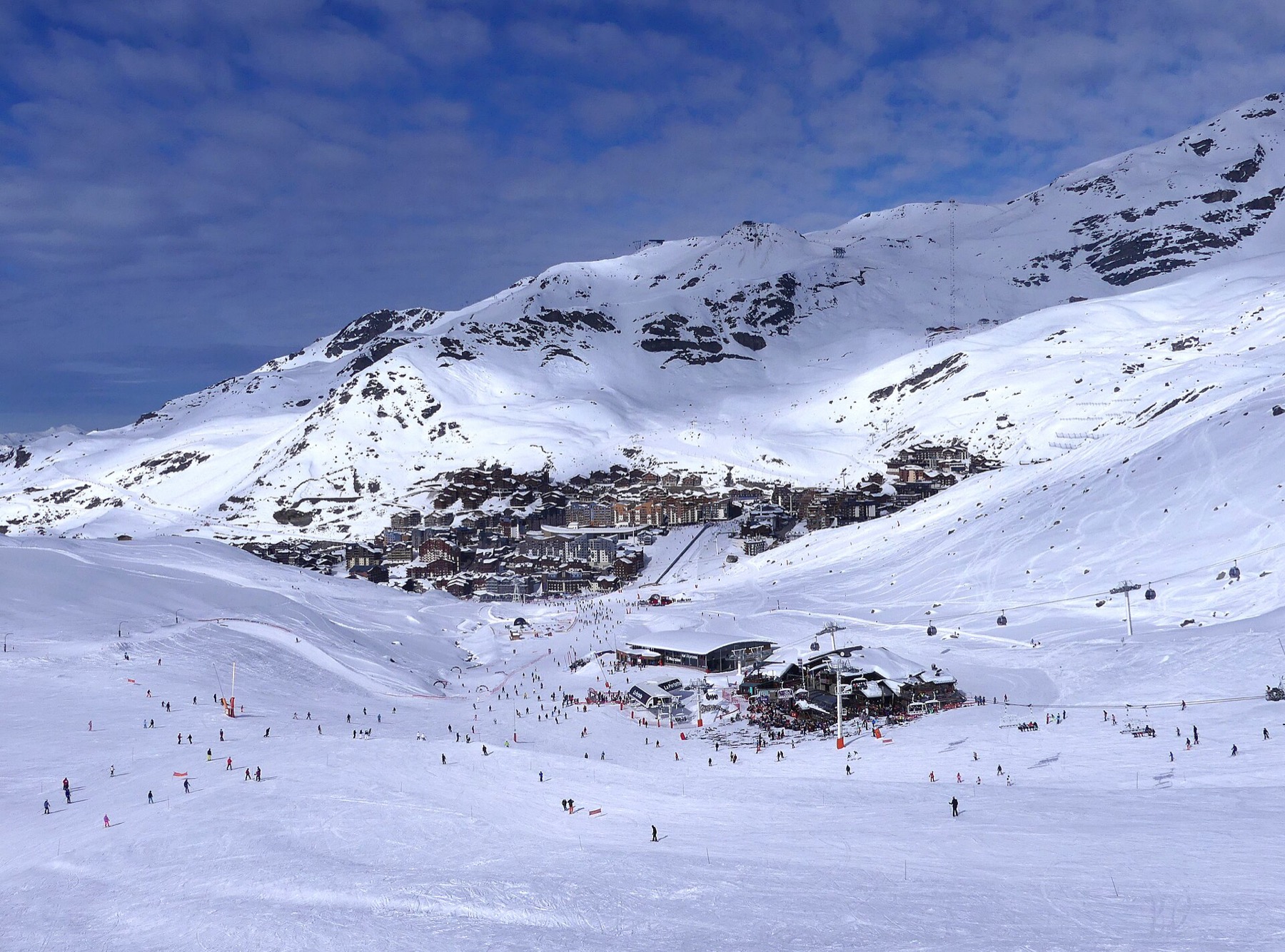
Summary
- Take piste kilometres with a pinch of salt – resorts inflate them by an average of 34 percent. Christoph Schrahe’s precise measurements from 2013 clearly showed that resorts like to count the width of slopes or simply count one wide piste multiple times.
- The world’s largest connected resort, Les 3 Vallées, proudly claims 600 kilometres of pistes. But real digital measurement revealed the actual length to be 493 kilometres, meaning a marketing inflation of 22 percent.
- A connected resort and a shared ski pass represent two entirely different skiing worlds. While you can glide through a connected resort purely on skis and lifts, with a shared ski pass you’ll often be stuck with time-consuming transfers by car or crowded skibus.
- The famous Dolomiti Superski tempts visitors with an almost unbelievable 1,200 kilometres of pistes. But in reality, only about half of that is actually connected ski-to-ski, with the rest scattered across many different valleys.
- Austria’s ranking of connected resorts is firmly topped by the sprawling Ski Arlberg. It offers skiers nearly 300 stated kilometres, and its key connection only came about recently thanks to the strategic Flexenbahn cable car.
- North America completely ignores kilometres and measures ski terrain exclusively in acres. Canadian giant Whistler Blackcomb offers over 8,000 acres, so it can’t be directly compared with traditional European resorts in terms of distance.
- For an interesting comparison with a smaller European resort, consider well-known Glenshee in Scotland. One of Europe’s more modest areas has around 40 kilometres of pistes, which is roughly one-twelfth of the enormous French Les 3 Vallées complex.
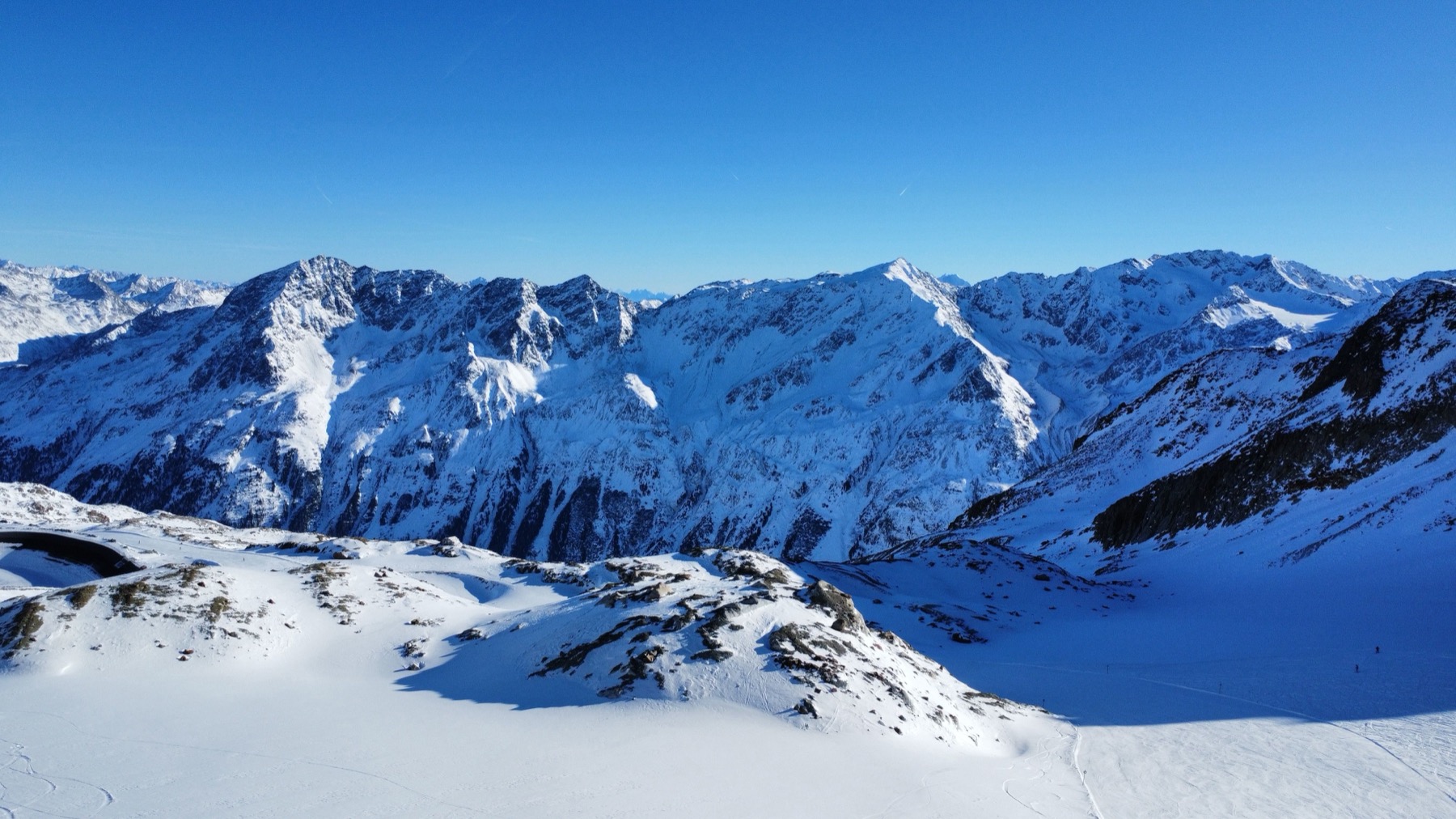
The full destination guide: Europe — guide and what to see
12 Things You Must Know About the Largest Ski Resorts
Let’s dive straight into the specific giants of winter sports. These world’s largest ski resorts promise literally hundreds of kilometres of perfectly groomed runs, but as we’ve already explained, not all that glitters is gold, and numbers can lie.
When choosing your dream winter holiday, it pays to know not only the official marketing slogans, but above all the real terrain conditions, altitude and logistics. I’ve put together an overview of the most interesting places where skiing really does happen on a grand scale.
1. Les 3 Vallées (France) and the Real Size of the King
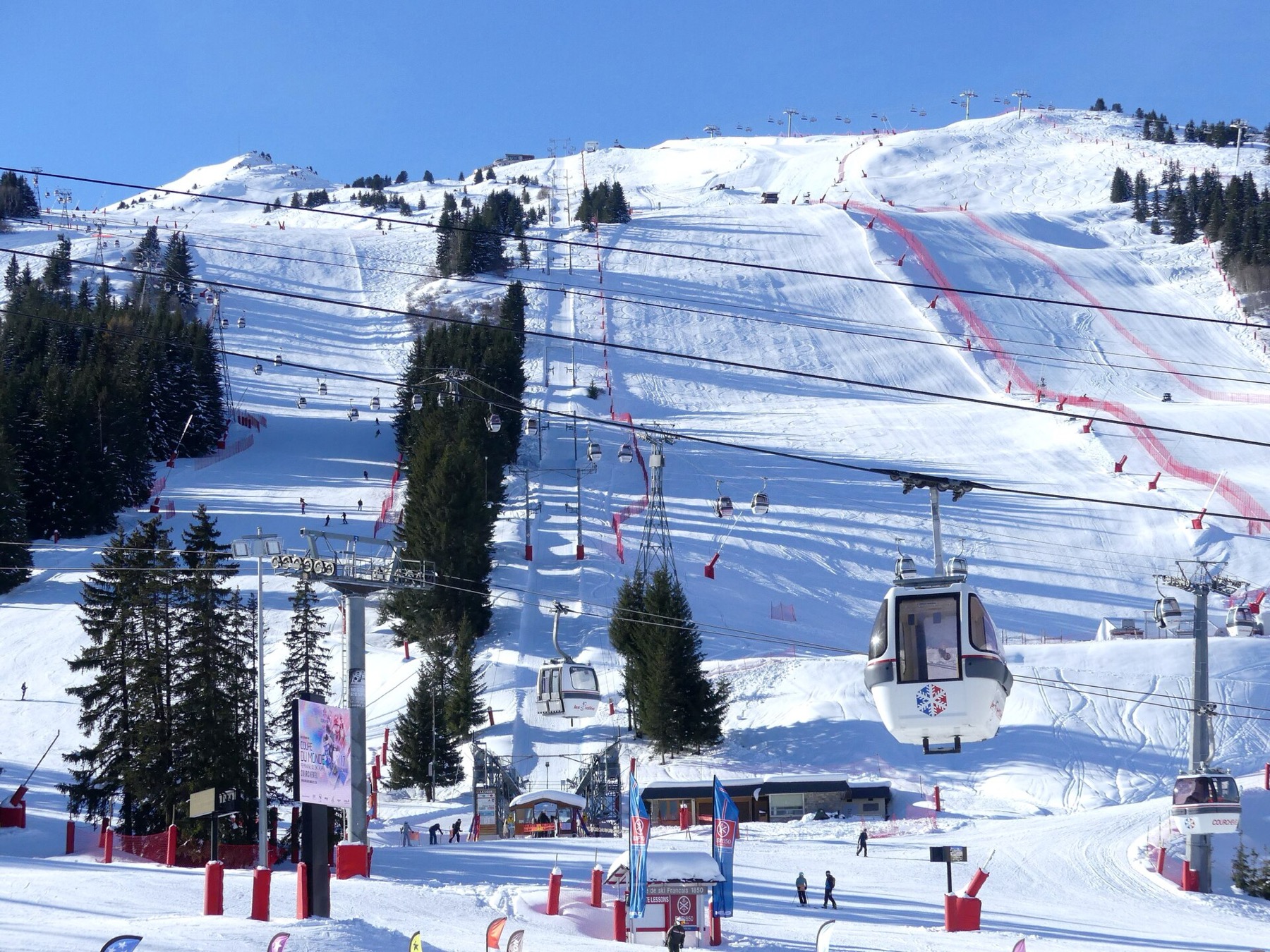
When you mention the world’s largest ski resort, almost everyone immediately thinks of the famous French Three Valleys. Official figures from Les 3 Vallées operators proudly claim 600 kilometres of pistes and 159 modern lifts, making this place an absolute legend of winter sports. It encompasses no fewer than eight different resorts spread across four valleys, including such famous names as Courchevel, Méribel, Val Thorens and Les Menuires (the fourth valley is Maurienne, although the resort’s name only mentions three).
But it’s precisely with this gigantic complex that you can best see how misleading official figures can be. When Christoph Schrahe carried out his precise digital measurement, he arrived at a real figure of 493 kilometres. Even after deducting this twenty-two percent marketing inflation, Les 3 Vallées comfortably maintains its position as the world’s largest truly connected resort, which you can ski through exclusively with skis on your feet without needing to take off your ski boots on a bus.
Ski all the runs in one week? You won’t manage it. Really. Most visitors naturally find their favourite circuit after three days and then repeat it, because constant transfers between distant valleys can be physically and time-wise very demanding. Plus you need to carefully watch the time to catch the last connecting lift back to your home valley.
💡 Tip: If you want to enjoy truly reliable snow even at the end of the season, choose accommodation directly in Val Thorens. This is Europe’s highest resort, where you’ll find pistes at altitudes exceeding 3,000 metres, and skiing commonly continues well into late May.
2. Les Portes du Soleil (Switzerland/France) as a Cross-Border Giant
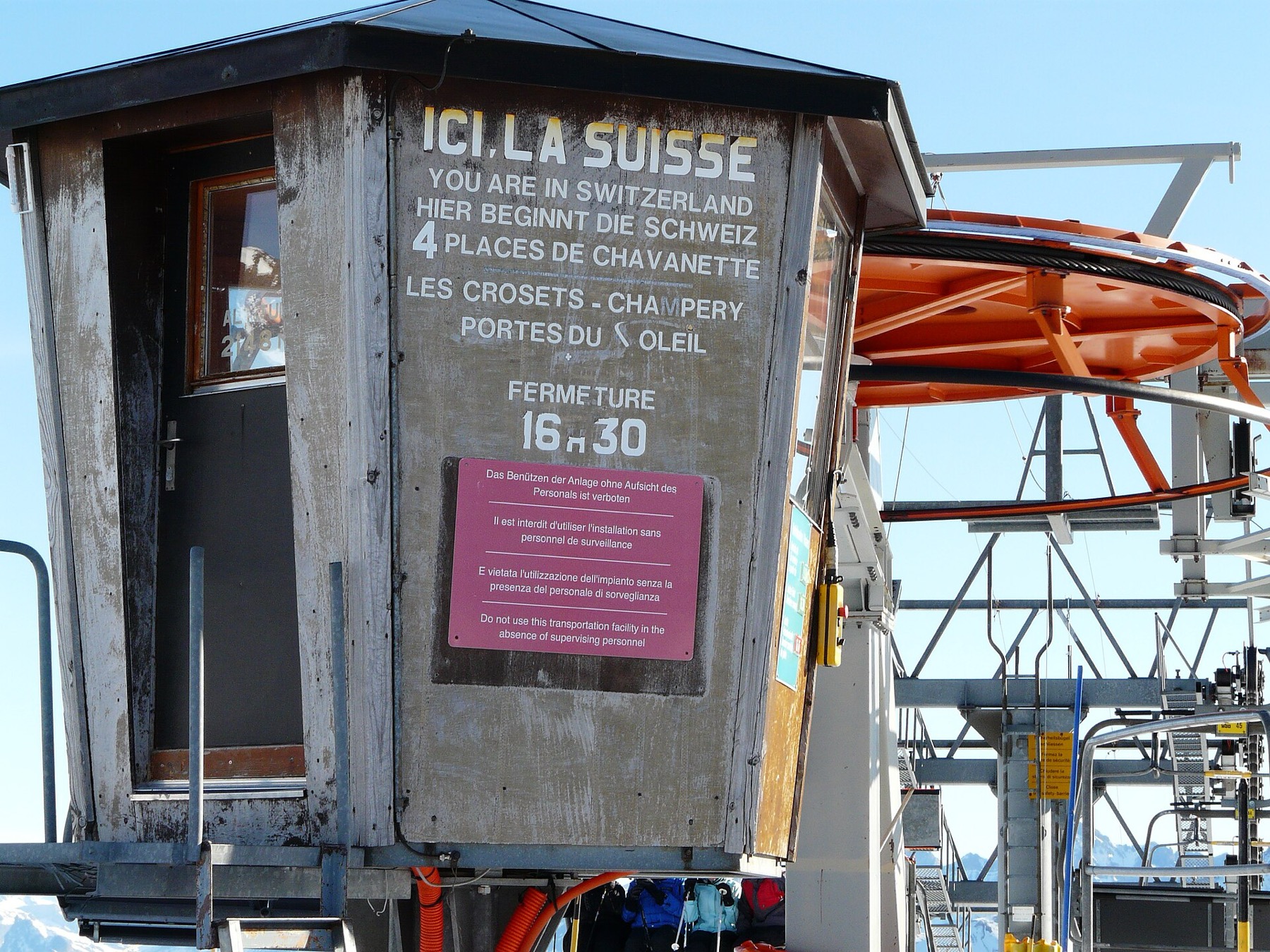
In the notional second place in the European rankings sits the huge area of Les Portes du Soleil, or Gates of the Sun. This massive cross-border complex claims an impressive 580 kilometres of pistes and 164 lifts that flow seamlessly between Swiss and French territory. You’ll find twelve different villages here, the most famous being French Avoriaz and Morzine and Swiss Champéry.
Although the figures on paper are absolutely fascinating, you need to reckon with one significant complication. Unlike the Three Valleys, this entire area is not one hundred percent ski-connected. If, for example, you want to get from the centre of Morzine up to modern Avoriaz, you’ll need to use a skibus to the Prodains lift or walk a short distance through the town on foot. Similar minor transfers await you at Swiss Morgins too, which slightly disrupts the overall experience of seamless travel.
Nevertheless, this is an absolutely unique ski destination where during a single day you’ll cross the national border several times and sample the different cultures of both countries. In the morning you can have a typical French croissant in a mountain hut under the piste, and at lunchtime sit down to hearty Swiss cheese fondue on the other side of the mountain ridge.
💡 Tip: When moving around the border areas, be very careful with roaming data on your phone. While in the French part you fall under EU rules and use data as at home, as soon as you cross the ridge into Switzerland, operators can charge you astronomical amounts for every downloaded megabyte.
3. 4 Vallées (Switzerland) and Legendary Freeride
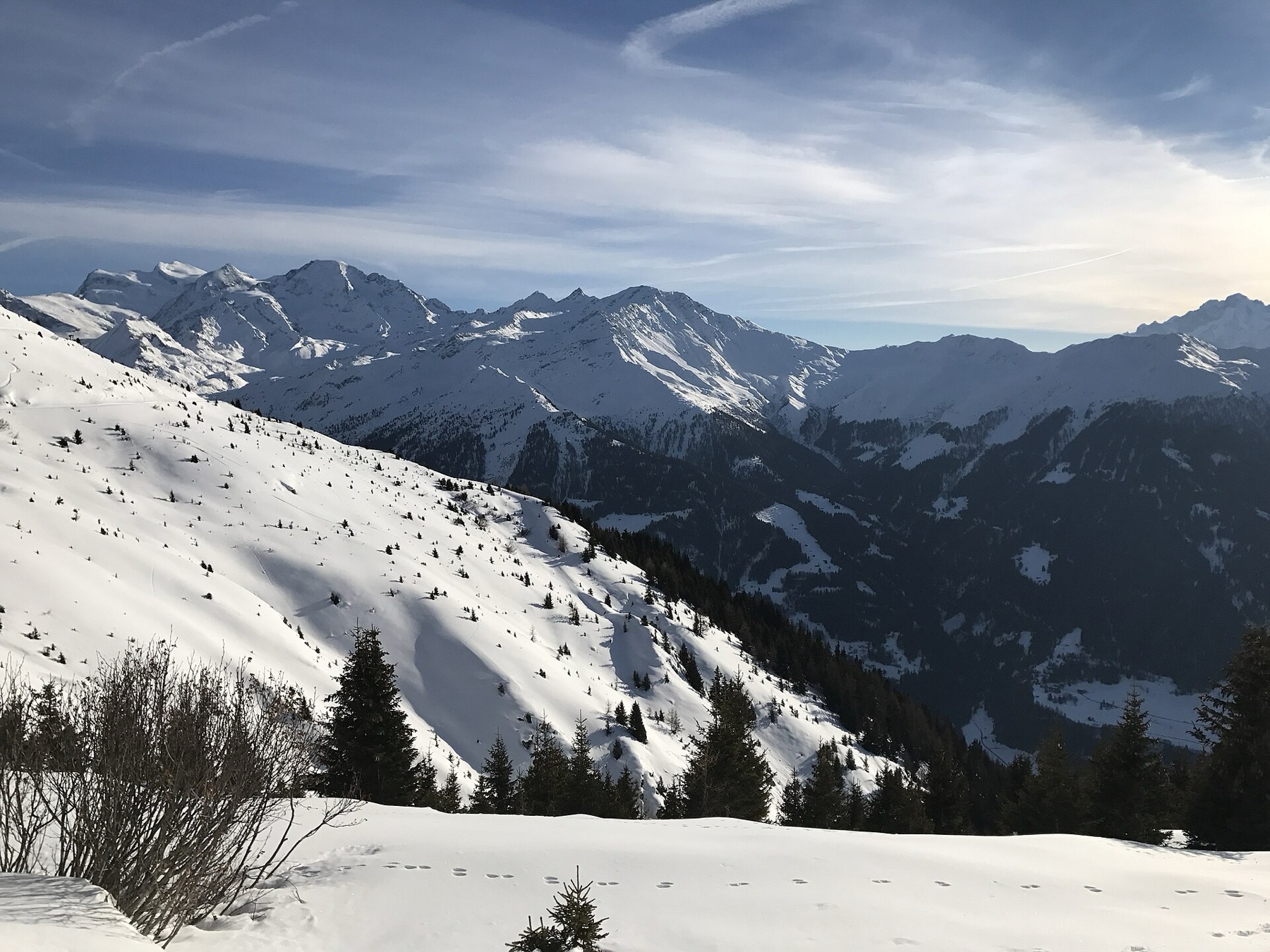
Switzerland’s national pride among connected giants is undoubtedly the 4 Vallées area, which stretches across the Valais canton. Operators claim 412 kilometers of slopes and 68 lifts, with the heart of the entire region being the world-famous luxury resort of Verbier. This resort is for skiers who know what they want and don’t mind paying for it: Swiss service, breathtaking views of four-thousand-meter peaks, and the feeling that you’ve entered a different league.
What makes 4 Vallées absolutely exceptional is its enormous emphasis on off-piste skiing. Verbier is globally considered the absolute mecca for all freeriders, offering dozens of kilometers of secured but ungroomed ski routes called itineraires. These yellow-marked slopes guarantee you an adrenaline-filled experience in deep powder while still protecting you from avalanche danger, which the mountain patrol carefully monitors.
The highest point of the entire resort is the majestic Mont-Fort summit at an elevation of 3,330 meters above sea level. The view from this glacial viewpoint is among the most beautiful in the entire Alps, and on a clear day you can see all the way to the iconic Matterhorn or the Mont Blanc massif. The descent down, however, is reserved only for truly skilled skiers, as it starts with a very steep and ungroomed mogul slope.
💡 Tip: Swiss lift passes are among the most expensive in Europe, but you can save significantly with early purchase. If you book your tickets online several months in advance through the dynamic pricing system, you’ll often get much more reasonable prices than buying at the morning ticket office.
4. Via Lattea (Italy/France) – The Milky Way
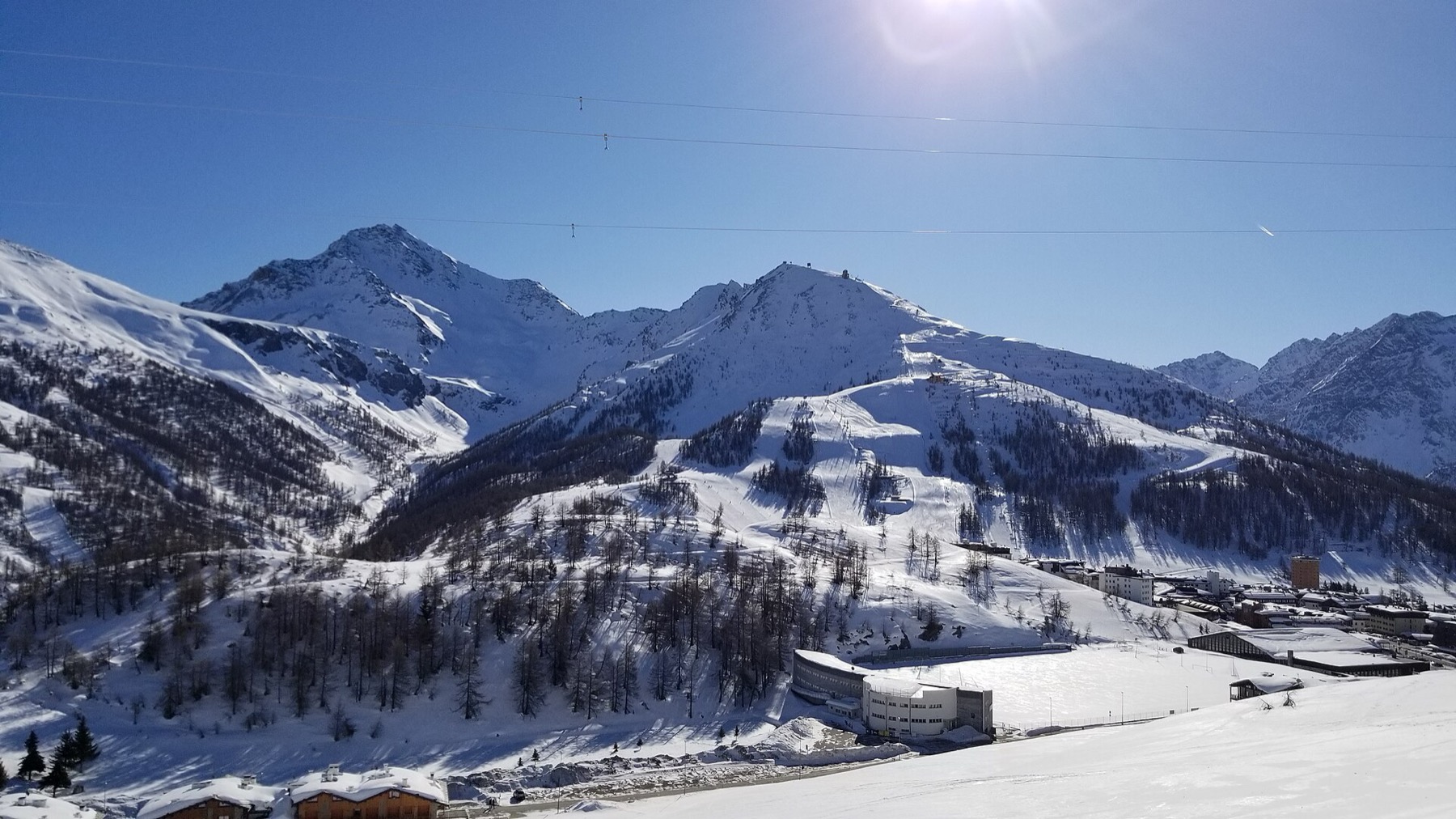
Another enormous complex that spans across national borders is the Italian-French Via Lattea, which translates to Milky Way. This sprawling area boasts 400 kilometers of slopes served by 69 lifts, with its symbolic center being the famous Italian resort of Sestriere, which was built in the 1930s by the founder of Fiat. It was here that much of the 2006 Turin Winter Olympics took place.
Although the claimed 400 kilometers is impressive, the reality on the slopes can sometimes be a bit more complicated. The Milky Way is indeed connected for skiing, but transfers between the outer sections take an enormous amount of time. Lifts in some Italian sections date back to bygone eras, are slower, and often lack protective bubbles, which can significantly diminish your full-day experience when facing freezing winds and long transfers.
However, if you come here in sunny weather, you’ll enjoy beautiful and very diverse skiing. The French section around the Montgenèvre resort offers lovely forest clearings and gentler slopes, while the Italian Sestriere and Sauze d’Oulx provide wide groomed motorways and on-slope dining at prices that will pleasantly surprise you after the French side.
💡 Tip: When planning a full-day trip across the Milky Way, allow plenty of time for your return. If you get stuck in a foreign country after the connecting lifts close, you’ll face an extremely expensive taxi ride over mountain passes back to your hotel.
5. Zermatt and Cervinia (Switzerland/Italy) with Dream Views
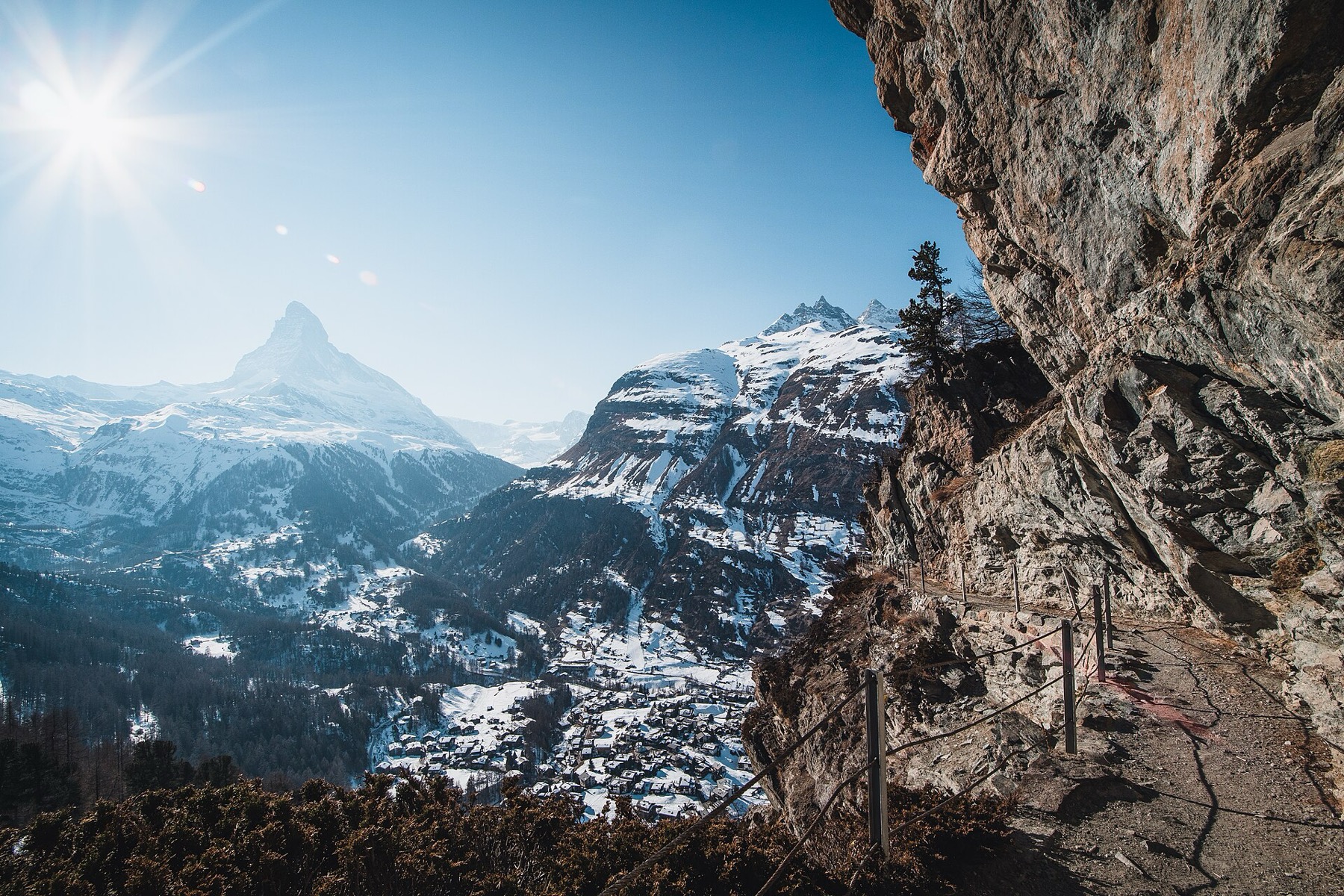
Few places on earth can boast such a photogenic backdrop as the area beneath the iconic Matterhorn peak. The connected area of Swiss Zermatt and Italian Cervinia claims a total of 322 kilometers of slopes and 51 lifts that take you to some of the highest elevations in Europe. This is where you’ll experience true high-altitude skiing in an environment of massive glaciers and endless white expanses.
This resort is an absolute paradise for lovers of long, flowing descents with enormous vertical drops. The run from the Klein Matterhorn viewpoint down to the Italian Breuil-Cervinia overcomes an incredible elevation difference of over 2,200 meters. Although many materials claim this is one of the longest ski runs in the world at around 20 kilometers, it’s actually a clever chain of several connected runs that you ski without having to board another lift.
A huge advantage is also the snow reliability all year round, since much of the resort sits on a glacier. And there’s another bonus reason to love Zermatt: no cars. You can only reach the town by cog railway, and the streets are served by silent electric vehicles or horse-drawn carriages, giving it an incomparable atmosphere.
💡 Tip: Weather at elevations above 3,500 meters can change from clear skies to a snowstorm in ten minutes. Always carry an extra warm mid-layer and carefully watch the light signals at the lifts, which warn of sudden border crossing closures.
6. Tignes and Val d’Isère (France) as High-Altitude Certainty
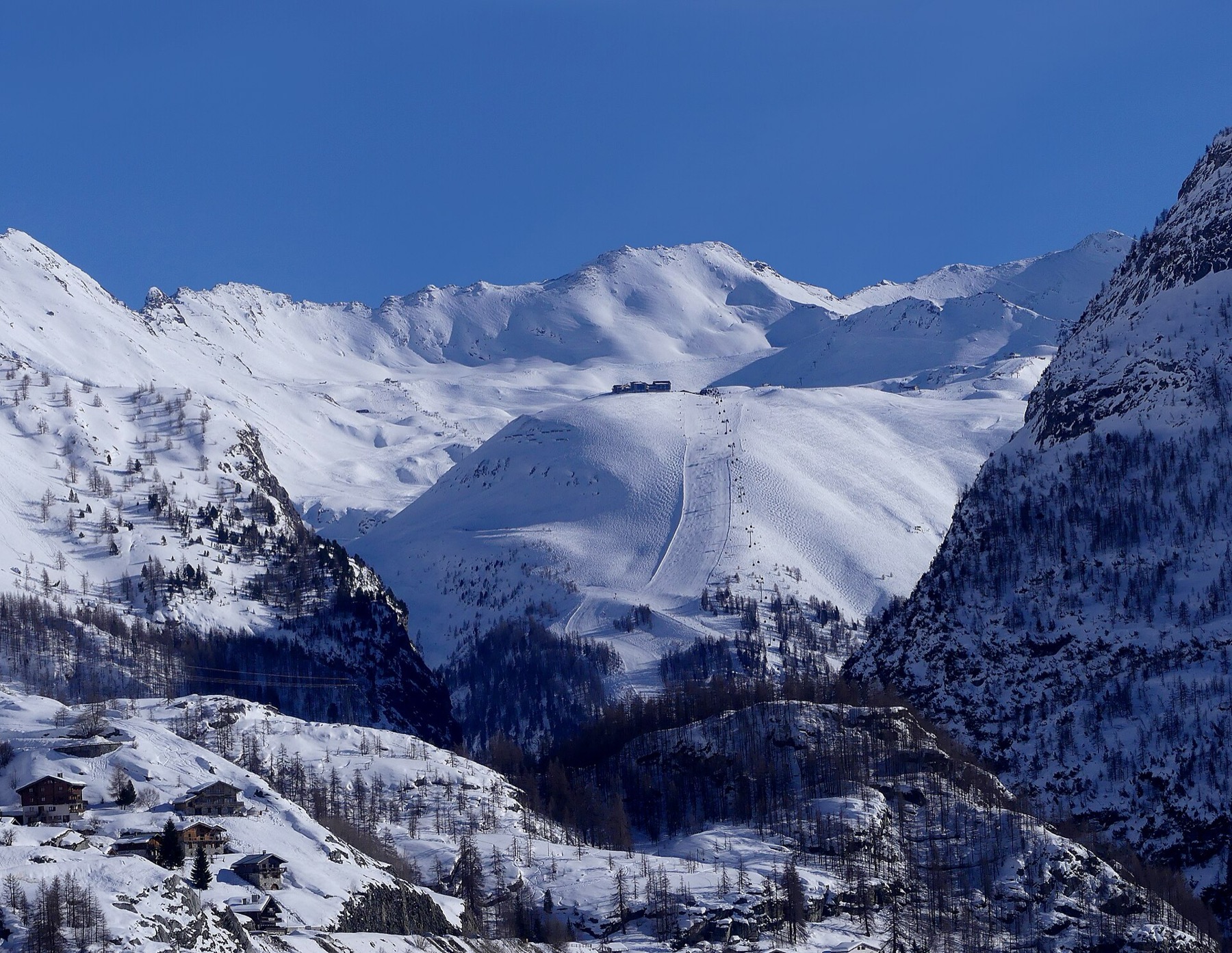
The area formerly known under the legendary name Espace Killy is among the most reliable winter destinations on the entire European continent. Today it’s marketed under the combined name Tignes/Val d’Isère and offers 300 claimed kilometers of slopes with 80 lifts. Its main advantage isn’t just the sheer size, but primarily its uncompromising altitude, thanks to which quality natural snow lies here from late autumn until early summer.
While most Austrian or Italian resorts end their lifts where this French giant is just beginning, here you ski in entirely different spheres. Much of the ski terrain sits safely above the 2,000-meter mark, and in an era when winters are getting warmer year after year, that’s truly an argument that decides.
Each of the two resorts also has a completely different atmosphere, so there’s really something for everyone. While Val d’Isère maintains the character of a traditional and very luxurious Savoyard village with wooden chalets, neighboring Tignes is a purely functional concrete settlement from the 1960s that may not overflow with beauty but offers unbeatable direct access to the slopes and the Grande Motte glacier.
💡 Tip: If you’re traveling with small children or complete beginners, choose accommodation in Val d’Isère instead. The local blue runs in the valley are much friendlier and wider, while the return routes to Tignes often become steep, icy, and full of moguls in the afternoon.
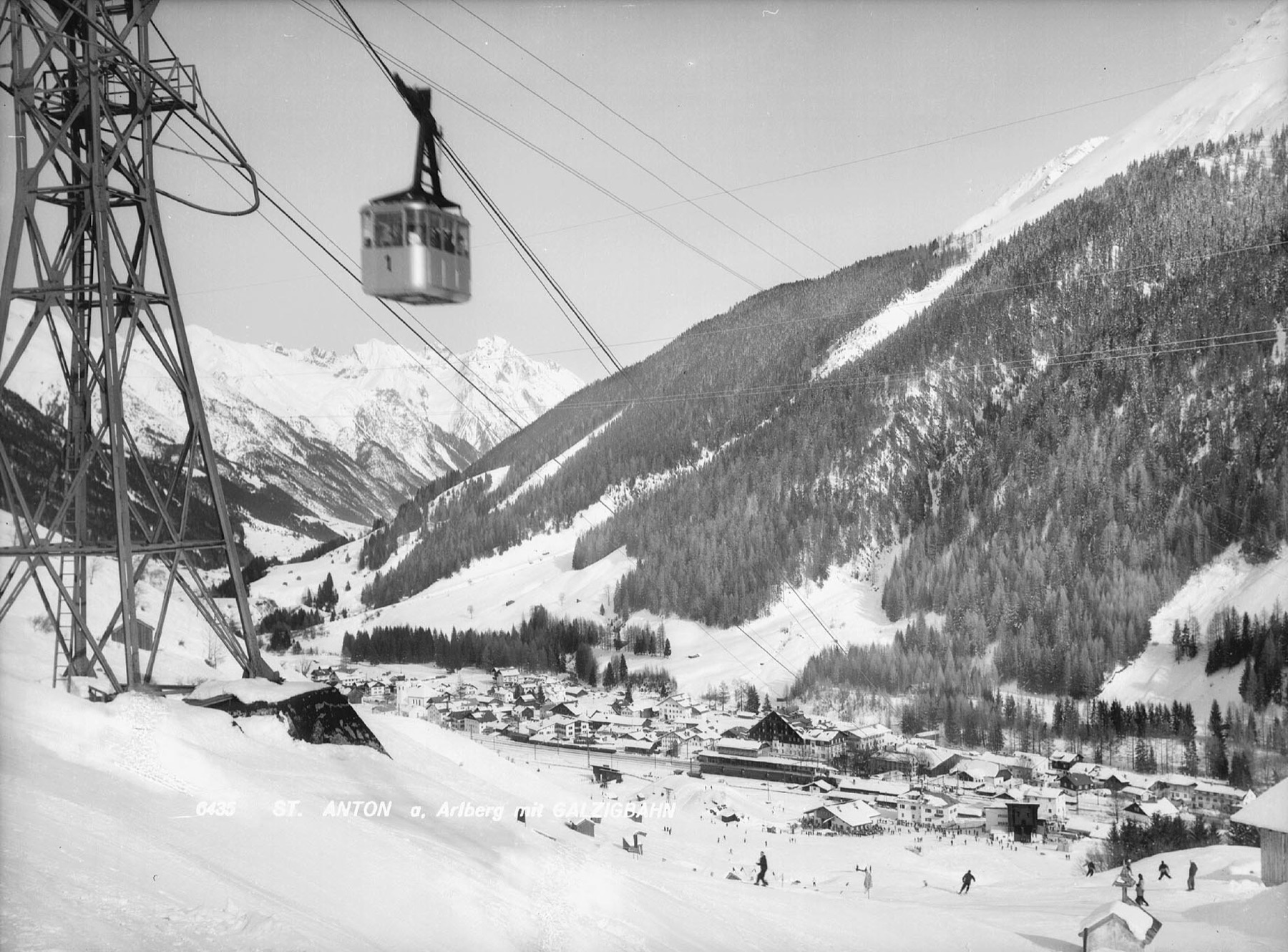
7. Ski Arlberg (Austria) with Revolutionary Cable Car
Looking at our southern neighbors in Austria, the throne for the largest connected resort is confidently held by the famous Ski Arlberg. This Tyrolean-Vorarlberg pride boasts a claimed 299.7 kilometers of slopes and 85 ultra-modern lifts. It unites several prestigious villages led by sporty St. Anton and aristocratic Lech, where European high society, royal families, and anyone who can afford it (and wants to ski on truly perfectly groomed slopes) come to spend their winter holidays.
What truly made Arlberg a giant, however, happened relatively recently. Until the 2016/2017 season, the St. Anton and Lech/Zürs areas were separated for skiing and required lengthy bus transfers between them. Only the revolutionary construction of the super-modern Flexenbahn connecting lift definitively solved this problem and united all parts into one seamless and fantastically functioning whole, creating the largest connected resort in all of Austria.
Ski Arlberg is also considered the cradle of modern Alpine skiing and offers terrain that satisfies even the most demanding experts. It’s particularly renowned for its endless possibilities for off-piste skiing and marked ski routes, which aren’t groomed but are protected from avalanches and provide the best safe freeride in the entire Eastern Alps.
💡 Tip: Try skiing the famous Run of Fame circuit, which takes you through the entire enormous resort from north to south. This impressive route measures a total of 85 kilometers and you’ll conquer an incredible 18,000 vertical meters, so dedicate a full day to it and head out on the first morning lift.
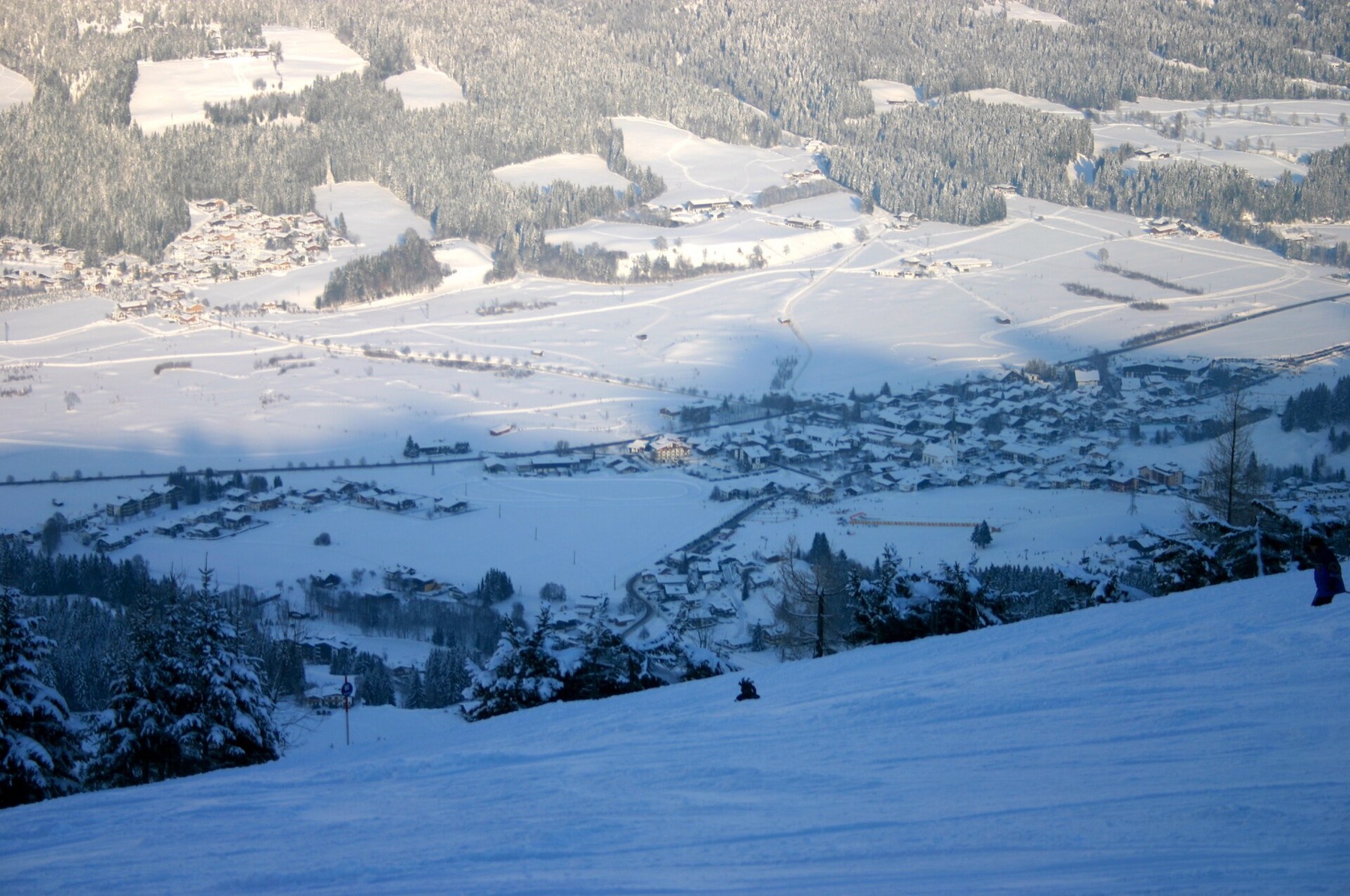
8. SkiWelt Wilder Kaiser-Brixental (Austria) as a Low-Altitude Giant
While French ski resorts score points with extreme altitude, Austrian SkiWelt Wilder Kaiser-Brixental takes a completely different approach. This incredibly expansive complex offers a claimed 275 kilometres of pistes and 81 lifts connecting no fewer than nine picturesque Tyrolean villages. It’s one of the most accessible giant ski resorts from abroad, lying just across the border near the motorway towards Innsbruck.
Its biggest weakness, but for some a major advantage, is the overall altitude. Most pistes here sit between 800 and 1,900 metres above sea level, which means you’re skiing mainly on beautiful pastures protected by deep forests. This shields you from the harsh icy storms found on French glaciers, and in poor visibility the trees provide excellent orientation points.
On the other hand, you need to be very careful about timing your holiday. Low altitude means that during sunny March the snow softens very quickly and turns into heavy spring slush. Instead of sharp morning carves, you’ll be wading through deep moguls by afternoon. While operators compensate brilliantly with one of the best snowmaking systems (snow cannons line virtually every metre), you can’t cheat the laws of physics, and for spring skiing it’s simply better to head a few hundred metres higher.
💡 Tip: This resort is an absolute paradise for families with children and lovers of traditional mountain cuisine. You’ll find over 80 cosy wooden huts offering proper Tyrolean Gröstl, fluffy Kaiserschmarrn, and fantastic service without the feel of industrial mass catering.
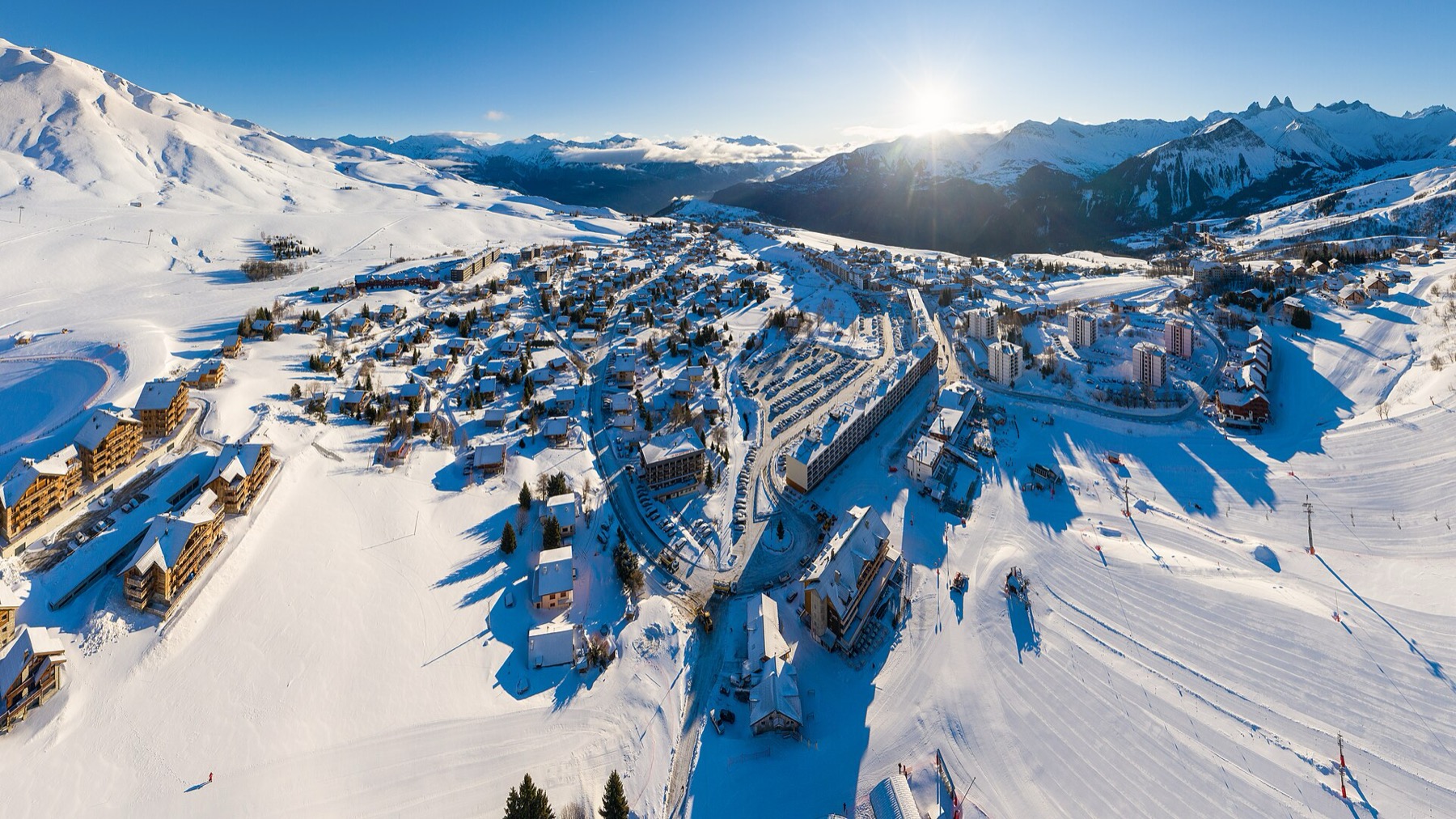
9. Les Sybelles (France) as an Affordable Sunny Plateau
France has several entries in the top ten largest ski resorts, and one of the lesser-known but all the more charming is the Les Sybelles complex. It connects a total of six smaller resorts and claims 275 kilometres of interconnected pistes served by 61 lifts. Located in the Maurienne valley, it offers fantastic views of the iconic rock towers of Aiguilles d’Arves that dominate the entire horizon.
This resort differs greatly from its more famous and expensive French neighbours in its overall atmosphere. Most slopes here are rated as blue or easy red, which makes Les Sybelles an absolutely ideal destination for relaxed recreational skiers and families with children. You won’t find extreme black runs or famous freeride zones here, but you will enjoy beautifully wide and clear motorways bathed in sunshine.
And then there are the prices. Here Les Sybelles simply scores. Lift passes, accommodation, and mountain hut meals work out noticeably cheaper than in prestigious Les 3 Vallées or luxurious Val d’Isère. The connection over the l’Ouillon summit at 2,431 metres altitude is also very smooth and logical, so you won’t get lost in the resort even on your first visit.
💡 Tip: Head out early in the morning to the outlying pistes above Saint Sorlin d’Arves resort. These slopes are perfectly groomed in the morning, offer the most beautiful views of surrounding peaks, and catch the sun from the very first rays of dawn.
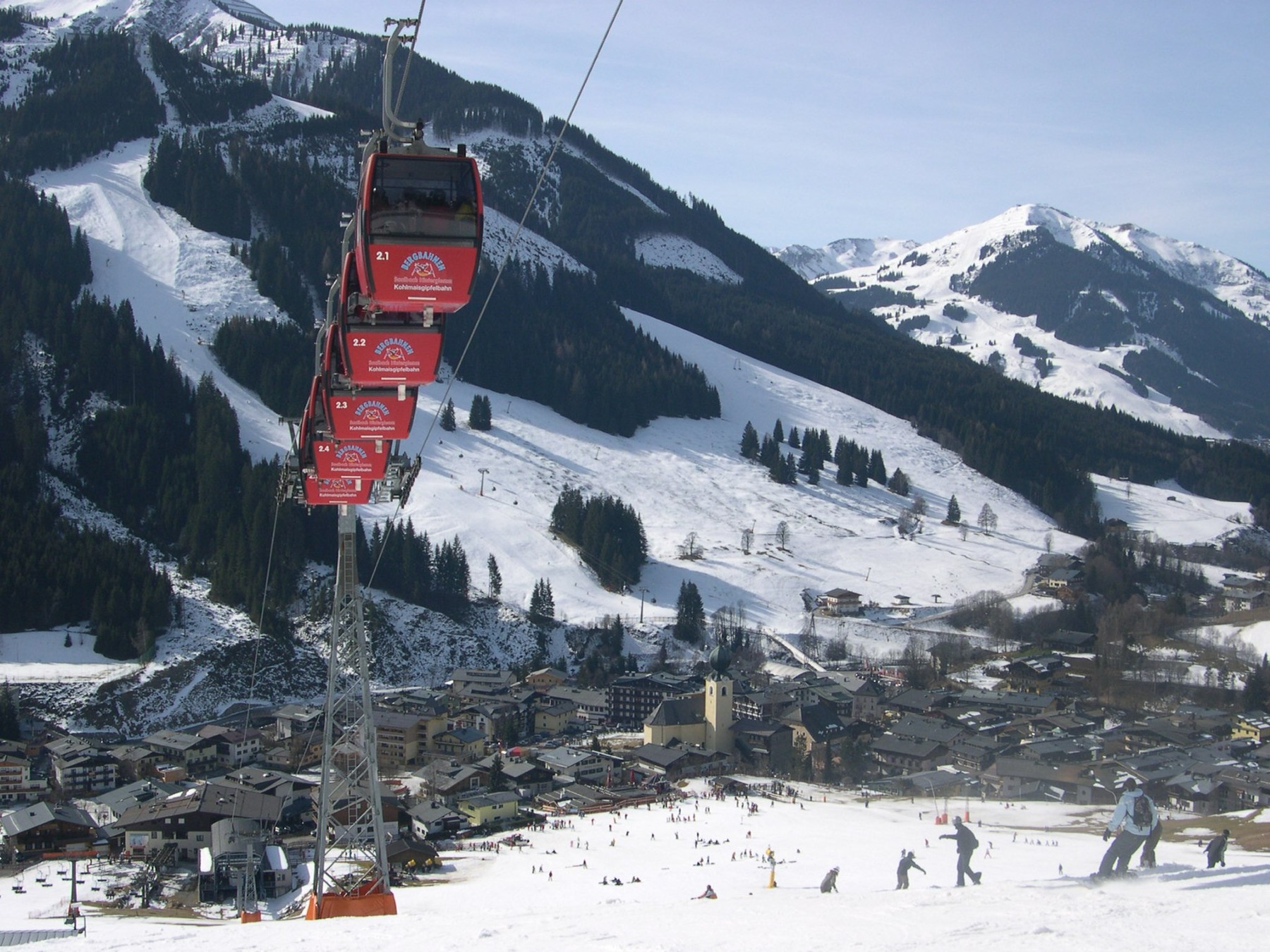
10. Skicircus Saalbach Hinterglemm (Austria) and Deceptive Numbers
When you look at the map of Austrian resort Skicircus, you might spend a while searching in vain for its actual size. The interconnected area itself, Saalbach Hinterglemm Leogang Fieberbrunn, offers 270 claimed kilometres and 69 lifts. It’s a fantastic ski carousel where you can circle all day on both sides of the deep valley, constantly alternating between sunny southern slopes and shady, frosty northern runs.
Confusion arises, however, when you buy a lift pass. The entire area falls under the so-called Ski ALPIN CARD, which proudly claims a total of 408 kilometres and 121 lifts. This giant number comes from the commercial partnership of Skicircus with the nearby Schmittenhöhe resort in Zell am See and the Kitzsteinhorn glacier above Kaprun. The problem is that these three massive areas are not physically interconnected by mountains and lifts.
This example beautifully illustrates the vast difference between an interconnected resort and a combined lift pass. To ski in Zell am See or on the glacier, you have to take off your skis, get in a car or wait a long time for the ski bus, and drive through the valley to a completely different area. Official rankings of the largest interconnected resorts therefore only count the Skicircus itself with its 270 kilometres.
💡 Tip: If it’s warm in the valley and the snow is starting to soften quickly, stick exclusively to the north-facing slopes above Hinterglemm. The runs below the Zwölferkogel and Schattberg peaks maintain hard, quality snow thanks to the shade until late afternoon.
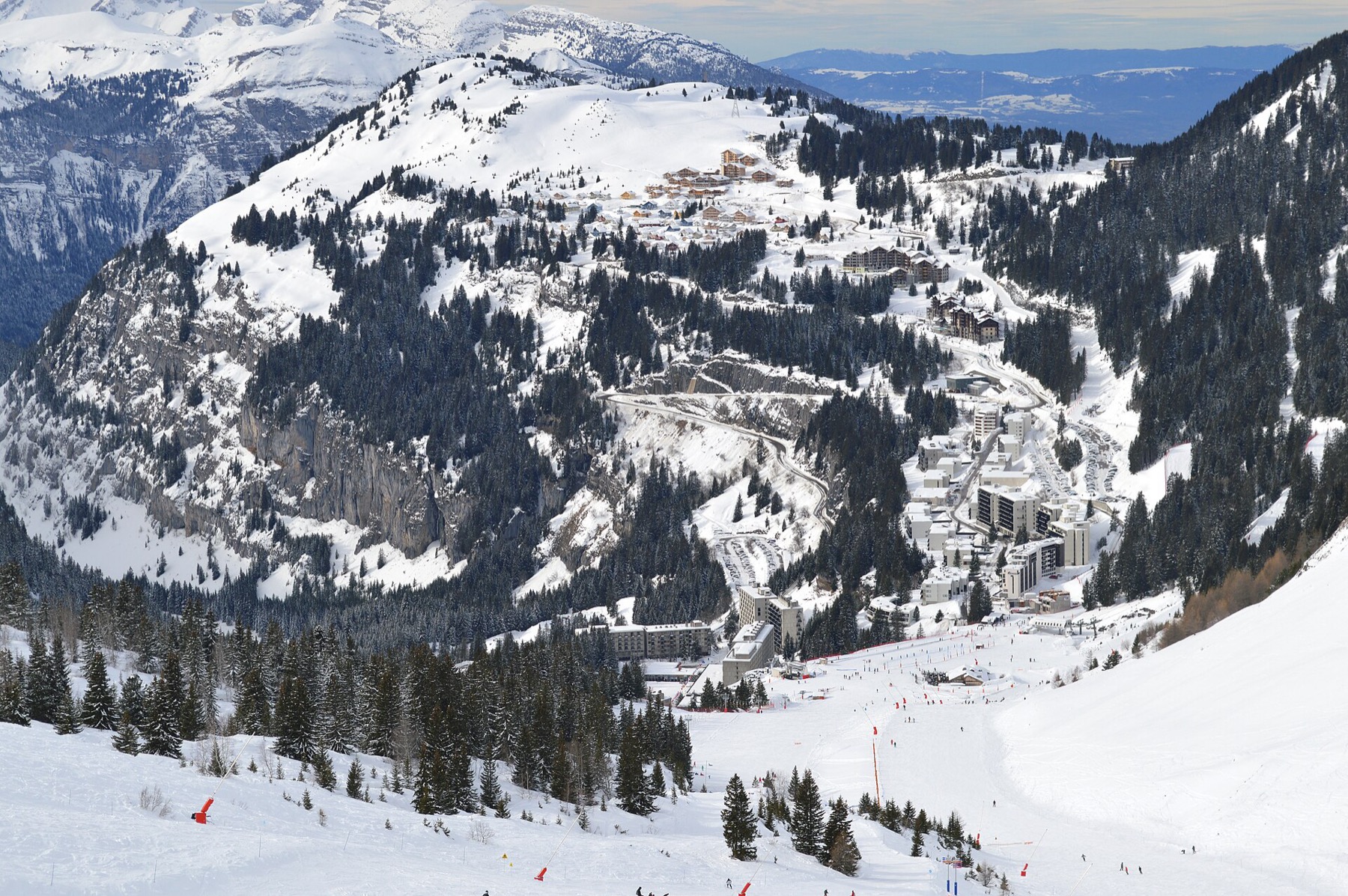
11. Le Grand Massif (France) with Mont Blanc Views
The fifth French giant in our list is the fascinating Le Grand Massif area, which spreads out in close proximity to Geneva. Operators claim 265 kilometres of interconnected pistes and 63 lifts for this complex. At the heart of the entire resort is the controversial and architecturally very unconventional Flaine resort, built in the 1960s in a harsh concrete brutalist style right in the middle of a deep rocky bowl.
Although the concrete hotels in Flaine may not please every aesthete’s eye, from a skiing perspective it’s an absolute gem. The entire resort functions as a huge natural snow trap, so there’s much more natural snow here than in surrounding, often higher-altitude resorts. Outlying villages like Samoëns or Les Carroz also offer the right traditional Alpine charm full of wooden chalets and cosy streets where you’ll happily return for hot chocolate.
But Le Grand Massif’s biggest draw is undoubtedly the panoramic views. In clear weather, from the summit of Les Grandes Platières at 2,480 metres altitude, you’ll get the most beautiful and completely unobstructed view of the entire majestic Mont Blanc massif. Just for this single moment alone, it’s worth making the long journey here.
💡 Tip: Try the fourteen-kilometre blue piste Les Cascades. This beautiful, gentle run leads through pristine nature from the summit all the way down to the village of Sixt, and along the way you won’t encounter a single lift, crowds of people, or noisy restaurants – just pure peace and rushing waterfalls.
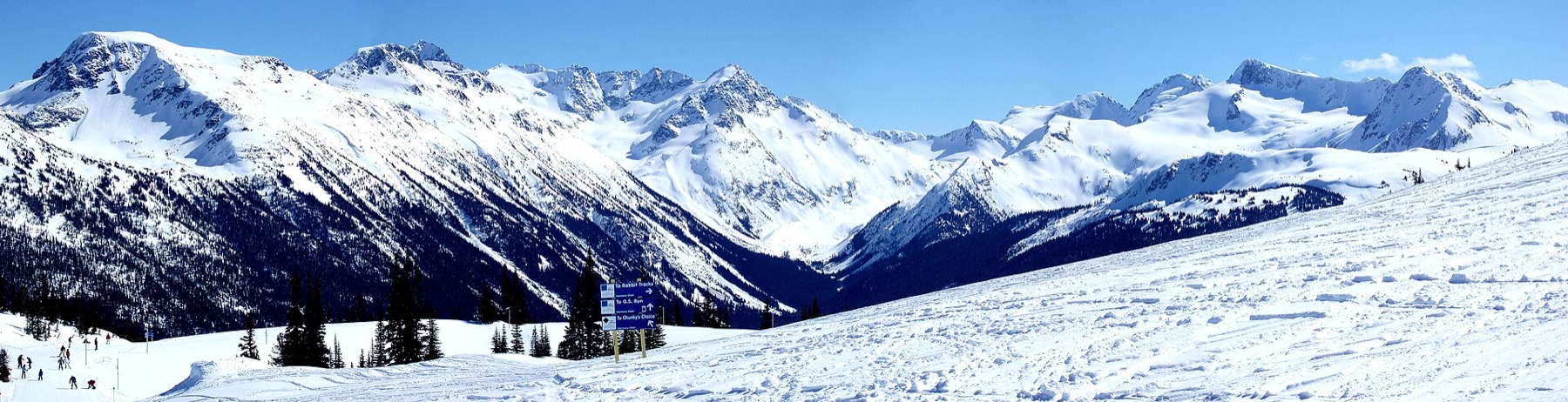
12. American Giants (Whistler and Park City) and Why They Don’t Count Kilometres
When we start talking about the world’s largest ski resorts, we must not overlook North America, which brings absolute chaos to European rankings. American and Canadian resorts fundamentally do not state kilometres of pistes, but rather the total skiable terrain area in acres. The reason is simple: in North America you don’t ski just on precisely marked and groomed strips, but essentially everywhere the trees and rocks allow.
The absolute king of the North American continent is Canadian Whistler Blackcomb. This monstrous resort offers skiable terrain exceeding 8,000 acres, which makes it so enormous that it can’t reasonably be compared with traditional Alpine resorts in terms of run length at all. The European metric simply wouldn’t work here. It wouldn’t be able to capture all those forest glades and powder fields where the very best of what North America offers actually happens.
If we still wanted to find some American comparison in European kilometres, we’d have to look to Utah or Montana. By European parameters, giant American complexes like Park City or Big Sky Resort would offer approximately 250 kilometres of pistes, served by about forty lifts. Even that makes them massive resorts that would easily compete with the biggest legends in the Alps.
💡 Tip: North American resorts don’t have the traditional European difficulty marking of blue-red-black. Instead they use green circles for beginners, blue squares for intermediates, and black diamonds (often double) for the most extreme and ungroomed runs that you absolutely shouldn’t attempt without deep powder experience.
Practical Summary and Pricing
If you’re tempted to try the absolute largest ski resorts in the world, you need to clarify beforehand what you actually expect from your holiday. It’s a complete misconception to think that a giant resort automatically means better and higher-quality skiing. Experience shows that completely different parameters determine a comfortable skiing experience than just the stated kilometres on a promotional brochure.
Lift speed, resort altitude, and (believe it or not) queue length matter much more than kilometres. A huge complex with outdated two-seater chairlifts will quickly bore you regardless of what the brochure promised. Conversely, a smaller but compact resort with heated eight-seater chairs often offers a much more intense and sportier experience.
Think carefully about whether you really need such a huge ski pass. Full-day lift tickets for the largest complexes like Ski Arlberg or Les Trois Vallées in 2026 are well above the €75 to €85 mark per adult day. If you’re traveling with family and know you’ll barely manage to ski a few slopes right around the hotel with the kids, it’s completely unnecessary to pay significant extra money for hundreds of kilometres of runs you’ll realistically never see.
Keep in mind that Dolomiti Superski with its 1,200 kilometres sounds tempting, but you’ll spend a large part of your holiday planning transfers, waiting for ski buses, and deciphering timetables. Sometimes it’s simply better to choose one properly interconnected mountain, park at your apartment on day one, and put the car keys away until departure.
Where to Go Next
If you’re interested in more ski tips and inspiration for your winter holiday, check out our detailed guides:
- Want to enjoy wide open slopes and perfect powder? Read our article about skiing in the French Alps.
- If you’re on a tight budget and looking to save, we have tips for a budget ski holiday.
- You don’t have to go to the Alps for great skiing. Try undiscovered slopes and explore skiing in Poland.
- Tempted by adventure and the wild Caucasus? Then you’ll definitely love our guide to skiing in Georgia.
- Heading to our southern neighbors by car? Don’t forget to read how the Austrian motorway vignette works.
- Safety comes first, so check what your car needs for winter mountains.
- You’ll find specific Austrian resorts with prices in the article skiing in Austria.
- And how much will you actually pay for those kilometres? We’ve calculated it in our ski pass price comparison.
Frequently Asked Questions
Still a bit confused? You’re not alone. The world of ski giants is full of marketing tricks, specific rules, and local exceptions that aren’t easy to navigate.
I’ve compiled answers to the most frequently asked questions you send me about huge ski resorts and their real size.
Which ski resort is actually the largest in the world?
If we’re talking about a truly interconnected resort that you can explore exclusively on skis, the absolute champion is the French area Les 3 Vallées. Although it officially claims a round 600 kilometers of slopes, precise digital measurements confirmed the real length at 493 kilometers. Even this refined figure is more than enough to maintain its worldwide record.
Why do ski resorts lie about the length of their slopes?
It’s not so much a direct lie as rather very creative measurement methodology. Resorts in the past often counted the total width of slopes, counted one wide run as three separate trails, or added long traversing paths. Measurements by expert Christoph Schrahe from 2013 showed that resorts inflated their length by an average of 34 percent this way.
What’s the difference between an interconnected resort and a combined ski pass?
In an interconnected resort, all the lifts and runs logically connect and you can cross it without taking off your skis. A combined ski pass, such as the giant Dolomiti Superski or Ski ALPIN CARD, is valid at many different resorts and valleys, but you physically have to transfer between them tediously by your own car or crowded shuttle bus.
Where can I find the longest ski run in the world?
Determining the single longest ski run is extremely difficult because definitions vary. France’s Vallée Blanche measures around 20 kilometers, but it’s an ungroomed glacial route requiring a mountain guide. The descent from Klein Matterhorn to the Italian Cervinia offers a massive vertical drop of 2,200 meters, but in reality it’s a chain of several connecting trails of varying difficulty.
Is it better to go to a giant resort or a smaller ski area?
Size definitely isn’t everything. A giant resort often means long transfers and high lift pass prices for kilometers of slopes you won’t manage to ski in a week anyway. Often a much better skiing experience is offered by a compact resort with modern and fast lifts without queues, located at high altitude guaranteeing powder snow.
How are ski runs measured in the USA and Canada?
North American resorts don’t use kilometers of slopes at all. Instead, they state the total area of ski terrain in acres. The reason is a different skiing style, where overseas people commonly ski absolutely everywhere between trees and rocks, not just on marked and groomed strips like in Europe. Canadian Whistler, for example, states an area exceeding 8,000 acres, which safely ranks it among the absolute North American giants.
What’s the largest interconnected ski resort in Austria?
The Austrian king of seamlessly connected slopes is the expansive Tyrolean-Vorarlberg Ski Arlberg. Thanks to the recent construction of the revolutionary connecting lift Flexenbahn, it joined previously separate valleys and today offers nearly 300 stated kilometers of trails without any need to use tedious ski buses.
How do ski resorts from abroad compare with the world’s giants?
For a perfect sense of the true size of Alpine complexes, a quick comparison with international reference points works well. A typical mid-sized ski area with around 25 kilometers of slopes would be roughly just one-twentieth the size of the enormous French Trois Vallées.
Tips and Tricks for Your Vacation
Don’t Overpay for Flights
Search for flights on Kayak. It’s our favorite search engine because it scans the websites of all airlines and always finds the cheapest connection.
Book Your Accommodation Smartly
The best experiences we’ve had when looking for accommodation (from Alaska to Morocco) are with Booking.com, where hotels, apartments, and entire houses are usually the cheapest and most widely available.
Don’t Forget Travel Insurance
Good travel insurance will protect you against illness, accidents, theft, or flight cancellations. We’ve had a few hospital visits abroad, so we know how important it is to have proper insurance arranged.
Where we insure ourselves: SafetyWing (simple monthly subscription) and TrueTraveller (for extra-long trips).
Find the Best Experiences
Get Your Guide is a huge online marketplace where you can book guided walks, trips, skip-the-line tickets, tours, and much more. We always find some extra fun there!