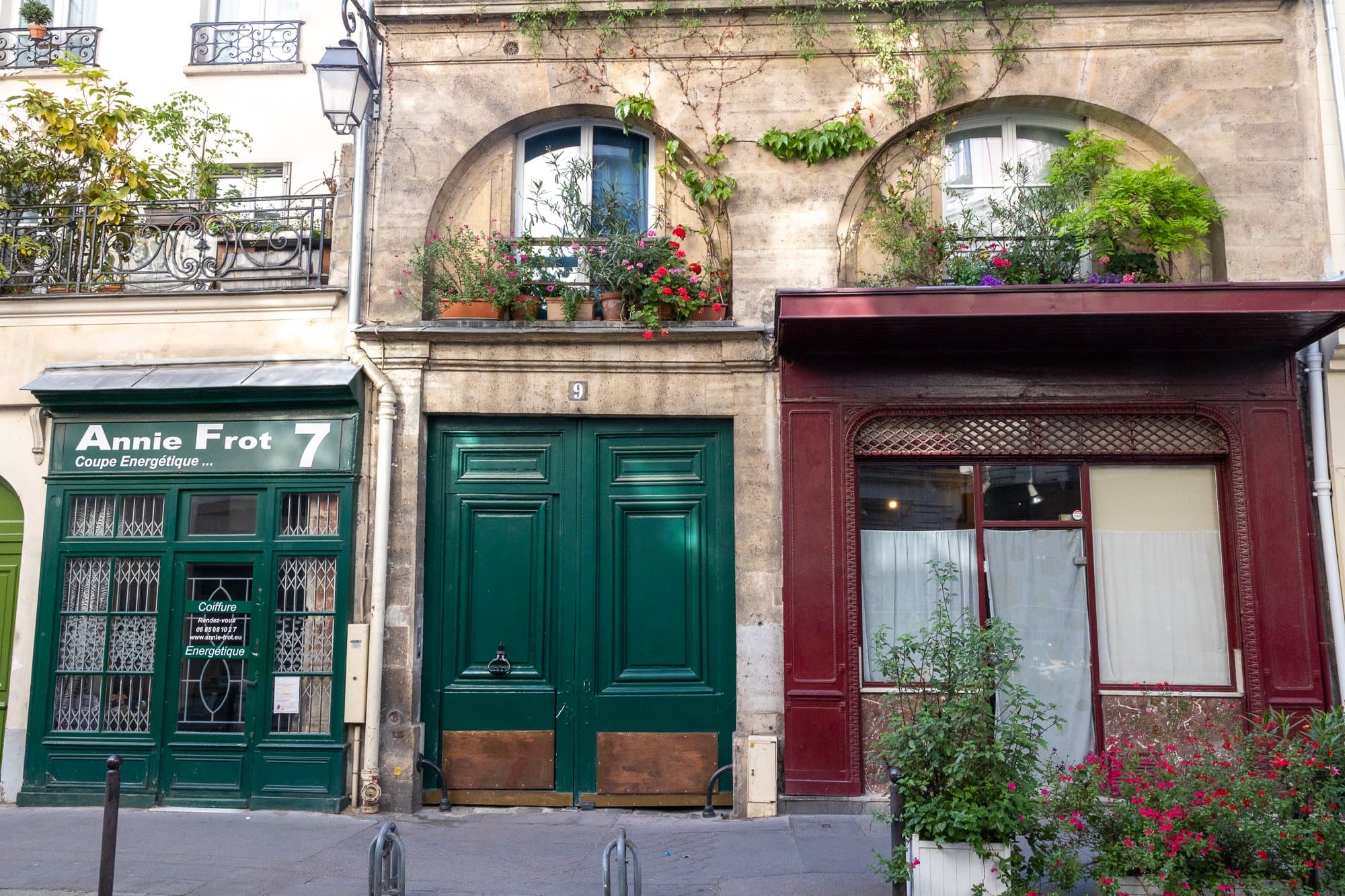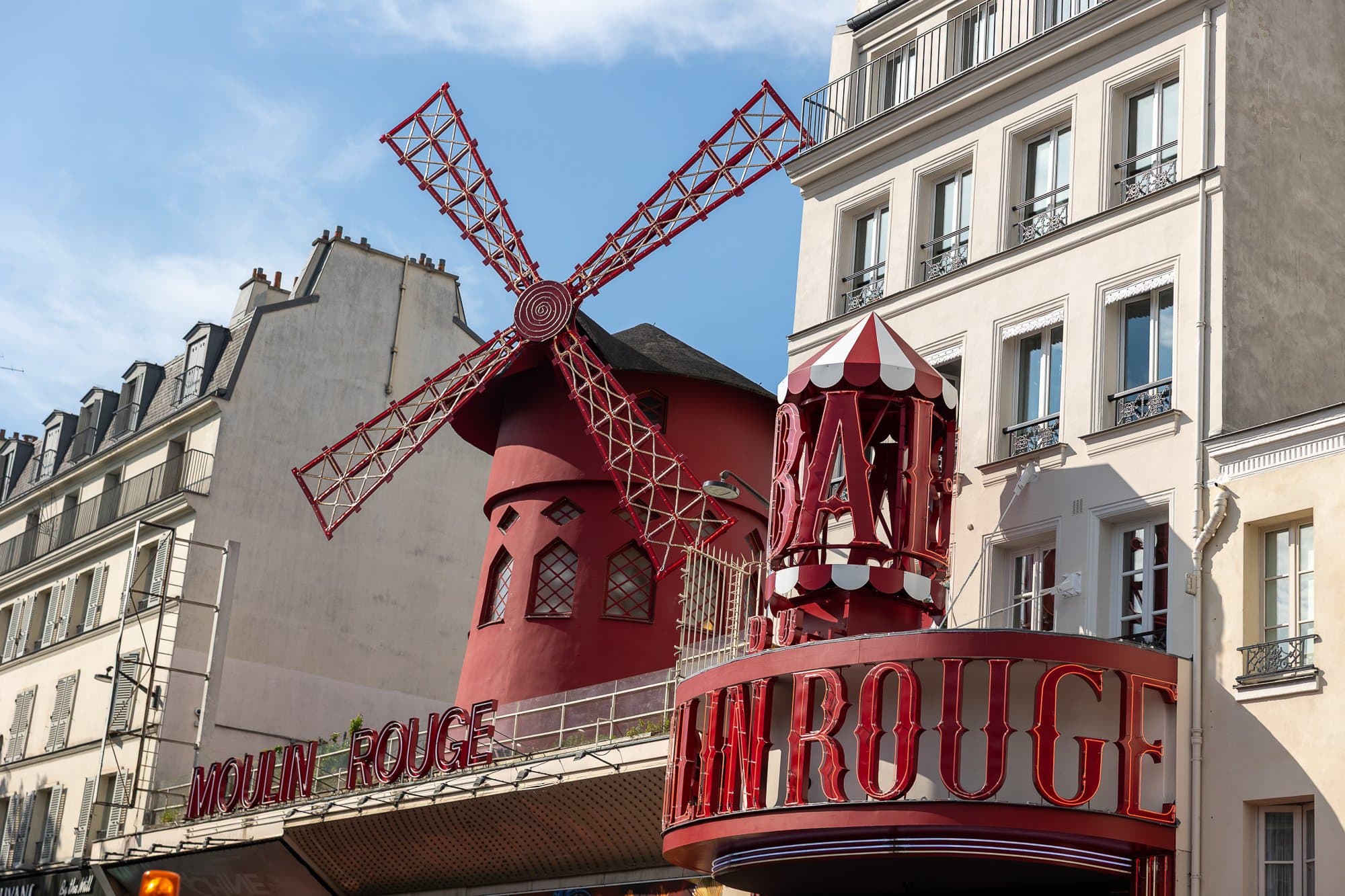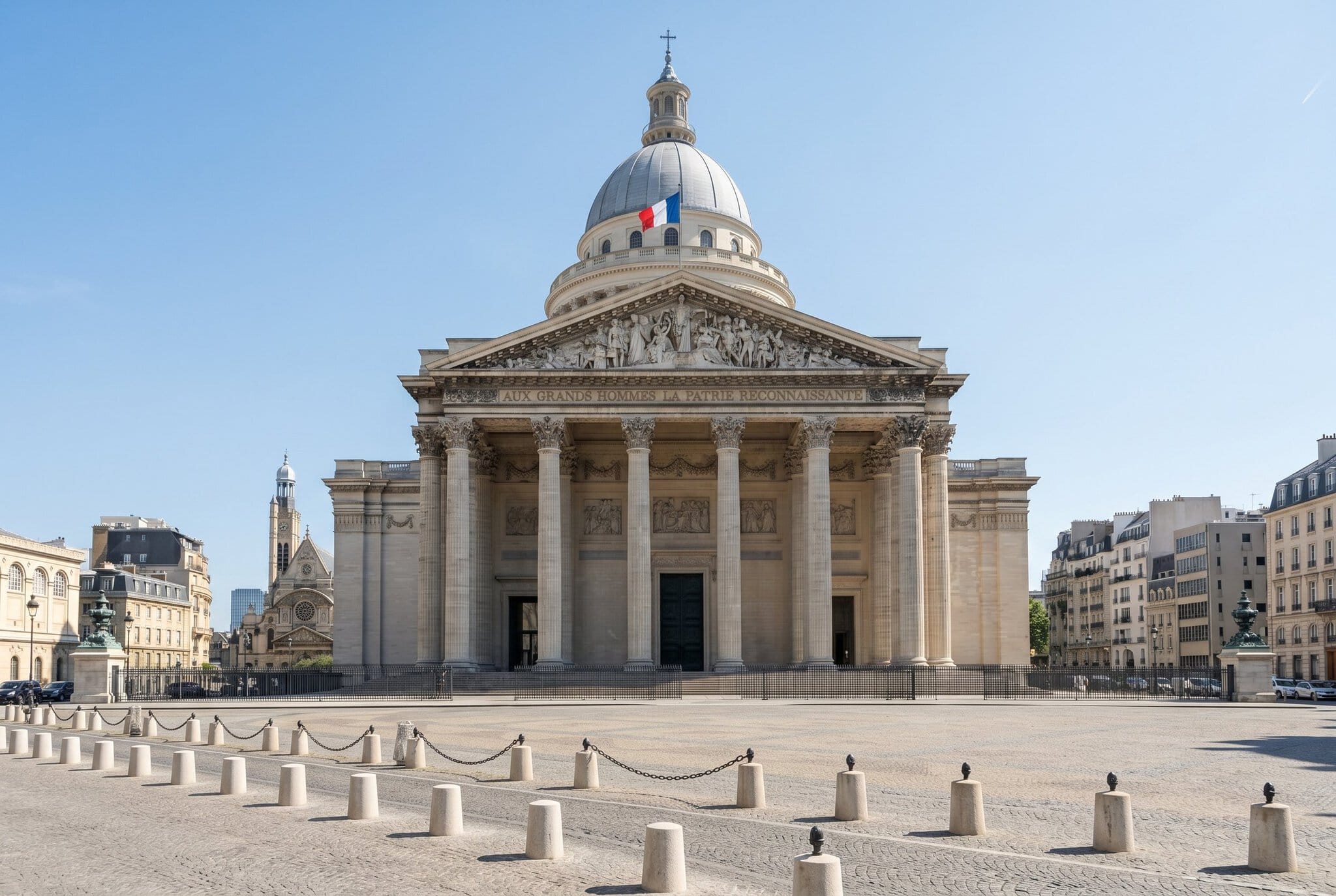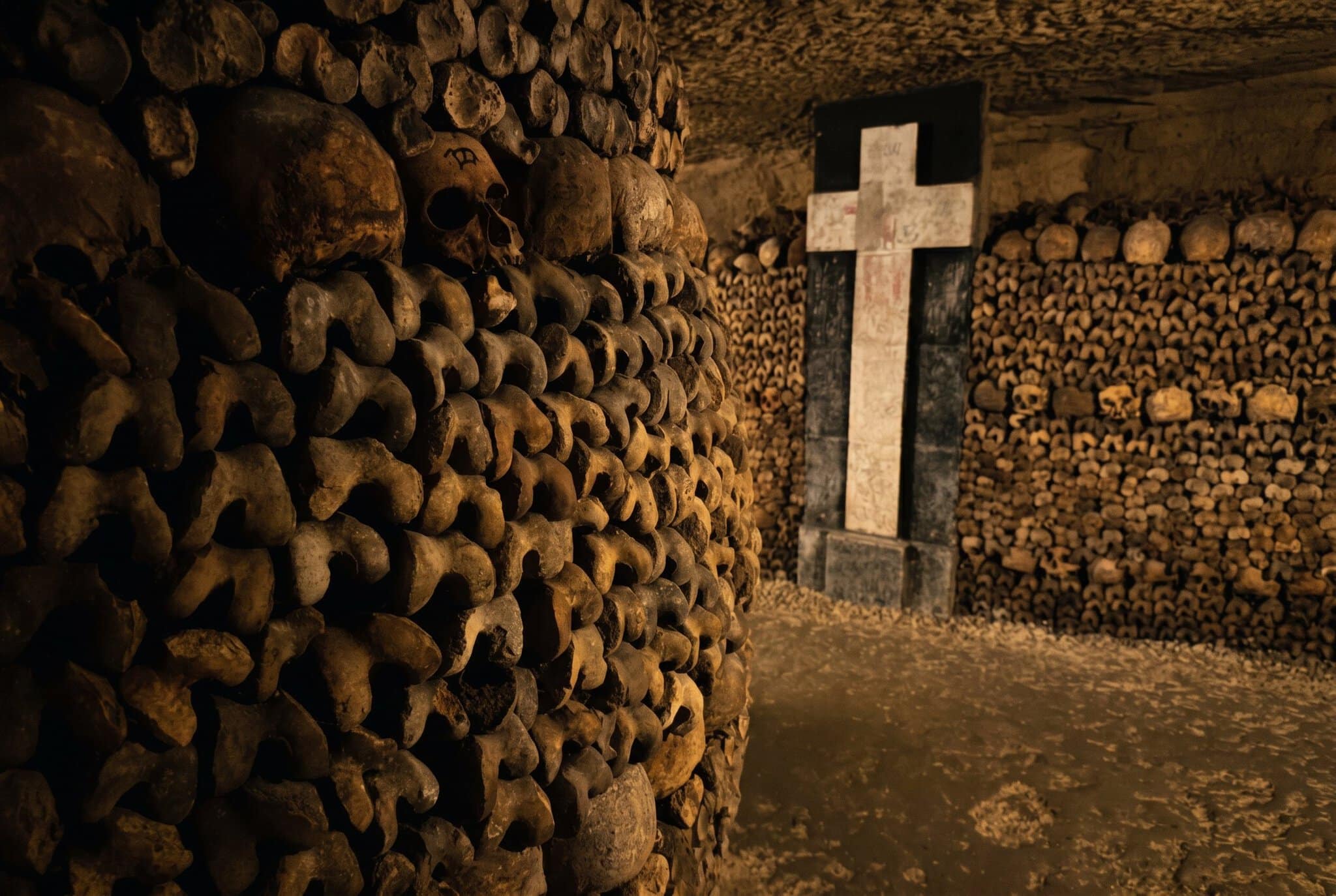
Hidden Paris: 30 Secret Gems Where the Tourist Crowds Don’t Go

TL;DRHidden Paris comes down to 30 specific tips for spots off the beaten track: covered arcades like Galerie Vivienne, Passage Jouffroy and Passage des Panoramas in the 2nd and 9th arrondissements, quiet gardens such as Square du Vert-Galant and Jardin Catherine-Labouré, the colourful Rue Crémieux and Villa Léandre, plus free rooftop views from Galeries Lafayette or the Institut du Monde Arabe. The best months for peaceful exploring are May, September and October, with temperatures around 20 degrees, while August is best avoided since shops shut down and it gets too hot. Most places are free to visit, with exceptions like the Catacombs at €29, which need booking online exactly 7 days ahead. There are also practical tips on getting around, eating without tourist mark-ups, and watching out for street scammers.

When you think of Paris, most people instantly picture endless queues, packed boulevards and a hopeless fight for a free chair at an overpriced café. That’s exactly how I always felt — until our last visit. It was only when exploring with Lukáš that we realised this city on the Seine has another, much quieter and more intimate face. All you need to do is turn the right corner, slip through an inconspicuous passageway or descend dusty stone steps below street level, and suddenly you find yourself in a world of hidden Paris that the standard guidebooks stubbornly ignore.

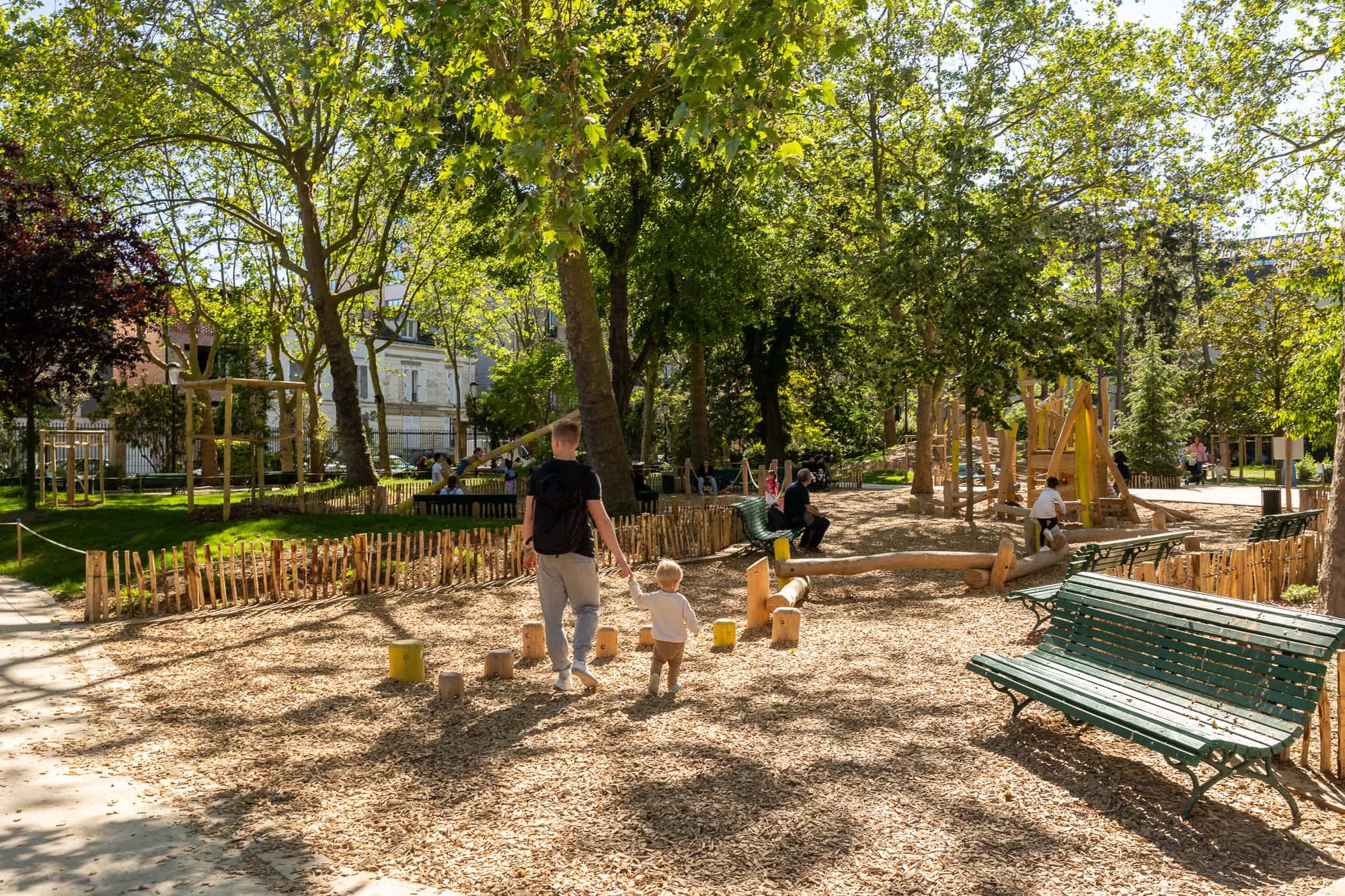
With little Jonáš in his pushchair, finding these quiet oases became an absolute survival necessity for our sanity. When the city slowly wakes up, the smell of hot butter drifts from corner bakeries and you’re sitting on a bench in a tiny courtyard where only the muffled hum of distant traffic reaches you — that’s the exact moment you fall hopelessly in love with the place. Nobody’s pushing you anywhere, nobody’s trying to sell you overpriced plastic souvenirs. Just you, a cup of good coffee and an old stone wall covered in ivy.

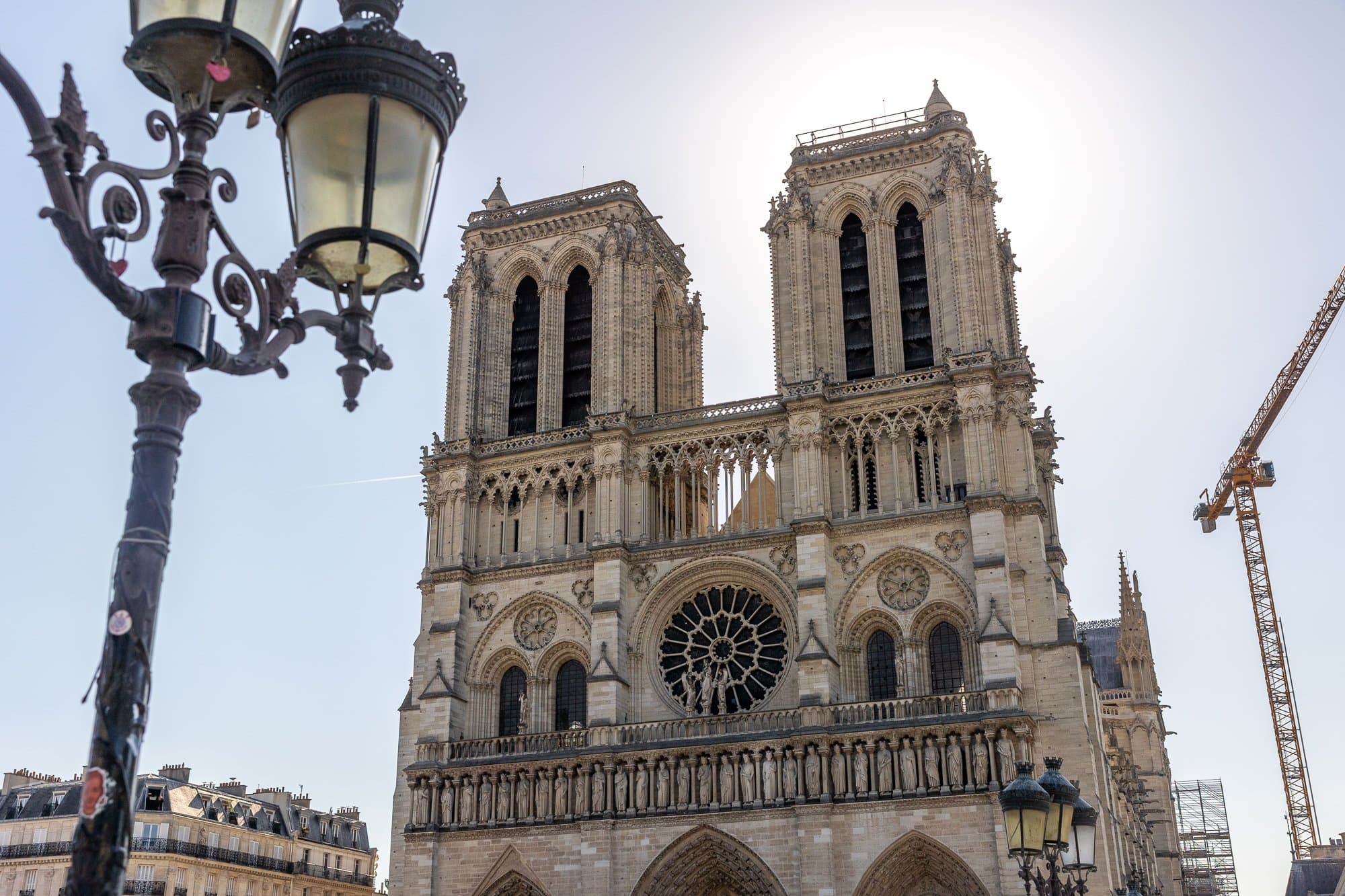
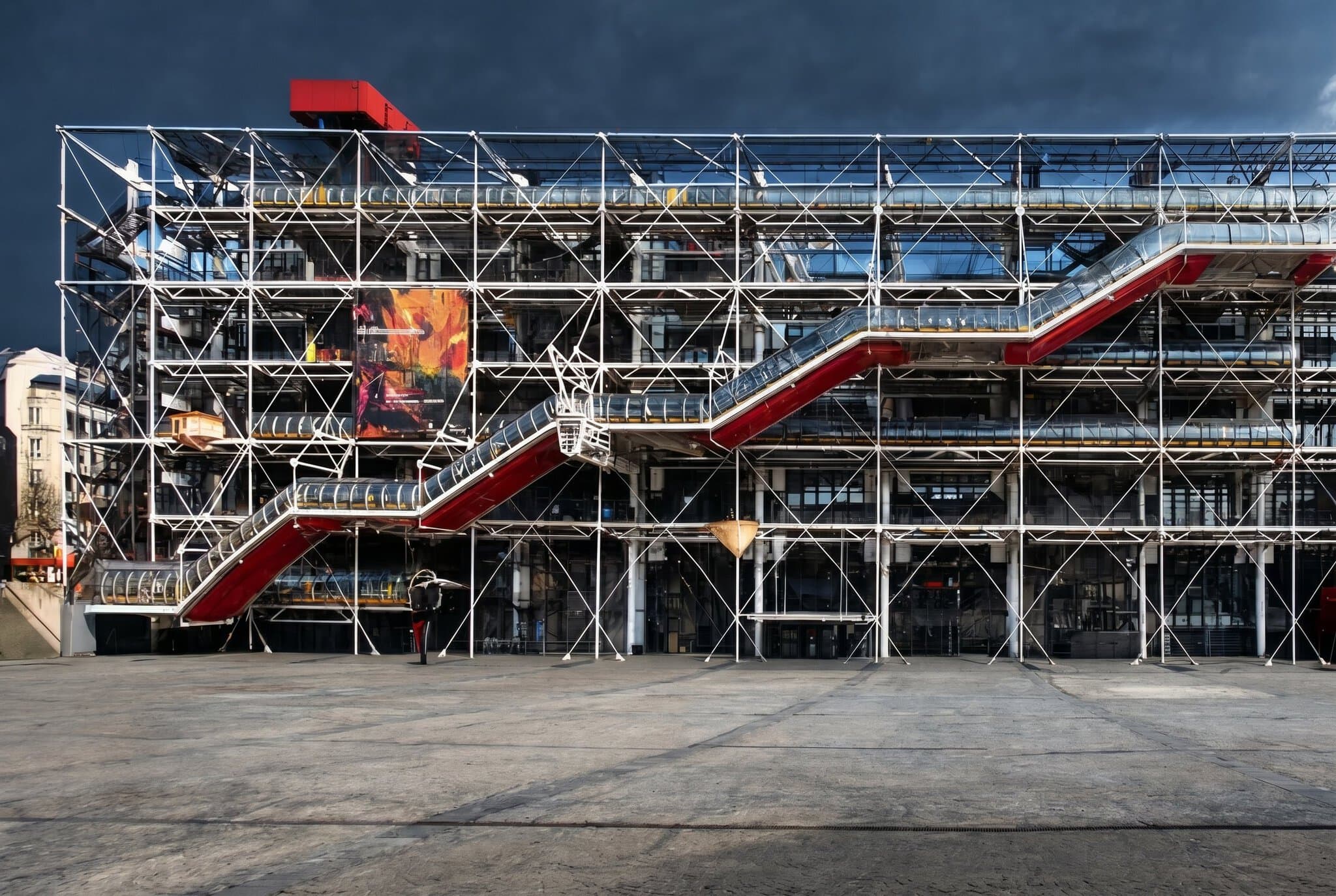
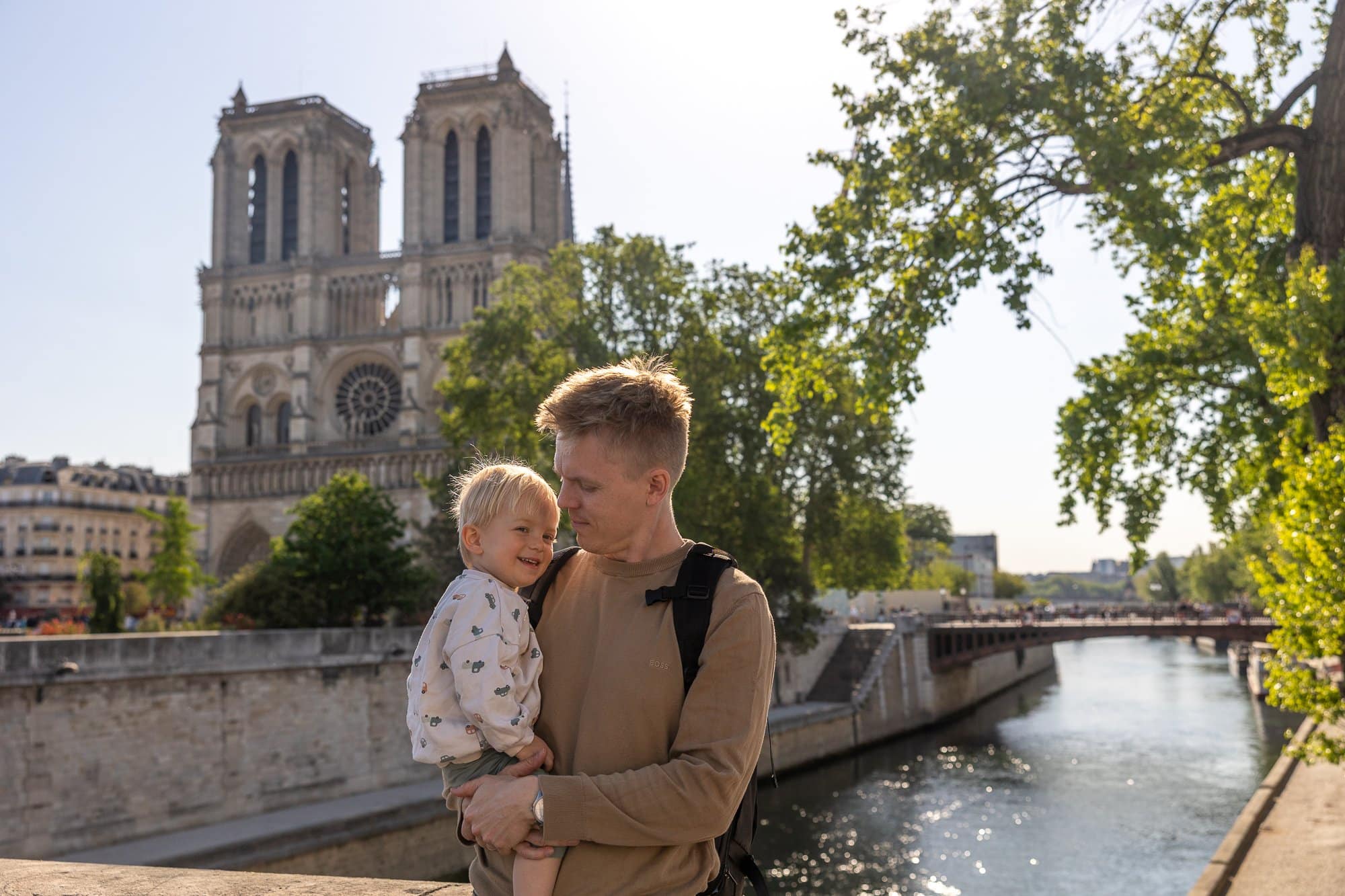
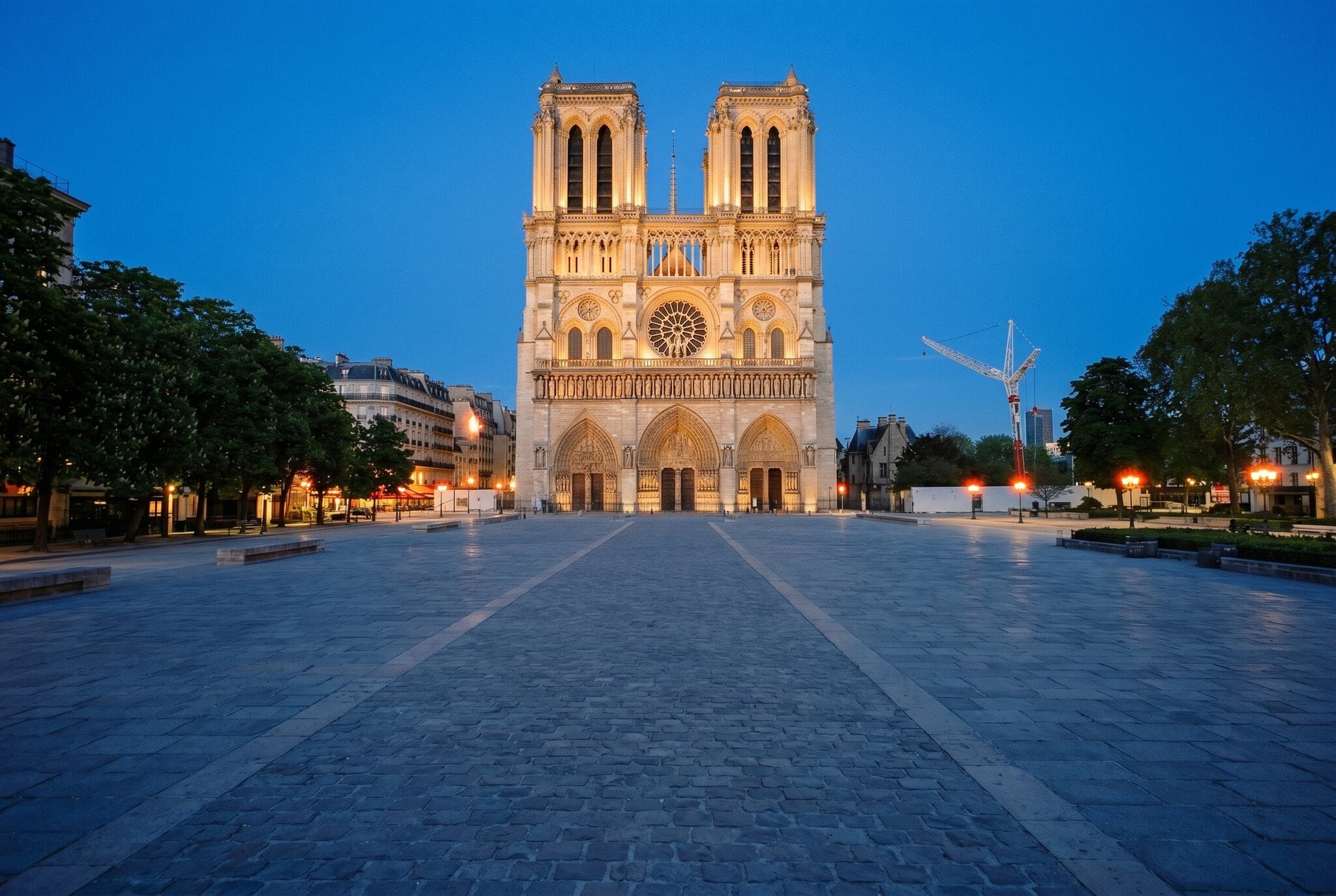
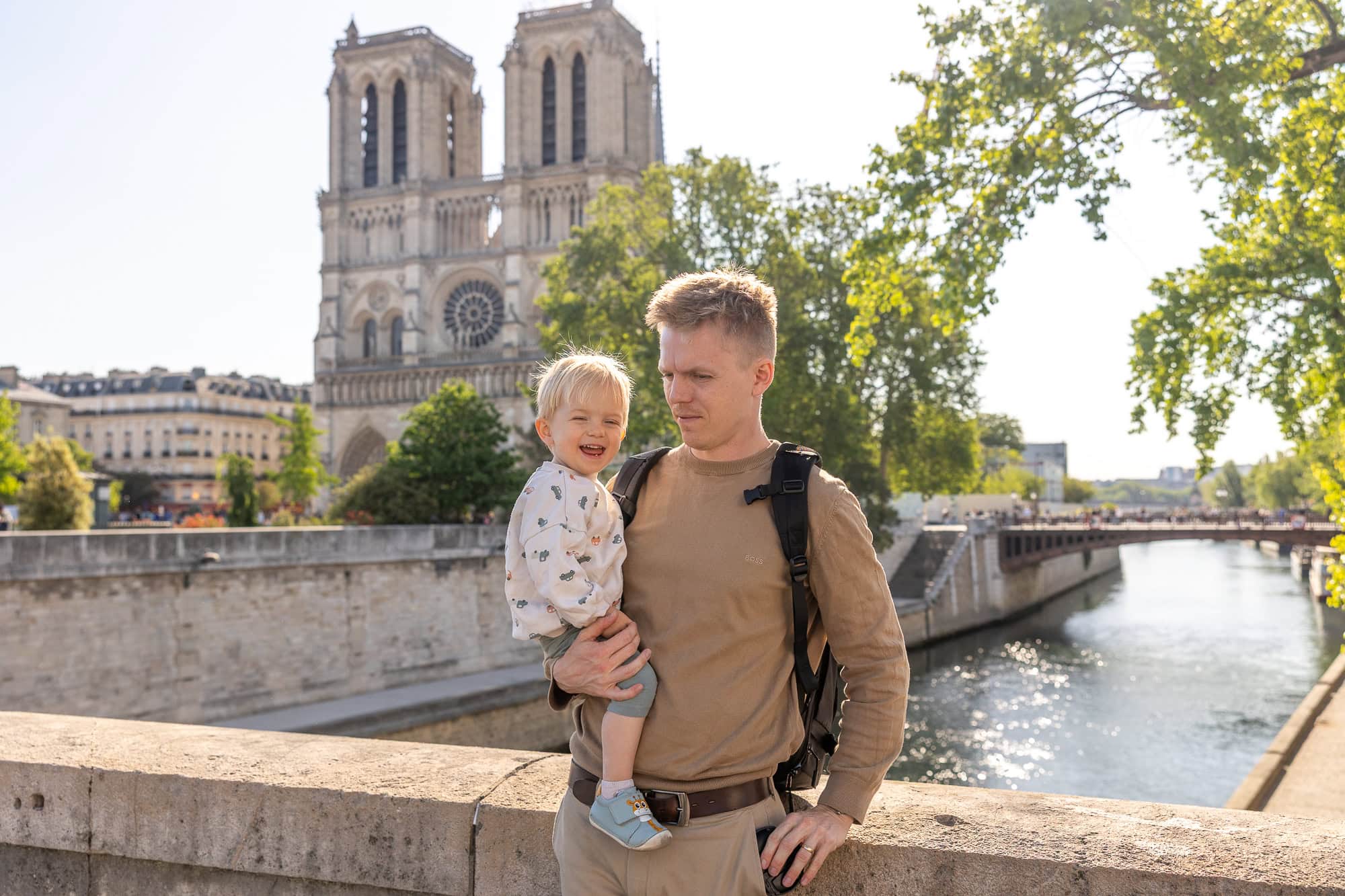
This year is particularly perfect for exploring. After the recent Olympic frenzy, the streets have taken a fresh breath. The famous Notre-Dame cathedral finally gleams after its long restoration, while the iconic Centre Pompidou has gone into a five-year hibernation. This summer, for the first time in a hundred years, you’ll officially be able to swim in the river again. And as a vegetarian, I was thrilled to hear that the legendary restaurant Arpège has switched to a fully plant-based menu. Everything changes and evolves, but those old, tucked-away lanes remain exactly as they were a century ago.

I’ve included exact prices, transport connections and a few honest warnings about common traps for each spot, because I personally fell into quite a few of them. 😅 Hopefully this will save you some unnecessary stress.

TL;DR
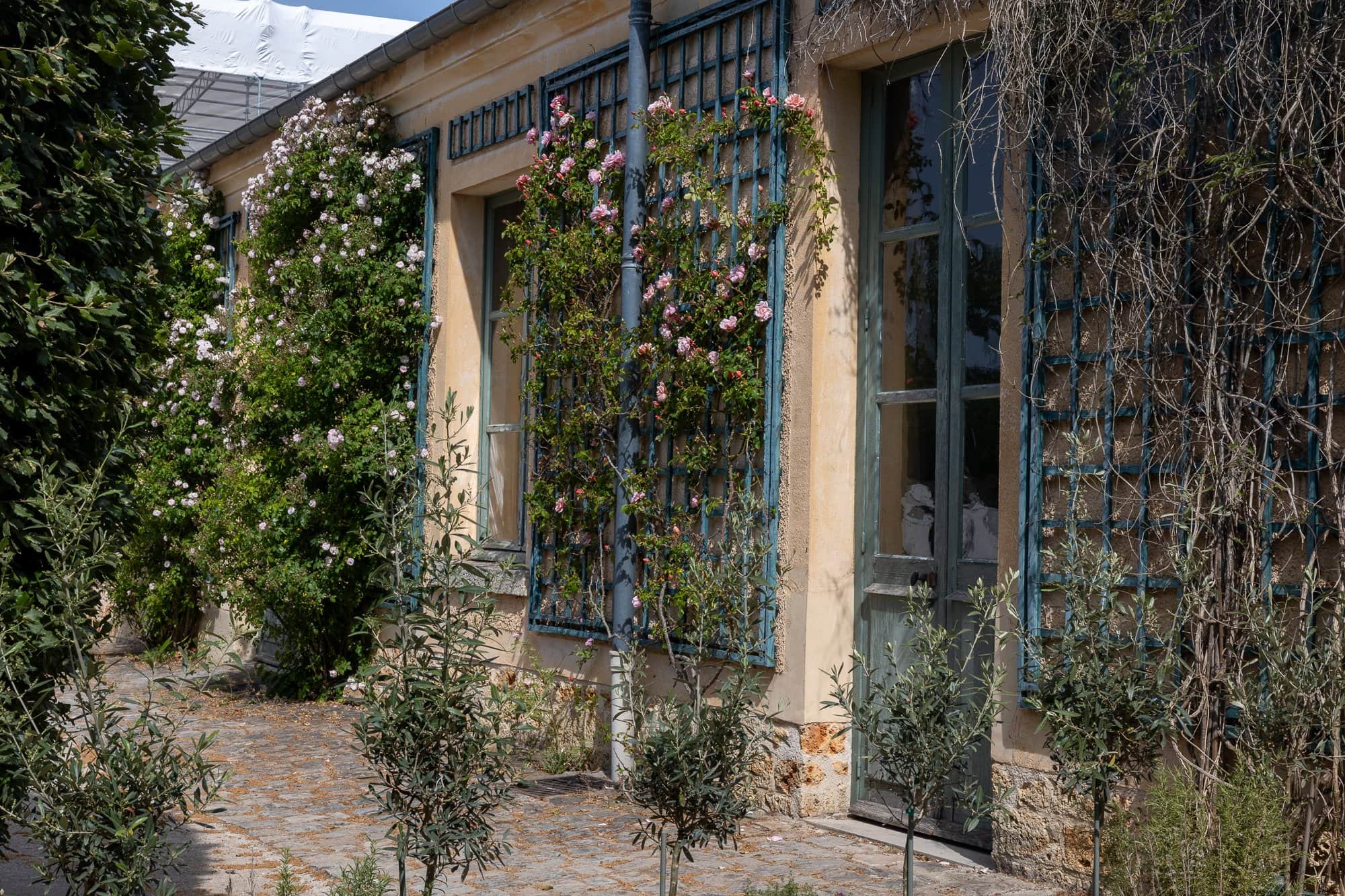
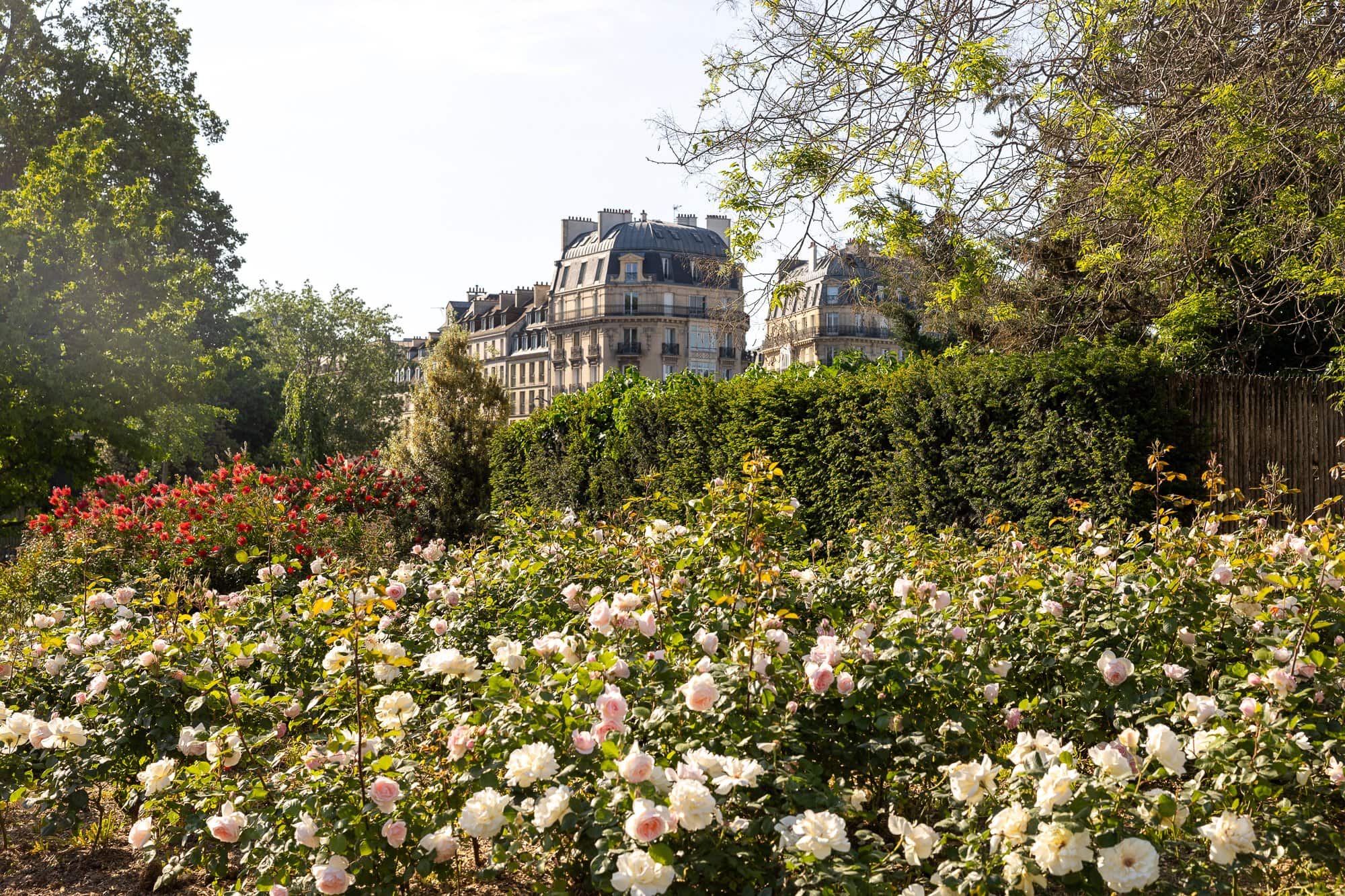
Climbing roses blooming next to blue French windows on a Parisian street
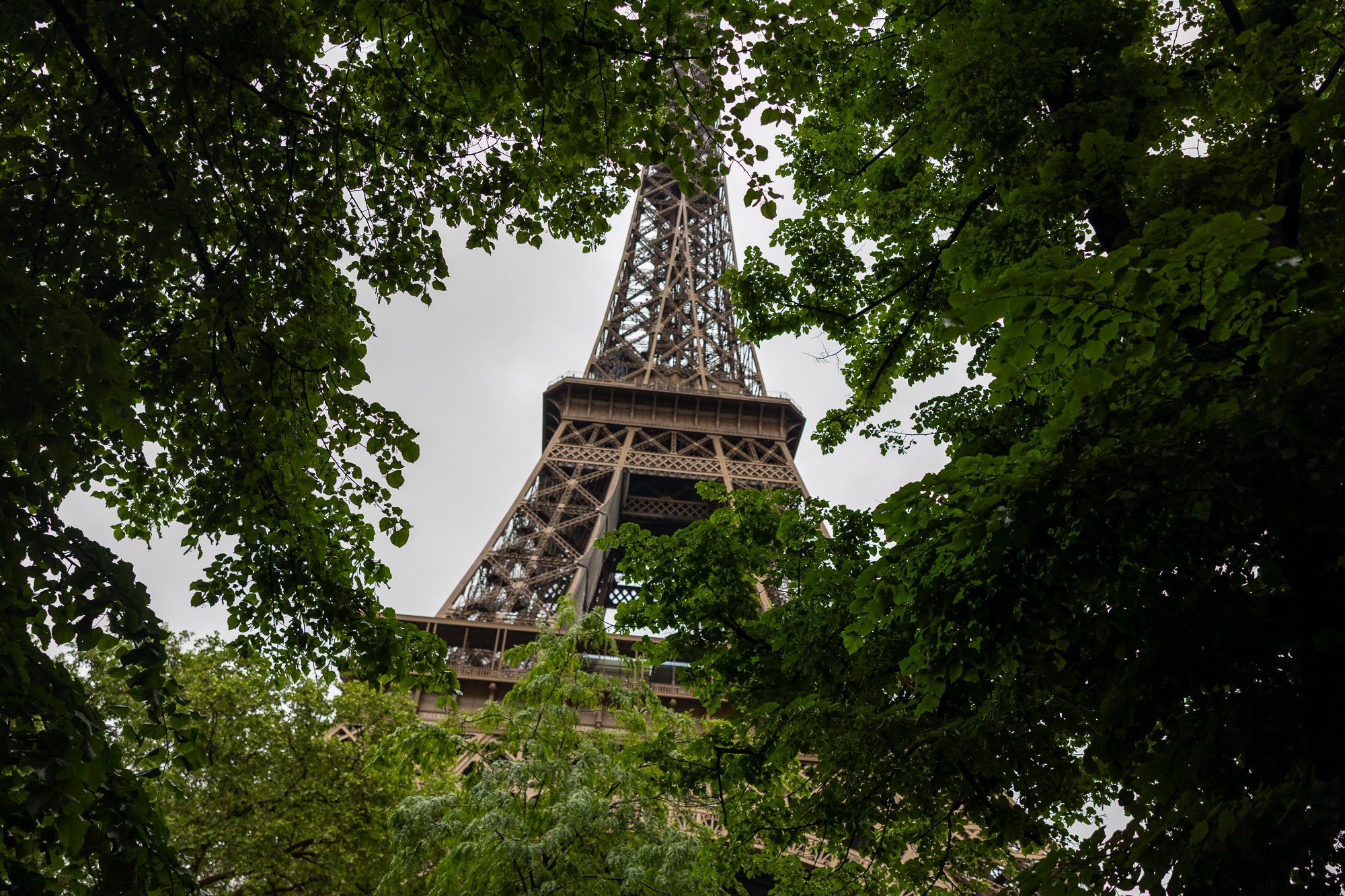
  • Free viewpoints: Skip the paid climb up the city’s famous iron tower and head to the rooftop terraces of Galeries Lafayette or Printemps instead — the best panoramas, completely free.
  • Covered passages: Explore the historic covered passages in the 2nd and 9th arrondissements. These 19th-century architectural gems are perfect for sheltering from the rain and the crowds alike.
  • Where to eat: Avoid restaurants on the main squares of Montmartre — they’re overpriced tourist traps. Seek out small eateries in Le Marais or along Canal Saint-Martin instead.
  • Catacombs: The Catacombs beneath Place Denfert-Rochereau are fascinating, but you must buy tickets exactly 7 days in advance online — otherwise you’ve got no chance of getting in.
  • Quiet spots for a pushchair: If you need absolute peace to rock a child to sleep, look for small gardens like Square du Vert-Galant on the tip of Île de la Cité or the secret garden at Hôtel de Sully.
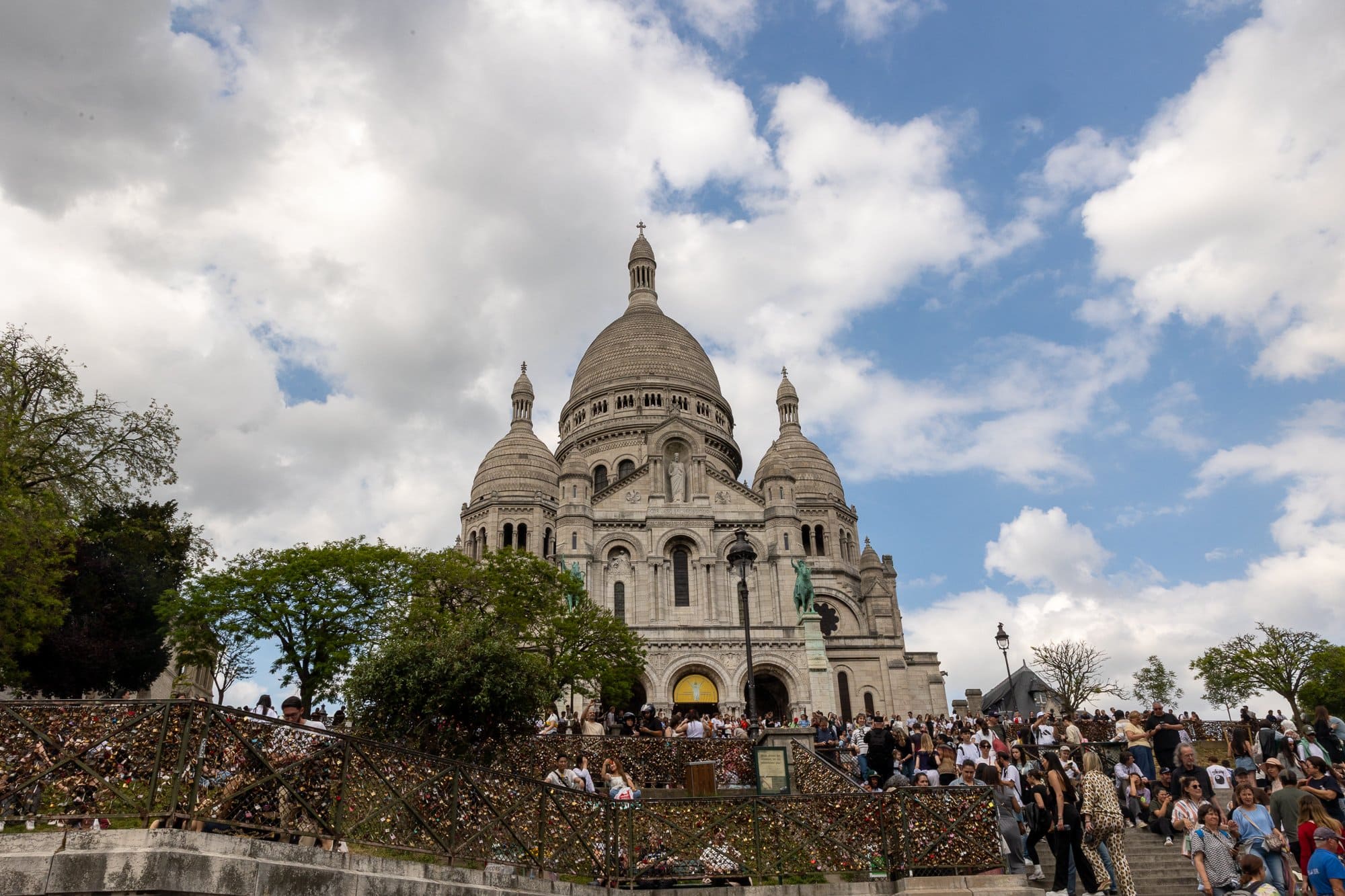
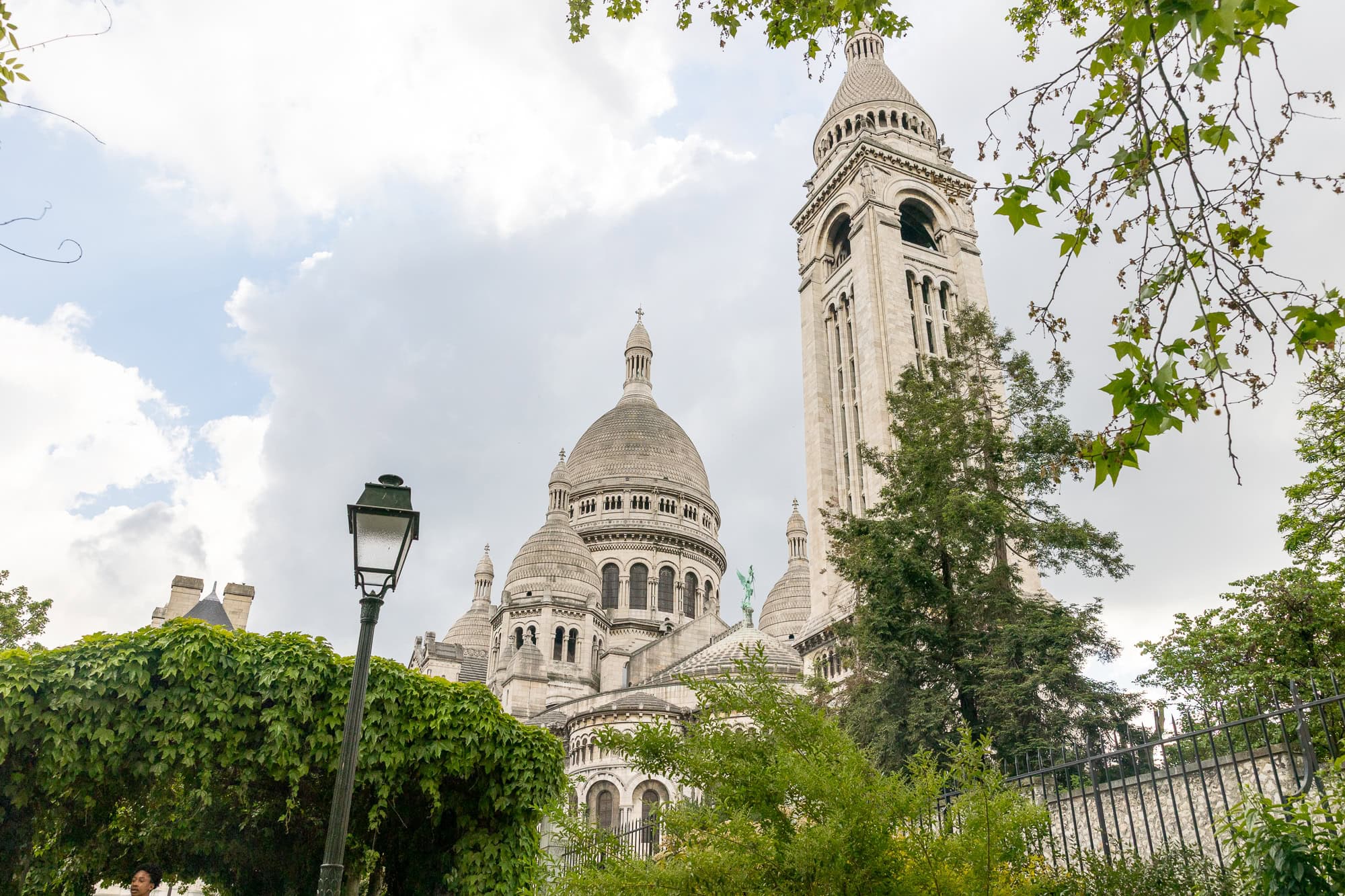
  • Watch out for scammers: Don’t fall for street scams. Ignore people with fake petitions near landmarks and anyone trying to tie a friendship bracelet on your wrist beneath the Sacré-Cœur basilica.
  • Notre-Dame is free: Entry to the reopened Notre-Dame is completely free. Don’t buy any fake skip-the-line tickets from touts on the street.
  • Petite Ceinture: The former railway line Petite Ceinture offers a brilliant walk through wild nature in the heart of the city, but avoid it with a pushchair due to the rough terrain.
  • The Bonjour rule: Learn the most essential etiquette rule: every time you enter a shop or café, begin with a clear “Bonjour” — otherwise locals will simply ignore you.
  • Literary heritage: Explore the Czechoslovak trail at Père-Lachaise cemetery, where writer Milan Kundera rests, or seek out the former studios of painter František Kupka — a fascinating piece of Central European cultural history in Paris.
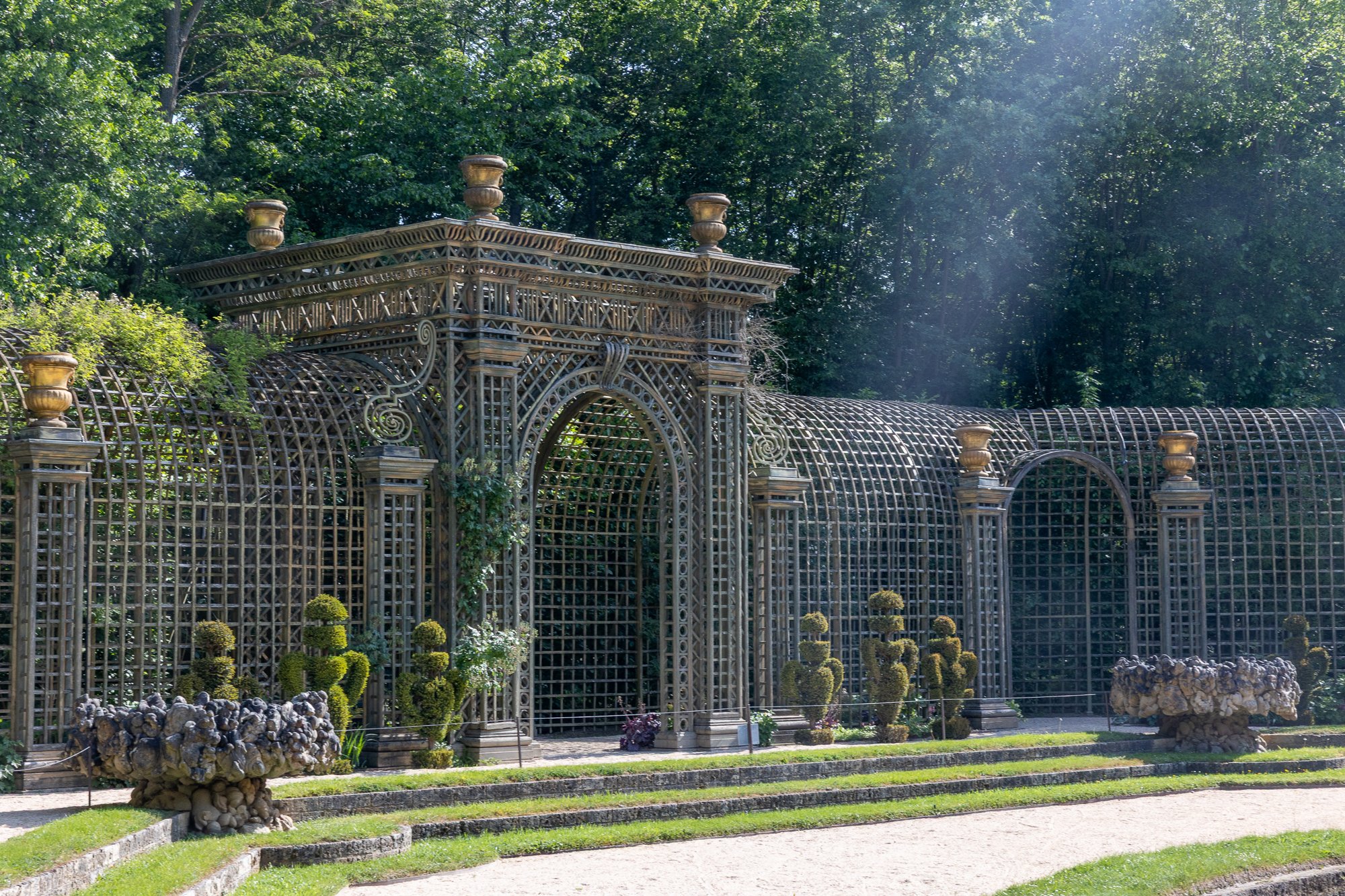
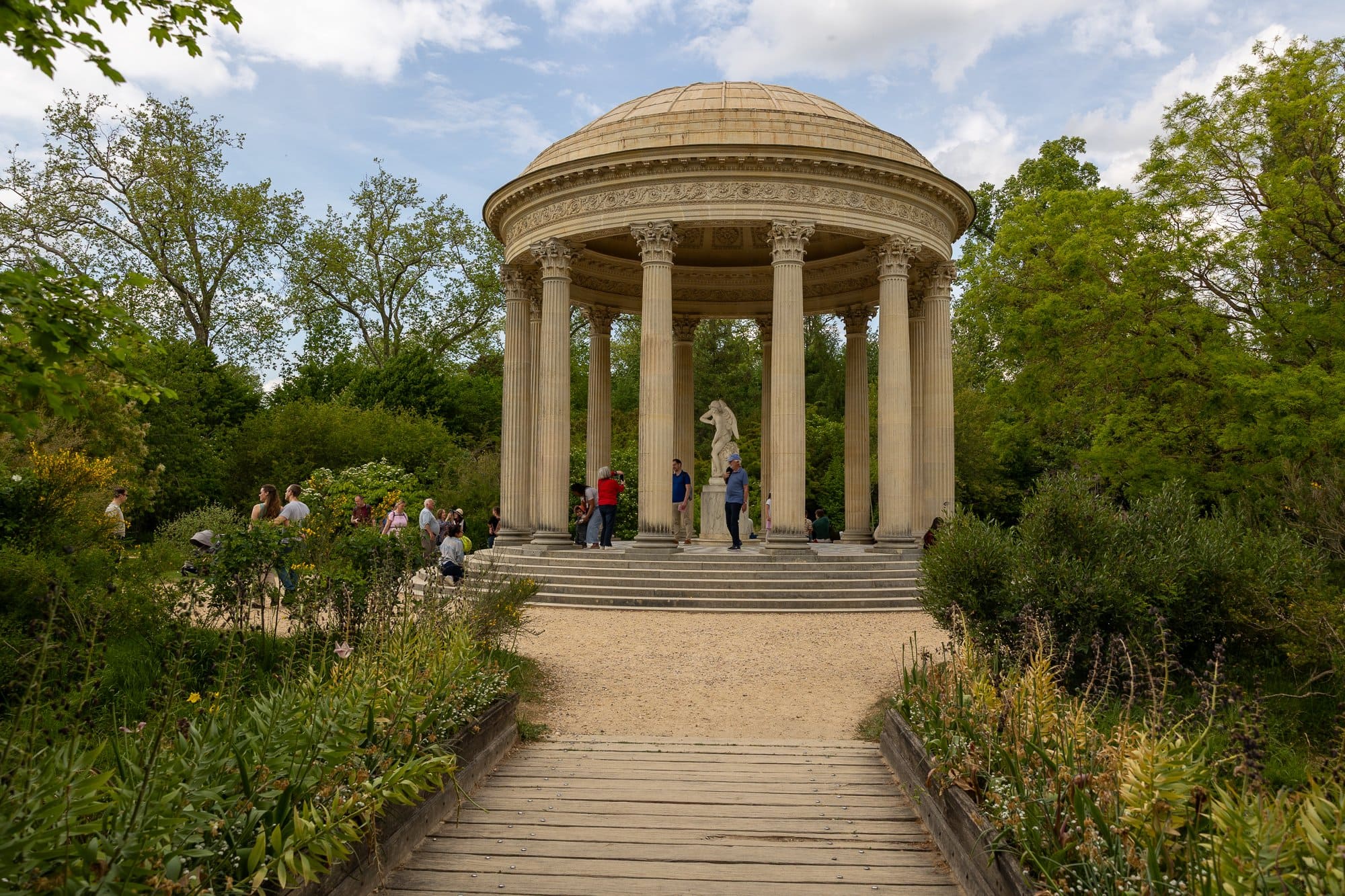
Neoclassical garden pergola with ornamental latticework and bronze vases

When to Visit Paris: Weather, Seasons and 2026 Event Calendar

Choosing the right time is absolutely crucial for discovering hidden corners. The city changes its character with every season, and what’s a romantic stroll in May can turn into a survival battle on scorching tarmac in August. Lukáš and I carefully plan our trip dates to dodge the worst extremes and soak up the authentic local atmosphere.

Best months for quiet exploring
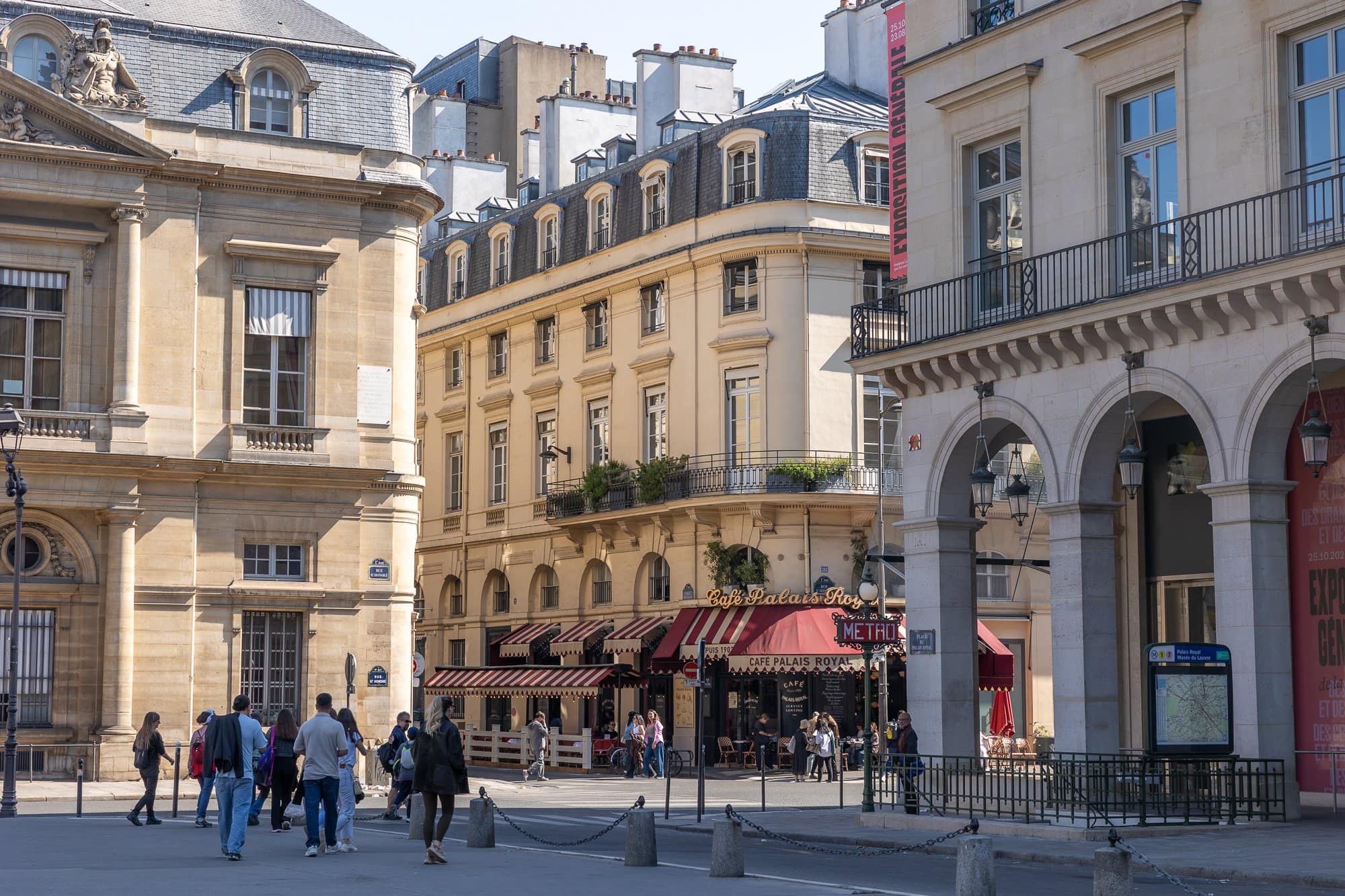
Historic Parisian square with café parasols and classical architecture

Spring and autumn are a must for us, and we’ve never regretted it. I consider May the most visually stunning month. Trees are in bloom, days are stretching out and you can lounge in parks wearing just a light jumper. Temperatures hover around a pleasant 20 °C. September and October are equally brilliant. The post-holiday period brings fresh energy to the streets — locals return from their holidays and all those small bistros that slept through summer swing their doors open again. You’ll want a windbreaker in your bag by October, but the colours of falling leaves in the smaller gardens more than make up for it.

Times to avoid
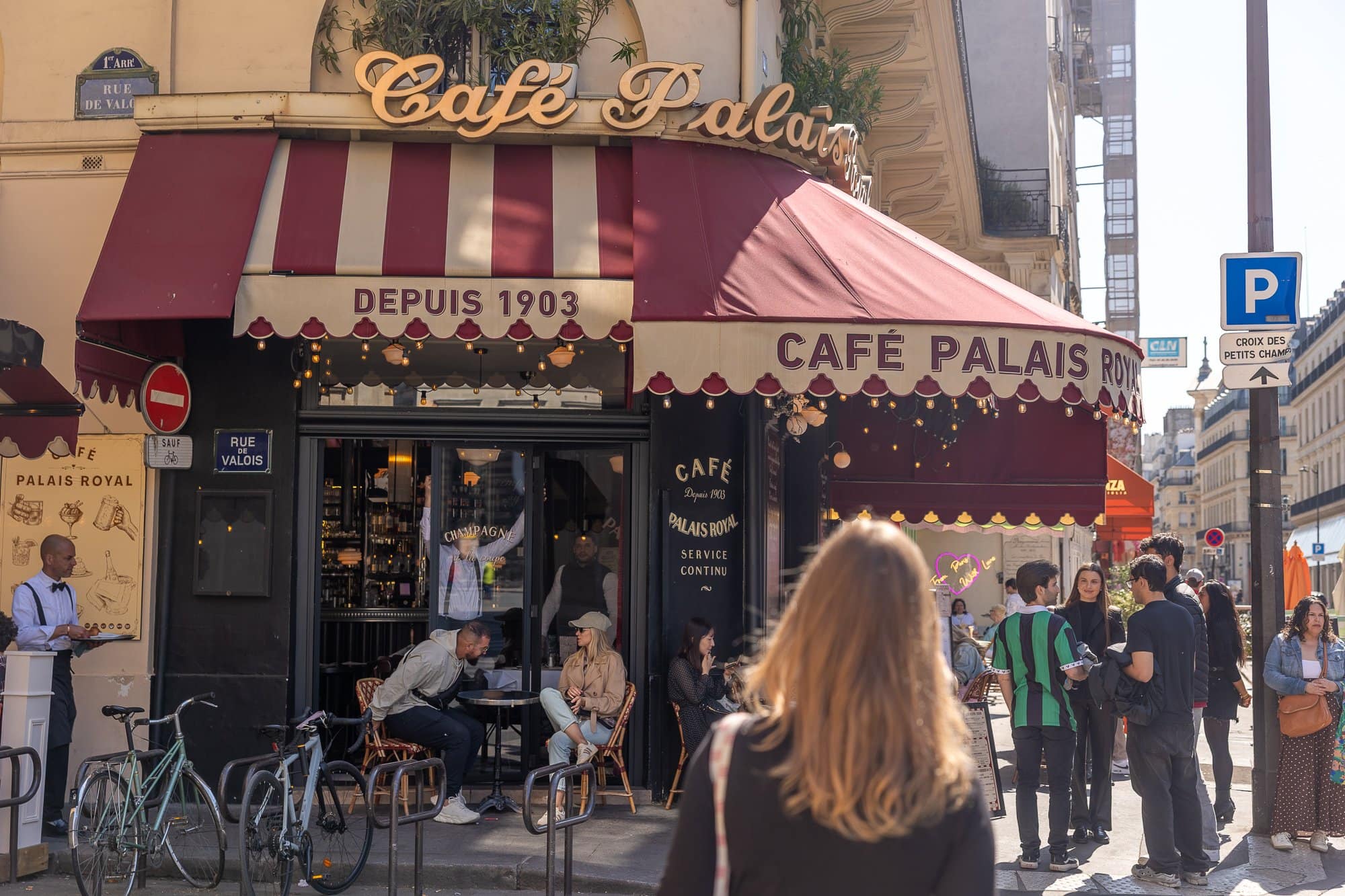
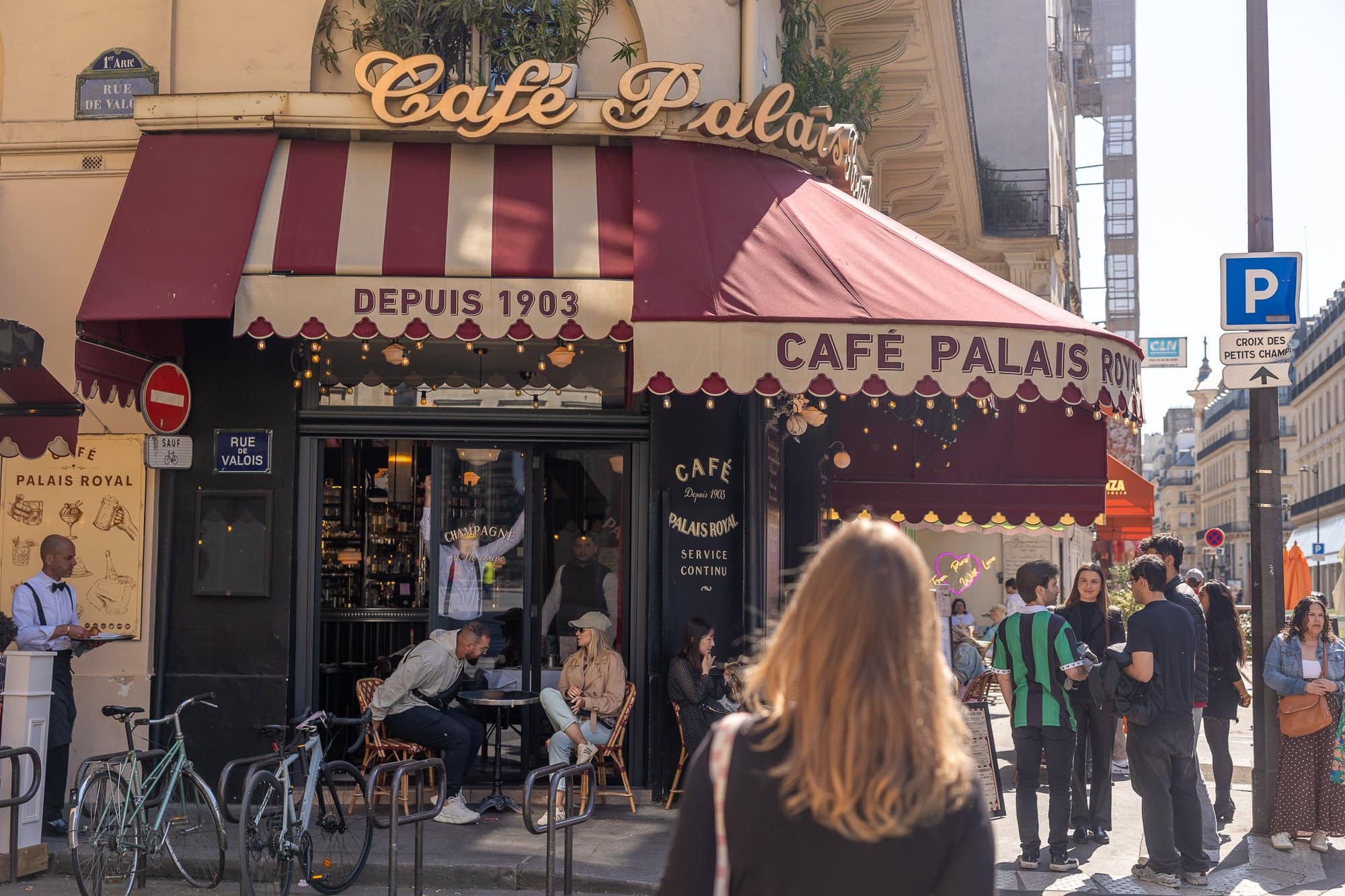
Traditional Parisian café Palais Royal with a burgundy awning on Rue Valois

If you have any flexibility, cross August off your list. Locals flee to the coast en masse during this month, and while the city empties somewhat, many of the best independent cafés and bakeries will have a closed-for-annual-holiday sign on the door. You’ll be stuck with places geared primarily towards tourists, and the tarmac radiates unbearable heat. Also watch out for the weekend around 12 April 2026, when a huge marathon shuts down much of the surface transport in the centre. We also avoid the weeks around late February and early March due to Fashion Week, when accommodation prices rocket to absurd levels.

2026 event calendar for your itinerary
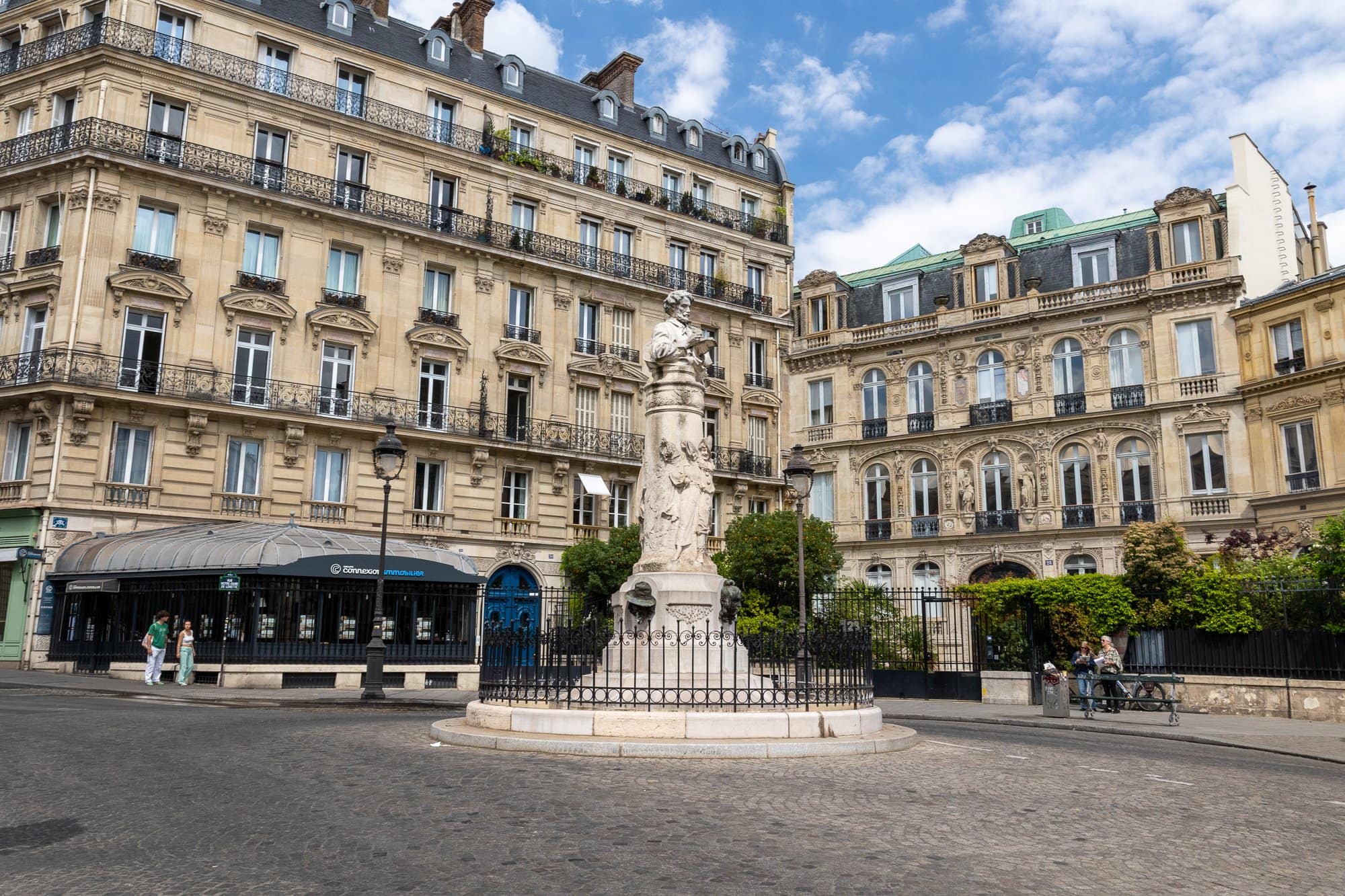
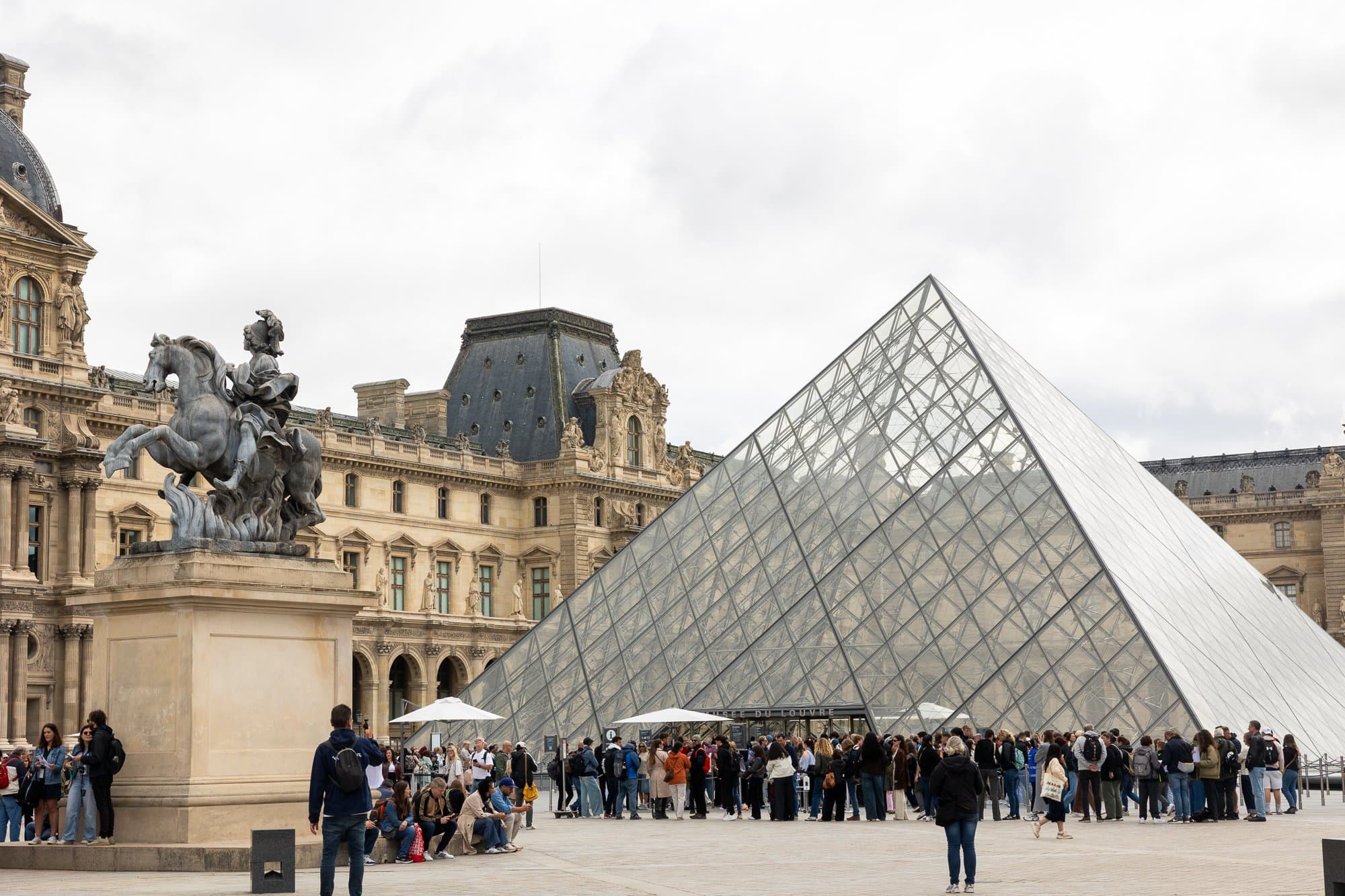
Parisian square with a monumental statue and neoclassical palaces

The year 2026 is packed with events that can either pleasantly enhance or seriously complicate your plans. March and April tempt with the first spring sunshine, and on 1 April the famous Monet’s Gardens in nearby Giverny regularly open for the season. Summer brings a major novelty — during July and August, official swimming zones will open directly in the River Seine for the first time in a hundred years.

A crucial warning applies to the autumn weekend of 19–20 September 2026. This is when the European Heritage Days take place. While normally inaccessible government palaces and courtyards open their doors, the gardens in Giverny are exceptionally and strictly closed on these two days. The end of the year is traditionally dominated by Christmas markets, which are beautiful, but you can forget about quiet crowd-free exploring in December.
Rustic courtyard with an old cauldron on a stone base and a rabbit on the ground

Where to Stay in Paris: Safe Neighbourhoods and Hotel Picks

Choosing your neighbourhood will make or break your entire experience — and your budget. Paris is divided into twenty arrondissements that spiral clockwise from the historic centre near the Louvre. Finding affordable accommodation in the centre is nearly impossible, but if you know where to look, you can find a great compromise between price, safety and accessibility.

With a pushchair and Jonáš, give a wide berth to the northern part of the 10th arrondissement around Gare du Nord and Pigalle at night in the 18th arrondissement. We once got lost there with a friend at two in the morning and that’s definitely not something you want to repeat with a two-year-old. 😅

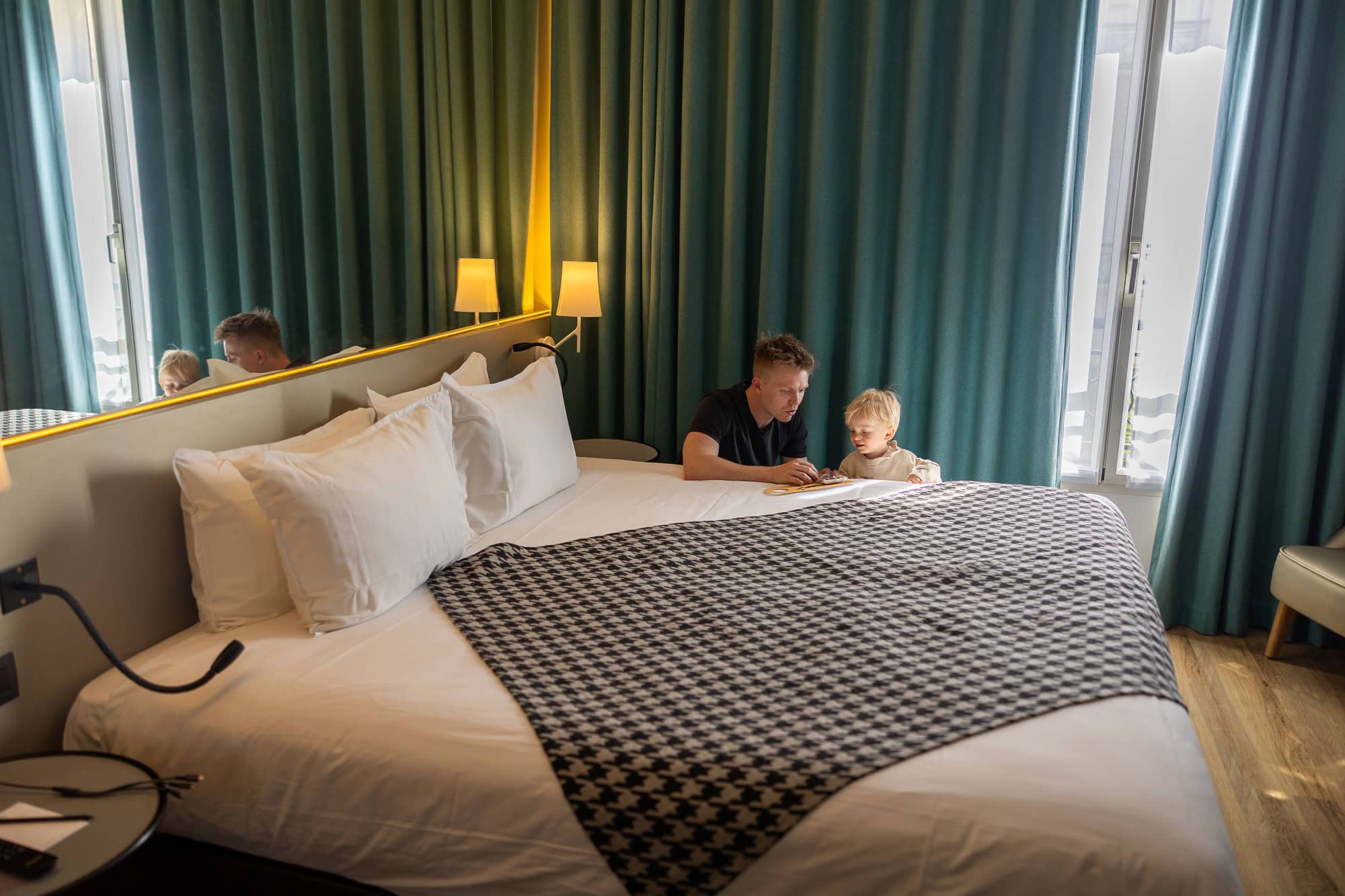
After extensive research, we settled on Hôbou, an authentic French boutique hotel in Boulogne-Billancourt (you can book it here). It looks rather unassuming at first glance, but you’ll fall in love with it within the first few hours.
Futuristic geodesic dome with floral decoration and chairs inside

Covered Passages: A Journey Through Time Under Glass Roofs

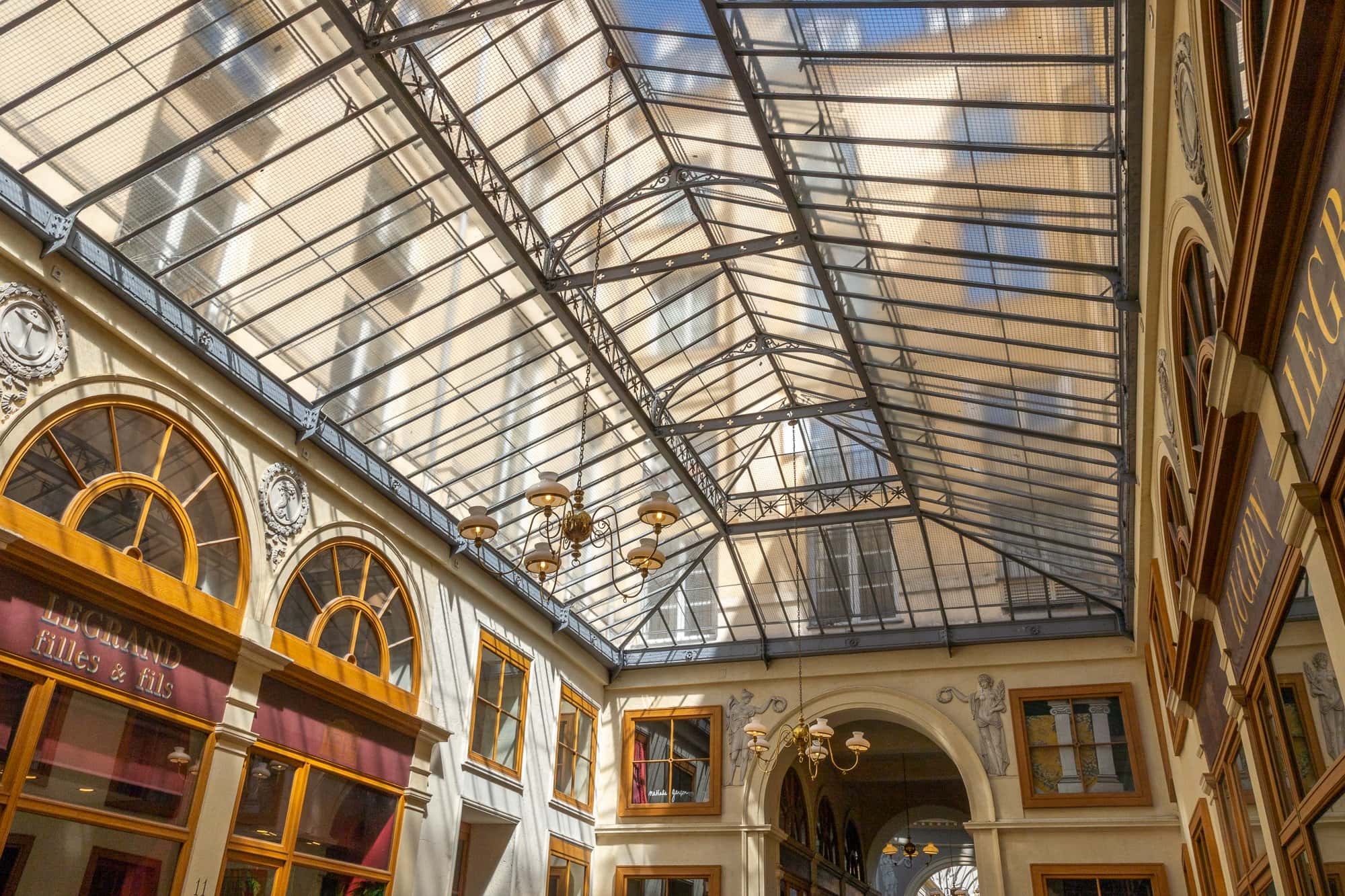
Long before humanity invented cavernous air-conditioned shopping centres where you can get lost even without children, the local elite built covered passages. In the nineteenth century, over a hundred of them were in operation, serving as luxurious refuges from street mud, rain and sewage. Today only a handful survive, mostly concentrated on the Right Bank. Glass roofs, old mosaic floors and quiet cafés instantly transport you to another era. With a pushchair, they’re an absolute dream — everything is flat and there’s no wind.

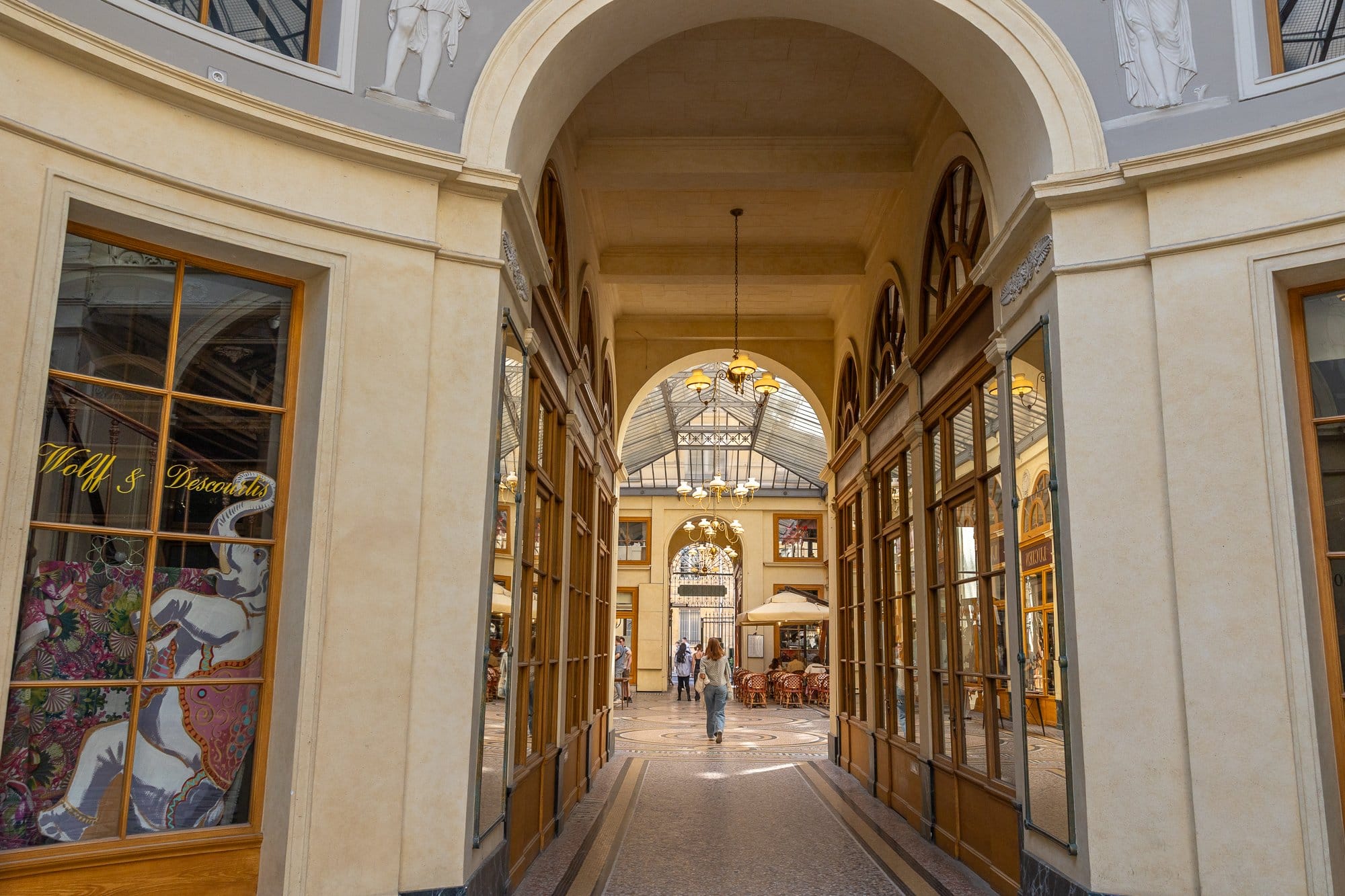
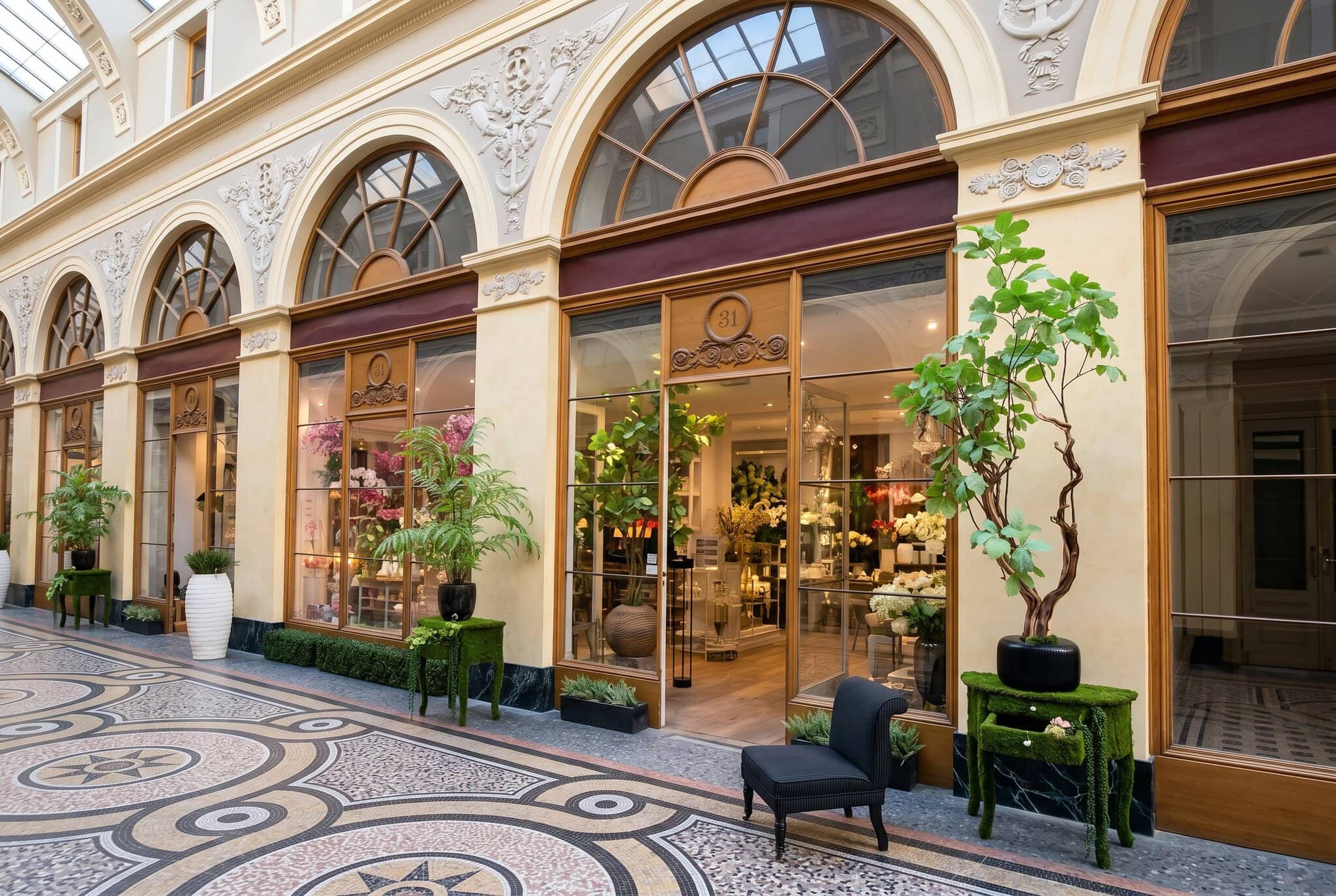
Galerie Vivienne
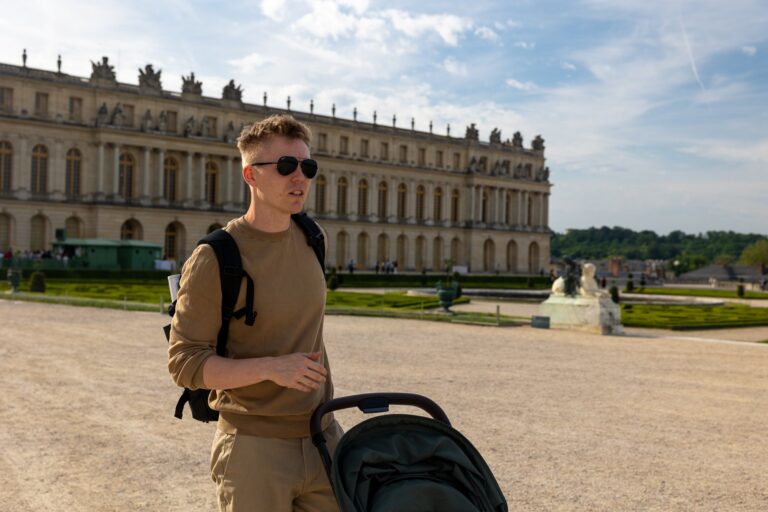
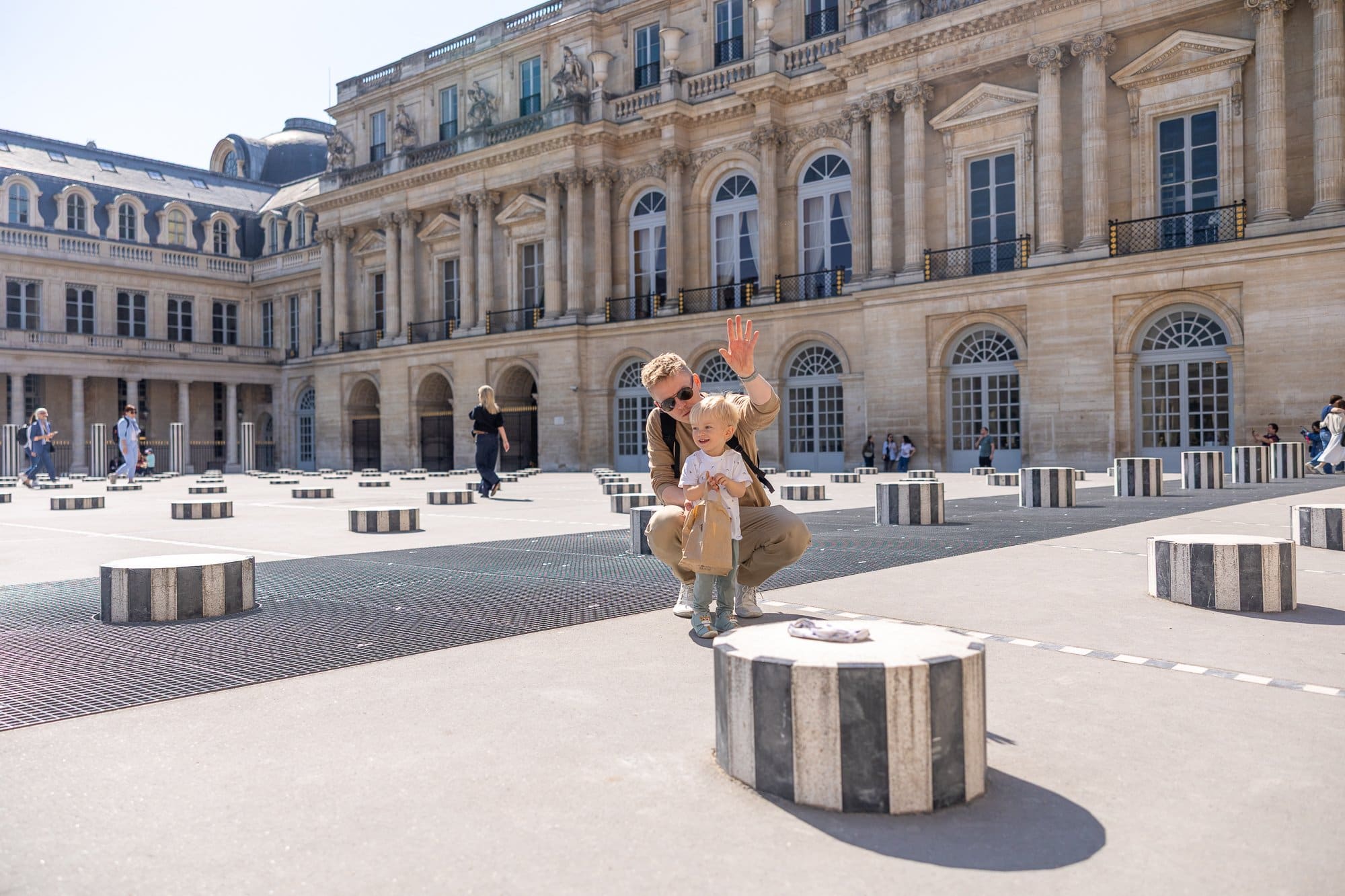
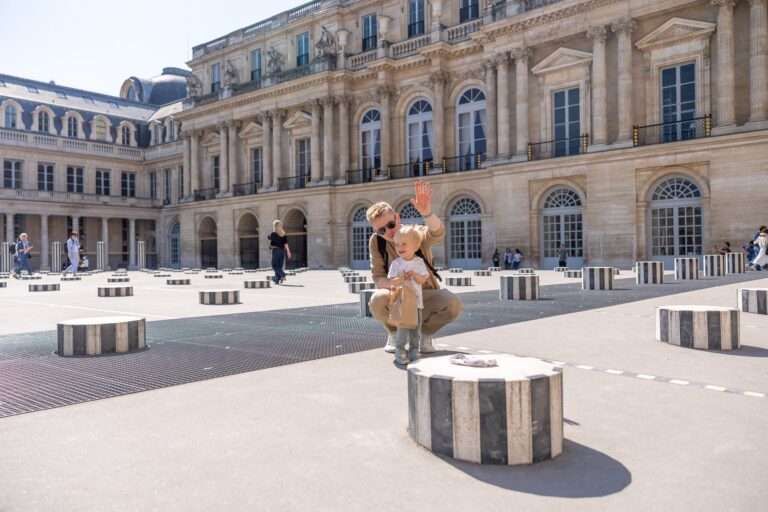
Father with a small child in a historic arcaded courtyard near a classical statue

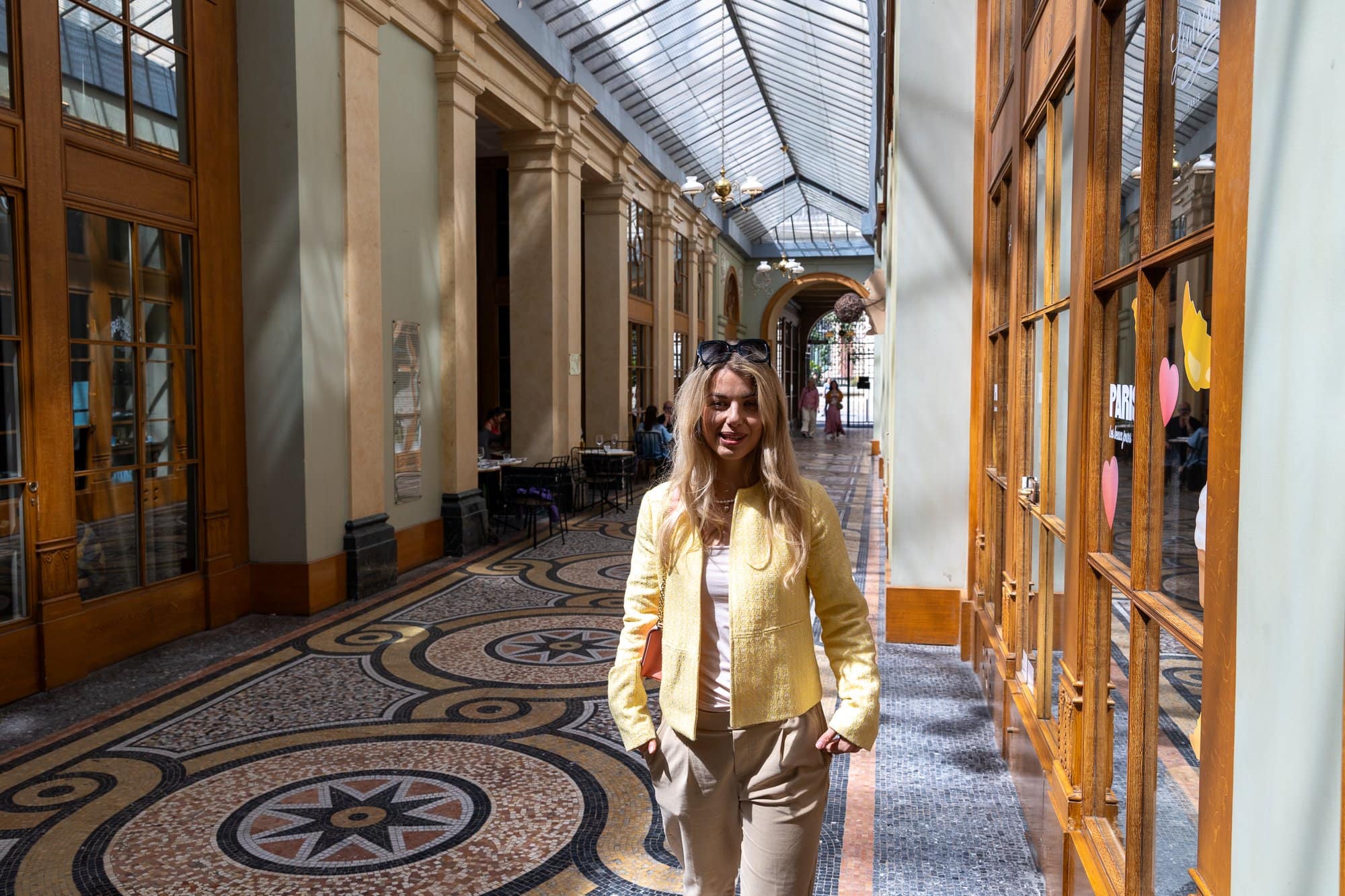
This is the undisputed queen of all the passages. Built in the 1820s, it’s the very embodiment of elegance. The moment you set eyes on the incredible original mosaic floor and the elaborate arches, you’ll understand why so many people come here to marvel, and why Galerie Vivienne has such a reputation.

When we first strolled through, the soft light completely floored us. You’ll find antique shops, upmarket boutiques and a cosy tearoom. The light filtering through the glass ceiling falls at such gentle angles that even a simple phone snap looks like it belongs in an art catalogue. And with a pushchair, it’s smooth sailing.

  • Address: 4 Rue des Petits Champs, 2nd arrondissement
  • Entry: Free
  • Open: Daily 8:30–20:30
  • Transport: Metro line 3 (Bourse station)

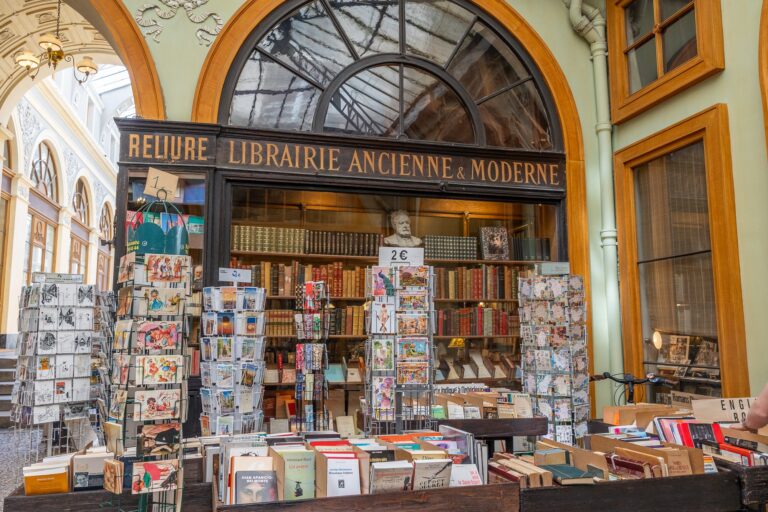
💡 Insider tip: Right by the entrance you’ll find the old bookshop Librairie Jousseaume, which has been here since the passage first opened. They stock beautiful antique prints and postcards that make a far better souvenir than plastic keyrings from the street.

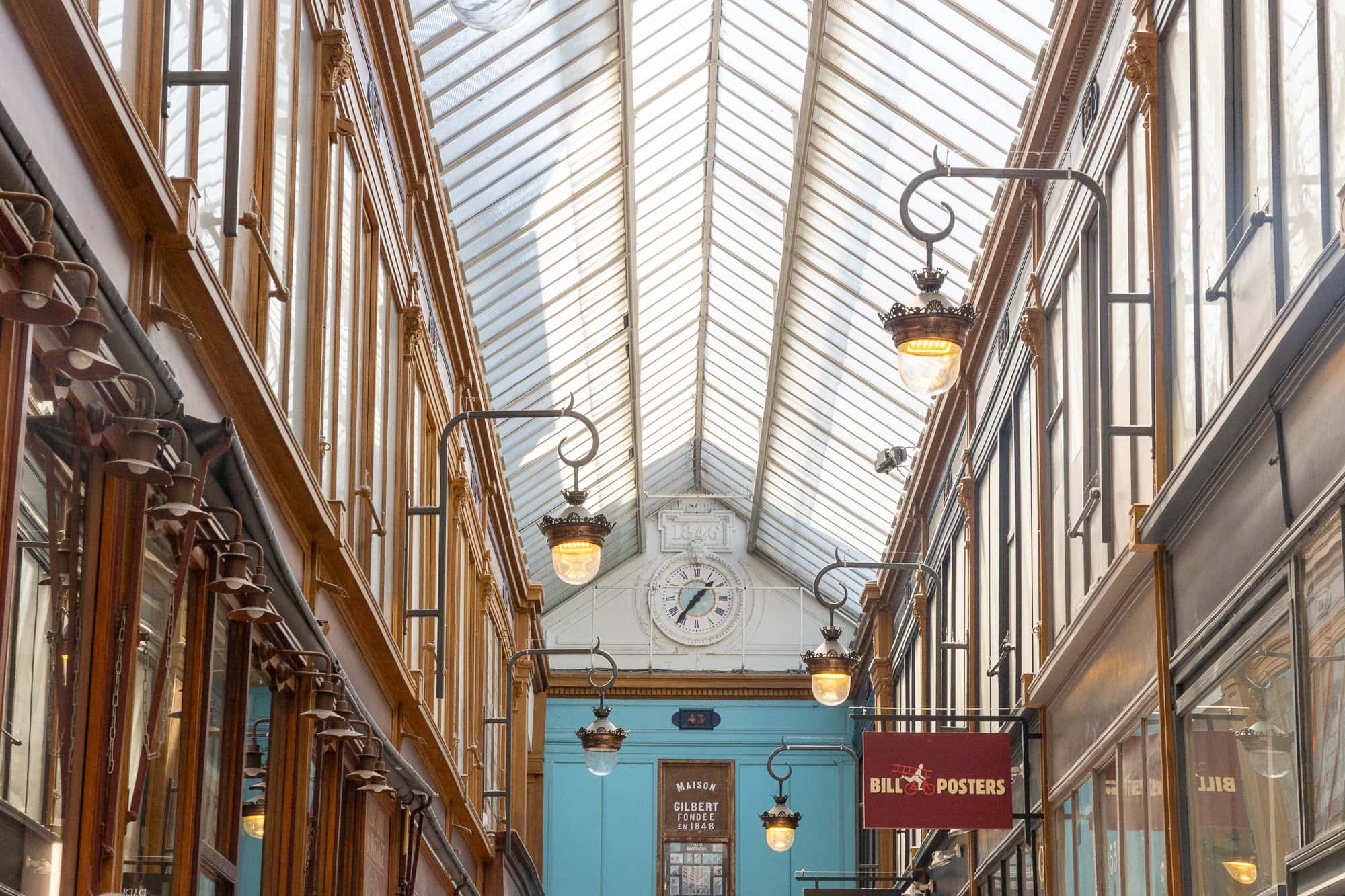
Passage Jouffroy
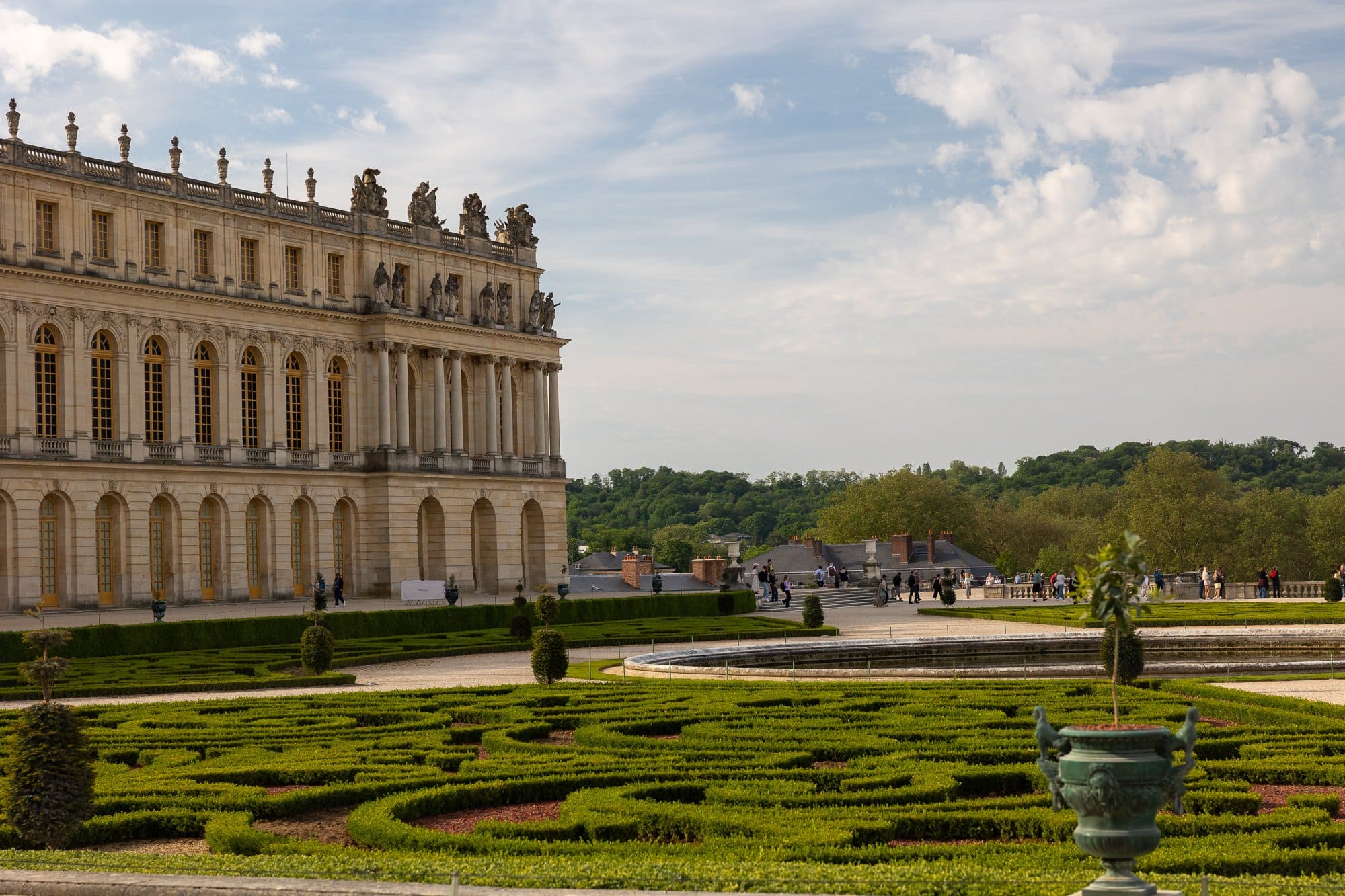
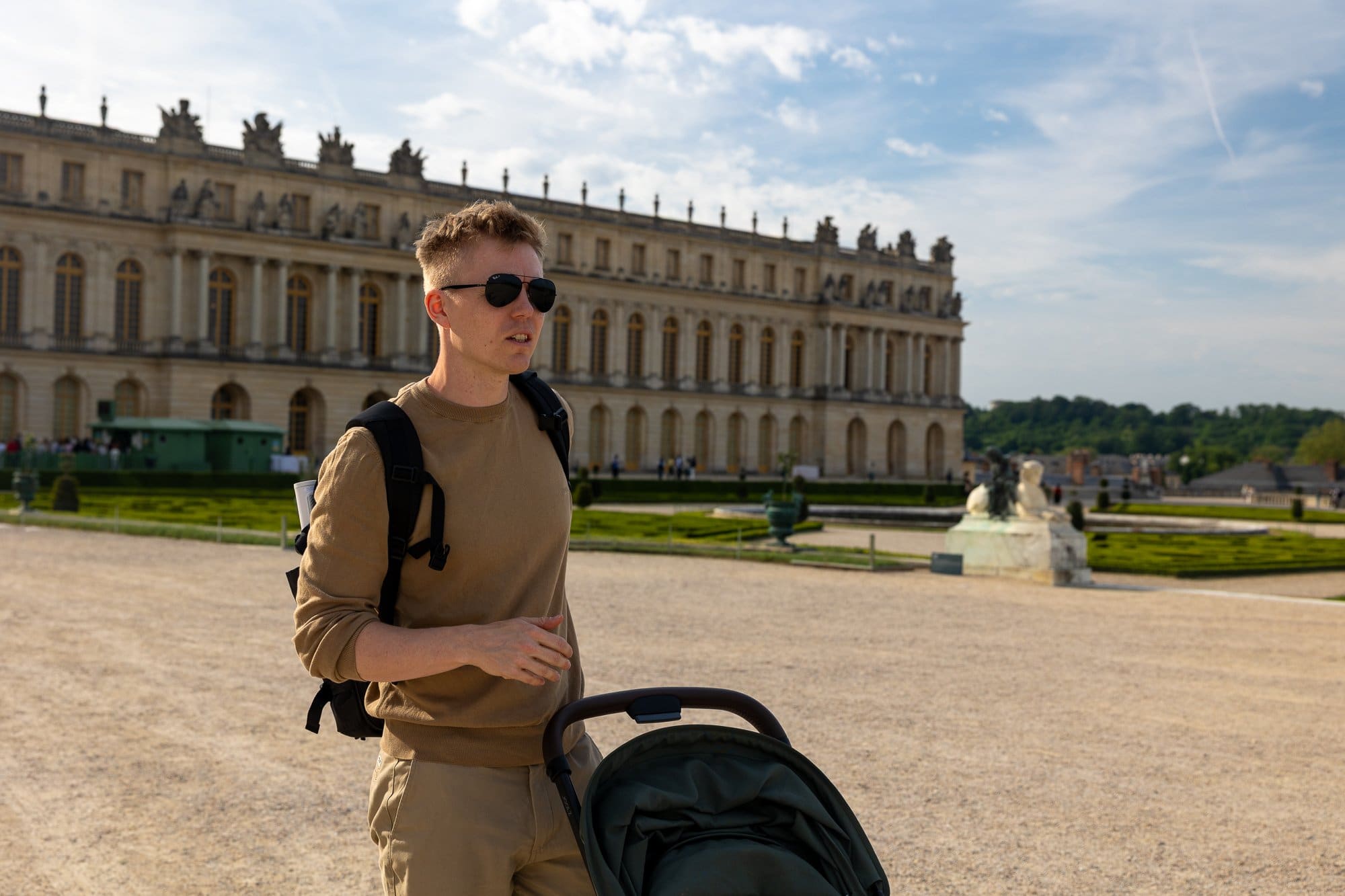
Classical building at Versailles with an orange tree in a green planter

This passage hits you with a distinctive smell of old wood and paper the moment you step through the door. Built in 1846, it was the first in the city to use underfloor heating. It’s home to a famous old hotel and also the back entrance to the wax museum.

There are loads of tiny shops selling toys, antique walking canes and incredibly detailed dolls’ houses. Jonáš can spend ages glued to the window displays of wooden trains, so we treat it as a brilliant pit stop for keeping the family peace.

  • Address: 10-12 Boulevard Montmartre, 9th arrondissement
  • Entry: Free
  • Open: Daily 7:00–21:30
  • Transport: Metro line 8 or 9 (Grands Boulevards station)

💡 Insider tip: Halfway along the passage you’ll find a little pâtisserie called Le Valentin. They make absolutely stunning traditional fruit tarts and have a few tables where you can rest while it pours outside.

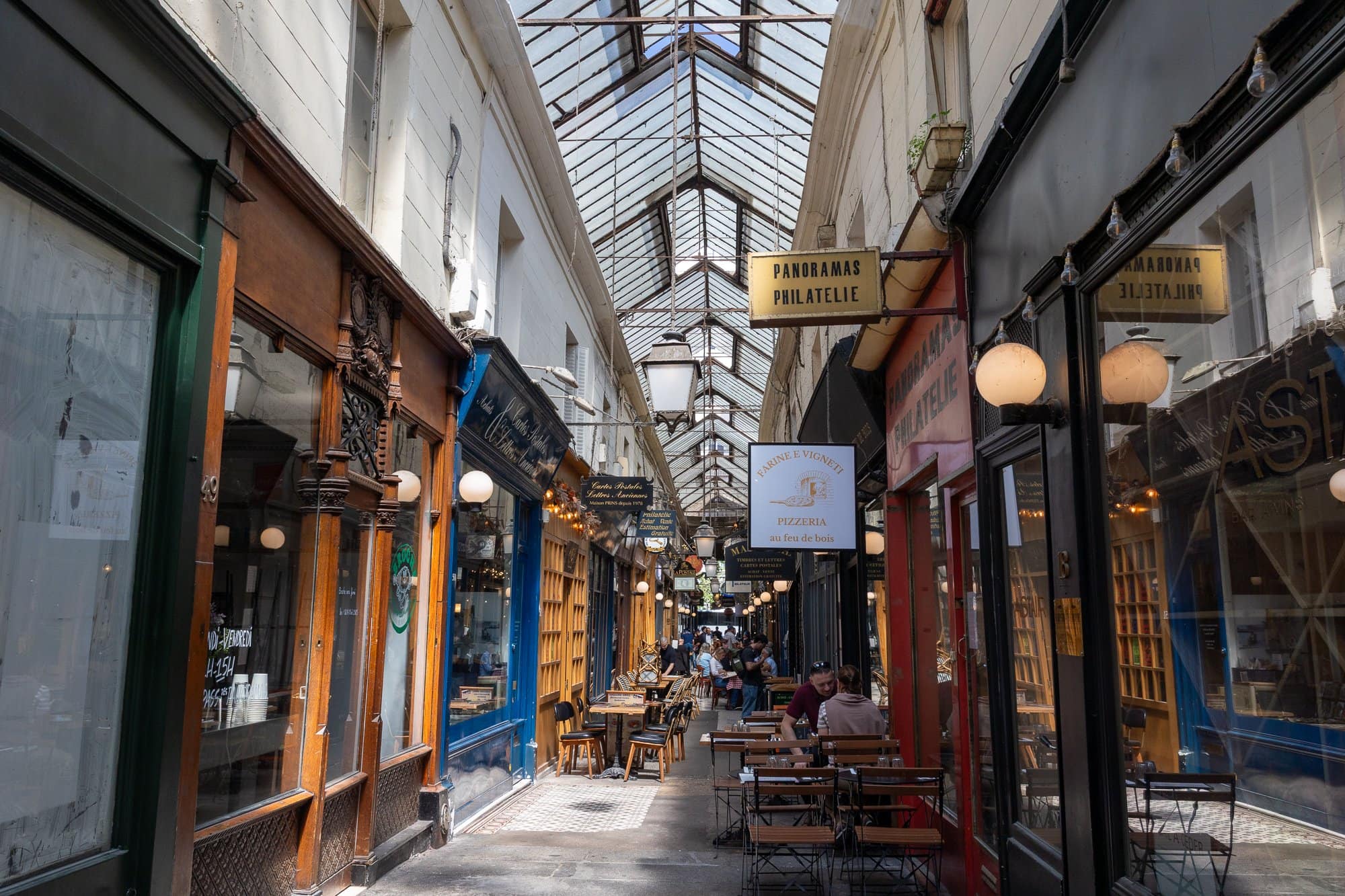
Passage des Panoramas
Classical façade with Corinthian columns and a green dome

Step out of the previous passage, cross the street, and you’ll slip straight into the oldest one in the city. Dating from 1799, it’s a paradise for stamp collectors and old coin enthusiasts. We like to pop in just for a visual feast, because the place radiates a peculiar charm.

The shop windows overflow with historical postcards and stamps. Unlike its more polished sisters, this passage feels a bit rawer, darker and full of small Asian bistros and traditional French restaurants where local office workers come for lunch.

  • Address: 11 Boulevard Montmartre, 2nd arrondissement
  • Entry: Free
  • Open: Daily 6:00–24:00
  • Transport: Metro line 8 or 9 (Grands Boulevards station)

💡 Insider tip: If you’re into meat-free food, you’ll find a small place specialising in vegetarian and vegan Asian dumplings. There’s a queue at lunchtime, but it moves fast.

Passage du Grand-Cerf
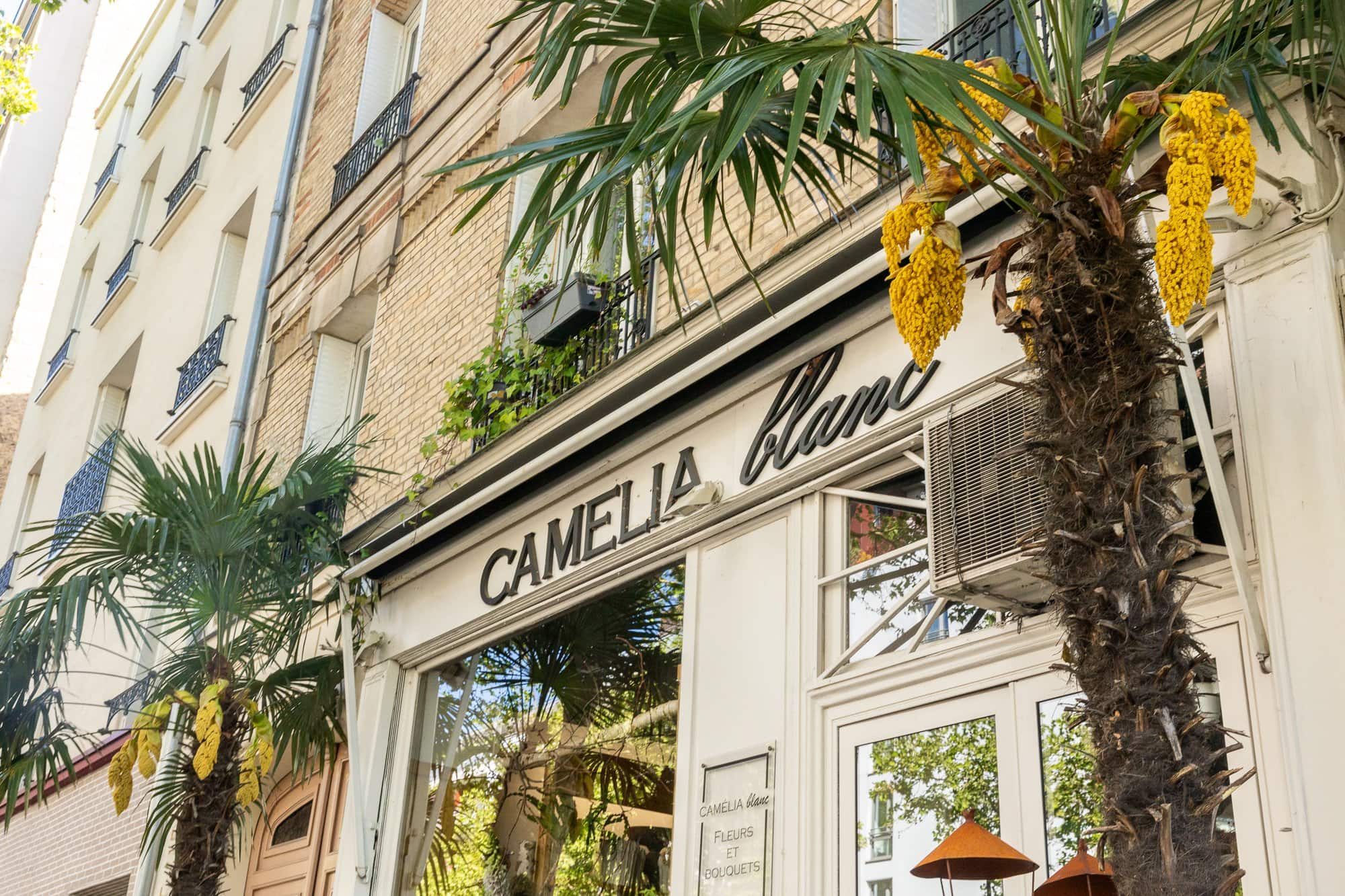
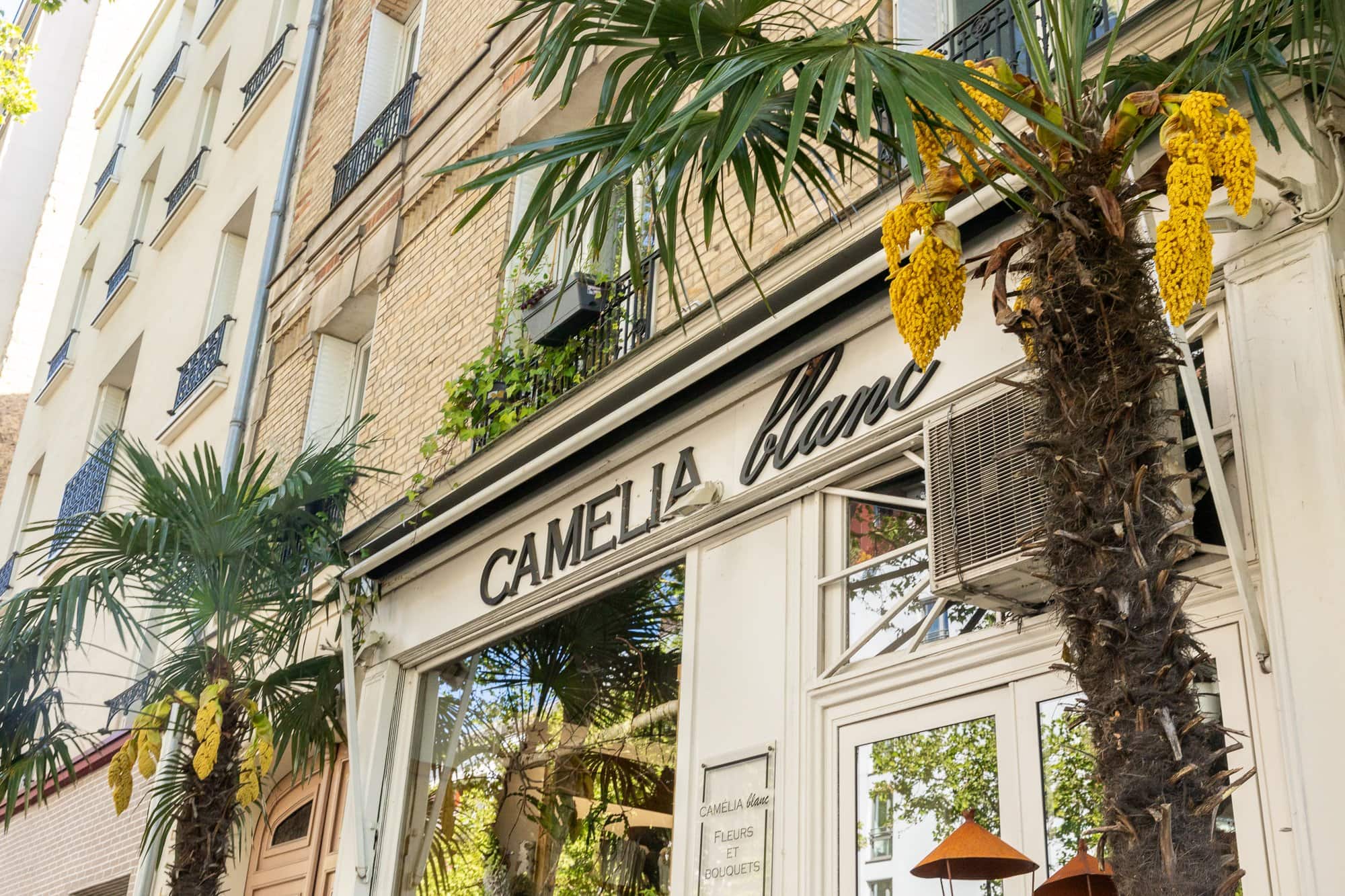
Elegant florist Camelia Blanc with yellow flowers and palms in central Paris

This place boasts the tallest glass ceiling of any surviving passage — nearly twelve metres high — flooding the space with an incredible amount of daylight. The whole area feels airy and light, making it our go-to escape on sweltering summer days.

You won’t find typical souvenirs here, but rather workshops of independent jewellers, designers, quality fabric sellers and shops with handmade furniture. It’s a very quiet, inspiring place where we love to wander when we need a break from the big-city bustle.

  • Address: 145 Rue Saint-Denis, 2nd arrondissement
  • Entry: Free
  • Open: Monday to Saturday 8:30–20:30 (closed on Sundays)
  • Transport: Metro line 4 (Étienne Marcel station)

💡 Insider tip: Pay close attention to the ironwork on the shop fronts and the old wooden signs. These are original 19th-century pieces that survived every historical upheaval the city has been through.

Galerie Véro-Dodat
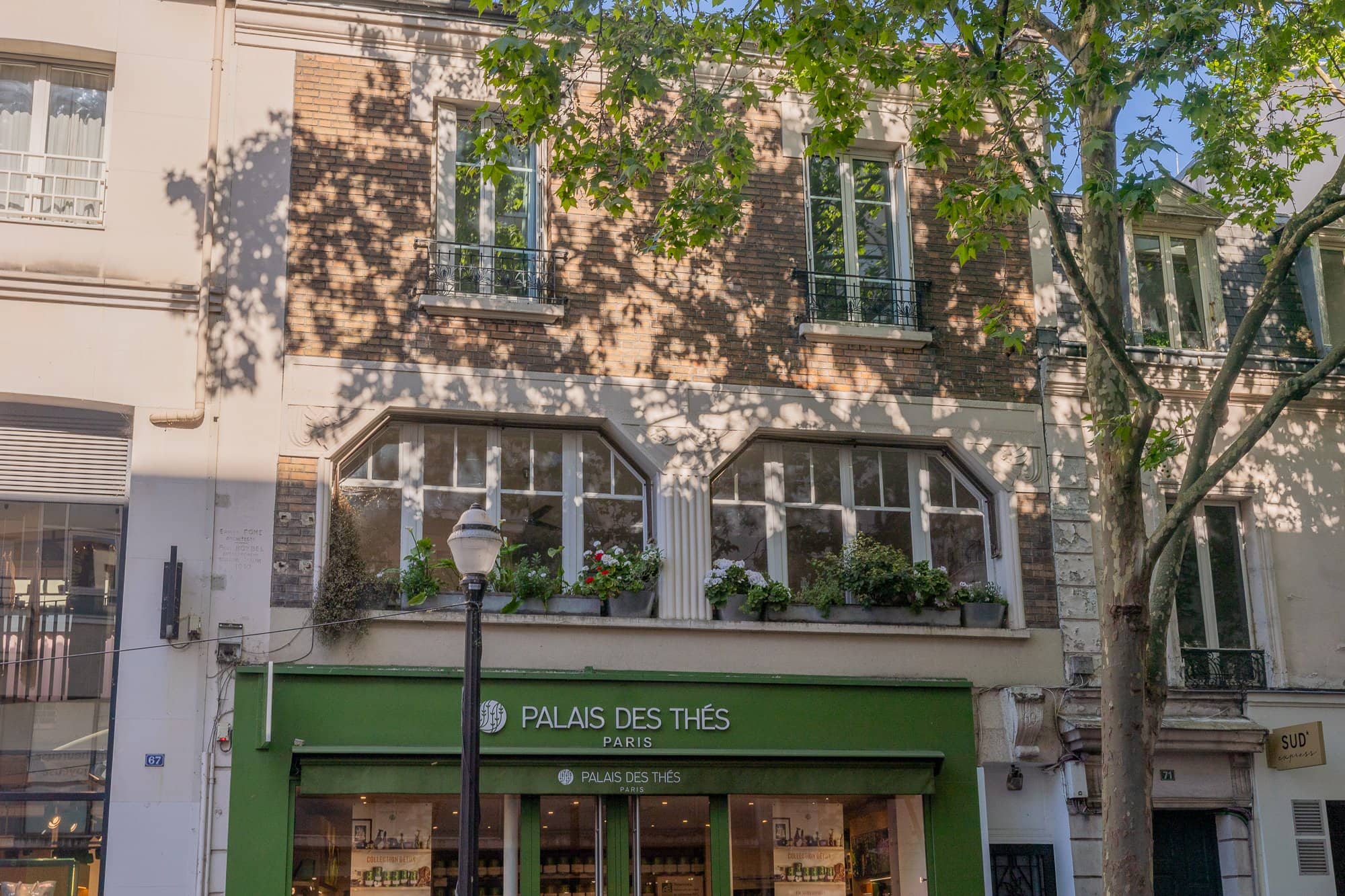
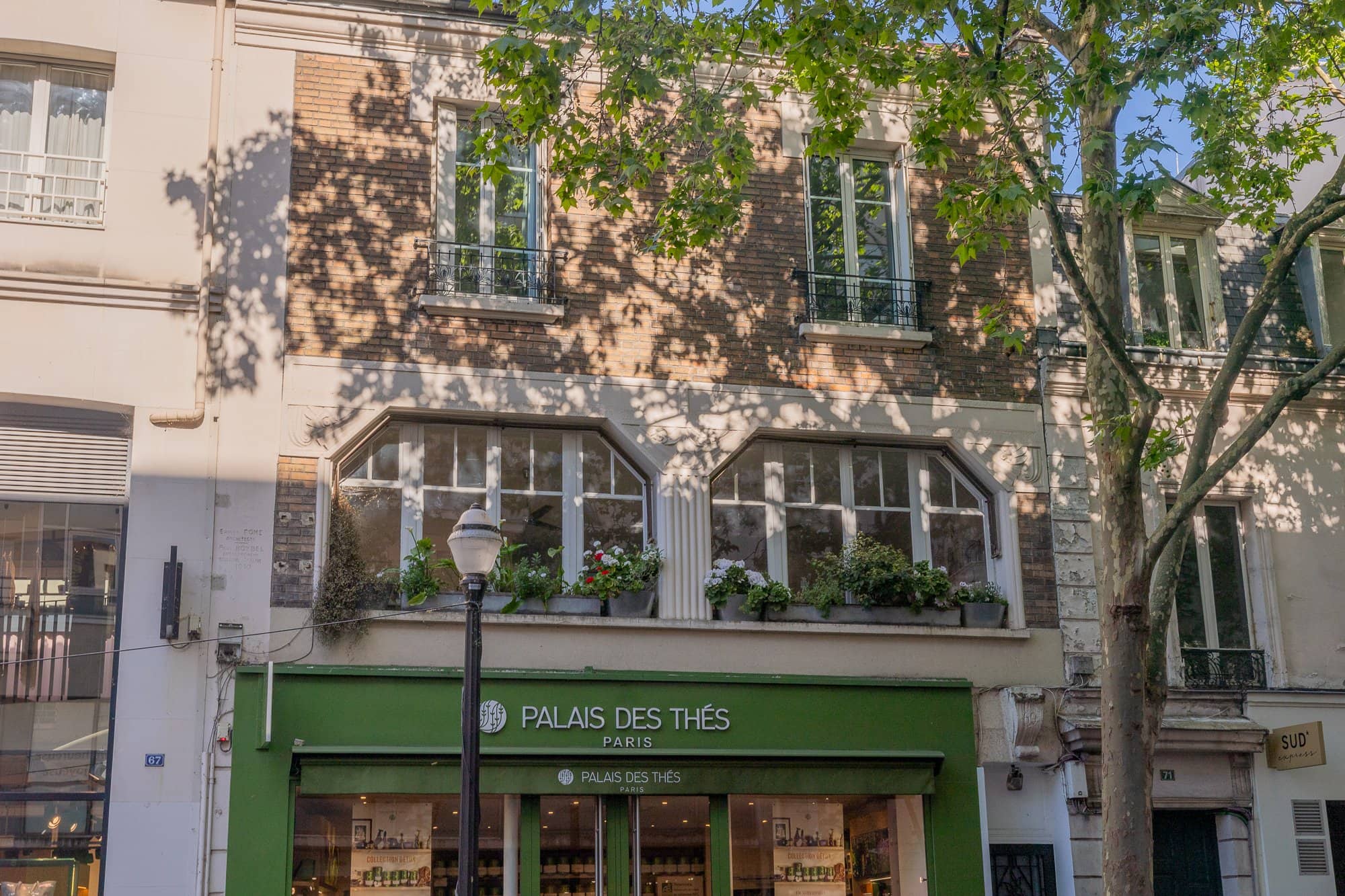
Green Palais des Thés shop on a Parisian street with flowers

Tucked away just a stone’s throw from the famous art museum, this passage is missed by the vast majority of tourists. Opened in 1826, it’s distinguished by its gorgeous neoclassical style. The floor features a striking black-and-white grid pattern that creates an interesting optical illusion, making the space appear longer than it actually is.

Today it houses very upmarket fashion and antique boutiques. Even if you don’t buy a thing, it’s worth stopping just for the breathtaking architecture and the silence — a world away from the crowds outside the Louvre nearby.

  • Address: 19 Rue Jean-Jacques Rousseau, 1st arrondissement
  • Entry: Free
  • Open: Monday to Saturday 7:00–22:00 (closed on Sundays)
  • Transport: Metro line 1 (Palais Royal – Musée du Louvre station)

💡 Insider tip: Look up at the ceilings near the entrances — you’ll spot beautiful mythological frescoes that were carefully restored not long ago. Most people walk through with their eyes glued to the shop windows and miss this detail entirely.

Passage Brady
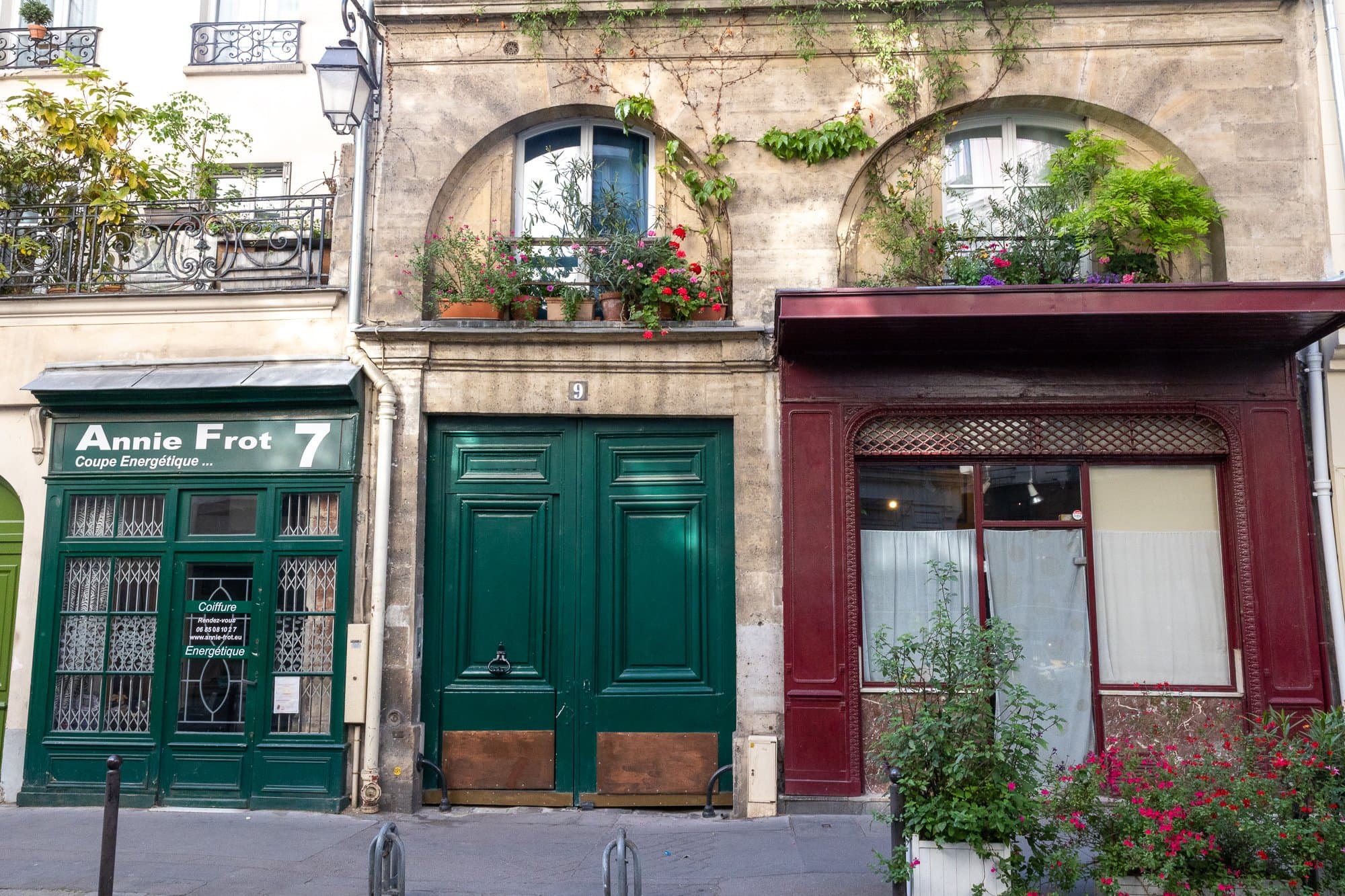
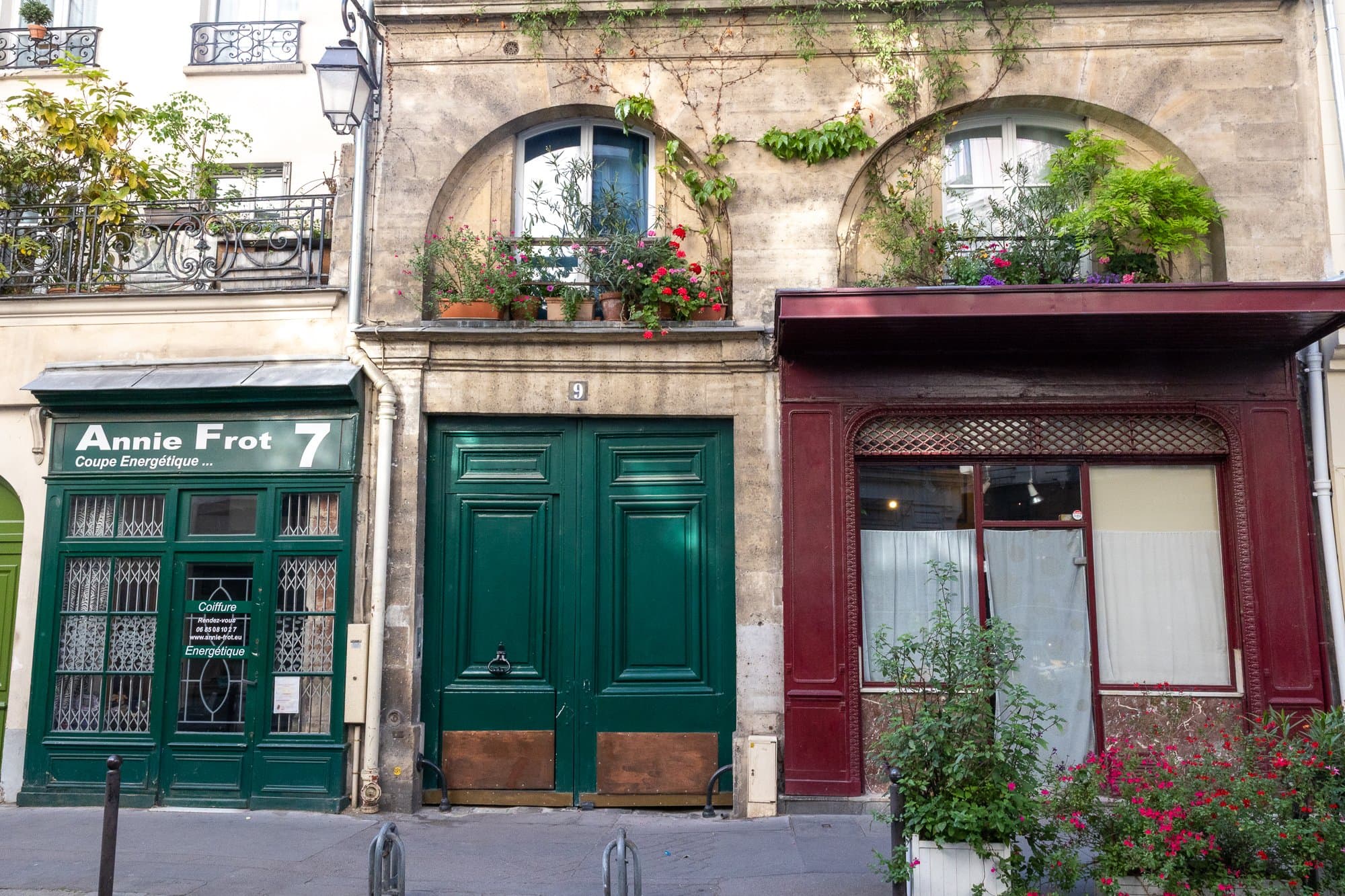
Parisian street with a historic green shop and red doors flanked by flowers

Fancy switching continents for a while without buying a plane ticket? Head to the 10th arrondissement. This passage is the pulsating heart of the Indian and Pakistani community, where you’ll disconnect completely from the typical Parisian experience.

The intense aromas of curry, cardamom and incense hit you straight away. You’ll find dozens of small restaurants, shops selling colourful fabrics and barber shops. It’s far livelier than the other passages, but the authentic atmosphere is absolutely worth the slight chaos — especially when you’re craving something spicy.

  • Address: 43 Rue du Faubourg Saint-Martin, 10th arrondissement
  • Entry: Free
  • Open: Daily 9:30–23:30
  • Transport: Metro line 4 (Château d’Eau station)

💡 Insider tip: Come at lunchtime for a traditional naan bread stuffed with cheese and garlic. They’re cheap, freshly made right in front of you, and they’ll tide you over perfectly during a day of city exploring.
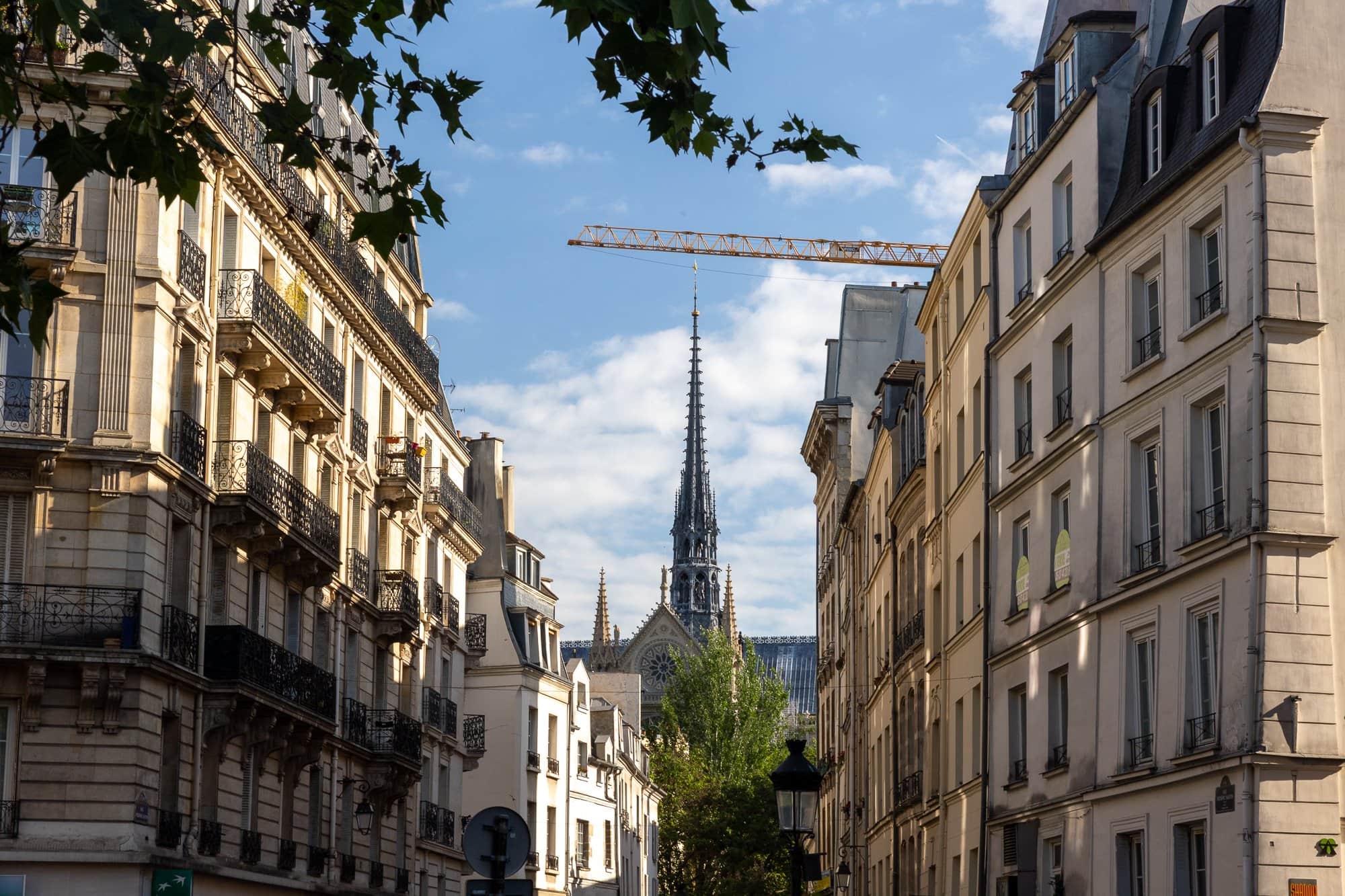
Narrow Parisian street with classical buildings and the Gothic tower of Notre-Dame in the background

Secret Gardens and Parks: Oases of Calm Amid the Concrete

When your toddler has had enough of landmarks and you desperately need a bench where you can drink your coffee in peace, the city delivers hidden pockets of absolute tranquillity. On most maps they’re just tiny green dots, but for weary parents they’re a lifeline. You just need to know which inconspicuous passageway to slip through.

Square du Vert-Galant
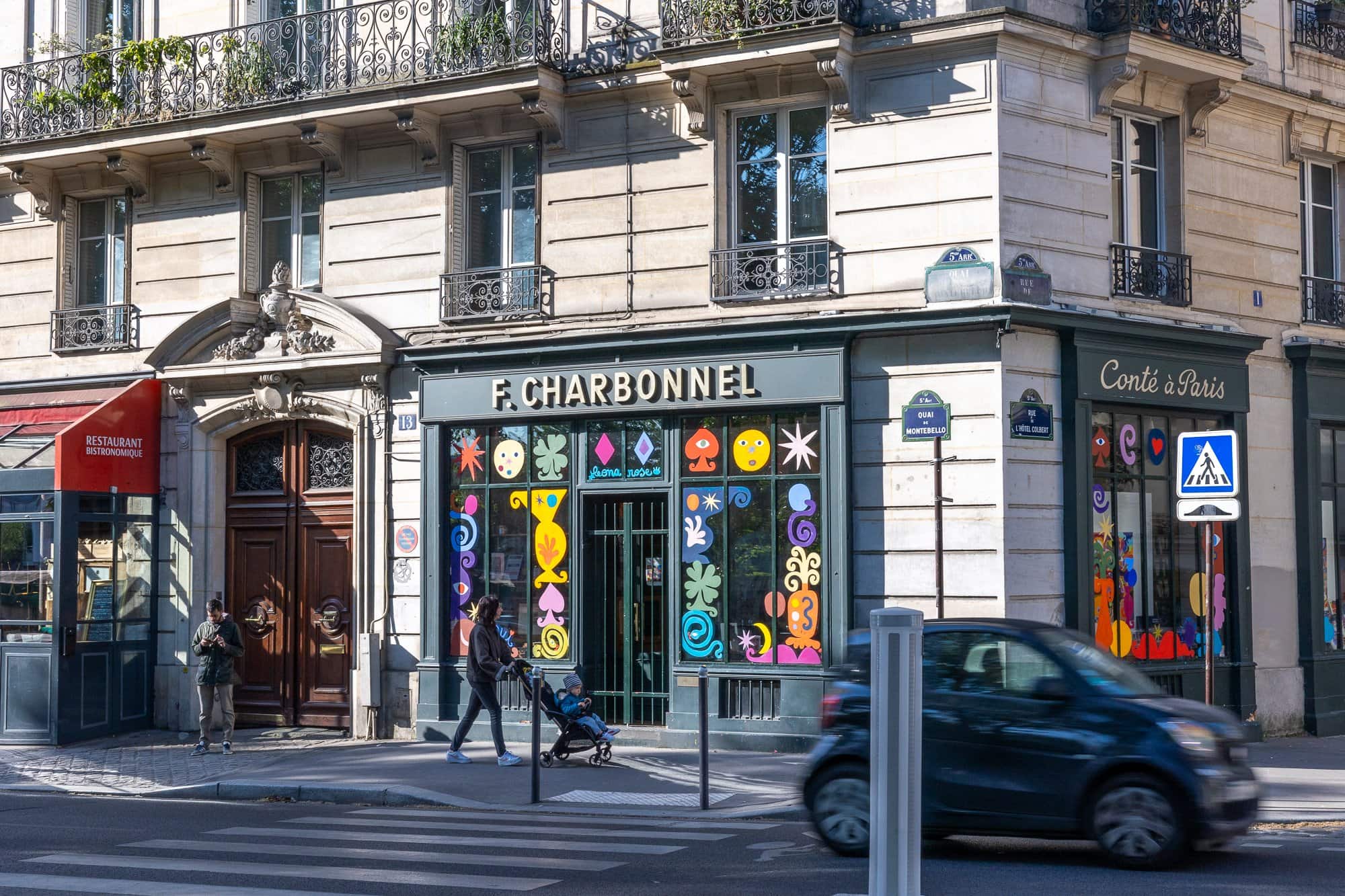
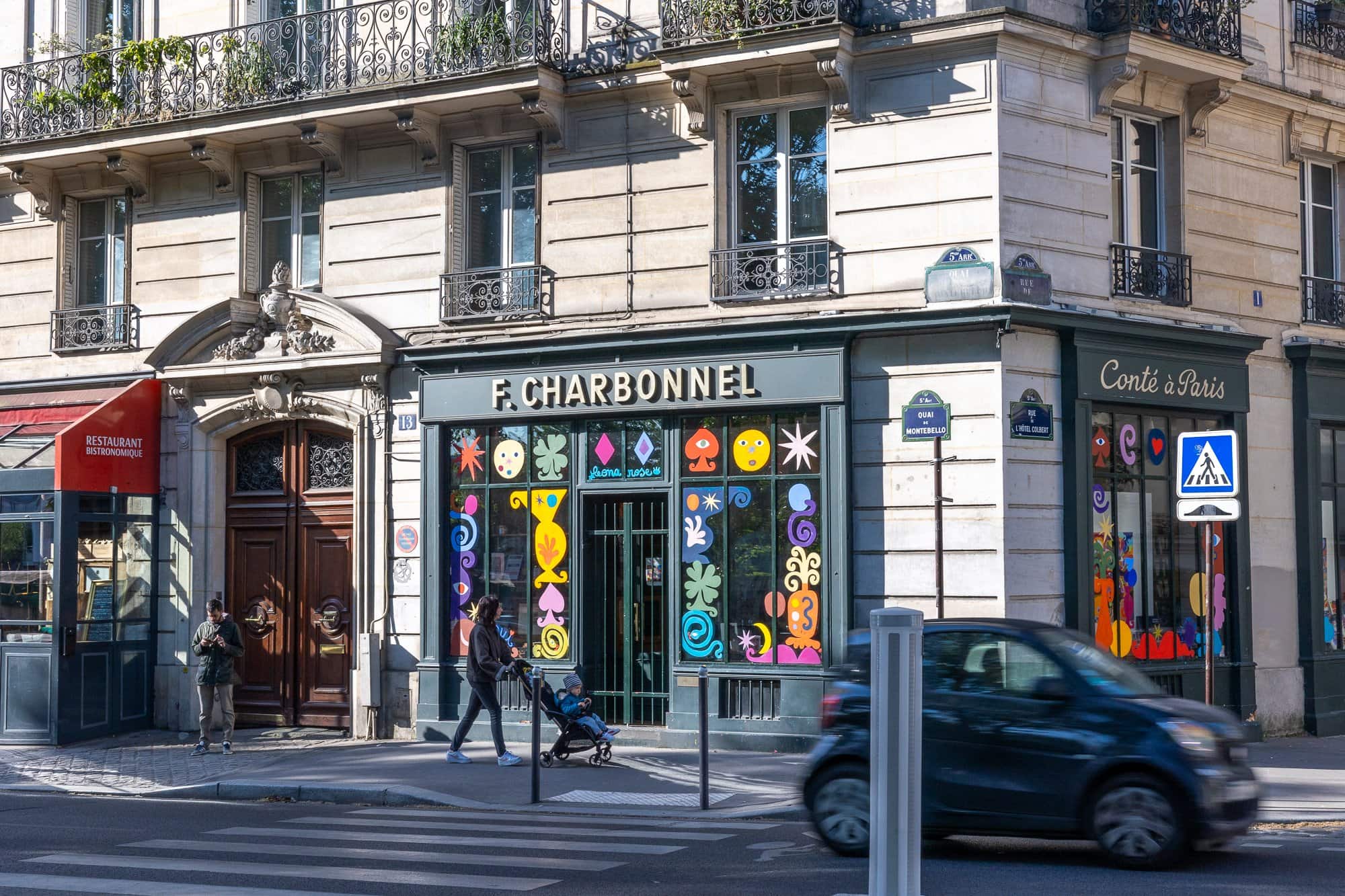
Parisian shop with colourful symbols in a Haussmann-era building

This little park sits right on the tip of Île de la Cité, just a short walk from the famous cathedral. Most people stay up on the bridge near the equestrian statue, but walk down the narrow stone steps towards the water and you’ll find the best greenery in the area.

You’ll discover a small, tree-shaded promontory where the river practically laps at your feet. Old weeping willows grow here and it’s the perfect spot for a quiet picnic with a baguette and cheese while tour boats slowly glide past. We simply adore this place.

  • Address: 15 Place du Pont Neuf, 1st arrondissement
  • Entry: Free
  • Open: Daily 8:00 until sunset
  • Transport: Metro line 7 (Pont Neuf station)

💡 Insider tip: The steps down aren’t wheelchair/pushchair-accessible, so you’ll need two pairs of hands to carry a buggy. Once you’re down, though, the terrain is flat and sandy — perfect for kids to run around safely.

Hôtel de Sully and its secret garden
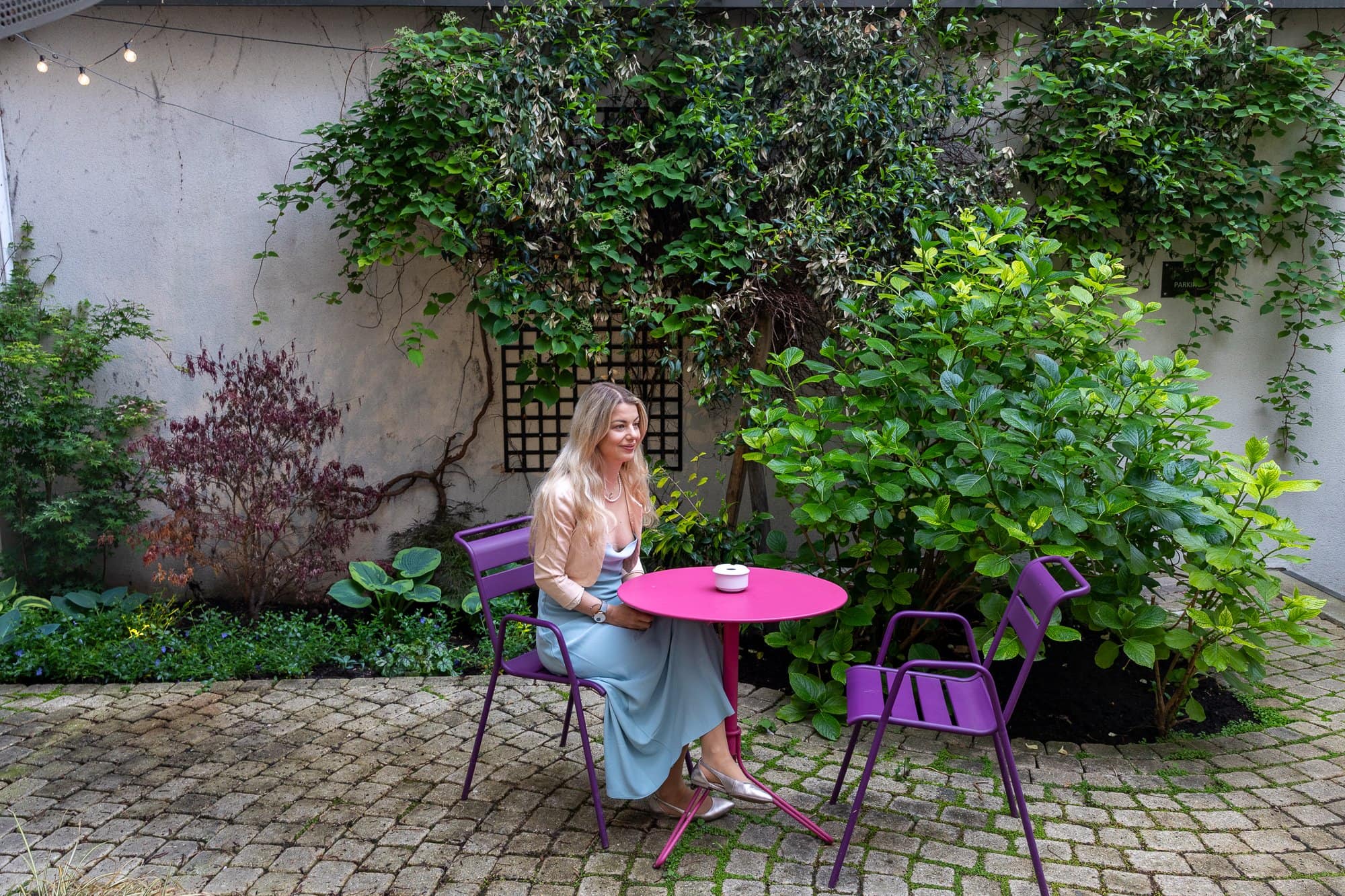
Blonde woman in a beige jacket sitting at a purple table in a green garden

In the Marais quarter, which gets absolutely packed at weekends, a gorgeous secret garden hides behind imposing wooden doors. You need to walk through the huge gates of this historic mansion, cross the first courtyard and pass through yet another archway — which most casual visitors give up on before they get that far.

Only then does a beautifully maintained lawn with benches and old statues open up before you. From the busy street, you’d never guess this place existed. It’s blissfully peaceful and shady — something you’ll appreciate more than anything on a hot summer’s day. We often retreat here to recharge before more exploring.

  • Address: 62 Rue Saint-Antoine, 4th arrondissement
  • Entry: Free
  • Open: Daily 9:00–19:00
  • Transport: Metro line 1 (Saint-Paul station)

💡 Insider tip: In the corner of this garden, a small, easy-to-miss gate leads directly to the famous Place des Vosges. It’s the most elegant way to reach the square, and you’ll avoid the crowds on the main approach streets.

Jardin des Rosiers (Joseph-Migneret Garden)
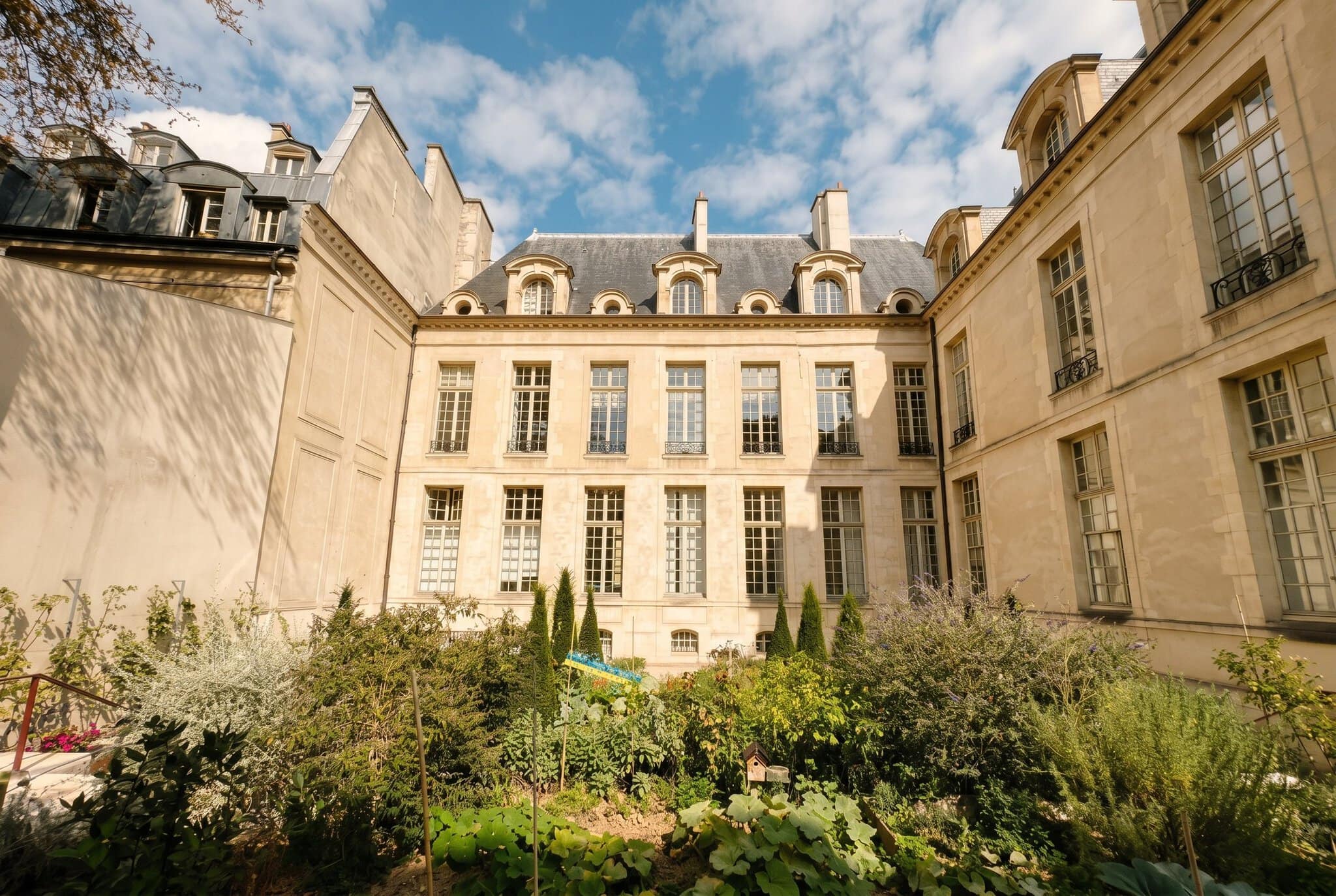
Community garden Jardin des Rosiers in the Marais quarter

Another gem hidden in the Marais. It was created relatively recently by combining the courtyards of several historic mansions. The entrance leads through a narrow passage from a street packed with falafel joints, so you essentially end up here straight from lunch.

You’ll find community flower beds, old trees and plenty of benches. We often come here after grabbing a takeaway lunch, when Jonáš needs to be let loose from the pushchair to have a run on the grass. Locals come to read books and the atmosphere is wonderfully homely and relaxed.

  • Address: 10 Rue des Rosiers, 4th arrondissement
  • Entry: Free
  • Open: Daily 8:00–19:00 (shorter hours in winter)
  • Transport: Metro line 1 (Saint-Paul station)

💡 Insider tip: The surrounding streets are home to some of the best bakeries for traditional Jewish pastries. Pick up a sweet babka, grab a coffee and enjoy the perfect afternoon break on a bench.

Jardin Catherine-Labouré
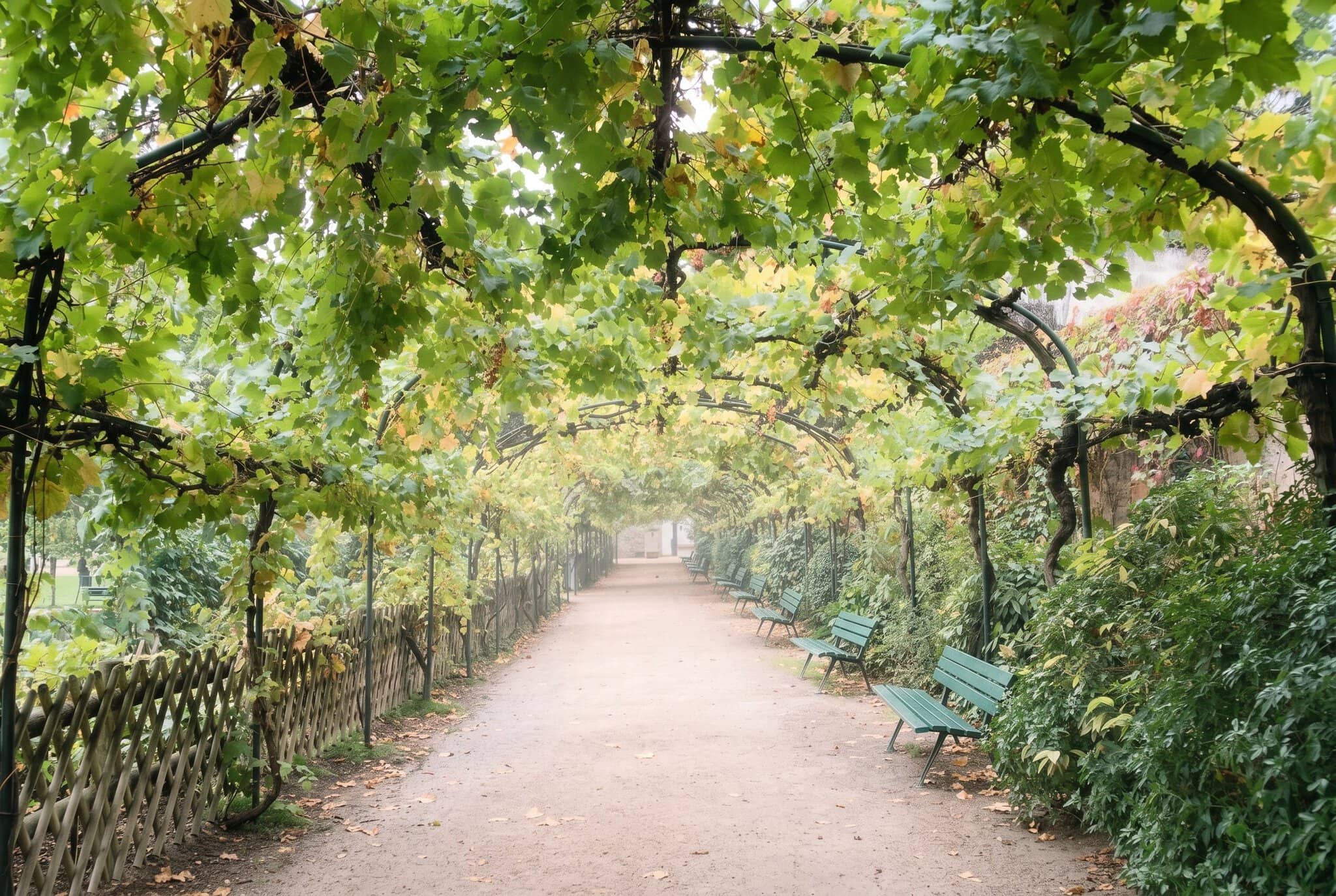
Walled garden Jardin Catherine-Labouré with grapevines

This park in the 7th arrondissement is hidden behind a tall stone wall and was originally a kitchen garden for local nuns. To this day you’ll find fruit trees, a small vineyard and vegetable beds tended by local schools.

There’s a huge lawn where you can stretch out, and a large wooden pergola covered in grapevines that provides glorious shade. You’d only bump into a tourist here by sheer accident — it’s a purely local affair, mostly frequented by families with children from the surrounding blocks.

  • Address: 29 Rue de Babylone, 7th arrondissement
  • Entry: Free
  • Open: Daily 8:00–20:30 (until 17:00 in winter)
  • Transport: Metro line 10 (Vaneau station)

💡 Insider tip: Right next to the park entrance there’s a wonderful old cheese shop. Ask the cheesemonger to cut you a few slices of local cheeses and you’ve got yourself a superbly luxurious yet cheap lunch on a park bench.

Promenade Plantée (Coulée Verte)
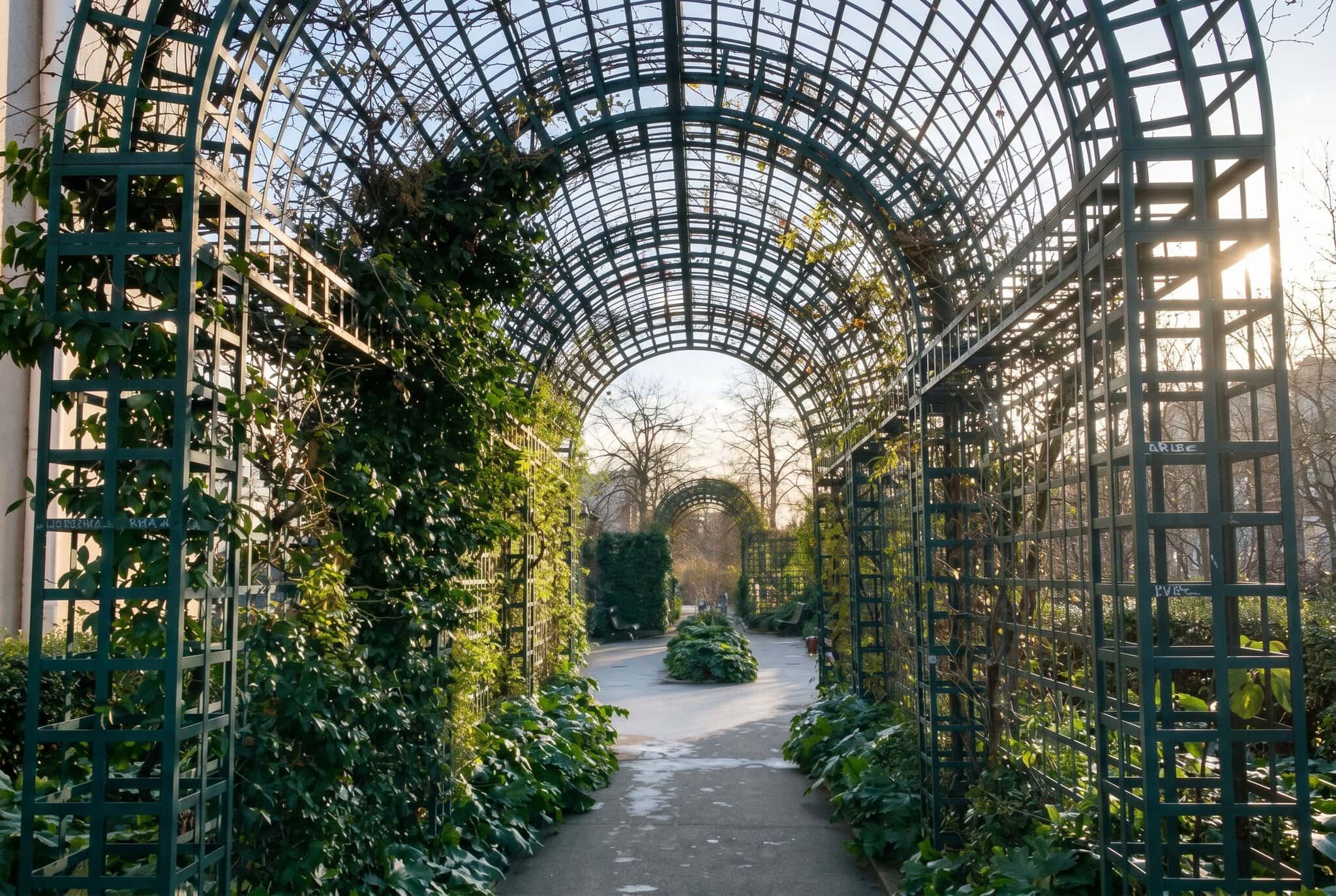
Elevated promenade Promenade Plantée lined with greenery

Long before New York built its famous High Line, this 4.7-kilometre elevated park came into existence. It runs along the embankment of a disused 19th-century railway line, starting just near Place de la Bastille and heading east.

It’s a stunning walk among the treetops, peering into windows of old apartment buildings and seeing the city from a completely different perspective. Part of the route runs along a viaduct whose arches now house artists’ workshops, creating a lovely blend of culture and nature.

  • Address: Starting at the corner of Rue de Lyon and Avenue Daumesnil, 12th arrondissement
  • Entry: Free
  • Open: Daily from 8:00 until sunset
  • Transport: Metro line 1, 5 or 8 (Bastille station)

💡 Insider tip: The first section on the viaduct is fully accessible by lift for pushchairs, but once the park drops to street level and continues east, the surface changes to gravel and tree roots. With small children, I’d recommend sticking to just the first, elevated half.

Clos Montmartre

Did you know the city still has its own working vineyard? It sits on the northern slope of Montmartre hill and it’s a genuine rarity. It was planted in the 1930s to block developers who were itching to throw up ugly apartment blocks on the site.

Today it produces around a thousand bottles of wine a year. You can’t normally get inside, but the view of the vine rows through the fence, with white houses in the background, is incredibly photogenic. Every time we stop here, we feel like we’ve escaped to the idyllic French countryside — the big-city buzz completely vanishes.

  • Address: Rue des Saules, 18th arrondissement
  • Entry: View from the street free (access inside only during the harvest festival)
  • Open: Visible from the street at all times
  • Transport: Metro line 12 (Lamarck – Caulaincourt station)

💡 Insider tip: If you’re planning an autumn trip, try to time it around mid-October. That’s when the Fête des Vendanges takes place — a harvest festival that sees the whole neighbourhood come alive with food stalls, music and tastings of this rare local wine.
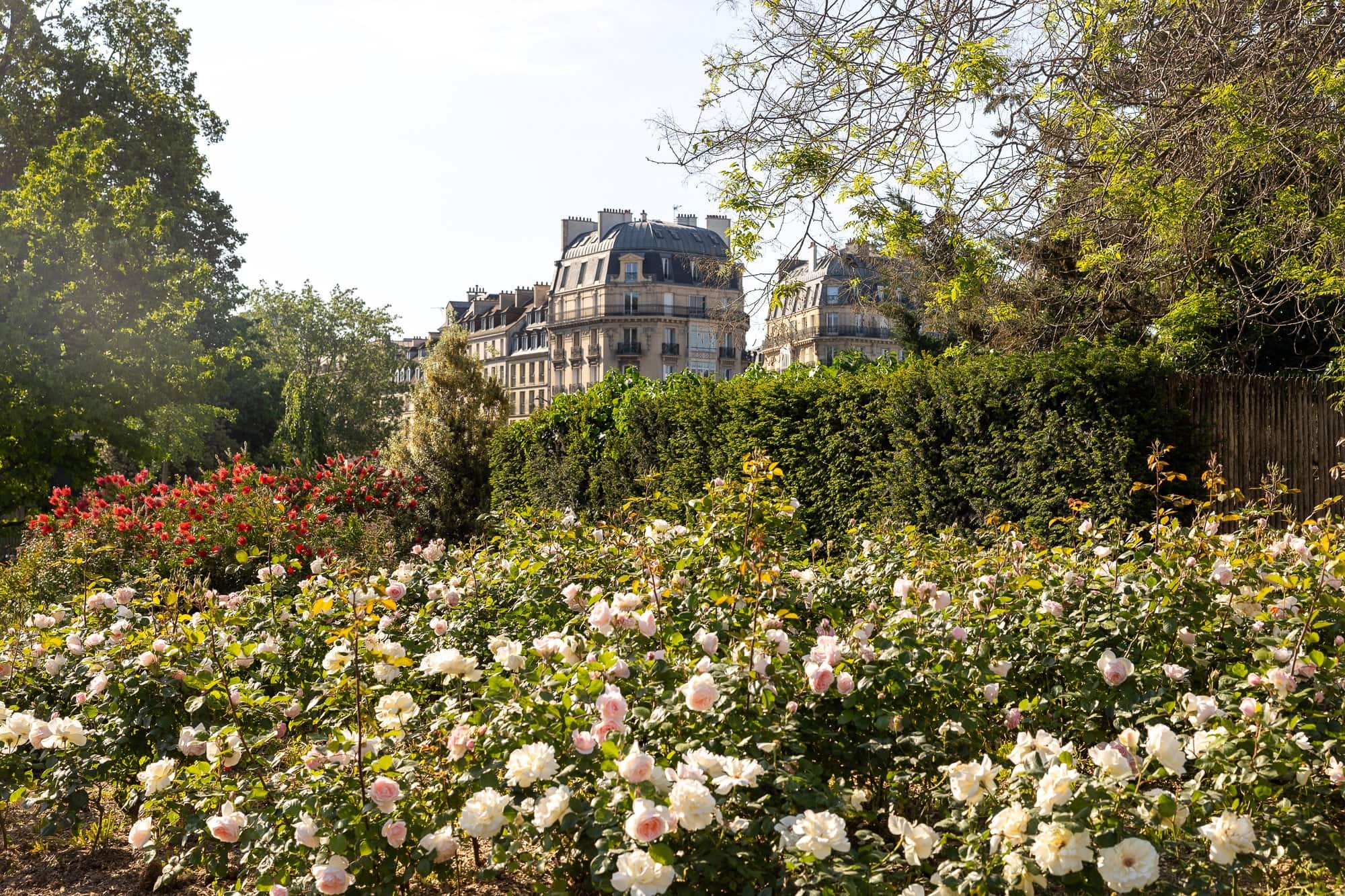

Nook with blooming roses and classic Parisian buildings
lukas a lucka
Lukáš and Lucie recommend
Where to stay in Paris
2 accommodations — hotels and other lodging options

Photogenic Micro-worlds and Lanes: Colours Off the Beaten Track

For a powerful visual experience and gorgeous photos, you don’t need to queue for an hour to see the Hall of Mirrors at the palace. The city hides entire small neighbourhoods and streets that feel like a teleport to a completely different world. Some evoke the French countryside, others an English workers’ terrace. Most lie further from the very centre, but the journey is always worth it.

Cité Florale
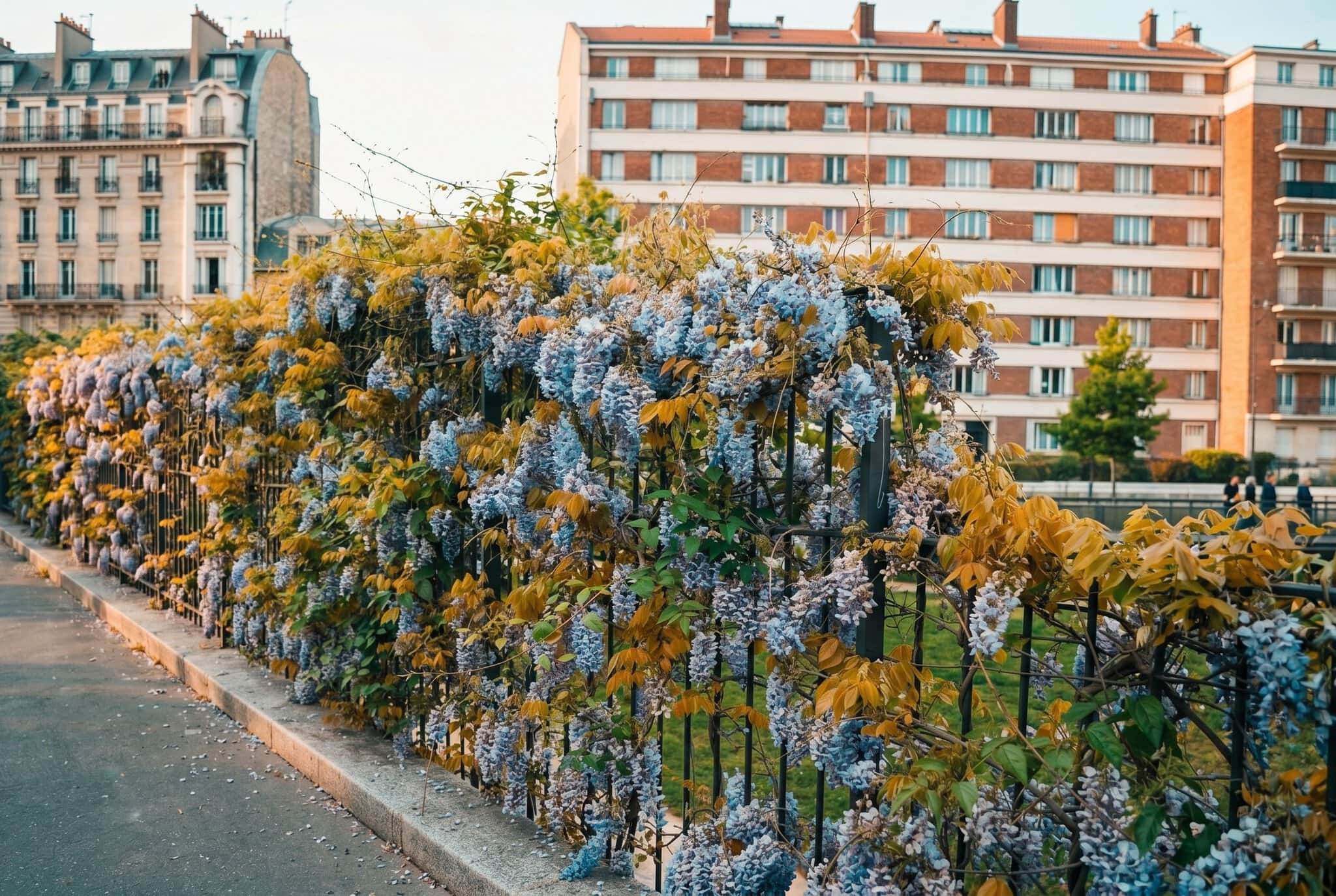
Colourful houses in the Cité Florale nook in the 13th arrondissement

This tiny area in the 13th arrondissement feels like a village transplanted into the heart of a metropolis. The streets are named after flowers, the small family houses come in every pastel shade imaginable and the façades are smothered in thick ivy.

It was built in the 1920s on a site where heavy multi-storey buildings were banned due to the unstable subsoil. The lanes are narrow and cobbled, and the silence is broken only occasionally by the meowing of local cats. Lukáš and I happily wandered here for a full hour in complete delight.

  • Address: Around Rue des Orchidées and Rue des Iris, 13th arrondissement
  • Entry: Free (public streets)
  • Open: Always
  • Transport: Tram T3a (Poterne des Peupliers stop)

💡 Insider tip: Please respect the residents’ privacy. Don’t climb over fences for a better photo and don’t block the narrow pavements. The locals are understandably a bit touchy about tourists with big camera lenses.

Rue Crémieux
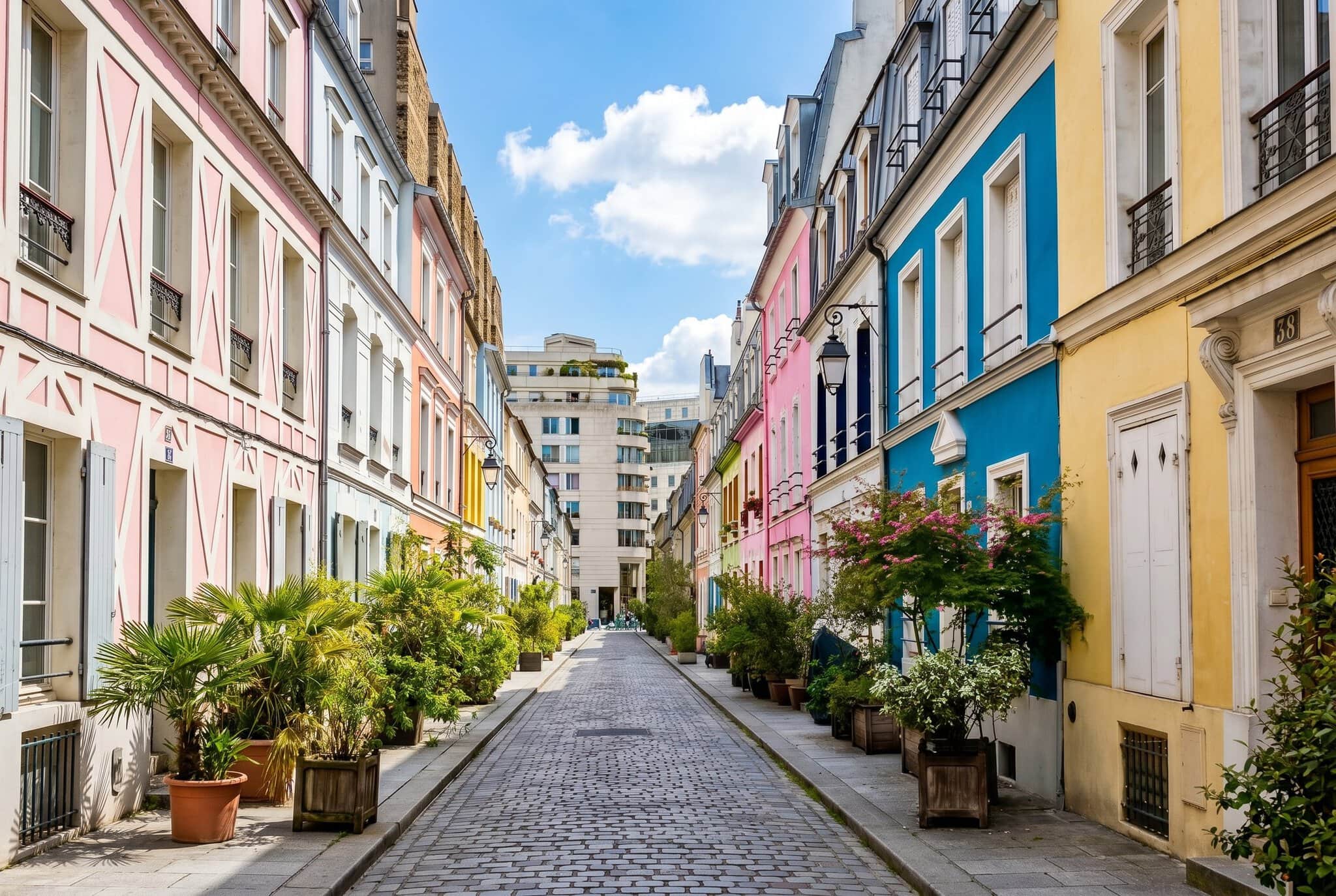
Pastel façades of houses on cobbled Rue Crémieux

With its pastel-painted façades, this little street has unfortunately become a massive social-media hit, so you probably won’t have it to yourself. Still, it’s definitely worth a quick stop because the palette of colours is simply unreal.

Houses in mint, lemon and lavender hues contrast sharply with the otherwise grey and cream architecture of the rest of the city. The pedestrianised lane dates from the 19th century, when it was built as affordable workers’ housing. Just photograph respectfully and quietly.

  • Address: Rue Crémieux, 12th arrondissement
  • Entry: Free
  • Open: Always, but restrictions apply for commercial photography at weekends
  • Transport: Metro line 1 or 14 (Gare de Lyon station)

💡 Insider tip: Residents successfully pushed through a rule banning filming and professional photography at weekends and evenings so they can have some peace. Come on a weekday morning instead, when the light is at its softest and the street is empty.

Villa Léandre
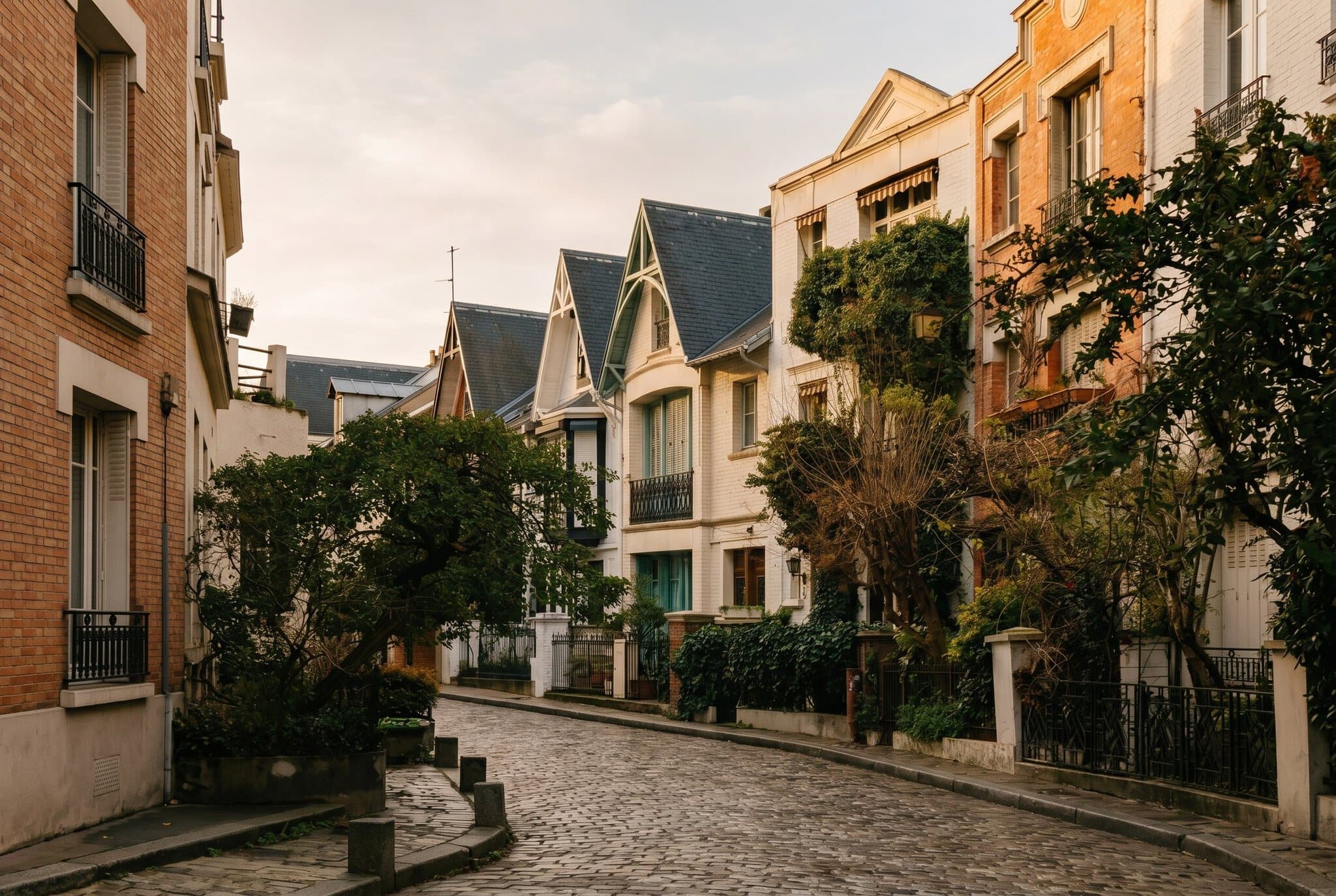
Quiet art deco cul-de-sac Villa Léandre in Montmartre

Escape the crowds at the white basilica on Montmartre, head deeper into the side streets, and you’ll stumble upon this charming cul-de-sac. Built in the 1920s in a mini art deco style, it charms you at first sight.

With its brick houses and sloping roofs, it feels more like a street in London’s Chelsea or the English countryside than central Paris. It’s unbelievably quiet and the trees cast a pleasant shade. The houses are astronomically expensive nowadays and mostly home to successful artists and actors.

  • Address: Villa Léandre (turning off Avenue Junot), 18th arrondissement
  • Entry: Free
  • Open: Always
  • Transport: Metro line 12 (Lamarck – Caulaincourt station)

💡 Insider tip: On house number ten, you’ll notice a small plaque referencing 10 Downing Street. It’s an old joke by the local residents dating back to the Second World War.

Rue de l’Abreuvoir
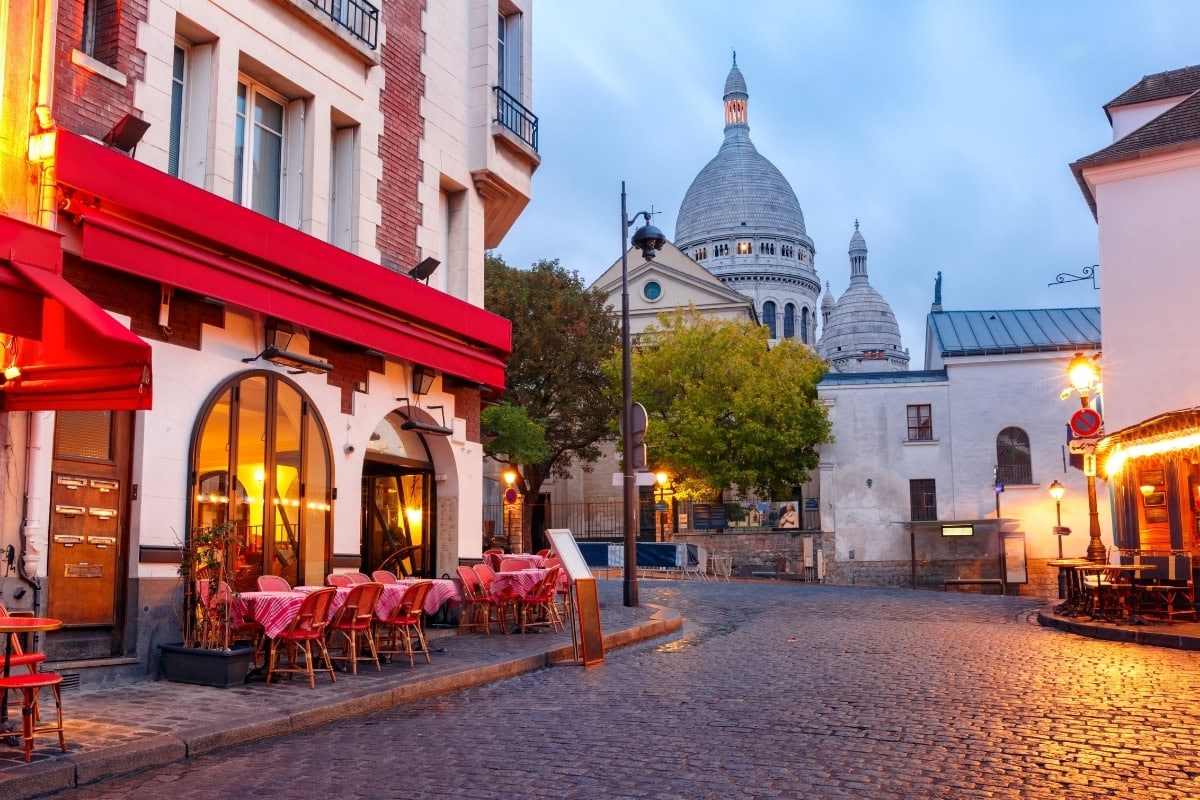
Cobbled lane Rue de l'Abreuvoir in Montmartre

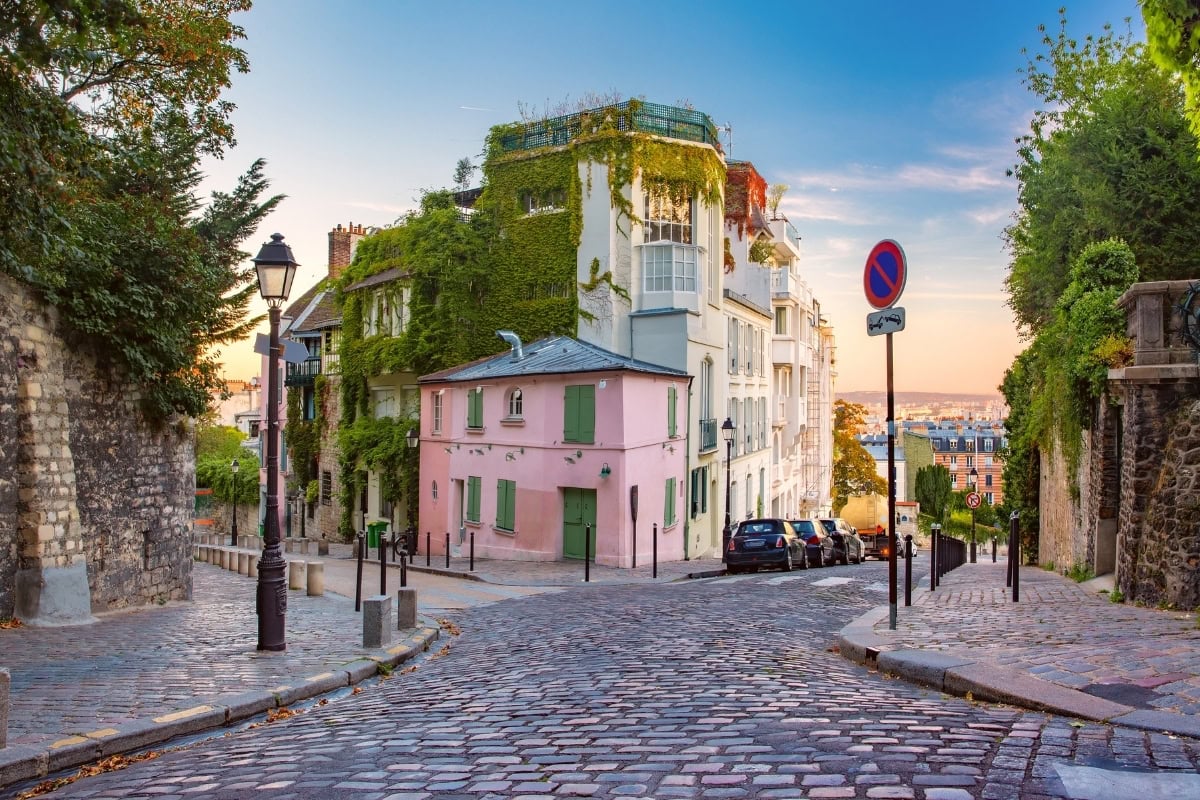
With its softly pastel façades, old cobblestones and a view of the basilica dome in the distance, this is arguably the most beautiful street on the entire hill. Halfway along stands the famous Pink House, once painted by Maurice Utrillo.

The street gently curves and descends, creating an absolutely perfect perspective for photography. Locals once used to lead cattle to a watering trough here — hence the historic name. We like to walk through early in the morning, when the sun is just rising over the city.

  • Address: Rue de l’Abreuvoir, 18th arrondissement
  • Entry: Free
  • Open: Always
  • Transport: Metro line 12 (Lamarck – Caulaincourt station)

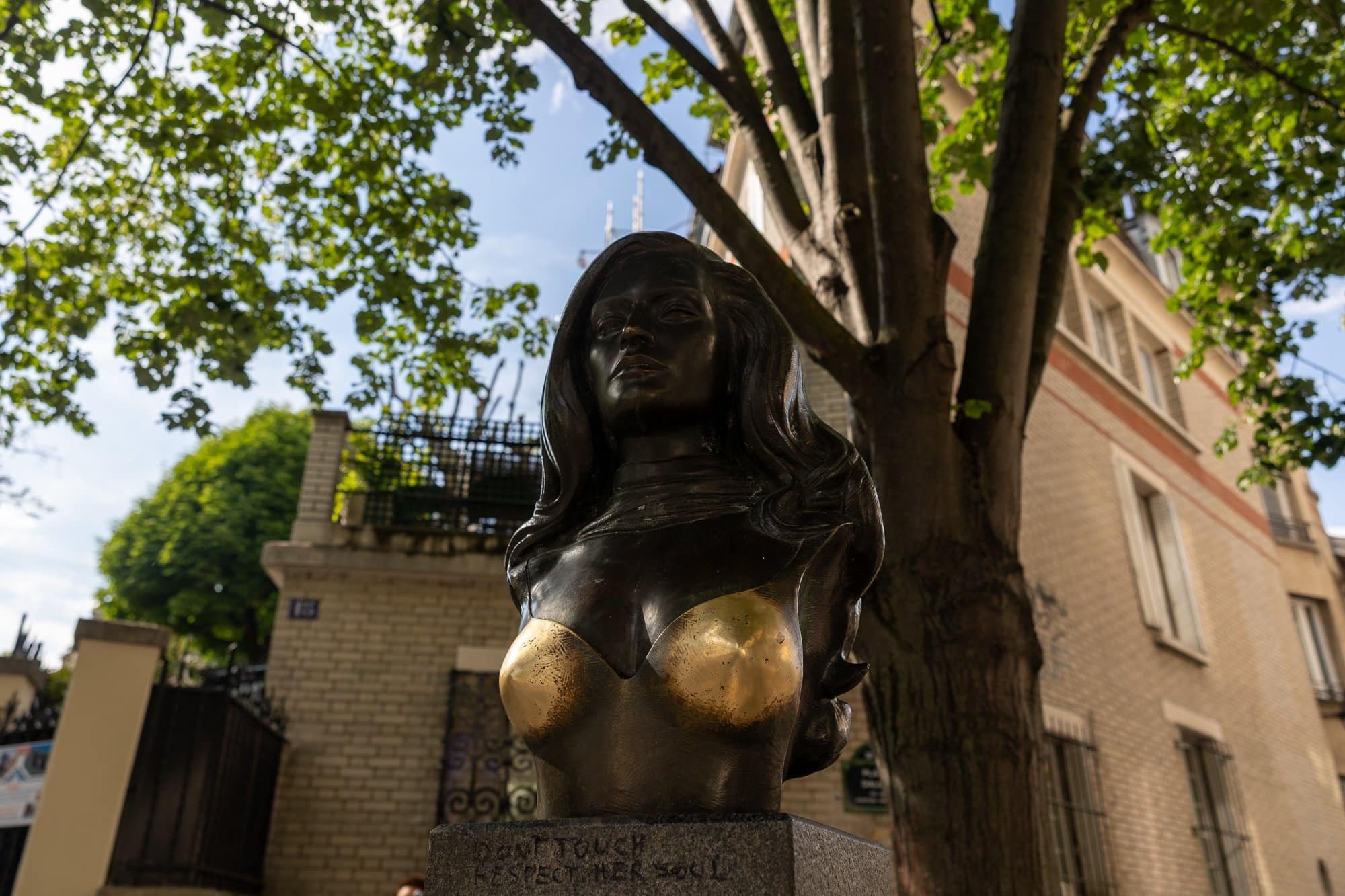
💡 Insider tip: At the end of the street you’ll find a small square with a bust of the famous singer Dalida. Local legend has it that touching her bronze bust brings good luck in love. The statue is visibly polished in that particular spot.

La Campagne à Paris
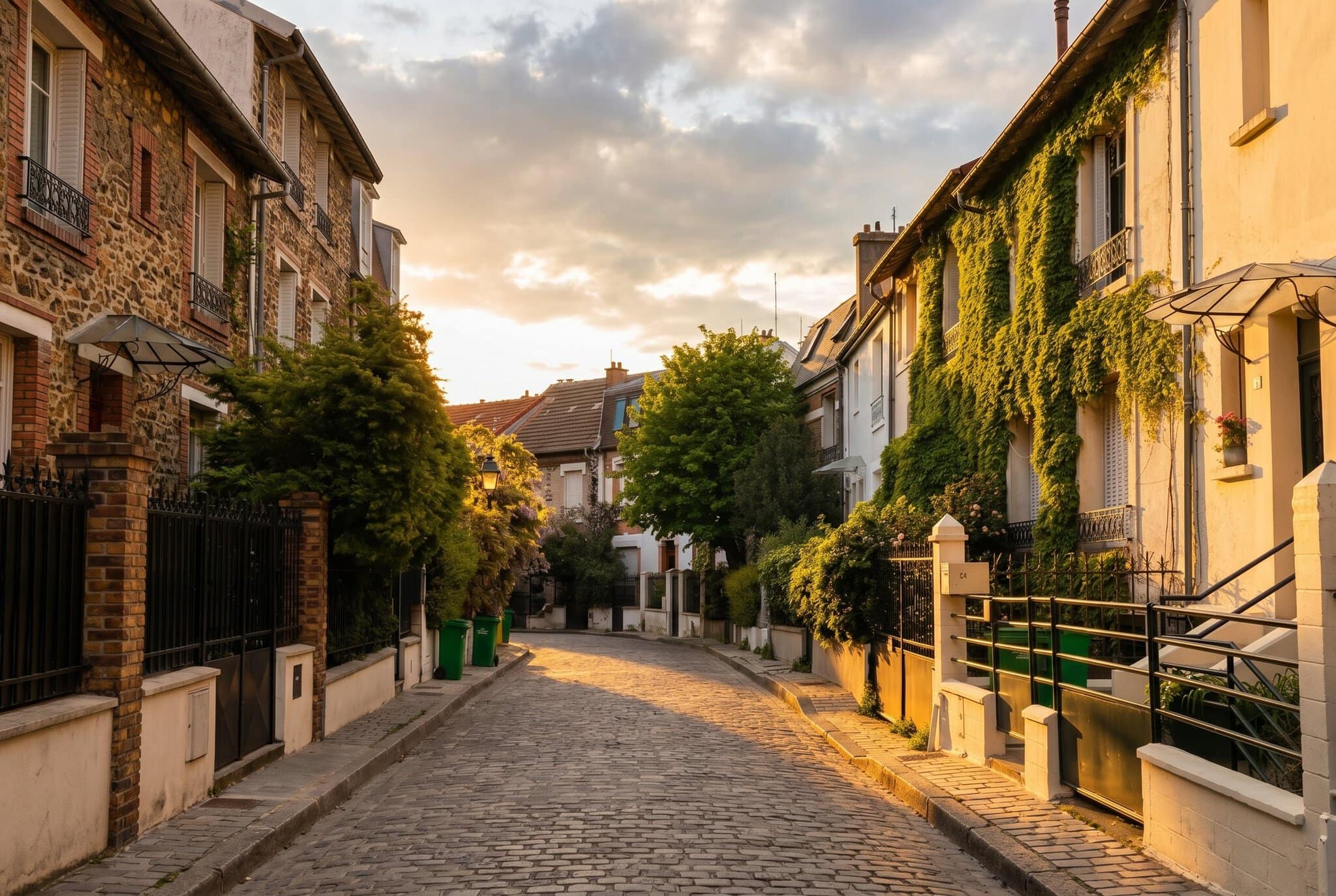
Country-style cottages in the La Campagne à Paris quarter in the 20th arrondissement

This is a genuine local treasure on the eastern edge of the city. It’s a former workers’ colony built at the beginning of the 20th century on an artificial hillock made from earth excavated during metro construction.

You’ll find just under a hundred small brick houses with gardens, accessible only via steep stone staircases. It’s absolutely silent here and you get the feeling you’ve left the big city for somewhere deep in the countryside. A perfect escape from the frenzy of tourism.

  • Address: Around Rue Jules Siegfried and Rue Irénée Blanc, 20th arrondissement
  • Entry: Free
  • Open: Always
  • Transport: Metro line 3 (Porte de Bagnolet station)

💡 Insider tip: The stairs up are quite steep, so if you’re travelling with a pushchair you’ll need to carry it by hand. Once you reach the top, though, the terrain is perfectly flat and safe for a stroll.

Mouzaïa Quarter

A similar concept to the previous spot, but on a much grander scale. The 19th arrondissement is home to a vast labyrinth of small pedestrian lanes lined with tiny houses and front gardens overflowing with greenery.

The area was originally home to workers from nearby gypsum quarries. The ground beneath was so riddled with tunnels that heavy buildings were forbidden. Today it’s one of the most sought-after and quietest residential areas in the entire city, and the thrill of discovery here is priceless.

  • Address: Around Rue de Mouzaïa, 19th arrondissement
  • Entry: Free
  • Open: Always
  • Transport: Metro line 7bis (Danube or Botzaris station)

💡 Insider tip: Get deliberately lost here. The lanes are so narrow that no car can pass through, and each one hides a slightly different variety of flowers and shrubs. In spring, when the lilacs are in bloom, the fragrance is absolutely intoxicating.
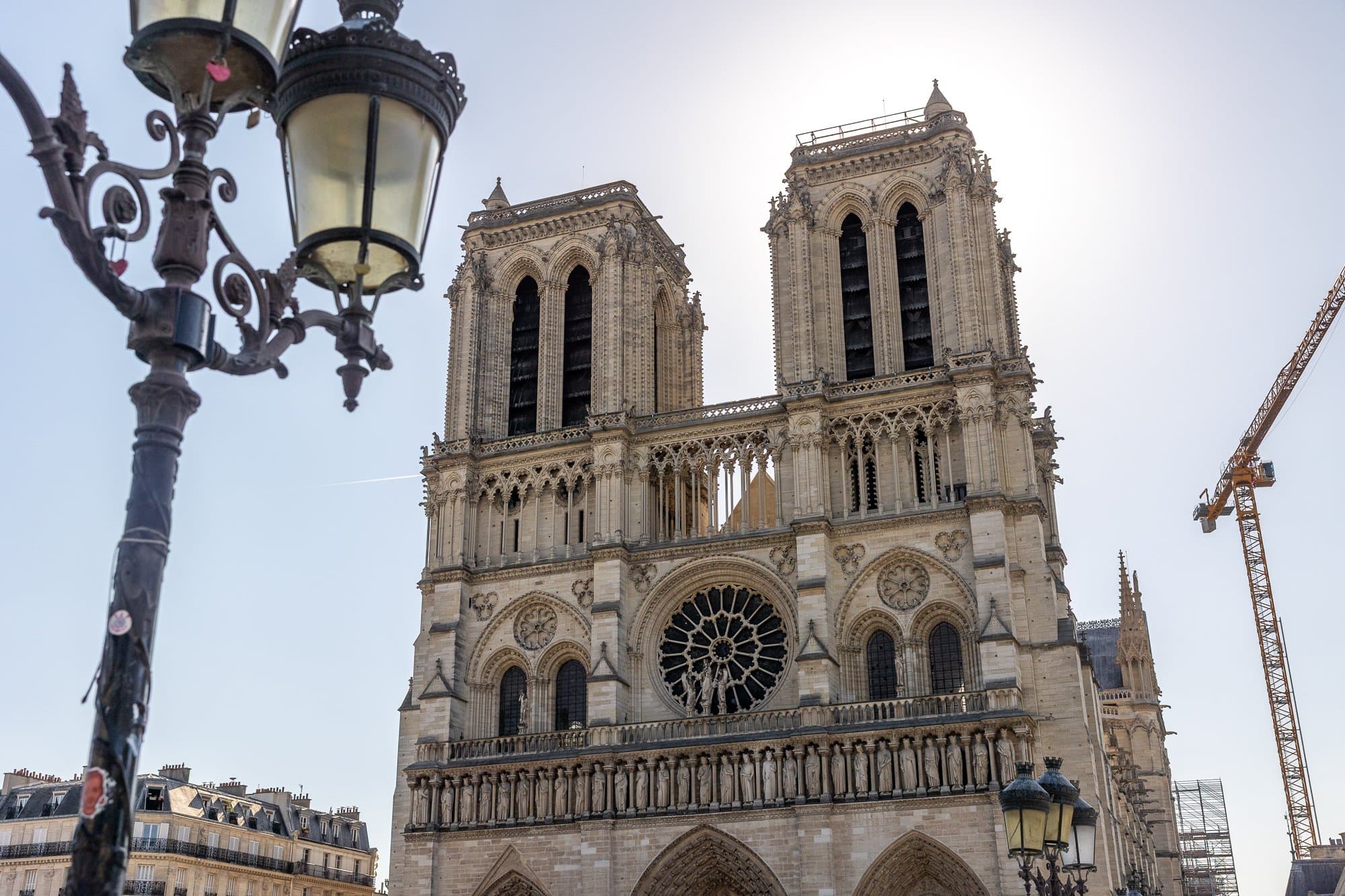
Detail view of the Gothic Notre-Dame cathedral with its twin towers and rose window

Paris from Above — Completely Free: Views That Don’t Cost a Penny

The view of the city from above is seriously addictive — and you’ll finally understand why you spent all morning weaving through a maze of streets instead of walking in a straight line. 😅 But you don’t need to shell out dozens of euros and stand in a two-hour queue for the lift up the most famous tower. The city offers fantastic rooftop terraces and hilltop parks that are fully open to the public and don’t cost a thing. Lukáš and I love these terraces, especially in the early evening when the sky turns pink.

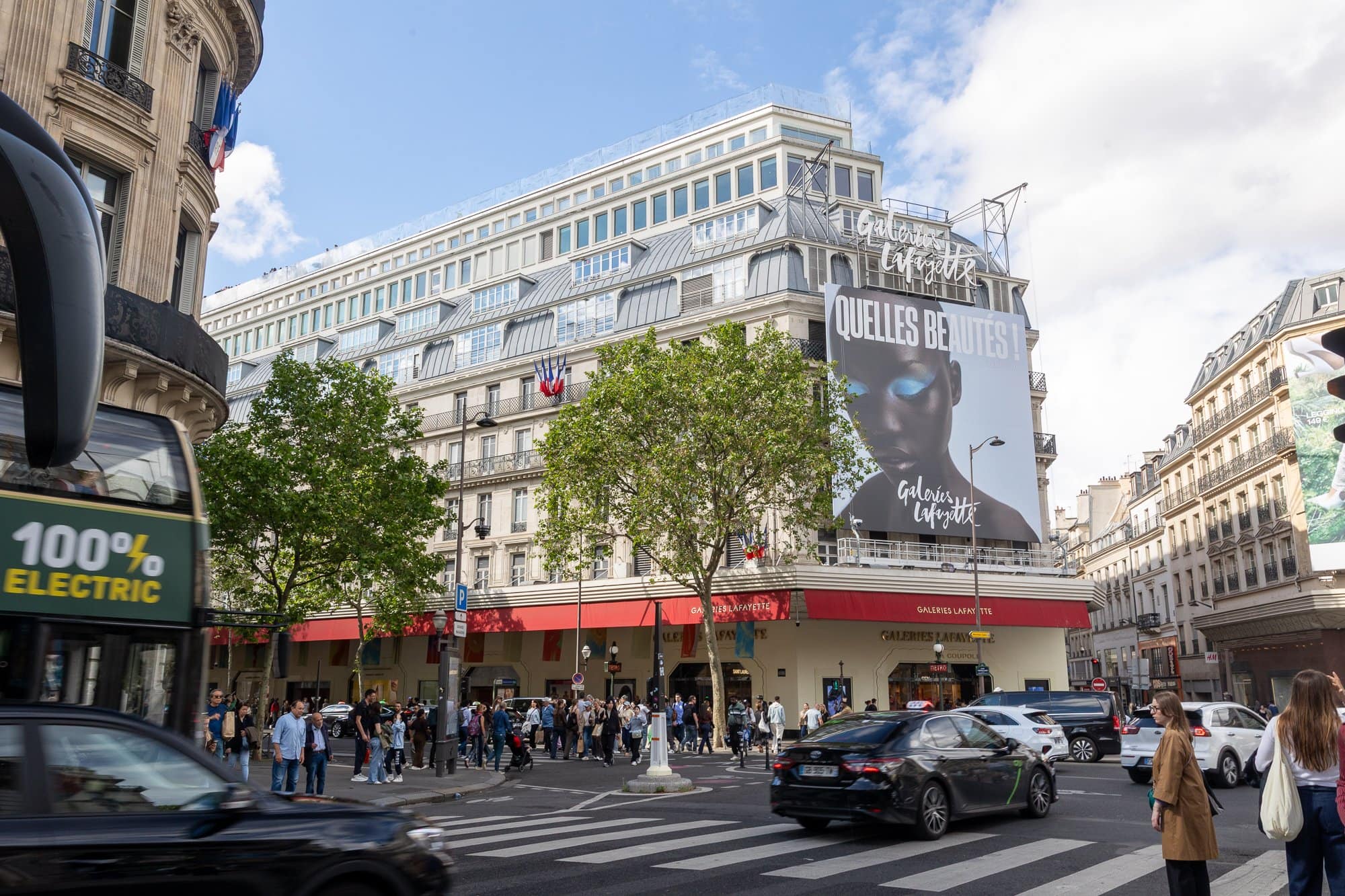
Galeries Lafayette Rooftop
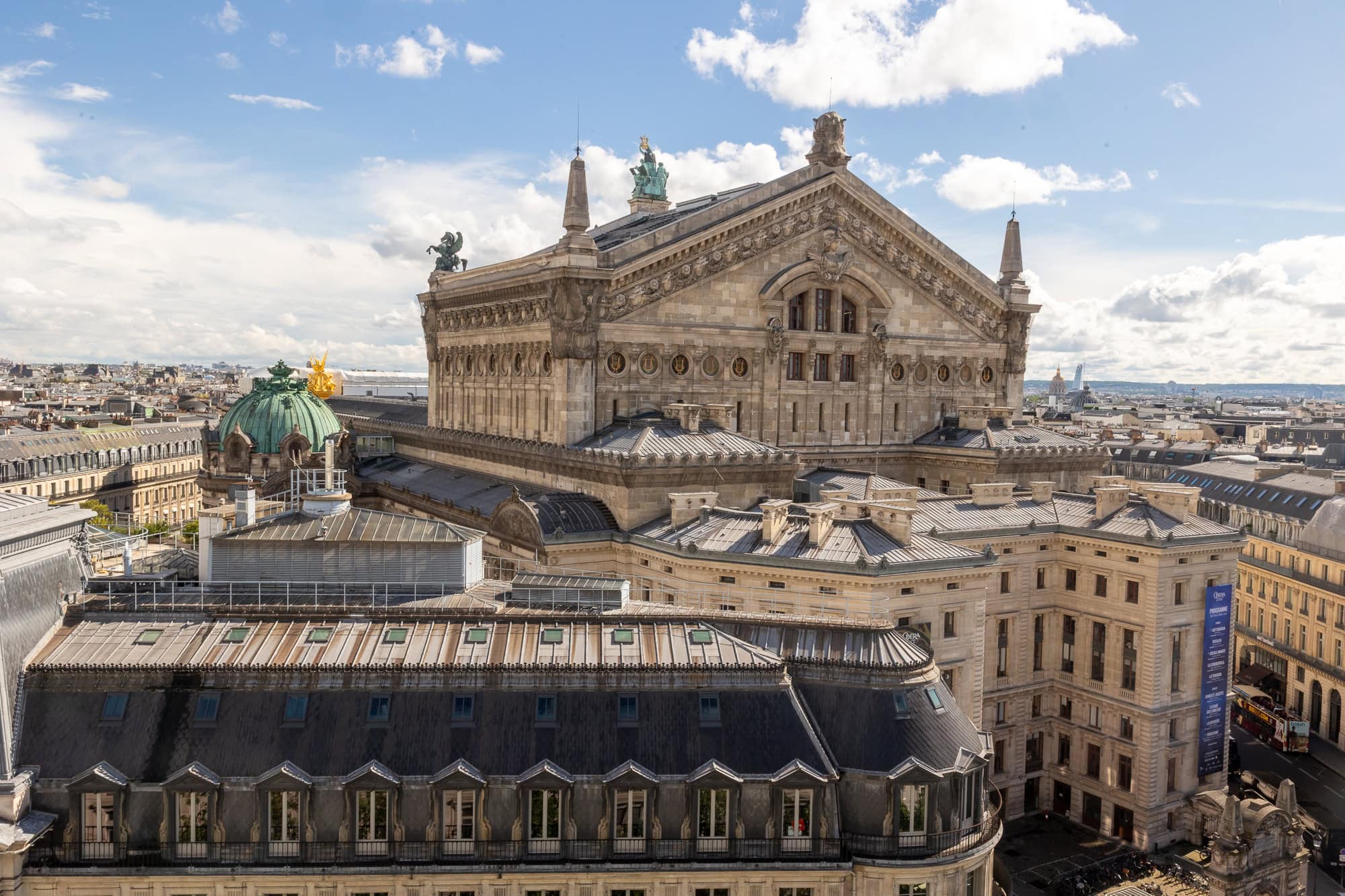
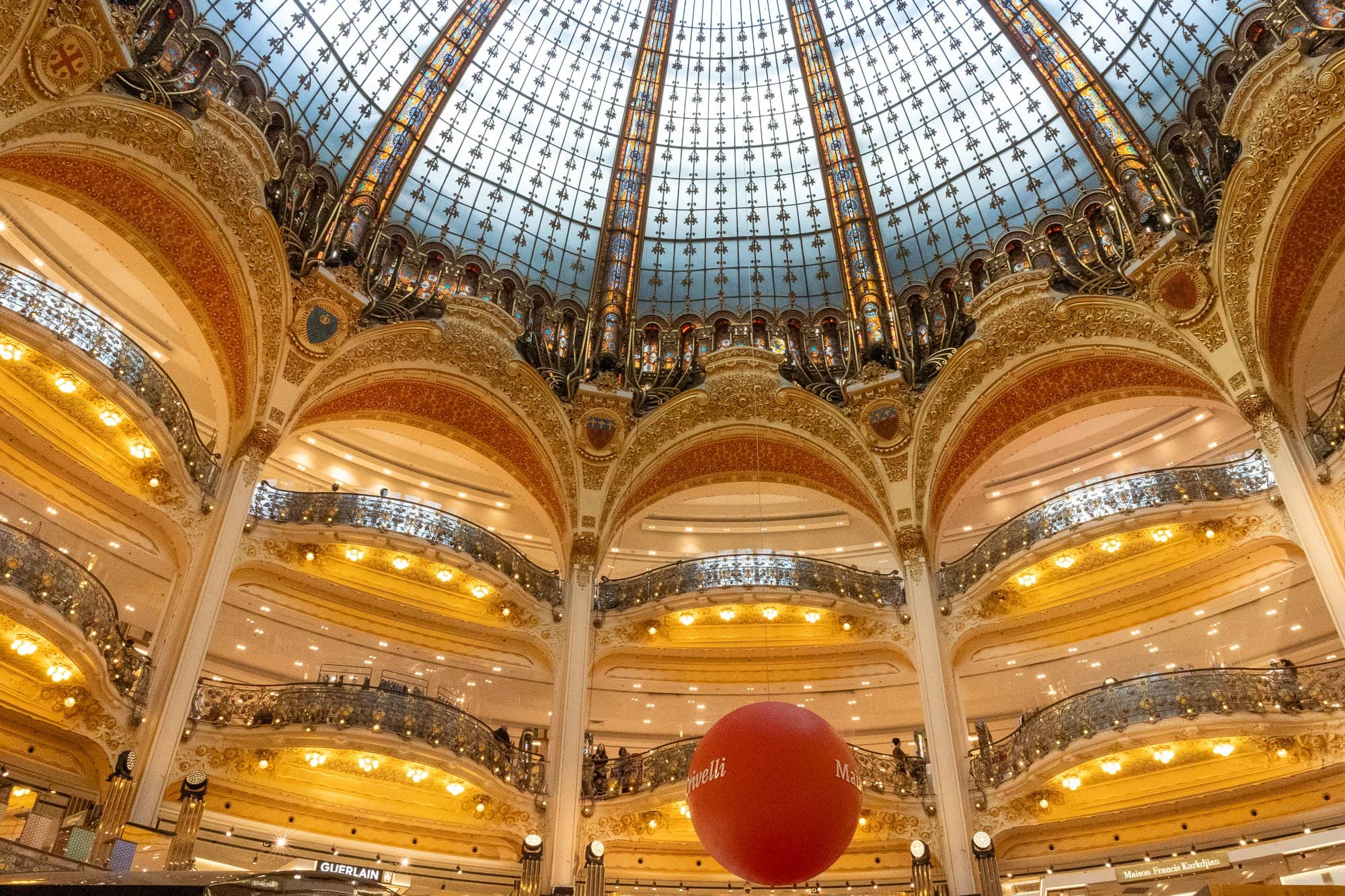
Glass dome and rooftop of Galeries Lafayette

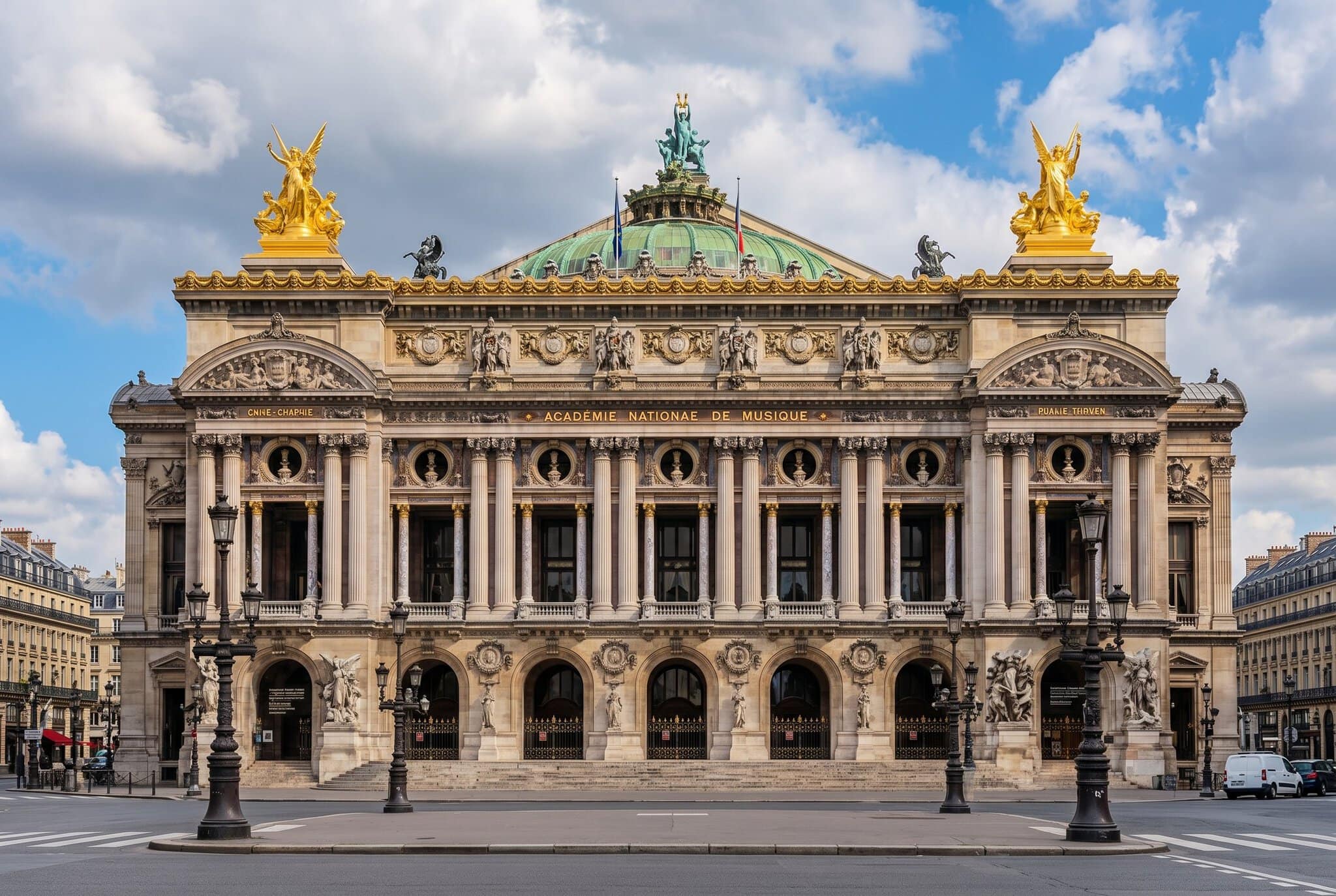
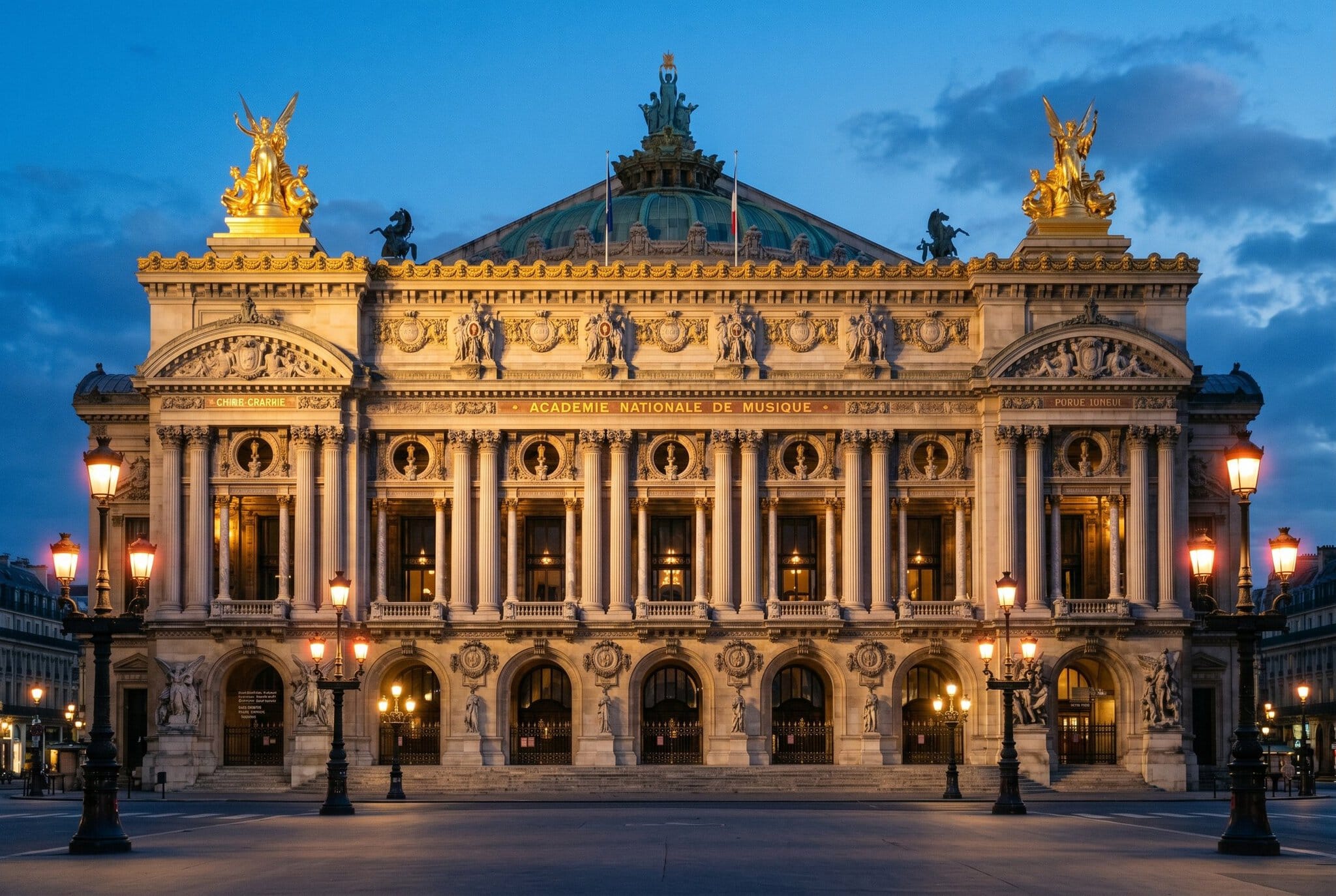
On the roof of one of the most famous department stores, you’ll find a huge open area with an incredible panoramic view. The ornate rear of the Opéra Garnier dominates the scene, but in the distance you can easily spot the iron tower and Montmartre hill too.

The rooftop often hosts art installations or a summer café. The ride up the escalators is an experience in itself — on the way you can admire the breathtaking art nouveau glass dome inside the store and drink in every detail.

  • Address: 40 Boulevard Haussmann, 9th arrondissement
  • Entry: Free
  • Open: Monday to Saturday 10:00–20:00, Sunday 11:00–20:00
  • Transport: Metro line 7 or 9 (Chaussée d’Antin – La Fayette station)

💡 Insider tip: Arrive about an hour before sunset. You can sit on the artificial turf, unpack your own snacks and watch the city lights gradually flicker on below.

Printemps 7e Ciel
Golden dome of the Printemps Haussmann department store

Right next door to the previous department store stands its slightly calmer rival, which hides a terrace called Printemps 7e Ciel on its seventh floor. It offers a slightly different angle, looking directly across the rooftops towards the river.

There’s a pleasant bar on the terrace, but you’re under no obligation to buy anything if you just want to stroll along the edge and snap a few photos. It’s noticeably less crowded than its neighbour, making it our personal escape when the crowds everywhere start getting to us.

  • Address: 64 Boulevard Haussmann, 9th arrondissement
  • Entry: Free
  • Open: Monday to Saturday 10:00–20:00, Sunday 11:00–20:00
  • Transport: Metro line 3 or 9 (Havre – Caumartin station)

💡 Insider tip: Finding the entrance to this terrace is a bit trickier. You need to enter the building dedicated to women’s fashion and take the lifts all the way up to the top. Don’t be put off by the luxury boutiques along the way.

Institut du Monde Arabe
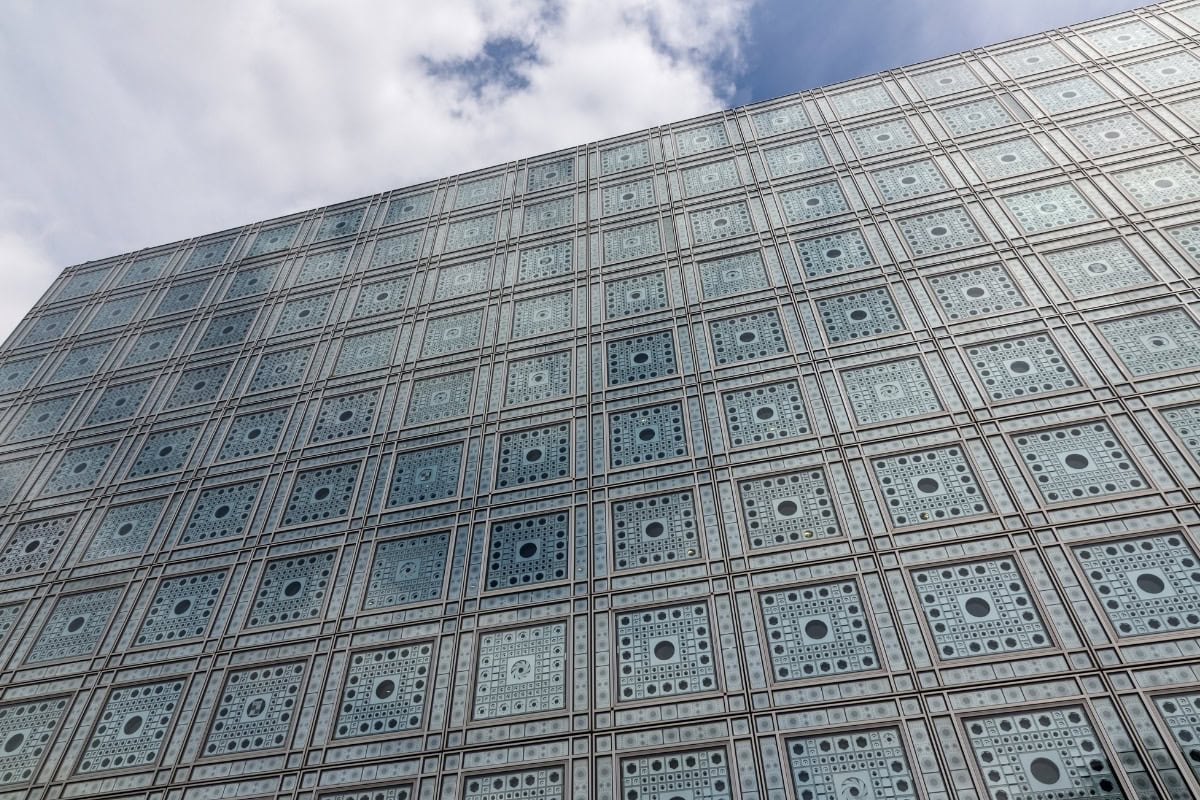
Modern façade of the Institut du Monde Arabe

If you happen to be in the Latin Quarter, this is an absolute must. The building itself is an architectural marvel — its façade is made of hundreds of mechanical shutters that open and close according to the intensity of sunlight. The Institut du Monde Arabe will simply mesmerise you visually.

Take the glass lift up to the ninth floor. The terrace serves up the finest possible view of the Seine and, in particular, the rear of Notre-Dame with its flying buttresses. The lift and terrace access are completely free for everyone.

  • Address: 1 Rue des Fossés Saint-Bernard, 5th arrondissement
  • Entry: Free (terrace; exhibitions are paid)
  • Open: Tuesday to Sunday 10:00–18:00 (closed on Mondays)
  • Transport: Metro line 7 (Jussieu or Sully-Morland station)

💡 Insider tip: In the ground-floor café you can grab an excellent mint tea and bring it up to the top. A warm cup in your hand and a view of the river — in the cooler months, it’s an absolutely perfect combination.

Parc de Belleville
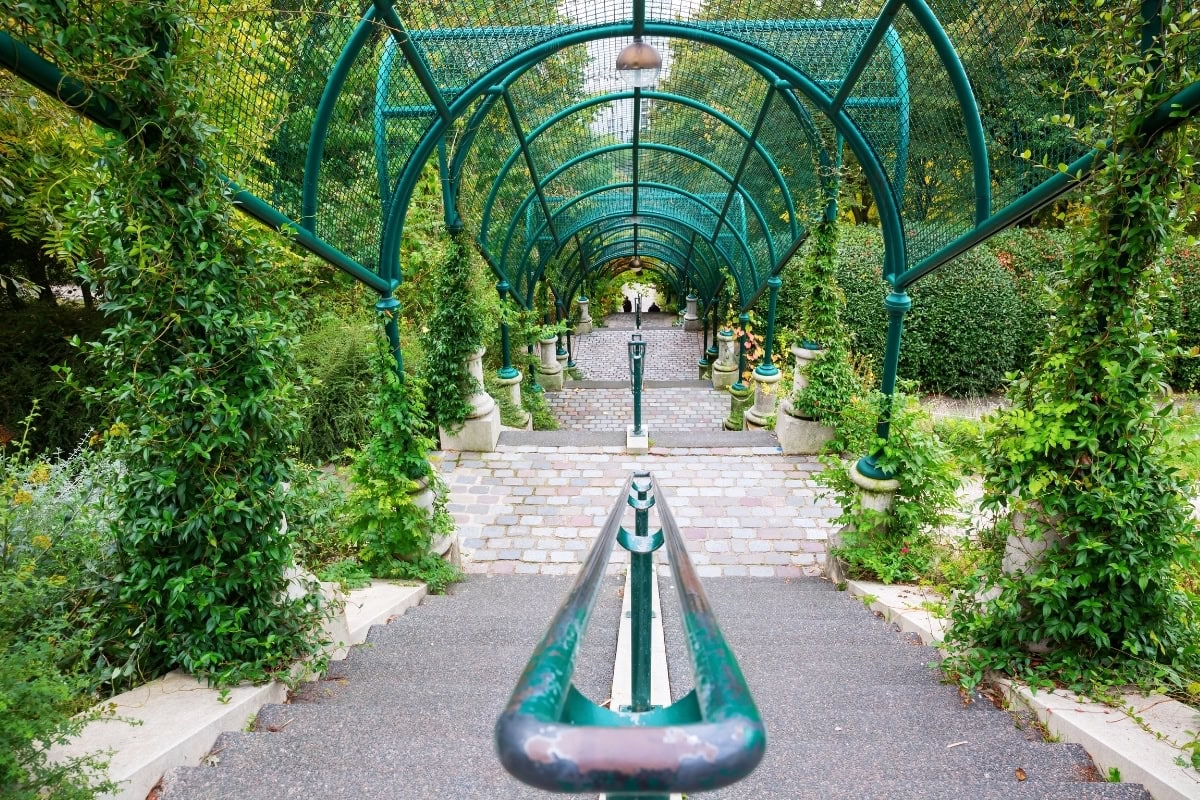
View over Paris from Parc de Belleville

This is the place for a viewpoint with a proper dose of nature. It’s the highest park in the city, sitting 108 metres above sea level, and the climb is well worth the effort.

The viewing terrace at the top is completely free and lays the entire city basin out before you like a map — from the hilltop Sacré-Cœur all the way to Les Invalides. Mostly local families and students come here to spend the afternoon; you’d only bump into a rucksack-laden tourist by pure chance. The park is full of fountains and cascades.

  • Address: 47 Rue des Couronnes, 20th arrondissement
  • Entry: Free
  • Open: Daily 8:00–21:30 (shorter hours in winter)
  • Transport: Metro line 11 (Pyrénées station)

💡 Insider tip: The walk up the hill with a pushchair is a decent workout — the paths wind and climb quite steeply. Either opt for a baby carrier, or ride the metro to the upper station and simply walk down through the park.

Pont de Bir-Hakeim Bridge
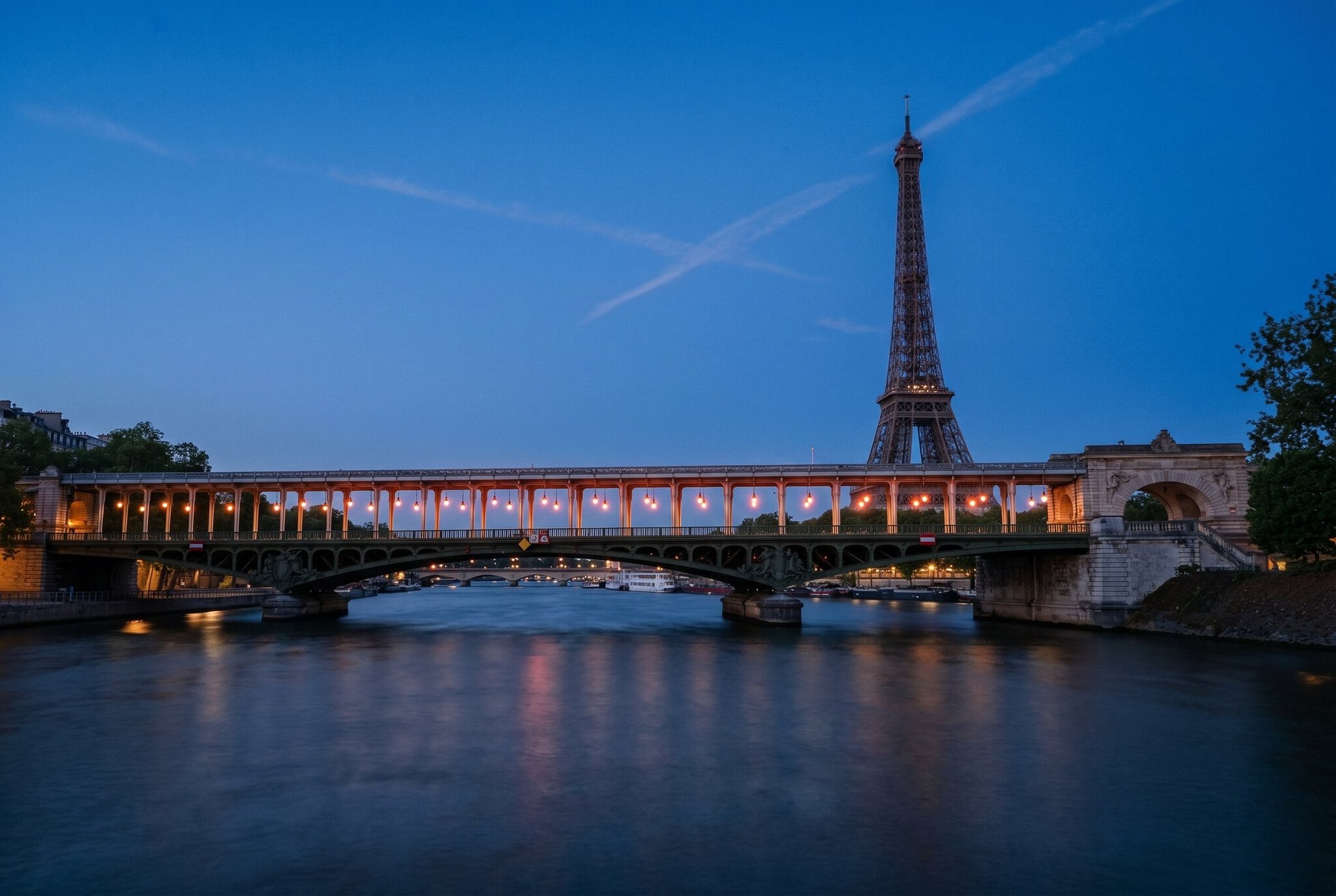
Double-decker Pont de Bir-Hakeim bridge with the metro viaduct

While most people jostle for position on Place du Trocadéro to photograph the iron tower, head to this double-decker bridge instead. The lower level serves cars and pedestrians; metro line six runs along the top.

The steel columns supporting the upper level create a perfect natural frame for photographing the tower. The spot was made famous by several films, including Christopher Nolan’s Inception. The view of the river and tower from here is far cleaner and less kitschy, so don’t be shy — make the most of it for a gorgeous family photo.

  • Address: Pont de Bir-Hakeim, border of the 15th and 16th arrondissements
  • Entry: Free
  • Open: Always
  • Transport: Metro line 6 (Bir-Hakeim or Passy station)

💡 Insider tip: If you want to photograph without crowds, come early on a weekend morning. On weekdays, streams of commuters cross the bridge heading to work on the other bank. Plus, the morning mist over the river gives your shots incredible depth.

Curiosities, Underground and Literary Heritage: The Darker Side of the City

I’ll admit that catacombs and taxidermied giraffes on the first floor of an old house often fascinate me more than yet another ornate salon interior — and Lukáš has come to terms with it. 😁 The city hides miles of dark tunnels and, above ground, ancient institutions that defy ordinary understanding. There are also several fascinating spots connected to Central European cultural history that are well worth seeking out.

Deyrolle
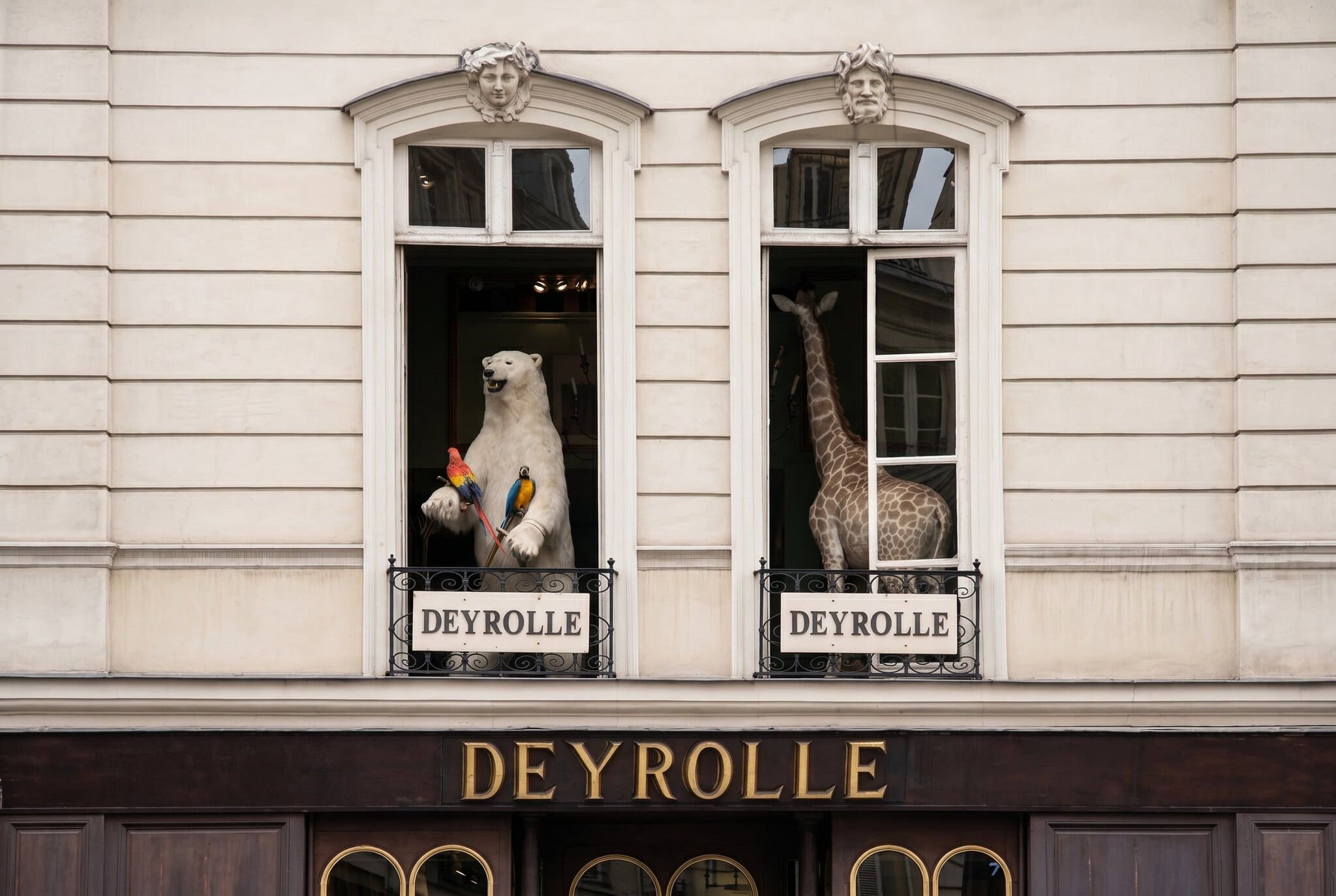
Historic interior of the Deyrolle cabinet of curiosities

From the street, this building in the 7th arrondissement looks like a run-of-the-mill old gardening shop. But climb the creaking wooden stairs to the first floor and you’ll find yourself in a genuine curiosity cabinet brimming with spectacular natural specimens.

This historic institution specialises in taxidermy and natural history. You’ll be surrounded by stuffed lions, giraffes and polar bears, and display cases hold thousands of shimmering butterflies. It’s fascinating, slightly eerie and utterly absorbing — a place that inspired many surrealist artists.

  • Address: 46 Rue du Bac, 7th arrondissement
  • Entry: Free (but photography inside is not allowed without permission)
  • Open: Monday to Saturday 10:00–19:00 (closed on Sundays)
  • Transport: Metro line 12 (Rue du Bac station)

💡 Insider tip: Children tend to love this place, but make sure they don’t touch anything. Most of the exhibits are actually for sale, and prices run into the thousands of euros. An accidental mishap could cost you dearly.

Paris Catacombs and Montparnasse Cemetery
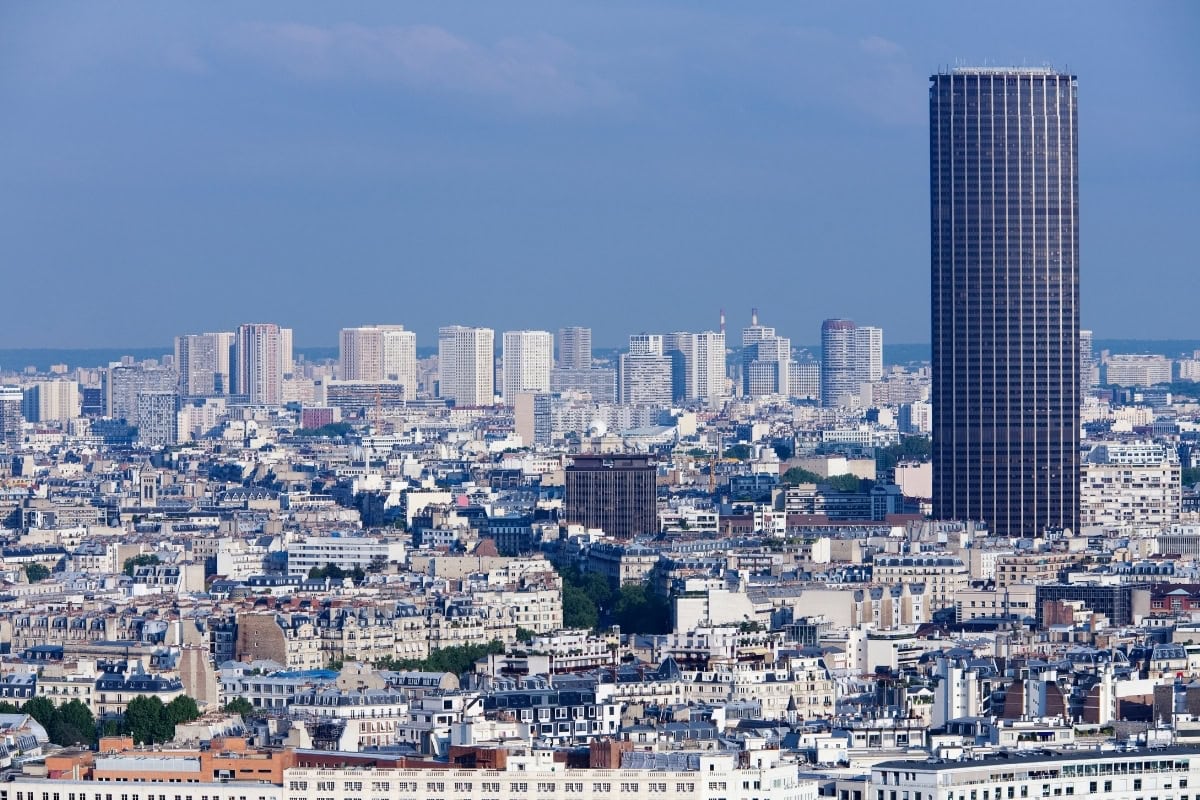
Tour Montparnasse tower above Parisian rooftops

If you’ve got a strong stomach, explore the underground beneath Place Denfert-Rochereau. In the dark tunnels deep below street level lie the neatly arranged bones and skulls of six million former inhabitants. For many, the descent is a truly powerful experience.

The remains were transferred here at the turn of the 18th and 19th centuries from overcrowded and unsanitary city cemeteries. The atmosphere is oppressive, the temperature hovers around fourteen degrees and — for obvious safety reasons — pushchairs aren’t allowed, so we’ve only ventured down child-free so far.

  • Address: 1 Avenue du Colonel Henri Rol-Tanguy, 14th arrondissement
  • Entry: 29 €
  • Open: Tuesday to Sunday 9:45–20:30 (closed on Mondays)
  • Transport: Metro line 4 or 6 (Denfert-Rochereau station)

💡 Insider tip: This is critical information. You must buy tickets online exactly seven days in advance. Tickets are no longer sold on-site and without a reservation you simply won’t get in.

Père-Lachaise Cemetery and its literary heritage
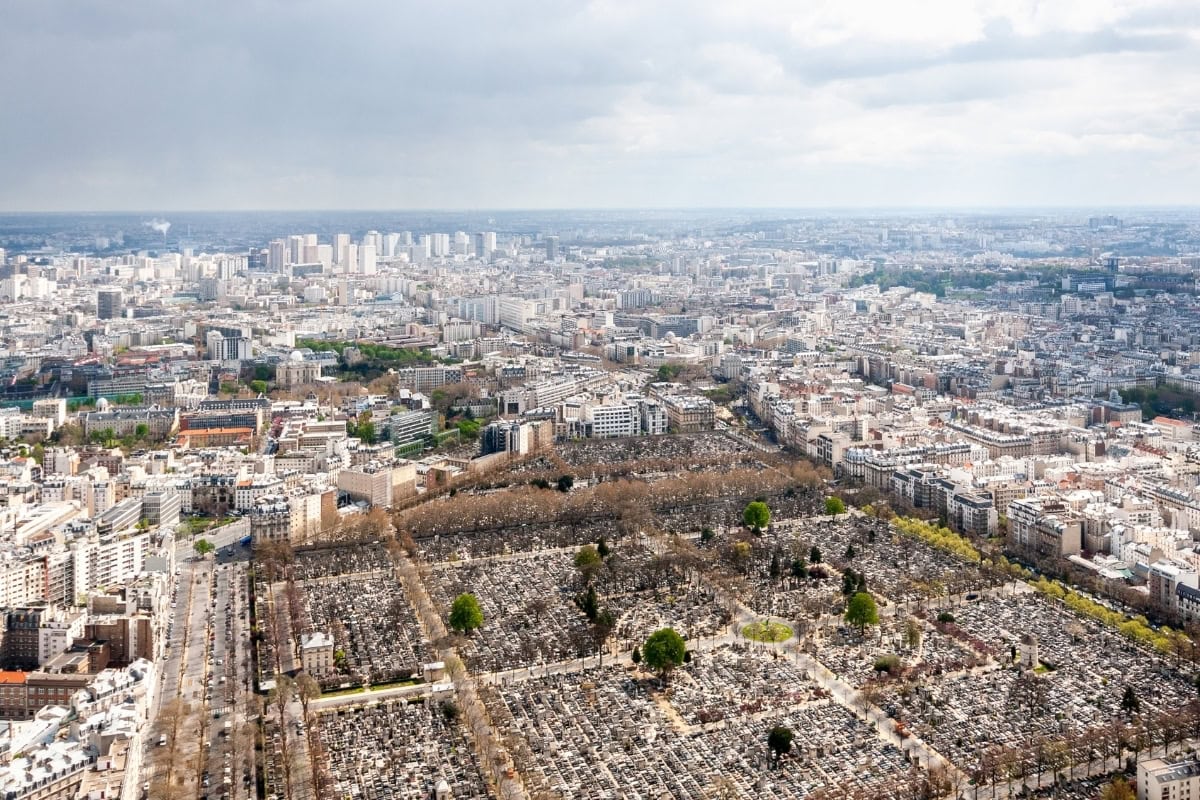
Tree-lined avenue and headstones at Père-Lachaise cemetery

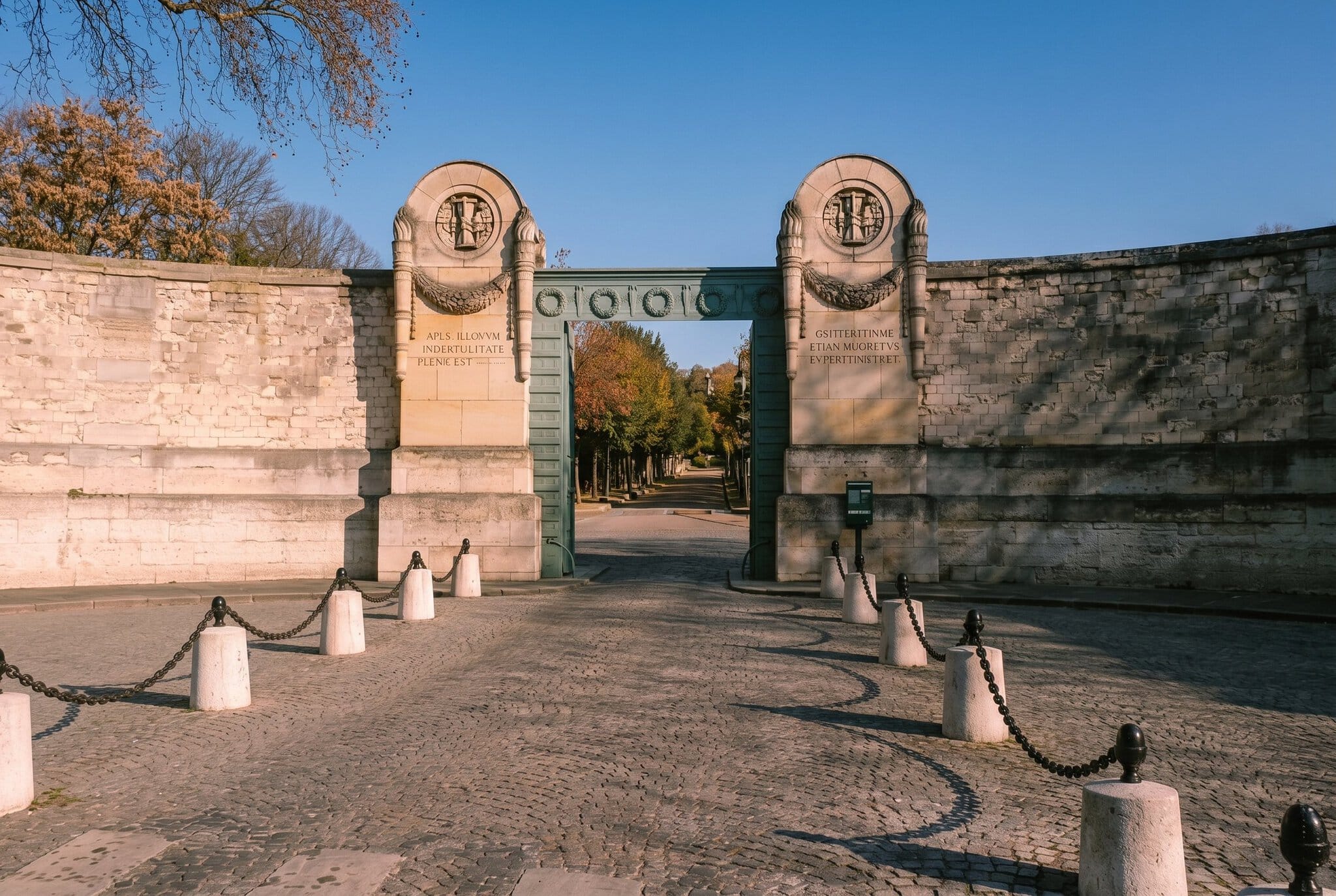
This is an enormous 44-hectare park full of mature trees and wandering cats. A pushchair rolls through beautifully. Besides famous names like Jim Morrison, Oscar Wilde and Édith Piaf, you’ll find a very significant Central European trail here.

Since 2023, the writer Milan Kundera — author of The Unbearable Lightness of Being, who lived in the city after leaving Czechoslovakia — has rested here. His grave is very simple and unassuming. Nearby you can also find the urn of the pioneering abstract painter František Kupka. It’s a fascinating piece of literary and artistic history, well worth the detour.

  • Address: 8 Boulevard de Ménilmontant, 20th arrondissement
  • Entry: Free
  • Open: Daily 8:00–18:00 (until 17:30 in winter)
  • Transport: Metro line 2 or 3 (Père Lachaise station)

💡 Insider tip: Don’t forget to photograph the orientation map from the noticeboard at the entrance. The cemetery is divided into dozens of divisions and without a map you’ll get hopelessly lost within ten minutes in this city of the dead.

Arènes de Lutèce
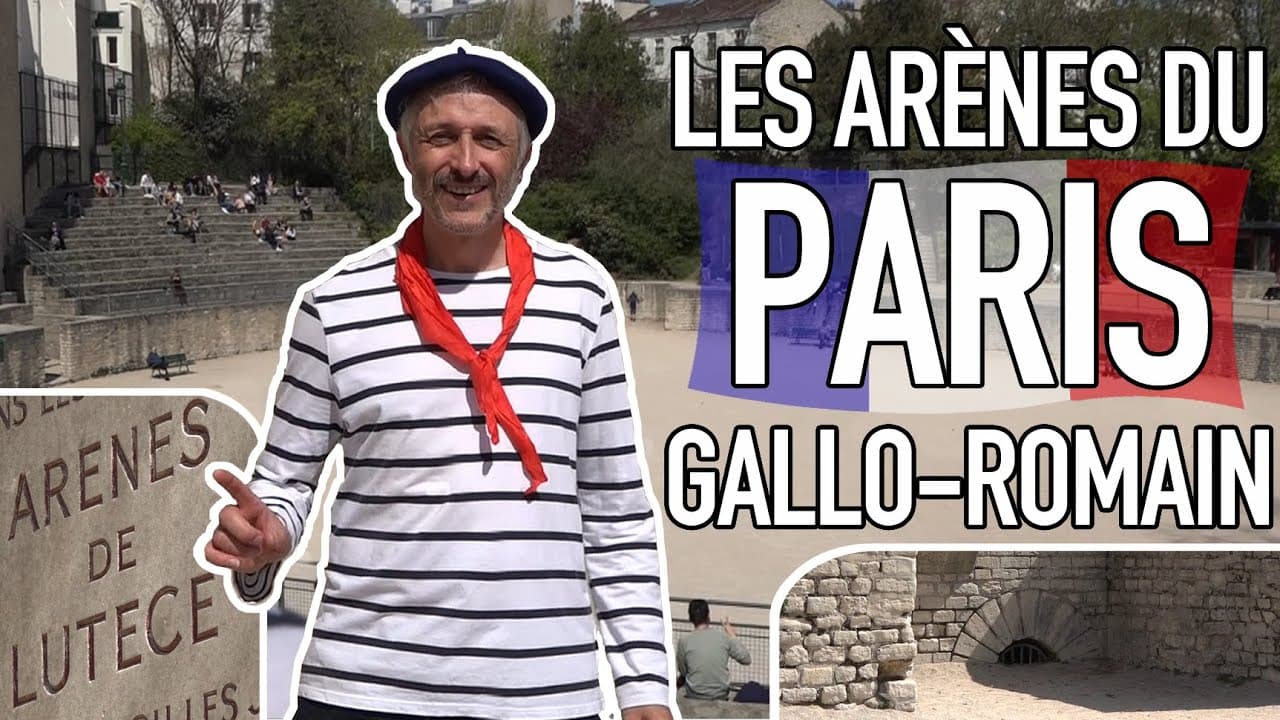
Ancient Roman amphitheatre Arènes de Lutèce in the Latin Quarter

Tucked away in the 5th arrondissement lies a monument that even many locals don’t know about. These are the remains of a Roman amphitheatre from the 1st century AD, which once held up to fifteen thousand spectators and is remarkably well preserved to this day.

Today it’s a public park hidden behind residential buildings. Instead of bloody gladiatorial combat, you’ll now see local pensioners playing pétanque and schoolchildren kicking a ball around. It’s a great spot for an afternoon stop with kids — the space is enclosed and safe.

  • Address: 49 Rue Monge, 5th arrondissement
  • Entry: Free
  • Open: Daily 8:30–21:00 (until 17:00 in winter)
  • Transport: Metro line 7 (Place Monge station)

💡 Insider tip: Sit on the ancient stone terraces with a coffee and imagine the spectacles that once took place here. The acoustics are still surprisingly good, and you’ll occasionally see young musicians practising their guitar.

59 Rivoli
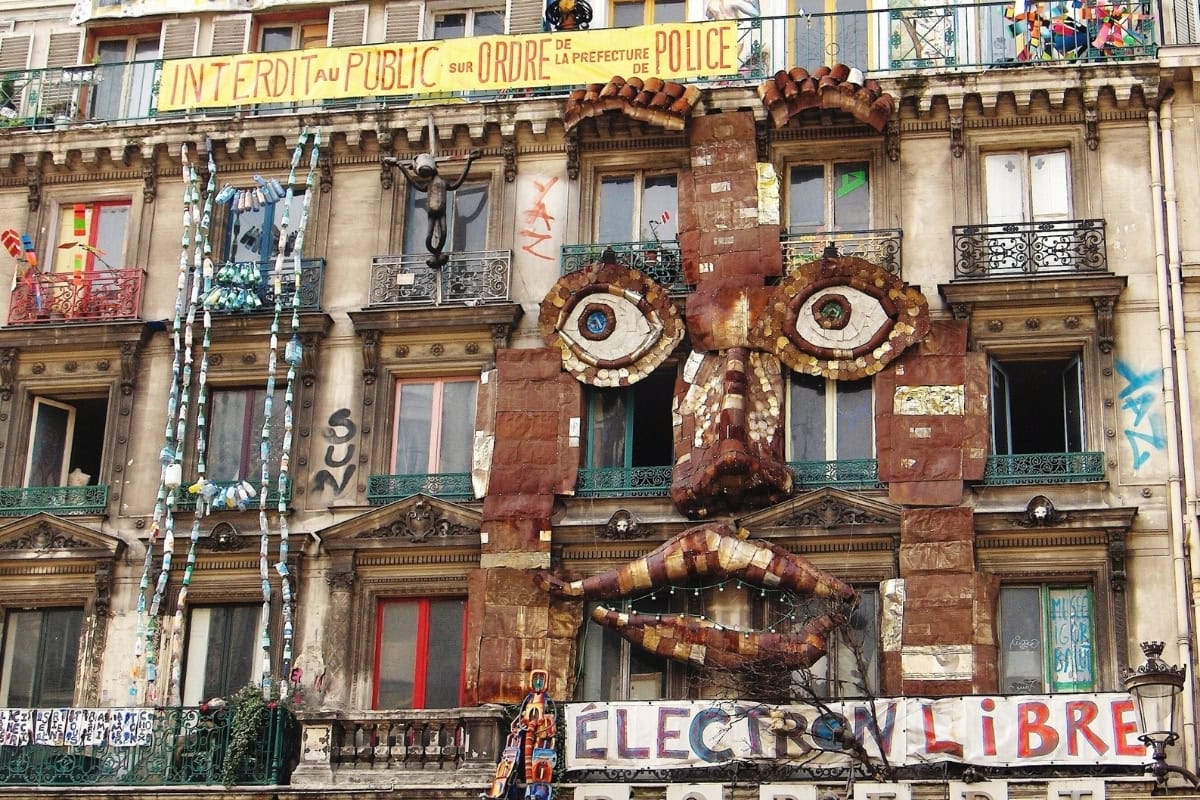
Artist squat and gallery 59 Rivoli

Right on one of the busiest shopping streets sits this complete one-off. Originally an illegal artists’ squat in an abandoned bank, the city eventually bought the building and made it official for everyone who loves living art.

Today, around thirty open studios host painters, sculptors and photographers. You can spot the building from a distance thanks to its wild façade decoration. Wander freely through the floors, chat with artists at work and soak up the wild, creative and delightfully chaotic energy.

  • Address: 59 Rue de Rivoli, 1st arrondissement
  • Entry: Free (voluntary donations welcome)
  • Open: Tuesday to Sunday 13:00–20:00 (closed on Mondays)
  • Transport: Metro line 1, 4, 7, 11 or 14 (Châtelet station)

💡 Insider tip: Free concerts often take place in the ground floor at weekends. It’s a tight squeeze and you can’t negotiate the stairs with a pushchair, but if you’ve got your child in a carrier it’s an incredibly stimulating visual environment.

Chat Mallows Café
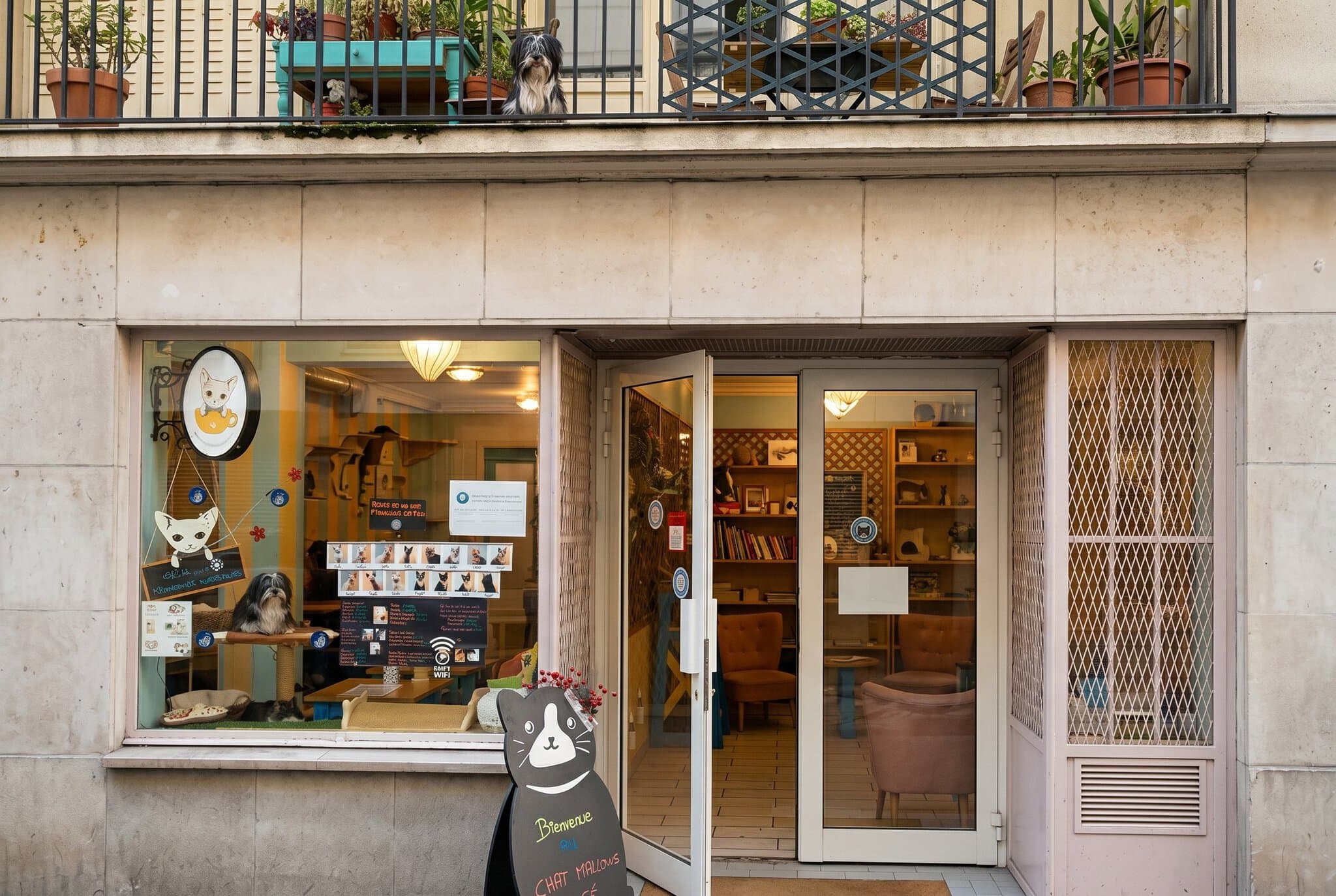
Cosy interior of the cat café Chat Mallows Café

For animal lovers and families with children, this is a wonderful rainy-day escape. In the 15th arrondissement you’ll find this cat café, home to around fifteen rescued cats.

The interior is designed around the cats’ needs, full of climbing structures and cosy beds. They serve excellent coffee and sweet desserts. Children need to be calm and respect the house rules so as not to stress the cats, but overall it’s a wonderfully soothing place where Jonáš will sit happily mesmerised for ages.

  • Address: 30 Rue des Volontaires, 15th arrondissement
  • Entry: Pay for what you consume + small time-based fee
  • Open: Wednesday to Sunday 12:00–21:00
  • Transport: Metro line 12 (Volontaires station)

💡 Insider tip: The place is very popular and capacity is limited to keep the cats comfortable. Definitely book in advance through their website, otherwise they’ll likely turn you away at the door.

Wallace Fountains and Petite Ceinture
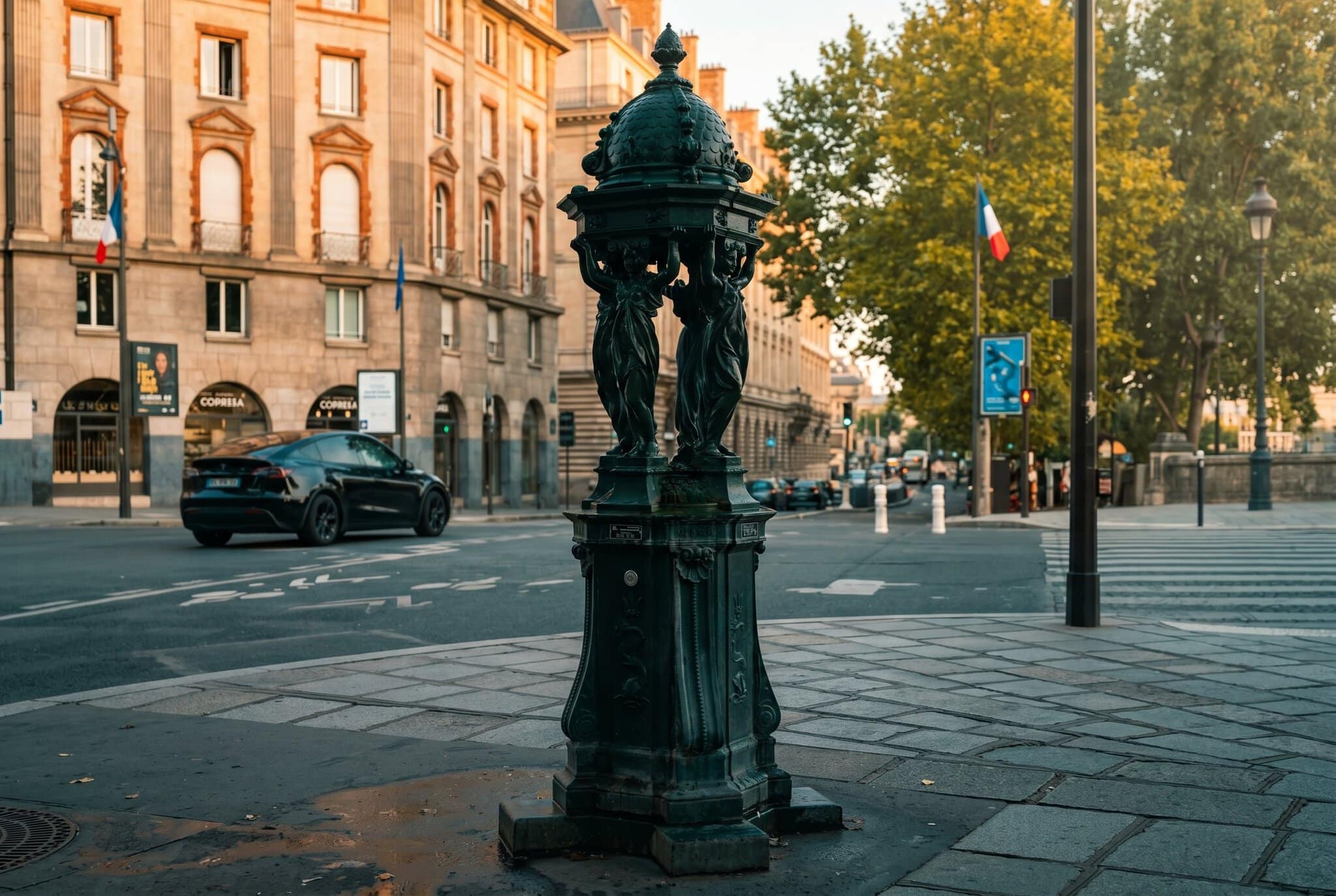
Dark green cast-iron Wallace fountain on a Parisian pavement

As you wander the city, keep an eye out for dark green cast-iron drinking fountains supported by four small female figures. These are the so-called Wallace fountains, which have stood here since the late 19th century. There are over a hundred of them and they all dispense perfectly safe drinking water completely free. In summer, they’re a lifesaver against dehydration.

If you’re after genuine wilderness, head for the Petite Ceinture. This is a 32-kilometre abandoned circular railway where nature has reclaimed the concrete. Several sections are now legally open, where you can walk through old tunnels and along rusting tracks.

  • Address: For example, entrance at Villa du Bel Air, 12th arrondissement
  • Entry: Free
  • Open: During daylight hours
  • Transport: Tram T3a (Montempoivre stop)

💡 Insider tip: A warning for families — don’t bring a toddler and pushchair here. The terrain is full of gravel, roots and old railway sleepers. In more remote stretches, rough sleepers sometimes shelter, so it’s not ideal for a relaxed walk with small children.

Where to Eat: Our Favourite Spots Without Tourist Mark-ups

For some, a trip to Paris is all about fashion — for Lukáš and me, it’s largely about food. Dodging tourist traps with overpriced onion soup made from a packet takes a bit of preparation, but once you know where to go, the city delivers an extraordinary culinary experience. Never sit down in a restaurant right on a main square or directly beneath a famous landmark — you’ll always overpay for dire quality.

We prefer to seek out small family-run places tucked away in side streets, or the kind of bistros where locals in both suits and overalls eat lunch. I’d love to share a few of our tried-and-tested favourites — the places we keep coming back to for the best crêpe or honest quiche when our stomachs start growling at midday.

Le Marais and surroundings
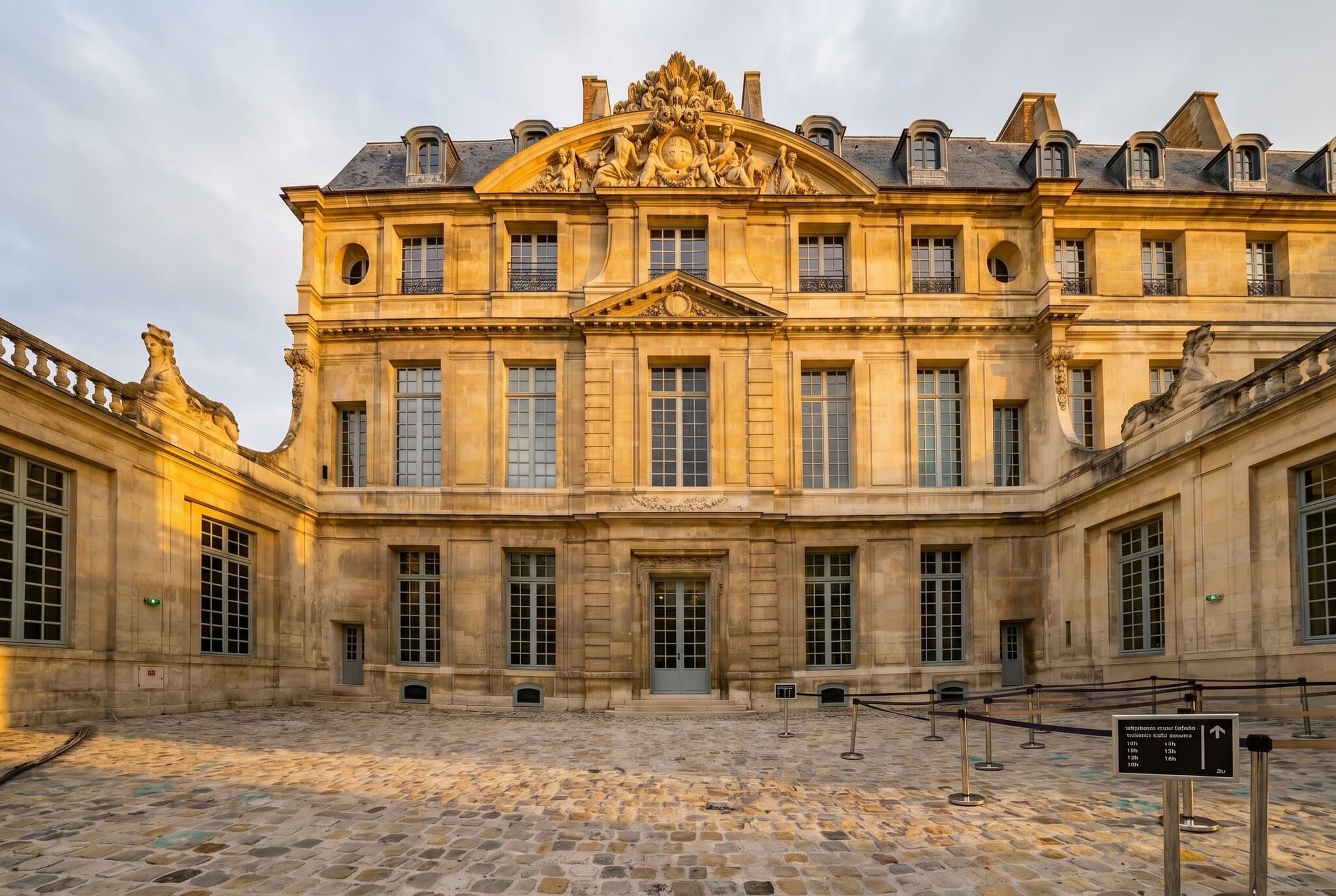
Courtyard of Hôtel Salé with Musée Picasso in the Marais

When our wanderings take us to Le Marais, we stick with a reliable classic. It’s a popular area, sure, but it still harbours plenty of traditional bistros with reasonable prices. Our number-one stop is the little falafel joint L’As du Fallafel, where we grab a pitta bread practically bursting at the seams with vegetables and hummus.

When we fancy sitting down for a proper rest, we head to Marché des Enfants Rouges. It’s a historic covered market packed with small food stalls from around the world. You sit on wooden benches, order a slice of savoury tart or a bowl of Moroccan couscous, and soak up the genuine local chatter. Best of all, the bill here won’t blow your holiday budget.

Canal Saint-Martin
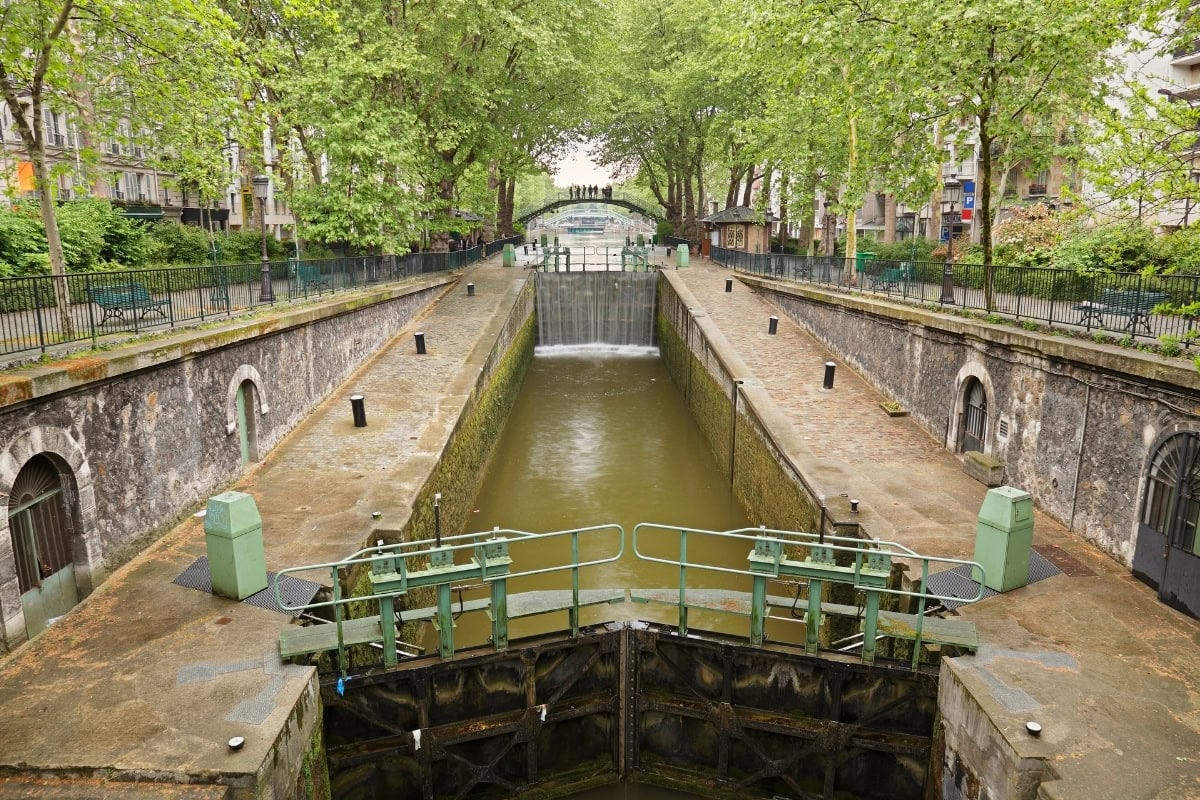
Cast-iron footbridges and trees along Canal Saint-Martin

For a more laid-back and less touristy vibe, we head north to the canal. It’s lined with dozens of small independent cafés and modern bistros. Mornings are best spent with a specialty coffee and an enormous buttery croissant at Ten Belles — it does get packed, but the service is incredibly warm and speedy.

In the evening we sometimes treat ourselves to a relaxed dinner at one of the many local crêperies. We’re obsessed with savoury buckwheat galettes stuffed with cheese, ham or spinach. They’re beautifully crispy and are traditionally washed down with semi-dry cider from ceramic bowls. For us, it’s the absolute pinnacle of culinary bliss — and Jonáš always gets a sweet chocolate crêpe for dessert.

Practical Info: How to Survive Without Losing Your Mind

Getting around a foreign capital requires a certain amount of tactical preparation, especially when you’ve got a small child in tow. The city has its own unwritten rules, and if you respect them you’ll save yourself a world of hassle and money.

Transport and pushchair logistics

The metro is fast, but for parents with a pushchair it’s frankly a nightmare. Stations are full of endless stairs, the turnstiles barely fit an empty buggy, and of all the lines only the modern line 14 is fully step-free. We rely mainly on surface buses instead. They’re slower, but you get to see the city and you can roll right in through the middle doors with a pushchair, no folding required. If you’re arriving from the UK, you’ll probably fly into Charles de Gaulle or Orly — pick up a Navigo Découverte card for around 30 €, which covers all transport including the journey from the airport. Flights from London are plentiful — both British Airways and easyJet operate regular services from Heathrow, Gatwick and Luton, and the Eurostar from St Pancras gets you to Gare du Nord in just over two hours.

The Golden Bonjour Rule

This is the absolute foundation — ignore it at your peril. Every single time you enter a shop, bakery or board a bus, you must say a clear and audible “Bonjour” (Good day). If you skip this and launch straight into English with your request, locals will regard you as a rude barbarian and their willingness to help will plummet to zero. On your way out, it’s polite to say “Merci, au revoir” (Thank you, goodbye).

Food tips to save money

Here’s a tip that escaped us in our first year and cost us more than it should have: never pay for tap water in restaurants. Just say “Une carafe d’eau, s’il vous plaît” and they’ll bring you a whole glass carafe of chilled water, completely free. If you’re looking for cheaper eats, look for the signs reading “La Formule” or “Menu du Jour” on boards outside restaurants at lunchtime. This means a set lunch menu, where a two-course meal costs around 18–22 €, which is excellent value by local standards.

Watch out for scams and pickpockets

The city is generally very safe, but petty crime targeting inattentive visitors unfortunately thrives. On the metro — especially on line 1 around the Louvre — wear your backpack on your front. Ignore anyone near landmarks trying to get you to sign some petition for the hearing-impaired; it’s a distraction trick. Likewise, never let anyone tie colourful friendship bracelets on your wrist beneath the basilica on Montmartre. And remember: entry to the restored Notre-Dame cathedral is free — anyone offering you tickets on the street is a scammer. It’s also worth keeping your valuables in a hidden money belt for extra peace of mind.

Read Next

If you’ve already ticked off the hidden gems and want to tackle the most famous landmarks too, check out our comprehensive guide on what to see in Paris. It includes tips on how to avoid the worst queues.

Interested in art and history? We’ve put together a detailed article on the best museums in Paris, including when admission is completely free and how the museum pass works.

And if you only have an extended weekend and need a clear plan, our Paris in 3 days article offers a logically structured step-by-step itinerary so you won’t waste time criss-crossing the city unnecessarily.

Frequently Asked Questions

Tips and Tricks for Your Vacation

Don’t Overpay for Flights

Search for flights on Kayak. It’s our favorite search engine because it scans the websites of all airlines and always finds the cheapest connection.

Book Your Accommodation Smartly

The best experiences we’ve had when looking for accommodation (from Alaska to Morocco) are with Booking.com, where hotels, apartments, and entire houses are usually the cheapest and most widely available.

Don’t Forget Travel Insurance

Good travel insurance will protect you against illness, accidents, theft, or flight cancellations. We’ve had a few hospital visits abroad, so we know how important it is to have proper insurance arranged.

Where we insure ourselves: SafetyWing (best for everyone) and TrueTraveller (for extra-long trips).

Why don’t we recommend any Czech insurance company? Because they have too many restrictions. They set limits on the number of days abroad, travel insurance via a credit card often requires you to pay medical expenses only with that card, and they frequently limit the number of returns to the Czech Republic.

Find the Best Experiences

Get Your Guide is a huge online marketplace where you can book guided walks, trips, skip-the-line tickets, tours, and much more. We always find some extra fun there!
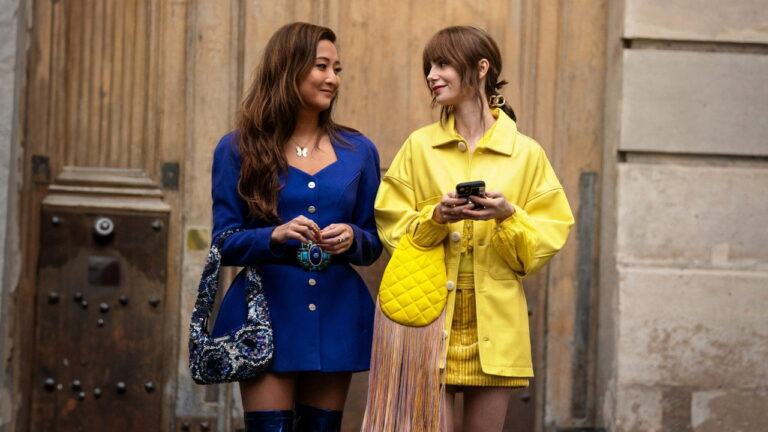

Emily in Paris: 15 Filming Locations in Paris (Complete Guide)

TL;DRThis guide covers 15 real filming locations from Emily in Paris, mostly clustered in the 5th arrondissement (the Latin Quarter) — from Emily’s flat on Place de l’Estrapade to Boulangerie Moderne and Gabriel’s restaurant Terra Nera, right through to the Panthéon and the Luxembourg Gardens. It also takes you to the Savoir agency on Place de Valois, to Café de Flore and Les Deux Magots, up to Montmartre for La Maison Rose and Sacré-Cœur, and over the Pont Alexandre III and Pont des Arts. You can walk the core loop in 2 to 3 hours, a croissant at Boulangerie Moderne costs €1.50, and organised “Emily” walking tours start at €14.50.

When Lukáš and I settle in for a Netflix evening after putting our little one to bed, we usually look for something light and easy to unwind with — and that’s exactly how we stumbled upon Emily in Paris. It’s obviously a massive cliché, everything is a bit over the top, and Paris looks like it’s been run through the most perfect colour filter imaginable, but I have to admit we both got hooked and it was the perfect way to switch off. You simply can’t help being drawn in by the romantic atmosphere and those gorgeous little streets.

We visited Paris recently with our toddler, so I’ll be upfront — ticking off Emily in Paris filming locations with a pushchair and a toddler’s schedule wasn’t exactly practical. We weren’t hopping from café to café or posing outside bakeries because, well, we had other priorities. But the topic fascinated me so much that I thought: if we’d had more time and free hands, we’d have loved to visit all these spots. So I did a thorough deep dive, tracked down every beautiful filming location, and put together this guide.

In this article, you’ll find 15 Emily in Paris filming locations — from Emily’s famous apartment and the fragrant bakery to Gabriel’s restaurant, iconic cafés, and historic bridges over the Seine. I want to show you not just where exactly these places are and which episodes they appear in, but also how much a coffee or meal costs there, so you’re not caught off guard. Paris can be seriously pricey, and part of the reason some people take the show with a pinch of salt is its unrealistic portrayal of the city. But if you approach it with the right mindset, you can enjoy a magical trip following in Emily’s footsteps.

The main cast of Emily in Paris

TL;DR

  • The heart of the show and its most iconic spots are in Paris’s 5th arrondissement (Quartier Latin), where everything is just a few steps apart.
  • The core walking route through central Emily in Paris filming locations can be comfortably covered on foot in two to three hours — no complicated logistics needed.
  • Emily’s apartment building is a regular private residence — you can only view it from outside; there’s no way to go in.
  • Famous cafés from the show like Café de Flore and Les Deux Magots are legendary but appropriately expensive, so expect to pay a premium for the atmosphere and history.
  • Local residents near filming spots are often frustrated by crowds of tourists, so please be respectful — don’t photograph people’s windows and keep noise down in the small squares.

Following Emily in Paris: how to plan your visit (when, how many seasons, route, transport)

Emily and Mindy strolling through a Parisian street in Emily in Paris

Before you head to the French capital to hunt down familiar streets and restaurants, it’s worth getting a few organisational basics sorted so you don’t get lost and know what to expect from the filming locations. Emily in Paris currently has five seasons, with the fifth dropping on 18 December 2025, and a sixth season is already officially confirmed. The key thing to know, though, is that from season five onwards the story largely shifts to Rome, so this guide focuses primarily on the classic locations from the first four seasons set in the heart of France.

Wondering whether you can fit all the main spots into a single day? Good news — you absolutely can. The central locations can be walked in around two to three hours, and I’d recommend starting at Place de l’Estrapade, then continuing to the nearby Panthéon, strolling through the peaceful Luxembourg Gardens, crossing the river via Pont des Arts, stopping by the Louvre, and finishing up at Place de Valois and the Palais Royal gardens. Set aside a separate trip for romantic Montmartre — you’ll need to hop on the Métro to get there, but several more gorgeous stops await you that are well worth the detour.

As for getting around Paris, the easiest option is to pick up a Navigo Easy card and download the handy Bonjour RATP app, which makes finding Métro and bus connections a breeze. Getting from the UK to Paris is very straightforward these days — you can take the Eurostar from London St Pancras (return tickets from around £60–£150 depending on how far ahead you book), or fly with budget airlines like easyJet or Ryanair from London, Manchester, or Edinburgh, with returns typically ranging from £30 to £120. You could also try organised “Emily” walking tours, offered by sites like Come to Paris from around €14.50 per person, but with a bit of planning you can easily do everything at your own pace.

Where to stay to have the locations on your doorstep

Lucie with a toddler in front of the Eiffel Tower at Trocadéro

Choosing the right neighbourhood will make or break your entire experience and budget. Paris is divided into twenty arrondissements that spiral outward clockwise from the historic centre near the Louvre. Finding affordable accommodation in the centre is nearly impossible, but if you know where to look, you can find a great compromise between price, safety, and accessibility.

With a pushchair and our little Jonáš, we gave a wide berth to the northern part of the 10th arrondissement around Gare du Nord and Pigalle in the 18th arrondissement at night. A friend and I once got lost there at 2am, and that’s definitely not an experience you want to repeat with a two-year-old. 😅 

After a long search, we chose Hôbou, an authentic French boutique hotel in Boulogne-Billancourt (you can book it here). It looks rather unassuming at first glance, but within the first few hours you’ll be completely smitten.

5th arrondissement: Emily’s neighbourhood (the heart of all locations)

Emily and Mindy outside a Parisian doorway in Emily in Paris

If you want to feel like you’ve genuinely stepped into the show, your first stop absolutely has to be the 5th arrondissement. It’s the beating heart of the entire story, and all the key locations here are within a five-minute walk of each other. The easiest way to get here is by taking the Métro to Cardinal Lemoine, or hopping on the RER to Luxembourg station, from where it’s just a pleasant short stroll to Emily’s little square.

1. Emily’s apartment on Place de l’Estrapade

Place de l'Estrapade in Paris's 5th arrondissement, where Emily lives in the show
Place de l’Estrapade in Paris’s 5th arrondissement, where Emily lives in the show

Your first stop will inevitably be 1 Place de l’Estrapade — that charming little square with a tree and benches where Emily lives in a tiny attic flat on the fifth floor with no lift. In real life, it’s an ordinary private residential building, so you can only view it from outside — there’s no way in. You also won’t find the restaurant and bakery directly below as shown in the series; they’re actually around the corner on the adjoining street. I’d recommend arriving very early in the morning, because during the day queues of tourists form waiting for a photo in front of the entrance, which understandably tests the patience of the locals who simply want to go about their lives.

2. Boulangerie Moderne — Emily’s bakery

Boulangerie Moderne in Paris, famous from the Emily in Paris series

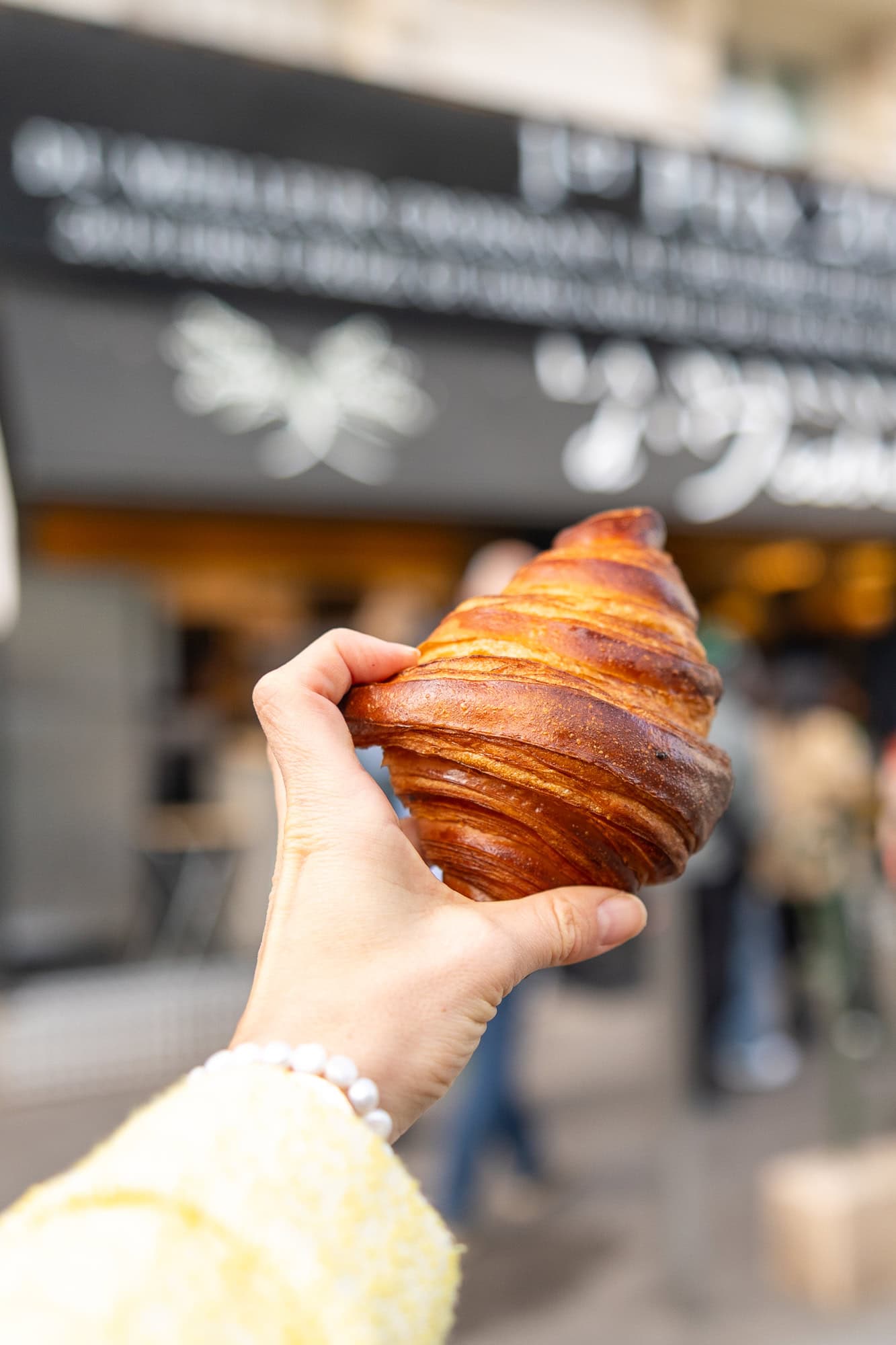
Just around the corner at 16 Rue des Fossés Saint-Jacques sits Boulangerie Moderne — the famous bakery where Emily picks up her beloved morning pain au chocolat. The wonderful thing about it is that it’s a real, fully functioning artisan bakery with a gorgeous historic shopfront. A regular croissant here costs around €1.50 and a traditional crusty baguette is about €1, which are perfectly normal prices for central Paris. They’re usually open Monday to Friday from 7:00 to 20:00, but watch out — they’re typically closed in August and every Monday, so don’t turn up only to find the shutters down. Despite being a massive tourist draw now, it remains a genuinely excellent neighbourhood bakery using organic flour. It even won a silver medal for the best croissant in Paris’s city competition in 2023 and placed fourth in the Parisian bakers’ union ranking in May 2025.

3. Terra Nera — Gabriel’s restaurant

Terra Nera restaurant with its red façade, Gabriel's restaurant from Emily in Paris
Terra Nera restaurant with its red façade, Gabriel’s restaurant from Emily in Paris

Directly opposite Emily’s building, at 18 Rue des Fossés Saint-Jacques, you’ll find a restaurant with a striking red façade that plays the role of hunky chef Gabriel’s beloved eatery, changing names across the seasons from Les Deux Compères to Chez Lavaux to L’Esprit de Gigi. Here’s where a big surprise awaits: Terra Nera is actually an Italian restaurant, not a French bistro, so you won’t find traditional cassoulet on the menu — think pasta with mussels, veal Milanese, and excellent pizza instead. Main courses run around €18–25, and they even offer a special themed “Emily in Paris” menu for €39 if you want the full experience. Definitely call ahead and make a reservation, because the place is often completely booked out, and there’s almost always a crowd of fans snapping photos outside.

4. Panthéon

The Panthéon on Place du Panthéon in Paris's Latin Quarter
The Panthéon on Place du Panthéon in Paris’s Latin Quarter

It’s just a few minutes’ walk from Emily’s apartment to the sweeping Place du Panthéon, where the stunning Panthéon building appears in the series mainly during season one as part of those beautiful establishing shots of life in the 5th arrondissement. This magnificent building is the final resting place of famous French figures like Victor Hugo and Marie Curie, making it a natural and worthwhile stop on your route. Admission to the interior, which is generally open from 10:00 to 18:30, costs €11–13. You can check current details on the official Panthéon website.

5. Jardin du Luxembourg (Luxembourg Gardens)

Luxembourg Gardens in Paris's 6th arrondissement, where Emily goes for a morning jog
Luxembourg Gardens in Paris’s 6th arrondissement, where Emily goes for a morning jog

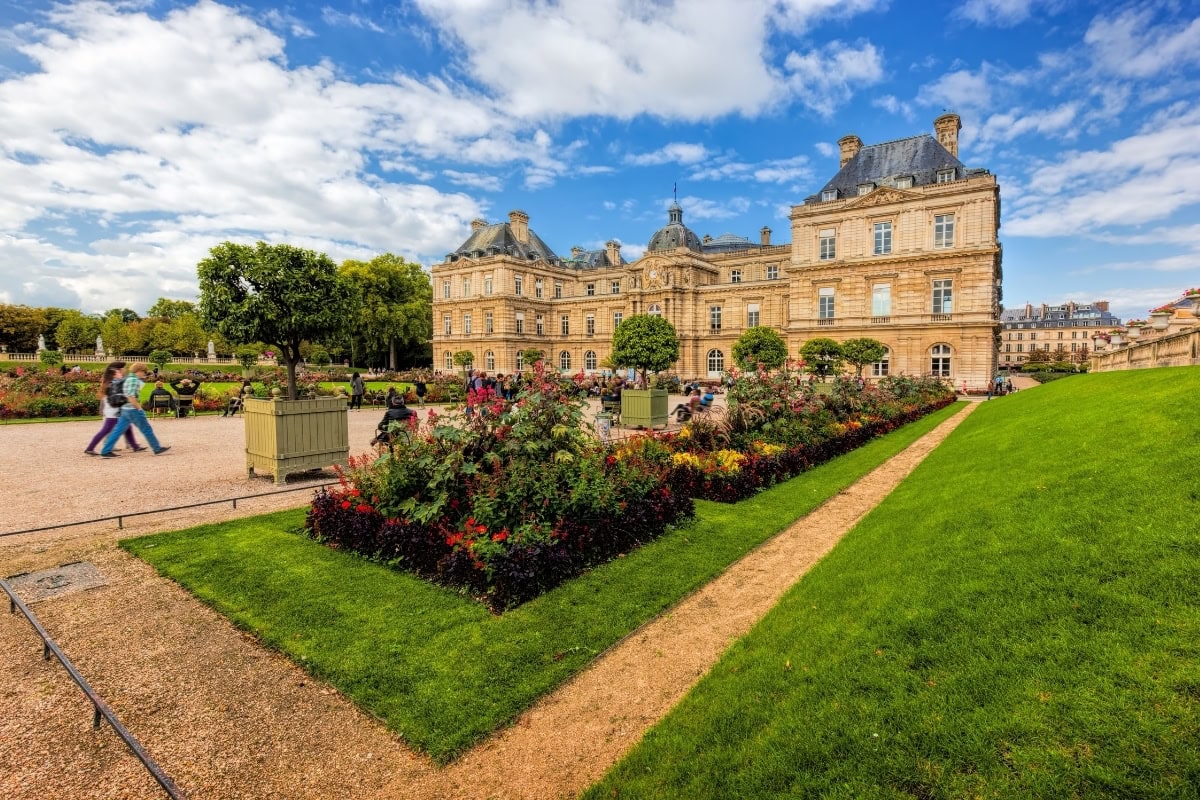
Just a short walk away in the neighbouring 6th arrondissement, you’ll find the Jardin du Luxembourg — the beautiful, sprawling Luxembourg Gardens where Emily goes for a morning run in the second episode of season one. Entry is completely free, and it’s the perfect spot for a little break during your walk. Settle into one of the iconic green metal chairs around the grand fountain or let the kids play with the traditional wooden toy boats. Lukáš and I love these gardens, and if you’re ever visiting Paris with young children like we did with our toddler, you’ll appreciate the wonderful calm and the vast open space for running around and unwinding.

1st arrondissement: where Emily works (Savoir and Palais Royal)

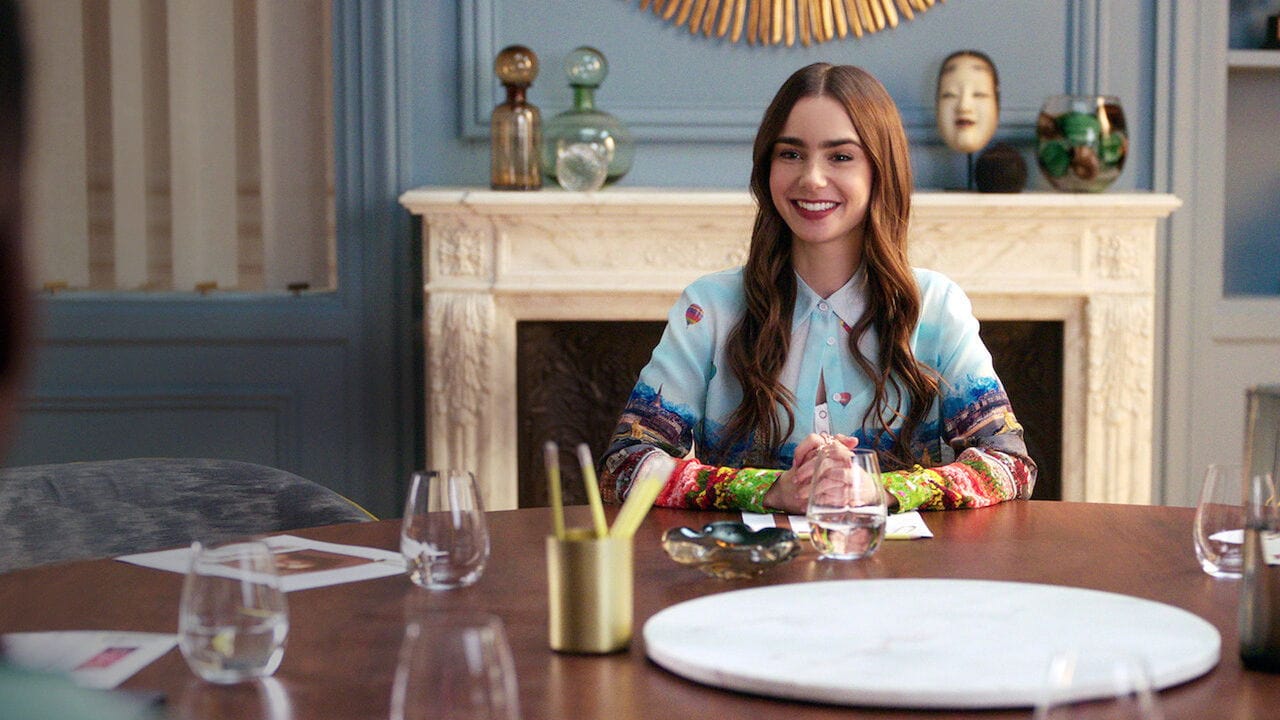
Emily in the Savoir marketing agency office from Emily in Paris

Once you’ve thoroughly explored Emily’s neighbourhood, it’s time to head over to the 1st arrondissement — exactly where the main character commutes to work each morning, and where you’ll feel a slightly more luxurious old-Paris atmosphere. The best way to get here is to hop on the Métro and get off at Palais Royal–Musée du Louvre, from where it’s just a short walk through picturesque lanes to the show’s marketing agency.

6. Place de Valois — Savoir agency / Agence Grateau

Traditional Parisian café on Rue Valois near the Savoir agency

The first spot you’ll be looking for is the hidden little square Place de Valois at 6 Place de Valois near Rue des Bons Enfants, home to the Savoir marketing agency (which later becomes Agence Grateau). The courtyard where Emily arrives in practically every episode and where most of the outdoor conversations with boss Sylvie take place is freely accessible, so you can wander through and imagine yourself heading to a meeting with a morning coffee in hand. It’s easily reached via a passageway from the nearby Palais Royal, and it’s usually pretty quiet since the square is slightly tucked away from the main tourist trail.

7. Jardin du Palais Royal — the striped columns

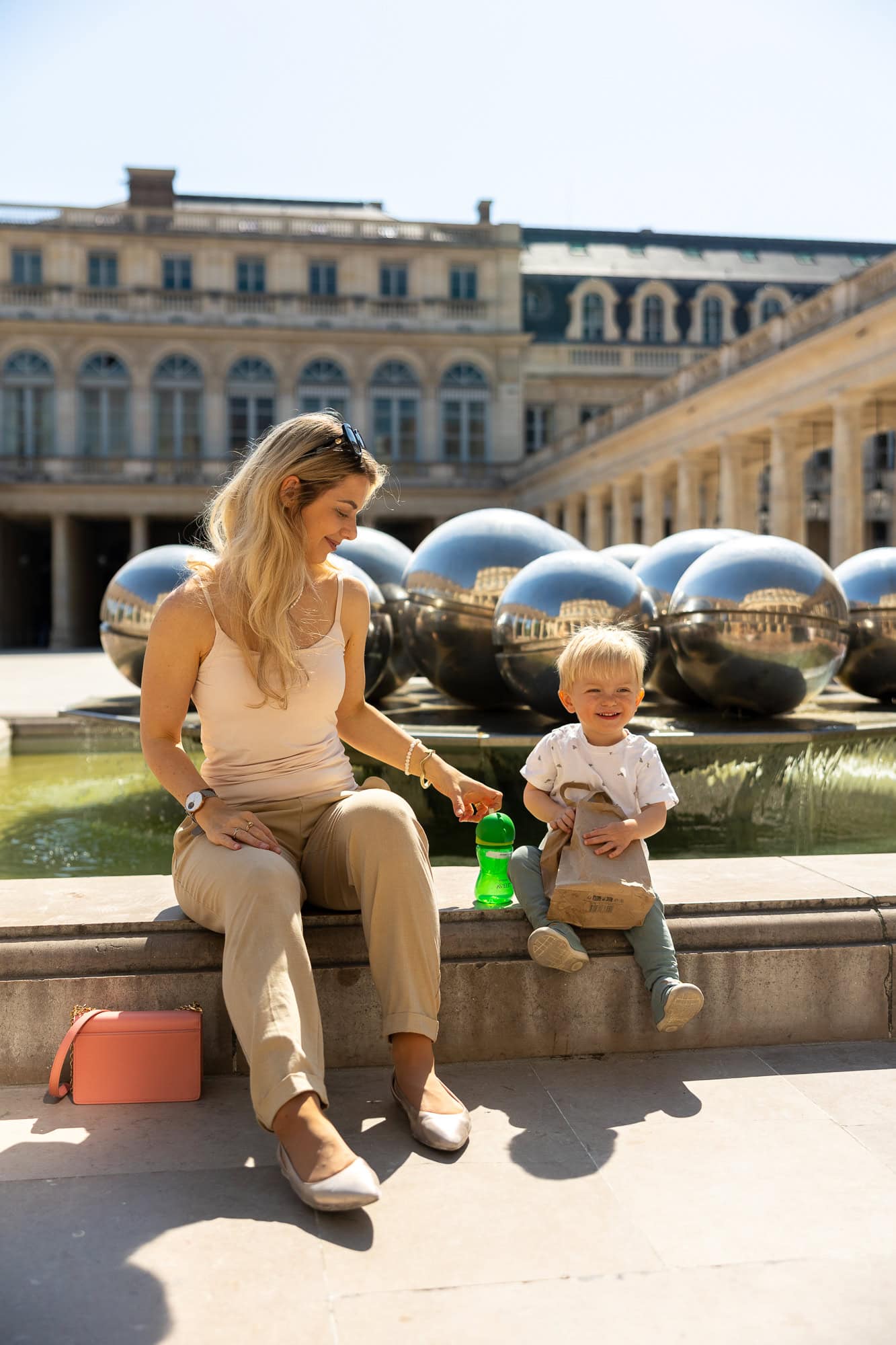
The striped Colonnes de Buren in the Palais Royal courtyard in Paris

Just a few dozen metres away at 8 Rue de Montpensier, you’ll come across the Jardin du Palais Royal — a free-entry spot that plays a fairly significant role in the series. This is where Emily first sits down on a bench by the fountain, has lunch, and meets her future best friend Mindy. Beyond the lovely gardens with their benches, you’ll also find one of Paris’s most popular Instagram photo spots: the iconic black-and-white striped columns of varying heights known as the Colonnes de Buren. It’s a delightful place to escape the buzz of the big city, and considerably less crowded than the nearby parks around the Louvre itself.

8. Le Grand Véfour — the restaurant Emily can’t get into

Right on the edge of these gardens at 17 Rue de Beaujolais sits Le Grand Véfour, a lavish and grand historic restaurant where Emily confidently tries to take clients and colleagues for dinner in season one, only to be mortified at the entrance when she realises she’s mixed up her reservation date. It’s a genuinely legendary restaurant that held Michelin stars for many years, and even today it remains an exceptionally expensive and luxurious dining experience where prices per person easily climb to €60–150 or more. Reservations need to be made well in advance, so unless your budget matches that of an American executive, I’d suggest admiring this beautiful historic institution from the outside through its wonderfully ornate window.

Saint-Germain: famous (and seriously pricey) cafés

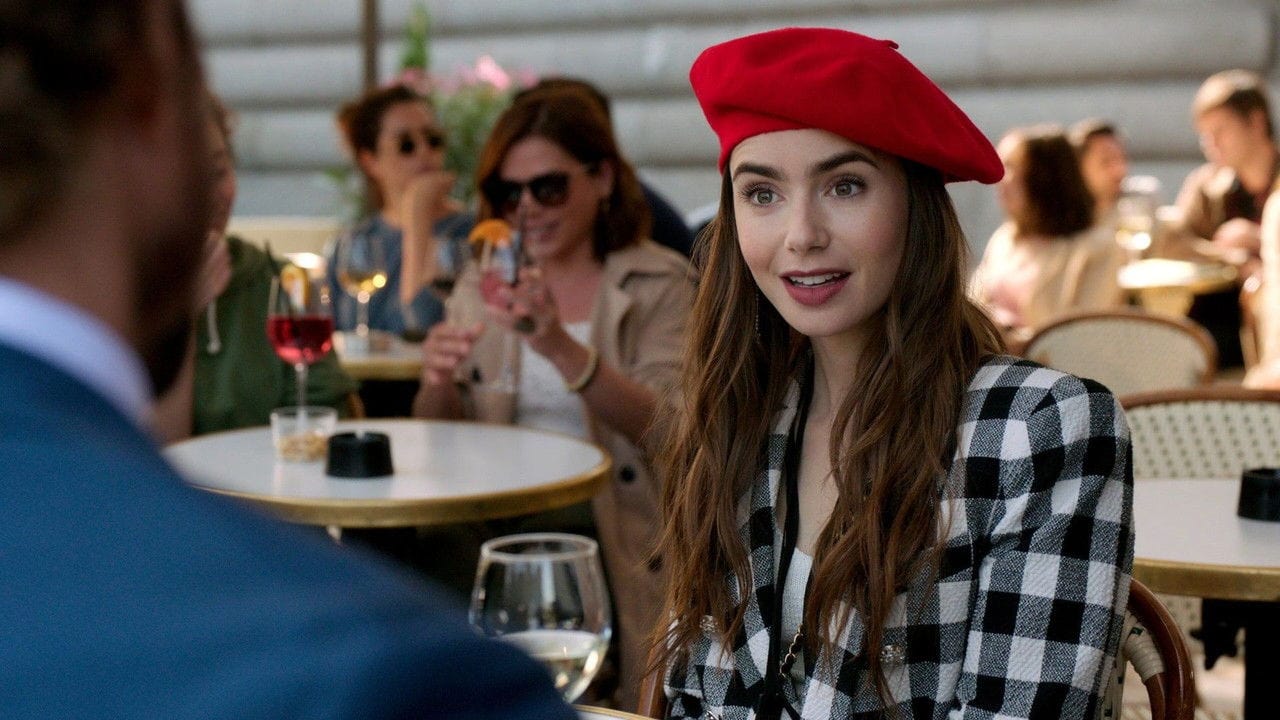
Emily in a red beret at a Parisian café, a scene from Emily in Paris

If you cross back over the river into the 6th arrondissement on Boulevard Saint-Germain, you’ll find yourself in the world of Paris’s most famous cafés — places where major writers, philosophers, and artists gathered in the twentieth century, and which naturally didn’t escape our show’s cameras either. These are spots steeped in history and unmistakable charm, but I should warn you straight away: they’re seriously expensive, and you’re paying not so much for outstanding coffee as for sitting in the same chair that Jean-Paul Sartre once occupied.

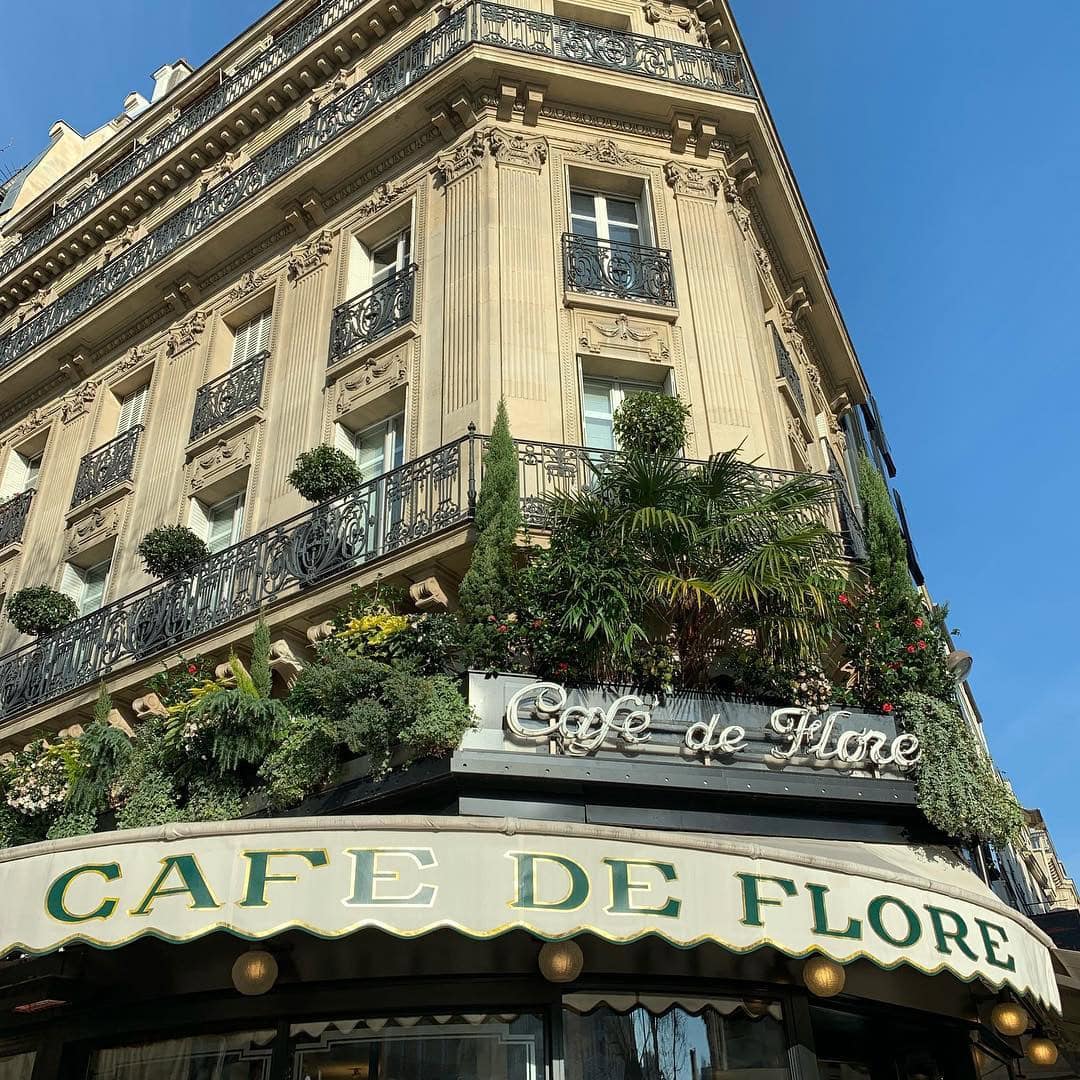
9. Café de Flore

The famous Café de Flore on Boulevard Saint-Germain in Paris

At the legendary address of 172 Boulevard Saint-Germain stands the corner establishment Café de Flore, unmistakable with its floral decorations and green signage, where Emily meets the snobbish semiotics professor Thomas in episode six of season one. Prices here are far from your average café — a simple small espresso costs around €5, a rich hot chocolate runs €10–12, and a light meal like an omelette or sandwich will set you back €10–20. Honestly, it’s basically a beautiful tourist trap these days, but it has cult status and you should treat it as a historic experience rather than scrutinise the value for money. They’re open daily from 7:30 in the morning until 1:30 at night, and I’d strongly recommend coming very early in the morning or later in the evening — otherwise you could easily queue for over half an hour for the right terrace table with a street view. More details on the Café de Flore website.

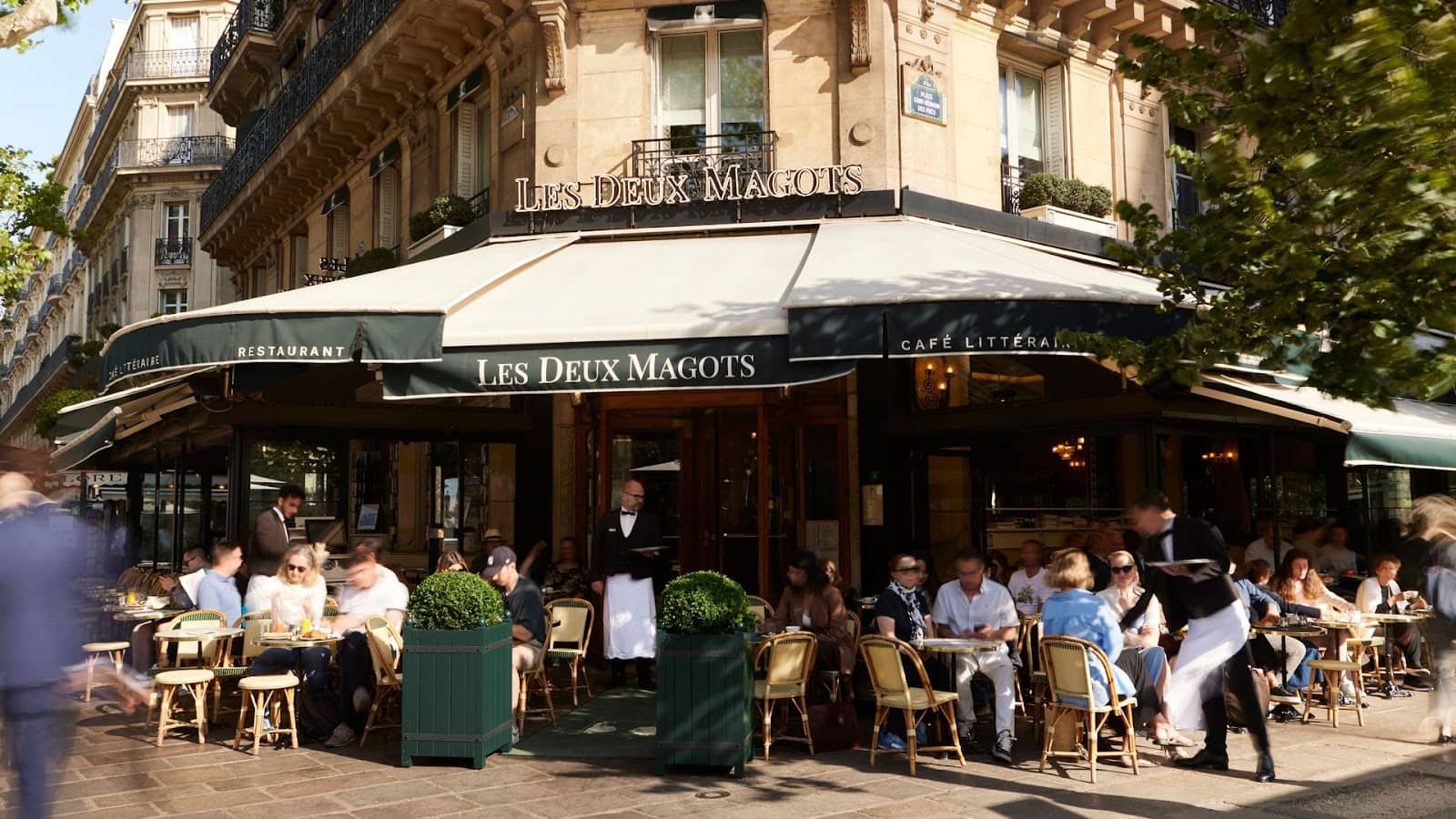
10. Les Deux Magots

The historic Les Deux Magots café in Paris's Saint-Germain neighbourhood
The historic Les Deux Magots café in Paris’s Saint-Germain neighbourhood

Right next door to Café de Flore at 6 Place Saint-Germain-des-Prés sits its historic arch-rival, Les Deux Magots. While it doesn’t play as prominent a role in the series, it belongs to the same league of admired and very expensive establishments, and the cameras certainly couldn’t miss it when shooting the neighbourhood. The atmosphere is quite similar to its neighbour — expect to pay around €9.50 for a simple cappuccino — and you could happily spend an afternoon people-watching stylishly dressed Parisians. In March 2025, the café reopened after a substantial renovation, so it’s now boasting a refreshed and polished interior. All the latest news is on the Les Deux Magots website.

lukas a lucka
Lukáš and Lucie recommend
Where to stay in Paris
3 accommodations — wellness hotels, hotels and other accommodation options

Montmartre: the most photogenic scenes from the show

When you fancy a break from the hustle of the city centre, make sure to head north to the enchanting 18th arrondissement and the hill of Montmartre. With its cobblestone streets and slightly bohemian atmosphere, it provided the show with by far its most photogenic and romantic scenes. The Métro will whisk you up there — just get off at the popular Abbesses station, or take the slightly quieter route from Lamarck–Caulaincourt and prepare for a bit of uphill walking that’s more than worth it for the stunning views.

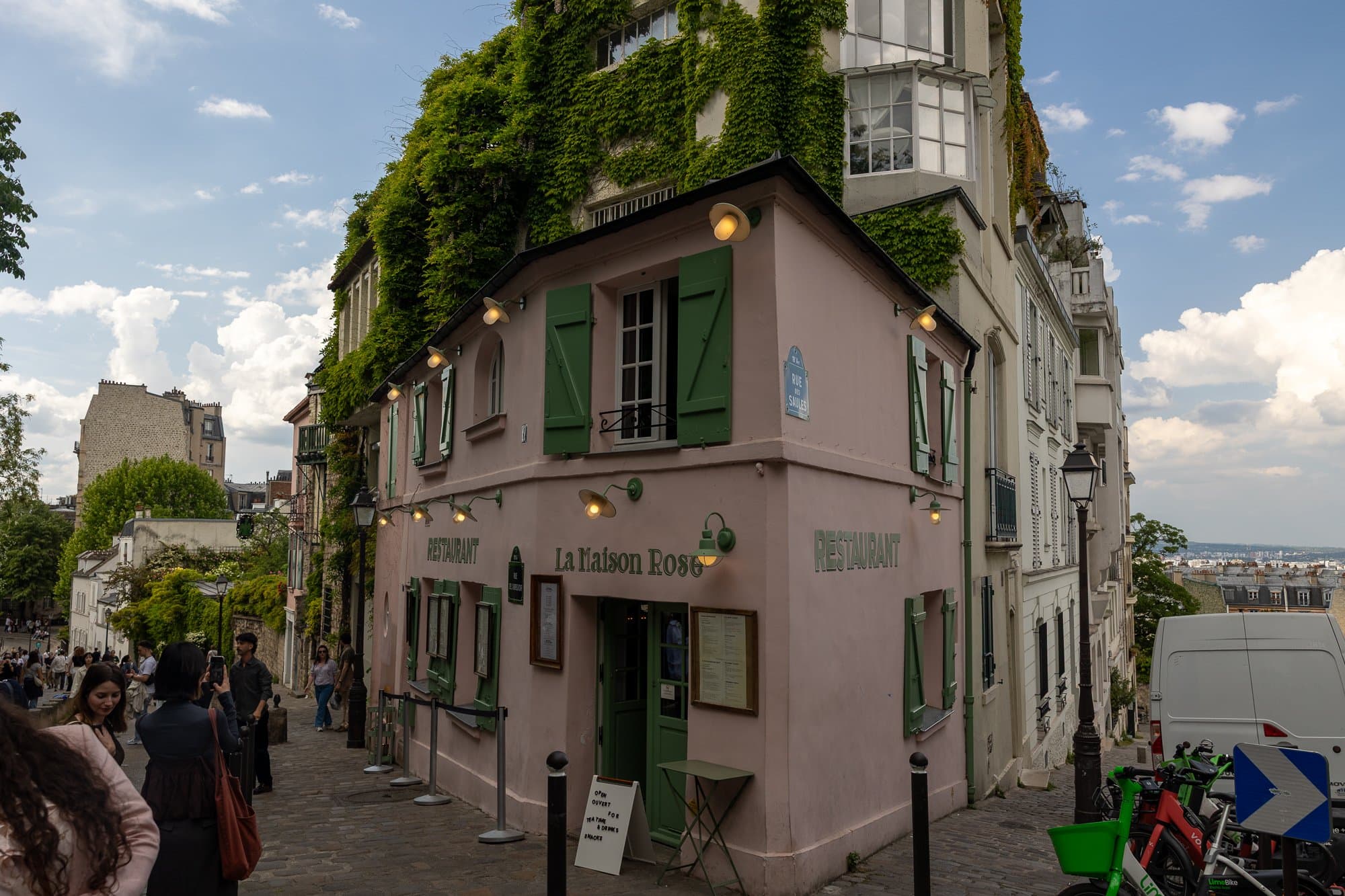
11. La Maison Rose

The pink La Maison Rose restaurant on Montmartre, where Emily and Mindy have lunch

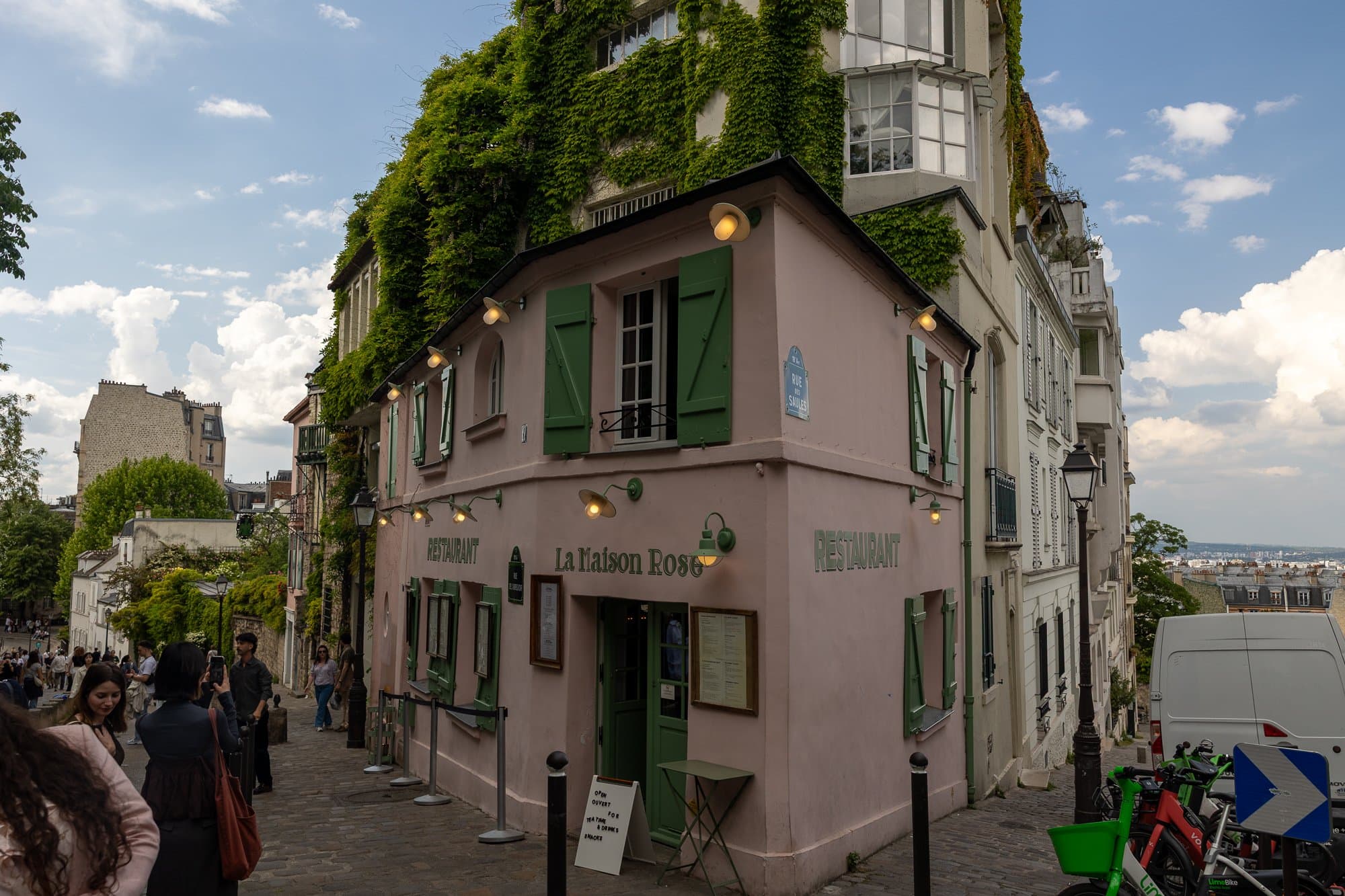
On the corner at 2 Rue de l’Abreuvoir, you can’t miss the gorgeous pink house with outdoor seating, known as the restaurant La Maison Rose, where Emily and Mindy have lunch together in episode five of season one and where Mindy describes this street as the prettiest in all of Paris. This restaurant has an incredible history — masters like Pablo Picasso and Vincent Van Gogh used to sit here, and it was immortalised by the famous painter Maurice Utrillo. Today, meal prices per person range from €28 to €40, and despite the tourist hype, they have surprisingly excellent reviews. With only 35 seats inside, getting a table is incredibly difficult, so you’ll need to book well in advance through their official website La Maison Rose — and even then, be prepared to wait a little while outside.

12. Le Mur des Je t’aime (the Wall of Love)

A short walk from the Abbesses Métro station, you’ll find the small park Square Jehan Rictus and hidden within it a blue wonder called Le Mur des Je t’aime — the Wall of Love — where the phrase “I love you” is written in more than 311 languages and 250 different dialects from around the world. This free-to-visit spot appears in season three, when chef Gabriel nervously studies the wall and romantically considers it as the ideal setting for his upcoming proposal. It’s quite a small space and during the day it tends to be packed with loved-up couples photographing their respective languages, so the best time for a peaceful photo is — once again — right after breakfast.

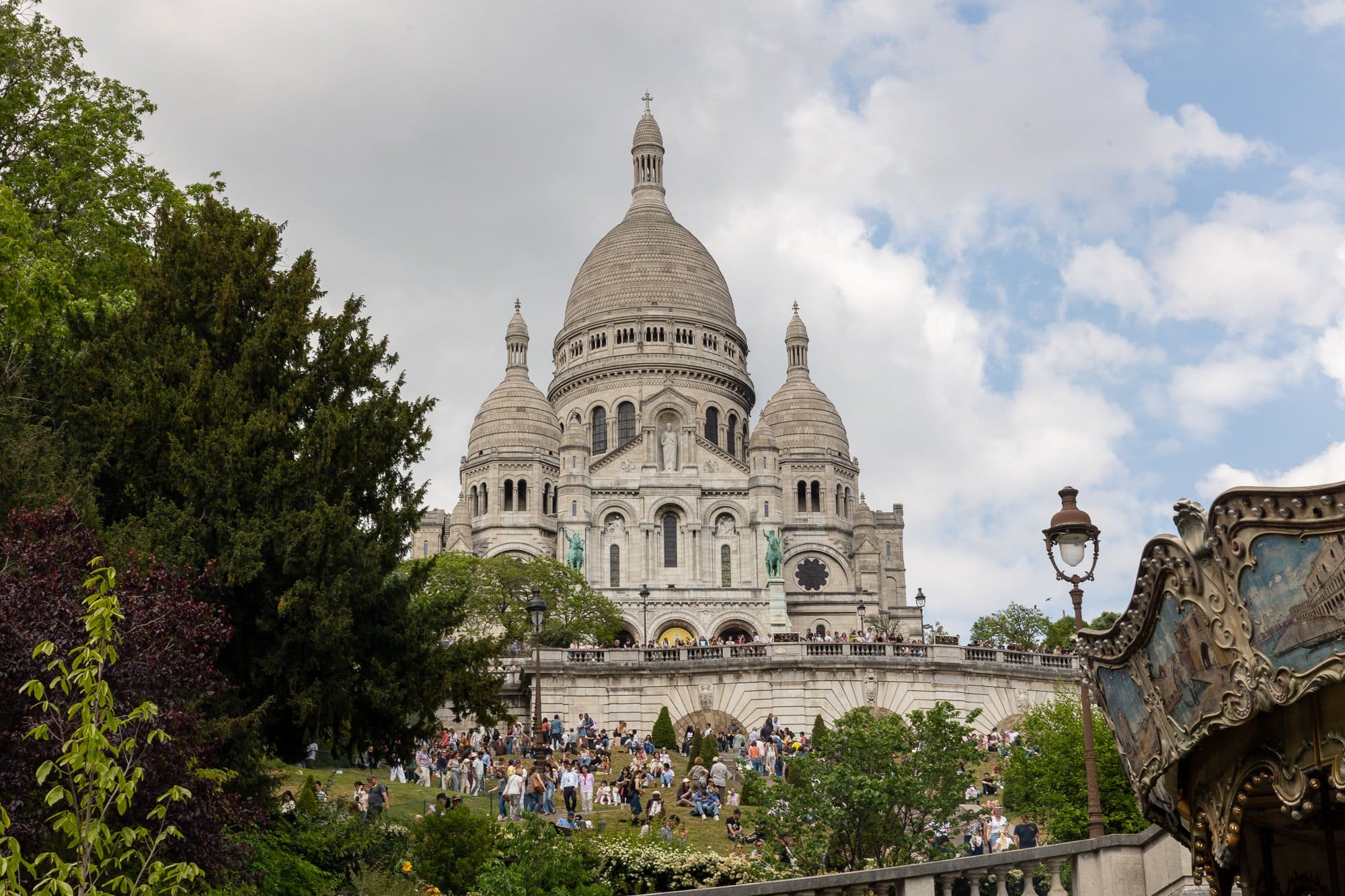
13. Sacré-Cœur

The white Sacré-Cœur basilica at the top of Montmartre in Paris

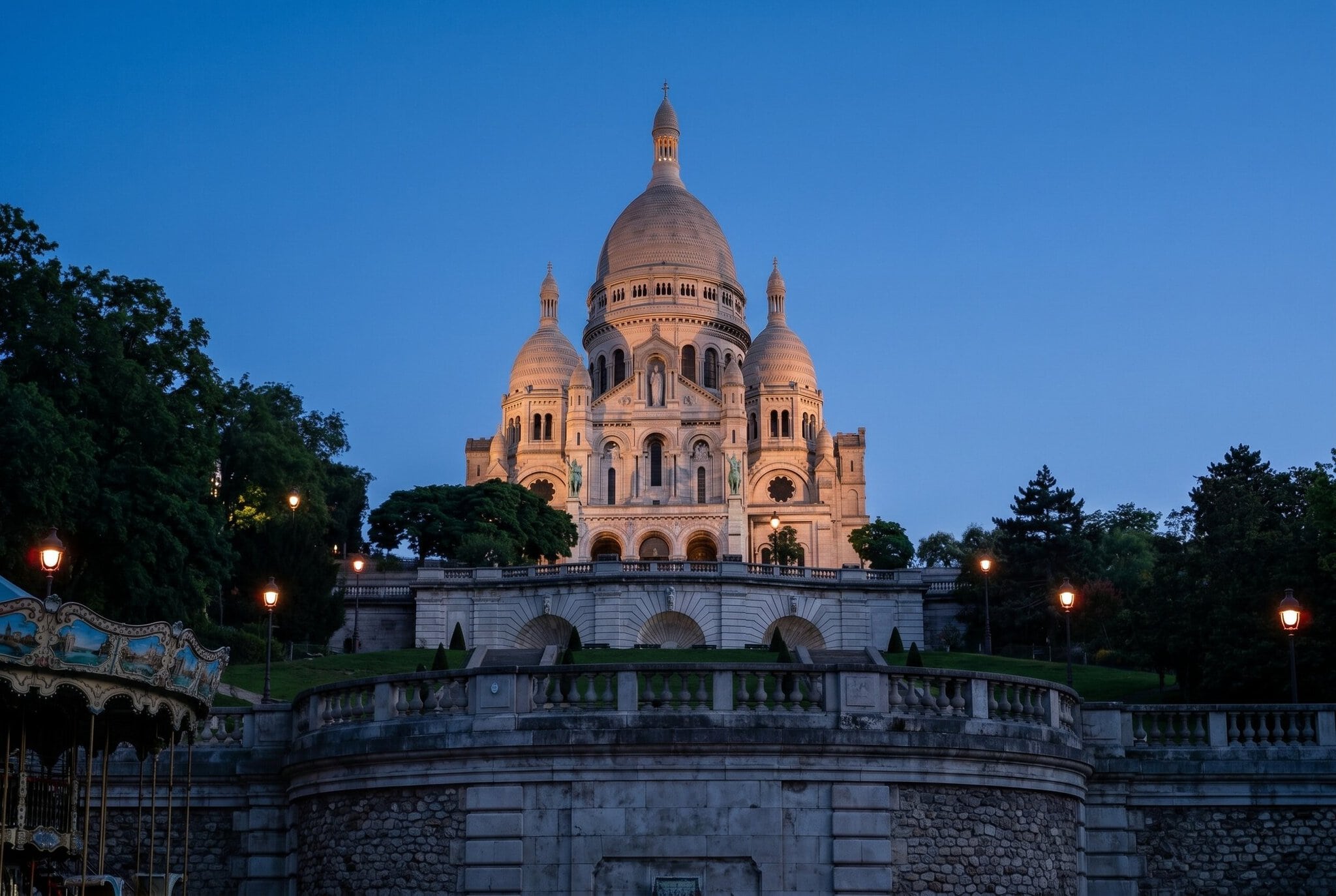
Right at the very top of the Montmartre hill at 35 Rue du Chevalier de la Barre stands the snow-white Sacré-Cœur basilica, which serves as the backdrop for a brilliant scene in season three where the characters do a live Instagram broadcast and soak in the view of the city below. Strolling around the basilica and enjoying the panoramic views over Paris is free, but if you’d like to peek inside the beautiful interior, that’ll be €6, with an additional €7 to climb up to the dome. A word of serious warning here: the terrace in front of the basilica gets extremely packed with tourists, you’ll often encounter pushy bracelet sellers, and you need to keep a very close eye on your valuables because of skilled pickpockets. For the best experience, head here early in the morning when it’s beautifully peaceful.

Bridges and big scenes: perfume, busking, and the Seine

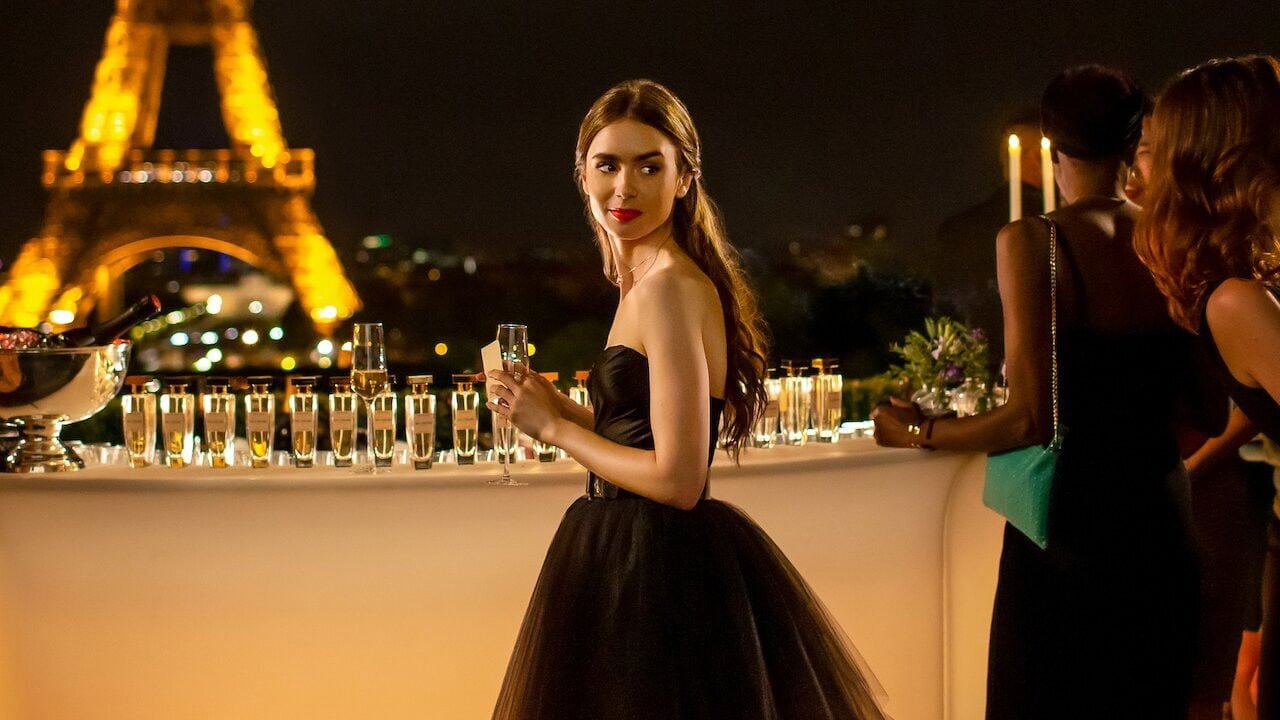
Emily at a party with the illuminated Eiffel Tower behind her, from Emily in Paris

The show’s visuals make full use of the gorgeous scenery along the Seine and Paris’s ornate bridges, which serve as perfect dramatic and romantic backdrops for the most important filming moments. It would be a real shame not to stroll across at least a couple of them during your trip.

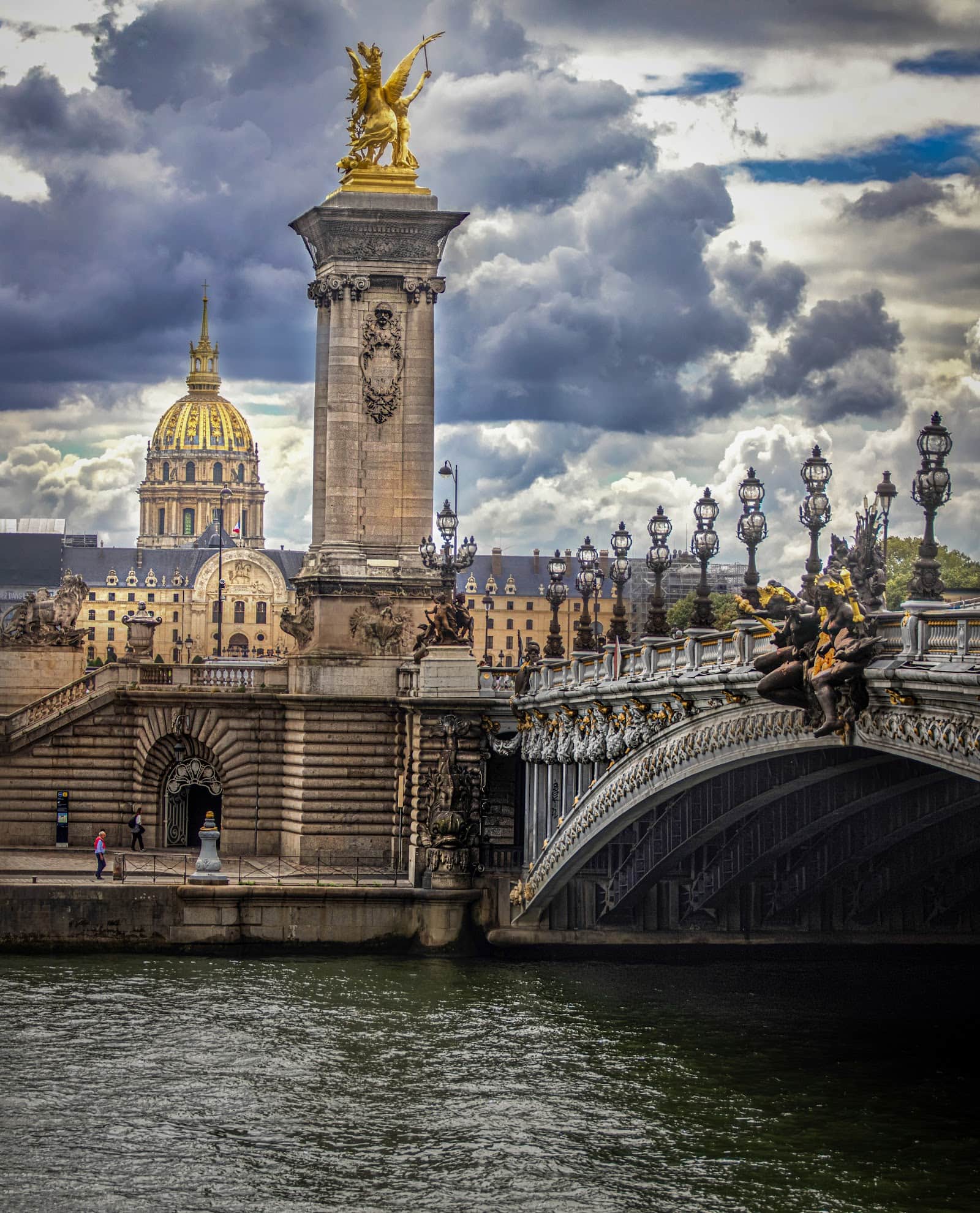
14. Pont Alexandre III

The ornate Pont Alexandre III bridge in Paris with golden statues

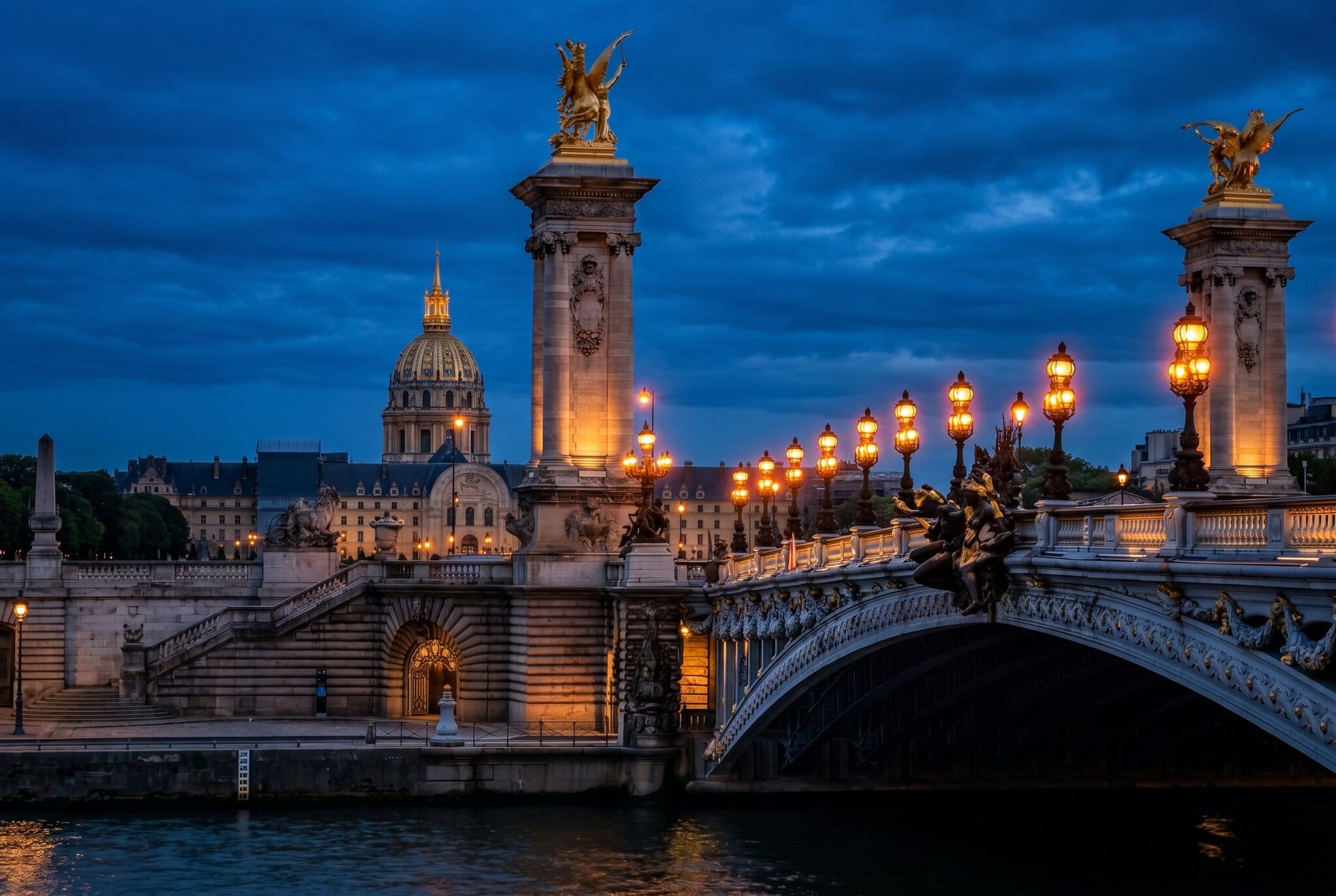
The grand and gorgeously decorated Art Nouveau Pont Alexandre III dates from 1900, sits between the 7th and 8th arrondissements near the Invalides Métro station, and at the start of season one serves as the filming location for that provocative Maison Lavaux perfume advertisement where Emily clashes with the client over the use of nudity in the campaign. The bridge boasts stunning golden statues and lampposts, and the view across the river towards the Eiffel Tower is simply magical — and free. Just be prepared for the fact that at sunset especially, this spot is extremely popular and absolutely packed with wedding photographers and fellow travellers.

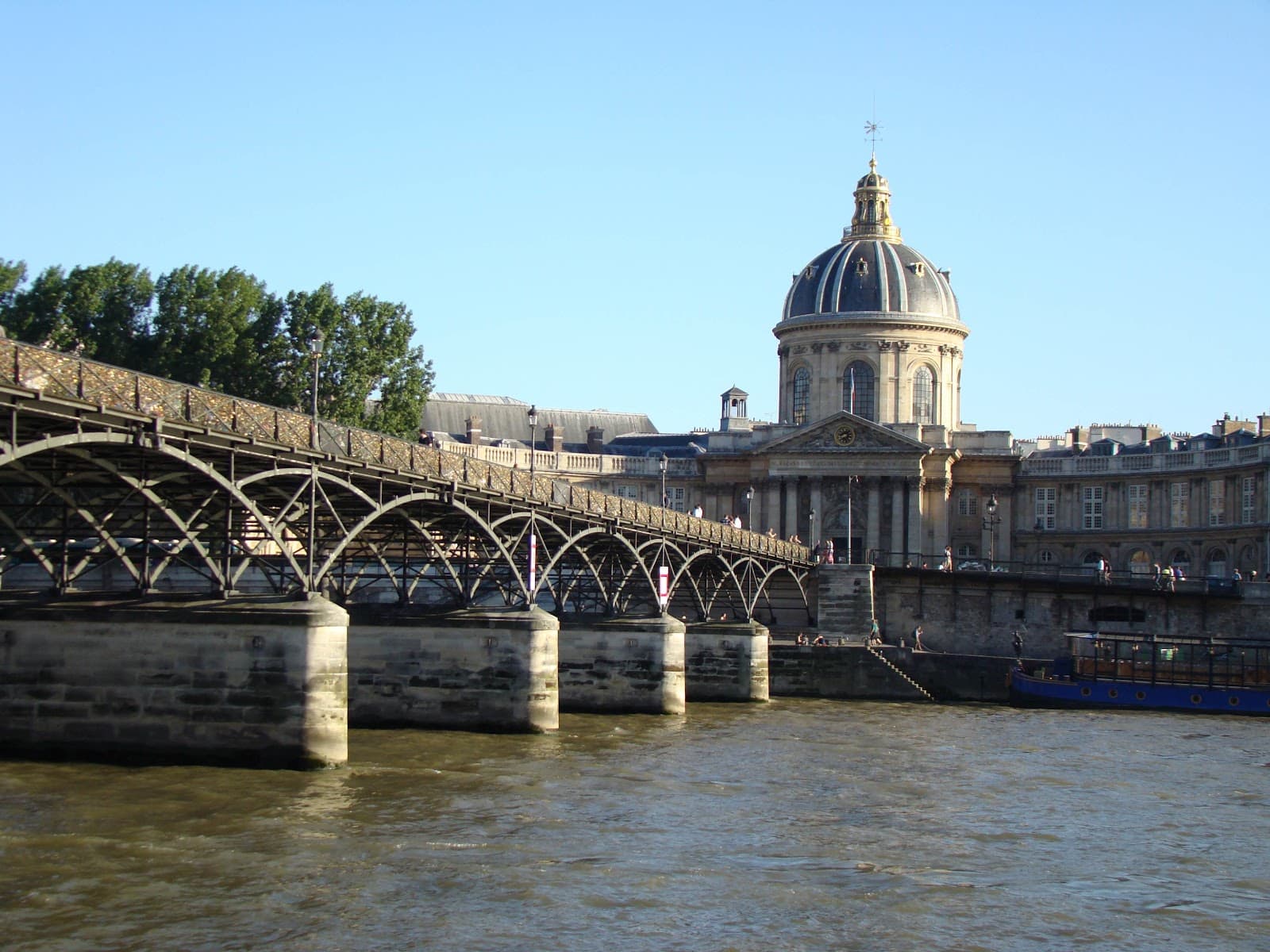
15. Pont des Arts

The pedestrian Pont des Arts bridge over the Seine with the Institut de France

The much more intimate wooden pedestrian bridge Pont des Arts, situated between the famous Louvre museum and the Institut de France, features in several key moments. For instance, boss Sylvie and Emily have a pivotal conversation here at the end of season one, and in season two, Emily’s friend Mindy rather awkwardly attempts to busk for passers-by. This bridge was once famous for the “love locks” that couples would attach to the railings before tossing the keys into the Seine. However, the railings became so heavy and damaged under the weight of all that metal that the city had to remove them and install special glass panels — so the romance remains, just minus the thousands of padlocks. Visiting and enjoying the river views from here is, of course, completely free, and you’ll love the calmer atmosphere that Paris exudes from this vantage point.

Beyond these main spots, the series briefly features several other lovely locations that are worth a quick mention if you have time to spare:

  • Hôtel Plaza Athénée (25 Avenue Montaigne, 8th arrondissement): the luxury hotel where both Alfie and client Antoine stayed, and which even had a little ice rink in winter. A room here is astronomically expensive, but a more accessible treat is a cocktail at the hotel bar for €25–60.
  • Galeries Lafayette (40 Boulevard Haussmann, 9th arrondissement): the iconic department store where Emily and Camille stand on the rooftop, and where the Kadiance cream event takes place in season four. Entry and rooftop access with panoramic views are both free.
  • Musée d’Orsay: the famous Impressionist museum where Gabriel and Camille’s beautiful proposal scene takes place by the iconic clock in episode nine of season three. Admission is €16, they’re closed on Mondays, and tickets are available on the official Musée d’Orsay website.
  • Musée des Arts Forains (53 Avenue des Terroirs de France, 12th arrondissement): a fairground arts museum where that outrageously extravagant party was filmed in season one. You can only visit on a pre-booked guided tour costing €15–20.

Where to eat on Emily’s trail (without taking out a second mortgage)

As I’ve mentioned several times, the popular filming-location restaurants and famous historic cafés in the centre tend to be pricey — and some are outright luxury affairs where you’ll pay handsomely for the name and a pavement seat. If you’ve got the budget and fancy treating yourself, go for it. But to avoid surviving on bread and water for the rest of your trip, there are also some brilliant affordable alternatives.

A great idea is to stop by Boulangerie Moderne first thing in the morning for a fragrant and inexpensive snack — for just a few euros you’ll get excellent fresh pastries that you can eat on the go or enjoy with a takeaway coffee in the nearby Luxembourg Gardens. As for Terra Nera, let’s be honest: it’s Italian rather than the classic French bistro from the show, but the food is genuinely good and the prices for an evening meal aren’t disastrous by Parisian standards — you just won’t be ordering escargots in herb butter. If I could recommend something beyond the Emily in Paris universe, we absolutely loved the traditional Parisian dining halls known as bouillons, such as the legendary Bouillon Chartier. There you’ll get solid French classics like onion soup or roast chicken in a buzzing atmosphere at remarkably reasonable prices. Alternatively, try any unassuming little bistro two streets away from the main squares.

💡 Tip: If you want a truly excellent culinary experience without splashing hundreds on lunch at Le Grand Véfour, look for restaurants offering a formule midi (set lunch menu). You can often get a fantastic three-course meal for under €20 and eat just as well as you would at dinner for three times the price.

Before you go: be respectful to the locals

When you head out to photograph famous filming locations, the most important thing to keep in mind is the Parisians themselves. The show’s sudden and enormous popularity has turned many once-quiet neighbourhoods into overcrowded tourist hotspots. Place de l’Estrapade used to be an unassuming, very peaceful little square where people simply enjoyed their morning coffee. Today it’s a massive tourist magnet where you might even spot spray-painted messages like “Emily n’est pas la bienvenue” (“Emily is not welcome”) on the walls — a clear sign of the deep frustration among those who are just trying to live their lives there.

While we’d all love that perfect beret-clad photo in front of the main characters’ windows, Boulangerie Moderne owner Thierry Rabineau recently told the press how hurt he feels by fans’ behaviour. Of the six to seven hundred people who visit daily, forty percent are show fans, many of whom don’t actually buy anything. When they can’t get in during holiday closures or discover the building and bakery don’t look exactly like they do on Netflix, they leave unfair and nasty Google reviews. So on behalf of all the locals, I’d like to urge you to remember these are real homes and real livelihoods of ordinary people and families. Visit early in the morning, keep your voice down, never ring doorbells, and don’t photograph through ground-floor windows. If you do make the effort to go, simply buy a coffee or a croissant, be kind to the people behind the counter, and you’ll find the whole experience becomes far more pleasant for everyone.

Where to go next

Interested in the French capital and want to read about places that might not be directly linked to the show but absolutely shouldn’t be missed on your trip? Check out our other guide where we’ve put together comprehensive tips on what else to see in Paris. And if you’re heading to the city of love and croissants with the whole family and restless little ones in a pushchair — just like we did — you’ll definitely find our tried-and-tested tips on how to survive Paris with kids without losing your mind invaluable.

You can also find official information about the city’s monuments, transport, and the latest news on the trusted official Paris tourism website.

Frequently asked questions (FAQ)

Tips and Tricks for Your Vacation

Don’t Overpay for Flights

Search for flights on Kayak. It’s our favorite search engine because it scans the websites of all airlines and always finds the cheapest connection.

Book Your Accommodation Smartly

The best experiences we’ve had when looking for accommodation (from Alaska to Morocco) are with Booking.com, where hotels, apartments, and entire houses are usually the cheapest and most widely available.

Don’t Forget Travel Insurance

Good travel insurance will protect you against illness, accidents, theft, or flight cancellations. We’ve had a few hospital visits abroad, so we know how important it is to have proper insurance arranged.

Where we insure ourselves: SafetyWing (best for everyone) and TrueTraveller (for extra-long trips).

Why don’t we recommend any Czech insurance company? Because they have too many restrictions. They set limits on the number of days abroad, travel insurance via a credit card often requires you to pay medical expenses only with that card, and they frequently limit the number of returns to the Czech Republic.

Find the Best Experiences

Get Your Guide is a huge online marketplace where you can book guided walks, trips, skip-the-line tickets, tours, and much more. We always find some extra fun there!
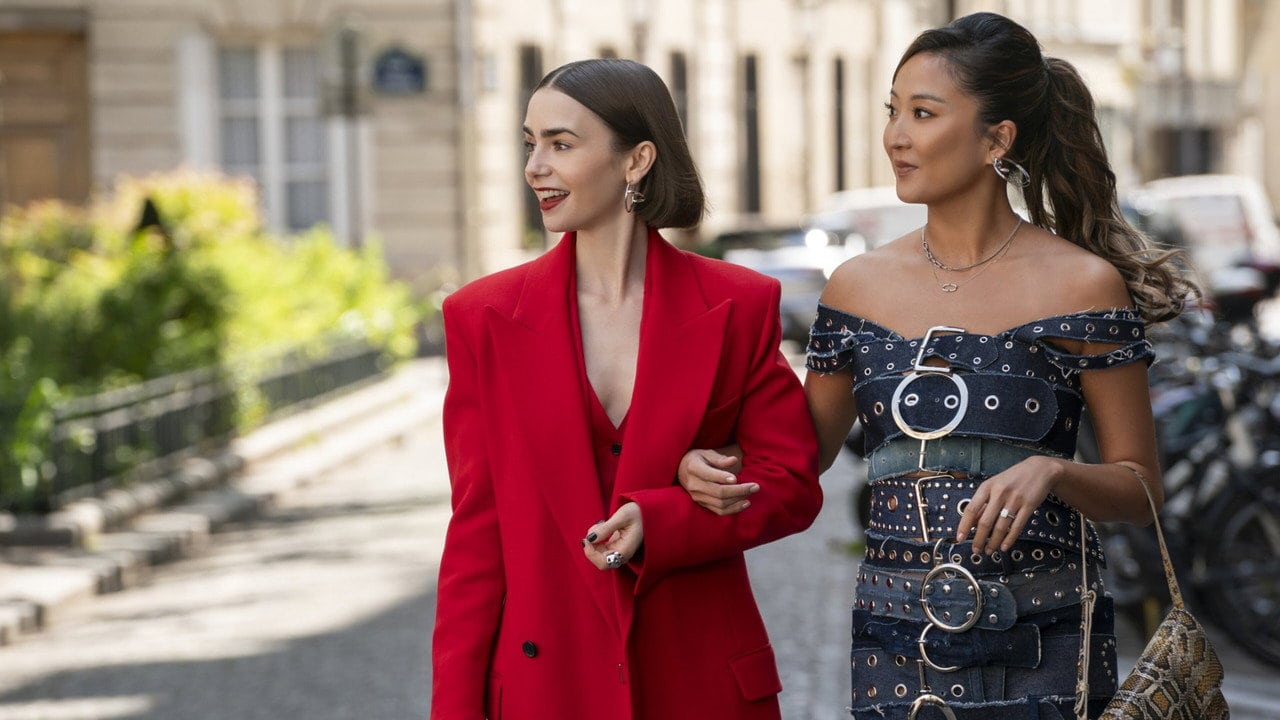
Shopping in Paris: Concept Stores, Department Stores & Vintage (A Complete Guide)

TL;DRShopping in Paris ranges from grand department stores like Galeries Lafayette and Printemps on Boulevard Haussmann, with free views over the Eiffel Tower, to concept stores such as Merci in the 3rd arrondissement, housed in a former wallpaper factory, and vintage spots like Kilo Shop, where you pay by the weight of what you buy. The best areas for a wander are Le Marais, Saint-Germain-des-Prés and Canal Saint-Martin, while it’s worth skipping the Champs-Élysées, which is all crowds and chain stores. The big sales (Soldes) run on government-set dates — in 2026 that’s 8 January to 4 February and 25 June to 22 July, with discounts of up to 70%. Visitors from outside the EU can claim back 12% VAT on purchases over €100 (2,500 Kč) through the Detaxe scheme, though Czech visitors aren’t eligible for a refund.

As the city wakes up, the scent of butter drifts from corner bakeries and you stroll past the first boutiques opening their doors with a hot coffee in hand — that’s when it hits you. Paris shopping isn’t about mindlessly filling paper bags or racing through enormous anonymous malls on the outskirts of town. It’s a cultural discipline in its own right, a careful curation of personal taste, and occasionally a full-blown treasure hunt. You sit on a bench, watching local women in perfectly rumpled linen shirts and worn canvas totes rushing to work, and suddenly you’re desperate to absorb that effortless style.

At first, you might be dazzled by the omnipresent luxury and glittering shop windows, but the true heart of the city beats elsewhere. It hides in forgotten covered passages, in former factories reimagined as avant-garde spaces, and in lanes where centuries-old cheese shops naturally coexist alongside modern ateliers of independent designers. As a vegetarian with a passion for sustainability, I find it an absolute paradise — local and ethical fashion truly take centre stage here.

In this article, you’ll find a complete guide to shopping in Paris. We’ll show you the best concept stores, break down the grand department stores like Galeries Lafayette, explore Parisian vintage, and cover practical tips on how the seasonal sales work, where to find the best local shopping districts, and how to claim your tax-free refund.

TL;DR

Elegant covered passage with shops, a glass ceiling and golden lighting
  • The big winter and summer sales (Soldes) have strictly government-regulated dates. In 2026, they run from 8 January to 4 February and from 25 June to 22 July.
  • If you want a free city view, head to the rooftop terrace of department store Galeries Lafayette or Printemps. You can see all of Paris from up there, Eiffel Tower included.
  • Paris’s most famous concept store, Merci, is in the 3rd arrondissement. It’s housed in a former wallpaper factory and you’ll spot it by the iconic red vintage car in the courtyard.
  • With a pushchair and small children, the best areas for shopping are the northern Marais (3rd arrondissement) and Saint-Germain (6th arrondissement), where the pavements are wider and the atmosphere calmer.
  • For thrift lovers and sustainability fans, Kilo Shop is a must — you pay for vintage clothing by its total weight at the checkout.
  • The best edible souvenirs (cheese, mustard, wine) can be found under one roof at La Grande Épicerie de Paris, next to department store Le Bon Marché.
  • The golden rule: every time you enter any smaller shop, you must greet the staff with a clear “Bonjour.” Without it, you’ll be completely ignored.
  • Visitors from outside the EU (including the UK post-Brexit) can use the Detaxe system to claim back 12% VAT on purchases over €100 on a single receipt.
  • Don’t bother shopping on the Champs-Élysées. It’s expensive, overcrowded, and full of global chains you can find absolutely anywhere in the world.
Beautiful covered Parisian passage with a glass roof, elegant lamps and historic shops

When to visit Paris for shopping and the sales calendar

The timing of your trip can mean the difference between an empty wallet and absolutely brilliant bargains at a fraction of the price. Parisian retail follows very strict rules set directly by the French government. You won’t find random mid-season sales throughout the year — everything is concentrated into two massive sale windows.

The legendary Soldes: Winter and summer sales 2026

Covered passage with colourful shops, a café and a glass ceiling

The French sales (Soldes) are a national institution. They last exactly four weeks each and discounts deepen in successive waves (démarques). The first week typically starts with 20–30% off, but by the final week prices can drop by as much as 70%. In 2026, the winter sales begin on Wednesday 8 January and end on 4 February. The summer wave kicks off on Wednesday 25 June and runs until 22 July.

💡 Insider tip: If you’ve got your eye on a specific designer piece in your size, go on the very first morning. But if you’re just treasure-hunting for the lowest possible price, hold off until the third wave of markdowns (troisième démarque), which usually begins around the middle of the third week.

What to avoid: Fashion Week and August holidays

Elegant Galeries Lafayette building with a large banner and crowds of visitors

Unless you actually work in the fashion industry, steer clear of Paris Fashion Week (typically late February into March, then late September). Accommodation prices skyrocket, central restaurants are hopelessly packed, and you’ll struggle to get past the crowds of buyers and influencers in many boutiques.

August is another tricky month. The French observe what’s known as the fermeture annuelle (annual holiday). Parisians flee the sweltering city en masse for the coast. The big department stores stay open, but many of the most interesting small independent boutiques, concept stores and beloved bakeries will have their shutters down and a sign saying “See you in September.”

Weekend shopping and Sunday rules

Elegant Camelia Blanc florist with yellow flowers and palms in central Paris

Paris long upheld strict Sunday closures and everything used to shut down. Thanks to special tourist zones, that’s no longer absolute — but you still need to plan. While large department stores like Galeries Lafayette and boutiques in Le Marais open on Sundays, smaller shops in residential neighbourhoods (such as the 11th or 15th arrondissements) remain firmly closed. Monday mornings can also be quiet, as many smaller shops don’t open until after lunch to allow for cleaning and restocking.

💡 Insider tip: The best day for relaxed shopping is Tuesday or Thursday morning. You’ll avoid the weekend influx of tourists and shop assistants will have far more time (and patience) to give you personal attention.

Glass dome of Galeries Lafayette with a red sphere and golden arches

Where to stay in Paris for a shopping and family weekend

Choosing the right neighbourhood will make or break your entire city experience — and your budget. Paris is divided into twenty arrondissements that spiral clockwise from the historic centre near the Louvre. Finding affordable accommodation in the centre is nearly impossible, but if you know where to look, you can find a great compromise between price, safety and accessibility.

If you’re travelling with a pushchair and small children, give a wide berth to the northern part of the 10th arrondissement around Gare du Nord and Pigalle in the 18th arrondissement at night. We once got lost there with a friend at 2am, and with a two-year-old in tow, that’s definitely not something you want to repeat. 😅 

After a long search, we settled on Hôbou, an authentic French boutique hotel in Boulogne-Billancourt (you can book it here). It looks unassuming at first glance, but within a few hours you’ll have fallen completely in love with it.

Department stores (Grands Magasins): Temples of luxury and everyday life

The French essentially invented the department store concept. These aren’t just places to spend money — they’re genuine architectural masterpieces and showcases of Parisian art de vivre. For families, they also serve as a safe haven: you’ll find plenty of space, working air conditioning, reliable lifts, and much-needed facilities including clean toilets.

Le Bon Marché and La Grande Épicerie (7th arrondissement)

Green Palais des Thés shop on a Parisian street with flowers

This is an absolute Left Bank (Rive Gauche) classic. Le Bon Marché, near the Sèvres-Babylone metro station, is considered the oldest department store in the world. It was founded in 1852 by Aristide Boucicaut and today falls under the LVMH empire. It radiates quiet, understated luxury and you won’t encounter the frenzied tourist crowds you’d find on the Right Bank. The space breathes, is filled with contemporary art, and the vast central atrium regularly hosts breathtaking art installations. Right next door at 38 Rue de Sèvres sits La Grande Épicerie de Paris — quite possibly the most luxurious food hall you’ll ever see. The cheese section hits you from a mile away and the shelves overflow with premium olive oils.

  • Address: 24 Rue de Sèvres, 7th arr. (metro Sèvres-Babylone, lines 10 & 12)
  • Open: Mon–Sat 10:00–19:45, Sun 11:00–19:45
  • Prices: Free entry; a premium chocolate box at the Épicerie starts from around €25.
  • 💡 Insider tip: On the ground floor of La Grande Épicerie they make fantastic fresh baguettes and have a brilliant counter of ready-made vegetarian dishes. Grab your lunch to go and eat it in the nearby Square Boucicaut park.

Galeries Lafayette Haussmann (9th arrondissement)

A Parisian street with a historic green shop and red doors adorned with flowers

An architectural feast for the eyes that’s worth visiting even if you don’t plan to spend a single euro. The Art Nouveau glass dome dating from 1894, designed by Ferdinand Chanut, is the very embodiment of Parisian Belle Époque grandeur. The store mixes absolute high-end luxury on the ground floor with more accessible mainstream brands on the upper levels. Directly opposite the main building lies the huge Lafayette Gourmet food hall, home to branches of Paris’s finest pâtisseries. A word of warning though: the newer Galeries Lafayette branch on the Champs-Élysées has a completely different, very futuristic concept — no traditional checkouts and, to me, it lacks the soul of the original building.

  • Address: 40 Boulevard Haussmann, 9th arr. (metro Chaussée d’Antin – La Fayette, lines 7 & 9)
  • Open: Mon–Sat 10:00–20:30, Sun 11:00–20:00
  • Prices: Free entry; a coffee in the in-house café around €5.
  • 💡 Insider tip: Take the escalators all the way up to the top floor and step out onto the rooftop terrace. It’s completely free and offers a fantastic 360° view of the city including the Opéra Garnier and the Eiffel Tower. We sometimes spend time up here with our little one Jonáš, because it’s safe and there’s plenty of room to run around.

Printemps Haussmann (9th arrondissement)

A Parisian shop with colourful symbols in a Haussmann-style building

Printemps is the immediate neighbour and eternal rival of Galeries Lafayette. You’ll recognise it instantly by its stunning Byzantine dome and golden façade details. The complex is split into three vast buildings: Printemps de la Femme (womenswear), Printemps de la Beauté (beauty), and Printemps de l’Homme (menswear). It feels a touch more luxurious and perhaps a shade calmer than Lafayette, since it doesn’t attract quite as many organised tour groups.

  • Address: 64 Boulevard Haussmann, 9th arr. (metro Havre-Caumartin, lines 3 & 9)
  • Open: Mon–Sat 10:00–20:00, Sun 11:00–20:00
  • Prices: Free entry; designer perfumes from around €150.
  • 💡 Insider tip: Printemps has its own rooftop trump card. It’s called 7e Ciel (Seventh Heaven) and you’ll find it on the 7th floor of the Printemps de la Femme building. There’s a small café up there, and in my opinion the view is even a notch better than the one next door.

BHV Marais (4th arrondissement)

Historic Parisian shopping passage with golden frames and a glass ceiling

Bazar de l’Hôtel de Ville — BHV for short — sits directly opposite Paris’s City Hall on the edge of Le Marais. While Lafayette and Printemps focus heavily on fashion, BHV is where Parisians themselves go when they need something practical. It’s a fascinating mix of clothing, design and a massive basement DIY section where you can find practically every screw ever made. The atmosphere is far more local, and you could easily spend hours in the kitchenware department browsing professional French cookware.

  • Address: 52 Rue de Rivoli, 4th arr. (metro Hôtel de Ville, lines 1 & 11)
  • Open: Mon–Sat 10:00–20:00, Sun 11:00–19:00
  • Prices: Generally a bit more affordable than the stores in the 9th arrondissement.
  • 💡 Insider tip: If you survive the shopping, treat yourself to a drink. On the BHV rooftop you’ll find Le Perchoir Marais bar. It usually opens in the late afternoon and offers a gorgeous view of the City Hall and the Seine.
Stained glass dome of Galeries Lafayette Haussmann

Concept stores: Where fashion meets art and coffee

Paris is the spiritual home of the concept store. After the legendary boutique Colette closed its doors in 2017, the city didn’t miss a beat. A new wave of successors emerged, taking the idea of “everything beautiful under one roof” to the next level — often with a strong focus on ecology and local production.

Merci (3rd arrondissement)

Woman in a yellow jacket in a historic Parisian passage with a glass roof

This is an absolute must-visit. Merci occupies a historic 19th-century building that once served as a wallpaper factory. The entrance alone is iconic — you pass through a covered driveway into a cobblestoned courtyard where a small vintage car always sits, classically a legendary red Fiat 500. Inside, you’ll find a perfectly curated mix of independent fashion, designer furniture, linen textiles and homeware. A significant share of the profits also goes to charitable causes in developing countries. In 2025, they opened a smaller Merci #2 branch in the 1st arrondissement, but the original Marais location remains unbeatable.

  • Address: 111 Boulevard Beaumarchais, 3rd arr. (metro Saint-Sébastien – Froissart, line 8)
  • Open: Mon–Sat 10:30–19:30, Sun 11:00–19:00
  • Prices: A linen shirt around €120, a mug about €15.
  • 💡 Insider tip: Part of the space houses The Used Book Café. Its walls are lined with thousands of old books and they make an excellent oat flat white. Outside of the weekend rush, you can manoeuvre a pushchair through here fairly easily.

Centre Commercial (10th arrondissement)

People queuing outside the award-winning Parisian bakery La Maison d'Isabelle

A stone’s throw from the picturesque Canal Saint-Martin, you’ll find this manifesto of sustainable fashion. The shop was founded by the team behind the cult French trainer brand Veja. It exclusively stocks brands that meet strict environmental and social responsibility criteria. You can pick up fashion, books, vintage furniture and even refurbished bicycles. It’s a very airy, bright space where nobody pressures you into buying anything.

  • Address: 2 Rue de Marseille, 10th arr. (metro Jacques Bonsergent, line 5)
  • Open: Tue–Sat 11:00–19:30, Sun 14:00–19:00, Mon closed
  • Prices: Sustainable Veja trainers around €140.
  • 💡 Insider tip: One street over (on Rue Yves Toudic), they’ve opened Children’s Centre Commercial. It focuses entirely on kids and stocks beautiful, ethically produced children’s clothing and certified wooden toys.

Bonton (3rd arrondissement)

Speaking of children, we can’t skip Bonton. This family brand in the heart of Le Marais is an institution for stylish Parisian parents. It’s not just about the clothes — which have a lovely vintage feel and comfortable cuts — it’s about the whole experience. The shop bursts with colour, overflows with children’s room accessories and original toys. We love coming here with our little boy Jonáš, because it’s designed to delight parents and kids in equal measure.

  • Address: 5 Boulevard des Filles du Calvaire, 3rd arr. (metro Saint-Sébastien – Froissart, line 8)
  • Open: Mon–Sat 10:00–19:00, Sun closed
  • Prices: A children’s jumper around €60.
  • 💡 Insider tip: Inside the shop there’s often a small photo booth and even a children’s hairdresser. It’s a brilliant way to brighten up a little one’s day after hours of grown-up shopping.

Empreintes (3rd arrondissement)

Empreintes is a vast four-storey concept store dedicated entirely to French artisans. If you’re after something truly unique that wasn’t mass-produced in a factory on the other side of the world, this is your place. They sell hand-blown glass, artisan ceramics, wooden sculptures and original jewellery. Every piece comes with a tag showing the maker’s name and where in France it was created. The space is flooded with natural light and feels more like an art gallery.

  • Address: 5 Rue de Picardie, 3rd arr. (metro Arts et Métiers, lines 3 & 11)
  • Open: Tue–Sat 11:00–19:00, Sun & Mon closed
  • Prices: An artisan ceramic plate from around €40.
  • 💡 Insider tip: On the first floor there’s a small café serving excellent herbal tea. It’s the perfect quiet hideaway from the bustle of the surrounding Marais streets.
Belle Époque façade of Le Bon Marché on Rue de Sèvres
lukas a lucka
Lukáš and Lucie recommend
Where to stay in Paris
2 accommodations — hotels and other lodging options

Best shopping areas in Paris where your credit card can breathe

Not everyone wants to spend their time under one roof. Sometimes the best approach is simply to stroll through the streets, peer into shop windows and discover little boutiques that no guidebook mentions. Modern-day Paris shopping is defined by these neighbourhoods, each with its own very distinct personality.

Le Marais (3rd and 4th arrondissements)

Le Marais pulses as the design heart of the city. It’s a tangle of narrow streets that were among the few to survive Haussmann’s grand 19th-century rebuilding of Paris. For families with a pushchair, the northern section (Haut Marais in the 3rd arrondissement) is ideal — slightly wider pavements and a generally calmer vibe than the heaving southern end near Rue de Rivoli. Focus on the axis of Rue de Turenne and Rue Vieille-du-Temple. In Le Marais you’ll regularly come across mid-range boutiques like Sandro, Maje and Claudie Pierlot, alongside unnamed little ateliers where designers sew right before your eyes.

  • Getting there: Metro Saint-Paul (line 1) or Filles du Calvaire (line 8)
  • Prices: Mid to upper range. A dress at Sandro costs around €250.
  • 💡 Insider tip: While shopping in Le Marais, take a break on Rue des Rosiers. You’ll find L’As du Fallafel, which serves the best vegetarian falafel in the entire city. The queue is long but it moves incredibly fast.

Saint-Germain-des-Prés (6th arrondissement)

While Le Marais is trendy and hip, Saint-Germain on the Left Bank embodies that traditional, intellectual Parisian elegance. The main shopping artery for luxury and premium fashion here is Rue de Grenelle and the area around the Saint-Sulpice church. You’ll find boutiques of iconic French brands like A.P.C. and shops selling exquisite leather accessories. The atmosphere remains hushed, the window displays understated, and the streets are lined with classic literary cafés.

  • Getting there: Metro Saint-Germain-des-Prés (line 4) or Mabillon (line 10)
  • Prices: Premium range. An A.P.C. leather bag starts at around €350.
  • 💡 Insider tip: For families with kids, this neighbourhood is absolutely brilliant. You’re just a short walk from the Jardin du Luxembourg, home to some of Paris’s best playgrounds and the famous toy boats you can hire on the central fountain.

Rue du Faubourg Saint-Honoré and Place Vendôme (1st and 8th arrondissements)

This is the territory of absolute luxury. If your budget stretches to a Hermès handbag, Chanel shoes or a Cartier ring, your feet will lead you here. On Rue Cambon you’ll find the original Chanel boutique (number 31), where Coco Chanel had her famous mirror-lined staircase salon. Place Vendôme is the global epicentre of the world’s most exclusive jewellers. Even if you’re not buying, the window shopping alone is an experience — displays are arranged like works of art.

  • Getting there: Metro Concorde (lines 1, 8, 12) or Tuileries (line 1)
  • Prices: High-end luxury. Items regularly exceed €2,000.
  • 💡 Insider tip: On Avenue Montaigne in the 8th arrondissement (another luxury stronghold), boutiques like Dior or Givenchy often won’t let random passers-by in without a prior appointment. It operates more like a catalogue for VIP clients.

Canal Saint-Martin (10th arrondissement)

If Saint-Honoré feels too stuffy, head to the water. The area around Canal Saint-Martin has become a stronghold of Parisian hipsters and young creatives in recent years. You’ll find loads of small independent boutiques, vinyl record shops and concept stores stocking sustainable fashion. The atmosphere is wonderfully relaxed — people sit with their coffee on the canal banks and nobody will give you a second glance if you turn up in joggers.

  • Getting there: Metro Jacques Bonsergent (line 5) or République (lines 3, 5, 8, 9, 11)
  • Prices: Very affordable. A designer T-shirt goes for around €40.
  • 💡 Insider tip: Try to find the Antoine et Lili boutique on the Quai de Valmy embankment. You’ll spot it by its dazzlingly pink and yellow façade. They stock brilliant, colourful, ethnically inspired clothing that you won’t easily find elsewhere in Paris.
Red Fiat 500 in the courtyard of the Merci concept store

Vintage and thrift shops: Treasure hunting with soul

Parisian women know perfectly well that the best wardrobe isn’t built by buying expensive labels head to toe, but by mixing premium pieces with thrift-shop finds. Sustainability isn’t just an empty trend here — it’s a way to stand out. With a bit of patience, you can unearth incredible pieces from the ’80s and ’90s.

Kilo Shop (multiple locations, best in the 4th arrondissement)

The Kilo Shop concept is simple and dangerously addictive. You pick out clothes, take them to the checkout, weigh them, and pay by weight. The price per kilogram varies depending on the colour of the plastic tag attached to each item (silk dresses or leather jackets have a different rate from heavy denim, for example). It’s a classic rummage-fest where you’ll need to sift through dozens of hangers before you strike gold.

  • Address: 69-71 Rue de la Verrerie, 4th arr. (metro Hôtel de Ville, lines 1 & 11)
  • Open: Mon–Sat 11:00–19:30, Sun 14:00–19:30
  • Prices: A silk scarf works out to roughly €5, a vintage hat around €20.
  • 💡 Insider tip: Don’t take a pushchair inside — the aisles are incredibly narrow and packed with people. If one of you takes the kids for a walk, the other can easily bag some brilliant vintage Levi’s in twenty minutes.

Free’P’Star (4th arrondissement)

A cult chain of small vintage shops with several branches in the heart of Le Marais and the Latin Quarter. Sharp elbows and infinite patience are required. The spaces are tiny, clothes hang literally from floor to ceiling, and there’s that unmistakable scent of old things in the air. You’ll often come across special bins where every single item costs just one euro.

  • Address: e.g. 61 Rue de la Verrerie, 4th arr.
  • Open: Daily 11:00–20:00
  • Prices: From €1 to roughly €30 for everyday pieces.
  • 💡 Insider tip: Go on a Tuesday morning if you can. At weekends it gets so packed you can barely reach the racks, and the whole experience becomes more stressful than fun.

Thanx God I’m a V.I.P. (10th arrondissement)

If rummaging through chaotic bins fills you with dread and you prefer careful curation, this is the place. Near Canal Saint-Martin, this shop specialises in luxury and designer vintage. Everything is meticulously laundered, pressed and obsessively arranged by colour — creating a rainbow effect. You’ll find flawless pieces by Yves Saint Laurent, Chanel and Hermès. Prices climb considerably higher than in regular thrift shops, but you’re paying for impeccable curation and guaranteed authenticity.

  • Address: 12 Rue de Lancry, 10th arr. (metro Jacques Bonsergent, line 5)
  • Open: Tue–Sat 14:00–20:00, Sun & Mon closed
  • Prices: A designer jacket from the ’90s around €300.
  • 💡 Insider tip: The owner is a former Parisian DJ, so the music playing in the shop is always absolutely spot-on and the atmosphere is wonderfully laid-back. The stock also turns over very fast, so every visit is a surprise.

Les Puces de Saint-Ouen (18th arrondissement / outskirts)

The biggest flea market in the world sprawls across a staggering 16 hectares and is made up of several individual markets (such as Marché Vernaison and Marché Paul Bert). It sits on the city’s northern edge near the Porte de Clignancourt metro station. You can buy absolutely everything here, from 18th-century antique furniture through vintage posters to second-hand fashion. It’s a vast labyrinth of alleyways where you can easily lose yourself for hours.

  • Address: Avenue de la Porte de Clignancourt, 18th arr.
  • Open: Weekends and Mondays only (Sat 9:00–18:00, Sun 10:00–18:00, Mon 11:00–17:00)
  • Prices: From a few euros for old postcards to thousands for antique furniture.
  • 💡 Insider tip: The walk from the metro to the actual market takes you past a rather hectic gauntlet of stalls selling counterfeits and cheap goods. Don’t be put off — walk purposefully with the crowd and keep your bags close. Once inside the historic market halls, the atmosphere is calm and perfectly safe.

Les Antiquaires du Village Saint-Paul (4th arrondissement)

If you don’t fancy travelling to the city’s edge for the massive flea market, here’s a more elegant alternative right in the centre. Village Saint-Paul is a complex of interconnected historic courtyards in the southern part of Le Marais, just steps from the river. Tucked away inside are numerous small antique shops, vintage crockery dealers and art galleries. It’s a wonderfully peaceful spot, sheltered from the street noise.

  • Address: Rue Saint-Paul, 4th arr. (metro Saint-Paul, line 1)
  • Open: Most shops Thu–Mon 11:00–19:00, Tue & Wed usually closed
  • Prices: Higher antique-level prices.
  • 💡 Insider tip: The courtyards are completely car-free and mostly tourist-free too. Grab a takeaway coffee and you can spend a wonderfully quiet hour here with a pushchair, poking around old treasures.
Golden dome of Printemps Haussmann in the morning light

Bookshops: Paper nostalgia and literary silence

Paris is a city of literature. Bookshops here don’t function as ordinary stores — they’re full-blown cultural institutions where people meet, debate and linger. English-language bookshops in particular have a rich historical tradition linked to the wave of American expatriates in the 1920s.

Shakespeare and Company (5th arrondissement)

The most famous English-language bookshop in Paris — arguably in the entire world. It sits on the Left Bank directly opposite Notre-Dame cathedral. Founded by George Whitman, it exudes an utterly magical atmosphere. Crooked wooden shelves groan under the weight of books, you thread your way up narrow staircases, past old pianos and cats sleeping on piles of poetry. From the upper floor, there’s a lovely view of the river and the newly restored cathedral.

  • Address: 37 Rue de la Bûcherie, 5th arr. (metro Saint-Michel, line 4)
  • Open: Mon–Sat 10:00–20:00, Sun 12:00–19:00
  • Prices: Standard book prices; a paperback around €12.
  • 💡 Insider tip: There’s usually a huge queue to get in and they won’t let you through with a pushchair — the aisles are barely wide enough for one person. But standing in line and getting the shop’s iconic stamp pressed into your newly purchased book at the till is simply a rite of passage.

Red Wheelbarrow (6th arrondissement)

If you’d rather avoid the crowds at Shakespeare and Company, try this cosy English-language bookshop directly opposite the Jardin du Luxembourg. It’s a quiet, wonderfully friendly place with a superb selection of contemporary fiction, poetry and beautiful children’s books. The owners are always happy to offer recommendations and will let you browse at your leisure.

  • Address: 9 Rue de Médicis, 6th arr. (RER B stop Luxembourg)
  • Open: Mon–Sat 10:00–19:00, Sun 13:00–18:00
  • Prices: Standard retail prices.
  • 💡 Insider tip: This is our favourite stop after visiting the puppet theatre in the park. We buy Jonáš a new picture book and head off to read it on a bench under the trees.

Librairie 7L (6th arrondissement)

A bookshop founded in 1999 by legendary fashion designer Karl Lagerfeld (the name references the address, 7 Rue de Lille). It specialises exclusively in photography, architecture, design and fashion. The minimalist, elegant space lined with enormous shelves is the polar opposite of chaotic Shakespeare and Company. It’s a serene sanctuary for lovers of visual arts.

  • Address: 7 Rue de Lille, 7th arr. (metro Rue du Bac, line 12)
  • Open: Tue–Sat 10:30–19:00, Sun & Mon closed
  • Prices: Large art publications from €50 upwards.
  • 💡 Insider tip: The shop also operates as a publisher. You’ll find fashion books here that are completely sold out everywhere else in Europe.

Librairie Galignani (1st arrondissement)

This bookshop on Rue de Rivoli proudly holds the title of the oldest English-language bookshop on the European continent — it’s been here since 1856. Beautiful wood-panelled interiors, high ceilings and an impeccable selection of English and French titles with a strong emphasis on history and the arts. Even Parisians themselves frequently shop here, because the range is genuinely premium.

  • Address: 224 Rue de Rivoli, 1st arr. (metro Tuileries, line 1)
  • Open: Mon–Sat 10:00–19:00, Sun closed
  • Prices: Standard book prices.
  • 💡 Insider tip: The bookshop sits beneath the famous arcades right next to the Angelina tearoom. Combining a book purchase with a cup of their legendary hot chocolate next door is the perfect plan for a rainy Parisian afternoon.
Narrow Rue Saint-Honoré with fashion boutiques in the morning sun

Food souvenirs and perfume: The best things to bring home

Fridge magnets are fine, but the best memories of Paris can either be eaten or spritzed on your wrist. French gastronomy and perfumery are globally renowned, and bringing a piece of that perfection home is practically obligatory.

Macarons, tea and mustard

The number one sweet souvenir is, of course, the macaron. The two biggest names are Pierre Hermé and Ladurée. Ladurée has gorgeous historic gift boxes and more classic flavours, while Pierre Hermé experiments — his combination of rose, lychee and raspberry (Ispahan) is the stuff of legend. Another brilliant gift is tea. In the 4th arrondissement you’ll find the historic Mariage Frères shop dating from 1854. The interior looks like an old apothecary, hundreds of black canisters line the walls, and staff in white coats will let you smell any blend you fancy.

  • Where to look: Mariage Frères (30 Rue du Bourg Tibourg, 4th arr.)
  • Prices: A box of tea around €20, a single macaron roughly €2.50.
  • 💡 Insider tip: If you want something savoury, pop into the Maille shop on Place de la Madeleine (8th arr.). They stock mustards in flavours you never dreamed of — including beer mustard and truffle mustard — and they’ll tap it fresh straight from a pump into a ceramic pot for you.

Niche perfumes and beauty

Paris is the capital of fragrance. Forget the standard duty-free shops at the airport and discover the world of niche perfumery. On Boulevard Saint-Germain in the 6th arrondissement you’ll find the original Diptyque boutique dating from 1961, famous for its candles and unisex fragrances. A little further along sits Officine Universelle Buly 1803, a shop that looks like a 19th-century laboratory. They sell water-based perfumes, and a calligrapher at the checkout will beautifully hand-letter your name on the box.

  • Where to look: Diptyque (34 Boulevard Saint-Germain, 5th arr.)
  • Prices: A Diptyque candle around €60, perfume from €140.
  • 💡 Insider tip: If you’re interested in the history of fragrance, visit the Fragonard Musée du Parfum in the 9th arrondissement near the opera. Entry and the guided tour are completely free, and at the end you can buy perfumes in the factory shop at very reasonable prices.

Outlets outside the centre and the tax-free (Detaxe) system

If you’re planning a serious designer shopping spree, it may be worth heading just outside the city limits or taking advantage of the VAT refund system.

La Vallée Village

Paris’s best-known open-air outlet village lies roughly 40 minutes away by RER A train in the direction of Disneyland Paris. Small cottage-style buildings house over a hundred luxury brand boutiques (Gucci, Prada, Celine, plus more affordable options like Maje and Sandro) with year-round discounts of around 30–50%.

  • Getting there: RER A to Val d’Europe station, or the dedicated Shopping Express bus from central Paris.
  • Open: Daily 10:00–20:00
  • 💡 Insider tip: Weekends here are absolutely chaotic, with long queues forming just to get into popular boutiques. Go on a weekday morning instead — otherwise you’ll spend more time waiting than actually shopping.

Tax refund (Detaxe) using PABLO kiosks

If you live outside the European Union — and since Brexit, this applies to UK residents — you’re entitled to a refund of the French VAT (12%) on your purchases. You need to spend over €100 in a single shop on the same day. Ask the shop for a detaxe form. At the airport (CDG or Orly), before checking in your luggage, find the blue electronic PABLO kiosks, scan the barcode on your form, and the money will be refunded to your card within a few days.

  • 💡 Insider tip: Always get the refund process validated at a PABLO kiosk BEFORE you hand your suitcase over at check-in. Customs may randomly ask you to physically show the purchased goods.

Practical info: Budget, faux pas and safety

Shopping in Paris comes with its own set of unwritten rules. Break them and you’ll get a frosty glare at best, or be shown the door at worst. It’s also wise to keep an eye on your belongings, as very skilled pickpockets operate in the busiest shopping zones.

The golden Bonjour rule and other faux pas

There is one single rule you absolutely must remember. Whenever — truly, whenever — you cross the threshold of any smaller shop, boutique or bakery, you must look at the staff and clearly say “Bonjour” (Good day). In France, a shop is considered the personal space of the seller, and entering without a greeting is seen as an arrogant intrusion into someone’s living room. Without that greeting, nobody will give you the time of day. On your way out, don’t forget to add “Merci, au revoir” (Thank you, goodbye).

Also be aware of card payments. Plenty of small shops, bakeries and market stalls still have a minimum spend for card transactions, often around €5 or €10. Always carry some loose change for that morning baguette or coffee. In expensive luxury boutiques, avoid touching merchandise without permission, and in concept stores don’t move displayed items around on the tables.

Budget: How much does it all cost

Paris offers shopping for every budget. Here’s a rough guide for 2026:

  • Budget shopping (vintage & souvenirs): Kilo Shop clothing roughly €15–20, a box of tea €20, macarons €15. Daily budget: €50–80.
  • Mid-range (concept stores & local boutiques): A linen shirt at Merci €120, sustainable trainers €140, a designer perfume €150. Daily budget: €200–400.
  • Luxury (Saint-Honoré): There are no limits here — handbags and coats from premium French fashion houses start at €2,000 and go up from there.

Safety and getting around with a pushchair

The Paris metro is a nightmare of stairs for parents with pushchairs. The only fully step-free line with lifts at every station is the automated Line 14. For getting between shopping neighbourhoods, we much prefer surface buses (such as routes 69 or 96, which criss-cross the centre) — they have designated pushchair spaces and you can enjoy the view from the window.

Keep a very sharp eye out for pickpockets while you’re shopping, especially around the large department stores on Boulevard Haussmann and at the Saint-Ouen flea market. Ignore anyone on the street trying to get you to sign a petition for deaf rights (it’s always a scam to distract you), and never let street sellers tie “friendship bracelets” onto your wrist.

Frequently asked questions

When are the biggest sales in Paris?

The biggest sales (Soldes) take place during two strictly regulated periods. The winter sales usually begin on the second Wednesday of January and last four weeks. The summer sales start at the end of June and finish in July. During these weeks, prices can drop by as much as 70%.

Is it worth shopping on the Champs-Élysées?

In our opinion, not really. The avenue is famous, of course, but today it’s packed with global chain stores you can find in any major city and the tourist crowds are exhausting. You’ll have a far more authentic Paris shopping experience in neighbourhoods like Le Marais or Saint-Germain.

Are shops in Paris open on Sundays?

Yes, these days, but with caveats. Large department stores (Galeries Lafayette, Printemps) and shops in designated tourist zones (Le Marais) are open on Sundays, though often with adjusted hours (e.g. from 11:00). Smaller shops in residential areas, however, remain strictly closed on Sundays.

Can I pay by card everywhere in Parisian boutiques?

Card terminals are available everywhere, but many smaller shops, bakeries and vintage stores have a minimum spend requirement for card payments (usually €5 to €10). It’s a good idea to always carry a small amount of cash for minor purchases.

How does tax-free shopping work for UK visitors?

Since Brexit, UK residents are eligible for the French VAT refund (Detaxe). You can claim back 12% on purchases over €100 made in a single store on the same day. Ask the shop for a detaxe form, then validate it at a PABLO kiosk at the airport before checking in your luggage. EU residents, however, are not eligible for this refund.

Can you haggle in Parisian thrift shops?

In regular bricks-and-mortar vintage shops (like Kilo Shop or Free’P’Star), prices are fixed and haggling is not the done thing. You can (and should) haggle at the large flea markets, such as the Marché aux Puces de Saint-Ouen, where it’s part of the culture.

Where can I find the best free views of Paris?

The best free viewpoints are the rooftop terraces of the department stores Galeries Lafayette and Printemps on Boulevard Haussmann. Simply take the escalator to the top floor. From both terraces you get stunning views of the Opéra and the Eiffel Tower.

How do Parisian shop assistants treat customers?

Parisian staff are often (unfairly) labelled as arrogant. The key to a good experience is your own behaviour. If you greet them with a clear “Bonjour” on entering the shop and use “S’il vous plaît” when asking for help, you’ll find staff are thoroughly professional and very willing to assist.

Tips and Tricks for Your Vacation

Don’t Overpay for Flights

Search for flights on Kayak. It’s our favorite search engine because it scans the websites of all airlines and always finds the cheapest connection.

Book Your Accommodation Smartly

The best experiences we’ve had when looking for accommodation (from Alaska to Morocco) are with Booking.com, where hotels, apartments, and entire houses are usually the cheapest and most widely available.

Don’t Forget Travel Insurance

Good travel insurance will protect you against illness, accidents, theft, or flight cancellations. We’ve had a few hospital visits abroad, so we know how important it is to have proper insurance arranged.

Where we insure ourselves: SafetyWing (best for everyone) and TrueTraveller (for extra-long trips).

Why don’t we recommend any Czech insurance company? Because they have too many restrictions. They set limits on the number of days abroad, travel insurance via a credit card often requires you to pay medical expenses only with that card, and they frequently limit the number of returns to the Czech Republic.

Find the Best Experiences

Get Your Guide is a huge online marketplace where you can book guided walks, trips, skip-the-line tickets, tours, and much more. We always find some extra fun there!
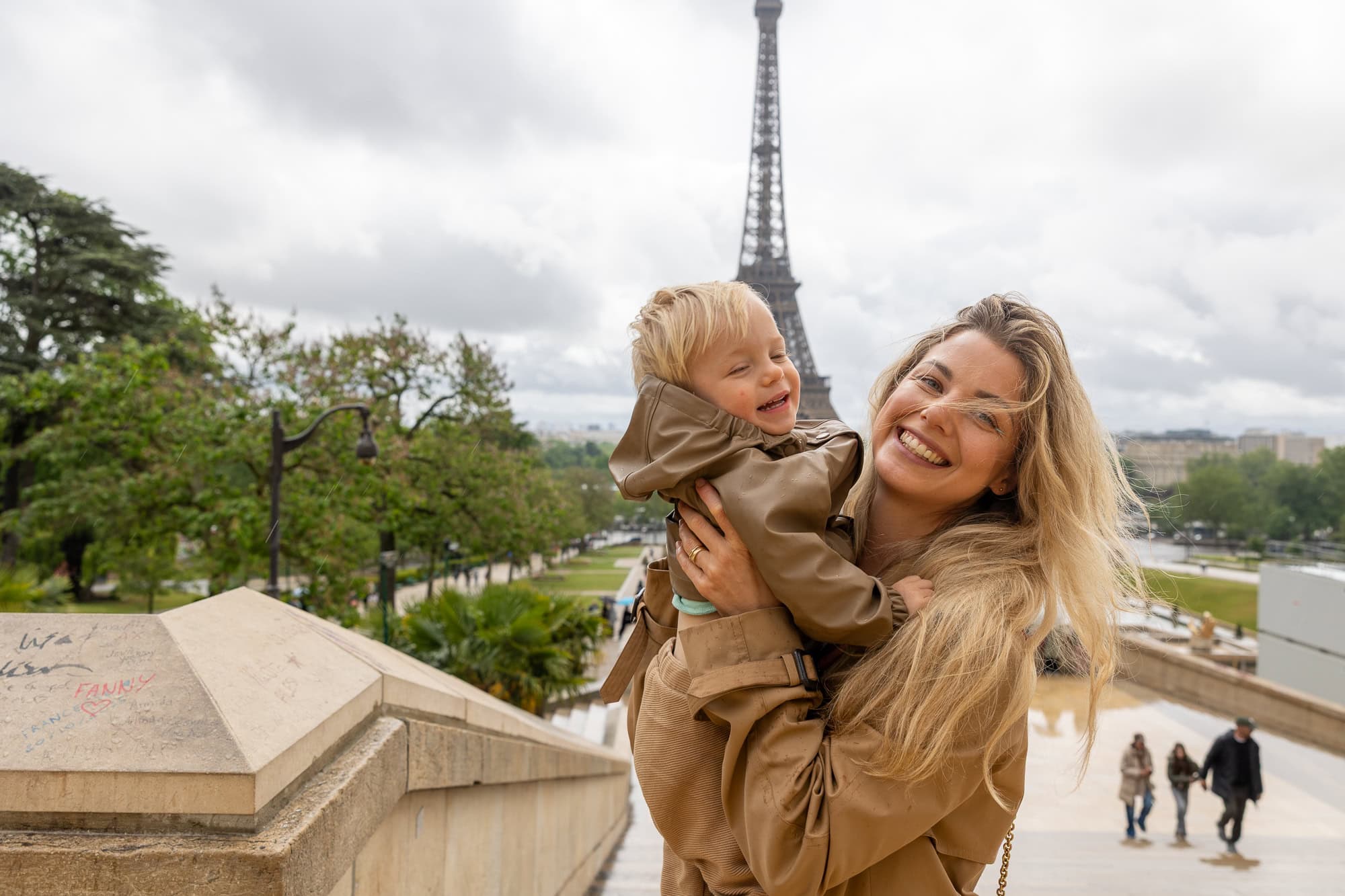
Day Trips from Paris: Versailles, Giverny, Chantilly & Fontainebleau

TL;DRThe best day trips from Paris are Versailles, Giverny, Chantilly and Fontainebleau, all within 45 minutes by train from the centre. For Versailles, take Line N from Gare Montparnasse (palace ticket €21, Passport with the Trianon estates €32). Giverny means a train from Gare Saint-Lazare to Vernon, then a €5 bus (open 1 April–1 November 2026, closed 19–20 September). Chantilly is a 25-minute train from Gare du Nord (entry €18), and Fontainebleau a 40-minute train from Gare de Lyon (château entry €14, gardens free). The best months are May, June and the late September/early October stretch, when temperatures sit at a pleasant 22 degrees and the gardens are in full bloom. If you’re travelling with small kids, bring an ergonomic carrier rather than a pushchair, and steer clear of August and Tuesdays, when the Louvre crowds spill over into Versailles.

Paris day trips are an absolute must, in my opinion. The city is wonderfully all-consuming, loud and constantly buzzing, but sometimes you just need to escape the stone streets, breathe some fresh air and let your toddler run free on the grass. Without the constant anxiety of a scooter hurtling through a crossroads.

France’s rail network is a small miracle. TGV high-speed trains and regional lines whisk you away to other centuries, straight into Impressionist paintings or into the heart of the Champagne region. For parents with a two-year-old explorer, that means one thing: minimal transport stress and maximum space for joy.

Plus, a lot is changing this year. Paris has caught its breath after last year’s Olympic frenzy, Notre-Dame Cathedral is finally gleaming after its restoration, and this summer people will be swimming in the Seine again for the first time in a century. As a vegetarian, I’m also thrilled that the famous restaurant Arpège has switched to a fully plant-based menu. All these changes in the centre mean that day trips from Paris also need a bit of a new strategy.

Small child in a white t-shirt standing by a cement railing and watching a fountain in a Parisian garden

The key is knowing which station to head to, which trains to avoid, and why you should pack a baby carrier instead of a pushchair for some of these châteaux. Some places will blow you away with their grandeur, while others will surprise you with unexpected tranquillity and empty forest paths.

So I’ve put it all together: Versailles without a family meltdown, Giverny in the right month, Chantilly as a secret trump card, and Fontainebleau for those who want castles with a side of forest. I’ve included exact prices for 2026 and things we reckon aren’t worth the bother.

TL;DR

  • Don’t take the RER C line to Versailles. It’s much more comfortable to catch the Line N train from Gare Montparnasse to Versailles Chantiers station.
  • Buy your Versailles Palace tickets online for a specific time slot. Without a reservation, you’ll be queuing for hours in the blazing sun.
  • With a toddler at Versailles, head straight for the gardens and Marie Antoinette’s hamlet. Only visit the palace in the afternoon if you really want to — personally, I think it’s not worth it with small kids.
  • Monet’s Gardens in Giverny are open from 1 April to 1 November in 2026. ⚠️ Warning: Giverny is completely closed on the weekend of 19–20 September 2026.
  • You can reach Giverny by train from Gare Saint-Lazare to Vernon station, where a shuttle bus runs for €5.
  • Château de Chantilly houses the second-largest collection of Old Masters after the Louvre. The train from Gare du Nord gets you there in just 25 minutes.
  • Fontainebleau offers not only a huge palace where Napoleon said his farewell, but above all an endless forest full of sandstone boulders that are perfect for kids to clamber over.
  • Children aged 2 and under get into Disneyland completely free. With little ones, focus mainly on the Fantasyland zone.
  • You can reach Reims for a champagne tasting in an incredible 45 minutes by TGV from Gare de l’Est.
  • Pushchairs are reluctantly tolerated in most historic palaces at best. Always keep an ergonomic baby carrier in your bag.
Round neoclassical pavilion with dome and columns surrounded by green trees

When to Take Paris Day Trips: Weather, Seasons & Key Dates 2026

Picking the right day to escape the city is absolutely crucial. While in central Paris you can always duck into a café or museum, on day trips you’re often at the mercy of the weather. Castle gardens and parks make up half the experience. Lukáš and I always carefully check the forecast, because pushing a buggy through a muddy park at Versailles is something you really don’t want.

Best months to escape the city

May and June are the absolute sweet spot for day trips from Paris. The days are long, temperatures hover around a pleasant 22°C, and everything is in glorious bloom. It’s in May that cascades of purple wisteria drape from the Japanese bridge in Giverny — a sight that will stay with you forever. September and the first half of October are also wonderful. The mornings are cooler, but the afternoon sun casts a beautifully soft light that gives the gardens at Fontainebleau a golden glow.

💡 Insider tip: If you’re planning a trip in May, watch out for French public holidays. There are several in this month alone (1 May, 8 May, Ascension Day) and Parisians love to turn them into long weekends. Trains sell out and attractions burst at the seams.

What to avoid and key dates 2026

Versailles Palace with colonnade and formal garden featuring hedges and a pool

August is the month to avoid day trips altogether. Palace courtyards turn into furnaces, park grass is scorched brown, and shade is nowhere to be found. On top of that, many small bistros in surrounding villages close for their annual summer holiday.

A critical warning for 2026 concerns the weekend of 19–20 September. The European Heritage Days (Journées du Patrimoine) take place across France. While normally closed government buildings open their doors, Monet’s Gardens in Giverny are exceptionally and strictly CLOSED on these two days. If you turn up, you’ll find nothing but a locked gate.

💡 Insider tip: Also check Mondays and Tuesdays. Most state-run museums and châteaux close on one of these days. Versailles is closed on Mondays, while the Louvre in Paris closes on Tuesdays. This means that on Tuesdays, the enormous crowd of tourists from the Louvre descends on Versailles instead.

White round neoclassical temple with colonnade in a park surrounded by greenery

Where to Stay in Paris for Easy Day Trips

Choosing the right neighbourhood will make or break your entire experience of the city and your budget. Paris is divided into twenty arrondissements that spiral clockwise from the historic centre near the Louvre. Finding affordable accommodation in the centre is nearly impossible, but if you know where to look, you can find a brilliant compromise between price, safety and accessibility.

With a pushchair and Jonáš, give a wide berth to the northern part of the 10th arrondissement around Gare du Nord and Pigalle in the 18th at night. A friend and I once got lost there at 2am — definitely not an experience I’d want to repeat with a two-year-old in tow. 😅 

After a long search, we chose Hôbou, an authentic French boutique hotel in Boulogne-Billancourt (you can book it here). At first glance it seems almost unassuming, but within the first few hours you’ll fall in love with it.

Lily pond in Monet's garden in Giverny

Versailles: King of All Day Trips (and How to Survive It)

Versailles isn’t just a palace. It’s an absolutist manifesto made flesh in gold, marble and endless gardens. But trying to tackle it without preparation is a guaranteed recipe for a family meltdown. Thousands of people head to the gates every day, and without a clear strategy you’ll drown in the crowds. We actually skipped the palace itself — there’s honestly not that much to see inside — and happily spent 6–7 hours in the gardens alone.

Getting there: Why to skip the RER C

Boy photographing golden fountains with water jets at Versailles

Most printed guidebooks will automatically send you on the yellow RER C line to Versailles Château Rive Gauche station. You’re going to be smarter than that. With a pushchair or small children, the much better option is the suburban Line N train, departing from Gare Montparnasse and taking you to Versailles Chantiers station.

The journey is shorter, and Montparnasse station itself is far more family-friendly than the labyrinthine underground corridors of the RER. The walk from Chantiers station to the palace is about five minutes longer, but you’ll save yourself enormous stress navigating awkward connections in central Paris. A one-way adult ticket costs €4.10.

💡 Insider tip: Don’t buy standard t+ tickets (those only cover zones 1–2). Versailles lies in zone 4. You need to buy a Billet Île-de-France (Billet Origine-Destination) ticket from the machine with Versailles as your destination. Ticket inspectors are stationed at the exit almost every day, and fines are steep.

Tickets and strict time slots 2026

Baroque fountain with golden statues and water jets at Versailles

Turning up at the palace without a ticket during high season means easily two hours or more of queuing in direct sunlight. Booking online at the official chateauversailles.fr website for a specific time slot is an absolute must. Without it, don’t even bother going.

The basic palace ticket (Billet Château) costs €21. If you also want to see the Trianons and the hamlet, you’ll need the so-called Passport, which comes to €32. Under-18s (and EU residents under 26) get free entry to the palace, but NOTE — you still need to reserve a free time slot for them in the booking system.

💡 Insider tip: The Paris Museum Pass does cover entry to the palace, but from April to October it does NOT include days when the Musical Fountain Shows are on. On those days (usually weekends and Tuesdays), you’ll need to pay an extra €10.50 or so for garden access.

Bronze statue of a man in the park in front of the Palace of Versailles with a pond

Reverse strategy for families

The typical visitor arrives in the morning, queues for ages, shuffles through the packed palace, and by the time they finally reach the gardens two hours later, they’re shattered. You’re going to do it the other way round. Head straight for the gardens and the vast park first. Entry to the park (not the formal gardens right next to the palace) is free and the gates open at 8:00.

Let your child run wild. The area around the Grand Canal is huge, airy and practically made for a morning picnic on the grass. Book your palace time slot for the late afternoon, ideally after 15:30. By then the big organised tour groups are heading back to Paris, you can finally breathe inside the palace, and your toddler might just be napping in the carrier. Or simply skip the palace entirely. With a small child, it’s honestly not worth it in my opinion.

💡 Insider tip: If you fancy a coffee and the famous hot chocolate at the Angelina patisserie branch inside the palace, brace yourself for an enormous queue. A much better bet is to grab a takeaway coffee from the little kiosk by the Grand Canal and enjoy it on a bench under the trees.

Marble figurative statue on a pedestal in a classical garden with an arcade

The Trianons and Marie Antoinette’s Hamlet (Hameau de la Reine)

When the main palace starts to feel overwhelming with all its gilded excess, make your way to the far end of the estate. The Grand Trianon and Petit Trianon feel far more intimate. But the real showstopper — especially if you’re travelling with children — is the Hameau de la Reine.

Queen Marie Antoinette had this rustic farmstead built complete with a mill, vegetable garden and thatched roofs so she could play at simple country life. For a two-year-old, it’s an absolute fairy tale. Sheep and goats roam freely, and the whole area looks like something from a picture book. You can walk to the Trianons in about 30 minutes from the main palace, or hop on the paid Petit Train tourist shuttle for €9.

💡 Insider tip: Some of the oldest trees in the entire estate grow around the Trianons, complete with signs telling their stories. It’s a brilliant spot to escape the summer heat, as the canopy creates a perfect natural parasol.

Pushchairs, carriers and toddler logistics

Man in t-shirt with glasses standing with a pushchair in front of the Palace of Versailles

The official Versailles rules are clear: no pushchairs inside the palace. In practice, though, staff often quietly tolerate small folding buggies. However, you might encounter a strict guard who’ll unceremoniously send you to the check-in desk to leave it.

The golden rule: bring an ergonomic baby carrier if you want to go inside the palace. It’s full of stairs, narrow passages, and the crowds shuffle along slowly. A carrier gives you freedom of movement and your toddler will see far more than just other people’s legs and rucksacks. In the gardens and park, your pushchair is absolutely fine.

💡 Insider tip: The toilets inside the palace are perpetually busy and the changing tables are often occupied. Much cleaner and quieter loos can be found near the garden entrance by the La Flottille restaurant at the Grand Canal.

Giverny: Step Right Into a Monet Painting

Monet's garden in Giverny with pond and willows

If you love Impressionism, blooming gardens and a dash of artistic romance, Giverny is your place of pilgrimage. Claude Monet lived here, worked here, and grew his greatest masterpiece with his own hands — his garden. It’s one of the most photogenic spots in all of France, but it does require a bit of planning.

When to go and how to get there

The season in Giverny runs from 1 April to 1 November 2026. It’s open daily from 9:30 to 18:00 (last entry at 17:30). The visit itself takes about 2 hours, but factor in half a day with travel.

Giverny lies in Normandy, about 80 kilometres from Paris. The easiest route is to take a regional train from Gare Saint-Lazare to Vernon-Giverny station. The journey takes roughly 50 minutes and a ticket costs around €16. A shuttle bus waits outside Vernon station and takes you directly to the village for €5 one way (or €10 return).

💡 Insider tip: The shuttle bus timetable is perfectly synced with train arrivals from Paris. Don’t be tempted by taxi drivers at the station who often claim the bus has already left. Stay calm — the bus waits for all passengers from the train.

What awaits inside (The Japanese Bridge and water lilies)

Sprawling formal gardens of the Palace of Versailles with golden statue, pool and tree-lined avenues

An adult ticket costs €13, and you can easily buy them on the official foundation website. Children under 7 get in free.

The main event happens outdoors. The garden is split into two parts. The Clos Normand in front of the house is a huge, geometrically arranged palette of flower beds. An underpass beneath the road then leads you to the Water Garden. There you’ll find the iconic green Japanese bridge draped in foliage and the pond full of Monet’s famous water lilies (Nymphéas) — the very subject he painted obsessively in the final years of his life.

💡 Insider tip: The best light for photography by the pond is first thing when the doors open at 9:30, or just before closing time. Around midday the sun is too harsh and the bridge becomes a battleground for tourists fighting over the best selfie spot.

Photography, lunch and the Impressionism Museum

The garden looks completely different each month. In May, irises and peonies bloom; June belongs to the climbing roses; and by late September into October, towering hydrangeas, dahlias and sunflowers take over. If you’re into photography, bring a polarising filter — it works wonders removing glare from the pond surface so the water lilies really pop.

After the gardens, take a stroll through the village. Right next door you’ll find the excellent Musée des impressionnismes Giverny. And if you’re after an exceptional dining experience, book a table at the nearby Le Jardin des Plumes, which holds a Michelin star. For vegetarians, they can prepare an absolutely fantastic tasting menu using local vegetables — just let them know in advance.

💡 Insider tip: The road through Giverny village (Rue Claude Monet) is narrow, but it’s lined with lovely little independent galleries and bakeries. Grab a fresh baguette, a chunk of Normandy cheese, and have a picnic on the banks of the River Epte just beyond the village.

Chantilly: Horses, Lace and Legendary Whipped Cream

Baroque Great Stables Grandes Écuries in Chantilly

Craving a grand château but honestly dreading the Versailles crowds? Chantilly is your secret weapon. This place oozes elegance, sits north of Paris, and sees significantly fewer tourists. Plus, it’s paradise for lovers of art, horses and good food.

lukas a lucka
Lukáš and Lucie recommend
Where to stay near Paris
2 accommodations — hotels and other lodging options

The château and the second-largest art collection

Getting there is surprisingly easy — a TER train from Gare du Nord drops you at Chantilly-Gouvieux station in just 25 minutes, and a ticket costs around €9. From the station, a lovely forest path leads to the château in about 20 minutes on foot, or you can catch the local bus.

The château itself (Palais de Condé) looks from afar as if it’s floating on the water. Inside, it holds a huge surprise: the second-largest collection of Old Masters in France, right after the Louvre in Paris. You’ll see works by Raphael, Botticelli and Delacroix. A full ticket (château, park and stables) costs €18, available on the Château de Chantilly website.

💡 Insider tip: The paintings in the gallery are hung exactly as the Duke of Aumale wanted them in the 19th century — crammed side by side, frame to frame, floor to ceiling. It’s a mesmerising sight that you simply don’t see in modern galleries any more.

Grandes Écuries (The Great Stables)

For families with children, the star attraction is the Grandes Écuries. These are quite possibly the most luxurious horse stables in the world — so monumental that 18th-century visitors often mistook them for the château itself.

Today they house a horse museum, and spectacular equestrian shows are held here regularly. The horses train every day, and for little ones, watching dressage beneath the enormous dome is a truly awe-inspiring experience. Jonáš stood there utterly fascinated for nearly an hour.

💡 Insider tip: Tickets for the equestrian show aren’t included in the standard entry fee. If you want to see the main performance (usually on Thursdays, weekends and bank holidays), you’ll need to pay an extra €6 or so, and book well in advance online.

The ritual of Crème Chantilly

Château de Chantilly reflected in its moat during golden hour

The town gave the world two absolutely essential things: delicate black lace, and above all the real, vanilla-scented, properly whipped crème chantilly. Trying it here, freshly whipped, is nothing short of a gastronomic and moral obligation.

Skip the stalls right by the station, though. The best places to try it are in the château grounds — the restaurant La Capitainerie, set in the former château kitchens, or the little bistro in the English garden. A bowl of fresh strawberries topped with a generous mountain of this fluffy heaven will set you back about €8.

💡 Insider tip: Authentic Chantilly cream is whipped by hand with large whisks and must contain no stabilisers whatsoever. You’ll taste the difference from the first spoonful. It’s incredibly rich, creamy and fragrant with real vanilla pods.

Fontainebleau: Refuge of Kings and a Sandstone Paradise

Sandstone boulders in the forest of Fontainebleau

While Versailles was built by the Sun King Louis XIV essentially from scratch, Fontainebleau served as a royal residence for a full eight centuries. It’s a sprawling complex that breathes far older and more rugged history. For Parisians, it’s the most popular weekend escape, offering a perfect blend of culture and wild nature.

Château de Fontainebleau (Napoleon’s footprint)

Horseshoe staircase of Château de Fontainebleau

A train from Gare de Lyon gets you to Fontainebleau-Avon station in 40 minutes. A ticket costs around €9, and you can also use a pre-loaded Pass Navigo Découverte if you’ve bought all zones. From there, hop on bus line 1 which drops you right at the château, or enjoy a 35-minute walk through the beautiful forest.

The palace is labyrinthine and enormous. It was on its main courtyard — today known as the Courtyard of the Farewells — that Napoleon Bonaparte stood in 1814 to bid farewell to his loyal guard before departing into exile on the island of Elba. Inside, don’t miss the stunning Gallery of Francis I, packed with frescoes and carved wood. Palace admission is €14, bookable on the official website.

💡 Insider tip: Unlike Versailles, the palace grounds are completely free to enter, 24 hours a day, 7 days a week. There’s a gorgeous pond teeming with giant carp. Buying a bit of bread and feeding them is one of those beloved local rituals that kids absolutely adore.

Forêt de Fontainebleau and bouldering

For many locals, Fontainebleau isn’t about the palace at all — it’s about the forest. This vast natural park spanning 25,000 hectares is a world-class wonder, scattered with enormous sandstone boulders in the most fantastical shapes.

It’s a global mecca for bouldering, something we only learnt from a random chap in climbing shoes who was training there. We’d turned up with a pushchair, and Jonáš was equally thrilled, leaping from boulder to boulder like a maniac while we barely had to watch him because the white sand underneath is naturally soft. It feels more like a fairy tale than somewhere 30 kilometres from bustling Paris. If you’ve got a buggy, stick to the main waymarked paths (like the loop at Gorges de Franchard).

💡 Insider tip: If you want to see the most interesting rock formations, download a hiking trail map app to your phone. The forest is so enormous that getting lost is genuinely easy. The most popular and family-accessible area is the so-called L’Éléphant (an elephant-shaped rock).

Disneyland Paris: A Tactical Operation with a Two-Year-Old

Sleeping Beauty Castle at Disneyland Paris during golden hour

Loads of parents think taking a two-year-old to Disneyland is pointless because they won’t remember it and won’t be allowed on any rides. Big mistake. Disneyland Paris is surprisingly well set up for toddlers. You just need to approach it more like a military operation than a carefree day out.

Key facts and prices for families

Getting there is very straightforward. From central Paris (e.g. Châtelet-Les Halles station), hop on the red RER A line and in 45 minutes you’ll step off at the terminus Marne-la-Vallée/Chessy, right at the park gates. A ticket costs €5.

Children aged 2 and under get in completely free and don’t need a ticket at all, but from age three you’ll need to buy a child’s ticket. A basic one-day adult ticket for one park (Disneyland Park) starts at €62 during off-peak times and can easily exceed €100 on weekends and school holidays — so buy exclusively online in advance, as tickets are no longer sold at the gates.

💡 Insider tip: Definitely bring your own pushchair. Even if your child normally walks, the park is enormous and a buggy doubles as a mobile base for jumpers, snacks and afternoon naps. If you forget one, you can hire a plastic stroller at the entrance for €25.

Fantasyland as your main target

With a small child, ignore the adrenaline zones like Discoveryland. Your home turf will be Fantasyland, at the back of the main park behind Sleeping Beauty Castle. The park has a surprising 47 rides with no minimum height requirement, meaning your toddler can join you on your lap.

Best rides for the youngest ones:

  • It’s a Small World: The absolute classic. A gentle boat glides past scenes with thousands of singing dolls. No darkness, no scares — just pure joy and a catchy tune you’ll never get out of your head.
  • Peter Pan’s Flight: A gorgeous flying ship soaring over a glowing nighttime London. One of the most popular rides, though, so expect massive queues.
  • Le Pays des Contes de Fées: A peaceful outdoor boat ride past miniature scenes from famous fairy tales. Perfect for a quiet moment.
  • Dumbo the Flying Elephant: Flying elephants where you control the height with a lever.

💡 Insider tip: Watch out for Snow White’s Scary Adventures. It’s called “scary” for good reason. Most of the ride takes place in the dark, and the evil witch lunging out of the shadows can genuinely terrify younger children to tears.

Extra Magic Hour strategy and food

If you can splash out on one of the official Disney hotels, you’ll get the so-called Extra Magic Hour. You can enter the park at 8:30, while regular visitors wait until 9:30. That morning hour is worth its weight in gold for Fantasyland. You’ll breeze through rides that later have hour-long queues.

Food inside the park is pricey and queues at the kiosks are endless. Pack your rucksack with squeeze pouches, rice cakes, sliced fruit and bottles of water (there are fountains around the park for refills). Toddler hunger doesn’t wait while you queue for half an hour for a hot dog.

In the afternoon, don’t miss the Parade (the procession of allegorical floats). For toddlers, seeing a life-sized Mickey is often a bigger thrill than the rides themselves.

💡 Insider tip: If you and your partner want to go on a big roller coaster (e.g. Hyperspace Mountain), use the Rider Switch service. You both queue once, one rides while the other watches the child, and then you swap without queuing again.

Reims: Champagne and Gothic Splendour 45 Minutes by High-Speed Train

Gothic Notre-Dame Cathedral in Reims in dramatic light

The idea that you could have a morning coffee and croissant by the Canal Saint-Martin in Paris and by late morning be standing in the capital of the Champagne region sounds almost like science fiction. But thanks to TGV high-speed trains, it’s an everyday reality. From Gare de l’Est you’re in Reims in an incredible 45 minutes.

Notre-Dame de Reims Cathedral

A return TGV ticket costs roughly €30 to €60, depending on how far in advance you book. The city centre is just a ten-minute walk from the station.

The main landmark is the Notre-Dame de Reims Cathedral (a UNESCO World Heritage Site). It’s a breathtaking Gothic structure that is historically far more significant than its Parisian counterpart. This is where 33 French kings were crowned over the centuries. Inside there’s a wonderful sense of calm and vast space. Don’t miss the stunning, vibrantly blue stained-glass windows at the rear, created by the celebrated artist Marc Chagall in 1974.

💡 Insider tip: TGV tickets go on sale roughly 3 to 4 months before the departure date. If you snap them up on the very first day of release, you can get the Prem’s tariff — a fraction of the standard price. Last-minute fares are astronomical.

Tasting in the chalk cellars

Reims is honeycombed with kilometres of ancient chalk cellars where millions of bottles from the most prestigious champagne houses age in perfect cool darkness. Giants like Veuve Clicquot, Taittinger, Pommery and Ruinart are all based here.

You must book a cellar tour with tasting at least 1 to 2 weeks in advance via the individual houses’ websites. Nobody will let you in without a reservation. A typical tour with one or two glasses costs €25 to €50 per person.

💡 Insider tip: With a toddler, the cellars can be a bit nerve-wracking. They’re dark, damp, a constant 10°C (bring a warm jumper for the child even in summer!) and the guide’s commentary goes on for a while. Pushchairs often can’t get into the cellars (at Taittinger, for example, you have to descend many steps). A baby carrier is your only option here.

More Brilliant Ideas for Day Trips

If you’ve already ticked off Versailles and Disneyland and are looking for something more low-key, the area around Paris hides plenty of smaller gems you can manage in half a day.

Auvers-sur-Oise (In Van Gogh’s footsteps)

The church in Auvers-sur-Oise immortalised by Van Gogh

A picturesque village less than an hour by train north-west of Paris. This place has a slightly melancholic atmosphere. It’s where Vincent van Gogh spent his final days. In just 70 days he painted an astonishing 80 canvases here, before shooting himself in a nearby field.

That attic room in the Auberge Ravoux inn — untouched since his death — left a peculiar weight on me. It feels completely different from the over-decorated royal palaces. And then the cemetery, where Vincent lies side by side with his brother Theo, both beneath a simple slab covered in ivy. I’m not sure why, but this place moved me more than many a world-famous painting. A walking trail with panels around the village shows his paintings at the exact spots where he painted them over a century ago.

💡 Insider tip: Pick up a free village map from the tourist office near the station. The walk to the famous church in Auvers and on to the wheat fields is very easy and perfectly manageable with a pushchair.

Château de Vincennes (A castle at the end of the Metro)

Looking for a trip beyond the city walls but can’t be bothered studying train timetables? Château de Vincennes is your answer. It’s the only real medieval fortress in the Paris area that you can reach by ordinary Metro. Just hop on the yellow Line 1 and ride to the terminus, Château de Vincennes.

What awaits you is a massive fortress with a moat and the tallest castle keep (donjon) in Europe at 50 metres. It feels much more military and austere — a brilliant contrast to the finery of Versailles. Admission is €9.50. Right beside the castle stretches the enormous Bois de Vincennes park with a lake where you can hire a rowing boat.

💡 Insider tip: The moat around the castle is now drained and grassed over. It’s a fantastic and completely safe spot where you can let kids run up and down the slopes while you sit on a blanket.

Provins (Medieval town under UNESCO protection)

Medieval walls and towers of Provins

If you love knights, half-timbered houses and massive stone ramparts, head to Provins. It lies about 90 kilometres south-east of Paris, and a Line P train from Gare de l’Est gets you there in an hour and a half.

The entire town is a UNESCO World Heritage Site and looks exactly like you’d imagine a period film set. You can walk the ramparts, explore underground tunnels or watch a falconry show. The town is also famous for its rose cultivation, so on every corner you’ll find rose jam, rose honey or rose-flavoured sweets.

💡 Insider tip: Buy the Provins Pass (around €15). It covers entry to four main attractions including the Tour César tower and the underground tunnels. Far better value than buying separate tickets for each site.

Where to Eat on Day Trips (Without Blowing Your Budget)

Food is sacred in France, but at popular tourist spots you can very easily get burnt. After a few expensive and distinctly mediocre lunches, Lukáš and I quickly realised that the secret to a truly successful day trip with a toddler is a well-thought-out eating strategy.

Picnics as the ultimate lifesaver

The best lunch is simply the one you bring with you. It sounds terribly ordinary, but in France a proper picnic is a full-blown gastronomic experience. You can’t bring food inside the châteaux themselves, but the sprawling gardens at Versailles, Fontainebleau or the lovely meadows beyond Giverny village are practically made for spreading out a blanket.

Every morning before leaving Paris we pop into our favourite bakery for freshly baked crusty baguettes. We add a chunk of good cheese, cherry tomatoes and some grapes. Jonáš is over the moon eating outside on the grass, and Lukáš and I get to relax without the stress of overcrowded, overpriced restaurants 😉.

Where to treat yourself to something special

When we do decide to eat out, we choose very carefully. In Chantilly, don’t miss La Capitainerie, set right in the historic château kitchens, or the little café in the gardens. The atmosphere is wonderful and you obviously have to round off dessert with their legendary whipped cream.

In Giverny, it’s absolutely worth booking a table at Le Jardin des Plumes, where they’ll prepare a stunning vegetarian menu from local produce if you let them know in advance. It’s a pricier treat, but the reward after a day spent walking the gardens is well worth it. At Disneyland, on the other hand, we rely purely on our own supplies, because the queues at the food stalls test the patience of even the calmest parents.

Practical Info: Transport, Budget and Tips for 2026

Day trips from Paris require a bit of maths. Figuring out which ticket offers the best value can sometimes feel harder than a school exam. Here are the ground rules we follow.

Trains and transport

Regional trains (RER, Transilien, TER) have fixed fares. If you’re planning to travel around Paris during one week, go to Versailles, and perhaps also visit Disneyland or Fontainebleau, the best value by far is the Pass Navigo Découverte.

This card covers all zones (1–5) for an entire week and costs €30.75 plus €5 for the card itself. You need to bring your own passport-sized photo! But beware of one catch: the card ALWAYS runs from Monday to Sunday. If you arrive on a Thursday, it’s not worth buying.

For TGV high-speed trains (Reims, Strasbourg), different rules apply. These tickets use dynamic pricing. The earlier you buy them (ideally on the SNCF Connect website), the cheaper they’ll be.

Sample budget for a day trip for two (Versailles)

  • Transport: Return Line N tickets for two adults: €16.40
  • Tickets: 2x Passport for palace and Trianons: €64
  • Lunch: Baguettes, cheese and fruit for a picnic bought in Paris: €15
  • Coffee and treats: Coffee and macarons in the gardens: €12
  • Total: €107.40 for a very full day out as a couple with a child who gets in free.

At stations like Gare du Nord or Gare de l’Est, keep a close eye on pickpockets. This isn’t a cliché — a friendly gentleman once offered to help us at the ticket machine, and I let him press buttons for a good half minute before Lukáš quietly tapped me on the shoulder. They’ll offer “help” with your purchase, but actually steal your card or sell you an invalid ticket. Always buy tickets yourself or ask only staff in SNCF uniform.

Frequently Asked Questions

Tips and Tricks for Your Vacation

Don’t Overpay for Flights

Search for flights on Kayak. It’s our favorite search engine because it scans the websites of all airlines and always finds the cheapest connection.

Book Your Accommodation Smartly

The best experiences we’ve had when looking for accommodation (from Alaska to Morocco) are with Booking.com, where hotels, apartments, and entire houses are usually the cheapest and most widely available.

Don’t Forget Travel Insurance

Good travel insurance will protect you against illness, accidents, theft, or flight cancellations. We’ve had a few hospital visits abroad, so we know how important it is to have proper insurance arranged.

Where we insure ourselves: SafetyWing (best for everyone) and TrueTraveller (for extra-long trips).

Why don’t we recommend any Czech insurance company? Because they have too many restrictions. They set limits on the number of days abroad, travel insurance via a credit card often requires you to pay medical expenses only with that card, and they frequently limit the number of returns to the Czech Republic.

Find the Best Experiences

Get Your Guide is a huge online marketplace where you can book guided walks, trips, skip-the-line tickets, tours, and much more. We always find some extra fun there!
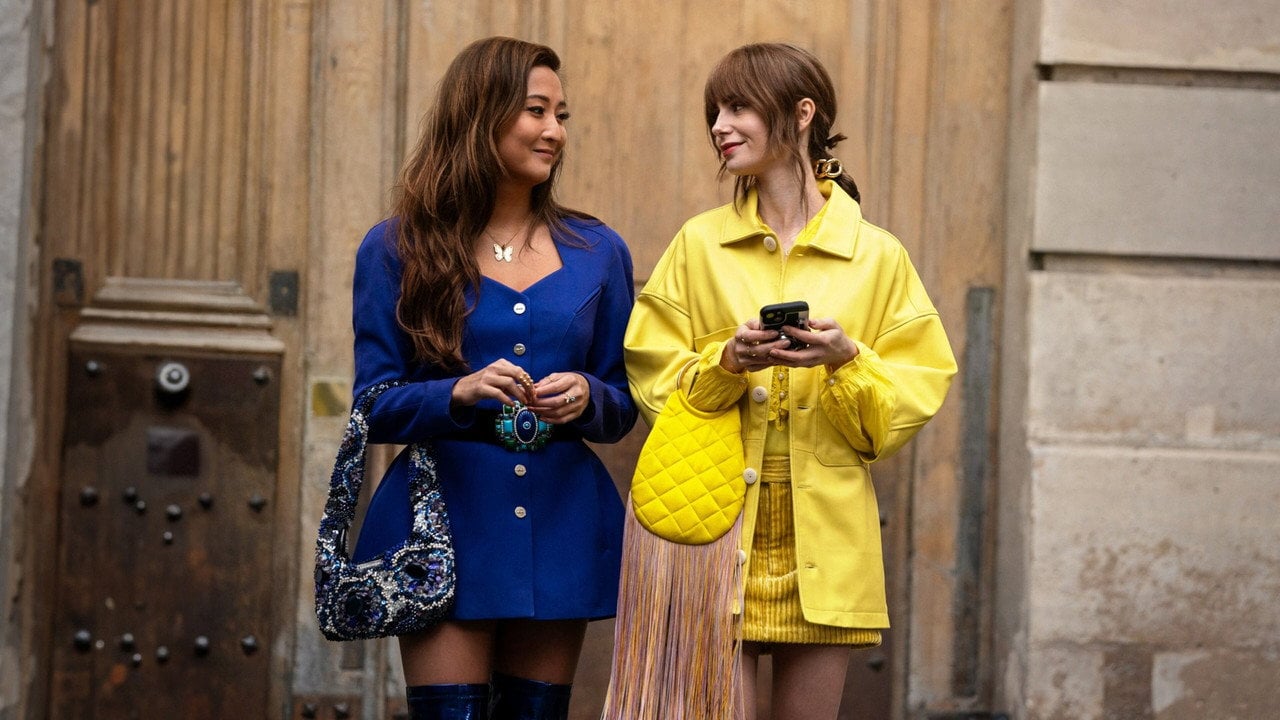
Paris Myths and Legends: From Paris Syndrome to the Phantom of the Opera

TL;DRParis mixes small legends with hard facts: the Eiffel Tower was meant to be pulled down after twenty years, but a military radio antenna and General von Choltitz’s refusal to obey Hitler’s orders saved it. Mona Lisa only became a celebrity after she was stolen in 1911 — Vincenzo Peruggia kept her hidden at his place for two years. Paris Syndrome is a genuine psychiatric diagnosis first described in 1986, and it mostly hits tourists confronted with reality instead of the film-set romance they’d expected. The Phantom of the Opera story is rooted in a real underground lake beneath the Palais Garnier, where Paris firefighters now train, while below the city you’ll also find 300 kilometres of catacombs holding the remains of six million people, plus 2,400 kilometres of historic sewers with a museum of their own.

Walking through the narrow streets of old Paris with a morning coffee in hand as the city lazily wakes and bakeries fill the air with the scent of fresh butter, you feel like you’ve stepped into a perfect film. Especially when you’re pushing a buggy and your toddler is happily watching pigeons on a little square. Everything around you looks so elegant, polished, and flawless. But this romantic façade that the French capital so carefully cultivates is actually one big, albeit stunningly beautiful, lie. The real Paris — and its Paris legends — is far darker, more tangled, and more fascinating than any glossy travel guide will ever show you.

Beneath those wide boulevards where we stroll and shop today lie millions of bones and hundreds of kilometres of dark sewers. The most famous landmarks that tourists now crowd around, phones in hand, often owe their fame to sheer chance, theft, or plain bureaucratic blunder. And those picture-perfect Parisian flats with a view? They were built at an enormous social cost, through the ruthless demolition of entire neighbourhoods. Paris constantly tests you, playing an endless game of truth and illusion.

The year 2026 is an exceptional time to explore these stories. The city has caught its second wind after the Olympic frenzy. Notre-Dame Cathedral, now shrouded in new legends after its devastating fire, has finally reopened in full glory. The famous Centre Pompidou, on the other hand, has closed until 2030, giving lesser-known spots a chance to shine. This summer, people will officially swim in the Seine again for the first time in a century. And for me personally, a small miracle happened — the legendary Michelin-starred restaurant Arpège switched to a fully plant-based menu, which is an absolute earthquake in the world of haute French cuisine.

So what’s ahead? Famous Parisian myths, the theft that turned the Mona Lisa into a global superstar, Paris Syndrome that breaks tourists’ hearts, and just how much the series Emily in Paris lies to us. Plus a few tips on where to go if you’re drawn to the dark side of this unbelievably beautiful illusion.

TL;DR

Green bronze equestrian statue of Louis XIV on a stone pedestal in Paris
  • The Eiffel Tower was originally meant to be demolished after twenty years. It was saved by a military radio antenna, and later by a German general who disobeyed Hitler’s order to destroy it.
  • The Mona Lisa was just one of many paintings in the Louvre until 1911. An audacious theft by an Italian workman — who hid it in his room for two years — turned it into a global celebrity.
  • Paris Syndrome is a genuine psychiatric diagnosis. Tourists (often from Japan) experience severe shock when they discover that Paris isn’t all romance and film-set perfection, but also noise, stress, and brusque waiters.
  • The series Emily in Paris depicts a city that doesn’t exist. Real Parisians don’t wear pastel colours, they don’t take taxis everywhere (because the traffic is hellish), and nobody will speak to you unless you greet them with “Bonjour” first.
  • Beneath Paris lie 300 kilometres of catacombs holding the remains of six million people, plus 2,400 kilometres of historic sewers that even have their own museum.
  • Paris’s wide boulevards (Haussmann’s renovation) weren’t built for beauty — they were designed so revolutionaries couldn’t build barricades and the army had room for artillery.
  • The story of the Phantom of the Opera is rooted in reality. Beneath the Palais Garnier, there’s still a vast underground lake where Paris firefighters train to this day.
  • The golden rule of survival is simple: ignore street scammers. Nobody just found a gold ring in front of you, nobody wants to give you a free friendship bracelet at Sacré-Cœur, and entry to Notre-Dame is free.
The Eiffel Tower photographed through green tree branches

When to explore Paris legends: Weather and seasons 2026

Getting the timing right is absolutely essential, especially if you don’t want to spend hours in queues or fight for pavement space. Paris is a city that responds dramatically to the seasons — each one changes not just the temperature but also the mood of the locals and the availability of attractions. Lukáš and I always try to plan our trips to avoid the worst of the madness, because wandering dark legend-filled alleyways with a crowd of strangers breathing down your neck just doesn’t have the right atmosphere.

Best months for exploring legends

Ornate golden gate with a royal crown and vine motifs

Lukáš and I swear that the most beautiful Paris we’ve ever experienced was always in spring or autumn. May brings blossoming trees and pleasant temperatures around 20°C, ideal for long walks tracing the footsteps of famous writers through the Latin Quarter. Autumn — October and November specifically — has an incredibly melancholic atmosphere. Frequent mists over the Seine and fallen leaves in the Luxembourg Gardens create the perfect backdrop for tales of the Phantom of the Opera or cursed poets. Plus the main tourist wave has receded, so you’ll get into smaller museums and underground spaces much more easily.

That autumn light, reflecting in puddles along the Seine, is something I’ll never tire of. You suddenly understand all those painters and writers who came here searching for lost inspiration and ended up staying for years.

💡 Insider tip: If you want to experience a truly magical, slightly eerie Paris, head to Père-Lachaise cemetery first thing in the morning in November. The morning mist weaving between the old tombstones is incredibly photogenic, and the tourist crowds don’t arrive until around ten.

When to stay home

Marble figurative statue on a pedestal in a classical garden with an arcade

August is the month when Paris transforms into a strange ghost town crossed with a tourist theme park. Locals flee to the coast, many family bakeries and small bistros shut up shop, and the only people left on the streets are confused visitors clutching maps. The tarmac radiates heat, turning a city tour into more of an endurance test. If you’re travelling with kids, give August a wide berth. Also watch out for late February and early March, when Fashion Week takes over. Accommodation prices make absolutely no sense during that period, and you won’t get into most central restaurants without a reservation made a month in advance.

Lukáš and I once lived through the Fashion Week circus first-hand, and honestly it was quite intense. Everywhere we wanted to go was packed solid, our favourite cafés were impossible to get into, and photographers were constantly dashing about — we and our buggy were clearly just getting in the way of their shots. So we now happily leave that season to the fashion enthusiasts.

💡 Insider tip: The Trocadéro fountains that you know from those flawless Instagram shots are often drained from November to March for maintenance and frost protection. Don’t plan a grand winter photo shoot there — you’d be greeted by empty concrete.

Events calendar and anniversaries 2026

The Eiffel Tower photographed from below against an overcast sky

The year 2026 brings several specifics you need to factor into your planning. From July to August, the massive Seine swimming project kicks off, with official bathing spots opening right in the river. This has been talked about for decades, and now it’s finally happening. A critical date for art lovers is the weekend of 19–20 September 2026, when European Heritage Days (Journées du Patrimoine) take place. While normally inaccessible palaces and government buildings across Paris open their doors for free, the famous Monet Gardens in Giverny are exceptionally and strictly closed on those two days.

Another big talking point this year is the reopening of several iconic covered passages in the centre that were hidden behind scaffolding for years. It’s lovely to see the city constantly evolving and taking its time after the Olympics to fine-tune these smaller delights to perfection.

💡 Insider tip: On the first Saturday of October, Nuit Blanche (White Night) takes place. The whole city stays awake, streets fill with art installations, and public transport runs for free until morning. It’s the best night of the year to soak up contemporary Parisian culture.

Aerial view of Trocadéro with the fountain, palaces, and Paris in the background

Where to stay in Paris: A base for families and mystery hunters

Choosing the right neighbourhood in Paris is absolutely crucial. It’s not just about where you sleep — it’s about what atmosphere you absorb the moment you wake up. The twenty Parisian arrondissements spiral outward from the centre like a snail’s shell, and each one has a completely different character. We went through a phase of staying in the noisy centre, but ever since Jonáš started travelling with us, our priorities have completely shifted. We need safety, wider pavements for the buggy, proximity to parks, and quiet nights.

Why we choose the 6th and 3rd arrondissements

Bronze bust of a woman with gilded details on a Parisian street under trees

For families and anyone looking for an authentic but peaceful Paris, the absolute favourite is the 6th arrondissement (Saint-Germain-des-Prés). Historically an intellectual quarter, it’s full of small publishers and quiet streets, and the main advantage is that you’ve got Jardin du Luxembourg right on your doorstep (which we think is the most beautiful park in the world), with fantastic playgrounds and safe, wide streets for pushchairs.

A brilliant alternative is the northern part of the 3rd arrondissement (Haut Marais). Unlike the overcrowded southern section of the Marais (4th arrondissement), this part is much calmer. The streets are narrow, but you’ll find loads of excellent vegetarian bistros, independent boutiques, and the fantastic covered market Enfants Rouges. If you want to be close to the Eiffel Tower and fancy an evening picnic, look in the 7th arrondissement (Invalides). It’s an incredibly quiet residential area — short on nightlife, but that’s a massive plus for families. Steer clear of the area around Gare du Nord station (10th arrondissement), where safety, particularly in the evening, isn’t great.

Where to rest your head with kids (tips 2026)

Your choice of neighbourhood will fundamentally shape your entire experience of the city — and your budget. Paris is divided into twenty arrondissements that spiral clockwise from the historic centre near the Louvre. Finding affordable accommodation in the centre is nearly impossible, but if you know where to look, you can find a great compromise between price, safety, and accessibility.

With a pushchair and Jonáš, give a wide berth to the northern part of the 10th arrondissement around Gare du Nord and Pigalle at night in the 18th arrondissement. We once got lost there at 2 AM with a friend, and that’s definitely not an experience you want to repeat with a two-year-old. 😅

After much searching, we settled on Hôbou, an authentic French boutique hotel in Boulogne-Billancourt (you can book it here). It looks almost unassuming at first glance, but within the first few hours you’ll fall in love with it.

The Eiffel Tower visible behind a stone bridge over the River Seine in Paris

Where to eat in Paris: Our favourite bistros and cafés

Hand on heart, for the first week Lukáš and I mostly ate baguettes from bakeries, because finding a free table in a restaurant with a pushchair and Jonáš in the evening is a sport in itself. Chasing Michelin stars on a tight budget is no easy feat, so we had to learn how to eat well in Paris without bankrupting the family and — crucially — find places where nobody would look down their nose at Jonáš.

Finding a genuinely good restaurant in the centre that isn’t just a tourist trap serving overpriced, tired croissants takes a bit of practice. After a few missteps, though, we discovered a handful of addresses we return to every visit. And don’t worry — I won’t skip the vegan tips that currently excite me most about the Parisian dining scene.

Breakfast and coffee to get you going

White Sacré-Cœur Basilica on Montmartre with groups of tourists and a blue sky

If there’s one thing the French do to perfection, it’s sweet pastries. Our morning routine usually starts at La Maison d’Isabelle bakery (in the 5th arrondissement), which won the award for the best croissant in all of Paris in 2018. And trust me, that award is thoroughly deserved. A buttery croissant here costs around €1.20 and peels apart beautifully. Lukáš and I always grab a few extra in a paper bag and munch them on the go.

Good speciality coffee used to be a real challenge in Paris — locals swear by their classic dark-roasted espresso knocked back standing at the bar. Thankfully, times are changing. We’re big fans of Café Loustic in the 3rd arrondissement (Haut Marais). There’s plenty of space, an excellent flat white for about €5, and the staff actually smile at us even when we’re battling spilt water at the table 😅.

Family-friendly dinners without the Michelin stars

Pink corner restaurant with green shutters and climbing plants in Montmartre

When we fancy a proper dinner at a reasonable price with that authentic Parisian buzz, we head to Bouillon Chartier. These traditional dining halls (bouillons) date back to the turn of the 19th century and were originally for workers. We love the branch on Grands Boulevards. It’s huge, noisy, waiters in black waistcoats scribble your order straight onto the paper tablecloth, and you can get classic French food for a song. A main course like bœuf bourguignon comes in at around €12. Just be prepared to share a table with strangers — which actually has its own unmistakable charm.

And I mustn’t forget my plant-based favourites — I have to mention Le Potager de Charlotte (with branches in the 9th and 17th arrondissements). It’s a family business run by two brothers who produce fantastic, fully vegan French cuisine. Their roasted aubergine and chickpea fritters are absolutely divine. Dinner here runs to about €25 per person. This is usually where we go once Jonáš has fallen asleep in the pushchair and Lukáš and I get a quiet moment to ourselves with a bottle of wine ☺️.

Parisian street with a historic green shopfront and red door adorned with flowers

The Iron Lady who was meant to die young

Close your eyes and picture Paris — you’ll see her, guaranteed. The Eiffel Tower forms an utterly fixed anchor in the city’s skyline. She looks as if she’s stood there since time immemorial, beloved from day one. And yet, what few people know is that her existence hung by a thread on multiple occasions. The story is packed with hatred, political intrigue, and sheer good fortune — the stuff novels are made of. So many legends swirl around the world’s most famous structure that it’s sometimes hard to separate historical fact from urban myth.

The myth of a twenty-year lifespan and salvation by radio

parizske myty legendy 09 cerveny mlyn moulin rouge dominuje parizske ulici mezi klasickymi haussmannskymi

You’ll often hear that the tower was supposed to come down after twenty years. Surprisingly, this isn’t a myth — it’s the pure truth. Gustave Eiffel built it as a temporary, albeit monumental, attraction for the 1889 World’s Fair. His land lease was for a mere two decades. In 1909, it was simply to be dismantled and sold for scrap. The Parisian cultural elite could hardly wait. Writers like Guy de Maupassant and Alexandre Dumas the younger penned furious petitions against the “tragic street lamp” and “black factory chimney” that they claimed disfigured the city.

But Eiffel wasn’t just a brilliant engineer — he also had a formidable nose for business and politics. He knew that unless he found some damn good practical use for the structure, it would be consigned to the dustbin of history. Salvation came from the then-invisible, brand-new world of radio waves. Eiffel transformed the tower into a giant antenna. By 1909, when the lease was set to expire, it was already functioning as a key military telegraphic hub. During World War I, the French army used it to intercept German dispatches and coordinate defences. The steel monster saved its own neck by simply becoming indispensable to the state.

💡 Insider tip: Getting up the Eiffel Tower is pricey (the lift to the top costs €29.40 — only buy tickets through the official Eiffel Tower website) and the queues are gruelling. A much better view, where you actually have the Eiffel Tower itself in the frame, is from the rooftop of the Tour Montparnasse skyscraper (open until 23:30, entry €21).

Hitler’s order to destroy and General Choltitz

Let’s jump forward to August 1944. The Allies are advancing relentlessly towards Paris, and Adolf Hitler issues a clear and deranged order from Berlin to General Dietrich von Choltitz, the military commander of the city. Paris must be razed to the ground: landmarks, bridges over the Seine, the Louvre, Notre-Dame, and the Eiffel Tower itself were all to vanish from the map forever.

The romantic version of the story — which has even been made into a film — tells of how von Choltitz disobeyed the order out of a deep love for Parisian culture and beauty. It sounds wonderful, but reality was far more prosaic and pragmatic. The general simply calculated that the war was lost. He didn’t want to go down in history as an utter barbarian, or end up at an Allied firing squad for war crimes. Whatever drove him — pragmatism or a sudden epiphany — he left the city standing, and the tower survived its second brush with death.

💡 Insider tip: For the absolute best photo with the Eiffel Tower, skip the overcrowded Trocadéro square. Instead, head a bit further to the Pont de Bir-Hakeim bridge. You’ll find a stunning steel colonnade there (you’ll recognise it from the film Inception) that frames the tower perfectly, with a fraction of the crowds.

Cut lift cables: sabotage or lack of parts?

Another popular legend dates from the same period of Nazi occupation. The story goes that proud French resistance fighters deliberately destroyed the Eiffel Tower’s lift cables under cover of darkness. The goal was clear and symbolic: if Hitler wanted to look down on the conquered city from the heights, he’d have to climb more than a thousand steps on foot.

This is a classic half-truth. The lifts genuinely didn’t work during the war, but the real reason was more likely a critical shortage of spare parts and the general collapse of routine maintenance during wartime. It sounds considerably less heroic than a secret sabotage mission with wire cutters in hand, but the result was the same. When German soldiers wanted to hoist a swastika flag at the summit, they really did have to hoof it all the way up.

💡 Insider tip: Never have a picnic directly under the tower on the Champ de Mars lawns, especially after dark. It’s unfortunately the prime hunting ground for the most brazen pickpockets and fake-charity scammers in all of Paris.

Neoclassical interior of the Panthéon with its dome

A city beneath the city: Catacombs, sewers, and pneumatic post

As you weave along the pavements with your pushchair, keep one crucial thing in mind. What you’re walking on is just a thin limestone shell. The real Paris is like Swiss cheese — its underground is every bit as labyrinthine, and arguably even more fascinating, than the sun-drenched streets above. Beneath Parisians’ feet lie the dead, the sewage, and some forgotten engineering marvels.

lukas a lucka
Lukáš and Lucie recommend
Where to stay in Paris
2 accommodations — hotels and other lodging options

The realm of the dead in the Paris catacombs

Beneath the bustling Place Denfert-Rochereau in the 14th arrondissement lies an unassuming entrance to a genuine underworld. The Catacombs (Les Catacombes) hold the remains of an astonishing six million Parisians. How did they end up there? At the end of the 18th century, the city centre’s cemeteries were bursting at the seams. Things got so bad that under the pressure of decaying bodies and earth, walls were collapsing into the basements of neighbouring houses and an unbearable stench was spreading through the city.

The solution was found underground. Over many months, bones were secretly transported on carts by night from the centre to old limestone quarries beyond what were then the city’s boundaries. Today they form macabre, geometrically precise walls made of skulls and femurs. It’s fascinating and deeply chilling at the same time — the tunnels are damp, cold, and the sound of dripping water amplifies the sombre atmosphere to the point where I always lose any appetite for conversation. For obvious reasons, we don’t bring Jonáš here — the darkness and narrow spaces really aren’t suited to toddlers.

💡 Insider tip: Tickets to the catacombs (€29) are released exactly 7 days in advance on the official Paris Catacombs website and sell out at lightning speed. Without a time-slot booking, you won’t get in — tickets haven’t been sold at the entrance for years.

Bone-lined tunnel in the Paris catacombs

2,400 kilometres of sewers beneath the boulevards

While the wide, light-filled boulevards were being built above ground in the 19th century, the brilliant engineer Eugène Belgrand created a mirror network below the city. The Paris sewer system stretches an almost unfathomable 2,400 kilometres — a hidden city beneath the city, really. Every street above has its exact counterpart below, complete with blue street signs so that maintenance workers don’t get lost in this dark labyrinth.

The system is so massive and historically significant that it even has its own museum. You’ll find the Musée des Égouts in the 7th arrondissement, near the Pont de l’Alma bridge. You walk on grates directly above active sewers. There is a bit of a smell (understandably), but the exhibition is brilliantly put together and you’ll learn a great deal about how Paris fought its hygiene battles. The writer Victor Hugo even set key scenes from Les Misérables down here.

💡 Insider tip: The Sewer Museum (entry €9 — details on the museum website) is a surprisingly brilliant Plan B when it suddenly starts pouring in Paris. It’s open Tuesday to Sunday and, unlike the Louvre, there are never any queues.

Pneumatic post and pipes beneath your feet

Galerie Vivienne covered passage with mosaic floor

Now pay attention, because this is my favourite piece of Parisian oddity of all. Beneath the streets, from 1866 to 1984, a vast network of brass tubes operated a pneumatic postal system (poste pneumatique). It stretched a total of 467 kilometres and connected important government offices, banks, and ordinary post offices.

Letter capsules shot through the tubes at incredible speed using compressed air. If you needed to send a message across the city faster than by regular post, you popped it into the tube and it arrived at the other end of Paris within two hours. The system survived the Franco-Prussian War and both World Wars. What finally killed it was the rise of faxes, modern telecommunications, and eventually email. To this day, remnants of these pipes lie forgotten beneath the pavements.

💡 Insider tip: Try looking down at the ground occasionally as you walk along the pavement. You’ll spot various cast-iron manhole covers and grates with historical inscriptions revealing exactly where the old gas lines or the pneumatic post once ran.

Art, thieves, and phantoms: Stories from the palaces

Parisian palaces and museums look like impregnable fortresses of high culture. Yet it’s precisely behind their walls that the most absurd criminal and literary tales have unfolded. The most famous painting in the world wouldn’t be famous if someone hadn’t stolen it, and the most celebrated Paris opera house wouldn’t have its mystique if it weren’t built on water.

Mona Lisa and the theft that created a celebrity

Honestly, every time I stand in that crowd trying to catch a glimpse of the tiny thing over a sea of mobile phones, I wonder how on earth it became such a celebrity. And then I remember: were it not for one August night in 1911, it might just be another respected Renaissance canvas you’d walk past without a second glance.

Before 1911, only art historians and connoisseurs knew the Mona Lisa. Everything changed on 21 August 1911. Vincenzo Peruggia, an Italian glazier and former museum employee, let himself be locked overnight in a small storeroom. The next morning he simply took the painting off the wall, removed the frame, hid it under his work smock, and slipped out through a side exit. France went into absolute shock. The media whipped up a frenzy and newspapers printed the painting’s face on their front pages. People suddenly queued for hours in the Louvre just to stare at the empty space on the wall.

Peruggia hid the work in his modest room in Florence for a full two years. He believed the painting belonged to Italy and that Napoleon had unjustly stolen it (which was wrong — Leonardo da Vinci had brought it to France himself). He was finally caught when he tried to sell the canvas to a Florentine gallery. The loss and triumphant return catapulted the Mona Lisa to the very centre of global pop culture.

💡 Insider tip: Don’t let the crowd around the Mona Lisa get you down in the Louvre. The museum is enormous. Head instead to the Richelieu Wing and Napoleon III’s apartments. They’re breathtakingly opulent, dripping with gold and crystal, and you’ll often have them entirely to yourself. Entry to the Louvre costs €22, and you must book online in advance through the official Louvre website.

Phantom of the Opera and the real underground lake

Grand Staircase inside the Palais Garnier

Gaston Leroux’s 1910 novel The Phantom of the Opera is known to practically everyone thanks to the musicals. The story of a disfigured musical genius hiding in the bowels of the Paris opera, terrorising its inhabitants, sounds like pure fiction. But Leroux drew inspiration from real events and the genuine architecture of the jaw-dropping Palais Garnier.

When architect Charles Garnier began digging the foundations for the new opera house in 1861, he struck an unexpected problem. Groundwater threatened to undermine the entire structure. Rather than fight the water, he decided to use it. He built a massive double foundation slab and between the two layers created a vast artificial reservoir that stabilises the water pressure. This dark, flooded cellar still exists today. The Phantom doesn’t punt around in it, but the space is regularly used by Paris firefighters for dive-training in the dark. Another spine-tingling detail? Box Number 5, which the Phantom claims in the novel, is still not sold to ordinary audience members to this day — out of respect for the legend.

💡 Insider tip: You can visit the inside of the Palais Garnier even without a performance ticket. A self-guided tour of the interior (including the famous staircase and Chagall’s ceiling) costs €15, and you can buy tickets on the Paris Opera website. Afterwards, make sure to grab a seat at Café de la Paix just opposite and watch the world go by.

The astrologer’s tower and Catherine de Médicis’ secrets

Gothic Tour Saint-Jacques tower in dramatic light

A stone’s throw from the Louvre, right next to the former Les Halles market, stands the Bourse de Commerce building (now a stunning modern art gallery, the Pinault Collection). Attached to the wall of this circular building is a curious 31-metre-tall column tower called the Colonne Médicis — the sole surviving remnant of a palace that once stood here.

It was built on the orders of Queen Catherine de’ Medici in the 16th century for her personal astrologer. The queen was superstitious, a believer in prophecies and dark omens. From this tower, she and her court astronomer allegedly observed the sky and read destiny from the stars. Some legends even claim that it was from this very tower that the queen plotted her political intrigues and possibly even poisoning conspiracies. It’s a fascinating relic of an era when state policy was shaped by horoscopes.

💡 Insider tip: Entry to the Bourse de Commerce gallery itself costs €14, but you can see the column from outside completely free of charge. There’s also a pleasant open space around it today where you can eat a lunch bought from a nearby bakery on Rue Montorgueil.

When Paris hurts: Shattered illusions in real time

Paris sells a dream. The scent of fresh baguettes, the sound of an accordion on Montmartre, elegant women sipping coffee at Café de Flore. This image has been branded so deeply into the global consciousness that confronting reality can genuinely hurt. And sometimes it hurts so much that there’s an official medical diagnosis for it.

Paris Syndrome and broken tourist hearts

It’s called Paris Syndrome. It was first described in 1986 by Japanese psychiatrist Hiroaki Ota, who was working at a local hospital. It primarily affects Japanese tourists (often over thirty) who arrive in France with an extremely idealised, almost cinematic vision of the city of love and poetry.

Instead of a romantic welcome, they step off the train with their suitcases at the overcrowded Gare du Nord (a notorious pickpocket hotspot), squeeze into a packed Métro that in summer smells nothing like violets, and face car horns and stress on the streets. The cherry on the cake is then a weary Parisian waiter with absolutely zero enthusiasm for their hesitant French, who slaps the bill on the table without so much as a smile. The result? Acute psychiatric shock. The gap between the Paris of their dreams and the real Paris is so enormous for some individuals that it triggers disorientation, hallucinations, a racing heart, dizziness, and severe paranoia. The Japanese Embassy still maintains a support line and handles roughly twenty serious cases a year.

💡 Insider tip: The golden rule of communication is this: every time you enter a shop, bakery, or interact with a waiter, you must begin with a clear, distinct “Bonjour.” Skip it, and locals will consider it a serious affront — and treat you accordingly.

The TV illusion: Emily in Paris versus harsh reality

If Paris Syndrome embodies the unexpected collision with reality, the series Emily in Paris is the pure distillation of the dangerous illusion that causes it. Since its premiere, it has polarised viewers and driven native Parisians (and frankly anyone who actually knows the city) up the wall.

Where is this polished version of the city filmed? The epicentre is the area around Place de l’Estrapade in the 5th arrondissement, where you’ll find Emily’s flat and her favourite bakery, La Boulangerie Moderne. The problem with the show is that it presents a city that can’t physically function. Emily trots over cobblestones in stiletto heels (any normal person would break an ankle within five metres) and gets everywhere by taxi. Anyone who’s spent more than a day in Paris knows that surface traffic is absolute murder thanks to chronic congestion and cycle lanes. Parisians travel primarily by Métro, by bike, or on foot. The show completely ignores the real city and portrays the French as nothing but lazy, flirtatious caricatures — which locals understandably despise.

💡 Insider tip: Don’t visit the restaurants and bakeries where the show was filmed. They’re currently drowning in fan traffic and prices have gone through the roof. Instead, walk a few streets further to Place de la Contrescarpe, where you’ll find the genuine, authentic café atmosphere of the Latin Quarter.

The dark price of beauty: Haussmann’s transformation

When you stroll down the Champs-Élysées or Boulevard Saint-Germain, you admire those perfectly uniform building façades with their ornamental balconies. They’re called Haussmann buildings, after Baron Georges-Eugène Haussmann, who was tasked by Emperor Napoleon III in the mid-19th century with completely rebuilding Paris.

Today we love this architecture, but its creation was brutal. Haussmann didn’t build new neighbourhoods on blank land. He simply took a ruler and sliced through the old medieval city without mercy. He had an incredible 20% of all the buildings in Paris demolished. The wide boulevards weren’t created merely to let the city breathe. They were built primarily to prevent barricades (which Parisians erected during every revolution) and to give the army clear lines for artillery. The renovation may have brought sewers and clean air, but it drove thousands of poor workers from the centre to the outskirts, because they simply couldn’t afford the new rents.

💡 Insider tip: Notice the hierarchy of these buildings. Shops were on the ground floor, the wealthiest residents lived on the second floor (which is why it has the most ornate and widest balcony) — because there were no lifts yet and nobody wanted to trudge up stairs. The smallest mansard rooms under the roof were for the servants.

Miracles, scars, and famous ghosts

The history of Paris isn’t just written in books — it’s pressed directly into the city’s walls. Some scars are visible at first glance; others you have to seek out. And then there are the places where the history of literature and art was being written, because Paris has always functioned as a magnet for geniuses and madmen alike.

Three crosses that survived the inferno at Notre-Dame

When flames engulfed Notre-Dame Cathedral in April 2019, the lead roof collapsed and the 850-year-old oak timbers burned (nicknamed “Le Forêt” because 1,200 trees were used to build them). The world watched the destruction in real time. The next morning, when firefighters finally entered the still-smouldering interior, littered with ash and rubble, the sight that greeted them sent shivers down spines. Amid total devastation, an untouched golden altar cross gleamed. And it wasn’t alone — three crosses in total survived the fire without a scratch. For believers, it was a clear miracle; for firefighters, an extraordinary stroke of luck with the physics of hot-air currents.

The cathedral is finally back, and I saw it last year — it still gives me goosebumps. The fire destroyed the roof, but it also revealed ancient masonry, and beneath the floor they discovered lead sarcophagi that absolutely nobody knew existed.

💡 Insider tip: Entry to the nave of Notre-Dame is and always will be free. Never buy tickets from touts outside the cathedral. Only the climb to the restored towers will be ticketed (around €16), and that isn’t opening until autumn 2025.

Where the famous actually lived (Hemingway, Picasso, Mucha)

Paris shaped the greatest artists of the 20th century. Ernest Hemingway wrote his A Moveable Feast in its cafés. His favourite haunts were Les Deux Magots and Café de Flore in the 6th arrondissement. Today they’re admittedly a bit touristy — you’ll pay as much as €8 for a coffee — but the literary aura is still palpable.

Pablo Picasso spent his most impoverished and most creative years (the so-called Blue Period) in a crumbling wooden building called the Bateau-Lavoir on the hill of Montmartre. It barely had running water or heating, but the avant-garde of the era would gather there.

And here I have to pause, because the Czech connection always moves me more than I expect: Alphonse Mucha shared a studio with Paul Gauguin near the Luxembourg Gardens early in his career, and it was right here in Paris that he created his iconic posters for the actress Sarah Bernhardt.

💡 Insider tip: If you want to see authentic literary history without overpriced cafés, pop into the English-language bookshop Shakespeare and Company opposite Notre-Dame. This is where James Joyce’s famous and then-banned novel Ulysses was first published.

Final days and resting places of legends (Chopin, Mata Hari, Marie Antoinette)

Tree-lined avenue and tombstones at Père-Lachaise cemetery

Paris can be cruel, too. Queen Marie Antoinette spent her final days here, awaiting execution in a cell at the Conciergerie (now a stunning museum with Gothic halls). Her reconstructed cell feels incredibly claustrophobic. The famous spy Mata Hari was executed during World War I against the walls of the Château de Vincennes fortress on the eastern edge of the city.

And then there are the final resting places. Père-Lachaise cemetery is an enormous park filled with famous names. You’ll find the graves of Frédéric Chopin (who fled Poland to Paris and lived a passionate romance with the writer George Sand), Jim Morrison, Édith Piaf, and Oscar Wilde.

💡 Insider tip: Entry to Père-Lachaise cemetery is free, but it’s an enormous maze. At the main entrance, snap a photo on your phone of the large orientation map showing the graves of famous figures — otherwise you’ll wander around for hours.

The double Statue of Liberty and other curiosities

Replica of the Statue of Liberty on Île aux Cygnes

And to wrap things up, a few facts to make your head spin. Did you know that while New York has its famous Statue of Liberty as a gift from France, Paris couldn’t resist and got its own smaller replicas? The most well-known stands on the narrow Île aux Cygnes island near the Eiffel Tower. It gazes towards America, as if greeting its bigger sister across the ocean. A second, even smaller version is tucked away in the Luxembourg Gardens.

Another curiosity is the soldier statue (Zouave) on the Pont de l’Alma bridge. When the Seine catastrophically burst its banks in 1910, the water reached up to his chin. Ever since, Parisians don’t measure flood levels by official gauges — they judge by how high the water reaches on this stone soldier.

💡 Insider tip: Île aux Cygnes with its Statue of Liberty is a brilliant spot for a peaceful stroll. It’s essentially a long, narrow tree-lined promenade in the middle of the river, with no cars and an unusual view of the western part of the city.

Practical info: How to survive Paris with your sanity intact

Paris won’t let you catch your breath logistically either. If you don’t want to waste time on stress and needlessly lose money, you need to know a few basic rules of the game.

Transport: Why skip taxis and how to use the Métro

As I mentioned with Emily in Paris, surface traffic during the day is a catastrophe. Lukáš and I (pushchair in tow) have learned that the Métro is simply the only sensible option, even though it has its drawbacks. It’s fast, runs every two minutes, and gets you everywhere, but most stations were built over a century ago and are full of stairs. Escalators frequently break down and lifts in older stations simply don’t exist. If you’re travelling with a pushchair or have limited mobility, the only fully accessible line is the automated Line 14 (which since 2024 also takes you to Orly Airport). Otherwise, rely on the dense network of surface buses.

For getting around, definitely download the official Bonjour RATP app. If you’re in Paris from Monday to Sunday, it’s worth buying a weekly Pass Navigo Découverte (around €30 plus €5 for the card itself, for which you’ll need a small passport-style photo). It covers absolutely everything, including the journey from CDG airport. Getting to Paris from the UK is straightforward — the Eurostar from London St Pancras takes just over two hours and drops you at Gare du Nord, right in the heart of the city. Alternatively, budget airlines fly from most major UK airports to Charles de Gaulle or Orly.

Safety and Paris scams 2026

Paris is generally a safe city for everyday life, but tourist zones are paradise for organised groups of pickpockets and scam artists. Never leave your phone lying on a café terrace table (someone will often approach you with a map, place it over your phone, and quietly swipe it).

Local hustlers have their tried-and-tested tricks, which they deploy with clockwork regularity on every newcomer, day in, day out. There’s nothing to be scared of, though — you just need to stay a little vigilant.

The most common scams to watch out for:

  • The gold ring: Someone on the street (often near the Louvre) suddenly picks up a “gold” ring from the ground and asks whether it’s yours. When you say no, they offer it to you for a small reward. It’s a worthless piece of brass. Ignore them and walk on.
  • Bracelets on Montmartre: On the steps below the Sacré-Cœur basilica, groups of men will try to tie a string or “friendship bracelet” around your wrist. Once they do, they aggressively demand money. Keep your hands in your pockets and walk briskly past.
  • Fake petitions: People pretending to be deaf-mute with clipboards and petitions near landmarks. While you’re signing and giving a “contribution,” another member of the gang is rummaging through your bag.
  • Ticket touts: I’ll say it again — entry to Notre-Dame is free. Anyone selling skip-the-line tickets in front of the cathedral is a scammer.

Further reading

If Paris has captured your heart and you want to plan your own itinerary, we’ve put together more detailed guides for you. Here’s some further reading:

Frequently asked questions

Tips and Tricks for Your Vacation

Don’t Overpay for Flights

Search for flights on Kayak. It’s our favorite search engine because it scans the websites of all airlines and always finds the cheapest connection.

Book Your Accommodation Smartly

The best experiences we’ve had when looking for accommodation (from Alaska to Morocco) are with Booking.com, where hotels, apartments, and entire houses are usually the cheapest and most widely available.

Don’t Forget Travel Insurance

Good travel insurance will protect you against illness, accidents, theft, or flight cancellations. We’ve had a few hospital visits abroad, so we know how important it is to have proper insurance arranged.

Where we insure ourselves: SafetyWing (best for everyone) and TrueTraveller (for extra-long trips).

Why don’t we recommend any Czech insurance company? Because they have too many restrictions. They set limits on the number of days abroad, travel insurance via a credit card often requires you to pay medical expenses only with that card, and they frequently limit the number of returns to the Czech Republic.

Find the Best Experiences

Get Your Guide is a huge online marketplace where you can book guided walks, trips, skip-the-line tickets, tours, and much more. We always find some extra fun there!
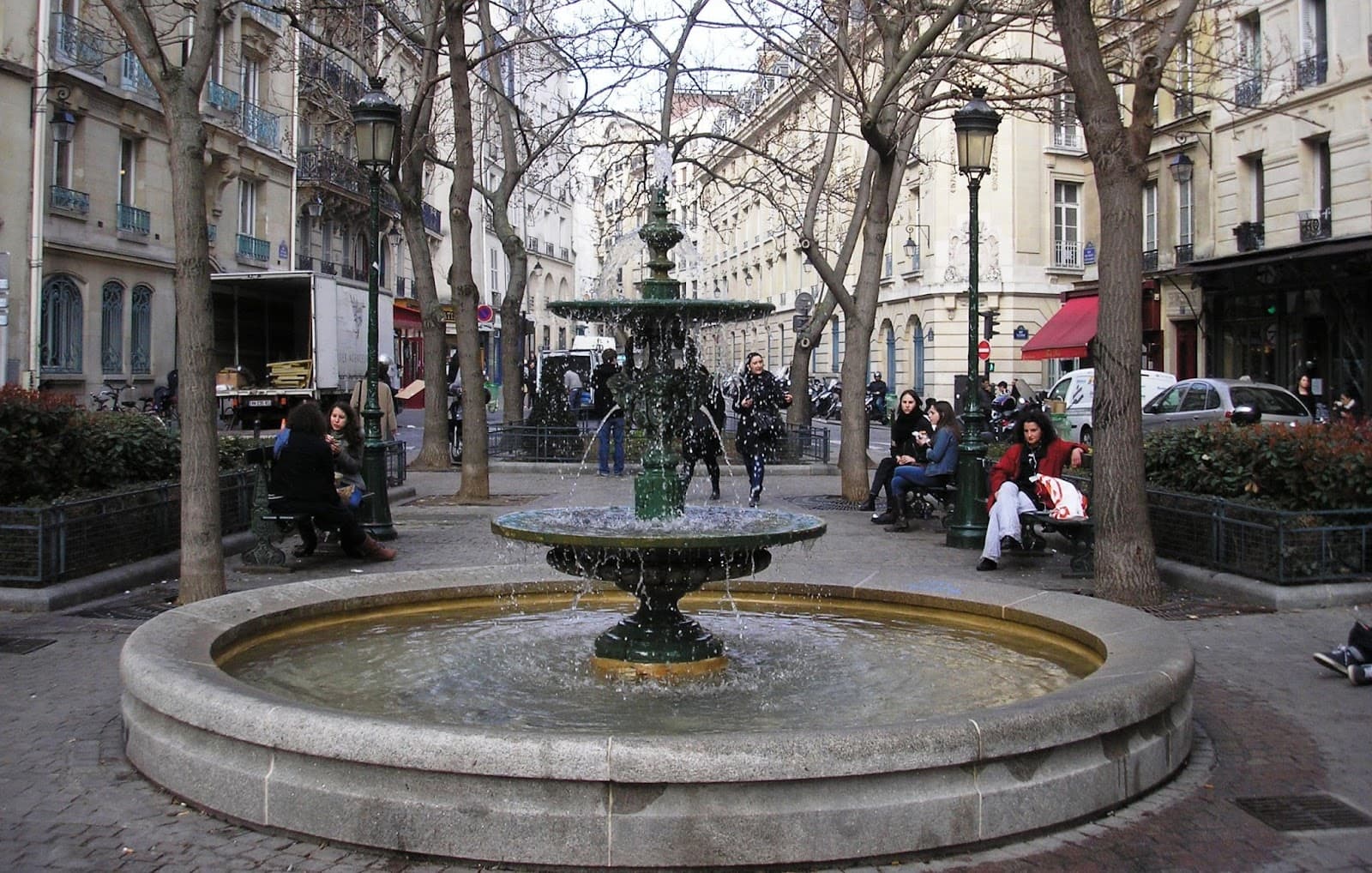
Best Paris Museums 2026: From the Louvre to Hidden Gems (Art Scene Guide)

TL;DRThe best Paris museums for 2026 start with the Musée d’Orsay, marking its 40th anniversary with Renoir and Mary Cassatt shows, plus the Musée de l’Orangerie with Monet’s Water Lilies (€12.50) and the Louvre (€22), where it’s worth entering via the Porte des Lions rather than the main Pyramid. The big change is that the Centre Pompidou is shut until 2030 for asbestos removal. Families will love the gardens at the Musée Rodin (€4 for the gardens alone), and hidden gems like the Musée Carnavalet, whose permanent collection is free. May, September and October are the best months to go — steer clear of August.

As the city stirs awake and you’re planning to visit the best Paris museums, you feel like the whole world is at your feet. The streets slowly fill with the clatter of metal shutters rising and the scent of freshly baked butter croissants drifting from the nearest corner bakery. You’re sitting on a bench with a cup of hot coffee, your toddler dozing contentedly in the pushchair beside you, and you know a day filled with art lies ahead. These are exactly the moments Lukáš and I live for. The City on the Seine has an incredible gift for pulling you into its history so naturally that you feel like you’ve stepped into an old French film. But then you reach the vast open square in front of the glass pyramid, spot that endless, snaking queue of people from every corner of the globe, and all the morning poetry vanishes in an instant.

The art scene here operates like a vast, constantly pulsating organism. You could spend a solid month just wandering from one famous canvas to the next and still discover you haven’t seen even half of it. We used to spend hours in galleries, reading every label and analysing every brushstroke. These days, our main currency is the attention span of a toddler. And you know what? It’s actually incredibly liberating. It forces you to choose carefully, slow down and stop racing through your holiday ticking items off a list. You’ll find that small, quiet places with creaky wooden floors often give you far more than the biggest and most famous institutions.

This year is also a truly groundbreaking one for culture, and a lot of the old rules no longer apply. The city has taken a deep breath after the enormous Olympic effort and sprung back to life. Major Impressionist anniversaries are being celebrated, the legendary Notre-Dame cathedral is finally welcoming visitors again, and this summer people will be swimming in the river for the first time in a century. On the other hand, some famous buildings have closed for years-long renovations, and for me as a vegetarian, there was huge news in the form of a fully plant-based menu at the celebrated restaurant Arpège. It’s a year of changes you need to be ready for.

TL;DR

Classic Louvre façade with Ionic columns and the French flag
  • Biggest disappointment of 2026: The iconic Centre Pompidou is completely closed for asbestos removal until 2030. Don’t go anywhere near it — you’ll find nothing but a building site.
  • Never enter the Louvre through the main Pyramid entrance. Use the secret Porte des Lions entrance, where the queues are virtually non-existent, and buy a timed-entry ticket online in advance — the easiest way is through GetYourGuide.
  • This year, you absolutely must see Musée d’Orsay. The former railway station is celebrating 40 years since opening, with fantastic exhibitions of Renoir and Mary Cassatt.
  • Monet’s Water Lilies at Musée de l’Orangerie require a strict online reservation for a specific time slot, even if you have free entry or a tourist pass — the easiest way to book is in advance through GetYourGuide.
  • If you’ve got a pushchair and small children, the garden at Musée Rodin is an absolute lifesaver. Entry costs just a few euros, you’ll see the famous Thinker, and your child can safely toddle along the wide paths.
  • Watch out for scams near the landmarks. Ignore anyone trying to push a friendship bracelet on you, showing you a “lost” gold ring, or asking you to sign a fake charity petition.
  • Cité des Enfants in La Villette park has its section for ages 2 to 7 closed for renovation until 9 June 2026.
  • Always — and I mean always — say Bonjour. Without this magic word, the staff at ticket desks and gallery attendants simply won’t engage with you.
The majestic Sacré-Cœur basilica on Montmartre surrounded by green trees

When to visit Paris museums: Seasons and 2026 calendar

Choosing the right month for a culture trip is absolutely crucial. Paris is a completely different city in February than it is in July, and we learned that the hard way. We once arrived in August only to find that half of our favourite bistros had a fermeture annuelle sign on the door. Lukáš and I love those moments when you can hop between exhibitions in a light jumper and afterwards sit down at an outdoor terrace with a view of the street.

Spring and autumn: a safe bet

A Paris museum building with a bronze statue in front of the façade

If you can, plan your trip for spring or autumn. May is probably the single most beautiful month of the year. The chestnut trees are in bloom, the days stretch out pleasantly, and the light inside glass-roofed palaces is absolutely perfect. September and October are equally magical. The period known as la rentrée (the return from holidays) brings a fresh energy to the streets, the year’s biggest and most anticipated exhibitions open, and the trees in the parks turn incredible shades of amber and gold. You’ll always need to pack a windbreaker and an umbrella for October, but the atmosphere makes it more than worthwhile.

💡 Insider tip: On the first Sunday of each month from November to March, many state-run institutions — including the famous Panthéon — offer completely free entry. It’s a brilliant way to save money, but don’t expect to have the place to yourself.

Blind spots and when to stay home

A cream-white Neoclassical building with a row of columns and a green-patina statue

Steer well clear of August. The locals flee the city en masse, heading for the coast or the countryside. The streets empty of residents but fill with tourists instead. Many of the best independent bistros and small galleries will have a fermeture annuelle (annual closure) sign on the door. The tarmac melts under the scorching heat and the air conditioning in old historic buildings often can’t cope. Also watch out for the weeks at the turn of February and March, when Paris Fashion Week sends hotel prices rocketing to frankly absurd levels.

💡 Insider tip: A critical date for autumn trips is the weekend of 19–20 September 2026 — the European Heritage Days (Journées du Patrimoine). Normally off-limits government palaces open their doors, but if you’re planning a trip to Monet’s gardens in Giverny, be aware they’re exceptionally and strictly closed on these two days.

The Palace of Versailles with a canal reflecting the building's façade

Where to stay in Paris

Your choice of neighbourhood will make or break your entire experience of the city — and your budget. Paris is divided into twenty arrondissements that spiral clockwise from the historic centre around the Louvre. Finding cheap accommodation in the centre is virtually impossible, but if you know where to look, you can find a great compromise between price, safety and accessibility.

If you’ve got a pushchair and a toddler, give a wide berth to the northern part of the 10th arrondissement around Gare du Nord and Pigalle in the 18th at night. We once got lost there at 2 a.m. with a friend and with a two-year-old in tow — definitely not something we’re keen to repeat. 😅

After a long search, we settled on Hôbou, an authentic French boutique hotel in Boulogne-Billancourt (you can book it here). It looks almost unassuming at first glance, but within the first few hours you’ll fall head over heels for it.

Hotels that actually make sense

A modern restaurant with grey chairs and a set table

Processing the visual overload from major galleries takes a bit of time and, above all, an environment free from further distractions. We loved that the family-run Hôbou is relatively close to Fondation Louis Vuitton and provided much-needed peace and quiet after a day at the galleries. You’ll find the full story about our stay in a separate review, and you can compare current prices right here.

A Baroque fountain with gilded statues reflected in a mirror pool

Heavyweights and Impressionist masters

Before our first trip with Jonáš, Lukáš and I asked ourselves the same question: three giants, one toddler — how much can we realistically get through? The answer surprised us. Managing them with a small child takes a pretty solid tactical plan, but the result is absolutely breathtaking.

Musée d’Orsay: The year you simply must visit

If you can only pick one major institutional museum for 2026, make it Musée d’Orsay. The former railway station with its iconic giant glass clocks is buzzing with incredible energy this year. It’s celebrating exactly 40 years since its grand opening, and it also marks one hundred years since the death of the painter Claude Monet. The atmosphere beneath the enormous steel vault is far airier and lighter than in other historic palaces. The space is more contained, more logically organised and far friendlier to navigate with a small child. The collection of more than four thousand works covers the absolute cream of late nineteenth- and early twentieth-century art.

The crown jewel of the permanent collection is Monet’s series of Rouen Cathedral paintings. They hang beautifully side by side, so you can see with your own eyes how the master captured the very same stone façade in different daylight and weather conditions. I stood in front of those canvases for so long that Lukáš silently pressed a coffee from our travel mug into my hand without saying a word. That’s what looking at art feels like when you truly see it. And then, of course, there’s Vincent van Gogh — two canvases that take your breath away: Starry Night over the Rhône and his famous, penetrating self-portrait. What you absolutely cannot miss this year are the special exhibitions. A major Renoir retrospective is planned for spring, and autumn will belong to the fascinating American Impressionist Mary Cassatt.

A standard ticket costs €16, and even here it pays to have a timed-entry ticket bought in advance — the easiest way is through GetYourGuide. It’s open daily except Monday from 9:30 to 18:00. The building is at 1 Rue de la Légion d’Honneur, and the nearest metro stations are Solférino (line 12) or RER C directly beneath the museum.

💡 Insider tip: If your toddler is happy in a carrier, leave the pushchair in the cloakroom as soon as you arrive. The wooden gallery floors handle wheels without a problem, but on Thursdays — when the doors don’t close until 21:45 — it gets quite tight in front of the Van Goghs, and with a child on your chest you’ll be far more nimble in the crowd.

Musée de l’Orangerie: An intimate meditation among the Water Lilies

Fondation Louis Vuitton with its distinctive asymmetric glass sails

On the very edge of the sprawling Tuileries Gardens in the 1st arrondissement, an unassuming, low-slung old orangery shelters one of the most powerful and purest art experiences in the entire city. The Orangerie is home to eight enormous, panoramic canvases of Monet’s Water Lilies (Nymphéas). They’re installed in two connected oval rooms flooded with natural daylight, arranged exactly according to the artist’s strict instructions. The moment you step inside, the noise of the city vanishes as if by magic.

The canvases surround you completely. For toddlers, it’s a visually mesmerising space — the gentle transitions of colour, the reflections of water and the shapes of the flowers draw them in like a magnet. You just need to keep a close eye on those inquisitive little fingers trying to grab a painted frog from touching the priceless canvas. The lower floor houses the Jean Walter and Paul Guillaume collection, featuring works by Cézanne, Renoir, Picasso, Matisse and Modigliani. It’s an intimate, deeply concentrated collection you can comfortably see in under two hours — an ideal time frame. There’s also a major event for 2026: from 25 March to 20 July, an exhibition dedicated to Henri Rousseau (Le Douanier) showcases the complete work of this fascinating customs officer turned painter and his profound influence on Surrealism.

Tickets cost €12.50. Open daily except Tuesday from 9:00 to 18:00. You’ll find it on Place de la Concorde; the nearest metro is Concorde (lines 1, 8, 12).

💡 Insider tip: The cardinal rule here is that entry requires a mandatory online reservation for a specific time slot (timed-ticket) — even if you have free entry or a tourist pass. Without a reservation, they simply won’t let you through the door. Book your timed ticket in advance — the easiest way is via GetYourGuide. My secret tip? Book a slot just after a rain shower, when tourists scatter to the cafés and you’ll have the Water Lily rooms almost to yourself.

Louvre: A survival strategy for the world’s largest palace

Close-up of the Gothic Notre-Dame cathedral with its two towers and rose window

Writing a guide to Paris museums and leaving out the enormous complex on the banks of the Seine would be a cardinal sin — but with a toddler, it’s a challenge that borders on an extreme sport. This is simply the largest institution of its kind in the world. Forget seeing everything. The bare minimum for a speed-run past the biggest hits — the surprisingly small Mona Lisa, the Venus de Milo and the majestic Winged Victory of Samothrace — is three hours of brisk walking. A serious visit to the Louvre takes six to eight hours, and with a two-year-old that’s simply not going to happen without tears on both sides.

The key to success is careful selection and smart timing. The worst day for a visit is unquestionably Saturday, when hordes of international tourists mingle with local families. Avoid it at all costs. The best days are Wednesday and Friday evenings, when the doors stay open until 21:45. After six o’clock, visitor numbers drop by more than sixty per cent and the halls take on an incredibly atmospheric quality. If you want to see the Mona Lisa’s famous smile without the insane crush, you need to be there either at exactly 9:00 right when the doors open, or on Wednesday and Friday late in the evening. The rest of the time, it’s just a sea of raised mobile phones.

A standard ticket costs around €22 and must be purchased exclusively as an online timed-entry ticket — the easiest way is to buy it in advance through GetYourGuide. The queue for people without a ticket often means hours of frustrating waiting. Open daily except Tuesday. The main metro station is Palais-Royal Musée du Louvre (lines 1 and 7).

💡 Insider tip: Here’s a trick that will save you a mountain of stress. Don’t use the main entrance through the big glass Pyramid in the courtyard. Head instead to the little-known Porte des Lions entrance in the southern Denon wing near the river. It’s the closest entrance to the Mona Lisa room, and the security-check queues here are a tiny fraction of what you’ll face at the Pyramid.

The Louvre courtyard with the iconic glass pyramid and the Neoclassical palace

Oases of calm: Institutions made for tired parents

If you’re after beauty and history but also desperately need a space where your child can breathe, run about, and you won’t end up with a stress-induced stomach ulcer, the following three addresses are an absolute bullseye.

Musée Rodin: Bronze sculptures and rose bushes

The Thinker statue in the Musée Rodin garden

The gorgeous Hôtel Biron, an eighteenth-century aristocratic mansion surrounded by expansive, beautifully maintained gardens in the quiet 7th arrondissement, is my absolute favourite for family outings. The Musée Rodin collection includes over six thousand sculptures and thousands of drawings. Inside the historic building you’ll find the iconic marble Kiss (Le Baiser) and a deeply moving room dedicated to Camille Claudel — the brilliant sculptor with an immensely tragic fate who was Rodin’s muse. The interior has beautiful old wooden floors and large French windows.

For us, though, the real magic happens outside behind the house. The garden hides the famous bronze Thinker and the dark Gates of Hell, but while everywhere else in a museum you’re on tenterhooks worrying about what your toddler might knock over, here you simply let them loose on the sandy paths between the roses and watch as they gleefully collect white pebbles while you admire Rodin in peace. This is the moment that makes travelling to Paris with a child truly worth it.

Full entry costs €14, but if you only want the outdoor area, a garden-only ticket is just €4. Open Tuesday to Sunday from 10:00 to 18:30. The nearest metro is Varenne (line 13).

💡 Insider tip: That €4 garden ticket is one of the best-value escapes from the city’s hustle in all of Paris. Grab a coffee from a nearby café, find a bench under the trees and just let time drift by.

Musée Marmottan Monet: A secret collection on the edge of a wood

The elegant villa of Musée Marmottan Monet

While the tourist crowds cram into the big institutions in the centre, you can head to the supremely calm and elegant 16th arrondissement near the sprawling Bois de Boulogne. A quiet hôtel particulier (private mansion) that once belonged to a wealthy collector houses the world’s largest collection of Claude Monet’s works at Musée Marmottan Monet. It was bequeathed here by his son Michel. You’ll find over a hundred paintings, and the atmosphere is worlds apart from anything in the centre.

It’s on the walls of this unassuming house that the legendary painting Impression, soleil levant (Impression, Sunrise) hangs — the very canvas that gave the entire Impressionist movement its name. Alongside Monet, you’ll encounter the delicate works of Berthe Morisot, who offers a remarkable female perspective in what was then an exclusively male art world, as well as canvases by Degas, Sisley and Pissarro. Carpets muffle your footsteps, the rooms feel more like a richly furnished apartment than a sterile gallery, and it’s never bursting at the seams.

Tickets cost €14. Open Tuesday to Sunday from 10:00 to 18:00, with Thursday hours extended to 21:00. The nearest metro is La Muette (line 9).

💡 Insider tip: If you’ve bought a weekly Navigo Découverte travel pass, the line 9 metro gets you here very comfortably, but for families with a pushchair I’d recommend taking bus 32 instead — it stops nearby and saves you lugging the buggy up and down underground stairs.

Musée Picasso Paris: Cubism and the best falafel

The courtyard of Hôtel Salé housing Musée Picasso in Le Marais

Based in Le Marais? Then Picasso is literally just a short stroll away. The entire collection is housed in the beautifully restored seventeenth-century Hôtel Salé, one of the finest historic buildings in the neighbourhood. It holds over five thousand works and forms one of the most comprehensive Picasso collections in the world. The displays rotate and change their arrangement fairly often, so the interior constantly offers fresh perspectives on the painter’s Blue, Rose, Cubist and late Surrealist periods.

Equally fascinating is Picasso’s personal private collection, which is also exhibited here. You’ll see astonishing works by Cézanne, Matisse and Rousseau that the Spanish master had hanging on the walls of his own home and drew inspiration from. The spaces feature beautiful old staircases with wrought-iron railings, and the whole place has a wonderfully relaxed feel.

Tickets cost €14. Open Tuesday to Sunday from 10:30 (weekends from 9:30) to 18:00. The nearest metro stations are Saint-Paul (line 1) or Saint-Sébastien – Froissart (line 8).

💡 Insider tip: This is the perfect combo for vegetarians. After browsing the Cubist canvases, just wander down a few narrow lanes to Rue des Rosiers. Queue up for the legendary street falafel at L’As du Fallafel, or duck into the nearby Marché des Enfants Rouges — Paris’s oldest covered market — where you’ll find excellent vegetable tagines. The little one eats outside on a bench and you get to enjoy top-notch street food.

The main hall of Musée d'Orsay with its large station clocks
lukas a lucka
Lukáš and Lucie recommend
Where to stay in Paris
2 accommodations — hotels and other lodging options

Modern art, immersive experiences and one big disappointment

Modern art has a massive presence in Paris, but this year has brought the biggest and most painful changes in precisely this area. Planning a trip to Pompidou? Read on carefully.

⚠️ Centre Pompidou: Critical status for 2026

The colourful pipes and escalators of Centre Pompidou

This is absolutely crucial information that will save you a huge disappointment and a lot of wasted steps. The iconic inside-out building with its giant colourful pipes on the façade and external escalators — known to locals as Beaubourg — is completely closed for a major renovation from the end of 2025 until the first quarter of 2030. The five-year, mega-budget shutdown is required for asbestos removal, new fire safety systems and a complete technology overhaul. Don’t go anywhere near it this year — you’ll find nothing but a tall fence and a massive building site.

💡 Insider tip: The institution hasn’t gone entirely dormant, though. It has moved its enormous archive to other venues. If you’re looking for the brilliant public library (Bpi) that used to be inside, it has temporarily relocated to the Lumière building in the 12th arrondissement near Bercy.

Fondation Louis Vuitton: A glass sailing ship in the woods

The glass sailing ship of Fondation Louis Vuitton by Frank Gehry

If you can’t get into Pompidou, head straight to the western edge of the city in the Bois de Boulogne. The foundation building by the celebrated Canadian-American architect Frank Gehry resembles a giant futuristic sailing ship assembled from glass, timber and steel. The architecture alone is a jaw-dropping experience. The enormous glass sails shift colour depending on how the sunlight hits them, reflecting the surrounding sky. Inside you’ll find spacious, light-filled galleries devoted to modern art.

The programme for 2026 is particularly packed. From April to mid-August 2026, a major exhibition — Calder. Rêver en équilibre — marks one hundred years since the sculptor’s arrival in France. You’ll see a huge number of his famous hanging wire mobiles gently swaying in the air, which is, incidentally, another thing that visually captivates small children.

Tickets cost €16. Open Wednesday to Monday; closed on Tuesdays. The nearest metro is Les Sablons (line 1), from where it’s about a fifteen-minute pleasant walk.

💡 Insider tip: The building sits right next to Jardin d’Acclimatation, the city’s best historic amusement park for small children. You can elegantly combine high art with a ride on old wooden boats. A handy electric shuttle bus also runs directly from the Arc de Triomphe (Étoile) for a few euros, saving your legs.

Atelier des Lumières: Digital magic in an old foundry

An abandoned industrial foundry in the 11th arrondissement was transformed a few years ago into a colossal digital projection canvas. Immersive exhibitions may be popping up all over the world these days, but the Parisians do it with unbelievable musical and visual grace. Classic paintings literally come alive, flowing down the rough brick walls and spreading across the concrete floors, accompanied by perfectly chosen, enveloping music.

For a two-year-old, it’s pure visual sorcery. In the dimness, where colours dance across the walls and floor and the music completely engulfs you, children instinctively start chasing the light, and you can finally savour the art without simultaneously acting as a safety brake. This year’s spring programme features the breathtaking Renaissance masters Da Vinci, Raphael and Michelangelo, and from April a family favourite with dinosaurs kicks off. If your child is going through a dinosaur phase, this will guarantee a grin from ear to ear.

Adult entry costs €14.50. Open daily, usually from 10:00 to 18:00. The nearest metro stations are Voltaire (line 9) or Père Lachaise (lines 2 and 3).

💡 Insider tip: Always try to book the very first morning slot right after opening. The air is still fresh and there’s plenty of floor space to sit on, so you can enjoy the experience in peace before the big afternoon groups arrive.

Palais de Tokyo: Raw concrete and late nights

If you’re looking for cutting-edge independent work in a no-holds-barred industrial setting, this is the place. The enormous building near the Trocadéro features exposed concrete walls, towering ceilings and art that often provokes and pushes boundaries. It’s not your typical polished gallery — think of it as a giant experimental laboratory.

The real standout feature is the opening hours. It’s one of the few places that stays alive well into the night, which is brilliant if you manage to find a babysitter and fancy an evening of culture with your partner. The space is so vast that people naturally spread out.

Tickets cost €12. Open daily except Tuesday from noon until midnight. The nearest metro stations are Iéna or Alma-Marceau (line 9).

💡 Insider tip: Inside the building you’ll find an old-fashioned analogue photo booth (photomaton). It produces absolutely fantastic, raw black-and-white photo strips — the best and most authentic little souvenir Lukáš and I bring home every single time.

The oval room with Monet's Water Lilies at Musée de l'Orangerie

Hidden gems and smaller galleries with local soul

Honestly? I first went to these places out of sheer desperation, because Jonáš was on the verge of a meltdown in the Louvre. It ended up with them becoming my favourite addresses in the entire city.

Musée Carnavalet: The complete history of the city

This wonderful place in the heart of Le Marais is dedicated entirely to the history of Paris itself. You’ll wander through an enormous maze of interconnected old palaces and see everything from ancient Roman excavations and original painted signs from old bakeries and taverns to personal belongings from the French Revolution. There’s even a fully reconstructed jewellery shop interior designed by Alphonse Mucha. The inner courtyard gardens are beautifully maintained and filled with meticulously trimmed hedges.

The permanent collection is completely free for everyone. You only pay for special temporary exhibitions. Open Tuesday to Sunday from 10:00 to 18:00. The nearest metro is Saint-Paul (line 1).

💡 Insider tip: During the warmer spring and summer months, a lovely pop-up café opens in one of the courtyards. The coffee and pastries aren’t exactly bargain-priced, but sitting under old trees in a historic courtyard is an experience well worth those extra euros.

Musée des Arts Forains: The magic of old carousels

This isn’t your typical exhibition hall — it’s more like a dream made real. In the quiet 12th arrondissement, in old wine warehouses, hides a private collection of historic fairground attractions: antique wooden carousels, mirror mazes and mechanical figurines from the turn of the nineteenth and twentieth centuries. It’s dark, magical and deeply poetic. You can even ride many of the old attractions during your visit, which is the absolute highlight for children.

Entry costs around €18, and visits take the form of guided group tours. The nearest metro is Cour Saint-Émilion (line 14).

💡 Insider tip: This place is only rarely open to the general public — you need to book your visit well in advance through their website. Your best chances are during the Christmas holidays and the September European Heritage Days, when they throw the doors wide open.

Musée de la Vie Romantique: A tearoom beneath the trees

At the foot of the Montmartre hill in the 9th arrondissement, at the end of a small cobbled drive lined with trees, sits an old house with a pink façade and green shutters. The painter Ary Scheffer once lived here, and the artistic elite of the day — including George Sand and Chopin — used to gather under its roof. Today the house holds a small collection devoted to the Romantic period. Creaky stairs, antique furniture and display cases filled with jewellery transport you to another era entirely.

Entry to the permanent collection is free. Open Tuesday to Sunday from 10:00 to 18:00. The nearest metro is Saint-Georges (line 12) or Blanche (line 2).

💡 Insider tip: The real draw is hidden in the small courtyard. There’s a charming little café run by the well-known Rose Bakery. You sit at iron tables beneath mature trees, sipping tea and eating superb lemon cake. It’s the perfect pit stop after a strenuous climb through the surrounding streets.

Musée Jacquemart-André: Luxury and privacy

If you want to see how the crème de la crème of nineteenth-century Parisian society lived, head near Boulevard Haussmann. This opulent private palace was built by a couple who devoted their lives to collecting art from around the world. You’ll find gorgeous frescoes, a winter garden brimming with marble, and rare Italian Renaissance canvases. Everything has been kept exactly as if the owners might walk in for dinner at any moment.

Tickets cost €17. Open daily from 10:00 to 18:00, Mondays until 20:30. The nearest metro is Miromesnil (lines 9 and 13).

💡 Insider tip: Pick up the free audio guide at the entrance. The story of the couple and how they secretly transported priceless frescoes from Italy is more gripping than many a detective novel and gives the whole marble palace a human face.

Where to eat: Our favourite bistros and cafés

Art can drain you so thoroughly that suddenly you’re standing in the middle of the street and the only thing on your mind is a massive plate of good food. Over the years, Lukáš and I have learned that searching for a restaurant on an empty stomach with a tired child in the pushchair is a direct route to a marital crisis. That’s why we already have our tried-and-tested spots — places that truly understand the meaning of hospitality.

Parisian gastronomy is a chapter all its own. As a vegetarian, I used to struggle here quite a bit, but these days it’s thankfully a completely different story. Here are two addresses we return to every single trip.

L’As du Fallafel and a breather in Le Marais

I touched on this earlier when talking about the Picasso museum, but this place truly deserves its own chapter. In the heart of the Jewish quarter on Rue des Rosiers, you’ll find a green shopfront with a long queue perpetually stretching outside. Don’t let that put you off — the staff out front work at lightning speed, and before you know it, you’re holding the best falafel in the entire city.

It’s street food in its purest form. A pitta stuffed to bursting with crispy falafel balls, aubergine and a genius tahini sauce that Lukáš and I reliably smear behind our ears every single time. We always grab Jonáš plain hummus with bread and head to the nearest little park to eat on a bench. This is what real Paris tastes like.

Le Potager de Charlotte: Plant-based heaven

When we want a proper romantic evening without the kids and manage to find a babysitter for Jonáš, we head straight here. This bistro in the revitalised 9th arrondissement was founded by two brothers and cooks exclusively with local plant-based ingredients. No artificial substitutes — just honest, creative work with vegetables that genuinely blows you away.

Their roasted aubergine or chickpea pancake are so good that even Lukáš, a committed carnivore, wolfs them down happily. Prices are still surprisingly reasonable by Parisian standards, and the atmosphere is wonderfully intimate and warm. Make sure to book ahead, though — locals love this place just as much as we do, and it’s always packed.

What NOT to do in Paris galleries: Warnings and scams

This city can enchant you, but it can also be pretty harsh and unforgiving towards unprepared visitors. If you want your memories to stay purely positive, you need to follow a few basic survival rules.

Fake tickets and street scams

The areas around famous landmarks — particularly the Louvre, the Eiffel Tower and Montmartre — attract not just art lovers but also very well-organised groups of scammers. This year, be especially wary of people selling so-called skip-the-line tickets. They’ll stop you on the street claiming to sell a ticket that lets you bypass the queue. It’s a scam. The tickets are either expired or outright fake, and you’ll just lose tens of euros. The same goes for the famous Notre-Dame cathedral — entry is always and for everyone completely free, so if anyone offers you a priority ticket, walk away immediately.

💡 Insider tip: If someone approaches you near a landmark speaking perfect English and opens with “Do you speak English?”, just ignore them and keep walking. A real Parisian would never accost you on the street like that. It’s usually the opening gambit of a fake charity petition scam.

The golden rule of Bonjour

This is the single most important piece of advice in this entire article. France has a very strict social etiquette. Whenever you enter any smaller gallery, a souvenir shop, or approach a ticket desk, you must look the staff member in the eye and say a clear “Bonjour” (or “Bonsoir” in the evening). If you just walk up to the counter and blurt out in English that you want two tickets, the locals will consider it deeply rude and will treat you accordingly. Try it, and watch the frowning faces of the gallery attendants instantly transform into smiles.

It took us quite a while to get used to this rule. Back home we’re sometimes used to heading straight to the counter and rattling off our order, but that simply doesn’t fly here. Lukáš once tried it at the entrance to the Picasso museum and the cashier acted as if we didn’t exist. Once you learn to greet people properly first, doors open and people become surprisingly helpful.

Don’t overload your daily itinerary

The biggest mistake you can make is to schedule three major museums in a single day. Trust me — it doesn’t work. Physically you might manage to walk it, but your brain simply can’t process that volume of visual input. You’ll end up with what’s known as museum fatigue. The ideal pace for adults is one large and one smaller institution per day. With a toddler in the pushchair, plan strictly just one exhibition for the morning and leave the afternoon free for parks or lounging in a café.

We made this very mistake ourselves years ago when we tried to cram everything in, and by the afternoon we couldn’t even remember whether we’d been looking at Monet or Manet. Ever since Jonáš came along, we’ve been much slower. We do one gallery, then go for a long walk, buy a fresh baguette and simply soak up the city’s atmosphere.

Practical info: Transport, pushchairs and smart passes

Logistics are half the battle in this city. The better you prepare for getting around and buying tickets, the more energy you’ll have left for the art itself and a great dinner. Always buy tickets for major museums online in advance — we like to get ours through GetYourGuide, where you get a timed-entry ticket with a straightforward cancellation policy, all on your phone.

Is the Paris Museum Pass worth it? (2026 calculator)

This official tourist pass grants entry to more than fifty institutions and monuments across the entire region. For 2026, the two-day version costs €60, the four-day is €90 and the six-day is €120. The question is whether it actually pays off.

If you’re travelling with children and know you’ll manage one place per day at most, the pass won’t pay for itself financially (Louvre is €22, Orsay is €16 — that’s €38 over two days, while the pass costs €60). But if you’re child-free and plan to visit the Louvre, Orsay, climb the Arc de Triomphe, pop into Sainte-Chapelle and head out to Versailles, the four-day pass at €90 will save you a decent amount of money — and, more importantly, the hassle of buying individual tickets.

💡 Insider tip: Even with a Museum Pass, many venues (such as the Louvre or Orangerie) still require you to book a free time slot on their website. The pass no longer means you can simply turn up and walk straight in. I’d recommend buying the physical paper version of the pass rather than the digital one — it scans much more easily at the turnstiles.

Getting around and the pushchair struggle

The Paris metro is old, deep and riddled with endless staircases. For parents with a pushchair, it’s a nightmare. The only line that’s completely modern, automatic and fully step-free with spacious lifts is line 14. For all other lines, don’t rely on the lifts even if they’re marked on the map — they’re frequently out of service.

We gave up on the metro with Jonáš after the first trip, when I was dragging the pushchair down the stairs and quietly weeping. Buses are a lifesaver: the driver will lower the ramp without a word, Jonáš gets a street-level view, and I can finally see where we’re actually going. The T+ ticket works on both the metro and buses.

⚠️ Important warning for parents: Cité des Enfants

If you’re planning to take your little ones to the popular science and play centre in La Villette park in the northeast of the city, pay attention this year. The fantastic section designed for the youngest children (ages 2 to 7) is completely closed for extensive renovation until 9 June 2026. The older section is still open, but with a toddler it’s best not to bother at all right now.

💡 Insider tip: Instead of the closed centre, take your toddler to Jardin du Luxembourg for the traditional puppet show (Théâtre des Marionnettes). For under €3 you’ll see a classic Guignol performance. Shows run on weekends and public holidays. It’s in French, of course, but the visual slapstick is universal and children laugh their heads off.

Frequently asked questions

Which Paris museums are free?

The permanent collections at all city-run institutions (Musées de la Ville de Paris) are completely free. These include the wonderful Musée Carnavalet (city history), Musée de la Vie Romantique, Petit Palais and Maison de Victor Hugo. National institutions (Louvre, Orsay) offer free entry on the first Sunday of each month, but only from November to March. The Louvre also has free entry on the first Saturday of each month from 18:00 to 21:45.

Do I always need to buy tickets online in advance?

For the biggest venues (Louvre, Orsay, Orangerie), it’s now essentially mandatory. Without an online timed-entry ticket, you risk either being turned away entirely or spending several hours in the walk-up queue. The easiest way is to buy tickets in advance through GetYourGuide. For smaller galleries (Marmottan, Picasso) it isn’t strictly required, but it will still save you a lot of time.

Which day are Paris museums closed?

Most split into two camps. The Louvre, Orangerie and Centre Pompidou (which is entirely closed until 2030 anyway) are shut on Tuesdays. Conversely, Musée d’Orsay, Musée Rodin and the Palace of Versailles close on Mondays. That’s why it’s ideal to plan your Louvre visit for a Monday and Orsay for a Tuesday.

Which museum is best for small children and toddlers?

Among the art museums, Musée Rodin wins hands down, thanks to its huge, safe garden full of wide sandy paths where children can run freely. The immersive Atelier des Lumières is also a massive hit, with moving images and music captivating kids in its darkened space.

Can you take a pushchair into the Louvre?

Yes, you can. Lifts are available inside, although finding them in the labyrinthine building can be a touch frustrating at times. Staff will usually let you use the lift at the Pyramid entrance as a priority with a pushchair. That said, if you have the option, a baby carrier is far more practical and manoeuvrable in the crowds around the Mona Lisa.

Does the Museum Pass still let you skip the queue?

The pass saves you money on admission, but it’s no longer an all-access VIP fast-track. At the busiest venues, even with a valid pass you need to reserve a free time slot on their website in advance. You’ll also still have to go through the regular security check, which nobody can skip.

Can I take photos inside the galleries?

In most permanent collections (including the Louvre and Orsay), personal photography is allowed, but the use of flash and tripods is strictly prohibited. For temporary and special exhibitions, photography is often banned entirely due to copyright on loaned works. Always look for the crossed-out camera pictogram at the entrance to each room.

Is it safe to walk near the landmarks in the evening?

Yes — the areas around the major institutions in the centre (1st, 6th, 7th arrondissements) are very safe even after dark, with beautifully lit streets full of people. You need to watch out for pickpockets mainly on the crowded metro and in the evening around northern Montmartre or near the large railway stations in the north of the city.

Tips and Tricks for Your Vacation

Don’t Overpay for Flights

Search for flights on Kayak. It’s our favorite search engine because it scans the websites of all airlines and always finds the cheapest connection.

Book Your Accommodation Smartly

The best experiences we’ve had when looking for accommodation (from Alaska to Morocco) are with Booking.com, where hotels, apartments, and entire houses are usually the cheapest and most widely available.

Don’t Forget Travel Insurance

Good travel insurance will protect you against illness, accidents, theft, or flight cancellations. We’ve had a few hospital visits abroad, so we know how important it is to have proper insurance arranged.

Where we insure ourselves: SafetyWing (best for everyone) and TrueTraveller (for extra-long trips).

Why don’t we recommend any Czech insurance company? Because they have too many restrictions. They set limits on the number of days abroad, travel insurance via a credit card often requires you to pay medical expenses only with that card, and they frequently limit the number of returns to the Czech Republic.

Find the Best Experiences

Get Your Guide is a huge online marketplace where you can book guided walks, trips, skip-the-line tickets, tours, and much more. We always find some extra fun there!
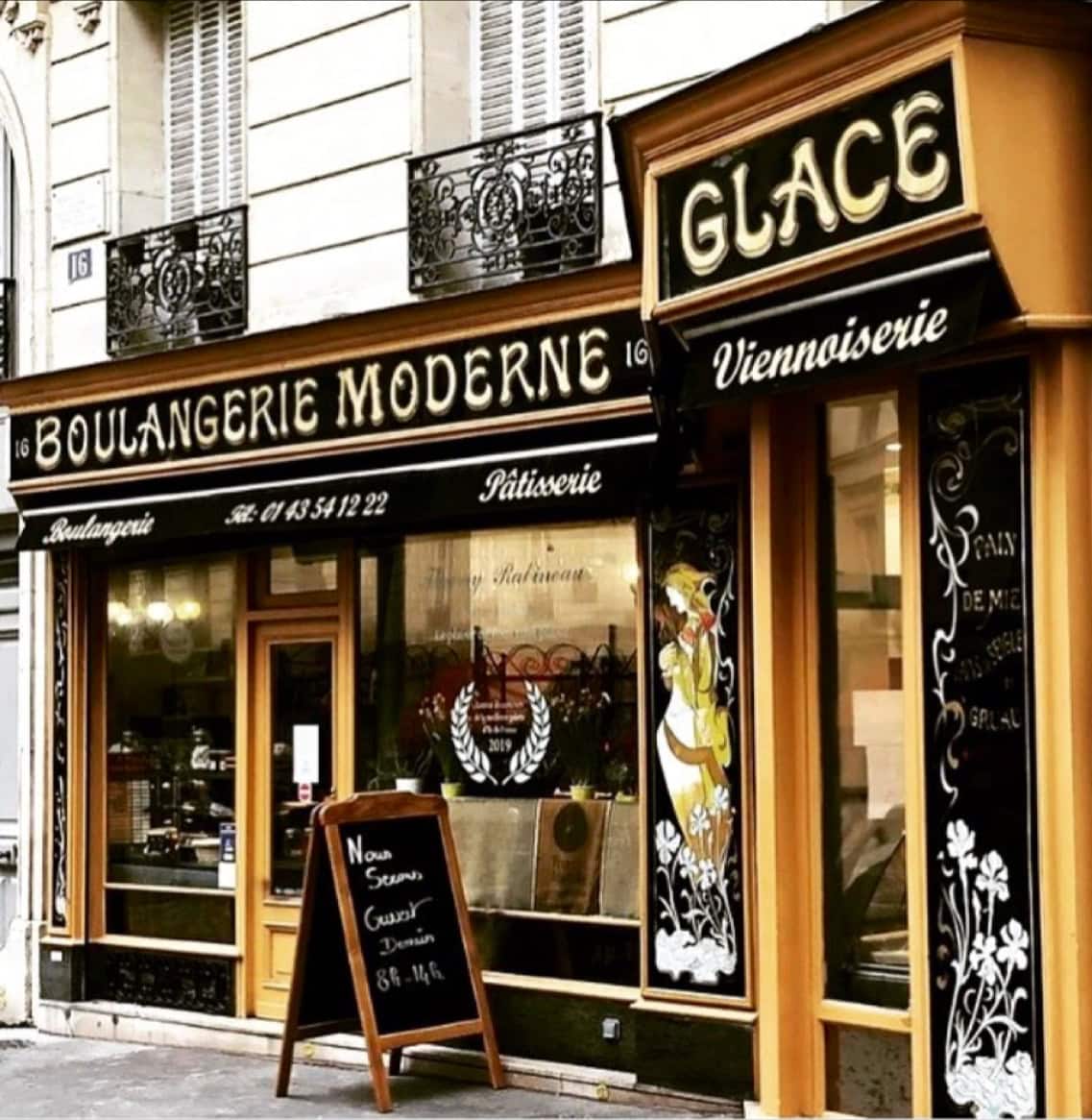
Paris with Kids: The Complete Guide to Family-Friendly Paris (What to Expect with a Pushchair)

TL;DRFamily trips to Paris with a pushchair work best in spring or autumn, when temperatures sit around 15 to 20 degrees and the trees in the Jardin du Luxembourg turn gold. Steer clear of August and the January-to-March winter stretch. The Paris Métro is the main headache — only line 14 is fully step-free, so you’re better off relying on low-floor buses. Pack a baby carrier and a foldable changing mat, since bistros almost never have changing tables; department stores like Galeries Lafayette are your saving grace. The Jardin du Luxembourg is the best spot for kids, with the Poussin Vert playground and a puppet show for €2.70. Cap your Louvre visit at two hours, and remember under-2s get into Disneyland Paris for free.

When the city slowly wakes, the scent of melted butter drifts from corner bakeries into the cool morning air, and the streets don’t yet belong to honking scooters — it’s quite possibly the most beautiful city in the world. Sitting in a wicker chair at a tiny round table, sipping strong coffee and watching Paris come to life is pure poetry. But then your toddler decides it’s time to sprint, you’re trying to squeeze a wide pushchair through a gap between tables that’s roughly the width of a shoebox, and the waiter is burning holes through you with his stare. The romance from the films suddenly crashes headfirst into reality. Because the Paris you see on postcards doesn’t know about toddler meltdowns or missing lifts in the Métro.

We discovered that the real, everyday Paris with kids can be tough and unforgiving for parents with little ones. Narrow cobblestone pavements in historic quarters will test your patience, endless staircases underground will test your fitness, and finding a changing table sometimes feels like searching for the Holy Grail.

At the same time, though, this is a city that offers children absolutely incredible experiences. It’s a place where a two-year-old can watch a puppet show that’s nearly a hundred years old with their mouth wide open, feed ducks by an enormous fountain in immaculate parks, and taste their very first truly good buttery madeleine. As a vegetarian with a toddler, I found that there are surprisingly brilliant options here — you just need to know where to go. All it takes is military-grade logistics, zero expectations about flexible dining, and a baby carrier as your ultimate backup plan.

In this article, you’ll find our complete, hard-won guide to a family holiday in Paris. Parks, restaurants, nappy-changing missions, pushchair nightmares, and genuine fairytale spots — everything we experienced first-hand with Lukáš and Jonáš. In short, everything you need so that your Paris with kids trip is more fairytale than purgatory.

TL;DR

Blonde woman in a beige blazer sitting at a purple table in a green garden
  • The Métro with a pushchair is a punishment. Only Line 14 is fully step-free. Rely on buses, which have low floors, and steer clear of the transfer nightmare at Châtelet-Les-Halles.
  • Changing tables in bistros essentially don’t exist. Carry a foldable wipe-clean changing mat and count on large department stores (Galeries Lafayette) or parks.
  • The number-one green oasis for kids is Jardin du Luxembourg. You’ll find the massive fenced Poussin Vert playground, toy boats on the fountain, and the Guignol puppet theatre.
  • Mealtimes are sacred. Lunch is served strictly between 12:00 and 14:30. If your child is hungry at five in the afternoon, look for bakeries or brasseries with a “service continu” sign.
  • “Bonjour” is the magic word. You must enter any shop or restaurant with a loud greeting — otherwise you’ll be ignored, even if you have a screaming child on your arm.
  • Avoid the crowds. Don’t go up the Eiffel Tower — head to a department store rooftop instead. In the Louvre, last no more than two hours with kids. And at Versailles, go straight to the gardens, where you’ll easily spend 6–7 hours anyway.
  • Watch out for 2026. The children’s section at Cité des Enfants La Villette (ages 2–7) is closed until 9 June 2026. The gardens at Giverny are closed on 19 and 20 September 2026.
  • Disneyland Paris is brilliant for toddlers. Under-3s get in free, and Fantasyland has a huge number of gentle rides with no height restriction.
  • Ignore the street scammers. People with petitions near monuments, bracelet sellers on Montmartre, and anyone who “finds” a gold ring in front of you — just walk straight past them.

When to visit Paris with kids: Seasons and weather

Picking the right month for a family trip is half the battle. Paris completely reinvents itself with every season, and what’s a romantic stroll in the rain for a child-free couple becomes a logistical nightmare with a pushchair. Lukáš and I love those sweet-spot moments when you can sit on a terrace in a light jumper and kids can run freely around the parks without risking heatstroke.

Spring and autumn are a safe bet

A corner with blooming roses and classic Parisian buildings

If you can, aim for May, June, September, or October. May is hands-down the most beautiful month. Chestnut trees are in bloom, the days stretch out nicely, and you can easily picnic in the parks.

Equally magical is the period from mid-September to late October. The season known as la rentrée (the return after summer holidays) brings a fresh energy to the streets. The trees in the Luxembourg Gardens turn incredible shades of gold, and the morning mists over the Seine have a charm all their own. The weather tends to be stable, with temperatures hovering around 15–20°C — absolutely ideal for toddlers on the move. That said, always pack a windbreaker and a rain cover for the pushchair.

💡 Insider tip: If you’re visiting in autumn, make the most of the early sunsets. You can show the kids the sparkling Eiffel Tower (it twinkles for five minutes on the hour after dark) without having to push their bedtime too late.

Months to avoid

Man with a small child playing in the courtyard of the Palais Royal in Paris

Give August a wide berth if you’re travelling with family. Parisians flee the city en masse for the coast during this month. While the streets empty of locals, many of the best independent bistros and family-run cafés will have a fermeture annuelle (annual closure) sign on the door. The tarmac melts under scorching heat, and the historic Métro without air conditioning is unbearable.

Winter from January to March tends to be damp, grey, and drizzly. With a toddler who needs outdoor playground time, that means a lot of hours spent drying clothes back at the hotel. Also watch out for 12 April 2026, when the Paris Marathon takes place and traffic across the city essentially grinds to a halt.

💡 Insider tip: If you do end up visiting in summer 2026, pack swimwear for the kids. For the first time in over a century, supervised swimming spots are opening directly in the River Seine during July and August. Water quality has been carefully monitored since the Olympics.

The Louvre courtyard with the iconic glass pyramid and historic buildings

Where to stay in Paris with family: Neighbourhoods and hotels

Your choice of neighbourhood will make or break the entire experience — and your budget. Paris is divided into twenty arrondissements that spiral clockwise from the historic centre near the Louvre. Finding affordable accommodation in the centre is nearly impossible, but if you know where to look, you can find a great compromise between price, safety, and accessibility.

With a pushchair and Jonáš, give a wide berth to the northern part of the 10th arrondissement around Gare du Nord and Pigalle at night in the 18th. We once got lost there with a friend at 2am — not an experience you want to repeat with a two-year-old. 😅

After a long search, we chose Hôbou, an authentic French boutique hotel in Boulogne-Billancourt (you can book it here). It looks almost understated at first glance, but within the first few hours you’ll fall in love with it.

Best family-friendly neighbourhoods

Small child in a white t-shirt standing by a concrete railing watching a fountain in a Paris garden

Getting around: How to survive Paris streets with a pushchair

Forget the idea that you’ll glide through the city with a pushchair like a knife through butter. The local transport system is one of the oldest in the world, and its late-nineteenth-century architecture simply wasn’t designed with wheels in mind. Getting from A to B takes a bit of planning and a healthy dose of patience.

The Métro is a baptism of fire with a pushchair

Man in a t-shirt and glasses standing with a pushchair in front of the Palace of Versailles

The Paris Métro (official RATP website) is fast, but riddled with endless staircases and narrow turnstiles. Out of the entire massive network, only 62 stations have full step-free access. The one line you can rely on 100% is Line 14 — fully automated, modern, with a spacious working lift at every station. The newly extended sections of Lines 4 and 11 now also have lifts, but in the historic centre you’ll hit a brick wall.

The notoriously hostile interchange is Châtelet-Les-Halles — a giant labyrinth of underground corridors and escalators that have the uncanny ability to break down on the exact day you visit. Avoid this transfer hellhole with a pushchair entirely.

💡 Insider tip: Download the official RATP app and switch on Accessibility Mode. It shows the real-time status of lifts and updates every 90 seconds. It’ll save you a lot of tears at broken escalators.

Father with a small child on a wooden playground surrounded by trees

Buses are your lifesaver

While the Métro will give you grief, the city buses are far kinder to families. Most have low floors, a dedicated pushchair space in the middle of the bus, and — bonus — kids can gaze out of the window the entire journey.

For occasional journeys, the Navigo Easy card makes sense (the plastic card itself costs €2). You can load a 10-ride bundle (known as a carnet) for €17.35. If you’re planning to travel from Monday to Sunday, grab a weekly Navigo Découverte pass for €32.40 plus €5 for the card (you’ll need a small passport-style photo).

💡 Insider tip: Always board the bus with a pushchair through the middle doors, where the designated space is — not the front doors by the driver. Just wave at the driver from outside and they’ll open the doors for you.

A baby carrier is an absolute must

Even if you’ve got the best all-terrain pushchair, the absolute Paris must-have is an ergonomic baby carrier. The moment you’re planning a visit to Montmartre — peppered with hundreds of steps — the crowded Louvre, or the inside of the Palace of Versailles (not recommended — stick to the gardens where you can bring the pushchair), leave the pushchair at the hotel with a clear conscience. Jonáš always napped beautifully in the carrier, while we could admire the sights stress-free.

Changing tables and toilet gymnastics

This is where you slam into the hard Parisian reality. If you’re used to British cafés with spacious baby-change facilities and roomy toilets, brace yourself for a culture shock.

The reality of Parisian bistros

Boy photographing golden fountains with water jets at Versailles

A changing table in a typical independent bistro or restaurant basically doesn’t exist. The toilets are often about the size of a phone box, and fitting in your child, yourself, and a nappy bag requires acrobatic talent.

Always carry a soft, foldable, wipe-clean changing mat. You’ll be changing nappies on park benches, on your own lap, or on the floor in a quiet corner of a café. Locals don’t bat an eyelid — it’s just city survival.

💡 Insider tip: One of the few restaurants that actually has a changing table and plenty of space is Les Belles Plantes in the 5th arrondissement. They also have comfortable booth seating and a great children’s menu.

Safe havens in department stores

Father with child by a beautiful fountain in the gardens of Versailles

Your main safety net will be the large department stores (Grands Magasins). Galeries Lafayette Haussmann in the 9th, Le Bon Marché in the 7th, and BHV Marais in the 4th all have luxurious, clean toilets, spacious changing tables, and often quiet nursing rooms (known as salles d’allaitement).

Bustling Parisian street with flowers and shops, full of tourists

Green oases: Best Paris parks for kids

Parisian parks are immaculate, geometrically precise, and meticulously maintained. But they come with one quirk: the lawns are often sacred. If you see a sign reading Pelouse interdite (Keep off the grass), they really mean it. Parisians take this deadly seriously, and park wardens with whistles will swiftly shoo you away. So where can kids actually let off steam?

Jardin du Luxembourg (6th arrondissement)

Father with a small child in a historic arched courtyard by a classical statue

This is the absolute top pick for families with children and our favourite park in Paris. The gardens offer so much to do that you can easily spend half a day here. Kids go wild at Poussin Vert, a massive fenced playground divided into zones by age. There are over 30 different play structures, sandpits, and slides. The playground entrance costs just a few euros. Don’t miss the toy boats on the central fountain, either — you hire a beautiful wooden sailboat with a stick and your child pushes it across the surface of the water.

The real gem, though, is the Théâtre des Marionnettes (Guignol), the biggest puppet theatre in France, founded in 1933. Shows run on Wednesdays, weekends, and bank holidays. Ticket price: €2.70.

💡 Insider tip: The puppet shows are in French, but don’t let that put you off. The slapstick humour, chases, and exaggerated puppet gestures are a universal language every two-year-old understands perfectly.

Jardin d’Acclimatation (16th arrondissement)

Marble figurative statue on a pedestal in a classical garden with an arcade

Want to give your child a day they’ll never forget? Head to the west of the city, into the Bois de Boulogne. Jardin d’Acclimatation is a historic amusement park spread across 18 hectares, purpose-built for the 2-to-12 age group.

You’ll find small roller coasters, boat rides, a huge paddling pool for summer, a petting farm, and a vintage little train. The atmosphere is far calmer and more local than the sprawling Disneyland. 2026 admission: Basic park entry is €7, an unlimited wristband for all rides costs €46.

💡 Insider tip: If you don’t want to buy the unlimited wristband, you can just get the basic entry and pay for individual rides with tokens (one token costs roughly €3). For younger children who’ll only manage a few rides, this works out better value.

Ménagerie at Jardin des Plantes (5th arrondissement)

Rowing boats on a pond at the Palace of Versailles with fountains in the background

Alongside the beautiful botanical gardens and greenhouses, you’ll find the Ménagerie — a small, historic zoo. It’s been here since 1794, giving it a rather impressive pedigree, and for a two-year-old it’s the perfect scale.

You won’t walk yourself to death, and don’t expect elephants or giraffes — the zoo specialises in smaller endangered species. Jonáš saw red pandas here for the first time in his life and nearly lost his mind with excitement. You’ll also spot flamingos and monkeys. Admission: Adults €13, children under 3 free.

💡 Insider tip: Right next to the zoo you’ll find the stunning Grande Galerie de l’Évolution (Great Gallery of Evolution) in the natural history museum. A procession of taxidermied animals from the African savanna marches through a vast hall. It’s visually jaw-dropping even for the tiniest visitors.

lukas a lucka
Lukáš and Lucie recommend
Where to stay in Paris
2 accommodations — hotels and other lodging options

Parc Monceau (8th arrondissement)

If you’re after a quieter oasis frequented mainly by local nannies and mums from the elegant 8th arrondissement, this is your spot. The park is surrounded by gorgeous townhouses, has wide tarmac paths ideal for pushchairs, and — wonder of wonders — a large lawn you’re actually allowed to sit on.

We love coming here when we need a break from the noise of the main boulevards. There’s also a charming old-fashioned carousel that kept Jonáš entertained for a solid half-hour.

💡 Insider tip: Before entering the park, pick up fresh pastries and cheeses on nearby Rue de Lévis — one of the best local market streets in Paris — and have a picnic on the grass in Monceau.

Where to eat in Paris with kids (without losing your mind)

The French love children, but they also love their firmly established rules. In Paris, little ones are welcome at the table — nobody will turn you away — but you have to play by their rules. The biggest stumbling block for British parents is mealtimes. Lunch is served strictly between 12:00 and 14:30.

At 14:30 on the dot, kitchens in classic bistros shut down without mercy. Dinner then starts at 19:30 at the earliest, often not until after eight. What do you do when your toddler is starving at five in the afternoon? You’ll be saved by places with continuous service (look for the sign service continu), traditional brasseries, or bakeries (boulangeries), where you can pick up a quiche or a freshly made baguette sandwich at any time.

Another golden rule is the magic word “Bonjour.” Every entrance to a restaurant or shop must begin with this greeting. Even if you’ve got a screaming toddler on your arm, stop in the doorway, make eye contact with the waiter, and say hello. Without this, they simply won’t engage with you. As a vegetarian, I should also mention that the situation in Paris has improved enormously. Even the legendary three-Michelin-star restaurant Arpège switched to an entirely plant-based menu in 2026 — an earthquake for the food scene. Here are our tried-and-tested spots where you can fit a pushchair and eat well:

Treize au Jardin (6th arrondissement)

Right opposite the Luxembourg Gardens, you’ll find this fantastic place. They have a huge terrace and serve a Southern American brunch with a French twist.

The space is generous, the staff are very used to children, and there are brilliant vegetarian options packed with vegetables and cheeses. Meal price: Around €20–25 for a main course.

💡 Insider tip: Order their homemade savoury pancakes or the carrot cake, which is so enormous that two adults sharing with kids will struggle to finish it.

Traditional Bouillons (Chartier, Pigalle, République)

These huge, historic, and affordable canteens from the late nineteenth century are a lifesaver for every parent. Why bring a toddler here? Precisely because of the noise.

The roar of hundreds of diners and clinking cutlery will completely swallow any toddler tantrum. Food arrives lightning-fast, it’s classically French (there’s always an omelette or a leek salad for vegetarians), and the prices are unbeatable by Parisian standards. Meal price: A main course starts at around €12.

💡 Insider tip: Don’t bring a big pushchair — the aisles between tables are narrow and pushchairs have to be folded and left by the entrance. A carrier or a child on your lap is the way to go here.

Woman in a grey dress gazing at a baroque fountain in Versailles

Marché des Enfants Rouges (3rd arrondissement)

The oldest covered market in Paris, in the heart of the Marais, is a perfect lunch stop. You can have a vegetarian Moroccan tagine, Lebanese salads, or a Japanese bento, while your partner grabs something meaty from the stall next door.

Seating is communal on shared wooden benches, the atmosphere is informal and buzzy, and for a toddler it’s a brilliant sensory show full of aromas. Meal price: Portions at the stalls run to about €15–18.

💡 Insider tip: The market is closed on Mondays. At lunchtime on weekends it gets incredibly packed — go on a weekday instead, or arrive by 11:45 on Saturday or Sunday before the queues build up.

La REcyclerie (18th arrondissement)

This wonderful spot by the former Petite Ceinture railway in the north of the city has the feel of a big community canteen. A family-friendly vibe, homemade sustainable food, plenty of vegetarian and vegan options at very reasonable prices.

Kids have loads of space, and nobody minds if they run around the upcycled furniture. For us, it was a blissful oasis in the middle of the otherwise hectic 18th arrondissement. Meal price: Daily menu around €16.

💡 Insider tip: After eating, you can walk with the kids along the old railway tracks, which are overgrown with greenery and serve as an urban farm complete with community chickens.

Small boy in a white t-shirt with cars holding French pastry on a Parisian street

Breizh Café (multiple locations, e.g. 3rd arrondissement)

Breton crêperies are an absolute lifesaver for families. Their savoury galettes are made from genuine buckwheat flour, so they’re naturally gluten-free and easy on the stomach.

There are plenty of meat-free options, and kids simply adore the sweet crêpes with homemade caramel. This rescued us on our very first day, when Jonáš was tired from travelling and needed something good in his belly fast. Meal price: A savoury galette costs roughly €12–15.

💡 Insider tip: If you order traditional Breton apple cider with your crêpes, they’ll serve it in wide ceramic cups (bolées), just as tradition demands.

Museums and sights: What little legs can handle

Planning a monument marathon with a toddler is a road to ruin. Jonáš made that crystal clear in the Louvre, where after about fifty metres he sat on the floor and refused to go on because he’d found an interesting crack in the tiles. Your child won’t appreciate the Impressionists and couldn’t care less about Gothic architecture — so choose wisely and always have a backup plan in the shape of the nearest park.

The Eiffel Tower and why not to go up

Seeing the Eiffel Tower is non-negotiable. But queuing for hours at the security scanners, cramming a pushchair into a claustrophobic lift, and battling crowds at the top for a sliver of view — with kids, that’s sheer misery. Lukáš and I have a firm rule: we admire the Eiffel Tower from below or from a distance. Have a picnic on the lawns of the Champ de Mars or stroll down to the river.

Want to see the city from above without the pushchair ordeal? Head to the rooftop of Galeries Lafayette in the 9th arrondissement, where a lift takes you up to a huge roof terrace with views across all of Paris, including the Eiffel Tower in the distance — and entry is completely free.

💡 Insider tip: If you’re looking for the best spot for a family photo with the Eiffel Tower, skip the overcrowded Trocadéro. Head to the Pont de Bir-Hakeim instead. From the lower level beneath the Métro viaduct, you’ll get iconic shots without crowds in the background.

The Louvre in family mode

Taking a child to the Louvre? It can be done, but you need a clear plan — otherwise you’ll end up like us on our first attempt, lost somewhere in medieval art with Jonáš raging in the carrier. Forget the idea of seeing everything. Pick just one wing (the Egyptian collection, for example, which fascinates kids thanks to mummies and massive statues).

You can bring a pushchair — the museum (official Louvre website) is surprisingly well equipped with lifts, even if finding them feels like an orienteering challenge. It was tough for us, but with a strict two-hour maximum you can manage it comfortably. Admission: Adults €22, children and under-18s free.

💡 Insider tip: Never use the main entrance through the glass pyramid, where the queues are longest. Use the side entrance Porte des Lions or the entrance from the underground Carrousel du Louvre shopping gallery. And buy tickets in advance online for a specific time slot.

L’Atelier des Lumières (11th arrondissement)

This is an absolute winner for kids. It’s a former foundry converted into a digital art centre. Paintings by famous artists are projected onto enormous walls and floors, accompanied by immersive music.

Children can wander freely, chase the projected colours across the floor, and nobody expects them to be quiet. Jonáš stood there mesmerised, watching the swirling lights, while we could sit for a moment and just soak in the atmosphere. Admission: Adults €17, ages 5–25 €12, under 5s free.

💡 Insider tip: From 19 April 2026, a brand-new immersive exhibition with a dinosaur theme launches here. For little prehistoric-animal fans, it’ll be a visual and audio experience unlike anything else in Paris.

What to skip in 2026 (Important warnings)

In the past, I’d have wholeheartedly recommended the science and discovery museum Cité des Enfants in the La Villette park. ⚠️ But here’s the crucial thing: The section for younger children (ages 2–7) is undergoing a major renovation and is completely CLOSED until 9 June 2026! Don’t plan a visit — you’d be disappointed.

Likewise, forget the iconic modern art museum Centre Pompidou. The building with the colourful pipes on its façade closed completely at the end of 2025 for a five-year renovation. It won’t reopen until 2030. You can photograph it from outside, but you can’t get in.

The good news, however, is that Notre-Dame Cathedral is finally open again after the devastating fire. It gleams with newness on the outside, and entry is free (never buy tickets from touts in front of the cathedral — it’s a scam).

Day trips beyond the city: Parks and fairytales

Paris is all-consuming and noisy, and sometimes you simply need to escape the stone streets, take a deep breath, and let your toddler run free. The countryside around Paris saved us from collective meltdown more than once.

Disneyland Paris: A tactical operation with a two-year-old

Lots of people think there’s no point taking a toddler to Disneyland, and I thought so too — until we went with Jonáš and I saw his face the moment he first spotted Mickey. Disneyland Paris (official website) is surprisingly well set up for small children; you just need to approach it like a military operation. Under-3s (inclusive) get in FREE. Definitely bring your own pushchair (it doubles as a mobile base for snacks and afternoon naps) and your own food. Adult admission: Dynamic pricing applies, starting from roughly €65 for one day/one park when booked well in advance.

Your territory will be Fantasyland, home to rides with no height restriction. Kids love the It’s a Small World boat ride (thousands of singing dolls), the Dumbo flying elephants, and the classic horse carousel.

💡 Insider tip: Check the app for the exact time of the afternoon character parade (Parade). For a two-year-old, seeing Mickey Mouse and the princesses in real life is often a far bigger thrill than the rides themselves. Grab a spot on the pavement at least 30 minutes beforehand.

Palace of Versailles: The reverse strategy

Versailles with a pushchair is a challenge. Thousands of visitors stream towards the gates. Most guides will point you to the RER C line. Do it differently. With a pushchair, the Line N train from Gare Montparnasse to Versailles Chantiers station is far more manageable.

The station is much more pushchair-friendly and you’ll spare yourself the stress of underground transfers. Buy tickets for the Palace of Versailles online for a specific time slot. Admission: The Palace costs €21; the gardens are free on most days (except during Musical Fountain days).

💡 Insider tip: While everyone rushes straight to the Palace, head to the gardens first. Let your child run wild by the Grand Canal and make for Marie Antoinette’s Hamlet (Hameau de la Reine). It’s like a miniature open-air village with real chickens, and Jonáš spent more time there than in the entire Palace combined. Visit the Palace in the afternoon, when your toddler has ideally fallen asleep in the carrier.

Giverny and Monet’s Gardens

If you love Impressionism, take a train into Normandy to the village of Giverny. Claude Monet created his greatest masterpiece here: a garden with the iconic Japanese bridge and a lily pond.

The journey from Gare Saint-Lazare to Vernon, followed by a shuttle bus, is very comfortable. For kids it’s a lovely walk full of colours, and you’ll soak up the real French countryside. Admission: Adults €13, children under 7 free.

💡 Insider tip: ⚠️ Critical warning for 2026: Giverny will be completely closed on the weekend of 19 and 20 September 2026 for European Heritage Days. Plan your itinerary around this date so you don’t make a wasted trip!

Practical info: Safety, health, and packing

Paris is gorgeous, but a naïve tourist pays a price — and with a pushchair and a bag full of baby essentials, you’re a welcome target for pickpockets. A few tricks and you’ll be just fine.

Pickpockets and street scams

Tourist crowds attract organised groups of scammers. Never leave your phone on the table at a café terrace, and keep your bag close to your body — especially on Montmartre and near the Louvre. Here are the specific tricks to watch out for:

The gold ring: Someone “finds” a chunky gold ring on the pavement in front of you and offers it for a small reward. It’s a worthless brass ring. Ignore them. Friendship bracelets: On the steps below the Sacré-Cœur basilica, men will try to quickly tie a string around your wrist and then aggressively demand money. Don’t let them invade your personal space — keep your hands in your pockets and walk quickly past. Fake petitions: Young women (often pretending to be deaf-mute) approach you with a clipboard and a petition to sign. While you’re reading, their accomplice is going through your bag.

Healthcare (when things go wrong)

When your child spikes a fever in the middle of the night, don’t panic. Paris has an excellent network of pharmacies (look for the glowing green cross), and for minor issues the pharmacist can advise you well. But if you need an actual doctor to come to your hotel, there’s a service called SOS Médecins (phone 3624).

They’re used to dealing with tourists, operate 24/7, and the doctor comes directly to you. You’ll pay a fee in cash or by card (around €70–100), but with a valid UK Global Health Insurance Card (GHIC) and travel insurance, you can claim it back. Make sure you have comprehensive travel insurance before you go — it’s essential for peace of mind when travelling with little ones.

💡 Insider tip: Don’t look for children’s medicines in supermarkets. In France, even basic fever syrup (such as Doliprane) is sold exclusively in pharmacies.

What extra things to pack

Beyond the usual toddler essentials, a few specialist items will prove invaluable in Paris. We gradually learned that dragging unnecessary stuff around really isn’t worth it — but on the flip side, a handful of things will reliably save your life (and sanity).

Here’s our tried-and-tested list of the essentials:

  • A lightweight folding pushchair with suspension (big three-wheelers simply won’t fit in the Métro or narrow shops).
  • A baby carrier (I’ve mentioned it already, but it really is the single most important item on the entire trip).
  • A travel changing mat.
  • A water bottle (Paris has loads of free drinking fountains — the famous green cast-iron Wallace fountains).

Where to go next

If you feel like you’ve got Paris with kids nailed and want to plan your next adventure, check out our other articles:

Frequently asked questions

Tips and Tricks for Your Vacation

Don’t Overpay for Flights

Search for flights on Kayak. It’s our favorite search engine because it scans the websites of all airlines and always finds the cheapest connection.

Book Your Accommodation Smartly

The best experiences we’ve had when looking for accommodation (from Alaska to Morocco) are with Booking.com, where hotels, apartments, and entire houses are usually the cheapest and most widely available.

Don’t Forget Travel Insurance

Good travel insurance will protect you against illness, accidents, theft, or flight cancellations. We’ve had a few hospital visits abroad, so we know how important it is to have proper insurance arranged.

Where we insure ourselves: SafetyWing (best for everyone) and TrueTraveller (for extra-long trips).

Why don’t we recommend any Czech insurance company? Because they have too many restrictions. They set limits on the number of days abroad, travel insurance via a credit card often requires you to pay medical expenses only with that card, and they frequently limit the number of returns to the Czech Republic.

Find the Best Experiences

Get Your Guide is a huge online marketplace where you can book guided walks, trips, skip-the-line tickets, tours, and much more. We always find some extra fun there!
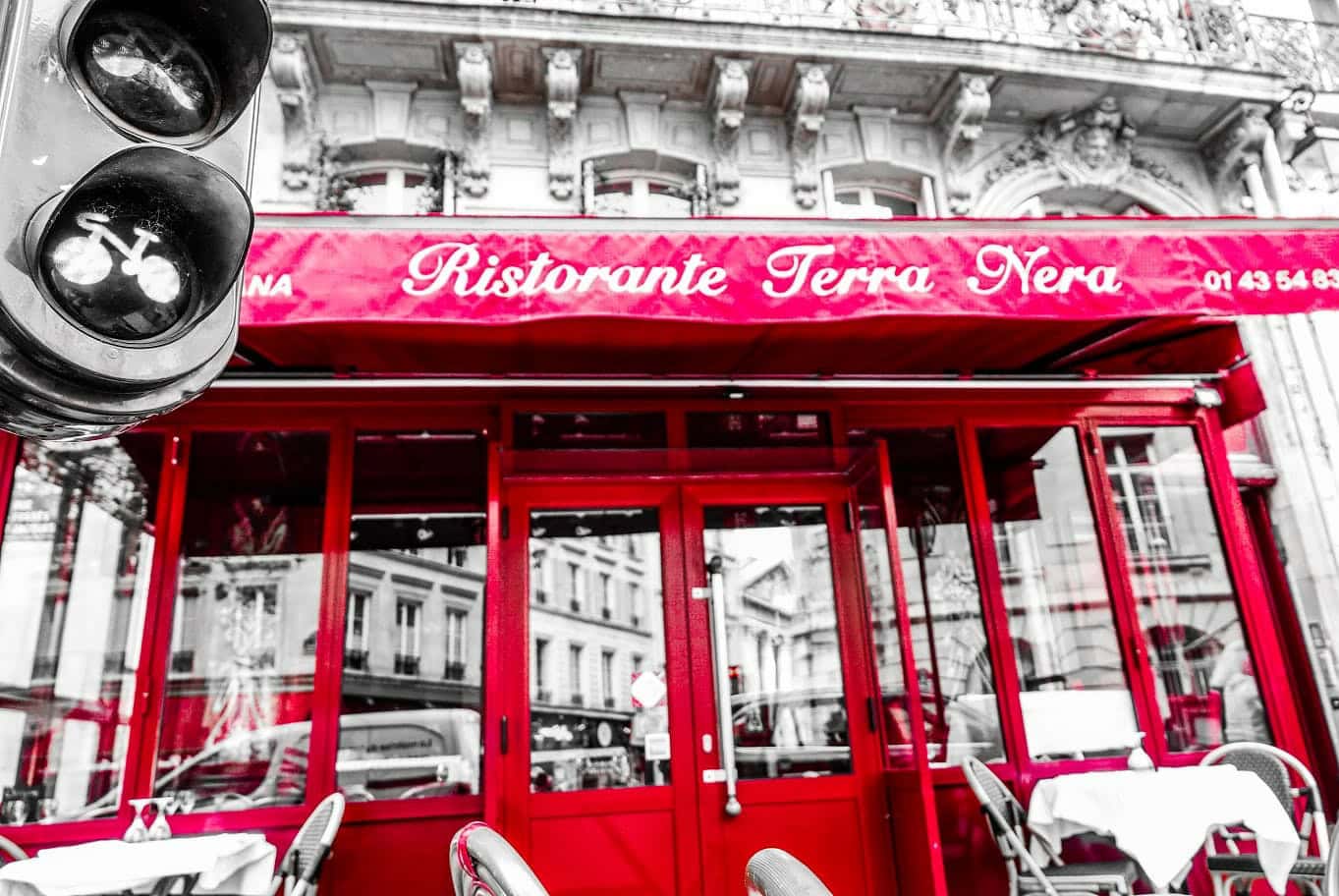
Paris Nightlife: Jazz, Speakeasy Bars, Rooftops & Opera (Complete Guide)

TL;DRParis after dark means jazz clubs on Rue des Lombards (Le Duc des Lombards, Sunset/Sunside), speakeasy-style bars like Little Red Door, Lavomatic and Candelaria, rooftops with Eiffel Tower views (Tour Montparnasse, Créatures atop Galeries Lafayette), and opera at Palais Garnier or the modern Opéra Bastille. June and July are the best months for nightlife thanks to long days and Paris Plages, while August sees plenty of places shut for the annual fermeture. The Métro runs until 1.15am (2.15am at weekends), after which you’re relying on night buses (Noctilien) or taxis. Steer clear of the areas around Gare du Nord and Gare de l’Est, plus the rougher edges of Pigalle and Barbès — the 6th and 3rd arrondissements, by contrast, feel very safe. Prices range from €10 for jazz club entry up to €230 for a dinner show at the Moulin Rouge.

Paris nightlife is nothing short of magical, especially when dusk begins to settle over the Seine and the cast-iron street lamps cast their first golden reflections on the wet cobblestones. The city radically shifts its tempo — the daytime tourist hustle gives way to something far more elegant, and the little round tables outside cafés start filling with glasses of wine while a muffled bass throbs through the half-open doors of old cellar bars. Paris is gearing up for its second, far more seductive shift.

What’s more, Paris after dark in 2026 offers incredible energy. While some famous institutions are resting, others have been reborn. Notre-Dame Cathedral finally glows into the night with its fresh restoration, and this summer, for the first time in over a century, evening swimming has reopened right in the Seine. From a vegetarian’s perspective, it’s also a huge celebration that the legendary restaurant Arpège has switched to a fully plant-based menu, transforming the entire local fine dining scene. Whether you’re after quiet romance or a wild swing dance party, this city won’t let you sleep.

I’ll walk you through it all in order: from jazz cellars and secret speakeasy bars hidden behind washing machine doors to rooftops where the Eiffel Tower peeks right over your shoulder.

Eiffel Tower lit in amber during blue hour seen from Trocadéro

TL;DR

  • The best night views aren’t from the Eiffel Tower. Head to the rooftop of Tour Montparnasse (open until 23:30) or the bar atop Galeries Lafayette, where you get all of Paris spread out before you.
  • Secret speakeasy bars are a massive trend. Visit Little Red Door in the Marais, Lavomatic hidden inside a launderette, or Candelaria disguised as an ordinary Mexican taqueria.
  • The jazz heartbeat pulses on Rue des Lombards, where you’ll find clubs like Le Duc des Lombards and Sunset/Sunside. For dancing and swing, head to the medieval cellar of Caveau de la Huchette.
  • Cabarets aren’t just about Moulin Rouge. For a more authentic, less touristy experience in a stunning building designed by Gustave Eiffel, book tickets for Paradis Latin.
  • Watch out for common scams. At night, ignore people offering you a “found” gold ring, bracelet sellers under Sacré-Cœur, and fake deaf-mute petition signers.
  • Parents with kids, don’t despair. Make the most of the early-evening apéro culture (between 5 pm and 8 pm), when people sit on terraces with wine and cheese. Children are perfectly welcome.
  • Night transport has its quirks. The metro runs until 2:15 am on weekends. After that, you’ll need to rely on Noctilien night buses or official taxi services (Uber, G7).
  • Avoid late-night walks around Gare du Nord and Gare de l’Est stations (10th arrondissement) and the more remote parts of Pigalle and Barbès. The 6th and 3rd arrondissements, on the other hand, are very safe.
Red neon sign of Moulin Rouge on evening Place Blanche

Paris Nightlife by Season: When to Go and Night Events Calendar

The city’s evening character changes dramatically depending on what month you arrive. Sometimes you can stroll along the river in a light jumper until midnight; other times, a bitter wind chases you into the nearest heated wine bar by five in the afternoon. Every season has its own magic though, so it all depends on what mood you’re in.

Summer Evenings and Paris Plages

Father holding his little son in front of Notre-Dame with the Seine

June and July are hands down the best months for nightlife in Paris. The days are incredibly long, the sun doesn’t set until around ten in the evening, and golden hour seems to last an eternity. This is when the famous Paris Plages open up, transforming the banks of the Seine into sandy beaches with sun loungers and bars. The big news for 2026 is that, for the first time in over a century, swimming has officially relaunched right in the Seine at designated spots — including during the evening hours.

Be prepared, though: in August the city experiences what’s known as the fermeture annuelle. Locals leave en masse for their holidays, many independent bistros and smaller bars close for the entire month, and the streets are left mostly to tourists.

💡 Local tip: If you want the real local vibe in summer, head along the Canal Saint-Martin. Parisians sit right on the banks, crack open bottles of wine and order pizza from nearby spots. It’s cheap, spontaneous and wonderfully laid-back.

Autumn and Winter Romance

Smiling boy standing on Place du Palais Royal in Paris

Once October rolls around, nightlife retreats from the streets and moves indoors. This is the perfect time to discover dark jazz cellars and cosy speakeasy bars. Parisians return from their summer holidays (a period known as la rentrée) and the cultural scene kicks into full gear. New theatre seasons open and opera tickets vanish in the blink of an eye.

Winter has its own enormous charm thanks to the Christmas lights, which traditionally shine from late November. Just bear in mind that after the holidays, in January and February, it can be genuinely miserable outside and some rooftop bars don’t open their outdoor terraces at all due to the weather.

💡 Local tip: In winter, booking a table at restaurants ahead of time is absolutely essential. While in summer people spread out across huge outdoor terraces, in winter everyone squeezes into tiny interiors — and without a reservation, you haven’t got a chance.

Night Events Calendar for 2026

Little blond boy in a white car-print T-shirt holding cheese on a Parisian street

If you want to experience something truly extraordinary, plan your trip around specific dates. The absolute must-see event is Nuit Blanche (White Night), which this year falls on Saturday, 6 June 2026. The entire city stays awake, museums open for free, and gigantic art installations take over the streets.

Just a few weeks later, on 21 June, comes Fête de la Musique. Live bands play on every corner, square and outside every bakery. It’s deafening, wild and utterly joyful. In May, the European Night of Museums (Nuit des Musées) lets you into famous galleries after dark, often with special programmes.

💡 Local tip: During Nuit Blanche, selected metro lines run all night long completely free of charge. Take advantage — taxis are hopelessly booked out that evening. You can always find programme details well in advance on the official paris.fr website.

Notre-Dame during evening blue hour after its renovation

Where to Stay in Paris: Safe and Strategic Neighbourhoods for Late-Night Returns

Choosing the right accommodation is crucial, especially if you’re planning evening adventures or travelling with small children. You don’t want to be trudging home at midnight through dodgy, unlit back streets on the city’s outskirts. My partner Lukáš and I have learned from experience that paying a bit more for a hotel in a safe, central neighbourhood pays for itself many times over in peace of mind and saved taxi fares. Paris has twenty arrondissements, and for nightlife I recommend the ones that buzz with energy yet still maintain a high level of safety.

6th Arrondissement (Saint-Germain-des-Prés): Elegance and Absolute Safety

This is our absolute favourite part of the city — the golden grail of the Left Bank. It’s perfectly safe even at two in the morning, the streets are beautifully lit and lined with elegant restaurants. You’ll find famous literary cafés and plenty of quiet side streets. With a pushchair it’s an ideal choice, because during the day you’ve got the Luxembourg Gardens just around the corner, and in the evening you can take a leisurely stroll along the river.

For us it’s always a little haven of calm. Sometimes in the evening we just sit on a bench with a fresh crêpe in hand and soak up the unrepeatable atmosphere of old Paris, which has been preserved here almost untouched.

  • Hôtel Rive Gauche: A lovely smaller hotel with very friendly staff who’ll happily arrange a cot. Rooms are fairly spacious by Parisian standards and there’s a working lift (which isn’t a given here). Rates in 2026 are around €180 per night for two.
  • Hotel des Marronniers: A hidden gem in a courtyard, shielded from street noise. They have a gorgeous inner garden where you can enjoy an evening glass of wine while your child sleeps in the room with a baby monitor. A night costs roughly €220.

3rd Arrondissement (Upper Marais): In the Heart of the Action

If your main goal is discovering secret speakeasy bars and outstanding restaurants, stay in the northern part of the Marais (Haut-Marais). It’s noticeably calmer than the wilder southern section, and you’re just a few steps from some of the best cocktail bars in Europe.

What’s more, old stone alleyways blend here with cutting-edge boutiques and independent cafés. It’s exactly the kind of neighbourhood where you can get lost without a map and always stumble upon some fantastic little spot that regular guidebooks never mention.

  • Hôtel Les Tournelles: Modern, very clean hotel with excellent breakfasts and comfortable beds. They have step-free access, which is a blessing with a pushchair. Double rooms start from €160 per night.
  • Hôtel Emile: A design gem with a wonderful atmosphere and a very welcoming approach to families. Located a short walk from the Saint-Paul metro station. A night costs approximately €190.

15th Arrondissement (Vaugirard): A Calm, Family-Friendly Choice

If you’re looking for a compromise between price, safety and good transport links, the 15th arrondissement is a brilliant option. It’s a residential, very peaceful neighbourhood where mainly Parisian families live. You won’t find wild clubs here in the evening, but there are loads of excellent bistros and from many spots you can walk to the Eiffel Tower.

It’s also a huge advantage if you want to avoid the biggest tourist crowds. Local cafés here serve the neighbours, prices are noticeably friendlier, and in the morning you’ll be woken only by the aroma of fresh baguettes from the nearby bakery.

  • Novotel Paris Centre Tour Eiffel: A rock-solid choice for families with children. Rooms are large, the hotel has its own pool and river views. Children under 16 often stay free in their parents’ room. Prices start at €150 per night.
  • Hôtel Eiffel Blomet: A gorgeous art deco hotel with an indoor pool and a very tranquil atmosphere. A great pick for those who want to explore by day and relax by evening. A night costs roughly €170.

For families with children, nightlife wraps up quite a bit earlier, so we welcomed the quiet hotel environment with great relief. Do bear in mind, though, that metro line 10 stops running around half past midnight, so for very late returns from the centre you’ll need to call an Uber. I go into the logistics in a separate review, and you can browse accommodation options here.

Illuminated Opéra Garnier with golden statues during blue hour

Where to Eat: Paris Nightlife Includes Brilliant Bistros and Renowned Restaurants

Heading out into the Parisian streets for a good dinner is a ritual you simply can’t skip. The French eat dinner fairly late — the best restaurants don’t really fill up until around eight or nine in the evening. It’s the time when the city quietens down a little, people put away their phones and enjoy the company of their loved ones over a plate of superb food and a glass of wine. Lukáš and I absolutely love it, though with our little one Jonáš we have to get a bit more creative to avoid disrupting his sleep schedule.

The golden rule for Parisian restaurants is rather uncompromising: book a table in advance. Especially at popular, well-known spots, you’ll otherwise easily find yourself standing hungry on the pavement. Here are a few places we keep returning to — not because we lack imagination, but because they’re simply exceptional and won’t blow your budget.

Bouillon Julien (10th Arrondissement)

This is an absolute classic if you want to taste traditional French cuisine at very reasonable prices in a jaw-droppingly beautiful setting. The bouillon concept is all about serving fast, hearty and cheap working-class food — but in grand Art Nouveau halls. The Bouillon Julien building from 1906 transports you straight back in time, with mirrors, painted glass and wrought-iron details everywhere. We often bring visiting friends here because that first impression is simply priceless.

They have a huge selection of starters like escargots or an excellent leek soup, plus mains such as bœuf bourguignon. As a vegetarian I sometimes have a tougher time choosing, but the cheese and vegetable options are outstanding. Main courses start at around €10, which is a small miracle for central Paris. Expect a bit of noise and very swift, occasionally brusque service though — tables turn here at breakneck speed.

Pink Mamma (9th Arrondissement)

If you’re after Italian cuisine in an insanely photogenic setting, you need to head to Pigalle. Pink Mamma occupies a multi-storey corner building, and the very top floor with its glass roof and cascading jungle of plants genuinely feels like stepping into an Italian dream. The food is authentic, pasta is made fresh on-site, and the aroma of truffles hits you the moment you walk through the door.

Their famous truffle pasta costs around €19 and a proper Neapolitan pizza comes to about €15. Don’t forget to leave room for the tiramisu, which they serve tableside from an enormous bowl. One caveat though: without a reservation there’s genuinely no point coming. They open their booking system a few weeks in advance and the best slots vanish before you can blink.

Le Train Bleu (12th Arrondissement)

If you want something truly luxurious and you’re in a celebratory mood, this restaurant inside Gare de Lyon station is a real gem. It opened for the World Exhibition and its interior is adorned with enormous chandeliers and gilded frescoes. Le Train Bleu carries an aura of a bygone era — famous travellers used to lunch here before boarding their train to the French Riviera.

Prices are understandably higher — a main course runs around €45 — but you’re largely paying for the fairy-tale experience. I love dropping in for an afternoon coffee or an evening dessert, even when we’re not planning a full dinner. Waiters in long aprons glide silently between tables and the whole atmosphere feels utterly captivating.

Pont Alexandre III with illuminated lamps during blue hour

Classics and Drama: Opera, Ballet and Theatre

The Parisian theatre and opera scene is an institution in its own right. You don’t just go for the performance itself — you go for the overall experience of the space. The architecture of the finest auditoriums plays a starring role right alongside the soloists, and simply stepping inside these buildings transports you to another era.

Two Faces of the Opera: Palais Garnier vs. Opéra Bastille

When you announce in Paris that you’re going to the opera, you immediately have to specify which one. The city has two main venues that could hardly be more different. They’re both managed by the Opéra national de Paris, but each offers an entirely different world.

Choosing between them is a bit like choosing between classic romance and modern minimalism. One building instantly transports you to the nineteenth century, while the other delivers the finest contemporary acoustic experience.

Palais Garnier (9th Arrondissement) This is the classic opera house — the essence of the 19th century with marble, gold, heavy red velvet and an enormous crystal chandelier. This is where Gaston Leroux set his famous Phantom of the Opera. The myth about an underground lake has a real basis, by the way — there’s a vast water tank still used by firefighters to this day. When you take your seat and look up, a breathtaking ceiling by none other than Marc Chagall will stop you in your tracks. His dreamy, colourful canvas sharply contrasts with Charles Garnier’s classical architecture, yet together they work absolutely perfectly. Today, it mainly hosts ballet.

  • Tickets: Evening performances range from €25 to €200. We never tested those €200 best seats 😅, but the €25 ticket for the last row is absolutely worth it. If you can’t make a performance, a daytime building tour costs €14.
  • Transport: Metro lines 3, 7 and 8 (Opéra station).
  • 💡 Local tip: To save money, look for Category 5 tickets. They’re the cheapest and often have a restricted view, but you’ll soak up every ounce of the grand atmosphere. The dress code is surprisingly relaxed these days — smart casual is fine, but leave the trainers at the hotel.

Opéra Bastille (12th Arrondissement) Opened in 1989 for the bicentennial of the French Revolution, this is a glass-fronted, massive, hyper-modern colossus. While Garnier breathes history, Bastille — with its huge capacity of over 2,700 seats and cutting-edge acoustics — hosts the biggest and most demanding operatic productions.

  • Tickets: From €15 to €180.
  • Transport: Metro lines 1, 5 and 8 (Bastille station).
  • 💡 Local tip: Bastille offers “last-minute” tickets (places de dernière minute) for under-28s and seniors for just €10. They’re sold at the box office roughly an hour before the performance.

Theatre Legends and Classics

Beyond opera and ballet, the Parisian stage is also renowned for its fantastic dramatic repertoire. Even if French might be a barrier for some, seeing classic plays in their home setting is an experience in itself.

Comédie-Française (1st Arrondissement) This theatre is synonymous with Molière. Founded in 1680, it’s the only state theatre company in France with its own permanent acting troupe. It’s housed in the beautiful Salle Richelieu right next to the Palais-Royal. If your French is up to it, seeing a classic drama here is the absolute cultural pinnacle of your stay.

  • Tickets: Prices range from €12 to €45.
  • Transport: Metro lines 1 and 7 (Palais Royal – Musée du Louvre station).
  • 💡 Local tip: Every day, roughly an hour before the performance, the theatre sells a limited number of standing or restricted-view tickets for a token €5. You’ll need to queue, though.
Pont de Bir-Hakeim with metro viaduct during blue hour

Cabarets: Feathers, Sequins and the Can-Can

Parisian cabaret is expensive, occasionally kitsch and undeniably touristy — I won’t pretend otherwise. But it carries undeniable historical weight and is simply part and parcel of nightlife in Paris.

Moulin Rouge and the Rest

Choosing the right cabaret can be quite a puzzle for first-time visitors, because each offers a slightly different kind of spectacle. While some go all-in on traditional folklore and grand production values, others push the genre in a more modern, artistic direction.

Moulin Rouge (18th Arrondissement) The red windmill at the foot of Montmartre on Boulevard de Clichy needs no introduction. It’s a legend that lives off its colossal fame. It’s massively touristy and the prices are astronomical. So why go at all? Because nowhere else on earth will you see the original French can-can performed with such precision and in such costumes. Tickets sell out months ahead, so you need to plan well in advance.

  • Tickets: The show alone with a glass of champagne costs around €135; the dinner option climbs to about €230.
  • Transport: Metro line 2 (Blanche station).
  • 💡 Local tip: Buy tickets for the late show from 23:00. They tend to be slightly cheaper and the atmosphere in the hall is more relaxed than the earlier dinner show.

Paradis Latin (5th Arrondissement) This is the hidden gem of the Latin Quarter and my personal recommendation for anyone wanting something more authentic. It’s the oldest cabaret in Paris, with roots dating back to 1803 (making it older than the Moulin Rouge). The current hall was designed by none other than Gustave Eiffel. Compared to the Red Windmill, it has a far more intimate, warmer and altogether more “local” feel. Their current show was choreographed by the renowned Kamel Ouali and it’s a visual stunner.

  • Tickets: Show with champagne comes to roughly €85; with dinner around €160.
  • Transport: Metro lines 7 and 10 (Jussieu station).
  • 💡 Local tip: Paradis Latin is one of the few cabarets where the food is genuinely excellent. If you want to combine a show with dinner, this is where your money is best spent compared to the competition.

Crazy Horse (8th Arrondissement) This is an entirely different league from the traditional can-can. Don’t expect enormous skirts and flying feathers. The Crazy Horse, located near the Champs-Élysées, focuses on the female form, the interplay of light and shadow, and flawless synchronisation. It’s highly stylised, visually mesmerising erotic art that feels very modern and chic.

  • Tickets: From €115 for the show with champagne.
  • Transport: Metro line 9 (Alma-Marceau station).
  • 💡 Local tip: The venue is very small and intimate. There isn’t a single bad seat in the house, so there’s no need to pay extra for VIP zones near the stage.

(Note for 2026: If you had your heart set on the famous Lido on the Champs-Élysées, you’ll need to change plans. The venue is currently undergoing a major transformation and no longer offers its classic evening dinner shows in their original format.)

White dome of Sacré-Cœur during blue hour above Montmartre

Jazz in Paris: Cellars Where History Was Written

I’ll admit that jazz wasn’t originally my reason for visiting Paris. Then Lukáš dragged me into a cellar on Rue des Lombards and everything changed. The genre and this city have had a love affair since the First World War, when African-American soldiers brought the rhythm across the Atlantic. After the Second World War, American jazz musicians fled racial segregation back home — names like Sidney Bechet and Miles Davis — and Paris welcomed them with open arms. Today, the city is one of Europe’s premier jazz capitals, and the clubs here have an atmosphere you won’t find anywhere else.

The Golden Triangle on Rue des Lombards (1st Arrondissement)

If you don’t want to spend your evenings poring over a map, go for the dead certainty. The unassuming Rue des Lombards, just a stone’s throw from the Châtelet transport hub, is the epicentre of contemporary Parisian jazz. You’ll find three legendary clubs packed practically side by side.

Le Duc des Lombards (42 Rue des Lombards) This is where you come to listen to serious jazz — the absolute cream of the crop. The club went through a complete renovation a few years ago, and the interior is dark, elegant, with a circular stage in the centre and a small mezzanine. They have first-rate acoustics, a Yamaha concert grand and, in the summer months, the absolute blessing of working air conditioning. They stage around 300 concerts a year and the biggest names in world jazz perform here.

  • Tickets: Concert admission usually costs between €30 and €40. Drinks inside around €12.
  • Transport: Metro lines 1, 4, 7, 11, 14 (Châtelet station).
  • 💡 Local tip: On Friday and Saturday nights from 23:30, they hold “Late Night Jams”. Entry to these jam sessions is completely free — you only pay for drinks. It’s a fantastic chance to enjoy brilliant music for next to nothing.

Sunset / Sunside (60 Rue des Lombards) These are actually two clubs hiding behind a single door. The venue was founded in 1983. Sunside is on the ground floor, with warm brick walls, an intimate vibe and a pure focus on acoustic jazz. Sunset, by contrast, takes you down the stairs into a cellar — its tiled walls give it the feel of a metro station, and the sounds here lean towards electric jazz, fusion and more experimental fare.

  • Tickets: Around €25 to €35 depending on the artist.
  • Transport: Same as Duc — Châtelet station.
  • 💡 Local tip: If you can’t decide, I’d recommend the basement Sunset. That underground tiled-vault atmosphere with superb acoustics is quintessentially Parisian.

Le Baiser Salé (58 Rue des Lombards) The third musketeer on this street. While Duc is the classic and Sunset experiments, the “Salty Kiss” specialises in world music, Afro-Cuban rhythms and wild jazz-fusion. Percussion takes centre stage and the atmosphere tends to be by far the most relaxed of all three.

  • Tickets: Often around €20 to €28.
  • Transport: Châtelet station.
  • 💡 Local tip: Grab a seat at the first-floor bar. They have an enormous selection of rums from around the world, which pair far better with the Afro-Cuban rhythms than your standard glass of wine.
lukas a lucka
Lukáš and Lucie recommend
Where to stay in Paris
6 accommodations — hotels and other lodging options
⭐ TOP CHOICE 🏨 Hotel
Hôtel Rive Gauche
Beautiful smaller hotel in the 6th arrondissement (Saint-Germain-des-Prés) with very friendly staff who will easily arrange a crib. The rooms are quite spacious by Parisian standards and have a working elevator.
★★★★ from €180/night
Check availability
🏨 Hotel
Hotel des Marronniers
A hidden gem in a courtyard in the 6th arrondissement where street noise doesn’t reach. They have a beautiful interior garden where you can enjoy an evening glass of wine while your child sleeps in the room with a baby monitor.
★★★★ from €220/night
Check availability
🏨 Hotel
Hôtel Les Tournelles
Modern, very clean hotel in the 3rd arrondissement (Northern Marais) with excellent breakfasts and comfortable beds. They have wheelchair access, which you’ll appreciate with a stroller.
★★★★ from €160/night
Check availability
🏨 Hotel
Hôtel Emile
Design hotel in the 3rd arrondissement with an amazing atmosphere and very welcoming approach to families. Located near the Saint-Paul metro station.
★★★★ from €190/night
Check availability
🏨 Hotel
Novotel Paris Centre Tour Eiffel
A huge safe bet for families with children in the 15th arrondissement. The rooms are large, the hotel has its own pool and river views. Children under 16 often stay free in their parents’ room.
★★★★ from €150/night
Check availability
🏨 Hotel
Hôtel Eiffel Blomet
Beautiful art deco style hotel with an indoor pool and very peaceful atmosphere in the 15th arrondissement. Great choice for those who want to explore during the day and relax in the evening.
★★★★ from €170/night
Check availability

Cellars and Legends Beyond the Centre

If you venture a little further from the famous jazz epicentre, you’ll find venues that may not look as polished at first glance but harbour far more fascinating histories. These are places with genuine soul.

Caveau de la Huchette (5th Arrondissement) Picture a genuine medieval cellar in the Latin Quarter: stone vaulting, dim light and all-pervading sweat. Since the 1940s, pure swing and bebop have been played here. This place has a very specific, slightly old-world charm. Traditional orchestras perform and people actually dance — no stiff sitting at tables and polite head-nodding; here, you work up a proper sweat on the dance floor. The space might also look familiar — it was used for the Paris scenes in the Oscar-winning film La La Land.

  • Tickets: Entry is a modest €15; for students under 25 just €10.
  • Transport: Metro line 4 (Saint-Michel station).
  • 💡 Local tip: Don’t wear heels. The stairs down to the cellar are old, steep and slippery. And if someone invites you to dance, don’t refuse — even if you don’t know the steps. Here, it’s all about the joy of movement.

New Morning (10th Arrondissement) A club with a larger hall and a monumental history. Don’t expect a polished salon or velvet sofas — this is a fairly raw space in a former print works where musical history was written. Miles Davis, Chet Baker and Prince have all played here. World-class acts still come through, though the programme is broader now and includes funk, soul and blues.

  • Tickets: Typically €25 to €40.
  • Transport: Metro lines 4, 8, 9 (Strasbourg – Saint-Denis station).
  • 💡 Local tip: Gigs here often start with a slight delay and the hall fills to bursting point. Arrive at least 45 minutes early to snag a good standing spot near the stage.
Bateau Mouche on the evening Seine with illuminated palaces

Speakeasy and Top Mixology: Secret Doors and Hidden Bars

I’ll confess that I originally wrote off speakeasy bars as a slightly overrated tourist trend. Then I accidentally spent two hours searching for the right washing machine door at Lavomatic and changed my mind entirely. Paris has taken this concept and perfected it to an art form. It’s long since stopped being about simply finding a hidden entrance — it’s about what they pour you behind it. Parisian mixology now sits at the absolute pinnacle of the global scene, and the bartenders here are more like alchemists and chefs rolled into one.

Absolute Must-Visit: Little Red Door

If you only have time and budget for a single cocktail during your entire stay, make it here. This unassuming spot in the heart of the Marais has featured an incredible nine times in the prestigious World’s 50 Best Bars ranking since 2012.

Their menu isn’t just a list of drinks but an elaborate conceptual piece, built around artistic movements and social sciences with a huge emphasis on sustainability and local French ingredients. It’s a perfect blend of New York energy and Parisian elegance.

  • Prices: Cocktails are a flat rate of around €17.
  • Transport: Metro line 8 (Filles du Calvaire station).
  • 💡 Local tip: They’re open daily from 18:00 to 02:00 but take absolutely no reservations — walk-ins only. Arrive right at opening time at six in the evening, or be prepared to queue on the street.

Secret Entrances and Illusions

Some bars have elevated secrecy to an entirely new level, turning the very act of finding the entrance into a fun game. Whether they’re hiding behind a washing machine, inside a pizzeria or behind an unassuming restaurant, that moment of surprise when you discover the hidden door is simply priceless.

Lavomatic (10th Arrondissement) One of the wittiest and most popular concepts in the city. From the street, you see a completely normal-looking launderette — people are genuinely doing their laundry in here. But you need to find the right washing machine door, which lets you onto a secret staircase built from old washing machines. Upstairs, a buzzing, colourful bar awaits with excellent drinks and a brilliant young-crowd atmosphere.

  • Prices: Drinks range from around €12 to €15.
  • Transport: Metro lines 3, 5, 8, 9, 11 (République station).
  • 💡 Local tip: The bar is tiny and it’s a huge hit on social media. At weekends it’s packed from eight in the evening onwards. Go on a Wednesday or Thursday instead.

Candelaria (3rd Arrondissement) From the street, all you see is a small, fairly ordinary and slightly greasy taqueria. Walk past the food counter, push the inconspicuous white back door and you find yourself in a dark, candlelit bar that feels like a cave. They specialise in mezcal and tequila, and Candelaria has been a longstanding fixture on the Parisian bar scene.

  • Prices: Cocktails €14 to €16, tacos €4.
  • Transport: Metro line 8 (Saint-Sébastien – Froissart station).
  • 💡 Local tip: Combine the two experiences. Have the excellent tacos in the front section, get your hands properly greasy, then move to the back for a sophisticated mezcal cocktail.

Moonshiner (11th Arrondissement) Same principle as Candelaria, but with an Italian twist. You walk into the pizzeria Da Vito, pass straight through the meat cold room and suddenly find yourself in 1920s America. Gramophones, dim lighting and the scent of prohibition-era drinks surround you. The interior is absolutely gorgeous.

  • Prices: Cocktails from €13.
  • Transport: Metro line 5 (Bréguet – Sabin station).
  • 💡 Local tip: Order their take on an Old Fashioned. The bartenders also crack open old safes where they stash their finest bottles.
Modern restaurant with grey chairs and a set table

High End and World Class

For those seeking the purest luxury and who aren’t afraid to dig deep into their pockets, Paris has world-class venues at the ready. This is no longer a game of hide-and-seek — it’s about first-rate design and the most acclaimed bartenders in the business.

Danico (1st Arrondissement) This bar is tucked away in the beautiful historic Galerie Vivienne, just behind the viral Italian restaurant Daroco. Danico regularly features in the World’s 50 Best Bars. The interior with striped wallpaper and velvet armchairs will take your breath away, and their drinks are staggeringly creative.

  • Prices: Drinks around €16.
  • Transport: Metro line 3 (Bourse station).
  • 💡 Local tip: Their signature Moscow Mule is legendary, but don’t be afraid to tell the bartender what flavour profiles you prefer and let them mix something bespoke off-menu.

Bar Hemingway (1st Arrondissement) Located inside the iconic Ritz hotel on Place Vendôme. You won’t be looking for hidden doors here — just make sure your wallet is well padded. Ernest Hemingway used to drink here and reportedly personally “liberated” the bar at the end of the Second World War. It’s conservative, very expensive, full of leather and dark wood, but it’s a slice of pure literary history.

  • Prices: Brace yourself — cocktails start at €35.
  • Transport: Metro lines 3, 7, 8 (Opéra station).
  • 💡 Local tip: They won’t let you into the Ritz in ripped jeans and trainers. More formal attire is expected here — a jacket for men is standard. If you want to treat yourself to one luxury drink of a lifetime, order their renowned Martini.

Paris from Above: Rooftop Bars and Terraces

Why drink at ground level when you can look the Sacré-Cœur or the Eiffel Tower straight in the eye? Rooftop bars have been booming in Paris over the last five years. The golden rule is simple: check what time the sun sets that day, and arrive at least an hour and a half early. Golden hour over the grey zinc rooftops of Paris will get under your skin far more than any museum visit.

Classics and the Best Free Views

The most perfect view of illuminated Paris actually doesn’t have to cost you a single euro — if you know where to go. Simply steer clear of overpriced tourist lookouts and head where Parisians go after work.

Créatures on the Galeries Lafayette Rooftop (9th Arrondissement) The terrace on the 7th floor of the famous Galeries Lafayette department store offers a full 360-degree view. From here you get a gorgeous vantage point of the rear of the Opéra Garnier building, and the Eiffel Tower rises majestically in the distance. In summer, a bar and vegetarian restaurant called Créatures operates here, run by the excellent chef Julien Sebbag.

  • Prices: Access to the terrace during the day is completely free. In the evening, a drink at the bar costs around €15.
  • Transport: Metro lines 7, 9 (Chaussée d’Antin – La Fayette station).
  • 💡 Local tip: This is hands down the best spot for a sunset with the Eiffel Tower in the background — without paying steep admission to climb the tower itself. Arrive early though, as the queue for the lifts can be long.

Tour Montparnasse and Ciel de Paris (15th Arrondissement) Many guidebooks will tell you the black skyscraper Tour Montparnasse is the ugliest building in Paris. Perhaps. But it has one enormous advantage: when you’re on it, you can’t see it. What you can see is the entire Paris skyline, including the perfect silhouette of the Eiffel Tower. At 210 metres up you’ll find a bar and restaurant called Ciel de Paris. I wasn’t terribly excited about going myself — the tower really is no architectural masterpiece, jarring from every second Parisian hilltop. But once the lightning-fast lift whisked us to the top, I had to admit it was worth it. Suddenly this breathtaking panorama opens up before you, the endless boulevards gleaming in the night, all of it spread out like a sparkling map.

  • Prices: Drinks at the bar cost around €20. Entry to the observation terrace of the tower is €20.
  • Transport: Metro lines 4, 6, 12, 13 (Montparnasse – Bienvenüe station).
  • 💡 Local tip: Feel free to skip climbing the Eiffel Tower entirely. From up there you can’t see the most beautiful element of the Paris panorama — the Eiffel Tower itself. Tour Montparnasse is open until 23:30, making it the ideal spot for late-night views.

Atmosphere and Design

When a stunning view is paired with thoughtful interior design and a brilliant atmosphere, you’ve got the recipe for a perfect evening. These rooftops pride themselves on offering stylish seating and fantastic drinks alongside the city panorama.

The Le Perchoir Family The word perchoir means “perch” in French, and the owners of this chain know exactly how to pick the best ones. Le Perchoir Ménilmontant (11th Arrondissement) is the original rooftop that kicked off the entire trend, offering a very laid-back, bohemian atmosphere full of cushions and fairy lights. Its sibling, Le Perchoir Marais (4th Arrondissement), sits right on the roof of the BHV Marais department store and rewards you with an absolutely stunning view of the illuminated Hôtel de Ville, the Seine and the towers of Notre-Dame.

  • Prices: Drinks around €14.
  • Transport: For Marais, metro lines 1, 11 (Hôtel de Ville station).
  • 💡 Local tip: The entrance to Le Perchoir Marais can only be found after the department store’s closing hours, from the rear on Rue de la Verrerie. Look for an inconspicuous door with a bouncer.

Terrass” Hotel (18th Arrondissement) Tucked away at the foot of Montmartre, this offers a far calmer, more romantic atmosphere than the buzzy bars in the city centre. The view stretches across the entire city, deep down to the Seine and over the Montmartre cemetery. Comfortable armchairs, plenty of greenery, and in winter they even hand out heated blankets.

  • Prices: Cocktails at €16.
  • Transport: Metro line 2 (Blanche station).
  • 💡 Local tip: This is one of the few places that does genuinely excellent non-alcoholic mocktails — not just sickly-sweet fruit juices but proper flavour experiences in their own right.

Hôtel Raphaël (16th Arrondissement) This is a little slice of exclusive Paris that most standard guidebooks overlook. This super-luxurious hotel near the Arc de Triomphe has a beautiful rooftop garden with views. Normally it’s only accessible to hotel guests and the Parisian elite.

  • Prices: Drinks start at €25.
  • Transport: Metro line 6 (Kléber station).
  • 💡 Local tip: The insider trick is this: if you book a table for drinks online in advance, they’ll let you up for free and you can enjoy this five-star luxury for the price of a single cocktail.

Alternative Evenings: Night Cruises, Walks and Hidden History

If loud music and packed bars aren’t your thing, Paris offers plenty of quieter ways to enjoy an evening out. The city is beautifully illuminated after dark, and a simple walk along the river is a fully-fledged cultural experience in its own right.

Magic on the River Seine

The most classic — yet still utterly enchanting — evening activity is a cruise along the Seine. Boats (Bateaux Mouches or Bateaux Parisiens) depart mostly from near the Eiffel Tower or Pont Neuf, and the cruise lasts about an hour. In the evening, when all the monuments lining the river are lit by floodlights and the light dances on the water, the romance is off the scale.

Lukáš and I prefer the smaller boats where it’s not wall-to-wall people and you can actually have a quiet conversation. Sometimes there’s even live music, which takes the evening romance to another level entirely. If you’re travelling with kids, definitely bring a warmer hoodie — it can get surprisingly chilly on the open river — but the view of a glittering Paris will make their jaws drop. 😉

Personally, I recommend timing your cruise for exactly sunset or just after. That’s when the famous Eiffel Tower comes alive — it sparkles for five minutes on the hour every evening, and seeing it from the water is unforgettable.

  • Prices: A basic evening cruise costs around €16; a cruise combined with a luxury dinner on board starts from €90.
  • 💡 Local tip: Dress warmer than you think you need to. On the upper open deck, the wind off the river is always quite biting — even in summer.

Bohemian Footsteps in Paris

Here’s something that many guidebooks miss entirely. Paris has historically been a refuge for artists and intellectuals from across Central Europe, and an evening walk in their footsteps has enormous charm. You could head to the 6th arrondissement and stroll along Rue de Cherche-Midi, near where the renowned novelist Milan Kundera lived for decades until his recent passing. Or walk past the Luxembourg Gardens and a short distance away, on Rue du Val-de-Grâce, you can trace the steps of the legendary Art Nouveau painter Alphonse Mucha, who created some of his most iconic work here before becoming a star.

I’m always fascinated by how many of these places still breathe the same atmosphere as they did when these great figures lived and worked in them. There’s something magical about standing in front of an old building and imagining the Parisian bohème mingling with artists from far-flung corners of Europe.

  • 💡 Local tip: In the suburb of Puteaux on the city’s outskirts (reachable by metro line 1), you’ll find the famous studios of the pioneering abstract painter František Kupka. An evening stroll through this quieter area is a lovely escape from the centre.

Pont de Bir-Hakeim

This double-decker steel bridge connecting the 15th and 16th arrondissements is famous from the film Inception. While during the day it’s packed with tourists and wedding photographers, in the evening it transforms into the perfect spot for quietly watching the city. The metro line 6 rumbles across the top; pedestrians walk below.

We love walking here after dinner. The massive industrial structure, lit up in gold, feels like something from another world, and when a metro train rattles overhead, you feel like you’re in the middle of a film scene. Occasionally you’ll encounter a street musician with an accordion, which for me creates the most quintessentially Parisian backdrop imaginable.

Lean against the cool railing and gaze across the river, and you’ll realise this pocket of the city is actually wonderfully peaceful. And because you’re a bit further from the busiest tourist hotspots, you won’t be jostling for elbow room at the viewpoint with a thousand other people.

  • 💡 Local tip: This is objectively the best spot in all of Paris for a photo of the illuminated Eiffel Tower. You’re far enough away to fit the whole thing in frame, the bridge provides a gorgeous architectural frame, and you avoid the insane crowds at the Trocadéro.

Practical Info: Transport and Safety After Dark

Paris at night operates a little differently from the daytime. It’s important to know the rules of the game so you can avoid unnecessary stress — or worse, unpleasant situations. The city is generally very safe, but like any major metropolis, it has its quirks.

Night Transport and the Noctilien

The Paris metro doesn’t run 24/7: from Sunday to Thursday, services stop at around 1:15 am, and on weekends that extends to 2:15 am. If you stay out later, you’ll need to rely on night buses called Noctilien, which criss-cross the city all night and converge at major hubs like Châtelet and the main train stations.

I’ll admit that navigating the night bus network can be a bit of a patience test, especially when you’ve already clocked up miles on your feet. That’s why I recommend always having the local transport app downloaded — it’ll show you exactly where to go and when.

  • 💡 Local tip: Night buses use the same tickets as regular transport, but they tend to be full of tipsy revellers at weekends and the journeys take ages. If you’re tired, you’re better off ordering an Uber or using the official G7 taxi service (they have a great English-language app). Never get into a taxi without an official sign and working meter!

Safety and Which Areas to Avoid

Most central arrondissements (1st to 8th) are perfectly safe at night — bustling with people and well lit. Still, there are places you should steer clear of after 10 pm, especially if you’re on your own or with children.

It works much the same as in any large European city — just trust your instincts. If a street suddenly goes suspiciously quiet, the street lights thin out and you just don’t feel right, the best thing to do is turn around and head back to the nearest busy boulevard.

  • Around train stations: Avoid the northern part of the 10th arrondissement, specifically the immediate surroundings of Gare du Nord and Gare de l’Est. Dodgy characters and pickpockets congregate here at night.
  • Pigalle and Barbès: While Boulevard de Clichy itself, with the Moulin Rouge, is full of tourists, the more remote side streets heading towards Barbès-Rochechouart (18th arrondissement) can feel rather unwelcoming and unsafe after dark.
  • 💡 Local tip: If you feel uncomfortable on the street at night, simply walk into any open bistro or hotel reception and ask them to call a taxi. Parisians are always willing to help in this regard.

Scams and Cons in Nighttime Paris

Tourist traps don’t sleep at night either. In fact, scammers often count on you being less alert after a few glasses of wine.

I didn’t want to believe it for the longest time myself, but a moment’s inattention is all it takes to lose your phone or wallet. It pays to know the most common tricks in advance so you can spot them a mile off.

  • The gold ring: The ring is, of course, worthless brass. Lukáš and I witnessed this scam first-hand near the Louvre: a man suddenly bent down, picked up a chunky ring and started pushing it on an unsuspecting British tourist, explaining how he couldn’t afford food and just needed a few coins — all before she could even catch her breath. She was completely taken aback, so we stepped in and shooed him away. Always keep your wits about you.
  • Fake petitions: Especially around the evening-lit Eiffel Tower or the Louvre, people (often young women) will approach you pretending to be deaf-mute, carrying clipboards and asking you to sign a “charity petition”. It’s purely a distraction while an accomplice robs you. This is probably the single most common trick. The women carry hard-backed clipboards, shove them in your face and gesture that they can’t hear. The clipboard acts as a screen behind which they lightning-fast rummage through your pockets — and before you know what’s happened, your phone is gone. Remember: genuine charities never collect signatures this aggressively on the street.
  • Friendship bracelets: On the steps below Sacré-Cœur, groups of men operate by trying to forcibly tie a woven bracelet onto your wrist and then demanding money for it. Keep your hands in your pockets and walk firmly past them with a clear French non. These gangs hang around the steps leading to the basilica almost year-round. They’re quite persistent, and once they’ve wrapped a thread around your wrist, they start demanding hefty sums. The safest approach is not to engage at all — don’t make eye contact and keep walking assertively. Don’t worry about any physical confrontation; if you’re firm enough, they’ll leave you alone immediately.
  • 💡 Local tip: The cardinal rule in every restaurant and bar: never leave your mobile phone sitting on the table in front of you, especially if you’re sitting on an outdoor terrace. Thieves will walk up, lay a map or newspaper on the table, ask for directions, and whisk your phone away under the paper.

Read Next

If you’ve got your evening plans sorted and need to fine-tune the rest of your trip, check out our other articles:

Frequently Asked Questions

Tips and Tricks for Your Vacation

Don’t Overpay for Flights

Search for flights on Kayak. It’s our favorite search engine because it scans the websites of all airlines and always finds the cheapest connection.

Book Your Accommodation Smartly

The best experiences we’ve had when looking for accommodation (from Alaska to Morocco) are with Booking.com, where hotels, apartments, and entire houses are usually the cheapest and most widely available.

Don’t Forget Travel Insurance

Good travel insurance will protect you against illness, accidents, theft, or flight cancellations. We’ve had a few hospital visits abroad, so we know how important it is to have proper insurance arranged.

Where we insure ourselves: SafetyWing (best for everyone) and TrueTraveller (for extra-long trips).

Why don’t we recommend any Czech insurance company? Because they have too many restrictions. They set limits on the number of days abroad, travel insurance via a credit card often requires you to pay medical expenses only with that card, and they frequently limit the number of returns to the Czech Republic.

Find the Best Experiences

Get Your Guide is a huge online marketplace where you can book guided walks, trips, skip-the-line tickets, tours, and much more. We always find some extra fun there!
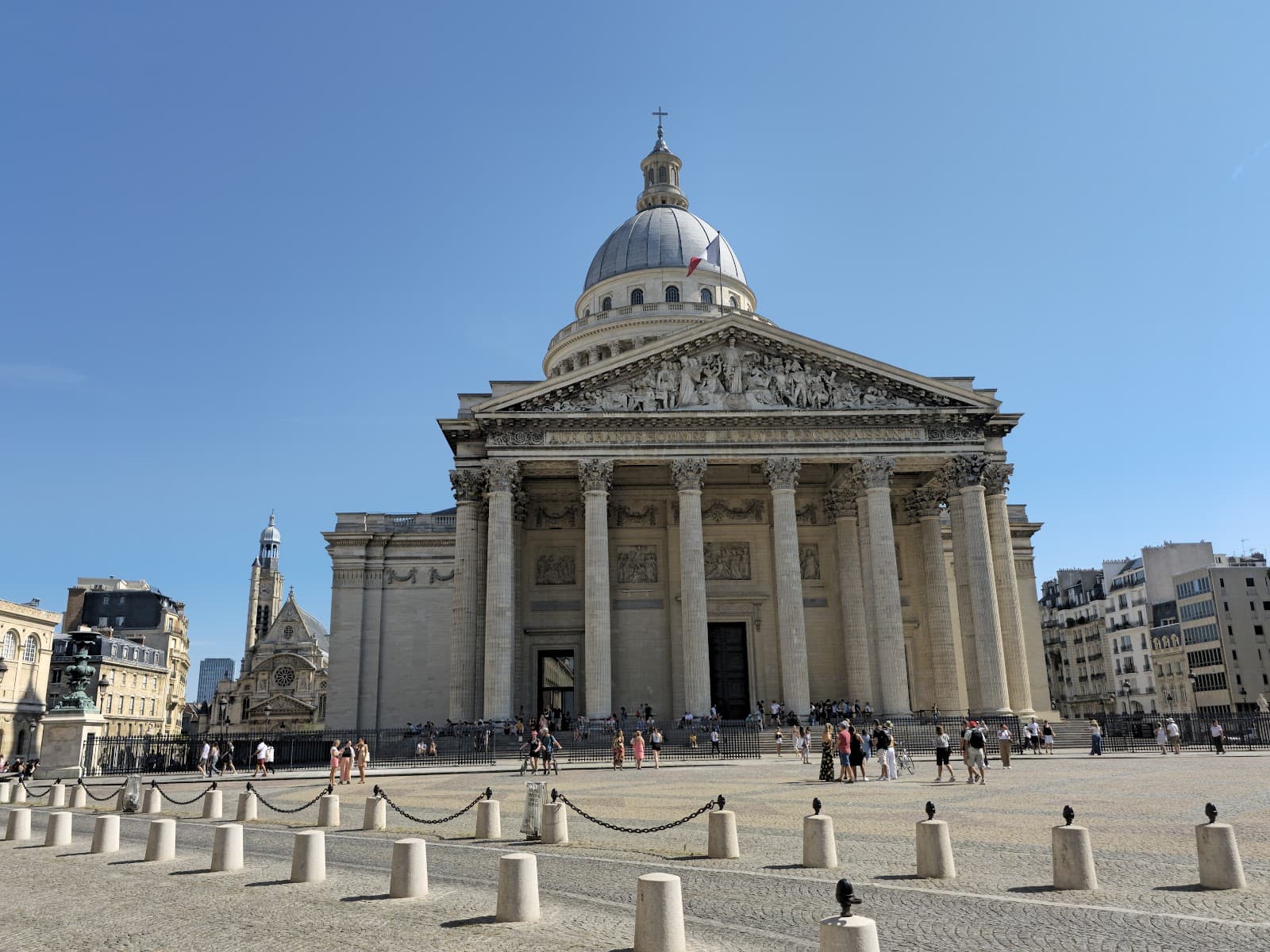
Prague Travel Guide: 50+ Tips For Unforgettable Experience

TL;DRThis guide packs in 108 concrete tips on what to see in Prague in 2026. The essentials are Prague Castle, Charles Bridge, Old Town Square with its astronomical clock, Josefov and Vyšehrad, while neighbourhoods like Vinohrady, Vršovice and Karlín reveal the city’s real character. Allow at least 4 days for Prague, and come in May or September to dodge the summer crowds and winter chill. For a place to stay, try The Julius Hotel on Senovážné náměstí, a Michelin Key 2025 winner that works well for families too. Practical tips include visiting Charles Bridge between 5 and 7am to have it to yourself, popping into Golden Lane for free after 5pm, and Prague Castle entry for 450 CZK. The guide also covers where to get a good coffee (Café Savoy, EMA Espresso Bar), the best spots for vegetarian food (Lehká Hlava, Maitrea, Moment Bistro), and how to get around Prague with a pushchair for free on the city’s public transport.

We lived in Prague with Luka on and off for ten years and we have been all over it. One day we plan to return to Prague, but for now this guide to enjoying Prague will have to suffice. 😊

Known as the “Golden City” and the “Heart of Europe”, Prague is one of the most beautiful and most visited cities in the world. With its rich history, beautiful architecture and rich cultural life, the city attracts millions of tourists every year.

The city offers many interesting sights such as Prague Castle, Old Town Square with the Prague Astronomical Clock or Charles Bridge. In addition, Prague is home to a number of cultural institutions, museums and galleries offering a varied cultural programme.

When visiting Prague, it is important to take into account its diversity and plan your trips so that you have enough time to see the sights and visit interesting places. However, once you have an idea of what you want to see and experience, Prague will remain firmly etched in your memories forever. 🙃 So what to see in Prague?

Where to stay in Prague

The choice of accommodation in Prague is huge, from luxury hotels to apartments to cheap hostels in the centre and outskirts of Prague.

Don’t look at money and want to live in the city centre? Reach for the BoHo Hotel, half a kilometre from Old Town Square, which has a restaurant and a luxury spa. It has a rating of 9.5 out of 10 on Booking and is a real gem.

Slightly cheaper, but also with wellness and infrared sauna is Hotel Miss Sophie’s New Town & Wellness which is a little further away from the centre.

For solo travellers, travellers on a budget or lovers of 100% we recommend The RoadHouse Prague, which has been voted the best hostel in Europe .

Map of trips around Prague

Because we have a lot of tips for you, we have also prepared a clear map that you can save to Google Maps with one click and navigate around Prague comfortably. 😊

Historical monuments in Prague

Prague is full of important historical monuments and it can be challenging to choose the most interesting ones for your trip. That’s why we bring you a list of our favourites. What to see in Prague from historical monuments?

Prague Castle

Prague Castle is the most important historical monument in Prague and the largest castle complex in the world. From 9. century served as the residence of Czech princes, kings and later presidents. The castle grounds include historic palaces, religious buildings, gardens and picturesque corners. It is worth visiting the St.Wenceslas Chapel, the Old Royal Palace, the Basilica of St. George and Golden Lane.

Charles Bridge

Charles Bridge is the most famous bridge in Prague, connecting the Old Town with the Lesser Town. The bridge is famous for its sculptures created by prominent Czech artists and sculptors. A walk along Charles Bridge offers a magnificent view of Prague Castle and the Vltava River.

Old Town Square

Old Town Square is the heart of Prague and the cultural centre of the historic city. The square is home to several important monuments such as Prague Astronomical Clock , Church of Our Lady before Týn a Old Town Hall . The square often hosts various cultural and musical events, such as the Christmas Market and the Prague Fair.

We recommend visiting the Old Town early in the morning, as it is already full of tourists in the afternoon.

Prague Astronomical Clock

Prague Astronomical Clock is an ancient astronomical clock machine located at the Old Town Hall in Prague. It is one of the oldest and best preserved astronomical clocks in the world that is still in use.

The astronomical clock consists of three main parts:

  • an astronomical dial that displays the position of the sun and moon in the sky and other astronomical data,
  • the apostles’ walks, which is a clockwork machine where every hour the figures of the twelve apostles come out,
  • and a calendar dial with zodiac sign medallions.

The astronomical clock is a popular tourist attraction and hundreds of people gather every hour to watch the apostles walk. Come early to see well 😊

The Dust Gate

The Dust Gate is one of the most important Gothic monuments in Prague. It is the only surviving city gate of the original thirteen that were part of the fortifications of the Old Town of Prague.

The gate was built in 15. century and it got its name thanks to the fact that the road to Kutná Hora led through it, from where gunpowder was transported to Prague.

The Powder Tower is also significant because the Royal Route traditionally begins here, leading through the Old Town, Charles Bridge, and up to Prague Castle.

Today it is possible to climb to the top of the gate and enjoy a beautiful view of the Old Town and other parts of Prague.

Lesser Town Square

Lesser Town Square is one of the largest and most beautiful squares in Prague, located in the Lesser Town.

The square is surrounded by a number of important buildings, including the Baroque Church of St. Nicholas, one of the most famous and important churches in Prague, and the Lesser Town Hall.

The square is also home to a number of restaurants, cafes and shops, making it a popular meeting place for locals and tourists alike.

Lesser Town Square is an important transport hub, from where you can easily reach Prague Castle, Charles Bridge, and other tourist attractions.

Municipal House

The Municipal House is a beautiful Art Nouveau building located in Prague on the Republic Square next to the Powder Tower. It was built at the turn of the 19. and 20th century and is considered one of the highlights of the Czech Art Nouveau.

The building is famous for its rich decoration, including stained glass, sculptures, mosaics and paintings by leading artists of the time, such as Alfons Mucha, Max Švabinský and Jan Preisler.

The Municipal House houses several important spaces, including Smetana Hall, the main concert hall and home to the Prague Symphony Orchestra FOK. In addition, there are several restaurants, cafés, bars and clubs.

The Municipal House is also historically significant as the place where the independence of Czechoslovakia was declared in 1918.

Vysehrad

Vysehrad is a historic fortified settlement on the right bank of the Vltava River. This fortress is a symbol of various legends and history of Prague. The Basilica of St. Peter and Paul, the Romanesque Church of St. Martin’s Cemetery and Vyšehrad Cemetery, where many prominent Czech artists and personalities are buried. Vyšehrad also offers a beautiful view of Prague and quiet corners for relaxation.

New World Quarter

Nový svět is a picturesque and historic district located near Prague Castle. It is one of the oldest districts of Prague and is famous for its narrow streets and small houses, which give an almost rural impression in the middle of the big city.

This district was formerly home to the poorer inhabitants of the city, including craftsmen and servants of the castle. Today, it is a quiet and attractive place where mostly Czech artists live and which is popular among tourists for its unique atmosphere and architecture. Although it is located in the heart of Prague, Nový Svět retains a sense of separateness and tranquility.

Important sights of Nový Svět include the Chapel of Our Lady of the Angels, which can be found on the little square with a historic fountain, or Hlásek, a picturesque house at the entrance to the district.

Strahov Monastery

Strahov Monastery is a historical complex located in the Hradčany district of Prague. It is a Premonstratensian monastery founded in 1140. It is one of the oldest and most important cultural institutions in the Czech Republic.

One of the most important features of the monastery is its magnificent Strahov Library, which contains thousands of old prints, manuscripts and first editions. The library consists of two main halls – Theological and Philosophical – each with its own unique artistic and architectural features.

The monastery complex also includes the Strahov Brewery and Restaurant, which offers traditional Czech cuisine and beer brewed on site.

Strahov Monastery is located on a hill near Prague Castle, offering a magnificent view of Prague.

Loreto pilgrimage site

The Loreto pilgrimage site is an important historical and religious centre located in the Hradčany district. It is one of the most important pilgrimage sites in the Czech Republic.

At the centre of the complex is the Santa Casa, a replica of the house of the Virgin Mary as found in the city of Loreto in Italy. This “House of Our Lady” is surrounded by a monastery complex that includes the Baroque Church of the Nativity and the Convent.

One of the most remarkable features of the Loreto is its bell tower, equipped with 27 bells that produce a melodious ringing every hour.

The complex also houses the Loreto Treasures, a collection of liturgical objects including the famous Prague Sun – a monstrance decorated with thousands of diamonds.

Loreto is popular not only among religious pilgrims, but also among visitors who appreciate its architectural and artistic value.

Church of Our Lady of Victory and the Prague Jesuit Church

The church is located in the Lesser Town and is mainly known for its statue of the Prague Child Jesus.

The Prague Baby Jesus is a wax statue of Jesus Christ as a child, about 47 cm high. She comes from Spain and came to Prague in 16. century. The statue is known for its miraculous powers and is considered one of the most important places of pilgrimage in Prague. Her dress is regularly changed in different liturgical colours.

The Church of Our Lady of Victory is also historically significant as the site of the Battle of White Mountain in 1620, when the Catholic Habsburgs defeated the Protestant Estates, which had a lasting impact on the history of the Czech lands.

The Lennon Wall

The Lennon Wall is a wall in Prague’s Lesser Town, which has been standing since the 1980s. 20 years. century has become a place where people – especially young people – express their views and wishes through graffiti. The wall is named after John Lennon, a member of the Beatles who was known for his pacifism and protests against military conflict.

After Lennon’s death in 1980, people began to write the lyrics of his songs and various anti-regime slogans on the wall as a sign of their disapproval of the communist regime in Czechoslovakia at the time.

Today, the Lennon Wall is a symbol of freedom and peace and is still covered with various inscriptions and paintings. Although the wall was painted white several times, it was always quickly refilled.

Jewish Town

The Jewish Town, also known as Josefov, is a historic district in Prague, located between the Old Town and the Vltava River. It is an area with a significant Jewish history and culture that dates back to the 13th century. century.

Josefov is home to several important Jewish monuments, including the Spanish Synagogue, the Old Synagogue, the Pinkas Synagogue and the Old Jewish Cemetery, which is one of the oldest Jewish cemeteries in Europe.

Museums and galleries

Prague has a number of museums and galleries that offer visitors a fascinating insight into history, culture and art.

National Museum

The National Museum is the oldest museum in the Czech Republic and comprises several buildings, including the main building on Wenceslas Square. This museum focuses on the history, art, nature and culture of the Czech Republic. Visitors can explore permanent and temporary exhibitions that cover a variety of topics such as:

  • archaeology and history of the Czech lands
  • mineralogy and palaeontology
  • Ethnography
  • Czech music and theatre

Other interesting objects of the National Museum are Czech Museum of Music a Náprstek Museum of Asian, African and American Cultures .

Trade Fair Palace

Trade Fair Palace is part of the National Gallery in Prague and is located in Prague 7. This gallery focuses mainly on modern and contemporary art. Visitors can find here works by important artists such as:

  • Pablo Picasso
  • Auguste Rodin
  • Egon Schiele
  • František Kupka

In addition to artworks, the Trade Fair Palace also offers public programmes such as lectures, workshops, film screenings and concerts.

lukas a lucka
Lukáš and Lucie recommend
Where to Stay in Prague
5 accommodations — wellness hotels, hotels and other lodging options

Museum of Communism

The Museum of Communism is a private museum in Prague that focuses on the communist era in the Czech Republic between 1948 and 1989. Visitors can explore various aspects of the communist regime, including:

  • political repression
  • of everyday life under communism
  • education and culture
  • sports and entertainment

The Museum of Communism also offers a film screening that presents historical events and significant moments from the communist era.

Parks and viewpoints in Prague

Prague is full of parks, viewpoints and various natural spots.

Petřín lookout tower

The Petřín lookout tower is one of the most famous places in Prague. This 63.5 metre high steel structure inspired by the Eiffel Tower was built in 1891. It offers a breathtaking view of Prague and its surroundings. There are 299 steps to the top, but you can also use the lift.

View of Prague from the Metronome on Letná

The view of Prague from the Metronome on Letná is impressive and offers a wide view of the historic part of the city. The Metronome, which replaced the statue of Stalin, is located at the top of Letenské sady, a popular park with locals and tourists alike.

The Metronome’s lookout offers a breathtaking view of the Vltava River as it winds through the city and of famous landmarks such as Prague Castle, Charles Bridge and Old Town Square. You can admire the whole panoramic view of the historical part of Prague, which is beautifully spread out in front of you.

This viewpoint is popular among photographers who come here to capture the charm of Prague from above. It is also an ideal place to relax and unwind, where you can enjoy the magnificent view of the city and the pleasant atmosphere of Letenské sady.

Wild Sharka

Divoká Šárka, located on the northwestern outskirts of Prague, is a nature reserve that is a popular destination for tourists and locals seeking refuge from the hustle and bustle of the city centre. The area is rich in scenery that includes diverse valleys, a historic mill, a living stream and impressive rock formations. It is an ideal place for activities such as hiking, cycling or picnicking in nature.

Letenské sady

Letenské sady is a large urban park situated at the top of a steep hill above Prague. This park is a popular place for relaxation, sports and meeting with friends. Letenský Park offers visitors a breathtaking view of Prague Castle, Charles Bridge and the Lesser Town. The park features a number of statues, fountains and architectural elements.

Kampa Island

Kampa is an island located in Prague on the left bank of the Vltava River, below the Lesser Town and the Charles Bridge. It is one of the most beautiful and peaceful places in the city centre.

The island is famous for its picturesque narrow streets, baroque houses and parks where locals and tourists alike enjoy relaxing. The park in Kampa also features several sculptural installations, including the famous babies by David Černý.

Kampa is also home to the Kampa Museum, a major centre of modern art in Central Europe. The museum offers an extensive collection of works by 20. century by Czech, Polish and Hungarian artists.

Kampa is also home to several cafes and restaurants overlooking the Vltava River and Charles Bridge, making it the perfect place to relax after a stroll around the city.

You can even go river surfing!

Canal Čertovka

Čertovka is a small canal in Prague that separates Mala Strana from Kampa Island. It is also sometimes called the “Venice of Prague” due to its picturesque setting with historic buildings and small bridges.

The canal is named after a woman who, according to legend, lived in one of the houses by the canal and was known for her evil nature, which is why the locals nicknamed her “The Devil”.

One of the characteristic features of Čertovka is the old water mill – Velkopřevorský mill, which gives this place a unique historical charm. It is a very popular area among tourists for walking, taking photos and enjoying the peaceful atmosphere in the middle of the bustling city.

Vrtba Gardens

The Vrtba Garden is one of the most beautiful and important Baroque gardens in Prague. It is located in the Lesser Town and is part of the Vrtba Palace.

The garden is known for its unique terraced layout, which allows visitors to enjoy a beautiful view of Prague, including Prague Castle and St. Nicholas. The Vrtba Garden is also rich in various types of flowers, plants and sculptures.

Despite its proximity to the busy city centre, the garden offers a peaceful and relaxing environment that is ideal for rest and relaxation.

Wallenstein Garden

The Wallenstein Garden is located in Prague’s Lesser Town and is part of the Wallenstein Palace, which is now the seat of the Senate of the Czech Republic. It is a Baroque garden that was founded in the 17th century. century along with the palace.

The garden is famous for its richly decorated sculptural groups, a pond with an island, an aviary with peacocks, and a unique wall with artificial caves, the so-called. grottou.

In the garden there is also the Sala Terrena, a ground-floor hall connected to the palace and garden, which is often used for concerts and cultural events.

The garden is open to the public and provides a peaceful place to relax in the heart of the bustling city.

Franciscan Garden

The Franciscan Garden is a city park in Prague, part of the Franciscan Monastery. This garden, situated in the centre of the town between Jungmannova and Vodičkova streets, is a popular place for locals and tourists to relax. It is famous for its beautiful flower beds, romantic paths, fountains and statues. In addition, there is a playground and a small pavilion. This oasis of peace and quiet is a great hideaway from the busy city life.

Clementinum

Clementinum is a large complex of Baroque buildings near the Charles Bridge in Prague’s Old Town. It is a former Jesuit college, which is the second largest building complex in Prague after Prague Castle. Today it is the seat of the National Library of the Czech Republic.

Modern architecture in Prague

Franz Kafka’s Turning Head

The Turning Head of Franz Kafka is a statue located in Prague on Franz Kafka Square near the Municipal House. This sculpture, created by artist David Černý, represents the head of writer Franz Kafka, which is divided into 42 movable layers.

The sculpture is placed on a rotating device that turns and creates the impression of a moving face. It is one of many unconventional and controversial sculptures created by David Černý in Prague.

Dancing House

Dancing House is a modern architectural building in Prague, located on Rasinova nábřeží on the right bank of the Vltava River. It’s also known as Fred and Ginger, after the famous dancing duo Fred Astaire and Ginger Rogers, because its design evokes their dance moves.

The house was built in 1996 and designed by architects Vlad Milunić and Frank Gehry. The building stands out for its unusual organic form, which differs from the surrounding historical environment of Prague. The Dancing House is a combination of residential, office and commercial space, including a restaurant and café.

Žižkov Tower

The Žižkov Tower is an important Prague landmark located on Žižkov Hill in the Prague district of the same name. It is a concrete television tower 216 metres high, which is the tallest building in Prague and one of the tallest towers in Europe.

The tower was built between 1985 and 1992 and its architect is Václav Aulický. It serves as a transmitter for television and radio signals, but also offers the public a viewing platform at a height of 93 metres, from which there is a beautiful panoramic view of Prague.

Theatres and cultural events in Prague

National Theatre

National Theatre in Prague is one of the most prestigious theatres in the Czech Republic. This cultural gem offers a wide range of theatrical performances: opera, ballet and drama.

State Opera

The State Opera in Prague, part of the National Theatre, is one of the most important opera houses in the Czech Republic. This institution boasts a long tradition and a high level of artistic expression. Their repertoire includes both classical opera titles and modern works from the world opera scene. State Opera is known for its excellent acoustics and beautiful interiors.

Concerts and festivals

Prague is a city that never sleeps and culture plays a key role here. The music scene offers a wide range of concerts and festivals throughout the year. Lovers of various musical genres will find something to their liking here. From jazz, to classical music, to rock concerts and techno parties.

Popular music events include Prague Spring . Moreover, Prague is home to many concert halls and venues that regularly host world-famous performers and young talented musicians.

Gastronomy and nightlife

Prague is known for its rich gastronomic and nightlife scene, which offers many interesting places to visit.

Restaurants and cafés

There are many excellent restaurants in Prague and cafes offering a wide selection of Czech and international dishes. If you want to taste traditional Czech cuisine, you can visit some of the local pubs, such as hospoda U fleků . In addition, Prague offers many elegant cafés where you can enjoy quality coffee and fresh pastries.

The best restaurants in Prague

Are you looking for a real gourmet experience in Prague and don’t want to just blink into the nearest restaurant? In that case, choose from our personal selection of the best gastro in Prague.

  1. La Degustation Bohême Bourgeoise : Michelin-starred restaurant with a modern interpretation of Czech cuisine.
  2. Field : Another Michelin-starred restaurant with an emphasis on seasonal and local ingredients.
  3. Alcron : Elegant restaurant specializing in modern European cuisine.
  4. Local : Popular restaurant chain offering traditional Czech cuisine and excellent draft beer.
  5. CottoCrudo : A sophisticated restaurant in the Four Seasons Hotel that specializes in Italian cuisine and sushi.
  6. Sansho : A unique restaurant with a fusion of Asian and European cuisine, offering a casual atmosphere.
  7. The Mill : Luxury restaurant with modern European cuisine and a breathtaking view of Charles Bridge.
  8. Cafe Imperial : Historical restaurant with beautiful Art Nouveau interior and traditional Czech cuisine.
  9. Eska Description : Modern restaurant with a focus on farm ingredients and bread baking.
  10. Light head : Vegan restaurant offering creative and healthy dishes with a welcoming atmosphere.

Bars and clubs

If you like rock music, rock clubs are the right experience for you. One of the most popular and famous bars in Prague is Hemingway Bar, which offers a wide range of cocktails and alcoholic drinks. If you are more of a dance club fan, be sure to visit some of the most famous clubs such as Roxy .

Whether you prefer traditional pubs, cafés, bars or dance clubs, Prague is a city that offers unforgettable gastronomic experiences and opportunities to have fun.

What sights can you visit for free?

What to visit in Prague for free? It’s a lot, but this list is enough for at least one day:

  1. Charles Bridge. century, it is open to the public all day and night.
  2. Old Town Square: this is the heart of Prague’s historic centre and is home to many important sights, including the Old Town Hall with its astronomical clock. Although it costs money to enter some of the buildings in the square, the square itself and the view of the clock are free.
  3. Wenceslas Square: this large city square is also home to many historical buildings and monuments.
  4. Petrin: This is a large park and hill that provides amazing views of the city. While it costs money to get to the lookout tower at the top of the hill, the walk around the park and the hill is free.
  5. Letenské sady: Another park with beautiful views of the city and the Vltava River.
  6. Vyšehrad: a historic fortress town on top of a hill. Here you can visit the free parks and see the outer structures of the fortress and the Basilica of St. Peter and Paul. However, there is a fee to enter some areas, such as the cemetery.
  7. Prague Castle. It costs money to walk around the castle grounds, but it is generally free.

What to see in Prague in one day?

Planning the ideal day trip to Prague depends on your interests, but here’s a suggested itinerary that covers some of the city’s most famous sights:

Morning: Prague Castle and Nerudova Street

  • Start your day with a visit to Prague Castle, where you can admire St. Vitus Cathedral, the Old Royal Palace and Golden Lane. After a tour of the castle and its surroundings, you can enjoy the view of Prague from the castle.
  • Walk down the beautiful Neruda Street, full of Renaissance and Baroque houses, to Malostranské náměstí. See here Church of St. St. Nicholas.

Noon: Charles Bridge and Old Town Square

  • Cross the famous Charles Bridge, full of statues and with beautiful views of the Vltava River.
  • Continue to Old Town Square, where you can admire the Old Town Hall with its astronomical clock, Týn Cathedral and other historic buildings.

Afternoon: Josefov and Wenceslas Square

  • After lunch in the old part of town, head to Josefov, the historic Jewish town, where you can visit the old Jewish cemetery, the Old Synagogue and other sights.
  • Afterwards, take a walk around Wenceslas Square, where you can see the National Museum and the statue of St. Wenceslas.

Evening: shooting island

  • End the day with a walk along the Vltava riverbank or relax on one of Prague’s islands, such as Strelecky Island.
  • If you still have the energy, consider visiting one of Prague’s many cafés or restaurants for dinner and sample traditional Czech cuisine.

Remember that Prague is a very busy city and it can be difficult to visit all these sights in one day. Planning ahead and getting up early will help you make the most of your time.

What to see in Prague in three days

If you have three days in Prague, you have plenty of time to visit the main sights and also enjoy some of the lesser-known parts of the city. Here’s how to spend three days in Prague:

Day One: Prague Castle and Lesser Town

  • Start your day with a visit to Prague Castle. Visit the Cathedral of St. Vitus, the Old Royal Palace and a walk along the Golden Lane. You can also enjoy the view of the city from the castle.
  • Descend down Nerudova Street into the Lesser Town and visit the Church of St Nicholas on Lesser Town Square.
  • Continue to Charles Bridge and see its sculptures and views of the Vltava River.

Day Two: Old Town and Josefov

  • Start the day in Old Town Square, where you can see the Old Town Hall with its astronomical clock and Týn Cathedral.
  • Then head to the historic Jewish town of Josefov. Here you can visit the Old Jewish Cemetery, the Old Synagogue and other sights.
  • Next, take a stroll around Wenceslas Square, home to the National Museum and the statue of St. Wenceslas.

Day 3: Vyšehrad and alternative parts of the city

  • Visit Vyšehrad, a historic hilltop fortress with beautiful parks, the Basilica of St. Peter and Paul and Slavín Cemetery, where many important personalities of Czech history and culture are buried.
  • After visiting Vyšehrad, head to some of the less touristy parts of the city. For example, the Vinohrady district is famous for its beautiful Art Nouveau buildings, many cafés and restaurants.
  • Another option is to visit Letná, where you can find Letenské sady with a beautiful view of the city and many hipster cafes and bars.

Don’t forget to spend time exploring Czech cuisine, visiting local pubs or tasting Czech beer. Prague is also known for its rich music scene, so consider attending a concert or performance at one of the city’s theatres or music clubs.

Frequently Asked Questions

Unusual places in Prague

For an off-the-beaten-path experience, visit unusual places such as the Žižkov transmitter, the Divoká Šárka or the National Monument at Vítkov. These places offer unique views of the city and fewer tourists than you will find in the centre of Prague.

The most beautiful places in Prague

Such places in Prague include Letenské sady, Vyšehrad, Malá Strana and Kampa. To get a taste of the beauty of these places, you can plan a stroll through Prague gardens such as the Wallenstein Garden, the Vrtba Garden or the gardens of Prague Castle.

What to see in Prague with children

Prague offers plenty of child-friendly activities, such as the Zoo, Planetarium, Sea World or DinoPark. You can also visit Petřín with a playground, a maze and a cable car.

What to see in Prague in winter

In winter, you can visit Christmas markets, winter gardens (e.g. Botanical Gardens) or enjoy ice skating at one of Prague’s ice rinks. To warm up, we recommend a visit to one of Prague’s cafés, tea rooms or traditional beer halls.

Fun places in Prague

For entertainment in Prague, visit one of the local cultural events, theatre performances or concerts. Also try unusual experiences such as an escape game, virtual reality or the popular brewery tour.

Tips and Tricks for Your Vacation

Don’t Overpay for Flights

Search for flights on Kayak. It’s our favorite search engine because it scans the websites of all airlines and always finds the cheapest connection.

Book Your Accommodation Smartly

The best experiences we’ve had when looking for accommodation (from Alaska to Morocco) are with Booking.com, where hotels, apartments, and entire houses are usually the cheapest and most widely available.

Don’t Forget Travel Insurance

Good travel insurance will protect you against illness, accidents, theft, or flight cancellations. We’ve had a few hospital visits abroad, so we know how important it is to have proper insurance arranged.

Where we insure ourselves: SafetyWing (best for everyone) and TrueTraveller (for extra-long trips).

Why don’t we recommend any Czech insurance company? Because they have too many restrictions. They set limits on the number of days abroad, travel insurance via a credit card often requires you to pay medical expenses only with that card, and they frequently limit the number of returns to the Czech Republic.

Find the Best Experiences

Get Your Guide is a huge online marketplace where you can book guided walks, trips, skip-the-line tickets, tours, and much more. We always find some extra fun there!

Free Things to Do in Paris: 30 Experiences That Won’t Cost a Penny

TL;DRParis is packed with things you can do for free. Notre-Dame and Sacré-Cœur cost nothing to visit if you book a time slot, and the same goes for 20 city museums, including the Musée Carnavalet and the Petit Palais. EU citizens under 26 also get free entry to national museums like the Louvre and the Musée d’Orsay. For views without spending a penny, head up to the terraces at Galeries Lafayette, Printemps, or the rooftop of the Institut du Monde Arabe. From summer 2026, you’ll be able to swim in the Seine for the first time in a century, at three spots: Bras Marie, Grenelle and Bercy. By law, restaurants also have to give you a free carafe d’eau (tap water) if you ask. Spring, especially May, or early autumn are the best times to come, when events like Nuit Blanche and the Fête de la Musique are on.

When you think of the French capital, most people don’t realise just how many free things to do in Paris there actually are. The usual image is all expensive shopping boulevards, luxury dinners and eye-watering bills. Paris can be ruthless and will drain your wallet with incredible elegance. I’ve been visiting since I was a child, and I remember when a friend and I came here as students. We stayed in the most basic hostels, counted every euro, and discovered something absolutely fascinating: this city paradoxically has far more amazing places with free admission than most other European capitals.

These days we push a buggy around the city with our two-year-old Jonáš, and our priorities have shifted a bit. We no longer need to see five landmarks a day. We’ve discovered that the very best moments don’t cost a thing. Those times when Paris slowly wakes up, the scent of hot butter drifts from corner bakeries, and you simply sit on a park bench. You watch elderly gentlemen playing pétanque, listen to the river lapping, and feel you’re exactly where you’re meant to be. Paris won’t give you anything for free when it comes to its rules, but when it comes to experiences, it can be unexpectedly generous.

The year 2026 is absolutely ideal for a visit, and for several reasons at once: the city has calmed down after the Olympic frenzy, Notre-Dame gleams like new after years of restoration, and this summer you’ll be able to swim in the Seine for the first time in a century. And as a bonus for me as a vegetarian, the food scene is changing for the better too. The legendary three-Michelin-star restaurant Arpège has switched to a fully plant-based menu. The city is greener than ever and offers plenty of ways to enjoy it without spending ridiculous amounts of money.

We’ve been putting this list together for years, so it’ll save you hours of googling and a few hundred euros. Let’s dive in.

Notre Dame in Paris - free things to see and do in Paris
Notre Dame in Paris – free things to see and do in Paris

TL;DR

  • All EU citizens under 26 get into national museums (Louvre, Musée d’Orsay, Orangerie, Arc de Triomphe) completely free all year round.
  • The newly reopened Notre-Dame cathedral charges no admission — just book a free time slot via the official app.
  • Paris runs 20 city museums (such as Musée Carnavalet and Petit Palais) where permanent collections are always free for everyone.
  • The first Sunday of each month brings free entry to many landmarks. In the winter season (November to March), this includes the Panthéon and the Arc de Triomphe.
  • The best views of the city cost nothing. Head to the rooftop terraces of Galeries Lafayette, Printemps, or the roof of the Institut du Monde Arabe.
  • From summer 2026, you can swim in the River Seine for free at three designated zones (Bras Marie, Grenelle, Bercy).
  • In Parisian restaurants, you’re legally entitled to free tap water. Just confidently order “une carafe d’eau”.
  • Save on metro fares and walk instead. Strolling around Montmartre, along Canal Saint-Martin, or along the elevated Promenade Plantée park is completely free.
  • Watch out for street scams. Ignore people with petitions near landmarks and bracelet sellers below Sacré-Cœur.
  • The legendary Centre Pompidou has been completely closed since late 2025 for renovation until 2030.
Father with a small child on a wooden playground surrounded by trees

When to Visit Paris: Free Events and Seasonal Calendar

Picking the right month for your trip is half the battle, especially when you’re trying to keep the budget in check. Paris completely transforms with each season and offers different freebies along the way. Lukáš and I love spring or early autumn best, when you can sit at an outdoor café in a light jumper and the city ticks along at its own gentle pace.

Spring and Autumn: a Safe Bet

Spring and autumn are absolutely ideal. May is arguably the most beautiful month of the year. The trees are in bloom, the days stretch pleasantly longer, and you can easily picnic in the parks. Mid-May also brings European Museum Night (Nuit des Musées), when most galleries open their doors for free in the evening.

September and October are equally enchanting. The period known as la rentrée (when Parisians return from their holidays) brings fresh energy to the streets, and the trees in the Luxembourg Gardens turn golden. The key autumn event is European Heritage Days (Journées du Patrimoine), which in 2026 fall on the weekend of 19–20 September. During that weekend, normally off-limits palaces and government buildings open to the public for free. A word of warning though: the famous Monet’s Gardens in Giverny are closed on those exact two days. Typical. 😅

Summer Festivals and Winter Sales

If you can, give August a wide berth. Parisians flee to the coast en masse during this month. The city does empty out, but many of the best independent bistros and cafés will have signs up for their annual holiday. The tarmac also melts under the scorching heat. On the other hand, June and July offer brilliant free events. On 6 June 2026, there’s the massive Nuit Blanche (White Night) — an all-night art festival spilling into the streets until dawn. Then comes the Fête de la Musique (21 June), when bands play on every corner completely free.

January is traditionally the time for the big winter sales (Soldes), when prices in boutiques plummet. Plus, during winter months (November to March), the first-Sunday-free-entry rule extends to even the biggest national landmarks.

Notre Dame in Paris - free things to see and do in Paris
Notre Dame in Paris – free things to see and do in Paris

Where to Stay in Paris: Budget-Friendly but Safe

Your choice of neighbourhood will make or break your entire Paris experience — and your budget. Paris is divided into twenty districts (arrondissements) that spiral clockwise from the historic centre around the Louvre. Finding cheap accommodation in the centre is nearly impossible, but if you know where to look, you can strike a great balance between price, safety and accessibility.

If you’re travelling with kids, steer clear of the northern part of the 10th arrondissement around Gare du Nord and nighttime Pigalle in the 18th. A friend and I once got lost there at two in the morning, and that’s definitely not an experience you want with a toddler in tow. 😅

After a long search, we chose Hôbou, an authentic French boutique hotel in Boulogne-Billancourt (you can book it here). It looks unassuming at first glance, but within the first few hours you’ll fall completely in love with it.

paris 4361

Landmarks and Icons: Free Things to Do in Paris

Paris hides thousands of quiet courtyards and forgotten passages, and sometimes friends will tell you: skip the big names, they’re just for tourists. Lukáš and I made that mistake once and never again — the iconic sights have earned their status for a reason. The good news is that many of them are completely free, as long as you know the right rules and times.

Notre-Dame Cathedral: The Phoenix Rises Again

Watching the lead spire of the cathedral collapse in flames in April 2019 broke hearts around the world. That makes the experience of its rebirth all the more powerful. The cathedral was ceremonially reopened on 8 December 2024. Step inside and you’ll be stunned. The stone is incredibly light, stripped of centuries’ worth of soot and grime. Miraculously, the fire didn’t touch three crosses inside the cathedral, which survived without a single trace of damage.

France has a strict policy of free entry to all its places of worship. Admission to the main nave is therefore completely free for all visitors. For 2026, there’s just one rule: you must book a time slot through the official “Notre-Dame de Paris” app or their website. Opening hours are generous — weekdays from 7:50 to 19:00 (Thursdays until 22:00) and weekends from 8:15 to 19:30. You only pay for climbing the towers (€16), which aren’t accessible with a buggy anyway.

💡 Insider tip: The internet is awash with fake websites selling so-called skip-the-line tickets to Notre-Dame. They’re pure scams. Never pay anyone for entry to the main nave — it’s always free.

Notre-Dame Cathedral in Paris

Sacré-Cœur Basilica: The White Dome Above the City

The Basilica of the Sacred Heart in the 18th arrondissement is visible from almost everywhere. The white travertine it’s built from has a unique property — when it rains, it secretes calcite, so the building actually cleans and whitens itself with every shower. Entry to the basilica is free year-round, and it’s open daily from 6:00 to 22:30.

If you’ve got a buggy, skip the three hundred steps up the hill and hop straight on the Funicular. A regular metro ticket (€2.15) is all you need. The ride takes just a moment but saves you buckets of sweat and toddler tantrums on the stairs. The area around the basilica is steeped in bohemian history — Picasso, Renoir and Van Gogh all lived here.

💡 Insider tip: Most people peek into the main nave and move on. Instead, find the entrance on the left side and head down to the Crypt. It’s an architectural gem — thanks to the wide trench around the basilica, it has real stained-glass windows letting in natural daylight. If you want to enjoy the view without the crowds, walk around Sacré-Cœur and head to the local park — there’s a children’s playground there too.

Sacré-Cœur Basilica in Paris
Sacré-Cœur Basilica

Arc de Triomphe and Panthéon: The Magic of First Sundays

If you’re over 26, standard admission to the Arc de Triomphe or the Panthéon will set you back around €13. But there’s a brilliant workaround. French national monuments offer free entry on the first Sunday of every month. While major museums tend to observe this rule all year round, for landmarks like the Panthéon or the Conciergerie (where Marie Antoinette was imprisoned), it only applies during the off-season — from 1 November to 31 March.

The Panthéon in the Latin Quarter serves as a secular mausoleum. Beneath its enormous dome rest some of the greatest figures in history. You’ll find the tombs of Voltaire, Victor Hugo, Marie Curie and Émile Zola. The space is vast, and navigating it with a buggy is no trouble at all. The Arc de Triomphe, meanwhile, offers one of the best views from its rooftop — twelve wide boulevards radiating in every direction.

💡 Insider tip: Never try to dash across the insane roundabout to reach the Arc de Triomphe. Use the safe underpass called Passage du Souvenir, which starts on the northern side of the Champs-Élysées.

Arc de Triomphe in Paris

Arènes de Lutèce: A Hidden Roman Amphitheatre

Most visitors have no idea that Paris has its own Roman ruins, right in the heart of the 5th arrondissement. The Arènes de Lutèce date back to the 1st century AD and once held up to 15,000 spectators watching gladiatorial combats. Today it’s an incredibly peaceful public park hidden behind an unassuming entrance on Rue Monge.

Entry is completely free and the site is open daily from morning until dusk. For families with children, it’s a perfect spot. Kids can safely run around the sandy arena while you sit on the ancient stone tiers eating a fresh baguette. You’ll often spot locals playing football or pétanque here.

💡 Insider tip: Access to the arena is via Rue Monge through the passageway at number 49. It looks like you’re walking into someone’s apartment block, but don’t be put off — walk through and an enormous space opens up before you.

Church of Saint-Eustache: Concert Acoustics for Free

A stone’s throw from the former Paris market hall of Les Halles stands a church whose grandeur easily rivals Notre-Dame, yet it rarely gets the attention it deserves. Saint-Eustache (1st arrondissement) is a stunning late-Gothic masterpiece. It’s open daily and entry is, of course, free.

Here’s the real treat: this church houses one of the largest organs in France, with an incredible 8,000 pipes. If you’re even slightly lucky, you’ll catch local organists practising in the afternoon. Sitting in that vast, silent nave listening to the music bounce off the vaulted ceiling is one of my absolute favourite Paris memories.

Church of Saint-Eustache in Paris
Church of Saint-Eustache

Museums and Galleries: World-Class Art for Zero Euros

Paris is an absolute museum powerhouse. I’ve spent weeks here over the years and still haven’t seen them all. If you’re a citizen of the European Union and under 26, you’re in luck — admission to all national museums (Louvre, Musée d’Orsay, Orangerie, Picasso) is free year-round. Just show your ID or passport at the entrance. For the rest of us, there are other brilliant ways in.

The Louvre in Paris
The Louvre in Paris

City Museums: Twenty Free Treasures

While national museums charge admission, the City of Paris (Ville de Paris) runs a network of 20 smaller but absolutely top-notch museums. Entry to their permanent collections is always free for everyone, regardless of age. You only pay for temporary exhibitions, which you can happily skip.

My absolute favourite is Musée Carnavalet in the 3rd arrondissement (Marais). It’s the museum of Paris history, housed in two beautiful Renaissance mansions. You’ll walk through the city’s story from prehistory to the French Revolution. They have entire reconstructed period rooms, old shop signs, and personal belongings of Marie Antoinette. Entry is free; open Tuesday to Sunday (10:00–18:00).

Another gem is the Petit Palais in the 8th arrondissement. The building itself, with its monumental entrance, is worth the visit alone. Inside, you’ll find a fantastic collection of fine art spanning from antiquity to the early 20th century. Navigating it with a buggy is a pleasure — the corridors are wide and the museum rarely gets overcrowded.

💡 Insider tip: The inner courtyard of the Petit Palais hides a gorgeous garden with a colonnade and a small café. Even if you don’t fancy going in for the art, pop in for a coffee. It’s an incredibly peaceful oasis right next to the bustling Champs-Élysées.

Homes of Famous Writers

If you love literature, treat yourself to visiting the homes of famous French authors. Maison de Victor Hugo sits on the beautiful Place des Vosges (4th arrondissement). You can wander the second-floor apartment where Hugo lived before his exile and where he wrote part of Les Misérables — completely free. Open Tuesday to Sunday (10:00–18:00).

In the 16th arrondissement, you’ll find Maison de Balzac. It’s the only surviving Parisian apartment of this brilliant novelist. Tucked away in an unassuming house with a garden, it offers a lovely, unexpected view of the Eiffel Tower. The permanent exhibition is, once again, free for all.

💡 Insider tip: In the 9th arrondissement, seek out the Musée de la Vie Romantique (Museum of Romantic Life). It’s set in a small house with green shutters at the end of a cobblestoned lane. The permanent collection is free, and in spring the garden roses burst into bloom beneath the trees.

Victor Hugo Museum in Paris
Maison de Victor Hugo

Musée Curie: Inside a Brilliant Woman’s Laboratory

If you have even the slightest interest in science, this little museum in the Latin Quarter (5th arrondissement) is one you absolutely shouldn’t miss. It occupies the very laboratory where Marie Curie worked and where she ultimately passed away. Entry is completely free, and the rooms have preserved an utterly authentic 1930s atmosphere.

Beyond the old ampoules, measuring instruments and notebooks, you’ll also see a small garden that Marie herself planted as a place to rest during her research. We don’t take Jonáš here yet — he’s too young for glass display cases — but for adults, it’s a profoundly fascinating glimpse into the life of one of history’s greatest figures.

Marie Curie's Laboratory
Marie Curie’s Laboratory

Louvre and d’Orsay: Free Entry Strategy

Getting into the Louvre or Musée d’Orsay for free takes a bit of planning. A standard Louvre ticket costs around €22, but the museum offers free admission on the first Saturday evening of each month, from 18:00 to 21:45. This applies to all visitors.

Musée d’Orsay, which this year celebrates its 40th anniversary and boasts the finest Impressionist collection anywhere (including Monet’s canvases and Van Gogh’s self-portrait), holds its free-entry tradition on the first Sunday of each month. Regular admission is otherwise €16.

💡 Insider tip: Even when entry is free, both museums require you to book a timed-entry slot online beforehand on their official websites. Without one, they simply won’t let you in — even on free days.

59 Rivoli - free things to do in Paris - free museums and landmarks
59 Rivoli

59 Rivoli: A Legalised Artists’ Squat

This is an experience of a completely different kind. In the very heart of the city, on the busy shopping street Rue de Rivoli (1st arrondissement), you’ll find building number 59. From the outside it looks wonderfully eccentric — the façade is often adorned with giant installations. It’s a former illegal squat that the city eventually bought and legalised.

Today, artists from around the world create in thirty studios here. Entry is completely free (a donation to the collection box is voluntary) and it’s open Tuesday to Sunday (13:00–20:00). You can freely wander through the floors, chat with artists while they work, and soak up the wild, creative energy. Don’t try bringing a buggy though — the staircase is narrow and spiral.

💡 Insider tip: Weekends tend to be packed. The best time to visit is on a weekday early afternoon, when the artists have time and are happy to chat about their work.

Viewpoints and Panoramas: The City at Your Feet

Seeing Paris from above is seriously addictive. But you don’t need to shell out tens of euros for the Eiffel Tower lift (which is tricky to access with a buggy anyway). The city offers fantastic rooftop viewpoints and parks completely free. And here’s a bonus: when you’re standing on the Eiffel Tower, you can’t actually see it in your photos. From these spots, you get the full picture.

Galeries Lafayette
Galeries Lafayette

Department Store Rooftops

The most famous terraces are perched atop the historic department stores near the Opéra Garnier. Galeries Lafayette Haussmann (9th arrondissement) offers a huge rooftop with 360° views across the city. Open Monday to Saturday (10:00–20:00) and Sunday (11:00–20:00). The lifts work perfectly, so getting up there with a child is easy.

Right next door, Printemps Haussmann has a 7th-floor terrace called “7e Ciel” (Seventh Heaven). It serves up a panorama from the opera house all the way to the Eiffel Tower. The newly opened rooftop at BHV Marais (4th arrondissement) is another great option, with lovely views of the Hôtel de Ville and surrounding historic rooftops.

💡 Insider tip: Head to the Galeries Lafayette terrace about an hour before sunset. You’ll catch the most beautiful golden light reflecting off the zinc Parisian rooftops.

Institut du Monde Arabe

Institut du Monde Arabe

If you happen to be in the Latin Quarter, take the glass lift up to the 9th floor of the Institut du Monde Arabe (5th arrondissement). The terrace is free and open Tuesday to Sunday (10:00–18:00), offering one of the very best views of the River Seine and the back of Notre-Dame Cathedral. On your way down, don’t miss the famous façade — it’s made up of mechanical apertures that open and close in response to sunlight.

If you’ve got a few minutes after the viewpoint, pop into the public library inside. The architecture of the whole space is gorgeous, it smells of old paper, and it offers perfect tranquility when you need a break from the noisy streets.

💡 Insider tip: Most tourists don’t know about this terrace, so it’s never as crowded as Galeries Lafayette. A brilliant spot for a quiet photo break.

La Samaritaine department store

La Samaritaine Rooftop: Luxury from a Bird’s Eye View

The La Samaritaine department store by the Pont Neuf bridge recently reopened after an incredibly long and expensive renovation. It’s a temple of luxury where the most affordable thing might be the ground-floor coffee, but it’s still worth a visit. Going up to the top won’t cost you a penny.

When you ride the lift to the upper floors, a splendid view of the Seine and surrounding historic buildings opens up beneath the glass roof. Lukáš and I love coming here just to people-watch Parisian high society and soak in the stunning views. The lifts are spacious, so getting a buggy up there is effortless.

Parc de Belleville
Parc de Belleville
lukas a lucka
Lukáš and Lucie recommend
Where to stay in Paris
2 accommodations — hotels and other lodging options

Parc de Belleville and Buttes-Chaumont

For a view with a splash of nature, head to eastern Paris. Parc de Belleville (20th arrondissement) is the highest park in the city (108 metres above sea level). The viewpoint at the top by Rue Piat costs nothing and lays the entire city out before you, from Sacré-Cœur to the Eiffel Tower. It’s mainly locals who come here, and the atmosphere is wonderfully relaxed and community-driven.

The nearby Parc des Buttes-Chaumont (19th arrondissement) offers equally breathtaking panoramas. From its suspended bridge and the central rocky outcrop topped by the little Temple de la Sibylle, you can see all the way to Montmartre. With its artificial grottos and waterfalls, this park is unbeatable for a family picnic.

💡 Insider tip: Be mindful of evening hours at Parc de Belleville. The neighbourhood is lively and a touch rougher, so I’d recommend visiting during a sunny afternoon instead.

Montmartre
Montmartre

Parks, Gardens and Swimming in the Seine

When Jonáš has had enough of landmarks and we desperately need some quiet, the parks always save us. Parisian green spaces are meticulously maintained, geometrically precise, and entry is, naturally, free. This year also brings one enormous revolution that’s changing summer in Paris beyond recognition.

Swimming in the Seine: The Reality of Summer 2026

For years it sounded like a pipe dream, but it’s finally happening. After massive investments in cleaning the river ahead of the Olympic Games, three designated public swimming spots are opening in the Seine from summer 2026. Best of all — it’s completely free.

You can take a dip at three locations: Bras Marie (4th arrondissement, near Île Saint-Louis), Bras de Grenelle (15th arrondissement, a short walk from the Eiffel Tower) and in the Bercy area (12th arrondissement). The swimming areas will operate during July and August, every day from morning to evening. Floating pontoons, showers and lifeguards will be provided. For Parisians, it’s a return to a century-old tradition.

💡 Insider tip: The river water is tested regularly. If quality drops after heavy rain, the swimming zones are temporarily closed. Keep an eye on updates on the city’s website or simply check whether the green flag is flying.

Jardin du LuxembourgJardin du Luxembourg“ class=“wp-image-158764″/>
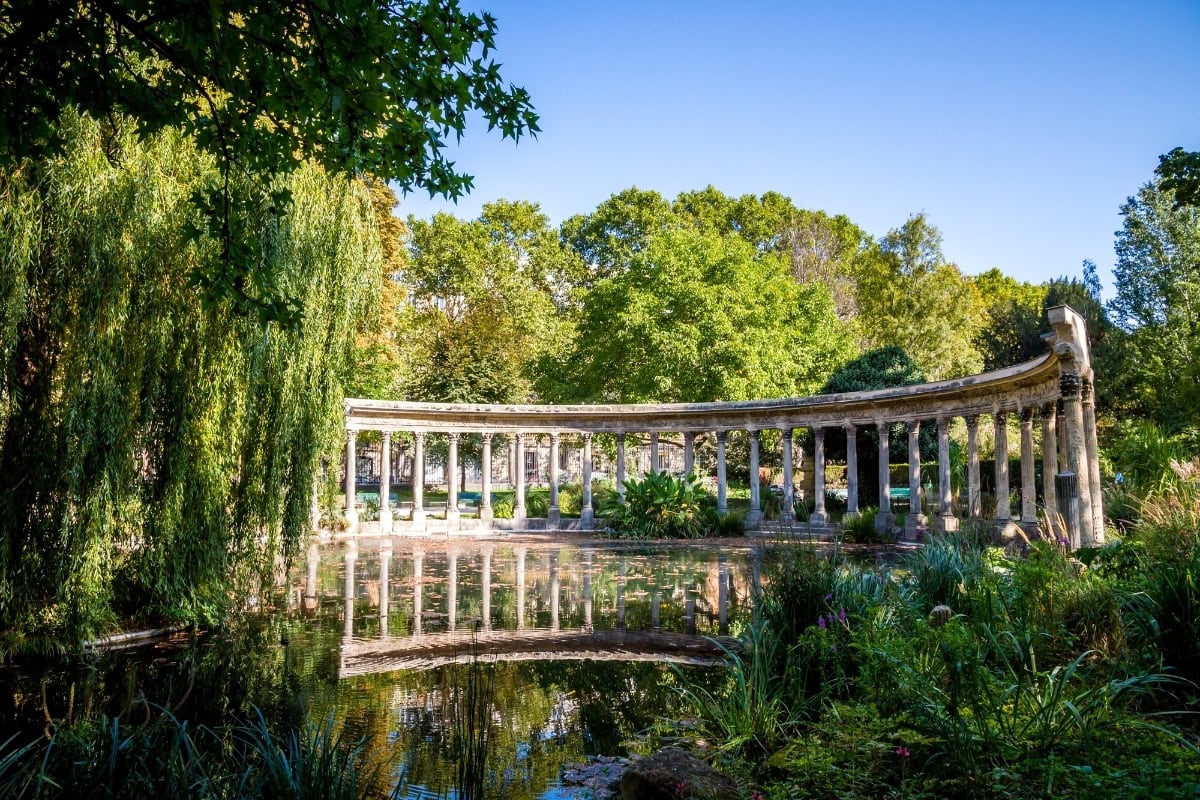
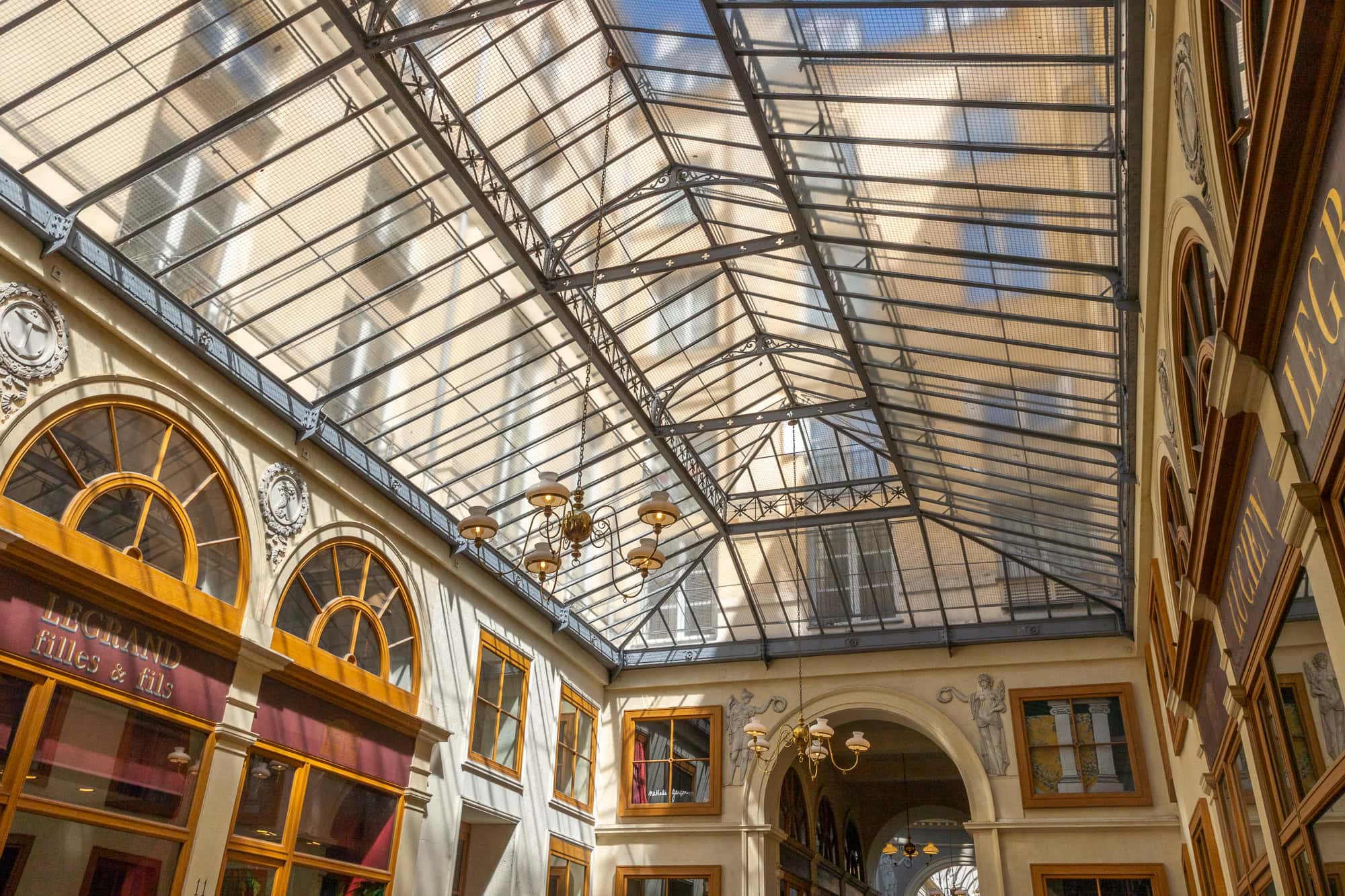
Jardin du Luxembourg

Family Classics: Jardin du Luxembourg and Tuileries

Jardin du Luxembourg (6th arrondissement) is my favourite spot in Paris. This park has everything: wide sandy paths, dozens of green metal chairs you can drag wherever you like, and — most importantly — a huge water basin in the centre. Children traditionally sail little wooden boats here, a timeless pleasure that never gets old. The park also has a classic puppet theatre (Théâtre des Marionnettes), where for a small fee (around €3) kids can enjoy the traditional Guignol show.

Jardin des Tuileries (1st arrondissement) lies directly between the Louvre and Place de la Concorde. It’s a perfect connector during walks through the centre. In autumn, the trees turn spectacular colours, and in the middle you’ll find large playgrounds and trampolines (the latter charge a small fee).

💡 Insider tip: In the Luxembourg Gardens, look for the beehives (Rucher du Luxembourg). They’ve been here since the 19th century and beekeeping courses are still held to this day. It’s a fascinating slice of countryside right in the heart of the city.

Parc Monceau
Parc Monceau

Parc Monceau: Ancient Ruins and Tranquillity

When we’ve had our fill of the sometimes-crowded Luxembourg Gardens, we head to the 8th arrondissement. Parc Monceau is wonderfully elegant, surrounded by wealthy townhouses with wrought-iron balconies, and it exudes that slow, lazy Sunday feeling. Jonáš loves running along the wide paths, and Lukáš and I admire the artificially constructed ancient ruins scattered across the lawns.

What makes this park really special is its local feel. Very few tourists find their way here. You’ll see plenty of Parisian families out for picnics, and on every other bench someone’s playing chess. And for architecture lovers: right by one of the entrances stands a gorgeous 18th-century rotunda.

Promenade Plantée and Square du Vert-Galant

If you’re a fan of New York’s High Line, you need to see its older Parisian predecessor. The Coulée Verte René-Dumont (also known as the Promenade Plantée) is a 4.7-kilometre elevated park in the 12th arrondissement, built on a disused railway viaduct. You walk at third-floor height, roses bloom all around you, and you peer into the windows of Parisian apartments. Start just behind the Opéra Bastille.

For a romantic picnic for two, I can’t think of a better spot than Square du Vert-Galant (1st arrondissement). It sits right on the western tip of Île de la Cité. Most tourists stay up by Pont Neuf, but if you walk down the steps to the water, you’ll discover a small, tree-shaded park where the Seine laps right at your feet.

💡 Insider tip: You can easily access the Promenade Plantée with a buggy — there are public lifts at several points along the route. The path is also completely car-free, which is a huge relief with a toddler.

Hidden Paris: Covered Passages, Lanes and the City of the Dead

When you want to escape the crowds and feel like a true explorer, Paris has an entire network of hidden gems waiting. Often all it takes is turning into an unassuming passageway and you’ll find yourself in a completely different century.

Covered Passages: 19th-Century Elegance

Long before soulless shopping centres appeared, Parisian high society built covered passages (passages couverts) as elegant refuge from the muddy streets. Only a handful survive today, and walking through them is, of course, free. Glass roofs, mosaic floors, hushed little cafés — suddenly you’re not in 2026 Paris but somewhere in the 19th century, except your phone is poking out of your bag. With a buggy, these are a dream to navigate: everything’s flat and sheltered from the wind.

Start at Galerie Vivienne (2nd arrondissement). It’s the most luxurious and beautiful passage, with original mosaic flooring from the 1820s. A short walk away lies Passage des Panoramas — the oldest of them all (dating from 1799) and a paradise for stamp collectors. Right opposite you’ll find Passage Jouffroy, which smells of old wood and hides the charming Hôtel Chopin.

💡 Insider tip: If you love high ceilings and light, seek out Passage du Grand-Cerf (2nd arrondissement). It boasts the tallest glass roof of any passage and is home to small boutiques of independent jewellers and designers.

Covered passages in Paris
Covered passages

Père-Lachaise and Montparnasse Cemeteries

It might sound morbid, but Parisian cemeteries function as beautiful, tranquil parks full of mature trees and wandering cats. Père-Lachaise (20th arrondissement) is reportedly the largest and most visited cemetery in the world — a rather bizarre statistic, but after your first visit you’ll completely understand why. Entry is free (daily 8:00–18:00). Jim Morrison, Oscar Wilde, Édith Piaf and Molière all rest here. With a buggy, stick to the main paved paths — the side alleys are surfaced with rather rough cobblestones.

A quieter alternative is Montparnasse Cemetery (14th arrondissement). It sits in a residential neighbourhood and offers a rather surreal view of the black Tour Montparnasse skyscraper looming directly above the historic headstones.

💡 Insider tip: At the entrance to Père-Lachaise, definitely snap a photo of the map from the noticeboard. Without it, you’ll get hopelessly lost in this city of the dead, and hunting for specific graves turns into a desperate wander.

Père-Lachaise Cemetery
Père-Lachaise

Canal Saint-Martin: Paris’s Answer to Amsterdam

This spot has held a special place in our hearts since our student days. Canal Saint-Martin (10th arrondissement) is a network of waterways connected by charming green bridges and iron footbridges. Tall trees line both banks, and in the evenings locals sit with their legs dangling towards the water, drinking wine from plastic cups and chatting away.

Walking along the canal is, of course, free, and for kids it’s an absolute winner — every few minutes a boat glides through and passes through the locks. We always stop somewhere halfway, pick up a fresh baguette, and just soak up the laid-back atmosphere. This is where Paris doesn’t feel like a hectic metropolis at all.

Canal Saint-Martin
Canal Saint-Martin

Colourful Streets: Crémieux and Montmartre

For a strong visual hit, go hunting for Parisian micro-worlds. Rue Crémieux in the 12th arrondissement is a lane of pastel-coloured houses that became an Instagram sensation, but it’s still worth a quick stroll. Even more enchanting is La Campagne à Paris in the 20th arrondissement — a former workers’ colony on a small hill that feels like a village plonked into the middle of a metropolis.

On Montmartre, escape the crowds around the basilica and find Villa Léandre. This cul-de-sac built in a mini art deco style looks more like an English country lane. A short walk away, Rue de l’Abreuvoir winds its way along. With its pastel façades and a view of the Sacré-Cœur dome in the distance, it’s quite possibly the prettiest street on the entire hill.

💡 Insider tip: On Montmartre, don’t miss the little square Place des Abbesses. Here you’ll find the famous Wall of Love (Le Mur des je t’aime), where “I love you” is written in over 300 languages. A brilliant spot for a romantic photo that won’t cost you a penny.

Montmartre
Montmartre

Food and Drink: How to Eat Well Without Breaking the Bank

Eating out in Paris can be eye-wateringly expensive. Sit down at a restaurant on the Champs-Élysées and you’ll easily pay €8 for a coffee. But there are time-tested tricks to eat brilliantly, locally and cheaply.

Free Water: The Magic Words “Carafe d’eau”

This is the single most important phrase you need to learn. In every French restaurant, bistro or café, you are legally entitled to free tap water. The waiter will often automatically offer you expensive bottled water (Evian, Badoit), which can add €6 to €10 to your bill.

Your only response should be a confident: “Une carafe d’eau, s’il vous plaît.” (A carafe of water, please). The waiter will bring a glass bottle of clean, chilled tap water without batting an eyelid. You can also fill up on the streets. Paris is full of cast-iron green fountains called Wallace fountains, which dispense free drinking water year-round (except during freezing winter days).

💡 Insider tip: Tap water in Paris is not only safe to drink but genuinely excellent quality. The city draws it from underground springs and rivers and filters it rigorously. There’s no reason to spend money on bottled water.

Allegedly the best croissant in Paris
Allegedly the best croissant in Paris.

Bakery Breakfast and Market Lunch

If breakfast isn’t included at your hotel, head straight to a bakery. For €1.50 you’ll get a still-warm, buttery miracle, sit down with it on the nearest park bench, and suddenly all is right with the world.

For lunch, hit the markets. Marché des Enfants Rouges (3rd arrondissement) is the oldest covered market in the city. It works like a brilliant open-air food court — grab your food at a stall and eat it at the communal wooden tables. While a regular restaurant lunch would set you back €25, here you’ll eat fantastically for €10 to €12. I personally love the Moroccan vegetable tagines, which are perfect for vegetarians.

💡 Insider tip: If you’d rather sit in a proper restaurant, look for the so-called “Bouillons.” These are historic, high-capacity restaurants (such as Bouillon Chartier or Bouillon Pigalle) that were originally built in the 19th century for workers. The atmosphere is wonderfully chaotic, you share tables with strangers, but you’ll get a main course for under €15.

paris 4379

The Falafel Wars in Marais

For a cheap grab-and-go dinner, head to Rue des Rosiers in the 4th arrondissement. You’re in the historic Jewish quarter, and a fierce battle is being waged here for the best falafel in Europe. The undisputed king is L’As du Fallafel. The queue often stretches halfway down the street, but it moves fast. For roughly €8, you’ll get a massive pitta stuffed with crispy falafel, aubergine, hummus and red cabbage.

And where to sit with this hot, fragrant beauty? Take your pitta and walk a few blocks to nearby Place des Vosges. Lukáš and I always plonk ourselves on the grass, hand Jonáš a piece of plain flatbread, and just gaze at the perfect symmetrical brick mansions all around.

💡 Insider tip: L’As du Fallafel is a strictly kosher establishment. That means from Friday afternoon to Sunday morning they’re completely closed for Shabbat. If you turn up on a Saturday, you’ll need to settle for the rival places across the road (which are also excellent, by the way).

Practical Info: Transport, Rules and What to Watch Out For

To make sure Paris doesn’t cost you more than necessary, you need to know the rules of the game. The city has its own customs, and if you break them, you’ll feel the sting — whether it’s buying tickets or how you behave in shops.

The Golden Rule: Bonjour

This is the absolute cornerstone of Parisian survival. Whenever you walk into a small shop, bakery or bistro, you must greet everyone with a clear “Bonjour” (or “Bonsoir” in the evening). Eye contact is mandatory. If you just walk in and start rummaging through the goods, the staff will instantly file you under “arrogant tourist” and treat you accordingly. The French take this seriously — without a Bonjour you’re basically invisible. And trust me, a frosty Parisian waiter is an experience you won’t forget in a hurry. 😉

The same magic applies when you leave. Never forget to add a simple “Merci, au revoir” (Thank you, goodbye). If you could see how quickly those words can thaw even the grumpiest Parisian baker, you’d understand that this tiny bit of politeness is really the best free ticket to connecting with locals.

Getting Around: On Foot or by Bus

You’ll save the most by walking, and fortunately Paris is perfect for it. The centre is surprisingly compact — the distances between the Louvre, Notre-Dame and Marais are easily walkable. With a buggy, you’ll quickly discover that the historic metro is full of stairs and turnstiles that a pushchair simply won’t fit through. The only reliably step-free option is the new, fully accessible Line 14.

Instead of the metro, use surface buses. A single ticket costs €2.15 and covers an entire journey. Buses have ramps for buggies and the added bonus of seeing the city as you go. If you’re in Paris for a full week (Monday to Sunday), buy a Navigo Découverte card. For around €30, you get unlimited travel on everything, including trains to CDG Airport. Getting to Paris from London is straightforward — the Eurostar takes just over two hours from St Pancras, and budget airlines like easyJet fly from several UK airports to both Charles de Gaulle and Orly.

Watch Out for Street Scams

Paris is full of people trying to part tourists from their money using tricks that are decades old. Stay alert.

  • The gold ring: Someone “finds” a gold ring on the pavement in front of you (often near the Louvre) and asks if it’s yours. When you say no, they offer to sell it to you for a small fee. The ring is, of course, worthless brass.
  • Friendship bracelets: On the steps below Sacré-Cœur, groups of men will approach and very quickly tie a string bracelet onto your wrist. Once the knot is done, they aggressively demand money. Keep your hands in your pockets and firmly say “Non.”
  • Fake petitions: Especially around the Eiffel Tower and Notre-Dame, you’ll encounter young women (often pretending to be deaf-mute) holding clipboards with a petition for a good cause. While you read and sign, their accomplice rifles through your bag.
  • Pickpockets on the metro: Be especially vigilant on Line 1 (which goes to the Louvre) and Line 4. Keep a hand on your bag zip and wear your backpack on your front.

All of this might sound a bit alarming, but if you use common sense and firmly but politely say no, you’ll be absolutely fine. Paris is otherwise a perfectly safe and wonderful city, so don’t let these minor nuisances spoil it for you.

Read More

If you’ve sorted out your budget planning and want to dive into specific Parisian adventures, check out our other guides:

  • What to See in Paris: Complete itineraries and strategies for first-time visitors.
  • Best Museums in Paris: A detailed guide to galleries, from the Impressionists at the Orsay to modern art.
  • Hidden Paris: Secret courtyards, forgotten passages and tourist-free spots.

Frequently Asked Questions

Tips and Tricks for Your Vacation

Don’t Overpay for Flights

Search for flights on Kayak. It’s our favorite search engine because it scans the websites of all airlines and always finds the cheapest connection.

Book Your Accommodation Smartly

The best experiences we’ve had when looking for accommodation (from Alaska to Morocco) are with Booking.com, where hotels, apartments, and entire houses are usually the cheapest and most widely available.

Don’t Forget Travel Insurance

Good travel insurance will protect you against illness, accidents, theft, or flight cancellations. We’ve had a few hospital visits abroad, so we know how important it is to have proper insurance arranged.

Where we insure ourselves: SafetyWing (best for everyone) and TrueTraveller (for extra-long trips).

Why don’t we recommend any Czech insurance company? Because they have too many restrictions. They set limits on the number of days abroad, travel insurance via a credit card often requires you to pay medical expenses only with that card, and they frequently limit the number of returns to the Czech Republic.

Find the Best Experiences

Get Your Guide is a huge online marketplace where you can book guided walks, trips, skip-the-line tickets, tours, and much more. We always find some extra fun there!