When it comes to mountain lakes near Italy’s Cortina d’Ampezzo, most people immediately think of the famous Lago di Sorapis. It’s stunning, no doubt about it, but during peak season it feels more like Oxford Street on a Saturday afternoon. If you’re after a quieter alternative where you won’t be jostling through crowds of tourists, let me take you to one of our absolute favourite spots in the Dolomites Italy has to offer. Croda da Lago and the lake nestled beneath it — Lago Federa — is exactly the kind of place that keeps us coming back to this part of the world. ☺️
It’s not far from Cortina at all, and you’re in for an incredible trek that takes you through deep forests, past dramatic rock walls, and ultimately rewards you with views of a turquoise lake framed by golden larches. Lukáš and I came here before our little Jonášek was born. It’s a proper trek that can easily take five to six hours, so with our one-year-old adventurer in tow, we’re giving it a miss this year and saving it for next year when he’s a bit bigger.
Let me give you a quick preview of what you’ll find in this article: where to park, which route to take to avoid the biggest elevation gains, where to sleep, and what to eat at the mountain hut. Plus, I’ll warn you about one mistake that could cost you thousands of euros. 😉
The full destination guide: Dolomites — guide and what to see
TL;DR
Already packing your bag and just need a quick overview? Here are the key points:
- Where is it: A mountain massif southwest of Cortina d’Ampezzo in the Veneto region of northern Italy.
- Main attraction: The turquoise Lago Federa at 2,034 m elevation and the mountain hut Rifugio Palmieri Croda da Lago.
- Difficulty: Moderate. The classic loop takes 5–6 hours, but you can shorten it to 3 hours from Passo Giau. Not suitable for pushchairs, but older children (8+) can manage it without any problems.
- Best time to go: Autumn is the most spectacular (late October), when the larches turn golden. Summer offers classic Alpine scenery, and in winter people come here for snowshoeing.
- Important warning: There’s a strict no-drone zone above the lake — fines can reach a staggering €3,000.
What Exactly Are Croda da Lago and Lago Federa?
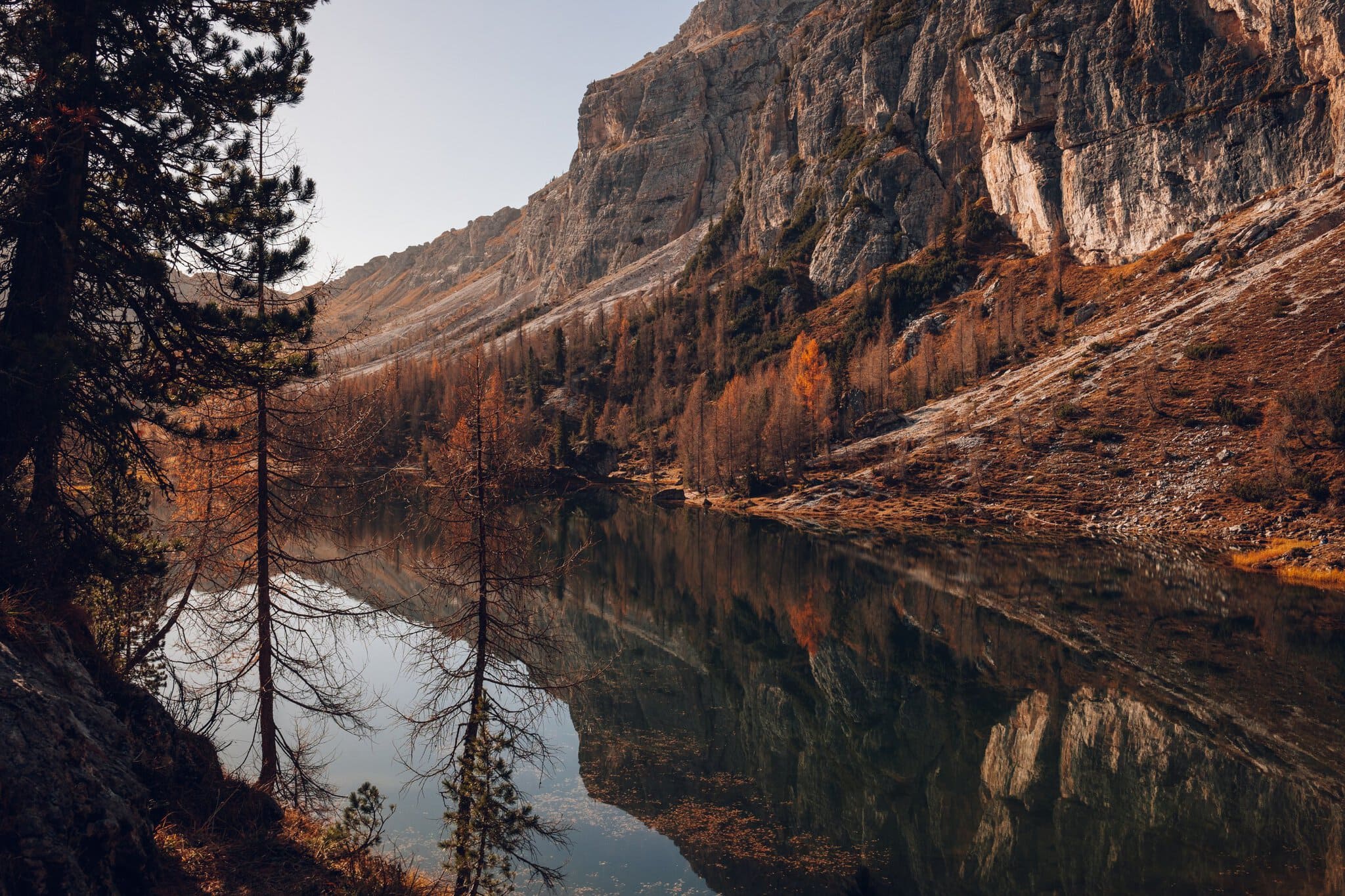
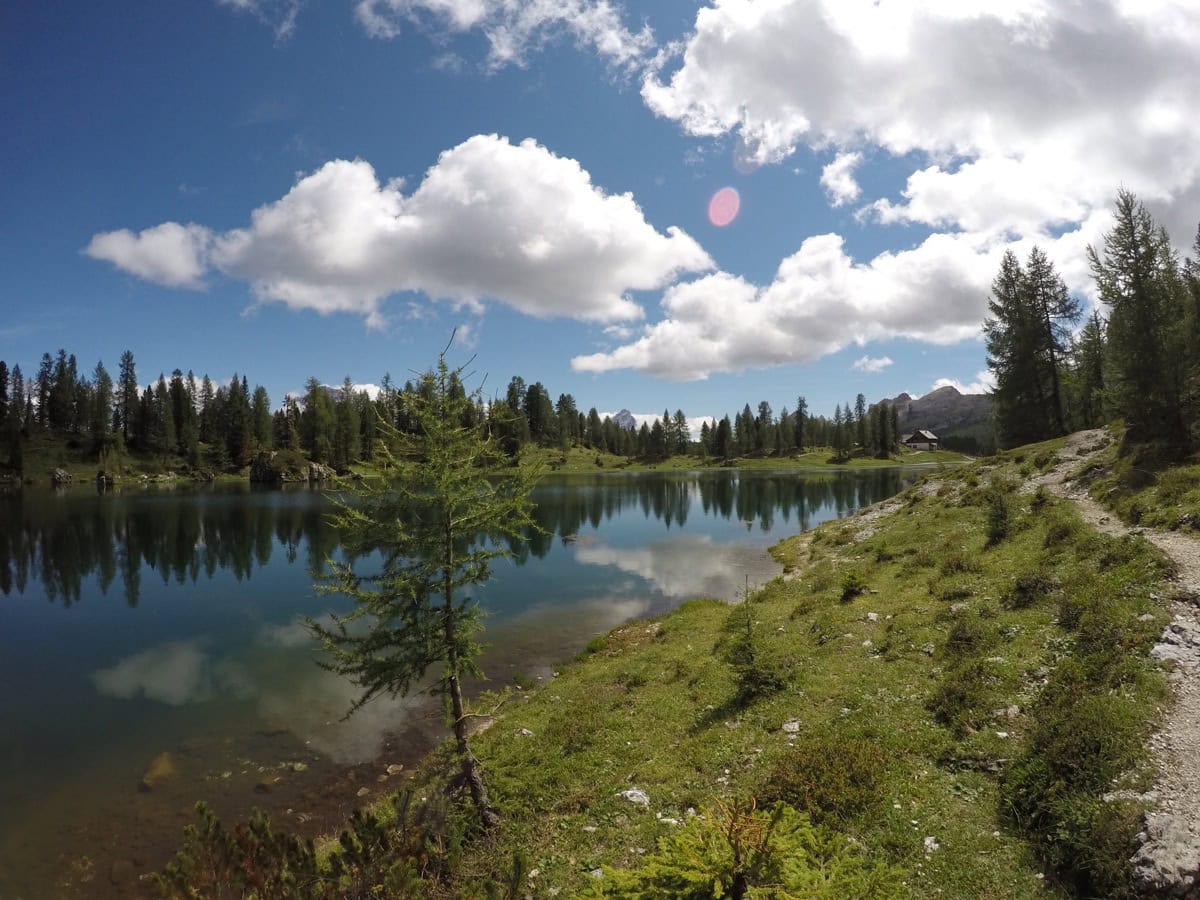
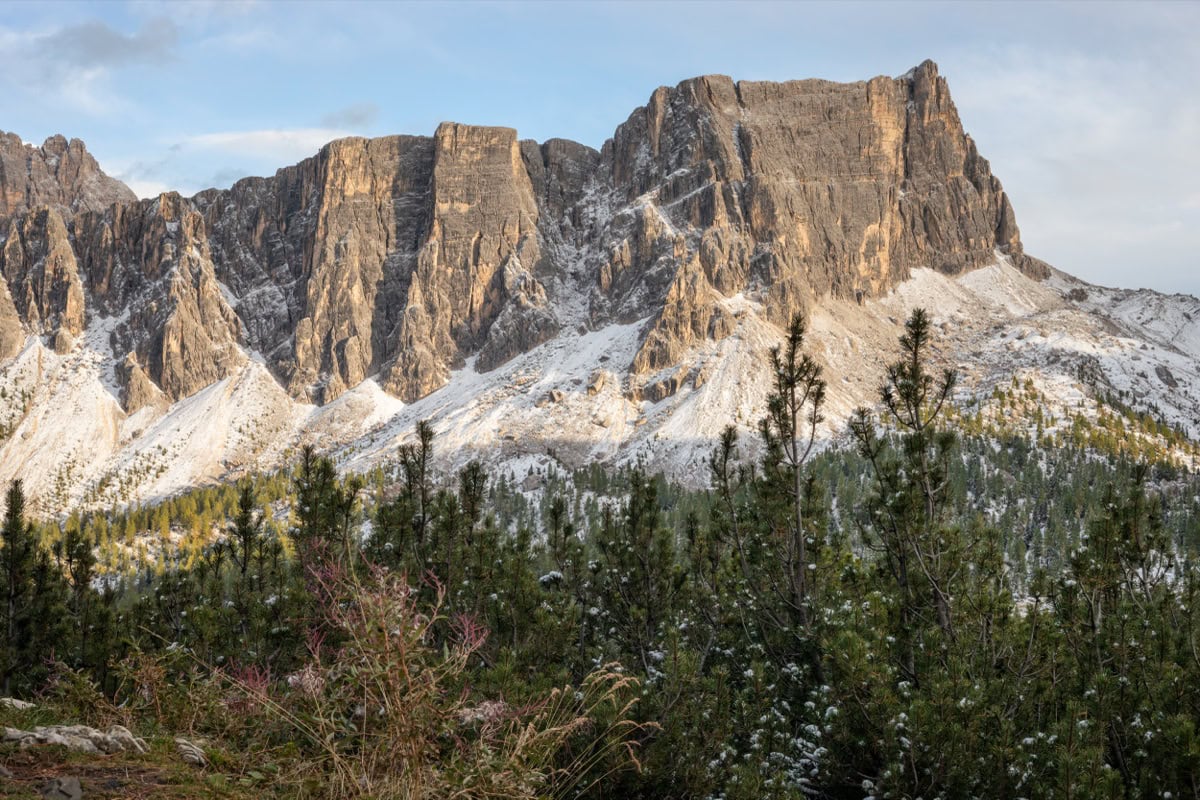
The name might be a bit confusing at first. Croda da Lago isn’t actually a lake, even though the word “Lago” might suggest that — it’s a breathtaking mountain massif and part of the UNESCO World Heritage Site, with jagged peaks towering high above the landscape. The turquoise lake that everyone comes here to see is called Lago Federa, and it sits right at the foot of these majestic cliffs at 2,034 metres above sea level.
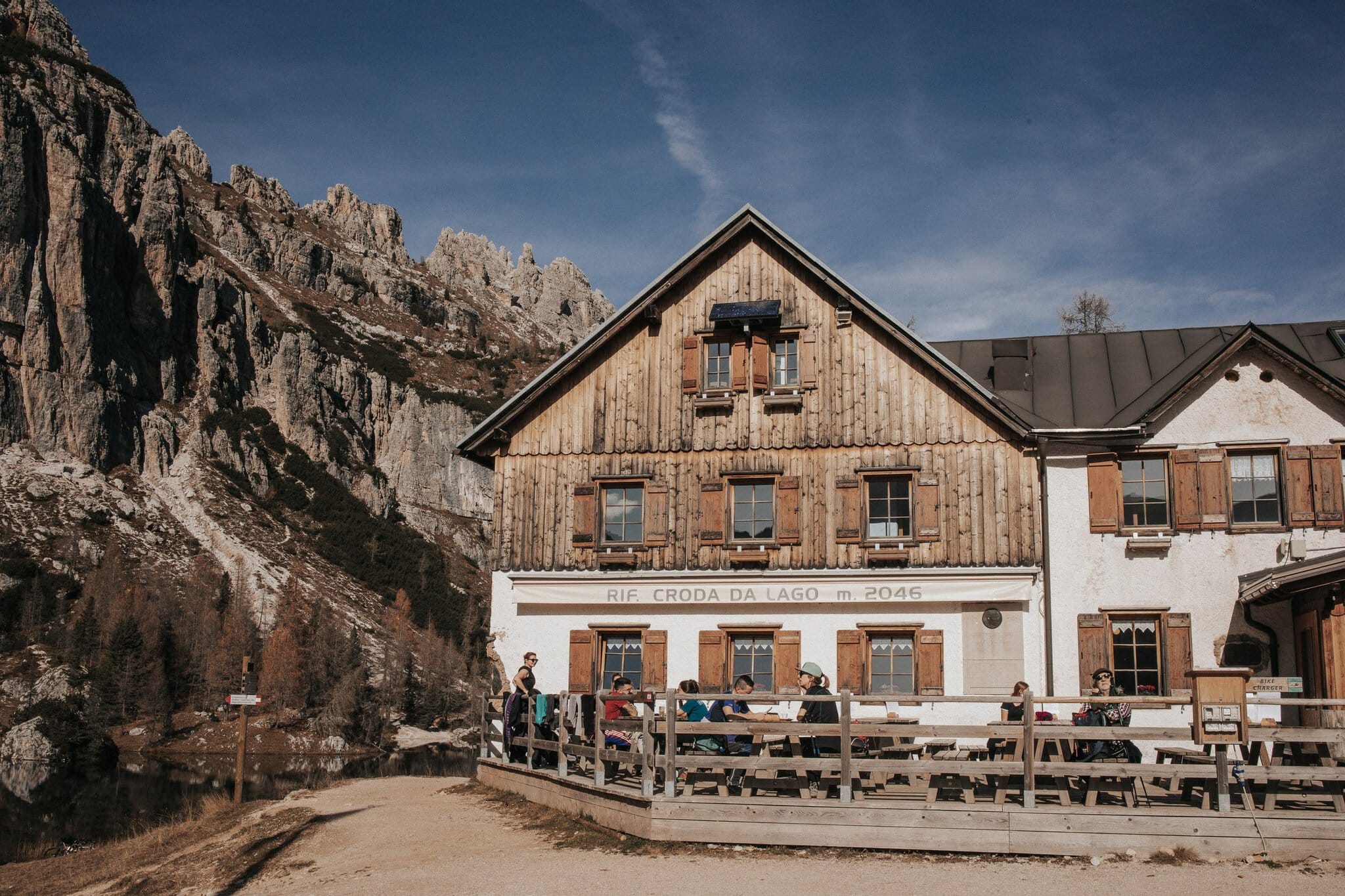
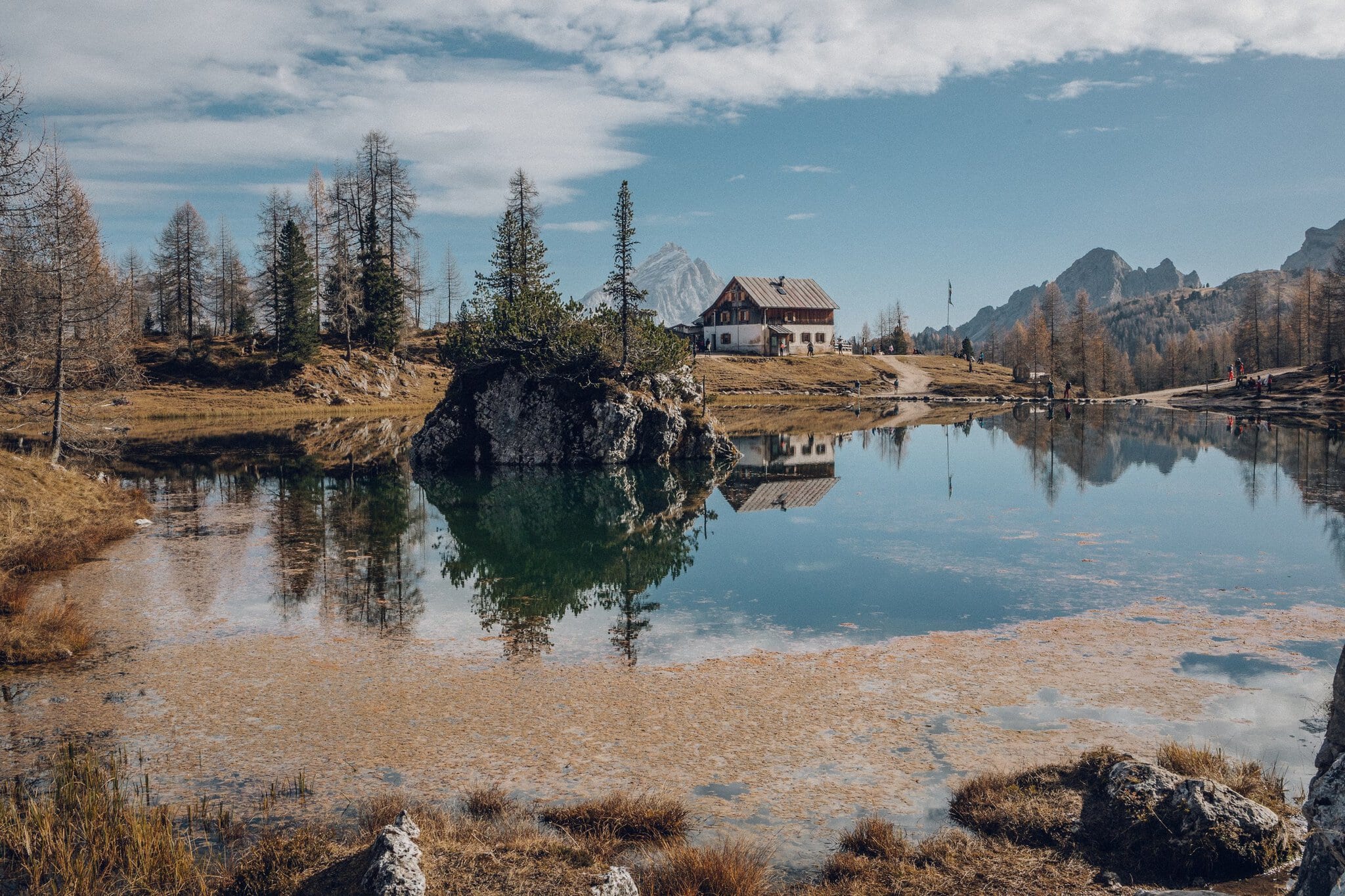
It’s this combination of razor-sharp Dolomite peaks and the calm water reflecting them that absolutely rooted Lukáš and me to the spot — I was frantically reaching for my camera while he stood there open-mouthed, and neither of us wanted to move an inch. Right on the lakeshore stands an iconic mountain hut, which you might know as Rifugio Gianni Palmieri. It’s the perfect refuge where you can rest, enjoy a brilliant meal, or even spend the night and wake up to mist rising off the water with not a soul in sight.
When to Go and What the Weather Is Like
Honestly? Choosing when to go is probably the biggest dilemma we face before every trip to the Dolomites. Each season looks completely different, and every time we’ve been, we’ve thought “this must be the best time.” But you need to bear in mind that the weather above 2,000 metres can be incredibly unpredictable — a key thing to consider when planning your Dolomites Italy weather expectations.
If you visit during the classic summer season from May to September, you’ll find green pastures, blooming Alpine meadows, and pleasant hiking temperatures. I should mention though that August is the absolute peak of the Italian holidays (known as Ferragosto), so even here the trails will be busy — though still incomparably quieter than nearby Lago di Sorapis.
Our favourite time, though, is autumn. In late October, the larches surrounding the lake turn incredible shades of gold and orange, which against the turquoise water and white rock looks like something someone painted in Photoshop. In the Dolomites Italy winter transforms the landscape entirely — the trails are buried under snow and the hut is usually closed, but the area becomes a popular destination for snowshoe excursions. Just remember to check the Croda da Lago webcam before a winter outing so you know what the current snow conditions are like.
How to Get to Croda da Lago (3 Main Routes)
We’ll be honest — even we got a bit lost at first trying to figure out the various starting points, so we’ve picked the three most popular options for you. There are several ways to reach the lake, and it really comes down to your fitness level and how much time you have.
From Passo Giau (Shortest and Most Scenic)
If you’re looking for the easiest route with the best effort-to-views ratio, start from the mountain pass Passo Giau. The trail goes via Forcella Giau and the return trip takes roughly 3 hours of relaxed walking with a pleasant elevation gain of around 350 metres. The advantage is that you’re already starting high up, so there’s no brutal uphill slog through the forest — instead, you enjoy panoramic views for most of the way. Parking at the pass costs around €5 for 3 hours.
From Ponte de Ru Curto (The Happy Medium)
This is the true classic — the popular Croda da Lago loop. It starts at a small car park by the bridge Ponte de Ru Curto, which sits right on the road connecting Cortina and Passo Giau. The route takes you through dense forest first, then across mountain streams, and finally up to the lake. The full loop takes 5 to 6 hours and makes for an absolutely stunning full-day hike that we’d recommend if you fancy a proper workout.
From the Olympia Car Park in Cortina (For the Adventurous)
If you’re in the mood for a really long and demanding full-day outing, you can set off from the Olympia car park right on the edge of Cortina. Bear in mind though that you’ll be walking through a very deep valley and racking up a serious amount of extra elevation. Parking here costs around €10 for the whole day. This is more of an option for those who enjoy solitude in the forest before arriving at the massif itself.
Where to Stay Nearby and How Much It Costs
The best strategy for exploring this area is to base yourself in one of the valley towns, where you’re just a few minutes’ drive from the trailheads. Accommodation in this area tends to be on the pricier side (Cortina is a premium destination, after all), but outside of August you can find some reasonable options.
Cortina d’Ampezzo is the number one choice. From here, it’s only about 15–20 minutes’ drive along stunning hairpin bends to Passo Giau. If you love history and a touch of Alpine luxury, check out the iconic Hotel de la Poste right in the centre, or the very pleasant Franceschi Park Hotel. Staying in Cortina means having the best restaurants and cafés at your doorstep for a post-hike evening wind-down.
A more affordable alternative to Cortina is the little town of San Vito di Cadore, which lies a bit further south. It’s quieter here, accommodation prices are noticeably lower, and you’re still very close to the trailheads. Another beautiful option is Alleghe, a town sitting by a lake right beneath the Marmolada massif. We can recommend the family-run Chalet al Lago — while the drive to the start of our trek takes a bit longer, the lakeside atmosphere is absolutely worth it. A week’s accommodation for two in summer season in this area typically runs between €1,000 and €1,600, depending on the level of comfort.
10 Tips on What to See and Do at Croda da Lago
Now that you know how to get here and where to rest your head, let’s dive into the best things the area has to offer. This trek isn’t just about reaching the lake and turning back — there are plenty of detours, hidden viewpoints, and experiences that would be a shame to miss.
1. The Classic Trek from Passo Giau to the Lake
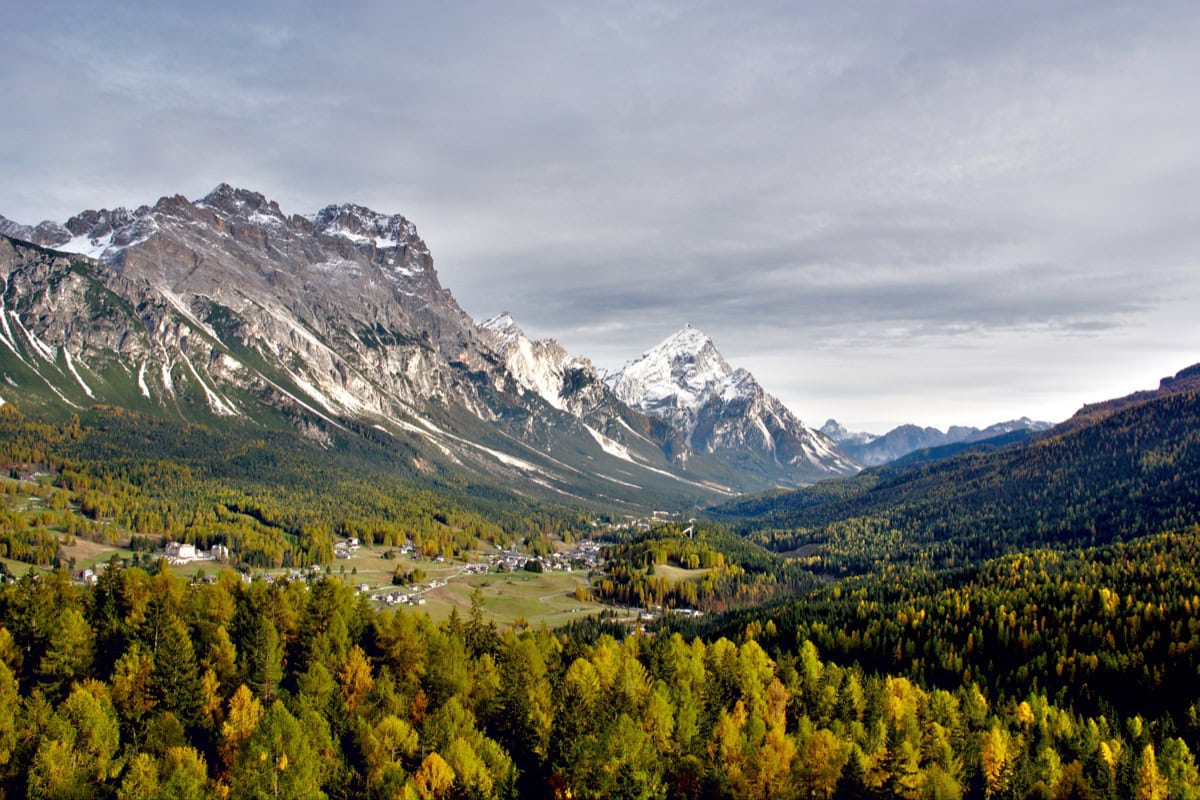
This is the essential experience that any reasonably fit hiker can manage. The path from Passo Giau to the lake is gorgeous because it takes you across high-altitude pastures full of marmots. The 350-metre elevation gain isn’t too daunting, and the views that open up once you cross the Forcella Giau saddle are absolutely breathtaking. Lukáš and I must have taken about a million photos before we even made it to the water.
Along the way, you’ll encounter an incredible number of marmots sunbathing on boulders or whistling at you from a distance. Our dogs Kája and Baby were completely fascinated, though of course they had to stay dutifully on their leads the whole time. That moment when you finally crest the ridge and see the valley spread out before you like a painting — it’s worth every drop of sweat.
2. An Overnight at Rifugio Palmieri Croda da Lago
Right on the lakeshore stands a charming stone hut known as Rifugio Gianni Palmieri. If you want a truly unforgettable experience, try booking an overnight stay here. It tends to fill up months in advance, so don’t leave it to the last minute. Waking up in the mountains as the first sunbeams light up the water while you sip your morning Italian espresso — that’s pure bliss.
The staff are incredibly warm and welcoming, making you feel right at home straight away. Dinner features local mountain specialities, and the atmosphere around the communal wooden tables — where everyone swaps stories from the day — has a wonderful charm to it. Just bear in mind that hot water in the showers at this altitude is a bit of a lottery.
3. The Iconic Photo from the Wooden Jetty
By the lake you’ll find a small wooden jetty that looks as though someone placed it there purely so people could photograph the perfect reflection of the jagged peaks on the water’s surface. Around midday there’s usually a bit of a queue, but it’s well worth the wait. We arrived at the jetty quite early in the morning — the surface was still as a mirror and the water was so cold that even dipping a finger in nearly gave us frostbite. 😅
If you don’t want strangers’ heads in your shot, I’d seriously recommend getting up early. The light is at its most beautiful first thing in the morning anyway, and the golden sun slowly creeping across the opposite rock faces creates a backdrop that no Instagram filter can replicate. Lukáš spent a good twenty minutes there with his camera before he was completely happy with the composition.
4. Explore the Trail from Olympia Car Park
If you enjoy walking through dense forest, give the route from the Olympia car park a go. Yes, it’s much longer, but it offers an entirely different perspective of the mountains. There’s something special about spending hours climbing through trees, listening to nothing but twigs snapping underfoot, and then suddenly the forest parts to reveal that enormous rock wall.
You’ll encounter very few people on this trail, making it ideal for those of you who crave peace and quiet in the mountains. Along the way, you’ll notice small streams and wooden footbridges that give it an almost fairy-tale feel. Just make sure you’ve got really good boots, because the tree roots can be quite slippery, especially after the morning dew.
5. For the Experienced: Via Ferrata della Strafala
For those who find regular hiking a bit tame, the area hides a protected climbing route called Via Ferrata della Strafala. We skipped it with our dogs, of course, but definitely check the current conditions beforehand — according to local guides, it offers views into deep gorges that you simply can’t experience anywhere else.
This via ferrata isn’t extremely difficult, but you’ll absolutely need full ferrata equipment including a helmet and harness. Some of the rock ledges can be quite exposed, so if you’re not great with heights, stick to the classic trek around the lake. But if you do make the ascent, you’re in for an incredible ride between sharp limestone towers.
6. Detour to Forcella Ambrizzola Saddle
Once you’ve soaked in the lake views and enjoyed a drink at the hut, make sure you get back on your feet for a short walk to the Forcella Ambrizzola saddle. It’s only about 20 minutes of gentle climbing from the lake, but the panorama that opens up before you is priceless. From here you can see a huge swathe of the Dolomites, including the Marmolada glacier in the distance.
Lukáš and I liked it so much that we unpacked our lunch on a big flat rock and simply gazed at the landscape. From this point, paths branch off into other valleys, so if you’re planning to spend several days in the mountains, it’s a brilliant starting point. Just be warned — it tends to be quite windy up here, so throw a windproof jacket into your pack.
7. Marvel at the Lunar Landscape of Lastoi de Formin
If you tackle the full Croda da Lago circuit trail, your route will take you across the fascinating plateau of Lastoi de Formin. It’s an enormous limestone slab that looks more like a lunar landscape than earthly mountains. The rocks are strangely fractured and feel incredibly raw. Our dogs Kája and Baby hopped around confusedly from one boulder to the next.
The contrast between this barren grey wilderness and the green valley with the lake below is absolutely striking. The path across the plateau isn’t the best marked, and I’d be very cautious in poor visibility. But when the weather’s on your side, you genuinely feel like astronauts on an exploration mission to some distant planet.
8. Wait for the Enrosadira at Sunset
Enrosadira is the phenomenon that made the Dolomites famous worldwide. It’s an optical effect where the limestone rocks turn incredible shades of pink and purple at sunset (or sunrise). Staying at Lago Federa until evening is romance at its very finest. Just don’t forget your head torches for the walk back to the car.
That amazing palette of colours doesn’t last long — usually just a few dozen minutes before the sun disappears below the horizon. So it’s worth scouting out a good spot for photos or sitting beforehand. Once the shadows thicken, the temperature can drop by a good ten degrees, so a warm layer is absolutely essential even if it was scorching during the day.


9. Winter Snowshoeing Under Snow-Capped Peaks
This place has plenty to offer even when it’s buried in snow. A winter snowshoe trek is incredibly magical — there’s absolute silence everywhere and the snow crunches under your feet. The hut itself is usually closed in winter and the lake lies under a thick layer of ice, but the raw winter wilderness is well worth the effort. Do make sure you check the avalanche danger beforehand and look at the Croda da Lago webcam.
Snowshoeing is actually great fun and doesn’t require any special training — you just need to lift your feet a bit higher than normal. If you don’t feel confident tackling a winter ascent on your own, there are plenty of local mountain guides in Cortina who’ll head out with you and throw in fascinating stories about the area’s history. Step by step through the white wilderness — it’s a wonderful way to clear your head.
10. Combine the Trek with a Scenic Drive over Passo Giau
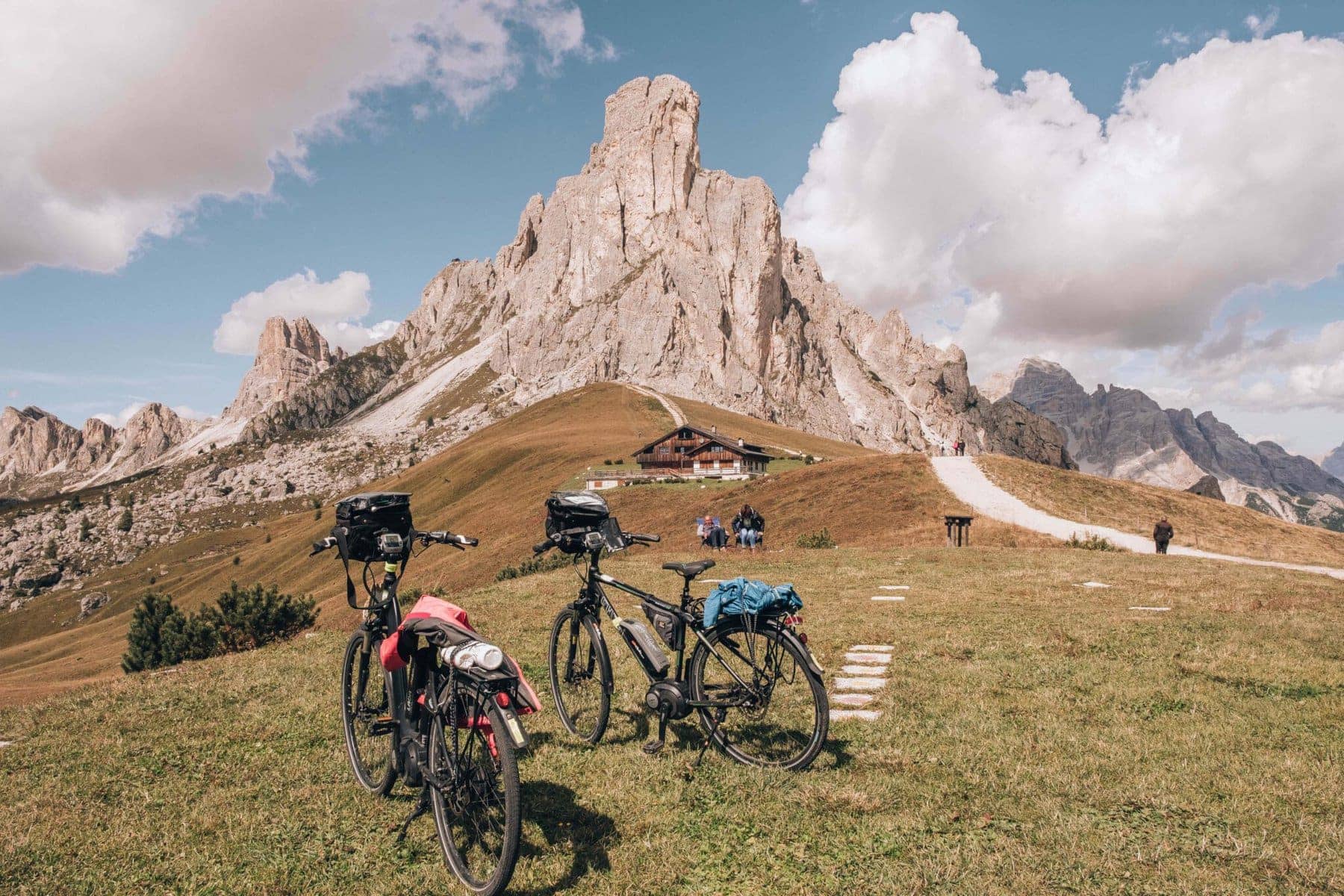
The journey to the trek can be an experience in itself. The Passo Giau mountain pass is one of the most beautiful mountain roads in Europe, packed with sharp bends and jaw-dropping views. I’d suggest leaving a bit of extra time to stop and admire the scenery along the way — pull over at the viewpoints and soak up that quintessential Italian mountain atmosphere.
Just a word of warning: this road is hugely popular with motorcyclists and cyclists, so as a driver you need to keep your eyes peeled at all times. At the top of the pass there’s a brilliant little café where we always reward ourselves with a proper Italian cappuccino and a fluffy croissant after coming down from the mountains. And don’t forget some change for the paid car park.
Map of points of interest for your phone
Croda da Lago with Kids and Our Dogs (Kája and Baby)
If you follow our blog regularly, you’ll know we travel with our little Jonášek. As I mentioned at the start, with a two-year-old in a carrier, a five-hour trek with this much elevation is quite a demanding affair, so we’re saving it for when he’s a bit bigger. And definitely don’t try bringing a pushchair — the terrain is very rocky and you’ll hit some nasty tree roots.
💡 Local tip: Almost all cable cars and buses require dogs to wear a muzzle (you can buy one pretty much anywhere, including at the base stations). We found this quite annoying, to be honest — they insisted even when we were riding a gondola completely on our own. When we had several cable cars in a row, we sometimes left Kája and Baby resting back at camp instead.
That said, for families with older children — say eight and up — this is a perfect alternative to the overcrowded via ferrata routes. Kids are kept engaged by the varied landscape, and the prospect of a lake plus delicious food at the hut motivates them far more than any adult reasoning ever could.
And what about our four-legged companions? Kája and Baby absolutely loved this trek. There is, however, one very important rule: dogs must be on a lead at all times, no exceptions. There’s a huge colony of marmots living around the lake and on the surrounding pastures, and the local rangers take a very dim view of dogs running free. The trail itself is very pleasant for dogs, alternating between shady forest sections and sunny stretches — just watch out for sharp rocks on the scree slopes.
What to Eat at Rifugio Palmieri
One of the best things about hiking in Italy is that no matter which peak you climb, there’s almost always fantastic food waiting for you at the top. Rifugio Palmieri is no exception. Their kitchen delivers exactly the blend of Italian passion and Tyrolean heartiness that you need after several hours of walking.
I’d definitely recommend trying the local speciality, polenta gröstl. It’s beautifully crispy fried polenta mixed with chunks of quality local meat, onion, and cheese. It’s an absolute calorie bomb, but Lukáš and I nearly fought over it. Pair it with a glass of Vino d’Ampezzo, the local wine from the region, which will warm you up nicely. And if you prefer the classics, their homemade pasta or apple strudel with vanilla sauce are absolutely spot-on.
Practical Information, Prices, and Rules (Drone Ban!)
Before heading into the mountains, it always pays to have a few practical details sorted so nothing catches you off guard. Here’s what we learned during our trip:
- Parking: Spaces at the trailheads fill up very quickly, especially in summer. At Passo Giau you’ll pay around €5 for three hours; at the Olympia car park in Cortina it’s roughly €10 for a full-day ticket. Arrive by 9 AM at the latest.
- Water: There aren’t many options for refilling your water safely along the trail. Water from the lake or surrounding streams isn’t safe to drink without boiling. It might look romantic, but wildlife lives its life up here and we don’t want you experiencing nature more intimately than you planned. 😅 Make sure you bring enough — at least 2 litres per person in summer.
- DRONE BAN: I need to stress this one. The entire Croda da Lago area lies within a protected zone and flying drones is absolutely and strictly prohibited. This isn’t just a suggestion — if the local police or park rangers catch you, fines can climb without mercy to an eye-watering €3,000. That risk simply isn’t worth one Instagram photo, trust me.
Where Else to Go in the Dolomites
The Dolomites are so magnificent that one trek definitely won’t be enough. If you’re already in the Cortina area, consider adding these gems to your itinerary (just be prepared for considerably more people):
- Our complete guide to Cortina d’Ampezzo with tips on where to stay and what not to miss.
- The famous Lago di Sorapis, which we visited on one of our very first Italian adventures.
- The legendary and iconic Tre Cime di Lavaredo, the loop around the three peaks.
- Or have a read of our big overview of things to do in the Dolomites and find 5 hiking trails for everyone.
Tips and Tricks for Travelling to Italy
Before you start packing your rucksack, here are a few quick tips that have consistently saved us time and money when travelling to Italy.
Finding Flights
If you’re not driving to the Dolomites, the nearest airports are Venice Marco Polo and Treviso. From London, you can often find great deals with easyJet or Ryanair flying into Venice. For comparing prices and routes, we love using Kiwi — it’s our go-to portal for flight comparison.
Hiring a Car
To get between the Italian mountain passes and lakes, you really do need a car. Lukáš and I have had consistently good experiences with DiscoverCars, which we use all over the world. They always find you the best deal across all the major hire companies.
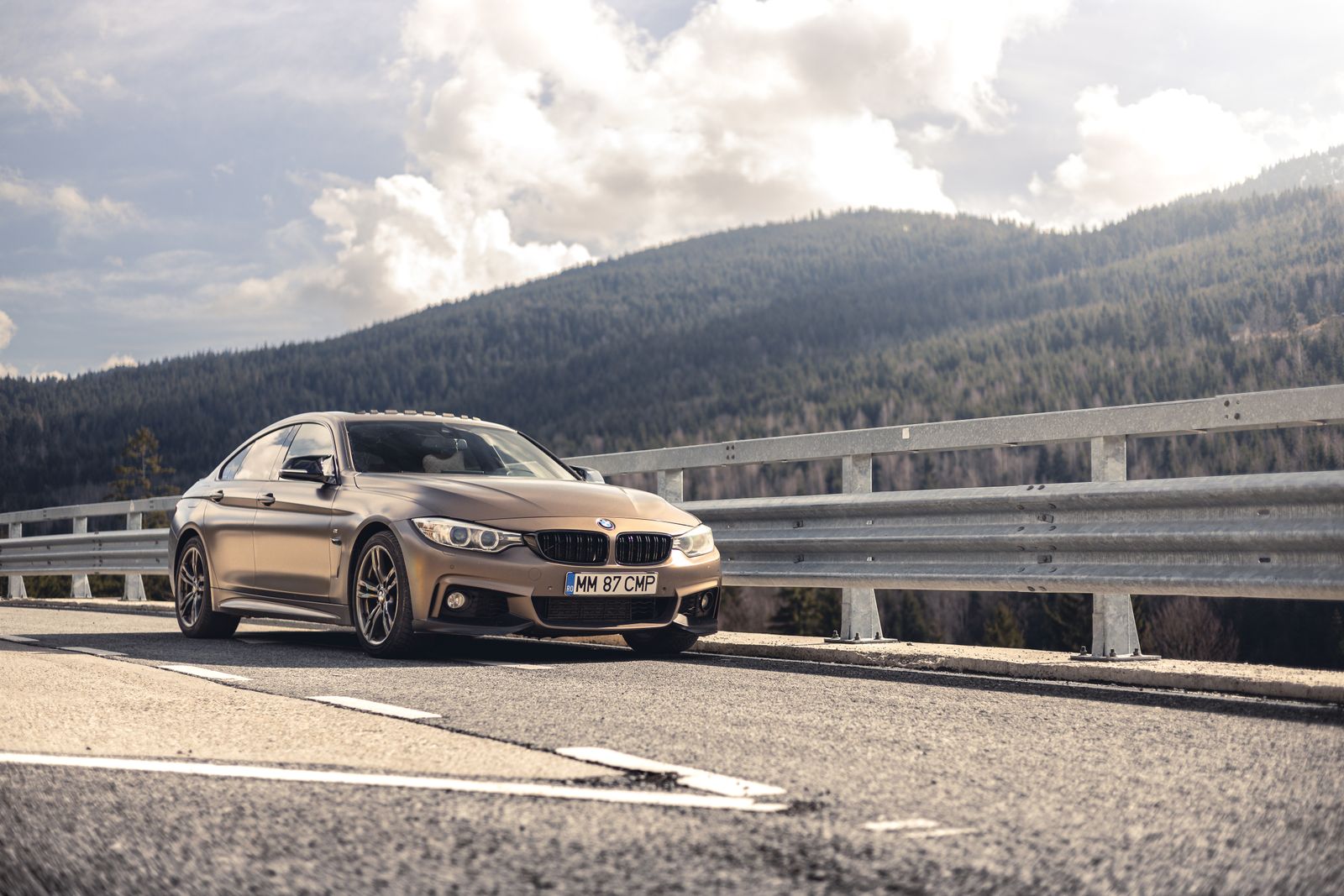 🚗 Car rental on the roadVerified rental cars in the Dolomites
Search with the DiscoverCars comparison engine — it compares prices from dozens of local and international rental companies, and most bookings come with free cancellation.
Compare car prices in the Dolomites →Don’t Forget Travel Insurance
In the mountains, you never know — one wrong step and a helicopter rescue can get very expensive indeed. For shorter trips we usually go with AXA insurance (we’ve got a 50% discount via this link), and for longer trips or anything more adventurous, we swear by SafetyWing. Your EHIC/GHIC covers basics in Italy, but mountain rescue and repatriation are a different story.
Internet and Data
Since leaving the EU, UK travellers should double-check their mobile roaming allowances for Italy. Many UK networks still include EU roaming, but if yours doesn’t — or you need reliable data for working on the go — have a look at our Holafly eSIM review, which we use regularly.
What to Put on Your Feet
For the rocky Dolomite trails, you genuinely need proper hiking boots. No trainers! If you haven’t invested in a quality pair yet, check out our article on how to choose hiking boots so you don’t come back from the trek covered in blisters.
Frequently Asked Questions (FAQ)
How long does the Croda da Lago trek take?
It depends on which route you choose. The shortest option from Passo Giau takes about 3 hours round trip. The longer loop from the Ponte de Ru Curto bridge will take you around 5 to 6 hours at a leisurely pace.
Is the Croda da Lago trek suitable for children?
It’s not suitable for strollers or very young children (unless you have a baby carrier) due to the rocky and fairly steep terrain. However, more experienced kids aged eight and up should be able to handle the loop, or at least the route from Passo Giau, without any problems.
Can I swim in Lago Federa?
No, swimming in the lake is prohibited to protect the fragile alpine ecosystem. Besides, the water is so icy cold that you probably wouldn’t want to anyway.
Are dogs allowed at the lake?
Yes, dogs are welcome on the trek, but they must be kept on a lead at all times. There are lots of marmots in the area, and you can face pretty hefty fines for letting your dog run free.
When is Rifugio Palmieri open?
The refuge is typically open from mid-June through the end of September or early October. It’s closed outside the season and during winter, but you can book accommodation in advance during the summer months.
Do I need a guide for this trek?
Not at all. The trails in the Dolomites are perfectly and clearly marked (including the red and white markings of the Italian Alpine Club). Just download offline maps and follow the signposts.
Are drones allowed above the lake?
No, there’s a very strict ban on flying drones here. Since the area is part of a protected zone and nature park, you could face massive fines of up to 3,000 euros for breaking this rule.
Tips and Tricks for Your Vacation
Don’t Overpay for Flights
Search for flights on Kayak. It’s our favorite search engine because it scans the websites of all airlines and always finds the cheapest connection.
Book Your Accommodation Smartly
The best experiences we’ve had when looking for accommodation (from Alaska to Morocco) are with Booking.com, where hotels, apartments, and entire houses are usually the cheapest and most widely available.
Don’t Forget Travel Insurance
Good travel insurance will protect you against illness, accidents, theft, or flight cancellations. We’ve had a few hospital visits abroad, so we know how important it is to have proper insurance arranged.
Where we insure ourselves: SafetyWing (simple monthly subscription) and TrueTraveller (for extra-long trips).
Find the Best Experiences
Get Your Guide is a huge online marketplace where you can book guided walks, trips, skip-the-line tickets, tours, and much more. We always find some extra fun there!