

Let me come clean right away: just a few years ago I was one of those people who packed two extra pairs of shoes “just in case” for a week by the sea, three books they’d never read, and a toiletry bag that weighed almost as much as the rest of the suitcase. Then Lukáš and I set off on a long-distance cycling trip from home all the way to Greece, where everything you own has to fit on a bike, and my whole idea of packing turned upside down. ☺️
Since then we’ve travelled a good chunk of Europe by campervan, with a tent, and the classic way by plane, and we’ve learned one thing: travelling light isn’t about going without, it’s about freedom. No waiting at the carousel, no checked-bag fees, no lugging twenty kilos over cobblestones. Just you, one backpack and the feeling that everything you need is right at hand.
In this guide I’ll show you how to pack light into your cabin luggage, what dimensions you need to stay within for each airline, which carry-on backpack to choose and how to cleverly get around that annoying liquids limit. I promise that once you’ve read it, you’ll never again pay for a checked bag you don’t actually need.
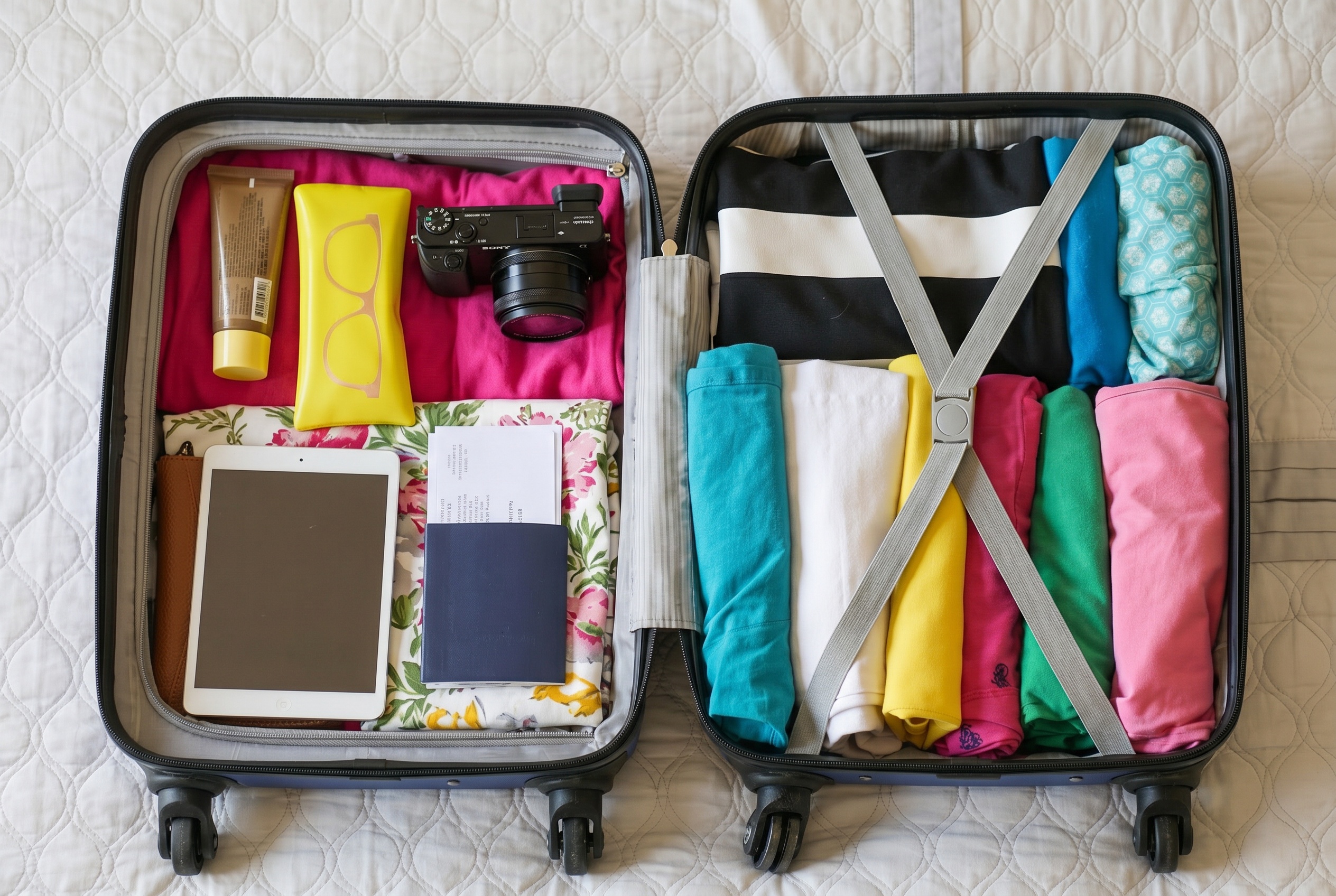
TL;DR: how to pack light in a nutshell
- Stay within the dimensions. Most budget airlines today let you bring a small bag of roughly 40×30×20 cm under the seat for free. A large cabin bag (55×40×20 cm) usually costs extra.
- Choose the right backpack. For light travel a 20–40 litre travel backpack is plenty, ideally one that opens flat like a suitcase.
- Plan your wardrobe for a week, not the whole trip. Sort the rest with a quick wash in the sink.
- Switch to solid toiletries. Powdered shampoo and toothpaste tablets don’t count as liquids, so the 100 ml limit doesn’t apply at all.
- Wear your heaviest items. Shoes and a jacket on your body don’t count towards your luggage weight.
Why travelling with just cabin luggage pays off
You might be wondering whether all the fuss around packing light is really worth it. For me the answer is a clear yes, and there are three big reasons. The first is money: a checked bag with a low-cost airline usually costs you anywhere from £15 to over £40 each way, so on a return ticket you can easily pay more for the suitcase than for the flight itself.
The second reason is time and peace of mind. When everything is in your cabin luggage, you walk straight off the plane and into the city instead of staring at the carousel for half an hour, hoping your bag hasn’t flown off to another country. And the third reason is the best one: freedom of movement. With a single backpack on your shoulders you can handle a connection, the stairs in the Tube and the cobbled lanes of an old town without cursing wheels that get stuck in every crack. 😅
💡 Tip: Try packing light for a longer trip once, not just a weekend. Most people discover that 80% of what they’d normally take for two weeks never gets used, and that you pack pretty much the same for a week as for a month.
Cabin luggage dimensions: what you need to fit within
This is the part people Google the most, and also the one where you can get burned the worst. Every airline has its own limits and, worse still, the budget carriers have changed them quite drastically in recent years. So I’ve put together a rough overview, but please treat it as a guide for June 2026, not gospel.
⚠️ Important: Check the dimensions and weights directly on your airline’s website before every flight. Both Ryanair and Wizz Air changed what they allow for free during 2025, and at the gate they measure without mercy. Thirty seconds of checking can save you a fee that’s often higher than the ticket.
| Airline | Small bag free | Large cabin bag |
|---|---|---|
| Ryanair | 40×30×20 cm | 55×40×20 cm 10 kg |
| Wizz Air | 40×30×20 cm 10 kg | 55×40×23 cm 10 kg |
| easyJet | 45×36×20 cm 15 kg | 56×45×25 cm 15 kg |
| British Airways | 40×30×15 cm | 56×45×25 cm 23 kg |
| Jet2 | — | 56×45×25 cm 10 kg |
| Vueling | 40×30×20 cm | 55×40×20 cm 10 kg |
| TUI | — | 55×40×20 cm 10 kg |
And here’s what to watch out for with individual airlines, especially what costs extra:
- Ryanair, Wizz Air and Vueling: you only get the large cabin bag with Priority or a more expensive fare, otherwise you’re left with the small under-seat bag.
- easyJet: has the most generous free bag, the large cabin bag costs extra or comes free with easyJet Plus.
- British Airways: generally lets you bring both a small personal item and a full cabin bag even on basic fares, which is rare among short-haul carriers.
- Jet2: includes a full 10 kg cabin bag in the standard fare on most routes.
- TUI: usually allows one cabin bag up to 10 kg, but check your specific package or flight.
What the dimensions 40×30×20, 40×20×25 and 55×40×20 mean
When you come across these numbers and don’t know what to make of them, here’s a quick translation. 40×30×20 cm is today’s most common size for the small bag that most budget airlines (Ryanair, Wizz Air, Vueling) let you bring under the seat for free. That’s the size worth aiming for if you want to fly with no extra charge at all.
The number 40×20×25 cm, which you might still see in older guides, was Ryanair’s earlier size; today many sources list it as outdated, so don’t rely on it. 55×40×20 cm (or sometimes 55×40×23 cm) is the large overhead cabin bag, usually with a limit of around 8 to 10 kg. But you almost never get that for free now, so expect to need Priority or a higher fare.
💡 Tip: If you want one backpack that fits into as many planes as possible, look for a size up to 55×40×20 cm. It’ll fit where the allowance is a few centimetres bigger too, and you’re sorted across airlines.
Which carry-on backpack to choose
The backpack is the heart of travelling light, and it’s worth investing in. Depending on whether you want to fly completely free or pay a bit more for extra space, you’re choosing between two categories.
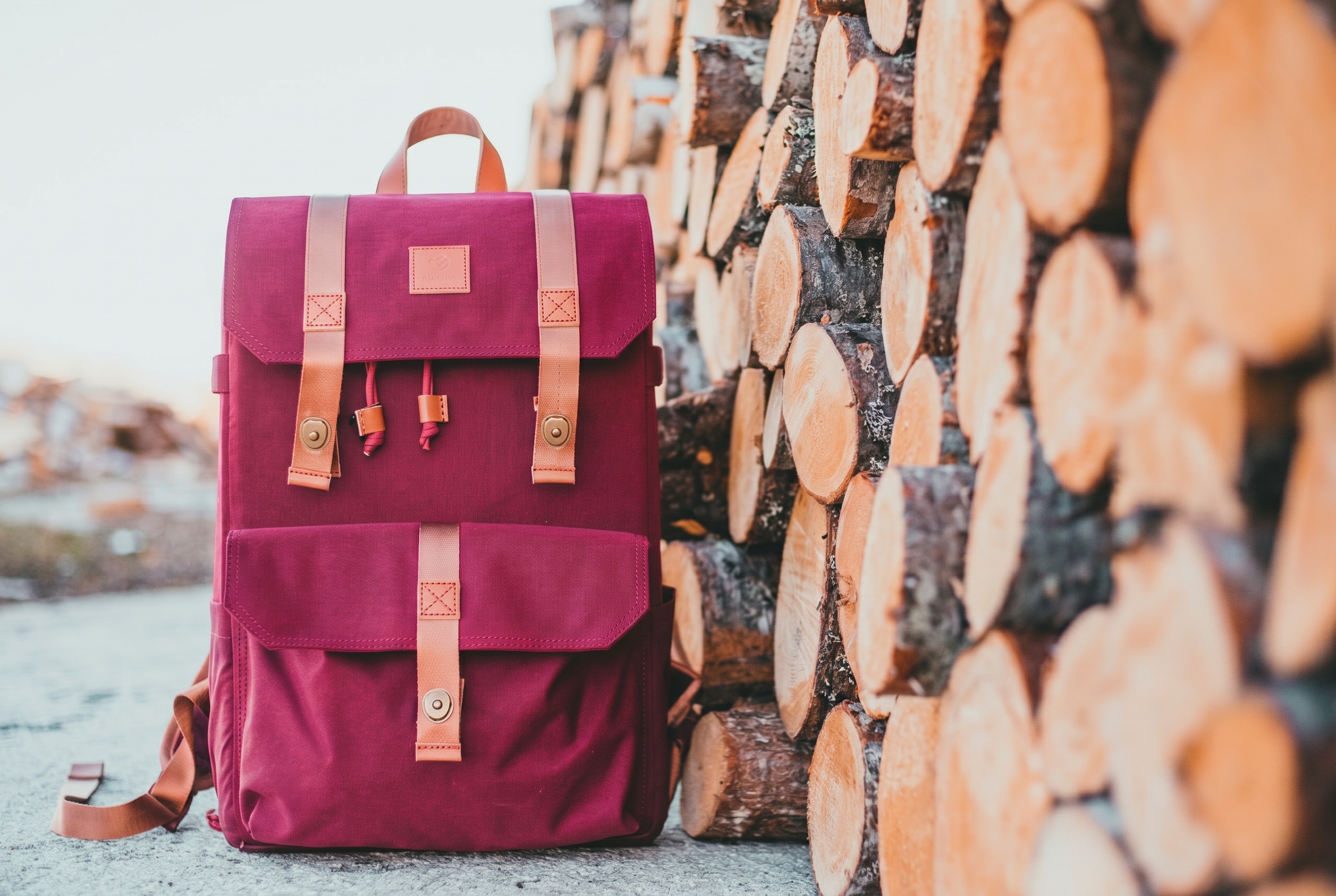
If you’re aiming for the free small bag under the seat, look for a compact travel backpack of around 20 litres with dimensions up to 40×30×20 cm. Decathlon does this brilliantly in its Forclaz travel range, where you’ll find models practically tailor-made for these limits at a friendly price. You can fit surprisingly much in there when you pack with thought.
If you want more space and are planning for a large cabin bag, reach for a 40-litre travel backpack with a full clamshell zip that opens like a suitcase. A classic is the Osprey Farpoint 40 (and its women’s version, the Fairview 40, with a shorter back system), which carries beautifully and has hideaway straps so it looks smart. Also popular are the ultralight Cabin Zero models (the 36 and 44 litre versions weigh only around 700 grams) or the premium Tortuga backpacks.
⚠️ Mind the depth of the backpack. Plenty of “travel” backpacks are over 23 cm deep, and it’s precisely that which gives you away with strict airlines. A fully stuffed backpack also swells up, so the real dimensions tend to be bigger than the ones on the label. Before you buy a backpack, check its measurements against the airline you fly with most.
💡 Tip: You’ll find specific models of backpacks, bags and suitcases — with dimensions, weight, price and a clear comparison table — in our overview of the best cabin luggage for flying.
How to pack light: technique step by step
You may have heard that you just roll everything up and you’re done. The truth is a bit more interesting. Folding clothes in stacks is actually the worst thing you can do, because lots of dead space builds up between the folded pieces. Rolling works great for soft items like T-shirts, underwear and socks, which you can then tuck into gaps, but it doesn’t save as much space as people claim, and shirts come out faintly creased.
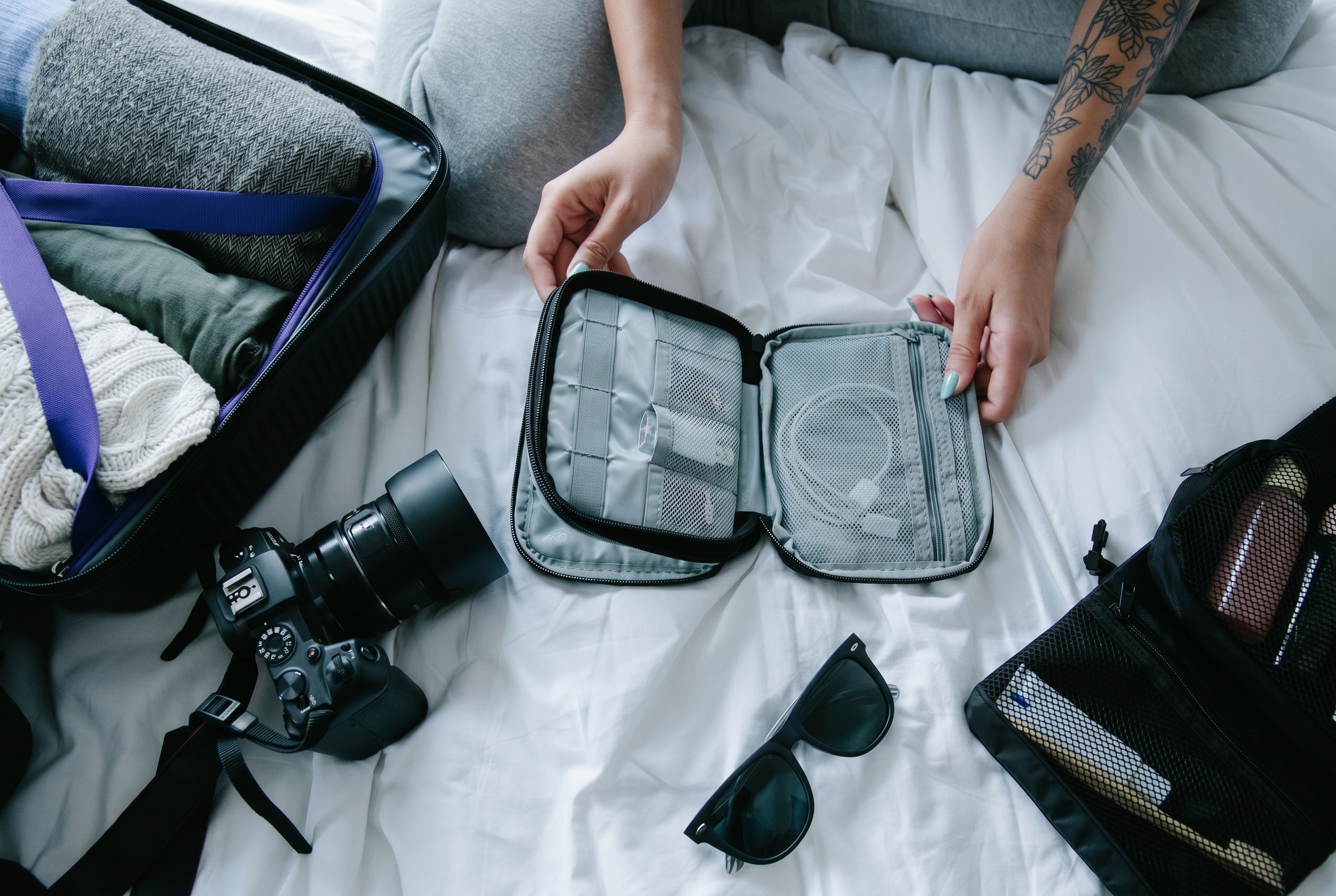
The best trick for crease-free packing is so-called bundle wrapping, where you layer your clothes on top of each other and wrap them around a soft core (rolled-up socks, for instance). The tension from wrapping smooths out the wrinkles, and jackets and shirts end up on the outside where they don’t crease. The only downside is that you have to unwrap the whole bundle for one item, so it suits trips where you’ll unpack properly at your destination.
And what about those famous packing cubes? Classic cubes save almost no space; their magic is in organisation — you separate clean from dirty and pull out a whole “drawer” at once. When you really want to shrink the volume, get the compression versions with a second zip that squeezes out the air. They have just one catch: clothes crease more, and above all it’s all too easy to cram so much into the saved space that you blow past the weight limit. 😅
💡 Tip: Put the heaviest items (a book, chargers, the toiletry bag) as close to the back panel of the backpack as possible, and as low down as you can. A centre of gravity near your back keeps the backpack stable and stops it pulling you backwards, so it’s far more comfortable to carry.
Capsule wardrobe: how much of what to take
Here’s the biggest secret of packing light: you don’t pack for the whole trip, you pack for a week. Whether you’re going for ten days or a month, you get by with roughly the same amount of clothing — you just do one wash halfway through. Quick-drying laundry dries overnight, so a wash in the sink or at a launderette every five to seven days solves the whole problem.
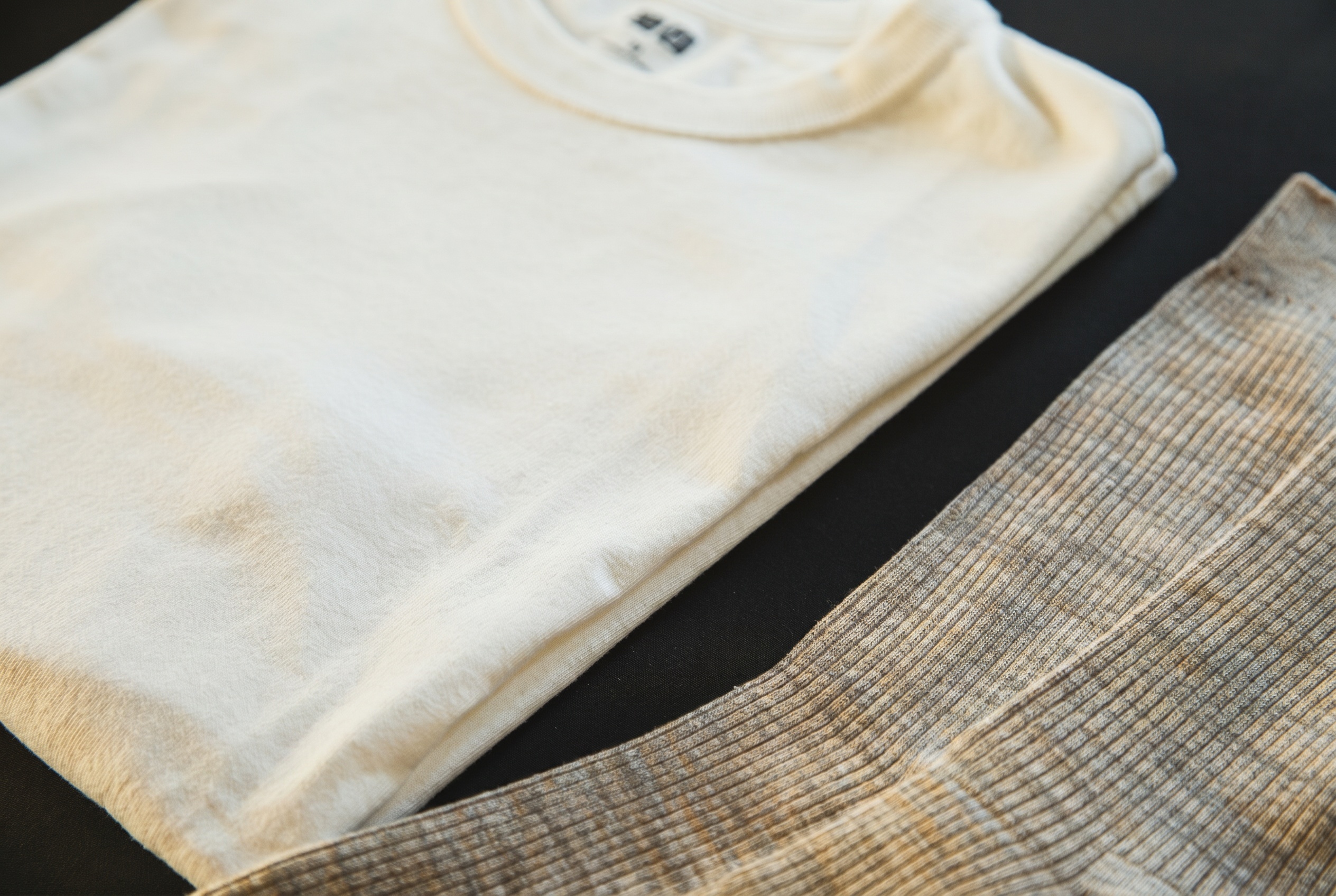
To make everything mix and match nicely, I go for a capsule wardrobe in a single colour family, where every piece works with every other. Rough quantities that fit into a cabin bag look like this:
- 3–4 T-shirts or tops (merino can take several wears without washing)
- 3–6 pairs of underwear and 3–4 pairs of socks, ideally quick-drying, not cotton
- 2 pairs of trousers or skirts (one pair worn straight away)
- 1 hoodie or jumper as a mid-layer
- 1 light packable jacket you wear on the plane
The key is the material. Steer clear of cotton and denim, which are heavy, slow to dry and crease easily. Reach for merino and technical synthetics, which are light, dry quickly, and merino doesn’t start to smell as fast either, so you can wear it longer between washes.
Shoes: cabin luggage’s biggest enemy
Shoes are the most demanding thing you carry both in bulk and in weight, so be most sparing with them. The rule is two pairs maximum, ideally just one comfortable all-rounder for walking and one light extra pair (sandals, flip-flops or something smarter, depending on your destination).
Put the heaviest pair on your feet for the journey — that saves you loads of space and weight in the backpack. Pack the shoes in your bag along the bottom against the wall, soles facing the edge, and stuff the insides with rolled-up socks or underwear so you don’t lose dead space. And drop them into a fabric bag so they don’t dirty your clothes. I’ve written about it all in detail, including how to cover formal occasions too, in a separate article on shoes in cabin luggage.
Light toiletries and waterless cosmetics
This is, in my view, the smartest move in the whole light-packing game, and at the same time the one most people overlook. Classic cosmetics are all liquids, and those are exactly what restrict you most in cabin luggage. Every bottle has to be 100 ml or less, everything must fit into a one-litre clear bag, and at security you often have to pull it out as well.
The solution is elegantly simple: switch to solid and waterless cosmetics. Powdered shampoo, toothpaste tablets, solid soap and solid deodorant don’t count as liquids, so the 100 ml limit doesn’t apply to them at all, and you can take as much as you like outside the bag. You’ll sail through security without a single frown.
I was a sceptic for ages, but on one campervan trip we tried a travel set of waterless cosmetics from nanoSPACE Cosmetics and honestly it won me over. The set includes powdered shampoo (just sprinkle it on your head, wet it and lather), toothpaste tablets with hydroxyapatite, which clean teeth beautifully and gently whiten them, soap tablets and mouthwash tablets. Everything is 100% natural, preservative-free and suitable even for people with allergies.
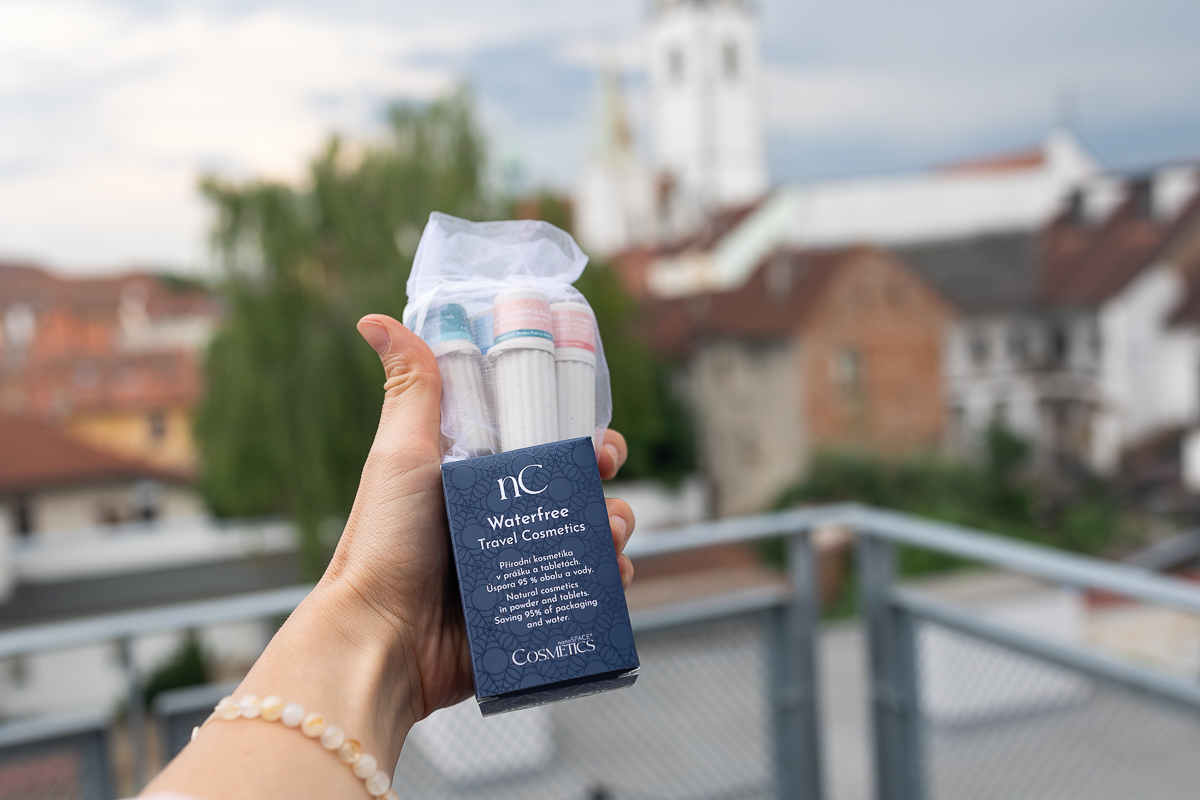
What surprised me most is how compact and long-lasting it is. The whole set fits in a pocket and weighs next to nothing, yet one pack of powdered shampoo lasts about twenty uses. For light travel it’s ideal, because you sort out your hygiene, save space and weight, and above all skip the whole clear-bag lottery at security.
💡 Tip: For what genuinely has to be liquid (eye drops, perfume, medicines), decant it into travel bottles of 100 ml or less. And remember that plenty of things like shower gel or toothpaste can simply be bought once you arrive, so you don’t need to carry a whole holiday’s supply.
Liquids and airport security: the current rules
There’s plenty of confusion around liquids, because the rules have changed over the past two years. So let me take it from the top. The basic rule still applies and you should count on it everywhere: liquids, gels and sprays only in containers of 100 ml or less, all together in one clear resealable bag of up to 1 litre, one bag per person.
Newer scanners (so-called CT scanners) at some airports allow you to bring more liquids, even a container of up to 2 litres, but it doesn’t apply across the board — it varies from airport to airport and often even from terminal to terminal. Several UK airports have been rolling out these scanners, but the situation keeps shifting and some have temporarily reverted to the 100 ml rule while equipment is finalised. So check your specific departure airport before you fly.
💡 Tip: Always rely on the 100 ml rule and treat a higher limit as a pleasant bonus, only when it’s explicitly allowed on your specific route. On the way back or at a connection a stricter regime may well apply, so don’t count on it in advance. And that’s exactly why solid cosmetics are so practical — you bypass all this uncertainty.
Two more things you often ask about. Power banks and spare batteries always belong only in cabin luggage, never in checked bags; a regular consumer power bank up to around 27,000 mAh is fine. From 2026 onwards you should also keep it within reach and not charge it during the flight. And medicines, baby food or special dietary items can be carried over the limit too — just declare them separately at security and, for liquid medicines, it’s best to have a doctor’s note.
How to get your bag under the weight limit
Sometimes you fit within the dimensions but get caught out by the weight, especially with airlines that have a limit of around 7 to 8 kg. Luckily there are a few tricks to lighten your bag without having to leave half your things at home.
- Wear your heaviest items. Shoes, a jacket and your heaviest trousers worn on your body don’t count towards luggage weight.
- Use your jacket pockets. Small heavy electronics, a power bank and chargers can hide in the pockets of your outer layer.
- Go digital with paperwork. Documents, tickets, bookings and guidebooks go on your phone, and read books on an e-reader.
- Don’t carry supplies. Shower gel, toothpaste and sun cream can all be bought at your destination.
- Weigh your backpack at home. Pop it on the kitchen scales so nothing surprises you at the gate. Compression cubes save volume, but not weight.
Common mistakes when packing light
Before you start packing, have a look at the most common slip-ups I once got burned by myself. Avoid them and you’re halfway there.
- Packing “just in case”. Items for unlikely scenarios are by far the biggest space eaters. Pack for an ordinary day and sort the exceptions on the spot.
- Too many shoes. The second costliest sin right after “just in case”.
- Cotton and denim. Heavy, slow to dry and they sabotage washing on the road.
- A full first-aid kit and toiletry bag. A few plasters and the basics will do; you can buy the rest at any pharmacy.
- An untested backpack. “Cabin” on the label doesn’t mean it’ll pass with your airline, mainly because of the depth.
Cabin luggage packing list
To finish, here’s a universal packing list you can copy and tick off. It’s based on packing for a week, but as you now know, it’ll see you through a longer trip too.
- Clothes: 3–4 T-shirts, 1 hoodie, 2 pairs of trousers, a week’s worth of underwear and socks, a light jacket, pyjamas, swimwear
- Shoes: 1 all-round pair on your feet + 1 light extra pair
- Toiletries: powdered shampoo, toothpaste tablets, solid soap, solid deodorant, toothbrush, comb, sun cream
- Liquids up to 100 ml: only the essentials in one clear bag
- Electronics: phone, charger, short cable, power bank, universal adapter, e-reader
- Documents: passport, cards, copies on your phone, travel insurance
- First-aid kit: plasters, your medicines, something for pain, antiseptic
Where to go next
If packing light has hooked you, I’ve got a few follow-up articles for you. If you’re working out how to have nice clothes in your cabin luggage too while travelling with the bare minimum, check out the tips in Travelling Light: Style and Freedom in One Backpack. And if you’re not sure about the very basics of what to pack at all, browse our overview of what to take on holiday. Safe travels, and may your backpack never weigh more than it has to. ☺️
How many kilos can carry-on luggage weigh?
It depends on the airline. Large cabin baggage for the overhead compartment typically has a limit of around 8 to 10 kg (Smartwings and Lufthansa 8 kg, Ryanair and Wizz Air 10 kg). The free small bag under the seat often has no stated weight limit, it just needs to fit the dimensions and you must be able to lift it yourself. Always check the current limit on the airline’s website, as they change.
Do solid shampoo bars or toothpaste tablets count as liquids?
No. Solid and water-free cosmetics, such as powder or bar shampoo, toothpaste tablets, bar soap and solid deodorant, are not counted as liquids. The 100 ml limit does not apply to them, so you can take as many as you want and you don’t need to put them in a transparent bag.
What backpack size for a week of lightweight travel?
When traveling light, a backpack between 20 and 40 liters is more than enough. Around 20 liters fits in a small bag for free under the seat, a 40-liter backpack offers more space, but usually already counts as large cabin baggage for an extra fee. With smart packing and doing laundry on the road, the same backpack is sufficient even for a longer vacation.
Is a backpack a carry-on?
Yes, a backpack can be carry-on luggage if it meets the airline’s size requirements. Pay special attention to the backpack’s depth, because a fully stuffed backpack will bulge and at the gate they measure including wheels and straps. Ideal is a travel backpack with dimensions up to 40×30×20 cm for a free small bag, or up to 55×40×20 cm for large cabin baggage.
What can’t you put in carry-on luggage?
Sharp objects with blades longer than approximately 6 cm (knives, larger scissors), liquids over 100 ml outside the permitted bag, and flammable materials are not allowed in carry-on luggage. On the other hand, power banks and spare batteries must always be in carry-on and never in checked luggage. Medications and baby food can be carried above the limit, but declare them at security.
Tips and Tricks for Your Vacation
Don’t Overpay for Flights
Search for flights on Kayak. It’s our favorite search engine because it scans the websites of all airlines and always finds the cheapest connection.
Book Your Accommodation Smartly
The best experiences we’ve had when looking for accommodation (from Alaska to Morocco) are with Booking.com, where hotels, apartments, and entire houses are usually the cheapest and most widely available.
Don’t Forget Travel Insurance
Good travel insurance will protect you against illness, accidents, theft, or flight cancellations. We’ve had a few hospital visits abroad, so we know how important it is to have proper insurance arranged.
Where we insure ourselves: SafetyWing (simple monthly subscription) and TrueTraveller (for extra-long trips).
Find the Best Experiences
Get Your Guide is a huge online marketplace where you can book guided walks, trips, skip-the-line tickets, tours, and much more. We always find some extra fun there!


