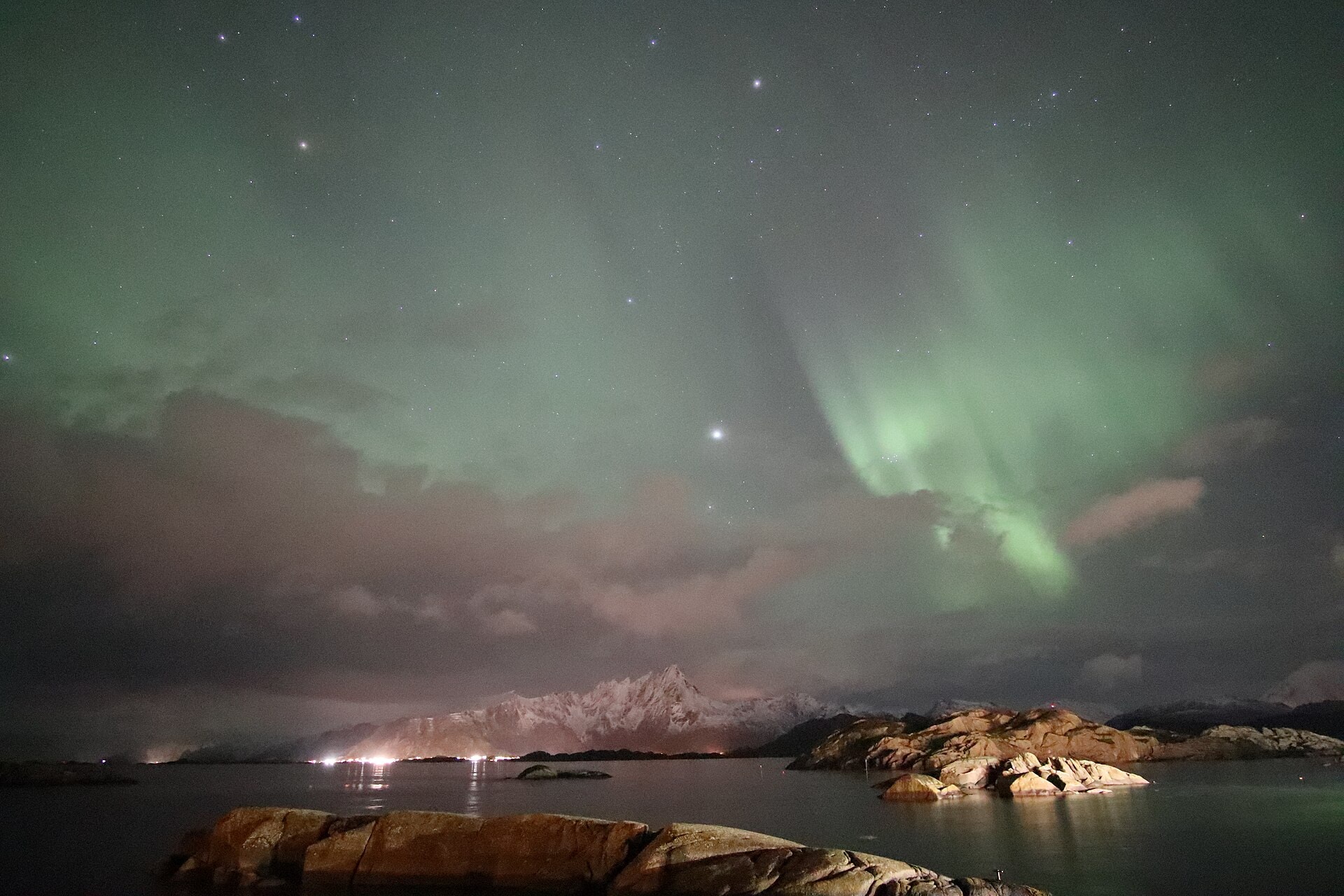
Picture this: you’re standing in total darkness on a snow-covered beach, an icy wind blowing in off the ocean and creeping deep under your jacket, and yet you can’t tear your eyes away from the sky. Above the majestic mountain peaks, green and pink ribbons of light have just begun to ripple, dancing like a celestial curtain. The northern lights, or Aurora Borealis, are quite simply one of the most beautiful natural spectacles our planet has to offer. Thanks to its position high above the Arctic Circle and its dramatic scenery, Norway’s Lofoten archipelago ranks among the very best and most photogenic places in the world to witness this phenomenon. In this detailed guide you’ll find everything you need to know — exactly 7 things that will maximise your chances of a successful hunt. You’ll learn when the main season is, which specific spots deliver the best photographs, how to read the Norwegian weather forecasts correctly, and how to dress, because the Arctic winter can be unforgiving. I’ll also help you with camera settings and finding your way around mobile apps, so you don’t miss even the faintest flicker of green beauty.
TL;DR
- When to go: The official northern lights season runs from late September to mid-April, when the far north is dark enough.
- Best time of day: Statistically, the strongest activity tends to appear between 10 pm and 2 am.
- Top photography spots: The most rewarding scenery is at the Uttakleiv, Gimsøy and Eggum beaches and the famous bridge in the village of Hamnøy.
- Weather is absolutely key: You can have extreme solar activity, but through thick clouds you’ll see nothing at all, so weather always takes priority over the KP index.
- Must-have apps: Download the Norwegian yr.no app for accurate weather and any Aurora app for activity notifications.
- Essential gear: To get a sharp photo you’ll need a sturdy tripod and a huge amount of patience, because the cold really does get into your bones.
- Rough prices: In 2026, expect a week’s car hire with studded tyres to cost around 8,000 NOK (roughly £600).
The full destination guide: Lofoten — guide and what to see
7 things you must know about the northern lights in Lofoten
Lofoten sits within the so-called auroral oval. This means your chances of seeing the northern lights here are enormous even when solar activity is very low. Hunting the aurora, though, isn’t just about glancing out of the window of a cosy cabin and snapping a quick photo on your phone. It takes meticulous planning, a willingness to freeze outdoors and the ability to react quickly to changes. Let’s look at 7 key tips that will prepare you for a night-time adventure and ensure you take home the most beautiful memories and photographs.
1. When the main season is and what time to head out
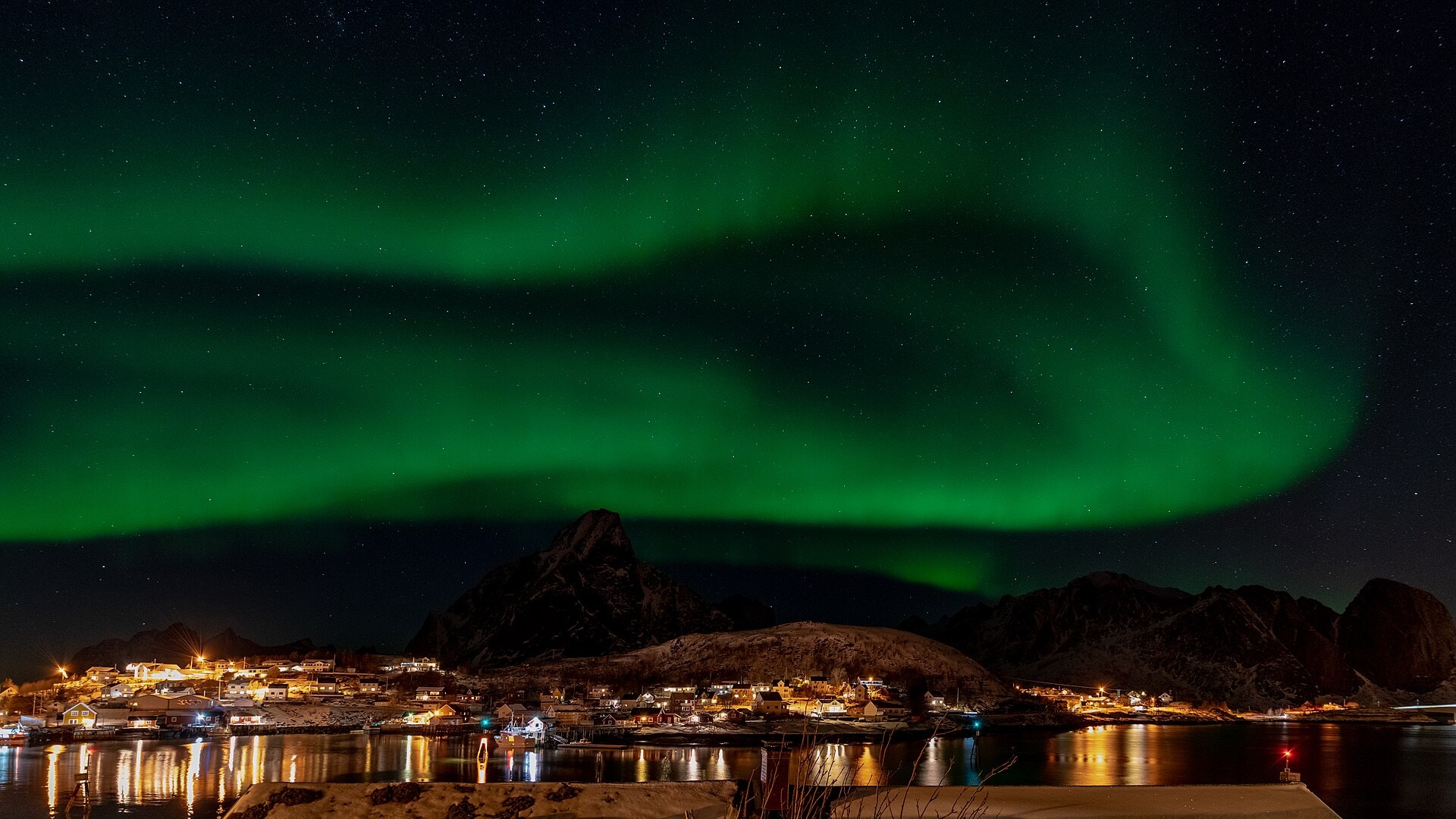
Although the sun spews particles into space all year round and the northern lights are theoretically glowing constantly, to see them with your own eyes you need absolute darkness. And in northern Norway that’s simply missing in summer. During the summer months Lofoten basks under the midnight sun, which means the main hunting season only begins in late September and ends in mid-April. If you arrive in July you’ll enjoy beautiful hikes, but there won’t be a trace of green sky.
If you want the best photographic conditions, consider months like October, February or March, when the weather tends to be statistically a touch more stable than in dark, rainy December. In late winter the landscape is also blanketed in deep snow, which beautifully reflects the residual light and lends photos an unreal atmosphere. Autumn, on the other hand, has the advantage of unfrozen lakes and fjords, on whose surface the aurora is perfectly mirrored.
As for the time of day, you obviously can’t plan it down to the minute, but the highest activity usually appears between 10 pm and 2 am. Sometimes the green beauty shows up as early as 6 pm, and other times you’ll wait in vain until the early morning. Patience is an absolute must when hunting the aurora, and it’s worth sacrificing a bit of sleep, because nature does exactly as it pleases.
💡 Tip: Rest plenty during the day and shift your body clock towards a nocturnal rhythm so you’re not exhausted in the first few days of your holiday and have the energy for all-night waiting.
2. The five most beautiful viewing spots
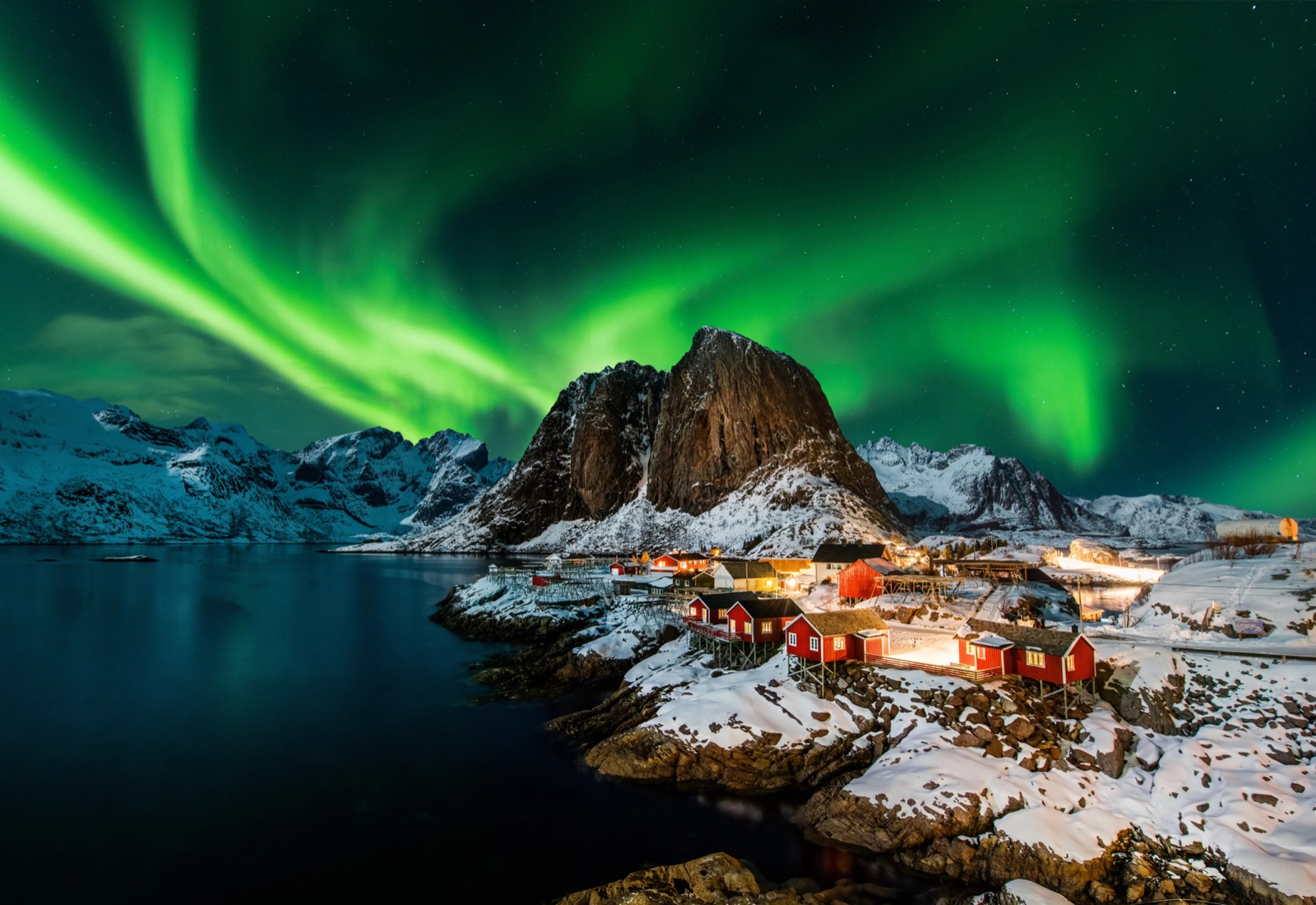
Lofoten is incredibly photogenic in itself, but for the perfect experience you need a view of the northern sky without significant light pollution. An absolute classic is the famous bridge at Hamnøy, where you can photograph the iconic red rorbu fishing cabins with the majestic Festvågtind mountain in the background. This spot is so popular among photographers that you probably won’t be alone at night — but the result is well worth it.
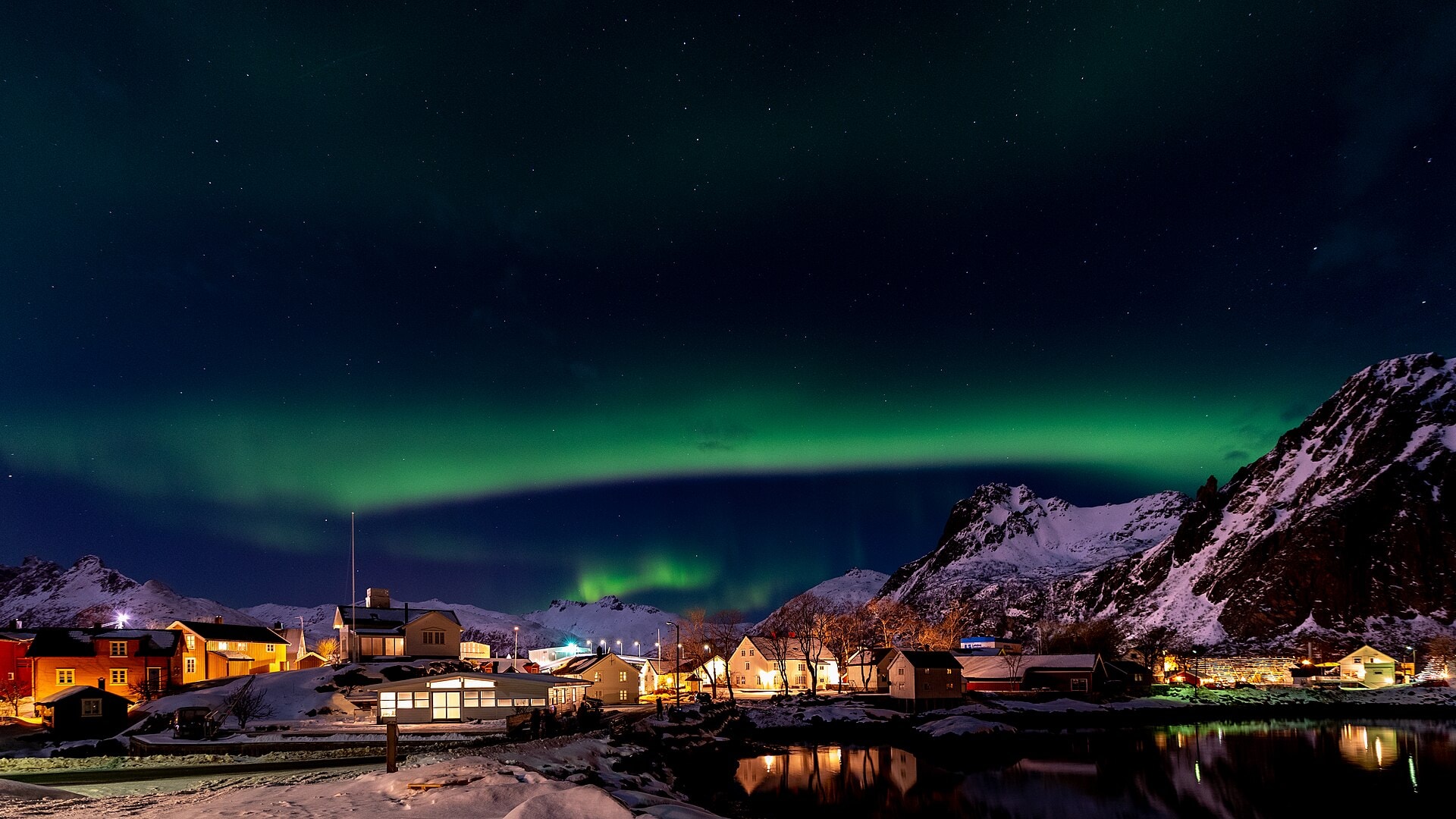
Just a stone’s throw away lies the picturesque village of Reine, which offers breathtaking scenery and bays that mirror the green light. Here, though, you need to watch out more for street lighting, which can blow out your photo. Try to find a darker nook on the edge of the village or move along to the nearby viewpoints by the E10 road.
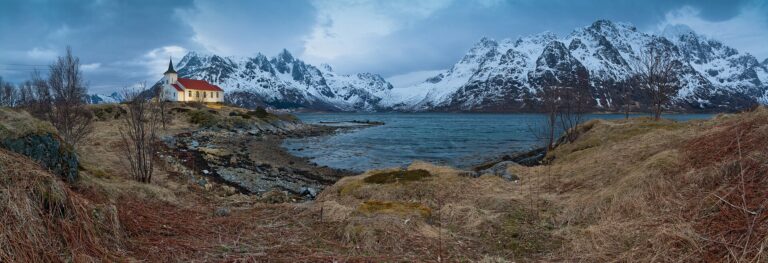
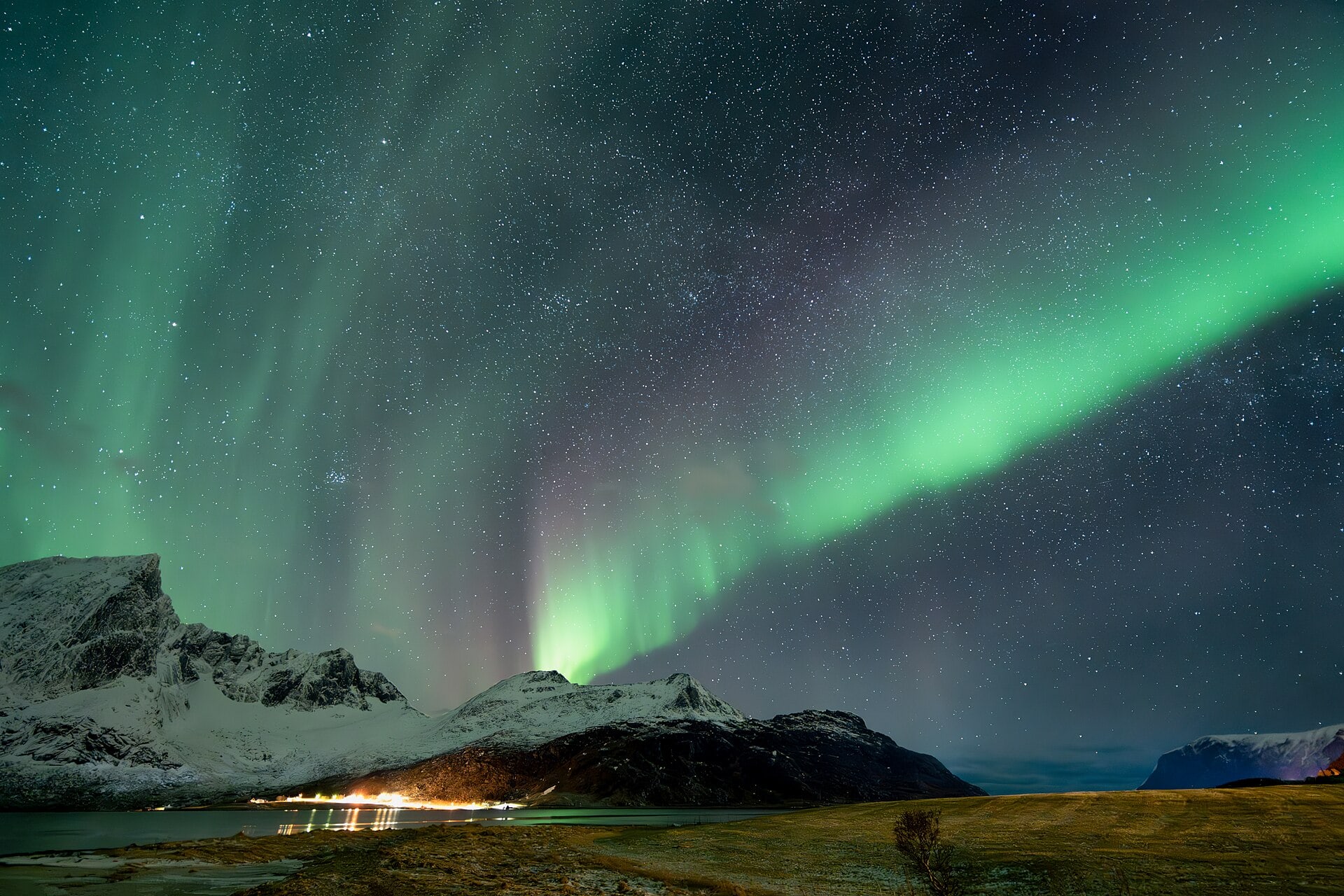
If you want to escape civilisation and enjoy the aurora in complete silence, head for the beaches on the northern side of the islands. Uttakleiv beach is legendary among northern lights hunters thanks to its rounded boulders and dramatic waves, which look absolutely fantastic in the foreground of a photo. Here you’ll have the northern horizon open right in front of you.
Another great spot is the rocky coastline of Eggum, where you’ll find a wide open horizon and minimal light pollution, allowing you to watch the aurora from its very first faint flickers just above the sea. And we mustn’t forget the island of Gimsøy, which is very flat and offers a 360-degree view, so you won’t miss a single corner of the night sky no matter where the activity is coming from.
💡 Tip: Before you head out for real at night, scout your chosen spots during the day so you know exactly where to safely set up your tripod and avoid unexpected holes or slippery rocks in the dark.
3. Weather and clear skies as the absolute foundation
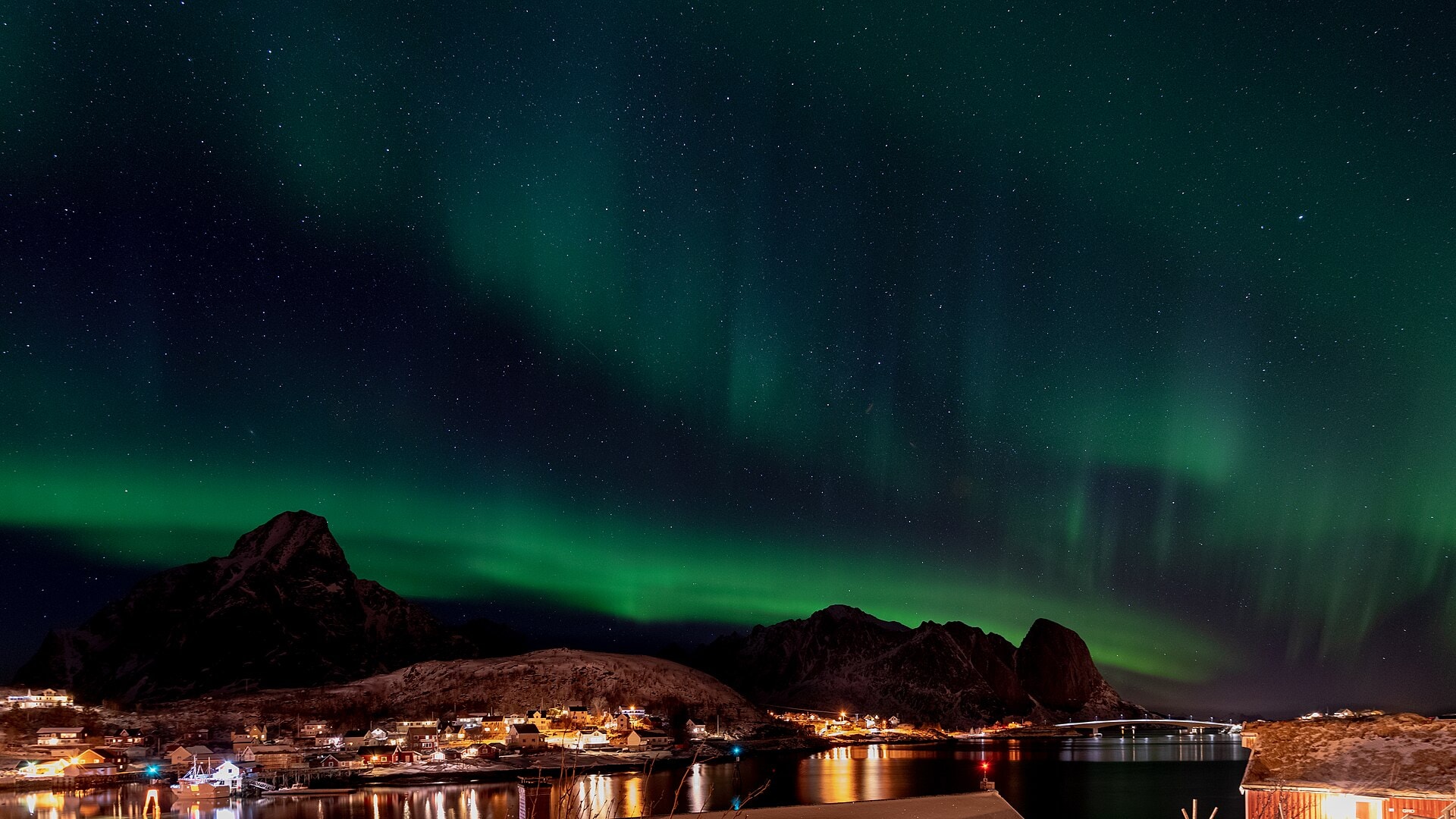
Many beginner hunters make one fundamental mistake: they only track solar activity and forget about the most important thing — the clouds. The northern lights occur roughly 100 kilometres above the Earth’s surface, so if it’s overcast you could have a historic storm overhead and still see absolutely nothing. The weather always takes priority over any aurora apps.
The weather in northern Norway is extremely changeable and shifts literally from minute to minute. Experiencing sunshine, heavy snow, fog and a strong icy wind all in a single afternoon is completely standard, and it mustn’t throw you. The locals like to say that if you don’t like the current weather, just wait ten minutes.
Forget the usual global weather apps on your phone and download the Norwegian yr.no, which the locals absolutely swear by. It works incredibly precisely, and you should mainly watch the cloud cover map and the short-term forecasts for the coming hours. Focus on the radar images, which show you where the clouds are moving.
Sometimes all it takes is to drive twenty kilometres over a hill and you’ll discover a completely clear sky, even when it’s pouring with rain over your accommodation. Thanks to its steep mountains and deep fjords, Lofoten has plenty of microclimates. Planning whole days ahead really doesn’t work here — you plan at most a few hours in advance.
💡 Tip: Stay flexible and be ready to jump straight into the car and chase a gap in the clouds the moment the radar in the yr.no app shows a promising break.
4. How to read the forecast and the KP index
Once you’ve got clear skies overhead, it’s time to track the auroral activity itself using special mobile apps. The best-known and most talked-about indicator is the so-called KP index, measured on a scale from zero to nine. The higher the number, the stronger the geomagnetic storm in progress. The same applies if you’re keeping an eye on the northern lights forecast back home in the UK on a stormy night.
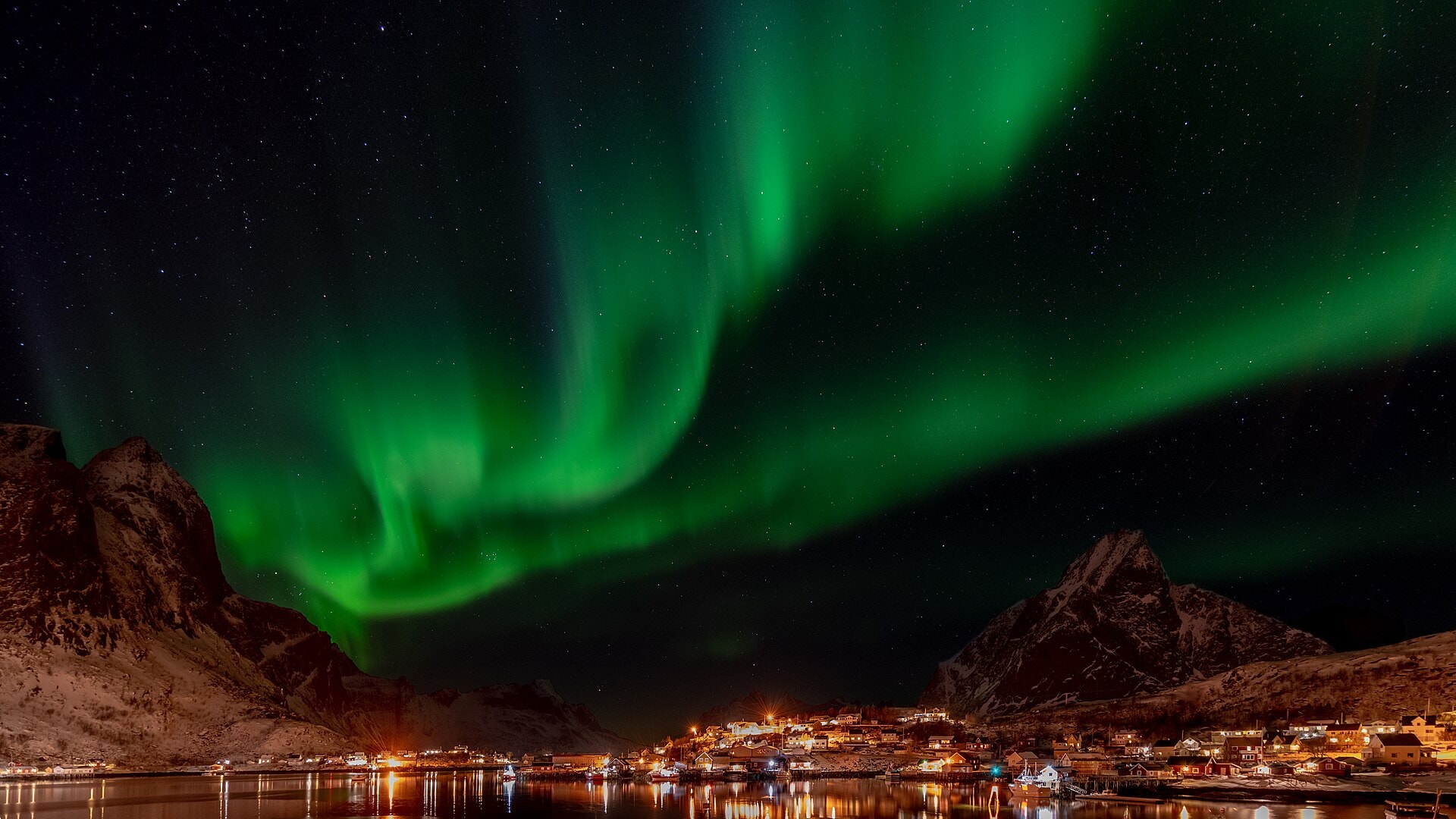
While in central and southern parts of Europe you need extreme values around KP 7 or 8 to see anything, in Lofoten a humble KP 1 or 2 is plenty thanks to its far northern position. If the app reports KP 3 or 4 up here, you’re probably in for an incredible show full of dancing green and pink ribbons that light up the whole landscape.
Your phone definitely shouldn’t be without an app like My Aurora Forecast or Aurora Alerts, which send you a notification when the chance of seeing the aurora in your location rises significantly. These apps gather data directly from satellites and can forecast the next hour fairly accurately.
It’s also important to watch the Bz parameter (which should be in negative values) and the speed of the solar wind — indicators that often tell experienced hunters far more than the KP index alone. If the solar wind is fast and dense, the aurora will be far more dynamic.
Don’t be put off, though, if the apps aren’t showing ideal numbers. Nature often surprises you, and the northern lights can appear out of nowhere even when the graphs look utterly hopeless.
💡 Tip: Don’t fix your eyes only on a phone screen full of graphs. Tuck it deep into your pocket now and then and simply look at the northern horizon — your eyes also need to adjust to the dark so they can pick out a fainter aurora.
5. How to photograph the northern lights on a phone or DSLR
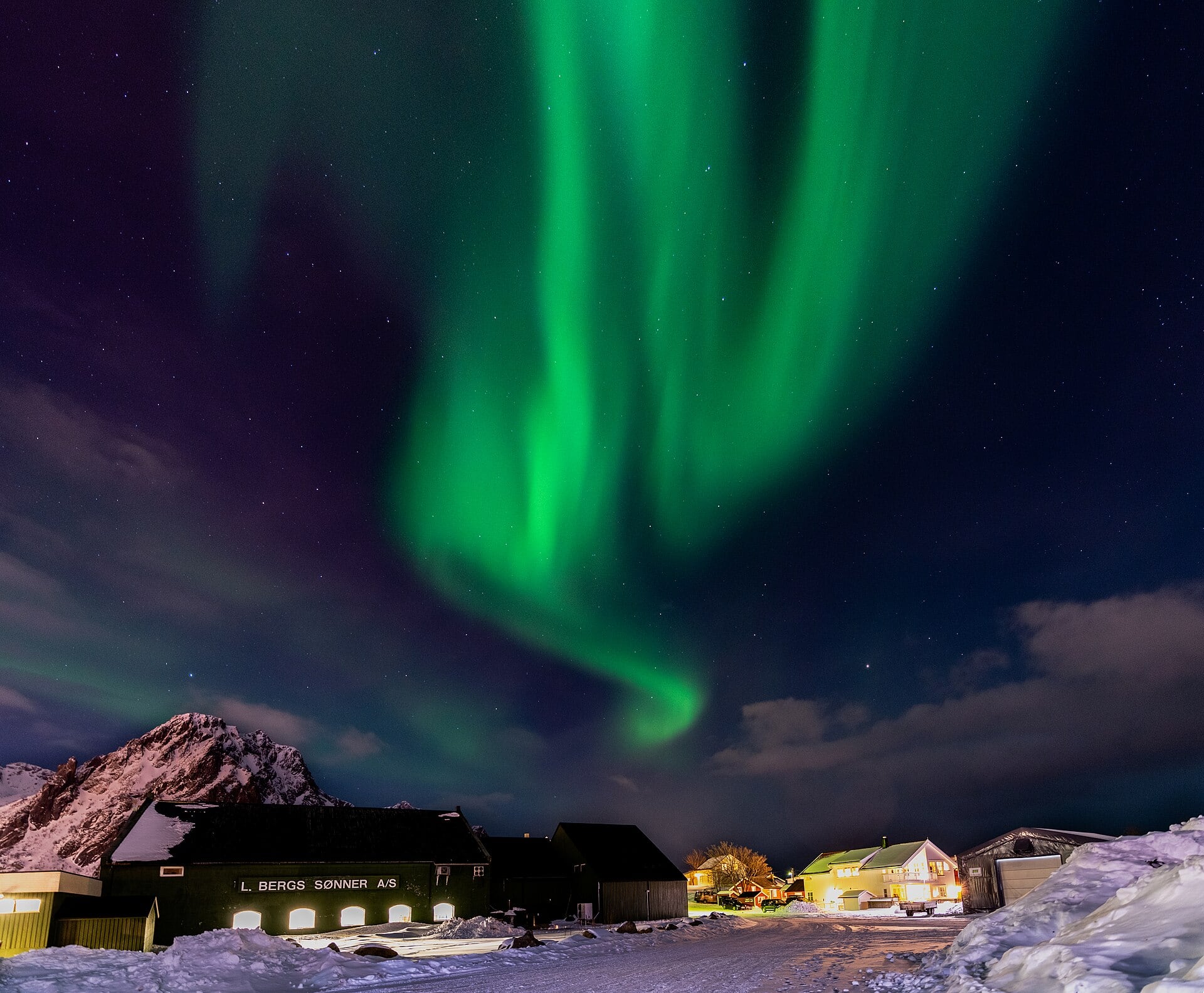
Once the spectacle finally erupts, you’ll naturally want to capture it as a keepsake. To photograph the northern lights successfully you absolutely need a good tripod, because you’ll be shooting long exposures, and the slightest movement of your hand would ruin the shot irreparably.
If you’re shooting with a DSLR or a modern mirrorless camera, switch to full manual mode. Set the aperture as wide as possible (for example f/2.8 or f/1.4) to let the maximum amount of night light into the lens. Switch focusing to manual and focus to so-called infinity, ideally using a bright star in the sky.
Raise the ISO as needed to values between 1600 and 3200 and adjust the exposure time to how fast the aurora is moving. If the green ribbons are moving and dancing quickly, choose a shorter time of around 2 to 5 seconds so the colours and shapes don’t blur into one big uniform smudge. For a faint, static aurora, on the other hand, feel free to leave the shutter open for 15 to 20 seconds.
If you don’t have professional gear, don’t despair. Modern smartphones now have excellent night modes that can conjure up gorgeous images. Just rest the phone firmly against a rock, use the self-timer or place it on a small travel tripod and let the algorithms do their work.
💡 Tip: In the cold, batteries drain incredibly fast, so keep your spare camera batteries in an inner jacket pocket nice and close to your body so they stay warm and don’t die before the main event begins.
6. What to pack for a night hunt
Waiting for the northern lights means long hours of standing in a freezing wind, and very often in deep snow too. The right clothing therefore decides whether you’ll enjoy this unique experience with a smile on your face or suffer through it with chattering teeth and flee back to the car.
The key to survival is thorough layering, and for your base layer choose nothing but quality merino wool. It wicks moisture brilliantly and keeps you warm even if you sweat a little on a shorter climb to a viewpoint with a heavy backpack. Steer well clear of cotton, because as soon as it gets damp it starts to chill you unpleasantly.
Over the merino, throw on a warm fleece jumper or a thick woollen hoodie, and on top of that a proper down jacket that will reliably protect you from the icy ocean wind. For your legs you’ll want thick insulated trousers, or even ski salopettes, with warm thermal underwear underneath — don’t forget that.
An absolute necessity is two pairs of warm socks, waterproof winter boots with a firm, thick sole and, of course, quality mittens. If you plan to shoot photos and constantly adjust your camera settings, get a special pair of photography gloves where you can comfortably flip back just the fingertips.
💡 Tip: Always pack a large flask of hot tea and a few chemical hand warmers in your backpack — you snap them to activate and slip them into your pockets. In the Arctic winter they’re an absolute lifesaver when your fingers finally refuse to cooperate 😅.
7. Hiring a car and night-time drives along the E10
To be mobile enough during the hunt and able to dodge the clouds effectively, you can’t manage in Lofoten without a hire car. Public transport at night is practically non-existent, and relying solely on the aurora coming to you would mean a huge risk of seeing nothing at all.
Fortunately, in the winter months all cars from Norwegian rental companies are automatically fitted with quality studded tyres, which grip surprisingly well on icy roads. Driving on studs is a little noisier, but it gives you the confidence you need on packed snow.
The main artery, the narrow and winding E10 road, tends to be reasonably well maintained and regularly ploughed, but bear in mind that the turn-offs to smaller, remote beaches can be heavily snowed-in and very slippery. So drive with maximum care, don’t overestimate your abilities and keep genuinely safe distances. Remember that in Norway you drive on the right.
During night-time drives, watch out carefully for unexpected wildlife or other hunters and photographers, who occasionally appear right on the verge, dressed in dark clothing and staring up at the sky. Use your full beams sensibly so you don’t dazzle oncoming cars or people with their cameras set up.
If you want to hire a car, expect that prices in Norway are traditionally very high and you need to book well in advance. Try various trusted comparison sites, because once you’re on the spot you almost certainly won’t find a cheaper option and you’ll end up paying needlessly over the odds.
💡 Tip: During a night hunt, never park on blind bends, narrow bridges or private driveways — the locals take a very dim view of it. Always find an official lay-by or a ploughed pull-in.

A practical summary and rough prices
Norway is not generally a cheap destination, and Lofoten is certainly no exception in this respect. So that you can plan your winter trip better and not blow your family budget the moment you land, I’ve put together some rough prices to expect in 2026.
- Renting a classic rorbu (fishing cabin): During the winter season prices hover around 1,800 to 2,500 NOK per night (roughly £135–£190), depending heavily on the specific location and how well equipped the cabin is.
- Hiring a small car for a week: In winter, with the mandatory studs, a reliable rental car will cost you around 8,000 to 10,000 NOK (roughly £600–£750).
- A litre of petrol: Fuel prices in Norway stay consistently very high — reckon on around 22 to 24 NOK per litre (roughly £1.65–£1.80).
- A supermarket shop: The cheapest places to shop are the Rema 1000 and Kiwi chains. A basic shop for two for one day (pasta, cheese, bread) comes to around 300 NOK (roughly £23).
- Dinner in a restaurant: A plain pizza or a veggie burger with chips costs about 250 to 350 NOK (roughly £19–£27). Local specialities, such as traditional dried cod (stockfish) dishes or fresh salmon, can be noticeably more expensive again.
- A coffee in a café: You can warm up with a popular cappuccino for around 50 to 60 NOK (roughly £4–£4.50).
- Entry fees and excursions: Organised fjord boat trips or evening guided tours (which you can book via GetYourGuide, for example) commonly range from 1,000 to 2,500 NOK per person.
💡 Accommodation and experience tip: We like to look for our stays on Booking.com, where the cancellation conditions tend to be the best. Tickets, trips and activities are then worth comparing and booking through GetYourGuide.
Where to next
If you’ve already got a clear idea of how and where to hunt the northern lights, take a look at our other articles packed with useful information that will make planning your whole Norwegian expedition much easier.
- The big Lofoten guide: what to see and do – a complete overview of the most beautiful spots and treks you mustn’t miss.
- Lofoten in winter: practical advice and tips – how to survive the cold safely, what else there is to experience besides the aurora, and how to handle driving on snow.
- When to visit Lofoten – a detailed breakdown of individual months, seasons and weather throughout the year.
- Iceland, Finland and Norway: how to catch the aurora – a big comparison of the best Nordic destinations for chasing the northern lights.
Frequently asked questions
Je vidět polární záře i přes mraky?
Bohužel ne. Polární záře vzniká vysoko v atmosféře, zhruba 100 kilometrů nad zemským povrchem. Pokud je obloha zatažená nízkou nebo střední oblačností, přes mraky žádné světlo neprosvitne, ani kdyby byla sluneční aktivita na maximu. Sledování oblačných radarů na aplikaci yr.no je proto mnohem důležitější než samotný KP index.
Kdy je největší šance vidět polární záři?
Na Lofotech trvá hlavní sezóna od konce září do poloviny dubna. Statisticky bývá obloha nejjasnější a počasí nejvíce stabilní během října a následně v únoru a březnu. Samotná denní doba pro pozorování je pak ideální v pozdních večerních hodinách, obvykle zhruba mezi desátou večerní a druhou hodinou ranní.
Potřebuji na focení profesionální fotoaparát?
Dnes už to rozhodně není nutnost. Nejnovější chytré telefony s pokročilým nočním režimem dokážou zachytit polární záři naprosto dokonale a v úžasných barvách. Stále však platí pravidlo, že k pořízení opravdu ostré fotky bezpodmínečně potřebujete pevný stativ, abyste zabránili jakémukoliv roztřesení obrazu během delší expozice.
Můžu jít lovit polární záři pěšky z ubytování?
Někdy se poštěstí a záře se v plné parádě ukáže přímo nad vaším rorbu. Mnohem častěji ale budete muset popojet autem na temnější místa, jako jsou odlehlé pláže Haukland nebo Uttakleiv, abyste utekli světelnému smogu z vesnic a pouličních lamp, který dokáže vizuální zážitek velmi výrazně utlumit.
Vyplatí se platit si organizovaný výlet s průvodcem?
Pokud se necítíte na noční řízení po namrzlých a úzkých silnicích, místní zkušení průvodci představují naprosto skvělou volbu. Mají detailní přehled o mikroklimatu, neustále komunikují s ostatními lovci vysílačkami a vědí naprosto přesně, do kterého fjordu se zrovna vydat za jasnou oblohou.
Jak moc velká zima mě při čekání čeká?
Teploty na Lofotech díky teplému Golfskému proudu málokdy padají hluboko pod -10 °C, pocitová teplota je ale kvůli ostrému arktickému větru od moře mnohem nižší. Dlouhé hodiny stání na jednom místě dokážou tělo rychle prochladit, takže kvalitní péřovka, dvoje rukavice a poctivá merino vlna jsou naprostou nutností.
Můžu si na Lofoty vzít celoroční pneumatiky?
V žádném případě to ani nezkoušejte. Norské zákony vyžadují odpovídající zimní obutí a všechna auta z místních půjčoven jsou automaticky vybavena speciálními pneumatikami s kovovými hroty. Silnice mohou být často pokryté silnou vrstvou čistého ledu, na které byste s běžnými pneumatikami okamžitě sjeli do nejbližšího příkopu.
Tips and Tricks for Your Vacation
Don’t Overpay for Flights
Search for flights on Kayak. It’s our favorite search engine because it scans the websites of all airlines and always finds the cheapest connection.
Book Your Accommodation Smartly
The best experiences we’ve had when looking for accommodation (from Alaska to Morocco) are with Booking.com, where hotels, apartments, and entire houses are usually the cheapest and most widely available.
 🚗 Car rental on the roadVerified rental cars in Norway
Search with the DiscoverCars comparison engine — it compares prices from dozens of local and international rental companies, and most bookings come with free cancellation.
Compare car prices in Norway →Don’t Forget Travel Insurance
Good travel insurance will protect you against illness, accidents, theft, or flight cancellations. We’ve had a few hospital visits abroad, so we know how important it is to have proper insurance arranged.
Where we insure ourselves: SafetyWing (simple monthly subscription) and TrueTraveller (for extra-long trips).
Find the Best Experiences
Get Your Guide is a huge online marketplace where you can book guided walks, trips, skip-the-line tickets, tours, and much more. We always find some extra fun there!