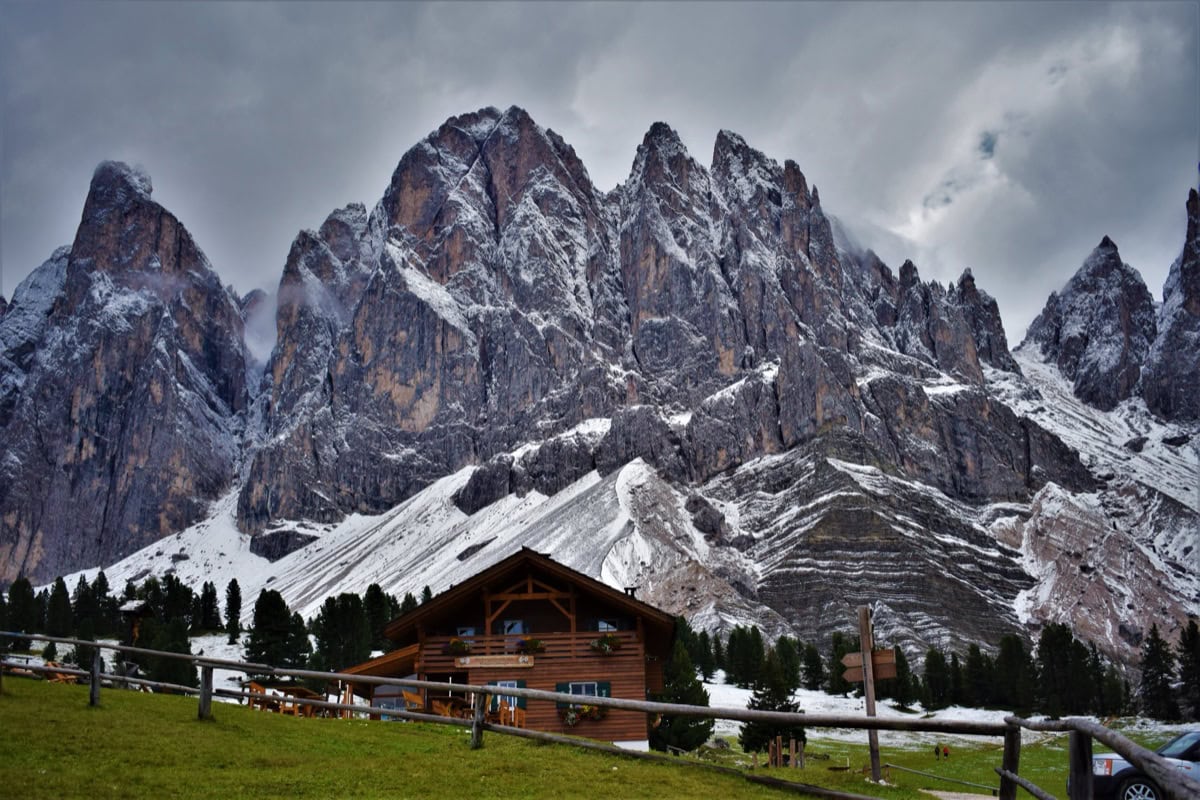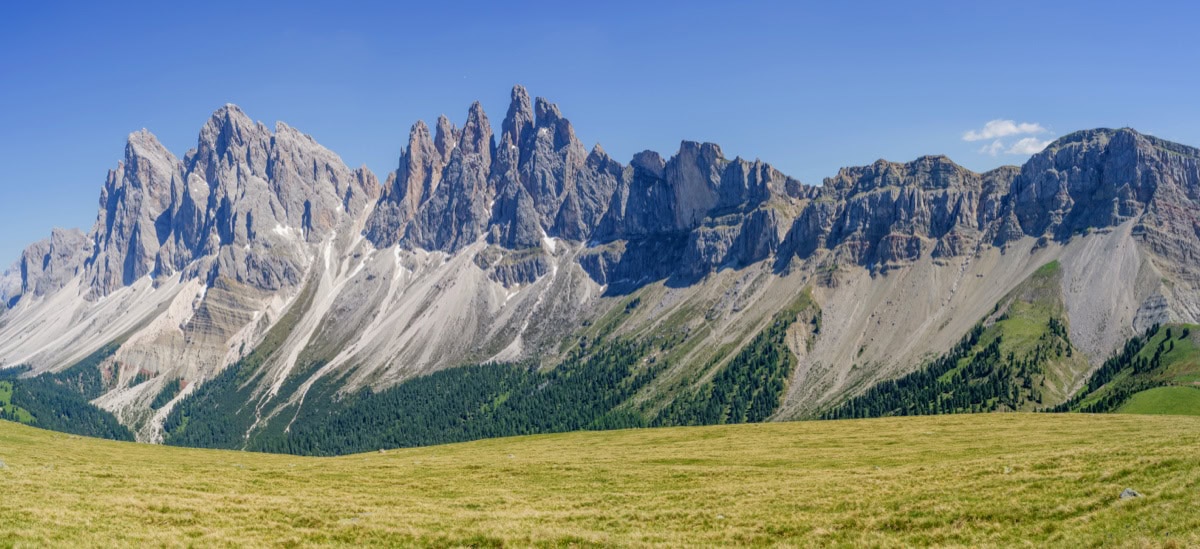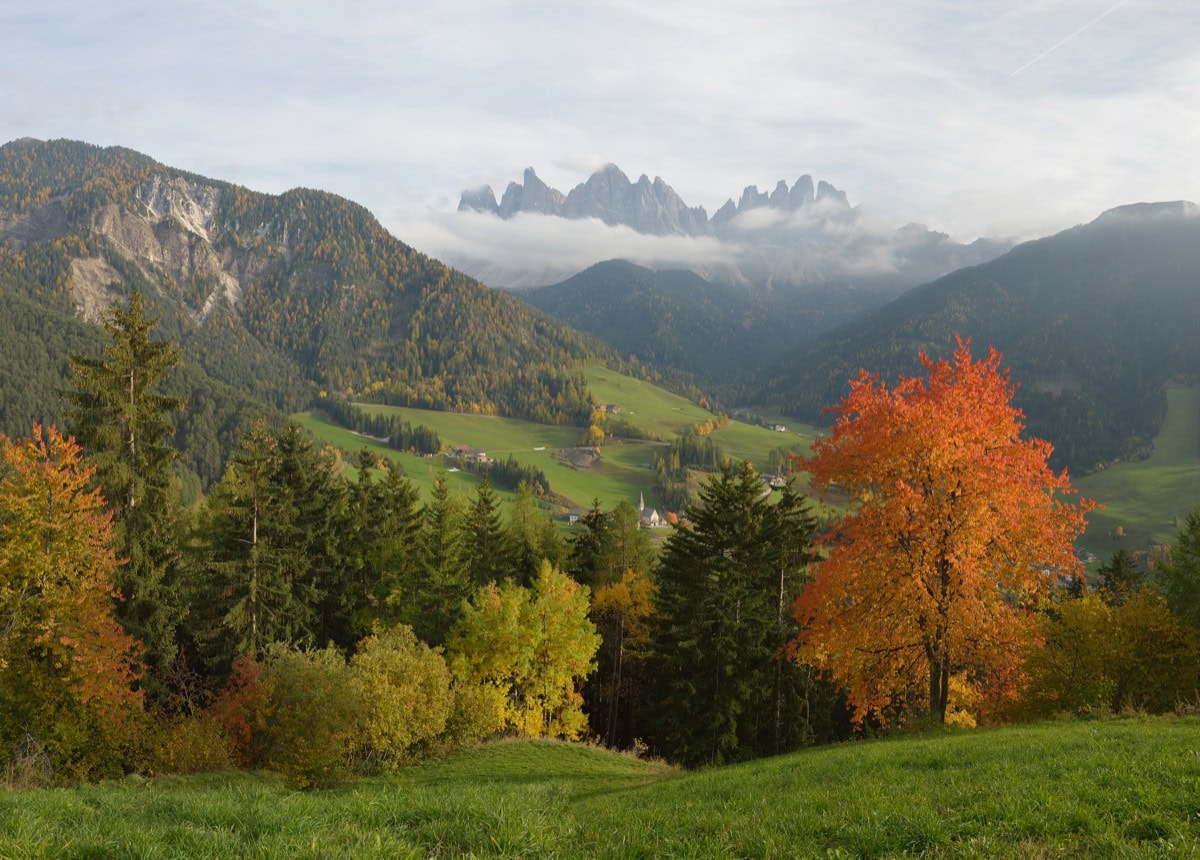
Lago di Sorapis, Dolomites Italy: 10 Tips on What to See and Do

TL;DRLago di Sorapis is a turquoise mountain lake in the Dolomites, sitting at 1,925 metres, reached by a popular hike from Passo Tre Croci along trail number 215 — roughly 8 kilometres there and back with about 220 metres of ascent, doable in 3 to 4 hours of walking. Along the way you’ll cross exposed sections with metal grating and steel cables above the drop, so this isn’t one for young kids, buggies, or larger or nervous dogs. Swimming and even dipping your feet in are strictly banned, as are drones (fines run up to €3,000). Late September into October is the sweet spot, or early mornings if you go in summer; the trail’s open roughly from June to the end of October, and parking at Passo Tre Croci can cost as much as €50 a day in season.

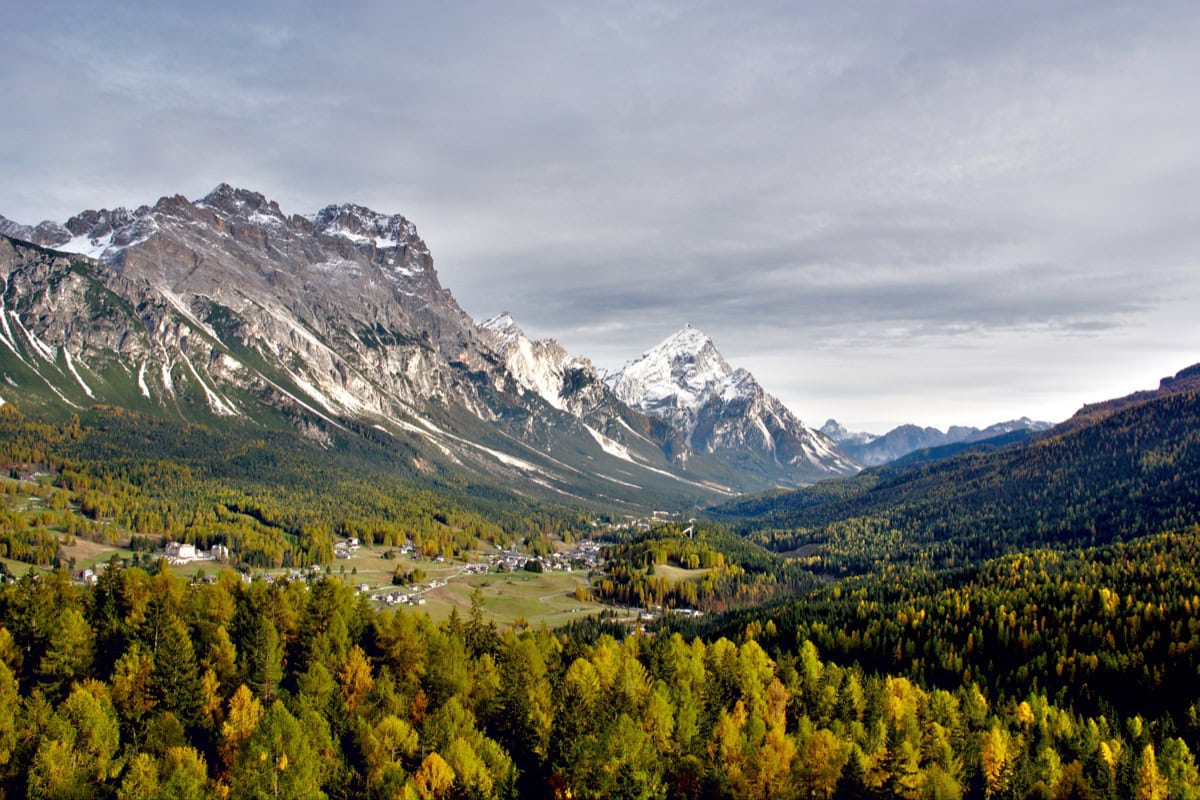
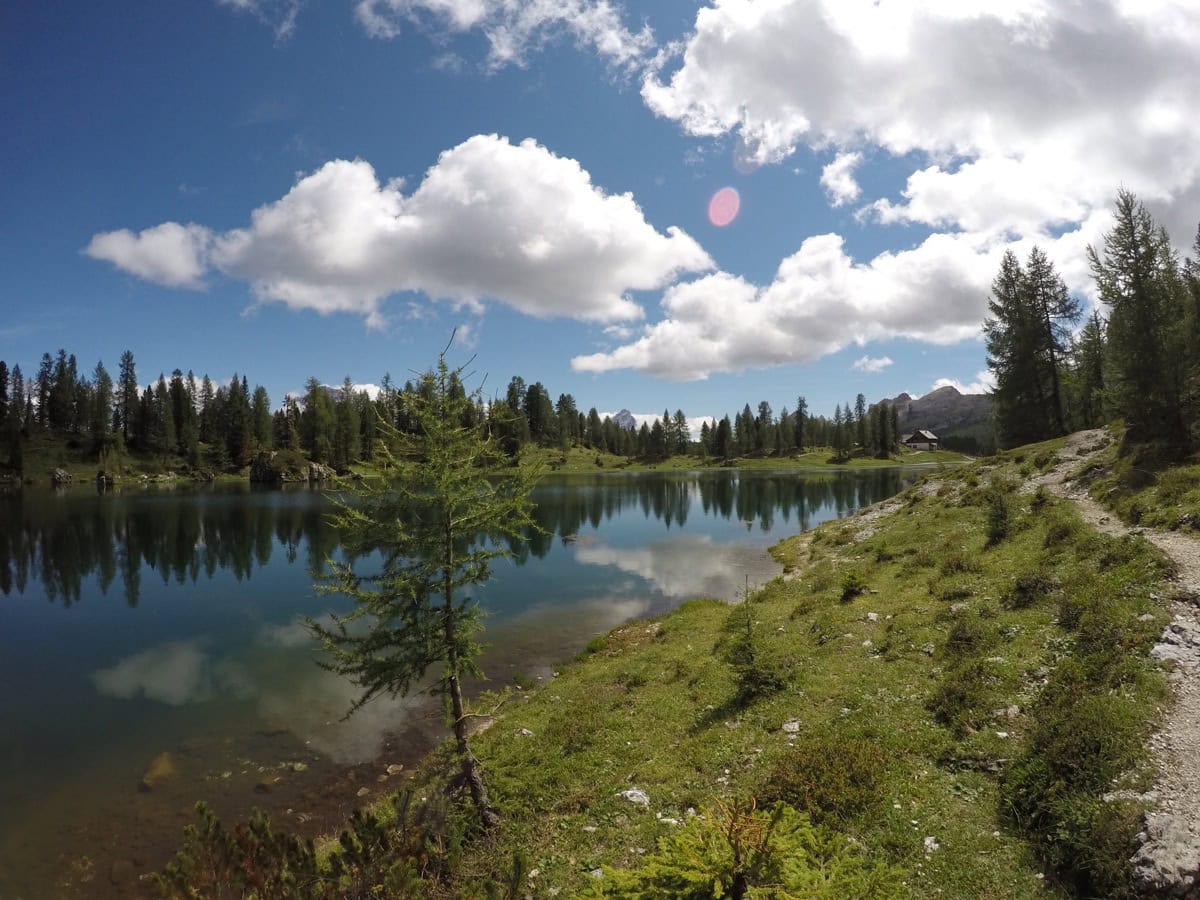
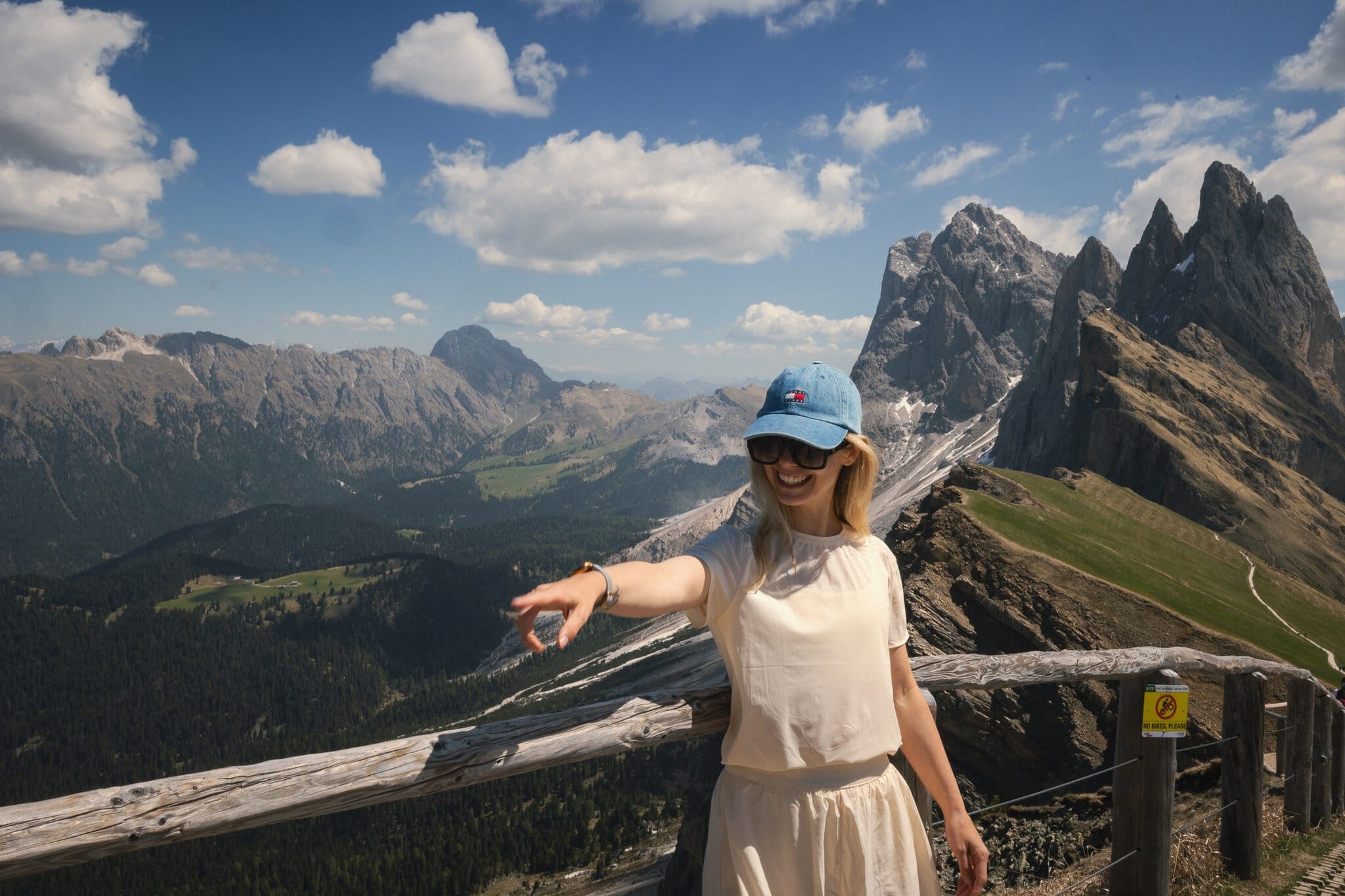
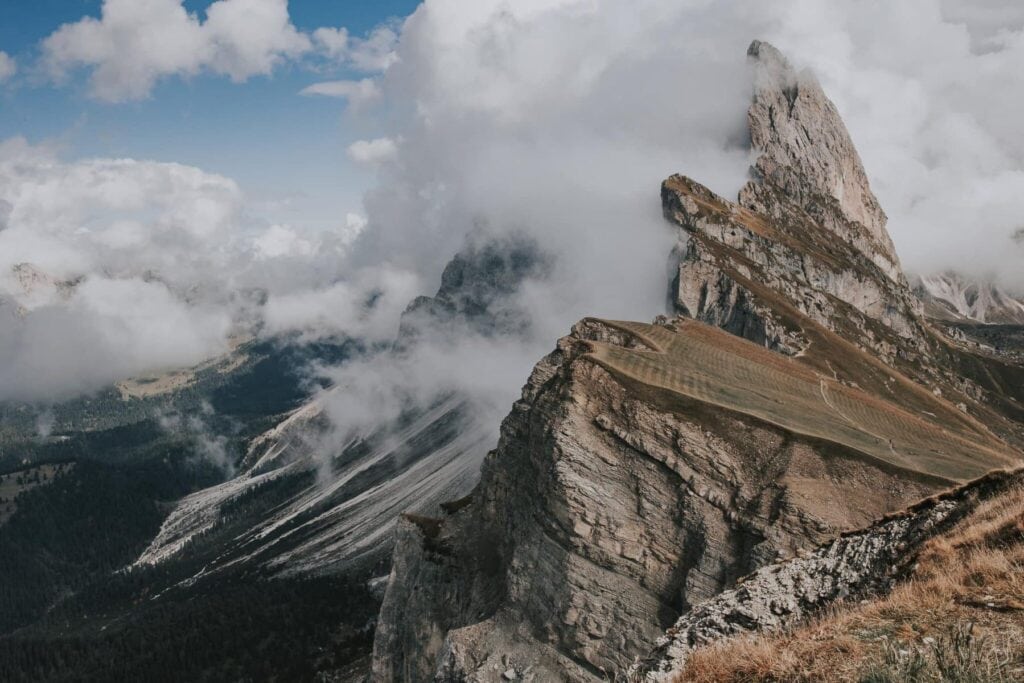
If you love mountains and you’re considering a trip to the Dolomites Italy, let me warn you — Lago di Sorapis is the kind of place that will ruin you for everywhere else. The Dolomites are pure paradise on earth, and once you visit, you’ll never want to go anywhere else. ☺️ Lukáš and I have been coming here for years, exploring every corner around Cortina, and this lake is one of those places you simply have to see with your own eyes. It’s one of our all-time favourite classics. When, after a few hours of uphill hiking and scrambling along rocky ledges, you finally emerge from the forest and catch your first glimpse of that impossibly vivid, milky turquoise water beneath the towering Sorapis massif, you completely forget how much your legs ache.

But before we dive into the details, I need to be upfront about one thing — don’t bring your dog on this hike. Some people do, but it’s really not a good trail for them. So I’ll tell you not only where to park and when to set off, but also why you need to think twice about this place if you’re travelling with children or four-legged companions.
TL;DR

If you’re already packing your rucksack and don’t have time to read the full article, here’s a quick cheat sheet — the absolute essentials you need before setting off.

  • Starting point: From Passo Tre Croci pass, just outside Cortina d’Ampezzo.
  • Difficulty and length: The trek (trail no. 215/401) is roughly 8 kilometres return, with about 220 metres of elevation gain, and takes around 3 to 4 hours of walking time.
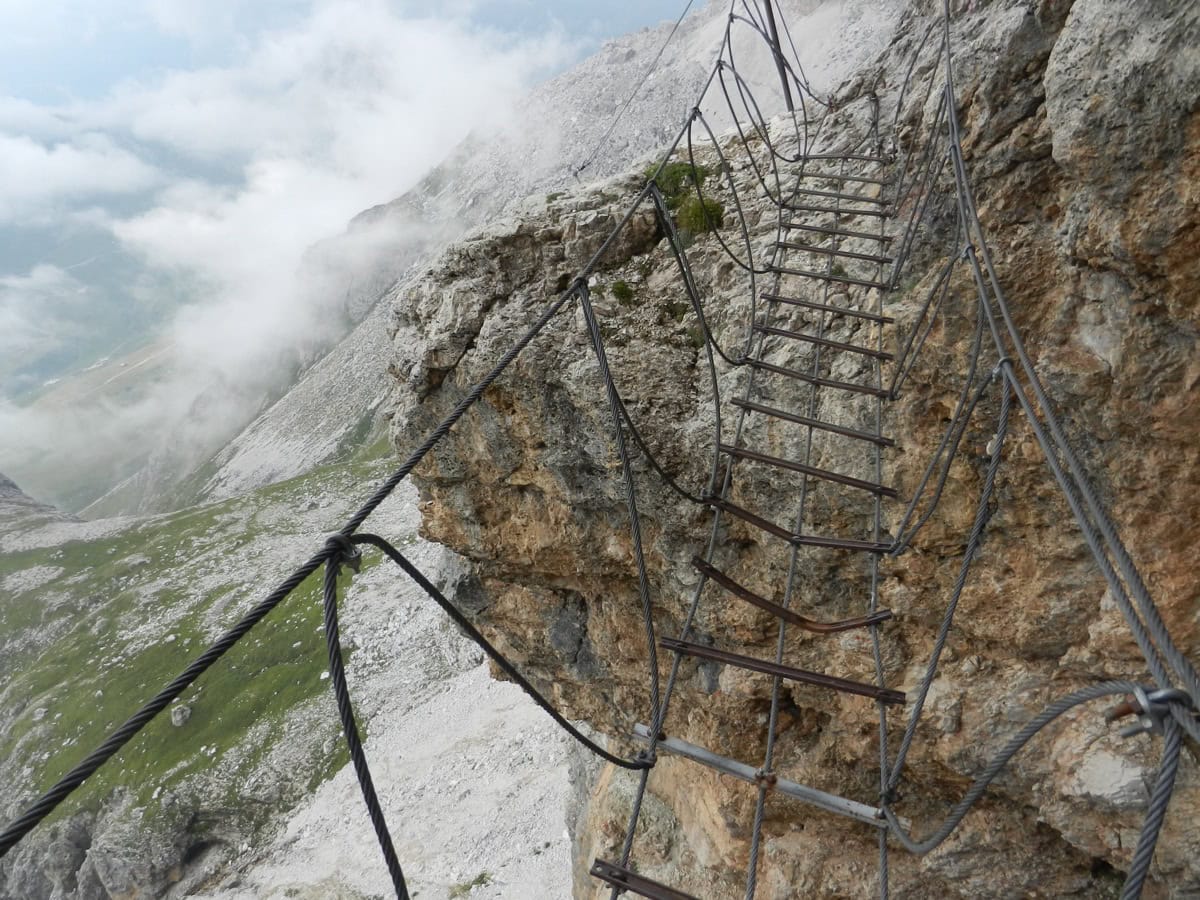
  • Biggest challenge: You’ll encounter sections secured with steel cables and, most notably, metal grated walkways bolted into the cliff face directly above a deep drop.
  • When to go: Late September to early October is ideal for the best light and fewer crowds; in summer, you really need to start very early in the morning.
  • Parking: Parking at Passo Tre Croci is a nightmare in season, with private car parks charging up to €50 per day. You’re much better off taking the bus from Cortina.
  • Who should avoid it: The trail is absolutely not suitable for pushchairs, small children, puppies, or larger clumsy dogs. Swimming in the lake is strictly prohibited.

What is Lago di Sorapis and Why is it So Incredibly Blue

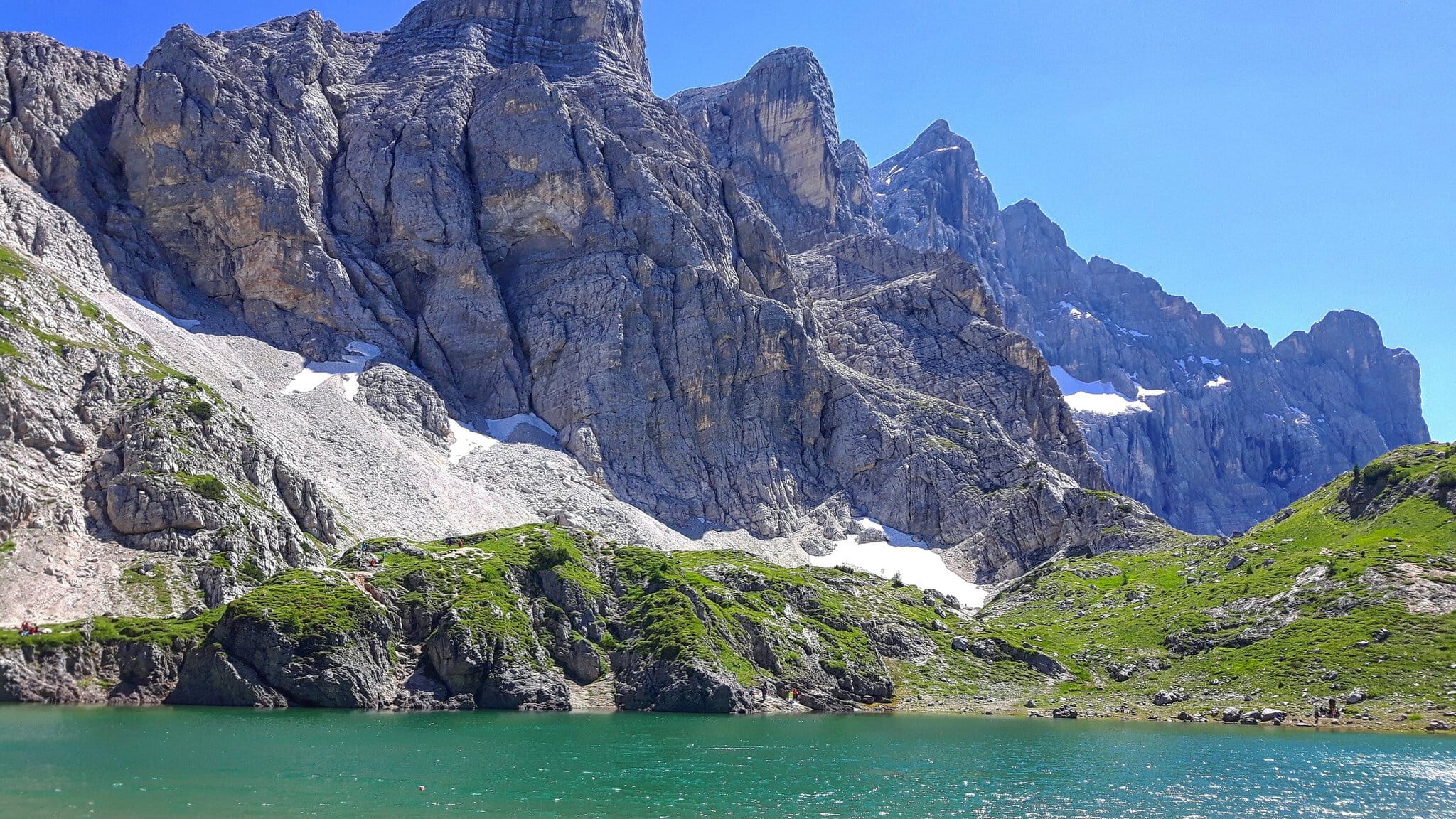
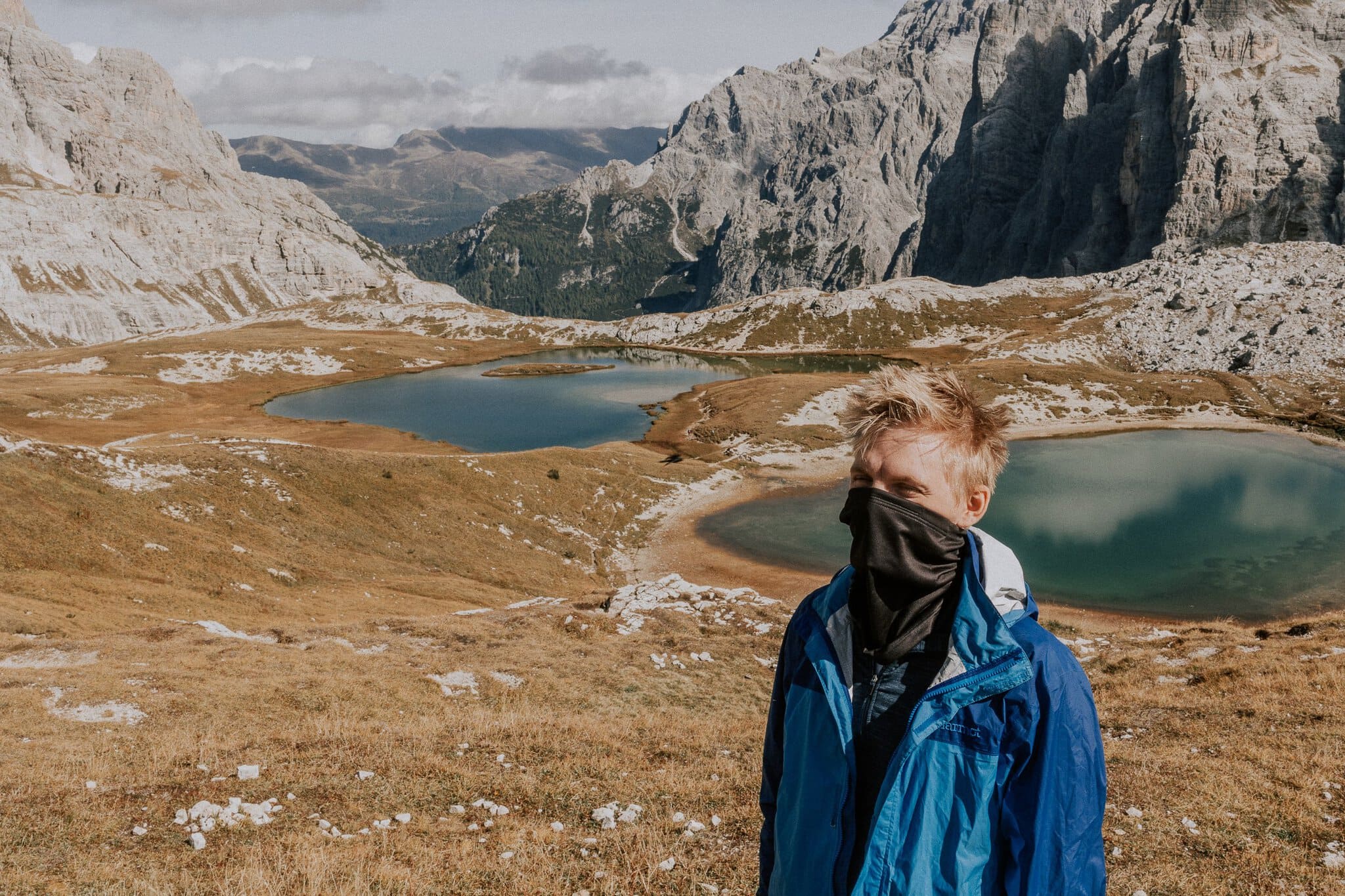
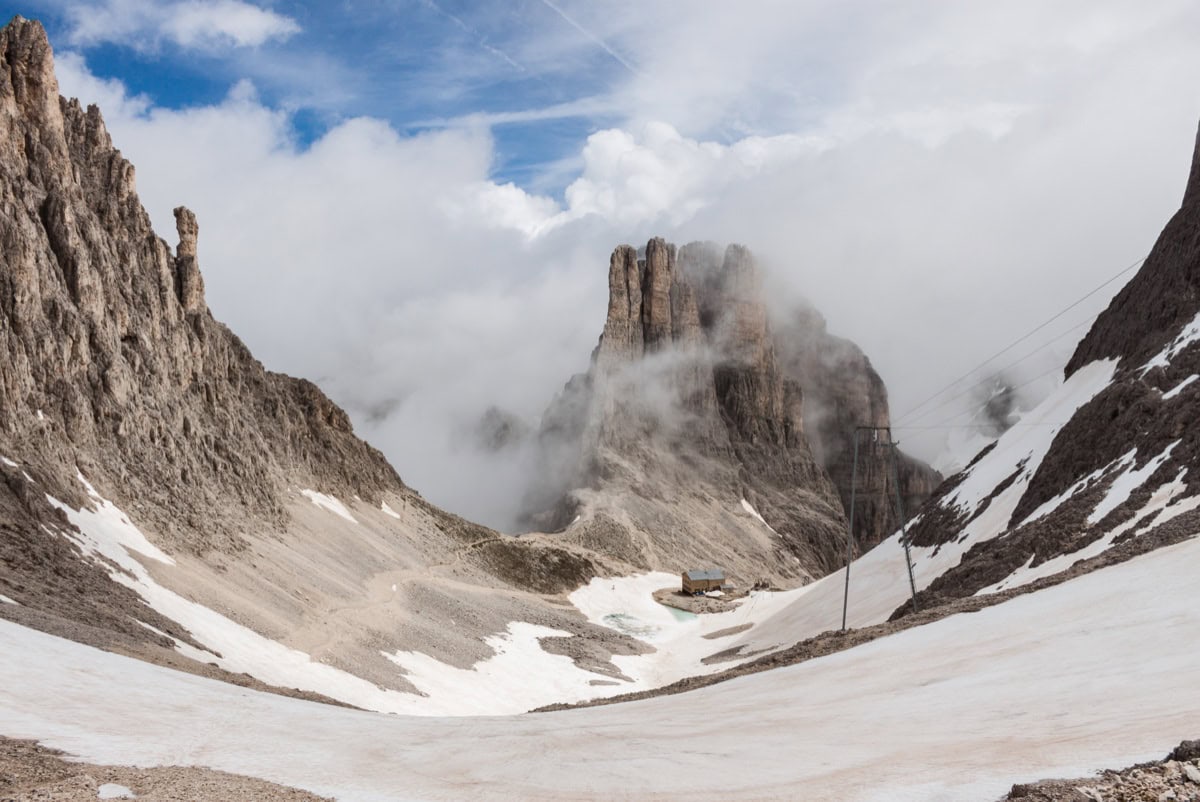
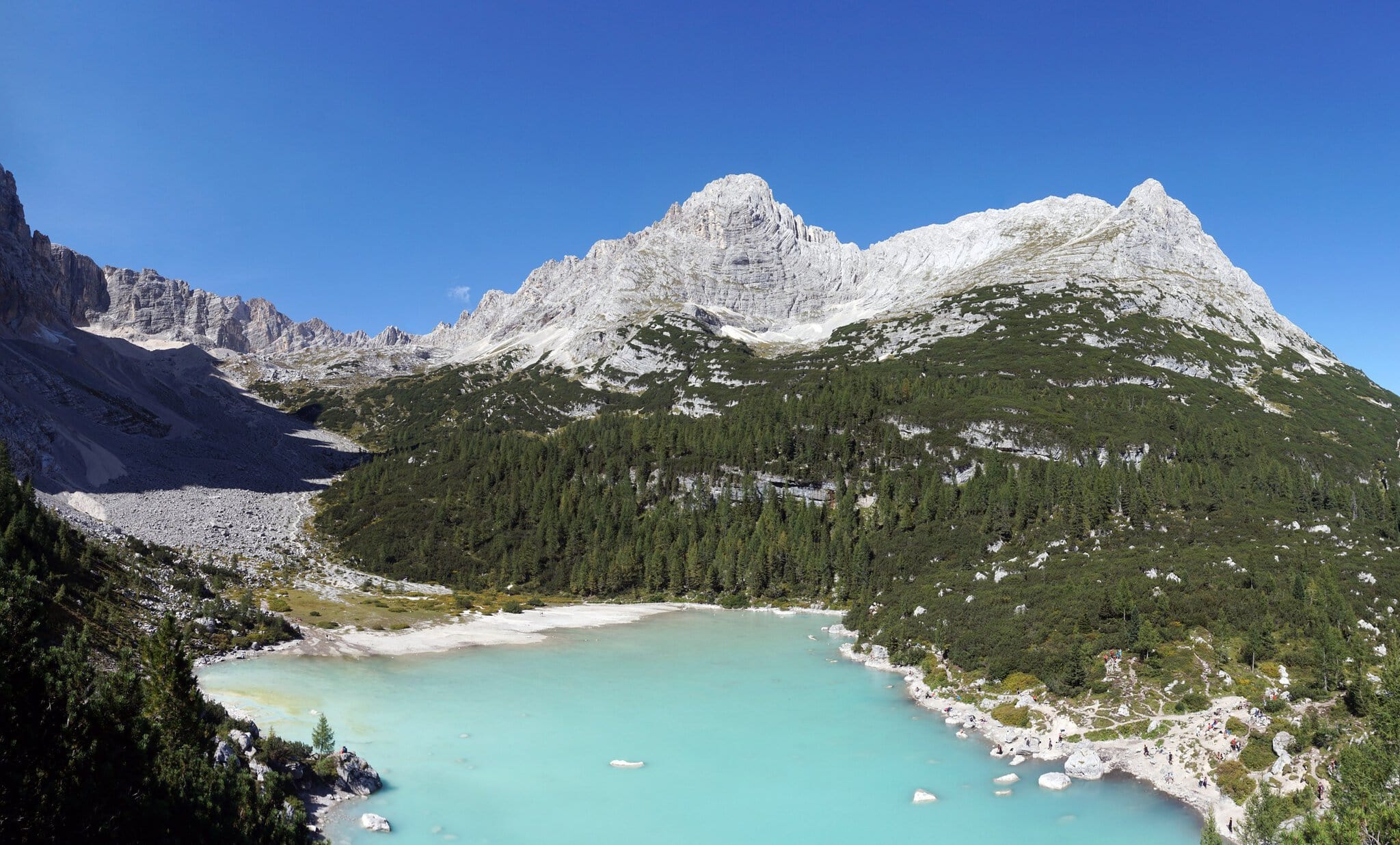
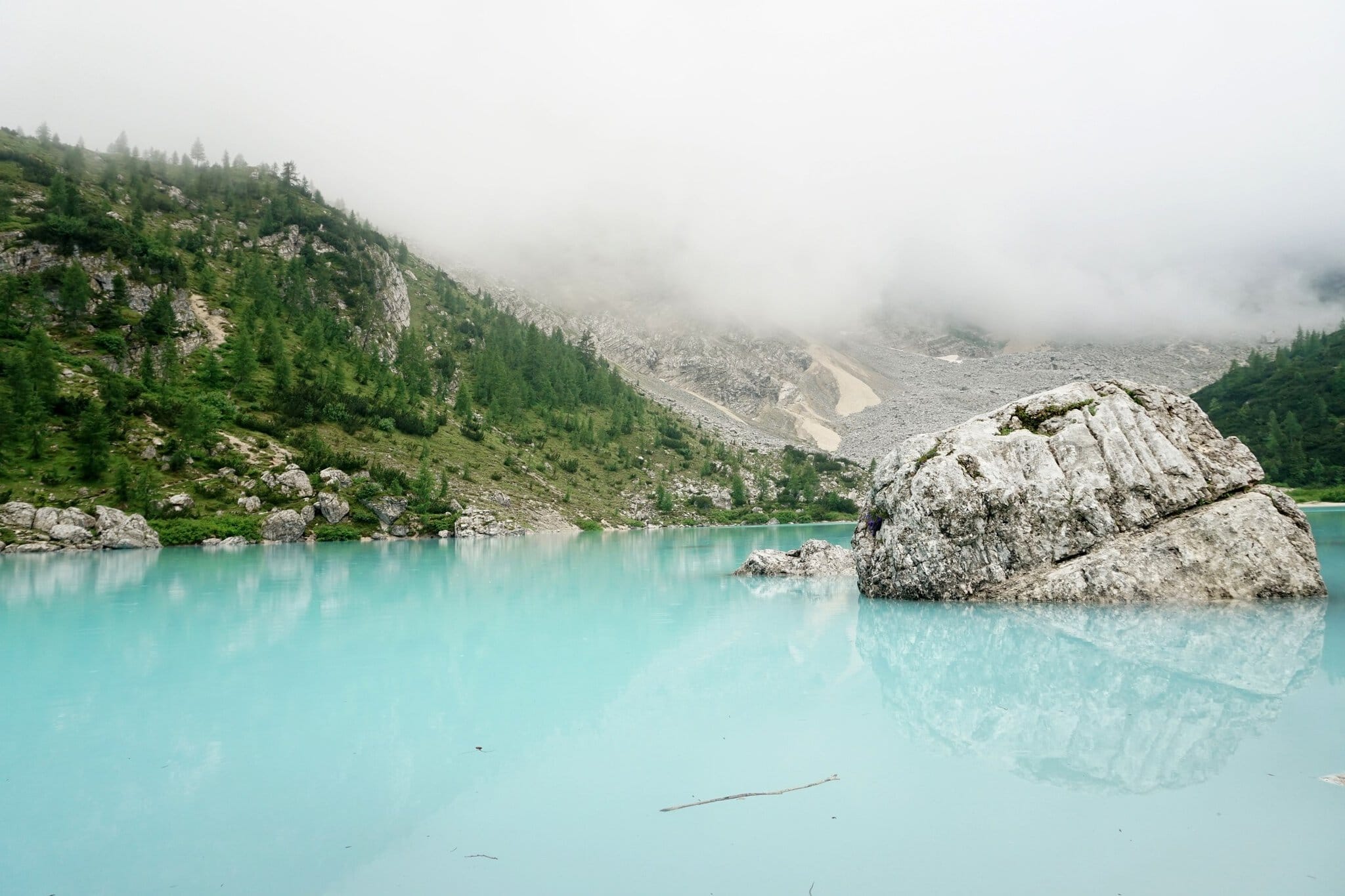
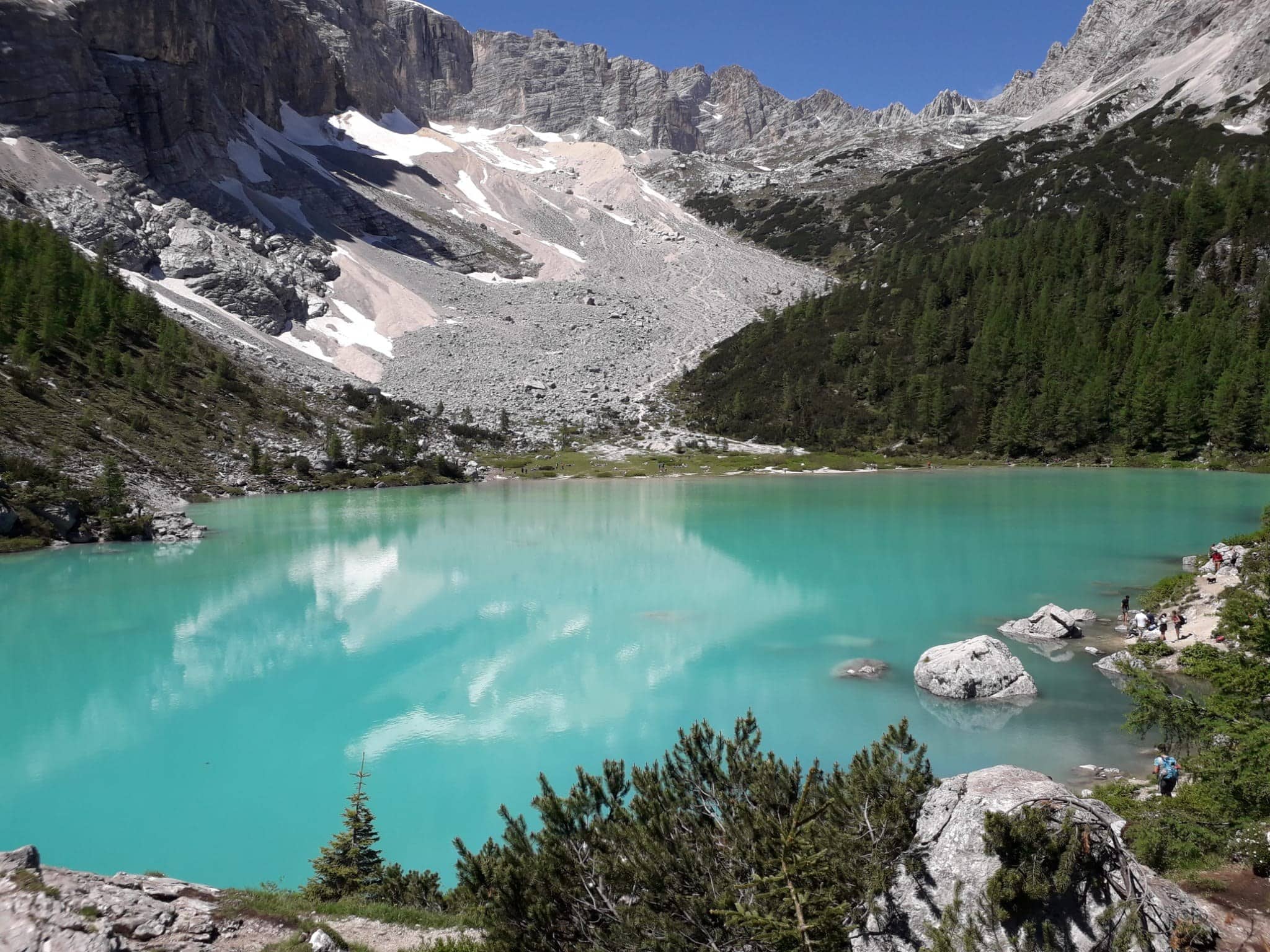
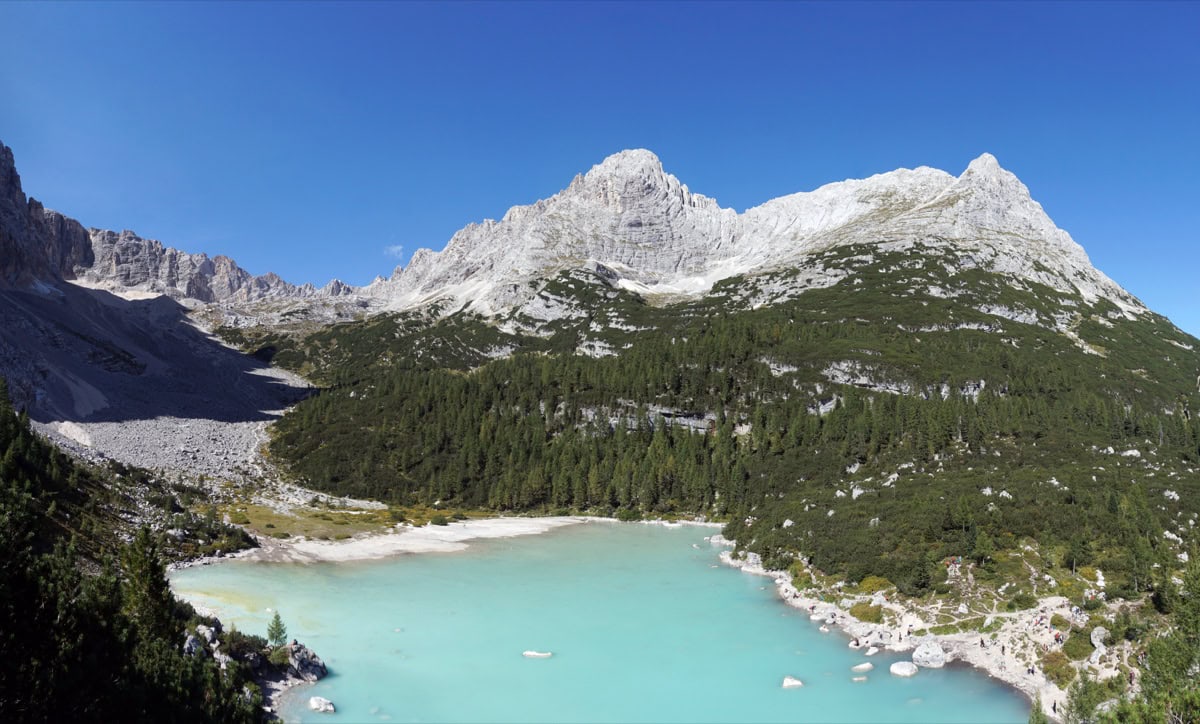
Before we hit the trail, let’s talk about why everyone flocks here in the first place. The Dolomites hide Lago di Sorapis like an absolute gem, and when you look at photos, you might think the colour has surely been Photoshopped. I can assure you it hasn’t. The lake sits at an altitude of 1,925 metres and its water has a uniquely milky turquoise hue that you won’t find anywhere else in the region.
The colour comes from fine limestone dust — so-called rock flour — carried down by the melting glacier above the lake. These tiny mineral particles remain suspended in the water, creating that magical, cloudy turquoise effect that makes you stare for a full minute before you even think about reaching for your camera. It’s precisely this that makes Sorapis one of the most photographed spots in all of northern Italy, and honestly, it’s easy to see why. Gazing at that dazzling colour beneath the jagged rock spire known as Dito di Dio (God’s Finger) is a moment you truly won’t forget in a hurry.

When to Visit and Lago di Sorapis Weather

Timing your trip right is absolutely crucial in the Dolomites, because winters here are long and summers can be overwhelmingly crowded. The trail to the lake is generally passable from June to late October, but it always depends on that year’s snowfall. Understanding Dolomites Italy weather patterns will help you plan the perfect visit.
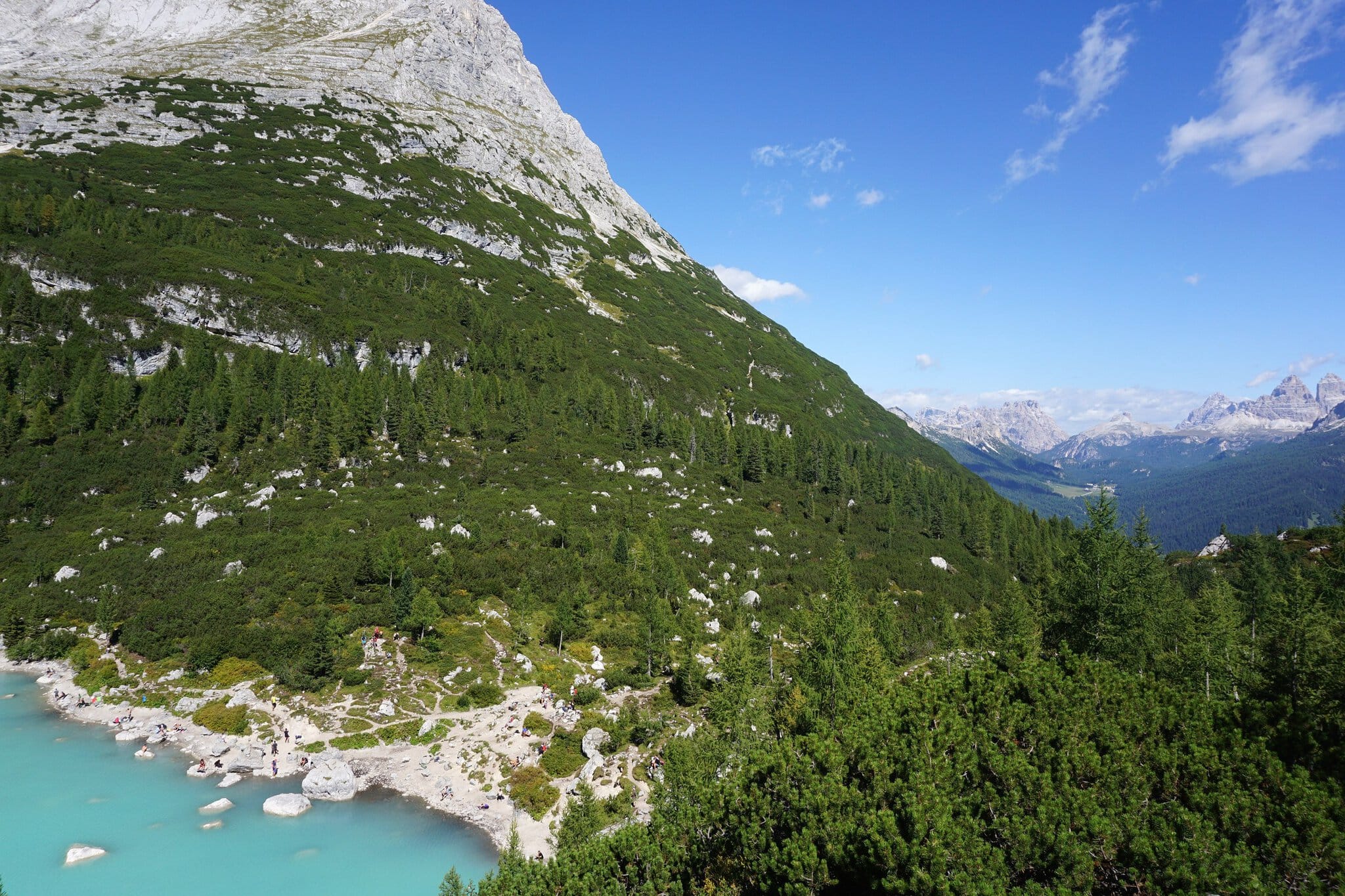
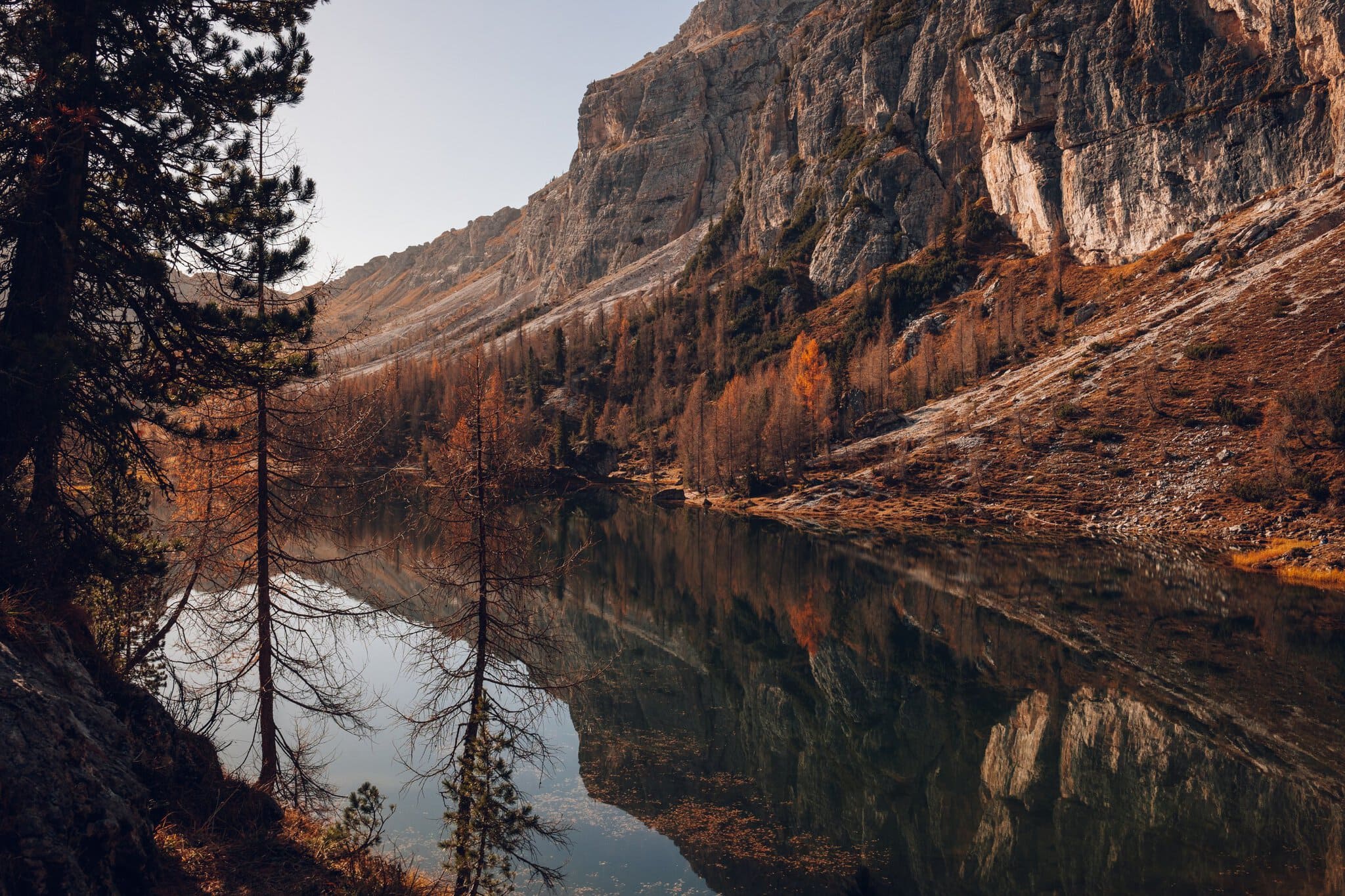
We personally love visiting the Dolomites in autumn, specifically September or early October. The temperatures are lower and you might encounter frost in the morning, but the air is beautifully crisp, the sky is cloudless, and the surrounding larch trees turn a gorgeous golden colour. Plus, you avoid the worst of the summer crowds. August is peak holiday season in Italy, and the narrow rocky ledges leading to the lake can become gridlocked — not something you want to experience above a deep drop. If you’re after up-to-date conditions, I’d recommend checking the Lago di Sorapis webcam before your hike to see whether fog or clouds are lingering up top.

Where to Stay Near the Lake and How Much it Costs

If you want to hit the trail really early in the morning — which is a must in peak season — strategic accommodation is half the battle. You could stay in town and drive up, but we found an absolute gem that saved us heaps of stress with parking and early starts.
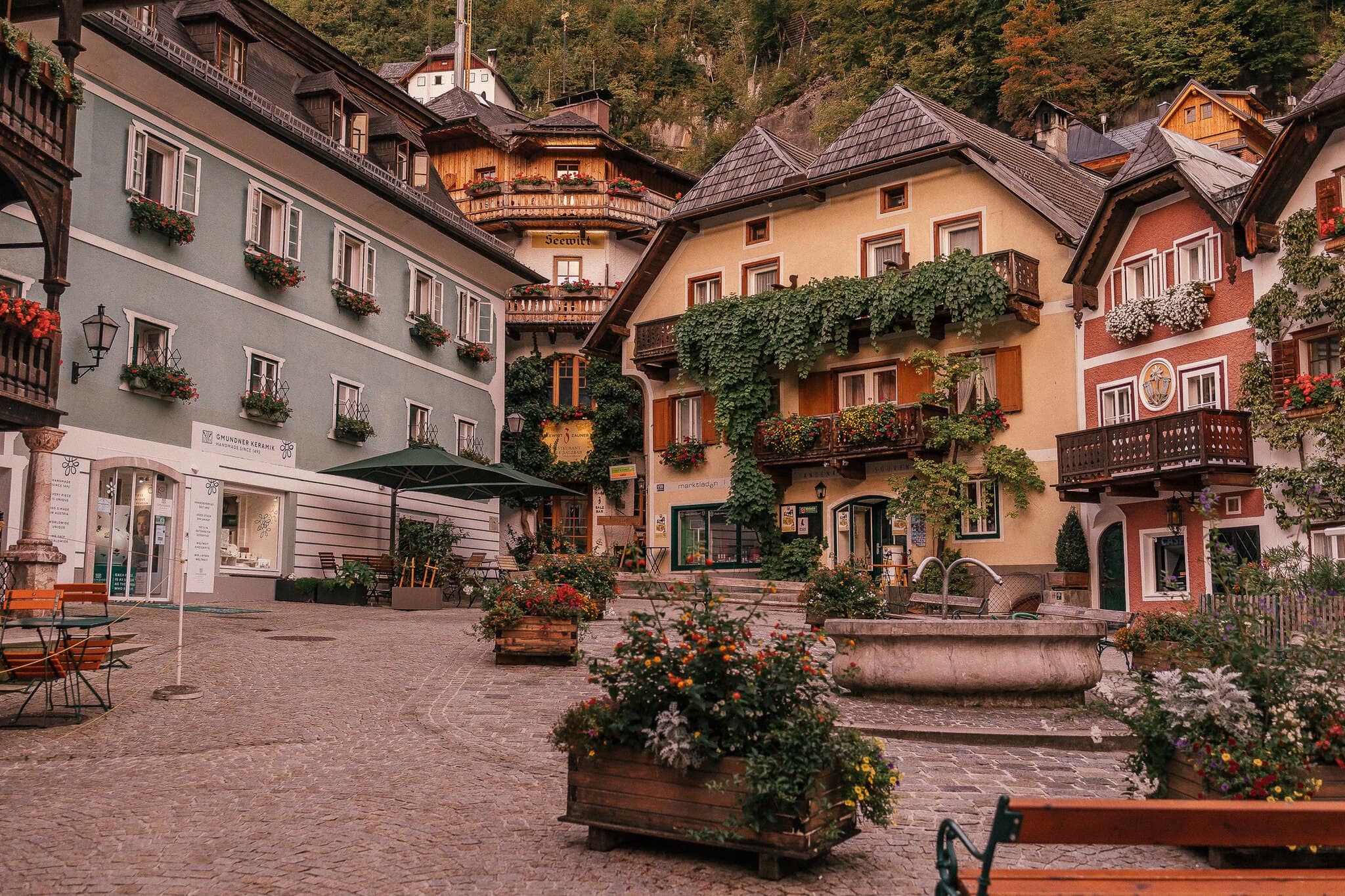
Our all-time favourite accommodation for this hike is the B&B Hotel Passo Tre Croci Cortina. It sits right at the trailhead, so in the morning you just get up, have breakfast, and walk straight out the door. The rooms are modern and beautiful with absolutely jaw-dropping views from the windows, and they’re dog-friendly — which is essential for us with Kája and Baby. Rates for a double room run between about €120 and €180 per night depending on the season, which is actually very reasonable by pricey Cortina standards.

Another option is to stay in the centre of Cortina d’Ampezzo, which we use as our main base. From there, it’s about 15 minutes by car or local bus to Passo Tre Croci. Cortina offers hundreds of options, from luxury wellness hotels to cosy mountain apartments — you can easily compare availability and prices on Booking.com.

How to Get to the Trailhead and Where to Park

Getting to the start of the hike has become quite a logistical puzzle in recent years, as the lake’s popularity has skyrocketed and the infrastructure simply can’t keep up. The trailhead is at the Passo Tre Croci mountain pass on the SR48 road, which connects Cortina d’Ampezzo with Lake Misurina. If you’re flying in from the UK, the closest airports are Venice (about 2 hours’ drive) and Innsbruck (around 2.5 hours), with plenty of flights from London, Manchester, and other major cities.
If you’re driving, I must warn you about the parking nightmare. A few years ago, you could park for free along the road, but those days are long gone. Cars were parked everywhere, blocking traffic, and the police started handing out hefty fines. Today, private car parks charge as much as €50 per day, which is frankly outrageous. If you don’t want to pay these inflated prices and you’re visiting in peak season, I’d recommend leaving your car at your hotel and taking the bus. Regular services run from Cortina, Misurina, and Lago di Misurina during the summer months, dropping you right at Passo Tre Croci. It’ll save you a mountain of stress.

Lago di Sorapis: 10 Tips on What to See and Do

Let’s finally get to the hike itself. The trail to the lake isn’t just a boring transfer from A to B — it’s a full-blown experience where you’ll be admiring views, occasionally feeling a healthy dose of fear, and above all having an incredible time. Here are our 10 favourite highlights and tips for the trail.

1. The Classic Trail from Passo Tre Croci

Most hikers take trail no. 215 (which sometimes merges with trail 401) — the most well-known and direct Lago di Sorapis route. It starts off pleasantly enough, winding through a fragrant larch forest where it feels more like a stroll in the park. Soon, however, the terrain starts to climb and the woodland path transforms into a rocky trail hugging the mountainside. In total, you’ll cover about 4 kilometres one way, with just over 200 metres of elevation gain. It’s not an extreme ascent by any means, but expect to work up a sweat.
Lukáš always says the first half is just a warm-up. The forest smells of resin and you think it’s all going to be a doddle — until you hit the first steep section over rocks and tree roots.

2. Metal Grated Walkways and Cables Above the Abyss

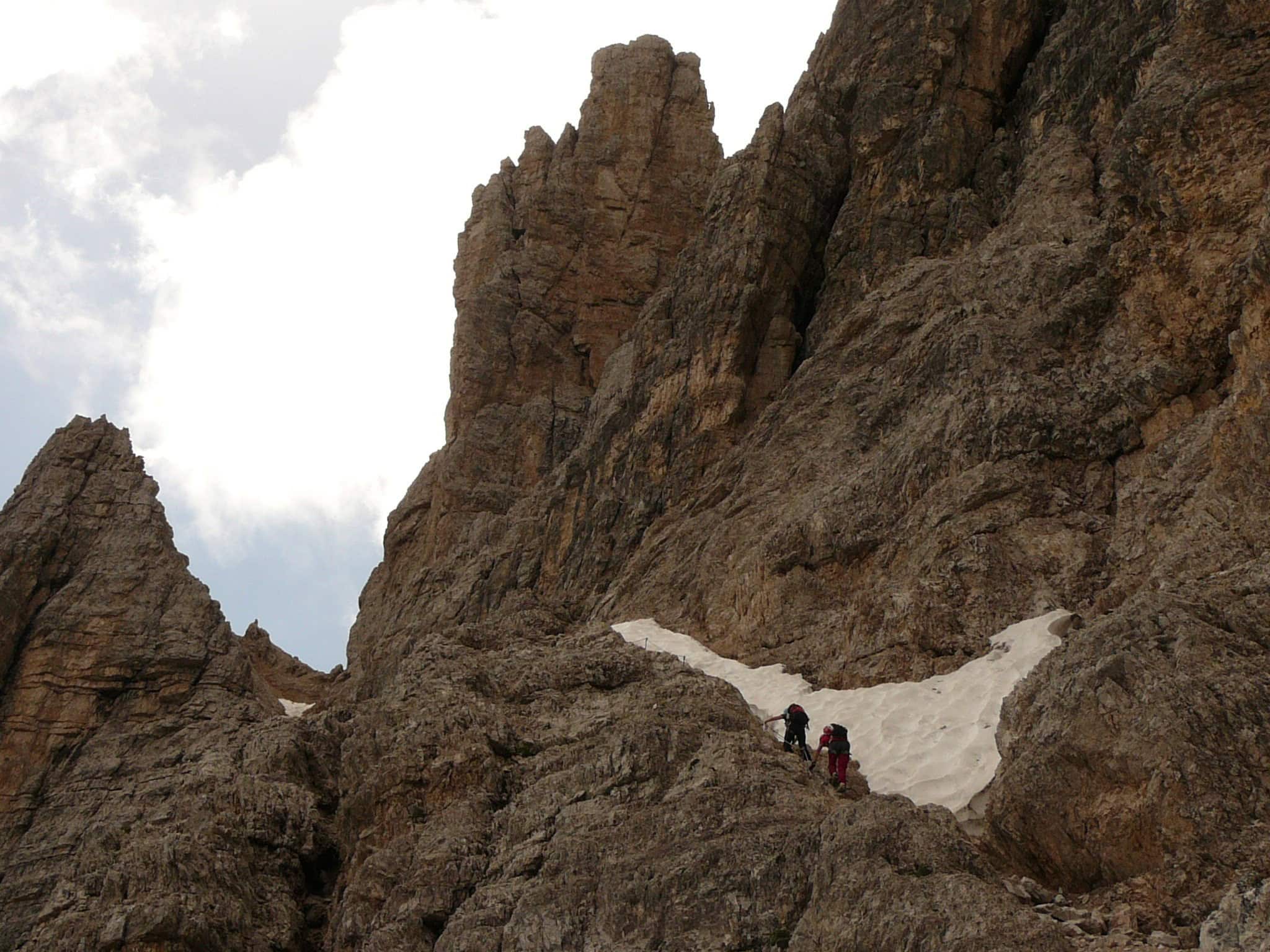
This is the moment that separates casual walkers from the more hardened hikers. Roughly halfway along the trail, the path veers directly into a steep rock face. To make the route passable, metal grated walkways and ladders have been bolted into the cliff. These sections are secured with steel cables that you can — and should — hold on to.

Through the grate beneath your feet, you can see the deep drop below, which honestly isn’t for anyone with a fear of heights. If you suffer from vertigo, think carefully about whether this hike is really for you. Lukáš and I have seen several people freeze up in the middle of the walkway, paralysed by fear, and have to be painstakingly guided back.

3. A Stop at Rifugio Vandelli

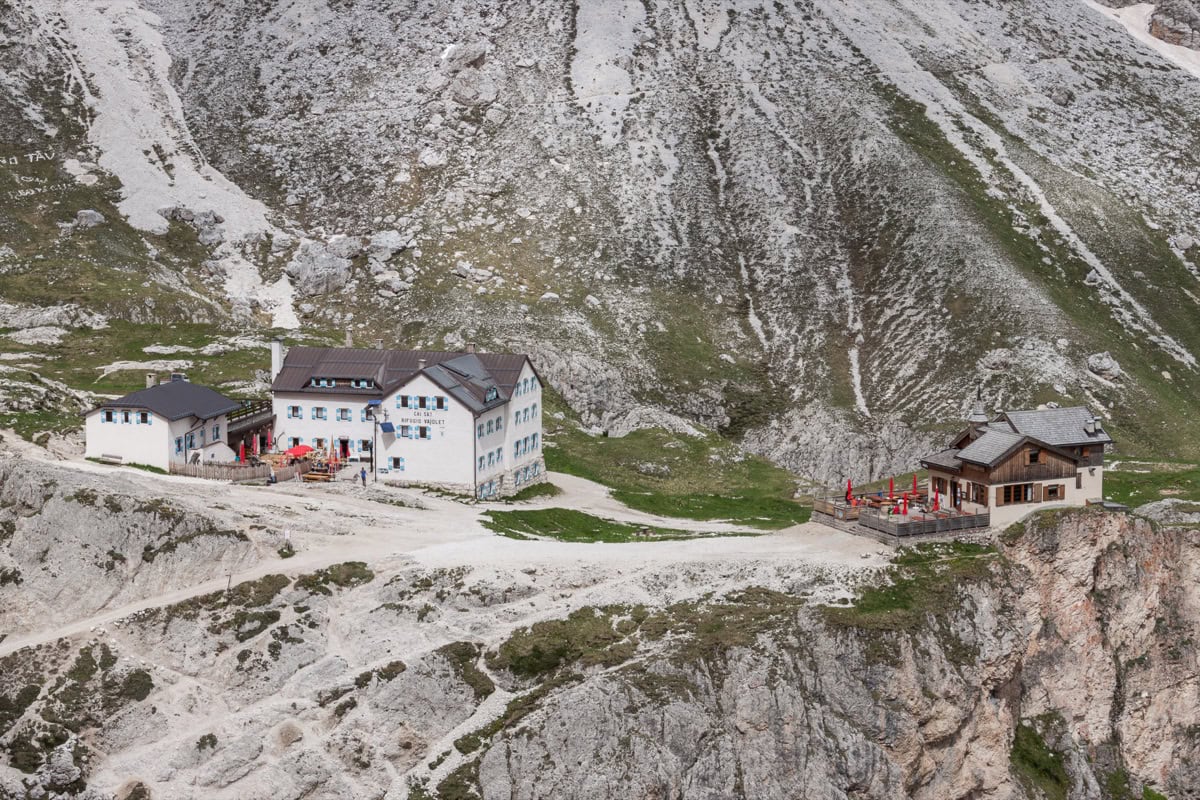
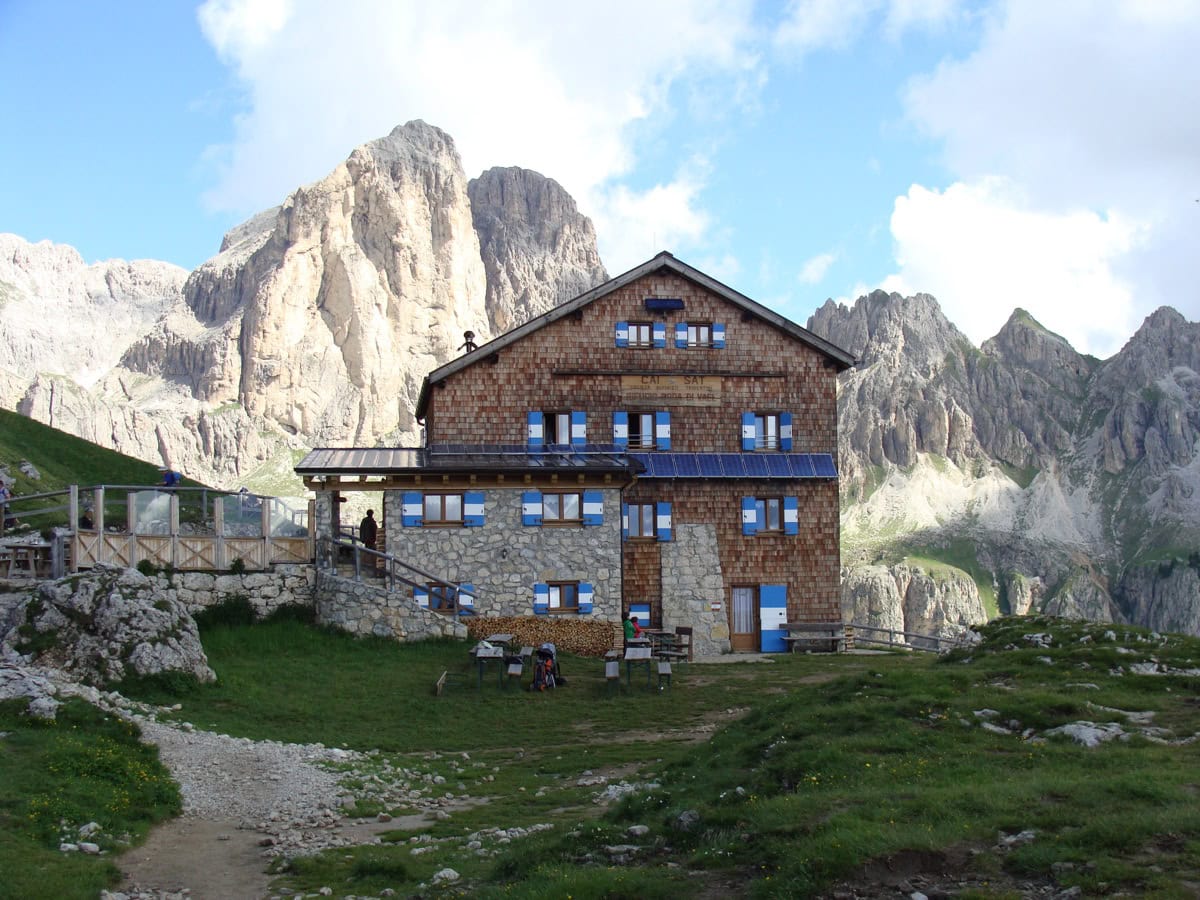
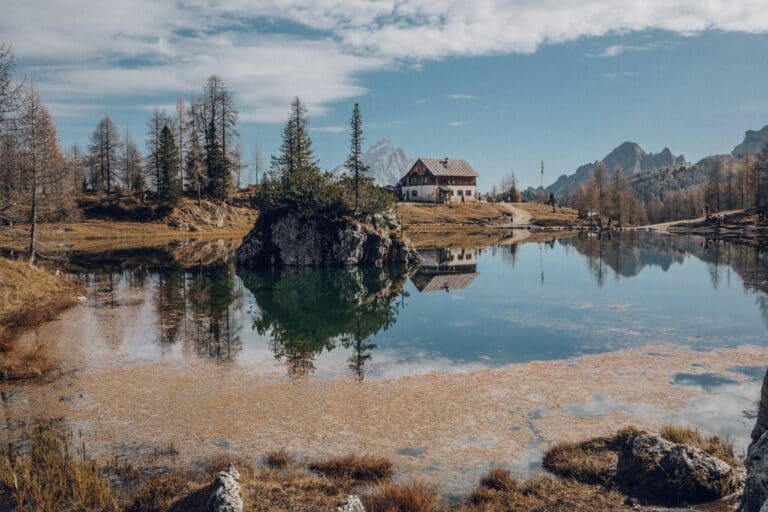
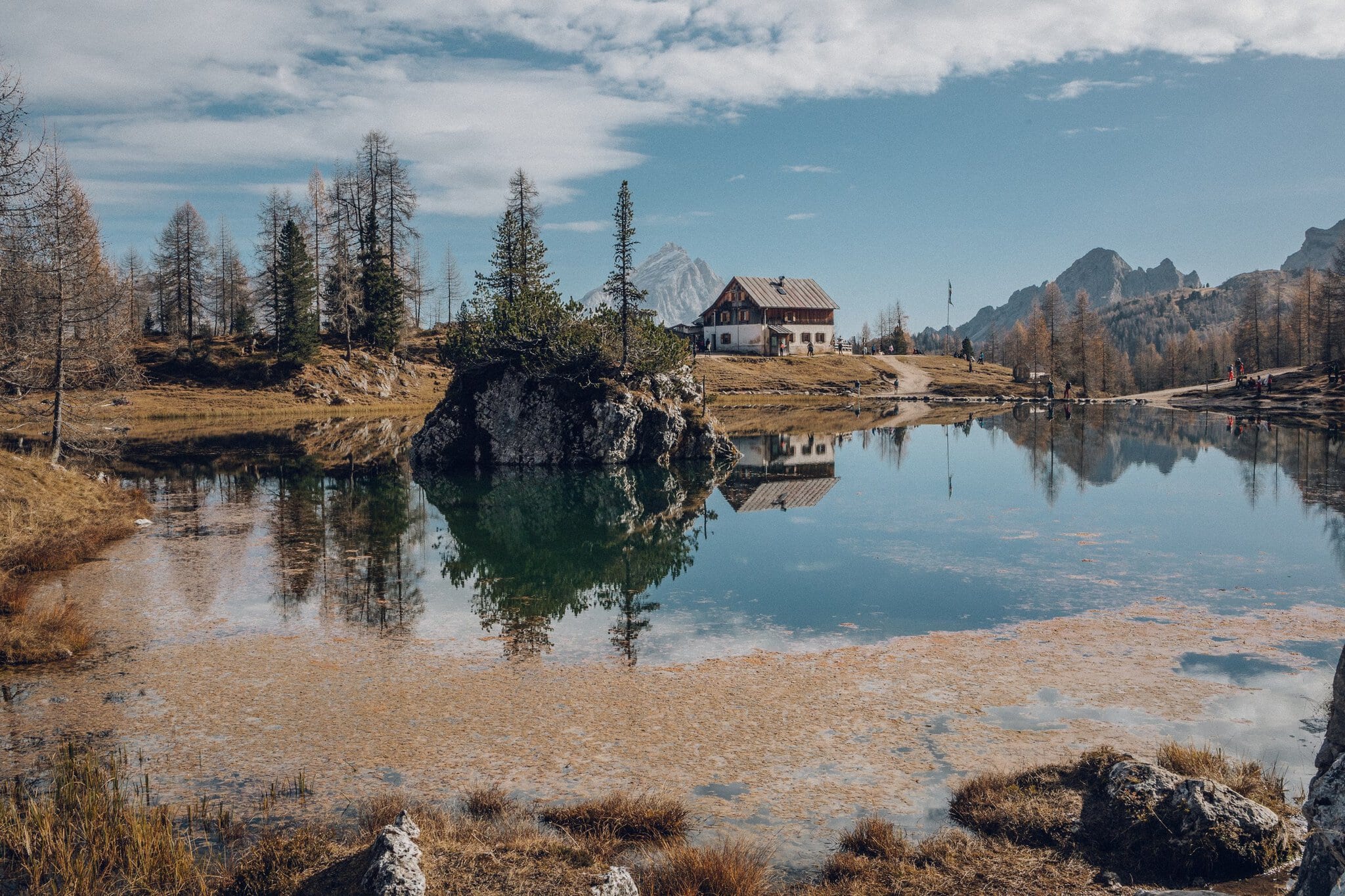
Just before you reach the lake itself, you’ll come across the mountain hut Rifugio Vandelli. This stone building with red shutters perches on a small wooded hillock and offers the perfect refuge for tired legs. We usually stop here for a quick coffee or a draught beer before descending the last few dozen metres to the water. It can get quite busy in season, but the atmosphere is wonderfully friendly and the views from the terrace towards Tre Cime are absolutely worth it.
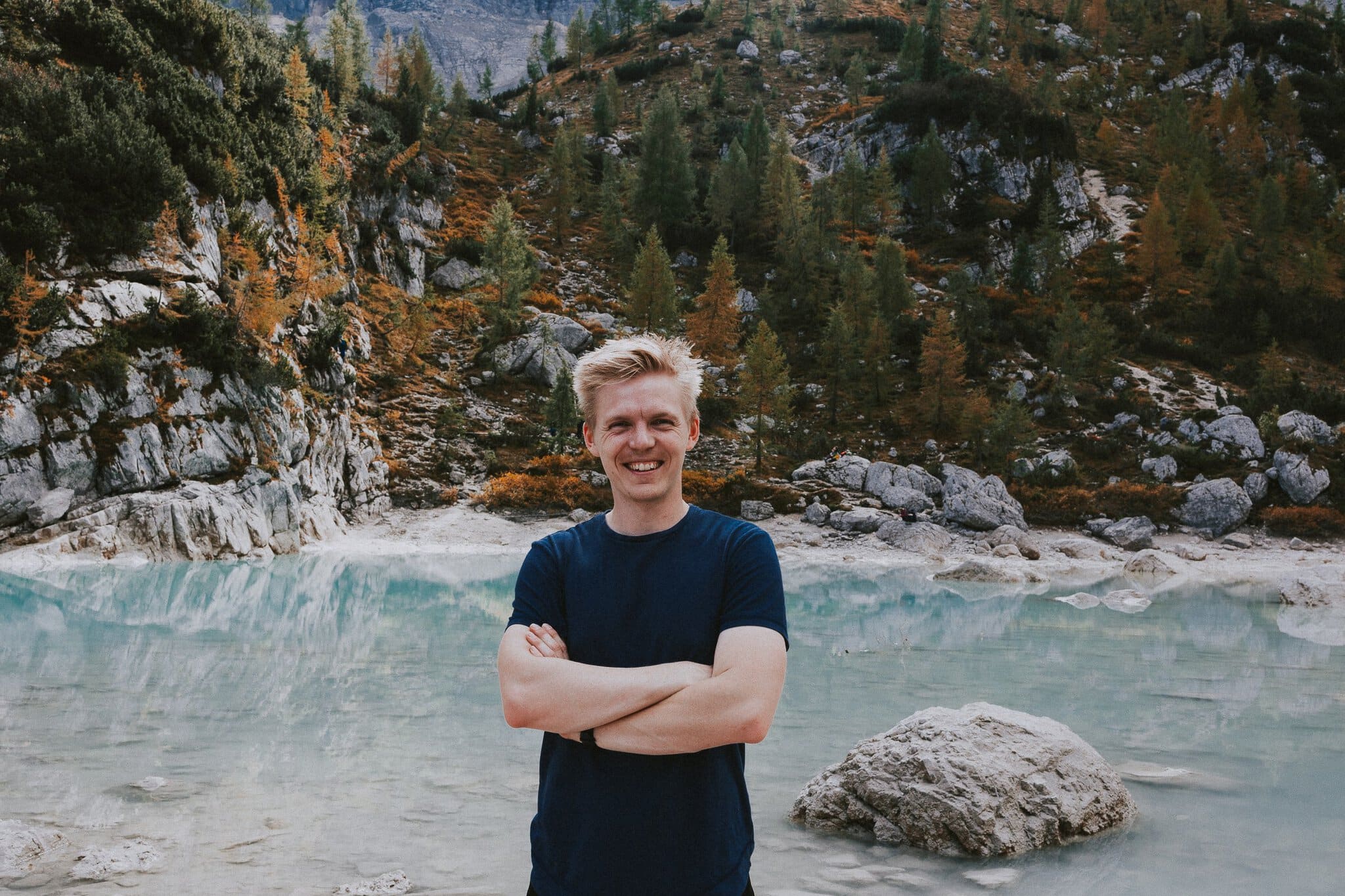
Lukáš usually can’t resist some kind of cake, while I just soak in the views and gather my strength for the last stretch. The hut can be a bit slow with service during the summer rush, but with views like that, the wait really doesn’t bother you.

4. The Iconic Photo from the Wooden Pier

When you finally arrive at the lake, you’ll understand why every bit of effort was worth it. Lago di Sorapis is even more stunning in real life than in photos. The most popular spot for that iconic shot is the small stony beach at the head of the lake, where a few wooden posts and rocks jut out of the water. This is where you get the best view of Dito di Dio reflected in the surface. Be prepared, though — in summer, you might have to queue for a while to snag that perfect angle.

We learned our lesson on our very first visit, when we had to wait about half an hour for that dream photo. Now we just find a different rock a bit further along and shoot from an angle that may be less famous but is far more authentic.

5. Walk Around the Lake for Some Peace and Quiet

Most people reach the lake, snap a photo at the front, eat their packed lunch, and head back. But if you want a piece of this beauty all to yourself, follow the narrow path along the shore and walk around the entire lake. The far side is usually blissfully quiet. You’ll find large boulders to sit on and, more importantly, get a completely different perspective on the water colour, which shifts and changes depending on how the sunlight hits it.
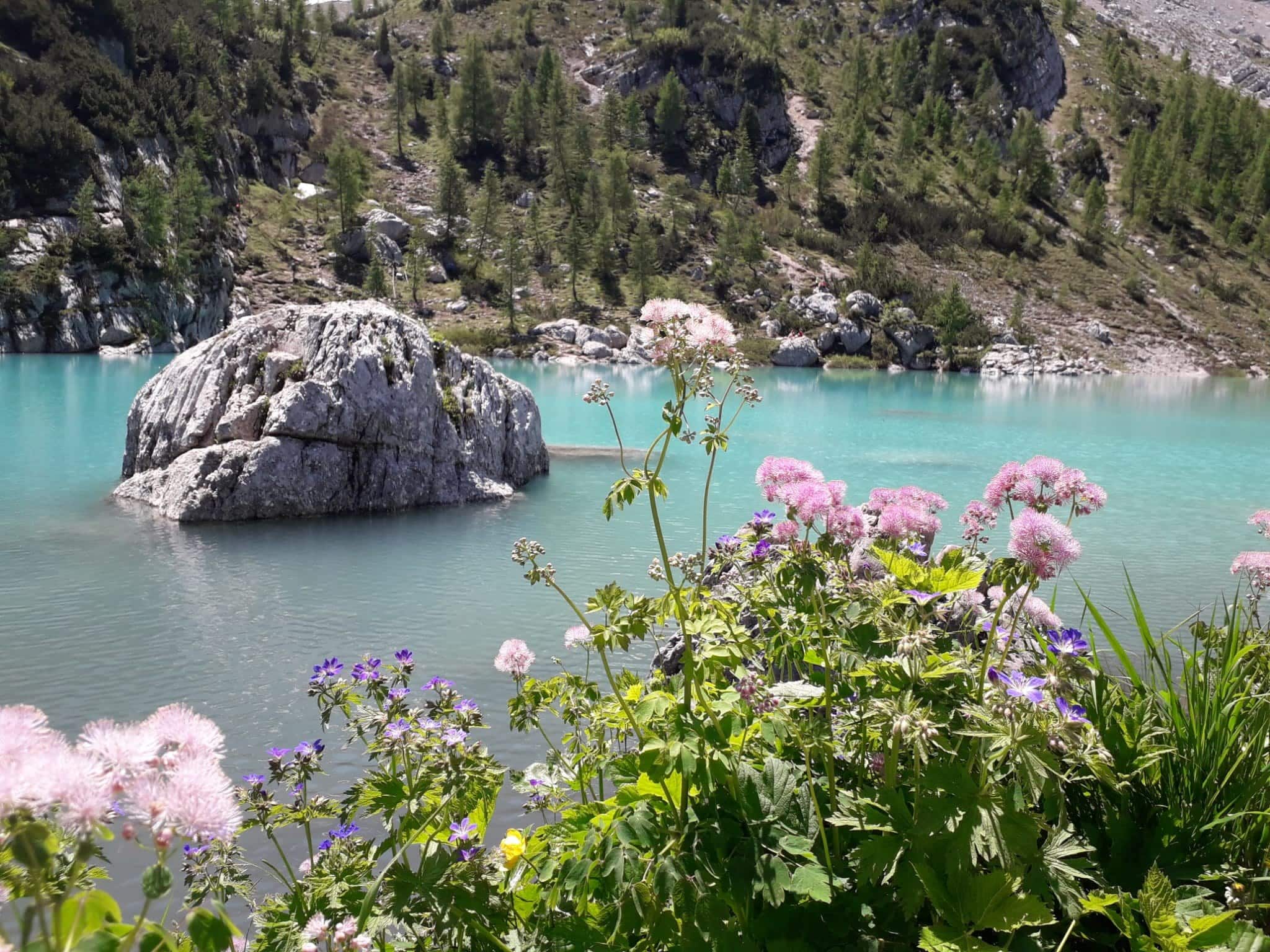
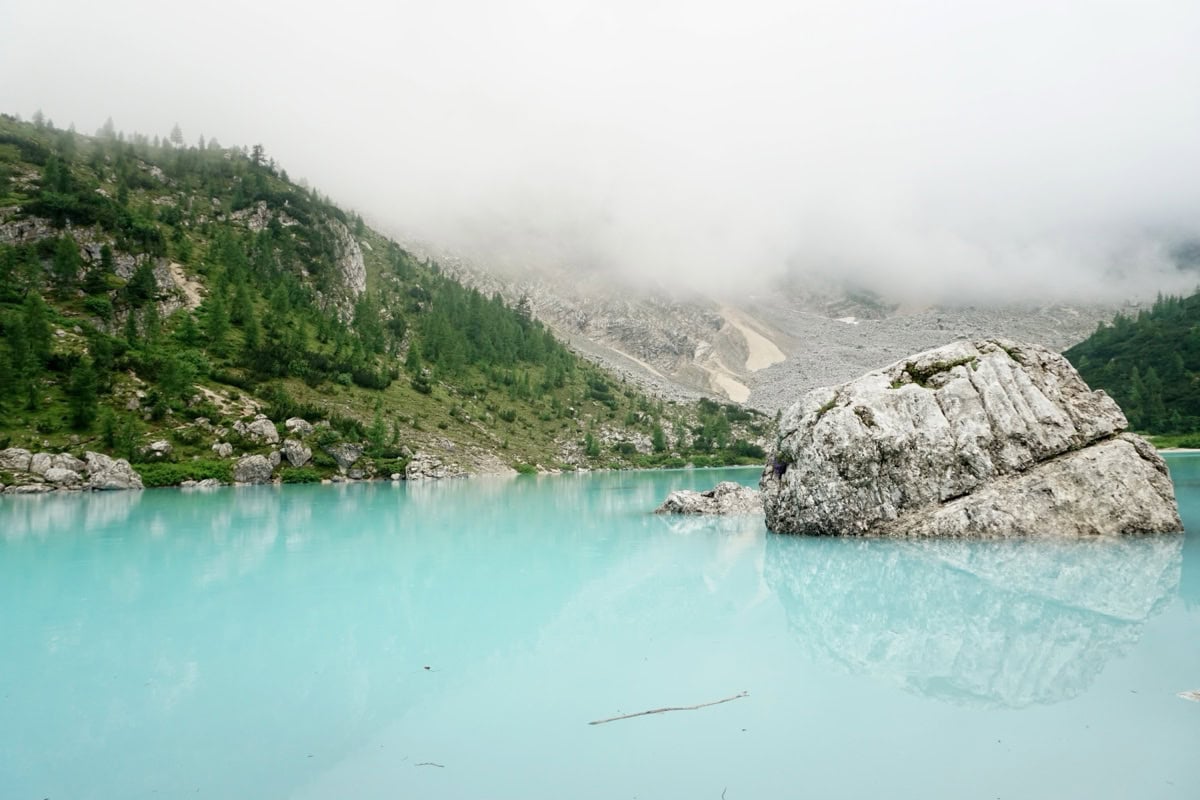
This is where we usually sit down with our favourite sandwich, crack open a flask of tea, and simply breathe in the cold mountain air. The blue surface looks even more magical from the other side, and the only sound breaking the silence is the occasional whistle of a marmot.

6. Watching the Enrosadira Phenomenon

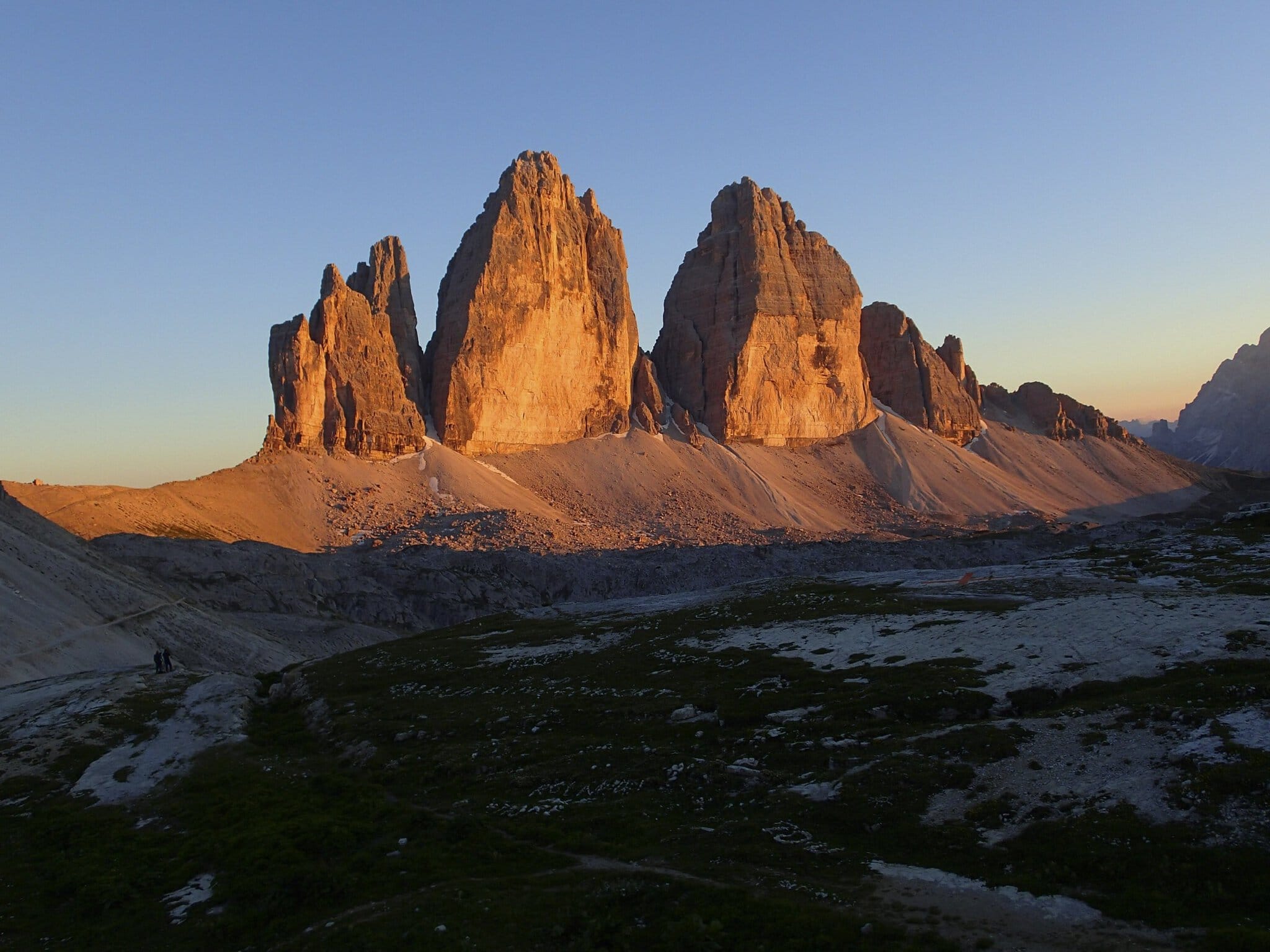
If you manage to time your hike so you’re at the lake or on the way back during sunset, you’ll witness a magical natural display called Enrosadira. This is the moment when the low sun illuminates the pale Dolomite limestone and paints it in vivid shades of pink and fiery orange. It’s absolutely breathtaking. Just don’t forget your head torch, though, because navigating those metal walkways back in the twilight would be sheer madness.

7. Extended Trek to Forcella Marcuoira

If the classic Lago di Sorapis hike feels too short and you’ve still got plenty of energy and experience, you can continue beyond Rifugio Vandelli. The route to Forcella Marcuoira is proper high-mountain hiking, though — with significant elevation gain and steep scrambles over scree. The reward? Views that’ll make your jaw drop: Cortina looks like a model village far below, and you get a sweeping panorama of the entire Sorapis massif without a single selfie stick in sight.

8. Alternative Start from Rifugio Tondi di Faloria

There’s another route to the lake that avoids the overcrowded Passo Tre Croci. You can take the cable car from Cortina up to Monte Faloria and then hike to Rifugio Tondi, continuing over mountain ridges and down to Lago di Sorapis. This route is much longer, more physically demanding, and crosses more challenging terrain including steep descents. I’d only recommend it to very fit hikers with sure footing who aren’t afraid of exposed sections. The views, however, are phenomenal.

Lukáš and I have only eyed this option from afar so far, and honestly, we probably won’t attempt it any time soon. But if you’re an experienced mountaineer who loves a proper challenge with minimal crowds, definitely do your research on this one.

9. Morning Mist and Best Light Tips

When I say arrive early, I mean really early. Not just because of parking and crowds on the walkways, but above all because of the atmosphere. Around seven in the morning, delicate mist often hovers over the lake surface, slowly rising up along the rock walls. The sun is just beginning to light up the surrounding peaks, and the water’s colour reaches its deepest turquoise. The golden hour here is short — the sun soon disappears behind the high mountains — but the sight will stay with you forever.

Yes, the early wake-up is painful, especially when it’s still cold outside and all you want is to stay under the duvet. But the moment you see those first rays of sunlight cutting through the misty veil, every ounce of tiredness vanishes instantly.

10. Winter Visit on Snowshoes

Although the trail is officially recommended only for summer and autumn, experienced mountaineers do venture here in winter on snowshoes. This, however, is truly extreme territory. The metal walkways and secured sections are buried under deep snow or ice, and there’s a very real risk of falls and avalanches. The lake itself is completely frozen over and blanketed in snow, so you won’t see that famous blue water at all. I mention it as a curiosity for those who love winter solitude, but I strongly advise the average hiker against a winter visit.

When I occasionally see those wild Instagram photos of someone balancing on snow-covered ledges, it makes my blood run cold. Mountains in winter don’t forgive mistakes, so even if it’s tempting, come here in summer and leave winter to nature.
lukas a lucka
Lukáš and Lucie recommend
Where to stay near Lago di Sorapis in the Dolomites
3 accommodations — hotels and other lodging options

Lago di Sorapis with Dogs and Children: Why it’s Not a Good Idea

This is a topic I feel particularly strongly about, because we’ve experienced it first-hand. The hike to Lago di Sorapis is definitely no walk in the park, and for families with younger children or dog owners, it can be a huge problem. We now have little Jonášek, and there’s no way we’re taking him there any time soon. The terrain is genuinely dangerous for small children in a carrier, and you can completely forget about a pushchair. If you have children over 10 who are used to the mountains and have a healthy respect for heights, they can manage it — but even then, you need to keep an eye on them constantly through the dangerous sections.
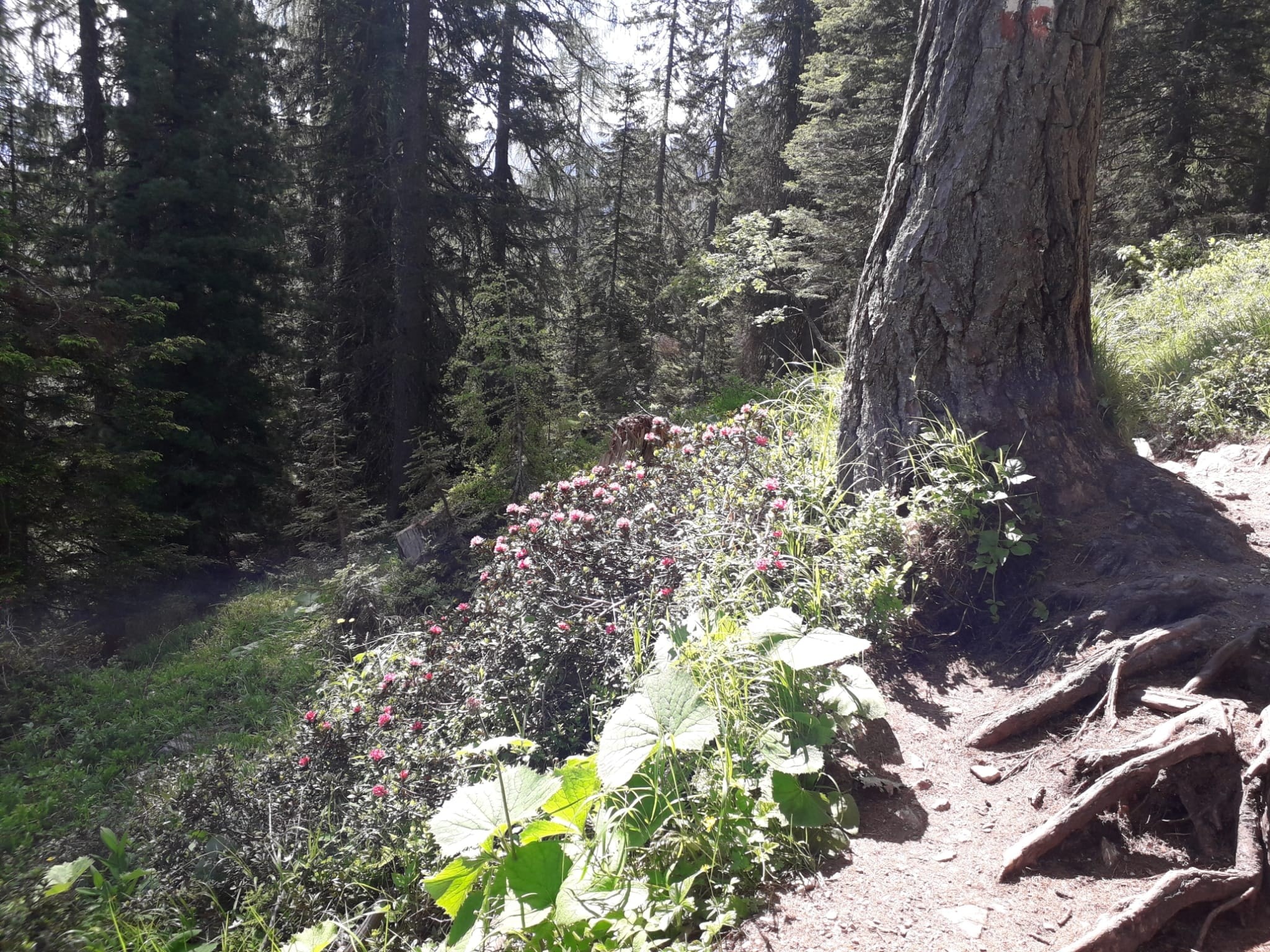
💡 Local tip: Nearly all cable cars and buses in the area require dogs to wear a muzzle (you can buy one practically everywhere, even at the lower stations). We found this pretty annoying — they insisted on it even when we had the cabin entirely to ourselves. When we had several cable cars to ride in a row, we’d rather leave Kája and Baby resting at the campsite.
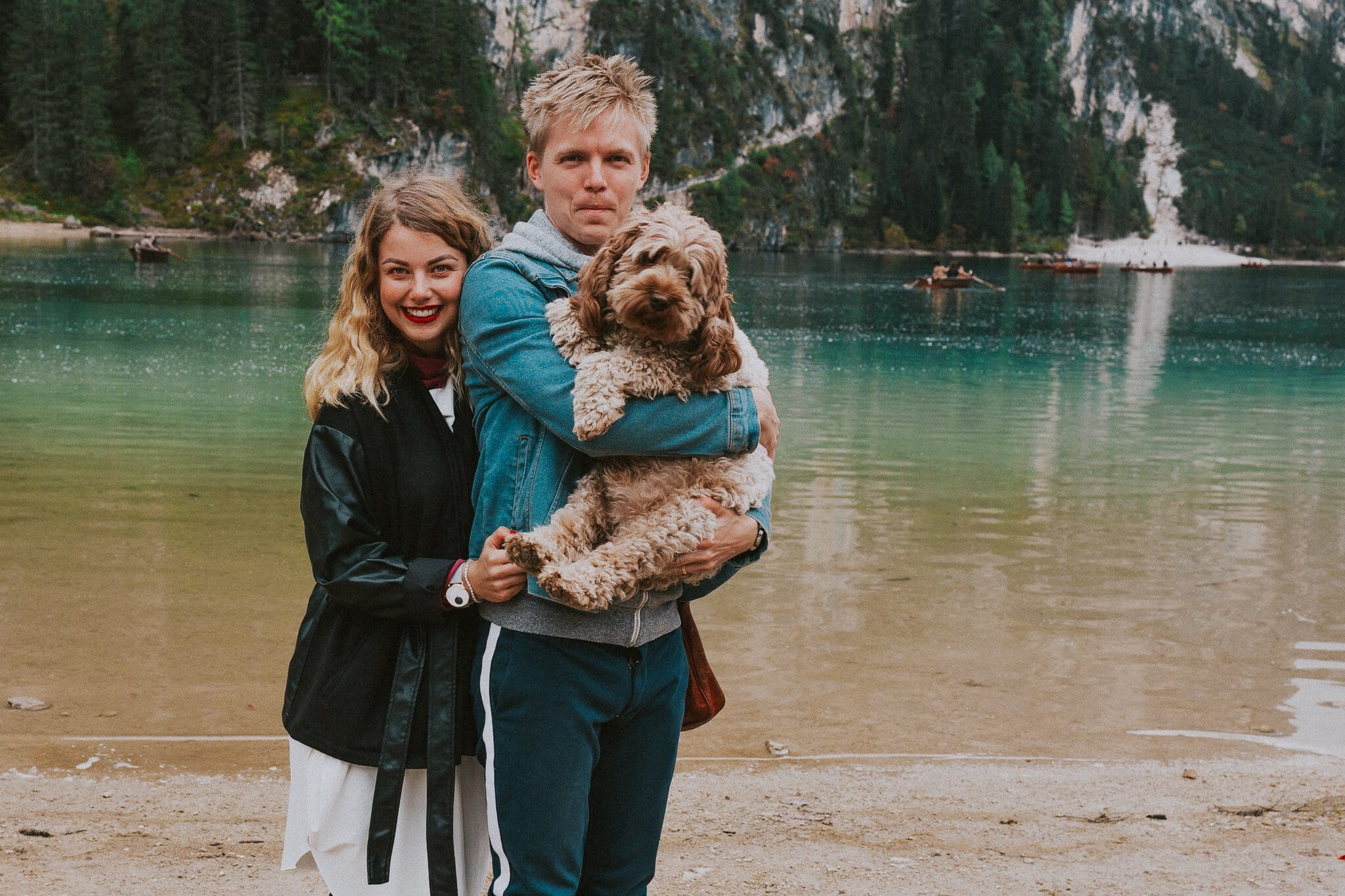
Now, about dogs. Our Kája came along with us once, and I have to admit it was a terrible idea. Kája is a sweetheart, but she’s a bit of a klutz. She handled the narrow forest paths with enthusiasm, but the moment we reached the metal grated walkways above the drop, it was game over. Dogs’ paws slip through the holes in the grate, they panic, and frankly I don’t blame them. Kája froze and refused to take a single step.

In the end, Lukáš had to pick her up and carry her the entire length of the exposed section. Just imagine carrying a terrified 20-kilogram dog in your arms along a narrow, wet rocky ledge above a deep ravine while desperately clinging to a steel cable with your other hand. Trust me, you don’t want that experience. So if you have a larger clumsy dog, or conversely a tiny Yorkshire terrier or Maltese like our Baby, leave them safely back at your hotel for this one. And as for puppies — that goes without saying. It’s stressful for you, for the dog, and for everyone you’ll be blocking on the narrow trail.

What to Bring on the Trek to the Turquoise Lake

Mountain weather changes incredibly fast, and even when it’s sunny and shorts weather down in Cortina, up at the lake you can be battered by an icy wind. Don’t underestimate this.

First and foremost: proper hiking boots. We regularly see people on the trail in canvas trainers with smooth soles, and it genuinely makes us wince. The rocks here are often wet and slippery, and without decent grip, those metal ladders can catch you out badly. Pack an extra warm layer in your rucksack — ideally a fleece or lightweight down jacket — plus a waterproof shell. Once the sun dips behind the mountains at the lake, the temperature drops noticeably.

A lot of people ask whether you need a via ferrata kit. For the standard trail no. 215, you don’t need a harness — the cables are just for handholds. We do recommend bringing a lightweight climbing helmet, though. The trail runs directly below vertical rock faces, and small stones dislodged from above by other hikers or animals are a fairly common occurrence. Don’t forget to bring plenty of water and snacks too, as the ascent will burn through some energy.

Where to Eat: What to Try at Rifugio Vandelli

Once you’ve conquered the toughest sections and found yourself at the lake, you’re bound to be ravenous. Rifugio Vandelli is small, but they serve excellent traditional mountain food that’ll have you back on your feet in no time. They’re typically open from mid-June to the end of September.

If you love Italian mountain cuisine, definitely try their canederli. These are large Tyrolean dumplings, served in either a spinach or cheese version — in broth or drizzled with melted butter. I always go for the broth, because after those walkways, warmth and comfort are what I need most. 😊 Another classic is proper polenta with goulash, or with mushrooms and local cheese. If you’d rather not spend time on a full sit-down lunch and want to get back to taking photos, you can grab excellent panini with caprese (mozzarella, tomato, and basil) and eat them on the bench outside with a view. Prices are understandably higher than down in the valley — all supplies have to be brought up by helicopter or cable car — but the atmosphere makes it worthwhile.

Practical Information and National Park Rules

Before you lace up your boots and head out, there are a few important practical things to mention. The lake and its surroundings fall within the protected area of Dolomiti d’Ampezzo Natural Park, and there are some fairly strict rules — breaking them can land you in serious trouble.

The most common mistake tourists make is flying a drone. You’ll see plenty of aerial shots of the lake on Instagram, but don’t be fooled. There’s a strict drone ban across the entire national park, as it disturbs local wildlife and other visitors. Park rangers patrol here regularly, and if you’re caught, you’re looking at a fine of up to €3,000. That’s not worth it for one nice photo.

Another thing people frequently Google — “lago di sorapis swimming” — is whether you can swim. Thankfully, swimming is prohibited (and that includes dipping your feet in). Contact with sunscreen and bacteria would quickly destroy the lake’s unique character.

Where to Go Next in the Dolomites

Sorapis is stunning, but it’s far from the only incredible spot in this part of the mountains in Italy. If you’ve got time and want to see the very best that the Dolomites have to offer, we’ve put together plenty of other guides from our travels:

  • Be sure to check out our comprehensive article on 5 Hiking Trails for Everyone in the Italian Dolomites.
  • If you’re looking for something easier, the hugely popular and car-accessible Lago di Braies is well worth a visit. It’s an absolute zoo in peak season, but the scenery is worth the crowds.
  • From Cortina, it’s a short hop to the iconic three peaks of the Dolomites. Our article on Tre Cime di Lavaredo will show you how to plan the most beautiful circular route.
  • And if you’re still not sure how to fill your trip, take a look at our complete list of things to do in the Dolomites.

Travel Tips to Finish

  • Cheap flights: Search for deals on Kiwi. It’s our go-to flight search engine. From the UK, you can often find affordable flights to Venice or Innsbruck, both within easy driving distance of Cortina.
  • Car hire: We regularly use DiscoverCars as a comparison tool. Lukáš and I have had consistently good experiences with it all over the world.
  • Booking accommodation: Booking.com is our favourite hotel search engine. In the Dolomites, I’d recommend looking for accommodation up to six months in advance.
  • Don’t forget insurance: For mountain treks, we usually go with AXA travel insurance and always add the sports package for high-altitude hiking. If you’re based in the UK, make sure your travel insurance specifically covers mountain activities.
  • Mobile data and eSIM: If you’re travelling through Switzerland or spending extended time on the road, consider an eSIM from Holafly.

Frequently Asked Questions (FAQ)

When we first wrote about Lago di Sorapis, we received a flood of questions from you on Instagram. It’s clear you want to be properly prepared for this kind of hike, especially when parts of it look like they belong in a mountaineering diary. So I’ve gathered the most common questions in one place.

Hopefully these answers will help with your planning and save you a few headaches. But if you think of anything else, do let us know!

How do I get to Lago di Sorapis?

The most common route starts at Passo Tre Croci pass. From there, you’ll follow trail number 215, which takes you directly to the lake after approximately two hours of hiking. You can reach the pass either by car or by bus from Cortina d’Ampezzo.

Can I swim in Lago di Sorapis?

No, swimming is strictly prohibited throughout the entire lake, and this includes even dipping your feet in the water. The reason is to protect the highly sensitive ecosystem and the specific mineral composition of the water, which could be permanently damaged by human presence.

How long does the trek to the lake take?

The entire trek takes approximately 3 to 4 hours of pure hiking time. The one-way journey takes around 1.5 to 2 hours depending on your fitness level and any potential queues at the metal grates. The trail measures 8 kilometers round trip.

Is the trail suitable for dogs?

From our personal experience, we definitely don’t recommend this trek for dogs. There are exposed metal grates over deep drops where dogs’ paws can slip through. While you can carry small and medium-sized dogs, it’s dangerous and stressful. It’s better to leave larger breeds or anxious dogs at home.

When is the best time to visit?

You’ll have the most beautiful experience in September and early October, when the crowds thin out and the mountains display gorgeous autumn colors. If you decide to go in July or August, you’ll need to start the trail early in the morning (ideally before 7:00 AM) to avoid the crowds and catch the best morning light for photography.

Can I fly a drone at the lake?

No. Lago di Sorapis is located within the Dolomiti d’Ampezzo National Park, where there’s a blanket ban on drone use. Fines for violating this rule can reach up to 3,000 EUR, so we definitely don’t recommend risking it.

Is the trek difficult and can beginners manage it?

Physically, the trail isn’t particularly challenging—the elevation gain is just over 200 meters. The difficulty lies mainly in the mental aspect, as you’ll be walking along narrow ledge sections with metal grates above steep drops. If you don’t suffer from vertigo and have proper footwear, an average hiker can manage the trek comfortably. The trail isn’t suitable for people with a serious fear of heights.

Tips and Tricks for Your Vacation

Don’t Overpay for Flights

Search for flights on Kayak. It’s our favorite search engine because it scans the websites of all airlines and always finds the cheapest connection.

Book Your Accommodation Smartly

The best experiences we’ve had when looking for accommodation (from Alaska to Morocco) are with Booking.com, where hotels, apartments, and entire houses are usually the cheapest and most widely available.

Don’t Forget Travel Insurance

Good travel insurance will protect you against illness, accidents, theft, or flight cancellations. We’ve had a few hospital visits abroad, so we know how important it is to have proper insurance arranged.

Where we insure ourselves: SafetyWing (best for everyone) and TrueTraveller (for extra-long trips).

Why don’t we recommend any Czech insurance company? Because they have too many restrictions. They set limits on the number of days abroad, travel insurance via a credit card often requires you to pay medical expenses only with that card, and they frequently limit the number of returns to the Czech Republic.

Find the Best Experiences

Get Your Guide is a huge online marketplace where you can book guided walks, trips, skip-the-line tickets, tours, and much more. We always find some extra fun there!
Dolomites Alta Via 1: The Queen of Multi-Day Treks in the Dolomites

TL;DRAlta Via 1 is the best-known and technically easiest of the multi-day treks in the Dolomites, running roughly 120 kilometres from Lake Braies in the north down to Belluno in the south, with around 6,500 metres of total ascent. The classic version takes 10 to 12 days (there are shorter 4- or 6-day options too), rated EE — no via ferrata kit needed, but you’ll want decent fitness. You sleep exclusively in mountain huts (rifugi), booked 3 to 6 months ahead, as wild camping isn’t allowed. Budget €1,100–€1,300 per person for the whole trek. The best time to go is late June to mid-September — just try to dodge the Ferragosto crowds around 15 August.

Say the words Dolomites Alta Via 1 and most of us instantly picture jagged rock towers glowing red at sunset and the smell of fresh polenta drifting out of a mountain hut. Lukáš and I absolutely adore these scenes, and we come back to the Italian Alps practically every single year. Multi-day mountain crossings with a backpack on our shoulders used to be our summer classic, but ever since little Jonáš came along, we’ve had to put these long and demanding adventures on hold for a while. That doesn’t stop us from dreaming about them and planning them in obsessive detail, though. ☺️

One of our biggest dreams is to walk the whole route in one go. Even though we haven’t yet done it from start to finish all at once, we’ve hiked a huge number of its sections on day trips back when we were based in Cortina d’Ampezzo. The trail runs through some of the most beautiful places imaginable, like Lago di Braies or the iconic cliffs around Rifugio Lagazuoi. Because you keep asking us about the Alta Via over and over, I finally decided to sit down and write this detailed guide. Read it once and you’ll know exactly what you’re getting into.

So: want to know when to go, where to sleep, how much it costs and what to throw in your backpack? I’ve laid out absolutely everything for you, day by day, hut by hut. Read on. 😉

TL;DR

I know, I know — laid out on paper these numbers look terrifying. But trust me, out on the trail it all flows far more naturally. Here’s the most important stuff in a nutshell:

  • Distance and elevation gain: The trek measures roughly 120 kilometres and you’ll climb a total of around 6,500 vertical metres.
  • Duration: It’s usually walked over 10 to 12 days, but you can also plan shorter versions of 4 or 6 days.
  • From where to where: The classic route starts in the north at the iconic Lago di Braies and finishes in the south at the town of Belluno (or at the La Pissa bus stop).
  • Difficulty: Technically the trek is rated EE (Escursionisti Esperti), which means you don’t need via ferrata gear, but you do need very good fitness and a sure step. It’s definitely not for small children.
  • Accommodation: You sleep exclusively in mountain huts (rifugi), which you need to book 3 to 6 months in advance. Wild camping is strictly forbidden.
  • Budget: Set aside roughly €1,100 to €1,300 per person for the whole trek (including half board in the huts, lunches and transport).

What is the Dolomites Alta Via 1 and who is it for

If you’re looking into multi-day treks in Italy, you’ve surely come across the classic dilemma of whether to choose the Dolomites Alta Via 1 or 2. The Alta Via 1 (literally “High Route 1”) is the more famous, more classic and technically more accessible option. While the Alta Via 2 already calls for via ferrata gear and far more climbing experience, the “number one” is friendlier and can be tackled by any experienced mountain hiker with good stamina who doesn’t mind walking with a heavy pack for several days in a row.

The route cuts beautifully through the Dolomites from north to south and takes you to places the average tourist can’t reach by car or cable car. It’s a real escape from civilisation, where your day shrinks down to nothing but walking, marvelling at unbelievable views, eating and sleeping. Technically there are no climbing sections waiting for you, but some passages can be steep, narrow or secured with a steel cable to hold onto. Good hiking boots and zero fear of heights are simply essential here.

When to set off on the trek and what the weather will be like

Choosing the right dates is absolutely crucial for this trek, because the mountain huts have a very limited season and the weather in the Dolomites can be seriously unpredictable. Let’s look at when it makes the most sense to book your flights and accommodation.

The ideal window for hiking the Alta Via 1

The season is actually really short — essentially only from late June to mid-September — so there’s genuinely no point putting off the planning. If you go in July or August, you’ll have the best chance of more stable weather and of finding every hut along the route open.

But I have to give you a strong warning about the period around 15 August. Italy celebrates the public holiday of Ferragosto on that day, and Italians take their mass holidays. The Dolomites (and frankly the whole of Italy) burst at the seams around then, the huts are hopelessly sold out a year in advance, and on the narrow mountain trails you’ll feel more like you’re on a busy city high street. I’d give this period a very wide berth if you want even a little bit of peace. 😅

Early September, on the other hand, tends to be absolutely magical. The air clears up a bit, the crowds thin out because the kids are back at school, yet the huts are still open. You just have to reckon with colder mornings and evenings. September is probably our favourite time in the mountains. If you fancy going as early as June, be very careful, as there can still be plenty of snow at higher altitudes and some mountain passes may be impassable without crampons and an ice axe.

How much the Alta Via 1 costs and where to sleep before the start

Multi-day hut-to-hut treks aren’t exactly the cheapest thing in Europe, and that goes double for the Dolomites. Wild camping is strictly forbidden throughout the national park and the fines are genuinely steep, so you’re completely reliant on the network of mountain huts.

Before the trek itself you’ll usually sleep near Lago di Braies or in nearby Cortina d’Ampezzo, from where you can easily reach the lake by bus in the morning. Cortina is a strategic base, a great springboard for the trek where you can rest and gather your strength. It’s always better to arrive a day early so you can begin the first stage bright and early.

Budget for 10 days in the mountains

Let’s take a look at what all this fun actually costs in real terms. The biggest expense will, of course, be accommodation combined with food. Most mountain huts work on the principle of what’s called “mezzopensione” (half board), which includes a bed (often in a shared dormitory with bunk beds), a hearty multi-course dinner and breakfast.

Lukáš and I always work everything out carefully in advance, because mountain mark-ups can give your wallet a serious shaking.

  • Accommodation with half board (rifugi): Reckon on roughly €75 to €95 per person per night. So for 10 nights that comes to approximately €800 to €1,000.
  • Lunches and snacks during the day: There are plenty of smaller huts along the route where you can grab polenta or soup, usually working out at €15 to €25 a day. If you bring food from home or buy filled rolls (panini) at the huts, you’ll save a little. Reckon on around €200 in total.
  • Transport to the start and from the end of the trek: Buses, trains, possibly taxis. Reckon on roughly €100 per person.
  • Overall estimate: Per person I’d recommend budgeting €1,100 to €1,300 for the full ten days, not including flights from the UK and additional gear.

Booking the huts and the essential rules

When it comes to planning, I have to be completely honest: there isn’t much room for spontaneity here. Relying on turning up at a hut in the evening and hoping they’ll simply find you a spot on the floor is a huge risk I really wouldn’t recommend trying.

💡 Tip: Book the huts (rifugi) along the route directly via their websites or by email — they’re not on Booking. But for the night before the start and after you finish, it pays to have a base down in the valley: right at the start by Lago di Braies you’ll find the iconic Hotel Pragser Wildsee on Booking.com.

When and how to book the refugios

Hut capacity is strictly limited and demand from hikers all over the world is enormous. You have to book the huts (in Italian, rifugi) well in advance, ideally 3 to 6 months ahead. That means if you want to go in July, you should have your exact plan sorted and be emailing the individual places to stay by January or February at the latest. Most huts take reservations by email or via forms on their own websites; booking portals like Booking.com generally don’t work up here in the mountains.

Another big rule in the Italian mountains is paying in cash. Although the situation is gradually improving and many huts now have card terminals, the signal high in the mountains often drops out and you can’t rely on your card. Always carry enough euros in cash to pay for your whole stay and food during the day. You can always refill your water at the huts for drinking, so at least you’ll save on bottled water and won’t generate plastic waste.

The classic 10-day version (day-by-day itinerary)

This is exactly the route Lukáš and I have lined up in our heads for the time when we set off just the two of us. It’s the classic ten days that lead you through the very best that nature has created in this region. Bear in mind that the times given for each stage are pure walking time, without breaks for soaking up the views, photography and lunches. So reality always tends to be a few hours longer. You’ll see for yourself how you get on! 😉

1. Lago di Braies to Rifugio Biella (the trail from the lake)

The trek begins nowhere other than at the famous Lago di Braies. If you’ve been reading our blog for a while, you’ll know this lake is simply breathtaking. The mornings here can be busy, as it’s a popular target for day-trippers, but as soon as you start climbing up along the Alta Via 1 route, the crowds thin out very quickly.

The opening climb is fairly sharp, so you can test your fitness right at the start, but once you reach the Porta del Forno saddle, the true limestone views open up before you. The walk to Rifugio Biella (also known by its German name, Seekofelhütte) takes roughly 5 hours of pure walking time. The hut sits in a rather inhospitable, lunar environment that nonetheless has tremendous atmosphere.

2. Rifugio Biella to Rifugio Sennes (the lunar landscape)

Day two is a pleasant, restful stage. You’ll have roughly 6 hours of walking through the beautiful and unusual landscape of a high plateau that at times genuinely resembles the surface of the moon. Especially in early summer, the alpine meadows here can still be in bloom.

Your destination is the charming Rifugio Sennes. This hut has a great reputation when it comes to food, so do treat yourself to something local — perhaps a classic Kaiserschmarrn (shredded pancake), which made its way here from nearby Austria. South Tyrol is wonderfully blended in this respect, mixing the very best of both Italian and Austrian cuisine. 😋

3. Rifugio Sennes to Rifugio Lagazuoi (the path into the clouds)

This is one of the absolute highlights of the whole trek. You’re in for a fairly long day (around 7 hours of walking), but those views are worth every drop of sweat. You’ll pass more gorgeous spots and finally climb up to Rifugio Lagazuoi, which sits at an altitude of over 2,700 metres. It’s one of the most iconic places in the Dolomites, which we’ve already written about in our article on Cinque Torri and Lagazuoi.

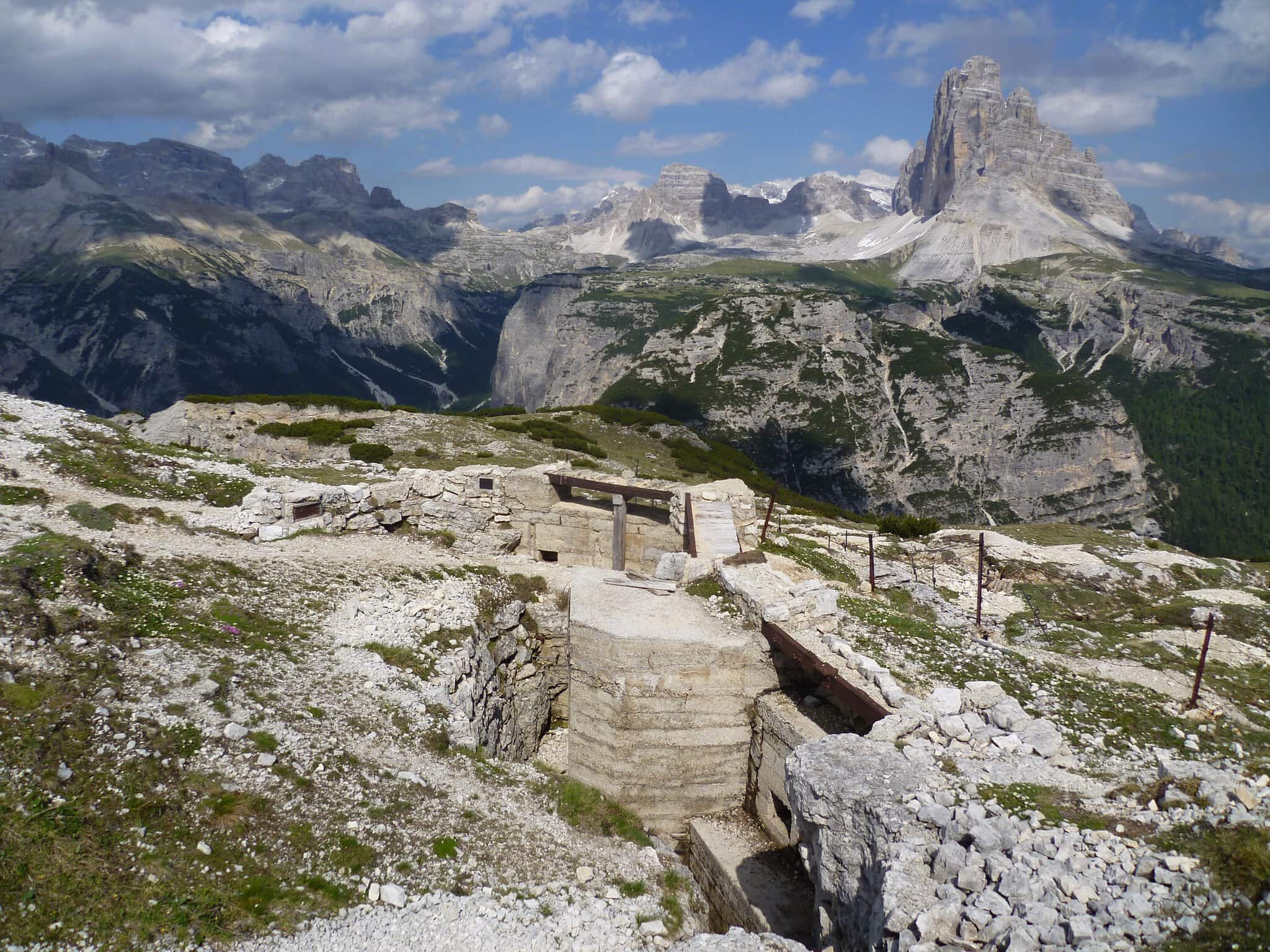
The area around Lagazuoi is riddled with tunnels from the First World War, when heavy fighting raged here between the Italians and the Austrians. If you’ve still got energy after lunch, I really recommend strapping on a headtorch and safely exploring some of them. And the evening? Sunset from the terrace of the Lagazuoi hut is one of those experiences you’re guaranteed never to forget.

4. Rifugio Lagazuoi to Rifugio Nuvolau (views of the five towers)

On the morning of day four you’ll descend from Lagazuoi (or you can take the cable car if your knees need a little rest) and head towards another very well-known area. You’ll walk for roughly 5 hours, with incredible rock formations in your sights the whole time.

Today’s destination is Rifugio Nuvolau. This hut is perched on the very summit of the mountain of the same name like an eagle’s nest, and it’s the oldest hut in all the Dolomites. The setting is a touch cramped, but the view of the nearby Cinque Torri and the majestic Marmolada (the highest mountain in the Dolomites, home to a glacier) more than makes up for it.

5. Rifugio Nuvolau to Rifugio Città di Fiume (a change of scenery)

During day five, which takes around 6 hours, you’ll start to notice how the landscape is changing. From the northern, sharper peaks you’ll begin moving into a slightly greener area. You’ll cross the Passo Giau saddle, which Lukáš and I often drove to on day trips, because it’s a wonderful spot full of grazing cows and tinkling bells.

The route then leads you beneath the enormous, massive wall of Monte Pelmo. Your bed for tonight will be at Rifugio Città di Fiume. This hut is renowned for its cosiness and very friendly staff, so after five days in the mountains you’ll feel almost at home.

6. Rifugio Città di Fiume to Rifugio Coldai (beneath the majestic Civetta)

The sixth stage is a touch shorter, taking roughly 5 hours, and the star of the show here is the Civetta massif. This enormous rock massif will accompany you for most of the day, and even though you definitely won’t be climbing it, the sight of those kilometres of sheer walls — home to climbers from all over the world — is simply breathtaking.

Rifugio Coldai sits just above the lovely lake of the same name, Lago di Coldai. If you arrive in time, don’t forget to take a short walk down to the lake — the water is incredibly clear, although swimming in it is probably only something Wim Hof could manage. 😂

7. Rifugio Coldai to Rifugio Vazzoler (around the rock giants)

On day seven (about 6 hours of walking) you’ll pass directly beneath the giant walls of the Civetta massif. This part of the trail is known for its wildness and for having fewer day-trippers. You’ll pass two more mountain huts (Rifugio Tissi is a great spot for a lunchtime soup or coffee) and gradually descend into slightly warmer altitudes.

In the evening you’ll reach Rifugio Vazzoler, charmingly tucked away in the forest beside a small botanical garden. There’s a wonderful sense of calm here, and the evening air already smells completely different from up north at the start of the trek.

8. Rifugio Vazzoler to Rifugio Carestiato (into the national park)

This stage clocks in at just under 7 hours and leads you beneath another gorgeous mountain, the Moiazza massif. The path here is often a touch trickier, more rocky and demands care, especially if it happens to be raining.

The landscape begins to open up more and more towards the southern plains, a sign that you’re nearing the end of your great journey. Rifugio Carestiato sits below the Passo Duran, and once again you’ll find excellent local food and a well-earned rest.

9. Rifugio Carestiato to Rifugio Pian de Fontana (the toughest day)

The penultimate stage is honestly probably the hardest of the whole trek, so steel yourself with patience and energy. You’re in for around 8 hours of strenuous walking in a fairly isolated area within the Dolomiti Bellunesi National Park. You’ll have to cross several rather deep valleys and tackle sharp climbs up to mountain saddles.

When you finally crest the last ridge, you’ll spot Rifugio Pian de Fontana with relief. It’s a picturesque shepherd’s homestead converted into a mountain hut, where they’ll look after you beautifully and where you’ll probably eat a double portion of dinner. 😅

10. Rifugio Pian de Fontana to Belluno (a sweet return to civilisation)

The final day! You have about 5 hours of walking left, heading down, down and down again. The steep descents really hammer your knees (definitely don’t underestimate trekking poles, which we’ll talk about shortly), so don’t rush.

The route ends at a bus stop near a place called La Pissa, from where regular services run to the town of Belluno. Once you reach the main square in Belluno, treat yourself to the biggest scoop of gelato and a proper Aperol Spritz to celebrate — you’ve earned it!

How to shorten the trek if you don’t have ten days

Ten days of holiday is quite a lot, and we understand that not everyone has that much time or nerve. The good news is that the Alta Via 1 offers several great “escape routes” back to civilisation, which let you plan a considerably shorter itinerary.

Northern version in 4 days

If you want to see the absolute most famous bits (Lago di Braies and the area around Lagazuoi), the first 4 days of the trek are all you need. You set off from Braies and on the afternoon of day four simply descend from the Lagazuoi hut down to the Passo Falzarego. From here there are comfortable, frequent buses straight to Cortina d’Ampezzo, where we spent many summers.

This version is ideal for those of you who don’t have much holiday but want a taste of the true high-mountain atmosphere. The views here are the most dazzling, and you definitely won’t miss out on any of the iconic spots — you’ll just save your knees from the long descent.

lukas a lucka
Lukáš and Lucie recommend
Where to stay on Alta Via 1 in the Dolomites
6 accommodations — hotels, mountain huts and other lodging options
⭐ TOP CHOICE 🏨 Hotel
Hotel Pragser Wildsee
Iconic hotel right by Lake Lago di Braies, ideal base for the night before starting the trek. Waking up at the lake before the first tourist buses arrive is priceless.
★★★★ Check prices
Check availability
🏔️ Hut
Rifugio Lagazuoi
Mountain hut by the iconic cliffs at an altitude of over 2700 meters. One of the most iconic places in the Dolomites. The sunset from the hut’s terrace is an experience you won’t forget.
★★★★ 75-95 EUR/night with half board
Check availability
🏔️ Hut
Rifugio Sennes
Charming mountain hut on a high plateau with excellent food. Famous for its Kaiserschmarrn (shredded pancake) with apple purée. Combines the best of Italian and Austrian cuisine.
★★★★ 75-95 EUR/night with half board
Check availability
🏔️ Hut
Rifugio Nuvolau
The oldest mountain hut in the entire Dolomites, perched on the summit like an eagle’s nest. The view of Cinque Torri and the majestic Marmolada more than makes up for it.
★★★★ 75-95 EUR/night with half board
Check availability
🏔️ Hut
Rifugio Biella (Seekofelhütte)
Mountain hut in a barren lunar landscape after the first day of trekking from Lago di Braies. Located in quite an inhospitable but tremendously atmospheric environment.
★★★★ 75-95 EUR/night with half board
Check availability
🏔️ Hut
Rifugio Città di Fiume
Mountain hut renowned for its coziness and very friendly staff. After five days in the mountains, you’ll feel almost at home here.
★★★★ 75-95 EUR/night with half board
Check availability

Mid-length version in 6 days

The six-day version is also very popular. The route is essentially the same up to Rifugio Città di Fiume or the nearby Passo Staulanza. From there you can easily catch buses back to your car or to larger towns for the train. You’ll miss out on that lovely feeling of completing the entire crossing all the way south, but you’ll still be reminiscing about it for years.

We recommend it for families with older children or for those who aren’t entirely sure of their stamina for the full ten days. Six days in the mountains is just about right to clear your head without starting to hate your backpack. 😅

What to pack for a multi-day trek

The key phrase for packing is just one: less is more. Every gram makes itself felt after a few days, and you’ll feel every extra jumper on your back. Lukáš and I stick to the rule that a backpack for treks like this definitely shouldn’t exceed 8 to 10 kilograms (including water and food). Here are the things we’d never set off into the mountains without.

Essential gear and clothing

The foundation of everything is top-quality hiking boots. Never go on a trek in brand-new, unbroken-in boots — that’s a guaranteed recipe for a holiday ruined by blisters. For this route we’d recommend higher trekking boots that give your ankle good support on the rocky terrain. Lukáš and I swear by Lowa (I’ve had one pair for over six years and they’re still going strong). La Sportiva are apparently even better on technical terrain, but I haven’t tried them.

The second most important thing is clothing. Don’t forget to layer up: down in the valley it can be over thirty degrees and you’ll be walking in a T-shirt, while in the evening at a hut at two thousand metres, or in the early morning hours at Lagazuoi, you’ll be grateful for a down jacket, gloves and a hat. Definitely pack a quality waterproof jacket (Gore-Tex) or a decent rain poncho, because mountain weather changes from one minute to the next.

Other essentials for your backpack

We try not to take anything unnecessary, but these things you simply must have with you, no matter what.

  • Trekking poles: Even if you think you don’t need them, your knees will thank you on long descents with a backpack. We won’t hear a word against our lightweight folding Leki poles.
  • Sleeping bag liner: Mountain huts don’t provide fresh bedding for every guest, so for hygiene reasons it’s compulsory to have your own lightweight textile or silk liner. You don’t need to lug along a full warm sleeping bag — the huts give you thick woollen blankets.
  • Headtorch: Essential not just for evening outings, but mainly if you get delayed in the mountains and end up walking in the dark. Even in summer, it gets dark earlier in the mountains than down in the towns.
  • First-aid kit: Basic blister plasters (e.g. Compeed), painkillers, a bandage, disinfectant and a foil blanket in case of hypothermia.
  • Power bank: At many huts you can’t charge your phone in your room — electricity is often only available in the common room and the sockets fill up immediately. A power bank with a capacity of at least 10,000 mAh is therefore a real lifesaver.

Mountain safety and useful apps

The mountains are beautiful, but they can also be cruel and unpredictable. Even though the Alta Via 1 is a waymarked hiking trail and you won’t be crossing any glaciers, you should never underestimate a few basic rules for moving around the alpine environment.

The 1 pm rule and thunderstorms

Lukáš and I have been trying to stick to this rule for many years now and thankfully it’s never let us down. In summer in the Dolomites, especially in the August heat, strong local heat thunderstorms develop very frequently. These storms arrive in a flash and with incredible force, usually in the afternoon. So the golden rule is: plan your hikes so that by 1 pm, or 2 pm at the latest, you’re at the hut, or at least in a safe, sheltered section of the ridge. The worst thing that can happen is getting caught in the afternoon on the steel cables of via ferratas or on bare summits when a storm breaks.

If you do get stuck out in the open and the thunder starts, immediately get down off the ridges as low as you possibly can. Throw away your trekking poles, which act like lightning rods, and shelter somewhere in a hollow — never under a lone tree.

Signal and navigation

Although Italy has fairly decent coverage, in many valleys you simply can’t get a signal, so offline maps (try Maps.me or AllTrails) are an absolute necessity, not an optional extra. Download them while you’re still at home and have WiFi. If you’re walking the trek for the first time and you’re worried about safety or poor visibility, it’s brilliant for peace of mind to take a so-called satellite communicator (e.g. a Garmin InReach).

If you’re a beginner and don’t fancy setting off on your own, you can of course hire an internationally certified mountain guide (IFMGA). A group hike with a guide usually works out at around €250 per day for the whole group, which can be worth it with more people, and it gives you genuine peace of mind. You can also browse guided Dolomites tours and activities on GetYourGuide.

Practical tips to finish and a few deals

If you’re already planning to buy flights and insurance for your trip to Italy, here’s a summary of the services Lukáš and I genuinely use (not because someone paid us, but because they’ve repeatedly saved our nerves):

Where to find flights to Italy

If you’re not driving over from Austria, the ideal starting point is Venice airport, or possibly Treviso. From the UK, there are plenty of direct flights to Venice with the likes of British Airways, easyJet and Ryanair from London, Manchester and other major airports. We always hunt for cheap flights on Skyscanner — it’s our absolute favourite portal for comparing all the airlines.

And believe me, saving on the flight means more money for a bombardino or an Aperol on some terrace. It usually pays to buy flights around two to three months ahead, when prices are at their best.

Renting a car for the transfers

If you fly into Italy and don’t want to rely solely on buses, we regularly use the DiscoverCars.com comparison site. We’ve had the best long-term experience with it all over the world. The drive from Venice to Lago di Braies takes just under 3 hours.

I’d definitely recommend paying extra for full cover, because Italian roads are narrow and the local drivers do rather their own thing. And don’t forget to pick a car with enough power — on those switchbacks up the hills you’ll really appreciate it! Bear in mind that, coming from the UK, you’ll be driving on the right here, so allow yourself a little time to adjust.

Don’t forget mountain insurance

This is absolutely crucial! Ordinary travel insurance that comes with your bank card definitely won’t cut it for a multi-day mountain trek — it often won’t cover helicopter rescue. For shorter trips in Europe we usually go with AXA insurance, and for longer or more demanding trips we rely on the tried-and-tested worldwide cover from True Traveller (or you can read our SafetyWing review). Insurance that covers “mountain search and rescue” and high altitudes is simply a must. UK travellers should also remember to bring a valid GHIC card, but it won’t replace proper mountain insurance.

We have a rule about this: if you can’t afford proper insurance, you can’t afford the trip. You never know when you’ll take a bad step, and a helicopter in the Dolomites is genuinely no cheap joke, believe me.

What about internet in Italy

Since Italy is in the EU, roaming with a UK SIM may now incur charges following Brexit, so it’s worth checking your provider’s terms before you go. If you want to avoid surprise bills or need reliable local data, definitely take a look at our favourite e-SIM (more in our Holafly review).

But honestly, once you get a bit higher on the trek, the signal often disappears even with the best data in the world. Take it as a bonus and enjoy a real digital detox — sometimes that’s the very best way to relax!

Where to stay before and after the trek

As I’ve already written, on the route itself you sleep exclusively in mountain huts. But what about the night before the start, or once you’ve successfully finished the whole show at Belluno? Finding a decent hotel to pamper you after that kind of effort is essential.

Lukáš and I have a few favourite spots we love coming back to when we want to rest. We usually try to find something with a touch of that alpine charm, but that won’t wreck our budget either.

Our hotel picks in Cortina and by the lake

Right by Lago di Braies, the absolute classic is the Hotel Lago di Braies. It’s a touch pricier, but waking up right beside the lake before the first tourist buses roll in is priceless. We spent one wonderful night there. You can check availability and prices on Booking.com.

If you’re after a base in Cortina d’Ampezzo, we have very fond memories of the Hotel de la Poste. It’s right in the centre, has incredibly friendly staff and, above all, fantastic beds you’ll sink into like a cloud after returning from the mountains. Plus they do a great breakfast!

Where to eat and refuel

In the mountains you simply have to eat. And the Italian Alps are a chapter all of their own. Forget any dry rolls — here, even at over two thousand metres, they cook like a luxury restaurant.

The food in the mountain huts is mostly absolutely excellent and hearty. Most rifugi offer three-course dinners that put you back on your feet, no matter how far you walked that day.

The best culinary stops

During the trek you definitely mustn’t miss the kitchen at Rifugio Sennes. I mentioned it earlier in the itinerary, but their Kaiserschmarrn (shredded pancake) with apple purée is simply legendary. I sometimes even dream about how good it was!

And once you’re back in civilisation in Cortina, pop into Ristorante Pizzeria Croda. They have the best and thinnest pizzas for miles around, and their cheese is just indescribable. Lukáš and I always devour a pizza there and wash it down with a glass of local wine, like proper Italians.

Where to go next from the Dolomites

If you’re staying in the area after the trek (or, like us, you’re still saving up the whole crossing for when little Jonáš grows a bit 😄), take a look at our other articles about the Dolomites: read about what to do in the Dolomites, where we share the most beautiful spots across the mountains, or try our specific guide to 5 hiking trails for everyone in the Italian Dolomites. We managed all of these trails even with little Jonáš in the carrier! ☺️

FAQ

How do I get to Alta Via 1?

The trek starts at Lago di Braies (Pragser Wildsee). The easiest way to get there is by train to the town of Villabassa/Niederdorf or Dobbiaco/Toblach, from where regular bus lines run to the lake. From Cortina d’Ampezzo, you can also get there by car or regional bus in just under an hour.

When should I hike Alta Via 1?

The best time for the trek is from mid-July to early September, when you’re most likely to have good weather and the snow in the passes has safely melted. However, try to avoid August around the Ferragosto holiday (August 15th), when the mountains and huts are extremely crowded.

Where can I park for Alta Via 1?

Most commonly, cars are left in the town of Dobbiaco (Toblach) at public long-term parking lots near the train station, or at free parking lots near Cortina d’Ampezzo. Long-term parking for several days directly at Lago di Braies is not possible, or rather would be very expensive. From the end of the trek at Belluno, you can return to your car by train or bus.

Where should I go in the Italian Dolomites?

If you’re not planning a ten-day traverse, excellent starting points for day hikes are Cortina d’Ampezzo (for the eastern part of the mountains), Ortisei in Val Gardena valley (for the Alpe di Siusi and Seceda area), or Canazei (for the area around Marmolada and Pordoi Pass).

Can I sleep in a tent along the route?

No, unfortunately it’s not allowed anywhere along the route. Wild camping in the Dolomites national parks is strictly prohibited, and park rangers monitor this very carefully and issue hefty fines. The only legal option is mountain huts (rifugi).

How far in advance do I need to book huts?

Due to the enormous worldwide popularity of this trek, we recommend starting to book huts at least 3 to 6 months in advance, ideally during January and February for the summer season. Last minute (in June or July), you’ll only manage to get a spot with an enormous amount of luck.

Do I need via ferrata equipment for Alta Via 1?

No, the classic Alta Via 1 route is classified as EE (Escursionisti Esperti – for experienced hikers) and doesn’t contain any technically demanding via ferrata sections. Places where steel cables are installed are only for safer handholds, and you can manage them with a bit of caution even without a harness and helmet. If you’re looking for routes with protection, focus on the Alta Via 2 trek.

Tips and Tricks for Your Vacation

Don’t Overpay for Flights

Search for flights on Kayak. It’s our favorite search engine because it scans the websites of all airlines and always finds the cheapest connection.

Book Your Accommodation Smartly

The best experiences we’ve had when looking for accommodation (from Alaska to Morocco) are with Booking.com, where hotels, apartments, and entire houses are usually the cheapest and most widely available.

Don’t Forget Travel Insurance

Good travel insurance will protect you against illness, accidents, theft, or flight cancellations. We’ve had a few hospital visits abroad, so we know how important it is to have proper insurance arranged.

Where we insure ourselves: SafetyWing (best for everyone) and TrueTraveller (for extra-long trips).

Why don’t we recommend any Czech insurance company? Because they have too many restrictions. They set limits on the number of days abroad, travel insurance via a credit card often requires you to pay medical expenses only with that card, and they frequently limit the number of returns to the Czech Republic.

Find the Best Experiences

Get Your Guide is a huge online marketplace where you can book guided walks, trips, skip-the-line tickets, tours, and much more. We always find some extra fun there!
Tre Cime di Lavaredo, Dolomites Italy: 12 Tips on What to See and Do

TL;DRThe Tre Cime di Lavaredo are three iconic rock towers in the Italian Dolomites (Cima Grande 2999 m, Cima Ovest 2973 m, Cima Piccola 2857 m). The classic loop around them is about 10 kilometres, with a manageable 350 metres of ascent, taking 3 to 4 hours on foot. Among the 12 tips on what to see and do are the viewpoint at the Rifugio Locatelli hut, with its classic view of the north faces, the Cadini di Misurina lookout, the Innerkofler via ferrata up Monte Paterno with its First World War tunnels, and a winter visit on snowshoes or by snowmobile. From 2026 you’ll need to book parking at Rifugio Auronzo online through seethedolomites.com, at €50 a day, or take the bus from Misurina or Cortina d’Ampezzo instead. The best time to go is July to September, avoiding mid-August, or late September into October.

If you’re planning a holiday in northern Italy, there’s something crucial I need to flag before you go. Tre Cime di Lavaredo is arguably the most popular spot in the entire Dolomites Italy region, which unfortunately means it gets absolutely packed in peak season — and the transport rules have undergone a massive overhaul. These new regulations can really catch you off guard, so I’ll walk you through them first — so no barrier gate ruins your day. I’ll also share which route works best with kids or dogs and where to reward yourself with the most incredible cheese dumplings after your hike.

TL;DR

  • Car reservation is a must: From 2026, the car park at Rifugio Auronzo is strictly by online reservation only via the official website seethedolomites.com. No booking, no entry.
  • Parking fee: Budget around €50 for the full day — it’s steep, but absolutely worth it.
  • Classic circuit: The most popular route (Tre Cime di Lavaredo hike) around the three towers takes roughly 3 to 4 hours and covers about 10 kilometres with barely any elevation gain.
  • Kids and pushchairs: The circuit isn’t suitable for pushchairs, but you can enjoy stunning views right from the car park without breaking a sweat.
  • Drone ban: Leave it at home — fines in the national park can soar to an eye-watering €3,000.

What Are Tre Cime di Lavaredo and Why Should You Visit?

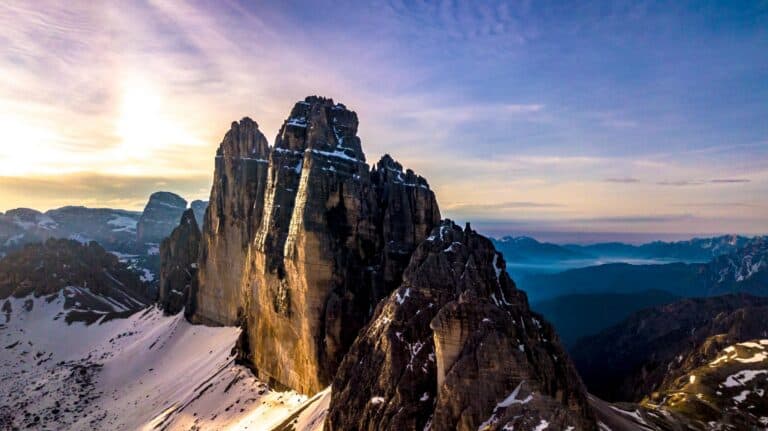
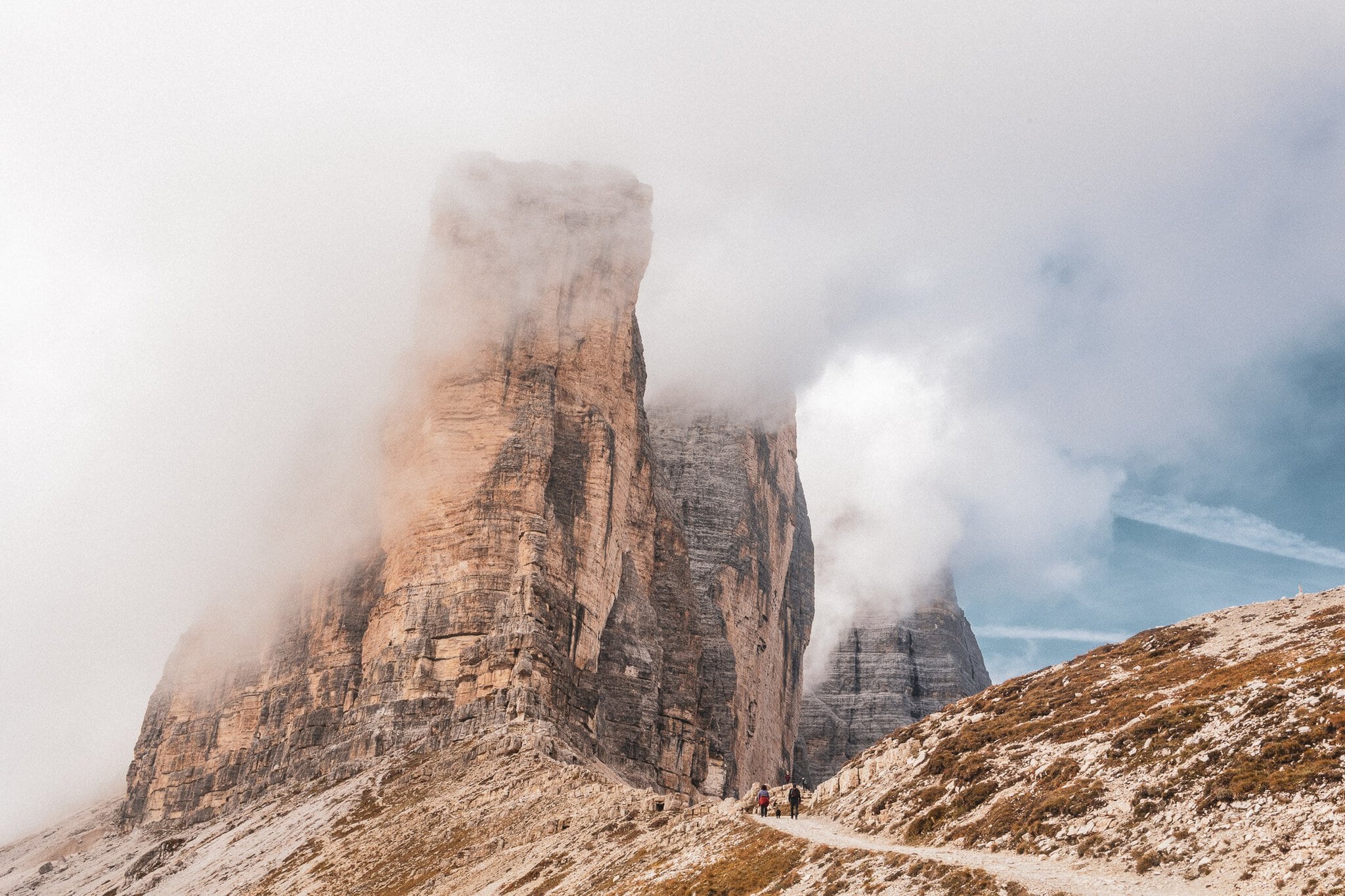
You know that feeling when you’ve seen a place a hundred times on Instagram, yet when you’re actually standing there in person, it still takes your breath away? That’s exactly what Tre Cime are — Three Peaks in English, or Drei Zinnen in German. These three iconic rock towers are a UNESCO World Heritage Site and the undisputed symbol of the Italian Dolomites. They consist of three main summits: Cima Grande at 2,999 metres, Cima Ovest at 2,973 metres, and the smallest, Cima Piccola, at 2,857 metres.

I still can’t quite wrap my head around the fact that all of this was once coral reef on the ocean floor. The rock is largely composed of dolomite and limestone — carbonates that give the peaks their gorgeous colour, shifting from orange to deep pink as the sun sets. Beyond the breathtaking scenery, there’s also a rather sombre history here: the front line during World War I ran right through this area, and you can still find remnants of trenches and tunnels carved into the rock.

When to Visit for the Best Experience

Picking the right time is absolutely critical at Tre Cime, especially if you want to actually enjoy the hike rather than just shuffle along in a crowd. The summer months from July to September offer the most stable weather, and all the mountain huts are open. I’d strongly recommend avoiding mid-August, though — that’s when Italians celebrate Ferragosto, and it feels like the entire country heads for the mountains. Trust me, it’s a level of crowding you really don’t want to experience. 😅

Lukáš and I personally love visiting the Dolomites around the turn of September and October. Morning mists drift lazily through the valleys, the larches start turning gold, and the air is beautifully crisp and clear. Plus, the crowds thin out considerably. Whenever you decide to go, always check the forecast at least ten days ahead — weather at around 3,000 metres can change in a matter of minutes. You can also visit in May when conditions can be perfect, though the road up doesn’t usually open until late May.

How to Get to Tre Cime in 2026

This is arguably the most important chapter in the entire guide, because the access rules have been drastically tightened and plenty of tourists end up circling the base in confusion when they discover they can’t get up. Below, I’ll walk you through every option for reaching the towers comfortably and stress-free.

Driving Up to Rifugio Auronzo (Reservation Required)

This is the most convenient but also the priciest option, particularly well-suited for families with small children. A beautiful mountain road leads up to Rifugio Auronzo from the area around Lake Misurina, but the access fee is a hefty €50.

In the past you could pay on the spot, but since around 2021 the rules have been steadily tightening. For 2026, a maximum of 1,500 cars are allowed per day and you must pre-book your parking slot through the official website seethedolomites.com. Without the QR code from your reservation, the barrier simply won’t open — so make sure to sort this out well in advance.

By Bus from Misurina or Cortina

If you’d rather not shell out for the expensive parking, or there are simply no slots left, local buses are an excellent alternative. We tried this option last year and honestly, it was a breeze — no hunting for a parking space and no stress navigating the hairpin bends.

Regular shuttle buses run from Misurina, Cortina d’Ampezzo, and the town of Dobbiaco, taking you all the way up to Rifugio Auronzo. The ticket price varies depending on where you board, but it works out significantly cheaper than driving — and you don’t have to worry about those tight switchbacks.

On Foot from Lago di Misurina (For Keen Hikers)

For those of you who love a challenge and want to save on the toll, there’s the option of hiking up on a marked trail directly from Lago di Misurina.

It’s completely free, but bear in mind the ascent to Rifugio Auronzo alone takes at least 2 hours of solid walking — all before you even start the main circuit around the towers. It’s a lovely walk through the forest, but the elevation gain is noticeable.

Where to Stay and How Much It Costs

We pick accommodation very strategically — our goal is to be up there as early as possible in the morning, before half of Europe arrives. Here’s what we’ve learned about the various options in the area.

Generally speaking, if you want to save a bit of money, look for accommodation in the Val Pusteria valley — villages like Dobbiaco (Toblach) offer noticeably lower prices and you’re within easy driving distance of both Tre Cime and Lago di Braies. Cortina d’Ampezzo is gorgeous and oozes Italian glamour, but expect to pay around €160 per night for a mid-range hotel in season. The Hotel de la Poste right in Cortina is lovely, but if you’d rather save money and stay in Dobbiaco, have a look at Hotel Santer or the family-run Romantik Hotel Santer.

Staying right by Lake Misurina is a very popular and strategic choice — the toll gate is just a stone’s throw away. And if you’re after something truly unique, you can book a bed directly up at Tre Cime in the mountain hut Rifugio Auronzo. Expect to pay around €80 to €120 per person including a wonderful half-board, but you’ll need to reserve up to six months ahead due to massive demand. You can easily compare availability and prices for Misurina, Cortina, and the surrounding valleys on Booking.com.

12 Tips on What to See and Do at Tre Cime di Lavaredo

Right, now for the good stuff. Here’s everything we’ve tried around Tre Cime over the years — and everything we wouldn’t dream of skipping.

1. The Classic Circuit Around the Towers

This is the main event — the reason most people come here — and exactly the Tre Cime di Lavaredo hike we’ve loved so much over the years. It’s a circular route of roughly 10 kilometres that starts and finishes at Rifugio Auronzo.

Allow roughly 3 to 4 hours at a relaxed pace. The terrain is fairly level with a total elevation gain of about 350 metres, making it manageable for less experienced hikers and older children. The trail passes right beneath the majestic towers, offering jaw-dropping views in every direction.

2. Stunning Views Right from the Car Park (Perfect with Kids)

If you’re not up for a full-day trek, don’t worry. You can enjoy an absolutely breathtaking view of Tre Cime practically the moment you park at Rifugio Auronzo.

There’s a wonderful flat viewing platform where you can sit down, sip a coffee from your flask, and simply soak in those colossal rock faces. It’s our go-to solution for days when our legs need a rest, or when we’re travelling with elderly family or pushchairs.

3. Rifugio Locatelli for the Ultimate Photo

If there’s one single view you’ll recognise from postcards, it’s the one from Rifugio Locatelli (also known as Dreizinnenhütte in German). You’ll reach this hut roughly halfway around the classic circuit, and it offers the most iconic, quintessential view of the three towers’ dramatic north faces.

I highly recommend sitting down on the terrace, ordering a well-deserved beer, and just soaking in that high-alpine atmosphere.

4. Coffee at Rifugio Lavaredo

Another stop on the classic circuit is the cosy Rifugio Lavaredo. It sits on the southern side of the towers and makes for a perfect rest stop before tackling the climb towards the pass.

They make excellent coffee and serve an absolutely divine apple strudel that vanishes in record time after a good walk. 😁

5. Crossing the Forcella Lavaredo Pass

Heading up from Rifugio Lavaredo, you’ll face a short but fairly steep climb to the Forcella Lavaredo pass at 2,454 metres. This is the moment you cross an invisible threshold and the sheer north faces of Tre Cime reveal themselves in all their colossal glory for the first time.

It gives me goosebumps every single time — it’s a truly awe-inspiring sight.

6. Adrenaline on the Via Ferrata Innerkofler

If you’re a climber or a fan of protected climbing routes, you absolutely can’t miss the Via Ferrata Innerkofler on Monte Paterno near Tre Cime di Lavaredo. It’s a stunning via ferrata that leads up the neighbouring Monte Paterno, offering what are arguably the best bird’s-eye views of the Three Peaks.

The route isn’t extremely difficult, but a helmet and a via ferrata set are absolutely essential — you’ll be traversing some seriously exposed terrain.

7. War Tunnels Inside Monte Paterno

The Innerkofler via ferrata also comes with a fascinating dose of history. Part of the route to the summit of Monte Paterno passes through dark tunnels and galleries carved into the rock by Italian soldiers during World War I.

Don’t forget to pack a decent head torch — the passages are dark, cold, and give you a powerful sense of the harsh conditions soldiers endured while living and fighting here.

8. Enrosadira: A Sunset That Takes Your Breath Away

Sunset in the Dolomites is an experience you simply cannot miss. The phenomenon where sunlight paints the limestone cliffs in intense shades of orange and pink is called enrosadira by the locals. Tre Cime are tailor-made for this spectacle.

Just be aware that after sunset, getting out can be a bit tricky as a lot of cars try to leave at once, creating queues at the toll gate. Arm yourself with patience and don’t let it spoil an otherwise magical experience.

9. A Stop at Lago di Misurina

Whether you’re driving up to or back from Tre Cime, make sure you stop at Lake Misurina along the way.

It’s one of the largest natural lakes in the area and the reflections of the surrounding mountains on the water’s surface are stunning. You’ll find several hotels and cafés around the shore where you can relax — and we’re putting together a dedicated guide to this picturesque spot on the blog soon.

10. Stargazing from the Cosmolab Observatory

Not many people know that just a short distance from Misurina, there’s a fascinating observatory and research centre called Cosmolab.

The area around Tre Cime and Misurina has remarkably low light pollution and incredibly clean air, making it one of the best places in Europe for stargazing. If you’re into astronomy, I’d highly recommend checking whether they’re running any public night-time observation sessions during your visit.

lukas a lucka
Lukáš and Lucie recommend
Where to Stay near Tre Cime di Lavaredo
6 accommodations — hotels and other lodging options

11. Mordor Within Reach: The Cadini di Misurina Viewpoint

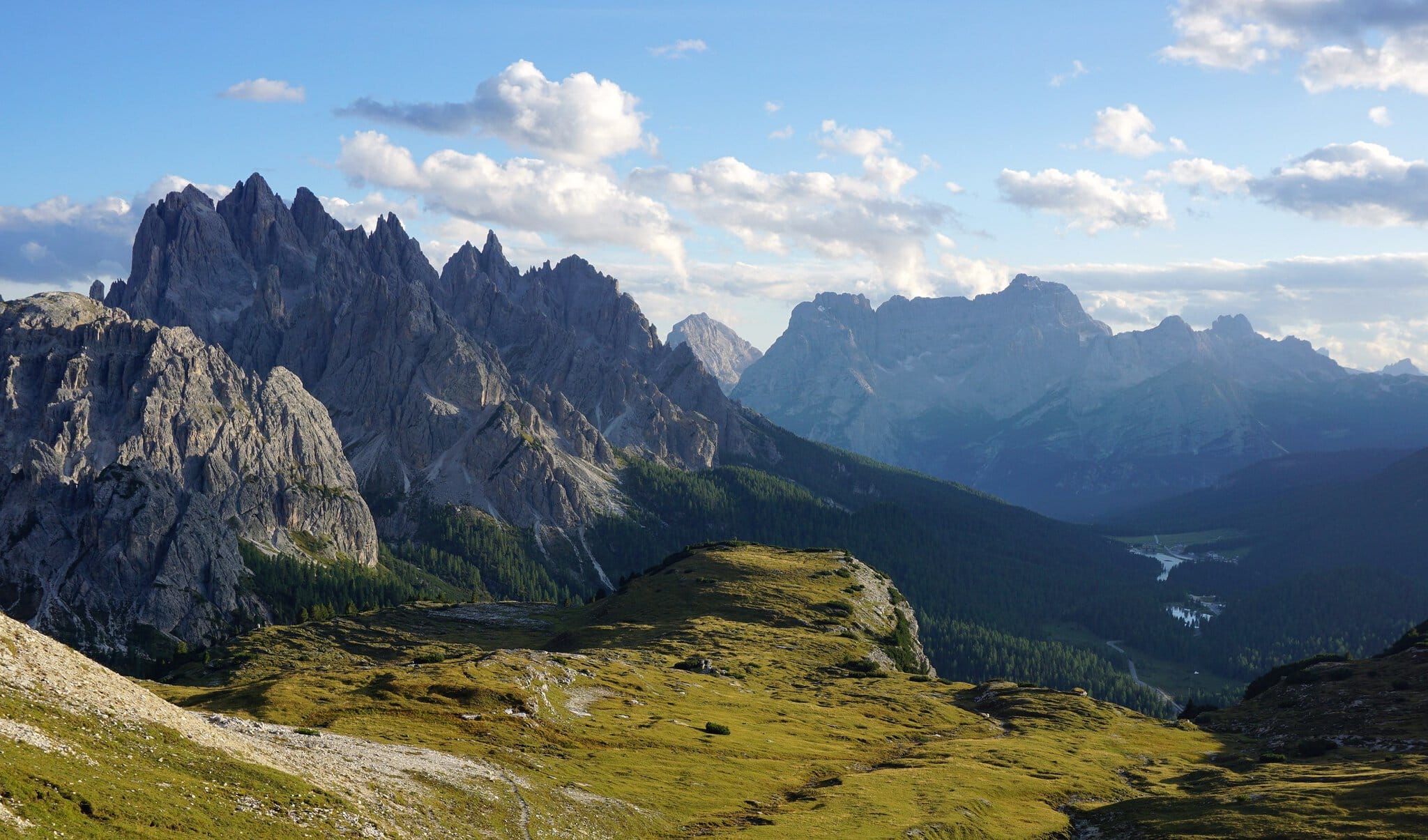
Technically these aren’t Tre Cime themselves, but the trailhead for this viewpoint is right by Rifugio Auronzo, so it would be a real shame to skip it. After roughly forty minutes walking in the opposite direction from the main circuit, you’ll reach the jagged, needle-like peaks of the Cadini di Misurina range.

It looks straight out of Lord of the Rings, and photos from this spot are among the most shared on social media. The terrain is a bit trickier and narrower, though, so exercise caution with young children.

12. Tre Cime Under Snow

Although the area is most popular in summer, a winter visit has its own immense charm. The road up is usually closed to cars, but you can hire snowmobile transfers to take you up — and toboggan your way back down.

More adventurous visitors strap on snowshoes or ski-touring gear and trek through pristine, untouched snow. It’s absolute silence and tranquillity — the polar opposite of the summer frenzy. If you’re considering a winter trip, check the Tre Cime di Lavaredo webcam beforehand to make sure thick fog won’t rob you of the views entirely.

How to Tackle Tre Cime with a Pushchair and Small Children

At first glance, Tre Cime with a little one in a carrier or pushchair might seem daunting — but there’s really nothing to worry about. We just had to adjust our plans a bit. I’d strongly advise against taking a standard pushchair on the main circuit. While the first section might look manageable, the path quickly becomes rocky and rough, and you’d essentially end up carrying the pushchair — which is absolutely not something you want to lug up and down these trails.

Instead, we made use of the car park at Rifugio Auronzo. Drive up comfortably, get the pushchair out of the boot, and stroll along the lovely paved path near the hut. There are plenty of strategically placed benches where you can sit down, feed the little one, and gaze directly at the iconic peaks. You can easily spend a couple of hours here, and small children tend to be perfectly happy — it might just become their first great mountain love. ☺️

Hiking with Dogs: Tre Cime with Your Furry Friends

Travelling with dogs in the Dolomites is generally very popular, and we take our two girls, Kája and Baby, everywhere we possibly can. While a hike like the one to Lago di Sorapis is essentially a no-go with dogs — the path is too narrow and dangerous, with real slip risks — Tre Cime is absolutely brilliant in this regard.

💡 Local tip: Almost all cable cars and buses in the Dolomites require dogs to wear a muzzle (you can buy one practically anywhere, including at the base stations). It was honestly a bit annoying — they required it even when we were in a cabin completely on our own. On days with multiple cable car rides, we sometimes left Kája and Baby resting at the campsite instead.

The classic circuit around the towers is wide enough for dogs to handle with ease. Just steer clear of the start of the Paternkofel via ferrata — it’s far too steep, and we wouldn’t have dared take them there on a lead. Speaking of which, dogs must be kept on a lead for the entire trail — both out of courtesy to other hikers and because of the local mountain cows, who are generally docile but might view a small dog as an interesting challenge.

Where to Eat (and What to Try)

Mountains and food — they just go together, and everyone works up an appetite after a good trek. The cuisine in this part of the Dolomites is a wonderful blend of traditional Italian and Tyrolean cooking. When you’re sitting in the sunshine on the terrace at Rifugio Locatelli, you absolutely must try canederli — hearty, filling dumplings that we love in the cheese or spinach versions, served either in broth or simply drizzled with melted butter and sprinkled with Parmesan. The cooking is also excellent down by the lake at Pizzeria Edelweiss, where the pizza is superb. And if you’re looking for something special, try the restaurant at Malga Langalm hut right on the trail.

Lukáš adores traditional polenta, which they prepare beautifully here — served with wild mushrooms or melted mountain cheese — while I’m a sucker for homemade pasta in creamy mushroom sauce or simply tossed with butter and fresh sage. It’s an incredible treat, and I can guarantee that with those majestic cliffs as your backdrop, everything tastes Michelin-worthy. And of course, don’t forget a refreshing Aperol Spritz — because a holiday in Italy without one simply doesn’t count. 😉

Practical Info and Strict National Park Rules

The Dolomites are experiencing a huge tourism boom, so it’s no surprise that the national park authorities have started strictly enforcing rules to protect this incredible landscape. Two things to pay particular attention to:

  • Drone ban: Aerial shots of the mountains may look spectacular, but drones are strictly forbidden at Tre Cime and throughout the national park. If you’re caught by park rangers, you face an immediate fine of up to an eye-watering €3,000. Leave it at the bottom of your bag.
  • Webcams and weather: Before heading out from the valley, check the Tre Cime di Lavaredo webcam. It’s not uncommon for Cortina to be basking in sunshine while the top is socked in with fog so thick you can barely see your hand in front of your face.

Tips and Tricks for Your Trip

These are the practical bits people constantly ask us about on Instagram. Mountain travel takes a little planning to keep costs down and everything running smoothly.

Flights and Getting There

The nearest airports to the Dolomites are Venice Marco Polo and Treviso. From the UK, you’ll find plenty of direct routes with carriers like easyJet, Ryanair, and British Airways flying into Venice. From there, it’s roughly a two-hour drive north into the mountains.

We always hunt for deals on Kiwi — it’s our favourite flight comparison tool where you can set up handy price alerts.

Car Hire

Getting around the Dolomites without a car is quite tricky, especially if you want to hit multiple spots early in the morning.

We’ve had consistently good experiences with DiscoverCars, which we use all over the world. They often list great local agencies alongside the big names, so you can usually find a solid deal.

Don’t Forget Travel Insurance

Mountains can be unpredictable, so travel insurance is an absolute must — even if you’re just popping up to a viewpoint. Lukáš always reminds me about this, because I’d happily forget and then kick myself for the entire trip.

For shorter trips, we go with SafetyWing — a brilliant option for flexible coverage that we’ve also written a detailed review about. Make sure your policy covers hiking at altitude, which is especially important in the Dolomites.

Where Else to Go in the Dolomites

Once you’ve ticked off Tre Cime, that doesn’t mean it’s time to head home. This region has so many more stunning places to explore. A natural next stop is the iconic high-alpine lake Lago di Braies with its famous rowing boats — we’ve already written about it on the blog.

Cortina d’Ampezzo is well worth exploring for its Italian elegance, or you could head further west to the Val Gardena area. We’ve put together a guide to the gorgeous ridge walk on Seceda, which is photogenic from practically every angle, and you can also browse our comprehensive guide to things to do in the Dolomites for inspiration for the rest of your holiday.

FAQ: Your Most Common Questions

How to get to Tre Cime di Lavaredo?

The easiest but most expensive route in 2026 is to drive by car along the toll road to the Rifugio Auronzo hut (booking required at seethedolomites.com for 50 EUR). Alternatives are the local buses that run from Misurina and Cortina, or a roughly two-hour hike on foot from Lago di Misurina lake.

What does the name Tre Cime mean?

Tre Cime di Lavaredo in Italian literally means ‘Three Peaks of Lavaredo’. The German name Drei Zinnen translates roughly to ‘Three Battlements’ or ‘Three Teeth’, which perfectly captures their distinctive shape—like massive rock teeth jutting into the sky.

Is the loop trail suitable for young children and strollers?

The classic loop trail isn’t suitable for strollers as the terrain is quite rocky. If you’re traveling with a stroller or a very young baby, I’d recommend driving up to the upper parking lot at Rifugio Auronzo, where you’ll get stunning views right from the paved path lined with benches—absolutely no effort required.

What is there to see and do at Tre Cime?

The main activity is the hiking loop around the towers, which offers plenty of beautiful stops including Rifugio Locatelli for the best photos, amazing views of the nearby Cadini di Misurina peaks, or you can explore the WWI war tunnels on Monte Paterno with a guide and helmet.

How do you get to Tre Cime in winter?

During the winter months, the toll road is typically closed to cars due to snow. You can get up there on foot with snowshoes, on ski touring equipment, or you can use the popular snowmobiles that take visitors up, and then you can sled back down.

When is the best time to photograph the towers?

Golden hour and sunset are ideal. During this time, the rocks change color to orange and pink hues (a phenomenon called enrosadira). Just remember that the most iconic view of all three towers is from the north side (from Rifugio Locatelli), so plan your trip to be there at the right time.

Can I pay by card up there?

You pay the parking toll online when making your reservation, but card terminal reliability at the mountain huts along the route varies greatly—they often don’t have good signal. Definitely bring enough cash for coffee, lunch, and any public toilet fees at the huts.

Tips and Tricks for Your Vacation

Don’t Overpay for Flights

Search for flights on Kayak. It’s our favorite search engine because it scans the websites of all airlines and always finds the cheapest connection.

Book Your Accommodation Smartly

The best experiences we’ve had when looking for accommodation (from Alaska to Morocco) are with Booking.com, where hotels, apartments, and entire houses are usually the cheapest and most widely available.

Don’t Forget Travel Insurance

Good travel insurance will protect you against illness, accidents, theft, or flight cancellations. We’ve had a few hospital visits abroad, so we know how important it is to have proper insurance arranged.

Where we insure ourselves: SafetyWing (best for everyone) and TrueTraveller (for extra-long trips).

Why don’t we recommend any Czech insurance company? Because they have too many restrictions. They set limits on the number of days abroad, travel insurance via a credit card often requires you to pay medical expenses only with that card, and they frequently limit the number of returns to the Czech Republic.

Find the Best Experiences

Get Your Guide is a huge online marketplace where you can book guided walks, trips, skip-the-line tickets, tours, and much more. We always find some extra fun there!
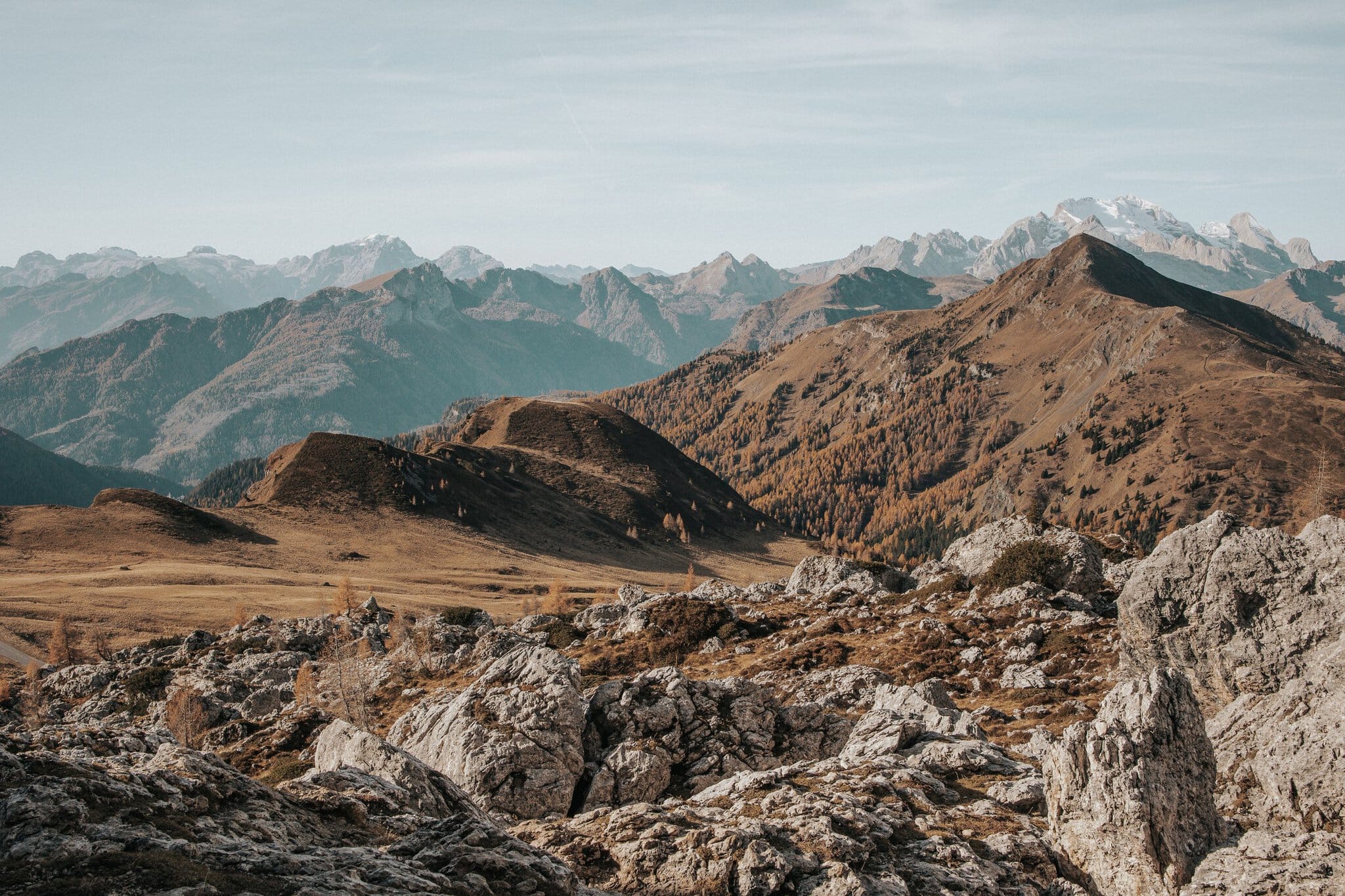
Catinaccio / Rosengarten, Dolomites: 10 Things to See & Do

TL;DRThe Catinaccio massif (Rosengarten in German) in the Dolomites comes with ten essential tips: catching the pink enrosadira glow at sunset, hiking up to the iconic Vajolet Towers and the Rifugio Vajolet hut at 2,243 metres, then pushing on to Rifugio Re Alberto (2,620 m) for the best view of the towers, taking the cable car from Vigo di Fassa up to Ciampedie, trekking to Roda di Vael from Passo Carezza, tackling the Cima Catinaccio summit (2,937 m) — experienced hikers only — the Santner via ferrata, Ladin cuisine, and the legend of King Laurin. The best time for walking is mid-June to the end of September, with August the busiest month. Drones are banned throughout the Sciliar-Catinaccio Nature Park, with fines of up to €3,000.

The Catinaccio massif in the Dolomites, Italy is packed with jaw-dropping spots that hit you the moment you step out of the car. Lukáš and I are head over heels for these Italian mountains and come back regularly, yet a few iconic places are still waiting for us to explore them properly. The area of Catinaccio / Rosengarten and the Vajolet Towers is exactly one of those cases.

So far we’ve only admired these majestic peaks from a distance as we drove past the famous Lago di Carezza, but given how much they tempt us, we did some serious research for our next trip. And because it’s an absolute classic that no mountain and photography lover should skip, I decided to write up all this carefully gathered info and these tips into this guide.

Turning up here unprepared is a bit like showing up at the best restaurant without a reservation. Technically possible, but needlessly stressful. So I’ve written down everything I found out: where to start, where to sleep and how to reach those legendary towers. Be warned that these rocks have one magical quality that draws people from all over the world. ☺️

TL;DR

If you’re packing your backpack right now and just need the essentials in a nutshell, here are the key points you should know before heading into the Catinaccio massif:

  • Two names for one place: Catinaccio in Italian, Rosengarten (Rose Garden) in German. It’s the same massif lying between Val di Fassa and Bolzano.
  • The magical enrosadira: The rocks are famous for turning an incredibly intense pink to red colour at sunset.
  • Vajolet Towers: The most famous rock formation in the whole area. Three sharp towers that look like they belong to another world.
  • Three main starting points: The Carezza pass (Paolina cable car), the town of Vigo di Fassa (Catinaccio cable car) and the village of Tires al Catinaccio.
  • Best time to visit: For hiking, from mid-June to the end of September. In August, expect huge crowds.
  • Drone ban: Flying drones is strictly forbidden across the whole nature park, with fines of up to €3,000.

What exactly is the Catinaccio / Rosengarten?

These mountains in Italy are vast and split into many smaller groups, and the Catinaccio is one of the most beautiful of them all. Its UNESCO World Heritage listing is proof enough. This limestone massif forms a natural border between the Italian-speaking Val di Fassa and German-speaking South Tyrol, so you’ll find everything written twice on the signs.

The biggest draw of the area is the so-called enrosadira. It’s an optical phenomenon where, at sunset (and sometimes at sunrise), the sun’s rays light up the specific composition of the Dolomite rock at such an angle that the whole mountains glow intense pink, orange and gradually a blood red. The Catinaccio massif is supposedly the very best place to see this in the entire Dolomites.

An old medieval legend about the dwarf king Laurin is tied to this colouring. He supposedly planted a beautiful rose garden in the mountains (hence the German name Rosengarten). But when his beloved princess was stolen from him, he cursed the garden so that no one would ever see it again, by day or by night. He forgot about dusk, though, which is why, according to the legend, the roses glow only in those few moments between day and night. It’s just a fairy tale, but when you see that pink glow with your own eyes, it’s easy to believe there’s something to it. ☺️

When to visit the Catinaccio massif and how to get your bearings

We arrived once in June and half the cable cars still weren’t running because of the snow. Ever since then we plan our timing in advance, because the Dolomites won’t cut you any slack on that front. The Catinaccio offers things to do all year round, but each month has its own quirks and pitfalls worth preparing for.

For classic summer hiking and walks up to the mountain huts (rifugio), the best window is from mid-June to the end of September. Most cable cars and huts open during June, once the snow melts at higher altitudes. July and especially August are the peak of the season, which in Italy means huge crowds, full car parks and higher prices. From our experience with the main spots in the Dolomites we know that autumn (late September and October) tends to be far calmer, and thanks to stable weather it’s an absolute paradise for photographers. In winter, the area turns into a great ski resort, especially around the Carezza pass and Vigo di Fassa.

How to get to the Catinaccio and the starting points

Getting beneath the peaks themselves isn’t as complicated as it might first look on the map. It all depends on which side you’re coming from and which specific route you have planned. Below you’ll find the three main gateways most people use to head into the mountains.

If you’re coming from the south via Trento and Bolzano, the most scenic approach leads over the Carezza pass (Passo Costalunga). Here you can hop on the Paolina cable car, which takes you straight up to over 2,100 metres above sea level. From there it’s just under half an hour along an easy path to the iconic Rifugio Roda di Vael hut, a great starting point for further treks.

The second popular option is the picturesque Ladin town of Vigo di Fassa, which sits right in the valley. From the town centre the Catinaccio gondola whisks you up to the Ciampedie plateau. From there a classic route leads towards the Vajolet Towers. The third option is the quieter village of Tires al Catinaccio (Tiers), from which you’ll have to walk a fair bit longer (roughly 2 hours to the first big huts), but you’ll also dodge the biggest crowds and enjoy total peace away from mass tourism. Lukáš and I have long had good experiences with DiscoverCars, which we use all over the world, and a car is an absolute must for exploring side valleys like these. For readers coming from the UK, the easiest way in is to fly to Venice, Verona or Bergamo and pick up a hire car there.

Where to stay and how much it costs

Choosing the right accommodation affects how long your morning drive to the cable car is and how close you’ll be to the best views of the enrosadira. As a rule, the Val di Fassa valley is a bit pricier, but it offers an amazing Italian-Ladin atmosphere and perfect access to the whole Dolomites. Expect the average price for a quality room for two in summer to land around €150 to €250 per night.

Vigo di Fassa is a lovely Ladin town where in the evening people sit outside the restaurants and you can hear three languages at once on the street. If you want to be near the cable car, Hotel Olympic (book on Booking.com) is a reliable choice, and for those who like to treat themselves, the Ciampedie Luxury Resort. They really look after you there. If you prefer the German-speaking side and want to be close to Lake Carezza, head for Nova Levante (Welschnofen). The absolute classic here is the Romantik Hotel Post.

For those after total peace, old little churches and meadows where cows graze with bells around their necks, Tires al Catinaccio is a slightly cut-off paradise with some of the best views of the whole massif. The luxurious Cyprianerhof, with its wellness spa, is by all accounts a place you simply won’t want to leave.

Catinaccio / Rosengarten: 10 Things to See and Do

Let’s finally take a look at the very best this mountain group has to offer. We gathered information from local mountain guides, read through forums and pieced together an itinerary of what we’d like to see here. The Catinaccio isn’t just about one viewpoint; it’s a complex network of trails, huts and peaks where you could easily spend a whole week.

We’ve put together a mix: from things you can manage even after an opulent Italian lunch (we know what we’re talking about 😅) all the way to climbs where you’ll need real fitness and nerves of steel.

1. The enrosadira at sunset (the main reason to visit)

This is exactly the thing everyone comes here for. Sunset, when the grey limestone walls suddenly burst into intense pink and orange out of nowhere. It’s a phenomenon that lasts only a moment but leaves an impression for life. Locals love telling tales of King Laurin and his roses, but the scientific explanation is that dolomite contains calcium magnesium carbonate, which reacts exactly like this to the slanting rays of the sun.

The best spots to watch the spectacle are on the western side of the massif, ideally from the village of Tires or the meadows around Nova Levante. Many photographers prefer to get up early for sunrise, though, because the rocks then glow in softer pastel tones, and you stand a good chance of avoiding the clouds that often gather over the peaks in the afternoon in the Dolomites.

2. The Vajolet Towers and the hike to Rifugio Vajolet

The Vajolet Towers are an absolute icon, not just of the Catinaccio group but of the entire Dolomites. You’ll spot these three slim, incredibly steep stone fingers jabbing at the sky on every other postcard from the region. The best way to reach them is a classic trek that a moderately fit hiker can handle. The route usually starts after the cable car ride up from Vigo di Fassa and heads deeper into the mountains.

The walk to Rifugio Vajolet, which sits at 2,243 metres, takes roughly 3 to 4 hours depending on your pace. The hut itself perches like an eagle’s nest right beneath the giant rock walls and is a great spot for lunch. You’ll already have a lovely view of the towers from here, even though this still isn’t the most famous photo point. For that you’ll have to push a little harder, which brings us to the next tip.

3. Rifugio Re Alberto right beneath the towers

If the view from a distance isn’t enough and you want to feel those enormous towers right above you, you’ll have to keep climbing higher from Rifugio Vajolet. The path rises fairly steeply through scree fields and stone gullies up to 2,620 metres, where Rifugio Re Alberto (Gartlhütte in German) stands. This is where the truly rugged mountain atmosphere hits you.

The climb to this hut already calls for sturdy footwear, a sure step and no fear of heights, even though it’s not yet a via ferrata. It’s precisely from Rifugio Re Alberto, or from the little lake nearby, that you get the most iconic view of the Vajolet Towers from below. This is where the best photos of the whole massif are born. Just be ready for the trail to get really crowded here in August.

4. An easy ride on the Catinaccio cable car from Vigo di Fassa

Sometimes you’re simply not in the mood to climb hundreds of metres with a backpack, or after three days in the mountains your legs hurt so much you can barely walk. We know these rest days all too well 😅. For days like that, the Catinaccio cable car is ideal: it starts right in the town of Vigo di Fassa and takes you up to 2,000 metres into the Ciampedie area in just a few minutes.

The ride alone is an experience, but the main event comes at the top. A wide and very welcoming plateau opens up, with playgrounds, plenty of benches and, above all, the terraces of mountain huts where you can have an excellent coffee and strudel and just gaze at the mountains. From here you can take completely easy walks across the flat, ideal for prams or older people.

5. The classic trek from the Carezza pass to Roda di Vael

By every guide’s account, this is one of the most popular half-day hikes in the whole area. The route starts at the Carezza pass (or from Lago di Carezza, which we cover in a separate article), from where you ride up on the Paolina chairlift. From the top station you continue on foot along a beautiful, scenic trail.

The path traverses beneath the rock walls and offers fantastic views down the valley and across to the opposite Latemar mountain the whole way. It’s a classic balcony trail that doesn’t climb or descend much, so it’s a fairly relaxed walk. The destination is a big junction of hiking paths and the hut of the same name, which we’ll talk about in the next point.

6. Rifugio Roda di Vael and its panoramic views

Rifugio Roda di Vael (Rotwandhütte) is a perfect place to rest if you’ve set out on the trek from the Paolina cable car. It sits at 2,283 metres and offers some of the best 360-degree panoramic views in the entire Dolomites. From here you can see not only the neighbouring Marmolada massif, to which we’ve dedicated a huge guide by the way, but on a clear day you can even spot the Austrian Alps.

We recommend having lunch here, sitting on the sunny terrace and just soaking up that high-mountain atmosphere. If you have enough energy, you can continue on more demanding trails deeper into the mountains, or do a loop and head back down to the valley a different way.

7. Climbing Cima Catinaccio (experienced climbers with a guide only!)

Cima Catinaccio (Rosengartenspitze) is the highest peak of the central part of the massif at 2,937 metres. But beware, this is no tourist stroll. The climb to this summit is a mountaineering experience that requires climbing skills, protection and, ideally, hiring a local mountain guide unless you’re a seasoned climber.

The ascent itself leads up steep gullies and exposed sections where you can’t afford a single mistake. The way up rewards the bravest with an incredible sense of conquering one of the mightiest peaks in the Dolomites and a view that takes in roughly half of northern Italy. If you don’t have the gear or the experience, it’s better to simply admire this mountain from the safety of the valley huts. There’s no shame in admitting something is beyond you. 😉

8. The Santner via ferrata for advanced iron lovers

The Dolomites are the cradle of via ferratas (protected climbing routes), and the Catinaccio massif hides several of them. One of the most famous and most beautiful is the Passo Santner via ferrata (Santnerpass-Klettersteig). It’s a route that leads you through stunning scenery of ravines, sheer walls and old smugglers’ paths up to the Santner pass.

The B/C grading sounds innocent, but this environment will teach you respect: ice, falling rocks and the fact that rescue takes hours. A helmet, a via ferrata set and boots with a proper sole are a necessity, not a recommendation. And it’s definitely not a route to take a mate who’s putting on a harness for the first time in their life. But if you know what you’re doing, it’s a fantastic adventure.

9. Culture and Ladin cuisine in Val di Fassa

When visiting the Catinaccio massif and the Val di Fassa valley, you mustn’t miss the most important thing: the local culture. This area is home to the Ladins, an ethnic and linguistic minority that has lived here for over two thousand years. Ladin is the region’s third official language (alongside Italian and German) and it’s a fascinating Romance language with roots in Latin.

And then there’s the food. The Ladins may be a small people, but their cuisine will feed you well. Forget about light pizza for a moment and try the traditional canederli (giant dumplings with cheese or spinach served in a broth), polenta with mushrooms and melted cheeses, or cheeses made right on the mountain pastures beneath the rocks.

10. Following the legend of King Laurin

If the story of King Laurin’s Rose Garden caught your imagination, you can set off along special educational trails dedicated to the legend. It’s a great activity especially for families, because the paths are often lined with information boards (mostly in Italian, German and sometimes English) telling fragments of the fairy tale.

There are also roughly two-hour guided walks with local teachers or guides who’ll tell you the story right in front of the glowing rocks. You’ll understand why the locals don’t talk about these mountains just as a place for outings, but almost as living beings.

lukas a lucka
Lukáš and Lucie recommend
Where to stay in Catinaccio / Rosengarten
6 accommodations — wellness hotels, hotels and other lodging options
⭐ TOP CHOICE 🏨 Hotel
Hotel Olympic
A reliable choice in the Ladin town of Vigo di Fassa, located by the Catinaccio cable car that takes you directly to the Vajolet Towers.
★★★★ Check prices
Check availability
⭐ Luxury
Ciampedie Luxury Resort
A luxury resort in Vigo di Fassa for those who like to indulge. Quality guest care in a Ladin town with excellent access to the mountains.
★★★★ Check prices
Check availability
🏨 Hotel
Romantik Hotel Post
An absolute classic in the German-speaking area near Lake Carezza. Ideal for those who prefer the German-speaking region.
★★★★ Check prices
Check availability
⭐ Luxury
Cyprianerhof
A luxury wellness hotel in Tires al Catinaccio. A place of absolute tranquility, old churches and meadows where cows graze with bells. Some of the best views of the entire massif. According to reviews, a place you simply don’t want to leave.
★★★★ Check prices
Check availability
🏔️ Mountain hut
Rifugio Vajolet
A mountain hut at 2,243 meters above sea level directly below the Vajolet Towers. Perched like an eagle’s nest beneath giant rock walls, a great place for lunch and starting point for further treks. Excellent apple strudel with a view of the majestic towers.
★★★★ Check prices
Check availability
🏔️ Mountain hut
Rifugio Re Alberto (Gartlhütte)
A high mountain hut at 2,620 meters above sea level, directly below the Vajolet Towers. True rugged mountain atmosphere, from here opens the most iconic view of the towers from bottom to top. The place where the best photos of the entire massif are born.
★★★★ Check prices
Check availability

Rosengarten with kids and dogs

When you head into the mountains, you often wonder whether a place is suitable for the smallest members of the family too. Luckily, the Catinaccio thinks of them as well. The ride up on the Paolina or Catinaccio cable car is an absolute hit with kids and they’ll manage it without a hitch. From the top stations, a number of paved, flat trails set off that even three-year-olds can walk, and there are often benches and playgrounds too.

💡 Tip: Nearly all the cable cars and buses require dogs to wear a muzzle (you can buy one practically everywhere, even right at the bottom stations). Honestly, it annoyed us quite a bit, they wanted it even when we were riding alone in the cabin. When several cable cars were lined up back to back, we’d rather leave Kája and Baby resting at the campsite.

On the other hand, we definitely wouldn’t recommend the long treks to the Vajolet Towers or the more demanding scrambles up the scree with smaller children. The paths there are rocky, can be slippery, and an all-day hike would more likely just put them off.

And what if you’re travelling with a furry companion? Dogs are allowed into the mountains and the Catinaccio nature park, but a strict rule applies: they must be on a lead at all times. You’re moving through a protected area where marmots and chamois live, and cows graze in many places. Most cable cars will let you on with a dog for a small surcharge or free of charge, but the dog often has to wear a muzzle, so don’t forget it.

Where to eat

Once you’ve scrambled up to one of the mountain huts (rifugio), it would be a sin not to taste some of the local treats. Lukáš and I can’t imagine a hike in the Dolomites without a proper reward at the end. The restaurants high up in the mountains often have a surprisingly high standard of gastronomy.

The staple is, of course, Apfelstrudel (apple strudel), which retains its strong Tyrolean influence here, full of apples, nuts and raisins, and often served drenched in warm vanilla sauce. Excellent strudel is made, for example, at Rifugio Vajolet, where you can eat it right in view of those majestic towers.

If you’re really hungry after a hike, stop at the restaurant of Tirler Alm and order the Tirler, a traditional hearty mountain dish with potatoes and egg (the original version comes with meat too). We go for polenta with mushrooms and melted mountain cheeses at Rifugio Roda di Vael. And don’t forget to wash it all down with a strong espresso, because the café culture, especially if you set off from Italian Vigo di Fassa, reaches all the way up to the mountain tops.

Practical information and a budget for the Catinaccio area

The Dolomites are beautiful, but the prices here can also surprise you. A few figures up front so the sticker shock doesn’t hit you only on the spot:

Prices in the Dolomites rise every year, so it’s good to have a rough idea of your budget. A return cable car ticket (for example on the Paolina cable car) costs around €35 per adult. Children from 6 to about 16 tend to get discounts, kids under 6 usually ride free unless they need their own seat. At the huts, expect a main course to cost between €15 and €22, while a beer or Aperol Spritz will set you back €5 to €8.

WATCH OUT for the drone ban! The entire massif falls under a protected nature park (Parco Naturale Sciliar-Catinaccio). Flying drones is strictly forbidden here to avoid disturbing wildlife and other visitors. The local park rangers are absolutely uncompromising. If they catch you, you face an immediate fine of up to €3,000, so think hard about whether that one aerial shot is worth the stress and the money.

If you’re heading for the via ferratas, remember that the villages down in the valley (Vigo di Fassa, Nova Levante) have great sports rental shops where, for a few tens of euros, they’ll lend you a complete via ferrata set and a helmet for the whole day, so you don’t have to lug it all the way from home in your suitcase.

Where to go next in the Dolomites

The Dolomites are vast and one massif isn’t enough, we know that very well, because every time we leave with an even longer list of places we didn’t manage to see.

We recommend exploring our big base around Cortina d’Ampezzo, which offers access to a completely different type of rocky peaks. Then there’s the monumental Marmolada glacier, the highest mountain in the Dolomites, which is practically just over the hill from the Catinaccio massif. And finally, you mustn’t skip a stop at the already-mentioned and incredibly turquoise Lago di Carezza, which lies just a few minutes’ drive from the bottom cable car stations in this area.

Our practical travel tips and tricks

When you ask how Lukáš and I plan and arrange our trips around Europe and beyond, here’s the list of services and apps we’ve sworn by for years and that have saved us heaps of time and nerves.

Where to find cheap flights

We look for cheap flights to Italy (for example to Venice, Treviso or Bergamo) almost exclusively on Kiwi. It’s our favourite portal, with great options for searching and combining flights from all corners of Europe. From the UK there are plenty of direct routes to northern Italy with the likes of easyJet, Ryanair and British Airways.

When we have flexible dates, we browse the calendar and pick the flights that work out cheapest. Then all that’s left is to pack hand luggage and spend the money we saved straight away on an Aperol or a delicious Italian pizza.

Hiring a car abroad

When we need to reach those out-of-the-way cable cars in the Dolomites, a car is essential. Lukáš and I have long had good experiences with DiscoverCars, which we use all over the world. They have a huge selection of cars and you can always clearly see what’s included in the price and what isn’t.

The key is always to study the insurance terms carefully and take a car with full coverage. Mountain roads can sometimes throw up flying stones, so those few extra euros for peace of mind are definitely worth it.

Where to book accommodation

Booking.com is our favourite search engine for hotels and apartments. We like the easy cancellation option and the Genius programme, which often lands us some genuinely interesting discounts at fancier hotels.

We also like to read reviews from previous guests, especially for mountain guesthouses or apartments. Thanks to that, we’ve several times managed to find incredible places with the very best hosts that we’d otherwise have probably missed entirely.

Don’t forget insurance and connectivity

Even if you’re only heading a short way across the border, insurance is essential. We’ve had great results with SafetyWing insurance (read the review), which you can arrange even after you’ve already left home. For shorter trips or winter skiing in Italy we often go for a classic UK travel insurance policy with good winter sports cover.

If your European data isn’t enough in Italy or you work on the road, check out our review of Holafly eSIM cards, with which you buy unlimited data straight to your phone without having to hunt down local operators. Although sometimes going offline up in the mountains is the best thing you can do.

Frequently asked questions (FAQ)

Why is Catinaccio also called Rosengarten?

The name Rosengarten (Rose Garden) comes from the German, or rather Tyrolean tradition and refers to an old legend about the dwarf king Laurin. This name became widely used precisely because of the typical pink color of the rocks (enrosadira), which the entire massif turns at sunset. The area lies on the border between German-speaking and Italian-speaking provinces, which is why both names are commonly used.

How long does the hike to Vajolet Towers take?

It depends on your starting point, but the most common route from the upper station of the Catinaccio cable car (from Vigo di Fassa) takes about 3 to 4 hours at a brisk pace to reach Rifugio Vajolet. If you want to continue all the way up to Rifugio Re Alberto, from where there’s an iconic view of the towers from below, count on an additional challenging hour of climbing.

Can Catinaccio be done with children?

Yes, some parts are absolutely ideal for children. The best option is to take the Paolina or Catinaccio cable car up to the high plateaus, where there are relatively flat, well-maintained trails, plenty of benches, and even playgrounds at the mountain huts. However, the more challenging treks below the rock walls and scree fields are definitely not suitable for small children.

Where is the best place to observe the enrosadira?

The pink coloring of the rocks at sunset is best seen from the western and southwestern side of the massif. Excellent viewpoints include the meadows and villages in the valley around Nova Levante, from Lago di Carezza lake, or directly from the windows of accommodations in the Tires al Catinaccio area, where the rocks glow incredibly above the green landscape.

Do I need to book mountain hut accommodation in advance?

If you’re planning a multi-day trek and want to sleep high in the mountains (for example at Rifugio Vajolet or Roda di Vael) during the summer season in July and August, booking several weeks to months in advance is absolutely essential. Hut capacity is limited and there’s huge demand for these spots from all over the world.

Can I fly a drone over Vajolet Towers?

No, a strict and uncompromising ban on flying drones applies throughout the Sciliar-Catinaccio Nature Park to protect wildlife. Local rangers strictly enforce this rule and violations carry a massive fine of up to €3,000.

What equipment do I need for regular trails in the Catinaccio area?

For basic hikes to the main huts, quality hiking boots with a solid sole, sports clothing, a windbreaker (weather in the mountains changes extremely quickly), sunscreen, and plenty of water are sufficient. However, if you’re planning to tackle via ferratas like Ferrata Santner, you must also have a certified via ferrata set, harness, and climbing helmet.

Tips and Tricks for Your Vacation

Don’t Overpay for Flights

Search for flights on Kayak. It’s our favorite search engine because it scans the websites of all airlines and always finds the cheapest connection.

Book Your Accommodation Smartly

The best experiences we’ve had when looking for accommodation (from Alaska to Morocco) are with Booking.com, where hotels, apartments, and entire houses are usually the cheapest and most widely available.

Don’t Forget Travel Insurance

Good travel insurance will protect you against illness, accidents, theft, or flight cancellations. We’ve had a few hospital visits abroad, so we know how important it is to have proper insurance arranged.

Where we insure ourselves: SafetyWing (best for everyone) and TrueTraveller (for extra-long trips).

Why don’t we recommend any Czech insurance company? Because they have too many restrictions. They set limits on the number of days abroad, travel insurance via a credit card often requires you to pay medical expenses only with that card, and they frequently limit the number of returns to the Czech Republic.

Find the Best Experiences

Get Your Guide is a huge online marketplace where you can book guided walks, trips, skip-the-line tickets, tours, and much more. We always find some extra fun there!
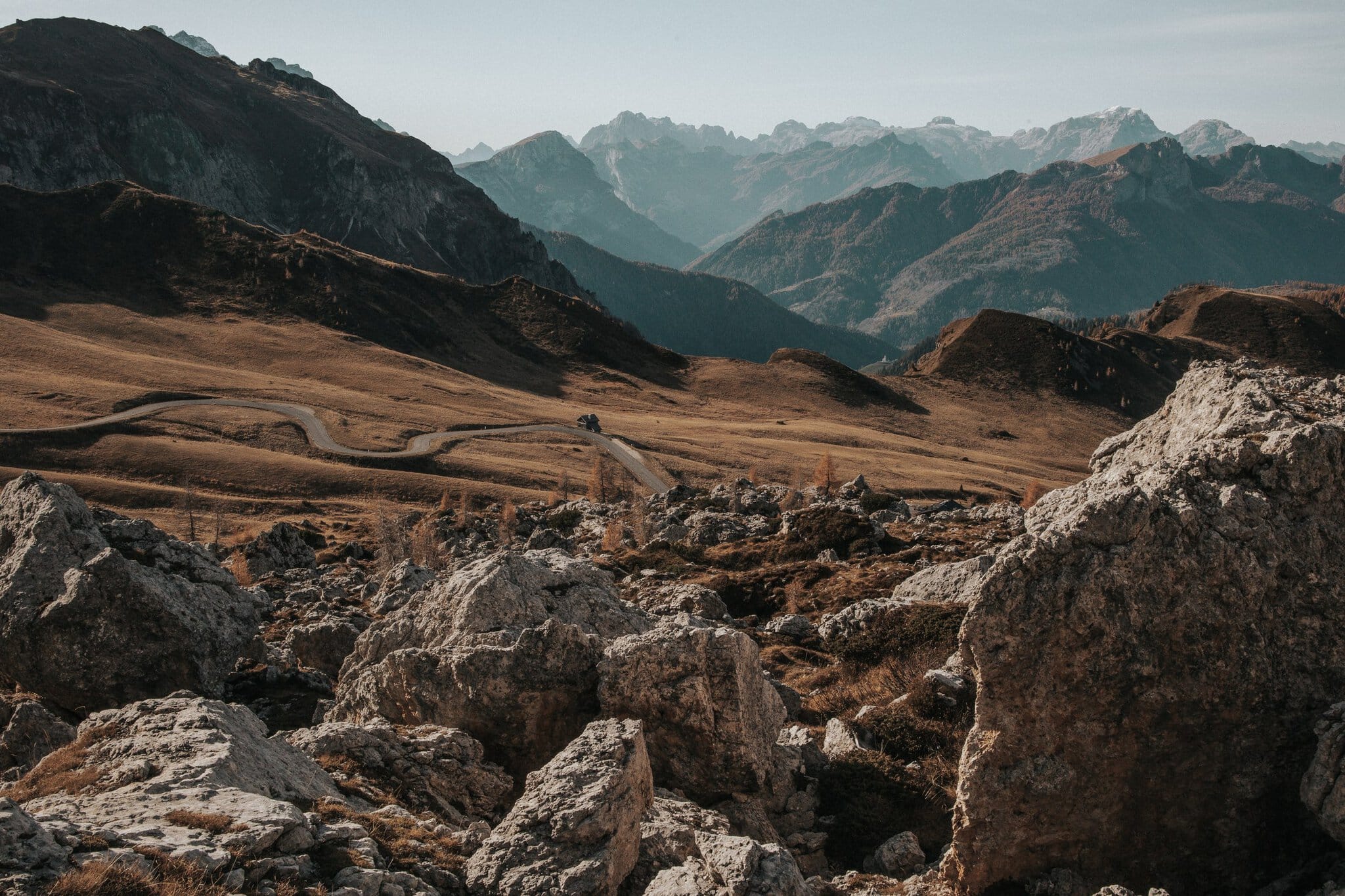
Sass Pordoi, Dolomites Italy: 10 Tips on What to See and Do

TL;DRSass Pordoi is a rock plateau in the Sella group in the Dolomites (2,950 m), nicknamed the Terrace of the Dolomites, reachable from the Passo Pordoi by cable car in under 3 minutes (about €28 one way, €39 return). Among the top 10 tips: a panoramic terrace looking out over Marmolada and the Tre Cime di Lavaredo, a climb up the 3,000-metre Piz Boè (3,152 m, roughly an hour and a half on foot), the Sellaronda loop (around 50 km) for cars and bikes alike, and the toughest via ferrata around, the Cesare Piazzetta. The best time to visit is late June to mid-September, steering clear of the week around Ferragosto. Drones are strictly banned in the area, with fines of up to €3,000 (roughly 75,000 CZK).

If you’re planning a trip to the Dolomites Italy, sooner or later you’ll stumble across photos of Sass Pordoi — a majestic flat-topped mountain that looks like it was plucked straight from a sci-fi film about colonising the Moon. The Italian Dolomites are packed with jaw-dropping natural wonders, but Sass Pordoi holds an absolutely special place among them. It’s one of those spots you simply have to know about and add to your itinerary if you want to experience genuine high-alpine atmosphere without needing to be a professional mountaineer.

Sass Pordoi is one of those places you simply can’t skip in the Dolomites. It’s a destination that perfectly defines what “cable car Dolomites” is all about, and we ourselves rode the cable car all the way up to the terrace — back in the days when it was just us and our dog Kája (before we had our second dog Baby or our son Jonáš). We’ve gathered all the latest information so you can make the most of your visit.

Right, now for the main event: I’ve put together 10 tips on what to see and do here. From summiting the 3,000-metre peak of Piz Boè to legendary viewpoints, and even why you should leave your drone at home. 😉 I’ll also help you sort out accommodation and the cable car.

TL;DR

  • Where is it: Sass Pordoi (2,950 m) is a rocky plateau in the Sella group, straddling the Italian provinces of Trentino and Belluno.
  • How to get there: Most easily from the mountain pass Passo Pordoi (2,239 m), where an aerial cable car runs directly to the summit. The ride takes roughly 3 minutes.
  • Who is it for: Absolutely everyone. The cabin whisks you to the top and on the viewing platform itself you can happily sip a coffee and soak up the views without breaking a single sweat.
  • Main goal: The hike to nearby Piz Boè (3,152 m), one of the most accessible 3,000-metre peaks in the entire Alps.
  • Watch out for drones: There’s an absolute no-fly zone for drones in the area, with fines reaching up to €3,000.

What is Sass Pordoi and the Terrace of the Dolomites

Let’s start by getting a proper picture of what we’re talking about, because Sass Pordoi isn’t just any old mountain peak you’d spend all day scrambling up through thick forest. Imagine a colossal block of stone rising from the surrounding green valleys like some giant medieval fortress.

Sass Pordoi forms the southernmost spur of the Sella massif, a fascinating geological formation. Unlike the sharp, pointy towers you might know from the Tre Cime area, the Sella massif has the shape of an enormous table mountain. Up top, it’s one vast, seemingly endless lunar landscape of pale rock and scree, where no trees grow and you feel utterly cut off from civilisation down in the valley.

The summit of Sass Pordoi itself is nicknamed the Terrace of the Dolomites, and when you ride up there, you’ll instantly understand why. At 2,950 metres above sea level, you genuinely feel like you’re standing on top of the world. The terrain up here is relatively flat, so you can safely wander along the edge of this gigantic terrace and gaze at the surrounding peaks stretching all the way to the horizon. It’s hugely popular with hardcore alpinists and families with children alike, because the large aerial cable car erases all that elevation gain in a matter of minutes.

When to Visit and How to Get to Sass Pordoi

If you’re planning a trip to Italy and wondering when the best time is to visit this mountain icon, bear in mind that at nearly three thousand metres, the climate is fairly harsh year-round. Here’s a complete breakdown of seasons and transport options so you don’t end up standing helplessly in front of a closed cable car station.

Best Time to Visit

For classic hiking and soaking up the views, the ideal window is late June through to mid-September. During this time there’s the least snow on the plateau and all the mountain huts are open. I do have to warn you strongly about August, though — specifically the week around Ferragosto (in 2026 that falls around 11–18 August). This is when the whole of Italy goes on holiday and the Dolomites are absolutely heaving, so you’d face endless queues for the cable car and be packed like sardines at the viewpoints.

Autumn, particularly late September and October, is fantastic for photographers as the air tends to be clearer and the skies more stable — though you’ll need to factor in chilly winds and the possibility of first snowfall. Winter, naturally, belongs to skiers, as the entire area forms part of the massive Dolomiti Superski complex and the famous Sellaronda circuit.

Cable Car to the Sky

The easiest and by far most popular way to get up is the Sass Pordoi cable car. Its lower station sits right at the Passo Pordoi mountain pass (at 2,239 m). If you punch “funivia sass pordoi stazione a valle” into your sat nav, it’ll take you to a large car park right next to the boarding area.

The ride in the aerial cabin is a thrill in itself — you ascend steeply alongside a sheer rock wall without any intermediate pylons. It takes just under three minutes to the top, during which you gain over 700 metres of elevation. As for tickets, prices change slightly each year, but currently expect around €28 for a one-way trip and roughly €39 for a return. You can buy tickets on the spot, but during summer I’d definitely recommend booking online to dodge the queues at the ticket office.

Driving to Passo Pordoi

First, you need to get to the cable car’s lower station, either by car or local buses. Passo Pordoi links the town of Canazei in the Val di Fassa valley with the village of Arabba. From Canazei it’s roughly a 20-minute drive along an incredibly twisty road full of hairpin bends — your head might spin a little, but the views along the way are absolutely worth it.

Right at the pass there are several car parks. Bear in mind that parking is paid (an all-day stay costs about €8) and especially in July and August you really need to arrive early in the morning — ideally before nine — otherwise you risk not finding a spot and having to park miles away along the roadside.

If you’d like to explore more of the Dolomites: a complete guide to what to do in the Dolomites, Passo Pordoi makes an absolutely brilliant starting point. And if you’re not driving your own car to Italy, we’ve had consistently great experiences with DiscoverCars, which we use all over the world.

Where to Stay When Visiting Sass Pordoi

Choosing the right accommodation in the Dolomites is absolutely crucial — because even though things look close on the map, driving over mountain passes eats up a surprising amount of time. To keep Sass Pordoi as close as possible so you can be the first on the cable car after breakfast, I recommend staying in one of three strategic areas around the Sella massif.

Canazei and Val di Fassa

This valley is probably the most practical and liveliest choice. Canazei is a gorgeous, quintessentially Alpine town where you’ll find plenty of excellent restaurants, outdoor gear shops, and charming cafés. From Canazei, it’s about a 20-minute drive up to Passo Pordoi. The valley is also brilliantly connected to other hiking destinations and offers a wide range of accommodation, from luxury wellness hotels to budget-friendly apartments.

Our tip for a truly comfortable stay with outstanding food and beautiful design is Hotel Locanda degli Artisti. If you’re after a solid mid-range option at a reasonable price, check out Albergo Alla Rosa right in the centre of town. A week for two in Canazei during peak summer season runs roughly €1,000 to €1,600, depending on whether you splash out on half-board and wellness.

Arabba

While Canazei buzzes with life, Arabba on the other side of the pass is noticeably quieter and a touch smaller. In winter it’s an absolute paradise for skiers, as it offers the shortest access to the Marmolada glacier, but in summer you’ll find incredible peace and tranquillity. The drive from Arabba to Passo Pordoi takes roughly 15 minutes through gorgeous hairpin bends.

Accommodation here is slightly cheaper than in Val di Fassa. A wonderful Alpine experience awaits at the family-run Hotel Evaldo, where you can soak in the hot tub after a hike and simply watch the sun set over the surrounding peaks.

Selva di Val Gardena

The third excellent option is to stay on the northern edge of the Sella massif, in the renowned Val Gardena valley. Selva (or Wolkenstein, since you’ll hear more German than Italian here) is a more exclusive resort, which unfortunately is immediately reflected in the prices. Lukáš would say they’re “a third more expensive on principle,” and he probably wouldn’t be far wrong. 😅 From here, Passo Pordoi is about a 30 to 40-minute drive via Passo Sella, which is itself an incredibly scenic journey.

For those who love absolute comfort, we can wholeheartedly recommend the stunning Boutique Hotel Nives, which will wow you with its top-notch gastronomy.

10 Tips on What to See and Do at Sass Pordoi

Sass Pordoi and its surroundings are definitely not a quick half-hour stop. This part of the Dolomites mountains in Italy offers activities for several days, whether you prefer easy strolls or serious mountaineering. Here’s my top 10 — everything from things you can manage in flip-flops to adrenaline that’ll leave your arms aching for three days. 😁

1. Panoramic Terrace: 360 Degrees of Perfection

The moment you step out of the upper cable car station, you’re standing on the Terrace of the Dolomites itself. You don’t need to walk a single extra metre to be greeted by a view you’ll probably remember for the rest of your life. Safe stone paths and viewpoints run along the entire cliff edge.

From this spot on a clear day, you can see virtually every major group in the Dolomites. Directly opposite rises the snow-capped queen of the Dolomites, Marmolada. In good weather you can see all the way to the iconic Tre Cime di Lavaredo, and you’ll clearly make out the monumental walls of Pelmo, Civetta, and the Catinaccio (Rosengarten) group.

Spending an hour here simply gazing and snapping photos is an absolute must on every visit. Just don’t forget to bring a windproof jacket — on this exposed plateau, an icy wind blows even when it’s a tropical summer down in the valley.

2. Rifugio Maria and Rifugio Sass Pordoi: Lunch in the Clouds

High-altitude hiking reliably works up an appetite. Right next to the cable car station you’ll find Rifugio Maria, a superb modern building with glass walls. You can sit in the warmth with a bowl of hot soup and feel like you’re floating above the Val di Fassa valley. The restaurant tends to get packed around lunchtime, so it’s better to pop in either earlier or in the late afternoon before heading back down.

If you’re craving a more traditional mountain atmosphere, just walk a few dozen metres across the rocky plateau to the historic Rifugio Sass Pordoi. It’s a smaller stone hut that looks exactly how you’d picture a mountaineer’s refuge from a hundred years ago.

Personally, I’d recommend trying the local polenta with porcini mushrooms and melted mountain cheese, followed by a proper Alpine Apfelstrudel. Although prices at these altitudes are understandably a bit higher than down in the towns, the experience of sipping a bombardino or excellent wine with a view across the entire Dolomites is unquestionably worth every penny.

3. Hiking Piz Boè: Through Lunar Landscape to the Summit

This is the main reason most hikers take the Sass Pordoi cable car in the first place. Just a short distance from the top station lies the summit of Piz Boè, standing at 3,152 metres. It’s one of the most accessible 3,000-metre peaks in the entire Alps, because the cable car does the lion’s share of the elevation gain for you.

The route from the upper station to the summit takes roughly an hour and a half of walking time going up. You’ll cross gently undulating terrain covered in pale scree that genuinely resembles the surface of another planet. The final push to the pyramid-shaped peak of Piz Boè is fairly steep, and in places you might need to use your hands on the fixed steel cables, but with a reasonable level of fitness and sturdy hiking boots, any average hiker can manage it.

At the top, a small but utterly charming hut — Capanna Piz Fassa — awaits you, along with a breathtaking panorama over the whole of northern Italy. Just make sure you pick a day with stable weather for this hike, because a thunderstorm on this exposed rocky plateau is an extremely dangerous affair.

4. Sellaronda in Summer: A Classic Road Trip

Once you’re back down on solid ground beside your car, you can experience another legendary attraction. Circling the entire Sella massif — the one you were just admiring from the terrace above — runs a road circuit called the Sellaronda. It connects four stunning mountain passes: Passo Pordoi, Passo Campolongo, Passo Gardena, and Passo Sella.

This roughly 50-kilometre route is a dream for anyone who loves driving — whether you’re behind the wheel of a sports car or on a motorbike. The road snakes through endless hairpins, you pass through picturesque villages, and around every bend a different, mesmerising rock formation appears. You can stop at every pass, grab a quick Italian espresso at a café, and carry on.

It’ll easily fill an entire afternoon, especially if you keep stopping for photos. Traffic in the summer months can be very heavy though, and you may get stuck behind a slow-moving campervan, so set aside plenty of time and arm yourself with patience.

5. Sellaronda Hero: Mountain Biking Paradise

If you’re a cycling fan, you’ve probably heard of Sellaronda Hero. It’s one of the toughest and most prestigious mountain bike races in the world, held right around the Sella massif and crossing our very own Passo Pordoi.

You don’t have to be a professional racer to give the route a go, though. The whole area offers a massive choice of fantastic singletrack trails and signed cycling routes of varying difficulty. In many of the valleys you’ll find well-equipped e-bike hire shops with full-suspension electric mountain bikes, so you can enjoy these steep Alpine climbs even if you don’t have the fitness of a pro athlete.

A huge bonus is that during summer you can use special cycling lift passes that take you and your bike up to the ridges, letting you enjoy long, technical descents back into the valleys. It’s an absolute cycling paradise, even if it does sometimes require nerves of steel on the narrow trails.

6. Winter Sellaronda Tour: The Never-Ending Ski Dream

Although most of this article focuses on summer, I have to mention the winter season too, because the winter Sellaronda is a world-class experience that draws thousands of skiers to Italy. If you love skiing, you probably know that thanks to the ingenious lift system within Dolomiti Superski, you can ski the entire way around the Sella massif in a single day.

The circuit runs in two directions, following orange or green arrows, and requires no uphill walking whatsoever. You clip into your skis in one valley in the morning, spend the whole day skiing over the Pordoi, Sella, Gardena, and Campolongo passes along beautifully groomed pistes, and arrive back at your starting point by afternoon.

The experience is unforgettable, but it does require a fairly steady pace to avoid getting stranded in the wrong valley after the lifts shut down for the day. Taxis over snow-covered passes in the evening can be eye-wateringly expensive.

7. Via Ferrata Cesare Piazzetta: Adrenaline for the Experienced

The Dolomites are the birthplace of via ferratas — protected climbing routes — and one of the toughest in the entire area runs right up the walls beneath our viewing terrace. Via ferrata Cesare Piazzetta leads directly to the summit of Piz Boè via a breathtaking, near-vertical rock face.

I must strongly warn you, though: this is absolutely not a ferrata for beginners or anyone with even a mild fear of heights. On the Italian grading system it rates D (extremely difficult), the first sections are nearly overhanging, and it demands serious arm strength and excellent footwork technique.

If you’re an experienced climber, however, the Piazzetta offers an incredible sporting challenge and views into the void that will literally take your breath away. Don’t forget full, certified gear (harness, shock absorber, helmet) and ideally start early in the morning to avoid afternoon traffic jams of slower climbers in the critical sections. If you’re just getting started with via ferratas, I’d suggest looking at the safer protected routes near our beloved Cortina d’Ampezzo.

8. Trek to Bivacco di Forcella Pordoi: For Those Who Love to Hike

If riding an aerial cabin to the top feels too easy and you’d rather earn your summit, you can hike all the way from the car park at Passo Pordoi on foot. The classic hiking trail leads up a large scree gully to the Forcella Pordoi saddle, where a small mountain hut stands.

Be prepared for a physically very demanding ascent. You’ll be walking in constant tight zigzags through loose, sliding rock where you often take one step forward and half a step back as the ground slips away beneath your boots. Expect this route to take roughly an hour and a half of genuinely intense effort going up.

Your reward, however, is the brilliant satisfaction of having conquered the mountain under your own steam. Many hikers ride up comfortably on the cable car and then descend via this scree gully (more sliding than walking, really). It’s much kinder on your wallet and lungs, but it’s very tough on the knees, so if you have joint problems, take the cable car back down as well. For more amazing hikes, check out our article Italian Dolomites for Hikers: 5 Trails for Everyone.

lukas a lucka
Lukáš and Lucie recommend
Where to stay near Sass Pordoi
5 accommodations — wellness hotels, hotels and other accommodation options

9. Photographing Marmolada from Passo Pordoi

You don’t even need to ride all the way up to Rifugio Maria to capture the most stunning shots of your holiday. The pass itself, Passo Pordoi, is a fantastic spot for landscape photography.

From several bends below the car park on the Arabba side, the most iconic view of the Dolomites’ highest peak — the glacier-clad Marmolada — unfolds before you. There’s one particular spot with a small wooden cross and a memorial to cycling legend Fausto Coppi where the composition looks absolutely magical, especially just before sunset when the light turns warm and the surrounding rocks blush pink (the locals call this phenomenon Enrosadira).

This is where you’ll understand why the Dolomites are a UNESCO World Heritage Site and a paradise for photographers from around the globe. If you visit in autumn, with a bit of luck you’ll catch a morning temperature inversion and find yourself standing above a sea of clouds with only the highest snow-capped peaks poking through.

10. Passo Sella as an Alternative Route

This last tip is about logistics if you’re touring the Dolomites by car and want to see as much as possible. If you’re heading back from Sass Pordoi and staying in the Cortina area, instead of taking the shortest route, consider making a small detour over Passo Sella.

This pass connects the Val di Fassa valley with Val Gardena and offers, in my opinion, the most dramatic scenery of the entire Sellaronda road circuit. The road winds directly beneath the sheer 300-metre walls of the Sassolungo towers. It’s a place where you feel absolutely tiny, and it’s well worth stopping in the car park for a moment to simply soak it all in.

Passo Sella can get congested with coaches and motorbikes, but trust me — the sight of those colossal vertical cliffs gleaming in the midday sun while you sit on a bench with a takeaway coffee, watching swarms of climbers high up on the walls, is an experience that’s simply priceless.

Sass Pordoi with Kids: Easy and Stress-Free

Many parents worry about taking young children to altitudes around 3,000 metres, but Sass Pordoi is a genuine exception and one of the most suitable spots in the entire Alps. The reason, of course, is the comfortable and fast high-capacity cable car.

Because you don’t need to hike at all, you ride up completely effortlessly. The Terrace of the Dolomites at the top is relatively safe and flat — provided you don’t let kids run unsupervised right up to the steep cliff edges. There are two things you really shouldn’t forget, though: with very young children, the altitude can cause tiredness and headaches, so don’t extend your stay up top unnecessarily. And then there’s the surface — it’s all loose rock, so a standard pushchair won’t work at all up there. A baby carrier or hiking child-carrier backpack is a must. Otherwise, there’s a large glass-walled restaurant, toilets, and plenty of space to comfortably spend time with the family.

Can You Bring Dogs to Sass Pordoi?

Travelling around Italy with your four-legged friend? Then I’ve got great news for you. Nobody in the Sella massif area turns dog owners away, and you can head out on your adventure together.

Dogs are allowed on the cable car, but they must be on a lead and operators often require a muzzle as well, especially when the cabin is packed with people — which in summer is pretty much always. You’ll pay a small fee for your dog to ride up, usually a few euros. On the plateau you can walk freely with them, but again remember that the sharp limestone rock and scree can be very uncomfortable for dogs’ paws if they’re not used to it from other mountain hikes. In the summer heat there’s also absolutely no shade up here and no natural water sources, so you need to carry enough water not just for yourself but for your pooch as well.

Where to Eat

Honestly, I initially expected a plate of pasta at the mountain hut — and then polenta arrived, and it turned out to be one of the biggest culinary surprises of the whole trip. The local cuisine is heavily influenced by nearby Austrian Tyrol and is built to warm you up as fast as possible and deliver massive amounts of energy after a day of freezing skiing or summer hiking.

The staple at mountain huts like Rifugio Maria on Sass Pordoi is traditional hearty cornmeal polenta. Forget bland, tasteless porridge though — here the polenta is mixed with enormous amounts of cheese and butter, and served with wild porcini mushrooms foraged from the forests below and melted mountain cheeses (locals also offer it with goulash or game ragù).

Another classic you absolutely have to try is Canederli (Knödel in German) — giant dumplings made from stale bread, served in spinach or cheese versions, drenched in brown butter and showered with Parmesan, or swimming in a rich broth. And of course, you have to round the whole meal off with a crispy apple strudel packed with raisins and nuts. To drink, definitely try the local wines from the Val di Fassa area, or a refreshing Hugo Spritz with elderflower syrup — far more popular in the Dolomites than the classic Aperol Spritz.

Practical Information and What to Watch Out For

Before you hit the road, here are a few things you should know. Otherwise, you’ll either find the cable car closed or face a rather nasty fine. 😅

  • Drone ban and hefty fines: This is an extremely important point. The entire Dolomites area — and especially spots near national parks and popular massifs like Sella — falls within a no-fly zone requiring special permits. The Italian Carabinieri (mountain police) keep a very close eye on this during summer and don’t hesitate to hand out draconian fines. If you’re caught with a drone on Sass Pordoi, expect your equipment to be confiscated and a fine that can reach a staggering €3,000. It’s definitely not worth it for one nice Instagram shot.
  • Combined lift passes (Dolomiti Superski and summer passes): If you’re spending multiple days in the Dolomites and plan to use several cable cars, it definitely doesn’t pay to buy individual tickets every time at €28 one-way or €39 return. In winter, the big Dolomiti Superski pass covers it automatically, and in summer there are multi-day hiking passes (e.g. Panorama Pass or SuperSummer) that let you ride cable cars on the Sella massif and elsewhere for free.
  • Appropriate clothing: Always remember you’re heading to nearly 3,000 metres above sea level. Down in Canazei it might be t-shirt and shorts weather, but the moment you step out of the cable car cabin onto the windy terrace, the temperature plummets by fifteen degrees and you’ll be cold. A lightweight down jacket or at least a decent Gore-Tex windbreaker in your rucksack is an absolute must, even in mid-August.
  • Payment info: Italy uses the euro and most places — including the cable car and the main mountain huts — accept card payments without any trouble. For smaller huts like Rifugio Boè at the top, bring some cash just in case.

Where to Go Next from the Dolomites

Once you’ve been admiring the Terrace of the Dolomites, you have a brilliant opportunity to visit other gems nearby. If you’re craving more high-alpine scenery, it’s just a short drive to the enormous glacier we wrote about in our complete guide to Marmolada. From Passo Pordoi you’ll get there in under an hour.

If you prefer charming Alpine towns with a hint of history and luxury, definitely don’t miss Cortina d’Ampezzo, our main base in the Dolomites, where you’ll find fantastic Olympic ski runs and incredible scenery all around. It’s a bit further away (roughly an hour and a half’s drive), but the trip and the town’s atmosphere will win you over completely.

Final Tips for a Stress-Free Holiday

To help you plan your trip without stress or worry, here’s a round-up of the services that have consistently served us well when travelling around Italy or anywhere in Europe — the ones Lukáš and I use regularly.

What to Pack

If you’re unsure what to bring and which bag to pack it in, take a look at our packing guide. We always take a pretty minimalist approach, so it’ll definitely make your decisions easier.

Lukáš and I have learned that in the mountains, what you really need is a good pair of boots and functional layers. So those three evening dresses can safely stay at home.

How to Find Flights to Italy

Northern Italy is well connected by air from the UK. The most convenient airports are Venice, Milan Bergamo, or Verona — all within a few hours’ drive of Passo Pordoi. Budget airlines like easyJet, Ryanair, and Jet2 all serve these routes regularly from London, Manchester, and other UK cities. To compare prices and find the best deals, search on Kiwi — it’s our go-to flight comparison tool.

Always pay attention to arrival times, because navigating unfamiliar mountain passes in the dark on the way to your hotel isn’t exactly relaxing. Ideally, aim to land around lunchtime.

Hiring a Car on Arrival

A car is an absolute necessity in the Dolomites — the local bus network will get you to the passes, but it takes an incredible amount of time and many beautiful spots aren’t served by buses at all. Lukáš and I have had consistently good experiences with the comparison site DiscoverCars.com, which we use all over the world.

Just make sure you pay for full coverage. On those narrow roads where you’re squeezing past coaches and campervans, scratches happen in a heartbeat — no matter how good a driver you are.

Booking Accommodation

As I mentioned earlier, look for accommodation strategically in the valleys right below the pass. Booking.com is our favourite hotel search engine because you’ll always find the freshest reviews and easy cancellation options.

Especially during summer and around Christmas, don’t leave your booking until the last minute. The best family-run hotels get booked out a good six months in advance.

Don’t Forget Travel Insurance

The Dolomites may be civilised mountains, but especially if you’re planning the scree trek or even a via ferrata below Sass Pordoi, you mustn’t underestimate healthcare and insurance. A rescue helicopter flight in Italy can cost tens of thousands of euros. For shorter trips we usually go with AXA with a 50% discount, and for longer or particularly active holidays we swear by True Traveller.

In Italy especially, it really doesn’t pay to skimp on insurance. When you see rescue helicopters flying overhead one after another, it’s reassuring to know you won’t be financially ruined if something goes wrong.

FAQ: Frequently Asked Questions About Sass Pordoi

Given the enormous popularity of this mountain and the entire Sella massif, the same practical questions keep coming up. We’ve compiled the key ones so you have all the important answers in one place.

Where is Piz Boe?

The summit of Piz Boè (also spelled Piz Boé) is located in the Italian Dolomites in the Sella massif. It sits at an elevation of 3,152 meters. The easiest access is from the Terrace of the Dolomites, from the upper station of the Sass Pordoi cable car, from where the hike takes about an hour and a half on foot through rocky terrain. This is why crowds of tourists flock there during the season, so I recommend setting off early in the morning. Your reward will be the amazing feeling of conquering a 3,000-meter peak and some perfect photos.

How long does the cable car ride to Sass Pordoi take?

The journey in the giant suspended cabin from the lower station at Passo Pordoi pass (2,239 m) to the upper Sass Pordoi station (2,950 m) is incredibly quick and takes just 3 minutes, even though it covers a massive elevation gain of over 700 meters. During this brief moment, you’ll be treated to breathtaking views of the steep limestone walls. So definitely have your camera ready as soon as you board the cabin.

How much does a cable car ticket cost?

Prices are adjusted slightly each season, but currently (for the summer season) expect to pay around €28 for a one-way ride and €39 for a return ticket. The cable car is also part of the large combined tourist and ski passes Dolomiti Superski. Children and seniors are of course entitled to discounts. I recommend buying tickets online in advance to save yourself quite a bit of time and hassle waiting in line at the ticket office.

Can I get to Passo Pordoi in winter too?

Yes, during the winter months Passo Pordoi is one of the key arteries for the massive Sellaronda ski circuit. You can get there either on groomed ski slopes or by car from Canazei or Arabba. The roads at the pass are permanently maintained, but proper winter equipment (winter tires and often chains in the trunk) is absolutely essential. If you’re not too confident about driving in snow, you can also use the local ski buses. These run completely reliably during the season and will get you to the cable cars safely.

Are there restaurants at the top of Sass Pordoi and Piz Boè?

Yes, right at the exit from the cable car on the Terrace of the Dolomites you’ll find the large glass-fronted restaurant Rifugio Maria and just a short distance away the traditional stone hut Rifugio Sass Pordoi. At the actual summit of Piz Boè (after conquering the 3,000-meter peak) there’s another smaller cozy cabin called Capanna Piz Fassa, where you can buy simple refreshments. If you have a sweet tooth, definitely try the hot chocolate or homemade strudel at the hut. Prices are a bit higher, but it’s worth it for that warm feeling and the fantastic view.

Can I bring a drone up there to shoot video?

Definitely don’t do it! This entire area is a strict no-fly zone for drones due to nature protection and the movement of rescue helicopters. Italian police actively enforce this and if they catch you, they issue devastating fines that often exceed €3,000, and your equipment will be confiscated too. Better to rely on a regular camera or a decent smartphone. You’ll still bring home fantastic shots without the threat of a ruined vacation and an empty wallet.

Is Sass Pordoi safe for young children?

Yes, you can take even small children to the viewing terrace at the cable car station (2,950 m) without any problems, since you’ll cover the elevation gain effortlessly by cable car and the terrain at the top is wide. Altitude sickness doesn’t usually appear during such short visits, but be cautious with very young children. However, watch out for the edges—the cliffs are steep and unprotected, so really don’t take your eyes off small children. And don’t try bringing a stroller; the loose rocks will swallow it up. A baby carrier is essential.

Tips and Tricks for Your Vacation

Don’t Overpay for Flights

Search for flights on Kayak. It’s our favorite search engine because it scans the websites of all airlines and always finds the cheapest connection.

Book Your Accommodation Smartly

The best experiences we’ve had when looking for accommodation (from Alaska to Morocco) are with Booking.com, where hotels, apartments, and entire houses are usually the cheapest and most widely available.

Don’t Forget Travel Insurance

Good travel insurance will protect you against illness, accidents, theft, or flight cancellations. We’ve had a few hospital visits abroad, so we know how important it is to have proper insurance arranged.

Where we insure ourselves: SafetyWing (best for everyone) and TrueTraveller (for extra-long trips).

Why don’t we recommend any Czech insurance company? Because they have too many restrictions. They set limits on the number of days abroad, travel insurance via a credit card often requires you to pay medical expenses only with that card, and they frequently limit the number of returns to the Czech Republic.

Find the Best Experiences

Get Your Guide is a huge online marketplace where you can book guided walks, trips, skip-the-line tickets, tours, and much more. We always find some extra fun there!
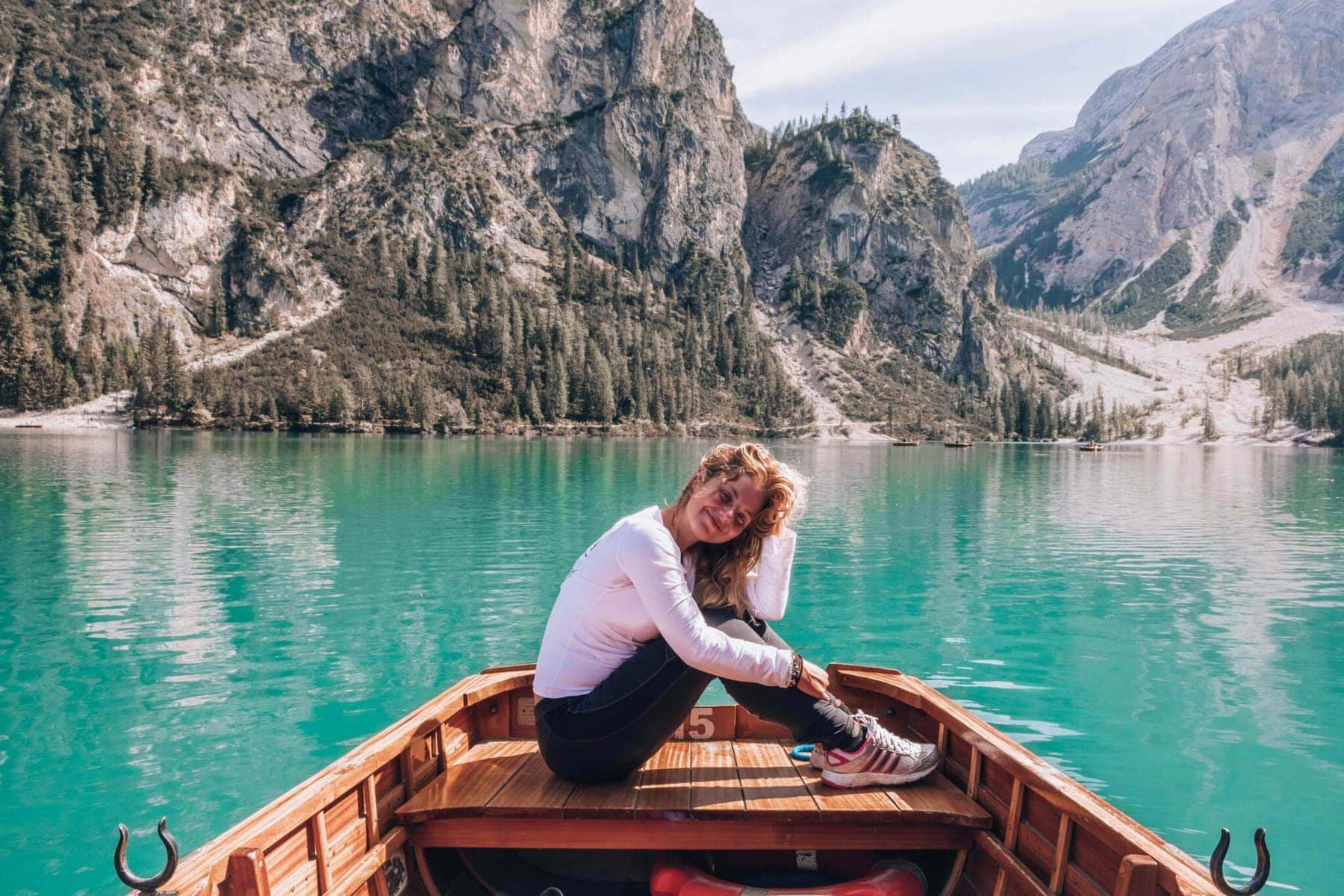
Adolf-Munkel-Weg, Dolomites Italy: 10 Tips on What to See & Do

TL;DRThe Adolf-Munkel-Weg is an easy loop trail in Val di Funes, South Tyrol, running beneath the Odle peaks, covering 5 to 7 kilometres with just 200 to 400 metres of ascent and taking 3 to 4 hours. Ten key tips cover the classic loop past Geisler Alm and Zanser Alm, photo spots beneath the Odle walls, a detour to Roanergola, the Tschantschenon valley with its waterfalls, the Cuecenes forest, and the iconic little church at Sankt Magdalena. You start from the Zanser Alm car park (1,685 m), where parking costs 8 EUR a day, and May to September is the best time to go — though October brings out the loveliest larch colours. The trail works fine for dogs on leads and kids aged 5 and up, but it’s not pushchair-friendly.

When people think of the Dolomites in Italy, one image instantly comes to mind: lush green meadows, a tiny church, and behind it, impossibly sharp, vertical rock towers piercing the sky. Welcome to Val di Funes, home to the Odle group. And it’s right beneath these majestic walls that the Adolf Munkel Weg trail winds its way through one of the most photogenic landscapes in the Alps.

It’s an absolutely ideal trail. You get maximum views with minimal elevation gain — which is pretty rare in the Dolomites 😅. Adolf Munkel Weg is relatively flat and not too demanding, but the surface is quite rocky and definitely not pushchair-friendly. That said, it’s a brilliant route to plan with older kids once they’re ready for a longer hike.

If you’re after a trail that takes a pleasant three to four hours, is dog-friendly, and serves up the most photogenic scenery in all of South Tyrol, you’ve come to the right place. Let me show you everything you need to know about this trek.

TL;DR

  • Where is it: Val di Funes valley, South Tyrol (Italy).
  • Distance and time: The loop is roughly 5 to 7 kilometres depending on your chosen route and takes about 3 to 4 hours of leisurely walking.
  • Difficulty: Easy to moderate. Elevation gain is only around 200 to 400 metres, but the terrain is rocky in places, so sturdy footwear is a must.
  • With pushchairs and children: Pushchairs are a definite no-go because of rocks and tree roots. For babies, you’ll need a hiking carrier; older kids (from about 5) can handle the trail on their own.
  • With dogs: Dogs are allowed but must be kept strictly on a lead. Cows graze freely on the alpine pastures, and trust me, mountain cattle really don’t appreciate dogs running loose 😅.
  • Parking: Zanser Alm at the end of the valley. In season it costs 8 EUR per day, and I’d recommend arriving early in the morning — otherwise you’ll be stopped by traffic restrictions further down the valley.
  • Drone ban: You’re inside the Puez-Geisler Nature Park. Flying drones is strictly prohibited, with fines of up to 3,000 EUR.

What is Adolf-Munkel-Weg?

I had to look this up myself, because I was genuinely curious about who the trail is named after. Adolf Munkel was a passionate German alpinist, and this trail was created on his initiative back in 1894. Over a hundred years old and people still queue up for photos along it — that tells you something, doesn’t it? The path winds directly beneath the Odle group (known as Geisler in German), through forest trails and alpine meadows, with enormous pale grey limestone towers watching over you the entire way.

When to go and how to get there

Timing is absolutely crucial in the Dolomites in general, and here in particular. The barrier gate can catch you out easily, so here are some tips to avoid disappointment.

Best time of year

The main hiking season in the Dolomites runs from May to September. During this period, all the mountain huts (rifugia) are open, the weather is most stable, and the snow at higher elevations has long melted. Just be prepared to share the trail with plenty of others. August, when Italians take their national holiday (Ferragosto), is especially busy. If you can, I’d recommend going in autumn — ideally October. The larches in the valley turn incredible shades of gold, and the contrast with the snow-dusted Odle peaks is pure magic. Spring brings thousands of blooming crocuses, which is equally stunning. In winter, however, the trail is officially closed due to snow and avalanche risk from the higher slopes, so don’t plan on it.

Getting there by car to Zanser Alm

The starting point for the trek is the Zanser Alm (Zannes) car park, sitting at 1,685 metres elevation at the very end of the Val di Funes valley. You’ll drive through the picturesque village of Santa Maddalena and keep heading uphill until you reach the barrier gate. During peak season, expect a fee of 8 EUR per day (which is actually quite reasonable by Dolomites standards). There’s one major catch, though. The valley has limited capacity, and once the car park fills up, the road is closed further down. From our experience, I’d recommend being at the barrier by 8:00 AM at the latest.

Eco-friendly and stress-free by bus

If you’d rather skip the early-morning parking stress, or if you’re travelling without a car, local bus services are an excellent alternative. From the nearby town of Brixen (Bressanone), regular bus lines 330 and 335 (check the official South Tyrol transport website for timetables) will take you all the way to the Zanser Alm car park. The journey takes roughly an hour and you can sit back and enjoy the valley views without any stress. Especially in summer, this is a far more pleasant option than worrying about whether there’s still space in the car park. And the environment will thank you too.

Where to stay near Val di Funes and how much it costs

If you want the best views right after waking up and want to be among the first on the trail, choosing your accommodation strategically is key. Prices in this area during peak season average between 100 and 200 EUR per night for two people, depending on whether you go for a luxury wellness hotel or a traditional mountain farmstead.

Right in the heart of the valley you’ll find the village of Santa Maddalena, which is absolutely ideal. There are plenty of traditional “agriturismo” (farm stays) and cosy B&Bs here. It’s a pricier location, but you’ll save time on commuting and the atmosphere of the quiet, emptied-out valley in the evening is worth every penny. A great choice is family-run guesthouses like Hotel Ranuimüllerhof, where breakfast features homemade cheeses from the neighbouring farm. Or try the highly rated Proihof, which consistently gets fantastic reviews.

If you’re looking for a slightly cheaper or livelier base, the historic town of Brixen (you can find more at Dolomiti.org) is an excellent option. It’s only about 15 to 20 minutes’ drive from the valley entrance. The town offers much more in terms of evening entertainment, a huge selection of restaurants, and accommodation prices tend to be a bit friendlier. Another popular, though slightly more distant option (roughly 30 minutes’ drive over a mountain pass), is the well-known resort of Ortisei in the neighbouring Val Gardena valley. Here you’ll find everything from luxury resorts to simple apartments — just bear in mind the longer morning drive to the trailhead.

Looking for specific recommendations? We always book accommodation through Booking.com, where you can find great deals — and if you have Genius status, you can get really good prices even during peak dates.

Adolf-Munkel-Weg: 10 tips on places and experiences along the way

Let’s get to the main event. The Adolf Munkel Weg trail isn’t just about getting from A to B — it’s about dozens of little experiences, viewpoints, and detours you’ll encounter along the way. Most people choose the classic loop starting from Zanser Alm, joining trail number 35, and returning via alpine meadows. Here are 10 things you shouldn’t miss.

1. The classic Geisler Alm and Zanser Alm loop

The absolute essential that most hikers go for is the circular route of roughly 5 to 6 kilometres. You set off from the Zanser Alm car park on trail number 6, which shortly leads you onto the main Adolf Munkel Weg path (marked as trail 35). This takes you directly beneath the rock faces until you reach the turnoff to the popular Geisler Alm hut, from where you descend gently through blooming meadows and forest paths back to the car park. It’s the perfect loop because you never retrace your steps and constantly have fresh scenery ahead of you.

This route is the golden middle ground when you want to see the best of the area without completely wearing yourself out. It’s worth spreading it across a whole afternoon so you’re not rushing and can make a few extra stops along the way.

2. Views of the vertical Odle walls

The Odle group consists of enormous vertical needles soaring over three thousand metres, and when you look up at them from below, your heart does something strange. It’s a ruthlessly grand kind of beauty that makes you feel utterly tiny 😅. The late afternoon is especially spectacular, when the rocks glow in warm orange tones — it’s a sight you won’t forget.

What’s more, the views constantly shift depending on how the clouds move. One moment the peaks are brilliantly lit, the next they’re hidden in dramatic shadows, so you end up snapping one photo after another, even though you keep telling yourself you’ve got enough.

3. A stop at Rifugio Geisler Alm

Rifugio Geisler Alm (just under 2,000 metres above sea level) isn’t just any mountain hut — it’s an institution. The moment you emerge from the forest, a huge, perfectly trimmed meadow opens up before you, dotted with wooden sun loungers that locals call the “cinema.” And the film playing? The Odle peaks right in front of you. We always take a long break here. Kids have a brilliant playground, adults can enjoy a cold beer or Aperol Spritz while watching cows graze right alongside them. It does get busy, but the space is so vast that you’ll always find your own spot.

If you’re heading here during peak season and want a proper sit-down lunch, check their official website beforehand to confirm opening hours. That said, a picnic on the grass with the world’s best view works perfectly too.

4. Rifugio Zanser Alm at the start and finish

Right next to the Zanser Alm car park sits the hut of the same name at 1,685 metres elevation (they even have their own website with current information). It makes a perfect morning pit stop — we always grab a strong Italian espresso and a slice of strudel for fuel before setting off. The bonus is that it also works brilliantly as a restaurant after your hike. When you come back tired from the trek, you don’t need to drive anywhere — just sit down for a late lunch or early dinner right here before heading down the valley.

Sitting on the terrace as the afternoon winds down and the hikers start heading home has a wonderful atmosphere. You can have a proper meal and simply soak in the mountain tranquillity.

5. Photo spots beneath the colossal walls

If you love photography, this trail is absolute paradise. The best photo spots are roughly halfway along trail 35, where the forest opens up a little and creates natural frames of larch and pine branches with the jagged peaks behind. If you want those iconic shots with pale pebbles and scree fields, you’ll notice several small worn paths (often carved by rainwater) leading towards the rocks. Just please respect nature and don’t stray too far from the marked trails — erosion is a real problem here.

Every step off the path risks damaging rare alpine flowers that take years to grow in these harsh conditions. The established viewpoints are more than enough — you’ll still take home incredible shots that’ll get all the likes on Instagram.

6. Extension to Roanergola (Roa Berg) for experienced hikers

If the classic five-kilometre loop isn’t enough and you fancy working up a proper sweat, you can extend the route. Instead of turning down towards Geisler Alm, continue along beneath the rock walls and head towards Forcella Roa (Roanergola). Here the forest shade ends and the rugged high-alpine environment takes over, all loose scree and exposed terrain. The views from this saddle into the surrounding valleys are absolutely breathtaking, but bear in mind this is a more strenuous climb that’ll add at least two more hours to your day.

It’s a decent cardio workout, so make sure you stock up on water and pack some extra snacks. Your reward, though, is a much emptier trail where you might not see another soul for a whole hour.

7. Detour to the Tschantschenon valley

Another beautiful and significantly quieter detour is the path leading towards the pastures and stream of Tschantschenon. This is the eastern section of the trail, right at the beginning if you set off from Zanser Alm in an anticlockwise direction. You’ll find gorgeous little waterfalls and cascading mountain streams here. On hot summer days, it’s the perfect spot to cool your tired feet in the ice-cold water — something both you and your four-legged companions will appreciate. It tends to be much less crowded than the main Geisler Alm area.

This little valley is a hidden gem where you can escape when the main trail gets too busy. Even a simple sandwich from your rucksack tastes Michelin-star quality when you’re eating it to the sound of rushing water.

8. The fir and larch forest of Cuecenes

A large section of the Adolf Munkel Weg passes through mature forests in the area known as Cuecenes. While walking through woodland might not sound like a highlight in the mountains, it’s quite the opposite. These forests provide much-needed shade during the hot summer months. And in autumn, the larches — which make up a large part of the canopy — turn incredible shades of orange and gold. Walking through this golden tunnel with mountain sunlight filtering through is probably one of the most romantic experiences the Dolomites have to offer.

9. The little church in Sankt Magdalena on the way up

This tip isn’t technically on the high-altitude trail itself, but you absolutely cannot skip it. As you drive uphill in the morning towards the Zanser Alm car park, you’ll pass through the village of Sankt Magdalena (Santa Maddalena). Stop at the viewpoint above the village. This is where everyone takes that world-famous photo of the little solitary church with the Odle massif towering behind it — the shot you’ve seen in every guidebook and calendar.

Be warned, though — the best spots can get quite crowded even from early morning. You’ll need a bit of patience to get a clean shot without someone’s rucksack or phone-wielding arm in the frame, but trust me, the photo is absolutely worth the wait.

lukas a lucka
Lukáš and Lucie recommend
Where to stay in Val di Funes (Dolomites)
3 accommodations — hotels and other lodging options

10. The upper route via Brogleshütte

For truly fit hikers, there’s one more, significantly longer option for exploring this area. From the Adolf Munkel Weg, you can link up with paths leading towards the Brogleshütte hut. This hut sits on the western side of the Odle group (towards the Seceda ridge). The hike is a full-day affair with considerable elevation gain, but you’ll be rewarded with views of the mountains from a completely different, less familiar angle. Along the way, you’ll see a wilder side of the Dolomites and encounter just a fraction of the hikers.

The western side of the massif is incredibly tempting and definitely deserves a trip of its own. If you have more time and the fitness to match, absolutely add it to your plans.

Can you do Adolf-Munkel-Weg with kids and dogs?

This is a question we get asked all the time. When you’re travelling with small children or dogs, trail accessibility is a huge deal. So how does this particular trek stack up?

💡 Local tip: Almost all cable cars and buses require dogs to wear a muzzle (you can buy one practically everywhere, including at the base stations). It can be annoying — they’ll ask for a muzzle even if you’re riding the cabin completely alone. If you’ve got several cable cars in a row, it’s often more comfortable to leave your dogs resting at your accommodation.

Hiking with younger and older children

As I mentioned at the start, the Adolf Munkel Weg is absolutely not suitable for pushchairs — not even off-road ones. The trail follows narrow forest paths, is full of protruding tree roots, large rocks, and occasional steps or gullies carved by rainwater. You’d get stuck within the first hundred metres with a pushchair.

However, if you bring a quality hiking carrier or child backpack for babies and toddlers (roughly up to 2–4 years), it’s an ideal choice. The elevation gain isn’t too dramatic, so you can manage it with a carrier on your back without too much trouble. For older children (roughly 5 and above), this trail is absolutely brilliant. It’s varied enough to keep them engaged — one moment they’re walking through forest, the next they’re hopping over rocks, spotting grazing cows, and at the end there’s a massive playground at the Geisler Alm hut. Boredom won’t be on the menu.

Dogs on the trail

The Dolomites are a fantastic destination for travelling with dogs, and Adolf-Munkel-Weg is one of the dog-friendly trails. The terrain is more than kind to paws — there’s no exposed ladder climbing or sharp scree that could hurt their pads, and you don’t need to carry loads of water because you’ll pass several streams and cascades along the way where dogs can drink freely.

There is, however, one strict rule: dogs must be kept on a lead at all times. The trail crosses alpine pastures where cattle roam freely. Mountain cows can be quite territorial, and if a dog runs up to them off-lead, things could turn ugly fast. As mentioned, you don’t need to haul huge amounts of water — there are plenty of small streams and cascades along the route where your dog can drink. Just watch out during the summer months — ticks are a thing even at these altitudes, so make sure your prevention is up to date.

What to eat at the mountain huts (rifugia)

Food in the Italian Dolomites is, in my opinion, the best in all of Italy — and anyone who disagrees simply hasn’t tasted proper Knödel after a four-hour hike 😄. It’s a glorious mix of Italian lightness and Austrian-Tyrolean heartiness, which is exactly what your body craves after a few hours of uphill walking. When you sit down on the terrace at Rifugio Geisler Alm or Zanser Alm, make sure you try the local specialities.

The undisputed classic is Knödel (dumplings) — besides the bacon ones (Speckknödel), they also make cheese and spinach versions, served either in a rich broth or simply drizzled with clarified butter and sprinkled with chives. It’s a calorie bomb, but an unbelievably delicious one. If you fancy something more Italian, order Schlutzkrapfen. These are stuffed pasta parcels (similar to ravioli), most commonly filled with spinach and ricotta, drenched in butter and topped with Parmesan.

Another local staple is hearty polenta served with mushroom ragù and melted mountain cheese. And since we’re in South Tyrol, famous for its apples, no meal is complete without a proper, warm Apfelstrudel (apple strudel) served with creamy vanilla custard. By the way, many of the farms and huts in the valley are members of the Roter Hahn (Red Rooster) association, which guarantees they cook with local, homegrown, and honest ingredients.

Practical tips before you lace up your boots

A few things worth knowing before you head into the Dolomites (better to be warned in advance than caught out on the trail):

  • Expensive drone ban: If you’re into aerial photography, leave the drone buried deep in your bag. Val di Funes falls within the protected Puez-Geisler Nature Park and flying drones is strictly forbidden. Local rangers actively patrol for it, and if you’re caught, you face a no-nonsense fine of up to 3,000 EUR. One Instagram shot really isn’t worth that.
  • Footwear for wet and rocky terrain: Even though the trail is relatively easy, you often walk over rocks that can be very slippery in the morning or after rain. Forget trainers — bring proper hiking boots with a solid grip.
  • Trekking poles: We use them practically everywhere in the Dolomites. When negotiating the uneven terrain on the Adolf Munkel Weg, they’ll take a lot of strain off your knees.
  • Drinking water: You can fill up your bottle at the car park before you start, and also during the hike at the mountain huts. No need to lug heavy water bottles for the entire day.

Tips and tricks for a hassle-free trip

Before you even get to the start of your mountain hike, it’s good to have your travel, car hire, and all the essentials sorted. Here are the tried-and-tested services we swear by.

Finding flights to Italy

If you’re not driving, the nearest major airports are Venice and Bergamo. From the UK, you’ll find good connections with budget airlines like easyJet and Ryanair. We usually search for cheap flights on Kiwi — it’s our go-to flight comparison tool.

Hiring a car in Italy

A car is pretty much essential for getting around the Dolomites (unless you want to rely solely on local buses). We’ve had consistently great experiences with DiscoverCars, which we use all over the world.

Don’t forget travel insurance

Mountains are unpredictable and good insurance is a must. We’ve been using SafetyWing for years.

Internet abroad

Outside of Europe, we always sort our data with an eSIM. Within the EU your UK plan may have roaming, but it’s handy to have a backup. Check out our review of Holafly.

Where else to go in the Dolomites

If you’re spending more days in Val di Funes, definitely check out our comprehensive guide to Val di Funes and Santa Maddalena, where you’ll find tips on more viewpoints and places in the valley.

From the nearby Val Gardena valley, you can set off on what is arguably the most famous ridge walk in the entire Alps — have a look at our Seceda guide.

Want an overall picture of what to do in this area? We’ve put together an article on what to do in the Dolomites, where we share our favourite lakes, mountain passes, and little towns. And for more hiking inspiration, don’t miss our 5 hiking trails in the Italian Dolomites for everyone.

FAQ (Frequently Asked Questions)

How long is the Adolf Munkel Weg trail?

The classic and most popular loop measures roughly 5 to 6 kilometers, depending on which hut you start from and which route you take back from the circuit. It will take you approximately 3 to 4 hours of pure hiking time without longer breaks.

What’s the elevation gain on the trail?

The elevation gain is very manageable by Dolomites standards – you’ll only climb and descend around 200 to 400 meters in total. The trail runs mostly along contour lines at the foot of the mountains.

Can you do the trail with a stroller?

No, the trail is completely unsuitable for strollers. The path is full of rocks, exposed roots, and steps. For young children, we recommend using a baby carrier or hiking backpack.

How much does parking cost at Zanser Alm?

During peak summer season, expect to pay 8 EUR per day for a car. It’s a good idea to have cash on hand, although the machines usually accept cards these days.

Are dogs allowed on the trail?

Yes, dogs are welcome on the trail, but for nature conservation reasons and due to grazing livestock, they must be kept on a leash at all times while in the nature park.

When is the best time to visit?

For classic hiking, the ideal months are July through September. For photography enthusiasts, I’d recommend October when the local larch forests turn beautiful golden shades. In winter, the trail is typically closed due to snow.

Can you spend the night on the trail?

Wild camping is strictly prohibited in the nature park. However, you can stay overnight at one of the accommodations down in the valley or, with advance booking, at one of the mountain rifugios near the trail.

Tips and Tricks for Your Vacation

Don’t Overpay for Flights

Search for flights on Kayak. It’s our favorite search engine because it scans the websites of all airlines and always finds the cheapest connection.

Book Your Accommodation Smartly

The best experiences we’ve had when looking for accommodation (from Alaska to Morocco) are with Booking.com, where hotels, apartments, and entire houses are usually the cheapest and most widely available.

Don’t Forget Travel Insurance

Good travel insurance will protect you against illness, accidents, theft, or flight cancellations. We’ve had a few hospital visits abroad, so we know how important it is to have proper insurance arranged.

Where we insure ourselves: SafetyWing (best for everyone) and TrueTraveller (for extra-long trips).

Why don’t we recommend any Czech insurance company? Because they have too many restrictions. They set limits on the number of days abroad, travel insurance via a credit card often requires you to pay medical expenses only with that card, and they frequently limit the number of returns to the Czech Republic.

Find the Best Experiences

Get Your Guide is a huge online marketplace where you can book guided walks, trips, skip-the-line tickets, tours, and much more. We always find some extra fun there!
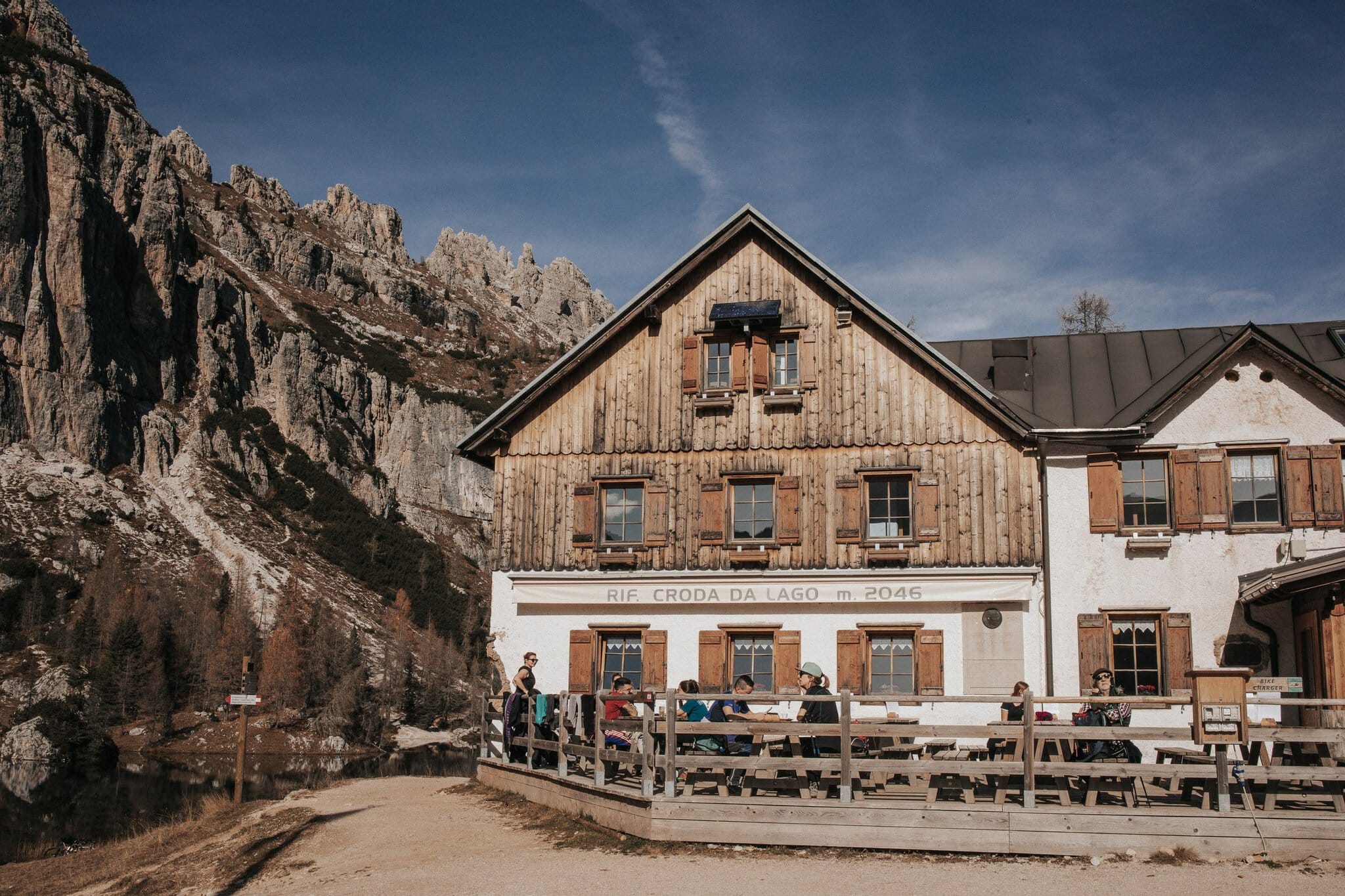
Croda da Lago & Lago Federa, Dolomites Italy: 10 Tips on What to See and Do

TL;DRCroda da Lago, a mountain massif in the Dolomites and part of the UNESCO site, and the turquoise Lago Federa at 2034 m above sea level make a much quieter alternative to Lago di Sorapis, southwest of Cortina d’Ampezzo. There are 10 tips here on what to see and do: from the classic trek from Passo Giau (3 hours, 350 m of ascent) to a full-day loop from Ponte de Ru Curto (5–6 hours) to an overnight stay at the Rifugio Palmieri mountain hut right on the lake’s shore. It’s loveliest in autumn, in late October, when the larches turn gold — parking at Passo Giau costs 5 euros for 3 hours. Flying drones over the lake is strictly banned, with fines of up to 3000 euros.

When it comes to mountain lakes near Italy’s Cortina d’Ampezzo, most people immediately think of the famous Lago di Sorapis. It’s stunning, no doubt about it, but during peak season it feels more like Oxford Street on a Saturday afternoon. If you’re after a quieter alternative where you won’t be jostling through crowds of tourists, let me take you to one of our absolute favourite spots in the Dolomites Italy has to offer. Croda da Lago and the lake nestled beneath it — Lago Federa — is exactly the kind of place that keeps us coming back to this part of the world. ☺️

It’s not far from Cortina at all, and you’re in for an incredible trek that takes you through deep forests, past dramatic rock walls, and ultimately rewards you with views of a turquoise lake framed by golden larches. Lukáš and I came here before our little Jonášek was born. It’s a proper trek that can easily take five to six hours, so with our one-year-old adventurer in tow, we’re giving it a miss this year and saving it for next year when he’s a bit bigger.

Let me give you a quick preview of what you’ll find in this article: where to park, which route to take to avoid the biggest elevation gains, where to sleep, and what to eat at the mountain hut. Plus, I’ll warn you about one mistake that could cost you thousands of euros. 😉

TL;DR

Already packing your bag and just need a quick overview? Here are the key points:

  • Where is it: A mountain massif southwest of Cortina d’Ampezzo in the Veneto region of northern Italy.
  • Main attraction: The turquoise Lago Federa at 2,034 m elevation and the mountain hut Rifugio Palmieri Croda da Lago.
  • Difficulty: Moderate. The classic loop takes 5–6 hours, but you can shorten it to 3 hours from Passo Giau. Not suitable for pushchairs, but older children (8+) can manage it without any problems.
  • Best time to go: Autumn is the most spectacular (late October), when the larches turn golden. Summer offers classic Alpine scenery, and in winter people come here for snowshoeing.
  • Important warning: There’s a strict no-drone zone above the lake — fines can reach a staggering €3,000.

What Exactly Are Croda da Lago and Lago Federa?

The name might be a bit confusing at first. Croda da Lago isn’t actually a lake, even though the word “Lago” might suggest that — it’s a breathtaking mountain massif and part of the UNESCO World Heritage Site, with jagged peaks towering high above the landscape. The turquoise lake that everyone comes here to see is called Lago Federa, and it sits right at the foot of these majestic cliffs at 2,034 metres above sea level.

It’s this combination of razor-sharp Dolomite peaks and the calm water reflecting them that absolutely rooted Lukáš and me to the spot — I was frantically reaching for my camera while he stood there open-mouthed, and neither of us wanted to move an inch. Right on the lakeshore stands an iconic mountain hut, which you might know as Rifugio Gianni Palmieri. It’s the perfect refuge where you can rest, enjoy a brilliant meal, or even spend the night and wake up to mist rising off the water with not a soul in sight.

When to Go and What the Weather Is Like

Honestly? Choosing when to go is probably the biggest dilemma we face before every trip to the Dolomites. Each season looks completely different, and every time we’ve been, we’ve thought “this must be the best time.” But you need to bear in mind that the weather above 2,000 metres can be incredibly unpredictable — a key thing to consider when planning your Dolomites Italy weather expectations.

If you visit during the classic summer season from May to September, you’ll find green pastures, blooming Alpine meadows, and pleasant hiking temperatures. I should mention though that August is the absolute peak of the Italian holidays (known as Ferragosto), so even here the trails will be busy — though still incomparably quieter than nearby Lago di Sorapis.

Our favourite time, though, is autumn. In late October, the larches surrounding the lake turn incredible shades of gold and orange, which against the turquoise water and white rock looks like something someone painted in Photoshop. In the Dolomites Italy winter transforms the landscape entirely — the trails are buried under snow and the hut is usually closed, but the area becomes a popular destination for snowshoe excursions. Just remember to check the Croda da Lago webcam before a winter outing so you know what the current snow conditions are like.

How to Get to Croda da Lago (3 Main Routes)

We’ll be honest — even we got a bit lost at first trying to figure out the various starting points, so we’ve picked the three most popular options for you. There are several ways to reach the lake, and it really comes down to your fitness level and how much time you have.

From Passo Giau (Shortest and Most Scenic)

If you’re looking for the easiest route with the best effort-to-views ratio, start from the mountain pass Passo Giau. The trail goes via Forcella Giau and the return trip takes roughly 3 hours of relaxed walking with a pleasant elevation gain of around 350 metres. The advantage is that you’re already starting high up, so there’s no brutal uphill slog through the forest — instead, you enjoy panoramic views for most of the way. Parking at the pass costs around €5 for 3 hours.

From Ponte de Ru Curto (The Happy Medium)

This is the true classic — the popular Croda da Lago loop. It starts at a small car park by the bridge Ponte de Ru Curto, which sits right on the road connecting Cortina and Passo Giau. The route takes you through dense forest first, then across mountain streams, and finally up to the lake. The full loop takes 5 to 6 hours and makes for an absolutely stunning full-day hike that we’d recommend if you fancy a proper workout.

From the Olympia Car Park in Cortina (For the Adventurous)

If you’re in the mood for a really long and demanding full-day outing, you can set off from the Olympia car park right on the edge of Cortina. Bear in mind though that you’ll be walking through a very deep valley and racking up a serious amount of extra elevation. Parking here costs around €10 for the whole day. This is more of an option for those who enjoy solitude in the forest before arriving at the massif itself.

Where to Stay Nearby and How Much It Costs

The best strategy for exploring this area is to base yourself in one of the valley towns, where you’re just a few minutes’ drive from the trailheads. Accommodation in this area tends to be on the pricier side (Cortina is a premium destination, after all), but outside of August you can find some reasonable options.

Cortina d’Ampezzo is the number one choice. From here, it’s only about 15–20 minutes’ drive along stunning hairpin bends to Passo Giau. If you love history and a touch of Alpine luxury, check out the iconic Hotel de la Poste right in the centre, or the very pleasant Franceschi Park Hotel. Staying in Cortina means having the best restaurants and cafés at your doorstep for a post-hike evening wind-down.

A more affordable alternative to Cortina is the little town of San Vito di Cadore, which lies a bit further south. It’s quieter here, accommodation prices are noticeably lower, and you’re still very close to the trailheads. Another beautiful option is Alleghe, a town sitting by a lake right beneath the Marmolada massif. We can recommend the family-run Chalet al Lago — while the drive to the start of our trek takes a bit longer, the lakeside atmosphere is absolutely worth it. A week’s accommodation for two in summer season in this area typically runs between €1,000 and €1,600, depending on the level of comfort.

10 Tips on What to See and Do at Croda da Lago

Now that you know how to get here and where to rest your head, let’s dive into the best things the area has to offer. This trek isn’t just about reaching the lake and turning back — there are plenty of detours, hidden viewpoints, and experiences that would be a shame to miss.

1. The Classic Trek from Passo Giau to the Lake

This is the essential experience that any reasonably fit hiker can manage. The path from Passo Giau to the lake is gorgeous because it takes you across high-altitude pastures full of marmots. The 350-metre elevation gain isn’t too daunting, and the views that open up once you cross the Forcella Giau saddle are absolutely breathtaking. Lukáš and I must have taken about a million photos before we even made it to the water.

Along the way, you’ll encounter an incredible number of marmots sunbathing on boulders or whistling at you from a distance. Our dogs Kája and Baby were completely fascinated, though of course they had to stay dutifully on their leads the whole time. That moment when you finally crest the ridge and see the valley spread out before you like a painting — it’s worth every drop of sweat.

2. An Overnight at Rifugio Palmieri Croda da Lago

Right on the lakeshore stands a charming stone hut known as Rifugio Gianni Palmieri. If you want a truly unforgettable experience, try booking an overnight stay here. It tends to fill up months in advance, so don’t leave it to the last minute. Waking up in the mountains as the first sunbeams light up the water while you sip your morning Italian espresso — that’s pure bliss.

The staff are incredibly warm and welcoming, making you feel right at home straight away. Dinner features local mountain specialities, and the atmosphere around the communal wooden tables — where everyone swaps stories from the day — has a wonderful charm to it. Just bear in mind that hot water in the showers at this altitude is a bit of a lottery.

3. The Iconic Photo from the Wooden Jetty

By the lake you’ll find a small wooden jetty that looks as though someone placed it there purely so people could photograph the perfect reflection of the jagged peaks on the water’s surface. Around midday there’s usually a bit of a queue, but it’s well worth the wait. We arrived at the jetty quite early in the morning — the surface was still as a mirror and the water was so cold that even dipping a finger in nearly gave us frostbite. 😅

If you don’t want strangers’ heads in your shot, I’d seriously recommend getting up early. The light is at its most beautiful first thing in the morning anyway, and the golden sun slowly creeping across the opposite rock faces creates a backdrop that no Instagram filter can replicate. Lukáš spent a good twenty minutes there with his camera before he was completely happy with the composition.

4. Explore the Trail from Olympia Car Park

If you enjoy walking through dense forest, give the route from the Olympia car park a go. Yes, it’s much longer, but it offers an entirely different perspective of the mountains. There’s something special about spending hours climbing through trees, listening to nothing but twigs snapping underfoot, and then suddenly the forest parts to reveal that enormous rock wall.

You’ll encounter very few people on this trail, making it ideal for those of you who crave peace and quiet in the mountains. Along the way, you’ll notice small streams and wooden footbridges that give it an almost fairy-tale feel. Just make sure you’ve got really good boots, because the tree roots can be quite slippery, especially after the morning dew.

5. For the Experienced: Via Ferrata della Strafala

For those who find regular hiking a bit tame, the area hides a protected climbing route called Via Ferrata della Strafala. We skipped it with our dogs, of course, but definitely check the current conditions beforehand — according to local guides, it offers views into deep gorges that you simply can’t experience anywhere else.

This via ferrata isn’t extremely difficult, but you’ll absolutely need full ferrata equipment including a helmet and harness. Some of the rock ledges can be quite exposed, so if you’re not great with heights, stick to the classic trek around the lake. But if you do make the ascent, you’re in for an incredible ride between sharp limestone towers.

6. Detour to Forcella Ambrizzola Saddle

Once you’ve soaked in the lake views and enjoyed a drink at the hut, make sure you get back on your feet for a short walk to the Forcella Ambrizzola saddle. It’s only about 20 minutes of gentle climbing from the lake, but the panorama that opens up before you is priceless. From here you can see a huge swathe of the Dolomites, including the Marmolada glacier in the distance.

Lukáš and I liked it so much that we unpacked our lunch on a big flat rock and simply gazed at the landscape. From this point, paths branch off into other valleys, so if you’re planning to spend several days in the mountains, it’s a brilliant starting point. Just be warned — it tends to be quite windy up here, so throw a windproof jacket into your pack.

7. Marvel at the Lunar Landscape of Lastoi de Formin

If you tackle the full Croda da Lago circuit trail, your route will take you across the fascinating plateau of Lastoi de Formin. It’s an enormous limestone slab that looks more like a lunar landscape than earthly mountains. The rocks are strangely fractured and feel incredibly raw. Our dogs Kája and Baby hopped around confusedly from one boulder to the next.

The contrast between this barren grey wilderness and the green valley with the lake below is absolutely striking. The path across the plateau isn’t the best marked, and I’d be very cautious in poor visibility. But when the weather’s on your side, you genuinely feel like astronauts on an exploration mission to some distant planet.

8. Wait for the Enrosadira at Sunset

Enrosadira is the phenomenon that made the Dolomites famous worldwide. It’s an optical effect where the limestone rocks turn incredible shades of pink and purple at sunset (or sunrise). Staying at Lago Federa until evening is romance at its very finest. Just don’t forget your head torches for the walk back to the car.

That amazing palette of colours doesn’t last long — usually just a few dozen minutes before the sun disappears below the horizon. So it’s worth scouting out a good spot for photos or sitting beforehand. Once the shadows thicken, the temperature can drop by a good ten degrees, so a warm layer is absolutely essential even if it was scorching during the day.

lukas a lucka
Lukáš and Lucie recommend
Where to stay near Croda da Lago and Lago Federa
5 accommodations — hotels and other lodging options
⭐ TOP CHOICE 🏔️ Mountain
Rifugio Gianni Palmieri (Rifugio Palmieri Croda da Lago)
A picturesque stone mountain refuge standing right on the shore of Lago Federa at 2034 m above sea level. Offers accommodation with an unforgettable wake-up as the first sun rays illuminate the water surface. Local mountain specialties such as polenta gröstl are served. The refuge is usually open from mid-June to the end of September.
★★★★ Check prices
Check availability
🏨 Hotel
Hotel de la Poste
An iconic hotel in the center of Cortina d’Ampezzo offering history and alpine luxury. Ideal starting point for the trek to Croda da Lago (15-20 minutes by car to Passo Giau).
★★★★ Check prices
Check availability
🏨 Hotel
Franceschi Park Hotel
A very pleasant hotel in Cortina d’Ampezzo. After your hike you’ll find the best restaurants and cafés here for evening relaxation. Distance to Passo Giau approximately 15-20 minutes by car.
★★★★ Check prices
Check availability
🏡 Chalet
Chalet al Lago
A family chalet by the lake in Alleghe, located right below the Marmolada massif. Offers great lake atmosphere, although it’s a bit longer by car to the trailhead than from Cortina. Weekly accommodation for two in summer season typically costs €1,000 to €1,600.
★★★★ from €1,000 – €1,600/week
Check availability
🔍 Search
View all accommodations near Croda da Lago and Lago Federa
Explore all available accommodation options near Croda da Lago and Lago Federa and find the best one according to your preferences and budget.
★★★★ Compare prices
Check availability

9. Winter Snowshoeing Under Snow-Capped Peaks

This place has plenty to offer even when it’s buried in snow. A winter snowshoe trek is incredibly magical — there’s absolute silence everywhere and the snow crunches under your feet. The hut itself is usually closed in winter and the lake lies under a thick layer of ice, but the raw winter wilderness is well worth the effort. Do make sure you check the avalanche danger beforehand and look at the Croda da Lago webcam.

Snowshoeing is actually great fun and doesn’t require any special training — you just need to lift your feet a bit higher than normal. If you don’t feel confident tackling a winter ascent on your own, there are plenty of local mountain guides in Cortina who’ll head out with you and throw in fascinating stories about the area’s history. Step by step through the white wilderness — it’s a wonderful way to clear your head.

10. Combine the Trek with a Scenic Drive over Passo Giau

The journey to the trek can be an experience in itself. The Passo Giau mountain pass is one of the most beautiful mountain roads in Europe, packed with sharp bends and jaw-dropping views. I’d suggest leaving a bit of extra time to stop and admire the scenery along the way — pull over at the viewpoints and soak up that quintessential Italian mountain atmosphere.

Just a word of warning: this road is hugely popular with motorcyclists and cyclists, so as a driver you need to keep your eyes peeled at all times. At the top of the pass there’s a brilliant little café where we always reward ourselves with a proper Italian cappuccino and a fluffy croissant after coming down from the mountains. And don’t forget some change for the paid car park.

Croda da Lago with Kids and Our Dogs (Kája and Baby)

If you follow our blog regularly, you’ll know we travel with our little Jonášek. As I mentioned at the start, with a two-year-old in a carrier, a five-hour trek with this much elevation is quite a demanding affair, so we’re saving it for when he’s a bit bigger. And definitely don’t try bringing a pushchair — the terrain is very rocky and you’ll hit some nasty tree roots.

💡 Local tip: Almost all cable cars and buses require dogs to wear a muzzle (you can buy one pretty much anywhere, including at the base stations). We found this quite annoying, to be honest — they insisted even when we were riding a gondola completely on our own. When we had several cable cars in a row, we sometimes left Kája and Baby resting back at camp instead.

That said, for families with older children — say eight and up — this is a perfect alternative to the overcrowded via ferrata routes. Kids are kept engaged by the varied landscape, and the prospect of a lake plus delicious food at the hut motivates them far more than any adult reasoning ever could.

And what about our four-legged companions? Kája and Baby absolutely loved this trek. There is, however, one very important rule: dogs must be on a lead at all times, no exceptions. There’s a huge colony of marmots living around the lake and on the surrounding pastures, and the local rangers take a very dim view of dogs running free. The trail itself is very pleasant for dogs, alternating between shady forest sections and sunny stretches — just watch out for sharp rocks on the scree slopes.

What to Eat at Rifugio Palmieri

One of the best things about hiking in Italy is that no matter which peak you climb, there’s almost always fantastic food waiting for you at the top. Rifugio Palmieri is no exception. Their kitchen delivers exactly the blend of Italian passion and Tyrolean heartiness that you need after several hours of walking.

I’d definitely recommend trying the local speciality, polenta gröstl. It’s beautifully crispy fried polenta mixed with chunks of quality local meat, onion, and cheese. It’s an absolute calorie bomb, but Lukáš and I nearly fought over it. Pair it with a glass of Vino d’Ampezzo, the local wine from the region, which will warm you up nicely. And if you prefer the classics, their homemade pasta or apple strudel with vanilla sauce are absolutely spot-on.

Practical Information, Prices, and Rules (Drone Ban!)

Before heading into the mountains, it always pays to have a few practical details sorted so nothing catches you off guard. Here’s what we learned during our trip:

  • Parking: Spaces at the trailheads fill up very quickly, especially in summer. At Passo Giau you’ll pay around €5 for three hours; at the Olympia car park in Cortina it’s roughly €10 for a full-day ticket. Arrive by 9 AM at the latest.
  • Water: There aren’t many options for refilling your water safely along the trail. Water from the lake or surrounding streams isn’t safe to drink without boiling. It might look romantic, but wildlife lives its life up here and we don’t want you experiencing nature more intimately than you planned. 😅 Make sure you bring enough — at least 2 litres per person in summer.
  • DRONE BAN: I need to stress this one. The entire Croda da Lago area lies within a protected zone and flying drones is absolutely and strictly prohibited. This isn’t just a suggestion — if the local police or park rangers catch you, fines can climb without mercy to an eye-watering €3,000. That risk simply isn’t worth one Instagram photo, trust me.

Where Else to Go in the Dolomites

The Dolomites are so magnificent that one trek definitely won’t be enough. If you’re already in the Cortina area, consider adding these gems to your itinerary (just be prepared for considerably more people):

Tips and Tricks for Travelling to Italy

Before you start packing your rucksack, here are a few quick tips that have consistently saved us time and money when travelling to Italy.

Finding Flights

If you’re not driving to the Dolomites, the nearest airports are Venice Marco Polo and Treviso. From London, you can often find great deals with easyJet or Ryanair flying into Venice. For comparing prices and routes, we love using Kiwi — it’s our go-to portal for flight comparison.

Hiring a Car

To get between the Italian mountain passes and lakes, you really do need a car. Lukáš and I have had consistently good experiences with DiscoverCars, which we use all over the world. They always find you the best deal across all the major hire companies.

Don’t Forget Travel Insurance

In the mountains, you never know — one wrong step and a helicopter rescue can get very expensive indeed. For shorter trips we usually go with AXA insurance (we’ve got a 50% discount via this link), and for longer trips or anything more adventurous, we swear by SafetyWing. Your EHIC/GHIC covers basics in Italy, but mountain rescue and repatriation are a different story.

Internet and Data

Since leaving the EU, UK travellers should double-check their mobile roaming allowances for Italy. Many UK networks still include EU roaming, but if yours doesn’t — or you need reliable data for working on the go — have a look at our Holafly eSIM review, which we use regularly.

What to Put on Your Feet

For the rocky Dolomite trails, you genuinely need proper hiking boots. No trainers! If you haven’t invested in a quality pair yet, check out our article on how to choose hiking boots so you don’t come back from the trek covered in blisters.

Frequently Asked Questions (FAQ)

How long does the Croda da Lago trek take?

It depends on which route you choose. The shortest option from Passo Giau takes about 3 hours round trip. The longer loop from the Ponte de Ru Curto bridge will take you around 5 to 6 hours at a leisurely pace.

Is the Croda da Lago trek suitable for children?

It’s not suitable for strollers or very young children (unless you have a baby carrier) due to the rocky and fairly steep terrain. However, more experienced kids aged eight and up should be able to handle the loop, or at least the route from Passo Giau, without any problems.

Can I swim in Lago Federa?

No, swimming in the lake is prohibited to protect the fragile alpine ecosystem. Besides, the water is so icy cold that you probably wouldn’t want to anyway.

Are dogs allowed at the lake?

Yes, dogs are welcome on the trek, but they must be kept on a lead at all times. There are lots of marmots in the area, and you can face pretty hefty fines for letting your dog run free.

When is Rifugio Palmieri open?

The refuge is typically open from mid-June through the end of September or early October. It’s closed outside the season and during winter, but you can book accommodation in advance during the summer months.

Do I need a guide for this trek?

Not at all. The trails in the Dolomites are perfectly and clearly marked (including the red and white markings of the Italian Alpine Club). Just download offline maps and follow the signposts.

Are drones allowed above the lake?

No, there’s a very strict ban on flying drones here. Since the area is part of a protected zone and nature park, you could face massive fines of up to 3,000 euros for breaking this rule.

Tips and Tricks for Your Vacation

Don’t Overpay for Flights

Search for flights on Kayak. It’s our favorite search engine because it scans the websites of all airlines and always finds the cheapest connection.

Book Your Accommodation Smartly

The best experiences we’ve had when looking for accommodation (from Alaska to Morocco) are with Booking.com, where hotels, apartments, and entire houses are usually the cheapest and most widely available.

Don’t Forget Travel Insurance

Good travel insurance will protect you against illness, accidents, theft, or flight cancellations. We’ve had a few hospital visits abroad, so we know how important it is to have proper insurance arranged.

Where we insure ourselves: SafetyWing (best for everyone) and TrueTraveller (for extra-long trips).

Why don’t we recommend any Czech insurance company? Because they have too many restrictions. They set limits on the number of days abroad, travel insurance via a credit card often requires you to pay medical expenses only with that card, and they frequently limit the number of returns to the Czech Republic.

Find the Best Experiences

Get Your Guide is a huge online marketplace where you can book guided walks, trips, skip-the-line tickets, tours, and much more. We always find some extra fun there!
Seceda, Dolomites: 10 Tips on What to See and Do

TL;DRSeceda is a famous viewpoint mountain in the Dolomites (Trentino-Alto Adige, Val Gardena), reached from the village of Ortisei by a two-stage cable car that whisks you up to 2,500 metres in about 15 minutes. From the top station it’s just a 10-minute walk to the iconic cross and that famous view of the jagged Odle ridge. Among the 10 tips on what to see and do, alongside the main viewpoint, are an easy loop walk along the ridge, the Rifugio Troier and Rifugio Firenze mountain huts, the Pieralongia rock towers, an e-bike descent, catching sunrise or sunset (enrosadira), and a wander round Ortisei itself. A return cable car ticket costs €40–€45 in 2026. The best time to visit is mid-June to the end of September, ideally avoiding the Ferragosto rush in August, and the cable cars run from late May to mid-October.

When we first stood beneath those iconic, jagged peaks that look as though someone ripped them from the earth and tilted them at an absurd angle, my jaw literally dropped. Seceda Dolomites is love at first sight, plain and simple. If you’re thinking about heading to the Italian Dolomites, I need to warn you upfront: this place will completely steal your heart and you’ll never want to go hiking anywhere else again. ☺️

Lukáš and I have been visiting the Dolomites for years — our dog Kája even brought home a companion from here, an adopted pup called Baby who hails from these very mountains. But this year was different. The year was 2026 and we set off for the first time with our two-year-old, Jonášek. Romantic visions of all-day challenging treks quickly went out the window, and we had to completely rethink our plans. That’s precisely why Seceda is an absolute game-changer. The cable car does most of the hard work for you, whisking you up to 2,500 metres above sea level in just ten minutes, with the most photogenic view in all of Italy. You can manage it with a small child, with dogs, or even if you’re simply not a peak-bagging athlete.

Right then, let me walk you through how to do the whole thing stress-free — from the cable car to the best mountain hut with alpacas. 😉 I’ll also cover which cable car to choose, where to grab the best mountain lunch, and when to go to dodge the worst crowds.

TL;DR

  • Where is it: In the Val Gardena valley, Trentino-Alto Adige region, northern Italy.
  • How to get up: The quickest way is the two-stage cable car directly from the village of Ortisei (St. Ulrich).
  • Who is it for: Absolutely everyone. The viewpoint is right by the top station — you can do easy strolls or more demanding ridge hikes.
  • With a pushchair: It’s possible with an all-terrain buggy on the main wide paths, but I’d definitely recommend a baby carrier instead!
  • When to go: Cable cars operate from late May to mid-October. In summer, be at the cable car right when it opens.
  • Accommodation: Ortisei is the ideal base — you’ll save on parking near the cable car.
  • Dogs: Dogs are allowed on the cable car (usually for a small fee) and must wear a muzzle, though the Italians often don’t enforce it strictly.

What Is Seceda and Why Does Everyone Want to Go There?

Look, Seceda technically isn’t even the tallest mountain in the area, but that’s completely beside the point — when someone says Seceda, everyone instantly pictures that jaw-dropping ridge of the Odle massif (Geisler in German), which looks like it belongs on another planet. These mountains look as if someone drove giant stone knives into the ground — on one side, they slope gently into lush green alpine meadows, while on the other, they plunge vertically into a deep abyss. It’s a sight that earned this area a spot on the UNESCO World Heritage list.

What makes this place so fascinating is the geology itself. These peaks were once coral reefs on the floor of the prehistoric Tethys Ocean, thrust upwards over millions of years into the formations we see today. It’s perhaps this unique rock composition (dolomite) that creates another magical phenomenon that draws photographers from around the world. It’s called enrosadira. At sunrise and sunset, the rocks blaze with incredible shades of pink, orange, and fiery red. We didn’t hang around for sunset with Jonášek this year — we’d have missed his evening porridge — but from previous visits, I can confirm it’s a goosebump-inducing experience.

When to Visit Seceda and What Weather to Expect

We once headed up in perfect sunshine, and within ten minutes we were engulfed in thick fog where you couldn’t see a metre ahead. I coped with the 40 euros we’d spent on the cable car by consoling myself with Canederli and coffee in a mountain hut. Lesson learned: mountain weather is completely unpredictable, and picking the right day is absolutely essential. The best time to visit is undoubtedly from mid-June to the end of September, when mountain huts are fully open and the snow has usually melted from the trails.

July and August bring lovely warm weather and meadows dotted with blooming alpine wildflowers, but you’ll have to contend with massive crowds. August is also Italy’s national holiday month (known as Ferragosto), so up on the mountain you’ll bump into not only us northern travellers but pretty much all of Italy, having collectively relocated to the hills 😅. My secret tip is to go in September or early October. The air is crisper and clearer, the crowds thin out, and the larch trees start turning golden.

When it comes to Seceda Dolomites weather, there’s one absolutely ironclad rule: the 1 pm rule. During summer months, mornings typically start with a brilliant azure sky, but as the valley heats up, clouds begin building and around one to two in the afternoon, powerful thunderstorms roll in surprisingly often. Head up on the very first cable car around half past eight in the morning. Before you even buy your ticket, I strongly recommend checking a live Seceda webcam online to see whether low cloud is sitting on the summit. The weather up here changes by the minute, and that camera is your best friend.

How to Get to Seceda: Cable Cars and on Foot

Getting to the Val Gardena area from the UK is straightforward. You can fly into Innsbruck, Verona, or Venice with airlines like easyJet, British Airways, or Ryanair, and then hire a car for the drive into the mountains — Innsbruck is the closest at around an hour and a half by road. Once you’re in the valley, there are several ways to conquer that famous ridge. This time, we opted for the easiest one.

Seceda Cable Car from Ortisei (Quickest and Most Comfortable)

This is the absolute classic, and the Seceda cable car is the first choice for most visitors. You’ll find the bottom station right in the village of Ortisei (St. Ulrich in German). The journey is in two stages. First, you hop into a smaller gondola that takes you up to the mid-station at Furnes. There you transfer to a large, high-capacity cabin that sweeps you all the way to the summit at 2,500 metres.

The whole thing takes about 15 minutes. It’s quite an experience — the big cabin sways a bit as it passes over the pylons, but the valley views are spectacular. There’s a large paid car park at the bottom station, though in peak season it fills up early in the morning.

Alternative via Col Raiser from Santa Cristina

If you’re staying in the neighbouring village of Santa Cristina or want to avoid the queues in Ortisei, you can take the Col Raiser gondola. It won’t take you all the way to the highest ridge and that iconic viewpoint, but it drops you a bit lower on beautiful alpine meadows at the foot of the Odle mountains.

From there, you’ll need to hike about an hour and a half uphill to reach the main Seceda viewpoint. It’s a lovely walk — as long as you’re not pushing a buggy — and it’s a slightly cheaper option too.

Seceda Hike for the Adventurous

For those of you who love a challenge and don’t have a toddler in tow, there are several hiking trails from Ortisei or Santa Cristina all the way to the top. Be prepared for a serious climb, though. The elevation gain is around 1,100 metres and the hike will take a good three to four hours of pure walking time to get up.

In the past, Lukáš and I would probably have huffed and puffed our way up on foot. This year, we tapped that precious cable car card at the turnstile with an overwhelming sense of relief and gratitude.

Where to Stay in Ortisei and the Surrounding Area + Budget

Choosing the right base is key to exploring Val Gardena properly. We wouldn’t trade Ortisei for anything. It’s a charming alpine town with a lovely historic centre, a pedestrian zone full of cafés where espresso fills the air, and — crucially — the cable cars to both Seceda and Alpe di Siusi are within walking distance. That means no battling for expensive parking spaces every morning.

Accommodation in Val Gardena isn’t exactly cheap, but for those morning views from your window, it’s worth every penny. If you’re after a good balance of price and quality, we can wholeheartedly recommend B&B Villa Angelino, where we’ve had a great stay in the past, or the lovely Apt Lara Siela if you prefer self-catering. For those who fancy a bit more comfort with stunning mountain views and a pool, the excellent Hotel Scherlin is a top pick. You can easily compare current availability and prices in Ortisei and the wider Val Gardena on Booking.com.

As for budget, Val Gardena is pricier than some of the lesser-known valleys in Trentino. A week-long holiday for two — with accommodation in a decent B&B including breakfast, a multi-day cable car pass (such as the excellent value Gardena Card), and the occasional dinner out — will set you back roughly €1,400 to €1,800. That depends, of course, on how many Aperols at €6–8 a pop you sink in the mountain sunshine 😅. On top of that, add a few euros for Italian motorway tolls and fuel.

10 Tips on What to See at Seceda and in the Area

Seceda isn’t just about that one iconic photo. It’s a vast high-altitude plateau, and over the years we’ve explored it thoroughly — with dogs, without dogs, with Jonášek in a carrier and without. Here’s what’s genuinely worth your time.

1. The Iconic Jagged Profile (Best Viewpoint)

This is exactly the spot everyone comes for, and it’s surprisingly easy to find. Once you step out of the large cable car at the Seceda summit, head along the groomed path to the left and uphill.

It takes just ten minutes on a well-maintained path and suddenly you’re standing at a metal viewing platform and cross at the very summit (2,519 m), and your jaw simply drops. A seemingly endless abyss opens up before you, and rising from it are the incredible jagged teeth of the Fermeda and Odle massifs. You almost feel like you could slide down the ridge like a toboggan run deep into the neighbouring Val di Funes. It’s always packed with people — everyone wants their photo — but the view never gets old. Don’t forget to check out the circular panoramic plaque that names dozens of surrounding peaks.

2. Easy Ridge Loop Walk

If you don’t fancy a day of tough climbing, I’d recommend simply doing a loop across the upper plateau. From the viewpoint cross, head down the wide path number 1 towards Rifugio Troier and on to Pieralongia. The trail gently undulates, but you’re mostly walking downhill or on the flat.

This easy loop takes roughly three to four hours, including very generous stops for photos, admiring the scenery, and devouring dumplings. Our dogs Kája and Baby happily trotted along the paths while we had time to watch the clouds constantly rolling over the razor-sharp peaks. For families and dog owners, this is probably the best possible route on the entire mountain.

3. Stop at Rifugio Troier Mountain Hut

Alpine huts — or rifugi — are an integral part of Dolomite culture, and without them, the experience just wouldn’t be the same. Rifugio Troier sits right at the foot of those jagged spires and is probably our favourite hut in the area. They have a huge outdoor terrace with sun loungers where you can flop down in the sunshine and simply breathe in the pure mountain air.

What makes this hut truly special is the animals. Goats and chickens roam freely around the building, and they also have ponies, a family of alpacas, and rabbits. For Jonášek, this year it was better than any kids’ TV show, and Lukáš and I could enjoy our excellent espressos in peace. The food is fantastic, and the whole place always smells of warm wood and mountain herbs.

4. Visit Rifugio Firenze in the Valley

If you’ve got a bit more energy and don’t mind a significant descent followed by a climb back up, you can head from the ridge down into the basin to Rifugio Firenze (Regensburger Hütte in German). It’s an older, more traditional hut with a long history, standing on a stunning green meadow directly beneath the majestic mountains.

It’s about an hour and a half’s walk down from the Seceda top station. The landscape changes dramatically along the way — you’ll pass mountain streams, small tarns, and you might spot marmots whistling at you from their hideouts under the rocks. Just bear in mind that if you don’t have a Col Raiser cable car ticket for the return, you’ll have to hike all the way back up to the Seceda summit station.

5. The Two Pieralongia Towers and Alpine Garden

This is a wonderfully photogenic spot you definitely shouldn’t miss. Along the trail, you’ll come across two massive solitary rock towers jutting out from an otherwise flat green meadow, as if someone simply placed them there. The spot is called Pieralongia.

It’s not some fancy restaurant — more of a little improvised alpine dairy with wooden benches where you can have homemade buttermilk, yoghurt, or fresh cheese. Sitting here with those enormous rock towers in front of you, sipping tangy buttermilk, is honestly one of the most authentic experiences the Dolomites have to offer. You’ll often see donkeys grazing freely nearby too, which only adds to the wonderful atmosphere.

6. E-Bike Descent for Adrenaline Junkies

You can hire top-quality e-bikes in Ortisei and ride them all the way up (or use the cable car, which will transport your bike for a surcharge). Seceda is threaded with a network of dirt and gravel tracks that are perfect for e-biking.

The descent from the summit back to the valley is clearly quite an experience, because Lukáš was watching the riders with such longing that I was worried he might leap on a bike without warning. You share the paths with hikers, and the steeper sections with loose gravel are apparently quite treacherous, so it’s not for complete beginners.

7. Sunrise and Sunset over the Jagged Peaks

As I mentioned, the enrosadira phenomenon is a hallmark of this area. Although the cable car only gets you up there around nine in the morning (and you need to be back down before five), photographers hike up in the dark or set their alarms for the special early-morning cable car rides that run just a few times a year in midsummer.

Watching the first rays of sunlight gradually flood the valley and turn the dark silhouettes of the Odle peaks into blazing reds is something you’ll remember for the rest of your life. If you’re not a morning person, you can opt for an evening hike instead — but you’ll need to walk back down with head torches, as the cable cars will no longer be running.

8. Exploring the Village of Ortisei (St. Ulrich)

When you get back down on the cable car after a full day up the mountain, don’t rush straight to your hotel. Ortisei is the jewel of the valley and well worth lingering in. Val Gardena has been famous for its woodcarving tradition for centuries. On practically every corner you’ll find a shop selling incredibly detailed wooden sculptures, from traditional nativity scenes to contemporary art.

Stroll through the pedestrian zone, grab some incredible gelato (naturally it’s divine here), and just soak up the unique atmosphere where meticulous Tyrolean tidiness blends with Italian laid-back charm. It’s a delightful mix that I absolutely love about northern Italy.

lukas a lucka
Lukáš and Lucie recommend
Where to stay in Seceda, Dolomites
4 accommodations — hotels and other lodging options

9. Santa Cristina and Selva di Val Gardena

Val Gardena isn’t just Ortisei, and it would be a shame to travel all this way and not see the rest. Santa Cristina is a touch quieter and smaller — we love it for an afternoon wander, mainly because there’s a great ice cream shop perfect for a stop before heading home.

Selva sits at the highest point and loses a bit of its winter ski-resort glamour in summer, but the views of the Sella massif are truly imposing. Both villages also have dozens of cable cars heading in all directions, so you certainly won’t run out of things to do.

10. Photography Tips — Finding the Best Perspective

Honestly, I’m no professional photographer, but even I discovered that the best shots aren’t taken right by the cross where the crowds jostle, but a short walk beyond it along the cliff edge. From here, the jagged towers visually compress together and look even more dramatic.

Try including a small figure — someone from your group standing on the trail edge — to give the photo a sense of scale, because otherwise the sheer enormity of the rock walls just doesn’t come across. And remember, the worst light for photography is right at midday when the sun is highest and casts harsh shadows. Try to hold out until the late afternoon.

Seceda with a Pushchair and Small Children (Our Experience This Year)

I have to admit, planning day trips with a two-year-old is a completely different game from what Lukáš and I were used to. But can a family with a small child manage Seceda? Absolutely yes! The two-stage cable car is a massive help — you can load a pushchair into the large cabin at the mid-station without any hassle whatsoever.

Once you’re up top, a fairly wide gravel path leads to the viewpoint, and with a genuinely good all-terrain pushchair (we’re talking big wheels and suspension, not a flimsy folding one from the high street), you can manage part of the ridge trail towards the huts. But honestly, an ergonomic baby carrier is a far better idea. Jonášek had a brilliant vantage point, we had our hands free, and we weren’t worried about rattling his bones on the rockier sections. Plus, he slept beautifully in the carrier in that fresh mountain air. Whatever you do, don’t forget a warm hat and a decent jacket for the little ones — it really is 10 to 15 degrees colder up there than in the valley below.

Where to Eat

In the Dolomites, you’re treated to a wonderfully eclectic culinary mix — Italian espresso and pasta meet hearty Tyrolean dumplings, and on top of that, the Ladins, the valley’s original inhabitants, add their own ancient recipes to the table.

Once you’re settled on a wooden bench with that view, you absolutely must try Canederli (Knödel in German). These are huge round bread dumplings mixed with local speck ham or spinach, served either swimming in a rich broth or drizzled with hot butter and showered in Parmesan. It sounds simple, but it’s heavenly.

Another staple is quality polenta, which the Ladins prepare with wild mushrooms foraged from local forests and melted alpine cheese. And for dessert? You simply cannot leave without trying apple strudel doused in warm vanilla sauce or a pile of shredded pancake (Kaiserschmarrn) with lingonberry jam. Either one will give you enough energy to bound back down to the cable car like a mountain goat.

Practical Tips and Photography Guide

If you’re still in the planning stages, here are a few tried-and-tested practical tips. In 2026, the return cable car ticket from Ortisei to the summit was around €40–45 per adult. It’s not cheap, but maintaining that incredible cable car infrastructure in such extreme conditions doesn’t come for free. If you’re staying in Val Gardena for several days, it’s definitely worth considering the multi-day Gardena Card, which covers all the surrounding cable cars.

Don’t be fooled by the temperature at your guesthouse down in the valley. You MUST always have a windproof jacket, a warm mid-layer, and even a thin beanie packed in your rucksack — even in the height of Italian summer at 30°C. Above 2,500 metres, the weather can turn very quickly.

The last cable car down usually departs between 17:00 and 17:30 (check the exact time at the turnstile). Don’t bank on them squeezing you in. Once the cable car closes, you’re facing a very long, knee-punishing descent on foot. And I’ll say it one more time: before you shell out for those pricey tickets, check the Seceda weather forecast and, more importantly, the live webcam from the summit on your phone. Sometimes the entire valley is bathed in sunshine while the top of Seceda is wearing a thick grey cap of cloud, and you wouldn’t be able to see the end of your own nose up there.

Beyond Seceda: Tips for More Day Trips

Once you’ve explored Val Gardena thoroughly and feel ready for a drive, the Dolomite region is enormous and offers endless possibilities. Right across the valley from Seceda lies the vast high-altitude pasture of Alpe di Siusi, dotted with wooden chalets and boasting views of the Sasso Lungo massif. If you prefer more dramatic mountains, check out our complete guide to Cortina d’Ampezzo, which is a perfect base for visiting the eastern Dolomites and the famous Tre Cime rocks.

I’d also recommend reading our article on what to do in the Dolomites for plenty more inspiration, and if you’re after easier walks, we’ve written up 5 hiking trails for everyone. And if you don’t mind a bit of crowd madness for a beautiful photo, definitely consider the famous emerald lake of Lago di Braies.

What to Sort Before Your Next Trip to Italy

Before you head off on your next adventure, here are a few well-tested tips. Travelling around Italy can be a little chaotic at times, so it pays to be prepared.

Lukáš and I have our routines down by now, but even so, we occasionally forget something. These services have definitely been worth getting right:

  • Finding flights: If you’re not driving to Italy, look for cheap flights on Skyscanner or Google Flights. From the UK, you can fly into Innsbruck, Verona, Venice, or Bergamo with airlines like easyJet, Ryanair, or British Airways.
  • Hiring a car: You’ll struggle without one in the mountains. We’ve had consistently good experiences with DiscoverCars, which we use all over the world.
  • Don’t forget travel insurance: Mountains are unpredictable and a rescue helicopter in Italy costs a fortune. We regularly go with AXA (they often have decent discounts) or international cover — find out more in our SafetyWing review.
  • Mobile data: To check those all-important webcams and weather forecasts on the trail, you’ll want reliable connectivity. If your UK plan doesn’t include EU roaming, have a read of our Holafly eSIM review.
  • Proper footwear: Leave your trainers at home — even on the well-maintained paths you need ankle support. Check out our tips on hiking boots.

Frequently Asked Questions (FAQ)

Got more questions? Here are the answers to the most common queries I receive about Seceda on Instagram and that people frequently search for online.

How much does the cable car to Seceda cost?

Prices change slightly each year, of course. In 2026, a round-trip ticket from Ortisei to the summit (both cable car sections) costs between 40 and 45 euros for adults. Discounted children’s tickets and family packages are available. Dogs usually ride for around 5 euros. And if you’re staying in Val Gardena for longer, it’s definitely worth considering a multi-day Gardena Card, which includes all the surrounding cable cars.

How do you get to Seceda?

The easiest way is to drive to the Italian valley of Val Gardena, to the town of Ortisei. We recommend securing parking first thing in the morning, as it gets pretty full later on. From the center of Ortisei, a two-stage cable car (Ortisei-Furnes and Furnes-Seceda) takes you up to the mountain summit at 2,500 meters elevation and the iconic viewpoint in about 15 minutes.

How long does the cable car ride to Seceda take?

The actual ride from Ortisei consists of two sections and takes around 15 minutes of pure travel time. The experience in the cabin is really pleasant though, and it flies by. Just keep in mind you’ll need to transfer at the Furnes mid-station, and during summer months, allow plenty of extra time for waiting in queues at the lower ticket office.

Where’s the best place to park for a trip to Seceda?

Your best bet is to leave your car at the large paid parking lot right at the lower cable car station in Ortisei. You’ll then be just steps away from the ticket offices. During peak summer season it fills up very quickly though, so I recommend arriving first thing in the morning. Alternatively, you can use the overflow parking areas in town and walk the short distance to the cable car.

Can you take dogs on the cable car and hikes?

Yes, we travel with two dogs (Kája and Baby) and have never had any issues with the cable car. You do need to buy them their own ticket though, and have a muzzle ready, even though the Italians often don’t make a big deal about it. On the ridge itself, it’s best to keep your dog on a leash. Cows, sheep, and horses graze freely all around, so you’ll avoid the hassle of chasing your dog down.

Can we manage Seceda in the rain?

Honestly, I wouldn’t recommend visiting in rain or thick fog. For the price of the cable car ticket, you’ll only see a gray curtain, you’ll miss out on the views, and the muddy trails will make it more of a punishment than anything. Wait for better weather—it really is crucial in the mountains. When it’s nice out, the views make it all worthwhile a hundred times over.

Can we fly a drone up there?

The Dolomites have very strict drone regulations, and Seceda is absolutely hopeless in this regard. There are UNESCO rules, a nature park, park rangers, and fines that’ll make you cry. So stick to traditional photography and leave your drone safely tucked away in your backpack. Plus, the peace and quiet without whirring propellers overhead will be appreciated by other hikers and the animals too.

Tips and Tricks for Your Vacation

Don’t Overpay for Flights

Search for flights on Kayak. It’s our favorite search engine because it scans the websites of all airlines and always finds the cheapest connection.

Book Your Accommodation Smartly

The best experiences we’ve had when looking for accommodation (from Alaska to Morocco) are with Booking.com, where hotels, apartments, and entire houses are usually the cheapest and most widely available.

Don’t Forget Travel Insurance

Good travel insurance will protect you against illness, accidents, theft, or flight cancellations. We’ve had a few hospital visits abroad, so we know how important it is to have proper insurance arranged.

Where we insure ourselves: SafetyWing (best for everyone) and TrueTraveller (for extra-long trips).

Why don’t we recommend any Czech insurance company? Because they have too many restrictions. They set limits on the number of days abroad, travel insurance via a credit card often requires you to pay medical expenses only with that card, and they frequently limit the number of returns to the Czech Republic.

Find the Best Experiences

Get Your Guide is a huge online marketplace where you can book guided walks, trips, skip-the-line tickets, tours, and much more. We always find some extra fun there!
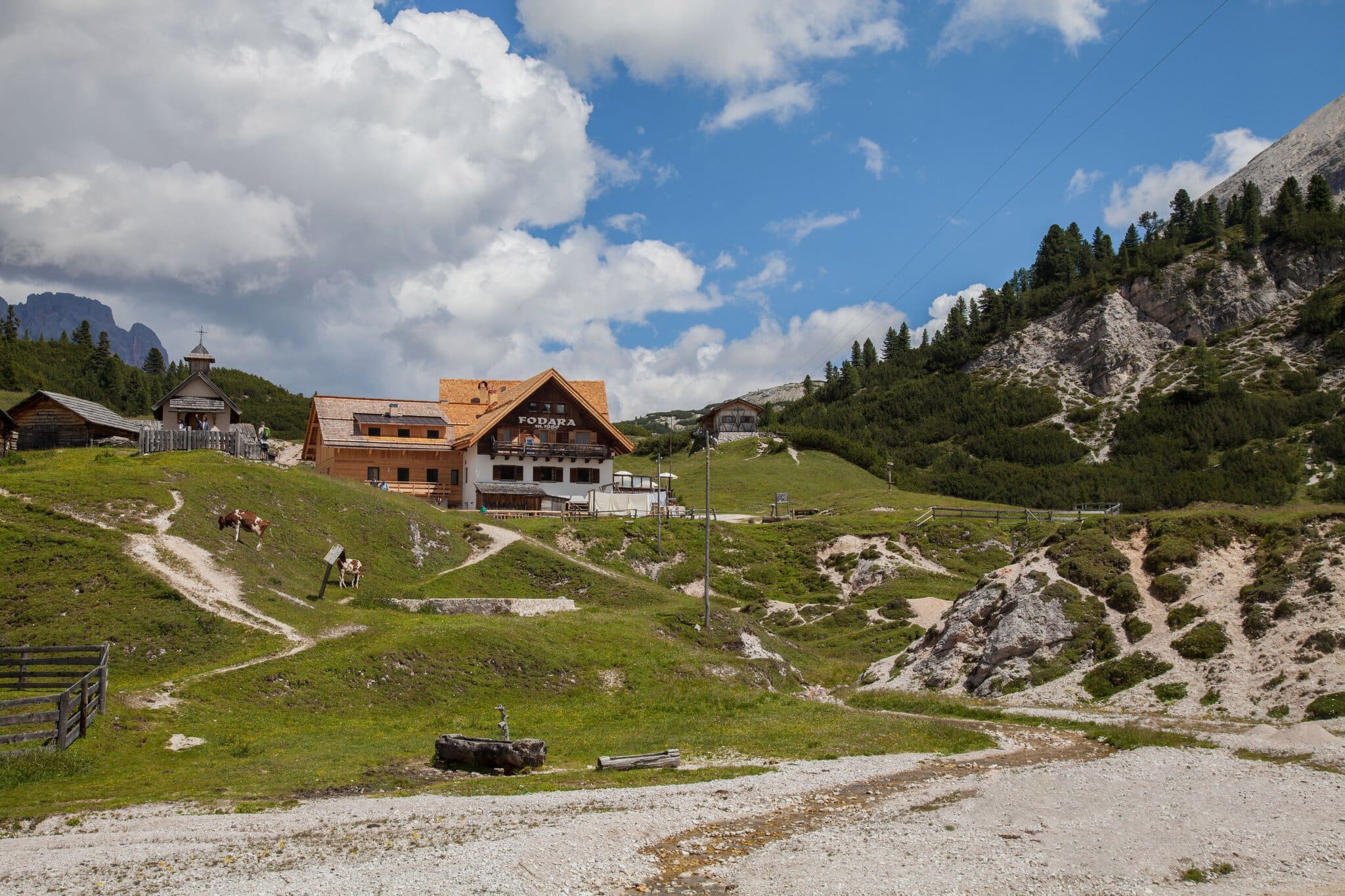
Alpe di Siusi (Seiser Alm), Dolomites: 12 Tips on What to See and Do

TL;DRAlpe di Siusi (Seiser Alm) is Europe’s largest high-alpine meadow at 56 km², sitting in Italy’s Dolomites at 1,680–2,350m, with sweeping views of the Sasso Lungo, Sasso Piatto and Sciliar massifs. May to September is the sweet spot, or mid-October if you want the meadows in golden autumn colour. You’ll need the cable car up from Ortisei or Compatsch, since cars are banned between 9am and 5pm in season; parking up top runs about 25 EUR a day, and the cable car ticket is 35–50 EUR. There are 12 ideas here for what to see and do, from walking the Hans und Paula Steger Weg to hiking up Sasso Piatto, plus Lago di Fiè and the Tirler and Mahlknecht mountain huts. It’s a good pick for families with pushchairs and dog owners too, as the terrain is mostly flat and easy going.

I remember the moment Lukáš and I pulled out our phones and showed each other the exact same saved photo of the same alpine meadow (yes, the one with those two jagged peaks piercing the sky). Back then, we had no idea that a few years later we’d be standing there with a pushchair and two dogs. Alpe di Siusi — or Seiser Alm, as it’s known in German — is the kind of place that pops up in every guide to northern Alpe di Siusi Italy, and I can promise you that reality is even more beautiful than those edited Instagram photos. When you ride the cable car up, the views are absolutely jaw-dropping and you’ll instantly understand why people flock here from all over the world. ☺️

We fell in love with the Dolomites years ago, but this time it felt completely different. With our two-year-old Jonášek in tow, we were specifically hunting for pushchair-friendly destinations, and Alpe di Siusi turned out to be absolutely ideal. The terrain is mostly flat, accessible cable cars and buses run everywhere, and you can soak in the high-altitude scenery without having to scramble up sheer rock faces with a toddler on your back. Our two dogs, Kája and Baby, came along too — for them, these vast grassy plains were nothing short of paradise. And that’s exactly what I want to share with you today: what to do, where to eat, and how to get there without spending your first day stuck in a car park.

TL;DR

  • Where is it: The largest high-altitude alpine meadow in Europe, located in the Italian Dolomites (Trentino-Alto Adige region) at an elevation of 1,680–2,350 metres.
  • Main draw: Panoramic views of the Sasso Lungo, Sasso Piatto, and Sciliar mountain massifs.
  • Getting there: During the season, there’s a strict car ban from 9:00 to 17:00. Use the Alpe di Siusi cable car from Ortisei or from Compatsch to get up.
  • Who is it ideal for: Families with children, pushchairs, dog owners, and lovers of easy walks as well as panoramic treks.
  • Watch out: Flying drones is strictly forbidden, with fines of up to €3,000.

What Exactly Is Alpe di Siusi (Seiser Alm)?

If you find yourself getting confused by the mix of Italian and German names, you’re not alone. The entire South Tyrol (Südtirol) region is bilingual, so you’ll always see the Italian name Alpe di Siusi right alongside the German Seiser Alm, sometimes even joined by the local Ladin name Mont Sëuc. Call it whatever you like — I’ve got it saved in my phone as “that meadow that made me cry at sunset.”

This is the largest high-altitude pasture in all of Europe, covering an enormous 56 km² and rightly listed as a UNESCO World Heritage Site as part of the Dolomites. The meadow sits like a green jewel among dramatic limestone peaks, the most striking being the pointed spires of Sasso Lungo (Langkofel) and the massive flat-topped Sciliar (Schlern). Unlike the jagged, steep mountains surrounding it, this plateau is incredibly gentle — rolling, dotted with wooden huts, and drenched in an unmistakable romantic atmosphere.

When to Visit and What Weather to Expect

Choosing the right time to visit Alpe di Siusi is crucial, because each season offers an entirely different experience — and honestly, I can’t pick a single best one. It all depends on what you’re looking for.

For classic hiking and pushchair-friendly outings, the sweet spot is May through September. The days are long and temperatures pleasant, although you need to bear in mind that at around 2,000 metres, even summer can bring a chilly breeze. If you’re mad about wildflowers, aim for late spring or early summer, when the entire vast plateau erupts in colour with thousands of alpine blooms.

In autumn, roughly from mid-October, the meadow turns a rich golden hue and the air is incredibly clear, giving you visibility for miles. And winter? That’s a chapter all on its own. The plateau transforms into a perfect winter resort within the famous Dolomiti Superski network. Before you set off at any time of year, though, we always recommend checking the latest Alpe di Siusi weather online and ideally pulling up an Alpe di Siusi webcam, because mountain weather can turn on a sixpence.

How to Get Up: Beware the Car Ban!

Listen, please don’t underestimate this — we’ve watched bewildered visitors pulling into the car park at half nine in the morning, only to stare in disbelief at the “no entry” sign. Getting up to the plateau has some very strict rules you absolutely need to know.

During the main tourist season, there’s an absolutely uncompromising ban on private vehicles entering the Alpe di Siusi area between 9:00 and 17:00. Try to break the rule and you’ll be caught on camera and hit with a hefty fine. So, what are your options?

  • By car before 9:00 or after 17:00: If you’re an early bird, you can drive up to the village of Compatsch (the main gateway to the meadow) before nine in the morning. The road gets busy, so give yourself plenty of time. Up top, you can park in the large car park for around €25 per day. You can leave whenever you like, but you’re not allowed to drive around the plateau itself during the day. With our little Jonášek, early mornings aren’t really our thing, so we went for other options. 😅
  • Cable car from Ortisei: This is our favourite and most comfortable route. From the lovely town of Ortisei, a red gondola (Cabinovia Mont Sëuc) takes you straight to the edge of the meadow. You can easily wheel a pushchair into the cabin and dogs are welcome aboard.
  • Alpe di Siusi cable car from Siusi (Seis) to Compatsch: Another great option that whisks you from the valley up to the main hub of Compatsch. The cable cars are fast, quiet, and the views alone are worth the ride.
  • By bus: Regular bus services run from many surrounding towns, including Castelrotto (Kastelruth). Once on the plateau, the local yellow and blue buses (lines 11 and 12, for instance, heading to the Saltria area) work brilliantly and drop you right at various trailheads.

Where to Stay and How Much It Costs

Finding the right accommodation in this area takes a bit of planning, because location has a huge impact on price. If you’re happy with a short commute and want to save some money, the charming valley towns are a great shout. But if you want the romance of waking up to views straight over the pastures, be prepared to pay a premium.

Right on the Alpe di Siusi meadow you’ll find plenty of gorgeous Alpe di Siusi Italy hotels and mountain lodges, but prices typically start above €200 per night for two and sell out well in advance during peak summer and winter. The strategically smartest move is to base yourself in Compatsch, right on the edge of the meadow, where everything is within easy reach.

I can recommend browsing local hotels via the official tourism website, or comparing current prices and availability on Booking.com. Personally, we’re huge fans of nearby Castelrotto (Kastelruth) — a gorgeous traditional Ladin village where you can find lovely apartments at more reasonable prices and the atmosphere is simply wonderful. For something upscale, the Schgaguler Hotel is superb, or for a more budget-friendly option, try the Aparthotel Kastel Seiser Alm. Another excellent base is the aforementioned Ortisei, where the cable car gets you to the top in just 15 minutes and you can stroll past lovely cafés in the evening.

12 Places to Visit and Things to Do at Alpe di Siusi

You could easily spend an entire week on this enormous plateau and still have plenty left to discover. Here’s our pick — tailored for families, dog owners, and those who simply want to sit on a terrace gazing at mountains with a coffee in hand.

1. Breathtaking Views of Sasso Lungo and Sasso Piatto from the Meadow

This is the exact view that draws everyone here. The two majestic mountains, Sasso Lungo and Sasso Piatto, tower over the green plain like a pair of sentinels, creating the perfect backdrop for any photograph.

And the best part? You don’t need to tackle any difficult hike. Simply ride the cable car from Ortisei, walk a few dozen metres from the Mont Sëuc upper station, and that postcard panorama just opens up right in front of you. In the early evening especially, when the setting sun paints the rocks pink and purple, it’s a spectacle that will genuinely take your breath away.

2. A Romantic Stroll Along the Hans und Paula Steger Weg

If you’re after an easy trail packed with interesting information and gorgeous views, this path is absolutely perfect. It’s named after two famous mountaineers and pioneers of local tourism who fell in love with the area and dedicated their lives to it.

The trail runs from Compatsch to the Saltria area, stretches about five kilometres, and is almost entirely flat or gently downhill. The path is wide and well-surfaced, making it absolutely ideal for families with pushchairs. Along the way, you’ll spot plenty of information boards about local fauna and flora — and Jonášek happily snoozed through most of it in his pushchair, lulled by the fresh mountain air.

3. Full-Day Trek to Plattkofel / Sasso Piatto

This one’s for those of you who crave a bit more adrenaline and physical challenge — Lukáš and I did this before Jonášek was born. The ascent of the vast, almost slant-topped Sasso Piatto is an all-day adventure.

The route takes roughly 4–5 hours and demands decent fitness and sturdy footwear. Your reward, though, is fantastic views — not just of the entire Alpe di Siusi meadow far below, but also of the distant Marmolada glacier and the Sella massif. Set off early before the sun starts blazing and pack more water than you think you’ll need. Lukáš and I always brought “just enough” and always regretted it.

4. Compatsch Centre and the Local Almstation

Compatsch is the natural hub of everything happening on Alpe di Siusi. You’ll find the highest concentration of hotels, restaurants, souvenir shops, and — crucially — a large visitor information centre where staff are always happy to help you choose trails and give you the latest weather forecast.

Even though it’s a fairly bustling spot full of tourists, it’s well worth lingering for a while. You can hire e-bikes, pick up local cheeses and speck for the trail, or simply grab a seat on a café terrace and watch the world go by. All the main hiking trails across the meadow fan out from Compatsch like spokes on a wheel.

5. Skihotel Saltria and the Saltria Loop

The Saltria area sits in a slight valley on the eastern side of the plateau and you can reach it either on foot or very comfortably by local bus from Compatsch. It’s a quieter part of the pasture, surrounded by dense forest and babbling streams.

The Skihotel Saltria makes an excellent landmark, and from there you can set off on shorter loop walks that take you past small waterfalls and idyllic wooden cabins. It’s another wonderfully relaxed and safe walk, so if you’re travelling with young children or older relatives, you’ll love it here.

6. A Trip to the Fairy-Tale Lago di Fiè

Although this little lake doesn’t sit directly on the high-altitude plateau but a bit lower, near the village of Fiè allo Sciliar (Völs am Schlern), it absolutely deserves a spot on our list. It’s widely considered one of the most beautiful natural lakes in all of Italy.

The lake is surrounded by dense spruce forest, and on a clear day the Sciliar massif is perfectly mirrored in its dark surface. In summer the water is bracing, to say the least, but swimming is possible, and along the shore you’ll find lovely wooden walkways and picnic spots. From Alpe di Siusi it’s an easy drive or bus ride, and it’s a wonderful place to unwind after a full day of hiking.

7. The Enchanting Witches Benches (Lavon dles Streghes)

The entire Alpe di Siusi area is steeped in myths and legends about witches who supposedly gathered on dark nights along the slopes of Mount Sciliar. And it’s this very legend that gives the so-called Witches Benches their name.

These are fascinating rock formations that genuinely look like enormous stone armchairs with a perfect view over the valley. You can reach them via a fairly easy, undemanding walk, and for older children especially, this magical spot with its touch of spooky history is a huge draw. Don’t forget to snap a fun photo sitting on a giant witch’s throne. 😁

8. A Ride on the Mont Sëuc Panoramic Cable Car

As I mentioned earlier, this striking red cable car departing from Ortisei isn’t just a means of transport — the ride itself is an incredible experience that everyone in the family will love.

The journey takes just under 15 minutes and covers an impressive change in elevation. As you rise out of the valley, ever-wider, breathtaking views of the entire meadow gradually unfold before you. At the top station there’s also a lovely restaurant with a panoramic terrace, where we always grab our first morning cappuccino.

9. Horse Riding and Horse-Drawn Carriage Rides

A mountain pasture wouldn’t be complete without animals. Besides the ever-present cows, you’ll encounter plenty of beautiful, powerful horses that are an inseparable part of the local character.

If you want to really impress your partner, hire a traditional wooden horse-drawn carriage. The sturdy Haflinger stallions are everywhere, and a sunset ride is worth every penny of the surcharge. Children will love the horses too — at the very least, they can give them a pat over the fence.

10. The Autumn Tradition of Almabtrieb (Cattle Festival)

If you time your trip for early autumn — around 2 September, for example — you can experience one of the most beautiful and authentic local traditions. The Almabtrieb is the ceremonial herding of cattle from the high summer pastures back down to the valley before winter sets in.

Cows, goats, and sheep are beautifully adorned with enormous floral wreaths and large bells, and the whole event has a wonderful atmosphere accompanied by live folk music, the smell of sausages, and flowing local beer and wine. It’s a massive celebration for the locals, and I guarantee you’ll enjoy it every bit as much as they do.

lukas a lucka
Lukáš and Lucie recommend
Where to stay in Alpe di Siusi
4 accommodations — wellness hotels, hotels and other accommodation options

11. Winter Sports, Ski Touring, and Snowshoeing

Winter transforms these endless green plains into a perfectly snow-covered fairy-tale landscape. If you visit in winter, your first stop should be to pick up an Alpe di Siusi skipass, because the area offers superbly groomed runs that aren’t overly steep — once again making it perfect for families and beginners wanting to try Alpe di Siusi Italy skiing.

Definitely download an Alpe di Siusi ski map to your phone beforehand so you know where you’re going, although the resort is fairly straightforward. Personally, though, beyond classic downhill skiing, we especially love snowshoeing and cross-country skiing — there are over an incredible 80 kilometres of groomed cross-country trails here. Gliding through a silent, snow-covered forest beneath the mountains without seeing a single soul is pure magic.

12. Relaxing in Our Favourite Mountain Huts (Rifugi)

The Italian Dolomites aren’t just about beautiful nature — they’re also about absolutely phenomenal food, and that’s concentrated right in the mountain huts known as rifugi. On Alpe di Siusi you’ll find tons of them, each with its own charm.

Lukáš and I have two absolute favourites. The first is the cosy Tirler Hut, which has a gorgeous terrace and an outdoor playground for kids — so you can sip your bombardino in peace while the little ones play. The second is the Mahlknecht Hut, tucked slightly away from the busiest trails, which serves what we reckon are the very best homemade dumplings in the whole region. Stopping at a rifugio for a proper lunch is a non-negotiable part of any visit. 😉

Seiser Alm with Kids: Through the Eyes of a Two-Year-Old

Travelling with children — especially tiny ones — completely changes how you experience any destination, as I’m sure you’ll agree. Places that once seemed simple suddenly become logistical puzzles, but Alpe di Siusi is an absolute unicorn in that respect.

I’ll be honest: before we went, I was genuinely worried about whether we’d manage with a pushchair. We managed without a single meltdown. Because you’re on an enormous high-altitude plateau, you can cover miles with a pushchair without having to tackle steep, rocky slopes. Most of the main paths are either tarmacked or surfaced with fine gravel. On top of that, the bus network works brilliantly — drivers are helpful and you can roll a pushchair straight on. For kids, there’s a huge amount of open space for safe running around, and the fresh scent of alpine herbs will tire out even the most stubborn non-sleepers. We look back on this holiday as one of our most relaxing since we became a family of three.

Travelling with Dogs: A Canine Paradise with One Rule

If you’ve got a four-legged friend and don’t want to leave them behind, bring them to the Dolomites with confidence. Our Kája and little Baby always have the time of their lives here — for them, these vast, fragrant meadows are absolute doggy heaven.

💡 Local tip: Almost all cable cars and buses require dogs to wear a muzzle (you can buy one practically anywhere, including at the valley stations). We found this a bit annoying, to be honest — they insisted even when we were in a cabin completely on our own. On days when we had several cable car rides lined up, we often left Kája and Baby resting at the campsite instead.

There is, however, one crucial thing you must respect: the free-roaming farm animals. Herds of huge cows and horses wander freely across the pastures, so you need to keep your dog under complete control at all times. A lead isn’t strictly mandatory everywhere, but it’s highly recommended — not least for safety reasons. Cows can be surprisingly unfriendly towards strange dogs, especially when they have calves, and you really don’t want a confrontation with a half-tonne animal. As long as you keep that in check, you’re in for a dreamy holiday with your pups.

Where to Eat and What to Try

South Tyrol — and Alpe di Siusi in particular — brings together the best of two worlds: hearty, filling cuisine with German-Austrian roots and Italian flair. The result? You’ll put on weight just from looking at the menu. 😅

You absolutely cannot leave without trying the traditional dumplings (Knödel), which come in countless variations — spinach, cheese, or studded with chunks of smoked meat. The local wafer-thin, air-dried South Tyrolean speck is superb too, and you simply must sample Schlutzkrapfen (essentially half-moon pasta parcels filled with spinach and ricotta, drizzled in brown butter). For a sweet finish to any hike, an outstanding Apfelstrudel smothered in vanilla sauce is the way to go — and wash it all down with a glass of full-bodied local Lagrein red wine.

Before You Pack: Things I Wish I’d Known in Advance

Here are a few things I’d tell you if we were sitting over a glass of wine and you were asking me about the Dolomites for the first time. This part of Italy can occasionally be a bit bureaucratic — and pricey.

Alpe di Siusi cable car prices change every season, but for 2026 you should budget roughly €35–50 per person for a return ticket. If you plan to use cable cars frequently, it’s well worth picking up a Combi Card on your first day, which lets you combine rides on multiple local cable cars and use the shuttle buses too. If you do drive up outside the restricted hours, don’t forget that parking at the top costs around €25 per day.

And one final, massive plea: the entire Alpe di Siusi area has a strict drone ban. I’d strongly advise you not to test this just for a nice Instagram video. Fines are genuinely enforced and can reach an eye-watering €3,000 — enough for two more gorgeous holidays — so leave the drone at home.

What to Pack

Make sure you read our guide on what to wear in the mountains and how to choose hiking boots, because mountain weather can change unbelievably fast and you need to be prepared for everything from sunshine to biting wind.

Finding Flights

If you’re not driving to Italy, the closest airports to the Dolomites are Verona, Innsbruck, Venice, and Milan. From London, you can often find cheap flights with easyJet, Ryanair, or British Airways to Verona or Venice — from there it’s roughly a two-to-three-hour drive to the Alpe di Siusi area. We love searching for deals on Kiwi, which often turns up surprisingly affordable options.

Hiring a Car

We consistently use and trust DiscoverCars for comparing prices. We’ve had great experiences with them over the years and they’ve never let us down.

Don’t Forget Insurance and Mobile Data

For shorter trips within Europe, a good UK-based travel insurance policy will have you covered. For longer adventures or if you’re planning riskier sports, we’ve had excellent experiences with True Traveller and SafetyWing. And to avoid shocking data charges — especially near the Swiss border where your phone might hop networks — we always buy an eSIM through Holafly beforehand.

Where Next: Get Inspired

Once you’ve explored every corner of this green plateau, the Dolomites have plenty more to offer just a short drive away. Don’t miss these other favourite articles of ours, packed with tips:

FAQ: Your Most Common Questions

How do I get to Alpe di Siusi?

The easiest and most stress-free way to get up there is by cable car from the town of Ortisei (Cabinovia Mont Sëuc) or by cable car from the town of Siusi to the Compatsch area. Between 9:00 AM and 5:00 PM, private cars are strictly prohibited under threat of hefty fines.

Where is Alpe di Siusi?

It’s a massive high-altitude plateau covering 56 square kilometers, located in the Italian part of the Dolomites in the province of Bolzano (Trentino-Alto Adige region), near the Austrian border. You’ll often come across it under its German name, Seiser Alm.

Can I go there with small children and a stroller?

Absolutely yes! From our own experience with our two-year-old Jonášek, we can confirm it’s probably the most stroller-friendly destination in the Dolomites. The trails are paved, mostly flat, and there are excellent accessible local buses and cable cars.

Is Alpe di Siusi suitable for dog owners?

Yes, we regularly travel here with our two dogs. However, due to the large number of freely grazing cows, horses, and sheep, it’s strongly recommended to keep your dog on a leash to avoid potential conflicts. Dogs are also allowed on the local cable cars without any issues.

How much does parking cost up on the plateau?

If you decide to drive up early in the morning (before 9:00 AM) to the main parking lot in Compatsch, expect to pay around 25 EUR for all-day parking. You pay upon entry and can leave whenever you want, but you’re not allowed to move your car around the plateau during the restricted hours.

Are there any restaurants up there, or do I need to bring my own food?

You definitely don’t need to bring food, as the plateau is dotted with fantastic mountain huts (called rifugio) that offer excellent local cuisine, great wines, and homemade cheeses and desserts. Our favorites include the Tirler and Mahlknecht huts.

Can I fly my drone on the meadows?

Absolutely not. Throughout the entire protected park area around the Sciliar massif, there’s an absolute and strict ban on drone use, and fines are actually enforced at enormous amounts that can reach up to 3,000 EUR. Better leave your drone at home and enjoy the views with your own eyes.

Tips and Tricks for Your Vacation

Don’t Overpay for Flights

Search for flights on Kayak. It’s our favorite search engine because it scans the websites of all airlines and always finds the cheapest connection.

Book Your Accommodation Smartly

The best experiences we’ve had when looking for accommodation (from Alaska to Morocco) are with Booking.com, where hotels, apartments, and entire houses are usually the cheapest and most widely available.

Don’t Forget Travel Insurance

Good travel insurance will protect you against illness, accidents, theft, or flight cancellations. We’ve had a few hospital visits abroad, so we know how important it is to have proper insurance arranged.

Where we insure ourselves: SafetyWing (best for everyone) and TrueTraveller (for extra-long trips).

Why don’t we recommend any Czech insurance company? Because they have too many restrictions. They set limits on the number of days abroad, travel insurance via a credit card often requires you to pay medical expenses only with that card, and they frequently limit the number of returns to the Czech Republic.

Find the Best Experiences

Get Your Guide is a huge online marketplace where you can book guided walks, trips, skip-the-line tickets, tours, and much more. We always find some extra fun there!
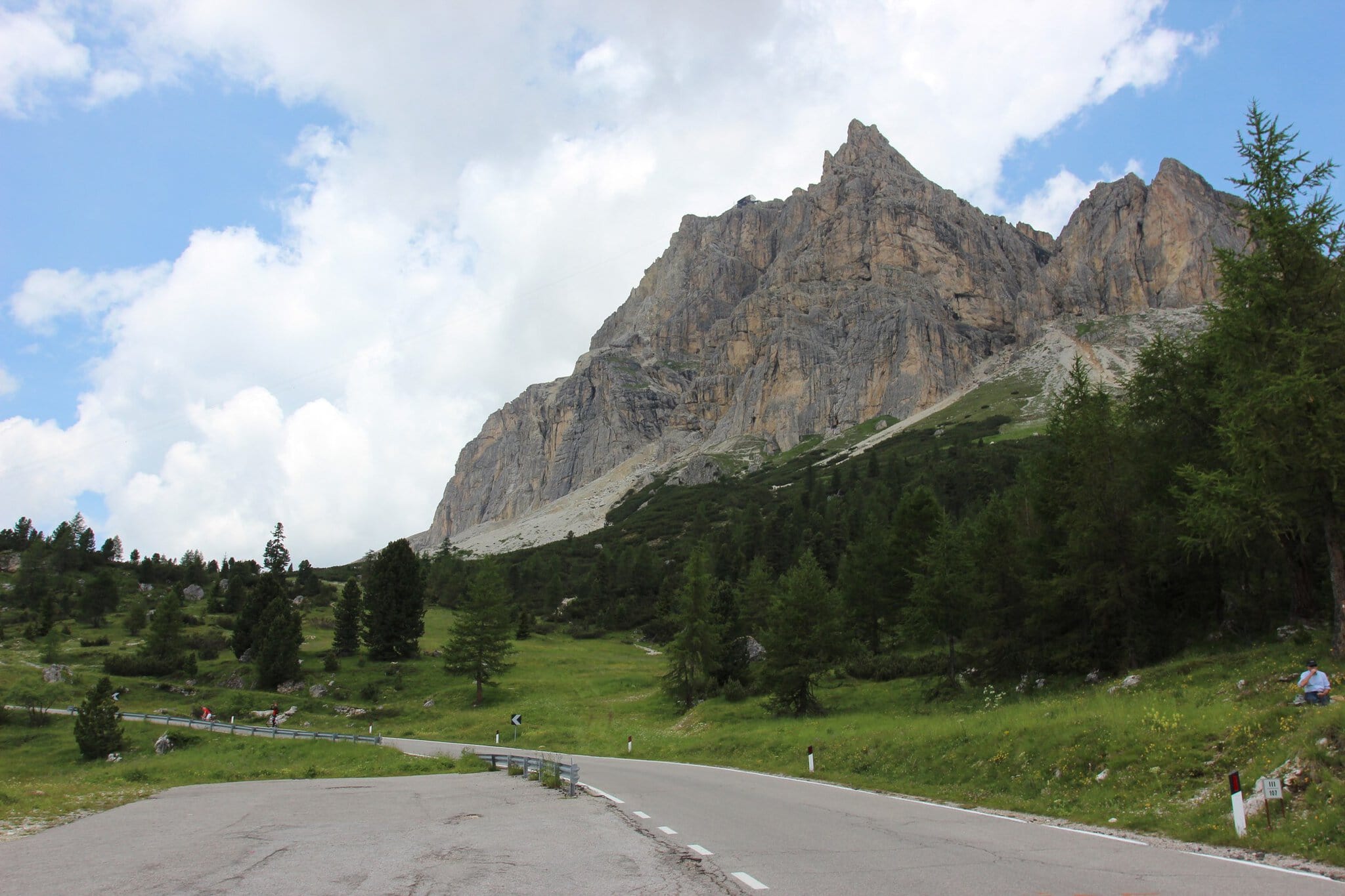
Karpacz, Poland: 12 Best Things to See and Do in the Vegas Beneath Śnieżka 2026

TL;DRKarpacz is a Polish mountain town beneath Śnieżka in the Karkonosze National Park, nicknamed “Vegas under Śnieżka” for the contrast between wild mountain scenery and a buzzing strip of neon, casinos and attractions. This piece rounds up 12 tips, including the hike up Śnieżka from the Polish side (4–5 hours on foot), the Norwegian timber Wang Chapel, the Karpacz Ski Arena with a full-day lift pass around 165 PLN, the Kopa cable car for about 50 PLN, the Cieplice thermal baths, Western City, and the water park at the Gołębiewski hotel. It’s about a 50-minute drive from Liberec, entry to the national park costs roughly 12 PLN, and the best time to go is late autumn into winter, or summer between June and September for hiking.

I have a little confession to make about the town of Karpacz, Poland. Plenty of visitors to the Giant Mountains (Karkonosze/Krkonoše) only ever explore the Czech side, completely — and needlessly — ignoring the Polish half. Yet just over the ridge lies an entirely different world that makes most first-timers’ jaws drop. And once you discover it, you’ll find yourself coming back every winter. ☺️

Karpacz is a chapter all on its own. Picture the stunning, wild mountain scenery of the Karkonosze National Park, and nestled beneath it a town that feels a bit like Las Vegas. Glowing signs, non-stop entertainment, casinos, enormous hotels, and children’s attractions on every corner. It’s an incredible contrast that will either amuse you or mildly shock you — but it definitely won’t leave you indifferent. 😅

So come along — let me take you on a ride, from Śnieżka peak through that wonderfully quirky Norwegian church to an evening pint surrounded by neon signs. 😁

TL;DR

  • Where is it: A Polish mountain town beneath Śnieżka (Sniezka) in the Karkonosze National Park (Karkonoski Park Narodowy).
  • Why go: The perfect blend of mountain hiking, affordable quality skiing, and lively evening entertainment with a slightly fairground “Vegas” atmosphere.
  • Top sights: The wooden Wang Temple (Świątynia Wang), hiking Śnieżka from the Polish side, the cable car to Kopa, and relaxing in thermal baths.
  • For families: An absolute paradise — Western City, aquaparks, and trails where you won’t curse your pushchair uphill every hundred metres.
  • Prices: Noticeably cheaper than the Czech side. A full-day ski pass costs around 165 PLN (roughly €38).

What exactly is Karpacz, and why is it called the Vegas beneath Śnieżka?

Karpacz is actually the second most visited mountain resort in all of Poland, right after Zakopane. Geographically, it sits directly beneath the queen of the Giant Mountains, Śnieżka (1,602 m / 5,256 ft), on the very edge of the Karkonosze National Park.

So why the nickname “Vegas beneath Śnieżka”? Because the moment you descend from those silent, frost-bitten, deserted mountain ridges into town, you’re hit by neon signs, restaurants packed to the rafters, arcades, stalls selling gofry (waffles) and oscypek cheese, and even casinos. It’s a town bursting with entertainment that never sleeps. If you’re after absolute solitude in a log cabin at the end of the world, Karpacz might surprise you — but if you love the feeling of tucking into a brilliant meal after a full day’s hike, popping into a bar, and soaking up a buzzing atmosphere, you’ll be thrilled.

When to visit Karpacz and how to get there

Whether you’re planning a winter ski trip or summer mountain hikes, Karpacz has something to offer in every season. Perhaps the loveliest time to visit is late autumn into early winter — the town already has that magical atmosphere, but the crowds haven’t yet reached their February half-term peak.

In winter (December to March), it’s an absolute haven for skiing in Poland. The resorts are superbly maintained and the services top-notch. If you’d rather hit the trails and plan to summit Śnieżka, the ideal window is June to September. And don’t overlook autumn — the mixed forests and mountain larches turn incredible shades of gold and crimson.

How to get to Karpacz from the UK

The easiest route is to fly into Wrocław (around 2 hours’ drive from Karpacz). Budget airlines such as Ryanair and Wizz Air operate regular flights from London, Edinburgh, and other UK cities to Wrocław. From there, you can hire a car and enjoy a scenic drive south through Lower Silesia.

  • From Wrocław: About 2 hours by car via the well-maintained A4/E40 motorway and then local roads.
  • From Berlin: If you’re combining your trip with a stopover in Germany, Karpacz is around 4 hours’ drive from Berlin.
  • Car hire: We’ve had a great long-term experience with DiscoverCars, which we use all over the world when we don’t have our own car.

If you’d rather not drive, FlixBus runs reliable services to the region, and you can often snag tickets for just a few pounds. Another option is to take a train to the Polish city of Jelenia Góra and hop on a local bus from there straight into the centre of Karpacz.

Where to stay in Karpacz + how much it costs

Karpacz is packed with hotels, but during peak season the best rooms disappear in the blink of an eye. Accommodation prices are generally a touch lower than in comparable Czech resorts, though it obviously depends on what you’re after.

The town centre (Karpacz central) is ideal if you want all the restaurants and bars right on your doorstep. You’ll soak up the full atmosphere here, but expect to pay a bit more and deal with some noise at night. For something quieter and a little higher towards the mountains, head to Karpacz Górny — it’s more peaceful, offers gorgeous views, and puts you close to the cable car stations.

The widest selection of Karpacz Poland hotels, guesthouses, and apartments can be found on Booking.com. In high season, I’d recommend booking several weeks ahead and choosing accommodation with free cancellation.

If you’re after specific hotel tips, the absolute phenomenon (which hits you right in the face the moment you drive downhill) is the Hotel Gołębiewski Karpacz. It’s a huge, majestic resort that’s a landmark in its own right. People frequently search for “hotel golebiewski karpacz poland” online, and it’s easy to see why. They have a spectacular giant aquapark called Tropicana, which you can visit even if you’re not a hotel guest. For families with children, Hotel Gołębiewski is a safe bet — but if you prefer something cosier, opt for one of the smaller family-run guesthouses instead.

For lovers of a quieter wellness retreat, the beautiful Hotel Buczyński is an excellent choice, with a lovely spa and outstanding breakfasts.

12 best things to see and do in Karpacz Poland

Karpacz isn’t the kind of place where you walk around one square and call it done. The town and its surroundings are brimming with attractions that could easily fill a week-long holiday. Let’s dive in — there’s something here for every mood, enough for a long weekend at the very least. 😅

1. Hiking Śnieżka from the Polish side

If you’re in Karpacz, you simply can’t skip Śnieżka — it’ll be gazing down at you majestically from its 1,602 metres the entire time. The ascent from the Polish side is arguably even more scenic than the Czech route. The classic hiking trail starts at the Wang Temple, continues past the Samotnia mountain shelter with its beautiful glacial lake, and climbs up to the ridge. The whole trek takes roughly 4 to 5 hours, depending on your pace and how many times you stop to photograph those breathtaking views.

Entry to the Polish national park (Karkonoski Park Narodowy) costs around 12 PLN (about €3) per day. You can easily buy tickets at the booths near the trailheads or online. The paths are well maintained and mostly paved with large stones.

2. Wang Temple — the wooden Norwegian church (Świątynia Wang)

This is an absolute gem and arguably the most romantic spot in the whole town. The Wang Temple was originally built in the 12th century in southern Norway from pine wood — without a single nail. When the Norwegians wanted to demolish it in the 19th century, the Prussian king bought it and had it transported piece by piece all the way here to the Polish Giant Mountains in 1842.

You’ll find the church in the upper part of town (Karpacz Górny), surrounded by a charming little cemetery. Admission is just a few zlotys, but that’s almost a bonus — on a clear day, the view over the entire valley from here is worth the trip on its own.

3. Karpacz Ski Arena and the cable car to Kopa

As I mentioned, this place is fantastic for winter sports. The local Karpacz Poland ski resort (Karpacz Ski Arena) spreads across the slopes of Kopa mountain. There’s a great mix of blue and red runs to please beginners and intermediates alike. But the best bit? The prices! A full-day adult ski pass comes to roughly 165 PLN — that’s about €38. Compared to bigger-name resorts where a pass can cost you an arm and a leg, it’s an absolute bargain.

If you’re visiting in summer or simply don’t fancy walking all the way to Śnieżka on foot, you can take the cable car up to Kopa (Mała Kopa). It whisks you up to 1,377 metres, and from there it’s a pleasant ridge walk to the summit. A one-way cable car ticket costs around 50 PLN (roughly €12).

4. Termy Cieplickie — healing thermal baths

When your legs are aching after a full day of trekking or skiing, grab your swimsuit and head to the neighbouring town of Jelenia Góra (the Cieplice district). The drive from Karpacz takes barely 30 minutes, and there you’ll find Termy Cieplickie. It’s a modern thermal bath complex with naturally heated water rising from deep underground — and after a long day in the mountains, your weary legs will welcome it with open arms.

There are indoor and outdoor pools, a wild river ride, water slides, and an excellent sauna world. The best time to visit is late afternoon. For more tips on amazing Polish spas, check out our article on the best thermal baths in Poland.

5. Poland’s Mt. Rushmore: Skalna Miska and Pradawne Skarby

An intriguing and slightly quirky stop — especially if you enjoy offbeat attractions — is the so-called “Pradawne Skarby” (Ancient Treasures). Some people jokingly call it Poland’s Mt. Rushmore.

You’ll find faces carved into rock and interesting formations that aren’t quite as ancient as they look, but they make for a fun photo stop or a short walk. Surprisingly few tourists bother to come here, so peace and quiet is guaranteed. You’ll have a laugh and snap a few amusing photos, because the resemblance to the famous American original is, let’s say, charmingly loose.

6. Wild nature and waterfalls along the Bóbr River

Karpacz isn’t all about Śnieżka — the surrounding rivers and valleys are gorgeous too. One of the loveliest outings is towards the Bóbr River. Beautiful hiking trails wind along the water, passing small caves and rock overhangs where you’ll feel completely cut off from civilisation.

The river also features an impressive dam (Tama Bóbr), which is particularly spectacular after the spring thaw when torrents of water come rushing through. It’s a pleasant, easy-going afternoon excursion.

7. Karkonosze Trail for cycling enthusiasts

For those of you who prefer pedal power over walking, the Karkonosze Trail is an absolute cracker. In recent years, Poland has invested heavily in cycling infrastructure, and around Karpacz and neighbouring Szklarska Poręba (which we also cover in our 7-day Poland road trip itinerary) you’ll find gorgeous flow trails and tougher downhill runs.

You can easily hire an electric mountain bike and explore the ridges from an entirely different perspective. If downhill isn’t your thing, you can always walk the routes instead — but cycling fans tend to rave about the local hire shops. The bikes are in perfect condition and the battery will comfortably last a full day of cruising the most scenic forest paths.

8. Evening promenade and soaking up the “Vegas” vibe

When darkness falls, Karpacz truly comes alive. Make sure you set aside time for a stroll along the main street (ulica Konstytucji 3 Maja). The air is filled with the scent of sweet waffles and mulled wine, everything glows, music plays, and you’ll want to park yourself for the entire evening because you simply won’t want to leave.

In Karpacz Poland winter, the town looks almost like one giant Christmas market. If you’re feeling lucky, you can peek into one of the small local casinos — or simply sit in a heated café terrace and watch the incredible bustle unfold. The little pubs on the corners are brilliant, serving fantastic hot chocolate while you people-watch for hours.

9. Skiing beneath Szrenica (Szklarska Poręba)

Although Karpacz has its own brilliant slopes, I can’t help mentioning its sister resort Szklarska Poręba, just “around the corner” (about 35 minutes by car). Here you’ll find Mount Szrenica and the SkiArena Szrenica, offering more excellent kilometres of runs, including the incredibly long Lolobrygida piste.

It’s well worth alternating between the two resorts so you’re not on the same slopes all weekend. Even better, you can buy a combined ski pass — just wake up in the morning and decide which way to head based on the weather or your mood. And the views from Szrenica in the afternoon sunshine are genuinely something special.

10. Western City: The Wild West beneath the mountains

Yes, you read that right. Right beneath the majestic Giant Mountains, you’ll find a slice of the American Wild West. The Western City (or Western Park) theme park is a hit mainly with families, but honestly, adults will have a good laugh too. 😁

You can ride a horse, try your hand at gold panning, throw a tomahawk, or watch a gunslinger show complete with a bank robbery. Once you see other visitors desperately trying to lasso a wooden bull, you’ll be in stitches. It’s exactly the kind of wonderfully bonkers attraction that fits the local fairground vibe perfectly — and you can easily spend a whole entertaining afternoon here.

11. Views over Karkonoski Park Narodowy and its strict rules

When you set off into the Karkonosze National Park from any direction, remember that nature conservation is taken very seriously here — park rangers don’t argue with anyone. It can be tempting to bend the rules a little, but I really wouldn’t recommend it.

There’s a strict ban on flying drones without a special permit. If you try it, you risk a fine of 1,500 PLN (around €350) — money that could buy you quite a luxurious weekend instead. Stick to the marked trails and enjoy the fact that the nature around you is so beautifully unspoilt.

12. The giant aquapark at Hotel Gołębiewski

If the weather lets you down — pouring rain or minus fifteen with a blizzard — retreat to the Tropicana aquapark. I’ve already mentioned the enormous Hotel Gołębiewski Karpacz, which houses this water world.

You pay the entrance fee at reception and then enjoy wave pools, hot tubs, lazy rivers, and kids’ zones that will keep your little ones (and you) happily occupied for hours. The very best part? From the outdoor hot tubs, you often have a view straight onto the snow-capped peaks. There’s nothing quite like freezing air on your face while warming up in bubbles — the ultimate winter discipline.

lukas a lucka
Lukáš and Lucie recommend
Where to Stay in Karpacz
3 accommodations — wellness hotels, resorts and other lodging options

Karpacz with kids: Completely hassle-free, even with a pushchair

With small children, you suddenly see trips through a different lens — instead of wild treks, you’re looking for routes a pushchair can handle. And this is where Karpacz is absolutely genius.

Unlike some hair-raising Alpine or other mountain resorts, Karpacz offers loads of gentle, well-surfaced trails that are completely pushchair-friendly. On top of that, the local cable car is set up to carry the youngest hikers. Add in all the attractions like Western City, treetop adventure courses in the forest, and those aquaparks, and this place is a number-one choice for a family holiday.

What about dogs? Karpacz and your four-legged friends

Not every dog is built for long mountain hikes — plenty of them are happiest lounging in the garden at home. But if you never travel without your furry companion, I’ve got good news.

Unlike some other Polish mountain parks (the Tatras, for instance), dogs are allowed in the Karkonosze National Park on the Polish side! You must keep them on a lead at all times, no exceptions. The autumn and summer trails away from the busiest ski areas are particularly ideal for walkies. Plus, you’ll find plenty of restaurants in town with outdoor terraces where staff will happily bring out a bowl of water for your pooch.
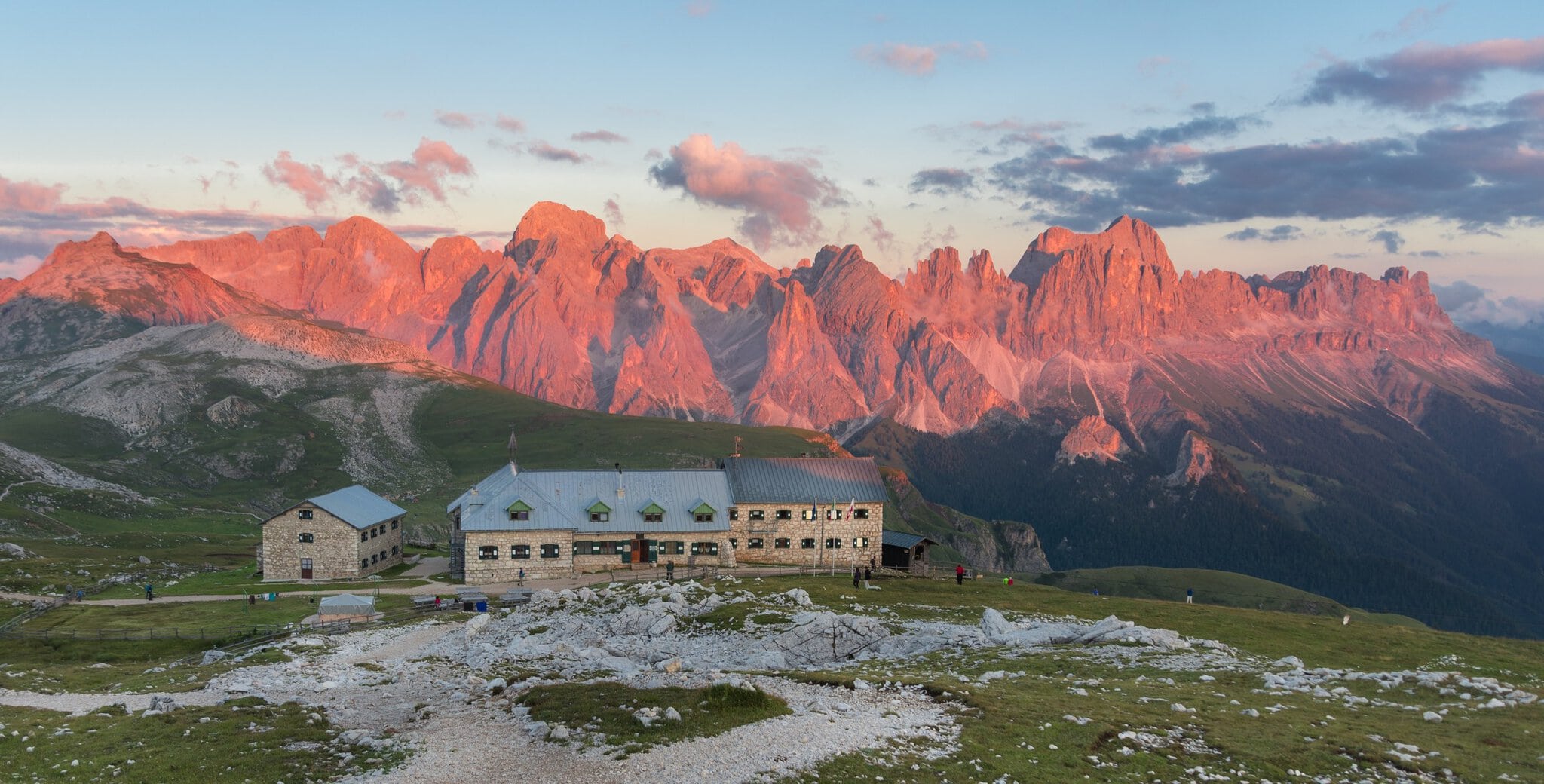
What to eat: Culinary delights beneath the mountains

Polish cuisine shares roots with its Central European neighbours, but it’s a touch more rustic, heartier, and after six hours in the mountains it feels like a revelation. So what should you absolutely not miss in Karpacz?

The foundation, of course, is pierogi — dumplings filled with meat, cabbage and mushrooms, or sweet ones with fruit. Street stalls everywhere sell classic smoked sheep’s cheese in the highland style (similar to Slovak oscypek) — grilled and served with cranberry sauce, they’re an absolute treat.

To drink, make sure you sample beers from local breweries. The locals are fond of classics like Tyskie or Żubr, but if you happen upon a small craft brewery, definitely give it a try. Poles also love their grzaniec — warm mulled drinks, whether it’s beer with raspberry syrup served hot, or classic spiced wine.

Where to eat well in Karpacz

If you work up a serious appetite, a local favourite is the restaurant U Ducha Gór, which has an incredibly charming, wooden highland atmosphere. Vegetarians will love the pierogi with curd cheese or mushrooms and the hearty potato soup with onion. Be warned — portions are enormous, so one main course can easily feed two.

Another excellent choice is Karczma Karkonoska, renowned for its traditional soups. There’s a big open fire where you can settle in with a mug of mulled wine, and the staff are always cheerful. Local classics include żurek served in a hollowed-out bread loaf, or a rich mushroom soup that means you won’t need another course.

Practical information and prices

You sometimes hear that Poland is no longer as cheap as it used to be. That’s partly true — prices have risen in recent years — but compared to many Western European mountain resorts, Karpacz is still remarkably affordable and the services are often of a higher standard.

The local currency is the Polish zloty (PLN). Roughly speaking, 1 PLN ≈ €0.23 (depending on the current exchange rate). In 95% of places you can pay with a regular debit or credit card (or your phone/watch). You’ll only need cash at the occasional cheese stall or tiny family-run places high up in the mountains.

A few example prices in Karpacz:

  • Full-day ski pass at Karpacz Ski Arena: approx. 165 PLN / €38 (adult)
  • One-way cable car to Kopa: approx. 50 PLN / €12
  • Entry to Karkonosze National Park: 12 PLN / €3
  • Mulled wine at a stall: approx. 15–20 PLN / €3.50–4.70
  • Huge portion of pierogi in a restaurant: around 35–40 PLN / €8–9

Where next?

Poland keeps winning us over more and more on our travels. If you’re planning to explore this fascinating country further, grab a coffee and have a look at these articles too:

Finding flights if you’re travelling from further afield

Although you’ll most likely reach Karpacz by car, whenever we need to fly somewhere we search for cheap flights on Kiwi — it’s our go-to portal for comparing prices. From the UK, look for flights to Wrocław with Ryanair or Wizz Air for the best deals.

Car hire

We regularly use the comparison site DiscoverCars.com — with Lukáš, we’ve had a consistently great experience with their customer support and use them all over the world.

Don’t forget travel insurance

Never head to the mountains without proper insurance! Especially if you’re travelling with family and small children, don’t skimp on cover. For shorter trips we typically go with a standard provider, and for longer stints — or when we’re travelling as digital nomads — we opt for SafetyWing.
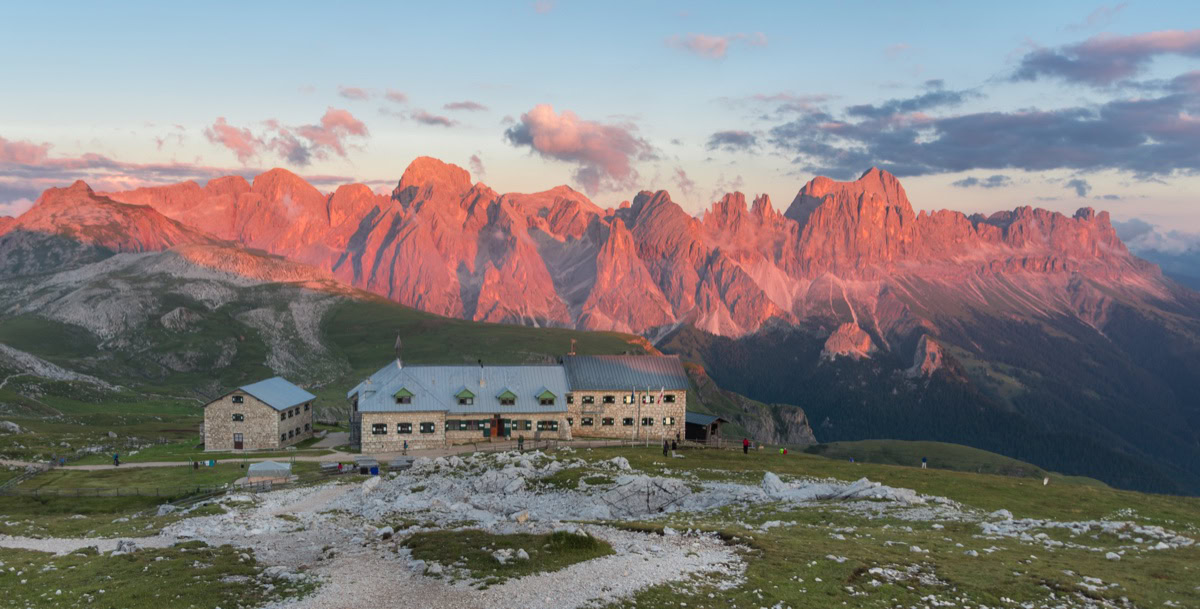
Stay connected

Whether for pulling up maps or sharing photos, having mobile data is a must. We’ve had an excellent experience with eSIM cards from Holafly, which we’ve reviewed on the blog. No fiddling with plastic SIM cards, and they work the moment you arrive.

Frequently Asked Questions (FAQ)

What can you do in Karpacz when it rains?

Great options include the Termy Cieplickie thermal baths, about 30 minutes away by car, or the massive aquapark right in the famous Gołębiewski hotel in the town center.

How do you get from Karpacz to Śnieżka?

You have two options. You can hike the marked trail from Wang Church via the Samotnia mountain hut (about 4-5 hours of walking), or save your energy and take the cable car up to Mała Kopa, from where it’s just a pleasant and relatively easy walk to the summit of Śnieżka itself.

How much does the cable car from Karpacz to Kopa cost?

A one-way ticket for an adult costs approximately 50 PLN (around 12 EUR). Return tickets offer better value, so be sure to check the current prices on the official website.

What exactly is Karpacz?

Karpacz is a popular mountain resort and spa town in the Polish Karkonosze Mountains. It sits right below the northern slopes of Śnieżka and is renowned for excellent skiing and summer hiking conditions, as well as vibrant nightlife.

Can I pay with Czech crowns in Karpacz?

The official currency is the Polish zloty (PLN). While some places near the border might accept crowns, the exchange rate is usually extremely unfavorable. It’s much better to pay everywhere with a card (which works in almost 100% of establishments) or withdraw some zlotys from an ATM.

Is accommodation at the Gołębiewski hotel really that expensive?

It depends on the season. It’s a large luxury resort with its own massive aquapark, so prices reflect the high standard of services and full or half-board options. It might be pricey for some, but for families looking for all-in-one entertainment, it makes sense.

Are dogs allowed in Karkonosze National Park?

Yes, on the Polish side (unlike some other Polish mountain ranges), dogs are allowed in the national park. However, they must be kept on a leash at all times. Please respect the local wildlife and park regulations.

Tips and Tricks for Your Vacation

Don’t Overpay for Flights

Search for flights on Kayak. It’s our favorite search engine because it scans the websites of all airlines and always finds the cheapest connection.

Book Your Accommodation Smartly

The best experiences we’ve had when looking for accommodation (from Alaska to Morocco) are with Booking.com, where hotels, apartments, and entire houses are usually the cheapest and most widely available.

Don’t Forget Travel Insurance

Good travel insurance will protect you against illness, accidents, theft, or flight cancellations. We’ve had a few hospital visits abroad, so we know how important it is to have proper insurance arranged.

Where we insure ourselves: SafetyWing (best for everyone) and TrueTraveller (for extra-long trips).

Why don’t we recommend any Czech insurance company? Because they have too many restrictions. They set limits on the number of days abroad, travel insurance via a credit card often requires you to pay medical expenses only with that card, and they frequently limit the number of returns to the Czech Republic.

Find the Best Experiences

Get Your Guide is a huge online marketplace where you can book guided walks, trips, skip-the-line tickets, tours, and much more. We always find some extra fun there!