

Tears were welling up. I felt ashamed of the Czech Republic, of the EU. In that moment, I wanted to play the hero and go liberate Ukraine with my own tiny strength. I was walking alongside Kristýna, a young, beautiful Ukrainian woman who had come to the Summer Journalism School from Uzhhorod. This is a personal story about the Ukraine war — about people caught between politics, propaganda, and the desperate need not to be forgotten.
“We know we’ll never be in the European Union. We know that. We’re all aware of it,” her voice was quiet, full of despair and resignation, gentle yet cutting through my every thought. We were talking about the war. And I couldn’t say a thing. What was I supposed to tell her — that it wasn’t true? Was I supposed to lie? So I stayed silent, and both of us fought hard not to break down crying right there on the spot.
Friends from Uzhhorod come to the Summer Journalism School regularly. Most of them speak Czech; sometimes we communicate in English, and when even that fails, hand gestures become our saving grace. Yet they are the ones who break our hearts, steal our smiles, and shatter our prejudices. This year, though, things were different. Over the town of Havlíčkův Brod, buzzing with enthusiastic, cheerful students, hung a topic that some didn’t want to open up. A topic others tried to cautiously broach, afraid of the reactions it might provoke. War. I believe some students had questions for our Eastern friends — questions they never dared to ask. All it took was for one of our guest speakers to mention the word Maidan, and one of the Ukrainian women ran out with tears streaming down her face. The door slammed shut behind her. And all I could do was hope she’d come back.
And so, eventually, they started the conversation themselves.
“Has the media stopped caring about the war in Ukraine because it’s been going on too long and maybe people just aren’t interested anymore? Has the war blended into the everyday news cycle?” Kristýna asked Barbara Tóth, an Austrian journalist and guest of the Summer Journalism School. The room fell silent. You could see on Barbara’s face that she wasn’t comfortable with what she had to say in response. A chilling silence. Everyone already knew the answer.
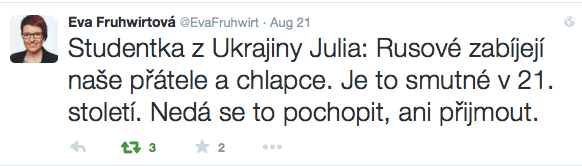
The Ukraine war no longer fills the front pages of newspapers. It’s no longer the top story of the day. It’s been going on too long. Russia is a master of propaganda, and people in Russia see Ukrainians as enemies. “This is personal for me — I’m from Russia, but I’ve been living in Germany for several years. I have relatives and friends back in Russia who only watch Russian media. They believe that only Russian media tells the truth, and they don’t trust European media at all. They think there’s propaganda in Europe and that European media lies. What am I supposed to do?” asked Olga, who studies Czech language and literature in Berlin, speaking in fluent Czech. A question that a special team in Brussels would struggle to answer — naturally, none of us in the room could solve it either.
“The Russians have been trying to destroy our nation for a long time. Under communism, they banned the publication of books in Ukrainian. They tried to destroy the nation from within. Because what makes a nation a nation? Language. You’re Czech — what language do you speak? Czech. I’m Ukrainian, so I speak Ukrainian.” Yakim had just finished his law degree. He’s younger than me. In Ukraine, after ten years of primary school, students go straight to university.
“Russian and Ukrainian are as similar as Czech and Slovak. But when we meet a Russian, they pretend not to understand us when we speak Ukrainian. That’s why, if you speak Russian in Ukraine, it means you’re not truly Ukrainian,” he said, pointing to his heart — though he admitted it’s not that black and white. There are Russian-speaking Ukrainians who side with Russia, but then there are Russian-speaking people who sign up as volunteers to fight for Ukraine.
“In the end, it’s not about the people — it’s about politics.” He wrapped up our conversation, and we agreed that we need to separate a nation and its culture from its politics. “Russians think we’re their enemies because that’s what their media tells them.” At the end of the day, we’re all just people.
Let’s not forget about Ukraine.
For them too, war was once just a word from literature.
Tips and Tricks for Your Vacation
Don’t Overpay for Flights
Search for flights on Kayak. It’s our favorite search engine because it scans the websites of all airlines and always finds the cheapest connection.
Book Your Accommodation Smartly
The best experiences we’ve had when looking for accommodation (from Alaska to Morocco) are with Booking.com, where hotels, apartments, and entire houses are usually the cheapest and most widely available.
Don’t Forget Travel Insurance
Good travel insurance will protect you against illness, accidents, theft, or flight cancellations. We’ve had a few hospital visits abroad, so we know how important it is to have proper insurance arranged.
Where we insure ourselves: SafetyWing (simple monthly subscription) and TrueTraveller (for extra-long trips).
Find the Best Experiences
Get Your Guide is a huge online marketplace where you can book guided walks, trips, skip-the-line tickets, tours, and much more. We always find some extra fun there!


