TL;DRStray dogs are a common sight all over Romania, wandering streets, roadsides, restaurants and even tourist spots — at one cable car viewpoint, travellers whiled away the queue stroking the puppies. The road out of Bucharest runs through towns like Pitești and Târgu Jiu to the village of Golești, home to the Muzeul Viticulturii with its 17th-century castle, currently under renovation, and next to it a rebuilt early-20th-century village funded by the EU, complete with church, school, town hall, pub and cemetery. Along the way you’ll spot Roma travellers with horse-drawn carts and dusty, down-at-heel towns where visitors are clearly seen as odd intruders. The whole region feels like a clash between neglected Romanian countryside and little pockets of Western-style development built on European funding.
We left Bucharest airport, heading for Targu Jiu.
We crawled through traffic on the motorway, surrounded by nothing. Nothing in the form of peeling walls, faded advertising signs on neglected houses, and yellow fields of dried-out grass. Nothing. No mountains in the background. No anything. That divine, romantic Romanian landscape certainly neither began nor ended in these parts. Just grime carried by the dry southern heat. Where on earth had we gone? I was starting to worry that there really was nothing here. This was our first taste of Romania — and it was nothing like the postcards.
And then we spotted them. The Roma.
Straight out of a storybook. A Roma family sat on a horse-drawn cart, a cheerful bunch grinning in the middle of the traffic chaos, their carriage pulled along by a single horse. The sun gleamed off the sweat on their faces. Before my eyes could even confirm they were real, they vanished — swallowed up like phantoms in the tangle of honking cars.
Horse-drawn carts are one of Romania’s symbols. They accompanied us throughout our entire journey from Bucharest to Banat and from Banat to Transylvania. It’s not just the Roma who ride them — other Romanians do too.You’ll find stray dogs in restaurants and at tourist attractions
Civilisation — in the form of engine noise — had long since dissolved behind us. We were still driving through barren nothingness. There’s really no other way to describe it.
A dog. No house in sight, no petrol station, no people. A German Shepherd cross was running along the road, heading somewhere in a hurry. Had it decided to go for a walk? Escaped from someone? No.
Stray dogs are everywhere. You’ll encounter packs and lone wolves alike. They live wherever they please, and nobody seems to mind — they’re like oversized pigeons. Someone feeds them now and then. Someone gives them a pat. In some places they’ll bark your ears off; in others they’ll race your car when you’re going slowly. But in all our time there, we never heard of one hurting anybody. It’s not unusual to find a stray dog in a restaurant or at a tourist attraction. Nobody shoos them away. On the contrary — we saw puppies near a cable car at a viewpoint. The mother was sleeping peacefully in the distance while crowds of tourists shortened their wait in the queue by cuddling their new furry friends. Who did they belong to? Nobody. Dogs here are free.
We encountered stray dogs more often than pigeons.Roma carrying plastic bottles on a cart stopped and stared
Targu Jiu was still a long way off, and we were getting hungry. We decided to stop in Pitesti and find a supermarket. We drove through grime and dust, through a small, poverty-stricken town that certainly didn’t feel like Europe. It was hard to tell whether a building was someone’s home, a shop, or a pub. Everything was hidden under faded parasols and crumbling plaster.
We parked beside a boxy, bleached-out supermarket next to a car and a rubbish dump, where dark-skinned Romanians stood around, smoking and watching. Their gaze swayed up and down, taking in our fair hair and our not-yet-dusty shoes.
Before we’d taken ten steps towards the shop, I saw Roma carrying plastic bottles on a horse-drawn cart pull up and stare. A passing car slowed down too. Everyone was watching us in sync. Intruders.
“I feel like a tourist attraction,” I whispered.
“We are a tourist attraction.” Our blonde hair was practically screaming.
“It’s like being in China.”
We walked into the shop and finally got a sense of what post-communist Eastern Europe must have looked like in the early nineties. A supermarket where everything had long since lost its colour, straight out of the stories people tell about what they think Romania is like. And we’d always insisted it wasn’t true. “Romania’s in the EU now, Mum,” I used to say, perhaps a tad naively.
“Well, this is Romania, alright,” Lukáš declared, as if reading my mind. We bought some fruit and hurried back to the car. The stares were getting uncomfortable.
According to the sat-nav we’d left Pitesti ages ago, but I couldn’t tell the difference when we turned onto a dusty track towards Golesti. I’d read in our guidebook about the Muzeul Viticulturii — supposedly home to a beautiful château. We drove for ages along an unpaved road, dust billowing in every direction, while locals walking along the street watched us with great interest. You couldn’t go fast. Some waved and smiled at us — from cars and from horse-drawn carts alike. The Western delegation had arrived.
The filthy, dusty road did nothing to convince me we were heading anywhere inhabited. We inched along, and there was no château in sight.
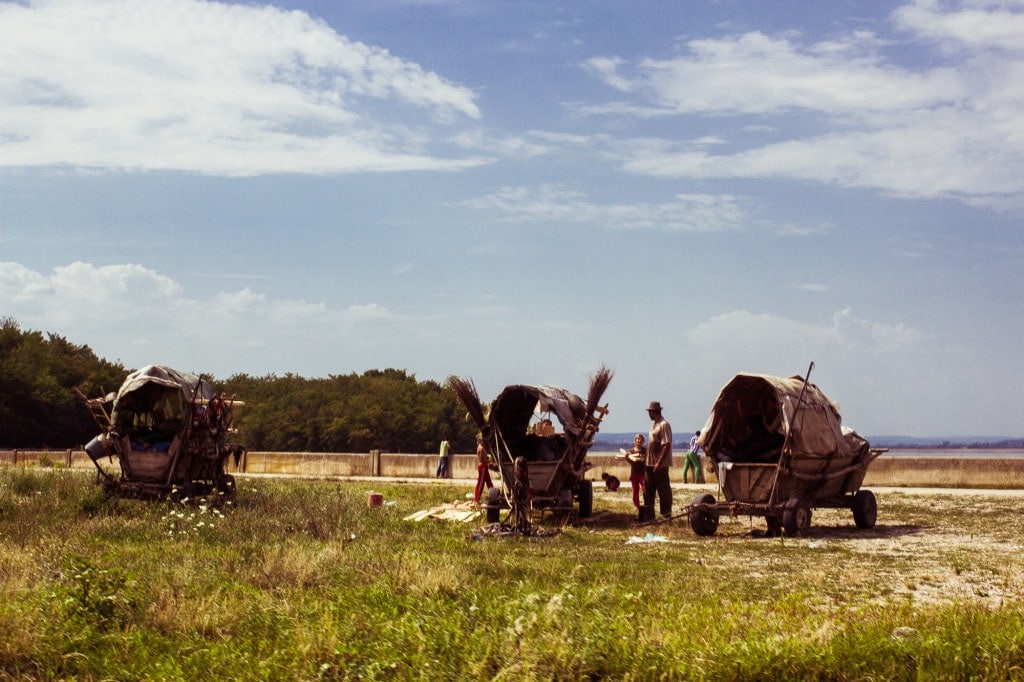
We reached a dam, where — for the first and last time on our entire trip — we spotted nomadic Roma. We stopped the car and gazed at the romantic scene, like fragments of my nineteenth-century fantasies come to life. They were lounging and smoking, until they noticed our car had stopped and some blonde head with a camera was photographing them.
Nomadic Roma in front of the dam
“Let’s go — they don’t like it.” We crossed the dam, where workers were labouring right beside the road. They were within arm’s reach of our car, and there they were again — those piercing looks, wondering what on earth we were doing there. Or were they just having a look? Was I starting to get paranoid?
A cultural centre in the middle of nowhere, built with EU money
At last we arrived at a grand historic gate — supposedly the entrance to a seventeenth-century château. But when we stepped through, all we saw was an enormous building wrapped entirely in scaffolding.
“Would you like to have a look?” asked a Romanian woman in her sixties, in broken English, rising from a bench.
“Well, since we’re already here.”
Our guide, who didn’t actually speak English, waved us into two rooms just inside the gate. There was nothing in them — just some rather unattractive pictures and labels in Romanian that we couldn’t understand.
Then she told us to climb the stairs above the gate, where there was another room and a view of the château under reconstruction — essentially a building site.
“So we’ve just donated towards the renovation…”
“Yep, pretty much.”
But when we came back down, our guide called over another guide and explained that we were to go with her now. Maybe we should’ve just given it a miss in this heat, I thought.
Guide number two led us behind the château. And that’s when we realised where we actually were.
A reconstructed early 20th-century village
Before us stood a reconstructed village from the early twentieth century — an EU-funded project. Small wooden houses with period furnishings. There was a school, a church, a town hall, a pub, and even a cemetery. An attraction that would set you back around €40 at Heritage Park in Calgary, Canada, was here with barely a tourist in sight. The only difference from the Canadian version? No actors playing the villagers.
So we wandered through this clean little island of Western civilisation, tucked away in the middle of dusty Golesti, in the stifling, relentless heat. Our guide soon handed us off to yet another guide, who took us through the final section. It was never-ending. How much had they built here? Guide number three also didn’t speak English, but the silence must have bothered her, so she narrated everything we saw — in Romanian.
At last it looked like we were nearing the exit. The final stop was before the entrance to a park, where stables and more buildings were still under construction. It wasn’t finished yet — perhaps that explained the lack of tourists, we realised. In the park, which had a small, clean refreshment stand and toilets, there was also a stage. With EU money, a cultural centre was being created in the middle of absolutely nowhere.
Search for flights on Kayak. It’s our favorite search engine because it scans the websites of all airlines and always finds the cheapest connection.
Book Your Accommodation Smartly
The best experiences we’ve had when looking for accommodation (from Alaska to Morocco) are with Booking.com, where hotels, apartments, and entire houses are usually the cheapest and most widely available.
Search with the DiscoverCars comparison engine — it compares prices from dozens of local and international rental companies, and most bookings come with free cancellation.
✓ DiscoverCars comparison✓ free cancellation on most bookings✓ no hidden fees
Don’t Forget Travel Insurance
Good travel insurance will protect you against illness, accidents, theft, or flight cancellations. We’ve had a few hospital visits abroad, so we know how important it is to have proper insurance arranged.
Where we insure ourselves: SafetyWing (best for everyone) and TrueTraveller (for extra-long trips).
Why don’t we recommend any Czech insurance company? Because they have too many restrictions. They set limits on the number of days abroad, travel insurance via a credit card often requires you to pay medical expenses only with that card, and they frequently limit the number of returns to the Czech Republic.
Find the Best Experiences
Get Your Guide is a huge online marketplace where you can book guided walks, trips, skip-the-line tickets, tours, and much more. We always find some extra fun there!
Bulgaria's southern Black Sea coast boasts measurably warmer and cleaner water than the more famous north. Primorsko is the perfect base: 18 tips from the megalithic shrine of Beglik Tash and a Ropotamo river cruise to the Turkish border at Rezovo.
Heading to Ireland and not sure where to rest your head? Discover the best neighborhoods and hotels in Dublin that will save your wallet and guarantee a good night's sleep.
A complete guide to 51 thermal spas in Germany by federal state: 2026 prices, where saunas are swimsuit-free and where you can sleep right by the pool.





 🚗 Car rental on the roadVerified rental cars in Romania


