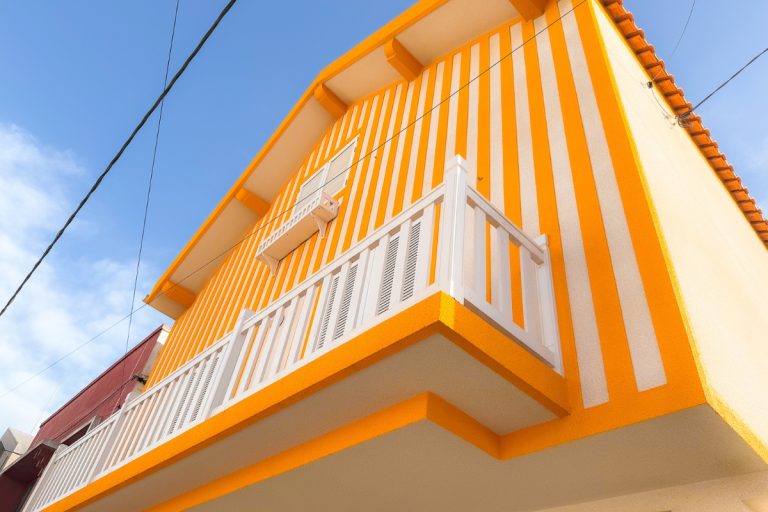
TL;DRAveiro, often dubbed the Portuguese Venice, is all canals and colourful moliceiros boats, Art Nouveau buildings, and the striped fishermen’s houses of Costa Nova, about twelve kilometres from the centre.
Among the 15 tips here, you’ll find the tiled Art Nouveau railway station with its azulejos, the Convento de Jesus, the Salinas de Aveiro salt pans, and a taste of the local sweet, ovos moles. The town sits roughly an hour’s drive south of Porto, and while one day is enough for the centre, two nights is the better call.
The best time to visit is May through to the end of September, when temperatures hit 25–28°C. A moliceiros boat trip takes about 45 minutes and costs around 15 euros a head.
Aveiro is also known as the Portuguese “Venice,” but I was heading to this town for entirely different reasons than canal cruises. I’ve long wanted to see the most colorful area of Portugal, which you’ll find on a nearby beach. In this guide I will share with you Aveiro, Portugal: 13 Best Things to Do and See. Want to know what I’m talking about? Read on and discover Aveiro and its surroundings with me.
Aveiro, the second-largest city in the Centro region with approximately 80,000 inhabitants, may not be among Portugal’s most famous tourist destinations, but it is definitely worth a visit. The city, located about an hour’s drive south of Porto, is renowned for its Art Nouveau architecture, canals, and proximity to Costa Nova, but you’ll find much more here.
Where to Stay?
I recommend staying in Costa Nova, which is a short distance from Aveiro, but you’ll be in a coastal area and can stay directly in a striped house at Costa Nova Hotel or in the luxurious Villa Rafa.
Stay in Costa Nova instead of Aveiro
Lukáš and Lucie recommend
Where to stay in Aveiro
3 accommodations — wellness hotels and other accommodation options
Let’s take a look at the most interesting places that the Portuguese Venice has to offer.
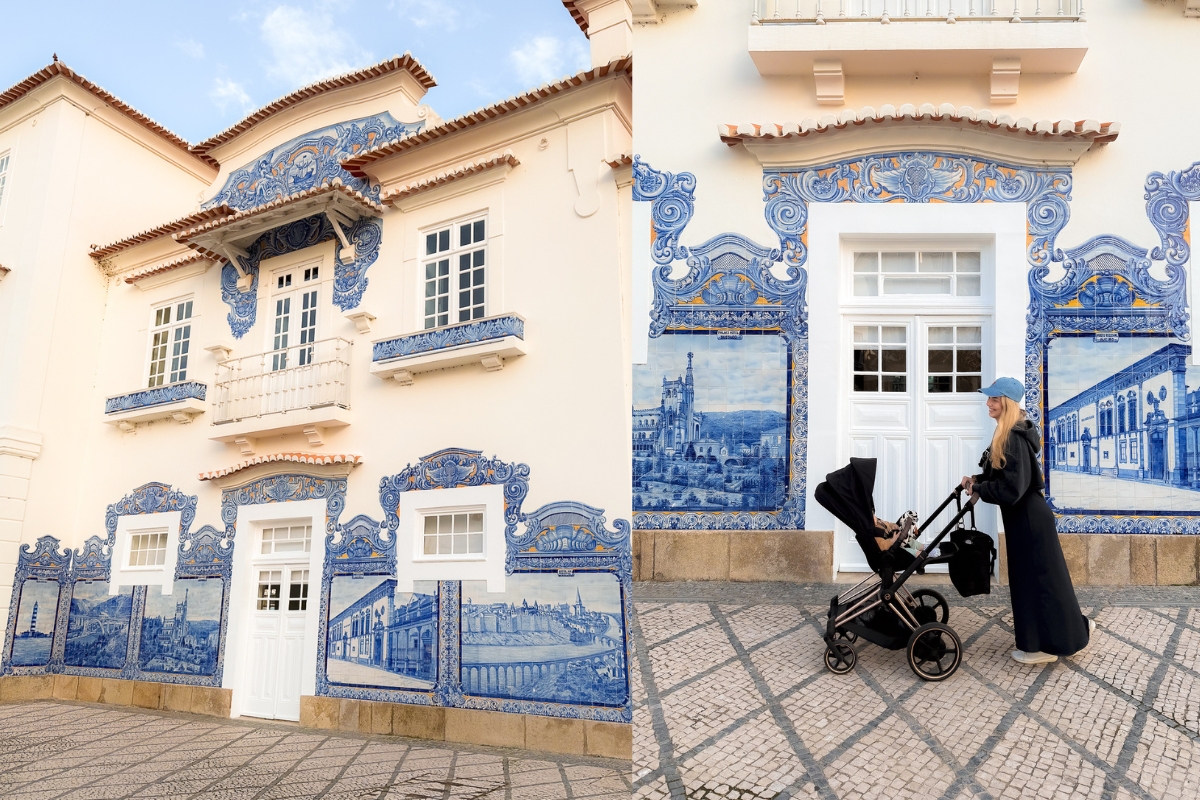
1. Antiga Estação Da CP – Municipal Tourism Space
A short walk from the train station, you’ll find one of two parking lots, from where it’s a short distance to the center. If we hadn’t parked here, we probably would never have discovered this beautiful building.
I didn’t discover it during my research (I’m crazy about lists of places we must see). So, I’m including it here for you. Inside the building, you’ll also find an information center where you can pick up maps and brochures (if you’re like my mom).
Antiga Estação da CP – Municipal Tourism Space
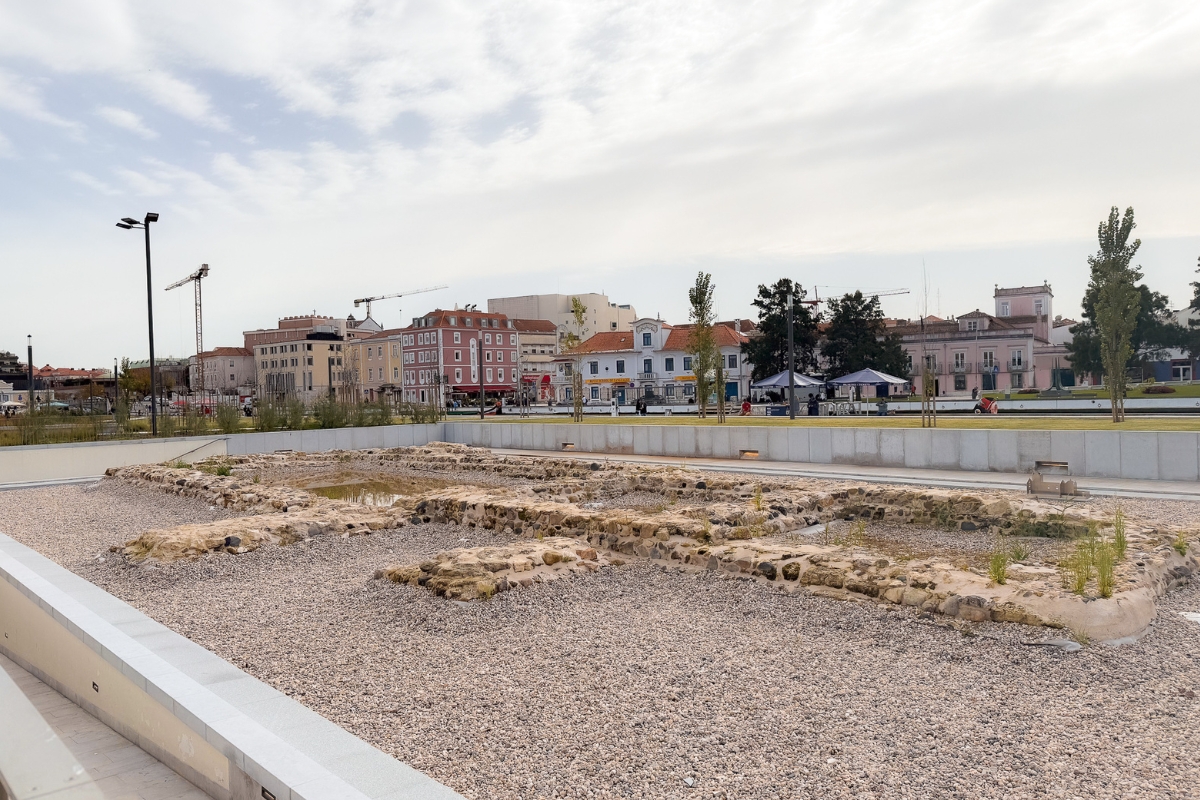
2. Ruins of the Chapel of S. João Do Rossio
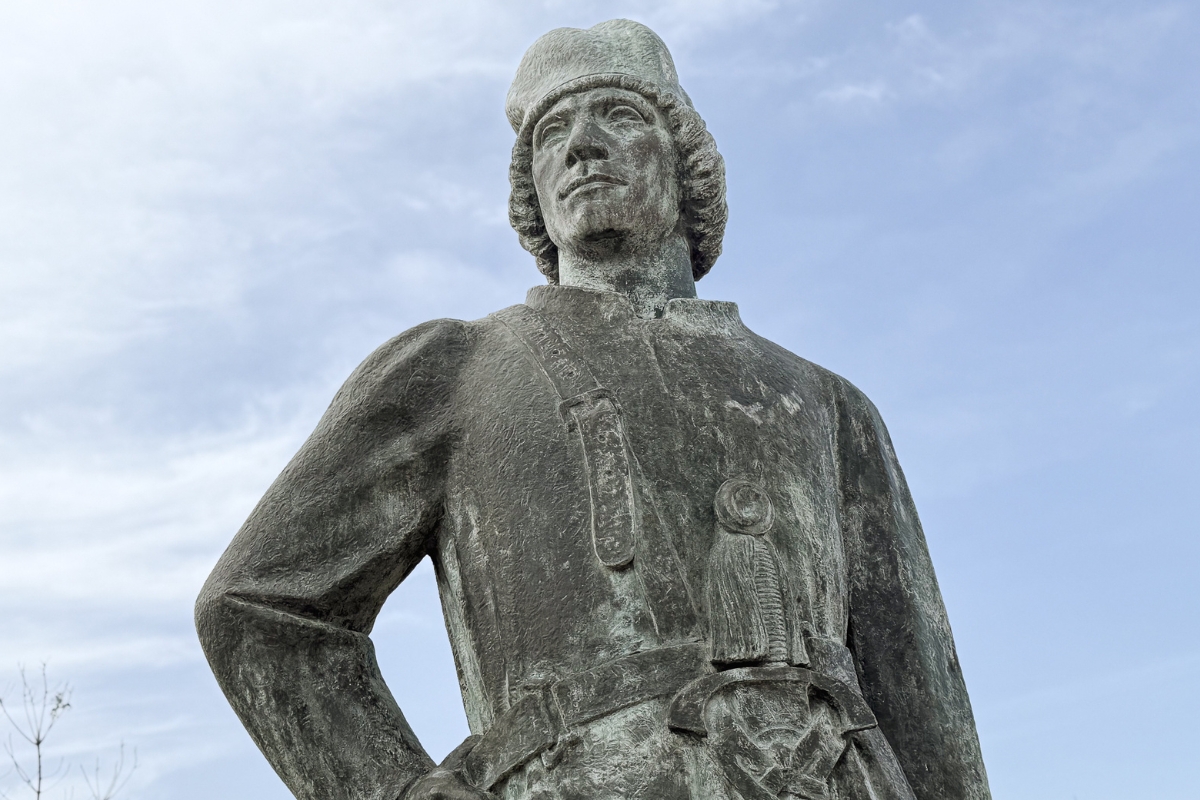
If you park in the second parking lot, you’ll walk past archaeological excavations. On the information board, you would learn that here you’ll find the Chapel of St. Pedro Gonçalves Telmo from 1910, the ruins of an old theater, and a bronze statue of João Afonso de Aveiro, a 15th-century Portuguese explorer who explored the African coast and the Golden River.
Statue at Ruínas da Capela de S. João do Rossio
3. Manuel Firmino Market
Just like in other cities in Portugal (and Spain), in Aveiro you’ll find a market where you can buy local tangerines, olives, or other seasonal fruits and vegetables. But you can also taste some traditional delicacies here, such as fish and seafood specialties.
Among the most famous dishes are Caldeirada de Enguias (stewed eel soup) and Caldeirada de Petinga (stewed sardines). Also often served are enguias de escabeche (marinated eels) and raia em molho pitau (skate in pitau sauce). Also popular are espetadas de mexilhão (mussel skewers).
Aveiro is also famous for its sweets called ovos moles, which are delicate confections made from egg yolks and sugar. Other traditional desserts include raivas, castanhas doces, and tripas, which are essentially pancakes.
Ponte dos Laços da Amizade
4. Ponte Dos Laços Da Amizade
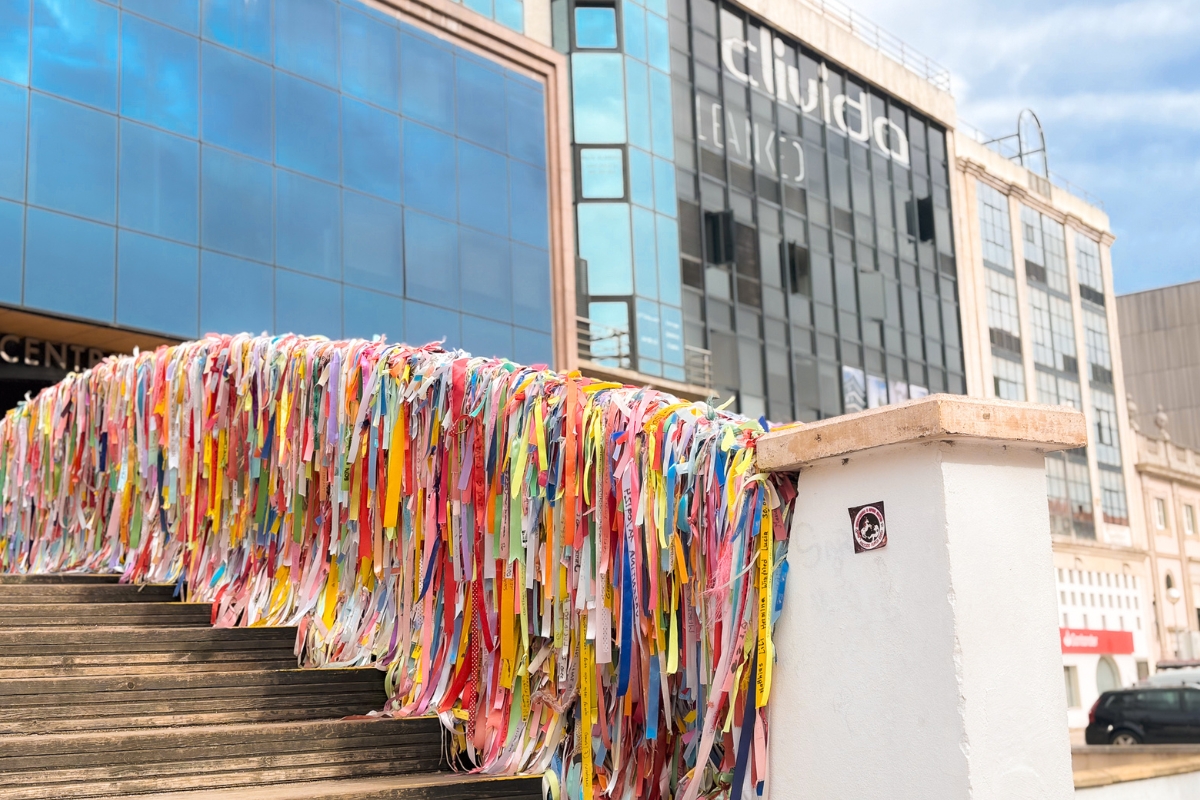
You’ll find this bridge over the Côjo canal, connecting the Fórum Aveiro shopping center with Largo do Mercado Manuel Firmino. Since 2004, the bridge has been a symbol of friendship and love, thanks to a tradition started by two students who tied the first colorful ribbons to the bridge’s railing as a symbol of their relationship and friendship.
Ponte dos Laços da Amizade
5. Go for a Boat Ride at Moliceiros Pier
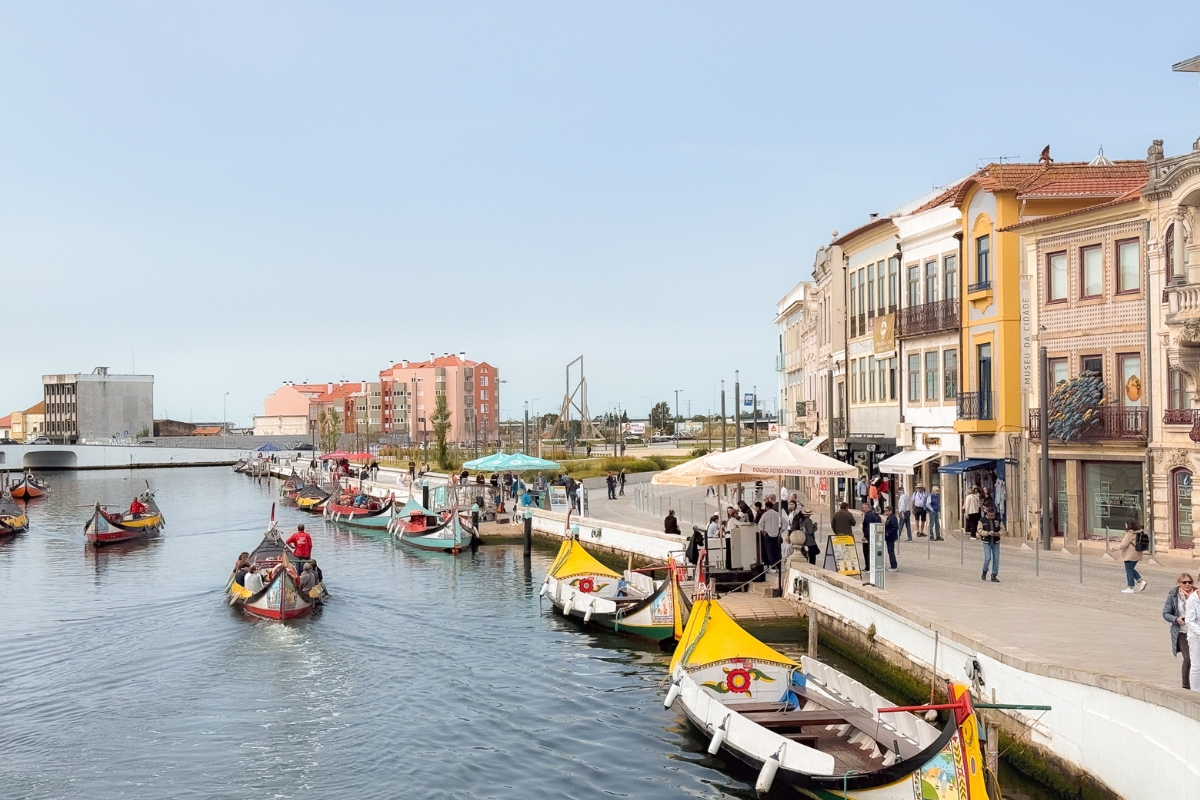
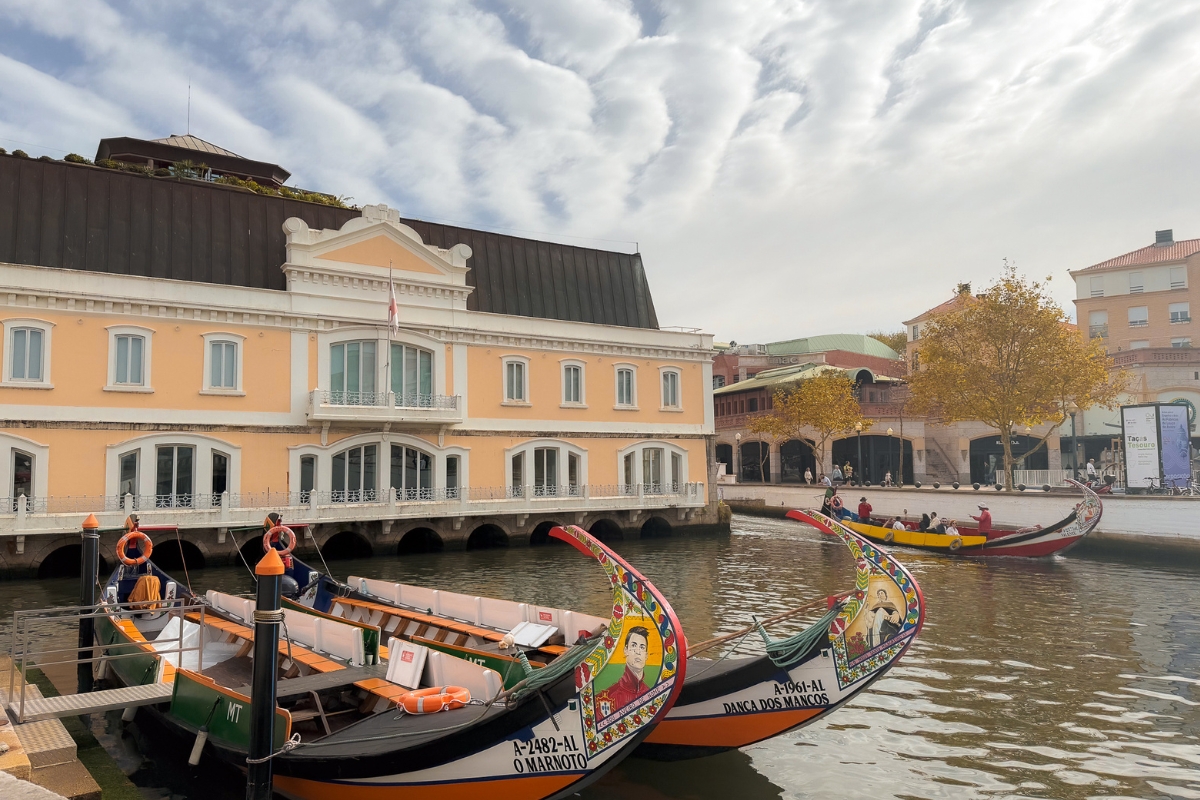
It’s not for nothing that Aveiro is called the Portuguese Venice. If, unlike us, you don’t have a baby, definitely go for a ride through the city on traditional boats called moliceiros. The price is 15 euros for 45 minutes (children 8 euros).
Moliceiros boats
6. Infante Dom Pedro City Park
This park was once a garden, considered one of the most beautiful in Portugal.
Originally, there was a field here that belonged to the Monastery of Saint Anthony, where monks cultivated the land. The rest of the land was sold in 1842 by the first Viscount of Saint Anthony, Pedro António Rebocho.
In 1861, the then-president of Aveiro, Firmino Maia, decided to transform “Campo de Santo António” into a public park.
In 1919, this area was expanded thanks to Dr. Lourenço Peixinho, who purchased adjacent plots and enabled the creation of new attractions, such as a colonnade with a double staircase, a tea house with a library, and a terrace overlooking the lake.
The park gained its popular name due to the cages with monkeys and birds that were once housed here. Today, the park is a green oasis, a place to escape the hot summer days.
🔗 These are affiliate links — they don't change your price and help us create content. · All experiences →
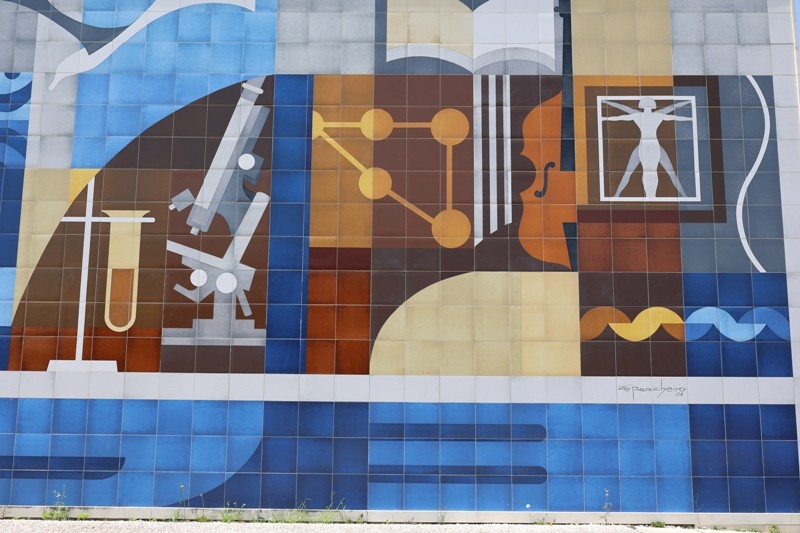
7. Zé Penicheiro Tile Panel
A short distance from the University of Aveiro, you’ll find a large panel made of traditional Portuguese tiles – azulejos – by the artist Zé Penicheiro. This artistic creation symbolizes the historical and academic development of the university. The year of the university’s founding, 1973, is displayed at the bottom of the panel, which is more visible in photos than when you walk by.
This panel is likely the only publicly displayed work by Zé Penicheiro in Aveiro.
8. Chapel of São Gonçalinho
In the picturesque Beira Mar district of Aveiro, you’ll find the beautiful Chapel of São Gonçalo, also known as Capela de São Gonçalinho. This chapel, built in 1714, captivates with its unique hexagonal structure and elegant dome covered with traditional blue and white tiles, known as azulejos. In 2011, it was designated as a monument of public interest.
The chapel is also the center of annual celebrations in honor of Saint Gonçalo. The city’s residents fulfill their vows by throwing traditional cookies called cavacas from the dome into the crowd. (When someone asks Saint Gonçalo for help or intervention – for example, for healing, protection, or success in love – they often promise to perform some ritual or gesture of gratitude after their request is fulfilled.)
The festival also includes a symbolic handover of a floral wreath to future festival organizers and the traditional “Dance of the Lame,” during which men pretend to limp and dance to folk songs.
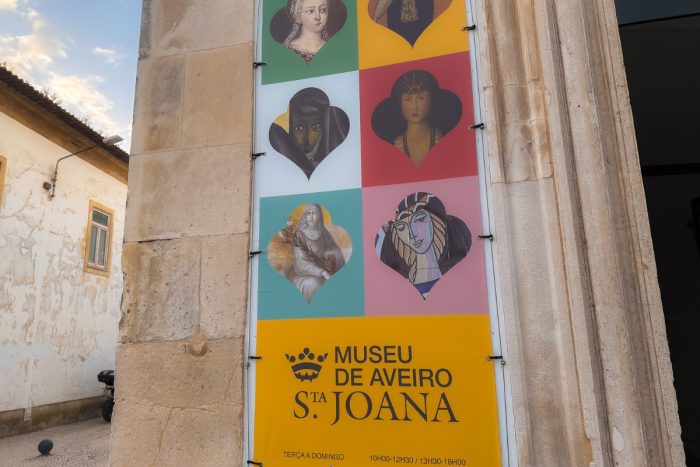
9. Aveiro Museum
The Museu de Aveiro, also known as the Museu de Santa Joana, is a rather impressive museum housed in the former Convent of Jesus (Convento de Jesus). Among the main exhibits are:
Tomb of Princess Joana: A richly decorated baroque tombstone made of multicolored marble, a work by the royal architect João Antunes.
Church of Jesus (Igreja de Jesus): A church with rich golden decoration and Portuguese azulejos, considered an excellent example of baroque decoration.
Cloister and Refectory: Spaces with original architectural elements, including a reading tribune and walls covered with azulejos.
The museum is open from Tuesday to Sunday, from 10:00 AM to 12:30 PM and from 1:30 PM to 6:00 PM. It is closed on Mondays.
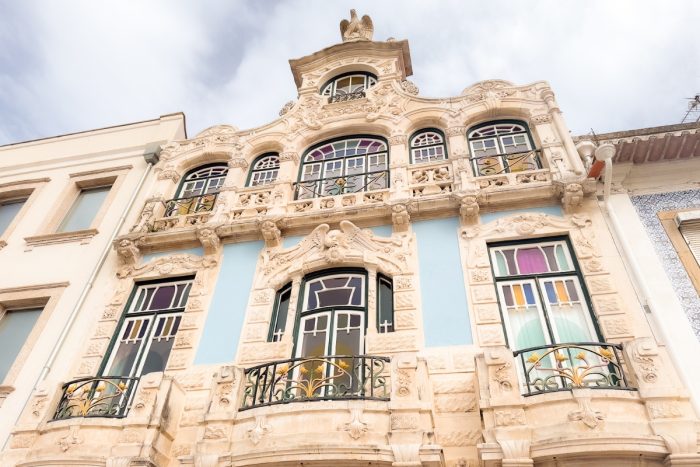
10. Art Nouveau Museum
If you’ve read more of my articles, you know I don’t miss anything related to art. So, in Aveiro, I recommend the Museu Arte Nova, which is housed in the historic building known as Casa do Major Pessoa and is dedicated to celebrating and interpreting the Art Nouveau movement.
This building, constructed between 1907 and 1909 according to the designs of architects Francisco Augusto da Silva Rocha and Ernesto Korrodi, is itself a significant example of this style.
Art Nouveau Museum
11. Best Restaurants and Cafes in Aveiro
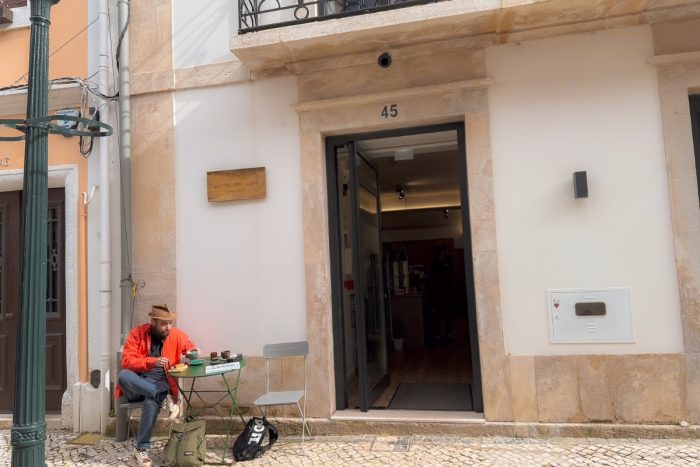
If you’re wondering where to go for coffee or a good meal in Aveiro, we have a few tips for you. The food at Balance FitFood Aveiro was absolutely excellent; I’m glad we stumbled upon this bistro during our walk.
But don’t get coffee there; if you want an excellent flat white or latte, go to Porta do café or Monlou, Cake and Coffee House. They also have great brunches at BEMA brunch.
Art Nouveau Museum
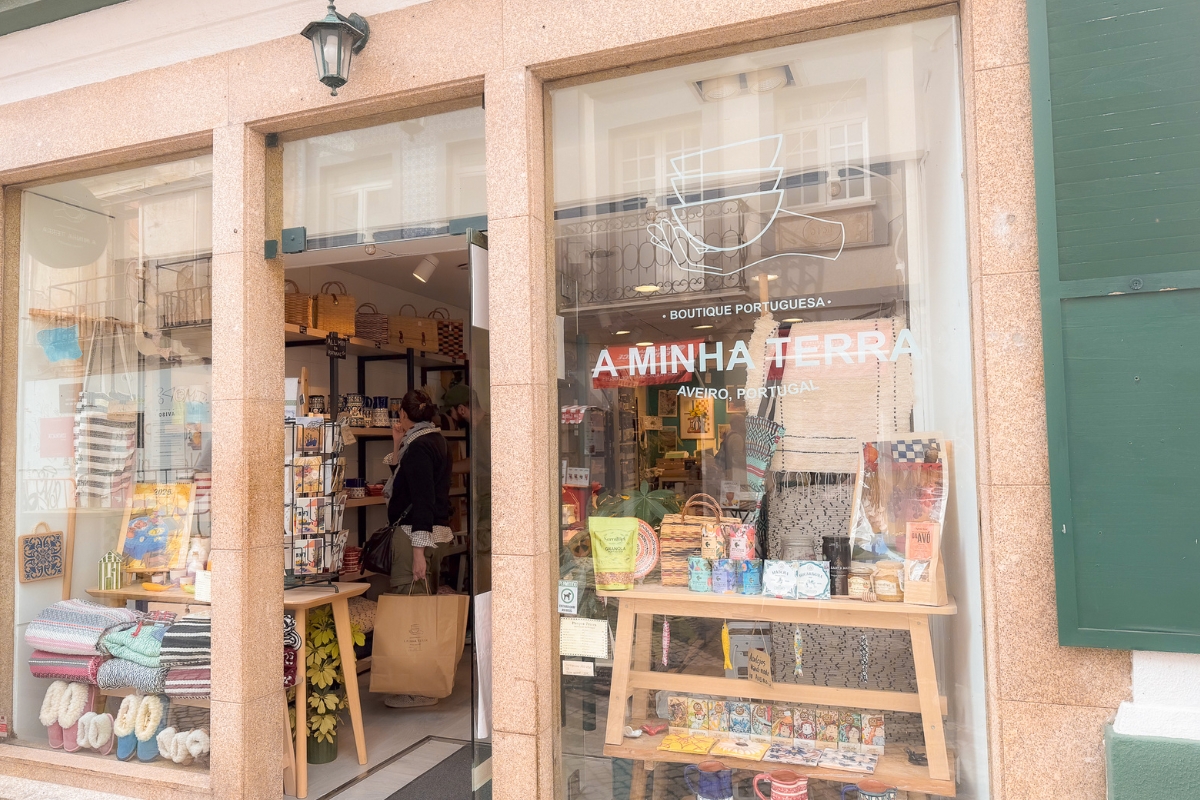
12. Visit a Local Products Shop
I was lucky enough to overhear a local guide telling tourists: “If you want to buy something truly Portuguese, go here.”
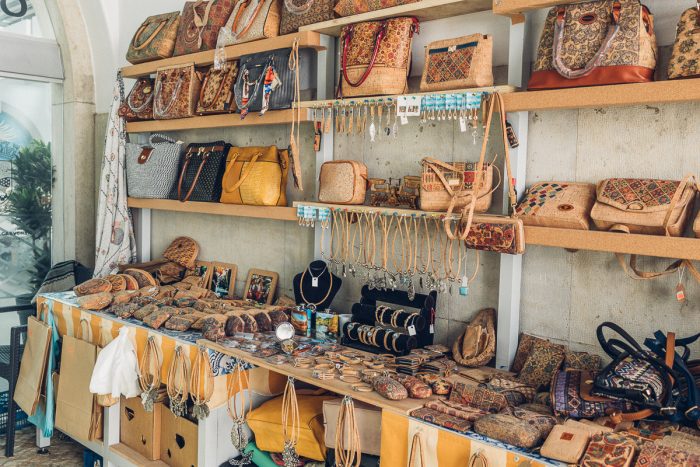
A wonderful little shop where you’ll find clothes, bags, plates, mugs, bath salts, soaps, and even small rugs that were made in Portugal. In short, it’s an ideal place to buy a souvenir, and it’s not ridiculously overpriced either. And what’s its name? A Minha Terra.
13. Costa Nova Beach
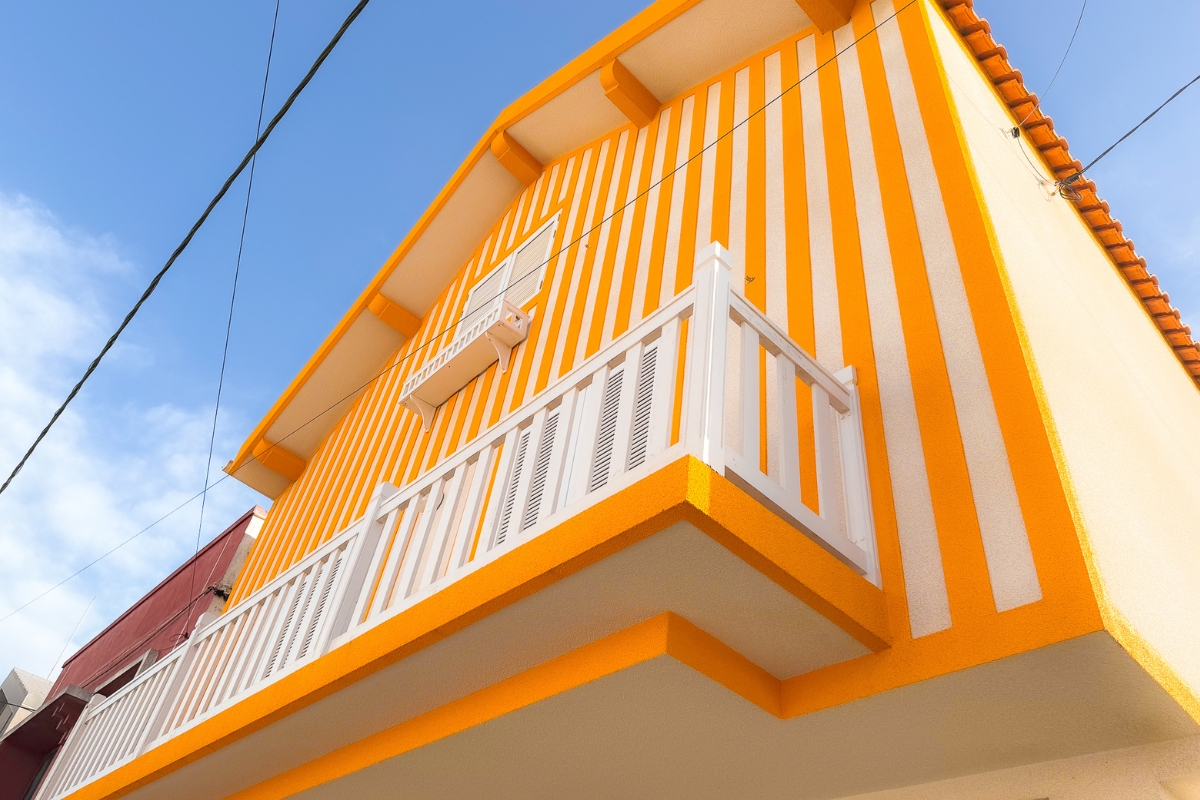
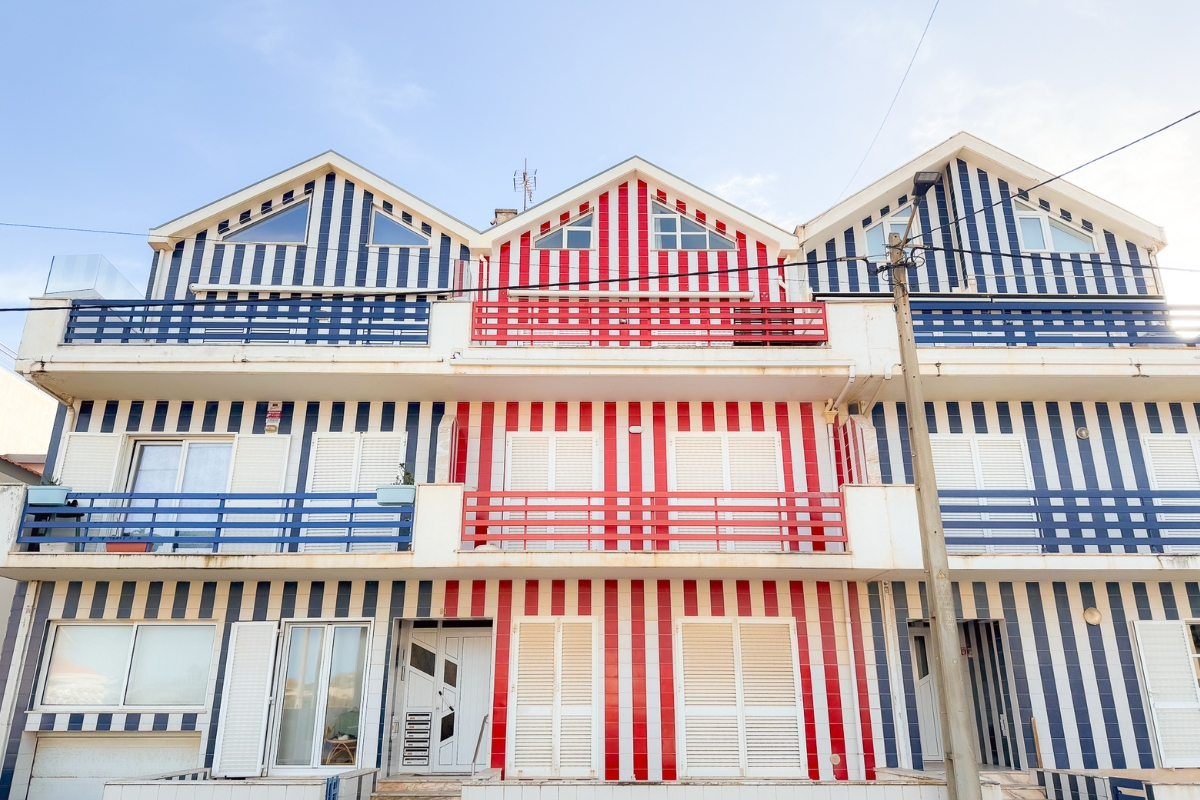
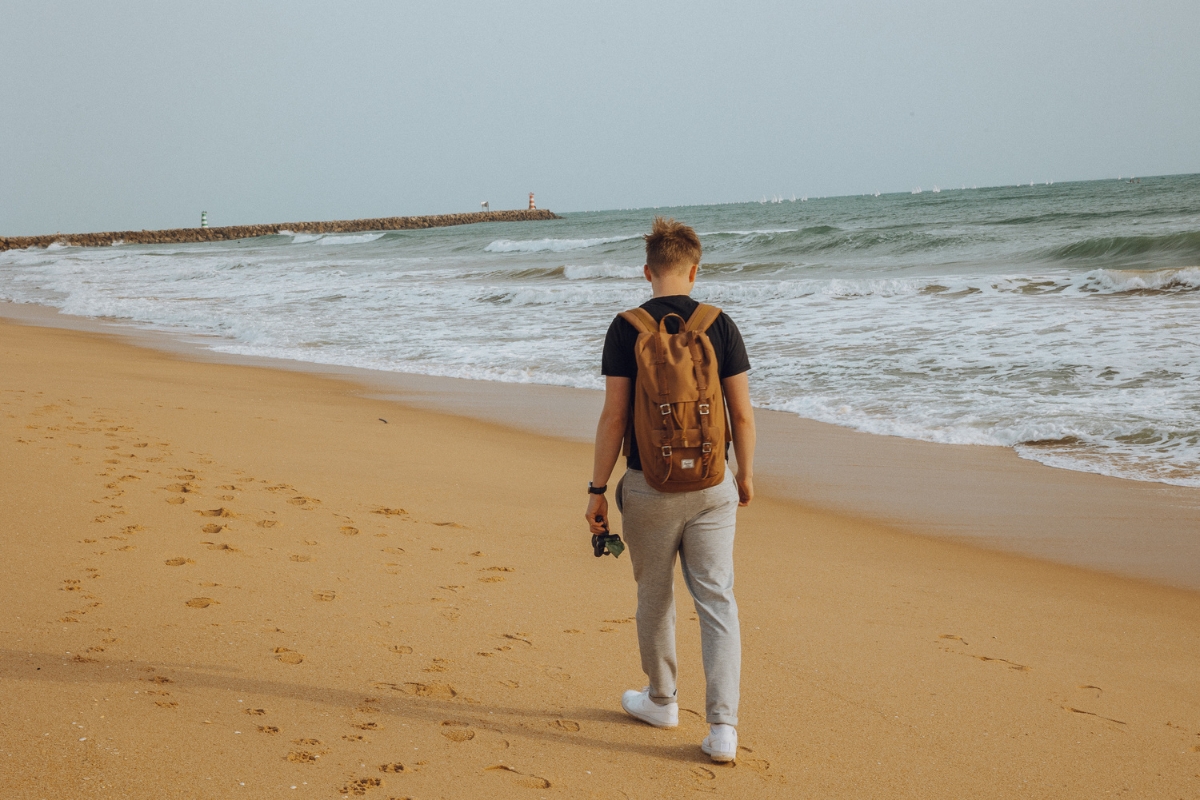
And last but not least. The place we went to Aveiro for. Costa Nova, located only about 12 km from Aveiro, is a small seaside paradise known for its iconic wooden houses – palheiros, whose colorful stripes immediately catch the eye.
They used to serve as storage for fishing equipment; today, you’ll find shops, restaurants, and accommodation in them. If you come during the season, it will probably be livelier here than when we were here at the end of October.
You can easily get to Costa Nova by bus from Aveiro city center or faster by car via A25.
Tips and Tricks for Your Vacation
Don’t Overpay for Flights
Search for flights on Kayak. It’s our favorite search engine because it scans the websites of all airlines and always finds the cheapest connection.
Book Your Accommodation Smartly
The best experiences we’ve had when looking for accommodation (from Alaska to Morocco) are with Booking.com, where hotels, apartments, and entire houses are usually the cheapest and most widely available.
Don’t Forget Travel Insurance
Good travel insurance will protect you against illness, accidents, theft, or flight cancellations. We’ve had a few hospital visits abroad, so we know how important it is to have proper insurance arranged.
Where we insure ourselves: SafetyWing (best for everyone) and TrueTraveller (for extra-long trips).
Why don’t we recommend any Czech insurance company? Because they have too many restrictions. They set limits on the number of days abroad, travel insurance via a credit card often requires you to pay medical expenses only with that card, and they frequently limit the number of returns to the Czech Republic.
Find the Best Experiences
Get Your Guide is a huge online marketplace where you can book guided walks, trips, skip-the-line tickets, tours, and much more. We always find some extra fun there!
TL;DRLoulé, in Portugal’s Algarve, mixes history and genuine local life away from the crowded coastal resorts. There are 15 tips here, from the Mercado Municipal market to Castelo de Loulé, the 1929 Café Calcinha, and the TechSalt salt mine with its descent 230 metres underground. The best months to visit are September and October, when prices and temperatures both drop, or April and May with highs of 20–23°C. Quarteira and Vilamoura beaches are about 15 minutes’ drive away, while the cliffs of Ponta da Piedade and Benagil Cave are roughly 40 minutes. The Loulé Jardim Hotel makes an ideal base in the centre, with a rooftop pool and underground parking.
We finally made it to Loulé! Last time, during the carnival madness, it was so busy that we couldn’t even find a parking spot and had to give up. But this autumn, we finally succeeded and could discover this Portuguese town and find out what’s essential to see and do in Loulé. In this guide I will share with you Loulé, Portugal: 13 Best Things to Do and See.
Loulé is a picturesque town in the Algarve region of Portugal. It’s located about 18 km north of Faro, making it an easy day trip.
Where to Stay in Loulé: Best Hotels
If you want to stay in the Algarve away from the main tourist spots, whether for the price or simply because you prefer peace and don’t need to be by the sea, Loulé is an excellent choice. The best place to stay is undoubtedly the Loulé Jardim Hotel.
13 Best Things to Do and See
Even though it’s a really small town in the Algarve, Loulé has its unique charm and is worth a visit. While there isn’t an abundance of attractions, those you’ll find here are definitely worth seeing. Let’s discover together what to do and see in Loulé.
Loulé Castle
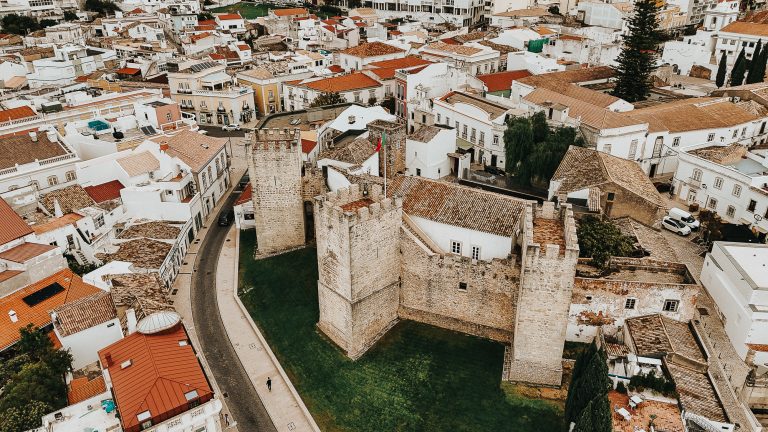
The Castle of Loulé dates back to the 2nd century. It has Roman origins and was later occupied by the Moors until it was finally conquered by D. Paio Peres Correia in 1249.
Afonso III fortified and expanded it in the 13th century, and the castle even hosted the Portuguese royal family. Although damaged by an earthquake in 1969, parts of it remain preserved and are now integrated into the town of Loulé, protected as part of the national heritage. Visitors can see remnants of its historic walls and towers in the town center.
Castle of Loulé
Loulé Market
If you’re on holiday in the Algarve, definitely visit the Loulé market! Every Saturday, it’s bustling – local farmers sell fresh produce, and the adjacent market offers a diverse range of goods, from which you’re sure to pick up an interesting souvenir.
Loulé market
Engineer Duarte Pacheco Monument
The Engineer Duarte Pacheco Monument in Loulé is an impressive tribute to one of the most influential figures of the Estado Novo period in Portugal. Duarte José Pacheco (1900-1943), a native of Loulé, was an outstanding electrical engineer and held key public positions, including director of the Instituto Superior Técnico and Minister of Education and Public Works. His influence is still evident today, for example, in the Santa Maria Hospital in Lisbon.
Pacheco tragically died in a car accident at the age of 43. In his honor, the city of Loulé unveiled the monument on November 16, 1953, ten years after his death. This 17-meter-high column, designed by architect Cristino da Silva and funded by public subscription, symbolizes Pacheco’s unfinished work.
A bronze relief by Leopoldo de Almeida and 18 panels by various sculptors adorn the monument, celebrating Pacheco’s legacy and serving as a significant symbol of the Estado Novo period in the Algarve.
Engineer Duarte Pacheco Monument
Park – Jardim Dos Amuados
In the historic heart of Loulé lies the enchanting Jardim dos Amuados park, dating back to the late 19th century.
It’s a small park where you can escape the city bustle and relax in the shade of trees when the heat becomes unbearable.
The origin of the name “amuados”, or “offended”, is shrouded in mystery, but it is said to have been a place where lovers went to reconcile after an argument.
Jardim Dos Amuados in Silves
Santuário De Nossa Senhora Da Piedade (Mãe Soberana)
The Chapel of Our Lady of Piety in Loulé, founded in 1553, is part of a sanctuary known for significant Easter pilgrimages in southern Portugal. After the 1755 earthquake, it was restored with a new Rococo altar.
The sanctuary is also famous for two major religious festivals, Festa Pequena and Festa Grande, which celebrate the revered “Sovereign Mother”. The chapel’s rich history includes a statue likely from the 16th century and paintings of the Passion of Christ by José Filipe Porfírio from the 19th c
Santuário de Nossa Senhora da Piedade (Mãe Soberana)
Palácio Gama Lobo
The Gama Lobo Palace, originally a private chapel built in 1725, was founded by Father João da Costa Aragão and became a symbol of the esteemed Lobo family.
After several obstacles and almost a century later, the chapel was completed by António José de Matos Mexia Costa, who magnificently renovated it with his family between 1891 and 1893.
In the 20th century, this elegant building served as a refuge for Spanish Jesuits during the civil war and later transformed into a vibrant center for community and cultural activities, from carnival balls to music and dance performances.
Following extensive renovations between 2017 and 2019, the palace now serves as a dynamic center for Loulé Criativo, promoting local identity through various creative and educational activities.
Palácio Gama Lobo, Loulé
Museu Municipal De Loulé
If you want to learn something about Loulé, visit the local Loulé Municipal Museum. The museum is quite modern and features fascinating exhibits that tell the story of this area from the Triassic period, when giant salamanders lived here, to the Middle Ages.
Among the most significant artifacts are the oldest preserved records from the municipal council in Portugal, dating back to 1384.
Museu Municipal de Loulé
Igreja Matriz De São Clemente
The Church of São Clemente,whose origins date back to the 13th century, was likely founded by the Archbishop of Braga, D. João Viegas, and in 1298 came under the Military Order of São Tiago. Its Gothic southern architecture features three naves and simple decoration on the capitals.
In the 16th century, side chapels and altars were added, but these were removed in the 18th century. The church suffered damage during the 1755 earthquake and subsequent tremors, thus undergoing significant reconstruction that emphasized its medieval elements. In 1924, it was declared a national monument.
Fonte Do Cadoiço
You might be surprised to find a waterfall in Loulé. It’s called Fonte do Cadoiço, and even though it’s just a short distance from the main road, not everyone manages to find it, because the access is subtly located between two buildings on a picturesque cobbled street.
The waterfall is not very well maintained, there’s a lot of trash, and it’s more of a curiosity that you find it in the city rather than something you truly need to visit. In summer, it can also be completely dry.
Artcatto – Art Gallery – Galeria De Arte
In Loulé, you’ll also find a small art gallery, the Artcatto Gallery. This gallery, led by acclaimed curator Gillian Catto, boasts an impressive collection of top-tier art created in the region.
Artcatto – Galeria de arte
1920s Café Calcinha
If you’re looking for a charming coffee spot, don’t forget to visit Café Calcinha. We went there for a cup of coffee and also had their local coconut bundt cake (they call it a cake 😁).
Café Calcinha is a historical gem in the center of Loulé. It opened in 1929 thanks to José Domingos Cavaco, nicknamed “Calcinha”. The interior was designed to reflect the grandeur of a Brazilian café from the 20th century.
During your visit, don’t forget to notice the Art Deco elements and Brazilian woodworking craftsmanship, which have been carefully preserved. Outside on the esplanade, you’ll find a statue of António Aleixo, a renowned poet who frequently visited this café and recited his verses.
1920s Café Calcinha, the best cafe in Loulé
Trip to an Underground Salt Mine
If it’s hot outside, it’s time for an underground trip; in Loulé, you can visit a salt mine. It’s better to book your reservation via GetYourGuide in advance, so you don’t have to scramble for tickets at the last minute or find them sold out.
An authentic experience awaits you—this is a functional salt mine, not a modified tourist attraction. The descent into the depths of the mine is accompanied by the hum of machinery and the occasional rumble of trucks in the tunnels. Guides, often miners themselves, provide insight into daily operations and allow you to understand the complexities of this impressive industrial enterprise.
🔗 These are affiliate links — they don't change your price and help us create content. · All experiences →
Wine Tasting
If you love wine too, this wine tasting will truly delight you. The tour begins with a short walk around the winery. You’ll taste four excellent wines that truly capture the essence of the region. Even if the service is a bit slow, don’t let it spoil your experience. The views are breathtaking, and the wine? Absolutely worth the wait. Book your wine tasting via GetYourGuide.
Search for flights on Kayak. It’s our favorite search engine because it scans the websites of all airlines and always finds the cheapest connection.
Book Your Accommodation Smartly
The best experiences we’ve had when looking for accommodation (from Alaska to Morocco) are with Booking.com, where hotels, apartments, and entire houses are usually the cheapest and most widely available.
Don’t Forget Travel Insurance
Good travel insurance will protect you against illness, accidents, theft, or flight cancellations. We’ve had a few hospital visits abroad, so we know how important it is to have proper insurance arranged.
Where we insure ourselves: SafetyWing (best for everyone) and TrueTraveller (for extra-long trips).
Why don’t we recommend any Czech insurance company? Because they have too many restrictions. They set limits on the number of days abroad, travel insurance via a credit card often requires you to pay medical expenses only with that card, and they frequently limit the number of returns to the Czech Republic.
Find the Best Experiences
Get Your Guide is a huge online marketplace where you can book guided walks, trips, skip-the-line tickets, tours, and much more. We always find some extra fun there!
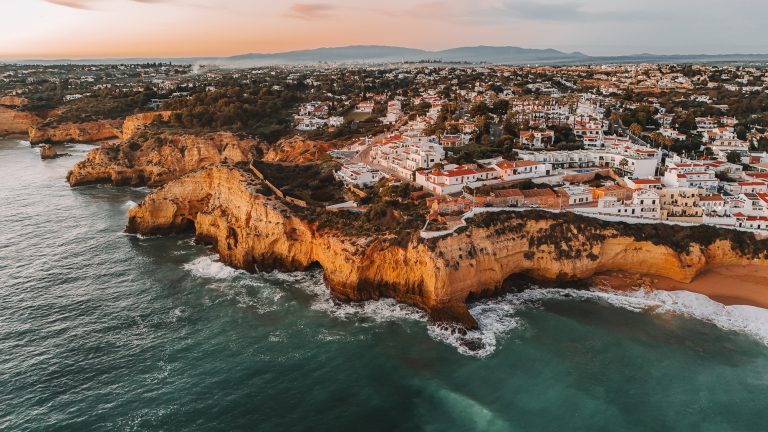
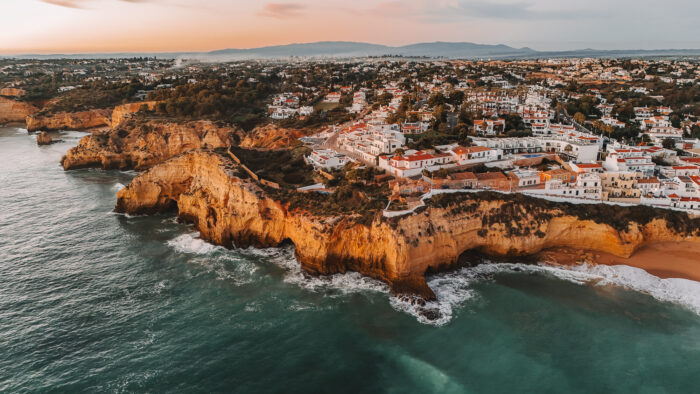
TL;DRCarvoeiro is a picture-postcard town on Portugal’s Algarve coast, ringed by limestone cliffs and a great base for exploring the region — here are 18 ideas on what to see and do. Top of the list is Praia da Marinha beach, the Benagil caves (go by boat or kayak), the rock formations at Algar Seco, and day trips to Lagos, Silves, Ferragudo, Albufeira, Portimão and Tavira. The sea’s warmest from June to August at 21°C, while September and early October give you a still-warm ocean and lower prices; February draws people in for the quiet and mild 18°C days. For a place to stay, try the Quinta Nova Vale Del Rey hotel near Praia da Marinha. Hiring a car is the way to get around — just make sure it comes with a Via Verde box for the electronic tolls.
Every February for the past four years, Carvoeiro has been our home. ❤️ This place is ideal for exploring nearby towns, and Praia da Marinha, the most picturesque Algarve beach, is just a short distance away. In this guide I will share with you Carvoeiro, Portugal: 18 Best Things to Do and See. Let’s explore the best things to do and see in Carvoeiro together.
Carvoeiro, with its golden beaches and dramatic cliffs, is paradise on Earth to us. Plus, the people here are very kind, and even for us vegetarians, there’s good food to be found. Whether you’re enjoying the views at Algar Seco or just strolling through town, you’ll make the most of your time here. We promise!
The history of Carvoeiro dates back centuries, when the area faced many military and pirate attacks. The town witnessed several naval battles, such as in 1544 between a fleet commanded by Dom Pedro da Cunha and a Turkish corsair named Xarramet.
One of the Most Beautiful Places in Carvoeiro
Despite its popularity, the town is relatively underserved by public transport; the nearest train station is Estombar-Lagoa. Therefore, it’s advisable to rent a car if you want to get around Carvoeiro and its surroundings. We recommend using services like DiscoverCars, with whom we’ve never had any issues.
On our last visit to Carvoeiro in November 2023, I was pregnant with our Jonášek.
Best Time to Visit Carvoeiro
We love Carvoeiro in autumn and spring, but the most popular period is summer, from late May to October, when the water is warmest for swimming. The summer months of June, July, and August are ideal for family holidays not only because of the water temperature, but also because there are the most options for various activities with children.
Summer (June to August): Hot and sunny weather, ideal for swimming.
Late Spring (May, early June) and Early Autumn (September, October): Milder weather, perfect for city trips, but also for swimming.
Winter Months (November to February): Colder with occasional rainy days, but still many sunny days; some restaurants are closed, and swimming in the sea is not possible. A great period for digital nomads.
Where to Stay in Carvoeiro
If you’re planning a one or two-week stay, the best choice in Carvoeiro is the hotel Quinta Nova Vale Del Rey. It has a beautiful pool and serves very good breakfasts. The hotel is located near one of the most beautiful beaches in the Algarve – Praia da Marinha.
Lukáš and Lucie recommend
Where to stay in Carvoeiro
2 accommodations — hotels and other lodging options
Public transport or renting your own car? If you truly want to see the most interesting parts of Carvoeiro and its surroundings, I recommend renting a car (for example, through the reliable portal DiscoverCars, with whom we’ve had no issues in 15 years of travel).
Of course, you can also rent a car directly at the airport, but I recommend booking online so you can compare offers and avoid renting a car too expensively.
Why not rely on public transport? Carvoeiro does not have a direct train connection; the nearest station is Estombar-Lagoa, about 8 km away, and local buses don’t cover all tourist spots, so you won’t get everywhere and would have to take a taxi.
Sunset in Carvoeiro
Most Beautiful Places around Carvoeiro
We return to Carvoeiro every year; it’s our favorite place in the entire Algarve region, and there’s always something new to discover. Here’s a list of some of the most well-known places worth visiting:
1) Benagil Caves and Dolphin Watching
This is the most popular boat trip in the Algarve, which can be taken from several locations. It’s best to book it online via GetYourGuide; you can also book a trip that includes dolphin watching.
The cave is formed by soft limestone, and there’s an opening in the cave, allowing sunlight to penetrate inside.
We mainly go to Carvoeiro in February, so I was a bit worried about getting cold on the boat. But it was great. Even though it was only 20°C, we enjoyed it. ☺️
🔗 These are affiliate links — they don't change your price and help us create content. · All experiences →
2) Algar Seco
When my mom visited us for a week, we took her to the Algar Seco formations. You can walk along coastal paths there, where interesting rock formations reflect light in fascinating ways, perfect for photography. These formations were created by years of erosion.
Algar Seco in Carvoeiro
3) Praia De Carvoeiro
In winter, it’s a relatively peaceful beach, but in summer, it gets quite crowded. So, it depends on when you visit Carvoeiro. The beach is right in the center, and if you climb above it, you can take beautiful photos at sunset or sunrise. In front of the beach, there’s also a very nice cafe called Levels, which probably has the best coffee in town and, most importantly, great breakfasts.
Carvoeiro Beach
4) Praia Do Vale De Centeanes
Praia do Vale de Centeanes was just a twenty-minute walk from our little house, so I used to go for runs there in the mornings, and in the evenings, we’d go there for sunset wine, because there’s a really nice bar right above the beach.
However, we don’t know how crowded it gets during peak season; in February, it’s quite peaceful. From this beach, you can also embark on a cliff-side walk. But I wouldn’t go in summer, as there’s no shade. ☺️
Praia do Vale de Centeanes in Carvoeiro
5) Praia Da Marinha
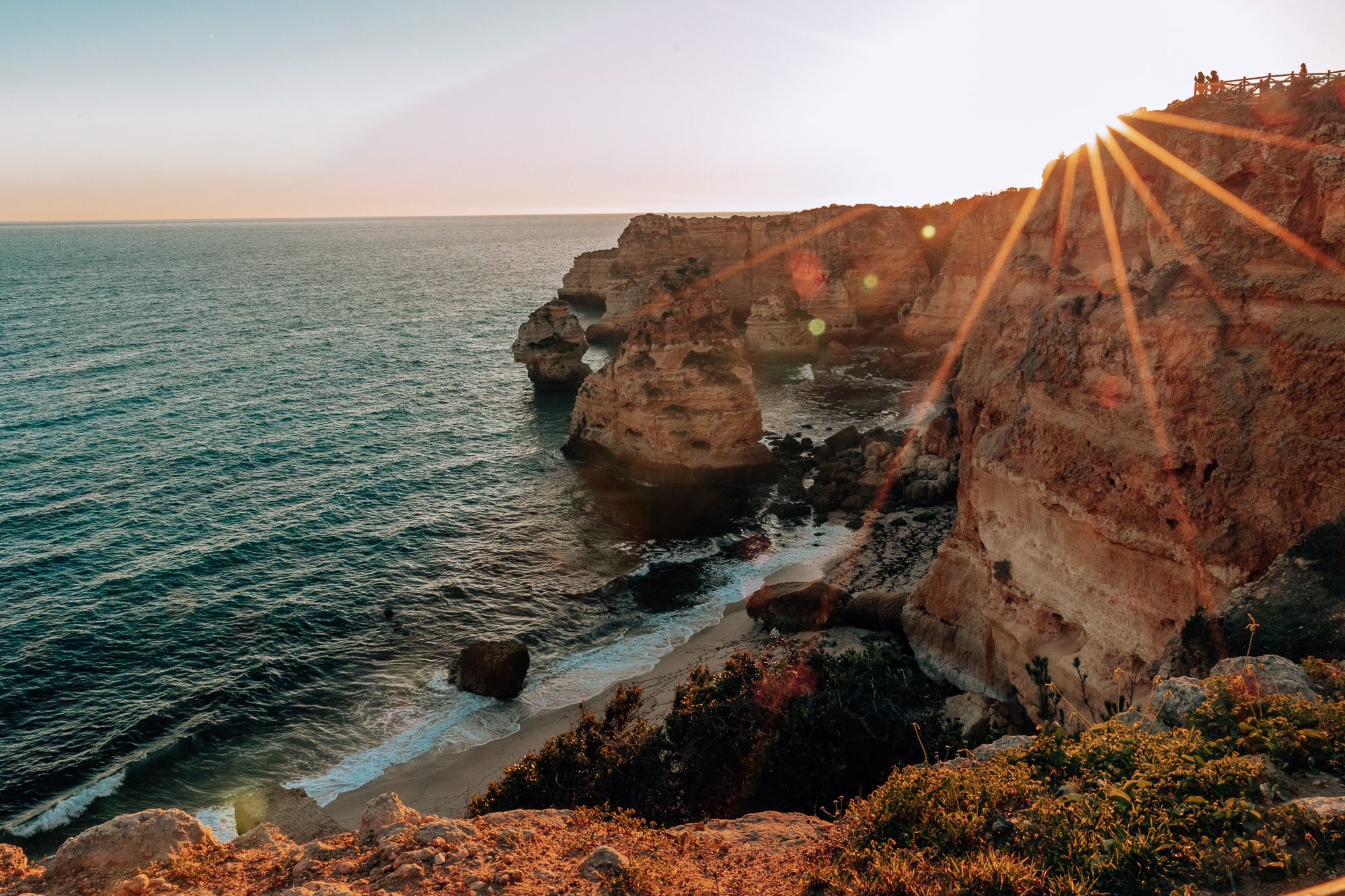
The most beautiful place near Carvoeiro? Praia da Marinha! That’s the beach where I first fell in love with the Algarve. It must be said, though, that it will probably be very crowded here in summer. I hope that doesn’t stop you.
Crystal-clear water and breathtaking rock formations never cease to amaze, even after years. Over the years, we’ve returned here several times a week during our monthly stays, especially to watch the sunset. The twilight colors dancing on the water’s surface are a sight that never gets old.
Praia da Marinha
6) Praia Do Paraíso
Want a slightly more intimate experience? Head to Praia do Paraíso. It’s a tiny, hidden cove where it’s usually peaceful. Surrounded by rocky cliffs and lush vegetation, it’s a secluded oasis ideal for those seeking tranquility and picturesque views.
7) Alfanzina Lighthouse
Our little house in Carvoeiro was near the Alfanzina Lighthouse. We used to go for a walk there with our dog almost every evening.
The lighthouse has been a silent guardian of the Atlantic since 1920. Every Wednesday from 2:00 PM to 5:00 PM, the Lighthouse doors open to the public, so you can go there too.
The lighthouse is on a hiking trail, which you can find in English under the name The Seven Hanging Valleys, leading across the cliffs. However, definitely don’t go there in the summer; even in February, we struggled with the heat.
Alfanzina Lighthouse
8) Kayaking
If you enjoy excursions, we recommend kayaking. An organized trip to the Benagil caves is also said to be great; you just need to book it again via GetYourGuide.
🔗 These are affiliate links — they don't change your price and help us create content. · All experiences →
9) Golf
The Algarve is a paradise for golfers. You’ll find a total of 31 golf courses here, making this area one of the densest golf destinations in Europe. In Carvoeiro, you’ll find three worth mentioning:
Vale de Milho Golf, ideal for beginners with magnificent ocean views,
Pestana Gramacho Golf Course offers an 18-hole course surrounded by olive and almond trees,
Pestana Vale da Pinta Golf Course is known for its centuries-old olive trees and excellently maintained fairways.
10) Surfing
Although Carvoeiro isn’t the most popular surf spot in the Algarve, there’s still a great surf school nearby in Lagoa called King Neptunos Surf School. This school was founded out of a 25-year love for surfing.
11) Thai Massages
So what if Thai massages aren’t local? 😁 There are great places here where you can get a Thai massage, and we’ve made it a tradition, just like visiting some Indian restaurants. So, we’d be happy to recommend our favorite spot for a Thai massage in Carvoeiro: Senses Thaimassage Beauty.
12) Portuguese Pottery
A trip to the Algarve wouldn’t be complete without visiting a pottery workshop. You definitely shouldn’t miss Porches Pottery, where you can see how classic Portuguese ceramics are made.
Our favorite workshop is Olaria Pequena, run by a father and daughter who moved here from the UK over 20 years ago and produce more modern pieces inspired by Portugal. We already have a collection from them at home.
13) Trip to Lagos
If you stay in Carvoeiro, definitely take a trip to Lagos and its charming surrounding beaches, which are among the most beautiful beaches in Portugal.
Praia da Dona Ana
Among the most beautiful are certainly Praia Dona Ana and Praia do Camilo. Praia Dona Ana, with its breathtaking cliffs and clear waters, is a feast not only for the eyes but especially for photographers. Praia do Camilo, accessible via a picturesque wooden staircase, is no less beautiful.
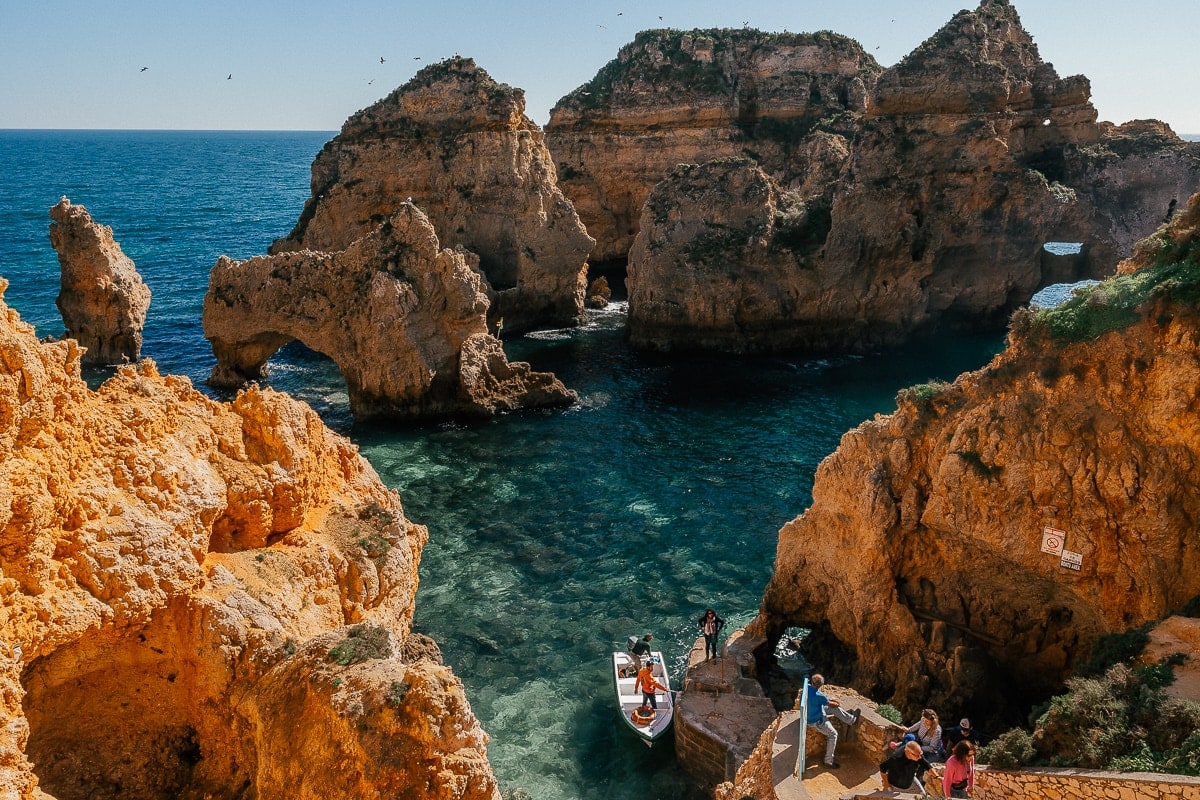
Ponta da Piedade
Another place we must recommend is the stunning Ponta da Piedade. Although it’s not a beach, the breathtaking views of the rugged coastline and the endless Atlantic are incredible. Some fun boat trips also start here, which you can take all year round.
14) Trip to Ferragudo
Ferragudo, a traditional fishing village, retains its original charm and is located near Carvoeiro. Its narrow, winding streets and picturesque waterfront square make Ferragudo a great tourist destination.
15) Trip to Silves
The medieval town of Silves captivated us so much that we moved here for a whole month in the autumn of 2023. The town has a great atmosphere; the main tourist attractions are the local castle and cathedral, but you’ll also find interesting museums, craft shops, and really nice restaurants.
16) Trip to Albufeira
Albufeira is one of the largest and liveliest towns in the Algarve; you’ll find many beautiful and, most importantly, long beaches there, which are ideal for families with children. But we confess, most often we went to Albufeira mainly for sushi.
We usually headed to Albufeira for sushi 😁
17) Portimão
Portimão is one of our favorite places that we love to return to. It’s only about a 20-minute drive from Carvoeiro, and you’ll find one of our favorite beaches for evening strolls there – Praia da Rocha, which has a very long sandy beach.
We always go there before sunset, and after dark, we head to one of our favorite Indian restaurants.
Praida da Rocha
18) Tavira
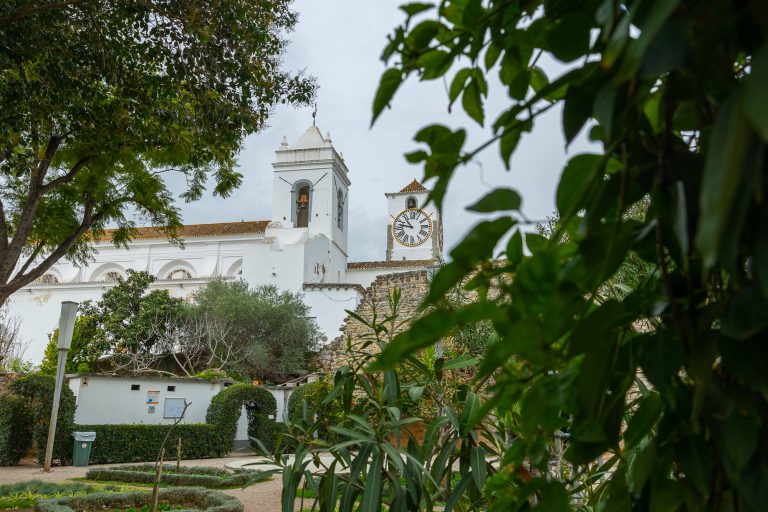
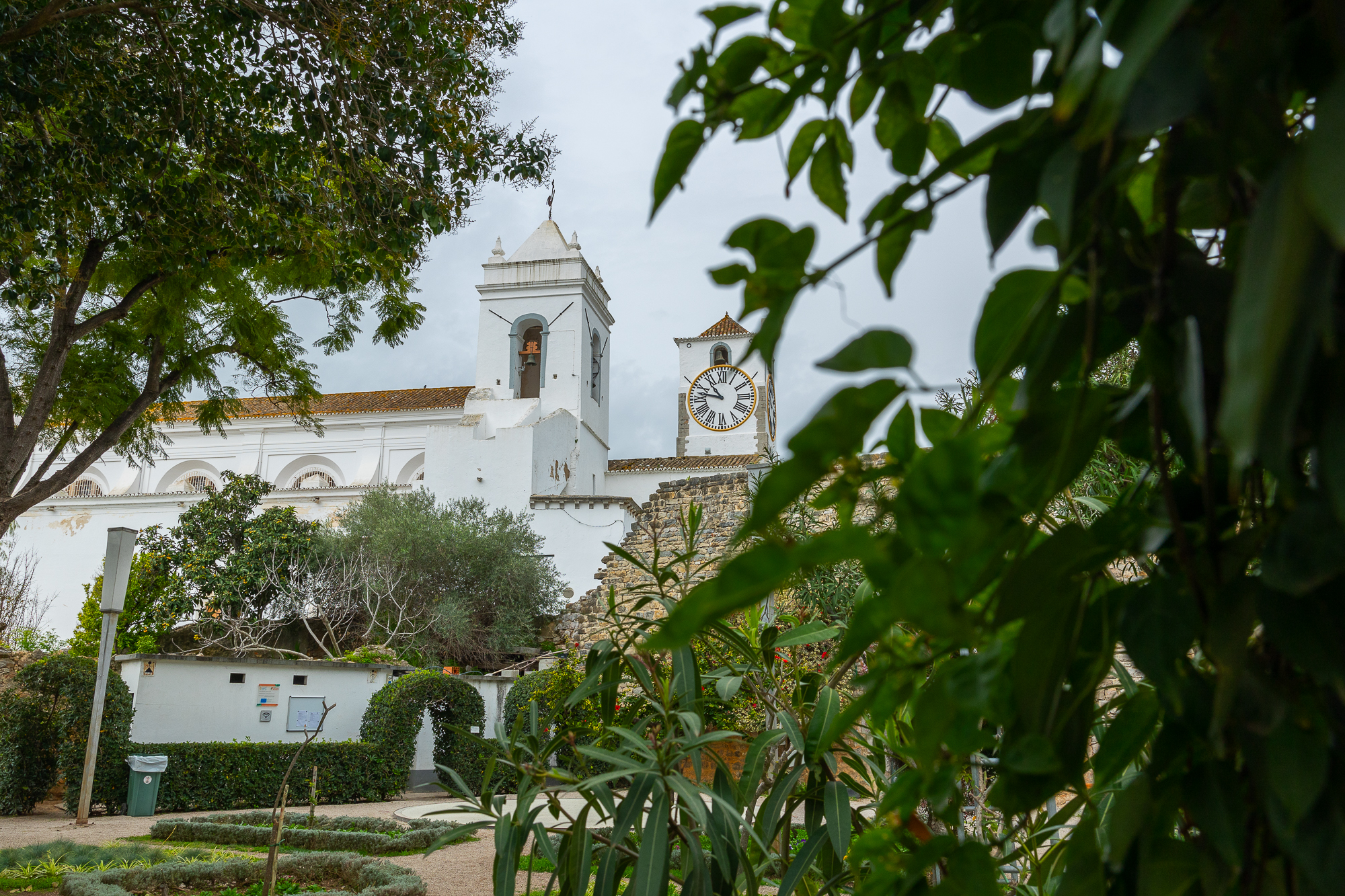
Tavira is a small but charming town, ideal for a day trip. You’ll find a beautiful church with an adjacent charming garden, Moorish architecture, and a Roman bridge there.
View from Castelo de Tavira
Best Restaurants in Carvoeiro
We are vegetarians, so it’s important for us to find restaurants with vegetarian or vegan options. We usually look for such places online. Our favorites in Carvoeiro are Organic, Earth Shop & Cafe, but the real gem is Chef’s Kitchen, where we had an unforgettable Valentine’s dinner last year. ❤️
We love Indian food, so we’re in an Indian restaurant several times a week. Among our favorites is Gurkha Kitchen Nepalese & Indian Cuisine, but all of them in Carvoeiro are good.
Best Cafes in Carvoeiro
Off-season, coffee in Carvoeiro is a bit worse because, for example, Bananna Café is often closed in February. Fortunately, a cafe right by the beach has opened – Levels. Finally, a place where you can get proper coffee!
🔗 These are affiliate links — they don't change your price and help us create content. · All experiences →
What to Do with Kids in Carvoeiro?
Our Jonášek will still be too young for it this year, but we believe that in a few years, we’ll head to the Slide and Splash water park. I loved water parks as a child, so I believe our son will love them too. And let’s be honest, I’ll enjoy it too. You can buy tickets online via GetYourGuide to avoid queuing with small children.
🔗 These are affiliate links — they don't change your price and help us create content. · All experiences →
Tips and Tricks for Your Vacation
Don’t Overpay for Flights
Search for flights on Kayak. It’s our favorite search engine because it scans the websites of all airlines and always finds the cheapest connection.
Book Your Accommodation Smartly
The best experiences we’ve had when looking for accommodation (from Alaska to Morocco) are with Booking.com, where hotels, apartments, and entire houses are usually the cheapest and most widely available.
Don’t Forget Travel Insurance
Good travel insurance will protect you against illness, accidents, theft, or flight cancellations. We’ve had a few hospital visits abroad, so we know how important it is to have proper insurance arranged.
Where we insure ourselves: SafetyWing (best for everyone) and TrueTraveller (for extra-long trips).
Why don’t we recommend any Czech insurance company? Because they have too many restrictions. They set limits on the number of days abroad, travel insurance via a credit card often requires you to pay medical expenses only with that card, and they frequently limit the number of returns to the Czech Republic.
Find the Best Experiences
Get Your Guide is a huge online marketplace where you can book guided walks, trips, skip-the-line tickets, tours, and much more. We always find some extra fun there!
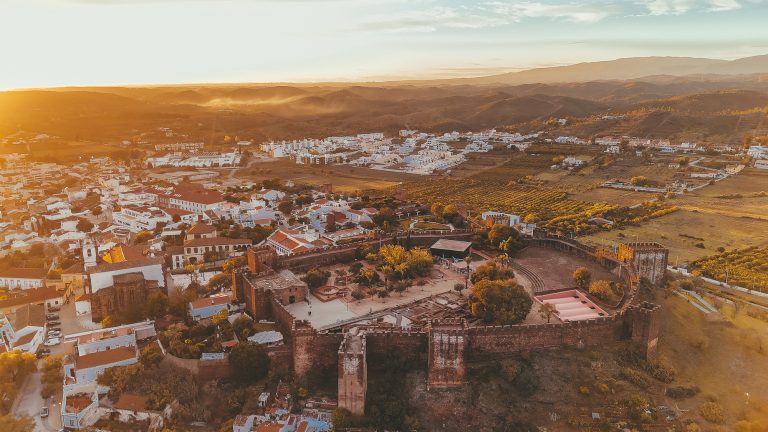
TL;DRSilves, in Portugal’s southern Algarve, comes with 18 solid tips for exploring the town. The star attraction is the 12th-century Moorish Castelo de Silves, built from red sandstone, right next to the Gothic Sé cathedral dating from 1189. There’s also an archaeological museum with an eighteen-metre cistern (entry €2.10, or €3.90 for a combined ticket with the castle). The town sits 20 to 30 minutes from beaches like Praia da Rocha and Praia da Marinha, and about 45 minutes from Faro airport. Other highlights include the Roman bridge Ponte Romana, the Mercado Municipal market, a solar-boat cruise along the Arade river, and the café Café DaRosa. September, early October, or April and May are the best times to visit — steer clear of August, when it’s scorching and packed with crowds.
Silves enchanted us so much during our trips to Portugal that we stayed there for a whole month. It’s a beautiful Portuguese medieval town, whose main landmark is a 12th-century Moorish castle. In this guide, “Silves, Portugal: 25 Best Things to Do and See”, I’ll share what kept us coming back and why we decided to stay longer.
As we found out during our stay, it’s also a cat city; you can practically see these four-legged furballs resting on every corner. If you’re heading to the Algarve, this article will tell you what to see and do in Silves, where to find a pretty good coffee, and where to eat.
One of the best places to stay is Mosaiko 5 Suites. These apartments are located in the center, near the main sights. The rooms are very spacious, and the shared kitchen even has a coffee machine, which is ideal for those who also need their morning dose of caffeine. The breakfasts are amazing, especially the omelets!
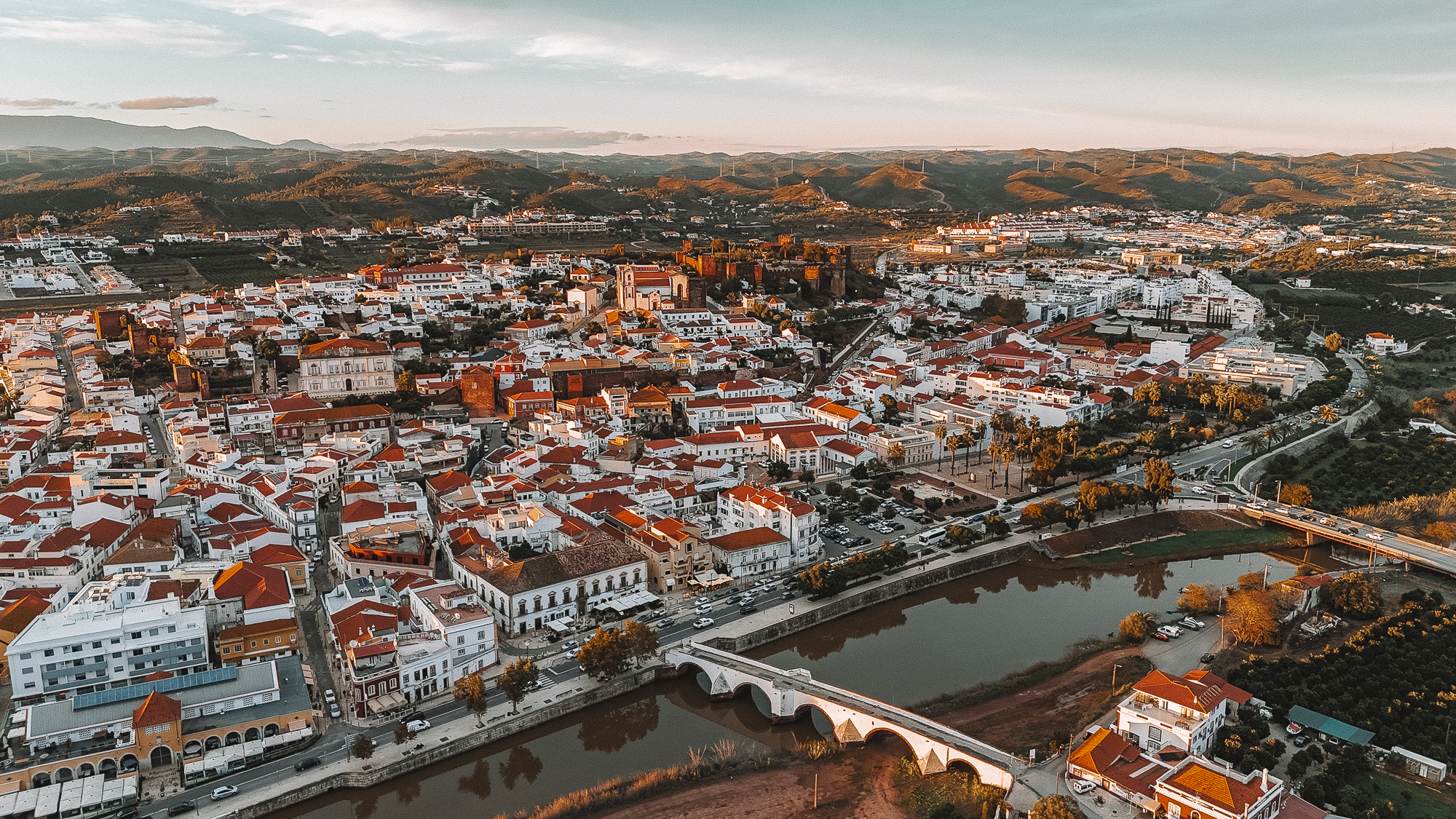
Silves Historic Center
History of Silves: What You should Know
Silves, a historic city in Portugal, was once the ancient capital of the Algarve region. During the Moorish era, which lasted from the 9th to the 12th century, the city served as a major stronghold and an important trading center.
Remains from the Iron Age were discovered in the city, along with a well, the governor’s palace, and the Cisterna Grande, a large 13th-century water reservoir that served the entire city. This reservoir, ten meters high and supported by six columns, is said to be haunted by the ghost of a Moorish maiden. 😁
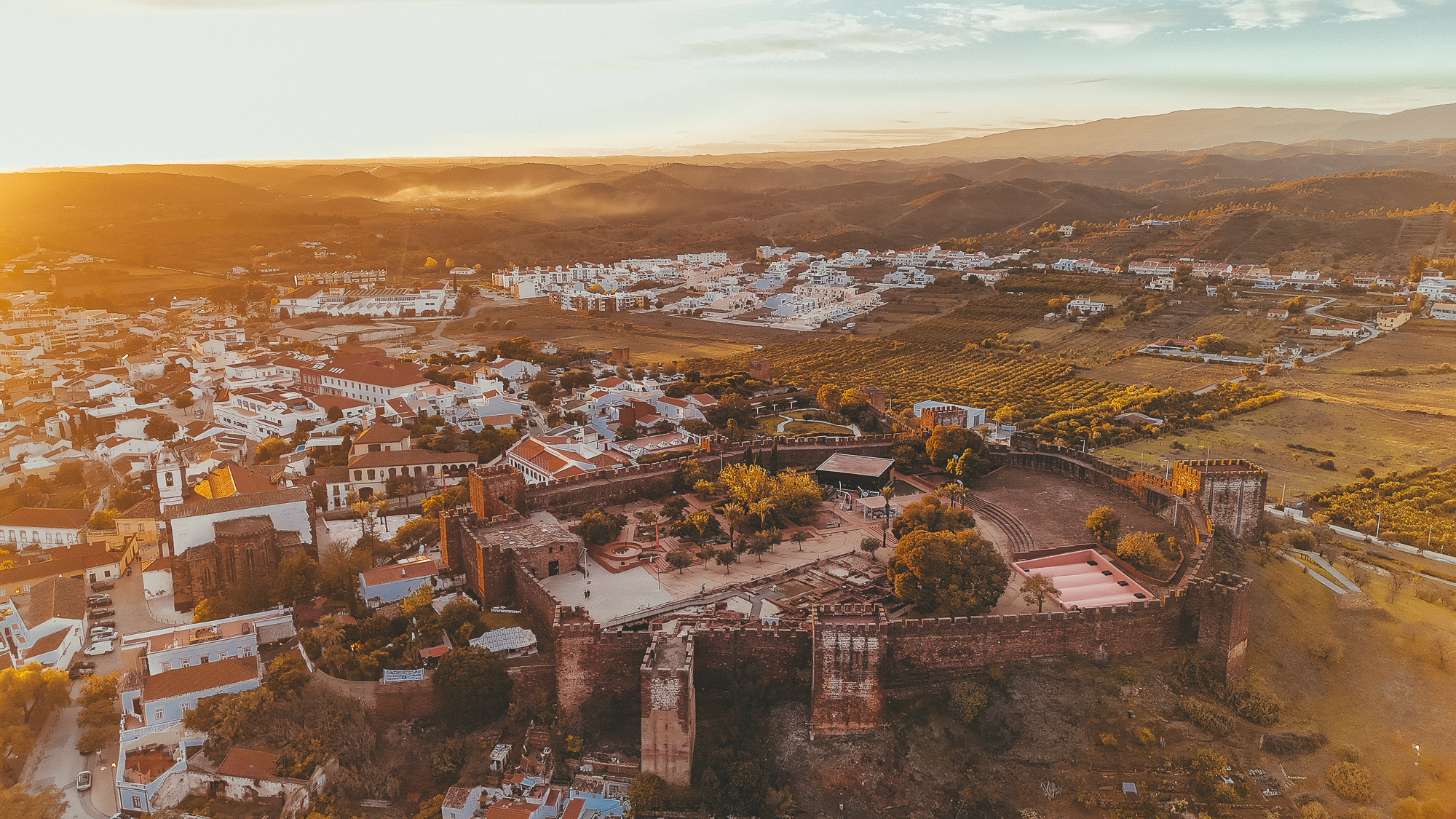
In addition to the Moorish era, the city has a history dating back to Roman times. The Middle Ages were a particularly significant period for Silves, as evidenced by the construction of Castelo de Silves. This castle, situated at the highest point of the city, is considered the best example of Arab military architecture in Portugal.
What to Do in Silves, Portugal? Explore the Historic Center
Sights and Attractions in Silves: What to See and Do Here
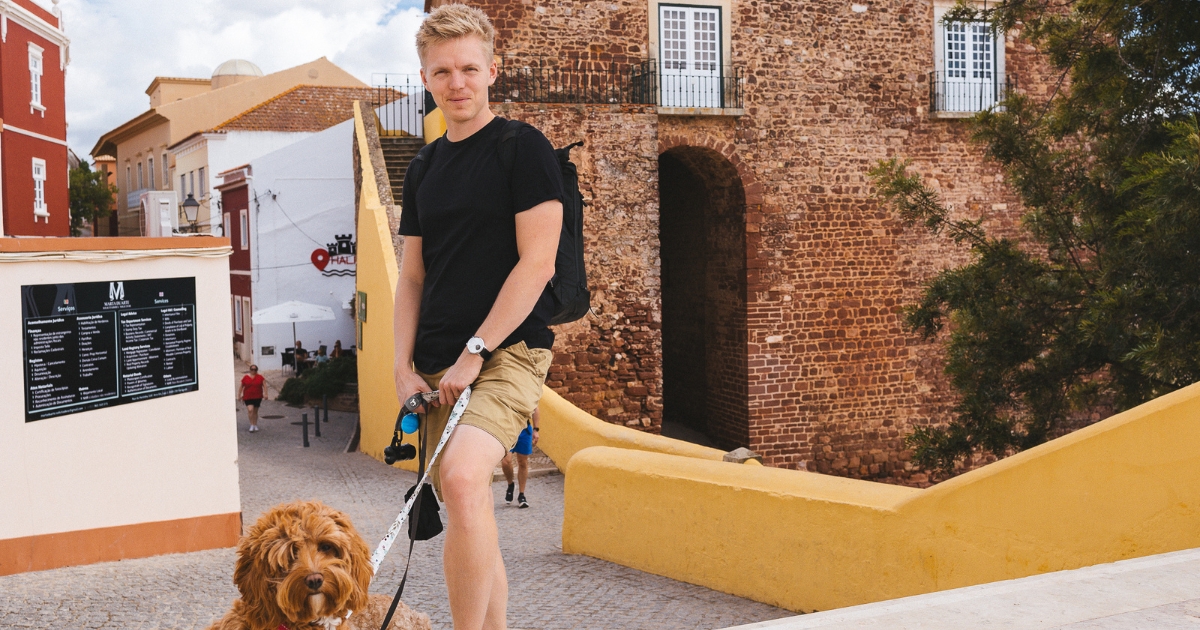
If you’re coming here for the first time and don’t have much time, simply walking through the town and soaking in its medieval atmosphere is enough. Here are the most important things you shouldn’t miss in Silves.
Silves Castle
Silves Castle is the dominant feature of the entire city, and I won’t lie to you, it’s what kept drawing us back here every time we visited the Algarve, until we decided we had to move here for a longer period. We ended up staying for a month and walked past this amazing castle every day, dating back to the time when the Moors lived here. The castle has a beautiful reddish-brown color, and from it, there’s a magnificent view of the entire city and the surrounding hills.
Silves Castle in Algarve from a bird’s eye view
Silves Cathedral (Sé)
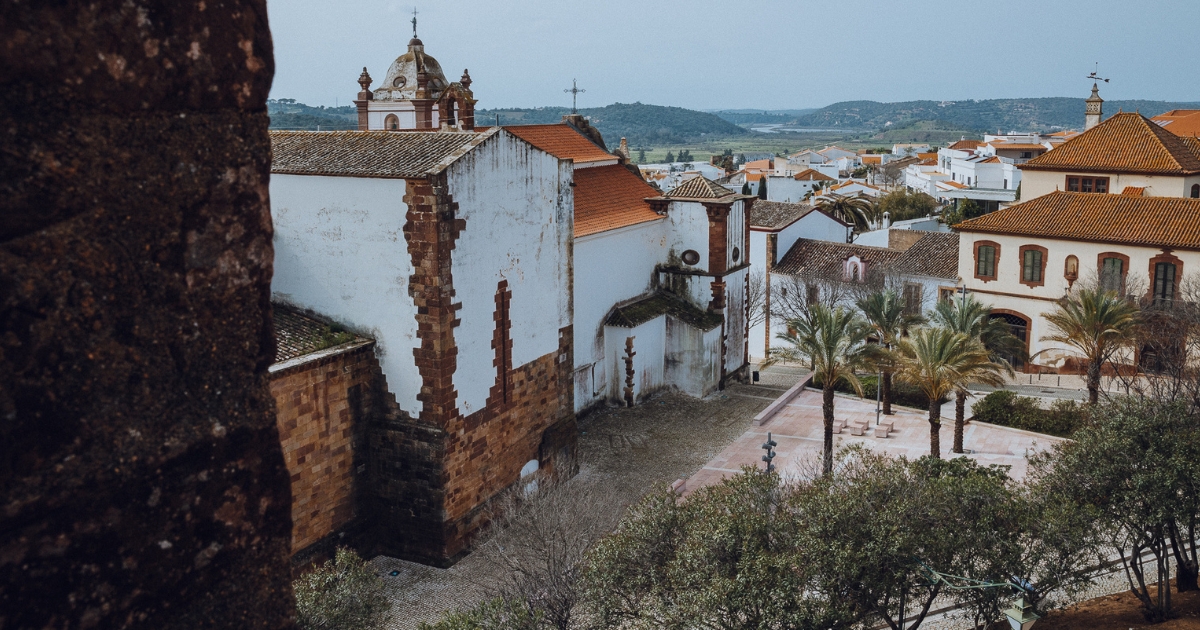
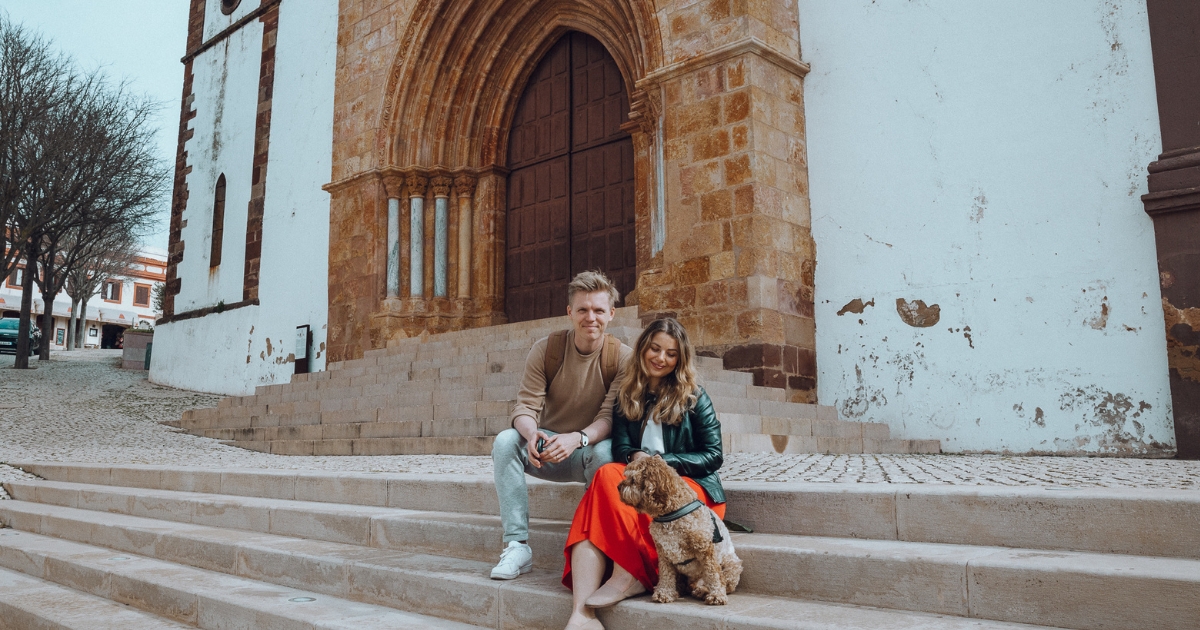
The local cathedral is magnificent, and you can’t miss it when you go to the castle, as it’s right next door. It was also built in 1189 on the site of an old mosque. You can go inside; it’s usually open from 9:00 AM to 5:30 PM. Outside of the season, hours may vary.
Silves Cathedral
Igreja Da Misericórdia De Silves Church Doors
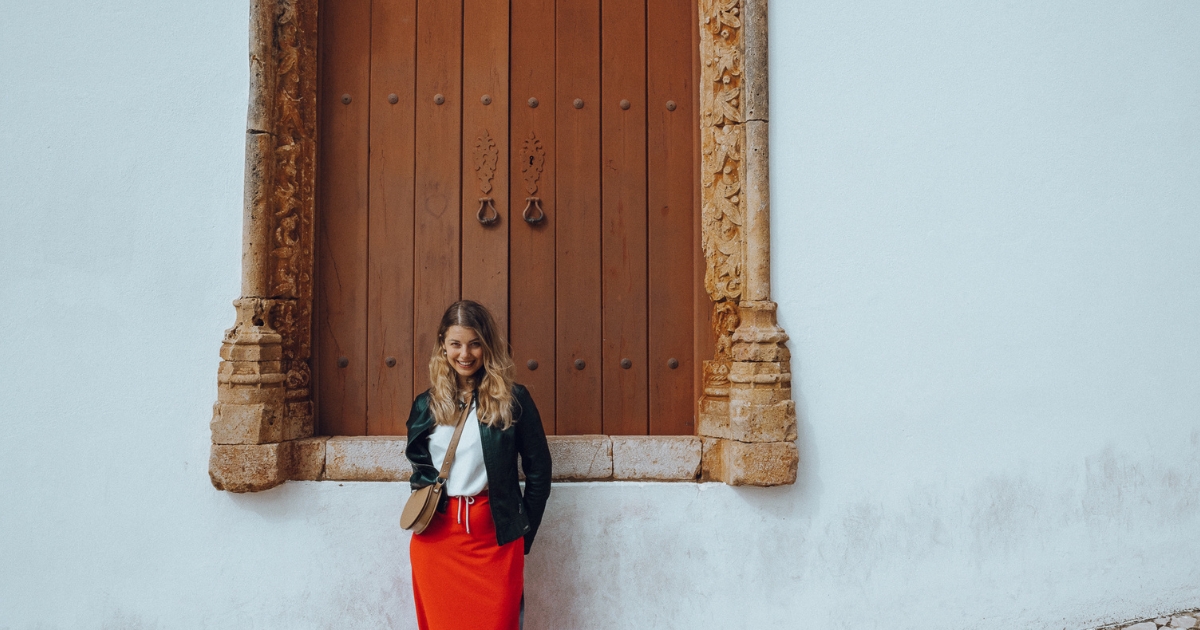
This church is directly opposite the cathedral and features very interesting 16th-century Manueline-style doors, while its interior boasts a stunning 17th-century altar.
What to See in Silves? Definitely the Historic Center
Ermida da Nossa Senhora dos Mártires was built in 1189 by King Sancho I as a final resting place for the brave soldiers who lost their lives during the conquest of the city. The original building is no longer visible here; today, you’ll find a charming blend of Gothic, Baroque, and Mannerist architectural styles.
Archaeological Museum – Museu Municipal De Arqueologia
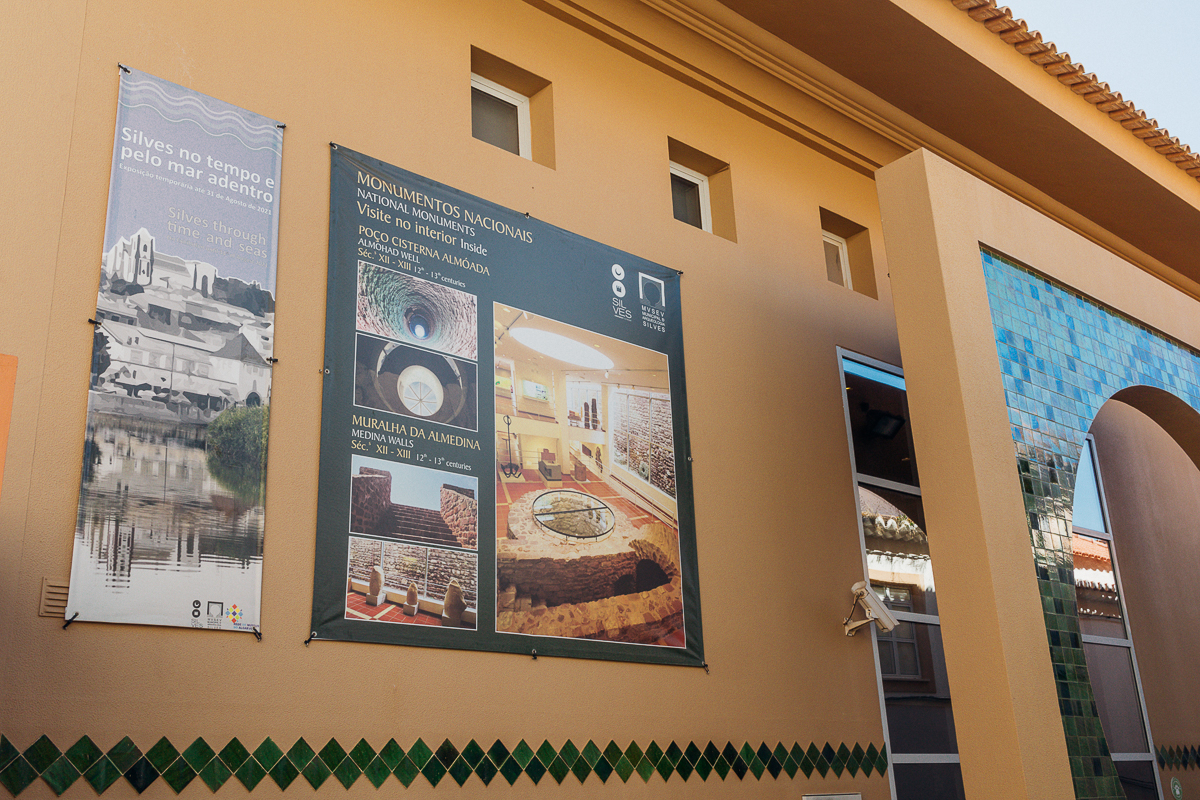
If you love history, visit the Archaeological Museum in Silves. You’ll find artifacts from various periods – from the Roman era, through the Islamic occupation, to the Christian Reconquista.
Interestingly, the museum is built around a 12th-century well, discovered back in the 18th century.
Museum in Silves
In the museum, you’ll also learn interesting facts about the city’s history, especially about the period under Muslim rule, and how the Arade River helped the city flourish in trade.
They are open from 10 AM to 6 PM, and admission is only €2.10 per entry. Additionally, you can buy a combined ticket for the castle and museum for €3.90.
Ponte Romana Bridge
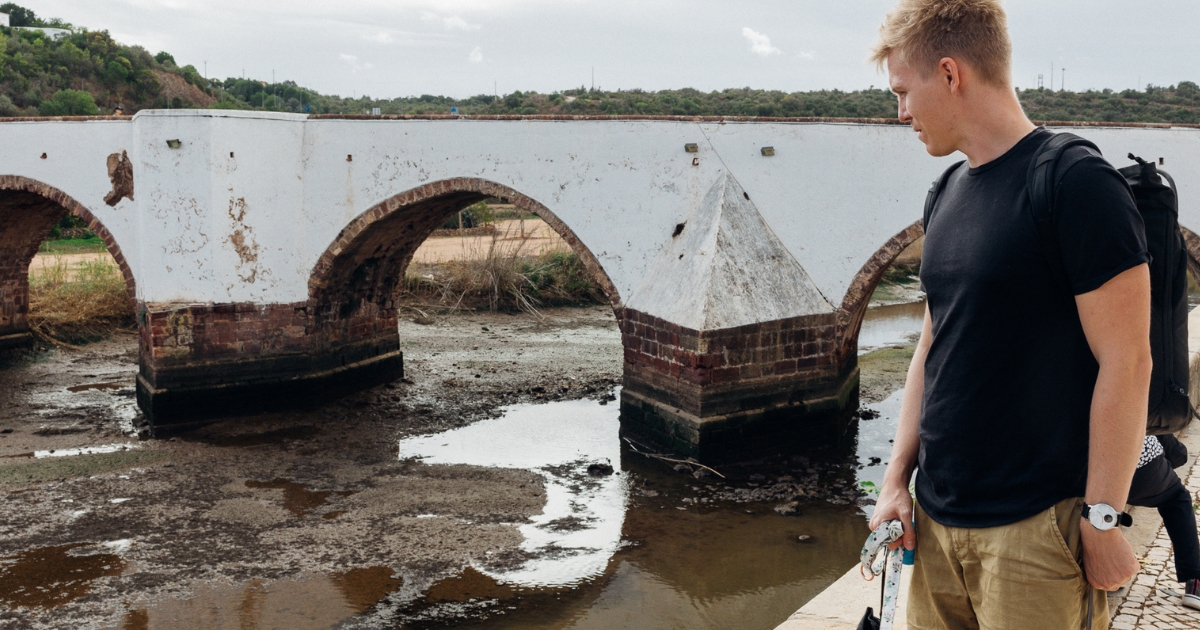
The local bridge isn’t a beauty 😁, that’s for sure, but we have to mention it because it was an important historical site for the residents of Silves. It was reportedly built during Roman times, which is likely why it’s called Ponte Romana – the Roman Bridge. The Rio Arade river flows beneath the bridge.
Ponta Romana Bridge in Silves
Silves Old Town
As I mentioned at the beginning, simply strolling through the romantic winding streets is practically enough for a tour.
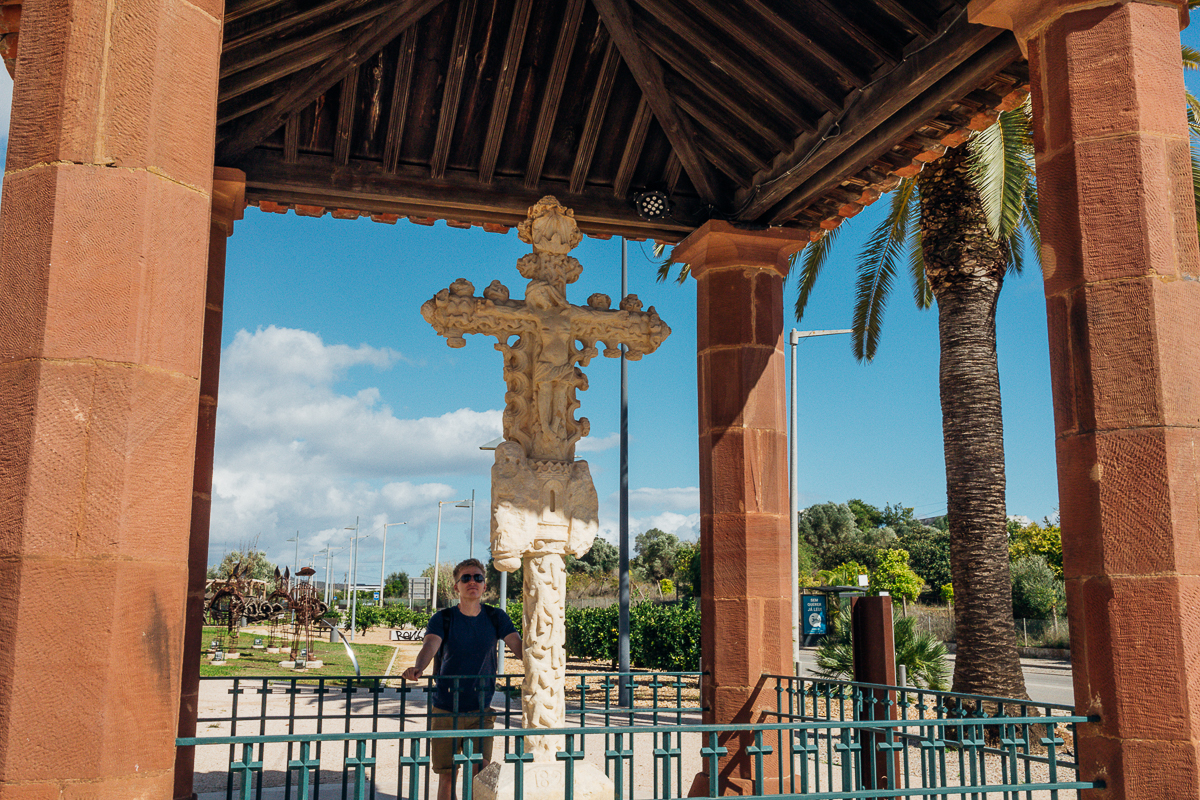
Cruz De Portugal Cross
Don’t miss the Cruz de Portugal, a significant religious monument that embodies Silves’ Christian history. Carved from white limestone and adorned with intricate carvings, its exact origin remains unknown, with dating estimates ranging from the late 14th to the late 15th century. It is generally believed to have been gifted to Silves by King Manuel I in 1499.
This cross, 3 meters high and depicting the crucified Christ and a poignant Virgin Mary, is a breathtaking example of the Flamboyant Gothic style. Its name, “Cruz de Portugal,” and the origin of the limestone suggest it comes from outside the Algarve, possibly Lisbon.
Over the years, the cross moved around the city until it reached its current location in 1957, where it is surrounded by a peaceful garden.
Cruz de Portugal Cross
Torreão Da Porta Da Cidade Tower
Don’t forget to make time to visit Torreão da Porta da Cidade when you’re in Silves! This defensive tower, also known as the City Gate, is a magnificent historical piece with a wonderful blend of Gothic and Baroque architecture.
Torreão da Porta da Cidade is a defensive tower, also known as the City Gate
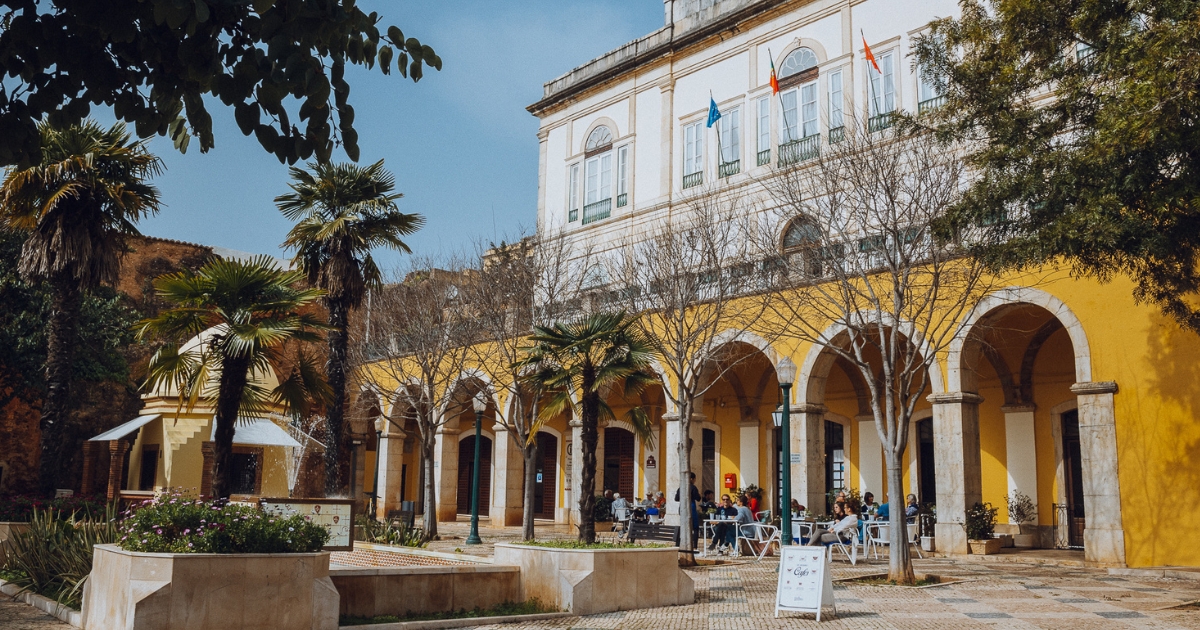
Relax at a Cafe in Praça Da Município Square
Praça da Município Square is an ideal place to relax and refresh yourself during your city tour. It’s also home to one of our favorite cafes, where you can grab a bite to eat.
We used to go here for coffee every day when we lived in Silves
Al Mouhatamid Ibn Abbad Park
Al Mouhatamid Ibn Abbad Park pays tribute to an 11th-century Arab leader known for his remarkable Arabic poetry. You can sit and relax here for a while; we enjoyed examining the local statues in detail; they look slightly comical.
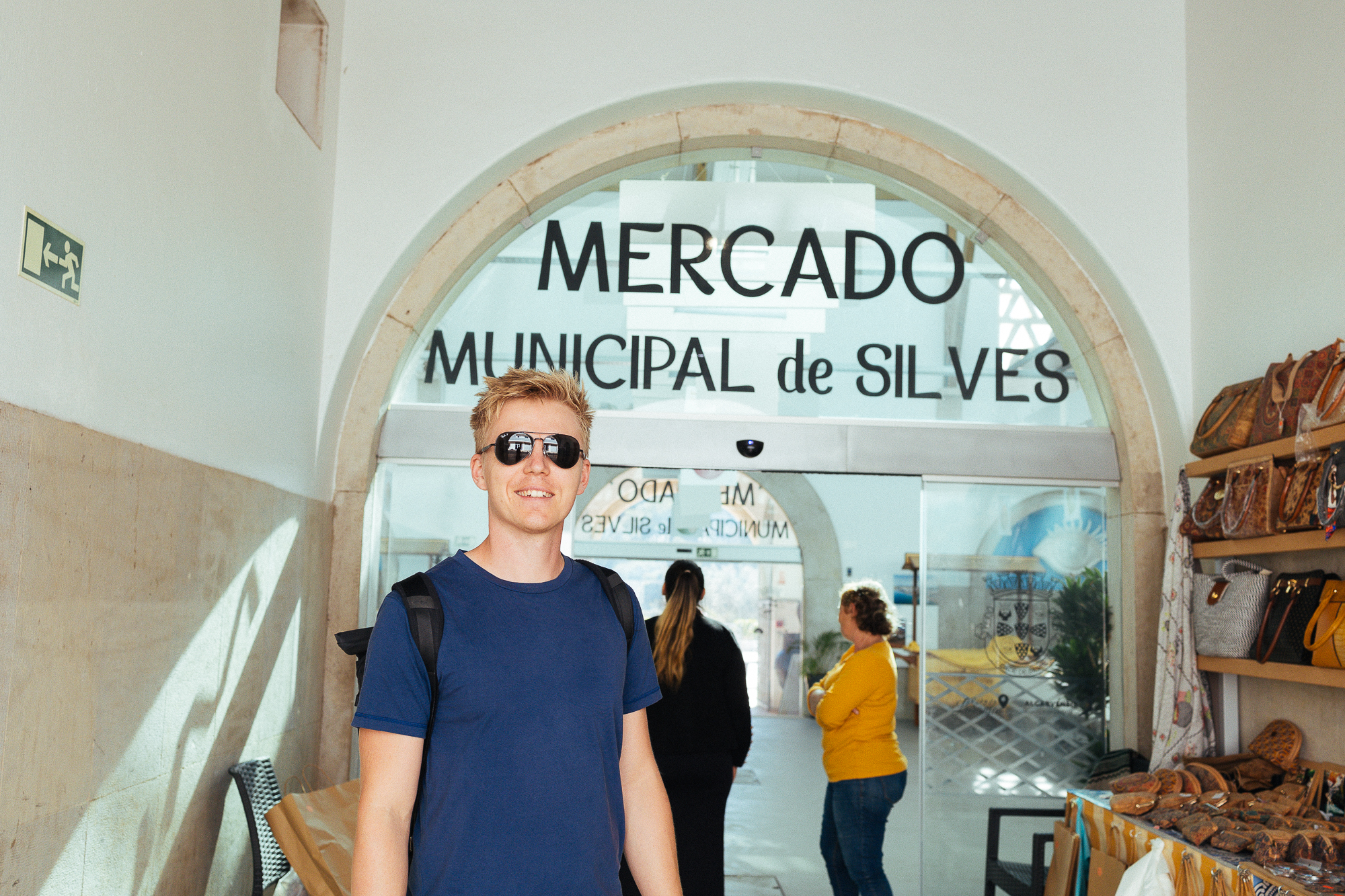
Mercado Municipal
If you find yourself in Silves, be sure to visit the Mercado Municipal, especially if you’re craving fresh fruits and vegetables or want to buy a nice souvenir.
Market in Silves, Portugal
Don’t miss the opportunity to taste local wines and juice from juicy oranges. There’s also a restaurant on the market’s rooftop, but it’s closed outside of the season.
Ceramic and Pottery Workshop
If you have a weakness for unique, hand-painted ceramic products, be sure to visit the charming Al-Tannur Ceramic Art Shop near the cathedral. Everyone says how lovely the couple who own it are, but Mrs. Teresa was quite unpleasant to us just because we wanted to take a photo there. However, it’s definitely a nice experience to see how she paints the ceramics.
Al Tannur Ceramics in Algarve
Cork Shopping
If you’re going to Portugal, you won’t miss cork products; they’re everywhere. Cork holds a special place in Silves’ history as a key export that significantly contributed to the city’s economy. Even when the Arade River began to silt up, affecting the city’s prosperity, cork remained a valuable commodity. Later, cork and dried fruit played an important role in Silves’ economic revival.
Cork is Everywhere in Portugal
Today, you can explore local shops throughout the city that offer an amazing range of cork products. Don’t forget to check out the shop on Rua de Abril, where you’ll find quality products at reasonable prices.
Lukáš and Lucie recommend
Where to stay in Silves
2 accommodations — hotels and other lodging options
🔗 These are affiliate links — they don't change your price and help us create content. · All experiences →
Best Day Trips around Silves
Since we know the Algarve quite well – given that we spend one to two months a year here – we’ll give you a few tips on where to go for a day trip from Silves.
Visit Portimão – Especially the Beaches
Just a 20-minute drive from Silves lies Portimão, where you’ll find our favorite beach for evening strolls – Praia da Rocha. There are also many restaurants along the promenade; we usually went to an Indian one, but we won’t force that on you.
One of the most beautiful beaches in the Algarve – Praia Rocha in Portimao
Zoomarine Algarve
Zoomarine Algarve is located in Guia, a short distance from Silves. It’s a marine theme park with dolphins, aquariums, and various water attractions, making it ideal fun with kids. Don’t forget to buy your ticket in advance, especially during peak season. As always, you can use the GetYourGuide portal; it works across Europe and is reliable.
🔗 These are affiliate links — they don't change your price and help us create content. · All experiences →
Praia Da Marinha
You probably know this beach from photos. Praia da Marinha, just a 30-minute drive from Silves, is one of the most beautiful beaches in the world. During peak season, it will likely be terribly crowded, so head there for sunrise.
The most beautiful beach in Portugal – Praia da Marinha
Praia De Benagil
Anyone heading to the Algarve must take a trip to the Praia de Benagil caves at least once. We’ve been several times; just book a trip through GetYourGuide, and you can go either just to the caves or also for dolphin watching.
🔗 These are affiliate links — they don't change your price and help us create content. · All experiences →
Albufeira
Albufeira isn’t exactly one of our favorite beach destinations, but I don’t know why, there’s a popular beach there, Falésia, which is ideal for families with children. We usually go to Albufeira mainly for food. It’s about 30 minutes from Silves.
Lagos
Lagos is our second favorite town in the Algarve after Carvoeiro; besides having our favorite pizzeria, it has a beautiful small historic center, and most importantly, some of the most beautiful beaches are nearby. Definitely head to the Ponta da Piedade viewpoint as well.
Ponta da Piadade
Ria Formosa Natural Park
Ria Formosa Natural Park is about an hour’s drive from Silves; you’ll find lagoons, sandy islets, and most importantly, you can observe birds there – the main attraction being flamingos. You can go on a catamaran trip via GetYourGuide. Which I consider probably the best way to explore this natural park.
🔗 These are affiliate links — they don't change your price and help us create content. · All experiences →
Loulé
We largely overlooked this city and only visited it on our fourth or fifth trip to the Algarve. Yet, it’s absolutely charming. Tiny, but charming.
The city of Loulé is about a 45-minute drive from Silves; you’ll find a beautiful castle, a great market, and pleasant establishments there. It’s a half-day trip.
Loulé is a beautiful historic town in the Algarve
Faro
The complete opposite of Loulé, we visit Faro every time we come to the Algarve. Faro is the capital of the Algarve region and is about an hour from Silves.
Here you can explore the well-preserved Old Town, visit the breathtaking cathedral, or stroll along the picturesque harbor.
Faro
Monchique
Everyone recommended a trip to Monchique, so I’ll write about it here too, but in my opinion, it doesn’t make that much sense.
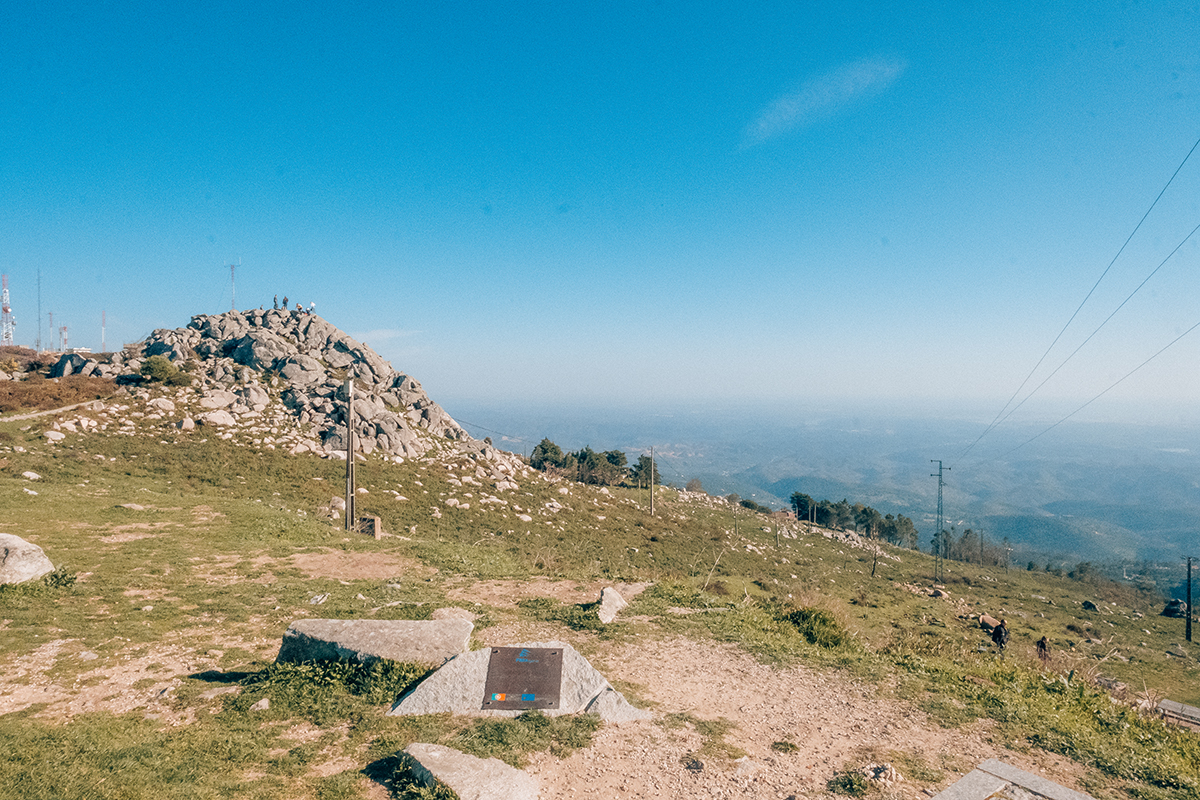
It’s a mountain town in Serra de Monchique; you’ll find beautiful trails there, even thermal baths, and there’s a view of the Algarve from there. But we prefer walking along the cliffs… if you’re in the Algarve for a very long time, then go check it out, otherwise there are many more beautiful places in this region of Portugal.
Monchique – Worth a Visit?
Best Restaurants and Cafes in Silves
In Silves, you’ll find great restaurants, but cafes are a bit trickier if you’re like us and want a bit of a hipster coffee.
The most popular restaurant is Café Ingles, it has existed since 1983, and they have live music performances every Friday and Saturday. I’d say the food in town is better, but the atmosphere makes it worthwhile.
If you want to enjoy the local music, it’s important to book your spot in advance.
Parsley & Thyme
One of the best restaurants for vegans is Parsley & Thyme, which, in addition to excellent vegan food, also has great service. Just be warned, don’t try the coffee here. It’s truly awful.
Among the best cafes in Silves is Café DaRosa, where you can try their special cappuccino. For those who want to taste the best ice cream in the Algarve, we recommend visiting Castelo dos Sabores.
Best Ice Cream in the Algarve
Visiting the local market is also an unforgettable experience. You definitely shouldn’t miss the Mercado Municipal de Silves, as well as the seafood you can taste there.
Seasonal Events and Festivals
Since we spend a lot of time in Portugal, we’ve also explored some festivals that are worth it.
Algarve International Jazz Festival
During the summer months, Silves comes alive with a series of music festivals and concerts that attract both local and international talent. The city hosts the renowned Algarve International Jazz Festival, featuring famous jazz musicians from around the world.
In addition to music, you can look forward to live street performances, art exhibitions, and stalls with a diverse selection of culinary delights.
Silves Medieval Fair
If you find yourself in Silves in August, a magical Silves Medieval Fair awaits you. The Al-Muthamid Gardens transform into a bustling center of historical merriment that cannot be missed.
Every evening, a lively procession passes through the city, winding through the streets and ending right in front of the cathedral. You practically can’t miss them when you’re in town. It’s not that big of a city.
🔗 These are affiliate links — they don't change your price and help us create content. · All experiences →
Algarve Orange Festival
Yep, there’s also an orange festival in Portugal (they even have a peanut festival, haha). If you like quirky events and food, you can visit it.
Google “Festa da Laranja” before your trip; it’s held every spring, in March or April. Maybe your stay will coincide with the dates.
Tips and Tricks for Your Vacation
Don’t Overpay for Flights
Search for flights on Kayak. It’s our favorite search engine because it scans the websites of all airlines and always finds the cheapest connection.
Book Your Accommodation Smartly
The best experiences we’ve had when looking for accommodation (from Alaska to Morocco) are with Booking.com, where hotels, apartments, and entire houses are usually the cheapest and most widely available.
Don’t Forget Travel Insurance
Good travel insurance will protect you against illness, accidents, theft, or flight cancellations. We’ve had a few hospital visits abroad, so we know how important it is to have proper insurance arranged.
Where we insure ourselves: SafetyWing (best for everyone) and TrueTraveller (for extra-long trips).
Why don’t we recommend any Czech insurance company? Because they have too many restrictions. They set limits on the number of days abroad, travel insurance via a credit card often requires you to pay medical expenses only with that card, and they frequently limit the number of returns to the Czech Republic.
Find the Best Experiences
Get Your Guide is a huge online marketplace where you can book guided walks, trips, skip-the-line tickets, tours, and much more. We always find some extra fun there!
TL;DRTavira, a historic town on the eastern Algarve about 30 kilometres from Faro, suits either a 2 to 3 day trip or a week-long holiday with day trips further afield. Among the 17 tips, the standouts are the ancient Ponte Romana over the Gilão river, the Moorish Castelo de Tavira, and the beaches Ilha de Tavira and Praia do Barril, famous for its anchor cemetery and reachable by ferry or the little tourist train. The best time to visit is September and the first half of October, when the sea sits at 21 to 22 degrees and accommodation prices drop by 20 to 30 percent, whereas August brings temperatures over 30 degrees and crowds of tourists. Don’t skip the Ria Formosa nature park, great for flamingo-spotting, or the fishing village of Cabanas de Tavira.
In February, my mom visited us in Portugal for a week, and so we decided to explore Tavira, a beautiful town in the eastern Algarve, Portugal. It was love at first sight! In this guide I will share Tavira, Portugal: 17 Best Things to Do and See.
The picturesque charm of this town, with its old Roman bridge and charming historic streets, immediately captivated us. Tavira is located just 30 kilometers east of Faro. Let’s take a look at what to see and do in Tavira, Portugal.
Tavira is located approximately 30 km east of Faro, making it an easily accessible destination from the region’s main transport hub. We arrived here from Carvoeiro; the journey takes about an hour (approximately 80 km).
It stretches along both banks of the winding Rio Gilão and is home to a hilltop castle ruin, an old Roman bridge, and several Gothic and Renaissance churches.
The town is also part of the Ria Formosa Natural Park, a network of protected lagoons and islands that serve as a sanctuary for various bird species and marine life.
Tavira is a charming town in the Algarve, a short distance from Faro.
Tavira – Accommodation Tips and Best Hotels
Tavira is a smaller town, so you’ll find a limited amount of accommodation here, but there are still plenty of hotels that provide comfortable (and affordable) lodging. One of our top choices is Quinta da Capelinha Agroturismo.❤️ Everyone we’ve sent there has loved this hotel. If it’s full, there are other options, such as Hotel Rural Quinta do Marco – Nature & Dining.
Lukáš and Lucie recommend
Where to stay in Tavira
3 accommodations — resorts and other lodging options
Tavira’s history dates back several centuries. Traces of its past can be found in various remnants left by the Phoenicians, Romans, and Moors. Tavira, which originated during the time of the Phoenicians, was a key settlement in the region and continued to grow under Roman rule.
The Moors later conquered the city in the 8th century and significantly influenced its development until the 13th century, when the city was reconquered by the Portuguese during the Reconquista.
In 1755, a devastating earthquake struck the region, causing significant damage. However, Tavira persevered and rebuilt itself, preserving the architectural heritage that is still visible today.
Tavira, Portugal: 17 Best Things to Do and See
Tavira is truly a magical town where every corner tells a story of its rich past through architectural monuments. Moreover, it’s just a short distance from beautiful Portuguese beaches, where you can always escape when it gets too hot.
Ponte Romana
The ancient bridge, which spans the Rio Gilão, was one of the first things we saw in Tavira. It serves as a reminder of the city’s Roman past thanks to its sturdy stone construction. Each arch of the bridge, beautifully reflected in the calm water below, creates a picturesque scene that looks like it’s taken from a classic painting.
Roman Bridge in Tavira, Algarve, Portugal
Castelo De Tavira
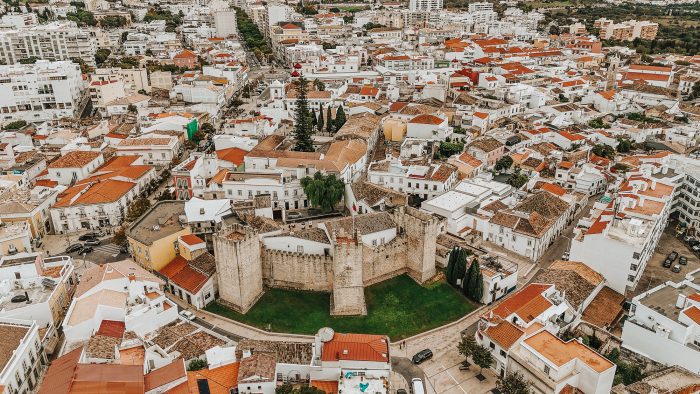
This 13th-century Moorish castle stands on a hill overlooking the city. Its outer walls remain, offering visitors the opportunity to explore ancient architecture and soak in panoramic views of the surrounding landscape.
Inside the castle, there’s a beautiful garden, and you can walk along the ramparts to enjoy a lovely view of the city. 😍
View from the Castelo de Tavira from Igreja de Santa Maria do Castelo
Igreja De Santa Maria Do Castelo
Igreja de Santa Maria do Castelo stands right in the heart of the city. The church is a beautiful blend of Gothic, Renaissance, and Baroque styles, with every corner telling stories from ancient times. Seven Christian knights, who played a key role in the city’s conquest from the Moors, are buried here.
Don’t forget to visit the elegant bell tower, which offers panoramic views of Tavira, making it an ideal spot for reflection and photography.
São Paulo Church
São Paulo Church is another symbol of Tavira’s rich ecclesiastical heritage. Unlike the historical grandeur of Igreja de Santa Maria do Castelo, São Paulo Church displays a more modest but equally captivating architectural style.
Its unassuming facade invites you into a space of spiritual tranquility, where the simplicity and quiet beauty of the interiors allow for peaceful contemplation. Inside, explore the artworks and the elaborate altar, which tell religious stories through every stroke and carving.
Praia Da Ilha De Tavira
Are you in Portugal during the summer and need to cool off somewhere? Tavira is known for its beautiful and tranquil beaches, and one beach you definitely must visit is Praia da Ilha de Tavira, a secluded spot famous for its crystal-clear waters and soft white sand. This sandy oasis is accessible by ferry and is an ideal place for soaking up the sun and enjoying a refreshing swim in the Atlantic Ocean.
Praia Do Barril
Praia do Barril is considered one of the best beaches in the Algarve. It is located about 5 kilometers from the city of Tavira, on Ilha de Tavira in the Algarve region of Portugal. It is part of the Ria Formosa Natural Park, which we definitely recommend visiting when in the Algarve; you can easily book a trip through GetYourGuide.
🔗 These are affiliate links — they don't change your price and help us create content. · All experiences →
Praia Da Terra Estreita
Further along the coast, you’ll find the less crowded Praia da Terra Estreita, a narrow strip of sandy paradise that provides the perfect escape for those looking to avoid busy beach spots during peak season.
Experience Olive Oil Production Firsthand and Taste the Region’s Best Olives
This activity is a great way to immerse yourself in the local agricultural tradition and to see and taste the most popular olive products.
It’s fascinating to see how hand-picked olives are carefully transformed into various delicious products like olive oil or chili sauces.
What makes this tour exceptional is the tasting. You’ll have the opportunity to sample various olive-based products and understand the flavor profiles characteristic of this region. The tasting also extends to a special wine session where you can enjoy local wines.
🔗 These are affiliate links — they don't change your price and help us create content. · All experiences →
Dolphin Watching
If you’re in Portugal with kids, you definitely shouldn’t miss dolphin watching. In fact, I don’t see why you wouldn’t go dolphin watching even without kids, but children love such trips even more than adults do. Again, you can easily book the trip through GetYourGuide; in summer, I recommend booking in advance (it can also be easily canceled).
🔗 These are affiliate links — they don't change your price and help us create content. · All experiences →
Galerie d’Artes
If you are an art enthusiast, we recommend a stop at this charming gallery. Despite its small size, the gallery offers a wide range of artworks that reflect the vibrancy and creativity of the local art scene.
At the entrance, you’ll be greeted by well-informed staff, so if you speak English, you can learn a lot about the artists and individual artworks, which is always a richer experience than just viewing the pieces.
Tavira d’Artes Art Gallery Tavira
Kayaking
If you enjoy kayaking, you can head to the Ria Formosa Natural Park, which is a labyrinth of channels, islands, and lagoons, making it ideal for paddling.
Golf
If you prefer golf, you’ll find quite a few golf courses around Tavira. These courses cater to both beginners and advanced players, and many boast breathtaking views of the surrounding landscape. Popular courses include Benamor Golf, Quinta da Ria, and Quinta de Cima.
Tavira Museum
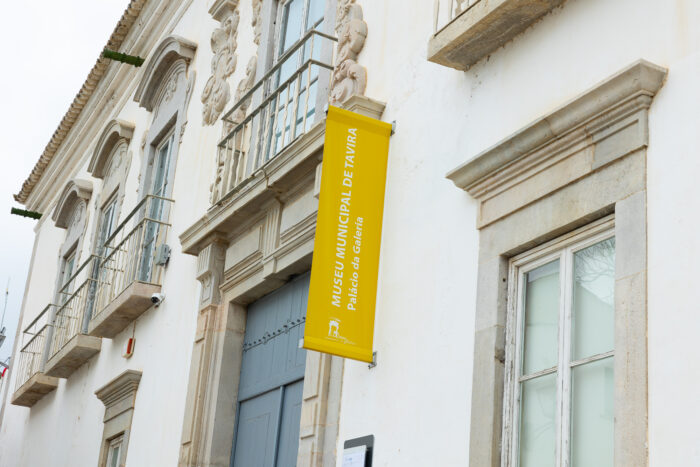
Tavira Municipal Museum, housed in the 16th-century Palácio da Galeria, showcases the city’s rich history and cultural heritage. Here you can explore Phoenician sites from the 7th to 6th centuries BC, including ritual wells dedicated to the storm god Baal. The museum also illuminates Tavira’s Islamic and Moorish past through various archaeological exhibits.
Tavira Municipal Museum
Ria Formosa Natural Park – Flamingo Watching
If you’re in Tavira, we definitely recommend heading to Ria Formosa Park, a protected area with a unique ecosystem and rich biodiversity.
Birdwatching tours, hiking, and boat trips are available, allowing you to appreciate the natural beauty of this region. It’s a great place for flamingo watching!
During peak season, be sure to book your trip in advance via GetYourGuide.
Explore the Salt Pans in Tavira
A salt pan or salt flat is a natural or artificial formation where salt is extracted. It is an area that is regularly flooded with saltwater, which then evaporates, leaving behind salt crystals.
Tavira boasts very clean water from the Atlantic, and its salt pans are proof of this. Salt known as Flor de Sal originates from here, and it was once sent as far as the Roman Empire.
If you’re wondering what to buy as a souvenir, I definitely recommend Flor de Sal. It can be quite expensive in the Czech Republic.
You can also take a 7km walk around the salt pans. Along the way, you might spot many different bird species.
Visit Pego Do Inferno Waterfall near Tavira
One of the stunning places you should visit near Tavira is the Pego do Inferno waterfall. Head towards Santo Estêvão, and from the parking lot, it’s just a short walk along a path that leads you to this magical natural wonder.
During hot summers, Pego do Inferno can be crowded, so if you can, visit this place outside of peak season when you might have the waterfall almost to yourself. It’s especially beautiful in spring, right after the rainy season, when the waterfall has more water.
Explore Cabanas De Tavira near Tavira
A pleasant excursion around Tavira is a visit to the picturesque fishing village of Cabanas de Tavira.
The history of Cabanas de Tavira dates back to the early 18th century, when the village emerged in connection with Tavira’s growing tuna industry. Originally, it was a group of small huts (Portuguese “cabanas”) used for storing fishing equipment.
With the flourishing of tuna fishing, many fishermen decided to settle permanently in this peaceful area.
Today, Cabanas de Tavira is a picturesque place with colorful fishing boats set against the tranquil waters of the Ria Formosa Natural Park. During your visit, don’t forget to visit the São João da Barra fortress, which adds a historical touch to your trip.
Best Restaurants in Tavira
In Tavira, you’ll find quite a few good restaurants. As vegetarians, we have limited options, so we usually end up at an Indian restaurant. Our favorite is called Dawat Indian Restaurant, but Little India Indian Restaurant is also great.
If you don’t like Indian food, try Tavila Cafe where you’ll find great tapas and they also have vegetarian and vegan options. Avant–Garde Bistro is also a great bistro; again, they have vegetarian food, and our friends love their burgers and mackerel there. 😁
Best Cafes in Tavira
If you love coffee and enjoy hipster cafes that serve a good flat white, that’s generally still a problem in the Algarve. The best cafes in Tavira are probably Cafeteria Originato or Flavour Cafe Tavira Downtown.
🔗 These are affiliate links — they don't change your price and help us create content. · All experiences →
FAQ
How Long to Visit Tavira For?
1-2 days are enough for Tavira. You’ll spend half a day exploring the town and the rest on trips, excursions, and relaxing on the beaches.
Tips and Tricks for Your Vacation
Don’t Overpay for Flights
Search for flights on Kayak. It’s our favorite search engine because it scans the websites of all airlines and always finds the cheapest connection.
Book Your Accommodation Smartly
The best experiences we’ve had when looking for accommodation (from Alaska to Morocco) are with Booking.com, where hotels, apartments, and entire houses are usually the cheapest and most widely available.
Don’t Forget Travel Insurance
Good travel insurance will protect you against illness, accidents, theft, or flight cancellations. We’ve had a few hospital visits abroad, so we know how important it is to have proper insurance arranged.
Where we insure ourselves: SafetyWing (best for everyone) and TrueTraveller (for extra-long trips).
Why don’t we recommend any Czech insurance company? Because they have too many restrictions. They set limits on the number of days abroad, travel insurance via a credit card often requires you to pay medical expenses only with that card, and they frequently limit the number of returns to the Czech Republic.
Find the Best Experiences
Get Your Guide is a huge online marketplace where you can book guided walks, trips, skip-the-line tickets, tours, and much more. We always find some extra fun there!
TL;DRFaro, in Portugal’s Algarve, comes with 18 ideas for things to see and do: the old town of Cidade Velha, the Sé Catedral de Faro, the eerie Capela dos Ossos, and the Ria Formosa natural park with its islands, Ilha Deserta and Ilha da Culatra. One day is enough for the city itself, but give the surrounding area 3 to 4 days if you want to fit in trips to Tavira or the Palácio de Estoi. The best time to visit is September and the first half of October, when the sea is warmest and accommodation prices drop by 20 to 30%. Alternatively, try the quieter months of February, October and November, with temperatures around 16 to 18°C. Faro also makes a great base for exploring the eastern Algarve, including Tavira and the Roman ruins at Milreu, with entry fees running to just a few euros (the cathedral costs 3.5 euros, the bone chapel 2 euros).
Since Faro has an airport, many travelers start their exploration of Algarve right here. In this guide I will share Faro, Portugal: 18 Best Things to Do and See. You’ll find it on the southern tip of Portugal, and this city is also the main center of Algarve, making it an ideal starting point for exploring this region. You’ll find beautiful beaches here, as well as historical sites and nice restaurants and cafes.
We most often visit Algarve off-season in February or in October and November because the weather is pleasantly sunny, and there aren’t many tourists, although you can’t swim (Luky did go in in October though 😁, but I didn’t).
In spring, in April and May, temperatures are mild, around 20-25°C, which is ideal for walks and nature trips. The hardier ones already swim, and you won’t bake like in summer.
Summer (June-August) brings hot days with temperatures above 30°C, perfect for beach activities and water sports; however, you must expect it to be very touristy here.
The autumn months of September and October are probably ideal; temperatures are around 25-30°C, you can still swim well until early October, and there aren’t as many tourists.
Winter here is quite sunny (even though it rains the most at this time, it’s still little compared to Czech standards), it’s really not for swimming, but it’s peaceful, and you can explore the most beautiful beaches almost without people.
Faro, Portugal – Best Beaches
How to get around Faro and the Surroundings?
It’s best to rent a car because local public transport isn’t ideal if you want to see a lot. Bus coverage isn’t perfect, and you’d have to take taxis. Moreover, car rental isn’t usually expensive; we recommend checking DiscoverCars before you fly to Faro, as you’ll get better deals there than directly at the airport.
Best Accommodation in Faro: Hotel and Apartment Tips
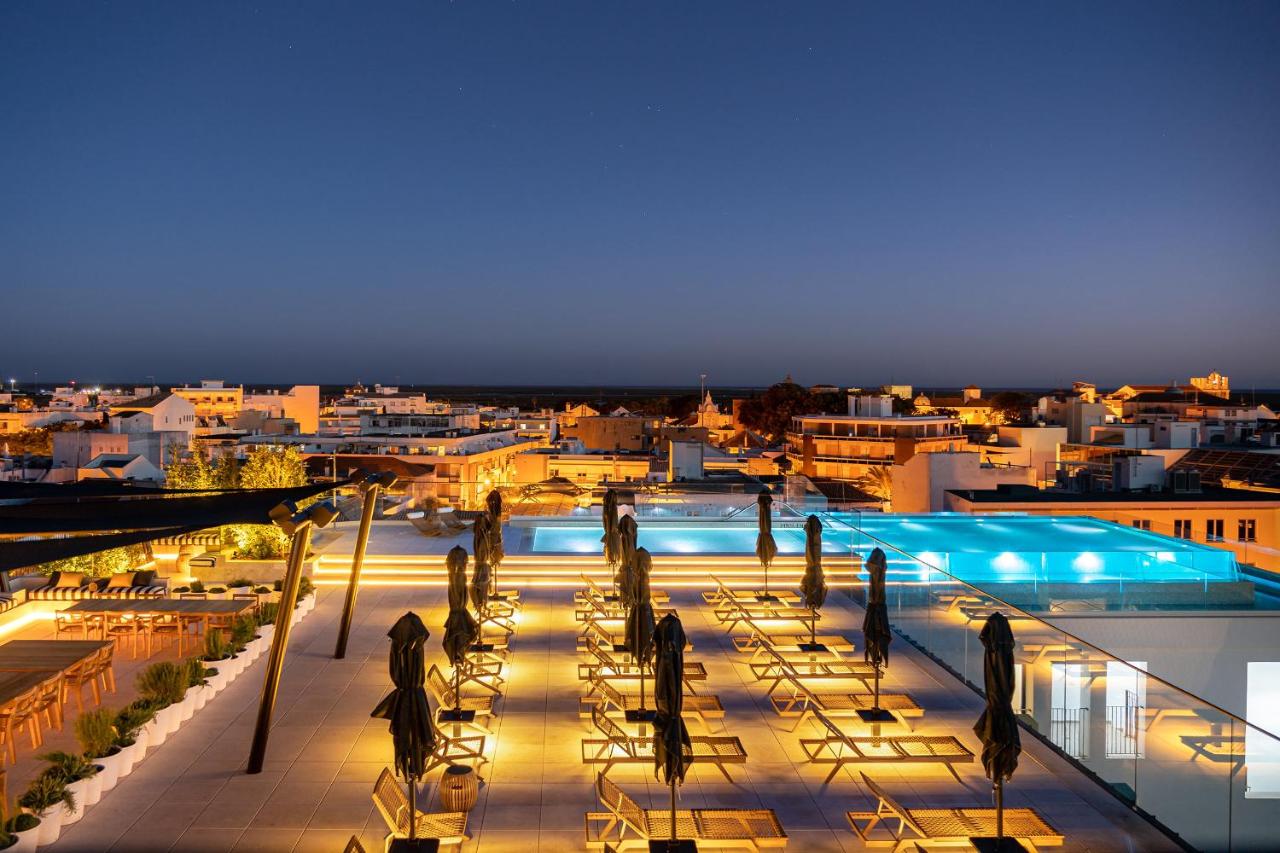
Where to stay in Faro? If you want something cheaper, you’ll find Baron Faro – Guest House near the center, and it’s sufficient as basic accommodation.
If you’re looking for a great apartment, among the best is be Unforgettable Apartment, but they are often sold out during the season.
Want something a bit more luxurious? In this location, nothing beats 3HB Faro, but you’ll pay for it too.
Craving something more grandiose? 10 km from Faro, you can stay in a palace – Pousada Palacio de Estoi – Small Luxury Hotels of the World.
3HB Faro
Lukáš and Lucie recommend
Where to stay in Faro
4 accommodations — wellness hotels, hotels and other lodging options
You’ll find a lot in Faro; it has a rich history, beautiful beaches, and a short distance away you’ll also find beautiful natural parks. Let’s take a look at what you shouldn’t miss in Faro.
What to Do in Faro
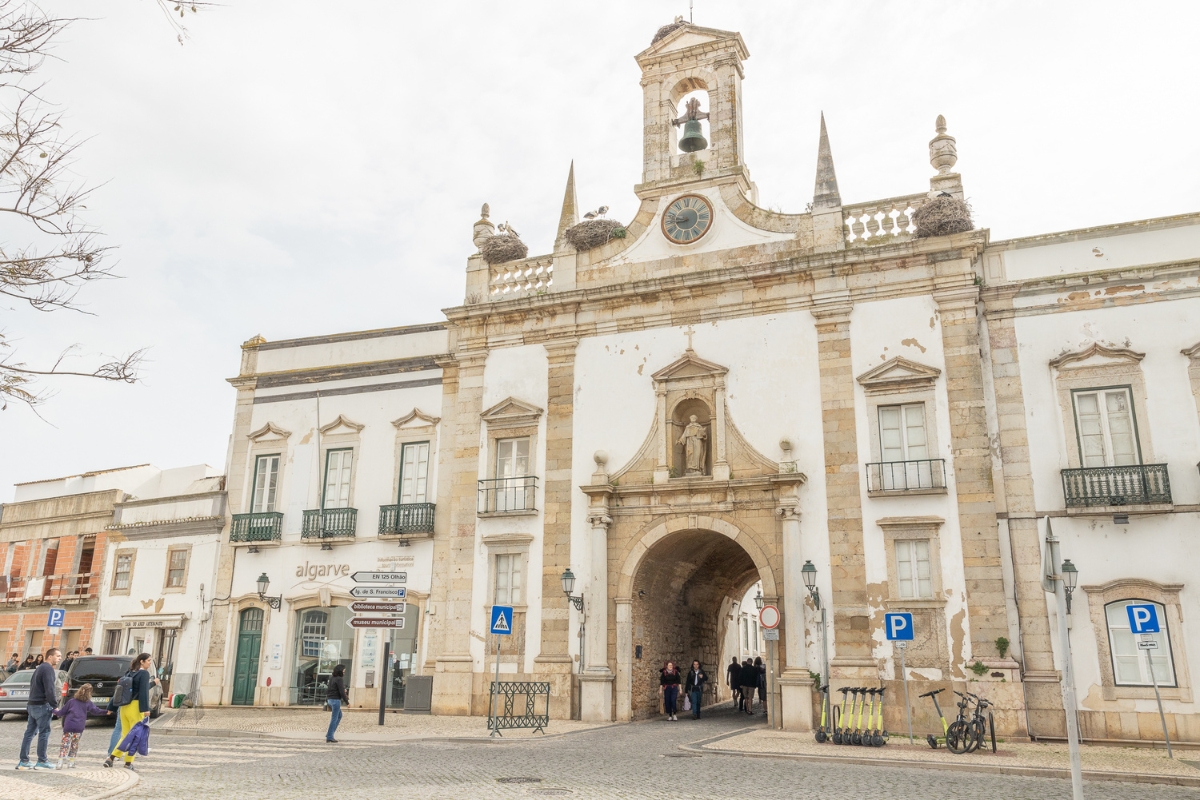
Centro Histórico (Vila Adentro)
Centro Histórico, known as Vila Adentro, is the heart of Faro’s historic center. It is located right by the docks with views of the beautiful Ria Formosa, which was once the economic lifeline of the area.
Don’t miss visiting Sé Cathedral and the municipal museum, which is housed in a former monastery. And when you’ve had enough of history, enjoy a coffee in one of the cozy squares where you can observe local life.
Faro, Portugal
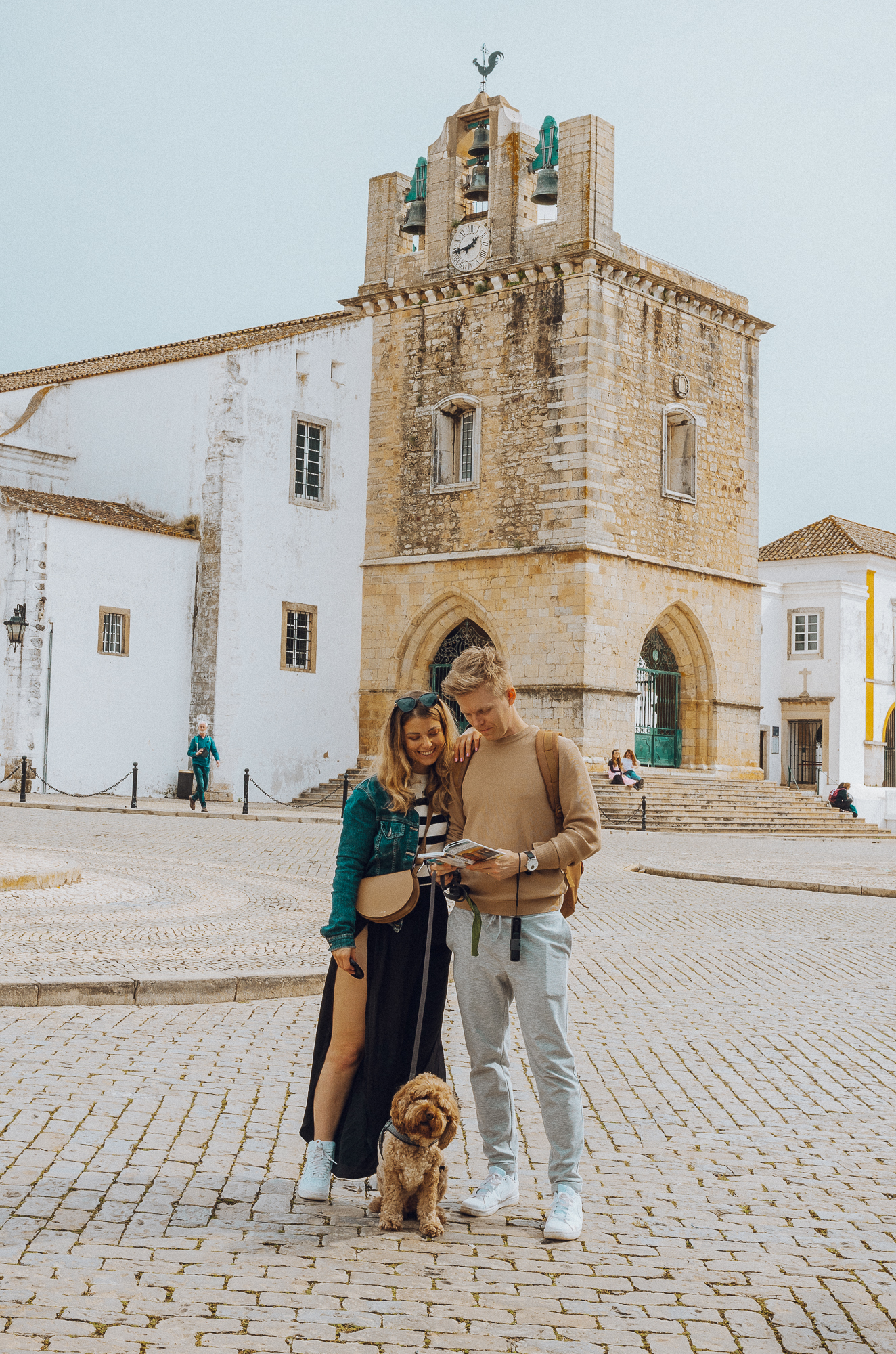
Sé Catedral De Faro
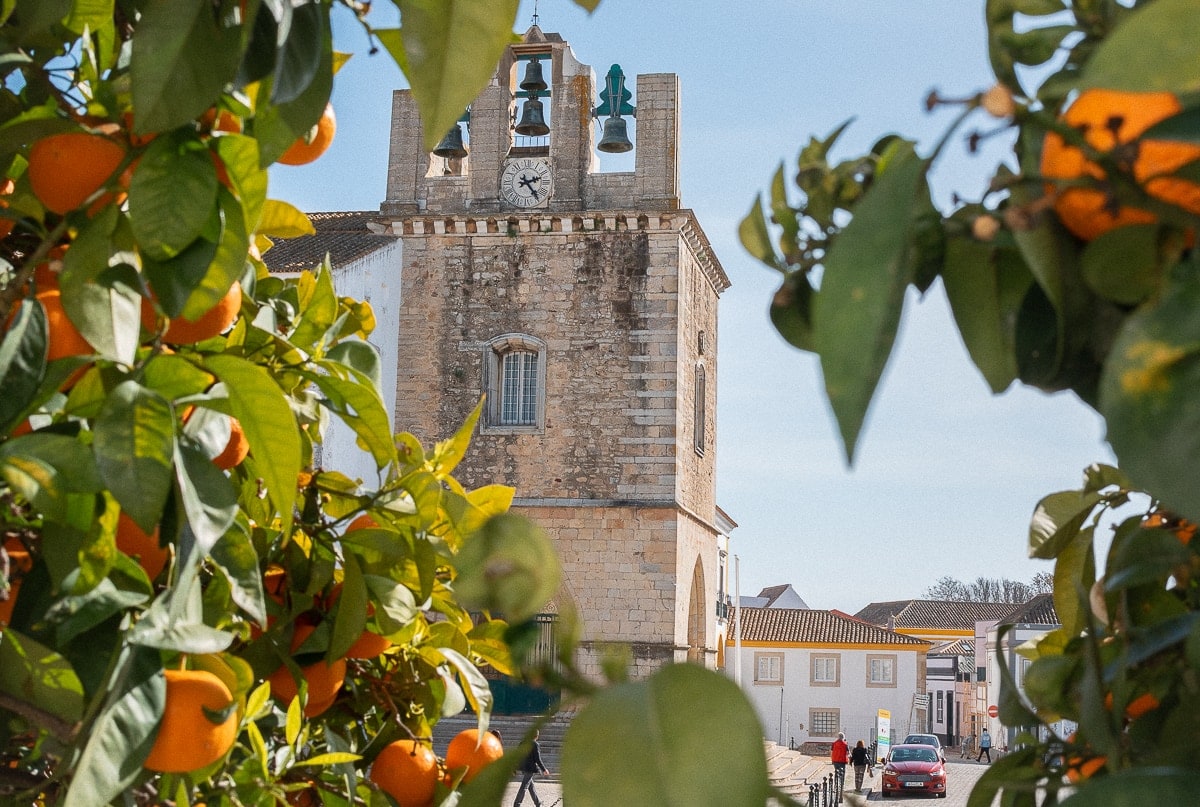
The dominant landmark of Faro is undoubtedly the cathedral Sé Catedral de Faro. This Roman Catholic cathedral is one of the most important historical monuments in the city.
It was built in 1251, and you can climb up to the tower for 3.5 euros, from where you have a magnificent view of the surroundings.
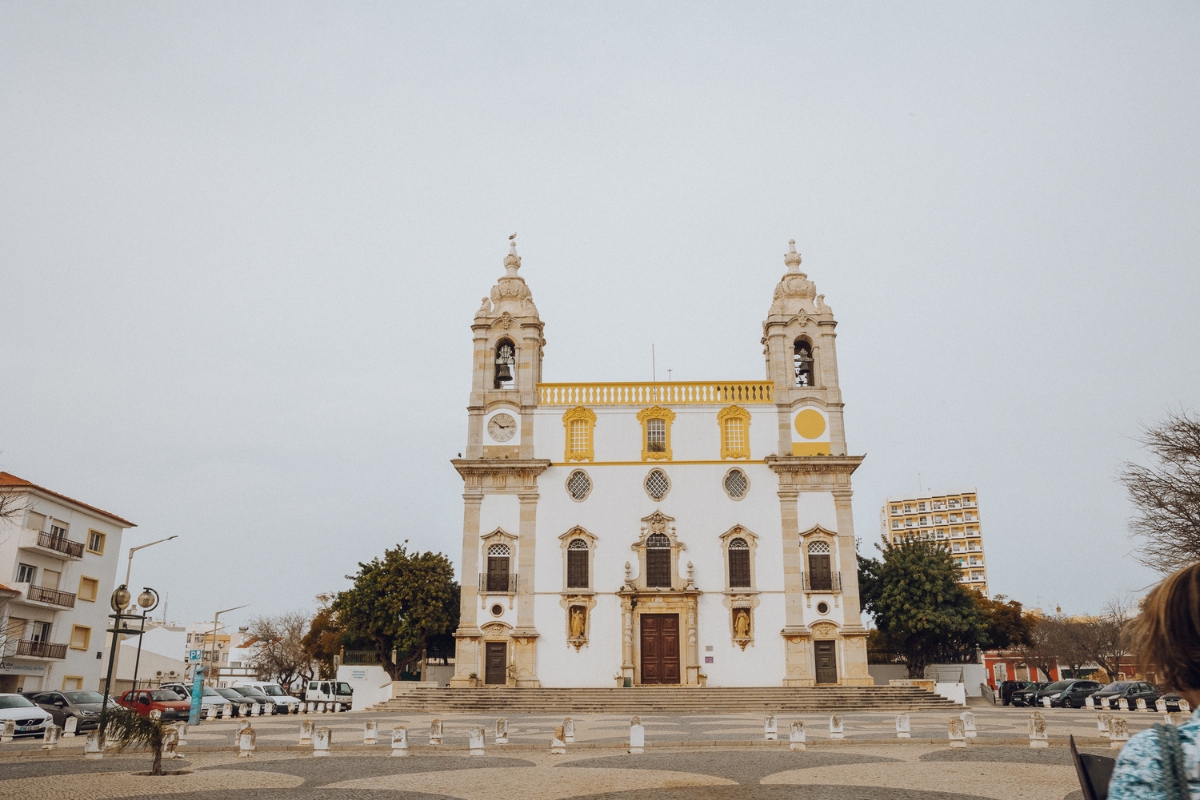
Faro, Portugal – Igreja do Carmo
Igreja Do Carmo
Igreja do Carmo, also known as Igreja da Ordem Terceira de Nossa Senhora do Monte do Carmo, is an important religious and historical monument in the city of Faro.
It is known for its Chapel of Bones – Capela dos Ossos, which is decorated with human bones and skulls.
You’ll find it in Largo do Carmo square. This Baroque building was completed in 1719 and is known for its impressive interior, richly decorated with gold from Brazil.
The church is open from Monday to Friday from 10:00 AM to 1:00 PM and from 3:00 PM to 5:30 PM, on Saturday only from 10:00 AM to 1:00 PM.
There are Beautiful Beaches Around Faro
Praia De Faro
If you’re already in Faro, you shouldn’t miss the local beach, where, besides golden sand and clear water, you’ll also find nice establishments where you can refresh yourself.
Marina De Faro
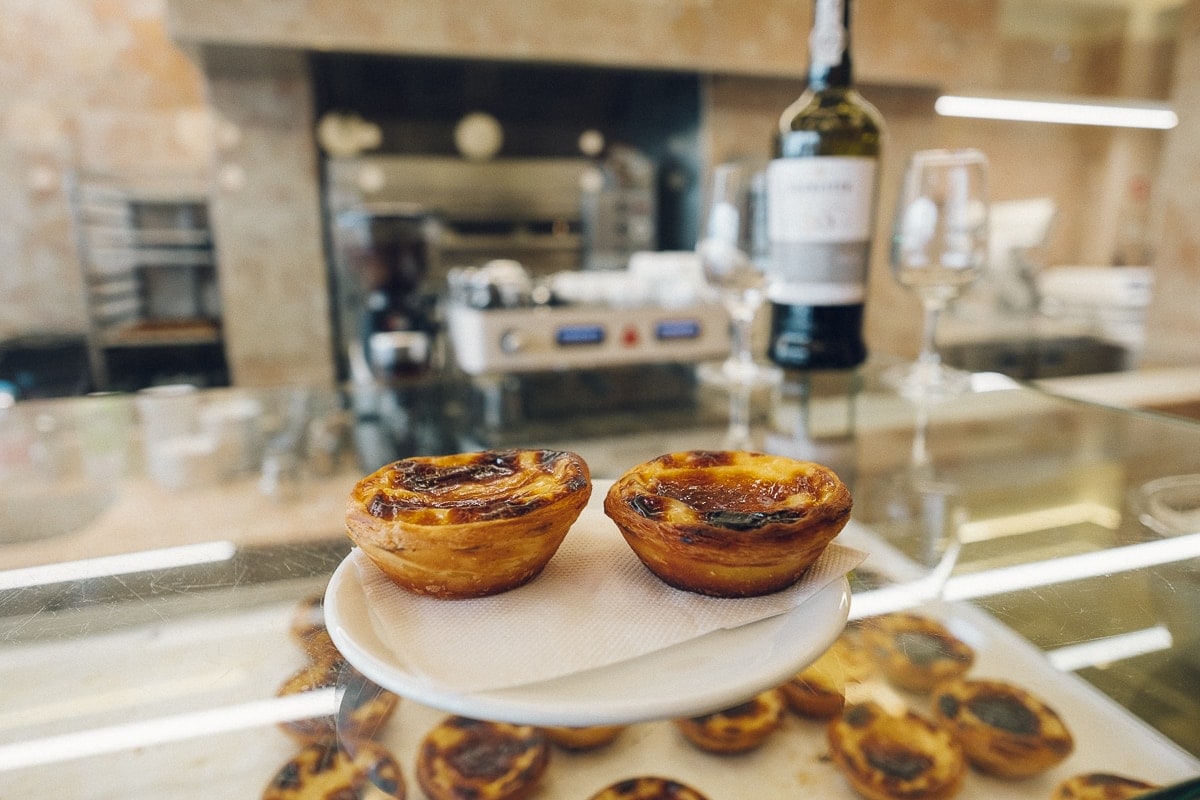
You definitely won’t miss the marina, as Faro isn’t that big. Take your time to walk through it, and then you can sit in a nearby cafe or restaurant and have a small bite to eat. We recommend the typical Portuguese dessert pastel de nata.
Pastel de nata
Parque Natural Da Ria Formosa
From Faro, people most often go on a trip to Parque Natural da Ria Formosa, which is a protected area with rich fauna and flora, including lagoons, dunes, and islands.
This park is a paradise for ornithologists, but also for all nature lovers.
Here you can enjoy walks along the trails, bird watching, or boat trips on the lagoon. If you want to explore this park less traditionally, you can book a catamaran cruise (we used the GetYourGuide portal)
🔗 These are affiliate links — they don't change your price and help us create content. · All experiences →
Museu Municipal De Faro
The municipal museum, Museu Municipal de Faro, is housed in the Nossa Senhora da Assunção monastery and offers a rich collection of archaeological and historical artifacts.
In the museum, you can not only cool down on hot summer days, but also explore life in Faro from Roman times to the present day.
The exhibition includes mosaics, sculptures, and various artifacts, which provide a detailed insight into regional history.
Museum in Faro
Rua De Santo António
Rua de Santo António is the main shopping street in Faro. This pedestrian zone is full of boutiques, cafes, and restaurants, so you can buy a souvenir here (cork is very popular here) or taste a local specialty.
Jardim Manuel Bívar
Jardim Manuel Bívar is a beautiful, though smaller, park in the heart of Faro. In summer, you’ll appreciate the park because it can be quite hot during walks. There are also markets here where you can buy some local delicacies or souvenirs.
It depends on what you come across. We haven’t quite figured out if the markets are always here or if we just get lucky every visit.
You Can Just Walk Around Faro
Estádio De São Luís
Are you football fans? Estádio de São Luís is the main football stadium in Faro. The stadium is home to the SC Farense teams and occasionally hosts various sporting events and concerts. You can go and see the stadium.
Vida Noturna
Where to go for nightlife in Faro? Definitely to Vida Noturna, where you’ll find bars, clubs, and restaurants. It’s probably the busiest street in the city. So if you want to go somewhere for live music, definitely head here; you’ll also find dance venues.
18 Best Things to Do and See
Faro is an excellent starting point for various trips. Visitors can discover beautiful islands, historical sites, and nature reserves.
Ilha Deserta
Want somewhere peaceful? Take a boat to Ilha Deserta, also known as Barreta Island. It’s an untouched island near Faro, offering peace, relaxation, and clean beaches. You’ll also find the popular restaurant “Estaminé” here, which mainly serves fish.
Ilha Da Culatra
Ilha da Culatra is another picturesque island off the coast of Faro. You’ll find traditional fishing villages and beautiful beaches there. The island is accessible by ferry from Faro port. Besides exploring the fishing village, you can also visit the lighthouse on Culatra.
Palácio De Estoi
Palácio de Estoi is a beautiful palace in the town of Estoi, about 10 km from Faro. It is now a luxury hotel, but it is freely accessible; you can admire its Baroque and Rococo architecture, mosaics, and sculptures, and have coffee or dinner at the on-site restaurant.
Ruínas Romanas De Milreu
Do you like archaeological excavations? Then I have a tip for you. Head to Ruínas Romanas de Milreu, Roman ruins near Estoi. You’ll find the remains of a villa, baths, and a temple there. You’ll also see mosaics and other artifacts from the Roman era.
Tavira
Tavira is a historic town east of Faro. It is known for its medieval streets, beautiful churches, and river bridge. This town is ideal for a day trip, and you’ll also have time to discover the nearby beaches.
Tavira, Portugal
Vilamoura
Vilamoura is a luxurious tourist resort west of Faro. You’ll find golf courses, luxury hotels, and a yacht marina there. People mainly come here for water sports and coastal cruises.
Vale Do Lobo
Vale do Lobo is a prestigious resort south of Faro. You’ll find luxury accommodation, golf courses, and beautiful beaches there. There are also popular wellness centers and tennis courts here. If you just want a taste, head there for dinner with an ocean view.
🔗 These are affiliate links — they don't change your price and help us create content. · All experiences →
Where Next?
Read our itinerary for 7 days in Algarve, explore with us the historic towns of Silves and Loulé, and check out the most beautiful beaches. We also include tips on what to do in Carvoeiro, our favorite town in the entire Algarve.
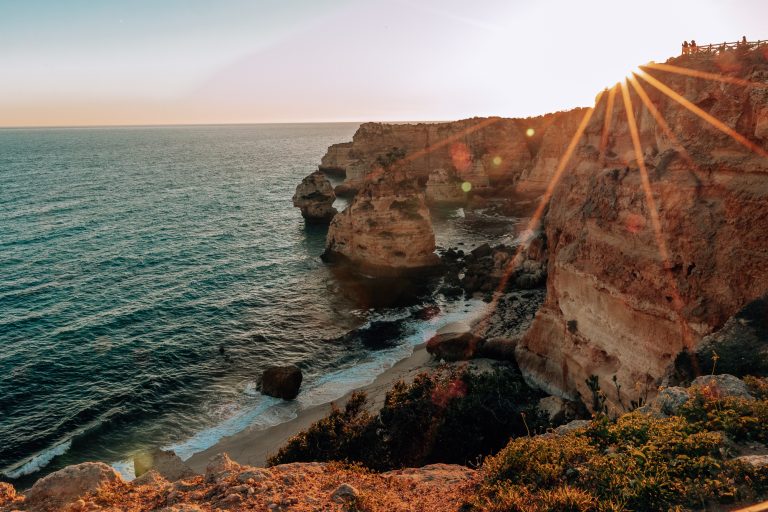
Sunset over Praia da Marinha beach
Tips and Tricks for Your Vacation
Don’t Overpay for Flights
Search for flights on Kayak. It’s our favorite search engine because it scans the websites of all airlines and always finds the cheapest connection.
Book Your Accommodation Smartly
The best experiences we’ve had when looking for accommodation (from Alaska to Morocco) are with Booking.com, where hotels, apartments, and entire houses are usually the cheapest and most widely available.
Don’t Forget Travel Insurance
Good travel insurance will protect you against illness, accidents, theft, or flight cancellations. We’ve had a few hospital visits abroad, so we know how important it is to have proper insurance arranged.
Where we insure ourselves: SafetyWing (best for everyone) and TrueTraveller (for extra-long trips).
Why don’t we recommend any Czech insurance company? Because they have too many restrictions. They set limits on the number of days abroad, travel insurance via a credit card often requires you to pay medical expenses only with that card, and they frequently limit the number of returns to the Czech Republic.
Find the Best Experiences
Get Your Guide is a huge online marketplace where you can book guided walks, trips, skip-the-line tickets, tours, and much more. We always find some extra fun there!
TL;DRAccording to these 20 tips, the best beaches in the Algarve, Portugal, include the iconic Praia da Marinha and Praia do Camilo, which offer the best shots of the limestone cliffs, the calmer Praia do Barril and Praia de Faro that are great for families with kids, and the wild surf beaches of Praia do Amado, Arrifana and Bordeira on the west coast. The best time to visit is September and the first half of October, when the ocean warms up to around 21 °C and there are fewer tourists. The Algarve enjoys over three hundred sunny days a year, on the A22 motorway you’ll need the electronic Via Verde device, and thanks to the new 2026 rental rules it’s a good idea to book your accommodation half a year in advance.
In our opinion, the beaches in the Algarve, Portugal, are quite simply the most beautiful in the world.☺️ You don’t have to agree with us, but you’ll definitely find beaches here that you’ll fall in love with. From the magical hidden coves of Carvoeiro, through the lively and busy coastline near Portimão, all the way to the surfer’s paradise around Sagres – every spot has something special. Let’s take a look at the best beaches in the Algarve, Portugal!
What you should know about the beaches in the Algarve
When you’re planning a seaside holiday, the Algarve in Portugal is our top spot. With more than 200 stunning beaches scattered along the coast, the Algarve boasts some of the most beautiful beaches in Europe.
You’ll find the most varied beaches here, from coves surrounded by limestone cliffs to sprawling golden sandy stretches – there really is something for everyone. The region offers picturesque scenery with unique rock formations and crystal-clear turquoise water that will take your breath away.
One of the reasons the beaches in the Algarve are so popular is the favourable climate. With sunshine on around 300 days a year, you can comfortably enjoy sunbathing, swimming and all kinds of water sports. We even swam here in October, though by then the water was really only for the brave.
20 best beaches in the Algarve, Portugal
Now let’s take a look at our favourite beaches in the Algarve. In our opinion, these are the most beautiful beaches in Portugal.
Praia da Marinha
Praia da Marinha is one of the most iconic beaches in the Algarve, famous for its fascinating limestone cliffs, golden sand and crystal-clear water. In high season it must be seriously packed, because even off-season there are quite a few people around.
We love going there to watch the sunset, and once we even dragged ourselves out for the sunrise. In winter there’s no charge for parking, but in summer there is, and the number of people allowed on the beach is limited too. So set off early! In summer, dogs aren’t allowed on the beach.
Praia da Marinha
The beach in central Carvoeiro
If you stay in Carvoeiro, don’t miss the local beach. Carvoeiro Beach, or Praia do Carvoeiro, is small but beautiful. We love going there in winter.
The golden sand is gently framed by azure waters and imposing cliffs, and you can climb up above the beach like we do to take some lovely photos.
The town has a row of charming cafés and nice restaurants – we’re big fans of Indian and sushi, but you’ll also find traditional Portuguese food.
💡 TIP: Check out the new Levels restaurant, right by the beach, where you can enjoy amazing coffee (the best in town) and brunch.
Carvoeiro Beach
Praia da Dona Ana
In Lagos you absolutely can’t skip Praia da Dona Ana, which Condé Nast Traveler once named the best beach in the world. This iconic Algarve beach sits between imposing limestone cliffs on the gorgeous Golden Coast. The best photos are from the stairs leading down to the beach.
Praia da Dona Ana
Ponta da Piedade
Another spot near Lagos you can’t miss is Ponta da Piedade. It’s mainly a viewpoint that gives you wonderful photos, and you can also set off from here on a kayak or boat trip to explore the caves.
I recommend booking your trip through GetYourGuide, which works reliably so you don’t have to trek around the booths in town, where there can be queues in summer.
Ponta da Piedade
Praia de Vale Covo in Carvoeiro
We came here just about every day when we were staying in Carvoeiro. It’s our favourite beach, and I consider it one of the most beautiful.
This idyllic cove is surrounded by majestic limestone cliffs, and I could sit here for hours just watching the sunset and the waves breaking against the beach and the cliffs.
During high season you can enjoy a glass of wine at the bar overlooking the beach. ☺️
Praia de Vale Covo in Carvoeiro
Praia da Rocha
One of our favourite beaches is in Portimão. There’s a row of bars along the beach, and it’s long, wide and sandy. In winter we go there for long walks with our dogs (in summer they’re probably not allowed) and enjoy the sunset.
Praia da Rocha in Portimão is one of the best beaches in Portugal
Meia Praia
A short walk from Lagos – you can reach it on a longer stroll from town – lies Alvor, a charming fishing village where you’ll find the long, wide sandy Meia Praia.
It’s ideal for families with kids, and it’s usually quiet here – though I’m not sure what it’s like in high season – but it’s so wide that you’ll definitely find your own little spot.
We love coming here early in the morning, when the beach is almost empty and we can enjoy a quiet walk at sunrise. Strolling along the golden sand to the gentle murmur of the waves is a kind of meditation, really.
Meia Praia in the Algarve
Praia do Carvalho
One of the most photogenic beaches is definitely Praia do Carvalho. It’s pretty popular, so it can get crowded in summer, but we come here in winter to read. It’s usually fairly peaceful.
If you visit outside the peak heat, we recommend setting out on the trail that runs past Praia do Carvalho – it’s part of the famous hiking route called Percurso dos Sete Vales Suspensos, the “Seven Hanging Valleys Trail”.
This route is one of the most beautiful and popular in the Algarve, offering breathtaking views of the ocean, cliffs and picturesque beaches. The trail connects the beaches of Praia da Marinha and Praia de Vale Centeanes, passing right by Praia do Carvalho.
Praia do Carvalho
Praia de Odeceixe
Praia de Odeceixe is one of the popular beaches for families with kids. It’s long and wide, so even in high season you’ll find a spot where children can play in the sand in peace.
The water tends to be calmer here than elsewhere, and just like everywhere else in the Algarve, you’ll find crystal-clear water and golden sand. A short distance away you’ll also find another beautiful beach that’s perfect for snorkelling – Ingrina. You can book a snorkelling trip through GetYourGuide.
Praia de Odeceixe – dogs aren’t allowed here in summer
Praia do Barril
When you head into the eastern part of the Algarve, you shouldn’t miss Praia do Barril, which is probably one of the best beaches in Portugal for families with kids. This beach even holds Blue Flag status, meaning it’s extremely safe (more on that below), and it’s known for its shallow waters, which is ideal if you have small children.
On top of that, there are lifeguards on the beach during high season, and Praia do Barril also has showers, toilets and several beach bars, so you won’t go hungry either.
Getting to the beach is an experience in itself – you can walk across the beautiful dunes, or ride the little train, which is a favourite activity especially for families with kids.
What does the Blue Flag designation mean for beaches?
The Blue Flag designation is awarded to beaches and marinas that meet strict quality and safety standards. If a beach carries this prestigious label, it’s a guarantee that it’s safe, clean, well served, and that environmental protection is a priority. It’s awarded by the Foundation for Environmental Education (FEE).
Praia do Barril
Praia da Luz
The charming smaller beach of Praia da Luz is a short drive from Lagos, and you’ll find some more hipster-style venues along the promenade. We love going to Endless Summer, which has great coffee and food.
It tends to be quieter here, though in high season nowhere is really quiet. This beach is ideal with small children because the water tends to be calmer.
Praia da Luz
Praia de Faro
This beach, located close to the airport in Faro, is again ideal for families with kids, because as well as beautiful golden sand it has relatively shallow and – for Portugal – warm water. That’s perfect for children to play and swim in, and during high season there are lifeguards here too.
There are beach bars, restaurants and rental shops for water sports gear like kayaks and paddleboards. Kids will also love the small playground near the beach.
Praia de Faro
Bordeira Beach
Among the most beautiful beaches we have to include Bordeira Beach, which is completely different from all the others. It’s mostly popular with surfers – it really isn’t a beach for lounging around – but even if you don’t surf, you should definitely head here.
Right from the car park you’ll have dramatic views of surfers and waves crashing against the cliffs and the beach. Plus there are gorgeous, photogenic dunes you can happily wander for two hours.
The best surfing beach in the Algarve – Bordeira Beach
A beach for surfers – Arrifana
If Bordeira doesn’t win you over for surfing, try Arrifana, which is also extremely popular among surfers. But if you arrive late, even off-season it can be a bit of a struggle to park here. There’s also a really nice café here that serves food – SEA YOU SURF CAFÉ.
Arrifana is one of the best surfing beaches in the Algarve
Praia do Amado
Another beach that’s popular with surfers is Praia do Amado – this beach is ideal for surfers of all levels. Its relatively remote location means fewer people make it out here, which is always a huge plus for us – we’re not big fans of crowds.
Even though we don’t surf yet, we head out here for a walk almost every time. It’s a wilder kind of beach, ideal for winter walks with the dogs, and you can take beautiful photos or just meditate with your eyes open.
Praia da Amoreira
Praia da Amoreira is another great beach popular with surfers. You’ll find it near the town of Aljezur on the west coast of the Algarve.
It offers good surf conditions year-round thanks to long, consistent waves. The waves here are usually suited to beginners and lower-intermediate surfers.
The best time to surf is from October to May, when the water is clear and the temperature hovers around 20 °C. The beach is popular with both families with kids and experienced surfers.
Where to learn to surf in Portugal?
If you want to learn the basics of surfing, the Algarve is ideal for it – there are plenty of schools that will teach you the fundamentals. You can simply book a lesson through GetYourGuide.
💡 ACCOMMODATION TIP: If you’re looking for accommodation in the Algarve, we recommend checking the offers on Booking.com, where you’ll find great hotels and apartments right by the most beautiful beaches.
If you’re heading to the Algarve or you’re already here, we recommend taking a look at our article with tips on what to see here, which also includes the ideal itinerary we use whenever visitors fly out to see us in Portugal.
We recommend combining a visit to the Algarve with a trip to Lisbon and possibly even Porto, which is further away but still doable.
Frequently asked questions
Which beach is best for surfing in the Algarve?
The best beaches for surfers are Arrifana and Bordeira Beach, known for their powerful waves and expansive sandy stretches, ideal for advanced surfers. For beginners, Praia do Amado is perfect.
Which beach is ideal for families with kids?
Praia do Barril: This beach is perfect for families thanks to its shallow waters and the presence of lifeguards during high season. The beach also holds Blue Flag status, which guarantees cleanliness and safety.
Where can I find a quiet beach near Carvoeiro?
Praia de Vale Covo: This hidden cove is the perfect spot for those looking for peace and gorgeous scenery. It’s surrounded by limestone cliffs and offers stunning views.
What’s the best beach near Lagos?
Praia da Dona Ana: This beach is considered one of the most beautiful in the world, with limestone cliffs and crystal-clear water. It’s a great spot to relax and take photos.
Where can I find a less crowded beach for surfing?
Praia do Amado: This beach is less crowded thanks to its relatively remote location. It offers great surfing conditions for all levels.
What’s the best beach for long walks?
Meia Praia: This long, wide sandy beach near Alvor is ideal for long walks, especially in the morning at sunrise.
What’s the best beach closest to Faro?
Praia de Faro: Located close to Faro airport, which makes it easy to reach. The beach is ideal for families with kids thanks to its shallow waters and nearby beach bars and restaurants.
🔗 These are affiliate links — they don't change your price and help us create content. · All experiences →
Tips and Tricks for Your Vacation
Don’t Overpay for Flights
Search for flights on Kayak. It’s our favorite search engine because it scans the websites of all airlines and always finds the cheapest connection.
Book Your Accommodation Smartly
The best experiences we’ve had when looking for accommodation (from Alaska to Morocco) are with Booking.com, where hotels, apartments, and entire houses are usually the cheapest and most widely available.
Don’t Forget Travel Insurance
Good travel insurance will protect you against illness, accidents, theft, or flight cancellations. We’ve had a few hospital visits abroad, so we know how important it is to have proper insurance arranged.
Where we insure ourselves: SafetyWing (best for everyone) and TrueTraveller (for extra-long trips).
Why don’t we recommend any Czech insurance company? Because they have too many restrictions. They set limits on the number of days abroad, travel insurance via a credit card often requires you to pay medical expenses only with that card, and they frequently limit the number of returns to the Czech Republic.
Find the Best Experiences
Get Your Guide is a huge online marketplace where you can book guided walks, trips, skip-the-line tickets, tours, and much more. We always find some extra fun there!
TL;DRGetting to Alaska doesn’t require a full visa – the electronic ESTA registration costs $21 and covers stays of up to 90 days. There’s no direct flight, so for 2026 your quickest bet is via Frankfurt, where Condor flies to Anchorage in under 10 hours; the whole journey takes 16 to 22 hours door to door. Book your car or RV 6 to 9 months ahead, and note that standard rental firms won’t let you take their vehicles onto gravel roads like the Dalton Highway or McCarthy Road. You’ll pay in US dollars, restaurant tips run 18 to 22%, and there’s no state sales tax in Alaska. It’s worth getting an eSIM (Airalo or Holafly) beforehand, since regular roaming just doesn’t work out in the wilderness. The best time to go is mid-June through to the end of August.
If you’re thinking about heading to Alaska, I need to warn you about something right from the start. It’s such an endlessly vast and breathtaking corner of the world that it will completely captivate you — but at the same time, your wallet is in for a serious shock 😅. Lukáš and I dreamed about Alaska flights and this trip for ages, and the logistics alone always felt overwhelming. After all, this isn’t exactly a destination where you’d book a flight on Friday evening and hop on a plane with a small backpack on Saturday morning.
Turquoise lakes, majestic mountains reaching into the sky, bears catching salmon in wild rivers, and glaciers that will literally leave you gasping in disbelief — it’s all waiting for you here. But to see this beauty with your own eyes, you first need to actually get there. So I’ve broken the whole thing down piece by piece — from flights and ESTA to car hire and what to do when a grizzly pops out of the bushes in front of you. So you don’t forget a thing 😉 You’ll see that when you prepare in advance, it’s actually a lot of fun! ☺️
Ted Stevens Airport terminal in Anchorage
TL;DR
Here are the absolute essentials you need to know for your trip, so you’ve got the most important basics all in one place.
If you tick off these points, you’re already halfway there — the rest will sort itself out on the ground.
Entry to the USA: You don’t need a full visa — just apply online for an ESTA electronic travel authorisation for 21 USD.
Flights: There are no direct flights from London to Anchorage. The quickest option for 2026 is a direct flight from Frankfurt with Condor (just under 10 hours), or connecting via Seattle or other US hubs.
Car hire: Book your car or motorhome six to nine months in advance. Most major rental companies strictly prohibit driving on gravel roads.
Money and tips: The currency is the US dollar (USD) and cards are accepted almost everywhere. Alaska has no state sales tax. Tipping in restaurants is 18–22%.
Internet: Standard UK roaming won’t work well here. Your best bet is to set up an eSIM beforehand (Airalo or Holafly) — but expect zero signal once you’re deep in the wilderness.
Bear spray: An absolute must-have, but you cannot take it on any flight (not even in checked luggage) — you have to buy it once you arrive.
The logistics intimidated Lukáš and me at first too, so let’s jump straight into what to sort out first — ideally while you’re still in your pyjamas with a cup of tea at home.
1. Bureaucracy and ESTA: forget about a full visa
American bureaucracy can be unforgiving at times, and mistakes aren’t easily pardoned — but for regular tourism, the process is fortunately quite straightforward. If you’re flying to Alaska for less than 90 days, you don’t need to deal with a complicated visa application at the embassy. The electronic ESTA registration is all you need.
The foundation is a biometric passport valid for at least six months beyond your planned return date. Always complete the registration through the official government portal only. It costs exactly 21 USD (around £17) and you pay online by card. I’m deliberately stressing this because there are plenty of scam intermediary websites lurking on the internet that will try to charge you double or triple.
Officially, the authorities say approval can take up to 72 hours, but our experience is that the system usually gives the green light within a few minutes. An approved ESTA is then valid for a full two years (or until your passport expires), so you can use it for multiple trips to the States.
2. Alaska flights: no direct route from London
Geography is geography, and there’s simply no direct flight from London to Anchorage. Your destination will be Ted Stevens Anchorage International Airport (ANC), an absolute giant and incidentally one of the busiest cargo airports in the entire world. The journey typically involves one or two connections, and you’ll spend anywhere from 16 to 22 hours in the air and at terminals.
Alaska Airlines Boeing 737 on the runway in Anchorage (Photo: Frank Kovalchek / Wikimedia Commons, CC BY 2.0)
For the 2026 summer season, one of the quickest options is with Condor, which flies direct from Frankfurt to Anchorage — the flight on a modern Airbus A330-900neo takes just under 10 hours. A return ticket from Frankfurt to Anchorage typically costs between 600 and 800 USD (roughly £480–£640). You can easily reach Frankfurt via a budget airline or Eurostar and onward train. Alternatively, flying from London Heathrow with connections via Seattle or Minneapolis on airlines like British Airways, Delta, or United is very common — expect to pay around £700 to £1,400 return depending on how far in advance you book. The golden rule: the earlier you buy, the cheaper you fly!
3. When is the best time to go
Honestly, I’d steer well clear of any winter experiments unless you’re specifically after the Northern Lights in minus-forty temperatures. The main tourist season in Alaska essentially runs only from late May to early September — that’s your window. We prefer the period from mid-June to the end of August.
One of the priciest excursions we’d ever done was kayaking among glaciers. The only thing we regret is not booking more trips like this in Alaska.
During these months, you’ve got the best chance of decent weather, all roads into the national parks are open, and the wildlife is at its most active. On the flip side, this is also when Anchorage fills up with crowds, accommodation prices skyrocket, and the highways are lined with convoys of motorhomes. Even with the crowds, though, it’s absolutely worth it.
Where to Stay in Anchorage and How Much It Costs
Anchorage isn’t actually the state capital (that’s surprisingly Juneau), but in practice it’s the hub where everything revolves. You set off from here, and you come back here. Nearly 300,000 people live here, which makes up almost forty percent of Alaska’s entire population. This is most likely where you’ll launch all your excursions from, so you’ll spend at least the first and last nights of your itinerary here. Fair warning: accommodation cost us more than we expected, and we’d come prepared for high prices.
Streets of Anchorage after arriving in Alaska
Let me be completely honest — pricing in Alaska is subject to insane seasonality. A cosy little room that would go for a hundred dollars in February can climb to 350 to 500 USD (£280–£400) for a single night in July. Forget budget travel here. If you’re after luxury, the iconic Hotel Captain Cook offers city-wide views with prices starting around 450 USD. We prefer the happy medium right in the city centre, where you can choose from hotels in the 250 to 350 USD range (roughly £200–£280).
If you’ve got a very early morning departure or you’re arriving exhausted late at night, it makes great sense to stay right near the airport or by the floatplane base at Lake Hood. Prices are slightly friendlier there — expect around 200 to 250 USD per night. Many people also solve the first night by picking up their rented motorhome straight after arrival and sleeping at a campsite just outside the city, which saves the budget significantly.
Car Hire and Getting Around Alaska: What to Watch Out For
Independent travel in Alaska stands or falls with a rental car. Public transport might just about work for getting around Anchorage itself, but you simply can’t reach the wilderness without your own set of wheels. On top of that, rental company fleets are severely limited due to the short season.
4. Book the car before the flight
This might sound like an exaggeration, but trust me — it’s not. Having flights to Alaska is all well and good, but discovering there isn’t a single car left to hire at the entire airport is enough to make you cry. Booking six to nine months ahead is an absolute necessity here. A standard compact SUV like a Toyota RAV4 will cost you roughly 150 to 300 USD per day (£120–£240) during peak season in July and August. Lukáš and I have had consistently great experiences with DiscoverCars, which we use all over the world.
We booked our car back in January and even then we were grabbing one of the last vehicles in our category. Make sure you get unlimited mileage, because distances rack up in the blink of an eye out here. And a top tip: check whether the rental company offers free cancellation. It gave us huge peace of mind when we later tweaked our plans.
5. The gravel road trap
I always flag this to practically everyone I know. The contracts at those big, well-known international rental chains absolutely and strictly prohibit driving on unpaved gravel roads. If you break this rule and something happens to the car, they’ll instantly void your entire insurance without any discussion, and you’ll be paying for the damage out of your own pocket.
Gravel road in Alaska — a trap for car rental companies
Typically off-limits are legendary routes like the Dalton Highway, Denali Highway, and McCarthy Road. If you’re planning to visit these areas, you’ll need to seek out local specialists who rent specially modified vehicles with two spare tyres. Be prepared to dig deeper into your pocket, though — local operators charge 30 to 50% more than standard rentals. We ultimately stuck to the permitted roads and even then it was occasionally an off-road experience we still smile about today.
6. Motorhome: freedom on four wheels
Renting a motorhome (you’ll also see them called campervans) is hugely popular, and we completely get why. It kills two birds with one stone — you sort out transport and a bed in one go. The undisputed king of the local market is Great Alaskan Holidays, based just a short distance from the airport.
Dodge Caravan motorhome in the Alaskan mountains
A smaller model costs roughly 250 USD per night during the summer season for a week’s rental. The advantage is that they hand over the vehicle fully kitted out with bedding and cooking gear, so you can head straight to the shops for food and hit the road. Campsites do fill up quickly though, so if you opt for this route, don’t forget to reserve your pitches well in advance — ideally by spring — otherwise you’ll be scrambling to find a spot for the night.
7. What Alaskan highways actually look like
Don’t picture a highway here as anything like the M1. Alaska’s road network is extremely sparse, and the vast majority of this enormous state has no road access at all. Overland logistics essentially rely on just a handful of main routes.
Road along the Turnagain Arm fjord — a typical Alaskan highway
The paved Glenn Highway takes you to the stunning Matanuska Glacier. The backbone Parks Highway connects Anchorage and Fairbanks and is the only access point to the famous Denali National Park. And my personal favourite is probably the Seward Highway, which hugs the coastline. It can get terribly windy along there, but that feeling when you spot white beluga whales from the car window is absolutely priceless. Just watch out for massive potholes left over from winter — Lukáš nearly lost a wheel on one.
8. Winter rules in the shoulder months
If you do decide to venture outside the main season — meaning October through to the end of April — some pretty tough winter rules apply. Cars must be equipped with studded winter tyres and all-wheel drive (AWD/4WD) is an absolute necessity, not a nice-to-have.
Winter road in Denali State Park (Photo: Lesscrafted / Wikimedia Commons, CC BY-SA 2.0)
The weather here can change from one minute to the next, and getting stranded in a blizzard fifty kilometres from the nearest civilisation is not an experience you want. On top of that, many petrol stations close over winter, so you need to constantly watch the fuel gauge and fill up at every opportunity. We’ve heard more than a few stories about tourists who had to sleep in their car until a snowplough rescued them in the morning.
Money, Internet and Safety in Alaska
Right, flights and car sorted — but that’s only the beginning. The American way of life throws up a few things that nobody warned us about beforehand, so let me put that right.
9. Currency, tipping and the (non)existence of taxes
The currency is, of course, the US dollar, and from my experience Alaska is extremely card-friendly. Visa and Mastercard — including contactless and Apple Pay — are accepted almost everywhere, even at a remote petrol station in the middle of nowhere. That said, I’d still recommend carrying a small amount of cash, around one to two hundred dollars, for smaller purchases or camps where there’s no signal.
What might catch you off guard is the tipping culture. Tips follow the pretty firm American standard, and service staff rely on them as their primary source of income. In restaurants, it’s customary to leave 18 to 22% of the pre-tax bill. Leave housekeeping two to five dollars per night on the bedside table, and glacier tour guides generally expect around ten percent of the excursion price. One nice perk of Alaska, though, is that it’s one of only five US states with no state sales tax! Electronics or quality outdoor jackets can sometimes be bought here more cheaply than in the rest of the States, although some smaller towns do add their own local tax.
10. Mobile data and why your UK provider won’t save you
If you’re counting on your standard UK roaming, think again — the bill would be eye-watering. The infrastructure here is quite specific, and even the American giant T-Mobile operates purely on roaming in Alaska. The absolute best coverage comes from the local operator GCI.
Lukáš and I solve this with an eSIM, which we download to our phones before we even leave home — no stressful scrambling at airport kiosks. We highly recommend Holafly, which offers unlimited data for a week for just under 30 dollars. Airalo is another solid alternative. But bear in mind that the moment you leave the main highways and venture deeper into the national parks, signal simply vanishes. Download offline maps of the entire state to your phone — consider this an absolute survival essential.
11. Bear spray: how to survive an encounter with a bear
Alaska is home to a huge number of brown bears (the famous grizzlies) as well as smaller black bears. Carrying bear spray on your belt during hikes is an absolute non-negotiable standard here — you really shouldn’t set foot in the wilderness without it. It works on the basis of highly concentrated capsaicin, sprays up to about seven to ten metres, and you can buy it in Anchorage at outdoor gear shops for around 50 dollars.
Bear-resistant container — essential gear for Alaska (Photo: Grantbackpacker / Wikimedia Commons, CC BY-SA 4.0)
⚠️ Now for the most important rule: bear spray is banned from all commercial flights according to strict aviation security regulations!
You can’t take it in your hand luggage or in your checked bags. There’s a risk of explosion under pressure, so security will simply confiscate it. The only option is to buy it after you land in Anchorage and hand it in to a ranger station or hotel reception before your return flight. Trying to smuggle it through is genuinely not worth the risk.
12. Travel insurance (a broken leg that costs as much as a mortgage)
Heading to America without comprehensive travel insurance is, in my opinion, pure gambling with personal bankruptcy. The American healthcare system is notorious for its astronomical prices — even a straightforward treatment and cast for a broken leg can cost between 15,000 and 30,000 USD.
Alaska adds the problem of extreme distances. An injury somewhere deep in the mountains of a national park will inevitably require a rescue helicopter. An air evacuation like that can easily swallow a hundred thousand dollars (over £80,000). I’d recommend setting your minimum medical cover at no less than £200,000, ideally more. If you’re planning any higher-altitude treks into the mountains, carefully check that your insurer covers mountain hiking above 3,000 metres.
13. Power sockets, time difference and drinking water
Let’s quickly run through a few small details that people often forget before the trip. The time difference from the UK is significant — Alaska is nine hours behind (GMT-9), so for the first few days you’ll probably be seriously jet-lagged, waking up at four in the morning feeling like it’s lunchtime. The mains voltage is the American 120V with two flat-pin sockets. A basic passive travel adapter for a couple of pounds will do the job perfectly.
As for water, tap water in Anchorage is completely safe to drink — it comes from a glacial lake. Once you head into the wilderness, however, all water from rivers and mountain streams must be properly filtered. Even crystal-clear water flowing straight from a melting glacier can contain nasty parasites that’ll land you with days of stomach cramps — and that’s really not how you want to spend your holiday 😁.
Lukáš and Lucie recommend
Where to Stay in Alaska
2 accommodations — wellness hotels and other lodging options
Anchorage: 3 Places to Visit During Acclimatisation
The city sprawls across an enormous area and, honestly, the architecture probably won’t blow you away at first glance. In 1964, the second most powerful earthquake ever recorded hit here with a magnitude of 9.2, destroying much of the original neighbourhoods. Even so, there are some brilliant spots that will help you soak up the atmosphere before heading out into the wild.
14. Tony Knowles Coastal Trail and views of Denali
This nearly eighteen-kilometre paved trail is the city’s pride and joy, reserved exclusively for pedestrians and cyclists. It starts right by the train station in the centre, and if you hire a bike you can comfortably ride all the way to the vast Kincaid Park.
Our favourite spot is the Point Woronzof viewpoint, where on a clear day you can see the snow-capped Mount Denali over 200 kilometres away — and with a bit of luck, you’ll spot white beluga whales swimming near the shore. We always pack a little snack and just sit there gazing at the water. After that long flight, it’s the perfect reset for both mind and body.
15. Culture at the Anchorage Museum
If the weather isn’t cooperating, go and get a dose of culture. The Anchorage Museum covers an impressive 10,000 square metres and admission for an adult costs around twenty-five dollars.
Inside you’ll find over six hundred incredible artefacts from Alaska’s indigenous peoples. What impressed us the most were the war helmets of the native tribes — honestly, I didn’t expect to be standing in front of a display case with my jaw on the floor. It’s a wonderful way to understand the complex history of the north before you drive out to smaller indigenous villages in the countryside. Take your time exploring — it’s worth every penny.
16. Hiking Flattop Mountain
Alaskans love the outdoors, and their favourite weekend activity is hiking Flattop Mountain. It’s hands-down the most climbed mountain in all of Alaska. The trailhead is roughly a twenty-minute drive from the city centre. The trail itself is just over two kilometres, but it’s a proper steep climb with 410 metres of elevation gain.
View of Anchorage from Flattop Mountain
Just below the summit, the hike even involves a bit of easy scrambling over rocks, so sturdy boots are an absolute must. Your reward, though, is an incredible panoramic view of all of Anchorage, the vast ocean, and the surrounding mountain peaks. Breathe in that crisp northern air to the fullest, because moments like these are exactly why we flew to Alaska!
Where to Eat in Anchorage (From Pizza to Reindeer)
Food in Alaska can be fantastic — the portions are proper American-sized (meaning enormous) and the fish is fresher than anywhere else, of course. There’s nothing better after a full day of trekking than ducking into a warm pub and ordering something gloriously unhealthy, right? 😅
An absolute and undisputed institution is a place called Moose’s Tooth Pub & Pizzeria. It’s actually one of the highest-grossing independent pizzerias in the entire USA! They bake incredible giant pizzas and brew their own beer in a small on-site brewery. Fair warning though — they don’t take reservations, and dining here in peak season can mean queuing outside for a good hour and a half. I’d recommend trying their “Large Avalanche” with chicken and bacon — it’s absolute heaven.
For a fantastic brunch so filling you won’t need lunch, head straight to Snow City Cafe in the centre. Their Eggs Benedict with crab meat is legendary. And if you fancy something uniquely Alaskan at a more reasonable price, stop by one of the street stalls on 4th Avenue. They sell the iconic Reindeer Sausage hot dogs piled high with caramelised onions. It’ll set you back around 10 dollars and tastes simply brilliant!
Tips and Tricks: How to Save Money
Let’s wrap up with our tried-and-tested tips that we use on every trip, not just to the States, to avoid throwing money down the drain.
Where to find flights
Search for affordable Alaska flights on Kiwi — it’s our favourite comparison site, and we love using it to piece together even complex multi-stop itineraries.
It pays to set up a price alert up to nine months in advance. We saved a bundle this way — as soon as we got pinged about a great deal via Frankfurt, we didn’t hesitate for a second.
Car hire in the USA
We regularly use the comparison site DiscoverCars.com. Remember that in Alaska you need to book at least six months ahead.
I covered more on this topic in tip #4 above. We always rely on this site for its clear insurance terms, so there’s no unpleasant haggling at the counter after a long flight. It’s also great having all your vouchers in one app.
Booking accommodation
Booking.com is our go-to hotel search engine. In Anchorage, it’s worth booking hotels with free cancellation and checking back occasionally to see if the price has dropped by a few dozen dollars.
It’s happened to Lukáš and me several times that a better deal for the same property appeared a few weeks before departure. At that point, it’s just a few clicks to cancel the original reservation and rebook the cheaper one — which saved us enough for a lovely dinner out.
Don’t forget travel insurance
As I mentioned above — do not fly to the States without insurance.
For shorter trips we use World Nomads, which sometimes offers excellent promotional rates, and for longer trips True Traveller has great coverage including mountain hiking. Before you travel, carefully read through the exclusions so you know exactly what altitude you’re covered up to. A few minutes spent reading the policy terms will save you a lot of sleepless nights once you’re up in the mountains.
Further Reading
If Alaska has caught your imagination and you want to start planning specific places and routes, be sure to check out our other articles from this region. We’ve written up everything from detailed cost breakdowns to complete itineraries:
When you write to me with questions about our dream trip, the same practical things come up time and again. So I’ve decided to compile the most common ones into this quick Q&A section, saving you from having to hunt through the entire article.
How do you get to Alaska from the Czech Republic?
There are no direct flights from Prague. You’ll always need at least one connection, typically through Frankfurt or another major European hub, from where you can continue either directly to Anchorage or via cities in the USA and Canada. It’s quite a long and demanding journey, so don’t forget to bring something to read and comfortable clothes for the plane. The sooner you start looking for tickets, the better and faster connections you’ll be able to find.
How long does the flight to Alaska take?
It depends on your chosen flight and layover times. If you take a direct flight from Frankfurt, Germany to Anchorage, the flight itself takes about 10 hours. Overall, traveling from the Czech Republic, you’re looking at 16 to 22 hours of total travel time. We always tried to make the journey more pleasant with a good book, so the time actually passed pretty quickly.
How much does an average ticket to Alaska cost?
Prices vary significantly depending on the season and when you book. During peak summer season, expect to pay between 1,500 and 3,000 USD (approximately 1,400 to 2,800 EUR) for a round-trip ticket. Promotional tickets from Germany can be found for under 900 EUR. It’s worth monitoring various flight search engines starting in the fall and not hesitating when you come across a reasonable price.
When is the best time to visit?
The best time to visit Alaska is during June, July, and August. The weather is most stable during these months, all roads and parks are open, and you have the best conditions for spotting bears and other wildlife. Keep in mind, though, that this is also the busiest time of year. You’ll encounter more tourists everywhere and accommodation prices are at their absolute peak.
Do I need a regular American visa for the trip?
For regular tourist trips up to 90 days, you don’t need a traditional visa. You can get by with the electronic ESTA registration, which you can complete online on the official government website for 21 dollars. The approval process usually takes just a few minutes, but authorities recommend completing everything at least 72 hours before departure. This will save you a lot of unnecessary nerves and stress at the airport.
Can I rent any car and drive it anywhere?
Unfortunately not. The major international rental companies in Alaska have strict prohibitions in their contracts against driving on unpaved (gravel) roads. If you want to venture into the deeper wilderness on such roads, you’ll need to rent from local specialists, where prices are understandably higher. Definitely don’t risk it with a regular rental car—it’s not worth the trouble.
Is it necessary to carry bear spray?
Yes, bear spray is absolutely essential whenever you leave urban areas. Bears are at home in Alaska and encounters with them aren’t uncommon at all. Remember, though, that for security reasons you can’t bring it on the plane. You’ll need to purchase it after arriving in Anchorage at a local store and properly dispose of it before your return flight.
Tips and Tricks for Your Vacation
Don’t Overpay for Flights
Search for flights on Kayak. It’s our favorite search engine because it scans the websites of all airlines and always finds the cheapest connection.
Book Your Accommodation Smartly
The best experiences we’ve had when looking for accommodation (from Alaska to Morocco) are with Booking.com, where hotels, apartments, and entire houses are usually the cheapest and most widely available.
Don’t Forget Travel Insurance
Good travel insurance will protect you against illness, accidents, theft, or flight cancellations. We’ve had a few hospital visits abroad, so we know how important it is to have proper insurance arranged.
Where we insure ourselves: SafetyWing (best for everyone) and TrueTraveller (for extra-long trips).
Why don’t we recommend any Czech insurance company? Because they have too many restrictions. They set limits on the number of days abroad, travel insurance via a credit card often requires you to pay medical expenses only with that card, and they frequently limit the number of returns to the Czech Republic.
Find the Best Experiences
Get Your Guide is a huge online marketplace where you can book guided walks, trips, skip-the-line tickets, tours, and much more. We always find some extra fun there!
TL;DRMarmolada, the highest peak in Italy’s Dolomites, tops out at Punta Penia (3343 m) and comes with ten essential tips: take the Move To Top cable car from Malga Ciapela up to Punta Rocca (3265 m, a return ticket costs around €50), soak up the 360° views from the panoramic terrace, visit Museo Marmolada Grande Guerra, the highest First World War museum around, and only attempt the summit with a certified mountain guide (€200–€300 per group). Other highlights include the West Ridge via ferrata, glacier skiing at Arabba Marmolada, the pink Enrosadira glow at sunset, Lago di Fedaia, the Sentiero della Pace, and the fast-disappearing Via Normale route. Since the 2022 tragedy, strict safety rules are in force and drones are banned, with fines of up to €3000. July, August and especially September are the best months to come, and parking by the cable car costs around €6 a day.
The moment someone mentions Marmolada Italy, I get goosebumps and instantly remember the incredible feeling of standing on the very “rooftop of the Dolomites” with Lukáš years ago. It’s the undisputed queen of the entire mountain range — a place with an indescribable energy. But times change, and Marmolada changes with them.
After the tragedy in 2022, when an enormous chunk of glacier broke away, access to this majestic mountain changed forever. While we once came here with ice axes and climbed up the glacier, in 2026 we arrived in a completely different setup. We’re now joined by our little Jonášek and our two dogs Kája and Baby, so wild mountaineering expeditions had to take a back seat.
Let’s take a look together at how to enjoy the highest mountain in the Dolomites safely, with respect for nature, and even with a pushchair or small children in tow. You’ll discover that even without dangerous trekking, Marmolada can absolutely take your breath away.
Marmolada — the highest mountain in the Dolomites with its glacier (Photo: Giorgio Galeotti, CC BY 4.0, Wikimedia Commons)
Where exactly are we: Marmolada, at 3,343 metres (Punta Penia summit), is the highest mountain in the Italian Dolomites, straddling the border between the Trentino and Veneto regions.
Important warning post-2022: Following the tragic glacier collapse, extremely strict rules are in place. Reaching the summit is only possible with a certified mountain guide and in perfect conditions.
How to get up effortlessly: The Move To Top cable car departs from the village of Malga Ciapela and whisks you up to Punta Rocca at 3,265 metres.
Perfect for families: The cable car is brilliant for families with kids and seniors alike — at the top you’ll find a panoramic terrace and even a World War I museum.
Winter season: The area is world-renowned for exceptional winter sports. The Arabba–Marmolada connection offers the best skiing at the only glacier ski area in the Dolomites.
Drone ban: There’s a strict no-fly zone for drones across the entire national park area, with fines of up to €3,000.
What is Marmolada and why is it melting
Marmolada is no ordinary peak — it’s a massive mountain dominated by the summit of Punta Penia at 3,343 metres above sea level. Known as the Queen of the Dolomites, it’s home to the last major glacier in the region. While its southern face plunges down in sheer, almost kilometre-high limestone walls beloved by extreme climbers, the northern side is capped by a white mantle of glacial ice.
Sadly, I have to mention the sobering reality of climate change here. The Marmolada glacier in Italy is shrinking at an alarming rate, and scientists predict it will likely vanish entirely by 2040. That makes every single glimpse of it all the more precious — our children may never see it in its current form.
A fragile beauty: the 2022 tragedy and new rules
If you’re considering a classic high-altitude ascent, there’s something crucial you need to know right from the start. On 3 July 2022, extreme summer temperatures caused a massive serac — a tower of glacial ice — to break away and sweep over several groups of climbers. The disaster claimed 11 lives and permanently changed the rules governing access to this mountain.
Today, very strict safety regulations are enforced on Marmolada mountain. Some of the old routes have been permanently closed, and reaching the Punta Penia summit is permitted only with a certified mountain guide. Rigorous meteorological protocols have also been introduced — if temperatures are forecast to be too high, climbs are cancelled without exception. Please never ignore these regulations. This mountain commands enormous power, and it’s not one to take lightly.
When to visit and what to wear
The best time to visit largely depends on what you actually want to do beneath the glacier. For summer hiking and cable car excursions, July and August are ideal, though be prepared for crowds of Italian holidaymakers in August. September is, in my opinion, absolutely perfect — the air is crystal clear, the crowds thin out, but it can get properly cold up top.
If you’re a snow lover, the winter months will make you the happiest person on the planet. The Marmolada Trentino area is a massive paradise for skiers, and the popular Arabba–Marmolada circuit offers runs that will leave you speechless.
How to get there and where to park
You can approach Marmolada from several directions, but the main starting point for the vast majority of visitors is the small village of Malga Ciapela. This is where the famous cable car departs from.
From the UK, the most convenient option is to fly into Venice (both Marco Polo and Treviso airports are well served by airlines like easyJet, Ryanair, and British Airways), then hire a car and drive north into the Dolomites. From Cortina d’Ampezzo, it’s roughly a 90-minute drive to Malga Ciapela through stunning mountain passes. If you’re staying on the western side in the Val di Fassa valley, you’ll drive via Canazei past the Lago di Fedaia reservoir — a journey that’s an experience in itself, with photo stops every five minutes.
Right at the lower cable car station in Malga Ciapela, you’ll find a large car park. Expect to pay around €6 for a full day, which is actually quite reasonable by Italian standards for such a popular spot.
Where to stay and how much it costs
If you’re planning to explore the Marmolada area properly, I’d recommend choosing a strategic base so you don’t spend hours driving mountain switchbacks. In summer, prices for a decent double room hover around €120–180 per night, though during the winter ski season or in August, they can easily double.
The closest accommodation to the cable car is naturally in Malga Ciapela itself, where you’ll find the well-known Hotel Principe Marmolada. It’s an ideal choice if you want to be first on the cable car in the morning or first on the slopes in winter — though evenings here are admittedly rather quiet.
If you prefer livelier towns with good restaurants and little shops, look into staying in Canazei or Pozza di Fassa. We’re also very fond of the romantic town of Alleghe, which sits beside a beautiful lake just a short drive from the massif and offers gorgeous mountain views right from the hotel windows.
10 tips on what to see and do at Marmolada
Whether you’re a seasoned mountaineer with an ice axe in hand or a laid-back traveller with a little one in a carrier, Marmolada has something for absolutely everyone. I’ve picked out the most exciting activities worth adding to your itinerary, including tips for the winter months.
1. Move To Top cable car to Punta Rocca
Photo: kallerna, crop of photo: User:LudwigSebastianMicheler / CC BY-SA 4.0 / Wikimedia Commons
This is an absolute lifesaver for anyone who can’t or simply doesn’t fancy hiking thousands of metres of elevation gain. The Marmolada cable car from Malga Ciapela takes you up in three connecting sections to an incredible 3,265 metres above sea level. For us this year, it was a no-brainer — Jonášek could comfortably take in the views from his carrier while we saved our knees. A return ticket costs around €50, which isn’t exactly cheap, but the experience is worth every penny.
I’d recommend buying tickets in advance through the official Marmolada Move to Top website to skip the queues. The cabins run smoothly, but do bring a proper warm jacket for the top — even if you’re sweating in shorts down at the car park 😉.
2. Panoramic terrace where you can touch the sky
Photo: Frank-Arne Knoth / CC BY-SA 4.0 / Wikimedia Commons
When you step out at the top station of Punta Rocca, you’ll find yourself on a stunning viewing terrace. You won’t need to walk a single step — a full 360-degree panorama of the Italian Dolomites unfolds right before you. On a clear day, you can see all the way to Austria or even the Adriatic Sea. Just make sure you’re well wrapped up — there’s a biting wind even in mid-July 😅.
Lukáš and I must have taken about a million photos up there, because the scene with the Sella massif in the background is simply jaw-droppingly photogenic. Jonášek’s favourite part was watching birds flying seemingly below him — a truly magical moment I’ll treasure for a long time.
3. World War I museum in the clouds
Photo: Godromil / Public domain / Wikimedia Commons
On the cable car journey up, make sure to stop at the intermediate station Serauta at 3,000 metres. Here you’ll find Europe’s highest museum — the Museo Marmolada Grande Guerra. The exhibition reveals the incredibly harsh conditions in which Italian and Austro-Hungarian soldiers fought during World War I in ice tunnels carved directly inside the glacier. The stories and preserved artefacts will send shivers down your spine more than the surrounding cold ever could.
If history interests you even slightly, I’d definitely suggest checking the Museo Marmolada website for opening hours, as they change with the seasons. A full tour of the exhibition takes about an hour, so you can easily squeeze it into even a packed afternoon.
4. Classic ascent to Punta Penia with a guide
Photo: Fuchs Robert / CC BY 3.0 / Wikimedia Commons
If you’re physically fit and dream of standing on the absolute summit at 3,343 metres, you can make the ascent. But as I mentioned earlier, after the 2022 tragedy, you absolutely must not attempt this alone. You’ll need to hire a local certified mountain guide. A group ascent with a guide costs roughly €200–300 per group — they’ll provide all the necessary equipment and, most importantly, make sure you get back down safely.
The price puts some people off, but trust me, the mountains are not the place to cut corners on safety. The guides know the glacier like the back of their hand, they’re aware of every new crevasse, and they’ll share fascinating insights along the way that you simply wouldn’t find anywhere else.
5. Adrenaline-pumping Via Ferrata West Ridge
Photo: Maurizio Ceol / CC BY 3.0 / Wikimedia Commons
On the western ridge of Marmolada, you’ll find one of the oldest and most spectacular via ferratas in the entire Dolomites. This is not for beginners — it demands excellent fitness, a head for heights, and a full ferrata kit including crampons and an ice axe for the descent. The views from the ridge, however, are nothing short of spectacular.
Bear in mind that you’ll need an early start for this route, as afternoon summer thunderstorms are very common here — and you really don’t want to be clipped onto a steel cable on a ridge when lightning strikes. I’d also strongly recommend packing extra layers, because the temperature swing between shade and sunshine can be quite a shock.
6. Winter paradise: Marmolada Glacier ski area
Mention Arabba–Marmolada to any keen skier and you’ll see their eyes light up. The winter season here offers truly world-class conditions, and the Marmolada ski resort is the only glacier ski area in the entire Dolomites. The “La Bellunese” run, which descends from Punta Rocca all the way down to the valley, stretches an incredible 12 kilometres. Marmolada Italy ski experiences are genuinely hard to beat — though be warned, lift passes in peak season can make a serious dent in your wallet.
If you’re already planning your winter trip, head over to the Dolomiti Superski website to check current slope conditions. Lukáš still talks fondly about the morning we carved down freshly groomed corduroy first thing — an absolute dream for any skier.
7. Enrosadira: the pink sunset spectacle
Photo: Dmitry A. Mottl / CC BY-SA 3.0 / Wikimedia Commons
This natural phenomenon is something you need to witness with your own eyes. The pale limestone of the Dolomites has the extraordinary quality of turning every shade of pink, orange, and violet at sunrise and sunset. Italians even have a special word for it — Enrosadira. The best way to enjoy it is to find a viewpoint down in the valley, brew a coffee on a camping stove, and simply watch the colour show unfold.
It’s one of those moments when the entire valley falls silent and time seems to stand still. Just remember to throw on something warm the moment the sun dips below the horizon — temperatures can drop by ten degrees in a matter of minutes.
8. Reflections on Lago di Fedaia
Photo: Wikimedia Commons / CC BY-SA 4.0
Directly beneath the northern face of the massif lies the vast Lago di Fedaia reservoir. The turquoise water combined with the snow-capped peak creates a scene straight out of a calendar. There’s a lovely flat path along the shoreline — something you’ll especially appreciate if your legs are screaming after previous hikes to Tre Cime.
A small word of warning: swimming in the lake is strictly for the brave, as the water comes directly from the melting glacier and barely reaches a few degrees. We were quite happy to stay on the shore with a flask of hot tea, soaking up the tranquillity while the dogs bounded around with glee.
9. Sentiero della Pace
The “Path of Peace” is a long-distance trail connecting sites from World War I. The sections beneath Marmolada are among the most compelling. You’ll walk past old trenches, remnants of military barracks, and gun emplacements carved directly into the rock. It’s a fascinating and simultaneously sobering walk through history.
The trail can be tackled in shorter sections too, which is great for families with children who aren’t up for twenty kilometres in one go. If you enjoy experiencing history up close and personal, this is a place that will truly grab your heart and not let go.
10. The vanishing Via Normale
The so-called Via Normale used to be the most popular ascent route across the glacier. Today, its passability is severely limited due to enormous crevasses in the melting ice and strict regulations. If you want to walk it with a guide, don’t wait too long — glaciologists warn that within just a few years, this historic route may cease to exist entirely.
Climate change is unfolding here in real time, and the local mountain folk speak about it with immense sadness. That’s exactly why it’s so important to treat nature with the utmost respect and leave nothing behind on the slopes but footprints.
Lukáš and Lucie recommend
Where to stay near Marmolada
2 accommodations — hotels and other lodging options
Marmolada with kids and dogs: how we managed in 2026
When it was just the two of us in the Dolomites, we’d chase the highest summits we could find. Now with Jonášek, we have to plan completely differently — but we don’t mind one bit. The Move To Top cable car was an absolute godsend. Because it’s split into three stages, we could stop at each station, let the little one acclimatise to the altitude, take a break, and then carry on. Jonášek spent the entire ride gawping out of the window, and at the top terrace he was utterly fascinated by white snow in the middle of summer.
💡 Insider tip: Nearly all cable cars and buses in Italy require dogs to wear a muzzle (you can buy one practically everywhere, including right at the lower stations). We found this rather annoying, honestly — they insisted on it even when we had the cabin entirely to ourselves. When we had multiple cable car rides planned, we preferred to leave Kája and Baby relaxing back at camp.
As for our dogs Kája and Baby, Italian cable cars will generally allow them on board, but you’ll need a sturdy lead and a muzzle just in case. Since it’s bitterly windy on the viewing terrace and there isn’t much room to walk about, we left the girls down below this time around. They more than made up for it on our stroll around Lago di Fedaia, where they could happily stretch out on the grass to their hearts’ content.
Where to eat: what to try when hunger strikes
Mountain air has a reliable way of ensuring you’re ravenous after just a few hours outdoors. Fortunately, Marmolada sits right on the border of two gastronomic powerhouses — Trentino and Veneto — so there’s no shortage of superb food.
Pop into one of the mountain huts and make sure you try the traditional polenta, which is prepared here in what feels like a hundred different ways. Our favourite is the baked version with salsiccia and mushrooms, which they do absolutely divinely at Rifugio Capanna Bill near the cable car station. For a starter, I’d recommend a board of local cheeses known as formaggi di malga, made from the milk of cows grazing on the high alpine meadows.
If you fancy a lovely walk to your meal, head through the Ombretta valley to the cosy Rifugio Falier beneath Marmolada’s southern face. They serve incredible homemade desserts, and the place is run by a wonderfully warm Italian family. And if you’re not driving, a glass of fine regional Trentino wine rounds the whole experience off perfectly.
Practical information and prices for 2026
Italy has tightened its rules and raised prices considerably in recent years, so it’s best to come prepared to avoid any unpleasant surprises on the ground.
Cable car price: A ticket from Malga Ciapela up to Punta Rocca currently costs around €50 per adult. If you’re planning multiple rides, it’s worth looking into a combi card.
Leave drones at home: This is extremely important — a strict no-fly zone for drones covers the entire Marmolada area and the surrounding national park. If caught, you face a whopping €3,000 fine, and the police actively enforce this.
Weather forecasts are sacred: Always check the local Marmolada Italy weather warnings on Dolomites-focused portals each morning. If authorities issue a heat or storm warning, stay down in the valley.
Guides cost money: If you’re set on reaching the summit, budget €200–300 for hiring a mountain guide for your group.
Tips and tricks for a smooth Dolomites holiday
The Dolomites can be quite rugged and logistically challenging if you turn up without a plan. From personal experience, I know that fortune favours the prepared — the more you think through in advance, the less stress you’ll face on the ground. You don’t want to ruin a gorgeous holiday by getting stuck somewhere without mobile data or in the wrong shoes.
That’s why I’ve put together a few of our personal, tried-and-tested tips for a smooth Dolomites holiday. Hopefully they’ll save you plenty of headaches and money, so you can focus entirely on enjoying the mountains — and the cheese ☺️.
Finding cheap flights
From the UK, you’ll find plenty of affordable flights to Venice and Treviso with airlines like easyJet, Ryanair, and British Airways. Both airports are small and easy to navigate, so you won’t waste any time after landing. We like to set up price alerts a few months in advance and snap up deals as soon as they appear.
Verona is another great gateway airport if you’re heading to the western side of the Dolomites. Compare prices across a few booking sites to make sure you’re getting the best fare.
Hiring a car for getting around
Lukáš and I have had consistently good experiences with DiscoverCars, which we use all over the world. It compares prices from every hire company at the airport, so you can be sure you’re not overpaying.
I’d definitely recommend paying extra for full insurance through the app — Italian driving can be rather spirited, and the odd scratch from narrow alleyways is par for the course. Also, try to choose a smaller car with a decent engine — you’ll be very grateful for the extra grunt on those Alpine inclines.
Don’t forget good travel insurance
Italian mountains can be unpredictable, and health is not something to skimp on. For UK travellers, your GHIC (Global Health Insurance Card) provides a safety net across the EU, but it won’t cover everything — mountain rescue, repatriation, or trip cancellation, for instance. We’d recommend supplementing it with a proper travel insurance policy from providers like World Nomads, True Traveller, or SafetyWing.
Even if you’re only planning gentle strolls beneath the glacier, one badly placed step on a loose rock can cause real trouble. If you knew how many times a simple insurance policy has saved us from eye-watering medical bills, you wouldn’t think twice.
Stay connected at all times
To download maps and keep tabs on the notoriously fickle mountain weather, you’ll need a reliable internet connection. While UK mobile plans often include EU roaming, coverage can be patchy in remote alpine valleys. A great backup solution is an eSIM from Holafly.
The beauty of it is that you don’t need to fiddle with a physical SIM card. Just scan a QR code and you’re instantly connected to the local network — a real lifesaver when you’ve taken a wrong turn and need to fire up the sat nav in a hurry 😁.
Only proper boots in the mountains
Leave the flip-flops by the seaside. The moment you set off on even a gentle lakeside stroll, put on a decent pair of hiking boots. They’ll save your ankles and spare you a world of pain on rocky paths.
Every time I see people tottering over boulders in white trainers, I can’t help but wince. Investing in quality hiking boots will pay for itself a thousand times over here — in the form of zero blisters and that wonderful feeling of dry feet when you inevitably step into a mountain stream.
Where else to go in the Dolomites
If you have more time in the area, definitely don’t miss the other iconic spots within easy driving distance.
A stunning complement to the majesty of the glacier is the turquoise Lago di Sorapis, reached via a beautiful if rather busy trail. An absolute must — and the very symbol of the range — are the famous three peaks of Tre Cime di Lavaredo, where you can walk an excellent flat circuit with non-stop views. And if you’re looking for the perfect strategic base from which to tackle all these highlights, have a read of our guide to Cortina d’Ampezzo — quite simply our favourite base camp in the Dolomites.
🔗 These are affiliate links — they don't change your price and help us create content. · All experiences →
FAQ: your most common questions
How do I get to Marmolada?
The quickest and most comfortable way is by cable car from the village of Malga Ciapela. The Move To Top cable car takes you up in three stages to 3,265 meters at Punta Rocca. Hiking to the summit is possible from the Lago di Fedaia dam, but it requires mountaineering experience and now also requires accompaniment by a certified guide.
What is the highest mountain in the Dolomites?
The highest mountain in the Italian Dolomites is Marmolada itself, with its main peak Punta Penia rising to 3,343 meters above sea level.
Can I go on the glacier without a mountain guide?
For safety reasons following the 2022 tragedy, I definitely wouldn’t recommend it, and besides, access to the main routes to the summit is now officially restricted for tourists without a certified guide.
Is Marmolada suitable for young children?
Hiking around the glacier isn’t suitable for kids, but you can easily take the cable car up to Punta Rocca with a stroller or a little one in a baby carrier. The views from the terrace are stunning and the journey is completely safe.
How much does the Marmolada cable car cost?
In the 2026 summer season, round-trip tickets for adults from the Malga Ciapela valley up to the top station at Punta Rocca cost around €50.
Where can I park before the trip?
The best large car park is located right at the lower cable car station in the village of Malga Ciapela. All-day parking costs around €6, and you’ll find a spot even during peak summer season if you get there reasonably early.
Can I fly my drone up there?
Unfortunately not. The entire massif falls under strict nature protection regulations, and flying drones is completely prohibited with fines of up to €3,000. The authorities also monitor this very carefully due to noise concerns.
Tips and Tricks for Your Vacation
Don’t Overpay for Flights
Search for flights on Kayak. It’s our favorite search engine because it scans the websites of all airlines and always finds the cheapest connection.
Book Your Accommodation Smartly
The best experiences we’ve had when looking for accommodation (from Alaska to Morocco) are with Booking.com, where hotels, apartments, and entire houses are usually the cheapest and most widely available.
Don’t Forget Travel Insurance
Good travel insurance will protect you against illness, accidents, theft, or flight cancellations. We’ve had a few hospital visits abroad, so we know how important it is to have proper insurance arranged.
Where we insure ourselves: SafetyWing (best for everyone) and TrueTraveller (for extra-long trips).
Why don’t we recommend any Czech insurance company? Because they have too many restrictions. They set limits on the number of days abroad, travel insurance via a credit card often requires you to pay medical expenses only with that card, and they frequently limit the number of returns to the Czech Republic.
Find the Best Experiences
Get Your Guide is a huge online marketplace where you can book guided walks, trips, skip-the-line tickets, tours, and much more. We always find some extra fun there!
TL;DRVal di Funes and Santa Maddalena in the Dolomites come with 12 key tips, from the iconic little churches of Santa Maddalena and San Giovanni in Ranui below the Odle massif to the demanding Adolf-Munkel-Weg trek (3 to 4 hours’ walking). Both churches are reached by an easy 20 to 30 minute walk from the car park, manageable even with a buggy. The best time for hiking is July to September, while late October into November is best for photographing the golden larches — the light is at its finest an hour before sunset or after sunrise. Entry to the valley is free, parking in Santa Maddalena costs around 8 EUR a day, and watch out: flying a drone here is banned, with fines of up to 3000 EUR.
If you’ve ever seen that iconic postcard of a tiny church dwarfed by enormous rocky spires, chances are it was taken right here in the famous Val di Funes Italy. It’s arguably the single most iconic view you can take away from this corner of the Dolomites, and it never fails to take your breath away — no matter how many times you visit. Whether you’re an avid hiker looking for all-day treks or travelling with little ones and a pushchair, this place doesn’t lose an ounce of its magic. ☺️
You can tackle a solid three-hour hike right beneath the mountain peaks, but families with pushchairs will enjoy the valley just as much — Val di Funes truly has something to offer at every stage of life. I’ll share where to stay strategically, how parking works here, and why you should leave your drone safely stashed in your backpack unless you fancy parting with a hefty sum of money.
Val di Funes valley and the Odle massif seen from Santa Maddalena (Photo: Ximonic (Simo Räsänen), CC BY-SA 4.0, Wikimedia Commons)
Most famous photo spots: The Santa Maddalena church and the San Giovanni in Ranui church (the one with the striking red roof). Both offer perfect views of the Odle (Geisler) massif.
For families and a relaxed visit: An easy 20–30 minute walk from the car park leads to both churches, and it’s perfectly doable with an all-terrain pushchair and small children.
For active hikers: The most famous trek is the Adolf-Munkel-Weg, running right along the base of the jagged peaks (allow roughly 3 to 4 hours — the views are unforgettable).
When to go: July to September is ideal for hiking, while late October to early November is a treat for lovers of golden larches. The golden hour for photographers is just after sunrise or before sunset.
Parking and access: Unlike some other Dolomites destinations, there’s no toll to enter the valley, but budget around 8 € per day for parking.
What Exactly Is Val di Funes (Villnöß) and Why Should You Visit?
I’ll admit that before our first visit, one thing puzzled me: where exactly is Val di Funes and why does nobody seem to talk about it, given how stunningly beautiful it is? The valley sits within the Trentino-Alto Adige region (South Tyrol) and perfectly illustrates the local linguistic and cultural melting pot — you’ll hear German, Italian, and the ancient Ladin language spoken here.
Panorama of Val di Funes valley with the Santa Maddalena church (Photo: Wolfgang Moroder, CC BY-SA 3.0, Wikimedia Commons)
In German, you’ll find it listed as Villnöß, and it lies just a stone’s throw from the well-known town of Brixen (Bressanone). The entire valley is a UNESCO-listed site, and its defining feature is the Odle mountain group (Geisler Spitzen in German), which forms that dramatic jagged backdrop in every photograph. What makes Val di Funes in South Tyrol Italy so special is that, despite the huge interest from photographers worldwide, it still manages to retain a wonderfully peaceful, almost rural atmosphere — cows grazing on meadows, locals going about their quiet South Tyrolean lives. I still can’t fathom how this valley hasn’t become as overcrowded as Hallstatt. Perhaps those jagged peaks serve as a natural filter for anyone lacking a decent level of fitness.
When to Visit Val di Funes and How to Get There
Planning a trip to the Dolomites takes a bit of strategic thinking, especially if you want to catch the best conditions for hiking or photography. The valley is beautiful year-round, but each season offers a completely different experience and calls for different gear.
If you’re keen on conquering mountain huts and enjoying long hikes, the best time is from late June to early October, when the Val di Funes Italy weather is generally stable and the alpine meadows burst with colour (May and June are gorgeous thanks to carpets of wildflowers). The autumn months bring a magical spectacle of golden larches contrasting with white-capped peaks. In winter, the valley transforms into a paradise for ski touring and cross-country skiing — don’t expect huge downhill pistes, though; it’s more about winter walks and Nordic skiing. Getting here by car is straightforward: from the motorway near Brixen (Bressanone), you turn off and after just 15 kilometres of easy driving you’ve arrived. Thankfully, there’s no paid road-access system here like at Tre Cime — you simply pay for parking in the villages of Santa Maddalena or Ranui. If you’re flying from the UK, the nearest airports are Innsbruck, Verona, and Venice. Budget airlines like easyJet and Ryanair serve Verona and Venice from several UK cities, and from there it’s roughly a 2.5 to 3-hour drive to the valley. Hiring a car at the airport is the most practical option — public transport between Dolomite valleys is slow and infrequent.
Where to Stay and How Much Does It Cost
Accommodation is worth sorting well in advance — if you leave it to the last minute, you could easily end up paying more for a mediocre room in Brixen than a fantastic agriturismo right in the valley. Lesson learned: book as early as you can. Lodging options within the valley itself are limited and in very high demand, so don’t put it off.
The best base for exploring is the village of Santa Maddalena itself, where you’ll find traditional family-run agriturismos and small B&Bs with wooden balconies overflowing with geraniums. If you’d like specific Val di Funes Italy hotels recommendations, have a look at Proihof, which is an absolute gem with jaw-dropping views, or the cosy Fallerhof. Prices during peak season typically range from 120 to 250 € per night for two, but you’ll often get a fantastic homemade breakfast packed with local cheeses and cured meats included. If you prefer somewhere with more shops and restaurants, a great alternative is the town of Ortisei in the neighbouring valley (the family-friendly Cavallino Bianco is superb there), which is about a 40-minute drive away, or the historic Brixen, which offers a lovely urban setting and somewhat friendlier prices. You can easily compare current availability and rates around Val di Funes and Brixen on Booking.com.
12 Best Things to See and Do in Val di Funes
Twelve places and experiences ranging from gentle strolls to proper hikes that’ll leave your legs aching — but your memory bank overflowing. You’ll find easy walks ideal for families with pushchairs alongside more demanding trails for those who want to push themselves and experience the mountains up close.
1. Santa Maddalena Church: The Classic View
This little church, dedicated to Saint Mary Magdalene, is the famous landmark you know from Instagram and travel magazines. It sits on a gentle hillock above the village of the same name and creates an absolutely perfect composition with the Odle rock massif in the background. The church itself is quite small and unassuming, but its placement in the landscape is nothing short of genius.
Santa Maddalena church at dusk beneath the Odle peaks (Photo: Michael Mantinger, CC BY 3.0, Wikimedia Commons)
The best photos, however, aren’t taken right next to it. You need to walk a bit further along the paved path towards the viewpoint (it’s signposted and leads uphill above the village), from where you’ll get just the right angle with the mountains appearing to sit directly behind the church tower. We recommend heading out early in the morning or in the late afternoon, when the sun beautifully lights up the tips of the peaks and you’ll avoid the biggest crowds of tripod-wielding photographers.
2. San Giovanni in Ranui Church
While we’re on the subject of iconic buildings, San Giovanni in Ranui is, in my opinion, perhaps even a touch more photogenic than Santa Maddalena — largely thanks to its unmistakable façade and strikingly red colour (technically cinnabar), which contrasts beautifully with the green forest and grey rock.
San Giovanni in Ranui church with its onion dome tower on a meadow beneath Odle (Photo: Syrio, CC BY-SA 4.0, Wikimedia Commons)
If you want to check the current cloud cover above the peaks before you leave your hotel, be sure to search online for a Val di Funes webcam — it can save you an early-morning disappointment if the rocks happen to be shrouded in thick fog. Beyond the viewpoint above Santa Maddalena and the meadow at Ranui, excellent photo spots can also be found right on the trail beneath the cliffs, where you can work old wooden fences and lone pine trees into your composition.
3. A Walk to the Churches with Kids and Dogs
One of the best things about Val di Funes is that its greatest beauty is accessible even to parents with small children and pushchairs. Not every route here has to be a demanding high-altitude climb.
From the central car park in the village, an easy circular walk links up views of both churches. The route takes roughly 20 to 30 minutes of actual walking, runs mostly on paved paths, and is perfectly manageable even with a standard pushchair. Dogs are welcome too, just keep an eye out for grazing cows in the meadows — they sometimes take a bit too much interest in four-legged companions. 😅
4. Adolf-Munkel-Weg: The Most Famous Trek Beneath the Odle Walls
This is exactly the kind of hike that ranks among the finest experiences in the entire Italian Dolomites. The Adolf Munkel Weg trail runs directly along the base of the northern walls of the Odle massif, delivering views that will literally leave you gasping.
A hiker on the Adolf-Munkel-Weg trail beneath the mighty Odle walls
The full loop takes roughly 3 to 4 hours, and its huge advantage is the minimal overall elevation gain relative to the maximum visual reward. The path winds pleasantly through forest and across open scree fields, with the majestic rocks within arm’s reach the entire time. If you’ve got childcare sorted or you’re travelling without kids, this is absolutely not to be missed.
5. Hiking to the Geisler Alm Mountain Hut
A stop at the renowned Geisler Alm (Rifugio delle Odle) mountain hut features on many of the longer trails in the area (including the aforementioned Adolf Munkel Weg). This place is essentially the embodiment of Alpine bliss, and it’s an incredible spot to recharge after a more demanding hike.
Mountain hut on an alpine meadow with the dramatic Odle peaks
Sprawling green meadows surround the hut, dotted with large wooden sun loungers. There’s nothing quite like lying down in the sunshine after lunch and gazing up at those insane rock faces above. I spent nearly an hour doing exactly that before Lukáš had to call me to finally get moving. It can get busy in season, but there’s so much space that you’ll always find your own little spot.
6. The Final Stretch at Zanser Alm
If you set out towards the Adolf Munkel Weg, your starting and finishing point will most likely be Zanser Alm (Zannes). It’s a large car park at the very end of the valley road and a perfect launching pad for most of the major hikes.
You’ll find a tourist information centre here along with several mountain huts where you can fuel up before or after your trek. From Zanser Alm, a whole network of perfectly waymarked trails fans out, including several educational nature trails that are great for families with older children.
7. Golden Autumn Larches and the Cuecenes Area
If you’re considering a trip to the Dolomites in October or early November, you stand a chance of experiencing the Cuecenes area at its most photogenic. The local larch forests turn incredible shades of gold and orange during this period.
During golden hour, when the setting sun lights up these yellow trees against the backdrop of grey rock, you’re treated to a spectacle that no Instagram filter could ever replicate. It’s a favourite time for landscape photographers, and while the nights are already chilly, you can still enjoy a good day’s hiking in a lighter jacket.
8. Kreuzkofel Panoramic Viewpoint
For those of you seeking slightly less busy spots with fantastic views, I’d recommend the hike up to the Kreuzkofel viewpoint. From here, you get the entire valley laid out beneath you and can admire the Odle massif from a completely different angle.
The trail is a touch steeper, but the reward is near-total solitude — most visitors stay down by the churches or stick to the main hiking arteries. A morning coffee from a thermos with a view like this tastes completely different. If you can get there at dawn, you’ll come away with photos others can only dream of.
9. Best Photo Spots and Chasing the Perfect Light
Val di Funes is largely about photography, and finding the right angle and light is a bit of a science here. Given the orientation of the valley, the best time for shooting is genuinely very early morning or roughly an hour before sunset, when the tips of the peaks take on a deep orange glow.
Jagged peaks of the Odle (Geisler) group above Val di Funes (Photo: Matthias Süßen, CC BY-SA 4.0, Wikimedia Commons)
If you want to check the current cloud cover above the peaks before heading out, search online for a Val di Funes webcam — it can save you an early-morning disappointment if the rocks happen to be hidden in thick fog. Beyond the viewpoint above Santa Maddalena and the meadow at Ranui, excellent photo spots can also be found right on the trail beneath the cliffs, where you can incorporate old wooden fences and lone pine trees into your frame.
10. Val di Funes with Kids and a Pushchair
Exploring the mountains with a little baby in a carrier or pushchair is a whole different ball game, and Val di Funes provides an absolutely ideal setting for it. The village is very quiet, there are no busy main roads, and you’ll come across conveniently placed wooden benches all along the path to the church.
The tranquillity of the local meadows works wonders on small children — you can spend ages simply watching the world go by. If you check a Val di Funes Italy map, you’ll notice a tangled network of small farm tracks surrounding the village that are tailor-made for pushchair walks — just be prepared for a few fairly steep little hills along the way.
11. A Trip to See Alpacas at a Nearby Farm
This is an absolute hit, especially if you’re travelling with children — but it’ll delight childless adults just as much. Not far away in the Pueztal valley (a short hop from Val di Funes), there’s a small family farm where they keep gorgeous fluffy alpacas.
You can arrange a walk with these animals across the mountain meadows, and it’s an incredibly calming experience. Alpacas are wonderfully gentle and curious — one of them spent the entire walk peering over our shoulder at our phone, as if checking whether the photo turned out well. We’d recommend booking this experience in advance, as capacity is very limited.
Lukáš and Lucie recommend
Where to stay in Val di Funes
5 accommodations — hotels and other lodging options
If the weather turns on you and the mountains are hidden behind rain clouds, we’ve got a brilliant tip for a day trip just outside the valley. A short drive from nearby Bolzano stands the Sigmundskron Castle, home to the flagship museum from legendary mountaineer Reinhold Messner’s museum project.
Sigmundskron Castle, home of Messner Mountain Museum Firmian (Photo: Ewald Gabardi, CC BY-SA 3.0, Wikimedia Commons)
MMM Firmian is a vast complex dedicated to the relationship between humans and mountains. You’ll find outstanding exhibitions on the history of mountaineering, religion in the mountains, and a huge collection of Asian art. It’s the perfect rainy-afternoon rescue mission — little ones can nap in a carrier while you browse the exhibits in peace. Check the official MMM Firmian website for current opening hours. Allow at least half a day for the visit — it’s an architecturally stunning place that appeals even to people who never set foot on a mountain.
Where to Eat: South Tyrolean Gastronomy in Action
Being in South Tyrol and not sampling the local specialities would be a cardinal sin. The cuisine here blends an Italian love of pasta with hearty Tyrolean tradition, so portions are generous and seriously calorific — exactly what you’ll welcome after a day in the mountains.
The foundation of everything is, of course, the Knödel (dumpling). The local classic is Speckknödel made with speck ham, but the cheese version (Käseknödel) and spinach variety (Spinatknödel) are equally delicious — served either in broth or simply with a cabbage salad. Another must-try is creamy polenta with porcini mushrooms and mountain cheese. Be sure to order a local Vatschger beer with your meal, brewed nearby at the Hornschloss farmstead — it’s an unfiltered beauty.
If you’re after a specific recommendation, an excellent choice en route is Gasthof Schmiedwiesen, where the cooking is properly homely — and if you skip the Apfelstrudel after lunch, you’ll regret it. Make sure to bring home some Tre Larici cheese — best packed at the top of your suitcase so it doesn’t get squashed.
Practical Tips: What You Need to Know Before You Go
Val di Funes may seem idyllic, but there are a few important rules you absolutely must follow — otherwise your holiday could become unexpectedly expensive.
The most important warning: leave your drone at home! The entire Puez-Odle Nature Park area (including the iconic meadows by the churches) is a strict no-fly zone. Local park wardens and police patrol fairly rigorously, and if they catch you flying a drone, you’re looking at an astronomical fine of around 3,000 €. No photo is worth those nerves.
Another thing to watch out for is the ban on photography inside the churches themselves. You can snap away to your heart’s content from outside, but photographing inside is often prohibited out of respect for the sacred nature of the place — and it’s only polite to honour that. As for logistics, as I mentioned earlier, you won’t pay for road access itself, but expect a parking fee in Santa Maddalena of around 8 € per day — which, by Dolomites standards, is actually quite reasonable.
Where Else to Go in the Dolomites
Once you’ve explored Val di Funes, there are countless other amazing spots nearby. In the neighbouring Val Gardena, you’ll find the cable car up to the photogenic Seceda ridge walk. The views easily rival Val di Funes itself, and we’ve written a dedicated guide about it.
We’d also highly recommend visiting the historic town of Brixen, which is just a short drive away and offers great cafés and a lovely main square. If you’d like to explore the eastern Dolomites, check out our article on the town of Cortina d’Ampezzo, an excellent base for lakes and other celebrated hikes. And if you’re looking for a broader overview, our comprehensive Dolomites hiking guide covers the best trails for beginners and experienced hikers alike.
Final Tips and Tricks
To make planning your trip as smooth as possible, here’s a round-up of the tried-and-tested services we use on every trip — not just to Italy.
Finding Flights
If you’re not driving, look for cheap flights to Milan, Bergamo, Verona, or Venice. From the UK, airlines like easyJet, Ryanair, and Wizz Air frequently serve these airports. Use comparison sites like Skyscanner or Google Flights to snag the best fares.
Deals pop up from regional UK airports too, so it’s worth setting up price alerts a few months in advance. Even with a baby, a direct flight to Verona makes the onward drive much more manageable.
Hiring a Car
Getting around the Dolomites without a car is pretty tricky — public transport between valleys is slow and limited. We’ve had consistently good experiences using comparison sites to find the best deals from airport car hire desks.
We always try to pick up from a desk right in the terminal so we don’t have to wrangle a pushchair and luggage onto a shuttle bus. And a quick tip: always photograph the car from every angle before you drive out of the garage.
Booking Accommodation
Booking.com is our go-to hotel and apartment finder. In the Dolomites, it’s doubly true that the earlier you book, the better your options.
Alongside the big platforms, we also love browsing smaller local agriturismo websites, because the real hidden gems often aren’t listed on the major booking networks. If you spot a vacancy in peak season, don’t hesitate for a second.
Don’t Forget Travel Insurance
Mountains are unforgiving, and healthcare in Italy can be expensive for visitors without proper cover. Your EHIC or GHIC card covers basic state healthcare, but for mountain rescue, repatriation, and cancellation cover, a dedicated travel insurance policy is essential. We recommend shopping around on comparison sites for the best deal.
Especially with small children and dogs, it pays not to leave anything to chance. Trip cancellation and liability cover have saved us so many times that we never leave home without insurance.
Frequently Asked Questions (FAQ)
We get loads of messages with questions about travelling to this area. Below you’ll find answers to the most common ones, which will hopefully make planning your own trip a little easier.
If you have any other questions, feel free to drop them in the comments — I’m always happy to help based on our experience of travelling around the Dolomites.
🔗 These are affiliate links — they don't change your price and help us create content. · All experiences →
Where should I go in the Italian Dolomites?
The Dolomites are huge. For families and photographers, Val di Funes or Alpe di Siusi are ideal. For iconic treks and lakes, choose the area around Cortina d’Ampezzo, and for more upscale ski resorts, go for Alta Badia or Val Gardena.
Is there an entrance fee for Val di Funes?
No, unlike the road to Tre Cime di Lavaredo, there’s no toll to enter the valley. You only pay standard parking fees at designated car parks (around 8 EUR per day).
How long does the walk to the Santa Maddalena churches take?
From the central car park in the village, you can reach the viewpoint above the church in a leisurely 20 to 30 minutes. The path is paved and easily manageable even with a stroller.
Can I fly a drone in Val di Funes?
Absolutely not. The entire area is a strict no-fly zone due to nature protection in Puez-Odle National Park. Violations can result in astronomical fines of up to 3,000 EUR.
When’s the best time to photograph the churches?
The best light for both churches (Santa Maddalena and San Giovanni in Ranui) is early morning or late afternoon, roughly an hour before sunset, when the sun beautifully paints the mountain peaks orange.
Can we do the Adolf Munkel Weg with kids?
It depends on their age. It’s a 3 to 4-hour loop trail mostly through forest and rocky terrain at the base of the cliffs. It’s not suitable for strollers, but for older, experienced children (or with a good hiking carrier) it’s a beautiful and safe hike without much elevation gain.
What language is spoken in Val di Funes?
The valley is part of South Tyrol, so the main language is German (locals call the village Villnöß). However, you’ll have no problem communicating in Italian and of course English, as the area attracts tons of tourists.
Tips and Tricks for Your Vacation
Don’t Overpay for Flights
Search for flights on Kayak. It’s our favorite search engine because it scans the websites of all airlines and always finds the cheapest connection.
Book Your Accommodation Smartly
The best experiences we’ve had when looking for accommodation (from Alaska to Morocco) are with Booking.com, where hotels, apartments, and entire houses are usually the cheapest and most widely available.
Don’t Forget Travel Insurance
Good travel insurance will protect you against illness, accidents, theft, or flight cancellations. We’ve had a few hospital visits abroad, so we know how important it is to have proper insurance arranged.
Where we insure ourselves: SafetyWing (best for everyone) and TrueTraveller (for extra-long trips).
Why don’t we recommend any Czech insurance company? Because they have too many restrictions. They set limits on the number of days abroad, travel insurance via a credit card often requires you to pay medical expenses only with that card, and they frequently limit the number of returns to the Czech Republic.
Find the Best Experiences
Get Your Guide is a huge online marketplace where you can book guided walks, trips, skip-the-line tickets, tours, and much more. We always find some extra fun there!