

We really love South Bohemia — Lukáš and I even moved here. If you’re visiting this corner of the Czech Republic, you should absolutely make time for Holašovice, a village in the Czech Republic near the town of České Budějovice that rightly prides itself on its unique architecture. This isn’t some artificially built open-air museum, but a completely authentic and still inhabited village where people genuinely live and work.
The truth is, the whole village is fairly small, and a walk all the way around it takes you roughly an hour, so it doesn’t quite make sense to travel here for a whole day from the other side of the country. But if you’re planning a road trip through South Bohemia or you’re spending a holiday somewhere nearby, definitely pencil in a short stop, because you simply have to see those white, decorated gables with red roofs with your own eyes. Plenty of international tourists come here on purpose, and it’s a UNESCO site well worth seeking out.
Let’s walk through what to see in Holašovice and how to make the most of your visit. You’ll also get all the practical info on parking, learn a few facts from its rather turbulent history, and I’ll throw in a couple of recommendations for nice places to stay nearby, in case you fancy sticking around the region a bit longer.
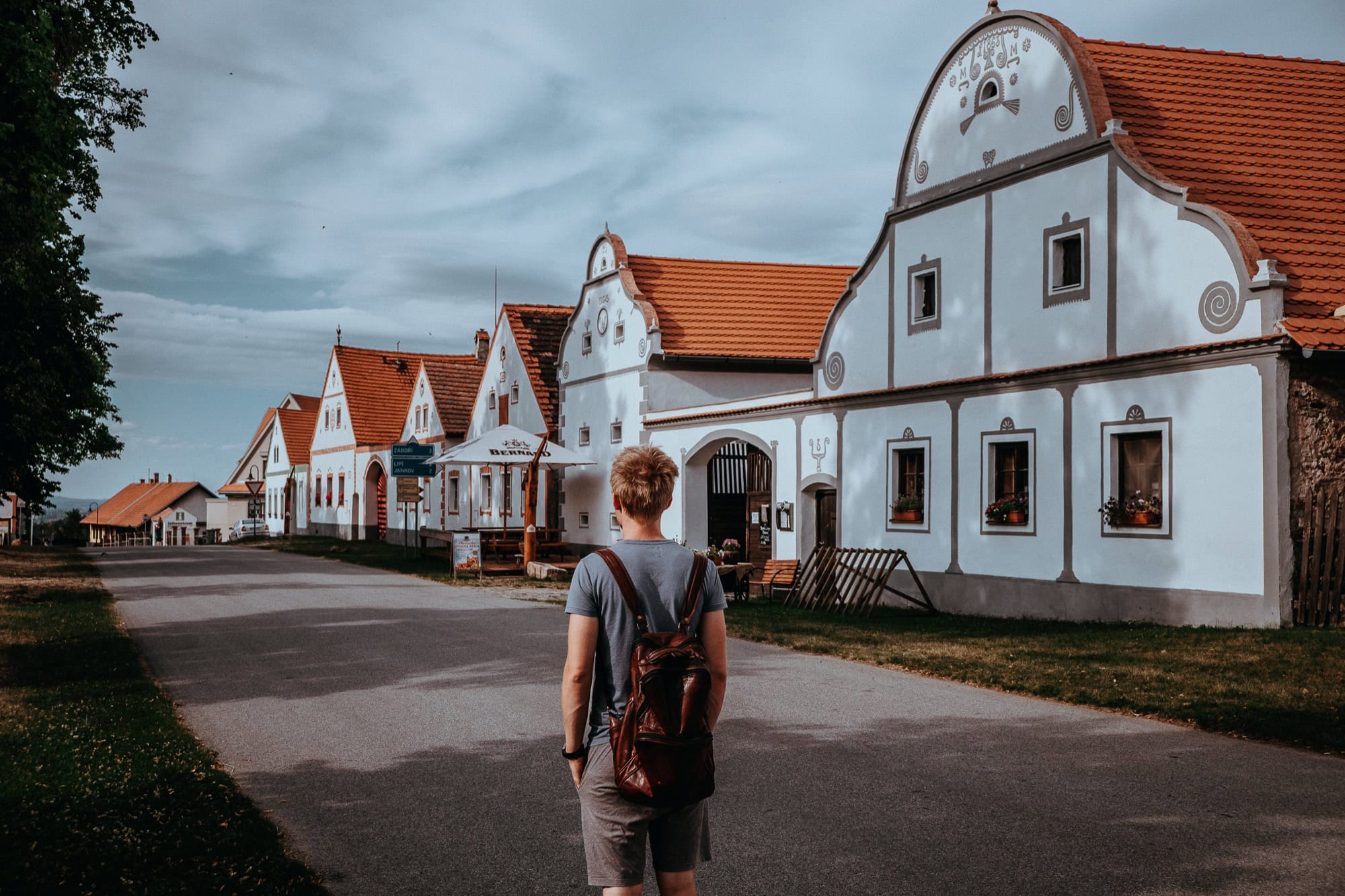
TL;DR
- Architecture: A unique ensemble of South Bohemian rural baroque, made up of 23 heritage-protected farmsteads arranged around a central village green.
- A living village: Holašovice is neither a museum nor an open-air skanzen — around 150 people live here and the houses are privately owned.
- World Heritage: Since 1998 the village has been inscribed on the UNESCO list thanks to its exceptionally well-preserved layout and appearance.
- A short visit: An hour or two is plenty to explore the green and take your photos — it’s ideal as a stop on a road trip.
- A modern curiosity: Just outside the village you’ll find the Holašovice Stonehenge, a stone circle built as recently as 2008.
- Entry and fees: Wandering around the village is completely free; you only pay for parking and any admission to the local museum or the Stonehenge.
The full destination guide: South Bohemia — guide and what to see
When to Visit Holašovice
Holašovice is a freely accessible village, so you can come here absolutely any time of year. That said, you’ll have the best experience from spring to autumn, when the weather is pleasant, the trees on the green are green, and the white house facades stand out beautifully against a blue sky. In the summer season the local pubs and museum are open too, so you can round off your visit with a coffee or lunch. Personally, we love late spring or early autumn best, when there aren’t as many tourists as during the summer holidays and the little village feels far more peaceful.
If you like collecting stamps or want to pick up a souvenir, you’ll want to know the opening hours of the local info centre, which sits in house number 43. From April to October it’s open on weekends and public holidays, roughly from nine in the morning to five in the afternoon. In November and December it opens Friday to Sunday, and from January to March the info centre is closed altogether. Keep in mind that on Mondays most of the indoor exhibitions in the area are shut, although a stroll around the green is of course always possible.
A completely special time is the Rural Festivities (Selské slavnosti), held every year on the last weekend of July. Over these three days the village transforms into a huge historical fair full of traditional crafts, folklore and period atmosphere. It really is a wonderful experience, but be aware that these are the busiest days of the entire year. If you’re not a fan of crowds and want to photograph the houses in peace without hundreds of heads in the frame, it’s better to skip this July weekend and enjoy Holašovice on an ordinary weekday instead.
How to Get to Holašovice and Where to Park
The village of Holašovice falls under the municipality of Jankov and lies just about 15 kilometres west of České Budějovice. By far the most comfortable way to get here is by car. From the centre of České Budějovice you head towards Lhenice, and the drive takes only a little over twenty minutes. The road winds through the typical South Bohemian landscape of fields and small woods, so even the journey itself is a treat. Holašovice works best as a stop on a larger South Bohemian loop, since the village itself can be walked fairly quickly and it isn’t worth driving here for a whole day from far away.
Access into the village itself is restricted for non-residents, which is entirely understandable — the narrow green couldn’t cope with a flood of tourist cars. On the edge of the village, though, you’ll find a large and clearly laid-out official car park where you can leave your car without any trouble. Parking is paid, at roughly 2 € per hour (I’d recommend keeping some coins on you for the machine, though modernisation is moving along quickly). From the car park it’s only a few dozen metres on foot to the central green.
If you’re travelling by public transport it’s a little trickier, but doable. No train runs directly to Holašovice, so you’ll have to rely on buses. From the bus station in České Budějovice there are lines heading towards Lhenice that stop in Holašovice. The trip takes just under 45 minutes, but services aren’t especially frequent — particularly at weekends you’ll need to plan the timetables carefully. If you’re heading to South Bohemia without your own car, it’s well worth considering a rental, as it will save you a lot of time and hassle when hopping between the sights.
Where to Stay in and around Holašovice
Even though the village is tiny, there are several options for laying your head down here — some of them right in the historic surroundings. Staying in Holašovice is ideal for those of you who want total peace and quiet and to soak up the village atmosphere early in the morning or late in the evening, once all the day-trippers have left. But if you’re planning a more active holiday and want to head out to towns and castles every day, it makes more sense to base yourself in one of the larger towns nearby, which serve as a great strategic hub.
Here are our specific accommodation tips across different categories:
- Right on the green in Holašovice: Pension Špejchar u Vojty offers lovely family apartments with their own kitchenette. There’s a large garden with a barbecue and even an indoor pool, which you’ll appreciate especially in summer. You can also hire e-bikes here and set off to explore the surroundings.
- A night in a UNESCO site: If you want something truly unique, book Selský dvůr Holašovice. It’s a historic farmstead with roots going all the way back to 1524, where you’ll feel the genuine atmosphere of the old days without having to give up modern comfort.
- A base in České Budějovice: For lovers of city life and evening strolls we recommend Grandhotel Zvon České Budějovice. It sits right on the main square, has gorgeous historic rooms, and everything is within easy reach.
- A luxury stay by the château: If you want to really treat yourself and are after something more upscale, take a look at Parkhotel Hluboká, located near the famous neo-Gothic château and offering excellent service and facilities.
- Romance in a historic town: Who could resist the charm of winding lanes? Then go for Hotel Růže Český Krumlov. This iconic hotel in a former monastery offers an utterly unforgettable experience, and from Krumlov it’s only about half an hour’s drive to Holašovice.
What to See in Holašovice
Although Holašovice really is a small village, it hides so many architectural details and points of interest that it would be a shame to just rush through. Let’s take a look together at seven specific things and spots you should pay attention to on your walk. I’ll tell you where to look closely and what to watch out for.
1. The Village Green with Its Pond
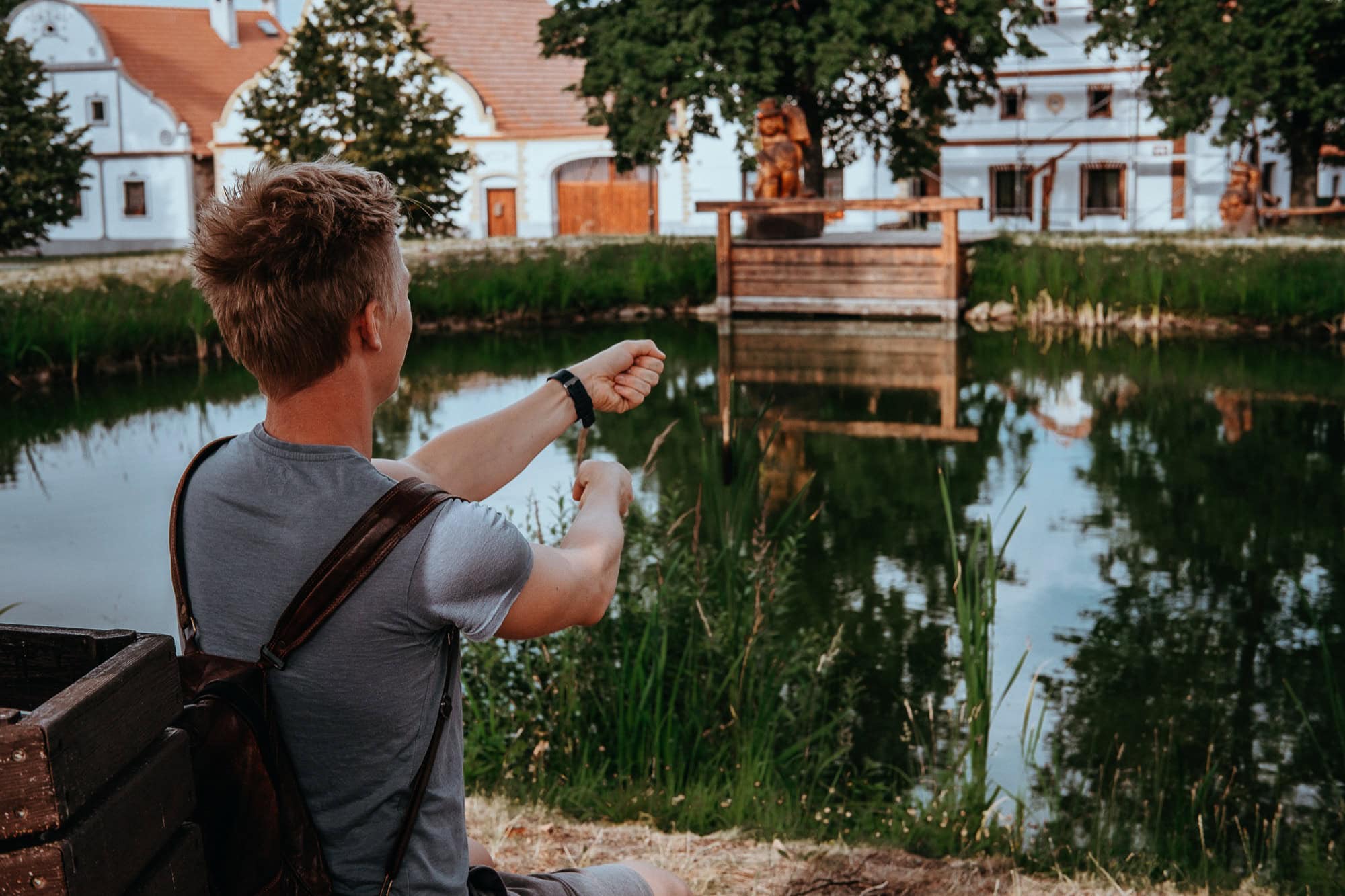
The heart of Holašovice is its enormous rectangular green, over 200 metres long and roughly 70 metres wide. Its dimensions are quite generous for a Czech village, and it’s precisely thanks to this unchanged medieval layout that the village earned its place on the UNESCO list. Around the green stand 23 heritage-protected farmsteads, though the village has around 120 buildings in total. In the middle of the green you’ll find a classic village pond that gives the whole space that perfect South Bohemian idyll.
Stand at the edge of the pond, look all around, and an incredible sense of calm washes over you. The white facades of the surrounding houses are mirrored on the water’s surface, and in the summer months flowers bloom in the window boxes. I’d recommend slowly walking all the way around the green along the grassy edge and looking at the farmsteads from different angles, because each side of the green catches slightly different light and offers different opportunities for beautiful photos.
2. The Decorated Gables of Rural Baroque
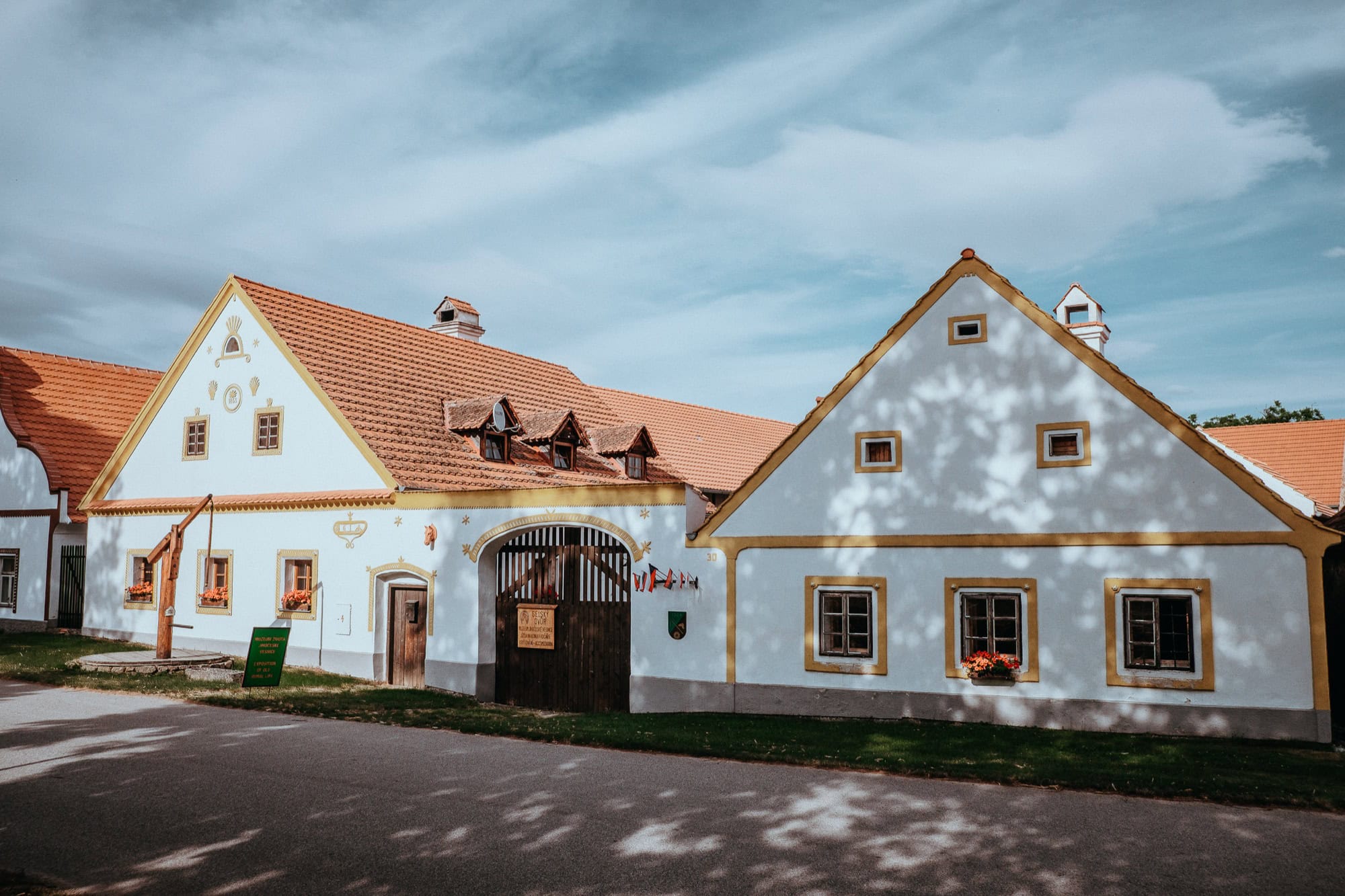
The main draw that brings tourists here from all over the world is the beautifully decorated house gables in the style of rural — or South Bohemian folk — baroque. These farmsteads got their present-day look mostly in the second half of the 19th century, during the main wave of rebuilding the originally wooden farms into brick buildings. The village’s wealthy farmers wanted to show off their fortune, so they had ornate facades built whose stucco details imitated grand baroque churches and manor houses. You’ll spot wide volutes (those curling scroll shapes at the edges), inscriptions, construction dates and small niche shrines.
Here I have to set the record straight on a common misconception. Rural baroque was indeed made famous by the celebrated master mason Jakub Bursa, but his documented buildings are mostly found around Prachatice and Strakonice. The Holašovice gables are in fact the anonymous work of skilled local masons whose names, sadly, haven’t survived. And yet they did an absolutely fantastic job, creating a unified whole that has no equal in the country.
3. Farmsteads and Arched Gates
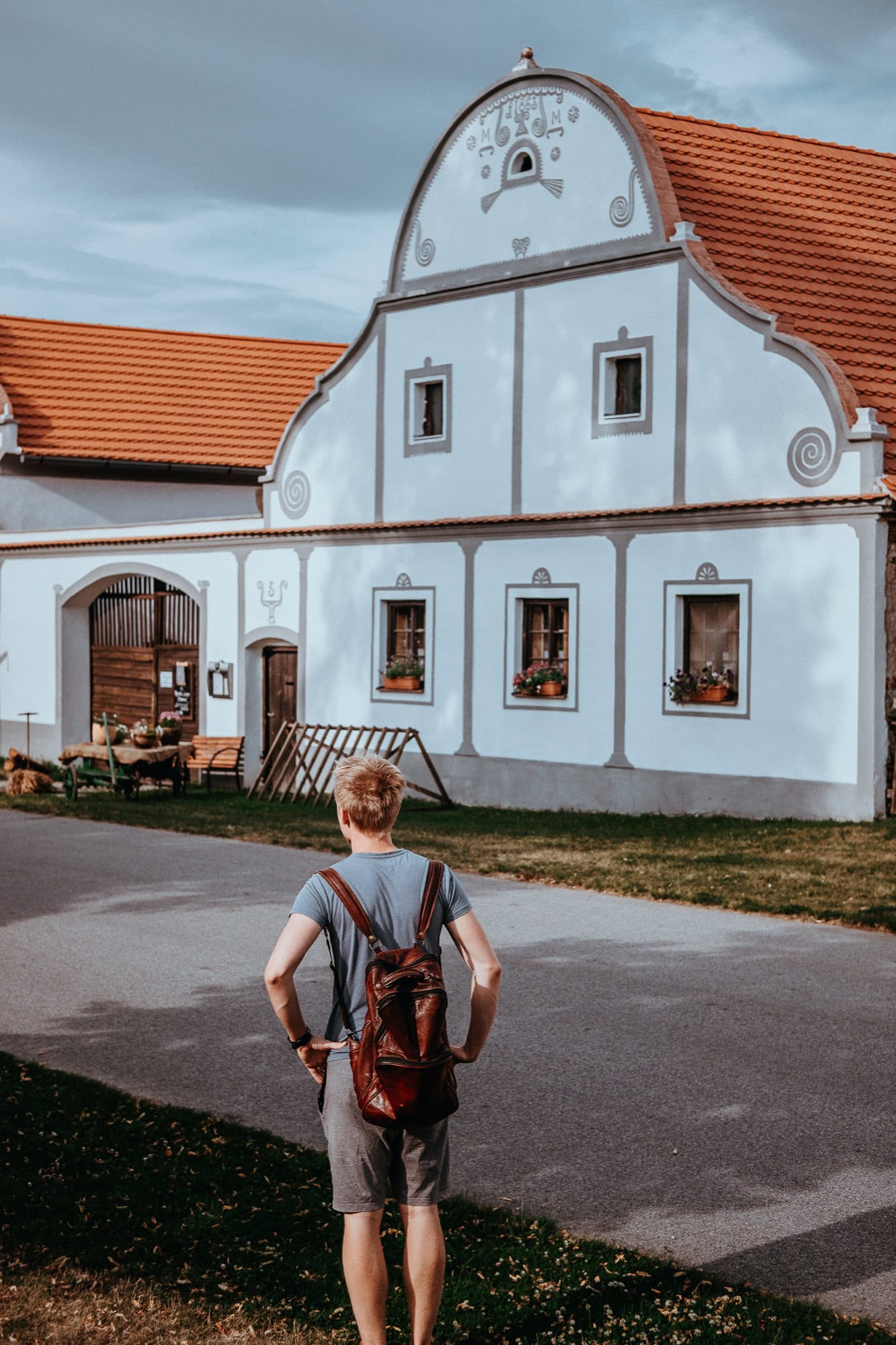
As you walk around the green, notice how the individual houses are arranged. A typical Holašovice farmstead consists of a residential house on one side and a granary or farm building on the other. Between them sits a magnificent massive enclosing wall with arched gates, through which carts loaded with hay once passed. These walls with their gates visually link the whole green together and create that characteristic enclosed look of a farmyard.
It’s important to keep in mind at all times that Holašovice really isn’t an open-air museum. Local residents genuinely live in these houses — they drive off to work in the morning and sit in their gardens in the afternoon. Even though the gates are often open and tempt you to peek into the courtyard, we must respect the locals’ privacy and not step onto their private property uninvited. Most of the courtyards are beautifully kept and full of flowers, which you can admire from a safe distance at the gate.

4. Rural Baroque Up Close: How the Village Came to Be
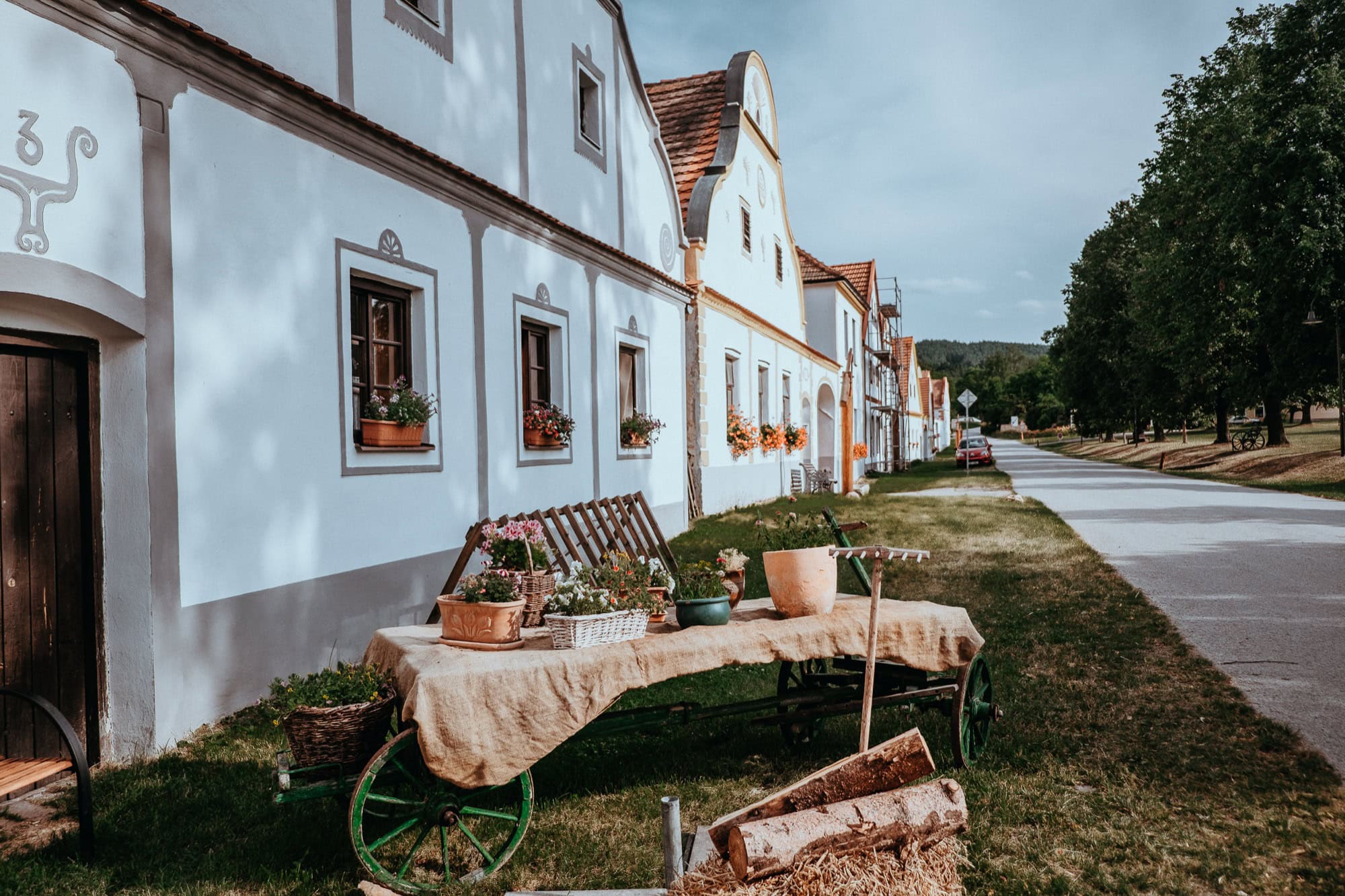
The history of Holašovice is fascinating and at times quite dark. The first written mention of the village dates from 1292, when it was donated to the monastery in Vyšší Brod. The worst period came around 1520 to 1521, when a terrible plague struck the village and it was almost entirely depopulated. The Vyšší Brod estate therefore had to resettle the empty houses, and mostly German-speaking inhabitants moved in.
The German population settled here for centuries, and even in the 1910 census a full one hundred percent of local residents reported German as their language. Everything changed after the Second World War, when between 1945 and 1946 the German-speaking old-timers were expelled and Czechs from the interior moved into the empty houses. If you’d like to learn more about how farming worked here in the 19th century, be sure to visit Farmstead No. 6, home to a museum of the traditional South Bohemian village. Museum admission is paid separately and the exhibition is really nicely done.
5. The Chapel of St John of Nepomuk
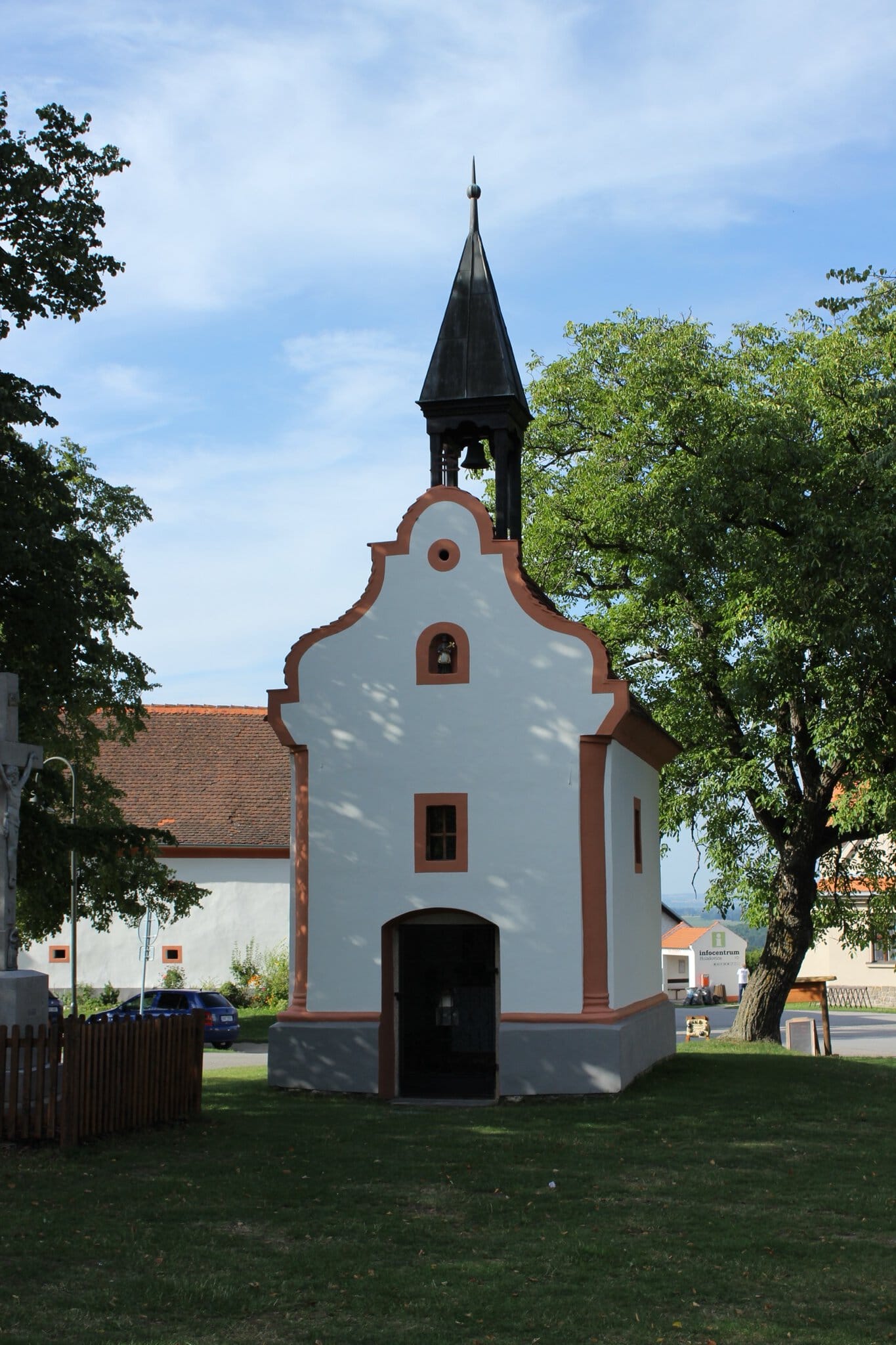
Right in the middle of the green, not far from the pond, stands an unassuming but all the more important building. It’s a small chapel dedicated to St John of Nepomuk, dating from 1744. The little chapel with its small bell tower is not only the compositional centre of the whole enormous green but was also, for centuries, its spiritual heart, where the villagers gathered to pray.
It’s built in a simple baroque style that pairs beautifully with the surrounding majestic gables of the farmsteads. The chapel’s white facade and red roof are among the most photographed spots in the village. You’ll often notice a bench here where you can sit and simply soak up the atmosphere of this exceptional place.
6. The Holašovice Stonehenge
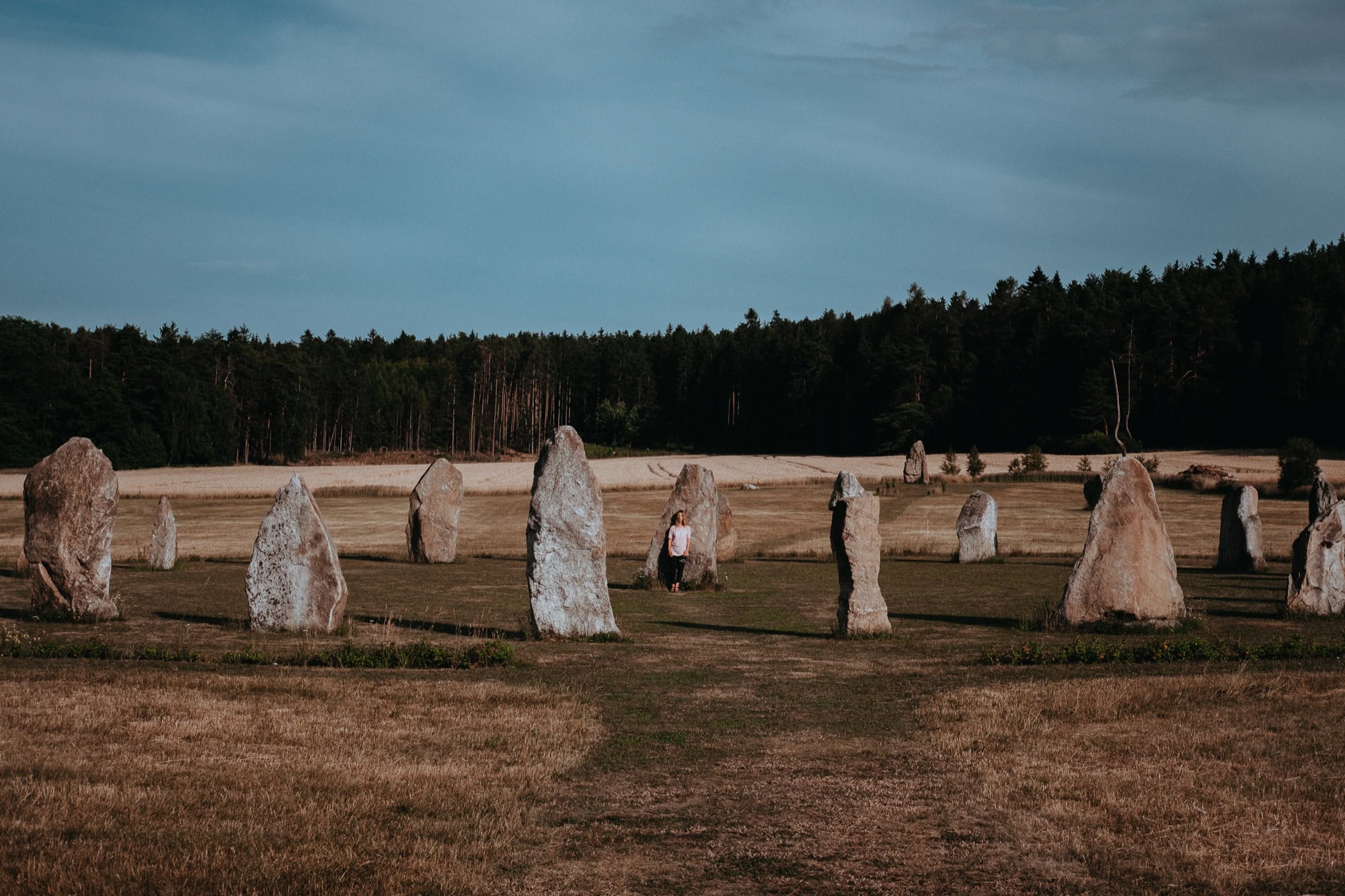
Roughly 400 metres beyond the village sits an attraction that sparks quite passionate debate. It’s the so-called Holašovice Stonehenge, a stone circle of twenty-five giant menhirs about 30 metres in diameter. I have to make it crystal clear here that this isn’t some prehistoric mystical monument, but a modern structure built by a local enthusiast as recently as 2008. Around the circle you’ll also find various wooden sculptures.
While some bloggers, both foreign and Czech, tend to criticise the place and consider it a bit of a tourist kitsch, plenty of Czechs happily come here to recharge their energy or simply take a walk. Lukáš and I take a relaxed view of it. If you enjoy modern megaliths and a touch of the esoteric, definitely pop over for a look. At the very least there’s a lovely view over the surrounding South Bohemian landscape, and on a clear day you can even spot the cooling towers of the Temelín nuclear power plant from the hill.
7. The Rural Festivities and Photographing the Village
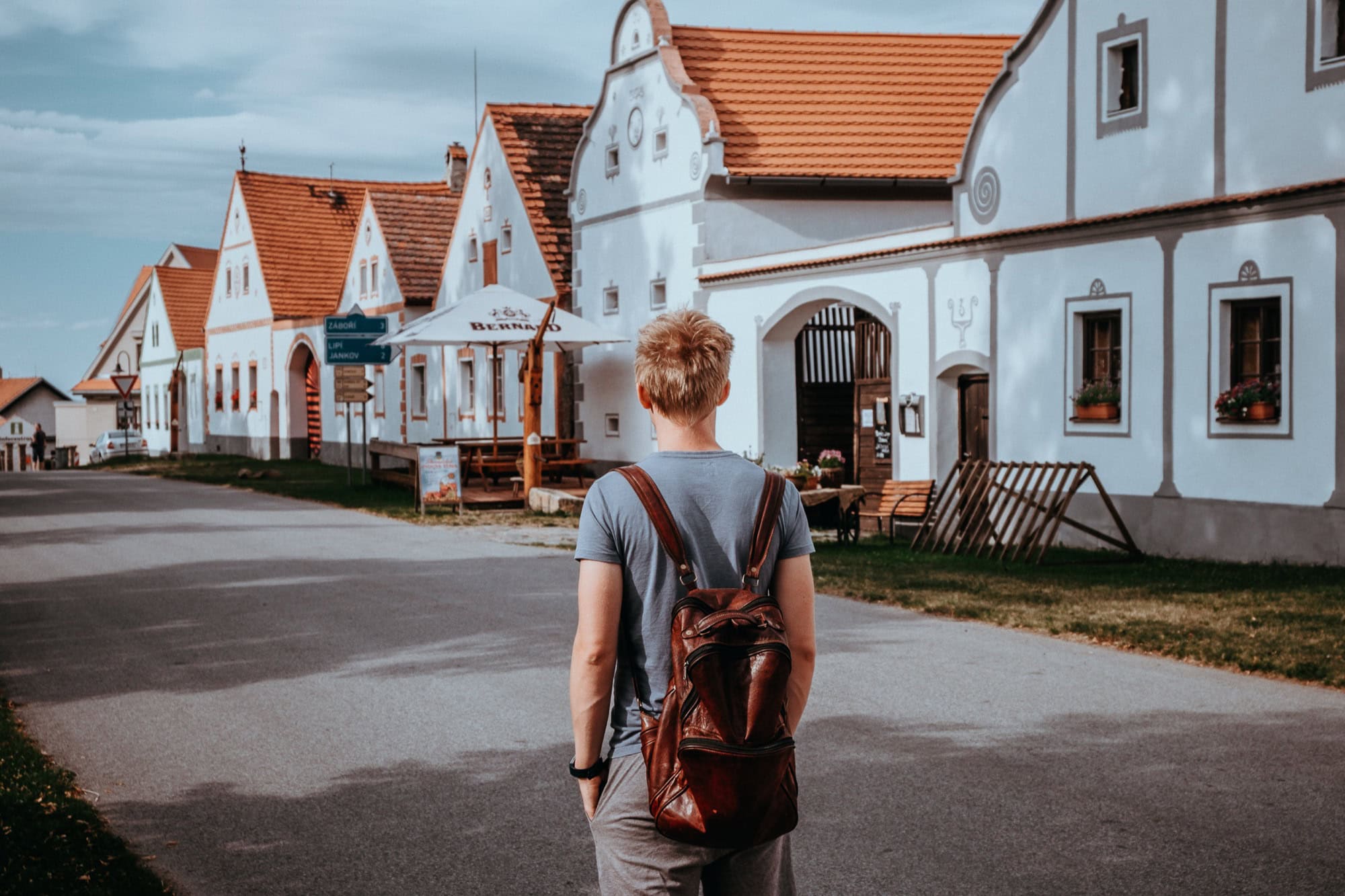
As I mentioned at the start, the biggest event of the year in Holašovice is the Rural Festivities, which come alive on the last weekend of July every year. The whole green fills up with dozens of stalls of traditional Czech crafts, the smell of food is everywhere, folk music plays and people walk about in period costumes. It’s the perfect chance to experience the village in full swing, much as it might have looked a hundred years ago during the great markets.
But if you come outside the festivities, you’ll find absolutely perfect conditions for photography. I’d recommend walking not only the inner perimeter of the green but also peeking into the side lanes and examining the details up close. The house facades are often decorated with little crosses, dates or the names of the original owners, and all these details are what make Holašovice so extraordinary.
💡 Tip: If you want the best photos without cars and people, come here early in the morning — even around eight o’clock — or, on the other hand, in the early evening, when the setting sun turns the white facades golden and most of the tour buses are long gone.
Where to Eat in Holašovice
After a walk around the green you’re bound to work up an appetite, and luckily you don’t have to go far. Right in the village there are several restaurants aimed primarily at tourists, serving classic Czech cuisine. Traditional South Bohemian country cooking has historically been very meat-heavy, so on the menu you’ll mainly come across roast meats, rich svíčková (beef sirloin in cream sauce), pork with dumplings and sauerkraut, and of course carp from the nearby South Bohemian ponds — a huge local speciality.
Since Lukáš and I are both vegetarians, these heavy classics go completely over our heads. When visiting places like this we usually fall back on the tried-and-tested safe bet of fried cheese with tartare sauce, proper garlicky potato pancakes, or a good meat-free soup. Very often we solve lunch by sitting on the garden terrace of Restaurace Špejchar u Vojty, having an excellent coffee with something sweet, and then driving into the larger town of České Budějovice for a proper meal, where the choice of vegetarian dishes is much wider. Still, I’d definitely recommend stopping at one of the pubs on the green for at least a pint of draught beer or a homemade lemonade, because sitting with a view of those gorgeous farmstead gables is an experience in itself.
Day Trips from Holašovice
Holašovice sits in an absolutely strategic spot, so once you’ve explored the little village you can head straight on to discover more of South Bohemia’s charms. Here are a few of our tips for nearby places well worth a visit:
- České Budějovice (about 15 km away) – The regional capital with its enormous square-shaped main square, the tall Black Tower with a fantastic view, and the famous Budvar brewery.
- Hluboká nad Vltavou (about 20 km away) – A stop at one of the country’s most beautiful neo-Gothic châteaux is practically a must, and you can also stroll through the sprawling château park.
- Zlatá Koruna (about 15 km away) – A gorgeous and very well-preserved Cistercian monastery in the Vltava river valley, which lovers of quiet and history will appreciate.
- Český Krumlov (about 25 km away) – A world-famous UNESCO-listed town that will enchant you with its winding lanes, majestic castle and mysterious atmosphere.
- Dívčí Kámen (about 15 km away) – One of the most romantic castle ruins in South Bohemia, reached by a lovely walk through the forest along the river.
💡 Tip: If you’d like to make planning easier and enjoy organised guided tours, you can conveniently book plenty of great tickets to châteaux — or, say, boat trips along the Vltava in nearby Krumlov — online through GetYourGuide.
Where to Next
If you enjoy discovering the beauty of the Czech Republic and are looking for more travel inspiration, be sure to check out these other articles of ours:
Frequently Asked Questions
Are Holašovice an open-air museum?
No, Holašovice is definitely not some artificially created open-air museum or skansen. It’s a regular, permanently inhabited village where about 150 residents live in ancient farmsteads. Most of the houses are privately owned, so you can only view their exteriors from the village green.
How much does it cost to enter the village of Holašovice?
A stroll through the entire village and admiring the beautiful farmhouse gables is completely free. You only pay for parking at the official car park on the edge of the village (roughly €2 per hour) and possibly an entrance fee to the local museum at Farmstead No. 6 or a voluntary donation at the Holašovice Stonehenge.
When was the Holašovice Stonehenge built?
Although the name might evoke ancient times, the stone circle behind the village was built only in 2008 by a local enthusiast and builder. So it’s not an ancient monument, but a modern esoteric project consisting of 25 large menhirs and serves mainly as a viewpoint.
Who is the author of the Holašovice gables?
It’s often mistakenly stated that the rural Baroque in Holašovice is the work of the famous mason Jakub Bursa. However, he worked primarily in the Prachatice and Strakonice regions. The Holašovice farmsteads were reconstructed to their present form between 1840 and 1880 by unnamed local masons, whose skill was absolutely exceptional.
How long does a visit to Holašovice take?
The village is quite small, so a leisurely stroll around the village green and taking all the photos will take you about an hour. If you decide to visit the local museum in the Farmstead, check out the Stonehenge, or sit down for a coffee at the restaurant, count on about two hours.
Can I come to Holašovice with a dog?
Yes, you can bring your dog to Holašovice without any problems. Since it’s a regular public village, walking around the village green with your dog on a leash is completely unrestricted. Restrictions may only apply inside the local museum or in some restaurants, which you need to verify directly on site.
Tips and Tricks for Your Vacation
Don’t Overpay for Flights
Search for flights on Kayak. It’s our favorite search engine because it scans the websites of all airlines and always finds the cheapest connection.
Book Your Accommodation Smartly
The best experiences we’ve had when looking for accommodation (from Alaska to Morocco) are with Booking.com, where hotels, apartments, and entire houses are usually the cheapest and most widely available.
Don’t Forget Travel Insurance
Good travel insurance will protect you against illness, accidents, theft, or flight cancellations. We’ve had a few hospital visits abroad, so we know how important it is to have proper insurance arranged.
Where we insure ourselves: SafetyWing (simple monthly subscription) and TrueTraveller (for extra-long trips).
Find the Best Experiences
Get Your Guide is a huge online marketplace where you can book guided walks, trips, skip-the-line tickets, tours, and much more. We always find some extra fun there!
More from South Bohemia
Full guide →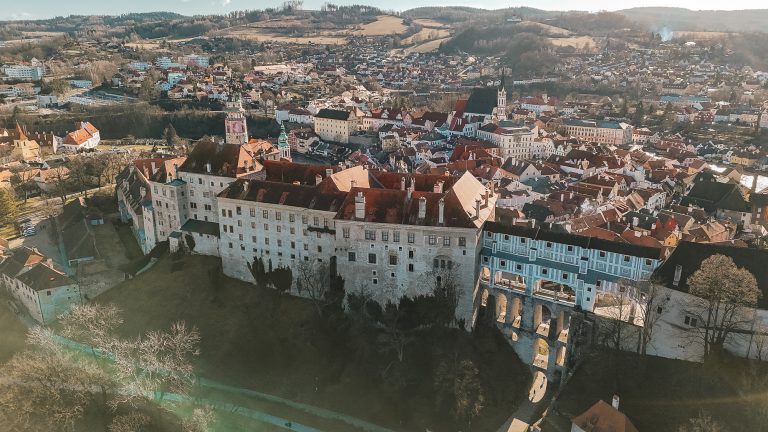 Day trips · most readCesky Krumlov: 20 Best Things to Do and See
 When to goChristmas Markets in České Budějovice 2026 – Tree Lighting, Opening Hours & Programme
 Where to stayTřeboň, Czech Republic: 20 Best Things to Do and See
 With kidsWhere to Go on Holiday in South Bohemia, Czech Republic: 15 Most Beautiful Places (Even With Kids) in 2026
 FoodTábor, Czech Republic: A Hidden Gem Where World-Class Wine Meets Culinary Poetry


