

Just beyond the edge of Prague lies a place you’d never spot from the motorway. Tucked deep into the valley of the Loděnice stream, Svatý Jan pod Skalou is a tiny, enchanting village in the Czech Karst with just two hundred residents. A towering limestone cliff looms over it, and Lukáš and I recently headed out here for a relaxed afternoon trip.
We wanted a bit of peace and quiet and to recharge in nature. But I have to confess one important thing right from the start. We came outside the main season, so we couldn’t get inside the famous local church or into the mysterious cave of Saint Ivan. These monuments are only open from spring to autumn.
It didn’t bother us at all though — maybe quite the opposite. Thanks to that, we had the village and the climb to the viewpoint almost entirely to ourselves, which is a real rarity in this hugely popular spot. Come along with us to see everything you can experience in this gem of the Czech Karst, and how to plan your trip so you don’t spend an hour searching for a parking space.
TL;DR: what awaits you in Svatý Jan pod Skalou
- Beautiful nature: the village sits in a picturesque valley, literally hemmed in by massive cliffs.
- A thousand years of history: according to legend, Saint Ivan — the first documented Christian hermit in the Czech lands — lived here in a cave for 42 years.
- Baroque architecture: the village is dominated by a stunning monastery and church built by famous architects.
- A more demanding climb: a steep forest path leads up a hundred-metre limestone cliff with a fantastic view.
- Healing water: the local spring flows freely beside the church, and people still come to fill their canisters today.
- Limited opening hours: the indoor monuments only open in season, and finding a parking spot is often a real puzzle.
The full destination guide: Czechia — guide and what to see
When to visit Svatý Jan pod Skalou
If you’re planning a visit to this picturesque Central Bohemian village, a lot depends on exactly what you expect from the trip. Svatý Jan pod Skalou is a classic example of a place where the summer and winter atmospheres are worlds apart. The main tourist season runs roughly from the first of April to the end of October. During this period, the interiors of the church and cave are open on weekends and holidays — but only as part of a guided tour. Over the summer holidays, the doors open from Tuesday to Sunday.
Lukáš and I came here in late autumn, when the leaves had turned gorgeous shades of gold. Sure, the closed doors meant we couldn’t admire the baroque interiors, but the total peace and quiet more than made up for it. We climbed the cliff in beautiful soft light, and at the cross on top we didn’t have to share the best view with crowds of other tourists.
A stroll around the village and a taste of the local spring water will take you about an hour. If you decide to hike up the cliff, allow another hour and a half. For the whole Svatojánský circuit including a stop at the quarries, set aside a comfortable two to three hours.
How to get to Svatý Jan pod Skalou and where to park
Getting here — and especially finding a free spot for the car — is probably the biggest headache of the whole trip. The village is tiny and squeezed into a narrow valley, so expanding the parking capacity simply isn’t physically possible. If you drive here in high season on a sunny weekend, be prepared for everything to be hopelessly full by around eleven in the morning, when parking becomes a small miracle.
There are four official paid car parks in the village, all with the usual ticket machines. Prices run to roughly €2 for three hours or €4 for the whole day. I really recommend setting off early and arriving as soon as possible in the morning, so you can park in peace and avoid any needless stress. If you’re travelling internationally, most visitors from the UK fly into Prague (direct routes run from London, Manchester and other UK airports), then hire a car — from Prague you can reach the village smoothly along the D5 motorway. Just take the Loděnice exit and within a few minutes you’ll be winding down into the valley. Note that Czech motorways require a digital vignette (toll sticker), which you can buy online before you set off.
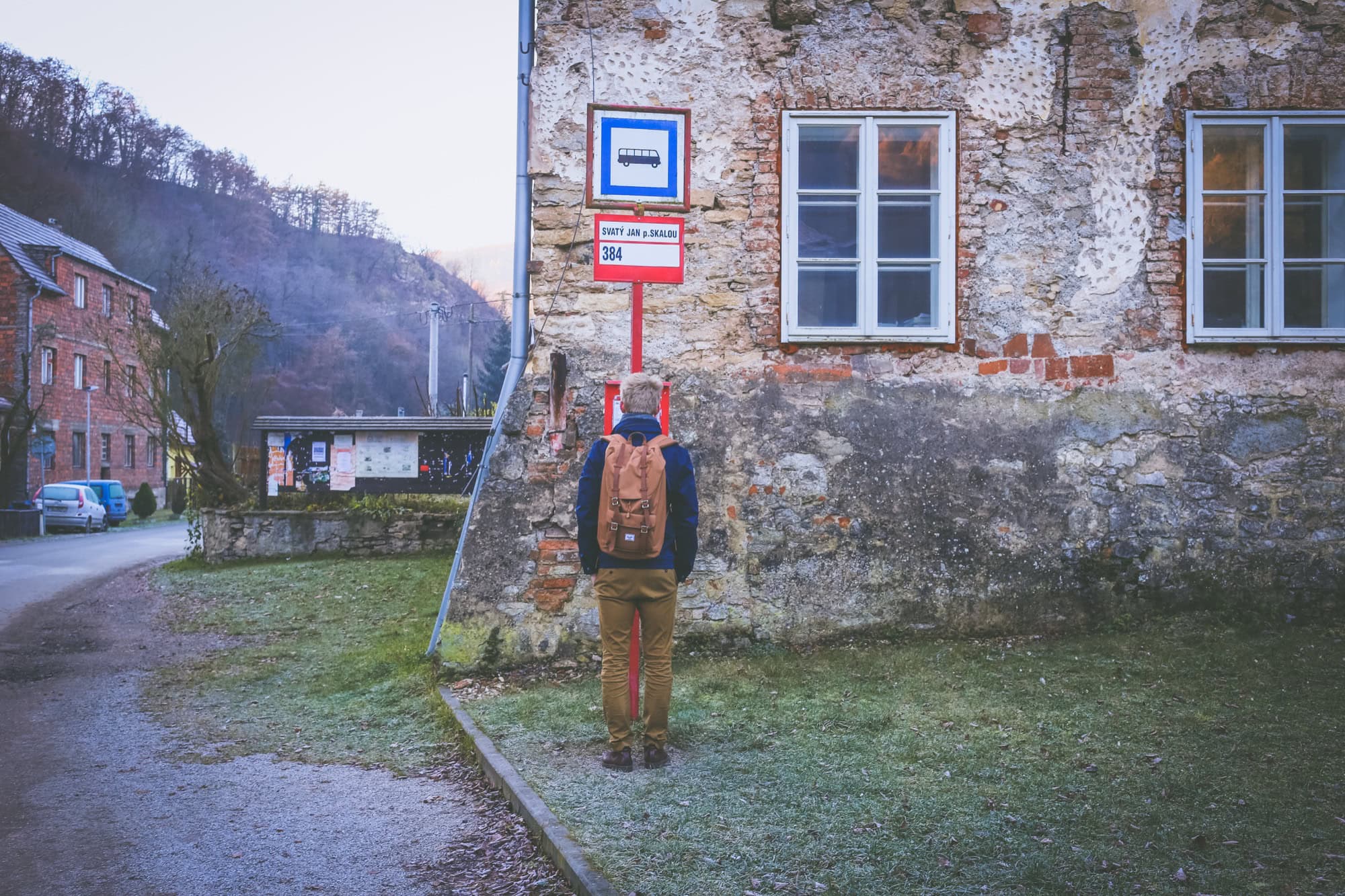
If you prefer public transport, be ready for a bit of a walk, as the train won’t take you right to the monuments. The best option is to reach the main station in Beroun or get off in nearby Srbsko. The regular S6 and S7 lines run here from Prague’s main station. From Srbsko you can then set out on foot through the beautiful valley. Bus number 825 from Beroun goes right into the centre of the village, which is the ideal choice if you’d rather not spend too long walking along tarmac.
Where to stay in Svatý Jan and the surrounding area
Although this is a tiny village, you’ll find plenty of lovely places to spend the night both here and nearby. The whole Czech Karst area is practically made for long weekends.
Right in the heart of the village you can rest your head at the stylish Hotel Obecná škola Svatý Jan pod Skalou. You’ll be staying literally beneath the enormous cliff, and first thing in the morning the healing spring and historic monastery are just a few steps from your room.
If you’d like to combine your trip with a visit to the nearby famous castle, an excellent choice is Hotel Mlýn Karlštejn. It’s a very tastefully restored mill sitting right on the bank of the Berounka river, with a sauna and hot tub ready for guests to unwind in the evening. Another great option right below the castle is the popular Penzion Karlštejn, with beautiful, comfortable rooms.
For families with children or keen cyclists, we can wholeheartedly recommend Hotel U Berounky Srbsko. It sits in a wonderfully peaceful setting within the protected landscape area and offers secure bike storage. If, on the other hand, you’re after a town base with all the shops and services within walking distance, definitely try Hotel Grand Litava Beroun.
What to see in Svatý Jan pod Skalou
Let’s take a look together at the most interesting things this picturesque Central Bohemian village has to offer. I’ve put together a list of six spots you absolutely mustn’t miss on your trip.
1. The monastery and church of Saint John the Baptist
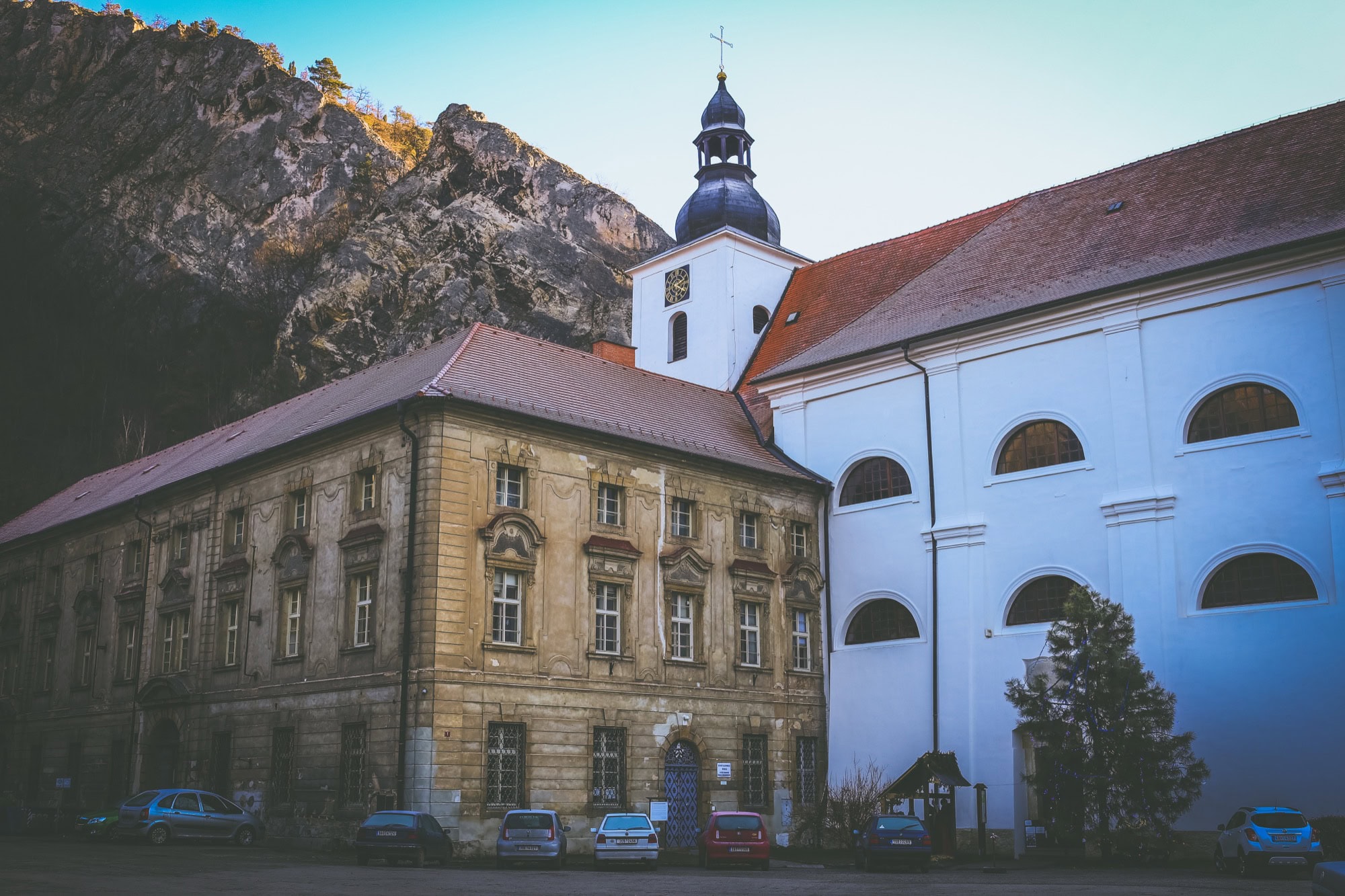
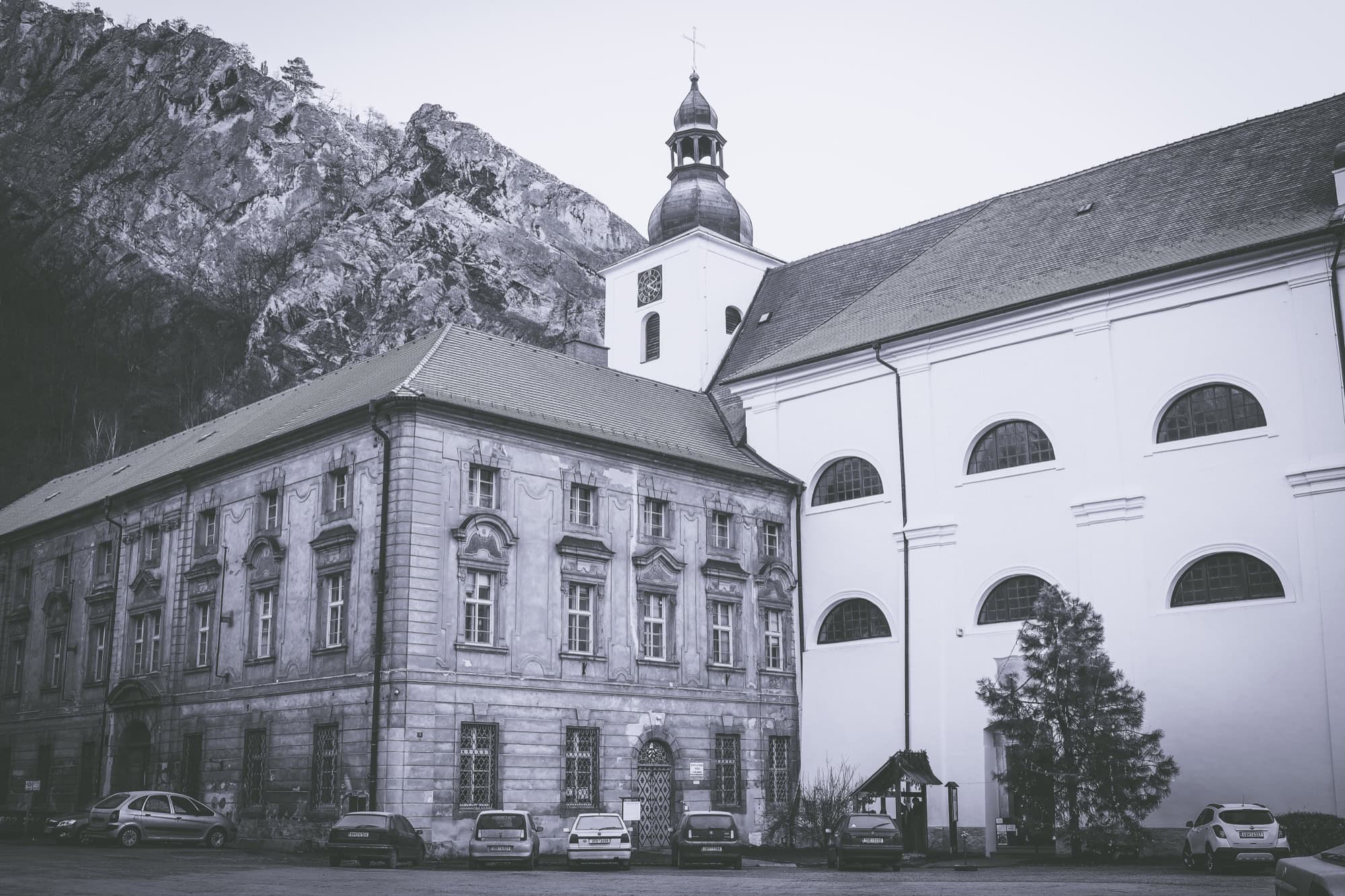
The whole valley is dominated by a magnificent baroque complex that has proudly held the status of national cultural monument since 2018. The history of this extraordinary place goes all the way back to 1030, when Prince Břetislav I gave the small local chapel to the Benedictine monastery of Ostrov near Davle. When the mother monastery was mercilessly destroyed by the Hussites in 1420, the monks moved here permanently and began building a new seat. The baroque church of the Nativity of Saint John the Baptist itself started to rise in 1657, led by the brilliant Italian architect Carlo Lurago. Emperor Leopold I even came in person to lay the foundation stone. About fifty years later the entire vault threatened to collapse, but the situation was ultimately saved by the famous architect Christoph Dientzenhofer.
Inside the church lies a richly decorated tomb with a silvered reliquary holding the remains of Saint Ivan. You’ll also be struck by the massive cross above the main altar, which once stood on Prague’s Charles Bridge. High up in the tower hangs a rare bell from 1401 bearing the oldest surviving Old Czech inscription. After the communist regime came to power in 1949, however, a dark chapter began: the complex was cruelly turned into a forced-labour camp, a prison for inconvenient clergy, and then served for nearly thirty years as a school for the National Security Corps. Today it houses the St John’s College, so the complex isn’t normally freely accessible, and you can only see inside the church in season with an official guide.
2. The cave of Saint Ivan and the hermit legend
The whole place is tied to an utterly fascinating thousand-year-old legend that still draws pilgrims today. At the end of the ninth century, the first documented Christian hermit in the Czech lands — known as Saint Ivan — is said to have lived here. According to oral tradition, he was the son of an influential Slavic prince who renounced all worldly wealth and chose to spend an incredible 42 years in complete self-denial in a cave inside the local cliff. His remains were solemnly exhumed and venerated in 1584.
The cave itself feels deeply mystical — it’s essentially a little rock chapel carved straight into the cool limestone, complete with a beautiful Renaissance altar. To this day you’ll find a sacred stone bearing the imprints of the hermit’s feet, along with his hard stone bed. You enter it directly through the main church, so the same opening hours and guided-tour requirement apply here too. Right beside the wall, a heavily mineralised healing spring named after Saint Ivan flows freely. Up until the 1970s this water was bottled and sold across the country as the popular mineral water Ivanka. You can reach the spring free of charge all year round, and locals still regularly come here to fill up large canisters.
3. The cliff with the cross and the climb above the village
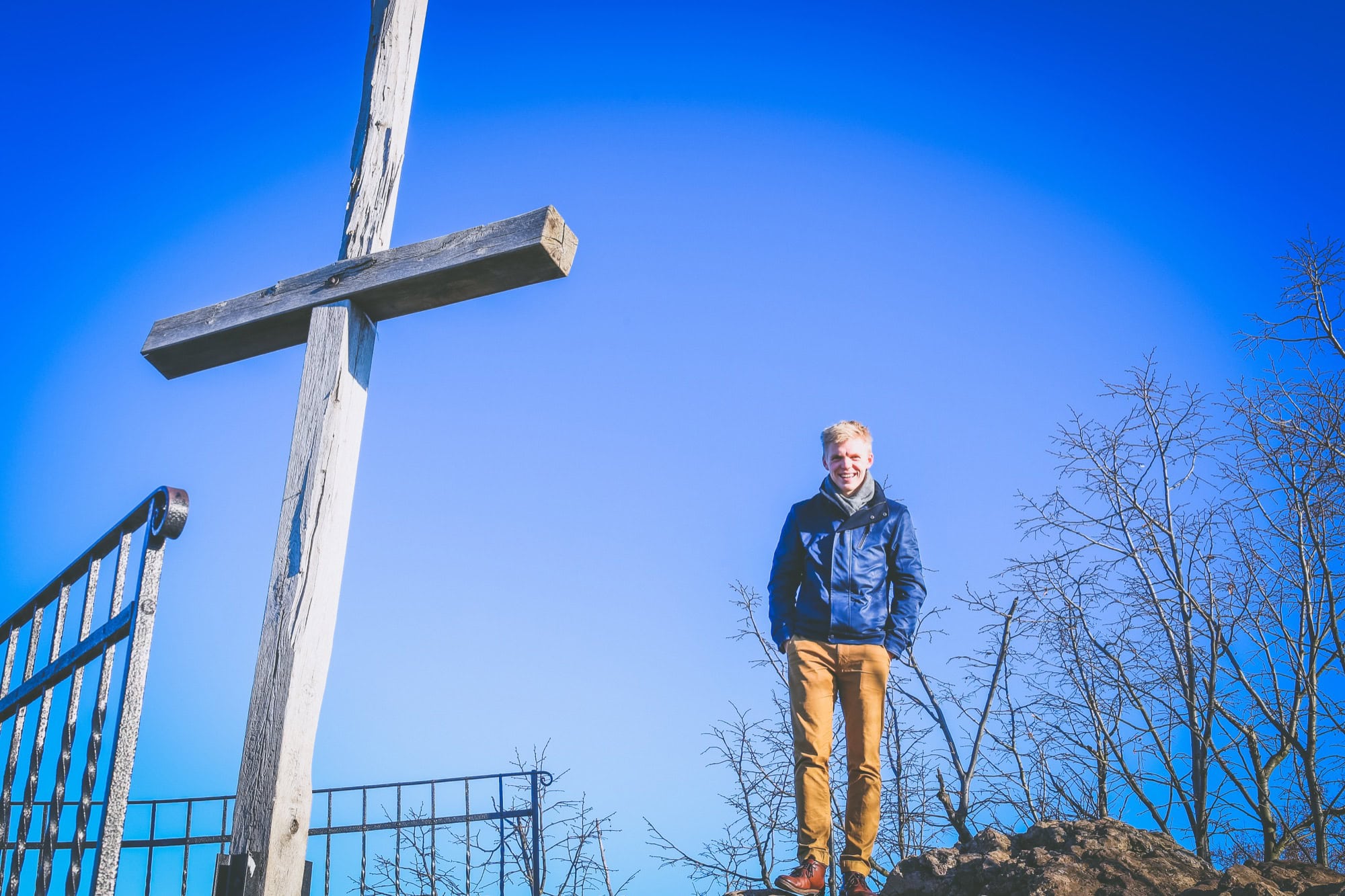
This is probably the biggest draw that pulls day-trippers here from far and wide. Rising directly above the roofs of the baroque monastery is a very imposing limestone wall around 150 metres high. At its very top stands a mighty wooden cross, visible from afar and forming the village’s unmistakable silhouette. As soon as we parked the car, our steps headed straight for the red hiking trail that leads sharply upward.
The climb is fairly demanding, and honestly, you’ll work up a bit of a sweat 😅. The path follows a very steep forest trail full of slippery stones and jutting roots. It’s no secured via ferrata and you don’t need any special gear at all, but proper sturdy footwear is an absolute must. At a normal pace you’ll manage the way up in around thirty to forty minutes. The great advantage is that the trail is open year-round and there’s no admission fee whatsoever.

4. The viewpoint over the Kačák valley
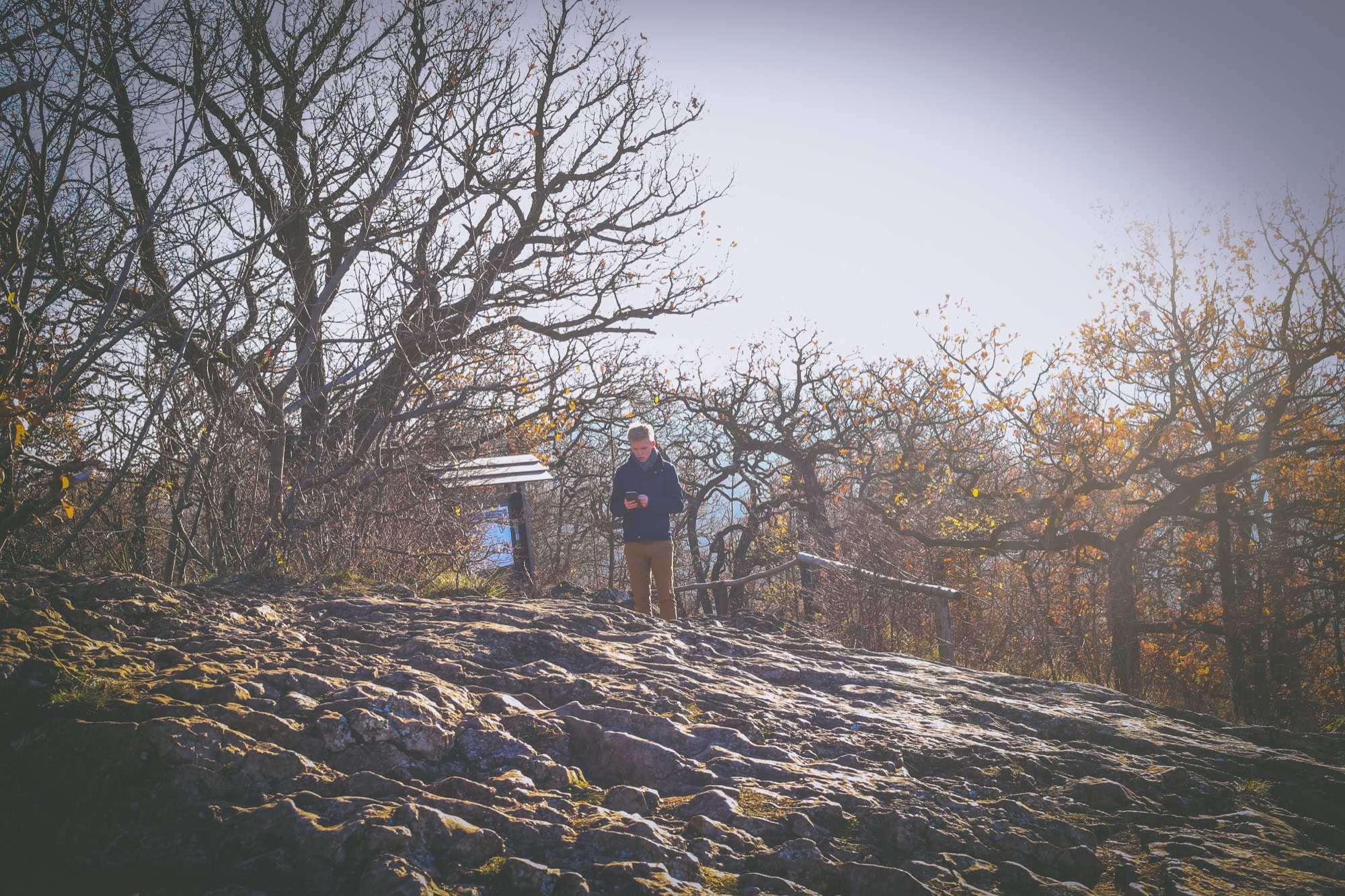
Once you’ve finally conquered all that tiring huffing and puffing up the steep hill and emerge from the shade of the forest onto the sunlit rocky plateau by the cross, an incredible reward awaits. A gorgeous view opens up into the deep valley of the Loděnice stream, which locals here call nothing other than the Kačák. Gazing out over this rippling landscape and the surrounding hills is an experience you could honestly never tire of.
Only from up here do you fully grasp just how enormous the whole baroque complex with its church really is, and how tiny the village huddling around it seems. We couldn’t resist — we sat down on the warm stones up top, watched the surrounding forests dressed in autumn colours, and soaked up that perfect silence. This view down is so photogenic that you’re guaranteed to take plenty of lovely keepsake shots.
5. The village hemmed in by cliffs
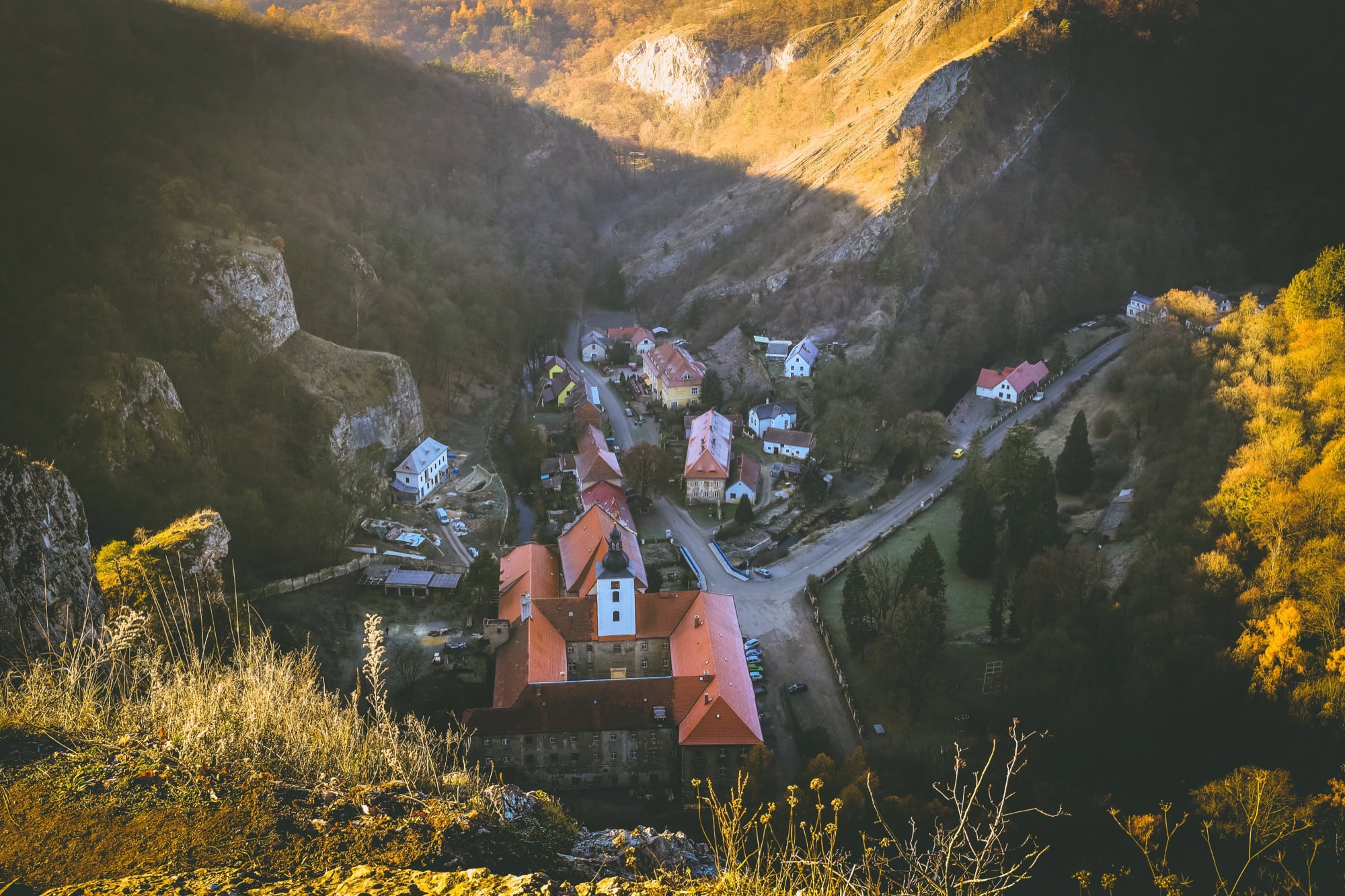
The village itself has enormous charm and feels wonderfully homely. Because it’s so perfectly hidden in a deep bend of the valley and locked firmly in the grip of the limestone cliffs, you’d never even guess it was there from the main road. You’ll find a very likeable cluster of neat little houses, the old school building, and a few winding lanes running alongside the babbling stream.
As we walked through the village towards the start of the steep ascent to the viewpoint, we came across another small but very pretty monument. On the way to the cross you pass the elegant baroque chapel of the Exaltation of the Holy Cross, which has stood firmly here since 1714. Definitely pause for a moment and take a rest before you tackle the main hill.
6. The nature trail, the Solvay quarries and treks through the Czech Karst
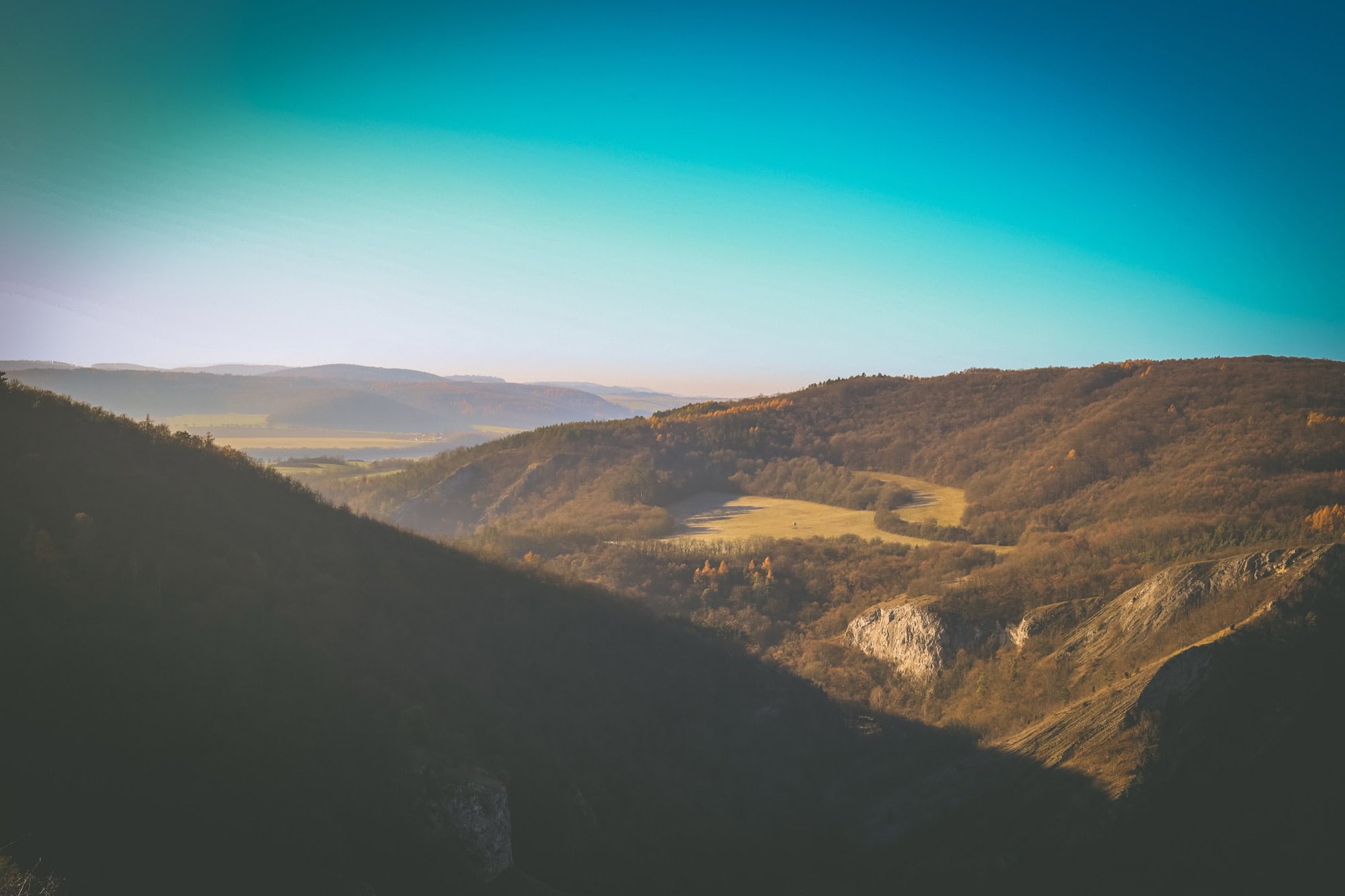
If you don’t feel like jumping straight back in the car after coming down from the cliff, definitely head out to explore the surroundings a little longer. Right from the car park by the church begins a very nice nature trail called the Svatojánský okruh. It’s roughly four kilometres long, takes a little over two hours to walk, and leads you through the loveliest parts of the whole area, including a stop at the chapel and the clifftop viewpoint.
Part of this larger loop is the fascinating mining open-air museum at the Solvay quarries, which you can read more about on the official Kudy z nudy website. It’s a former limestone quarry where an old narrow-gauge mining railway has been preserved. Since 2023 you can even ride a fully functioning steam locomotive named Bronhilda. The indoor exhibitions and fun train rides mostly run from May to October on weekends, but you can freely walk the outdoor quarry grounds with the nature trail absolutely any time of year.
💡 Tip: If you come outside the main season or during the winter months, take real care on the climb to the cross. The path over smooth stones and wet roots can be extremely slippery, and there’s often a nasty risk of ice.
Where to eat in Svatý Jan
After a demanding hike up the cliff and a walk through the forest, you usually work up quite an appetite. Right in the centre of the village you’ll find the spacious Hotel and Restaurant Obecná škola, which serves classic Czech cuisine. Traditional Czech specialities are a favourite among guests, and plenty of visitors come here specifically for them.
The two of us are vegetarians, though, so we went for the lighter route. We happily ordered a hot soup and a hearty portion of fried cheese with potatoes — the perfect thing to warm us up after the climb. They also do good pasta.
If you come in high season, don’t miss a visit to the Svatý Jan pod Skalou Café and Patisserie. We were out of luck this time, as they’d sadly already closed for the season, but in spring and summer it’s apparently the ideal spot to sit down with an excellent coffee and a sweet treat after a demanding trek.
Where to go from Svatý Jan pod Skalou
The Czech Karst area offers so many interesting and varied places that it would be a huge shame to limit yourself to just one village. Here are a few of our tried-and-tested tips for where to head next:
- Karlštejn Castle: This iconic monument lies only about 9 kilometres away. You can take a beautiful walk through the Berounka river valley via nearby Srbsko, or drive there comfortably in about fifteen minutes.
- Beroun: This lovely district town sits just 5 kilometres from Svatý Jan. Well worth a look are the nicely restored historic square and the very popular bear enclosure with its bears on Městská hora.
- Koněprusy Caves: If you love mysterious underground worlds and stalactites, head to the largest cave system in all of Bohemia, just a short drive away.
- Tetín: A neighbouring historic village closely tied to the ancient history of Saint Ludmila, offering absolutely stunning views over the meandering Berounka river.
- Koda Nature Reserve: A magical wooded valley full of clear brooks and old deciduous forests, absolutely perfect for a quiet afternoon ramble through nature.
💡 GetYourGuide tip: If you’re planning a longer holiday and figuring out what to do, take a look at GetYourGuide. Lukáš and I use it all the time to find tickets and all sorts of activities around the world, because it’s incredibly clear and easy — and it often helps you skip long queues at the ticket office.
Where to next
Get inspired by our other articles too and plan plenty more unforgettable trips.
Frequently asked questions
Where can you park in Svatý Jan pod Skalou?
Right in the heart of the village, there are four designated paid car parks with ticket machines. Parking costs roughly €2 for three hours or €4 for the whole day. However, capacity is very limited, so we strongly recommend arriving as early in the morning as possible.
When is the Church of St. John the Baptist accessible?
The interior spaces of the monuments are open only during the main tourist season, roughly from the beginning of April to the end of October. Tours of the church and cave are always conducted with an official guide. Current information can be found on the official village website.
Is the climb up the rock to the cross very difficult?
The path is quite steep and follows a forest trail full of protruding roots and large rocks. The ascent takes approximately thirty to forty minutes. You don’t need any special climbing equipment, but sturdy and comfortable shoes are an absolute must here.
Is there an entrance fee for the viewpoint?
No, the forest trail up to the cross and the viewpoint itself at the very top of the limestone rock are freely accessible year-round completely free of charge.
Can you normally drink water from Saint Ivan’s Spring?
Yes, it is a highly mineralized healing spring that locals still commonly fill into bottles and canisters for drinking at home to this day. Access to the spring is free and it’s available 24/7.
What are the Solvay Quarries?
This is a fascinating nearby mining open-air museum located in a former large limestone quarry. You’ll find a historic narrow-gauge railway here, where you can even take a ride on a steam train during weekends in the summer season.
Tips and Tricks for Your Vacation
Don’t Overpay for Flights
Search for flights on Kayak. It’s our favorite search engine because it scans the websites of all airlines and always finds the cheapest connection.
Book Your Accommodation Smartly
The best experiences we’ve had when looking for accommodation (from Alaska to Morocco) are with Booking.com, where hotels, apartments, and entire houses are usually the cheapest and most widely available.
Don’t Forget Travel Insurance
Good travel insurance will protect you against illness, accidents, theft, or flight cancellations. We’ve had a few hospital visits abroad, so we know how important it is to have proper insurance arranged.
Where we insure ourselves: SafetyWing (simple monthly subscription) and TrueTraveller (for extra-long trips).
Find the Best Experiences
Get Your Guide is a huge online marketplace where you can book guided walks, trips, skip-the-line tickets, tours, and much more. We always find some extra fun there!
More from Czechia
Full guide →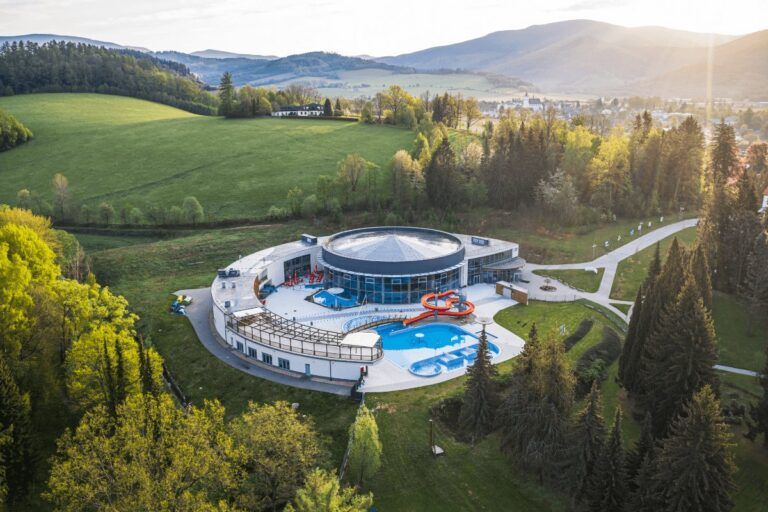 What to seeBest Thermal Spas in the Czech Republic: 12 Tips for Warm Water in 2026
 When to goBrno Christmas Markets 2026 – Tree Lighting, Opening Hours & Programme
 With kidsBest Water Parks in the Czech Republic: 13 Family Tips for 2026
 FoodPrague, Czech Republic: 10 Best Things to Do and See with a Toddler
 Where to stayPrague, Czech Republic: 10 Best Family Hotels for Your Stay with Children


