

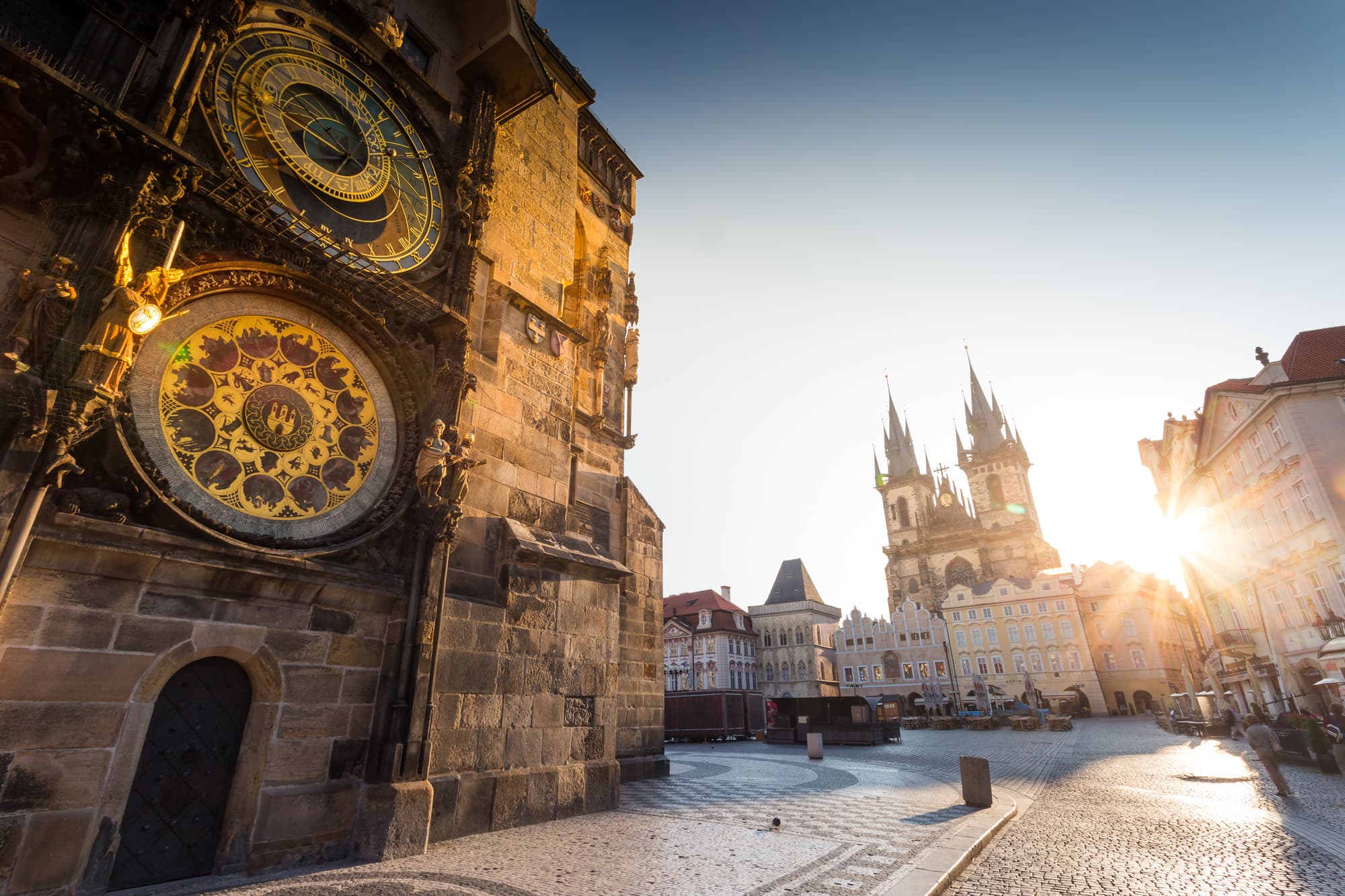
Back at university, during a photojournalism course where I was chasing the perfect contrasts of light and shadow, I spent entire winter mornings at Prague Old Town Square. With a heavy DSLR hanging around my neck, I’d freeze beside empty market stalls, waiting for the first sunbeams to cut through the fog above the rooftops and hit the matte face of the tower clock. In those moments — when the only passers-by were lone bakers and bin collectors — this historic epicentre of Prague had a completely different pulse than at high noon, when an impenetrable wall of tourists with phones held overhead floods across it.
Over my ten years in Prague, I developed a relationship with this place that’s full of contradictions. As a student at the Malostranské gymnasium (a local grammar school), I mostly just rushed through the square — for locals, it was little more than an obstacle course on the way to the metro. In 2018, I watched the famous Prague Astronomical Clock disappear behind scaffolding and tarpaulin for months on end, undergoing its biggest restoration in decades, and the city suddenly felt strangely incomplete. And now? Now I navigate the same cobblestones with a pushchair carrying our two-year-old son Jonáš, learning to see the space from an entirely new perspective — one where I’m hunting for wheelchair ramps and shaded benches.
Despite the occasional frustration with the crowds and visual clutter, Lukáš and I keep coming back. There’s a world of difference between simply passing through the square on the way to grab a trdelník and actually knowing where to look. When you know the story behind the twenty-seven white crosses in the pavement, when you’ve found the hidden passageway leading to a peaceful café, and when you understand that waiting half an hour in a crowd for a forty-five-second show of apostles is perhaps a touch overrated — yet historically utterly fascinating.
So let’s get into it — no fluff, no filler, just the tips I’ve gathered over the years.
The full destination guide: Czechia — guide and what to see
TL;DR
I get it — sometimes you just need the quick version. Last time Lukáš and I were planning a weekend getaway to Vienna, I was frantically scrolling for bullet points myself so we wouldn’t waste any time. So if you’re standing at the starting line and ready to go, here’s the essentials.
These few points will save you from the most expensive mulled wine of your life and spare you the disappointment of being swallowed by enormous crowds. I’d recommend at least skimming them before diving headfirst into the Prague whirlwind.
- The square is at its most beautiful early in the morning, ideally before 8 am, when there are virtually no tourists and you can photograph the empty space in peace.
- The Astronomical Clock chimes every hour on the hour from 9:00 to 23:00, but the procession of apostles lasts less than a minute — don’t plan your entire half-day around it.
- Buy tickets for the Old Town Hall tower online in advance to skip the long queue at the ground-floor ticket office.
- For the best views, you don’t have to climb the Town Hall tower — a brilliant perspective is also on offer from the windows of the café at the Scout Institute right on the square.
- The Church of Our Lady before Týn has its entrance cleverly hidden behind the arcade of houses — don’t look for it from the open square.
- In the pavement near the Town Hall, you’ll find 27 white crosses commemorating the execution of Bohemian lords in 1621 — local superstition says you shouldn’t step on them.
- St. Nicholas Church on this square is a wonderful venue for evening classical music concerts thanks to its superb acoustics.
- Give a wide berth to tourist traps like overpriced exchange offices and street taxis — use ride-hailing apps or public transport instead.
- The trdelník sold everywhere as “traditional Old Bohemian” is actually a modern marketing invention, not a historic Prague recipe. That said, Lukáš and I still eat them — they’re delicious.
When to visit and the best time of day
Choosing the right time to visit the historic centre determines whether you’ll take home a memorable experience or just a lingering sense of claustrophobia. By 2026, Prague no longer has a true off-season, but there are still windows of time when the city breathes a little easier.
Morning fog versus evening lights
If you love photography, set your alarm. Around 7 am, especially in spring or autumn, the square is practically deserted. Light presses into the Týn Church façade and all you hear is the tap of your own shoes on the cobblestones. That’s exactly the atmosphere I used to chase on 35mm film. An evening visit has a different energy altogether — palace façades are illuminated, snippets of classical music drift from open church doors, and the space hums with street performers. Just bear in mind that the crowds peak in the evening.
Don’t hesitate to come right after rain, either. Wet cobblestones reflect the street lamps and the Týn Church radiates an almost magical energy. Just don’t forget a warm layer — there’s an unpleasant draught that often rolls in from the river. When you finally duck into the first open café on the corner with a red nose, that hot tea tastes a hundred times better. For any photographer, this early-morning awakening of the city is pure bliss — a quiet, intimate moment that no midday tour could ever match.
💡 Local’s tip: If you want to avoid the biggest crush in front of the Astronomical Clock, arrive about five minutes after the hour. People scatter the moment the apostle show ends, leaving you space to examine the astronomical dial up close.
Christmas and Easter markets
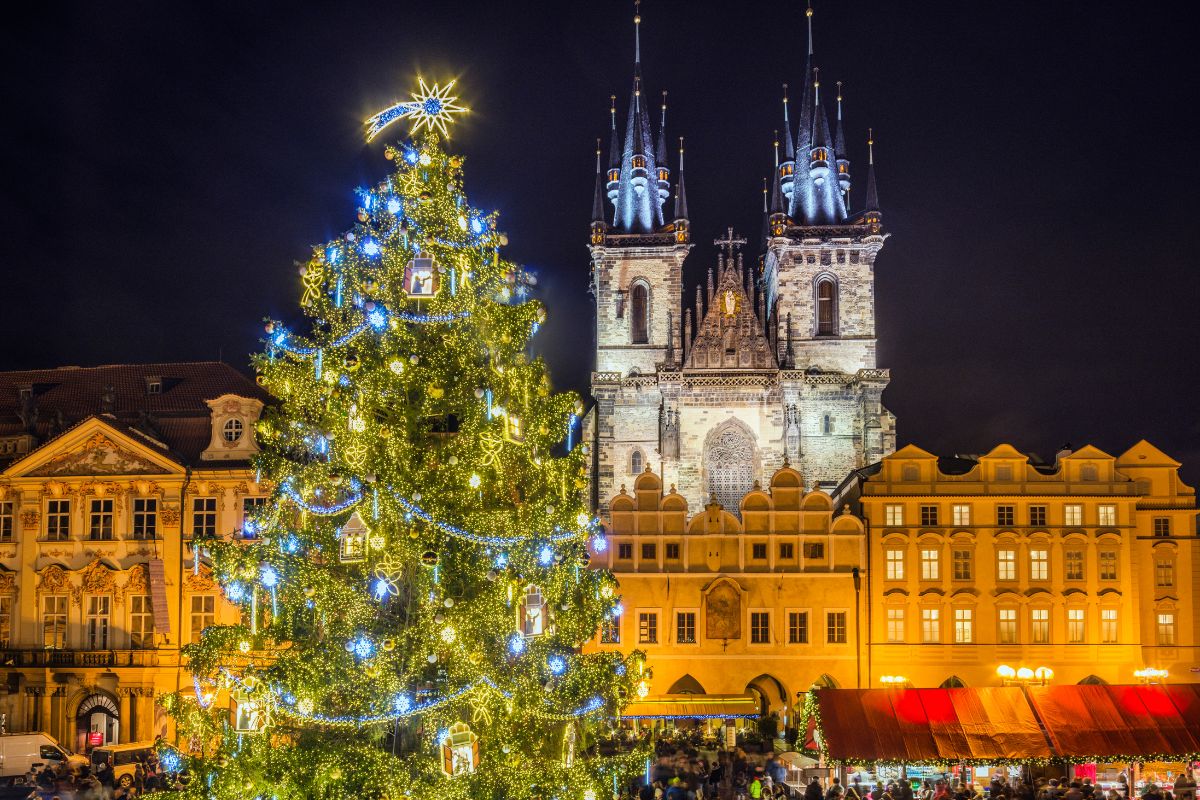
The markets on Old Town Square are a phenomenon that locals love and loathe in equal measure. The Christmas markets run from late November to early January, while the Easter ones traditionally take place in April. Last year we took Jonáš to soak up the Advent atmosphere, but navigating with a pushchair requires nerves of steel and strategic planning. The space around the stalls selling ceramics and mulled wine turns into an impenetrable maze. If you’re visiting during this period, go on a weekday morning.
Honestly, I adore the scent of pine needles mingling with roasted chestnuts. I always grab a mulled wine and just take it all in for a while. But you really need to get there before dusk, when the real madness kicks in and you can barely take a single step. When we’ve had enough, we escape toward the Pařížská Street end. Even with the pushchair, it takes a good dose of zen and some solid shoes for manoeuvring.
💡 Local’s tip: The mulled wine from the main stalls directly under the tree tends to be overly sweet and overpriced. Just duck into any side street heading towards the Haštalská quarter and you’ll find much better quality for less money.
Where to stay
Picking the right hotel can make or break an entire holiday, especially when you’ve got little ones in tow. I’m fairly demanding when it comes to comfort, but at the same time I don’t want to waste an hour commuting into the centre.
Our tried-and-tested favourite: The Julius Hotel
If you want the historic centre within easy reach but prefer a quieter base with high standards, I recommend The Julius Hotel, where Lukáš and I recently stayed. It sits on Senovážné náměstí, just a ten-minute pleasant walk from Old Town Square. We had the One Bedroom Suite, which was incredibly spacious — a godsend given Jonáš’s need to run about. The interiors are impeccably designed in earthy tones, and the breakfast includes generous vegetarian options, so I was more than happy. You can check current prices and availability and book via Booking.com.
It’s such a relief to return to a quiet room after a full day pounding the cobblestones between monuments, open a bottle of wine, and simply switch off. In the morning, coffee in hand, you can plan your next route without the stress of already battling crowds from your own doorstep. The balance between city-centre location and privacy here is simply spot-on.
Old Town Hall and its secrets
This isn’t just a single building — it’s a complex of houses that gradually fused together, much like Prague’s history itself: a little chaotic, a little surprising, and more fascinating with every layer.
When we last visited with Jonáš, he was fascinated watching how the individual façades connect to one another. For me, this place is a captivating example of how Prague evolved and adapted over the centuries without ever losing its original charm.

Prague Astronomical Clock
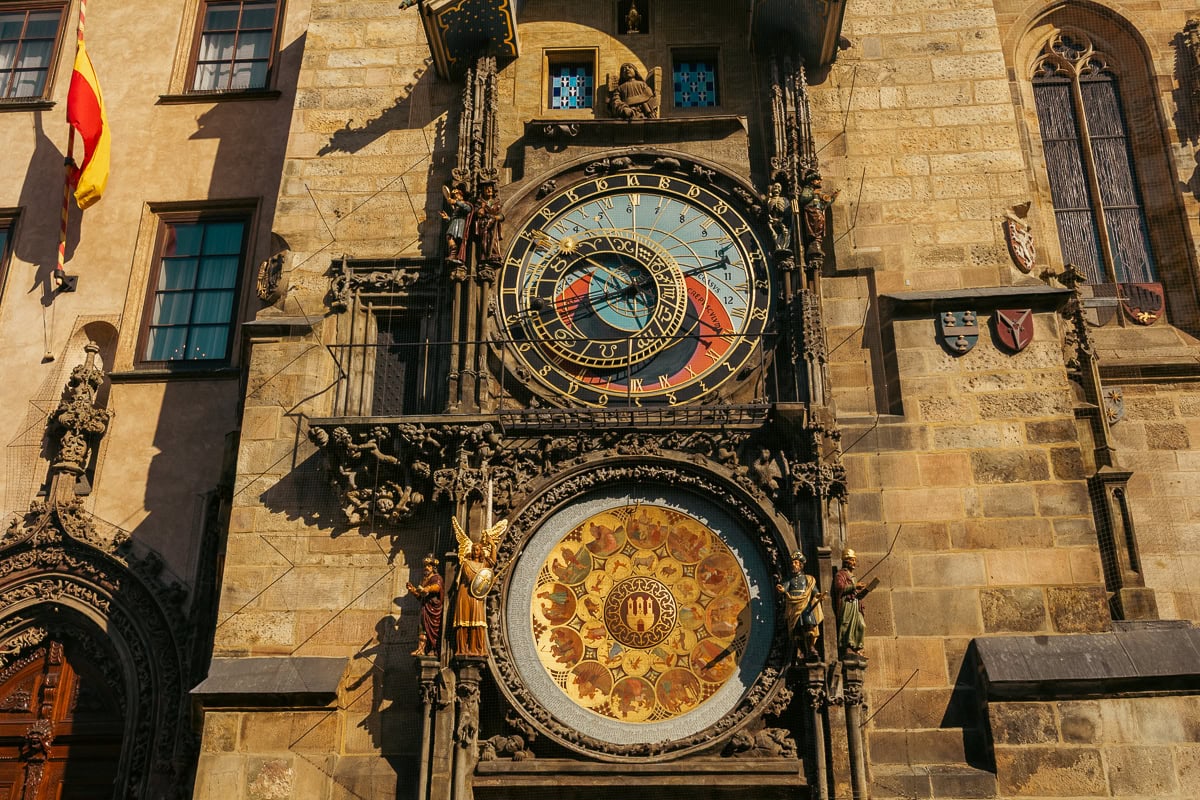
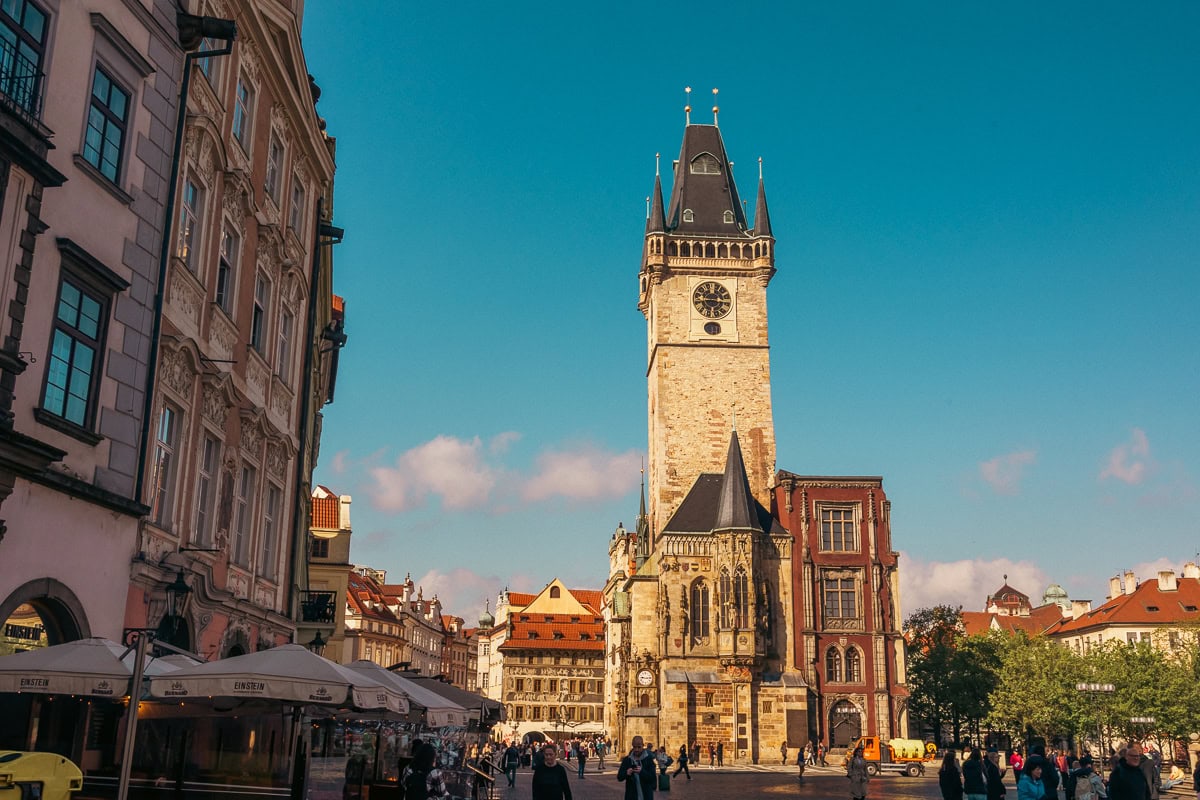
It’s quite possibly the most photographed technical monument in the Czech Republic. The Prague Astronomical Clock dates back to 1410 and is the third-oldest astronomical clock in the world — and the only one still in working order. I remember our history teacher at school debunking the famous legend about Master Hanuš, who was supposedly blinded by the city councillors so he could never build anything more beautiful. In reality, the clock was constructed by Mikuláš of Kadaň. The astronomical dial shows the position of the sun, moon, and zodiac signs. The lower calendar plate, featuring medallions by Josef Mánes, is a copy (the original is in a museum), but the depictions of rural seasonal work are exquisite. The procession of the twelve apostles runs every hour on the hour from 9:00 to 23:00.
I remember one evening heading there with the girls, wine in paper cups, right as the clock was striking midnight. The atmosphere was completely different from daytime — no selfie sticks, just a handful of stray couples and the quiet sound of cogs, reminding you that this mechanism has been ticking away for centuries. It was incredibly romantic, and ever since I tell everyone to come here late at night instead.
💡 Local’s tip: Don’t expect a laser show. It’s a 45-second procession of small wooden figures. If you want a decent view without having to elbow your way through, position yourself at an angle to the left side of the Town Hall a quarter of an hour beforehand.
The view from Old Town Hall
While you can admire the Astronomical Clock for free from street level, the Old Town Hall offers one of the best views in Prague — and it’s well worth paying for. The Gothic tower stands 69.5 metres tall and, unlike many other historic towers in the city, you can reach the top via a modern glass lift — a huge relief if you’re carrying a child in a sling. From the gallery, the entire square unfolds beneath you like a map: you can clearly see the patchwork of rooftops and, in the distance, the silhouette of Prague Castle. Standard admission in 2026 is around € 12.
Once you get to the top, you realise just how compact this old town really is. I love gazing down at the enormous labyrinth of lanes and red rooftops. 😉
💡 Local’s tip: Queues at the indoor ticket office can be endless. Save yourself time and grab your Old Town Hall tickets via GetYourGuide, which lets you skip straight to the lifts.
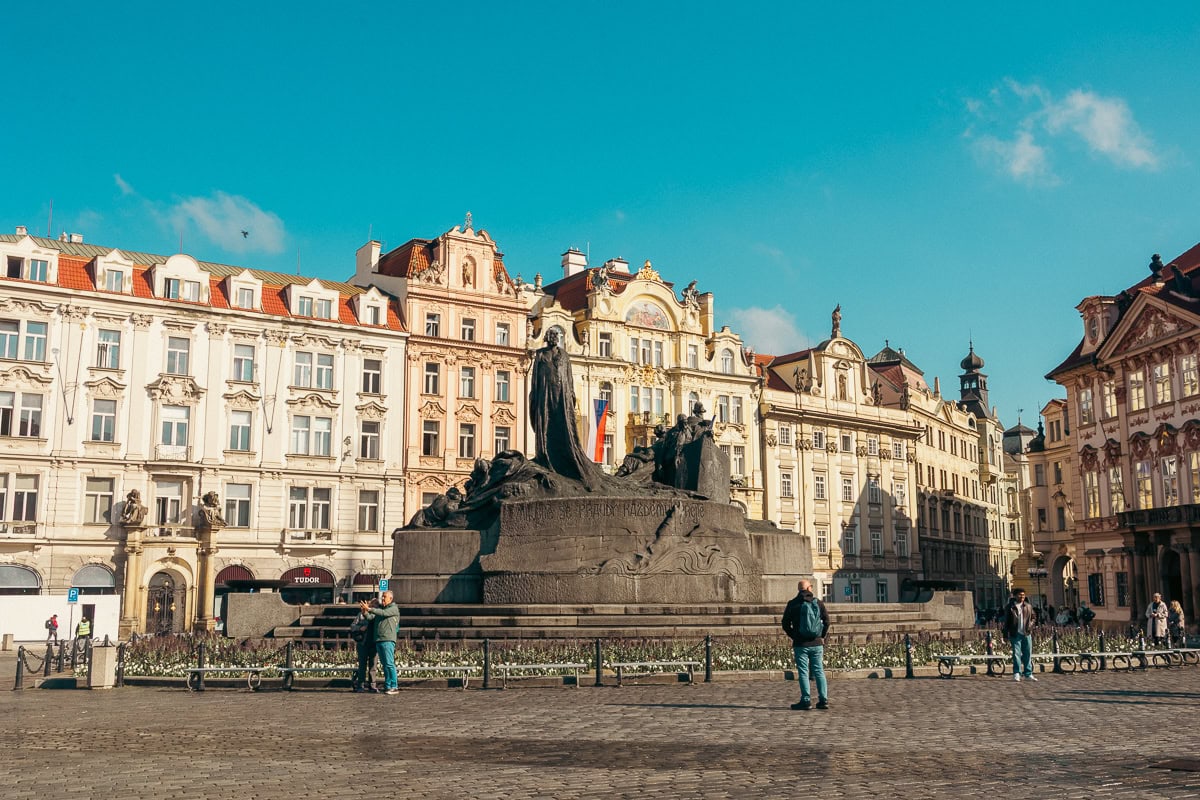
Underground vaults and historic halls
Most people rush to the top, snap a photo, and head off. But look for the arrow pointing downwards — beneath the Town Hall lies a labyrinth of Romanesque and Gothic cellars that are older than the building above them. These spaces once served as a prison. Upstairs, you’ll find stunning historic halls, the most notable being the Brožík Hall, which is a popular venue for weddings. These areas are accessible via guided tours, usually included in the standard admission.
It’s fairly cool down there, so even in the height of summer I’d recommend throwing a jumper over your shoulders. The whole place smells of old stone and dust — exactly the kind of thing I love about historic sites. It’s genuinely worth the extra hour. For me personally, the contrast between the polished halls above and the dark vaults below is one of the most powerful experiences on the entire square.
💡 Local’s tip: Guided tours of the underground run at set intervals. Check the schedule at the entrance straight away so you can time the tower visit and the underground tour efficiently.
Map of points of interest for your phone
Landmarks that shape Old Town Square
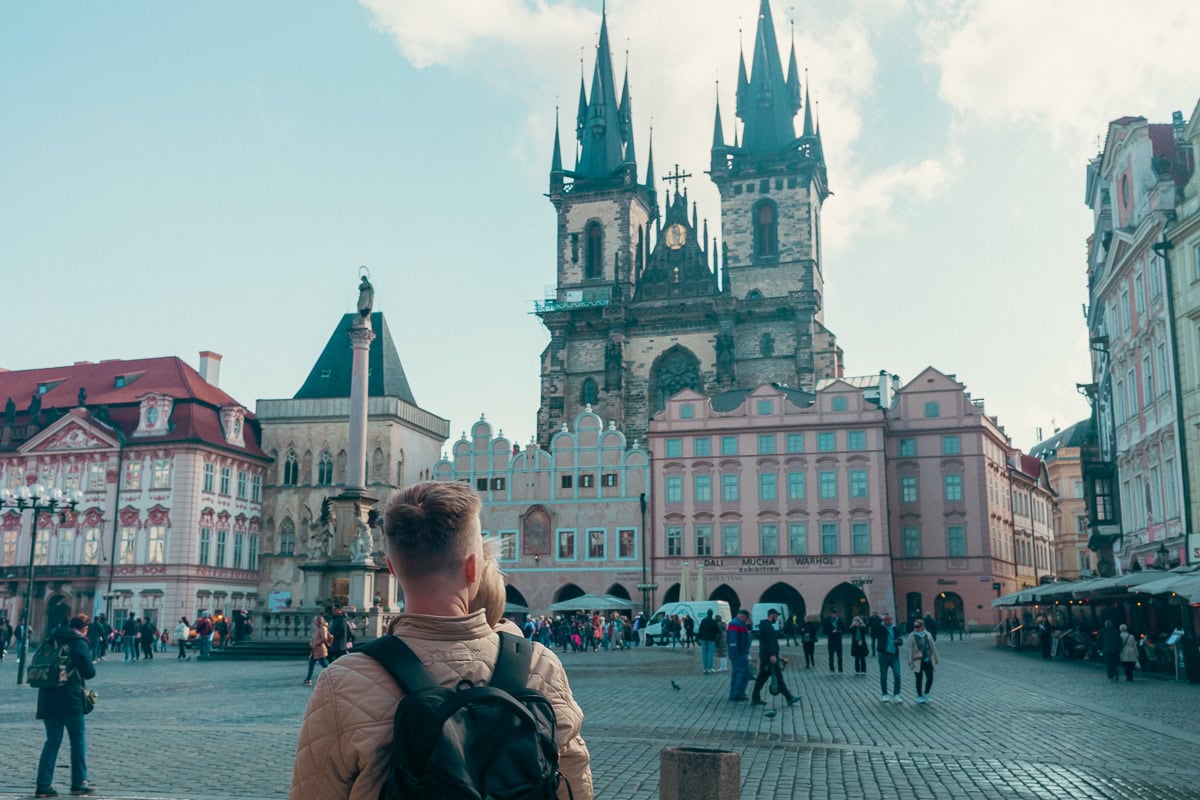
The square wouldn’t be what it is without the two giants that have been staring each other down from opposite sides for centuries — the Gothic severity of Týn versus the white Baroque elegance of St. Nicholas. Neither will leave you unmoved.
It’s quite entertaining to watch how these two buildings compete. One dark and majestic, the other bright and ornate. I always wonder what the architects of each church would say to one another if they met today over a coffee in the middle of the square.
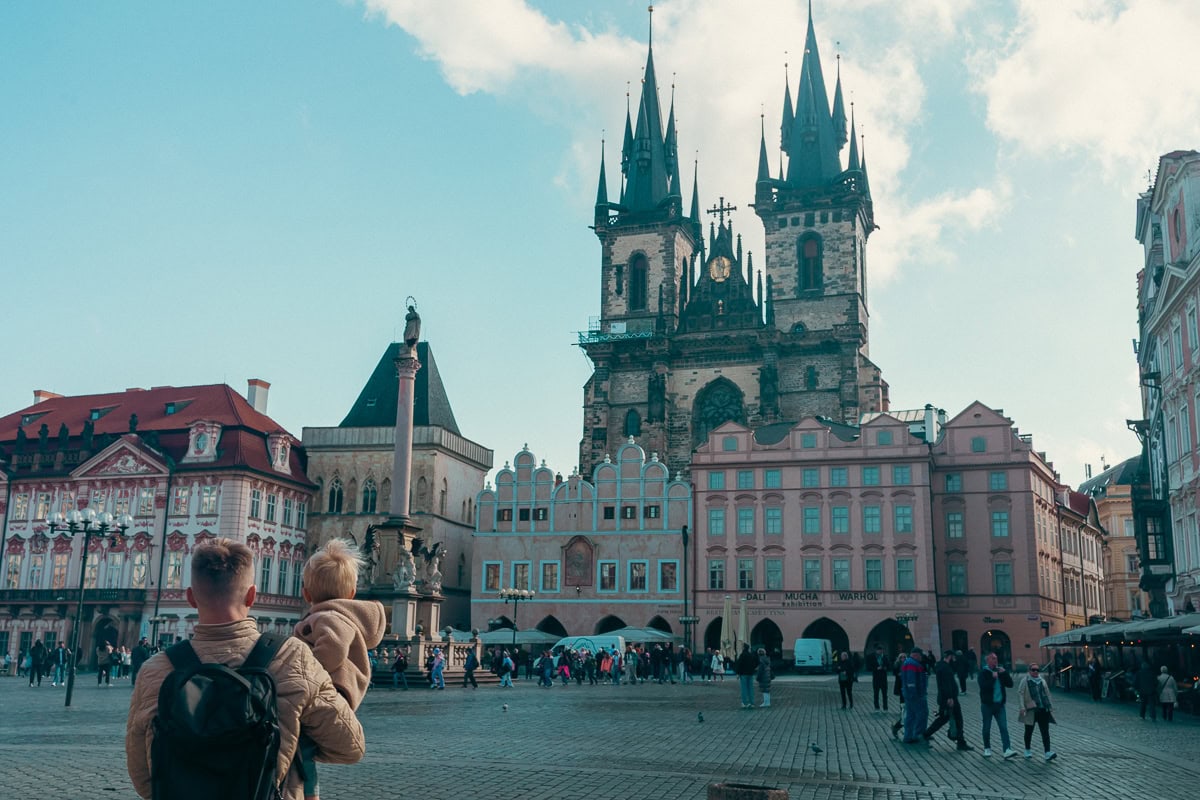
Church of Our Lady before Týn
Its asymmetric Gothic towers, bristling with dozens of small turrets, look as if they’ve stepped straight out of a dark fairy tale. The Týn Church is the landmark everyone photographs from every angle, yet finding the entrance stumps a surprising number of visitors. The church is partially hidden behind a row of historic houses that jut out in front of it. Inside, alongside a magnificent Baroque altar, you’ll find the tomb of the famous Danish astronomer Tycho Brahe. Admission is free, though a voluntary donation is appreciated.
The interior is surprisingly spacious, and there’s a wonderful stillness — a total contrast to the chaos outside. I like to simply sit in one of the back pews and think for a while.
💡 Local’s tip: The entrance is tucked away in the arcade of the Týn School, right next to the restaurants. Walk through the third arch from the left and you’ll discover the heavy wooden doors that lead into the tranquil church interior.
St. Nicholas Church (Old Town)
When people hear “St. Nicholas Church,” most picture the one in the Malá Strana district. But the St. Nicholas Church on Old Town Square offers its own purely white Baroque response, designed by Kilian Ignaz Dientzenhofer. The interior is breathtaking — covered in stuccowork and frescoes, with a crystal chandelier donated by a Russian tsar hanging in the centre. Today it serves as the base for the Czechoslovak Hussite Church and hosts classical music concerts that are well worth attending, even without a special occasion.
Kinský Palace and the House at the Stone Bell
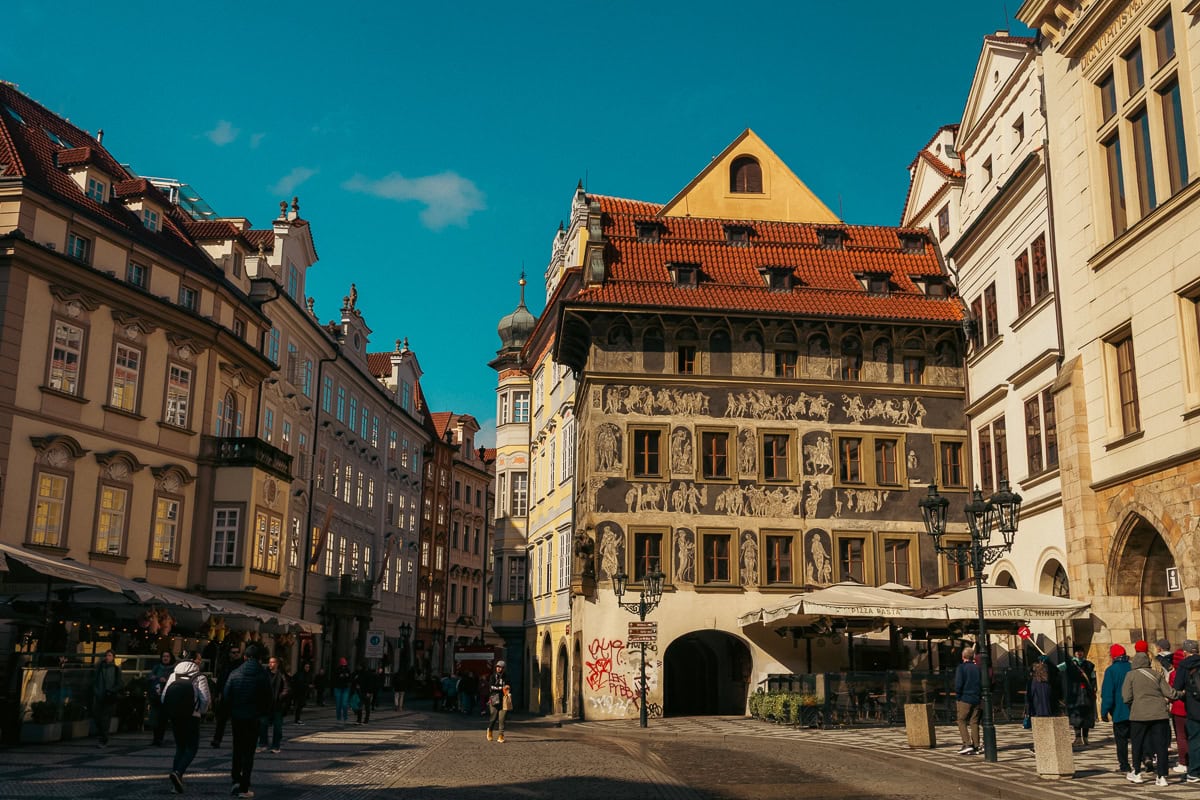
On the eastern side of the square stand two buildings that perfectly illustrate Prague’s architectural melting pot. The Rococo Kinský Palace, with its pink-and-white stucco façade, now houses exhibitions by the National Gallery. Right beside it stands the House at the Stone Bell, which was painstakingly stripped of its Baroque plaster last century to reveal its original, raw Gothic face. It now serves as a venue for the Prague City Gallery.
Every time I walk past the House at the Stone Bell, it takes me back to my university years. My coursemates and I used to go to every new exhibition and then spend hours debating it over a glass of white wine in the café just around the corner. They have a genuinely brilliant programme that manages to captivate even people who don’t normally set foot in galleries.
💡 Local’s tip: The exhibitions at the House at the Stone Bell are among the best-curated in Prague — they often focus on modern photography or contemporary art, which, as a former photojournalism student, I can wholeheartedly recommend.
Historic details and shadows of the past
Everyone looks up at the towers. But the most fascinating — and frankly most haunting — details have been right under your feet the whole time.
Prague is exceptionally good at concealing its secrets. Thousands of people dance through here every day with cameras, without ever noticing the traces of history hidden in the cobblestones. And it’s precisely these details that, in my opinion, transform an ordinary stroll into a truly unforgettable experience.
27 crosses in the pavement (The 1621 Execution)
Right by the eastern wing of the Old Town Hall, you’ll spot 27 white crosses set into the granite pavement. They mark the site of a tragic event from 21 June 1621, when twenty-seven leaders of the Bohemian Estates’ Revolt — including the renowned physician Jan Jessenius — were executed here following the Battle of White Mountain. The atmosphere of the spot is chilling even amid the tourist crowds, once you grasp what actually happened here centuries ago.
It’s a profoundly strange feeling to stand on a site you studied in school history lessons. Back then, it was just dry dates, but when you’re standing here looking at those crosses with your own eyes, it takes on a completely different dimension. Sometimes Lukáš and I see tourists posing for grinning selfies here, and we wonder whether they have any idea what they’re standing on. For me, it’s a small daily test of our awareness and empathy. I always think of what my grandmother used to say about the importance of knowing your roots — even when they’re rather bloody.
💡 Local’s tip: Among native Praguers, there’s an unwritten rule that you don’t step on the crosses out of respect for those who were executed. Most tourists walk right across them without thinking, but you might try to step around them.
Jan Hus Memorial
The imposing bronze sculpture group, dominated by the figure of the burned reformer Jan Hus, commands the northern section of the square. The memorial, by sculptor Ladislav Šaloun, was unveiled in 1915 and has become one of the square’s key orientation points. In Prague slang, people arrange to meet “at Hus” — much like Londoners might say “under the clock at Waterloo.”
The sculpture group is truly monumental, and I have to admit it impresses me anew every time with its sheer scale. When you’re trying to find someone in the centre, meeting at Hus is a sure bet — you’ll never miss each other. Best of all, you get a perfect panoramic view across all sides of the square, so you can check whether your better half has finally turned up.
💡 Local’s tip: The wide stone ledge around the memorial is one of the few spots on the square where you can sit for free without having to pay for a coffee at one of the restaurant terraces.
Prague Meridian
If you walk from the Hus Memorial towards the Old Town Hall, you’ll come across an unassuming brass strip set into the pavement. This is the Prague Meridian (14°25’17” East longitude). In centuries past, Praguers used it to tell the exact time — when the shadow of the Marian Column hit this line precisely, it was noon.
Something tells me that if today’s hurried executives with iPhones had to tell the time by the shadow of a Marian Column, they’d be late for everything 😁. Either way, it’s a lovely reminder of an era when the world didn’t spin at quite such a frantic pace. I always enjoy finding this little detail again.
💡 Local’s tip: The inscription on the meridian is in Latin and English, but it’s often hidden beneath the feet of people standing around. You’ll find it roughly halfway between the Astronomical Clock and the Jan Hus Memorial.
How to survive Old Town Square (without getting ripped off)
Prague’s historic centre is, unfortunately, a magnet for traps that prey on visitor ignorance. I lived in Prague long enough to know which places to give a wide berth and where to seek refuge instead.
I don’t mean to sound like a grumpy local, but it genuinely pains me when I see visitors falling for these tricks. That’s why I’ve put together these survival tips — so you can enjoy your visit without walking away feeling like someone just made off with your holiday budget.
Where to eat: Coffee and food without the tourist markup
The restaurants lining the square all share one trait: you’re paying for the view, not the food. A coffee here routinely costs twice what it does just a few streets away. If you desperately need caffeine and don’t want to leave the square, pop into the Scout Institute. It’s on the first floor of one of the historic buildings right by the Astronomical Clock. They serve excellent coffee at normal prices, and the window views of the action below are fantastic. As a vegetarian, I also never miss a visit to Maitrea in nearby Týnská lane, which offers superb meat-free dishes in a beautiful feng-shui-inspired interior.
With a small child, you simply need to stop from time to time, feed them, and rest for a bit. And I’d rather not spend a fortune doing it. The Scout Institute is an absolute gem for this — hidden in plain sight. The coffee smells honest-to-goodness, and the quiet on the gallery is simply priceless. You can recharge your batteries before plunging back into those never-ending waves of people.
💡 Local’s tip: The entrance to the Scout Institute is an inconspicuous passageway right next to a crystal shop. Walk through the courtyard and up the spiral stairs to the first floor, where a network of cosy rooms opens up before you.
Tourist traps and taxi scams
A classic scam is the exchange office with a huge “0 % commission” sign that gives you such an appalling rate you effectively lose a third of your money. The Czech currency is the Czech koruna (CZK), but most tourist-facing places accept euros and card payments too. Always withdraw cash from ATMs of standard banks — never from the freestanding Euronet machines. And as for the trdelník: the cinnamon aroma will reel you in, but know that it has nothing to do with Prague’s culinary history. It’s a modern street-food phenomenon.
Prague’s taxi drivers who hover near stations and the square have a reputation that’s been passed down through the generations — and not in a good way. Lukáš jokingly calls them “road pirates with a price list in euros.” Seriously, save yourself the stress and money by relying on your own feet or ride-hailing apps. Nothing ruins a lovely day quite like a heated argument over an inflated fare.
💡 Local’s tip: Never take a taxi parked near the square (they often lurk by Pařížská Street). If you need a ride, always order an Uber or Bolt through the app so you can see the price upfront.
Practical information
Right, now for the less glamorous but arguably more important part. It may seem trivial, but when you’re desperately running circles around the Town Hall with a full bladder and no idea where to go, you’ll suddenly realise these practical nuggets are worth their weight in gold.
Getting there and accessibility
The nearest metro station is Staroměstská on the green Line A — about three minutes’ walk. By tram, use the same riverside stop (lines 2, 17, 18) or Náměstí Republiky if you’re coming from the other direction. Prague has direct flight connections from London (with carriers like easyJet, Ryanair, and British Airways from Heathrow, Gatwick, Stansted, and Luton), and from the airport the 119 bus connects you to Line A in about 40 minutes. Public transport in Prague is generally reliable and often gets you where you need to go much faster than sitting in gridlocked traffic.
Accessibility-wise, the entire surface of the square is cobbled. You’ll occasionally hit some pretty large gaps between the cobblestones, which makes for a bumpy ride with a pushchair.
Tickets and useful services
The good news is that entry to the square itself and most of the churches is completely free. You essentially only pay to climb the Town Hall tower — around € 12 in 2026 — and optionally for guided tours of the underground. Even so, it’s worth every penny, because the views from up there are simply unrivalled.
Public toilets can be found on the ground floor of the Old Town Hall building, where you can pay easily by card or coins. Another option is to use the facilities at the Scout Institute mentioned above — provided you order at least a coffee or lemonade.
Frequently asked questions
What time does the Prague Astronomical Clock chime?
The apostles appear every hour on the hour from 9:00 am to 11:00 pm. The show lasts roughly 45 seconds and finishes with the crowing of the golden cockerel.
How much does it cost to climb the Old Town Hall tower?
Standard adult admission in 2026 is around € 12. I’d recommend buying tickets online in advance to avoid the queues.
Is there a lift to the top of the tower?
Yes, the historic tower has a modern glass lift that takes you all the way up to the viewing gallery. It’s a fully accessible solution suitable for wheelchair users and families with pushchairs.
Is trdelník a traditional Prague pastry?
No, trdelník is not a historic Prague speciality. It’s originally a Transylvanian sweet treat that only became widely sold in Prague’s streets over the past two decades as a tourist attraction.
Where is the entrance to the Týn Church?
The entrance is not directly on the square. You need to walk through the arcade of the Týn School (third arch from the left when facing the church) to find the doors.
When are the Christmas markets on Old Town Square?
The Christmas markets usually begin on the first Advent weekend (late November) and run until 6 January (Epiphany). In 2026, they follow this standard timeframe.
Tips and Tricks for Your Vacation
Don’t Overpay for Flights
Search for flights on Kayak. It’s our favorite search engine because it scans the websites of all airlines and always finds the cheapest connection.
Book Your Accommodation Smartly
The best experiences we’ve had when looking for accommodation (from Alaska to Morocco) are with Booking.com, where hotels, apartments, and entire houses are usually the cheapest and most widely available.
Don’t Forget Travel Insurance
Good travel insurance will protect you against illness, accidents, theft, or flight cancellations. We’ve had a few hospital visits abroad, so we know how important it is to have proper insurance arranged.
Where we insure ourselves: SafetyWing (simple monthly subscription) and TrueTraveller (for extra-long trips).
Find the Best Experiences
Get Your Guide is a huge online marketplace where you can book guided walks, trips, skip-the-line tickets, tours, and much more. We always find some extra fun there!
More from Czechia
Full guide → Day trips · most readMikulov, Czech Republic: 10 Best Things to Do and See
 With kidsBest Water Parks in the Czech Republic: 13 Family Tips for 2026
 When to goBrno Christmas Markets 2026 – Tree Lighting, Opening Hours & Programme
 FoodPrague, Czech Republic: 10 Best Things to Do and See with a Toddler
 Where to stayPrague, Czech Republic: 10 Best Family Hotels for Your Stay with Children


