TL;DROver-the-knee boots are back this year, and they genuinely work for every body type – tall women suit flat versions, while petite ones should go for heels to lengthen the leg. Avoid tight-fitting shapes if you’ve got muscular calves; suede is your best bet for softening the whole look. For daytime styling, pair them with skinny jeans or leggings and an oversized jumper, or try a short skirt or wool dress, leaving a sliver of skin visible above the boot line. For an evening look, go for darker shades like black or burgundy, suede boots with a silk dress, minimal jewellery and a small clutch bag. You’ll find the boots and accessories at CCC, in-store or online.
This fashion season brings a spectacular and long-awaited return of statement footwear to our wardrobes. Stylish and bold over-knee boots are once again taking centre stage, and it’s easy to see why. Many women often wonder whether this specific trend suits their body type. However, the right model can instantly transform even the simplest outfit into a fashion hit.
Who do over-knee boots suit best?
These boots are surprisingly versatile and suit a wide range of body types. Tall women can confidently wear flat models without visually shortening their legs. Petite figures, on the other hand, benefit greatly from higher heels, which beautifully elongate the entire silhouette. Leg lengthening is the main advantage of this very specific cut of winter footwear.
When choosing the ideal pair, it pays to follow a few simple rules:
Petite women should opt for models with heels – over knee boots heels work wonders for shorter frames.
Tall ladies will look great in over knee boots flat styles with a flat sole.
Avoid overly tight models if you have muscular calves – consider over knee boots wide calf options instead.
Suede materials will pleasantly soften the overall look of your outfit.
Finding the right size and shape is easier today than ever before. High street and online retailers offer diverse styles for every woman, available both in-store and online. Stylish over the knee high boots provide the warmth, comfort, and elegance you need all in one. The wide selection includes models made from various durable materials – from over the knee boots leather to suede – for every occasion.
How to style high boots for everyday wear?
For a relaxed casual look, pair these boots with skinny blue jeans or leggings. An oversized knitted jumper creates a very cosy and balanced contrast to the fitted bottom half of your outfit. Layering is the ideal technique for cooler and damp autumn days. This tried-and-tested combination ensures maximum comfort and chic style throughout the entire day.
Short skirts and woollen dresses also work absolutely brilliantly with this style of footwear. Just make sure there’s always a visible strip of skin above the top edge of the boot. Look for a rich assortment of colours and cuts to make morning styling incredibly simple. Whether you choose thigh high boots in classic black or opt for over knee boots brown tones, the right skirt length is absolutely crucial for the final aesthetic impression.
How to create an elegant evening outfit?
Evening events call for a touch of sophistication and the use of high-quality materials. Suede models paired with delicate silk dresses look absolutely stunning and very feminine. Combining different textures gives your festive outfit the depth and interest it needs. Darker shades such as black or burgundy add an air of mystery and elegance to your overall look.
Don’t forget to accessorise your outfit thoughtfully so the ensemble looks harmonious and complete. A bolder makeup choice, such as a classic red lip, pairs beautifully with over the knee boots. A small elegant clutch bag makes the ideal accessory without disrupting the clean line of your dress. Jewellery should be kept minimalist to let the boots themselves take centre stage. The overall impression will then feel very luxurious and considered down to the last detail. You can find perfect accessories and your dream footwear conveniently online or on the high street. An elegant look requires above all quality craftsmanship and a perfectly fitting boot. With the right pair, you’ll feel confident and comfortable throughout the entire event.
Tips and Tricks for Your Vacation
Don’t Overpay for Flights
Search for flights on Kayak. It’s our favorite search engine because it scans the websites of all airlines and always finds the cheapest connection.
Book Your Accommodation Smartly
The best experiences we’ve had when looking for accommodation (from Alaska to Morocco) are with Booking.com, where hotels, apartments, and entire houses are usually the cheapest and most widely available.
Don’t Forget Travel Insurance
Good travel insurance will protect you against illness, accidents, theft, or flight cancellations. We’ve had a few hospital visits abroad, so we know how important it is to have proper insurance arranged.
Where we insure ourselves: SafetyWing (best for everyone) and TrueTraveller (for extra-long trips).
Why don’t we recommend any Czech insurance company? Because they have too many restrictions. They set limits on the number of days abroad, travel insurance via a credit card often requires you to pay medical expenses only with that card, and they frequently limit the number of returns to the Czech Republic.
Find the Best Experiences
Get Your Guide is a huge online marketplace where you can book guided walks, trips, skip-the-line tickets, tours, and much more. We always find some extra fun there!
TL;DRThe Dune du Pilat is Europe’s tallest sand dune, standing 100 to 115 metres high near Pyla-sur-Mer, close to Arcachon and about 66 kilometres (40–50 minutes by car) from Bordeaux. It creeps 1 to 5 metres towards the Les Landes forest every year.
Getting onto the dune itself is free — you only pay for parking (roughly €4–€10 depending on how long you stay). From April to November, a wooden staircase with 160 steps takes you to the top, and it’s manageable even for families with young kids.
The best time to go is early morning or at sunset, and you’ll find things quietest in the shoulder months (April–May, September–October). From the summit you get views over the ocean, the pine forest and the island of Banc d’Arguin. While you’re in the area, it’s worth checking out Cap Ferret with its lighthouse, plus the bird reserve at Le Teich.
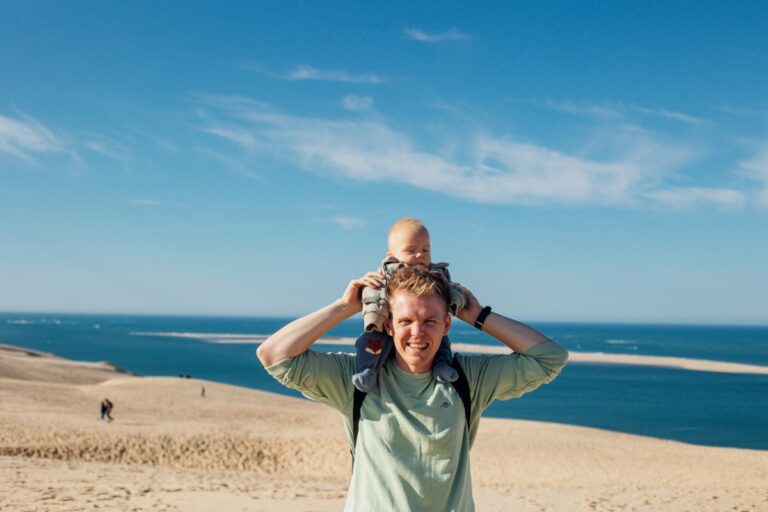
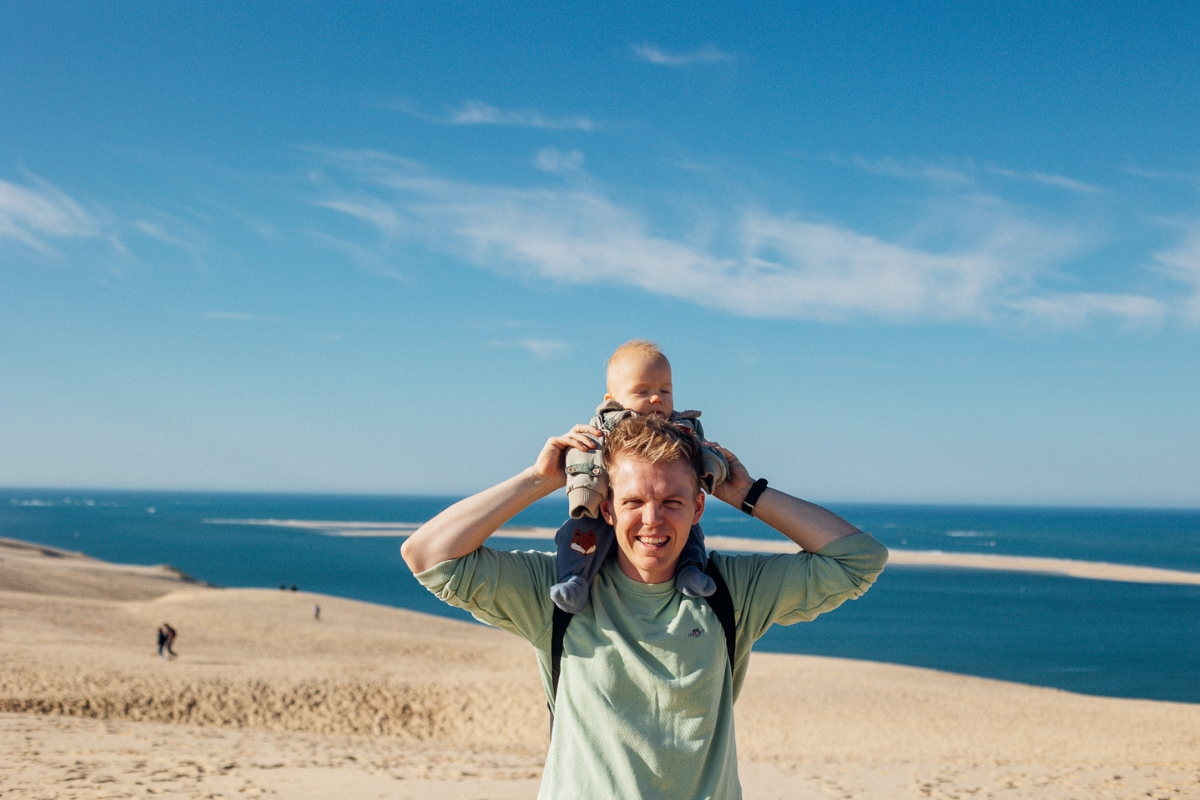
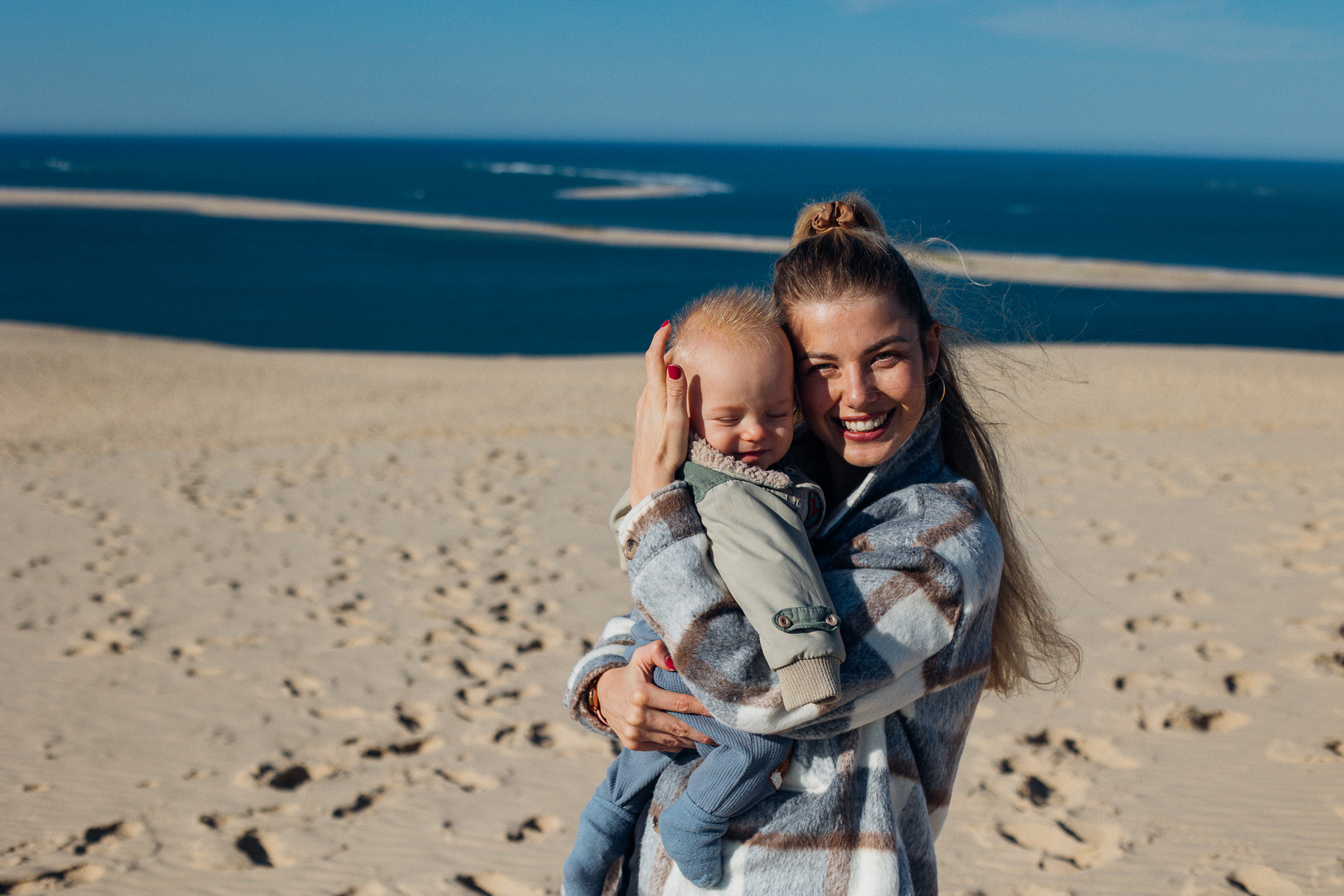
Every year we head south with our family for winter sun, regularly travelling from the UK to Portugal for warmth and sunshine. Last year we decided to try a different route and slow things down. With our nine-month-old son, we stopped in south-west France, where the mighty Dune Pilat rises – a giant sandy mountain nestled between pine forest and the Atlantic Ocean. What was meant to be a quick stop turned into a multi-day adventure. The area around Dune du Pilat captivated us so much that we stayed for several days and didn’t regret it one bit. (More about our holiday with a baby).
Dune du Pilat is the tallest sand dune in Europe (110 metres) and moves 1 to 5 metres inland towards the forest every year
The best time to visit is early morning or at sunset to avoid the crowds and heat – in the shoulder season (September–October, April–May) it’s blissfully quiet
It’s perfectly doable with small children – from April to November there’s a wooden staircase with 160 steps; kids aged 3+ can climb on their own, younger ones can be carried in a baby carrier
The surrounding area offers plenty of activities: the Banc d’Arguin nature reserve, the Cap Ferret lighthouse, the ornithological reserve at Le Teich, and charming oyster villages
Accommodation is cheaper outside peak season – you’ll find campsites, apartments and luxury hotels; parking at the dune costs €4–8, but entry to the dune itself is free
Where to find Dune du Pilat and how to get there
Dune du Pilat lies on the French Atlantic coast in the Gironde department, specifically in the commune of Pyla-sur-Mer near the town of Arcachon. If you’re coming from Bordeaux (which is likely the nearest major city you’ll pass through), it’s a pleasant drive of roughly 66 kilometres, taking about 40 to 50 minutes by car. The road runs mostly through pine forests that are typical of the Aquitaine region. We passed through here on our annual drive from the UK to Portugal, and I have to say the detour was absolutely worth it.
What is Dune du Pilat and why is it worth visiting
Dune du Pilat is the tallest sand dune in all of Europe, with a height ranging between 100 and 115 metres. Imagine a wall of sand taller than a thirty-storey building. And what’s even more remarkable – this dune isn’t static. Every year it shifts 1 to 5 metres further inland, towards the pine forest. Wind carries sand from the beach during low tide and gradually piles it onto the dune, which slowly “devours” the forest. Some trees are already half-buried under sand and look like eerie skeletons.
How was the Dune of Pilat formed
The formation of this giant dune is a fascinating story stretching back thousands of years. Dune du Pilat was created by a combination of ocean currents, wind, and geological changes. The sand originates from the coastline and was carried by waves and currents from the south-west. During low tide, wind dries out the sand on the beaches and blows it inland, where it accumulates. The entire process continues to this day – the dune is literally alive and constantly changing.
An interesting detail is that remnants of the past lie hidden beneath the sand. During World War II, the Germans built concrete bunkers along this coast to defend against invasion. Some of these bunkers now lie on the beach below the dune, deposited there by the shifting sand. Others are buried deep within the dune itself. It’s a vivid illustration of just how powerful nature can be.
What to bring and how to prepare for the climb
This is really important, especially if you’re travelling with a small child. At the top of the dune there’s absolutely nothing – no shade, no toilets, no water stand. You need to be perfectly prepared. For our visit with our nine-month-old son, we packed a proper backpack, and believe me, every single item came in handy.
What you definitely need to bring
Water, and plenty of it – If you’re visiting in summer, expect scorching heat on the dune. The sand can reach up to 50 °C and there’s nowhere to hide. I’d recommend at least one and a half litres per person if you plan to stay longer than an hour.
High-factor sunscreen – SPF 50+ is essential. The sun reflects off the sand and you’ll burn much faster than on a normal beach.
A hat – Everyone needs a hat or cap. Our little one had a cap with a peak and neck cover.
Sunglasses – The glare from the sand is intense and it’s not pleasant without sunglasses.
Appropriate footwear – The sand gets scorching hot in summer, so sandals or light shoes are a must. French visitors on forums recommend either running shoes or sturdy sandals. Going barefoot means risking burnt feet. Plus, you’ll occasionally find glass shards left by irresponsible tourists.
A blanket or beach mat – If you want to rest or sit at the summit, you’ll definitely appreciate something to sit on.
A baby carrier or ergonomic wrap – Essential for parents with small children. Our son weighed about 9 kilos and climbing 160 steps while carrying him in our arms would have been exhausting. In the ergonomic carrier it was perfectly manageable.
Best time to visit Dune du Pilat
This is one of the most important pieces of advice I picked up from French parents on discussion forums. Dune du Pilat is absolutely packed with tourists in summer (July and August). There can be several thousand people a day. If you don’t want to be part of that crowd, you need to pick the right time.
Summer months (July, August)
If you’re visiting in peak season, the best bet is to go very early in the morning – ideally around sunrise or an hour after. At that time there are still relatively few people on the dune, the sand isn’t scorching, and you can enjoy it in peace. The second option is to arrive around four in the afternoon and stay until sunset. Sunset at Dune du Pilat is, according to all travellers, something truly magical – the sky turns golden, orange, and violet, the air cools, and the atmosphere becomes much calmer. Just bear in mind that descending in the dark is a bit trickier, so bring a head torch or use the torch on your phone.
Shoulder season (September–October, April–May)
In my opinion, this is absolutely the best time to visit Dune du Pilat. We were there in autumn and it was perfect. The weather is still pleasant (temperatures around 15–20 °C), tourists are a fraction of summer numbers, and the whole atmosphere is much more peaceful. The staircase is still in place (from April to November), so the climb is easy. The ocean has gorgeous colours and the air is crisp.
Winter (November–February)
In winter, Dune du Pilat has an entirely different atmosphere. The staircase is no longer installed, so you have to climb through the sand. It’s more challenging, but also a more authentic experience. Temperatures hover around 10–12 °C, which isn’t too bad when you’re moving. Tourists are minimal and you’ll have the dune practically to yourself. If you enjoy peace and quiet and don’t need to swim in the ocean, it’s an excellent option.
Climbing the dune with a small child: Our experience
This was our biggest worry before the visit – could we manage it with a nine-month-old? The answer is a definite yes, and it was actually easier than we expected.
From April to November, a wooden staircase with 160 steps is installed at the dune. The steps are fairly well built, have a railing, and are wide enough. The climb takes roughly 10 to 15 minutes at a relaxed pace. We went even slower, pausing for drinks and occasionally letting our son stretch his legs.
Practical tips for parents with toddlers
French parents on blogs and forums share several useful tips that really worked for us:
Use a baby carrier or ergonomic wrap – Trying to climb the stairs with a child in your arms is exhausting. In a carrier your hands are free and the child has better support.
Bring extra water – Children need to drink more frequently, especially in warm weather.
Put a hat on your child – Small children overheat faster than adults.
Don’t be afraid to take breaks – It’s not a race. Stop, have a drink, look around you.
Bring a changing mat and nappies – There are no toilets on the dune, so if you need to change a nappy, it’s good to have something to lay down.
What kids love about the dune
The biggest hit for children, according to French parents, is the descent. While the climb is a bit challenging, the way down is pure fun. Older children (aged 3+) love sliding in the sand, running downhill, and “tumbling” into the soft sand. It’s like a giant sandpit for them. Our son was still too young, but we saw plenty of toddlers around us rolling in the sand and absolutely loving it. Expect to do a lot of laundry afterwards – sand gets absolutely everywhere.
French mothers on forums also recommend bringing a simple toy – like a small bucket and spade. Children can play on the summit for a while as you relax and soak in the views.
What you’ll see from the summit: Views over three worlds
When you finally reach the top of Dune du Pilat, your reward is a view you won’t easily forget. From up there you can see three completely different landscapes at once:
To the east stretches the endless pine forest of Les Landes – the largest man-made forest in Europe. It extends as far as the eye can see, and in places you can watch the dune gradually “swallowing” the trees.
To the west and south, the Atlantic Ocean unfolds in all its glory. Waves crash onto the shore and the water shifts from azure to deep blue depending on the time of day and the weather. Right in front of you, you’ll spot Banc d’Arguin – a mysterious sandy island that changes shape with the tides.
To the north, you get a view of the Arcachon Bay with its little villages, harbour, and the iconic wooden cabins on stilts known as “cabanes tchanquées”. In the distance you can even make out the Cap Ferret lighthouse.
We stood there and simply couldn’t believe our eyes. It’s one of those moments when you realise just how beautiful the world is. And our little son? He was peacefully sleeping in the carrier, completely oblivious to the stunning panorama behind him.
Where to eat and get refreshments
In the area by the car park right below Dune du Pilat, you’ll find several food stalls and restaurants. It’s nothing fancy, but perfectly fine for a quick bite. Your options include:
Tekoa Dune – Offers salads, poke bowls, burgers made with local ingredients, and homemade lemonades
Le Snack de la Dune – Simple snacks, sandwiches, salads, and drinks
L’Avant-Goût – Crêpes, homemade ice cream, hot and cold sandwiches
Oyster & Tapas – Here you can try fresh oysters from Arcachon Bay and other seafood specialities
We had sandwiches and homemade lemonade, and it was perfectly sufficient. Prices are tourist-level but not outrageous – expect around €8–15 per person for a snack.
If you want a proper meal, I’d recommend heading to the surrounding villages or into Arcachon itself. You’ll find plenty of excellent restaurants focusing on seafood and local specialities.
Local gastronomy
The area around Arcachon is famous for its oysters. Arcachon Bay is one of France’s largest oyster farming areas. If you enjoy oysters, you absolutely must try them here – they’re fresh, delicious, and reasonably priced. You can buy them directly from producers at small roadside stalls or have them at a restaurant.
Another local speciality are pinasses – not food, but traditional wooden boats that locals use for fishing and getting around the bay. You’ll often see them carrying tourists on excursions too.
Parking and entry fees: How much does it cost
Entry to the dune itself is completely free. That’s great news, because you can come whenever you want and stay as long as you like without paying an entrance fee. You only pay for parking near the dune.
Parking prices
2 hours: approximately €4
6 hours: approximately €8
Full day: around €10
Prices may vary slightly depending on the season and vehicle size
For motorhomes or caravans, the fee is higher – expect around €12–15 per day. The car park is fairly large and even in peak season you’ll usually find a space, though you may have to park further from the staircase.
Our tip: If you arrive very early in the morning (around 7–8 am), you can sometimes park for free because the machines aren’t running yet or the attendants haven’t arrived. This isn’t official advice, but we saw several people doing it.
Lukáš and Lucie recommend
Where to stay near Dune du Pilat
6 accommodations — campsites, wellness hotels and other accommodation options
When we decided to stay near Dune du Pilat for a few days, we started searching for accommodation. The range is truly diverse and depends mainly on your budget and preferences.
Campsites and caravan parks
If you’re travelling with a caravan or enjoy camping, you’ll find several excellent options near Pyla-sur-Mer:
Camping de la Dune “Les Flots Bleus” – Located very close to the dune, it has direct beach access and offers pitches for tents and caravans. Prices start at around €25–40 per night depending on the season.
Camping Clicochic Petit Nice – Highly rated by families with children, it offers mobile homes, a children’s playground, and a swimming pool. Mobile home prices start from €60 per night in the shoulder season.
Pyla Camping – Another popular campsite with good facilities and friendly staff.
Apartments and holiday homes
We ended up renting an apartment through Booking.com, roughly 2 kilometres from the dune. We had a two-room flat with a kitchenette for €80 per night (off-season). This turned out to be the best option – we had privacy, could cook our own meals, and there was enough space for our son to toddle around. In peak season the same apartment would easily cost €150–200 per night, so I’d definitely recommend travelling outside July and August.
Luxury hotels for special occasions
If you want to treat yourself to something extraordinary, Pyla-sur-Mer has two stunning five-star hotels:
La Co(o)rniche – This hotel is built right on the slope of the dune and offers incredible views of Banc d’Arguin and the ocean. It has 29 luxury rooms, an excellent seafood restaurant, and a bar with live music. Room prices start at around €300–400 per night, but the view and experience are worth it.
Ha(a)ïtza – This newer luxury hotel has 38 rooms, its own spa, and a two-Michelin-star restaurant, Le Skiff Club. It’s a destination for true gourmets and lovers of fine dining.
We didn’t try these hotels ourselves, but we admired them from afar and they look absolutely stunning. Perhaps next time, when our son is older.
Things to do in the area: A few days won’t be enough
When we planned our trip, we thought we’d visit Dune du Pilat in one afternoon and drive on. What a mistake! The area around Arcachon Bay is so beautiful and offers so many activities that we ended up spending four days and still felt like we hadn’t seen everything.
Banc d’Arguin: A mysterious sandy island
When you stand on top of Dune du Pilat and look towards the ocean, you’ll see a long sandy island that seems to float on the water. That’s Banc d’Arguin – a nature reserve that’s home to hundreds of bird species.
Banc d’Arguin constantly changes with the tides. At low tide it’s a vast sandy shoal roughly 4 kilometres long and 2 kilometres wide. At high tide most of it is submerged, leaving only a small islet. It’s home to wading birds, including terns, herons, and many other species.
You can get there by boat. Local operators offer trips on traditional wooden boats called pinasses. The crossing usually takes 30–45 minutes and you’ll spend an hour or two on the island. You can enjoy the calm waters, which are much gentler than on the ocean side, watch the birds, and soak up the absolute tranquility. Prices range from €15 to €30 per person depending on the length of the trip.
We didn’t take this trip with our little son because we were worried about how he’d react to a boat, but we saw plenty of families with small children who came back absolutely delighted.
Cap Ferret: Lighthouse, oysters, and a relaxed atmosphere
On the other side of Arcachon Bay lies Cap Ferret – a narrow peninsula with an unmistakable character. It’s the complete opposite of bustling Arcachon – calm, authentic, and wonderfully picturesque.
The Cap Ferret lighthouse is the main attraction. It was built in 1947 (the original 1849 lighthouse was destroyed by the Germans during World War II) and has 258 steps. The view from the top is absolutely breathtaking – on one side you see the ocean, on the other Arcachon Bay, and in the distance even Dune du Pilat. Entry is €7 for adults and €4 for children. The lighthouse is open every day except Mondays.
Oyster farms are another reason to visit Cap Ferret. Local producers have been farming oysters here for generations. You can buy fresh oysters directly from them for a fraction of what you’d pay in a restaurant – roughly €5–8 per dozen depending on the size. Many of them will shuck them on the spot and you can enjoy them with a squeeze of lemon and a slice of bread. It’s an authentic experience you shouldn’t miss.
The beaches on Cap Ferret are calmer than on the ocean side. The water is gentler, warmer, and ideal for small children. We spent an afternoon there and it was lovely – our son enjoyed the sand and we had peace and quiet.
You can get there either by car (the drive around the bay takes about an hour) or by boat – a ferry runs from Arcachon to Cap Ferret several times a day. The boat ride takes 30 minutes and is a fun experience in itself. The fare is around €7–10 per person, with children under 2 travelling free.
Le Teich: A paradise for birdwatchers
About 25 kilometres from Dune du Pilat, you’ll find the Réserve Ornithologique du Teich – an ornithological reserve that’s one of the best in Europe. It’s home to more than 300 bird species, and up to 300,000 birds pass through each year during migration.
The reserve offers 6 kilometres of carefully maintained trails with 20 observation points. You can visit with a pushchair (the paths are well maintained) and easily spend 3–4 hours observing nature. Entry is €9.60 for adults and €7.40 for children.
We spent a morning there and it was wonderful. Our son slept most of the time in his pushchair while we watched herons, swans, ducks, and many other birds. For children they have a special educational trail called “Rouge Gorge”, designed to help kids discover nature in a fun way.
The best time to visit is in spring (March–May) or autumn (September–October), when migration is underway.
Arcachon: A town with history and charm
The town of Arcachon itself is well worth a visit. In the 19th century it was a fashionable resort for wealthy Parisians, and to this day it retains beautiful architecture from that era.
Ville d’Hiver (the Winter Town) is Arcachon’s most beautiful quarter. Located on the hill above the town, it’s full of colourful villas from the turn of the 19th and 20th centuries. Some are in the Swiss chalet style, others have Moorish elements – it’s an architectural open-air museum. You can stroll around and admire the houses (most are private, so you can’t go inside).
Markets are another reason to visit Arcachon. Every day except Monday there’s a market in town with fresh fish, oysters, vegetables, cheeses, and other local produce. It’s a great place to stock up on fresh food if you want to cook or enjoy a picnic.
The beaches in Arcachon are calmer than on the ocean side near the dune. The water in the bay is warmer and without big waves, making it ideal for families with small children.
Practical tips we learned along the way
After several days in the area, we gathered plenty of experience that I’d like to share:
Bring more water than you think you need
I can’t stress this enough. The sand on Dune du Pilat reflects the sun and creates incredible heat. Even when it’s not hot in the shade, you can suffer on the dune. Take at least one and a half litres of water per person. We brought a thermos of cold water and it was a lifesaver.
Early morning or late afternoon
If you want peace and beautiful light for photos, arrive early in the morning (around 8–9 am) or from 5 pm onwards. Midday is the worst time – the most people, the most heat, and the least atmosphere.
Bring your swimsuit
Even if you don’t expect to go swimming, pack your swimsuit. The beach below the dune is gorgeous and you’ll probably want to at least dip your toes or cool off. The ocean does have waves, but the water is beautifully clean.
Expect sand everywhere
Sand gets everywhere – in your shoes, your hair, your bag, your camera, your phone. Bring zip-lock bags for electronics and be prepared to wash and clean a lot of things. But it’s absolutely worth it.
Leave time for the surrounding area
Don’t focus solely on the dune itself. The area around Arcachon Bay is incredibly beautiful and offers so many activities. If you can, stay at least 2–3 days. You definitely won’t regret it.
It’s manageable with small children
We were worried about whether we could manage it with a nine-month-old, but it was a breeze. An ergonomic carrier, plenty of water, a hat, and frequent breaks – that’s all you need. And remember, children usually handle it better than adults.
The weather changes quickly
The Atlantic coast is known for its rapidly changing weather. It can be overcast in the morning and clear an hour later. Don’t be put off by a bad forecast – things often improve.
FAQ: Frequently asked questions
Is Dune du Pilat accessible for wheelchair users or people with limited mobility?
Unfortunately, not entirely. The staircase is not wheelchair accessible and climbing through the sand is very demanding. However, you can admire the dune from the bottom or from the beach, where the views are also lovely. Some restaurants and viewpoints in the area (for example the La Co(o)rniche restaurant) have step-free access and views of the dune.
Can I bring a dog to Dune du Pilat?
Yes, dogs are allowed on the dune but must be kept on a lead. On the beach below the dune, some sections are off-limits for dogs during peak season (July–August), but outside of that period it’s no problem. Dog owners in online forums recommend visiting early in the morning when it’s not hot and the sand isn’t scorching, as dogs can burn their paws.
Can I sleep or camp on Dune du Pilat?
No, camping on the dune is strictly forbidden. The dune is a protected nature reserve and overnight stays are only permitted for the purpose of watching the sunset and stargazing, but you must leave afterwards. The nearest campsites are in Pyla-sur-Mer, a few kilometres from the dune.
How much time should I plan for a visit to Dune du Pilat?
At least half a day. The climb takes 10–20 minutes depending on your pace, but you’ll definitely want to spend time at the summit – enjoying the view, taking photos, relaxing. The descent is quicker (5–10 minutes). If you want to visit the beach below the dune or walk along it, allow 3–4 hours. And if you’re planning to stay for sunset, it’ll be an entire afternoon and evening.
Is the water below Dune du Pilat safe for swimming?
Yes, but you need to be careful. The ocean has strong waves and currents here, so swimming isn’t suitable for weaker swimmers or very young children. In summer, lifeguards are on the beach to monitor safety. The water is fairly cold even in summer (around 18–20 °C). If you have small children and want calmer water, I’d recommend the beaches in Arcachon Bay or on Cap Ferret, where the water is warmer and without big waves.
🔗 These are affiliate links — they don't change your price and help us create content. · All experiences →
Tips and Tricks for Your Vacation
Don’t Overpay for Flights
Search for flights on Kayak. It’s our favorite search engine because it scans the websites of all airlines and always finds the cheapest connection.
Book Your Accommodation Smartly
The best experiences we’ve had when looking for accommodation (from Alaska to Morocco) are with Booking.com, where hotels, apartments, and entire houses are usually the cheapest and most widely available.
Don’t Forget Travel Insurance
Good travel insurance will protect you against illness, accidents, theft, or flight cancellations. We’ve had a few hospital visits abroad, so we know how important it is to have proper insurance arranged.
Where we insure ourselves: SafetyWing (best for everyone) and TrueTraveller (for extra-long trips).
Why don’t we recommend any Czech insurance company? Because they have too many restrictions. They set limits on the number of days abroad, travel insurance via a credit card often requires you to pay medical expenses only with that card, and they frequently limit the number of returns to the Czech Republic.
Find the Best Experiences
Get Your Guide is a huge online marketplace where you can book guided walks, trips, skip-the-line tickets, tours, and much more. We always find some extra fun there!
TL;DRBordeaux comes with 37 concrete tips on sights, neighbourhoods, day trips and food — from Place de la Bourse with its Miroir d’eau reflecting pool and the former submarine base Bassins des Lumières (entry around 14–16 euros), to the Cité du Vin wine museum (around 22 euros), to day trips out to Saint-Émilion, the Dune du Pilat (roughly 110m high) or the Médoc wine route. Turn up at Place de la Bourse an hour before sunset, and hit the Marché des Capucins on a Friday around 9am, where a dozen oysters go for 6–8 euros. For somewhere to stay, the quieter Chartrons district is a good shout — about 15 minutes’ walk from the centre, with tram line B running through it. A visit with kids works fine with just the centre and the Quai des Chartrons waterfront, but set aside a full day for any trips further out.
It’s become something of a family tradition for us. Every year, when the days start getting shorter in autumn and the morning fog lingers well past noon, we pack up the car and head south. Our final destination is Portugal, where we spend the winter, but we always try to see something along the way — it’s a long drive, and with a small child it’s even longer. Bordeaux, France is one of our regular stops, and there are plenty of things to do here. We’ve pulled over several times before, but this October was a bit different with our little Jonáš.
It was the first time we had our year-and-a-half-old son with us, and honestly, we were a little nervous. What is there to see in Bordeaux with a toddler when the forecast is calling for typical “April showers” weather in the middle of autumn? Our answer might surprise you: the Wine Museum was our Jonáš’s biggest hit, and I’m so glad I’d read forum discussions saying it’s well worth visiting even with small children.
Bordeaux is vibrant, playful, and surprisingly brilliant even for the tiniest travellers. (If you’re thinking about travelling with little ones in general, have a look at: Holiday with a Baby.)
Bordeaux didn’t give us great weather, but it certainly didn’t disappoint
TL;DR
Book Bassins des Lumières online in advance (e.g. via GetYourGuide) — a massive digital art show inside a former submarine base that’s utterly immersive even in the worst weather, but it often sells out.
Arrive at Place de la Bourse an hour before sunset — the light is perfect, you’ll dodge the crowds, and you’ll see magical reflections in the Miroir d’eau water mirror.
Hit Marché des Capucins at 9 am on a Friday — if you love oysters (we’re vegetarians, so definitely not our thing), this is where you’ll find the best ones at fair prices rather than the tourist-trap markups. A tip from locals that we’re happy to pass along.
Buy a 10-trip tram ticket from the machine right away — you’ll save 5 euros and won’t have to fuss with tickets every time you hop on (each ticket is valid for one hour).
Skip Grand Théâtre unless you’re seeing a show — it’s stunning from outside, but the tours are often underwhelming. Better to grab a glass of wine in Chartrons and soak up the neighbourhood atmosphere instead.
Why Bordeaux looks like a postcard — and the story behind it
Bordeaux is nicknamed the “Port of the Moon” because of the characteristic crescent-shaped bend of the Garonne River. But this is more than a poetic moniker. That curve created a natural harbour that brought the city wealth for two thousand years.
All those honey-gold façades, sweeping squares, and monumental buildings aren’t a coincidence. They were built during a massive 18th-century urban overhaul, when the city literally tore down its medieval alleyways and erected what you see today. And where did all that money come from? Trade. Wine, of course, but also colonial goods — and, tragically, involvement in the slave trade.
Bordeaux was France’s second-largest slave-trading port after Nantes, with 419 to 480 documented expeditions. Between 1672 and 1837, roughly 150,000 to 200,000 Africans were deported on ships from Bordeaux. The city profited indirectly — importing sugar, coffee, rum, and cotton. Today, Bordeaux addresses this history openly and is working to reckon with its past.
Where to stay in Bordeaux — and why we recommend Chartrons
The first time we visited Bordeaux, we stayed right in the centre, near Place de la Comédie. It looked perfect — we were in the middle of everything. But we barely slept a wink. Tipsy tourists under our windows, noisy restaurant terraces until eleven at night, and then clubs thumping until three in the morning. With a toddler, it was a nightmare. That’s why we recommend the Chartrons neighbourhood. Chartrons sits north of Place de Quinconces, about a 15-minute walk from the centre. It used to be the wine merchants’ quarter — British, Irish, and Dutch traders had their warehouses and elegant townhouses here. Today it’s the most sought-after residential area in Bordeaux, a blend of bourgeois and bohemian.
Why Chartrons is brilliant:
Peaceful, but never boring. It’s noticeably quieter than the tourist centre, yet you’ll still find excellent restaurants, cafés, and wine bars. Rue Notre Dame is lined with boutiques, vintage shops, and antique stores. On Sunday mornings, Place du Marché des Chartrons hosts a local market — smaller, calmer, and more authentic than Capucins.
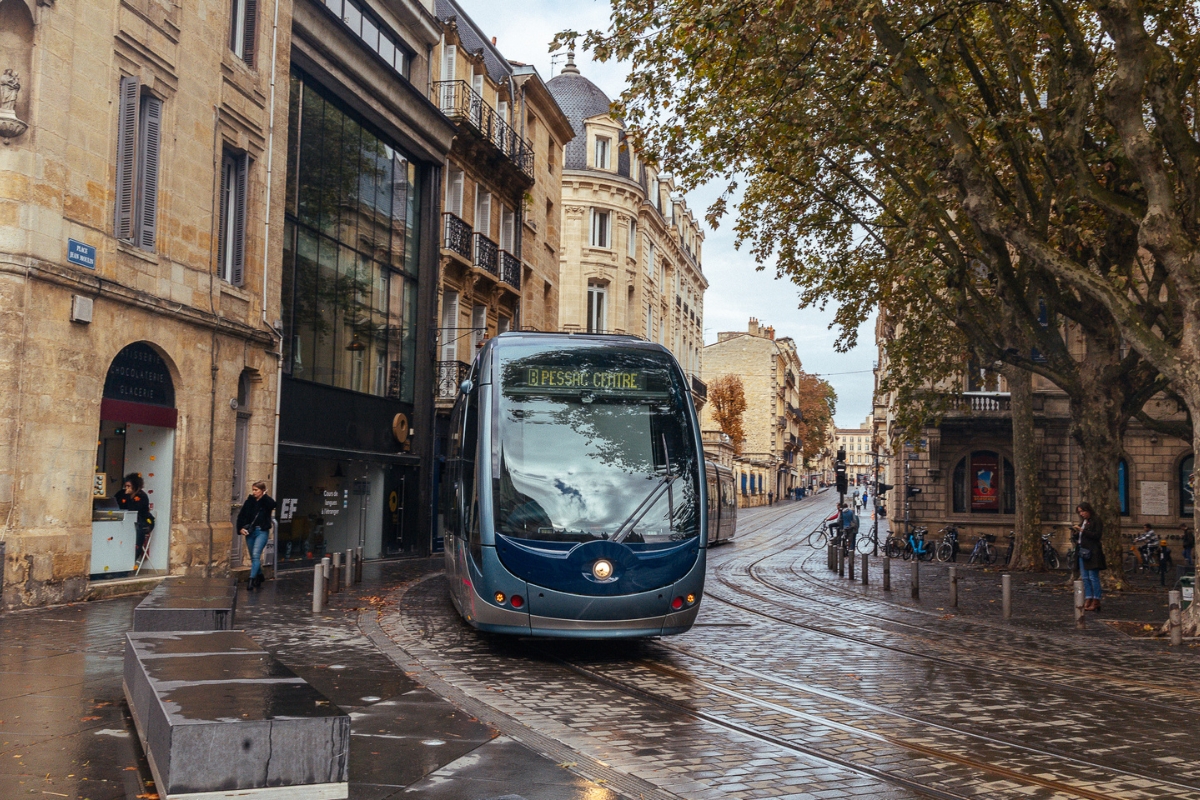
Tram B gets you everywhere. Line B runs straight through Chartrons towards the centre, to Saint-Jean station, and north to Cité du Vin and Bassins à Flots. The ride to the centre takes 5–8 minutes.
Riverbank and park on your doorstep. You’re just minutes from Quai des Chartrons (a waterfront promenade with a playground and skatepark) and Jardin Public. With small children it’s ideal — morning in the park, tram to the centre, then back to the park or riverbank in the afternoon.
Perfect for families. Chartrons is considered one of the best neighbourhoods for family living — pedestrian waterfront for rollerblading, a skatepark, calm atmosphere. You’ll see locals with their kids here, not hordes of tourists.
Reasonable prices. Yes, Chartrons is a “posh area”, but it’s still cheaper than Saint-Pierre or the Grand Théâtre surroundings. You’ll find quality Airbnbs, smaller hotels, and lovely B&Bs. For more options, check Booking.com.
Specific accommodation tips in Chartrons
Casa Blanca — cosy, stylish B&B with excellent breakfast, a few minutes’ walk from Place du Marché des Chartrons
Chambres à Bord’O — beautiful B&B with spacious rooms, right by tram line A
Hotel Indigo — a livelier hotel closer to the waterfront, if you prefer a hotel experience over a family guesthouse
Mercure Chartrons — four-star hotel with great breakfast, good for families and groups, though the rooms could use a refresh
Eklo — eco-friendly hostel with an outdoor bar, if you’re on a tighter budget
Other things to consider
Parking: If you’re driving (as we do on our way to Portugal), parking in Chartrons is far easier than in the centre. Some hotels have their own car parks or can advise on long-term parking. Street parking is metered during the day, but often free in the evenings and at weekends.
Safety: Chartrons is one of the safest and quietest neighbourhoods in Bordeaux. We walked around with a pushchair in the evenings and never once felt uneasy.
Alternatives if Chartrons is fully booked
Bacalan / Bassins à Flots: North of Chartrons, even quieter, with a grungy vibe and modern architecture around the docks. Close to Cité du Vin and Bassins des Lumières. Radisson Blu or Seeko’o Hotel are solid choices here.
La Bastide (right bank): A calmer neighbourhood on the other side of the river with good prices and an authentic atmosphere. Tram A or D gets you to the centre in 10 minutes. A great option for families with a car.
Avoid: Cours de la Marne after dark — it’s not the safest area. Saint-Michel has charm, but be cautious there at night.
37 things to see and do in Bordeaux, France
Let’s dive into what you should see and do in this beautiful city of Bordeaux.
1. Place de la Bourse and Miroir d’eau — but come at the right time
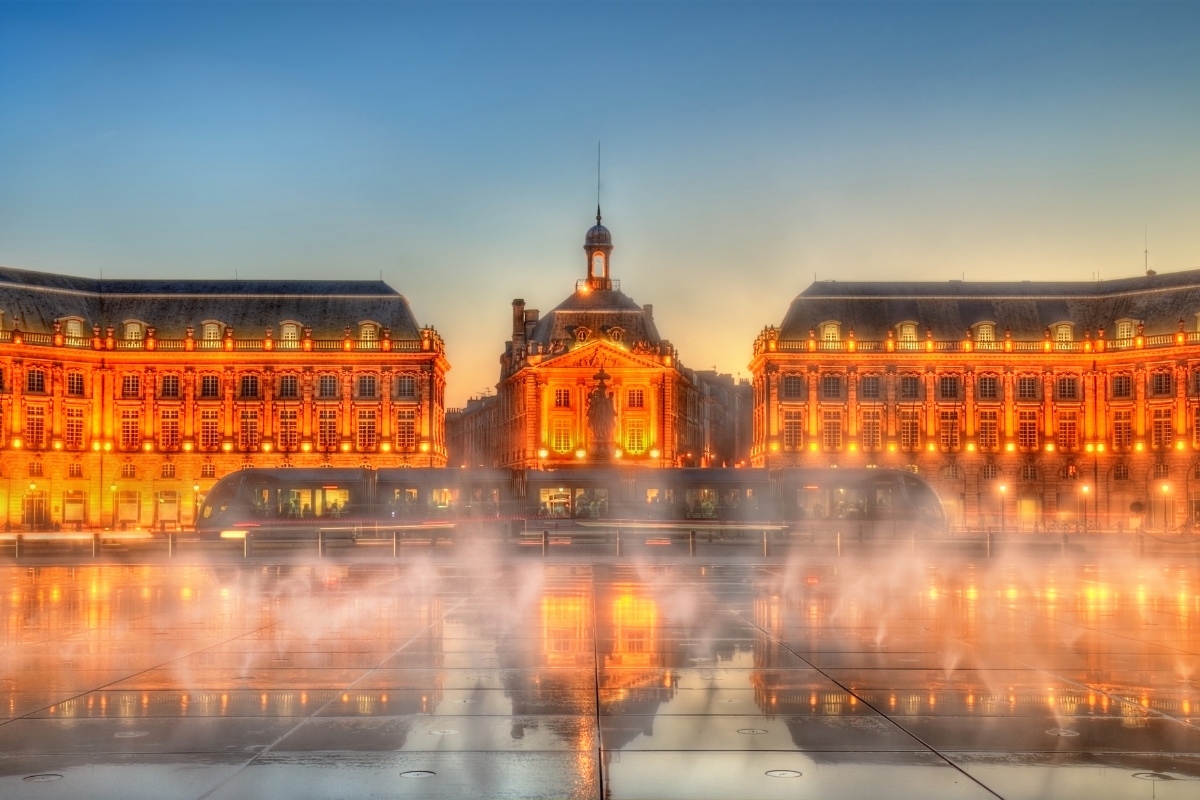
This is THE spot. Place de la Bourse was built specifically to impress foreign merchants arriving by boat on the Garonne. Its message was crystal clear: “Look how wealthy we are.”
In front of the square lies the Miroir d’eau — the world’s largest water mirror. It’s a shallow pool (about 2 cm of water) that creates perfect reflections of the palace. Every fifteen minutes, a mist sprays above the water — lovely in summer, though in October we were glad to have our jackets on.
Practical tip: Arrive an hour before sunset. The light is at its best and you’ll avoid the tourist crowds. In summer, locals gather here in the evening, sit by the river, and sip wine — join them. In winter, note that the Miroir d’eau may be out of service for maintenance, typically November to March.
Time on site: A good 45 minutes to an hour. Don’t expect information boards or interactive features though — it’s simply a square and a reflecting pool.
2. Bassins des Lumières
Bassins des Lumières is probably the most incredible place to spend time when it’s pouring outside. It’s a former World War II submarine base built by the Germans. Enormous concrete halls several storeys high, with four massive water-filled basins in the middle. And onto all those walls and ceilings, they project dynamic digital art shows accompanied by music.
When we visited, the exhibition was dedicated to the Impressionists. The walls came alive with giant Monets and Renoirs that shifted and morphed in time with the music. Our son was absolutely transfixed — mouth wide open. So were we.
Practical tips:Book your tickets in advance online via GetYourGuide — the venue often sells out. Tickets cost around 14–16 euros; children under 5 go free. It’s chilly and damp inside (it’s still a submarine base, after all), so bring a jumper. The show lasts about 50 minutes, but you can stay as long as you like. Allow 1.5–2 hours in total.
🔗 These are affiliate links — they don't change your price and help us create content. · All experiences →
Time on site: 1.5–2.5 hours. Don’t eat right before — there’s no food inside and nowhere to pop out for a snack.
3. Cité du Vin — understanding wine (no snobbery required)
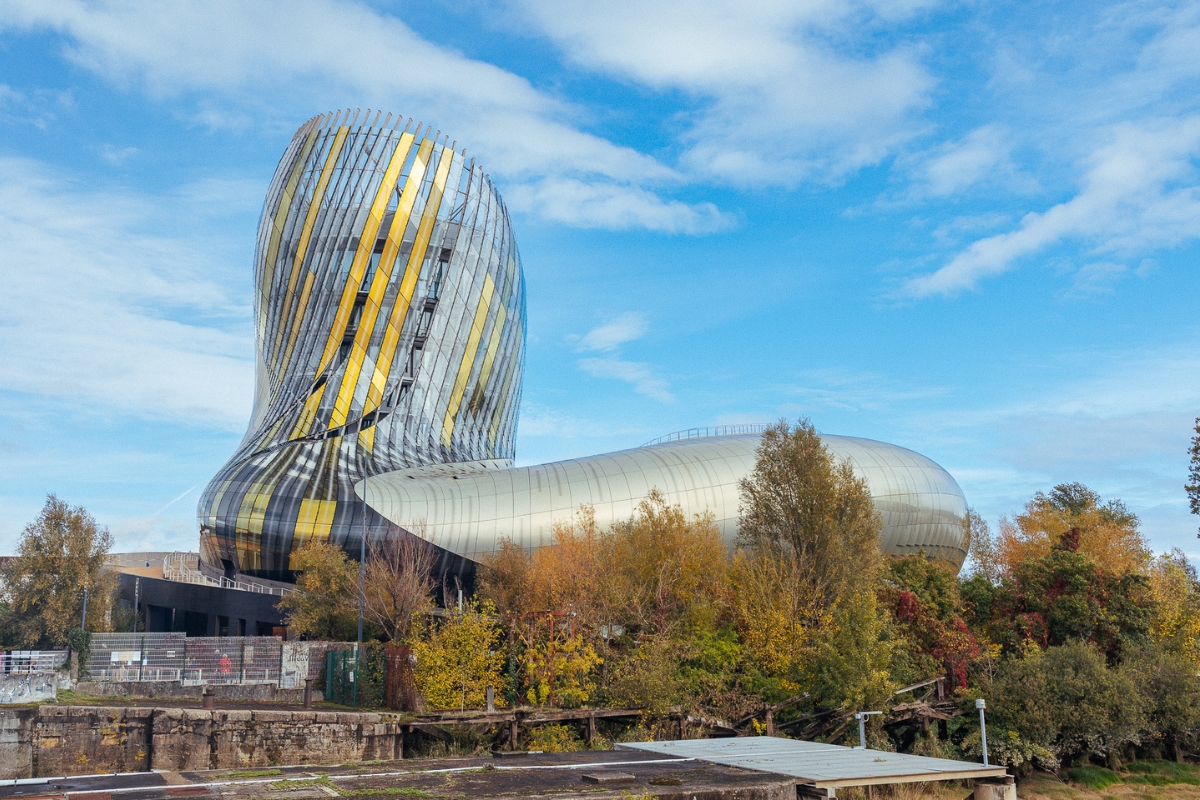
A modern museum of wine culture shaped like a decanter that even the smallest visitors will love (our 18-month-old son was absolutely thrilled). Inside you’ll find an interactive exhibition on the history of wine, winemaking around the world, and tastings. At the end, you take the lift up to a panoramic viewing bar where a glass of wine and sweeping views of Bordeaux are included in the ticket price.
Practical tips: The Bordeaux CityPass includes admission, BUT only before noon. If you want to visit in the afternoon, you’ll need to pay extra. Tickets cost around 22 euros. The tasting in the viewing bar is included, but you choose from a limited selection of wines based on what’s currently available.
The museum is well done but quite large, and it can be exhausting. If you’re not a hardcore wine enthusiast, head straight for the sections that interest you and don’t wear yourself out reading every single panel.
Time on site: 2–3 hours.
Cité du Vin Bordeaux
4. Walking the UNESCO “Port of the Moon” trail
UNESCO recognised Bordeaux as an “outstanding urban and architectural ensemble” — meaning the entire historic centre is effectively one giant monument. The trail runs along the river from Pont de Pierre (the Stone Bridge) all the way to Chartrons.
What you’ll see: 18th-century honey-coloured façades (limestone quarried from the region), wide promenades along the Garonne where port warehouses once stood, Place de la Bourse, Porte Cailhau (a medieval gate), and the narrow streets of the Saint-Pierre quarter.
Practical tip: Start at Porte Cailhau and walk towards Place de la Bourse, then continue along the river northward. The waterfront is flat and smooth — ideal for pushchairs. You’ll pass plenty of cafés and wine bars along the way.
Time for the walk: 2–4 hours depending on how often you stop. With a toddler, allow for the longer version — they’ll want to run, rest, eat…
5. Porte Cailhau — a slice of the Middle Ages
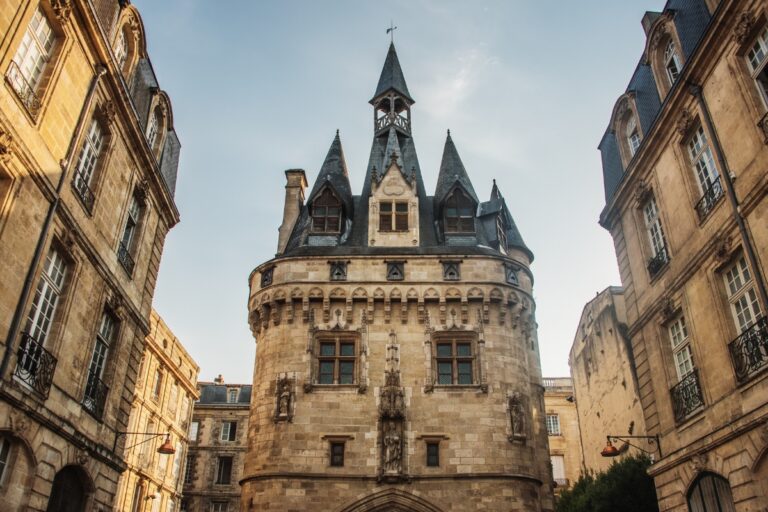
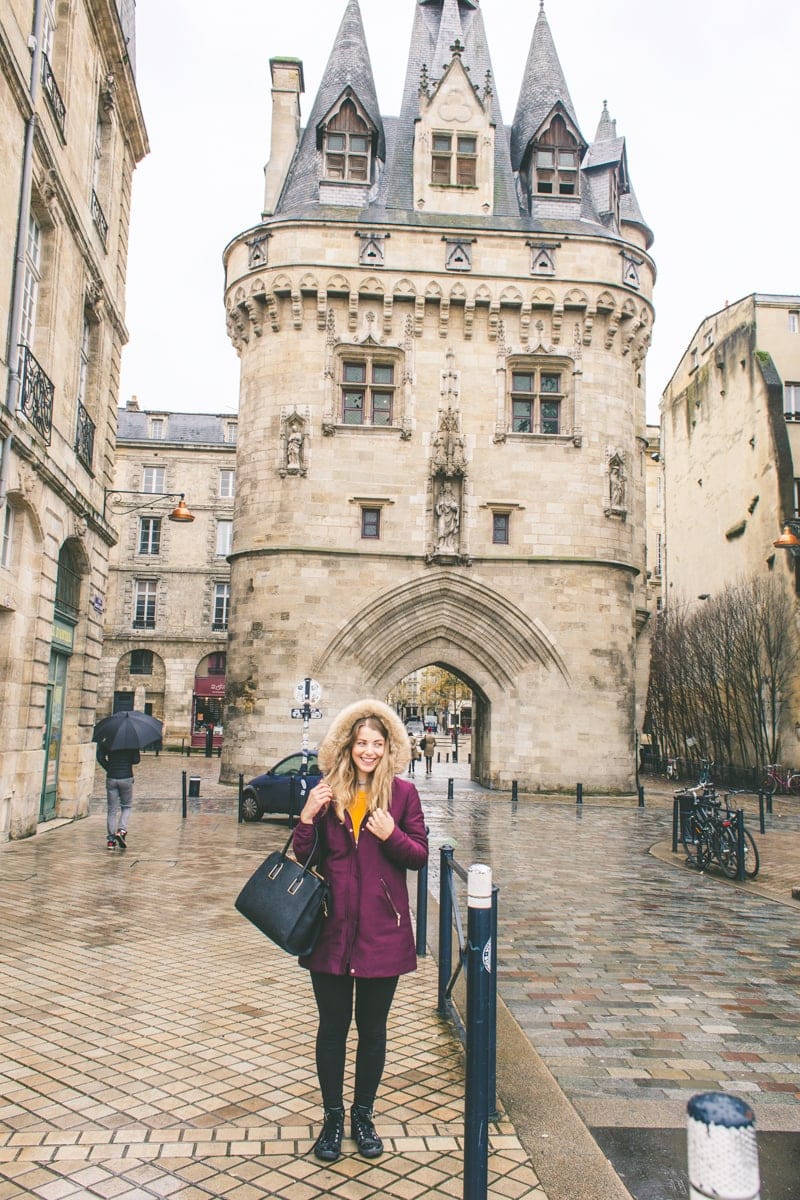
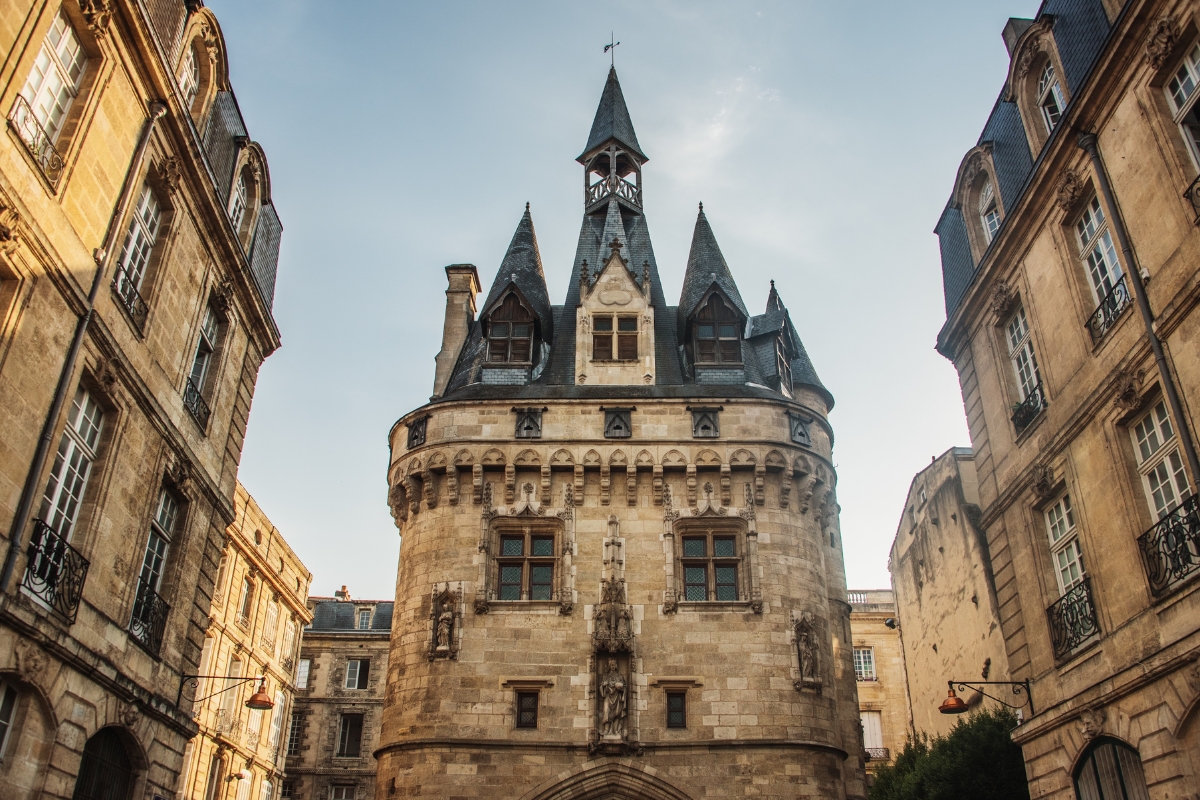
One of the few surviving medieval landmarks. The gate was built in 1495 to celebrate King Charles VIII’s victory at the Battle of Fornovo. It’s a charming little Gothic turret-topped structure that contrasts beautifully with the neoclassical Bordeaux surrounding it.
You can go inside and climb to the top (232 steps) for a view, but honestly — the view isn’t spectacular and it’s quite narrow and dimly lit. Worth admiring from the outside though.
Time on site: 15–30 minutes from outside, 60–90 minutes if you go inside.
Porte Cailhau
6. Grosse Cloche — the bell that dictated the grape harvest
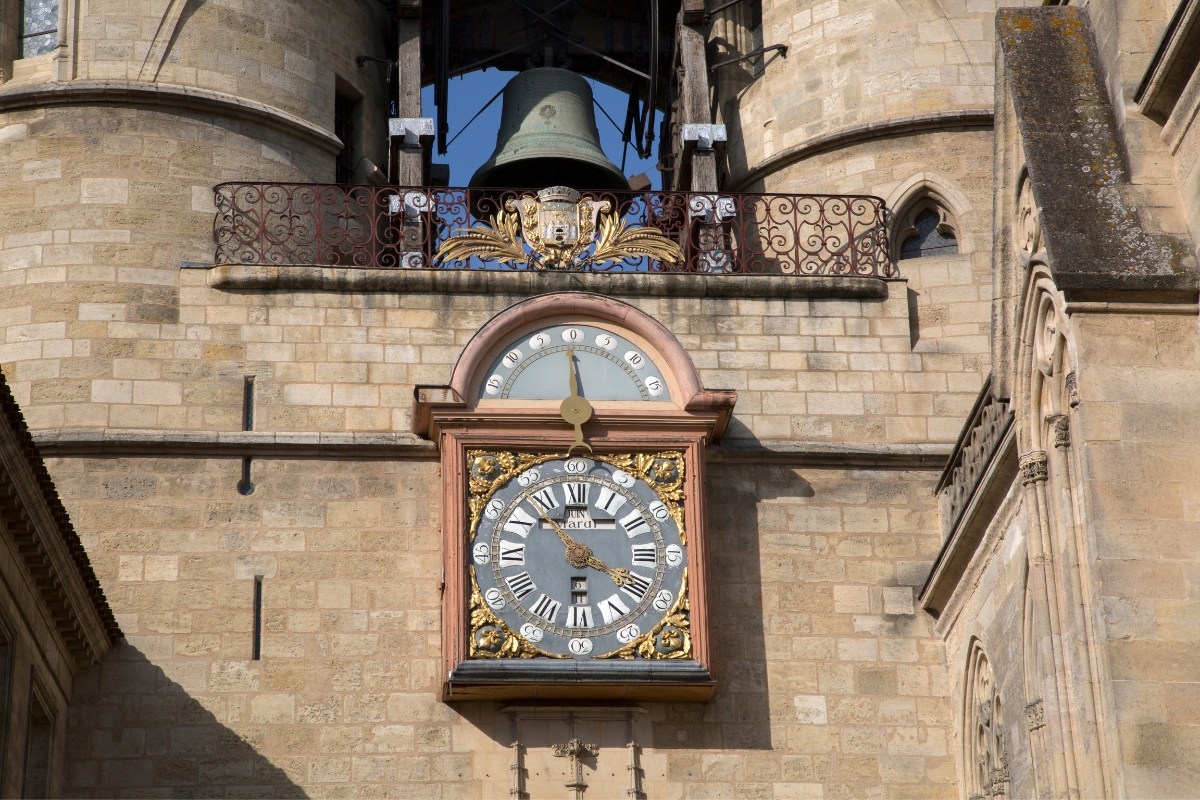
Grosse Cloche is a medieval gate topped with an enormous bell. It served as a city fortification gate and the belfry of the old town hall. The bell, Armande-Louise, dates from 1775 and weighs a hefty 8 tonnes.
The city magistrates used this bell to signal the start of the grape harvest — winemakers weren’t allowed to begin picking until Grosse Cloche had rung. It also served as a fire alarm. Today it rings at noon on the first Sunday of each month and on public holidays.
Practical tip: The best view is from Rue Saint-James. You can’t go inside — it’s an exterior-only attraction.
Time on site: 20–30 minutes.
Grosse Cloche — the bell that dictated the grape harvest
7. Grand Théâtre — stunning outside, skip the tours
A neoclassical theatre from the late 18th century with twelve Corinthian columns and statues on the roofline. It’s an emblem of Bordeaux — the city’s official tourist board says as much.
But: The guided tours often disappoint. You go in expecting something on par with the Paris Opera, but the tour is fairly brief and there isn’t much to see unless you’re attending a performance.
Practical tip: Admire it from the outside, snap your photos, and then treat yourself to a glass of wine at one of the nearby wine bars instead. If you do want to go inside, try to get tickets for an opera or ballet — that’s a completely different experience from a standard tour.
Time on site: 15 minutes from outside.
Grand Théâtre Bordeaux
Lukáš and Lucie recommend
Where to stay in Bordeaux
6 accommodations — hotels and other lodging options
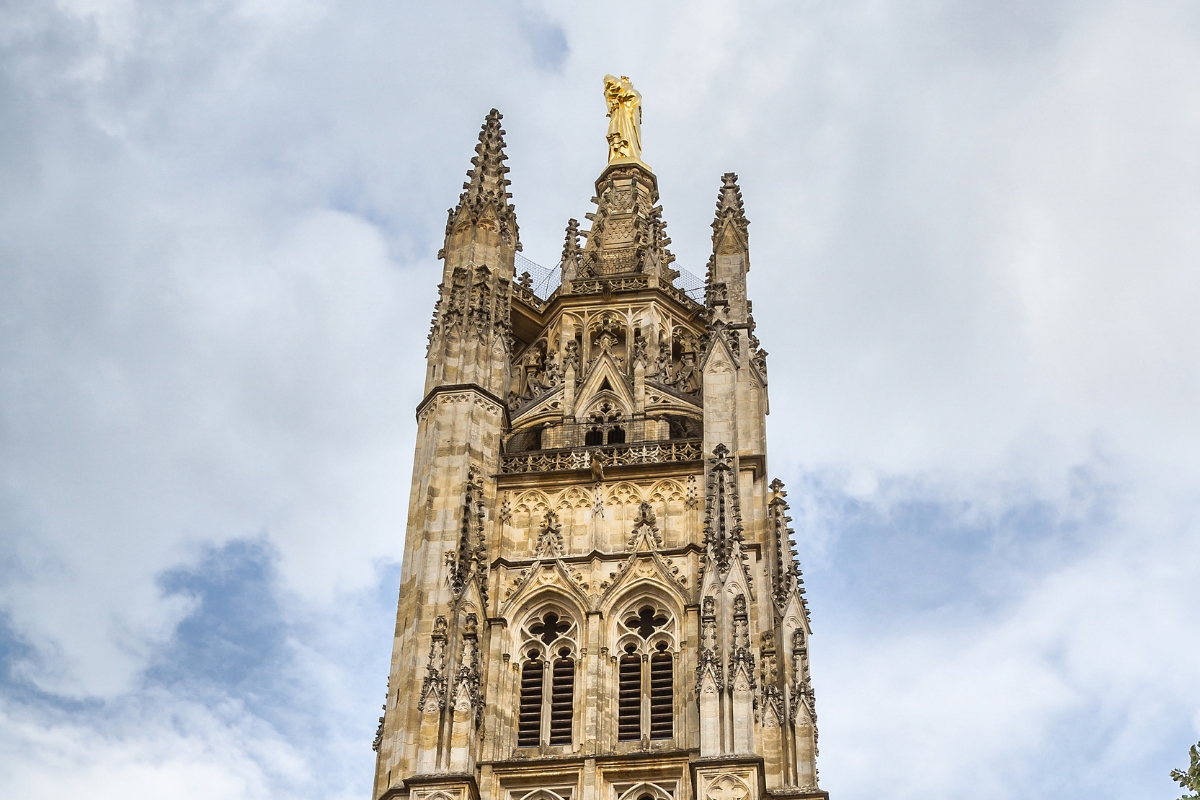
A 15th-century Gothic bell tower, built separately from the main cathedral over fears that the bell vibrations might damage the structure. Climb 229 steps and you’re rewarded with a panoramic view over all of Bordeaux.
Practical tips: Tickets are sold online with timed slots due to limited capacity — book ahead. Expect to pay around 7–8 euros. There’s no lift. It’s narrow at the top and can be windy. Not feasible with a pushchair or very small children.
Time on site: 60–90 minutes including queuing and the climb.
Tour Pey-Berland
9. Cathédrale Saint-André
A Gothic cathedral dedicated to Saint Andrew, part of the UNESCO World Heritage Site. Inside, in 1137, the wedding of Eleanor of Aquitaine and the future King Louis VII took place.
Practical tip: Free entry. Lovely for a quick visit, but unless you’re a devoted fan of Gothic cathedrals, 20 minutes will do.
Time on site: 20–45 minutes.
10. Chartrons — where wine was traded and today you’ll find the best brunch
The historic wine merchants’ quarter. From the 17th century, foreign traders — mainly from Britain, Ireland, and the Netherlands — came here, building warehouses for wine barrels and elegant townhouses.
Today Chartrons is a neighbourhood brimming with boutiques, antique shops, cafés, and wine bars. It’s calmer than the tourist centre but still within walking distance of everything.
What to do there: On Sunday mornings there’s a market (until 14:30) that’s smaller and far less touristy than Capucins. Pop into a café for brunch. Wander along Rue Notre Dame for vintage clothing and furniture shops.
Practical tip: If you’re looking for accommodation, Chartrons is an excellent choice — quieter than the centre, cheaper than the tourist quarters, and tram B gets you anywhere.
Time in the neighbourhood: 2–4 hours.
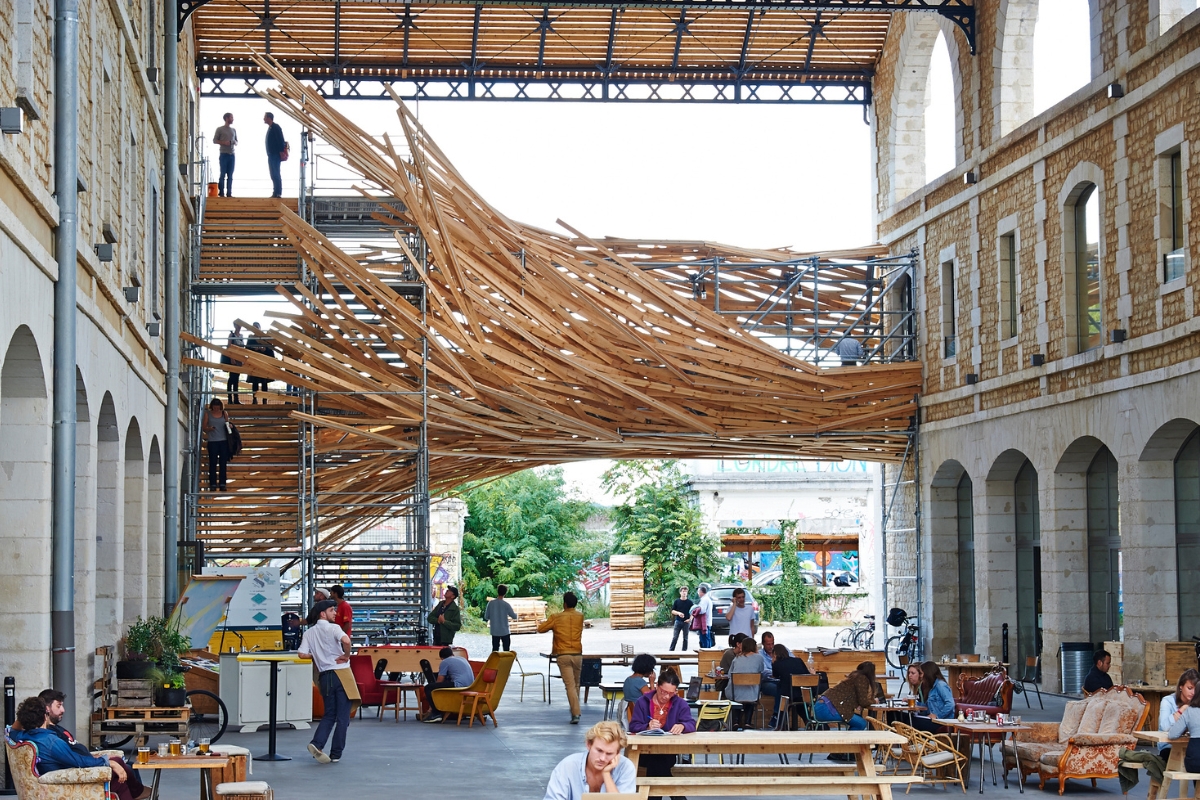
Darwin Ecosystem
11. Darwin Ecosystem — alternative Bordeaux on the right bank
Former military barracks (Caserne Niel), now an eco-rehabilitated hub packed with street art, startups, a skatepark, organic restaurants, and cultural events.
Think of it as Bordeaux’s answer to Brooklyn — a place where locals hang out, not tourists. You’ll find co-working spaces for sustainability-focused social enterprises, bistros with locally sourced produce, galleries, concerts, and markets.
What to do there: Explore the street art (the entire complex is covered in graffiti by leading artists), grab lunch at an organic bistro, and on Saturday afternoons there’s often a farmers’ market. If you have kids, the skatepark is open and free.
Practical tip: Darwin is on the right bank of the river (La Bastide quarter) — take tram line D to the Belvédère stop. It’s about 10 minutes from the centre.
Time on site: 1.5–3 hours.
12. Saint-Pierre — the oldest quarter
The oldest neighbourhood in Bordeaux. Narrow alleyways, carved-stone buildings, the little church of Saint-Pierre, and plenty of restaurants and wine bars.
In the evening, Saint-Pierre buzzes with life — restaurant terraces are packed, couples stroll through the lanes with wine in hand. It’s lively, loud, and fun. And, yes, a bit touristy.
Practical tip: If you’re looking for accommodation, Saint-Pierre offers an excellent location — you’re in the heart of everything. But expect noise at night, especially at weekends.
Time in the quarter: 1–3 hours, depending on whether you’re just strolling or sitting down for dinner.
13. Rue Sainte-Catherine — the shopping spine
Often cited as the longest pedestrian shopping street in Europe, stretching 1.2 km. It connects Place de la Victoire with Place de la Comédie (where the Grand Théâtre is).
You’ll find all the usual high-street chains — Zara, H&M, Sephora, and so on. Nothing extraordinary, but handy if you need to pick up clothes or toiletries.
Time on the street: 30 minutes–2 hours, depending on whether you’re actually shopping.
14. Jardin Public
A city park dating from 1755 with a pond, mature trees, and a blissful sense of calm. Inside you’ll find the Musée d’Histoire Naturelle, which has its own Musée des Tout-Petits section for children under 6 — an interactive exhibition full of animals, colours, and tactile elements.
In summer (July and August), the park hosts Guignol puppet shows. There’s a playground, benches by the pond, and locals come here with a baguette and cheese for a picnic.
Practical tip: It’s at its prettiest in the afternoon when the sun filters through the trees. Bring your own food and drink — the park café is overpriced and underwhelming.
Time in the park: 1–2 hours.
15. Quai des Chartrons and the riverfront — the best spot for a family walk
The waterfront along the Garonne stretches for several kilometres. It’s flat, smooth, and ideal for pushchairs, scooters, and bikes. Locals jog, rollerblade, and walk their dogs here.
In Chartrons (the northern stretch of the waterfront) there’s a children’s playground and skatepark right by the river. You’ll find benches where you can sit and watch the boats go by.
Practical tip: The prettiest section runs from Place de la Bourse northward towards Chartrons. At sunset it’s absolutely magical.
Time for the walk: However long you fancy — could be 30 minutes, could be 3 hours.
Bordeaux
16. Musée d’Aquitaine
A museum covering the history of Bordeaux and Aquitaine “from prehistory to the 21st century”. You’ll find prehistoric artefacts, Roman mosaics, medieval sculptures, exhibits on colonial trade, and modern history.
There’s an entire section dedicated to the slave trade — unvarnished, with hard facts and figures. It’s an important thing to see if you want to understand where Bordeaux’s wealth really came from.
Practical tip: The museum is large. If you don’t have an entire afternoon, focus on the sections that interest you most. A solid combination: Roman Bordeaux + the 18th century + the slave trade. Free entry for under-18s; adults around 5 euros.
Time in the museum: 1.5–3 hours.
17. CAPC — contemporary art in a former colonial warehouse
The contemporary art museum is housed in the former “Entrepôt Lainé” warehouse, where colonial goods — coffee, cocoa, cotton — were once stored. The building itself is striking — a cavernous space with concrete pillars.
The exhibitions rotate, so you never know what you’ll find. If you’re into contemporary art, it’s a must. If not, give it a miss.
Time in the museum: 1.5–2.5 hours.
18. Museum of Illusions — rainy day fun with kids
An interactive museum packed with optical illusions, mirrors, and brain-teasers. Kids love it, and adults have a good laugh too.
Practical tip: It’s a small museum — you can see everything in about an hour. Tickets cost around 12–15 euros. A great shout for a rainy afternoon.
Time in the museum: 1–1.5 hours.
19. Marché des Capucins — the “belly of Bordeaux”
A market with nearly 200 years of history — the liveliest food spot in the city. The covered hall is packed with stalls selling fresh vegetables, fruit, meat, cheese, fish, and oysters.
But Capucins isn’t just about shopping. It’s a social hub where locals come for a morning coffee, lunch, oysters, and white wine. In the middle of the market, several stalls have high stools where you can sit, eat fresh oysters (6 euros a dozen), sip an Entre-Deux-Mers, and watch the bustle around you.
Practical tips: The best time is Friday morning around 9–10 am — fresh produce, free tables, authentic atmosphere. Weekends are great too, but noticeably busier. Some stalls close in the afternoon.
Bring cash — not all stalls take cards. And come hungry.
Time at the market: 1–3 hours, depending on whether you’re just browsing or eating too.
20. Canelé — the city’s sweet icon
A small dessert with a caramelised, almost burnt crust and a soft, custardy centre flavoured with rum and vanilla.
Its history is hazy — one legend has it that 18th-century nuns from the Annonciades convent created it. They used egg yolks (the whites were used for clarifying wine), vanilla, and rum from the port. The batter needs to rest for 24–48 hours before being baked in special copper moulds greased with beeswax at very high temperatures.
Where to buy canelé: Almost any bakery. The most famous names are Baillardran and La Toque Cuivrée, but honestly — regular bakeries often have fresher and better canelé. Expect to pay around 1.50–2 euros each.
Practical tip: Canelé must be fresh — ideally baked that day, two days old at most. Don’t buy them from tourist shops where they’ve been sitting for a week. And watch out for “luxury” brands — there have been media exposés about frozen canelé being sold as fresh.
21. Oysters and white wine — a ritual you must experience
Southwest France is an oyster paradise. Bordeaux is just an hour from the Arcachon Bay, where they’re farmed. At Capucins you can get a dozen fresh oysters for 6–8 euros and a glass of white Entre-Deux-Mers for 3–4 euros.
How it works: Sit down at a stall, order “une douzaine d’huîtres” (a dozen oysters) and “un verre de blanc” (a glass of white). You’ll get a plate of oysters, a lemon, and shallot vinegar. Squeeze lemon over them (or don’t — it’s up to you), tip them into your mouth, and wash them down with wine.
Time for the experience: 30–60 minutes.
22. Entrecôte à la Bordelaise — where to try it
Beef entrecôte in a sauce of red Bordeaux wine, shallots, bone marrow, and butter. Served with chips or mashed potatoes.
Where to get a good one:
Brasserie Bordelaise (50 Rue Saint-Rémi) — a classic, focused on quality meat
Le Bouchon Bordelais (2 Rue Courbin) — stone walls, red accents, fantastic atmosphere
Filoche (32 Rue des Argentiers) — a tiny restaurant with just 14 seats, famous for its “boeuf à la bordelaise”
Price: Budget around 20–30 euros for a main course.
23. Where to eat well without breaking the bank
Petit Mignon (33 Rue Saint-Rémi) — cosy, local vibe, famous for its burger in cream sauce and steak tartare
Les Drôles (21 Rue Saint-Rémi) — traditional French cooking with a homely feel, proper comfort food
Marché des Capucins — where else? The cheapest and most authentic food in Bordeaux
Cathédrale Saint-André
24. Saint-Émilion — a UNESCO wine landscape
A medieval town nestled among vineyards, about an hour by car or train from Bordeaux. The entire area is a UNESCO cultural landscape — vines have been grown here since Roman times.
What to do: Wander the medieval lanes, visit the monolithic church carved into the rock, taste wines in the cellars, and take in the views across the vineyards.
Practical tips: Book tastings in advance via GetYourGuide, especially at weekends and in summer — it gets packed. Some châteaux offer English-language tours. Full-day organised trips from Bordeaux cost around 60–100 euros including transport and tastings.
If you’re driving yourself, parking in the centre of Saint-Émilion is limited — arrive early in the morning.
🔗 These are affiliate links — they don't change your price and help us create content. · All experiences →
Time for the trip: A full day.
25. Dune du Pilat — the tallest dune in Europe
A colossal sand dune on the Atlantic coast, roughly 110 metres high and 2.7 km long. Official sources list it as the tallest dune in Europe.
What to do: Scramble up the dune (hard work, especially in hot weather), gaze at the ocean and the pine forest, and swim in the Atlantic (if it’s warm enough).
Practical tips: It’s about an hour’s drive from Bordeaux, heading towards Arcachon. Parking is paid (around 6–8 euros). Bring water and sunscreen — there’s no shade on the dune. If you don’t have a car, organised day trips from Bordeaux are available.
Sunset is the most beautiful time, but also the busiest. If you can, arrive mid-morning or early afternoon.
Time for the trip: Half a day to a full day (depending on whether you combine it with Arcachon, which is right next door).
Dune du Pilat
26. Médoc Route — vineyards and châteaux
The famous wine route along the left bank of the Garonne, north of Bordeaux. Here you’ll find the most iconic châteaux — Château Margaux, Château Latour, Château Lafite Rothschild — all from the legendary 1855 Classification.
What to do: Drive along the Route des Châteaux (D2), stopping at estates for tastings, and photograph the vineyards and grand buildings.
Practical tips: You’ll need a car. Some châteaux require reservations weeks in advance, particularly the most famous ones. Tastings can be pricey — budget 20–50 euros per château.
If you’d rather not drive (because of the wine), organised tours are available. Or hire a driver through a local taxi service.
Time for the trip: A full day.
27. Arcachon and Cap Ferret — beaches and oysters
Arcachon Bay is an hour from Bordeaux — a seaside resort with belle époque villas, beaches, and some of the finest oyster farms in France. It pairs perfectly with a visit to the nearby Dune du Pilat for a full day out on the Atlantic coast.
Tips and Tricks for Your Vacation
Don’t Overpay for Flights
Search for flights on Kayak. It’s our favorite search engine because it scans the websites of all airlines and always finds the cheapest connection.
Book Your Accommodation Smartly
The best experiences we’ve had when looking for accommodation (from Alaska to Morocco) are with Booking.com, where hotels, apartments, and entire houses are usually the cheapest and most widely available.
Don’t Forget Travel Insurance
Good travel insurance will protect you against illness, accidents, theft, or flight cancellations. We’ve had a few hospital visits abroad, so we know how important it is to have proper insurance arranged.
Where we insure ourselves: SafetyWing (best for everyone) and TrueTraveller (for extra-long trips).
Why don’t we recommend any Czech insurance company? Because they have too many restrictions. They set limits on the number of days abroad, travel insurance via a credit card often requires you to pay medical expenses only with that card, and they frequently limit the number of returns to the Czech Republic.
Find the Best Experiences
Get Your Guide is a huge online marketplace where you can book guided walks, trips, skip-the-line tickets, tours, and much more. We always find some extra fun there!
✈️ Oh, and one more thing… Our baby boy Jonáš was born. And 2 months later, we bought a campervan. 🚐 Every winter we escape from the Czech Republic. We run 3 businesses. We have 2 dogs. And we’re still travelling — enter our contest giveaway to win a stay!
Join us on Saturday (10:00–11:00) to hear how it all really works — we’re giving a talk at the HOLIDAY WORLD & REGION WORLD 2026 travel fair! 🎤
The topic? 🎙️ “How to keep travelling after having a baby”.
The fair takes place on 12–14 March in Prague Letňany and it’s the perfect place to soak up travel inspiration. You’ll meet representatives from all over the world as well as the Czech Republic, and pick up tips straight from fellow travellers that you simply won’t find by googling. 🌍
Tips and Tricks for Your Vacation
Don’t Overpay for Flights
Search for flights on Kayak. It’s our favorite search engine because it scans the websites of all airlines and always finds the cheapest connection.
Book Your Accommodation Smartly
The best experiences we’ve had when looking for accommodation (from Alaska to Morocco) are with Booking.com, where hotels, apartments, and entire houses are usually the cheapest and most widely available.
Don’t Forget Travel Insurance
Good travel insurance will protect you against illness, accidents, theft, or flight cancellations. We’ve had a few hospital visits abroad, so we know how important it is to have proper insurance arranged.
Where we insure ourselves: SafetyWing (best for everyone) and TrueTraveller (for extra-long trips).
Why don’t we recommend any Czech insurance company? Because they have too many restrictions. They set limits on the number of days abroad, travel insurance via a credit card often requires you to pay medical expenses only with that card, and they frequently limit the number of returns to the Czech Republic.
Find the Best Experiences
Get Your Guide is a huge online marketplace where you can book guided walks, trips, skip-the-line tickets, tours, and much more. We always find some extra fun there!
TL;DRSeattle, better known as the Emerald City, comes with 25 tips worth knowing about — from the iconic 184-metre Space Needle and the historic Pike Place Market to the Chihuly Garden and Glass museum and day trips out to Mount Rainier National Park, 2–3 hours away by car. The best time to visit is June to September, with temperatures of 22–28°C, and September tends to be the quietest month for crowds. Two to three days is enough for the city itself, but allow 5–7 days if you want to fit in trips further afield. You don’t need a car to get around, thanks to the Link Light Rail and the free summer Waterfront Shuttle, while parking in the centre runs $2–$4 an hour.
The Emerald City, as Seattle is fondly known, is one of the most beautiful and greenest cities on the northwestern coast of the United States. Nestled between Puget Sound and Lake Washington, it’s surrounded by majestic mountains and dense forests. All of this comes together to create an unforgettable setting that captivates every visitor. Seattle isn’t just home to world-famous companies like Amazon, Microsoft, and Starbucks — it’s also a city bursting with a vibrant cultural scene, outstanding food, and endless outdoor adventures. If you’re looking for the best things to see and do in Seattle, you’re in for a real treat.
During my visit to Seattle, I fell completely in love with its unique vibe. You expect modern architecture, but just outside the city you’ll find raw wilderness — you can stand atop a skyscraper with views across the entire city in the morning and be hiking through the mountains by afternoon. It’s a place that serves up some of the best coffee in the world, incredibly friendly people, and an atmosphere that simply steals your heart.
Let’s explore the very best that Seattle has to offer — from iconic landmarks and hidden gems to day trips into the surrounding nature. And of course, I’ve included some practical tips to help you make the most of your trip and avoid any hiccups along the way.
The best time to visit Seattle is from June to September, when the weather is most settled with minimal rainfall and temperatures around 22–28°C (72–82°F); September offers gorgeous weather with fewer tourists.
Top attractions include Space Needle, Pike Place Market with the original Starbucks and its famous fish-throwing market stalls, the Seattle Great Wheel, and a waterfront packed with interesting shops and restaurants.
If you want to save time, you can buy skip-the-line tickets for most attractions in advance through GetYourGuide.
Getting around the city is easy — combine walking with public transport (Link Light Rail, buses), and in summer take advantage of the free Waterfront Shuttle along the waterfront.
You don’t need a car in the city — for day trips to the surrounding nature, rent one just for those specific days; parking downtown is expensive (use public garages with the Downtown Parking programme).
Try local specialities like clam chowder, fresh salmon, oysters, or coffee from local roasters; Seattle is also a paradise for vegetarians and vegans.
🔗 These are affiliate links — they don't change your price and help us create content. · All experiences →
Where to Stay in Seattle
It’s well worth staying in the city centre, as you’ll save on transport and, more importantly, a lot of time. Right in the heart of downtown, you’ll find one of the most popular hotels — Mayflower Park Hotel. If you’re looking for extremely budget-friendly accommodation, check out Green Tortoise Hostel Seattle. You can also browse more options on Booking.com.
When to Visit Seattle
Seattle has a reputation as a rainy city (though we didn’t experience that during either of our visits), but the truth is that the weather changes dramatically throughout the year. Timing your visit right can make all the difference to your experience.
Summer – The Ideal Time to Visit
Summer (June to September) is hands down the best time to visit Seattle. The weather during these months is sunny and settled, with minimal rainfall and pleasant temperatures around 22–28°C (72–82°F). The days are long, with the sun not setting until around 9pm, giving you plenty of time to explore.
July and August are the warmest months but also the busiest with tourists. If you want great weather without the biggest crowds, consider visiting in June or September. Locals often regard September as the most beautiful month of the year — the weather is usually still gorgeous, but the peak tourist season is winding down.
Summer is also the season of festivals and outdoor events. In early August, the city hosts the Seafair festival featuring the Blue Angels air show and hydroplane races on Lake Washington.
Spring and Autumn
Spring (March to May) and autumn (October to November) each have their own charm. In spring, Seattle dresses up in colourful blooms — especially the famous cherry blossoms on the University of Washington campus, which typically flower in late March. The weather is still changeable, though, with more frequent showers and temperatures around 15–18°C (59–64°F).
Autumn brings stunning foliage to the city’s parks and lower accommodation prices. September and early October can still be very pleasant, while from mid-October onwards, rain and fog become more frequent. October also sees the Refract glass art festival, showcasing the region’s rich glassmaking tradition.
Winter
Winter (December to February) is the season that lives up to Seattle’s rainy reputation. November and December are the wettest months — the rain is usually a fine drizzle, but it can be relentless. Temperatures hover around 5–10°C (41–50°F), and while snow in the city is rare, the surrounding mountains get plenty of it.
The upside of a winter visit? Lower accommodation prices, minimal tourist crowds, and the chance to go skiing in the nearby mountains (e.g. Snoqualmie Pass, just an hour’s drive from the city). In February, Seattle Museum Month offers 50% discounts on admission to many museums.
It’s worth noting that Seattle’s weather can change quickly at any time of year. Always be prepared for a possible shower and dress in layers that you can add or remove as needed.
25 Best Things to See and Do in Seattle
Seattle is a city full of contrasts and incredible experiences. From iconic landmarks to hidden gems, from bustling markets to tranquil parks — here are 25 things you absolutely shouldn’t miss during your visit.
1. Space Needle
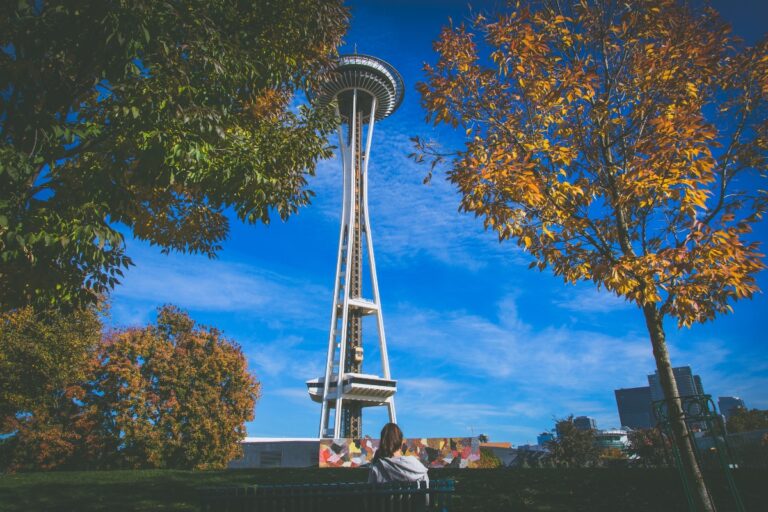
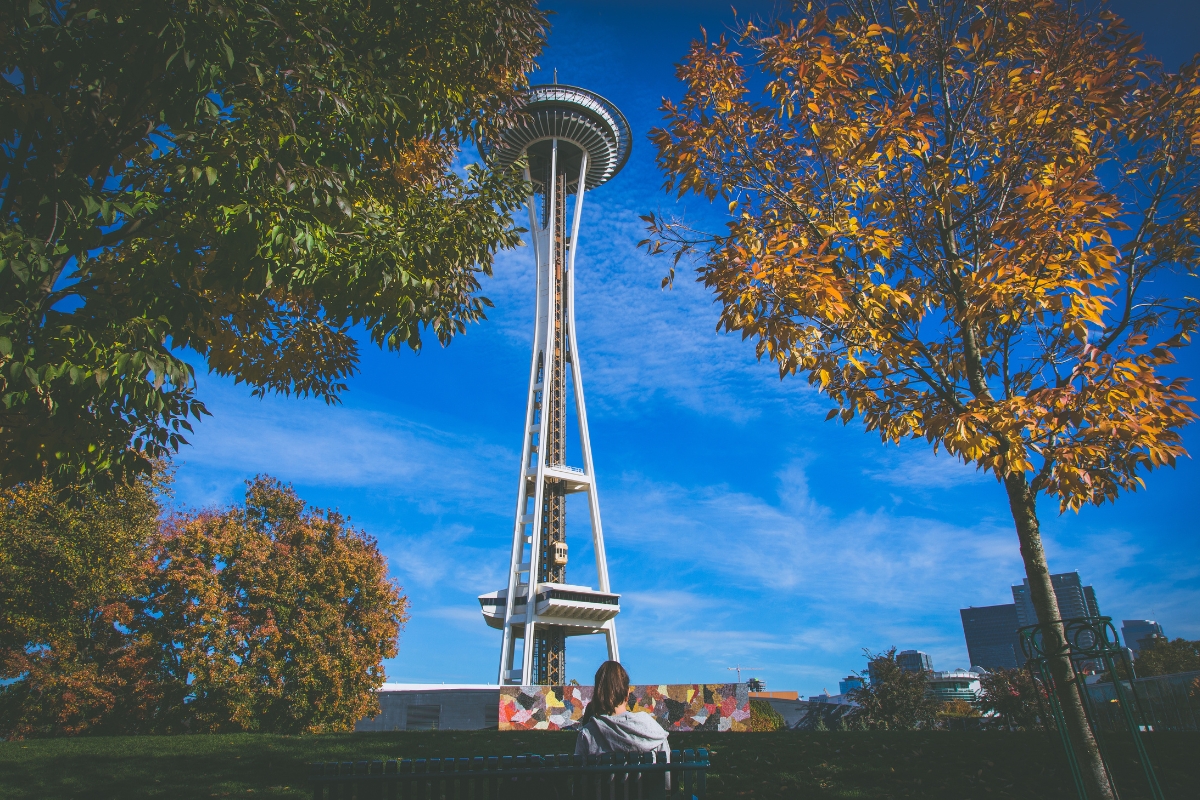
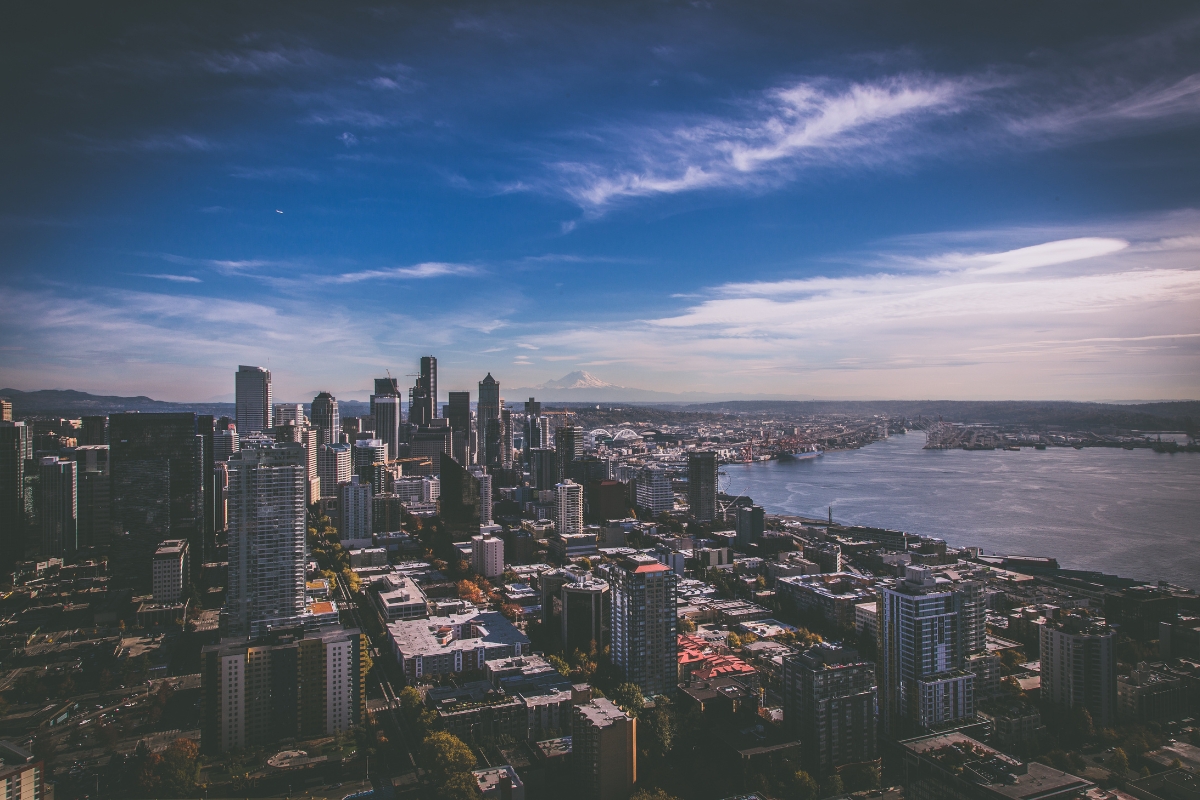
The Space Needle is without doubt the most iconic symbol of Seattle. This 184-metre-tall futuristic tower was built for the 1962 World’s Fair and remains the most photographed structure in the city to this day. From its observation deck, you’ll be treated to a stunning 360° panoramic view of the city, the harbour, the surrounding mountains, and — on a clear day — the majestic Mount Rainier.
For the brave, there’s a glass floor that lets you look straight down beneath your feet. Admission ranges from $32–37 depending on the time of day, with sunset slots being the most sought-after. I’d recommend booking your tickets in advance on GetYourGuide to skip the queues, especially during peak season.
Space Needle Seattle
2. Pike Place Market – The Heart of the City
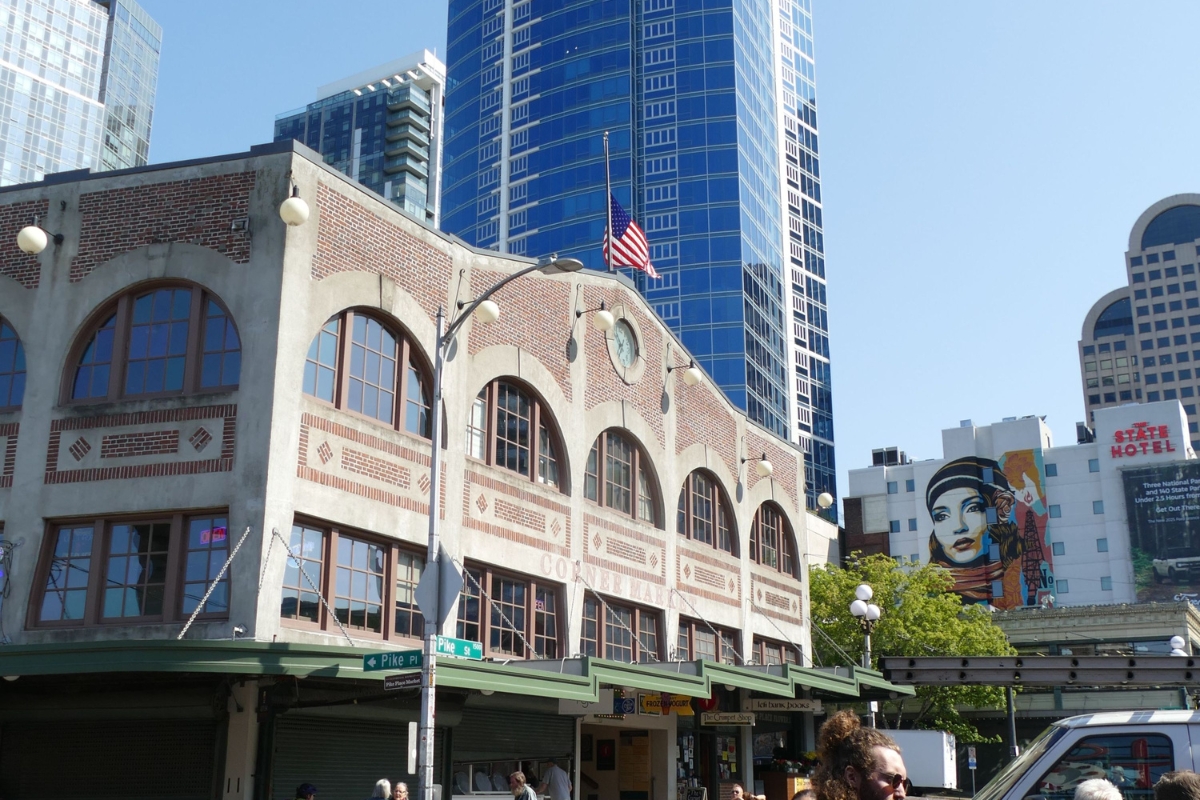
Pike Place Market is one of the oldest continuously operating farmers’ markets in the USA (since 1907) and the true heart of Seattle. Here you can soak up the authentic atmosphere of the city, watch the famous fish-throwing at Pike Place Fish Market, sample local specialities, or pick up fresh fruit and vegetables.
Don’t miss the very first Starbucks, which opened in 1971 right across from the market. Be prepared for a queue of tourists taking photos, though. Nearby, you’ll also find the quirky Gum Wall — a wall covered in thousands of pieces of chewing gum that’s become an unlikely tourist attraction.
The market is also packed with small restaurants and cafés where you can try local specialities like clam chowder (a creamy soup with clams) or fresh pastries. Head to Pike Place Chowder, for instance, where they serve one of the best versions of this soup in the city.
Pike Place Market Seattle
3. Seattle Waterfront
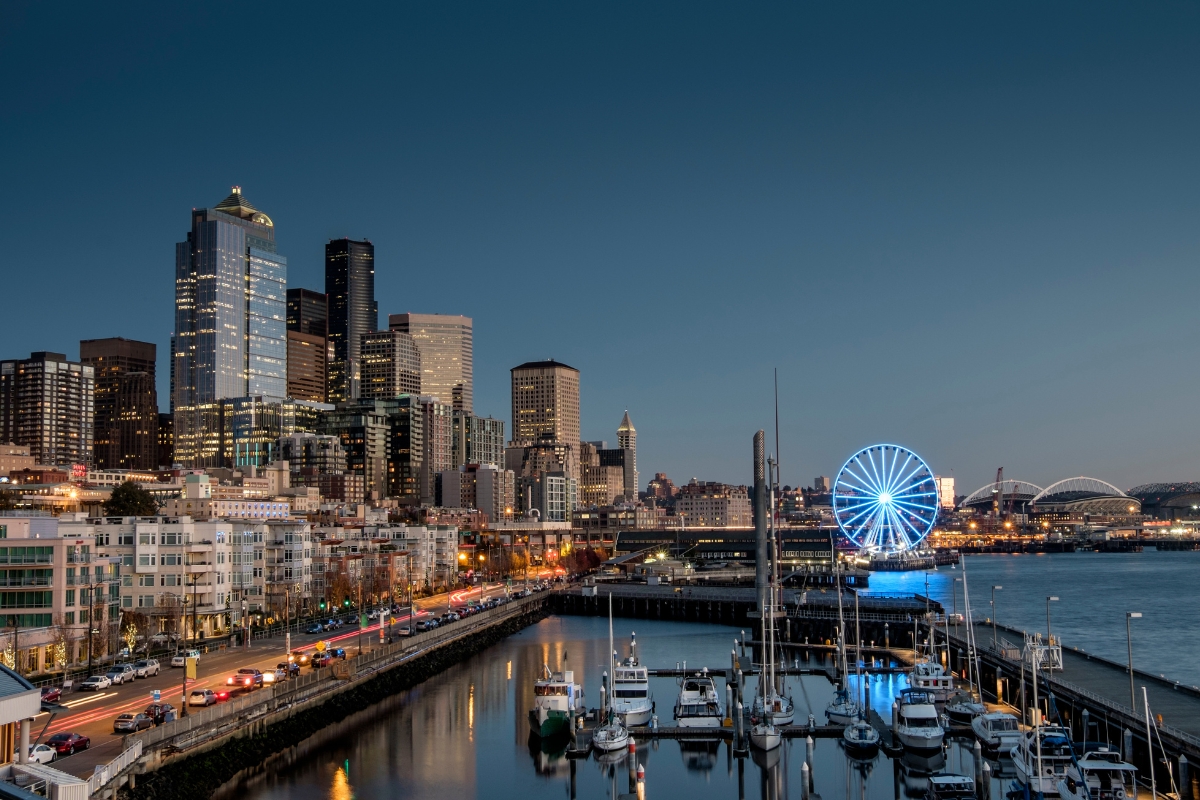
Seattle’s waterfront along Elliott Bay is a brilliant spot for a stroll with views of the ocean and the skyline of skyscrapers. On Pier 57, the Seattle Great Wheel — a giant observation wheel — offers unique views of the city and the bay. Nearby you’ll also find the Seattle Aquarium and Miner’s Landing entertainment centre with restaurants and shops.
From Pier 55, you can set out on a Harbor Cruise sightseeing boat trip around the bay. From the deck, you’ll see the city skyline with the Space Needle, and on a clear day, Mount Rainier looming in the background. The one-hour cruise costs around $30 per adult.
Another popular experience is the ferry ride to Bainbridge Island from Colman Dock. This 35-minute crossing takes you to a peaceful island with a charming little town, and the journey itself offers gorgeous scenery. A return ticket costs approximately $8.50.
Seattle Waterfront
4. Museum of Pop Culture (MoPOP)
Near Space Needle, you’ll find the fascinating Museum of Pop Culture (MoPOP), designed by the legendary architect Frank Gehry. The building itself is a work of art — its vibrantly coloured, undulating metal facade looks like a smashed-up guitar.
Inside, you’ll discover interactive exhibits dedicated to music, sci-fi, fantasy, horror, video games, and pop culture in general. Among the highlights are sections devoted to local music legends like Nirvana, Jimi Hendrix, and Pearl Jam, complete with original instruments and other artefacts.
Sci-fi and fantasy fans are in for a treat with impressive exhibits dedicated to Star Wars, Star Trek, and Harry Potter. The museum also hosts regular special exhibitions and interactive programmes for visitors of all ages.
5. Chihuly Garden and Glass
Just a stone’s throw from Space Needle lies Chihuly Garden and Glass, a stunning exhibition of works by world-renowned glass artist Dale Chihuly. This Washington native is famous for his monumental glass installations that combine colours and shapes inspired by nature.
The exhibition features eight galleries, a spectacular glass garden, and the impressive Glasshouse — a 12-metre-tall glass pavilion with a hanging 30-metre glass installation in shades of red, orange, and yellow. At sunset, when light streams through the coloured glass, the atmosphere inside the Glasshouse is absolutely magical.
The outdoor garden blends Chihuly’s glass creations with carefully selected plants, creating a harmonious whole that shifts with the seasons. This was one of my absolute favourite spots in all of Seattle — it’s a true feast for the eyes and the soul.
Pioneer Square Seattle
6. Pioneer Square and Underground Tours
Pioneer Square is the oldest part of Seattle, filled with beautiful Victorian architecture, art galleries, and cafés. Here’s the fascinating bit: after the Great Fire of 1889, the entire area had to be rebuilt at a higher level — the original streets were buried underground.
You can explore these underground spaces on the popular Underground Tour, which takes you through a labyrinth of subterranean passages while sharing captivating stories about the city’s history. You’ll learn how Seattle literally rose from its own ashes and transformed from a wild port town into a modern metropolis.
Back on the surface, the ornate Smith Tower from 1914 catches the eye — it was once the tallest skyscraper in the western United States. Its observation deck with a Prohibition-era cocktail bar is well worth a visit, offering lovely views over downtown and the harbour.
7. Kerry Park – The Best View of the City Skyline
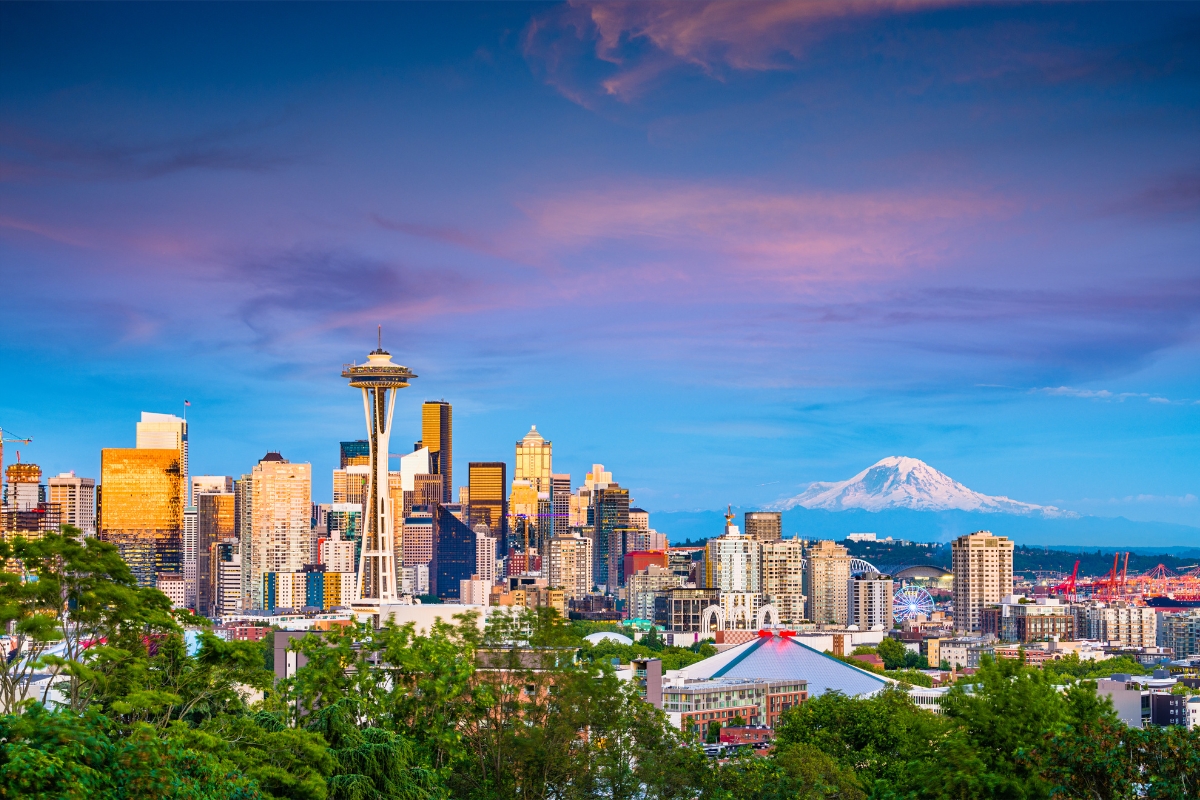
Kerry Park on Queen Anne Hill offers what many visitors and locals consider the finest view of the Seattle skyline. From this small park, you can admire the iconic silhouette of the city with Space Needle in the foreground, the downtown skyscrapers behind it, and the majestic Mount Rainier in the background (on a clear day).
It’s particularly stunning at sunset, when the sky turns golden and pink and the city lights gradually flicker to life. It’s no surprise that Kerry Park is a favourite spot for photographers and romantics alike. Entry is free, and the park is open daily from 6am to 10pm.
For an even better experience, I’d suggest arriving shortly before sunset, finding a good spot (the park gets popular at this time), and staying through blue hour, when the city is bathed in a magical blue glow.
8. Olympic Sculpture Park
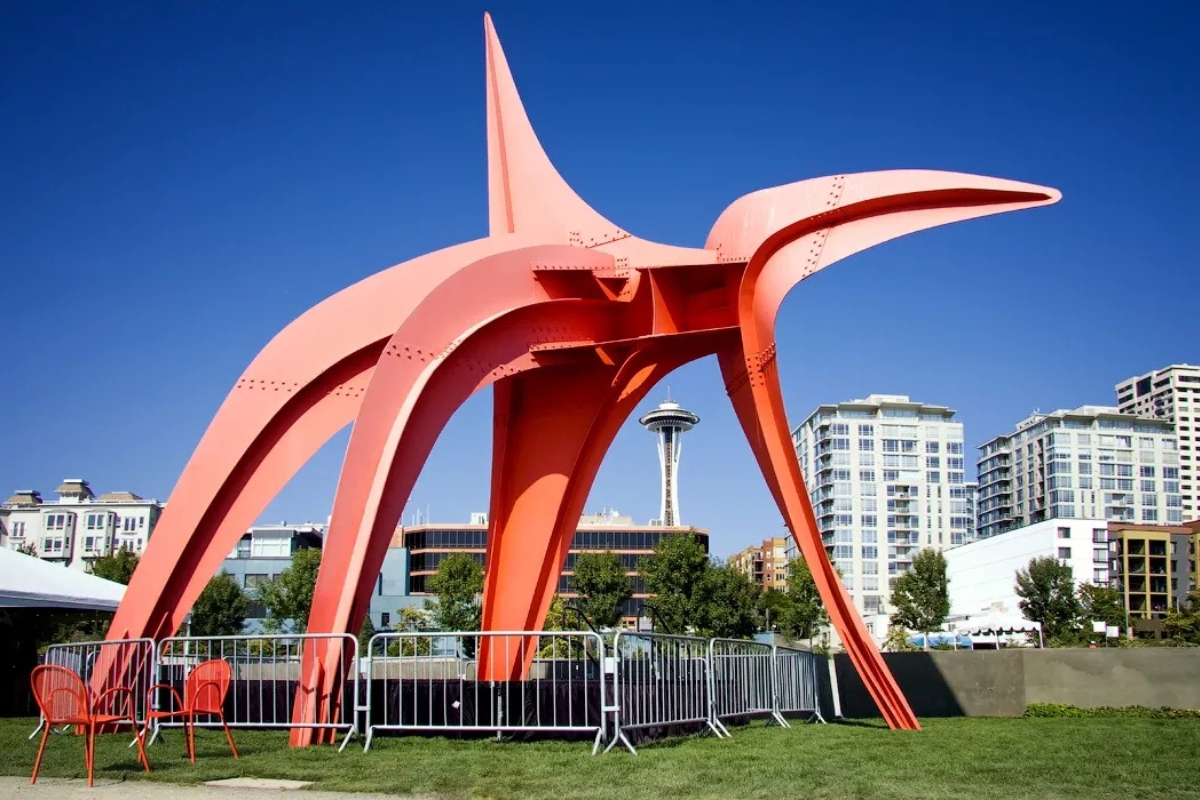
Stretching along the waterfront near the city centre, Olympic Sculpture Park is a free-access park dotted with modern sculptures and offering views over Puget Sound. This 9-acre park opened in 2007 and blends art with nature in a way that delights art lovers and those who simply want to enjoy a nice view and some fresh air alike.
Among the best-known works are the monumental red “Eagle” by Alexander Calder and “Echo” — a 14-metre white head by Jaume Plensa. The park is connected by pathways that wind between sculptures, trees, and flower beds all the way down to the shoreline.
Olympic Sculpture Park is a wonderful spot for a picnic, a rest, or just a quick stop on a waterfront walk. Entry is free, and the park is open daily from sunrise to sunset.
9. Seattle Central Library
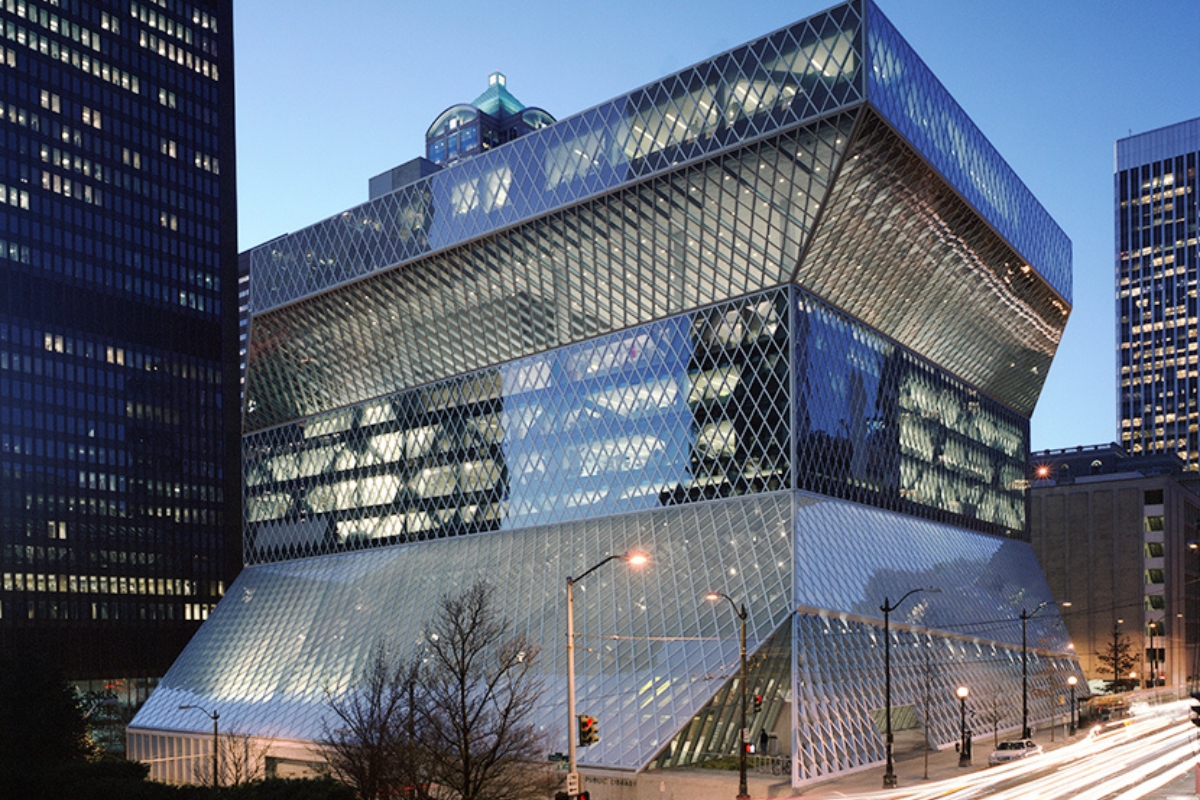
Architecture lovers will be wowed by the Seattle Central Library in downtown — a futuristic building of glass and steel designed by architect Rem Koolhaas. This 11-storey structure with its diagonal lattice facade is considered a masterpiece of modern architecture.
The interior is every bit as impressive as the exterior. Take the glass lift up to the 10th floor, where there’s a free observation area with city views. Also worth seeing is the “Book Spiral” — a four-floor spiral where books are arranged in the Dewey Decimal System in one unbroken sequence — and the dazzling red interior of the 4th floor.
The library is open daily and admission is free. Regular guided tours are also available, introducing you to the architectural details and concept behind this unique building.
Seattle Central Library
10. Fremont Troll and the Artsy Fremont District
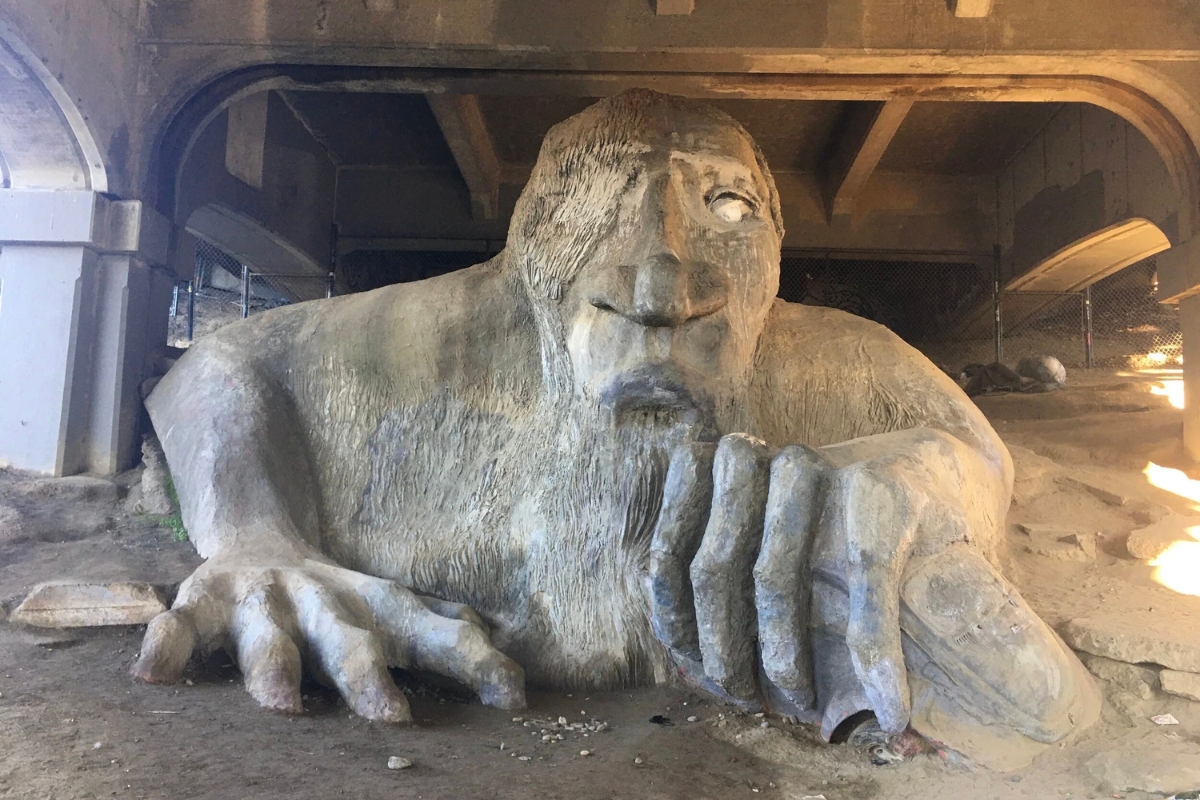
Fremont prides itself on its reputation as an artistic “republic” and is packed with quirky attractions. The most famous is the Fremont Troll — a giant troll sculpture under the Aurora Bridge, clutching a real Volkswagen Beetle. This wonderfully bizarre statue was created in 1990 and has since become the symbol of the neighbourhood.
In this bohemian part of town, you’ll also find other curious sculptures such as “Waiting for the Interurban” (a group of people waiting for a tram, regularly dressed up in various costumes by locals) and a statue of Vladimir Lenin (yes, really).
Fremont is also home to plenty of cafés, restaurants, and microbreweries. Fremont Brewing serves excellent craft beers (a pint for around $5–6) in a lovely atmosphere — visitors can help themselves to free pretzels and apples with their beer. If you’re visiting Fremont on a Sunday, don’t miss the Fremont Sunday Market — a popular flea market with food, artisan goods, and antiques.
Fremont Troll Seattle
11. Gas Works Park – An Industrial Park with a View
Gas Works Park is a unique urban park built on the site of a former gasification plant. The large rusty machines of the old factory have been preserved as industrial sculptures and a monument to the city’s industrial past.
The park sits on the shore of Lake Union and offers gorgeous views of downtown Seattle across the water. It’s a favourite spot for picnics, kite-flying (thanks to the steady breeze off the lake), and watching seaplanes land on the lake.
The hill in the centre of the park, known as “Kite Hill”, is a popular place for watching the 4th of July fireworks or simply relaxing while taking in the panoramic views. Gas Works Park is open daily from 6am to 10pm, and entry is free.
12. Ballard Locks (Hiram M. Chittenden Locks)
The Ballard Locks are a fascinating feat of engineering that connects the saltwater Puget Sound with the freshwater Lake Union and Lake Washington. Every day, dozens of vessels pass through — from small kayaks to large yachts and commercial boats.
The most captivating part is watching the locks fill and empty to equalise the water level between the sound and the lakes. Near the locks, you’ll also find a unique fish ladder where you can watch salmon migrating upstream through viewing windows, particularly during the spawning run (July–October).
The complex also includes a beautiful botanical garden with colourful flower beds and rare plants. Admission to the entire site is free, and guided tours are available to explain how this ingenious system works.
13. Columbia Center Sky View Observatory
While the Space Needle is the iconic landmark, the highest viewpoint in the city is actually at the Columbia Center — the tallest skyscraper in Washington State at 284 metres. The Sky View Observatory on the 73rd floor provides a 360° view of the city, the surrounding mountains, Puget Sound, and on a clear day, Mount Rainier.
The advantage of this observatory is that from here, you can see the Space Needle itself as part of the city panorama. What’s more, admission is lower than at the Space Needle (around $20) and the queues tend to be shorter. There’s also a café in the observatory where you can enjoy a coffee or a glass of wine with breathtaking views.
For the best experience, visit the observatory just before sunset — you’ll see the city in daylight, during the sunset, and at night when all the lights come on.
14. Washington Park Arboretum
On the eastern edge of downtown, you’ll find Washington Park Arboretum — a sprawling 230-acre park with a rich collection of trees, shrubs, and plants from around the world. The park is managed by the University of Washington and serves as both a living laboratory and a peaceful retreat for residents and visitors alike.
The park is particularly beautiful in spring, when cherry blossoms, magnolias, and rhododendrons burst into bloom. Autumn, meanwhile, puts on a spectacular show of colourful foliage. Several trails wind through the arboretum — the most popular is Azalea Way, lined with azaleas, rhododendrons, and cherry trees.
Part of the arboretum includes a Japanese Garden (small admission fee for this section), which is considered one of the finest Japanese gardens outside Japan. Designed according to traditional principles, it features ponds, bridges, a tea house, and meticulously maintained trees and shrubs.
15. Museum of Flight
For aviation and space enthusiasts, the Museum of Flight near the former Boeing factory is an absolute must. It’s one of the largest air and space museums in the world, with more than 175 aircraft and spacecraft, thousands of artefacts, millions of photographs, and numerous interactive exhibits.
Key exhibits include the first ever Boeing 747 (Jumbo Jet), Concorde (the only one on the US West Coast), the original Air Force One, and a replica of the first Boeing plane. The museum also offers flight simulators and a 3D cinema.
Part of the exhibition is dedicated to space exploration, including a genuine Space Shuttle training module. Admission is around $25 per adult, but the museum is worth every penny — you could easily spend an entire day here.
16. Pacific Science Center
The Pacific Science Center at Seattle Center is an interactive science museum that entertains and educates visitors of all ages. It features hundreds of hands-on exhibits that bring the principles of physics, biology, mathematics, and other sciences to life in a fun and engaging way.
Top attractions include a butterfly house where you can walk among freely flying tropical butterflies, and a laser show in the planetarium. The animatronic dinosaur exhibits at life size are also hugely popular.
The centre regularly screens films on its giant IMAX screen and hosts special events and science demonstrations. Admission is around $20 per adult, though you can often find discounts or combination tickets with other Seattle Center attractions.
Lukáš and Lucie recommend
Where to Stay in Seattle
4 accommodations — wellness hotels, hotels and other lodging options
Alki Beach in West Seattle is a favourite spot for relaxing by the water. This 2.5-mile-long beach with its promenade offers stunning views of downtown Seattle across Elliott Bay. It’s a great place for walks, cycling, beach volleyball, or simply sitting back and soaking up the view.
Although it’s a “beach,” swimming is more of a token gesture given the chilly waters of Puget Sound. In summer, however, Alki becomes a social hub, with a string of restaurants, cafés, and bars with outdoor seating lining the promenade.
Alki Beach is at its most beautiful at sunset, when the sun dips behind the Olympic Mountains to the west and downtown Seattle is bathed in golden light. You can easily get to the beach by water taxi from downtown (a lovely experience in itself) or by car via the West Seattle Bridge.
18. Chinatown-International District
The Chinatown-International District is a vibrant neighbourhood where Chinese, Japanese, Vietnamese, Filipino, and other Asian cultures blend together. It’s a fantastic place for sampling authentic Asian cuisine, exploring specialist shops, and learning about the rich history of Seattle’s Asian communities.
Visit Uwajimaya, a massive Asian supermarket with a food court where you’ll find everything from fresh sushi and bubble tea to exotic fruit. The Wing Luke Museum tells the story of Asian American history and culture through compelling exhibits and guided tours of the historic district.
In February, the colourful Lunar New Year Festival fills the streets with dragons, lions, music, and dancing. Year-round, you can also visit the Kubota Garden (a bit further south) — a hidden gem that blends Japanese garden artistry with Pacific Northwest plants.
19. Capitol Hill – The Nightlife Hub
Capitol Hill is a trendy neighbourhood bursting with bars, cafés, and vintage shops, and it serves as the centre of Seattle’s nightlife and LGBTQ+ community (you’ll spot it by the rainbow crossings on the streets). During the day, browse the boutiques on Broadway or pop into Elliott Bay Book Company — a renowned independent bookshop with a café.
After dark, Capitol Hill transforms into an entertainment hub. Neumos hosts live alternative music gigs, while Cha Cha Lounge and Unicorn offer a unique vibe with arcade games and eccentric décor. Wine lovers should check out Poco Wine Room, while beer fans will appreciate The Pine Box — a craft beer bar housed in a converted former funeral home.
The neighbourhood is also a foodie’s paradise — you’ll find everything from upscale restaurants to street food. Don’t miss Melrose Market, a smaller version of Pike Place with artisan shops, restaurants, and an oyster bar.
20. Ferry to Bainbridge Island
The ferry ride to Bainbridge Island is one of the best excursions from downtown Seattle. The 35-minute crossing offers gorgeous views of the Seattle skyline, Puget Sound, and the surrounding mountains. The ferry costs around $8.50 per person (return) and runs every hour.
Once you arrive, the charming little town of Winslow awaits with galleries, boutique shops, and restaurants, all within walking distance of the terminal. I’d recommend visiting the Bainbridge Island Museum of Art (free entry), tasting wine at a local winery, or strolling to Eagle Harbor Waterfront Park.
For more active visitors, bike hire is available so you can explore more of this 17-square-mile island. Also worth a visit is the Bloedel Reserve — a 150-acre garden with forests, ponds, and formal gardens (admission $20).
21. Mount Rainier National Park (Full-Day Trip)
Mount Rainier, a majestic stratovolcano rising to 4,392 metres (14,411 ft), is visible from Seattle on clear days and offers one of the best full-day trips from the city. Mount Rainier National Park is approximately 2–3 hours’ drive away and features spectacular alpine meadows, glaciers, and dozens of hiking trails.
For a day visit, I’d recommend the Paradise area on the mountain’s southern slope. From here, the popular Skyline Trail — a roughly 6-mile loop — takes you to Panorama Point with views of Mount St. Helens and Mount Adams. In summer, wildflowers blanket the meadows and you might spot marmots or herds of elk.
Park entrance costs $30 per vehicle (valid for 7 days). On peak-season weekends, queues can form at the gates — set off early in the morning. Keep an eye on the forecast too, as Rainier’s summit is often shrouded in cloud. But on a clear day, it’s an absolutely unforgettable experience.
22. Olympic National Park (Full-Day Trip)
To the west of Seattle lies the vast Olympic National Park, a biosphere reserve encompassing snow-capped peaks, rainforests, and wild Pacific coastline. For a day trip, you can manage Hurricane Ridge — a mountain ridge with a scenic drive and visitor centre above the town of Port Angeles.
The journey from Seattle takes around 3 hours, including a 30-minute ferry crossing over Puget Sound. From Hurricane Ridge, try the short Hurricane Hill Trail — an easy paved path with sweeping views of the Olympic range and, on a clear day, all the way to Canada and the Cascades.
On the way back, you can stop at the turquoise glacial Lake Crescent and nearby Marymere Falls. Park entrance is $30 per vehicle. For a longer trip (2–3 days), I’d also recommend visiting the Hoh Rainforest (a unique temperate rainforest) and the coastal beaches at Rialto or La Push.
23. Snoqualmie Falls (Half-Day Trip)
Less than an hour east of Seattle lies the picturesque Snoqualmie Valley with the impressive Snoqualmie Falls. This 82-metre (268 ft) waterfall, famous as the opening shot of the TV series Twin Peaks, is one of the most visited natural attractions in Washington State.
There’s a viewing platform by the falls (free entry) and a short trail down to the base. Perched on the cliff above the waterfall is the historic Salish Lodge & Spa, where you can enjoy lunch with a view or treat yourself to a spa treatment.
You can combine the trip with a visit to the town of Snoqualmie and its railway museum, or with a short hike in the area. Popular trails include Rattlesnake Ledge (5 miles round trip, with lake views) or the more challenging Mount Si for fitter hikers.
24. Winery Visits in Woodinville
Surprisingly, just 30 minutes from Seattle lies Woodinville — a wine country hub with more than 100 wineries and tasting rooms. While most of the grapes are grown in eastern Washington, many winemakers bring their products closer to the city’s consumers.
Woodinville is divided into four wine districts: Hollywood District (home to flagship estates like Chateau Ste. Michelle), Warehouse District (smaller family-run wineries), Downtown, and West Valley. You can join an organised tasting tour or explore the area at your own pace.
Beyond wine, Woodinville also boasts several craft breweries, distilleries, and excellent restaurants using local produce. It’s a wonderful way to enjoy a countryside atmosphere and superb Washington wines without a long journey.
25. Catch a Seattle Seahawks or Mariners Game
Seattle has a passionate sports culture, and attending a game can be an unforgettable experience. The NFL’s Seattle Seahawks play at Lumen Field, where fans known as the “12s” create one of the loudest atmospheres in American football. The season runs from September to January.
The baseball team Seattle Mariners play at T-Mobile Park from April to October. The stadium is renowned for its excellent architecture and panoramic views of downtown. Even if you’re not a die-hard sports fan, the stadium atmosphere, local food and drinks, and the social experience make it well worthwhile.
Seattle also has an NHL ice hockey team, the Seattle Kraken, who play at the renovated Climate Pledge Arena. It’s best to buy tickets in advance, especially for Seahawks games, which frequently sell out.
Getting Around Seattle and Beyond
Seattle has a well-functioning public transport system and is friendly to both pedestrians and cyclists, so you really don’t need a car in the city. Here are your main options for getting around:
Public Transport – Getting Around the City
The backbone of Seattle’s public transport is the bus network (King County Metro) and the Link Light Rail. The Link is a rapid transit line connecting downtown with neighbourhoods to the north (University District, North Seattle) and, crucially, with the airport to the south — the journey to/from Sea-Tac Airport takes around 30 minutes and costs just $2.75.
A standard fare is $2.75 for 2 hours within the city (including transfers). You can buy tickets from machines at Link stations or from the bus driver (cash only, exact change required). A more modern option is the Transit GO Ticket mobile app, where you can purchase tickets online.
A fun quirk is the Monorail from 1962, which shuttles between Seattle Center (near Space Needle) and Westlake shopping centre downtown. A ride costs $3.50, and it’s more of a tourist attraction than serious transport, but it’s handy for a quick hop from downtown to the Space Needle.
Free Waterfront Shuttle – Free Along the Waterfront
A seasonal bonus for tourists is the Free Waterfront Shuttle — a complimentary hop-on, hop-off bus along the waterfront. It typically runs in summer (usually May to September), daily from around 10am to 8pm. The shuttle runs from Seattle Center/Space Needle along the waterfront (Piers 56/62/69) to Pioneer Square and the stadiums at the south end of downtown, departing every 15 minutes or so.
It’s a brilliant way to move between the main tourist spots for free — the shuttle is air-conditioned, wheelchair-accessible, and dog-friendly. In the evenings, it even adds a special loop around the downtown hotels.
On Foot, by Bike, or by Scooter
Downtown Seattle is fairly compact, and many sights can be reached on foot. Be warned, though — the city is hilly (the First Hill and Queen Anne areas in particular will give your calves a workout). Pedestrian crossings are well respected, but expect longer traffic light cycles at the wider junctions.
Seattle has invested in cycle lanes and paths — for example, around Lake Union or across to West Seattle. Hiring a bike or electric scooter is easy thanks to shared services like Lime, Veer, and Bird. Everything works through mobile apps — unlocking costs around $1 with a per-minute rate of roughly $0.25.
Taxis, Uber, and Lyft
Traditional taxi services (Yellow Cab and others) operate in Seattle, but locals tend to use Uber and Lyft more frequently. Both cover the city reliably — a ride from downtown to the airport costs around $40–50 (depending on traffic), while shorter trips around the city typically range from $10–20.
The advantage of Uber/Lyft is that you summon them via the app wherever you are, with no need to hail a cab on the street. Another option in the city centre are pedicabs, which offer rides to tourists in summer — though treat these more as a novelty experience than serious transport.
Car Hire and Parking
If you’re planning trips outside the city, hiring a car may come in handy. Car rental in Seattle is available both at Sea-Tac Airport and at numerous city-centre locations. Prices vary by season — summer is the most expensive. As a rough guide, expect to pay around $50–100 per day for a standard car when booked in advance.
Worth noting: hiring directly at the airport tends to be significantly more expensive due to airport surcharges — on average 18% higher than city-centre branches. A weekly rental there works out roughly $86 more. If your itinerary allows, you can save by taking the Link Light Rail from the airport to downtown (just $3) and picking up the car in the city instead.
Parking in downtown Seattle is metered and fairly pricey. Street parking is generally paid Monday to Saturday, typically 8am–8pm. Street parking rates are around $2–4 per hour depending on the area. Sundays and public holidays are free.
In the centre, public car parks are often better value, especially for longer stays. The city has partnered with operators to create the “Downtown Parking” programme — several garages near Pike Place and the waterfront offer discounted rates of $3–4/hour for up to 4 hours. Many garages in the business district also offer evening and weekend flat rates of around $7 for the whole night or day.
Where to Eat in Seattle
Seattle is a culinary hotspot — thanks to its proximity to the sea, fresh seafood takes centre stage, while the city is also a haven for café culture, craft breweries, and innovative gastronomy. You’ll find everything from street food stalls to fine dining with views.
Seafood and Local Specialities
In Seattle, you absolutely must try the local salmon, which ranks among the best in the world — it’s often served grilled or smoked on a cedar plank. The oysters are also renowned (particularly those from nearby Hood Canal).
A classic local speciality is clam chowder — a thick, creamy soup with clams and potato; one of the best is allegedly served at Pike Place Chowder right on Pike Place Market (a regular award winner). Seafood lovers should head to Elliott’s Oyster House on Pier 56 (wide selection of oysters and bay views) or the legendary Ivar’s (a local chain dating back to the 1930s).
For cheaper seafood, try fish and chips at one of the stalls on the market or along the waterfront. Crab cakes and grilled prawns are also popular at many waterfront eateries.
International Cuisine
Seattle is a multicultural city, so you’ll find authentic Asian food everywhere — head to Chinatown for dim sum (try Jade Garden), Little Saigon for excellent Vietnamese phở, or Japantown for sushi and ramen (Sushi Kashiba near Pike Place is a standout).
For outstanding Thai food, try Bangrak Market or the vegetarian Thai restaurant Araya’s Place (fully vegan menu). For Mexican street food, grab tacos at the taquería Los Agaves in Ballard, or browse the Latin American stalls at Pike Place Market.
European classics are represented by the French restaurant Maximilien (romantic dining with Elliott Bay views) or the Italian bistro Serious Pie (famous for its pizzas). And of course there’s American comfort food too — a burger at the iconic Dick’s Drive-In (a beloved retro fast-food joint) or proper BBQ at the acclaimed Jack’s BBQ.
Vegetarian and Vegan Options
Seattle is brilliantly accommodating for plant-based diners. Among the most celebrated vegetarian restaurants are Cafe Flora (an institution running for over 30 years, with creative vegetarian dishes and a beautiful interior with a winter garden) and Plum Bistro on Capitol Hill — a stylish spot serving a 100% vegan menu.
Also worth a mention are Harvest Beat in Wallingford, which serves a seasonal vegan five-course tasting menu, and Wayward Vegan Café (diner-style, hearty breakfasts, burgers — all plant-based). Pi Vegan Pizzeria in the U-District was even the first fully vegan pizzeria in the USA.
Most mainstream restaurants in Seattle also have vegetarian-friendly options, and finding good food as a vegetarian or vegan is no problem at all — the choice is genuinely impressive.
Coffee and Cafés in Seattle
Seattle is the birthplace of Starbucks, but definitely don’t stop there — the city has one of the best café scenes in the world. Beyond the symbolic visit to the first Starbucks near Pike Place (brace yourself for a queue), explore the local roasters.
You’ll find outstanding coffee at Storyville Coffee (right above Pike Place Market), Victrola Coffee (Capitol Hill), Caffe Ladro, or Milstead & Co. in Fremont. A special mention goes to the Starbucks Reserve Roastery on Capitol Hill — a premium roastery and café in one, where you can taste rare coffees prepared in various styles.
In Seattle, lingering with a cup of coffee and watching the world go by is something of a local pastime — especially on rainy days, when the city’s cafés become a second living room for Seattleites.
Breweries and Drinks
An evening in Seattle often involves a glass of craft beer — the Pacific Northwest is famous for its craft beer scene. The city alone is home to dozens of microbreweries: highlights include Fremont Brewing (popular beer garden, pints from the tank for around $5–6), Pike Brewing Co. (right by Pike Place Market, with a small beer museum), and Elysian Brewing (famous for its pumpkin beer).
Beyond beer, Seattle is also known for its cocktail bars. Rooftop bars with views are especially worth visiting, such as The Nest at the Thompson Hotel, or the historic bar at the Smith Tower Observatory, decked out in Prohibition-era style.
What to Watch Out for in Seattle
Seattle is generally a safe and pleasant city for travellers. That said, it’s worth keeping a few practical things in mind to ensure your trip goes smoothly.
Safety in the City
Like other large cities, Seattle has some issues with homelessness and drugs in the city centre.The main tourist areas such as the Waterfront, Pike Place Market, Seattle Center, and so on are safe and well-patrolled — even in the evenings, there are plenty of people around along with private security.
However, you may occasionally encounter homeless individuals or people under the influence of drugs, particularly around 3rd Avenue and Westlake Park downtown. These blocks aren’t outright dangerous, but they can feel uncomfortable. It’s advisable to avoid isolated or poorly lit areas at night — for instance, parts of Pioneer Square in the late hours.
If you stick to the main streets and tourist areas, the risk of incidents is minimal. As anywhere, don’t leave valuables unattended and keep an eye out for pickpockets in crowds (e.g. at Pike Place Market). Theft, however, is relatively uncommon.
Weather and What to Wear
Seattle is famously rainy, so even in summer, keep a lightweight waterproof jacket or at least a compact umbrella to hand. The rain is usually a gentle drizzle, but it can last all day. In winter, bring warm clothing — the damp cold at around 5°C (41°F) has a real bite to it.
Layering is key — it might be raining at 10°C (50°F) in the morning, then the sun comes out and it’s suddenly 20°C (68°F) by afternoon. For mountain hikes, equip yourself with sturdy footwear, a windproof jacket, and a spare layer at all times, as mountain weather changes even faster.
In summer, there’s an occasional risk of poor air quality from wildfire smoke in the region. If this happens, check local news and health advisories — strenuous outdoor activities are not recommended when pollution levels are high.
Traffic Tips
Rush hours are on weekdays around 7–9am and 4–6:30pm, when traffic jams build on the motorways (I-5 running through the city and I-90/I-405 heading east). Plan extra time for journeys during these hours.
The city centre has many one-way streets — using GPS navigation is a good idea to avoid unnecessary loops. It’s also important to watch for bus lanes and tram tracks — some lanes downtown are reserved for public transport only. As mentioned, the entire length of 3rd Avenue downtown is buses and trolleybuses only from 6am to 7pm.
When parking on the street, pay close attention to signage — especially the “Peak Hour” no-parking restrictions on main routes, where stopping during rush hour is prohibited. These are strictly enforced, and your car would be towed immediately.
Rules and Local Customs
Recreational marijuana is legal in Washington State (21+), but only in private spaces. Smoking or consuming any drugs in public (including marijuana) is illegal and can result in a fine. Cannabis products can be purchased at licensed dispensaries, but keep in mind that you cannot bring them into or out of the USA.
In restaurants and bars, a tip of around 15–20% of the bill is expected, unless a service charge has been automatically added. Wait staff in the US often earn only the minimum wage and rely on tips. In some cafés and fast-food spots, the tablet at the till may also prompt you to leave a small tip — it’s not compulsory, but it’s appreciated when the service is good.
Alcohol is sold only to those aged 21 and over — shops may ask to see your ID, and bars may not let you in without it in the evening.
Frequently Asked Questions
How do I get from the airport to downtown Seattle?
The Link Light Rail runs from Sea-Tac Airport to downtown Seattle. The journey takes approximately 30 minutes and a ticket costs 2.75 USD. Trains run every 8-10 minutes during peak hours, making it the most economical transportation option. Alternatively, you can take a taxi or Uber/Lyft (around 40-50 USD) or an airport shuttle bus.
How many days do I need to explore Seattle?
If you want to see the main highlights, 2-3 days will suffice. However, if you’d like to visit nearby national parks or take day trips outside the city, I’d recommend at least 5-7 days.
How expensive is Seattle?
Seattle is one of the pricier American cities, but because it’s large, if you book accommodation in advance and choose your restaurants wisely, it’s not as bad as you might think.
Tips and Tricks for Your Vacation
Don’t Overpay for Flights
Search for flights on Kayak. It’s our favorite search engine because it scans the websites of all airlines and always finds the cheapest connection.
Book Your Accommodation Smartly
The best experiences we’ve had when looking for accommodation (from Alaska to Morocco) are with Booking.com, where hotels, apartments, and entire houses are usually the cheapest and most widely available.
Don’t Forget Travel Insurance
Good travel insurance will protect you against illness, accidents, theft, or flight cancellations. We’ve had a few hospital visits abroad, so we know how important it is to have proper insurance arranged.
Where we insure ourselves: SafetyWing (best for everyone) and TrueTraveller (for extra-long trips).
Why don’t we recommend any Czech insurance company? Because they have too many restrictions. They set limits on the number of days abroad, travel insurance via a credit card often requires you to pay medical expenses only with that card, and they frequently limit the number of returns to the Czech Republic.
Find the Best Experiences
Get Your Guide is a huge online marketplace where you can book guided walks, trips, skip-the-line tickets, tours, and much more. We always find some extra fun there!
TL;DRCefalù, on Sicily’s north coast, packs a lot into a small historic centre: the Norman Duomo di Cefalù, the La Rocca cliff with its views over the town, the medieval washhouse Lavatoio Medievale, the old harbour with its pier, the Museo Mandralisca, and the Lungomare beach made famous by The White Lotus. The train from Palermo takes about an hour. If you’re driving, watch out for the ZTL zones — we got landed with a 40 euro fine for parking in the centre. The best time to come is May–June and September to early October, when it’s around 25°C and the sea’s warm, while July and August get crowded with temperatures up to 32°C. The Madonie mountains and the town of Castelbuono, with its medieval castle, make a great day trip from Cefalù.
Cefalù in Sicily was originally just a “must-do stop” during our month-long stay on the island. Everyone talks about it, it’s in every guidebook, and now it keeps popping up everywhere thanks to The White Lotus. We expected a tourist trap — and instead found a town where we could have happily spent our entire holiday.
We were travelling with our one-year-old Jonáš, so we were more concerned with pushchair logistics than baroque details, but Cefalù is compact, easy to navigate and pleasantly quiet outside peak season. It has everything you’d want from an ideal seaside destination — a historic centre, a long sandy beach, mountains rising behind the town, and food you’ll be dreaming about for weeks. If you fancy a longer holiday on the island, check out our comprehensive guide to holidays in Sicily.
But it wasn’t all picture-perfect — right at the start, we made a mistake that cost us €40. The same blunder could easily happen to you, so keep reading.
Getting to Cefalù is easy by train from Palermo. The journey takes roughly an hour, it’s cheap, straightforward and — most importantly — you avoid the stress of parking.
We had a rental car, though, and thought: “Let’s park as close to the centre as possible so we don’t have to walk far with the little one.” Mistake. Big mistake.
Like most Italian historic towns, Cefalù has ZTL zones (Zona a Traffico Limitato) — restricted traffic areas. They are signposted, but in the chaos of Italian traffic and narrow alleyways, it’s surprisingly easy to miss the signs. We parked just a short walk from the centre, feeling pretty pleased with ourselves — until we found a fine tucked under the windscreen wiper.
Tip for drivers: If you’re arriving by car, don’t try to squeeze as close to the centre as possible. Park at the large car parks along the Lungomare promenade — it’s just a few minutes’ walk and you’ll save yourself both stress and money. Better yet, leave the car in Palermo and take the train. From the UK, you can fly to Palermo with Ryanair or easyJet from London, Manchester or other major airports — the Cefalù to Palermo train connection makes it a breeze. (If you’re planning a broader Italian trip, you might also find our article on where to holiday in Italy useful.)
Cefalù: weather and sea temperature by month
🌡️ Warmest: July (daytime 32 °C) · 🌊 Warmest sea: August (28 °C) · ☔ Least rainfall: June
Month
Day
Night
Sea
Rainy days
January
14 °C
9 °C
16 °C
13
February
15 °C
10 °C
15 °C
9
March
16 °C
10 °C
16 °C
14
April
19 °C
13 °C
17 °C
11
May
23 °C
17 °C
19 °C
9
June
29 °C
22 °C
24 °C
4
July
32 °C
25 °C
27 °C
4
August
32 °C
25 °C
28 °C
5
September
28 °C
22 °C
26 °C
12
October
24 °C
18 °C
24 °C
12
November
20 °C
15 °C
21 °C
14
December
17 °C
11 °C
18 °C
12
Source: climate normal 2019–2024 (Open-Meteo, measured data)
When to Visit Cefalù: Our Experience in May
We visited Cefalù in May and it was nearly the perfect choice. Temperatures around 25 °C are just right for strolling with a pushchair, and the town isn’t yet overrun by crowds of tourists.
In July and August, Cefalù turns into a sweltering, packed destination where finding a free spot on the beach or a table at a restaurant becomes a challenge. The sweet spot is May to June and then September to early October — you can still swim in the sea (or already swim again), but the air remains pleasantly breathable. The Cefalù Sicily weather in these shoulder months is reliably warm without being oppressive.
Where to Stay in Cefalù
We highly recommend the gorgeous apartment Cuore Della Valle. If you’d prefer a place with breakfast included, check out Lirma B&B. You can compare more options on Booking.com.
Cefalù Beach: The Famous Lungomare and Swimming with Kids
The main town beach, Lungomare, is the very one you might recognise from the opening scene of The White Lotus Season 2 — a long stretch of sand, historic buildings in the background and La Rocca towering over the town. In person, it looks even more picturesque than on screen.
For families with small children, this is an ideal spot. The sand is fine, the water entry is very gradual, and toddlers can safely splash around near the shore. If you’re travelling with a baby or a young child, you might also find our guide to holidays with a baby helpful.
Beach tip: The Cefalù beach is divided into paid sections (lidos) with sun loungers and parasols, and free public areas. While the lidos are comfortable, they’re pricey. The free beach a short walk from the historic centre offers more space, a calmer atmosphere and exactly the same sea.
6 Must-See Things in Cefalù Sicily
Let’s take a look at what you shouldn’t miss in town — even if sightseeing isn’t usually your thing.
Norman Cathedral: The Mosaic That Watches You
The town’s crowning landmark is the Norman Cathedral (Duomo di Cefalù) on the main square, one of the most significant monuments on Sicily’s northern coast. Inside, you’ll find stunning Byzantine mosaics including the monumental Christ Pantocrator, who seems to gaze down at you from virtually every angle in the nave.
On hot days, it’s also one of the most welcome escapes from the heat — cool, quiet and calm inside, so we happily lingered for a few peaceful minutes with Jonáš in the baby carrier. Afterwards, grab a coffee or a granita on Piazza del Duomo and just soak up the buzz.
Lavatoio Medievale: A Medieval Washhouse Carved into Rock
Just a few steps from the main street, you’ll find Lavatoio Medievale — a medieval washhouse carved into the rock, fed by the ice-cold Cefalino river. You descend slippery steps into a cool chamber with stone troughs and channels where kids can watch in fascination as the water flows past.
It’s a small but atmospheric stop, perfect for a quick cool-down on a sweltering day. We’d suggest combining it with a short stroll around the old harbour and along the waterfront.
Lavatoio Medievale: a medieval washhouse carved into rock
La Rocca: The Viewpoint Rock Above Cefalù
Looming above the town is the iconic La Rocca, offering fantastic views over the historic centre, the sea and the surrounding coastline. The path up follows stone trails and steps, so bear in mind it’s not pushchair-friendly.
If you’re travelling as a couple with a child, you can take turns — one stays with the little one down in town while the other tackles the climb. The reward is a panorama that confirms exactly why Cefalù in Sicily is considered one of the island’s most beautiful towns.
You can hike up to the rock, but leave the pushchair behind
The Pier and Old Harbour
The old harbour with its short pier is one of the most photogenic spots in town. From here, you get a gorgeous view of the colourful houses hugging the coastline, with La Rocca rising dramatically behind them.
In the evening, it’s a wonderful place for a stroll, watching the sunset and snapping photos. During summer, locals and visitors alike swim and jump into the water straight from the pier.
Cefalù
Museo Mandralisca: A Dash of Culture
If you enjoy galleries and history, Museo Mandralisca is worth a visit. It houses a collection of art, archaeological finds and other treasures from the region. The star exhibit is the “Portrait of an Unknown Man” by Antonello da Messina, sometimes nicknamed the Sicilian Mona Lisa.
The museum is small and can be explored in under an hour, making it a solid plan for a shady break when you’ve had your fill of beaches and winding streets.
Cefalù
Eating in Cefalù as a Vegetarian
Cefalù is a typical Sicilian town, so most restaurants prominently feature fish and seafood. As vegetarians, though, we ate incredibly well — you just need to look around a little and don’t be shy about asking for modifications.
Most places will happily prepare vegetarian pasta, meat-free pizza or salads. Safe bets include pizza margherita, vegetable pizzas, various types of caponata, roasted vegetables and classics like arancini in a meat-free version.
Worth a mention is Bastione & Costanza, which has a wider selection of vegetarian and vegan dishes along with pizzas featuring plant-based alternatives. We’d recommend booking your “veggie-friendlier” dinner in advance, especially during high season.
Sweet treats: Sicilian desserts are in a league of their own — and happily, most are meat and fish-free. While cannoli aren’t our personal favourite, most people absolutely love them, along with granita served with a brioche for breakfast.
Cefalù
Day Trips from Cefalù: Madonie Mountains and Castelbuono
Cefalù makes an excellent base for day trips into the Madonie Mountains, which rise right behind the town. If you get restless after a few days on the beach, just hop on a bus or into your car and within no time you’re in a completely different world — pine forests instead of sea, fresh mountain air and smaller villages with a totally different vibe.
Our favourite was the little town of Castelbuono, known for its medieval castle, narrow lanes and local specialities. It’s particularly famous for producing manna — a natural sweetener tapped from ash trees — and products made from it, but you can also sample local cheeses, bread and pastries.
If you want to explore more of Cefalù Sicily Italy beyond just one seaside base, we’d suggest combining your visit with a stay in Palermo or romantic Taormina, from where you can branch out to other parts of the island.
Practical Tips for Visiting Cefalù
Accommodation: We stayed in an apartment right in the centre, which was ideal with a child — kitchenette, washing machine, everything within reach. If you prefer more peace, a pool and sea views, popular options include hotels just outside town along the coast. You’ll find more accommodation tips in our Sicily holiday guide.
Water & Wi‑Fi: Tap water generally isn’t recommended for drinking, so we bought bottled (it’s supposedly drinkable, but honestly tastes awful). Wi‑Fi is hit and miss — signal quality varies wildly from one building to the next, so if you need to stay connected, make sure you have plenty of mobile data. A Holafly or Yesim eSIM can be a lifesaver — we actually brought a Starlink with us.
In the end, Cefalù wasn’t just an obligatory tick on our itinerary — it was one of the highlights of our entire trip. Despite the parking fine, which we’ve come to think of as an involuntary contribution to the town’s development fund, we’d go back in a heartbeat. If you’re on the fence about whether Cefalù Sicily is worth visiting — it absolutely is. Just go.
Tips and Tricks for Your Vacation
Don’t Overpay for Flights
Search for flights on Kayak. It’s our favorite search engine because it scans the websites of all airlines and always finds the cheapest connection.
Book Your Accommodation Smartly
The best experiences we’ve had when looking for accommodation (from Alaska to Morocco) are with Booking.com, where hotels, apartments, and entire houses are usually the cheapest and most widely available.
Don’t Forget Travel Insurance
Good travel insurance will protect you against illness, accidents, theft, or flight cancellations. We’ve had a few hospital visits abroad, so we know how important it is to have proper insurance arranged.
Where we insure ourselves: SafetyWing (best for everyone) and TrueTraveller (for extra-long trips).
Why don’t we recommend any Czech insurance company? Because they have too many restrictions. They set limits on the number of days abroad, travel insurance via a credit card often requires you to pay medical expenses only with that card, and they frequently limit the number of returns to the Czech Republic.
Find the Best Experiences
Get Your Guide is a huge online marketplace where you can book guided walks, trips, skip-the-line tickets, tours, and much more. We always find some extra fun there!
TL;DRThe perfect two-week Thailand itinerary starts with 3 days in Bangkok (Grand Palace, Wat Pho, Wat Arun), then 2 days in Ayutthaya before an overnight train up to Chiang Mai. Spend 4 days in Chiang Mai (Wat Chedi Luang, Doi Suthep, Khao Soi), then wrap up with 5 days on the islands, depending on the season – Koh Lanta, Koh Phi Phi or Railay from November to April, or Koh Samui, Koh Phangan and Koh Tao from May to October. Budget £800–£1,100 a person for a comfortable trip, not counting your international flight. Don’t forget to sort your ETA and the digital TDAC arrival card at least 3 days before you fly.
Planning a trip to Thailand can be a real headache. How do you fit in a buzzing metropolis, the temples of the north, and those picture-perfect beaches without spending half your holiday on a bus? If you’re looking for the ultimate Thailand roadtrip itinerary, you’ve come to the right place.
We’ve put together this Thailand roadtrip itinerary so you can see all the highlights while still having time for an iced coffee in Chiang Mai or a coconut on the beach. Forget the frantic rush. Travelling through Thailand should be sabai sabai – relaxed and stress-free.
Watch out for new visa rules (ETA): From 2025/2026, entry often requires an Electronic Travel Authorization (ETA) or a Thailand Digital Arrival Card (TDAC). Apply online at least 3 days before your flight.
Cash is king (but QR codes rule): While cards are accepted at 7-Eleven, you’ll need cash at markets and Pad Thai stalls. QR code payments are a great hack if you have a Thai banking app, but as tourists, rely on ATM withdrawals (ATM fee is around 220 THB / approx. €5.50).
Download Grab and Bolt: Haggling with tuk-tuk drivers is an experience, but for actual transport use the Grab or Bolt apps. They’re cheaper, safer, and you know the price upfront.
Choose the right coast: In summer (July–August), it rains on the Andaman coast (Phuket, Krabi), so opt for the Gulf of Thailand islands (Koh Samui, Koh Tao) instead. In winter, it’s the other way around.
Respect the culture: Always cover your shoulders and knees when visiting temples. Never step on money (the King’s portrait is on it) and don’t raise your voice – Thai people consider losing your temper a serious loss of face.
What to see and do in Bangkok
How to Prepare Before Starting Your Thailand Roadtrip
Before you toss your flip-flops into your suitcase, let’s sort out the paperwork. Thailand used to be a country where British travellers could simply fly in with a passport. That’s changed slightly. For 2026, keep an eye on the new ETA (Electronic Travel Authorization) system, which aims to streamline immigration but requires pre-registration. Also don’t forget the Thailand Digital Arrival Card (TDAC), which has replaced the old paper forms. Without these documents, your dream Thailand roadtrip could fall apart right at the airport.
As for health, no vaccinations are mandatory, but Hepatitis A and B and typhoid are strongly recommended. If you’re sticking to tourist areas, there’s no need to worry about malaria, but a quality mosquito repellent (buy it locally at 7-Eleven – European ones don’t work on Thai mosquitoes) is essential because of dengue fever. Travel insurance is an absolute must – Thai hospitals are excellent, but the bills can be eye-watering. For staying connected on the go, consider picking up an eSIM from Holafly or Yesim before you leave – it’ll save you the hassle of hunting for a local SIM card.
What to see and do in Bangkok
Days 1–3: Bangkok – The City of Angels That Never Sleeps
Your Thailand roadtrip logically begins in Bangkok. Many people flee the city immediately, and that’s a huge mistake. Give the city a chance and it will reward you. Stay ideally near the Chao Phraya River or around Sukhumvit, so you’re close to the BTS Skytrain.
Spend your first day acclimatising and ticking off the must-sees. The Grand Palace and Wat Phra Kaew (the Emerald Buddha) are breathtaking, but be prepared for crowds. Tip for you: Right next door is Wat Pho with the Reclining Buddha. It’s quieter and home to the oldest massage school in the country. Getting your stiff back massaged here after a long flight is an experience you won’t forget. In the evening, hop on a boat and cross over to Wat Arun at sunset – the view is pure magic.
On day two, dive into Chinatown. It’s a gastronomic heaven. Sit on a plastic stool, order a noodle soup or grilled prawns, and watch the chaos unfold around you. In the evening, treat yourself to a drink at one of the rooftop bars (Sky Bars), where you can see Bangkok spread out beneath you. For the adventurous, there’s always the legendary Khao San Road, where you can try a fried scorpion if you have enough courage (and enough drinks in you).
On day three, board a morning train from Krung Thep Aphiwat station (formerly Bang Sue) and head north. Your destination is Ayutthaya, the ancient capital of Siam, which was burned down by the Burmese in 1767. The train journey takes only about an hour and a half and costs next to nothing. It’s an authentic experience – open windows, ceiling fans, and vendors offering cold drinks right in the carriage.
In Ayutthaya, rent a bicycle or hire a tuk-tuk for a few hours. Cycling between the brick ruins of temples like Wat Mahathat (yes, that’s the one with the famous Buddha head entwined in tree roots) has an unforgettable atmosphere. Unlike Bangkok, there’s peace and space to breathe here.
If you want to inject some adventure into your Thailand roadtrip, don’t continue by bus – instead, hop on the overnight sleeper train from Ayutthaya to Chiang Mai. It’s legendary among backpackers. The beds are surprisingly comfortable and clean, and in the morning you’ll wake up to misty mountain views across northern Thailand. Book tickets well in advance online though – they sell out weeks ahead.
Where to stay: For a budget option, take a look at Auntie House985. If you prefer something more upscale, try Baan Canalee.
Days 6–9: Chiang Mai – Heart of the North and Digital Nomad Haven
Welcome to Chiang Mai, a city with a completely different energy to Bangkok. Nobody rushes here. The old town is surrounded by a moat and remnants of ancient walls, and inside you’ll find hundreds of temples. Wat Chedi Luang and Wat Phra Singh are must-sees, but try to seek out the smaller, tucked-away temples where you’ll have the place to yourself. Northern Thailand is also home to excellent coffee – the café culture here is world-class.
What you absolutely must include in this part of your Thailand roadtrip is the food. The northern speciality Khao Soi (a curry soup with egg noodles and chicken) is an absolute culinary revelation. Try it at Khao Soi Khun Yai, if you find it open.
Set aside one day for a trip into the mountains. You can visit Doi Suthep, the golden temple towering above the city, or venture further to Doi Inthanon National Park – the “roof of Thailand.” If you want to see elephants, please choose carefully. Avoid places that offer elephant riding. Choose an ethical sanctuary where the animals are cared for, fed, and not having their spirits broken for tourist entertainment.
Days 10–14: Southern Thailand – Well-Deserved Relaxation in Paradise
Now comes the toughest decision of your Thailand roadtrip: Which island to pick? Thailand has hundreds of islands and each one is different. Your choice should depend on the time of year you’re travelling.
November – April (Andaman Sea)
Fly from Chiang Mai directly to Phuket or Krabi. From there, take a boat to Koh Lanta (peaceful, family-friendly, long beaches), Koh Phi Phi (parties, stunning scenery, but crowds), or the Railay peninsula (rock climbing, only accessible by boat). The sea will be calm and the sky blue.
May – October (Gulf of Thailand)
During this period, it rains on the west coast. Head to the eastern islands instead: Koh Samui (luxury, has an airport, lively), Koh Phangan (not just the Full Moon Party – also amazing yoga retreats and a peaceful north), or Koh Tao (a diver’s and snorkeller’s paradise). The weather here is much more stable in summer.
Picture this: you spend your last days with your feet in the sand, sipping fresh coconut water, and your only dilemma is whether to have a massage before lunch or after. I’d recommend not leaving your return to Bangkok until the last minute. Flying back to the capital a day before your flight home gives you peace of mind and saves your nerves.
Lukáš and Lucie recommend
Where to stay in Thailand
6 accommodations — wellness hotels, resorts and other lodging options
To keep your Thailand roadtrip running like clockwork, make the most of modern technology. For long-distance travel (trains, buses, ferries), the website 12Go Asia is an absolute lifesaver. You can find timetables, prices, and buy tickets right there.
In cities, avoid standing on the kerb and flagging down taxis unless you want to hear an inflated “tourist price.” The Grab and Bolt apps work reliably. With Bolt, you can often get a motorbike ride (sitting behind the driver), which is the fastest and cheapest way to get around in Bangkok’s traffic jams. Just don’t forget to wear a helmet!
And a small warning: If someone outside a temple tells you it’s “closed today” and offers you a cheap tuk-tuk ride elsewhere, don’t believe them. It’s the oldest trick in the book. The temples are open, and you shouldn’t fall for it.
How Much Will It Cost? Budget for Your Thailand Roadtrip
Thailand isn’t as cheap as it was ten years ago, but it still offers excellent value for money. Here’s a realistic estimate for 2026:
Accommodation: A nice double room in a guesthouse or 3-star hotel costs from 800 to 1,500 THB (roughly €20–€37).
Food: Street food (Pad Thai, rice with meat) costs 60–100 THB (€1.50–€2.50). A meal in an air-conditioned restaurant runs 200–400 THB (€5–€10).
Transport: Domestic flights between north and south (e.g. AirAsia) cost around €25–€50 if booked early.
Total budget: For a comfortable holiday without counting every baht, budget roughly €600–€850 per person for 14 days (excluding international flights). You can do it cheaper on a shoestring, or spend much more at luxury resorts.
FAQ – Frequently Asked Questions
Is it safe to eat street food in Thailand?
Yes, and it’s often safer than eating in restaurants because you can see the ingredients being prepared right in front of you. Ingredients are turned over quickly thanks to high demand. Just avoid ice in remote areas and tap water – always drink bottled water.
What should I wear to temples?
Respect is essential. Both men and women must have their shoulders and knees covered. No tank tops, no short shorts. It’s a good idea to carry a light scarf (sarong) in your backpack that you can wrap around yourself before entering. You always remove your shoes before entering the inner shrine.
Can I rent a scooter in Thailand?
You can, but there’s a catch. Police in tourist areas (Phuket, Chiang Mai, Samui) run daily checks on tourists. You need an International Driving Permit with a motorcycle endorsement (Category A). A standard car driving licence doesn’t cover scooters in Thailand, and your insurance won’t pay out in the event of an accident. If you don’t have experience, Thai traffic is not the place to learn.
When is the best time to visit Thailand?
The peak season is generally considered to be November to February, when the weather is dry and temperatures are bearable (around 30°C). From March to May, it’s extremely hot. If you can only travel in summer (July/August), head to the Gulf of Thailand islands (Koh Samui), where it rains less than in Phuket.
Do credit cards work in Thailand?
In large hotels, supermarkets, and shopping centres, yes. Everywhere else (markets, tuk-tuks, small restaurants, park entrance fees), cash rules. ATMs are widely available, but they charge a withdrawal fee (around 220 THB / €5.50), so it’s better to withdraw larger amounts at once.
🔗 These are affiliate links — they don't change your price and help us create content. · All experiences →
Tips and Tricks for Your Vacation
Don’t Overpay for Flights
Search for flights on Kayak. It’s our favorite search engine because it scans the websites of all airlines and always finds the cheapest connection.
Book Your Accommodation Smartly
The best experiences we’ve had when looking for accommodation (from Alaska to Morocco) are with Booking.com, where hotels, apartments, and entire houses are usually the cheapest and most widely available.
Don’t Forget Travel Insurance
Good travel insurance will protect you against illness, accidents, theft, or flight cancellations. We’ve had a few hospital visits abroad, so we know how important it is to have proper insurance arranged.
Where we insure ourselves: SafetyWing (best for everyone) and TrueTraveller (for extra-long trips).
Why don’t we recommend any Czech insurance company? Because they have too many restrictions. They set limits on the number of days abroad, travel insurance via a credit card often requires you to pay medical expenses only with that card, and they frequently limit the number of returns to the Czech Republic.
Find the Best Experiences
Get Your Guide is a huge online marketplace where you can book guided walks, trips, skip-the-line tickets, tours, and much more. We always find some extra fun there!
TL;DRA trustworthy travel agent should carry legally required insolvency insurance, with the certificate displayed on the website and in-branch, and you can double-check it’s valid with the relevant trading standards body. It’s also worth confirming the company holds a proper licence with a visible registration number, and ideally belongs to a recognised trade association such as ABTA. A good test is how quickly and helpfully customer support responds when you first get in touch, plus watching for recurring complaints in reviews — mismatched hotels or a missing rep on arrival, for instance. A company’s track record matters too: Čedok, for example, has been running in the Czech market since 1920, which says a lot about stability.
The line between a dream holiday and a total disaster is often thinner than you’d think. It comes down to a single decision: who do you trust with your money and your precious time off? Choosing the right travel agency is a bit like detective work. Here’s how to check what obligations a travel agency has and how to verify they’re actually meeting them.
Insolvency Insurance: Your Safety Net if Things Go Wrong
This isn’t an optional extra — it’s an absolute must. Every travel agency that legally sells package holidays must carry insolvency protection by law. Why does this matter? If the agency goes bust, this insurance guarantees you’ll get your money back — or a safe journey home if the collapse happens mid-holiday.
The insurance certificate should be clearly displayed on the company’s website and in their office. If you have to dig around to find it, or they refuse to show it to you, walk away immediately. That’s a massive red flag.
Where can you verify this information? In the UK, you should look for ATOL protection (for air holidays) issued by the Civil Aviation Authority, or ABTA membership for broader travel protection. If a travel agency isn’t ATOL-protected or ABTA-bonded, don’t risk it.
Travel Agencies Must Meet Strict Legal Criteria
Running a travel agency isn’t something you can set up over a lunch break. It’s a regulated business.That means the owner had to meet strict legal requirements that were thoroughly vetted before they were granted a licence to operate.
A reputable operator won’t hide their company registration or licence details. A good indicator of quality (though not mandatory) is membership in professional bodies such as ABTA (Association of British Travel Agents) or similar trade organisations. It shows the company plays fair and actively works to protect its clients.
Customer Support: Your First Reality Check
How a company communicates before you buy tells you everything about what happens after. Sent an email and still waiting three days later? Do they pick up the phone reluctantly and give you answers like pulling teeth? Pay attention. Ask yourself one simple question: “Do I want these people handling things when my flight gets cancelled or there’s a problem with my hotel on the other side of the world?” If you hesitate, go elsewhere.
Read Reviews, But Use Your Common Sense
A quality travel agency isn’t afraid of feedback. But when reading reviews, you need to filter out the emotional noise. One angry review about “lukewarm coffee” or “a rainy Tuesday” doesn’t carry much weight.
Look for recurring patterns that spell trouble:
“The hotel looked nothing like the photos.”
“The hotel was filthy with zero housekeeping.”
“The rep was rude or completely absent.”
“The agency changed our hotel at the last minute with no proper alternative.”
Don’t rely on a single source. Check Google, Facebook, Trustpilot, and independent travel forums. It’s also crucial to see how the agency responds to criticism. Do they look for solutions, or do they attack the customer? That tells you more about their company culture than any glossy brochure ever could.
Look for History and Stability
Was the agency set up last week? That doesn’t necessarily mean it’s a scam, but it’s a risk you’re taking on. A long track record is the best proof of reliability in the travel industry. Companies that have survived economic crises, pandemics, and market upheavals have strong foundations.
When booking with well-established travel agencies — ones that have been operating for decades — you’re not just buying a holiday. You’re buying the reassurance that comes with years of experience and a worldwide network of contacts. That kind of stability means they’ll take care of you when it matters most.
TIP: Like to plan your holidays well in advance? Browse package holiday options for 2026 now and secure the best spots before they’re gone. You can compare offers from top UK travel agencies or book directly through platforms like Booking.com for accommodation.
Don’t forget to thoroughly read the terms and conditions before signing anything — they often reveal far more than the colourful brochures. A fair travel agency has no reason to bury key information about cancellation fees or the scope of services in unreadable fine print.
Choosing a travel agency isn’t something to take lightly. It’s an investment in your peace of mind. Take the time to do your homework, ask about the details, and don’t settle for half-baked answers. That’s the only way your dream holiday will turn into an unforgettable experience you’ll look back on fondly for years to come.
Tips and Tricks for Your Vacation
Don’t Overpay for Flights
Search for flights on Kayak. It’s our favorite search engine because it scans the websites of all airlines and always finds the cheapest connection.
Book Your Accommodation Smartly
The best experiences we’ve had when looking for accommodation (from Alaska to Morocco) are with Booking.com, where hotels, apartments, and entire houses are usually the cheapest and most widely available.
Don’t Forget Travel Insurance
Good travel insurance will protect you against illness, accidents, theft, or flight cancellations. We’ve had a few hospital visits abroad, so we know how important it is to have proper insurance arranged.
Where we insure ourselves: SafetyWing (best for everyone) and TrueTraveller (for extra-long trips).
Why don’t we recommend any Czech insurance company? Because they have too many restrictions. They set limits on the number of days abroad, travel insurance via a credit card often requires you to pay medical expenses only with that card, and they frequently limit the number of returns to the Czech Republic.
Find the Best Experiences
Get Your Guide is a huge online marketplace where you can book guided walks, trips, skip-the-line tickets, tours, and much more. We always find some extra fun there!
TL;DRYellowstone National Park is the oldest national park in the world, established on 1 March 1872, and it drew 4.74 million visits in 2024. The big draws are Old Faithful, whose eruptions last roughly 1.5–5 minutes and shoot 27–55 metres into the air (with 35–120 minutes between blasts, averaging 92 minutes), and the Grand Prismatic Spring, a rainbow-coloured pool about 113 metres across and over 37 metres deep. The park is quietest early morning or evening, or if you visit outside summer when the crowds thin out. One quirky tradition is “Christmas in August”, celebrated by park staff usually on 25 August with a tree, carols and presents. For somewhere to stay nearby, the Crosswinds Inn is worth a look.
Yellowstone National Park has a peculiar talent: even hundreds of miles away, it keeps hissing, bubbling, and smelling of sulphur inside your head — as if it’s settled under your skin. Yellowstone National Park is also a legend on paper: on 1 March 1872, it became the very first national park in the world.
Years ago, my husband Lukáš and I spent three months road-tripping across the USA and Canada. We slept mostly in our car, washed in lakes every morning (sometimes romantic, sometimes a freezing test of character), and heated up tinned food on a camping stove each evening because eating out was a luxury we simply couldn’t afford. And Yellowstone National Park remains one of the most beautiful places I’ve ever been — somewhere I’d love to return to one day, this time not as two wide-eyed wanderers, but as a family with our little Jonáš.
And here’s something you wouldn’t expect: a friend of ours was working in the park at the time, and through her we discovered that Yellowstone celebrates Christmas in summer. Yes, you read that right — “Christmas in August”, usually around 25 August, complete with a tree, carols, and presents.
So come along: I’ll take you through Yellowstone National Park — not as a dry list of attractions, but as a story that’ll help you plan your own trip.
Yellowstone is crowded with tourists but utterly magical
Yellowstone National Park is a historic gem: Established on 1 March 1872 as the world’s first national park.
Crowds are a reality: The main draw is the geothermal features, but they come with massive visitor numbers (e.g. 4.74 million visits in 2024).
Old Faithful still delivers: According to the NPS, eruptions last roughly 1.5–5 minutes and reach heights of approximately 90–180 feet (27–55 metres).
Colours that take your breath away: Grand Prismatic Spring is enormous — the NPS lists a diameter of about 370 feet (113 m) and a depth of over 121 feet (37 m).
A quirky Christmas tradition: The park traditionally celebrates “Christmas in August”, usually on the evening and night of 25 August.
Where to stay in Yellowstone
It really is worth staying inside Yellowstone National Park itself. Sleeping in your car outside designated campgrounds isn’t tolerated — even we had to use a campsite when we slept in our vehicle. If you’re booking last minute, you’ll be grateful to find anything at all. But if you plan ahead, try Crosswinds Inn, which has an ideal location. You can also browse more options on Booking.com.
Why Yellowstone National Park is so different
Yellowstone National Park isn’t “just” pretty scenery. It’s a place where you feel like you’re peering under the planet’s lid — as if the Earth briefly pulled back the curtain and showed you what it normally hides deep beneath the surface. Everything around you hisses, bubbles, and steams; in some spots there’s a mineral tang in the air, in others the unmistakable smell of sulphur — and suddenly it hits you: this isn’t a backdrop. This is the action.
The NPS states that the geothermal areas in Yellowstone contain roughly half of the world’s active geysers. That’s a statistic that sounds interesting from your sofa at home, but it’s only when you’re standing there that you truly grasp what it means: the landscape is literally dotted with places where the earth speaks up.
And there’s an odd paradox to it all. Yellowstone is wild yet remarkably accessible. You drive up, take a few steps along a boardwalk, and find yourself standing next to something that looks like another planet. But that very ease of access can lull you into complacency — and Yellowstone doesn’t forgive complacency. Not out of spite, but on principle: in the wilderness, the rules are simply different from those in a city.
Yellowstone National Park
Yellowstone and crowds: romance vs. reality
Let’s be honest right from the start: Yellowstone National Park is popular. Very popular. In 2024 it recorded 4.74 million visits. In practice, that means during peak season you can find yourself sitting in a queue of cars in places where you’d expected nothing but silence and elk on the horizon.
At the same time, Yellowstone can be peaceful — you just have to earn that peace with the right timing. Early mornings can transform an overcrowded spot into an entirely different world. And the evenings? The park often seems to take a deep breath in the evening, as if it can finally shrug off its heavy coat.
When to visit Yellowstone
Summer is the most convenient season for planning, as the majority of roads and facilities are open. But summer is also the noisiest, the most crowded, and the most rushed — and Yellowstone, in my opinion, deserves a slower pace.
Spring and autumn have their own magic: fewer people, crisper air, and sometimes strikingly dramatic weather. And winter? That’s for those who want Yellowstone almost as a secret. Just be prepared to deal with restrictions and arrive ready — not with a vague feeling that “it’ll work out somehow”.
For many people, Yellowstone National Park is synonymous with geysers and hot springs. And that makes perfect sense: few places on Earth pack so many different expressions of subterranean heat into such a relatively small area. The NPS summarises that the park is renowned for its geothermal features and its unique hydrothermal areas.
But here’s the important thing that people often underestimate: this isn’t just about the photo. It’s about the experience. The sound, the warmth, the steam, that peculiar tension of standing beside a spring and knowing that beneath your feet something is happening that you can neither stop nor speed up.
Old Faithful: famous, but still incredible
Old Faithful is a place that almost everyone knows, even if they’ve never set foot in Yellowstone National Park. And that’s exactly why many people wonder: “Won’t it be overrated?” But it isn’t. It’s simply iconic.
The NPS states that an Old Faithful eruption typically lasts about 1.5 to 5 minutes, with water shooting to heights of roughly 90 to 180 feet (27 to 55 metres). The NPS also notes that the interval between eruptions ranges from approximately 35 to 120 minutes, with an average of around 92 minutes. So you stand among the crowd, waiting, staring at a seemingly unremarkable cone in the ground… and then it happens. And in that moment, even the people who a minute earlier were only worried about whether they could film it on their phone fall silent (for instant sharing, I recommend getting an eSIM for US data — or check out providers like Holafly).
Old Faithful reminds me of something we often lose sight of in everyday life: not everything is instant. Sometimes you have to wait. And sometimes it’s precisely the waiting that turns an ordinary moment into an unforgettable one.
How to enjoy Old Faithful without the stress
If you want Old Faithful to be more than just a “compulsory stop”, here’s a simple trick: don’t try to squeeze it between ten other sights. Give it space. Sit down. Look around. Notice that even what feels like tourist chaos has its own peculiar rhythm — people gather, wait, exhale, and then scatter again like a flock of birds.
And if you manage to be there early in the morning or later in the evening, you’ll feel like you’re at the same geyser — but in a completely different reality.
Yellowstone is crowded with tourists but utterly magical
Grand Prismatic Spring: colours that look like a dream
Grand Prismatic Spring is the kind of place that makes you doubt your own eyes. The NPS lists its diameter at approximately 370 feet (about 113 metres) and its depth at over 121 feet (about 37 metres). Standing at the edge, you feel like you’re gazing into a giant eye — as if the Earth is staring right back at you.
And yet it’s so fragile. All it takes is one careless visitor to endanger not only themselves but the feature itself. Yellowstone isn’t a gallery where you walk “as close to the painting as possible”. Yellowstone is a living organism that deserves distance — both physical and mental.
The metaphor that fits best
If I had to compare Grand Prismatic to something human, it’s like looking into the soul of someone who isn’t trying to look pretty. It’s beautiful precisely because it’s real. Sometimes sharp, sometimes strange, sometimes overwhelmingly intense. But utterly unforgettable.
Wildlife that aren’t props
In Yellowstone National Park, you can see wild animals in a landscape that is still very much theirs. The NPS describes Yellowstone as home to diverse fauna and a significant ecosystem. And this part of the trip can be every bit as powerful as the geysers — only much quieter.
It’s also the part where the line between “experience” and “disaster” is most easily crossed. A bison by the road is not an attraction. A bear in the distance is not an invitation to approach. And an elk that looks calm can become dangerous in a split second.
The best wildlife sightings often come when you’re not actively hunting for them. You’re driving, sitting in comfortable silence, and suddenly the landscape moves. And you realise: you’re a guest here.
Respect as essential gear
People talk a lot about boots, jackets, flasks, and maps. All of that matters. But in Yellowstone National Park, one piece of gear is the most important of all: respect. Respect for the fact that you’re in the wilderness. Respect for the understanding that not everything exists for your photo. Respect for the reality that nature is neither “kind” nor “cruel” — it’s simply powerful.
And paradoxically, it’s respect that unlocks the most beautiful moments. When you stop pushing, nature often reveals itself on its own terms.
“Doing Yellowstone in a day”: what you should know
Yellowstone National Park can only be glimpsed in a single day — a bit like browsing a book in a shop without ever opening it. In one day you’ll tick off a handful of the most famous spots, snap a few photos, and feel like you’ve “been there”. But the thing that makes Yellowstone truly Yellowstone often only surfaces once you stop rushing.
Ideally, give yourself several days. Not so you can tick off as many attractions as possible, but so you have room: for a slow drive between locations, for short walks, for morning silence, for unexpected stops because of wildlife — and for the plain old tiredness that’s simply part of visiting big national parks.
On a personal note: when Lukáš and I were there, sleeping in the car and living simply, we suddenly had something that’s often missing at home — time. Time to sit on a bench and just look. Time to let a place do its work.
How to split your visit sensibly
Instead of trying to see everything, pick a few areas and leave a generous time buffer for each one. Yellowstone is vast and getting between spots can take a while — not just because of the distances, but also because of traffic and the “wildlife jams” that form within seconds.
When you leave gaps in your schedule, you paradoxically end up seeing more. Because you won’t mind stopping. It won’t bother you when something takes longer than expected. And you won’t drive through the park like someone permanently one step behind their own itinerary.
Grand Canyon of Yellowstone
Christmas in August: Yellowstone’s quirkiest tradition
When I tell people that Yellowstone celebrates Christmas in summer, I understand the disbelief. It sounds like a staff prank. But according to Yellowstone National Park Lodges, it’s a genuine tradition that usually takes place on the evening and night of 25 August, complete with Christmas trees, carols, and gifts.
Yellowstone National Park Lodges also describes how several origin stories circulate around the tradition and mentions a connection to a Montana custom of celebrating “summer Christmas”. While you might crack a smile, there’s actually something touching about it: people who’ve spent the summer working together in the park create their own holiday, knowing that at the end of the season they’ll all head off in different directions.
And you know what’s best about it? It fits Yellowstone perfectly. Because Yellowstone is a place of contrasts. Steam and snow. Summer and Christmas. Throngs of tourists and silence just a few miles down the road. And you, right in the middle of it all, with the feeling that the world is bigger and more wondrous than it ever looks from home.
Conclusion
Yellowstone National Park isn’t a trip you put on a to-do list. It’s an encounter. With nature that doesn’t play by our rules. With time that flows differently. And sometimes with traditions you’d expect anywhere but in the scorching heat of August — like Christmas carols in the middle of summer.
FAQ
When was Yellowstone National Park established and why is it important?
Yellowstone National Park was established on March 1, 1872, and is considered the world’s first national park. This gives it exceptional historical significance and it became a model for nature conservation in other countries as well.
Is Yellowstone really that crowded?
During certain times, yes—for example, in 2024 the park recorded 4.74 million visits. The crowds are most noticeable at iconic sites and on main routes, especially in summer.
How often does Old Faithful erupt?
The NPS states that the interval between eruptions ranges from roughly 35 to 120 minutes, with an average of around 92 minutes. Eruptions typically last approximately 1.5 to 5 minutes.
How big is Grand Prismatic Spring?
The NPS lists it at approximately 370 feet (about 113 meters) in diameter and over 121 feet (about 37 meters) deep. It feels even larger in person because the colors and steam give it an otherworldly atmosphere.
Is Christmas in August really a thing at Yellowstone?
Yes, Yellowstone National Park Lodges traditionally celebrate ‘Christmas in August’ in the park, usually on the evening and night of August 25th. The tradition includes Christmas trees, carols, and gifts, and is primarily associated with park employees.
Tips and Tricks for Your Vacation
Don’t Overpay for Flights
Search for flights on Kayak. It’s our favorite search engine because it scans the websites of all airlines and always finds the cheapest connection.
Book Your Accommodation Smartly
The best experiences we’ve had when looking for accommodation (from Alaska to Morocco) are with Booking.com, where hotels, apartments, and entire houses are usually the cheapest and most widely available.
Don’t Forget Travel Insurance
Good travel insurance will protect you against illness, accidents, theft, or flight cancellations. We’ve had a few hospital visits abroad, so we know how important it is to have proper insurance arranged.
Where we insure ourselves: SafetyWing (best for everyone) and TrueTraveller (for extra-long trips).
Why don’t we recommend any Czech insurance company? Because they have too many restrictions. They set limits on the number of days abroad, travel insurance via a credit card often requires you to pay medical expenses only with that card, and they frequently limit the number of returns to the Czech Republic.
Find the Best Experiences
Get Your Guide is a huge online marketplace where you can book guided walks, trips, skip-the-line tickets, tours, and much more. We always find some extra fun there!
TL;DRThe best Bali road trip itinerary runs for 10 days (basic loop) or 14 days (extended version) and takes you through Ubud, northern Bali (Munduk, Lovina), Amed in the east and Uluwatu in the south, plus optionally the island of Nusa Penida. The 10-day route combines the Tegallalang rice terraces, the Tirta Empul water temple, the Banyumala Twin Falls and Sekumpul waterfalls, snorkelling in Amed and the Uluwatu temple with its Kecak fire dance. The 14-day version adds a climb up the Batur volcano, the Besakih temple and Nusa Penida. The best time to visit is April to October, ideally May, June and September. Budget around €60–125 per person per day including accommodation, food and activities. You can get around the island by scooter, private driver or rental car.
Picture an island where emerald-green rice terraces unfold before your eyes, where you can relax on beaches with volcanic sand and where every sunset looks like a painted canvas. A Bali road trip is about far more than lounging by infinity pools — this is an island full of contrasts you can explore from end to end, from mountain waterfalls through traditional villages all the way to the cliffs of the southern coast.
Maybe you don’t dare plan a trip around Bali on your own, because it can feel overwhelming given the endless options the island offers. That’s why I’ve put together a detailed 10-14 day itinerary that guides you through the most beautiful spots while letting you truly get to know Balinese culture and nature. Just read on.
TL;DR
Best time to visit: April to October (dry season), ideally May–September for the most favourable weather.
Recommended regions: Ubud (cultural centre), Canggu/Seminyak(beaches and surf), Uluwatu (cliffs and temples), northern Bali (waterfalls and calm), Nusa Penida (stunning landscapes).
Getting around: Rent a scooter or car, or hire a private driver for longer distances.
Budget: Around €60–125 per person per day including accommodation, food and activities.
🔗 These are affiliate links — they don't change your price and help us create content. · All experiences →
Where to go in Bali
When you’re flying such a long way, you want to squeeze the most out of Bali. The ideal way to do that is a road trip. But where should you go in Bali? I’ve picked out the very best places for you.
Ubud – the cultural heart of Bali: Ubud isn’t just a tourist town — it’s the island’s true spiritual centre. It’s surrounded by rice terraces, dozens of Hindu temples and art galleries. It’s the perfect place to start your road trip and settle into the Balinese rhythm of life. Spots you shouldn’t miss include the Monkey Forest, the Tegallalang rice terraces and the traditional handicraft markets. You can also drop in for a yoga session here.
Northern Bali – waterfalls and calm: The northern part of the island offers a completely different experience from the crowded south. The areas around Munduk and Lovina are home to countless waterfalls, mountain lakes and very few tourists. It’s ideal for anyone who wants to experience peace and a connection with nature in Bali.
The east coast – authentic Bali: Amed is Bali without the crowds. This fishing area on the east coast offers amazing snorkelling, views of the Agung volcano and a wonderfully authentic atmosphere. Locals still live traditionally and tourism isn’t the main industry here.
The southern peninsula – cliffs and luxury: Uluwatu and the surrounding areas are famous for their stunning cliffs rising straight out of the ocean. Here you’ll find some of the most beautiful beaches in Bali, world-famous surf spots and luxury beach clubs, cafés and boutiques with sustainable fashion and cosmetics.
Tempted to follow exactly in our footsteps but dreading the hours of planning? To make your travels as easy as possible, we’ve put together an entire trip for you. We’ve bundled up our whole route, the best places and all our tips into one clear itinerary. You can click through it in detail below, and if you like it, a few clicks are all it takes to set off with zero worries!
Bali road trip: Itinerary for 10-14 days
I’ve written up two different versions of a Bali road trip route for you, depending on how many days you have.
If you have at least 10 days in Bali, here’s my basic loop for a Bali road trip.
Days 1-3: Ubud
Your road trip begins in the heart of Bali, in Ubud. Spend the first day settling in and getting to know the town. Visit the Saraswati temple, wander through the traditional market, and in the evening catch a Kecak dance performance at the royal palace.
On the second day, head out to explore the surroundings. Set off early to the Tegallalang rice terraces before the crowds arrive. Continue to a coffee plantation to taste local coffee and teas. In the afternoon, visit the Tirta Empul water temple, where you can take part in a purification ritual in the sacred springs.
Use the third day for outdoor activities or relaxation. You can take the Campuhan Ridge Walk with its lovely views over the valley, visit one of the local waterfalls such as Tibumana, or treat yourself to a rest day at a spa with traditional Balinese massages.
Move on to the Munduk area, which serves as the gateway to northern Bali. On the way, stop at Lake Bratan and the iconic Ulun Danu temple, which seems to float on the water’s surface.
In Munduk I’d recommend spending at least two days chasing waterfalls. The area has over twenty of them, and the most beautiful are Banyumala Twin Falls and Sekumpul Waterfall. Besides the waterfalls, you can visit local coffee plantations and enjoy the mountain air far from the tourist bustle.
Continue north to the coast and the town of Lovina. This spot is known for its early-morning dolphin trips — you head out to sea on traditional boats at dawn and, with a good chance, you’ll spot pods of dolphins in their natural habitat.
Head along the east coast to Amed. This area offers some of the best snorkelling conditions in all of Bali — you can spot turtles, colourful corals and even a sunken Japanese shipwreck from World War II.
Dedicate your second day in Amed to a trip to the Agung volcano. Visit the Lahangan Sweet viewpoint with breathtaking views of the majestic volcano, then continue to the Lempuyang temple, home to the Gate of Heaven with its framed view of Agung.
End your road trip on the southern cliffs in the Uluwatu area. Spend the first day discovering hidden beaches like Padang Padang, a small but photogenic beach surrounded by cliffs, while Thomas Beach offers more room to relax.
Save the last day for a visit to the Uluwatu temple, perched on a 70-metre-high cliff. In the evening, enjoy the Kecak fire dance performance at sunset — it’ll be one of the most magical experiences you have in Bali.
If you have at least 14 days, then lay out your Bali road trip like this.
Days 1-4: Ubud + surrounding temples
Start the road trip just like in the 10-day version, but add a fourth day to visit the more distant temples. Head to the Goa Gajah temple (Elephant Cave) with its mysterious entrance shaped like a demonic face, then continue to Gunung Kawi, where royal tombs are carved directly into the rock face.
Ubud Palace
Day 5: Climbing the Batur volcano
Get ready for a very early start — the climb up the Batur volcano begins around 4:00 a.m. so you reach the summit in time for sunrise. This active volcano offers unforgettable views over the whole island and is one of the most popular experiences in Bali.
Mount Batur
Days 6-7: Northern Bali
Give yourself more time to explore the north. Besides the waterfalls, visit traditional villages where textiles are still woven using time-honoured methods, and soak up the calm of the mountain lakes.
Waterfalls in northern Bali
Day 8: Transfer to Amed
Use the journey east to visit the Besakih temple, the largest temple complex in Bali, known as the “Mother of all temples”.
Days 9-10: Amed + Candidasa
Spend two days in Amed snorkelling and relaxing. Then add a visit to neighbouring Candidasa with its calm beaches of black volcanic sand.
Days 11-12: Nusa Penida
From the port of Sanur, take a two-day trip to the island of Nusa Penida. On the first day, visit the western part with its iconic spots Kelingking Beach and Angel’s Billabong. On the second day, explore the east of the island — Diamond Beach and Atuh Beach offer breathtaking scenery and photogenic cliffs.
Save the last two days for southern Bali. Besides Uluwatu, visit Jimbaran Bay too, where you can enjoy a fresh seafood dinner right on the beach, and explore the beaches around Canggu or Seminyak if you’re in the mood for a livelier vibe.
Canggu beaches
How to get around Bali
Well, a road trip around Bali sounds great, but Bali is a long way from smooth, comfortable roads and motorways, so you’re probably wondering how to get around Bali.
Scooter
Renting a scooter is the most popular way to get around Bali. The price is around 60,000–80,000 Indonesian rupiah per day (roughly €4–5). A scooter lets you get practically anywhere and stop whenever you like.
But keep a few important things in mind: traffic on Bali is chaotic and busy, especially in the Seminyak, Canggu and Ubud areas. If you don’t have experience riding a scooter in Asian traffic, consider a different option. Also check whether your travel insurance covers motor vehicle accidents (we recommend SafetyWing travel insurance).
Hiring a private driver for a full day costs 600,000–800,000 rupiah (roughly €35–45) including fuel. The driver often doubles as a local guide, showing you hidden gems and helping with communication in Indonesian. This option is ideal for longer distances and for anyone who wants to focus on enjoying the scenery instead of driving.
Car rental
You can rent a car for around 300,000–500,000 rupiah per day (€18–30). It’s a good choice if you have experience driving in developing countries and want complete independence. Just bear in mind that parking in tourist areas can be quite tricky, and you’ll often be stuck in heavy traffic.
Grab, Gojek and taxis
For getting around within a single town or over shorter distances, use the Grab app or its rival Gojek (the Asian Uber), or a traditional taxi. Blue Bird taxis are considered the most reliable and always use the meter.
Practical transport tips
Always carry an international driving permit. If you’re riding a scooter, a helmet is mandatory and the fine can run to several hundred thousand rupiah. Traffic jams are common, especially in the morning and evening, so plan your transfer times with a buffer — particularly if you’re heading to the airport.
Accommodation: Book your stays well in advance, especially from May to September and around Christmas. Bali offers everything from hostels (€12–33/night) through hotels (€60–125/night) to luxury villas (€200+/night). Take a look at Dicky House or Zena Surf Suite, for example.
Budget: Count on around €60–125 per person per day if you want to combine mid-range accommodation with good food and activities. Backpackers can get by on €33–50 a day, while luxury travel can run to €200+ per day.
Staying connected: A local SIM card with data costs 50,000–100,000 rupiah (€3–6) and makes navigating and communicating far easier. Telkomsel has the best coverage across the island.
Frequently asked questions
When is the best time to visit Bali?
The most favorable period to visit Bali is from April to October, during the dry season. The ideal months are May, June, and September – the weather is stable, it’s not too hot, and prices aren’t as high as in July and August. If you don’t mind occasional rain, you can save money by traveling during the wet season from November to March. However, rain usually doesn’t last all day, only in the afternoon or evening.
Is it safe to ride a scooter on Bali?
Riding a scooter on Bali requires experience and caution. Traffic is chaotic, roads are often in poor condition, and locals drive aggressively. If you don’t have previous experience riding in Asian traffic, we strongly recommend starting in quieter areas or choosing another form of transportation. Always wear a helmet, carry an international driver’s license, and verify that your travel insurance covers accidents on motorized vehicles. Serious tourist scooter accidents occur every year.
Do we need a visa for Indonesia?
Most international visitors can obtain a Visa on Arrival for 500 thousand Indonesian rupiah, which is approximately €30. This visa is valid for 30 days and can be extended once for an additional 30 days. Alternatively, you can apply for an e-visa online before departure. For stays longer than 60 days, you’ll need a different type of visa.
What vaccinations are needed for Bali?
No vaccinations are mandatory for entering Bali, but vaccinations against hepatitis A and B, typhoid, and tetanus are recommended. If you’re planning to visit rural areas or stay for an extended period, also consider vaccination against Japanese encephalitis. Malaria is practically non-existent on Bali, so prophylaxis is not necessary. However, always consult with your doctor or a travel clinic at least 6 weeks before departure.
Can you drink tap water?
No, tap water on Bali is not safe to drink. Buy bottled water or get a filtered water bottle to reduce plastic waste. Also be careful with ice in drinks at smaller establishments – in tourist restaurants the ice is usually made from purified water, but not always in local restaurants. Also thoroughly wash fruits and vegetables with bottled water before consumption.
How many days are enough to explore Bali?
You’ll need a minimum of 7-10 days to cover the island’s main highlights. 14 days is ideal, allowing you to combine different areas and have time to relax. If you want to explore Bali in depth and visit nearby islands like Nusa Penida or the Gilis, plan for 3 weeks. Bali isn’t a large island, but transportation between locations takes time due to heavy traffic.
Is it better to move between hotels or have one base?
It depends on your preferences. Moving between different areas allows you to better experience Bali’s diversity and you won’t waste time on long round trips. On the other hand, frequent packing can be tiring. A compromise is to have 2-3 bases (for example Ubud, the north, and the south) and take day trips from them. For a relaxing beach holiday with occasional excursions, one base in the southern part of the island is sufficient.
What should you wear when visiting temples?
When entering temples, you must have your shoulders and knees covered. Most temples will lend you a sarong (a traditional cloth wrapped around the waist), often for a fee of 10-20 thousand rupiah. However, you can buy a sarong and carry it with you – it’s cheaper and you’ll always be properly dressed. Women during menstruation are not allowed to enter temples according to local customs.
Tips and Tricks for Your Vacation
Don’t Overpay for Flights
Search for flights on Kayak. It’s our favorite search engine because it scans the websites of all airlines and always finds the cheapest connection.
Book Your Accommodation Smartly
The best experiences we’ve had when looking for accommodation (from Alaska to Morocco) are with Booking.com, where hotels, apartments, and entire houses are usually the cheapest and most widely available.
Don’t Forget Travel Insurance
Good travel insurance will protect you against illness, accidents, theft, or flight cancellations. We’ve had a few hospital visits abroad, so we know how important it is to have proper insurance arranged.
Where we insure ourselves: SafetyWing (best for everyone) and TrueTraveller (for extra-long trips).
Why don’t we recommend any Czech insurance company? Because they have too many restrictions. They set limits on the number of days abroad, travel insurance via a credit card often requires you to pay medical expenses only with that card, and they frequently limit the number of returns to the Czech Republic.
Find the Best Experiences
Get Your Guide is a huge online marketplace where you can book guided walks, trips, skip-the-line tickets, tours, and much more. We always find some extra fun there!