

Yellowstone National Park has a peculiar talent: even hundreds of miles away, it keeps hissing, bubbling, and smelling of sulphur inside your head — as if it’s settled under your skin. Yellowstone National Park is also a legend on paper: on 1 March 1872, it became the very first national park in the world.
Years ago, my husband Lukáš and I spent three months road-tripping across the USA and Canada. We slept mostly in our car, washed in lakes every morning (sometimes romantic, sometimes a freezing test of character), and heated up tinned food on a camping stove each evening because eating out was a luxury we simply couldn’t afford. And Yellowstone National Park remains one of the most beautiful places I’ve ever been — somewhere I’d love to return to one day, this time not as two wide-eyed wanderers, but as a family with our little Jonáš.
And here’s something you wouldn’t expect: a friend of ours was working in the park at the time, and through her we discovered that Yellowstone celebrates Christmas in summer. Yes, you read that right — “Christmas in August”, usually around 25 August, complete with a tree, carols, and presents.
So come along: I’ll take you through Yellowstone National Park — not as a dry list of attractions, but as a story that’ll help you plan your own trip.

The full destination guide: USA Travel Guide — guide and what to see
TL;DR
- Yellowstone National Park is a historic gem: Established on 1 March 1872 as the world’s first national park.
- Crowds are a reality: The main draw is the geothermal features, but they come with massive visitor numbers (e.g. 4.74 million visits in 2024).
- Old Faithful still delivers: According to the NPS, eruptions last roughly 1.5–5 minutes and reach heights of approximately 90–180 feet (27–55 metres).
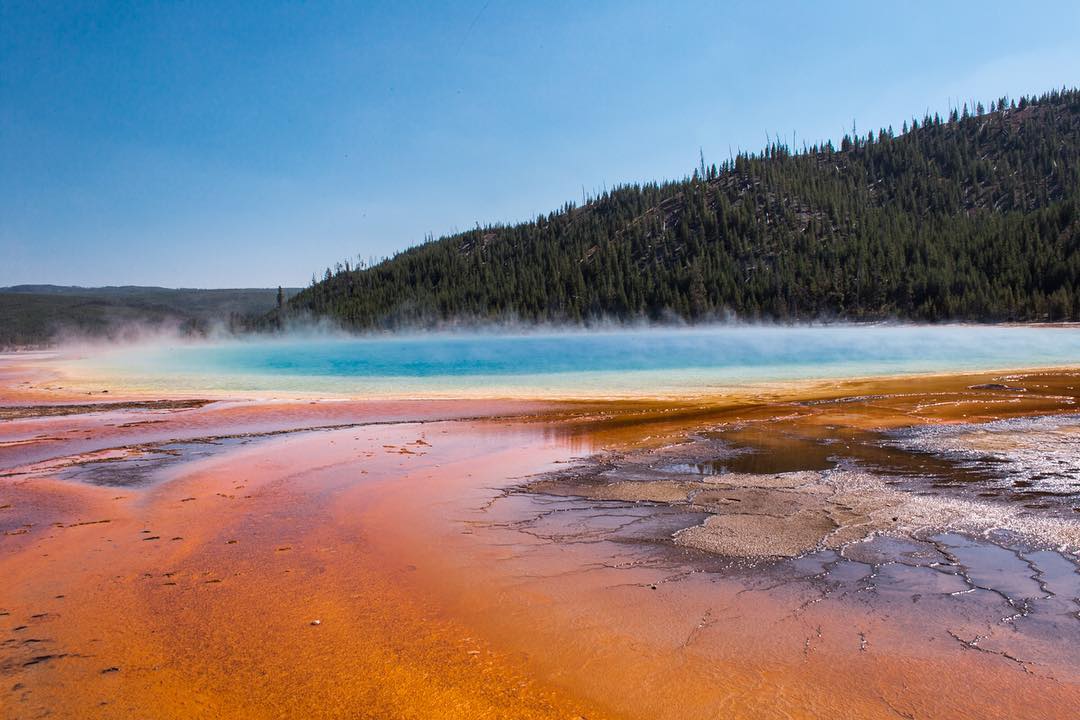
- Colours that take your breath away: Grand Prismatic Spring is enormous — the NPS lists a diameter of about 370 feet (113 m) and a depth of over 121 feet (37 m).
- A quirky Christmas tradition: The park traditionally celebrates “Christmas in August”, usually on the evening and night of 25 August.
Where to stay in Yellowstone
It really is worth staying inside Yellowstone National Park itself. Sleeping in your car outside designated campgrounds isn’t tolerated — even we had to use a campsite when we slept in our vehicle. If you’re booking last minute, you’ll be grateful to find anything at all. But if you plan ahead, try Crosswinds Inn, which has an ideal location. You can also browse more options on Booking.com.
Why Yellowstone National Park is so different
Yellowstone National Park isn’t “just” pretty scenery. It’s a place where you feel like you’re peering under the planet’s lid — as if the Earth briefly pulled back the curtain and showed you what it normally hides deep beneath the surface. Everything around you hisses, bubbles, and steams; in some spots there’s a mineral tang in the air, in others the unmistakable smell of sulphur — and suddenly it hits you: this isn’t a backdrop. This is the action.
The NPS states that the geothermal areas in Yellowstone contain roughly half of the world’s active geysers. That’s a statistic that sounds interesting from your sofa at home, but it’s only when you’re standing there that you truly grasp what it means: the landscape is literally dotted with places where the earth speaks up.
And there’s an odd paradox to it all. Yellowstone is wild yet remarkably accessible. You drive up, take a few steps along a boardwalk, and find yourself standing next to something that looks like another planet. But that very ease of access can lull you into complacency — and Yellowstone doesn’t forgive complacency. Not out of spite, but on principle: in the wilderness, the rules are simply different from those in a city.
Yellowstone and crowds: romance vs. reality
Let’s be honest right from the start: Yellowstone National Park is popular. Very popular. In 2024 it recorded 4.74 million visits. In practice, that means during peak season you can find yourself sitting in a queue of cars in places where you’d expected nothing but silence and elk on the horizon.
At the same time, Yellowstone can be peaceful — you just have to earn that peace with the right timing. Early mornings can transform an overcrowded spot into an entirely different world. And the evenings? The park often seems to take a deep breath in the evening, as if it can finally shrug off its heavy coat.
When to visit Yellowstone
Summer is the most convenient season for planning, as the majority of roads and facilities are open. But summer is also the noisiest, the most crowded, and the most rushed — and Yellowstone, in my opinion, deserves a slower pace.
Spring and autumn have their own magic: fewer people, crisper air, and sometimes strikingly dramatic weather. And winter? That’s for those who want Yellowstone almost as a secret. Just be prepared to deal with restrictions and arrive ready — not with a vague feeling that “it’ll work out somehow”.

Geothermal wonders: when the Earth speaks up
For many people, Yellowstone National Park is synonymous with geysers and hot springs. And that makes perfect sense: few places on Earth pack so many different expressions of subterranean heat into such a relatively small area. The NPS summarises that the park is renowned for its geothermal features and its unique hydrothermal areas.
But here’s the important thing that people often underestimate: this isn’t just about the photo. It’s about the experience. The sound, the warmth, the steam, that peculiar tension of standing beside a spring and knowing that beneath your feet something is happening that you can neither stop nor speed up.
Old Faithful: famous, but still incredible
Old Faithful is a place that almost everyone knows, even if they’ve never set foot in Yellowstone National Park. And that’s exactly why many people wonder: “Won’t it be overrated?” But it isn’t. It’s simply iconic.
The NPS states that an Old Faithful eruption typically lasts about 1.5 to 5 minutes, with water shooting to heights of roughly 90 to 180 feet (27 to 55 metres). The NPS also notes that the interval between eruptions ranges from approximately 35 to 120 minutes, with an average of around 92 minutes. So you stand among the crowd, waiting, staring at a seemingly unremarkable cone in the ground… and then it happens. And in that moment, even the people who a minute earlier were only worried about whether they could film it on their phone fall silent (for instant sharing, I recommend getting an eSIM for US data — or check out providers like Holafly).
Old Faithful reminds me of something we often lose sight of in everyday life: not everything is instant. Sometimes you have to wait. And sometimes it’s precisely the waiting that turns an ordinary moment into an unforgettable one.
How to enjoy Old Faithful without the stress
If you want Old Faithful to be more than just a “compulsory stop”, here’s a simple trick: don’t try to squeeze it between ten other sights. Give it space. Sit down. Look around. Notice that even what feels like tourist chaos has its own peculiar rhythm — people gather, wait, exhale, and then scatter again like a flock of birds.
And if you manage to be there early in the morning or later in the evening, you’ll feel like you’re at the same geyser — but in a completely different reality.
Grand Prismatic Spring: colours that look like a dream
Grand Prismatic Spring is the kind of place that makes you doubt your own eyes. The NPS lists its diameter at approximately 370 feet (about 113 metres) and its depth at over 121 feet (about 37 metres). Standing at the edge, you feel like you’re gazing into a giant eye — as if the Earth is staring right back at you.
And yet it’s so fragile. All it takes is one careless visitor to endanger not only themselves but the feature itself. Yellowstone isn’t a gallery where you walk “as close to the painting as possible”. Yellowstone is a living organism that deserves distance — both physical and mental.
The metaphor that fits best
If I had to compare Grand Prismatic to something human, it’s like looking into the soul of someone who isn’t trying to look pretty. It’s beautiful precisely because it’s real. Sometimes sharp, sometimes strange, sometimes overwhelmingly intense. But utterly unforgettable.
Map of points of interest for your phone
Wildlife that aren’t props
In Yellowstone National Park, you can see wild animals in a landscape that is still very much theirs. The NPS describes Yellowstone as home to diverse fauna and a significant ecosystem. And this part of the trip can be every bit as powerful as the geysers — only much quieter.
It’s also the part where the line between “experience” and “disaster” is most easily crossed. A bison by the road is not an attraction. A bear in the distance is not an invitation to approach. And an elk that looks calm can become dangerous in a split second.
The best wildlife sightings often come when you’re not actively hunting for them. You’re driving, sitting in comfortable silence, and suddenly the landscape moves. And you realise: you’re a guest here.
Respect as essential gear
People talk a lot about boots, jackets, flasks, and maps. All of that matters. But in Yellowstone National Park, one piece of gear is the most important of all: respect. Respect for the fact that you’re in the wilderness. Respect for the understanding that not everything exists for your photo. Respect for the reality that nature is neither “kind” nor “cruel” — it’s simply powerful.
And paradoxically, it’s respect that unlocks the most beautiful moments. When you stop pushing, nature often reveals itself on its own terms.
“Doing Yellowstone in a day”: what you should know
Yellowstone National Park can only be glimpsed in a single day — a bit like browsing a book in a shop without ever opening it. In one day you’ll tick off a handful of the most famous spots, snap a few photos, and feel like you’ve “been there”. But the thing that makes Yellowstone truly Yellowstone often only surfaces once you stop rushing.
Ideally, give yourself several days. Not so you can tick off as many attractions as possible, but so you have room: for a slow drive between locations, for short walks, for morning silence, for unexpected stops because of wildlife — and for the plain old tiredness that’s simply part of visiting big national parks.
On a personal note: when Lukáš and I were there, sleeping in the car and living simply, we suddenly had something that’s often missing at home — time. Time to sit on a bench and just look. Time to let a place do its work.
How to split your visit sensibly
Instead of trying to see everything, pick a few areas and leave a generous time buffer for each one. Yellowstone is vast and getting between spots can take a while — not just because of the distances, but also because of traffic and the “wildlife jams” that form within seconds.
When you leave gaps in your schedule, you paradoxically end up seeing more. Because you won’t mind stopping. It won’t bother you when something takes longer than expected. And you won’t drive through the park like someone permanently one step behind their own itinerary.
Christmas in August: Yellowstone’s quirkiest tradition
When I tell people that Yellowstone celebrates Christmas in summer, I understand the disbelief. It sounds like a staff prank. But according to Yellowstone National Park Lodges, it’s a genuine tradition that usually takes place on the evening and night of 25 August, complete with Christmas trees, carols, and gifts.
Yellowstone National Park Lodges also describes how several origin stories circulate around the tradition and mentions a connection to a Montana custom of celebrating “summer Christmas”. While you might crack a smile, there’s actually something touching about it: people who’ve spent the summer working together in the park create their own holiday, knowing that at the end of the season they’ll all head off in different directions.
And you know what’s best about it? It fits Yellowstone perfectly. Because Yellowstone is a place of contrasts. Steam and snow. Summer and Christmas. Throngs of tourists and silence just a few miles down the road. And you, right in the middle of it all, with the feeling that the world is bigger and more wondrous than it ever looks from home.
Conclusion
Yellowstone National Park isn’t a trip you put on a to-do list. It’s an encounter. With nature that doesn’t play by our rules. With time that flows differently. And sometimes with traditions you’d expect anywhere but in the scorching heat of August — like Christmas carols in the middle of summer.
 🚗 Car rental on the roadVerified rental cars in the United States
Search with the DiscoverCars comparison engine — it compares prices from dozens of local and international rental companies, and most bookings come with free cancellation.
Compare car prices in the United States →FAQ
When was Yellowstone National Park established and why is it important?
Yellowstone National Park was established on March 1, 1872, and is considered the world’s first national park. This gives it exceptional historical significance and it became a model for nature conservation in other countries as well.
Is Yellowstone really that crowded?
During certain times, yes—for example, in 2024 the park recorded 4.74 million visits. The crowds are most noticeable at iconic sites and on main routes, especially in summer.
How often does Old Faithful erupt?
The NPS states that the interval between eruptions ranges from roughly 35 to 120 minutes, with an average of around 92 minutes. Eruptions typically last approximately 1.5 to 5 minutes.
How big is Grand Prismatic Spring?
The NPS lists it at approximately 370 feet (about 113 meters) in diameter and over 121 feet (about 37 meters) deep. It feels even larger in person because the colors and steam give it an otherworldly atmosphere.
Is Christmas in August really a thing at Yellowstone?
Yes, Yellowstone National Park Lodges traditionally celebrate ‘Christmas in August’ in the park, usually on the evening and night of August 25th. The tradition includes Christmas trees, carols, and gifts, and is primarily associated with park employees.
Tips and Tricks for Your Vacation
Don’t Overpay for Flights
Search for flights on Kayak. It’s our favorite search engine because it scans the websites of all airlines and always finds the cheapest connection.
Book Your Accommodation Smartly
The best experiences we’ve had when looking for accommodation (from Alaska to Morocco) are with Booking.com, where hotels, apartments, and entire houses are usually the cheapest and most widely available.
Don’t Forget Travel Insurance
Good travel insurance will protect you against illness, accidents, theft, or flight cancellations. We’ve had a few hospital visits abroad, so we know how important it is to have proper insurance arranged.
Where we insure ourselves: SafetyWing (simple monthly subscription) and TrueTraveller (for extra-long trips).
Find the Best Experiences
Get Your Guide is a huge online marketplace where you can book guided walks, trips, skip-the-line tickets, tours, and much more. We always find some extra fun there!


