

Do you go on holiday camping or just love spending nights outdoors and wondering if a roof tent for your car would be a worthy upgrade to justify the price? We bought a higher-end roof tent and after several weeks of sleeping in it, I decided to write this review of living in a rooftop tent, so you don’t have to hunt for information all over the internet. 😈
💡 TL;DR: Roof tents are amazing! Hard shell models work in all weather conditions, while lighter soft shell tents are better suited for warm climates. Don’t buy cheap tents that fall apart quickly. Quality roof tents aren’t cheap, but they can easily last 20 years. 🙂
I mount the tent on my car in June and don’t take it off until November. Until then, our travel season is wide open. A roof tent gives you incredible freedom to go anywhere, anytime.
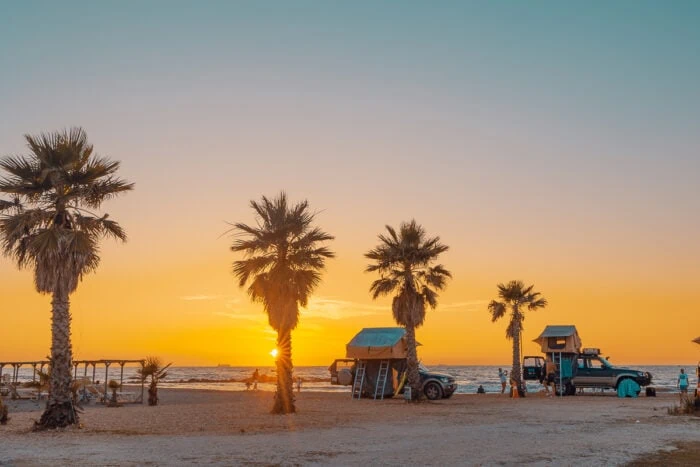
Sleeping and Living in a Roof Tent
Generally speaking, you sleep better in a roof tent than in a ground tent. You don’t have to worry about water seeping in from the ground or morning dew making the bottom of your tent damp. Roof tents typically offer more space and greater comfort.
You access your roof tent via a ladder. If you’re used to getting up several times a night for the toilet, this might annoy you a bit. We got used to it fairly quickly — we just stopped drinking a glass of water before bed (like I do at home).
A roof tent gets humid just like a ground tent. Most people close their roof tents at night because up on the car roof, you’re fully exposed to the wind. And even though morning dew is less of an issue, condensation inside the tent is just as much of a problem. We solved this with a condensation mat placed under the mattress, plus our tent has an upholstered ceiling that absorbs moisture so nothing drips on us at night.
On warm days, the tent naturally dries out before you’ve even finished breakfast, but in the mountains or during cooler temperatures with higher humidity, you might not have time to air it out properly, and you’ll be climbing into a damper environment in the evening.
In any case, after every trip you need to take everything out of the tent and let it dry thoroughly.
How to Choose a Roof Tent?
I can’t give you a simple answer (at least not straight away :)). It really depends on several factors. Mainly:
- Number of people sleeping in it
- Height of the sleepers
- The climate of your most frequent destinations
- The load capacity of your roof bars
Hard Shell or Soft Shell?
The basic way to categorise car roof tents is by shell type.
Soft Shell Roof Tents
Soft shell tents — fully fabric-based — are cheaper and more common. These tents usually fold open in half, with one half extending over the side of the car, supported by the ladder. These are most often family tents for 2–4 people. Thanks to the overhang, you can often buy an annex that hangs beneath the tent. Personally, I’m not a fan of these tents because they’re less stable in the wind and tend to get damp quickly.
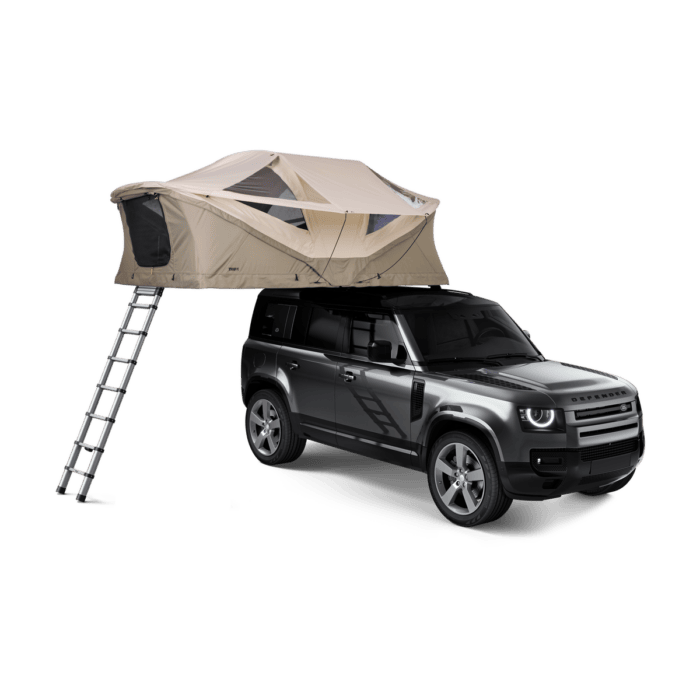
Hard Shell Roof Tents
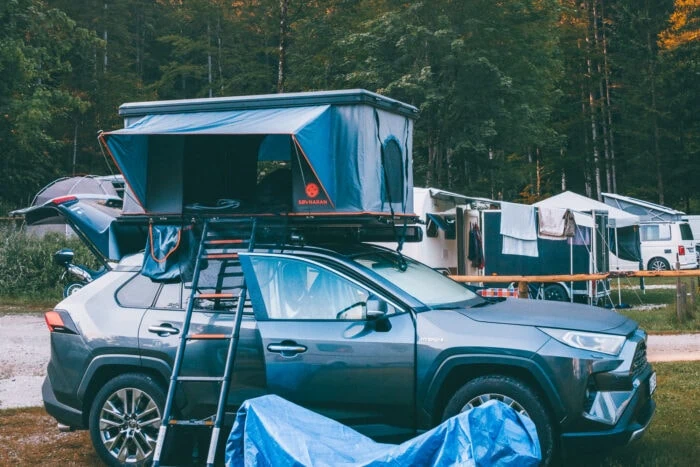
Hard shell roof tents (plastic or aluminium) don’t extend beyond the edges of the vehicle, but they’re designed for 2 people only. Aluminium versions (like our Sovnaran) are so sturdy you can even mount a solar panel on top. They’re also much more robust and can handle worse weather conditions. Combined with upholstered lining and a condensation mat, you’ll sleep nice and dry even on days when it’s absolutely pouring outside.
TIP: Try the Camperguru app, where you’ll find an overview of the best campsites and wild camping spots across Europe.
I also prefer the opening mechanisms on hard shell tents. You either turn a crank a few times, or just push the tent open (if it has gas struts).
Hybrid Roof Tents
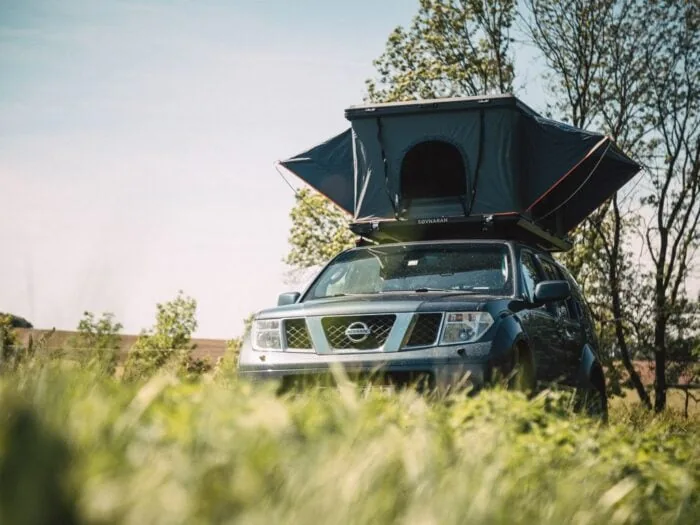
There are also hybrid tents on the market that have a hard shell but flip open on one side, with the rest made of fabric. This makes them easy to set up while still accommodating up to 4 people. However, they’re still more prone to getting damp than fully hard shell tents that open straight upwards.
Inflatable Roof Tents
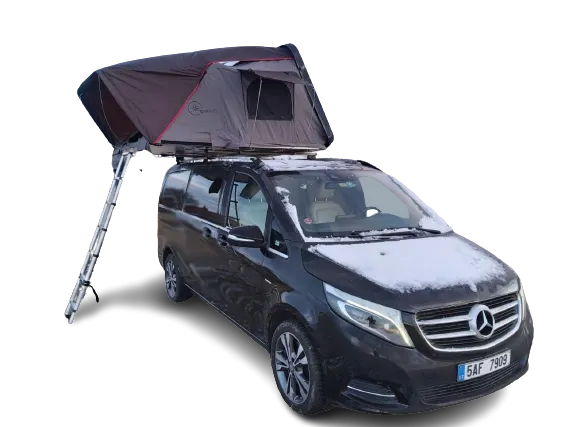
A special category is inflatable roof tents, which can be inflated using a 12V pump plugged into your car’s cigarette lighter. However, you won’t see these on the road very often — they tend to be quite expensive and in my opinion aren’t very practical either. Setup can take a good 10 minutes (compared to hard shell tents, which are ready in under a minute) and what happens if it starts leaking?!
My Recommendations
- Two people on holiday – a pop-up tent, for example the Bjormutt by Sovnaran
- Two people on an expedition – a hard shell tent, for example the NoHelp by Sovnaran
- For a family of 3+ – a large soft shell tent, for example the Thule Approach L
Tent Dimensions and Standard Equipment
It might surprise you, but roof tents are often larger than regular ground tents. Two-person models can be up to 230 cm long and a comfortable 145 cm wide.
What Fits Inside a Roof Tent?
Standard equipment usually includes a quality mattress, steps, poles for propping up the exterior awnings, and shoe bags. All of this fits comfortably inside the tent even when it’s closed. We also managed to squeeze in two sleeping bags and small pillows.
Will a Roof Tent Fit on My Car?
A car roof tent can generally be mounted on any vehicle, but there are a few things you need to check.
Mounting Type
Most commonly, tents are mounted on roof bars (longitudinal or crossbars) or on roof racks. You definitely can’t just attach a tent to a bare roof without proper preparation. Tents are heavy and need to be seated on a sufficiently sturdy base.
Most modern cars come with mounting points for roof bars, but you’ll need to buy the bars separately. I wouldn’t recommend getting bars from your car manufacturer — for example, Toyota’s own roof bars have a rated dynamic load capacity of only 60 kg.
I opted for wider Thule Wingbar Evo crossbars because of the width of my tent and awning. These are rated to carry up to 100 kg while driving. Given that the bars are in perfect condition after dozens of nights in the tent, I can confirm they comfortably support an 80 kg tent plus two people. 😊
Tent Weight
Car roof tents vary in weight, ranging from about 40 kg to 80 kg. Your car’s roof can handle all of them (check your manual to be sure), but it’s worth keeping the weight in mind when choosing your roof bars.
Roof Load Capacity
Everyone shopping for a roof tent inevitably asks: “Can my car’s roof handle it?” The answer is simple: YES. There’s a difference between dynamic and static load capacity, and manufacturers are sometimes lazy about specifying which one they mean.
Dynamic Maximum Weight
Your vehicle manual will typically state a roof load capacity of around 80 kg, but this refers to the dynamic load — i.e., while the car is moving. That’s also why the heaviest tents weigh exactly 80 kg. 😉
Static Maximum Weight
Static weight refers to the load the roof can bear when the car is stationary. The static maximum weight is typically at least three times higher than the dynamic rating. Family-sized tents (for 4 people) are regularly mounted on regular cars, and I’ve never heard of anyone’s roof caving in. 😂
Roof Tent Brands
There are loads of roof tent brands out there. We went with the Czech brand Sovnaran. Their tents are manufactured in China, but they’re very well built, and the aluminium NoHelp model, which sits on top of our Toyota RAV4, is truly top-notch.
From many reviews online, it seems that the most proven and highest-quality tents in the long run are the Maggiolina range by Autohome. These start at around €2,000, with the most expensive models going well over €3,200. They’re not the cheapest tents, but they’re not the most expensive either.
Other brands worth considering:
- Sirius
- Thule
- Front Runner
Driving Performance and Fuel Consumption
A common question I get about my tent is whether the rooftop load changes the car’s handling. I have both a tent and an awning on my roof, and I haven’t noticed any deterioration in driving. If anything, the car actually corners a bit better with the extra weight. 😈
Fuel consumption increased by about 0.5 to 1.0 litres per 100 km depending on the terrain. With my average of 6.0 litres per 100 km, that’s an increase of roughly 17%. Not good, not bad.
Condensation in the Tent
Just like in a regular ground tent, moisture builds up inside a roof tent too. Most condensation problems can be solved by getting a condensation mat to place under the mattress.
Rent Our Roof Tent
Would you like to try a roof tent before buying one? If I don’t have the tent mounted on my car at the time, I’d be happy to rent it out for €20 per day. Just drop me an email at lukas@lkmedia.cz.
FAQ
What Are the Best Roof Tents on the Market?
The best roof tents are those with a hard shell. The highest-quality tents are arguably made by Autohome (the Maggiolina product line).
Where Can I Find the Cheapest Roof Tent?
I’d recommend browsing comparison sites like Amazon, eBay, or dedicated outdoor retailers to compare prices and find the best deals on roof tents.
Tips and Tricks for Your Vacation
Don’t Overpay for Flights
Search for flights on Kayak. It’s our favorite search engine because it scans the websites of all airlines and always finds the cheapest connection.
Book Your Accommodation Smartly
The best experiences we’ve had when looking for accommodation (from Alaska to Morocco) are with Booking.com, where hotels, apartments, and entire houses are usually the cheapest and most widely available.
Don’t Forget Travel Insurance
Good travel insurance will protect you against illness, accidents, theft, or flight cancellations. We’ve had a few hospital visits abroad, so we know how important it is to have proper insurance arranged.
Where we insure ourselves: SafetyWing (best for everyone) and TrueTraveller (for extra-long trips).
Why don’t we recommend any Czech insurance company? Because they have too many restrictions. They set limits on the number of days abroad, travel insurance via a credit card often requires you to pay medical expenses only with that card, and they frequently limit the number of returns to the Czech Republic.
Find the Best Experiences
Get Your Guide is a huge online marketplace where you can book guided walks, trips, skip-the-line tickets, tours, and much more. We always find some extra fun there!


