

You’re standing in a car park, it’s nine in the morning, and the thermometer reads 38 °C. The air shimmers above the scorching tarmac and you think: “Why on earth did I come here?” Then you look down — at that endless white salt flat stretching to the horizon, framed by mountains in shades of purple and rust — and suddenly it all makes sense. Death Valley is a place that first intimidates you, then takes your breath away. Quite literally, because breathing in that heat feels like sitting in a sauna. 😅
I’ve visited Death Valley National Park several times, and each trip has been a completely different experience. The first time we hit the wildflower bloom and the entire valley was ablaze with yellows and purples (that only happens once every few years). The second time we arrived for sunset over Zabriskie Point, and I felt like we’d landed on Mars.
In this article you’ll find 15 tips on what to see and do in Death Valley — from the iconic Badwater Basin, the lowest point in North America, to the psychedelic Artists Palette and sand dunes that’ll make you feel like you’re in the Sahara. I’ll tell you when to go (because bad timing can literally put your life at risk), where to stay, how much it all costs, and what to watch out for so your visit to Death Valley National Park is unforgettable — in the best possible way.
TL;DR
- Death Valley National Park sits on the border of California and Nevada and is the driest, lowest, and hottest place in North America. In summer, the Death Valley temperature exceeds 50 °C — that’s not a typo.
- The best time to visit is November to March, when temperatures hover around a pleasant 15–25 °C. Avoid summer unless you fancy the sensation of being shoved inside an oven.
- Allow at least 1–2 full days for Death Valley, ideally 3 if you want to reach more remote spots like Racetrack Playa.
- Top 5 must-see spots: Badwater Basin, Zabriskie Point, Dante’s View, Artists Drive, and Mesquite Flat Sand Dunes.
- Accommodation inside the park is pricey and limited — alternatives include the towns of Beatty (Nevada) or Pahrump. Book well ahead, especially in peak season.
- Park entrance fee is $30 per vehicle (roughly €28) for 7 days, or you can grab an America the Beautiful Pass for $80 (roughly €75) covering all US national parks for a year.
- Bring LOTS of water — at least 4 litres per person per day. There’s no mobile signal, petrol stations are few and far between, and a tow truck will cost a fortune.
- The night sky in Death Valley is among the best in the world — the park holds Dark Sky certification and the Milky Way is visible with the naked eye so clearly your jaw will drop.
The full destination guide: California — guide and what to see
When to visit Death Valley and how to get there
Death Valley, California — two words that conjure images of scorching heat and endless desert. And that’s true — but only for part of the year. Timing your visit here matters more than almost anywhere else, because getting it wrong doesn’t just mean an unpleasant trip — it can be genuinely dangerous.
Best time to visit
November through March is hands-down the best time to visit Death Valley. Daytime temperatures sit around 15–25 °C, while nights can drop close to freezing (yes, the desert gets cold at night — that caught Lukáš and me off guard on our first camping trip 😅). Skies are mostly clear, the air is crisp, and the crowds are manageable.
March and April are brilliant if you want to catch the wildflower season — after a wetter-than-average winter, the whole valley can erupt into incredible colours. It doesn’t happen every year, but when it does, it’s absolutely magical.
May and October are transition months — the Death Valley weather brings temperatures around 30–35 °C, which is still bearable, but shorter hikes already demand caution.
June through September? Give it a miss. Average temperatures exceed 45 °C, and the record-breaking 56.7 °C (134 °F) measured in 1913 makes Death Valley the hottest place on the planet. In summer only hardcore enthusiasts visit, and even they spend most of the day in an air-conditioned car. The park service strongly advises against any hiking after 10 am. Trust me, they mean it — every year rescue teams deal with dozens of dehydration and heatstroke cases.
How to get to Death Valley
By car — the only sensible option. Death Valley National Park is enormous (larger than the whole of Yorkshire!) and there’s simply no public transport. The nearest major cities:
- Las Vegas — roughly 2 hours (190 km) via Highway 160 and 190. The most convenient starting point and often where you’ll find the cheapest flights from the UK (British Airways, Virgin Atlantic, and budget carriers fly direct from London).
- Los Angeles — around 4.5–5 hours (450 km). Perfect as part of a bigger US national parks road trip.
- Bakersfield — roughly 4 hours from the west via the mountain pass.
Lukáš and I have had consistently great experiences with DiscoverCars, which we use all over the world — it compares prices from all the major rental companies and makes insurance straightforward. Definitely pick up your car with a full tank and fill up every time you see a petrol station. There are barely any inside the park (Furnace Creek and Stovepipe Wells only) and prices are 50–100% higher than outside.
Important: If you’re planning to drive to Racetrack Playa or more remote parts of the park, you’ll need a 4WD with high clearance. A regular saloon car is fine for the main roads, but forget about unpaved tracks.
Entrance fees and getting around the park
Entry costs $30 per vehicle (roughly €28) for 7 days. If you’re planning to hit multiple US national parks, grab an America the Beautiful Pass for $80 (about €75) — it’s valid for a year and covers every national park and federal recreation area. We buy one every time and it pays for itself after just three parks.
Download a Death Valley map of attractions to your phone beforehand (Google Maps offline maps are a lifesaver here, because signal only works in Furnace Creek and Stovepipe Wells — and even that’s patchy). You can also pick up an official park map at the Visitor Center in Furnace Creek.
Where to stay in Death Valley and how much it costs
Accommodation in and around Death Valley has its quirks — choice is limited and prices reflect that. Let’s run through all the options, from camping under the stars to that one “luxury” hotel in the middle of the desert.
Accommodation inside the park
The Oasis at Death Valley (Furnace Creek) — formerly Furnace Creek Ranch, now a modernised resort. Two tiers:
- The Ranch at Death Valley — simpler rooms, a thermal-water pool, from around $250/night (€235). In peak season expect $350+.
- The Inn at Death Valley — a historic 1927 hotel in Spanish Colonial Mission style. Beautiful, but prices start at $500/night (€465). If your budget stretches that far, it’s quite an experience.
Stovepipe Wells Village — motel-style accommodation, from roughly $150–200/night (€140–185). It has a restaurant, pool, and petrol station. Great location near the sand dunes.
Panamint Springs Resort — on the western edge of the park, small and cosy, from $100/night (€93). A bit off the beaten track from the main attractions, but peaceful and reasonably priced.
Camping — the best experience
Honestly? Camping is the single best way to experience Death Valley. Falling asleep beneath a billion stars in absolute darkness and silence is something no hotel can match.
- Furnace Creek Campground — the only campsite that takes reservations (via recreation.gov), $22/night. In season it fills up weeks in advance, so book as early as you can!
- Sunset, Texas Springs — first-come, first-served, $16/night. Arrive early in the morning.
- Free camping — backcountry camping is allowed at designated spots inside the park, completely free but with zero facilities. No water, no toilets, no signal. Best suited to experienced campers.
Accommodation outside the park (cheaper option)
Beatty, Nevada (60 km from Furnace Creek) — our recommendation for anyone on a budget. A small town with a handful of motels and restaurants. Prices from $80–120/night (€75–110).
Pahrump, Nevada (100 km) — a larger town with more options, a Walmart, and restaurants. Cheaper, but a longer drive.
Lone Pine, California (165 km from the west) — a gorgeous little town at the foot of the Sierra Nevada and the launch point for Mt. Whitney. Perfect if you’re combining Death Valley with parks further west.
How much Death Valley costs — budget for 2–3 days for two
- Entrance fee: $30 (€28) per vehicle / $80 (€75) annual pass
- Accommodation (2 nights): $200–700 (€185–650) depending on type
- Petrol: $40–60 (€37–56) — pricier inside the park
- Food (2 days): $80–150 (€75–140) — restaurants in the park are expensive
- Activities/tours: $0–50 — most attractions are free; you only pay the park entrance
- Total for 2–3 days for two: roughly $350–960 (€325–895)
Budget tip: camp, bring a cool box full of food, and stock up on water before you arrive. On our first visit we camped and cooked on a portable stove — it cost us a fraction of the price.
Death Valley: 15 things to see and do
Now for the good stuff — let’s dive into the best things to see and do in Death Valley National Park. I’ve ranked them roughly by “must-see” factor, but honestly — everything here is stunning, even the drive itself is an experience.
1. Badwater Basin — the lowest point in North America
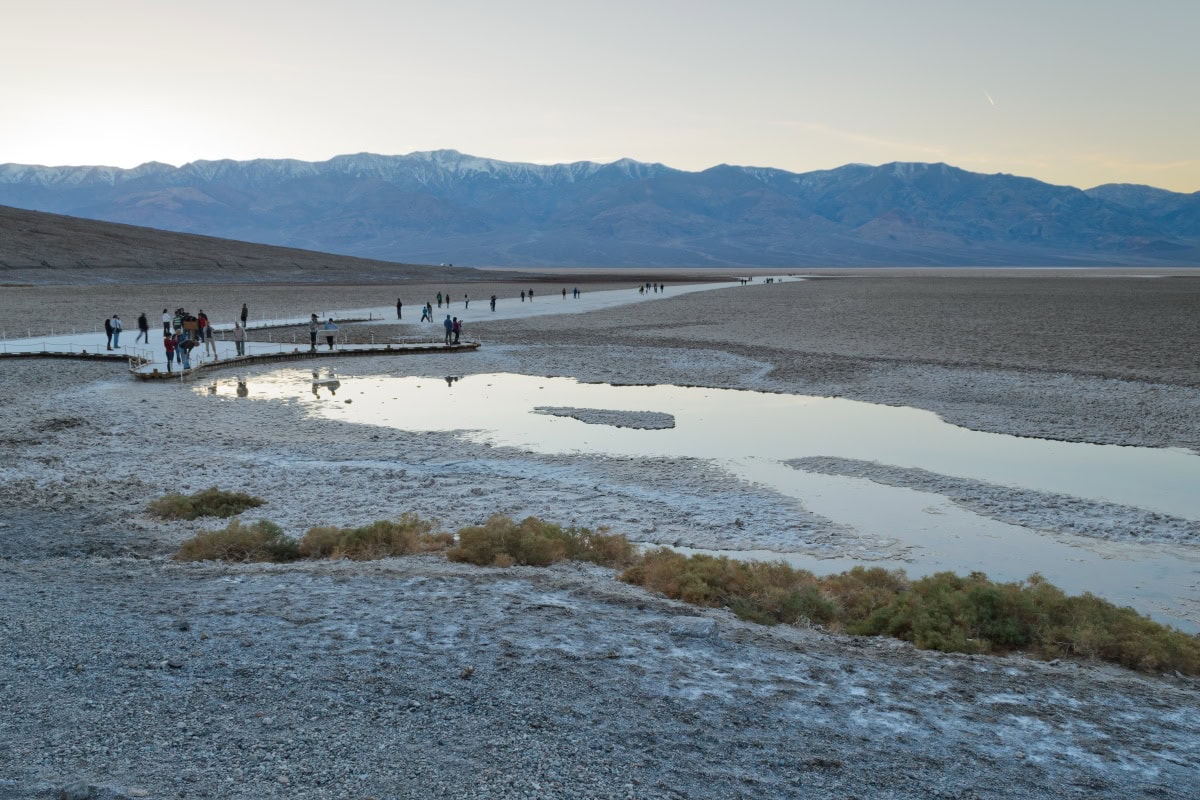
Badwater Basin is THE spot in Death Valley. You’re standing 86 metres below sea level — the lowest point in all of North America — surrounded by an endless salt flat, white and crunchy underfoot, hemmed in by mountains with a “Sea Level” sign bolted to the cliff face above you. You stare up at it and think: “Wait, the ocean is normally up there?”
A short paved path leads from the car park to the edge of the salt flat, but I’d recommend walking further — the deeper you go (a good 15–20 minutes), the more regular and photogenic the salt crust becomes, with those iconic hexagonal patterns. The whole round trip takes about 30–60 minutes.
Timing is everything. Morning or late afternoon offers the best light and far more bearable temperatures. At midday the heat is unbearable and the white salt reflects the sun so fiercely you won’t last a minute without sunglasses. Badwater Basin Death Valley is an absolutely iconic experience, but if you rock up at 2 pm in June, it’ll be more torture than treat.
Fun fact: The name “Badwater” comes from early surveyors whose mules refused to drink the water here. It’s not poisonous, but it’s so salty and mineral-rich that it’s genuinely undrinkable.
2. Zabriskie Point — sunset from another planet
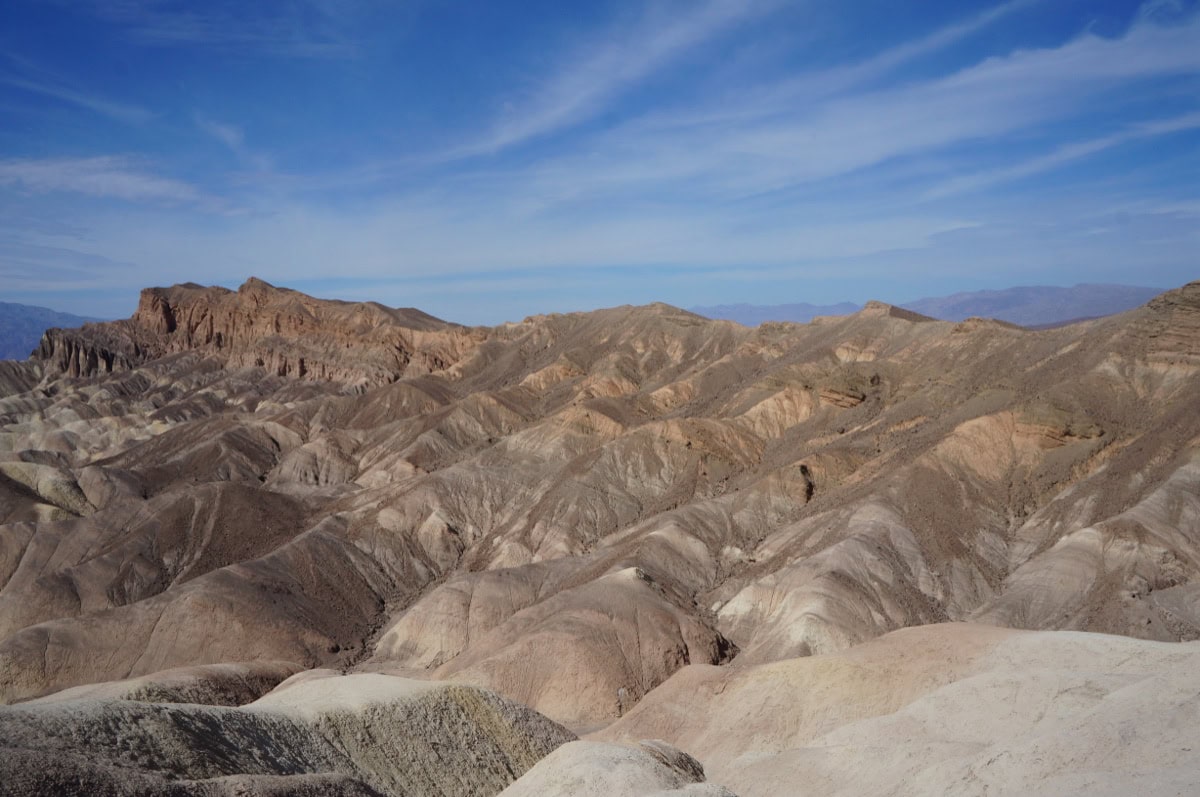
Zabriskie Point is probably the most photographed spot in the entire park — and rightly so. From the viewpoint you gaze across a labyrinth of golden and cream-coloured eroded hills that look like giant scoops of ice cream left out in the sun. Or like Mars. Or like a sci-fi film set (which, incidentally, it’s been used as many times).
It’s only a couple of minutes’ walk from the car park along a paved, wheelchair-accessible path — literally anyone can get here. Come for sunrise — that’s the golden hour when the entire landscape glows orange and gold. Sunset is lovely too, but the sun dips behind the mountains at your back, so the last light fades sooner than you’d expect.
From Zabriskie Point you can continue onto the Golden Canyon Trail (about 5 km round trip), which threads right through those eroded formations. Well worth it, but bring plenty of water and set off early.
3. Dante’s View — a jaw-dropping panorama
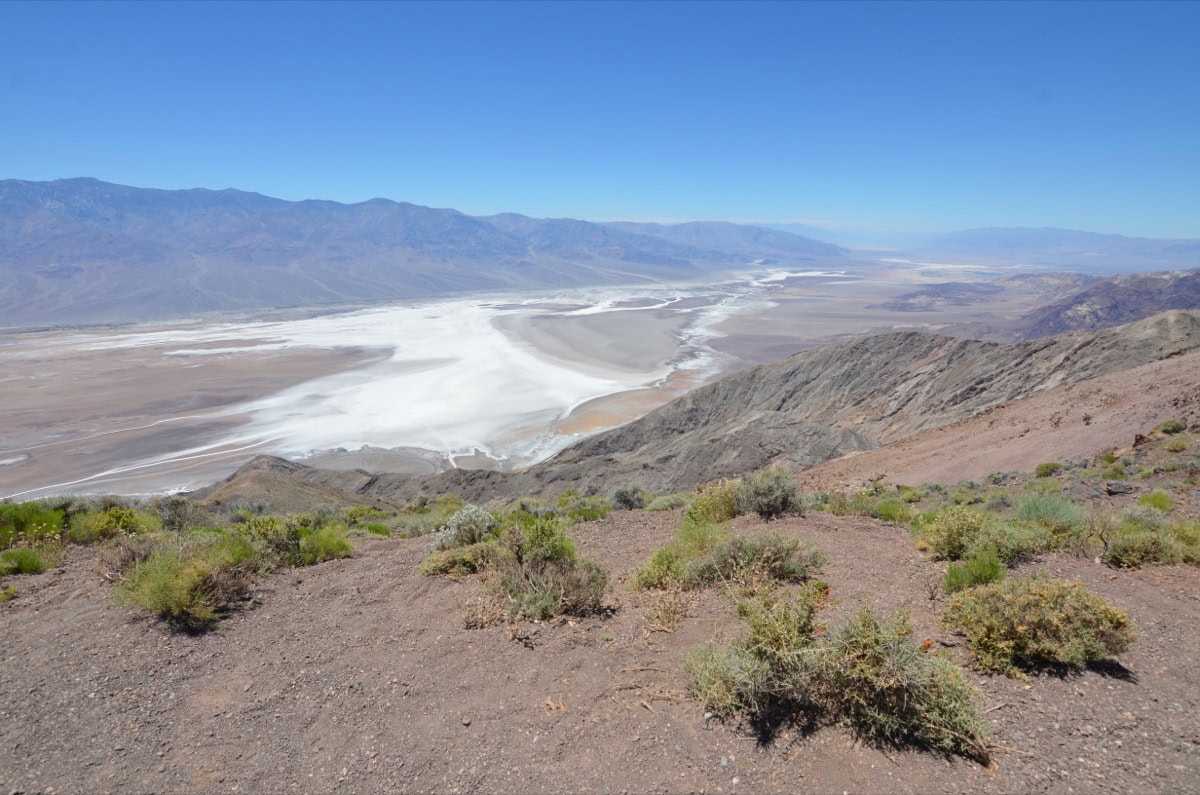
If you can only pick one viewpoint in Death Valley, Dante’s View should be it. From 1,669 metres above sea level you look down across the entire valley — Badwater Basin appears as a tiny white smudge far below, while on the opposite side the Sierra Nevada rises with Mt. Whitney, the highest point in the contiguous United States. The lowest and highest points of the lower 48 in a single panorama — it’s quite the head-spinner.
The Death Valley road to Dante’s View follows a narrow paved road (13 miles from the Highway 190 junction); the final stretch is fairly steep and winding but manageable in a regular car. At the top there’s a car park and a short path to the viewpoint.
Best time: Sunrise here is pure magic — you watch the first rays slowly illuminate the valley from below. But heads up, mornings can be windy and chilly (below 10 °C in winter months), so bring a jacket. Lukáš and I arrived at half five in the morning in November and I was wearing my puffer — after a full day exploring in a T-shirt down in the valley, the contrast was quite the shock. 😅
4. Artists Drive and Artists Palette — nature was painting
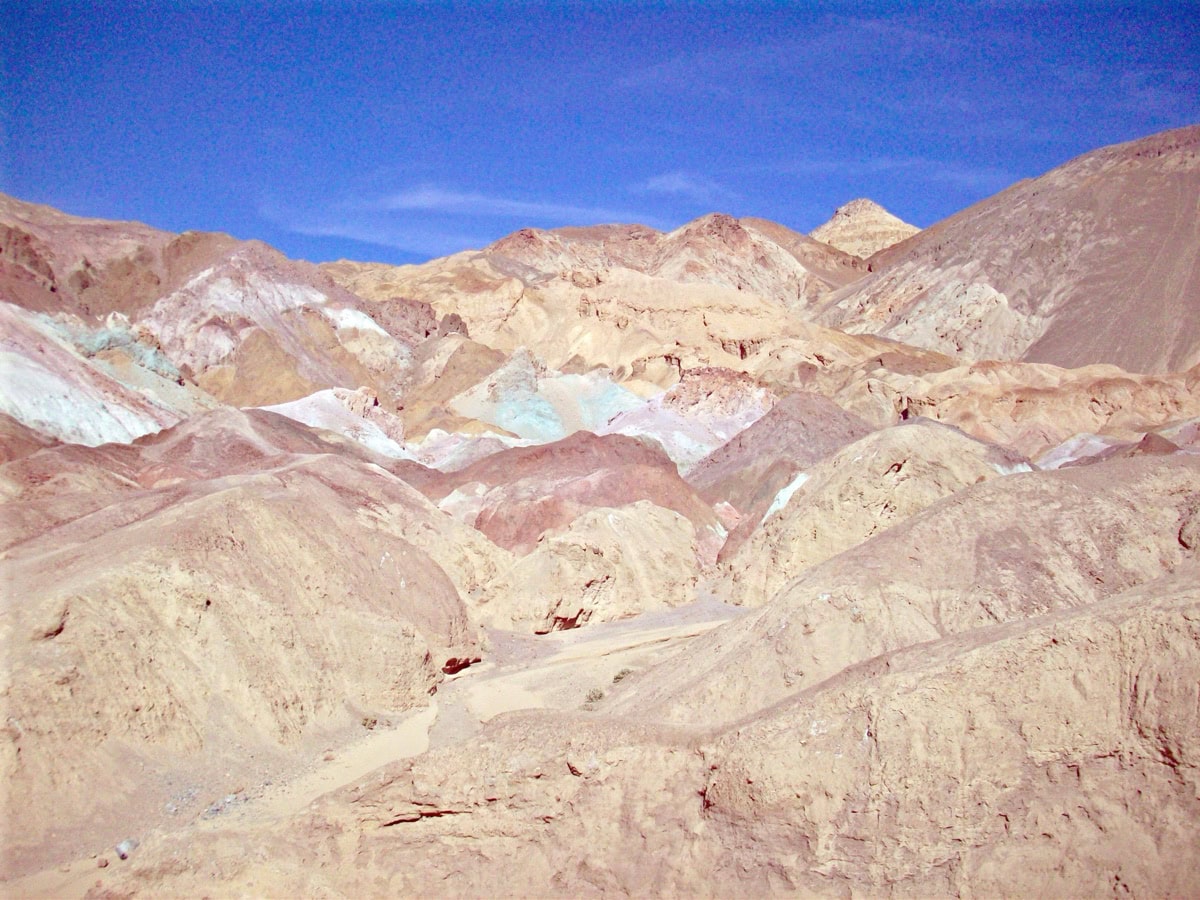
Artists Drive is a one-way loop (14 km) that winds through rocks in shades of green, pink, purple, turquoise, and orange. It looks just like a painter’s palette — hence the name of the main viewpoint, Artists Palette. The colours come from the oxidation of various minerals: iron produces reds and yellows, manganese gives purple, and mica creates green.
Driving the whole of Artists Drive takes about 30–45 minutes, but pull over as often as you can — the best Death Valley photos are often from unexpected spots along the road. Artists Palette itself has a small car park and a short stroll to the most colourful stretch.
Good to know: Artists Drive is one-way and closed to vehicles longer than 25 feet (7.6 m) — so no RVs or large motorhomes. The colours look most vivid in late-afternoon light, when the low sun intensifies every shade.
5. Mesquite Flat Sand Dunes — the Sahara in California
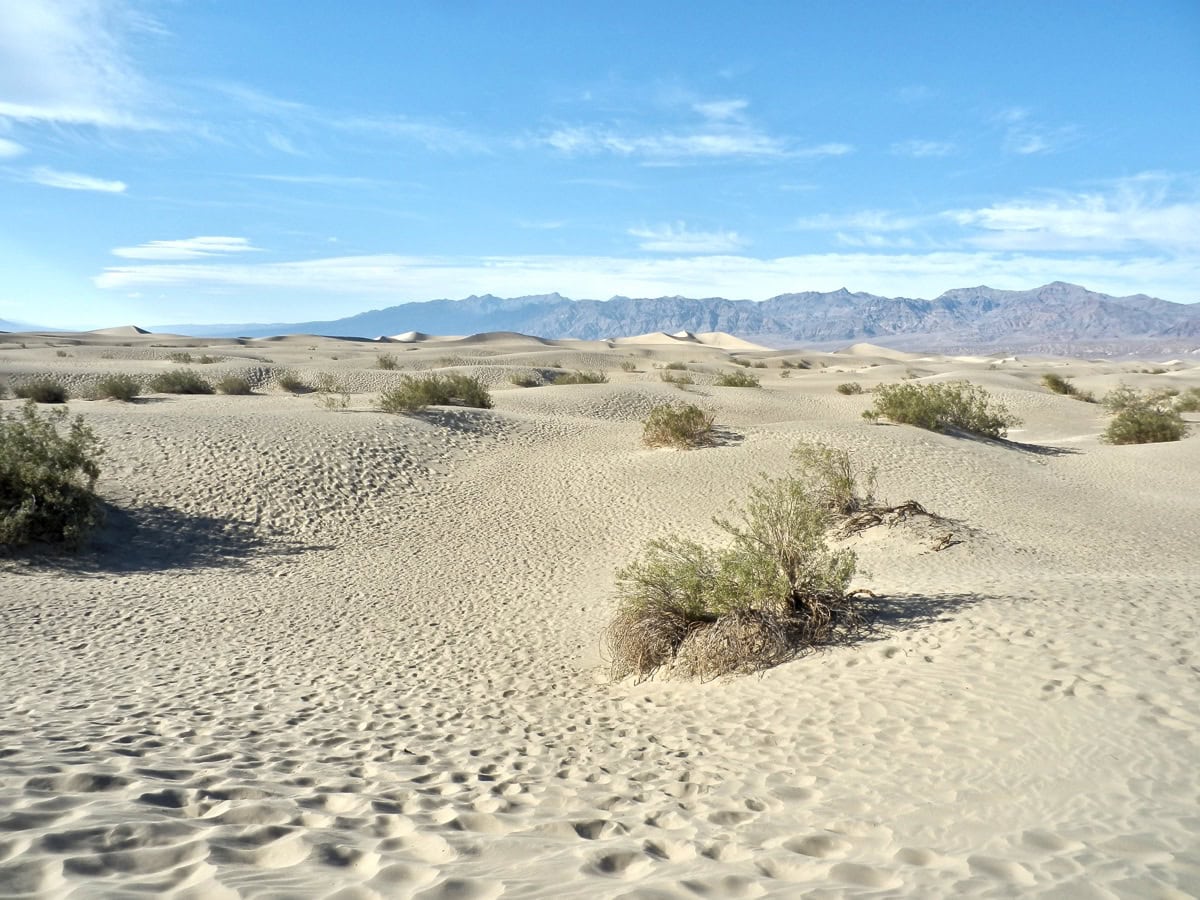
Mesquite Flat Sand Dunes are the sandy dunes you’ve seen in every other Death Valley photo. And they’re every bit as photogenic in person — golden waves of sand with razor-sharp edges and dramatic shadows, backed by a mountain range. The tallest dune reaches about 30 metres, and the entire dune field covers roughly 14 km².
It’s just a few minutes’ walk from the car park near Stovepipe Wells to the dunes. There’s no marked trail — you simply wander wherever you like. But be warned: walking in sand is hard work, distances are deceptive, and in hot weather the sand surface temperature can soar past 70 °C. Only take your shoes off if you’ve thought it through very carefully (or better yet, don’t).
Best time: Sunrise or sunset, when the shadows create those dramatic contrasts across the dunes. At midday the light is flat and the dunes look dull. Plus — at noon you could literally fry an egg on them. We arrived for sunset and Lukáš insisted he’d only taken better photos in the Sahara. (He’s never been to the Sahara, but we’ll let that slide. 😁)
6. Golden Canyon and Red Cathedral — a short hike with big payoff
Golden Canyon Trail is one of the most popular short hikes in Death Valley, and deservedly so. You walk through a narrow canyon with walls in golden and orange hues that tower above you like cathedral walls. The destination is Red Cathedral — a massive rock face in deep red that looks like a rusted Gothic cathedral.
The trail is roughly 5 km round trip with about 100 metres of elevation gain. Nothing strenuous, but in the heat it can be draining — set off early in the morning. The terrain is mostly sandy and gravelly; hiking boots are recommended but sturdy trainers will do (that said, we swear by our favourite hiking boots).
You can extend the route into the Gower Gulch Loop, a roughly 7 km circuit — up through Golden Canyon, over the ridge, and back via Gower Gulch. A brilliant option if you have the time and energy.
7. Dante’s Ridge Trail — for those who want more than a viewpoint
If simply standing at Dante’s View isn’t enough and you want to earn your panorama, head out along Dante’s Ridge, an unmarked trail running along the ridgeline to the north. It’s roughly 1.5 km one way, but you’re on a narrow ridge with views on both sides — down into Death Valley on one side and across Greenwater Valley on the other.
Warning: The trail is unmaintained, exposed in places, and unpleasant in strong wind. It’s not for everyone. But if there’s one thing from Death Valley that’s etched into our memory, it’s that feeling of standing on the ridge completely alone, wind whistling past your ears, with a 1,700-metre drop below. A bit like being on top of the world — except here you’re on top of the deepest valley.
8. Natural Bridge — a rock arch in a canyon
Natural Bridge is a natural rock arch spanning a narrow canyon — and reaching it is a pleasant, short hike (about 2 km round trip). The path follows a dry streambed between steep rock walls where you can see layers of sediment millions of years old.
It’s one of the lesser-visited spots in the park, so you’ll often have it to yourself. The access road (2 miles of unpaved track) is a bit bumpy — you don’t strictly need 4WD, but watch your clearance.
9. Racetrack Playa — the mystery of the sailing stones
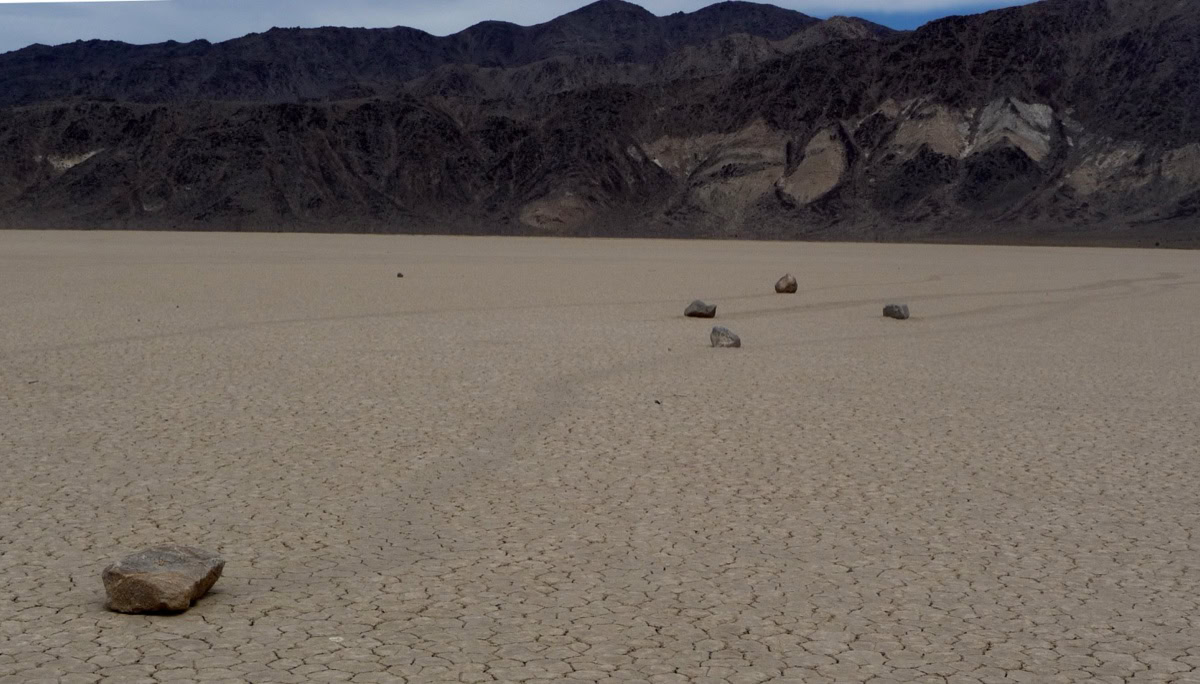
Racetrack Playa is one of the most mysterious places on Earth — rocks “move” on their own across a smooth, dried-out lake bed, leaving trails behind them. Scientists only cracked the phenomenon in 2014: in winter, a thin layer of ice forms on the playa and, pushed by wind, slides along carrying the rocks with it. Even with the explanation, it’s a fascinating sight.
BUT — and this is a big but: The route to Racetrack Playa is 42 km (26 miles) of rough, unpaved road from Ubehebe Crater and you need a 4WD with high clearance. Budget at least 2 hours each way (max speed 25 km/h). There’s no phone signal, no services, nothing. If you get a flat tyre, you’re on your own. Bring two spare tyres, plenty of water, and a full tank.
But it’s worth every bump. Racetrack Playa is utterly surreal — a perfectly flat dry lake bed surrounded by mountains, absolute silence, not a soul in sight. One of those experiences you never forget.
10. Ubehebe Crater — the explosion that reshaped the landscape
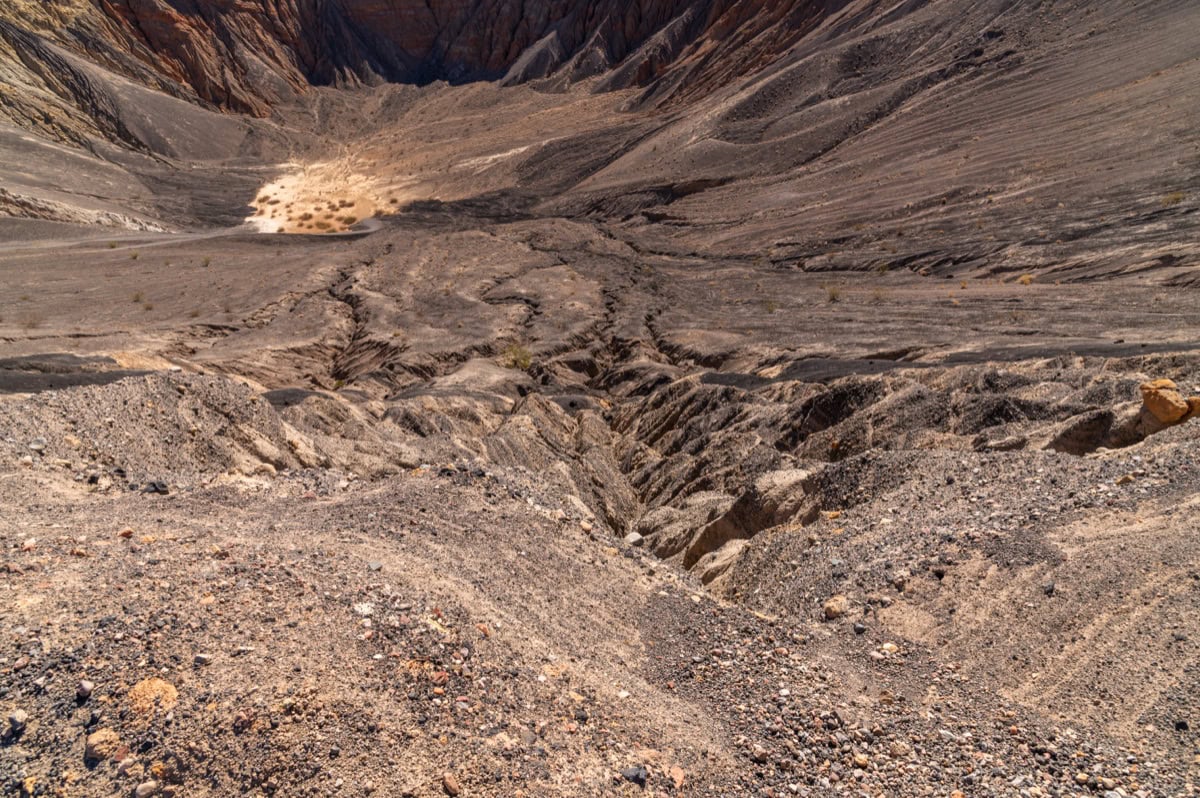
Ubehebe Crater is a massive crater 800 metres across and 237 metres deep, created by a volcanic explosion a “mere” 2,000–7,000 years ago. You stand on the rim and peer into an abyss of coloured layers — orange, black, and grey.
From the car park it’s literally a few steps to the crater’s edge. You can walk the entire rim (about 2.4 km) or descend to the bottom (roughly 0.5 km down, but be warned — the climb back up through the loose gravel is considerably harder than it looks). Allow 30–60 minutes for the whole stop.
Ubehebe Crater is also the jumping-off point for the drive to Racetrack Playa — if you’re heading to the “sailing stones,” make a stop here on the way.
11. Devil’s Golf Course — a salt landscape from a horror film
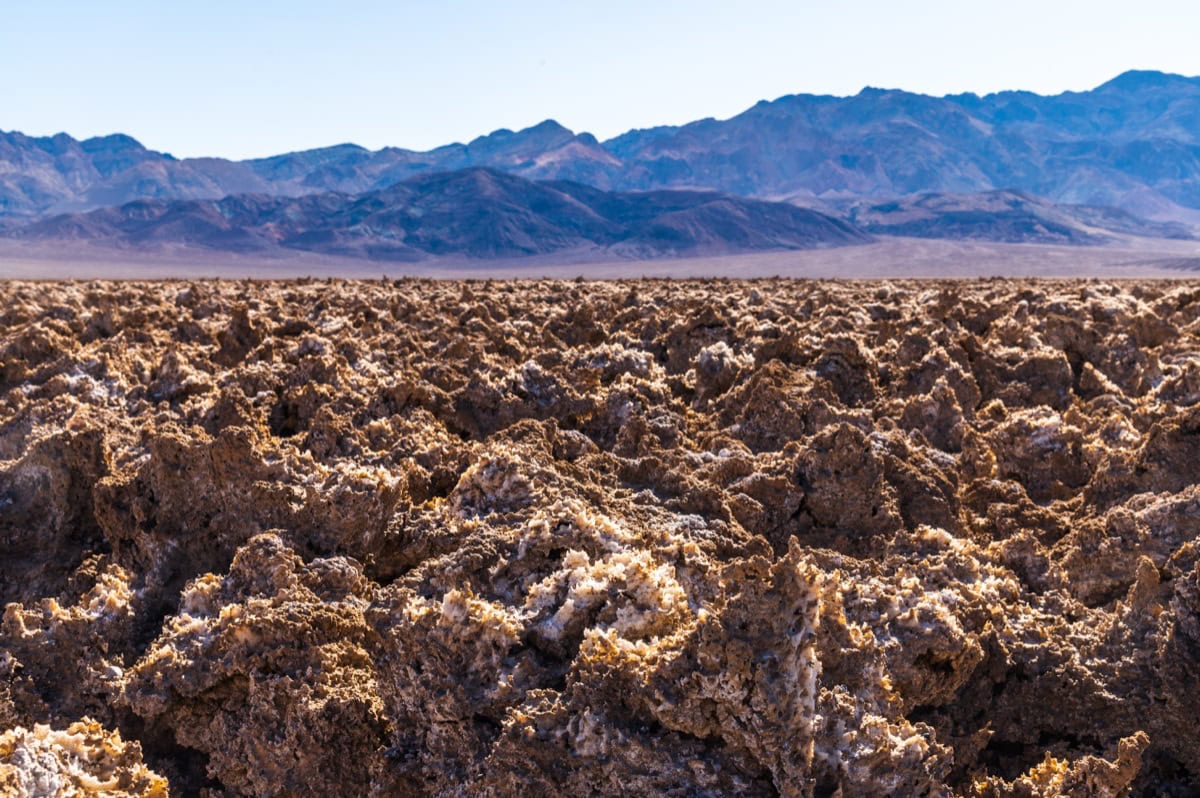
Devil’s Golf Course is fascinating — picture a salt flat, but not the smooth kind like Badwater. Here the surface is broken into sharp, jagged salt crystals and formations that resemble miniature mountains and turrets. The name comes from a 1934 guidebook that declared “only the devil could play golf here.”
You can drive right to the edge and walk on the surface — but tread carefully, because those salt crystals are razor-sharp. Proper shoes are a must; sandals would be suicidal. On a still day, press your ear to the ground — you’ll hear a faint crackling. That’s the salt crystallising and expanding in the heat. A bit eerie, a bit cool.

12. Night sky in Death Valley — Dark Sky Park
Death Valley holds Gold Tier International Dark Sky Park certification, and the night sky here is in a league of its own. The Milky Way is visible with the naked eye so clearly that the first time you see it, you’ll wonder if it’s an optical illusion. It’s not.
Best stargazing spots:
- Harmony Borax Works — flat, easily accessible, minimal light pollution
- Mesquite Flat Sand Dunes — dunes + starry sky = Instagram jackpot
- Badwater Basin — the salt flat reflects the starlight
When: Around the new moon, ideally in winter months (longer nights). Bring a blanket or camping mat to lie on, a warm jacket (the desert gets properly cold at night), and if you have a tripod, you’ll come away with the best photos of your life. Lukáš and I lay on the Badwater salt flat staring upward for about an hour. I think we said maybe three sentences the entire time — there’s simply nothing to say when the entire universe is hanging above you.
13. Mosaic Canyon — marble-walled canyon
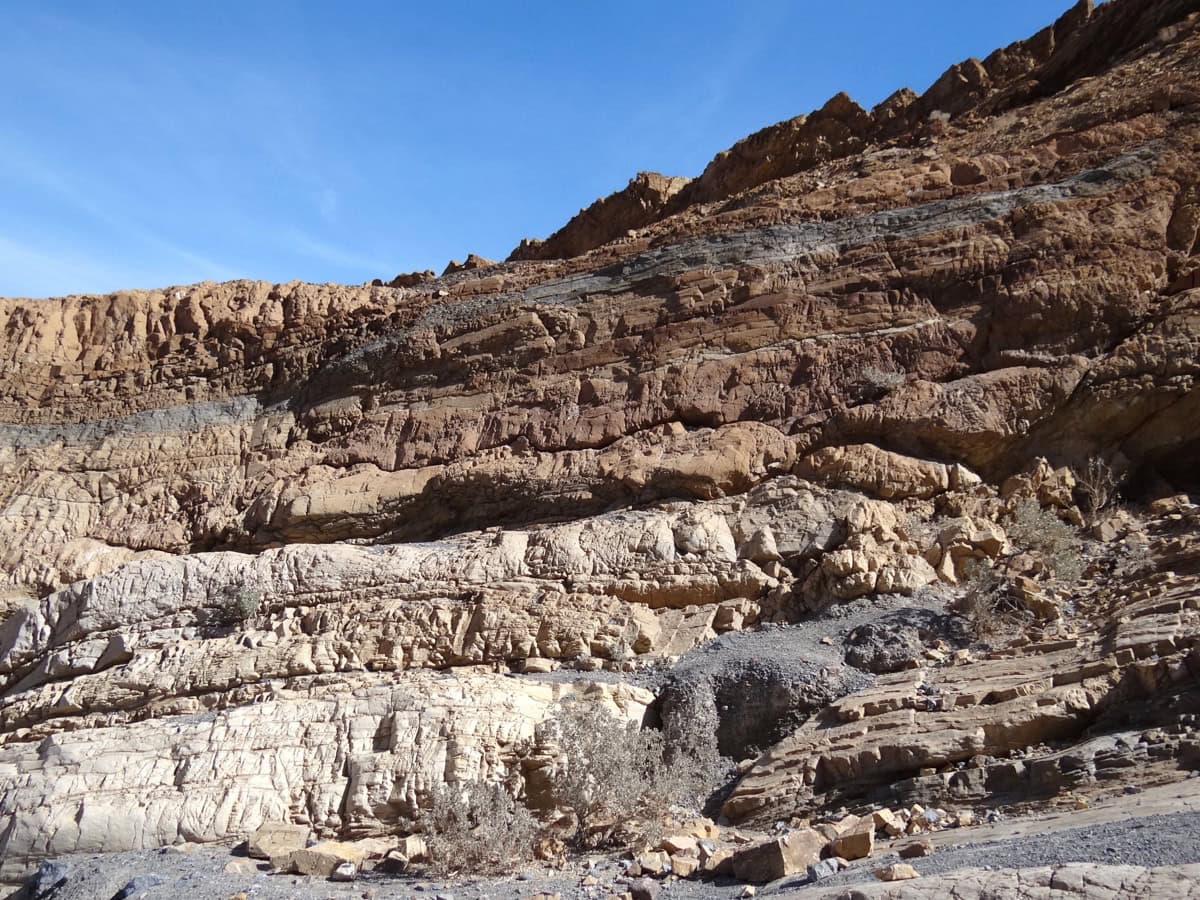
Mosaic Canyon is a short but visually stunning hike right near Stovepipe Wells. You walk through a narrow canyon whose walls are smooth as polished marble — literally, because they’re formed from a mosaic (hence the name) of different rock types cemented into a sleek surface.
The trail is roughly 3 km round trip and fairly easy, though at a few points you’ll need to scramble over rock ledges. Older children can manage it fine. The canyon looks its best in the early morning, when angled light illuminates the polished walls.
14. Father Crowley Vista Point — the fighter jet viewpoint
This one’s a bit different. Father Crowley Vista Point is a viewpoint overlooking Rainbow Canyon (a.k.a. Star Wars Canyon), where the US military practises low-level flying. Yes, you read that right — with a bit of luck you’ll see an F/A-18 or F-35 fighter jet blast through the canyon below the level of the viewpoint. It sounds bonkers if you haven’t heard of it before, but it’s very real and incredibly thrilling.
Flyovers are most common on weekdays, but there’s no timetable. Sometimes you wait an hour and see nothing; other times three jets scream past back to back. Even without the planes, it’s a gorgeous viewpoint into a deep, rainbow-coloured canyon. And if no jets show up, at least you’ve got a cracking view and a great pub story.
15. Wildrose Charcoal Kilns — historic kilns in the mountains
Wildrose Charcoal Kilns are ten beehive-shaped stone kilns built in 1877 to produce charcoal for smelting silver. They sit at an elevation of 2,000 metres, so it’s noticeably cooler here than down in the valley — a welcome relief on warmer days.
The kilns are beautifully preserved and you can step inside — the acoustics are fantastic, so try whistling or clapping. The site is off the main tourist trail, so you’ll likely have it to yourself. The road here (Wildrose Road) is mostly paved, but the last few miles are unpaved.
Map of points of interest for your phone
Where to eat and drink in Death Valley (and survive)
Let’s be honest — nobody goes to Death Valley for the gastronomy. 😅 Options are limited, prices reflect the fact that you’re in the middle of a desert miles from civilisation, and quality varies. But you won’t starve (unlike dying of thirst, which is a genuine risk if you don’t pack enough water).
Restaurants in the park
The Inn at Death Valley Dining Room — the best restaurant in the park, solid American cuisine, decent steaks and salads. But prices match the luxury setting — mains $30–50 (€28–47). Book ahead in season.
The Last Kind Words Saloon (Furnace Creek) — a casual restaurant and bar. Good burgers, nachos, pizza. Prices are reasonable by local standards ($15–25, or €14–23 for a main). Western saloon vibes — grab a beer on the terrace and swap desert stories.
Toll Road Restaurant (Stovepipe Wells) — straightforward American fare and buffet breakfasts. Nothing world-beating, but after a day in the desert absolutely anything tastes good.
Panamint Springs Restaurant — a small restaurant with surprisingly good burgers and portions big enough to satisfy a famished cowboy.
Tip: Bring your own food
We mean it. A cool box filled with water, fruit, sandwiches, and snacks will save you both money and time. The park has one small Furnace Creek General Store with eye-watering prices for basic supplies. Do your shopping in Las Vegas or Pahrump before you arrive.
And above all — water, water, water. A minimum of 4 litres per person per day, more if you’re hiking. Dehydration in Death Valley can sneak up on you surprisingly fast, even when you think you’re not sweating — in reality the sweat evaporates instantly in the dry air, so you don’t realise how much fluid you’re losing.
Practical tips and what to pack
Safety in Death Valley
This isn’t scaremongering — Death Valley is genuinely a place where you need to respect nature:
- Fill up your tank whenever you see a petrol station. There are only two in the park (Furnace Creek and Stovepipe Wells) and prices are brutal ($6–7/gallon).
- Mobile signal is virtually non-existent outside Furnace Creek. A satellite communicator (Garmin InReach, SPOT) is a smart idea for longer excursions.
- Never set off on a hike without enough water. The park service recommends 1 gallon (3.8 litres) per person for a longer hike.
- Roads can flood. After rain (even distant rain) dry washes can be hit by flash floods with no warning. Never park in a wash and keep an eye on the weather forecast.
- Tell someone your plan — where you’ll be and when you expect to be back.
What to pack
- Wide-brimmed hat — sunglasses alone aren’t enough; you need shade on your face and neck
- SPF 50+ sunscreen — in the desert you can burn even through clouds
- Layered clothing — 30 °C during the day, below 5 °C at night (in winter months)
- Sturdy footwear — essential for hikes and recommended on the salt flats (see our hiking boot recommendations)
- Head torch — for stargazing, camping, and early-morning starts
- Offline maps — Google Maps and maps.me both work offline; download the whole park area in advance
- eSIM — useful for when you arrive and leave the park; we recommend Holafly (but inside the park there’s mostly no signal anyway, so don’t rely on it)
- For more packing tips, check out our guide on how to pack carry-on only
Travel insurance
Never travel to the US without travel insurance — healthcare there is astronomically expensive (a helicopter evacuation from Death Valley could set you back tens of thousands of dollars). For shorter trips we like AXA, and for longer stays we recommend SafetyWing, which we’ve tested ourselves.
Why is it called Death Valley? A brief history
We get this question a lot, so let’s tackle it. The name Death Valley dates back to the Gold Rush in 1849, when a group of emigrants — the so-called “49ers” — got lost in the valley while trying to find a shortcut to California. They spent weeks in inhuman conditions, without enough water or food, and eventually had to eat their oxen.
Surprisingly — despite the brutal conditions — only one person from the entire group actually died. Still, when the survivors were finally rescued and crossed out over a mountain pass, one of the women reportedly turned around and said: “Goodbye, Death Valley.” And the name stuck.
But Death Valley’s history reaches much further back. The Timbisha Shoshone people have lived here continuously for over a thousand years and still maintain a reservation within the park. They thrived in conditions that nearly killed European settlers — which rather says it all.
FAQ — Frequently asked questions about Death Valley
What to see in Death Valley?
The most famous attractions include Badwater Basin (the lowest point in North America, 86 m below sea level), Zabriskie Point with its surreal eroded hills, the Dante’s View panorama overlooking the entire valley, the colourful Artists Palette, the Mesquite Flat Sand Dunes, and the mysterious Racetrack Playa with its “sailing stones.” Allow at least 2 full days for the main sights, ideally 3. In the article above you’ll find a detailed description of all 15 top spots.
Why is it called Death Valley?
The name dates back to 1849, when a group of Gold Rush prospectors (the “49ers”) got lost in the valley on their way to California. They endured weeks in extreme conditions without enough water or food. As the group finally departed over a mountain pass, one member reportedly turned around and said: “Goodbye, Death Valley.” Ironically, only one person from the group actually died — but the harrowing experience was enough for the name to stick forever.
Where is Death Valley located?
Death Valley National Park lies on the border of California and Nevada in the southwestern United States. The nearest major city is Las Vegas (roughly 2 hours by car, 190 km). From Los Angeles it’s about 4.5–5 hours. The park sits in the Mojave Desert and is the driest, lowest, and hottest place in all of North America.
How many days do I need for Death Valley?
A minimum of 1–2 full days covers the main attractions (Badwater Basin, Zabriskie Point, Dante’s View, Artists Drive, Mesquite Sand Dunes). For a more relaxed pace and remote spots like Racetrack Playa or Ubehebe Crater, we recommend 3 days. If you want to fit in hikes (Golden Canyon, Mosaic Canyon), add a 4th day. On our second visit we allowed 3 days and still didn’t manage everything.
Is Death Valley dangerous?
If you follow basic precautions, no — but underestimating it is not an option. The main risks are dehydration and heatstroke (summer temperatures exceed 50 °C), vehicle breakdowns in remote areas with no signal, and flash floods after rain. Always carry enough water (at least 4 litres per person per day), tell someone your plans, and limit outdoor activity in the summer months. The park service advises against camping below 1,500 m elevation in summer.
What car do I need for Death Valley?
For the main roads and most top attractions (Badwater, Zabriskie Point, Dante’s View, Artists Drive, Sand Dunes), a regular saloon or SUV is fine. For Racetrack Playa, Titus Canyon, and certain other unpaved routes you’ll need a 4WD with high clearance. In all cases, make sure you have a full tank and two spare tyres for more remote excursions.
How much does it cost to visit Death Valley?
Park entrance is $30 (about €28) per vehicle for 7 days, or $80 (€75) for an annual America the Beautiful Pass covering all US national parks. Accommodation inside the park ranges from $150 to $500+ per night; camping costs $16–22 per night. The total budget for 2–3 days for two ranges from roughly €325 (camping, own food) to €895 (hotel, restaurants).
Tips and Tricks for Your Vacation
Don’t Overpay for Flights
Search for flights on Kayak. It’s our favorite search engine because it scans the websites of all airlines and always finds the cheapest connection.
Book Your Accommodation Smartly
The best experiences we’ve had when looking for accommodation (from Alaska to Morocco) are with Booking.com, where hotels, apartments, and entire houses are usually the cheapest and most widely available.
 🚗 Car rental on the roadVerified car rentals in California
Search with the DiscoverCars comparison engine — it compares prices from dozens of local and international rental companies, and most bookings come with free cancellation.
Compare car prices in California →Don’t Forget Travel Insurance
Good travel insurance will protect you against illness, accidents, theft, or flight cancellations. We’ve had a few hospital visits abroad, so we know how important it is to have proper insurance arranged.
Where we insure ourselves: SafetyWing (simple monthly subscription) and TrueTraveller (for extra-long trips).
Find the Best Experiences
Get Your Guide is a huge online marketplace where you can book guided walks, trips, skip-the-line tickets, tours, and much more. We always find some extra fun there!
More from California
Full guide → Itinerary · most readWest Coast USA Road Trip: 14–21 Day Itinerary (LA → San Francisco)
 Where to stayWhere to Stay in Los Angeles: 18 Tips for the Best Hotels and Safe Neighborhoods in 2026
 What to seeYosemite National Park, California: 15 Things to See and Do
 What to seeSequoia National Park, California: 15 Things to See and Do
 What to seeSan Francisco, California: 22 Things to Do in 2026


