

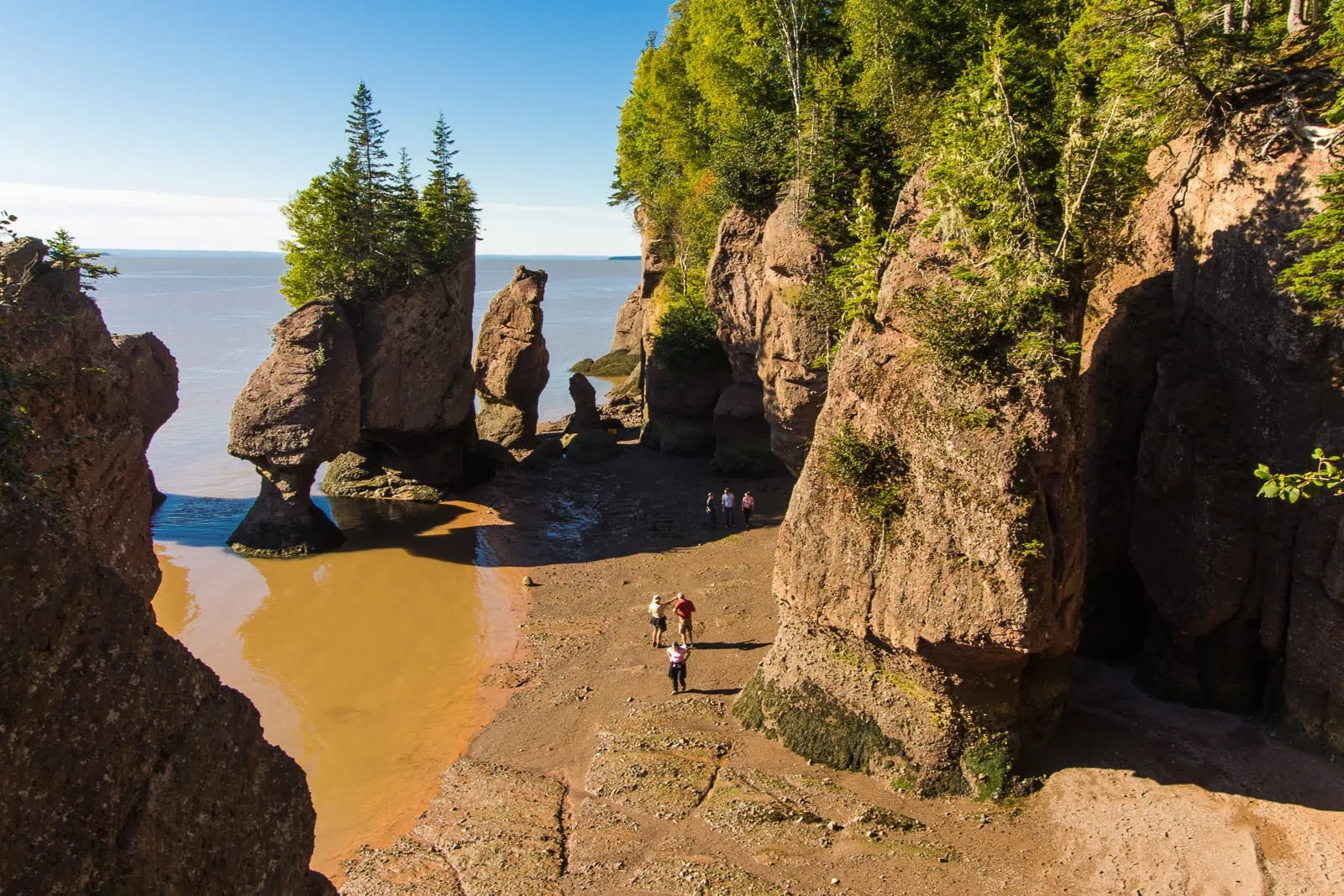
You’re standing on the ocean floor, looking up at fifteen-metre-tall rock pillars with spruce trees growing on top. You feel tiny — as if someone shrunk you and placed you inside a giant glass aquarium that someone just drained. And that’s essentially what happened here. Except the “aquarium” is the size of an entire bay, and it was the ocean itself that drained it. Twice a day.
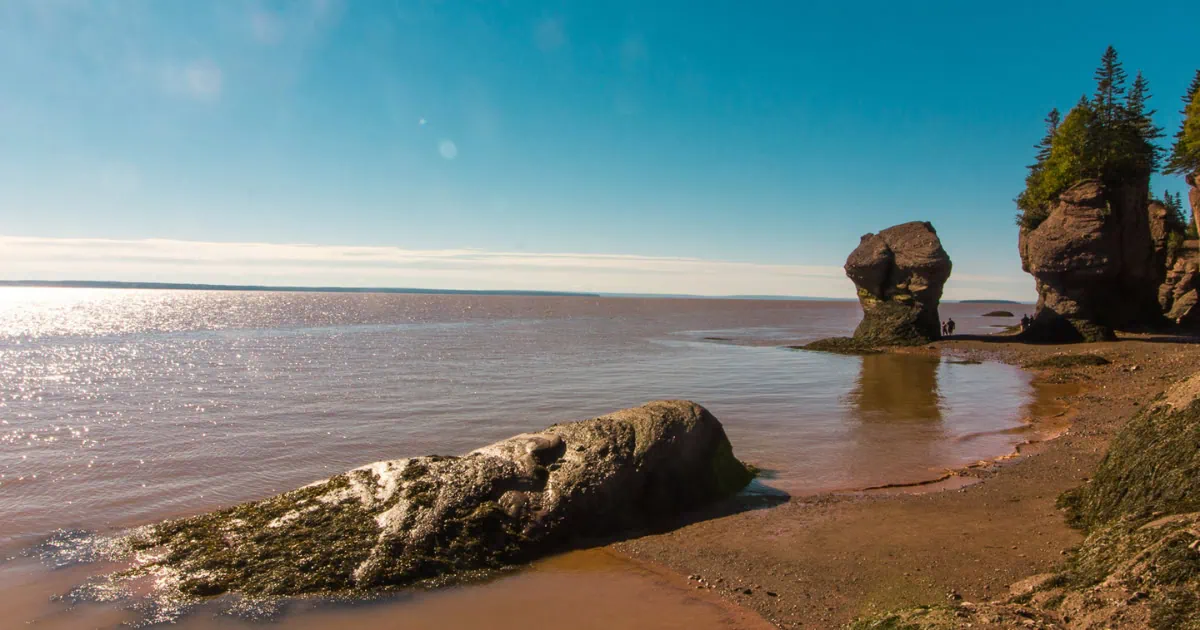
Bay of Fundy, a bay in the Canadian province of New Brunswick, is a place where nature puts on one of the most dramatic water shows on the planet. The tides here reach heights of up to 16 metres — that’s roughly a five-storey building, if you need a comparison. 😅 My mum and I came here as part of our road trip across Canada and honestly? This bay blew us away in a completely different way than the Rocky Mountains. No dramatic peaks, no glaciers — just a quiet, incredible spectacle of nature that follows the timetable of the Bay of Fundy tides.
In this article, you’ll find a complete guide to Bay of Fundy — from the famous Hopewell Rocks and hikes in Fundy National Park to whale watching and the best lobster roll in the little town of Alma. I’ll tell you when to go, how to plan your day around the tide tables, and where to stay. Everything you need to know before heading to the highest tides in the world.
TL;DR
- Bay of Fundy is located in the province of New Brunswick on Canada’s east coast. It has the highest tides in the world — the tidal range reaches up to 16 metres.
- The main attraction is Hopewell Rocks — flowerpot-shaped rock formations that you can walk around on the ocean floor at low tide.
- Plan your entire day around the tide tables — this is the key to the whole experience. Ideally, visit Hopewell Rocks at low tide and then return at high tide to see the mind-blowing difference.
- The nearest city is Moncton (about 40 minutes by car from Hopewell Rocks), but make your base in the small fishing village of Alma right by the bay.
- Fundy National Park offers dozens of hiking trails, waterfalls, and beautiful coastline — dedicate at least one full day to it.
- Best time to visit is from June to September. July and August are the warmest and offer the best chance of whale watching.
- Two to three days is the ideal time to explore the area. One day for Hopewell Rocks, one day for Fundy NP, one day for kayaking or whale watching.
- Budget for two people for 3 days is around €250–500 (excluding flights and car rental) depending on accommodation type.
- A car is essential — public transport is virtually non-existent.
When to visit Bay of Fundy and how to get there
Bay of Fundy is a destination where timing is literally everything. And I don’t just mean the month of the year — I mean the exact hour of the day. Let’s break down both.
Best time to visit Bay of Fundy
The season at Bay of Fundy runs from June to October, with the golden period being July and August. During these months, temperatures hover around 20–25 °C, the water in the bay is bearable (though “bearable” is a relative term in Canada — it’s no Algarve 😅), and most importantly — it’s the best time for whale watching, as humpbacks and other species migrate here to feed.
June is lovely because there are fewer tourists, but the weather can still be unstable and morning fog is common. September is gorgeous thanks to the autumn colours — the Canadian “Indian summer” combined with the dramatic coastline is something that will take your breath away.
I’d avoid May and October — many attractions and accommodations are closed, the weather is unpredictable, and some trails in Fundy NP may still be waterlogged or closed. And winter? Skip it entirely, unless you enjoy arctic winds and shuttered restaurants.
How to get to Bay of Fundy
Bay of Fundy is located in the province of New Brunswick on Canada’s east coast, though part of the bay extends into Nova Scotia on the opposite shore. The main tourist attractions (Hopewell Rocks, Fundy National Park, Alma) are on the New Brunswick side.
By air: The nearest airport is Moncton (YQM) — about 40 minutes by car from Hopewell Rocks and an hour from Alma. A larger international airport is Halifax (YHZ) in Nova Scotia — it’s about 3.5 hours by car through New Brunswick, but you can easily combine it with a visit to Halifax and the Nova Scotia coast.
From the UK, there are no direct flights to Moncton. The most common route is via Toronto or Montreal, from where you can either fly to Moncton or set off on a road trip along the east coast. For the best flight deals, we recommend comparing prices on Kiwi or Skyscanner.
By car: A car is absolutely essential for Bay of Fundy. Public transport to the area is virtually non-existent, and the distances between attractions are such that you simply can’t get around without one. We’ve had consistently great experiences with RentalCars, which we use all over the world. From Moncton, it’s about 40 minutes to Hopewell Rocks via Route 114, an hour to Alma, and about an hour and a quarter to Fundy National Park.
One thing to watch out for: You’ll sometimes come across information about Bay of Fundy in Maine, USA — yes, the bay technically extends into the American state of Maine, but the famous tides, Hopewell Rocks, and main attractions are on the Canadian side. If you’re googling “Bay of Fundy Maine,” you’ll find a quieter, less touristy part of the bay without the iconic rock formations.
Where to stay near Bay of Fundy and how much it costs
The area around Bay of Fundy isn’t exactly overflowing with luxury resorts — and that’s part of its charm. It’s a peaceful, slightly sleepy corner of Canada where accommodation is mostly B&Bs, small motels, cottages, and campsites. Prices are considerably more affordable than in western Canada.
Alma — the best base
The little town of Alma (population about 250, but who’s counting 😁) is the ideal base for exploring the entire area. It sits right at the entrance to Fundy National Park and is the closest settlement to Hopewell Rocks (about 30 minutes by car). Plus, you’ll find a few restaurants, shops with local products, and a harbour from which whale watching boats depart. We recommend Alma Shore Lane Suites & Cottages.
Moncton — if you want city comforts
Moncton is the nearest larger city (population 75,000) and if you prefer hotels with full amenities, restaurants, and shopping options, it can work as a base. However, expect to drive 40–80 minutes each way every day. For a luxury stay, consider Chateau Moncton Trademark Collection by Wyndham.
Sussex and St. Martins — for Fundy Trail visitors
If you’re planning to explore the Fundy Trail Parkway (and you should!), staying in St. Martins — a picturesque fishing village with covered bridges and sea caves — could be a smart choice. Accommodation options are more limited here, but all the more authentic. Check out Fundy Footprints.
Bay of Fundy: 13 tips on what to see and do
Let’s dive into the best that Bay of Fundy has to offer — from walking on the ocean floor and waterfalls in Fundy National Park to whale watching and the best lobster on the coast. I’ve ordered these tips so you can easily put together two to three days packed with unforgettable experiences.
1. Hopewell Rocks — walking on the ocean floor
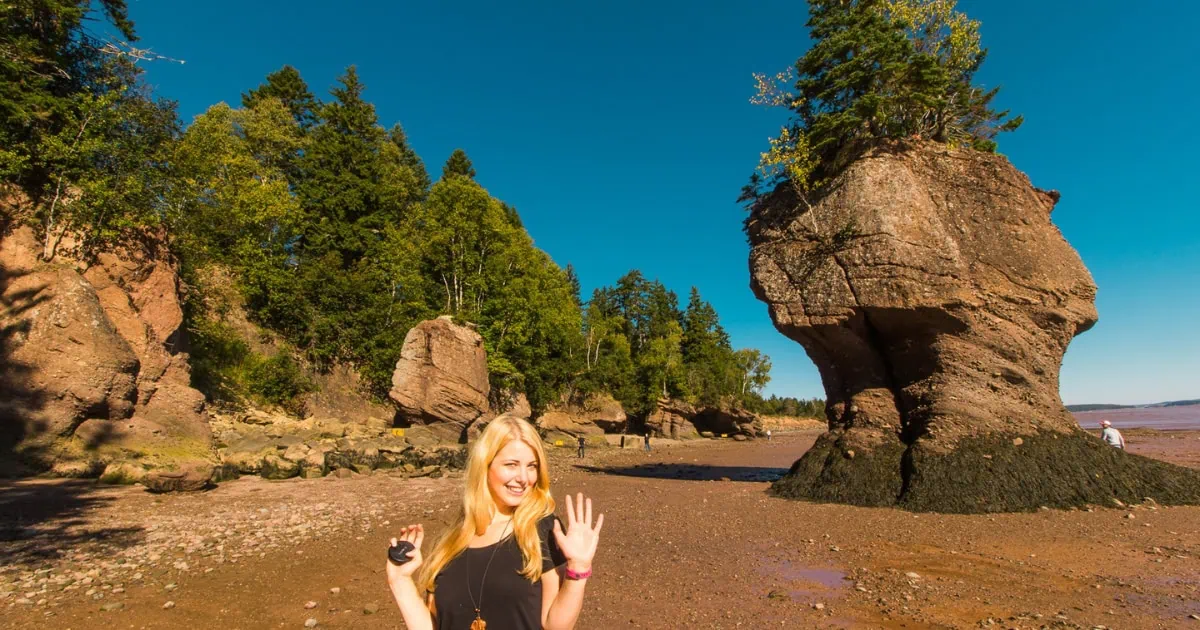
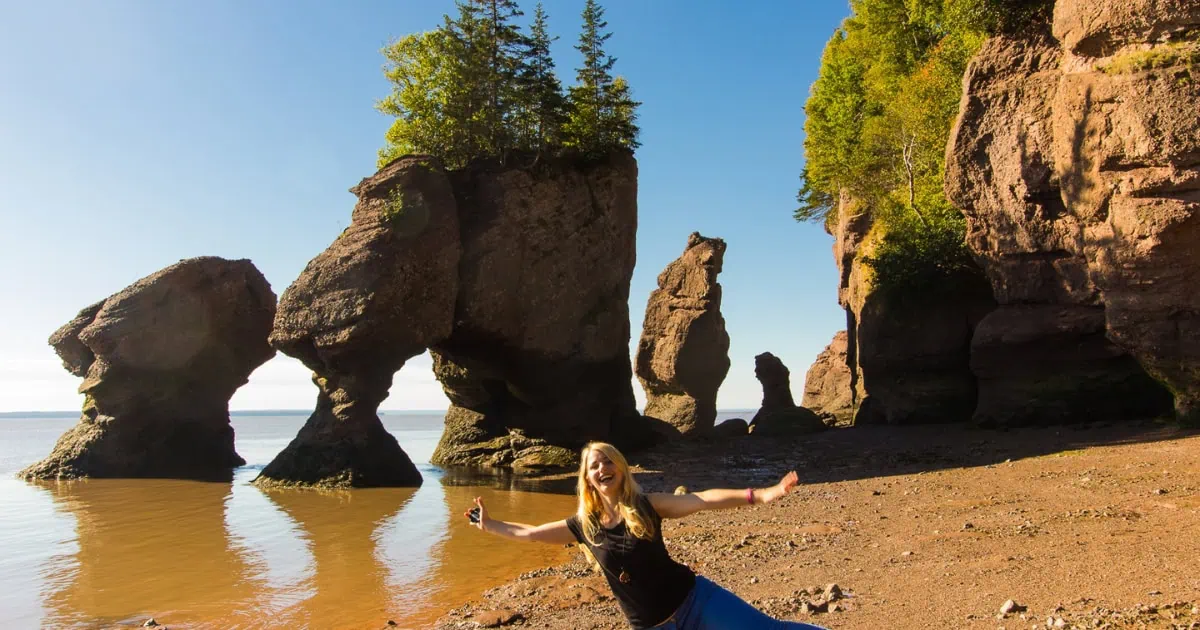
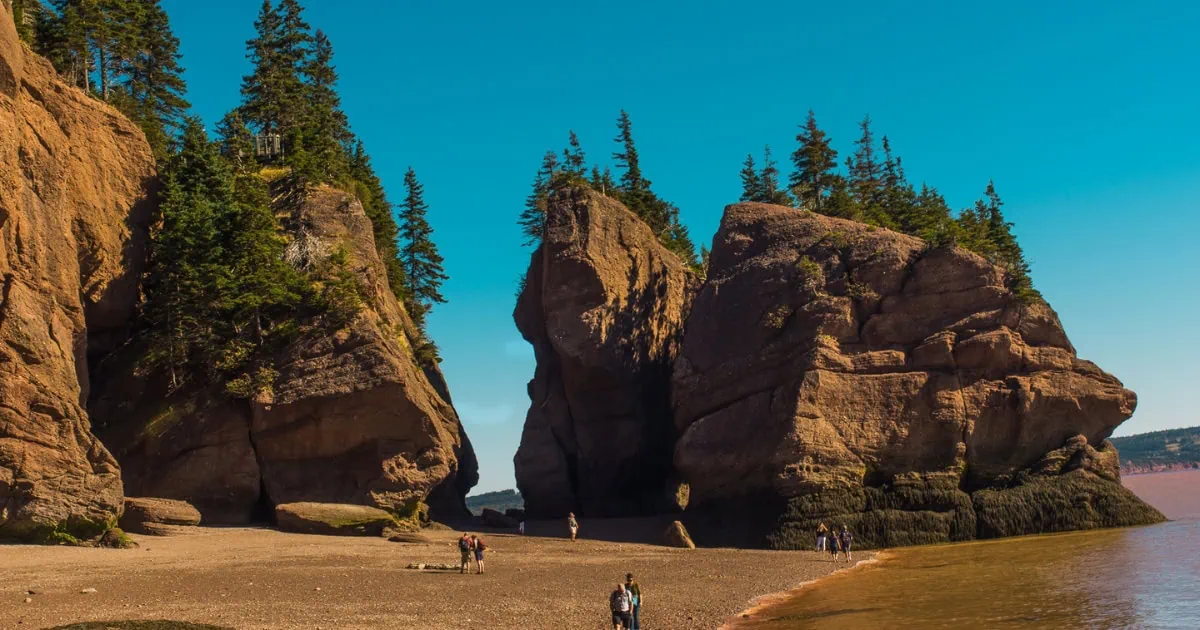
This is the main reason most people come here, and I have to say: rightly so. Hopewell Rocks (officially The Hopewell Rocks Ocean Tidal Exploration Site) are rock formations shaped like giant flowerpots — they’re called “flowerpot rocks” — carved by millions of years of tidal erosion. At low tide, you walk around them on the ocean floor, touch them, and shake your head wondering how it’s possible that trees grow on top of them. At high tide, those same rocks are submerged up to their necks and you watch them from the viewpoint above.
And here’s the crucial thing: you must arrive at low tide. Ideally 1–2 hours before the lowest point of low tide, so you have plenty of time for the walk on the ocean floor. You can find the tide tables directly on the Hopewell Rocks website — download them in advance and plan your entire day around them. Seriously, there’s nothing worse than arriving to find three metres of water below you. 😅
Practical info:
- Admission: 15 CAD/adult (about €10), children 6–16 years 12 CAD
- Open: mid-May to mid-October
- Parking: free, large car park
- Time needed: 2–3 hours (ideally arrive at low tide, walk on the ocean floor, then return at high tide to compare the incredible difference)
- Tip: The stairs down to the ocean floor have about 100 steps and can be slippery. Wear shoes you don’t mind getting dirty — the bottom is muddy and full of seaweed. Definitely no flip-flops. If you’re looking for good hiking shoes, check out our hiking boots guide.
What surprised me most wasn’t the walk on the ocean floor itself — you expect that. What amazed me was the moment you return a few hours later and the rocks you walked around are suddenly submerged up to the top. The contrast is so dramatic that you can’t help but photograph it again from the same spot. Your brain refuses to accept that it’s the same place.
2. Fundy National Park — waterfalls, trails, and coastline
Fundy National Park is one of the most beautiful, yet least visited national parks in Canada. And that’s its greatest charm — no crowds, no queues, just you, the forest, and the sound of waterfalls. The park covers 207 km² along the Bay of Fundy coast and offers over 25 hiking trails of varying difficulty.
Admission: 10 CAD/adult (about €7) — purchased at the park entrance or online. If you’re planning to visit multiple Canadian national parks, the Parks Canada Discovery Pass is worth it (145 CAD/family for a whole year).
Best trails in Fundy NP:
- Dickson Falls Trail (1.5 km, easy) — the most popular trail in the park, leading along wooden boardwalks past cascading waterfalls. Perfect even with children.
- Laverty Falls Trail (5 km return, moderate) — leads to gorgeous waterfalls where you can even swim in summer (if you’re hardy — the water is freezing).
- Third Vault Falls (7.4 km return, moderate) — the tallest waterfall in New Brunswick (16 m). The route is longer but well worth it.
- Coastal Trail — various sections along the coastline with views over the bay. Some parts are only accessible at low tide!
- Coppermine Trail (4.4 km, easy) — leads to Point Wolfe and the ocean shore.
You can also camp in the park — Headquarters campground is right by the town of Alma and has showers, toilets, and electrical hookups. Chippewa campground is set in the forest by a lake where you can swim in summer.
3. Fundy Trail Parkway — a scenic drive that will take your breath away
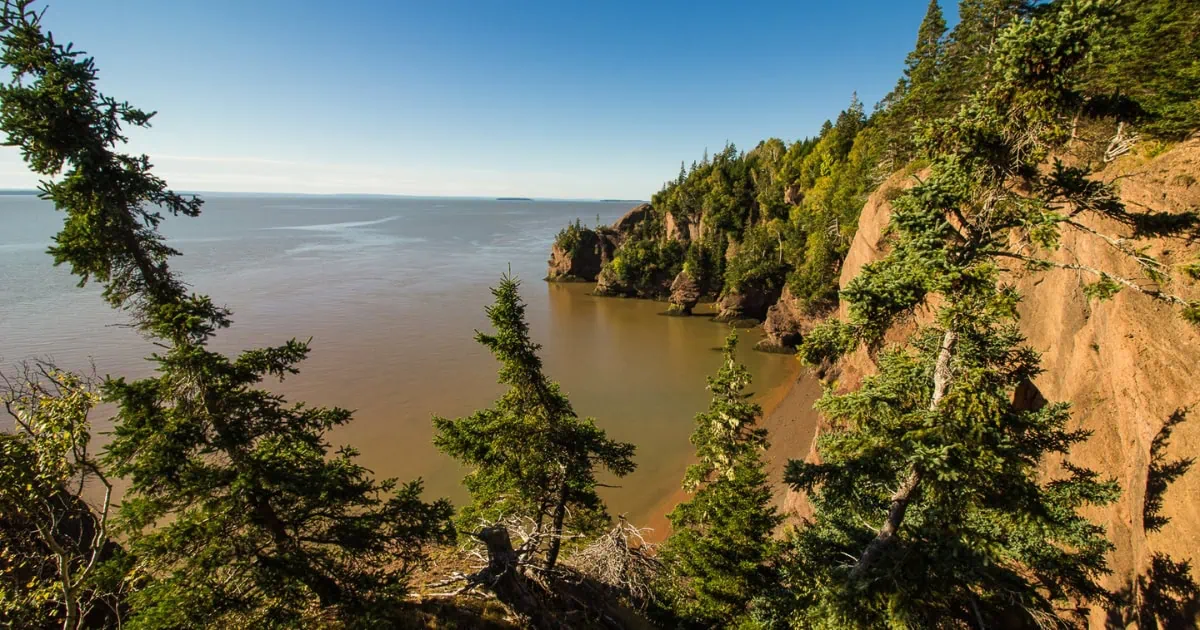
If you love scenic drives, Fundy Trail Parkway will blow you away. It’s a 30 km road along the coastline with dozens of viewpoints, hiking trails, and beach access points. The road is narrow, winding, and stunning — it’s a bit like the Great Ocean Road in Australia, just without the crowds and with Canadian forest instead of eucalyptus.
Fundy Trail admission: 11 CAD/car (about €7).
Along the route, you’ll find 21 viewpoints — stop at every one, because each offers a different perspective on the bay, cliffs, and coastline. The most impressive for me was Big Salmon River at the end of the parkway — a former logging settlement where the river meets the bay and where you can descend to the beach (at low tide, naturally).
Tip: Allow at least 3–4 hours for the entire parkway if you want to stop and walk at least two trails. If you’re more active, you could easily spend a whole day here — there are plenty of trails leading to waterfalls, suspension bridges, and hidden beaches.
Fundy Trail Parkway is open from mid-May to mid-October, and in the morning hours you’ll often encounter fog that gives the coastline a mystical atmosphere. It usually clears by the afternoon, leaving crystal-clear views.
4. Kayaking among the rocks at high tide
If walking on the ocean floor at low tide is experience number one, then kayaking among the Hopewell Rocks at high tide is a close 1-A. You paddle between those massive rock pillars with trees above your head and the smooth bay surface around you at a level where just a few hours earlier you were standing on dry land. It’s a bit surreal.
Kayak tours are offered by several local companies in the Hopewell Rocks area and typically last 2–3 hours. Prices are around 65–85 CAD per person (€40–55). Your guide will explain the geology of the bay, show you sea caves, and make sure you don’t capsize (though even that’s an experience 😅).
Important: Kayaking is obviously dependent on the tide — tours run 2 hours before and after high tide. So the ideal plan is: morning at low tide for Hopewell Rocks on foot, afternoon at high tide for kayaking. A perfect day.
Book at least a day or two in advance, and in summer even a week — capacity is limited and this is one of the most popular activities in the entire area.
5. Whale watching in Bay of Fundy
Bay of Fundy is one of the best places in the world for whale watching. The massive tides bring tonnes of plankton and tiny crustaceans into the bay, attracting humpback whales, fin whales, minke whales, and even endangered North Atlantic right whales — some of the rarest animals on the planet.
Best time: July and August, when whale concentration is at its highest.
Whale watching trips depart from Alma and from St. Andrews (on the other side of the bay). A cruise typically lasts 2–3 hours and prices are around 70–90 CAD per person (€45–60). Most operators guarantee you’ll see whales — if not, you get a free return trip. We recommend booking your trip through GetYourGuide — it’s the easiest option.
Tip from personal experience: Bring a warm layer and a jacket, even if it’s warm on land. Out on the water it’s 5–10 degrees colder and the wind blows fiercely. And if you suffer from seasickness, take medication beforehand — the bay can get rough.
We were lucky and saw a group of humpbacks feeding about 200 metres from the boat. When a fifteen-metre whale surfaces and slaps its tail fin on the water, it’s a sound and sight you simply can’t prepare for. Lukáš says it was his top experience of the entire trip. And I’m not going to argue with that. 😊
6. St. Martins — sea caves and covered bridges
The small fishing village of St. Martins sits at the eastern end of the Fundy Trail and is one of those places you probably wouldn’t drive to without a guidebook — and that would be a shame. The village is known for two things: sea caves and covered bridges.
The sea caves are accessible at low tide (more tide table planning!) and are impressive — tall, dark, and carved into red sandstone cliffs. At high tide, they’re completely submerged. Entry is free — you just walk down to the beach.
The covered bridges are a classic feature of New Brunswick — wooden bridges with roofs that look like something out of a storybook. In St. Martins, you’ll find two right next to each other, making them a beautifully photogenic subject.
St. Martins makes a great stop on the way from Moncton to Fundy Trail Parkway. Stop for an hour, explore the caves, and grab some fish and chips at one of the local restaurants.
7. Alma — a fishing village with the best lobster
Alma isn’t just a base for exploring the area — it’s a place with its own soul. The town has a harbour where at low tide the boats lie on their sides on the bottom (because the water left — where else would it go? 😅), a handful of shops, and most importantly, fantastic food.
It’s tiny — a few hundred residents — but that intimate atmosphere is what makes it so special. In the morning you buy fresh pastries at Kelly’s Bake Shop (their sticky buns are legendary — the queue stretches down the street and is absolutely worth it), for lunch a lobster roll straight from the harbour, and in the evening you sit on the pier watching the tide slowly lift the boats back into the water.
I’ll come back to Alma in the food section — it deserves it.

8. Bay of Fundy tide tables — your most important tool
This isn’t a typical “thing to see” tip, but it’s probably the most important piece of advice in this entire article. Bay of Fundy is a place where your entire schedule is dictated by the tide tables. If you ignore them, you’ll arrive at Hopewell Rocks at high tide and only see the tips of rocks poking out of the water. Or you’ll show up for kayaking at low tide with nowhere to paddle.
Where to find tide tables:
- Hopewell Rocks website has the table right on the main page
- The Tides Near Me app (free) — shows tides for any location
- Fisheries and Oceans Canada — the official government source
How Bay of Fundy tides work: The entire cycle takes approximately 12 hours and 25 minutes. This means high tide and low tide shift by about 50 minutes each day. If low tide is at 10:00 today, tomorrow it will be around 10:50. The average difference between the lowest and highest water level is 12 metres, but during spring or autumn full moons, it can reach up to 16 metres.
Practical day planning example:
- Low tide at 10:30 → Arrive at Hopewell Rocks at 9:00, walk on the ocean floor 9:30–11:30
- Lunch in Alma 12:00–13:00
- Afternoon hike in Fundy NP 13:30–16:00
- High tide around 16:45 → Return to Hopewell Rocks, view the submerged rocks from above
9. Point Wolfe — a hidden gem of Fundy NP
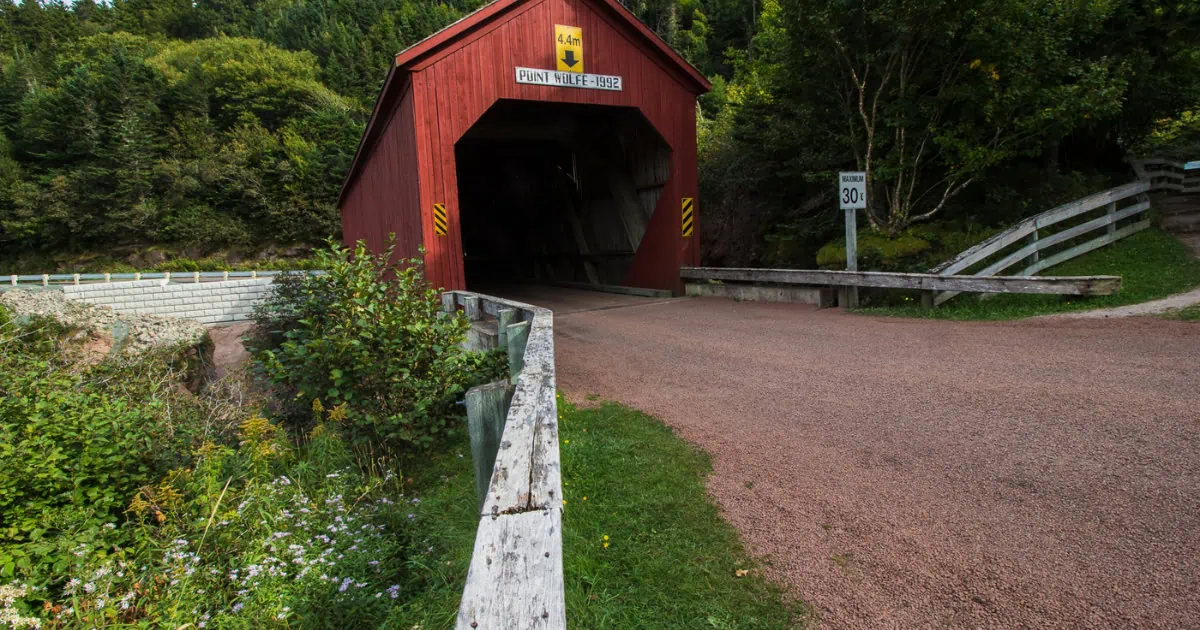
Point Wolfe is an area in Fundy National Park that most tourists miss because they head straight for Dickson Falls. And that’s a mistake. The road to Point Wolfe passes through a beautiful covered bridge (another one!) and ends at a beach where the river meets the bay.
At low tide, an enormous stretch of ocean floor is revealed, full of rock pools where you can find starfish, sea urchins, crabs, and other marine creatures. It’s like a natural aquarium and for children (and adults who like to revisit their childhood years — guilty 😁) it’s an absolute paradise.
The Coppermine Trail leads from the Point Wolfe car park along the coast and offers beautiful views of the bay. It’s easy and about 4.4 km return.
10. Waterside Beach — walk on the Bay of Fundy floor without crowds
If Hopewell Rocks feels too touristy for you (it can indeed get quite busy in summer), Waterside Beach is a great alternative. It’s about 15 minutes’ drive from Hopewell Rocks and offers practically the same experience — a walk on the ocean floor at low tide — but without the crowds and without admission fees.
The beach is long, sandy, and at low tide reveals interesting rock formations and pools. It’s not as dramatic as Hopewell Rocks, but the atmosphere is far more intimate. We were practically alone here and could enjoy the experience — standing where just a few hours earlier there were 12 metres of water — in complete peace.
11. Cape Enrage — lighthouse and zip-line over the bay
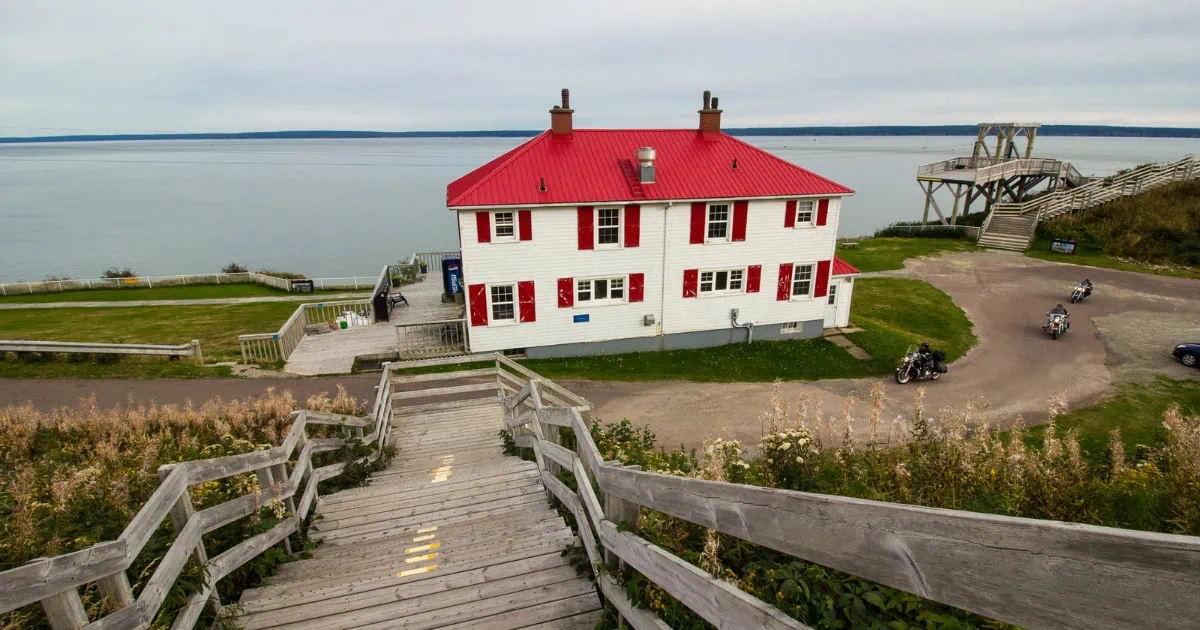
Cape Enrage (yes, it really is called that — “Enraged Cape” 😅) is a dramatic cliff with a lighthouse perched on the edge of a 50-metre drop above the bay. The site is run by a local non-profit, and alongside stunning views, they also offer some rather adrenaline-pumping activities.
What you can do here:
- Visit the lighthouse and museum (admission 5 CAD)
- Ride a zip-line over the bay (quite the experience if you’re not afraid of heights)
- Rappel down the cliffs to the beach
- Walk along the beach below the cliffs at low tide
Cape Enrage is about 20 minutes’ drive from Alma and can be easily combined with a visit to Hopewell Rocks — it’s practically on the way.
12. Mary’s Point — a paradise for birdwatchers
Every year from mid-July to mid-August, hundreds of thousands of semipalmated sandpipers descend on Mary’s Point to fuel up before their migration to South America. It’s one of the most important gathering sites for these birds in the world, and UNESCO has listed it as an Important Bird Area.
Even if you’re not a dedicated birdwatcher, the spectacle is incredible — thousands of birds lift off the mudflats at once and fly in synchronized formations above the bay. At low tide, you can walk across the muddy floor and watch the birds probing the mud for crustaceans.
Entry is free. Mary’s Point is about 10 minutes from Hopewell Rocks.
13. Coastal road trip — connect Bay of Fundy with Halifax or PEI
Bay of Fundy makes an excellent start (or finish) to a larger road trip along Canada’s east coast. From the area, you can easily continue in several directions:
- Halifax and Nova Scotia (3.5 hours) — a city with rich maritime history, Peggy’s Cove, and the Cabot Trail coastline
- Prince Edward Island (3 hours) — across the iconic Confederation Bridge to an island of red beaches and Anne of Green Gables
- Saint John (1.5 hours) — the largest city in New Brunswick with the Reversing Falls (a spot where the tide reverses the direction of the river!)
If you’re planning a bigger road trip, I recommend at least 10–14 days for a combination of Bay of Fundy, Nova Scotia, and PEI. For road trip planning tips, check out our article on road tripping in western Canada — the planning principles are the same.
Don’t forget travel insurance — Canada has very expensive healthcare and without coverage you risk astronomical bills. For longer road trips, we recommend SafetyWing, and for shorter trips, a standard travel policy. And if you want internet connectivity even in remote areas, check out our Holafly eSIM review.
What to eat and drink at Bay of Fundy: a foodie guide
If you’re heading to Bay of Fundy and not planning to eat lobster, you’re doing it wrong. Here’s a rundown of the food and places you shouldn’t miss.
Lobster roll — obligation number one
A lobster roll is a bun stuffed with fresh lobster meat. In Alma, you can get one practically everywhere, but our favourite was at Alma Lobster Shop — fresh, generously filled, and at a reasonable price (around 25 CAD/€16).
Sticky buns from Kelly’s Bake Shop
Kelly’s Bake Shop in Alma is an institution. Their cinnamon sticky buns are legendary and queues form every morning. They open early and sell out fast — get there before 9:00 or risk missing out. They cost about 5 CAD (€3) and are so good you’ll buy two. Maybe three. 😅
Fish and chips
You probably know the drill. Fresh fish (usually cod or plaice), crispy batter, and homemade chips. Try Tides Restaurant in Alma or Holy Whale Brewing — yes, the local microbrewery that makes great beer and solid fish and chips to boot.
Dulse — edible seaweed
This is a local speciality that will either delight you or horrify you. Dulse is dried red seaweed that’s eaten as a snack in New Brunswick. It has a salty, slightly smoky flavour and can be added to salads, soups, or eaten on its own. Pick up a bag at a local shop in Alma and give it a try — it’s an experience. If only for the expression on your face. 😁
Holy Whale Brewing
The Holy Whale microbrewery in Alma is a great spot for an evening pint after a full day of exploring. They brew local craft beers inspired by the bay and surrounding nature. Friendly atmosphere, good music, and views over the harbour.

FAQ — Frequently asked questions about Bay of Fundy
What is the Bay of Fundy famous for?
Bay of Fundy has the highest tides in the world. The difference between the lowest and highest water levels averages 12 metres, but under ideal conditions (full moon, spring or autumn equinox) it can reach up to 16 metres — equivalent to the height of a five-storey building. This phenomenon is caused by the bay’s unique funnel shape and the resonance of the tidal wave. In practical terms, at low tide an enormous stretch of ocean floor is exposed for you to walk on, and a few hours later the same spot is under fifteen metres of water. Beyond the tides, Bay of Fundy is home to rare whales, unique rock formations, and a rich marine ecosystem.
How high are the tides in Bay of Fundy?
The average tidal range in Bay of Fundy is around 12 metres, but at the narrowest points of the bay — particularly at Burntcoat Head in Nova Scotia and at Hopewell Rocks in New Brunswick — the range reaches up to 16 metres. With each tidal cycle, approximately 160 billion tonnes of water flow through the bay — more than the combined flow of all the world’s rivers. Yes, you read that correctly. The ocean shifts here with such force that scientists are even studying the potential for tidal energy generation.
What city is closest to Bay of Fundy?
The nearest larger city is Moncton in New Brunswick — about 40 minutes’ drive from Hopewell Rocks and an hour from Alma. If you’re looking for a smaller base right by the bay, the town of Alma (population around 250) sits directly at the entrance to Fundy National Park. Other nearby cities include Sussex (50 minutes from Fundy NP) and Saint John (1.5 hours), the largest city in New Brunswick.
Which province is Bay of Fundy in?
Bay of Fundy stretches between two Canadian provinces — New Brunswick on the northern side and Nova Scotia on the southern side. A small portion of the bay also extends into the American state of Maine. The bay as a whole doesn’t “belong” to any single province — it’s shared territory under Canada’s federal jurisdiction when it comes to maritime law and fishing. Hopewell Rocks and Fundy National Park are managed by the province of New Brunswick and Parks Canada, respectively.
Can you swim in Bay of Fundy?
Yes, but prepare for cold water. Ocean temperatures even in summer hover around 10–14 °C, so it’s more of a wading or kayaking experience than a swimming one. However, in Fundy National Park you’ll find Wolfe Lake and Bennett Lake, where the water is significantly warmer in summer (around 20 °C) and swimming is pleasant. On the coast, swimming is more symbolic — most people dip their toes and run back. 😅
How many days do I need for Bay of Fundy?
Ideally 2–3 days. Spend one day at Hopewell Rocks (at both low and high tide), a second day at Fundy National Park with hikes, and a third day kayaking, whale watching, or driving the Fundy Trail Parkway. If you only have one day, focus on Hopewell Rocks at low tide and an afternoon hike in Fundy NP. But honestly — one day isn’t enough. You’ll want more.
Do I need a car to visit Bay of Fundy?
Absolutely yes. Public transport in the area is virtually non-existent — no buses between Moncton and Hopewell Rocks, no trains to Alma. The nearest bus connection is to Moncton, from where you’d need to find your own way. Without a car, it simply doesn’t work. Car rental from Moncton starts from about 50 CAD/day (€32) and the roads are good quality and easy to drive.
Tips and Tricks for Your Vacation
Don’t Overpay for Flights
Search for flights on Kayak. It’s our favorite search engine because it scans the websites of all airlines and always finds the cheapest connection.
Book Your Accommodation Smartly
The best experiences we’ve had when looking for accommodation (from Alaska to Morocco) are with Booking.com, where hotels, apartments, and entire houses are usually the cheapest and most widely available.
Don’t Forget Travel Insurance
Good travel insurance will protect you against illness, accidents, theft, or flight cancellations. We’ve had a few hospital visits abroad, so we know how important it is to have proper insurance arranged.
Where we insure ourselves: SafetyWing (best for everyone) and TrueTraveller (for extra-long trips).
Why don’t we recommend any Czech insurance company? Because they have too many restrictions. They set limits on the number of days abroad, travel insurance via a credit card often requires you to pay medical expenses only with that card, and they frequently limit the number of returns to the Czech Republic.
Find the Best Experiences
Get Your Guide is a huge online marketplace where you can book guided walks, trips, skip-the-line tickets, tours, and much more. We always find some extra fun there!


