

Munich is a city that will surprise you. The Bavarian capital with 1.5 million inhabitants sits at the foot of the Alps on the River Isar and offers a mix of history, modern architecture, gorgeous parks, and one of the best food scenes in Europe. From the UK, it’s just a 2-hour flight and absolutely worth a visit. After Berlin, it’s our second favourite city in Germany.
Whether you’re planning a weekend break or a longer stay, this guide will help you plan a tailor-made trip — from iconic landmarks to beer gardens and day trips to the Alps. In this article, you’ll find 40+ things to do in Munich, a practical itinerary for 1 to 3 days, tips on Bavarian cuisine, and a map with all the places to download to your phone.
Itinerary — Munich for 1, 2 or 3 Days
Before we dive into individual tips, here’s our recommended plan depending on how many days you have in Munich. We spent just under three days here and it was just right.
Munich for 1 Day
If you only have one day, focus on the historic centre and the city’s atmosphere.
Morning: Start at Marienplatz — admire the New Town Hall and at 11:00 (or 12:00) watch the Glockenspiel chime. Climb the tower of St. Peter’s Church (Alter Peter) — nearly 400 steps, but the view of the city and, on a clear day, all the way to the Alps is worth it (admission €3). Stroll over to Viktualienmarkt, grab some Bavarian sausages or Obatzda with a pretzel and a beer right at the market.
Afternoon: Head to the English Garden — stop by the Eisbach, where surfers catch waves right in the middle of the city (yes, surfers in central Munich — you have to see it!). Walk through the park towards Chinesischer Turm and have a beer in one of Munich’s largest beer gardens. If time allows, visit Odeonsplatz and Hofgarten.
Evening: End the day at Hofbräuhaus or Augustiner-Keller — both offer traditional Bavarian cuisine with live music. Order the Schweinshaxe (roast pork knuckle) and a Maß of beer — it’s an experience that simply belongs to Munich.
Munich for 2 Days
Add to day one:
Day 2 — morning: Head to Nymphenburg Palace — a baroque palace with beautiful gardens (gardens are free). Allow 2-3 hours. On the way back, stop at the Hirschgarten beer garden (the world’s largest, 8,000 seats!), which is right next door.
Day 2 — afternoon: BMW Museum or Deutsches Museum — depends on whether you’re more into the automotive world or science and technology. In our opinion, the BMW Museum is the best attraction in all of Munich, even if you’re not a car fan. Allow at least 2-3 hours.
Day 2 — evening: Dinner at Wirtshaus in der Au for the best Kaiserschmarrn in Munich, or head to Schneider Bräuhaus for wheat beer and Schweinshaxe.
Munich for 3 Days
Dedicate the third day to a trip out of the city:
- Neuschwanstein — the fairy-tale castle of King Ludwig II (2 hours by train/car)
- Zugspitze — Germany’s highest peak with a cable car to the summit
- Salzburg — Mozart’s city is just 1.5 hours by train
- Königssee — an emerald-green lake surrounded by steep cliffs
More in the Day Trips from Munich section below.
Historic Landmarks and Squares of Munich
The foundation of a complete visit to Munich is seeing all four main historic squares. That’s where you’ll find the majority of the most important landmarks.
Marienplatz
Marienplatz is the heart of Munich’s old town and one of the most visited places in the city. It’s packed with historic buildings, including the Old and New Town Halls, the Glockenspiel, and the viewing platform at St. Peter’s Church. At the centre of the square stands the Marian Column, a symbol of the city. Various events take place here daily, from markets to cultural performances, making it the ideal starting point for exploring the city.
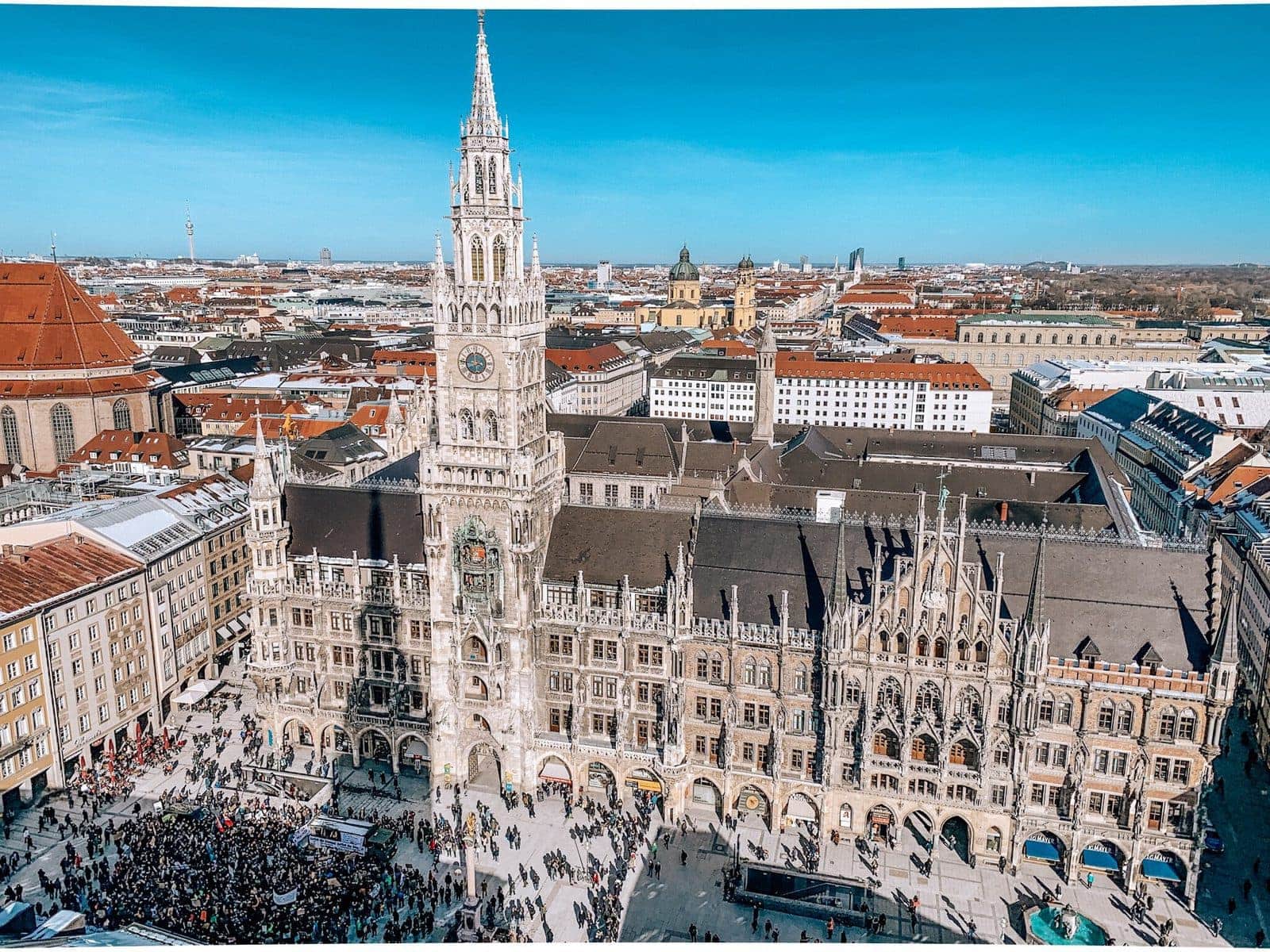
Don’t miss these at Marienplatz:
Peterskirche (St. Peter’s Church)
The best way to start exploring any city is always from above. The viewing tower of Peterskirche at Marienplatz offers a panorama of Munich’s entire historic centre.
The climb is quite long — you need to ascend nearly 400 steps to reach the top. But it’s absolutely worth it, and on a clear day you can spot the Alps in the distance. It’s one of the best viewpoints in all of Munich and an alternative to the New Town Hall tower — and in our opinion, the better one.
The tower is open daily from 10:00 to 18:00.
- Adult admission is €3.
- Children aged 6-14 pay €1.50.
- A family ticket for 2 adults and up to 3 children is €6.
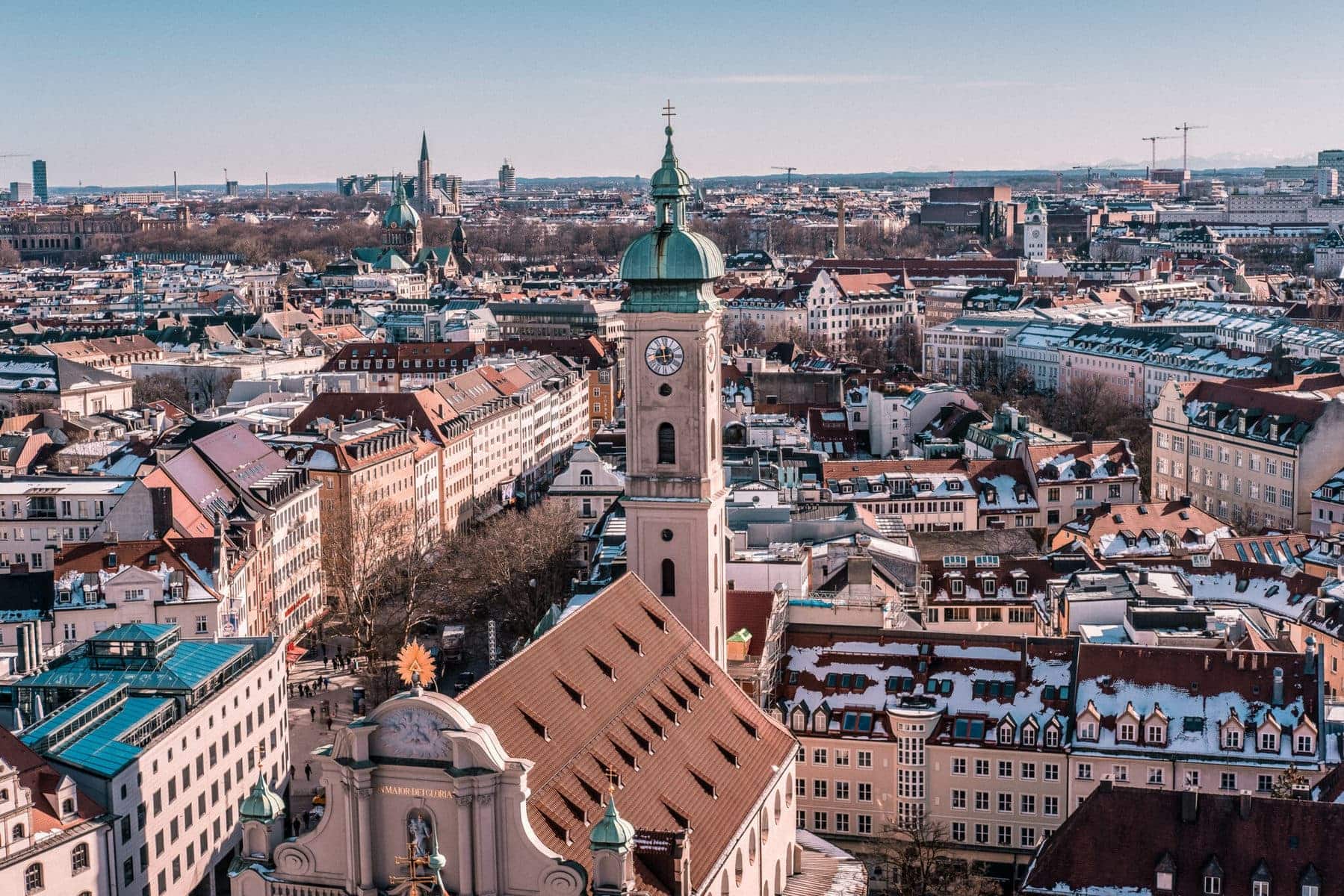
Neues Rathaus (New Town Hall)
The Neues Rathaus is the New Town Hall. It was built between 1867 and 1909 in a typical Neo-Gothic style. Visiting the town hall is free and offers several highlights:
- The famous Glockenspiel (more details below), located in the tower.
- Views from the observation platform at 50 metres height with panoramic views of the old town.
- Historic halls decorated with paintings and sculptures depicting the city’s history.
- A tourist information centre with maps and advice on the city’s landmarks.
Glockenspiel at Neues Rathaus
The Glockenspiel is a carillon (similar in concept to Prague’s Astronomical Clock) mounted on the New Town Hall building. It was built in 1908 and tells a story from the 16th century. The mechanism is truly elaborate, featuring 43 bells and 32 life-sized figures that enact a jousting tournament in which one of the knights falls from his horse.
The Glockenspiel plays every half hour at these times:
| Monday to Friday | 08:00 – 20:00 |
| Saturday and Sunday | 09:00 – 20:00 |
The specific melody changes with each performance. Usually, it’s a short folk song or dance tune.
Marian Column and Fountain
The Marian Column rising in the centre of Marienplatz is one of Munich’s symbols. It was erected in 1590 as a thanksgiving to the Virgin Mary for averting the plague.
Atop the tall marble column stands a gilded statue of the Virgin Mary wearing a stylised crown, with a crescent moon beneath her feet. Since 1638, it has been accompanied by statues of 12 apostles and 4 Church Fathers.
The column is surrounded by a fountain with water jets, which was added in 1885. In summer, it’s lovely to cool off by the fountain.
We visited Munich in winter, so unfortunately we don’t have a photo of the fountain in action. 😊
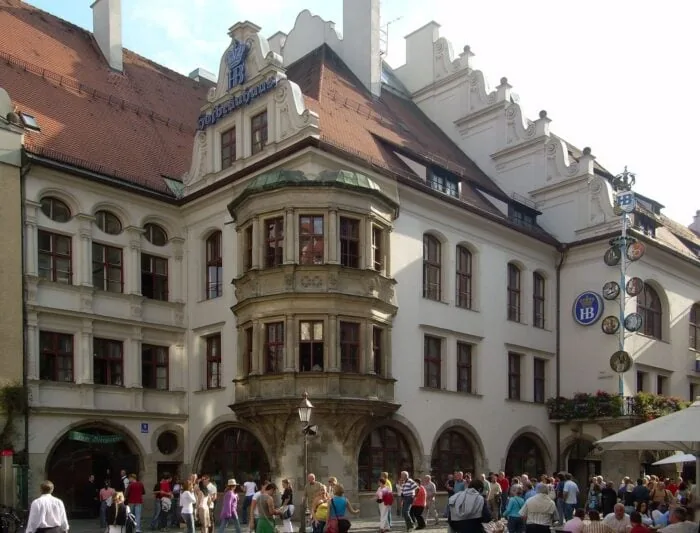
Hofbräuhaus Brewery and Beer Hall
Hofbräuhaus is the oldest brewery in Munich, with a history dating back to 1589. It’s located near Marienplatz, just beside the New Town Hall.
Today it primarily serves as a massive restaurant with traditional Bavarian cuisine. The highlight is beer from their own brewery, which you simply must try. 😊 See if you like it even more than a classic British pint!
The beer hall often features live music (from what we could tell, it was an oompah band) and the staff wear traditional clothing. In summer, there’s outdoor seating.
Odeonsplatz
Odeonsplatz is another historic square in the northern part of Munich’s historic centre. The key landmarks here include:
- Feldherrnhalle — a monumental loggia with two towers, built in 1841-1844.
- Theatinerkirche — a church dedicated to the Virgin Mary built between 1663 and 1785; its yellow facade is one of the square’s defining features.
- Residenz München — a royal palace and the largest urban palace in Germany. The former seat of Bavarian dukes houses magnificent art collections and lavishly decorated halls and chambers. If you only have time for one museum with historical interiors, this should be it.
Odeonsplatz is an ideal spot for an afternoon stroll as a break from exploring the busy centre. From the square, you can walk straight into Hofgarten, where you can relax among fountains and sculptures. 🙃
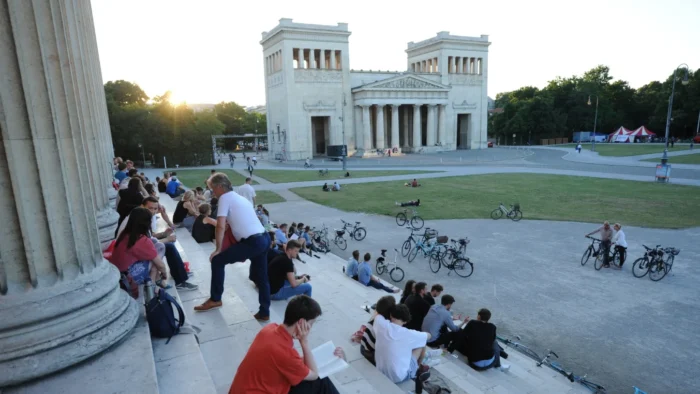
Königsplatz
Königsplatz is the second most famous square in central Munich. It’s not a typical square, but rather a large green space surrounded by three grand museum buildings.
The square features the famous Propylaea — a monumental gateway in Greek style. It forms the entrance to the museum complex. You’ll also find equestrian statues of Bavarian kings on the square.
Königsplatz is flanked by three major Munich museums — the Alte Pinakothek, the Neue Pinakothek, and the Glyptothek, where you can admire world-renowned art collections.
Karlsplatz (Stachus)
Karlsplatz is another square in central Munich that primarily serves as a transport hub. It has the eponymous U-Bahn and S-Bahn station, offering excellent connections across the city.
The square is dominated by a Marian column from 1873. In summer, concerts are held here. Below the square lies an extensive shopping centre with numerous shops.
Frauenkirche
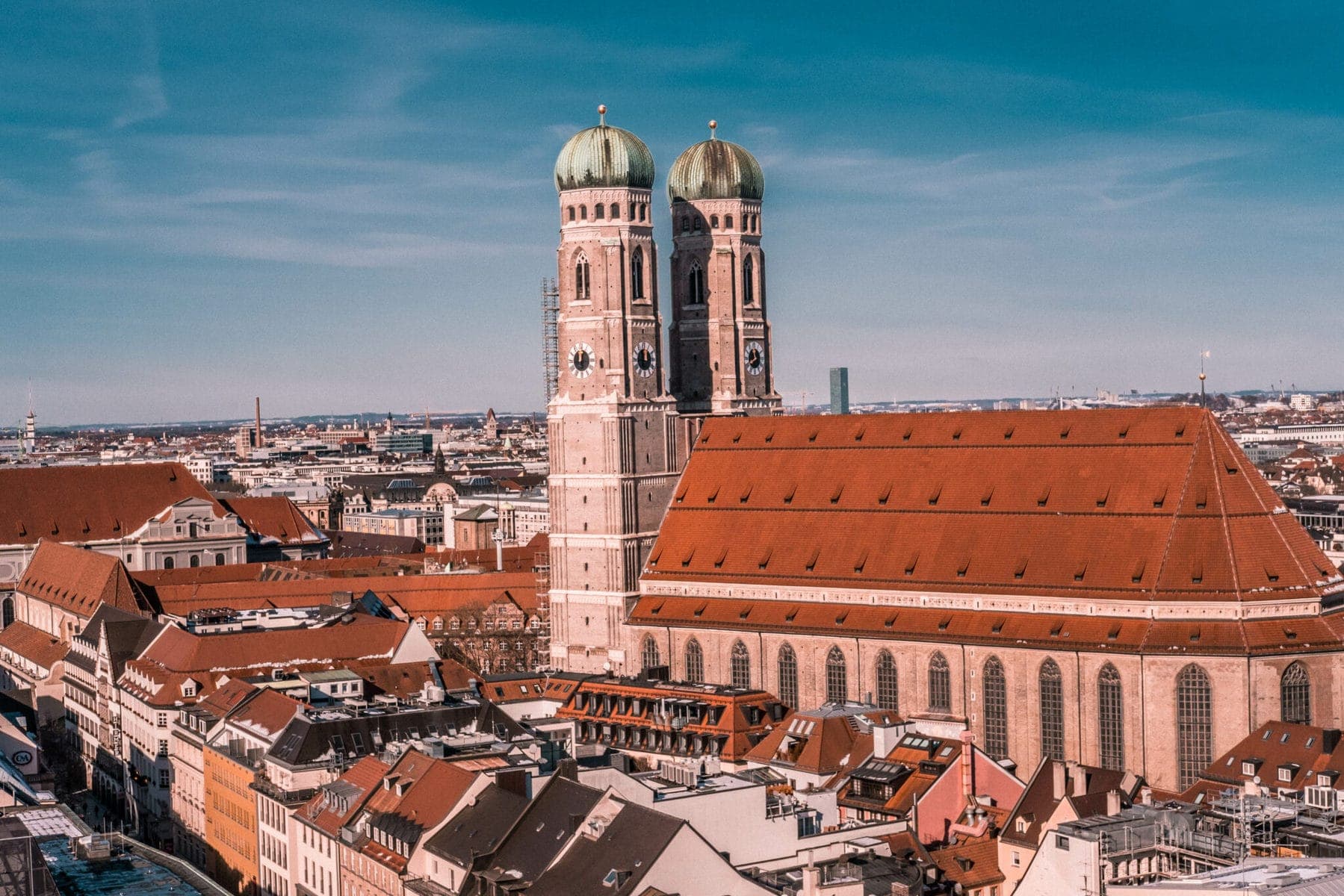
The Frauenkirche is another Munich icon, recognisable by its two identical onion-shaped towers. Built in the 15th century, it was sadly heavily damaged during World War II (it has since been restored). Just like Peterskirche, you can climb one of the Frauenkirche towers for panoramic views.
Asamkirche
This is a hidden gem that most tourists don’t know about. Asamkirche is a small baroque church on Sendlinger Straße, built by the Asam brothers in the 18th century originally as their private chapel. From the outside you could easily walk past it, but inside awaits one of the most stunning baroque interiors in all of Germany — gilded sculptures, frescoes, and lavish decoration from floor to ceiling. Entry is free and it takes no more than 15 minutes, but the impression lasts much longer.
Nymphenburg Palace
Nymphenburg is a baroque palace located to the west of the city centre, originally built as a summer residence for the Bavarian dukes. Over the years, it underwent several transformations to reach its present-day appearance.
When visiting the palace, don’t miss a tour of its magnificent gardens and interiors, where you can admire lavishly decorated halls and chambers. The gardens are vast and beautiful in every season — and best of all, they’re free.
The Maximilianeum
This historic building was constructed in 1857 and today serves as the seat of the Bavarian Parliament. The spot where the Maximilianeum stands offers a lovely view of the city.
Victory Gate (Siegestor)
The Victory Gate (also known as Siegestor) was built to honour the Bavarian army and is one of the most significant monuments in Munich. It’s reminiscent of Paris’s Arc de Triomphe and sits at the end of the Ludwigstraße boulevard. After being damaged in World War II, it was deliberately only partially restored — as a reminder of peace.
Museums and Galleries
Interested in history, technology, or art? Then you’ll love Munich. Munich is the third-largest city in Germany and home to over 80 museums. But which ones should you visit? Here are our top picks.
- BMW Museum – an absolute must-see!
- Deutsches Museum – Munich’s most famous museum, which prides itself on being the world’s largest science and technology museum
- Glyptothek – the only museum dedicated exclusively to ancient sculpture
- Museum Brandhorst – a modern art museum that only opened in 2009, featuring works by Hirst, Warhol, and Basquiat
- Kartoffel Museum – a potato museum — and we thought Canadians were quirky when we saw one in Nova Scotia
- Pinakothek – in the 19th century, this was the largest art museum in Europe
BMW Museum
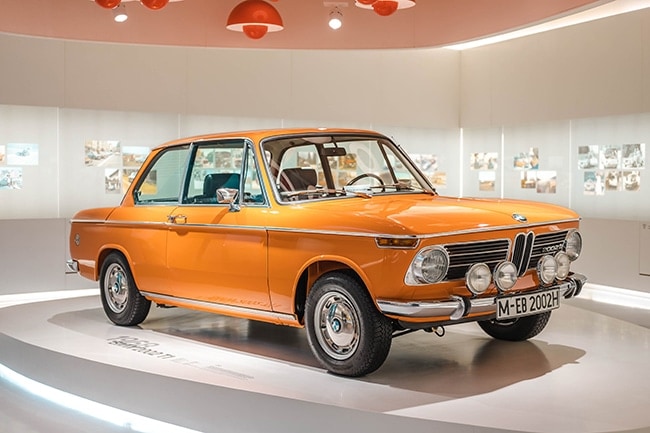
Even if you’re not a huge fan of cars or BMW, we can promise the BMW Museum will still be a highlight. In our opinion, it’s the best attraction in all of Munich.
The museum takes you through the entire story of the brand — you’ll see the most beautiful, elegant, and luxurious models, explore how BMW approaches design, and learn what goes into building a Formula racing car. Plus, you can download an excellent audio guide app to your phone that walks you through the entire museum.
| Admission | Adults: €10, Reduced: €6 |
| Family ticket | Family ticket (2 adults + 3 children): €16 |
| Opening hours | Tue-Sun: 10:00-18:00 (closed Mondays) |
| Address | Am Olympiapark 1, 80809 Munich, Olympic Park |
| Exhibition | 150 BMW vehicles incl. prototypes and concepts, history, production, motorsport |
| Visit duration | 2-3 hours depending on pace |
Deutsches Museum
Deutsches Museum is the world’s largest science and technology museum, with over 50 exhibitions covering a wide range of sciences and technologies. Visitors can look forward to exploring a life-size replica of a coal mine or examining the first steam engine. This museum is ideal for families with children and all tech enthusiasts alike.
| Address | Museumsinsel 1, 80538 Munich |
| Opening hours | Tue-Sun: 9-17, Wednesday until 20:00. Closed on the first Monday of each month. |
| Admission | Adults: €12, Reduced: €8 |
| Exhibition | Over 50,000 exhibits of technology, science, and research from the 15th-21st century |
| Visit duration | Min. 3 hours, a full day recommended |
| Events | Workshops, lectures, family programmes |
| Note | One of the world’s largest science and technology museums |
Glyptothek Museum
The Glyptothek is one of Munich’s major art museums, housing a rich collection of Greek and Roman sculpture.
The exhibition includes over 400 sculptures from the 6th century BC to the 4th century AD, with highlights including the Laocoon group and the Barberini Faun. The sculptures come from Greek islands as well as mainland Greece and were discovered during excavations in Rome.
Admission to the Glyptothek is €6, reduced admission €4. Open Tuesday to Sunday from 10:00 to 18:00, closed on Mondays. On Sundays, admission is just €1!
Museum Brandhorst
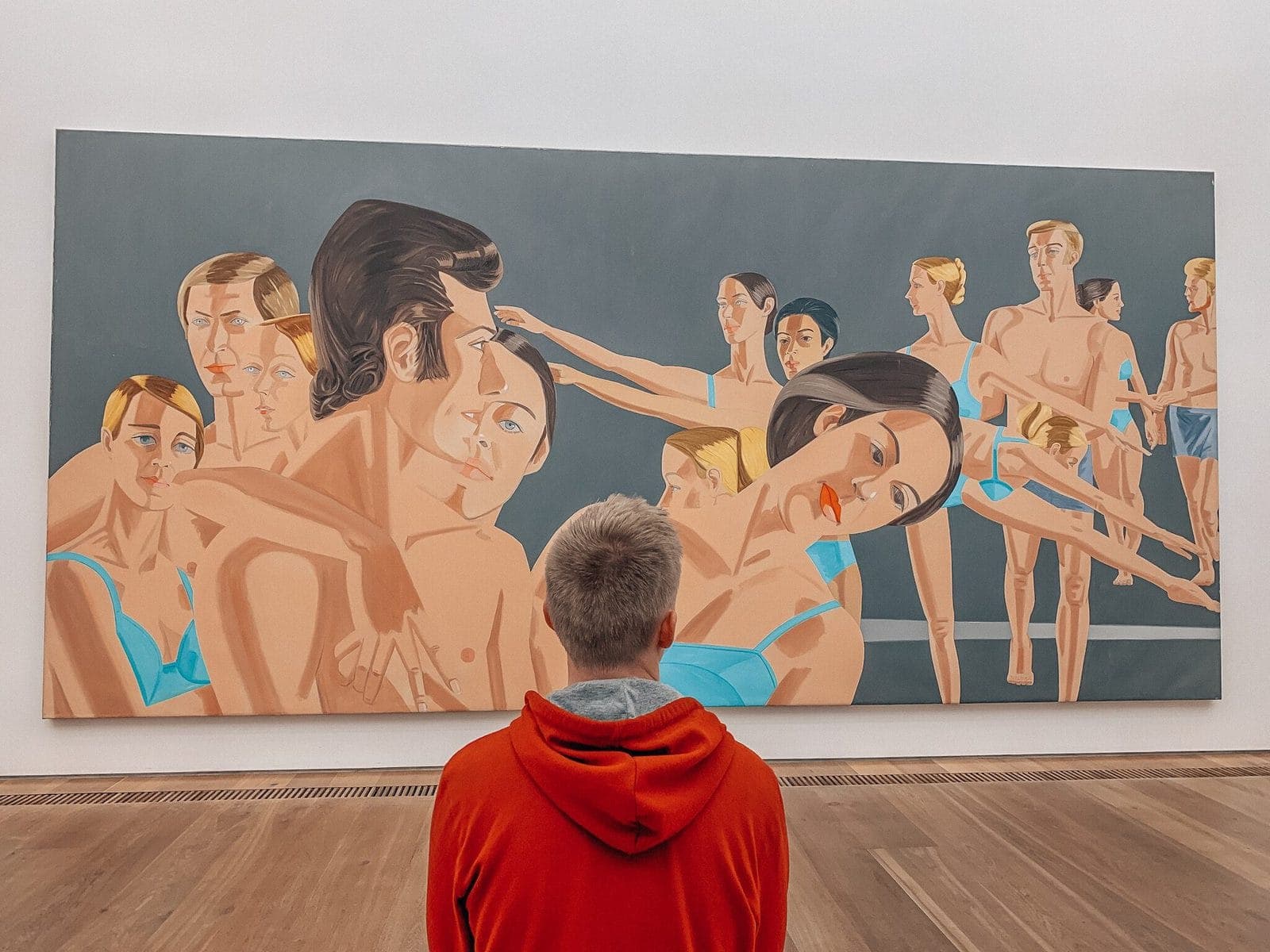
This museum is a true paradise for lovers of modern art. You’ll easily spend at least half a day here, as viewing 1,200 works by some of the most important artists of the 20th and 21st centuries takes time.
| Address | Tiergartenstraße 1, 80538 Munich |
| Opening hours | Tue-Sun: 10-18, Thu 10-20 |
| Admission | Full: €7, Reduced: €3.50 |
| Exhibition | Modern and contemporary art, painting, sculpture, photography |
| Visit duration | About 2 hours |
Kartoffel Museum
The Kartoffelmuseum in Munich is one of the few museums in the world dedicated to potatoes.
At the museum, you’ll learn everything about the history of potato cultivation and use around the world, as well as their cultural significance in different countries. Another section of the museum is devoted to potato varieties, their biological properties, and their use in cooking. You can even see potatoes shaped like animals and people.
| Address | Grafinger Str. 2, 81671 Munich |
| Opening hours | Fri: 9-18, Sat: 11-17 |
| Admission | Free entry |
| Exhibition | History and culture of potatoes in the world and Germany |
| Visit duration | About 1 hour |
| Note | One of the few museums dedicated to potatoes |
Alte Pinakothek
The Alte Pinakothek is a significant museum because it houses several truly famous paintings, such as The Night Watch by Rembrandt. The museum is one of the most renowned in the world for old European art.
If you’re interested in classical paintings, definitely pay a visit. On Sundays, admission is just €1.
| Address | Barer Straße 27, 80333 Munich |
| Opening hours | Tue-Sat 10:00-18:00, Thu 10:00-20:00 |
| Admission | Full €11, Reduced €7 (Sundays €1) |
| Exhibition | European painting from the 14th-18th century |
If you still can’t get enough of museums, here are a few more tips:
Bavarian National Museum
With more than 1.3 million objects, the Bavarian National Museum is the largest cultural institution in Bavaria. The collection spans from medieval tapestries to modern art.
Beer & Oktoberfest Museum
The Beer & Oktoberfest Museum in Munich is the ideal spot for lovers of beer and history. 🙃 You’ll learn about the festival’s history, but the most interesting part is undoubtedly the tasting of the best Bavarian beers.
Pinakothek der Moderne
The Pinakothek der Moderne houses extensive collections of architecture, design, graphics, and photography. It focuses almost exclusively on modern art. Again, on Sundays admission is just €1.
Parks and Nature in the City
Go Surfing in Munich
The Eisbach surf wave is a symbol of Munich, located at the edge of the Englischer Garten. Be warned, the water is very cold even in the warmest months — in summer you can expect just 17°C. If the cold doesn’t bother you, you can surf even in winter as it almost never freezes. Just make sure you don’t freeze yourself!
English Garden (Englischer Garten)
The English Garden is one of the largest urban parks in the world — it’s even bigger than New York’s Central Park. It’s the ideal spot for walks, picnics, and relaxing in nature. Inside the park you’ll find the aforementioned surf wave, a Chinese pagoda with a beer garden, and Kleinhesseloher See lake. In summer, locals kick off their shoes, spread out their blankets, and spend entire afternoons here — and honestly, it’s probably the best Munich experience, and it’s completely free.
Hofgarten
Hofgarten is a historic park just a short walk from the English Garden, designed in the Italian Renaissance style. Its centrepiece is a fountain with a Neptune statue. Hofgarten also features the Temple of Diana, a pond, and numerous sculptures. Cultural events are held here in summer.
Olympic Park
The 1972 Olympic Games were held in Munich, and the resulting Olympic Park still hosts cultural and sporting events today. The park is right next to the BMW Museum, so you can easily combine both visits.
Allianz Arena
The Allianz Arena is a modern football stadium, home to the famous German football club FC Bayern Munich. If you’re a football fan, stadium tours including the FC Bayern Museum are available.
Hellabrunn Zoo
If you’re travelling with children, Munich’s Hellabrunn Zoo is a fantastic choice. It’s among the best zoos in Europe and is designed as a geo-zoo — animals are grouped by the continent they originate from. The zoo sits on the banks of the River Isar and a visit takes at least 3-4 hours. Adult admission is around €21, children aged 4-14 pay €9.
Bavarian Cuisine — What to Try and Where to Eat
Munich is a paradise for food lovers. Forget currywurst — here, Bavarian classics reign supreme. And honestly? After a few days in Munich, we had to loosen our belts a notch. 😅
What You Must Try
- Weißwurst (white sausage) — a traditional Munich breakfast. Eaten exclusively in the morning, no later than noon, with sweet mustard and a pretzel. Don’t slice it — you don’t eat the skin; you “suck” it out or cut it lengthwise.
- Schweinshaxe — crispy roast pork knuckle. The portions are enormous — feel free to share between two people.
- Obatzda — a spicy cheese spread with onions, served with a Brezn (pretzel). The perfect snack in a beer garden.
- Brezn (pretzel) — the Bavarian pretzel is in a league of its own. Soft inside, crispy outside, sprinkled with coarse salt.
- Kaiserschmarrn — sweet shredded pancake with plum compote. The best in Munich is served at Wirtshaus in der Au.
- Leberknödelsuppe — liver dumpling soup, a classic Bavarian starter.
Where to Eat — Our Tips
- Hofbräuhaus — a tourist classic, but the atmosphere is worth it. Huge portions, live music, one-litre steins.
- Augustiner-Keller — locals prefer this over Hofbräuhaus. Excellent beer straight from wooden barrels (Holzfass), more relaxed atmosphere.
- Wirtshaus in der Au — famous for the best Kaiserschmarrn in the city. Book ahead.
- Schneider Bräuhaus — home of Schneider Weisse wheat beer. Superb Schweinshaxe.
- Viktualienmarkt — not a restaurant but a market where you can assemble your own lunch. Cheeses, sausages, fruit, pastries — cheaper and more authentic than restaurants in the centre.
And one more bonus tip: we stumbled upon a little gem near the Eisbach completely by chance. A small Asian restaurant called Halong Bay truly surprised us — although it doesn’t look particularly impressive inside, we hadn’t had Pad Thai that good even during our entire month in Thailand. Lukáš declared they have the best Pho in Europe, and we were so impressed we ordered sushi too. Again, phenomenal. Plus, the prices were low for Munich.
Beer Gardens (Biergärten) — Where to Drink Like a Local
Beer gardens are as much a part of Munich as Marienplatz. They’re open from April to October, and there’s an unwritten rule — you can bring your own food, but you buy your beer on-site. How brilliant is that? 😁
- Hirschgarten — 8,000 seats, the world’s largest beer garden. Tucked away in a park behind Nymphenburg Palace, so you can combine it with a visit to the palace.
- Augustiner-Keller — 5,000 seats beneath chestnut trees. Beer is tapped directly from wooden barrels (Holzfass), which is a rarity even among Munich beer gardens.
- Chinesischer Turm — right in the English Garden by the Chinese pagoda. The most photogenic beer garden in the city.
- Seehaus — by Kleinhesseloher See lake in the English Garden. More romantic atmosphere, great for an early evening.
- Viktualienmarkt Biergarten — a small beer garden right at the market in the centre. Ideal for a quick beer between sightseeing.
Tip: A Maß (one litre of beer) costs around €12-14 in beer gardens. If you want to save a bit, order a Halbe (half litre) for €6-7.
Oktoberfest — A Practical Guide
The world’s largest beer festival takes place annually from mid-September to the first October weekend at the Theresienwiese fairground (U-Bahn station Theresienwiese). Entry to the festival is free — you pay for beer and food.
Key Information
| When | Approx. 16 days, from the third Saturday in September to the first Sunday in October |
| Entry | Free (you pay for beer and food) |
| Maß of beer (1 litre) | Around €15-16 (prices increase each year) |
| Attendance | Over 6 million people annually |
| Where | Theresienwiese (U-Bahn: Theresienwiese) |
Tips for Enjoying Oktoberfest
- Come on a weekday morning — on weekends and evenings, the tents are packed and you’ll only get in with a reservation.
- Tent reservations — if you want a guaranteed seat, book 6-9 months in advance directly on the website of your chosen tent (Augustiner, Hofbräu, Paulaner…).
- Smaller tents — Augustiner-Festhalle and Fischer-Vroni have a calmer atmosphere than the massive Hofbräu-Festzelt.
- Accommodation — during Oktoberfest, hotel prices are 2-3x higher. Book as early as possible, or consider staying in towns along the S-Bahn line (Dachau, Freising).
Off Season
If you can’t make it to Oktoberfest, try Starkbierfest (March) — a local alternative with even stronger beer, without the tourist crowds. Or Frühlingsfest (April-May) — a smaller spring version of Oktoberfest at the same venue. We haven’t been to Oktoberfest ourselves yet, but it’s definitely on our list for next time.
Shopping and Markets
We’re not big shoppers, so we can’t recommend too many places, but a few stuck with us.
Viktualienmarkt
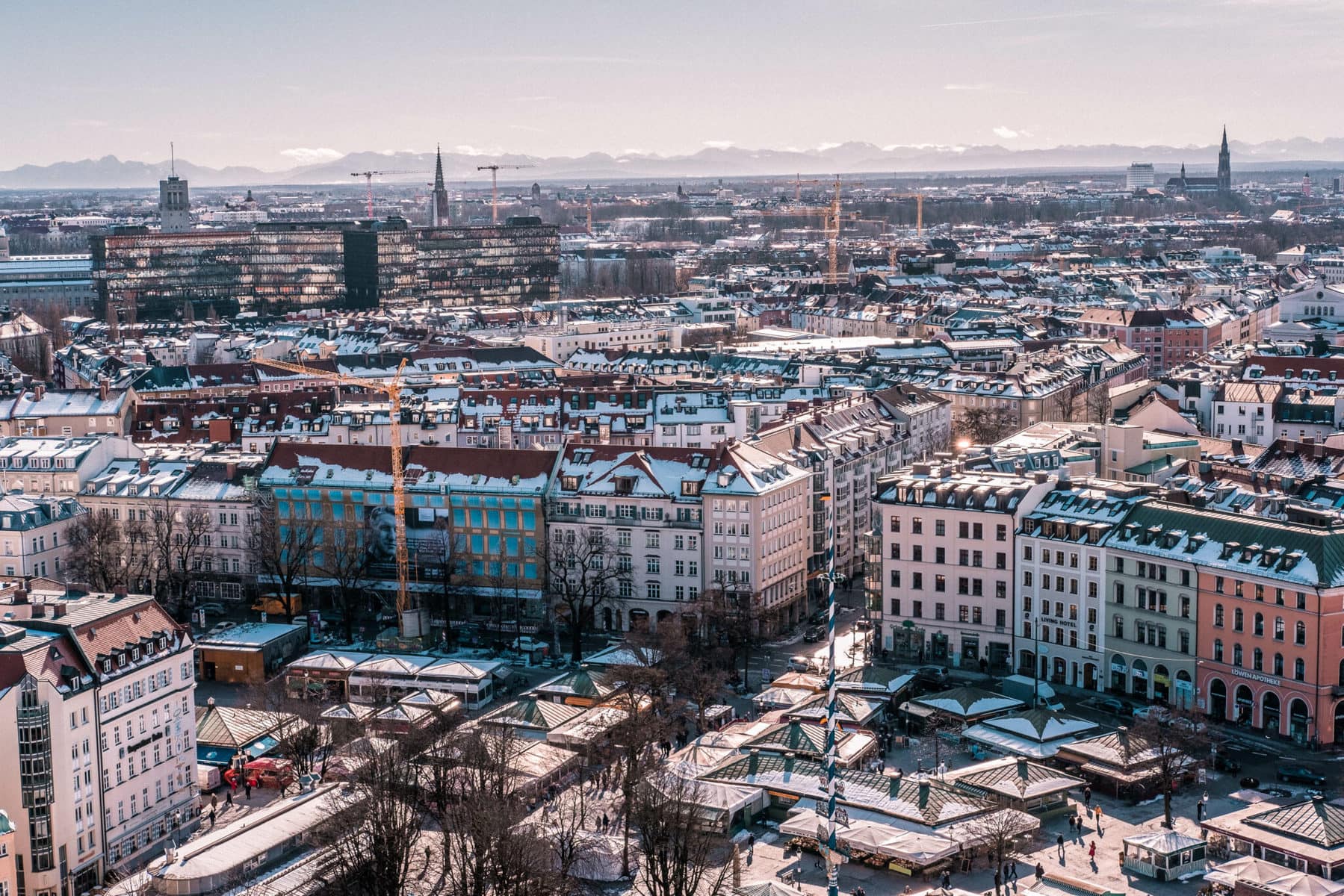
If you want to taste some local delicacies, head to Viktualienmarkt, where you’ll find just about everything. From fresh vegetables and spices to local Bavarian specialities.
Kaufingerstraße and Neuhauser Straße
Munich’s main shopping zone — a pedestrian street connecting Marienplatz and Karlsplatz (Stachus). You’ll find big-name brands, souvenir shops, and plenty of cafés for resting between purchases.
Dallmayr
A legendary Munich delicatessen that’s been operating since 1700. Even if you don’t buy anything, it’s worth a visit just to look around — you’ll find exotic fruit, chocolate, cheeses, and teas from around the world. Their coffee is famous throughout Germany.
Christmas Markets
If you visit Munich in December, the Christmas markets are an absolute must. The main Christkindlmarkt on Marienplatz is huge and beautifully illuminated. For something more unusual, try the Mittelaltermarkt (medieval market) — there you’ll get mulled wine in a clay cup and feel like you’ve stepped back in time. 😊
Day Trips from Munich
Munich is an excellent base for day trips into the Bavarian Alps and surrounding cities. All of them can be done in a day, and most are possible without a car thanks to the Bayern Ticket.
Neuschwanstein Castle
The fairy-tale castle of King Ludwig II is Germany’s most photographed landmark. Take the train to Füssen (2 hours), then a bus to the castle. Buy tickets online in advance — they’re often sold out on the day. Admission is around €15 and the tour lasts about 35 minutes. The journey is longer, but the view of the castle set against the Alpine scenery is worth every minute.
Zugspitze
Germany’s highest mountain (2,962 m). Take the train to Garmisch-Partenkirchen (1.5 hours), then a cog railway and cable car to the summit. Views across 4 countries — Germany, Austria, Italy, and Switzerland. Return ticket around €40-60. If you love mountains, this is an unforgettable experience.
Salzburg (Austria)
Mozart’s city is just 1.5 hours by train from Munich. The old town is a UNESCO World Heritage Site and Hohensalzburg is one of the largest fortresses in Europe. With a Bayern Ticket, you can get to Salzburg for the price of a regional ticket — yes, the Bayern Ticket is valid all the way to Salzburg!
Königssee Lake
An emerald-green lake surrounded by steep cliffs. Take the train to Berchtesgaden (2.5 hours), then a bus to the lake. The boat trip to the baroque chapel of St. Bartholomew is an unforgettable experience. The water is so clean you can drink it straight from the lake — at least that’s what the guide on the boat told us. 😊
Dachau Concentration Camp
The memorial of the first Nazi concentration camp. Take the S-Bahn from Munich in just 25 minutes (line S2 to Dachau, then bus 726). Entry is free, audio guide €4.50. Allow at least 3 hours. It’s not an easy visit, but it’s an important one.
Getting to Munich and Transport in the City
How to Get to Munich
By plane: Munich Airport (MUC) is one of Europe’s major hubs with direct flights from London, Manchester, Edinburgh, and other UK cities. Airlines like Lufthansa, British Airways, and easyJet operate regular routes. The airport is well connected to the city centre by S-Bahn (lines S1 and S8, about 40 minutes).
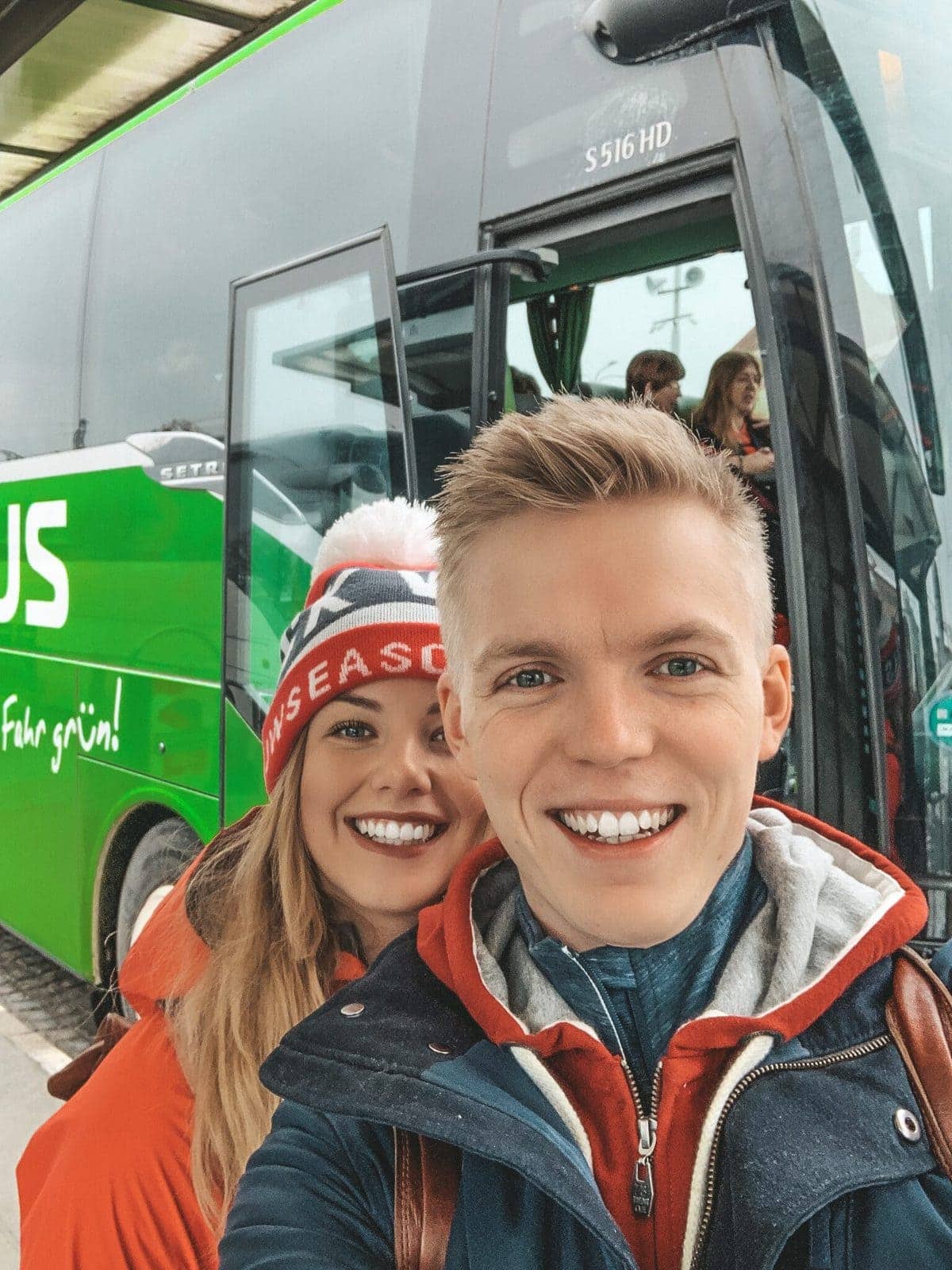
By bus: You can reach Munich by Flixbus from various European cities. Flixbus uses dynamic pricing similar to airlines, so it pays to book as early as possible. The more seats are taken, the more expensive the ticket. Buses are comfortable and offer Wi-Fi.
By train: Munich’s Hauptbahnhof is well connected to the European rail network. From London, you can travel via the Eurostar to Brussels or Paris and then onward by high-speed rail. Deutsche Bahn (DB) offers good connections from cities across Germany and neighbouring countries. Book early via the DB website for the best fares.
Public Transport in Munich
Munich’s public transport network (MVV) is excellent — the metro (U-Bahn), suburban trains (S-Bahn), trams, and buses cover the entire city. A day ticket costs around €9.20 and is worth it practically every time if you plan to make more than two journeys.
Tip: Download the DB Navigator app — you can buy all tickets (local transport and regional trains) through it and avoid fiddling with ticket machines at the station.
Bayern Ticket
The Bayern Ticket is a traveller’s best friend in Bavaria. It’s valid all day on regional trains (RE, RB, S-Bahn) and local public transport throughout Bavaria — including Munich. Price: €29 for 1 person, each additional person +€10 (max 5 people). The more people, the cheaper per person. Buy online via DB Navigator — there’s a surcharge on the train.
Note: The Bayern Ticket is only valid from 9:00 on weekdays (no restriction on weekends) and only on regional trains, not express services (ICE, IC, EC).
CityTourCard München
If you plan to visit several paid attractions, the CityTourCard München may be worthwhile. It includes public transport + 10-50% discounts on attractions (museums, tours, zoo). From €15.90 for 1 day, from €29.90 for 3 days. It pays off if you plan to visit 2+ paid attractions per day.
How Much Does Munich Cost — Budget and Saving Tips
Munich is one of the most expensive cities in Germany, but with a bit of planning it can be managed sensibly. We won’t sugarcoat it — it’s not cheap. But when you know where to save, it’s doable.
Approximate Daily Budget (1 Person)
| Item | Budget | Mid-range |
| Accommodation | €40-60 (hostel) | €100-150 (hotel) |
| Food | €20-30 | €40-60 |
| Public transport | €9.20 (day ticket) | €9.20 |
| Admissions | €10-15 | €20-30 |
| Total | €80-115 | €170-250 |
How to Save Money
- CityTourCard München — includes public transport + 10-50% discounts on attractions. From €15.90 for 1 day, from €29.90 for 3 days.
- Bayern Ticket — for trips outside Munich. The more people, the cheaper per person.
- Sunday at the museum — several Munich museums (Pinakotheken, Glyptothek) offer admission for just €1 on Sundays. This is an absolute bargain.
- Viktualienmarkt for lunch — cheaper and more authentic than restaurants in the centre.
- Tap water — Munich’s tap water is excellent, so bring your own bottle.
- English Garden — Munich’s best experience is completely free.
Where to Stay in Munich — Stylish and Affordable
There’s so much to see in Munich that one day simply won’t be enough. We spent two nights (just under three days) in Munich and it was just right. Here’s our personal accommodation recommendation that we were more than happy with.
Our top pick: Motel One München – Deutsches Museum
Motel One, a ten-minute walk from Munich’s centre, had everything we love about hotels. Gorgeous design, a workspace, and a king’s breakfast in organic quality. Plus, we got a room on the ninth floor with a morning view of all of Munich with the mountains in the background! The trade-off for the pleasant price is smaller rooms, but they’re so cleverly designed that there was nothing to complain about.
Besides the hotel near the Deutsches Museum, Motel One has seven other branches across the city. If you want to be right in the heart of the centre, choose Motel One München Sendlinger Tor. The hotels are identical in price and services, differing only in their design style.
Prefer to browse more options? Check out hotels in Munich on Booking.com to find the best deal for your dates.
Unexpected things can happen while travelling, so we recommend not forgetting about travel insurance. We’ve had great experiences with long-term insurance from SafetyWing, which can be easily arranged online and is paid monthly.
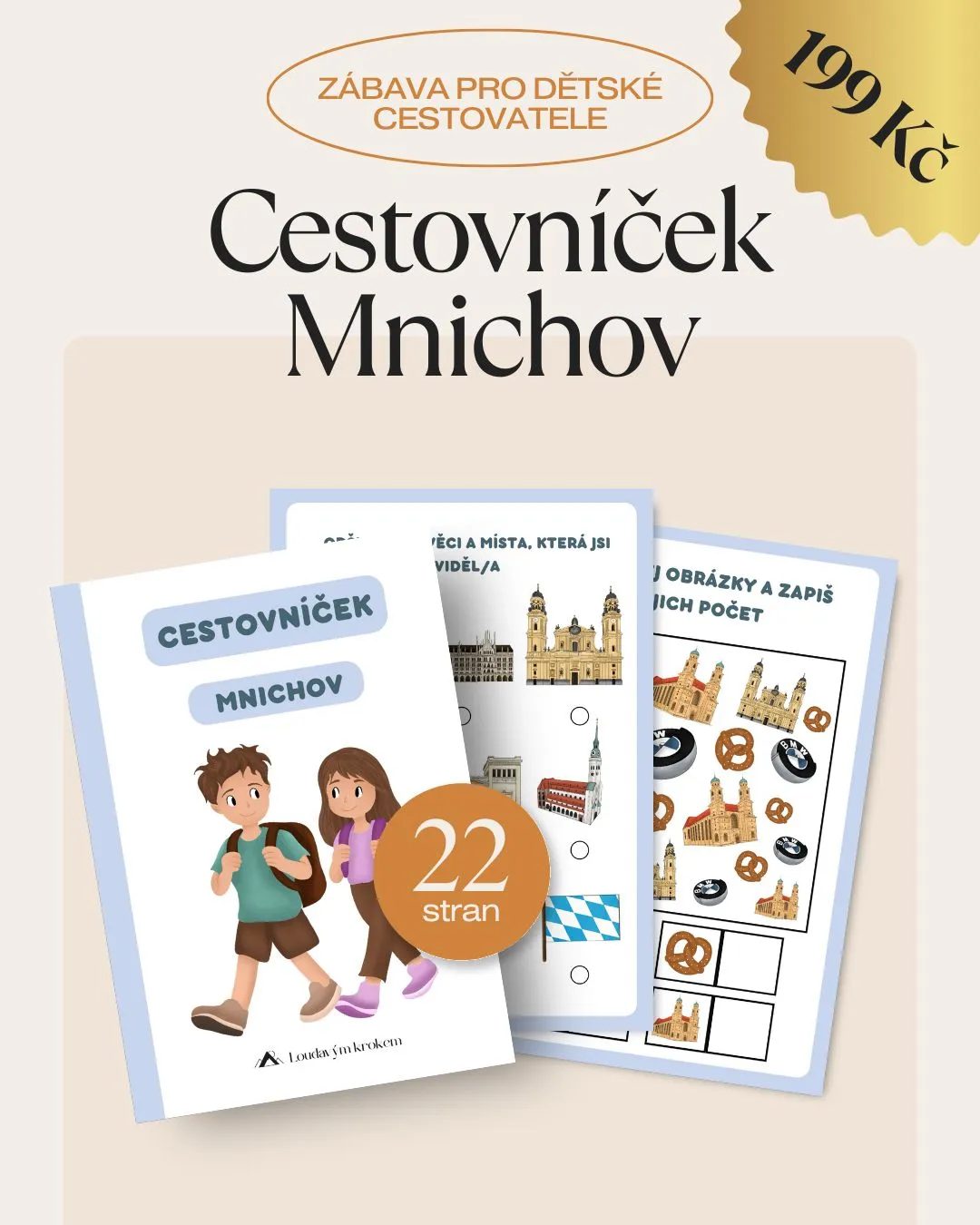
Travelling with kids? Check out our Munich Travel Journal for Kids — a children’s travel diary that turns a visit to the Bavarian capital into an adventurous expedition for young explorers aged 5 to 12.
Munich Map with All Places
Download our interactive Google Maps map with all the places mentioned in this article. Have everything at your fingertips right on your phone — no searching required.
Frequently Asked Questions About Munich
How many days do I need for Munich?
Two days are enough for the city centre and main landmarks. If you want to add a day trip (Neuschwanstein, Zugspitze), count on 3 days. For Munich with its surroundings, 4-5 days is ideal.
How do I get to Munich?
From the UK, the easiest way is to fly — direct flights from London, Manchester, and other cities take around 2 hours. Budget airlines like easyJet and Ryanair often offer great deals. You can also travel by train via Brussels or Paris, or by Flixbus from various European cities.
When is the best time to visit Munich?
May to October — warm weather, beer gardens are open, Oktoberfest in September/October. December is great for Christmas markets. Summer (July-August) can be hot and crowded.
Is Munich expensive?
Yes, it’s one of the most expensive cities in Germany. But with planning, it’s manageable even on a smaller budget — museums on Sundays for €1, lunch at Viktualienmarkt instead of a restaurant, excellent tap water. A rough daily budget ranges from €80-250 depending on your travel style.
Can you get around Munich without a car?
Absolutely. Public transport (U-Bahn, S-Bahn, trams, buses) is excellent and covers the entire city. For trips outside Munich, use the Bayern Ticket for regional trains — it’s valid all day across Bavaria for €29 (1 person).
Is Munich good for families with children?
Very much so. Deutsches Museum has interactive exhibits for kids, Hellabrunn Zoo is one of the best in Europe, Olympic Park offers plenty of activities, and the English Garden is ideal for picnics and play.
Tips and Tricks for Your Vacation
Don’t Overpay for Flights
Search for flights on Kayak. It’s our favorite search engine because it scans the websites of all airlines and always finds the cheapest connection.
Book Your Accommodation Smartly
The best experiences we’ve had when looking for accommodation (from Alaska to Morocco) are with Booking.com, where hotels, apartments, and entire houses are usually the cheapest and most widely available.
Don’t Forget Travel Insurance
Good travel insurance will protect you against illness, accidents, theft, or flight cancellations. We’ve had a few hospital visits abroad, so we know how important it is to have proper insurance arranged.
Where we insure ourselves: SafetyWing (best for everyone) and TrueTraveller (for extra-long trips).
Why don’t we recommend any Czech insurance company? Because they have too many restrictions. They set limits on the number of days abroad, travel insurance via a credit card often requires you to pay medical expenses only with that card, and they frequently limit the number of returns to the Czech Republic.
Find the Best Experiences
Get Your Guide is a huge online marketplace where you can book guided walks, trips, skip-the-line tickets, tours, and much more. We always find some extra fun there!


