

Long lift queues, overcrowded slopes, and sky-high prices putting you off planning a ski holiday? We have a solution that might just have you grabbing your ski poles with both hands. Poland has dramatically modernised its ski resorts in recent years, making Poland skiing an exciting alternative not only to smaller Central European hills but also to the expensive Alps. And the best part? It’s likely just a short flight or drive away from wherever you are in Europe.
TL;DR
- Polish ski resorts are easily accessible – with direct flights to Kraków from many European cities and excellent road connections, getting to the slopes is a breeze.
- Ski pass prices range from around €17–€30 per day, which is significantly cheaper than the Alps and comparable to many Central European resorts.
- The slopes are generally steeper than in Czechia, which is great news for sporty skiers looking for an adrenaline rush.
- Significantly fewer crowds on the slopes means shorter lift queues and more space for safe skiing.
- Modern infrastructure including gondola lifts, artificial snowmaking, and wellness centres guarantees Western European-level comfort.
TIP: Not into skiing? Try surfing in Europe instead.
Why go skiing in Poland?
Polish mountains have long remained under the radar for most international skiers, who traditionally headed straight to the Alps or other well-known destinations. But the situation is changing rapidly. Poland has invested billions in modernising its skiing resorts, and the results speak for themselves. Today, it’s no longer just a budget alternative – it’s a fully-fledged destination with modern infrastructure, quality services, and excellent resort management. Plus, with the added bonus of being incredibly affordable.
Affordable prices that save time and money
The biggest Polish ski resorts are surprisingly accessible. For example, Kraków – the main gateway to Polish ski areas – is served by direct flights from London, Manchester, Edinburgh, Dublin, Berlin, and many other European cities. From Kraków, the famous Zakopane resort is just a two-hour drive. Many resorts also offer skibus services from major cities, making car-free ski holidays perfectly feasible.
Prices that won’t break the bank
While famous Alpine resorts often charge over €50 for a day pass, skiing in Poland prices range from just €17 to €30. You can save even more by purchasing ski passes online in advance, where dynamic pricing can bring costs down further. Accommodation and food are also significantly more affordable than in the Alps, making Poland skiing holidays excellent value for money.
Snow that lasts into spring
The Polish side of the mountains often benefits from a unique microclimate. Take Szrenica in Szklarska Poręba on the northern side of the Karkonosze (Giant Mountains), for example. Thanks to its specific position and cooler microclimate, natural snow holds here well into March and April, long after lower-lying resorts have closed for the season. And if natural snow isn’t enough, most Polish resorts have state-of-the-art snowmaking systems.
When to go skiing in Poland: The ski season in Polish mountains
The ski season in Poland traditionally starts in December and runs until March, with some higher-altitude areas like the Tatras or Szrenica extending into April. The most reliable snow conditions are from January to early March, when most resorts are in full operation.
Want to avoid the crowds? The busiest periods on Polish slopes are during the Christmas holidays and the February half-term break. If you can choose a different time, weekdays and weekends outside school holidays are ideal for skiing in peace. The best tactic is to hit the slopes first thing in the morning when they open and the lift queues are non-existent.
You might also like: 12 tips for places to visit in Poland
Where to stay
Polish mountain resorts have undergone significant modernisation in recent years, and today you’ll find accommodation for every budget and taste. From family-run guesthouses for just a few euros per night to luxurious five-star hotels with wellness centres, water parks, and top-notch gastronomy. You can easily find and book great deals on Booking.com.
Accommodation for families with children
Families with children will appreciate hotels with extensive water parks and entertainment programmes. In Karpacz, you’ll find Hotel Gołębiewski with a huge water park and an outdoor toboggan run, where kids can enjoy themselves long after the skiing is done. In the Wisła area, you’ll find a resort with the largest hotel wellness centre in Poland, as well as hotels with their own ski slopes right at the doorstep.
For wellness and relaxation lovers
After a demanding day on the slopes, you’ll appreciate the chance to relax in a quality wellness centre. Polish hotels often offer more in this regard than some Alpine resorts – for example, the Lake Hill Hotel. You’ll commonly find not just saunas and hot tubs, but also thermal pools, massage parlours, and beauty centres. In Świeradów-Zdrój, for instance, some operators combine a long spa tradition with a modern ski resort – perfect for an active winter holiday.
Tips for saving money
If you want to save on accommodation, it pays to book in advance and look out for early-bird offers, where you can get discounts of up to thirty percent. Another option is private accommodation or apartments, which are significantly cheaper than hotels and allow you to cook your own meals. Many apartments also provide access to the wellness centre of a neighbouring hotel, so you won’t miss out on anything.
5 best Poland skiing resorts
Wondering where to go for your Poland skiing holiday? Here are our top 5 best Polish ski resorts.
TIP: Best wellness hotels in Poland
1) Szczyrk Mountain Resort – Silesian Beskids
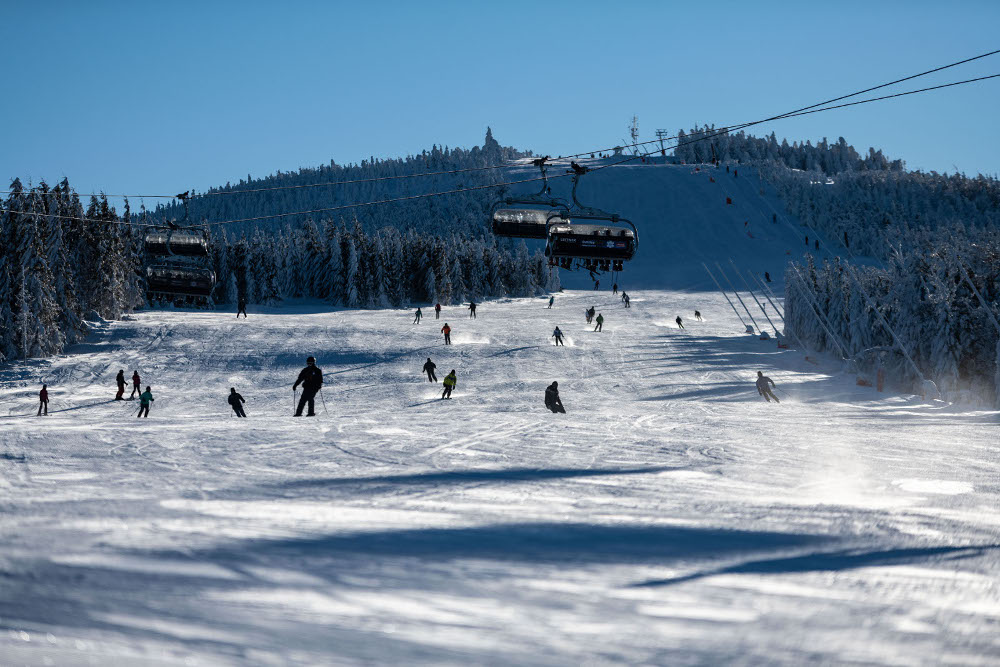
The largest and most modern ski resort in the Polish Beskids offers an impressive 36 kilometres of slopes across all difficulty levels. This Szczyrk Poland ski resort has undergone extensive modernisation under Slovak ownership, which is reflected in the quality of services and infrastructure. You’ll find a ten-person gondola lift, modern chairlifts, and various types of drag lifts.
For families with children, there’s the Maxiland Arena zone covering five thousand square metres, where little skiers are looked after by the friendly mascot Max the Teddy. More experienced skiers will appreciate two black runs, including an FIS-certified slope with a gradient exceeding thirty percent. The cherry on top is that most slopes are floodlit, so you can ski in the evening too.
The resort is around two hours’ drive from Kraków. A day ski pass can be purchased online from as little as 88 PLN (around €21) when bought in advance, with standard prices ranging from 147 to 183 PLN (€35–€43) depending on the date and season.
2) Zieleniec in the Orlické Mountains
Zieleniec Sport Arena is one of the best Poland ski resorts for beginners and families. Set between the peaks of the Orlické and Bystřické mountains, it offers 48 runs totalling over twenty kilometres. It’s an ideal resort primarily for families and recreational skiers, as the vast majority of runs are marked blue (easiest difficulty). With 31 lifts at your disposal, skiers are well distributed across the area and you won’t spend long waiting in queues.
Thanks to an Alpine-like microclimate, snow stays here for nearly 150 days a year, often well into the Easter holidays. The resort is also equipped with modern snowmaking technology, so even during warmer spells you needn’t worry about conditions. It’s approximately a three-hour drive from Wrocław or reachable via Kraków.
A day ski pass costs 160 PLN (around €38). Children and seniors benefit from reduced prices, and children under six ski for free.
3) Szklarska Poręba and Ski Arena Szrenica – Karkonosze
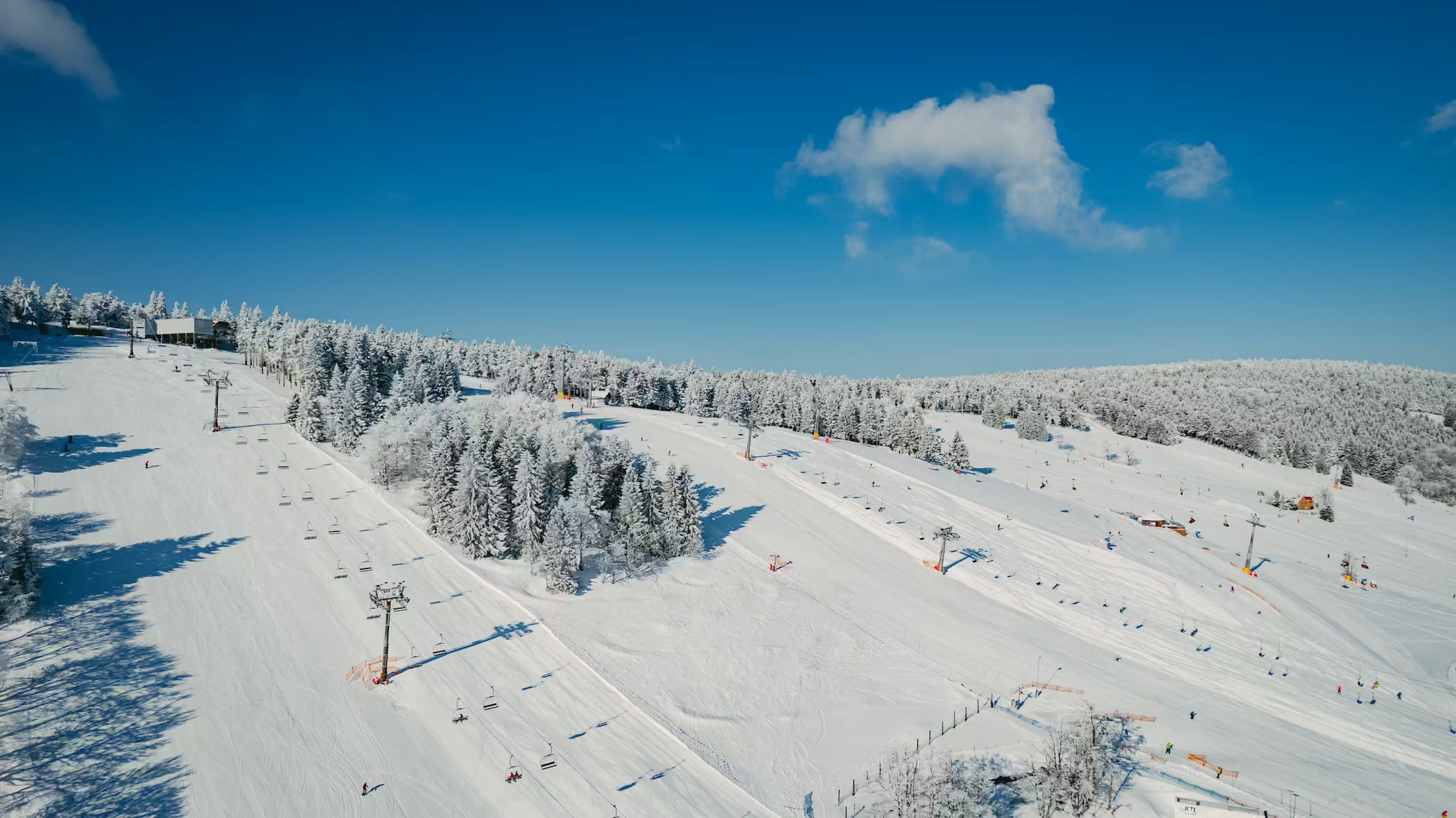
The Polish side of the Karkonosze (Giant Mountains) will surprise those looking for a steeper challenge. Ski Arena Szrenica stretches across the northern slopes of Mount Szrenica at elevations between 707 and 1,362 metres above sea level. Thanks to its northern exposure, the microclimate here is noticeably colder than on the southern side, meaning excellent snow conditions often lasting into April.
The resort offers a total of twelve kilometres of slopes, with the highlight for experienced skiers being the very demanding FIS run with an average gradient of 26 percent. The longest run, Lolobrygida, is an impressive 4,400 metres with a vertical drop of 637 metres. Eight modern lifts ensure a transport capacity of ten thousand people per hour.
A day ski pass costs 175 PLN (around €41) for adults and 145 PLN (around €34) for seniors and children.
4) Zakopane in the Tatras
The most famous Polish winter resort sits in the heart of the High Tatras and attracts visitors not only for skiing in Zakopane Poland but also for stunning mountain views and a rich cultural scene. The Zakopane area offers several resorts catering to different types of skiers.
The highest Polish ski resort, Kasprowy Wierch, reaches 1,987 metres and features two demanding black runs with average gradients of 32 to 37 percent. The second major area is Polana Szymoszkowa, accessed by a modern six-person chairlift to the summit of Gubałówka, offering panoramic views of the Tatras. For families with children, there’s a KidsPark with a magic carpet lift.
The Tatry Super Ski pass, valid at multiple resorts on both the Polish and Slovak sides, costs 170 PLN (around €40) in peak season. A day pass for Kasprowy Wierch starts from 175 PLN (around €41). Zakopane is roughly two hours by car from Kraków, which has excellent flight connections to London, Dublin, Berlin, and many other European cities.
5) Świeradów-Zdrój – Jizera Mountains
This charming spa town on the Polish side of the Jizera Mountains offers a perfect combination of winter sports and wellness relaxation. The modern Ski & Sun resort features one gondola lift and two drag lifts serving a 2,500-metre slope with a vertical drop of 443 metres. The run has an average gradient of nineteen percent and alternates between blue and red markings.
A major advantage is the option of evening skiing thanks to full floodlighting of the entire run. There’s a dedicated kids’ park for younger skiers and a snowpark with its own lift for snowboarders. From the top station, groomed cross-country trails head out into the mountains, so if someone in your group prefers Nordic skiing, this is the perfect spot.
A two-day ski pass in peak season costs 310 PLN (around €73), which works out very well per day.
Read also: 9 best water parks in Poland
How to get to Poland for skiing
The most convenient way to reach Polish ski resorts from the UK is to fly into Kraków, which has direct connections from London (Stansted, Luton, Gatwick), Manchester, Edinburgh, Bristol, and other cities. From Kraków, you can rent a car or take a bus to Zakopane (around 2 hours) or other Tatra resorts. For resorts in the Karkonosze or Jizera Mountains, flying into Wrocław is another great option.
If you’re driving from elsewhere in Europe, Polish roads are in good condition and the journey is straightforward. Poland is part of the EU and the Schengen Area, so EU/EEA citizens only need a valid passport or national ID card — no visa required. For UK passport holders, you can stay for up to 90 days without a visa.
Many resorts also run seasonal skibus services connecting nearby cities with the mountain resorts, making car-free travel perfectly possible.
Things to do besides skiing
Wondering what else to do on your Poland skiing holidays besides hitting the slopes?
Thermal baths and water parks
After a demanding day on the slopes, you’ll love unwinding in thermal baths or a water park. Białka Tatrzańska at the foot of the Tatras boasts a thermal water park right next to the ski slopes — a unique feature in Central Europe. The pleasantly warm water will warm you up even in freezing weather, and kids will enjoy countless slides and attractions.
Similarly, in Świeradów-Zdrój you’ll find quality spa treatments that combine tradition with modern wellness trends. Many hotels in the Polish mountains have their own wellness centres with pools, saunas, steam rooms, and massage parlours.
Cross-country skiing in Polish mountains
If you prefer cross-country skiing over downhill, the Polish mountains won’t disappoint. In Jakuszyce near Szklarska Poręba, you’ll find one of the largest and best-groomed cross-country skiing regions in Central Europe. There are 150 kilometres of trails of varying difficulty, from flat loops suitable for families to more challenging mountain routes. The grooming quality is truly world-class, which even the most demanding Nordic skiers will appreciate.
Ski jumps and toboggan runs
For adrenaline seekers, there are toboggan runs that operate year-round. For example, near the top station of the gondola in Świeradów-Zdrój, you can enjoy a 720-metre toboggan ride with plenty of twists and steep descents. In Karpacz, you can visit the famous Orlinek ski jumping hill and see where ski jumpers launch their flights. In good weather, the hill serves as a viewing platform with stunning panoramic views of the entire Karkonosze range.
Polish cuisine: What to try while skiing in Poland
Polish cuisine is a delightful change from the standard mountain hut fare you might find elsewhere in Central Europe. While other resorts might offer little more than basic soups and sausages, Polish mountain restaurants serve up a much more varied and flavourful menu.
Oscypek and string cheese
The most famous Polish mountain delicacy is undoubtedly oscypek — a traditional smoked sheep’s cheese from the Tatras. It’s sold right on the slopes and in mountain huts, where it’s typically served grilled with cranberry jam. Similar string cheeses (korbáčiky) can be found throughout Poland. The flavour is very distinctive and specific, but absolutely worth trying.
Pierogi – Polish dumplings
If you’ve ever tried Russian pelmeni, Polish pierogi will be a pleasant surprise. These stuffed dumplings come in both sweet varieties (with cottage cheese and fruit, for example) and savoury ones (with cabbage, meat, or potatoes). They’re served with sour cream and fried onions. A single portion is filling enough to keep you going all afternoon on the slopes.
Żurek and other soups
There’s nothing better than a hot soup in cold winter weather. A traditional Polish speciality is żurek — a sour soup made from fermented rye flour, often served with sausage and a hard-boiled egg. For those who prefer something more familiar, you’ll also find excellent beef broths or cabbage soup (kapuśniak).
Practical information for your trip to Poland
If you’re planning your Poland skiing holidays, here are some handy practical tips.
Currency and payments
Poland uses the Polish złoty (PLN), although some places in tourist areas also accept euros. The best approach is to pay by card — we recommend Revolut or similar multi-currency cards for the best exchange rates. Avoid exchanging money at currency exchange kiosks in ski resorts, as they typically offer poor rates.
Language and communication
English is widely spoken in Polish tourist areas, hotel receptions, and ski rental shops. Younger Poles especially tend to speak good English. You’ll have no trouble getting by with English at all major ski resorts. Some staff also speak German. Poles are generally very welcoming and helpful to foreign visitors.
Fuel prices
Fuel prices in Poland are generally lower than in Western Europe, making driving a cost-effective option. Petrol stations are common along main roads, but they become scarcer in the mountains, so we recommend filling up before heading into the hills.
Travel insurance
While EU citizens are entitled to basic healthcare in Poland through the European Health Insurance Card (EHIC), and UK citizens can use the UK Global Health Insurance Card (GHIC), we strongly recommend taking out travel insurance — for example from SafetyWing. This will cover you not only for injuries on the slopes but also for repatriation or lost luggage.
Read more: SafetyWing travel insurance review
Frequently asked questions
Is skiing in Poland suitable for beginners?
Yes, most Polish resorts offer blue runs suitable for beginners and ski schools with English-speaking instructors. Ideal Poland ski resorts for beginners include Białka Tatrzańska and Zieleniec.
Are Polish slopes more difficult than average?
Generally yes. Polish slopes tend to be steeper and more technically demanding than those in many Central European countries, which is great news for advanced and sporty skiers. However, families with children and beginners will find plenty of gentle blue runs.
Can I pay with euros in Poland?
The official currency is the Polish złoty. Some tourist areas accept euros, but at unfavourable exchange rates. We recommend paying by card or exchanging money in advance for the best deal.
Do I need a visa to visit Poland?
No, Poland is part of the Schengen Area. EU/EEA citizens only need a valid national ID card or passport. UK citizens can visit visa-free for up to 90 days with a valid passport.
How good is snowmaking at Polish resorts?
Most modern Polish resorts have high-quality snowmaking systems. Additionally, resorts on north-facing slopes like Szrenica benefit from a naturally colder microclimate that helps preserve snow.
Are lift queues a problem in Poland?
One of the biggest advantages of skiing in Poland is the minimal queues. While Alpine resorts often see thirty-minute waits, in Poland you’ll typically get on the lift almost immediately.
Can I rent ski equipment on site?
All major Polish resorts have quality rental shops for skis, snowboards, boots, and protective gear. Rental prices are very reasonable compared to Western European resorts.
Tips and Tricks for Your Vacation
Don’t Overpay for Flights
Search for flights on Kayak. It’s our favorite search engine because it scans the websites of all airlines and always finds the cheapest connection.
Book Your Accommodation Smartly
The best experiences we’ve had when looking for accommodation (from Alaska to Morocco) are with Booking.com, where hotels, apartments, and entire houses are usually the cheapest and most widely available.
Don’t Forget Travel Insurance
Good travel insurance will protect you against illness, accidents, theft, or flight cancellations. We’ve had a few hospital visits abroad, so we know how important it is to have proper insurance arranged.
Where we insure ourselves: SafetyWing (best for everyone) and TrueTraveller (for extra-long trips).
Why don’t we recommend any Czech insurance company? Because they have too many restrictions. They set limits on the number of days abroad, travel insurance via a credit card often requires you to pay medical expenses only with that card, and they frequently limit the number of returns to the Czech Republic.
Find the Best Experiences
Get Your Guide is a huge online marketplace where you can book guided walks, trips, skip-the-line tickets, tours, and much more. We always find some extra fun there!


