

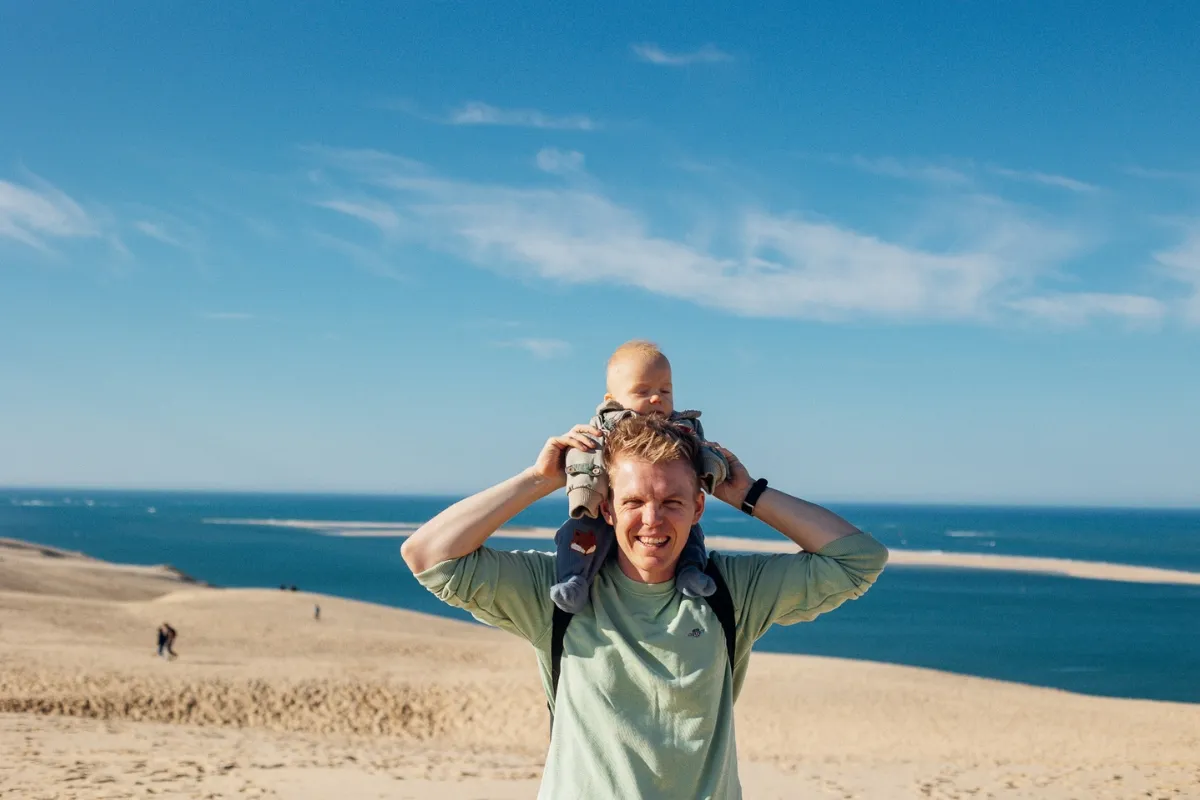
Every year we head south with our family for winter sun, regularly travelling from the UK to Portugal for warmth and sunshine. Last year we decided to try a different route and slow things down. With our nine-month-old son, we stopped in south-west France, where the mighty Dune Pilat rises – a giant sandy mountain nestled between pine forest and the Atlantic Ocean. What was meant to be a quick stop turned into a multi-day adventure. The area around Dune du Pilat captivated us so much that we stayed for several days and didn’t regret it one bit. (More about our holiday with a baby).
TL;DR
- Dune du Pilat is the tallest sand dune in Europe (110 metres) and moves 1 to 5 metres inland towards the forest every year
- The best time to visit is early morning or at sunset to avoid the crowds and heat – in the shoulder season (September–October, April–May) it’s blissfully quiet
- It’s perfectly doable with small children – from April to November there’s a wooden staircase with 160 steps; kids aged 3+ can climb on their own, younger ones can be carried in a baby carrier
- The surrounding area offers plenty of activities: the Banc d’Arguin nature reserve, the Cap Ferret lighthouse, the ornithological reserve at Le Teich, and charming oyster villages
- Accommodation is cheaper outside peak season – you’ll find campsites, apartments and luxury hotels; parking at the dune costs €4–8, but entry to the dune itself is free
Where to find Dune du Pilat and how to get there
Dune du Pilat lies on the French Atlantic coast in the Gironde department, specifically in the commune of Pyla-sur-Mer near the town of Arcachon. If you’re coming from Bordeaux (which is likely the nearest major city you’ll pass through), it’s a pleasant drive of roughly 66 kilometres, taking about 40 to 50 minutes by car. The road runs mostly through pine forests that are typical of the Aquitaine region. We passed through here on our annual drive from the UK to Portugal, and I have to say the detour was absolutely worth it.
What is Dune du Pilat and why is it worth visiting
Dune du Pilat is the tallest sand dune in all of Europe, with a height ranging between 100 and 115 metres. Imagine a wall of sand taller than a thirty-storey building. And what’s even more remarkable – this dune isn’t static. Every year it shifts 1 to 5 metres further inland, towards the pine forest. Wind carries sand from the beach during low tide and gradually piles it onto the dune, which slowly “devours” the forest. Some trees are already half-buried under sand and look like eerie skeletons.
How was the Dune of Pilat formed
The formation of this giant dune is a fascinating story stretching back thousands of years. Dune du Pilat was created by a combination of ocean currents, wind, and geological changes. The sand originates from the coastline and was carried by waves and currents from the south-west. During low tide, wind dries out the sand on the beaches and blows it inland, where it accumulates. The entire process continues to this day – the dune is literally alive and constantly changing.
An interesting detail is that remnants of the past lie hidden beneath the sand. During World War II, the Germans built concrete bunkers along this coast to defend against invasion. Some of these bunkers now lie on the beach below the dune, deposited there by the shifting sand. Others are buried deep within the dune itself. It’s a vivid illustration of just how powerful nature can be.
What to bring and how to prepare for the climb
This is really important, especially if you’re travelling with a small child. At the top of the dune there’s absolutely nothing – no shade, no toilets, no water stand. You need to be perfectly prepared. For our visit with our nine-month-old son, we packed a proper backpack, and believe me, every single item came in handy.
What you definitely need to bring
- Water, and plenty of it – If you’re visiting in summer, expect scorching heat on the dune. The sand can reach up to 50 °C and there’s nowhere to hide. I’d recommend at least one and a half litres per person if you plan to stay longer than an hour.
- High-factor sunscreen – SPF 50+ is essential. The sun reflects off the sand and you’ll burn much faster than on a normal beach.
- A hat – Everyone needs a hat or cap. Our little one had a cap with a peak and neck cover.
- Sunglasses – The glare from the sand is intense and it’s not pleasant without sunglasses.
- Appropriate footwear – The sand gets scorching hot in summer, so sandals or light shoes are a must. French visitors on forums recommend either running shoes or sturdy sandals. Going barefoot means risking burnt feet. Plus, you’ll occasionally find glass shards left by irresponsible tourists.
- A blanket or beach mat – If you want to rest or sit at the summit, you’ll definitely appreciate something to sit on.
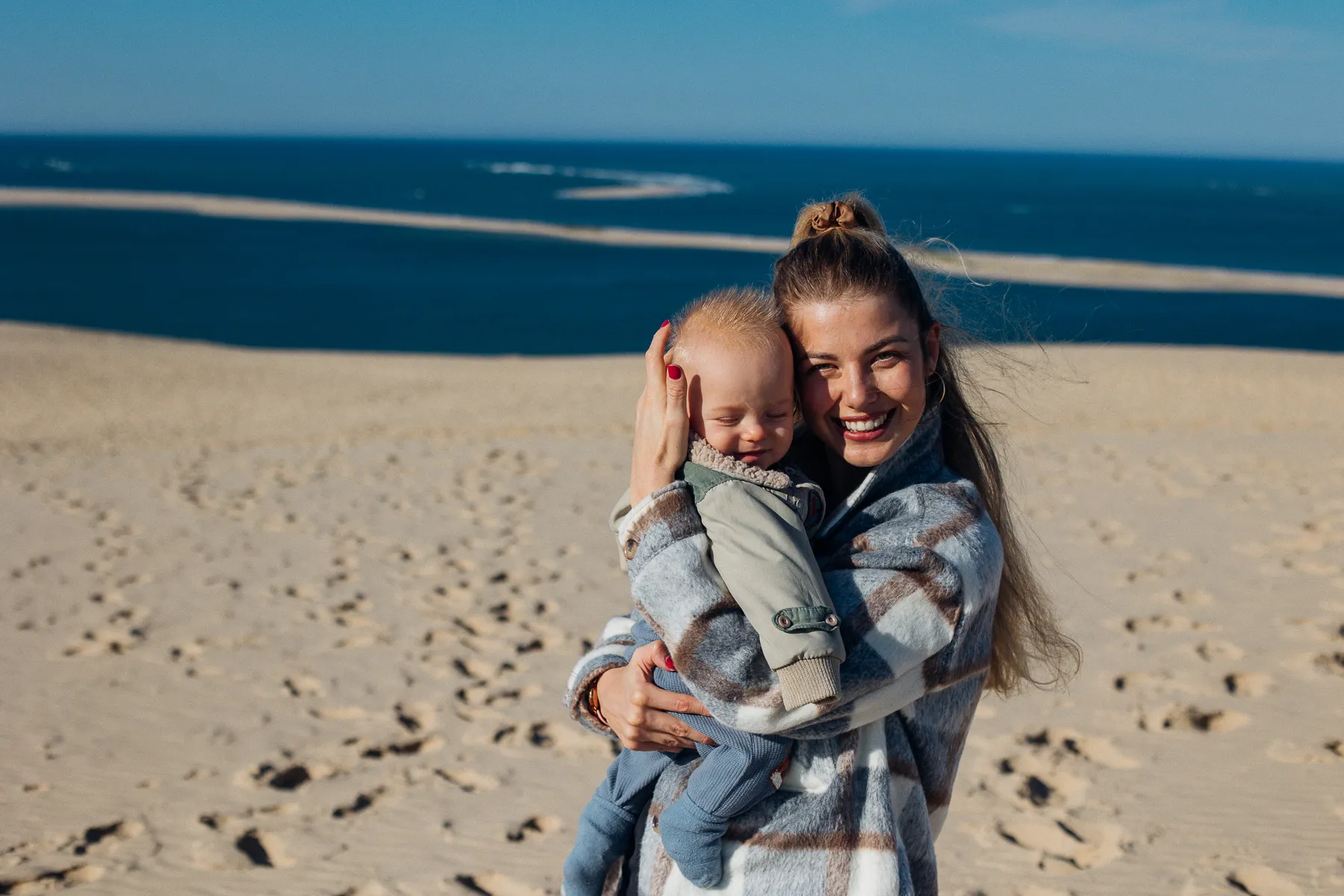
- A baby carrier or ergonomic wrap – Essential for parents with small children. Our son weighed about 9 kilos and climbing 160 steps while carrying him in our arms would have been exhausting. In the ergonomic carrier it was perfectly manageable.
Best time to visit Dune du Pilat
This is one of the most important pieces of advice I picked up from French parents on discussion forums. Dune du Pilat is absolutely packed with tourists in summer (July and August). There can be several thousand people a day. If you don’t want to be part of that crowd, you need to pick the right time.
Summer months (July, August)
If you’re visiting in peak season, the best bet is to go very early in the morning – ideally around sunrise or an hour after. At that time there are still relatively few people on the dune, the sand isn’t scorching, and you can enjoy it in peace. The second option is to arrive around four in the afternoon and stay until sunset. Sunset at Dune du Pilat is, according to all travellers, something truly magical – the sky turns golden, orange, and violet, the air cools, and the atmosphere becomes much calmer. Just bear in mind that descending in the dark is a bit trickier, so bring a head torch or use the torch on your phone.
Shoulder season (September–October, April–May)
In my opinion, this is absolutely the best time to visit Dune du Pilat. We were there in autumn and it was perfect. The weather is still pleasant (temperatures around 15–20 °C), tourists are a fraction of summer numbers, and the whole atmosphere is much more peaceful. The staircase is still in place (from April to November), so the climb is easy. The ocean has gorgeous colours and the air is crisp.
Winter (November–February)
In winter, Dune du Pilat has an entirely different atmosphere. The staircase is no longer installed, so you have to climb through the sand. It’s more challenging, but also a more authentic experience. Temperatures hover around 10–12 °C, which isn’t too bad when you’re moving. Tourists are minimal and you’ll have the dune practically to yourself. If you enjoy peace and quiet and don’t need to swim in the ocean, it’s an excellent option.
Climbing the dune with a small child: Our experience
This was our biggest worry before the visit – could we manage it with a nine-month-old? The answer is a definite yes, and it was actually easier than we expected.
From April to November, a wooden staircase with 160 steps is installed at the dune. The steps are fairly well built, have a railing, and are wide enough. The climb takes roughly 10 to 15 minutes at a relaxed pace. We went even slower, pausing for drinks and occasionally letting our son stretch his legs.
Practical tips for parents with toddlers
French parents on blogs and forums share several useful tips that really worked for us:
- Use a baby carrier or ergonomic wrap – Trying to climb the stairs with a child in your arms is exhausting. In a carrier your hands are free and the child has better support.
- Bring extra water – Children need to drink more frequently, especially in warm weather.
- Put a hat on your child – Small children overheat faster than adults.
- Don’t be afraid to take breaks – It’s not a race. Stop, have a drink, look around you.
- Bring a changing mat and nappies – There are no toilets on the dune, so if you need to change a nappy, it’s good to have something to lay down.
What kids love about the dune
The biggest hit for children, according to French parents, is the descent. While the climb is a bit challenging, the way down is pure fun. Older children (aged 3+) love sliding in the sand, running downhill, and “tumbling” into the soft sand. It’s like a giant sandpit for them. Our son was still too young, but we saw plenty of toddlers around us rolling in the sand and absolutely loving it. Expect to do a lot of laundry afterwards – sand gets absolutely everywhere.
French mothers on forums also recommend bringing a simple toy – like a small bucket and spade. Children can play on the summit for a while as you relax and soak in the views.
What you’ll see from the summit: Views over three worlds
When you finally reach the top of Dune du Pilat, your reward is a view you won’t easily forget. From up there you can see three completely different landscapes at once:
To the east stretches the endless pine forest of Les Landes – the largest man-made forest in Europe. It extends as far as the eye can see, and in places you can watch the dune gradually “swallowing” the trees.
To the west and south, the Atlantic Ocean unfolds in all its glory. Waves crash onto the shore and the water shifts from azure to deep blue depending on the time of day and the weather. Right in front of you, you’ll spot Banc d’Arguin – a mysterious sandy island that changes shape with the tides.
To the north, you get a view of the Arcachon Bay with its little villages, harbour, and the iconic wooden cabins on stilts known as “cabanes tchanquées”. In the distance you can even make out the Cap Ferret lighthouse.
We stood there and simply couldn’t believe our eyes. It’s one of those moments when you realise just how beautiful the world is. And our little son? He was peacefully sleeping in the carrier, completely oblivious to the stunning panorama behind him.
Where to eat and get refreshments
In the area by the car park right below Dune du Pilat, you’ll find several food stalls and restaurants. It’s nothing fancy, but perfectly fine for a quick bite. Your options include:
- Tekoa Dune – Offers salads, poke bowls, burgers made with local ingredients, and homemade lemonades
- Le Snack de la Dune – Simple snacks, sandwiches, salads, and drinks
- L’Avant-Goût – Crêpes, homemade ice cream, hot and cold sandwiches
- Oyster & Tapas – Here you can try fresh oysters from Arcachon Bay and other seafood specialities
We had sandwiches and homemade lemonade, and it was perfectly sufficient. Prices are tourist-level but not outrageous – expect around €8–15 per person for a snack.
If you want a proper meal, I’d recommend heading to the surrounding villages or into Arcachon itself. You’ll find plenty of excellent restaurants focusing on seafood and local specialities.
Local gastronomy
The area around Arcachon is famous for its oysters. Arcachon Bay is one of France’s largest oyster farming areas. If you enjoy oysters, you absolutely must try them here – they’re fresh, delicious, and reasonably priced. You can buy them directly from producers at small roadside stalls or have them at a restaurant.
Another local speciality are pinasses – not food, but traditional wooden boats that locals use for fishing and getting around the bay. You’ll often see them carrying tourists on excursions too.
Parking and entry fees: How much does it cost
Entry to the dune itself is completely free. That’s great news, because you can come whenever you want and stay as long as you like without paying an entrance fee. You only pay for parking near the dune.
Parking prices
- 2 hours: approximately €4
- 6 hours: approximately €8
- Full day: around €10
- Prices may vary slightly depending on the season and vehicle size
For motorhomes or caravans, the fee is higher – expect around €12–15 per day. The car park is fairly large and even in peak season you’ll usually find a space, though you may have to park further from the staircase.
Our tip: If you arrive very early in the morning (around 7–8 am), you can sometimes park for free because the machines aren’t running yet or the attendants haven’t arrived. This isn’t official advice, but we saw several people doing it.
Where to stay: From campsites to luxury hotels
When we decided to stay near Dune du Pilat for a few days, we started searching for accommodation. The range is truly diverse and depends mainly on your budget and preferences.
Campsites and caravan parks
If you’re travelling with a caravan or enjoy camping, you’ll find several excellent options near Pyla-sur-Mer:
- Camping de la Dune “Les Flots Bleus” – Located very close to the dune, it has direct beach access and offers pitches for tents and caravans. Prices start at around €25–40 per night depending on the season.
- Camping Clicochic Petit Nice – Highly rated by families with children, it offers mobile homes, a children’s playground, and a swimming pool. Mobile home prices start from €60 per night in the shoulder season.
- Pyla Camping – Another popular campsite with good facilities and friendly staff.
Apartments and holiday homes
We ended up renting an apartment through Booking.com, roughly 2 kilometres from the dune. We had a two-room flat with a kitchenette for €80 per night (off-season). This turned out to be the best option – we had privacy, could cook our own meals, and there was enough space for our son to toddle around. In peak season the same apartment would easily cost €150–200 per night, so I’d definitely recommend travelling outside July and August.
Luxury hotels for special occasions
If you want to treat yourself to something extraordinary, Pyla-sur-Mer has two stunning five-star hotels:
La Co(o)rniche – This hotel is built right on the slope of the dune and offers incredible views of Banc d’Arguin and the ocean. It has 29 luxury rooms, an excellent seafood restaurant, and a bar with live music. Room prices start at around €300–400 per night, but the view and experience are worth it.
Ha(a)ïtza – This newer luxury hotel has 38 rooms, its own spa, and a two-Michelin-star restaurant, Le Skiff Club. It’s a destination for true gourmets and lovers of fine dining.
We didn’t try these hotels ourselves, but we admired them from afar and they look absolutely stunning. Perhaps next time, when our son is older.
Things to do in the area: A few days won’t be enough
When we planned our trip, we thought we’d visit Dune du Pilat in one afternoon and drive on. What a mistake! The area around Arcachon Bay is so beautiful and offers so many activities that we ended up spending four days and still felt like we hadn’t seen everything.
Banc d’Arguin: A mysterious sandy island
When you stand on top of Dune du Pilat and look towards the ocean, you’ll see a long sandy island that seems to float on the water. That’s Banc d’Arguin – a nature reserve that’s home to hundreds of bird species.
Banc d’Arguin constantly changes with the tides. At low tide it’s a vast sandy shoal roughly 4 kilometres long and 2 kilometres wide. At high tide most of it is submerged, leaving only a small islet. It’s home to wading birds, including terns, herons, and many other species.
You can get there by boat. Local operators offer trips on traditional wooden boats called pinasses. The crossing usually takes 30–45 minutes and you’ll spend an hour or two on the island. You can enjoy the calm waters, which are much gentler than on the ocean side, watch the birds, and soak up the absolute tranquility. Prices range from €15 to €30 per person depending on the length of the trip.
We didn’t take this trip with our little son because we were worried about how he’d react to a boat, but we saw plenty of families with small children who came back absolutely delighted.
Cap Ferret: Lighthouse, oysters, and a relaxed atmosphere
On the other side of Arcachon Bay lies Cap Ferret – a narrow peninsula with an unmistakable character. It’s the complete opposite of bustling Arcachon – calm, authentic, and wonderfully picturesque.
The Cap Ferret lighthouse is the main attraction. It was built in 1947 (the original 1849 lighthouse was destroyed by the Germans during World War II) and has 258 steps. The view from the top is absolutely breathtaking – on one side you see the ocean, on the other Arcachon Bay, and in the distance even Dune du Pilat. Entry is €7 for adults and €4 for children. The lighthouse is open every day except Mondays.
Oyster farms are another reason to visit Cap Ferret. Local producers have been farming oysters here for generations. You can buy fresh oysters directly from them for a fraction of what you’d pay in a restaurant – roughly €5–8 per dozen depending on the size. Many of them will shuck them on the spot and you can enjoy them with a squeeze of lemon and a slice of bread. It’s an authentic experience you shouldn’t miss.
The beaches on Cap Ferret are calmer than on the ocean side. The water is gentler, warmer, and ideal for small children. We spent an afternoon there and it was lovely – our son enjoyed the sand and we had peace and quiet.
You can get there either by car (the drive around the bay takes about an hour) or by boat – a ferry runs from Arcachon to Cap Ferret several times a day. The boat ride takes 30 minutes and is a fun experience in itself. The fare is around €7–10 per person, with children under 2 travelling free.
Le Teich: A paradise for birdwatchers
About 25 kilometres from Dune du Pilat, you’ll find the Réserve Ornithologique du Teich – an ornithological reserve that’s one of the best in Europe. It’s home to more than 300 bird species, and up to 300,000 birds pass through each year during migration.
The reserve offers 6 kilometres of carefully maintained trails with 20 observation points. You can visit with a pushchair (the paths are well maintained) and easily spend 3–4 hours observing nature. Entry is €9.60 for adults and €7.40 for children.
We spent a morning there and it was wonderful. Our son slept most of the time in his pushchair while we watched herons, swans, ducks, and many other birds. For children they have a special educational trail called “Rouge Gorge”, designed to help kids discover nature in a fun way.
The best time to visit is in spring (March–May) or autumn (September–October), when migration is underway.
Arcachon: A town with history and charm
The town of Arcachon itself is well worth a visit. In the 19th century it was a fashionable resort for wealthy Parisians, and to this day it retains beautiful architecture from that era.
Ville d’Hiver (the Winter Town) is Arcachon’s most beautiful quarter. Located on the hill above the town, it’s full of colourful villas from the turn of the 19th and 20th centuries. Some are in the Swiss chalet style, others have Moorish elements – it’s an architectural open-air museum. You can stroll around and admire the houses (most are private, so you can’t go inside).
Markets are another reason to visit Arcachon. Every day except Monday there’s a market in town with fresh fish, oysters, vegetables, cheeses, and other local produce. It’s a great place to stock up on fresh food if you want to cook or enjoy a picnic.
The beaches in Arcachon are calmer than on the ocean side near the dune. The water in the bay is warmer and without big waves, making it ideal for families with small children.
Practical tips we learned along the way
After several days in the area, we gathered plenty of experience that I’d like to share:
Bring more water than you think you need
I can’t stress this enough. The sand on Dune du Pilat reflects the sun and creates incredible heat. Even when it’s not hot in the shade, you can suffer on the dune. Take at least one and a half litres of water per person. We brought a thermos of cold water and it was a lifesaver.
Early morning or late afternoon
If you want peace and beautiful light for photos, arrive early in the morning (around 8–9 am) or from 5 pm onwards. Midday is the worst time – the most people, the most heat, and the least atmosphere.
Bring your swimsuit
Even if you don’t expect to go swimming, pack your swimsuit. The beach below the dune is gorgeous and you’ll probably want to at least dip your toes or cool off. The ocean does have waves, but the water is beautifully clean.
Expect sand everywhere
Sand gets everywhere – in your shoes, your hair, your bag, your camera, your phone. Bring zip-lock bags for electronics and be prepared to wash and clean a lot of things. But it’s absolutely worth it.
Leave time for the surrounding area
Don’t focus solely on the dune itself. The area around Arcachon Bay is incredibly beautiful and offers so many activities. If you can, stay at least 2–3 days. You definitely won’t regret it.
It’s manageable with small children
We were worried about whether we could manage it with a nine-month-old, but it was a breeze. An ergonomic carrier, plenty of water, a hat, and frequent breaks – that’s all you need. And remember, children usually handle it better than adults.
The weather changes quickly
The Atlantic coast is known for its rapidly changing weather. It can be overcast in the morning and clear an hour later. Don’t be put off by a bad forecast – things often improve.
FAQ: Frequently asked questions
Is Dune du Pilat accessible for wheelchair users or people with limited mobility?
Unfortunately, not entirely. The staircase is not wheelchair accessible and climbing through the sand is very demanding. However, you can admire the dune from the bottom or from the beach, where the views are also lovely. Some restaurants and viewpoints in the area (for example the La Co(o)rniche restaurant) have step-free access and views of the dune.
Can I bring a dog to Dune du Pilat?
Yes, dogs are allowed on the dune but must be kept on a lead. On the beach below the dune, some sections are off-limits for dogs during peak season (July–August), but outside of that period it’s no problem. Dog owners in online forums recommend visiting early in the morning when it’s not hot and the sand isn’t scorching, as dogs can burn their paws.
Can I sleep or camp on Dune du Pilat?
No, camping on the dune is strictly forbidden. The dune is a protected nature reserve and overnight stays are only permitted for the purpose of watching the sunset and stargazing, but you must leave afterwards. The nearest campsites are in Pyla-sur-Mer, a few kilometres from the dune.
How much time should I plan for a visit to Dune du Pilat?
At least half a day. The climb takes 10–20 minutes depending on your pace, but you’ll definitely want to spend time at the summit – enjoying the view, taking photos, relaxing. The descent is quicker (5–10 minutes). If you want to visit the beach below the dune or walk along it, allow 3–4 hours. And if you’re planning to stay for sunset, it’ll be an entire afternoon and evening.
Is the water below Dune du Pilat safe for swimming?
Yes, but you need to be careful. The ocean has strong waves and currents here, so swimming isn’t suitable for weaker swimmers or very young children. In summer, lifeguards are on the beach to monitor safety. The water is fairly cold even in summer (around 18–20 °C). If you have small children and want calmer water, I’d recommend the beaches in Arcachon Bay or on Cap Ferret, where the water is warmer and without big waves.
Tips and Tricks for Your Vacation
Don’t Overpay for Flights
Search for flights on Kayak. It’s our favorite search engine because it scans the websites of all airlines and always finds the cheapest connection.
Book Your Accommodation Smartly
The best experiences we’ve had when looking for accommodation (from Alaska to Morocco) are with Booking.com, where hotels, apartments, and entire houses are usually the cheapest and most widely available.
Don’t Forget Travel Insurance
Good travel insurance will protect you against illness, accidents, theft, or flight cancellations. We’ve had a few hospital visits abroad, so we know how important it is to have proper insurance arranged.
Where we insure ourselves: SafetyWing (best for everyone) and TrueTraveller (for extra-long trips).
Why don’t we recommend any Czech insurance company? Because they have too many restrictions. They set limits on the number of days abroad, travel insurance via a credit card often requires you to pay medical expenses only with that card, and they frequently limit the number of returns to the Czech Republic.
Find the Best Experiences
Get Your Guide is a huge online marketplace where you can book guided walks, trips, skip-the-line tickets, tours, and much more. We always find some extra fun there!


