

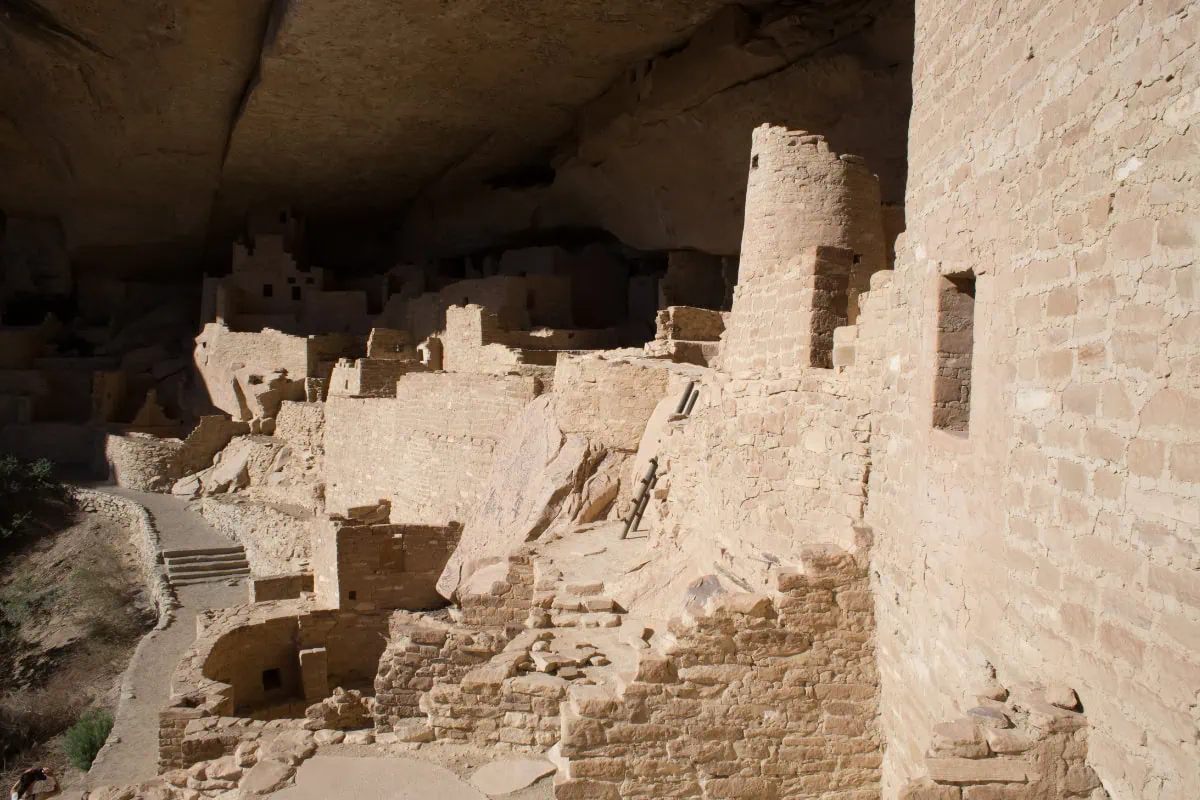
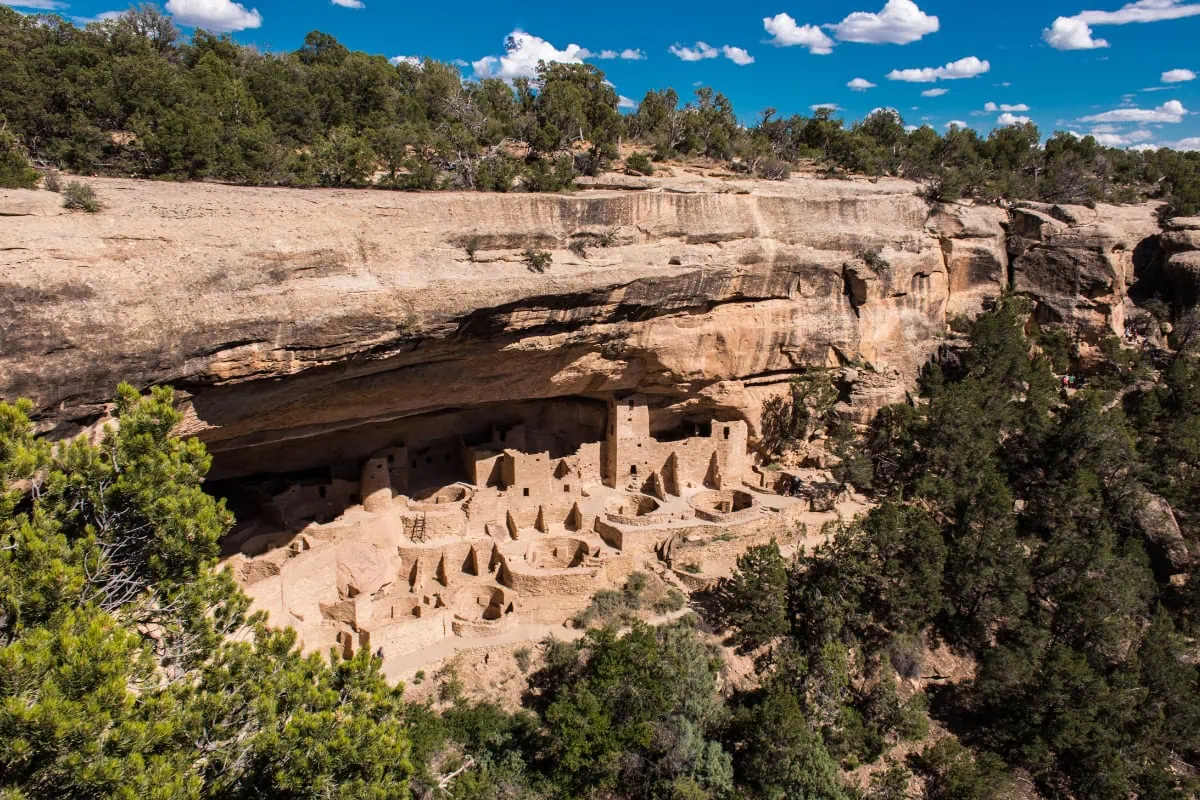
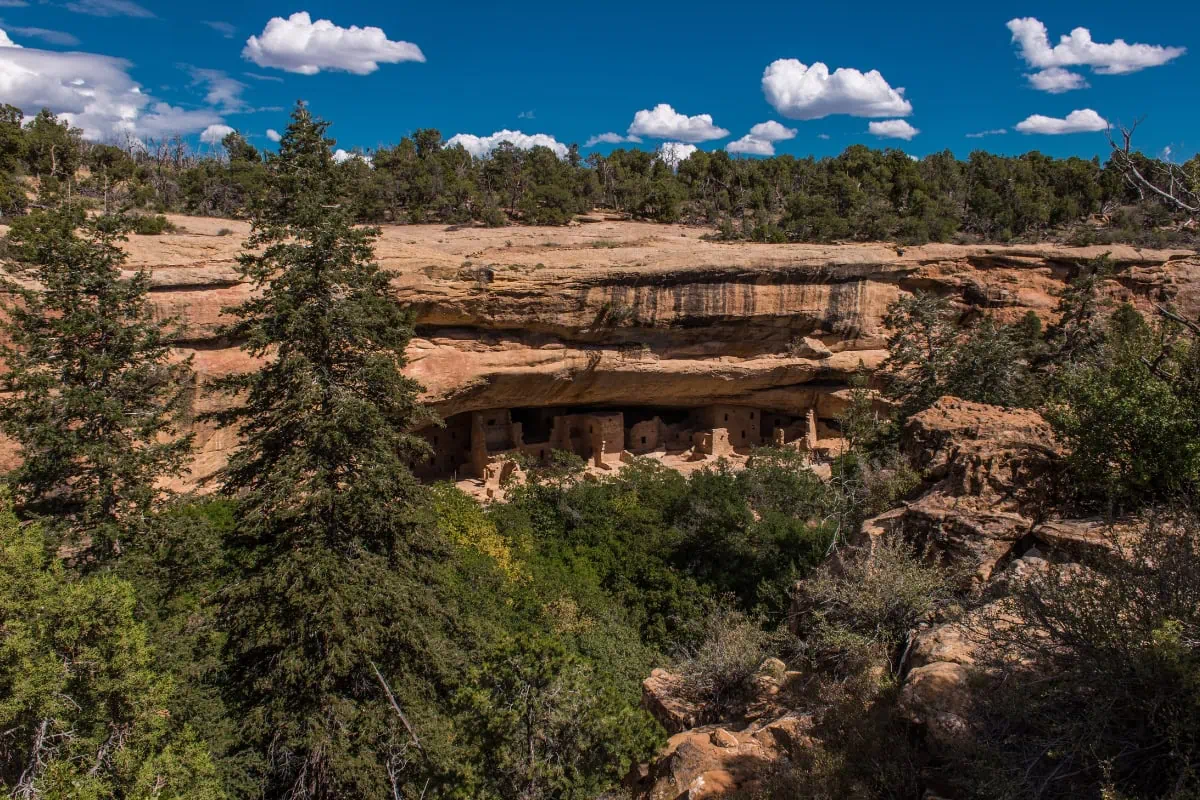
You’re standing on the edge of a canyon, hundreds of metres below you a valley stretches out, covered in junipers and pines, and then you see it — in a rock alcove across the way, as if someone carefully tucked it in, stands an entire building. Not just one. A whole village. With windows, towers, tiny rooms stacked one on top of another, as if someone lived there just yesterday. Except “yesterday” was more than 700 years ago.
Mesa Verde Colorado was the first place in the USA that truly caught me off guard. You know how sometimes you arrive at a famous landmark and think “yeah, nice”? This was something completely different. Lukáš and I stood at the overlook above Cliff Palace and neither of us said a word. We just stared. Because what the Ancestral Puebloans built into those cliff ledges is so incomprehensibly brilliant and beautiful that your jaw literally drops.
Mesa Verde National Park is the only national park in the USA that was established primarily to protect human cultural heritage, not nature. It’s been a UNESCO World Heritage Site since 1978 and contains over 5,000 archaeological sites, including around 600 cliff dwellings. And yet it receives far fewer visitors than Yellowstone or the Grand Canyon, so you can enjoy it in relative peace.
In this article, you’ll find a complete guide to Mesa Verde National Park — from 13 best things to see and do, through practical tips on when to visit, where to stay, and how much it all costs, to advice on ranger-led tours and food. Get ready for one of the most fascinating places you’ll ever visit in America. ☺️
TL;DR
- Mesa Verde National Park lies in southwestern Colorado and protects hundreds of cliff dwellings built by the Ancestral Puebloans, who lived here from roughly 550 AD to the end of the 13th century.
- The most famous site is Cliff Palace — the largest cliff dwelling in North America with over 150 rooms. You can only access it with a ranger (ranger-led tour).
- Ranger-led tours need to be booked in advance on recreation.gov — they sell out weeks ahead during peak season.
- The best time to visit is May to June and September to October — fewer crowds, pleasant temperatures.
- The park is huge and spread across two main areas — Chapin Mesa (most popular) and Wetherill Mesa (quieter, but seasonal).
- For a thorough visit, plan at least 1.5–2 full days — in one day you’ll only manage the bare essentials.
- Park entrance fee is $30/vehicle (valid for 7 days). Ranger-led tours cost an additional $5–8/person.
- Accommodation in the park is available at Far View Lodge (from $180/night), while a more affordable option is the town of Cortez, 15 minutes from the entrance, where you’ll find motels from $80–120/night.
- Morefield Campground inside the park costs around $40–50/night and is the best option if you want to see amazing sunsets right from Mesa Verde.
- Don’t forget to pack comfortable hiking shoes, plenty of water, and sunscreen — shade is scarce here and the altitude of 2,000–2,600 m (6,500–8,500 ft) will catch you off guard.
When to Visit Mesa Verde and How to Get There
Mesa Verde National Park is open year-round, but be warned — “open” doesn’t mean “fully operational”. Most cliff dwellings, ranger-led tours, and Wetherill Mesa are only accessible during the season, roughly from mid-May to mid-October (exact dates vary slightly each year — always check the NPS website). In winter, only Chapin Mesa and a few overlooks are accessible — plus plenty of snow and closed roads.
Best Time to Visit
The ideal months are May–June and September–early October. In May and June, everything is freshly open, nature is blooming, and there are fewer tourists than in summer. September is absolutely divine — temperatures around 20–25 °C (68–77 °F), golden light, minimal crowds.
July and August work too, but be prepared for heat (around 30 °C / 86 °F in the sun — on the mesa it’s relentless) and bigger crowds. It’s also thunderstorm season — afternoon showers are common and sometimes they close certain trails because of them.
A word about wildfires — Mesa Verde has an unfortunate history with forest fires (in 2000 and 2002, thousands of hectares burned). During summer months, the park or parts of it occasionally close due to fire risk. Monitor current conditions on the NPS website.
How to Get to Mesa Verde
The park lies in southwestern Colorado, about 10 km (6 miles) east of the town of Cortez and roughly 60 km (37 miles) west of Durango. The nearest park entrance is off Highway US-160.
By car — hands down the best option. There’s no public transport inside the park and distances between individual sites are substantial (from the entrance to Cliff Palace it’s nearly 35 km / 22 miles along a winding mountain road). We’ve had consistently great experiences with RentalCars, which we use all over the world — you can pick up a car in Durango or Cortez.
Nearest airports:
- Cortez Municipal Airport (CEZ) — tiny, with limited connections
- Durango–La Plata County Airport (DRO) — better choice, with flights from Denver and Dallas
- Albuquerque (ABQ) — about 5 hours by car, but often significantly cheaper flights
From Europe, you’ll most commonly fly via Denver and then either take a connecting flight to Durango, or pick up a rental car and do a road trip through US national parks, which we highly recommend.
Important: From the park entrance to the main sites on Chapin Mesa, the drive takes at least 45 minutes along a narrow, winding mountain road with over 600 metres (2,000 ft) of elevation gain. Factor this into your day — I wouldn’t say it’s dangerous, but RVs and large campervans go slowly and overtaking opportunities are limited. 😅
Where to Stay and How Much Mesa Verde National Park Costs
Mesa Verde isn’t a cheap park, but it’s not outrageously expensive compared to other American national parks either. Here’s an overview of the main costs:
Entrance fee:
- $30/vehicle (approx. €28) — valid for 7 days
- If you have an America the Beautiful Pass ($80/year, approx. €74), entry is free — if you’re planning to visit multiple US parks, it’s absolutely the best investment.
Ranger-led tours:
- $5–8/person (approx. €5–7) per tour — Cliff Palace, Balcony House, Long House
- Advance booking required on recreation.gov — they sell out in peak season!
Accommodation:
- Far View Lodge (inside the park): from $180–280/night (approx. €165–260) — simple rooms, but the location is unbeatable
- Motels in Cortez: $80–150/night (approx. €74–140) — best value for money
- Motels in Durango: $100–200/night (approx. €93–185) — nicer town, but further from the park
- Morefield Campground (inside the park): $40–50/night (approx. €37–46) — tent or RV
Food in the park:
- Far View Terrace Café: sandwiches, salads, burgers — $10–18 (approx. €9–17)
- Metate Room (upscale restaurant at Far View Lodge): main course $25–40 (approx. €23–37)
Budget for 2 days for two people (mid-range):
- Park entrance: $30
- 2× ranger-led tours (for two): $20–32
- 2 nights in Cortez (motel): $160–300
- Food (2 days, mix of restaurant and self-catering): $80–120
- Petrol: $20–30
- Total: approx. $310–510 (€290–475) for two people
Accommodation in the Park vs. Cortez
Far View Lodge is the only accommodation inside the park (apart from the campground). It’s a simple lodge with no TV and limited Wi-Fi — and that’s exactly its charm. In the morning you wake up to views across four states and in the evening you gaze at stars you’d never see in a city. The downside? The price, and the fact that it sells out quickly. You can check availability and book on Booking.com.
Cortez is a small town 15 minutes from the park entrance. It’s no beauty queen, let’s be honest — a typical American small town with motels, fast food, and a Walmart. But it’s a practical and affordable base. Hotel & Hostel & Spa Retro Inn at Mesa Verde or Holiday Inn Express are solid picks.
Durango is an hour further, but it’s a significantly nicer town with a historic centre, breweries, and an Old West atmosphere. If you have time, it’s worth spending an evening there.
Camping in Mesa Verde
Morefield Campground sits 6 km (4 miles) from the park entrance and is one of the best ways to experience Mesa Verde to the fullest. Picture this: you’re sitting by your tent, surrounded by silence broken only by crickets, above you a starry sky with zero light pollution, and you know that in the morning you’ll be among the first people in the park.
The campground has showers, a small shop with basic supplies, and sites for both tents and RVs with electricity. Book through recreation.gov — in summer I recommend reserving as early as possible.
Mesa Verde Colorado: 13 Best Things to See and Do
Now we’re getting to the best part — the cliff dwellings themselves and the other sites that draw people here from around the world. Mesa Verde is divided into two main areas: Chapin Mesa (the main one, accessible year-round) and Wetherill Mesa (open only in season, fewer people). We’ll start with the most famous sites and work our way through to the hidden gems.
1. Cliff Palace — the Largest Cliff Dwelling in North America
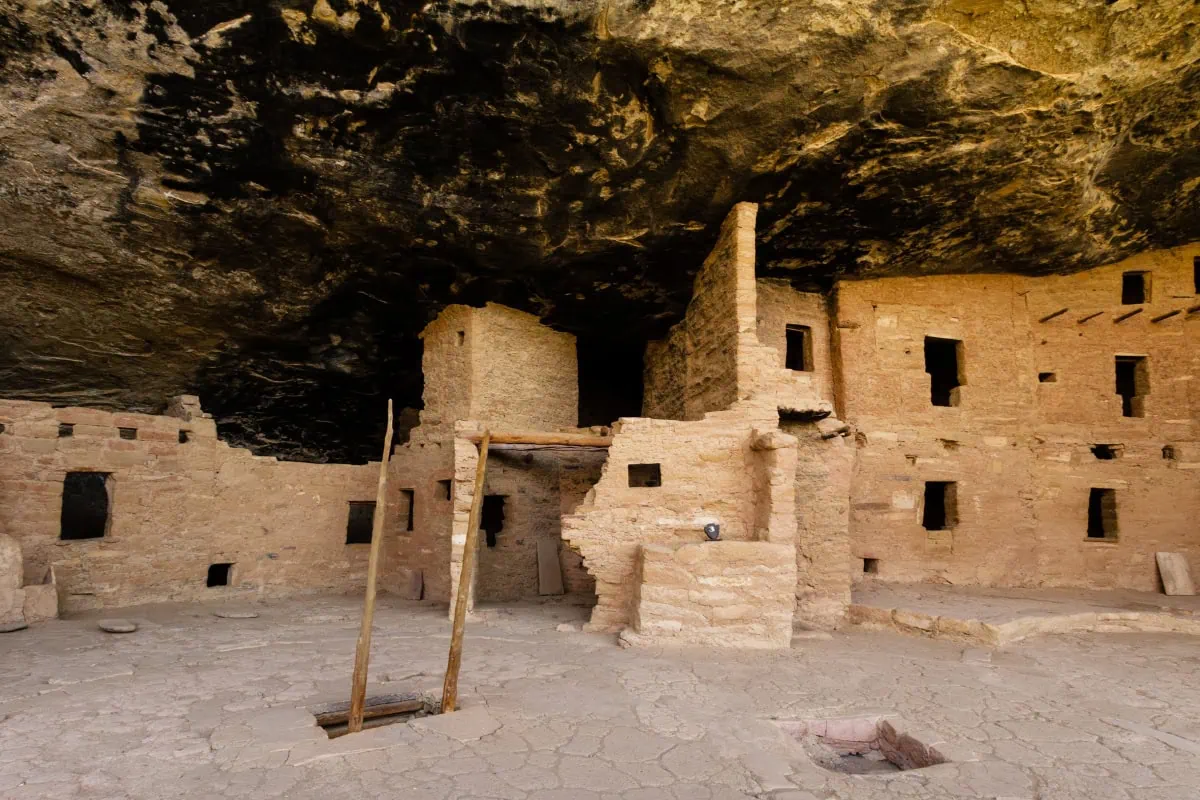
This is it. The reason most people come to Mesa Verde, and the reason they leave with their jaws on the floor. Cliff Palace is the largest cliff dwelling in all of North America — more than 150 rooms and 23 kivas (ceremonial underground chambers) crammed into a massive rock alcove.
The Ancestral Puebloans lived here from roughly the late 12th to the late 13th century — “only” about 75–100 years before abandoning the entire area. And that’s the fascinating part: why? Why would someone build such a sophisticated complex and then leave? Scientists still don’t fully agree — probably a combination of drought, soil exhaustion, and social changes. But when you stand there, you feel like the stones are still whispering.
You can only access Cliff Palace on a ranger-led tour. The tour lasts about an hour, the ranger tells you the history, answers questions, and meanwhile you’re climbing ladders and squeezing through narrow passages. Tickets ($8/person, approx. €7) are purchased in advance on recreation.gov — they sell out weeks ahead during peak season, so don’t delay!
The tour involves descending and climbing stone steps and ladders — it’s not extremely strenuous, but you need comfortable hiking shoes and a basic level of fitness. If you’re afraid of heights or enclosed spaces, think carefully — some of the passages are genuinely tight.
Tip: Book a morning tour (ideally the first one at 9:00 or 9:30). The light is beautiful, it’s cooler, and there are fewer people. Afternoon tours in summer tend to be hot and crowded.
2. Balcony House — an Adventure for the Brave
If Cliff Palace is “wow, that’s beautiful,” then Balcony House is “wow, that’s beautiful AND slightly terrifying.” 😅 This cliff dwelling is only accessible via a 10-metre (32-foot) ladder, a narrow tunnel you have to crawl through (literally — on all fours, with your backpack on), and another series of steep steps.
Balcony House has “only” about 40 rooms, but its position is absolutely dramatic — it hangs on the cliff face like an eagle’s nest, and its inhabitants had to reach it using the same ladders you do. Imagine doing that in winter, with children, carrying supplies of food. These people were incredible.
The ranger-led tour ($8/person) is more intense than Cliff Palace — the ranger clearly explains what awaits you, and if you have claustrophobia or serious issues with heights, they’ll recommend a different tour. Lukáš and I absolutely loved it, though I’ll admit the tunnel caught me slightly off guard. Fortunately, it’s short.
Important: Balcony House is typically open from late April/early May to mid-October. Even during the season, it occasionally closes due to weather (a slippery ladder after rain isn’t ideal). Tickets again through recreation.gov.
3. Spruce Tree House — the Best-Preserved Dwelling (Currently Closed)
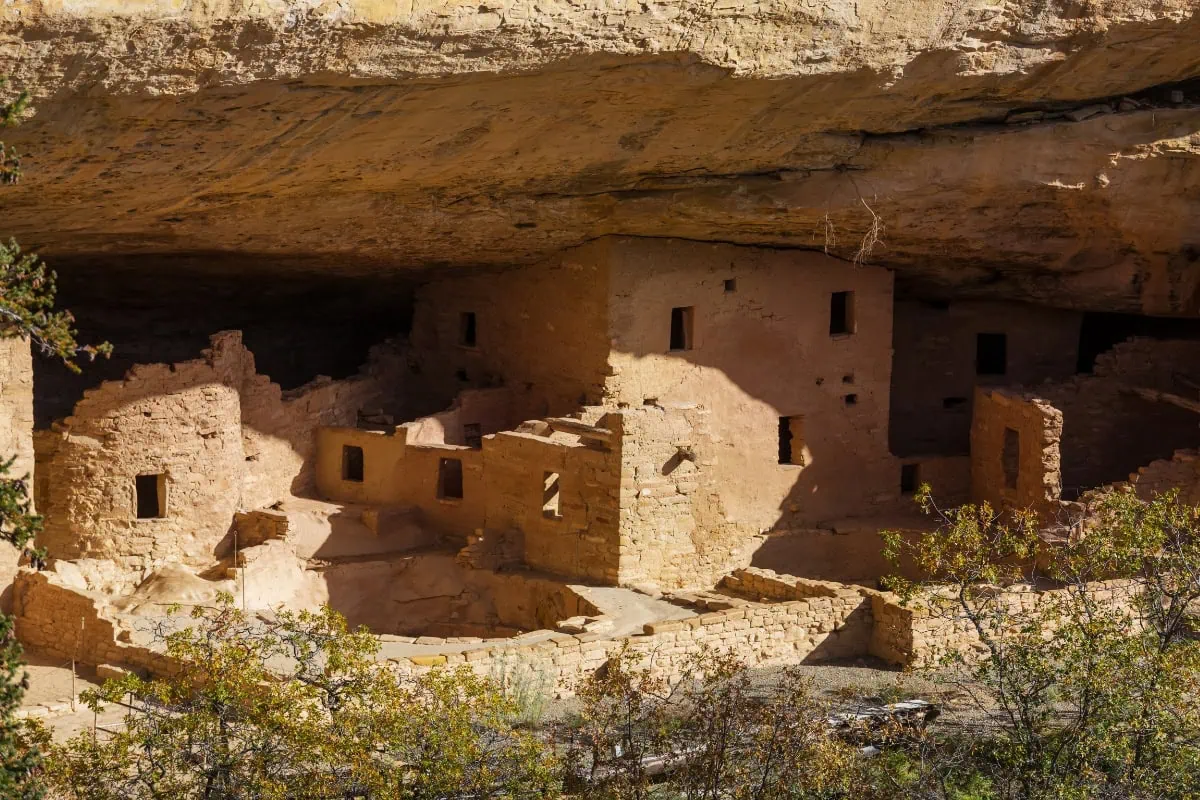
Spruce Tree House was long the most accessible cliff dwelling in the park — the only one you could reach without a ranger-led tour, via a short trail right from the Chapin Mesa museum. With 130 rooms and 8 kivas, it was the third largest in the park.
But be warned: At the time of writing, Spruce Tree House is closed to the public due to the risk of falling rock from the cliff overhang. The closure has been in place since 2015 and it’s unclear when (or if) it will reopen. Check the current status on the NPS website before your visit.
Even though you can’t go inside, it’s worth walking to the overlook above Spruce Tree House — you can see the cliff dwelling beautifully from above and a ranger at the viewpoint will happily answer your questions. The Chapin Mesa Museum (right next door) is also excellent — small but with superb exhibits about the life of the Ancestral Puebloans.
4. Long House — a Quiet Alternative on Wetherill Mesa
Long House is the second-largest cliff dwelling in Mesa Verde — over 150 rooms stretched along a cliff overhang like a row of houses on a village street. And yet only a fraction of the visitors who go to Cliff Palace come here. Why? Because it’s on Wetherill Mesa, which is further from the main road and open only in season (usually May–September).
The ranger-led tour ($5/person, approx. €5) lasts about 90 minutes and follows a longer trail with ladders — it’s physically slightly more demanding than Cliff Palace, but the atmosphere is incomparably more peaceful. On our tour there were about 15 of us. At Cliff Palace it’s usually 40–60.
My honest tip: If you have two days in Mesa Verde and can manage the logistics, do Cliff Palace one day and Long House the next. The contrast — crowds vs. tranquillity — is unbelievable. Long House gives you an experience that’s much closer to how the place “feels” without the tourist bustle.
5. Mesa Top Loop Road — Cliff Dwellings from a Bird’s Eye View
If you don’t have a ranger-led tour (they’re sold out, you don’t have time, you don’t have the nerves for ladders), Mesa Top Loop Road is your lifesaver. This 10 km (6-mile) loop drive on Chapin Mesa takes you past a dozen overlooks of cliff dwellings that you can see from the opposite canyon rim.
You’ll stop at Square Tower House (the tallest structure in the park — a four-storey tower!), Sun Point View (from here you can see 12 cliff dwellings at once), and walk along short trails to pithouses and surface pueblos that show earlier phases of settlement here (from underground pit dwellings through above-ground villages to those famous cliff dwellings).
Mesa Top Loop doesn’t require a ticket or ranger-led tour — it’s accessible with your standard park entrance fee. Allow 2–3 hours if you want to stop at most overlooks and read the information panels.
Photography tip: The cliff dwellings on the opposite canyon wall are most beautifully lit in the morning and late afternoon, when the sun shines directly into the alcoves. At midday they’re in shadow and don’t stand out in photos.
6. Chapin Mesa Archeological Museum — Context That Changes Everything
I know, I know — a museum in a national park doesn’t sound sexy. But this museum gives you context that makes the cliff dwellings a completely different experience afterwards. It’s small, you can get through it in 30–45 minutes, and you’ll find answers to questions that will be popping into your head all day:
How did the Ancestral Puebloans grow corn in this arid landscape? Why did they move from their pueblos on the mesa top down into the cliff alcoves? Why did they suddenly leave? What did their daily life look like?
The museum has excellent dioramas, original artefacts (pottery, tools, textiles), and a short film that I recommend watching as the first thing after arrival. Free entry (included in the park admission). Open year-round.
7. Petroglyph Point Trail — Rock Art and Views
This is probably the best hike in the entire park — a 4.6 km (2.8-mile) loop trail that follows the canyon rim with head-spinning views (in the best sense), rewarding you at the end with petroglyphs (rock carvings) left by the Ancestral Puebloans.
The trail is moderately difficult — narrow, steep in places, with a few sections where you steady yourself against the rock. Nothing dangerous, but I wouldn’t recommend it with small children or in flip-flops. Allow 2–3 hours including stops for photos and at the petroglyphs.
Important: You need to register at the trailhead (starting point near Chapin Mesa Museum) — it’s free, but you must fill out a form. The reason is safety — the ranger needs to know how many people are on the trail.
8. Step House on Wetherill Mesa — Two Eras in One Dwelling
Step House is unique because in one location you can see two completely different phases of settlement: a pithouse from approximately 626 AD (an underground pit with a wooden roof) and a cliff dwelling from the late 13th century. The contrast of six hundred years of human development in one spot is fascinating.
The best part? Step House is self-guided — you don’t need a ranger-led tour, just walk down the trail (short but steep, with stone steps) and explore the dwelling on your own. During the season there’s usually a ranger here who’ll answer questions, but it’s not mandatory.
Step House is on Wetherill Mesa, so fewer people make it here. Combine it with Long House for a perfect day on the quieter side of the park.
9. Far View Sites — Surface Villages
Before the Ancestral Puebloans moved into cliff alcoves, they lived on top of the mesa in above-ground villages made of stone and mud. Far View Sites is a complex of several pueblos right by the road that shows what “normal” life looked like before the era of cliff dwellings.
The tour is self-guided with information panels and takes about 30–45 minutes. It’s not as dramatic as the cliff dwellings, but it completes the picture — you’ll understand how the civilisation here evolved from simple pit dwellings through these stone villages to those incredible cliff palaces.
Stop here on your way to Chapin Mesa — it’s right by the road and won’t take much time.
10. Point Lookout Trail — Panoramic View of the Entire Park
If you want to see Mesa Verde from above, Point Lookout Trail is the clear choice. This 3.4 km (2.1-mile) out-and-back trail leads to a viewpoint at an elevation of 2,613 m (8,572 ft), from where you can see the entire park, Montezuma Valley, Sleeping Ute Mountain, and on a clear day even four states (Colorado, Utah, Arizona, New Mexico).
The elevation gain is about 130 metres (430 ft) and the trail is exposed — in summer there’s no shade and the sun beats down mercilessly. Set out early morning or late afternoon. Sunset from Point Lookout is reportedly one of the most beautiful things in the entire park — we unfortunately didn’t catch it ourselves, but the photos we’ve seen speak for themselves.
The trailhead is right by Morefield Campground, so if you’re camping, it’s an ideal evening hike.
11. Ranger Programs and Evening Campfire Talks
The rangers at Mesa Verde are absolutely exceptional. It’s not just “look left, look right” — these people live and breathe the history of the Ancestral Puebloans and tell it with such passion that you feel as if you were there with them.
Besides ranger-led tours to the cliff dwellings, the park offers:
- Evening campfire programs at Morefield Campground (free, in season) — a ranger tells stories by the fire under the stars. This is an experience you won’t find anywhere else.
- Twilight tours of Cliff Palace (limited availability, usually in summer) — a tour at sunset when the cliff dwelling glows with golden light. If you spot an available slot, grab it without hesitation.
- Ranger talks at various overlooks and in the museum — shorter programs (20–30 minutes) on specific topics.
The schedule changes by season — find the current timetable in the Mesa Verde Guide, the newspaper you’ll receive at the park entrance, or on the NPS website.
12. Canyons and Wildlife Around Mesa Verde
Mesa Verde isn’t just archaeology — it’s also surprisingly beautiful nature. The green mesa (that’s where the name comes from — “green table” in Spanish) contrasts with the ochre canyons and blue sky in a way that’s typically southwestern and incredibly photogenic.
In the park you’ll encounter wild turkeys (massive ones that practically walk under your car 😁), mule deer, squirrels, and with a bit of luck even a black bear. In spring, cacti and wildflowers bloom, and in autumn the juniper and oak forests turn golden.
Knife Edge Road — the road leading from the campground to Chapin Mesa — is an experience in itself. It runs along a narrow ridge with views on both sides, and at times you feel like you’re driving along the roof of the world. Stop at Montezuma Valley Overlook on the edge of the mesa — the view across the entire valley is breathtaking, especially at sunset.
13. Cortez and Surroundings — What to Do After the Park
The town of Cortez itself isn’t exactly a dream destination, but it’s a practical base and you’ll find a few interesting things:
Anasazi Heritage Center (about 15 minutes from Cortez near the town of Dolores) — if Mesa Verde inspired you and you want more, this museum is excellent. Interactive exhibits, dwelling replicas, and the chance to try grinding corn on a stone metate. Admission $5 (approx. €5).
Hovenweep National Monument (about 45 minutes from Cortez) — a lesser-known “sibling” of Mesa Verde with fascinating towers and pueblos on canyon rims. Virtually no tourists. If you have a spare half-day, I highly recommend it.
Canyon of the Ancients National Monument — a vast area with thousands of archaeological sites scattered across the landscape. No marked trails, more for adventurers with a map and GPS. But the feeling of standing at a ruin that no one else will visit all day is priceless.
Food and Drink in Mesa Verde and Around
I’ll be honest — you don’t come to Mesa Verde for the culinary experiences. 😅 But you won’t go hungry, and a few pleasant surprises await.
In the Park
Far View Terrace Café is the park’s main dining spot — cafeteria style, sandwiches, salads, burgers, pizzas. The quality is surprisingly decent for a park canteen. Expect $10–18 per meal. Open only in season.
Metate Room at Far View Lodge is the park’s more upmarket restaurant with regional cuisine inspired by Native American culture — bison steak, trout, chilli, corn tortillas. Prices $25–40 for a main course. Very pleasant by national park standards, but I recommend making a reservation.
Morefield Campground Store — basic groceries, ice cream, beer. Sufficient for cooking at your campsite.
My tip: Bring your own snacks and plenty of water into the park. There are no refreshment stations between the individual sites, and in summer at 30 °C (86 °F) and an altitude above 2,000 m (6,500 ft) you dehydrate faster than you’d expect. We had a cooler in the car with fruit, sandwiches, and two litres of water per person per day — and that was just about right.
In Cortez
Pepperhead — our top choice for dinner. Mexican cuisine, enormous portions, fresh ingredients, and local beer. Reasonable prices ($12–20 for a main course).
The Farm Bistro — a local bistro with farm-fresh ingredients. Slightly pricier, but quality.
Loungin’ Lizard — a casual bar with great burgers and small-town Wild West atmosphere.
Main Street Brewery in Cortez or Steamworks Brewing in Durango — if you love craft beer, southwestern Colorado has a surprisingly vibrant brewing scene.
Practical Tips for Visiting Mesa Verde
What to Pack
Mesa Verde is unique because of its altitude (2,000–2,600 m / 6,500–8,500 ft), dry climate, and the fact that at the cliff dwellings you’re climbing ladders and crawling through tunnels. Pack:
- Comfortable closed-toe shoes — essential for ranger-led tours (they won’t let you in with flip-flops!). We have a list of the best hiking shoes if you’re looking for inspiration.
- Sunscreen and a hat — there’s practically no shade on the mesa
- Plenty of water — at least 2 litres/person/day
- A warm layer — mornings and evenings can be cool even in summer (especially at the campground)
- A small daypack — you’ll need your hands free for ranger-led tours (ladders!)
If you’re wondering how to pack efficiently, check out our guide on how to pack in carry-on luggage only.
eSIM and Phone
There’s minimal to zero mobile signal in the park. Limited Wi-Fi is available at the campground and Far View Lodge. Download offline maps (Google Maps or maps.me) and park information before you arrive.
For your overall trip to the USA, I recommend getting an eSIM — read our review of Holafly, which works brilliantly for travels in America.
Travel Insurance
Don’t travel to the USA without insurance — hospital treatment can cost tens of thousands of dollars. We recommend checking out our review of SafetyWing, which we use ourselves on longer trips.
How Many Days in Mesa Verde
- 1 day (minimum): Cliff Palace tour + Mesa Top Loop Road + museum. Doable, but it’s a rush.
- 1.5–2 days (ideal): Day 1 — Chapin Mesa (Cliff Palace, Balcony House, Mesa Top Loop, museum). Day 2 — Wetherill Mesa (Long House, Step House) + hiking.
- 3 days (luxury): All of the above + Petroglyph Point Trail, Point Lookout, evening programs, Hovenweep.
FAQ — Frequently Asked Questions About Mesa Verde National Park
Do I Need Tickets for Mesa Verde National Park in Advance?
Not for the park itself — you pay at the gate ($30/vehicle). However, ranger-led tours to Cliff Palace, Balcony House, and Long House require tickets purchased in advance on recreation.gov. During peak season (June–August) they sell out weeks ahead, so book as early as possible. Simple park entry without ranger tours doesn’t require any reservation.
What Are the Opening Hours of Mesa Verde National Park?
The park is technically open 24 hours a day, 365 days a year — but that applies to the road and campgrounds. Individual sites and roads to Chapin Mesa and Wetherill Mesa have seasonal restrictions. The visitor centre is typically open from 8:00 AM to 5:00 PM (longer in season). The road to Wetherill Mesa is usually open May–September, typically 8:00 AM to 5:00 PM. Always check current hours on the NPS website.
Can You Do Mesa Verde in One Day?
Yes, but you’ll only see the basics. In one full day you can manage a ranger-led tour of Cliff Palace, Mesa Top Loop Road, and the museum. You won’t have time for Balcony House, Wetherill Mesa, or hiking. If possible, plan for at least 1.5 days — you won’t regret it.
Can I Visit Cliff Dwellings Without a Ranger-Led Tour?
Some of them, yes. Mesa Top Loop Road offers overlooks of cliff dwellings from the opposite canyon rim (without going inside). Step House on Wetherill Mesa is self-guided. Far View Sites are freely accessible. However, Cliff Palace, Balcony House, and Long House are accessible ONLY with a ranger-led tour — and those are the ones truly worth seeing.
Is Mesa Verde Suitable for Children?
Yes, but with common sense. Children usually love the cliff dwellings — climbing ladders, crawling through tunnels, stories about ancient people. The Cliff Palace tour is manageable for children from about age 6 without problems. I’d recommend Balcony House for ages 8–10+ due to the physical demands and narrow tunnel. Mesa Top Loop Road and the museum are suitable for all ages. A pushchair is practically useless in the park — the terrain is uneven and steps lead to the cliff dwellings.
What Is the Weather Like at Mesa Verde?
Summer (June–August): daytime highs 27–32 °C (80–90 °F), occasional afternoon thunderstorms. Spring and autumn: 15–25 °C (59–77 °F), ideal for hiking, but mornings and evenings can drop to around 5 °C (41 °F). Winter: snow, temperatures around –5 to 5 °C (23–41 °F), most sites closed. The altitude (2,000–2,600 m / 6,500–8,500 ft) means the sun burns more than you’d expect and temperatures drop rapidly after sunset.
Is There a Downloadable Map of Mesa Verde National Park?
Yes. The NPS offers a free printed map at the park entrance and a digital version for download on their website (nps.gov/meve). I recommend downloading an offline map in Google Maps before you arrive — mobile signal in the park is minimal. The ranger at the entrance will also give you the Mesa Verde Guide newspaper with a current map, opening times, and ranger talk schedule.
Mesa Verde is a place that hits you differently than the classic scenic national parks. It’s not just about views and photos — it’s about standing in a space where centuries ago people lived who managed to build something incredible with their bare hands and minimal tools. And then they simply left.
When you stand at Cliff Palace and the ranger tells you that the last inhabitants departed sometime around 1285 and nobody knows exactly why, you’ll get goosebumps. And that’s exactly the feeling that makes Mesa Verde worth the journey. ☺️
Tips and Tricks for Your Vacation
Don’t Overpay for Flights
Search for flights on Kayak. It’s our favorite search engine because it scans the websites of all airlines and always finds the cheapest connection.
Book Your Accommodation Smartly
The best experiences we’ve had when looking for accommodation (from Alaska to Morocco) are with Booking.com, where hotels, apartments, and entire houses are usually the cheapest and most widely available.
Don’t Forget Travel Insurance
Good travel insurance will protect you against illness, accidents, theft, or flight cancellations. We’ve had a few hospital visits abroad, so we know how important it is to have proper insurance arranged.
Where we insure ourselves: SafetyWing (best for everyone) and TrueTraveller (for extra-long trips).
Why don’t we recommend any Czech insurance company? Because they have too many restrictions. They set limits on the number of days abroad, travel insurance via a credit card often requires you to pay medical expenses only with that card, and they frequently limit the number of returns to the Czech Republic.
Find the Best Experiences
Get Your Guide is a huge online marketplace where you can book guided walks, trips, skip-the-line tickets, tours, and much more. We always find some extra fun there!


