

You’re standing on the edge of a cliff and below you stretches a landscape that looks like it was sculpted on another planet. Canyons extend into infinity, red rock towers rise from the earth like monumental statues, and you feel like you’ve just stepped into a movie. That’s exactly how Lukáš and I felt when we first arrived at Canyonlands Utah — one of the most dramatic national parks in the American Southwest.
Honestly? Canyonlands hit us harder than the more famous Arches National Park just around the corner. Arches is gorgeous, no question — but Canyonlands is raw, vast, and wild in a way that no photo can prepare you for. It’s a place where you stand at an overlook, gaze across hundreds of square miles of chasms and mesas, and the only thing running through your mind is: “Wow.” 😅
In this article, you’ll find a complete guide to Canyonlands National Park — from the most stunning viewpoints and hikes to practical tips on when to visit and where to stay, plus advice on how to combine Canyonlands with Arches National Park. I’ve put together 14 tips on what to see and do so you can make the most of your visit, whether you have half a day or an entire week.
TL;DR
- Canyonlands National Park is divided into three main sections: Island in the Sky (the most accessible), The Needles (wild hiking terrain), and The Maze (extremely remote).
- Most visitors head to Island in the Sky, where you’ll find iconic viewpoints like Mesa Arch, Grand View Point, and Green River Overlook — and you only need half a day to a full day.
- Mesa Arch at sunrise is one of the most photographed spots in all of Utah. Arrive at least 30–45 minutes before dawn.
- From Moab (the nearest town), it’s roughly 40 minutes by car to Island in the Sky; about an hour and a half to The Needles.
- The park can be perfectly combined with Arches National Park — both are just a short drive from Moab.
- Entrance fee is $30 per vehicle (7 days) or free with the America the Beautiful Pass ($80 per year, pays for itself from the third park).
- There are no restaurants or shops inside the park — bring plenty of food and especially water.
- The best time to visit is April–May and September–October (pleasant temperatures, fewer crowds).
- The Needles is a hiker’s paradise — fewer people, colourful rock formations, and a real sense of adventure.
- White Rim Road is an epic 4×4 road trip, but it requires a permit and a minimum of 2–3 days.
When to Visit Canyonlands and How to Get There
Canyonlands National Park lies in southeastern Utah, near the town of Moab, and is open year-round. But not every season is the same — and trust me, the difference between visiting in April and in July is like the difference between a pleasant stroll and surviving on Mars.
Best Season
Spring (April–May) and autumn (September–October) are by far the best times to visit. Temperatures hover around 15–25 °C (59–77 °F), which is ideal for hiking. In spring, you might stumble upon wildflowers in the valleys, while autumn brings gorgeous warm light that sets the red rocks ablaze in breathtaking shades.
Summer (June–August) is brutal. Temperatures regularly exceed 38 °C (100 °F) and there’s virtually no shade on the trails. If you visit in summer, start your hikes early in the morning (ideally before 7:00 AM) and carry at least 3 litres of water per person. This isn’t an exaggeration — dehydration creeps up faster than you’d think in the desert.
Winter (November–March) is quiet and beautiful, but expect temperatures around freezing at night and occasional snow. Some roads (especially gravel roads in The Needles and The Maze) may be impassable.
How to Get to Canyonlands
By car from Moab is by far the easiest option. To reach Island in the Sky (the northern section), take UT-313 — the drive from Moab takes roughly 35–40 minutes. For The Needles (the southern section), head south on US-191 and then take UT-211 — the journey takes about an hour and a half. Note: you can’t drive “through the park” between Island in the Sky and The Needles — you have to go back to the main highway. The distance between the two entrance gates is roughly 150 km (93 miles) and takes about 2 hours.
The nearest airport is Canyonlands Field Airport (CNY) right near Moab, with flights from Denver and Salt Lake City. The larger Salt Lake City airport (SLC) is about a 4-hour drive — but the journey through Utah is stunningly beautiful in its own right. From the UK, you can find connecting flights to Salt Lake City via major hubs like Denver, Dallas, or Los Angeles.
We’ve had consistently good experiences with RentalCars, which we use everywhere around the world. A car in Utah is absolutely essential — there’s no public transport to the park.
Canyonlands National Park Entrance Fee
The entrance fee is $30 per private vehicle (approximately €28) and is valid for 7 days. A motorcycle costs $25, and pedestrians or cyclists pay $15 per person. If you’re planning to visit multiple national parks in the USA (and Utah alone has five stunning ones!), get the America the Beautiful Pass for $80 (approximately €74) — it covers all national parks and federal recreation areas in the US for a full year. It paid for itself by our third park. Find more about planning a road trip through US national parks in our article.
Where to Stay and How Much a Holiday Near Canyonlands Costs
Moab serves as the base for both Canyonlands and Arches National Park, and you’ll find accommodation for every budget — from camping under the stars to cosy boutique hotels. Just a heads-up: during peak season (March–October), accommodation sells out quickly, so book well in advance.
Accommodation in Moab
Moab is hands-down the best place to stay. It’s a small desert town with surprisingly good infrastructure — restaurants, cafés, outdoor gear shops, and plenty of accommodation. From Moab, you’re close to both main sections of the park and to Arches.
Peak season prices are roughly as follows:
- Hostel/budget: $40–80 per night (approximately €37–74)
- Mid-range (motel, Airbnb): $120–200 per night (approximately €111–185)
- Upper range (hotel with pool): $200–350 per night (approximately €185–325)
Popular places to stay include Hoodoo Moab (a stylish hotel with a pool and stunning views of the red rocks), Gonzo Inn (a boutique hotel in the centre), or the more affordable but clean Moab Valley Inn. In winter, prices can drop by as much as half.
Camping in Canyonlands
If you love camping, Canyonlands National Park camping is a phenomenal experience. There are two campgrounds inside the park:
- Willow Flat Campground (Island in the Sky) — 12 sites, $15 per night, no reservations (first come, first served). Basic facilities, vault toilets, no water. But those morning views…
- Squaw Flat Campground (Needles) — 26 sites, $20 per night, reservations via recreation.gov. Better facilities, drinking water available.
Both campgrounds fill up very early during the season (Willow Flat often by 9:00 AM). If you’re out of luck, there are plenty of private campgrounds near Moab — such as Sun Outdoor Arches Gateway or ACT Campground, which offer showers and full amenities.
How Much Does a Trip to Canyonlands Cost — Budget
Approximate budget for 3–4 days for two people (Moab + Canyonlands + Arches):
- Accommodation (3 nights, mid-range): $450–600 (€415–555)
- Car rental (4 days): $200–300 (€185–278)
- Petrol: $50–80 (€46–74)
- Food (restaurants + groceries): $200–300 (€185–278)
- Entrance fees (America the Beautiful Pass): $80 (€74) or $30 for Canyonlands + $30 for Arches
- Total for two: approximately $1,000–1,400 (€925–1,300)
On our trip through Utah, we didn’t go extremely budget — we ate at restaurants, stayed in mid-range accommodation, and occasionally treated ourselves to a guided tour. But you can definitely do it much cheaper with a tent and self-catering.
Island in the Sky: 8 Must-See Places
Island in the Sky is the most visited and most accessible section of Canyonlands National Park. Imagine an enormous flat “mesa” (table mountain) that towers 300 metres above the surrounding canyons — offering knee-buckling views from every direction. The scenic drive through this section follows a paved road, and most viewpoints are accessible right from the car park or via short walks. Ideal for half a day to a full day.
1. Mesa Arch at Sunrise — Utah’s Iconic Shot
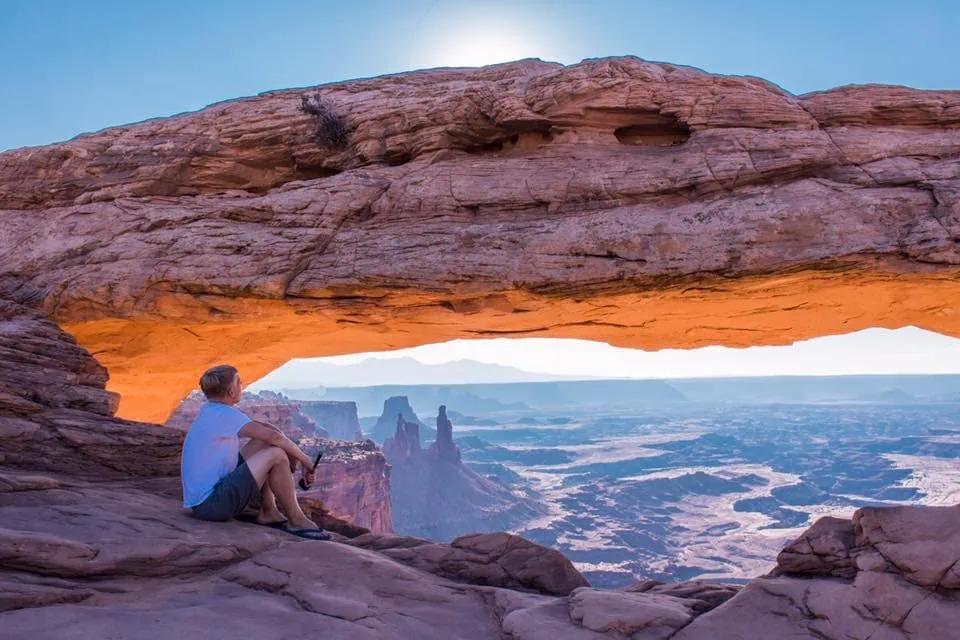
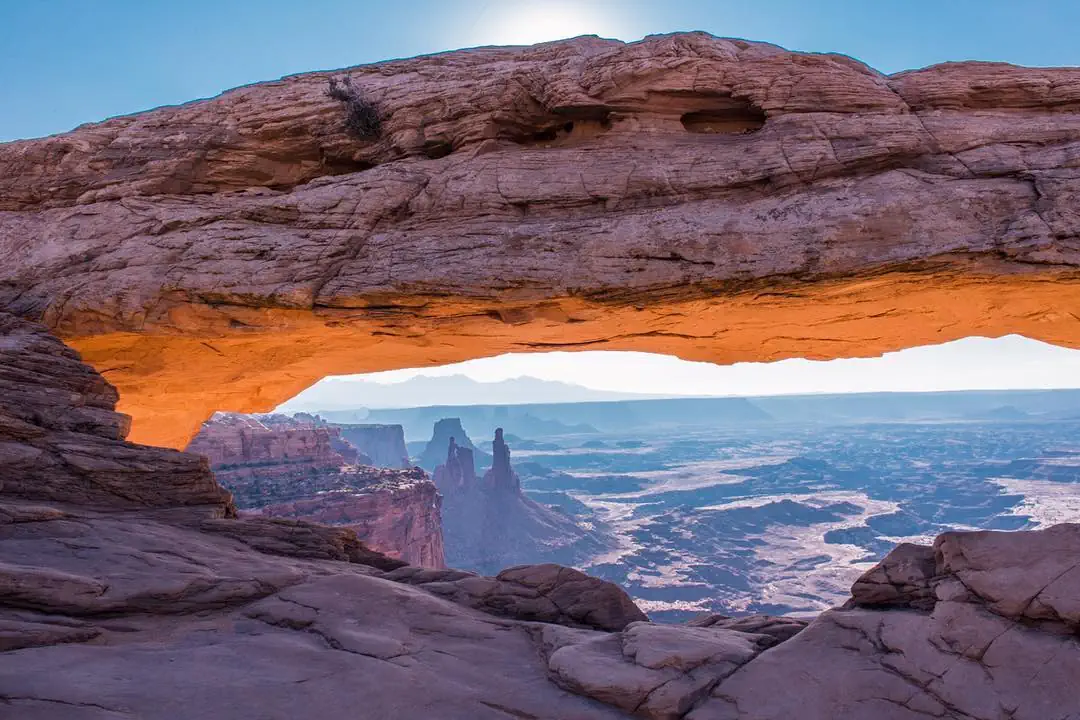
This is the shot you’ve seen in thousands of photos. Mesa Arch is a natural rock arch perched right on the edge of a cliff, and at sunrise, it glows orange-red from underneath with light reflected off the canyons below. It literally looks like the arch is on fire.
The trail to Mesa Arch is short — roughly 800 metres round trip with minimal elevation gain. Absolutely anyone can do it, including children. BUT: if you want to see the sunrise, you need to arrive at least 30–45 minutes before dawn, because photographers and tourists start claiming spots while it’s still dark. During peak season, it looks like a cinema — rows of people with tripods, quiet whispers, and then a collective “ahhh” when the first ray pierces through the arch. 😁
Even if you miss the sunrise, Mesa Arch is worth visiting any time of day. The view through the arch towards Washer Woman Arch and the canyons beyond is stunning in any light.
2. Grand View Point — A View to the End of the World
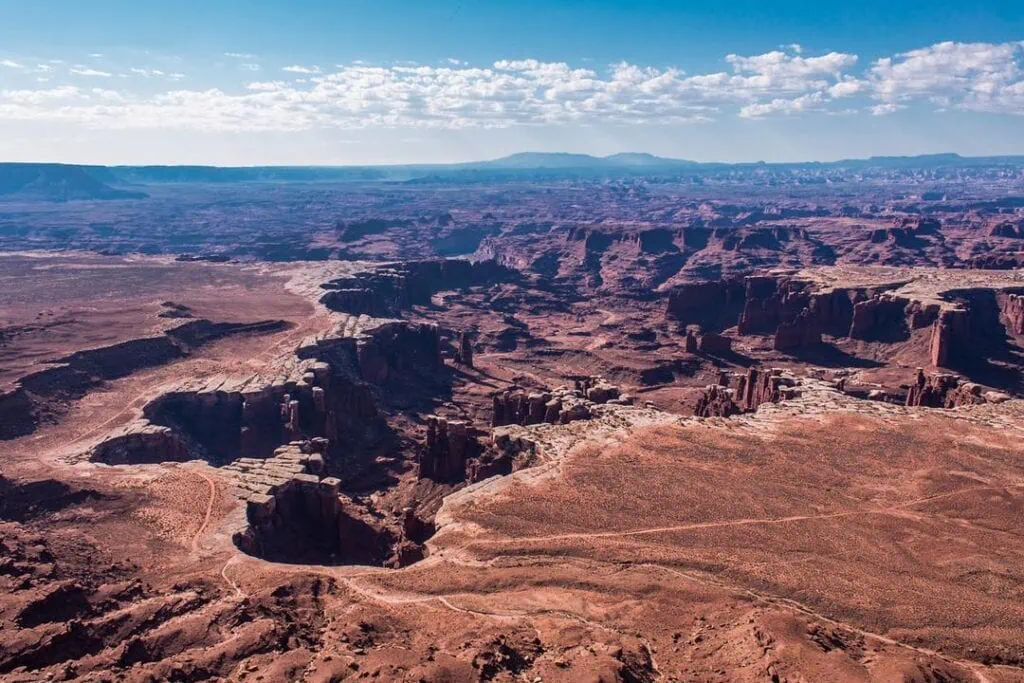
Grand View Point is the final stop on the scenic drive in Island in the Sky — and it’s the view that defines the entire park. You stand on a rocky promontory and all around you stretch canyons, mesas, buttes, and gorges in shades of red, orange, and white. On a clear day, you can see tens of miles into the distance, all the way to the La Sal Mountains.
Grand View Point Overlook is accessible right from the car park. If you have the time and energy, set off on the Grand View Point Trail — it’s about 3 km (1.8 miles) round trip along a flat rocky ridge with views on both sides. It’s not a difficult hike, but the feeling of walking along a narrow ridge with chasms on either side is unforgettable.
We were here in the late afternoon as the sun began to set and the entire landscape transformed into a palette of warm colours. We sat on the edge of the cliff with our legs dangling over the void (safely, of course 😅) and simply gazed. Sometimes you don’t need to do anything — you just need to be.
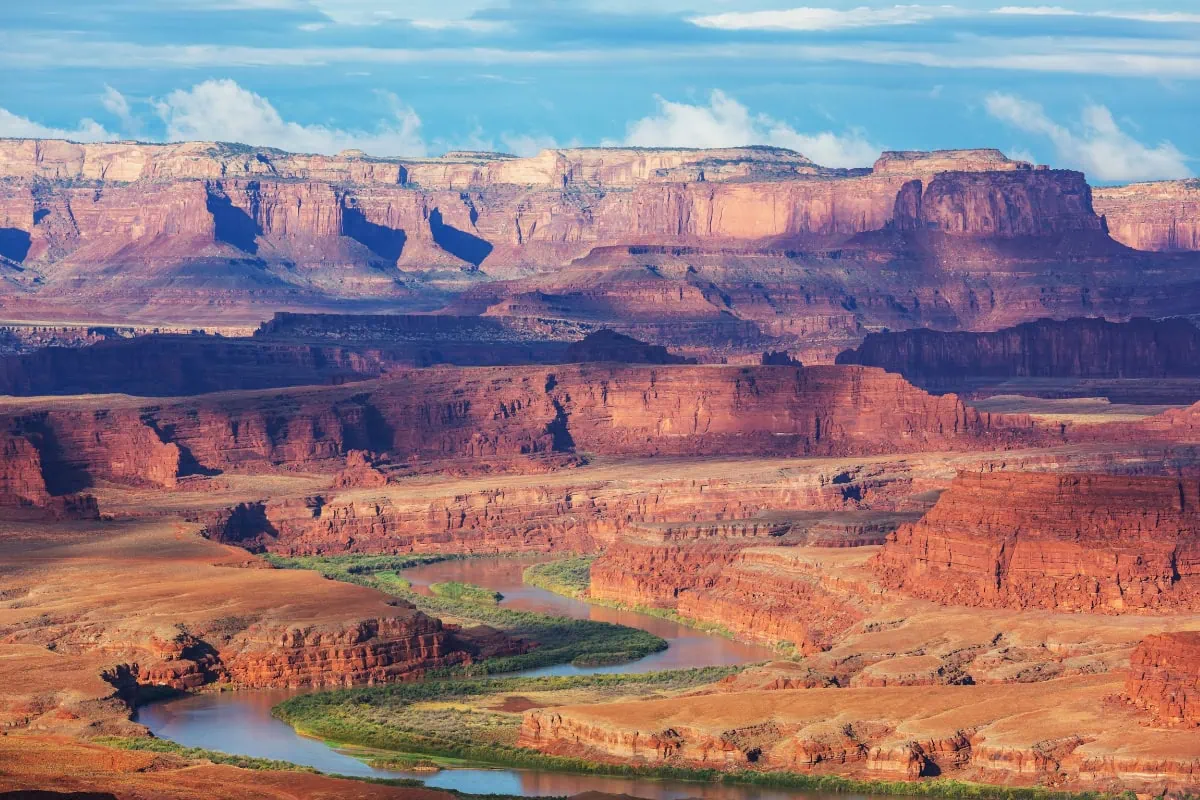
3. Green River Overlook — The Most Beautiful River Viewpoint
Green River Overlook is perhaps my favourite viewpoint in the entire park. You stand on the edge and below you the Green River winds through the canyon in a perfect meander — like a huge green “U” set into the red rocks.
The turnoff to the overlook branches from the main scenic drive and it’s just a short walk from the car park. Unlike Grand View Point, there are significantly fewer people here, so you can enjoy the view in peace. The best times to visit are morning or late afternoon, when the low sun creates dramatic shadows in the canyons.
4. Upheaval Dome — A Geological Mystery
Upheaval Dome is a peculiar geological formation that looks like a massive crater in the middle of an otherwise flat mesa. Scientists still debate whether it was formed by a meteorite impact or by the erosion of a salt dome. Whatever the truth, it’s a fascinating sight.
The First Overlook is an easy walk of about 800 metres. If you want a better view and perspective of the entire “crater,” continue to the Second Overlook — roughly 2.5 km (1.5 miles) round trip. The path is rocky but not particularly challenging.
Most tourists skip Upheaval Dome because it’s not as photogenic as Mesa Arch or Grand View Point. But that’s precisely why it’s wonderfully peaceful — and the thought that you might be looking at a meteorite impact site is just plain cool.
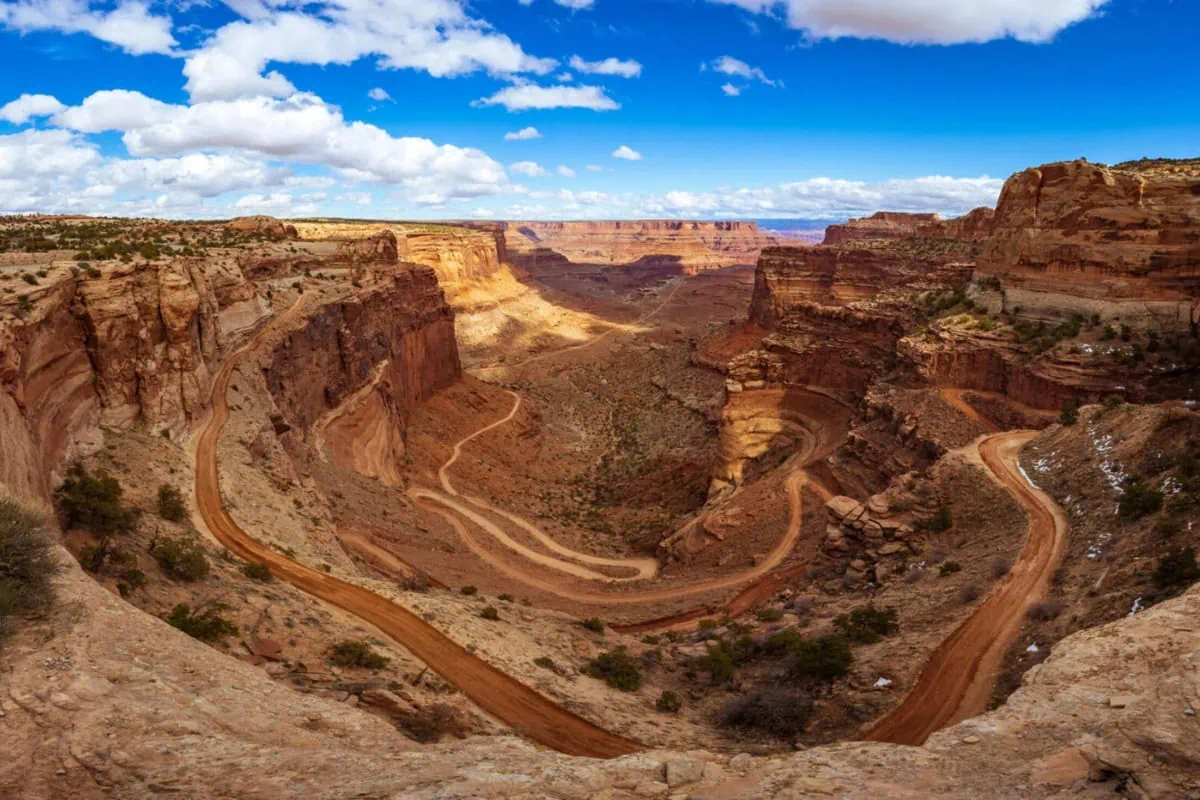
5. Shafer Canyon Overlook — Guaranteed Vertigo
Shafer Canyon Overlook is one of the first viewpoints you’ll encounter after entering Island in the Sky, and it packs a serious punch right away. You stand at the edge of an abyss and directly below you the Shafer Trail winds — a switchback gravel road that zigzags down into the canyon. It looks like a road nobody sane should drive. (Spoiler: people do.)
The overlook is right by the road, so no hiking required. It’s a great place to stop at the very beginning of your visit — it sets the tone for everything that follows.
6. White Rim Overlook Trail — A Short Hike with an Epic Finale
If you want something more than just standing at a railing, White Rim Overlook Trail is the perfect choice. It’s about 3 km (1.8 miles) round trip over relatively flat terrain, and at the end you’re rewarded with a view down to the White Rim Road — the legendary off-road route that winds 300 metres below you.
The hike is easy and manageable for anyone with average fitness. At the end of the trail, you’ll find yourself on a rocky outcrop where you can sit and watch as the occasional Jeep crawls along White Rim Road far below. It’s strangely meditative.
7. Canyonlands Scenic Drive — Island in the Sky from the Car
If you’re short on time, the Canyonlands National Park scenic drive in Island in the Sky is the best thing you can do. The main road runs from the visitor centre all the way to Grand View Point and is roughly 20 km (12 miles) one way. Along it, you’ll find most of the major viewpoints and trailheads.
You can complete the entire scenic drive with short stops in 2–3 hours. If you add Mesa Arch and the Grand View Point Trail, allow for half a day. The road is well-paved tarmac and you don’t need any special vehicle.
Tip: Head out early in the morning for Mesa Arch (sunrise) and then continue along the scenic drive towards Grand View Point. Stop at Green River Overlook and Upheaval Dome along the way. In the afternoon, you can still fit in Arches National Park — the distance from Arches National Park to Canyonlands (Island in the Sky) is only about 40 minutes’ drive.
8. White Rim Road — A 4×4 Adventure for the Bold
White Rim Road is a 160 km (100-mile) off-road route that follows a contour roughly halfway between Island in the Sky above and the rivers below. It’s one of the most famous 4×4 road trips in America and a once-in-a-lifetime experience.
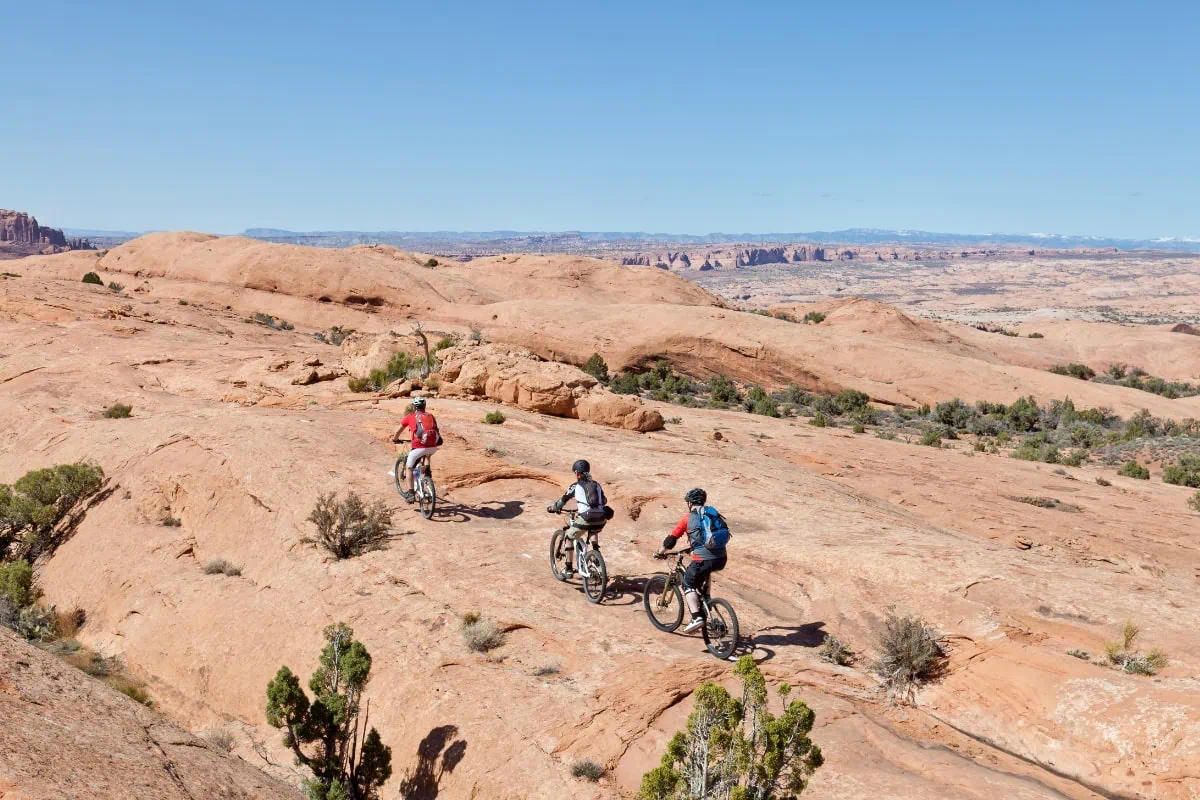
For White Rim Road you need a 4×4 vehicle with high clearance, a park permit (which must be reserved in advance via recreation.gov), and at least 2–3 days. Most people do it in 2–3 days, camping overnight at primitive sites along the route. Some fit cyclists tackle it on mountain bikes in 3–4 days.
This isn’t a trip for everyone — it’s a remote, demanding route with no mobile signal, no water, and no facilities of any kind. But if you love adventure and have off-road experience, it’s one of the most epic things you can do in Utah.
The Needles: 4 Reasons to Visit the Wild Southern Section
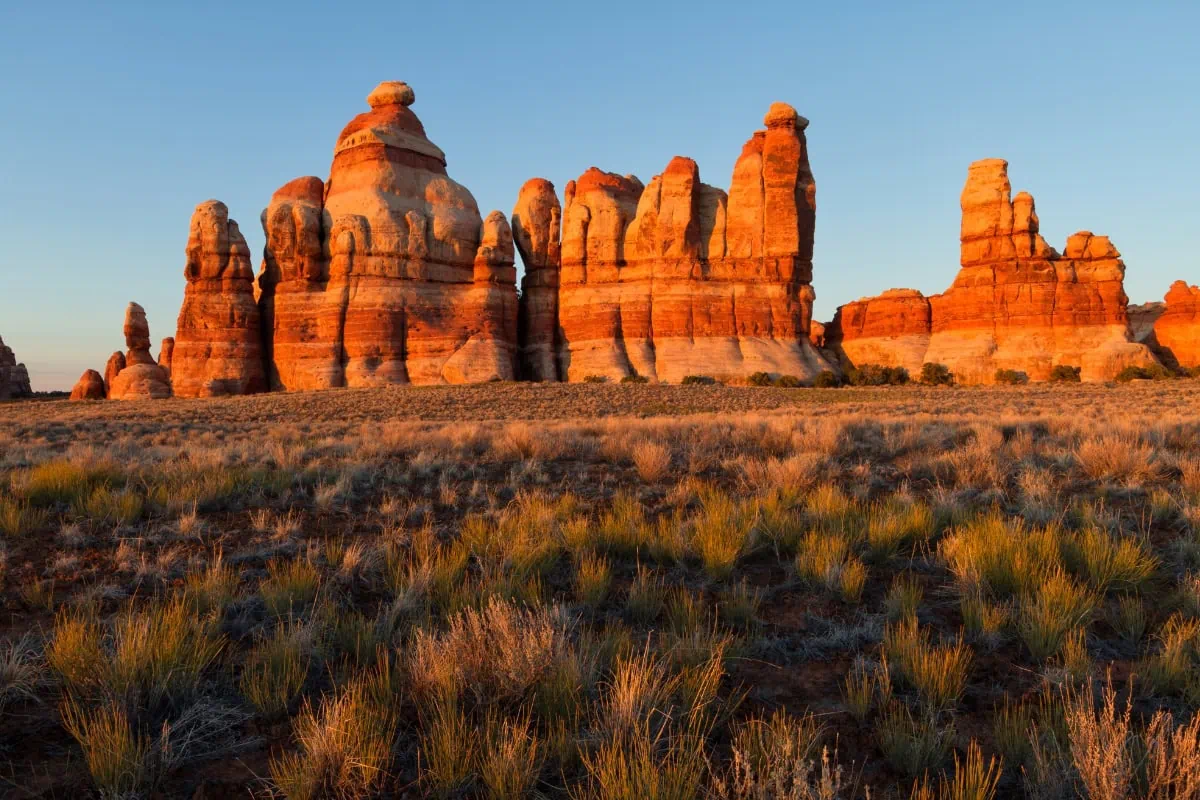
The Canyonlands National Park Needles district is a completely different world from Island in the Sky. While Island in the Sky offers panoramic views from above, in The Needles you’re down among the rocks — surrounded by colourful towers, pillars, and rock “needles” that gave the area its name. It’s a hiker’s paradise with a true sense of wilderness.
The Needles lies about an hour and a half’s drive from Moab (via US-191 and UT-211) and attracts significantly fewer visitors than Island in the Sky. If you have at least two days in Moab, dedicate one to Island in the Sky and another to The Needles — you won’t regret it.
9. Chesler Park Loop — The Most Beautiful Hike in Canyonlands
Chesler Park Loop is an approximately 18 km (11-mile) circuit that takes you through the heart of the Needles district. You’ll pass through narrow rock passages (joints), open grassy meadows surrounded by rock towers, and landscapes that look straight out of a fantasy film.
The hike is moderately strenuous — the elevation gain isn’t extreme, but the distance and rocky terrain require solid fitness and good hiking boots. Allow 5–7 hours. Bring plenty of water (at least 3 litres per person) — there are no drinking water sources on the trails in The Needles.
10. Slickrock Trail — An Easy Hike for Everyone
If you don’t fancy hiking 18 km, Slickrock Trail is the perfect shorter alternative. It’s about 4 km (2.5 miles) round trip over rocky terrain with gorgeous views of the surrounding “needles” and distant canyons. The trail is well marked with cairns and is manageable even for less experienced hikers.
Tip: Slickrock Trail is ideal for an evening walk, when the low sun beautifully illuminates the colourful rock formations.
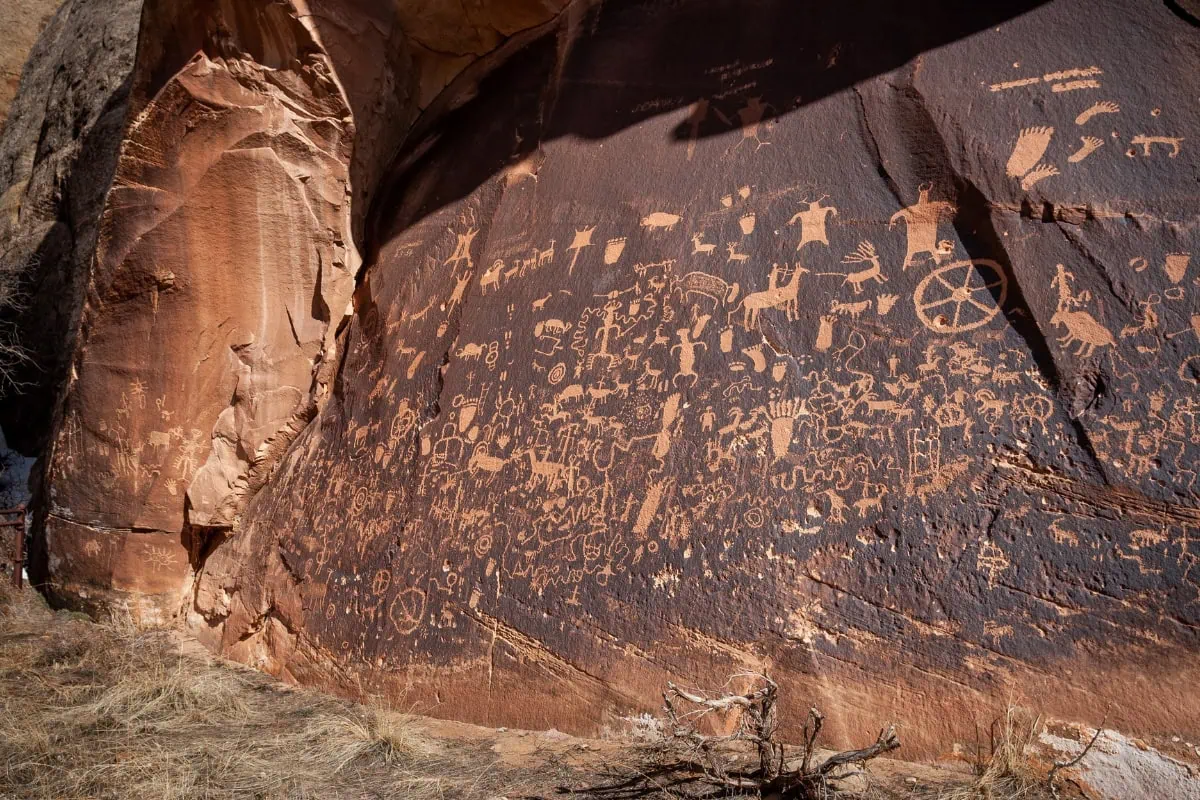
11. Newspaper Rock — A Prehistoric Comic Strip
On your way to The Needles (along UT-211), stop at Newspaper Rock State Historical Monument. It’s a massive rock wall covered in hundreds of petroglyphs — rock carvings created by Native American peoples over thousands of years. You’ll find figures of hunters, animals, symbols, and patterns whose exact meaning remains a mystery to this day.
Newspaper Rock is right by the road, the stop takes 15–20 minutes, and it’s free. But the feeling of looking at artwork thousands of years old is priceless.
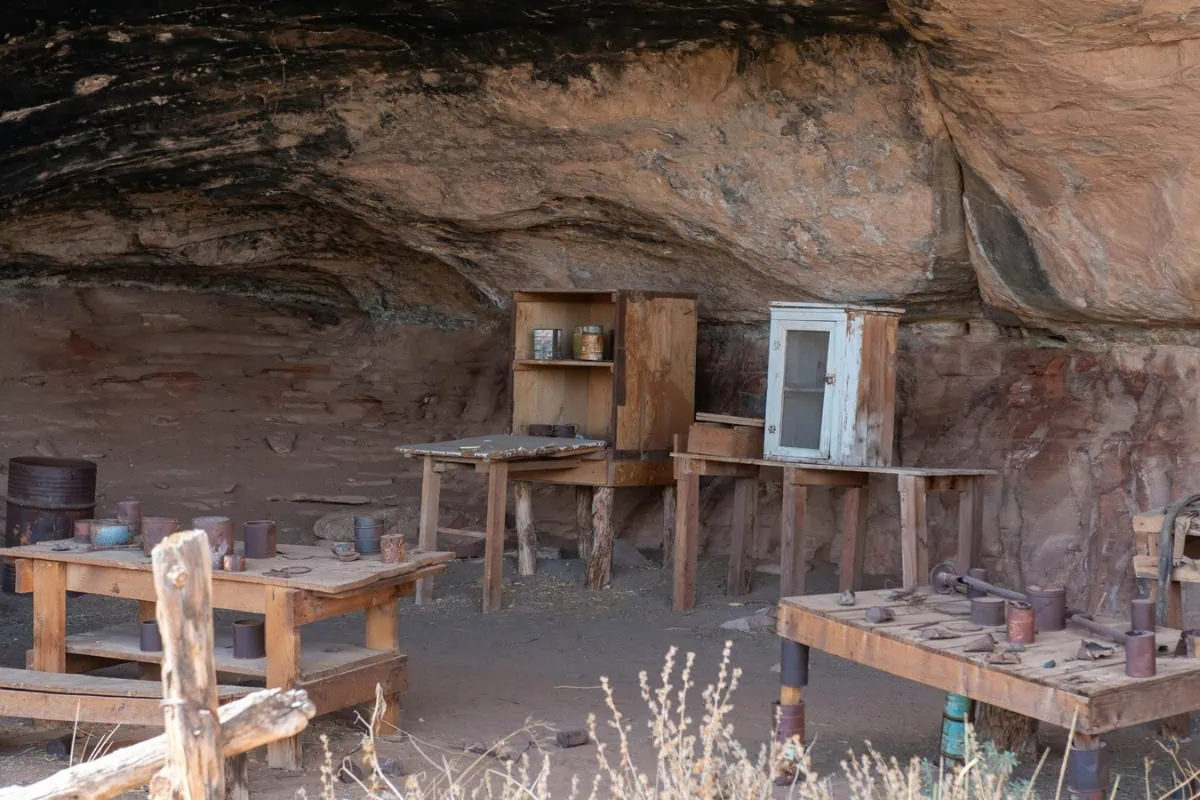
12. Cave Spring Trail — A Visit to a Cowboy Camp
Cave Spring Trail is a short loop (about 1 km / 0.6 miles) that takes you past a historic 19th-century cowboy camp and prehistoric pictographs. The route also crosses a couple of rock ladders, which kids absolutely love.
It’s an ideal trail for families with children or for anyone who wants a quick taste of the area’s history without hiking all day.
The Maze: The Most Remote Corner of the Park
Now let’s take a look at the section that’s made for adventurers.
13. The Maze — Only for True Adventurers
The Maze is the most remote and least visited section of Canyonlands National Park. Getting here requires a 4×4 vehicle, off-road experience, and at least 3 days. The nearest access point is via Hans Flat Ranger Station, from which it’s still hours of driving on unpaved roads.
To give you some perspective: The Maze receives fewer visitors in an entire year than Island in the Sky gets in a single day. There’s no infrastructure, no mobile signal, and the ranger station is hours away by car. It’s a place for people who want absolute wilderness — and are prepared for it.
We didn’t make it to The Maze (we didn’t have enough time and, I’ll admit, perhaps not quite enough courage 😅), but everyone we’ve spoken to who has been there delivers the same verdict: it’s the wildest and most beautiful part of the entire park. One day we’ll go — I promise.
14. Horseshoe Canyon — World-Class Prehistoric Art
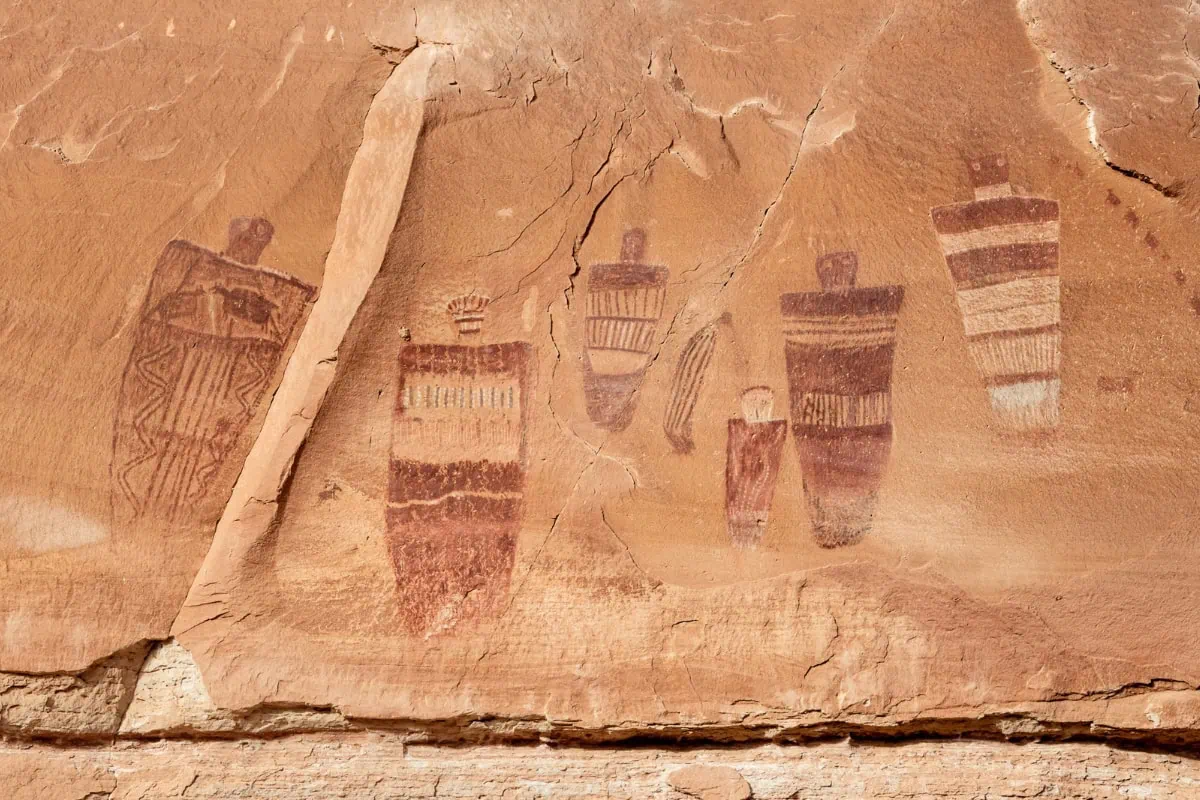
Horseshoe Canyon technically belongs to Canyonlands but lies detached from the rest of the park. The main attraction is the Great Gallery — one of the most significant collections of rock art in North America. The paintings are over 4,000 years old and depict larger-than-life human figures in an eerie style known as “Barrier Canyon Style.”
The hike to the Great Gallery is about 10 km (6.2 miles) round trip with a 230-metre (750-foot) descent into the canyon (and of course the climb back out). The access road is unpaved and may be impassable after rain. I recommend checking conditions with the ranger station beforehand.
Where to Eat and Drink: A Guide for Hungry Travellers
Inside Canyonlands National Park itself, you won’t find a single restaurant, shop, or even a water vending machine. Nothing. Zero. This isn’t Yellowstone — this is true wilderness. You must bring all your food and water with you.
Stocking Up Before Your Hike
In Moab, stock up at City Market (the largest supermarket in town) or the smaller Village Market. Buy plenty of water — we recommend at least 3–4 litres per person per day, especially during the warmer months.
For the trail, pack sandwiches, fruit, nuts, energy bars, and a salty snack (you sweat a lot in the desert and lose salts).
Restaurants in Moab
Moab is a small town, but the dining scene is surprisingly good:
- Quesadilla Mobilla — a food truck with phenomenal quesadillas. The queue can be long, but it’s worth it. Prices around $10–14 (€9–13).
- Thai Bella — the best Thai restaurant in town. The curry is fantastic and portions are generous.
- Antica Forma — an Italian restaurant with excellent Neapolitan pizza. Lovely outdoor seating.
- Love Muffin Café — great breakfast and brunch. Come early, as queues form quickly.
- Milt’s Stop & Eat — a classic American diner with excellent burgers and milkshakes. Cheap, fast, authentic.
- Moab Brewery — a local brewery with solid food and their own craft beers. Perfect after a full day of hiking.
Coffee tip: Red Rock Bakery has excellent coffee and fresh pastries — the perfect stop on your way to the park in the morning.
How to Combine Canyonlands with Arches National Park
Arches National Park is literally just around the corner — from Moab it’s only 10 minutes to Arches and about 40 minutes to Island in the Sky. It would be a shame not to visit both. Here’s a suggested itinerary:
3-day plan:
- Day 1: Island in the Sky — Mesa Arch (sunrise), scenic drive, Grand View Point, Green River Overlook
- Day 2: The Needles — Chesler Park Loop or shorter hikes + a stop at Newspaper Rock on the way
- Day 3: Arches National Park — Delicate Arch (sunset!), Devils Garden, Landscape Arch
If you only have 1 day: Focus on Island in the Sky (scenic drive + Mesa Arch + Grand View Point) and head to Arches in the afternoon. It’s intense but doable.
The distance from Arches National Park to Canyonlands (Island in the Sky) is roughly 50 km (31 miles) and the drive takes about 40 minutes. Between Arches and The Needles, it’s approximately 120 km (75 miles) or 1.5 hours.
Practical Tips and Tricks
What to Pack
Utah is a desert — dress and pack accordingly. Essentials:
- Plenty of water (3–4 litres per person/day — no, I’m not exaggerating)
- Sunscreen SPF 50+ and a hat — UV radiation at an altitude of around 1,800 m (5,900 ft) is intense
- Good hiking boots — the terrain is rocky and slippery. Check out our hiking boot tips.
- Layered clothing — mornings and evenings can be chilly even in season
- Torch/headlamp — if you’re going to Mesa Arch for sunrise, it’ll be dark
- For a complete packing guide, read our article on how to pack into carry-on luggage
Where to Find Flights
Look for affordable flights to the USA on Kiwi or Skyscanner — they’re great tools for finding the best deals. There are direct flights to Salt Lake City from several European cities, or you can connect through London, Frankfurt, or another major hub.
Car Rental
A car in Utah is absolutely essential. We regularly use the comparison site RentalCars.com, where you can find offers from all the major rental companies. For Island in the Sky and the main roads, a standard car will do. For White Rim Road, The Maze, or unpaved roads in The Needles, you’ll need a 4×4 with high clearance.
Internet and eSIM
In Moab, you’ll have WiFi and mobile signal without any issues. Inside the park itself, there’s virtually no signal — not even on Island in the Sky, let alone in The Needles or The Maze. Download offline maps beforehand (Google Maps or maps.me) and a Canyonlands National Park map. If you’re travelling in the USA for an extended period, check out our review of Holafly eSIM.
Travel Insurance
Don’t underestimate travel insurance for a trip to the USA — healthcare in America is astronomically expensive. Read our SafetyWing review, which we use for longer trips.
FAQ — Frequently Asked Questions About Canyonlands National Park
What is Canyonlands National Park known for?
Canyonlands is the largest national park in Utah and offers some of the most dramatic canyon landscapes in the world. Unlike the Grand Canyon, which you typically view from one rim, Canyonlands surrounds you from all sides — mesas, buttes, rock needles, rivers, and arches in a landscape that feels almost extraterrestrial. There are also significantly fewer tourists here than at neighbouring Arches, so you can enjoy the wilderness in peace.
Which national park is better — Arches or Canyonlands?
It depends on what you’re looking for. Arches is more compact, more photogenic, and easier to explore in half a day — ideal for those who want to see iconic rock arches. Canyonlands is more expansive, wilder, and offers a deeper experience of the American West. We personally prefer Canyonlands — there’s more space, more silence, and that feeling of endlessness is unbeatable. But honestly? Visit both. From Moab, they’re both just a short drive away.
How long does it take to drive through Canyonlands?
The scenic drive in Island in the Sky (the main road from the entrance gate to Grand View Point) is roughly 20 km (12 miles) one way. Without stops, you can drive it in 30 minutes, but with short stops at viewpoints, allow 2–3 hours. If you add hikes (Mesa Arch, Grand View Point Trail), it’ll fill an entire morning or afternoon. The scenic drive in The Needles is shorter, but the hikes are longer.
What city is Canyonlands National Park in?
Moab — it’s the nearest town with full infrastructure (accommodation, restaurants, shops, petrol stations). From Moab to Island in the Sky takes about 35–40 minutes, to The Needles roughly 1.5 hours. Moab is also the gateway to Arches National Park and is the ideal base for exploring the entire area.
How many days do I need for Canyonlands?
For Island in the Sky (scenic drive + main viewpoints + Mesa Arch at sunrise), half a day to one full day is enough. If you want to visit The Needles as well, add another day. For White Rim Road or The Maze, allow 2–3 extra days. The ideal combination is 1 day Island in the Sky + 1 day The Needles + 1 day Arches = 3 days in Moab.
Do I need a 4×4 for Canyonlands?
For the Island in the Sky scenic drive and main viewpoints — NO. The road is well-paved and you can manage it in a standard car. For The Needles, the main road is also fine with a regular car, but some side roads (Elephant Hill, Salt Creek) require 4×4. For White Rim Road and The Maze, you absolutely need a 4×4 with high clearance.
Is Canyonlands National Park dangerous?
The park is safe as long as you follow basic desert hiking rules: carry enough water (dehydration is the main risk), avoid hiking in the midday heat, stick to marked trails, and be careful near cliff edges — most viewpoints have no railings. Watch out for rattlesnakes especially during the warmer months — but don’t be alarmed, attacks are extremely rare. Mobile signal doesn’t work in the park, so always tell someone where you’re going and have offline maps ready.
Tips and Tricks for Your Vacation
Don’t Overpay for Flights
Search for flights on Kayak. It’s our favorite search engine because it scans the websites of all airlines and always finds the cheapest connection.
Book Your Accommodation Smartly
The best experiences we’ve had when looking for accommodation (from Alaska to Morocco) are with Booking.com, where hotels, apartments, and entire houses are usually the cheapest and most widely available.
Don’t Forget Travel Insurance
Good travel insurance will protect you against illness, accidents, theft, or flight cancellations. We’ve had a few hospital visits abroad, so we know how important it is to have proper insurance arranged.
Where we insure ourselves: SafetyWing (best for everyone) and TrueTraveller (for extra-long trips).
Why don’t we recommend any Czech insurance company? Because they have too many restrictions. They set limits on the number of days abroad, travel insurance via a credit card often requires you to pay medical expenses only with that card, and they frequently limit the number of returns to the Czech Republic.
Find the Best Experiences
Get Your Guide is a huge online marketplace where you can book guided walks, trips, skip-the-line tickets, tours, and much more. We always find some extra fun there!


