

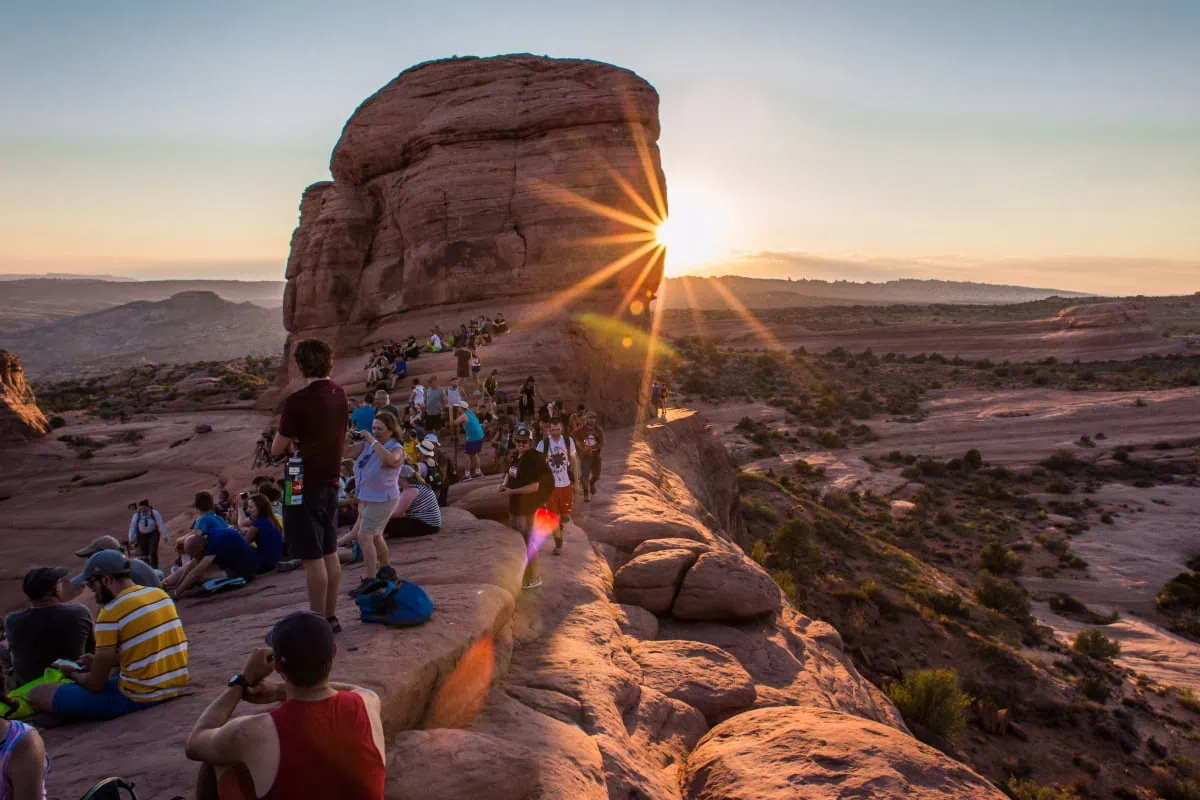
When Lukáš and I first drove through the gate of Arches National Park, I expected a desert landscape with a few rock arches along the road. A nice little afternoon trip, I thought. Eight hours and twenty thousand steps later, I was standing beneath Delicate Arch at sunset, jaw on the floor and tears in my eyes, whispering: “This can’t be real.” 😅
But it is very real. Arches National Park is a place where nature has spent millions of years patiently carving shapes into red sandstone that not even the wildest sculptor could dream up. Over 2,000 natural stone arches in a single location — there’s nothing quite like it anywhere on Earth. From the delicate curve of Delicate Arch, which you’ll recognise from Utah’s licence plates, to the monumental Landscape Arch spanning nearly 100 metres, to Double Arch, where you feel like an ant in a cathedral.
The park lies in southeastern Utah, just minutes from the town of Moab, and can easily be combined with nearby Canyonlands and other parks of the American Southwest. In this article, I’m bringing you a complete guide to Arches National Park — 15 tips on what to see and do, practical advice on timed entry reservations, where to stay in Moab, how much it all costs, and how to make the most of the park even if you only have one day.
TL;DR
- Arches National Park is located in Utah, right next to the town of Moab — the entrance gate is just 8 km from the town centre.
- The park contains over 2,000 natural stone arches, including the iconic Delicate Arch and the impressive Landscape Arch.
- From April to October, you’ll need a timed entry reservation — book on recreation.gov, slots sell out fast.
- Entrance fee is $30 per car (valid for 7 days). If you’re visiting multiple parks, get the America the Beautiful Pass for $80.
- The best time to visit is April–May or September–October — pleasant temperatures around 20–25 °C and smaller crowds.
- The park features a 29 km Arches Scenic Drive — you drive along it with turnoffs leading to individual trails and viewpoints.
- Delicate Arch Trail is a must-do — 4.8 km round trip, ideally 1–2 hours before sunset.
- For adventurers: Fiery Furnace — a labyrinth of rock formations accessible only with a permit or with a ranger.
- Devils Garden Trail at the end of the road offers several arches including Landscape Arch.
- Accommodation in Moab ranges from about $60/night (budget motel) to $150+/night (nicer hotel).
- The park pairs beautifully with Canyonlands National Park, which is just 40 minutes by car.
- Plan at least one full day for the whole park, ideally two days.
When to Visit Arches National Park and How to Get There
Arches National Park is a desert park, and the weather plays an absolutely crucial role in how much you’ll enjoy your visit. Temperatures change dramatically throughout the year, and some months are, frankly, pretty brutal. Here’s my honest overview of when to go and what to avoid.
Best Time to Visit
April and May are probably the very best months. Temperatures hover around 20–28 °C, the days are long, and nature is waking up (yes, even in the desert!). It can be windy occasionally, but nothing that would stop you.
September and October are the second great choice — summer has faded, temperatures drop back to a pleasant 18–27 °C, and the crowds thin out noticeably, especially after mid-September.
June to August — summer in Arches is brutal. Temperatures routinely exceed 38 °C and the rock trails turn into a scorching frying pan. If you visit in summer, plan all longer hikes for early morning (before 8:00) or late afternoon. Hydration is an absolute must — bring at least 2 litres of water per person for every hike. We once made the mistake of setting off for Delicate Arch at two in the afternoon in July… never again. 😅
November to March — the park is open year-round, but winter months bring temperatures around freezing (sometimes below) and occasional snow. On the other hand — red rocks with a white dusting are absolutely magical, and you’ll have the place almost to yourself. Just expect shorter days and the possibility that some trails may be snowy or icy.
How to Get to Arches National Park
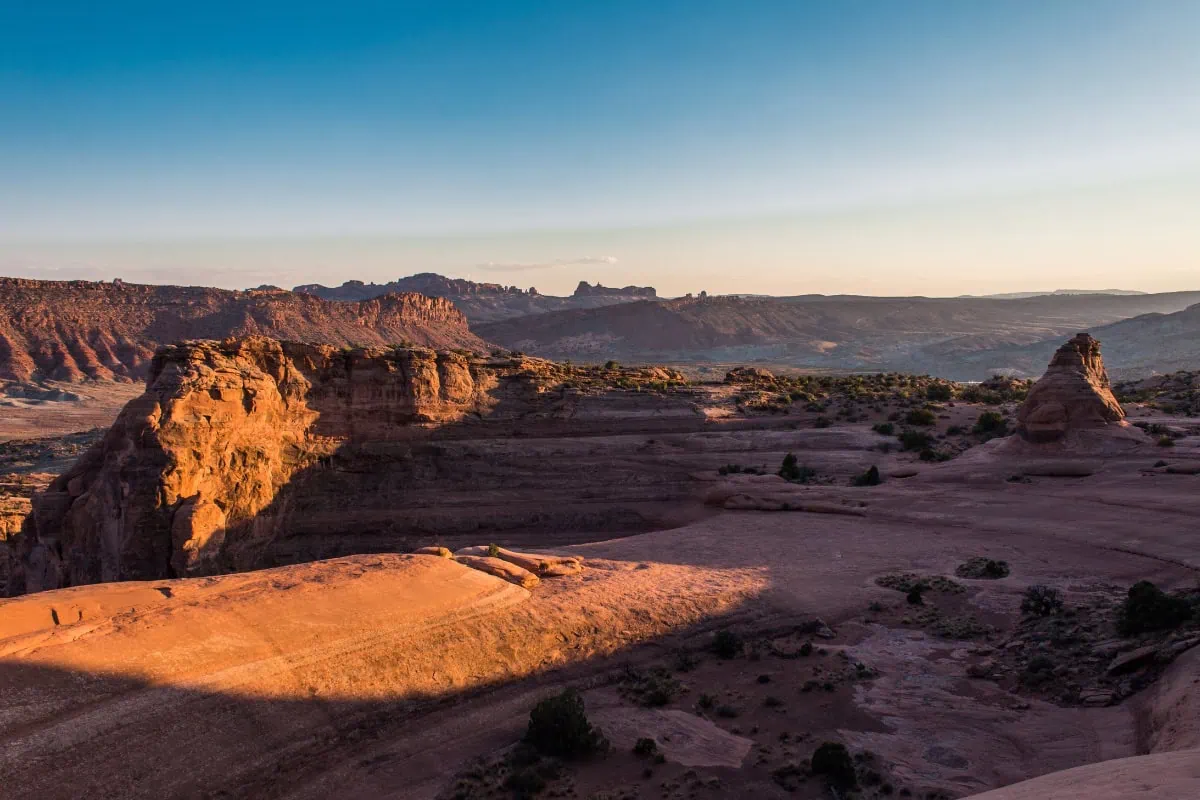
If you’re wondering where Arches National Park is on the map — it’s in southeastern Utah, right next to the town of Moab. The park entrance gate is literally 8 km from the centre of Moab.
By car — this is by far the most practical option. You can’t get around the park without a car; there’s no public transport. The nearest larger cities are:
- Moab — 8 km (5 minutes by car) — the base for most visitors
- Grand Junction, Colorado — 180 km (2 hours) — the closest larger airport
- Salt Lake City — 370 km (4 hours) — the biggest international airport in the region
We flew into Salt Lake City and drove from there across Utah, which was amazing — the landscape along the way is an experience in itself. We’ve had great long-term experience with RentalCars, which we use all over the world, and Utah was no exception. A car is an absolute necessity here, not just for Arches but for all the surrounding parks.
By air — the closest airport with regular flights is Canyonlands Field Airport (CNY) in Moab itself, served by United Airlines from Denver. A wider selection of connections is available at Grand Junction (GJT) or Salt Lake City (SLC). For cheap flights to the US from the UK, try comparison sites like Skyscanner or Google Flights to find the best deals with connecting flights.
Timed Entry — Reservation for Entry (Important!)
Since 2022, Arches National Park has operated a timed entry system — essentially timed entry tickets. If you’re planning a visit from 1 April to 31 October, you need to book a time slot in advance on recreation.gov.
Here’s how it works:
- Reservations open 3 months in advance (e.g. June slots open on 1 March)
- Slots sell out within minutes — be on the website the moment they open
- It costs just $2 per reservation (plus the $30 per car entrance fee)
- If you miss out, there’s a last-minute lottery — a limited number of slots are released the day before
- Without a reservation, you can enter the park before 7:00 am or after 4:00 pm (times may vary — check nps.gov)
My tip: Get the America the Beautiful Pass for $80 (about £65) if you’re planning to visit more than two national parks. The pass is valid for a full year and covers entry to all national parks and federal recreation areas in the USA. However, you still need the timed entry reservation — the pass replaces only the entrance fee, not the timed entry.
Where to Stay in Moab and How Much Arches National Park Costs
Moab is hands down the best base for visiting Arches National Park. It’s a small desert town with surprisingly good infrastructure — hotels, restaurants, bike and jeep rental shops, outdoor stores. Everything a traveller needs in one place. From central Moab, you’re at the park entrance gate in 5 minutes.
Accommodation in Moab
Popular accommodation options include Hoodoo Moab (a stylish hotel with a pool and stunning views of the red rocks), Gonzo Inn (a boutique hotel in the centre), or the more affordable but clean Moab Valley Inn. In winter, prices sometimes drop by as much as half.
How Much a Visit to Arches Costs
Here’s an approximate budget for 3 days for two people (Arches + Canyonlands):
- Arches entrance fee: $30 per car / 7 days (or $80 America the Beautiful Pass)
- Timed entry reservation: $2
- Canyonlands entrance fee: $30 per car / 7 days (included in ABP)
- Accommodation (3 nights, mid-range): approx. $150–250/night → $450–750 total
- Food (restaurants + occasional groceries): $40–80/day for two → $120–240 total
- Petrol: approx. $30–50
- Total for 3 days for two: approx. $670–1,150 (excluding flights and car hire)
Prices in Moab aren’t exactly cheap — it’s a tourist town and they know it. But compared to some other park destinations in the US (looking at you, Jackson Hole 😅), it’s still reasonable.
Arches National Park: 15 Places You Must See and Things to Do
Let’s take a look at the best things Arches National Park has to offer. The park is surprisingly compact — the main road (Arches Scenic Drive) is just 29 km long, with short turnoffs leading to individual trails and viewpoints. Yet you can easily spend two full days here, because the number of arches, rock formations, and hikes is simply staggering. I’ve listed the tips roughly in the order you’ll encounter them driving through the park from the entrance.
1. Arches Scenic Drive — An Experience in Itself
Yes, you can drive through Arches National Park by car — and the drive itself is one of the highlights. Arches Scenic Drive takes you through the entire park along a 29 km road that climbs from the desert valley past red rock walls all the way to Devils Garden at the end. Along the way, there are viewpoints, trailhead car parks, and dozens of rock formations visible directly from the car.
But honestly? If you just drive through without getting out, you’ll miss 90% of what makes Arches special. Most arches require at least a short walk. Think of the Scenic Drive as the backbone of your day — park up, walk, take photos, then move on to the next stop.
Practical tip: Car parks at popular trailheads (Delicate Arch, Devils Garden) fill up by 8–9 am during the season. Either set off early or aim for the afternoon when spaces start freeing up.
2. Park Avenue Viewpoint & Trail — A Sandstone Welcome Committee
Right after entering the park, you’ll reach the first stop — Park Avenue Viewpoint. The name isn’t a coincidence: the enormous rock towers on both sides of the valley resemble the skyscrapers of Manhattan. Except these skyscrapers are millions of years old and have a much nicer colour. 😉
If you have time, walk the Park Avenue Trail (1.6 km one way, one-directional — you’ll need either two cars or to walk back the same way). You walk along the canyon floor between the towers, and it’s a stunning introduction to what awaits you in the park. We walked it there and back (3.2 km total) and it took about 45 minutes.
3. Balanced Rock — A Rock That Defies Gravity
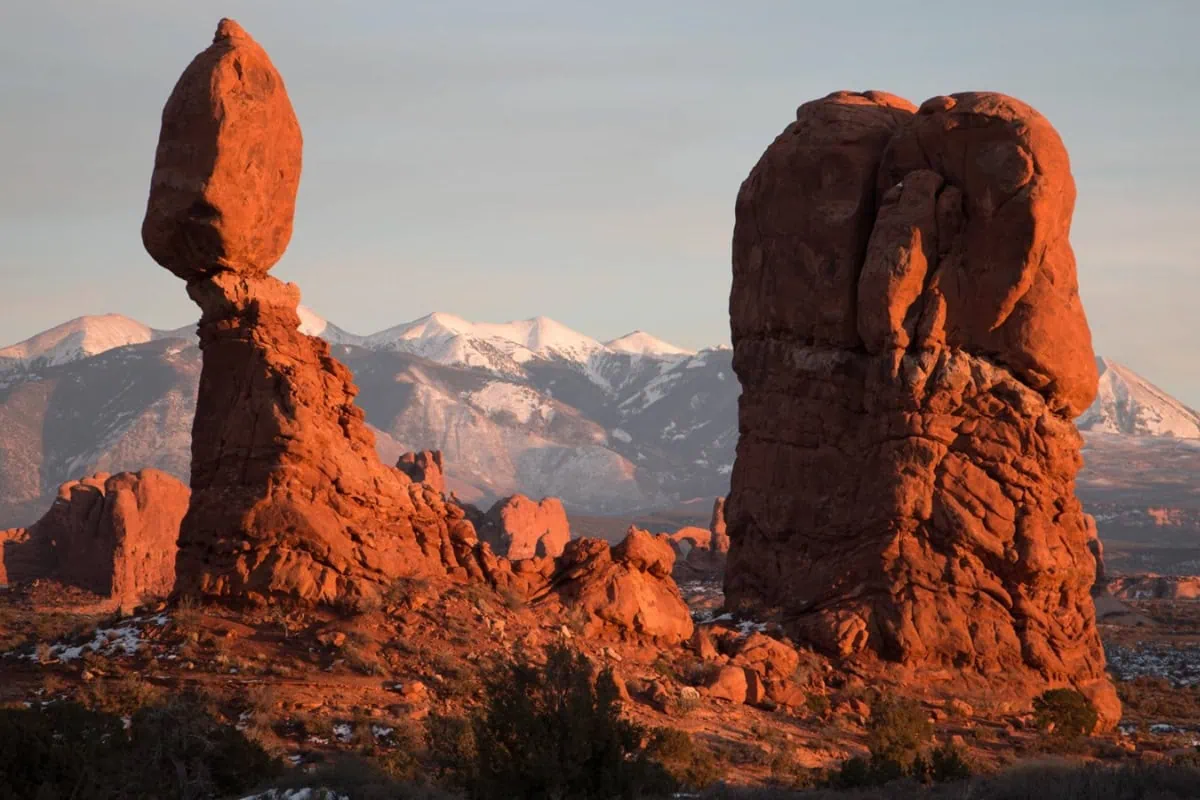
This 39-metre rock formation looks like it should topple over any second. A massive boulder balancing on a thin “leg” of softer sandstone — it looks like a Photoshop creation, but it’s completely real. Balanced Rock is visible right from the road, and the short loop around it (500 metres) takes just 15 minutes.
It’s a great stop for stretching your legs and taking photos. At sunset, the rock literally glows orange — if you’re heading back from the park in the evening, be sure to stop here.
4. The Windows Section — Three Arches in One Place
This is one of the most photogenic areas in the park and also one of the most easily accessible. A short turnoff from the main road takes you to a car park, from where two short trails lead to North Window, South Window, and Turret Arch.
The Windows Trail (1.6 km loop) takes you to both “windows” — enormous arches in the rock wall. You walk through them, and the views of the desert landscape framed by the arches are breathtaking. Don’t miss the trail behind the Windows (not just to them) — the view from the other side is even better and far fewer people venture there.
Turret Arch is across the car park and takes another 10 minutes to reach on foot. It’s smaller but beautifully shaped, with a tower beside it — this is the spot for the classic photo capturing both Windows at once.
The entire Windows Section will take you an hour to an hour and a half and is ideal for families with children or those who don’t fancy long hikes.
5. Double Arch — Two Arches, One Jaw Drop
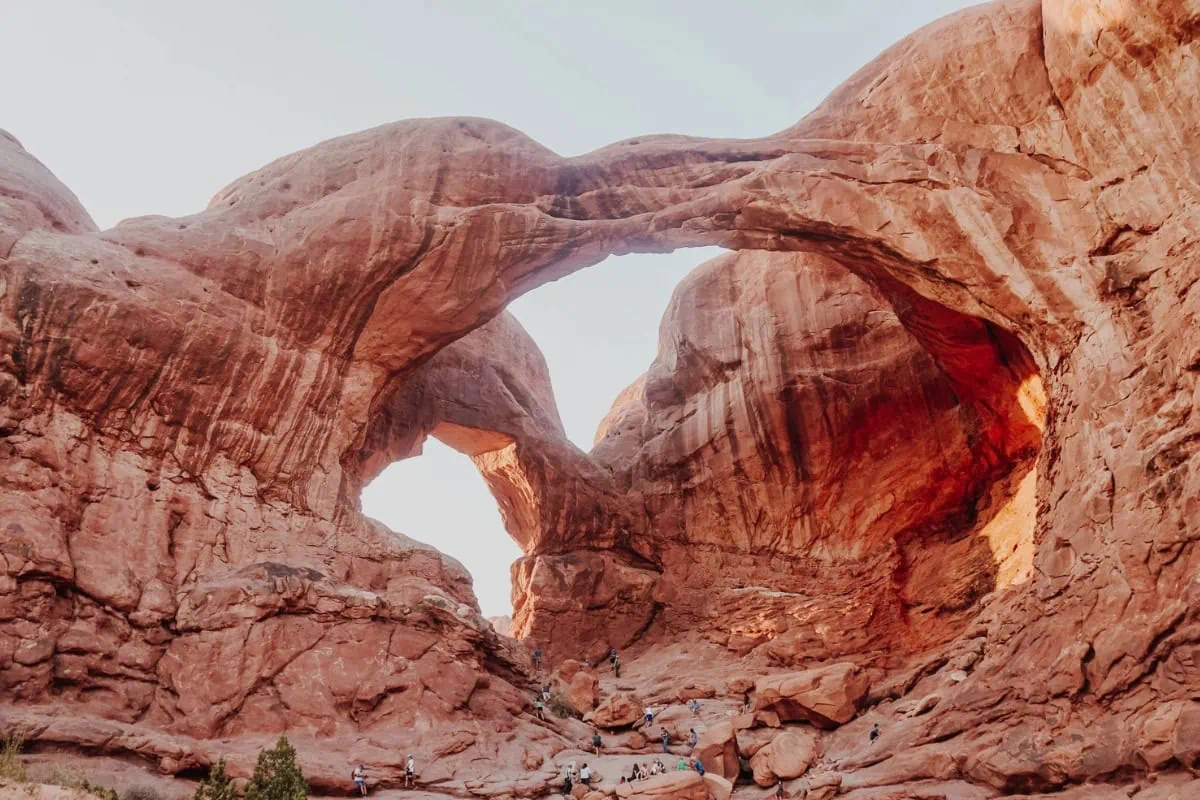
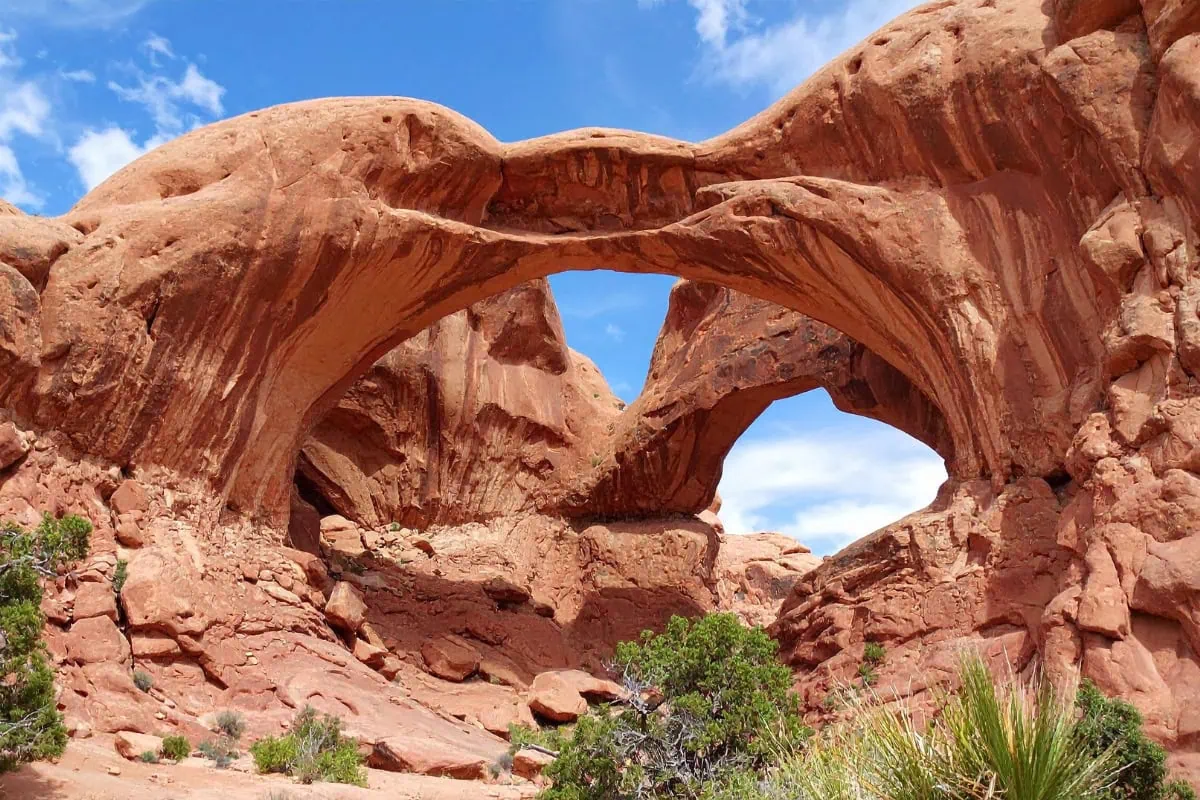
Directly opposite the Windows turnoff, you’ll find the car park for Double Arch — and this is one of my absolute favourite stops in the entire park. Double Arch consists of two massive arches sharing a single “leg.” The larger one spans over 45 metres and stands 32 metres tall.
The walk to it is easy and short (800 metres round trip on flat ground), but the experience is enormous. You stand beneath it and feel absolutely tiny. Sound resonates beautifully under the arches, and the light filtering through both of them in the late afternoon is pure magic.
Fun fact: You might recognise Double Arch from the opening scene of Indiana Jones and the Last Crusade. Yes, it was filmed here.
6. Delicate Arch — Utah’s Icon and the Number One Must-Do
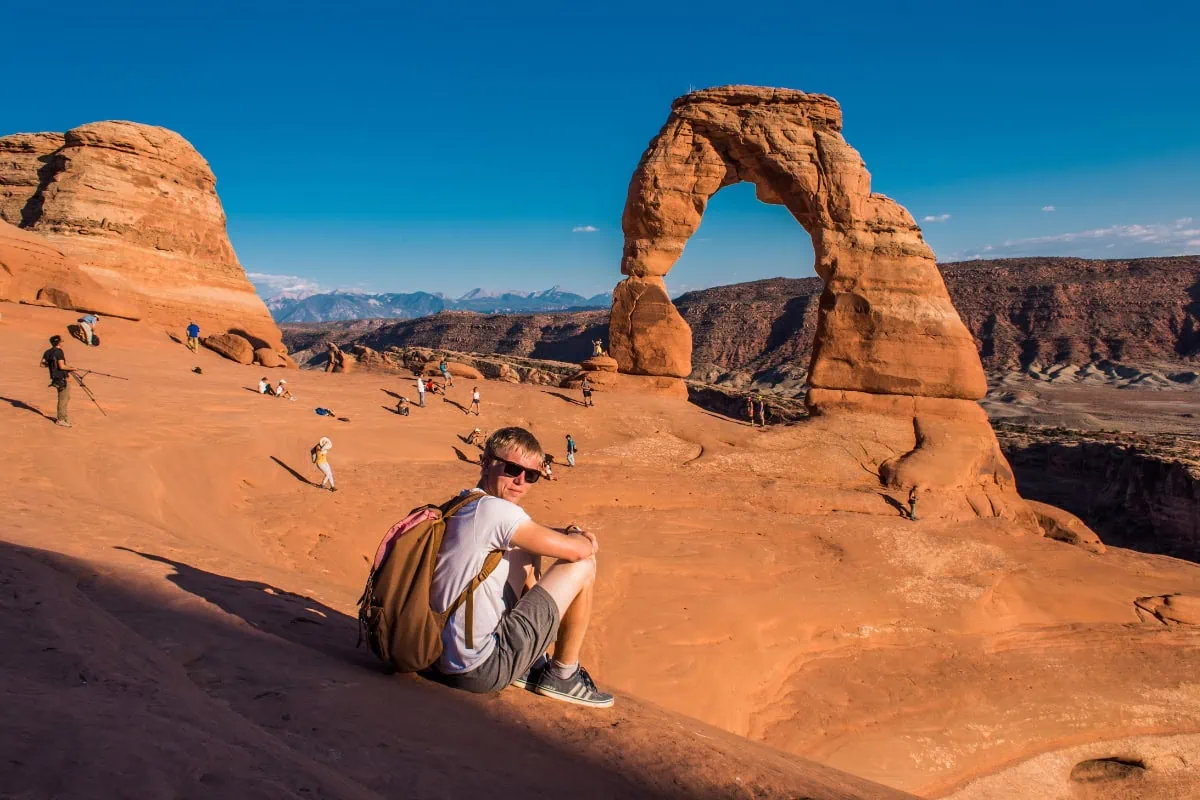
Here we go. Delicate Arch is probably the most photographed natural formation in all of Utah — you’ll find it on the Utah licence plate, on postage stamps, and on millions of Instagram photos. And believe me, it’s even better in person.
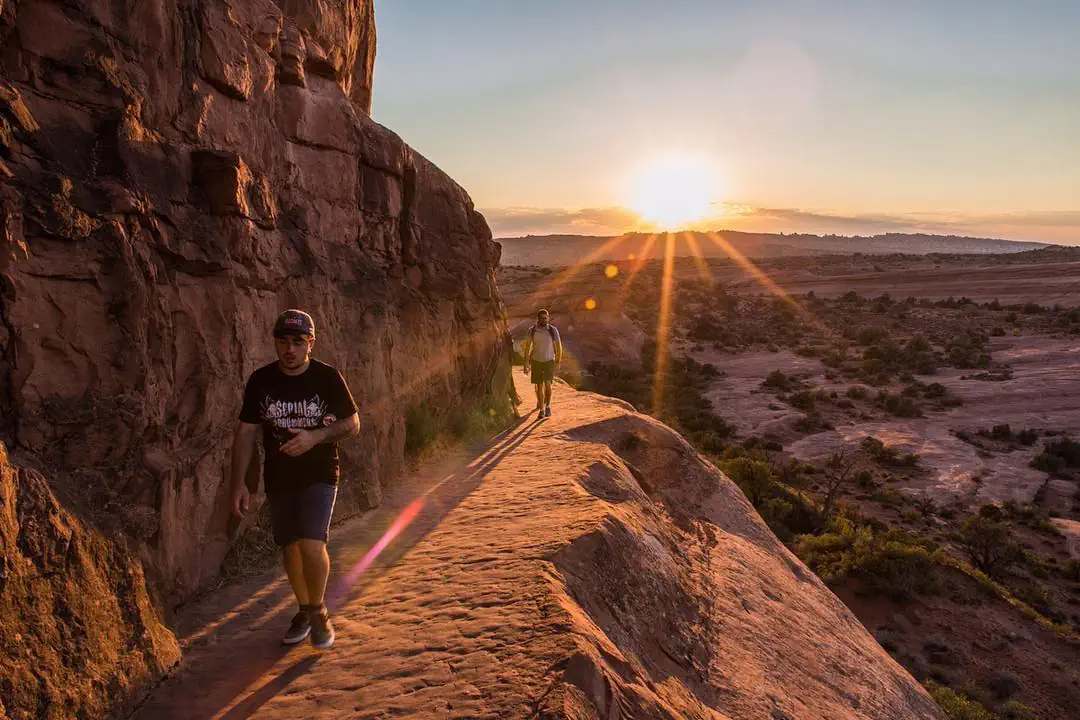
The Delicate Arch Trail is 4.8 km round trip with an elevation gain of about 146 metres. It’s no stroll — the final 800 metres cross exposed bare rock with no shade, and in summer it can be scorching. Allow 1.5–3 hours for the full hike (depending on your pace and how long you’ll stare at the arch — we stood there for an hour 😅).
Best time: Set off 1.5–2 hours before sunset. You’ll arrive at the top just in time to watch the arch gradually change colours from orange through crimson to deep purple. It’s one of those moments that makes you understand why you travel. Bring a headlamp for the way back — you’ll be returning in the dark, but the trail is well marked.
If you can’t or don’t want to hike: There are two viewpoints where Delicate Arch is visible from the road (Lower and Upper Viewpoint, 800 metres of walking combined), but honestly — it’s like looking at the Mona Lisa through frosted glass. If you’re physically able, do the trail. It’s worth every step.
Don’t forget to bring plenty of water (at least a litre per person), sunglasses, a hat, and good hiking boots — the terrain is rocky and slippery.
7. Fiery Furnace — A Labyrinth for Adventurers (Permit Required!)
Fiery Furnace is a narrow labyrinth of sandstone fins, tight passages, and hidden arches that you can only enter with a ranger-led tour or a special permit. And it’s one of the most amazing experiences in the entire park.
The ranger-led hike (about 3 hours, $10/person) is fantastic — the ranger guides you through the labyrinth, shows you hidden arches, explains the geology, and makes sure you don’t get lost (which could easily happen without a guide). Tours are booked on recreation.gov and sell out fast — book months in advance.
Self-guided entry with a permit is possible, but you first need to complete an online orientation video and demonstrate that you can navigate without marked trails. The permit costs $6 and is available on recreation.gov. This isn’t for beginners — there are no markers in the labyrinth and it’s easy to lose your way.
We went with a ranger and don’t regret it one bit. Our guide was incredibly knowledgeable, showed us miniature arches we’d never have found on our own, and the whole experience was more intimate than anything else in the park (groups have a maximum of 20 people).
8. Sand Dune Arch — A Secret Oasis Among the Rocks
This is my secret tip for families with children or for when you need an escape from the heat. Sand Dune Arch is tucked away between tall rock walls that create natural shade, and beneath the arch there’s soft sand where kids (and let’s be honest, adults too) love to play.
The trail is short — just 500 metres round trip along a sandy path between sandstone fins. It’s a bit like discovering a secret garden. Even in the fiercest summer heat, it’s several degrees cooler here.
9. Broken Arch — Surprisingly Still in One Piece
The name is misleading — Broken Arch isn’t actually broken. It does have a crack along its top, but it’s still holding together. The trail to it (2 km loop) leads through an open desert meadow with wildflowers in spring and makes for a pleasant, easy walk.
Bonus: Broken Arch is also accessible from Devils Garden Campground, so if you’re camping there, it’s literally right behind your tent.
10. Devils Garden Trail — An Arch Paradise at the End of the Road
Devils Garden Trail, at the very end of Arches Scenic Drive, is the longest and most rewarding trail in the park. Along its full length (11.6 km round trip), you’ll encounter at least seven named arches and countless other rock formations.
Most people walk only to Landscape Arch (the first mile — see tip #11) and turn back. But if you have the time and fitness, continue further — after Landscape Arch, the trail transforms from a comfortable path into an adventurous route across sandstone fins marked with cairns (stone markers), and the rewards are arches like Partition Arch, Navajo Arch, Double O Arch, and Dark Angel (a rock tower at the very end).
The full trail takes 3–5 hours and requires good fitness, plenty of water (3+ litres in summer), and proper hiking boots. The Primitive Trail on the return journey is less visited and offers a completely different perspective.
11. Landscape Arch — The Longest Arch in North America
Landscape Arch, with a span of nearly 93 metres, is the longest natural stone arch in North America (and one of the longest in the world). It’s incredibly thin and elegant — at its narrowest point, it’s only a few metres thick. It looks like it could collapse at any moment.
And that’s not far from the truth. In 1991, a chunk roughly 18 metres long broke off, and since then it’s been forbidden to walk beneath it. Geologists estimate that the arch will eventually fall — nobody knows when, but the fact that you can still see it standing is a bit like winning the lottery.
The walk to Landscape Arch is easy — 2.6 km round trip along a well-maintained path from the Devils Garden car park. Practically anyone can manage it.
12. Panorama Point and La Sal Mountains Viewpoint — Views in Every Direction
Two viewpoints along the main road that many people drive past because they’re in a rush to reach the arches. Mistake! Panorama Point offers a 360-degree view of the entire park and surrounding landscape — on a clear day, you can see all the way to the snow-capped La Sal Mountains, creating an incredible contrast with the red desert in the foreground.
The stop takes just 10 minutes, and the photos from here will be among the best you’ll take home from the park.
13. Courthouse Towers & Petrified Dunes — Desert Cathedrals
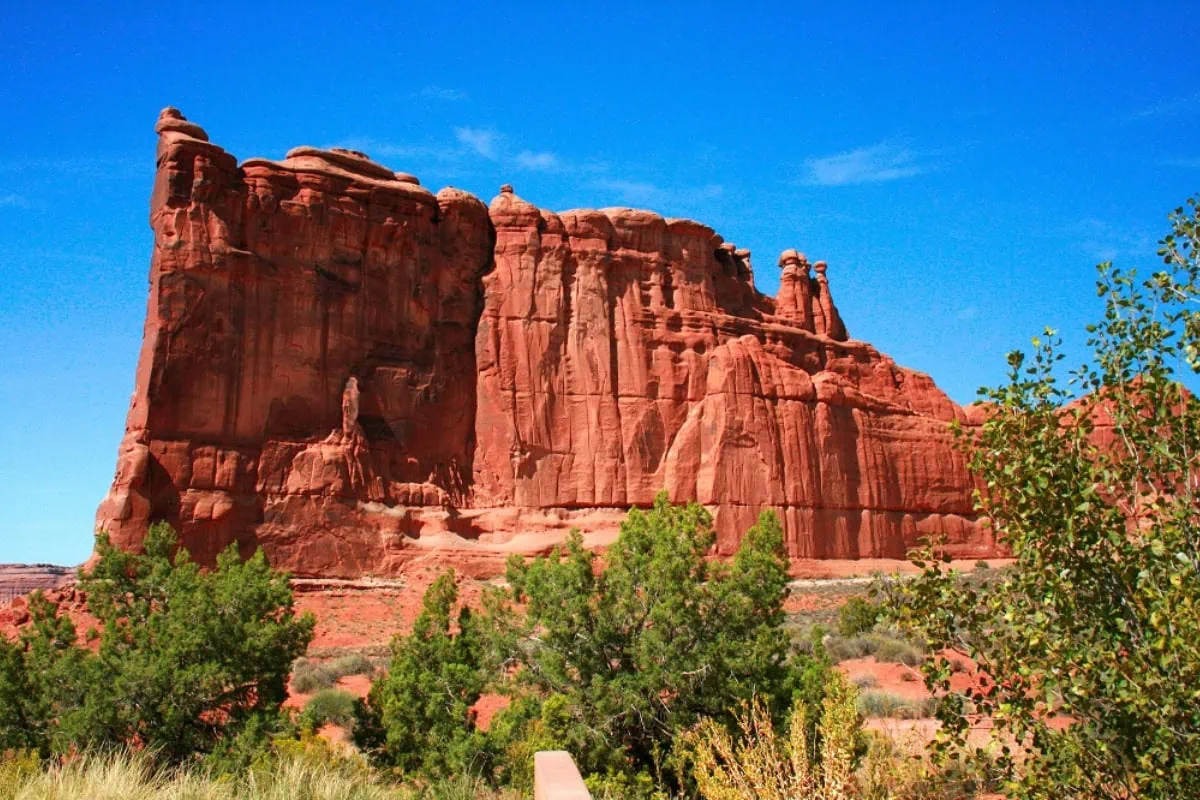
Just after Park Avenue, you’ll reach the Courthouse Towers area — massive rock towers named Three Gossips, Sheep Rock, and Tower of Babel. They’re not arches, but they’re imposing rock formations that deserve a stop.
A bit further on are the Petrified Dunes — petrified sand dunes that you can freely walk across. It’s a surreal landscape where you feel like you’re on Mars. A perfect spot for photographers at sunrise or sunset.
14. Fiery Furnace Viewpoint — When You Don’t Have a Permit
If you didn’t manage to get a permit or reservation for the ranger-led tour into Fiery Furnace (see tip #7), at least stop at the Fiery Furnace Viewpoint. From the overlook, you can see the labyrinth of sandstone fins from above, and at sunset, when the rocks light up in orange and crimson, you’ll understand why this area is called the “Fiery Furnace.”
15. Combine with Canyonlands — Two Parks, One Trip
This isn’t a tip from within Arches itself, but it would be foolish not to mention it. Canyonlands National Park is just about 40 minutes’ drive from Moab and is an entirely different world. While Arches is all about arches and rock formations, Canyonlands is about vast canyons, mesas, and viewpoints that will make your head spin.
The Island in the Sky section is the most accessible and can easily be visited in half a day — the Grand View Point and Mesa Arch viewpoints (a small arch with an iconic canyon view at sunrise) are absolute must-dos.
Our tip: Dedicate one day to Arches and a second day to Canyonlands Island in the Sky. If you have a third day, head to Dead Horse Point State Park — the view is comparable to the Grand Canyon and there’s a fraction of the crowds.
Food and Drink: Where to Eat in Moab
For a desert town, Moab is surprisingly well equipped when it comes to restaurants. After a day in the park surviving on trail bars and water from your CamelBak, you’ll appreciate a proper meal more than ever.
Breakfast and Coffee
Love Muffin Café — our number one breakfast spot. Homemade muffins, excellent eggs Benedict, and solid coffee. There’s usually a queue in the morning, but it moves fast. If you love specialty coffee, Moab Coffee Roasters roasts right in town and serves great espresso.
Lunch and Dinner
Quesadilla Mobilla — a food truck serving (surprise!) quesadillas that are so good people queue up for them. Fresh, creative filling combinations at reasonable prices ($8–12).
Antica Forma — the best pizza in Moab. Neapolitan style, thin crust, quality ingredients. Surprisingly authentic Italian food for a small town in the desert.
Desert Bistro — if you fancy something upscale, this is arguably the best restaurant in town. Seasonal menu, local ingredients, beautiful setting. Prices match the quality ($25–45 for a main course), but after a day in the desert, you deserve it. Book in advance.
Moab Brewery — a local brewery with decent food and excellent craft beer. The Dead Horse Amber Ale is a classic. Ideal for a relaxed evening after a demanding day.
Shopping and Picnic
City Market (Moab) — the largest supermarket in town. Stock up here on water, fruit, trail mix, and sandwiches for your outings. There are no shops or restaurants in the park — you need to bring everything with you.
Practical Tips for Visiting Arches National Park
What to Pack
Arches is a desert park with minimal shade. Absolute essentials:
- Water, water, water — at least 2–3 litres per person per day. In summer, probably more.
- Sun protection — high-SPF sunscreen, a hat, sunglasses
- Quality hiking boots — the rocky terrain is uneven and slippery. Check out our hiking boots guide.
- Headlamp — if you’re planning sunset at Delicate Arch, you’ll be walking back in the dark
- Layers of clothing — mornings and evenings can be chilly even in season (desert climate = huge temperature swings)
- Want to pack into carry-on only? We have a complete guide for that.
Travel Insurance and eSIM
For trips to the USA, definitely don’t skimp on travel insurance — healthcare in America costs astronomical sums, and a rescue operation in a national park can run into thousands of dollars. Check out our SafetyWing review, which we use for longer trips.
As for internet, American eSIM cards are thankfully easy to sort out nowadays. Read our Holafly review — we had excellent signal in Moab, while coverage in the park itself is limited (which is actually quite nice — a digital detox in the desert 😊).
Safety in the Park
- Don’t feed or approach wildlife — foxes, rabbits, and the occasional coyote live in the park
- Stay on marked trails — the biological soil crust (cryptobiotic soil) is a fragile ecosystem that takes decades to recover
- Watch out for lightning — monsoon season (July–September) brings afternoon storms. On rock plateaus, you’re the highest point — descend immediately if a storm hits
- Flash floods — after rain, narrow canyons can flood rapidly. Check the forecast
FAQ — Frequently Asked Questions About Arches National Park
Can you drive through Arches National Park?
Yes, a 29 km Arches Scenic Drive runs through the park, and you can see a number of rock formations (Balanced Rock, Courthouse Towers, Petrified Dunes) right from the car. But honestly — you’d miss the best bits. Delicate Arch, Devils Garden, Fiery Furnace, and most arches in the Windows Section all require at least a short walk. At the very minimum, get out at the Windows (10-minute walk) and Double Arch (5-minute walk) to have at least some close-up contact with the rocks.
What is Arches National Park famous for?
Arches National Park is famous for its more than 2,000 natural stone arches — it’s the greatest concentration of natural stone arches in the world. The most well-known is Delicate Arch, the icon of the state of Utah, which also appears on the local licence plate. Other famous arches include Landscape Arch (the longest in North America, spanning 93 metres), Double Arch (known from the film Indiana Jones and the Last Crusade), and the Windows — a pair of arches in a rock wall.
What is the nearest town to Arches National Park?
The nearest town is Moab, Utah — the park entrance gate is just 8 km (5 minutes’ drive) from the centre of Moab. Moab is the base for most visitors and offers a wide range of accommodation, restaurants, shops, and outdoor services. The nearest larger city with an international airport is Salt Lake City (370 km, 4 hours by car).
How much does it cost to enter Arches National Park?
The entrance fee is $30 per car (approximately £24) and is valid for 7 days. A motorcycle costs $25, and entry on foot or by bicycle is $15 per person. If you’re planning to visit multiple national parks, the America the Beautiful Pass at $80 (about £65) is worth it — it covers entry to all national parks in the USA for a full year. From April to October, you also need a timed entry reservation for $2 on recreation.gov.
How much time do I need for Arches National Park?
It depends on what you want to see. A minimum of 4–5 hours will cover the Scenic Drive, Windows, Double Arch, and Balanced Rock with short stops from the car. One full day allows you to also complete the Delicate Arch Trail and Devils Garden to Landscape Arch. Two days are ideal — you’ll manage all the main trails, Fiery Furnace, and can enjoy both sunrises and sunsets without rushing. We spent two days here and wanted more.
Do I need a reservation to enter Arches?
From April to October, yes — the park operates a timed entry system. Reservations are made on recreation.gov for a $2 fee and open 3 months in advance. Slots sell out very quickly (within minutes), so be on the website exactly when they open. Alternatively, you can enter without a reservation before 7:00 am or after 4:00 pm (times may vary — check the current rules on nps.gov). During the winter months (November–March), no reservation is needed.
Can you combine Arches with Canyonlands?
Absolutely, and we highly recommend it! Canyonlands National Park (Island in the Sky section) is just about 40 minutes’ drive from Moab and offers a completely different but equally stunning experience — deep canyons, Mesa Arch viewpoint, and Grand View Point. The ideal plan is to dedicate one day to Arches and a second day to Canyonlands. If you have time, add Dead Horse Point State Park and make it a full road trip through US national parks.
Tips and Tricks for Your Vacation
Don’t Overpay for Flights
Search for flights on Kayak. It’s our favorite search engine because it scans the websites of all airlines and always finds the cheapest connection.
Book Your Accommodation Smartly
The best experiences we’ve had when looking for accommodation (from Alaska to Morocco) are with Booking.com, where hotels, apartments, and entire houses are usually the cheapest and most widely available.
Don’t Forget Travel Insurance
Good travel insurance will protect you against illness, accidents, theft, or flight cancellations. We’ve had a few hospital visits abroad, so we know how important it is to have proper insurance arranged.
Where we insure ourselves: SafetyWing (best for everyone) and TrueTraveller (for extra-long trips).
Why don’t we recommend any Czech insurance company? Because they have too many restrictions. They set limits on the number of days abroad, travel insurance via a credit card often requires you to pay medical expenses only with that card, and they frequently limit the number of returns to the Czech Republic.
Find the Best Experiences
Get Your Guide is a huge online marketplace where you can book guided walks, trips, skip-the-line tickets, tours, and much more. We always find some extra fun there!


